
The mexican Frankliniella aurea Moulton, F. Bisaetaevenusta sp. nov., and F. prothoraciglabra sp. nov. species assemblages in the "Intonsa group" (Insecta, Thysanoptera: Thripidae)
Roberto M. Johansen and Aurea Mojica-Guzmán
Instituto de Biología, UNAM. Departamento de Zoología, Laboratorio de Entomología, Apartado Postal 70-153, 04510 Coyoacán, México, D.F. MEXICO.
Recibido: 22 de abril 2002
Aceptado: 20 de enero 2003
Resumen
Se hace la revisión de la especie norteamericana (Estados Unidos de América y México) Frankliniella aurea Moulton, 1948, misma que se le reconoce aquí como una "especie complejo", con base en que presenta tres formas de coloración en sus adultos; se aportan nuevos datos sobre los adultos hembras y se describe al macho. Conjuntamente, se describen tres especies nuevas, dos del noreste y una del noroeste de México, permitiendo la integración de un ensamble de especies, que también incluye a la especie brasileña F. zucchini Nakahara & Monteiro, 1999 recientemente encontrada en México; en el estudio de estas especies, se resalta la ausencia de la seda postocular i. Además se incluye la descripción de otras seis especies afines, cuyos adultos carecen de la seda postocular i, tres en cada uno de dos ensambles específicos: F. bisaetaevenusta sp. nov. y F. prothoraciglabra sp. nov. Se concluye que el ensamble Frankliniella aurea Moulton es afín al ensamble F. occidentalis (Pergande); el ensamble F. bisaetaevenusta es afín al ensamble F. williamsi Hood, mientras que el ensamble F. prothoraciglabra, es afín al ensamble F. ipomoeae Watson. Se comenta la información pertinente sobre agroecosistemas y ecosistemas naturales, así como de distribución geográfica. Se incluyen ilustraciones de cabeza, antenas, tórax y abdomen de las diez especies incluidas.
Palabras clave: Thysanoptera, Ensambles específicos Frankliniella aurea, F. bisaetaevenusta y F. prothoraciglabra, Taxonomía, Especies nuevas, México.
Abstract
A review of the North American (Mexico and the United States of America) species Frankliniella aurea Moulton, 1948, was carry out herein. It is now recognized as a "species complex", since its adults show three color forms; new data about the adults of both sexes is included, together with the description of the male. Three new related species, two from North Eastern Mexico, and one from North Western Mexico were described, allowing the integration of a "species assemblage", that also includes the Brazilian species F. zucchini Nakahara and Monteiro, 1999 which was recently found in Mexico; in the study of these species, the absence of the postocular setae i was pointed out. Futhermore, there are also included two related "species assemblages", F. bisaetaevenusta sp. nov. and F. prothoraciglabra sp. nov. each with three new Mexican species. It was concluded that the Frankliniella aurea Moulton species assemblage, is related to the F. occidentalis (Pergande) species assemblage; the F. bisaetaevenusta species assemblage is related to the F. williamsi Hood species assemblage, whereas the F. prothoraciglabra species assemblage is related to the F. ipomoeae Watson species assemblage. Pertinent data about the agroecosystems and natural ecosystems, as well as geographic distribution was discussed. Illustrations of the head, antennae, thorax and abdomen of 10 examined species are included.
Key Words: Thysanoptera, Species assemblages Frankliniella aurea, F. bisaetaevenusta and F. prothoraciglabra, Taxonomy, New species, Mexico.
Introducction
]]> The definition of Frankliniella aurea Moulton (four species), F. bisaetaevenusta sp. nov. (three species), and F. prothoraciglabra sp. nov. (three species), as three "species assemblages" within the "Intonsa group", was possible by means of the recognition of several shared color and morphologic characters, principally because of the lack of the postocular setae i; this fact is supported by the evidence found in one adult specimen (it has in one side the setae formula ii-iii, IV, in the other side i-iii, IV) of the species F. brevisaetaeoneillae (Johansen, 1998), in the F. desertileonidum Watson assemblage, but also in the F. paricutinensis Johansen (2000), and the adult males of F. hemerocallis J.C. Crawford (the females have the postocular setae formula i-iii, IV), but these species belongs into different "species assemblages". It is clear that the postocular setae i commonly exist in all the species belonging into the Intonsa group sensu Moulton (1948), but it was lost in the adults of both sexes in the Frankliniella desertileonidum Watson, F. paricutinensis Johansen, F. aurea, F. bisaetaevenusta sp. nov. and F. prothoraciglabra sp. nov. "species assemblage", thus having the postocular setae formula: ii-iii, IV. Recently, Nakahara and Monteiro (1999) described Frankliniella zucchini from Brazil; this species bears the postocular setae formula ii-iii, IV.Since the species number in the Intonsa group is still increazing, species assembling is a good neutral classifying solution. Mound & Marullo (1996) provided a key that is not reliable, in the first place because the morphologic characters used in some of the dichotomies are confusing; in the second place, they do not grouped the species as Hood (1925), Moulton (1948), and Sakimura & O'Neill (1979) did.
This is the fifth paper of a series planned to review the "species assemblages" within the "Intonsa Group". The terms assemblage, group, and complex, are used here as neutral terms in the sense of Mayr & Ashlock (1991).
Material and methods
The adult illustrations from each of the studied species, were taked from Canada balsam mounted slides. They are realistic microscopic interpretations, that were donne using a camera-lucida equipment, and two magnifications: 400 and 1000 X.
Depositories
CAS = California Academy of Sciences, San Francisco, California, United States of America.
IBUNAM = Instituto de Biología, Universidad Nacional Autónoma de México, México, D.F.
UAAAN = Universidad Agraria Antonio Narro, Saltillo, Coahuila, México.
]]>
Taxonomic list
Frankliniella aurea Moulton species assemblage
1. F. aurea Moulton
2. F. aureabouvardiae sp. nov.
3. F. aureasonorensis sp. nov.
4. F. sorghiaurea sp. nov.
5. F. zucchini Nakahara and Monteiro
Frankliniella bisaetaevenusta sp. nov. species assemblage
]]> 1. F. bisaetaeaurea sp. nov.2. F. bisaetaeminuta sp. nov.
3. F. bisaetaevenusta sp. nov.
Frankliniella prothotaciglabra sp. nov. species assemblage
1. F. axochcoglabra sp. nov.
2. F. prothoraciglabra sp. nov.
3. F. symphoricarpae sp. nov.
The Frankliniella aurea Moulton species assemblage
Diagnosis. Small species (females: 1.3-1.6; males: 1.2 mm in length) in the Intonsa group. Body color predominantly clear yellow (forma clara) with abundant yellow-orange subhypodermal pigment, except: tergites I-VIII each with a median anteromerginal dark brown blotch (forma maculata), or completly dark brown (forma bicolor). Fore wings light yellow; hind wings whitish-yellow. Ocellar crescents orange. Body setae dark brown.
]]> Morphology. Head (Figs. 1, 4, 12, 18) broader than long in posterior one half; occiput sculptured with open, parallel and confluent (at middle and both sides) striae. Postocular setae formula ii-iii, IV. Compound eyes ellipsoidal, very slightly protruding. Antennal segments (Figs. 9, 13) typical in the group, iii with slightly fungiform pedicel, IV-VI globose-elongate. Mouth-cone pointed, longer than head's dorsal length. Pronotum (Figs. 1, 4, 12) with its surface sculptured with fine transverse and confluent striae, becoming stronger at posterior margin; chaetotaxy, median transverse row with 3-5 setae; median pair of subposteromarginal setae advanced or not. Mesonotal plate transverse and hexagonal (Figs. 15, 21). Metanotal plate (Figs. 10, 16, 22) with a median pair of campaneiform sensilla, rarelly absent (one species); pterosternum (Fig. 2). Abdomen; tergite VIII with a complete posteromarginal comb. Males, with an oblong transverse glandular area in each of sternites III-VII (Fig. 5).


Specific differential characters. Body size proportions are variable between adults of the species. Antennal segments III-V are variable in color. There are differences in the head chaetotaxy, antennal segments (length versus width). The pronotal sculpture and chaetotaxy. The meso- and metanotal sculpture also varyes. The tergite I plate is also variable.
Comments. The Frankliniella aurea Moulton species assemblage is close to the F. occidentalis (Pergande) species assemblage, in color and morphological characters, specially the pronotal median transverse row with 3-5 setae, and the subposteromarginal setae, with the median pair advanced. However, they are different in the postocular setae formula: ii-iii, IV, v-vi in the F. aurea assemblage, and i-iii, IV, v-vi in the F. occidentalis assemblage.

Frankliniella aurea Moulton
(Figs. 1-11 (2, 3, 4, 5, 6, 7, 8, 9, 10), 77)
Frankliniella aurea Moulton, 1948: 96
Frankliniella aurea Moulton; Jacot-Guillarmod 1974: 764
]]> Frankliniella aurea Moulton; Mound & Marullo, 1996: 129Frankliniella aurea Moulton; Nakahara, 1997: 359
Frankliniella californica Moulton, 1911: 28 (in part).
Redescription
Female. Body color clear yellow, with yellow-orange subhypodermal pigment, except: tergites I-VIII each with a median dark chestnut brown blotch (forma maculata, Fig. 7), or abdomen completly dark brown (forma bicolor, Fig. 8). Antennal segments: I light brown; II dark brown; III yelowish-brown in basal one half, the rest dark brown; IV-VIII dark brown. All femora yellow, but dark brown at middle. Fore wings light yellow; hind wings whitish-yellow. Ocellar crescents orange. Body setae dark brown.
Morphology. Head in dorsal view (Fig. 1), broader (1.25 times) than long at middle, cheeks nearly subparallel; occiput sculptured with some open and parallel striae, confluent at middle and both sides. Chaetotaxy as follows: anteocellar pair I shorter than lateral ones (pair II); interocellars (pair III) almost subequal to compound eyes width, between fore and hind ocelli. Antennal segments (Fig. 9) typical in the group. Mouth-cone pointed, projected towards posterior margin of prosternum. Thorax; pronotum (Fig. 1) with its surface sculptured with faint transverse and confluent striae, becoming stronger in posterior margin; chaetotaxy: two pairs of minor anteromarginals (each pair near the respective major anteromarginal seta), median transverse row with four setae, four subposteromarginals forming a straight line or 1-2 of median pair advanced; pterosternum (Fig. 2); metanotal scutum (Fig. 10). Abdomen; tergite I (Fig. 11); tergites VI-VII (Figs. 7-8); tergites VIII-X (Fig. 3)
Measurements (N = 3, Holotype, 2 ♀♀ in µm).
Body length: 1.3-1.6 mm. Head dorsal length: 106-110. Width at eyes: 138, behind eyes: 136, middle: 138, basal: 138. Chaetotaxy, intocc: 52-60; postoc: IV 40-44. Compound eyes, length: 60, width: 48. Ocelli, fore: 12, hind: 12. Antennal segments, length (width): I 24 (28), II 40 (24), III 53-58 (20-23), IV 50-53 (20), V 44-48 (16), VI 50-56 (16), VII 10-12 (8), VIII 14-20 (6). Thorax; pronotum, length: 130-150, width at middle: 180-190. Chaetotaxy, major setae AA 72-93, AM 50-86; PA, outer: 70-90, inner: 80-83; minor setae: aa 30, am 16; pm i: 16, ii: 40, iii: 16. Mesothorax, width: 254; metathorax, width: 252. Fore wings, width at base: 96, at middle: 60; veins chaetotaxy, fore: 20, hind: 17. Abdomen; width at segment IV: 293. Tergite IX setae, IX 1: 110-112, IX ii: 122-126. Tergite X setae, X i: 126.
Male (Figs. 4-6). Similar to adult female but smaller and slender. Body color clear yellow (forma clara). Sternites II-VII (Fig. 5), each with an oblong transverse glandular area.
Measurements (♂ in µm). Body length: 1.2 mm.
]]> Head dorsal length: 80. Width at eyes: 122, behind eyes: 120, middle: 120, basal: 118. Chaetotaxy, intocc: 38; postoc: IV 28. Compound eyes, length: 46, width: 36. Ocelli, fore: 14, hind: 10. Antennal segments, length (width): I 24 (22), II 38 (20), III 50 (16), IV 46 (16), V 38 (16), VI 42 (16), VII 8 (8), VIII 10 (6). Thorax; pronotum, length: 106, width at middle: 148. Chaetotaxy, major setae AA 46, AM 40; PA, outer: 48, inner: 54; minor setae: aa 16, am 12; pm i: 12, ii: 34, iii: 14. Mesothorax, width: 194; metathorax, width: 172. Fore wings, width at base: 74, at middle: 44; veins chaetotaxy, fore: 19, hind: 14. Abdomen; width at segment IV: 164. Tergite IX setae, IX i: 26, IX ii: 60. Tergite X setae, X i: 68.Material examined. Ex-paratypes of Euthrips tritici var. californicus Moulton, 1911 (Frankliniella californica Moulton), 1948), 1 ♀ dorsal (left), 1 ♀ ventral (rigth) No. 101 C/CAS Type No. 10734. UNITED STATES OF AMERICA; CALIFORNIA: Yosemite Valley; 24-VI-1908; on lilac (D. Moulton), in CAS. MEXICO; ESTADO DE MEXICO: Chapingo (Volcanic Range), 2240 m.; 29-IX-1993; 2 ♀♀, 2 ♂♂ in flowers of Cucurbita pepo L. (Lourdes Cervantes-Díaz), in IBUNAM. Idem, Coatepec Harinas, Municipio de Villa Guerrero (Volcanic Range), 2000 m.; 15-V-1993; 1 ♂ in Dendranthema grandiflora cv. polaris Tzvelev (Daniel Ochoa, Lourdes Cervantes & T. Vargas), in IBUNAM. MICHOACAN: Municipio de Nuevo San Juán Parangaricutiro, El Durazno (Volcanic Range), 2300 m.; 24-I-1999; 1 ♀ in young foliar buds of Persea americana Miller (Guadalupe Ascención-Betanzos), in IBUNAM. SINALOA: La Cruz; 15-III-2000; 1 ♀ in "Bell Peper" plants Capsicum annum L. crop (Bayer de México), in IBUNAM. COAHUILA: Saltillo (Sierra Madre Oriental), 1599 m; 23 VII-1997; 1 ♀ (forma bicolor) in Reseda luteola L. (Luz-Bertha Morales-Cruz), in UAAAN. Idem, Saltillo-Buenavista (UAAAN Campus), 2000 m.; 9-VII-1997; 1 ♀ in Ipomoea purpurea (L.B. Morales-C.), in UAAAN. Idem, Presa de la Amistad, near Ciudad Acuña (Sierra Madre Oriental), 200 m; 10-VIII-1997; 1 ♀ in Nicotiana sp. (L.B. Morales-C.), in UAAAN. SONORA: Costa de Hermosillo; 13-V-1999; 2 ♀♀ (forma maculata) in Vitis vinifera L. (Diego Cerecer/Bayer), in IBUNAM.
Comments. The single Holotype ♀ of Frankliniella aurea, together with the additional females from Central Mexico (Estado de México), North Western Region (Sinaloa), Central Western Region (Michoacán), and the North Eastern part of the Sierra Madre Oriental (Coahuila), share the color and morphologic characters of the original description by Moulton (1948), that is, they belong to the "forma maculata" (body clear yellow, with a dark brown median spot on the anterior margin in each of tergites I-VIII (Fig. 7). However the "forma bicolor" (body clear yellow with dark brown abdomen), is known from California, U.S.A. and Coahuila, Mexico; the Californian specimens were found within the paratypes series of Frankliniella californica (Moulton, 1911) (Figs. 1-3, 8-11), a synonym of F. occidentalis (Pergande), according to Bryan & Smith (1956) and Nakahara (1997). Furthermore, the clear yellow males "forma clara", were found at Chapingo and Villa Guerrero, Estado de México (Figs. 4-6).
The above evidences, allow to consider Frankliniella aurea Moulton as a "species complex" in the sense of Bryan & Smith (1956).
Frankliniella aureabouvardiae sp. nov.
(Figs. 12-17)
Female. Body color clear yellow, except: antennal segments, I whitish-yellow; II light yellow in basal one half, light brown in apical half; III yellowish in basal two thirds, the rest light brown; IV yellow in basal one half, the rest dark brown; V yellow in basal one half, brown in pedicel and apical one half; VI-VIII dark brown. Fore wings light yellow; hind wings whitish-yellow. Body setae brown.
Morphology. Head in dorsal aspect (Fig. 12), broader (1.42 times) than long at middle; occiput sculptured with parallel striae, wich become confluent behind each compound eyes, and more close behind posterior ocelli. Chaetotaxy as follows: anteocellars (pairs I-II) longer than one ocellar diameter; interocellars (pair III) shorter than compound eyes. Antennal segments (Fig. 13) typical in the group; III longer than the others. Mouth-cone pointed and longer than head's dorsal length. Pronotum (Fig. 12) sculptured with faint transverse striae; chaetotaxy as follows: four minor anteromarginals, the median pair advanced. Pterothorax; mesonotum (Fig. 15); metanotal scutum (Fig. 16), without a pair of campaneiform sensilla. Abdomen; tergite I (Fig. 17); tergites VIII-X (Fig. 14).
Measurements (Holotype ♀ in µm). Body length: 1.53 mm.
Head dorsal length: 122. Width at eyes: 160, behind eyes: 168, middle: 174, basal: 160. Chaetotaxy, intocc: 34; postoc: ii 14, iii 10, IV 34, v 12. Compound eyes, length: 68, width: 48. Ocelli, fore: 12, hind: 12. Antennal segments, length (width): I 24 (28), II 38 (28), III 46 (24), IV 40 (22), V 32 (18), VI 42 (18), VII 8 (6), VIII 10 (4). Thorax; pronotum, length: 130; width at middle: 216. Chaetotaxy, major setae AA 60, AM 50; PA, outer: 60, inner: 70; minor setae: aa 18, am 12; pm i: 12, ii: 40, iii: 12. Mesothorax, width: 362; metathorax, width: 340. Fore wings, width at base: 92, middle: 60; veins chaetotaxy, fore: 20, hind: 15. Abdomen; width at segment IV: 326. Tergite IX setae, IX i: 80, IX ii: 94. Tergite X setae, X i: 98.
]]> Material examined. Holotype ♀ (NaOH treated). MEXICO; COAHUILA: Saltillo, Jagüey de Feru (Sierra Madre Oriental), 1999 m.; 18-VII-1997; en Bouvardia tenuifolia (Luz-Bertha Morales-Cruz) en IBUNAM.Comments. The adult of Frankliniella aureabouvardie sp. nov. is different from the other three species (F. aurea, F. sorghiaurea and F. zucchini), because it lacks the pair of campaneiform sensilla in the metanotal scutum.
Derivatio nominis: from Latin aurea = golden, a related species; bouvardia = the botanical name of a genus (Rubiaceae).
Frankliniella aureasonorensis sp. nov.
(Figs. 24-30 (25, 26, 27, 28, 29), 77)


Female. Body color clear yellow, with orange subhypodermal pigment, except: tergites I-VIII each with a median dark chestnut brown spot in anterior margin (Fig. 26); tergite X dark chestnut in posterior end (Fig. 26). Antennal segments: I yellow; II yellow in basal one third, the rest dark brown; III-IV yellow in basal two thirds and one half respectivelly, the rest dark brown; V yellow in basal one half, dark brown in pedicel and apical one half; VI-VIII dark brown. Fore wings clear yellow, hind wings whitish-yellow. Ocellar crescents brownish. Body setae dark brown.
]]> Morphology. Head in dorsal view (Fig. 24), broader (1.40 times) than long at middle and both sides. Chaetotaxy as follows: anteocellar pair I reduced and shorter than lateral ones (pair II), in both cases shorter than one ocellar diameter; interocellars (pair III) shorter than compound eyes, between fore and hind ocelli. Antennal segments (Fig. 27) typical in the group, III the longest. Mouth-cone pointed and longer than head's dorsal length, projected into anterior two thirds of prosternum. Thorax; pronotum (Fig. 24) sculptured with faint close and transverse striae, becoming stronger in posterior margin; chaetotaxy as follows: four minor anteromarginals regularly placed; median transverse row with three very close together setae forming a V; posteromarginal ii subequal in length to interocellars (pair III). Pterosternum (Fig. 25); mesonotum (Fig. 28); metanotal scutum (Fig. 29). Abdomen; tergite I (Fig. 30); tergites VIII-X (Fig. 26).Measurements (Holotype ♀ in µm). Body length: 1.46 mm.
Head dorsal length: 94. Width at eyes: 132, behind eyes: 130, middle: 132, basal: 126. Chaetotaxy, intocc: 38; postoc: ii 14, iii 10, IV 30. Compound eyes, length: 50, width: 42. Ocelli, fore: 16, hind: 10. Antennal segments, length (width): I 26 (26), II 40 (22), III 54 (20), IV 48 (18), V 38 (16), VI 48 (16), VII 10 (6), VIII 12 (4). Thorax; pronotum, length; 130, width at middle: 166. Chaetotaxy, major setae: AA 56, AM 50; PA, outer: 56, inner: 62; minor setae: aa 24, am 14; pm i: 16, ii: 38, iii: 14. Mesothorax, width: 216; metathorax, width: 206. Fore wings, width at base: 88, middle: 54; veins chaetotaxy, fore: 19, hind: 14. Abdomen; width at segment IV: 264. Tergite IX setae, IX i: 80, IX ii: 96. Tergite X setae, X i: 120.
Material examined. Holotype ♀. MEXICO; SONORA: Costa de Hermosillo; 13-V-1999; in Vitis vinifera L. (Diego Cerecer/Bayer), in IBUNAM.
Comments. The adult of Frankliniella aureasonorensis sp. nov., resemble those of F. aurea Moulton. However, both species are different in the following characters: in F. aureasonorensis the anteocellars I are very minute; the interocellars (pair III) are shorter than compound eyes. Pronotal chaetotaxy: the minor anteromarginals are regularly spaced (in F. aurea are paired, each pair close to the respective major anteromarginal seta); the median transverse row has three very close together setae, forming a V. The metanotal scutum has more equiangular reticles at middle (elongate in F. aurea). Tergite I has a different sculpture (more open reticles) and the campaneiform sensilla are broadly separated. Tergite IX setae IX i and IX ii are shorter.
Derivatio nominis: from Latin, aurea = golden; sonorensis, sonora = a federal state in North Western Mexico, from Latin, ensis = locative. In allusion to the related species F. aurea Moulton and the Type locallity.
Frankliniella sorghiaurea sp. nov.
(Figs. 18-23 (19, 20, 21, 22), 77)
Female. Body color clear yellow, except: antennal segments, I whitish-yellow; dark brown with yellow base; III-IV yellow in basal one half, the rest dark brown; V dark chestnut brown, yellow in extreme base; VI-VIII dark chestnut brown. Tergites II-VIII each with a dark brown median spot in anterior margin. Fore wings clear yellow; hind wings whitish-yellow. Body setae dark brown.
Morphology. Head in dorsal aspect (Fig. 18), broader (1.54 times) than long at middle; occiput sculptured with open parallel and confluent striae, wich become closer near postocular setae. Chaetotaxy as follows: anteocellars (pairs I-II) longer than one ocellar diameter; interocellars (pair III) slightly longer than compound eyes width. Antennal segments (Fig. 19) typical in the group; III longer than the others; IV and VI subequal in length. Pronotum (Fig. 18) sculptured with some faint transverse striae at center; chaetotaxy as follows: six minor anteromarginals, median transverse row with four setae forming a triangle, four subposteromarginals, the median pair advanced. Pterothorax; mesothorax (Fig. 21); metanotal scutum (Fig. 22). Abdomen; tergite I (Fig. 23); tergites VIII-X (Fig. 20).
]]> Measurements (Holotype ♀ in µm). Body length: 1.33 mm.Head dorsal length: 106. Width at eyes: 154, behind eyes: 156, middle: 164, basal: 160. Chaetotaxy, intocc: 48; postoc: ii-iii 12; IV 40. Compound eyes, length: 68, width: 44. Ocelli, fore: 10, hind: 10. Antennal segments, length (width): I 24 (26), II 36 (22), III 48 (20), IV 44 (18), V 36 (16), VI 44 (16), VII 10 (6), VIII 12 (4). Thorax; pronotum, length: 124; width at middle: 190. Chaetotaxy, major setae: AA 64, AM 56; PA, outer: 64, inner: 72; minor setae: aa 24, am 16; pm i: 16, ii: 40, iii: 16. Mesothorax, width: 258; metathorax, width: 238. Fore wings, width at base: 100, middle: 60; veins chaetotaxy, fore: 22, hind: 15. Abdomen; width at segment IV: 320. Tergite IX setae, IX i: 100, IX ii: 116. Tergite X setae, X i: 122.
Material examined. Holotype ♀ (NaOH treated). MEXICO; COAHUILA: Saltillo, Universidad Autónoma Agraria Antonio Narro Campus Buenavista (Sierra Madre Oriental), 2000 m.; 1-VII-1997; in Sorghum bicolor (Luz-Bertha Morales-Cruz), in IBUNAM.
Comments. The adult of Frankliniella sorghiaurea sp. nov., is different from those of F. aurea and F. zucchini, because the pronotum bears six minor anteromarginal setae, the median transverse row has four setae forming a V, and the metanotal scutum is sculptured at middle with an area of long concentric reticles; in F. zucchini, there is only a median pair of subposteromarginal setae.
Derivatio nominis: from Latin, Sorghum = the botanical name of a Poaceae genus; aurea = golden, a related species.
Frankliniella zuchhini Nakahara & Monteiro
Frankliniella zucchini Nakahara & Monteiro, 1999: 290
This Brazilian species was recently decribed by Nakahara and Monteiro (1999), as a new species (here incorporated in the Frankliniella aurea Moulton species assemblage), and as a vector of tospoviruses in Cucurbita pepo L. cv. Caserta, in São Paulo, Brazil. Frankliniella aurea Moulton was also collected in Cucurbita pepo L. in Chapingo, México. The Mexican female specimen herein recorded, was found in Persea americana Miller foliar buds. It is slightly different from the Brazilian specimens, because the antennal segment II is completly dark chestnut brown.
Material examined. MEXICO; MICHOACAN: Municipio de Nuevo San Juán Parangaricutiro, El Durazno (Volcanic Range), 2300 m.; 5-IV-1999; 1 ♀ in young foliar buds of Persea americana Miller cv. Hass (Guadalupe Ascención-Betanzos), in IBUNAM.
The Frankliniella bisaetaevenusta sp. nov. species assemblage
]]> Diagnosis. Small species (females: 1.58-1.60 mm in length).Color predominantly clear yellow, with abundant yellow to orange subhypodermal pigment, except: tergites I-VIII each with a median anteromarginal blotch, or completly dark chestnut brown. Antennal segments III-V bicolored yellow and brown. Fore wings clear yellow; hind wings whitish-yellow. Ocellar crescents orange. Body setae brown.
Morphology. Head (Figs. 31, 37, 44), broader than long in posterior one half; occiput sculptured with open parallel striae. Antennal segments (Figs. 32, 40, 45) typical in the group. Mouth-cone pointed and short. Pronotum with a median transverse row of only two setae (Figs. 31, 37, 44). Metanotal scutum with a pair of campaneiform sensilla (Figs. 35, 47, 48). Abdomen; tergite VIII with a complete posteromarginal comb (Figs. 33, 39, 50).

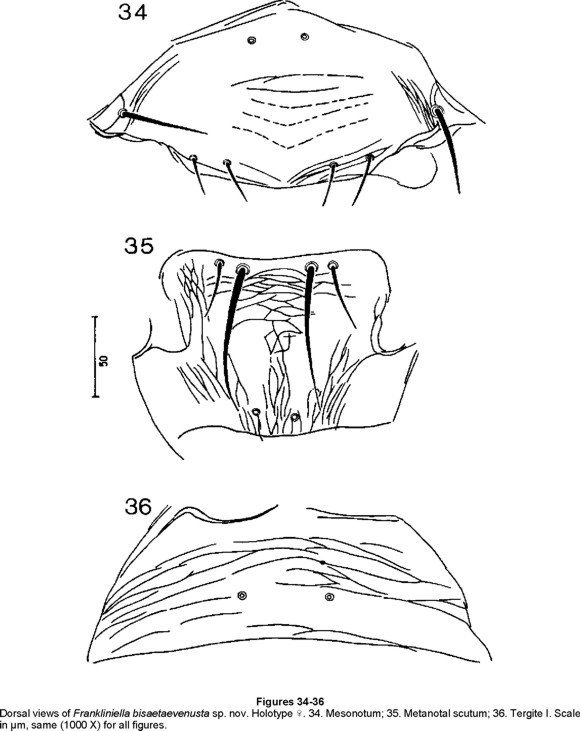

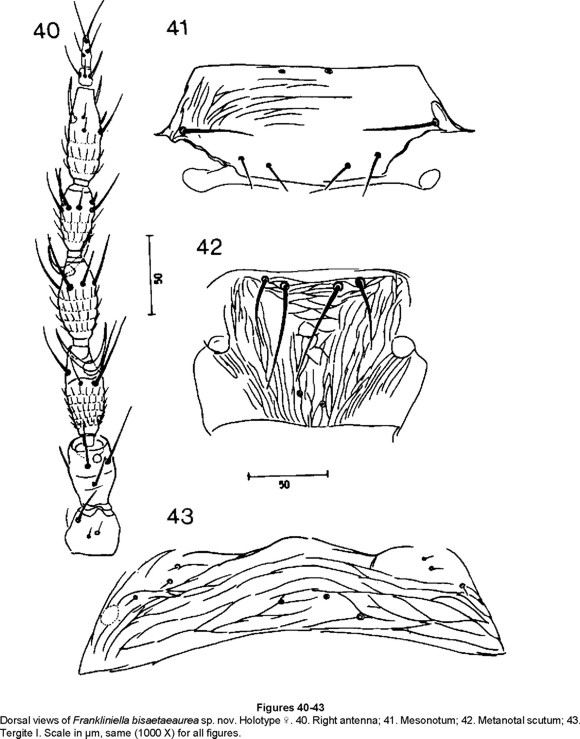


Specific differential characters. Body size proportions are variable between adults of the species. Antennal segments III-V are variable in color. There are differences in the head chaetotaxy, antennal segments (length versus width). The pronotal chaetotaxy also varyes; the meso- and metanotal sculpture also varyes. The tergite I plate is also variable.
Comments. The Frankliniella bisaetaevenusta sp. nov. assemblage, is close to the F. williamsi Hood assemblage in color (specially fore wings clear yellow) and morphologic characters (the pronotal median transverse row with two setae only), except for the postocular setae formula: ii-iii, IV, v-vi in the F. bisaetaevenusta assemblage, and i-iii, IV, v-vi in the F. williamsi assemblage.

Frankliniella bisaetaeaurea sp. nov.
(Figs. 37-43 (38, 39, 40, 41, 42), 78)
Morphology. Head in dorsal aspect (Fig. 37), broader (1.46 times) than long at middle, and with slightly sinuouse cheeks; occiput sculptured with parallel striae confluent at middle. Chaetotaxy as follows: anteocellars (pair I) subequal or shorter than one ocellar diameter, whereas those of pair II longer; interocellars (pair III) long and between fore and hind ocelli. Antennal segments (Fig. 40). Mouth-cone longer than head's dorsal length. Pronotum (Fig. 32) broader (1.61 times) than long; its surface almost smooth, but with some transverse striae in anterior and posterior margin, as well as at center. Pterothorax; pterosternum (Fig. 38); mesonotum (Fig. 41); metanotum (Fig. 42). Abdomen; tergite I (Fig. 43); tergites VIII-IX (Fig. 39).
Measurements (Holotype ♀ in µm). Body length: 1.54 mm.
Head dorsal length: 100, width at eyes: 142, behind eyes: 140, middle: 146, basal: 142. Chaetotaxy, intocc: 46; postoc: ii 12, iii 12, IV 26, v 18. Compound eyes, length: 60, width: 50. Ocelli, fore: 14, hind: 12. Antennal segments, length (width): I 24 (26), II 36 (24), III 52 (20), IV 46 (20), V 40 (18), VI 48 (18), VII 8(8), VIII 14 (6). Thorax; pronotum, length: 114, width at middle: 184. Chaetotaxy, major setae: AA 64, AM 52; PA, outer: 66, inner: 72; minor setae: aa 22, am 16; pm i: 16, ii: 48, iii: 16. Mesothorax, width: 264; metathorax, width: 258. Fore wings, width at base: 86, middle: 50; veins chaetotaxy, fore: 22, hind: 17. Abdomen; width at segment IV: 296. Tergite IX setae, IX i: 102, IX ii: 112. Tergite X setae, X i: 128.
Material examined. Holotype ♀, Paratype ♀. MEXICO; DISTRITO FEDERAL: Ciudad de México (Volcanic Range), 2240 m.; 29-IX-1972; (Holotype) in flower of Rosa centifolia (Roberto M. Johansen), in IBUNAM; Idem, Xochimilco, San Gregorio Atlapulco (Volcanic Range), 2240 m.; 23-VIII-1999; (Paratype) in flowers of "monedero" (Martha Yazmín Sánchez-Roncancio), in IBUNAM.
Comments. This species is different from the other two in the assemblage, because of the very short anteocellar setae pair I, the pronotum with only one pair of minor anteromarginal setae, and only one pair of subposteromarginal setae.
Derivatio nominis: from Latin, bi = two; saetae = setae; aurea = golden, a related species.
Frankliniella bisaetaeminuta sp. nov.
(Figs. 44-50, 78)
Female. Body color clear yellow, except: antennal segments, I whitish-yellow; II yellow in basal one third, the rest light brown; III yellow in basal two thirds, the rest dark brown; IV yellow in basal one half, the rest dark brown; V yellow in basal two thirds, dark brown in pedicel and apical one third; VI-VIII dark brown. Fore wings yellow ; hind wings whitish-yellow. Body setae dark brown.
]]> Morphology. Head in dorsal aspect (Fig. 44), broader (1.6 times) than long at middle, and with very slightly sinuouse cheeks; compound eyes slightly protruding; occiput sculptured with open parallel striae, confluent at center and both sides, becoming closer towards postocular setae. Chaetotaxy as follows: anteocellars (pairs I-II) much shorter than one ocellar diameter; interocellars longer than compound eyes width, and placed between fore and hind ocelli. Antennal segments (Fig. 48). Mouth-cone rounded and shorter than head's dorsal length. Pronotum (Fig. 44) almost smooth, but with some faint transverse striae in anterior one half and posterior margin. Chaetotaxy as follows: three minor anteromarginals, a pair of subposteromarginals. Pterothorax; pterosternum (Fig. 46); mesonotum (Fig. 47); metanotal scutum (Fig. 48) with concentric equiangular and elongate reticulation at center, a pair of very close campaneiform sensilla. Abdomen; tergite I (Fig. 49); tergites VIII-X (Fig. 50).Measurements (Holotype ♀ in µm). Body length: 1.08 mm.
Head dorsal length: 80, width at eyes: 122, behind eyes: 122, middle: 128, basal: 124. Chaetotaxy, intocc: 40; postoc: ii 10, iii 8, IV 24, v 8. Compound eyes, length: 50, width: 34. Ocelli, fore: 10, hind: 10. Antennal segments, length (width): I 22 (22), II 30 (20), III 40 (18), IV 36 (16), V 30 (14), VI 40 (14), VII 8 (6), VIII 10 (4). Thorax; pronotum, length: 118, width at middle: 148. Chaetotaxy, major setae: AA 50, AM 40; PA, outer: 48, inner: 56; minor setae: aa 18, am 10; pm i: 10, ii 30, iii 12. Mesothorax, width: 194; metathorax, width: 172. Fore wings, width at base: 68, middle: 48; veins chaetotaxy, fore: 20, hind: 14. Abdomen; width at segment IV: 146. Tergite IX setae, IX i: 76, IX ii: 86. Tergite X setae, X i: 86.
Material examined. Holotype ♀, Paratype ♀ (NaOH treated). MEXICO; COAHUILA: Municipio de Saltillo, Panteón Frontera (Sierra Madre Oriental), 2000 m.; 12-X-1997 (Holotype), in Pennisetum ciliare (Luz-Bertha Morales-Cruz), in IBUNAM.; Municipio General Cepeda, Ejido El Mimbre (Sierra Madre Oriental), 2000 m.; 2-VIII-1997 (Paratype), in Solanum eleagnifolium (L.B. Morales-Cruz), in UAAAN.
Comments. Adults of Frankliniella bisaetaeminuta sp. nov., are the smallest in the F. bisaetaevenusta assemblage; they are also different from the other two species in the assemblage, because the anteocellar setae (pairs I-II) are very small and much shorter than one ocellar diameter; the pronotum bears three minor anteromarginal setae, and a pair of subposteromarginals.
Derivatio nominis: from Latin, bi = two; saetae = setae; minuta = minute.
Frankliniella bisaetaevenusta sp. nov.
(Figs. 31-36 (32, 33, 34, 35), 78)
Female. Body color clear yellow, with abundant yellow subhypodermal pigment, except: tergites I-VIII each with a dark brown median spot in anterior margin. Antennal segments, I whitish yellow; II dark chestnut brown, lighter at base; III clear yellow in basal two thirds, the rest dark brown; IV-V clear yellow in basal one half, the rest dark brown; VI-VIII dark chestnut brown. Fore wings clear yellow; hind wings whitish-yellow. Ocellar crescents orange. Body setae dark brown.
Morphology. Head in dorsal aspect (Fig. 31), broader (1.23 times) than long at middle; cheeks convex; occiput sculptured with open parallel striae, confluent behind each compound eye. Chaetotaxy as follows: anteocellars (pair I) shorter than the lateral ones (pair II), in both cases longer than one ocellar diameter; interocellars (pair III) longer than compound eyes width; postocular ii longer than iii. Antennal segments (Fig. 32) typical in the group, III longer than the others. Mouth-cone pointed, shorter than head's dorsal length and projected on anterior one half of prosternum. Pronotum (Fig. 31), broader (1.24 times) than long at middle; its surface sculptured with faint transverse and confluent striae at middle. Mesonotum (Fig. 34); metanotal scutum (Fig. 35). Abdomen; tergite I (Fig. 36); tergites VIII-X (Fig. 33).
]]> Measurements (Holotype ♀ in µm). Body length: 1.60 mm.Head dorsal length: 130, width at eyes: 160, behind eyes: 156, middle: 160, basal: 140. Chaetotaxy, intocc: 62; postoc: ii-iii 18, IV 40. Compound eyes, length (width): I 40 (28), II 42 (24), III 64 (22), IV 54 (20), V 42 (20), VI 52 (18), VII 10 (8), VIII 16 (6). Thorax; pronotum, length: 156, width at middle: 194. Chaetotaxy, major setae. AA 74, AM 72; PA, outer: 86, inner: 88; minor setae: aa 26, am 24; pm i: 24, ii: 50, iii: 20. Mesothorax, width: 286; metathorax, width: 266. Fore wings, width at base: 110, middle: 68; veins chaetotaxy, fore: 23, hind: 19. Abdomen; width at segment IV: 340. Tergite IX setae, IX i: 110, IX ii: 122. Tergite X setae, X i: 118.
Material examined. Holotype ♀. MEXICO; HIDALGO: Sierra de Zacualtipán (Sierra Madre Oriental), 2 km al W de Calnalli, 1250 m.; 2-III-1981; in flowers of Stevia sp. within Mountain Deciduous Forest (Roberto M. Johansen), in IBUNAM.
Comments. The adult of Frankliniella bisaetaevenusta sp. nov., is different from the other two species in the F. bisaetaevenusta species assemblage in the head shape; the pronotum with four minor anteromarginal setae, and four subposteromarginals in a stright line.
Derivatio nominis: from Latin, bi = two; saetae = setae; venusta = plenty of beauty or elegance.
The Frankliniella prothoraciglabra sp. nov. species assemblage
Diagnosis. Small species (females: 1.51-1.71; males: 1.18 mm in length). Color predominantly clear yellow or dark chestnut brown, with abundant yellow to orange subhypodermal pigment, except: tergites I-VIII each with a dark brown median spot in anterior margin, or abdomen completly dark chestnut brown. Antennal segments III-V bicolored yellow and brown. Fore wings clear yellow; hind wings whitish-yellow. Ocellar crescents orange. Body setae brown.
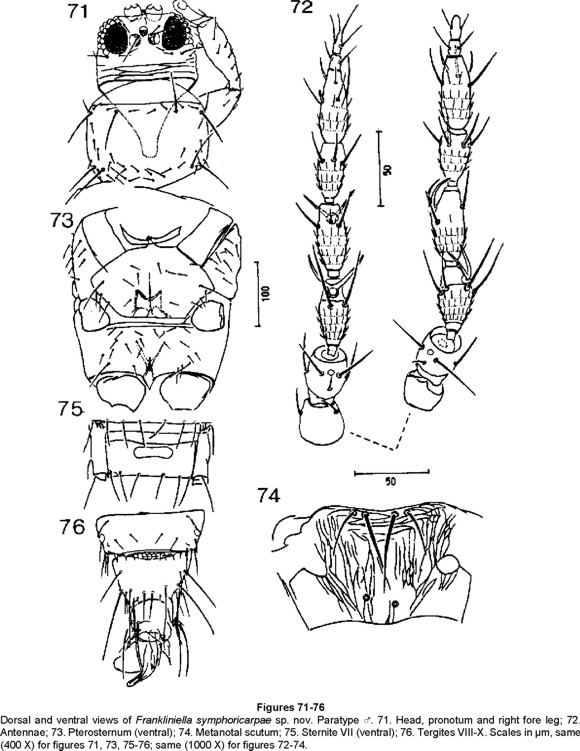
Morphology. Head (Figs. 51, 58, 68, 71), broader than long in posterior one half; occiput sculptured with open parallel striae. Antennal segments III-V (Figs. 54, 61, 66, 72) typical in the group. Mouth-cone longer than head's dorsal length. Pronotum glabrous at center and without any setae. Metanotal scutum (Figs. 56, 63, 69, 74), with a pair of campaneiform sensilla. Abdomen, tergite VIII with a complete posteromarginal comb (Figs. 53, 60, 67, 76).

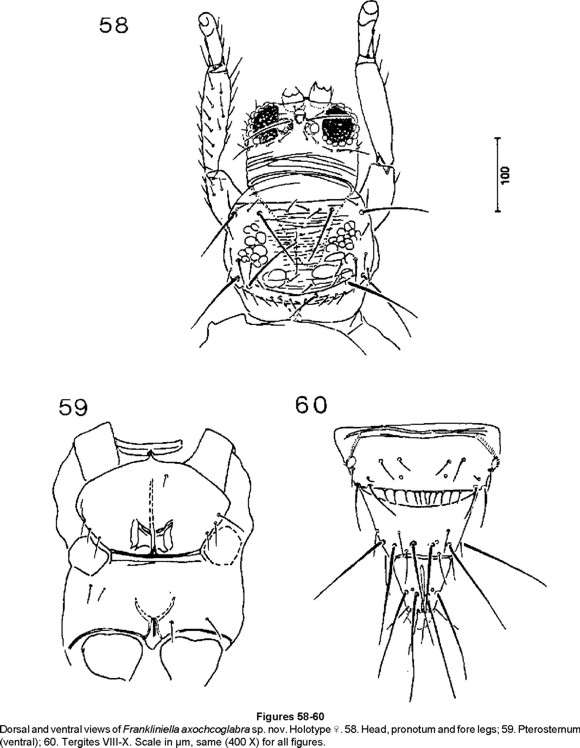
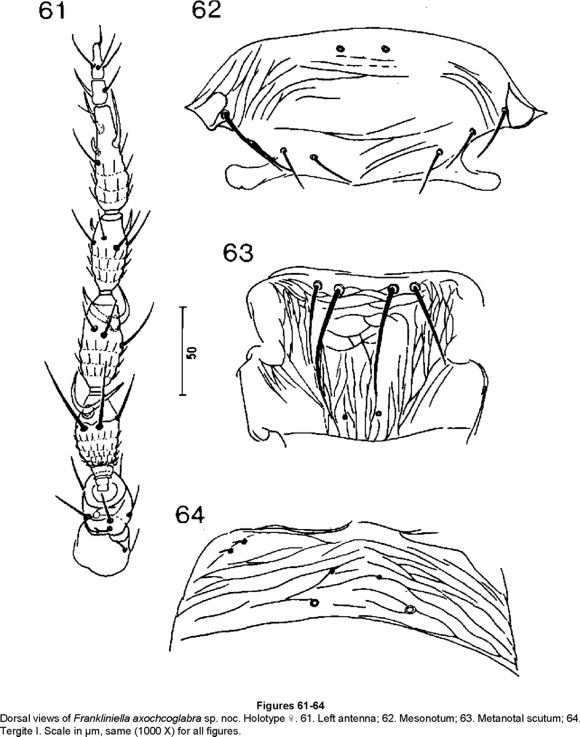


Comments. The Frankliniella prothoraciglabra sp. nov. "species assemblage", is close to the F. ipomoeae Watson "species assemblage" because in both assemblages, the adults of their species have the pronotal center glabrous: without any setae, and the fore wings are clear yellow. However, in the adults of the F. prothoraciglabra assemblage, the postocular setae formula is: ii-iii, IV, v (sometimes is i-iii, IV, v in one side), whereas in the adults of the F. ipomoeae assemblage, the postocular setae formula is: i-iii, IV, v.

Frankliniella axochcoglabra sp. nov.
(Figs. 58-64 (59, 60, 61, 62, 63), 78)
Female. Body color clear yellow, with abundant yellow-orange subhypodermal pigment (forma clara), except: brown in sides of thorax; tergites I-VIII each with a median dark brown spot in anterior margin (forma maculata). Antennal segments: I whitish-yellow; II dark chestnut brown; III dark chestnut brown, yellow in extreme base; V-VIII dark chestnut brown. Fore wings clear yellow, hind wings whitish-yellow. Ocellar crescents orange. Body setae dark brown.
Morphology. Head in dorsal aspect (Fig. 58), broader (1.55 times) than long at middle; occiput sculptured with parallel striae, confluent at middle. Chaetotaxy as follows: anteocellars (pair I) shorter than one ocellar diameter, those of pair II subequal or slightly longer; interocellars (pair III) longer than compound eyes, and between fore and hind ocelli. Antennal segments (Fig. 61). Mouth-cone pointed and longer than head's dorsal length. Pronotum (Fig. 58), broader (1.52 times) than long at middle, its surface faintly sculptured with close transverse striae. Pterothorax; pterosternum (Fig. 59); mesonotum (Fig. 62); metanotal scutum (Fig. 63). Abdomen; tergite I (Fig. 64) tergites VIII-X (Fig. 60).
Measurements (Holotype ♀ in µm). Body length: 1.61 mm.
Head dorsal length: 86, width at eyes: 132, behind eyes: 130, middle: 134, basal: 132. Chaetotaxy, intocc: 52; postoc: ii 12, iii 10, IV 38. Compound eyes, length: 48, width: 42. Ocelli, fore: 14, hind: 12. Antennal segments, length (width): I 28 (26), II 30 (24), III 46 (20), IV 48 (20), V 40 (16), VI 50 (16), VII 10 (6), VIII 16 (4). Thorax; pronotum, length: 118, width at middle: 180. Chaetotaxy, major setae: AA 76, AM 68; PA, outer: 84, inner: 76; minor setae: aa 20, am 18; pm i: 14, ii: 40, iii: 13. Mesothorax, width: 272; metathorax, width: 224. Fore wings, width at base: 86, middle: 50; veins chaetotaxy, fore: 18, hind: 13. Abdomen; width at segment IV: 186. Tergite IX setae, IX i: 100, IX ii: 102. Tergite X setae, X i: 126.
Male. Virtually like adult female forma clara, but smaller and slender. Antennal segments: I yellow; II yellowish-brown; III yellow in basal one half, the rest yellowish-brown; IV light brown, yellow in extreme base, dark brown in extreme apex; V yellowish-brown in basal one third, the rest light brown; VI brown, but darker in extreme base; VII-VIII dark brown.
]]> Measurements (Paratype ♂ in µm). Body length: 1.17 mm.Head dorsal length: 105. Width at eyes: 130; behind eyes: 132, middle: 134, basal: 126. Chaetotaxy, intocc: 40. Compound eyes, length: 64, width: 50. Ocelli, fore: 10, hind: 10. Antennal segments, length (width): I 24 (24), II 32 (20), III 46 (18), IV 44 (18), V 38 (16), VI 46 (16), VII 10 (8), VIII 12 (6). Thorax; pronotum, length: 100, width at middle: 144. Chaetotaxy, major setae: AA 58, AM 52; PA, outer: 58, inner: 70; minor setae: aa 18, am 10; pm i: 12, ii: 36, iii: 14. Mesothorax, width: 226; metathorax, width: 212. Fore wings, width at base: 74, middle: 44; veins chaetotaxy, fore: 44, hind: 14. Abdomen; width at segment IV: 132. Tergite IX setae, IX i: 22, IX ii: 76.
Material examined. Holotype ♀; paratypes: 3 ♀♀, 1 ♂. MEXICO; DISTRITO FEDERAL: Sierra de Ajusco, 4 km East of Ajusco (Volcanic Range), 2500 m.; 17-XI-1973 (Holotype ♀), in flowers of Symphoricarpos microphyllus H.B.K. within Quercus Forest (Roberto M. Johansen), in IBUNAM. Idem, Ciudad de México, Pedregal de San Angel (Volcanic Range), 2240 m.; 26-XI-1977 (Paratype ♀), in Ageratum corymbosum Zucc. (María del Carmen Mendieta), in IBUNAM. Idem et Ibidem, 23-VIII-1977 (Paratype ♂), in Phytolaca octandra L. (María del Carmen Mendieta), in IBUNAM. ESTADO DE MEXICO: Sierra del Doctor, km 23 on road Méx-36 to Sultepec (Volcanic Range), 3060 m; 19-XI-1987 (Paratype ♀ forma clara), in grasses (Muhlenbergia sp. ?) within Abies-Pinus Forest (R.M. Johansen), in IBUNAM. MICHOACAN: Municipio de Nuevo San Juán Parangaricutiro, El Durazno (Volcanic Range), 2300 m; 5-IV-1999 (Paratype ♀), in young foliar buds of Persea americana Miller (Guadalupe Ascención-Betanzos), in IBUNAM.
Comments. Adults of Frankliniella axochcoglabra sp. nov., show two color forms: the forma clara (yellow, with thorax females and males, and the forma maculata (yellow, with thorax brown at sides, tergites I-VIII each with a dark brown median spot in anterior margin. Both color forms show that it is a "species complex", in the sense of Bryan and Smith (1956). Furthermore, this species is different from the other two in the assemblage, because of the morphology of antennal segment III, and the pronotum with only one pair of subposteromarginal setae.
Derivatio nominis: from Nahoa (aztec) languaje, atl = water, xochtl = flow out, co = place; Latin, glabra = smooth.
Frankliniella prothoraciglabra sp. nov.
(Figs. 51-57 (52, 53, 54, 55, 56), 78)
Female. Body color dark chestnut brown, with abundant orange subhypodermal pigment. Antennal segments: I-VIII dark chestnut brown, II darker, IV-V each with a clear sub-basal ring. All tarsi light brown. Fore wings yellow; hind wings whitish yellow. Ocellar crescents orange-red. Body setae dark brown.
Morphology. Head in dorsal aspect (Fig. 44), broader (1.52 times) than long at middle; cheeks slightly sinuouse; occiput sculptured with a close, parallel striae, wich become confluent at sides. Chaetotaxy as follows: anteocellars (pair I) shorter than one ocellar diameter, (pair II) slightly longer than one ocellar diameter; interocellars (pair III) long, but shorter than compound eyes, and between fore and hind ocelli. Antennal segments (Fig. 54) typical III the longest. Mouth-cone pointed and longer than head's dorsal length, produced in anterior four fifths of prosternum. Pronotum (Fig. 51) broader (1.62 times) than long; major anteroangular and anteromarginal setae longer than interocellars; minor subposteromarginal setae forming a straight line. Mesonotum (Fig. 55); metanotal scutum (Fig. 56); pterosternum (Fig. 52), mesosternal plate oblong-hexagonal, spinula strong. Abdomen; tergite I (Fig. 57); tergites VIII-X (Fig. 53).
Measurements (Holotype ♀ in µm forma maculata). Body length: 1.69 mm.
]]> Head dorsal length: 96. Width at eyes: 144, behind eyes: 142, middle: 146, basal: 138. Chaetotaxy, intocc: 46; postoc: i 16, ii 14, iii 12, IV 30. Compound eyes, length: 58, width: 44. Ocelli, fore: 14, hind: 12. Antennal segments, length (width): I 26 (28), II 34 (24), III 50 (20), IV 44 (20), V 36 (18), VI 48 (16), VII 8(6), VIII 14 (4). Thorax; pronotum, length: 122, width at middle: 198. Chaetotaxy, major setae: AA 68, AM 54; PA, outer: 74, inner: 80; minor setae: aa 22, am 18; pm i: 18, ii: 40, iii 20. Mesothorax, width: 266; metathorax, width: 254. Fore wings, width at base: 100, middle: 60; veins chaetotaxy, fore: 22, hind: 17. Abdomen, width at segment IV: 300. Tergite IX setae, IX i: 110, IX ii: 120. Tergite X setae, X i: 132.Material examined. Holotype ♀ (forma maculata), Paratype ♀ (forma clara). MEXICO; ESTADO DE MEXICO: Montecillo, Texcoco, 2240.; 25-X-1993; in flowers of Dendranthema grandiflora cv. polaris Tzvelev (within glass house), (Lourdes Cervantes-Díaz), in IBUNAM. Idem, Sierra del Doctor, km 23 on road Méx-36 to Sultepec (Volcanic Range), 3060 m; 19-XI-1987 (Paratype ♀ forma clara), in grasses (Muhlenbergia sp. ?) within Abies-Pinus Forest (Roberto M. Johansen), in IBUNAM.
Comments. Frankliniella prothoraciglabra sp. nov., is different from the other two species in the assemblage because of the body color dark chestnut brown, including all tarsi.
Derivatio nominis: from Latin, pro = in front; thorax = thorax; glabra = smooth. In allusion to the pronotum without setae at center.
Frankliniella symphoricarpae sp. nov.
(Figs. 65-78 (66, 67, 68, 69, 70, 71, 72, 73, 74, 75, 76, 77))
Female. Body color clear yellow, with abundant yellow subhypodermal pigment, except: abdomen with tergites II-VIII each with a median dark brown blotch in anterior (forma maculata) or, abdomen dark chestnut brown (forma bicolor). Antennal segments: I yellowish-brown; II dark chestnut brown; III yellowish-brown in basal one half, the rest dark brown; IV dark chestnut brown, with a lighter sub-basal ring; V-VIII dark chestnut brown. Fore wings yellow; hind wings whitish-yellow. Ocellar crescents orange. Body setae brown.
Morphology. Head (Fig. 65), broader (1.4 times) than long at middle; occiput sculptured with parallel striae, somewhat confluent at both sides. Chaetotaxy as follows: anteocellars (pair I) shorter than laterals (pair II) and one ocellar diameter; pair II longer than one ocellar diameter; interocellars (pair III) longer than compound eyes and between fore and hind ocelli. Antennal segments (Fig. 66) typical. Mouth-cone pointed and longer than head's dorsal length. Pronotum (Fig. 65), almost smooth but with some transverse striae in anterior margin and both sides. Pterothorax; mesonotum (Fig. 68); metanotal scutum (Fig. 67). Abdomen; tergite I (Fig. 70); tergites VIII-X (Fig. 67).
Measurements (Holotype ♀ in µm forma maculata). Body length: 1.77 mm.
Head dorsal length: 100. Width at eyes: 134, behind eyes: 132, middle: 140, basal: 130. Chaetotaxy, intocc: 56; postoc: ii 18, iii 16, IV 42, v 14. Compound eyes, length (width): I 30 (28), II 42 (24), III 56 (20), IV 44 (20), V 42 (16), VI 52 (18), VII 10 (6), VIII 14 (4). Thorax; pronotum, length: 140, width at middle: 198. Chaetotaxy, major setae: AA 84, AM 80; PA, outer: 90, inner: 88; minor setae: aa 26, am 14; pm i: 20, ii: 50, iii: 16. Mesothorax, width: 294; metathorax, width: 266. Fore wings, width at base: 84, middle: 60; veins chaetotaxy, fore: 24, hind: 20. Abdomen; width at segment IV: 304. Tergite IX setae, IX i: 104, IX ii: 114. Tergite X setae, X i: 96.
]]> Measurements (Paratype ♀ in µm forma bicolor). Body length: 1.53 mm.Head dorsal length: 92. Width at eyes: 130; behind eyes: 126, middle: 130, basal: 120. Chaetotaxy, intocc: 44; postoc: ii 14, iii 10, IV 34, v 16. Compound eyes, length: 54, width: 46. Ocelli, fore: 14, hind: 12. Antennal segments, length (with): I 32 (26), II 38 (24), III 48 (20), IV 42 (20), V 36 (18), VI 44 (18), VII 10 (8), VIII 14 (6). Thorax; pronotum, length: 120, width at middle: 166. Chaetotaxy, major setae: AA 78, AM 70; PA, outer: 82, inner: 78; minor setae: aa 20, am 20; pm i: 18, ii: 44, iii: 14. Mesothorax, width: 238; metathorax, width: 218. Fore wings, width at base: 86, middle: 58; veins chaetotaxy, fore: 21, hind: 17. Abdomen; width at segment IV: 254. Tergite IX setae, IX i: 88, IX ii: 100. Tergite X setae, X i: 116.
Male. Virtually like adult female (forma maculata), but abdomen completly clear yellow (forma clara). Body smaller and slender (Figs. 71-76).
Measurements (Paratype ♂ in µm forma clara). Body length: 1.18 mm.
Head dorsal length: 86. Width at eyes: 126, behind eyes: 124, middle: 132, basal: 130. Chaetotaxy, intocc: 42; postoc: ii 10, iii 10, IV 34, v 12. Compound eyes, length: 50, width: 42. Ocelli, fore: 10, hind: 10. Antennal segments, length (width): I 22 (24), II 30 (22), III 42 (18), IV 40 (18), V 30 (16), VI 40 (16), VII 10 (6), VIII 12 (4). Thorax; pronotum, length: 104, width at middle: 162. Chaetotaxy, major setae: AA 52, AM 54; PA, outer: 54, inner: 56; minor setae: aa 18, am 12; pm i: 14, ii: 30, iii: 12. Mesothorax, width: 224; metathorax, width: 206. Fore wings, width at base: 70, middle: 44; veins chaetotaxy, fore: 20, hind: 15. Abdomen; width at segment IV: 196. Tergite IX setae, IX i: 38, IX ii: 80.
Material examined. Holotype ♀ (forma maculata); paratypes: 1 ♀ (forma bicolor); 3 ♂♂ (forma clara). MEXICO; DISTRITO FEDERAL: Sierra de Ajusco (Volcanic Range), 4 km East of Ajusco, 2400 m.; 17-XI-1973 (Holotype ♀, Paratype ♀); in flowers of Symphoricarpos microphyllus H.B.K. within Quercus Forest (Roberto M. Johansen), in IBUNAM. Idem, México, D.F., Pedregal de San Angel, 2250 m.; (Paratype ♂); in flowers of Ageratum corymbosum Zucc. (María del Carmen Mendieta), in IBUNAM; Idem et Ibidem, 23-VIII-1977; (Paratype ♂); in flowers of Phytolacca octandra L. (M.C. Mendieta), in IBUNAM. MICHOACAN: Municipio de Nuevo San Juán Parangaricutiro, El Durazno, 2300 m. (Volcanic Range); 10-III-1999; (Paratype ♂); in flowers of Persea americana Miller cv. Hass (Guadalupe Ascención-Betanzos), in IBUNAM.
Comments. Adults of Frankliniella symphoricarpae sp. nov., form a "species complex" of three color forms. They are different from those of F. axochcoglabra, because the longer and slender antennal segment III, and the pronotum with four minor anteromarginal setae, and four subposteromarginal setae forming a stright line.
Derivatio nominis: Symphoricarpos, a generic name in the Family Caprifoliaceae. From Greek, sym = together; phore = to carry; carpos = fruit; from Latin, ae = genitive. In allusion to the main host plant.
Geographic distribution
I) The Frankliniella aurea Moulton species assemblage (Fig. 77)
]]> This species assemblage has a recent geographic distribution, as follows:MEXICO
a) Sierra Madre Oriental (200-1599 m.)
Coahuila: Ciudad Acuña, Presa de La Amistad, 200 m. (F. aurea); Saltillo, 1599 m: (F. aureabouvardiae, and F. sorghiaurea).
b) Volcanic Range (2000-2300 m.)
Estado de México: Chapingo, 2200 m. (F. aurea); Coatepec Harinas, 2000 m. (F. aurea). Michoacán: Municipio de Nuevo San Juán Parangaricutiro, El Durazno, 2300 m. (F. aurea, and F. zucchini).
c) North Western Region
Sonora: Pacific Coastal Plain (near Hermosillo), 200 m. (F. aurea, and F. aureasonorensis).
UNITED STATES OF AMERICA
a) California: Yosemite Valley (F. aurea).
]]> BRAZILa) São Paulo: Piracicaba (F. zucchini).
II) The Frankliniella bisaetaevenusta sp. nov. species assemblage (Fig. 78)
This species assemblage has a recent geographic distribution in México, as follows:
a) Sierra Madre Oriental (1250-1525 m.)
Coahuila: Saltillo, 1599 m. (F. bisaetaeminuta).
Hidalgo: Sierra de Zacualtipán, 2 km W of Calnalli, 1595 m. (F. bisaetaevenusta).
b) Volcanic Range (2240-2300 m.)
Distrito Federal: Ciudad de México, 2240 m. (F. bisaetaeaurea); Xochimilco, 2300 m. (F. bisaetaeaurea).
Michoacán: Municipio de Nuevo San Juán Parangaricutiro, El Durazno, 2300 m. (F. bisaetaeaurea).
]]> III) The Frankliniella prothoraciglabra sp. nov. species assemblage (Fig. 78)This species assemblage has a recent geographic distribution in México, as follows:
a) Volcanic Range (2240-3060 m.)
Distrito Federal: Sierra de Ajusco, 2400 m. (F. axochcoglabra, and F. symphoricarpae). Estado de México: Sierra del Doctor, on road to Sultepec, 3060 m. (F. axochcoglabra; Texcoco, Montecillo, 2240 m. (F. prothoraciglabra).
Michoacán: Municipio de Nuevo San Juán Parangaricutiro, El Durazno, 2300 m. (F. axochcoglabra, and F. symphoricarpae).
Some ecologic data
Up to the present time, only a total of 30 adult specimens of the reviewed species were available. The studied material is scarce, but good enough to fullfill the preliminary needs of this study. The studied adult specimens represent a small fraction of a whole sample containing other related species of Frankliniella that were abundant, in both agroecosystems and natural ecosystems host plants. In this way, Frankliniella aurea, F. zucchini and F. symphoricarpae are known by their adults of both sexes; F. bisaetaeaurea, F. bisaetaeminuta, F. axochcoglabra and F. prothoraciglabra are known only from several adult females, whereas F. aureabouvardiae, F. aureasonorensis, F. sorghiaurea, F. bisaetaevenusta are known only by the Holotype female.
A) Agroecosystems
The Frankliniella aurea Moulton assemblage.
F. aurea in flowers of Cucurbita pepo L., in Chapingo, México; in flowers of Dendranthema grandiflora Tzvelev cv. polaris, in Coatepec Harinas, México; in young foliar buds of Persea americana Miller cv. Hass in Nuevo San Juán Parangaricutiro, Michoacán; in Vitis vinifera L., in Sonora.
]]> F. sorghiaurea in Sorghum bicolor, in Saltillo, Coahuila.F. sorghiaurea in Cucurbita pepo L. cv. zucchini, in São Paulo, Brazil; young foliar buds of Persea americana Miller cv. Hass, in Nuevo San Juán Parangaricutiro, Michoacán.
The Frankliniella bisaetaevenusta sp. nov. assemblage
F. bisaetaeaurea in flowers of Rosa centifolia, in México, D.F.; in flowers of "monedero", in Xochimilco, San Gregorio Atlapulco, D.F.
The Frankliniella prothoraciglabra sp. nov. assemblage
F. axochcoglabra in young foliar buds of Persea americana, in Nuevo San Juán Parangaricutiro, Michoacán.
F. prothoraciglabra in flowers of Dendranthema grandiflora Tzvelev cv. polaris, in Montecillo, Texcoco, México.
F. symphoricarpae in flowers of Persea americana, in Nuevo San Juán Parangaricutiro, Michoacán.
B) Natural ecosystems
The Frankliniella aurea Moulton assemblage
]]> F. aurea in flowers of Ipomoea purpurea, in Saltillo, Coahuila. Chaparral (Rzedowski, 1978).F. aureabouvardiae in Bouvardia tenuifolia, in Saltillo, Coahuila. Chaparral (Rzedowski, 1978)
The Frankliniella bisaetaevenusta sp. nov. assemblage
F. bisaetaeminuta in Pennisetum ciliare, in Saltillo, Coahuila. Chaparral (Rzedowski, 1978).
F. bisaetaevenusta in flowers of Stevia sp., near Calnalli, Hidalgo. Montane Rain Forest (Rzedowski, 1978).
The Frankliniella prothoraciglabra sp. nov. assemblage
F. axochcoglabra in flowers of Symphoricarpos microphyllus, in Distrito Federal. Pine-Oak Forest (Rzedowski, 1978); in grasses (Muhlenbergia sp. ?), in Sierra del Doctor on road to Sultepec, Estado de México. Pine-Oak Forest (Rzedowski, 1978).
F. symphoricarpae in flowers of Symphoricarpos microphyllus, in Sierra del Ajusco, Distrito Federal. Pine-Oak Forest (Rzedowski, 1978).
Aknowledgements
]]> The authors are very gratefull with the followings colleagues and institutions, for their valuable participation in this work: Vincent F. Lee, from the California Academy of Sciences, San Francisco, California, United States of America, for loaning the types of Frankliniella californica (Moulton). Sueo (Steve) Nakahara, from the United States Department of Agriculture, Beltsville, Maryland, U.S.A., for his critical remarks on concepts and illustrations of Frankliniella aurea Moulton. From the Instituto de Fitosanidad, Colegio de Postgraduados en Ciencias Agrícolas, Montecillo, Texcoco, Estado de México, Lourdes Cervantes Díaz, for her collection of Frankliniella aurea in Chapingo; Daniel Leobardo Ochoa Martínez for his collection in Villa Guerrero, Estado de México; Martha Yazmín Sánchez-Roncancio, for her collection of Frankliniella bisaetaeaurea in Xochimilco; Guadalupe Ascención-Betanzos, for her collections in El Durazno, Nuevo San Juán Parangaricutiro, Michoacán. From The Universidad Autónoma Agraria "Antonio Narro", Saltillo Coahuila, Luz-Bertha Morales for her collections of Frankliniella aurea, F. sorghiaurea, F. aureabouvardiae, and F. bisaetaeminuta. From Bayer de México, División Agrícola, Ings. Agrs. Diego Cerecer and José Abel Toledo Martínez (Bayer de México-IBUNAM research agreement), for their collection of Frankliniella aureasonorensis.
Literature cited
Bryan, D.E. & R.F. Smith. 1956. The Frankliniella occidentalis (Pergande) complex in California (Thysanoptera: Thripidae). Univ. Calif. Publ. Entomol. 10 (6): 359-410. [ Links ]
Hood, J.D. 1925. New species of Frankliniella (Thysanoptera). Bull. Brooklyn Ent. Soc. 80 (2): 71-82 + plate. [ Links ]
Jacot-Guillarmod, C.F., 1974. Catalogue of the Thysanoptera of the World (Part 3). Annals Cape Prov. Mus. (nat. Hist.) 7 (3): 517-976. [ Links ]
Johansen, R.M. 1998. The Mexican Frankliniella desertileonidum Watson species assemblage, in the "Intonsa Group" (Insecta, Thysanoptera: Thripidae). Acta Zool. Mex. (n.s.) 75: 143-161. [ Links ]
Mayr, E. & P.P. Ashlock, 1991. Principles of Systematic Zoology, 2nd. Ed. Mc Graw Hill, Inc., New York: 476 pp. [ Links ]
Moulton, D., 1948. The genus Frankliniella Karny, with keys for the determination of species (Thysanoptera). Rev. Entomol. (Rio de Janeiro) 19 (1-2): 55-114. [ Links ]
Mound, L.A. & R. Marullo, 1996. The thrips of Central and South America: An Introduction (Insecta: Thysanoptera). Memoirs on Entomology, International Vol. 6. Associated Publishers, Gainesville, Florida, U.S.A., 487 pp. [ Links ]
Nakahara, S., 1997. Annotated list of the Frankliniella species of the World (Thysanoptera: Thripidae). Contributions on Entomology, International, 2 (4): 355-389. [ Links ]
Nakahara, S. & R.C. Monteiro, 1999. Frankliniella zucchini (Thysanoptera: Thripidae), a new species and vector of tospovirus in Brazil. Proc. Ent. Soc. Wash. 10(2): 290-294. [ Links ]
Rzedowski, J., 1978. Vegetación de México. Editorial Limusa, México, 432 pp. [ Links ]
Sakimura, K. & K. O'Neill, 1979. Frankliniella, redefinition of genus and revision f Minuta Group species (Thysanoptera: Thripidae). United States Department of Agriculture, Tech. Bull. 1572: 1-49. [ Links ]
]]>