<?xml version="1.0" encoding="ISO-8859-1"?><article xmlns:mml="http://www.w3.org/1998/Math/MathML" xmlns:xlink="http://www.w3.org/1999/xlink" xmlns:xsi="http://www.w3.org/2001/XMLSchema-instance">
<front>
<journal-meta>
<journal-id>0065-1737</journal-id>
<journal-title><![CDATA[Acta zoológica mexicana]]></journal-title>
<abbrev-journal-title><![CDATA[Acta Zool. Mex]]></abbrev-journal-title>
<issn>0065-1737</issn>
<publisher>
<publisher-name><![CDATA[Instituto de Ecología A.C.]]></publisher-name>
</publisher>
</journal-meta>
<article-meta>
<article-id>S0065-17372002000300001</article-id>
<title-group>
<article-title xml:lang="en"><![CDATA[Soil meso-fauna patterns and experiments on leaf litter mite fungivory: preferences, effects on fungal reproduction and decomposition]]></article-title>
</title-group>
<contrib-group>
<contrib contrib-type="author">
<name>
<surname><![CDATA[Guevara]]></surname>
<given-names><![CDATA[Roger]]></given-names>
</name>
<xref ref-type="aff" rid="A01"/>
</contrib>
<contrib contrib-type="author">
<name>
<surname><![CDATA[Villedo]]></surname>
<given-names><![CDATA[Lorenzo]]></given-names>
</name>
<xref ref-type="aff" rid="A01"/>
</contrib>
<contrib contrib-type="author">
<name>
<surname><![CDATA[Nájera]]></surname>
<given-names><![CDATA[Andrea]]></given-names>
</name>
<xref ref-type="aff" rid="A01"/>
</contrib>
</contrib-group>
<aff id="A01">
<institution><![CDATA[,Instituto de Ecología, A.C División de Ecología Departamento de Biología de Suelos]]></institution>
<addr-line><![CDATA[Jalapa Veracruz]]></addr-line>
<country>México</country>
</aff>
<pub-date pub-type="pub">
<day>00</day>
<month>00</month>
<year>2002</year>
</pub-date>
<pub-date pub-type="epub">
<day>00</day>
<month>00</month>
<year>2002</year>
</pub-date>
<numero>87</numero>
<fpage>01</fpage>
<lpage>15</lpage>
<copyright-statement/>
<copyright-year/>
<self-uri xlink:href="http://www.scielo.org.mx/scielo.php?script=sci_arttext&amp;pid=S0065-17372002000300001&amp;lng=en&amp;nrm=iso"></self-uri><self-uri xlink:href="http://www.scielo.org.mx/scielo.php?script=sci_abstract&amp;pid=S0065-17372002000300001&amp;lng=en&amp;nrm=iso"></self-uri><self-uri xlink:href="http://www.scielo.org.mx/scielo.php?script=sci_pdf&amp;pid=S0065-17372002000300001&amp;lng=en&amp;nrm=iso"></self-uri><abstract abstract-type="short" xml:lang="es"><p><![CDATA[En la primera parte de este estudio se investigaron los patrones estructurales de la comunidad de mesofauna en un bosque mesófilo de montaña encontrando que la hojarasca y el suelo como tal albergan comunidades estructuralmente diferentes. La hojarasca parece ser un hábitat complejo, heterogéneo, mientras que el suelo parece ser homogéneo. Las principales diferencias entre los dos hábitats están dadas por la abundancia de ácaros y colémbolos y se discuten sus patrones de distribución en relación con aquellos factores que pudiesen estar determinando la actividad de la micobiota en el suelo ya que la fungivoría es un hábito ampliamente distribuido entre ácaros y colémbolos. En la segunda parte de este estudio se realizaron experimentos de microcosmos en los que se observó que la actividad trófica de una especie de ácaro (Oppidae) afecta la producción de esporas de cuatro especies de hongos lo que sugiere un efecto sobre su capacidad competitiva.]]></p></abstract>
<abstract abstract-type="short" xml:lang="en"><p><![CDATA[We investigated patterns of community structure of soil meso-fauna in an tropical cloud forest. The leaf litter habitat and the actual soil below were found to support structurally different communities. Leaf litter appeared to be a complex, heterogeneous, habitat whereas soil was homogeneous. The abundance of mites and collembolans marked the main differences between leaf litter and soil, and given that a large number of species of these taxa are fungivorous their distribution patterns are discussed in relation to those factors that may determine fungal activity. In microcosmos experiments we found that a fungivorous oppid mite (Oppidae) affected the spore production of four species of fungi suggesting a shift in their combative abilities.]]></p></abstract>
<kwd-group>
<kwd lng="es"><![CDATA[Consumo selectivo]]></kwd>
<kwd lng="es"><![CDATA[Estructura de la comunidad]]></kwd>
<kwd lng="es"><![CDATA[Fungivoría]]></kwd>
<kwd lng="es"><![CDATA[Hongos de la hojarasca]]></kwd>
<kwd lng="es"><![CDATA[Mesofauna]]></kwd>
<kwd lng="es"><![CDATA[Oppidae]]></kwd>
<kwd lng="en"><![CDATA[Community structure]]></kwd>
<kwd lng="en"><![CDATA[Fungivory]]></kwd>
<kwd lng="en"><![CDATA[Leaf litter fungi]]></kwd>
<kwd lng="en"><![CDATA[Oppidae]]></kwd>
<kwd lng="en"><![CDATA[Selective feeding]]></kwd>
<kwd lng="en"><![CDATA[Meso-fauna]]></kwd>
</kwd-group>
</article-meta>
</front><body><![CDATA[ <p align="justify"><font face="Verdana" size="4">Article</font></p>     <p align="justify"><font face="Verdana" size="2">&nbsp;</font></p>     <p align="center"><font face="verdana" size="4"><b>Soil meso&#45;fauna patterns and experiments on leaf litter mite fungivory: preferences, effects on fungal reproduction and decomposition</b></font></p>     <p align="justify"><font face="Verdana" size="2">&nbsp;</font></p>     <p align="center"><font face="verdana" size="2"><b>Roger Guevara, Lorenzo Villedo and Andrea N&aacute;jera</b></font></p>     <p align="justify"><font face="Verdana" size="2">&nbsp;</font></p>     <p align="justify"><font face="verdana" size="2"><i>Instituto de Ecolog&iacute;a, A.C. Divisi&oacute;n de Ecolog&iacute;a, Departamento de Biolog&iacute;a de Suelos, A. Postal 63, CP 91000, Xalapa, Ver. M&Eacute;XICO.</i></font></p>     <p align="justify"><font face="Verdana" size="2">&nbsp;</font></p>     <p align="justify"><font face="verdana" size="2">Recibido: 24 de mayo 2001    <br>Aceptado: 11 de abril 2002</font></p>     ]]></body>
<body><![CDATA[<p align="justify"><font face="Verdana" size="2">&nbsp;</font></p>     <p align="justify"><font face="verdana" size="2"><b>Resumen</b></font></p>     <p align="justify"><font face="verdana" size="2">En la primera parte de este estudio se investigaron los patrones estructurales de la comunidad de mesofauna en un bosque mes&oacute;filo de monta&ntilde;a encontrando que la hojarasca y el suelo como tal albergan comunidades estructuralmente diferentes. La hojarasca parece ser un h&aacute;bitat complejo, heterog&eacute;neo, mientras que el suelo parece ser homog&eacute;neo. Las principales diferencias entre los dos h&aacute;bitats est&aacute;n dadas por la abundancia de &aacute;caros y col&eacute;mbolos y se discuten sus patrones de distribuci&oacute;n en relaci&oacute;n con aquellos factores que pudiesen estar determinando la actividad de la micobiota en el suelo ya que la fungivor&iacute;a es un h&aacute;bito ampliamente distribuido entre &aacute;caros y col&eacute;mbolos. En la segunda parte de este estudio se realizaron experimentos de microcosmos en los que se observ&oacute; que la actividad tr&oacute;fica de una especie de &aacute;caro (Oppidae) afecta la producci&oacute;n de esporas de cuatro especies de hongos lo que sugiere un efecto sobre su capacidad competitiva.</font></p>     <p align="justify"><font face="verdana" size="2"><b>Palabras clave:</b> Consumo selectivo, Estructura de la comunidad, Fungivor&iacute;a, Hongos de la hojarasca, Mesofauna, Oppidae.</font></p>     <p align="justify"><font face="Verdana" size="2">&nbsp;</font></p>     <p align="justify"><font face="verdana" size="2"><b>Abstract</b></font></p>     <p align="justify"><font face="verdana" size="2">We investigated patterns of community structure of soil meso&#45;fauna in an tropical cloud forest. The leaf litter habitat and the actual soil below were found to support structurally different communities. Leaf litter appeared to be a complex, heterogeneous, habitat whereas soil was homogeneous. The abundance of mites and collembolans marked the main differences between leaf litter and soil, and given that a large number of species of these taxa are fungivorous their distribution patterns are discussed in relation to those factors that may determine fungal activity. In microcosmos experiments we found that a fungivorous oppid mite (Oppidae) affected the spore production of four species of fungi suggesting a shift in their combative abilities.</font></p>     <p align="justify"><font face="verdana" size="2"><b>Key Words:</b> Community structure, Fungivory, Leaf litter fungi, Oppidae, Selective feeding, Meso&#45;fauna.</font></p>     <p align="justify"><font face="Verdana" size="2">&nbsp;</font></p>     <p align="justify"><font face="verdana" size="2"><b>Introduction</b></font></p>     ]]></body>
<body><![CDATA[<p align="justify"><font face="verdana" size="2">Decomposition of plant organic matter, the antithesis of photosynthesis, is a major process directly linked to soil fertility. Therefore, a main challenge for soil biologists is to understand the dynamics of the decomposition process and its relations to the origin and maintenance of soil fertility in natural and cultivated systems. In order to do this, it is necessary to understand the biology of decomposer organisms and their interactions with the physical and biotic environments.</font></p>     <p align="justify"><font face="verdana" size="2">Fungi are an important group of decomposer organisms. As a group fungi degrade all kinds of organic matter and man&#45;made products, including even plastic (Cooke &amp; Rayner 1984). Furthermore, fungi are the main decomposer group of the products of primary production, leaf litter, twigs, branches, stems, trunks and roots. Therefore, fungi are central to understanding the process of decomposition in terrestrial ecosystems (c.f., Rodin &amp; Basilevic 1967, 1968). In accordance, fungivory stands up as a key interaction to be study if we aim to understand the dynamics of the decomposition process (c.f., Swift &amp; Boddy 1984) and its implications to soil fertility.</font></p>     <p align="justify"><font face="verdana" size="2">The body of studies of soil fungus&#45;fungivore interactions consists mainly of isolated works, usually focusing only on one aspect of these interactions. Some studies have investigated mechanisms used by fungivores to discriminate among different fungi. For instance, Hedlund <i>et al.</i> (1995) showed that some collembolans differentiate fungal species on the base of aroma compounds. This behavioural capability offers the potential of selective feeding and effects on fungal community structure. Thus, for instance Newell (1984a, 1984b) showed that <i>Onychiurus latus</i> Gisin allowed extended populations of the fungus <i>Mycena galopus</i> &#91;Pers. ex. Fr.&#93; Kummer in the field by selectively feeding on a strong combative species, <i>Marasmius androsaceus</i> L. ex F. The later fungus dominates in collembolan&#45;free systems. Similarly, Parkinson <i>et al</i>. (1979) showed that selective feeding by <i>Onychiurus subtenuis</i> Folsom biased the competitive capabilities of two species of fungi on aspen litter. Furthermore, selective fungivory may also directly influence the genetic structure of fungal populations since mycelium fragmentation (a means of asexual reproduction) may be favoured in some interactions (Bengtsson <i>et al</i>. 1993). In relation to decomposition other studies have shown that fungivory increased the respiration rate of the micro&#45;biota in decomposing leaf litter (Bear <i>et al.</i> 1992, Hedlund <i>et al</i>. 1995, Hedlund &amp; Oehrn, 2000; Kaneko <i>et al</i>. 1998, Siepel &amp; Maaskamp 1994).</font></p>     <p align="justify"><font face="verdana" size="2">In this study we present a general perspective of the interactions between an oppid mite and some common soil fungi. First, we present a brief description of the soil meso&#45;fauna in a remnant of evergreen cloud forest. Then, we set up two experiments to explore three questions. Is the performance of mite colonies affected by different species of fungi used as food resource? Does fungivory by mites affect fungal reproductive success? Does fungivory by mites affect the rate of leaf litter decomposition?</font></p>     <p align="justify"><font face="Verdana" size="2">&nbsp;</font></p>     <p align="justify"><font face="verdana" size="2"><b>Methods</b></font></p>     <p align="justify"><font face="verdana" size="2"><b>Study site</b></font></p>     <p align="justify"><font face="verdana" size="2">This study was carried out in the protected area "Santuario del Bosque de Niebla" (Cloud Forest Sanctuary) located on 19&deg;30' N and 96&deg;57' W' with altitude around 1280 m, near to Xalapa, Veracruz, Mexico. The original plant community in the area was tropical cloud forest that covered the central part of Veracruz state between 1200 and 1600 meters above the sea level (Castillo&#45;Campos 1991). Now, the actual plant community in the protected area (30 ha.) is a mixture of remnants of tropical cloud forest (28%), various successional stages derived from abandoned coffee plantations (20%) and cleared areas (52%) (personal communication of O. Gomez&#45;Garc&iacute;a).</font></p>     <p align="justify"><font face="verdana" size="2"><b>Soil meso&#45;fauna community</b></font></p>     <p align="justify"><font face="verdana" size="2">We collected 20 soil cores (20x20x20 cm) and 20 leaf litter samples (20X20 cm) in August 2000. Leaf litter samples were taken from the surface area of each soil core and all samples were collected from randomly selected points. This was done by generating random number between 0 to 1000 which corresponded to distances along the main trail in the study site. All samples were taken 30 m into the forest.</font></p>     ]]></body>
<body><![CDATA[<p align="justify"><font face="verdana" size="2">In the laboratory, we placed soil cores and leaf litter samples in Berlese's funnels (c.f., Coleman &amp; Crossley Jr. 1996) with a 2 mm grid and allowed the samples to dry for seven days aided by a 40 W light bulb placed above each sample. All samples were covered with nylon mesh and soil meso&#45;fauna was collected in 70% alcohol. Then, using a stereoscopic microscope, we sorted (at order level and including a category for immature stages) and counted all individuals of soil meso&#45;fauna in each sample.</font></p>     <p align="justify"><font face="verdana" size="2"><b>Experimental design</b></font></p>     <p align="justify"><font face="verdana" size="2">Because mites were among the most abundant components of the soil meso&#45;fauna and an unidentified fungivorous oppid mite (Oribatida: Oppidae) was especially abundant, we established cultures of this mite (fed on <i>Penicillum</i> sp growing on 2% malt extract at room temperature) for experimental studies.</font></p>     <p align="justify"><font face="verdana" size="2"><b>Decomposition experiment</b></font></p>     <p align="justify"><font face="verdana" size="2">The first experiment consisted of 80 microcosmos replicates set up in plastic chamber (8 x 8 cm high and diameter) with a 2 cm<sup>2</sup> hole in the lid covered with nylon mesh. We added to each container 2 g of wet leaf litter extracted from a bulk amount. Leaf litter was collected at the study site and chopped into 1 cm<sup>2</sup> pieces, wet and homogenised. Then, from the bulk chopped leaf litter we weighed 80 samples (2 g each) to a precision of 0.1&micro;g, taking each sample from the centre of the bulk to minimise variation in water content between samples. Then we prepared a suspension of spores of four leaf litter fungi (<i>Doratomyces microsporus</i> (Saccardo) Morton &amp; Smith, <i>Acrogenospora sphaerocephala</i> (Berkeley &amp; Broome) M.B. Ellis, <i>Cylindrocladium heptasporum</i> Casta&ntilde;eda and <i>Menisporopsis novae&#45;zelandiae</i> Hughes &amp; Kendrick) commonly occurring in the leaf litter of the study site. We grew each species in a 5 cm Petri dish (2% malt extract at 30 C) and after 10 days we washed the mycelium surface of each plate with 120 ml of distilled water and mechanically suspended spores and mycelium fragments. These suspensions were mixed and then we added 5 ml to each of the 80 chambers. By artificially increasing the relative dominance (spore number) of these four species, we attempted to minimise potential differences in the composition of the mico&#45;biota between microcosmos. We also eliminated the meso&#45;fauna in all chambers by fumigating them with chlorobenzene crystals (Sigma C7640) for 5 minutes and ventilated them for 30 minutes. Then we added an adult oppid mite and an egg to each of 35 microcosmos whereas, the other 35 chambers were left meso&#45;fauna free. The leaf litter of the remaining 10 chambers was dried and stored as control for initial dry weight. The 70 experimental microcosmos were placed in a greenhouse for 60 days and then dried at 70EC for three days and the leaf litter weighed to a precision of 0.1 &micro;g, together with the dried leaf litter of the 10 control chambers.</font></p>     <p align="justify"><font face="verdana" size="2"><b>Fungal reproductive potential</b></font></p>     <p align="justify"><font face="verdana" size="2">After weighting the leaf litter as described above we added 10 ml of distilled water to each of the 70 microcosmos and shook them vigorously before taking a 50 &micro;l sample from which we classified and counted all spores under a compound microscope.</font></p>     <p align="justify"><font face="verdana" size="2"><b>Mite performance</b></font></p>     <p align="justify"><font face="verdana" size="2">In the second experiment we evaluated the performance of the oppid mite on the host fungi <i>Haplographium</i> sp., <i>Cylindrotrichum</i> sp., <i>C. heptasporum</i> and <i>M. novae&#45;zelandiae</i>. We established 30 cultures of each fungus in 5 cm Petri plates (2% malt extract and 2% agar). After one week of incubation we added a surface sterilised egg (washed in 2% formaldehyde and rinsed in distilled water) of the oppid mite to 16 plates of each fungus. All dishes (with and without an sterilised eggs) were stored at room temperature for six weeks. Then, we counted the number of adult mites and eggs in all 120 plates. In this way we assessed the performance of mites in those plates starting with a single egg and separately we analysed the mite colonisation preference by counting the number of adults in dishes that were egg&#45;free at the beginning of the experiment.</font></p>     <p align="justify"><font face="verdana" size="2"><b>Statistical analysis</b></font></p>     ]]></body>
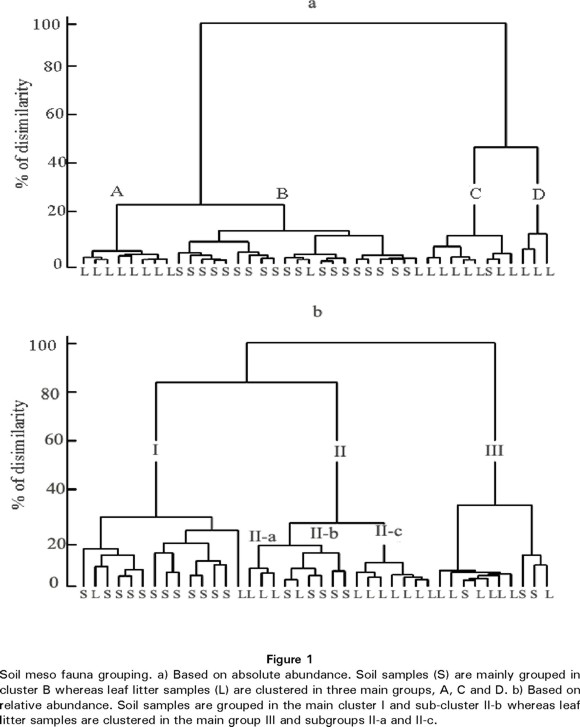
<body><![CDATA[<p align="justify"><font face="verdana" size="2">We used cluster analysis with Ward's method and Euclidean distance (c.f., Digby &amp; Kempton 1987) to explore patterns of soil meso&#45;fauna structure based on absolute and relative abundance. Effects of mites on the rate of leaf litter decomposition and mite performance on different fungal species were evaluated with one way ANOVA. In the decomposition experiment, the final weight of leaf litter was the response variable tested over the fungivory treatment (mites vs. no mites) used as fixed factor. In the mite performance experiment the number of adult mites and laid eggs were used as response variables. The four different species on which mites were fed were used as a fixed factor with four levels. Effects on fungal reproductive potential were explored with MANOVA. The number of spores recovered of each of the four fungus species were used as response variables tested over the fungivory treatment which were used as a fixed factor. We used Duncan's multiple range test to compare observed means in factors that showed significant effects (&prop;=0.05). All statistical tests were done in the Statistica software (StatSoft&#45;Inc 1999).</font></p>     <p align="justify"><font face="Verdana" size="2">&nbsp;</font></p>     <p align="justify"><font face="verdana" size="2"><b>Results</b></font></p>     <p align="justify"><font face="verdana" size="2"><b>Soil meso&#45;fauna community</b></font></p>     <p align="justify"><font face="verdana" size="2">We used cluster analysis to characterise the structure of soil and leaf&#45;litter meso&#45;fauna. The analysis based on absolute abundance grouped the 40 samples into four distinguishable groups (<a href="#f1">Fig. 1a</a>). Leaf litter samples were separated in three groups (groups A, C and D) whereas soil samples (group B) were clustered in one group. The main difference between groups was measured by the abundance of mites and collembolans. These taxa showed the highest abundance in all samples. Group B, which included all soil samples except one, was characterised by a low abundance of mites (rounded mean, 41) and collembolans (30) whereas group D had the highest abundance of mites (198) and collembolans (304). Group C presented intermediate abundance values for mites (126) and collembolans (116), whereas group A showed an intermediate abundance value for mites (96) and a low number of collembolans (44). Also, flies, beetles, isopods and juvenile stages presented higher values in group D (22, 12, 5 and 35, respectively) than in groups A (13, 7, 3 and 17, respectively), group B (12, 9, 1 and 21, respectively) and C (15, 6, 2 and 19, respectively). In contrast, ants were more abundant on average in group B (4) than in group A (&lt;1), group C (1) and group D (1).</font></p>     <p align="center"><font face="verdana" size="2"><a name="f1"></a></font></p>     <p align="center"><font face="verdana" size="2"><img src="/img/revistas/azm/n87/a1f1.jpg"></font></p>     <p align="justify"><font face="verdana" size="2">The analysis based on relative abundance showed a complex grouping, but it was still possible to differentiate soil and leaf litter groups (<a href="#f1">Fig. 1b</a>). At the 50% similarity level there were three groups. Group I was mainly composed of soil samples whereas leaf litter samples were clustered in group III. Group II included soil and leaf litter samples. However, this last group appeared to be composed of three sub&#45;groups at about the 16% similarity level. Sub&#45;groups II&#45;a and II&#45;c consisted solely of leaf litter samples whereas sub&#45;group II&#45;b was largely composed of soil samples. In accordance with the analysis based on absolute abundance, soil clusters (group I and sub&#45;group II&#45;b) were characterised by a low relative abundance of mites and collembolans, whereas the relative abundance of these taxa varied among leaf litter groups. Relative abundance of mites was higher in group II (0.52), especially in sub group II&#45;a (0.60) than in group III (0.30). Also, the relative abundance of ants was higher in soil, group I (0.04), than in leaf litter, groups II (0.01) and III (&lt;0.01). By contrast, collembolans had a higher relative abundance in sub&#45;group II&#45;C (0.49) than in any other group. Opposite from the pattern observed in the absolute abundance analysis, there was a higher relative abundance in the soil (group I) of juveniles (0.17), beetles (0.08), Hymenoptera (0.05) and flies (0.12) than in groups, II (0.01, 0.04, 0.03 and 0.06, respectively) and III (0.05, 0.03.0.03 and 0.04, respectively).</font></p>     <p align="justify"><font face="verdana" size="2">In the study site a morpho&#45;species of oppid mite (Oribatida: Oppidae) was abundant and, based on preliminary feeding tests was fungivorous.</font></p>     <p align="justify"><font face="verdana" size="2"><b>Mite performance</b></font></p>     ]]></body>
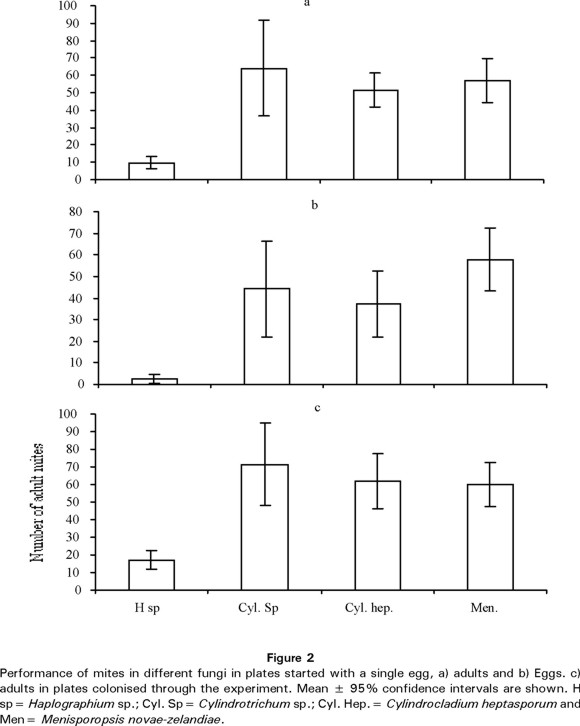
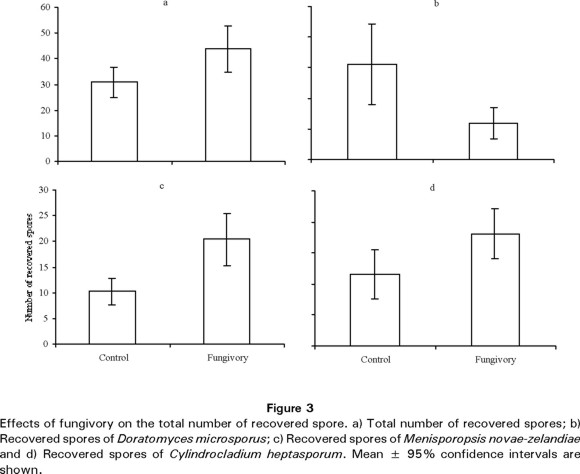
<body><![CDATA[<p align="justify"><font face="verdana" size="2">We tested the performance of the oppid mite in an experiment that included four fungi (<i>Haplographium</i> sp, <i>Cylindrotrichum</i> sp. <i>C. heptasporum</i> y <i>M. novae&#45;zelandiae</i>) as food resource. For those plates in which we added an egg at the beginning of the experiment our results showed that there are differences in the quality of the resource (fungi) since we detected significant differences in number of adults (F=10.8, d.f.=3, 51 and P&lt;0.001) and number of eggs (F=10.57, d.f.=3, 51 and P&lt;0.001) among fungi. The number of adult mites (9.81 &plusmn; 6.7, mean &plusmn; sd) and eggs (2.6 &plusmn; 4.5) were significantly lower (P&lt;0.001) in <i>Haplographium</i> sp than in any other fungus (<a href="#f2">Fig. 2a&#45;b</a>). In accordance, the number of adult mites in those plates that were colonised by the oppid mite (F=7.75, d.f.= 3, 61 and P&lt;0.001) was, also, significantly lower (P&gt;0.001) in <i>Haplographium</i> sp. (17.1 &plusmn; 9.9) than in any other fungus (<a href="#f2">Fig. 2c</a>).</font></p>     <p align="center"><font face="verdana" size="2"><a name="f2"></a></font></p>     <p align="center"><font face="verdana" size="2"><img src="/img/revistas/azm/n87/a1f2.jpg"></font></p>     <p align="justify"><font face="verdana" size="2"><b>Fungal reproductive potential</b></font></p>     <p align="justify"><font face="verdana" size="2">We also evaluated the effects of the mite on the reproductive potential of different fungi (<i>D. microsporus</i>, <i>A. sphaerocephala</i>, <i>C. heptasporum</i> and <i>M. novae&#45;zelandiae</i>) in a microcosmos experiment. At the end of the experiment we identified six kinds of spores, based on shape and appearance, and hifa fragments.</font></p>     <p align="justify"><font face="verdana" size="2">Only four kinds of spores were recovered from over 90% of microcosmos, and these spores corresponded to those species added at the beginning of the experiment. 1) Small spherical spores, <i>D. microsporus</i>. 2) Long and smooth elliptic spores, <i>M. novae&#45;zelandiae</i>. 3) Elliptic spores with septa, <i>C. heptasporum</i>. 4) Dark fig&#45;shaped spores, <i>A. sphaerocephala.</i></font></p>     <p align="justify"><font face="verdana" size="2">Overall, the MANOVA model was highly significant (U= 0.75, F=4.45, d.f.=5, 64, P&lt;0.01). Post&#45;hoc comparisons showed significant differences in spore numbers between control and microcosmos exposed to fungivory. The overall number of recovered spores (<a href="#f3">Fig. 3a</a>) was significantly higher (P&lt;0.01) in microcosmos with fungivory (43.6 &plusmn; 9.05, mean&plusmn;95% confidence intervals) than in control microcosmos (30.8 &plusmn; 5.93). However, the numbers of different spores varied. Recovery of small spherical spores, <i>D. microsporus</i> (<a href="#f3">Fig. 3b</a>), was significantly higher (P&lt;0.01) in control microcosmos (3.11 &plusmn; 1.30) than in those microcosmos subjected to fungivory (1.2 &plusmn; 0.51). By contrast, the number of long and smooth elliptic spores, <i>M. novae&#45;zelandiae</i> (<a href="#f3">Fig. 3c</a>), and elliptic spores with septa, <i>C. heptasporum</i> (<a href="#f4">Fig. 4d</a>), was significantly lower (P&lt;0.01 and P&lt;0.05, respectively) in control microcosmos (10.23 &plusmn; 2.56 and 11.49 &plusmn; 3.96, respectively) than in microcosmos exposed to fungivory (20.4 &plusmn; 5.01 and 18.1 &plusmn; 4.01, respectively).</font></p>     <p align="center"><font face="verdana" size="2"><a name="f3"></a></font></p>     <p align="center"><font face="verdana" size="2"><img src="/img/revistas/azm/n87/a1f3.jpg"></font></p>     <p align="center"><font face="verdana" size="2"><a name="f4"></a></font></p>     ]]></body>
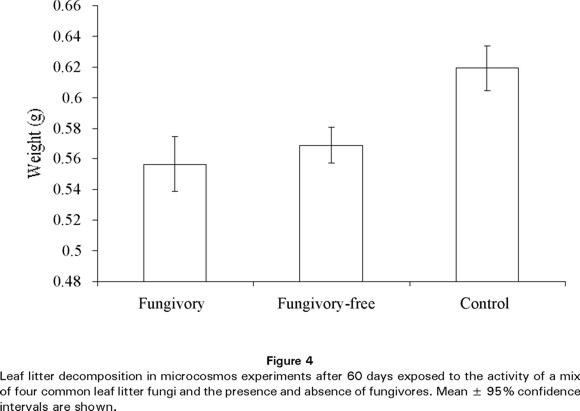
<body><![CDATA[<p align="center"><font face="verdana" size="2"><img src="/img/revistas/azm/n87/a1f4.jpg"></font></p>     <p align="justify"><font face="verdana" size="2"><b>Leaf litter decomposition</b></font></p>     <p align="justify"><font face="verdana" size="2">Finally, we compared the weight of leaf litter after 60 days of fungal activity (<a href="#f4">Fig. 4</a>) in all 80 microcosmos between treatments and the overall control (2 g microcosmos dried at the beginning of the experiment). The overall ANOVA was highly significant (F=7.99; d.f.=22, 77, P&lt;0.01) and the means comparison test showed that the dried leaf litter weight was significantly higher (P&lt;0.001) in the overall control (0.619 g) than in the fungivory (0.557 g) and fungivory&#45;free (0.569 g) treatments; there was no significant difference between treatments.</font></p>     <p align="justify"><font face="Verdana" size="2">&nbsp;</font></p>     <p align="justify"><font face="verdana" size="2"><b>Discussion</b></font></p>     <p align="justify"><font face="verdana" size="2"><b>Soil meso&#45;fauna community</b></font></p>     <p align="justify"><font face="verdana" size="2">The first part of this investigation showed that soil meso&#45;fauna is structurally complex in the study site. Although we found the same orders of arthropods in soil and in leaf litter, their absolute and relative abundance varied between habitats; variation also occurred within leaf litter samples but not soil samples. This reveals that in the study site leaf litter is a heterogeneous habitat which accommodates at least three sub&#45;communities, whereas soil is a homogeneous habitat accommodating only one community. The aim of this research was not to explore those factors related to the heterogeneity of leaf litter as habitat for soil meso&#45;fauna but several factors can be empirically identified: 1) The guild structure of fungi and other decomposers may be affected by the chemical composition of leaf litter and in turn this may affect the distribution of fungivorous meso&#45;fauna. Previous work at the study site (Heredia 1999) showed that leaf litter of <i>Quercus germana</i> Cham and Sch. <i>and Q. xalapensis</i> Humb. sustained a higher diversity of hyphomycetes than leaf litter of <i>Liquidambar styraciflua</i> Oersted. 2) Litter from different tree species decomposes at different rates and this may in itself affect soil meso&#45;fauna distribution. Heredia (1993) found that in an evergreen cloud forest (Biosphere Reserve El Cielo) in north&#45;eastern Mexico, leaf litter of <i>L</i>. <i>styraciflua</i> decomposed faster than that of <i>Quercus sartorii</i> Liemb. and <i>Q. germana</i>, probably due to the preferential activity of <i>Cylindrocladium scoparium</i> Morgan, <i>Verticillium</i> spp. and <i>Fusarium</i> spp. in <i>L. styraciflua</i> leaf litter. 3) In forest ecosystems, even in the range of few square meters, there is, at a single time, a mosaic of micro&#45;environmental conditions in the leaf litter habitat. This mosaic results mainly from the interaction of environmental conditions, thickness of the leaf litter layer, micro&#45;topography and canopy shade distribution. By contrast, the soil is usually covered by the leaf litter layer which may buffer micro&#45;environmental changes making the soil a homogeneous habitat compared to the leaf litter. Other studies have demonstrated that some micro&#45;environmental factors alter the activity of soil meso&#45;fauna (e.g., Worthen <i>et al.</i> 1995).</font></p>     <p align="justify"><font face="verdana" size="2">Mites and collembolans were the taxa with highest abundance and therefore had high weights in the grouping analysis marking clear differences among groups. Detailed analysis of the abundance of these taxa showed that mites and collembolans are more abundant in leaf litter than in soil. Given that a large number of species of these taxa are fungivorous, it is likely that their abundance is correlated to local (micro scale) fungal activity. Predators, a habit also common among mites, may also correlate with this activity as a result of potential prey concentration. Leaf litter micro&#45;environmental heterogeneity may determine largely the actual rate of fungal activity at any given area. Therefore, the leaf litter habitat may be visualise as a dynamic matrix on which different points change from high fungal activity to low activity or even cessation of activity almost in a stochastic (spatially and temporally) fashion. This in turn may be reflected by distribution patterns of soil (fungivorous) meso&#45;fauna. Also, biotic factors (e.g., feedback between fungi and fungivores) are expected to contribute to the dynamics of the leaf litter matrix.</font></p>     <p align="justify"><font face="verdana" size="2"><b>Selective feeding and effects on fungal fitness</b></font></p>     <p align="justify"><font face="verdana" size="2">Other studies have shown that fungivorous collembolans and mites prey selectively on mycelia of different species of fungi altering the competitive (combative) capabilities of fungi (Kaneko, <i>et al.</i> 1995, Maraun, <i>et al.</i> 1998, McLean, <i>et al.</i> 1996, Newell 1984a, 1984b, Parkinson, <i>et al.</i> 1979). Our results are in accordance to these evidence. We found that <i>Haplographium</i> sp. is a low quality resource for the oppid mite compared to the other three species of fungi. In addition, we recovered a larger number of spores of <i>D. microsporus</i> from control chambers than from those that included mites. Whereas, <i>M. novae&#45;zelandiae</i> and <i>C. heptasporum</i> showed the opposite pattern. From this, we hypothesise that the different species of fungi used in our experiments represent resources of varied qualities to the oppid mite which drives selective feeding. This difference may be on the basis of chemical composition of mycelia &#91;nutrient contents (c.f. Guevara &amp; Dirzo 1999), toxins (Franzolin, <i>et al.</i> 1999, Omoto &amp; McCoy 1998), odours (Bengtsson, <i>et al.</i> 1991, Guevara, <i>et al.</i> 2000, Hedlund, <i>et al.</i> 1995) and flavours&#93; or mechanical properties.</font></p>     ]]></body>
<body><![CDATA[<p align="justify"><font face="verdana" size="2">In our experimental design from which we recovered spores we used a single mix of four species of fungi in all microcosmos; therefore, we cannot be precise about the effects of fungivory on the reproductive potential of each of the four species of fungi. However, to our knowledge this is the first study in addressing effects of fungivory on mycelium systems based on a component of fungal reproductive fitness.</font></p>     <p align="justify"><font face="verdana" size="2"><b>Decomposition</b></font></p>     <p align="justify"><font face="verdana" size="2">We did not detect a significant effect of fungivory on the decomposition of leaf litter in the microcosmos experiment. This result contradicts other studies (Beare, <i>et al.</i> 1992, Hedlund &amp; Oehrn 2000, Rihani, <i>et al.</i> 1995). However, the observed result may be due to the fact that fungi where differentially affected by fungivory. <i>D. microsporus</i> appeared to be more active (high spore production) in fungivore free microcosmos whereas the number of recovered spores of <i>M. novae&#45;zelandiae</i> and <i>C. heptasporum</i> indicates an increase of activity of these fungi in the presence of the fungivore.</font></p>     <p align="justify"><font face="Verdana" size="2">&nbsp;</font></p>     <p align="justify"><font face="verdana" size="2"><b>Conclusion</b></font></p>     <p align="justify"><font face="verdana" size="2">Our findings indicate that fungivory affects the activity (spore production) of leaf litter fungi. Also, fungivores performed different on a variety of offered fungi indicating distinct resource (food) qualities. Hence, fungivory by the oppid mite has the potential to affect fungal community structure and the decomposition process although net effects may be masked by differential responses of fungi to the trophic activity of fungivory.</font></p>     <p align="justify"><font face="Verdana" size="2">&nbsp;</font></p>     <p align="justify"><font face="verdana" size="2"><b>Acknowledgements</b></font></p>     <p align="justify"><font face="verdana" size="2">We thank G. Heredia, R. M. Arias and M. Reyes for the strains used in this study. Funds for this investigation came from the project CONACYT&#45;I 32791 N and Departamento de Biolog&iacute;a de Suelos, INECOL.</font></p>     <p align="justify"><font face="Verdana" size="2">&nbsp;</font></p>     ]]></body>
<body><![CDATA[<p align="justify"><font face="verdana" size="2"><b>Literature cited</b></font></p>     <!-- ref --><p align="justify"><font face="verdana" size="2"><b>Beare, M. H., R. W. Parmelee, P. F. Hendrix, W. X. Cheng, D. C. Coleman &amp; D. A. Crossley</b>. 1992. Microbial and faunal interactions and effects on litter nitrogen and decomposition in agroecosystems. <i>Ecol. Mon.</i> 62: 569&#45;591.    &nbsp;&nbsp;&nbsp;&nbsp;&nbsp;&nbsp;&nbsp;&nbsp;[&#160;<a href="javascript:void(0);" onclick="javascript: window.open('/scielo.php?script=sci_nlinks&ref=302344&pid=S0065-1737200200030000100001&lng=','','width=640,height=500,resizable=yes,scrollbars=1,menubar=yes,');">Links</a>&#160;]<!-- end-ref --></font></p>     <!-- ref --><p align="justify"><font face="verdana" size="2"><b>Bengtsson, G., K. Hedlund &amp; S. Rundgren</b>. 1991. Selective odor perception in the soil Collembola <i>Onychiurus armatus</i>. <i>J. Chem. Ecol.</i> 17: 2113&#45;2125.    &nbsp;&nbsp;&nbsp;&nbsp;&nbsp;&nbsp;&nbsp;&nbsp;[&#160;<a href="javascript:void(0);" onclick="javascript: window.open('/scielo.php?script=sci_nlinks&ref=302346&pid=S0065-1737200200030000100002&lng=','','width=640,height=500,resizable=yes,scrollbars=1,menubar=yes,');">Links</a>&#160;]<!-- end-ref --></font></p>     <!-- ref --><p align="justify"><font face="verdana" size="2"><b>&#45;&#45;&#45;&#45;&#45;&#45;&#45;&#45;&#45;&#45;</b>. 1993. Patchiness and compensatory growth in a fungus&#45;Collembola system. <i>Oecologia</i> 93: 296&#45;302.    &nbsp;&nbsp;&nbsp;&nbsp;&nbsp;&nbsp;&nbsp;&nbsp;[&#160;<a href="javascript:void(0);" onclick="javascript: window.open('/scielo.php?script=sci_nlinks&ref=302348&pid=S0065-1737200200030000100003&lng=','','width=640,height=500,resizable=yes,scrollbars=1,menubar=yes,');">Links</a>&#160;]<!-- end-ref --></font></p>     <!-- ref --><p align="justify"><font face="verdana" size="2"><b>Castillo&#45;Campos, G</b>. 1991. Vegetaci&oacute;n y flora del municipio de Xalapa, Veracruz. <i>Instituto de Ecolog&iacute;a, A. C.</i>, <i>Xalapa</i>.    &nbsp;&nbsp;&nbsp;&nbsp;&nbsp;&nbsp;&nbsp;&nbsp;[&#160;<a href="javascript:void(0);" onclick="javascript: window.open('/scielo.php?script=sci_nlinks&ref=302350&pid=S0065-1737200200030000100004&lng=','','width=640,height=500,resizable=yes,scrollbars=1,menubar=yes,');">Links</a>&#160;]<!-- end-ref --></font></p>     <!-- ref --><p align="justify"><font face="verdana" size="2"><b>Coleman, D. C. &amp; D. A. Crossley Jr</b>. 1996. Fundamentals of soil ecology. <i>Academic Press</i>, <i>San Diego</i>.    &nbsp;&nbsp;&nbsp;&nbsp;&nbsp;&nbsp;&nbsp;&nbsp;[&#160;<a href="javascript:void(0);" onclick="javascript: window.open('/scielo.php?script=sci_nlinks&ref=302352&pid=S0065-1737200200030000100005&lng=','','width=640,height=500,resizable=yes,scrollbars=1,menubar=yes,');">Links</a>&#160;]<!-- end-ref --></font></p>     <!-- ref --><p align="justify"><font face="verdana" size="2"><b>Cooke, R. C. &amp; A. D. M. Rayner</b>. 1984. Ecology of soprotrophic fungi. <i>Longman Group Ltd</i>, <i>New York</i>.    &nbsp;&nbsp;&nbsp;&nbsp;&nbsp;&nbsp;&nbsp;&nbsp;[&#160;<a href="javascript:void(0);" onclick="javascript: window.open('/scielo.php?script=sci_nlinks&ref=302354&pid=S0065-1737200200030000100006&lng=','','width=640,height=500,resizable=yes,scrollbars=1,menubar=yes,');">Links</a>&#160;]<!-- end-ref --></font></p>     <!-- ref --><p align="justify"><font face="verdana" size="2"><b>Digby, P. G. N. &amp; R. A. Kempton</b>. 1987. Multivariate analysis of ecological communities. <i>Chapman and Hall</i>, <i>London</i>.    &nbsp;&nbsp;&nbsp;&nbsp;&nbsp;&nbsp;&nbsp;&nbsp;[&#160;<a href="javascript:void(0);" onclick="javascript: window.open('/scielo.php?script=sci_nlinks&ref=302356&pid=S0065-1737200200030000100007&lng=','','width=640,height=500,resizable=yes,scrollbars=1,menubar=yes,');">Links</a>&#160;]<!-- end-ref --></font></p>     <!-- ref --><p align="justify"><font face="verdana" size="2"><b>Franzolin, M. R., W. Gambale, R. G. Cuero &amp; B. Correa</b>. 1999. Interaction between toxigenic <i>Aspergillus flavus</i> Link and mites (<i>Tyrophagus putrescentiae</i> Schrank) on maize grains: effects on fungal growth and aflatoxin production. <i>J. Stored Prod. Res.</i> 35: 215&#45;224.    &nbsp;&nbsp;&nbsp;&nbsp;&nbsp;&nbsp;&nbsp;&nbsp;[&#160;<a href="javascript:void(0);" onclick="javascript: window.open('/scielo.php?script=sci_nlinks&ref=302358&pid=S0065-1737200200030000100008&lng=','','width=640,height=500,resizable=yes,scrollbars=1,menubar=yes,');">Links</a>&#160;]<!-- end-ref --></font></p>     <!-- ref --><p align="justify"><font face="verdana" size="2"><b>Guevara, R. &amp; R. Dirzo</b>. 1999. Consumption of macro&#45;fungi by invertebrates in a Mexican tropical cloud forest: do fruit body characteristics matter? <i>J. Trop. Ecol.</i> 15: 603&#45;617.    &nbsp;&nbsp;&nbsp;&nbsp;&nbsp;&nbsp;&nbsp;&nbsp;[&#160;<a href="javascript:void(0);" onclick="javascript: window.open('/scielo.php?script=sci_nlinks&ref=302360&pid=S0065-1737200200030000100009&lng=','','width=640,height=500,resizable=yes,scrollbars=1,menubar=yes,');">Links</a>&#160;]<!-- end-ref --></font></p>     <!-- ref --><p align="justify"><font face="verdana" size="2"><b>Guevara, R., A. D. M. Rayner &amp; S. E. Reynolds</b>. 2000. Orientation of specialist and generalist fungivorous ciid beetles to host and non&#45;host odours. <i>Physiol. Entomol.</i> 25: 288&#45;295.    &nbsp;&nbsp;&nbsp;&nbsp;&nbsp;&nbsp;&nbsp;&nbsp;[&#160;<a href="javascript:void(0);" onclick="javascript: window.open('/scielo.php?script=sci_nlinks&ref=302362&pid=S0065-1737200200030000100010&lng=','','width=640,height=500,resizable=yes,scrollbars=1,menubar=yes,');">Links</a>&#160;]<!-- end-ref --></font></p>     <!-- ref --><p align="justify"><font face="verdana" size="2"><b>Hedlund, K., G. Bengtsson &amp; S. Rundgren</b>. 1995. Fungal odour discrimination in two sympatric species of fungivorous collembolans. <i>Func. Ecol.</i> 9: 869&#45;875.    &nbsp;&nbsp;&nbsp;&nbsp;&nbsp;&nbsp;&nbsp;&nbsp;[&#160;<a href="javascript:void(0);" onclick="javascript: window.open('/scielo.php?script=sci_nlinks&ref=302364&pid=S0065-1737200200030000100011&lng=','','width=640,height=500,resizable=yes,scrollbars=1,menubar=yes,');">Links</a>&#160;]<!-- end-ref --></font></p>     <!-- ref --><p align="justify"><font face="verdana" size="2"><b>Hedlund, K. &amp; M. S. Oehrn</b>. 2000. Tritrophic interactions in a soil community enhance decomposition rates. <i>Oikos</i> 88: 585&#45;591.    &nbsp;&nbsp;&nbsp;&nbsp;&nbsp;&nbsp;&nbsp;&nbsp;[&#160;<a href="javascript:void(0);" onclick="javascript: window.open('/scielo.php?script=sci_nlinks&ref=302366&pid=S0065-1737200200030000100012&lng=','','width=640,height=500,resizable=yes,scrollbars=1,menubar=yes,');">Links</a>&#160;]<!-- end-ref --></font></p>     <!-- ref --><p align="justify"><font face="verdana" size="2"><b>Heredia, G</b>. 1993. Mycoflora associated with green leaves and leaf litter of <i>Quercus germana</i>, <i>Quercus sartorii</i> and <i>Liquidambar styraciflua</i> in a mexican cloud forest. <i>Crypto. Mycol.</i> 14: 171&#45;183.    &nbsp;&nbsp;&nbsp;&nbsp;&nbsp;&nbsp;&nbsp;&nbsp;[&#160;<a href="javascript:void(0);" onclick="javascript: window.open('/scielo.php?script=sci_nlinks&ref=302368&pid=S0065-1737200200030000100013&lng=','','width=640,height=500,resizable=yes,scrollbars=1,menubar=yes,');">Links</a>&#160;]<!-- end-ref --></font></p>     <!-- ref --><p align="justify"><font face="verdana" size="2"><b>&#45;&#45;&#45;&#45;&#45;&#45;&#45;&#45;&#45;</b>. 1999. Diversidad y sucesi&oacute;n de los hyphomycetes de la superficie de las hojas en descomposici&oacute;n de tres especies arboreas dominantes en un bosque mes&oacute;filo de monta&ntilde;a en el centro de Veracruz. Tesis de Doctorado. <i>Universidad Nacional Aut&oacute;noma de M&eacute;xico, Mexico.    &nbsp;&nbsp;&nbsp;&nbsp;&nbsp;&nbsp;&nbsp;&nbsp;[&#160;<a href="javascript:void(0);" onclick="javascript: window.open('/scielo.php?script=sci_nlinks&ref=302370&pid=S0065-1737200200030000100014&lng=','','width=640,height=500,resizable=yes,scrollbars=1,menubar=yes,');">Links</a>&#160;]<!-- end-ref --></i></font></p>     <!-- ref --><p align="justify"><font face="verdana" size="2"><b>Kaneko, N., M. A. McLean &amp; D. Parkinson</b>. 1995. Grazing preference of <i>Onychiurus subtenuis</i> (Collembola) and <i>Oppiella nova</i> (Oribatei) for fungal species inoculated on pine needles. <i>Pedobiol.</i> 39: 538&#45;546.    &nbsp;&nbsp;&nbsp;&nbsp;&nbsp;&nbsp;&nbsp;&nbsp;[&#160;<a href="javascript:void(0);" onclick="javascript: window.open('/scielo.php?script=sci_nlinks&ref=302372&pid=S0065-1737200200030000100015&lng=','','width=640,height=500,resizable=yes,scrollbars=1,menubar=yes,');">Links</a>&#160;]<!-- end-ref --></font></p>     <!-- ref --><p align="justify"><font face="verdana" size="2"><b>&#45;&#45;&#45;&#45;&#45;&#45;&#45;&#45;&#45;</b>. 1998. Do mites and Collembola affect pine litter fungal biomass and microbial respiration? <i>Appl. Soil Ecol.</i> 9: 209&#45;213.    &nbsp;&nbsp;&nbsp;&nbsp;&nbsp;&nbsp;&nbsp;&nbsp;[&#160;<a href="javascript:void(0);" onclick="javascript: window.open('/scielo.php?script=sci_nlinks&ref=302374&pid=S0065-1737200200030000100016&lng=','','width=640,height=500,resizable=yes,scrollbars=1,menubar=yes,');">Links</a>&#160;]<!-- end-ref --></font></p>     <!-- ref --><p align="justify"><font face="verdana" size="2"><b>Maraun, M., S. Migge, M. Schaefer &amp; S. Scheu</b>. 1998. Selection of microfungal food by six oribatid mite species (Oribatidae, Acari) from two different beech forests. <i>Pedobiol</i>. 42: 232&#45;240.    &nbsp;&nbsp;&nbsp;&nbsp;&nbsp;&nbsp;&nbsp;&nbsp;[&#160;<a href="javascript:void(0);" onclick="javascript: window.open('/scielo.php?script=sci_nlinks&ref=302376&pid=S0065-1737200200030000100017&lng=','','width=640,height=500,resizable=yes,scrollbars=1,menubar=yes,');">Links</a>&#160;]<!-- end-ref --></font></p>     <!-- ref --><p align="justify"><font face="verdana" size="2"><b>McLean, M. A., N. Kaneko &amp; D. Parkinson</b>. 1996. Does selective grazing by mites and Collembola affect litter fungal community structure? <i>Pedobiol.</i> 40: 97&#45;105.    &nbsp;&nbsp;&nbsp;&nbsp;&nbsp;&nbsp;&nbsp;&nbsp;[&#160;<a href="javascript:void(0);" onclick="javascript: window.open('/scielo.php?script=sci_nlinks&ref=302378&pid=S0065-1737200200030000100018&lng=','','width=640,height=500,resizable=yes,scrollbars=1,menubar=yes,');">Links</a>&#160;]<!-- end-ref --></font></p>     <!-- ref --><p align="justify"><font face="verdana" size="2"><b>Newell, K</b>. 1984a. Interactions between two decomposer basidiomycetes and a collembolan under sitka spruce: distribution, abundance and selective grazing. <i>Soil. Biol. Biochem.</i> 16: 227&#45;233.    &nbsp;&nbsp;&nbsp;&nbsp;&nbsp;&nbsp;&nbsp;&nbsp;[&#160;<a href="javascript:void(0);" onclick="javascript: window.open('/scielo.php?script=sci_nlinks&ref=302380&pid=S0065-1737200200030000100019&lng=','','width=640,height=500,resizable=yes,scrollbars=1,menubar=yes,');">Links</a>&#160;]<!-- end-ref --></font></p>     <!-- ref --><p align="justify"><font face="verdana" size="2"><b>&#45;&#45;&#45;&#45;&#45;&#45;&#45;&#45;&#45;&#45;</b>. 1984b. Interactions between two decomposer basidiomycetes and a collembolan under sitka spruce: grazing and its potential effects on fungal distribution and litter decomposition. <i>Soil Biol. Biochem.</i> 16: 235&#45;239.    &nbsp;&nbsp;&nbsp;&nbsp;&nbsp;&nbsp;&nbsp;&nbsp;[&#160;<a href="javascript:void(0);" onclick="javascript: window.open('/scielo.php?script=sci_nlinks&ref=302382&pid=S0065-1737200200030000100020&lng=','','width=640,height=500,resizable=yes,scrollbars=1,menubar=yes,');">Links</a>&#160;]<!-- end-ref --></font></p>     <!-- ref --><p align="justify"><font face="verdana" size="2"><b>Omoto, C. &amp; C. W. McCoy</b>. 1998. Toxicity of purified fungal toxin hirsutellin A to the citrus rust mite <i>Phyllocoptruta oleivora</i> (Ash.). <i>J. Invert. Pathol.</i> 72: 319&#45;322.    &nbsp;&nbsp;&nbsp;&nbsp;&nbsp;&nbsp;&nbsp;&nbsp;[&#160;<a href="javascript:void(0);" onclick="javascript: window.open('/scielo.php?script=sci_nlinks&ref=302384&pid=S0065-1737200200030000100021&lng=','','width=640,height=500,resizable=yes,scrollbars=1,menubar=yes,');">Links</a>&#160;]<!-- end-ref --></font></p>     <!-- ref --><p align="justify"><font face="verdana" size="2"><b>Parkinson, D., S. Visser &amp; J. B. Whittaker</b>. 1979. Effects of Collembola grazing on fungal colonisation of leaf litter. <i>Soil Biol. Biochem.</i> 11: 529&#45;535.    &nbsp;&nbsp;&nbsp;&nbsp;&nbsp;&nbsp;&nbsp;&nbsp;[&#160;<a href="javascript:void(0);" onclick="javascript: window.open('/scielo.php?script=sci_nlinks&ref=302386&pid=S0065-1737200200030000100022&lng=','','width=640,height=500,resizable=yes,scrollbars=1,menubar=yes,');">Links</a>&#160;]<!-- end-ref --></font></p>     <!-- ref --><p align="justify"><font face="verdana" size="2"><b>Rihani, M., J. P. Fonseca &amp; E. Kiffer</b>. 1995. Decomposition of beech leaf litter by microflora and mesofauna. II. Food preferences and action of oribatid mites on different substrates. <i>Rev. Ecol. Biol. Sol</i> 31: 67.    &nbsp;&nbsp;&nbsp;&nbsp;&nbsp;&nbsp;&nbsp;&nbsp;[&#160;<a href="javascript:void(0);" onclick="javascript: window.open('/scielo.php?script=sci_nlinks&ref=302388&pid=S0065-1737200200030000100023&lng=','','width=640,height=500,resizable=yes,scrollbars=1,menubar=yes,');">Links</a>&#160;]<!-- end-ref --></font></p>     <!-- ref --><p align="justify"><font face="verdana" size="2"><b>Rodin, L. E. &amp; N. I. Basilevic</b>. 1967. Production and mineral cycling in terrestrial vegetation. <i>Oliver and Boyd</i>, <i>Edinburgh</i>.    &nbsp;&nbsp;&nbsp;&nbsp;&nbsp;&nbsp;&nbsp;&nbsp;[&#160;<a href="javascript:void(0);" onclick="javascript: window.open('/scielo.php?script=sci_nlinks&ref=302390&pid=S0065-1737200200030000100024&lng=','','width=640,height=500,resizable=yes,scrollbars=1,menubar=yes,');">Links</a>&#160;]<!-- end-ref --></font></p>     <!-- ref --><p align="justify"><font face="verdana" size="2"><b>&#45;&#45;&#45;&#45;&#45;&#45;&#45;&#45;&#45;&#45;</b>. 1968. World distribution of plant biomass. <i>In</i> F. E. Eckardt (eds). <i>Functioning of terrestrial ecosystems at the primary production level</i>. United Nations Educational, Scientific and Cultural Organization Press, Paris. pp. 193&#45;202.    &nbsp;&nbsp;&nbsp;&nbsp;&nbsp;&nbsp;&nbsp;&nbsp;[&#160;<a href="javascript:void(0);" onclick="javascript: window.open('/scielo.php?script=sci_nlinks&ref=302392&pid=S0065-1737200200030000100025&lng=','','width=640,height=500,resizable=yes,scrollbars=1,menubar=yes,');">Links</a>&#160;]<!-- end-ref --></font></p>     <!-- ref --><p align="justify"><font face="verdana" size="2"><b>Siepel, H. &amp; F. Maaskamp</b>. 1994. Mites of different feeding guilds affect decomposition of organic matter. <i>Soil Biol. Bioche.</i> 26: 1389&#45;1394.    &nbsp;&nbsp;&nbsp;&nbsp;&nbsp;&nbsp;&nbsp;&nbsp;[&#160;<a href="javascript:void(0);" onclick="javascript: window.open('/scielo.php?script=sci_nlinks&ref=302394&pid=S0065-1737200200030000100026&lng=','','width=640,height=500,resizable=yes,scrollbars=1,menubar=yes,');">Links</a>&#160;]<!-- end-ref --></font></p>     <!-- ref --><p align="justify"><font face="verdana" size="2"><b>StatSoft&#45;Inc</b>. 1999. Statistica for Windows (computer program manual). <i>StatSoft Inc, Tulsa</i>.    &nbsp;&nbsp;&nbsp;&nbsp;&nbsp;&nbsp;&nbsp;&nbsp;[&#160;<a href="javascript:void(0);" onclick="javascript: window.open('/scielo.php?script=sci_nlinks&ref=302396&pid=S0065-1737200200030000100027&lng=','','width=640,height=500,resizable=yes,scrollbars=1,menubar=yes,');">Links</a>&#160;]<!-- end-ref --></font></p>     <!-- ref --><p align="justify"><font face="verdana" size="2"><b>Swift, M. J. &amp; L. Boddy</b>. 1984. Animal&#45;microbial interactions in wood decomposition. <i>In</i> J. M. Anderson, A. D. M. Rayner and D. W. H. Walton (eds). <i>Invertebrate&#45;microbial interactions</i>. Cambridge University Press, Cambridge. pp. 89&#45;131.    &nbsp;&nbsp;&nbsp;&nbsp;&nbsp;&nbsp;&nbsp;&nbsp;[&#160;<a href="javascript:void(0);" onclick="javascript: window.open('/scielo.php?script=sci_nlinks&ref=302398&pid=S0065-1737200200030000100028&lng=','','width=640,height=500,resizable=yes,scrollbars=1,menubar=yes,');">Links</a>&#160;]<!-- end-ref --></font></p>     <!-- ref --><p align="justify"><font face="verdana" size="2"><b>Worthen, W. B., B. R. Bloodworth &amp; M. B. Hobbs</b>. 1995. Habitat variability in the effects of predation and microclimate on mycophagous fly communities. <i>Ecography</i> 18: 248&#45;258.    &nbsp;&nbsp;&nbsp;&nbsp;&nbsp;&nbsp;&nbsp;&nbsp;[&#160;<a href="javascript:void(0);" onclick="javascript: window.open('/scielo.php?script=sci_nlinks&ref=302400&pid=S0065-1737200200030000100029&lng=','','width=640,height=500,resizable=yes,scrollbars=1,menubar=yes,');">Links</a>&#160;]<!-- end-ref --></font></p>      ]]></body><back>
<ref-list>
<ref id="B1">
<nlm-citation citation-type="journal">
<person-group person-group-type="author">
<name>
<surname><![CDATA[Beare]]></surname>
<given-names><![CDATA[M. H.]]></given-names>
</name>
<name>
<surname><![CDATA[Parmelee]]></surname>
<given-names><![CDATA[R. W.]]></given-names>
</name>
<name>
<surname><![CDATA[Hendrix]]></surname>
<given-names><![CDATA[P. F.]]></given-names>
</name>
<name>
<surname><![CDATA[Cheng]]></surname>
<given-names><![CDATA[W. X.]]></given-names>
</name>
<name>
<surname><![CDATA[Coleman]]></surname>
<given-names><![CDATA[D. C.]]></given-names>
</name>
<name>
<surname><![CDATA[Crossley]]></surname>
<given-names><![CDATA[D. A.]]></given-names>
</name>
</person-group>
<article-title xml:lang="en"><![CDATA[Microbial and faunal interactions and effects on litter nitrogen and decomposition in agroecosystems]]></article-title>
<source><![CDATA[Ecol. Mon.]]></source>
<year>1992</year>
<volume>62</volume>
<page-range>569-591</page-range></nlm-citation>
</ref>
<ref id="B2">
<nlm-citation citation-type="journal">
<person-group person-group-type="author">
<name>
<surname><![CDATA[Bengtsson]]></surname>
<given-names><![CDATA[G.]]></given-names>
</name>
<name>
<surname><![CDATA[Hedlund]]></surname>
<given-names><![CDATA[K.]]></given-names>
</name>
<name>
<surname><![CDATA[Rundgren]]></surname>
<given-names><![CDATA[S.]]></given-names>
</name>
</person-group>
<article-title xml:lang="en"><![CDATA[Selective odor perception in the soil Collembola Onychiurus armatus]]></article-title>
<source><![CDATA[J. Chem. Ecol.]]></source>
<year>1991</year>
<volume>17</volume>
<page-range>2113-2125</page-range></nlm-citation>
</ref>
<ref id="B3">
<nlm-citation citation-type="journal">
<person-group person-group-type="author">
<name>
<surname><![CDATA[Bengtsson]]></surname>
<given-names><![CDATA[G.]]></given-names>
</name>
</person-group>
<article-title xml:lang="en"><![CDATA[Patchiness and compensatory growth in a fungus-Collembola system]]></article-title>
<source><![CDATA[Oecologia]]></source>
<year>1993</year>
<volume>93</volume>
<page-range>296-302</page-range></nlm-citation>
</ref>
<ref id="B4">
<nlm-citation citation-type="book">
<person-group person-group-type="author">
<name>
<surname><![CDATA[Castillo-Campos]]></surname>
<given-names><![CDATA[G]]></given-names>
</name>
</person-group>
<source><![CDATA[Vegetación y flora del municipio de Xalapa, Veracruz]]></source>
<year>1991</year>
<publisher-loc><![CDATA[Xalapa ]]></publisher-loc>
<publisher-name><![CDATA[Instituto de Ecología, A. C.]]></publisher-name>
</nlm-citation>
</ref>
<ref id="B5">
<nlm-citation citation-type="book">
<person-group person-group-type="author">
<name>
<surname><![CDATA[Coleman]]></surname>
<given-names><![CDATA[D. C.]]></given-names>
</name>
<name>
<surname><![CDATA[Crossley Jr]]></surname>
<given-names><![CDATA[D. A.]]></given-names>
</name>
</person-group>
<source><![CDATA[Fundamentals of soil ecology]]></source>
<year>1996</year>
<publisher-loc><![CDATA[San Diego ]]></publisher-loc>
<publisher-name><![CDATA[Academic Press]]></publisher-name>
</nlm-citation>
</ref>
<ref id="B6">
<nlm-citation citation-type="book">
<person-group person-group-type="author">
<name>
<surname><![CDATA[Cooke]]></surname>
<given-names><![CDATA[R. C.]]></given-names>
</name>
<name>
<surname><![CDATA[Rayner]]></surname>
<given-names><![CDATA[A. D. M.]]></given-names>
</name>
</person-group>
<source><![CDATA[Ecology of soprotrophic fungi]]></source>
<year>1984</year>
<publisher-loc><![CDATA[New York ]]></publisher-loc>
<publisher-name><![CDATA[Longman Group Ltd]]></publisher-name>
</nlm-citation>
</ref>
<ref id="B7">
<nlm-citation citation-type="book">
<person-group person-group-type="author">
<name>
<surname><![CDATA[Digby]]></surname>
<given-names><![CDATA[P. G. N.]]></given-names>
</name>
<name>
<surname><![CDATA[Kempton]]></surname>
<given-names><![CDATA[R. A.]]></given-names>
</name>
</person-group>
<source><![CDATA[Multivariate analysis of ecological communities]]></source>
<year>1987</year>
<publisher-loc><![CDATA[London ]]></publisher-loc>
<publisher-name><![CDATA[Chapman and Hall]]></publisher-name>
</nlm-citation>
</ref>
<ref id="B8">
<nlm-citation citation-type="journal">
<person-group person-group-type="author">
<name>
<surname><![CDATA[Franzolin]]></surname>
<given-names><![CDATA[M. R.]]></given-names>
</name>
<name>
<surname><![CDATA[Gambale]]></surname>
<given-names><![CDATA[W.]]></given-names>
</name>
<name>
<surname><![CDATA[Cuero]]></surname>
<given-names><![CDATA[R. G.]]></given-names>
</name>
<name>
<surname><![CDATA[Correa]]></surname>
<given-names><![CDATA[B.]]></given-names>
</name>
</person-group>
<article-title xml:lang="en"><![CDATA[Interaction between toxigenic Aspergillus flavus Link and mites (Tyrophagus putrescentiae Schrank) on maize grains: effects on fungal growth and aflatoxin production]]></article-title>
<source><![CDATA[J. Stored Prod. Res.]]></source>
<year>1999</year>
<volume>35</volume>
<page-range>215-224</page-range></nlm-citation>
</ref>
<ref id="B9">
<nlm-citation citation-type="journal">
<person-group person-group-type="author">
<name>
<surname><![CDATA[Guevara]]></surname>
<given-names><![CDATA[R.]]></given-names>
</name>
<name>
<surname><![CDATA[Dirzo]]></surname>
<given-names><![CDATA[R.]]></given-names>
</name>
</person-group>
<article-title xml:lang="en"><![CDATA[Consumption of macro-fungi by invertebrates in a Mexican tropical cloud forest: do fruit body characteristics matter?]]></article-title>
<source><![CDATA[J. Trop. Ecol.]]></source>
<year>1999</year>
<volume>15</volume>
<page-range>603-617</page-range></nlm-citation>
</ref>
<ref id="B10">
<nlm-citation citation-type="journal">
<person-group person-group-type="author">
<name>
<surname><![CDATA[Guevara]]></surname>
<given-names><![CDATA[R.]]></given-names>
</name>
<name>
<surname><![CDATA[Rayner]]></surname>
<given-names><![CDATA[A. D. M.]]></given-names>
</name>
<name>
<surname><![CDATA[Reynolds]]></surname>
<given-names><![CDATA[S. E.]]></given-names>
</name>
</person-group>
<article-title xml:lang="en"><![CDATA[Orientation of specialist and generalist fungivorous ciid beetles to host and non-host odours]]></article-title>
<source><![CDATA[Physiol. Entomol.]]></source>
<year>2000</year>
<volume>25</volume>
<page-range>288-295</page-range></nlm-citation>
</ref>
<ref id="B11">
<nlm-citation citation-type="journal">
<person-group person-group-type="author">
<name>
<surname><![CDATA[Hedlund]]></surname>
<given-names><![CDATA[K.]]></given-names>
</name>
<name>
<surname><![CDATA[Bengtsson]]></surname>
<given-names><![CDATA[G.]]></given-names>
</name>
<name>
<surname><![CDATA[Rundgren]]></surname>
<given-names><![CDATA[S.]]></given-names>
</name>
</person-group>
<article-title xml:lang="en"><![CDATA[Fungal odour discrimination in two sympatric species of fungivorous collembolans]]></article-title>
<source><![CDATA[Func. Ecol.]]></source>
<year>1995</year>
<volume>9</volume>
<page-range>869-875</page-range></nlm-citation>
</ref>
<ref id="B12">
<nlm-citation citation-type="journal">
<person-group person-group-type="author">
<name>
<surname><![CDATA[Hedlund]]></surname>
<given-names><![CDATA[K.]]></given-names>
</name>
<name>
<surname><![CDATA[Oehrn]]></surname>
<given-names><![CDATA[M. S.]]></given-names>
</name>
</person-group>
<article-title xml:lang="en"><![CDATA[Tritrophic interactions in a soil community enhance decomposition rates]]></article-title>
<source><![CDATA[Oikos]]></source>
<year>2000</year>
<volume>88</volume>
<page-range>585-591</page-range></nlm-citation>
</ref>
<ref id="B13">
<nlm-citation citation-type="journal">
<person-group person-group-type="author">
<name>
<surname><![CDATA[Heredia]]></surname>
<given-names><![CDATA[G]]></given-names>
</name>
</person-group>
<article-title xml:lang="en"><![CDATA[Mycoflora associated with green leaves and leaf litter of Quercus germana, Quercus sartorii and Liquidambar styraciflua in a mexican cloud forest]]></article-title>
<source><![CDATA[Crypto. Mycol.]]></source>
<year>1993</year>
<volume>14</volume>
<page-range>171-183</page-range></nlm-citation>
</ref>
<ref id="B14">
<nlm-citation citation-type="">
<person-group person-group-type="author">
<name>
<surname><![CDATA[Heredia]]></surname>
<given-names><![CDATA[G]]></given-names>
</name>
</person-group>
<person-group person-group-type="editor">
<name>
</name>
</person-group>
<source><![CDATA[Diversidad y sucesión de los hyphomycetes de la superficie de las hojas en descomposición de tres especies arboreas dominantes en un bosque mesófilo de montaña en el centro de Veracruz]]></source>
<year>1999</year>
</nlm-citation>
</ref>
<ref id="B15">
<nlm-citation citation-type="journal">
<person-group person-group-type="author">
<name>
<surname><![CDATA[Kaneko]]></surname>
<given-names><![CDATA[N.]]></given-names>
</name>
<name>
<surname><![CDATA[McLean]]></surname>
<given-names><![CDATA[M. A.]]></given-names>
</name>
<name>
<surname><![CDATA[Parkinson]]></surname>
<given-names><![CDATA[D.]]></given-names>
</name>
</person-group>
<article-title xml:lang="en"><![CDATA[Grazing preference of Onychiurus subtenuis (Collembola) and Oppiella nova (Oribatei) for fungal species inoculated on pine needles]]></article-title>
<source><![CDATA[Pedobiol.]]></source>
<year>1995</year>
<volume>39</volume>
<page-range>538-546</page-range></nlm-citation>
</ref>
<ref id="B16">
<nlm-citation citation-type="journal">
<person-group person-group-type="author">
<name>
<surname><![CDATA[Kaneko]]></surname>
<given-names><![CDATA[N.]]></given-names>
</name>
</person-group>
<article-title xml:lang="en"><![CDATA[Do mites and Collembola affect pine litter fungal biomass and microbial respiration? Appl]]></article-title>
<source><![CDATA[Soil Ecol.]]></source>
<year>1998</year>
<volume>9</volume>
<page-range>209-213</page-range></nlm-citation>
</ref>
<ref id="B17">
<nlm-citation citation-type="journal">
<person-group person-group-type="author">
<name>
<surname><![CDATA[Maraun]]></surname>
<given-names><![CDATA[M.]]></given-names>
</name>
<name>
<surname><![CDATA[Migge]]></surname>
<given-names><![CDATA[S.]]></given-names>
</name>
<name>
<surname><![CDATA[Schaefer]]></surname>
<given-names><![CDATA[M.]]></given-names>
</name>
<name>
<surname><![CDATA[Scheu]]></surname>
<given-names><![CDATA[S.]]></given-names>
</name>
</person-group>
<article-title xml:lang="en"><![CDATA[Selection of microfungal food by six oribatid mite species (Oribatidae, Acari) from two different beech forests]]></article-title>
<source><![CDATA[Pedobiol.]]></source>
<year>1998</year>
<volume>42</volume>
<page-range>232-240</page-range></nlm-citation>
</ref>
<ref id="B18">
<nlm-citation citation-type="journal">
<person-group person-group-type="author">
<name>
<surname><![CDATA[McLean]]></surname>
<given-names><![CDATA[M. A.]]></given-names>
</name>
<name>
<surname><![CDATA[Kaneko]]></surname>
<given-names><![CDATA[N.]]></given-names>
</name>
<name>
<surname><![CDATA[Parkinson]]></surname>
<given-names><![CDATA[D.]]></given-names>
</name>
</person-group>
<article-title xml:lang="en"><![CDATA[Does selective grazing by mites and Collembola affect litter fungal community structure?]]></article-title>
<source><![CDATA[Pedobiol.]]></source>
<year>1996</year>
<volume>40</volume>
<page-range>97-105</page-range></nlm-citation>
</ref>
<ref id="B19">
<nlm-citation citation-type="journal">
<person-group person-group-type="author">
<name>
<surname><![CDATA[Newell]]></surname>
<given-names><![CDATA[K]]></given-names>
</name>
</person-group>
<article-title xml:lang="en"><![CDATA[Interactions between two decomposer basidiomycetes and a collembolan under sitka spruce: distribution, abundance and selective grazing]]></article-title>
<source><![CDATA[Soil. Biol. Biochem.]]></source>
<year>1984</year>
<volume>16</volume>
<page-range>227-233</page-range></nlm-citation>
</ref>
<ref id="B20">
<nlm-citation citation-type="journal">
<person-group person-group-type="author">
<name>
<surname><![CDATA[Newell]]></surname>
<given-names><![CDATA[K]]></given-names>
</name>
</person-group>
<article-title xml:lang="en"><![CDATA[Interactions between two decomposer basidiomycetes and a collembolan under sitka spruce: grazing and its potential effects on fungal distribution and litter decomposition]]></article-title>
<source><![CDATA[Soil Biol. Biochem.]]></source>
<year>1984</year>
<volume>16</volume>
<page-range>235-239</page-range></nlm-citation>
</ref>
<ref id="B21">
<nlm-citation citation-type="journal">
<person-group person-group-type="author">
<name>
<surname><![CDATA[Omoto]]></surname>
<given-names><![CDATA[C.]]></given-names>
</name>
<name>
<surname><![CDATA[McCoy]]></surname>
<given-names><![CDATA[C. W.]]></given-names>
</name>
</person-group>
<article-title xml:lang="en"><![CDATA[Toxicity of purified fungal toxin hirsutellin A to the citrus rust mite Phyllocoptruta oleivora (Ash.)]]></article-title>
<source><![CDATA[J. Invert. Pathol.]]></source>
<year>1998</year>
<volume>72</volume>
<page-range>319-322</page-range></nlm-citation>
</ref>
<ref id="B22">
<nlm-citation citation-type="journal">
<person-group person-group-type="author">
<name>
<surname><![CDATA[Parkinson]]></surname>
<given-names><![CDATA[D.]]></given-names>
</name>
<name>
<surname><![CDATA[Visser]]></surname>
<given-names><![CDATA[S.]]></given-names>
</name>
<name>
<surname><![CDATA[Whittaker]]></surname>
<given-names><![CDATA[J. B.]]></given-names>
</name>
</person-group>
<article-title xml:lang="en"><![CDATA[Effects of Collembola grazing on fungal colonisation of leaf litter]]></article-title>
<source><![CDATA[Soil Biol. Biochem.]]></source>
<year>1979</year>
<volume>11</volume>
<page-range>529-535</page-range></nlm-citation>
</ref>
<ref id="B23">
<nlm-citation citation-type="journal">
<person-group person-group-type="author">
<name>
<surname><![CDATA[Rihani]]></surname>
<given-names><![CDATA[M.]]></given-names>
</name>
<name>
<surname><![CDATA[Fonseca]]></surname>
<given-names><![CDATA[J. P.]]></given-names>
</name>
<name>
<surname><![CDATA[Kiffer]]></surname>
<given-names><![CDATA[E.]]></given-names>
</name>
</person-group>
<article-title xml:lang="en"><![CDATA[Decomposition of beech leaf litter by microflora and mesofauna. II. Food preferences and action of oribatid mites on different substrates]]></article-title>
<source><![CDATA[Rev. Ecol. Biol. Sol]]></source>
<year>1995</year>
<volume>31</volume>
<page-range>67</page-range></nlm-citation>
</ref>
<ref id="B24">
<nlm-citation citation-type="book">
<person-group person-group-type="author">
<name>
<surname><![CDATA[Rodin]]></surname>
<given-names><![CDATA[L. E.]]></given-names>
</name>
<name>
<surname><![CDATA[Basilevic]]></surname>
<given-names><![CDATA[N. I.]]></given-names>
</name>
</person-group>
<source><![CDATA[Production and mineral cycling in terrestrial vegetation]]></source>
<year>1967</year>
<publisher-loc><![CDATA[Edinburgh ]]></publisher-loc>
<publisher-name><![CDATA[Oliver and Boyd]]></publisher-name>
</nlm-citation>
</ref>
<ref id="B25">
<nlm-citation citation-type="book">
<person-group person-group-type="author">
<name>
<surname><![CDATA[Rodin]]></surname>
<given-names><![CDATA[L. E.]]></given-names>
</name>
</person-group>
<article-title xml:lang="en"><![CDATA[World distribution of plant biomass]]></article-title>
<person-group person-group-type="editor">
<name>
<surname><![CDATA[Eckardt]]></surname>
<given-names><![CDATA[F. E.]]></given-names>
</name>
</person-group>
<source><![CDATA[Functioning of terrestrial ecosystems at the primary production level]]></source>
<year>1968</year>
<page-range>193-202</page-range><publisher-loc><![CDATA[Paris ]]></publisher-loc>
<publisher-name><![CDATA[United Nations Educational, Scientific and Cultural Organization Press]]></publisher-name>
</nlm-citation>
</ref>
<ref id="B26">
<nlm-citation citation-type="journal">
<person-group person-group-type="author">
<name>
<surname><![CDATA[Siepel]]></surname>
<given-names><![CDATA[H.]]></given-names>
</name>
<name>
<surname><![CDATA[Maaskamp]]></surname>
<given-names><![CDATA[F.]]></given-names>
</name>
</person-group>
<article-title xml:lang="en"><![CDATA[Mites of different feeding guilds affect decomposition of organic matter]]></article-title>
<source><![CDATA[Soil Biol. Bioche.]]></source>
<year>1994</year>
<volume>26</volume>
<page-range>1389-1394</page-range></nlm-citation>
</ref>
<ref id="B27">
<nlm-citation citation-type="book">
<collab>^rND^sSiepel^nH.</collab>
<source><![CDATA[Statistica for Windows (computer program manual)]]></source>
<year>1999</year>
<publisher-loc><![CDATA[Tulsa ]]></publisher-loc>
<publisher-name><![CDATA[StatSoft Inc]]></publisher-name>
</nlm-citation>
</ref>
<ref id="B28">
<nlm-citation citation-type="book">
<person-group person-group-type="author">
<name>
<surname><![CDATA[Swift]]></surname>
<given-names><![CDATA[M. J.]]></given-names>
</name>
<name>
<surname><![CDATA[Boddy]]></surname>
<given-names><![CDATA[L.]]></given-names>
</name>
</person-group>
<article-title xml:lang="en"><![CDATA[Animal-microbial interactions in wood decomposition]]></article-title>
<person-group person-group-type="editor">
<name>
<surname><![CDATA[Anderson]]></surname>
<given-names><![CDATA[J. M.]]></given-names>
</name>
<name>
<surname><![CDATA[Rayner]]></surname>
<given-names><![CDATA[A. D. M.]]></given-names>
</name>
<name>
<surname><![CDATA[Walton]]></surname>
<given-names><![CDATA[D. W. H.]]></given-names>
</name>
</person-group>
<source><![CDATA[Invertebrate-microbial interactions]]></source>
<year>1984</year>
<page-range>89-131</page-range><publisher-loc><![CDATA[Cambridge ]]></publisher-loc>
<publisher-name><![CDATA[Cambridge University Press]]></publisher-name>
</nlm-citation>
</ref>
<ref id="B29">
<nlm-citation citation-type="journal">
<person-group person-group-type="author">
<name>
<surname><![CDATA[Worthen]]></surname>
<given-names><![CDATA[W. B.]]></given-names>
</name>
<name>
<surname><![CDATA[Bloodworth]]></surname>
<given-names><![CDATA[B. R.]]></given-names>
</name>
<name>
<surname><![CDATA[Hobbs]]></surname>
<given-names><![CDATA[M. B.]]></given-names>
</name>
</person-group>
<article-title xml:lang="en"><![CDATA[Habitat variability in the effects of predation and microclimate on mycophagous fly communities]]></article-title>
<source><![CDATA[Ecography]]></source>
<year>1995</year>
<volume>18</volume>
<page-range>248-258</page-range></nlm-citation>
</ref>
</ref-list>
</back>
</article>