<?xml version="1.0" encoding="ISO-8859-1"?><article xmlns:mml="http://www.w3.org/1998/Math/MathML" xmlns:xlink="http://www.w3.org/1999/xlink" xmlns:xsi="http://www.w3.org/2001/XMLSchema-instance">
<front>
<journal-meta>
<journal-id>0065-1737</journal-id>
<journal-title><![CDATA[Acta zoológica mexicana]]></journal-title>
<abbrev-journal-title><![CDATA[Acta Zool. Mex]]></abbrev-journal-title>
<issn>0065-1737</issn>
<publisher>
<publisher-name><![CDATA[Instituto de Ecología A.C.]]></publisher-name>
</publisher>
</journal-meta>
<article-meta>
<article-id>S0065-17372002000100010</article-id>
<title-group>
<article-title xml:lang="en"><![CDATA[Comparison of rodent communities in sites with different degrees of disturbance in deciduous forest of southeartern Morelos, Mexico]]></article-title>
</title-group>
<contrib-group>
<contrib contrib-type="author">
<name>
<surname><![CDATA[García-Estrada]]></surname>
<given-names><![CDATA[Carlos]]></given-names>
</name>
<xref ref-type="aff" rid="A01"/>
</contrib>
<contrib contrib-type="author">
<name>
<surname><![CDATA[Romero-Almaraz]]></surname>
<given-names><![CDATA[Ma. de Lourdes]]></given-names>
</name>
<xref ref-type="aff" rid="A01"/>
</contrib>
<contrib contrib-type="author">
<name>
<surname><![CDATA[Sánchez-Hernández]]></surname>
<given-names><![CDATA[Cornelio]]></given-names>
</name>
<xref ref-type="aff" rid="A02"/>
</contrib>
</contrib-group>
<aff id="A01">
<institution><![CDATA[,Universidad Autónoma del Estado de Morelos Centro de Investigaciones Biológicas ]]></institution>
<addr-line><![CDATA[Cuernavaca Morelos]]></addr-line>
<country>México</country>
</aff>
<aff id="A02">
<institution><![CDATA[,Universidad Nacional Autónoma de México Instituto de Biología ]]></institution>
<addr-line><![CDATA[México Distrito Federal]]></addr-line>
<country>México</country>
</aff>
<pub-date pub-type="pub">
<day>00</day>
<month>00</month>
<year>2002</year>
</pub-date>
<pub-date pub-type="epub">
<day>00</day>
<month>00</month>
<year>2002</year>
</pub-date>
<numero>85</numero>
<fpage>153</fpage>
<lpage>168</lpage>
<copyright-statement/>
<copyright-year/>
<self-uri xlink:href="http://www.scielo.org.mx/scielo.php?script=sci_arttext&amp;pid=S0065-17372002000100010&amp;lng=en&amp;nrm=iso"></self-uri><self-uri xlink:href="http://www.scielo.org.mx/scielo.php?script=sci_abstract&amp;pid=S0065-17372002000100010&amp;lng=en&amp;nrm=iso"></self-uri><self-uri xlink:href="http://www.scielo.org.mx/scielo.php?script=sci_pdf&amp;pid=S0065-17372002000100010&amp;lng=en&amp;nrm=iso"></self-uri><abstract abstract-type="short" xml:lang="es"><p><![CDATA[Este estudio es el primer trabajo que compara comunidades de roedores en una selva baja caducifolia en México. Señala las diferencias entre dos sitios con diferentes grados de alteración ocasionado por la extracción de madera y leña, y el pastoreo del ganado; en un sitio relativamente poco alterado (Sitio 1) y otro sitio más alterado (Sitio 2) en el sureste del estado de Morelos. En cada sitio se capturaron seis especies de roedores. Aunque la alteración del hábitat no modificó la diversidad o la equitatividad de las especies de roedores, el número total de inviduos capturados en el Sitio 1 (n = 319) fue mayor que en el Sitio 2 (n = 90). Los efectos de la fragmentación de hábitat se expresaron en diferencias significativas en la densidad poblacional, estructura de edades y preferencia en el microhábitat entre los dos de sitios para Baiomys musculus, Peromyscus levipes y P. melanophrys. La alteración de la selva baja caducifolia parece ser el principal factor que explica las diferencias en los parámetros demográficos de las especies entre los dos sitios, debido a que los dos sitios tienen el mismo clima, el suelo es similar, y la topografía difiere ligeramente.]]></p></abstract>
<abstract abstract-type="short" xml:lang="en"><p><![CDATA[This study is the first work that compares rodent communities in a deciduous forest in Mexico. It documents differences between sites experiencing different degrees of disturbance caused by firewood and lumber extraction, and cattle grazing; a relatively undisturbed site (Site 1) and another more disturbed site (Site 2) in southeastern Morelos State. In each site we captured six species of rodents. Though habitat disturbance did not modify diversity or evenness of rodent species, the total number of individuals captured in Site 1 (n = 319) was greater than in Site 2 (n = 90). Effects of habitat fragmentation were expressed in significant differences in population density, age structure and microhabitat preference between two sites for Baiomys musculus, Peromyscus levipes and P. melanophrys. The disturbance of deciduous forest appears to be the principal factor explaining differences in demographic parameters of rodent species between the two study sites, as these two sites have the same climate, similar soils, and topography which differ only slightly.]]></p></abstract>
<kwd-group>
<kwd lng="es"><![CDATA[comunidades de roedores]]></kwd>
<kwd lng="es"><![CDATA[alteración]]></kwd>
<kwd lng="es"><![CDATA[diversidad]]></kwd>
<kwd lng="es"><![CDATA[ecología poblacional]]></kwd>
<kwd lng="es"><![CDATA[selva baja caducifolia]]></kwd>
<kwd lng="es"><![CDATA[México]]></kwd>
<kwd lng="en"><![CDATA[rodent communities]]></kwd>
<kwd lng="en"><![CDATA[disturbance]]></kwd>
<kwd lng="en"><![CDATA[diversity]]></kwd>
<kwd lng="en"><![CDATA[population ecology]]></kwd>
<kwd lng="en"><![CDATA[deciduous forest]]></kwd>
<kwd lng="en"><![CDATA[Mexico]]></kwd>
</kwd-group>
</article-meta>
</front><body><![CDATA[ <p align="justify"><font face="Verdana" size="4">Article</font></p>     <p align="justify"><font face="Verdana" size="2">&nbsp;</font></p>     <p align="center"><font face="verdana" size="4"><b>Comparison of rodent communities in sites with different degrees of disturbance in deciduous forest of southeartern Morelos, Mexico</b></font></p>     <p align="justify"><font face="Verdana" size="2">&nbsp;</font></p>     <p align="center"><font face="verdana" size="2"><b>Carlos Garc&iacute;a&#45;Estrada<sup>1</sup>, Ma. de Lourdes Romero&#45;Almaraz<sup>1</sup>, and Cornelio S&aacute;nchez&#45;Hern&aacute;ndez<sup>2</sup></b></font></p>     <p align="justify"><font face="Verdana" size="2">&nbsp;</font></p>     <p align="justify"><font face="verdana" size="2"><i><sup>1</sup> Centro de Investigaciones Biol&oacute;gicas, Universidad Aut&oacute;noma del Estado de Morelos, Av. Universidad 1001, C. P. 62210, Col. Chamilpa, Cuernavaca, Morelos, M&Eacute;XICO.</i></font></p>     <p align="justify"><font face="verdana" size="2"><i><sup>2</sup> Instituto de Biolog&iacute;a, Universidad Nacional Aut&oacute;noma de M&eacute;xico. Dept. Zoolog&iacute;a, Ap. Postal 70&#45;153. C. P. 04510, M&eacute;xico, D. F. M&Eacute;XICO.</i></font></p>     <p align="justify"><font face="Verdana" size="2">&nbsp;</font></p>     <p align="justify"><font face="verdana" size="2">Recibido: 26 de marzo 2001    ]]></body>
<body><![CDATA[<br>Aceptado: 20 de septiembre 2001</font></p>     <p align="justify"><font face="Verdana" size="2">&nbsp;</font></p>     <p align="justify"><font face="verdana" size="2"><b>Resumen</b></font></p>     <p align="justify"><font face="verdana" size="2">Este estudio es el primer trabajo que compara comunidades de roedores en una selva baja caducifolia en M&eacute;xico. Se&ntilde;ala las diferencias entre dos sitios con diferentes grados de alteraci&oacute;n ocasionado por la extracci&oacute;n de madera y le&ntilde;a, y el pastoreo del ganado; en un sitio relativamente poco alterado (Sitio 1) y otro sitio m&aacute;s alterado (Sitio 2) en el sureste del estado de Morelos. En cada sitio se capturaron seis especies de roedores. Aunque la alteraci&oacute;n del h&aacute;bitat no modific&oacute; la diversidad o la equitatividad de las especies de roedores, el n&uacute;mero total de inviduos capturados en el Sitio 1 (n = 319) fue mayor que en el Sitio 2 (n = 90). Los efectos de la fragmentaci&oacute;n de h&aacute;bitat se expresaron en diferencias significativas en la densidad poblacional, estructura de edades y preferencia en el microh&aacute;bitat entre los dos de sitios para <i>Baiomys musculus, Peromyscus levipes</i> y <i>P. melanophrys</i>. La alteraci&oacute;n de la selva baja caducifolia parece ser el principal factor que explica las diferencias en los par&aacute;metros demogr&aacute;ficos de las especies entre los dos sitios, debido a que los dos sitios tienen el mismo clima, el suelo es similar, y la topograf&iacute;a difiere ligeramente.</font></p>     <p align="justify"><font face="verdana" size="2"><b>Palabras clave:</b> comunidades de roedores, alteraci&oacute;n, diversidad, ecolog&iacute;a poblacional, selva baja caducifolia, M&eacute;xico.</font></p>     <p align="justify"><font face="Verdana" size="2">&nbsp;</font></p>     <p align="justify"><font face="verdana" size="2"><b>Abstract</b></font></p>     <p align="justify"><font face="verdana" size="2">This study is the first work that compares rodent communities in a deciduous forest in Mexico. It documents differences between sites experiencing different degrees of disturbance caused by firewood and lumber extraction, and cattle grazing; a relatively undisturbed site (Site 1) and another more disturbed site (Site 2) in southeastern Morelos State. In each site we captured six species of rodents. Though habitat disturbance did not modify diversity or evenness of rodent species, the total number of individuals captured in Site 1 (n = 319) was greater than in Site 2 (n = 90). Effects of habitat fragmentation were expressed in significant differences in population density, age structure and microhabitat preference between two sites for <i>Baiomys musculus, Peromyscus levipes</i> and <i>P. melanophrys</i>. The disturbance of deciduous forest appears to be the principal factor explaining differences in demographic parameters of rodent species between the two study sites, as these two sites have the same climate, similar soils, and topography which differ only slightly.</font></p>     <p align="justify"><font face="verdana" size="2"><b>Key Words:</b> rodent communities, disturbance, diversity, population ecology, deciduous forest, Mexico.</font></p>     <p align="justify"><font face="Verdana" size="2">&nbsp;</font></p>     ]]></body>
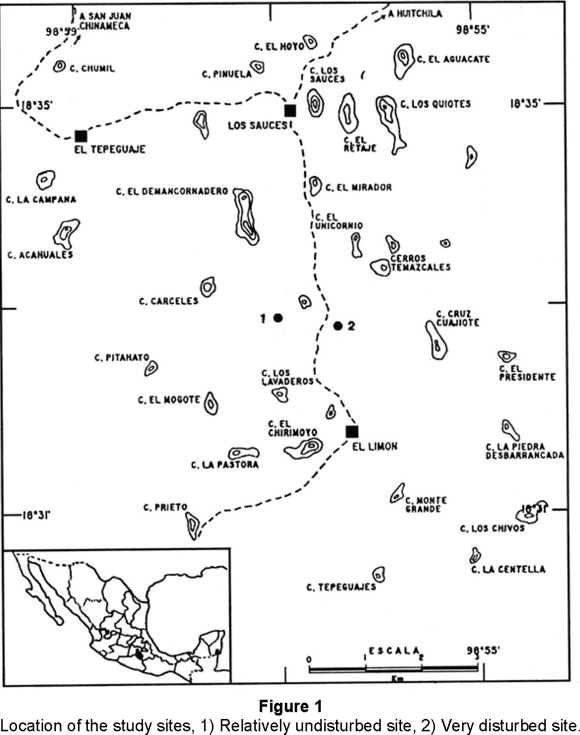
<body><![CDATA[<p align="justify"><font face="verdana" size="2"><b>Introduction</b></font></p>     <p align="justify"><font face="verdana" size="2">Stability of ecological communities is dependent upon the inherent balance of their component species populations (Chapman &amp; Reiss 1992, Putman 1994; Stiling 1999). Ecological disturbances caused human activities as agriculture, forestry and urbanitation commonly affect community composition, structures and processes (Matson <i>et al</i>. 1997, Noble &amp; Dirzo 1997, Pickett &amp; White 1985). Disturbance also reduces the average size of patches of a habitat and increases the distance between them. Such changes can reduce animal population densities, as well as dispersion to new areas, thus increasing population instability and the probability of local extinction (Terborgh 1992, Herkert 1994, Waiters <i>et al</i>. 1994, Johannesen &amp; Ims 1996, Bowers &amp; Matter 1997). With increasing habitat fragmentation, one of the outcomes is the reduction in the number and size of suitable patches in a region, this increases the probability of local extinction (Moilanen &amp; Hanski 1995), by lowering animal densities and not permiting the recolonization of patches. Due to these and other factors associated with disturbances, populations and communities in fragmented landscapes are not likely to be in overall equilibrium (Wiens 1985).</font></p>     <p align="justify"><font face="verdana" size="2">Several studies have concluded that intermediate levels of disturbances may enhance species diversity by lowering the dominance of one or a few species (Connell 1980, Terborgh &amp; Winter 1980, Kirkland 1989) or by increasing environmental heterogeneity (Tilman 1982, Yahner 1991). However, if disturbance occurs frequently, richness can decreases because species intolerant to disturbance become locally extinct (Denslow 1985, Adler &amp; Levins 1994, Collins <i>et al</i>. 1995, Williams &amp; Marsh 1998) or can be maintained since species are tolerant to disturbance (Jonson <i>et al</i>. 1979, Anthony <i>et al</i>. 1981, Huntly &amp; Inouye 1987). While the longer&#45;term impacts of disturbance on population, community and ecosystem&#45;level processes are still under debate, the immediate effects of habitat fragmentation are more clear, following habitat fragmentation species richness of mammals frequently declines dramatically producing large shift in species composition of the entire faunal assemblage. While many resident species disappear with habitat fragmentation, other tolerant or exotic species arrive in these areas to exploit the disturbed areas left vacant (Laurance 1991, Laurance &amp; Yensen 1991, Nupp &amp; Swihart 1998). Even among native species changes in dominance, diversity and evenness may occur as a result of habitat fragmentation (Kirkland 1990, Holt 1993).</font></p>     <p align="justify"><font face="verdana" size="2">There are not many information exists on rodent community dynamics in deciduous forest in Mexico (Collett <i>et al</i>. 1975, Ceballos 1990), and studies that compare demographic characteristics of species occupying fragmented and unfragmented habitats are exceedingly rare (Medell&iacute;n 1992, Fa &amp; S&aacute;nchez&#45;Cordero 1993, Mart&iacute;nez Gallardo 1995, V&aacute;zquez <i>et al</i>. 2000). Our objective was to address this problem by examining the effects of disturbance caused by firewood and lumber extraction, as well as the cattle grazing, on rodent diversity, evenness, community and population dynamics.</font></p>     <p align="justify"><font face="verdana" size="2">We hypothesized that species diversity and evenness of rodents should be greater in a relatively undisturbed site (Site 1) versus a disturbed site (Site 2). Similarly, as forest fragmentation produces a biotic isolation for rodents within deciduous forests, and has been documented that habitat fragmentation can be species&#45;specific, we expect that <i>Baiomys musculus</i>, <i>Peromyscus levipes</i> and <i>P. melanophrys</i> which habitat requirements are specialized (Baker and Greer 1962, Packard and Montgomery 1978) will be intolerant species to disturbance and their population sizes will reduced in Site 2. Furthermore, we expected that demographic parameters (population density, sex ratio, age structure, residence) of those rodent species in Site 1 to be greater than in Site 2. Meanwhile <i>Liomys irroratus</i> will be a tolerant species to disturbance and its demographic parameters should be similar in both sites because it is adapted to arid regions, has affinities for edge habitats and disturbed sites and well&#45;developed vagility (Dowler &amp; Genoways 1978). Finally, we predict that preferences for microhabitats in four species will be modified due to differences in the availability of resources as food and refuges between the two sites.</font></p>     <p align="justify"><font face="Verdana" size="2">&nbsp;</font></p>     <p align="justify"><font face="verdana" size="2"><b>Materials and methods</b></font></p>     <p align="justify"><font face="verdana" size="2"><b>Study sites</b></font></p>     <p align="justify"><font face="verdana" size="2">Our study was conducted at 3 km north of the Ejido El Lim&oacute;n (18&deg;31'10"&#45;18&deg;31'50"N and 98&deg;56'30"&#45;98&deg;56'55"W). El Lim&oacute;n is located in northeastern Sierra de Huautla Biosphere Reserve in Morelos State, Mexico (<a href="#f1">Fig. 1</a>). Topography is variable, with numerous high hills. Elevation at the study site ranges from 1,300 to 1,700 m. The climate is subhumid and warm. Rains occur regularly in June&#45;July and then again in September; October through May tipically is very dry. Annual precipitation is about 800 mm per year (data from the El Lim&oacute;n meteorological station of Comisi&oacute;n Nacional del Agua).</font></p>     <p align="center"><font face="verdana" size="2"><a name="f1"></a></font></p>     ]]></body>
<body><![CDATA[<p align="center"><font face="verdana" size="2"><img src="/img/revistas/azm/n85/a10f1.jpg"></font></p>     <p align="justify"><font face="verdana" size="2">The two study sites were chosen as representative of vegetation disturbance by firewood and lumber extraction, and cattle grazing. They are separated by a distance of 1 km as well as by a land&#45;highway with irregular traffic of vehicles. In El Lim&oacute;n there are 300 inhabitants established approximately more than 100 years ago. It is isolated of the city by 20 km of land&#45;highway. The people use and sale firewood and lumber, and cattle grazing as means of subsistence. Disturbance is concentrated mainly around the town and most of the hills are relatively undisturbed.</font></p>     <p align="justify"><font face="verdana" size="2">Deciduous forest (Rzedowski 1978) covers the site of Ejido El Lim&oacute;n. The relatively undisturbed site (Site 1) is rocky, it includes a narrow canyon, with steep slope, distances between the highest and lowest points are approximately 30 m. In this site, there are species of original vegetation as <i>Licania arborea</i> (cacahuananche; Chrysobalanaceae), <i>Sapindus saponaria</i> (amole; Sapindaceae), <i>Guazuma ulmifolia</i> (cuahulote; Sterculiaceae), <i>Ficus petiolaris</i> (amate; Moraceae), <i>Daphnopsis americana</i> (ahuejote; Thymelaeaceae), <i>Enterolobium cyclocarpum</i> (parota; Leguminosae), <i>Pithecellobium dulce</i> (guam&uacute;chil; Leguminosae), <i>Lysiloma divaricata</i> (tepeguaje; Leguminosae), <i>Bursera grandifolia</i> (cuajiote colorado; Burseraceae) and <i>Euphorbia fulva</i> (pegahueso; Euphorbiaceae). Also, there are columnar cacti of Cactaceae family such as <i>Neobuxbaumia mezcalaensis</i>, <i>Pachycereus weberi</i>, <i>Stenocereus beneckei</i> and <i>S. stellatus</i>.</font></p>     <p align="justify"><font face="verdana" size="2">The very disturbed site (Site 2) is located 1 km E of Site 1. Site 2 is a hillside with slight slope; difference between the highest and lowest points is approximately 15 m, and ground also is rocky. In this site, approximately 90% of the vegetation is disturbed and secondary associations include mainly thorny shrubs of Leguminosae family as <i>Acacia bilimeckii</i> (tehuistle), <i>A. cochliacantha</i> (cubata), <i>A. farnesiana</i> (huizache blanco), <i>A. pennatula</i> (quisache), <i>Eysenhardtia polystachya</i> (palo dulce), <i>Mimosa benthamii</i>, <i>M. chaetocarpa</i> (tepescolhuistle), <i>M. polyantha</i> (palo prieto) and <i>Pithecellobium acatlense</i> (huizache de chintete). In both sites, during the dry season herbaceous vegetation is reduced and during wet season a dense stratum of grass grows to 40 or 50 cm in height. Site 2 is subjected to intense cattle grazing during the wet season, while cattle activity is reduced in Site 1. The Sites have the same climate, similar soils and topography that differ only slightly. The main difference between the two sites is the disturbance caused by firewood and lumber extraction, cattle grazing and the type of vegetation associated with each site.</font></p>     <p align="justify"><font face="verdana" size="2"><b>Rodent trapping</b></font></p>     <p align="justify"><font face="verdana" size="2">Rodents were trapped with 2&#45;dimensional grids in both habitats. Two&#45;night trapping sessions were performed at 40 days intervals between February 1991 and March 1992. Trapping grids in each site were 100 by 100 m with trap stations spaced at 10&#45;m intervals (100 stations/grid). A total of four hundred Sherman traps were used, two at each capture station, providing 8,800 trap nights for analysis. Traps were placed on the ground and were baited with rolled oats in the afternoon prior to each day of checking traps. Each animal captured was weighed, sexed and aged (by size, pelage and sexual conditions) as juvenile, subadult, or adult. Animals were toe&#45;clipped following a numbered sequence (Martoff 1963). After processing, each animal was released at the point of capture.</font></p>     <p align="justify"><font face="verdana" size="2"><b>Statistical analysis</b></font></p>     <p align="justify"><font face="verdana" size="2">Using this trapping protocol we determined overall community structure of rodents in each site, as well as how this structure change over the course of the study. Rodent species diversity was calculated using the Shannon&#45;Wiener index (Krebs 1989) and compared with a t&#45;test. As this index underestimates rodent diversity (Zar 1999), we calculated the maximum diversity (H'max) and evenness (J). Population size on each site at each sampling period was estimated by direct enumeration of the Minimum Number Known to be Alive method (MNKA; Krebs 1966). Differences between population densities, residence and movements of the two sites were analyzed by two&#45;factor (sites and time) analysis without replication. Differences in sex ratio were examinated by X<sup>2</sup> test (Zar 1999). Movements were measured according the method of activity center by Hayne (1950) modified by V&aacute;zquez B&aacute;rcena (1980), which considers average deviations from the points of capture, as the radius of a circle, and surface of a circle as the area of activity. Annual wet&#45;season vegetation was compared between sites. Trees, shrubs, cactus and herbs were evaluated qualitatively. Vegetative cover was determined visually. We categorized microhabitat or each trap site and used capture locations of each species to infer microhabitat use. We compared microhabitat use of different rodent species by two&#45;factor (microhabitat and seasons) analysis without replication. Data analyses were processed with JMP statistical software (SAS Institute 1998) and Statistical Ecology (Ludwig &amp; Reynolds 1988). All analyses were considered statistically significant when P&lt;0.05.</font></p>     <p align="justify"><font face="Verdana" size="2">&nbsp;</font></p>     <p align="justify"><font face="verdana" size="2"><b>Results</b></font></p>     ]]></body>
<body><![CDATA[<p align="justify"><font face="verdana" size="2"><b>Population size</b></font></p>     <p align="justify"><font face="verdana" size="2">In Site 1 we captured 319 individuals of six species of rodents. The most abundant species were <i>P. levipes</i> (113 individuals, 35.4%), <i>B. musculus</i> (86 individuals, 27.0%), <i>P. melanophrys</i> (59 individuals, 18.5%) and <i>L. irroratus</i> (55 individuals, 17.1%). Rare species were <i>Reithrodontomys megalotis</i> (5 individuals, 1.6%) and <i>Hodomys alleni</i> (1 individual, 0.3%). In Site 2 we captured 90 individuals of six species. The most abundant species were <i>L. irroratus</i> (38 individuals, 42.2%), <i>P. melanophrys</i> (26 individuals, 28.9%) and <i>B. musculus</i> (15 individuals, 16.7%). Rare species were <i>P. levipes</i> (6 individuals, 6.7%), <i>R. megalotis</i> (4 individuals, 4.4%) and <i>Sigmodon hispidus</i> (1 individual, 1.1%).</font></p>     <p align="justify"><font face="verdana" size="2"><b>Cumulative number of species</b></font></p>     <p align="justify"><font face="verdana" size="2">In Site 1, six species were captured after nine months, while in Site 2 this same number of rodent species was obtained by the second month. Differences in cumulative rate of species were due to capture of <i>H. alleni</i> in Site 1, because other species were recorded at second month in both sites.</font></p>     <p align="justify"><font face="verdana" size="2"><b>Diversity</b></font></p>     <p align="justify"><font face="verdana" size="2">In Site 1 the number of captured individuals was greater than Site 2 (319 versus 90). However, species diversity in Site 1 (H'= 0.616, H'<sub>max</sub>= 0.778) and in Site 2 (H'= 0.603, H'<sub>max</sub>= 0.778) was similar (t= 0.372, df= 8, P= 0.64). Also, evenness in both sites was similar (J= 0.79, J= 0.77).</font></p>     <p align="justify"><font face="verdana" size="2"><b>Population density</b></font></p>     <p align="justify"><font face="verdana" size="2">In Site 1, from February to June 1991 population of <i>L. irroratus</i> fluctuated from six to seven individuals/ha (ind/ha), but since July population increased to the maximum in November (27 ind/ha). After November the population decreased to three ind/ha in March 1992. Density of <i>B. musculus</i> was 15 ind/ha in February 1991. This number declined to 11 ind/ha in April. A subsequent population maximum was reached in July 1991 with 30 ind/ha; the population was decreased to March 1992 when we did not record individuals. Population density of <i>P. levipes</i> fluctuated from 41 ind/ha in March 1991 to a decrease of 16 ind/ha in March 1992, with increments in June (31 ind/ha) and December 1991 (27 ind/ha). Density of <i>P. melanophrys</i> was 18 ind/ha in February; population maximum (23 ind/ha) was reached in June 1991; following that month, density declined to two ind/ha in March 1992 (<a href="/img/revistas/azm/n85/a10f2.jpg" target="_blank">Fig. 2</a>).</font></p>     <p align="justify"><font face="verdana" size="2">In Site 2, population density of <i>L. irroratus</i> increased since 12 ind/ha in March to a maximum of 24 ind/ha in July. Following this month, population density declined to March 1992 when no further individuals were captured. In general, population dynamics of <i>B. musculus</i> was low (zero to six ind/ha); population maximum was recorded in March and July of 1991 (six ind/ha). Maximum density of <i>P. melanophrys</i> was recorded in March 1991 (12 ind/ha), this number decreased to September when we found no further individuals, but increased to five ind/ha in January 1992, in March no specimen was captured (<a href="/img/revistas/azm/n85/a10f3.jpg" target="_blank">Fig. 3</a>). Population densities of <i>B. musculus</i>, <i>P. levipes</i> and <i>P. melanophrys</i> were greater in Site 1 than in Site 2 (F= 9.34, df= 1,10, P= 0.001; F= 154.98, df= 1,10, P= 0.0001; F= 40.42, df= 1,10, P= 0.001; respectively), while differences in population density of <i>L. irroratus</i> between both sites were not significant (F= 0.02, df= 1,10, P= 0.89).</font></p>     <p align="justify"><font face="verdana" size="2"><b>Sex ratio</b></font></p>     ]]></body>
<body><![CDATA[<p align="justify"><font face="verdana" size="2">In Site 1, differences in the ratio of males to females were not significant for <i>L. irroratus</i> (1:1.3; X<sup>2</sup>= 1.2, df= 1, P= 0.72), <i>B. musculus</i> (1:1.1; X<sup>2</sup>= 0.1, df= 1, P= 0.24), <i>P. levipes</i> (1:0.8; X<sup>2</sup>= 1.5, df= 1, P= 0.77) and <i>P. melanophrys</i> (1:1.2; X<sup>2</sup>= 0.7, df= 1, P= 0.59) over the duration of the study. Also, in Site 2, differences in the ratio of males to females were not significant for <i>L. irroratus</i> (1:1.6; X<sup>2</sup>= 1.8, df= 1, P= 0.82), <i>B. musculus</i> (1:1.3; X<sup>2</sup>= 0.3, df= 1, P= 0.41) and <i>P. melanophrys</i> (1:0.7; X<sup>2</sup>= 0.6, df= 1, P= 0.56).</font></p>     <p align="justify"><font face="verdana" size="2"><b>Age structure</b></font></p>     <p align="justify"><font face="verdana" size="2">In Site 1, subadults and juveniles were captured almost all year, with a maximum for <i>L. irroratus</i> in November 1991, for <i>B. musculus</i> in February and March 1991, for <i>P. levipes</i> in February, March and December 1991, and for <i>P. melanophrys</i> in February, June and December 1991 (<a href="/img/revistas/azm/n85/a10f2.jpg" target="_blank">Fig. 2</a>). In Site 2, populations of subadults were recorded in March 1991 for <i>L. irroratus</i>; March, July and August 1991 for <i>B. musculus</i>; and in March and June 1991 for <i>P. melanophrys</i>. Juveniles only were captured from November 1991 to January 1992 for <i>P. melanophrys</i> (<a href="/img/revistas/azm/n85/a10f3.jpg" target="_blank">Fig. 3</a>).</font></p>     <p align="justify"><font face="verdana" size="2"><b>Residence</b></font></p>     <p align="justify"><font face="verdana" size="2">In Site 1, average of residence, minimum, maximum and number of individuals in parentheses was for <i>L. irroratus</i> 129 days (35&#45;395, n= 19), for <i>B. musculus</i> 100 days (34&#45;236, n= 20), for <i>P. levipes</i> 175 days (41&#45;395, n= 60) and for <i>P. melanophrys</i> 136 days (40&#45;323, n= 25). In Site 2, average of residence was 143 days for <i>L. irroratus</i> (35&#45;310, n= 19), 92 days for <i>B. musculus</i> (32&#45;138, n= 4) and 76 days for <i>P. melanophrys</i> (32&#45;106, n= 9). Residence of individuals was significantly larger in Site 1 than Site 2 for <i>P. melanophrys</i> (F= 327.18, df= 1,15, P= 0.001) and <i>B. musculus</i> (F= 269.17, df= 1,11, P= 0.001), and were not significant for <i>L. irroratus</i> (F= 2.25, df= 1,18, P= 0.85).</font></p>     <p align="justify"><font face="verdana" size="2"><b>Movements</b></font></p>     <p align="justify"><font face="verdana" size="2">In Site 1, average movements were greater in the wet than in the dry season for <i>L. irroratus</i> (311.5 versus 130.8 m<sup>2</sup>), <i>B. musculus</i> (1107.7 versus 550.6 m<sup>2</sup>) and <i>P. levipes</i> (677.3 versus 448.2 m<sup>2</sup>), only for <i>P. melanophrys</i> average movements were larger in dry than wet season (762.1 versus 567.9 m<sup>2</sup>). In Site 2, movements were larger in wet than dry season for <i>L. irroratus</i> (909.4 versus 603.0 m<sup>2</sup>) and <i>P. melanophrys</i> (1,394.0 versus 990.4 m<sup>2</sup>). For <i>B. musculus</i> we only recorded the movement of one male (1,570.7 m<sup>2</sup>) and one female (463.2 m<sup>2</sup>). The movements of individuals of <i>L. irroratus</i> and <i>P. melanophrys</i> in Site 1 were significantly lower than individuals in Site 2 in wet season (F= 10.01, df= 1,5, P= 0.02; F= 24.04, df= 1,6, P= 0.01; respectively) but differences were not significant in dry season (F= 0.98, df= 1,5, P= 0.65; F= 3.29, df= 1,8, P= 0.10; respectively)</font></p>     <p align="justify"><font face="verdana" size="2"><b>Analysis of vegetation</b></font></p>     <p align="justify"><font face="verdana" size="2">In Site 1, we recorded 66 plant species of 53 genera and 27 families. The most represented families were Compositae (nine species), Leguminosae (eight species) and Burseraceae (eight species). Out of 66 species recorded, cover in parenthesis, 17 are trees (5,800 m<sup>2</sup>), 26 are shrubs (1,200 m<sup>2</sup>), one is cactus (550 m<sup>2</sup>) and 22 are herbs (2,450 m<sup>2</sup>). In Site 2, we recorded 50 plant species of 42 genera and 20 families. The most represented families were Leguminosae (17 species) and Cactaceae (nine species). Out of 50 species recorded, cover in parenthesis, eight are trees (1,050 m<sup>2</sup>), 16 are shrubs (3,800 m<sup>2</sup>), nine are cactus (800 m<sup>2</sup>) and 17 are herbs (3,500 m<sup>2</sup>).</font></p>     <p align="justify"><font face="verdana" size="2"><b>Microhabitat</b></font></p>     ]]></body>
<body><![CDATA[<p align="justify"><font face="verdana" size="2">In Site 1, all rodents were captured more often at trapsites with arboreal coverage (60%, n= 43, for <i>L. irroratus</i>; 68%, n= 40, for <i>B. musculus</i>; 67% n= 184, for <i>P. levipes</i>; 59%, n= 72, for <i>P. melanophrys</i>). However, only <i>P. levipes</i> and <i>P. melanophrys</i> showed a statistical difference (F= 134.58, df= 1,4, P= 0.001, n= 305; F= 15.77, df= 1,4, P= 0.04, n= 134; respectively). In Site 2, species had preference by shrub coverage (47%, n= 38, for <i>L. irroratus</i>; 56%, n= 10, for <i>B. musculus</i>; 55%, n= 16, for <i>P. melanophrys</i>) and in less proportion by the arboreal, annual plants and cactus. Only for <i>L. irroratus</i> preferences for shrub coverage were significant (F= 16.35, df= 1,4, P= 0.04, n= 81).</font></p>     <p align="justify"><font face="Verdana" size="2">&nbsp;</font></p>     <p align="justify"><font face="verdana" size="2"><b>Discussion and conclussions</b></font></p>     <p align="justify"><font face="verdana" size="2">Our study is the first work that compares rodent communities in a deciduous forest in Mexico. It is important to recognize the limitations of the design and results of this study, since the treatments were unreplicated. Despite these limitations, our results suggests interesting and important trends, such as indicates that habitat fragmentation can be species&#45;specific. Similar studies have been reported in United States and Australia (Laurance 1991, Laurance &amp; Yensen 1991, Diffendorfer <i>et al</i>. 1995a, Nupp &amp; Swihart 1998, Waters &amp; Zabel 1998).</font></p>     <p align="justify"><font face="verdana" size="2">Contrary to our prediction, there were no significant differences in diversity and evenness of rodent species between the two studies sites. However, the number of individuals captured in Site 1 (319) was larger than Site 2 (90) and there was a shift in species composition in abundant and dominant species between sites. <i>Liomys irroratus</i>, <i>B. musculus</i> and <i>P. melanophrys</i> were abundant in both sites, while <i>P. levipes</i> was the most abundant species in Site 1 and was occasionally captured in Site 2. <i>Hodomys alleni</i> was only captured in Site 1, <i>S. hispidus</i> was only recorded in Site 2 and <i>R. megalotis</i> were occasional in both sites. Similar studies had documented disappearance of resident species and changes in dominance with habitat fragmentation (Diffendorfer <i>et al</i>. 1995a, Nupp &amp; Swihart 1998, Kirkland 1990, Holt 1993, V&aacute;zquez <i>et al</i>. 2000). Our results support previous findings, which suggested that habitat disturbance does not modify the diversity of rodents (Johnson <i>et al</i>. 1979, Anthony <i>et al</i>. 1981, Huntly &amp; Inouye 1987, Medell&iacute;n 1992). However in Site 2 there were 33 species of perennial plants, of which 23 were associated with primary vegetation and they are distributed in patches. Its disturbance caused by firewood and lumber extraction, as well as cattle grazing favored reduction of available refuges for rodents. This pattern was reflected in a smaller number of abundant rodent species (three) in Site 2, in comparison with the four dominant species in Site 1 with lesser disturbances. Occasional captures of <i>H. alleni</i> and <i>R. megalotis</i> in Site 1, and of <i>P. levipes</i>, <i>R. megalotis</i> and <i>S. hispidus</i> in Site 2, suggest that they are transient individuals captured in their way toward other site or searching resources.</font></p>     <p align="justify"><font face="verdana" size="2">Livestock could negatively impact rodent populations directly by trampling burrows and compacting the soil or harvesting seed heads and other plants parts while grazing, thus removing food resources that would otherwise be available to rodents. Although livestock might affect rodents indirectly by altering the species composition of the vegetation and the food available for insects (Heske &amp; Campbell 1991), we estimated only percent cover of annual annual plants and grasses in our vegetation anaylisis and, therefore, cannot measure potential impact of livestock grazing on either seed production or plant species composition.</font></p>     <p align="justify"><font face="verdana" size="2"><i><b>Liomys irroratus</b></i></font></p>     <p align="justify"><font face="verdana" size="2">In Site 1 maximum density was recorded at the beginning of dry season, while in Site 2 it was in wet season. Differences in the timing of the population maximum between the sites could be the result of larger coverage (7,500 m<sup>2</sup> versus 5,650 m<sup>2</sup> of perennial plants) and richness of plant species (66 versus 50 species) in Site 1, resulting in differences in timing on abundance of seed resources. Densities were similar in both sites, perhaps because this species is adapted to arid regions and to open places (Jones &amp; Webster 1976).</font></p>     <p align="justify"><font face="verdana" size="2"><i><b>Baiomys musculus</b></i></font></p>     <p align="justify"><font face="verdana" size="2">In Site 1 maximum density was recorded in the wet season, which was similar to the pattern observed in Site 2. As we expected, density in Site 2 was lower than in Site 1. Although Packard &amp; Montgomery (1978) have recorded <i>B. musculus</i> in places with secondary vegetation, our study is the first to document changes in habitat use depending on the site&#45;specific degree of disturbance. In Site 1 individuals prefer arboreal cover, while in Site 2 they chose shrubs.</font></p>     ]]></body>
<body><![CDATA[<p align="justify"><font face="verdana" size="2"><i><b>Peromyscus levipes and P. melanophrys</b></i></font></p>     <p align="justify"><font face="verdana" size="2">In Site 1 maximum density of <i>P. levipes</i> was recorded at the middle of the dry season, declining at the end of this season and increasing in the wet season. As we hypothesized, population density in Site 1 was significantly larger than Site 2. Our data suggests that <i>P. levipes</i> selects undisturbed places, rocky areas (Jones &amp; Webster 1976), with arboreal cover. Their refuges are in rocks, hollows of trees and cactus. For <i>P. melanophrys</i> in Site 1, the maximum population density was recorded in the wet season, while in Site 2 density was low in the dry season and increased in wet season. Density in Site 1 was significantly larger than in Site 2. This may be due to preference for arboreal cover, which was more abundant in Site 1. Density of <i>P. levipes</i> and <i>P. melanophrys</i> is in the range reported in Mexico for <i>P. boylii</i> (Drake 1958, Collett <i>et al</i>. 1975, &Aacute;lvarez &amp; Arroyo&#45;Cabrales 1990) and <i>P. levipes</i> (Salgado P&eacute;rez 1988). Even where densities are similar across habitat types, disturbance may affect aspects of demography and habitat selection (Geier &amp; Best 1980, Diffendorfer <i>et al</i>. 1995b).</font></p>     <p align="justify"><font face="verdana" size="2">Our data therefore are consistent with the hypotesis that fragmentation can be species&#45;specific, as we expect population sizes and demographic parameters (population density, sex ratio, residence) of <i>Baiomys musculus</i>, <i>Peromyscus levipes</i> and <i>P. melanophrys</i> were reduced in Site 2, therefore we think these species were intolerant to disturbance. <i>Peromyscus levipes</i> was the most affected species with respect to number of individuals captured between two sites (113 versus 6). This species exhibited preferences for arboreal and shrub coverage, which suggests that reduction in plant cover decreased the availability of refuges and resources, and affected significantly population number of this species. Continual disturbance of deciduous forest in Morelos as is now occurring, could cause resident species like <i>B. musculus</i>, <i>P. levipes</i> and <i>P. melanophrys</i> to become locally extinct. As we predicted, population densities, sex ratios and residence for <i>L. irroratus</i> were not different between sites. Although we think this species in tolerant to disturbance because its adapted to arid regions, has affinities for edge habitats and disturbed sites and well&#45;developed vagility, more habitat fragmentation could produce population instability and changes in demographic parameters.</font></p>     <p align="justify"><font face="verdana" size="2">Data on population dynamics are critical to development of management strategies for animal and plant species. We must conserve communities and thus whole assemblages of species. Conservation of a species with its associated community must occur in conjuction with the understanding of how the community and the inclusive species function. One without the other will probably not be successful.</font></p>     <p align="justify"><font face="Verdana" size="2">&nbsp;</font></p>     <p align="justify"><font face="verdana" size="2"><b>Acknowledegments</b></font></p>     <p align="justify"><font face="verdana" size="2">We thank Juli&aacute;n Mor&aacute;n&#45;Altamirano, Julio C&eacute;sar Lara&#45;Manrique, Jos&eacute; Antonio Guerrero&#45;Enr&iacute;quez, Juan Carlos Arroyo&#45;Cruz, Lucas Ben&iacute;tez&#45;Arellano, Leticia Osorio&#45;Navarro and Alma Fern&aacute;ndez&#45;Rom&aacute;n for their collaboration and enthusiasm during fieldwork. An earlier draft of the manuscript was reviewed by Robert Manson, Celia L&oacute;pez Gonz&aacute;lez, Michael and Phyllis Kennedy. Two anonymous reviewers provided many constructed comments on the manuscript. C&eacute;sar Barona R&iacute;os provide us logistic support. This study was supported by the Secretar&iacute;a de Educaci&oacute;n Publica (FOMES/91 and FOMES/92) awarded to Universidad Aut&oacute;noma del Estado de Morelos.</font></p>     <p align="justify"><font face="Verdana" size="2">&nbsp;</font></p>     <p align="justify"><font face="verdana" size="2"><b>Literature cited</b></font></p>     <!-- ref --><p align="justify"><font face="verdana" size="2"><b>Adler, G. H. &amp; R. Levins</b>. 1994. The island syndrome in rodent populations. <i>Quart. Rev. Biol</i>. 69:473&#45;496.    &nbsp;&nbsp;&nbsp;&nbsp;&nbsp;&nbsp;&nbsp;&nbsp;[&#160;<a href="javascript:void(0);" onclick="javascript: window.open('/scielo.php?script=sci_nlinks&ref=296438&pid=S0065-1737200200010001000001&lng=','','width=640,height=500,resizable=yes,scrollbars=1,menubar=yes,');">Links</a>&#160;]<!-- end-ref --></font></p>     <!-- ref --><p align="justify"><font face="verdana" size="2"><b>&Aacute;lvarez, T. &amp; J. Arroyo&#45;Cabrales</b>. 1990. C&aacute;lculos de captura, densidad y &aacute;mbito hogare&ntilde;o de tres especies de roedores en un &aacute;rea de influencia humana en el sureste de Durango, M&eacute;xico. <i>An. Esc. nac. Cien. biol., M&eacute;x.</i> 33:185&#45;210.    &nbsp;&nbsp;&nbsp;&nbsp;&nbsp;&nbsp;&nbsp;&nbsp;[&#160;<a href="javascript:void(0);" onclick="javascript: window.open('/scielo.php?script=sci_nlinks&ref=296440&pid=S0065-1737200200010001000002&lng=','','width=640,height=500,resizable=yes,scrollbars=1,menubar=yes,');">Links</a>&#160;]<!-- end-ref --></font></p>     <!-- ref --><p align="justify"><font face="verdana" size="2"><b>Anthony, R. G., L. J. Niles &amp; J. D. Spring</b>. 1981. Small&#45;mammal associations in forested and old&#45;field habitats &#45;A quantitative comparisons. <i>Ecology</i> 62:955&#45;963.    &nbsp;&nbsp;&nbsp;&nbsp;&nbsp;&nbsp;&nbsp;&nbsp;[&#160;<a href="javascript:void(0);" onclick="javascript: window.open('/scielo.php?script=sci_nlinks&ref=296442&pid=S0065-1737200200010001000003&lng=','','width=640,height=500,resizable=yes,scrollbars=1,menubar=yes,');">Links</a>&#160;]<!-- end-ref --></font></p>     <!-- ref --><p align="justify"><font face="verdana" size="2"><b>Baker, R. H. &amp; J. K. Greer</b>. 1962. Mammals of the Mexican State of Durango. <i>Publ. Misc. Michigan State Univ., Biol. Ser.</i> 2:25:104.    &nbsp;&nbsp;&nbsp;&nbsp;&nbsp;&nbsp;&nbsp;&nbsp;[&#160;<a href="javascript:void(0);" onclick="javascript: window.open('/scielo.php?script=sci_nlinks&ref=296444&pid=S0065-1737200200010001000004&lng=','','width=640,height=500,resizable=yes,scrollbars=1,menubar=yes,');">Links</a>&#160;]<!-- end-ref --></font></p>     <!-- ref --><p align="justify"><font face="verdana" size="2"><b>Bowers, M. A. &amp; S. F. Matter</b>. 1997. Landscape ecology of mammals: relationships between density and patch size. <i>J. Mamm.</i> 78:999&#45;1013.    &nbsp;&nbsp;&nbsp;&nbsp;&nbsp;&nbsp;&nbsp;&nbsp;[&#160;<a href="javascript:void(0);" onclick="javascript: window.open('/scielo.php?script=sci_nlinks&ref=296446&pid=S0065-1737200200010001000005&lng=','','width=640,height=500,resizable=yes,scrollbars=1,menubar=yes,');">Links</a>&#160;]<!-- end-ref --></font></p>     <!-- ref --><p align="justify"><font face="verdana" size="2"><b>Ceballos, G</b>. 1990. Comparative natural history of small mammals from tropical forest in western Mexico. <i>J. Mamm</i>. 71:263&#45;266.    &nbsp;&nbsp;&nbsp;&nbsp;&nbsp;&nbsp;&nbsp;&nbsp;[&#160;<a href="javascript:void(0);" onclick="javascript: window.open('/scielo.php?script=sci_nlinks&ref=296448&pid=S0065-1737200200010001000006&lng=','','width=640,height=500,resizable=yes,scrollbars=1,menubar=yes,');">Links</a>&#160;]<!-- end-ref --></font></p>     <!-- ref --><p align="justify"><font face="verdana" size="2"><b>Chapman, J. L., and M. J. Reiss</b>. 1992. <i>Ecology. Principles and Applications</i>. Cambridge University Press, Great Britain.    &nbsp;&nbsp;&nbsp;&nbsp;&nbsp;&nbsp;&nbsp;&nbsp;[&#160;<a href="javascript:void(0);" onclick="javascript: window.open('/scielo.php?script=sci_nlinks&ref=296450&pid=S0065-1737200200010001000007&lng=','','width=640,height=500,resizable=yes,scrollbars=1,menubar=yes,');">Links</a>&#160;]<!-- end-ref --></font></p>     <!-- ref --><p align="justify"><font face="verdana" size="2"><b>Collett, S. F., C. S&aacute;nchez Hern&aacute;ndez, K. A. Shump, Jr., W. R. Teska &amp; R. H. Baker</b>. 1975. Algunas caracter&iacute;sticas poblacionales de peque&ntilde;os mam&iacute;feros en dos h&aacute;bitats mexicanos. <i>Anales Inst. Biol. Univ. Nac. Aut&oacute;n. M&eacute;xico, Ser. Zool.</i> 46:101&#45;124.    &nbsp;&nbsp;&nbsp;&nbsp;&nbsp;&nbsp;&nbsp;&nbsp;[&#160;<a href="javascript:void(0);" onclick="javascript: window.open('/scielo.php?script=sci_nlinks&ref=296452&pid=S0065-1737200200010001000008&lng=','','width=640,height=500,resizable=yes,scrollbars=1,menubar=yes,');">Links</a>&#160;]<!-- end-ref --></font></p>     <!-- ref --><p align="justify"><font face="verdana" size="2"><b>Collins, S. L., D. M. Glenn &amp; D. J. Gibson</b>. 1995. Experimental analysis of intermediate disturbance and initial floristic composition: decoupling cause and effect. <i>Ecology</i> 76:486&#45;492.    &nbsp;&nbsp;&nbsp;&nbsp;&nbsp;&nbsp;&nbsp;&nbsp;[&#160;<a href="javascript:void(0);" onclick="javascript: window.open('/scielo.php?script=sci_nlinks&ref=296454&pid=S0065-1737200200010001000009&lng=','','width=640,height=500,resizable=yes,scrollbars=1,menubar=yes,');">Links</a>&#160;]<!-- end-ref --></font></p>     <!-- ref --><p align="justify"><font face="verdana" size="2"><b>Connell, J. H</b>. 1980. Diversity and the coevolution of competitors, or the ghost of competition past. <i>Oikos</i> 35:131&#45;138.    &nbsp;&nbsp;&nbsp;&nbsp;&nbsp;&nbsp;&nbsp;&nbsp;[&#160;<a href="javascript:void(0);" onclick="javascript: window.open('/scielo.php?script=sci_nlinks&ref=296456&pid=S0065-1737200200010001000010&lng=','','width=640,height=500,resizable=yes,scrollbars=1,menubar=yes,');">Links</a>&#160;]<!-- end-ref --></font></p>     <!-- ref --><p align="justify"><font face="verdana" size="2"><b>Denslow, J. S</b>. 1985. Disturbance&#45;mediated coexistence of species. Pp. 307&#45;323. <i>In:</i> S. T. A. Pickett &amp; P. S. White (eds). <i>The ecology of natural disturbance and patch dynamics.</i> Academic Press, Inc. San Diego, California.    &nbsp;&nbsp;&nbsp;&nbsp;&nbsp;&nbsp;&nbsp;&nbsp;[&#160;<a href="javascript:void(0);" onclick="javascript: window.open('/scielo.php?script=sci_nlinks&ref=296458&pid=S0065-1737200200010001000011&lng=','','width=640,height=500,resizable=yes,scrollbars=1,menubar=yes,');">Links</a>&#160;]<!-- end-ref --></font></p>     <!-- ref --><p align="justify"><font face="verdana" size="2"><b>Diffendorfer, J. E., N. A. Slade, M. S. Gaines &amp; R. D. Holt</b>. 1995a. Population dynamics of small mammals in fragmented and continuous old&#45;field habitat. Pp. 175&#45;199. <i>In</i>: W. Z. Lidicker, Jr. (ed). <i>Landscape approaches in mammalian ecology and conservation.</i> University of Minnesota Press, Minneapolis.    &nbsp;&nbsp;&nbsp;&nbsp;&nbsp;&nbsp;&nbsp;&nbsp;[&#160;<a href="javascript:void(0);" onclick="javascript: window.open('/scielo.php?script=sci_nlinks&ref=296460&pid=S0065-1737200200010001000012&lng=','','width=640,height=500,resizable=yes,scrollbars=1,menubar=yes,');">Links</a>&#160;]<!-- end-ref --></font></p>     <!-- ref --><p align="justify"><font face="verdana" size="2"><b>Diffendorfer, J. E., M. S. Gaines &amp; R. D. Holt</b>. 1995b. Habitat fragmentation and movements of three small mammals (<i>Sigmodon</i>, <i>Microtus</i>, and <i>Peromyscus</i>). <i>Ecology</i> 76:827&#45;839.    &nbsp;&nbsp;&nbsp;&nbsp;&nbsp;&nbsp;&nbsp;&nbsp;[&#160;<a href="javascript:void(0);" onclick="javascript: window.open('/scielo.php?script=sci_nlinks&ref=296462&pid=S0065-1737200200010001000013&lng=','','width=640,height=500,resizable=yes,scrollbars=1,menubar=yes,');">Links</a>&#160;]<!-- end-ref --></font></p>     <!-- ref --><p align="justify"><font face="verdana" size="2"><b>Dowler, R. C. &amp; H. H. Genoways</b> 1978. <i>Liomys irroratus</i>. <i>Mamm. Species</i> 82:1&#45;6.    &nbsp;&nbsp;&nbsp;&nbsp;&nbsp;&nbsp;&nbsp;&nbsp;[&#160;<a href="javascript:void(0);" onclick="javascript: window.open('/scielo.php?script=sci_nlinks&ref=296464&pid=S0065-1737200200010001000014&lng=','','width=640,height=500,resizable=yes,scrollbars=1,menubar=yes,');">Links</a>&#160;]<!-- end-ref --></font></p>     <!-- ref --><p align="justify"><font face="verdana" size="2"><b>Drake, D. D</b>. 1958. The brush mouse <i>Peromyscus boylii</i> in southern, Durango. <i>Publ. Mus.</i>, <i>Michigan State Univ., Biol. Ser.</i> 1:97&#45;132.    &nbsp;&nbsp;&nbsp;&nbsp;&nbsp;&nbsp;&nbsp;&nbsp;[&#160;<a href="javascript:void(0);" onclick="javascript: window.open('/scielo.php?script=sci_nlinks&ref=296466&pid=S0065-1737200200010001000015&lng=','','width=640,height=500,resizable=yes,scrollbars=1,menubar=yes,');">Links</a>&#160;]<!-- end-ref --></font></p>     <!-- ref --><p align="justify"><font face="verdana" size="2"><b>Fa, J. E. &amp; V. S&aacute;nchez&#45;Cordero</b>. 1993. Small mammal population responses to fire in a Mexican high&#45;altitude grassland. <i>J. Zoology, London</i> 230:343&#45;347.    &nbsp;&nbsp;&nbsp;&nbsp;&nbsp;&nbsp;&nbsp;&nbsp;[&#160;<a href="javascript:void(0);" onclick="javascript: window.open('/scielo.php?script=sci_nlinks&ref=296468&pid=S0065-1737200200010001000016&lng=','','width=640,height=500,resizable=yes,scrollbars=1,menubar=yes,');">Links</a>&#160;]<!-- end-ref --></font></p>     <!-- ref --><p align="justify"><font face="verdana" size="2"><b>Geier, A. R. &amp; L. B. Best</b>. 1980. Habitat selection by small mammals of riparian communities: evaluating effects of habitat alterations. <i>J. Wildl. Manage</i> 44:16&#45;24.    &nbsp;&nbsp;&nbsp;&nbsp;&nbsp;&nbsp;&nbsp;&nbsp;[&#160;<a href="javascript:void(0);" onclick="javascript: window.open('/scielo.php?script=sci_nlinks&ref=296470&pid=S0065-1737200200010001000017&lng=','','width=640,height=500,resizable=yes,scrollbars=1,menubar=yes,');">Links</a>&#160;]<!-- end-ref --></font></p>     <!-- ref --><p align="justify"><font face="verdana" size="2"><b>Gilpin, M</b>. 1996. Metapopulation and Wildlife Conservation: Aproaches to modeling spatial structure. Pp. 11&#45;27. <i>In</i> D. R. McCullough (ed). Metapopulation and Wildlife Conservation. Washington, D.C.    &nbsp;&nbsp;&nbsp;&nbsp;&nbsp;&nbsp;&nbsp;&nbsp;[&#160;<a href="javascript:void(0);" onclick="javascript: window.open('/scielo.php?script=sci_nlinks&ref=296472&pid=S0065-1737200200010001000018&lng=','','width=640,height=500,resizable=yes,scrollbars=1,menubar=yes,');">Links</a>&#160;]<!-- end-ref --></font></p>     <!-- ref --><p align="justify"><font face="verdana" size="2"><b>Hayne, O. W</b>. 1950. Apparent home range of <i>Microtus</i> in relation to distance between Traps. <i>J. Mamm.</i> 31:26&#45;39.    &nbsp;&nbsp;&nbsp;&nbsp;&nbsp;&nbsp;&nbsp;&nbsp;[&#160;<a href="javascript:void(0);" onclick="javascript: window.open('/scielo.php?script=sci_nlinks&ref=296474&pid=S0065-1737200200010001000019&lng=','','width=640,height=500,resizable=yes,scrollbars=1,menubar=yes,');">Links</a>&#160;]<!-- end-ref --></font></p>     <!-- ref --><p align="justify"><font face="verdana" size="2"><b>Herkert, J. R</b>. 1994. The effects of habitat fragmentation on midwestern grassland bird communities. <i>Ecol. Appl.</i> 4:461&#45;471.    &nbsp;&nbsp;&nbsp;&nbsp;&nbsp;&nbsp;&nbsp;&nbsp;[&#160;<a href="javascript:void(0);" onclick="javascript: window.open('/scielo.php?script=sci_nlinks&ref=296476&pid=S0065-1737200200010001000020&lng=','','width=640,height=500,resizable=yes,scrollbars=1,menubar=yes,');">Links</a>&#160;]<!-- end-ref --></font></p>     <!-- ref --><p align="justify"><font face="verdana" size="2"><b>Heske, E. J. &amp; M. Campbell</b>. 1991. Effects of on 11&#45;year livestock exclusure on rodent and ant numbers in the Chihuahuan desert, southeastern Arizona. <i>Southwest. Nat.</i> 36:89&#45;93.    &nbsp;&nbsp;&nbsp;&nbsp;&nbsp;&nbsp;&nbsp;&nbsp;[&#160;<a href="javascript:void(0);" onclick="javascript: window.open('/scielo.php?script=sci_nlinks&ref=296478&pid=S0065-1737200200010001000021&lng=','','width=640,height=500,resizable=yes,scrollbars=1,menubar=yes,');">Links</a>&#160;]<!-- end-ref --></font></p>     <!-- ref --><p align="justify"><font face="verdana" size="2"><b>Holt, R. D</b>. 1993. Ecology at the mesoscale: The influence of regional processes on local communities. Pp. 77&#45;88. <i>In</i>: R. Ricklefs &amp; D. Schuleter. (eds). <i>Species Diversity in Ecological Communities: Historical and Geographical Perspectives.</i> University of Chicago Press, Chicago.    &nbsp;&nbsp;&nbsp;&nbsp;&nbsp;&nbsp;&nbsp;&nbsp;[&#160;<a href="javascript:void(0);" onclick="javascript: window.open('/scielo.php?script=sci_nlinks&ref=296480&pid=S0065-1737200200010001000022&lng=','','width=640,height=500,resizable=yes,scrollbars=1,menubar=yes,');">Links</a>&#160;]<!-- end-ref --></font></p>     <!-- ref --><p align="justify"><font face="verdana" size="2"><b>Huntly, N. &amp; R. S. Inouye</b>. 1987. Small mammal populations and old&#45;field chronosequence: successional patterns and associations with vegetation. <i>J. Mamm.</i> 68:739&#45;745.    &nbsp;&nbsp;&nbsp;&nbsp;&nbsp;&nbsp;&nbsp;&nbsp;[&#160;<a href="javascript:void(0);" onclick="javascript: window.open('/scielo.php?script=sci_nlinks&ref=296482&pid=S0065-1737200200010001000023&lng=','','width=640,height=500,resizable=yes,scrollbars=1,menubar=yes,');">Links</a>&#160;]<!-- end-ref --></font></p>     <!-- ref --><p align="justify"><font face="verdana" size="2"><b>Johannesen, E. &amp; R. A. Ims</b>. 1996. Modeling survival rates: habitat fragmentation and destruction in root vole experimental populations. <i>Ecology</i> 77:1196&#45;1209.    &nbsp;&nbsp;&nbsp;&nbsp;&nbsp;&nbsp;&nbsp;&nbsp;[&#160;<a href="javascript:void(0);" onclick="javascript: window.open('/scielo.php?script=sci_nlinks&ref=296484&pid=S0065-1737200200010001000024&lng=','','width=640,height=500,resizable=yes,scrollbars=1,menubar=yes,');">Links</a>&#160;]<!-- end-ref --></font></p>     <!-- ref --><p align="justify"><font face="verdana" size="2"><b>Johnson, W. C., R. K. Schreiber &amp; R. L. Burgess</b>. 1979. Diversity of small mammals in a powerline right&#45;of&#45;way and adjacent forest in east Tennessee. <i>Am. Midl. Nat.</i> 101:231&#45;235.    &nbsp;&nbsp;&nbsp;&nbsp;&nbsp;&nbsp;&nbsp;&nbsp;[&#160;<a href="javascript:void(0);" onclick="javascript: window.open('/scielo.php?script=sci_nlinks&ref=296486&pid=S0065-1737200200010001000025&lng=','','width=640,height=500,resizable=yes,scrollbars=1,menubar=yes,');">Links</a>&#160;]<!-- end-ref --></font></p>     <!-- ref --><p align="justify"><font face="verdana" size="2"><b>Jones, G. S. &amp; J. D. Webster</b>. 1976. Notes on distribution, habitat and abundance of some mammals of Zacatecas, Mexico. <i>Anales Inst. Biol. Univ. Nac. Aut&oacute;n. M&eacute;xico, Ser. Zool.</i> 47:75&#45;84.    &nbsp;&nbsp;&nbsp;&nbsp;&nbsp;&nbsp;&nbsp;&nbsp;[&#160;<a href="javascript:void(0);" onclick="javascript: window.open('/scielo.php?script=sci_nlinks&ref=296488&pid=S0065-1737200200010001000026&lng=','','width=640,height=500,resizable=yes,scrollbars=1,menubar=yes,');">Links</a>&#160;]<!-- end-ref --></font></p>     <!-- ref --><p align="justify"><font face="verdana" size="2"><b>Kirkland, G. L., Jr</b>. 1989. Meadow voles (<i>Microtus pennsylvanicus</i>) on forest clearcuts: the role of long&#45;distance dispersal. <i>J. Pennsylvania Acad. Sci.</i> 62:83&#45;85.    &nbsp;&nbsp;&nbsp;&nbsp;&nbsp;&nbsp;&nbsp;&nbsp;[&#160;<a href="javascript:void(0);" onclick="javascript: window.open('/scielo.php?script=sci_nlinks&ref=296490&pid=S0065-1737200200010001000027&lng=','','width=640,height=500,resizable=yes,scrollbars=1,menubar=yes,');">Links</a>&#160;]<!-- end-ref --></font></p>     <!-- ref --><p align="justify"><font face="verdana" size="2"><b>&#150;&#150;&#150;&#150;&#150;&#150;&#150;&#150;&#150;&#150;</b>. 1990. Patterns of initial small mammal community change after clearcutting of temperate North American forests. <i>Oikos</i> 59:313&#45;320.    &nbsp;&nbsp;&nbsp;&nbsp;&nbsp;&nbsp;&nbsp;&nbsp;[&#160;<a href="javascript:void(0);" onclick="javascript: window.open('/scielo.php?script=sci_nlinks&ref=296492&pid=S0065-1737200200010001000028&lng=','','width=640,height=500,resizable=yes,scrollbars=1,menubar=yes,');">Links</a>&#160;]<!-- end-ref --></font></p>     <!-- ref --><p align="justify"><font face="verdana" size="2"><b>Krebs, C. J</b>. 1966. Demographic changes in fluctuating populations of <i>Microtus californicus</i>. <i>Ecol. Monog.</i> 36:239&#45;273.    &nbsp;&nbsp;&nbsp;&nbsp;&nbsp;&nbsp;&nbsp;&nbsp;[&#160;<a href="javascript:void(0);" onclick="javascript: window.open('/scielo.php?script=sci_nlinks&ref=296494&pid=S0065-1737200200010001000029&lng=','','width=640,height=500,resizable=yes,scrollbars=1,menubar=yes,');">Links</a>&#160;]<!-- end-ref --></font></p>     <!-- ref --><p align="justify"><font face="verdana" size="2"><b>&#150;&#150;&#150;&#150;&#150;&#150;&#150;&#150;&#150;&#150;</b>. 1989. <i>Ecological methodology</i>. Harper Collins Publishers, New York.    &nbsp;&nbsp;&nbsp;&nbsp;&nbsp;&nbsp;&nbsp;&nbsp;[&#160;<a href="javascript:void(0);" onclick="javascript: window.open('/scielo.php?script=sci_nlinks&ref=296496&pid=S0065-1737200200010001000030&lng=','','width=640,height=500,resizable=yes,scrollbars=1,menubar=yes,');">Links</a>&#160;]<!-- end-ref --></font></p>     <!-- ref --><p align="justify"><font face="verdana" size="2"><b>Laurance, W. F</b>. 1991. Ecological correlates of extinction proneness in Australian tropical rain forest mammals. <i>Conserv. Biol.</i> 5:79&#45;89.    &nbsp;&nbsp;&nbsp;&nbsp;&nbsp;&nbsp;&nbsp;&nbsp;[&#160;<a href="javascript:void(0);" onclick="javascript: window.open('/scielo.php?script=sci_nlinks&ref=296498&pid=S0065-1737200200010001000031&lng=','','width=640,height=500,resizable=yes,scrollbars=1,menubar=yes,');">Links</a>&#160;]<!-- end-ref --></font></p>     <!-- ref --><p align="justify"><font face="verdana" size="2"><b>Laurance, W. F., and E. Yensen</b>. 1991. Predicting the impacts of edge effects in fragmented habitats. <i>Biol. Conserv.</i> 55:77&#45;92.    &nbsp;&nbsp;&nbsp;&nbsp;&nbsp;&nbsp;&nbsp;&nbsp;[&#160;<a href="javascript:void(0);" onclick="javascript: window.open('/scielo.php?script=sci_nlinks&ref=296500&pid=S0065-1737200200010001000032&lng=','','width=640,height=500,resizable=yes,scrollbars=1,menubar=yes,');">Links</a>&#160;]<!-- end-ref --></font></p>     <!-- ref --><p align="justify"><font face="verdana" size="2"><b>Ludwig, J. A., and J. F. Reynolds</b>. 1988. <i>Statistical ecology. A primer on methods and computing</i>. John Wiley &amp; Sons, New York.    &nbsp;&nbsp;&nbsp;&nbsp;&nbsp;&nbsp;&nbsp;&nbsp;[&#160;<a href="javascript:void(0);" onclick="javascript: window.open('/scielo.php?script=sci_nlinks&ref=296502&pid=S0065-1737200200010001000033&lng=','','width=640,height=500,resizable=yes,scrollbars=1,menubar=yes,');">Links</a>&#160;]<!-- end-ref --></font></p>     <!-- ref --><p align="justify"><font face="verdana" size="2"><b>Martoff, B. S</b>. 1963. Territoriality in the green frog, <i>Rana clamitans</i>. <i>Ecology</i> 34:165&#45;174.    &nbsp;&nbsp;&nbsp;&nbsp;&nbsp;&nbsp;&nbsp;&nbsp;[&#160;<a href="javascript:void(0);" onclick="javascript: window.open('/scielo.php?script=sci_nlinks&ref=296504&pid=S0065-1737200200010001000034&lng=','','width=640,height=500,resizable=yes,scrollbars=1,menubar=yes,');">Links</a>&#160;]<!-- end-ref --></font></p>     <!-- ref --><p align="justify"><font face="verdana" size="2"><b>Mart&iacute;nez Gallardo, R</b>. 1995. <i>Remoci&oacute;n postdispersi&oacute;n de semillas y frutos por mam&iacute;feros en diferentes grados de perturbaci&oacute;n antropog&eacute;nica de la selva alta perennifolia en la regi&oacute;n de los Tuxtlas, Veracruz.</i> Ph.D. dissertation. Facultad de Ciencias, Universidad Nacional Aut&oacute;noma de M&eacute;xico.    &nbsp;&nbsp;&nbsp;&nbsp;&nbsp;&nbsp;&nbsp;&nbsp;[&#160;<a href="javascript:void(0);" onclick="javascript: window.open('/scielo.php?script=sci_nlinks&ref=296506&pid=S0065-1737200200010001000035&lng=','','width=640,height=500,resizable=yes,scrollbars=1,menubar=yes,');">Links</a>&#160;]<!-- end-ref --></font></p>     <!-- ref --><p align="justify"><font face="verdana" size="2"><b>Matson, P. A., W. J. Parton, A. G. Power &amp; M. J. Swift</b>. 1997. Agricultural intensification and ecosystem properties. <i>Science</i> 277:509&#45;515.    &nbsp;&nbsp;&nbsp;&nbsp;&nbsp;&nbsp;&nbsp;&nbsp;[&#160;<a href="javascript:void(0);" onclick="javascript: window.open('/scielo.php?script=sci_nlinks&ref=296508&pid=S0065-1737200200010001000036&lng=','','width=640,height=500,resizable=yes,scrollbars=1,menubar=yes,');">Links</a>&#160;]<!-- end-ref --></font></p>     <!-- ref --><p align="justify"><font face="verdana" size="2"><b>Medell&iacute;n, R. A</b>. 1992. <i>Community ecology and conservation of mammals in a mayan tropical rainforest and abandoned agricultural fields.</i> Ph.D. dissertation, University of Florida.    &nbsp;&nbsp;&nbsp;&nbsp;&nbsp;&nbsp;&nbsp;&nbsp;[&#160;<a href="javascript:void(0);" onclick="javascript: window.open('/scielo.php?script=sci_nlinks&ref=296510&pid=S0065-1737200200010001000037&lng=','','width=640,height=500,resizable=yes,scrollbars=1,menubar=yes,');">Links</a>&#160;]<!-- end-ref --></font></p>     <!-- ref --><p align="justify"><font face="verdana" size="2"><b>Moilanen, A. &amp; I. Hanski</b>. 1995. Habitat destruction and coexistence of competitors in a spatially realistic metapopulation model. <i>J. Anim. Ecol.</i> 64:141&#45;144.    &nbsp;&nbsp;&nbsp;&nbsp;&nbsp;&nbsp;&nbsp;&nbsp;[&#160;<a href="javascript:void(0);" onclick="javascript: window.open('/scielo.php?script=sci_nlinks&ref=296512&pid=S0065-1737200200010001000038&lng=','','width=640,height=500,resizable=yes,scrollbars=1,menubar=yes,');">Links</a>&#160;]<!-- end-ref --></font></p>     <!-- ref --><p align="justify"><font face="verdana" size="2"><b>Noble, I. R. &amp; R. Dirzo</b>. 1997. Forests as human&#45;dominated ecosystems. <i>Science</i> 277:522&#45;525.    &nbsp;&nbsp;&nbsp;&nbsp;&nbsp;&nbsp;&nbsp;&nbsp;[&#160;<a href="javascript:void(0);" onclick="javascript: window.open('/scielo.php?script=sci_nlinks&ref=296514&pid=S0065-1737200200010001000039&lng=','','width=640,height=500,resizable=yes,scrollbars=1,menubar=yes,');">Links</a>&#160;]<!-- end-ref --></font></p>     <!-- ref --><p align="justify"><font face="verdana" size="2"><b>Nupp, T. E. &amp; R. K. Swihart</b>. 1998. Effects of forest fragmentation on population attributes of white&#45;footed mice and eastern chipmunks. <i>J. Mamm.</i> 79:1234&#45;1243.    &nbsp;&nbsp;&nbsp;&nbsp;&nbsp;&nbsp;&nbsp;&nbsp;[&#160;<a href="javascript:void(0);" onclick="javascript: window.open('/scielo.php?script=sci_nlinks&ref=296516&pid=S0065-1737200200010001000040&lng=','','width=640,height=500,resizable=yes,scrollbars=1,menubar=yes,');">Links</a>&#160;]<!-- end-ref --></font></p>     <!-- ref --><p align="justify"><font face="verdana" size="2"><b>Packard, R. L. &amp; J. B. Montgomery, Jr</b>. 1978. <i>Baiomys musculus</i>. <i>Mamm. Species</i> 102:1&#45;3.    &nbsp;&nbsp;&nbsp;&nbsp;&nbsp;&nbsp;&nbsp;&nbsp;[&#160;<a href="javascript:void(0);" onclick="javascript: window.open('/scielo.php?script=sci_nlinks&ref=296518&pid=S0065-1737200200010001000041&lng=','','width=640,height=500,resizable=yes,scrollbars=1,menubar=yes,');">Links</a>&#160;]<!-- end-ref --></font></p>     <!-- ref --><p align="justify"><font face="verdana" size="2"><b>Pickett, S. T. A. &amp; P. S. White</b>. 1985. Patch dynamics: A synthesis. <i>In</i>: S. T. A. Pickett &amp; P. S. White (eds). <i>The ecology on natural disturbance and patch dynamics.</i> Academic Press, Inc. San Diego, California. pp. 371&#45;384.    &nbsp;&nbsp;&nbsp;&nbsp;&nbsp;&nbsp;&nbsp;&nbsp;[&#160;<a href="javascript:void(0);" onclick="javascript: window.open('/scielo.php?script=sci_nlinks&ref=296520&pid=S0065-1737200200010001000042&lng=','','width=640,height=500,resizable=yes,scrollbars=1,menubar=yes,');">Links</a>&#160;]<!-- end-ref --></font></p>     <!-- ref --><p align="justify"><font face="verdana" size="2"><b>Putman, R. J</b>. 1994. <i>Community Ecology</i>. Chapman &amp; Hall, Great Britain.    &nbsp;&nbsp;&nbsp;&nbsp;&nbsp;&nbsp;&nbsp;&nbsp;[&#160;<a href="javascript:void(0);" onclick="javascript: window.open('/scielo.php?script=sci_nlinks&ref=296522&pid=S0065-1737200200010001000043&lng=','','width=640,height=500,resizable=yes,scrollbars=1,menubar=yes,');">Links</a>&#160;]<!-- end-ref --></font></p>     <!-- ref --><p align="justify"><font face="verdana" size="2"><b>Rzedowski, J</b>. 1978. <i>Vegetaci&oacute;n de M&eacute;xico.</i> Limusa, M&eacute;xico, D.F.    &nbsp;&nbsp;&nbsp;&nbsp;&nbsp;&nbsp;&nbsp;&nbsp;[&#160;<a href="javascript:void(0);" onclick="javascript: window.open('/scielo.php?script=sci_nlinks&ref=296524&pid=S0065-1737200200010001000044&lng=','','width=640,height=500,resizable=yes,scrollbars=1,menubar=yes,');">Links</a>&#160;]<!-- end-ref --></font></p>     <!-- ref --><p align="justify"><font face="verdana" size="2"><b>Salgado P&eacute;rez, A</b>. 1988. <i>Contribuci&oacute;n al conocimiento de la densidad poblacional y actividad reproductiva de Peromyscus boylii levipes (Rodentia: Cricetidae) en Conejos, Estado de Hidalgo.</i> B.S. Thesis. Escuela Nacional de Estudios Profesionales Iztacala, Universidad Nacional Aut&oacute;noma de M&eacute;xico.    &nbsp;&nbsp;&nbsp;&nbsp;&nbsp;&nbsp;&nbsp;&nbsp;[&#160;<a href="javascript:void(0);" onclick="javascript: window.open('/scielo.php?script=sci_nlinks&ref=296526&pid=S0065-1737200200010001000045&lng=','','width=640,height=500,resizable=yes,scrollbars=1,menubar=yes,');">Links</a>&#160;]<!-- end-ref --></font></p>     <!-- ref --><p align="justify"><font face="verdana" size="2"><b>SAS Institute, Inc</b>. 1998. <i>JMP. Statistics and Graphics Guide</i>. Cary, NC.    &nbsp;&nbsp;&nbsp;&nbsp;&nbsp;&nbsp;&nbsp;&nbsp;[&#160;<a href="javascript:void(0);" onclick="javascript: window.open('/scielo.php?script=sci_nlinks&ref=296528&pid=S0065-1737200200010001000046&lng=','','width=640,height=500,resizable=yes,scrollbars=1,menubar=yes,');">Links</a>&#160;]<!-- end-ref --></font></p>     <!-- ref --><p align="justify"><font face="verdana" size="2"><b>Stiling, P</b>. 1999. <i>Ecology. Theories and applications.</i> Prentice&#45;Hall, Inc. New Jersey.    &nbsp;&nbsp;&nbsp;&nbsp;&nbsp;&nbsp;&nbsp;&nbsp;[&#160;<a href="javascript:void(0);" onclick="javascript: window.open('/scielo.php?script=sci_nlinks&ref=296530&pid=S0065-1737200200010001000047&lng=','','width=640,height=500,resizable=yes,scrollbars=1,menubar=yes,');">Links</a>&#160;]<!-- end-ref --></font></p>     <!-- ref --><p align="justify"><font face="verdana" size="2"><b>Terborgh, J</b>. 1992. Maintenance of diversity in tropical forest. <i>Biotropica</i> 24:283&#45;292.    &nbsp;&nbsp;&nbsp;&nbsp;&nbsp;&nbsp;&nbsp;&nbsp;[&#160;<a href="javascript:void(0);" onclick="javascript: window.open('/scielo.php?script=sci_nlinks&ref=296532&pid=S0065-1737200200010001000048&lng=','','width=640,height=500,resizable=yes,scrollbars=1,menubar=yes,');">Links</a>&#160;]<!-- end-ref --></font></p>     <!-- ref --><p align="justify"><font face="verdana" size="2"><b>Terborgh, J. &amp; B. Winter</b>. 1980. Some causes of extinction. Pp. 119&#45;133. <i>In</i>: M. E. Soul&eacute; &amp; S. A. Wilcox (eds). <i>Conservation biology: An evolutionary&#45;ecological perspective.</i> Sinauer Press, Sunderland, Massachusetts.    &nbsp;&nbsp;&nbsp;&nbsp;&nbsp;&nbsp;&nbsp;&nbsp;[&#160;<a href="javascript:void(0);" onclick="javascript: window.open('/scielo.php?script=sci_nlinks&ref=296534&pid=S0065-1737200200010001000049&lng=','','width=640,height=500,resizable=yes,scrollbars=1,menubar=yes,');">Links</a>&#160;]<!-- end-ref --></font></p>     <!-- ref --><p align="justify"><font face="verdana" size="2"><b>Tilman, D</b>. 1982. <i>Resource Competition and Community Structure</i>. Princeton Univ. Press, Princeton, New Jersey.    &nbsp;&nbsp;&nbsp;&nbsp;&nbsp;&nbsp;&nbsp;&nbsp;[&#160;<a href="javascript:void(0);" onclick="javascript: window.open('/scielo.php?script=sci_nlinks&ref=296536&pid=S0065-1737200200010001000050&lng=','','width=640,height=500,resizable=yes,scrollbars=1,menubar=yes,');">Links</a>&#160;]<!-- end-ref --></font></p>     <!-- ref --><p align="justify"><font face="verdana" size="2"><b>V&aacute;zquez B&aacute;rcena, L. A</b>. 1980. <i>Contribuci&oacute;n al conocimiento del &aacute;rea de actividad, densidad de poblaci&oacute;n y actividad reproductiva de Microtus mexicanus mexicanus (Rodentia: Microtinae) en la Sierra del Ajusco, M&eacute;xico.</i> B.S. Thesis. Facultad de Ciencias, Universidad Nacional Aut&oacute;noma de M&eacute;xico.    &nbsp;&nbsp;&nbsp;&nbsp;&nbsp;&nbsp;&nbsp;&nbsp;[&#160;<a href="javascript:void(0);" onclick="javascript: window.open('/scielo.php?script=sci_nlinks&ref=296538&pid=S0065-1737200200010001000051&lng=','','width=640,height=500,resizable=yes,scrollbars=1,menubar=yes,');">Links</a>&#160;]<!-- end-ref --></font></p>     <!-- ref --><p align="justify"><font face="verdana" size="2"><b>V&aacute;zquez, L. B., R. A. Medell&iacute;n &amp; G. N. Cameron</b>. 2000. Population and community ecology of small rodents in montane forest of western Mexico. <i>J. Mamm.</i> 81:77&#45;85.    &nbsp;&nbsp;&nbsp;&nbsp;&nbsp;&nbsp;&nbsp;&nbsp;[&#160;<a href="javascript:void(0);" onclick="javascript: window.open('/scielo.php?script=sci_nlinks&ref=296540&pid=S0065-1737200200010001000052&lng=','','width=640,height=500,resizable=yes,scrollbars=1,menubar=yes,');">Links</a>&#160;]<!-- end-ref --></font></p>     <!-- ref --><p align="justify"><font face="verdana" size="2"><b>Waters, J. R. &amp; C. J. Zabel</b>. 1998. Abundances of small mammals in fir forest in northeastern California. <i>J. Mamm.</i> 79:1244&#45;1253.    &nbsp;&nbsp;&nbsp;&nbsp;&nbsp;&nbsp;&nbsp;&nbsp;[&#160;<a href="javascript:void(0);" onclick="javascript: window.open('/scielo.php?script=sci_nlinks&ref=296542&pid=S0065-1737200200010001000053&lng=','','width=640,height=500,resizable=yes,scrollbars=1,menubar=yes,');">Links</a>&#160;]<!-- end-ref --></font></p>     <!-- ref --><p align="justify"><font face="verdana" size="2"><b>Waiters, L., P. Casale &amp; A. A. Dhondt</b>. 1994. Space use and dispersal of red squirrels in fragmented habitats. <i>Oikos</i> 69:140&#45;146.    &nbsp;&nbsp;&nbsp;&nbsp;&nbsp;&nbsp;&nbsp;&nbsp;[&#160;<a href="javascript:void(0);" onclick="javascript: window.open('/scielo.php?script=sci_nlinks&ref=296544&pid=S0065-1737200200010001000054&lng=','','width=640,height=500,resizable=yes,scrollbars=1,menubar=yes,');">Links</a>&#160;]<!-- end-ref --></font></p>     <!-- ref --><p align="justify"><font face="verdana" size="2"><b>Wiens, J. A</b>. 1985. Vertebrate responses to environmental patchiness in arid and semiarid ecosystems. Pp. 169&#45;193. <i>In</i>: S. T. A. Pickett &amp; P. S. White (eds). <i>The ecology on natural disturbance and patch dynamics.</i> Academic Press, Inc. San Diego, California.    &nbsp;&nbsp;&nbsp;&nbsp;&nbsp;&nbsp;&nbsp;&nbsp;[&#160;<a href="javascript:void(0);" onclick="javascript: window.open('/scielo.php?script=sci_nlinks&ref=296546&pid=S0065-1737200200010001000055&lng=','','width=640,height=500,resizable=yes,scrollbars=1,menubar=yes,');">Links</a>&#160;]<!-- end-ref --></font></p>     <!-- ref --><p align="justify"><font face="verdana" size="2"><b>Williams, S. E. &amp; H. Marsh</b>. 1998. Changes in small mammal assemblage structure across a rain forest/open forest ecotone. <i>J. Trop. Ecol.</i> 14:187&#45;198.    &nbsp;&nbsp;&nbsp;&nbsp;&nbsp;&nbsp;&nbsp;&nbsp;[&#160;<a href="javascript:void(0);" onclick="javascript: window.open('/scielo.php?script=sci_nlinks&ref=296548&pid=S0065-1737200200010001000056&lng=','','width=640,height=500,resizable=yes,scrollbars=1,menubar=yes,');">Links</a>&#160;]<!-- end-ref --></font></p>     <!-- ref --><p align="justify"><font face="verdana" size="2"><b>Yahner, R. H</b>. 1991. Dynamics of a small mammal community in a fragmented forest. <i>Am. Midl. Nat.</i> 127:381&#45;391.    &nbsp;&nbsp;&nbsp;&nbsp;&nbsp;&nbsp;&nbsp;&nbsp;[&#160;<a href="javascript:void(0);" onclick="javascript: window.open('/scielo.php?script=sci_nlinks&ref=296550&pid=S0065-1737200200010001000057&lng=','','width=640,height=500,resizable=yes,scrollbars=1,menubar=yes,');">Links</a>&#160;]<!-- end-ref --></font></p>     <!-- ref --><p align="justify"><font face="verdana" size="2"><b>Zar, J. H</b>. 1996. <i>Biostatistical analysis.</i> Prentice&#45;Hall. Inc. Englewood Cilffs, New Jersey.    &nbsp;&nbsp;&nbsp;&nbsp;&nbsp;&nbsp;&nbsp;&nbsp;[&#160;<a href="javascript:void(0);" onclick="javascript: window.open('/scielo.php?script=sci_nlinks&ref=296552&pid=S0065-1737200200010001000058&lng=','','width=640,height=500,resizable=yes,scrollbars=1,menubar=yes,');">Links</a>&#160;]<!-- end-ref --></font></p>      ]]></body><back>
<ref-list>
<ref id="B1">
<nlm-citation citation-type="journal">
<person-group person-group-type="author">
<name>
<surname><![CDATA[Adler]]></surname>
<given-names><![CDATA[G. H.]]></given-names>
</name>
<name>
<surname><![CDATA[Levins]]></surname>
<given-names><![CDATA[R.]]></given-names>
</name>
</person-group>
<article-title xml:lang="en"><![CDATA[The island syndrome in rodent populations]]></article-title>
<source><![CDATA[Quart. Rev. Biol.]]></source>
<year>1994</year>
<volume>69</volume>
<page-range>473-496</page-range></nlm-citation>
</ref>
<ref id="B2">
<nlm-citation citation-type="journal">
<person-group person-group-type="author">
<name>
<surname><![CDATA[Álvarez]]></surname>
<given-names><![CDATA[T.]]></given-names>
</name>
<name>
<surname><![CDATA[Arroyo-Cabrales]]></surname>
<given-names><![CDATA[J.]]></given-names>
</name>
</person-group>
<article-title xml:lang="es"><![CDATA[Cálculos de captura, densidad y ámbito hogareño de tres especies de roedores en un área de influencia humana en el sureste de Durango, México]]></article-title>
<source><![CDATA[An. Esc. nac. Cien. biol., Méx.]]></source>
<year>1990</year>
<volume>33</volume>
<page-range>185-210</page-range></nlm-citation>
</ref>
<ref id="B3">
<nlm-citation citation-type="journal">
<person-group person-group-type="author">
<name>
<surname><![CDATA[Anthony]]></surname>
<given-names><![CDATA[R. G.]]></given-names>
</name>
<name>
<surname><![CDATA[Niles]]></surname>
<given-names><![CDATA[L. J.]]></given-names>
</name>
<name>
<surname><![CDATA[Spring]]></surname>
<given-names><![CDATA[J. D.]]></given-names>
</name>
</person-group>
<article-title xml:lang="en"><![CDATA[Small-mammal associations in forested and old-field habitats -A quantitative comparisons]]></article-title>
<source><![CDATA[Ecology]]></source>
<year>1981</year>
<volume>62</volume>
<page-range>955-963</page-range></nlm-citation>
</ref>
<ref id="B4">
<nlm-citation citation-type="journal">
<person-group person-group-type="author">
<name>
<surname><![CDATA[Baker]]></surname>
<given-names><![CDATA[R. H.]]></given-names>
</name>
<name>
<surname><![CDATA[Greer]]></surname>
<given-names><![CDATA[J. K.]]></given-names>
</name>
</person-group>
<article-title xml:lang="en"><![CDATA[Mammals of the Mexican State of Durango]]></article-title>
<source><![CDATA[Publ. Misc. Michigan State Univ., Biol. Ser.]]></source>
<year>1962</year>
<volume>2</volume>
<page-range>25:104</page-range></nlm-citation>
</ref>
<ref id="B5">
<nlm-citation citation-type="journal">
<person-group person-group-type="author">
<name>
<surname><![CDATA[Bowers]]></surname>
<given-names><![CDATA[M. A.]]></given-names>
</name>
<name>
<surname><![CDATA[Matter]]></surname>
<given-names><![CDATA[S. F.]]></given-names>
</name>
</person-group>
<article-title xml:lang="en"><![CDATA[Landscape ecology of mammals: relationships between density and patch size]]></article-title>
<source><![CDATA[J. Mamm.]]></source>
<year>1997</year>
<volume>78</volume>
<page-range>999-1013</page-range></nlm-citation>
</ref>
<ref id="B6">
<nlm-citation citation-type="journal">
<person-group person-group-type="author">
<name>
<surname><![CDATA[Ceballos]]></surname>
<given-names><![CDATA[G.]]></given-names>
</name>
</person-group>
<article-title xml:lang="en"><![CDATA[Comparative natural history of small mammals from tropical forest in western Mexico]]></article-title>
<source><![CDATA[J. Mamm.]]></source>
<year>1990</year>
<volume>71</volume>
<page-range>263-266</page-range></nlm-citation>
</ref>
<ref id="B7">
<nlm-citation citation-type="book">
<person-group person-group-type="author">
<name>
<surname><![CDATA[Chapman]]></surname>
<given-names><![CDATA[J. L.]]></given-names>
</name>
<name>
<surname><![CDATA[Reiss]]></surname>
<given-names><![CDATA[M. J.]]></given-names>
</name>
</person-group>
<source><![CDATA[Ecology. Principles and Applications]]></source>
<year>1992</year>
<publisher-loc><![CDATA[Great Britain ]]></publisher-loc>
<publisher-name><![CDATA[Cambridge University Press]]></publisher-name>
</nlm-citation>
</ref>
<ref id="B8">
<nlm-citation citation-type="journal">
<person-group person-group-type="author">
<name>
<surname><![CDATA[Collett]]></surname>
<given-names><![CDATA[S. F.]]></given-names>
</name>
<name>
<surname><![CDATA[Sánchez Hernández]]></surname>
<given-names><![CDATA[C.]]></given-names>
</name>
<name>
<surname><![CDATA[Shump, Jr.]]></surname>
<given-names><![CDATA[K. A.]]></given-names>
</name>
<name>
<surname><![CDATA[Teska]]></surname>
<given-names><![CDATA[W. R.]]></given-names>
</name>
<name>
<surname><![CDATA[Baker]]></surname>
<given-names><![CDATA[R. H.]]></given-names>
</name>
</person-group>
<article-title xml:lang="es"><![CDATA[Algunas características poblacionales de pequeños mamíferos en dos hábitats mexicanos]]></article-title>
<source><![CDATA[Anales Inst. Biol. Univ. Nac. Autón. México, Ser. Zool.]]></source>
<year>1975</year>
<volume>46</volume>
<page-range>101-124</page-range></nlm-citation>
</ref>
<ref id="B9">
<nlm-citation citation-type="journal">
<person-group person-group-type="author">
<name>
<surname><![CDATA[Collins]]></surname>
<given-names><![CDATA[S. L.]]></given-names>
</name>
<name>
<surname><![CDATA[Glenn]]></surname>
<given-names><![CDATA[D. M.]]></given-names>
</name>
<name>
<surname><![CDATA[Gibson]]></surname>
<given-names><![CDATA[D. J.]]></given-names>
</name>
</person-group>
<article-title xml:lang="en"><![CDATA[Experimental analysis of intermediate disturbance and initial floristic composition: decoupling cause and effect]]></article-title>
<source><![CDATA[Ecology]]></source>
<year>1995</year>
<volume>76</volume>
<page-range>486-492</page-range></nlm-citation>
</ref>
<ref id="B10">
<nlm-citation citation-type="journal">
<person-group person-group-type="author">
<name>
<surname><![CDATA[Connell]]></surname>
<given-names><![CDATA[J. H.]]></given-names>
</name>
</person-group>
<article-title xml:lang="en"><![CDATA[Diversity and the coevolution of competitors, or the ghost of competition past]]></article-title>
<source><![CDATA[Oikos]]></source>
<year>1980</year>
<volume>35</volume>
<page-range>131-138</page-range></nlm-citation>
</ref>
<ref id="B11">
<nlm-citation citation-type="book">
<person-group person-group-type="author">
<name>
<surname><![CDATA[Denslow]]></surname>
<given-names><![CDATA[J. S.]]></given-names>
</name>
</person-group>
<article-title xml:lang="en"><![CDATA[Disturbance-mediated coexistence of species]]></article-title>
<person-group person-group-type="editor">
<name>
<surname><![CDATA[Pickett]]></surname>
<given-names><![CDATA[S. T. A.]]></given-names>
</name>
<name>
<surname><![CDATA[White]]></surname>
<given-names><![CDATA[P. S.]]></given-names>
</name>
</person-group>
<source><![CDATA[The ecology of natural disturbance and patch dynamics]]></source>
<year>1985</year>
<page-range>307-323</page-range><publisher-loc><![CDATA[San Diego^eCalifornia California]]></publisher-loc>
<publisher-name><![CDATA[Academic Press, Inc.]]></publisher-name>
</nlm-citation>
</ref>
<ref id="B12">
<nlm-citation citation-type="book">
<person-group person-group-type="author">
<name>
<surname><![CDATA[Diffendorfer]]></surname>
<given-names><![CDATA[J. E.]]></given-names>
</name>
<name>
<surname><![CDATA[Slade]]></surname>
<given-names><![CDATA[N. A.]]></given-names>
</name>
<name>
<surname><![CDATA[Gaines]]></surname>
<given-names><![CDATA[M. S.]]></given-names>
</name>
<name>
<surname><![CDATA[Holt]]></surname>
<given-names><![CDATA[R. D.]]></given-names>
</name>
</person-group>
<article-title xml:lang="en"><![CDATA[Population dynamics of small mammals in fragmented and continuous old-field habitat]]></article-title>
<person-group person-group-type="editor">
<name>
<surname><![CDATA[Lidicker, Jr.]]></surname>
<given-names><![CDATA[W. Z.]]></given-names>
</name>
</person-group>
<source><![CDATA[Landscape approaches in mammalian ecology and conservation]]></source>
<year>1995</year>
<page-range>175-199</page-range><publisher-loc><![CDATA[Minneapolis ]]></publisher-loc>
<publisher-name><![CDATA[University of Minnesota Press]]></publisher-name>
</nlm-citation>
</ref>
<ref id="B13">
<nlm-citation citation-type="journal">
<person-group person-group-type="author">
<name>
<surname><![CDATA[Diffendorfer]]></surname>
<given-names><![CDATA[J. E.]]></given-names>
</name>
<name>
<surname><![CDATA[Gaines]]></surname>
<given-names><![CDATA[M. S.]]></given-names>
</name>
<name>
<surname><![CDATA[Holt]]></surname>
<given-names><![CDATA[R. D.]]></given-names>
</name>
</person-group>
<article-title xml:lang="en"><![CDATA[Habitat fragmentation and movements of three small mammals (Sigmodon, Microtus, and Peromyscus)]]></article-title>
<source><![CDATA[Ecology]]></source>
<year>1995</year>
<volume>76</volume>
<page-range>827-839</page-range></nlm-citation>
</ref>
<ref id="B14">
<nlm-citation citation-type="journal">
<person-group person-group-type="author">
<name>
<surname><![CDATA[Dowler]]></surname>
<given-names><![CDATA[R. C.]]></given-names>
</name>
<name>
<surname><![CDATA[Genoways]]></surname>
<given-names><![CDATA[H. H.]]></given-names>
</name>
</person-group>
<article-title xml:lang="en"><![CDATA[Liomys irroratus]]></article-title>
<source><![CDATA[Mamm. Species]]></source>
<year>1978</year>
<volume>82</volume>
<page-range>1-6</page-range></nlm-citation>
</ref>
<ref id="B15">
<nlm-citation citation-type="journal">
<person-group person-group-type="author">
<name>
<surname><![CDATA[Drake]]></surname>
<given-names><![CDATA[D. D.]]></given-names>
</name>
</person-group>
<article-title xml:lang="en"><![CDATA[The brush mouse Peromyscus boylii in southern, Durango]]></article-title>
<source><![CDATA[Publ. Mus., Michigan State Univ., Biol. Ser.]]></source>
<year>1958</year>
<volume>1</volume>
<page-range>97-132</page-range></nlm-citation>
</ref>
<ref id="B16">
<nlm-citation citation-type="journal">
<person-group person-group-type="author">
<name>
<surname><![CDATA[Fa]]></surname>
<given-names><![CDATA[J. E.]]></given-names>
</name>
<name>
<surname><![CDATA[Sánchez-Cordero]]></surname>
<given-names><![CDATA[V.]]></given-names>
</name>
</person-group>
<article-title xml:lang="en"><![CDATA[Small mammal population responses to fire in a Mexican high-altitude grassland]]></article-title>
<source><![CDATA[J. Zoology]]></source>
<year>1993</year>
<volume>230</volume>
<page-range>343-347</page-range><publisher-loc><![CDATA[London ]]></publisher-loc>
</nlm-citation>
</ref>
<ref id="B17">
<nlm-citation citation-type="journal">
<person-group person-group-type="author">
<name>
<surname><![CDATA[Geier]]></surname>
<given-names><![CDATA[A. R.]]></given-names>
</name>
<name>
<surname><![CDATA[Best]]></surname>
<given-names><![CDATA[L. B.]]></given-names>
</name>
</person-group>
<article-title xml:lang="en"><![CDATA[Habitat selection by small mammals of riparian communities: evaluating effects of habitat alterations]]></article-title>
<source><![CDATA[J. Wildl. Manage]]></source>
<year>1980</year>
<volume>44</volume>
<page-range>16-24</page-range></nlm-citation>
</ref>
<ref id="B18">
<nlm-citation citation-type="">
<person-group person-group-type="author">
<name>
<surname><![CDATA[Gilpin]]></surname>
<given-names><![CDATA[M.]]></given-names>
</name>
</person-group>
<article-title xml:lang="en"><![CDATA[Metapopulation and Wildlife Conservation: Aproaches to modeling spatial structure]]></article-title>
<person-group person-group-type="editor">
<name>
<surname><![CDATA[McCullough]]></surname>
<given-names><![CDATA[D. R.]]></given-names>
</name>
</person-group>
<source><![CDATA[Metapopulation and Wildlife Conservation]]></source>
<year>1996</year>
<page-range>11-27</page-range><publisher-loc><![CDATA[Washington^eD.C D.C]]></publisher-loc>
</nlm-citation>
</ref>
<ref id="B19">
<nlm-citation citation-type="journal">
<person-group person-group-type="author">
<name>
<surname><![CDATA[Hayne]]></surname>
<given-names><![CDATA[O. W.]]></given-names>
</name>
</person-group>
<article-title xml:lang="en"><![CDATA[Apparent home range of Microtus in relation to distance between Traps]]></article-title>
<source><![CDATA[J. Mamm.]]></source>
<year>1950</year>
<volume>31</volume>
<page-range>26-39</page-range></nlm-citation>
</ref>
<ref id="B20">
<nlm-citation citation-type="journal">
<person-group person-group-type="author">
<name>
<surname><![CDATA[Herkert]]></surname>
<given-names><![CDATA[J. R.]]></given-names>
</name>
</person-group>
<article-title xml:lang="en"><![CDATA[The effects of habitat fragmentation on midwestern grassland bird communities]]></article-title>
<source><![CDATA[Ecol. Appl.]]></source>
<year>1994</year>
<volume>4</volume>
<page-range>461-471</page-range></nlm-citation>
</ref>
<ref id="B21">
<nlm-citation citation-type="journal">
<person-group person-group-type="author">
<name>
<surname><![CDATA[Heske]]></surname>
<given-names><![CDATA[E. J.]]></given-names>
</name>
<name>
<surname><![CDATA[Campbell]]></surname>
<given-names><![CDATA[M.]]></given-names>
</name>
</person-group>
<article-title xml:lang="en"><![CDATA[Effects of on 11-year livestock exclusure on rodent and ant numbers in the Chihuahuan desert, southeastern Arizona]]></article-title>
<source><![CDATA[Southwest. Nat.]]></source>
<year>1991</year>
<volume>36</volume>
<page-range>89-93</page-range></nlm-citation>
</ref>
<ref id="B22">
<nlm-citation citation-type="book">
<person-group person-group-type="author">
<name>
<surname><![CDATA[Holt]]></surname>
<given-names><![CDATA[R. D.]]></given-names>
</name>
</person-group>
<article-title xml:lang="en"><![CDATA[Ecology at the mesoscale: The influence of regional processes on local communities]]></article-title>
<person-group person-group-type="editor">
<name>
<surname><![CDATA[Ricklefs]]></surname>
<given-names><![CDATA[R.]]></given-names>
</name>
<name>
<surname><![CDATA[Schuleter]]></surname>
<given-names><![CDATA[D.]]></given-names>
</name>
</person-group>
<source><![CDATA[Species Diversity in Ecological Communities: Historical and Geographical Perspectives]]></source>
<year>1993</year>
<page-range>77-88</page-range><publisher-loc><![CDATA[Chicago ]]></publisher-loc>
<publisher-name><![CDATA[University of Chicago Press]]></publisher-name>
</nlm-citation>
</ref>
<ref id="B23">
<nlm-citation citation-type="journal">
<person-group person-group-type="author">
<name>
<surname><![CDATA[Huntly]]></surname>
<given-names><![CDATA[N.]]></given-names>
</name>
<name>
<surname><![CDATA[Inouye]]></surname>
<given-names><![CDATA[R. S.]]></given-names>
</name>
</person-group>
<article-title xml:lang="en"><![CDATA[Small mammal populations and old-field chronosequence: successional patterns and associations with vegetation]]></article-title>
<source><![CDATA[J. Mamm.]]></source>
<year>1987</year>
<volume>68</volume>
<page-range>739-745</page-range></nlm-citation>
</ref>
<ref id="B24">
<nlm-citation citation-type="journal">
<person-group person-group-type="author">
<name>
<surname><![CDATA[Johannesen]]></surname>
<given-names><![CDATA[E.]]></given-names>
</name>
<name>
<surname><![CDATA[Ims]]></surname>
<given-names><![CDATA[R. A.]]></given-names>
</name>
</person-group>
<article-title xml:lang="en"><![CDATA[Modeling survival rates: habitat fragmentation and destruction in root vole experimental populations]]></article-title>
<source><![CDATA[Ecology]]></source>
<year>1996</year>
<volume>77</volume>
<page-range>1196-1209</page-range></nlm-citation>
</ref>
<ref id="B25">
<nlm-citation citation-type="journal">
<person-group person-group-type="author">
<name>
<surname><![CDATA[Johnson]]></surname>
<given-names><![CDATA[W. C.]]></given-names>
</name>
<name>
<surname><![CDATA[Schreiber]]></surname>
<given-names><![CDATA[R. K.]]></given-names>
</name>
<name>
<surname><![CDATA[Burgess]]></surname>
<given-names><![CDATA[R. L.]]></given-names>
</name>
</person-group>
<article-title xml:lang="en"><![CDATA[Diversity of small mammals in a powerline right-of-way and adjacent forest in east Tennessee]]></article-title>
<source><![CDATA[Am. Midl. Nat.]]></source>
<year>1979</year>
<volume>101</volume>
<page-range>231-235</page-range></nlm-citation>
</ref>
<ref id="B26">
<nlm-citation citation-type="journal">
<person-group person-group-type="author">
<name>
<surname><![CDATA[Jones]]></surname>
<given-names><![CDATA[G. S.]]></given-names>
</name>
<name>
<surname><![CDATA[Webster]]></surname>
<given-names><![CDATA[J. D.]]></given-names>
</name>
</person-group>
<article-title xml:lang="en"><![CDATA[Notes on distribution, habitat and abundance of some mammals of Zacatecas, Mexico]]></article-title>
<source><![CDATA[Anales Inst. Biol. Univ. Nac. Autón. México, Ser. Zool.]]></source>
<year>1976</year>
<volume>47</volume>
<page-range>75-84</page-range></nlm-citation>
</ref>
<ref id="B27">
<nlm-citation citation-type="journal">
<person-group person-group-type="author">
<name>
<surname><![CDATA[Kirkland]]></surname>
<given-names><![CDATA[G. L., Jr.]]></given-names>
</name>
</person-group>
<article-title xml:lang="en"><![CDATA[Meadow voles (Microtus pennsylvanicus) on forest clearcuts: the role of long-distance dispersal]]></article-title>
<source><![CDATA[J. Pennsylvania Acad. Sci.]]></source>
<year>1989</year>
<volume>62</volume>
<page-range>83-85</page-range></nlm-citation>
</ref>
<ref id="B28">
<nlm-citation citation-type="journal">
<person-group person-group-type="author">
<name>
<surname><![CDATA[Kirkland]]></surname>
<given-names><![CDATA[G. L., Jr.]]></given-names>
</name>
</person-group>
<article-title xml:lang="en"><![CDATA[Patterns of initial small mammal community change after clearcutting of temperate North American forests]]></article-title>
<source><![CDATA[Oikos]]></source>
<year>1990</year>
<volume>59</volume>
<page-range>313-320</page-range></nlm-citation>
</ref>
<ref id="B29">
<nlm-citation citation-type="journal">
<person-group person-group-type="author">
<name>
<surname><![CDATA[Krebs]]></surname>
<given-names><![CDATA[C. J.]]></given-names>
</name>
</person-group>
<article-title xml:lang="en"><![CDATA[Demographic changes in fluctuating populations of Microtus californicus]]></article-title>
<source><![CDATA[Ecol. Monog.]]></source>
<year>1966</year>
<volume>36</volume>
<page-range>239-273</page-range></nlm-citation>
</ref>
<ref id="B30">
<nlm-citation citation-type="book">
<person-group person-group-type="author">
<name>
<surname><![CDATA[Krebs]]></surname>
<given-names><![CDATA[C. J.]]></given-names>
</name>
</person-group>
<person-group person-group-type="editor">
<name>
</name>
</person-group>
<source><![CDATA[Ecological methodology]]></source>
<year>1989</year>
<publisher-loc><![CDATA[New York ]]></publisher-loc>
<publisher-name><![CDATA[Harper Collins Publishers]]></publisher-name>
</nlm-citation>
</ref>
<ref id="B31">
<nlm-citation citation-type="journal">
<person-group person-group-type="author">
<name>
<surname><![CDATA[Laurance]]></surname>
<given-names><![CDATA[W. F.]]></given-names>
</name>
</person-group>
<article-title xml:lang="en"><![CDATA[Ecological correlates of extinction proneness in Australian tropical rain forest mammals]]></article-title>
<source><![CDATA[Conserv. Biol.]]></source>
<year>1991</year>
<volume>5</volume>
<page-range>79-89</page-range></nlm-citation>
</ref>
<ref id="B32">
<nlm-citation citation-type="journal">
<person-group person-group-type="author">
<name>
<surname><![CDATA[Laurance]]></surname>
<given-names><![CDATA[W. F.]]></given-names>
</name>
<name>
<surname><![CDATA[Yensen]]></surname>
<given-names><![CDATA[E.]]></given-names>
</name>
</person-group>
<article-title xml:lang="en"><![CDATA[Predicting the impacts of edge effects in fragmented habitats]]></article-title>
<source><![CDATA[Biol. Conserv.]]></source>
<year>1991</year>
<volume>55</volume>
<page-range>77-92</page-range></nlm-citation>
</ref>
<ref id="B33">
<nlm-citation citation-type="book">
<person-group person-group-type="author">
<name>
<surname><![CDATA[Ludwig]]></surname>
<given-names><![CDATA[J. A.]]></given-names>
</name>
<name>
<surname><![CDATA[Reynolds]]></surname>
<given-names><![CDATA[J. F.]]></given-names>
</name>
</person-group>
<source><![CDATA[Statistical ecology. A primer on methods and computing]]></source>
<year>1988</year>
<publisher-loc><![CDATA[New York ]]></publisher-loc>
<publisher-name><![CDATA[John Wiley & Sons]]></publisher-name>
</nlm-citation>
</ref>
<ref id="B34">
<nlm-citation citation-type="journal">
<person-group person-group-type="author">
<name>
<surname><![CDATA[Martoff]]></surname>
<given-names><![CDATA[B. S.]]></given-names>
</name>
</person-group>
<article-title xml:lang="en"><![CDATA[Territoriality in the green frog, Rana clamitans]]></article-title>
<source><![CDATA[Ecology]]></source>
<year>1963</year>
<volume>34</volume>
<page-range>165-174</page-range></nlm-citation>
</ref>
<ref id="B35">
<nlm-citation citation-type="">
<person-group person-group-type="author">
<name>
<surname><![CDATA[Martínez Gallardo]]></surname>
<given-names><![CDATA[R.]]></given-names>
</name>
</person-group>
<source><![CDATA[Remoción postdispersión de semillas y frutos por mamíferos en diferentes grados de perturbación antropogénica de la selva alta perennifolia en la región de los Tuxtlas, Veracruz]]></source>
<year>1995</year>
</nlm-citation>
</ref>
<ref id="B36">
<nlm-citation citation-type="journal">
<person-group person-group-type="author">
<name>
<surname><![CDATA[Matson]]></surname>
<given-names><![CDATA[P. A.]]></given-names>
</name>
<name>
<surname><![CDATA[Parton]]></surname>
<given-names><![CDATA[W. J.]]></given-names>
</name>
<name>
<surname><![CDATA[Power]]></surname>
<given-names><![CDATA[A. G.]]></given-names>
</name>
<name>
<surname><![CDATA[Swift]]></surname>
<given-names><![CDATA[M. J.]]></given-names>
</name>
</person-group>
<article-title xml:lang="en"><![CDATA[Agricultural intensification and ecosystem properties]]></article-title>
<source><![CDATA[Science]]></source>
<year>1997</year>
<volume>277</volume>
<page-range>509-515</page-range></nlm-citation>
</ref>
<ref id="B37">
<nlm-citation citation-type="">
<person-group person-group-type="author">
<name>
<surname><![CDATA[Medellín]]></surname>
<given-names><![CDATA[R. A.]]></given-names>
</name>
</person-group>
<source><![CDATA[Community ecology and conservation of mammals in a mayan tropical rainforest and abandoned agricultural fields]]></source>
<year>1992</year>
</nlm-citation>
</ref>
<ref id="B38">
<nlm-citation citation-type="journal">
<person-group person-group-type="author">
<name>
<surname><![CDATA[Moilanen]]></surname>
<given-names><![CDATA[A.]]></given-names>
</name>
<name>
<surname><![CDATA[Hanski]]></surname>
<given-names><![CDATA[I.]]></given-names>
</name>
</person-group>
<article-title xml:lang="en"><![CDATA[Habitat destruction and coexistence of competitors in a spatially realistic metapopulation model]]></article-title>
<source><![CDATA[J. Anim. Ecol.]]></source>
<year>1995</year>
<volume>64</volume>
<page-range>141-144</page-range></nlm-citation>
</ref>
<ref id="B39">
<nlm-citation citation-type="journal">
<person-group person-group-type="author">
<name>
<surname><![CDATA[Noble]]></surname>
<given-names><![CDATA[I. R.]]></given-names>
</name>
<name>
<surname><![CDATA[Dirzo]]></surname>
<given-names><![CDATA[R.]]></given-names>
</name>
</person-group>
<article-title xml:lang="en"><![CDATA[Forests as human-dominated ecosystems]]></article-title>
<source><![CDATA[Science]]></source>
<year>1997</year>
<volume>277</volume>
<page-range>522-525</page-range></nlm-citation>
</ref>
<ref id="B40">
<nlm-citation citation-type="journal">
<person-group person-group-type="author">
<name>
<surname><![CDATA[Nupp]]></surname>
<given-names><![CDATA[T. E.]]></given-names>
</name>
<name>
<surname><![CDATA[Swihart]]></surname>
<given-names><![CDATA[R. K.]]></given-names>
</name>
</person-group>
<article-title xml:lang="en"><![CDATA[Effects of forest fragmentation on population attributes of white-footed mice and eastern chipmunks]]></article-title>
<source><![CDATA[J. Mamm.]]></source>
<year>1998</year>
<volume>79</volume>
<page-range>1234-1243</page-range></nlm-citation>
</ref>
<ref id="B41">
<nlm-citation citation-type="journal">
<person-group person-group-type="author">
<name>
<surname><![CDATA[Packard]]></surname>
<given-names><![CDATA[R. L.]]></given-names>
</name>
<name>
<surname><![CDATA[Montgomery, Jr.]]></surname>
<given-names><![CDATA[J. B.]]></given-names>
</name>
</person-group>
<article-title xml:lang="en"><![CDATA[Baiomys musculus]]></article-title>
<source><![CDATA[Mamm. Species]]></source>
<year>1978</year>
<volume>102</volume>
<page-range>1-3</page-range></nlm-citation>
</ref>
<ref id="B42">
<nlm-citation citation-type="book">
<person-group person-group-type="author">
<name>
<surname><![CDATA[Pickett]]></surname>
<given-names><![CDATA[S. T. A.]]></given-names>
</name>
<name>
<surname><![CDATA[White]]></surname>
<given-names><![CDATA[P. S.]]></given-names>
</name>
</person-group>
<article-title xml:lang="en"><![CDATA[Patch dynamics: A synthesis]]></article-title>
<person-group person-group-type="editor">
<name>
<surname><![CDATA[Pickett]]></surname>
<given-names><![CDATA[S. T. A.]]></given-names>
</name>
<name>
<surname><![CDATA[White]]></surname>
<given-names><![CDATA[P. S.]]></given-names>
</name>
</person-group>
<source><![CDATA[The ecology on natural disturbance and patch dynamics]]></source>
<year>1985</year>
<page-range>371-384</page-range><publisher-loc><![CDATA[San Diego^eCalifornia California]]></publisher-loc>
<publisher-name><![CDATA[Academic Press, Inc.]]></publisher-name>
</nlm-citation>
</ref>
<ref id="B43">
<nlm-citation citation-type="book">
<person-group person-group-type="author">
<name>
<surname><![CDATA[Putman]]></surname>
<given-names><![CDATA[R. J.]]></given-names>
</name>
</person-group>
<source><![CDATA[Community Ecology]]></source>
<year>1994</year>
<publisher-loc><![CDATA[Great Britain ]]></publisher-loc>
<publisher-name><![CDATA[Chapman & Hall]]></publisher-name>
</nlm-citation>
</ref>
<ref id="B44">
<nlm-citation citation-type="book">
<person-group person-group-type="author">
<name>
<surname><![CDATA[Rzedowski]]></surname>
<given-names><![CDATA[J.]]></given-names>
</name>
</person-group>
<source><![CDATA[Vegetación de México]]></source>
<year>1978</year>
<publisher-loc><![CDATA[México^eD.F D.F]]></publisher-loc>
<publisher-name><![CDATA[Limusa]]></publisher-name>
</nlm-citation>
</ref>
<ref id="B45">
<nlm-citation citation-type="">
<person-group person-group-type="author">
<name>
<surname><![CDATA[Salgado Pérez]]></surname>
<given-names><![CDATA[A.]]></given-names>
</name>
</person-group>
<source><![CDATA[Contribución al conocimiento de la densidad poblacional y actividad reproductiva de Peromyscus boylii levipes (Rodentia: Cricetidae) en Conejos, Estado de Hidalgo]]></source>
<year>1988</year>
</nlm-citation>
</ref>
<ref id="B46">
<nlm-citation citation-type="">
<collab>SAS Institute, Inc.</collab>
<source><![CDATA[JMP. Statistics and Graphics Guide]]></source>
<year>1998</year>
<publisher-loc><![CDATA[Cary^eNC NC]]></publisher-loc>
</nlm-citation>
</ref>
<ref id="B47">
<nlm-citation citation-type="book">
<person-group person-group-type="author">
<name>
<surname><![CDATA[Stiling]]></surname>
<given-names><![CDATA[P.]]></given-names>
</name>
</person-group>
<source><![CDATA[Ecology. Theories and applications]]></source>
<year>1999</year>
<publisher-loc><![CDATA[New Jersey ]]></publisher-loc>
<publisher-name><![CDATA[Prentice-Hall, Inc.]]></publisher-name>
</nlm-citation>
</ref>
<ref id="B48">
<nlm-citation citation-type="journal">
<person-group person-group-type="author">
<name>
<surname><![CDATA[Terborgh]]></surname>
<given-names><![CDATA[J.]]></given-names>
</name>
</person-group>
<article-title xml:lang="en"><![CDATA[Maintenance of diversity in tropical forest]]></article-title>
<source><![CDATA[Biotropica]]></source>
<year>1992</year>
<volume>24</volume>
<page-range>283-292</page-range></nlm-citation>
</ref>
<ref id="B49">
<nlm-citation citation-type="book">
<person-group person-group-type="author">
<name>
<surname><![CDATA[Terborgh]]></surname>
<given-names><![CDATA[J.]]></given-names>
</name>
<name>
<surname><![CDATA[Winter]]></surname>
<given-names><![CDATA[B.]]></given-names>
</name>
</person-group>
<article-title xml:lang="en"><![CDATA[Some causes of extinction]]></article-title>
<person-group person-group-type="editor">
<name>
<surname><![CDATA[Soulé]]></surname>
<given-names><![CDATA[M. E.]]></given-names>
</name>
<name>
<surname><![CDATA[Wilcox]]></surname>
<given-names><![CDATA[S. A.]]></given-names>
</name>
</person-group>
<source><![CDATA[Conservation biology: An evolutionary-ecological perspective]]></source>
<year>1980</year>
<page-range>119-133</page-range><publisher-loc><![CDATA[Sunderland^eMassachusetts Massachusetts]]></publisher-loc>
<publisher-name><![CDATA[Sinauer Press]]></publisher-name>
</nlm-citation>
</ref>
<ref id="B50">
<nlm-citation citation-type="book">
<person-group person-group-type="author">
<name>
<surname><![CDATA[Tilman]]></surname>
<given-names><![CDATA[D.]]></given-names>
</name>
</person-group>
<source><![CDATA[Resource Competition and Community Structure]]></source>
<year>1982</year>
<publisher-loc><![CDATA[Princeton^eNew Jersey New Jersey]]></publisher-loc>
<publisher-name><![CDATA[Princeton Univ. Press]]></publisher-name>
</nlm-citation>
</ref>
<ref id="B51">
<nlm-citation citation-type="">
<person-group person-group-type="author">
<name>
<surname><![CDATA[Vázquez Bárcena]]></surname>
<given-names><![CDATA[L. A.]]></given-names>
</name>
</person-group>
<source><![CDATA[Contribución al conocimiento del área de actividad, densidad de población y actividad reproductiva de Microtus mexicanus mexicanus (Rodentia: Microtinae) en la Sierra del Ajusco, México]]></source>
<year>1980</year>
</nlm-citation>
</ref>
<ref id="B52">
<nlm-citation citation-type="journal">
<person-group person-group-type="author">
<name>
<surname><![CDATA[Vázquez]]></surname>
<given-names><![CDATA[L. B.]]></given-names>
</name>
<name>
<surname><![CDATA[Medellín]]></surname>
<given-names><![CDATA[R. A.]]></given-names>
</name>
<name>
<surname><![CDATA[Cameron]]></surname>
<given-names><![CDATA[G. N.]]></given-names>
</name>
</person-group>
<article-title xml:lang="en"><![CDATA[Population and community ecology of small rodents in montane forest of western Mexico]]></article-title>
<source><![CDATA[J. Mamm.]]></source>
<year>2000</year>
<volume>81</volume>
<page-range>77-85</page-range></nlm-citation>
</ref>
<ref id="B53">
<nlm-citation citation-type="journal">
<person-group person-group-type="author">
<name>
<surname><![CDATA[Waters]]></surname>
<given-names><![CDATA[J. R.]]></given-names>
</name>
<name>
<surname><![CDATA[Zabel]]></surname>
<given-names><![CDATA[C. J.]]></given-names>
</name>
</person-group>
<article-title xml:lang="en"><![CDATA[Abundances of small mammals in fir forest in northeastern California]]></article-title>
<source><![CDATA[J. Mamm.]]></source>
<year>1998</year>
<volume>79</volume>
<page-range>1244-1253</page-range></nlm-citation>
</ref>
<ref id="B54">
<nlm-citation citation-type="journal">
<person-group person-group-type="author">
<name>
<surname><![CDATA[Waiters]]></surname>
<given-names><![CDATA[L.]]></given-names>
</name>
<name>
<surname><![CDATA[Casale]]></surname>
<given-names><![CDATA[P.]]></given-names>
</name>
<name>
<surname><![CDATA[Dhondt]]></surname>
<given-names><![CDATA[A. A.]]></given-names>
</name>
</person-group>
<article-title xml:lang="en"><![CDATA[Space use and dispersal of red squirrels in fragmented habitats]]></article-title>
<source><![CDATA[Oikos]]></source>
<year>1994</year>
<volume>69</volume>
<page-range>140-146</page-range></nlm-citation>
</ref>
<ref id="B55">
<nlm-citation citation-type="book">
<person-group person-group-type="author">
<name>
<surname><![CDATA[Wiens]]></surname>
<given-names><![CDATA[J. A.]]></given-names>
</name>
</person-group>
<article-title xml:lang="en"><![CDATA[Vertebrate responses to environmental patchiness in arid and semiarid ecosystems]]></article-title>
<person-group person-group-type="editor">
<name>
<surname><![CDATA[Pickett]]></surname>
<given-names><![CDATA[S. T. A.]]></given-names>
</name>
<name>
<surname><![CDATA[White]]></surname>
<given-names><![CDATA[P. S.]]></given-names>
</name>
</person-group>
<source><![CDATA[The ecology on natural disturbance and patch dynamics]]></source>
<year>1985</year>
<page-range>169-193</page-range><publisher-loc><![CDATA[San Diego^eCalifornia California]]></publisher-loc>
<publisher-name><![CDATA[Academic Press, Inc.]]></publisher-name>
</nlm-citation>
</ref>
<ref id="B56">
<nlm-citation citation-type="journal">
<person-group person-group-type="author">
<name>
<surname><![CDATA[Williams]]></surname>
<given-names><![CDATA[S. E.]]></given-names>
</name>
<name>
<surname><![CDATA[Marsh]]></surname>
<given-names><![CDATA[H.]]></given-names>
</name>
</person-group>
<article-title xml:lang="en"><![CDATA[Changes in small mammal assemblage structure across a rain forest/open forest ecotone]]></article-title>
<source><![CDATA[J. Trop. Ecol.]]></source>
<year>1998</year>
<volume>14</volume>
<page-range>187-198</page-range></nlm-citation>
</ref>
<ref id="B57">
<nlm-citation citation-type="journal">
<person-group person-group-type="author">
<name>
<surname><![CDATA[Yahner]]></surname>
<given-names><![CDATA[R. H.]]></given-names>
</name>
</person-group>
<article-title xml:lang="en"><![CDATA[Dynamics of a small mammal community in a fragmented forest]]></article-title>
<source><![CDATA[Am. Midl. Nat.]]></source>
<year>1991</year>
<volume>127</volume>
<page-range>381-391</page-range></nlm-citation>
</ref>
<ref id="B58">
<nlm-citation citation-type="book">
<person-group person-group-type="author">
<name>
<surname><![CDATA[Zar]]></surname>
<given-names><![CDATA[J. H.]]></given-names>
</name>
</person-group>
<source><![CDATA[Biostatistical analysis]]></source>
<year>1996</year>
<publisher-loc><![CDATA[Englewood Cilffs^eNew Jersey New Jersey]]></publisher-loc>
<publisher-name><![CDATA[Prentice-Hall. Inc.]]></publisher-name>
</nlm-citation>
</ref>
</ref-list>
</back>
</article>