<?xml version="1.0" encoding="ISO-8859-1"?><article xmlns:mml="http://www.w3.org/1998/Math/MathML" xmlns:xlink="http://www.w3.org/1999/xlink" xmlns:xsi="http://www.w3.org/2001/XMLSchema-instance">
<front>
<journal-meta>
<journal-id>0065-1737</journal-id>
<journal-title><![CDATA[Acta zoológica mexicana]]></journal-title>
<abbrev-journal-title><![CDATA[Acta Zool. Mex]]></abbrev-journal-title>
<issn>0065-1737</issn>
<publisher>
<publisher-name><![CDATA[Instituto de Ecología A.C.]]></publisher-name>
</publisher>
</journal-meta>
<article-meta>
<article-id>S0065-17372001000300005</article-id>
<title-group>
<article-title xml:lang="en"><![CDATA[Contributions to a History of Mexican Dipterology: Part I. Entomologists and their works before the Biologia Centrali-Americana]]></article-title>
</title-group>
<contrib-group>
<contrib contrib-type="author">
<name>
<surname><![CDATA[Papavero]]></surname>
<given-names><![CDATA[Nelson]]></given-names>
</name>
<xref ref-type="aff" rid="A01"/>
</contrib>
<contrib contrib-type="author">
<name>
<surname><![CDATA[Ibáñez-Bernal]]></surname>
<given-names><![CDATA[Sergio]]></given-names>
</name>
<xref ref-type="aff" rid="A02"/>
</contrib>
</contrib-group>
<aff id="A01">
<institution><![CDATA[,Universidade de Sao Paulo Instituto de Estudos Avançados ]]></institution>
<addr-line><![CDATA[Sao Paulo ]]></addr-line>
<country>Brasil</country>
</aff>
<aff id="A02">
<institution><![CDATA[,Instituto de Ecología A.C Departamento de Entomología ]]></institution>
<addr-line><![CDATA[Jalapa Veracruz]]></addr-line>
<country>México</country>
</aff>
<pub-date pub-type="pub">
<day>00</day>
<month>00</month>
<year>2001</year>
</pub-date>
<pub-date pub-type="epub">
<day>00</day>
<month>00</month>
<year>2001</year>
</pub-date>
<numero>84</numero>
<fpage>65</fpage>
<lpage>173</lpage>
<copyright-statement/>
<copyright-year/>
<self-uri xlink:href="http://www.scielo.org.mx/scielo.php?script=sci_arttext&amp;pid=S0065-17372001000300005&amp;lng=en&amp;nrm=iso"></self-uri><self-uri xlink:href="http://www.scielo.org.mx/scielo.php?script=sci_abstract&amp;pid=S0065-17372001000300005&amp;lng=en&amp;nrm=iso"></self-uri><self-uri xlink:href="http://www.scielo.org.mx/scielo.php?script=sci_pdf&amp;pid=S0065-17372001000300005&amp;lng=en&amp;nrm=iso"></self-uri><abstract abstract-type="short" xml:lang="es"><p><![CDATA[Se presenta la vida y obra de aquellos entomólogos quienes describieron especies de Diptera de México antes de la publicación de la obra Biologia Centrali-Americana, incluyendo algunos comentarios respecto a los colectores. Aquí se incluyen las listas de los nombres de especies mexicanas propuestos por Thomas Say (15 especies), Rudolph Wilhelm Wiedemann (35 especies), Pierre Justin Marie Macquart (71 especies), John Obadiah Westwood (5 especies), Bracy Clark (1 especie), Francis Walker (91 especies), Luigi Bellardi (176 especies), Camilo Rondani (5 especies), F. Jaennicke (24 especies) Edward Adolph Gerstaecker (8 especies), Jaques Marie Frangille Bigot (205 especies), Alfred Dugès (1 especie), Friedrich Moritz Brauer (3 especies), F. M. Brauer & J. F. Bergenstamm (13 especies), Ermanno Giglio-Tos (177 especies), and Ewald Rübsaamen (2 especies), esto es, un total de 832 nombres específicos de las siguientes 51 familias actuales (en orden filogenético): Tipulidae, Culicidae, Simuliidae, Anisopodidae, Bibionidae, Ditomyiidae, Mycetophilidae, Sciaridae, Xylomyidae, Stratiomyidae, Tabanidae, Rhagionidae, Pantophtalmidae, Therevidae, Mydidae, Asilidae, Nemestrinidae, Acroceridae, Bombyliidae, Empididae, Dolichopodidae, Syrphidae, Conopidae, Micropezidae, Neriidae, Psilidae, Tanypezidae, Richardiidae, Otitidae, Platystomatidae, Tephritidae, Dryomyzidae, Sepsidae, Sciomyzidae, Lauxaniidae, Lonchaeidae, Ephydridae, Drosophilidae, Chloropidae, Heleomyzidae, Rhinotoridae, Anthomyiidae, Scatophagidae, Muscidae, Hippoboscidae, Streblidae, Nycteribiidae, Calliphoridae, Sarcophagidae, Tachinidae y Cuterebridae. Se presenta la referencia original, la localidad tipo, el museo o colección depositarios, el estado taxonómico actual de cada nombre y referencias adicionales.]]></p></abstract>
<abstract abstract-type="short" xml:lang="en"><p><![CDATA[The life and works of entomologists who described species of Diptera from Mexico before the publication of the Biologia Centrali-Americana are presented, including some commentaries about the collectors. Here are listed all the Mexican Diptera species-names proposed by Thomas Say (15 species), Rudolph Wilhelm Wiedemann (35 species), Pierre Justin Marie Macquart (71 species), John Obadiah Westwood (5 species), Bracy Clark (1 species), Francis Walker (91 species), Luigi Bellardi (176 species), Camilo Rondani (5 species), F. Jaennicke (24 species), Edward Adolph Gerstaecker (8 species), Jaques Marie Frangille Bigot (205 species), Alfred Dugès (1 species), Friedrich Moritz Brauer (3 species), F. M. Brauer & J. F. Bergenstamm (13 species), Ermanno Giglio-Tos (177 species), and Ewald Rübsaamen (2 species). Included are a total of 832 specific names of the following 51 current families (in phylogenetic order): Tipulidae, Culicidae, Simuliidae, Anisopodidae, Bibionidae, Ditomyiidae, Mycetophilidae, Sciaridae, Xylomyidae, Stratiomyidae, Tabanidae, Rhagionidae, Pantophtalmidae, Therevidae, Mydidae, Asilidae, Nemestrinidae, Acroceridae, Bombyliidae, Empididae, Dolichopodidae, Syrphidae, Conopidae, Micropezidae, Neriidae, Psilidae, Tanypezidae, Richardiidae, Otitidae, Platystomatidae, Tephritidae, Dryomyzidae, Sepsidae, Sciomyzidae, Lauxaniidae, Lonchaeidae, Ephydridae, Drosophilidae, Chloropidae, Heleomyzidae, Rhinotoridae, Anthomyiidae, Scatophagidae, Muscidae, Hippoboscidae, Streblidae, Nycteribiidae, Calliphoridae, Sarcophagidae, Tachinidae, and Cuterebridae. The original reference, type-locality, depository museum or collection, present taxonomic status of each name and additional references are presented.]]></p></abstract>
<kwd-group>
<kwd lng="es"><![CDATA[Historia]]></kwd>
<kwd lng="es"><![CDATA[Diptera]]></kwd>
<kwd lng="es"><![CDATA[México]]></kwd>
<kwd lng="es"><![CDATA[taxonomía]]></kwd>
<kwd lng="en"><![CDATA[History]]></kwd>
<kwd lng="en"><![CDATA[Diptera]]></kwd>
<kwd lng="en"><![CDATA[Mexico]]></kwd>
<kwd lng="en"><![CDATA[taxonomy]]></kwd>
</kwd-group>
</article-meta>
</front><body><![CDATA[ <p align="justify"><font face="Verdana" size="4">Art&iacute;culo</font></p>     <p align="justify"><font face="Verdana" size="2">&nbsp;</font></p>     <p align="center"><font face="verdana" size="4"><b>Contributions to a History of Mexican Dipterology.&#45;Part I. Entomologists and their works before the <i>Biologia Centrali&#45;Americana</i>.</b></font></p>     <p align="justify"><font face="Verdana" size="2">&nbsp;</font></p>     <p align="center"><font face="verdana" size="2"><b>Nelson Papavero<sup>1</sup> and Sergio Ib&aacute;&ntilde;ez&#45;Bernal<sup>2</sup></b></font></p>     <p align="justify"><font face="Verdana" size="2">&nbsp;</font></p>     <p align="justify"><font face="verdana" size="2"><i><sup>1</sup> Museu de Zoologia &amp; Instituto de Estudos Avan&ccedil;ados, Universidade de S&atilde;o Paulo, S&atilde;o Paulo, SP, BRAZIL. Pesquisador do Conselho Nacional de Desenvolvimento Cient&iacute;fico e Tecnol&oacute;gico (CNPq, Proc. N&deg;1 300994/79);</i></font></p>     <p align="justify"><font face="verdana" size="2"><i><sup>2 </sup>Departamento de Entomolog&iacute;a, Instituto de Ecolog&iacute;a, A.C., Km 2.5 Carr. Antigua a Coatepec No. 351, Congregaci&oacute;n El Haya, 91070, Xalapa, Veracruz, M&Eacute;XICO</i></font></p>     <p align="justify"><font face="Verdana" size="2">&nbsp;</font></p>     <p align="justify"><font face="verdana" size="2">Recibido: 27 de noviembre 2000    ]]></body>
<body><![CDATA[<br>Aceptado: 21 de mayo 2001</font></p>     <p align="justify"><font face="Verdana" size="2">&nbsp;</font></p>     <p align="justify"><font face="verdana" size="2"><b>RESUMEN</b></font></p>     <p align="justify"><font face="verdana" size="2">Se presenta la vida y obra de aquellos entom&oacute;logos quienes describieron especies de Diptera de M&eacute;xico antes de la publicaci&oacute;n de la obra <i>Biologia Centrali&#45;Americana</i>, incluyendo algunos comentarios respecto a los colectores. Aqu&iacute; se incluyen las listas de los nombres de especies mexicanas propuestos por Thomas Say (15 especies), Rudolph Wilhelm Wiedemann (35 especies), Pierre Justin Marie Macquart (71 especies), John Obadiah Westwood (5 especies), Bracy Clark (1 especie), Francis Walker (91 especies), Luigi Bellardi (176 especies), Camilo Rondani (5 especies), F. Jaennicke (24 especies) Edward Adolph Gerstaecker (8 especies), Jaques Marie Frangille Bigot (205 especies), Alfred Dug&egrave;s (1 especie), Friedrich Moritz Brauer (3 especies), F. M. Brauer &amp; J. F. Bergenstamm (13 especies), Ermanno Giglio&#45;Tos (177 especies), and Ewald R&uuml;bsaamen (2 especies), esto es, un total de 832 nombres espec&iacute;ficos de las siguientes 51 familias actuales (en orden filogen&eacute;tico): Tipulidae, Culicidae, Simuliidae, Anisopodidae, Bibionidae, Ditomyiidae, Mycetophilidae, Sciaridae, Xylomyidae, Stratiomyidae, Tabanidae, Rhagionidae, Pantophtalmidae, Therevidae, Mydidae, Asilidae, Nemestrinidae, Acroceridae, Bombyliidae, Empididae, Dolichopodidae, Syrphidae, Conopidae, Micropezidae, Neriidae, Psilidae, Tanypezidae, Richardiidae, Otitidae, Platystomatidae, Tephritidae, Dryomyzidae, Sepsidae, Sciomyzidae, Lauxaniidae, Lonchaeidae, Ephydridae, Drosophilidae, Chloropidae, Heleomyzidae, Rhinotoridae, Anthomyiidae, Scatophagidae, Muscidae, Hippoboscidae, Streblidae, Nycteribiidae, Calliphoridae, Sarcophagidae, Tachinidae y Cuterebridae. Se presenta la referencia original, la localidad tipo, el museo o colecci&oacute;n depositarios, el estado taxon&oacute;mico actual de cada nombre y referencias adicionales.</font></p>     <p align="justify"><font face="verdana" size="2"><b>Palabras clave:</b> Historia, Diptera, M&eacute;xico, taxonom&iacute;a.</font></p>     <p align="justify"><font face="Verdana" size="2">&nbsp;</font></p>     <p align="justify"><font face="verdana" size="2"><b>ABSTRACT</b></font></p>     <p align="justify"><font face="verdana" size="2">The life and works of entomologists who described species of Diptera from Mexico before the publication of the <i>Biologia Centrali&#45;Americana</i> are presented, including some commentaries about the collectors. Here are listed all the Mexican Diptera species&#45;names proposed by Thomas Say (15 species), Rudolph Wilhelm Wiedemann (35 species), Pierre Justin Marie Macquart (71 species), John Obadiah Westwood (5 species), Bracy Clark (1 species), Francis Walker (91 species), Luigi Bellardi (176 species), Camilo Rondani (5 species), F. Jaennicke (24 species), Edward Adolph Gerstaecker (8 species), Jaques Marie Frangille Bigot (205 species), Alfred Dug&egrave;s (1 species), Friedrich Moritz Brauer (3 species), F. M. Brauer &amp; J. F. Bergenstamm (13 species), Ermanno Giglio&#45;Tos (177 species), and Ewald R&uuml;bsaamen (2 species). Included are a total of 832 specific names of the following 51 current families (in phylogenetic order): Tipulidae, Culicidae, Simuliidae, Anisopodidae, Bibionidae, Ditomyiidae, Mycetophilidae, Sciaridae, Xylomyidae, Stratiomyidae, Tabanidae, Rhagionidae, Pantophtalmidae, Therevidae, Mydidae, Asilidae, Nemestrinidae, Acroceridae, Bombyliidae, Empididae, Dolichopodidae, Syrphidae, Conopidae, Micropezidae, Neriidae, Psilidae, Tanypezidae, Richardiidae, Otitidae, Platystomatidae, Tephritidae, Dryomyzidae, Sepsidae, Sciomyzidae, Lauxaniidae, Lonchaeidae, Ephydridae, Drosophilidae, Chloropidae, Heleomyzidae, Rhinotoridae, Anthomyiidae, Scatophagidae, Muscidae, Hippoboscidae, Streblidae, Nycteribiidae, Calliphoridae, Sarcophagidae, Tachinidae, and Cuterebridae. The original reference, type&#45;locality, depository museum or collection, present taxonomic status of each name and additional references are presented.</font></p>     <p align="justify"><font face="verdana" size="2"><b>Key Words:</b> History, Diptera, Mexico, taxonomy.</font></p>     <p align="justify"><font face="Verdana" size="2">&nbsp;</font></p>     ]]></body>
<body><![CDATA[<p align="justify"><font face="verdana" size="2"><b>HISTORY</b></font></p>     <p align="justify"><font face="verdana" size="2"><b>1. The first species, described by Thomas Say and Rudolph Wilhelm Wiedemann</b></font></p>     <p align="justify"><font face="verdana" size="2">Before Mexican independence, in 1821, it was nearly impossible for Europeans to settle in Mexico, being difficult for naturalists to explore a good amount of the territory, principally due to the social and economical situation promoting the scarcity of roads and danger.</font></p>     <p align="justify"><font face="verdana" size="2">The only exception to that rule, as is well&#45;known, was the trip of Baron Alexander von Humboldt (<a href="#f1">Fig. 1</a>) and Aim&eacute; Bonpland to several Spanish colonies in South, Central, and North America, from 1799 to 1804, thanks to special permission from the King of Spain, Charles IV. After travelling through Venezuela, Cuba, Nueva Granada, Ecuador, and Peru, the two naturalists left the Port of Guayaquil on February 15, 1803, heading for Acapulco, in the Vice&#45;kingdom of New Spain, where they landed on March 23. They began their march to the interior of Mexico almost immediately, through the present State of Guerrero, passing by Chilpancingo, Taxco, and later by Cuernavaca in the present State of Morelos. In Mexico City, they were received by the Viceroy, Count Iturrigaray. After a stay in the Capital, they went, on August 1, 1803, to Guanajuato. On September 9, they arrived in Jorullo, near Uruapan, proceeding thence to Toluca, via Morelia, on the 21 <sup>st</sup>. Returning to Mexico City, they packed their collections and on January 20, 1804, went to Veracruz, passing through Puebla. They arrived at the former city on February 19. On March 7, they sailed once more to Cuba, staying shortly in Havana, where they picked up the collections made in the Orinoco (Venezuela) and left there since 1801. Through the Consul of the United States, Humboldt received a letter from Thomas Jefferson, inviting him to visit the country. Humboldt and Bonpland sailed to the United States and after some weeks returned to Europe, arriving there in August 1804 (Beck, 1959&#45;1961; Chard&oacute;n, 1949; Coats, 1970; Hemsley, 1887; Kellner, 1963; Koehler, 1904; Papavero, 1971b; Penell, 1945; Sprague, 1924; Stafleu &amp; Cowan, 1979; Standley, 1920; Stearn, 1968; Stevens, 1956; Terra, 1955). The travels of Humboldt and Bonpland were published in 1814 (see also Humboldt, 1861&#45;1862).</font></p>     <p align="center"><font face="verdana" size="2"><a name="f1"></a></font></p>     <p align="center"><font face="verdana" size="2"><img src="/img/revistas/azm/n84/a5f1.jpg"></font></p>     <p align="justify"><font face="verdana" size="2">Almost twenty years afterwards, in 1823, William Bullock went to Mexico (Bullock, 1824) with the aim of acquiring abandoned gold and silver mines. Bullock was a former London goldsmith, well&#45;known as the owner of the "London Museum", which was sold by auction in 1819. When he returned to London at the end of 1823, he brought back with him all sorts of Mexican curiosities which served for public show, called "New Mexico", in his "Egyptian Hall". Farber (1982: 49) said:</font></p>     <blockquote>    <p align="justify"><font face="verdana" size="2"><i>"Bullock carefully labelled his specimens and displayed them in a scientific manner. William Jordan, in his</i> "Men I have known" <i>(1866: 70&#45;71) recalled the opening of Bullock's Museum:</i></font></p></blockquote>     <blockquote>    ]]></body>
<body><![CDATA[<p align="justify"><font face="verdana" size="2"><i>'Up to that date, there was nothing of the sort' The British Museum was not, in those days, a place of popular resort. The Leverian Museum, in the Blackfriars Bridge Road, was a most heterogeneous medley of stuffed animals, without order or classification, and savage costumes, weapons, and products from the Pacific Ocean, or elsewhere in Asia, Africa, or America, as such curiosities were picked up by adventurous navigators and exploring travellers. In a visit to it a few desultory facts might be gathered; but as a means for solid or lasting instruction, its miscellaneous and aimless character rendered it useless. Mr. Bullock's collection was quite the reverse of this&#45; admirably preserved and scientifically arranged&#45;. After three or four experimental years in its original locality, it was transported to the Egyptian Hall, then finished for its reception, and not fewer than 32,000 subjects of animated nature were skill&#45;fully grouped and conveniently displayed within its walls. The town was absolutely astonished by the individual acquisition of so vast and marvellous a treasure and crowds soon availed themselves of the privilege of reading its lessons. In one department were seen the quadrupeds, as natural as life, and as they would appear in a real Indian forest, with its rocks, caverns, trees, and all other adjuncts congenial to their habits and habitats. In another direction, 3,000 birds were set up with similar accuracy, and attended by well&#45;selected accessories, so as to afford sufficient ideas of their motion, food, and mode of feeding, and peculiarities of every description'.</i></font></p></blockquote>     <p align="justify"><font face="verdana" size="2">Bullock's Museum was also described by Mullens (1917).</font></p>     <p align="justify"><font face="verdana" size="2">In Germany, the news that mysterious Mexico had become accessible to the ordinary traveller excited the curiosity of a wealthy nobleman, Count von Sack, "Zweiter Ober&#45;J&auml;germeister" and chamberlain to the King of Prussia (Stresemann, 1954; Papavero, 1971b). He had recently returned from a voyage to Cyprus and Egypt, where he had made a small collection of birds, and at once felt inclined to visit Mexico, provided that there was a collecting naturalist of good reputation to go with him.</font></p>     <p align="justify"><font face="verdana" size="2">A gardener by the name of Ferdinand Deppe (Binford, 1989; Ewan, 1955; Hemsley, 1887; Hitchcock, 1919; Lindemann, 1884&#45;1885; Nelson, 1922; Papavero, 1971b; Penell, 1945; Schiede, 1829&#45;1830; Smith &amp; Smith, 1973), appointed to the Royal Gardens, was recommended for this task by Professor Hinrich Lichtenstein, director of the Zoological Museum of Berlin University. Deppe was an intelligent and energetic young man born in 1794. For a long while his connections with the Zoological Museum had been intimate, the more so as his elderly brother Wilhelm was accountant of the institution.</font></p>     <p align="justify"><font face="verdana" size="2">On Count von Sack's advice, Deppe gave up his job in 1821, and prepared for the voyage to Mexico. He trained himself in skinning birds and mammals, a technique which he soon mastered to great perfection. Besides, he studied books on the zoology, botany and geography of South America, took lessons in drawing and painting, and acquired English and Spanish. However, the wayward Count remained undecided for three more years, and it was only due to the insistence of Deppe that the plan to go Mexico was finally carried out in 1824.</font></p>     <p align="justify"><font face="verdana" size="2">The party, increased by the Count's domestic, arrived in London on August 23, 1824. There Deppe visited, besides the British Museum (the zoological section of which he judged far inferior to that of the Berlin Museum), Mr. Bullock's Show and Mr. Leadbeater's Shop (a dealer in natural history objects).</font></p>     <p align="justify"><font face="verdana" size="2">On October 8, they sailed from Falmouth on board a British ship to Jamaica via Barbados. There they took another vessel bound for Alvarado, Veracruz, arriving in mid&#45;December 1824; shortly after the Count's footman died from a yellow fever attack.</font></p>     <p align="justify"><font face="verdana" size="2">Two years later, in January 1827, Deppe left Mexico, after having travelled via Mexico City to Oaxaca and Tehuantepec and back via Oaxaca to Alvarado. He and William Bullock's son who had joined him on the trip from Mexico City to Tehuantepec, are the first naturalists who ever collected birds for scientific purposes in Mexico.</font></p>     <p align="justify"><font face="verdana" size="2">The following itinerary has been compiled by Stresemann (1954) from Deppe's letters, kept in the archives of the Zoological Museum in Berlin, and from the entries in Lichtenstein's lists of acquisitions in the same museum. From December 25, 1824 to January 1825, an excursion was made from Alvarado to the swamps and lagunas near Tlacotalpan in Veracruz. In January 1825, he went from Alvarado to Jalapa, Veracruz, and in February from Jalapa to Mexico City. In April, an excursion was made from Mexico City to Temascaltepec, State of Mexico, where Deppe made the acquaintance of Mr. Bullock Jr., who, like his father, took the hobby of collecting birds and was an excellent shot. He had come over with his father in 1823 and lived in Temascaltepec as an agent of a British mining company. Deppe went back to Mexico City on May 10. He stayed in and near Mexico City from May 11 to the end of the month. In June and July a trip was made to Chico and Toluca, in the State of Mexico, including a stay at Tlalpujahua and another at Cimap&aacute;n (Zimap&aacute;n). On August 25, Deppe, joined by Bullock Jr., started for a long trip to Tehuantepec. Taking the route via Puebla and Tehuac&aacute;n, they reached the city of Oaxaca by September 6. Extensive field work was done in the vicinity. On one of these trips they reached Villa Alta, "37 legoas" from Oaxaca, on September 22. On October 22, Deppe and Bullock continued their journeys and six days later they reached Tehuantepec via San Bartolo. Early in November they proceed to the Pacific shore (San Mateo del Mar, Santa Mar&iacute;a del Mar) and were back at the city of Oaxaca by the 22 <sup>nd</sup> of that month. On December 5, Bullock left for Mexico City to meet his father. Deppe left Oaxaca the next day and chose a direct route to Alvarado, which proved very difficult. On December 19, he crossed the Cordillera Real at a place called Valle Real (?), Veracruz, clad with luxuriant forest. He was back in Alvarado on December 22.</font></p>     <p align="justify"><font face="verdana" size="2">Early in January 1826, Deppe paid another visit, this time an extensive one, to Valle Real. From there he returned to Alvarado in March and proceeded via Santuario to the city of Veracruz, which was reached by March 23. After a short stay, he left for Mexico City at the end of March. The time from April 13 to July 16 was devoted to excursions to the environs of Mexico City, including a trip to Chico and Ixmiquilpec (?). On July 17, Deppe left the Capital to visit his friend Bullock Jr. at his place in Rinc&oacute;n de Temascaltepec. He crossed the range of Las Cruces and proceeded via Tenancingo and Saculp&aacute;n (?), Mexico. His stay in Temascaltepec lasted from July 28 to late September, with excursions to Real (de) Arriba (?), Mexico, and to Jantepeque (?) and Cuernavaca in Morelos. In August, in Temascaltepec, Deppe met William Bullock (senior), who had made a business trip to Mexico in company of his wife and daughter. After his return to London in 1823, the senior Bullock founded a British mining company of which he was the director. At the end of September, Deppe went back to the Capital and prepared for a quick departure. He reached Jalapa by October 26 and embarked at Veracruz at the end of January 1827, for Hamburg, on the German vessel "Anna Maria".</font></p>     ]]></body>
<body><![CDATA[<p align="justify"><font face="verdana" size="2">On April 9, 1827, after almost three years of absence, Deppe was welcomed back in Berlin.</font></p>     <p align="justify"><font face="verdana" size="2">Since the landing at Alvarado in December 1824, there was no mention of Count von Sack in this short review of the itinerary. The Count seems to have been a very queer and whimsical person. No longer disposed to suffer his employer's bad manners, Deppe parted company with him in May 1825 and carried out the rest of the expedition at his own risk. The Count returned to the coast in the autumn of 1825, sailed back to Jamaica, and reappeared in the summer of 1826 in Berlin, where three years later he died.</font></p>     <p align="justify"><font face="verdana" size="2">In the years 1825 and 1826 Deppe had gathered, all by himself, 958 bird skins, a number of mammals, a quantity of reptiles, amphibians, fishes, snails, and thousands of insects (but very few Diptera). Nor had botany been neglected by this indefatigable naturalist. All his zoological material was bought by the Zoological Museum of Berlin. But in vain, he had hoped to be rewarded with a post at one of the scientific institutions of the Prussian capital. This induced him to return to his beloved Mexico once more, this time in the company of a dear friend, the botanist Dr. Christian Julius Wilheim Schiede (1798&#45;1836) (Barnhart, 1965; Hemsley, 1887; Knobloch, 1983; Lindemann, 1884&#45;1885; Papavero, 1971b; Schiede, 1829&#45;1830; Smith &amp; Smith, 1973; Stafleu &amp; Cowan, 1985). They expected to make their living in Mexico by selling zoological and botanical specimens to European museums and dealers.</font></p>     <p align="justify"><font face="verdana" size="2">In July 1828 they settled in Jalapa, whence they made distant excursions to various places, all within or near the boundary of the State of Veracruz; among others were the Pico de Orizaba, which they ascended almost to the summit, Misantla, Papantla, Veracruz, and the Laguna Huetulac&aacute;n (?), west of the Cofre de Perote. But they were very soon disappointed. Lichtenstein was no longer able to buy quantities of Mexican materials at reasonable prices, and although some of the specimens collected up to May 7, 1829, were acquired by the Museums of Berlin and Vienna, the financial result of their efforts was far below what they had expected. Ferdinand Deppe and Wilhelm Schiede were forced to give up this kind of business in 1830. The latter died very soon afterwards. Deppe became a commission agent to merchants located in Acapulco and Monterey, California. In 1836 he was tricked out of all he had learned and decided to sail home to Germany once more. Back in Berlin in 1838, the unfortunate Deppe was again denied an official appointment. He died in oblivion about 1860 (Stresemann, 1954).</font></p>     <p align="center"><font face="verdana" size="2">*****</font></p>     <p align="justify"><font face="verdana" size="2">Another collector in Mexico in those times was the illustrious North American entomologist Thomas Say (<a href="#f2">Fig. 2</a>) (Stroud, 1992; Weiss &amp; Ziegler, 1931). H. S. Barber (1928) called attention to this very little known trip of Say. Say, in the company of William McLure, travelled and collected along the old road between Veracruz, Jalapa, Mexico City, and Tacuba, beginning in the autumn of 1827; and on the approach of summer (1828) they returned to the United Sates. Barber reproduced in his paper several extracts from Say's papers and other commentaries by other authors confirming that Say had indeed collected in Mexico.</font></p>     <p align="center"><font face="verdana" size="2"><a name="f2"></a></font></p>     <p align="center"><font face="verdana" size="2"><img src="/img/revistas/azm/n84/a5f2.jpg"></font></p>     <p align="justify"><font face="verdana" size="2">Say (1829) described the following Mexican species:</font></p>     <blockquote>       ]]></body>
<body><![CDATA[<p align="justify"><font face="verdana" size="2">1. <i>Limnobia livida</i>, p. 150. "Mexico". Now in <i>Limonia (Dicranomyia)</i> (Alexander &amp; Alexander, 1970: 54), but identity uncertain (Tipulidae).</font></p>       <p align="justify"><font face="verdana" size="2">2. <i>Penthetria heros</i>, p. 154. "Mexico". (Hardy, 1966: 2) (Bibionidae).</font></p>       <p align="justify"><font face="verdana" size="2">3. <i>Dilophus stygius</i>, p. 155. "Mexico". (Hardy, 1966: 11) (Bibionidae).</font></p>       <p align="justify"><font face="verdana" size="2">4. <i>Nemotelus polyposus</i>, p. 160. "Mexico". (James, 1973: 48) (Stratiomyidae).</font></p>       <p align="justify"><font face="verdana" size="2">5. <i>Stratiomys trivittatus</i>, p. 160. "Mexico". Now <i>Hedriodiscus trivittatus</i> (James, 1973: 41) (Stratiomyidae).</font></p>       <p align="justify"><font face="verdana" size="2">6. <i>Xilota arquata</i>, p. 162. "Mexico". Now <i>Asemosyrphus arquatus</i> (Thompson <i>et al.</i>, 1976: 96) (Syrphidae).</font></p>       <p align="justify"><font face="verdana" size="2">7. <i>Syrphus stegnus</i>, p. 163. "Mexico". Now <i>Carposcalis stegna</i> (Thompson <i>et al.</i>, 1976: 41) (Syrphidae).</font></p>       <p align="justify"><font face="verdana" size="2">8. <i>Syrphus mutuus</i>, p. 164. "Mexico". Now in <i>Toxomerus</i> (Thompson <i>et al</i>., 1976: 52) (Syrphidae).</font></p>       <p align="justify"><font face="verdana" size="2">9. <i>Syrphus ectypus</i>, p. 165. "Mexico". Now in <i>Toxomerus</i> (Thompson <i>et al.</i>, 1976: 50) (Syrphidae).</font></p>       <p align="justify"><font face="verdana" size="2">10. <i>Chrysotus concinnarius</i>, p. 168. "Mexico". As unplaced species of Dolichopodidae (Robinson, 1970: 58).</font></p>       ]]></body>
<body><![CDATA[<p align="justify"><font face="verdana" size="2">11. <i>Medeterus punctipennis</i>, p. 170. "Mexico". Now <i>Pelastoneurus punctipennis</i> (Robinson, 1970: 51) (Dolichopodidae).</font></p> </blockquote>     <p align="justify"><font face="verdana" size="2">Say (1830) also described four new Mexican flies:</font></p>     <blockquote>       <p align="justify"><font face="verdana" size="2">12. <i>Volucella violacea</i>, p. 166. "Mexico". Preoccupied by Lepeletier &amp; Serville (1825); now <i>Copestylum metalliferum</i> (Walker) (Thompson <i>et al.</i>, 1976: 79) (Syrphidae).</font></p>       <p align="justify"><font face="verdana" size="2">13. <i>Volucella postica</i>, p. 166. "Mexico". Now <i>Copestylum posticum</i> (Thompson <i>et al</i>., 1976: 82) (Syrphidae).</font></p>       <p align="justify"><font face="verdana" size="2">14. <i>Volucella marginata</i>, p. 167. "Mexico". Now <i>Copestylum marginatum</i> (Thompson <i>et al.</i>, 1976: 78) (Syrphidae).</font></p>       <p align="justify"><font face="verdana" size="2">15. <i>Ephydra hians</i>, p. 188. "Mexico". Now in <i>Hydropyrus</i> (Wirth, 1968: 24) (Ephydridae).</font></p> </blockquote>     <p align="justify"><font face="verdana" size="2">The first species of Mexican Diptera, collected by the travellers mentioned above, were described by the German dipterist Christian Rudolph Wilhelm Wiedemann (1770&#45;1840) ( <i>cf</i>. the excellent biography of Wiedemann published by Pont (1995)). Wiedemann's first paper on flies was published in 1819. In 1820 he published the first part of the first edition of his <i>Diptera exotica</i> (1820a) and a paper describing new genera of Diptera (1820b). In 1821 he published the second part of the first edition of the <i>Diptera exotica</i> (1821a, 1821b), and a much enlarged second edition of the same work (1821c). In this latter work, Wiedemann described the first Mexican species of flies, namely:</font></p>     <blockquote>       <p align="justify"><font face="verdana" size="2">1. <i>Culex taeniorhynchus</i>, p. 43 (&#9792;). "Mexico". Now <i>Aedes (Ochlerotatus) taeniorhynchus</i> (Wied.) (Culicidae).</font></p>       ]]></body>
<body><![CDATA[<p align="justify"><font face="verdana" size="2">2. <i>Culex posticatus</i>, p. 43 (&#9792;). "Mexico (Coll. Winthem)". Now a junior synonym of <i>Psorophora (Janthinosoma) ferox</i> (Humboldt) (Belkin, 1968: 28) (Culicidae).</font></p>       <p align="justify"><font face="verdana" size="2">3. <i>Tabanus quinquevittatus</i>, p. 84. "Mexico". (not included in Fairchild's (1971) catalogue or Fairchild &amp; Burger (1994)) (Tabanidae).</font></p>       <p align="justify"><font face="verdana" size="2">4. <i>Bombylius helvus</i>, p. 164. "Mexico" (Painter <i>et al</i>., 1978: 3) (Bombyliidae).</font></p>       <p align="justify"><font face="verdana" size="2">5. <i>Bombylius mexicanus</i>, p. 166. Curiously, Painter <i>et al</i>. (1978: 3) mentioned "U.S.A., Georgia" as type locality. This species, and the foregoing, still in <i>Bombylius</i>, according to Painter <i>et al</i>., 1978) (Bombyliidae).</font></p>       <p align="justify"><font face="verdana" size="2">6. <i>Laphria melanogaster</i>, p. 236. "Mexico and Savannah". Same combination (Martin &amp; Papavero, 1970: 38) (Asilidae). The specimen serving for the description of this species was also probably collected in Mexico by Humboldt, and in Savannah, Georgia, by Thomas Say.</font></p> </blockquote>     <p align="justify"><font face="verdana" size="2">All these flies were most probably collected in Mexico by Humboldt.</font></p>     <p align="justify"><font face="verdana" size="2">In his <i>Analecta entomologica</i> (1824), Wiedemann included only one additional Mexican species:</font></p>     <blockquote>       <p align="justify"><font face="verdana" size="2">7. <i>Bombylius confusus</i>, p. 60. "Middle America". Now in <i>Sparnopolius</i>, according to Painter <i>et al</i>. (1978: 7) (Bombyliidae).</font></p> </blockquote>     <p align="justify"><font face="verdana" size="2">In the first volume of the <i>Aussereurop&auml;ische zweifl&uuml;gelige Insekten</i> (1828) no Mexican species were included. Only when the second volume was published (1830) did Wiedemann include new species collected in Mexico by Deppe. It is interesting to note that only a few species were included in the main body of the text; most of them were only described in the appendix to that work. Why did that happen? Why did it take such a long time for Wiedemann to obtain those specimens collected by Deppe and deposited in the Berlin Zoological Museum? Most of the species were from Oaxaca, where Deppe collected in 1825. It is an unsolved mystery.</font></p>     ]]></body>
<body><![CDATA[<p align="justify"><font face="verdana" size="2">The following species were described in volume II of the <i>Aussereurop&auml;ische zweifl&uuml;gelige Insekten</i> (1830):</font></p>     <blockquote>       <p align="justify"><font face="verdana" size="2">8. <i>Xylophagus rufipalpis</i>, p. 619. "Mexico". Now <i>Archistratiomys rufipalpis</i> (Wied.) (James, 1973: 4) (Stratiomyidae).</font></p>       <p align="justify"><font face="verdana" size="2">9. <i>Tabanus circumfusus</i>, p. 624. "Mexico"?. Now in <i>Catachlorops (Catachlorops)</i>. Fairchild (1971: 67) said this species is not Mexican, but from Southern Brazil and Uruguay; the type must have been mislabelled in the Berlin Museum (Tabanidae).</font></p>       <p align="justify"><font face="verdana" size="2">10. <i>Pangonia aurulans</i>, p. 620. "Mexico, Oaxaca". Now in <i>Scione</i> (Fairchild, 1971: 25; Fairchild &amp; Burger, 1994: 49) (Tabanidae).</font></p>       <p align="justify"><font face="verdana" size="2">11. <i>Pangonia basilaris</i>, p. 621. "Mexico". Now <i>Esenbeckia (Ricardoa) wiedemanni</i> (Bellardi). <i>P. basilaris</i> was pre&#45;occupied by Wiedemann, 1828, so Townsend (1912) proposed the new name <i>Pangonia tepicana</i> (Fairchild, 1971:11; Fairchild &amp; Burger, 1994: 29) (Tabanidae).</font></p>       <p align="justify"><font face="verdana" size="2">12. <i>Pangonia semiflava</i>, p. 622. "Mexico". Now in <i>Esenbeckia (Ricardoa)</i> (Fairchild, 1971: 11; Fairchild &amp; Burger, 1994: 28) (Tabanidae).</font></p>       <p align="justify"><font face="verdana" size="2">13. <i>Mydas interruptus</i>, p. 628; 1831: 46, pl. 53, fig. 12 (as <i>Midas</i> sic.). "Mexico". Unchanged (Papavero &amp; Wilcox, 1968: 8) (Mydidae).</font></p>       <p align="justify"><font face="verdana" size="2">14. <i>Mydas rubidapex</i>, p. 626; 1931: 40, pl. 52, fig. 2 (as <i>Midas</i> sic.). "Mexico". Unchanged (Papavero &amp; Wilcox, 1968: 9; Papavero, 1996: 632) (Mydidae).</font></p>       <p align="justify"><font face="verdana" size="2">15. <i>Anthrax latreillei</i>, p. 633. "Mexico, Oaxaca". Now in <i>Ligyra</i> (Painter <i>et al</i>., 1978: 43) (Bombyliidae).</font></p>       ]]></body>
<body><![CDATA[<p align="justify"><font face="verdana" size="2">16. <i>Anthrax lacera</i>, p. 634. "Mexico". Now in <i>Stonyx</i> (Painter <i>et al</i>., 1978: 34) (Bombyliidae).</font></p>       <p align="justify"><font face="verdana" size="2">17. <i>Anthrax clotho</i>, p. 635. "Mexico". Now in <i>Stonyx</i> (Painter <i>et al.</i>, 1978: 34) (Bombyliidae).</font></p>       <p align="justify"><font face="verdana" size="2">18. <i>Anthrax valida</i>, p. 636. "Mexico". Now in <i>Bryodemina</i> (Painter <i>et al.</i>, 1978: 24) (Bombyliidae).</font></p>       <p align="justify"><font face="verdana" size="2">19. <i>Anthrax astarte</i>, p. 637. "Mexico". Now in <i>Villa (Chrysanthrax)</i> (Painter <i>et al</i>., 1978: 45) (Bombyliidae).</font></p>       <p align="justify"><font face="verdana" size="2">20. <i>Anthrax leucothoa</i>, p. 638. "Mexico". Now in <i>Villa (Paravilla)</i> (Painter <i>et al</i>., 1978: 51) (Bombyliidae).</font></p>       <p align="justify"><font face="verdana" size="2">21. <i>Anthrax cyanoptera</i>, p. 638. "Mexico". Now in <i>Cyananthrax</i> (Painter <i>et al</i>., 1978: 58) (Bombyliidae).</font></p>       <p align="justify"><font face="verdana" size="2">22. <i>Anthrax terminalis</i>, p. 639. "Mexico"?. Now <i>Ogcodocera leucoprocta</i> (Wiedemann) (Painter <i>et al</i>., 1978: 24) (Bombyliidae).</font></p>       <p align="justify"><font face="verdana" size="2">23. <i>Anthrax disjuncta</i>, p. 639. "Mexico". Now in <i>Lepidanthrax</i> (Painter <i>et al</i>., 1978: 35) (Bombyliidae).</font></p>       <p align="justify"><font face="verdana" size="2">24. <i>Dasypogon nitidus</i>, p. 643. "Mexico". Now in <i>Holcocephala</i> (Martin &amp; Papavero, 1970: 7) (Asilidae).</font></p>       <p align="justify"><font face="verdana" size="2">25. <i>Leptogaster fervens</i>, p. 646. "Mexico". Same combination (Martin, 1968: 3) (Leptogastridae or Asilidae&#45;Leptogastrinae).</font></p>       ]]></body>
<body><![CDATA[<p align="justify"><font face="verdana" size="2">26. <i>Empis spiloptera</i>, p. 5. "Mexico". Still in that genus (Smith, 1967: 24) (Empididae).</font></p>       <p align="justify"><font face="verdana" size="2">27. <i>Cyphomyia elegans</i>, p. 58. "Mexico". Now in <i>Euparyphus</i> (James, 1973: 31) (Stratiomyidae).</font></p>       <p align="justify"><font face="verdana" size="2">28. <i>Volucella lata</i>, p. 195. "Mexico, Oaxaca". Now <i>Copestylum latum</i> (Thompson <i>et al</i>., 1976: 78) (Syrphidae).</font></p>       <p align="justify"><font face="verdana" size="2">29. <i>Tachina corpulenta</i>, p. 280. "Mexico". Now in <i>Adejeania</i> (Guimar&atilde;es, 1971: 46) (Tachinidae).</font></p>       <p align="justify"><font face="verdana" size="2">30. <i>Trypeta scutellata</i>, p. 494. "Mexico". An unplaced species (Foote, 1967: 58) (Tephritidae).</font></p>       <p align="justify"><font face="verdana" size="2">31. <i>Trypeta scutellaris</i>, p. 484. "Mexico". Now in <i>Dyscrasis</i> (Steyskal, 1968b: 4) (Otitidae).</font></p>       <p align="justify"><font face="verdana" size="2">32. <i>Trypeta lichtensteinii</i>, p. 497. "Mexico". Now in <i>Ictericodes</i> (Foote, 1967: 29) (Tephritidae).</font></p>       <p align="justify"><font face="verdana" size="2">33. <i>Trypeta mexicana</i>, p. 511. "Mexico". Now in <i>Dyseuaresta</i> (Foote, 1967: 22) (Tephritidae).</font></p>       <p align="justify"><font face="verdana" size="2">34. <i>Calobata pectoralis</i>, p. 540. "Mexico". Now in <i>Micropeza</i> (Steyskal, 1968a: 4) (Micropezidae).</font></p>       <p align="justify"><font face="verdana" size="2">35. <i>Calobata divisa</i>, p. 540. "Mexico". Now in <i>Micropeza</i> (Steyskal, 1968a: 3) (Micropezidae).</font></p> </blockquote>     ]]></body>
<body><![CDATA[<p align="justify"><font face="verdana" size="2">By 1830, Mexico was the least known part of the Americas. Consulting Appendage 1, we see that Wiedemann had included in his <i>Aussereurop&auml;ische zweifl&uuml;gelige Insekten</i> (1828, 1830) 2,053 "exotic" ( <i>i.e.</i>, non&#45;European) species; 688 were reported from South America (mainly Brazil and the Guyanas); 319 from the United States (mostly collected by Say); the West Indies had only 48, and Mexico 28 (plus the species described by Wiedemann in 1821 and 1824 and the species described by Say).</font></p>     <p align="justify"><font face="verdana" size="2"><b>2.&#45; The species described by Pierre Justin Macquart</b></font></p>     <p align="justify"><font face="verdana" size="2">Pierre Justin Marie Macquart (<a href="#f3">Fig. 3</a>) was born in Hazebrouck, 45 km west of Lille, France, in 1776. In his parental home there was a garden where Macquart first became interested in natural sciences. His older brother, a fellow of the <i>"Soci&eacute;t&eacute; des Sciences de Lille"</i>, was an ornithologist, and assembled a sizeable collection which, after his death, served as the starting point for the Lille Museum. A second brother was interested in botany, and built a botanical garden with over 3,000 species. Macquart also became interested in natural history, choosing entomology as his field. His first paper, published by the Lille Scientific Society, dealt with Psyllids.</font></p>     <p align="center"><font face="verdana" size="2"><a name="f3"></a></font></p>     <p align="center"><font face="verdana" size="2"><img src="/img/revistas/azm/n84/a5f3.jpg"></font></p>     <p align="justify"><font face="verdana" size="2">At the age of 21 he had to leave his native place to join the Army of the Rhine. He went to Mannheim, entering the Corps of Engineers. During his leaves he was able to explore the banks of the Rhine, so rich in natural productions. He served the commander of the Army of Rhine, General Armand Samuel, Marquis of Mariscot, in the quality of secretary and draftsman. With the Army he visited Schwetzingen, Heidelberg and Mainz, passing to Switzerland, to Arau and nearby places. Afterwards the general staff moved on to Z&uuml;rich, returning to Arau and Basel. While Macquart stayed at Basel he received the sad news of his mother's death. He return to Lille, after an absence of 18 months (1797&#45;1798).</font></p>     <p align="justify"><font face="verdana" size="2">From the military campaign through Germany and Switzerland he brought home German books, a herbarium, insects and birds.</font></p>     <p align="justify"><font face="verdana" size="2">Once established again in Lille he dedicated himself entirely to natural history, and during the winters studied in the public library of Lille. On 27 niv&ocirc;se, "An" XI (1802) he was elected fellow of the " <i>Soci&eacute;t&eacute; des Sciences, de l'Agriculture et des Arts de Lille"</i>.</font></p>     <p align="justify"><font face="verdana" size="2">Macquart also travelled frequently to several regions of France, especially to Paris, where he followed the entomological lectures of Latreille. The great entomologist identified the collections gathered by Macquart and encouraged him in his career.</font></p>     <p align="justify"><font face="verdana" size="2">After a trip to Holland, Macquart's "wandering life settled down by a happy marriage, followed by a happy and numerous paternity" (Macquart, 1850a).</font></p>     ]]></body>
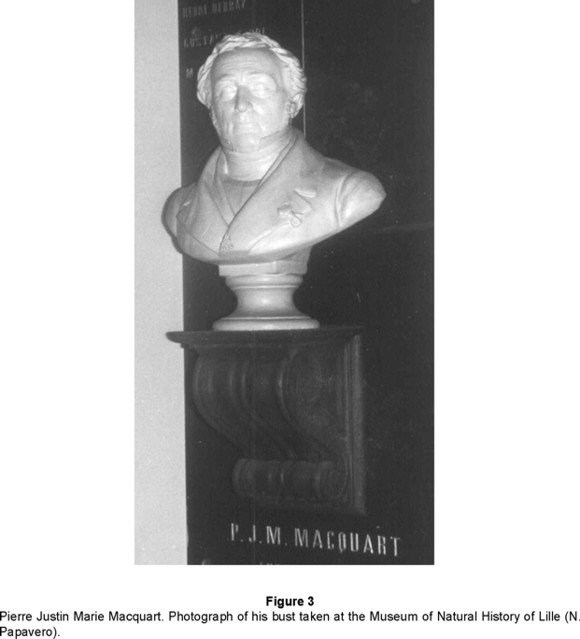
<body><![CDATA[<p align="justify"><font face="verdana" size="2">Following his marriage, he moved from Hazebrouck to Lestrem, living in a house made of two towers, remains of a castle from the XIV century, in the middle of a beautiful village near the banks of the Lawe, a tributary of the Lys. Eventually, he became the major Lestrem and a member of the " <i>Conseil G&eacute;n&eacute;ral du Pas de Calais</i>".</font></p>     <p align="justify"><font face="verdana" size="2">He started then his studies of Diptera, made easier by Meigen's publications. With the help of the works of the great Master he started the study of the French Diptera, which resulted in his "<i>Dipt&egrave;res du Nord de la France</i>" (1828&#45;1833). This work opened to him the important collections and libraries of the time: Blainville, Geoffroy de Saint&#45;Hilaire, F&eacute;russac, Lepelletier de Saint&#45;Fargeau, Audinet Serville, Audouin, Carcel, Al. Lefebvre, Brull&eacute;, Castelnau, Winthem, etc.</font></p>     <p align="justify"><font face="verdana" size="2">Soon after the publication of this work, Latreille thought of editing a special work on insects, in collaboration with several entomologists, and invited Macquart to take care of the Diptera. This project, whose execution was delayed by the health of the editor, was afterwards started again, under the editorship of N. E. Roret, and the name changed to "<i>Collection des Suites &agrave; Buffon, formant avec les oeuvres de cet auteur un cours complet d'histoire naturalle</i>" (82 volumes, 11 atlases). Macquart worked very hard, preparing the " <i>Histoire Naturalle des Insectes Dipt&egrave;res"</i>, studying the collections in the Paris Museum and several private collections. Once the two volumes were published (1834&#45;1835), he received a number of collections of exotic flies and established relations with all the leading entomologists of his time.</font></p>     <p align="justify"><font face="verdana" size="2">In the meantime, he travelled throughout France and Belgium. In 1839 he visited Meigen in Stolberg, where he saw the collections, 3,000 drawings of flies done by the great dipterist and Meigen's library, which contained exclusively his own writings. As Meigen was in straitened circumstances, Macquart offered to buy all those collections. After obtaining permission from the authorities of the Paris Museum, Macquart acquired all that material. The drawings made by Meigen remained unpublished in the Paris Museum, being rediscovered by Matile (1974) and finally published (Morge, 1975).</font></p>     <p align="justify"><font face="verdana" size="2">Returning to the Museum of Paris, and having at his disposition the great collections brought home by the French expeditions and collecting naturalists in almost every corner of the globe, Macquart undertook the description of the new species in the Museum, since these had not been examined by Wiedemann while working on exotic flies, and only a few had been dealt with before in the works of Guerin&#45;M&eacute;neville, Olivier, Robineau&#45;Desvoidy and Macquart's own "<i>Historie Naturelle des Insectes Dipt&egrave;res</i>". In this great series, published from 1838 to 1855, in two tomes and five supplements, he described some 1,800 species. In the first volume of his "<i>Dipt&egrave;res exotiques nouveaux ou peu connus</i>" (1838a: 15) he gave a list of the collections studied. As new collections arrived from the explorations of several travelling naturalists, such as Durville, Goudot, Pilate, Sall&eacute;, d'Orbigny, Claussen, Ghiesbreght, Saint&#45;Hilaire, and others, Macquart published new supplements to this work.</font></p>     <p align="justify"><font face="verdana" size="2">In 1845, he visited Switzerland again, calling on Perty in Berne, and thence passed to Germany. Returning to France, he put his newly acquired entomological collections in order and returned to his work of classifying the exotic flies.</font></p>     <p align="justify"><font face="verdana" size="2">In 1850, he wrote a book on the "<i>Facult&eacute;s int&eacute;rieures des Animaux Invert&eacute;br&eacute;s</i>" (Macquart, 1850a), in whose introduction he published an autobiography of 82 pages.</font></p>     <p align="justify"><font face="verdana" size="2">Macquart was elected fellow of the entomological and scientific societies of France, Normandy, Bordeaux, Turin, Lyon, Z&uuml;rich, Malta, Stettin, and others, such as the Linnaean Society.</font></p>     <p align="justify"><font face="verdana" size="2">He died in 1855, the year of publication of the 5 <sup>th</sup> Supplement of his "<i>Dipt&egrave;res exotiques nouveaux ou peu connus</i>". His bust was placed in the Museum of Natural History of Lille (<a href="#f3">Fig. 3</a>).</font></p>     <p align="justify"><font face="verdana" size="2">Macquart's types of Diptera are partly in the <i>"Mus&eacute;um National d'Histoire Naturalle de Paris</i>", partly (those belonging to the Bigot collection) in Oxford University (OXF) and the British Museum (Natural History); a few remained in the Museum of Natural History of Lille. In the Diptera section of the "<i>Mus&eacute;um National d'Histoire Naturalle de Paris</i>" (MNHNP) there exists a manuscript catalogue of the Diptera collection of Macquart still existing in Lille, organized by Julien Salmon, who saved what was left of the collection in 1899. The introduction to that catalogue says:</font></p>     ]]></body>
<body><![CDATA[<blockquote>    <p align="justify"><font face="verdana" size="2"><i>"Catalogue de la collection des Dipt&egrave;res de Macquart (conserv&eacute;s au Mus&eacute;e d'Histoire Naturelle de Lille (Nord).</i></font></p></blockquote>     <blockquote>    <p align="justify"><font face="verdana" size="2"><i>Notice: Le 15 d&eacute;cembre 1854, Macquart fit don de sa biblioth&egrave;que et de ses colections entomologiques &agrave; la Soci&eacute;t&eacute; des Sciences et Arts de Lille.</i></font></p></blockquote>     <blockquote>    <p align="justify"><font face="verdana" size="2"><i>Ces pr&eacute;cieuses richesses en re&ccedil;urent malheuresement pas les soins qu' elles m&eacute;ritaient: lorsque je retrouvai la collection Macquart en 1897, au Mus&eacute;e d'Histoire Naturelle de Lille, les anthr&egrave;nes avaient &eacute;lu domicile dans tous les cartons et continuaient leurs ravages sans &ecirc;tre inqui&eacute;t&eacute;s. J'entrepris de sauver tout d'abord les d&eacute;bris de la collection des Dipt&egrave;res. Ceux&#45;ci &eacute;taient r&eacute;partis en trois groupes: 1&deg; une collection renfermant un grand nombre d'esp&egrave;ces&#45;types (Indiqu&eacute;e T dans ce catalogue); 2&deg; une collection compos&eacute;e en grande partie d'esp&egrave;ces exotiques (Marqu&eacute;e G dans ce catalogue); 3&deg; une collection paraissant avoir &eacute;t&eacute; compos&eacute;e par Macquart pour le Mus&eacute;e; car le catalogue imprim&eacute; de 1850 lui correspond exactement (Indiqu&eacute;e par M dans ce catalogue). Apr&egrave;s avoir donn&eacute; &agrave; ces Dipt&egrave;res les soins de pr&eacute;servation que r&eacute;clamait leur &eacute;tat, j'en ai op&eacute;r&eacute; le transfert dans des cadres neufs, en respectant rigouresement l'ordre dans lequel je les ai trouv&eacute;s dans les vieux cartons, et sans essayer aucune intercalation. Puis, &agrave; l'aide des ouvrages de Macquart (M&eacute;moires de la Soci&eacute;t&eacute; des Science de Lille) et du Catalogue du Mus&eacute;e, j'ai &eacute;tabli l'num&eacute;ration des esp&egrave;ces qui avaient &eacute;chapp&eacute; &agrave; la destruction et de celles dont il subistait des d&eacute;bris observables.</i></font></p></blockquote>     <blockquote>    <p align="justify"><font face="verdana" size="2"><i>On remarquera que certaines esp&egrave;ces d'un m&ecirc;me genre se trouvent r&eacute;p&eacute;t&eacute;es plusieurs fois avec des annotations diff&eacute;rentes; cela tient &agrave; ce que je me suis born&eacute;, faute de connaissances sp&eacute;ciales, &agrave; retranscrire avec la plus grande exactitude, le libell&eacute; de chaque &eacute;tiquette, laissant aux sp&eacute;cialistes le soin d'en tirer les conclusions qu'il leur plaira.</i></font></p></blockquote>     <blockquote>    <p align="justify"><font face="verdana" size="2"><i>Il semble aussi, au premier abord, que ce catalogue soit bien restreint, en camparaison du nombre consid&eacute;rable de Dipt&egrave;res d&eacute;crits par Macquart. Mais, apr&egrave;s avoir fait la part des ravages caus&eacute;es par Antr&ecirc;nes et par l'humidit&eacute;, il faut tenir compte de l'observation suivante, pr&eacute;sent&eacute;e par le savant entomologista lorqu'il l&eacute;gua ses collections &agrave; la Soci&eacute;t&eacute; des Sciences: '. . . les esp&egrave;ces qui me furent comuniqu&eacute;es pour la d&eacute;termination et particuli&egrave;rement la collection du Jardin des Plantes, celles recueillies par les Commissions scientifiques de Mor&eacute;e et d'Alg&eacute;rie, celles rapport&eacute;es des Ies Canaries par MM. Webb et Berthelot, etc., me furent simplement confi&eacute;es, et je me r&eacute;servau seulement par convention avec les possesseurs, un individu sur quatre de la m&ecirc;me esp&egrave;ce, ce qui m'enrichit que tr&egrave;s m&eacute;diocrement ma collection. On y chercherait donc vainement les types d'un grand nombre de genres nouveaux que j'ai publi&eacute;s, surtout dans l'ouvrage sur les Dipt&egrave;res exotiques, que la Soci&eacute;t&eacute; a bien voulu comprendre dans ses m&eacute;moires et qui, acompagn&eacute; de 186 planches, en contient pas moins de 2300 descriptions d'esp&egrave;ces nouvelles.</i></font></p>    ]]></body>
<body><![CDATA[<p align="justify"><font face="verdana" size="2"><i>J'esp&egrave;re cependant que l'&eacute;numeration des d&eacute;bris de cette collection c&eacute;l&egrave;bre, sera de quelque utilit&eacute; aux Dipt&egrave;ristes qui l'avaient consider&eacute;e jusqu'&agrave; pr&eacute;sent comme enti&egrave;rement d&eacute;truite.</i></font></p>       <p align="right"><font face="verdana" size="2"><i>Lille, le 20 janvier 1899</i></font></p>       <p align="right"><font face="verdana" size="2"><i>Sign&eacute;: Julien Salmon"</i></font></p> </blockquote>     <p align="justify"><font face="verdana" size="2">Macquart studied the collections brought from Mexico by Fontaine, Pilate, Ghiesbreght, Linden, and Funk. Let's examine what is known about the lives and itineraries of those naturalists.</font></p>     <p align="center"><font face="verdana" size="2">*****</font></p>     <p align="justify"><font face="verdana" size="2">A "Fontaine" (or "Fontaines") was cited by du Petit&#45;Thouars, in his telling of the voyage of the frigate "La V&eacute;nus" (1840&#45;1843). Pierre&#45;Antoine Fontana, "dit Fontaine", was " <i>capitaine d'armes de premi&egrave;re classe"</i> aboard the frigate "La V&eacute;nus", commanded by du Petit&#45;Thouars. The frigate left Brest on December 29, 1836, for Teneriffe (January 1837) and then for Fernando de Noronha and Cabo Frio (February 3) in Brazil. The frigate landed in Rio de Janeiro, staying there from February 4 to 16, going afterwards to Florian&oacute;polis, Montevideo (February 24), Buenos Aires, Cape Horn, and Valpara&iacute;so (March 27), whence some members of the expedition followed to Santiago overland. Leaving Valpara&iacute;so on May 13, they visited several localities on the Peruvian coast, and from Callao (June 14) departed for the Sandwich Islands and other places, returning afterwards to Monterey, California. They then explored the localities of Guadalupe (November 19, 1837), bah&iacute;a de Magdalena, San Lucas, San Pedro del Cabo, Isla Venado, Mazatl&aacute;n, Golfo de Cort&eacute;s, Isla Isabel, San Blas, Tepic, and Acapulco in Mexico. Proceeding then to the Easter Island, they returned again to the South American Pacific coast, touching the Juan Fern&aacute;ndez Islands, landing in Valpara&iacute;so. After visiting some islands, they headed for the Marquesas (du Petit&#45;Thouars, 1840&#45;1843). However, no reference is made by Petit&#45;Thouars to "Fontaine" as zoological collector, credit being given to the ship surgeon, Adolphe Simon N&eacute;boux, " <i>chirurgien de premi&egrave;re classe</i> ", who sent collections of animals, especially birds and insects, to the Paris Museum. Thus, we cannot be sure whether the "Fontaine" cited by Macquart is the same as the one who participated in the "La V&eacute;nus" expedition.</font></p>     <p align="justify"><font face="verdana" size="2">Louis Pilate, according to Sall&eacute; (1852), travelled through the United States (Alabama, Louisiana, and Texas) and explored the State of Yucatan in Mexico. Returning to France, Pilate decided to visit Mexico again, and came to Yucatan for a second time in 1849. After a prolonged stay in that part of the country, Pilate moved to Mexico City, where he died on March 17, 1852, at the age of 36 years, of "a hypertrophy of the heart". The relation of Pilate's activities and descriptions of the regions he visited were published by himself in 1846, as follows (translation):</font></p>     <blockquote>    <p align="justify"><font face="verdana" size="2">" <i>The province of Yucatan, situated in the southeast of the Golf of Mexico, extends nearly from 17&#45;29&deg; of latitude. Even in the north, the thermometer does not go below 11&deg; R&eacute;amur (=13.75&deg;C, 56.75&deg;F) during the coldest part of the winter; the heat there is considerable in the summer. The northern part down to Campeche is general arid; it is, so to say, only a vast rock, nearly level and with a wrinkled surface. A single chain of hills about a hundred meters or more in elevation, originates a little south of Campeche, follows the coast northward a few kilometres inland for about 20 leagues, and then turns south&#45;eastward to the rocky part of the peninsula. One finds there, at various places, especially in the Northeast, a kind of subterranean ponds called locally</i> senotes <i>(sic!); otherwise there is no water during the dry season except in wells, that is, from November to the end of May. The vegetation is poor, the thinness of the soil permits nothing to live but shrubs, mostly of the</i> Mimosa <i>family, and rarely are there trees whose highest branches attain more than 10 meters of height. I am not speaking of the cultivated places that are continually irrigated. About a dozen leagues south of Campeche, a terrain of another nature starts &#45;from the little river of Champoton, the land is low, flat, humid, and inundated for several months of the year. Finally, in the southern part, rivers abound and the vegetation is magnificent. There is never any dryness there and the country is very unhealthy. I lived in the capital (Merida, in the Northeast) for 5 years and made only short trips to other localities; there was hardly anything in the north that I could secure besides insects. It is easy to imagine that I would find little, and generally only small insects, in a dry and sterile land. I might add that except for a dozen Coleptera, everything is rare; in 4 or 5 hours of searching I often found only a few specimens. However, in May and June there are more. In the rainy season diurnal Lepidoptera are abundant, but not of many kinds. Except for mosquitoes and the housefly, Diptera are very rare, and I would say the same about all other insects. I needed plenty of perseverance, a very determined attitude, and the aid of a domestic for 10 years, with nothing else to do but collect, to gather here 8,000 Coleoptera comprising almost 720 species, of which 500 about are new".</i></font></p></blockquote>     <p align="justify"><font face="verdana" size="2">August B. Ghiesbreght (the Ghisbrecht or Ghiesbrecht of Macquart) (1810&#45;1893; <i>cf.</i> Barnhart, 1927, 1965; Breedlove, 1981; Hemsley, 1887; Knobloch, 1983; Linden, 1867; Lorence &amp; Garc&iacute;a, 1989; McVaugh, 1972; Papavero, 1971b; Pennell, 1945; Rovirosa, 1889; Rzedowski &amp; Rzedowski, 1989) was the zoologist of a Belgian commission charged by the government to undertake a scientific exploration of Mexico and other tropical countries. The other two members were Jean Jules Linden (1817&#45;1898) (Barnhart, 1927, 1965; Breedlove, 1981; Hemsley, 1887; Linden, 1867; Papavero, 1971b; Pennell, 1945; R&ouml;hl, 1938a, b; Stafleu &amp; Cowan, 1981 (3:42); Standley, 1930), a botanist, and Nicholas Funck (1817&#45;1896) (Barnhart, 1927, 1965; Hemsley, 1887; Linden, 1867; Papavero, 1971b), the artist of the expedition. Their first travel was to Brazil, where they arrived in December 1835, visiting the provinces of Rio de Janeiro, Esp&iacute;rito Santo, Minas Gerais, and S&atilde;o Paulo. In March 1837, they returned to Belgium with the zoological and botanical collections obtained. Their second travel was made to Cuba, where they arrived in December 1837. The Belgians spent 3 months on the island, exploring its northern and western districts, and left in March 1838 for Mexico. There they visited the plateau of An&aacute;huac, the volcanoes Popocat&eacute;petl and Iztaccihuatl, the peak of Orizaba, the Cofre de Perote, and all the eastern slope of the Cordillera. From Veracruz they sailed to Campeche, crossed Yucatan and then went by sea to visit the state of Tabasco and later Chiapas, entering also northern Guatemala. Linden then went to Havana and the United States and the commission returned in February 1841 to Belgium. It seems that, from 1840 on, Ghiesbreght travelled alone, living in Tabasco, and then in Chiapas; although repeatedly visiting Europe, Ghiesbreght spent many years in Mexico. Although only the name Ghiesbreght is cited by Macquart, it is possible that in the same collections, insects collected by Linden and Funck were also included. According to the Paris Museum manuscript book of accessions (<i>catalogue des animaux sans vert&egrave;bres</i>, vol. 3, p. 83), Ghiesbreght sold insects to the Museum in 1842, for 30 francs per hundred specimens.</font></p>     ]]></body>
<body><![CDATA[<p align="justify"><font face="verdana" size="2">No Mexican species was described by Macquart in his "<i>Histoire naturalle des insectes dipt&egrave;res</i>" (1834&#45;1835).</font></p>     <p align="justify"><font face="verdana" size="2">In his "<i>Dipt&egrave;res exotiques nouveaux ou peu connus</i>" (1838&#45;1850), Macquart described 794 Neotropical species, only 71 being Mexican, as follows:</font></p>     <p align="justify"><font face="verdana" size="2">1838a:</font></p>     <blockquote>       <p align="justify"><font face="verdana" size="2">1. <i>Pachyrhina quadrilineata</i>, p. 50 (&#9794;,&#9792;), "Mexique (Coll. Lefebvre)". Now <i>Nephrotoma ferruginea</i> (Fabricius, 1805) (Alexander &amp; Alexander, 1970: 17) (Tipulidae).</font></p>       <p align="justify"><font face="verdana" size="2">2. <i>Odontomyia lefebvrei</i>, p. 189 (&#9794;), "Mexique (Coll. Lefebvre)". Now <i>Hedriodiscus lefebvrei</i> (Macquart) (James, 1973: 41) (Stratiomyidae).</font></p>       <p align="justify"><font face="verdana" size="2">3. <i>Odontomyia emarginata</i>, p. 190 (&#9794;), "Mexique (Coll. Lefebvre)". Same generic combination (James, 1973: 44) (Stratiomyidae).</font></p> </blockquote>     <p align="justify"><font face="verdana" size="2">1842:</font></p>     <blockquote>       <p align="justify"><font face="verdana" size="2">4. <i>Volucella mexicana</i>, p. 25 (&#9792;), "Mexique"&#45; Type N&deg; 1645 (Box 53), in MNHNP; also a specimen in Lille (M13). Now <i>Copestylum mexicanum</i> (Macquart) (Thompson <i>et al.</i>, 1976: 79) (Syrphidae).</font></p>       ]]></body>
<body><![CDATA[<p align="justify"><font face="verdana" size="2">5. <i>Helophilus mexicanus</i>, p. 64 (&#9792;), "Mexique (Coll. Lefebvre)"&#45; Type in Lille (T6). Now <i>Asemosyrphus mexicanus</i> (Macquart) (Thompson <i>et al.</i>, 1976: 97) (Syrphidae).</font></p> </blockquote>     <p align="justify"><font face="verdana" size="2">1843a:</font></p>     <blockquote>       <p align="justify"><font face="verdana" size="2">6. <i>Dejeania analis</i>, p. 34 (&#9794;), "Mexique"&#45; Type N&deg; 1727 in MNHNP lost. Now <i>Adejeania analis</i> (Macquart) (Guimar&atilde;es, 1971: 46) (Tachinidae).</font></p>       <p align="justify"><font face="verdana" size="2">7. <i>Dejeania rufipalpis</i>, p. 35 (&#9794;), "Mexique". Now <i>Adejeania rufipalpis</i> (Macquart) (Guimar&atilde;es, 1971: 47) (Tachinidae).</font></p>       <p align="justify"><font face="verdana" size="2">8. <i>Jurinia lateralis</i>, p. 42 (&#9794;), "Mexique". Now <i>Archytas lateralis</i> (Macquart) (Guimar&atilde;es, 1971: 50) (Tachinidae).</font></p>       <p align="justify"><font face="verdana" size="2">9. <i>Hystricia amoena</i>, p 44 (&#9794;), "Mexique"&#45; Type N&deg; 1749 in MNHNP, lost. Same generic combination (Guimar&atilde;es, 1971: 41) (Tachinidae).</font></p>       <p align="justify"><font face="verdana" size="2">10. <i>Hystricia testacea</i>, p. 44 (&#9794;,&#9792;), "Mexique (Coll. Lefebvre) et Am&eacute;rique du Nord"&#45; Specimen in Lille (G14). An unrecognized species of <i>Bombyliopsis</i> (Guimar&atilde;es, 1971:40) (Tachinidae).</font></p>       <p align="justify"><font face="verdana" size="2">11. <i>Micropalpus ornatus</i>, p. 48 (&#9794;), "Mexique et Colombie"&#45; Type N&deg; 1753 (Box 56) in MNHNP. Now <i>Cryptopalpus ornatus</i> (Macquart) (Guimar&atilde;es, 1971: 61) (Tachinidae).</font></p>       <p align="justify"><font face="verdana" size="2">12. <i>Blepharipeza rufipalpis</i>, p. 55 (sex?), "Mexique et Cuba"&#45; Type (from Cuba) N&deg; 2551 in Coll. Sagra/Bigot, MNHNP. Now <i>Leschenaultia leucophrys</i> (Wiedemann, 1830) (Guimar&atilde;es, 1971: 186) (Tachinidae).</font></p>       ]]></body>
<body><![CDATA[<p align="justify"><font face="verdana" size="2">13. <i>Lucilia brunnicornis</i>, p. 142 (&#9792;), "Mexique, Mozaid (?)"&#45; Type N&deg; 1847 in MNHNP, lost. Now <i>Phaenicia (Phaenicia) purpurascens</i> (Walker, 1837) (James, 1970: 11) (Calliphoridae).</font></p>       <p align="justify"><font face="verdana" size="2">14. <i>Lucilia mexicana</i>, p. 143 (&#9794;), "Mexique"&#45; Types N&deg; 1850 (4 specimens) (Box 60) in MNHNP. Now <i>Phaenicia (Phaenicia) mexicana</i> (Macquart) (James, 1970: 11) (Calliphoridae).</font></p>       <p align="justify"><font face="verdana" size="2">15. <i>Curtonevra mexicana</i>, p. 158 (&#9794;,&#9792;), "Mexique". Now <i>Neomusca mexicana</i> (Macquart) (Pont, 1972: 50) (Muscidae).</font></p>       <p align="justify"><font face="verdana" size="2">16. <i>Herina mexicana</i>, p. 208 (sex?), "Mexique". Now <i>Senopterina</i> Macquart (Steyskal, 1965: 657) (Platystomatidae).</font></p>       <p align="justify"><font face="verdana" size="2">17. <i>Drosophila mexicana</i>, p. 259 (&#9794;), "Mexique"&#45; Types N&deg; 1998 (Box 66) (2 wings glued to piece of cardboard) in MNHNP. An unplaced species (Wheeler, 1970:30) (Drosophilidae).</font></p>       <p align="justify"><font face="verdana" size="2">18. <i>Olfersia mexicana</i>, p. 297 (sex?), "Mexique"&#45; Types N&deg; 2015 (2 specimens) (Box 66) in MNHNP. Now <i>Lynchia nigra</i> (Perty, 1833) (Guimar&atilde;es, 1968a:6) (Hippoboscidae).</font></p> </blockquote>     <p align="justify"><font face="verdana" size="2">1846:</font></p>     <blockquote>       <p align="justify"><font face="verdana" size="2">19. <i>Pachyrhina mexicana</i>, p. 12 (&#9794;), "Mexique (Coll. Gu&eacute;rin&#45;M&eacute;neville)"&#45; Type N&deg; 1240 in MNHNP, lost. Now <i>Nephrotoma mexicana</i> (Macquart) (Alexander &amp; Alexander, 1970: 17) (Tipulidae).</font></p>       <p align="justify"><font face="verdana" size="2">20. <i>Tabanus ruber</i>, p. 42 (&#9792;), "Mexique (Coll. Gu&eacute;rin&#45;M&eacute;neville)"&#45; Type N&deg; 1345 in MNHNP. Now <i>Tabanus subruber</i> Bellardi, 1859 (Fairchild, 1971: 102; Fairchild &amp; Burger, 1994: 150) (Tabanidae).</font></p>       ]]></body>
<body><![CDATA[<p align="justify"><font face="verdana" size="2">21. <i>Cyphomyia fenestrata</i>, p. 48 (&#9794;,&#9792;), "M&eacute;rida, Yucat&aacute;n (Pilate)"&#45; Specimen in Lille (M6). Now <i>Cyphomyia albitarsis</i> (Fabricius, 1805) (James, 1973: 26) (Stratiomyidae).</font></p>       <p align="justify"><font face="verdana" size="2">22. <i>Hermetia coarctata</i>, p. 50 (&#9792;), "Mexique (Coll. Fairmaire)". Same generic combination (James, 1973: 37) (Stratiomyidae).</font></p>       <p align="justify"><font face="verdana" size="2">23. <i>Hermetia planifrons</i>, p. 50 (&#9794;), "M&eacute;rida, Yucat&aacute;n (Pilate)". Now <i>Hermetia albitarsis</i> Fabricius, 1805 (James, 1973:36) (Stratiomyidae).</font></p>       <p align="justify"><font face="verdana" size="2">24. <i>Odontomyia rubricornis</i>, p. 53 (&#9794;), "M&eacute;rida, Yucat&aacute;n (Pilate)". Type N&deg; 1440 in MNHNP, lost. Now <i>Labostigmina rubricornis</i> (Macquart) (James, 1973: 43) (Stratiomyidae).</font></p>       <p align="justify"><font face="verdana" size="2">25. <i>Ephippium fenestrata</i>, p. 54 (&#9794;,&#9792;), "M&eacute;rida, Yucat&aacute;n (Pilate)". Type N&deg; 1445 in MNHNP, lost; specimen in Lille (G5). Now <i>Adoxomyia fenestrata</i> (Macquart) (James, 1973: 30) (Stratiomyidae).</font></p>       <p align="justify"><font face="verdana" size="2">26<i>. Sargus speciosus</i>, p. 56 (&#9792;), "M&eacute;rida, Yucat&aacute;n (Pilate)". Same generic combination (James, 1973: 20) (Stratiomyidae).</font></p>       <p align="justify"><font face="verdana" size="2">27. <i>Dasypogon candidus</i>, p. 67 (&#9794;), "Veracruz (Coll. Spinola)". Now <i>Stichopogon trifasciatus</i> (Say, 1823) (Martin &amp; Papavero, 1970: 5) (Asilidae).</font></p>       <p align="justify"><font face="verdana" size="2">28. <i>Dasypogon mexicanus</i>, p. 68 (&#9794;), "Mexique (Coll. Gu&eacute;rin&#45;M&eacute;neville)". Type N&deg; 1480 in MNHNP, lost. An unrecognized species (Martin &amp; Papavero, 1970: 90) (Asilidae).</font></p>       <p align="justify"><font face="verdana" size="2">29. <i>Dasypogon nigritarsis</i>, p. 68 (&#9794;), "Mexique (Coll. Gu&eacute;rin&#45;M&eacute;neville)". Type N&deg; 1481 in MNHNP, lost. Now <i>Diogmites nigritarsis</i> (Macquart) (Martin &amp; Papavero, 1970: 26) (Asilidae).</font></p>       <p align="justify"><font face="verdana" size="2">30. <i>Megapoda cyaneiventris</i>, p. 71 (&#9792;), "Mexique (Coll. Robyns)". Type N&deg; 1507 in MNHNP. Now <i>Pseudorus distendens</i> (Wiedemann, 1828) (Papavero, 1975) (Asilidae).</font></p>       ]]></body>
<body><![CDATA[<p align="justify"><font face="verdana" size="2">31. <i>Atomosia tibialis</i>, p. 76 (&#9794;), "M&eacute;rida, Yucat&aacute;n (Pilate)". Type lost. Same generic combination (Artigas <i>et al.</i>, 1991: 59) (Asilidae).</font></p>       <p align="justify"><font face="verdana" size="2">32. <i>Erax argyrogaster</i>, p. 84 (&#9794;,&#9792;), "M&eacute;rida, Yucat&aacute;n (Pilate)". Type not in Paris. Now <i>Efferia argyrogaster</i> (Macquart) (Martin &amp; Papavero, 1970: 63) (Asilidae).</font></p>       <p align="justify"><font face="verdana" size="2">33. <i>Asilus mexicanus</i>, p. 94 (&#9794;), "Mexique (Coll. Gu&eacute;rin&#45;M&eacute;neville)". Type lost. Now <i>Machimus (Tolmerus) mexicanus</i> (Macquart) (Martin &amp; Papavero, 1970: 86) (Asilidae).</font></p>       <p align="justify"><font face="verdana" size="2">34. <i>Hirmoneura brevirostris</i>, p. 101 (&#9794;), "M&eacute;rida, Yucat&aacute;n (Pilate)". Now <i>Hirmoneura (Hyrmophlaeba) brevirostris</i> Macquart (Papavero, 1968: 3) (Nemestrinidae).</font></p>       <p align="justify"><font face="verdana" size="2">35. <i>Exoprosopa pilatei</i>, p. 110 (&#9794;), "M&eacute;rida, Yucat&aacute;n (Pilate)". Now <i>Ligyra pilatei</i> (Macquart) (Painter <i>et al</i>., 1978: 44) (Bombyliidae).</font></p>       <p align="justify"><font face="verdana" size="2">36. <i>Exoprosopa limbipennis</i>, p. 110 (&#9794;), "M&eacute;rida, Yucat&aacute;n (Pilate)". Type N&deg; 1595 in MNHNP. Now <i>Exoprosopa argentifasciata</i> (Macquart, 1846) (Painter <i>et al</i>., 1978: 39) (Bombyliidae).</font></p>       <p align="justify"><font face="verdana" size="2">37. <i>Geron rufipes</i>, p. 119 (&#9794;,&#9792;), "M&eacute;rida, Yucat&aacute;n (Pilate)". Same generic combination (Painter <i>et al</i>., 1978: 17) (Bombyliidae).</font></p>       <p align="justify"><font face="verdana" size="2">38. <i>Psilopus incisuralis</i>, p. 120 (&#9792;), "M&eacute;rida, Yucat&aacute;n (Pilate)". Now <i>Condylostylus incisuralis</i> (Macquart) (Robinson, 1970: 8) (Dolichopodidae).</font></p>       <p align="justify"><font face="verdana" size="2">39. <i>Mixogaster mexicanus</i>, p. 123 (&#9792;), "Mexique (Coll. Robyns)". Type in MRHNB. Now <i>Mixogaster mexicana</i> Macquart (Thompson <i>et al</i>., 1976: 58) (Syrphidae).</font></p>       <p align="justify"><font face="verdana" size="2">40. <i>Volucella tibialis</i>, p. 123 (&#9792;), "M&eacute;rida, Yucat&aacute;n (Pilate)". Type not found. Now <i>Copestylum tibiale</i> (Macquart) (Thompson <i>et al</i>., 1976: 85) (Syrphidae).</font></p>       ]]></body>
<body><![CDATA[<p align="justify"><font face="verdana" size="2">41. <i>Syrphus delineatus</i>, p. 139 (&#9792;), "Mexique (Coll. Robyns)". Type in MRHNB. An unplaced species (Thompson <i>et al.</i>, 1976: 39) (Syrphidae).</font></p>       <p align="justify"><font face="verdana" size="2">42. <i>Baccha lineata</i>, p. 139 (&#9792;), "Texas ou Yucat&aacute;n (Pilate)". Now <i>Ocyptamus lineatus</i> (Macquart) (Thompson <i>et al</i>., 1976: 21) (Syrphidae).</font></p>       <p align="justify"><font face="verdana" size="2">43. <i>Trichopoda mexicana</i>, p. 172 (&#9792;), "Mexique (Coll. Robyns)". Same generic combination (Guimar&atilde;es, 1971: 9) (Tachinidae).</font></p>       <p align="justify"><font face="verdana" size="2">44. <i>Dexia rubriventris</i>, p. 189 (&#9794;), "M&eacute;rida, Yucat&aacute;n (Pilate)". Now <i>Ptilodexia rubriventris</i> (Macquart) (Guimar&atilde;es, 1971: 33) (Tachinidae).</font></p>       <p align="justify"><font face="verdana" size="2">45. <i>Dexia fuscanipennis</i>, p. 188 (&#9792;), "M&eacute;rida, Yucat&aacute;n (Pilate)". An unrecognized Dexiinae (Guimar&atilde;es, 1971: 122) (Tachinidae).</font></p>       <p align="justify"><font face="verdana" size="2">46. <i>Lucilia meridensis</i>, p. 199 (&#9794;,&#9792;), "M&eacute;rida, Yucat&aacute;n (Pilate)". Actually not an species of Calliphoridae, now <i>Morellia meridensis</i> (Macquart) (Pont, 1972: 9) (Muscidae).</font></p> </blockquote>     <p align="justify"><font face="verdana" size="2">1847:</font></p>     <blockquote>       <p align="justify"><font face="verdana" size="2">47. <i>Dichelacera scapularis</i>, p. 15 (&#9792;), "Mexique (Coll. Bigot)". Same generic combination (Fairchild, 1971: 64; Fairchild &amp; Burger, 1994: 98) (Tabanidae).</font></p>       <p align="justify"><font face="verdana" size="2">48. <i>Tabanus apicalis</i>, p. 20 (sex?), "Mexique (Coll. Bigot)". Now <i>Tabanus bigoti</i> Bellardi, 1859 (Fairchild, 1971: 84; Fairchild &amp; Burger, 1994: 132) (Tabanidae).</font></p>       ]]></body>
<body><![CDATA[<p align="justify"><font face="verdana" size="2">49. <i>Sargus nigrifemorata</i>, p.31 (&#9794;), "Mexique (Coll. Bigot)". Now <i>Himantoloba nigrifemorata</i> (Macquart) (James, 1973: 10) (Stratiomyidae).</font></p>       <p align="justify"><font face="verdana" size="2">50. <i>Ceraturgus rufipennis</i>, p. 32 (&#9792;), "Mexique (Coll. Bigot)". Type OXF. Now <i>Taracticus rufipennis</i> (Macquart) (Martin &amp; Papavero, 1970: 35) (Asilidae).</font></p>       <p align="justify"><font face="verdana" size="2">51. <i>Dasypogon nigripennis</i>, p. 34 (&#9792;), "Mexique (Coll. Bigot)". Type OXF. Now <i>Diogmites nigripennis</i> (Macquart) (Martin &amp; Papavero, 1970: 26) (Asilidae).</font></p>       <p align="justify"><font face="verdana" size="2">52. <i>Dasypogon dimidiatus</i>, p. 35 (&#9794;), "Mexique (Coll. Bigot)". Type OXF. Now <i>Taracticus dimidiatus</i> (Macquart) (Martin &amp; Papavero, 1970: 35) (Asilidae).</font></p>       <p align="justify"><font face="verdana" size="2">53. <i>Lampria mexicana</i>, p. 37 (&#9794;), "Mexique (Coll. Bigot)". Type OXF. Same generic combination (Martin &amp; Papavero, 1970: 40) (Asilidae).</font></p>       <p align="justify"><font face="verdana" size="2">54. <i>Ommatius pumillus</i>, p. 42 (&#9792;), "Mexique (Coll. Bigot)". Type OXF. Same generic combination (Martin &amp; Papavero, 1970: 59) (Asilidae).</font></p>       <p align="justify"><font face="verdana" size="2">55. <i>Eristalis mexicanus</i>, p. 59 (&#9794;), "Mexique (Coll. Bigot)". Type BMNH. Now <i>Palpada mexicana</i> (Macquart) (Thompson <i>et al.</i>, 1976: 107) (Syrphidae).</font></p>       <p align="justify"><font face="verdana" size="2">56. <i>Lucilia violacea</i>, p. 83 (&#9794;), "Mexique (Coll. Bigot)". Now <i>Phaenicia purpurescens</i> (Walker) (James, 1970: 11) (Calliphoridae).</font></p> </blockquote>     <p align="justify"><font face="verdana" size="2">1850:</font></p>     <blockquote>       ]]></body>
<body><![CDATA[<p align="justify"><font face="verdana" size="2">57. <i>Pangonia planiventris</i>, p. 26 (&#9792;), "Mexique (Mus&eacute;um)". Type N&deg; 1322 in MNHNP. Now <i>Esenbeckia (Ricardoa) planiventris</i> (Macquart) (Fairchild, 1971: 11; Fairchild &amp; Burger, 1994: 28) (Tabanidae).</font></p>       <p align="justify"><font face="verdana" size="2">58. <i>Pangonia nigronotata</i>, p. 27 (&#9794;,&#9792;), "Mexique (Mus&eacute;um)". Type N&deg; 1324 in MNHNP. Now <i>Esenbeckia (Ricardoa) nigronotata</i> (Macquart) (Fairchild, 1971: 11; Fairchild &amp; Burger, 1994: 27) (Tabanidae).</font></p>       <p align="justify"><font face="verdana" size="2">59. <i>Pangonia bicolor</i>, P. 27 (&#9792;), "Mexique (Mus&eacute;um)". Type N&deg; 1325 in MNHNP. Now <i>Esenbeckia (Ricardoa) semiflava</i> (Wiedemann, 1830) (Fairchild, 1971: 11; Fairchild &amp; Burger, 1994: 28) (Tabanidae).</font></p>       <p align="justify"><font face="verdana" size="2">60. <i>Tabanus albiscutellatus</i>, p. 34 (&#9792;), "Mexique (Ghiesbreght)". Type N&deg; 1365 in MNHNP. Now <i>Leucotabanus exaestuans</i> (Linnaeus, 1758) (Fairchild, 1971: 83; Fairchild &amp; Burger, 1994: 123) (Tabanidae).</font></p>       <p align="justify"><font face="verdana" size="2">61. <i>Odontomyia flavifasciata</i>, p. 53 (&#9792;), "Mexique (Ghiesbreght)". Type N&deg; 1442 in MNHNP. Now <i>Hedriodiscus lefebvrei</i> (Macquart, 1838) (James, 1973: 41) (Stratiomyidae).</font></p>       <p align="justify"><font face="verdana" size="2">62. <i>Mydas vittatus</i>, p. 60 (&#9794;), "Mexique (Coll. Br&eacute;mond)". Type N&deg; 1460 in MNHNP. Now <i>Stratiomydas rufiventris</i> (Macquart, 1850) (Papavero, 1996:632) (Mydidae).</font></p>       <p align="justify"><font face="verdana" size="2">63. <i>Dasypogon fasciventris</i>, p. 69 (&#9794;), "Mexique (Coll. Bigot)". Type OXF. Now <i>Stichopogon trifasciatus</i> (Say, 1823) (Martin &amp; Papavero, 1970: 5) (Asilidae).</font></p>       <p align="justify"><font face="verdana" size="2">64. <i>Mallophora fulviventris</i>, p. 77 (&#9792;), "Mexique (Ghiesbreght)". Type N&deg; 1101 in MNHNP. Same generic combination (Martin &amp; Papavero, 1970: 74) (Asilidae).</font></p>       <p align="justify"><font face="verdana" size="2">65. <i>Mallophora fulvianalis</i>, p. 78 (&#9792;), "Mexique (Ghiesbreght)". Type N&deg; 1102 in MNHNP. A synonym of <i>M. fulviventris</i> Macquart? (Martin &amp; Papavero, 1970: 74) (Asilidae).</font></p>       <p align="justify"><font face="verdana" size="2">66. <i>Mallophora pica</i>, p. 78 (&#9794;), "Mexique ou Bolivie (M. d'Orbigny)". As d'Orbigny never collected in Mexico, this species is probably from Bolivia. Type N&deg; 1103 in MNHNP. Same generic combination (Martin &amp; Papavero, 1970: 75) (Asilidae).</font></p>       ]]></body>
<body><![CDATA[<p align="justify"><font face="verdana" size="2">67. <i>Anisotamia eximia</i>, p. 115 (&#9794;), "Mexique (Ghiesbreght)". Type N&deg; 1615 in MNHNP. Now <i>Bryodemina valida</i> (Wiedemann, 1830) (Painter <i>et al.</i>, 1978: 24) (Bombyliidae).</font></p>       <p align="justify"><font face="verdana" size="2">68. <i>Eristalis testaceicornis</i>, p. 138 (&#9792;), "Mexique". Type OXF. Now <i>Palpada testaceicornis</i> (Macquart) (Thompson <i>et al.</i>, 1976: 104) (Syrphidae).</font></p>       <p align="justify"><font face="verdana" size="2">69. <i>Hystricia ambigua</i>, p. 172 (&#9792;), "Mexique (Coll. Bigot)". Now <i>Jurinella ambigua</i> (Macquart) (Guimar&atilde;es, 1971: 56) (Tachinidae).</font></p>       <p align="justify"><font face="verdana" size="2">70. <i>Prosena mexicana</i>, p. 231 (&#9794;,&#9792;), "Mexique (Ghiesbreght)". Type N&deg; 1798 in MNHNP. Now <i>Mochlosoma mexicanum</i> (Macquart) (Guimar&atilde;es, 1971: 31) (Tachinidae).</font></p> </blockquote>     <p align="justify"><font face="verdana" size="2">Finally, in an article from 1852, Macquart described from Mexico his last species:</font></p>     <blockquote>       <p align="justify"><font face="verdana" size="2">71. <i>Megistopoda pilatei</i>, p. 332, pl. 4, fig. 4. (sex?), Mexico, Tabasco, Teapa (Pilate) (Wenzel, 1970: 9) (Streblidae).</font></p> </blockquote>     <p align="justify"><font face="verdana" size="2"><b>3. The species described by John Obadiah Westwood</b></font></p>     <p align="justify"><font face="verdana" size="2">John Obadiah Westwood (<a href="#f4">Fig. 4</a>) was born at Sheffield, England, on December 22, 1805, and died shortly after completing his 87 <sup>th</sup> year, on January 2, 1892, at Oxford. His father was a die sinker at Sheffield, but afterwards removed to Lichfield. When nearly 16 years of age, Westwood went to London to be articled to a solicitor, and though he devoted his attention more to the study of natural history than of law, he was admitted to the bar as a solicitor and became partner in a firm. Having some private means, which he augmented by writing and drawing, he was able to neglect his profession and devote himself entirely to entomology and archaeology. Westwood was actively associated with the Entomological Society of London, from its foundation in 1831, and was for many years its secretary. Subsequently, he was elected president when the Society celebrated its jubilee in 1833. He was also a fellow of the Linnaean Society from 1827.</font></p>     <p align="center"><font face="verdana" size="2"><a name="f4"></a></font></p>     ]]></body>
<body><![CDATA[<p align="center"><font face="verdana" size="2"><img src="/img/revistas/azm/n84/a5f4.jpg"></font></p>     <p align="justify"><font face="verdana" size="2">Westwood's dipterological publications include short papers describing miscellaneous new species (1835a, 1835b), a revision of the Mydidae (1841), descriptions of a new species of <i>Systropus</i> (Bombyliidae) (1842), and two papers on Acroceridae (1848, 1876). Among his other publications, special mention must be made to his "Introduction to the modern Classification of Insects", a systematic arrangement of the genera of British Insects (1840).</font></p>     <p align="justify"><font face="verdana" size="2">In 1858, the Reverend F. W. Hope, a wealthy amateur, who had been for years a warm friend and patron of Westwood, and had purchased his collection, gave the specimens to the University of Oxford, and founded a Professorship of Invertebrate Zoology, which bears his name. Westwood was appointed the first Hope Professor and in consequence removed to Oxford, where he was a conspicuous figure in the University for 35 years (Anon, 1893; Wandolleck, 1893).</font></p>     <p align="justify"><font face="verdana" size="2">Westwood described only a few species of Mexican Diptera:</font></p>     <blockquote>       <p align="justify"><font face="verdana" size="2">1. <i>Mydas dives</i>, 1841: 50, pl. 13, fig. 1. "Mexico (locality unknown)". (&#9792; OXF). Now <i>Protomydas rubidapex</i> (Wiedemann) (Wilcox <i>et al.</i>, 1989: 16; Papavero, 1996: 632) (Mydidae).</font></p>       <p align="justify"><font face="verdana" size="2">2. <i>Mydas crassipes</i>, 1841: 51, pl. 13, fig. 3. "North America". Now <i>Ceriomydas crassipes</i> (Westwood) (Wilcox <i>et al.</i>, 1989: 107) (Mydidae).</font></p>       <p align="justify"><font face="verdana" size="2">3. <i>Mydas senilis</i>, 1841: 52. "Mexico, Tacubaya (Coffin)". (&#9794; OXF). Unchanged (Wilcox <i>et al.</i>, 1989: 41; Papavero, 1996: 631) (Mydidae).</font></p>       <p align="justify"><font face="verdana" size="2">4. <i>Mydas basalis</i>, 1841: 53. "Mexico, Tacubaya (Coffin)". (&#9792; OXF). Now a junior synonym of <i>Mydas senilis</i> Westwood (Wilcox <i>et al.</i>, 1989: 41&#45;42; Papavero, 1996: 631) (Mydidae).</font></p>       <p align="justify"><font face="verdana" size="2">5. <i>Systropus faenoides</i>, 1842: 3. "Mexico". Unchanged (Painter <i>et al.</i>, 1978: 18) (Bombyliidae).</font></p> </blockquote>     ]]></body>
<body><![CDATA[<p align="justify"><font face="verdana" size="2">Nothing is known about the collector "Coffin".</font></p>     <p align="justify"><font face="verdana" size="2"><b>4. The first Cuterebridae, described by Bracy Clark</b></font></p>     <p align="justify"><font face="verdana" size="2">The oldest known reference to a Mexican Cuterebridae (now subfamily Cuterebrinae of Oestridae, according to Wood, 1987) is found in Fray Bernardino de Sahagun's "<i>Historia General de las cosas de la Nueva Espa&ntilde;a"</i>. Sahagun, who lived in New Spain from 1529 to 1590, said in that book that there existed "<i>gusanos que cr&iacute;an en los brazos o miembros de los conejos y ratones</i>" (worms that live in the marms or members of rabbits and rats); those worms could be seen "<i>metidos dentro de la carne y miran hacia fuera</i>" (placed within the flesh, looking to the outside). Those larvae, certainly of <i>Cuterebra</i> , were called <i>"nacaocuilin</i>" (from nahuatl <i>"nacatl</i>"= flesh, and <i>"ocuilin"</i> = worm) (Vogelsang &amp; Mart&iacute;n del Campo, 1947: 50). Sahagun described the opening of the wound where the larva lives and its posterior spiracles, taken by him as "eyes", "looking to the outside" (Guimar&atilde;es <i>et al</i> ., 1983: 241).</font></p>     <p align="justify"><font face="verdana" size="2">But the first scientific description of a Mexican Cuterebridae would be made only in 1848, by Bracy Clark, a veterinary surgeon and Fellow of the Linnaean Society of London. In that paper he described <i>Cuterebra atrox</i> from Mexico. Sabrosky (1986: 149) said:</font></p>     <p align="justify"><font face="verdana" size="2">"<i>Holotype of </i>atrox<i>, female, Mexico (Oxford). Clark (1848) stated that the species, from a specimen in the Westwood collection, was "believed to inhabit Africa" ("</i> Habitasse creditur in Africa <i>"), but Westwood himself crossed out those words in the Oxford University copy of Clark's paper and wrote in the margin "</i> Habitat certe in Mexico, J. O. W. <i>", as already noted by Austen (1895). Austen also stated that the type is "apparently a male", but he corrected this in 1933 to female</i>".</font></p>     <p align="justify"><font face="verdana" size="2">As also commented by Sabrosky (1972: 89), on November 1 <sup>st</sup>, 1796, Bracy Clark (for a biography see <i>Proc. Linn. Soc. London, 1861</i> : xxi&#45;xxiv) read to the Linnaean Society an important paper on "Observations on the genus <i>Oestrus</i>", and the following year published it in the third volume of the Society's <i>Transactions</i>. This was expanded and published in 1815 as his famous "<i>An essay on the bots of horses and other animals"</i>. Clark's works are particularly significant contributions to the knowledge of oestroid flies, with their keen and direct observations on then little known, confused and misunderstood life histories and immature stages of the bot and warble flies. Over the next decades he published a few other papers, ending with three short comments in 1857, in his 87 <sup>th</sup> year. He died in 1860.</font></p>     <p align="justify"><font face="verdana" size="2">Sabrosky (1972) published a very interesting paper on the "rediscovery" of the bot fly collection of Clark.</font></p>     <p align="justify"><font face="verdana" size="2"><b>5. The species described by Francis Walker</b></font></p>     <p align="justify"><font face="verdana" size="2">Francis Walker (<a href="#f5">Fig. 5</a>) was the seventh son, and the tenth and youngest child of Mr. John Walker, a gentleman of independent fortune, residing at Arno's Grove, Southgate, where Francis was born on July 31, 1809. His father had a decided taste for scientific activities, especially natural history; he was a fellow of the Royal and Horticultural Societies and vice&#45;president of the Linnaean, so that his son's almost boyish propensity for those studies could be explained by those influences.</font></p>     <p align="center"><font face="verdana" size="2"><a name="f5"></a></font></p>     ]]></body>
<body><![CDATA[<p align="center"><font face="verdana" size="2"><img src="/img/revistas/azm/n84/a5f5.jpg"></font></p>     <p align="justify"><font face="verdana" size="2">In 1816 Walker's parents were staying with their family in Geneva, then the center of a literary coterie in which they met, among other celebrities, Lord Byron, Madame de Sta&euml;l, and the naturalists Saussure and Vernet. They spent more than a year in Geneva and Vevey, and in 1818 proceeded to Lucerne, from which place Francis, then a boy nine years of age, made the ascent of Mount Pilatus, in company with his elder brother Henry; their object, in addition to mountain climbing, being the collecting of butterflies. The family afterwards visited Neuwied and returned to Arno's Grove in 1820.</font></p>     <p align="justify"><font face="verdana" size="2">In 1830 the two brothers, Henry and Francis, again visited the continent, and now it was purely an entomological tour; Mr. Curtis, the well&#45;known author of "British Entomology", being their companion. This party collected the French Satyridae most assiduously on the Island of Jersey and afterwards at Fontainebleau, Montpellier, Nantes, Vaucluse, etc.</font></p>     <p align="justify"><font face="verdana" size="2">Walker's career as an author commenced in 1832. He contributed to the first number of the "Entomological Magazine", the introductory chapter of his "<i>Monographia Chalciditum</i>".</font></p>     <p align="justify"><font face="verdana" size="2">In 1834, somewhat reluctantly, he consented to undertake the editorial management of the Entomological Magazine, but resigned this office the following year, yet continued to be a constant contributor to its pages. The same year he visited Lapland.</font></p>     <p align="justify"><font face="verdana" size="2">From 1837 to 1863 he was hired by the British Museum to describe the insect collections, receiving &pound;1 per genus and 1 shilling per species. During his lifetime, as calculated by Horn (1937: 432), Walker prepared some 20,000 ("<i>zahllosen und trostlosen</i>"= innumerable and untrustworthy) descriptions of insects in several orders.</font></p>     <p align="justify"><font face="verdana" size="2">Walker's first paper on neotropical flies was published in 1837, containing the descriptions of the Diptera collected during Captain P. P. Kinks survey of the Straits of Magellan.</font></p>     <p align="justify"><font face="verdana" size="2">In 1849 (May) Walker married May Elizabeth, the oldest daughter of Mr. Ford, of Ellel Hall, near Lancaster, and spent the summer on the Continent, again collecting in Switzerland.</font></p>     <p align="justify"><font face="verdana" size="2">In 1848 he had explored the Isle of Thanet, and in 1849 he went to the Island of Wright. During those two years the first four volumes of the "List of the specimens of Dipterous Insects in the collection of the British Museum" were published. In the succeeding years, 1850 and 1851, he visited Geneva and Interlaken. During 1850, he published the first part of a work on the Diptera in the collections of W. W. Saunders (1850a), and a smaller number of new species in the "<i>Zoologist</i>" (1850b). He also commenced work on Diptera for a projected series of works on British insects, to be called "<i>Insecta Britannica</i>".</font></p>     <p align="justify"><font face="verdana" size="2">In 1851 and 1852, the second and the third parts of his "<i>Insecta Saundersiana</i>" were published (1851, 1852a, b), and from 1854 to 1856 the three supplements (=vols. 5&#45;7) of the "List".</font></p>     ]]></body>
<body><![CDATA[<p align="justify"><font face="verdana" size="2">In 1856 appeared the last (fourth) part of the "<i>Insecta Saundersiana</i>", and in 1857 Walker published the first part of the "<i>Characters of undescribed Diptera in the collection of W. W. Saunders</i>", in the "<i>Transactions of the Royal Entomological Society</i>".</font></p>     <p align="justify"><font face="verdana" size="2">Another tour of the Continent occupied a considerable portion of 1857, with Walker visiting Calais, Rouen, Paris, Strasbourg, Baden&#45;Baden, Heidelberg, Wiesbaden, Frankfurt, Mainz, K&ouml;ln, Brussels, Aix&#45;la&#45;Chapelle and Antwerp. During this journey he collected in the Black Forest.</font></p>     <p align="justify"><font face="verdana" size="2">In 1860, the second part of the "<i>Characters</i>" was published (and here he described the great majority of his new species of Mexican flies) and the summer of this same year was devoted to a thorough exploration of the Chennel Islands. In 1861 Walker's excursions were confined to North Devon, and the third part of the "<i>Characters</i>" was published. In 1863 he toured the English lakes.</font></p>     <p align="justify"><font face="verdana" size="2">In the spring of 1865 he visited North Wales and Ireland. In the autumn he again visited Paris, Geneva, Lucerne, Interlaken, and Altdorf, ascending the Righi, Mount Pilatus and the M&uuml;rren, proceeding to Kanderstag, the Oeschinen See and the Gemmi Pass.</font></p>     <p align="justify"><font face="verdana" size="2">In 1867, we find him again in France and Switzerland, ascending the Col de Voza and examining the Jardin of the Mer de Glace; thence over the T&ecirc;te Noire to Martigny, Sion, and the Great St. Bernard, returning through St. Maurice and Villeneuve to Geneva.</font></p>     <p align="justify"><font face="verdana" size="2">In 1868 he made the tour of the Isle of Mann and returned to Holyhead; in 1870 he paid another visit to Llanberis, as well as to all the more beautiful scenery in North Wales, crossing over to Ireland and touring that island from south to north; and in 1874 he examined entomologically the Scilly Islands and the districts of the Lizard and the Land's End.</font></p>     <p align="justify"><font face="verdana" size="2">In 1872 he turned his attention to Italy, visiting Rome, Piza, Lucca, Florence, Naples, Sorrento, Capri, Milan and Venice, as well as the lakes Como and Maggiore.</font></p>     <p align="justify"><font face="verdana" size="2">Finally, in 1874, he had again proceeded as far as Aberystwith, on his way to Ireland, when his intention was frustrated by illness, which terminated fatally on the 5 <sup>th</sup> of October, 1874 (Newman, 1874).</font></p>     <p align="center"><font face="verdana" size="2">*****</font></p>     <p align="justify"><font face="verdana" size="2">Walker used to take the insects of the British Museum home to describe them. It is said by Horn (1937: 432) that "<i>dem brave Fr. Walker passierte dabei nicht selten, dass ihm "die ganze Geschichte" auf die Strasse fiel!</i>" (Not seldom it happened to the brave Fr. Walker that whole "kit and kaboodle" fell into the street!). His careless descriptions aroused much argument, and it is stated by an anonymous writer at the "Entomological Monthly Magazine" for 1874 (p. 141):</font></p>     ]]></body>
<body><![CDATA[<blockquote>    <p align="justify"><font face="verdana" size="2">"<i>The authorities of the British Museum who permitted the scandal came under the lash of such criticism as has happily seldom been directed against scientific men. This criticism had no other effect than (apparently) to increase the evil. Walker, by nature, appeared to be utterly indifferent to anything that could be hurled at him, and the only apparent answer on the part of the ruling power at the Museum was the commencement of catalogues of hiterto unassailed groups or orders</i>".</font></p></blockquote>     <p align="justify"><font face="verdana" size="2">Baron Osten Sacken was especially acid when he wrote about Walker (1878: xvi&#45;xix):</font></p>     <blockquote>       <p align="justify"><font face="verdana" size="2"><i>"Mr. Walker's writings on the order of Diptera are no better than his publications on Lepidoptera, Hemiptera and Orthoptera, as characterized by other authors. The same species are often found described under several different specific names and placed in different genera; well characterized species of a certain genus are placed in the wrong, sometimes in very distant genera, or even in the wrong family. In the great majority of cases, the descriptions of a new species were drawn from a single, often hardly recognizable specimen; and when new species happen to be represented by more than one type&#45;specimen, these are almost sure to belong to different species.</i> (Here Osten Sacken cites several instances of Walker's misidentifications and proceeds:) <i>Mr. Walker's identifications of the species of former authors are often, I may say in most cases, incorrect. These facts are given as a warning for entomologists not to trouble themselves too much about the interpretation of Mr. Walker's descriptions, because in most cases they will find themselves mislead by the very data furnished by him... The authorities of the British Museum, in a most praiseworthy, and truly scientific spirit, have bestowed a great deal of labour upon preserving and labelling Mr. Walker's types. But the task of singling out the original type of the description from among the specimens added afterwards is by no means an easy one, often hardly possible. Furthermore, it is a well&#45;known fact that authors are apt not to be very careful with their own types; to remove and displace them, when made aware of an error; and Mr. Walker, in this respect, was not an exception. Neither this, nor any other types can, therefore, be implicity relied upon, and we have, ultimately, to fall back on the descriptions. In rescuing those of Mr. Walker's descriptions, which are available and in rejecting the remainder, as useless, we pursue, I think, a course consistent both with justice and scientific expediency".</i></font></p></blockquote>     <p align="center"><font face="verdana" size="2">*****</font></p>     <p align="justify"><font face="verdana" size="2">Walker described over 750 species of Neotropical Diptera, 91 from Mexico (listed below). It is very difficult, if not impossible, to say in which part of Mexico they were collected, as Walker, with most other authors from the XIX century, was extremely careless in citing the type&#45;locality. We also know practically nothing about the collectors who brought the specimens to the British Museum of Natural History. Walker cites only the names of Coffin and Glennie, about whom nothing is known.</font></p>     <p align="justify"><font face="verdana" size="2">The species of Mexican flies described by Walker are the following:</font></p>     <p align="justify"><font face="verdana" size="2">1849a:</font></p>     <blockquote>       ]]></body>
<body><![CDATA[<p align="justify"><font face="verdana" size="2">1. <i>Anthrax orcus</i>, p. 237 (&#9792;). "Mexico (Coffin)". Now <i>Ligyra orcus</i> (Walker) (Painter <i>et al</i>., 1978: 43) (Bombyliidae).</font></p> </blockquote>     <p align="justify"><font face="verdana" size="2">1849b:</font></p>     <blockquote>       <p align="justify"><font face="verdana" size="2">2. <i>Helophilus formalis</i>, p. 603 (&#9792;). "Mexico (Coffin)". Now <i>Asemosyrphus arquatus</i> (Say, 1829) (Thompson <i>et al.</i>, 1976: 96) (Syrphidae).</font></p>       <p align="justify"><font face="verdana" size="2">3. Ersitalis diminutus, p. 622 (&#9792;). "Mexico (Coffin)". Now <i>Palpada diminuta</i> (Walker) (Thompson <i>et al.</i>, 1976: 104) (Syrphidae).</font></p>       <p align="justify"><font face="verdana" size="2">4. <i>Volucella metallifera</i>, p. 636 (&#9792;). "Venezuela (Mr. Dyson's collection), Mexico (Coffin)". Now <i>Copestylum metalliferum</i> (Walker). The specimen from Venezuela is a junior synonym of <i>Copestylum dispar</i> Macquart (Thompson <i>et al.</i>, 1976: 79) (Syrphidae).</font></p>       <p align="justify"><font face="verdana" size="2">5. <i>Psilopus inficitus</i>, p. 649 (sex?). "Mexico (Coffin)". Now <i>Condylostylus patibulatus</i> (Say, 1823) (Robinson, 1970: 10) (Dolichopodidae).</font></p> </blockquote>     <p align="justify"><font face="verdana" size="2">1852:</font></p>     <blockquote>       <p align="justify"><font face="verdana" size="2">6. <i>Psilopus lepidus</i>, p. 207 (&#9794;). "Mexico". Now <i>Condylostylus lepidus</i> (Walker) (Robinson, 1970: 8) (Dolichopodidae).</font></p>       ]]></body>
<body><![CDATA[<p align="justify"><font face="verdana" size="2">7. <i>Microdon trochilus</i>, p. 216 (&#9792;). "Mexico". Now <i>Microdon (Microdon) aurifex</i> (Wiedemann, 1830) (Thompson <i>et al</i>., 1976: 63) (Syrphidae).</font></p> </blockquote>     <p align="justify"><font face="verdana" size="2">1854a:</font></p>     <blockquote>       <p align="justify"><font face="verdana" size="2">8. <i>Sargus linearis</i>, p. 318 (&#9792;). "Mexico (Mr. Glennie's collection). Same combination nowadays (James, 1973: 19) (Stratiomyidae).</font></p> </blockquote>     <p align="justify"><font face="verdana" size="2">1854b:</font></p>     <blockquote>       <p align="justify"><font face="verdana" size="2">9. <i>Dasypogon magnificus</i>, p. 427 (&#9792;). "Mexico (presented by Mrs. Rouquette)". Now <i>Archilestris magnificus</i> (Walker) (Martin &amp; Papavero, 1970: 16) (Asilidae).</font></p> </blockquote>     <p align="justify"><font face="verdana" size="2">1855:</font></p>     <blockquote>       <p align="justify"><font face="verdana" size="2">10. <i>Erax aper</i>, p. 621 (&#9794;, &#9792;). "Mexico (Mr. Glennie's collection)". <i>Efferia</i>&#45;group (Martin &amp; Papavero, 1970: 63) (Asilidae).</font></p>       ]]></body>
<body><![CDATA[<p align="justify"><font face="verdana" size="2">11. <i>Mallophora antiqua</i>, p. 581 (&#9792;). "Mexico, Veracruz (Sall&eacute;)". Same original combination (Martin &amp; Papavero, 1970: 72) (Asilidae).</font></p> </blockquote>     <p align="justify"><font face="verdana" size="2">1857:</font></p>     <blockquote>       <p align="justify"><font face="verdana" size="2">12. <i>Pipiza divisa</i>, p. 156 (&#9792;). "Mexico, Veracruz". Now <i>Ocyptamus dimidiatus</i> (Fabricius, 1781) (Thompson <i>et al</i>., 1976: 16) (Syrphidae).</font></p> </blockquote>     <p align="justify"><font face="verdana" size="2">1860:</font></p>     <blockquote>       <p align="justify"><font face="verdana" size="2">13. <i>Cyphomyia simplex</i>, p. 268 (&#9792;). "Mexico". Same combination (James, 1973: 28) (Stratiomyidae).</font></p>       <p align="justify"><font face="verdana" size="2">14. <i>Stratiomys constricta</i>, p. 269 (&#9794;). "Mexico". Same combination (James, 1973: 45) (Stratiomyidae).</font></p>       <p align="justify"><font face="verdana" size="2">15. <i>Stratiomys pinguis</i>, p. 270 (&#9792;). "Mexico". A junior synonym of <i>Stratiomys constricta</i> Walker (James, 1973: 45) (Stratiomyidae).</font></p>       <p align="justify"><font face="verdana" size="2">16. <i>Clitellaria obesa</i>, p. 270 (&#9794;). "Mexico". Now <i>Spaniomyia obesa</i> (Walker) (James, 1973: 59) (Stratiomyidae).</font></p>       ]]></body>
<body><![CDATA[<p align="justify"><font face="verdana" size="2">17. <i>Chrysochlora purpurea</i>, p. 271 (&#9794;). "Mexico". Now <i>Chrysochlorina purpurea</i> (Walker) (James, 1973: 35) (Stratiomyidae).</font></p>       <p align="justify"><font face="verdana" size="2">18. <i>Pangonia atrifera</i>, p. 272 (&#9794;). Not from Mexico; actually a junior synonym of the Palearctic species <i>Pangonia haustellata</i> (Fabricius, 1781) (Fairchild, 1971: 164; Fairchild &amp; Burger, 1994: 153) (Tabanidae).</font></p>       <p align="justify"><font face="verdana" size="2">19. <i>Pangonia tenuirostris</i>, p. 272 (&#9794;). "Mexico". Now <i>Esenbeckia (Ricardoa) flavohirta</i> (Bellardi, 1859) (Fairchild, 1971: 10; Fairchild &amp; Burger, 1994: 27) (Tabanidae).</font></p>       <p align="justify"><font face="verdana" size="2">20. <i>Tabanus dorsifer</i>, p. 273 (&#9792;). "Mexico". Same combination (Fairchild, 1971: 91; Fairchild &amp; Burger, 1994: 136) (Tabanidae).</font></p>       <p align="justify"><font face="verdana" size="2">21. <i>Tabanus commixtus</i>, p. 273 (&#9792;). "Mexico". Same combination (Fairchild &amp; Burger, 1994: 134) (Tabanidae).</font></p>       <p align="justify"><font face="verdana" size="2">22. <i>Tabanus alteripennis</i>, p. 274 (&#9792;). "Mexico". Now <i>Philipotabanus (Philipotabanus) caliginosus</i> (Bellardi, 1859) (Fairchild, 1971: 178; Fairchild &amp; Burger, 1994: 116) (Tabanidae).</font></p>       <p align="justify"><font face="verdana" size="2">23. <i>Tabanus purus</i>, p. 274 (&#9792;). "Mexico". Now <i>Phaeotabanus longiappendiculatus</i> (Macquart, 1855) (Fairchild, 1971: 157; Fairchild &amp; Burger, 1994: 89) (Tabanidae).</font></p>       <p align="justify"><font face="verdana" size="2">24. <i>Dasypogon secabilis</i>, p. 276 (&#9792;). "Mexico". Now <i>Blepharepium secabile</i> (Walker) (Martin &amp; Papavero, 1970: 28) (Asilidae).</font></p>       <p align="justify"><font face="verdana" size="2">25. <i>Dasypogon gelascens</i>, p. 277 (&#9794;). "Mexico". Now <i>Stichopogon trifasciatus</i> (Say, 1823) (Martin &amp; Papavero, 1970: 5) (Asilidae).</font></p>       <p align="justify"><font face="verdana" size="2">26. <i>Discocephala divisa</i>, p. 279 (&#9792;). "Mexico". Now <i>Holcocephala divisa</i> (Walker) (Martin &amp; Papavero, 1970: 7) (Asilidae).</font></p>       ]]></body>
<body><![CDATA[<p align="justify"><font face="verdana" size="2">27. <i>Discocephala interlineata</i>, p. 279 (&#9792;). "Mexico". Now <i>Holcocephala nitida</i> (Wiedemann, 1830) (Martin &amp; Papavero, 1970: 7) (Asilidae).</font></p>       <p align="justify"><font face="verdana" size="2">28. <i>Laphria formidolosa</i>, p. 280 (&#9794;). "Mexico". Now <i>Andrenosoma (Pilica) formidolosa</i> (Walker) (Martin &amp; Papavero, 1970: 44) (Asilidae).</font></p>       <p align="justify"><font face="verdana" size="2">29. <i>Laphria componens</i>, p. 281 (&#9794;). "Mexico". Same combination (Martin &amp; Papavero, 1970: 38) (Asilidae).</font></p>       <p align="justify"><font face="verdana" size="2">30. <i>Laphria triligata</i>, p. 281 (&#9792;). "Mexico". Same combination (Martin &amp; Papavero, 1970: 38) (Asilidae).</font></p>       <p align="justify"><font face="verdana" size="2">31. <i>Atomosia sericans</i>, p. 282 (&#9794;). "Mexico". Same combination (Martin &amp; Papavero, 1970: 47) (Asilidae).</font></p>       <p align="justify"><font face="verdana" size="2">32. <i>Trupanea lateralis</i>, p. 283 (&#9794;). "Mexico". Now <i>Promachus (Amblyonychus) lateralis</i> (Walker) (Martin &amp; Papavero, 1970: 81) (Asilidae).</font></p>       <p align="justify"><font face="verdana" size="2">33. <i>Asilus inamatus</i>, p. 283 (&#9792;). "Mexico". An unrecognized species (Martin &amp; Papavero, 1970: 89) (Asilidae).</font></p>       <p align="justify"><font face="verdana" size="2">34. <i>Asilus perrumpeus</i>, p. 283 (&#9794;). "Mexico". Now <i>Triorla interrupta</i> (Macquart, 1834) (Martin &amp; Papavero, 1970: 69) (Asilidae).</font></p>       <p align="justify"><font face="verdana" size="2">35. <i>Chrysopila trifasciata</i>, p. 284 (&#9792;). "Mexico". Now <i>Chrysopilus trifasciatus</i> (Walker) (James, 1968: 4) (Rhagionidae).</font></p>       <p align="justify"><font face="verdana" size="2">36. <i>Chrysopila basalis</i>, p. 285 (&#9794;). "Mexico". An unrecognized species (James, 1968: 6) (Rhagionidae).</font></p>       ]]></body>
<body><![CDATA[<p align="justify"><font face="verdana" size="2">37. <i>Psilopus solidus</i>, p. 287 (&#9792;). Now <i>Condylostylus solidus</i> (Walker) (Robinson, 1970: 10) (Dolichopodidae).</font></p>       <p align="justify"><font face="verdana" size="2">38. <i>Psilopus peractus</i>, p. 287 (&#9792;). "Mexico". <i>Condylostylus peractus</i> (Walker) (Robinson, 1970: 10) (Dolichopodidae).</font></p>       <p align="justify"><font face="verdana" size="2">39. <i>Psilopus haereticus</i>, p. 287 (&#9792;). "Mexico". Now <i>Condylostylus haereticus</i> (Walker) (Robinson, 1970: 7) (Dolichopodidae).</font></p>       <p align="justify"><font face="verdana" size="2">40. <i>Psilopus permodicus</i>, p. 288 (&#9794;). "Mexico". Now <i>Condylostylus permodicus</i> (Walker) (Robinson, 1970: 10) (Dolichopodidae).</font></p>       <p align="justify"><font face="verdana" size="2">41. <i>Ceria cacica</i>, p. 288 (&#9792;). "Mexico". Now <i>Monoceromyia cacica</i> (Walker) (Thompson <i>et al.</i>, 1976: 94) (Syrphidae).</font></p>       <p align="justify"><font face="verdana" size="2">42. <i>Eristalis familiaris</i>, p. 290 (&#9794;). "Mexico". Now <i>Palpada familiaris</i> (Walker) (Thompson <i>et al</i>., 1976: 105) (Syrphidae).</font></p>       <p align="justify"><font face="verdana" size="2">43. <i>Eristalis expictus</i>, p. 290 (&#9794;). "Mexico". Now <i>Palpada expicta</i> (Walker) (Thompson <i>et al</i>., 1976: 105) (Syrphidae).</font></p>       <p align="justify"><font face="verdana" size="2">44. <i>Xylota subcostalis</i>, p. 291 (&#9792;). "Mexico". Now <i>Quichuana subcostalis</i> (Walker) (Thompson <i>et al</i>., 1976: 99) (Syrphidae).</font></p>       <p align="justify"><font face="verdana" size="2">45. <i>Volucella aperta</i>, p. 292 (&#9794;). "Mexico". Now <i>Copestylum apertum</i> (Walker) (Thompson <i>et al</i>., 1976: 71) (Syrphidae).</font></p>       <p align="justify"><font face="verdana" size="2">46. <i>Temnocera viridula</i>, p. 292 (&#9794;). "Mexico". Now <i>Copestylum viridulum</i> (Walker) (Thompson <i>et al.</i>, 1976: 87) (Syrphidae).</font></p>       ]]></body>
<body><![CDATA[<p align="justify"><font face="verdana" size="2">47. <i>Temnocera unilecta</i>, p. 292 (&#9792;). "Mexico". Now <i>Copestylum unilectum</i> (Walker) (Thompson <i>et al</i>., 1976: 86) (Syrphidae).</font></p>       <p align="justify"><font face="verdana" size="2">48. <i>Syrphus colludens</i>, p. 293 (&#9792;). "Mexico". An unplaced species of Syrphini (Thompson <i>et al</i>., 1976: 39) (Syrphidae).</font></p>       <p align="justify"><font face="verdana" size="2">49. <i>Jurinia debitrix</i>, p. 296 (&#9792;). "Mexico". Now <i>Juriniella debitrix</i> (Walker) (Guimar&atilde;es, 1971: 57) (Tachinidae).</font></p>       <p align="justify"><font face="verdana" size="2">50. <i>Jurinia innovata</i>, p. 296 (&#9792;). "Mexico". Now <i>Archytas innovatus</i> (Walker) (Guimar&atilde;es, 1971: 50) (Tachinidae).</font></p> </blockquote>     <p align="justify"><font face="verdana" size="2">1861:</font></p>     <blockquote>       <p align="justify"><font face="verdana" size="2">51. <i>Nemoraea intrita</i>, p. 297 (&#9792;). "Mexico". An unrecognized species of <i>Archytas</i> (Guimar&atilde;es, 1971: 50) (Tachinidae).</font></p>       <p align="justify"><font face="verdana" size="2">52. <i>Eurigaster saginata</i>, p. 298 (&#9792;). "Mexico". Now <i>Copecrypta nitens</i> (Wiedemann, 1830) (Guimar&atilde;es, 1971: 75) (Tachinidae).</font></p>       <p align="justify"><font face="verdana" size="2">53. <i>Eurigaster desita</i>, p. 299 (&#9792;). An unrecognized Goniinae (Guimar&atilde;es, 1971: 215) (Tachinidae).</font></p>       <p align="justify"><font face="verdana" size="2">54. <i>Eurigaster commetans</i>, p. 299 (&#9792;). "Mexico". Now <i>Bolomyia commetans</i> (Walker) (Guimar&atilde;es, 1971: 187) (Tachinidae).</font></p>       ]]></body>
<body><![CDATA[<p align="justify"><font face="verdana" size="2">55. <i>Eurigaster fertoria</i>, p. 300 (&#9792;). "Mexico". An unplaced Blondeliini (Guimar&atilde;es, 1971: 152) (Tachinidae).</font></p>       <p align="justify"><font face="verdana" size="2">56. <i>Eurigaster habilis</i>, p. 301 (&#9792;). "Mexico". An unplaced Sturmiini (Guimar&atilde;es, 1971: 194) (Tachinidae).</font></p>       <p align="justify"><font face="verdana" size="2">57. <i>Eurigaster postica</i>, p. 301 (&#9792;). "Mexico". An unplaced Sturmiini (Guimar&atilde;es, 1971: 194) (Tachinidae).</font></p>       <p align="justify"><font face="verdana" size="2">58. <i>Masicera disputans</i>, p. 302 (&#9794;). "Mexico". An unplaced Eryciini (Guimar&atilde;es, 1971: 214) (Tachinidae).</font></p>       <p align="justify"><font face="verdana" size="2">59. <i>Masicera gentica</i>, p. 302 (&#9794;). "Mexico". An unplaced Blondeliini (Guimar&atilde;es, 1971: 152) (Tachinidae).</font></p>       <p align="justify"><font face="verdana" size="2">60. <i>Masicera necopina</i>, p. 303 (&#9792;). "Mexico". An unplaced Tachinidae (Guimar&atilde;es, 1971: 216) (Tachinidae).</font></p>       <p align="justify"><font face="verdana" size="2">61. <i>Masicera expergita</i>, p. 304 (&#9794;). "Mexico". An unplaced Blondeliini (Guimar&atilde;es, 1971: 152) (Tachinidae).</font></p>       <p align="justify"><font face="verdana" size="2">62. <i>Lydella cessatrix</i>, p. 305 (&#9792;). "Mexico". An unplaced Goniinae (Guimar&atilde;es, 1971: 215) (Tachinidae).</font></p>       <p align="justify"><font face="verdana" size="2">63. <i>Lydella indita</i>, p. 306 (&#9792;). "Mexico". Now <i>Pseudeuantha indita</i> (Walker) (Guimar&atilde;es, 1971: 104) (Tachinidae).</font></p>       <p align="justify"><font face="verdana" size="2">64. <i>Dexia pertecta</i>, p. 307 (&#9794;). "Mexico". Now <i>Myiobiopsis pertecta</i> (Walker) (Guimar&atilde;es, 1971: 118) (Tachinidae).</font></p>       ]]></body>
<body><![CDATA[<p align="justify"><font face="verdana" size="2">65. <i>Sarcophaga intermutans</i>, p. 308 (&#9792;). "Mexico". An unrecognized species (Lopes, 1969: 54) (Sarcophagidae).</font></p>       <p align="justify"><font face="verdana" size="2">66. <i>Sarcophaga perneta</i>, p. 308 (&#9794;). "Mexico". Now <i>Oxysarcodexia perneta</i> (Walker) (Lopes, 1969: 27) (Sarcophagidae).</font></p>       <p align="justify"><font face="verdana" size="2">67. <i>Sarcophaga innota</i>, p. 308 (&#9792;). "Mexico". An unrecognized species (Lopes, 1969: 53) (Sarcophagidae).</font></p>       <p align="justify"><font face="verdana" size="2">68. <i>Sarcophaga conclausa</i>, p. 309 (&#9792;). "Mexico". An unrecognized species (Lopes, 1969: 53) (Sarcophagidae).</font></p>       <p align="justify"><font face="verdana" size="2">69. <i>Sarcophaga despensa</i>, p. 309 (&#9792;). "Mexico". An unrecognized species (Lopes, 1969: 53) (Sarcophagidae).</font></p>       <p align="justify"><font face="verdana" size="2">70. <i>Sarcophaga effrenata</i>, p. 309 (&#9794;). "Mexico". Now <i>Chaetoravinia effrenata</i> (Walker) (Lopes, 1969: 22) (Sarcophagidae).</font></p>       <p align="justify"><font face="verdana" size="2">71. <i>Calliphora femorata</i>, p. 310 (&#9792;). "Mexico". A junior synonym of <i>Hemilucilia segmentaria</i> (Fabricius, 1805) (James, 1970: 7) (Calliphoridae).</font></p>       <p align="justify"><font face="verdana" size="2">72. <i>Calliphora socors</i>, p. 311 (&#9792;). "Mexico". A junior synonym of <i>Mesembrinella bicolor</i> (Fabricius, 1805) (James, 1970: 4) (Calliphoridae).</font></p>       <p align="justify"><font face="verdana" size="2">73. <i>Lucilia surrepens</i>, p. 312 (&#9792;). "Mexico". Now <i>Morellia basalis</i> (Walker, 1852) (Pont, 1972: 8) (Muscidae).</font></p>       <p align="justify"><font face="verdana" size="2">74. <i>Pyrellia suspicax</i>, p. 312 (&#9794;). Now <i>Morellia bipuncta</i> (Wiedemann, 1830) (Pont, 1972: 8) (Muscidae).</font></p>       ]]></body>
<body><![CDATA[<p align="justify"><font face="verdana" size="2">75. <i>Pyrellia specialis</i>, p. 313 (&#9792;). "Mexico". Now <i>Morellia maculipennis</i> (Macquart, 1846) (Pont, 1972: 9) (Muscidae).</font></p>       <p align="justify"><font face="verdana" size="2">76. <i>Pyrellia scordalus</i>, p. 313 (&#9792;). "Mexico". Now <i>Hemichlora scordalus</i> (Walker) (Pont, 1972: 49) (Muscidae).</font></p>       <p align="justify"><font face="verdana" size="2">77. <i>Musca sensifera</i>, p. 314 (&#9794;). "Mexico". An unrecognized Tachinidae! (Pont, 1972: 60) (Tachinidae).</font></p>       <p align="justify"><font face="verdana" size="2">78. <i>Aricia rescita</i>, p. 315 (&#9792;). "Mexico". Now <i>Cyrtoneurina rescita</i> (Walker) (Pont, 1972: 53) (Muscidae).</font></p>       <p align="justify"><font face="verdana" size="2">79. <i>Aricia procedens</i>, p. 315 (&#9792;). "Mexico". Now <i>Helina procedens</i> (Walker) (Pont, 1972: 22) (Muscidae).</font></p>       <p align="justify"><font face="verdana" size="2">80. <i>Aricia circulatrix</i>, p. 316 (&#9792;). "Mexico". Now <i>Helina circulatrix</i> (Walker) (Pont, 1972: 19) (Muscidae).</font></p>       <p align="justify"><font face="verdana" size="2">81. <i>Anthomyia protrita</i>, p. 317 (&#9792;). "Mexico". An unrecognized Sarcophagidae! (Pont, 1972: 60) (Sarcophagidae).</font></p>       <p align="justify"><font face="verdana" size="2">82. <i>Hylemyia probata</i>, p. 318 (&#9794;). "Mexico". An unrecognized Tachinidae! (Pont, 1972: 60) (Tachinidae).</font></p>       <p align="justify"><font face="verdana" size="2">83. <i>Dryomyza maculipes</i>, p. 319 (no sex declared). "Mexico". An unrecognized species (Steyskal, 1977: 2) (Dryomyzidae).</font></p>       <p align="justify"><font face="verdana" size="2">84. <i>Sapromyza apta</i>, p. 321 (no sex declared). "Mexico". Without additional references (Lauxaniidae).</font></p>       ]]></body>
<body><![CDATA[<p align="justify"><font face="verdana" size="2">85. <i>Tetanocera pectoralis</i>, p. 321 (no sex declared). "Mexico". An unrecognized Otitidae (Knutson et al., 1976: 14) (Otitidae).</font></p>       <p align="justify"><font face="verdana" size="2">86. <i>Lonchaea discrepans</i>, p. 322 (no sex declared). "Mexico". Without additional references (Lonchaeidae).</font></p>       <p align="justify"><font face="verdana" size="2">87. <i>Bricinnia flexivitta</i>, p. 324 (&#9792;). "Mexico". Now <i>Senopterina flexivitta</i> (Walker) (Steyskal, 1968f: 3) (Platystomatidae).</font></p>       <p align="justify"><font face="verdana" size="2">88. <i>Simulium ochraceum</i>, p. 332 (&#9792;). "Mexico". Same combination (Dalmat, 1955: 225) (Simuliidae).</font></p>       <p align="justify"><font face="verdana" size="2">89. <i>Limnobia stupens</i>, p. 333 (&#9792;). "Mexico". Now <i>Gnophomyia stupens</i> (Walker) (Alexander &amp; Alexander, 1970: 130) (Tipulidae).</font></p>       <p align="justify"><font face="verdana" size="2">90. <i>Tipula associans</i>, p. 333 (&#9794;). "Mexico". Now <i>Zelandotipula associans</i> (Walker) (Alexander &amp; Alexander, 1970: 41) (Tipulidae).</font></p>       <p align="justify"><font face="verdana" size="2">91. <i>Tipula dispellens</i>, p. 334 (&#9792;). "Mexico". Now <i>Brachypelmna dispellens</i> (Walker) (Alexander &amp; Alexander, 1970: 6) (Tipulidae).</font></p> </blockquote>     <p align="justify"><font face="verdana" size="2"><b>6. The "Saggio di Ditterologia Messicana" of Luigi Bellardi</b></font></p>     <p align="justify"><font face="verdana" size="2">Luigi Bellardi was born in Genova, Italy, on May 18, 1818. To please his family he studied law, but as he always had been attracted to the study of natural sciences, he soon began studies on fossil molluscs. With his friend Michelotti he collected fossil shells in the hills of Turin. At only 20 years of age he published his first paper on fossil molluscs. In order to increase his field action, he traveled to Egypt, where he made a large collection of nummulitic fossils.</font></p>     <p align="justify"><font face="verdana" size="2">Between 1854 and 1874, however, he became interested in Diptera, publishing several papers on the fauna of the Piemonte, as well as a monograph on Mexican Diptera, the first in the history of Dipterology, the famous "Saggio di Ditterologia Messicana" (Essay on Mexican Dipterology) (1859&#45;1862).</font></p>     ]]></body>
<body><![CDATA[<p align="justify"><font face="verdana" size="2">For the publication of the "<i>Saggio</i>", Bellardi had access to several collections:</font></p>     <blockquote>       <p align="justify"><font face="verdana" size="2">&#45; Those collected by Eugenio Truqui (or Truqui) (sardinian consul in Cyprus; died in Rio de Janeiro in April, 1860), about whose life and travels we could find nothing else).Approximately 50 species, collected in the neighbourhood of Mexico City, by a certain Ettore Craveri (1815&#45;1890), about whom nothing is known (Papavero, 1973; Morisi, 1980; Passerin d'Entr&egrave;ves, 1983).</font></p>       <p align="justify"><font face="verdana" size="2">&#45; The duplicates of Mexican species in the Paris Museum, sent to Bellardi by the director of the Museum, Milne&#45;Edwards; some of these specimens had been studied by Macquart (cf. part II of this work).</font></p>       <p align="justify"><font face="verdana" size="2">&#45; The collection of the Reale Museo di Zoologia di Torino, loaned by the Director, Filippo di Filippi.</font></p>       <p align="justify"><font face="verdana" size="2">&#45; Specimens collected by Sall&eacute; in several parts of Mexico.</font></p>       <p align="justify"><font face="verdana" size="2">&#45; Mexican material in the Bigot collection, which had been identified by Macquart.</font></p>       <p align="justify"><font face="verdana" size="2">&#45; Approximately 100 specimens collected by Sumichrast and Saussure.</font></p> </blockquote>     <p align="center"><font face="verdana" size="2">*****</font></p>     <p align="justify"><font face="verdana" size="2">Auguste Sall&eacute; died in Paris on May 5, 1896, in his 70 <sup>th</sup> year. He travelled extensively in the United States, Mexico, the West Indies, Central America, and Venezuela, making collections in all branches of entomology. On his return to Europe he established himself as a natural history agent in Paris. His Central American collections were afterwards purchased by Godman and Salvin for the "<i>Biologia Centrali&#45;Americana</i>". Sall&eacute; was elected fellow of the French Entomological Society in 1875 and of the Entomological Society of London in 1875 (Anon., 1896; Barnhart, 1965; Binford, 1989; Sclater, 1858; Smith &amp; Smith, 1973).</font></p>     ]]></body>
<body><![CDATA[<p align="justify"><font face="verdana" size="2">Adrien Louis Jean de Sumichrast was born in Yvonne, Canton de Vaud, Switzerland, on October 15, 1828. His studies were made in Lausanne, Geneva and Berne. He soon became interested in the study of natural history and, as the European fauna was not enough for him, he decided to accompany De Saussure on his trip to Mexico.</font></p>     <p align="justify"><font face="verdana" size="2">Henri Louis Frederic De Saussure was born at Geneva, Switzerland, on November 27, 1829, and died there on February 20, 1905. He received his elementary education at Briquet, and his advanced training at the Institute of Fellenberg. He studied under the entomologist Fran&ccedil;ois Jules Pictet de la Rive, who directed his attention to insects. The early part of his entomological career was spent in the study of the Hymenoptera and latter part in Orthoptera, his greatest reputation being made with the last named order. After several years of study in Paris, where he received the degree of licentiate of the Faculty of Paris, he began his travels in 1854, going first to the West Indies, then to Mexico, and finally to the United States, where he met Louis Agassiz and other scientists. He returned to Europe in 1856 with valuable collections of insects, myriapods, crustaceans, birds and other groups. Aside from his interest in entomology, he also studied geography and ethnology. In 1858, he founded the Geographical Society of Geneva and was its president from 1888 to 1889. For many years he was a member of the committee which managed the Natural History Museum of Geneva. There he amassed the finest collection of Hymenoptera and Orthoptera in the world. In 1892 he was elected an Honorary Fellow of the Entomological Society of London (Essig, 1931; Kellogg, 1932).</font></p>     <p align="justify"><font face="verdana" size="2">Sumichrast and Saussure arrived in Veracruz, Mexico, in April 1855, remaining for a few days in that city. Proceeding thence to C&oacute;rdoba (written "Cordova" by Bellardi), they passed by tosp&aacute;n on April 16 (an "hacienda" not far from C&oacute;rdoba), where they visited Auguste Sall&eacute;, who was exploring Mexico with Boucard. After the short stay in C&oacute;rdoba the naturalists resumed their journey, going to Orizaba, Puebla, Mexico City, Tampico, and other cities in the interior. Sumichrast collected in those places with Saussure for about one year and those collections were taken back to Geneva by Saussure, when he left Mexico, due to the troubles of travelling and the political unrest caused by several revolutions. Sumichrast decided to stay in Mexico. He married in Cuchit&aacute;n (Juchit&aacute;n), Oaxaca on August 30, 1870, and from this time to his death he was occupied with the scientific exploration of Mexico, visiting the States of Veracruz, Puebla, Mexico, Oaxaca (Tehuantepec), and Chiapas. In the latter state death overtook him, in Tonal&aacute;, on September 26, 1882 (Boucard, 1884; Binford, 1989; Hemsley, 1887; Kellogg, 1932; Knobloch, 1983; Papavero, 1973; Smith &amp; Smith, 1973; Wauer, 1992).</font></p>     <p align="justify"><font face="verdana" size="2">Sall&eacute;'s companion, Adolphe Boucard, seems to have been a general collector, but more especially devoted to birds and insects. He wrote an account of his extensive travels through the United States, Mexico, Central America, Colombia, Chile and other countries (1894). In 1867, he published a catalogue of the natural history specimens he had gathered in Mexico. In 1878, he published another catalogue of the collections obtained in Guatemala, which were exhibited at the "<i>Exposition Universalle de Paris</i>" and perhaps about the same time a list of the Coleoptera offered for sale. According to Carriker (1910), he collected in Costa Rica in 1877. Boucard published a list of the birds collected during that trip (1878) (Papavero, 1971b).</font></p>     <p align="center"><font face="verdana" size="2">*****</font></p>     <p align="justify"><font face="verdana" size="2">Bellardi was also assistant of the Mineralogical Museum (since 1844) and curator of the paleontological collections of the geological museum of Turin. He taught for 30 years at the girls college (Regina Margheritta) and in the "Liceo Reale Gilberti" in Turin. He was elected member of several cultural and scientific societies. From 1870 on, he went back to his studies of fossil molluscs, dying in Turin on September 17, 1889 ( Lessona, 1884; Papavero, 1973; Sacco, 1889).</font></p>     <p align="justify"><font face="verdana" size="2">Bellardi's "<i>Saggio di Ditterologia Messicana</i>" contains 266 species, 176 of which were proposed as new. The collection is housed at the Istituto e Museo di Zoologia2 Sistematica, Universit&agrave; di Torino, together with Bellardi's library. The list of the species proposed by Bellardi in the "<i>Saggio</i>" is the following:</font></p>     <p align="justify"><font face="verdana" size="2">1859:</font></p>     <blockquote>       <p align="justify"><font face="verdana" size="2">1. <i>Culex mexicanus</i>, p. 5 (&#9792;). "Messico (Sall&eacute;)". Box 11. Apparently a distinct species, as currently interpreted, now <i>Psorophora (Janthinosoma) mexicana</i> (Bellardi), according to Belkin (1968: 27) (Culicidae).</font></p>       ]]></body>
<body><![CDATA[<p align="justify"><font face="verdana" size="2">2. <i>Tipula nebulosa</i>, p. 6 (&#9794;). "Messico (Sall&eacute;)". Box 11. Now <i>Epiphragma (Epiphragma) nebulosa</i> (Bellardi) (Alexander &amp; Alexander, 1970: 97) (Tipulidae).</font></p>       <p align="justify"><font face="verdana" size="2">3. <i>Tipula craverii</i>, p. 7, pl. I, fig. 1 (&#9794;). "Messico (Craveri)". Box 11. Now <i>Tipula (Bellardina) craverii</i> Bellardi (Alexander &amp; Alexander, 1970: 20) (Tipulidae).</font></p>       <p align="justify"><font face="verdana" size="2">4. <i>Tipula edwardsi</i>, p. 8, pl. I, fig. 2 (&#9794;). "Messico (Sall&eacute;)". Box 11. Now <i>Tipula (Bellardina) edwardsi</i> Bellardi (Alexander &amp; Alexander, 1970: 20) (Tipulidae).</font></p>       <p align="justify"><font face="verdana" size="2">5. <i>Tipula quadrimaculata</i>, p. 9, pl. I, fig. 3 (&#9792;). "Messico, Cordoba (Saussure)". Box 11. An unplaced Tipulinae (Alexander &amp; Alexander, 1970: 44) (Tipulidae).</font></p>       <p align="justify"><font face="verdana" size="2">6. <i>Tipula proxima</i>, p. 9 (&#9792;). "Messico (Craveri)". Box 11. Now a junior synonym of <i>Nephrotoma ferruginea</i> (Fabricius, 1805) (Alexander &amp; Alexander, 1970: 17) (Tipulidae).</font></p>       <p align="justify"><font face="verdana" size="2">7. <i>Tipula affinis</i>, p. 10 (&#9794;). "Messico (Truqui)". Box 11. Now <i>Nephrotoma affinis</i> (Bellardi) (Alexander &amp; Alexander, 1970: 16) (Tipulidae).</font></p>       <p align="justify"><font face="verdana" size="2">8. <i>Tipula nigrolutea</i>, p. 11 (&#9794;). "Messico (Sall&eacute;)". Box 11. Now <i>Nephrotoma nigrolutea</i> (Bellardi) (Alexander &amp; Alexander, 1970: 17) (Tipulidae).</font></p>       <p align="justify"><font face="verdana" size="2">9. <i>Sciophila popocatepetli</i>, p. 11 (&#9792;). "Messico, Popocat&eacute;petl, 3800m (Truqui)". Box 11. Same combination (Papavero, 1978: 53) (Mycetophilidae).</font></p>       <p align="justify"><font face="verdana" size="2">10. <i>Simulium cinereum</i>, p. 13 (&#9794;, &#9792;). "Messico, Morelia (Saussure)". Box 11. Preocc. Macquart, 1834). Now <i>Simulium virgatum</i> Coquillett, 1902 (Vulcano, 1967: 23) (Simuliidae).</font></p>       <p align="justify"><font face="verdana" size="2">11. <i>Simulium metallicum</i>, p. 14 (&#9794;). "Messico (Sall&eacute;)". Box 11. Same combination (Vulcano, 1967: 16) (Simuliidae).</font></p>       ]]></body>
<body><![CDATA[<p align="justify"><font face="verdana" size="2">12. <i>Plecia nigerrima</i>, p. 14 (&#9792;). "Messico, contorni di Messico (Sall&eacute;), Orizaba, Meztill&aacute;n (Saussure)". Box 11. Now <i>Penthetria nigerrima</i> (Bellardi) (Hardy, 1966: 2) (Bibionidae).</font></p>       <p align="justify"><font face="verdana" size="2">13. <i>Plecia rostrata</i>, p. 15 (&#9794;, &#9792;). "Messico (Sall&eacute;)". Box 11. Now <i>Plecia rostellata</i> Loew, 1858 (Hardy, 1966: 5) (Bibionidae).</font></p>       <p align="justify"><font face="verdana" size="2">14. <i>Plecia bicolor</i> (and var.), p. 16 (&#9794;, &#9792;). "Messico, Cordova (the type) (Saussure), Messico, Orizaba (Saussure) (the variety). Box 11. Same combination (Hardy, 1966: 2) (Bibionidae).</font></p>       <p align="justify"><font face="verdana" size="2">15. <i>Bibio criorhinus</i>, p. 17 (&#9794;). "Messico (Sall&eacute;)". Box 11. Same combination (Hardy, 1966: 6) (Bibionidae).</font></p>       <p align="justify"><font face="verdana" size="2">16. <i>Bibio piceus</i>, p. 17 (&#9794;). "Messico (Craveri)". Box 11. Same combination (Hardy, 1966: 6) (Bibionidae).</font></p>       <p align="justify"><font face="verdana" size="2">17. <i>Bibio dubius</i>, p. 18 (&#9792;). Messico (Craveri)". Box 11. Now <i>Bibio vicinus</i> Lynch Arrib&aacute;lzaga, 1878 (Hardy, 1966: 6) (Bibionidae).</font></p>       <p align="justify"><font face="verdana" size="2">18. <i>Bibio fuligineus</i>, p. 19 (&#9792;). "Messico (Craveri e Sall&eacute;), Orizaba (Saussure)". Box 11. Same combination (Hardy, 1966: 6) (Bibionidae).</font></p>       <p align="justify"><font face="verdana" size="2">19. <i>Dilophus maculatus</i>, p. 19, pl. I, fig. 5 (&#9792;). "Messico (Truqui). Box 11. Same combination (Hardy, 1966: 9) (Bibionidae).</font></p>       <p align="justify"><font face="verdana" size="2">20. <i>Beris mexicana</i>, p. 20, pl. I, fig. 6 (&#9794;, &#9792;). "Messico (Sall&eacute;)". Box 11. Now <i>Oplachantha mexicana</i> (Bellardi) (James, 1973: 8) (Stratiomyidae).</font></p>       <p align="justify"><font face="verdana" size="2">21. <i>Cyphomyia similis</i>, p. 23, pl. I, fig. 7 (&#9792;). "Messico (Truqui)". Box 11. Now a junior synonym of <i>Cyphomyia tomentosa</i> Gerstaeker, 1857 (James, 1973: 28) (Stratiomyidae).</font></p>       ]]></body>
<body><![CDATA[<p align="justify"><font face="verdana" size="2">22. <i>Hermetia lativentris</i>, p. 27, pl. I, fig. 9 (&#9792;). "Messico, Tampico (Saussure)". Box 11. Same combination (James, 1973: 38) (Stratiomyidae).</font></p>       <p align="justify"><font face="verdana" size="2">23. <i>Hermetia aurata</i>, p. 27, pl. I, fig. 8 (&#9792;, &#9794;). "Messico, Morelia (Saussure)". Box 11. Same combination (James, 1973: 37) (Stratiomyidae).</font></p>       <p align="justify"><font face="verdana" size="2">24. <i>Stratiomys gerstaeckeri</i>, p. 31, pl. I, fig. 10 (&#9794;). "Messico, contorni di Messico (Sall&eacute;)". Box 11. Now a junior synonym of <i>Hoplitimyia (Hoplitimyia) fasciata</i> (Fabricius, 1787) (James, 1973: 42) (Stratiomyidae).</font></p>       <p align="justify"><font face="verdana" size="2">25. <i>Odonthomyia truquii</i>, p. 34, pl. I, fig. 11 (&#9792;). "Messico, Morelos, Cuernavaca (Truqui)". Box 11. Now <i>Hedriodiscus truquii</i> (Bellardi) (James, 1973: 41) (Stratiomyidae).</font></p>       <p align="justify"><font face="verdana" size="2">26. <i>Odonthomyia affinis</i>, p. 35, pl. I, fig. 12 (&#9792;). "Messico, Puebla (Saussure)". Box 2. Now a junior synonym of <i>Hedriodiscus euchlorus</i> (Gerstaecker, 1857) (James, 1973: 40) (Stratiomyidae).</font></p>       <p align="justify"><font face="verdana" size="2">27. <i>Odonthomyia dissimilis</i>, p. 35, pl. I, figs. 13&#45;14 (&#9792;, &#9794;). "Messico, contorni di Messico (Truqui)". Box 2. Same combination (in <i>Odontomyia</i>) (James, 1973: 44) (Stratiomyidae).</font></p>       <p align="justify"><font face="verdana" size="2">28. <i>Odonthomyia viridis</i>, p. 36, pl. I, fig. 16 (&#9792;). "Messico, Morelos, Cuautla (as Cuantla) (Saussure)". Box 2. Now <i>Labostigmina viridis</i> (Bellardi) (James, 1973: 43) (Stratiomyidae).</font></p>       <p align="justify"><font face="verdana" size="2">29. <i>Odonthomyia quadrimaculata</i>, p. 37, pl. I, fig. 15 (&#9794;). "Messico (Craveri)". Box 2. Now <i>Labostigmina quadrimaculata</i> (Bellardi) (James, 1973: 43) (Stratiomyidae).</font></p>       <p align="justify"><font face="verdana" size="2">30. <i>Odonthomyia femorata</i>, p. 37 (&#9792;). "Messico, Toluca (Saussure)". Box 2. A junior synonym of the preceding species (James, 1973: 43) (Stratiomyidae).</font></p>       <p align="justify"><font face="verdana" size="2">31. <i>Odonthomyia tritaeniata</i>, p. 38, pl. I, fig. 17 (&#9792;). "Messico, contorni di Messico (Sall&eacute;), Cuautla (as Cuantla) (Saussure)". Box 2. A junior synonym of <i>Hedriodiscus trivittatus</i> (Say, 1829) (James, 1973: 41) (Stratiomyidae).</font></p>       ]]></body>
<body><![CDATA[<p align="justify"><font face="verdana" size="2">32. <i>Sargus caesius</i>, p. 40, pl. I, fig. 18 (&#9792;). "Messico, Angangueo (as Angang) (Saussure)". Box 2. Unchanged (James, 1973: 18) (Stratiomyidae).</font></p>       <p align="justify"><font face="verdana" size="2">33. <i>Sargus latus</i>, p. 41, pl. I, fig. 19 (&#9794;). "Messico (Sall&eacute;)". Box 2. Unchanged (James, 1973: 18) (Stratiomyidae).</font></p>       <p align="justify"><font face="verdana" size="2">34. <i>Sargus aureus</i>, p. 42, pl. I, fig. 20 (&#9794;). "Messico (Sall&eacute;)". Box 2. Now a junior synonym of <i>Sargus speciosus</i> Macquart, 1846 (James, 1973: 20) (Stratiomyidae).</font></p>       <p align="justify"><font face="verdana" size="2">35. <i>Sargus sallei</i>, p. 43 (&#9794;). "Messico (Sall&eacute;)". Box 2. Now a junior synonym of <i>Sargus fasciatus</i> Fabricius, 1805 (James, 1973: 19) (Stratiomyidae).</font></p>       <p align="justify"><font face="verdana" size="2">36. <i>Sargus subinterruptus</i>, p. 44, pl. I, fig. 22 (&#9792;). "Messico (Sall&eacute;)". Box 2. Now <i>Merosargus subinterruptus</i> (Bellardi) (James, 1973: 15) (Stratiomyidae).</font></p>       <p align="justify"><font face="verdana" size="2">37. <i>Pangonia rhinophora</i>, p. 46, pl. II, fig. 1 (&#9792;). "Messico (Sall&eacute;)". Box 2. Now <i>Fidena (Fidena) rhinophora</i> (Bellardi) (Fairchild, 1971: 23; Fairchild &amp; Burger, 1994: 46) (Tabanidae).</font></p>       <p align="justify"><font face="verdana" size="2">38. <i>Pangonia rostrifera</i>, p. 47 (&#9794;, &#9792;). "Messico (Sall&eacute;)". Box 2. Now a junior synonym of <i>Scione aurulans</i> (Wiedemann, 1830) (Fairchild, 1971: 25; Fairchild &amp; Burger, 1994: 49) (Tabanidae).</font></p>       <p align="justify"><font face="verdana" size="2">39. <i>Pangonia wiedemanni</i>, p. 48, pl. II, fig. 3 (&#9792;). "Messico (Sall&eacute;)". Box 2. Now <i>Esenbeckia (Ricardoa) wiedemanni</i> (Bellardi) (Fairchild, 1971: 12; Fairchild &amp; Burger, 1994: 28) (Tabanidae).</font></p>       <p align="justify"><font face="verdana" size="2">40. <i>Pangonia saussurei</i>, p. 49, pl. II, fig. 4 (&#9792;). "Messico, Veracruz, Orizaba (Sall&eacute;)". Box 2. Now <i>Esenbeckia (Ricardoa) planiventris saussurei</i> (Bellardi) (Fairchild, 1971: 11; Fairchild &amp; Burger, 1994: 28) (Tabanidae).</font></p>       <p align="justify"><font face="verdana" size="2">41. <i>Pangonia flavohirta</i>, p. 49 (&#9792;). "Messico (Sall&eacute;)". Box 2. Now <i>Esenbeckia (Ricardoa) flavohirta</i> (Bellardi) (Fairchild, 1971: 10; Fairchild &amp; Burger, 1994: 26) (Tabanidae).</font></p>       ]]></body>
<body><![CDATA[<p align="justify"><font face="verdana" size="2">42. <i>Pangonia sallei</i>, p. 50 (&#9794;). "Messico (Sall&eacute;)". Box 2. A synonym of the preceding species (Fairchild, 1971: 10; Fairchild &amp; Burger, 1994: 27) (Tabanidae).</font></p>       <p align="justify"><font face="verdana" size="2">43. <i>Pangonia incerta</i>, p. 52 (&#9792;). "Messico, Veracruz, Orizaba (Saussure)". Box 2. Now <i>Esenbeckia (Ricardoa) incerta</i> (Bellardi) (Fairchild, 1971: 11; Fairchild &amp; Burger, 1994: 27) (Tabanidae).</font></p>       <p align="justify"><font face="verdana" size="2">44. <i>Tabanus subruber</i>, p. 55 (&#9792;). "Messico (Sall&eacute;, Sumichrast)". Box 2. Unchanged (Fairchild, 1971: 102; Fairchild &amp; Burger, 1994: 150) (Tabanidae).</font></p>       <p align="justify"><font face="verdana" size="2">45. <i>Tabanus sumichrasti</i>, p. 56 (&#9792;). "Messico (Sumichrast)". Box 2. A synonym of the preceding species (Fairchild, 1971: 102; Fairchild &amp; Burger, 1994: 150) (Tabanidae).</font></p>       <p align="justify"><font face="verdana" size="2">46. <i>Tabanus albonotatus</i>, p. 56, pl. II, fig. 5 (&#9792;). "Messico (Sall&eacute;), Tamaulipas, Tampico (Saussure)". Box 2. Now a junior synonym of <i>Tabanus oculus</i> Walker, 1848 (Fairchild, 1971: 98; Fairchild &amp; Burger, 1994: 144) (Tabanidae).</font></p>       <p align="justify"><font face="verdana" size="2">47. <i>Tabanus defilippii</i>, p. 57 (&#9792;). "Messico (Sumichrast)". Box 2. Unchanged (Fairchild, 1971: 91; Fairchild &amp; Burger, 1994: 135) (Tabanidae).</font></p>       <p align="justify"><font face="verdana" size="2">48. <i>Tabanus bigoti</i>, p. 58 (?&#9792;, without head). "Messico (Coll. Bigot)". Type in Oxford. Unchanged (Fairchild, 1971: 89; Fairchild &amp; Burger, 1994: 132) (Tabanidae).</font></p>       <p align="justify"><font face="verdana" size="2">49. <i>Tabanus luteoflavus</i>, p. 60 (&#9792;). "Messico (Sumichrast)". Box 2. Now a junior synonym of <i>Phaeotabanus longiappendiculatus</i> (Macquart, 1855) (Fairchild, 1971: 57; Fairchild &amp; Burger, 1994: 89) (Tabanidae).</font></p>       <p align="justify"><font face="verdana" size="2">50. <i>Tabanus craverii</i>, p. 60 (&#9792;). "Messico (Craveri)". Box 2. Same combination (Fairchild &amp; Burger, 1994: 135) (Tabanidae).</font></p>       <p align="justify"><font face="verdana" size="2">51. <i>Tabanus flavocinctus</i>, p. 61 (&#9792;). "Mexico". Types in Paris and Turin. Locality in error, as this is a synonym of <i>Hybomitra zonalis</i> (Kirby, 1837), a Nearctic species (Fairchild, 1971: 105; Fairchild &amp; Burger, 1994: 154) (Tabanidae).</font></p>       ]]></body>
<body><![CDATA[<p align="justify"><font face="verdana" size="2">52. <i>Tabanus sallei</i>, p. 61, pl. II, fig. 7 (&#9794;). "Messico (Sall&eacute;)". Box 2. Now a junior synonym of <i>Tabanus pungens</i> Wiedemann, 1828 (Fairchild, 1971: 100; Fairchild &amp; Burger, 1994: 147) (Tabanidae).</font></p>       <p align="justify"><font face="verdana" size="2">53. <i>Tabanus carneus</i>, p. 62 (&#9794;). "Messico (Sall&eacute;)". Box 2. Now a junior synonym of <i>Tabanus occidentalis</i> var. <i>dorsovittatus</i> Macquart, 1855 (Fairchild &amp; Burger, 1994: 143) (Tabanidae).</font></p>       <p align="justify"><font face="verdana" size="2">54. <i>Tabanus truquii</i>, p. 64, pl. II, fig. 6 (&#9794;). "Messico (Truqui)". Box 2. Now a junior synonym of <i>Tabanus colombensis</i> Macquart, 1846 (Fairchild &amp; Burger, 1994: 134) (Tabanidae).</font></p>       <p align="justify"><font face="verdana" size="2">55. <i>Tabanus propinquus</i>, p. 65 (&#9792;). "Messico (Sall&eacute;, Sumichrast)". Types in Paris and Turin (Box 2). Now a junior synonym of <i>Tabanus pungens</i> Wiedemann, 1828 (Fairchild, 1971: 100; Fairchild &amp; Burger, 1994: 147) (Tabanidae).</font></p>       <p align="justify"><font face="verdana" size="2">56. <i>Tabanus subsimilis</i>, p. 66 (&#9792;). Messico (Sall&eacute;). Types in Paris and Turin (Box 2). Unchanged (Fairchild, 1971: 102; Fairchild &amp; Burger, 1994: 150) (Tabanidae).</font></p>       <p align="justify"><font face="verdana" size="2">57. <i>Tabanus nigropunctatus</i>, p. 67, pl. II, fig. 8 (&#9792;). "Messico, Cordova, Huastec (Saussure)". Box 2. A junior synonym of <i>Poeciloderas quadripunctatus</i> (Fabricius, 1805) (Fairchild, 1971: 86; Fairchild &amp; Burger, 1994: 127) (Tabanidae).</font></p>       <p align="justify"><font face="verdana" size="2">58. <i>Tabanus aurantiacus</i>, p. 69, pl. II, fig. 9 (&#9792;). "Messico (Caveri), Orizaba (Saussure)". Box 2. Now <i>Agkistrocerus aurantiacus</i> (Bellardi) (Fairchild &amp; Burger, 1994: 128) (Tabanidae).</font></p>       <p align="justify"><font face="verdana" size="2">59. <i>Tabanus caliginosus</i>, p. 68, pl. II, fig. 10 (&#9792;). "Messico (Sall&eacute;)". Box 3. Now <i>Philipotabanus (Philipotabanus) caliginosus</i> (Bellardi) (Fairchild, 1971: 78; Fairchild &amp; Burger, 1994: 116) (Tabanidae).</font></p>       <p align="justify"><font face="verdana" size="2">60. <i>Tabanus rondanii</i>, p. 68, pl. II, fig. 11 (&#9792;). "Messico (Saussure, Sall&eacute;)". Box 3. Now a junior synonym of <i>Diachlorus ferrugatus</i> (Fabricius, 1805) (Fairchild, 1971: 53; Fairchild &amp; Burger, 1994: 83) (Tabanidae).</font></p>       <p align="justify"><font face="verdana" size="2">61. <i>Chrysops subcaecutiens</i>, p. 69, pl. II, fig. 13 (&#9794;). "Messico, contorni di Messico (Saussure)". Box 3. Unchanged (Fairchild, 1971: 534; Fairchild &amp; Burger, 1994: 60) (Tabanidae).</font></p>       ]]></body>
<body><![CDATA[<p align="justify"><font face="verdana" size="2">62. <i>Chrysops affinis</i>, p. 70, pl. II, fig. 14 (&#9794;). "Messico, contorni di Messico (Truqui)". Box 3. Unchanged (Fairchild, 1971: 30; Fairchild &amp; Burger, 1994: 55) (Tabanidae).</font></p>       <p align="justify"><font face="verdana" size="2">63. <i>Chrysops virgulatus</i>, p. 71, pl. II, fig. 17 (&#9794;). "Messico, Cuautla (as Cuantla) (Saussure)". Box 3. Unchanged (Fairchild, 1971: 35; Fairchild &amp; Burger, 1994: 61) (Tabanidae).</font></p>       <p align="justify"><font face="verdana" size="2">64. <i>Chrysops latifasciatus</i>, p. 71, pl. II, fig. 15 (&#9792;). "Messico (Sall&eacute;)". Box 3. Unchanged (Fairchild, 1971: 32; Fairchild &amp; Burger, 1994: 58) (Tabanidae).</font></p>       <p align="justify"><font face="verdana" size="2">65. <i>Chrysops scalaratus</i>, p. 72, pl. II, fig. 19 (&#9792;, without head). "Messico (Sumichrast)". Box 3. Unchanged (Fairchild, 1971: 34; Fairchild &amp; Burger, 1994: 60) (Tabanidae).</font></p>       <p align="justify"><font face="verdana" size="2">66. <i>Chrysops apicalis</i>, p. 73 (&#9794;). "Messico (Sall&eacute;). Box 3. A synonym of the preceding species (Fairchild, 1971: 34; Fairchild &amp; Burger, 1994: 60) (Tabanidae).</font></p>       <p align="justify"><font face="verdana" size="2">67. <i>Chrysops pallidus</i>, p. 73, pl. II, fig. 16 (&#9792;). "Messico (Sumichrast)". Box 3. Now a junior synonym of <i>Chrysops flavidus</i> Wiedemann, 1821 (Fairchild, 1971: 31; Fairchild &amp; Burger, 1994: 57) (Tabanidae).</font></p>       <p align="justify"><font face="verdana" size="2">68. <i>Chrysops megaceras</i>, p. 74, pl. II, fig. 18 (&#9792;). "Messico (Sall&eacute;, Sumichrast). Box 3. Now <i>Silvius (Assipala) megaceras</i> (Bellardi) (Fairchild, 1971: 29; Fairchild &amp; Burger, 1994: 54) (Tabanidae).</font></p>       <p align="justify"><font face="verdana" size="2">69. <i>Philopota truquii</i>, p. 77, pl. II, figs 20, 20bis (&#9794;). "Messico, Cuazimalpa (actually Cuajimalpa, State of Mexico) (Truqui)". Box 3. (Acroceridae).</font></p> </blockquote>     <p align="justify"><font face="verdana" size="2">1861:</font></p>     <blockquote>       ]]></body>
<body><![CDATA[<p align="justify"><font face="verdana" size="2">70. <i>Mydas bitaeniatus</i>, p. 107, pl. I, fig. 1 (&#9794;). "Messico, Playa Vicente (Sall&eacute;)". Box 3. Now <i>Stratiomydas bitaeniatus</i> (Bellardi) (Papavero, 1996: 632) (Mydidae).</font></p>       <p align="justify"><font face="verdana" size="2">71. <i>Mydas tricinctus</i>, p. 108, pl. I, fig. 2 (&#9794;). "Messico, contorni di Messico (Truqui, Sall&eacute;)". Box 3. Unchanged (Papavero, 1996: 631) (Mydidae).</font></p>       <p align="justify"><font face="verdana" size="2">72. <i>Mydas subinterruptus</i>, p. 110, pl. I, fig. 3 (&#9794;). "Messico, Angangueo (as Angang), P&aacute;tzcuaro (Saussure)". Box 3. Unchanged (Papavero, 1996: 631) (Mydidae).</font></p>       <p align="justify"><font face="verdana" size="2">73. <i>Pseudorus bicolor</i>, p. 111, pl. I, fig. 20 (&#9792;). "Messico, Playa Vicente (Sall&eacute;)". Box 3. Now <i>Pseudoryclus bicolor</i> (Bellardi) (Martin &amp; Papavero, 1970: 57) (Asilidae).</font></p>       <p align="justify"><font face="verdana" size="2">74. <i>Lampria circumdata</i>, p. 115, pl. I, fig. 17 (&#9792;). "Messico (Sumichrast)". Box 3. Unchanged (Martin &amp; Papavero, 1970: 40) (Asilidae).</font></p>       <p align="justify"><font face="verdana" size="2">75. <i>Laphria cinerea</i>, p. 116, pl. I, fig. 16 (&#9792;). "Messico (Sall&eacute;)". Box 3. Now <i>Andrenosoma cinerea</i> (Bellardi) (Martin &amp; Papavero, 1970: 42) (Asilidae).</font></p>       <p align="justify"><font face="verdana" size="2">76. <i>Laphria cincta</i>, p. 118, pl. I, fig. 19 (&#9794;). "Messico (Sall&eacute;)". Box 3. Now <i>Andrenosoma cincta</i> (Bellardi) (Martin &amp; Papavero, 1970: 42) (Asilidae).</font></p>       <p align="justify"><font face="verdana" size="2">77. <i>Atomosia nigripennis</i>, p. 119 (&#9794;, &#9792;). "Messico (Sall&eacute;)". Box 3. Now <i>Cerotainia nigripennis</i> (Bellardi) (Martin &amp; Papavero, 1970: 52) (Asilidae).</font></p>       <p align="justify"><font face="verdana" size="2">78. <i>Atomosia macquarti</i>, p. 120 (&#9792;). "Messico (Craveri)". Box 3. Unchanged (Martin &amp; Papavero, 1970: 46) (Asilidae).</font></p>       <p align="justify"><font face="verdana" size="2">79. <i>Atomosia bigoti</i>, p. 120 (&#9794;). "Messico (Sall&eacute;) (Coll. Bigot)". Type in Oxford. Unchanged (Martin &amp; Papavero, 1970: 46) (Asilidae).</font></p>       ]]></body>
<body><![CDATA[<p align="justify"><font face="verdana" size="2">80. <i>Mallophora craverii</i>, p. 122 (&#9792;). "Messico, contorni di Messico (Craveri); Oaxaca (Sall&eacute;)". Box 4. Unchanged (Martin &amp; Papavero, 1970: 73) (Asilidae).</font></p>       <p align="justify"><font face="verdana" size="2">81. <i>Promachus cinctus</i>, p. 125, pl. II, fig. 2 (&#9794;, &#9792;). "Messico (Sall&eacute;)". Box 4. Unchanged (Martin &amp; Papavero, 1970: 80) (Asilidae).</font></p>       <p align="justify"><font face="verdana" size="2">82. <i>Promachus magnus</i>, p. 126 (&#9792;). "Messico (Saussure)". Box 4. Unchanged (Martin &amp; Papavero, 1970: 80) (Asilidae).</font></p>       <p align="justify"><font face="verdana" size="2">83. <i>Promachus quadratus</i>, p. 127, pl. II, fig. 3. "Messico (Sall&eacute;)". Box 4. Now <i>Promachus bellardii</i> Martin, 1965 (Martin &amp; Papavero, 1970: 79) (Asilidae).</font></p>       <p align="justify"><font face="verdana" size="2">84. <i>Promachus trapezoidalis</i>, p. 128, pl. II, fig. 4 (&#9794;, &#9792;). "Messico (Sall&eacute;)". Box 4. Now <i>Promachus (Amblyonychus) trapezoidalis</i> (Bellardi) (Martin &amp; Papavero, 1970: 81) (Asilidae).</font></p>       <p align="justify"><font face="verdana" size="2">85. <i>Promachus pulchellus</i>, p. 129, pl. II, fig. 5 (&#9794;). "Messico (Sall&eacute;)". Box 4. Now <i>Promachus (Amblyonychus) pulchellus</i> (Martin &amp; Papavero, 1970: 81) (Asilidae).</font></p>       <p align="justify"><font face="verdana" size="2">86. <i>Promachus truquii</i>, p. 130, pl. II, fig. 6 (&#9794;&#9792;). "Messico (Truqui)". Box 4. Unchanged (Martin &amp; Papavero, 1970: 80) (Asilidae).</font></p>       <p align="justify"><font face="verdana" size="2">87. <i>Erax anomalus</i>, p. 132, pl. II, fig. 7 (&#9794;&#9792;). "Messico, Cuautla (as Cuantla) (Saussure)". Box 4. Now <i>Efferia anomala</i> (Bellardi) (Martin &amp; Papavero, 1970: 63) (Asilidae).</font></p>       <p align="justify"><font face="verdana" size="2">88. <i>Erax comatus</i>, p. 134 (&#9794;). "Messico (Saussure)". Box 4. Now a junior synonym of <i>Efferia aper</i> (Walker, 1855) (Martin &amp; Papavero, 1970: 63) (Asilidae).</font></p>       <p align="justify"><font face="verdana" size="2">89. <i>Erax parvulus</i>, p. 135, pl. II, fig. 8 (&#9794;). "Messico (Truqui)". Box 4. Now <i>Efferia parvula</i> (Bellardi) (Martin &amp; Papavero, 1970: 67) (Asilidae).</font></p>       ]]></body>
<body><![CDATA[<p align="justify"><font face="verdana" size="2">90. <i>Erax carinatus</i>, p. 136, pl. II, fig. 9 (&#9794;). "Messico (Truqui)". Box 4. Now <i>Efferia carinata</i> (Bellardi) (Martin &amp; Papavero, 1970: 64) (Asilidae).</font></p>       <p align="justify"><font face="verdana" size="2">91. <i>Erax unicolor</i>, p. 137 (&#9792;). "Messico, Orizaba (Saussure)". Box 4. Now a junior synonym of <i>Efferia aper</i> (Walker, 1855) (Martin &amp; Papavero, 1970: 63) (Asilidae).</font></p>       <p align="justify"><font face="verdana" size="2">92. <i>Erax eximius</i>, p. 138 (&#9794;). "Messico, contorni di Messico (Truqui)". Box 4. Now <i>Efferia eximia</i> (Bellardi) (Martin &amp; Papavero, 1970: 64) (Asilidae).</font></p>       <p align="justify"><font face="verdana" size="2">93. <i>Erax cinerescens</i>, p. 139, pl. II, fig. 10 (&#9794;, &#9792;). "Messico (Sall&eacute;), Tuxpango presso Orizaba (Sumichrast)". Box 4. Now a junior synonym of <i>Efferia albibarbis</i> (Macquart, 1838) (Martin &amp; Papavero, 1970: 62) (Asilidae).</font></p>       <p align="justify"><font face="verdana" size="2">94. <i>Erax tricolor</i>, p. 140, pl. II, fig. 12 (&#9794;, &#9792;). "Messico, contorni di Messico (Truqui)". Box 4. Now a junior synonym of <i>Efferia albibarbis</i> (Macquart, 1838) (Martin &amp; Papavero, 1970: 62) (Asilidae).</font></p>       <p align="justify"><font face="verdana" size="2">95. <i>Erax affinis</i>, p. 141 (&#9794;). "Messico, Cordova (Saussure)". Box 4. Now <i>Efferia affinis</i> (Bellardi) (Martin &amp; Papavero, 1970: 62) (Asilidae).</font></p>       <p align="justify"><font face="verdana" size="2">96. <i>Erax cingulatus</i>, p. 142 (&#9794;). "Messico, Cuautla (as Cuantla) (Saussure)". Box 4. Now <i>Efferia cingulata</i> (Bellardi) (Martin &amp; Papavero, 1970: 64) (Asilidae).</font></p>       <p align="justify"><font face="verdana" size="2">97. <i>Erax quadrimaculatus</i>, p. 144, pl. II, fig. 13 (&#9794;). "Messico, playa Vicente (Sall&eacute;); Cordova (Saussure)". Box 4. Now <i>Efferia quadrimaculata</i> (Bellardi) (Martin &amp; Papavero, 1970: 67) (Asilidae).</font></p>       <p align="justify"><font face="verdana" size="2">98. <i>Erax bimaculatus</i>, p. 145, pl. II, fig. 11 (&#9792;). "Messico (Sall&eacute;)". Box 4. Now <i>Efferia bimaculata</i> (Bellardi) (Martin &amp; Papavero, 1970: 63) (Asilidae).</font></p>       <p align="justify"><font face="verdana" size="2">99. <i>Erax marginatus</i>, p. 146 (&#9792;). "Messico, Cuautla (as Cuantla) (Saussure)". Box 4. Now <i>Efferia marginata</i> (Bellardi) (Martin &amp; Papavero, 1970: 66) (Asilidae).</font></p>       ]]></body>
<body><![CDATA[<p align="justify"><font face="verdana" size="2">100. <i>Erax bicolor</i>, p. 147 (&#9792;). "Messico, contorni di Messico (Saussure)". Box 4. Now <i>Efferia bicolor</i> (Bellardi) (Martin &amp; Papavero, 1970: 63) (Asilidae).</font></p>       <p align="justify"><font face="verdana" size="2">101. <i>Erax nigripes</i>, p. 118 (&#9794;). "Messico (Sall&eacute;) (Coll. Bigot)". Type in Oxford. Now <i>Eicherax nigripes</i> (Bellardi) (Martin &amp; Papavero, 1970: 70) (Asilidae).</font></p>       <p align="justify"><font face="verdana" size="2">102. <i>Erax villosus</i>, p. 149 (&#9794;). "Messico (Sall&eacute;)". Box 4. Now a junior synonym of <i>Triorla interrupta</i> (Macquart, 1834) (Martin &amp; Papavero, 1970: 69) (Asilidae).</font></p>       <p align="justify"><font face="verdana" size="2">103. <i>Proctacanthus craverii</i>, p. 150 (&#9794;, &#9792;). "Messico, contorni di Messico (Craveri)". Box 4. Unchanged (Martin &amp; Papavero, 1970: 78) (Asilidae).</font></p>       <p align="justify"><font face="verdana" size="2">104. <i>Asilus humilis</i>, p. 151 (&#9792;). "Messico (Truqui)". Box 4. Now <i>Machimus (Tolmerus) humilis</i> (Bellardi) (Martin &amp; Papavero, 1970: 86) (Asilidae).</font></p>       <p align="justify"><font face="verdana" size="2">105. <i>Asilus truquii</i>, p. 152 (&#9794;). "Messico (Truqui)". Box 4. Now <i>Philonicus truquii</i> (Bellardi) (Martin &amp; Papavero, 1970: 85) (Asilidae).</font></p>       <p align="justify"><font face="verdana" size="2">106. <i>Asilus fuliginosus</i>, p. 152 (&#9794;). "Messico". Box 5. Now <i>Philonicus fuliginosus</i> (Bellardi) (Martin &amp; Papavero, 1970: 85) (Asilidae).</font></p>       <p align="justify"><font face="verdana" size="2">107. <i>Asilus niveibarbus</i>, p. 153 (&#9794;, &#9792;). "Messico, Cordova (Saussure)". Box 5. Now <i>Machimus niveibarbus</i> (Bellardi) (Martin &amp; Papavero, 1970: 86) (Asilidae).</font></p>       <p align="justify"><font face="verdana" size="2">108. <i>Asilus albospinosus</i>, p. 154 (&#9794;). "Messico, contorni di Messico (Truqui)". Box 5. Now <i>Philonicus albospinosus</i> (Bellardi) (Martin &amp; Papavero, 1970: 85) (Asilidae).</font></p>       <p align="justify"><font face="verdana" size="2">109. <i>Asilus taeniatus</i>, p. 155 (&#9792;). "Messico (Craveri)". Box 5. Now <i>Philonicus taeniatus</i> (Bellardi) (Martin &amp; Papavero, 1970: 85) (Asilidae).</font></p>       ]]></body>
<body><![CDATA[<p align="justify"><font face="verdana" size="2">110. <i>Asilus infuscatus</i>, p. 156, Pl. I, fig. 15 (&#9794;). "Messico (Sall&eacute;)". Box 5. Now <i>Machimus infuscatus</i> (Bellardi) (Martin &amp; Papavero, 1970: 86) (Asilidae).</font></p>       <p align="justify"><font face="verdana" size="2">111. <i>Asilus apicalis</i>, p. 157 (&#9792;). "Messico (Sall&eacute;)". Box 5. Now <i>Ommatius apicalis</i> (Bellardi) (Martin &amp; Papavero, 1970: 59) (Asilidae).</font></p>       <p align="justify"><font face="verdana" size="2">112. <i>Asilus megacephalus</i>, p. 158, pl. I, fig. 14 (&#9794;). "Messico (Sall&eacute;)". Box 5. Now <i>Ommatius megacephalus</i> (Bellardi) (Martin &amp; Papavero, 1970: 59) (Asilidae).</font></p>       <p align="justify"><font face="verdana" size="2">113. <i>Ceraturgus vitripennis</i>, p. 160 (&#9794;). "Messico, Cuautla (as Cuantla) (Saussure)". Box 5. Now <i>Taracticus vitripennis</i> (Bellardi) (Martin &amp; Papavero, 1970: 35) (Asilidae).</font></p>       <p align="justify"><font face="verdana" size="2">114. <i>Dasypogon jalapensis</i>, p. 165, pl. I, fig. 5 (&#9792;). "Messico, Jalapa (Truqui)". Box 5. Now <i>Diogmites jalapensis</i> (Bellardi) (Martin &amp; Papavero, 1970: 26) (Asilidae).</font></p>       <p align="justify"><font face="verdana" size="2">115. <i>Dasypogon goniostigma</i>, p. 165. pl. I, fig. 6 (&#9794;, &#9792;). "Messico, Playa Vicente (Sall&eacute;)". Box 5. Now <i>Diogmites goniostigma</i> (Bellardi) (Martin &amp; Papavero, 1970: 25) (Asilidae).</font></p>       <p align="justify"><font face="verdana" size="2">116. <i>Dasypogon cuantlensis</i>, p. 167 (&#9794;, &#9792;). "Messico, Cuautla (as Cuantla) (Saussure)". Box 5. Now <i>Diogmites cuantlensis</i> (Bellardi) (Martin &amp; Papavero, 1970: 25) (Asilidae).</font></p>       <p align="justify"><font face="verdana" size="2">117. <i>Dasypogon craverii</i>, p. 168 (&#9794;, &#9792;). "Messico (Craveri)". Box 5. Now <i>Diogmites craverii</i> (Bellardi) (Martin &amp; Papavero, 1970: 25) (Asilidae).</font></p>       <p align="justify"><font face="verdana" size="2">118. <i>Dasypogon virescens</i>, p. 169 (&#9794;). "Messico (Truqui)". Box 5. Now <i>Diogmites virescens</i> (Bellardi) (Martin &amp; Papavero, 1970: 27) (Asilidae).</font></p>       <p align="justify"><font face="verdana" size="2">119. <i>Dasypogon sallei</i>, p. 170 (&#9792;). "Messico (Sall&eacute;), Tuxpango (Sumichrast)". Box 5. Now <i>Diogmites sallei</i> (Bellardi) (Martin &amp; Papavero, 1970: 27) (Asilidae).</font></p>       ]]></body>
<body><![CDATA[<p align="justify"><font face="verdana" size="2">120. <i>Dasypogon bigoti</i>, p. 170 (&#9794;). "Mexico (Coll. Bigot)". Type in Oxford. Lost. An unrecognized species (Martin &amp; Papavero, 1970: 88) (Asilidae).</font></p>       <p align="justify"><font face="verdana" size="2">121. <i>Dasypogon rubescens</i>, p. 171 (&#9794;). "Messico (Truqui), Tuxpango (Sumichrast)". Box 5. Now <i>Diogmites rubescens</i> (Bellardi) (Martin &amp; Papavero, 1970: 27) (Asilidae).</font></p>       <p align="justify"><font face="verdana" size="2">122. <i>Dasypogon tricolor</i>, p. 172 (&#9794;, &#9792;). "Messico (Coll. Bigot)". Box 5. Now <i>Diogmites tricolor</i> (Bellardi) (Martin &amp; Papavero, 1970: 27) (Asilidae).</font></p>       <p align="justify"><font face="verdana" size="2">123. <i>Dasypogon affinis</i>, p. 173 (&#9794;). "Messico (Sall&eacute;)". Box 5. Now <i>Diogmites affinis</i> (Bellardi) (Martin &amp; Papavero, 1970: 24) (Asilidae).</font></p>       <p align="justify"><font face="verdana" size="2">124. <i>Dasypogon dubius</i>, p. 174 (&#9792;). "Messico, Cuautla (as Cuantla) (Saussure). Box 5. Now <i>Diogmites dubius</i> (Bellardi) (Martin &amp; Papavero, 1970: 25) (Asilidae).</font></p>       <p align="justify"><font face="verdana" size="2">125. <i>Dasypogon nigripes</i>, p. 175 (&#9792;). "Messico, Playa Vicente (Sall&eacute;)". Box 5. Now <i>Diogmites nigripes</i> (Bellardi) (Martin &amp; Papavero, 1970: 26) (Asilidae).</font></p>       <p align="justify"><font face="verdana" size="2">126. <i>Dasypogon truquii</i>, p. 176, pl. I, fig. 10 (&#9792;). "Messico (Truqui)". Box 5. Now <i>Stenopogon truquii</i> (Bellardi) (Martin &amp; Papavero, 1970: 13) (Asilidae).</font></p>       <p align="justify"><font face="verdana" size="2">127. <i>Dasypogon humilis</i>, p. 177 (&#9794;). "Messico, Cuautla (as Cuantla) (Saussure). Box 5. Now <i>Cophura humilis</i> (Bellardi) (Martin &amp; Papavero, 1970: 34) (Asilidae).</font></p>       <p align="justify"><font face="verdana" size="2">128. <i>Dasypogon quadrimaculatus</i>, p. 180, pl. I, fig. 8 (&#9794;). "Messico (Saussure)". Box 5. Now <i>Dizonias tristis</i> (Walker, 1851) (Martin &amp; Papavero, 1970: 14) (Asilidae).</font></p>       <p align="justify"><font face="verdana" size="2">129. <i>Dasypogon lucasi</i>, p. 181, pl. I, fig. 7 (&#9794;). "Messico (Craveri)". Box 5. Now <i>Dizonias lucasi</i> (Bellardi) (Martin &amp; Papavero, 1970: 14) (Asilidae).</font></p>       ]]></body>
<body><![CDATA[<p align="justify"><font face="verdana" size="2">130. <i>Dasypogon spathulatus</i>, p. 182, pl. I, fig. 9 (&#9794;). "Messico (Truqui)". Box 5. Now <i>Stenopogon (Ospriocerus) abdominalis</i> (Say, 1824) (Martin &amp; Papavero, 1970: 13) (Asilidae).</font></p>       <p align="justify"><font face="verdana" size="2">131. <i>Discocephala minuta</i>, p. 183 (&#9794;, &#9792;). "Messico,Tuxpango presso Orizaba (Sumichrast)". Box 5. Now <i>Holcocephala minuta</i> (Bellardi) (Martin &amp; Papavero, 1970: 7) (Asilidae).</font></p>       <p align="justify"><font face="verdana" size="2">132. <i>Discocephala deltoidea</i>, p. 185, pl. I, fig. 12 (&#9792;). "Messico (Sall&eacute;)". Box 6. Now <i>Holcocephala deltoidea</i> (Bellardi) (Martin &amp; Papavero, 1970: 6) (Asilidae).</font></p>       <p align="justify"><font face="verdana" size="2">133. <i>Discocephala longipennis</i>, p. 186, pl. I, fig. 14 (&#9794;). "Messico, Jalapa (Truqui)". Box 6. Now <i>Holcocephala longipennis</i> (Bellardi) (Martin &amp; Papavero, 1970: 7) (Asilidae).</font></p>       <p align="justify"><font face="verdana" size="2">134. <i>Discocephala affinis</i>, p. 186, pl. I, fig. 13 (&#9794;, &#9792;). "Messico (Sall&eacute;)". Box 6. Now <i>Holcocephala affinis</i> (Bellardi) (Martin &amp; Papavero, 1970: 6) (Asilidae).</font></p>       <p align="justify"><font face="verdana" size="2">135. <i>Leptogaster truquii</i>, p. 187, pl. I, fig. 18 (&#9794;). "Messico, Jantepec (Truqui)". Box 6. Now a synonym of <i>Leptogaster fervens</i> Wiedemann, 1830 (Martin, 1968: 3, as Leptogastridae) (or Asilidae).</font></p>       <p align="justify"><font face="verdana" size="2">136. <i>Thereva crassicornis</i>, p. 188, pl. II, fig. 16 (&#9794;). "Messico (Truqui)". Box 6. Now <i>Ozodiceromya crassicornis</i> (Bellardi) (Irwin &amp; Lyneborg, 1980: 257) (Therevidae).</font></p>       <p align="justify"><font face="verdana" size="2">137. <i>Thereva argentata</i>, p. 189 (&#9794;). "Messico, contorni di Messico; Cordova (Saussure)". Box 6. Now <i>Ozodiceromya argentata</i> (Bellardi) (Irwin &amp; Lyneborg, 1980: 257) (Therevidae).</font></p>       <p align="justify"><font face="verdana" size="2">138. <i>Psilocephala univittata</i>, p. 190 (&#9792;). "Messico, Puebla (Saussure) (Collection Bigot)". Type in Oxford; specimen of Turin lost. Now <i>Ozodiceromya univittata</i> (Bellardi) (Irwin &amp; Lyneborg, 1980: 258) (Therevidae).</font></p>       <p align="justify"><font face="verdana" size="2">139. <i>Psilocephala sumichrasti</i>, p. 191 (&#9794;). "Messico, Tuxpango Presso Orizaba (Sumichrast)". Box 6. Now <i>Cyclotelus sumichrasti</i> (Bellardi) (Irwin &amp; Lyneborg, 1980: 254) (Therevidae).</font></p>       ]]></body>
<body><![CDATA[<p align="justify"><font face="verdana" size="2">140. <i>Psilocephala nigra</i>, p. 192 (&#9794;). "Messico (Semper)". Box 6. Now <i>Melanothereva nigra</i> (Bellardi) (Irwin &amp; Lyneborg, 1980: 193) (Therevidae).</font></p>       <p align="justify"><font face="verdana" size="2">141. <i>Atherix latipennis</i>, p. 193 (&#9794;). "Messico, Angangueo (as Angang) (Saussure), Oaxaca (Sall&eacute;)". Box 6. Now <i>Suragina latipennis</i> (Bellardi) (James, 1968: 6) (Rhagionidae).</font></p>       <p align="justify"><font face="verdana" size="2">142. <i>Atherix longipes</i>, p. 194, pl. II, fig. 17 (&#9792;). "Messico, Cordova (Saussure)". Box 6. Now <i>Suragina longipes</i> (Bellardi) (James, 1968:6) (Rhagionidae).</font></p>       <p align="justify"><font face="verdana" size="2">143. <i>Leptis cinereus</i>, p. 195. "Messico, Cordova (Saussure). Type lost. An unrecognized species (James, 1968: 6) (Rhagionidae).</font></p>       <p align="justify"><font face="verdana" size="2">144. <i>Chrysopila mexicana</i>, p. 196 (&#9794;). "Messico, contorni di Messico (Truqui)". Box 6. Now <i>Chrysopilus mexicanus</i> Bellardi (James, 1968: 3) (Rhagionidae).</font></p>       <p align="justify"><font face="verdana" size="2">145. <i>Hybos dimidiata</i>, p. 197 (&#9792;). "Messico (Sall&eacute;)". Box 6. Now <i>Lactistomyia dimidiata</i> (Bellardi) (Smith, 1967: 14) (Empididae).</font></p>       <p align="justify"><font face="verdana" size="2">146. <i>Empis bicolor</i>, p. 198 (&#9792;). "Messico, Cuautla (as Cuantla) (Saussure)". Box 6. Same combination (Smith, 1967: 21) (Empididae).</font></p>       <p align="justify"><font face="verdana" size="2">147. <i>Empis cyaneus</i>, p. 198 (&#9792;). "Messico, Angangueo (as Angang) (Saussure)". Box 6. Now <i>Lamprempis cyanea</i> (Bellardi) (Smith, 1967: 20) (Empididae).</font></p>       <p align="justify"><font face="verdana" size="2">148. <i>Empis totipennis</i>, p. 199 (&#9792;). "Messico, Morelia (Saussure)". Box 6. Unchanged (Smith, 1967: 24) (Empididae).</font></p> </blockquote>     <p align="justify"><font face="verdana" size="2">1862:</font></p>     ]]></body>
<body><![CDATA[<blockquote>       <p align="justify"><font face="verdana" size="2">149. <i>Culex bigoti</i>, p. 200, pl. III, fig. 1 (&#9792;). "Messico (Sall&eacute;)(Coll. Bigot)". Type in Oxford. Unchanged (Culicidae).</font></p>       <p align="justify"><font face="verdana" size="2">150. <i>Limnophila undulata</i>, p. 200, pl. III, fig. 2 (&#9792;). "Messico, Tuxpango presso Orizaba (Sumichrast)". Box 7. Unchanged (Alexander &amp; Alexander, 1970: 108) (Tipulidae).</font></p>       <p align="justify"><font face="verdana" size="2">151. <i>Aporosa mexicana</i>, p. 201 (&#9794;). "Messico, Tuxpango presso Orizaba (April) (Sumichrast)". Box 7. Now <i>Limonia (Geranomyia) mexicana</i> (Bellardi) (Alexander &amp; Alexander, 1970: 64) (Tipulidae).</font></p>       <p align="justify"><font face="verdana" size="2">152. <i>Leia punctata</i>, p. 202, pl. III, fig. 3 (&#9794;). "Messico, Tuxpango presso Orizaba (Sumichrast)". Box 7. Unchanged (Papavero, 1978: 30) (Mycetophilidae).</font></p>       <p align="justify"><font face="verdana" size="2">153. <i>Rhyphus taeniatus</i>, p. 202, pl. III, fig. 15 (&#9794;). "Messico, Tuxpango presso Orizaba (Sumichrast)". Box 7. Now <i>Olbiogaster taeniata</i> (Bellardi) (Papavero, 1967a: 4) (Anisopodidae).</font></p>       <p align="justify"><font face="verdana" size="2">154. <i>Simulium mexicanum</i>, p. 203 (&#9794;). "Messico, Tuxpango presso Orizaba (Sumichrast)". Box 7. Unchanged (Vulcano, 1967: 16) (Simuliidae).</font></p>       <p align="justify"><font face="verdana" size="2">155. <i>Plecia notata</i>, p. 204, pl. III, fig. 4 (&#9794;, &#9792;). "Messico, Playa Vicente (Sall&eacute;)". Box 7. Now a junior synonym of <i>Plecia plagiata</i> Wiedemann, 1824 (Hardy, 1966: 4) (Bibionidae).</font></p>       <p align="justify"><font face="verdana" size="2">156. <i>Dilophus minutus</i>, p. 204 (&#9794;, &#9792;). "Messico, Tuxpango presso Orizaba (Sumichrast)". Box 7. Unchanged (Hardy, 1966: 10) (Bibionidae).</font></p>       <p align="justify"><font face="verdana" size="2">157. <i>Hermetia lativentris</i>, p. 205 (&#9792;). "Messico, Tuxpango presso Orizaba (Sumichrast)". Box 7. Unchanged (James, 1973: 38) (Stratiomyidae).</font></p>       ]]></body>
<body><![CDATA[<p align="justify"><font face="verdana" size="2">158. <i>Acanthina nana</i>, p. 206 (&#9794;, &#9792;). "Messico, Tuxpango presso Orizaba (Sumichrast)". Box 7. Now <i>Artemita nana</i> (Bellardi) (James, 1973:50) (Stratiomyidae).</font></p>       <p align="justify"><font face="verdana" size="2">159. <i>Stratiomys bimaculata</i>, p. 207, pl. III, fig. 7 (&#9794;). "Messico, Cosamaloapan (Sall&eacute;)". Box 7. Now <i>Hoplitimyia bimaculata</i> (Bellardi) (James, 1973:42) (Stratiomyidae).</font></p>       <p align="justify"><font face="verdana" size="2">160. <i>Chordonota fuscipennis</i>, p. 208, pl. III, fig. 6 (&#9794;). "Messico, Playa Vicente (Sall&eacute;)". Box 7. Unchanged (James, 1973: 24) (Stratiomyidae).</font></p>       <p align="justify"><font face="verdana" size="2">161. <i>Chordonota carbonaria</i>, p. 208 (&#9794;). "Messico, Tuxpango presso Orizaba (Sumichrast)". Type lost. Now a junior synonym of <i>Labocerina atrata</i> (Fabricius, 1805) (James, 1973:29) (Stratiomyidae).</font></p>       <p align="justify"><font face="verdana" size="2">162. <i>Clitellaria pygmaea</i>, p. 209, pl. III, fig. 5 (&#9794;). "Messico (Sall&eacute;), Tuxpango, presso Orizaba (Sumichrast)". Box 7. Now <i>Eurineura pygmaea</i> (Bellardi) (James, 1973:32) (Stratiomyidae).</font></p>       <p align="justify"><font face="verdana" size="2">163. <i>Sargus versicolor</i>, p. 210, pl. III, fig. 8 (&#9792;). "Messico, Oaxaca (Sall&eacute;)". Box 7. Unchanged (James, 1973:20) (Stratiomyidae).</font></p>       <p align="justify"><font face="verdana" size="2">164. <i>Tabanus subtilis</i>, p. 211, pl. III, fig. 9 (&#9792;). "Messico, Oaxaca (Sall&eacute;)". Box 7. Now <i>Stenotabanus subtilis</i> (Bellardi) (Fairchild, 1971: 48; Fairchild &amp; Burger, 1994: 76) (Tabanidae).</font></p>       <p align="justify"><font face="verdana" size="2">165. <i>Tabanus rubescens</i>, p. 212 (&#9792;). "Messico, Oaxaca (Sall&eacute;)". Box 7. Now a junior synonym of <i>Tabanus dorsifer</i> Walker, 1860) (Fairchild, 1971: 91; Fairchild &amp; Burger, 1994: 136) (Tabanidae).</font></p>       <p align="justify"><font face="verdana" size="2">166. <i>Acanthomera bellardii</i> Bigot, p. 213, pl. III, fig. 11 (&#9792;). "Messico (Sall&eacute;) (Coll. Bigot)". Type in Oxford. Now <i>Pantophthalmus bellardii</i> (Bigot) (Papavero, 1967b: 2) (Pantophthalmidae).</font></p>       <p align="justify"><font face="verdana" size="2">167. <i>Acanthomera bigoti</i>, p. 213, pl. III, fig. 10 (&#9794;). "Messico, Chinantla presso Oaxaca (Sall&eacute;)". Box 7. Now a junior synonym of <i>Rhaphiorhynchus planiventris</i> (Wiedemann,1821) (Papavero, 1967b: 3) (Pantophthalmidae).</font></p>       ]]></body>
<body><![CDATA[<p align="justify"><font face="verdana" size="2">168. <i>Apelleia vittata</i>, p. 216, pl. III, fig. 12 (&#9794;). "Messico, Playa Vicente (Sall&eacute;)". Box 7 (Acroceridae).</font></p>       <p align="justify"><font face="verdana" size="2">169. <i>Laphria homopoda</i>, p. 217, pl. III, fig. 16 (&#9794;). "Messico, Tuxpango presso Orizaba (May) (Sumichrast)". Box 7. Now <i>Lampria homopoda</i> (Bellardi) (Martin &amp; Papavero, 1970:40) (Asilidae).</font></p>       <p align="justify"><font face="verdana" size="2">170. <i>Erax lowei</i>, p. 218, pl. III, fig. 17 (&#9794;). "Messico, Tuxpango presso Orizaba (Sumichrast)". Box 7. Now in <i>Efferia</i> (Martin &amp; Papavero, 1970: 66) (Asilidae).</font></p>       <p align="justify"><font face="verdana" size="2">171. <i>Asilus tuxpanganus</i>, p. 219 (&#9794;, &#9792;). "Messico, Tuxpango presso Orizaba (Sumichrast)". Box 7. Now <i>Philonicus tuxpanganus</i> (Bellardi) (Martin &amp; Papavero, 1970: 85) (Asilidae).</font></p>       <p align="justify"><font face="verdana" size="2">172. <i>Ommatius fuscipennis</i>, p. 220 (&#9794;, &#9792;). Messico, Tuxpango presso Orizaba (April and May) (Sumichrast)". Box 7. Unchanged (Martin &amp; Papavero, 1970: 59) (Asilidae).</font></p>       <p align="justify"><font face="verdana" size="2">173. <i>Dasypogon pseudoialapensis</i>, p. 222 (&#9794;, &#9792;). "Messico, Tuxpango presso Orizaba (Sumichrast)". Box 7. Now in <i>Diogmites</i> (Martin &amp; Papavero, 1970: 26) (Asilidae).</font></p>       <p align="justify"><font face="verdana" size="2">174. <i>Leptis bitaeniata</i>, p. 223, pl. III, fig. 14 (&#9794;). "Messico, Tuxpango presso Orizaba (Sumichrast)". Box 7. Now in <i>Rhagio</i> (James, 1968: 6) (Rhagionidae).</font></p>       <p align="justify"><font face="verdana" size="2">175. <i>Leptis politaeniata</i>, p. 224, pl. III, fig. 13 (&#9792;). "Messico, Tuxpango presso Orizaba (Sumichrast)". Box 7. Now in <i>Rhagio</i> (James, 1968:6) (Rhagionidae).</font></p>       <p align="justify"><font face="verdana" size="2">176. <i>Chrysopila nigra</i>, p. 224, pl. III, fig. 13 (&#9792;). "Messico, Tuxpango presso Orizaba (April) (Sumichrast)". Box 7. Now <i>Chrysopilus niger</i> Bellardi (James, 1968: 4) (Rhagionidae).</font></p> </blockquote>     <p align="justify"><font face="verdana" size="2"><b>7. The species Described by Camillo Rondani</b></font></p>     ]]></body>
<body><![CDATA[<p align="justify"><font face="verdana" size="2">Camillo Rondani (pronounced R&oacute;ndani) (<a href="#f6">Fig. 6</a>), born in Parma on November 23, 1803, was a descendant of a very old, noble family of that city, which could boast of having produced men of distinction as eraly as the twelfth century. Among his ancestors was a painter of some renown, Francesco Maria Rondani (1490&#45;1548). His family had decided that Camilo should have an ecclesiastical career. However, in 1818, Rondani began to show a great interest in natural history, after having read the works of Buffon, and he discontinued his religious studies. Afterwards he entered the University of Parma, and with Giorgio Jan, with whom he learned botany, Rondani undertook several excursions, collecting insects.</font></p>     <p align="center"><font face="verdana" size="2"><a name="f6"></a></font></p>     <p align="center"><font face="verdana" size="2"><img src="/img/revistas/azm/n84/a5f6.jpg"></font></p>     <p align="justify"><font face="verdana" size="2">During his life in the University, Rondani became interested in the politics of his country. Parma was at that time a Duchy governed by Marie Louise, the ex&#45;Empress of France. After the fall of Napoleon in Waterloo, she obtained this government from the Austrains, who again had dominated Italy since 1815. In 1831, following the example given by the revolution of the preceding year in France, which resulted in the ascension to power of Louis Philippe, the Parmese rebelled against the Austrians. Marie Louise was deposed and fled to Piacenza. The liberal party assumed the government, and one of its members, Macedonio Melloni, offered a chair of natural history to Rondani, with the opportunity of travelling to France, where he was to study in order to take later the professorship in his native town. Rondani travelled to Paris, attending several lectures of the leading naturalists, especially Cuvier. However, with the Austrian troops having suppressed the Parmese revolution, Rondani was forced to leave Paris and return to his native place. In Parma, he stayed for a while helping his brother in commerce. In 1833 he married, and the following year left Parma, going to live in Guardasone, where he dedicated himself to entomological pursuits.</font></p>     <p align="justify"><font face="verdana" size="2">On December 17, 1847, with the death of Marie Louise, the government of the Duchy of Parma passed to Carlo Lodivo di Borbone, who assumed it with the title of Carlo II. The next year another revolution took place, taking him from power. In the same year Rondani published his first paper on exotic Diptera, a study of the Brazilian flies collected by Ghiliani (Rondani, 1848).</font></p>     <p align="justify"><font face="verdana" size="2">In 1849, Carlo Alberto di Savoia declared war on Austria and took Parma with his army. Rondani left the countryside and again came to that city, returning to the political life. He was elected deputy by Traversetolo. However, with the defeat of Novara, Parma was lost again to the Austrians, and Carlo III succeeded his father in the Duchy, exercizing a tyrannical rule. Rondani took refuge again in Guardasone, returning to his entomological studies. In this he was rewarded by the excellent harvest brought by Cajetano Osculati from his trip through the equatorial regions of South America, then almost entirely unknown entomologically. The 31 species of Diptera reported by Osculati (17 of which were described as new) were studied by Rondani, who published the results in 1850 (Rondani, 1850a). In that same year, Rondani published another paper describing Diptera, principally from Venezuela and from the Island of S&atilde;o Sebasti&atilde;o (Sate of S&atilde;o Paulo), Brazil, the latter collected by Giovanni Casaretto (Rondani, 1850b).</font></p>     <p align="justify"><font face="verdana" size="2">In 1854, March 26, Carlo III was murdered, and his consort, Luigia Maria di Bourbon&#45;Artois, assumed the government of Parma. The University experienced notable progress and Rondani was invited to assume the professorship of agronomy, also being named director of an agronomic institution. In 1860, with the unification of Italy and the definite defeat of the Austrians, Rondani went to teach natural history in the Liceo di Parma, as the agronomic institution had been closed. When it was reopened in 1865, Rondani was again appointed to it as director. In 1863, Rondani published one more paper on exotic Diptera, including mostly specimens sent to him by R. A. Philippi, from Chile. Also included were some other specimens caught by Ghiliani in Bel&eacute;m, Par&aacute;, Brazil, and some materials given to him by Marquis Massimiliano Spinola. This paper (1863) included specimens from Colombia and Puerto Rico, collected by Giuseppe Bertero.</font></p>     <p align="justify"><font face="verdana" size="2">In 1868, Rondani described Argentinian flies collected by Pellegrino Strobel.</font></p>     <p align="justify"><font face="verdana" size="2">In 1878, he published his last paper on Neotropical flies, describing some Pupipara found in the Museo Civico di Genova. This is his only paper describing Mexican flies, which includes the following:</font></p>     <blockquote>       ]]></body>
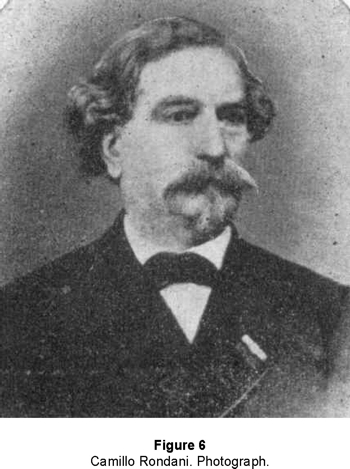
<body><![CDATA[<p align="justify"><font face="verdana" size="2">1. <i>Lipoptena mazamae</i>, p. 153. "Central and South America". Unchanged (Guimar&atilde;es, 1968a: 9) (Hippoboscidae).</font></p>       <p align="justify"><font face="verdana" size="2">2. <i>Ornithomyia bellardiana</i>, p. 157. "Messico". Now a junior synonym of <i>Ornithoctona (Ornithoctona) erythrocephala</i> (Leach, 1817) (Guimar&atilde;es, 1968a: 3) (Hippoboscidae).</font></p>       <p align="justify"><font face="verdana" size="2">3. <i>Olfersia pallidilabris</i>, p. 161. "Messico". Now a junior synonym of <i>Lynchia nigra</i> (Perty, 1833) (Guimar&atilde;es, 1968a:6) (Hippoboscidae).</font></p>       <p align="justify"><font face="verdana" size="2">4. <i>Olfersia obliquinervis</i>, p. 162. "Messico". Also a synonym of <i>Lynchia nigra</i> (Perty, 1833) (Guimar&atilde;es, 1968a: 6) (Hippoboscidae).</font></p>       <p align="justify"><font face="verdana" size="2">5. <i>Strebla mexicana</i>, p. 168. Not cited in Wenzel's 1970 catalogue (Streblidae).</font></p> </blockquote>     <p align="justify"><font face="verdana" size="2">In 1870, Rondani had collaborated in the foundation of the Italian Entomological Society, of which he was the vice&#45;president. He died on September 17, 1879. A list of his publications was given by Baron Osten Sacken (1885). His biography was published by Lessona (1884) (see also Bezzi, 1908a, 1908b). Rondani's types of exotic (<i>i.e.</i></font><font face="verdana" size="2">, Latin American) Diptera are deposited in the Museo de Instituto di Zoologia Sistematica della Universit&agrave; di Torino, in the Museo Civico di Storia Naturale di Milano, and in Naples (a list of types found in Naples, the majority of Rondani's types, was given by A. Costa (1866)).</font></p>     <p align="justify"><font face="verdana" size="2"><b>8. Dominik Bilimek</b></font></p>     <p align="justify"><font face="verdana" size="2">Dominik Bilimek entitled himself "Kustos am National Museum in Mexiko" (Curador del Museo Nacional de M&eacute;xico)". During the unfortunate reign of Emperor Ferdinand Maximilian of Mexico, Bilimek explored the Cacahuamilpa Caves, 45 leagues from Mexico City, on January 14, 1866, leaving an account of his explorations, and a description of <i>Pholeomyia leucozona</i> (1867) (Milichiidae), the only Mexican fly described by him. According to labels in the Museum of Vienna he also collected extensively in Orizaba and Tacubaya. Before his arrive to Mexico he professed as Augustine monk, but being his principal fondness to collect insect specimens for the European museums. As soon as he deserted the monastic order, he organized a museum of natural history for Maximilian, using an abandoned abbey of La Chroma island, in the Adriatic Sea. Later in Mexico, he collected a great amount of insects around Mexico City and in Morelos, sometimes accompanied by Empress Charlotte and her ladies (Hoffmann <i>et al</i>., 1986). No other details are known about his life and travels (Papavero, 1973: 291&#45;292. See also Barnhart, 1927, 1965; Hemsley, 1887; Linden, 1867).</font></p>     <p align="justify"><font face="verdana" size="2"><b>9. The species described by F. Jaennicke</b></font></p>     <p align="justify"><font face="verdana" size="2">Unfortunately, we were not able to find data about the life of F. Jaennicke. In his paper of 1867 (reprinted in 1968) he described the following species from Mexico (most of the types are now in the Senckenberg Institution, Frankfurt a. M.):</font></p>     ]]></body>
<body><![CDATA[<blockquote>       <p align="justify"><font face="verdana" size="2">1. <i>Odontomyia prasina</i>, p. 324 (16) (&#9794;). "Mexico". Now <i>Hedriodiscus prasinus</i> (Jaennicke) (James, 1973: 41) (Stratiomyidae).</font></p>       <p align="justify"><font face="verdana" size="2">2. <i>Rondania obscura</i>, p. 325 (17) (&#9794;, &#9792;). "Mexico". Now <i>Cyphomyia obscura</i> (Jaennicke) (James, 1973: 27) (Stratiomyidae).</font></p>       <p align="justify"><font face="verdana" size="2">3. <i>Anthrax castanea</i>, p. 338 (30), pl. 44, fig. 15 (&#9794;, &#9792;). "Mexico". Now <i>Villa (Paravilla) castanea</i> (Jaennicke) (Painter <i>et al</i>., 1978: 50) (Bombyliidae).</font></p>       <p align="justify"><font face="verdana" size="2">4. <i>Anthrax paradoxa</i>, p. 339 (31), pl. 44, fig. 16 (&#9792;). "Mexico". Now <i>Neodiplocampta (Neodiplocampta) paradoxa</i> (Jaennicke) (Painter <i>et al</i>., 1978: 37) (Bombyliidae).</font></p>       <p align="justify"><font face="verdana" size="2">5. <i>Antharx kaupii</i>, p. 340 (32), pl. 44, fig. 17 (&#9794;, &#9792;). "Mexico". Now a junior synonym of <i>Ligyra orcus</i> (Walker, 1849) (Painter <i>et al.</i>, 1978:43) (Bombyliidae).</font></p>       <p align="justify"><font face="verdana" size="2">6. <i>Exoprosopa anthracoidea</i>, p. 340 (32), pl. 44, fig. 18 (&#9794;, &#9792;). "Mexico". Unchanged (Painter <i>et al</i>., 1978: 39) (Bombyliidae).</font></p>       <p align="justify"><font face="verdana" size="2">7. <i>Exoprosopa rostrifera</i>, p. 341 (33), pl. 44, fig. 19 (&#9794;, &#9792;). "Mexico". Unchanged (Painter <i>et al</i>., 1978: 41) (Bombyliidae).</font></p>       <p align="justify"><font face="verdana" size="2">8. <i>Exoprosopa blanchardiana</i>, p. 341 (33), pl. 44, fig. 20 (&#9794;, &#9792;). "Mexico". Now <i>Villa (Hemipenthes) sinuosa blanchardiana</i> (Jaennicke) (Painter <i>et al</i>., 1978: 50) (Bombyliidae).</font></p>       <p align="justify"><font face="verdana" size="2">9. <i>Exoprosopa pueblensis</i>, p. 342 (34), pl. 44, fig. 21 (&#9794;, &#9792;). "Mexico". Unchanged (Painter <i>et al</i>., 1978: 41) (Bombyliidae).</font></p>       ]]></body>
<body><![CDATA[<p align="justify"><font face="verdana" size="2">10. <i>Adelidea flava</i>, p. 346 (38) (&#9794;). "Mexico". Now a junior synonym of <i>Lordotus gibbus</i> Loew, 1863 (Painter <i>et al.</i>, 1978: 6) (Bombyliidae).</font></p>       <p align="justify"><font face="verdana" size="2">11. <i>Poecilognathus thlipsomyzoides</i>, p. 351 (43), pl. 43, fig. 11 (&#9794;). "Mexico". Now <i>Phthiria thlipsomyzoides</i> (Jaennicke) (Painter <i>et al</i>., 1978: 15) (Bombyliidae).</font></p>       <p align="justify"><font face="verdana" size="2">12. <i>Nicocles analis</i>, p. 355 (47), pl. 43, fig. 13 (&#9794;). "Mexico". Unchanged (Martin &amp; Papavero, 1970: 31) (Asilidae).</font></p>       <p align="justify"><font face="verdana" size="2">13. <i>Atomosia beckeri</i>, p. 359 (51) (&#9794;, &#9792;). "Mexico". Unchanged (Martin &amp; Papavero, 1970: 46) (Asilidae).</font></p>       <p align="justify"><font face="verdana" size="2">14. <i>Micropalpus albomaculatus</i>, p. 388 (80) (&#9792;). "Mexico". Now <i>Epalpus albomaculatus</i> (Jaennicke) (Guimar&atilde;es, 1971: 64) (Tachinidae).</font></p>       <p align="justify"><font face="verdana" size="2">15. <i>Jurinia flavifrons</i>, p. 390 (82) (&#9792;). "Mexico". Now in <i>Archytas</i> (Guimar&atilde;es, 1971: 49) (Tachinidae).</font></p>       <p align="justify"><font face="verdana" size="2">16. <i>Jurinia apicalis</i>, p. 390 (82) (&#9794;, &#9792;). "Mexico". Now a junior synonym of <i>Archytas lateralis</i> (Macquart, 1843) (Guimar&atilde;es, 1971: 50) (Tachinidae).</font></p>       <p align="justify"><font face="verdana" size="2">17. <i>Dejeania rutiloides</i>, p. 394 (86) (&#9792;). "Mexico". Now in <i>Paradejeania</i> (Guimar&atilde;es, 1971: 59) (Tachinidae).</font></p>       <p align="justify"><font face="verdana" size="2">18. <i>Volucella maximiliani</i>, p. 395 (87) (&#9794;, &#9792;). "Mexico". Now a junior synonym of <i>Copestylum metalliferum</i> (Walker, 1849) (Thompson <i>et al</i>., 1976: 79) (Syrphidae).</font></p>       <p align="justify"><font face="verdana" size="2">19. <i>Volucella mellea</i>, p. 396 (88) (&#9794;, &#9792;). "Mexico". Now <i>Copestylum melleum</i> (Thompson <i>et al.</i>, 1976: 79) (Syrphidae).</font></p>       ]]></body>
<body><![CDATA[<p align="justify"><font face="verdana" size="2">20. <i>Volucella haagii</i>, p. 397 (89) (&#9792;). "Mexico". Now in <i>Copestylum</i> (Thompson <i>et al</i>., 1976: 76) (Syrphidae).</font></p>       <p align="justify"><font face="verdana" size="2">21. <i>Eristalis thoracica</i>, p. 399 (91) (&#9794;, &#9792;). "Mexico". Now a junior synonym of <i>Palpada ruficeps</i> (Macquart, 1842) (Thompson <i>et al</i>., 1976: 108) (Syrphidae).</font></p>       <p align="justify"><font face="verdana" size="2">22. <i>Eristalis tricolor</i>, p. 400 (92) (&#9792;). "Mexico". Now a junior synonym of <i>Palpada pusilla</i> (Macquart, 1842) (Thompson <i>et al</i>., 1976: 108) (Syrphidae).</font></p>       <p align="justify"><font face="verdana" size="2">23. <i>Eristalis bellardii</i>, p. 400 (92) (&#9794;). Now <i>Eristalis (Eoseristalis) bellardii</i> Jaennicke (Thompson <i>et al.</i>, 1976: 101) (Syrphidae).</font></p>       <p align="justify"><font face="verdana" size="2">24. <i>Zodion splendens</i>, p. 405 (97). Not cited in Papavero's 1971a catalogue (Conopidae).</font></p> </blockquote>     <p align="justify"><font face="verdana" size="2"><b>10. The species described by Carl Eduard Adolph Gerstaecker</b></font></p>     <p align="justify"><font face="verdana" size="2">Carl Eduard Adolph Gerstaecker died on July 20, 1895 at Greifswald, at the age of 67. He was educated for the medical profession and took his degree, but devoted himself to zoology, especially to entomology. For many years he was keeper of the entomological department of the Berlin Natural History Museum and also a professor of zoology at the University of Berlin. About the year 1876, differences with the then director of the Berlin Museum induced him to resign his appointment in Berlin, and he subsequently accepted the professorship of Zoology at Greifswald, which he held until his death. Gerstaecker was an industrious and thorough worker in all departments of entomology. Among his principal works may be noted the "Arthropoda" in the "Handbuch der Zoologie" (1863) and the same phylum in Bronn's "Klassen und Ordnungen der Tierreichs".</font></p>     <p align="justify"><font face="verdana" size="2">Gerstaecker rendered infinite help to his fellow students by compiling the entomological portions of the German "Bericht" (the forerunner and subsequent contemporary of the English "Zoological Record") from the year 1853 to the year 1867.</font></p>     <p align="justify"><font face="verdana" size="2">Among Gerstaecker's publications are those dealing with the Acroceridae (1856), Stratiomyidae (1857), Acalyptratae (1860), parasitic flies (1868a), and his most important paper, the revision of the Mydidae (1868b).</font></p>     <p align="justify"><font face="verdana" size="2">Gerstaecker studied the Diptera contained in the ancient collection of T&ouml;nder Lund in Copenhagen, and that of Westermann in the Vienna Museum. Many of his more recent specimens were collected by Natterer in Brazil ( <i>cf</i>. Papavero, 1971b: 80&#45;87), Lacordaire ( <i>ibid.</i> , p. 133) in French Guiana, Deppe ( <i>Ibid</i>., pp. 103&#45;107; part 1 of the present work) in Mexico, Olfers ( <i>cf.</i> Papavero, 1971b: 69) in Brazil, Burmeister ( <i>Ibid</i>., pp. 292&#45;293) in Brazil, Koeppen in Mexico, Moritz ( <i>Ibid</i> ., pp. 297&#45;298) in Colombia and the West Indies, Virmond ( <i>Ibid.</i> , pp. 110, 112) in Brazil, Appun ( <i>Ibid</i>., p. 291) in Colombia, Ehrenberg and Uhde in Mexico. He also studied the collections organized by Bescke in Brazil ( <i>cf.</i> Papavero, 1971b: 87) belonging to the coleopterist Germar.</font></p>     ]]></body>
<body><![CDATA[<p align="center"><font face="verdana" size="2">*****</font></p>     <p align="justify"><font face="verdana" size="2">About Koeppen and Uhde (or Uhle) nothing is known.</font></p>     <p align="justify"><font face="verdana" size="2">Carl August Ehrenberg was born in Delitsch, Province of Sachsen, Prussia, on August 24, 1801, son of the "Stadtrat und Stadtritter" Johann Gottfried Ehrenberg. Carl dedicated himself to commerce (Kauffmannstande) and travelled through St. Thomas (1827&#45;1828), Port&#45;au&#45;Prince in Haiti (March 1828&#45;June 1831) and Mexico (July 1831&#45; April 1840), both near the Capital and 30 leagues to the interior (Mineral Real del Monte). From all those places he sent to the Museums of Berlin and Halle rich zoological and botanical collections. In Mexico he became especially interested in the Cactaceae. Upon his return to Berlin he entered business with his brother Ferdinand. He died there on August 13, 1849, of cholera (Urban, 1903, p. 43; see also Barnhart, 1965; Hemsley, 1887; Knobloch, 1893; Lorence &amp; Garc&iacute;a, 1989; McVaugh, 1972; Papavero, 1973; Pennell, 1945; Stafleu &amp; Cowan, 1976 (1: 727); Urban, 1897).</font></p>     <p align="justify"><font face="verdana" size="2">Only 8 species were described by Gerstaecker from Mexico:</font></p>     <p align="justify"><font face="verdana" size="2">1857:</font></p>     <blockquote>       <p align="justify"><font face="verdana" size="2">1. <i>Cyphomyia varipes</i>, p. 283 (&#9792;). "Mexico, Costa Rica, ?Venezuela". Types in Vienna Museum. Unchanged (James, 1973: 28) (Stratiomyidae).</font></p>       <p align="justify"><font face="verdana" size="2">2. <i>Cyphomyia pilosissima</i>, p. 293 (&#9794;). "Mexico (Koeppen)". Type in Vienna Museum. Unchanged (James, 1973: 28) (Stratiomyidae).</font></p>       <p align="justify"><font face="verdana" size="2">3. <i>Cyphomyia tomentosa</i>, p. 294 (&#9792;). "Mexico (Koeppen)". Type ?. Unchanged (James, 1973: 46) (Stratiomyidae).</font></p>       <p align="justify"><font face="verdana" size="2">4. <i>Stratiomys fenestrata</i>, p. 327 (&#9792;). "Mexico (Deppe)". Type ?Berlin. Unchanged (James, 1973: 46) (Stratiomyidae).</font></p>       ]]></body>
<body><![CDATA[<p align="justify"><font face="verdana" size="2">5. <i>Stratiomys euchlorus</i>, p. 328 (&#9794;, &#9792;). "Mexico (Deppe)". Types ?Berlin. Now <i>Hedriodiscus euchlorus</i> (Gerstaecker) (James, 1973: 40) (Stratiomyidae).</font></p> </blockquote>     <p align="justify"><font face="verdana" size="2">1860:</font></p>     <blockquote>       <p align="justify"><font face="verdana" size="2">6. <i>Diacrita costalis</i>, p. 197, pl. II, figs. 10, 10a. "Mexico, Oaxaca (Deppe)". Type ?Berlin. Unchanged (Steyskal, 1968b: 4) (Otitidae).</font></p> </blockquote>     <p align="justify"><font face="verdana" size="2">1868b:</font></p>     <blockquote>       <p align="justify"><font face="verdana" size="2">7. <i>Mydas lavatus</i>, p. 96 (&#9794;, &#9792;). "Mexico (Koeppen)". Types Berlin. Now a junior synonym of <i>Mydas xanthopterus</i> Loew, 1866 (Papavero, 1996: 631) (Mydidae).</font></p>       <p align="justify"><font face="verdana" size="2">8. <i>Mydas annularis</i>, p. 100 (&#9792;). "Mexico (Ehrenberg)". Type Berlin. Unchanged (Papavero, 1996: 630) (Mydidae).</font></p> </blockquote>     <p align="justify"><font face="verdana" size="2"><b>11. The species described by Jacques Marie Frangille Bigot</b></font></p>     <p align="justify"><font face="verdana" size="2">Unfortunately, very little is known about the life of the French dipterist Jacques Marie Frangille Bigot (<a href="#f7">Fig. 7</a>). He was born in 1818, in 1844 was elected fellow of the <i>"Soci&eacute;t&eacute; Entomologique de France</i>", and seems to have been a very wealthy person, who could buy large collections of exotic flies, having amassed a very important collection of Diptera.</font></p>     ]]></body>
<body><![CDATA[<p align="center"><font face="verdana" size="2"><a name="f7"></a></font></p>     <p align="center"><font face="verdana" size="2"><img src="/img/revistas/azm/n84/a5f7.jpg"></font></p>     <p align="justify"><font face="verdana" size="2">Bigot published two large series of papers, the "<i>Essai d'une classification g&eacute;n&eacute;rale et synoptique de l'Ordre des Insectes Dipt&egrave;res</i>", and the "<i>Dipt&egrave;res nouveaux ou peu connus</i> ".</font></p>     <p align="justify"><font face="verdana" size="2">In relation to the former series, Baron Osten Sacken makes the following comments (1904: 232&#45;233; 1978 (reprint): 232&#45;233):</font></p>     <p align="justify"><font face="verdana" size="2"><i>It remains for me now to reproduce the opinion expressed by Mr. Bigot himself, at different times, about his own publications:</i></font></p>     <p align="justify"><font face="verdana" size="2"><i>In the Annales etc. 1885, p. 225, he said:</i>"J'avais autrefois (Ann. etc. 1852&#45;1859) commenc&eacute; la publication d'un travail intitul&eacute;: Essai d'une classification g&eacute;n&eacute;rale et synoptiqe de l'Ordre des Insectes Dipt&egrave;res etc. Cette oeuvre fut alors s&eacute;v&egrave;rement et doctoralement critiqu&eacute;e dans le Bericht de Gerstaecker (Berlin) par l'habile dipt&egrave;riste H. Loew. Je dois confesser que la plupart de ses objections m'ont paru tellement fond&eacute;es que, reconnaissant la m&eacute;diocre valeur de mes Essais, je me r&eacute;signe &agrave; les abandonner &agrave; mi&#45;chemin <i>". Whereupon Mr. Bigot proposes a new plan for the distribution of the Diptera, into two tribes: Omalocerati and Anomalocerati etc.</i></font></p>     <p align="justify"><font face="verdana" size="2"><i>A further discussion between Bigot and G. H. Verrall, about questions of orthography and of mutual courtesy will be found in the</i> Wien. Ent. Zeitschr., 1889, p. 168, 265 and 293 <i>. In the latter notice, Bigot renews his former recantation of his "</i> Essai <i>": "</i> Si Mr. Verrall avait daign&eacute; lire mes opuscules, etc. il y aurait vu, maintes fois r&eacute;p&eacute;t&eacute;, que mon ancien travail, intitul&eacute; "Essai" etc. devait &ecirc;tre d&eacute;sormais, et dans son entier, consid&eacute;r&eacute; comme nul et non avenu, d&eacute;claration qui m'absolut naturellement des fautes que j'ai pu y commettre".</font></p>     <p align="justify"><font face="verdana" size="2">Regarding the series "<i>Dipt&egrave;res nouveaux ou peu connus</i>", Aldrich (1905: ii) points out that:</font></p>     <p align="justify"><font face="verdana" size="2">Bigot's main work (...) is in the form of a long series of articles in the Annales Soc. ent. France (...) interspersed chronologically with fragments in the Bulletin of the same society. Owing to Bigot's peculiar, complicated and inconsistent system of numbering his contributions, it has been almost impossible for me to find them all, but I believe I have succeeded (...). Sometimes his Roman numerals stop and remain the same for several papers, then again the numbering in "parts" becomes stationary while the other goes on, and in two cases two papers have both the same.</font></p>     <p align="justify"><font face="verdana" size="2">Bigot started publishing in 1852 and the last of his papers that interest us is dated from 1892. He also studied the Diptera collected by Ram&oacute;n de la Sagra in Cuba (1857a), and those collected by the "<i>Mission Scientifique du Cap Horn</i>" (1888a).</font></p>     ]]></body>
<body><![CDATA[<p align="justify"><font face="verdana" size="2">Osten Sacken (1904: 232; 1978: 232) comments further, on Bigot's work:</font></p>     <blockquote>    <p align="justify"><font face="verdana" size="2"><i>My excellent friend J. M. F. Bigot died April 14 1893 at his country&#45;seat near Paris at the age of 74 years (An Obituary Notice will be found in the Bolletin de la Soc. Ent. de France, April 26 1893). My acquaintance with Bigot was of long date. When I met him again after my return from the United States in 1887, and our relations were renewed, I felt it my duty, although treating him as a friend, to tell him the truth about his publications. I did so, during one of my visits to Paris (the year I do not remember), in telling him that he was doing a useful work in forming a large collection, especially of exotic Diptera; but that he should renounce descriptive work, for which he was not competent. I expressed my opinion in the strongest terms, concluding with the words: "If</i> <i><b>all</b></i> <i>your publications could be suppressed, it would be a gain for science". He winced a little, but resumed immediately his serene expression, and said: "Eh bien, cela m'amuse". My frankness did not prevent us from remaining friends up to his death. In the most generous manner, he kept his rich collection and library at my disposal. Even when he was away from Paris (he usually spent his winters in Algiers) he left orders to his housekeeper to admit me at any time into his sanctum, and to light a fire for me in winter. I keep of my friend Bigot and his family (wife and daughter) a pleasant and grateful recollection.</i></font></p></blockquote>     <p align="justify"><font face="verdana" size="2">The great collection of flies gathered by Bigot, including many types, especially of exotic flies, and many types described by Macquart (see part 2 of this work), were bought after his death by G. H. Verrall, and are now deposited at the Hope Department of Entomology, Oxford University (most of the types), some of them also at the British Museum of Natural History. Osten Sacken (l. c.) had an important role in that transaction:</font></p>     <blockquote>    <p align="justify"><font face="verdana" size="2"><i>The share I had in the sale of Bigot's collection is explained in the Bulletin de la Soc. Ent. de France, June 14, 1893. In this notice it should have been added that I had written to the Authorities of the Museum in Paris, urging them to purchase this important collection offered at a very moderate price (6000 francs). My advice, however, was not heeded, and the collection passed into the hands of Mr. G. H. Verrall of Newmarket, England, and will ultimately, as I understand, find its place in the British Museum.</i></font></p></blockquote>     <p align="center"><font face="verdana" size="2">*****</font></p>     <p align="justify"><font face="verdana" size="2">Although he never cites the names of the collectors, it is very probable that Bigot studied the collections gathered in Mexico by Pilate, Geisbreght, Linden, and Funck (see part 2 of this work), as well as the material collected by Sall&eacute;, Sumichrast, Saussure, and Boucard (see part 6 of this work).</font></p>     <p align="justify"><font face="verdana" size="2">Bigot described the following Mexican flies:</font></p>     <p align="justify"><font face="verdana" size="2">1875a:</font></p>     ]]></body>
<body><![CDATA[<blockquote>       <p align="justify"><font face="verdana" size="2">1. <i>Emphysomera pilosula</i>, p. 243 (&#9794;). "Mexico". Type in Oxford. Now <i>Ommatius pilosulus</i> (Bigot) (Martin &amp; Papavero, 1970: 59) (Asilidae).</font></p>       <p align="justify"><font face="verdana" size="2">2. <i>Emphysomera bicolor</i>, p. 244 (&#9794;, &#9792;). "Mexico". Type in Oxford. Now in <i>Ommatius</i> (Martin &amp; Papavero, 1970: 59) (Asilidae).</font></p>       <p align="justify"><font face="verdana" size="2">3. <i>Ommatius parvus</i>, p. 247 (&#9794;). "Mexico". Type in Oxford. Unchanged (Martin &amp; Papavero, 1970: 59) (Asilidae).</font></p> </blockquote>     <p align="justify"><font face="verdana" size="2">1875b:</font></p>     <blockquote>       <p align="justify"><font face="verdana" size="2">4. <i>Volucella castanea</i>, p. 476 (&#9794;). "Mexico, Oaxaca". Type in Oxford. Now a junior synonym of <i>Copestylum posticum</i> (Say, 1830) (Thompson <i>et al</i>., 1976: 82) (Syrphidae).</font></p>       <p align="justify"><font face="verdana" size="2">5. <i>Volucella tricincta</i>, p. 477 (&#9792;). "Mexico, Oaxaca". Type in Oxford. Now <i>Copestylum tricinctum</i> (Bigot) (Thompson <i>et al</i>., 1976: 85) (Syrphidae).</font></p>       <p align="justify"><font face="verdana" size="2">6. <i>Volucella purpurifera</i>, p. 477 (&#9794;, &#9792;). "Mexico, Oaxaca". Type in Oxford. Now <i>Copestylum purpuriferum</i> (Bigot) (Thompson <i>et al</i>., 1976: 82) (Syrphidae).</font></p>       <p align="justify"><font face="verdana" size="2">7. <i>Volucella variegata</i>, p. 478 (&#9794;, &#9792;). "Mexico". Types in Oxford. Now <i>Copestylum variegatum</i> (Bigot) (Thompson <i>et al</i>., 1976: 86) (Syrphidae).</font></p>       ]]></body>
<body><![CDATA[<p align="justify"><font face="verdana" size="2">8. <i>Volucella amethistina</i>, p. 479 (&#9794;). "Mexico". Type in Oxford. Now <i>Copestylum amethystinum</i> (Bigot) (Thompson <i>et al</i>., 1976: 71) (Syrphidae).</font></p>       <p align="justify"><font face="verdana" size="2">9. <i>Volucella nigrifacies</i>, p. 479 (&#9794;). "Mexico". Type in BMNH. Now in <i>Copestylum</i> (Thompson <i>et al</i>., 1976: 80) (Syrphidae).</font></p>       <p align="justify"><font face="verdana" size="2">10. <i>Volucella pulchripes</i>, p. 480 (&#9794;). "Mexico". Type in Oxford. Now in <i>Copestylum</i> (Thompson <i>et al</i>., 1976: 82) (Syrphidae).</font></p>       <p align="justify"><font face="verdana" size="2">11. <i>Volucella varians</i>, p. 481 (&#9792;). "Mexico". Type in Oxford. Now in <i>Copestylum</i> (Thompson <i>et al</i>., 1976: 86) (Syrphidae).</font></p>       <p align="justify"><font face="verdana" size="2">12. <i>Volucella viridula</i>, p. 481 (&#9792;). "Mexico". Type in Oxford. Now a synonym of <i>Copestylum vagum</i> (Wiedemann, 1830) (Thompson <i>et al</i>., 1976: 86) (Syrphidae).</font></p>       <p align="justify"><font face="verdana" size="2">13. <i>Volucella tristis</i>, p. 482 (&#9792;). "Mexico". Type in Oxford. Now a junior synonym of <i>Copestylum subrostratum</i> (Rondani, 1848) (Thompson <i>et al</i>., 1976: 85) (Syrphidae).</font></p> </blockquote>     <p align="justify"><font face="verdana" size="2">1875c:</font></p>     <blockquote>       <p align="justify"><font face="verdana" size="2">14. <i>Cyphomyia scalaris</i>, p. 487 (&#9794;, &#9792;). "Mexico". Unchanged (James, 1973: 27) (Stratiomyidae).</font></p> </blockquote>     <p align="justify"><font face="verdana" size="2">1876a:</font></p>     ]]></body>
<body><![CDATA[<blockquote>       <p align="justify"><font face="verdana" size="2">15. <i>Trichopoda nigricauda</i>, p. 395 (&#9794;). "Mexico". Now <i>Trichopoda (Trichopoda) nigricauda</i> Bigot (Guimar&atilde;es, 1971: 9) (Tachinidae).</font></p> </blockquote>     <p align="justify"><font face="verdana" size="2">1877b:</font></p>     <blockquote>       <p align="justify"><font face="verdana" size="2">16. <i>Somomya pallidibasis</i>, p. 247 (&#9792;). "Mexico". Now <i>Phaenicia (Phaenicia) purpurescens</i> (Walker, 1837) (James, 1970: 11) (Calliphoridae).</font></p>       <p align="justify"><font face="verdana" size="2">17. <i>Somomya mutabilis</i>, p. 248 (&#9794;, &#9792;). "Mexico". Now <i>Phaenicia (Phaenicia) eximia</i> (Wiedemann, 1819) (James, 1970: 10) (Calliphoridae).</font></p>       <p align="justify"><font face="verdana" size="2">18. <i>Somomya flavigena</i>, p. 249 (&#9792;). "Mexico". Now <i>Cochliomyia macellaria</i> (Fabricius, 1775) (James, 1970: 7) (Calliphoridae).</font></p>       <p align="justify"><font face="verdana" size="2">19. <i>Somomya callipes</i>, p. 249 (&#9794;). "Mexico". Now <i>Myiolucilia lyrcea</i> (Walker, 1849) (James, 1970: 8) (Calliphoridae).</font></p>       <p align="justify"><font face="verdana" size="2">20. <i>Somomya pueblensis</i>, p. 250 (&#9792;). "Mexico". Now <i>Phaenicia (Phaenicia) eximia</i> (Wiedemann, 1819) (James, 1970: 10) (Calliphoridae).</font></p>       <p align="justify"><font face="verdana" size="2">21. <i>Somomya fulvinota</i>, p. 251 (&#9792;). "Mexico". Now in <i>Myiolucilia</i> (James, 1970: 7) (Calliphoridae).</font></p>       ]]></body>
<body><![CDATA[<p align="justify"><font face="verdana" size="2">22. <i>Somomya argentifera</i>, p. 251 (?&#9794;). Not cited in James's 1970 catalogue (Calliphoridae).</font></p>       <p align="justify"><font face="verdana" size="2">23. <i>Somomya aztequina</i>, p. 252 (&#9794;, &#9792;). "Mexico". Now <i>Cochliomyia macellaria</i> (Fabricius, 1775) (James, 1970: 7) (Calliphoridae).</font></p> </blockquote>     <p align="justify"><font face="verdana" size="2">1877c:</font></p>     <blockquote>       <p align="justify"><font face="verdana" size="2">24. <i>Carlottaemyia moerens</i>, p. xxvii (&#9794;, &#9792;). "Mexico". Now <i>Diacrita costalis</i> Gerstaecker, 1860) (Steyskal, 1968b: 4) (Otitidae).</font></p> </blockquote>     <p align="justify"><font face="verdana" size="2">1878a:</font></p>     <blockquote>       <p align="justify"><font face="verdana" size="2">25. <i>Pyrellia scapulata</i>, p. 35 (&#9794;, &#9792;). "Mexico". Now <i>Morellia basalis</i> (Walker, 1852) (Pont, 1972: 8) (Muscidae).</font></p>       <p align="justify"><font face="verdana" size="2">26. <i>Pyrellia iris</i>, p. 36 (&#9792;). "Mexico". Now <i>Morellia flavicornis</i> (Macquart, 1848) (Pont, 1972: 9) (Muscidae).</font></p> </blockquote>     <p align="justify"><font face="verdana" size="2">1878b:</font></p>     ]]></body>
<body><![CDATA[<blockquote>       <p align="justify"><font face="verdana" size="2">27. <i>Ocyptera soror</i>, p. 46 (&#9792;). "Mexico". An unrecognized <i>Cylindromyia</i> (Guimar&atilde;es, 1971: 16) (Tachinidae).</font></p>       <p align="justify"><font face="verdana" size="2">28. <i>Ocyptera simplex</i>, p. 47 (&#9792;). "Mexico". An unrecognized <i>Cylindromyia</i> (Guimar&atilde;es, 1971: 16) (Tachinidae).</font></p> </blockquote>     <p align="justify"><font face="verdana" size="2">1878d:</font></p>     <blockquote>       <p align="justify"><font face="verdana" size="2">29. <i>Pogonosoma arachnoides</i>, p. 227 (&#9792;). "Mexico". Type in Oxford. Now in <i>Andrenosoma (Pogonosoma)</i> (Martin &amp; Papavero, 1970: 44) (Asilidae).</font></p>       <p align="justify"><font face="verdana" size="2">30. <i>Cormansis eupoda</i>, p. 234 (?&#9792;). "Mexico". Type in Oxford. Now in <i>Atomosia</i> (Martin &amp; Papavero, 1970: 47) (Asilidae).</font></p>       <p align="justify"><font face="verdana" size="2">31. <i>Aphestia nigra</i>, p. 235 (&#9794;, &#9792;). "Mexico". Type in Oxford. Unchanged (Martin &amp; Papavero, 1970: 50) (Asilidae).</font></p>       <p align="justify"><font face="verdana" size="2">32. <i>Atomosia soror</i>, p. 236 (&#9794;, &#9792;). "Mexico". Type in Oxford. Now <i>Atomosia rufipes</i> Macquart, 1847 (Martin &amp; Papavero, 1970: 47) (Asilidae).</font></p>       <p align="justify"><font face="verdana" size="2">33. <i>Cerotainia? nigra</i>, p. 238 (&#9792;). "Mexico". Type in Oxford. Unchanged (Martin &amp; Papavero, 1970: 52) (Asilidae).</font></p>       ]]></body>
<body><![CDATA[<p align="justify"><font face="verdana" size="2">34. <i>Cerotainia? dubia</i>, p. 238 (&#9794;). "Mexico". Type in Oxford. Unchanged (Martin &amp; Papavero, 1970: 52) (Asilidae).</font></p>       <p align="justify"><font face="verdana" size="2">35. <i>Microstylum fulvigaster</i>, p. 410 (&#9794;). "Mexico". Type in Oxford. Unchanged (Martin &amp; Papavero, 1970: 19) (Asilidae).</font></p>       <p align="justify"><font face="verdana" size="2">36. <i>Stenopogon fuscolimbatum</i>, p. 421 (?&#9794;, &#9792;). "Mexico". Type in Oxford. Now <i>Stenopogon (Stenopogon) fuscolimbatus</i> Bigot. Unchanged (Martin &amp; Papavero, 1970: 12) (Asilidae).</font></p>       <p align="justify"><font face="verdana" size="2">37. <i>Ceraturgus geniculatus</i>, p. 443 (&#9794;). "Mexico (Veracruz)". Type in Oxford. Now in <i>Taracticus</i> (Martin &amp; Papavero, 1970: 35) (Asilidae).</font></p> </blockquote>     <p align="justify"><font face="verdana" size="2">1879a:</font></p>     <blockquote>       <p align="justify"><font face="verdana" size="2">38. <i>Macroceromys fulviventris</i>, p. 187 (&#9792;). "Mexico". Now <i>Solva (Macroceromys) fulviventris</i> (Bigot) (James, 1975: 2) (Xylomyidae).</font></p>       <p align="justify"><font face="verdana" size="2">39. <i>Oplacantha limbata</i>, p. 196 (&#9792;). "Mexico, Veracruz, Orizaba". Unchanged (but <i>Oplachantha</i> Rondani) (James, 1973: 8) (Stratiomyidae).</font></p>       <p align="justify"><font face="verdana" size="2">40. <i>Hermetia nigrifascies</i>, p. 200 (&#9794;, &#9792;). "Mexico". Now a junior synonym of <i>Hermetia illucens</i> (Linnaeus, 1758) (James, 1973: 38) (Stratiomyidae).</font></p>       <p align="justify"><font face="verdana" size="2">41. <i>Hermetia flavoscutata</i>, p. 201 (&#9794;). "Mexico". Unchanged (James, 1973: 38) (Stratiomyidae).</font></p>       ]]></body>
<body><![CDATA[<p align="justify"><font face="verdana" size="2">42. <i>Histiodroma flaveola</i>, p. 205 (&#9792;). "Mexico". Now <i>Acrochaeta fasciata</i> Wiedemann, 1830 (James, 1973: 9) (Stratiomyidae).</font></p>       <p align="justify"><font face="verdana" size="2">43. <i>Sargus splendens</i>, p. 224 (&#9792;). "Mexico". Now <i>Sargus speciosus</i> Macquart, 1846 (James, 1973: 20) (Stratiomyidae).</font></p>       <p align="justify"><font face="verdana" size="2">44. <i>Macrosargus smaragdiferus</i>, p. 226 (&#9792;). "Mexico". Now in <i>Merosargus</i> (James, 1973: 15) (Stratiomyidae).</font></p>       <p align="justify"><font face="verdana" size="2">45. <i>Chrysonotus flavopilosus</i>, p. 227 (&#9794;, &#9792;). "Mexico". Now <i>Himantoloba flavopilosa</i> (Bigot) (James, 1973: 10) (Stratiomyidae).</font></p>       <p align="justify"><font face="verdana" size="2">46. <i>Merosargus fraternus</i>, p. 228 (&#9792;). "Mexico". Unchanged (James, 1973: 13) (Stratiomyidae).</font></p>       <p align="justify"><font face="verdana" size="2">47. <i>Merosargus calceolatus</i>, p. 229 (&#9792;). "Mexico". Unchanged (James, 1973: 12) (Stratiomyidae).</font></p>       <p align="justify"><font face="verdana" size="2">48. <i>Ptecticus flaviceps</i>, p. 230 (&#9792;). "Mexico". Unchanged (James, 1973: 17) (Stratiomyidae).</font></p> </blockquote>     <p align="justify"><font face="verdana" size="2">1880b:</font></p>     <blockquote>       <p align="justify"><font face="verdana" size="2">49. <i>Eristalomyia rufoscutata</i>, p. 221 (&#9794;, &#9792;). "Mexico". Types in Oxford. Now <i>Eristalis (Eoseristalis) bellardii</i> Jaennicke, 1867 (Thompson <i>et al.</i>, 1976: 101) (Syrphidae).</font></p>       ]]></body>
<body><![CDATA[<p align="justify"><font face="verdana" size="2">50. <i>Eristalis sackenis</i>, p. 224 (&#9794;). "Mexico". Type in BMNH. Now <i>Palpada testaceicornis</i> (Macquart, 1850) (Thompson <i>et al.</i>, 1976: 110) (Syrphidae).</font></p>       <p align="justify"><font face="verdana" size="2">51. <i>Eristalomyia pachypoda</i>, p. 224 (&#9792;). "Mexico". Type BMNH. Now <i>Palpada obsoleta</i> (Wiedemann, 1830) (Thompson <i>et al.</i>, 1976: 107) (Syrphidae).</font></p>       <p align="justify"><font face="verdana" size="2">52. <i>Eristalomyia fulvipes</i>, p. 225 (&#9792;). "Mexico". Type in BMNH. Now <i>Palpada fulvipes</i> (Bigot) (Thompson <i>et al.</i>, 1976: 105) (Syrphidae).</font></p> </blockquote>     <p align="justify"><font face="verdana" size="2">1882c:</font></p>     <blockquote>       <p align="justify"><font face="verdana" size="2">53. <i>Eurhinomallota metallica</i>, p. lxvii (&#9792;). "Mexico". Type in Oxford. Now in <i>Criorhina</i> (Thompson <i>et al.</i>, 1976: 119) (Syrphidae).</font></p> </blockquote>     <p align="justify"><font face="verdana" size="2">1882e:</font></p>     <blockquote>       <p align="justify"><font face="verdana" size="2">54. <i>Asemosyrphus oculiferus</i>, p. cxxviii (&#9792;). "Mexico". Type in BMNH. Now <i>Asemosyrphus mexicanus</i> (Macquart, 1842) (Thompson <i>et al.</i>, 1976: 97) (Syrphidae).</font></p>       <p align="justify"><font face="verdana" size="2">55. <i>Asemosyrphus nigroscutatus</i>, p. cxxviii (?&#9792;). "Mexico". Type BMNH. Now <i>Asemosyrphus mexicanus</i> (Macquart, 1842) (Thompson <i>et al.</i>, 1976: 97) (Syrphidae).</font></p>       ]]></body>
<body><![CDATA[<p align="justify"><font face="verdana" size="2">56. Asemosyrphus flavocaudatus, p. cxxviii (?&#9792;). "Mexico". Type BMNH. Now <i>Asemosyrphus mexicanus</i> (Macquart, 1842) (Thompson <i>et al.</i>, 1976: 97) (Syrphidae).</font></p>       <p align="justify"><font face="verdana" size="2">57. Asemosyrphus bicolor, p. cxxix (?&#9792;). "Mexico". Type BMNH. Now <i>Asemosyrphus arquatus</i> (Say, 1829) (Thompson <i>et al.</i>, 1976: 96) (Syrphidae).</font></p>       <p align="justify"><font face="verdana" size="2">58. <i>Romaleosyrphus villosus</i>, p. cxxix (&#9794;). "Mexico". Type BMNH. Now <i>Criorhina villosa</i> (Bigot) (Thompson <i>et al.</i>, 1976: 119) (Syrphidae).</font></p> </blockquote>     <p align="justify"><font face="verdana" size="2">1883a:</font></p>     <blockquote>       <p align="justify"><font face="verdana" size="2">59. <i>Volucella tau</i>, p. 84 (&#9792;). "Mexico". Type BMNH. Now in <i>Copestylum</i> (Thompson <i>et al.</i>, 1976: 85) (Syrphidae).</font></p>       <p align="justify"><font face="verdana" size="2">60. <i>Phalachromyia vicina</i>, p. 86 (&#9794;). "Mexico". Type in BMNH. Now <i>Copestylum vicinum</i> (Bigot) (Thompson <i>et al.</i>, 1976: 86) (Syrphidae).</font></p>       <p align="justify"><font face="verdana" size="2">61. <i>Phalachromyia melanorhina</i>, p. 86 (&#9792;). "Mexico". Type in BMNH. Now <i>Copestylum subrostratum</i> (Rondani, 1848) (Thompson <i>et al.</i>, 1976: 85) (Syrphidae).</font></p> </blockquote>     <p align="justify"><font face="verdana" size="2">1883c:</font></p>     <blockquote>       ]]></body>
<body><![CDATA[<p align="justify"><font face="verdana" size="2">62. <i>Sphyximorpha nigra</i>, p. 317 (&#9794;, &#9792;). "Mexico". Types in BMNH. Now in <i>Polybiomyia</i> (Thompson <i>et al.</i>, 1976: 95) (Syrphidae).</font></p>       <p align="justify"><font face="verdana" size="2">63. <i>Sphyximorpha rufibasis</i>, p. 318 (&#9794;). "Mexico". Type in BMNH. Now in <i>Polybiomyia</i> (Thompson <i>et al.</i>, 1976: 95) (Syrphidae).</font></p>       <p align="justify"><font face="verdana" size="2">64. <i>Microdon gracile</i>, p. 320 (&#9794;). "Mexico". Type in BMNH. Now <i>Microdon (Microdon) gracilis</i> Bigot (Thompson <i>et al.</i>, 1976: 65) (Syrphidae).</font></p>       <p align="justify"><font face="verdana" size="2">65. <i>Ocyptamus infuscatus</i>, p. 324 (&#9794;). "Mexico". Type in BMNH. Unchanged (Thompson <i>et al.</i>, 1976: 20) (Syrphidae).</font></p>       <p align="justify"><font face="verdana" size="2">66. <i>Ocyptamus fraternus</i>, p. 324 (&#9792;). "Mexico". Type ?BMNH. Unchanged (Thompson <i>et al.</i>, 1976: 18) (Syrphidae).</font></p>       <p align="justify"><font face="verdana" size="2">67. <i>Salpingogaster anchoratus</i>, p. 328 (&#9794;). "Mexico". Type in ?BMNH. Now <i>Salpingogaster (Salpingogaster) nigra</i> Schiner, 1868 (Thompson <i>et al.</i>, 1976: 32) (Syrphidae).</font></p>       <p align="justify"><font face="verdana" size="2">68. <i>Salpingogaster cothurnatus</i>, p. 329 (&#9792;). "Mexico". Type in ?BMNH. Now <i>Salpingogaster (Salpingogaster) cothurnata</i> Bigot (Thompson <i>et al.</i>, 1976: 31) (Syrphidae).</font></p>       <p align="justify"><font face="verdana" size="2">69. <i>Baccha marmorata</i>, p. 333 (&#9794;). "Mexico". Type in BMNH. Now in <i>Leucopodella</i> (Thompson <i>et al.</i>, 1976: 47) (Syrphidae).</font></p>       <p align="justify"><font face="verdana" size="2">70. <i>Baccha luctuosa</i>, p. 334 (&#9794;). "Mexico". Type in BMNH. Now <i>Ocyptamus luctuosus</i> (Bigot) (Thompson <i>et al.</i>, 1976: 21) (Syrphidae).</font></p>       <p align="justify"><font face="verdana" size="2">71. <i>Lepidomyia cinta</i>, p. 345 (&#9794;). "Mexico". Type in BMNH. Now in <i>Quichuana</i> (Thompson <i>et al.</i>, 1976: 98) (Syrphidae).</font></p>       ]]></body>
<body><![CDATA[<p align="justify"><font face="verdana" size="2">72. <i>Spilomyia pallipes</i>, p. 352 (&#9792;). "Mexico". Type in BMNH. Now in <i>Blera</i> (Thompson <i>et al.</i>, 1976: 119) (Syrphidae).</font></p> </blockquote>     <p align="justify"><font face="verdana" size="2">1883d:</font></p>     <blockquote>       <p align="justify"><font face="verdana" size="2">73. <i>Syritta mexicana</i>, p. 539 (&#9794;). "Mexico". Type in BMNH. Now a junior synonym of <i>Neplas vagans</i> (Wiedemann, 1830) (Thompson <i>et al.</i>, 1976: 115) (Syrphidae).</font></p>       <p align="justify"><font face="verdana" size="2">74. <i>Glaurotricha volucelloides</i>, p. 548 (&#9794;). "Mexico". Type in BMNH. Now in <i>Copestylum</i> (Thompson <i>et al.</i>, 1976: 87) (Syrphidae).</font></p>       <p align="justify"><font face="verdana" size="2">75. <i>Cartosyrphus frontosus</i>, p. 553 (&#9794;). "Mexico". Type in BMNH. Now <i>Cheilosia (Cartosyrphus) frontosa</i> (Bigot) (Thompson <i>et al.</i>, 1976: 69) (Syrphidae).</font></p> </blockquote>     <p align="justify"><font face="verdana" size="2">1884a:</font></p>     <blockquote>       <p align="justify"><font face="verdana" size="2">76. ?<i>Melanostoma quadrinotata</i>, p. 77 (&#9794;). "Mexico". Type in Oxford. Now <i>Xanthandrus quadrinotatus</i> (Bigot) (Thompson <i>et al.</i>, 1976: 45) (Syrphidae).</font></p>       <p align="justify"><font face="verdana" size="2">77. ?<i>Melanostoma cruciata</i>, p. 81 (&#9794;). "Mexico". Type in Oxford. Now <i>Melanostoma cruciatum</i> Bigot (Thompson <i>et al.</i>, 1976: 42) (Syrphidae).</font></p>       ]]></body>
<body><![CDATA[<p align="justify"><font face="verdana" size="2">78. ?<i>Melanostoma annulifera</i>, p. 84 (&#9792;). "Mexico". Type in Oxford. Now <i>Toxomerus annulifer</i> (Bigot) (Thompson <i>et al.</i>, 1976: 48) (Syrphidae).</font></p>       <p align="justify"><font face="verdana" size="2">79. <i>Syrphus eupeltatus</i>, p. 91 (&#9794;). "Mexico". Type in Oxford. Now <i>Allograpta eupeltata</i> (Bigot) (Thompson <i>et al.</i>, 1976: 34) (Syrphidae).</font></p>       <p align="justify"><font face="verdana" size="2">80. <i>Syrphus agilis</i>, p. 92 (&#9792;). "Mexico". Type in Oxford. Now in <i>Ocyptamus</i> (Thompson <i>et al.</i>, 1976: 12) (Syrphidae).</font></p>       <p align="justify"><font face="verdana" size="2">81. <i>Sphaerophoria rostrata</i>, p. 102 (&#9792;). "Mexico". Type in Oxford. Now in <i>Allograpta</i> (Thompson <i>et al.</i>, 1976: 37) (Syrphidae).</font></p>       <p align="justify"><font face="verdana" size="2">82. <i>Sphaerophoria picticauda</i>, p. 102 (&#9794;, &#9792;). "Mexico". Type in Oxford. Now a junior synonym of <i>Allograpta micrura</i> (Osten Sacken, 1877) (Thompson <i>et al.</i>, 1976: 36) (Syrphidae).</font></p>       <p align="justify"><font face="verdana" size="2">83. <i>Sphaerophoria nasuta</i>, p. 103 (&#9794;). "Mexico". Type in Oxford. Now in <i>Allograpta</i> (Thompson <i>et al.</i>, 1976: 36) (Syrphidae).</font></p>       <p align="justify"><font face="verdana" size="2">84. <i>Sphaerophoria pachypyga</i>, p. 104 (&#9794;). "Mexico". Type in Oxford. Now a junior synonym of <i>Sphaerophoria sulphuripes</i> (Thomson, 1869) (Thompson <i>et al.</i>, 1976: 38) (Syrphidae).</font></p>       <p align="justify"><font face="verdana" size="2">85. <i>Sphaerophoria fulcicauda</i>, p. 104 (&#9794;). "Mexico". Type in Oxford. Now a junior synonym of <i>Sphaerophoria contigua</i> (Macquart, 1847) (Thompson <i>et al.</i>, 1976: 38) (Syrphidae).</font></p>       <p align="justify"><font face="verdana" size="2">86. ?<i>Mesograpta saphiridiceps</i>, p. 105 (&#9792;). "Mexico". Type in Oxford. Now in <i>Toxomerus</i> (Thompson <i>et al.</i>, 1976: 54) (Syrphidae).</font></p>       <p align="justify"><font face="verdana" size="2">87. ?<i>Mesograpta mu</i>, p. 105 (&#9792;). "Mexico". Type in Oxford. Now in <i>Allograpta</i> (Thompson <i>et al.</i>, 1976: 36) (Syrphidae).</font></p>       ]]></body>
<body><![CDATA[<p align="justify"><font face="verdana" size="2">88. ?<i>Mesograpta pallipes</i>, p. 106 (&#9794;, &#9792;). "Mexico". Type in Oxford. Now a junior synonym of <i>Toxomerus tridentatus</i> (Rondani, 1868) (Thompson <i>et al.</i>, 1976: 55) (Syrphidae).</font></p>       <p align="justify"><font face="verdana" size="2">89. ?<i>Mesograpta circumdata</i>, p. 107 (&#9794;, &#9792;). "Mexico". Type in Oxford. Now <i>Toxomerus circumdatus</i> (Bigot) (Thompson <i>et al.</i>, 1976:49) (Syrphidae).</font></p>       <p align="justify"><font face="verdana" size="2">90. ?<i>Mesograpta lacrymosa</i>, p. 108 (&#9794;, &#9792;). "Br&eacute;sil et Mexique". Type in Oxford. Now <i>Toxomerus lacrymosus</i> (Bigot) (Thompson <i>et al.</i>, 1976: 51) (Syrphidae).</font></p>       <p align="justify"><font face="verdana" size="2">91. ?<i>Mesograpta heraldica</i>, p. 109 (&#9794;, &#9792;). "Mexico". Type in Oxford. Now <i>Toxomerus heraldicus</i> (Bigot) (Thompson <i>et al.</i>, 1976: 50) (Syrphidae).</font></p>       <p align="justify"><font face="verdana" size="2">92. ?<i>Mesograpta trilobata</i>, p. 109 (&#9794;). "Mexico". Type in Oxford. Now <i>Toxomerus trilobatus</i> (Bigot) (Thompson <i>et al.</i>, 1976: 55) (Syrphidae).</font></p>       <p align="justify"><font face="verdana" size="2">93. ?<i>Mesograpta bistriga</i>, p. 110 (&#9792;). "Mexico". Type in Oxford. Now in <i>Toxomerus</i> (Thompson <i>et al.</i>, 1976: 48) (Syrphidae).</font></p>       <p align="justify"><font face="verdana" size="2">94. ?<i>Mesograpta maculata</i>, p. 111 (&#9792;). "Mexique, Cuba, Br&eacute;sil". Types in Oxford. Now <i>Toxomerus maculatus</i> (Bigot) (Thompson <i>et al.</i>, 1976: 52) (Syrphidae).</font></p>       <p align="justify"><font face="verdana" size="2">95. ?<i>Mesograpta bicincta</i>, p. 112 (&#9794;). "Mexico". Type in Oxford. Now in <i>Allograpta</i> (Thompson <i>et al.</i>, 1976: 34) (Syrphidae).</font></p> </blockquote>     <p align="justify"><font face="verdana" size="2">1885a:</font></p>     <blockquote>       ]]></body>
<body><![CDATA[<p align="justify"><font face="verdana" size="2">96. <i>Limnophora limbata</i>, p. 271 (&#9792;). "Mexique, Chili". Unchanged (Pont, 1972: 28) (Muscidae).</font></p>       <p align="justify"><font face="verdana" size="2">97. <i>Limnophora normata</i>, p. 272 (&#9794;). "Mexico". Unchanged (Pont, 1972: 29) (Muscidae).</font></p>       <p align="justify"><font face="verdana" size="2">98. <i>Limnophora rufipes</i>, p. 273 (&#9792;). "Mexico". Now a junior synonym of <i>Bithoracochaeta leucoprocta</i> (Wiedemann, 1830) (Pont, 1972: 37) (Muscidae).</font></p>       <p align="justify"><font face="verdana" size="2">99. <i>Limnophora anthrax</i>, p. 274 (&#9794;). "Mexico". Now in <i>Spilogona</i> (Pont, 1972: 33) (Muscidae).</font></p>       <p align="justify"><font face="verdana" size="2">100. ?<i>Hydrophoria pictipes</i>, p. 275 (&#9792;). "Mexico". Now in <i>Taeniomyia</i> (Pont, 1974: 9) (Anthomyiidae).</font></p>       <p align="justify"><font face="verdana" size="2">101. ?<i>Hydrophoria calopus</i>, p. 275 (&#9792;). "Mexico". Now a junior synonym of <i>Bithoracochaeta leucoprocta</i> (Wiedemann, 1930) (Pont, 1972: 37) (Muscidae).</font></p>       <p align="justify"><font face="verdana" size="2">102. <i>Homalomyia mexicana</i>, p. 284 (&#9794;). "Mexico". Now a junior synonym of <i>Fannia canicularis</i> (Linnaeus, 1761) (Pont, 1972: 4) (Muscidae).</font></p>       <p align="justify"><font face="verdana" size="2">103. <i>Dialyta bicolor</i>, p. 302 (&#9794;). "Mexico". Now in <i>Cordiluroides</i> (Pont, 1972: 44) (Muscidae).</font></p> </blockquote>     <p align="justify"><font face="verdana" size="2">1885b:</font></p>     <blockquote>       ]]></body>
<body><![CDATA[<p align="justify"><font face="verdana" size="2">104. <i>Nycteribia mexicana</i>, p. 245 (?sex). "?Mexico". Now <i>Basilia bellardii</i> (Rondani, 1878) (Guimar&atilde;es, 1968b: 2) (Nycteribiidae).</font></p> </blockquote>     <p align="justify"><font face="verdana" size="2">1885d:</font></p>     <blockquote>       <p align="justify"><font face="verdana" size="2">105. <i>Stictomyia longicornis</i>, p. clxvi (&#9794;, &#9792;). "Mexico". Unchanged (Steyskal, 1968b: 22) (Otitidae).</font></p> </blockquote>     <p align="justify"><font face="verdana" size="2">1885e:</font></p>     <blockquote>       <p align="justify"><font face="verdana" size="2">106. <i>Dimorphomyia calliphoroides</i>, p. clxxiii (?sex). "Mexico". Type in ?Oxford. Now <i>Asemosyrphus mexicanus</i> (Macquart, 1842) (Thompson <i>et al.</i>, 1976: 97) (Syrphidae).</font></p> </blockquote>     <p align="justify"><font face="verdana" size="2">1885f:</font></p>     <blockquote>       <p align="justify"><font face="verdana" size="2">107. <i>Melanostoma cyaneocincta</i>, p. 251 (&#9794;). "Mexico". Type in ?Oxford. Unplaced Melanostomini (Thompson <i>et al</i>., 1976: 47) (Syrphidae).</font></p>       ]]></body>
<body><![CDATA[<p align="justify"><font face="verdana" size="2">108. <i>Ocyptamus fenestratus</i>, p. 251 (&#9794;). "Mexico". Type in Oxford. Now a junior synonym of <i>Ocyptamus fuscipennis</i> (Say, 1823) (Thompson <i>et al</i>., 1976: 19) (Syrphidae).</font></p> </blockquote>     <p align="justify"><font face="verdana" size="2">1886a:</font></p>     <blockquote>       <p align="justify"><font face="verdana" size="2">109. <i>Tetradiscus notatus</i>, p. 371 (&#9794;). "Mexico". Now <i>Chyliza bigoti</i> Melander, 1920 (Prado, 1975a: 2) (Psilidae).</font></p>       <p align="justify"><font face="verdana" size="2">110. <i>Nerius plurivittatus</i>, p. 372 (&#9794;). "Mexico". Unchanged (Steyskal, 1968d: 5) (Neriidae).</font></p>       <p align="justify"><font face="verdana" size="2">111. <i>Nerius flavifrons</i>, p. 372 (&#9792;). "Mexico". Now in <i>Glyphidops (Oncopsia)</i> (Steyskal, 1968d: 3) (Neriidae).</font></p>       <p align="justify"><font face="verdana" size="2">112. <i>Calobata callichroma</i>, p. 373 (&#9794;). "Mexico". Now a junior synonym of <i>Ptilosphen cyaneiventris</i> (Macquart, 1846) (Steyskal, 1968a: 13) (Micropezidae).</font></p>       <p align="justify"><font face="verdana" size="2">113. <i>Calobata calocephala</i>, p. 375 (misprinted as 575) (&#9794;, &#9792;). "Mexico". Now in <i>Scipopus</i> (Steyskal, 1968a: 15) (Micropezidae).</font></p>       <p align="justify"><font face="verdana" size="2">114. <i>Taeniaptera calosoma</i>, p. 379 (&#9794;, &#9792;). "Mexico". Now <i>Rainieria (Rainieriella) calosoma</i> (Bigot) (Steyskal, 1968a: 15) (Micropezidae).</font></p>       <p align="justify"><font face="verdana" size="2">115. <i>Taeniaptera pallidipennis</i>, p. 380 (&#9792;). "Mexico". Now <i>Neotanypeza (Neotanypeza) ornatipes</i> (Bigot) (Steyskal, 1967: 1) (see next species) (Tanypezidae).</font></p>       ]]></body>
<body><![CDATA[<p align="justify"><font face="verdana" size="2">116. <i>Taeniaptera ornatipes</i>, p. 380 (&#9794;). "Mexico". Now <i>Neotanypeza (Neotanypeza) ornatipes</i> (Bigot) (Steyskal, 1967: 1) (Tanypezidae).</font></p>       <p align="justify"><font face="verdana" size="2">117. <i>Grallomyia caloptera</i>, p. 381 (&#9794;, &#9792;). "Mexico". Now a junior synonym of <i>Taeniaptera ichneumonea</i> Brauer, 1885 (Steyskal, 1968a: 17) (Micropezidae).</font></p>       <p align="justify"><font face="verdana" size="2">118. <i>Micropeza obscura</i>, p. 387 (&#9794;). "Mexico". Unchanged (Steyskal, 1968a: 3) (Micropezidae).</font></p>       <p align="justify"><font face="verdana" size="2">119. ?<i>Enicopus fuscus</i>, p. 387 (&#9792;). "Mexico". Now <i>Themira (Enicita) fusca</i> (Bigot) (Steyskal, 1968c: 3, unrecognized) (Sepsidae).</font></p> </blockquote>     <p align="justify"><font face="verdana" size="2">1887a:</font></p>     <blockquote>       <p align="justify"><font face="verdana" size="2">120. <i>Conops nigrifascies</i>, p. 40 (&#9792;). "Mexico". Now in <i>Physocephala</i> (Papavero, 1971a: 8) (Conopidae).</font></p>       <p align="justify"><font face="verdana" size="2">121. <i>Conops carbonarius</i>, p. 42 (&#9794;, &#9792;). "Mexico". A junior synonym of the above (Papavero, 1971a: 8) (Conopidae).</font></p> </blockquote>     <p align="justify"><font face="verdana" size="2">1887b:</font></p>     <blockquote>       ]]></body>
<body><![CDATA[<p align="justify"><font face="verdana" size="2">122. <i>Zodion flavipenne</i>, p. 204 (&#9792;). "Mexico". Unchanged (Papavero, 1971a: 12) (Conopidae).</font></p>       <p align="justify"><font face="verdana" size="2">123. <i>Zodion zebrinum</i>, p. 204 (&#9794;). "Mexico". Unchanged (Papavero, 1971a: 13) (Conopidae).</font></p> </blockquote>     <p align="justify"><font face="verdana" size="2">1887c:</font></p>     <blockquote>       <p align="justify"><font face="verdana" size="2">124. <i>Jurinia barbata</i>, p. cxl (&#9792;). "Mexico". Unchanged (Guimar&atilde;es, 1971: 68) (Tachinidae).</font></p>       <p align="justify"><font face="verdana" size="2">125. <i>Jurinia gonioides</i>, p. cxl (&#9792;). "Mexico". Now a junior synonym of <i>Archytas lateralis</i> (Macquart, 1843) (Guimar&atilde;es, 1971: 50) (Tachinidae).</font></p>       <p align="justify"><font face="verdana" size="2">126. <i>Blepharipeza trichopsis</i>, p. cxl (&#9794;). "Mexico". An unrecognized species of <i>Leschenaultia</i> (Guimar&atilde;es, 1971: 186) (Tachinidae).</font></p>       <p align="justify"><font face="verdana" size="2">127. <i>Echinomyia cora</i>, p. cxl (&#9792;). "Mexico". An unrecognized species of <i>Peleteria</i> (Guimar&atilde;es, 1971: 44) (Tachinidae).</font></p>       <p align="justify"><font face="verdana" size="2">128. <i>Echinomyia macrocera</i>, p. cxl (&#9792;). "Mexico". An unrecognized species of <i>Peleteria</i> (Guimar&atilde;es, 1971: 44) (Tachinidae).</font></p>       <p align="justify"><font face="verdana" size="2">129. <i>Echinomyia notata</i>, p. cxli (&#9794;). "Mexico". An unrecognized species of <i>Exopalpus</i> (Guimar&atilde;es, 1971: 55) (Tachinidae).</font></p>       ]]></body>
<body><![CDATA[<p align="justify"><font face="verdana" size="2">130. <i>Fabricia infumata</i>, p. cxli (&#9792;). "Mexico". An unrecognized species of <i>Archytas</i> (Guimar&atilde;es, 1971: 50) (Tachinidae).</font></p>       <p align="justify"><font face="verdana" size="2">131. <i>Frontina rufostylata</i>, p. cxli (&#9794;). "Mexico". An unrecognized species of <i>Chaetogaedia</i> (Guimar&atilde;es, 1971: 178) (Tachinidae).</font></p>       <p align="justify"><font face="verdana" size="2">132. <i>Frontina chrysopyga</i>, p. cxli (&#9792;). "Mexico". Now in <i>Triachora</i> (Guimar&atilde;es, 1971: 184) (Tachinidae).</font></p>       <p align="justify"><font face="verdana" size="2">133. <i>Elachipalpus nigrifrons</i>, p. cxli (&#9792;). "Mexico". An unrecognized Tachinidae (Guimar&atilde;es, 1971: 216) (Tachinidae).</font></p> </blockquote>     <p align="justify"><font face="verdana" size="2">1887d:</font></p>     <blockquote>       <p align="justify"><font face="verdana" size="2">134. <i>Calliphora xanthorrhina</i>, p. clxxx (&#9792;). "Mexico". Now in <i>Mesembrinella</i> (Guimar&atilde;es, 1977: 35) (Calliphoridae).</font></p>       <p align="justify"><font face="verdana" size="2">135. <i>Pyrellia obscuripes</i>, p. clxxxi (&#9794;). "Mexico". Now a junior synonym of <i>Morellia ochricornis</i> (Wiedemann, 1830) (Pont, 1972: 9) (Muscidae).</font></p>       <p align="justify"><font face="verdana" size="2">136. <i>Musca atrifrons</i>, p. clxxxi (&#9792;). "Cuba et Mexique". Now a junior synonym of <i>Musca domestica</i> Linnaeus, 1758 (Pont, 1972: 7) (Muscidae).</font></p>       <p align="justify"><font face="verdana" size="2">137. <i>Curtonevra fulvipes</i>, p. clxxxii (&#9792;). "Mexico". An unplaced Cyrtoneurininae (Pont, 1972: 58) (Muscidae).</font></p>       ]]></body>
<body><![CDATA[<p align="justify"><font face="verdana" size="2">138. <i>Curtonevra vittigera</i>, p. clxxxii (&#9794;). "Mexico". Now a junior synonym of <i>Hemichlora scordalus</i> (Walker, 1861) (Pont, 1972: 49) (Muscidae).</font></p>       <p align="justify"><font face="verdana" size="2">139. <i>Curtonevra pallidicornis</i>, p. clxxxii (&#9792;). "Mexico". Now in <i>Myospila</i> (Pont, 1972: 27) (Muscidae).</font></p>       <p align="justify"><font face="verdana" size="2">140. <i>Curtonevra callimera</i>, p. clxxxii (&#9792;). "Mexico". Now in <i>Morellia</i> (Pont, 1972: 8) (Muscidae).</font></p> </blockquote>     <p align="justify"><font face="verdana" size="2">1888b:</font></p>     <blockquote>       <p align="justify"><font face="verdana" size="2">141. <i>Echinomyia rubrifrons</i>, p. 80 (&#9792;). "Mexico". An unrecognized species of <i>Peleteria</i> (Guimar&atilde;es, 1971: 45) (Tachinidae).</font></p> </blockquote>     <p align="justify"><font face="verdana" size="2">1888c:</font></p>     <blockquote>       <p align="justify"><font face="verdana" size="2">142. <i>Sphaerophoria nasuta</i>, p. 253 (&#9794;). "Mexico". Type in Oxford. Now <i>Allograpta nasuta</i> (Bigot, 1884) (Thompson <i>et al</i>., 1976: 36) (Syrphidae).</font></p>       <p align="justify"><font face="verdana" size="2">143. <i>Sphaerophoria trilimbata</i>, p. 253 (&#9794;). "Mexico". Type in Oxford. Now in <i>Allograpta</i> (Thompson <i>et al.</i>, 1976: 38) (Syrphidae).</font></p>       ]]></body>
<body><![CDATA[<p align="justify"><font face="verdana" size="2">144. <i>Mesograpta quinquecincta</i>, p. 254 (&#9792;). "Mexico". Type in Oxford. Now <i>Toxomerus quinquecinctus</i> (Bigot) (Thompson <i>et al</i>., 1976: 54) (Syrphidae).</font></p>       <p align="justify"><font face="verdana" size="2">145. <i>Scopolia satanica</i>, p. 254 (&#9794;). "Mexico". Now in <i>Penthosia</i> (Guimar&atilde;es, 1971: 17) (Tachinidae).</font></p>       <p align="justify"><font face="verdana" size="2">146. <i>Stevenia pallidiventris</i>, p. 255 (&#9794;). "Mexico". An unrecognized Phasiinae (Guimar&atilde;es, 1971: 19) (Tachinidae).</font></p>       <p align="justify"><font face="verdana" size="2">147. <i>Stevenia flavocalyptrata</i>, p. 255 (&#9794;). "Mexico". An unrecognized Phasiinae (Guimar&atilde;es, 1971: 19) (Tachinidae).</font></p>       <p align="justify"><font face="verdana" size="2">148. <i>Echinomyia cinerascens</i>, p. 256 (&#9794;). "Mexico". Now in <i>Peleteria</i> (Guimar&atilde;es, 1971: 44) (Tachinidae).</font></p>       <p align="justify"><font face="verdana" size="2">149. <i>Exorista rufipalpis</i>, p. 256 (&#9794;). "Mexico". Now in <i>Trafoia</i> (Guimar&atilde;es, 1971: 83) (Tachinidae).</font></p>       <p align="justify"><font face="verdana" size="2">150. <i>Exorista rufata</i>, p. 257 (&#9794;, &#9792;). "Mexique et Br&eacute;sil (Par&aacute;)". Now in <i>Bolomyia</i> (Guimar&atilde;es, 1971: 187) (Tachinidae).</font></p>       <p align="justify"><font face="verdana" size="2">151. <i>Chaetolyga erythropyga</i>, p. 257 (&#9792;). "Mexico". Now in <i>Winthemia</i> (Guimar&atilde;es, 1971: 196) (Tachinidae).</font></p>       <p align="justify"><font face="verdana" size="2">152. <i>Chaetolyga nigriventris</i>, p. 257 (&#9794;). "Mexico". Not cited in Guimar&atilde;es's 1971 catalogue (Tachinidae).</font></p>       <p align="justify"><font face="verdana" size="2">153. <i>Chaetolyga dubia</i>, p. 257 (&#9794;). "Mexico". Now in <i>Drino</i> (Guimar&atilde;es, 1971: 188) (Tachinidae).</font></p>       ]]></body>
<body><![CDATA[<p align="justify"><font face="verdana" size="2">154. <i>Chaetolyga nigripalpis</i>, p. 258 (&#9794;). "Mexico". Now in <i>Eucelatoria</i> (Guimar&atilde;es, 1971: 133) (Tachinidae).</font></p>       <p align="justify"><font face="verdana" size="2">155. <i>Chaetolyga flavolimbata</i>, p. 258 (&#9794;). "Mexico". Now in <i>Triodontopyga</i> (Guimar&atilde;es, 1971: 213) (Tachinidae).</font></p>       <p align="justify"><font face="verdana" size="2">156. <i>Chaetolyga albopicta</i>, p. 258 (&#9792;). "Mexico". Now in <i>Spathimeigenia</i> (Guimar&atilde;es, 1971: 148) (Tachinidae).</font></p>       <p align="justify"><font face="verdana" size="2">157. <i>Chaetolyga occidentalis</i>, p. 258 (&#9794;). "Mexico". An unplaced Winthemiini (Guimar&atilde;es, 1971: 198) (Tachinidae).</font></p>       <p align="justify"><font face="verdana" size="2">158. <i>Chaetolyga nitidiventris</i>, p. 258 (&#9792;). "Mexico". An unplaced Winthemiini (Guimar&atilde;es, 1971: 198) (Tachinidae).</font></p>       <p align="justify"><font face="verdana" size="2">159. <i>Chaetolyga aenea</i>, p. 259 (&#9792;). "Mexico". An unplaced Blondeliini (Guimar&atilde;es, 1971: 152) (Tachinidae).</font></p>       <p align="justify"><font face="verdana" size="2">160. <i>Degeeria cora</i>, p. 259 (&#9792;). "Mexico". Now in <i>Eucelatoria</i> (Guimar&atilde;es, 1971: 133) (Tachinidae).</font></p>       <p align="justify"><font face="verdana" size="2">161. Degeeria anthracina, p. 259 (&#9792;). "Mexico". Now <i>Oxynops anthracinus</i> (Bigot) (Guimar&atilde;es, 1971: 143) (Tachinidae).</font></p>       <p align="justify"><font face="verdana" size="2">162. <i>Cestonia nigra</i>, p. 259 (&#9792;). An unplaced Blondeliini (Guimar&atilde;es, 1971: 153) (Tachinidae).</font></p>       <p align="justify"><font face="verdana" size="2">163. <i>Macquartia atrifrons</i>, p. 259 (&#9792;). "Mexico". An unrecognized species of <i>Pseudeuantha</i> (Guimar&atilde;es, 1971: 104) (Tachinidae).</font></p>       ]]></body>
<body><![CDATA[<p align="justify"><font face="verdana" size="2">164. <i>Prosopea americana</i>, p. 260 (&#9792;). "Mexico". An unplaced Blondeliini (Guimar&atilde;es, 1971: 152) (Tachinidae).</font></p>       <p align="justify"><font face="verdana" size="2">165. <i>Phorocera barbata</i>, p. 260 (&#9792;). "Mexico". Now in <i>Metadoria</i> (Guimar&atilde;es, 1971: 140) (Tachinidae).</font></p>       <p align="justify"><font face="verdana" size="2">166. <i>Phorocera melanoceps</i>, p. 260 (&#9792;). "Mexico". A junior synonym of <i>Metadoria barbata</i> (Bigot) (Guimar&atilde;es, 1971: 140) (Tachinidae).</font></p>       <p align="justify"><font face="verdana" size="2">167. <i>Ceromasia quadrivittata</i>, p. 261 (&#9792;). "Mexico". An unrecognized Dexiinae (Guimar&atilde;es, 1971: 122) (Tachinidae).</font></p>       <p align="justify"><font face="verdana" size="2">168. <i>Ceromasia zonata</i>, p. 261 (&#9792;). "Mexico". Now in <i>Spathimeigenia</i> (Guimar&atilde;es, 1971: 149) (Tachinidae).</font></p>       <p align="justify"><font face="verdana" size="2">169. <i>Ceromasia pictigaster</i>, p. 261 (&#9792;). "Mexico". An unplaced Dexiini (Guimar&atilde;es, 1971: 97) (Tachinidae).</font></p>       <p align="justify"><font face="verdana" size="2">170. <i>Ceromasia castanifrons</i>, p. 261 (&#9792;). "Mexico". An unrecognized species of <i>Prospherysa</i> (Guimar&atilde;es, 1971: 213) (Tachinidae).</font></p>       <p align="justify"><font face="verdana" size="2">171. <i>Ceromasia chrysocephala</i>, p. 261 (&#9792;). "Mexico". An unplaced Blondeliini (Guimar&atilde;es, 1971: 152) (Tachinidae).</font></p>       <p align="justify"><font face="verdana" size="2">172. <i>Ceromasia spinipes</i>, p. 262 (&#9792;). "Mexico". An unplaced Blondeliini (Guimar&atilde;es, 1971: 153) (Tachinidae).</font></p>       <p align="justify"><font face="verdana" size="2">173. <i>Ceromasia abbreviata</i>, p. 262 (&#9792;). "Mexico". An unplaced Blondeliini (Guimar&atilde;es, 1971: 152) (Tachinidae).</font></p>       ]]></body>
<body><![CDATA[<p align="justify"><font face="verdana" size="2">174. ?<i>Viviania rufopygata</i>, p. 262 (&#9792;). "Mexico". An unrecognized Leskiini (Guimar&atilde;es, 1971: 120) (Tachinidae).</font></p>       <p align="justify"><font face="verdana" size="2">175. ?<i>Viviania citrina</i>, p. 262 (&#9792;). "Mexico". Now a junior synonym of <i>Chaetona icterica</i> (Wiedemann, 1830) (Guimar&atilde;es, 1971: 105) (Tachinidae).</font></p>       <p align="justify"><font face="verdana" size="2">176. <i>Micropalpus nigrifrons</i>, p. 263 (&#9792;). "Mexico". An unplaced Linnaemyini (Guimar&atilde;es, 1971: 83) (Tachinidae).</font></p>       <p align="justify"><font face="verdana" size="2">177. <i>Masicera flavifacies</i>, p. 263 (&#9792;). "Mexico". An unplaced Sturmiini (Guimar&atilde;es, 1971: 193) (Tachinidae).</font></p>       <p align="justify"><font face="verdana" size="2">178. <i>Tricoliga caloptera</i>, p. 263 (&#9792;). "Mexico". Now junior synonym of <i>Pseudeuantha indita</i> (Walker, 1860) (Guimar&atilde;es, 1971: 104) (Tachinidae).</font></p>       <p align="justify"><font face="verdana" size="2">179. <i>Tricoliga fulvidapex</i>, p. 263 (&#9794;). "?Mexique ou ?Celebes". An unrecognized species of <i>Winthemia</i> (Guimar&atilde;es, 1971: 196) (Tachinidae).</font></p>       <p align="justify"><font face="verdana" size="2">180. Prosena maculifera, p. 264 (&#9792;). "Mexico". An unrecognized species of <i>Stomatodexia</i> (Guimar&atilde;es, 1971: 119) (Tachinidae).</font></p>       <p align="justify"><font face="verdana" size="2">181. <i>Prosena obscura</i>, p. 264 (&#9794;). "Mexico". Now in <i>Eudexia</i> (Guimar&atilde;es, 1971: 29) (Tachinidae).</font></p>       <p align="justify"><font face="verdana" size="2">182. <i>Prosena curvirostris</i>, p. 264 (&#9794;,&#9792;). "Mexique ou Br&eacute;sil". Now in <i>Prosenoides</i> (Guimar&atilde;es, 1971: 32) (Tachinidae).</font></p>       <p align="justify"><font face="verdana" size="2">183. <i>Rhamphinina formidabilis</i>, p. 264 (&#9794;). "Mexico". Now in <i>Eudexia</i> (Guimar&atilde;es, 1971: 29) (Tachinidae).</font></p>       ]]></body>
<body><![CDATA[<p align="justify"><font face="verdana" size="2">184. <i>Rhamphinina major</i>, p. 265 (&#9794;). 'Mexique et Washington Territory'. Now in <i>Ptilodexia</i> (Guimar&atilde;es, 1971: 33) (Tachinidae).</font></p>       <p align="justify"><font face="verdana" size="2">185. <i>Rhamphinina anthracina</i>, p. 265 (&#9794;,&#9792;). "Mexico". Now in <i>Ptilodexia</i> (Guimar&atilde;es, 1971: 33) (Tachinidae).</font></p>       <p align="justify"><font face="verdana" size="2">186. <i>Rhynchodexia tincticornis</i>, p. 266 (&#9794;). "Mexico, Paso de Macho". Now in <i>Ptilodexia</i> (Guimar&atilde;es, 1971: 34) (Tachinidae).</font></p>       <p align="justify"><font face="verdana" size="2">187. <i>Microphthalma calogaster</i>, p. 266 (&#9794;). "Mexico, Orizaba". Now in <i>Macrometopa</i> (Guimar&atilde;es, 1971: 23) (Tachinidae).</font></p>       <p align="justify"><font face="verdana" size="2">188. <i>Myocera simplex</i>, p. 266 (&#9792;). "Mexico". Now in <i>Ptilodexia</i> (Guimar&atilde;es, 1971: 34) (Tachinidae).</font></p>       <p align="justify"><font face="verdana" size="2">189. <i>Tromodesia hoemorrhoidalis (sic)</i>, p. 267 (?sex). "Mexico". Now a junior synonym of <i>Tromodesiopsis atrifrons</i> (Wiedemann, 1830) (Guimar&atilde;es, 1971: 102) (Tachinidae).</font></p>       <p align="justify"><font face="verdana" size="2">190. <i>Homodexia longicornis</i>, p. 267 (&#9794;). "Mexico". Now in <i>Pseudodexia</i> (Guimar&atilde;es, 1971: 108) (Tachinidae).</font></p>       <p align="justify"><font face="verdana" size="2">191. <i>Homodexia vittigera</i>, p. 267 (?&#9792;). "Mexico". Now <i>Thelairodes vittigerus</i> (Bigot) (Guimar&atilde;es, 1971: 95) (Tachinidae).</font></p>       <p align="justify"><font face="verdana" size="2">192. <i>Homodexia flavipes</i>, p. 268 (&#9792;). "Mexico". Now in <i>Eucalodexia</i> (Guimar&atilde;es, 1971: 106) (Tachinidae).</font></p>       <p align="justify"><font face="verdana" size="2">193. <i>Homodexia spinosa</i>, p. 268 (&#9794;). "Mexico". Now Thelairodes spinosus (Bigot) (Guimar&atilde;es, 1971: 95) (Tachinidae).</font></p>       ]]></body>
<body><![CDATA[<p align="justify"><font face="verdana" size="2">194. <i>Homodexia triangulifera</i>, p. 268 (&#9794;). "Mexico". Now in <i>Ptilodegeeria</i> (Guimar&atilde;es, 1971: 147) (Tachinidae).</font></p>       <p align="justify"><font face="verdana" size="2">195. <i>Oplisa albifacies</i>, p. 268 (&#9792;). "Mexico". Now in <i>Pseudodexia</i> (Guimar&atilde;es, 1971: 108) (Tachinidae).</font></p>       <p align="justify"><font face="verdana" size="2">196. <i>Oplisa nigrifacies</i>, p. 268 (&#9794;, &#9792;). "Mexico". Now in <i>Metadoria</i> (Guimar&atilde;es, 1971: 140) (Tachinidae).</font></p>       <p align="justify"><font face="verdana" size="2">197. <i>Pyrrosia ochracea</i>, p. 268 (&#9794;, &#9792;). "Mexico". Not cited in Guimar&atilde;es's 1971 catalogue (Tachinidae).</font></p>       <p align="justify"><font face="verdana" size="2">198. <i>Phorostoma appendiculata</i>, p. 269 (&#9792;). "Mexico". An unrecognized species of <i>Myiomima</i> (Guimar&atilde;es, 1971: 31) (Tachinidae).</font></p>       <p align="justify"><font face="verdana" size="2">199. <i>Dexiosoma fumipennis</i>, p. 270 (&#9792;). "Mexico". Now in <i>Ptilodexia</i> (Guimar&atilde;es, 1971: 33) (Tachinidae).</font></p>       <p align="justify"><font face="verdana" size="2">200. <i>Dexiosoma partita</i>, p. 270 (&#9792;). "Mexico". An unrecognized Tachinidae (Guimar&atilde;es, 1971: 216).</font></p>       <p align="justify"><font face="verdana" size="2">201. <i>Anthracomyia pallidicornis</i>, p. 270 (&#9794;). "Mexico". Now in <i>Pseudodexia</i> (Guimar&atilde;es, 1971: 108) (Tachinidae).</font></p> </blockquote>     <p align="justify"><font face="verdana" size="2">1888e:</font></p>     <blockquote>       ]]></body>
<body><![CDATA[<p align="justify"><font face="verdana" size="2">202. <i>Psilopodinus astequinus</i>, p. xxx (&#9794;). "Mexico". Now in <i>Condylostylus</i> (Robinson, 1970: 3) (Dolichopodidae).</font></p>       <p align="justify"><font face="verdana" size="2">203. <i>Poecilobothrus mexicanus</i>, p. xxx (&#9794;). "Mexico". Now in <i>Pelastoneurus</i> (Robinson, 1970: 51) (Dolichopodidae).</font></p> </blockquote>     <p align="justify"><font face="verdana" size="2">1892a:</font></p>     <blockquote>       <p align="justify"><font face="verdana" size="2">204. <i>Anthrax eurhinatus</i>, p. 355 (&#9792;). "Mexico". Now <i>Villa (Paravilla) eurhinata</i> (Bigot) (Painter <i>et al</i>., 1978: 51) (Bombyliidae).</font></p>       <p align="justify"><font face="verdana" size="2">205. <i>Bombylius albopenicillatus</i>, p. 363 (&#9794;). "Mexico". Now in <i>Parabombylius</i> (Painter <i>et al</i>., 1978: 4) (Bombyliidae).</font></p> </blockquote>     <p align="justify"><font face="verdana" size="2"><b>12. The brothers Dug&egrave;s</b></font></p>     <p align="justify"><font face="verdana" size="2">Alfred Auguste Delsescautz Dug&egrave;s (<a href="#f8">Fig. 8</a>) and his brother Eug&egrave;ne (<a href="#f8">Fig. 9</a>) were born in Montepellier, France, around 1826. Their father, Antoine Louis Delsescautz, was a medical doctor, professor of the University of Paris, and a naturalist. Upon their father's death, the two brothers moved to Paris to study medicine. Alfred left for Mexico, arriving there in 1853. As soon as his medical title was recognized in Mexico City, he moved to Guanajuato, where he remained practicing medicine and teaching natural history. His brother Eug&egrave;ne came to Mexico only in 1865, also becoming established in Guanajuato as a medical doctor. Eug&egrave;ne would send many collections of insects to Paris. Later he founded a natural history museum in Morelia and died in that city on 13 January 1895 (Anon., 1895). Alfred also used to collect in the neighbourhoods of Guanajuato, especially on Sundays, accompanied by his students. He died at 84 years of age on 7 January 1910 (Adler, 1989; Barnhart, 1965; Duellman, 1961; Howard, 1930; Kellogg, 1932; Mart&iacute;n del Campo, 1937; McVaugh, 1972; Palmer <i>et al</i>., 1954; Papavero, 1971b; Smith &amp; Smith, 1969, 1973; Stafleu &amp; Cowan, 1976 (1:692)).</font></p>     <p align="center"><font face="verdana" size="2"><a name="f8"></a></font></p>     <p align="center"><font face="verdana" size="2"><img src="/img/revistas/azm/n84/a5f8.jpg"></font></p>     ]]></body>
<body><![CDATA[<p align="justify"><font face="verdana" size="2">Alfred Dug&egrave;s authored the first paper on Diptera published in Mexico (1887), describing <i>Ornithomyia villadae</i> (p. 20, pl. 3, figs. 3a&#45;b), now a junior synonym of <i>Lynchia nigra</i> (Perty, 1833) (Guimar&atilde;es, 1968a: 6) (Hippoboscidae).</font></p>     <p align="justify"><font face="verdana" size="2"><b>13. The species described by Friedrich Moritz Brauer</b></font></p>     <p align="justify"><font face="verdana" size="2">Friedrich Moritz Brauer was born on 12 May 1832 in Vienna (Mariahilferstrasse 335), the son of Justus Brauer and his second wife Louise Braun, from Hannover. The house where Brauer was born, now in the commercial center of Vienna, was at that time the cottage of the family, which actually resided in the center of Vienna. In the gardens and wells of his home, Brauer started to observe the biology of insects, noting their metamorphosis; he reared mosquitoes in vials.</font></p>     <p align="justify"><font face="verdana" size="2">In 1838 he had as teacher of drawing Anton L&ouml;w, who also had the habit to collect insects, and with him Brauer learned the collecting techniques. His father and his uncle Daniel Braun, as well as his brother Theodor were also fond of entomology. Thus Friedrich very early had his tastes inclined to that field of zoology.</font></p>     <p align="justify"><font face="verdana" size="2">Upon his father's death in 1839, the family spent a last summer in Mariahilferstrasse, as the following year they moved to Germany, where they lived with some relatives. In 1841 they rented a cottage in D&ouml;bling. There Brauer started excursions with L&ouml;w, especially in Krottentoch and Kallenberg. In 1842 his mother married again, with Dr. Victor Ivanchich. Summers were then spent in Br&uuml;hl, where Friedrich frequently hunted insects in the company of L&ouml;w.</font></p>     <p align="justify"><font face="verdana" size="2">In 1845 Brauer was introduced to Gustav G&ouml;zsys, who at that time frequented the second grade in the gymnasium. G&ouml;zsys' father, the medical doctor of the Brauer family since 1842, convinced them to let Friedrich frequent the public school, for which he was prepared by private teachers since 1843. Brauer entered the school of the 'Piaristen', after passing examinations. He suffered bad moments, however , for until then he had no contact with other children of his age. In 1846, being in the third grade in the gymnasium, he was given a small collection of exotic insects, which he proposed to identify. He was introduced to the then curator of insects in the Hofsmuseum, Vincenz Kollar, by his uncle Daniel, with whom Kollar had relations. From then on, Friedrich began to frequent the collections of the Vienna Hofsmuseum, thus obtaining a good knowledge of all the orders of insects. By that time he received Burmeister's "Handbuch der Entomologie", which he studied assiduously, in spite of the fact that he could not assimilate quite a few things, due to his age.</font></p>     <p align="justify"><font face="verdana" size="2">Thus Brauer spent his time, collecting and studying insects, until the political crisis of 1848, which affected his family. In this same year, the gymnasium where he studied suffered many reforms in the teaching methods, which brought him many difficulties. Precociously interested in research, he had no taste for the regular courses at school. By that time he also became interested in the biology of the Odonata, and in 1850 published his first paper on the subject, in the annals of the "Gesellschadt der Freunde der Naturwissenschaft" of Vienna, through the good efforts of Georg Frauenfeld, whom he had previously met. Enthused with his first successes, he dedicated himself to the study of insect metamorphosis, especially of the Neuropteroidea, a subject which he would investigate for many years to come.</font></p>     <p align="justify"><font face="verdana" size="2">From July to September 1850 he traveled with his family to Adelsberg, Trieste, Venice and Tyrol. As in his gymnasium, his fame of naturalist brought jealously, and he changed schools.</font></p>     <p align="justify"><font face="verdana" size="2">In March 1852 he was not able to pass the "matura" exams; in September of the same year he again tried, with the same result. His family decided then to take some providences, and applied directly to the Minister of Education, quiring another chance; a boy with published papers, accepted by the Royal Academy of Vienna and other scientific associations, they noted, could not depend on an examination to proceed in his career. The new chance was granted, and after passing examinations on mathematics and Latin, Brauer entered the University, to follow the course of medicine. He was given at that occasion Westwoods's "Modern classification of insects", which induced him to study English.</font></p>     <p align="justify"><font face="verdana" size="2">On May 1854 he lost his mother, and his brother Albert became his tutor. At that time he made the acquaintance of Schiner and Johann Egger. Schiner was not yet a dipterist, being interested in ornithology and botany. As Brauer had a reasonable collection of flies, Frauenfeld, Egger and Schiner became interested in the systematics of that Order, and tried to identify them through the works of Meigen. In 1854 and 1855 Brauer and Egger undertook frequent excursions to collect Diptera.</font></p>     ]]></body>
<body><![CDATA[<p align="justify"><font face="verdana" size="2">In 1856 Brauer married Leontine Boschetty, whom he knew already for some years. In the same year, Karl Lang found in the Pratter a specimen <i>of Oestrus pictus</i> , and Brauer decided to start the study of the Oestroidea, beginning to compile the literature and to make field observations. Visiting the Pratter and Imperial Zoological Garden he was able to rear several parasitic oestrids, completing his notes and studies, being helped by Rogenhofer, Zeller and Hermann Loew.</font></p>     <p align="justify"><font face="verdana" size="2">In 1860 he published on <i>Oestrus hominis</i> , based on larvae brought from Brazil by Johann Natterer, deposited in the Vienna Museum, erecting then the genus <i>Dermatobia</i>.</font></p>     <p align="justify"><font face="verdana" size="2">Finally, after 7 years of studies of medicine, Brauer passed the "Rigorosum" and graduated. Soon afterwards he contracted typhus, and, due to his precarious health, gave up the idea of passing a second "Rigorosum".</font></p>     <p align="justify"><font face="verdana" size="2">In October 1861 he accepted a position in the Naturalienkabinet (Vienna Museum), leaving medicine to dedicate himself exclusively to natural history. However, he remained at the museum for 16 year as curator of molluscs. During that time, with J. F. Bergenstamm, he published the famous monographs of Muscoidea (1889&#45;1894). In that series, entitled "Die Zweifl&uuml;gler des Kaiserlichen Museum zu Wien", Brauer and Bergenstamm proposed many genera , especially in the Family Tachinidae.</font></p>     <p align="justify"><font face="verdana" size="2">Brauer also published on the higher classification of the Diptera and on the phylogeny of insects. In 1871 he obtained his doctor's degree in the faculty of philosophy, and two years latter the title of "Professor Extraordinarius". With the death of Frauenfeld (1873), Ferrari (1876) and Redtenbacher (1876), the number of members of the Museum diminished and only then Brauer obtained a better position. He dedicated himself entirely to the study of the Diptera, identifying and organizing the collections of the Vienna Museum, which included those of Winthem, Wiedemann, Egger and Schiner.</font></p>     <p align="justify"><font face="verdana" size="2">In 1876 he was named curator of the entomological section of the Museum and made a member of the Academy of Science and other learned societies . From 1880 on, he started publishing his monumental work on the Diptera of the Imperial Museum of Vienna ("Die Zweifl&uuml;gler des Kaiserlichen Museums zu Wien"). In 1884 he was made "Ordenlich Professor" and in 1888 effective member of the Academy of Sciences.</font></p>     <p align="justify"><font face="verdana" size="2">The elaboration of the "Zweifl&uuml;gler" left him very little time. At that period the Naturalienkabinet was incorporated to the Hofsmuseum. He revised the collections of Robineau&#45;Desvoidy, Rondani and Bigot. His collaborator, Bergenstamm, was not an ideal partner, but as he had many important types, Brauer had to accept his collaboration. The great work was finished only in 1893. During this period he lost his wife and married for a second time, with Ludmila von Koenig.</font></p>     <p align="justify"><font face="verdana" size="2">With the advancement of the years he felt old and fatigued, and needed much stimulation to prepare his works. He published less and less. In 1896 he had the pleasure of describing the larva of <i>Cobboldia</i> extracted from an Indian elephant. With the decline of his mental activities and with the death of his second wife, he became embittered.</font></p>     <p align="justify"><font face="verdana" size="2">In 1898 he was made head of the zoological sections of the Museum, but this position was reached too late in his life to introduce in the Museum the changes he expected to impose. His last paper was Mik's necrologue (1901).</font></p>     <p align="justify"><font face="verdana" size="2">He died on 29 December 1904, after much suffering, at the house of his daughter Laura, the wife of the malacologist A. Wagner (Handlirsch, 1905).</font></p>     ]]></body>
<body><![CDATA[<p align="justify"><font face="verdana" size="2">Brauer described only a few species of Mexican Diptera, listed below. His types are all deposited in the Vienna Natural History Museum.</font></p>     <p align="justify"><font face="verdana" size="2">1882:</font></p>     <blockquote>       <p align="justify"><font face="verdana" size="2">1. <i>Cynipimorpha bilimeki</i>, p. 75, (sex?). "Mexico, Veracruz, Orizaba; Morelos, Cuernavaca" (as <i>bilimecki</i>, lapsus). Unchanged (James, 1973:53) (Stratiomyidae).</font></p> </blockquote>     <p align="justify"><font face="verdana" size="2">1885:</font></p>     <blockquote>       <p align="justify"><font face="verdana" size="2">2. <i>Calobata ichneumonea</i>, p. 388, fig. 4 (pl.) (sex?). "Mexico, Veracruz, Orizaba". Now in <i>Taeniaptera</i> (Steyskal, 1968a: 17) (Micropezidae).</font></p> </blockquote>     <p align="justify"><font face="verdana" size="2">1897:</font></p>     <blockquote>       <p align="justify"><font face="verdana" size="2">3. <i>Melanota dubia</i>, p. 357 (sex?). "Mexico". An unrecognized Tachinidae (Guimar&atilde;es, 1971: 215).</font></p> </blockquote>     ]]></body>
<body><![CDATA[<p align="justify"><font face="verdana" size="2">The remaining species were described with Bergenstamm:</font></p>     <p align="justify"><font face="verdana" size="2">1889:</font></p>     <blockquote>       <p align="justify"><font face="verdana" size="2">4. <i>Phasiopteryx bilimeki</i>, p. 147 (1889:79). "Mexico, Veracruz, Orizaba". Now in <i>Ormia</i> (Guimar&atilde;es, 1971:21) (Tachinidae).</font></p>       <p align="justify"><font face="verdana" size="2">5. <i>Macrometopa mexicana</i>, p. 117 (1889:49). "Mexico". Now a junior synonym of <i>Macrometopa calogaster</i> (Bigot, 1889) (Guimar&atilde;es, 1971: 23) (Tachinidae).</font></p>       <p align="justify"><font face="verdana" size="2">6. <i>Hystrisiphona pseudohystricia</i>, p. 120 (1889: 93). "Mexico, Tacubaya". Now in <i>Echinodexia</i> (Guimar&atilde;es, 1971: 29) (Tachinidae).</font></p>       <p align="justify"><font face="verdana" size="2">7. <i>Myiopharus metopia</i>, p. 161 (1889: 93). "Mexico, Tacubaya, and Yucatan, Merida". Unchanged (Guimar&atilde;es, 1971: 142) (Tachinidae).</font></p>       <p align="justify"><font face="verdana" size="2">8. <i>Masipoda geminata</i>, p. 102 (1889: 94). "Mexico". Now in <i>Winthemia</i> (Guimar&atilde;es, 1971:196) (Tachinidae).</font></p> </blockquote>     <p align="justify"><font face="verdana" size="2">1891:</font></p>     <blockquote>       ]]></body>
<body><![CDATA[<p align="justify"><font face="verdana" size="2">9. <i>Gaediopsis mexicana</i>, p. 336 (1891:32). "Mexico". Unchanged (Guimar&atilde;es, 1971:179) (Tachinidae).</font></p>       <p align="justify"><font face="verdana" size="2">10. <i>Paragaedia hedemanni</i>, p. 350 (1891:45). "Mexico". Now in <i>Chaetoprosopa</i> (Guimar&atilde;es, 1971: 184) (Tachinidae).</font></p> </blockquote>     <p align="justify"><font face="verdana" size="2">1893:</font></p>     <blockquote>       <p align="justify"><font face="verdana" size="2">11. <i>Cyrtosoma rufum</i>, p. 132 (1893: 44). "Mexico, Guerrero, Omilteme". Now in <i>Ocyrtosoma</i> (Guimar&atilde;es, 1971: 37) (Tachinidae).</font></p>       <p align="justify"><font face="verdana" size="2">12. <i>Wulpia aperta</i>, pp. 128, 188 (1893: 40, 100). "Mexico". Now in <i>Catemophrys</i> (Guimar&atilde;es, 1971: 114) (Tachinidae).</font></p>       <p align="justify"><font face="verdana" size="2">13. <i>Microchira mexicana</i>, p. 128 (1893: 40). "Mexico". Now in <i>Paradidyma</i> (Guimar&atilde;es, 1971: 115) (Tachinidae).</font></p>       <p align="justify"><font face="verdana" size="2">14. <i>Paradidyma aperta</i>, p. 127 (1893: 39). "Mexico". A junior synonym of <i>Paradidyma mexicana</i> (Brauer &amp; Bergenstamm, 1893) (Guimar&atilde;es, 1971: 115) (Tachinidae).</font></p>       <p align="justify"><font face="verdana" size="2">15. <i>Metadoria mexicana</i>, p. 117 (1893: 20). "Mexico". A junior synonym of <i>Metadoria barbata</i> (Bigot, 1889) (Guimar&atilde;es, 1971: 140) (Tachinidae).</font></p>       <p align="justify"><font face="verdana" size="2">16. <i>Gaediophana atra</i>, pp. 123, 201 (1893: 35, 113). "Mexico" Unchanged (Guimar&atilde;es, 1971: 179) (Tachinidae).</font></p> </blockquote>     ]]></body>
<body><![CDATA[<p align="justify"><font face="verdana" size="2"><b>14. The species described by Ermanno Giglio&#45;Tos</b></font></p>     <p align="justify"><font face="verdana" size="2">Ermanno Giglio&#45;Tos (<a href="#f9">Fig. 10</a>) was born in Turin on August 25, 1865. He started his studies of natural history under the guidance of M. Lessona and L. Camerano, with whom he learned the principles of systematic zoology. Even in later years, when he dedicated himself to studies of vertebrate anatomy, hematology, cytology, mechanics of development and applied zoology, he never quite abandoned the study of systematics, of which he was particularly fond.</font></p>     <p align="center"><font face="verdana" size="2"><a name="f9"></a></font></p>     <p align="center"><font face="verdana" size="2"><img src="/img/revistas/azm/n84/a5f9.jpg"></font></p>     <p align="justify"><font face="verdana" size="2">Entering the Museo Zoologico di Torino at the age of 20, Giglio&#45;Tos became interested in the systematics of insects, and began his activities with a number of papers on Diptera, of which there was an abundant collection, left by Bellardi (see Part 6). His first publications were on European and African flies, but his attention turned afterwards to Mexican and Central American flies. He published short papers from 1890 to 1893, and his great work, the "Ditteri del Messico", was published from 1892 to 1895, in 4 parts. As Bellardi had not finished his studies of Mexican Diptera, Giglio&#45;Tos completed the work, describing the remaining Mexican collections of Stratiomyidae, Aschiza, Calyptratae and Acalyptratae. In 1896, he published his last paper on Neotropical Diptera, describing a striking new genus of Tabanidae brought from panama by Enrico Festa.</font></p>     <p align="justify"><font face="verdana" size="2">As the Museum of Turin was receiving a great number of insects, Giglio&#45;Tos became gradually interested in the study of other orders of insects, and after some essays in Coleoptera and Hemiptera, became definitely interested in the Orthoptera (<i>sensu lato</i>), in which he was to become known as a specialist.</font></p>     <p align="justify"><font face="verdana" size="2">Appointed professor of zoology and comparative anatomy at the Reale Universit&agrave; di Cagliari, when he was 36 years old, he founded the Instituto di Biologia Marina in San Bartolomeo. He was next called to be professor of zoology and vertebrate anatomy at the University of Firenze, where he remained only two years, passing on to the chair of anatomy and physiology of the University of Turin, where he occupied the chair of zoology, returning then to Cagliari, where he stayed for seven years. His last position was that of professor of zoology in Turin, to which he was appointed in December 1925. He died there on August 18, 1926 (Zavatari, 1927).</font></p>     <p align="justify"><font face="verdana" size="2">All the types of Giglio&#45;Tos are deposited in the Turin Zoological Museum. He described the following Mexican species:</font></p>     <p align="justify"><font face="verdana" size="2">1890:</font></p>     <blockquote>       ]]></body>
<body><![CDATA[<p align="justify"><font face="verdana" size="2">1. <i>Ditomyia zonata</i>, p. 2, pl. II, fig. 6 (&#9794;, &#9792;). "Mexico, Veracruz, Orizaba (Sumichrast). Box 1. As an unplaced Ditomyiidae (Papavero, 1977: 4) (Ditomyiidae).</font></p>       <p align="justify"><font face="verdana" size="2">2. <i>Ditomyia mexicana</i>, p. 3, pl. II, fig. 7 (?sex). "Mexico, Veracruz, Orizaba (Sumichrast)". Box 1. As an unplaced Ditomyiidae (Papavero, 1977: 4) (Ditomyiidae).</font></p> </blockquote>     <p align="justify"><font face="verdana" size="2">1891a:</font></p>     <blockquote>       <p align="justify"><font face="verdana" size="2">3. <i>Heteracanthia mexicana</i>, p. 1 (&#9792;) (1892e: 8). "Mexico (Sumichrast)". Box 8. Now <i>Heteracanthia ruficornis</i> Macquart, 1849 (James, 1973: 6) (Stratiomyidae).</font></p>       <p align="justify"><font face="verdana" size="2">4. <i>Cyphomyia ochracea</i>, p. 2 (&#9792;) (1892e: 10, pl. I, fig. 4). "Mexico (Sumichrast)". Box 8. Unchanged (James, 1973: 27) (Stratiomyidae).</font></p>       <p align="justify"><font face="verdana" size="2">5. <i>Euparyphus carbonarius</i>, p. 2 (&#9794;). (1892e: 12, pl. I, fig. 5). "Mexico (Sumichrast)". Box 8. Now <i>Euparyphus (Euparyphus) carbonarius</i> Giglio&#45;Tos (James, 1973: 31) (Stratiomyidae).</font></p>       <p align="justify"><font face="verdana" size="2">6. <i>Clitellaria stigma</i>, p. 2 (&#9792;) (1892e: 13). "Mexico (Sumichrast)". Type ?lost. Now in <i>Dieuryneura</i> (James, 1973: 31) (Stratiomyidae).</font></p>       <p align="justify"><font face="verdana" size="2">7. <i>Acanthina? bellardii</i>, p. 2 (&#9792;) (1892e: 14). "Tehuacan (Sumichrast)". Box 8. Now in <i>Artemita</i> (James, 1973: 50) (Stratiomyidae).</font></p>       <p align="justify"><font face="verdana" size="2">8. <i>Microchrysa nova</i>, p. 2 (&#9792;) (1892e: 16). "Mexico". Box 8. Unchanged (James, 1973: 17) (Stratiomyidae).</font></p>       ]]></body>
<body><![CDATA[<p align="justify"><font face="verdana" size="2">9. <i>Merosargus hyalopterus</i>, p. 3 (&#9794;,&#9792;) (1892e: 19). "Orizaba (Sumichrast)". Box 8. Unchanged (James, 1973: 13) (Stratiomyidae).</font></p>       <p align="justify"><font face="verdana" size="2">10. <i>Merosargus dissimilis</i>, p. 3 (&#9794;) (1892e: 20, pl. I, fig. 7). "Orizaba". Box 8. Unchanged (James, 1973: 12) (Stratiomyidae).</font></p>       <p align="justify"><font face="verdana" size="2">11. <i>Merosargus orizabae</i>, p. 3 (&#9794;) (1892e: 20). "Orizaba (Sumichrast)". Box 9. Unchanged (James, 1973: 14) (Stratiomyidae).</font></p>       <p align="justify"><font face="verdana" size="2">12. <i>Merosargus coriaceus</i>, p. 4 (&#9794;, &#9792;) (1892e: 21). "Orizaba (Sumichrast)". Box 8. Unchanged (James, 1973: 12) (Stratiomyidae).</font></p>       <p align="justify"><font face="verdana" size="2">13. <i>Sargus (?Macrosargus) filiformis</i>, p. 4 (&#9794;) (1892e: 28). "Mexico". Box 8. Now a junior synonym of <i>Sargus caesius</i> Bellardi, 1859 (James, 1973: 18) (Stratiomyidae).</font></p> </blockquote>     <p align="justify"><font face="verdana" size="2">1892c:</font></p>     <blockquote>       <p align="justify"><font face="verdana" size="2">14. <i>Mixogaster dimidiata</i>, p. 1 (&#9792;) (1892e: 33, pl. I, figs. 9, 9a). "Tuxpango (Sumichrast)". Box 15. Unchanged (Thompson <i>et al</i>., 1976: 58) (Syrphidae).</font></p>       <p align="justify"><font face="verdana" size="2">15. <i>Ubristes chrysopyga</i>, p. 1 (&#9792;) (1892e: 37). "Orizaba (Sumichrast)". Box 15. Now <i>Microdon (Ubristes) chrysopygus</i> (Giglio&#45;Tos) (Thompson <i>et al</i>., 1976: 61) (Syrphidae).</font></p>       <p align="justify"><font face="verdana" size="2">16. <i>Microdon aquilinus</i>, p. 2 (&#9792;) (1892e: 37). "Tuxpango (Sumichrast)". Box 15. Unchanged (Thompson <i>et al</i>., 1976: 63) (Syrphidae).</font></p>       ]]></body>
<body><![CDATA[<p align="justify"><font face="verdana" size="2">17. <i>Copestylum parvum</i>, p. 2 (&#9794;, &#9792;) (1892e: 42). "Tehuacan (Sumichrast)". Box 15. Now a junior synonym of <i>Copestylum simile</i> (Giglio&#45;Tos, 1892) (Thompson <i>et al</i>., 1976: 84) (Syrphidae).</font></p>       <p align="justify"><font face="verdana" size="2">18. <i>Copestylum simile</i>, p. 2 (&#9794;, &#9792;) (1892e: 42). "Tehuacan (Sumichrast)". Box 15. Unchanged (Thompson <i>et al</i>., 1976: 84) (Syrphidae).</font></p>       <p align="justify"><font face="verdana" size="2">19. <i>Volucella omochroma</i>, p. 2 (&#9792;) (1892e: 47). "Mexico, without locality". Box 15. Now in <i>Copestylum</i> (Thompson <i>et al</i>., 1976: 80) (Syrphidae).</font></p>       <p align="justify"><font face="verdana" size="2">20. <i>Volucella furens</i>, p. 2 (&#9794;) (1892e: 48). "Mexico (Sall&eacute;)". Box 15. Now in <i>Copestylum</i> (Thompson <i>et al</i>., 1976: 76) (Syrphidae).</font></p>       <p align="justify"><font face="verdana" size="2">21. <i>Volucella craverii</i>, p. 2 (&#9794;) (1892e: 49). "Mexico (Craveri)". Box 15. Now in <i>Copestylum</i> (Thompson <i>et al</i>., 1976: 74) (Syrphidae).</font></p>       <p align="justify"><font face="verdana" size="2">22. <i>Volucella flavissima</i>, p. 3 (&#9792;) (1892e: 50). "Orizaba (Sumichrast)". Box 15. Now <i>Copestylum flavissimum</i> (Giglio&#45;Tos) (Thompson <i>et al</i>., 1976: 75) (Syrphidae).</font></p>       <p align="justify"><font face="verdana" size="2">23. <i>Volucella minima</i>, p. 3 (&#9794;) (1892e: 53). "Orizaba (Sumichrast)". Box 15. Now <i>Copestylum minimum</i> (Giglio&#45;Tos) (Thompson <i>et al</i>., 1976: 79) (Syrphidae).</font></p>       <p align="justify"><font face="verdana" size="2">24. <i>Volucella dichroica</i>, p. 3 (&#9792;) (1892e: 55). "Huastec (Saussure)". Box 15. Now <i>Copestylum dichroicum</i> (Giglio&#45;Tos) (Thompson <i>et al</i>., 1976: 74) (Syrphidae).</font></p>       <p align="justify"><font face="verdana" size="2">25. <i>Volucella trigona</i>, p. 3 (&#9794;) (1892e: 52). "Orizaba (Sumichrast)". Box 15. Now <i>Copestylum trigonum</i> (Giglio&#45;Tos) (Thompson <i>et al</i>., 1976: 85) (Syrphidae).</font></p>       <p align="justify"><font face="verdana" size="2">26. <i>Volucella hyaloptera</i>, p. 3 (&#9792;) (1892e: 57). Tampico (Saussure)". Box 16. Now <i>Copestylum hyalopterum</i> (Giglio&#45;Tos) (Thompson <i>et al</i>., 1976: 77) (Syrphidae).</font></p>       ]]></body>
<body><![CDATA[<p align="justify"><font face="verdana" size="2">27. <i>Volucella hirsuta</i>, p. 3 (&#9794;) (1892e: 60, as synon. of <i>coesariata</i> Williston). "Meztillan (Saussure)". Box 16. Now a junior synonym of <i>Copestylum caesariatum</i> (Williston, 1891) (Thompson <i>et al</i>., 1976: 73) (Syrphidae).</font></p>       <p align="justify"><font face="verdana" size="2">28. <i>Volucella hispida</i>, p. 4 (&#9794;) (1892e: 61, as synon. of <i>ornata</i> Williston). "Orizaba (Sumichrast)". Box 16. Now a junior synonym of <i>Copestylum ornatum</i> (Williston, 1891) (Thompson <i>et al</i>., 1976: 80) (Syrphidae).</font></p>       <p align="justify"><font face="verdana" size="2">29. <i>Volucella volucris</i>, p. 4 (&#9794;) (1892e: 61). "Orizaba". Box 16. Now <i>Copestylum volucre</i> (Giglio&#45;Tos) (Thompson <i>et al</i>., 1976: 87) (Syrphidae).</font></p>       <p align="justify"><font face="verdana" size="2">30. <i>Volucella hystrix</i>, p. 4 (&#9794;) (1892e: 62). "Tuxpango (Sumichrast)". Box 16. Now in <i>Copestylum</i> (Thompson <i>et al</i>., 1976: 77) (Syrphidae).</font></p>       <p align="justify"><font face="verdana" size="2">31. <i>Volucella brevis</i>, p. 4 (&#9794;, &#9792;) (1892e: 63). "Meztillan (Saussure)". Box 16. Now <i>Copestylum breve</i> (Giglio&#45;Tos) (Thompson <i>et al</i>., 1976: 72) (Syrphidae).</font></p>       <p align="justify"><font face="verdana" size="2">32. <i>Volucella obesoides</i>, p. 4 (&#9794;) (1892e: 65). "Mexico (Craveri)". Box 16. Now a junior synonym of <i>Ornidia obesa</i> (Fabricius, 1775) (Thompson <i>et al</i>., 1976: 70) (Syrphidae).</font></p>       <p align="justify"><font face="verdana" size="2">33. <i>Eristalis bombusoides</i>, p. 4 (&#9794;, &#9792;) (1893c: 3, as synon. of <i>circe</i> Williston). "Oaxaca (Sumichrast)". Box 16. Now a junior synonym of <i>Eristalis (Eoseristalis) circe</i> Williston, 1891 (Thompson <i>et al</i>., 1976: 102) (Syrphidae).</font></p>       <p align="justify"><font face="verdana" size="2">34. <i>Eristalis trilimbata</i>, p. 5 (&#9792;) (1893c: 8). "Tampico (Saussure)". Box 16. Now a junior synonym of <i>Palpada vinetorum</i> (Fabricius, 1798) (Thompson <i>et al</i>., 1976: 110) (Syrphidae).</font></p>       <p align="justify"><font face="verdana" size="2">35. <i>Eristalis praeclarus</i>, p. 5 (&#9794;) (1893c: 11, as synon. of <i>rufiventris</i> Macquart). "Tuxpango (Sumichrast)". Type ?lost. Now a junior synonym of <i>Palpada rufiventris</i> (Macquart, 1846) (Thompson <i>et al</i>., 1976: 108) (Syrphidae).</font></p>       <p align="justify"><font face="verdana" size="2">36. <i>Eristalis clarissimus</i>, p. 5 (&#9794;) (1893c: 11). "Tuxpango (Sumichrast)". Box 16. Now <i>Palpada clarissima</i> (Giglio&#45;Tos) (Thompson <i>et al</i>., 1976: 104) (Syrphidae).</font></p>       ]]></body>
<body><![CDATA[<p align="justify"><font face="verdana" size="2">37. <i>Eristalis sallei</i>, p. 5 (&#9792;) (1893c: 12). "Mexico (Sall&eacute;)". Box ?. Now a junior synonym of <i>Palpada agrorum</i> (Fabricius, 1787) (Thompson <i>et al</i>., 1976: 103) (Syrphidae).</font></p>       <p align="justify"><font face="verdana" size="2">38. <i>Eristalis triangularis</i>, p. 6 (&#9792;) (1893c: 9). "Cuautla". Box 16. Now in <i>Palpada</i> (Thompson <i>et al</i>., 1976: 110) (Syrphidae).</font></p>       <p align="justify"><font face="verdana" size="2">39. <i>Asemosyrphus olivaceus</i>, p. 6 (&#9792;) (1893c: 10, as synon. of <i>bicolor</i> Bigot). "Mexico". Box 17. Now a junior synonym of <i>Asemosyrphus arquatus</i> (Say, 1829) (Thompson <i>et al</i>., 1976: 96) (Syrphidae).</font></p>       <p align="justify"><font face="verdana" size="2">40. <i>Asemosyrphus griseus</i>, p. 6 (&#9794;, &#9792;) (1893c: 20, as synon. of <i>mexicanus</i> Macquart). "Tehuacan". Box 17. Now a junior synonym of <i>Asemosyrphus mexicanus</i> (Macquart, 1842) (Thompson <i>et al</i>., 1976: 97) (Syrphidae).</font></p>       <p align="justify"><font face="verdana" size="2">41. <i>Asemosyrphus impurus</i>, p. 6 (&#9792;) (1893c: 19, as synon. of <i>bicolor</i> Bigot). "Mexico". Box 17. Now a junior synonym of <i>Asemosyrphus arquatus</i> (Say, 1829) (Thompson <i>et al</i>., 1976: 96) (Syrphidae).</font></p>       <p align="justify"><font face="verdana" size="2">42. <i>Platynochaetus niger</i>, p. 6 (&#9792;) (1893c: 20, pl. II, figs. 1, 1a). "Orizaba (Sumichrast)". Box 17. Now a junior synonym of <i>Quichuana championi</i> (Williston, 1892) (Thompson <i>et al</i>., 1976: 98) (Syrphidae).</font></p>       <p align="justify"><font face="verdana" size="2">43. <i>Salpingogaster nova</i>, p. 7 (&#9792;) (1893c: 23, pl. II, fig. 3). "No locality". Box 17. Unchanged (Thompson <i>et al</i>., 1976: 32) (Syrphidae).</font></p>       <p align="justify"><font face="verdana" size="2">44. <i>Crioprora arctophiloides</i>, p. 7 (&#9794;, &#9792;) (1893c: 25, pl. II, figs. 2, 2a). "Mexico (Craveri), Angang(ueo) (Saussure)". Box 17. Now in <i>Criorhina</i> (Thompson <i>et al</i>., 1976: 118) (Syrphidae).</font></p> </blockquote>     <p align="justify"><font face="verdana" size="2">1892d:</font></p>     <blockquote>       ]]></body>
<body><![CDATA[<p align="justify"><font face="verdana" size="2">45. <i>Eristalis sumischrasti</i> (sic), p. 1 (&#9794;) (1893c: 6, corrected to <i>sumichrasti</i>). "Tehuacan (Sumichrast)". Box 16. Now a junior synonym of <i>Palpada testaceicornis</i> (Macquart, 1850) (Thompson <i>et al</i>., 1976: 110) (Syrphidae).</font></p>       <p align="justify"><font face="verdana" size="2">46. <i>Eristalis atropos</i>, p. 1 (&#9794;) (1893c: 14, pl. II, fig. 23). "Mexico (Sall&eacute;)". Box 17. Now a junior synonym of <i>Palpada trigona</i> (Williston, 1891) (Thompson <i>et al</i>., 1976: 110) (Syrphidae).</font></p>       <p align="justify"><font face="verdana" size="2">47. <i>Syrphus lautus</i>, p. 2 (&#9794;) (1893c: 29). "Tuxpango (Sumichrast)". Box 17. Now in <i>Ocyptamus</i> (Thompson <i>et al</i>., 1976: 21) (Syrphidae).</font></p>       <p align="justify"><font face="verdana" size="2">48. <i>Syrphus saussurii</i>, p. 2 (&#9794;) (1893c: 30). "Orizaba (Saussure)". Box 17. Now in <i>Allograpta</i> (Thompson <i>et al</i>., 1976: 37) (Syrphidae).</font></p>       <p align="justify"><font face="verdana" size="2">49. <i>Sphaerophoria syrphica</i>, p. 2 (&#9794;) (1893c: 32, pl. II, figs. 5, 5a). "Orizaba (Sumichrast)". Box 17. Now in <i>Allograpta</i> (Thompson <i>et al</i>., 1976: 37) (Syrphidae).</font></p>       <p align="justify"><font face="verdana" size="2">50. <i>Melanostoma elegans</i>, p. 2 (&#9794;, &#9792;) (1893c: 39, pl. II, fig. 21). "Orizaba (Sumichrast)". Box 18. Now in <i>Ocyptamus</i> (Thompson <i>et al</i>., 1976: 17) (Syrphidae).</font></p>       <p align="justify"><font face="verdana" size="2">51. <i>Melanostoma bellum</i>, p. 3 (&#9792;). (1893c: 38, pl. II, figs. 7, 7a). "Mexico, without locality". Box ?. Unchanged (Thompson <i>et al</i>., 1976: 42) (Syrphidae).</font></p>       <p align="justify"><font face="verdana" size="2">52. <i>Mesogramma rombicum</i>, p. 3 (&#9794;, &#9792;) (1893c: 46, pl. II, fig. 13). "Orizaba (Sumichrast)". Box 18. Now <i>Toxomerus rombicus</i> (Giglio&#45;Tos) (Thompson <i>et al</i>., 1976: 54) (Syrphidae).</font></p>       <p align="justify"><font face="verdana" size="2">53. <i>Mesogramma diversum</i>, p. 3 (&#9792;) (1893c: 48, pl. II, fig. 13). "Mexico, without locality". Box 18. Now <i>Toxomerus diversus</i> (Giglio&#45;Tos) (Thompson <i>et al</i>., 1976: 50) (Syrphidae).</font></p>       <p align="justify"><font face="verdana" size="2">54. <i>Mesogramma ciliatum</i>, p. 3 (&#9794;, &#9792;) (1893c: 50, pl. II, figs. 16, 16a&#45;b). "Tuxpango (Smichrast)". Box 18. Now <i>Toxomerus ciliatus</i> (Giglio&#45;Tos) (Thompson <i>et al</i>., 1976: 49) (Syrphidae).</font></p>       ]]></body>
<body><![CDATA[<p align="justify"><font face="verdana" size="2">55. <i>Mesogramma comma</i>, p. 4 (&#9794;) (1893c: 53). "Mexico (Sall&eacute;, Truqui)". Box 18. Now in <i>Toxomerus</i> (Thompson <i>et al</i>., 1976: 49) (Syrphidae).</font></p>       <p align="justify"><font face="verdana" size="2">56. <i>Baccha spatulata</i>, p. 4 (&#9792;) (1893c: 56, pl. II, figs. 18, 18a). "Orizaba (Sumichrast)". Box 18. Now <i>Ocyptamus spatulatus</i> (Giglio&#45;Tos) (Thompson <i>et al</i>., 1976: 27) (Syrphidae).</font></p>       <p align="justify"><font face="verdana" size="2">57. <i>Chilosia aurotecta</i>, p. 4 (&#9794;, &#9792;) (1893c: 58, pl. II, fig. 22). "Orizaba (Sumichrast)". Box 19. Now <i>Cheilosia aurotecta</i> Giglio&#45;Tos (Thompson <i>et al</i>., 1976: 68) (Syrphidae).</font></p>       <p align="justify"><font face="verdana" size="2">58. <i>Physocephala maxima</i>, p. 5 (&#9792;) (1893c: 64). "Mexico". Box 19. Unchanged (Papavero, 1971a: 9) (Conopidae).</font></p>       <p align="justify"><font face="verdana" size="2">59. <i>Conops ocellatus</i>, p. 5 (&#9794;). (1893c: 67, as synon. of <i>parvus</i> Williston). "Mexico (Sumichrast)". Box 19. Now in <i>Physoconops</i> (Papavero, 1971a: 3) (Conopidae).</font></p> </blockquote>     <p align="justify"><font face="verdana" size="2">1892e:</font></p>     <blockquote>       <p align="justify"><font face="verdana" size="2">60. <i>Berismyia fusca</i>, p. 7, pl. I, fig. 2 (&#9794;). "Mexico (Sall&eacute;)". Box. 7. Unchanged (James, 1973: 5) (Stratiomyidae).</font></p>       <p align="justify"><font face="verdana" size="2">61. <i>Hermetia flavipes</i> var. <i>aeneipennis</i>, p. 11 (&#9792;). "Mexico (Sumichrast)". Box 8. Now <i>Hermetia aeneipennis</i> Giglio&#45;Tos (James, 1973: 36) (Stratiomyidae).</font></p>       <p align="justify"><font face="verdana" size="2">62. <i>Chrysonotus aeneiventris</i>, p. 25 (&#9794;, &#9792;). "Mexico, Orizaba (Sumichrast)". Box 9. Now a junior synonym of <i>Himantoloba flavopilosa</i> (Bigot, 1879) (James, 1973: 10) (Stratiomyidae).</font></p>       ]]></body>
<body><![CDATA[<p align="justify"><font face="verdana" size="2">63. <i>Copestylum distinctum</i>, p. 41, pl. I, fig. 15 (&#9794;). "Tehuacan (Sumichrast)". Box 15. Now a junior synonym of <i>Copestylum marginatum</i> (Say, 1830) (Thompson <i>et al</i>., 1976: 78) (Syrphidae).</font></p>       <p align="justify"><font face="verdana" size="2">64. <i>Camerania macrocephala</i>, p. 45, pl. I, fig. 13 (&#9794;). "Mexico (Sall&eacute;). Box ?. Now <i>Copestylum macrocephalum</i> (Giglio&#45;Tos) (Thompson <i>et al</i>., 1976: 78) (Syrphidae).</font></p> </blockquote>     <p align="justify"><font face="verdana" size="2">1893a (Giglio&#45;Tos did not cite the localities in this paper, only in the 1894 paper):</font></p>     <blockquote>       <p align="justify"><font face="verdana" size="2">65. <i>Hystrisiphona</i> (sic) <i>bicolor</i>, p. 1 (&#9794;) (1894: 54, fig. 17). "Mexico (Truqui)". Box 24. Now in <i>Jurinodexia</i> (Guimar&atilde;es, 1971: 30) (Tachinidae).</font></p>       <p align="justify"><font face="verdana" size="2">66. <i>Mochlosoma anale</i>, p. 1 (?sex) (1894: 55 (&#9794;)). "Mexico (Truqui)". Box ?. Unchanged (Guimar&atilde;es, 1971: 30) (Tachinidae).</font></p>       <p align="justify"><font face="verdana" size="2">67. <i>Mochlosoma sericeum</i>, p. 2 (&#9792;) (1894: 56). "Mexico (Truqui)". Box 24. Unchanged (Guimar&atilde;es, 1971: 31) (Tachinidae).</font></p>       <p align="justify"><font face="verdana" size="2">68. <i>Hystrichodexia mellea</i>, p. 2 (&#9794;) (1894: 58). "Oaxaca (Sall&eacute;)". Box 24. Unchanged (Guimar&atilde;es, 1971: 30) (Tachinidae).</font></p>       <p align="justify"><font face="verdana" size="2">69. <i>Hystrichodexia aurea</i>, p. 2 (&#9792;) (1894: 59). "Mexico, without locality (Sumichrast)". Box 24. Now in <i>Sumichrastia</i> (Guimar&atilde;es, 1971: 35) (Tachinidae).</font></p>       <p align="justify"><font face="verdana" size="2">70. <i>Scotiptera cyanea</i>, p. 2 (&#9794;) (1894: 61). "Angang(ueo) (Saussure)". Box 25. Unchanged (Guimar&atilde;es, 1971: 35) (Tachinidae).</font></p>       ]]></body>
<body><![CDATA[<p align="justify"><font face="verdana" size="2">71. <i>Myioscotiptera cincta</i>, p. 2 (&#9794;) (1894: 62, fig. 14). "Solco". Box 25. Unchanged (Guimar&atilde;es, 1971: 31) (Tachinidae).</font></p>       <p align="justify"><font face="verdana" size="2">72. <i>Microphthalmum sordida</i>, p. 3 (&#9794;) (1894: 63). "Mexico (Truqui), Toluca (Saussure, Boucard)". Box 25. Now a junior synonym of <i>Microphthalma obsoleta</i> (Wulp, 1890) (Guimar&atilde;es, 1971: 24) (Tachinidae).</font></p>       <p align="justify"><font face="verdana" size="2">73. <i>Thelairodes basalis</i>, p. 3 (&#9792;) (1894: 65). "Mexico, no locality (Boucard)". Box 25. Now a junior synonym of <i>Cholomyia inaequipes</i> Bigot, 1884 (Guimar&atilde;es, 1971: 106) (Tachinidae).</font></p>       <p align="justify"><font face="verdana" size="2">74. <i>Chaetona cruenta</i>, p. 3 (&#9792;) (1894: 65). "Mexico, no locality (Boucard)". Box 25. Unchanged (Guimar&atilde;es, 1971: 105) (Tachinidae).</font></p>       <p align="justify"><font face="verdana" size="2">75. <i>Aporia elegans</i>, p. 3 (&#9794;) (1894: 66, fig. 15). "Tuxpango (Sumichrast)". Box 25. Now in <i>Paraporia</i> (Guimar&atilde;es, 1971: 104) (Tachinidae).</font></p>       <p align="justify"><font face="verdana" size="2">76. <i>Calliphora praepes</i>, p. 3 (&#9794;) (1895:1). "Mexico (Saussure)". Box 26. An unplaced species of Calliphoridae (James, 1970: 16) (Calliphoridae).</font></p>       <p align="justify"><font face="verdana" size="2">77. <i>Lucilia praescia</i>, p. 4 (&#9794;) (1894: 3). "Tampico (Saussure)". Box?. Now a junior synonym of <i>Phaenicia purpurescens</i> (Walker, 1837) (James, 1970: 11) (Calliphoridae).</font></p>       <p align="justify"><font face="verdana" size="2">78. <i>Lucilia quieta</i>, p. 4 (&#9792;) (1894: 4). "Mexico, no locality". Box 26. An unplaced species of Calliphoridae (James, 1970: 16) (Calliphoridae).</font></p>       <p align="justify"><font face="verdana" size="2">79. <i>Mesembrinella bicolor</i>, p. 4 (&#9794;) (1895: 11, figs. 1, 1bis). "Chinantla, Oaxaca (Sumichrast)". Box 26. Now a synonym (and homonym) of <i>Mesembrinella bicolor</i> (Fabricius, 1805) (James, 1970: 4) (Calliphoridae).</font></p>       <p align="justify"><font face="verdana" size="2">80. <i>Hyadesimyia grisea</i>, p. 5 (&#9792;) (1895: 8, fig. 2). "Mexico, Oaxaca (Sall&eacute;)". Box 26. Now a junior synonym of <i>Synthesiomyia nudiseta</i> (Wulp, 1883) (Pont, 1972: 12) (Muscidae).</font></p>       ]]></body>
<body><![CDATA[<p align="justify"><font face="verdana" size="2">81. <i>Graphomyia mexicana</i>, p. 5 (?sex) (1895: 9 (&#9794;)). "Tuxpango (Sumichrast, Boucard)". Box 26. Unchanged but in <i>Graphomya</i> (Pont, 1972: 28) (Muscidae).</font></p>       <p align="justify"><font face="verdana" size="2">82. <i>Cyrtoneurina parilis</i>, p. 6 (?sex) (1895: 14 (&#9794;, &#9792;)). "Oaxaca (Sumichrast)". Box 27. Now in <i>Neomuscina</i> (Pont, 1972: 50) (Muscidae).</font></p>       <p align="justify"><font face="verdana" size="2">83. <i>Cyrtoneurina vecta</i>, p. 6 (?sex) (1895: 14, fig. 4 (&#9794;)). "Tuxpango (Sumichrast)". Box 27. Now in <i>Neomuscina</i> (Pont, 1972: 51) (Muscidae).</font></p>       <p align="justify"><font face="verdana" size="2">84. <i>Cyrtoneurina inuber</i>, p. 6 (&#9794;) (1895: 15). "Solco (Sumichrast)". Box 27. Unchanged (Pont, 1972: 53) (Muscidae).</font></p>       <p align="justify"><font face="verdana" size="2">85. <i>Cyrtoneurina gluta</i>, p. 6 (&#9794;, &#9792;) (1895: 15). "Tuxpango (Sumichrast)". Box 27. Unchanged (Pont, 1972: 53) (Muscidae).</font></p>       <p align="justify"><font face="verdana" size="2">86. <i>Cyrtoneurina pellex</i>, p. 6 (&#9792;) (1895: 16). "Tuxpango (Sumichrast)". Box 27. Now a junior synonym of <i>Cyrtoneurina inuber</i> Giglio&#45;Tos (Pont, 1972: 53) (Muscidae).</font></p>       <p align="justify"><font face="verdana" size="2">87. <i>Cyrtoneurina uber</i>, p. 7 (&#9794;) (1895: 17). "Tuxpango (Sumichrast)". Box 27. Unchanged (Pont, 1972: 54) (Muscidae).</font></p>       <p align="justify"><font face="verdana" size="2">88. <i>Leucomelina garrula</i>, p. 7 (&#9794;) (1895: 18). "Tuxpango (Sumichrast)". Box 27. Now in <i>Limnophora</i> (Pont, 1972: 28) (Muscidae).</font></p>       <p align="justify"><font face="verdana" size="2">89. <i>Leucomelina corvina</i>, p. 7 (?sex) (1895: 19 (&#9794;, &#9792;)). "Mexico (sall&eacute;), Solco (Sumichrast)". Box 27. Now in <i>Limnophora</i> (Pont, 1972: 28) (Muscidae).</font></p>       <p align="justify"><font face="verdana" size="2">90. <i>Leucomelina strigata</i>, p. 7 (&#9792;) (1895: 19). "Tuxpango (Sumichrast)". Box 27. Now in <i>Limnophora</i> (Pont, 1972: 29) (Muscidae).</font></p>       ]]></body>
<body><![CDATA[<p align="justify"><font face="verdana" size="2">91. <i>Hyetodesia mulcata</i>, p. 7 (&#9794;) (1895: 20, fig. 5). "Mexico, no locality (Sumichrast)". Box 27. Now in <i>Helina</i> (Pont, 1972: 21) (Muscidae).</font></p>       <p align="justify"><font face="verdana" size="2">92. <i>Hyetodesia parsura</i>, p. 8 (&#9794;) (1895: 20). "Mexico, no locality (Truqui)". Box 27. Now in <i>Helina</i> (Pont, 1972: 22) (Muscidae).</font></p>       <p align="justify"><font face="verdana" size="2">93. <i>Hyetodesia abacta</i>, p. 8 (&#9794;) (1895: 21). "Mexico, no locality (Boucard)". Box 27. Now a junior synonym of <i>Helina laetifica</i> (Robineau&#45;Desvoidy, 1830) (Pont, 1972: 21) (Muscidae).</font></p>       <p align="justify"><font face="verdana" size="2">94. <i>Hyetodesia abdicta</i>, p. 8 (&#9792;) (1895: 21). "Mexico, no locality (Craveri)". Box 27. Now a junior synonym of <i>Helina laetifica</i> (Robineau&#45;Desvoidy, 1830) (Pont, 1972: 21) (Muscidae).</font></p>       <p align="justify"><font face="verdana" size="2">95. <i>Hyetodesia insons</i>, p. 8 (&#9794;) (1895:21). "Mexico, no locality (Boucard)". Box 27. Now in <i>Mydaea</i> (Pont, 1972: 25) (Muscidae).</font></p>       <p align="justify"><font face="verdana" size="2">96. <i>Spilogaster refusa</i>, p. 8 (&#9794;, &#9792;) (1895: 22). "Tuxpango (Sumichrast)". Box 27. Now in <i>Helina</i> (Pont, 1972: 22) (Muscidae).</font></p>       <p align="justify"><font face="verdana" size="2">97. <i>Spilogaster abdita</i>, p. 8 (&#9792;) (1895: 23). "Mexico, no locality (Boucard)". Box 27. Now in <i>Bigotomyia</i> (Pont, 1972: 18) (Muscidae).</font></p>       <p align="justify"><font face="verdana" size="2">98. <i>Spilogaster etesia</i>, p. 8 (&#9792;) (1895: 23). "Tuxpango (Sumichrast)". Box 27. Now in <i>Helina</i> (Pont, 1972: 20) (Muscidae).</font></p>       <p align="justify"><font face="verdana" size="2">99. <i>Spilogaster meracula</i>, p. 9 (&#9792;) (!895: 24). "Mexico, no locality (Boucard)". Box 27. Now in <i>Pegoplata</i> (Pont, 1974: 9) (Anthomyiidae).</font></p>       <p align="justify"><font face="verdana" size="2">100. <i>Spilogaster pansa</i>, p. 9 (&#9792;) (1895: 24, fig. 3). "Mexico, no locality (Sumichrast)". Box 27. Now in <i>Mydaea</i> (Pont, 1972: 25) (Muscidae).</font></p>       ]]></body>
<body><![CDATA[<p align="justify"><font face="verdana" size="2">101. <i>Spilogaster sera</i>, p. 9 (&#9794;) (1895: 25). "Mexico (Truqui)". Box 27. Now in <i>Helina</i> (Pont, 1972: 23) (Muscidae).</font></p>       <p align="justify"><font face="verdana" size="2">102. <i>Spilogaster scabra</i>, p. 9 (&#9794;, &#9792;) (1895: 25). "Mexico (Craveri)". Box 27. Now in <i>Dendrophaonia</i> (Pont, 1972: 13) (Muscidae).</font></p>       <p align="justify"><font face="verdana" size="2">103. <i>Brachiophyra effrons</i>, p. 9 (&#9794;, &#9792;) (1895: 26, fig. 6). "Tuxpango (Sumichrast)". Box 27. Now a junior synonym of <i>Limnophora normata</i> Bigot, 1885 (Pont, 1972: 29) (Muscidae).</font></p>       <p align="justify"><font face="verdana" size="2">104. <i>Lasiops mexicana</i>, p. 10 (?sex) (1895: 28 (&#9794;, &#9792;)). "Orizaba (Sumichrast, Boucard)". Box 27. Now a junior synonym of <i>Calythea crenata</i> (Bigot, 1885) (Pont, 1974: 2) (Anthomyiidae).</font></p>       <p align="justify"><font face="verdana" size="2">105. <i>Anthomyia trifilis</i>, p. 10 (?sex) (1895: 28 (&#9794;, &#9792;)). "Coscom(atepec) (Sumichrast)". Box 27. Now a junior synonym of <i>Delia platura</i> (Meigen, 1826) (Pont, 1974: 4) (Anthomyiidae).</font></p>       <p align="justify"><font face="verdana" size="2">106. <i>Chortophila stlemba</i>, p. 10 (&#9792;) (1895: 29). "Mexico (Craveri)". Box 27. Now in Pegomya (Pont, 1974: 9) (Anthomyiidae).</font></p>       <p align="justify"><font face="verdana" size="2">107. <i>Hylemyia levipes</i>, p. 10 (&#9792;) (1895: 30). "Mexico, no locality (Boucard)". Box 27. An unplaced Anthomyiidae (Pont, 1974: 10) (Anthomyiidae).</font></p>       <p align="justify"><font face="verdana" size="2">108. <i>Hylemyia abrepta</i>, p. 10 (&#9792;) (1895: 30). "Mexico, no locality". Box 27. An unplaced Anthomyiidae (Pont, 1974: 10) (Anthomyiidae).</font></p>       <p align="justify"><font face="verdana" size="2">109. <i>Hylemyia rhodina</i>, p. 10 (&#9792;) (1895: 31). "Tuxpango (Sumichrast)". Box 27. Now in <i>Pegoplata</i> (Pont, 1974: 9) (Anthomyiidae).</font></p>       <p align="justify"><font face="verdana" size="2">110. <i>Coenosia pacifera</i>, p. 11 (&#9792;) (1895: 31). "Txpango (Sumichrast)". Box 28. Now in <i>Bithoracochaeta</i> (Pont, 1972: 37) (Muscidae).</font></p>       ]]></body>
<body><![CDATA[<p align="justify"><font face="verdana" size="2">111. <i>Coenosia vitilis</i>, p. 11 (&#9792;) (1895: 32 (&#9794;, &#9792;)). "Tuxpango (Sumichrast)". Box 28. Now in <i>Neodexiopsis</i> (Pont, 1972: 48) (Muscidae).</font></p>       <p align="justify"><font face="verdana" size="2">112. <i>Coenosia uvens</i>, p. 11 (&#9792;) (1895: 32 (&#9794;, &#9792;)). "Mexico, no locality (Boucard)". Box 28. A junior synonym of <i>Bithoracochaeta leucoprocta</i> (Wiedemann, 1830) (Pont, 1972: 37) (Muscidae).</font></p> </blockquote>     <p align="justify"><font face="verdana" size="2">1893b (Also in this paper Giglio&#45;Tos did not cite the localities, which were only given in his 1894 and 1895 papers):</font></p>     <blockquote>       <p align="justify"><font face="verdana" size="2">113. <i>Gymnomma novum</i>, p. 1 (&#9792;) (1894: 12, fig. 2). "Mexico (Sumichrast)". Box 20. Unchanged (Guimar&atilde;es, 1971: 67) (Tachinidae).</font></p>       <p align="justify"><font face="verdana" size="2">114. <i>Nemochaeta incerta</i>, p. 2 (&#9794;) (1894: 14, fig. 3). "Oaxaca (Sumichrast)". Box 21 (under <i>Tachinodes</i>). Now <i>Archytas incertus</i> (Giglio&#45;Tos) (Guimar&atilde;es, 1971: 50) (Tachinidae).</font></p>       <p align="justify"><font face="verdana" size="2">115. <i>Nemochaeta dubia</i>, p. 2 (&#9794;) (1894: 15, fig. 8). "Mexico, no locality". Box 21 (under <i>Tachinodes</i>). Now <i>Archytas dubius</i> (Giglio&#45;Tos) (Guimar&atilde;es, 1971: 49) (Tachinidae).</font></p>       <p align="justify"><font face="verdana" size="2">116. <i>Nemochaeta crucia</i>, p. 2 (?sex) (1894: 16 (&#9794;, &#9792;)). "Mexico (Truqui), Tuxpango (Sumichrast), Huastec". Box 21 (under <i>Tachinodes</i>). Now <i>Archytas crucius</i> (Giglio&#45;Tos) (Guimar&atilde;es, 1971: 49) (Tachinidae).</font></p>       <p align="justify"><font face="verdana" size="2">117. <i>Nemochaeta pernox</i>, p. 2 (?sex) (1894: 16) "Mexico (Boucard), Orizaba (Sumichrast)". Box 21 (under <i>Tachinodes</i>). Now in <i>Archytas</i> (Guimar&atilde;es, 1971: 51) (Tachinidae).</font></p>       <p align="justify"><font face="verdana" size="2">118. <i>Nemochaeta jurinoides</i>, p. 2 (&#9794;) (1894: 18, fig. 5). "Oaxaca (Sall&eacute;)". Box 21 (under <i>Tachinodes</i>). Now an unrecognized species of <i>Archytas</i> (Guimar&atilde;es, 1971: 50) (Tachinidae).</font></p>       ]]></body>
<body><![CDATA[<p align="justify"><font face="verdana" size="2">119. <i>Nemochaeta? aberrans</i>, p. 2 (&#9792;) (1894: 18, fig. 9). "Meztillan". Box 21 (under <i>Tachinodes</i>). Now in <i>Archytas</i> (Guimar&atilde;es, 1971: 48) (Tachinidae).</font></p>       <p align="justify"><font face="verdana" size="2">120. <i>Dejeania aurea</i>, p. 3 (&#9794;) (1894: 20). "Solco (Sumichrast)". Box?. Now in <i>Adejeania</i> (Guimar&atilde;es, 1971: 46) (Tachinidae).</font></p>       <p align="justify"><font face="verdana" size="2">121. <i>Saundersia aurea</i>, p. 3 (?sex) (1894: 21 (&#9794;, ?&#9792;). "Mexico (Craveri), Angang(ueo)". Box 21. Now <i>Epalpus aureus</i> (Giglio&#45;Tos) (Guimar&atilde;es, 1971: 64) (Tachinidae).</font></p>       <p align="justify"><font face="verdana" size="2">122. <i>Saundersia picea</i>, p. 3 (?sex) (1894: 25, fig. 10 (&#9794;, &#9792;)). "Mexico (Sumichrast)". Box 20. Now <i>Epalpus piceus</i> (Giglio&#45;Tos) (Guimar&atilde;es, 1971: 65) (Tachinidae).</font></p>       <p align="justify"><font face="verdana" size="2">123. <i>Belvosia bella</i>, p. 3 (&#9792;) (1894: 30, figs. 6, 6a). "Mexico, no locality". Box 22. Unchanged (Guimar&atilde;es, 1971: 181) (Tachinidae).</font></p>       <p align="justify"><font face="verdana" size="2">124. <i>Chaetogena carbonaria</i>, p. 4 (&#9794;) (1894: 31, fig. 19). "Orizaba (Sumichrast)". Box 23. An unplaced species of Dexiinae (Guimar&atilde;es, 1971: 122) (Tachinidae).</font></p>       <p align="justify"><font face="verdana" size="2">125. <i>Chaetogena cincta</i>, p. 4 (?sex) (1894: 32 (&#9794;, &#9792;)). "Orizaba (Sumichrast)". Box 23. An unplaced Dexiinae (Guimar&atilde;es, 1971: 122) (Tachinidae).</font></p>       <p align="justify"><font face="verdana" size="2">126. <i>Chaetogena gracilis</i>, p. 4 (&#9792;) (1894: 33, fig. 6). "Mexico, no locality (Boucard)". Box 23. An unplaced Dexiinae (Guimar&atilde;es, 1971: 122) (Tachinidae).</font></p>       <p align="justify"><font face="verdana" size="2">127. <i>Acroglossa tesselleta</i>, p. 5 (&#9792;) (1894: 35). "Oaxaca (Sumichrast)". Box 23. Now in <i>Chaetogaedia</i> (Guimar&atilde;es, 1971: 178) (Tachinidae).</font></p>       <p align="justify"><font face="verdana" size="2">128. <i>Plagia mexicana</i>, p. 5 (&#9792;) (1894: 42, fig. 13). "Mexico, no locality (Boucard)". Box 23. Now a junior synonym of <i>Voria ruralis</i> (Fall&eacute;n, 1810) (Guimar&atilde;es, 1971: 93) (Tachinidae).</font></p>       ]]></body>
<body><![CDATA[<p align="justify"><font face="verdana" size="2">129. <i>Plagia dicta</i>, p. 5 (&#9792;) (1894: 42). "Mexico, no locality". Box 23. Now in <i>Voria</i> (Guimar&atilde;es, 1971: 93) (Tachinidae).</font></p>       <p align="justify"><font face="verdana" size="2">130. <i>Tricholyga gracilens</i>, p. 5 (&#9794;) (1894: 39, fig. 16). "Mexico, no locality (Boucard)". Box 23. An unplaced Goniinae (Guimar&atilde;es, 1971: 215) (Tachinidae).</font></p>       <p align="justify"><font face="verdana" size="2">131. <i>Tricholyga insita</i>, p. 5 (&#9794;) (1894: 39). "Mexico, no locality (Boucard)". Box 23. An unplaced Goniinae (Guimar&atilde;es, 1971: 215) (Tachinidae).</font></p>       <p align="justify"><font face="verdana" size="2">132. <i>Blepharipoda mexicana</i>, p. 6 (&#9792;) (1894: 33, fig. 18). "Tehuacan". Box 23. Now in <i>Drino</i> (Guimar&atilde;es, 1971: 189) (Tachinidae).</font></p>       <p align="justify"><font face="verdana" size="2">133. <i>Cyrtophloeba horrida</i>, p. 6 (&#9794;) (1894: 40). "Mexico, no locality (Sumichrast)". Box 23. Now in <i>Eucyrtophloeba</i> (Guimar&atilde;es, 1971: 90) (Tachinidae).</font></p>       <p align="justify"><font face="verdana" size="2">134. <i>Masicera sesquiplex</i>, p. 6 (&#9792;) (1894: 43). "Mexico, no locality (Boucard)". Box 23. An unrecognized Tachinidae (Guimar&atilde;es, 1971: 216) (Tachinidae).</font></p>       <p align="justify"><font face="verdana" size="2">135. <i>Masicera usta</i>, p. 6 (&#9792;) (1894: 44). "Mexico (Boucard)". Box 23. An unrecognized Tachinidae (Guimar&atilde;es, 1971: 216) (Tachinidae).</font></p>       <p align="justify"><font face="verdana" size="2">136. <i>Masicera glauca</i>, p. 6 (&#9792;) (1894: 46). "Mexico, no locality (Boucard)". Box 23. An unrecognized Tachinidae (Guimar&atilde;es, 1971: 216) (Tachinidae).</font></p>       <p align="justify"><font face="verdana" size="2">137. <i>Degeeria mexicana</i>, p. 7 (&#9794;) (1894: 46). "Orizaba (Sumichrast)". Box 23. An unplaced Blondeliini (Guimar&atilde;es, 1971: 152) (Tachinidae).</font></p>       <p align="justify"><font face="verdana" size="2">138. <i>Degeeria dicax</i>, p. 7 (&#9794;) (1894: 49). "Mexico, no locality (Boucard)". Box 23. An unplaced Blondeliini (Guimar&atilde;es, 1971: 152) (Tachinidae).</font></p>       ]]></body>
<body><![CDATA[<p align="justify"><font face="verdana" size="2">139. <i>Degeeria insecta</i>, p. 7 (?&#9792;) (1894: 48). "Mexico, no locality (Boucard). Box 23. An unplaced Blondeliini (Guimar&atilde;es, 1971: 152) (Tachinidae).</font></p>       <p align="justify"><font face="verdana" size="2">140. <i>Deggeria cruralis</i>, p. 7 (&#9792;) (1894: 49). "Mexico, no locality (Sumichrast)". Box 23. An unplaced Blondeliini (Guimar&atilde;es, 1971: 152) (Tachinidae).</font></p>       <p align="justify"><font face="verdana" size="2">141. <i>Clistomorpha ochracea</i>, p. 7 (&#9792;) (1894: 53). "Mexico (Sumichrast)". Box 23. Without additional references (Tachinidae).</font></p>       <p align="justify"><font face="verdana" size="2">142. <i>Scatophaga reses</i>, p. 7 (?sex) (1895: 34 (&#9794;, &#9792;)). "Mexico (Truqui)". Box 28. Unchanged (Albuquerque, 1984: 3) (Scatophagidae).</font></p>       <p align="justify"><font face="verdana" size="2">143. <i>Scatophaga coenosa</i>, p. 8 (1895: 34 (&#9792;)). "Popocatepetl, 3800 m". Box 28. Without references (Scatophagidae).</font></p>       <p align="justify"><font face="verdana" size="2">144. <i>Tauromyia pachyneura</i>, p. 8 (&#9792;) (1895: 37, figs. 7&#45;8). "Mexico (Sall&eacute;)". Box 28. No more information.</font></p>       <p align="justify"><font face="verdana" size="2">145. <i>Helomyza iniens</i>, p. 8 )?sex) (1895: 35, figs. 9&#45;10 (&#9794;, &#9792;). "Mexico, no locality (Sumichrast)". Box 28 Now in <i>Suillia</i> (Gill, 1968: 7) (Heleomyzidae).</font></p>       <p align="justify"><font face="verdana" size="2">146. <i>Sepedon praemiosus</i>, p. 8 (&#9794;) (1895: 38). "Morelia (Saussure)". Box 28. Unchanged (Knutson <i>et al</i>., 1976: 10) (Sciomyzidae).</font></p>       <p align="justify"><font face="verdana" size="2">147. <i>Sapromyza stata</i>, p. 9 (&#9792;) (1895: 47). "Orizaba (Sumichrast)". Box 28. (Lauxaniidae).</font></p>       <p align="justify"><font face="verdana" size="2">148. <i>Sapromyza plagosa</i>, p. 9 (?sex) (1895: 47, as synon. of <i>geminata</i> Fabricius). "Mexico". Box 28. (Lauxaniidae).</font></p>       ]]></body>
<body><![CDATA[<p align="justify"><font face="verdana" size="2">149. <i>Sapromyza sonax</i>, p. 9 (?sex) (1895: 48). "Tuxpango (Sumichrast)". Box 28. (Lauxaniidae).</font></p>       <p align="justify"><font face="verdana" size="2">150. <i>Sapromyza vinnula</i>, p. 9 (?sex) (1895: 48). "Tuxpango (Sumichrast)". Box 28. (Lauxaniidae).</font></p>       <p align="justify"><font face="verdana" size="2">151. <i>Sapromyza urina</i>, p. 9 (?sex) (1895: 50, as <i>Physogenua</i>). "Mexico, Tuxpango (Sumichrast)". Box 28. (Lauxaniidae).</font></p>       <p align="justify"><font face="verdana" size="2">152. <i>Sapromyza innuba</i>, p. 9 (?sex) (1895: 49). "Mexico, no locality (Boucard)". Box 28. (Lauxaniidae).</font></p>       <p align="justify"><font face="verdana" size="2">153. <i>Euaresta audax</i>, p. 9 (&#9792;) (1895: 55, fig. 22). "Tuxpango (Sumichrast)". Box 29. A junior synonym of <i>Dyseuaresta mexicana</i> (Wiedemann, 1830) (Foote, 1967: 23) (Tephritidae).</font></p>       <p align="justify"><font face="verdana" size="2">154. <i>Blepharoneura regina</i>, p. 9 (&#9794;) (1895: 56, fig. 16). "Mexico, no locality". Box 28. Unchanged (Foote, 1967: 18) (Tephritidae).</font></p>       <p align="justify"><font face="verdana" size="2">155. <i>Blepharoneura saga</i>, p. 10 (&#9794;) (1895: 56, fig. 19). "Cordova (sic) (Saussure)". Box 28. A junior synonym of <i>Blepharoneura poecilosoma</i> (Schiner, 1868) (Foote, 1967: 18) (Tephritidae).</font></p>       <p align="justify"><font face="verdana" size="2">156. <i>Blepharoneura io</i>, p. 10 (&#9794;) (1895: 57, fig. 18). "Tuxpango (Sumichrast)". Box 29. Unchanged (Foote, 1967: 18) (Tephritidae).</font></p>       <p align="justify"><font face="verdana" size="2">157. <i>Blepharoneura diva</i>, p. 10 (&#9792;) (1895: 57, fig. 17). "Tuxpango (Sumichrast)". Box 29. Unchanged (Foote, 1967: 18) (Tephritidae).</font></p>       <p align="justify"><font face="verdana" size="2">158. <i>Blepharoneura splendida</i>, p. 10 (&#9794;) (1895: 58, fig. 20). "Mexico, no locality (Boucard)". Box 29. Now in <i>Hexachaeta</i> (Foote, 1967: 28) (Tephritidae).</font></p>       ]]></body>
<body><![CDATA[<p align="justify"><font face="verdana" size="2">159. <i>Acrotoxa mucida</i>, p. 10 (&#9794;) (1895: 58, fig. 21). "Mexico, no locality (Boucard)". Box 29. Now in <i>Polionota</i> (Foote, 1967: 36) (Tephritidae).</font></p>       <p align="justify"><font face="verdana" size="2">160. <i>Ostracocoelia mirabilis</i>, p. 11 (&#9792;) (1895: 44, fig. 13). "Tampico (Saussure)". Box 29. Unchanged (Foote, 1967: 32) (Tephritidae).</font></p>       <p align="justify"><font face="verdana" size="2">161. <i>Chaetocoelia palans</i>, p. 11 (&#9794;) (1895: 51, fig. 14). "Orizaba (Sumichrast)". Box 29. Without additional references.</font></p>       <p align="justify"><font face="verdana" size="2">162. <i>Molynocoelia lutea</i>, p. 11 (&#9794;) (1895: 60, fig. 23). "Tuxpango (Sumichrast)". Box 29. Unchanged (Foote, 1967: 31) (Tephritidae).</font></p>       <p align="justify"><font face="verdana" size="2">163. <i>Platystoma mexicanum</i>, p. 12 (&#9794;) (1895: 46, fig. 24). "Tuxpango (Sumichrast)". Box 29. Now a synonym of <i>Automola atomaria</i> (Wiedemann, 1830) ( Steyskal, 1968e: 2) (Richardiidae).</font></p>       <p align="justify"><font face="verdana" size="2">164. <i>Paragorgopis maculata</i>, p. 12 (&#9792;) (1895: 41, fig. 12). "Tuxpango (Sumichrast)". Box 29. Unchanged (Steyskal, 1968b: 7) (Otitidae).</font></p>       <p align="justify"><font face="verdana" size="2">165. <i>Oedopa elegans</i>, p. 12 (&#9792;) (1895: 42). "Oaxaca (Sall&eacute;)". Box 29. Unchanged (Steyskal, 1968b: 20) (Otitidae).</font></p>       <p align="justify"><font face="verdana" size="2">166. <i>Rhinotora diversa</i>, p. 13 (&#9794;) (1895: 43). "Tuxpango (Sumichrast)". Box 29. Now in <i>Neorhinotora</i> (Papavero, 1967c: 2) (Rhinotoridae).</font></p>       <p align="justify"><font face="verdana" size="2">167. <i>Bricinniella cyanea</i>, p. 13 (?&#9794;) (1895: 45). "Cuernavaca (Boucard)". Box 29. Now in <i>Senopterina</i> (Steyskal, 1968f: 2) (Platystomatidae).</font></p>       <p align="justify"><font face="verdana" size="2">168. <i>Chyliza enthea</i>, p. 13 (&#9792;) (1895: 64). "Tuxpango (Sumichrast)". Box 29. Unchanged (Prado, 1975a: 2) (Psilidae).</font></p>       ]]></body>
<body><![CDATA[<p align="justify"><font face="verdana" size="2">169. <i>Tanypeza mexicana</i>, p. 14 (?sex) (1895: 61 (&#9794;, &#9792;)). "Orizaba; Tuxpango (Sumichrast)". Box 29. Now a junior synonym of <i>Neotanypeza (Neotanypeza) ornatipes</i> (Bigot, 1886) (Steyskal, 1967: 1) (Tanypezidae).</font></p>       <p align="justify"><font face="verdana" size="2">170. <i>Calobata plectilis</i>, p. 14 (&#9792;) (1895: 62). "Mexico, no locality". Now in <i>Rainieria (Rainieria)</i> (Steyskal, 1968a: 14) (Micropezidae).</font></p>       <p align="justify"><font face="verdana" size="2">171. <i>Drosophila excita</i>, p. 14 (&#9792;) (1895: 66). "Mexico, no locality (Boucard)". Box 29. Not included in Wheeler's 1970 catalogue (Drosophilidae).</font></p>       <p align="justify"><font face="verdana" size="2">172. <i>Chlorops unicornis</i>, p. 14 (?sex) (1895: 65). "Coscom(atepec) (Sumichrast); Puebla (Saussure)". Box 30. Unchanged (Sabrosky &amp; Paganelli, 1984: 35) (Chloropidae).</font></p> </blockquote>     <p align="justify"><font face="verdana" size="2">1893c:</font></p>     <blockquote>       <p align="justify"><font face="verdana" size="2">173. <i>Sphaerophoria willistoni</i>, p. 31, pl. II, figs. 6, 6a (&#9794;, &#9792;). "Mexico, Orizaba (Sumichrast)". Box 17. Now in <i>Allograpta</i> (Thompson <i>et al</i>., 1976: 38) (Syrphidae).</font></p>       <p align="justify"><font face="verdana" size="2">174. <i>Sphaerophoria forreri</i>, p. 32 (&#9794;). "Mexico, Ciudad in Durango; Solco; Cuernavaca. Box 17. Now in <i>Allograpta</i> (Thompson <i>et al</i>., 1976: 35 (Syrphidae).</font></p>       <p align="justify"><font face="verdana" size="2">175. <i>Mesogramma bidentatum</i>, p. 49, pl. II, fig. 12 (&#9794;, &#9792;). "Mexico: Acahuizotla, Chilpancingo, Tepetlapa, Medellin near Veracruz, Teapa in Tabasco, Orizaba (Sumichrast), Tampico". Box 18. Now in <i>Toxomerus</i> (Thompson <i>et al</i>., 1976: 48) (Syrphidae).</font></p> </blockquote>     <p align="justify"><font face="verdana" size="2">1895:</font></p>     ]]></body>
<body><![CDATA[<blockquote>       <p align="justify"><font face="verdana" size="2">176. <i>Pterocalla bella</i>, p. 39, fig. 11 (&#9792;). "Orizaba (Sumichrast, Boucard)". Box 29. Unchanged (Steyskal, 1968b: 8) (Otitidae).</font></p>       <p align="justify"><font face="verdana" size="2">177. <i>Chaetocoelia vergens</i>, p. 51, fig. 15 (&#9794;). Tuxpango (Sumichrast)". Box 29. Without additional references.</font></p> </blockquote>     <p align="justify"><font face="verdana" size="2"><b>15. The species described by Ewald R&uuml;bsaamen</b></font></p>     <p align="justify"><font face="verdana" size="2">Ewald R&uuml;bsaamen was born on May 20, 1857 in Haardt (now Weidenau, Province of Siegen), on the margins of the Sieg, as the son of Frans and Mathilde R&uuml;bsaamen. His basic studies were made at the public school in Wiedenau and later at the Royal Gymnasium of Siegen, until the end of the "<i>Ober Sekunda</i>". The father, owner of a factory of instruments for mountain engeneering and metallurgy, wanted him to study metallurgy, and for that reason, in 1875, R&uuml;bsaamen entered the Superior Technical School in Karlsruhe, to study mathematics. However, after 4 semesters, he gave up the idea and, with his parents' consent, decided to become professor of drawing, studying for that purpose at Hilchenbach (Siegen). In 1878, he became a teacher in a public school in Steinhauserberg, in Schwen, and during the fall of the same year he was the main teacher of that school. In the spring of 1879 he was granted the directorship of a private school in Siegen.</font></p>     <p align="justify"><font face="verdana" size="2">He learned by himself botany and zoology and became especially interested in plant&#45;galls, very little known at that time, and in a special way in the dipterous family Cecidomyiidae. Upon his father's death, he and his family moved to Berlin, so he could finish his botanical studies. His mother stimulated him to complete those studies.</font></p>     <p align="justify"><font face="verdana" size="2">In Berlin he found a job at the "<i>Pfanzenphysiologische Institut der Landwirtschaftlichen Hochschule</i>". From 1892 to 1893 he frequented the "<i>K&ouml;niglich Kunstschule</i>", and after two years passed examination to graduate. Natural history enthusmed him so much that he could not think of becoming a teacher any more, and he decided to become a researcher. He found a position as a volunteer in the Berliner Museum, with Professor M&ouml;bius. Later on, as a research assistant, in the section of entomology, he received materials collected in several regions around the world. In 1884 he started the preparation of several water&#45;colors depicting the plant galls and their agents. A collection of 100 water&#45;colors was exposed during the International Exposition of Gardens in Hamburg, in 1897, and he received the Great Golden Medal from the Government of Hamburg. He also received a Golden Medal from the "<i>Vereins zur F&ouml;derung des Gartenbaues in den Kgl. preussischen Staates</i>", by the occasion of the 75 <sup>th</sup> anniversary and jubilaeum of that Society.</font></p>     <p align="justify"><font face="verdana" size="2">From 1897 on, he occupied several important positions in the <i>Phylloxera</i> commission. He published some interesting papers on zoocecidiae, some with beautiful colored plates.</font></p>     <p align="justify"><font face="verdana" size="2">Towards the end of his life he suffered much from heart and lung diseases, remaining sick for many years; he also suffered from dropsy. In 1912, he received the title of Professor, through the Ministry of Agriculture, and was elected in 1917 a member of the <i>Leopoldinischen&#45;Carolinischen Akademie der Wissenschaften</i> in Halle.</font></p>     <p align="justify"><font face="verdana" size="2">R&uuml;bsaamen died on March 17, 1919, in Metternich bei Koblenz (Schaffnit, 1927; Papavero, 1973: 327&#45;328).</font></p>     ]]></body>
<body><![CDATA[<p align="justify"><font face="verdana" size="2">R&uuml;bsaamen published only seven papers dealing with Neotropical Cecidomyiidae and Sciaridae (1892, 1894, 1895, 1905, 1908a, 1908b, 1916). Only two Mexican species, both Sciaridae, were described by him:</font></p>     <blockquote>       <p align="justify"><font face="verdana" size="2">1. <i>Sciara nigra</i>, 1884: 26, pl. 1, fig. 7, pl. 3, figs. 12. 19, 22. "Mexico, Oaxaca". Types: Berliner Museum. Now in <i>Odontosciara</i> (Amorim, 1992: 63) (Sciaridae).</font></p>       <p align="justify"><font face="verdana" size="2">2. <i>Sciara striata</i>, 1894: 37, pl. 2, fig. 12, pl. 3, fig. 4. "Mexico, Oaxaca". Type: Berliner Museum. Now in <i>Pseudosciara</i> (Amorim, 1992: 65) (Sciaridae).</font></p> </blockquote>     <p align="justify"><font face="Verdana" size="2">&nbsp;</font></p>     <p align="justify"><font face="verdana" size="2"><b>ACKNOWLEDGMENTS</b></font></p>     <p align="justify"><font face="verdana" size="2">This work was partially supported by Department of Entomology, Instituto de Ecolog&iacute;a, A. C. (902&#45;02).</font></p>     <p align="justify">&nbsp;</p>     <p align="center"><font face="Verdana" size="2"><a href="/img/revistas/azm/n84/html/a5appendix.html" target="_blank">APPENDIX</a></font></p>     <p align="justify"><font face="Verdana" size="2">&nbsp;</font></p>     ]]></body>
<body><![CDATA[<p align="justify"><font face="verdana" size="2"><b>LITERATURE CITED</b></font></p>     <!-- ref --><p align="justify"><font face="verdana" size="2"><b>Adler, K</b>. (Ed.). 1989. Contributions to the history of herpetology. (Society for the Study of Amphibians and Reptiles, Oxford, Ohio). <i>Contrib. Herpetol</i>., 5:1&#45;202.    &nbsp;&nbsp;&nbsp;&nbsp;&nbsp;&nbsp;&nbsp;&nbsp;[&#160;<a href="javascript:void(0);" onclick="javascript: window.open('/scielo.php?script=sci_nlinks&ref=295161&pid=S0065-1737200100030000500001&lng=','','width=640,height=500,resizable=yes,scrollbars=1,menubar=yes,');">Links</a>&#160;]<!-- end-ref --></font></p>     <!-- ref --><p align="justify"><font face="verdana" size="2"><b>Albuquerque, D. O</b>. 1984. Family Scatophagidae, N&deg; 96b: 1&#45;4. <i>In</i>: Papavero, N. (Ed.). <i>A Catalogue of the Diptera of the Americas south of the United States</i>. Museu de Zoologia, Universidade de S&atilde;o Paulo, S&atilde;o Paulo.    &nbsp;&nbsp;&nbsp;&nbsp;&nbsp;&nbsp;&nbsp;&nbsp;[&#160;<a href="javascript:void(0);" onclick="javascript: window.open('/scielo.php?script=sci_nlinks&ref=295163&pid=S0065-1737200100030000500002&lng=','','width=640,height=500,resizable=yes,scrollbars=1,menubar=yes,');">Links</a>&#160;]<!-- end-ref --></font></p>     <!-- ref --><p align="justify"><font face="verdana" size="2"><b>Aldrich, J. M</b>. 1905. A catalogue of North American Diptera. <i>Smithson. Misc. Collns</i>., 46 (1444): 1&#45;680.    &nbsp;&nbsp;&nbsp;&nbsp;&nbsp;&nbsp;&nbsp;&nbsp;[&#160;<a href="javascript:void(0);" onclick="javascript: window.open('/scielo.php?script=sci_nlinks&ref=295165&pid=S0065-1737200100030000500003&lng=','','width=640,height=500,resizable=yes,scrollbars=1,menubar=yes,');">Links</a>&#160;]<!-- end-ref --></font></p>     <!-- ref --><p align="justify"><font face="verdana" size="2"><b>Alexander, C. P</b>. 1969. Baron Osten Sacken and his influence on American dipterology. <i>Annu. Rev. Entomol</i>., 14: 1&#45;10, portrait.    &nbsp;&nbsp;&nbsp;&nbsp;&nbsp;&nbsp;&nbsp;&nbsp;[&#160;<a href="javascript:void(0);" onclick="javascript: window.open('/scielo.php?script=sci_nlinks&ref=295167&pid=S0065-1737200100030000500004&lng=','','width=640,height=500,resizable=yes,scrollbars=1,menubar=yes,');">Links</a>&#160;]<!-- end-ref --></font></p>     <!-- ref --><p align="justify"><font face="verdana" size="2"><b>Alexander, C. P. &amp; M. M. Alexander</b>. 1970. Family Tipulidae, N&deg; 4: 1&#45;259. <i>In</i>: Papavero, N. (Ed.). <i>A Catalogue of the Diptera of the Americas south of the United States</i>. Museu de Zoologia, Universidade de S&atilde;o Paulo, S&atilde;o Paulo.    &nbsp;&nbsp;&nbsp;&nbsp;&nbsp;&nbsp;&nbsp;&nbsp;[&#160;<a href="javascript:void(0);" onclick="javascript: window.open('/scielo.php?script=sci_nlinks&ref=295169&pid=S0065-1737200100030000500005&lng=','','width=640,height=500,resizable=yes,scrollbars=1,menubar=yes,');">Links</a>&#160;]<!-- end-ref --></font></p>     <!-- ref --><p align="justify"><font face="verdana" size="2"><b>Amorim, D. de S</b>. 1992. A catalogue of the family Sciaridae (Diptera) of the Americas south of the United States. <i>Rvta. Bras. Entomol</i>., 36(1): 55&#45;77.    &nbsp;&nbsp;&nbsp;&nbsp;&nbsp;&nbsp;&nbsp;&nbsp;[&#160;<a href="javascript:void(0);" onclick="javascript: window.open('/scielo.php?script=sci_nlinks&ref=295171&pid=S0065-1737200100030000500006&lng=','','width=640,height=500,resizable=yes,scrollbars=1,menubar=yes,');">Links</a>&#160;]<!-- end-ref --></font></p>     <!-- ref --><p align="justify"><font face="verdana" size="2"><b>Anonymous,</b> 1893. The late Professor Westwood. <i>Canad. Entomol</i>., 25(2): 261&#45;262, portrait.    &nbsp;&nbsp;&nbsp;&nbsp;&nbsp;&nbsp;&nbsp;&nbsp;[&#160;<a href="javascript:void(0);" onclick="javascript: window.open('/scielo.php?script=sci_nlinks&ref=295173&pid=S0065-1737200100030000500007&lng=','','width=640,height=500,resizable=yes,scrollbars=1,menubar=yes,');">Links</a>&#160;]<!-- end-ref --></font></p>     <!-- ref --><p align="justify"><font face="verdana" size="2"><b>&#45;&#45;&#45;&#45;&#45;&#45;&#45;&#45;&#45;&#45;</b>. 1895. Eug&egrave;ne Dug&egrave;s, biographical note. <i>Zool. Anz.</i>, 18:260.    &nbsp;&nbsp;&nbsp;&nbsp;&nbsp;&nbsp;&nbsp;&nbsp;[&#160;<a href="javascript:void(0);" onclick="javascript: window.open('/scielo.php?script=sci_nlinks&ref=295175&pid=S0065-1737200100030000500008&lng=','','width=640,height=500,resizable=yes,scrollbars=1,menubar=yes,');">Links</a>&#160;]<!-- end-ref --></font></p>     <!-- ref --><p align="justify"><font face="verdana" size="2"><b>&#45;&#45;&#45;&#45;&#45;&#45;&#45;&#45;&#45;&#45;</b>. 1896. Auguste Sall&eacute;, biographical note. <i>Trans. Entomol. Soc. London</i> (Proc.) 1896: xciii&#45;xciv.    &nbsp;&nbsp;&nbsp;&nbsp;&nbsp;&nbsp;&nbsp;&nbsp;[&#160;<a href="javascript:void(0);" onclick="javascript: window.open('/scielo.php?script=sci_nlinks&ref=295177&pid=S0065-1737200100030000500009&lng=','','width=640,height=500,resizable=yes,scrollbars=1,menubar=yes,');">Links</a>&#160;]<!-- end-ref --></font></p>     <!-- ref --><p align="justify"><font face="verdana" size="2"><b>Artigas, J. N., N. Papavero &amp; A. L. Serra</b>. 1991. The American genera of Asilidae (Diptera): Keys for identification with an atlas of female spermathecae and other morphological details. VI. Tribe Atomosiini Hermann (Laphriinae), with descriptions of two new genera and three new species, and a catalogue of the Neotropical species. <i>Gayana</i>, Zool., 55(1): 53&#45;85, 104 pp.    &nbsp;&nbsp;&nbsp;&nbsp;&nbsp;&nbsp;&nbsp;&nbsp;[&#160;<a href="javascript:void(0);" onclick="javascript: window.open('/scielo.php?script=sci_nlinks&ref=295179&pid=S0065-1737200100030000500010&lng=','','width=640,height=500,resizable=yes,scrollbars=1,menubar=yes,');">Links</a>&#160;]<!-- end-ref --></font></p>     <!-- ref --><p align="justify"><font face="verdana" size="2"><b>Austen, E. E</b>. 1895. Further notes on <i>Cutiterebra</i> (<i>sic</i>): On the identity of certain species described by the late Bracy Clark. <i>Ann. Mag. natl. Hist.</i>, (6) 16: 147&#45;155.    &nbsp;&nbsp;&nbsp;&nbsp;&nbsp;&nbsp;&nbsp;&nbsp;[&#160;<a href="javascript:void(0);" onclick="javascript: window.open('/scielo.php?script=sci_nlinks&ref=295181&pid=S0065-1737200100030000500011&lng=','','width=640,height=500,resizable=yes,scrollbars=1,menubar=yes,');">Links</a>&#160;]<!-- end-ref --></font></p>     <!-- ref --><p align="justify"><font face="verdana" size="2"><b>&#45;&#45;&#45;&#45;&#45;&#45;&#45;&#45;&#45;&#45;</b>. 1933. New and little known species of <i>Cuterebra</i> Clark and <i>Bogeria</i> Austen (Diptera: Family Oestridae). <i>Proc. Zool. Soc. London</i>, 1933: 699&#45;713, 1 pl.    &nbsp;&nbsp;&nbsp;&nbsp;&nbsp;&nbsp;&nbsp;&nbsp;[&#160;<a href="javascript:void(0);" onclick="javascript: window.open('/scielo.php?script=sci_nlinks&ref=295183&pid=S0065-1737200100030000500012&lng=','','width=640,height=500,resizable=yes,scrollbars=1,menubar=yes,');">Links</a>&#160;]<!-- end-ref --></font></p>     <!-- ref --><p align="justify"><font face="verdana" size="2"><b>Barber, H. S</b>. 1928. Thomas Say's unrecorded journey to Mexico. <i>Ent. News</i>, 39: 15&#45;20.    &nbsp;&nbsp;&nbsp;&nbsp;&nbsp;&nbsp;&nbsp;&nbsp;[&#160;<a href="javascript:void(0);" onclick="javascript: window.open('/scielo.php?script=sci_nlinks&ref=295185&pid=S0065-1737200100030000500013&lng=','','width=640,height=500,resizable=yes,scrollbars=1,menubar=yes,');">Links</a>&#160;]<!-- end-ref --></font></p>     <!-- ref --><p align="justify"><font face="verdana" size="2"><b>Barnhart, J. H</b>. 1927. Jean Jules Linden collecting localities. <i>J. New York bot. Gard.</i>, 28(333): 210&#45;211.    &nbsp;&nbsp;&nbsp;&nbsp;&nbsp;&nbsp;&nbsp;&nbsp;[&#160;<a href="javascript:void(0);" onclick="javascript: window.open('/scielo.php?script=sci_nlinks&ref=295187&pid=S0065-1737200100030000500014&lng=','','width=640,height=500,resizable=yes,scrollbars=1,menubar=yes,');">Links</a>&#160;]<!-- end-ref --></font></p>     <!-- ref --><p align="justify"><font face="verdana" size="2"><b>&#45;&#45;&#45;&#45;&#45;&#45;&#45;&#45;&#45;&#45;</b>. 1965. <i>Biographical notes upon botanists</i>. 3 vols. G. K. Hall &amp; Co., Boston.    &nbsp;&nbsp;&nbsp;&nbsp;&nbsp;&nbsp;&nbsp;&nbsp;[&#160;<a href="javascript:void(0);" onclick="javascript: window.open('/scielo.php?script=sci_nlinks&ref=295189&pid=S0065-1737200100030000500015&lng=','','width=640,height=500,resizable=yes,scrollbars=1,menubar=yes,');">Links</a>&#160;]<!-- end-ref --></font></p>     <!-- ref --><p align="justify"><font face="verdana" size="2"><b>Beck, H</b>. 1959&#45;1961. <i>Alexander von Humboldt</i>. 2 vols. Franz Steiner, Wiesbaden.    &nbsp;&nbsp;&nbsp;&nbsp;&nbsp;&nbsp;&nbsp;&nbsp;[&#160;<a href="javascript:void(0);" onclick="javascript: window.open('/scielo.php?script=sci_nlinks&ref=295191&pid=S0065-1737200100030000500016&lng=','','width=640,height=500,resizable=yes,scrollbars=1,menubar=yes,');">Links</a>&#160;]<!-- end-ref --></font></p>     <!-- ref --><p align="justify"><font face="verdana" size="2"><b>Bellardi, L</b>. 1859. <i>Saggio di Ditterologia Messicana</i>. <i>Parte I</i>, 80 pp., 2 pls. Torino. (Also published in <i>Mem. r. Accad. Sci. Torino 19:</i> 201&#45;277, 2 pls., <i>1861</i>).    &nbsp;&nbsp;&nbsp;&nbsp;&nbsp;&nbsp;&nbsp;&nbsp;[&#160;<a href="javascript:void(0);" onclick="javascript: window.open('/scielo.php?script=sci_nlinks&ref=295193&pid=S0065-1737200100030000500017&lng=','','width=640,height=500,resizable=yes,scrollbars=1,menubar=yes,');">Links</a>&#160;]<!-- end-ref --></font></p>     <!-- ref --><p align="justify"><font face="verdana" size="2"><b>&#45;&#45;&#45;&#45;&#45;&#45;&#45;&#45;&#45;&#45;</b>. 1861. <i>Saggio di Ditterologia Messicana</i>. Parte II, 99 pp., 2 pls., Torino. (Also published in <i>Mem. r. Accad. Sci. Torino 21</i>: 103&#45;199, 2 pls., <i>1864</i>).    &nbsp;&nbsp;&nbsp;&nbsp;&nbsp;&nbsp;&nbsp;&nbsp;[&#160;<a href="javascript:void(0);" onclick="javascript: window.open('/scielo.php?script=sci_nlinks&ref=295195&pid=S0065-1737200100030000500018&lng=','','width=640,height=500,resizable=yes,scrollbars=1,menubar=yes,');">Links</a>&#160;]<!-- end-ref --></font></p>     <!-- ref --><p align="justify"><font face="verdana" size="2"><b>&#45;&#45;&#45;&#45;&#45;&#45;&#45;&#45;&#45;&#45;</b>. 1862. <i>Saggio di Ditterologia Messicana. Appendice</i>, 28 pp., 1 pl., Torino. (Also published in <i>Mem. r. Accad. Sci. Torino 21</i>: 200&#45;225, 1 pl., <i>1864</i>).    &nbsp;&nbsp;&nbsp;&nbsp;&nbsp;&nbsp;&nbsp;&nbsp;[&#160;<a href="javascript:void(0);" onclick="javascript: window.open('/scielo.php?script=sci_nlinks&ref=295197&pid=S0065-1737200100030000500019&lng=','','width=640,height=500,resizable=yes,scrollbars=1,menubar=yes,');">Links</a>&#160;]<!-- end-ref --></font></p>     <!-- ref --><p align="justify"><font face="verdana" size="2"><b>Belkin, J. N</b>. 1968. Mosquitoes studies. IX. The type specimens of New World mosquitoes in European museums. <i>Contrib. Amer. Entomol. Inst</i>., 3(4): 1&#45;69.    &nbsp;&nbsp;&nbsp;&nbsp;&nbsp;&nbsp;&nbsp;&nbsp;[&#160;<a href="javascript:void(0);" onclick="javascript: window.open('/scielo.php?script=sci_nlinks&ref=295199&pid=S0065-1737200100030000500020&lng=','','width=640,height=500,resizable=yes,scrollbars=1,menubar=yes,');">Links</a>&#160;]<!-- end-ref --></font></p>     <!-- ref --><p align="justify"><font face="verdana" size="2"><b>Bernardi, N</b>. 1968. Family Nemestrinidae, N&deg; 36: 1&#45;12. <i>In</i>: Papavero, N. (Ed.). <i>A Catalogue of the Diptera of the Americas south of the United States</i>. Museu de Zoologia, Universidade de S&atilde;o Paulo, S&atilde;o Paulo.    &nbsp;&nbsp;&nbsp;&nbsp;&nbsp;&nbsp;&nbsp;&nbsp;[&#160;<a href="javascript:void(0);" onclick="javascript: window.open('/scielo.php?script=sci_nlinks&ref=295201&pid=S0065-1737200100030000500021&lng=','','width=640,height=500,resizable=yes,scrollbars=1,menubar=yes,');">Links</a>&#160;]<!-- end-ref --></font></p>     <!-- ref --><p align="justify"><font face="verdana" size="2"><b>Bezzi, M</b>. 1908a. Camillo Rondani, zu seinen 100 j&auml;hrigen Geburtstage. <i>Entomol. Wochenblatt</i>, 25: 1&#45;4, portrait.    &nbsp;&nbsp;&nbsp;&nbsp;&nbsp;&nbsp;&nbsp;&nbsp;[&#160;<a href="javascript:void(0);" onclick="javascript: window.open('/scielo.php?script=sci_nlinks&ref=295203&pid=S0065-1737200100030000500022&lng=','','width=640,height=500,resizable=yes,scrollbars=1,menubar=yes,');">Links</a>&#160;]<!-- end-ref --></font></p>     <!-- ref --><p align="justify"><font face="verdana" size="2"><b>&#45;&#45;&#45;&#45;&#45;&#45;&#45;&#45;&#45;&#45;</b>. 1908b. In memoria di Camillo Rondani nel primo centenario della sua nascita. <i>Boll. Mus. Zool. Anat. comp. r. Univ. Torino</i>, 23 (592):1&#45;10, portrait.    &nbsp;&nbsp;&nbsp;&nbsp;&nbsp;&nbsp;&nbsp;&nbsp;[&#160;<a href="javascript:void(0);" onclick="javascript: window.open('/scielo.php?script=sci_nlinks&ref=295205&pid=S0065-1737200100030000500023&lng=','','width=640,height=500,resizable=yes,scrollbars=1,menubar=yes,');">Links</a>&#160;]<!-- end-ref --></font></p>     <!-- ref --><p align="justify"><font face="verdana" size="2"><b>Bigot, J. M. F</b>. 1857a. D&iacute;pteros, pp. 328&#45;349, pl. 20 of insects and crustaceans bound in vol. 0, <i>In</i>: Sagra, R. de la, (Ed.). <i>Historia f&iacute;sica, pol&iacute;tica y natural de la isla de Cuba</i>, 7: 371 pp. Paris, "1856". (This portion on Diptera was also published as pp. 738&#45;829 of the French edition, in Paris, 829 pp., 1857. The French and Spanish editions were said to have been issued simultaneously, the latter a translation of the former).    &nbsp;&nbsp;&nbsp;&nbsp;&nbsp;&nbsp;&nbsp;&nbsp;[&#160;<a href="javascript:void(0);" onclick="javascript: window.open('/scielo.php?script=sci_nlinks&ref=295207&pid=S0065-1737200100030000500024&lng=','','width=640,height=500,resizable=yes,scrollbars=1,menubar=yes,');">Links</a>&#160;]<!-- end-ref --></font></p>     <!-- ref --><p align="justify"><font face="verdana" size="2"><b>Bigot, J. M. F</b>. 1857b. Dipt&egrave;res nouveaux provenant du Chili. <i>Ann. Soc. Entomol. France</i>, (3) 5: 277&#45;308.    &nbsp;&nbsp;&nbsp;&nbsp;&nbsp;&nbsp;&nbsp;&nbsp;[&#160;<a href="javascript:void(0);" onclick="javascript: window.open('/scielo.php?script=sci_nlinks&ref=295209&pid=S0065-1737200100030000500025&lng=','','width=640,height=500,resizable=yes,scrollbars=1,menubar=yes,');">Links</a>&#160;]<!-- end-ref --></font></p>     <!-- ref --><p align="justify"><font face="verdana" size="2"><b>&#45;&#45;&#45;&#45;&#45;&#45;&#45;&#45;&#45;&#45;</b>. 1859. Dipterorum aliquot nova genera. <i>Revue Mag. Zool.</i> (2) 11: 305&#45;315, pl. 11.    &nbsp;&nbsp;&nbsp;&nbsp;&nbsp;&nbsp;&nbsp;&nbsp;[&#160;<a href="javascript:void(0);" onclick="javascript: window.open('/scielo.php?script=sci_nlinks&ref=295211&pid=S0065-1737200100030000500026&lng=','','width=640,height=500,resizable=yes,scrollbars=1,menubar=yes,');">Links</a>&#160;]<!-- end-ref --></font></p>     <!-- ref --><p align="justify"><font face="verdana" size="2"><b>&#45;&#45;&#45;&#45;&#45;&#45;&#45;&#45;&#45;&#45;</b>. 1875a. Dipt&egrave;res nouveaux ou peu connus. 4e. partie. V. Asilides exotiques nouveaux. <i>Ann. Soc. Entomol. France</i>, 5(5): 237&#45;248.    &nbsp;&nbsp;&nbsp;&nbsp;&nbsp;&nbsp;&nbsp;&nbsp;[&#160;<a href="javascript:void(0);" onclick="javascript: window.open('/scielo.php?script=sci_nlinks&ref=295213&pid=S0065-1737200100030000500027&lng=','','width=640,height=500,resizable=yes,scrollbars=1,menubar=yes,');">Links</a>&#160;]<!-- end-ref --></font></p>     <!-- ref --><p align="justify"><font face="verdana" size="2"><b>&#45;&#45;&#45;&#45;&#45;&#45;&#45;&#45;&#45;&#45;</b>. 1875b. Dipt&egrave;res nouveaux ou peu connus. 5e. partie. VI. Esp&egrave;ces nouvelles des genres <i>Sphixea</i> (Rondani) et <i>Volucella</i> (auctorum). <i>Ann. Soc. Entomol. France</i>, 5(5): 469&#45;482.    &nbsp;&nbsp;&nbsp;&nbsp;&nbsp;&nbsp;&nbsp;&nbsp;[&#160;<a href="javascript:void(0);" onclick="javascript: window.open('/scielo.php?script=sci_nlinks&ref=295215&pid=S0065-1737200100030000500028&lng=','','width=640,height=500,resizable=yes,scrollbars=1,menubar=yes,');">Links</a>&#160;]<!-- end-ref --></font></p>     <!-- ref --><p align="justify"><font face="verdana" size="2"><b>&#45;&#45;&#45;&#45;&#45;&#45;&#45;&#45;&#45;&#45;</b>. 1875c. Dipt&egrave;res nouveaux ou peu connus. 5e. partie. VII. Esp&egrave;ces nouvelles du genre <i>Cyphomyia</i>. <i>Ann. Soc. Entomol. France</i>, 5(5): 483&#45;488.    &nbsp;&nbsp;&nbsp;&nbsp;&nbsp;&nbsp;&nbsp;&nbsp;[&#160;<a href="javascript:void(0);" onclick="javascript: window.open('/scielo.php?script=sci_nlinks&ref=295217&pid=S0065-1737200100030000500029&lng=','','width=640,height=500,resizable=yes,scrollbars=1,menubar=yes,');">Links</a>&#160;]<!-- end-ref --></font></p>     <!-- ref --><p align="justify"><font face="verdana" size="2"><b>&#45;&#45;&#45;&#45;&#45;&#45;&#45;&#45;&#45;&#45;</b>. 1876a. Dipt&egrave;res nouveaux ou peu connus. 6e. partie. VIII. Curie des Phasides (Phasidae, mihi). Genres <i>Trichopoda</i> (Macq.) et <i>Bogosia</i> (Rond.). <i>Ann. Soc. Entomol. France</i>, (5) 6: 389&#45;400.    &nbsp;&nbsp;&nbsp;&nbsp;&nbsp;&nbsp;&nbsp;&nbsp;[&#160;<a href="javascript:void(0);" onclick="javascript: window.open('/scielo.php?script=sci_nlinks&ref=295219&pid=S0065-1737200100030000500030&lng=','','width=640,height=500,resizable=yes,scrollbars=1,menubar=yes,');">Links</a>&#160;]<!-- end-ref --></font></p>     <!-- ref --><p align="justify"><font face="verdana" size="2"><b>&#45;&#45;&#45;&#45;&#45;&#45;&#45;&#45;&#45;&#45;</b>. 1876b. Diagnose d'un nouveau genre de Dipt&egrave;res: <i>Pharanthrax</i>). <i>Ann. Soc. Entomol. France</i>, (5) 6 (Bull.): lxvi.    &nbsp;&nbsp;&nbsp;&nbsp;&nbsp;&nbsp;&nbsp;&nbsp;[&#160;<a href="javascript:void(0);" onclick="javascript: window.open('/scielo.php?script=sci_nlinks&ref=295221&pid=S0065-1737200100030000500031&lng=','','width=640,height=500,resizable=yes,scrollbars=1,menubar=yes,');">Links</a>&#160;]<!-- end-ref --></font></p>     <!-- ref --><p align="justify"><font face="verdana" size="2"><b>&#45;&#45;&#45;&#45;&#45;&#45;&#45;&#45;&#45;&#45;</b>. 1876c. (Diagnoses de quatre Dipt&egrave;res exotiques nouveaux: <i>Ommatius</i> et <i>Emphysomera</i>). <i>Ann. Soc. Entomol. France</i>, (5) 6 (Bull.): lxxxv&#45;lxxxvi.    &nbsp;&nbsp;&nbsp;&nbsp;&nbsp;&nbsp;&nbsp;&nbsp;[&#160;<a href="javascript:void(0);" onclick="javascript: window.open('/scielo.php?script=sci_nlinks&ref=295223&pid=S0065-1737200100030000500032&lng=','','width=640,height=500,resizable=yes,scrollbars=1,menubar=yes,');">Links</a>&#160;]<!-- end-ref --></font></p>     <!-- ref --><p align="justify"><font face="verdana" size="2"><b>&#45;&#45;&#45;&#45;&#45;&#45;&#45;&#45;&#45;&#45;</b>. 1877a. Dipt&egrave;res nouveaux ou peu connus. 7e. partie. IX. Genre <i>Somomyia</i> (Rondani), <i>Lucilia</i> (Rob.&#45;Desv.), <i>Calliphora, Phormia, Chrysomyia</i> (id.). <i>Ann. Soc. Entomol. France</i>,(5)7: 35&#45;48.    &nbsp;&nbsp;&nbsp;&nbsp;&nbsp;&nbsp;&nbsp;&nbsp;[&#160;<a href="javascript:void(0);" onclick="javascript: window.open('/scielo.php?script=sci_nlinks&ref=295225&pid=S0065-1737200100030000500033&lng=','','width=640,height=500,resizable=yes,scrollbars=1,menubar=yes,');">Links</a>&#160;]<!-- end-ref --></font></p>     <!-- ref --><p align="justify"><font face="verdana" size="2"><b>&#45;&#45;&#45;&#45;&#45;&#45;&#45;&#45;&#45;&#45;</b>. 1877b. Dipt&egrave;res nouveaux ou peu connus. 8e. partie. X. Genre <i>Somomyia</i> (Rondani), <i>Calliphora, Melinda, Mufetia, Lucilia, Chrysomyia</i> (alias <i>Microchrysa</i> Rond.) Robineau&#45;Desvoidy. <i>Ann. Soc. Entomol. France</i>, (5) 7: 243&#45;259.    &nbsp;&nbsp;&nbsp;&nbsp;&nbsp;&nbsp;&nbsp;&nbsp;[&#160;<a href="javascript:void(0);" onclick="javascript: window.open('/scielo.php?script=sci_nlinks&ref=295227&pid=S0065-1737200100030000500034&lng=','','width=640,height=500,resizable=yes,scrollbars=1,menubar=yes,');">Links</a>&#160;]<!-- end-ref --></font></p>     <!-- ref --><p align="justify"><font face="verdana" size="2"><b>&#45;&#45;&#45;&#45;&#45;&#45;&#45;&#45;&#45;&#45;</b>. 1877c. Genus novum Ortalidarum (Macq. Schin. Et auctor) vel Tanipezidarum (Rond.) Vel Trypetidarum (J. Bigot). <i>Ann. Soc. Entomol. France</i>, (5) 7: xxvi&#45;xxvii.    &nbsp;&nbsp;&nbsp;&nbsp;&nbsp;&nbsp;&nbsp;&nbsp;[&#160;<a href="javascript:void(0);" onclick="javascript: window.open('/scielo.php?script=sci_nlinks&ref=295229&pid=S0065-1737200100030000500035&lng=','','width=640,height=500,resizable=yes,scrollbars=1,menubar=yes,');">Links</a>&#160;]<!-- end-ref --></font></p>     <!-- ref --><p align="justify"><font face="verdana" size="2"><b>&#45;&#45;&#45;&#45;&#45;&#45;&#45;&#45;&#45;&#45;</b>. 1878a. Dipt&egrave;res nouveaux ou peu connus. 9e. partie. XII. Genus <i>Phumosia</i>, <i>Cosmina, Ochromyia</i> et <i>Curtonevra</i>. <i>Ann. Soc. Entomol. France</i>,(5)8: 31&#45;40.    &nbsp;&nbsp;&nbsp;&nbsp;&nbsp;&nbsp;&nbsp;&nbsp;[&#160;<a href="javascript:void(0);" onclick="javascript: window.open('/scielo.php?script=sci_nlinks&ref=295231&pid=S0065-1737200100030000500036&lng=','','width=640,height=500,resizable=yes,scrollbars=1,menubar=yes,');">Links</a>&#160;]<!-- end-ref --></font></p>     <!-- ref --><p align="justify"><font face="verdana" size="2"><b>&#45;&#45;&#45;&#45;&#45;&#45;&#45;&#45;&#45;&#45;</b>. 1878b. Dipt&egrave;res nouveaux ou peu connus. 9e. partie. XIII. Genres <i>Ocyptera</i> (Latr.), <i>Ocypterula, Exogaster</i> (Rond.). <i>Ann. Soc. Entomol. France</i>,(5)8: 40&#45;47.    &nbsp;&nbsp;&nbsp;&nbsp;&nbsp;&nbsp;&nbsp;&nbsp;[&#160;<a href="javascript:void(0);" onclick="javascript: window.open('/scielo.php?script=sci_nlinks&ref=295233&pid=S0065-1737200100030000500037&lng=','','width=640,height=500,resizable=yes,scrollbars=1,menubar=yes,');">Links</a>&#160;]<!-- end-ref --></font></p>     <!-- ref --><p align="justify"><font face="verdana" size="2"><b>&#45;&#45;&#45;&#45;&#45;&#45;&#45;&#45;&#45;&#45;</b>. 1878c. Dipt&egrave;res nouveaux ou peu connus. 9e. partie. XIV. Notes et m&eacute;langes. <i>Ann. Soc. Entomol. France</i>, (5) 8: 48.    &nbsp;&nbsp;&nbsp;&nbsp;&nbsp;&nbsp;&nbsp;&nbsp;[&#160;<a href="javascript:void(0);" onclick="javascript: window.open('/scielo.php?script=sci_nlinks&ref=295235&pid=S0065-1737200100030000500038&lng=','','width=640,height=500,resizable=yes,scrollbars=1,menubar=yes,');">Links</a>&#160;]<!-- end-ref --></font></p>     <!-- ref --><p align="justify"><font face="verdana" size="2"><b>&#45;&#45;&#45;&#45;&#45;&#45;&#45;&#45;&#45;&#45;</b>. 1878d. Dipt&egrave;res nouveaux ou peu connus. 10e. partie. XV. Tribu des Asilidi, curies des Laphridae et Dasypogonidae. <i>Ann. Soc. Entomol. France</i>,(5)8: 213&#45;240, 401&#45;446.    &nbsp;&nbsp;&nbsp;&nbsp;&nbsp;&nbsp;&nbsp;&nbsp;[&#160;<a href="javascript:void(0);" onclick="javascript: window.open('/scielo.php?script=sci_nlinks&ref=295237&pid=S0065-1737200100030000500039&lng=','','width=640,height=500,resizable=yes,scrollbars=1,menubar=yes,');">Links</a>&#160;]<!-- end-ref --></font></p>     <!-- ref --><p align="justify"><font face="verdana" size="2"><b>&#45;&#45;&#45;&#45;&#45;&#45;&#45;&#45;&#45;&#45;</b>. 1879a. Dipt&egrave;res nouveaux ou peu connus. 11e. partie. XVI. Curiae Xylophagidarum et Stratiomydarum (Bigot). <i>Ann. Soc. Entomol. France</i>,(5)9: 183&#45;234.    &nbsp;&nbsp;&nbsp;&nbsp;&nbsp;&nbsp;&nbsp;&nbsp;[&#160;<a href="javascript:void(0);" onclick="javascript: window.open('/scielo.php?script=sci_nlinks&ref=295239&pid=S0065-1737200100030000500040&lng=','','width=640,height=500,resizable=yes,scrollbars=1,menubar=yes,');">Links</a>&#160;]<!-- end-ref --></font></p>     <!-- ref --><p align="justify"><font face="verdana" size="2"><b>&#45;&#45;&#45;&#45;&#45;&#45;&#45;&#45;&#45;&#45;</b>. 1879b. (Diagnoses de trois genres nouveaux de Dipt&egrave;res). <i>Ann. Soc. Entomol. France</i>,(5) 9(Bull.): lxvii&#45;lxviii.    &nbsp;&nbsp;&nbsp;&nbsp;&nbsp;&nbsp;&nbsp;&nbsp;[&#160;<a href="javascript:void(0);" onclick="javascript: window.open('/scielo.php?script=sci_nlinks&ref=295241&pid=S0065-1737200100030000500041&lng=','','width=640,height=500,resizable=yes,scrollbars=1,menubar=yes,');">Links</a>&#160;]<!-- end-ref --></font></p>     <!-- ref --><p align="justify"><font face="verdana" size="2"><b>&#45;&#45;&#45;&#45;&#45;&#45;&#45;&#45;&#45;&#45;</b>. 1880a. Dipt&egrave;res nouveaux ou peu connus. 12e. partie. XVIII. Genres <i>Plagiocera</i> (Macq.), <i>Formosia</i> (Gu&eacute;rin) et <i>Rutilia</i> (Rob.&#45;Desv.). <i>Ann. Soc. Entomol. France</i>, (5)10: 85&#45; 89.    &nbsp;&nbsp;&nbsp;&nbsp;&nbsp;&nbsp;&nbsp;&nbsp;[&#160;<a href="javascript:void(0);" onclick="javascript: window.open('/scielo.php?script=sci_nlinks&ref=295243&pid=S0065-1737200100030000500042&lng=','','width=640,height=500,resizable=yes,scrollbars=1,menubar=yes,');">Links</a>&#160;]<!-- end-ref --></font></p>     <!-- ref --><p align="justify"><font face="verdana" size="2"><b>&#45;&#45;&#45;&#45;&#45;&#45;&#45;&#45;&#45;&#45;</b>. 1880b. Dipt&egrave;res nouveaux ou peu connus. 14e. partie. XXI. Syrphidi (mihi)&#45; Genre <i>Eristalis</i> (Fabr.). <i>Ann. Soc. Entomol. France</i>,(5)10: 213&#45;230.    &nbsp;&nbsp;&nbsp;&nbsp;&nbsp;&nbsp;&nbsp;&nbsp;[&#160;<a href="javascript:void(0);" onclick="javascript: window.open('/scielo.php?script=sci_nlinks&ref=295245&pid=S0065-1737200100030000500043&lng=','','width=640,height=500,resizable=yes,scrollbars=1,menubar=yes,');">Links</a>&#160;]<!-- end-ref --></font></p>     <!-- ref --><p align="justify"><font face="verdana" size="2"><b>&#45;&#45;&#45;&#45;&#45;&#45;&#45;&#45;&#45;&#45;</b>. 1880c. (Description d'un genre nouveau et de nouvelles esp&egrave;ces d'Acanthomeridae Weidemann (sic)). <i>Ann. Soc. Entomol. France</i>, (5) 10 (Bull.): v&#45;vi.    &nbsp;&nbsp;&nbsp;&nbsp;&nbsp;&nbsp;&nbsp;&nbsp;[&#160;<a href="javascript:void(0);" onclick="javascript: window.open('/scielo.php?script=sci_nlinks&ref=295247&pid=S0065-1737200100030000500044&lng=','','width=640,height=500,resizable=yes,scrollbars=1,menubar=yes,');">Links</a>&#160;]<!-- end-ref --></font></p>     <!-- ref --><p align="justify"><font face="verdana" size="2"><b>&#45;&#45;&#45;&#45;&#45;&#45;&#45;&#45;&#45;&#45;</b>. 1880d. (Diagnoses de trois genres nouveaux des Dipt&egrave;res). <i>Ann. Soc. Entomol. France</i>, (5) 10(Bull.): xlvi&#45;xlviii.    &nbsp;&nbsp;&nbsp;&nbsp;&nbsp;&nbsp;&nbsp;&nbsp;[&#160;<a href="javascript:void(0);" onclick="javascript: window.open('/scielo.php?script=sci_nlinks&ref=295249&pid=S0065-1737200100030000500045&lng=','','width=640,height=500,resizable=yes,scrollbars=1,menubar=yes,');">Links</a>&#160;]<!-- end-ref --></font></p>     <!-- ref --><p align="justify"><font face="verdana" size="2"><b>&#45;&#45;&#45;&#45;&#45;&#45;&#45;&#45;&#45;&#45;</b>. 1880e. (Diagnose d'un nouveau genre de Dipt&egrave;res de la tribu Tachinidi). <i>Ann. Soc. Entomol. France</i>,(5)10 (Bull.): liii.    &nbsp;&nbsp;&nbsp;&nbsp;&nbsp;&nbsp;&nbsp;&nbsp;[&#160;<a href="javascript:void(0);" onclick="javascript: window.open('/scielo.php?script=sci_nlinks&ref=295251&pid=S0065-1737200100030000500046&lng=','','width=640,height=500,resizable=yes,scrollbars=1,menubar=yes,');">Links</a>&#160;]<!-- end-ref --></font></p>     <!-- ref --><p align="justify"><font face="verdana" size="2"><b>&#45;&#45;&#45;&#45;&#45;&#45;&#45;&#45;&#45;&#45;</b>. 1881. Dipt&egrave;res nouveaux ou peu connus. 16e. partie. XXIII. Tribus Nemestrinidorum. <i>Ann. Soc. Entomol. France</i>, (6)1: 13&#45;21.    &nbsp;&nbsp;&nbsp;&nbsp;&nbsp;&nbsp;&nbsp;&nbsp;[&#160;<a href="javascript:void(0);" onclick="javascript: window.open('/scielo.php?script=sci_nlinks&ref=295253&pid=S0065-1737200100030000500047&lng=','','width=640,height=500,resizable=yes,scrollbars=1,menubar=yes,');">Links</a>&#160;]<!-- end-ref --></font></p>     <!-- ref --><p align="justify"><font face="verdana" size="2"><b>&#45;&#45;&#45;&#45;&#45;&#45;&#45;&#45;&#45;&#45;</b>. 1882a. Dipt&egrave;res nouveaux ou peu connus. 18e. partie. XXVIII. Acanthomeridae (Wiedemann, Dipt. Exot.). <i>Ann. Soc. Entomol. France</i>,(6)1 (1881): 453&#45;460.    &nbsp;&nbsp;&nbsp;&nbsp;&nbsp;&nbsp;&nbsp;&nbsp;[&#160;<a href="javascript:void(0);" onclick="javascript: window.open('/scielo.php?script=sci_nlinks&ref=295255&pid=S0065-1737200100030000500048&lng=','','width=640,height=500,resizable=yes,scrollbars=1,menubar=yes,');">Links</a>&#160;]<!-- end-ref --></font></p>     <!-- ref --><p align="justify"><font face="verdana" size="2"><b>&#45;&#45;&#45;&#45;&#45;&#45;&#45;&#45;&#45;&#45;</b>. 1882b. Dipt&egrave;res nouveaux ou peu connus. 19e. partie. XXX. Genre <i>Ctenostylum</i>. <i>Ann. Soc. Entomol. France</i>,(6)2: 21&#45;22.    &nbsp;&nbsp;&nbsp;&nbsp;&nbsp;&nbsp;&nbsp;&nbsp;[&#160;<a href="javascript:void(0);" onclick="javascript: window.open('/scielo.php?script=sci_nlinks&ref=295257&pid=S0065-1737200100030000500049&lng=','','width=640,height=500,resizable=yes,scrollbars=1,menubar=yes,');">Links</a>&#160;]<!-- end-ref --></font></p>     <!-- ref --><p align="justify"><font face="verdana" size="2"><b>&#45;&#45;&#45;&#45;&#45;&#45;&#45;&#45;&#45;&#45;</b>. 1882c. (Descriptions de quatre genres nouveaux de la trubu des Syrphides (Syrphidae, auctorum), ainsi que celles de deux nouvelles sp&egrave;ces). <i>Ann. Soc. Entomol. France</i>,(6)2 (Bull.): lxvii&#45;lxviii.    &nbsp;&nbsp;&nbsp;&nbsp;&nbsp;&nbsp;&nbsp;&nbsp;[&#160;<a href="javascript:void(0);" onclick="javascript: window.open('/scielo.php?script=sci_nlinks&ref=295259&pid=S0065-1737200100030000500050&lng=','','width=640,height=500,resizable=yes,scrollbars=1,menubar=yes,');">Links</a>&#160;]<!-- end-ref --></font></p>     <!-- ref --><p align="justify"><font face="verdana" size="2"><b>&#45;&#45;&#45;&#45;&#45;&#45;&#45;&#45;&#45;&#45;</b>. 1882d. (Description de deux nouvelles esp&egrave;ces de dipt&egrave;res propres &agrave; la Californie, dont l'une est le type d'un genre nouveau). <i>Ann. Soc. Entomol. France</i>,(6)2 (Bull.): xci&#45;xcii.    &nbsp;&nbsp;&nbsp;&nbsp;&nbsp;&nbsp;&nbsp;&nbsp;[&#160;<a href="javascript:void(0);" onclick="javascript: window.open('/scielo.php?script=sci_nlinks&ref=295261&pid=S0065-1737200100030000500051&lng=','','width=640,height=500,resizable=yes,scrollbars=1,menubar=yes,');">Links</a>&#160;]<!-- end-ref --></font></p>     <!-- ref --><p align="justify"><font face="verdana" size="2"><b>&#45;&#45;&#45;&#45;&#45;&#45;&#45;&#45;&#45;&#45;</b>. 1882e. (Diagnoses de genres et esp&egrave;ces in&eacute;dits de Syrphides 1re. partie; 2e. partie; 3e. partie). <i>Ann. Soc. Entomol. France</i>,(6)2 (Bull.): cxiv&#45;cxv; cxx&#45;cxxi; cxxviii&#45;cxxix.    &nbsp;&nbsp;&nbsp;&nbsp;&nbsp;&nbsp;&nbsp;&nbsp;[&#160;<a href="javascript:void(0);" onclick="javascript: window.open('/scielo.php?script=sci_nlinks&ref=295263&pid=S0065-1737200100030000500052&lng=','','width=640,height=500,resizable=yes,scrollbars=1,menubar=yes,');">Links</a>&#160;]<!-- end-ref --></font></p>     <!-- ref --><p align="justify"><font face="verdana" size="2"><b>&#45;&#45;&#45;&#45;&#45;&#45;&#45;&#45;&#45;&#45;</b>. 1883a. Dipt&egrave;res nouveaux ou peu connus. 20e. partie. XXXI. Genres <i>Volucella</i> (Geoffr., Hist. des Insectes, 1764) et <i>Phalachromyia</i> (Rondani, Esame d. var. spec. d'Insetti Ditteri Brasiliani, Torino, 1848). <i>Ann. Soc. Entomol. France</i>,(6)3: 61&#45;88.    &nbsp;&nbsp;&nbsp;&nbsp;&nbsp;&nbsp;&nbsp;&nbsp;[&#160;<a href="javascript:void(0);" onclick="javascript: window.open('/scielo.php?script=sci_nlinks&ref=295265&pid=S0065-1737200100030000500053&lng=','','width=640,height=500,resizable=yes,scrollbars=1,menubar=yes,');">Links</a>&#160;]<!-- end-ref --></font></p>     <!-- ref --><p align="justify"><font face="verdana" size="2"><b>&#45;&#45;&#45;&#45;&#45;&#45;&#45;&#45;&#45;&#45;</b>. 1883b. Dipt&egrave;res nouveaux ou peu connus. 21e. partie. XXXII. Syrphidi (1e. partie). <i>Ann. Soc. Entomol. France</i>, (6)3: 221&#45;258.    &nbsp;&nbsp;&nbsp;&nbsp;&nbsp;&nbsp;&nbsp;&nbsp;[&#160;<a href="javascript:void(0);" onclick="javascript: window.open('/scielo.php?script=sci_nlinks&ref=295267&pid=S0065-1737200100030000500054&lng=','','width=640,height=500,resizable=yes,scrollbars=1,menubar=yes,');">Links</a>&#160;]<!-- end-ref --></font></p>     <!-- ref --><p align="justify"><font face="verdana" size="2"><b>&#45;&#45;&#45;&#45;&#45;&#45;&#45;&#45;&#45;&#45;</b>. 1883c. Dipt&egrave;res nouveaux ou peu connus. 22e. partie. XXXII. Syrphidi (2e. partie). Esp&egrave;ces nouvelles, n&deg; I. <i>Ann. Soc. Entomol. France</i>, (6) 3: 315&#45;356.    &nbsp;&nbsp;&nbsp;&nbsp;&nbsp;&nbsp;&nbsp;&nbsp;[&#160;<a href="javascript:void(0);" onclick="javascript: window.open('/scielo.php?script=sci_nlinks&ref=295269&pid=S0065-1737200100030000500055&lng=','','width=640,height=500,resizable=yes,scrollbars=1,menubar=yes,');">Links</a>&#160;]<!-- end-ref --></font></p>     <!-- ref --><p align="justify"><font face="verdana" size="2"><b>&#45;&#45;&#45;&#45;&#45;&#45;&#45;&#45;&#45;&#45;</b>. 1883d. Dipt&egrave;res nouveaux ou peu connus. 23e. partie. XXXII. Syrphidi (2e. partie). Esp&egrave;ces nouvelles, n&deg; II. <i>Ann. Soc. Entomol. France</i>, (6)3: 535&#45;560.    &nbsp;&nbsp;&nbsp;&nbsp;&nbsp;&nbsp;&nbsp;&nbsp;[&#160;<a href="javascript:void(0);" onclick="javascript: window.open('/scielo.php?script=sci_nlinks&ref=295271&pid=S0065-1737200100030000500056&lng=','','width=640,height=500,resizable=yes,scrollbars=1,menubar=yes,');">Links</a>&#160;]<!-- end-ref --></font></p>     <!-- ref --><p align="justify"><font face="verdana" size="2"><b>&#45;&#45;&#45;&#45;&#45;&#45;&#45;&#45;&#45;&#45;</b>. 1883e. (Description d'un nouveau genre de dipt&egrave;res de la tribu des Syrphidaes). <i>Ann. Soc. ent. France</i> (6) 3(Bull.): xx&#45;xxi.    &nbsp;&nbsp;&nbsp;&nbsp;&nbsp;&nbsp;&nbsp;&nbsp;[&#160;<a href="javascript:void(0);" onclick="javascript: window.open('/scielo.php?script=sci_nlinks&ref=295273&pid=S0065-1737200100030000500057&lng=','','width=640,height=500,resizable=yes,scrollbars=1,menubar=yes,');">Links</a>&#160;]<!-- end-ref --></font></p>     <!-- ref --><p align="justify"><font face="verdana" size="2"><b>&#45;&#45;&#45;&#45;&#45;&#45;&#45;&#45;&#45;&#45;</b>. 1883f. (Diagnose d'un nouveau genre et d'une nouvelle esp&egrave;ce de dipt&egrave;res de la tribu des Antomyzides /sic/). <i>Ann. Soc. ent. France</i> (6) 3(Bull.): xxx.    &nbsp;&nbsp;&nbsp;&nbsp;&nbsp;&nbsp;&nbsp;&nbsp;[&#160;<a href="javascript:void(0);" onclick="javascript: window.open('/scielo.php?script=sci_nlinks&ref=295275&pid=S0065-1737200100030000500058&lng=','','width=640,height=500,resizable=yes,scrollbars=1,menubar=yes,');">Links</a>&#160;]<!-- end-ref --></font></p>     <!-- ref --><p align="justify"><font face="verdana" size="2"><b>&#45;&#45;&#45;&#45;&#45;&#45;&#45;&#45;&#45;&#45;</b>. 1884a. Dipt&egrave;res nouveaux ou peu connus. 4e. partie. XXXII. Syrphidi (2e. partie). Esp&egrave;ces nouvelles, no. III. <i>Ann. Soc. ent. France</i> (6) 4: 73&#45;116.    &nbsp;&nbsp;&nbsp;&nbsp;&nbsp;&nbsp;&nbsp;&nbsp;[&#160;<a href="javascript:void(0);" onclick="javascript: window.open('/scielo.php?script=sci_nlinks&ref=295277&pid=S0065-1737200100030000500059&lng=','','width=640,height=500,resizable=yes,scrollbars=1,menubar=yes,');">Links</a>&#160;]<!-- end-ref --></font></p>     <!-- ref --><p align="justify"><font face="verdana" size="2"><b>&#45;&#45;&#45;&#45;&#45;&#45;&#45;&#45;&#45;&#45;</b>. 1884b. (Diagnoses d'un genre et d'une esp&egrave;ce de Dipt&egrave;res). <i>Ann. Soc. ent. France</i> (6) 3(Bull.) (1883): cviii&#45;cix.    &nbsp;&nbsp;&nbsp;&nbsp;&nbsp;&nbsp;&nbsp;&nbsp;[&#160;<a href="javascript:void(0);" onclick="javascript: window.open('/scielo.php?script=sci_nlinks&ref=295279&pid=S0065-1737200100030000500060&lng=','','width=640,height=500,resizable=yes,scrollbars=1,menubar=yes,');">Links</a>&#160;]<!-- end-ref --></font></p>     <!-- ref --><p align="justify"><font face="verdana" size="2"><b>&#45;&#45;&#45;&#45;&#45;&#45;&#45;&#45;&#45;&#45;</b>. 1884c. (Descriptions d'un nouveau genre et d'une nouvelle esp&egrave;ce de dipt&egrave;res de la famille des Ortalidae). <i>Ann. Soc. ent. France</i> (6) 4(Bull.): xxix.    &nbsp;&nbsp;&nbsp;&nbsp;&nbsp;&nbsp;&nbsp;&nbsp;[&#160;<a href="javascript:void(0);" onclick="javascript: window.open('/scielo.php?script=sci_nlinks&ref=295281&pid=S0065-1737200100030000500061&lng=','','width=640,height=500,resizable=yes,scrollbars=1,menubar=yes,');">Links</a>&#160;]<!-- end-ref --></font></p>     <!-- ref --><p align="justify"><font face="verdana" size="2"><b>&#45;&#45;&#45;&#45;&#45;&#45;&#45;&#45;&#45;&#45;</b>. 1884d. (Descriptions d'un nouveau genre et d'une nouvelle esp&egrave;ce de dipt&egrave;res de la famille des Dexidae). <i>Ann. Soc. ent. France</i> (6) 4(Bull.): xxxvii.    &nbsp;&nbsp;&nbsp;&nbsp;&nbsp;&nbsp;&nbsp;&nbsp;[&#160;<a href="javascript:void(0);" onclick="javascript: window.open('/scielo.php?script=sci_nlinks&ref=295283&pid=S0065-1737200100030000500062&lng=','','width=640,height=500,resizable=yes,scrollbars=1,menubar=yes,');">Links</a>&#160;]<!-- end-ref --></font></p>     <!-- ref --><p align="justify"><font face="verdana" size="2"><b>&#45;&#45;&#45;&#45;&#45;&#45;&#45;&#45;&#45;&#45;</b>. 1885a. Dipt&egrave;res nouveaux ou peu connus. 25e. partie. XXXIII. Anthomyzides nouvelles. <i>Ann. Soc. ent. France</i> (6) 4 (1884): 263&#45;304.    &nbsp;&nbsp;&nbsp;&nbsp;&nbsp;&nbsp;&nbsp;&nbsp;[&#160;<a href="javascript:void(0);" onclick="javascript: window.open('/scielo.php?script=sci_nlinks&ref=295285&pid=S0065-1737200100030000500063&lng=','','width=640,height=500,resizable=yes,scrollbars=1,menubar=yes,');">Links</a>&#160;]<!-- end-ref --></font></p>     <!-- ref --><p align="justify"><font face="verdana" size="2"><b>&#45;&#45;&#45;&#45;&#45;&#45;&#45;&#45;&#45;&#45;</b>. 1885b. Dipt&egrave;res nouveaux ou peu connus. 27e. partie. XXXV. Famille des Anomalocerati (mihi) (Coriacea, Pupipara, Nycteribidae, auctor). <i>Ann. Soc. ent. France</i> (6) 5: 225&#45;246.    &nbsp;&nbsp;&nbsp;&nbsp;&nbsp;&nbsp;&nbsp;&nbsp;[&#160;<a href="javascript:void(0);" onclick="javascript: window.open('/scielo.php?script=sci_nlinks&ref=295287&pid=S0065-1737200100030000500064&lng=','','width=640,height=500,resizable=yes,scrollbars=1,menubar=yes,');">Links</a>&#160;]<!-- end-ref --></font></p>     <!-- ref --><p align="justify"><font face="verdana" size="2"><b>&#45;&#45;&#45;&#45;&#45;&#45;&#45;&#45;&#45;&#45;</b>. 1885c. (Diagnoses de deux genres nouveaux de dipt&egrave;es du groupe des D&eacute;xiaires). <i>Ann. Soc. ent. France</i> (6) 5(Bull.): xxv&#45;xxvi.    &nbsp;&nbsp;&nbsp;&nbsp;&nbsp;&nbsp;&nbsp;&nbsp;[&#160;<a href="javascript:void(0);" onclick="javascript: window.open('/scielo.php?script=sci_nlinks&ref=295289&pid=S0065-1737200100030000500065&lng=','','width=640,height=500,resizable=yes,scrollbars=1,menubar=yes,');">Links</a>&#160;]<!-- end-ref --></font></p>     <!-- ref --><p align="justify"><font face="verdana" size="2"><b>&#45;&#45;&#45;&#45;&#45;&#45;&#45;&#45;&#45;&#45;</b>. 1885d. (Diagnoses de deux genres nouveaux de dipt&egrave;res appartenant &agrave; la famille des Ortalides). <i>Ann. Soc. ent. France</i> (6) 5(Bull.): clxv&#45;clxvi.    &nbsp;&nbsp;&nbsp;&nbsp;&nbsp;&nbsp;&nbsp;&nbsp;[&#160;<a href="javascript:void(0);" onclick="javascript: window.open('/scielo.php?script=sci_nlinks&ref=295291&pid=S0065-1737200100030000500066&lng=','','width=640,height=500,resizable=yes,scrollbars=1,menubar=yes,');">Links</a>&#160;]<!-- end-ref --></font></p>     <!-- ref --><p align="justify"><font face="verdana" size="2"><b>&#45;&#45;&#45;&#45;&#45;&#45;&#45;&#45;&#45;&#45;</b>. 1885e. (Description d'un nouveau genre de dipt&egrave;res). <i>Ann. Soc. ent. France</i> (6) 5(Bull.): clxxiii&#45;clxxiv.    &nbsp;&nbsp;&nbsp;&nbsp;&nbsp;&nbsp;&nbsp;&nbsp;[&#160;<a href="javascript:void(0);" onclick="javascript: window.open('/scielo.php?script=sci_nlinks&ref=295293&pid=S0065-1737200100030000500067&lng=','','width=640,height=500,resizable=yes,scrollbars=1,menubar=yes,');">Links</a>&#160;]<!-- end-ref --></font></p>     <!-- ref --><p align="justify"><font face="verdana" size="2"><b>&#45;&#45;&#45;&#45;&#45;&#45;&#45;&#45;&#45;&#45;</b>. 1885f. Dipt&egrave;res nouveaux ou peu connus. 28e.partie. XXXVI. Syrphidi. Addenda au m&eacute;moire publi&eacute; dans les Annales de la Soci&eacute;t&eacute; Entomologique de France (Ann&eacute;es 1883&#45;1884). <i>Ann. Soc. ent. France</i> (6) 5: 24&#45;252.    &nbsp;&nbsp;&nbsp;&nbsp;&nbsp;&nbsp;&nbsp;&nbsp;[&#160;<a href="javascript:void(0);" onclick="javascript: window.open('/scielo.php?script=sci_nlinks&ref=295295&pid=S0065-1737200100030000500068&lng=','','width=640,height=500,resizable=yes,scrollbars=1,menubar=yes,');">Links</a>&#160;]<!-- end-ref --></font></p>     <!-- ref --><p align="justify"><font face="verdana" size="2"><b>&#45;&#45;&#45;&#45;&#45;&#45;&#45;&#45;&#45;&#45;</b>. 1886a. Dipt&egrave;res nouveaux ou peu connus. 29e. partie. XXXVII, 1er. Essai d'une classification synoptique du grupe des Tanypezidi (mihi) et descriptions de genres et d'esp&egrave;ces in&eacute;dits; 2e. (Suite). <i>Ann. Soc. ent. France</i> (6) 6: 287&#45;302, 369&#45;392.    &nbsp;&nbsp;&nbsp;&nbsp;&nbsp;&nbsp;&nbsp;&nbsp;[&#160;<a href="javascript:void(0);" onclick="javascript: window.open('/scielo.php?script=sci_nlinks&ref=295297&pid=S0065-1737200100030000500069&lng=','','width=640,height=500,resizable=yes,scrollbars=1,menubar=yes,');">Links</a>&#160;]<!-- end-ref --></font></p>     <!-- ref --><p align="justify"><font face="verdana" size="2"><b>&#45;&#45;&#45;&#45;&#45;&#45;&#45;&#45;&#45;&#45;</b>. 1886b. (Diagnoses nouvelles d'un genre et d'une esp&egrave;ce de l'ordre des Dipt&egrave;res). <i>Ann. Soc. ent. France</i> (6) 6 (Bull.): ciii&#45;civ.    &nbsp;&nbsp;&nbsp;&nbsp;&nbsp;&nbsp;&nbsp;&nbsp;[&#160;<a href="javascript:void(0);" onclick="javascript: window.open('/scielo.php?script=sci_nlinks&ref=295299&pid=S0065-1737200100030000500070&lng=','','width=640,height=500,resizable=yes,scrollbars=1,menubar=yes,');">Links</a>&#160;]<!-- end-ref --></font></p>     <!-- ref --><p align="justify"><font face="verdana" size="2"><b>&#45;&#45;&#45;&#45;&#45;&#45;&#45;&#45;&#45;&#45;</b>. 1887a. Dipt&egrave;res nouveaux ou peu connus. 31e. partie XXXIX. Descriptions de nouvelles esp&egrave;ces de Stratiomydi et de Conopsidi. <i>Ann. Soc. ent. France</i> (6) 7: 20&#45;46.    &nbsp;&nbsp;&nbsp;&nbsp;&nbsp;&nbsp;&nbsp;&nbsp;[&#160;<a href="javascript:void(0);" onclick="javascript: window.open('/scielo.php?script=sci_nlinks&ref=295301&pid=S0065-1737200100030000500071&lng=','','width=640,height=500,resizable=yes,scrollbars=1,menubar=yes,');">Links</a>&#160;]<!-- end-ref --></font></p>     <!-- ref --><p align="justify"><font face="verdana" size="2"><b>&#45;&#45;&#45;&#45;&#45;&#45;&#45;&#45;&#45;&#45;</b>. 1887b. Dipt&egrave;res nouveaux ou peu connus. 32e. partie. XL. Descriptions de nouvelles esp&egrave;ces de Myopidi. <i>Ann. Soc. ent. France</i> (6) 7: 203&#45;208.    &nbsp;&nbsp;&nbsp;&nbsp;&nbsp;&nbsp;&nbsp;&nbsp;[&#160;<a href="javascript:void(0);" onclick="javascript: window.open('/scielo.php?script=sci_nlinks&ref=295303&pid=S0065-1737200100030000500072&lng=','','width=640,height=500,resizable=yes,scrollbars=1,menubar=yes,');">Links</a>&#160;]<!-- end-ref --></font></p>     <!-- ref --><p align="justify"><font face="verdana" size="2"><b>&#45;&#45;&#45;&#45;&#45;&#45;&#45;&#45;&#45;&#45;</b>. 1887c. (Diagnoses de quelques esp&egrave;ces nouvelles de dipt&egrave;res). <i>Ann. Soc. ent. France</i> (6) 7(Bull.): cxxxix&#45;cxlii.    &nbsp;&nbsp;&nbsp;&nbsp;&nbsp;&nbsp;&nbsp;&nbsp;[&#160;<a href="javascript:void(0);" onclick="javascript: window.open('/scielo.php?script=sci_nlinks&ref=295305&pid=S0065-1737200100030000500073&lng=','','width=640,height=500,resizable=yes,scrollbars=1,menubar=yes,');">Links</a>&#160;]<!-- end-ref --></font></p>     <!-- ref --><p align="justify"><font face="verdana" size="2"><b>&#45;&#45;&#45;&#45;&#45;&#45;&#45;&#45;&#45;&#45;</b>. 1887d. (Diagnoses abr&eacute;g&eacute;es de quelques dipt&egrave;res nouveaux, provenant de l'Amerique du Nord). <i>Ann. Soc. ent. France</i> (6) 7(Bull.): clxxx&#45;clxxxii.    &nbsp;&nbsp;&nbsp;&nbsp;&nbsp;&nbsp;&nbsp;&nbsp;[&#160;<a href="javascript:void(0);" onclick="javascript: window.open('/scielo.php?script=sci_nlinks&ref=295307&pid=S0065-1737200100030000500074&lng=','','width=640,height=500,resizable=yes,scrollbars=1,menubar=yes,');">Links</a>&#160;]<!-- end-ref --></font></p>     <!-- ref --><p align="justify"><font face="verdana" size="2"><b>&#45;&#45;&#45;&#45;&#45;&#45;&#45;&#45;&#45;&#45;</b>. 1888a. Dipt&egrave;res, pp. 1&#45;45, pls. 1&#45;4, <i>in:</i> Minist&egrave;re de la Marine et de l'Instruction Publique /de France/, Mission scientifique du Cap Horn, 1882&#45;1883, 6 (Zoologie), 2me. Partie. Paris., '1891'.    &nbsp;&nbsp;&nbsp;&nbsp;&nbsp;&nbsp;&nbsp;&nbsp;[&#160;<a href="javascript:void(0);" onclick="javascript: window.open('/scielo.php?script=sci_nlinks&ref=295309&pid=S0065-1737200100030000500075&lng=','','width=640,height=500,resizable=yes,scrollbars=1,menubar=yes,');">Links</a>&#160;]<!-- end-ref --></font></p>     <!-- ref --><p align="justify"><font face="verdana" size="2"><b>&#45;&#45;&#45;&#45;&#45;&#45;&#45;&#45;&#45;&#45;</b>. 1888b. Dipt&egrave;res nouveaux ou peu connus. 33e. partie. XLI. Tachinidae. <i>Ann. Soc. ent. France</i> (6) 8: 77&#45;101.    &nbsp;&nbsp;&nbsp;&nbsp;&nbsp;&nbsp;&nbsp;&nbsp;[&#160;<a href="javascript:void(0);" onclick="javascript: window.open('/scielo.php?script=sci_nlinks&ref=295311&pid=S0065-1737200100030000500076&lng=','','width=640,height=500,resizable=yes,scrollbars=1,menubar=yes,');">Links</a>&#160;]<!-- end-ref --></font></p>     <!-- ref --><p align="justify"><font face="verdana" size="2"><b>&#45;&#45;&#45;&#45;&#45;&#45;&#45;&#45;&#45;&#45;</b>. 1888c. Dipt&egrave;res nouveaux ou peu connus. 34e. partie. XLII. Diagnoses de nouvelles esp&egrave;ces. <i>Ann. Soc. ent. France</i> (6) 8: 253&#45;270.    &nbsp;&nbsp;&nbsp;&nbsp;&nbsp;&nbsp;&nbsp;&nbsp;[&#160;<a href="javascript:void(0);" onclick="javascript: window.open('/scielo.php?script=sci_nlinks&ref=295313&pid=S0065-1737200100030000500077&lng=','','width=640,height=500,resizable=yes,scrollbars=1,menubar=yes,');">Links</a>&#160;]<!-- end-ref --></font></p>     <!-- ref --><p align="justify"><font face="verdana" size="2"><b>&#45;&#45;&#45;&#45;&#45;&#45;&#45;&#45;&#45;&#45;</b>. 1888d. (Notes critiques sur les Dipt&egrave;res). <i>Ann. Soc. ent. France</i> (6) 8(Bull.): xxiv.    &nbsp;&nbsp;&nbsp;&nbsp;&nbsp;&nbsp;&nbsp;&nbsp;[&#160;<a href="javascript:void(0);" onclick="javascript: window.open('/scielo.php?script=sci_nlinks&ref=295315&pid=S0065-1737200100030000500078&lng=','','width=640,height=500,resizable=yes,scrollbars=1,menubar=yes,');">Links</a>&#160;]<!-- end-ref --></font></p>     <!-- ref --><p align="justify"><font face="verdana" size="2"><b>&#45;&#45;&#45;&#45;&#45;&#45;&#45;&#45;&#45;&#45;</b>. 1888e. (Diagnoses d'esp&egrave;ces nouvelles de Dolichopodi). <i>Ann. Soc. ent. France</i> (6) 8(Bull.): xxix&#45;xxx.    &nbsp;&nbsp;&nbsp;&nbsp;&nbsp;&nbsp;&nbsp;&nbsp;[&#160;<a href="javascript:void(0);" onclick="javascript: window.open('/scielo.php?script=sci_nlinks&ref=295317&pid=S0065-1737200100030000500079&lng=','','width=640,height=500,resizable=yes,scrollbars=1,menubar=yes,');">Links</a>&#160;]<!-- end-ref --></font></p>     <!-- ref --><p align="justify"><font face="verdana" size="2"><b>&#45;&#45;&#45;&#45;&#45;&#45;&#45;&#45;&#45;&#45;</b>. 1889a. Dipt&egrave;res nouveaux ou peu connus. 34e. partie. XLII. Empidi. <i>Ann. Soc. ent. France</i> (6) 9: 111&#45;134.    &nbsp;&nbsp;&nbsp;&nbsp;&nbsp;&nbsp;&nbsp;&nbsp;[&#160;<a href="javascript:void(0);" onclick="javascript: window.open('/scielo.php?script=sci_nlinks&ref=295319&pid=S0065-1737200100030000500080&lng=','','width=640,height=500,resizable=yes,scrollbars=1,menubar=yes,');">Links</a>&#160;]<!-- end-ref --></font></p>     <!-- ref --><p align="justify"><font face="verdana" size="2"><b>&#45;&#45;&#45;&#45;&#45;&#45;&#45;&#45;&#45;&#45;</b>. 1889b. Dipt&egrave;res nouveaux ou peu connus. 35e. partie. XLIII. Cyrtidi, XLIV. Therevidi. <i>Ann. Soc. ent. France</i> (6) 9: 313&#45;320, 321&#45;328.    &nbsp;&nbsp;&nbsp;&nbsp;&nbsp;&nbsp;&nbsp;&nbsp;[&#160;<a href="javascript:void(0);" onclick="javascript: window.open('/scielo.php?script=sci_nlinks&ref=295321&pid=S0065-1737200100030000500081&lng=','','width=640,height=500,resizable=yes,scrollbars=1,menubar=yes,');">Links</a>&#160;]<!-- end-ref --></font></p>     <!-- ref --><p align="justify"><font face="verdana" size="2"><b>&#45;&#45;&#45;&#45;&#45;&#45;&#45;&#45;&#45;&#45;</b>. 1889c. (Novum genus dipterorum ex Trypetidis, genus <i>Chetostomae</i> (Rondani) sat vicium). <i>Ann. Soc. ent. France</i> (6) 9(Bull.): xxix&#45;xxx.    &nbsp;&nbsp;&nbsp;&nbsp;&nbsp;&nbsp;&nbsp;&nbsp;[&#160;<a href="javascript:void(0);" onclick="javascript: window.open('/scielo.php?script=sci_nlinks&ref=295323&pid=S0065-1737200100030000500082&lng=','','width=640,height=500,resizable=yes,scrollbars=1,menubar=yes,');">Links</a>&#160;]<!-- end-ref --></font></p>     <!-- ref --><p align="justify"><font face="verdana" size="2"><b>&#45;&#45;&#45;&#45;&#45;&#45;&#45;&#45;&#45;&#45;</b>. 1889d. (Change of generic name). <i>Ann. Soc. ent. France</i> (6) 9(Bull.): xciii.    &nbsp;&nbsp;&nbsp;&nbsp;&nbsp;&nbsp;&nbsp;&nbsp;[&#160;<a href="javascript:void(0);" onclick="javascript: window.open('/scielo.php?script=sci_nlinks&ref=295325&pid=S0065-1737200100030000500083&lng=','','width=640,height=500,resizable=yes,scrollbars=1,menubar=yes,');">Links</a>&#160;]<!-- end-ref --></font></p>     <!-- ref --><p align="justify"><font face="verdana" size="2"><b>&#45;&#45;&#45;&#45;&#45;&#45;&#45;&#45;&#45;&#45;</b>. 1889e. (Note on relationships of <i>Archilestes</i> and synonymy; Change of generic name). <i>Ann. Soc. ent. France</i> (6) 9(Bull.): clxxxiii.    &nbsp;&nbsp;&nbsp;&nbsp;&nbsp;&nbsp;&nbsp;&nbsp;[&#160;<a href="javascript:void(0);" onclick="javascript: window.open('/scielo.php?script=sci_nlinks&ref=295327&pid=S0065-1737200100030000500084&lng=','','width=640,height=500,resizable=yes,scrollbars=1,menubar=yes,');">Links</a>&#160;]<!-- end-ref --></font></p>     <!-- ref --><p align="justify"><font face="verdana" size="2"><b>&#45;&#45;&#45;&#45;&#45;&#45;&#45;&#45;&#45;&#45;</b>. 1890a. Dipt&egrave;res nouveaux ou peu connus. 46e. partie. XLV. Dolichopi. Essai d'une classification g&eacute;n&eacute;rale. <i>Ann. Soc. ent. France</i> (6) 10: 261&#45;296.    &nbsp;&nbsp;&nbsp;&nbsp;&nbsp;&nbsp;&nbsp;&nbsp;[&#160;<a href="javascript:void(0);" onclick="javascript: window.open('/scielo.php?script=sci_nlinks&ref=295329&pid=S0065-1737200100030000500085&lng=','','width=640,height=500,resizable=yes,scrollbars=1,menubar=yes,');">Links</a>&#160;]<!-- end-ref --></font></p>     <!-- ref --><p align="justify"><font face="verdana" size="2"><b>&#45;&#45;&#45;&#45;&#45;&#45;&#45;&#45;&#45;&#45;</b>. 1890b. (Change of generic name). <i>Wien. Ent. Ztg.</i> 9:96.    &nbsp;&nbsp;&nbsp;&nbsp;&nbsp;&nbsp;&nbsp;&nbsp;[&#160;<a href="javascript:void(0);" onclick="javascript: window.open('/scielo.php?script=sci_nlinks&ref=295331&pid=S0065-1737200100030000500086&lng=','','width=640,height=500,resizable=yes,scrollbars=1,menubar=yes,');">Links</a>&#160;]<!-- end-ref --></font></p>     <!-- ref --><p align="justify"><font face="verdana" size="2"><b>&#45;&#45;&#45;&#45;&#45;&#45;&#45;&#45;&#45;&#45;</b>. 1892a. Dipt&egrave;res nouveaux ou peu connus. 37e partie. XLVI. Bombylidi (mihi). <i>Ann. Soc. ent. France</i> 61: 321&#45;376.    &nbsp;&nbsp;&nbsp;&nbsp;&nbsp;&nbsp;&nbsp;&nbsp;[&#160;<a href="javascript:void(0);" onclick="javascript: window.open('/scielo.php?script=sci_nlinks&ref=295333&pid=S0065-1737200100030000500087&lng=','','width=640,height=500,resizable=yes,scrollbars=1,menubar=yes,');">Links</a>&#160;]<!-- end-ref --></font></p>     <!-- ref --><p align="justify"><font face="verdana" size="2"><b>&#45;&#45;&#45;&#45;&#45;&#45;&#45;&#45;&#45;&#45;</b>. 1892b. Descriptions de dipt&egrave;res nouveaux. Tabanidi. <i>M&eacute;m. Soc. zool. France</i> 5: 602&#45;691.    &nbsp;&nbsp;&nbsp;&nbsp;&nbsp;&nbsp;&nbsp;&nbsp;[&#160;<a href="javascript:void(0);" onclick="javascript: window.open('/scielo.php?script=sci_nlinks&ref=295335&pid=S0065-1737200100030000500088&lng=','','width=640,height=500,resizable=yes,scrollbars=1,menubar=yes,');">Links</a>&#160;]<!-- end-ref --></font></p>     <!-- ref --><p align="justify"><font face="verdana" size="2"><b>&#45;&#45;&#45;&#45;&#45;&#45;&#45;&#45;&#45;&#45;</b>. 1892c. Nova genera dipterorum. <i>Wien. Ent. Ztg.</i> 11: 161&#45;162.    &nbsp;&nbsp;&nbsp;&nbsp;&nbsp;&nbsp;&nbsp;&nbsp;[&#160;<a href="javascript:void(0);" onclick="javascript: window.open('/scielo.php?script=sci_nlinks&ref=295337&pid=S0065-1737200100030000500089&lng=','','width=640,height=500,resizable=yes,scrollbars=1,menubar=yes,');">Links</a>&#160;]<!-- end-ref --></font></p>     <!-- ref --><p align="justify"><font face="verdana" size="2"><b>&#45;&#45;&#45;&#45;&#45;&#45;&#45;&#45;&#45;&#45;</b>. 1892d. Description d'une esp&egrave;ce nouvelle de dipt&egrave;res parasite de Costa Rica. <i>The Hummingbird</i> 2(7): 49.    &nbsp;&nbsp;&nbsp;&nbsp;&nbsp;&nbsp;&nbsp;&nbsp;[&#160;<a href="javascript:void(0);" onclick="javascript: window.open('/scielo.php?script=sci_nlinks&ref=295339&pid=S0065-1737200100030000500090&lng=','','width=640,height=500,resizable=yes,scrollbars=1,menubar=yes,');">Links</a>&#160;]<!-- end-ref --></font></p>     <!-- ref --><p align="justify"><font face="verdana" size="2"><b>Bilimek, D</b>. 1867. Fauna der Grotte Cacahuamilpa in Mexiko. <i>Verh. Zool.&#45;bot. Ges. Wien</i> 17 (Abhandl.): 901&#45;908.    &nbsp;&nbsp;&nbsp;&nbsp;&nbsp;&nbsp;&nbsp;&nbsp;[&#160;<a href="javascript:void(0);" onclick="javascript: window.open('/scielo.php?script=sci_nlinks&ref=295341&pid=S0065-1737200100030000500091&lng=','','width=640,height=500,resizable=yes,scrollbars=1,menubar=yes,');">Links</a>&#160;]<!-- end-ref --></font></p>     <!-- ref --><p align="justify"><font face="verdana" size="2"><b>Binford, L. C</b>. 1989. A distributional survey of the birds of the Mexican State of Oaxaca. (American Ornithological Union, Washington, D.C.). <i>Ornithol. Mon</i>., <i>43</i>:1&#45;418.    &nbsp;&nbsp;&nbsp;&nbsp;&nbsp;&nbsp;&nbsp;&nbsp;[&#160;<a href="javascript:void(0);" onclick="javascript: window.open('/scielo.php?script=sci_nlinks&ref=295343&pid=S0065-1737200100030000500092&lng=','','width=640,height=500,resizable=yes,scrollbars=1,menubar=yes,');">Links</a>&#160;]<!-- end-ref --></font></p>     <!-- ref --><p align="justify"><font face="verdana" size="2"><b>Boucard, A</b>. 1867. <i>Catalogue des collections d'histoire naturelle r&eacute;colt&eacute;es au Mexique par M.</i> <i>A. Boucard</i>, 16 pp. Typ. Oberthur et fils, Rennes.    &nbsp;&nbsp;&nbsp;&nbsp;&nbsp;&nbsp;&nbsp;&nbsp;[&#160;<a href="javascript:void(0);" onclick="javascript: window.open('/scielo.php?script=sci_nlinks&ref=295345&pid=S0065-1737200100030000500093&lng=','','width=640,height=500,resizable=yes,scrollbars=1,menubar=yes,');">Links</a>&#160;]<!-- end-ref --></font></p>     <!-- ref --><p align="justify"><font face="verdana" size="2"><b>&#45;&#45;&#45;&#45;&#45;&#45;&#45;&#45;&#45;&#45;</b>. 1877. <i>Liste de col&eacute;opt&egrave;res en vente chez A. Boucard</i>, 27 + 1 pp. Typ. Oberthur et fils, Rennes.    &nbsp;&nbsp;&nbsp;&nbsp;&nbsp;&nbsp;&nbsp;&nbsp;[&#160;<a href="javascript:void(0);" onclick="javascript: window.open('/scielo.php?script=sci_nlinks&ref=295347&pid=S0065-1737200100030000500094&lng=','','width=640,height=500,resizable=yes,scrollbars=1,menubar=yes,');">Links</a>&#160;]<!-- end-ref --></font></p>     <!-- ref --><p align="justify"><font face="verdana" size="2"><b>&#45;&#45;&#45;&#45;&#45;&#45;&#45;&#45;&#45;&#45;</b>. 1878a. <i>Notice sur les objets expos&eacute;s par la Republique de Guatemala et par Adolphe Boucard &agrave; l'Exposition Universelle de Paris</i>, 32 pp.    &nbsp;&nbsp;&nbsp;&nbsp;&nbsp;&nbsp;&nbsp;&nbsp;[&#160;<a href="javascript:void(0);" onclick="javascript: window.open('/scielo.php?script=sci_nlinks&ref=295349&pid=S0065-1737200100030000500095&lng=','','width=640,height=500,resizable=yes,scrollbars=1,menubar=yes,');">Links</a>&#160;]<!-- end-ref --></font></p>     <!-- ref --><p align="justify"><font face="verdana" size="2"><b>&#45;&#45;&#45;&#45;&#45;&#45;&#45;&#45;&#45;&#45;</b>. 1878b. On birds collected in Costa Rica. <i>Proc. zool. Soc. London 1878:</i> 37.    &nbsp;&nbsp;&nbsp;&nbsp;&nbsp;&nbsp;&nbsp;&nbsp;[&#160;<a href="javascript:void(0);" onclick="javascript: window.open('/scielo.php?script=sci_nlinks&ref=295351&pid=S0065-1737200100030000500096&lng=','','width=640,height=500,resizable=yes,scrollbars=1,menubar=yes,');">Links</a>&#160;]<!-- end-ref --></font></p>     <!-- ref --><p align="justify"><font face="verdana" size="2"><b>&#45;&#45;&#45;&#45;&#45;&#45;&#45;&#45;&#45;&#45;</b>. 1884. Notice sur Fran&ccedil;ois Sumchrast. <i>Bull. Soc. zool. France 9:</i> 305&#45;312.    &nbsp;&nbsp;&nbsp;&nbsp;&nbsp;&nbsp;&nbsp;&nbsp;[&#160;<a href="javascript:void(0);" onclick="javascript: window.open('/scielo.php?script=sci_nlinks&ref=295353&pid=S0065-1737200100030000500097&lng=','','width=640,height=500,resizable=yes,scrollbars=1,menubar=yes,');">Links</a>&#160;]<!-- end-ref --></font></p>     <!-- ref --><p align="justify"><font face="verdana" size="2"><b>&#45;&#45;&#45;&#45;&#45;&#45;&#45;&#45;&#45;&#45;</b>. 1894. <i>Travels of a naturalist. A record of adventures, discoveries, history and customs of Americans and Indians, habits and descriptions of animals, chiefly made in North America, California, Mexico, Central America, Columbia, Chili, etc., during the last fourty years</i>, viii + ii + 204 pp. Pardy &amp; Sons, Printers, Bournemouth, London.    &nbsp;&nbsp;&nbsp;&nbsp;&nbsp;&nbsp;&nbsp;&nbsp;[&#160;<a href="javascript:void(0);" onclick="javascript: window.open('/scielo.php?script=sci_nlinks&ref=295355&pid=S0065-1737200100030000500098&lng=','','width=640,height=500,resizable=yes,scrollbars=1,menubar=yes,');">Links</a>&#160;]<!-- end-ref --></font></p>     <!-- ref --><p align="justify"><font face="verdana" size="2"><b>Brauer, F. M</b>. 1860. Ueber den sogennanten <i>Oestrus hominis</i> und die oftmals berichteten Verirrungen von Oestriden der S&auml;ugethiere zum Menschen. <i>Verh. Zool.&#45;bot. Ges. Wien</i>, 10:57&#45;72.    &nbsp;&nbsp;&nbsp;&nbsp;&nbsp;&nbsp;&nbsp;&nbsp;[&#160;<a href="javascript:void(0);" onclick="javascript: window.open('/scielo.php?script=sci_nlinks&ref=295357&pid=S0065-1737200100030000500099&lng=','','width=640,height=500,resizable=yes,scrollbars=1,menubar=yes,');">Links</a>&#160;]<!-- end-ref --></font></p>     <!-- ref --><p align="justify"><font face="verdana" size="2"><b>&#45;&#45;&#45;&#45;&#45;&#45;&#45;&#45;&#45;&#45;</b>. 1861. Ueber die Larven der Gattung <i>Cuterebra</i> Clark. <i>Verh. Zool.&#45;bot. Ges. Wien</i>, 10 (1860): 777&#45;786.    &nbsp;&nbsp;&nbsp;&nbsp;&nbsp;&nbsp;&nbsp;&nbsp;[&#160;<a href="javascript:void(0);" onclick="javascript: window.open('/scielo.php?script=sci_nlinks&ref=295359&pid=S0065-1737200100030000500100&lng=','','width=640,height=500,resizable=yes,scrollbars=1,menubar=yes,');">Links</a>&#160;]<!-- end-ref --></font></p>     <!-- ref --><p align="justify"><font face="verdana" size="2"><b>&#45;&#45;&#45;&#45;&#45;&#45;&#45;&#45;&#45;&#45;</b>. 1863a. <i>Rogenhofera</i>, eine neue Gattung aus der Familie der Oestriden. <i>Verh. Zool.&#45;bot. Ges. Wien</i>, 13: 325&#45;326.    &nbsp;&nbsp;&nbsp;&nbsp;&nbsp;&nbsp;&nbsp;&nbsp;[&#160;<a href="javascript:void(0);" onclick="javascript: window.open('/scielo.php?script=sci_nlinks&ref=295361&pid=S0065-1737200100030000500101&lng=','','width=640,height=500,resizable=yes,scrollbars=1,menubar=yes,');">Links</a>&#160;]<!-- end-ref --></font></p>     <!-- ref --><p align="justify"><font face="verdana" size="2"><b>&#45;&#45;&#45;&#45;&#45;&#45;&#45;&#45;&#45;&#45;</b>. 1863b. <i>Monographie der Oestriden</i>, 8+6+293 pp., 10 pls. K. K. Zoologischen&#45; Botanischen Gesellschaft, Wien.    &nbsp;&nbsp;&nbsp;&nbsp;&nbsp;&nbsp;&nbsp;&nbsp;[&#160;<a href="javascript:void(0);" onclick="javascript: window.open('/scielo.php?script=sci_nlinks&ref=295363&pid=S0065-1737200100030000500102&lng=','','width=640,height=500,resizable=yes,scrollbars=1,menubar=yes,');">Links</a>&#160;]<!-- end-ref --></font></p>     <!-- ref --><p align="justify"><font face="verdana" size="2"><b>&#45;&#45;&#45;&#45;&#45;&#45;&#45;&#45;&#45;&#45;</b>. 1863c. Beitr&auml;ge zur Kenntniss der Dipteren. II. <i>Dermatobia</i> Larven aus <i>Felis concolor</i>. <i>Verh. Zool.&#45;bot. Ges. Wien</i>, 14:894.    &nbsp;&nbsp;&nbsp;&nbsp;&nbsp;&nbsp;&nbsp;&nbsp;[&#160;<a href="javascript:void(0);" onclick="javascript: window.open('/scielo.php?script=sci_nlinks&ref=295365&pid=S0065-1737200100030000500103&lng=','','width=640,height=500,resizable=yes,scrollbars=1,menubar=yes,');">Links</a>&#160;]<!-- end-ref --></font></p>     <!-- ref --><p align="justify"><font face="verdana" size="2"><b>&#45;&#45;&#45;&#45;&#45;&#45;&#45;&#45;&#45;&#45;</b>. 1882. Die Zweifl&uuml;ger des Kaiserlinchen Museums zu Wien. II. <i>Denkschr. K. Akad. Wiss. Wien</i> (Math.&#45;naturwiss. Cl.), 44(1): 59&#45;110, pls. 1&#45;2 (Also separately published, 54 pp., 2 pls., Wien, 1882).    &nbsp;&nbsp;&nbsp;&nbsp;&nbsp;&nbsp;&nbsp;&nbsp;[&#160;<a href="javascript:void(0);" onclick="javascript: window.open('/scielo.php?script=sci_nlinks&ref=295367&pid=S0065-1737200100030000500104&lng=','','width=640,height=500,resizable=yes,scrollbars=1,menubar=yes,');">Links</a>&#160;]<!-- end-ref --></font></p>     <!-- ref --><p align="justify"><font face="verdana" size="2"><b>&#45;&#45;&#45;&#45;&#45;&#45;&#45;&#45;&#45;&#45;</b>. 1883. Die Zweifl&uuml;ger des kaiserlinchen Museums zu Wien. III. <i>Denkschr. K. Akad. Wiss. Wien</i> (Math.&#45;naturwiss. Cl.), 47: 1&#45;100, 5 pls. (Also separately published, 100 pp., 5 pls., Wien, 1883).    &nbsp;&nbsp;&nbsp;&nbsp;&nbsp;&nbsp;&nbsp;&nbsp;[&#160;<a href="javascript:void(0);" onclick="javascript: window.open('/scielo.php?script=sci_nlinks&ref=295369&pid=S0065-1737200100030000500105&lng=','','width=640,height=500,resizable=yes,scrollbars=1,menubar=yes,');">Links</a>&#160;]<!-- end-ref --></font></p>     <!-- ref --><p align="justify"><font face="verdana" size="2"><b>&#45;&#45;&#45;&#45;&#45;&#45;&#45;&#45;&#45;&#45;</b>. 1885. Systematische&#45;zoologische Studien. <i>Sitzber. K. Akad. Wiss. Wien</i> (Math.&#45;naturwiss. Cl.) (Abt. 1) 91: 237&#45;413, 1 pl.    &nbsp;&nbsp;&nbsp;&nbsp;&nbsp;&nbsp;&nbsp;&nbsp;[&#160;<a href="javascript:void(0);" onclick="javascript: window.open('/scielo.php?script=sci_nlinks&ref=295371&pid=S0065-1737200100030000500106&lng=','','width=640,height=500,resizable=yes,scrollbars=1,menubar=yes,');">Links</a>&#160;]<!-- end-ref --></font></p>     <!-- ref --><p align="justify"><font face="verdana" size="2"><b>&#45;&#45;&#45;&#45;&#45;&#45;&#45;&#45;&#45;&#45;</b>. 1887. Nachtrage zur Monographie der Oestriden. II. Zur Charakteristik und Verwandtschaft der Oestridengruppen im Larven und volkommenen Zustanden. <i>Wien. Ent. Ztg</i>., 6: 4&#45;16.    &nbsp;&nbsp;&nbsp;&nbsp;&nbsp;&nbsp;&nbsp;&nbsp;[&#160;<a href="javascript:void(0);" onclick="javascript: window.open('/scielo.php?script=sci_nlinks&ref=295373&pid=S0065-1737200100030000500107&lng=','','width=640,height=500,resizable=yes,scrollbars=1,menubar=yes,');">Links</a>&#160;]<!-- end-ref --></font></p>     <!-- ref --><p align="justify"><font face="verdana" size="2"><b>&#45;&#45;&#45;&#45;&#45;&#45;&#45;&#45;&#45;&#45;</b>. 1895. Bemerkungen zu einigen neuen Gattungen der Muscarien und Deutung einiger Original&#45;Examplaren. <i>Sitzber. K. Akad. Wiss. Wien</i> (Math&#45;naturwiss. Cl.), (Abt. 1) 109: 582&#45;604, 8 figs.    &nbsp;&nbsp;&nbsp;&nbsp;&nbsp;&nbsp;&nbsp;&nbsp;[&#160;<a href="javascript:void(0);" onclick="javascript: window.open('/scielo.php?script=sci_nlinks&ref=295375&pid=S0065-1737200100030000500108&lng=','','width=640,height=500,resizable=yes,scrollbars=1,menubar=yes,');">Links</a>&#160;]<!-- end-ref --></font></p>     <!-- ref --><p align="justify"><font face="verdana" size="2"><b>&#45;&#45;&#45;&#45;&#45;&#45;&#45;&#45;&#45;&#45;</b>. 1896. Beitr&auml;ge zur Kenntniss aussereurop&auml;ischer Oestriden. <i>Denkschr. K. Akad. Wiss. Wien</i> (Math.&#45;naturwiss. Cl), 64: 260&#45;282, 1 pl.    &nbsp;&nbsp;&nbsp;&nbsp;&nbsp;&nbsp;&nbsp;&nbsp;[&#160;<a href="javascript:void(0);" onclick="javascript: window.open('/scielo.php?script=sci_nlinks&ref=295377&pid=S0065-1737200100030000500109&lng=','','width=640,height=500,resizable=yes,scrollbars=1,menubar=yes,');">Links</a>&#160;]<!-- end-ref --></font></p>     <!-- ref --><p align="justify"><font face="verdana" size="2"><b>&#45;&#45;&#45;&#45;&#45;&#45;&#45;&#45;&#45;&#45;</b>. 1897&#45;1899. Berkungen zur Kenntniss der Muscaris Schizometopa. Bemerkungen zu den Original&#45;Exemplaren der von Bigot, Macquart und Robineau&#45;Desvoidy bescreiben Muscaria Schizometopa aus der Sammlung des Herrn G. H. Verral, I&#45;III. <i>Sitzber. K. Akad. Wiss. Wien</i> (Math.&#45;naturwiss. Cl.) (Abt. 1), 106:329&#45;377, 1897; 107: 493&#45;546, 1898; 108: 495&#45;529, 1899.    &nbsp;&nbsp;&nbsp;&nbsp;&nbsp;&nbsp;&nbsp;&nbsp;[&#160;<a href="javascript:void(0);" onclick="javascript: window.open('/scielo.php?script=sci_nlinks&ref=295379&pid=S0065-1737200100030000500110&lng=','','width=640,height=500,resizable=yes,scrollbars=1,menubar=yes,');">Links</a>&#160;]<!-- end-ref --></font></p>     <!-- ref --><p align="justify"><font face="verdana" size="2"><b>&#45;&#45;&#45;&#45;&#45;&#45;&#45;&#45;&#45;&#45;</b>. 1901. Nekrolog Jos. Mik's. <i>Wien. Ent. Ztg</i>., 20:1&#45;8.    &nbsp;&nbsp;&nbsp;&nbsp;&nbsp;&nbsp;&nbsp;&nbsp;[&#160;<a href="javascript:void(0);" onclick="javascript: window.open('/scielo.php?script=sci_nlinks&ref=295381&pid=S0065-1737200100030000500111&lng=','','width=640,height=500,resizable=yes,scrollbars=1,menubar=yes,');">Links</a>&#160;]<!-- end-ref --></font></p>     <!-- ref --><p align="justify"><font face="verdana" size="2"><b>Brauer, F. M. &amp; J. E. von Bergenstamm</b>, 1889. Die Zweifl&uuml;ger des Kaiserlinchen Museums zu Wien. IV. Vorarbeiten zu einer Monographie der Muscaria Schizometopa (exclusive Anthomyidae). Pars. I. <i>Denkschr. K. Akad. Wiss. Wien</i> (Math.&#45;naturwiss. Cl.), 56(1): 69&#45;180, 11 pls. (Also published separately, 1889, 112 pp., Wien).    &nbsp;&nbsp;&nbsp;&nbsp;&nbsp;&nbsp;&nbsp;&nbsp;[&#160;<a href="javascript:void(0);" onclick="javascript: window.open('/scielo.php?script=sci_nlinks&ref=295383&pid=S0065-1737200100030000500112&lng=','','width=640,height=500,resizable=yes,scrollbars=1,menubar=yes,');">Links</a>&#160;]<!-- end-ref --></font></p>     <!-- ref --><p align="justify"><font face="verdana" size="2"><b>&#45;&#45;&#45;&#45;&#45;&#45;&#45;&#45;&#45;&#45;</b>. 1891. Die Zweifl&uuml;ger des Kaiserlinchen Museums zu Wien. V. Vorarbeiten zu einer Monographie der Muscaria Schizometopa (exclusive Anthomyidae). Pars. II. <i>Denkschr. K. Akad. Wiss. Wien</i> (Math.&#45;naturwiss. Cl.), 58: 305&#45;446. (Also published separately, 1891, 142 pp., Wien).    &nbsp;&nbsp;&nbsp;&nbsp;&nbsp;&nbsp;&nbsp;&nbsp;[&#160;<a href="javascript:void(0);" onclick="javascript: window.open('/scielo.php?script=sci_nlinks&ref=295385&pid=S0065-1737200100030000500113&lng=','','width=640,height=500,resizable=yes,scrollbars=1,menubar=yes,');">Links</a>&#160;]<!-- end-ref --></font></p>     <!-- ref --><p align="justify"><font face="verdana" size="2"><b>&#45;&#45;&#45;&#45;&#45;&#45;&#45;&#45;&#45;&#45;</b>. 1893. Die Zweifl&uuml;ger des Kaiserlinchen Museums zu Wien. VI. Vorarbeiten zu einer Monographie der Muscaria Schizometopa (exclusive Anthomyidae). Pars. III. <i>Denkschr. K. Akad. Wiss. Wien</i> (Math.&#45;naturwiss. Cl.), 60: 89&#45;240. (Also published separately, 1893, 152 pp., Wien).    &nbsp;&nbsp;&nbsp;&nbsp;&nbsp;&nbsp;&nbsp;&nbsp;[&#160;<a href="javascript:void(0);" onclick="javascript: window.open('/scielo.php?script=sci_nlinks&ref=295387&pid=S0065-1737200100030000500114&lng=','','width=640,height=500,resizable=yes,scrollbars=1,menubar=yes,');">Links</a>&#160;]<!-- end-ref --></font></p>     <!-- ref --><p align="justify"><font face="verdana" size="2"><b>&#45;&#45;&#45;&#45;&#45;&#45;&#45;&#45;&#45;&#45;</b>. 1894. Die Zweifl&uuml;ger des Kaiserlinchen Museums zu Wien. VII. Vorarbeiten zu einer Monographie der Muscaria Schizometopa (exclusive Anthomyidae). Pars. IV, Pt. 7, 88 pp., (Also published in the <i>Denkschr. K. Akad. Wiss. Wien</i> (Math.&#45;naturwiss. Cl.), 61: 537&#45;624, 1895).    &nbsp;&nbsp;&nbsp;&nbsp;&nbsp;&nbsp;&nbsp;&nbsp;[&#160;<a href="javascript:void(0);" onclick="javascript: window.open('/scielo.php?script=sci_nlinks&ref=295389&pid=S0065-1737200100030000500115&lng=','','width=640,height=500,resizable=yes,scrollbars=1,menubar=yes,');">Links</a>&#160;]<!-- end-ref --></font></p>     <!-- ref --><p align="justify"><font face="verdana" size="2"><b>Breedlove, D. E</b>. 1981. Introduction to the flora of Chiapas. Part 1, <i>In</i>: Breedlove, D. E. (Ed.) Flora of Chiapas. California Academy of Sciences, San Francisco.    &nbsp;&nbsp;&nbsp;&nbsp;&nbsp;&nbsp;&nbsp;&nbsp;[&#160;<a href="javascript:void(0);" onclick="javascript: window.open('/scielo.php?script=sci_nlinks&ref=295391&pid=S0065-1737200100030000500116&lng=','','width=640,height=500,resizable=yes,scrollbars=1,menubar=yes,');">Links</a>&#160;]<!-- end-ref --></font></p>     <!-- ref --><p align="justify"><font face="verdana" size="2"><b>Bullock, W</b>. 1824. <i>Six months residence and travels in Mexico. Containing remarks on the present state of New Spain, its natural productions, state of society, manufactures, trade, agriculture, and antiquities</i>. John Murray, London.    &nbsp;&nbsp;&nbsp;&nbsp;&nbsp;&nbsp;&nbsp;&nbsp;[&#160;<a href="javascript:void(0);" onclick="javascript: window.open('/scielo.php?script=sci_nlinks&ref=295393&pid=S0065-1737200100030000500117&lng=','','width=640,height=500,resizable=yes,scrollbars=1,menubar=yes,');">Links</a>&#160;]<!-- end-ref --></font></p>     <!-- ref --><p align="justify"><font face="verdana" size="2"><b>Carriker, M. A., Jr</b>. 1910. An annotated list of the birds of Costa Rica, including Cocos Islands. <i>Annls Carnegie Mus. 6:</i> 314&#45;970, 1 map.    &nbsp;&nbsp;&nbsp;&nbsp;&nbsp;&nbsp;&nbsp;&nbsp;[&#160;<a href="javascript:void(0);" onclick="javascript: window.open('/scielo.php?script=sci_nlinks&ref=295395&pid=S0065-1737200100030000500118&lng=','','width=640,height=500,resizable=yes,scrollbars=1,menubar=yes,');">Links</a>&#160;]<!-- end-ref --></font></p>     <!-- ref --><p align="justify"><font face="verdana" size="2"><b>Chard&oacute;n, C. E</b>. 1949. <i>Los naturalistas en la Am&eacute;rica Latina. Tomo I. Los siglos XVI, XVII y XVIII. Alejandro Humboldt, Carlos Darwin. La Espa&ntilde;ola, Cuba y Puerto Rico</i>. Secretar&iacute;a de Estado de Agricultura, Pecuaria y Colonizaci&oacute;n, Editora del Caribe, c. por A. Ciudad Trujillo, R. Dominicana.    &nbsp;&nbsp;&nbsp;&nbsp;&nbsp;&nbsp;&nbsp;&nbsp;[&#160;<a href="javascript:void(0);" onclick="javascript: window.open('/scielo.php?script=sci_nlinks&ref=295397&pid=S0065-1737200100030000500119&lng=','','width=640,height=500,resizable=yes,scrollbars=1,menubar=yes,');">Links</a>&#160;]<!-- end-ref --></font></p>     <!-- ref --><p align="justify"><font face="verdana" size="2"><b>Clark, B</b>. 1797. Observations on the genus <i>Oestrus. Trans. Linn. Soc. (Zool.)</i>, 3: 289&#45;329, pl. 23 (coloured).    &nbsp;&nbsp;&nbsp;&nbsp;&nbsp;&nbsp;&nbsp;&nbsp;[&#160;<a href="javascript:void(0);" onclick="javascript: window.open('/scielo.php?script=sci_nlinks&ref=295399&pid=S0065-1737200100030000500120&lng=','','width=640,height=500,resizable=yes,scrollbars=1,menubar=yes,');">Links</a>&#160;]<!-- end-ref --></font></p>     <!-- ref --><p align="justify"><font face="verdana" size="2"><b>&#45;&#45;&#45;&#45;&#45;&#45;&#45;&#45;&#45;&#45;</b>. 1815. <i>An Essay on the Bots of Horses and other Animals</i>, 72 pp., 2 col. pls., London.    &nbsp;&nbsp;&nbsp;&nbsp;&nbsp;&nbsp;&nbsp;&nbsp;[&#160;<a href="javascript:void(0);" onclick="javascript: window.open('/scielo.php?script=sci_nlinks&ref=295401&pid=S0065-1737200100030000500121&lng=','','width=640,height=500,resizable=yes,scrollbars=1,menubar=yes,');">Links</a>&#160;]<!-- end-ref --></font></p>     <!-- ref --><p align="justify"><font face="verdana" size="2"><b>&#45;&#45;&#45;&#45;&#45;&#45;&#45;&#45;&#45;&#45;</b>. 1815 (or 1816?). <i>Discovery of the Fly of the White Bot</i>. Supplementary Sheet, (unnumbered), 4 pp., London.    &nbsp;&nbsp;&nbsp;&nbsp;&nbsp;&nbsp;&nbsp;&nbsp;[&#160;<a href="javascript:void(0);" onclick="javascript: window.open('/scielo.php?script=sci_nlinks&ref=295403&pid=S0065-1737200100030000500122&lng=','','width=640,height=500,resizable=yes,scrollbars=1,menubar=yes,');">Links</a>&#160;]<!-- end-ref --></font></p>     <!-- ref --><p align="justify"><font face="verdana" size="2"><b>&#45;&#45;&#45;&#45;&#45;&#45;&#45;&#45;&#45;&#45;</b>. 1827. On the insect called Oistros by the ancients, and of the true species intended by them under this appelation. <i>Trans. Linn. Soc.</i> (Zool.), 15(2): 402&#45;411.    &nbsp;&nbsp;&nbsp;&nbsp;&nbsp;&nbsp;&nbsp;&nbsp;[&#160;<a href="javascript:void(0);" onclick="javascript: window.open('/scielo.php?script=sci_nlinks&ref=295405&pid=S0065-1737200100030000500123&lng=','','width=640,height=500,resizable=yes,scrollbars=1,menubar=yes,');">Links</a>&#160;]<!-- end-ref --></font></p>     <!-- ref --><p align="justify"><font face="verdana" size="2"><b>&#45;&#45;&#45;&#45;&#45;&#45;&#45;&#45;&#45;&#45;</b>. 1838. Note on <i>Oestrus equi</i>; the bot of horses. <i>Entomol. Mag.</i>, 5: 336&#45;338.    &nbsp;&nbsp;&nbsp;&nbsp;&nbsp;&nbsp;&nbsp;&nbsp;[&#160;<a href="javascript:void(0);" onclick="javascript: window.open('/scielo.php?script=sci_nlinks&ref=295407&pid=S0065-1737200100030000500124&lng=','','width=640,height=500,resizable=yes,scrollbars=1,menubar=yes,');">Links</a>&#160;]<!-- end-ref --></font></p>     <!-- ref --><p align="justify"><font face="verdana" size="2"><b>&#45;&#45;&#45;&#45;&#45;&#45;&#45;&#45;&#45;&#45;</b>. 1841. An appendix or supplement to a treatise on the Oestri and Cuterebrae of various animals (secretary's summary). <i>Proc. Linn. Soc.</i> (Zool.), 1: 99, 100 (meetings of April 6th and 20th, 1841).    &nbsp;&nbsp;&nbsp;&nbsp;&nbsp;&nbsp;&nbsp;&nbsp;[&#160;<a href="javascript:void(0);" onclick="javascript: window.open('/scielo.php?script=sci_nlinks&ref=295409&pid=S0065-1737200100030000500125&lng=','','width=640,height=500,resizable=yes,scrollbars=1,menubar=yes,');">Links</a>&#160;]<!-- end-ref --></font></p>     <!-- ref --><p align="justify"><font face="verdana" size="2"><b>&#45;&#45;&#45;&#45;&#45;&#45;&#45;&#45;&#45;&#45;</b>. 1843. An appendix or supplement to a treatise on the Oestri and Cuterebrae of varius animals. <i>Trans. Linn. Soc.</i> (Zool.), 19(2): 81&#45;94.    &nbsp;&nbsp;&nbsp;&nbsp;&nbsp;&nbsp;&nbsp;&nbsp;[&#160;<a href="javascript:void(0);" onclick="javascript: window.open('/scielo.php?script=sci_nlinks&ref=295411&pid=S0065-1737200100030000500126&lng=','','width=640,height=500,resizable=yes,scrollbars=1,menubar=yes,');">Links</a>&#160;]<!-- end-ref --></font></p>     <!-- ref --><p align="justify"><font face="verdana" size="2"><b>&#45;&#45;&#45;&#45;&#45;&#45;&#45;&#45;&#45;&#45;</b>. 1847. Note on the Bot infesting stag. <i>Zoologist</i>, 5: 1569_1570, 3 figs.    &nbsp;&nbsp;&nbsp;&nbsp;&nbsp;&nbsp;&nbsp;&nbsp;[&#160;<a href="javascript:void(0);" onclick="javascript: window.open('/scielo.php?script=sci_nlinks&ref=295413&pid=S0065-1737200100030000500127&lng=','','width=640,height=500,resizable=yes,scrollbars=1,menubar=yes,');">Links</a>&#160;]<!-- end-ref --></font></p>     <!-- ref --><p align="justify"><font face="verdana" size="2"><b>&#45;&#45;&#45;&#45;&#45;&#45;&#45;&#45;&#45;&#45;</b>. 1848. Addenda (to Clark, 1843), 5 figs. London.    &nbsp;&nbsp;&nbsp;&nbsp;&nbsp;&nbsp;&nbsp;&nbsp;[&#160;<a href="javascript:void(0);" onclick="javascript: window.open('/scielo.php?script=sci_nlinks&ref=295415&pid=S0065-1737200100030000500128&lng=','','width=640,height=500,resizable=yes,scrollbars=1,menubar=yes,');">Links</a>&#160;]<!-- end-ref --></font></p>     <!-- ref --><p align="justify"><font face="verdana" size="2"><b>&#45;&#45;&#45;&#45;&#45;&#45;&#45;&#45;&#45;&#45;</b>. 1857a. The supposed new <i>Oestrus. Zoolgist</i>, 15: 5542.    &nbsp;&nbsp;&nbsp;&nbsp;&nbsp;&nbsp;&nbsp;&nbsp;[&#160;<a href="javascript:void(0);" onclick="javascript: window.open('/scielo.php?script=sci_nlinks&ref=295417&pid=S0065-1737200100030000500129&lng=','','width=640,height=500,resizable=yes,scrollbars=1,menubar=yes,');">Links</a>&#160;]<!-- end-ref --></font></p>     <!-- ref --><p align="justify"><font face="verdana" size="2"><b>&#45;&#45;&#45;&#45;&#45;&#45;&#45;&#45;&#45;&#45;</b>. 1857b. Further note on the supposed new <i>Oestrus. Zoologist</i>, 15: 5630.    &nbsp;&nbsp;&nbsp;&nbsp;&nbsp;&nbsp;&nbsp;&nbsp;[&#160;<a href="javascript:void(0);" onclick="javascript: window.open('/scielo.php?script=sci_nlinks&ref=295419&pid=S0065-1737200100030000500130&lng=','','width=640,height=500,resizable=yes,scrollbars=1,menubar=yes,');">Links</a>&#160;]<!-- end-ref --></font></p>     <!-- ref --><p align="justify"><font face="verdana" size="2"><b>&#45;&#45;&#45;&#45;&#45;&#45;&#45;&#45;&#45;&#45;</b>. 1857c. The tzetze of Africa identified with <i>Oestrus bovis. Zoologist</i>, 15: 5720&#45;5721.    &nbsp;&nbsp;&nbsp;&nbsp;&nbsp;&nbsp;&nbsp;&nbsp;[&#160;<a href="javascript:void(0);" onclick="javascript: window.open('/scielo.php?script=sci_nlinks&ref=295421&pid=S0065-1737200100030000500131&lng=','','width=640,height=500,resizable=yes,scrollbars=1,menubar=yes,');">Links</a>&#160;]<!-- end-ref --></font></p>     <!-- ref --><p align="justify"><font face="verdana" size="2"><b>Coats, A.M</b>. 1970. <i>The plant hunters, being a history of the horticultural pioneers, their guests</i>, <i>and their discoveries, from the Renaissance to the Twentieth Century</i>. McGraw&#45;Hill Book Co., New York.    &nbsp;&nbsp;&nbsp;&nbsp;&nbsp;&nbsp;&nbsp;&nbsp;[&#160;<a href="javascript:void(0);" onclick="javascript: window.open('/scielo.php?script=sci_nlinks&ref=295423&pid=S0065-1737200100030000500132&lng=','','width=640,height=500,resizable=yes,scrollbars=1,menubar=yes,');">Links</a>&#160;]<!-- end-ref --></font></p>     <!-- ref --><p align="justify"><font face="verdana" size="2"><b>Conci, C</b>. 1975. Repertorio delle biografie e bibliografie degli scrittorio e cultori italiani di Entomologia. <i>Mem. Soc. ent. ital.</i>, Genova <i>48</i> (1969): 817&#45;1069.    &nbsp;&nbsp;&nbsp;&nbsp;&nbsp;&nbsp;&nbsp;&nbsp;[&#160;<a href="javascript:void(0);" onclick="javascript: window.open('/scielo.php?script=sci_nlinks&ref=295425&pid=S0065-1737200100030000500133&lng=','','width=640,height=500,resizable=yes,scrollbars=1,menubar=yes,');">Links</a>&#160;]<!-- end-ref --></font></p>     <!-- ref --><p align="justify"><font face="verdana" size="2"><b>Costa, A</b>. 1866. Acquiste fatti durante l'anno 1863. <i>Annuario Mus. Zool. Univ. Napoli</i>, 3 (1863):13&#45;41.    &nbsp;&nbsp;&nbsp;&nbsp;&nbsp;&nbsp;&nbsp;&nbsp;[&#160;<a href="javascript:void(0);" onclick="javascript: window.open('/scielo.php?script=sci_nlinks&ref=295427&pid=S0065-1737200100030000500134&lng=','','width=640,height=500,resizable=yes,scrollbars=1,menubar=yes,');">Links</a>&#160;]<!-- end-ref --></font></p>     <!-- ref --><p align="justify"><font face="verdana" size="2"><b>Dalmat, H. T</b>. 1955. The Black Flies (Diptera, Simuliidae) of Guatemala and their role as vectors of Onchocerciasis. <i>Smith. Misc. Coll</i>., 125: 1&#45;425.    &nbsp;&nbsp;&nbsp;&nbsp;&nbsp;&nbsp;&nbsp;&nbsp;[&#160;<a href="javascript:void(0);" onclick="javascript: window.open('/scielo.php?script=sci_nlinks&ref=295429&pid=S0065-1737200100030000500135&lng=','','width=640,height=500,resizable=yes,scrollbars=1,menubar=yes,');">Links</a>&#160;]<!-- end-ref --></font></p>     <!-- ref --><p align="justify"><font face="verdana" size="2"><b>Duellman, W. E</b>., 1961. The amphibians and reptiles of Michoacan, Mexico. <i>Univ. Kans. Publs. Mus. nat. Hist</i>., 15(1):1&#45;148.    &nbsp;&nbsp;&nbsp;&nbsp;&nbsp;&nbsp;&nbsp;&nbsp;[&#160;<a href="javascript:void(0);" onclick="javascript: window.open('/scielo.php?script=sci_nlinks&ref=295431&pid=S0065-1737200100030000500136&lng=','','width=640,height=500,resizable=yes,scrollbars=1,menubar=yes,');">Links</a>&#160;]<!-- end-ref --></font></p>     <!-- ref --><p align="justify"><font face="verdana" size="2"><b>Dug&egrave;s, A</b>. 1887. <i>Adelophis copei, Argas sanchesi</i> y <i>Ornithomyia villadae</i>. <i>La Naturaleza</i>, M&eacute;xico (2) 1(1):18&#45;21, pl. 3.    &nbsp;&nbsp;&nbsp;&nbsp;&nbsp;&nbsp;&nbsp;&nbsp;[&#160;<a href="javascript:void(0);" onclick="javascript: window.open('/scielo.php?script=sci_nlinks&ref=295433&pid=S0065-1737200100030000500137&lng=','','width=640,height=500,resizable=yes,scrollbars=1,menubar=yes,');">Links</a>&#160;]<!-- end-ref --></font></p>     <!-- ref --><p align="justify"><font face="verdana" size="2"><b>Essig, E. O</b>. 1931. <i>A history of entomology</i>, vii + 1029 pp., 263 figs. The MacMillan Co., New York.    &nbsp;&nbsp;&nbsp;&nbsp;&nbsp;&nbsp;&nbsp;&nbsp;[&#160;<a href="javascript:void(0);" onclick="javascript: window.open('/scielo.php?script=sci_nlinks&ref=295435&pid=S0065-1737200100030000500138&lng=','','width=640,height=500,resizable=yes,scrollbars=1,menubar=yes,');">Links</a>&#160;]<!-- end-ref --></font></p>     <!-- ref --><p align="justify"><font face="verdana" size="2"><b>Ewan, J</b>. 1955. San Francisco as a Mecca for Nineteenth Century naturalists, pp. 1&#45;63. <i>In</i>: California Academy of Sciences (Ed.). <i>A Century of progress in the natural sciences, 1853&#45;1953</i>. San Francisco.    &nbsp;&nbsp;&nbsp;&nbsp;&nbsp;&nbsp;&nbsp;&nbsp;[&#160;<a href="javascript:void(0);" onclick="javascript: window.open('/scielo.php?script=sci_nlinks&ref=295437&pid=S0065-1737200100030000500139&lng=','','width=640,height=500,resizable=yes,scrollbars=1,menubar=yes,');">Links</a>&#160;]<!-- end-ref --></font></p>     <!-- ref --><p align="justify"><font face="verdana" size="2"><b>Fairchild, G. B</b>. 1971. Family Tabanidae. N&deg; 28: 1&#45;163. <i>In</i>: Papavero, N. (Ed.). <i>A Catalogue of the Diptera of the Americas south of the United States</i> Museu de Zoologia, Universidade de S&atilde;o Paulo, S&atilde;o Paulo.    &nbsp;&nbsp;&nbsp;&nbsp;&nbsp;&nbsp;&nbsp;&nbsp;[&#160;<a href="javascript:void(0);" onclick="javascript: window.open('/scielo.php?script=sci_nlinks&ref=295439&pid=S0065-1737200100030000500140&lng=','','width=640,height=500,resizable=yes,scrollbars=1,menubar=yes,');">Links</a>&#160;]<!-- end-ref --></font></p>     <!-- ref --><p align="justify"><font face="verdana" size="2"><b>Fairchild, G. B. &amp; J. F. Burger</b>. 1994. A catalog of the Tabanidae (Diptera) of the Americas South of the United States. <i>Memoirs, Amer. Ent. Inst.</i>, 55: 1&#45;249.    &nbsp;&nbsp;&nbsp;&nbsp;&nbsp;&nbsp;&nbsp;&nbsp;[&#160;<a href="javascript:void(0);" onclick="javascript: window.open('/scielo.php?script=sci_nlinks&ref=295441&pid=S0065-1737200100030000500141&lng=','','width=640,height=500,resizable=yes,scrollbars=1,menubar=yes,');">Links</a>&#160;]<!-- end-ref --></font></p>     <!-- ref --><p align="justify"><font face="verdana" size="2"><b>Farber, P. L</b>. 1982. <i>The emergence of ornithology as a scientific discipline, 1760&#45;1850</i>. D. Riedel, Dordrecht, Boston/London.    &nbsp;&nbsp;&nbsp;&nbsp;&nbsp;&nbsp;&nbsp;&nbsp;[&#160;<a href="javascript:void(0);" onclick="javascript: window.open('/scielo.php?script=sci_nlinks&ref=295443&pid=S0065-1737200100030000500142&lng=','','width=640,height=500,resizable=yes,scrollbars=1,menubar=yes,');">Links</a>&#160;]<!-- end-ref --></font></p>     <!-- ref --><p align="justify"><font face="verdana" size="2"><b>Foote, R. H</b>. 1967. Family Tephritidae (Trypetidae, Trupaneidae). N&deg; 57 : 1&#45;91. <i>In</i>: Papavero, N. (Ed.). <i>A Catalogue of the Diptera of the Americas south of the United States</i>. Museu de Zoologia, Universidade de S&atilde;o Paulo, S&atilde;o Paulo.    &nbsp;&nbsp;&nbsp;&nbsp;&nbsp;&nbsp;&nbsp;&nbsp;[&#160;<a href="javascript:void(0);" onclick="javascript: window.open('/scielo.php?script=sci_nlinks&ref=295445&pid=S0065-1737200100030000500143&lng=','','width=640,height=500,resizable=yes,scrollbars=1,menubar=yes,');">Links</a>&#160;]<!-- end-ref --></font></p>     <!-- ref --><p align="justify"><font face="verdana" size="2"><b>Gerstaecker, C. E. A</b>. 1856. Beitrag zur Kenntniss der Henopier. <i>Stettin. Ent. Ztg</i>., 17: 339&#45; 361.    &nbsp;&nbsp;&nbsp;&nbsp;&nbsp;&nbsp;&nbsp;&nbsp;[&#160;<a href="javascript:void(0);" onclick="javascript: window.open('/scielo.php?script=sci_nlinks&ref=295447&pid=S0065-1737200100030000500144&lng=','','width=640,height=500,resizable=yes,scrollbars=1,menubar=yes,');">Links</a>&#160;]<!-- end-ref --></font></p>     <!-- ref --><p align="justify"><font face="verdana" size="2"><b>&#45;&#45;&#45;&#45;&#45;&#45;&#45;&#45;&#45;&#45;</b>. 1857. Beitr&auml;ge zur Kenntniss exotischer Stratiomyiden. <i>Linnaea ent</i>., 11: 261&#45; 350, pl. III.    &nbsp;&nbsp;&nbsp;&nbsp;&nbsp;&nbsp;&nbsp;&nbsp;[&#160;<a href="javascript:void(0);" onclick="javascript: window.open('/scielo.php?script=sci_nlinks&ref=295449&pid=S0065-1737200100030000500145&lng=','','width=640,height=500,resizable=yes,scrollbars=1,menubar=yes,');">Links</a>&#160;]<!-- end-ref --></font></p>     <!-- ref --><p align="justify"><font face="verdana" size="2"><b>&#45;&#45;&#45;&#45;&#45;&#45;&#45;&#45;&#45;&#45;</b>. 1860. Beschreibung einiger ausgezeichnete neuen Dipteren aus den Familie Muscariae. <i>Stettin. Ent. Ztg</i>., 21: 163&#45;208, pl. III.    &nbsp;&nbsp;&nbsp;&nbsp;&nbsp;&nbsp;&nbsp;&nbsp;[&#160;<a href="javascript:void(0);" onclick="javascript: window.open('/scielo.php?script=sci_nlinks&ref=295451&pid=S0065-1737200100030000500146&lng=','','width=640,height=500,resizable=yes,scrollbars=1,menubar=yes,');">Links</a>&#160;]<!-- end-ref --></font></p>     <!-- ref --><p align="justify"><font face="verdana" size="2"><b>&#45;&#45;&#45;&#45;&#45;&#45;&#45;&#45;&#45;&#45;</b>. 1868a. Ueber von Dr. Hensel beobrachtete Oestriden&#45;Larven bei Sa&uuml;gethiere und Menschen in S&uuml;d&#45;Amerika. <i>SitzBer. Ges. naturf. Freunde Berlin</i>, 1867: 31&#45;32.    &nbsp;&nbsp;&nbsp;&nbsp;&nbsp;&nbsp;&nbsp;&nbsp;[&#160;<a href="javascript:void(0);" onclick="javascript: window.open('/scielo.php?script=sci_nlinks&ref=295453&pid=S0065-1737200100030000500147&lng=','','width=640,height=500,resizable=yes,scrollbars=1,menubar=yes,');">Links</a>&#160;]<!-- end-ref --></font></p>     <!-- ref --><p align="justify"><font face="verdana" size="2"><b>&#45;&#45;&#45;&#45;&#45;&#45;&#45;&#45;&#45;&#45;</b>. 1868b. Sustematische Uebersicht des bis jetzt bekannt gewordene Mydaiden (Mydasii Latr.). <i>Stettin. Ent. Ztg</i>., 29: 65&#45;103, pl. 1.    &nbsp;&nbsp;&nbsp;&nbsp;&nbsp;&nbsp;&nbsp;&nbsp;[&#160;<a href="javascript:void(0);" onclick="javascript: window.open('/scielo.php?script=sci_nlinks&ref=295455&pid=S0065-1737200100030000500148&lng=','','width=640,height=500,resizable=yes,scrollbars=1,menubar=yes,');">Links</a>&#160;]<!-- end-ref --></font></p>     <!-- ref --><p align="justify"><font face="verdana" size="2"><b>Giglio&#45;Tos, E</b>. 1890. Nouve specie di ditteri del Museo Zoologico di Torino. <i>Boll. Mus. Zool. Anat. comp. r. Univ. Torino</i>, 5 (84): 1&#45;4.    &nbsp;&nbsp;&nbsp;&nbsp;&nbsp;&nbsp;&nbsp;&nbsp;[&#160;<a href="javascript:void(0);" onclick="javascript: window.open('/scielo.php?script=sci_nlinks&ref=295457&pid=S0065-1737200100030000500149&lng=','','width=640,height=500,resizable=yes,scrollbars=1,menubar=yes,');">Links</a>&#160;]<!-- end-ref --></font></p>     <!-- ref --><p align="justify"><font face="verdana" size="2"><b>&#45;&#45;&#45;&#45;&#45;&#45;&#45;&#45;&#45;&#45;</b>. 1891a. Nouve specie di ditteri del Museo Zoologico di Torino. Parte V. <i>Boll. Mus. Zool. Anat. comp. r. Univ. Torino</i>, 6 (102): 1&#45;4.    &nbsp;&nbsp;&nbsp;&nbsp;&nbsp;&nbsp;&nbsp;&nbsp;[&#160;<a href="javascript:void(0);" onclick="javascript: window.open('/scielo.php?script=sci_nlinks&ref=295459&pid=S0065-1737200100030000500150&lng=','','width=640,height=500,resizable=yes,scrollbars=1,menubar=yes,');">Links</a>&#160;]<!-- end-ref --></font></p>     <!-- ref --><p align="justify"><font face="verdana" size="2"><b>&#45;&#45;&#45;&#45;&#45;&#45;&#45;&#45;&#45;&#45;</b>. 1891b. Diagnosi di cuatro nuovi generi di ditteri. <i>Boll. Mus. Zool. Anat. comp. r. Univ. Torino</i>, 6 (108): 1&#45;6.    &nbsp;&nbsp;&nbsp;&nbsp;&nbsp;&nbsp;&nbsp;&nbsp;[&#160;<a href="javascript:void(0);" onclick="javascript: window.open('/scielo.php?script=sci_nlinks&ref=295461&pid=S0065-1737200100030000500151&lng=','','width=640,height=500,resizable=yes,scrollbars=1,menubar=yes,');">Links</a>&#160;]<!-- end-ref --></font></p>     <!-- ref --><p align="justify"><font face="verdana" size="2"><b>&#45;&#45;&#45;&#45;&#45;&#45;&#45;&#45;&#45;&#45;</b>. 1892a. Un nuovo genere di Sirfidi: <i>Camerania</i>. <i>Boll. Mus. Zool. Anat. comp. r. Univ. Torino</i>, 7 (117): 1&#45;4.    &nbsp;&nbsp;&nbsp;&nbsp;&nbsp;&nbsp;&nbsp;&nbsp;[&#160;<a href="javascript:void(0);" onclick="javascript: window.open('/scielo.php?script=sci_nlinks&ref=295463&pid=S0065-1737200100030000500152&lng=','','width=640,height=500,resizable=yes,scrollbars=1,menubar=yes,');">Links</a>&#160;]<!-- end-ref --></font></p>     <!-- ref --><p align="justify"><font face="verdana" size="2"><b>&#45;&#45;&#45;&#45;&#45;&#45;&#45;&#45;&#45;&#45;</b>. 1892b. Sui due generi di Sirfidi: <i>Rhopalosyrphus</i> ed <i>Omegasyrphus</i>. <i>Boll. Mus. Zool. Anat. comp. r. Univ. Torino</i>, 7 (118): 1&#45;3.    &nbsp;&nbsp;&nbsp;&nbsp;&nbsp;&nbsp;&nbsp;&nbsp;[&#160;<a href="javascript:void(0);" onclick="javascript: window.open('/scielo.php?script=sci_nlinks&ref=295465&pid=S0065-1737200100030000500153&lng=','','width=640,height=500,resizable=yes,scrollbars=1,menubar=yes,');">Links</a>&#160;]<!-- end-ref --></font></p>     <!-- ref --><p align="justify"><font face="verdana" size="2"><b>&#45;&#45;&#45;&#45;&#45;&#45;&#45;&#45;&#45;&#45;</b>. 1892c. Diagnosi di nuove specie di ditteri. VI. Sirfidi del Messico. <i>Boll. Mus. Zool. Anat. comp. r. Univ. Torino</i>, 7 (123): 1&#45;7.    &nbsp;&nbsp;&nbsp;&nbsp;&nbsp;&nbsp;&nbsp;&nbsp;[&#160;<a href="javascript:void(0);" onclick="javascript: window.open('/scielo.php?script=sci_nlinks&ref=295467&pid=S0065-1737200100030000500154&lng=','','width=640,height=500,resizable=yes,scrollbars=1,menubar=yes,');">Links</a>&#160;]<!-- end-ref --></font></p>     <!-- ref --><p align="justify"><font face="verdana" size="2"><b>&#45;&#45;&#45;&#45;&#45;&#45;&#45;&#45;&#45;&#45;</b>. 1892d. Diagnosi di nuove specie di ditteri. VII. Sirfidi del Messico. <i>Boll. Mus. Zool. Anat. comp. r. Univ. Torino</i>, 7 (132): 1&#45;5.    &nbsp;&nbsp;&nbsp;&nbsp;&nbsp;&nbsp;&nbsp;&nbsp;[&#160;<a href="javascript:void(0);" onclick="javascript: window.open('/scielo.php?script=sci_nlinks&ref=295469&pid=S0065-1737200100030000500155&lng=','','width=640,height=500,resizable=yes,scrollbars=1,menubar=yes,');">Links</a>&#160;]<!-- end-ref --></font></p>     <!-- ref --><p align="justify"><font face="verdana" size="2"><b>&#45;&#45;&#45;&#45;&#45;&#45;&#45;&#45;&#45;&#45;</b>. 1892e. <i>Ditteri del Messico</i>. Pt. 1: 72 pp., 1 pl. Torino. (Also published in <i>Mem. r. Accad. Sci. Torino</i>, 43: 99&#45;168, 1 pl., 1893).    &nbsp;&nbsp;&nbsp;&nbsp;&nbsp;&nbsp;&nbsp;&nbsp;[&#160;<a href="javascript:void(0);" onclick="javascript: window.open('/scielo.php?script=sci_nlinks&ref=295471&pid=S0065-1737200100030000500156&lng=','','width=640,height=500,resizable=yes,scrollbars=1,menubar=yes,');">Links</a>&#160;]<!-- end-ref --></font></p>     <!-- ref --><p align="justify"><font face="verdana" size="2"><b>&#45;&#45;&#45;&#45;&#45;&#45;&#45;&#45;&#45;&#45;</b>. 1893a. Diagnosi di nuovi generi e di nuove specie di ditteri. VIII. <i>Boll. Mus. Zool. Anat. comp. r. Univ. Torino</i>, 8 (147): 1&#45;11.    &nbsp;&nbsp;&nbsp;&nbsp;&nbsp;&nbsp;&nbsp;&nbsp;[&#160;<a href="javascript:void(0);" onclick="javascript: window.open('/scielo.php?script=sci_nlinks&ref=295473&pid=S0065-1737200100030000500157&lng=','','width=640,height=500,resizable=yes,scrollbars=1,menubar=yes,');">Links</a>&#160;]<!-- end-ref --></font></p>     <!-- ref --><p align="justify"><font face="verdana" size="2"><b>&#45;&#45;&#45;&#45;&#45;&#45;&#45;&#45;&#45;&#45;</b>. 1893b. Diagnosi di nuovi generi e di nuove specie di ditteri. IX. <i>Boll. Mus. Zool. Anat. comp. r. Univ. Torino</i>, 8 (158): 1&#45;14.    &nbsp;&nbsp;&nbsp;&nbsp;&nbsp;&nbsp;&nbsp;&nbsp;[&#160;<a href="javascript:void(0);" onclick="javascript: window.open('/scielo.php?script=sci_nlinks&ref=295475&pid=S0065-1737200100030000500158&lng=','','width=640,height=500,resizable=yes,scrollbars=1,menubar=yes,');">Links</a>&#160;]<!-- end-ref --></font></p>     <!-- ref --><p align="justify"><font face="verdana" size="2"><b>&#45;&#45;&#45;&#45;&#45;&#45;&#45;&#45;&#45;&#45;</b>. 1893c. <i>Ditteri del Messico</i>. Pt. 2: 80 pp., 1 pl. Torino. (Also published in <i>Mem. r. Accad. Sci. Torino</i>, 43: 321&#45;398, 1 pl., 1893).    &nbsp;&nbsp;&nbsp;&nbsp;&nbsp;&nbsp;&nbsp;&nbsp;[&#160;<a href="javascript:void(0);" onclick="javascript: window.open('/scielo.php?script=sci_nlinks&ref=295477&pid=S0065-1737200100030000500159&lng=','','width=640,height=500,resizable=yes,scrollbars=1,menubar=yes,');">Links</a>&#160;]<!-- end-ref --></font></p>     <!-- ref --><p align="justify"><font face="verdana" size="2"><b>&#45;&#45;&#45;&#45;&#45;&#45;&#45;&#45;&#45;&#45;</b>. 1894. <i>Ditteri del Messico</i>. Pt. 3: 76 pp., 1 pl. Torino. (Also published in <i>Mem. r. Accad. Sci. Torino</i>, 44: 473&#45;546, 1 pl., 1894).    &nbsp;&nbsp;&nbsp;&nbsp;&nbsp;&nbsp;&nbsp;&nbsp;[&#160;<a href="javascript:void(0);" onclick="javascript: window.open('/scielo.php?script=sci_nlinks&ref=295479&pid=S0065-1737200100030000500160&lng=','','width=640,height=500,resizable=yes,scrollbars=1,menubar=yes,');">Links</a>&#160;]<!-- end-ref --></font></p>     <!-- ref --><p align="justify"><font face="verdana" size="2"><b>&#45;&#45;&#45;&#45;&#45;&#45;&#45;&#45;&#45;&#45;</b>. 1895. <i>Ditteri del Messico</i>. Pt. 4: 74 pp., 1 pl. Torino. (Also published in <i>Mem. r. Accad. Sci. Torino</i>, 45: 1&#45;74, 1 pl., 1896).    &nbsp;&nbsp;&nbsp;&nbsp;&nbsp;&nbsp;&nbsp;&nbsp;[&#160;<a href="javascript:void(0);" onclick="javascript: window.open('/scielo.php?script=sci_nlinks&ref=295481&pid=S0065-1737200100030000500161&lng=','','width=640,height=500,resizable=yes,scrollbars=1,menubar=yes,');">Links</a>&#160;]<!-- end-ref --></font></p>     <!-- ref --><p align="justify"><font face="verdana" size="2"><b>&#45;&#45;&#45;&#45;&#45;&#45;&#45;&#45;&#45;&#45;</b>. 1896. Un nuovo genere di Tabanidi. <i>Boll. Mus. Zool. Anat. comp. r. Univ. Torino</i>, 11 (224): 1&#45;5, 1 fig.    &nbsp;&nbsp;&nbsp;&nbsp;&nbsp;&nbsp;&nbsp;&nbsp;[&#160;<a href="javascript:void(0);" onclick="javascript: window.open('/scielo.php?script=sci_nlinks&ref=295483&pid=S0065-1737200100030000500162&lng=','','width=640,height=500,resizable=yes,scrollbars=1,menubar=yes,');">Links</a>&#160;]<!-- end-ref --></font></p>     <!-- ref --><p align="justify"><font face="verdana" size="2"><b>&#45;&#45;&#45;&#45;&#45;&#45;&#45;&#45;&#45;&#45;</b>. 1897. Il maschio della Dicrania cervus Wied. <i>Boll. Mus. Zool. Anat. comp. r. Univ. Torino</i>, 12 (276): 1&#45;3.    &nbsp;&nbsp;&nbsp;&nbsp;&nbsp;&nbsp;&nbsp;&nbsp;[&#160;<a href="javascript:void(0);" onclick="javascript: window.open('/scielo.php?script=sci_nlinks&ref=295485&pid=S0065-1737200100030000500163&lng=','','width=640,height=500,resizable=yes,scrollbars=1,menubar=yes,');">Links</a>&#160;]<!-- end-ref --></font></p>     <!-- ref --><p align="justify"><font face="verdana" size="2"><b>Gill, G. D</b>. 1968. Family Heleomyzidae (Helomyzidae), including the Trixoscelididae (Trichocelidae), N&deg; 85: 1&#45;13. <i>In</i>: Papavero, N. (Ed.). <i>A Catalogue of the Diptera of the Americas south of the United States</i>. Museu de Zoologia, Universidade de S&atilde;o Paulo, S&atilde;o Paulo.    &nbsp;&nbsp;&nbsp;&nbsp;&nbsp;&nbsp;&nbsp;&nbsp;[&#160;<a href="javascript:void(0);" onclick="javascript: window.open('/scielo.php?script=sci_nlinks&ref=295487&pid=S0065-1737200100030000500164&lng=','','width=640,height=500,resizable=yes,scrollbars=1,menubar=yes,');">Links</a>&#160;]<!-- end-ref --></font></p>     <!-- ref --><p align="justify"><font face="verdana" size="2"><b>Goidanich, A</b>. 1975. Uomini, storie e insetti italiani nella scienza del passato. I precursori minori. <i>Redia</i> (3) <i>57:</i> 1&#45;509, 239 figs.; <i>58:</i> 513&#45;1060, figs. 240&#45;670.    &nbsp;&nbsp;&nbsp;&nbsp;&nbsp;&nbsp;&nbsp;&nbsp;[&#160;<a href="javascript:void(0);" onclick="javascript: window.open('/scielo.php?script=sci_nlinks&ref=295489&pid=S0065-1737200100030000500165&lng=','','width=640,height=500,resizable=yes,scrollbars=1,menubar=yes,');">Links</a>&#160;]<!-- end-ref --></font></p>     <!-- ref --><p align="justify"><font face="verdana" size="2"><b>Guimar&atilde;es, J. H</b>. 1968a. Family Hippoboscidae, N&deg; 99 :1&#45;17. <i>In</i>: Papavero, N. (Ed.). <i>A Catalogue of the Diptera of the Americas south of the United States</i>. Museu de Zoologia, Universidade de S&atilde;o Paulo, S&atilde;o Paulo.    &nbsp;&nbsp;&nbsp;&nbsp;&nbsp;&nbsp;&nbsp;&nbsp;[&#160;<a href="javascript:void(0);" onclick="javascript: window.open('/scielo.php?script=sci_nlinks&ref=295491&pid=S0065-1737200100030000500166&lng=','','width=640,height=500,resizable=yes,scrollbars=1,menubar=yes,');">Links</a>&#160;]<!-- end-ref --></font></p>     <!-- ref --><p align="justify"><font face="verdana" size="2"><b>&#45;&#45;&#45;&#45;&#45;&#45;&#45;&#45;&#45;&#45;</b>. 1968b. Family Nycteribiidae, N&deg; 101 :1&#45;7. <i>In</i>: Papavero, N. (Ed.). <i>A Catalogue of the Diptera of the Americas south of the United States</i>. Museu de Zoologia, Universidade de S&atilde;o Paulo, S&atilde;o Paulo.    &nbsp;&nbsp;&nbsp;&nbsp;&nbsp;&nbsp;&nbsp;&nbsp;[&#160;<a href="javascript:void(0);" onclick="javascript: window.open('/scielo.php?script=sci_nlinks&ref=295493&pid=S0065-1737200100030000500167&lng=','','width=640,height=500,resizable=yes,scrollbars=1,menubar=yes,');">Links</a>&#160;]<!-- end-ref --></font></p>     <!-- ref --><p align="justify"><font face="verdana" size="2"><b>&#45;&#45;&#45;&#45;&#45;&#45;&#45;&#45;&#45;&#45;</b>. 1971. Family Tachinidae (Larvaevoridae), N&deg; 104 :1&#45;333&#45; <i>In</i>: Papavero, N. (Ed.). <i>A Catalogue of the Diptera of the Americas south of the United States</i>. Museu de Zoologia, Universidade de S&atilde;o Paulo, S&atilde;o Paulo.    &nbsp;&nbsp;&nbsp;&nbsp;&nbsp;&nbsp;&nbsp;&nbsp;[&#160;<a href="javascript:void(0);" onclick="javascript: window.open('/scielo.php?script=sci_nlinks&ref=295495&pid=S0065-1737200100030000500168&lng=','','width=640,height=500,resizable=yes,scrollbars=1,menubar=yes,');">Links</a>&#160;]<!-- end-ref --></font></p>     <!-- ref --><p align="justify"><font face="verdana" size="2"><b>&#45;&#45;&#45;&#45;&#45;&#45;&#45;&#45;&#45;&#45;</b>. 1977. A systematic revision of the Mesembrinellidae, stat. nov. (Diptera, Cyclorrhapha). <i>Arquivos de Zool</i>., (S&atilde;o Paulo), 29(1): 1&#45;109.    &nbsp;&nbsp;&nbsp;&nbsp;&nbsp;&nbsp;&nbsp;&nbsp;[&#160;<a href="javascript:void(0);" onclick="javascript: window.open('/scielo.php?script=sci_nlinks&ref=295497&pid=S0065-1737200100030000500169&lng=','','width=640,height=500,resizable=yes,scrollbars=1,menubar=yes,');">Links</a>&#160;]<!-- end-ref --></font></p>     <!-- ref --><p align="justify"><font face="verdana" size="2"><b>Guimar&atilde;es, J. H., N. Papavero &amp; A. P. do Prado</b>. 1983. As mi&iacute;ases na Regi&atilde;o Neotropical (Identifica&ccedil;&atilde;o, biologis, bibliografia). <i>Rvta. bras. Zool.</i>, 1(4): 239&#45;416, 88 figs.    &nbsp;&nbsp;&nbsp;&nbsp;&nbsp;&nbsp;&nbsp;&nbsp;[&#160;<a href="javascript:void(0);" onclick="javascript: window.open('/scielo.php?script=sci_nlinks&ref=295499&pid=S0065-1737200100030000500170&lng=','','width=640,height=500,resizable=yes,scrollbars=1,menubar=yes,');">Links</a>&#160;]<!-- end-ref --></font></p>     <!-- ref --><p align="justify"><font face="verdana" size="2"><b>Handlirsch, A</b>. 1905. Friedrich Moritz Brauer. <i>Verh. Zool.&#45;bot. Ges. Wien</i>, 55:129&#45;166, portrait (Biography and bibliography).    &nbsp;&nbsp;&nbsp;&nbsp;&nbsp;&nbsp;&nbsp;&nbsp;[&#160;<a href="javascript:void(0);" onclick="javascript: window.open('/scielo.php?script=sci_nlinks&ref=295501&pid=S0065-1737200100030000500171&lng=','','width=640,height=500,resizable=yes,scrollbars=1,menubar=yes,');">Links</a>&#160;]<!-- end-ref --></font></p>     <!-- ref --><p align="justify"><font face="verdana" size="2"><b>Hardy, D. E</b>. 1966. Family Bibionidae, N&deg; 18: 1&#45;20. <i>In</i>: Papavero, N. (Ed.). <i>A Catalogue of the Diptera of the Americas south of the United States.</i> Museu de Zoologia, Universidade de S&atilde;o Paulo, S&atilde;o Paulo.    &nbsp;&nbsp;&nbsp;&nbsp;&nbsp;&nbsp;&nbsp;&nbsp;[&#160;<a href="javascript:void(0);" onclick="javascript: window.open('/scielo.php?script=sci_nlinks&ref=295503&pid=S0065-1737200100030000500172&lng=','','width=640,height=500,resizable=yes,scrollbars=1,menubar=yes,');">Links</a>&#160;]<!-- end-ref --></font></p>     <!-- ref --><p align="justify"><font face="verdana" size="2"><b>Hemsley, W. B</b>. 1887. A sketch of the history of botanical exploration of Mexico and Central America, pp. 117&#45;137. <i>In</i>: Godman, F.D. &amp; O. Salvin, (Eds.). <i>Biologia Centrali&#45;Americana</i>. <i>Botany 4</i>. London.    &nbsp;&nbsp;&nbsp;&nbsp;&nbsp;&nbsp;&nbsp;&nbsp;[&#160;<a href="javascript:void(0);" onclick="javascript: window.open('/scielo.php?script=sci_nlinks&ref=295505&pid=S0065-1737200100030000500173&lng=','','width=640,height=500,resizable=yes,scrollbars=1,menubar=yes,');">Links</a>&#160;]<!-- end-ref --></font></p>     <!-- ref --><p align="justify"><font face="verdana" size="2"><b>Hitchcock, A. S</b>. 1919. A botanical trip to Mexico. I. <i>Sci. Monthly</i>, 8: 129&#45;145; II, 8: 216&#45;238.    &nbsp;&nbsp;&nbsp;&nbsp;&nbsp;&nbsp;&nbsp;&nbsp;[&#160;<a href="javascript:void(0);" onclick="javascript: window.open('/scielo.php?script=sci_nlinks&ref=295507&pid=S0065-1737200100030000500174&lng=','','width=640,height=500,resizable=yes,scrollbars=1,menubar=yes,');">Links</a>&#160;]<!-- end-ref --></font></p>     <!-- ref --><p align="justify"><font face="verdana" size="2"><b>Hoffmann, A., J. G. Palacios&#45;Vargas y J. B. Morales&#45;Malacara</b>. 1986. <i>Manual de Bioespeleolog&iacute;a (con nuevas aportaciones de Morelos y Guerrero)</i>. Dir. Gral. UNAM, M&eacute;xico. 274 pp.    &nbsp;&nbsp;&nbsp;&nbsp;&nbsp;&nbsp;&nbsp;&nbsp;[&#160;<a href="javascript:void(0);" onclick="javascript: window.open('/scielo.php?script=sci_nlinks&ref=295509&pid=S0065-1737200100030000500175&lng=','','width=640,height=500,resizable=yes,scrollbars=1,menubar=yes,');">Links</a>&#160;]<!-- end-ref --></font></p>     <!-- ref --><p align="justify"><font face="verdana" size="2"><b>Horn, W</b>. 1937. III. Kapitel: Ueber die Entwicklung der Entomo&#45;Museologie (besonders in Abendlande). 1) Aus der Geschichte der f&uuml;nf gr&ouml;ssten Museen Europas (London, Leningrad, Wien, Paris, Berlin). <i>Ent. Beihefte</i>, Berlin&#45;Dahlem, 4: 431&#45;442.    &nbsp;&nbsp;&nbsp;&nbsp;&nbsp;&nbsp;&nbsp;&nbsp;[&#160;<a href="javascript:void(0);" onclick="javascript: window.open('/scielo.php?script=sci_nlinks&ref=295511&pid=S0065-1737200100030000500176&lng=','','width=640,height=500,resizable=yes,scrollbars=1,menubar=yes,');">Links</a>&#160;]<!-- end-ref --></font></p>     <!-- ref --><p align="justify"><font face="verdana" size="2"><b>Howard, L. O</b>. 1930. A history of applied entomology (somewhat anecdotical). <i>Smith. Misc. Coll</i>., 84:1&#45;564.    &nbsp;&nbsp;&nbsp;&nbsp;&nbsp;&nbsp;&nbsp;&nbsp;[&#160;<a href="javascript:void(0);" onclick="javascript: window.open('/scielo.php?script=sci_nlinks&ref=295513&pid=S0065-1737200100030000500177&lng=','','width=640,height=500,resizable=yes,scrollbars=1,menubar=yes,');">Links</a>&#160;]<!-- end-ref --></font></p>     <!-- ref --><p align="justify"><font face="verdana" size="2"><b>Humboldt, A. von</b>. 1814. Relation historique 1: 352 pp. (Atlas g&eacute;ographique et physique (1814&#45;1819). <i>In</i>: Humboldt, A. von, &amp; A. Bonpland (Eds.), 1805&#45;1837. <i>Voyage aux r&eacute;gions &eacute;quinoxiales du nouveau continent, fait en 1799, 1800, 1801, 1802, 1803 et 1804</i>. 24 vols., Paris.    &nbsp;&nbsp;&nbsp;&nbsp;&nbsp;&nbsp;&nbsp;&nbsp;[&#160;<a href="javascript:void(0);" onclick="javascript: window.open('/scielo.php?script=sci_nlinks&ref=295515&pid=S0065-1737200100030000500178&lng=','','width=640,height=500,resizable=yes,scrollbars=1,menubar=yes,');">Links</a>&#160;]<!-- end-ref --></font></p>     <!-- ref --><p align="justify"><font face="verdana" size="2"><b>&#45;&#45;&#45;&#45;&#45;&#45;&#45;&#45;&#45;&#45;</b>. 1861&#45;1862. <i>Reise in der aequinoctial&#45;Gegenden des neuen Continents</i>. 6 vol. J. G. Gotta'scher Verlang, Stuttgart.    &nbsp;&nbsp;&nbsp;&nbsp;&nbsp;&nbsp;&nbsp;&nbsp;[&#160;<a href="javascript:void(0);" onclick="javascript: window.open('/scielo.php?script=sci_nlinks&ref=295517&pid=S0065-1737200100030000500179&lng=','','width=640,height=500,resizable=yes,scrollbars=1,menubar=yes,');">Links</a>&#160;]<!-- end-ref --></font></p>     <!-- ref --><p align="justify"><font face="verdana" size="2"><b>Irwin, M. E. &amp; L. Lyneborg</b>. 1980. The genera of Nearctic Therevidae. <i>Illinois Nat. Hist. Survey Bull</i>., 32(3): 191&#45;277.    &nbsp;&nbsp;&nbsp;&nbsp;&nbsp;&nbsp;&nbsp;&nbsp;[&#160;<a href="javascript:void(0);" onclick="javascript: window.open('/scielo.php?script=sci_nlinks&ref=295519&pid=S0065-1737200100030000500180&lng=','','width=640,height=500,resizable=yes,scrollbars=1,menubar=yes,');">Links</a>&#160;]<!-- end-ref --></font></p>     <!-- ref --><p align="justify"><font face="verdana" size="2"><b>James, M. T</b>. 1968. Family Rhagionidae (Leptidae), N&deg; 29: 1&#45;12. <i>In</i>: Papavero, N. (Ed.). <i>A Catalogue of the Diptera of the Americas south of the United States</i>. Museu de Zoologia, Universidade de S&atilde;o Paulo, S&atilde;o Paulo.    &nbsp;&nbsp;&nbsp;&nbsp;&nbsp;&nbsp;&nbsp;&nbsp;[&#160;<a href="javascript:void(0);" onclick="javascript: window.open('/scielo.php?script=sci_nlinks&ref=295521&pid=S0065-1737200100030000500181&lng=','','width=640,height=500,resizable=yes,scrollbars=1,menubar=yes,');">Links</a>&#160;]<!-- end-ref --></font></p>     <!-- ref --><p align="justify"><font face="verdana" size="2"><b>&#45;&#45;&#45;&#45;&#45;&#45;&#45;&#45;&#45;&#45;</b>. 1970. Family Calliphoridae, N&deg; 102 :1&#45;28. <i>In</i>: Papavero, N. (Ed.). <i>A Catalogue of the Diptera of the Americas south of the United States</i>. Museu de Zoologia, Universidade de S&atilde;o Paulo, S&atilde;o Paulo.    &nbsp;&nbsp;&nbsp;&nbsp;&nbsp;&nbsp;&nbsp;&nbsp;[&#160;<a href="javascript:void(0);" onclick="javascript: window.open('/scielo.php?script=sci_nlinks&ref=295523&pid=S0065-1737200100030000500182&lng=','','width=640,height=500,resizable=yes,scrollbars=1,menubar=yes,');">Links</a>&#160;]<!-- end-ref --></font></p>     <!-- ref --><p align="justify"><font face="verdana" size="2"><b>&#45;&#45;&#45;&#45;&#45;&#45;&#45;&#45;&#45;&#45;</b>. 1973. Family Stratiomyidae, N&deg; 26: 1&#45;95. <i>In</i>: Papavero, N. (Ed.). <i>A Catalogue of the Diptera of the Americas south of the United States</i>. Museu de Zoologia, Universidade de S&atilde;o Paulo, S&atilde;o Paulo.    &nbsp;&nbsp;&nbsp;&nbsp;&nbsp;&nbsp;&nbsp;&nbsp;[&#160;<a href="javascript:void(0);" onclick="javascript: window.open('/scielo.php?script=sci_nlinks&ref=295525&pid=S0065-1737200100030000500183&lng=','','width=640,height=500,resizable=yes,scrollbars=1,menubar=yes,');">Links</a>&#160;]<!-- end-ref --></font></p>     <!-- ref --><p align="justify"><font face="verdana" size="2"><b>&#45;&#45;&#45;&#45;&#45;&#45;&#45;&#45;&#45;&#45;</b>. 1975. Family Xylomyidae, N&deg; 25: 1&#45;4. <i>In</i>: Papavero, N. (Ed.). <i>A Catalogue of the Diptera of the Americas south of the United States</i>. Museu de Zoologia, Universidade de S&atilde;o Paulo, S&atilde;o Paulo.    &nbsp;&nbsp;&nbsp;&nbsp;&nbsp;&nbsp;&nbsp;&nbsp;[&#160;<a href="javascript:void(0);" onclick="javascript: window.open('/scielo.php?script=sci_nlinks&ref=295527&pid=S0065-1737200100030000500184&lng=','','width=640,height=500,resizable=yes,scrollbars=1,menubar=yes,');">Links</a>&#160;]<!-- end-ref --></font></p>     <!-- ref --><p align="justify"><font face="verdana" size="2"><b>Jaennicke, F</b>. 1867. Neue exotische Dipteren. <i>Abhandl. Senckenb. Naturf. Ges</i>., 6: 311&#45;408, pls. 43&#45;44. (Also printed separately, under the title (<i>Neue exotische Dipteren aus den Museen zu Frankfurt a. M. und Darmstadt</i>, 100 pp. 2 pls., Frankfurt, 1868).    &nbsp;&nbsp;&nbsp;&nbsp;&nbsp;&nbsp;&nbsp;&nbsp;[&#160;<a href="javascript:void(0);" onclick="javascript: window.open('/scielo.php?script=sci_nlinks&ref=295529&pid=S0065-1737200100030000500185&lng=','','width=640,height=500,resizable=yes,scrollbars=1,menubar=yes,');">Links</a>&#160;]<!-- end-ref --></font></p>     <!-- ref --><p align="justify"><font face="verdana" size="2"><b>Jordan, W</b>. 1866. <i>Men I have known</i>. Routledge, London.    &nbsp;&nbsp;&nbsp;&nbsp;&nbsp;&nbsp;&nbsp;&nbsp;[&#160;<a href="javascript:void(0);" onclick="javascript: window.open('/scielo.php?script=sci_nlinks&ref=295531&pid=S0065-1737200100030000500186&lng=','','width=640,height=500,resizable=yes,scrollbars=1,menubar=yes,');">Links</a>&#160;]<!-- end-ref --></font></p>     <!-- ref --><p align="justify"><font face="verdana" size="2"><b>Kellner, L</b>. 1963. <i>Alexander von Humboldt</i>. Oxford University Press, New York.    &nbsp;&nbsp;&nbsp;&nbsp;&nbsp;&nbsp;&nbsp;&nbsp;[&#160;<a href="javascript:void(0);" onclick="javascript: window.open('/scielo.php?script=sci_nlinks&ref=295533&pid=S0065-1737200100030000500187&lng=','','width=640,height=500,resizable=yes,scrollbars=1,menubar=yes,');">Links</a>&#160;]<!-- end-ref --></font></p>     <!-- ref --><p align="justify"><font face="verdana" size="2"><b>Kellogg, R</b>. 1932. Mexican tailless amphibians in the United States National Museum. <i>Bull. U. S. natl. Mus. 160:</i> 1&#45;224.    &nbsp;&nbsp;&nbsp;&nbsp;&nbsp;&nbsp;&nbsp;&nbsp;[&#160;<a href="javascript:void(0);" onclick="javascript: window.open('/scielo.php?script=sci_nlinks&ref=295535&pid=S0065-1737200100030000500188&lng=','','width=640,height=500,resizable=yes,scrollbars=1,menubar=yes,');">Links</a>&#160;]<!-- end-ref --></font></p>     <!-- ref --><p align="justify"><font face="verdana" size="2"><b>Knobloch, I. W</b>., 1983. A preliminary verified list of plant collectors in Mexico. <i>Phytologia</i>, <i>Mem. 6:</i> 1&#45;179.    &nbsp;&nbsp;&nbsp;&nbsp;&nbsp;&nbsp;&nbsp;&nbsp;[&#160;<a href="javascript:void(0);" onclick="javascript: window.open('/scielo.php?script=sci_nlinks&ref=295537&pid=S0065-1737200100030000500189&lng=','','width=640,height=500,resizable=yes,scrollbars=1,menubar=yes,');">Links</a>&#160;]<!-- end-ref --></font></p>     <!-- ref --><p align="justify"><font face="verdana" size="2"><b>Knutson, L., G. C. Steyskal &amp; J. Zuska</b>. 1976. Family Sciomyzidae, N&deg; 64 :1&#45;24. <i>In</i>: Papavero, N. (Ed.). <i>A Catalogue of the Diptera of the Americas south of the United States</i>. Museu de Zoologia, Universidade de S&atilde;o Paulo, S&atilde;o Paulo.    &nbsp;&nbsp;&nbsp;&nbsp;&nbsp;&nbsp;&nbsp;&nbsp;[&#160;<a href="javascript:void(0);" onclick="javascript: window.open('/scielo.php?script=sci_nlinks&ref=295539&pid=S0065-1737200100030000500190&lng=','','width=640,height=500,resizable=yes,scrollbars=1,menubar=yes,');">Links</a>&#160;]<!-- end-ref --></font></p>     <!-- ref --><p align="justify"><font face="verdana" size="2"><b>Koehler, H</b>. 1904. Alexander von Humboldt in Mexico. <i>Prometheus</i>, 15: 469&#45;471.    &nbsp;&nbsp;&nbsp;&nbsp;&nbsp;&nbsp;&nbsp;&nbsp;[&#160;<a href="javascript:void(0);" onclick="javascript: window.open('/scielo.php?script=sci_nlinks&ref=295541&pid=S0065-1737200100030000500191&lng=','','width=640,height=500,resizable=yes,scrollbars=1,menubar=yes,');">Links</a>&#160;]<!-- end-ref --></font></p>     <!-- ref --><p align="justify"><font face="verdana" size="2"><b>Lessona, M</b>. 1881. Camillo Rondani. <i>Ann. r. Accad. Agric. Torino</i>, 1881:129&#45;153.    &nbsp;&nbsp;&nbsp;&nbsp;&nbsp;&nbsp;&nbsp;&nbsp;[&#160;<a href="javascript:void(0);" onclick="javascript: window.open('/scielo.php?script=sci_nlinks&ref=295543&pid=S0065-1737200100030000500192&lng=','','width=640,height=500,resizable=yes,scrollbars=1,menubar=yes,');">Links</a>&#160;]<!-- end-ref --></font></p>     <!-- ref --><p align="justify"><font face="verdana" size="2"><b>&#45;&#45;&#45;&#45;&#45;&#45;&#45;&#45;&#45;&#45;</b>. 1884. <i>Naturalisti italiani</i>, 239pp. Casa Editrice A. Sommaruga, Roma.    &nbsp;&nbsp;&nbsp;&nbsp;&nbsp;&nbsp;&nbsp;&nbsp;[&#160;<a href="javascript:void(0);" onclick="javascript: window.open('/scielo.php?script=sci_nlinks&ref=295545&pid=S0065-1737200100030000500193&lng=','','width=640,height=500,resizable=yes,scrollbars=1,menubar=yes,');">Links</a>&#160;]<!-- end-ref --></font></p>     <!-- ref --><p align="justify"><font face="verdana" size="2"><b>Lindemann</b>, (&#45;&#45;). 1884&#45;1885. Verzeichniss derjenigen Botaniker welche zu meinem Herbarium beitragen haben. <i>Bull. Soc. imp. Natural. Moscou</i>, 60: 272&#45;312.    &nbsp;&nbsp;&nbsp;&nbsp;&nbsp;&nbsp;&nbsp;&nbsp;[&#160;<a href="javascript:void(0);" onclick="javascript: window.open('/scielo.php?script=sci_nlinks&ref=295547&pid=S0065-1737200100030000500194&lng=','','width=640,height=500,resizable=yes,scrollbars=1,menubar=yes,');">Links</a>&#160;]<!-- end-ref --></font></p>     <!-- ref --><p align="justify"><font face="verdana" size="2"><b>Linden, J. J</b>. 1867. Les explorations botaniques de la Colombie et en particulier le voyage de M. J. Linden de 1840 &agrave; 1844. <i>Belgique hort.</i>, 17: 235&#45;256.    &nbsp;&nbsp;&nbsp;&nbsp;&nbsp;&nbsp;&nbsp;&nbsp;[&#160;<a href="javascript:void(0);" onclick="javascript: window.open('/scielo.php?script=sci_nlinks&ref=295549&pid=S0065-1737200100030000500195&lng=','','width=640,height=500,resizable=yes,scrollbars=1,menubar=yes,');">Links</a>&#160;]<!-- end-ref --></font></p>     <!-- ref --><p align="justify"><font face="verdana" size="2"><b>Lopes, H. S</b>. 1969. Family Sarcophagidae, N&deg;103: 1&#45;88. <i>In</i>: Papavero, N. (Ed.). <i>A Catalogue of the Diptera of the Americas south of the United States</i>. Museu de Zoologia, Universidade de S&atilde;o Paulo, S&atilde;o Paulo.    &nbsp;&nbsp;&nbsp;&nbsp;&nbsp;&nbsp;&nbsp;&nbsp;[&#160;<a href="javascript:void(0);" onclick="javascript: window.open('/scielo.php?script=sci_nlinks&ref=295551&pid=S0065-1737200100030000500196&lng=','','width=640,height=500,resizable=yes,scrollbars=1,menubar=yes,');">Links</a>&#160;]<!-- end-ref --></font></p>     <!-- ref --><p align="justify"><font face="verdana" size="2"><b>Lorence, D. H. &amp; A. Garc&iacute;a M</b>. 1989. Oaxaca, M&eacute;xico, pp. 253&#45;269. <i>In</i>: Campbell, D. G. &amp; H. D. Hammond (Eds.), <i>Floristic inventory of tropical countries</i>. New York Botanical Garden, New York.    &nbsp;&nbsp;&nbsp;&nbsp;&nbsp;&nbsp;&nbsp;&nbsp;[&#160;<a href="javascript:void(0);" onclick="javascript: window.open('/scielo.php?script=sci_nlinks&ref=295553&pid=S0065-1737200100030000500197&lng=','','width=640,height=500,resizable=yes,scrollbars=1,menubar=yes,');">Links</a>&#160;]<!-- end-ref --></font></p>     <!-- ref --><p align="justify"><font face="verdana" size="2"><b>Macquart, J</b>. 1834. Historie naturelle des Insectes.&#45; Dipt&egrave;res. Tome premier, Diptera 1: 578 pp., 12 pls. <i>In</i>: Roret, N.E. (Ed.). <i>Collection des suites &agrave; Buffon</i>. Paris.    &nbsp;&nbsp;&nbsp;&nbsp;&nbsp;&nbsp;&nbsp;&nbsp;[&#160;<a href="javascript:void(0);" onclick="javascript: window.open('/scielo.php?script=sci_nlinks&ref=295555&pid=S0065-1737200100030000500198&lng=','','width=640,height=500,resizable=yes,scrollbars=1,menubar=yes,');">Links</a>&#160;]<!-- end-ref --></font></p>     <!-- ref --><p align="justify"><font face="verdana" size="2"><b>&#45;&#45;&#45;&#45;&#45;&#45;&#45;&#45;&#45;&#45;</b>. 1835. Historie naturelle des Insectes.&#45; Dipt&egrave;res. Tome deuxi&egrave;me, Diptera 2: 703 pp., 12 pls. <i>In</i>: Roret, N.E. (Ed.). <i>Collection des suites &agrave; Buffon</i>. Paris.    &nbsp;&nbsp;&nbsp;&nbsp;&nbsp;&nbsp;&nbsp;&nbsp;[&#160;<a href="javascript:void(0);" onclick="javascript: window.open('/scielo.php?script=sci_nlinks&ref=295557&pid=S0065-1737200100030000500199&lng=','','width=640,height=500,resizable=yes,scrollbars=1,menubar=yes,');">Links</a>&#160;]<!-- end-ref --></font></p>     <!-- ref --><p align="justify"><font face="verdana" size="2"><b>&#45;&#45;&#45;&#45;&#45;&#45;&#45;&#45;&#45;&#45;</b>. 1838a. Dipt&egrave;res exotiques nouveaux ou peu connus. <i>M&eacute;m. Soc. Roy. des Sci., de l'Agr. et des Arts Lille</i>, 1838(2): 9&#45;225, 25 pls. (Also published separately as vol. 1, pt. 1, pp. 5&#45;221, 25 pls., Paris, 1838).    &nbsp;&nbsp;&nbsp;&nbsp;&nbsp;&nbsp;&nbsp;&nbsp;[&#160;<a href="javascript:void(0);" onclick="javascript: window.open('/scielo.php?script=sci_nlinks&ref=295559&pid=S0065-1737200100030000500200&lng=','','width=640,height=500,resizable=yes,scrollbars=1,menubar=yes,');">Links</a>&#160;]<!-- end-ref --></font></p>     <!-- ref --><p align="justify"><font face="verdana" size="2"><b>&#45;&#45;&#45;&#45;&#45;&#45;&#45;&#45;&#45;&#45;</b>. 1838b. Dipt&egrave;res exotiques nouveaux ou peu connus, 1(2): 5&#45;207, 14 pls., Paris. (Also published in <i>M&eacute;m. Soc. Roy. des Sci., de l'Agr. et des Arts Lille</i>, 1838(3): 131&#45;323, 14 pls. (1839)).    &nbsp;&nbsp;&nbsp;&nbsp;&nbsp;&nbsp;&nbsp;&nbsp;[&#160;<a href="javascript:void(0);" onclick="javascript: window.open('/scielo.php?script=sci_nlinks&ref=295561&pid=S0065-1737200100030000500201&lng=','','width=640,height=500,resizable=yes,scrollbars=1,menubar=yes,');">Links</a>&#160;]<!-- end-ref --></font></p>     <!-- ref --><p align="justify"><font face="verdana" size="2"><b>&#45;&#45;&#45;&#45;&#45;&#45;&#45;&#45;&#45;&#45;</b>. 1840. Dipt&egrave;res exotiques nouveaux ou peu connus, 2(1): 5&#45;135, 21 pls., Paris. (Also published in <i>M&eacute;m. Soc. Roy. des Sci., de l'Agr. et des Arts Lille</i>, 1840: 283&#45;413, 21 pls. (1841)).    &nbsp;&nbsp;&nbsp;&nbsp;&nbsp;&nbsp;&nbsp;&nbsp;[&#160;<a href="javascript:void(0);" onclick="javascript: window.open('/scielo.php?script=sci_nlinks&ref=295563&pid=S0065-1737200100030000500202&lng=','','width=640,height=500,resizable=yes,scrollbars=1,menubar=yes,');">Links</a>&#160;]<!-- end-ref --></font></p>     <!-- ref --><p align="justify"><font face="verdana" size="2"><b>&#45;&#45;&#45;&#45;&#45;&#45;&#45;&#45;&#45;&#45;</b>. 1842. Dipt&egrave;res exotiques nouveaux ou peu connus. <i>M&eacute;m. Soc. Roy. des Sci., de l'Agr. et des Arts Lille</i>, 1841(1): 65&#45;200, 22 pls. (Also published separately as vol. 2, pt. 2, pp. 5&#45;140, 22 pls., Paris, 1842).    &nbsp;&nbsp;&nbsp;&nbsp;&nbsp;&nbsp;&nbsp;&nbsp;[&#160;<a href="javascript:void(0);" onclick="javascript: window.open('/scielo.php?script=sci_nlinks&ref=295565&pid=S0065-1737200100030000500203&lng=','','width=640,height=500,resizable=yes,scrollbars=1,menubar=yes,');">Links</a>&#160;]<!-- end-ref --></font></p>     <!-- ref --><p align="justify"><font face="verdana" size="2"><b>&#45;&#45;&#45;&#45;&#45;&#45;&#45;&#45;&#45;&#45;</b>. 1843a. Dipt&egrave;res exotiques nouveaux ou peu connus. <i>M&eacute;m. Soc. Roy. des Sci., de l'Agr. et des Arts Lille</i>, 1842: 162&#45;460, 26 pls. (Also published separately as vol. 2, pt. 3, pp. 5&#45;304, 36 pls., Paris, 1843).    &nbsp;&nbsp;&nbsp;&nbsp;&nbsp;&nbsp;&nbsp;&nbsp;[&#160;<a href="javascript:void(0);" onclick="javascript: window.open('/scielo.php?script=sci_nlinks&ref=295567&pid=S0065-1737200100030000500204&lng=','','width=640,height=500,resizable=yes,scrollbars=1,menubar=yes,');">Links</a>&#160;]<!-- end-ref --></font></p>     <!-- ref --><p align="justify"><font face="verdana" size="2"><b>&#45;&#45;&#45;&#45;&#45;&#45;&#45;&#45;&#45;&#45;</b>. 1843b. Description d'un nouveau genre d'Insectes Dipt&egrave;res. <i>Ann. Soc. Entomol. France</i>, (2) 1: 59&#45;63, 1 pl.    &nbsp;&nbsp;&nbsp;&nbsp;&nbsp;&nbsp;&nbsp;&nbsp;[&#160;<a href="javascript:void(0);" onclick="javascript: window.open('/scielo.php?script=sci_nlinks&ref=295569&pid=S0065-1737200100030000500205&lng=','','width=640,height=500,resizable=yes,scrollbars=1,menubar=yes,');">Links</a>&#160;]<!-- end-ref --></font></p>     <!-- ref --><p align="justify"><font face="verdana" size="2"><b>&#45;&#45;&#45;&#45;&#45;&#45;&#45;&#45;&#45;&#45;</b>. 1846. Dipt&egrave;res exotiques nouveaux ou peu connus. Ier. Suppl&eacute;ment. <i>M&eacute;m. Soc. Roy. des Sci., de l'Agr. et des Arts Lille</i>, (1845), 1844: 133&#45;364, 20 pls. (Also separately published as Suppl&eacute;ment I, pp. 5&#45;238, 20 pls., Paris, 1846).    &nbsp;&nbsp;&nbsp;&nbsp;&nbsp;&nbsp;&nbsp;&nbsp;[&#160;<a href="javascript:void(0);" onclick="javascript: window.open('/scielo.php?script=sci_nlinks&ref=295571&pid=S0065-1737200100030000500206&lng=','','width=640,height=500,resizable=yes,scrollbars=1,menubar=yes,');">Links</a>&#160;]<!-- end-ref --></font></p>     <!-- ref --><p align="justify"><font face="verdana" size="2"><b>&#45;&#45;&#45;&#45;&#45;&#45;&#45;&#45;&#45;&#45;</b>. 1847. Dipt&egrave;res exotiques nouveaux ou peu connus. 2e. Suppl&eacute;ment. <i>M&eacute;m. Soc. Roy. des Sci., de l'Agr. et des Arts Lille</i>, 1846: 21&#45;120, 6 pls. (Also separately published as Suppl&eacute;ment II, pp. 5&#45;104, 6 pls., Paris, ?1847).    &nbsp;&nbsp;&nbsp;&nbsp;&nbsp;&nbsp;&nbsp;&nbsp;[&#160;<a href="javascript:void(0);" onclick="javascript: window.open('/scielo.php?script=sci_nlinks&ref=295573&pid=S0065-1737200100030000500207&lng=','','width=640,height=500,resizable=yes,scrollbars=1,menubar=yes,');">Links</a>&#160;]<!-- end-ref --></font></p>     <!-- ref --><p align="justify"><font face="verdana" size="2"><b>&#45;&#45;&#45;&#45;&#45;&#45;&#45;&#45;&#45;&#45;</b>. 1848. Dipt&egrave;res exotiques nouveaux ou peu connus. Suite du 2me. Suppl&eacute;ment. (i.e., 3me. Suppl&eacute;ment). <i>M&eacute;m. Soc. Roy. des Sci., de l'Agr. et des Arts Lille</i>, 1847(2): 161&#45;237, 7 pls. (Also separately published as Suppl&eacute;ment III, pp. 1&#45;77, 7 pls., Paris, 1848).    &nbsp;&nbsp;&nbsp;&nbsp;&nbsp;&nbsp;&nbsp;&nbsp;[&#160;<a href="javascript:void(0);" onclick="javascript: window.open('/scielo.php?script=sci_nlinks&ref=295575&pid=S0065-1737200100030000500208&lng=','','width=640,height=500,resizable=yes,scrollbars=1,menubar=yes,');">Links</a>&#160;]<!-- end-ref --></font></p>     <!-- ref --><p align="justify"><font face="verdana" size="2"><b>&#45;&#45;&#45;&#45;&#45;&#45;&#45;&#45;&#45;&#45;</b>. 1850. Dipt&egrave;res exotiques nouveaux ou peu connus. 4e. Suppl&eacute;ment (part). <i>M&eacute;m. Soc. Roy. des Sci., de l'Agr. et des Arts Lille</i>, 1849: 309&#45;465 (text), 466&#45;479 (explanation of Figs., index), pls. 1&#45;14. (Also separately published as Suppl&eacute;ment IV (part), pp. 5&#45;161 (text), Paris, ?1850).    &nbsp;&nbsp;&nbsp;&nbsp;&nbsp;&nbsp;&nbsp;&nbsp;[&#160;<a href="javascript:void(0);" onclick="javascript: window.open('/scielo.php?script=sci_nlinks&ref=295577&pid=S0065-1737200100030000500209&lng=','','width=640,height=500,resizable=yes,scrollbars=1,menubar=yes,');">Links</a>&#160;]<!-- end-ref --></font></p>     <!-- ref --><p align="justify"><font face="verdana" size="2"><b>&#45;&#45;&#45;&#45;&#45;&#45;&#45;&#45;&#45;&#45;</b>. 1850a. Facult&eacute;s int&eacute;rieures des animaux invert&eacute;br&eacute;s, lxxxii (Macquart's autobiography) + 272 pp. Imprim&eacute;rie de L. Danel, Lille. (Reprinted from the <i>M&eacute;m. Soc. Des Sci., de l'Agr. et des Arts Lille</i>).    &nbsp;&nbsp;&nbsp;&nbsp;&nbsp;&nbsp;&nbsp;&nbsp;[&#160;<a href="javascript:void(0);" onclick="javascript: window.open('/scielo.php?script=sci_nlinks&ref=295579&pid=S0065-1737200100030000500210&lng=','','width=640,height=500,resizable=yes,scrollbars=1,menubar=yes,');">Links</a>&#160;]<!-- end-ref --></font></p>     <!-- ref --><p align="justify"><font face="verdana" size="2"><b>&#45;&#45;&#45;&#45;&#45;&#45;&#45;&#45;&#45;&#45;</b>. 1852. Notice sur un nouveau genre de Dipt&egrave;res de la famille des Pupipares, tribu des Phthiromydes, sous le nom de <i>Megistopoda</i> (<i>M. pilatei</i>). <i>Ann. Soc. Entomol. France</i>, (2) 10: 331&#45;333, pl. 4, fig. 4.    &nbsp;&nbsp;&nbsp;&nbsp;&nbsp;&nbsp;&nbsp;&nbsp;[&#160;<a href="javascript:void(0);" onclick="javascript: window.open('/scielo.php?script=sci_nlinks&ref=295581&pid=S0065-1737200100030000500211&lng=','','width=640,height=500,resizable=yes,scrollbars=1,menubar=yes,');">Links</a>&#160;]<!-- end-ref --></font></p>     <!-- ref --><p align="justify"><font face="verdana" size="2"><b>&#45;&#45;&#45;&#45;&#45;&#45;&#45;&#45;&#45;&#45;</b>. 1854. Dipt&egrave;res exotiques nouveaux ou peu connus. Suite du 4e. Suppl&eacute;ment. <i>M&eacute;m. Soc. Roy. des Sci., de l'Agr. et des Arts Lille</i>, 1850: 134&#45;282 (text), 283&#45;294 (explanation of Figs., index), pls. 15&#45;28. (Also separately published as Suppl&eacute;ment IV (part), pp. 161&#45;309 (text), 317&#45;323 (explanation of Figs.), 324&#45;336 (combine index of the 2 parts of this supplement), pls. 15&#45;28, Paris, 1851).    &nbsp;&nbsp;&nbsp;&nbsp;&nbsp;&nbsp;&nbsp;&nbsp;[&#160;<a href="javascript:void(0);" onclick="javascript: window.open('/scielo.php?script=sci_nlinks&ref=295583&pid=S0065-1737200100030000500212&lng=','','width=640,height=500,resizable=yes,scrollbars=1,menubar=yes,');">Links</a>&#160;]<!-- end-ref --></font></p>     <!-- ref --><p align="justify"><font face="verdana" size="2"><b>&#45;&#45;&#45;&#45;&#45;&#45;&#45;&#45;&#45;&#45;</b>. 1854a. Dipt&egrave;res exotiques nouveaux ou peu connus. 5e. Suppl&eacute;ment. <i>M&eacute;m. Soc. Roy. des Sci., de l'Agr. et des Arts Lille</i>, 1854: 25&#45;156, 7 pls.    &nbsp;&nbsp;&nbsp;&nbsp;&nbsp;&nbsp;&nbsp;&nbsp;[&#160;<a href="javascript:void(0);" onclick="javascript: window.open('/scielo.php?script=sci_nlinks&ref=295585&pid=S0065-1737200100030000500213&lng=','','width=640,height=500,resizable=yes,scrollbars=1,menubar=yes,');">Links</a>&#160;]<!-- end-ref --></font></p>     <!-- ref --><p align="justify"><font face="verdana" size="2"><b>Martin, C. H</b>. 1968. Family Leptogastridae, N&deg; 35a: 1&#45;11 <i>In</i> Papavero, N. (Ed.). <i>A Catalogue of the Diptera of the Americas south of the United States</i>. Museu de Zoologia, Universidade de S&atilde;o Paulo, S&atilde;o Paulo.    &nbsp;&nbsp;&nbsp;&nbsp;&nbsp;&nbsp;&nbsp;&nbsp;[&#160;<a href="javascript:void(0);" onclick="javascript: window.open('/scielo.php?script=sci_nlinks&ref=295587&pid=S0065-1737200100030000500214&lng=','','width=640,height=500,resizable=yes,scrollbars=1,menubar=yes,');">Links</a>&#160;]<!-- end-ref --></font></p>     <!-- ref --><p align="justify"><font face="verdana" size="2"><b>Martin, C. H. &amp; N. Papavero</b>. 1970. Family Asilidae, N&deg; 35b: 1&#45;139. <i>In</i>: Papavero, N. (Ed.). <i>A Catalogue of the Diptera of the Americas south of the United States</i>. Museu de Zoologia, Universidade de S&atilde;o Paulo, S&atilde;o Paulo.    &nbsp;&nbsp;&nbsp;&nbsp;&nbsp;&nbsp;&nbsp;&nbsp;[&#160;<a href="javascript:void(0);" onclick="javascript: window.open('/scielo.php?script=sci_nlinks&ref=295589&pid=S0065-1737200100030000500215&lng=','','width=640,height=500,resizable=yes,scrollbars=1,menubar=yes,');">Links</a>&#160;]<!-- end-ref --></font></p>     <!-- ref --><p align="justify"><font face="verdana" size="2"><b>Mart&iacute;n del Campo, R</b>. 1937. Alfredo Augusto Delsescautz Dug&egrave;s. Ensayo biogr&aacute;fico. <i>An. Inst. Biol. M&eacute;xico</i>, 8:437&#45;455, 3 figs.    &nbsp;&nbsp;&nbsp;&nbsp;&nbsp;&nbsp;&nbsp;&nbsp;[&#160;<a href="javascript:void(0);" onclick="javascript: window.open('/scielo.php?script=sci_nlinks&ref=295591&pid=S0065-1737200100030000500216&lng=','','width=640,height=500,resizable=yes,scrollbars=1,menubar=yes,');">Links</a>&#160;]<!-- end-ref --></font></p>     <!-- ref --><p align="justify"><font face="verdana" size="2"><b>Matile, L</b>. 1974. D&eacute;couverte des dessins in&eacute;dits du dipt&egrave;riste J. W. Meigen. <i>Bull. Soc. Entomol. France</i>, 79:104.    &nbsp;&nbsp;&nbsp;&nbsp;&nbsp;&nbsp;&nbsp;&nbsp;[&#160;<a href="javascript:void(0);" onclick="javascript: window.open('/scielo.php?script=sci_nlinks&ref=295593&pid=S0065-1737200100030000500217&lng=','','width=640,height=500,resizable=yes,scrollbars=1,menubar=yes,');">Links</a>&#160;]<!-- end-ref --></font></p>     <!-- ref --><p align="justify"><font face="verdana" size="2"><b>McVaugh, R</b>. 1972. Botanical exploration in Nueva Galicia, Mexico, from 1790 to the present time. <i>Contr. Univ. Mich. Herb.</i>, 9: 205&#45;357.    &nbsp;&nbsp;&nbsp;&nbsp;&nbsp;&nbsp;&nbsp;&nbsp;[&#160;<a href="javascript:void(0);" onclick="javascript: window.open('/scielo.php?script=sci_nlinks&ref=295595&pid=S0065-1737200100030000500218&lng=','','width=640,height=500,resizable=yes,scrollbars=1,menubar=yes,');">Links</a>&#160;]<!-- end-ref --></font></p>     <!-- ref --><p align="justify"><font face="verdana" size="2"><b>Morisi, A</b>. 1980. Sala degli insetti, pp. 91&#45;106, 21 figs., <i>In</i> Molinari, E., ed., <i>Il Museo Civico</i> <i>Craveri di Bra di Storia Naturale.</i> Ed. Casa Risparmio Savigliana.    &nbsp;&nbsp;&nbsp;&nbsp;&nbsp;&nbsp;&nbsp;&nbsp;[&#160;<a href="javascript:void(0);" onclick="javascript: window.open('/scielo.php?script=sci_nlinks&ref=295597&pid=S0065-1737200100030000500219&lng=','','width=640,height=500,resizable=yes,scrollbars=1,menubar=yes,');">Links</a>&#160;]<!-- end-ref --></font></p>     <!-- ref --><p align="justify"><font face="verdana" size="2"><b>Morge, G</b>. 1975. Dipteren&#45;Farbtafeln nach den bisher nicht ver "offentlichten Original&#45; Handzeichnungen Meigens: Johann Wilhelm Meigen: Abbildung der europ&auml;ischen zweiflugeligen Insecten nach der Natur". Pars I. Vorwort des Herausgebers&#45; Faksimiles von Original&#45;Legenden un Indez: "Erklaerung der Fig."und" Alphabetisches Verzeichnis der Gattungen und Arten&#45;Farbtafeln I&#45;LXXX. <i>Beitr. Z. Ent., Berlin</i> 25(2): 383&#45;500, 80 col. pls.    &nbsp;&nbsp;&nbsp;&nbsp;&nbsp;&nbsp;&nbsp;&nbsp;[&#160;<a href="javascript:void(0);" onclick="javascript: window.open('/scielo.php?script=sci_nlinks&ref=295599&pid=S0065-1737200100030000500220&lng=','','width=640,height=500,resizable=yes,scrollbars=1,menubar=yes,');">Links</a>&#160;]<!-- end-ref --></font></p>     <!-- ref --><p align="justify"><font face="verdana" size="2"><b>Mullens, W. H</b>. 1917. Some museums of Old London. II. William Bullock's London Museum. <i>The Museums J.</i>, 17: 51&#45;56, 132&#45;137, 180&#45;187.    &nbsp;&nbsp;&nbsp;&nbsp;&nbsp;&nbsp;&nbsp;&nbsp;[&#160;<a href="javascript:void(0);" onclick="javascript: window.open('/scielo.php?script=sci_nlinks&ref=295601&pid=S0065-1737200100030000500221&lng=','','width=640,height=500,resizable=yes,scrollbars=1,menubar=yes,');">Links</a>&#160;]<!-- end-ref --></font></p>     <!-- ref --><p align="justify"><font face="verdana" size="2"><b>Munroe, D. D</b>. 1974. The systematics, phylogeny, and zoogeography of <i>Symmerus</i> Walker and <i>Australosymmerus</i> Freeman (Diptera: Mycetophilidae: Ditomyiinae). <i>Mem. Entomol. Soc. Canada</i>, 92: 1&#45;183, 78 figs.    &nbsp;&nbsp;&nbsp;&nbsp;&nbsp;&nbsp;&nbsp;&nbsp;[&#160;<a href="javascript:void(0);" onclick="javascript: window.open('/scielo.php?script=sci_nlinks&ref=295603&pid=S0065-1737200100030000500222&lng=','','width=640,height=500,resizable=yes,scrollbars=1,menubar=yes,');">Links</a>&#160;]<!-- end-ref --></font></p>     <!-- ref --><p align="justify"><font face="verdana" size="2"><b>Nelson, E. W</b>. 1922. Lower California and its natural resources. <i>Natl. Acad. Sci.</i>, 16 (1<sup>st</sup> Memoir): 1&#45;94.    &nbsp;&nbsp;&nbsp;&nbsp;&nbsp;&nbsp;&nbsp;&nbsp;[&#160;<a href="javascript:void(0);" onclick="javascript: window.open('/scielo.php?script=sci_nlinks&ref=295605&pid=S0065-1737200100030000500223&lng=','','width=640,height=500,resizable=yes,scrollbars=1,menubar=yes,');">Links</a>&#160;]<!-- end-ref --></font></p>     <!-- ref --><p align="justify"><font face="verdana" size="2"><b>Newman, E</b>. 1874. Obituary (F. Walker). <i>Can. Entomol</i>., 6: 255&#45;259.    &nbsp;&nbsp;&nbsp;&nbsp;&nbsp;&nbsp;&nbsp;&nbsp;[&#160;<a href="javascript:void(0);" onclick="javascript: window.open('/scielo.php?script=sci_nlinks&ref=295607&pid=S0065-1737200100030000500224&lng=','','width=640,height=500,resizable=yes,scrollbars=1,menubar=yes,');">Links</a>&#160;]<!-- end-ref --></font></p>     <!-- ref --><p align="justify"><font face="verdana" size="2"><b>Osten Sacken, C. R</b>. 1878. Catalogue of the described Diptera of North America. Ed. 2. <i>Smithson. Misc. Coll.</i>, 16 (publ. 270): 276 pp.    &nbsp;&nbsp;&nbsp;&nbsp;&nbsp;&nbsp;&nbsp;&nbsp;[&#160;<a href="javascript:void(0);" onclick="javascript: window.open('/scielo.php?script=sci_nlinks&ref=295609&pid=S0065-1737200100030000500225&lng=','','width=640,height=500,resizable=yes,scrollbars=1,menubar=yes,');">Links</a>&#160;]<!-- end-ref --></font></p>     <!-- ref --><p align="justify"><font face="verdana" size="2"><b>&#45;&#45;&#45;&#45;&#45;&#45;&#45;&#45;&#45;&#45;</b>. 1885. Elenco delle publicazione entomologische del Professore Camillo Rondani. <i>Boll. Soc. Entomol. Ital</i>., 17:149&#45;162.    &nbsp;&nbsp;&nbsp;&nbsp;&nbsp;&nbsp;&nbsp;&nbsp;[&#160;<a href="javascript:void(0);" onclick="javascript: window.open('/scielo.php?script=sci_nlinks&ref=295611&pid=S0065-1737200100030000500226&lng=','','width=640,height=500,resizable=yes,scrollbars=1,menubar=yes,');">Links</a>&#160;]<!-- end-ref --></font></p>     <!-- ref --><p align="justify"><font face="verdana" size="2"><b>&#45;&#45;&#45;&#45;&#45;&#45;&#45;&#45;&#45;&#45;</b>. 1903. <i>Record of my life in entomology</i>. viii+204 pp., 3 pls. Cambridge, Mass.    &nbsp;&nbsp;&nbsp;&nbsp;&nbsp;&nbsp;&nbsp;&nbsp;[&#160;<a href="javascript:void(0);" onclick="javascript: window.open('/scielo.php?script=sci_nlinks&ref=295613&pid=S0065-1737200100030000500227&lng=','','width=640,height=500,resizable=yes,scrollbars=1,menubar=yes,');">Links</a>&#160;]<!-- end-ref --></font></p>     <!-- ref --><p align="justify"><font face="verdana" size="2"><b>&#45;&#45;&#45;&#45;&#45;&#45;&#45;&#45;&#45;&#45;</b>. 1904. Records of my life in Entomology. Part Third. List of my entomological publications from 1854 to 1904, pp. 205&#45;240 + 2 unnumbered pages, 1 pl. J. Hoerning, Heidelberg (Facsimile reprint, 1978, E. W. Classey (Series Classica Entomologica n&deg; 2), Faringdon, Oxon).    &nbsp;&nbsp;&nbsp;&nbsp;&nbsp;&nbsp;&nbsp;&nbsp;[&#160;<a href="javascript:void(0);" onclick="javascript: window.open('/scielo.php?script=sci_nlinks&ref=295615&pid=S0065-1737200100030000500228&lng=','','width=640,height=500,resizable=yes,scrollbars=1,menubar=yes,');">Links</a>&#160;]<!-- end-ref --></font></p>     <!-- ref --><p align="justify"><font face="verdana" size="2"><b>Painter, R. H., E. M. Painter &amp; J. Hall</b>. 1978. Family Bombyliidae, N&deg; 38:1&#45;92. <i>In</i>: Papavero, N. (Ed.). <i>A Catalogue of the Diptera of the Americas south of the United States</i>. Museu de Zoologia, Universidade de S&atilde;o Paulo, S&atilde;o Paulo.    &nbsp;&nbsp;&nbsp;&nbsp;&nbsp;&nbsp;&nbsp;&nbsp;[&#160;<a href="javascript:void(0);" onclick="javascript: window.open('/scielo.php?script=sci_nlinks&ref=295617&pid=S0065-1737200100030000500229&lng=','','width=640,height=500,resizable=yes,scrollbars=1,menubar=yes,');">Links</a>&#160;]<!-- end-ref --></font></p>     <!-- ref --><p align="justify"><font face="verdana" size="2"><b>Palmer, T. S</b>. <i>et al</i>., 1954. <i>Biographies of members of the American Ornithologists' Union</i>. Lord Baltimore Press, Washington, D.C.    &nbsp;&nbsp;&nbsp;&nbsp;&nbsp;&nbsp;&nbsp;&nbsp;[&#160;<a href="javascript:void(0);" onclick="javascript: window.open('/scielo.php?script=sci_nlinks&ref=295619&pid=S0065-1737200100030000500230&lng=','','width=640,height=500,resizable=yes,scrollbars=1,menubar=yes,');">Links</a>&#160;]<!-- end-ref --></font></p>     <!-- ref --><p align="justify"><font face="verdana" size="2"><b>Papavero, N</b>. 1967a. Family Anisopodidae (Rhyphidae, Phryneidae, Sylvicolidae), N&deg; 17: 1&#45; 19. <i>In:</i> Papavero, N. (Ed.). <i>A Catalogue of the Diptera of the Americas south of the United States</i>. Museu de Zoologia, Universidade de S&atilde;o Paulo, S&atilde;o Paulo.    &nbsp;&nbsp;&nbsp;&nbsp;&nbsp;&nbsp;&nbsp;&nbsp;[&#160;<a href="javascript:void(0);" onclick="javascript: window.open('/scielo.php?script=sci_nlinks&ref=295621&pid=S0065-1737200100030000500231&lng=','','width=640,height=500,resizable=yes,scrollbars=1,menubar=yes,');">Links</a>&#160;]<!-- end-ref --></font></p>     <!-- ref --><p align="justify"><font face="verdana" size="2"><b>&#45;&#45;&#45;&#45;&#45;&#45;&#45;&#45;&#45;&#45;</b>. 1967b. Family Pantophthalmidae, N&deg; 30: 1&#45;8. <i>In:</i> Papavero, N. (Ed.). <i>A Catalogue of the Diptera of the Americas south of the United States</i>. Museu de Zoologia, Universidade de S&atilde;o Paulo, S&atilde;o Paulo.    &nbsp;&nbsp;&nbsp;&nbsp;&nbsp;&nbsp;&nbsp;&nbsp;[&#160;<a href="javascript:void(0);" onclick="javascript: window.open('/scielo.php?script=sci_nlinks&ref=295623&pid=S0065-1737200100030000500232&lng=','','width=640,height=500,resizable=yes,scrollbars=1,menubar=yes,');">Links</a>&#160;]<!-- end-ref --></font></p>     <!-- ref --><p align="justify"><font face="verdana" size="2"><b>&#45;&#45;&#45;&#45;&#45;&#45;&#45;&#45;&#45;&#45;</b>. 1967c. Family Rhinotoridae, N&deg; 87: 1&#45;4. <i>In:</i> Papavero, N. (Ed.). <i>A Catalogue of the Diptera of the Americas south of the United States</i>. Museu de Zoologia, Universidade de S&atilde;o Paulo, S&atilde;o Paulo.    &nbsp;&nbsp;&nbsp;&nbsp;&nbsp;&nbsp;&nbsp;&nbsp;[&#160;<a href="javascript:void(0);" onclick="javascript: window.open('/scielo.php?script=sci_nlinks&ref=295625&pid=S0065-1737200100030000500233&lng=','','width=640,height=500,resizable=yes,scrollbars=1,menubar=yes,');">Links</a>&#160;]<!-- end-ref --></font></p>     <!-- ref --><p align="justify"><font face="verdana" size="2"><b>&#45;&#45;&#45;&#45;&#45;&#45;&#45;&#45;&#45;&#45;</b>. 1968. Family Nemestrinidae, N&deg; 36: 1&#45;12. <i>In</i>: Papavero, N. (Ed.). <i>A Catalogue of the Diptera of the Americas south of the United States</i>. Museu de Zoologia, Universidade de S&atilde;o Paulo, S&atilde;o Paulo.    &nbsp;&nbsp;&nbsp;&nbsp;&nbsp;&nbsp;&nbsp;&nbsp;[&#160;<a href="javascript:void(0);" onclick="javascript: window.open('/scielo.php?script=sci_nlinks&ref=295627&pid=S0065-1737200100030000500234&lng=','','width=640,height=500,resizable=yes,scrollbars=1,menubar=yes,');">Links</a>&#160;]<!-- end-ref --></font></p>     <!-- ref --><p align="justify"><font face="verdana" size="2"><b>&#45;&#45;&#45;&#45;&#45;&#45;&#45;&#45;&#45;&#45;</b>. 1971a. Family Conopidae, N&deg; 47: 1&#45;28. <i>In:</i> Papavero, N. (Ed.). <i>A Catalogue of the Diptera of the Americas south of the United States</i>. Museu de Zoologia, Universidade de S&atilde;o Paulo, S&atilde;o Paulo.    &nbsp;&nbsp;&nbsp;&nbsp;&nbsp;&nbsp;&nbsp;&nbsp;[&#160;<a href="javascript:void(0);" onclick="javascript: window.open('/scielo.php?script=sci_nlinks&ref=295629&pid=S0065-1737200100030000500235&lng=','','width=640,height=500,resizable=yes,scrollbars=1,menubar=yes,');">Links</a>&#160;]<!-- end-ref --></font></p>     <!-- ref --><p align="justify"><font face="verdana" size="2"><b>&#45;&#45;&#45;&#45;&#45;&#45;&#45;&#45;&#45;&#45;</b>. 1971b. <i>Essays on the history of neotropical dipterology, with special reference to collectors (1750&#45;1905)</i>. Vol. I. Museu de Zoologia, Universidade de S&atilde;o Paulo, S&atilde;o Paulo.    &nbsp;&nbsp;&nbsp;&nbsp;&nbsp;&nbsp;&nbsp;&nbsp;[&#160;<a href="javascript:void(0);" onclick="javascript: window.open('/scielo.php?script=sci_nlinks&ref=295631&pid=S0065-1737200100030000500236&lng=','','width=640,height=500,resizable=yes,scrollbars=1,menubar=yes,');">Links</a>&#160;]<!-- end-ref --></font></p>     <!-- ref --><p align="justify"><font face="verdana" size="2"><b>&#45;&#45;&#45;&#45;&#45;&#45;&#45;&#45;&#45;&#45;</b>. 1973. <i>Essays on the history of neotropical dipterology, with special reference to collectors (1750&#45;1905)</i>. Vol. II. Museu de Zoologia, Universidade de S&atilde;o Paulo, S&atilde;o Paulo.    &nbsp;&nbsp;&nbsp;&nbsp;&nbsp;&nbsp;&nbsp;&nbsp;[&#160;<a href="javascript:void(0);" onclick="javascript: window.open('/scielo.php?script=sci_nlinks&ref=295633&pid=S0065-1737200100030000500237&lng=','','width=640,height=500,resizable=yes,scrollbars=1,menubar=yes,');">Links</a>&#160;]<!-- end-ref --></font></p>     <!-- ref --><p align="justify"><font face="verdana" size="2"><b>&#45;&#45;&#45;&#45;&#45;&#45;&#45;&#45;&#45;&#45;</b>. 1975. Studies of Asilidae (Diptera) systematics and evolution. IV.&#45; The tribe Megapodini Carrera (Dasypogoninae), with a review of the neotropical species. <i>Aqs. Zool.</i>, S. Paulo, 26(3): 191&#45;318, 175 figs.    &nbsp;&nbsp;&nbsp;&nbsp;&nbsp;&nbsp;&nbsp;&nbsp;[&#160;<a href="javascript:void(0);" onclick="javascript: window.open('/scielo.php?script=sci_nlinks&ref=295635&pid=S0065-1737200100030000500238&lng=','','width=640,height=500,resizable=yes,scrollbars=1,menubar=yes,');">Links</a>&#160;]<!-- end-ref --></font></p>     <!-- ref --><p align="justify"><font face="verdana" size="2"><b>&#45;&#45;&#45;&#45;&#45;&#45;&#45;&#45;&#45;&#45;</b>. 1977. Family Ditomyiidae, N&deg; 19B: 1&#45;6. <i>In:</i> Papavero, N. (Ed.). <i>A Catalogue of the Diptera of the Americas south of the United States</i>. Museu de Zoologia, Universidade de S&atilde;o Paulo, S&atilde;o Paulo.    &nbsp;&nbsp;&nbsp;&nbsp;&nbsp;&nbsp;&nbsp;&nbsp;[&#160;<a href="javascript:void(0);" onclick="javascript: window.open('/scielo.php?script=sci_nlinks&ref=295637&pid=S0065-1737200100030000500239&lng=','','width=640,height=500,resizable=yes,scrollbars=1,menubar=yes,');">Links</a>&#160;]<!-- end-ref --></font></p>     <!-- ref --><p align="justify"><font face="verdana" size="2"><b>&#45;&#45;&#45;&#45;&#45;&#45;&#45;&#45;&#45;&#45;</b>. 1978. Family Mycetophilidae (Fungivoridae), N&deg; 19E: 1&#45;78. <i>In:</i> Papavero, N. (Ed.). <i>A Catalogue of the Diptera of the Americas south of the United States</i>. Museu de Zoologia, Universidade de S&atilde;o Paulo, S&atilde;o Paulo.    &nbsp;&nbsp;&nbsp;&nbsp;&nbsp;&nbsp;&nbsp;&nbsp;[&#160;<a href="javascript:void(0);" onclick="javascript: window.open('/scielo.php?script=sci_nlinks&ref=295639&pid=S0065-1737200100030000500240&lng=','','width=640,height=500,resizable=yes,scrollbars=1,menubar=yes,');">Links</a>&#160;]<!-- end-ref --></font></p>     <!-- ref --><p align="justify"><font face="verdana" size="2"><b>&#45;&#45;&#45;&#45;&#45;&#45;&#45;&#45;&#45;&#45;</b>. 1996. Mydidae (Diptera), pp. 619&#45;634, 14 figs., 2 tabs. <i>In</i>: Llorente&#45;Bousquets, J., A. N. Garc&iacute;a&#45;Aldrete &amp; E. Gonz&aacute;lez&#45;Soriano (Eds.). <i>Biodiversidad, taxonom&iacute;a y biogeograf&iacute;a de M&eacute;xico: hacia una s&iacute;ntesis de su conocimiento</i>, xvi+660 pp. Universidad Nacional Aut&oacute;noma de M&eacute;xico, M&eacute;xico, D.F.    &nbsp;&nbsp;&nbsp;&nbsp;&nbsp;&nbsp;&nbsp;&nbsp;[&#160;<a href="javascript:void(0);" onclick="javascript: window.open('/scielo.php?script=sci_nlinks&ref=295641&pid=S0065-1737200100030000500241&lng=','','width=640,height=500,resizable=yes,scrollbars=1,menubar=yes,');">Links</a>&#160;]<!-- end-ref --></font></p>     <!-- ref --><p align="justify"><font face="verdana" size="2"><b>Papavero, N. &amp; J. Wilcox</b>. 1968. Family Mydidae, N&deg; 34: 1&#45;20. <i>In</i>: Papavero, N. (Ed.). <i>A Catalogue of the Diptera of the Americas south of the United States</i>. Museu de Zoologia, Universidade de S&atilde;o Paulo, S&atilde;o Paulo.    &nbsp;&nbsp;&nbsp;&nbsp;&nbsp;&nbsp;&nbsp;&nbsp;[&#160;<a href="javascript:void(0);" onclick="javascript: window.open('/scielo.php?script=sci_nlinks&ref=295643&pid=S0065-1737200100030000500242&lng=','','width=640,height=500,resizable=yes,scrollbars=1,menubar=yes,');">Links</a>&#160;]<!-- end-ref --></font></p>     <!-- ref --><p align="justify"><font face="verdana" size="2"><b>Passerin d'Entr&egrave;ves, P</b>. 1983. Figure dell'entomologia piemontese (Riassunto). <i>Atti XIII Congr. Naz. Ital. Ent., Sestriere&#45;Torino:</i> 31&#45;34.    &nbsp;&nbsp;&nbsp;&nbsp;&nbsp;&nbsp;&nbsp;&nbsp;[&#160;<a href="javascript:void(0);" onclick="javascript: window.open('/scielo.php?script=sci_nlinks&ref=295645&pid=S0065-1737200100030000500243&lng=','','width=640,height=500,resizable=yes,scrollbars=1,menubar=yes,');">Links</a>&#160;]<!-- end-ref --></font></p>     <!-- ref --><p align="justify"><font face="verdana" size="2"><b>Pennell, F. W</b>. 1945. Historical sketch, pp. 35&#45;48. <i>In</i>: Verdoorn, F. (ed). <i>Plants and plant sciences in Latin America</i>. Chronica Botanica, Waltham, Mass.    &nbsp;&nbsp;&nbsp;&nbsp;&nbsp;&nbsp;&nbsp;&nbsp;[&#160;<a href="javascript:void(0);" onclick="javascript: window.open('/scielo.php?script=sci_nlinks&ref=295647&pid=S0065-1737200100030000500244&lng=','','width=640,height=500,resizable=yes,scrollbars=1,menubar=yes,');">Links</a>&#160;]<!-- end-ref --></font></p>     <!-- ref --><p align="justify"><font face="verdana" size="2"><b>Petit&#45;Thouars, A. A. du,</b> 1840&#45;1843. Voyage autour du monde sur la fr&eacute;gate La V&eacute;nus", pendant les ann&eacute;es 1836&#45;1839, publi&eacute;e par ordre du roi, sous les auspices du Minist&egrave;re de la Marine, 1(1840), xliv + 402 pp., 2 pls.; 2(1841), 464 pp.; 3(1841), 490 pp. 6 pls.; 4 (1843), 178 pp., 1 pl. Atlas Pittoresque, 68 pls. Paris.    &nbsp;&nbsp;&nbsp;&nbsp;&nbsp;&nbsp;&nbsp;&nbsp;[&#160;<a href="javascript:void(0);" onclick="javascript: window.open('/scielo.php?script=sci_nlinks&ref=295649&pid=S0065-1737200100030000500245&lng=','','width=640,height=500,resizable=yes,scrollbars=1,menubar=yes,');">Links</a>&#160;]<!-- end-ref --></font></p>     <!-- ref --><p align="justify"><font face="verdana" size="2"><b>Pilate, L</b>. 1846. Letter about his travels in Yucatan. <i>Bull. Soc. Entomol. France</i>, (2)4: xcvi&#45;xcvii.    &nbsp;&nbsp;&nbsp;&nbsp;&nbsp;&nbsp;&nbsp;&nbsp;[&#160;<a href="javascript:void(0);" onclick="javascript: window.open('/scielo.php?script=sci_nlinks&ref=295651&pid=S0065-1737200100030000500246&lng=','','width=640,height=500,resizable=yes,scrollbars=1,menubar=yes,');">Links</a>&#160;]<!-- end-ref --></font></p>     <!-- ref --><p align="justify"><font face="verdana" size="2"><b>Poggi, R. &amp; C. Conci</b>. 1996a. Elenco delle collezioni entomologiche conservate nelle structure pubbliche italiane. <i>Mem. Soc. ent. ital.</i>, Genova <i>75:</i> 3&#45;157.    &nbsp;&nbsp;&nbsp;&nbsp;&nbsp;&nbsp;&nbsp;&nbsp;[&#160;<a href="javascript:void(0);" onclick="javascript: window.open('/scielo.php?script=sci_nlinks&ref=295653&pid=S0065-1737200100030000500247&lng=','','width=640,height=500,resizable=yes,scrollbars=1,menubar=yes,');">Links</a>&#160;]<!-- end-ref --></font></p>     <!-- ref --><p align="justify"><font face="verdana" size="2"><b>&#45;&#45;&#45;&#45;&#45;&#45;&#45;&#45;&#45;&#45;</b>. 1996b. Iconography of Italian entomologists, with essential biographical data. <i>Mem. Soc. ent, ital.</i>, Genova <i>75:</i> 159&#45;382, 418 portraits.    &nbsp;&nbsp;&nbsp;&nbsp;&nbsp;&nbsp;&nbsp;&nbsp;[&#160;<a href="javascript:void(0);" onclick="javascript: window.open('/scielo.php?script=sci_nlinks&ref=295655&pid=S0065-1737200100030000500248&lng=','','width=640,height=500,resizable=yes,scrollbars=1,menubar=yes,');">Links</a>&#160;]<!-- end-ref --></font></p>     <!-- ref --><p align="justify"><font face="verdana" size="2"><b>Pont, A. C</b>. 1972. Family Muscidae, N&deg; 97: 1&#45;111. <i>In</i>: Papavero, N. (Ed.). <i>A Catalogue of the Diptera of the Americas south of the United States</i>. Museu de Zoologia, Universidade de S&atilde;o Paulo, S&atilde;o Paulo.    &nbsp;&nbsp;&nbsp;&nbsp;&nbsp;&nbsp;&nbsp;&nbsp;[&#160;<a href="javascript:void(0);" onclick="javascript: window.open('/scielo.php?script=sci_nlinks&ref=295657&pid=S0065-1737200100030000500249&lng=','','width=640,height=500,resizable=yes,scrollbars=1,menubar=yes,');">Links</a>&#160;]<!-- end-ref --></font></p>     <!-- ref --><p align="justify"><font face="verdana" size="2"><b>&#45;&#45;&#45;&#45;&#45;&#45;&#45;&#45;&#45;&#45;</b>. 1974. Family Anthomyiidae, N&deg; 96a: 1&#45;21. <i>In</i>: Papavero, N. (Ed.). <i>A Catalogue of the Diptera of the Americas south of the United States</i>. Museu de Zoologia, Universidade de S&atilde;o Paulo, S&atilde;o Paulo.    &nbsp;&nbsp;&nbsp;&nbsp;&nbsp;&nbsp;&nbsp;&nbsp;[&#160;<a href="javascript:void(0);" onclick="javascript: window.open('/scielo.php?script=sci_nlinks&ref=295659&pid=S0065-1737200100030000500250&lng=','','width=640,height=500,resizable=yes,scrollbars=1,menubar=yes,');">Links</a>&#160;]<!-- end-ref --></font></p>     <!-- ref --><p align="justify"><font face="verdana" size="2"><b>&#45;&#45;&#45;&#45;&#45;&#45;&#45;&#45;&#45;&#45;</b>. 1995. The dipterist C. R. W. Wiedemann (1770&#45;1840). His life, work and collections. <i>Steenstrupia</i>, 21: 125&#45;154.    &nbsp;&nbsp;&nbsp;&nbsp;&nbsp;&nbsp;&nbsp;&nbsp;[&#160;<a href="javascript:void(0);" onclick="javascript: window.open('/scielo.php?script=sci_nlinks&ref=295661&pid=S0065-1737200100030000500251&lng=','','width=640,height=500,resizable=yes,scrollbars=1,menubar=yes,');">Links</a>&#160;]<!-- end-ref --></font></p>     <!-- ref --><p align="justify"><font face="verdana" size="2"><b>Prado, A. P. do,</b> 1975a. Family Psilidae, N&deg; 50: 1&#45;3. <i>In</i>: Papavero, N., (Ed.) <i>A Catalogue of the Diptera of the Americas south of the United States.</i> Museu de Zoologia, Universidade de S&atilde;o Paulo, S&atilde;o Paulo.    &nbsp;&nbsp;&nbsp;&nbsp;&nbsp;&nbsp;&nbsp;&nbsp;[&#160;<a href="javascript:void(0);" onclick="javascript: window.open('/scielo.php?script=sci_nlinks&ref=295663&pid=S0065-1737200100030000500252&lng=','','width=640,height=500,resizable=yes,scrollbars=1,menubar=yes,');">Links</a>&#160;]<!-- end-ref --></font></p>     <!-- ref --><p align="justify"><font face="verdana" size="2"><b>&#45;&#45;&#45;&#45;&#45;&#45;&#45;&#45;&#45;&#45;</b>. 1975b. Family Syringogastridae, N&deg; 51: 1&#45;2. <i>In:</i> Papavero, N., (Ed.). <i>A Catalogue of the Diptera of the Americas south of the United States</i>. Museu de Zoologia, Universidade de S&atilde;o Paulo, S&atilde;o Paulo.    &nbsp;&nbsp;&nbsp;&nbsp;&nbsp;&nbsp;&nbsp;&nbsp;[&#160;<a href="javascript:void(0);" onclick="javascript: window.open('/scielo.php?script=sci_nlinks&ref=295665&pid=S0065-1737200100030000500253&lng=','','width=640,height=500,resizable=yes,scrollbars=1,menubar=yes,');">Links</a>&#160;]<!-- end-ref --></font></p>     <!-- ref --><p align="justify"><font face="verdana" size="2"><b>Robinson, H</b>. 1970. Family Dolichopodidae, N&deg; 40: 1&#45;92. <i>In</i>: Papavero, N. (Ed.). <i>A Catalogue of the Diptera of the Americas south of the United States</i>. Museu de Zoologia, Universidade de S&atilde;o Paulo, S&atilde;o Paulo.    &nbsp;&nbsp;&nbsp;&nbsp;&nbsp;&nbsp;&nbsp;&nbsp;[&#160;<a href="javascript:void(0);" onclick="javascript: window.open('/scielo.php?script=sci_nlinks&ref=295667&pid=S0065-1737200100030000500254&lng=','','width=640,height=500,resizable=yes,scrollbars=1,menubar=yes,');">Links</a>&#160;]<!-- end-ref --></font></p>     <!-- ref --><p align="justify"><font face="verdana" size="2"><b>R&ouml;hl, E</b>. 1938a. Jean Jules Linden. <i>Boln. Soc. Venez. Cienc. Nat.</i>, 4(34): 380&#45;383.    &nbsp;&nbsp;&nbsp;&nbsp;&nbsp;&nbsp;&nbsp;&nbsp;[&#160;<a href="javascript:void(0);" onclick="javascript: window.open('/scielo.php?script=sci_nlinks&ref=295669&pid=S0065-1737200100030000500255&lng=','','width=640,height=500,resizable=yes,scrollbars=1,menubar=yes,');">Links</a>&#160;]<!-- end-ref --></font></p>     <!-- ref --><p align="justify"><font face="verdana" size="2"><b>&#45;&#45;&#45;&#45;&#45;&#45;&#45;&#45;&#45;&#45;</b>. 1938b. Jean Jules Linden. Relaci&oacute;n del viaje de exploraci&oacute;n efctuado por J. Linden en 1841. <i>Boln. Soc. Venez. Cienc. Nat.</i>, 4(34): 384&#45;414.    &nbsp;&nbsp;&nbsp;&nbsp;&nbsp;&nbsp;&nbsp;&nbsp;[&#160;<a href="javascript:void(0);" onclick="javascript: window.open('/scielo.php?script=sci_nlinks&ref=295671&pid=S0065-1737200100030000500256&lng=','','width=640,height=500,resizable=yes,scrollbars=1,menubar=yes,');">Links</a>&#160;]<!-- end-ref --></font></p>     <!-- ref --><p align="justify"><font face="verdana" size="2"><b>Rondani, C</b>. 1848. Esame di varie specie d'insetti ditteri brasiliani. <i>In</i>: F. Baudi &amp; E. Truqui. <i>Studi Entomologici</i>, 1: 63&#45;112.    &nbsp;&nbsp;&nbsp;&nbsp;&nbsp;&nbsp;&nbsp;&nbsp;[&#160;<a href="javascript:void(0);" onclick="javascript: window.open('/scielo.php?script=sci_nlinks&ref=295673&pid=S0065-1737200100030000500257&lng=','','width=640,height=500,resizable=yes,scrollbars=1,menubar=yes,');">Links</a>&#160;]<!-- end-ref --></font></p>     <!-- ref --><p align="justify"><font face="verdana" size="2"><b>&#45;&#45;&#45;&#45;&#45;&#45;&#45;&#45;&#45;&#45;</b>. 1850a. Osservazioni sopra alquante specie di esapodi ditteri del Museo Torinense. <i>Nuovi Annal. Sci. nat. e Rend., Bologna</i> (3) 2: 165&#45;197, pl. 4.    &nbsp;&nbsp;&nbsp;&nbsp;&nbsp;&nbsp;&nbsp;&nbsp;[&#160;<a href="javascript:void(0);" onclick="javascript: window.open('/scielo.php?script=sci_nlinks&ref=295675&pid=S0065-1737200100030000500258&lng=','','width=640,height=500,resizable=yes,scrollbars=1,menubar=yes,');">Links</a>&#160;]<!-- end-ref --></font></p>     <!-- ref --><p align="justify"><font face="verdana" size="2"><b>&#45;&#45;&#45;&#45;&#45;&#45;&#45;&#45;&#45;&#45;</b>. 1850b. Dipterorum species aliquae in America Aequatoriali collectae a Cajetano Osculati, observatae et distinctae novis breviter descriptis. <i>Nuovi Annal. Sci. nat. e Rend., Bologna</i> (3) 2: 357&#45;372.    &nbsp;&nbsp;&nbsp;&nbsp;&nbsp;&nbsp;&nbsp;&nbsp;[&#160;<a href="javascript:void(0);" onclick="javascript: window.open('/scielo.php?script=sci_nlinks&ref=295677&pid=S0065-1737200100030000500259&lng=','','width=640,height=500,resizable=yes,scrollbars=1,menubar=yes,');">Links</a>&#160;]<!-- end-ref --></font></p>     <!-- ref --><p align="justify"><font face="verdana" size="2"><b>&#45;&#45;&#45;&#45;&#45;&#45;&#45;&#45;&#45;&#45;</b>. 1863. Diptera exotica revisa et annotata, 99 pp., 1 pl. <i>Modena</i> (Also published in <i>Arch. Zool. Anat. Fisiol. Modena</i> (1863), 3(1): 1&#45;99. pl. 5, 1864).    &nbsp;&nbsp;&nbsp;&nbsp;&nbsp;&nbsp;&nbsp;&nbsp;[&#160;<a href="javascript:void(0);" onclick="javascript: window.open('/scielo.php?script=sci_nlinks&ref=295679&pid=S0065-1737200100030000500260&lng=','','width=640,height=500,resizable=yes,scrollbars=1,menubar=yes,');">Links</a>&#160;]<!-- end-ref --></font></p>     <!-- ref --><p align="justify"><font face="verdana" size="2"><b>&#45;&#45;&#45;&#45;&#45;&#45;&#45;&#45;&#45;&#45;</b>. 1868. Diptera aliqua in America Meridionali lects a Prof. P. Strobel annis 1866&#45;7 distincta et annotata, novis aliquibus descriptis. <i>Ann. Soc. Naturalisti Modena</i>, 3: 1&#45;20, pl. 4.    &nbsp;&nbsp;&nbsp;&nbsp;&nbsp;&nbsp;&nbsp;&nbsp;[&#160;<a href="javascript:void(0);" onclick="javascript: window.open('/scielo.php?script=sci_nlinks&ref=295681&pid=S0065-1737200100030000500261&lng=','','width=640,height=500,resizable=yes,scrollbars=1,menubar=yes,');">Links</a>&#160;]<!-- end-ref --></font></p>     <!-- ref --><p align="justify"><font face="verdana" size="2"><b>&#45;&#45;&#45;&#45;&#45;&#45;&#45;&#45;&#45;&#45;</b>. 1878. Muscaria exotica Musei Civici Januensis observata et distincta. Fragmentum IV. Hippoboscita exotica non vel minus cognita. <i>Ann. Mus. civ. Stor. Nat. Genova</i>, 12: 150&#45;169.    &nbsp;&nbsp;&nbsp;&nbsp;&nbsp;&nbsp;&nbsp;&nbsp;[&#160;<a href="javascript:void(0);" onclick="javascript: window.open('/scielo.php?script=sci_nlinks&ref=295683&pid=S0065-1737200100030000500262&lng=','','width=640,height=500,resizable=yes,scrollbars=1,menubar=yes,');">Links</a>&#160;]<!-- end-ref --></font></p>     <!-- ref --><p align="justify"><font face="verdana" size="2"><b>Rovirosa, J. N</b>. 1889. Vida y trabajos del naturalista Belga Augusto B. (Bonifacio) Ghiesbreght, explorador de M&eacute;xico. <i>Naturaleza</i>, (2) 1: 211&#45;217.    &nbsp;&nbsp;&nbsp;&nbsp;&nbsp;&nbsp;&nbsp;&nbsp;[&#160;<a href="javascript:void(0);" onclick="javascript: window.open('/scielo.php?script=sci_nlinks&ref=295685&pid=S0065-1737200100030000500263&lng=','','width=640,height=500,resizable=yes,scrollbars=1,menubar=yes,');">Links</a>&#160;]<!-- end-ref --></font></p>     <!-- ref --><p align="justify"><font face="verdana" size="2"><b>R&uuml;bsaamen, E</b>. 1892. Die Gallm&uuml;cken des K&ouml;nigl. Museums f&uuml;r Naturk. zu Berlin. <i>Berlin. Entomol. Z.</i>, 37: 321&#45;411, pls. 7&#45;18.    &nbsp;&nbsp;&nbsp;&nbsp;&nbsp;&nbsp;&nbsp;&nbsp;[&#160;<a href="javascript:void(0);" onclick="javascript: window.open('/scielo.php?script=sci_nlinks&ref=295687&pid=S0065-1737200100030000500264&lng=','','width=640,height=500,resizable=yes,scrollbars=1,menubar=yes,');">Links</a>&#160;]<!-- end-ref --></font></p>     <!-- ref --><p align="justify"><font face="verdana" size="2"><b>&#45;&#45;&#45;&#45;&#45;&#45;&#45;&#45;&#45;&#45;</b>. 1894. Die aussereurop&auml;ische Trauerm&uuml;cken des K&ouml;nigl. Museums f&uuml;r Naturk. zu Berlin. <i>Berlin. Entomol. Z.</i>, 39: 17&#45;42, 3 pls.    &nbsp;&nbsp;&nbsp;&nbsp;&nbsp;&nbsp;&nbsp;&nbsp;[&#160;<a href="javascript:void(0);" onclick="javascript: window.open('/scielo.php?script=sci_nlinks&ref=295689&pid=S0065-1737200100030000500265&lng=','','width=640,height=500,resizable=yes,scrollbars=1,menubar=yes,');">Links</a>&#160;]<!-- end-ref --></font></p>     <!-- ref --><p align="justify"><font face="verdana" size="2"><b>&#45;&#45;&#45;&#45;&#45;&#45;&#45;&#45;&#45;&#45;</b>. 1895. Cecidomyidenstudien. <i>Entomol. Nachr</i>., 21: 177&#45;194.    &nbsp;&nbsp;&nbsp;&nbsp;&nbsp;&nbsp;&nbsp;&nbsp;[&#160;<a href="javascript:void(0);" onclick="javascript: window.open('/scielo.php?script=sci_nlinks&ref=295691&pid=S0065-1737200100030000500266&lng=','','width=640,height=500,resizable=yes,scrollbars=1,menubar=yes,');">Links</a>&#160;]<!-- end-ref --></font></p>     <!-- ref --><p align="justify"><font face="verdana" size="2"><b>&#45;&#45;&#45;&#45;&#45;&#45;&#45;&#45;&#45;&#45;</b>. 1905. Beitr&auml;ge zur Kenntnis aussereurop&auml;ischer Zoocecidien. II. Beitrage Gallen aus Brasilien und Peru. <i>Marcellia</i>, 4: 68&#45;85, 115&#45;138.    &nbsp;&nbsp;&nbsp;&nbsp;&nbsp;&nbsp;&nbsp;&nbsp;[&#160;<a href="javascript:void(0);" onclick="javascript: window.open('/scielo.php?script=sci_nlinks&ref=295693&pid=S0065-1737200100030000500267&lng=','','width=640,height=500,resizable=yes,scrollbars=1,menubar=yes,');">Links</a>&#160;]<!-- end-ref --></font></p>     <!-- ref --><p align="justify"><font face="verdana" size="2"><b>&#45;&#45;&#45;&#45;&#45;&#45;&#45;&#45;&#45;&#45;</b>. 1908a. Beitr&auml;ge zur Kenntnis aussereurop&auml;ischer Zoocecidien. III. Beitrage Gallen aus Brasilien und Peru. <i>Marcellia</i>, 6: 110&#45;173.    &nbsp;&nbsp;&nbsp;&nbsp;&nbsp;&nbsp;&nbsp;&nbsp;[&#160;<a href="javascript:void(0);" onclick="javascript: window.open('/scielo.php?script=sci_nlinks&ref=295695&pid=S0065-1737200100030000500268&lng=','','width=640,height=500,resizable=yes,scrollbars=1,menubar=yes,');">Links</a>&#160;]<!-- end-ref --></font></p>     <!-- ref --><p align="justify"><font face="verdana" size="2"><b>&#45;&#45;&#45;&#45;&#45;&#45;&#45;&#45;&#45;&#45;</b>. 1908b. Beitr&auml;ge zur Kenntnis aussereurop&auml;ischer Zoocecidien. III. Beitrage (concl.) Gallen aus Brasilien und Peru. <i>Marcellia</i>, 7: 15&#45;79.    &nbsp;&nbsp;&nbsp;&nbsp;&nbsp;&nbsp;&nbsp;&nbsp;[&#160;<a href="javascript:void(0);" onclick="javascript: window.open('/scielo.php?script=sci_nlinks&ref=295697&pid=S0065-1737200100030000500269&lng=','','width=640,height=500,resizable=yes,scrollbars=1,menubar=yes,');">Links</a>&#160;]<!-- end-ref --></font></p>     <!-- ref --><p align="justify"><font face="verdana" size="2"><b>&#45;&#45;&#45;&#45;&#45;&#45;&#45;&#45;&#45;&#45;</b>. 1916. Beitr&auml;ge zur Kenntnis aussereurop&auml;ischer Gallm&uuml;cken. <i>Sitzber. Ges. naturf. Freunde Berlin</i>, 1915: 431&#45;481.    &nbsp;&nbsp;&nbsp;&nbsp;&nbsp;&nbsp;&nbsp;&nbsp;[&#160;<a href="javascript:void(0);" onclick="javascript: window.open('/scielo.php?script=sci_nlinks&ref=295699&pid=S0065-1737200100030000500270&lng=','','width=640,height=500,resizable=yes,scrollbars=1,menubar=yes,');">Links</a>&#160;]<!-- end-ref --></font></p>     <!-- ref --><p align="justify"><font face="verdana" size="2"><b>Rzedowski, J. &amp; G. C. de Rzedowski</b>. 1989. Transisthmic Mexico (Coahuila, Chiapas, Quintana Roo, Tabasco, and Yucatan), pp. 270&#45;280. In: Campbell, D. G. &amp; D. Hammond (Eds.). <i>Floristic inventory of tropical countries</i>. New York Botanical Garden, New York.    &nbsp;&nbsp;&nbsp;&nbsp;&nbsp;&nbsp;&nbsp;&nbsp;[&#160;<a href="javascript:void(0);" onclick="javascript: window.open('/scielo.php?script=sci_nlinks&ref=295701&pid=S0065-1737200100030000500271&lng=','','width=640,height=500,resizable=yes,scrollbars=1,menubar=yes,');">Links</a>&#160;]<!-- end-ref --></font></p>     <!-- ref --><p align="justify"><font face="verdana" size="2"><b>Sabrosky, C. W</b>. 1972. Discovery of the bot fly collection of Bracy Clark, with designation of lectotypes in <i>Cuterebra. J. Entomol.</i> (B), 41(2): 89&#45;96.    &nbsp;&nbsp;&nbsp;&nbsp;&nbsp;&nbsp;&nbsp;&nbsp;[&#160;<a href="javascript:void(0);" onclick="javascript: window.open('/scielo.php?script=sci_nlinks&ref=295703&pid=S0065-1737200100030000500272&lng=','','width=640,height=500,resizable=yes,scrollbars=1,menubar=yes,');">Links</a>&#160;]<!-- end-ref --></font></p>     <!-- ref --><p align="justify"><font face="verdana" size="2"><b>&#45;&#45;&#45;&#45;&#45;&#45;&#45;&#45;&#45;&#45;</b>. 1986. <i>North American species of</i> Cuterebra, <i>the rabbit and rodent bot flies (Diptera, Cuterebridae)</i>. Entomological Society of America, College Park, Maryland, 240 pp. 19 maps, 51 figs.    &nbsp;&nbsp;&nbsp;&nbsp;&nbsp;&nbsp;&nbsp;&nbsp;[&#160;<a href="javascript:void(0);" onclick="javascript: window.open('/scielo.php?script=sci_nlinks&ref=295705&pid=S0065-1737200100030000500273&lng=','','width=640,height=500,resizable=yes,scrollbars=1,menubar=yes,');">Links</a>&#160;]<!-- end-ref --></font></p>     <!-- ref --><p align="justify"><font face="verdana" size="2"><b>Sabrosky, C. W. &amp; C. H. Paganelli</b>. 1984. Family Chloropidae, N&deg; 81: 1&#45;63. <i>In</i>: Papavero, N. (Ed.). <i>A Catalogue of the Diptera of the Americas south of the United States</i>. Museu de Zoologia, Universidade de S&atilde;o Paulo, S&atilde;o Paulo.    &nbsp;&nbsp;&nbsp;&nbsp;&nbsp;&nbsp;&nbsp;&nbsp;[&#160;<a href="javascript:void(0);" onclick="javascript: window.open('/scielo.php?script=sci_nlinks&ref=295707&pid=S0065-1737200100030000500274&lng=','','width=640,height=500,resizable=yes,scrollbars=1,menubar=yes,');">Links</a>&#160;]<!-- end-ref --></font></p>     <!-- ref --><p align="justify"><font face="verdana" size="2"><b>Sacco, F</b>. 1889. Louis Bellardi, note biographique. <i>Bull. Soc. belge G&eacute;ol. 3:</i> 456&#45;460, portrait.    &nbsp;&nbsp;&nbsp;&nbsp;&nbsp;&nbsp;&nbsp;&nbsp;[&#160;<a href="javascript:void(0);" onclick="javascript: window.open('/scielo.php?script=sci_nlinks&ref=295709&pid=S0065-1737200100030000500275&lng=','','width=640,height=500,resizable=yes,scrollbars=1,menubar=yes,');">Links</a>&#160;]<!-- end-ref --></font></p>     <!-- ref --><p align="justify"><font face="verdana" size="2"><b>Say, T</b>. 1829. Descriptions of North American dipterous insects. <i>J. Acad. nat. Sci. Phila</i>., 6: 149&#45;178.    &nbsp;&nbsp;&nbsp;&nbsp;&nbsp;&nbsp;&nbsp;&nbsp;[&#160;<a href="javascript:void(0);" onclick="javascript: window.open('/scielo.php?script=sci_nlinks&ref=295711&pid=S0065-1737200100030000500276&lng=','','width=640,height=500,resizable=yes,scrollbars=1,menubar=yes,');">Links</a>&#160;]<!-- end-ref --></font></p>     <!-- ref --><p align="justify"><font face="verdana" size="2"><b>&#45;&#45;&#45;&#45;&#45;&#45;&#45;&#45;&#45;&#45;</b>. 1830. Descriptions of North American dipterous insects. <i>J. Acad. nat. Sci. Phila</i>., 6: 183&#45;188.    &nbsp;&nbsp;&nbsp;&nbsp;&nbsp;&nbsp;&nbsp;&nbsp;[&#160;<a href="javascript:void(0);" onclick="javascript: window.open('/scielo.php?script=sci_nlinks&ref=295713&pid=S0065-1737200100030000500277&lng=','','width=640,height=500,resizable=yes,scrollbars=1,menubar=yes,');">Links</a>&#160;]<!-- end-ref --></font></p>     <!-- ref --><p align="justify"><font face="verdana" size="2"><b>Schaffnit, E</b>. 1927. Professor Ewald R&uuml;bsaamen. <i>Z. angew. Entomol.</i>, 13: 200&#45;217, photo.    &nbsp;&nbsp;&nbsp;&nbsp;&nbsp;&nbsp;&nbsp;&nbsp;[&#160;<a href="javascript:void(0);" onclick="javascript: window.open('/scielo.php?script=sci_nlinks&ref=295715&pid=S0065-1737200100030000500278&lng=','','width=640,height=500,resizable=yes,scrollbars=1,menubar=yes,');">Links</a>&#160;]<!-- end-ref --></font></p>     <!-- ref --><p align="justify"><font face="verdana" size="2"><b>Schiede, C. J. W</b>. 1829a. Botanische Berichte aus Mexiko, mitgetheilt vom Dr. Schiede (aus Briefen an den Herausgeber). Erster Bericht uber die Vegetation um Veracruz and uber die Reise von dort nach Jalapa. <i>Linnaea</i>, 4: 205&#45;212.    &nbsp;&nbsp;&nbsp;&nbsp;&nbsp;&nbsp;&nbsp;&nbsp;[&#160;<a href="javascript:void(0);" onclick="javascript: window.open('/scielo.php?script=sci_nlinks&ref=295717&pid=S0065-1737200100030000500279&lng=','','width=640,height=500,resizable=yes,scrollbars=1,menubar=yes,');">Links</a>&#160;]<!-- end-ref --></font></p>     <!-- ref --><p align="justify"><font face="verdana" size="2"><b>&#45;&#45;&#45;&#45;&#45;&#45;&#45;&#45;&#45;&#45;</b>. 1829b. Botanische Berichte aus Mexiko, mitgetheilt vom Dr. Schiede (aus Briefen an den Herausgeber). Zweiter Bericht uber die Gegend um Jalapa und Excursion auf den Volcan de Orizaba. <i>Linnaea</i>, 4: 212&#45;236.    &nbsp;&nbsp;&nbsp;&nbsp;&nbsp;&nbsp;&nbsp;&nbsp;[&#160;<a href="javascript:void(0);" onclick="javascript: window.open('/scielo.php?script=sci_nlinks&ref=295719&pid=S0065-1737200100030000500280&lng=','','width=640,height=500,resizable=yes,scrollbars=1,menubar=yes,');">Links</a>&#160;]<!-- end-ref --></font></p>     <!-- ref --><p align="justify"><font face="verdana" size="2"><b>&#45;&#45;&#45;&#45;&#45;&#45;&#45;&#45;&#45;&#45;</b>. 1830a. Botanische Berichte aus Mexiko, mitgetheilt vom Dr. Schiede (aus Briefen an den Herausgeber). Dritter Bericht uber die Gegend von Papantla und Misantla und uber die Reisse von Jalapa dorthin und zuruck. <i>Linnaea</i>, 4: 524&#45;538.    &nbsp;&nbsp;&nbsp;&nbsp;&nbsp;&nbsp;&nbsp;&nbsp;[&#160;<a href="javascript:void(0);" onclick="javascript: window.open('/scielo.php?script=sci_nlinks&ref=295721&pid=S0065-1737200100030000500281&lng=','','width=640,height=500,resizable=yes,scrollbars=1,menubar=yes,');">Links</a>&#160;]<!-- end-ref --></font></p>     <!-- ref --><p align="justify"><font face="verdana" size="2"><b>&#45;&#45;&#45;&#45;&#45;&#45;&#45;&#45;&#45;&#45;</b>. 1830b. Botanische Berichte aus Mexiko, mitgetheilt vom Dr. Schiede (aus Briefen an den Herausgeber). Vierter Bericht, Excursionen in der Gegend von Jalapa und Reise von dort nach Mexiko. <i>Linnaea</i>, 5: 463&#45;477.    &nbsp;&nbsp;&nbsp;&nbsp;&nbsp;&nbsp;&nbsp;&nbsp;[&#160;<a href="javascript:void(0);" onclick="javascript: window.open('/scielo.php?script=sci_nlinks&ref=295723&pid=S0065-1737200100030000500282&lng=','','width=640,height=500,resizable=yes,scrollbars=1,menubar=yes,');">Links</a>&#160;]<!-- end-ref --></font></p>     <!-- ref --><p align="justify"><font face="verdana" size="2"><b>Sclater, P. L</b>. 1858. On a collection of birds recieved by M. Auguste Sall&eacute; from Oaxaca in southern Mexico. <i>Proc. zool. Soc. London Pt 26:</i> 294&#45;305, 1858; <i>Pt 27:</i> 369&#45;393, <i>1859.</i> (Also in <i>Proc. zool. Soc. London 1862:</i> 18&#45;20).    &nbsp;&nbsp;&nbsp;&nbsp;&nbsp;&nbsp;&nbsp;&nbsp;[&#160;<a href="javascript:void(0);" onclick="javascript: window.open('/scielo.php?script=sci_nlinks&ref=295725&pid=S0065-1737200100030000500283&lng=','','width=640,height=500,resizable=yes,scrollbars=1,menubar=yes,');">Links</a>&#160;]<!-- end-ref --></font></p>     <!-- ref --><p align="justify"><font face="verdana" size="2"><b>Smith, K. G. V</b>. 1967. Family Empididae (Empididae, Hybotidae), N&deg; 39: 1&#45;67. <i>In</i>: Papavero, N. (Ed.). <i>A Catalogue of the Diptera of the Americas south of the United States</i>. Museu de Zoologia, Universidade de S&atilde;o Paulo, S&atilde;o Paulo.    &nbsp;&nbsp;&nbsp;&nbsp;&nbsp;&nbsp;&nbsp;&nbsp;[&#160;<a href="javascript:void(0);" onclick="javascript: window.open('/scielo.php?script=sci_nlinks&ref=295727&pid=S0065-1737200100030000500284&lng=','','width=640,height=500,resizable=yes,scrollbars=1,menubar=yes,');">Links</a>&#160;]<!-- end-ref --></font></p>     <!-- ref --><p align="justify"><font face="verdana" size="2"><b>Smith, H. M. &amp; R. B. Smith</b>. 1969. <i>Early foundations of Mexican herpetology. An annotated and indexed bibliography of the herpetological publications of Alfredo Dug&egrave;s</i>, 1826&#45;1860. University of Illinois Press, Urbana.    &nbsp;&nbsp;&nbsp;&nbsp;&nbsp;&nbsp;&nbsp;&nbsp;[&#160;<a href="javascript:void(0);" onclick="javascript: window.open('/scielo.php?script=sci_nlinks&ref=295729&pid=S0065-1737200100030000500285&lng=','','width=640,height=500,resizable=yes,scrollbars=1,menubar=yes,');">Links</a>&#160;]<!-- end-ref --></font></p>     <!-- ref --><p align="justify"><font face="verdana" size="2"><b>&#45;&#45;&#45;&#45;&#45;&#45;&#45;&#45;&#45;&#45;</b>. 1973. <i>Synopsis of the herpetological fauna of Mexico. Vol. 2. Analysis of the literature exclusive of the Mexican axolotl</i>. John Johnston Natural History Books, North Bennington, Vermont.    &nbsp;&nbsp;&nbsp;&nbsp;&nbsp;&nbsp;&nbsp;&nbsp;[&#160;<a href="javascript:void(0);" onclick="javascript: window.open('/scielo.php?script=sci_nlinks&ref=295731&pid=S0065-1737200100030000500286&lng=','','width=640,height=500,resizable=yes,scrollbars=1,menubar=yes,');">Links</a>&#160;]<!-- end-ref --></font></p>     <!-- ref --><p align="justify"><font face="verdana" size="2"><b>Sprague, T. A</b>. 1924. Humboldt and Bonpland's Mexican itinerary. <i>Kew Bull.</i>, 1: 20&#45;27 (Republished, pp. 95&#45;98, in Stearn, 1968).    &nbsp;&nbsp;&nbsp;&nbsp;&nbsp;&nbsp;&nbsp;&nbsp;[&#160;<a href="javascript:void(0);" onclick="javascript: window.open('/scielo.php?script=sci_nlinks&ref=295733&pid=S0065-1737200100030000500287&lng=','','width=640,height=500,resizable=yes,scrollbars=1,menubar=yes,');">Links</a>&#160;]<!-- end-ref --></font></p>     <!-- ref --><p align="justify"><font face="verdana" size="2"><b>Stafleu, F. A. &amp; R. S. Cowan</b>. 1976&#45;1988. <i>Taxonomic literature, a selective guide to botanical publications and collections, with dates, commentaries and types</i>. 7 Vols. Bohn, Scheltema &amp; Holkema, Utrecht.    &nbsp;&nbsp;&nbsp;&nbsp;&nbsp;&nbsp;&nbsp;&nbsp;[&#160;<a href="javascript:void(0);" onclick="javascript: window.open('/scielo.php?script=sci_nlinks&ref=295735&pid=S0065-1737200100030000500288&lng=','','width=640,height=500,resizable=yes,scrollbars=1,menubar=yes,');">Links</a>&#160;]<!-- end-ref --></font></p>     <!-- ref --><p align="justify"><font face="verdana" size="2"><b>Standley, P. C</b>. 1920. Trees and shrubs of Mexico. Part 1. <i>Contr. U. S. natl. Herb.</i>, 23: 1&#45;169.    &nbsp;&nbsp;&nbsp;&nbsp;&nbsp;&nbsp;&nbsp;&nbsp;[&#160;<a href="javascript:void(0);" onclick="javascript: window.open('/scielo.php?script=sci_nlinks&ref=295737&pid=S0065-1737200100030000500289&lng=','','width=640,height=500,resizable=yes,scrollbars=1,menubar=yes,');">Links</a>&#160;]<!-- end-ref --></font></p>     <!-- ref --><p align="justify"><font face="verdana" size="2"><b>&#45;&#45;&#45;&#45;&#45;&#45;&#45;&#45;&#45;&#45;</b>. 1930. Flora of Yucatan. <i>Field Mus Nat. Hist. Publs. Bot.</i>, (3)3: 157&#45;452.    &nbsp;&nbsp;&nbsp;&nbsp;&nbsp;&nbsp;&nbsp;&nbsp;[&#160;<a href="javascript:void(0);" onclick="javascript: window.open('/scielo.php?script=sci_nlinks&ref=295739&pid=S0065-1737200100030000500290&lng=','','width=640,height=500,resizable=yes,scrollbars=1,menubar=yes,');">Links</a>&#160;]<!-- end-ref --></font></p>     <!-- ref --><p align="justify"><font face="verdana" size="2"><b>Stearn, W. T</b>. (Ed.). 1968. <i>Humboldt, Bonpland, Kunth, and Tropical American botany. A miscellany of the "Nova genera et species plantarum"</i>. J. Cramer, Lehore.    &nbsp;&nbsp;&nbsp;&nbsp;&nbsp;&nbsp;&nbsp;&nbsp;[&#160;<a href="javascript:void(0);" onclick="javascript: window.open('/scielo.php?script=sci_nlinks&ref=295741&pid=S0065-1737200100030000500291&lng=','','width=640,height=500,resizable=yes,scrollbars=1,menubar=yes,');">Links</a>&#160;]<!-- end-ref --></font></p>     <!-- ref --><p align="justify"><font face="verdana" size="2"><b>Stevens, M., R.L</b>. 1956. La obra de Alexander von Humboldt en M&eacute;xico. <i>Publs. Inst. panam. Georg. Hist.</i>, 202: 1&#45;269.    &nbsp;&nbsp;&nbsp;&nbsp;&nbsp;&nbsp;&nbsp;&nbsp;[&#160;<a href="javascript:void(0);" onclick="javascript: window.open('/scielo.php?script=sci_nlinks&ref=295743&pid=S0065-1737200100030000500292&lng=','','width=640,height=500,resizable=yes,scrollbars=1,menubar=yes,');">Links</a>&#160;]<!-- end-ref --></font></p>     <!-- ref --><p align="justify"><font face="verdana" size="2"><b>Steyskal, G. C</b>. 1965. Family Platystomatidae, pp. 655&#45;657. <i>In</i>: Stone, A., C.W. Sabrsky, W.W. Wirth, R.F. Foote &amp; J. R. Coulson. <i>A catalog of the Diptera of America North of Mexico</i>. Agriculture Handbook No. 276, Washington, D. C.    &nbsp;&nbsp;&nbsp;&nbsp;&nbsp;&nbsp;&nbsp;&nbsp;[&#160;<a href="javascript:void(0);" onclick="javascript: window.open('/scielo.php?script=sci_nlinks&ref=295745&pid=S0065-1737200100030000500293&lng=','','width=640,height=500,resizable=yes,scrollbars=1,menubar=yes,');">Links</a>&#160;]<!-- end-ref --></font></p>     <!-- ref --><p align="justify"><font face="verdana" size="2"><b>&#45;&#45;&#45;&#45;&#45;&#45;&#45;&#45;&#45;&#45;</b>. 1967. Family Tanypezidae, N&deg; 52: 1&#45;4. <i>In</i>: Papavero, N. (Ed.). <i>A Catalogue of the Diptera of the Americas south of the United States</i>. Museu de Zoologia, de S&atilde;o Paulo, S&atilde;o Paulo.    &nbsp;&nbsp;&nbsp;&nbsp;&nbsp;&nbsp;&nbsp;&nbsp;[&#160;<a href="javascript:void(0);" onclick="javascript: window.open('/scielo.php?script=sci_nlinks&ref=295747&pid=S0065-1737200100030000500294&lng=','','width=640,height=500,resizable=yes,scrollbars=1,menubar=yes,');">Links</a>&#160;]<!-- end-ref --></font></p>     <!-- ref --><p align="justify"><font face="verdana" size="2"><b>&#45;&#45;&#45;&#45;&#45;&#45;&#45;&#45;&#45;&#45;</b>. 1968a. Family Micropezidae, N&deg; 48: 1&#45;33. <i>In</i>: Papavero, N. (Ed.). <i>A Catalogue of the Diptera of the Americas south of the United States</i>. Museu de Zoologia, Universidade de S&atilde;o Paulo, S&atilde;o Paulo.    &nbsp;&nbsp;&nbsp;&nbsp;&nbsp;&nbsp;&nbsp;&nbsp;[&#160;<a href="javascript:void(0);" onclick="javascript: window.open('/scielo.php?script=sci_nlinks&ref=295749&pid=S0065-1737200100030000500295&lng=','','width=640,height=500,resizable=yes,scrollbars=1,menubar=yes,');">Links</a>&#160;]<!-- end-ref --></font></p>     <!-- ref --><p align="justify"><font face="verdana" size="2"><b>&#45;&#45;&#45;&#45;&#45;&#45;&#45;&#45;&#45;&#45;</b>. 1968b. Family Otitidae, N&deg; 54: 1&#45;31. <i>In</i>: Papavero, N. (Ed.). <i>A Catalogue of the Diptera of the Americas south of the United States</i>. Museu de Zoologia, de S&atilde;o Paulo, S&atilde;o Paulo.    &nbsp;&nbsp;&nbsp;&nbsp;&nbsp;&nbsp;&nbsp;&nbsp;[&#160;<a href="javascript:void(0);" onclick="javascript: window.open('/scielo.php?script=sci_nlinks&ref=295751&pid=S0065-1737200100030000500296&lng=','','width=640,height=500,resizable=yes,scrollbars=1,menubar=yes,');">Links</a>&#160;]<!-- end-ref --></font></p>     <!-- ref --><p align="justify"><font face="verdana" size="2"><b>&#45;&#45;&#45;&#45;&#45;&#45;&#45;&#45;&#45;&#45;</b>. 1968c. Family Sepsidae, N&deg; 63: 1&#45;6. <i>In</i>: Papavero, N. (Ed.). <i>A Catalogue of the Diptera of the Americas south of the United States</i>. Museu de Zoologia, de S&atilde;o Paulo, S&atilde;o Paulo.    &nbsp;&nbsp;&nbsp;&nbsp;&nbsp;&nbsp;&nbsp;&nbsp;[&#160;<a href="javascript:void(0);" onclick="javascript: window.open('/scielo.php?script=sci_nlinks&ref=295753&pid=S0065-1737200100030000500297&lng=','','width=640,height=500,resizable=yes,scrollbars=1,menubar=yes,');">Links</a>&#160;]<!-- end-ref --></font></p>     <!-- ref --><p align="justify"><font face="verdana" size="2"><b>&#45;&#45;&#45;&#45;&#45;&#45;&#45;&#45;&#45;&#45;</b>. 1968d. Family Neriidae, N&deg; 49: 1&#45;7. <i>In</i>: Papavero, N. (Ed.). <i>A Catalogue of the Diptera of the Americas south of the United States</i>. Museu de Zoologia, de S&atilde;o Paulo, S&atilde;o Paulo.    &nbsp;&nbsp;&nbsp;&nbsp;&nbsp;&nbsp;&nbsp;&nbsp;[&#160;<a href="javascript:void(0);" onclick="javascript: window.open('/scielo.php?script=sci_nlinks&ref=295755&pid=S0065-1737200100030000500298&lng=','','width=640,height=500,resizable=yes,scrollbars=1,menubar=yes,');">Links</a>&#160;]<!-- end-ref --></font></p>     <!-- ref --><p align="justify"><font face="verdana" size="2"><b>&#45;&#45;&#45;&#45;&#45;&#45;&#45;&#45;&#45;&#45;</b>. 1968e. Family Richardiidae, N&deg; 53: 1&#45;26. <i>In</i>: Papavero, N. (Ed.). <i>A Catalogue of the Diptera of the Americas south of the United States</i>. Museu de Zoologia, de S&atilde;o Paulo, S&atilde;o Paulo.    &nbsp;&nbsp;&nbsp;&nbsp;&nbsp;&nbsp;&nbsp;&nbsp;[&#160;<a href="javascript:void(0);" onclick="javascript: window.open('/scielo.php?script=sci_nlinks&ref=295757&pid=S0065-1737200100030000500299&lng=','','width=640,height=500,resizable=yes,scrollbars=1,menubar=yes,');">Links</a>&#160;]<!-- end-ref --></font></p>     <!-- ref --><p align="justify"><font face="verdana" size="2"><b>&#45;&#45;&#45;&#45;&#45;&#45;&#45;&#45;&#45;&#45;</b>. 1968f. Family Platystomatidae, N&deg; 55: 1&#45;4. <i>In</i>: Papavero, N. (Ed.). <i>A Catalogue of the Diptera of the Americas south of the United States</i>. Museu de Zoologia, de S&atilde;o Paulo, S&atilde;o Paulo.    &nbsp;&nbsp;&nbsp;&nbsp;&nbsp;&nbsp;&nbsp;&nbsp;[&#160;<a href="javascript:void(0);" onclick="javascript: window.open('/scielo.php?script=sci_nlinks&ref=295759&pid=S0065-1737200100030000500300&lng=','','width=640,height=500,resizable=yes,scrollbars=1,menubar=yes,');">Links</a>&#160;]<!-- end-ref --></font></p>     <!-- ref --><p align="justify"><font face="verdana" size="2"><b>&#45;&#45;&#45;&#45;&#45;&#45;&#45;&#45;&#45;&#45;</b>. 1977. Family Dryomyzidae, N&deg; 62: 1&#45;2. <i>In</i>: Papavero, N. (Ed.). <i>A Catalogue of the Diptera of the Americas south of the United States</i>. Museu de Zoologia, de S&atilde;o Paulo, S&atilde;o Paulo.    &nbsp;&nbsp;&nbsp;&nbsp;&nbsp;&nbsp;&nbsp;&nbsp;[&#160;<a href="javascript:void(0);" onclick="javascript: window.open('/scielo.php?script=sci_nlinks&ref=295761&pid=S0065-1737200100030000500301&lng=','','width=640,height=500,resizable=yes,scrollbars=1,menubar=yes,');">Links</a>&#160;]<!-- end-ref --></font></p>     <!-- ref --><p align="justify"><font face="verdana" size="2"><b>Stresemann, E</b>. 1954. Ferdinand Deppe's travels in Mexico, 1824&#45;1829. <i>The Condor</i>, 56: 86&#45; 92.    &nbsp;&nbsp;&nbsp;&nbsp;&nbsp;&nbsp;&nbsp;&nbsp;[&#160;<a href="javascript:void(0);" onclick="javascript: window.open('/scielo.php?script=sci_nlinks&ref=295763&pid=S0065-1737200100030000500302&lng=','','width=640,height=500,resizable=yes,scrollbars=1,menubar=yes,');">Links</a>&#160;]<!-- end-ref --></font></p>     <!-- ref --><p align="justify"><font face="verdana" size="2"><b>Stroud, P. T</b>. 1922. <i>Thomas Say. New World Naturalist</i>. University of Pennsylvania Press, Philadelphia.    &nbsp;&nbsp;&nbsp;&nbsp;&nbsp;&nbsp;&nbsp;&nbsp;[&#160;<a href="javascript:void(0);" onclick="javascript: window.open('/scielo.php?script=sci_nlinks&ref=295765&pid=S0065-1737200100030000500303&lng=','','width=640,height=500,resizable=yes,scrollbars=1,menubar=yes,');">Links</a>&#160;]<!-- end-ref --></font></p>     <!-- ref --><p align="justify"><font face="verdana" size="2"><b>Terra, H. de,</b> 1955. <i>Humboldt: The life and times of Alexander von Humboldt, 1769&#45;1859</i>. Alfred A. Knopf, New York.    &nbsp;&nbsp;&nbsp;&nbsp;&nbsp;&nbsp;&nbsp;&nbsp;[&#160;<a href="javascript:void(0);" onclick="javascript: window.open('/scielo.php?script=sci_nlinks&ref=295767&pid=S0065-1737200100030000500304&lng=','','width=640,height=500,resizable=yes,scrollbars=1,menubar=yes,');">Links</a>&#160;]<!-- end-ref --></font></p>     <!-- ref --><p align="justify"><font face="verdana" size="2"><b>Thompson, F. C., J. R. Vockeroth &amp; Y. S. Sedeman</b>. 1976. Family Syrphidae, N&deg; 46: 1&#45;195. <i>In</i>: Papavero, N. (Ed.). <i>A Catalogue of the Diptera of the Americas south of the United States</i>. Museu de Zoologia, Universidade de S&atilde;o Paulo, S&atilde;o Paulo.    &nbsp;&nbsp;&nbsp;&nbsp;&nbsp;&nbsp;&nbsp;&nbsp;[&#160;<a href="javascript:void(0);" onclick="javascript: window.open('/scielo.php?script=sci_nlinks&ref=295769&pid=S0065-1737200100030000500305&lng=','','width=640,height=500,resizable=yes,scrollbars=1,menubar=yes,');">Links</a>&#160;]<!-- end-ref --></font></p>     <!-- ref --><p align="justify"><font face="verdana" size="2"><b>Urban, I</b>. 1897. Carl August Ehrenberg (1801&#45;1849). <i>Bot. Jahrb., Abt. Syst.</i>, 24 (Beihefte 58): 1&#45;13.    &nbsp;&nbsp;&nbsp;&nbsp;&nbsp;&nbsp;&nbsp;&nbsp;[&#160;<a href="javascript:void(0);" onclick="javascript: window.open('/scielo.php?script=sci_nlinks&ref=295771&pid=S0065-1737200100030000500306&lng=','','width=640,height=500,resizable=yes,scrollbars=1,menubar=yes,');">Links</a>&#160;]<!-- end-ref --></font></p>     <!-- ref --><p align="justify"><font face="verdana" size="2"><b>&#45;&#45;&#45;&#45;&#45;&#45;&#45;&#45;&#45;&#45;</b>. 1903. Notae biographicae peregrinatorum Indiae Occidentalis botanicorum, <i>In: Symbolae Antillanae</i>, 3 (1): 14&#45;158. Lipsiae (=Leipzig).    &nbsp;&nbsp;&nbsp;&nbsp;&nbsp;&nbsp;&nbsp;&nbsp;[&#160;<a href="javascript:void(0);" onclick="javascript: window.open('/scielo.php?script=sci_nlinks&ref=295773&pid=S0065-1737200100030000500307&lng=','','width=640,height=500,resizable=yes,scrollbars=1,menubar=yes,');">Links</a>&#160;]<!-- end-ref --></font></p>     <!-- ref --><p align="justify"><font face="verdana" size="2"><b>Vogelsang, E. G. &amp; R. Mart&iacute;n del Campo</b>. 1947. Parasitolog&iacute;a de los Nahoas. <i>Rvta. Med. vet. Parasitol. Caracas</i>, 6(1&#45;4): 47&#45;52, 2 figs.    &nbsp;&nbsp;&nbsp;&nbsp;&nbsp;&nbsp;&nbsp;&nbsp;[&#160;<a href="javascript:void(0);" onclick="javascript: window.open('/scielo.php?script=sci_nlinks&ref=295775&pid=S0065-1737200100030000500308&lng=','','width=640,height=500,resizable=yes,scrollbars=1,menubar=yes,');">Links</a>&#160;]<!-- end-ref --></font></p>     <!-- ref --><p align="justify"><font face="verdana" size="2"><b>Vulcano, M. A</b>. 1967. Family Simuliidae, N&deg; 16: 1&#45;44. <i>In</i>: Papavero, N. (Ed.). <i>A Catalogue of the Diptera of the Americas south of the United States</i>. Museu de Zoologia, de S&atilde;o Paulo, S&atilde;o Paulo.    &nbsp;&nbsp;&nbsp;&nbsp;&nbsp;&nbsp;&nbsp;&nbsp;[&#160;<a href="javascript:void(0);" onclick="javascript: window.open('/scielo.php?script=sci_nlinks&ref=295777&pid=S0065-1737200100030000500309&lng=','','width=640,height=500,resizable=yes,scrollbars=1,menubar=yes,');">Links</a>&#160;]<!-- end-ref --></font></p>     <!-- ref --><p align="justify"><font face="verdana" size="2"><b>Walker, F</b>. 1837. Descriptions, etc., of the insects collected by Cpt. P. P. King, R. N., F. R. S., in the survey of the Straits of Magellan. Diptera. <i>Trans. Linn. Soc. London</i>, 17: 331&#45;359.    &nbsp;&nbsp;&nbsp;&nbsp;&nbsp;&nbsp;&nbsp;&nbsp;[&#160;<a href="javascript:void(0);" onclick="javascript: window.open('/scielo.php?script=sci_nlinks&ref=295779&pid=S0065-1737200100030000500310&lng=','','width=640,height=500,resizable=yes,scrollbars=1,menubar=yes,');">Links</a>&#160;]<!-- end-ref --></font></p>     <!-- ref --><p align="justify"><font face="verdana" size="2"><b>&#45;&#45;&#45;&#45;&#45;&#45;&#45;&#45;&#45;&#45;</b>. 1848&#45;1849. List of the specimens of dipterous insects in the collection of the British Museum, 1: 1&#45;229, 1848; 2: 231&#45;484, 1849; 3: 485&#45;687, 1849; 4: 689&#45;1172, 1849. London.    &nbsp;&nbsp;&nbsp;&nbsp;&nbsp;&nbsp;&nbsp;&nbsp;[&#160;<a href="javascript:void(0);" onclick="javascript: window.open('/scielo.php?script=sci_nlinks&ref=295781&pid=S0065-1737200100030000500311&lng=','','width=640,height=500,resizable=yes,scrollbars=1,menubar=yes,');">Links</a>&#160;]<!-- end-ref --></font></p>     <!-- ref --><p align="justify"><font face="verdana" size="2"><b>&#45;&#45;&#45;&#45;&#45;&#45;&#45;&#45;&#45;&#45;</b>. 1850a. Diptera, (cont.), Vol. 1, pp. 1&#45;76, pls. I&#45;II, In: Saunders, W. W. (Ed.). <i>Insecta Saundersiana</i>. London, "1856".    &nbsp;&nbsp;&nbsp;&nbsp;&nbsp;&nbsp;&nbsp;&nbsp;[&#160;<a href="javascript:void(0);" onclick="javascript: window.open('/scielo.php?script=sci_nlinks&ref=295783&pid=S0065-1737200100030000500312&lng=','','width=640,height=500,resizable=yes,scrollbars=1,menubar=yes,');">Links</a>&#160;]<!-- end-ref --></font></p>     <!-- ref --><p align="justify"><font face="verdana" size="2"><b>&#45;&#45;&#45;&#45;&#45;&#45;&#45;&#45;&#45;&#45;</b>. 1850b. Characters of undescribed Diptera in the British Museum. <i>Zoologist</i>, 8 (<a href="/img/revistas/azm/n84/html/a5appendix.html" target="_blank">Appendix</a>): lxv, xcv&#45;xcix, cxxi&#45;cxxii.    &nbsp;&nbsp;&nbsp;&nbsp;&nbsp;&nbsp;&nbsp;&nbsp;[&#160;<a href="javascript:void(0);" onclick="javascript: window.open('/scielo.php?script=sci_nlinks&ref=295785&pid=S0065-1737200100030000500313&lng=','','width=640,height=500,resizable=yes,scrollbars=1,menubar=yes,');">Links</a>&#160;]<!-- end-ref --></font></p>     <!-- ref --><p align="justify"><font face="verdana" size="2"><b>&#45;&#45;&#45;&#45;&#45;&#45;&#45;&#45;&#45;&#45;</b>. 1851. Diptera (cont.), Vol. 1, pp. 77&#45;156, pls. III&#45;IV, In: Saunders, W. W. (Ed.). <i>Insecta Saundersiana</i>. London, "1856".    &nbsp;&nbsp;&nbsp;&nbsp;&nbsp;&nbsp;&nbsp;&nbsp;[&#160;<a href="javascript:void(0);" onclick="javascript: window.open('/scielo.php?script=sci_nlinks&ref=295787&pid=S0065-1737200100030000500314&lng=','','width=640,height=500,resizable=yes,scrollbars=1,menubar=yes,');">Links</a>&#160;]<!-- end-ref --></font></p>     <!-- ref --><p align="justify"><font face="verdana" size="2"><b>&#45;&#45;&#45;&#45;&#45;&#45;&#45;&#45;&#45;&#45;</b>. 1852a. Diptera (cont.), Vol. 1, pp. 157&#45;252, pls. V&#45;VI, In: Saunders, W. W. (Ed.). <i>Insecta Saundersiana</i>. London, "1856".    &nbsp;&nbsp;&nbsp;&nbsp;&nbsp;&nbsp;&nbsp;&nbsp;[&#160;<a href="javascript:void(0);" onclick="javascript: window.open('/scielo.php?script=sci_nlinks&ref=295789&pid=S0065-1737200100030000500315&lng=','','width=640,height=500,resizable=yes,scrollbars=1,menubar=yes,');">Links</a>&#160;]<!-- end-ref --></font></p>     <!-- ref --><p align="justify"><font face="verdana" size="2"><b>&#45;&#45;&#45;&#45;&#45;&#45;&#45;&#45;&#45;&#45;</b>. 1852b. Diptera (cont.), Vol. 1, pp. 253&#45;414, pls. VII&#45;VIII, In: Saunders, W. W. (Ed.). <i>Insecta Saundersiana</i>. London, "1856".    &nbsp;&nbsp;&nbsp;&nbsp;&nbsp;&nbsp;&nbsp;&nbsp;[&#160;<a href="javascript:void(0);" onclick="javascript: window.open('/scielo.php?script=sci_nlinks&ref=295791&pid=S0065-1737200100030000500316&lng=','','width=640,height=500,resizable=yes,scrollbars=1,menubar=yes,');">Links</a>&#160;]<!-- end-ref --></font></p>     <!-- ref --><p align="justify"><font face="verdana" size="2"><b>&#45;&#45;&#45;&#45;&#45;&#45;&#45;&#45;&#45;&#45;</b>. 1854. List of the specimens of dipterous insects in the collection of the British Museum, 5 (suppl. I): 1&#45;330, 2 figs.; 6 (suppl. II): 331&#45;506, 8 figs. London.    &nbsp;&nbsp;&nbsp;&nbsp;&nbsp;&nbsp;&nbsp;&nbsp;[&#160;<a href="javascript:void(0);" onclick="javascript: window.open('/scielo.php?script=sci_nlinks&ref=295793&pid=S0065-1737200100030000500317&lng=','','width=640,height=500,resizable=yes,scrollbars=1,menubar=yes,');">Links</a>&#160;]<!-- end-ref --></font></p>     <!-- ref --><p align="justify"><font face="verdana" size="2"><b>&#45;&#45;&#45;&#45;&#45;&#45;&#45;&#45;&#45;&#45;</b>. 1856. Diptera (concl.), Vol. 1, pp. 415&#45;474. In: Saunders, W. W. (Ed.). <i>Insecta Saundersiana</i>. London, "1856".    &nbsp;&nbsp;&nbsp;&nbsp;&nbsp;&nbsp;&nbsp;&nbsp;[&#160;<a href="javascript:void(0);" onclick="javascript: window.open('/scielo.php?script=sci_nlinks&ref=295795&pid=S0065-1737200100030000500318&lng=','','width=640,height=500,resizable=yes,scrollbars=1,menubar=yes,');">Links</a>&#160;]<!-- end-ref --></font></p>     <!-- ref --><p align="justify"><font face="verdana" size="2"><b>&#45;&#45;&#45;&#45;&#45;&#45;&#45;&#45;&#45;&#45;</b>. 1857&#45;1858. Characters of undescribed Diptera in the collection of W. W. Saunders. Trans. Entomol. Soc. London, (N.S.)(Ser. 2), 4: 119&#45;158, 1857; 190&#45;235, 1858.    &nbsp;&nbsp;&nbsp;&nbsp;&nbsp;&nbsp;&nbsp;&nbsp;[&#160;<a href="javascript:void(0);" onclick="javascript: window.open('/scielo.php?script=sci_nlinks&ref=295797&pid=S0065-1737200100030000500319&lng=','','width=640,height=500,resizable=yes,scrollbars=1,menubar=yes,');">Links</a>&#160;]<!-- end-ref --></font></p>     <!-- ref --><p align="justify"><font face="verdana" size="2"><b>&#45;&#45;&#45;&#45;&#45;&#45;&#45;&#45;&#45;&#45;</b>. 1860&#45;1861. Characters of undescribed Diptera in the collection of W. W. Saunders. Trans. Entomol. Soc. London, (1858&#45;1861) (N.S.) (Ser. 2), 5: 268&#45;296, 1860; 297&#45;334, 1861.    &nbsp;&nbsp;&nbsp;&nbsp;&nbsp;&nbsp;&nbsp;&nbsp;[&#160;<a href="javascript:void(0);" onclick="javascript: window.open('/scielo.php?script=sci_nlinks&ref=295799&pid=S0065-1737200100030000500320&lng=','','width=640,height=500,resizable=yes,scrollbars=1,menubar=yes,');">Links</a>&#160;]<!-- end-ref --></font></p>     <!-- ref --><p align="justify"><font face="verdana" size="2"><b>Wandolleck, B</b>. 1893. John Obadiah Westwood. <i>Berlin. Entomol. Z.</i>, 38(4): 392&#45;396.    &nbsp;&nbsp;&nbsp;&nbsp;&nbsp;&nbsp;&nbsp;&nbsp;[&#160;<a href="javascript:void(0);" onclick="javascript: window.open('/scielo.php?script=sci_nlinks&ref=295801&pid=S0065-1737200100030000500321&lng=','','width=640,height=500,resizable=yes,scrollbars=1,menubar=yes,');">Links</a>&#160;]<!-- end-ref --></font></p>     <!-- ref --><p align="justify"><font face="verdana" size="2"><b>Wauer, R. H</b>. 1992. <i>A naturalist's Mexico.</i> Texas A &amp; M University Press, College Station, Texas.    &nbsp;&nbsp;&nbsp;&nbsp;&nbsp;&nbsp;&nbsp;&nbsp;[&#160;<a href="javascript:void(0);" onclick="javascript: window.open('/scielo.php?script=sci_nlinks&ref=295803&pid=S0065-1737200100030000500322&lng=','','width=640,height=500,resizable=yes,scrollbars=1,menubar=yes,');">Links</a>&#160;]<!-- end-ref --></font></p>     <!-- ref --><p align="justify"><font face="verdana" size="2"><b>Weiss, H. B. &amp; G. M. Ziegler</b>. 1931. <i>Thomas Say, early American naturalist</i>. Charles C. Thomas, Springfield, Ill.    &nbsp;&nbsp;&nbsp;&nbsp;&nbsp;&nbsp;&nbsp;&nbsp;[&#160;<a href="javascript:void(0);" onclick="javascript: window.open('/scielo.php?script=sci_nlinks&ref=295805&pid=S0065-1737200100030000500323&lng=','','width=640,height=500,resizable=yes,scrollbars=1,menubar=yes,');">Links</a>&#160;]<!-- end-ref --></font></p>     <!-- ref --><p align="justify"><font face="verdana" size="2"><b>Wenzel, R. L</b>. 1970. Family Streblidae, N&deg; 100: 1&#45;25. <i>In</i>: Papavero, N. (Ed.). <i>A Catalogue of the Diptera of the Americas south of the United States</i>. Museu de Zoologia, Universidade de S&atilde;o Paulo, S&atilde;o Paulo.    &nbsp;&nbsp;&nbsp;&nbsp;&nbsp;&nbsp;&nbsp;&nbsp;[&#160;<a href="javascript:void(0);" onclick="javascript: window.open('/scielo.php?script=sci_nlinks&ref=295807&pid=S0065-1737200100030000500324&lng=','','width=640,height=500,resizable=yes,scrollbars=1,menubar=yes,');">Links</a>&#160;]<!-- end-ref --></font></p>     <!-- ref --><p align="justify"><font face="verdana" size="2"><b>Westwood, J. O</b>. 1835a. Insectorum novorum exoticorum (ex ordine dipterorum) descriptiones. <i>London &amp; Edinburgh Mag. &amp; J. Sci.</i>, (3) 6: 280&#45;281, 447&#45;449.    &nbsp;&nbsp;&nbsp;&nbsp;&nbsp;&nbsp;&nbsp;&nbsp;[&#160;<a href="javascript:void(0);" onclick="javascript: window.open('/scielo.php?script=sci_nlinks&ref=295809&pid=S0065-1737200100030000500325&lng=','','width=640,height=500,resizable=yes,scrollbars=1,menubar=yes,');">Links</a>&#160;]<!-- end-ref --></font></p>     <!-- ref --><p align="justify"><font face="verdana" size="2"><b>&#45;&#45;&#45;&#45;&#45;&#45;&#45;&#45;&#45;&#45;</b>. 1835b. Insectorum nonnullorum novorum (ex ordine dipterorum) descriptiones. <i>Ann. Entomol. Soc. France</i>, (1)4: 681&#45;685.    &nbsp;&nbsp;&nbsp;&nbsp;&nbsp;&nbsp;&nbsp;&nbsp;[&#160;<a href="javascript:void(0);" onclick="javascript: window.open('/scielo.php?script=sci_nlinks&ref=295811&pid=S0065-1737200100030000500326&lng=','','width=640,height=500,resizable=yes,scrollbars=1,menubar=yes,');">Links</a>&#160;]<!-- end-ref --></font></p>     <!-- ref --><p align="justify"><font face="verdana" size="2"><b>&#45;&#45;&#45;&#45;&#45;&#45;&#45;&#45;&#45;&#45;</b>. 1840. Order XIII. Diptera Aristotle (Antliata Fabricius. Halteriptera Clairv.), pp. 125&#45;128 (=signature I, part), 129&#45;144 (=signature K), 145&#45;158 (=signature L), <i>In</i>: Westwood, J.O. (Ed.). <i>An introduction to the modern classification of Insects. Synopsis of the genera of British Insects</i>. 158 pp., London.    &nbsp;&nbsp;&nbsp;&nbsp;&nbsp;&nbsp;&nbsp;&nbsp;[&#160;<a href="javascript:void(0);" onclick="javascript: window.open('/scielo.php?script=sci_nlinks&ref=295813&pid=S0065-1737200100030000500327&lng=','','width=640,height=500,resizable=yes,scrollbars=1,menubar=yes,');">Links</a>&#160;]<!-- end-ref --></font></p>     <!-- ref --><p align="justify"><font face="verdana" size="2"><b>&#45;&#45;&#45;&#45;&#45;&#45;&#45;&#45;&#45;&#45;</b>. 1841. Plates XIII and XIV. Synopsis of the dipterous family Midasidae, with descriptions of numerous species, pp. 49&#45;56, pls. 13&#45;14. <i>In</i>: Westwood, O. J. (Ed.). 1845. <i>Arcana Entomologica: Or illustrations of new, rare, and interesting insects</i>, 1: 192 pp., 48 pls. London.    &nbsp;&nbsp;&nbsp;&nbsp;&nbsp;&nbsp;&nbsp;&nbsp;[&#160;<a href="javascript:void(0);" onclick="javascript: window.open('/scielo.php?script=sci_nlinks&ref=295815&pid=S0065-1737200100030000500328&lng=','','width=640,height=500,resizable=yes,scrollbars=1,menubar=yes,');">Links</a>&#160;]<!-- end-ref --></font></p>     <!-- ref --><p align="justify"><font face="verdana" size="2"><b>&#45;&#45;&#45;&#45;&#45;&#45;&#45;&#45;&#45;&#45;</b>. 1842. Generis dipterorum monographia Systropi (Gu&eacute;rin&#45;M&eacute;neville). <i>Mag. Zool.</i>, (2) 4: 1&#45;4, pl. 90.    &nbsp;&nbsp;&nbsp;&nbsp;&nbsp;&nbsp;&nbsp;&nbsp;[&#160;<a href="javascript:void(0);" onclick="javascript: window.open('/scielo.php?script=sci_nlinks&ref=295817&pid=S0065-1737200100030000500329&lng=','','width=640,height=500,resizable=yes,scrollbars=1,menubar=yes,');">Links</a>&#160;]<!-- end-ref --></font></p>     <!-- ref --><p align="justify"><font face="verdana" size="2"><b>&#45;&#45;&#45;&#45;&#45;&#45;&#45;&#45;&#45;&#45;</b>. 1848. Descriptions of some new exotic species of Acroceridae (Vesiculosa, Latr.), a family of dipterous insects. <i>Trans. Entomol. Soc. London</i>, (1847&#45;1849), 5: 91&#45;98.    &nbsp;&nbsp;&nbsp;&nbsp;&nbsp;&nbsp;&nbsp;&nbsp;[&#160;<a href="javascript:void(0);" onclick="javascript: window.open('/scielo.php?script=sci_nlinks&ref=295819&pid=S0065-1737200100030000500330&lng=','','width=640,height=500,resizable=yes,scrollbars=1,menubar=yes,');">Links</a>&#160;]<!-- end-ref --></font></p>     <!-- ref --><p align="justify"><font face="verdana" size="2"><b>&#45;&#45;&#45;&#45;&#45;&#45;&#45;&#45;&#45;&#45;</b>. 1876. Notae dipterologicae. N&deg; 3. Descriptions of new genera and species of the family Acroceridae. <i>Trans. Entomol. Soc. London</i>, 1876: 507&#45;518, 2 pls.    &nbsp;&nbsp;&nbsp;&nbsp;&nbsp;&nbsp;&nbsp;&nbsp;[&#160;<a href="javascript:void(0);" onclick="javascript: window.open('/scielo.php?script=sci_nlinks&ref=295821&pid=S0065-1737200100030000500331&lng=','','width=640,height=500,resizable=yes,scrollbars=1,menubar=yes,');">Links</a>&#160;]<!-- end-ref --></font></p>     <!-- ref --><p align="justify"><font face="verdana" size="2"><b>&#45;&#45;&#45;&#45;&#45;&#45;&#45;&#45;&#45;&#45;</b>. 1881. Notae dipterologicae. N&deg; 5. Descriptions of new species of exotic Tipulidae, with an annotated summary of species belonging to the same family, previously described. <i>Trans. Entomol. Soc. London</i>, 1881 (2): 363&#45;385, pls. 17&#45;19.    &nbsp;&nbsp;&nbsp;&nbsp;&nbsp;&nbsp;&nbsp;&nbsp;[&#160;<a href="javascript:void(0);" onclick="javascript: window.open('/scielo.php?script=sci_nlinks&ref=295823&pid=S0065-1737200100030000500332&lng=','','width=640,height=500,resizable=yes,scrollbars=1,menubar=yes,');">Links</a>&#160;]<!-- end-ref --></font></p>     <!-- ref --><p align="justify"><font face="verdana" size="2"><b>Wheeler, M. R</b>. 1970. Family Drosophilidae, N&deg; 79:1&#45;65. <i>In</i>: Papavero, N. (Ed.). <i>A Catalogue of the Diptera of the Americas south of the United States</i>. Museu de Zoologia, Universidade de S&atilde;o Paulo, S&atilde;o Paulo.    &nbsp;&nbsp;&nbsp;&nbsp;&nbsp;&nbsp;&nbsp;&nbsp;[&#160;<a href="javascript:void(0);" onclick="javascript: window.open('/scielo.php?script=sci_nlinks&ref=295825&pid=S0065-1737200100030000500333&lng=','','width=640,height=500,resizable=yes,scrollbars=1,menubar=yes,');">Links</a>&#160;]<!-- end-ref --></font></p>     <!-- ref --><p align="justify"><font face="verdana" size="2"><b>Wiedemann C. R. W</b>. 1819. Brasilianische Zweifl&uuml;gler. (Wiedemann's) <i>Zool. Mag.</i>, 1: 40&#45;56.    &nbsp;&nbsp;&nbsp;&nbsp;&nbsp;&nbsp;&nbsp;&nbsp;[&#160;<a href="javascript:void(0);" onclick="javascript: window.open('/scielo.php?script=sci_nlinks&ref=295827&pid=S0065-1737200100030000500334&lng=','','width=640,height=500,resizable=yes,scrollbars=1,menubar=yes,');">Links</a>&#160;]<!-- end-ref --></font></p>     <!-- ref --><p align="justify"><font face="verdana" size="2"><b>&#45;&#45;&#45;&#45;&#45;&#45;&#45;&#45;&#45;&#45;</b>. 1820a. <i>Diptera exotica</i> (Ed. 1). Pt I, xix+ 42 pp., 1 fig. Kiliae (=Kiel).    &nbsp;&nbsp;&nbsp;&nbsp;&nbsp;&nbsp;&nbsp;&nbsp;[&#160;<a href="javascript:void(0);" onclick="javascript: window.open('/scielo.php?script=sci_nlinks&ref=295829&pid=S0065-1737200100030000500335&lng=','','width=640,height=500,resizable=yes,scrollbars=1,menubar=yes,');">Links</a>&#160;]<!-- end-ref --></font></p>     <!-- ref --><p align="justify"><font face="verdana" size="2"><b>&#45;&#45;&#45;&#45;&#45;&#45;&#45;&#45;&#45;&#45;</b>. 1820b. <i>Munus rectoris in Academia Christiano&#45;Albertina iterum aditurus Nova dipterorum genera offert iconibusque illustrat</i>, 23 pp., 1 pl. Kiliae Holsatorum (=Kiel).    &nbsp;&nbsp;&nbsp;&nbsp;&nbsp;&nbsp;&nbsp;&nbsp;[&#160;<a href="javascript:void(0);" onclick="javascript: window.open('/scielo.php?script=sci_nlinks&ref=295831&pid=S0065-1737200100030000500336&lng=','','width=640,height=500,resizable=yes,scrollbars=1,menubar=yes,');">Links</a>&#160;]<!-- end-ref --></font></p>     <!-- ref --><p align="justify"><font face="verdana" size="2"><b>&#45;&#45;&#45;&#45;&#45;&#45;&#45;&#45;&#45;&#45;</b>. 1821a. <i>Diptera exotica</i> (Ed. 1). Pt II, iv+ pp. 43&#45;50 (cont.). Kiliae (=Kiel).    &nbsp;&nbsp;&nbsp;&nbsp;&nbsp;&nbsp;&nbsp;&nbsp;[&#160;<a href="javascript:void(0);" onclick="javascript: window.open('/scielo.php?script=sci_nlinks&ref=295833&pid=S0065-1737200100030000500337&lng=','','width=640,height=500,resizable=yes,scrollbars=1,menubar=yes,');">Links</a>&#160;]<!-- end-ref --></font></p>     <!-- ref --><p align="justify"><font face="verdana" size="2"><b>&#45;&#45;&#45;&#45;&#45;&#45;&#45;&#45;&#45;&#45;</b>. 1821b. <i>Diptera exotica</i> (Ed. 1). Pt II (concl.), 101 pp., 2 pls. Kiliae (=Kiel).    &nbsp;&nbsp;&nbsp;&nbsp;&nbsp;&nbsp;&nbsp;&nbsp;[&#160;<a href="javascript:void(0);" onclick="javascript: window.open('/scielo.php?script=sci_nlinks&ref=295835&pid=S0065-1737200100030000500338&lng=','','width=640,height=500,resizable=yes,scrollbars=1,menubar=yes,');">Links</a>&#160;]<!-- end-ref --></font></p>     <!-- ref --><p align="justify"><font face="verdana" size="2"><b>&#45;&#45;&#45;&#45;&#45;&#45;&#45;&#45;&#45;&#45;</b>. 1821c. <i>Diptera exotica</i> (Ed. 2), 244 pp., 1 fig., 2 pls. Kiliae (=Kiel). (Pages 152&#45; 244 contain material not in the first edition; pp. 1&#45;151 being the same as the first edition's pp. 1&#45;50, and 1&#45;101).    &nbsp;&nbsp;&nbsp;&nbsp;&nbsp;&nbsp;&nbsp;&nbsp;[&#160;<a href="javascript:void(0);" onclick="javascript: window.open('/scielo.php?script=sci_nlinks&ref=295837&pid=S0065-1737200100030000500339&lng=','','width=640,height=500,resizable=yes,scrollbars=1,menubar=yes,');">Links</a>&#160;]<!-- end-ref --></font></p>     <!-- ref --><p align="justify"><font face="verdana" size="2"><b>&#45;&#45;&#45;&#45;&#45;&#45;&#45;&#45;&#45;&#45;</b>. 1824. <i>Munus rectoris in Academia Christiano&#45;Albertina aditurus Analecta entomologica ex Museo regio Havniensi</i>, 60 pp., 1 pl. Kiliae (=Kiel).    &nbsp;&nbsp;&nbsp;&nbsp;&nbsp;&nbsp;&nbsp;&nbsp;[&#160;<a href="javascript:void(0);" onclick="javascript: window.open('/scielo.php?script=sci_nlinks&ref=295839&pid=S0065-1737200100030000500340&lng=','','width=640,height=500,resizable=yes,scrollbars=1,menubar=yes,');">Links</a>&#160;]<!-- end-ref --></font></p>     <!-- ref --><p align="justify"><font face="verdana" size="2"><b>&#45;&#45;&#45;&#45;&#45;&#45;&#45;&#45;&#45;&#45;</b>. 1828. <i>Aussereurop&auml;ische zweifl&uuml;gelige Insekten. Als Fortsetzung des Meigenschen Werkes. I</i>, xxxii+ 608 pp., 7 pls. Schulz, Hamm.    &nbsp;&nbsp;&nbsp;&nbsp;&nbsp;&nbsp;&nbsp;&nbsp;[&#160;<a href="javascript:void(0);" onclick="javascript: window.open('/scielo.php?script=sci_nlinks&ref=295841&pid=S0065-1737200100030000500341&lng=','','width=640,height=500,resizable=yes,scrollbars=1,menubar=yes,');">Links</a>&#160;]<!-- end-ref --></font></p>     <!-- ref --><p align="justify"><font face="verdana" size="2"><b>&#45;&#45;&#45;&#45;&#45;&#45;&#45;&#45;&#45;&#45;</b>. 1830. <i>Aussereurop&auml;ische zweifl&uuml;gelige Insekten. Als Fortsetzung des Meigenschen Werkes. II</i>, xii+ 684 pp., 5 pls. Schulz, Hamm.    &nbsp;&nbsp;&nbsp;&nbsp;&nbsp;&nbsp;&nbsp;&nbsp;[&#160;<a href="javascript:void(0);" onclick="javascript: window.open('/scielo.php?script=sci_nlinks&ref=295843&pid=S0065-1737200100030000500342&lng=','','width=640,height=500,resizable=yes,scrollbars=1,menubar=yes,');">Links</a>&#160;]<!-- end-ref --></font></p>     <!-- ref --><p align="justify"><font face="verdana" size="2"><b>&#45;&#45;&#45;&#45;&#45;&#45;&#45;&#45;&#45;&#45;</b>. 1831. Monographia generis Midarum. <i>Verh. k. leopold.&#45;carol. Akad. Naturf.</i> (Acta C. Leopold.&#45;Carol. Nat. Curios. Nova Acta Phys.&#45;Med.), <i>15</i> (=Ser. 2, 5 (=Verh. 7) (2): 19&#45;56, pls. 52&#45;54.    &nbsp;&nbsp;&nbsp;&nbsp;&nbsp;&nbsp;&nbsp;&nbsp;[&#160;<a href="javascript:void(0);" onclick="javascript: window.open('/scielo.php?script=sci_nlinks&ref=295845&pid=S0065-1737200100030000500343&lng=','','width=640,height=500,resizable=yes,scrollbars=1,menubar=yes,');">Links</a>&#160;]<!-- end-ref --></font></p>     <!-- ref --><p align="justify"><font face="verdana" size="2"><b>Wilcox, J., N. Papavero &amp; T. Pimentel</b>. 1989. <i>Studies of Mydidae (Diptera). Ivb.</i> Mydas <i>and allies in the Americas (Mydinae, Mydini)</i>, 139 pp. 27 figs. Museu Paraense Emilio Goeldi, Bel&eacute;m, Par&aacute;    &nbsp;&nbsp;&nbsp;&nbsp;&nbsp;&nbsp;&nbsp;&nbsp;[&#160;<a href="javascript:void(0);" onclick="javascript: window.open('/scielo.php?script=sci_nlinks&ref=295847&pid=S0065-1737200100030000500344&lng=','','width=640,height=500,resizable=yes,scrollbars=1,menubar=yes,');">Links</a>&#160;]<!-- end-ref -->.</font></p>     <!-- ref --><p align="justify"><font face="verdana" size="2"><b>Wirth, W. W</b>. 1968. Family Ephydridae, N&deg; 77: 1&#45;43. <i>In</i>: Papavero, N. (Ed.). <i>A Catalogue of the Diptera of the Americas south of the United States</i>. Museu de Zoologia, Universidade de S&atilde;o Paulo, S&atilde;o Paulo.    &nbsp;&nbsp;&nbsp;&nbsp;&nbsp;&nbsp;&nbsp;&nbsp;[&#160;<a href="javascript:void(0);" onclick="javascript: window.open('/scielo.php?script=sci_nlinks&ref=295849&pid=S0065-1737200100030000500345&lng=','','width=640,height=500,resizable=yes,scrollbars=1,menubar=yes,');">Links</a>&#160;]<!-- end-ref --></font></p>     <!-- ref --><p align="justify"><font face="verdana" size="2"><b>Wood, D. M</b>. 1987. Oestridae, Cap. 107: 1147&#45; 1158. <i>In</i>: McAlpine, J. F. (Ed.). <i>Manual of Nearctic Diptera</i>, Vol. 2. Research Branch, Agric. Canada, Monograph N&deg; 28, Canada.    &nbsp;&nbsp;&nbsp;&nbsp;&nbsp;&nbsp;&nbsp;&nbsp;[&#160;<a href="javascript:void(0);" onclick="javascript: window.open('/scielo.php?script=sci_nlinks&ref=295851&pid=S0065-1737200100030000500346&lng=','','width=640,height=500,resizable=yes,scrollbars=1,menubar=yes,');">Links</a>&#160;]<!-- end-ref --></font></p>      ]]></body><back>
<ref-list>
<ref id="B1">
<nlm-citation citation-type="journal">
<person-group person-group-type="author">
<name>
<surname><![CDATA[Adler]]></surname>
<given-names><![CDATA[K.]]></given-names>
</name>
</person-group>
<article-title xml:lang="en"><![CDATA[Contributions to the history of herpetology. (Society for the Study of Amphibians and Reptiles, Oxford, Ohio)]]></article-title>
<source><![CDATA[Contrib. Herpetol.]]></source>
<year>1989</year>
<volume>5</volume>
<page-range>1-202</page-range></nlm-citation>
</ref>
<ref id="B2">
<nlm-citation citation-type="book">
<person-group person-group-type="author">
<name>
<surname><![CDATA[Albuquerque]]></surname>
<given-names><![CDATA[D. O.]]></given-names>
</name>
</person-group>
<article-title xml:lang="en"><![CDATA[Family Scatophagidae, N° 96b: 1-4]]></article-title>
<person-group person-group-type="editor">
<name>
<surname><![CDATA[Papavero]]></surname>
<given-names><![CDATA[N.]]></given-names>
</name>
</person-group>
<source><![CDATA[A Catalogue of the Diptera of the Americas south of the United States]]></source>
<year>1984</year>
<publisher-loc><![CDATA[São Paulo ]]></publisher-loc>
<publisher-name><![CDATA[Museu de Zoologia, Universidade de São Paulo]]></publisher-name>
</nlm-citation>
</ref>
<ref id="B3">
<nlm-citation citation-type="journal">
<person-group person-group-type="author">
<name>
<surname><![CDATA[Aldrich]]></surname>
<given-names><![CDATA[J. M]]></given-names>
</name>
</person-group>
<article-title xml:lang="en"><![CDATA[A catalogue of North American Diptera]]></article-title>
<source><![CDATA[Smithson. Misc. Collns.]]></source>
<year>1905</year>
<volume>46</volume>
<numero>1444</numero>
<issue>1444</issue>
<page-range>1-680</page-range></nlm-citation>
</ref>
<ref id="B4">
<nlm-citation citation-type="journal">
<person-group person-group-type="author">
<name>
<surname><![CDATA[Alexander]]></surname>
<given-names><![CDATA[C. P]]></given-names>
</name>
</person-group>
<article-title xml:lang="en"><![CDATA[Baron Osten Sacken and his influence on American dipterology]]></article-title>
<source><![CDATA[Annu. Rev. Entomol.]]></source>
<year>1969</year>
<volume>14</volume>
<page-range>1-10, portrait</page-range></nlm-citation>
</ref>
<ref id="B5">
<nlm-citation citation-type="book">
<person-group person-group-type="author">
<name>
<surname><![CDATA[Alexander]]></surname>
<given-names><![CDATA[C. P.]]></given-names>
</name>
<name>
<surname><![CDATA[Alexander]]></surname>
<given-names><![CDATA[M. M.]]></given-names>
</name>
</person-group>
<article-title xml:lang="en"><![CDATA[Family Tipulidae, N° 4: 1-259]]></article-title>
<person-group person-group-type="editor">
<name>
<surname><![CDATA[Papavero]]></surname>
<given-names><![CDATA[N.]]></given-names>
</name>
</person-group>
<source><![CDATA[A Catalogue of the Diptera of the Americas south of the United States]]></source>
<year>1970</year>
<publisher-loc><![CDATA[São Paulo ]]></publisher-loc>
<publisher-name><![CDATA[Museu de Zoologia, Universidade de São Paulo]]></publisher-name>
</nlm-citation>
</ref>
<ref id="B6">
<nlm-citation citation-type="journal">
<person-group person-group-type="author">
<name>
<surname><![CDATA[Amorim]]></surname>
<given-names><![CDATA[D. de S]]></given-names>
</name>
</person-group>
<article-title xml:lang="en"><![CDATA[A catalogue of the family Sciaridae (Diptera) of the Americas south of the United States]]></article-title>
<source><![CDATA[Rvta. Bras. Entomol.]]></source>
<year>1992</year>
<volume>36</volume>
<numero>1</numero>
<issue>1</issue>
<page-range>55-77</page-range></nlm-citation>
</ref>
<ref id="B7">
<nlm-citation citation-type="journal">
<person-group person-group-type="author">
<name>
</name>
<name>
</name>
</person-group>
<article-title xml:lang="en"><![CDATA[The late Professor Westwood]]></article-title>
<source><![CDATA[Canad. Entomol.]]></source>
<year>1893</year>
<volume>25</volume>
<numero>2</numero>
<issue>2</issue>
<page-range>261-262</page-range></nlm-citation>
</ref>
<ref id="B8">
<nlm-citation citation-type="journal">
<person-group person-group-type="author">
<name>
</name>
</person-group>
<article-title xml:lang="en"><![CDATA[Eugène Dugès, biographical note]]></article-title>
<source><![CDATA[Zool. Anz.]]></source>
<year>1895</year>
<volume>18</volume>
<page-range>260</page-range></nlm-citation>
</ref>
<ref id="B9">
<nlm-citation citation-type="journal">
<person-group person-group-type="author">
<name>
</name>
</person-group>
<article-title xml:lang="en"><![CDATA[Auguste Sallé, biographical note]]></article-title>
<source><![CDATA[Trans. Entomol. Soc. London]]></source>
<year>1896</year>
<volume>1896</volume>
<page-range>xciii-xciv</page-range></nlm-citation>
</ref>
<ref id="B10">
<nlm-citation citation-type="journal">
<person-group person-group-type="author">
<name>
<surname><![CDATA[Artigas]]></surname>
<given-names><![CDATA[J. N.]]></given-names>
</name>
<name>
<surname><![CDATA[Papavero]]></surname>
<given-names><![CDATA[N.]]></given-names>
</name>
<name>
<surname><![CDATA[Serra]]></surname>
<given-names><![CDATA[A. L.]]></given-names>
</name>
</person-group>
<article-title xml:lang="en"><![CDATA[The American genera of Asilidae (Diptera): Keys for identification with an atlas of female spermathecae and other morphological details. VI. Tribe Atomosiini Hermann (Laphriinae), with descriptions of two new genera and three new species, and a catalogue of the Neotropical species]]></article-title>
<source><![CDATA[Gayana, Zool.]]></source>
<year>1991</year>
<volume>55</volume>
<numero>1</numero>
<issue>1</issue>
<page-range>53-85</page-range></nlm-citation>
</ref>
<ref id="B11">
<nlm-citation citation-type="journal">
<person-group person-group-type="author">
<name>
<surname><![CDATA[Austen]]></surname>
<given-names><![CDATA[E. E]]></given-names>
</name>
</person-group>
<article-title xml:lang="en"><![CDATA[Further notes on Cutiterebra (sic): On the identity of certain species described by the late Bracy Clark]]></article-title>
<source><![CDATA[Ann. Mag. natl. Hist.]]></source>
<year>1895</year>
<volume>16</volume>
<numero>6</numero>
<issue>6</issue>
<page-range>147-155</page-range></nlm-citation>
</ref>
<ref id="B12">
<nlm-citation citation-type="journal">
<person-group person-group-type="author">
<name>
<surname><![CDATA[Austen]]></surname>
<given-names><![CDATA[E. E]]></given-names>
</name>
</person-group>
<article-title xml:lang="en"><![CDATA[New and little known species of Cuterebra Clark and Bogeria Austen (Diptera: Family Oestridae)]]></article-title>
<source><![CDATA[Proc. Zool. Soc. London]]></source>
<year>1933</year>
<volume>1933</volume>
<page-range>699-713</page-range></nlm-citation>
</ref>
<ref id="B13">
<nlm-citation citation-type="journal">
<person-group person-group-type="author">
<name>
<surname><![CDATA[Barber]]></surname>
<given-names><![CDATA[H. S]]></given-names>
</name>
</person-group>
<article-title xml:lang="en"><![CDATA[Thomas Say's unrecorded journey to Mexico]]></article-title>
<source><![CDATA[Ent. News]]></source>
<year>1928</year>
<volume>39</volume>
<page-range>15-20</page-range></nlm-citation>
</ref>
<ref id="B14">
<nlm-citation citation-type="journal">
<person-group person-group-type="author">
<name>
<surname><![CDATA[Barnhart]]></surname>
<given-names><![CDATA[J. H]]></given-names>
</name>
</person-group>
<article-title xml:lang="en"><![CDATA[Jean Jules Linden collecting localities]]></article-title>
<source><![CDATA[J. New York bot. Gard.]]></source>
<year>1927</year>
<volume>28</volume>
<numero>333</numero>
<issue>333</issue>
<page-range>210-211</page-range></nlm-citation>
</ref>
<ref id="B15">
<nlm-citation citation-type="book">
<person-group person-group-type="author">
<name>
<surname><![CDATA[Barnhart]]></surname>
<given-names><![CDATA[J. H]]></given-names>
</name>
</person-group>
<person-group person-group-type="editor">
<name>
</name>
</person-group>
<source><![CDATA[Biographical notes upon botanists]]></source>
<year>1965</year>
<publisher-loc><![CDATA[Boston ]]></publisher-loc>
<publisher-name><![CDATA[G. K. Hall & Co.]]></publisher-name>
</nlm-citation>
</ref>
<ref id="B16">
<nlm-citation citation-type="book">
<person-group person-group-type="author">
<name>
<surname><![CDATA[Beck]]></surname>
<given-names><![CDATA[H.]]></given-names>
</name>
</person-group>
<source><![CDATA[Alexander von Humboldt]]></source>
<year>1961</year>
<publisher-loc><![CDATA[Wiesbaden ]]></publisher-loc>
<publisher-name><![CDATA[Franz Steiner]]></publisher-name>
</nlm-citation>
</ref>
<ref id="B17">
<nlm-citation citation-type="journal">
<person-group person-group-type="author">
<name>
<surname><![CDATA[Bellardi]]></surname>
<given-names><![CDATA[L]]></given-names>
</name>
</person-group>
<article-title xml:lang="it"><![CDATA[Saggio di Ditterologia Messicana]]></article-title>
<source><![CDATA[Mem. r. Accad. Sci. Torino]]></source>
<year>1859</year>
<volume>19</volume>
<page-range>201-277</page-range></nlm-citation>
</ref>
<ref id="B18">
<nlm-citation citation-type="journal">
<person-group person-group-type="author">
<name>
<surname><![CDATA[Bellardi]]></surname>
<given-names><![CDATA[L]]></given-names>
</name>
</person-group>
<article-title xml:lang="it"><![CDATA[Saggio di Ditterologia Messicana]]></article-title>
<source><![CDATA[Mem. r. Accad. Sci. Torino]]></source>
<year>1861</year>
<volume>21</volume>
<page-range>103-199</page-range></nlm-citation>
</ref>
<ref id="B19">
<nlm-citation citation-type="journal">
<person-group person-group-type="author">
<name>
<surname><![CDATA[Bellardi]]></surname>
<given-names><![CDATA[L]]></given-names>
</name>
</person-group>
<article-title xml:lang="it"><![CDATA[Saggio di Ditterologia Messicana]]></article-title>
<source><![CDATA[Mem. r. Accad. Sci. Torino]]></source>
<year>1862</year>
<volume>21</volume>
<page-range>200-225</page-range></nlm-citation>
</ref>
<ref id="B20">
<nlm-citation citation-type="journal">
<person-group person-group-type="author">
<name>
<surname><![CDATA[Belkin]]></surname>
<given-names><![CDATA[J. N]]></given-names>
</name>
</person-group>
<article-title xml:lang="en"><![CDATA[Mosquitoes studies. IX. The type specimens of New World mosquitoes in European museums]]></article-title>
<source><![CDATA[Contrib. Amer. Entomol. Inst.]]></source>
<year>1968</year>
<volume>3</volume>
<numero>4</numero>
<issue>4</issue>
<page-range>1-69</page-range></nlm-citation>
</ref>
<ref id="B21">
<nlm-citation citation-type="">
<person-group person-group-type="author">
<name>
<surname><![CDATA[Bernardi]]></surname>
<given-names><![CDATA[N]]></given-names>
</name>
</person-group>
<article-title xml:lang="en"><![CDATA[Family Nemestrinidae, N° 36: 1-12]]></article-title>
<source><![CDATA[]]></source>
<year>1968</year>
</nlm-citation>
</ref>
<ref id="B22">
<nlm-citation citation-type="journal">
<person-group person-group-type="author">
<name>
<surname><![CDATA[Bezzi]]></surname>
<given-names><![CDATA[M]]></given-names>
</name>
</person-group>
<article-title xml:lang="de"><![CDATA[Camillo Rondani, zu seinen 100 jährigen Geburtstage]]></article-title>
<source><![CDATA[Entomol. Wochenblatt]]></source>
<year>1908</year>
<volume>25</volume>
<page-range>1-4</page-range></nlm-citation>
</ref>
<ref id="B23">
<nlm-citation citation-type="journal">
<person-group person-group-type="author">
<name>
<surname><![CDATA[Bezzi]]></surname>
<given-names><![CDATA[M]]></given-names>
</name>
</person-group>
<article-title xml:lang="it"><![CDATA[In memoria di Camillo Rondani nel primo centenario della sua nascita]]></article-title>
<source><![CDATA[Boll. Mus. Zool. Anat. comp. r. Univ. Torino]]></source>
<year>1908</year>
<volume>23</volume>
<numero>592</numero>
<issue>592</issue>
<page-range>1-10</page-range></nlm-citation>
</ref>
<ref id="B24">
<nlm-citation citation-type="">
<person-group person-group-type="author">
<name>
<surname><![CDATA[Bigot]]></surname>
<given-names><![CDATA[J. M. F]]></given-names>
</name>
</person-group>
<article-title xml:lang="es"><![CDATA[Dípteros]]></article-title>
<person-group person-group-type="editor">
<name>
<surname><![CDATA[Sagra]]></surname>
<given-names><![CDATA[R. de la]]></given-names>
</name>
</person-group>
<source><![CDATA[Historia física, política y natural de la isla de Cuba]]></source>
<year>1857</year>
<volume>7</volume>
<page-range>328-349</page-range><page-range>371</page-range></nlm-citation>
</ref>
<ref id="B25">
<nlm-citation citation-type="journal">
<person-group person-group-type="author">
<name>
<surname><![CDATA[Bigot]]></surname>
<given-names><![CDATA[J. M. F]]></given-names>
</name>
</person-group>
<article-title xml:lang="fr"><![CDATA[Diptères nouveaux provenant du Chili]]></article-title>
<source><![CDATA[Ann. Soc. Entomol. France]]></source>
<year>1857</year>
<volume>5</volume>
<numero>3</numero>
<issue>3</issue>
<page-range>277-308</page-range></nlm-citation>
</ref>
<ref id="B26">
<nlm-citation citation-type="journal">
<person-group person-group-type="author">
<name>
<surname><![CDATA[Bigot]]></surname>
<given-names><![CDATA[J. M. F]]></given-names>
</name>
</person-group>
<article-title xml:lang="en"><![CDATA[Dipterorum aliquot nova genera]]></article-title>
<source><![CDATA[Revue Mag. Zool.]]></source>
<year>1859</year>
<volume>11</volume>
<numero>2</numero>
<issue>2</issue>
<page-range>305-315</page-range></nlm-citation>
</ref>
<ref id="B27">
<nlm-citation citation-type="journal">
<person-group person-group-type="author">
<name>
<surname><![CDATA[Bigot]]></surname>
<given-names><![CDATA[J. M. F]]></given-names>
</name>
</person-group>
<article-title xml:lang="fr"><![CDATA[Diptères nouveaux ou peu connus. 4e. partie. V. Asilides exotiques nouveaux]]></article-title>
<source><![CDATA[Ann. Soc. Entomol.]]></source>
<year>1875</year>
<volume>5</volume>
<numero>5</numero>
<issue>5</issue>
<page-range>237-248</page-range></nlm-citation>
</ref>
<ref id="B28">
<nlm-citation citation-type="journal">
<person-group person-group-type="author">
<name>
<surname><![CDATA[Bigot]]></surname>
<given-names><![CDATA[J. M. F]]></given-names>
</name>
</person-group>
<article-title xml:lang="fr"><![CDATA[Diptères nouveaux ou peu connus. 5e. partie. VI. Espèces nouvelles des genres Sphixea (Rondani) et Volucella (auctorum)]]></article-title>
<source><![CDATA[Ann. Soc. Entomol. France]]></source>
<year>1875</year>
<volume>5</volume>
<numero>5</numero>
<issue>5</issue>
<page-range>469-482</page-range></nlm-citation>
</ref>
<ref id="B29">
<nlm-citation citation-type="journal">
<person-group person-group-type="author">
<name>
<surname><![CDATA[Bigot]]></surname>
<given-names><![CDATA[J. M. F]]></given-names>
</name>
</person-group>
<article-title xml:lang="fr"><![CDATA[Diptères nouveaux ou peu connus. 5e. partie. VII. Espèces nouvelles du genre Cyphomyia]]></article-title>
<source><![CDATA[Ann. Soc. Entomol.]]></source>
<year>1875</year>
<volume>5</volume>
<numero>5</numero>
<issue>5</issue>
<page-range>483-488</page-range></nlm-citation>
</ref>
<ref id="B30">
<nlm-citation citation-type="journal">
<person-group person-group-type="author">
<name>
<surname><![CDATA[Bigot]]></surname>
<given-names><![CDATA[J. M. F]]></given-names>
</name>
</person-group>
<article-title xml:lang="fr"><![CDATA[Diptères nouveaux ou peu connus. 6e. partie. VIII. Curie des Phasides (Phasidae, mihi). Genres Trichopoda (Macq.) et Bogosia (Rond.)]]></article-title>
<source><![CDATA[Ann. Soc. Entomol.]]></source>
<year>1876</year>
<volume>6</volume>
<numero>5</numero>
<issue>5</issue>
<page-range>389-400</page-range></nlm-citation>
</ref>
<ref id="B31">
<nlm-citation citation-type="journal">
<person-group person-group-type="author">
<name>
<surname><![CDATA[Bigot]]></surname>
<given-names><![CDATA[J. M. F]]></given-names>
</name>
</person-group>
<article-title xml:lang="fr"><![CDATA[Diagnose d'un nouveau genre de Diptères: Pharanthrax)]]></article-title>
<source><![CDATA[Ann. Soc. Entomol.]]></source>
<year>1876</year>
<volume>6</volume>
<numero>5</numero>
<issue>5</issue>
<page-range>lxvi</page-range></nlm-citation>
</ref>
<ref id="B32">
<nlm-citation citation-type="journal">
<person-group person-group-type="author">
<name>
<surname><![CDATA[Bigot]]></surname>
<given-names><![CDATA[J. M. F]]></given-names>
</name>
</person-group>
<article-title xml:lang="fr"><![CDATA[Diagnoses de quatre Diptères exotiques nouveaux: Ommatius et Emphysomera]]></article-title>
<source><![CDATA[Ann. Soc. Entomol.]]></source>
<year>1876</year>
<volume>6</volume>
<numero>5</numero>
<issue>5</issue>
<page-range>lxxxv-lxxxvi</page-range></nlm-citation>
</ref>
<ref id="B33">
<nlm-citation citation-type="journal">
<person-group person-group-type="author">
<name>
<surname><![CDATA[Bigot]]></surname>
<given-names><![CDATA[J. M. F]]></given-names>
</name>
</person-group>
<article-title xml:lang="en"><![CDATA[Diptères nouveaux ou peu connus. 7e. partie. IX. Genre Somomyia (Rondani), Lucilia (Rob.-Desv.), Calliphora, Phormia, Chrysomyia (id.)]]></article-title>
<source><![CDATA[Ann. Soc. Entomol.]]></source>
<year>1877</year>
<volume>7</volume>
<numero>5</numero>
<issue>5</issue>
</nlm-citation>
</ref>
<ref id="B34">
<nlm-citation citation-type="journal">
<person-group person-group-type="author">
<name>
<surname><![CDATA[Bigot]]></surname>
<given-names><![CDATA[J. M. F]]></given-names>
</name>
</person-group>
<article-title xml:lang="fr"><![CDATA[Diptères nouveaux ou peu connus. 8e. partie. X. Genre Somomyia (Rondani), Calliphora, Melinda, Mufetia, Lucilia, Chrysomyia (alias Microchrysa Rond.) Robineau-Desvoidy]]></article-title>
<source><![CDATA[Ann. Soc. Entomol.]]></source>
<year>1877</year>
<volume>7</volume>
<numero>5</numero>
<issue>5</issue>
<page-range>243-259</page-range></nlm-citation>
</ref>
<ref id="B35">
<nlm-citation citation-type="journal">
<person-group person-group-type="author">
<name>
<surname><![CDATA[Bigot]]></surname>
<given-names><![CDATA[J. M. F]]></given-names>
</name>
</person-group>
<article-title xml:lang="en"><![CDATA[Genus novum Ortalidarum (Macq. Schin. Et auctor) vel Tanipezidarum (Rond.) Vel Trypetidarum (J. Bigot)]]></article-title>
<source><![CDATA[Ann. Soc. Entomol.]]></source>
<year>1877</year>
<volume>7</volume>
<numero>5</numero>
<issue>5</issue>
<page-range>xxvi-xxvii</page-range></nlm-citation>
</ref>
<ref id="B36">
<nlm-citation citation-type="journal">
<person-group person-group-type="author">
<name>
<surname><![CDATA[Bigot]]></surname>
<given-names><![CDATA[J. M. F]]></given-names>
</name>
</person-group>
<article-title xml:lang="fr"><![CDATA[Diptères nouveaux ou peu connus. 9e. partie. XII. Genus Phumosia, Cosmina, Ochromyia et Curtonevra]]></article-title>
<source><![CDATA[Ann. Soc. Entomol.]]></source>
<year>1878</year>
<volume>8</volume>
<numero>5</numero>
<issue>5</issue>
<page-range>31-40</page-range></nlm-citation>
</ref>
<ref id="B37">
<nlm-citation citation-type="journal">
<person-group person-group-type="author">
<name>
<surname><![CDATA[Bigot]]></surname>
<given-names><![CDATA[J. M. F]]></given-names>
</name>
</person-group>
<person-group person-group-type="editor">
<name>
</name>
</person-group>
<source><![CDATA[Ann. Soc. Entomol.Diptères nouveaux ou peu connus. 9e. partie. XIII. Genres Ocyptera (Latr.), Ocypterula, Exogaster (Rond.)]]></source>
<year>1878</year>
<volume>8</volume>
<numero>5</numero>
<issue>5</issue>
<page-range>40-47</page-range></nlm-citation>
</ref>
<ref id="B38">
<nlm-citation citation-type="journal">
<person-group person-group-type="author">
<name>
<surname><![CDATA[Bigot]]></surname>
<given-names><![CDATA[J. M. F]]></given-names>
</name>
</person-group>
<article-title xml:lang="fr"><![CDATA[Diptères nouveaux ou peu connus. 9e. partie. XIV. Notes et mélanges]]></article-title>
<source><![CDATA[Ann. Soc. Entomol.]]></source>
<year>1878</year>
<volume>8</volume>
<numero>5</numero>
<issue>5</issue>
<page-range>48</page-range></nlm-citation>
</ref>
<ref id="B39">
<nlm-citation citation-type="journal">
<person-group person-group-type="author">
<name>
<surname><![CDATA[Bigot]]></surname>
<given-names><![CDATA[J. M. F]]></given-names>
</name>
</person-group>
<article-title xml:lang="fr"><![CDATA[Diptères nouveaux ou peu connus. 10e. partie. XV. Tribu des Asilidi, curies des Laphridae et Dasypogonidae]]></article-title>
<source><![CDATA[Ann. Soc. Entomol.]]></source>
<year>1878</year>
<volume>8</volume>
<numero>5</numero>
<issue>5</issue>
<page-range>213-240</page-range></nlm-citation>
</ref>
<ref id="B40">
<nlm-citation citation-type="journal">
<person-group person-group-type="author">
<name>
<surname><![CDATA[Bigot]]></surname>
<given-names><![CDATA[J. M. F]]></given-names>
</name>
</person-group>
<article-title xml:lang="fr"><![CDATA[Diptères nouveaux ou peu connus. 11e. partie. XVI. Curiae Xylophagidarum et Stratiomydarum (Bigot)]]></article-title>
<source><![CDATA[Ann. Soc. Entomol.]]></source>
<year>1879</year>
<volume>9</volume>
<numero>5</numero>
<issue>5</issue>
<page-range>183-234</page-range></nlm-citation>
</ref>
<ref id="B41">
<nlm-citation citation-type="journal">
<person-group person-group-type="author">
<name>
<surname><![CDATA[Bigot]]></surname>
<given-names><![CDATA[J. M. F]]></given-names>
</name>
</person-group>
<article-title xml:lang="fr"><![CDATA[Diagnoses de trois genres nouveaux de Diptères]]></article-title>
<source><![CDATA[Ann. Soc. Entomol.]]></source>
<year>1879</year>
<volume>9</volume>
<numero>5</numero>
<issue>5</issue>
<page-range>lxvii-lxviii</page-range></nlm-citation>
</ref>
<ref id="B42">
<nlm-citation citation-type="journal">
<person-group person-group-type="author">
<name>
<surname><![CDATA[Bigot]]></surname>
<given-names><![CDATA[J. M. F]]></given-names>
</name>
</person-group>
<article-title xml:lang="fr"><![CDATA[Diptères nouveaux ou peu connus. 12e. partie. XVIII. Genres Plagiocera (Macq.), Formosia (Guérin) et Rutilia (Rob.-Desv.)]]></article-title>
<source><![CDATA[Ann. Soc. Entomol.]]></source>
<year>1880</year>
<volume>10</volume>
<numero>5</numero>
<issue>5</issue>
<page-range>85- 89</page-range></nlm-citation>
</ref>
<ref id="B43">
<nlm-citation citation-type="journal">
<person-group person-group-type="author">
<name>
<surname><![CDATA[Bigot]]></surname>
<given-names><![CDATA[J. M. F]]></given-names>
</name>
</person-group>
<article-title xml:lang="fr"><![CDATA[Diptères nouveaux ou peu connus. 14e. partie. XXI. Syrphidi (mihi)- Genre Eristalis (Fabr.)]]></article-title>
<source><![CDATA[Ann. Soc. Entomol.]]></source>
<year>1880</year>
<volume>10</volume>
<numero>5</numero>
<issue>5</issue>
<page-range>213-230</page-range></nlm-citation>
</ref>
<ref id="B44">
<nlm-citation citation-type="journal">
<person-group person-group-type="author">
<name>
<surname><![CDATA[Bigot]]></surname>
<given-names><![CDATA[J. M. F]]></given-names>
</name>
</person-group>
<article-title xml:lang="fr"><![CDATA[Description d'un genre nouveau et de nouvelles espèces d'Acanthomeridae Weidemann (sic)]]></article-title>
<source><![CDATA[Ann. Soc. Entomol.]]></source>
<year>1880</year>
<volume>10</volume>
<numero>5</numero>
<issue>5</issue>
<page-range>v-vi</page-range></nlm-citation>
</ref>
<ref id="B45">
<nlm-citation citation-type="journal">
<person-group person-group-type="author">
<name>
<surname><![CDATA[Bigot]]></surname>
<given-names><![CDATA[J. M. F]]></given-names>
</name>
</person-group>
<article-title xml:lang="fr"><![CDATA[Diagnoses de trois genres nouveaux des Diptères]]></article-title>
<source><![CDATA[Ann. Soc. Entomol.]]></source>
<year>1880</year>
<volume>10</volume>
<numero>5</numero>
<issue>5</issue>
<page-range>xlvi-xlviii</page-range></nlm-citation>
</ref>
<ref id="B46">
<nlm-citation citation-type="journal">
<person-group person-group-type="author">
<name>
<surname><![CDATA[Bigot]]></surname>
<given-names><![CDATA[J. M. F]]></given-names>
</name>
</person-group>
<article-title xml:lang="fr"><![CDATA[Diagnose d'un nouveau genre de Diptères de la tribu Tachinidi]]></article-title>
<source><![CDATA[Ann. Soc. Entomol.]]></source>
<year>1880</year>
<volume>10</volume>
<numero>5</numero>
<issue>5</issue>
<page-range>liii</page-range></nlm-citation>
</ref>
<ref id="B47">
<nlm-citation citation-type="journal">
<person-group person-group-type="author">
<name>
<surname><![CDATA[Bigot]]></surname>
<given-names><![CDATA[J. M. F]]></given-names>
</name>
</person-group>
<article-title xml:lang="fr"><![CDATA[Diptères nouveaux ou peu connus. 16e. partie. XXIII. Tribus Nemestrinidorum]]></article-title>
<source><![CDATA[Ann. Soc. Entomol.]]></source>
<year>1881</year>
<volume>1</volume>
<numero>6</numero>
<issue>6</issue>
<page-range>13-21</page-range></nlm-citation>
</ref>
<ref id="B48">
<nlm-citation citation-type="journal">
<person-group person-group-type="author">
<name>
<surname><![CDATA[Bigot]]></surname>
<given-names><![CDATA[J. M. F]]></given-names>
</name>
</person-group>
<article-title xml:lang="fr"><![CDATA[Diptères nouveaux ou peu connus. 18e. partie. XXVIII. Acanthomeridae (Wiedemann, Dipt. Exot.).]]></article-title>
<source><![CDATA[Ann. Soc. Entomol.]]></source>
<year>1882</year>
<month>18</month>
<day>81</day>
<volume>1</volume>
<numero>6</numero>
<issue>6</issue>
<page-range>453-460</page-range></nlm-citation>
</ref>
<ref id="B49">
<nlm-citation citation-type="journal">
<person-group person-group-type="author">
<name>
<surname><![CDATA[Bigot]]></surname>
<given-names><![CDATA[J. M. F]]></given-names>
</name>
</person-group>
<article-title xml:lang="fr"><![CDATA[Diptères nouveaux ou peu connus. 19e. partie. XXX. Genre Ctenostylum]]></article-title>
<source><![CDATA[Ann. Soc. Entomol.]]></source>
<year>1882</year>
<volume>2</volume>
<numero>6</numero>
<issue>6</issue>
<page-range>21-22</page-range></nlm-citation>
</ref>
<ref id="B50">
<nlm-citation citation-type="journal">
<person-group person-group-type="author">
<name>
<surname><![CDATA[Bigot]]></surname>
<given-names><![CDATA[J. M. F]]></given-names>
</name>
</person-group>
<article-title xml:lang="fr"><![CDATA[Descriptions de quatre genres nouveaux de la trubu des Syrphides (Syrphidae, auctorum), ainsi que celles de deux nouvelles spèces]]></article-title>
<source><![CDATA[Ann. Soc. Entomol.]]></source>
<year>1882</year>
<volume>2</volume>
<numero>6</numero>
<issue>6</issue>
<page-range>lxvii-lxviii</page-range></nlm-citation>
</ref>
<ref id="B51">
<nlm-citation citation-type="journal">
<person-group person-group-type="author">
<name>
<surname><![CDATA[Bigot]]></surname>
<given-names><![CDATA[J. M. F]]></given-names>
</name>
</person-group>
<article-title xml:lang="fr"><![CDATA[Description de deux nouvelles espèces de diptères propres à la Californie, dont l'une est le type d'un genre nouveau]]></article-title>
<source><![CDATA[Ann. Soc. Entomol.]]></source>
<year>1882</year>
<volume>2</volume>
<numero>6</numero>
<issue>6</issue>
<page-range>xci-xcii</page-range></nlm-citation>
</ref>
<ref id="B52">
<nlm-citation citation-type="journal">
<person-group person-group-type="author">
<name>
<surname><![CDATA[Bigot]]></surname>
<given-names><![CDATA[J. M. F]]></given-names>
</name>
</person-group>
<article-title xml:lang="fr"><![CDATA[Diagnoses de genres et espèces inédits de Syrphides 1re. partie; 2e. partie; 3e. partie]]></article-title>
<source><![CDATA[Ann. Soc. Entomol.]]></source>
<year>1882</year>
<volume>2</volume>
<numero>6</numero>
<issue>6</issue>
<page-range>cxiv-cxv</page-range></nlm-citation>
</ref>
<ref id="B53">
<nlm-citation citation-type="journal">
<person-group person-group-type="author">
<name>
<surname><![CDATA[Bigot]]></surname>
<given-names><![CDATA[J. M. F]]></given-names>
</name>
</person-group>
<article-title xml:lang="fr"><![CDATA[Diptères nouveaux ou peu connus. 20e. partie. XXXI. Genres Volucella (Geoffr., Hist. des Insectes, 1764) et Phalachromyia (Rondani, Esame d. var. spec. d'Insetti Ditteri Brasiliani, Torino, 1848)]]></article-title>
<source><![CDATA[Ann. Soc. Entomol.]]></source>
<year>1883</year>
<volume>3</volume>
<numero>6</numero>
<issue>6</issue>
<page-range>61-88</page-range></nlm-citation>
</ref>
<ref id="B54">
<nlm-citation citation-type="journal">
<person-group person-group-type="author">
<name>
<surname><![CDATA[Bigot]]></surname>
<given-names><![CDATA[J. M. F]]></given-names>
</name>
</person-group>
<article-title xml:lang="fr"><![CDATA[Diptères nouveaux ou peu connus. 21e. partie. XXXII. Syrphidi (1e. partie)]]></article-title>
<source><![CDATA[Ann. Soc. Entomol.]]></source>
<year>1883</year>
<volume>3</volume>
<numero>6</numero>
<issue>6</issue>
<page-range>221-258</page-range></nlm-citation>
</ref>
<ref id="B55">
<nlm-citation citation-type="journal">
<person-group person-group-type="author">
<name>
<surname><![CDATA[Bigot]]></surname>
<given-names><![CDATA[J. M. F]]></given-names>
</name>
</person-group>
<article-title xml:lang="fr"><![CDATA[Diptères nouveaux ou peu connus. 22e. partie. XXXII. Syrphidi (2e. partie). Espèces nouvelles, n° I]]></article-title>
<source><![CDATA[Ann. Soc. Entomol.]]></source>
<year>1883</year>
<volume>3</volume>
<numero>6</numero>
<issue>6</issue>
<page-range>315-356</page-range></nlm-citation>
</ref>
<ref id="B56">
<nlm-citation citation-type="journal">
<person-group person-group-type="author">
<name>
<surname><![CDATA[Bigot]]></surname>
<given-names><![CDATA[J. M. F]]></given-names>
</name>
</person-group>
<article-title xml:lang="fr"><![CDATA[Diptères nouveaux ou peu connus. 23e. partie. XXXII. Syrphidi (2e. partie). Espèces nouvelles, n° II]]></article-title>
<source><![CDATA[Ann. Soc. Entomol.]]></source>
<year>1883</year>
<volume>3</volume>
<numero>6</numero>
<issue>6</issue>
<page-range>535-560</page-range></nlm-citation>
</ref>
<ref id="B57">
<nlm-citation citation-type="journal">
<person-group person-group-type="author">
<name>
<surname><![CDATA[Bigot]]></surname>
<given-names><![CDATA[J. M. F]]></given-names>
</name>
</person-group>
<article-title xml:lang="fr"><![CDATA[Description d'un nouveau genre de diptères de la tribu des Syrphidaes]]></article-title>
<source><![CDATA[Ann. Soc. ent.]]></source>
<year>1883</year>
<volume>3</volume>
<numero>6</numero>
<issue>6</issue>
<page-range>xx-xxi</page-range></nlm-citation>
</ref>
<ref id="B58">
<nlm-citation citation-type="journal">
<person-group person-group-type="author">
<name>
<surname><![CDATA[Bigot]]></surname>
<given-names><![CDATA[J. M. F]]></given-names>
</name>
</person-group>
<article-title xml:lang="fr"><![CDATA[Diagnose d'un nouveau genre et d'une nouvelle espèce de diptères de la tribu des Antomyzides /sic/]]></article-title>
<source><![CDATA[Ann. Soc. ent.]]></source>
<year>1883</year>
<volume>3</volume>
<numero>6</numero>
<issue>6</issue>
<page-range>xxx</page-range></nlm-citation>
</ref>
<ref id="B59">
<nlm-citation citation-type="journal">
<person-group person-group-type="author">
<name>
<surname><![CDATA[Bigot]]></surname>
<given-names><![CDATA[J. M. F]]></given-names>
</name>
</person-group>
<article-title xml:lang="fr"><![CDATA[Diptères nouveaux ou peu connus. 4e. partie. XXXII. Syrphidi (2e. partie). Espèces nouvelles, no. III]]></article-title>
<source><![CDATA[Ann. Soc. ent.]]></source>
<year>1884</year>
<volume>4</volume>
<numero>6</numero>
<issue>6</issue>
<page-range>73-116</page-range></nlm-citation>
</ref>
<ref id="B60">
<nlm-citation citation-type="journal">
<person-group person-group-type="author">
<name>
<surname><![CDATA[Bigot]]></surname>
<given-names><![CDATA[J. M. F]]></given-names>
</name>
</person-group>
<article-title xml:lang="fr"><![CDATA[Diagnoses d'un genre et d'une espèce de Diptères]]></article-title>
<source><![CDATA[Ann. Soc. ent.]]></source>
<year>1884</year>
<month>18</month>
<day>83</day>
<volume>3</volume>
<numero>6</numero>
<issue>6</issue>
<page-range>cviii-cix</page-range></nlm-citation>
</ref>
<ref id="B61">
<nlm-citation citation-type="journal">
<person-group person-group-type="author">
<name>
<surname><![CDATA[Bigot]]></surname>
<given-names><![CDATA[J. M. F]]></given-names>
</name>
</person-group>
<article-title xml:lang="fr"><![CDATA[Descriptions d'un nouveau genre et d'une nouvelle espèce de diptères de la famille des Ortalidae]]></article-title>
<source><![CDATA[Ann. Soc. ent.]]></source>
<year>1884</year>
<volume>4</volume>
<numero>6</numero>
<issue>6</issue>
<page-range>xxix</page-range></nlm-citation>
</ref>
<ref id="B62">
<nlm-citation citation-type="journal">
<person-group person-group-type="author">
<name>
<surname><![CDATA[Bigot]]></surname>
<given-names><![CDATA[J. M. F]]></given-names>
</name>
</person-group>
<article-title xml:lang="fr"><![CDATA[Descriptions d'un nouveau genre et d'une nouvelle espèce de diptères de la famille des Dexidae]]></article-title>
<source><![CDATA[Ann. Soc. ent.]]></source>
<year>1884</year>
<volume>4</volume>
<numero>6</numero>
<issue>6</issue>
<page-range>xxxvii</page-range></nlm-citation>
</ref>
<ref id="B63">
<nlm-citation citation-type="journal">
<person-group person-group-type="author">
<name>
<surname><![CDATA[Bigot]]></surname>
<given-names><![CDATA[J. M. F]]></given-names>
</name>
</person-group>
<article-title xml:lang="fr"><![CDATA[Diptères nouveaux ou peu connus. 25e. partie. XXXIII. Anthomyzides nouvelles]]></article-title>
<source><![CDATA[Ann. Soc. ent.]]></source>
<year>1885</year>
<month>18</month>
<day>84</day>
<volume>4</volume>
<numero>6</numero>
<issue>6</issue>
<page-range>263-304</page-range></nlm-citation>
</ref>
<ref id="B64">
<nlm-citation citation-type="journal">
<person-group person-group-type="author">
<name>
<surname><![CDATA[Bigot]]></surname>
<given-names><![CDATA[J. M. F]]></given-names>
</name>
</person-group>
<article-title xml:lang="fr"><![CDATA[Diptères nouveaux ou peu connus. 27e. partie. XXXV. Famille des Anomalocerati (mihi) (Coriacea, Pupipara, Nycteribidae, auctor)]]></article-title>
<source><![CDATA[Ann. Soc. ent.]]></source>
<year>1885</year>
<volume>5</volume>
<numero>6</numero>
<issue>6</issue>
<page-range>225-246</page-range></nlm-citation>
</ref>
<ref id="B65">
<nlm-citation citation-type="journal">
<person-group person-group-type="author">
<name>
<surname><![CDATA[Bigot]]></surname>
<given-names><![CDATA[J. M. F]]></given-names>
</name>
</person-group>
<article-title xml:lang="fr"><![CDATA[Diagnoses de deux genres nouveaux de diptèes du groupe des Déxiaires]]></article-title>
<source><![CDATA[Ann. Soc. ent.]]></source>
<year>1885</year>
<volume>5</volume>
<numero>6</numero>
<issue>6</issue>
<page-range>xxv-xxvi</page-range></nlm-citation>
</ref>
<ref id="B66">
<nlm-citation citation-type="journal">
<person-group person-group-type="author">
<name>
<surname><![CDATA[Bigot]]></surname>
<given-names><![CDATA[J. M. F]]></given-names>
</name>
</person-group>
<article-title xml:lang="fr"><![CDATA[Diagnoses de deux genres nouveaux de diptères appartenant à la famille des Ortalides]]></article-title>
<source><![CDATA[Ann. Soc. ent.]]></source>
<year>1885</year>
<volume>5</volume>
<numero>6</numero>
<issue>6</issue>
<page-range>clxv-clxvi</page-range></nlm-citation>
</ref>
<ref id="B67">
<nlm-citation citation-type="journal">
<person-group person-group-type="author">
<name>
<surname><![CDATA[Bigot]]></surname>
<given-names><![CDATA[J. M. F]]></given-names>
</name>
</person-group>
<article-title xml:lang="fr"><![CDATA[Description d'un nouveau genre de diptères]]></article-title>
<source><![CDATA[Ann. Soc. ent.]]></source>
<year>1885</year>
<volume>5</volume>
<numero>6</numero>
<issue>6</issue>
<page-range>clxxiii-clxxiv</page-range></nlm-citation>
</ref>
<ref id="B68">
<nlm-citation citation-type="journal">
<person-group person-group-type="author">
<name>
<surname><![CDATA[Bigot]]></surname>
<given-names><![CDATA[J. M. F]]></given-names>
</name>
</person-group>
<article-title xml:lang="fr"><![CDATA[Diptères nouveaux ou peu connus. 28e.partie. XXXVI. Syrphidi. Addenda au mémoire publié dans les Annales de la Société Entomologique de France (Années 1883-1884)]]></article-title>
<source><![CDATA[Ann. Soc. ent.]]></source>
<year>1885</year>
<volume>5</volume>
<numero>6</numero>
<issue>6</issue>
<page-range>24-252</page-range></nlm-citation>
</ref>
<ref id="B69">
<nlm-citation citation-type="journal">
<person-group person-group-type="author">
<name>
<surname><![CDATA[Bigot]]></surname>
<given-names><![CDATA[J. M. F]]></given-names>
</name>
</person-group>
<article-title xml:lang="fr"><![CDATA[Diptères nouveaux ou peu connus. 29e. partie. XXXVII, 1er. Essai d'une classification synoptique du grupe des Tanypezidi (mihi) et descriptions de genres et d'espèces inédits; 2e. (Suite)]]></article-title>
<source><![CDATA[Ann. Soc. ent.]]></source>
<year>1886</year>
<volume>6</volume>
<numero>6</numero>
<issue>6</issue>
<page-range>287-302</page-range></nlm-citation>
</ref>
<ref id="B70">
<nlm-citation citation-type="journal">
<person-group person-group-type="author">
<name>
<surname><![CDATA[Bigot]]></surname>
<given-names><![CDATA[J. M. F]]></given-names>
</name>
</person-group>
<article-title xml:lang="fr"><![CDATA[Diagnoses nouvelles d'un genre et d'une espèce de l'ordre des Diptères]]></article-title>
<source><![CDATA[Ann. Soc. ent.]]></source>
<year>1886</year>
<volume>6</volume>
<numero>6</numero>
<issue>6</issue>
<page-range>ciii-civ</page-range></nlm-citation>
</ref>
<ref id="B71">
<nlm-citation citation-type="journal">
<person-group person-group-type="author">
<name>
<surname><![CDATA[Bigot]]></surname>
<given-names><![CDATA[J. M. F]]></given-names>
</name>
</person-group>
<article-title xml:lang="fr"><![CDATA[Diptères nouveaux ou peu connus. 31e. partie XXXIX. Descriptions de nouvelles espèces de Stratiomydi et de Conopsidi]]></article-title>
<source><![CDATA[Ann. Soc. ent.]]></source>
<year>1887</year>
<volume>7</volume>
<numero>6</numero>
<issue>6</issue>
<page-range>20-46</page-range></nlm-citation>
</ref>
<ref id="B72">
<nlm-citation citation-type="journal">
<person-group person-group-type="author">
<name>
<surname><![CDATA[Bigot]]></surname>
<given-names><![CDATA[J. M. F]]></given-names>
</name>
</person-group>
<article-title xml:lang="fr"><![CDATA[Diptères nouveaux ou peu connus. 32e. partie. XL. Descriptions de nouvelles espèces de Myopidi]]></article-title>
<source><![CDATA[Ann. Soc. ent.]]></source>
<year>1887</year>
<volume>7</volume>
<numero>6</numero>
<issue>6</issue>
<page-range>203-208</page-range></nlm-citation>
</ref>
<ref id="B73">
<nlm-citation citation-type="journal">
<person-group person-group-type="author">
<name>
<surname><![CDATA[Bigot]]></surname>
<given-names><![CDATA[J. M. F]]></given-names>
</name>
</person-group>
<article-title xml:lang="fr"><![CDATA[Diagnoses de quelques espèces nouvelles de diptères]]></article-title>
<source><![CDATA[Ann. Soc. ent.]]></source>
<year>1887</year>
<volume>7</volume>
<numero>6</numero>
<issue>6</issue>
<page-range>cxxxix-cxlii</page-range></nlm-citation>
</ref>
<ref id="B74">
<nlm-citation citation-type="journal">
<person-group person-group-type="author">
<name>
<surname><![CDATA[Bigot]]></surname>
<given-names><![CDATA[J. M. F]]></given-names>
</name>
</person-group>
<article-title xml:lang="fr"><![CDATA[Diagnoses abrégées de quelques diptères nouveaux, provenant de l'Amerique du Nord]]></article-title>
<source><![CDATA[Ann. Soc. ent.]]></source>
<year>1887</year>
<volume>7</volume>
<numero>6</numero>
<issue>6</issue>
<page-range>clxxx-clxxxii</page-range></nlm-citation>
</ref>
<ref id="B75">
<nlm-citation citation-type="">
<person-group person-group-type="author">
<name>
<surname><![CDATA[Bigot]]></surname>
<given-names><![CDATA[J. M. F]]></given-names>
</name>
</person-group>
<article-title xml:lang="fr"><![CDATA[Diptères]]></article-title>
<collab>Ministère de la Marine et de l'Instruction Publique /de France</collab>
<source><![CDATA[Mission scientifique du Cap Horn, 1882-1883]]></source>
<year>1888</year>
<page-range>1-45</page-range><publisher-loc><![CDATA[Paris ]]></publisher-loc>
</nlm-citation>
</ref>
<ref id="B76">
<nlm-citation citation-type="journal">
<person-group person-group-type="author">
<name>
<surname><![CDATA[Bigot]]></surname>
<given-names><![CDATA[J. M. F]]></given-names>
</name>
</person-group>
<article-title xml:lang="fr"><![CDATA[Diptères nouveaux ou peu connus. 33e. partie. XLI. Tachinidae]]></article-title>
<source><![CDATA[Ann. Soc. ent.]]></source>
<year>1888</year>
<volume>8</volume>
<numero>6</numero>
<issue>6</issue>
<page-range>77-101</page-range></nlm-citation>
</ref>
<ref id="B77">
<nlm-citation citation-type="journal">
<person-group person-group-type="author">
<name>
<surname><![CDATA[Bigot]]></surname>
<given-names><![CDATA[J. M. F]]></given-names>
</name>
</person-group>
<article-title xml:lang="fr"><![CDATA[Diptères nouveaux ou peu connus. 34e. partie. XLII. Diagnoses de nouvelles espèces]]></article-title>
<source><![CDATA[Ann. Soc. ent.]]></source>
<year>1888</year>
<volume>8</volume>
<numero>6</numero>
<issue>6</issue>
<page-range>253-270</page-range></nlm-citation>
</ref>
<ref id="B78">
<nlm-citation citation-type="journal">
<person-group person-group-type="author">
<name>
<surname><![CDATA[Bigot]]></surname>
<given-names><![CDATA[J. M. F]]></given-names>
</name>
</person-group>
<article-title xml:lang="fr"><![CDATA[Notes critiques sur les Diptères]]></article-title>
<source><![CDATA[Ann. Soc. ent.]]></source>
<year>1888</year>
<volume>8</volume>
<numero>6</numero>
<issue>6</issue>
<page-range>xxiv</page-range></nlm-citation>
</ref>
<ref id="B79">
<nlm-citation citation-type="journal">
<person-group person-group-type="author">
<name>
<surname><![CDATA[Bigot]]></surname>
<given-names><![CDATA[J. M. F]]></given-names>
</name>
</person-group>
<article-title xml:lang="fr"><![CDATA[Diagnoses d'espèces nouvelles de Dolichopodi]]></article-title>
<source><![CDATA[Ann. Soc. ent.]]></source>
<year>1888</year>
<volume>8</volume>
<numero>6</numero>
<issue>6</issue>
<page-range>xxix-xxx</page-range></nlm-citation>
</ref>
<ref id="B80">
<nlm-citation citation-type="journal">
<person-group person-group-type="author">
<name>
<surname><![CDATA[Bigot]]></surname>
<given-names><![CDATA[J. M. F]]></given-names>
</name>
</person-group>
<article-title xml:lang="fr"><![CDATA[Diptères nouveaux ou peu connus. 34e. partie. XLII. Empidi]]></article-title>
<source><![CDATA[Ann. Soc. ent.]]></source>
<year>1889</year>
<volume>9</volume>
<numero>6</numero>
<issue>6</issue>
<page-range>111-134</page-range></nlm-citation>
</ref>
<ref id="B81">
<nlm-citation citation-type="journal">
<person-group person-group-type="author">
<name>
<surname><![CDATA[Bigot]]></surname>
<given-names><![CDATA[J. M. F]]></given-names>
</name>
</person-group>
<article-title xml:lang="fr"><![CDATA[Diptères nouveaux ou peu connus. 35e. partie. XLIII. Cyrtidi, XLIV. Therevidi]]></article-title>
<source><![CDATA[Ann. Soc. ent.]]></source>
<year>1889</year>
<volume>9</volume>
<numero>6</numero>
<issue>6</issue>
<page-range>313-320</page-range></nlm-citation>
</ref>
<ref id="B82">
<nlm-citation citation-type="journal">
<person-group person-group-type="author">
<name>
<surname><![CDATA[Bigot]]></surname>
<given-names><![CDATA[J. M. F]]></given-names>
</name>
</person-group>
<article-title xml:lang="fr"><![CDATA[Novum genus dipterorum ex Trypetidis, genus Chetostomae (Rondani) sat vicium]]></article-title>
<source><![CDATA[Ann. Soc. ent.]]></source>
<year>1889</year>
<volume>9</volume>
<numero>6</numero>
<issue>6</issue>
<page-range>xxix-xxx</page-range></nlm-citation>
</ref>
<ref id="B83">
<nlm-citation citation-type="journal">
<person-group person-group-type="author">
<name>
<surname><![CDATA[Bigot]]></surname>
<given-names><![CDATA[J. M. F]]></given-names>
</name>
</person-group>
<article-title xml:lang="en"><![CDATA[Change of generic name]]></article-title>
<source><![CDATA[Ann. Soc. ent.]]></source>
<year>1889</year>
<volume>9</volume>
<numero>6</numero>
<issue>6</issue>
<page-range>xciii</page-range></nlm-citation>
</ref>
<ref id="B84">
<nlm-citation citation-type="journal">
<person-group person-group-type="author">
<name>
<surname><![CDATA[Bigot]]></surname>
<given-names><![CDATA[J. M. F]]></given-names>
</name>
</person-group>
<article-title xml:lang="en"><![CDATA[Note on relationships of Archilestes and synonymy; Change of generic name]]></article-title>
<source><![CDATA[Ann. Soc. ent.]]></source>
<year>1889</year>
<volume>9</volume>
<numero>6</numero>
<issue>6</issue>
<page-range>clxxxiii</page-range></nlm-citation>
</ref>
<ref id="B85">
<nlm-citation citation-type="journal">
<person-group person-group-type="author">
<name>
<surname><![CDATA[Bigot]]></surname>
<given-names><![CDATA[J. M. F]]></given-names>
</name>
</person-group>
<article-title xml:lang="fr"><![CDATA[Diptères nouveaux ou peu connus. 46e. partie. XLV. Dolichopi. Essai d'une classification générale]]></article-title>
<source><![CDATA[Ann. Soc. ent.]]></source>
<year>1890</year>
<volume>10</volume>
<numero>6</numero>
<issue>6</issue>
<page-range>261-296</page-range></nlm-citation>
</ref>
<ref id="B86">
<nlm-citation citation-type="journal">
<person-group person-group-type="author">
<name>
<surname><![CDATA[Bigot]]></surname>
<given-names><![CDATA[J. M. F]]></given-names>
</name>
</person-group>
<article-title xml:lang="en"><![CDATA[Change of generic name]]></article-title>
<source><![CDATA[Wien. Ent. Ztg.]]></source>
<year>1890</year>
<volume>9</volume>
<page-range>96</page-range></nlm-citation>
</ref>
<ref id="B87">
<nlm-citation citation-type="journal">
<person-group person-group-type="author">
<name>
<surname><![CDATA[Bigot]]></surname>
<given-names><![CDATA[J. M. F]]></given-names>
</name>
</person-group>
<article-title xml:lang="fr"><![CDATA[Diptères nouveaux ou peu connus. 37e partie. XLVI. Bombylidi (mihi)]]></article-title>
<source><![CDATA[Ann. Soc. ent.]]></source>
<year>1892</year>
<volume>61</volume>
<page-range>321-376</page-range></nlm-citation>
</ref>
<ref id="B88">
<nlm-citation citation-type="journal">
<person-group person-group-type="author">
<name>
<surname><![CDATA[Bigot]]></surname>
<given-names><![CDATA[J. M. F]]></given-names>
</name>
</person-group>
<article-title xml:lang="en"><![CDATA[Descriptions de diptères nouveaux. Tabanidi]]></article-title>
<source><![CDATA[Mém. Soc. zool.]]></source>
<year>1892</year>
<volume>5</volume>
<page-range>602-691</page-range></nlm-citation>
</ref>
<ref id="B89">
<nlm-citation citation-type="journal">
<person-group person-group-type="author">
<name>
<surname><![CDATA[Bigot]]></surname>
<given-names><![CDATA[J. M. F]]></given-names>
</name>
</person-group>
<article-title xml:lang="en"><![CDATA[Nova genera dipterorum]]></article-title>
<source><![CDATA[Wien. Ent. Ztg.]]></source>
<year>1892</year>
<volume>11</volume>
<page-range>161-162</page-range></nlm-citation>
</ref>
<ref id="B90">
<nlm-citation citation-type="journal">
<person-group person-group-type="author">
<name>
<surname><![CDATA[Bigot]]></surname>
<given-names><![CDATA[J. M. F]]></given-names>
</name>
</person-group>
<article-title xml:lang="fr"><![CDATA[Description d'une espèce nouvelle de diptères parasite de Costa Rica]]></article-title>
<source><![CDATA[The Hummingbird]]></source>
<year>1892</year>
<volume>2</volume>
<numero>7</numero>
<issue>7</issue>
<page-range>49</page-range></nlm-citation>
</ref>
<ref id="B91">
<nlm-citation citation-type="">
<person-group person-group-type="author">
<name>
<surname><![CDATA[Bilimek]]></surname>
<given-names><![CDATA[D]]></given-names>
</name>
</person-group>
<source><![CDATA[Fauna der Grotte Cacahuamilpa in Mexiko]]></source>
<year>1867</year>
<volume>Verh. Zool.-bot. Ges.</volume>
<page-range>901-908</page-range><publisher-loc><![CDATA[Wien ]]></publisher-loc>
</nlm-citation>
</ref>
<ref id="B92">
<nlm-citation citation-type="journal">
<person-group person-group-type="author">
<name>
<surname><![CDATA[Binford]]></surname>
<given-names><![CDATA[L. C]]></given-names>
</name>
</person-group>
<article-title xml:lang="en"><![CDATA[A distributional survey of the birds of the Mexican State of Oaxaca. (American Ornithological Union, Washington, D.C.)]]></article-title>
<source><![CDATA[Ornithol. Mon.]]></source>
<year>1989</year>
<volume>43</volume>
<page-range>1-418</page-range></nlm-citation>
</ref>
<ref id="B93">
<nlm-citation citation-type="">
<person-group person-group-type="author">
<name>
<surname><![CDATA[Boucard]]></surname>
<given-names><![CDATA[A]]></given-names>
</name>
</person-group>
<source><![CDATA[Catalogue des collections d'histoire naturelle récoltées au Mexique par M]]></source>
<year>1867</year>
<page-range>16</page-range><publisher-loc><![CDATA[Rennes ]]></publisher-loc>
</nlm-citation>
</ref>
<ref id="B94">
<nlm-citation citation-type="">
<person-group person-group-type="author">
<name>
<surname><![CDATA[Boucard]]></surname>
<given-names><![CDATA[A]]></given-names>
</name>
</person-group>
<person-group person-group-type="editor">
<name>
</name>
</person-group>
<source><![CDATA[Liste de coléoptères en vente chez A]]></source>
<year>1877</year>
<page-range>27 + 1</page-range><publisher-loc><![CDATA[Rennes ]]></publisher-loc>
</nlm-citation>
</ref>
<ref id="B95">
<nlm-citation citation-type="">
<person-group person-group-type="author">
<name>
<surname><![CDATA[Boucard]]></surname>
<given-names><![CDATA[A]]></given-names>
</name>
</person-group>
<person-group person-group-type="editor">
<name>
</name>
</person-group>
<source><![CDATA[Notice sur les objets exposés par la Republique de Guatemala et par Adolphe Boucard à l'Exposition Universelle de Paris]]></source>
<year>1878</year>
<page-range>32</page-range></nlm-citation>
</ref>
<ref id="B96">
<nlm-citation citation-type="journal">
<person-group person-group-type="author">
<name>
<surname><![CDATA[Boucard]]></surname>
<given-names><![CDATA[A]]></given-names>
</name>
</person-group>
<article-title xml:lang="en"><![CDATA[On birds collected in Costa Rica]]></article-title>
<source><![CDATA[Proc. zool. Soc. London]]></source>
<year>1878</year>
<volume>1878</volume>
<page-range>37</page-range></nlm-citation>
</ref>
<ref id="B97">
<nlm-citation citation-type="journal">
<person-group person-group-type="author">
<name>
<surname><![CDATA[Boucard]]></surname>
<given-names><![CDATA[A]]></given-names>
</name>
</person-group>
<article-title xml:lang="fr"><![CDATA[Notice sur François Sumchrast]]></article-title>
<source><![CDATA[Bull. Soc. zool. France]]></source>
<year>1884</year>
<volume>9</volume>
<page-range>305-312</page-range></nlm-citation>
</ref>
<ref id="B98">
<nlm-citation citation-type="book">
<person-group person-group-type="author">
<name>
<surname><![CDATA[Boucard]]></surname>
<given-names><![CDATA[A]]></given-names>
</name>
</person-group>
<person-group person-group-type="editor">
<name>
</name>
</person-group>
<source><![CDATA[Travels of a naturalist. A record of adventures, discoveries, history and customs of Americans and Indians, habits and descriptions of animals, chiefly made in North America, California, Mexico, Central America, Columbia, Chili, etc., during the last fourty years]]></source>
<year>1894</year>
<page-range>204</page-range><publisher-loc><![CDATA[London ]]></publisher-loc>
<publisher-name><![CDATA[Pardy & Sons]]></publisher-name>
</nlm-citation>
</ref>
<ref id="B99">
<nlm-citation citation-type="journal">
<person-group person-group-type="author">
<name>
<surname><![CDATA[Brauer]]></surname>
<given-names><![CDATA[F. M]]></given-names>
</name>
</person-group>
<article-title xml:lang="de"><![CDATA[Ueber den sogennanten Oestrus hominis und die oftmals berichteten Verirrungen von Oestriden der Säugethiere zum Menschen]]></article-title>
<source><![CDATA[Verh. Zool.-bot. Ges. Wien]]></source>
<year>1860</year>
<volume>10</volume>
<page-range>57-72</page-range></nlm-citation>
</ref>
<ref id="B100">
<nlm-citation citation-type="journal">
<person-group person-group-type="author">
<name>
<surname><![CDATA[Brauer]]></surname>
<given-names><![CDATA[F. M]]></given-names>
</name>
</person-group>
<article-title xml:lang="de"><![CDATA[Ueber die Larven der Gattung Cuterebra Clark]]></article-title>
<source><![CDATA[Verh. Zool.-bot. Ges. Wien]]></source>
<year>1861</year>
<volume>10</volume>
<numero>1860</numero>
<issue>1860</issue>
<page-range>777-786</page-range></nlm-citation>
</ref>
<ref id="B101">
<nlm-citation citation-type="journal">
<person-group person-group-type="author">
<name>
<surname><![CDATA[Brauer]]></surname>
<given-names><![CDATA[F. M]]></given-names>
</name>
</person-group>
<article-title xml:lang="de"><![CDATA[Rogenhofera, eine neue Gattung aus der Familie der Oestriden]]></article-title>
<source><![CDATA[Verh. Zool.-bot. Ges. Wien]]></source>
<year>1863</year>
<volume>13</volume>
<page-range>325-326</page-range></nlm-citation>
</ref>
<ref id="B102">
<nlm-citation citation-type="book">
<person-group person-group-type="author">
<name>
<surname><![CDATA[Brauer]]></surname>
<given-names><![CDATA[F. M]]></given-names>
</name>
</person-group>
<person-group person-group-type="editor">
<name>
</name>
</person-group>
<source><![CDATA[Monographie der Oestriden]]></source>
<year>1863</year>
<page-range>8+6+293</page-range><publisher-loc><![CDATA[Wien ]]></publisher-loc>
<publisher-name><![CDATA[K. K. Zoologischen- Botanischen Gesellschaft]]></publisher-name>
</nlm-citation>
</ref>
<ref id="B103">
<nlm-citation citation-type="journal">
<person-group person-group-type="author">
<name>
<surname><![CDATA[Brauer]]></surname>
<given-names><![CDATA[F. M]]></given-names>
</name>
</person-group>
<article-title xml:lang="de"><![CDATA[Beiträge zur Kenntniss der Dipteren. II. Dermatobia Larven aus Felis concolor]]></article-title>
<source><![CDATA[Verh. Zool.-bot. Ges. Wien]]></source>
<year>1863</year>
<volume>14</volume>
<page-range>894</page-range></nlm-citation>
</ref>
<ref id="B104">
<nlm-citation citation-type="journal">
<person-group person-group-type="author">
<name>
<surname><![CDATA[Brauer]]></surname>
<given-names><![CDATA[F. M]]></given-names>
</name>
</person-group>
<article-title xml:lang="de"><![CDATA[Die Zweiflüger des Kaiserlinchen Museums zu Wien. II. Denkschr]]></article-title>
<source><![CDATA[K. Akad. Wiss. Wien.]]></source>
<year>1882</year>
<volume>44</volume>
<numero>1</numero>
<issue>1</issue>
<page-range>59-110</page-range></nlm-citation>
</ref>
<ref id="B105">
<nlm-citation citation-type="journal">
<person-group person-group-type="author">
<name>
<surname><![CDATA[Brauer]]></surname>
<given-names><![CDATA[F. M]]></given-names>
</name>
</person-group>
<article-title xml:lang="de"><![CDATA[Die Zweiflüger des kaiserlinchen Museums zu Wien. III. Denkschr]]></article-title>
<source><![CDATA[K. Akad. Wiss. Wien.]]></source>
<year>1883</year>
<volume>47</volume>
<page-range>1-100</page-range></nlm-citation>
</ref>
<ref id="B106">
<nlm-citation citation-type="journal">
<person-group person-group-type="author">
<name>
<surname><![CDATA[Brauer]]></surname>
<given-names><![CDATA[F. M]]></given-names>
</name>
</person-group>
<article-title xml:lang="de"><![CDATA[Systematische-zoologische Studien]]></article-title>
<source><![CDATA[Sitzber. K. Akad. Wiss.]]></source>
<year>1885</year>
<volume>91</volume>
<page-range>237-413</page-range></nlm-citation>
</ref>
<ref id="B107">
<nlm-citation citation-type="journal">
<person-group person-group-type="author">
<name>
<surname><![CDATA[Brauer]]></surname>
<given-names><![CDATA[F. M]]></given-names>
</name>
</person-group>
<article-title xml:lang="de"><![CDATA[Nachtrage zur Monographie der Oestriden. II. Zur Charakteristik und Verwandtschaft der Oestridengruppen im Larven und volkommenen Zustanden]]></article-title>
<source><![CDATA[Wien. Ent. Ztg.]]></source>
<year>1887</year>
<volume>6</volume>
<page-range>4-16</page-range></nlm-citation>
</ref>
<ref id="B108">
<nlm-citation citation-type="journal">
<person-group person-group-type="author">
<name>
<surname><![CDATA[Brauer]]></surname>
<given-names><![CDATA[F. M]]></given-names>
</name>
</person-group>
<article-title xml:lang="de"><![CDATA[Bemerkungen zu einigen neuen Gattungen der Muscarien und Deutung einiger Original-Examplaren]]></article-title>
<source><![CDATA[Sitzber. K. Akad. Wiss.]]></source>
<year>1895</year>
<volume>109</volume>
<page-range>582-604</page-range><publisher-loc><![CDATA[Wien ]]></publisher-loc>
<publisher-name><![CDATA[Math-naturwiss. Cl.]]></publisher-name>
</nlm-citation>
</ref>
<ref id="B109">
<nlm-citation citation-type="journal">
<person-group person-group-type="author">
<name>
<surname><![CDATA[Brauer]]></surname>
<given-names><![CDATA[F. M]]></given-names>
</name>
</person-group>
<article-title xml:lang="de"><![CDATA[Beiträge zur Kenntniss aussereuropäischer Oestriden]]></article-title>
<source><![CDATA[Denkschr. K. Akad. Wiss.]]></source>
<year>1896</year>
<volume>64</volume>
<page-range>260-282</page-range><publisher-loc><![CDATA[Wien ]]></publisher-loc>
</nlm-citation>
</ref>
<ref id="B110">
<nlm-citation citation-type="journal">
<person-group person-group-type="author">
<name>
<surname><![CDATA[Brauer]]></surname>
<given-names><![CDATA[F. M]]></given-names>
</name>
</person-group>
<article-title xml:lang="de"><![CDATA[Berkungen zur Kenntniss der Muscaris Schizometopa. Bemerkungen zu den Original-Exemplaren der von Bigot, Macquart und Robineau-Desvoidy bescreiben Muscaria Schizometopa aus der Sammlung des Herrn G. H. Verral, I-III. Sitzber]]></article-title>
<source><![CDATA[K. Akad. Wiss.]]></source>
<year>1899</year>
<volume>106</volume>
<page-range>329-377</page-range><publisher-loc><![CDATA[Wien ]]></publisher-loc>
</nlm-citation>
</ref>
<ref id="B111">
<nlm-citation citation-type="journal">
<person-group person-group-type="author">
<name>
<surname><![CDATA[Brauer]]></surname>
<given-names><![CDATA[F. M]]></given-names>
</name>
</person-group>
<article-title xml:lang="de"><![CDATA[Nekrolog]]></article-title>
<source><![CDATA[Jos. Mik's. Wien. Ent. Ztg.]]></source>
<year>1901</year>
<volume>20</volume>
<page-range>1-8</page-range></nlm-citation>
</ref>
<ref id="B112">
<nlm-citation citation-type="journal">
<person-group person-group-type="author">
<name>
<surname><![CDATA[Brauer]]></surname>
<given-names><![CDATA[F. M.]]></given-names>
</name>
<name>
<surname><![CDATA[von Bergenstamm]]></surname>
<given-names><![CDATA[J. E.]]></given-names>
</name>
</person-group>
<article-title xml:lang="de"><![CDATA[Die Zweiflüger des Kaiserlinchen Museums zu Wien. IV. Vorarbeiten zu einer Monographie der Muscaria Schizometopa (exclusive Anthomyidae). Pars. I. Denkschr]]></article-title>
<source><![CDATA[K. Akad. Wiss. Wien (Math.-naturwiss. Cl.)]]></source>
<year>1889</year>
<volume>56</volume>
<numero>1</numero>
<issue>1</issue>
<page-range>69-180</page-range></nlm-citation>
</ref>
<ref id="B113">
<nlm-citation citation-type="journal">
<person-group person-group-type="author">
<name>
<surname><![CDATA[Brauer]]></surname>
<given-names><![CDATA[F. M.]]></given-names>
</name>
</person-group>
<article-title xml:lang="de"><![CDATA[Die Zweiflüger des Kaiserlinchen Museums zu Wien. V. Vorarbeiten zu einer Monographie der Muscaria Schizometopa (exclusive Anthomyidae). Pars. II. Denkschr.]]></article-title>
<source><![CDATA[K. Akad. Wiss.)]]></source>
<year>1891</year>
<volume>58</volume>
<page-range>305-446</page-range><publisher-loc><![CDATA[Wien ]]></publisher-loc>
</nlm-citation>
</ref>
<ref id="B114">
<nlm-citation citation-type="journal">
<person-group person-group-type="author">
<name>
<surname><![CDATA[Brauer]]></surname>
<given-names><![CDATA[F. M.]]></given-names>
</name>
</person-group>
<article-title xml:lang="de"><![CDATA[Die Zweiflüger des Kaiserlinchen Museums zu Wien. VI. Vorarbeiten zu einer Monographie der Muscaria Schizometopa (exclusive Anthomyidae). Pars. III. Denkschr]]></article-title>
<source><![CDATA[K. Akad. Wiss.]]></source>
<year>1893</year>
<volume>60</volume>
<page-range>89-240</page-range><publisher-loc><![CDATA[Wien ]]></publisher-loc>
</nlm-citation>
</ref>
<ref id="B115">
<nlm-citation citation-type="">
<person-group person-group-type="author">
<name>
<surname><![CDATA[Brauer]]></surname>
<given-names><![CDATA[F. M.]]></given-names>
</name>
</person-group>
<person-group person-group-type="editor">
<name>
</name>
</person-group>
<source><![CDATA[Die Zweiflüger des Kaiserlinchen Museums zu Wien. VII. Vorarbeiten zu einer Monographie der Muscaria Schizometopa (exclusive Anthomyidae)]]></source>
<year>1894</year>
<page-range>88</page-range></nlm-citation>
</ref>
<ref id="B116">
<nlm-citation citation-type="">
<person-group person-group-type="author">
<name>
<surname><![CDATA[Breedlove]]></surname>
<given-names><![CDATA[D. E]]></given-names>
</name>
</person-group>
<article-title xml:lang="en"><![CDATA[Introduction to the flora of Chiapas]]></article-title>
<person-group person-group-type="editor">
<name>
<surname><![CDATA[Breedlove]]></surname>
<given-names><![CDATA[D. E.]]></given-names>
</name>
</person-group>
<source><![CDATA[Flora of Chiapas. California Academy of Sciences]]></source>
<year>1981</year>
<publisher-loc><![CDATA[San Francisco ]]></publisher-loc>
</nlm-citation>
</ref>
<ref id="B117">
<nlm-citation citation-type="book">
<person-group person-group-type="author">
<name>
<surname><![CDATA[Bullock]]></surname>
<given-names><![CDATA[W]]></given-names>
</name>
</person-group>
<source><![CDATA[Six months residence and travels in Mexico. Containing remarks on the present state of New Spain, its natural productions, state of society, manufactures, trade, agriculture, and antiquities]]></source>
<year>1824</year>
<publisher-loc><![CDATA[London ]]></publisher-loc>
<publisher-name><![CDATA[John Murray]]></publisher-name>
</nlm-citation>
</ref>
<ref id="B118">
<nlm-citation citation-type="journal">
<person-group person-group-type="author">
<name>
<surname><![CDATA[Carriker]]></surname>
<given-names><![CDATA[M. A., Jr.]]></given-names>
</name>
</person-group>
<article-title xml:lang="en"><![CDATA[An annotated list of the birds of Costa Rica, including Cocos Islands]]></article-title>
<source><![CDATA[Annls Carnegie Mus.]]></source>
<year>1910</year>
<volume>6</volume>
<page-range>314-970</page-range></nlm-citation>
</ref>
<ref id="B119">
<nlm-citation citation-type="book">
<person-group person-group-type="author">
<name>
<surname><![CDATA[Chardón]]></surname>
<given-names><![CDATA[C. E]]></given-names>
</name>
</person-group>
<source><![CDATA[Los naturalistas en la América Latina]]></source>
<year>1949</year>
<volume>I</volume>
<publisher-name><![CDATA[Secretaría de Estado de Agricultura, Pecuaria y ColonizaciónEditora del Caribe]]></publisher-name>
</nlm-citation>
</ref>
<ref id="B120">
<nlm-citation citation-type="journal">
<person-group person-group-type="author">
<name>
<surname><![CDATA[Clark]]></surname>
<given-names><![CDATA[B]]></given-names>
</name>
</person-group>
<article-title xml:lang="en"><![CDATA[Observations on the genus Oestrus]]></article-title>
<source><![CDATA[Trans. Linn. Soc. (Zool.)]]></source>
<year>1797</year>
<volume>3</volume>
<page-range>289-329</page-range></nlm-citation>
</ref>
<ref id="B121">
<nlm-citation citation-type="">
<person-group person-group-type="author">
<name>
<surname><![CDATA[Clark]]></surname>
<given-names><![CDATA[B]]></given-names>
</name>
</person-group>
<person-group person-group-type="editor">
<name>
</name>
</person-group>
<source><![CDATA[An Essay on the Bots of Horses and other Animals]]></source>
<year>1815</year>
<page-range>72</page-range><publisher-loc><![CDATA[London ]]></publisher-loc>
</nlm-citation>
</ref>
<ref id="B122">
<nlm-citation citation-type="">
<person-group person-group-type="author">
<name>
<surname><![CDATA[Clark]]></surname>
<given-names><![CDATA[B]]></given-names>
</name>
</person-group>
<person-group person-group-type="editor">
<name>
</name>
</person-group>
<source><![CDATA[Discovery of the Fly of the White Bot. Supplementary Sheet, (unnumbered)]]></source>
<year>1815</year>
<page-range>4</page-range><publisher-loc><![CDATA[London ]]></publisher-loc>
</nlm-citation>
</ref>
<ref id="B123">
<nlm-citation citation-type="journal">
<person-group person-group-type="author">
<name>
<surname><![CDATA[Clark]]></surname>
<given-names><![CDATA[B]]></given-names>
</name>
</person-group>
<article-title xml:lang="en"><![CDATA[On the insect called Oistros by the ancients, and of the true species intended by them under this appelation]]></article-title>
<source><![CDATA[Trans. Linn. Soc. (Zool.)]]></source>
<year>1827</year>
<volume>15</volume>
<numero>2</numero>
<issue>2</issue>
<page-range>402-411</page-range></nlm-citation>
</ref>
<ref id="B124">
<nlm-citation citation-type="journal">
<person-group person-group-type="author">
<name>
<surname><![CDATA[Clark]]></surname>
<given-names><![CDATA[B]]></given-names>
</name>
</person-group>
<article-title xml:lang="en"><![CDATA[Note on Oestrus equi; the bot of horses]]></article-title>
<source><![CDATA[Entomol. Mag.]]></source>
<year>1838</year>
<volume>5</volume>
<page-range>336-338</page-range></nlm-citation>
</ref>
<ref id="B125">
<nlm-citation citation-type="journal">
<person-group person-group-type="author">
<name>
<surname><![CDATA[Clark]]></surname>
<given-names><![CDATA[B]]></given-names>
</name>
</person-group>
<article-title xml:lang="en"><![CDATA[An appendix or supplement to a treatise on the Oestri and Cuterebrae of various animals (secretary's summary)]]></article-title>
<source><![CDATA[Proc. Linn. Soc. (Zool.)]]></source>
<year>1841</year>
<volume>1</volume>
<page-range>99, 100</page-range></nlm-citation>
</ref>
<ref id="B126">
<nlm-citation citation-type="journal">
<person-group person-group-type="author">
<name>
<surname><![CDATA[Clark]]></surname>
<given-names><![CDATA[B]]></given-names>
</name>
</person-group>
<article-title xml:lang="en"><![CDATA[An appendix or supplement to a treatise on the Oestri and Cuterebrae of varius animals]]></article-title>
<source><![CDATA[Trans. Linn. Soc. (Zool.)]]></source>
<year>1843</year>
<volume>19</volume>
<numero>2</numero>
<issue>2</issue>
<page-range>81-94</page-range></nlm-citation>
</ref>
<ref id="B127">
<nlm-citation citation-type="journal">
<person-group person-group-type="author">
<name>
<surname><![CDATA[Clark]]></surname>
<given-names><![CDATA[B]]></given-names>
</name>
</person-group>
<article-title xml:lang="en"><![CDATA[Note on the Bot infesting stag]]></article-title>
<source><![CDATA[Zoologist]]></source>
<year>1847</year>
<volume>5</volume>
<page-range>1569_1570</page-range></nlm-citation>
</ref>
<ref id="B128">
<nlm-citation citation-type="">
<person-group person-group-type="author">
<name>
<surname><![CDATA[Clark]]></surname>
<given-names><![CDATA[B]]></given-names>
</name>
</person-group>
<person-group person-group-type="editor">
<name>
</name>
</person-group>
<source><![CDATA[Addenda]]></source>
<year>1848</year>
<publisher-loc><![CDATA[London ]]></publisher-loc>
</nlm-citation>
</ref>
<ref id="B129">
<nlm-citation citation-type="journal">
<person-group person-group-type="author">
<name>
<surname><![CDATA[Clark]]></surname>
<given-names><![CDATA[B]]></given-names>
</name>
</person-group>
<article-title xml:lang="en"><![CDATA[The supposed new Oestrus]]></article-title>
<source><![CDATA[Zoolgist]]></source>
<year>1857</year>
<volume>15</volume>
<page-range>5542</page-range></nlm-citation>
</ref>
<ref id="B130">
<nlm-citation citation-type="journal">
<person-group person-group-type="author">
<name>
<surname><![CDATA[Clark]]></surname>
<given-names><![CDATA[B]]></given-names>
</name>
</person-group>
<article-title xml:lang="en"><![CDATA[Further note on the supposed new Oestrus]]></article-title>
<source><![CDATA[Zoologist]]></source>
<year>1857</year>
<volume>15</volume>
<page-range>5630</page-range></nlm-citation>
</ref>
<ref id="B131">
<nlm-citation citation-type="journal">
<person-group person-group-type="author">
<name>
<surname><![CDATA[Clark]]></surname>
<given-names><![CDATA[B]]></given-names>
</name>
</person-group>
<article-title xml:lang="en"><![CDATA[The tzetze of Africa identified with Oestrus bovis]]></article-title>
<source><![CDATA[Zoologist]]></source>
<year>1857</year>
<volume>15</volume>
<page-range>5720-5721</page-range></nlm-citation>
</ref>
<ref id="B132">
<nlm-citation citation-type="book">
<person-group person-group-type="author">
<name>
<surname><![CDATA[Coats]]></surname>
<given-names><![CDATA[A.M]]></given-names>
</name>
</person-group>
<source><![CDATA[The plant hunters, being a history of the horticultural pioneers, their guests, and their discoveries, from the Renaissance to the Twentieth Century]]></source>
<year>1970</year>
<publisher-loc><![CDATA[New York ]]></publisher-loc>
<publisher-name><![CDATA[McGraw-Hill]]></publisher-name>
</nlm-citation>
</ref>
<ref id="B133">
<nlm-citation citation-type="journal">
<person-group person-group-type="author">
<name>
<surname><![CDATA[Conci]]></surname>
<given-names><![CDATA[C]]></given-names>
</name>
</person-group>
<article-title xml:lang="it"><![CDATA[Repertorio delle biografie e bibliografie degli scrittorio e cultori italiani di Entomologia]]></article-title>
<source><![CDATA[Mem. Soc. ent. ital.]]></source>
<year>1975</year>
<volume>48</volume>
<numero>1969</numero>
<issue>1969</issue>
<page-range>817-1069</page-range><publisher-loc><![CDATA[Genova ]]></publisher-loc>
</nlm-citation>
</ref>
<ref id="B134">
<nlm-citation citation-type="journal">
<person-group person-group-type="author">
<name>
<surname><![CDATA[Costa]]></surname>
<given-names><![CDATA[A]]></given-names>
</name>
</person-group>
<article-title xml:lang="it"><![CDATA[Acquiste fatti durante l'anno 1863]]></article-title>
<source><![CDATA[Annuario Mus. Zool. Univ. Napoli]]></source>
<year>1866</year>
<volume>3</volume>
<numero>1863</numero>
<issue>1863</issue>
<page-range>13-41</page-range></nlm-citation>
</ref>
<ref id="B135">
<nlm-citation citation-type="journal">
<person-group person-group-type="author">
<name>
<surname><![CDATA[Dalmat]]></surname>
<given-names><![CDATA[H. T]]></given-names>
</name>
</person-group>
<article-title xml:lang="en"><![CDATA[The Black Flies (Diptera, Simuliidae) of Guatemala and their role as vectors of Onchocerciasis]]></article-title>
<source><![CDATA[Smith. Misc. Coll.]]></source>
<year>1955</year>
<volume>125</volume>
<page-range>1-425</page-range></nlm-citation>
</ref>
<ref id="B136">
<nlm-citation citation-type="journal">
<person-group person-group-type="author">
<name>
<surname><![CDATA[Duellman]]></surname>
<given-names><![CDATA[W. E.]]></given-names>
</name>
</person-group>
<article-title xml:lang="en"><![CDATA[The amphibians and reptiles of Michoacan, Mexico]]></article-title>
<source><![CDATA[Univ. Kans. Publs. Mus. nat. Hist.]]></source>
<year>1961</year>
<volume>15</volume>
<numero>1</numero>
<issue>1</issue>
<page-range>1-148</page-range></nlm-citation>
</ref>
<ref id="B137">
<nlm-citation citation-type="journal">
<person-group person-group-type="author">
<name>
<surname><![CDATA[Dugès]]></surname>
<given-names><![CDATA[A]]></given-names>
</name>
</person-group>
<article-title xml:lang="es"><![CDATA[Adelophis copei, Argas sanchesi y Ornithomyia villadae]]></article-title>
<source><![CDATA[La Naturaleza]]></source>
<year>1887</year>
<volume>1</volume>
<numero>1</numero>
<issue>1</issue>
<page-range>18-21</page-range><publisher-loc><![CDATA[México ]]></publisher-loc>
</nlm-citation>
</ref>
<ref id="B138">
<nlm-citation citation-type="book">
<person-group person-group-type="author">
<name>
<surname><![CDATA[Essig]]></surname>
<given-names><![CDATA[E. O]]></given-names>
</name>
</person-group>
<source><![CDATA[A history of entomology]]></source>
<year>1931</year>
<publisher-loc><![CDATA[New York ]]></publisher-loc>
<publisher-name><![CDATA[MacMillan]]></publisher-name>
</nlm-citation>
</ref>
<ref id="B139">
<nlm-citation citation-type="">
<person-group person-group-type="author">
<name>
<surname><![CDATA[Ewan]]></surname>
<given-names><![CDATA[J]]></given-names>
</name>
</person-group>
<article-title xml:lang="en"><![CDATA[San Francisco as a Mecca for Nineteenth Century naturalists]]></article-title>
<collab>California Academy of Sciences</collab>
<source><![CDATA[A Century of progress in the natural sciences]]></source>
<year>1955</year>
<page-range>1-63</page-range><publisher-loc><![CDATA[San Francisco ]]></publisher-loc>
</nlm-citation>
</ref>
<ref id="B140">
<nlm-citation citation-type="book">
<person-group person-group-type="author">
<name>
<surname><![CDATA[Fairchild]]></surname>
<given-names><![CDATA[G. B]]></given-names>
</name>
</person-group>
<article-title xml:lang="en"><![CDATA[Family Tabanidae. N° 28]]></article-title>
<person-group person-group-type="editor">
<name>
<surname><![CDATA[Papavero]]></surname>
<given-names><![CDATA[N.]]></given-names>
</name>
</person-group>
<source><![CDATA[A Catalogue of the Diptera of the Americas south of the United States Museu de Zoologia]]></source>
<year>1971</year>
<page-range>1-163</page-range><publisher-loc><![CDATA[São Paulo ]]></publisher-loc>
<publisher-name><![CDATA[Universidade de São Paulo]]></publisher-name>
</nlm-citation>
</ref>
<ref id="B141">
<nlm-citation citation-type="journal">
<person-group person-group-type="author">
<name>
<surname><![CDATA[Fairchild]]></surname>
<given-names><![CDATA[G. B.]]></given-names>
</name>
<name>
<surname><![CDATA[Burger]]></surname>
<given-names><![CDATA[J. F.]]></given-names>
</name>
</person-group>
<article-title xml:lang="en"><![CDATA[A catalog of the Tabanidae (Diptera) of the Americas South of the United States]]></article-title>
<source><![CDATA[Memoirs, Amer. Ent. Inst.]]></source>
<year>1994</year>
<volume>55</volume>
<page-range>1-249</page-range></nlm-citation>
</ref>
<ref id="B142">
<nlm-citation citation-type="book">
<person-group person-group-type="author">
<name>
<surname><![CDATA[Farber]]></surname>
<given-names><![CDATA[P. L]]></given-names>
</name>
</person-group>
<source><![CDATA[The emergence of ornithology as a scientific discipline, 1760-1850]]></source>
<year>1982</year>
<publisher-loc><![CDATA[BostonLondon ]]></publisher-loc>
<publisher-name><![CDATA[Dordrecht]]></publisher-name>
</nlm-citation>
</ref>
<ref id="B143">
<nlm-citation citation-type="book">
<person-group person-group-type="author">
<name>
<surname><![CDATA[Foote]]></surname>
<given-names><![CDATA[R. H]]></given-names>
</name>
</person-group>
<article-title xml:lang="en"><![CDATA[Family Tephritidae (Trypetidae, Trupaneidae). N° 57]]></article-title>
<person-group person-group-type="editor">
<name>
<surname><![CDATA[Papavero]]></surname>
<given-names><![CDATA[N.]]></given-names>
</name>
</person-group>
<source><![CDATA[A Catalogue of the Diptera of the Americas south of the United States]]></source>
<year>1967</year>
<page-range>1-91</page-range><publisher-loc><![CDATA[São Paulo ]]></publisher-loc>
<publisher-name><![CDATA[Museu de Zoologia, Universidade de São Paulo]]></publisher-name>
</nlm-citation>
</ref>
<ref id="B144">
<nlm-citation citation-type="journal">
<person-group person-group-type="author">
<name>
<surname><![CDATA[Gerstaecker]]></surname>
<given-names><![CDATA[C. E. A]]></given-names>
</name>
</person-group>
<article-title xml:lang="de"><![CDATA[Beitrag zur Kenntniss der Henopier]]></article-title>
<source><![CDATA[Stettin. Ent. Ztg.]]></source>
<year>1856</year>
<volume>17</volume>
<page-range>339- 361</page-range></nlm-citation>
</ref>
<ref id="B145">
<nlm-citation citation-type="journal">
<person-group person-group-type="author">
<name>
<surname><![CDATA[Gerstaecker]]></surname>
<given-names><![CDATA[C. E. A]]></given-names>
</name>
</person-group>
<article-title xml:lang="de"><![CDATA[Beiträge zur Kenntniss exotischer Stratiomyiden]]></article-title>
<source><![CDATA[Linnaea ent.]]></source>
<year>1857</year>
<volume>11</volume>
<page-range>261- 350</page-range></nlm-citation>
</ref>
<ref id="B146">
<nlm-citation citation-type="journal">
<person-group person-group-type="author">
<name>
<surname><![CDATA[Gerstaecker]]></surname>
<given-names><![CDATA[C. E. A]]></given-names>
</name>
</person-group>
<article-title xml:lang="de"><![CDATA[Beschreibung einiger ausgezeichnete neuen Dipteren aus den Familie Muscariae]]></article-title>
<source><![CDATA[Stettin. Ent. Ztg.]]></source>
<year>1860</year>
<volume>21</volume>
<page-range>163-208</page-range></nlm-citation>
</ref>
<ref id="B147">
<nlm-citation citation-type="journal">
<person-group person-group-type="author">
<name>
<surname><![CDATA[Gerstaecker]]></surname>
<given-names><![CDATA[C. E. A]]></given-names>
</name>
</person-group>
<article-title xml:lang="de"><![CDATA[Ueber von Dr.Hensel beobrachtete Oestriden-Larven bei Saügethiere und Menschen in Süd-Amerika]]></article-title>
<source><![CDATA[SitzBer. Ges. naturf.]]></source>
<year>1868</year>
<volume>1867</volume>
<page-range>31-32</page-range><publisher-loc><![CDATA[Berlin ]]></publisher-loc>
</nlm-citation>
</ref>
<ref id="B148">
<nlm-citation citation-type="journal">
<person-group person-group-type="author">
<name>
<surname><![CDATA[Gerstaecker]]></surname>
<given-names><![CDATA[C. E. A]]></given-names>
</name>
</person-group>
<article-title xml:lang="de"><![CDATA[Sustematische Uebersicht des bis jetzt bekannt gewordene Mydaiden (Mydasii Latr.)]]></article-title>
<source><![CDATA[Stettin. Ent. Ztg.]]></source>
<year>1868</year>
<volume>29</volume>
<page-range>65-103</page-range></nlm-citation>
</ref>
<ref id="B149">
<nlm-citation citation-type="journal">
<person-group person-group-type="author">
<name>
<surname><![CDATA[Giglio-Tos]]></surname>
<given-names><![CDATA[E]]></given-names>
</name>
</person-group>
<article-title xml:lang="it"><![CDATA[Nouve specie di ditteri del Museo Zoologico di Torino]]></article-title>
<source><![CDATA[Boll. Mus. Zool. Anat. comp. r. Univ. Torino]]></source>
<year>1890</year>
<volume>5</volume>
<numero>84</numero>
<issue>84</issue>
<page-range>1-4</page-range></nlm-citation>
</ref>
<ref id="B150">
<nlm-citation citation-type="journal">
<person-group person-group-type="author">
<name>
<surname><![CDATA[Giglio-Tos]]></surname>
<given-names><![CDATA[E]]></given-names>
</name>
</person-group>
<article-title xml:lang="it"><![CDATA[Nouve specie di ditteri del Museo Zoologico di Torino. Parte V]]></article-title>
<source><![CDATA[Boll. Mus. Zool. Anat. comp. r. Univ. Torino]]></source>
<year>1891</year>
<volume>6</volume>
<numero>102</numero>
<issue>102</issue>
<page-range>1-4</page-range></nlm-citation>
</ref>
<ref id="B151">
<nlm-citation citation-type="journal">
<person-group person-group-type="author">
<name>
<surname><![CDATA[Giglio-Tos]]></surname>
<given-names><![CDATA[E]]></given-names>
</name>
</person-group>
<article-title xml:lang="it"><![CDATA[Diagnosi di cuatro nuovi generi di ditteri]]></article-title>
<source><![CDATA[Boll. Mus. Zool. Anat. comp. r. Univ. Torino]]></source>
<year>1891</year>
<volume>6</volume>
<numero>108</numero>
<issue>108</issue>
<page-range>1-6</page-range></nlm-citation>
</ref>
<ref id="B152">
<nlm-citation citation-type="journal">
<person-group person-group-type="author">
<name>
<surname><![CDATA[Giglio-Tos]]></surname>
<given-names><![CDATA[E]]></given-names>
</name>
</person-group>
<article-title xml:lang="it"><![CDATA[Un nuovo genere di Sirfidi: Camerania]]></article-title>
<source><![CDATA[Boll. Mus. Zool. Anat. comp. r. Univ. Torino]]></source>
<year>1892</year>
<volume>7</volume>
<numero>117</numero>
<issue>117</issue>
<page-range>1-4</page-range></nlm-citation>
</ref>
<ref id="B153">
<nlm-citation citation-type="journal">
<person-group person-group-type="author">
<name>
<surname><![CDATA[Giglio-Tos]]></surname>
<given-names><![CDATA[E]]></given-names>
</name>
</person-group>
<article-title xml:lang="it"><![CDATA[Sui due generi di Sirfidi: Rhopalosyrphus ed Omegasyrphus]]></article-title>
<source><![CDATA[Boll. Mus. Zool. Anat. comp. r. Univ. Torino]]></source>
<year>1892</year>
<volume>7</volume>
<numero>118</numero>
<issue>118</issue>
<page-range>1-3</page-range></nlm-citation>
</ref>
<ref id="B154">
<nlm-citation citation-type="journal">
<person-group person-group-type="author">
<name>
<surname><![CDATA[Giglio-Tos]]></surname>
<given-names><![CDATA[E]]></given-names>
</name>
</person-group>
<article-title xml:lang="it"><![CDATA[Diagnosi di nuove specie di ditteri. VI. Sirfidi del Messico]]></article-title>
<source><![CDATA[Boll. Mus. Zool. Anat. comp. r. Univ. Torino]]></source>
<year>1892</year>
<volume>7</volume>
<numero>123</numero>
<issue>123</issue>
<page-range>1-7</page-range></nlm-citation>
</ref>
<ref id="B155">
<nlm-citation citation-type="journal">
<person-group person-group-type="author">
<name>
<surname><![CDATA[Giglio-Tos]]></surname>
<given-names><![CDATA[E]]></given-names>
</name>
</person-group>
<article-title xml:lang="it"><![CDATA[Diagnosi di nuove specie di ditteri. VII. Sirfidi del Messico]]></article-title>
<source><![CDATA[Boll. Mus. Zool. Anat. comp. r. Univ. Torino]]></source>
<year>1892</year>
<volume>7</volume>
<numero>132</numero>
<issue>132</issue>
<page-range>1-5</page-range></nlm-citation>
</ref>
<ref id="B156">
<nlm-citation citation-type="">
<person-group person-group-type="author">
<name>
<surname><![CDATA[Giglio-Tos]]></surname>
<given-names><![CDATA[E]]></given-names>
</name>
</person-group>
<person-group person-group-type="editor">
<name>
</name>
</person-group>
<source><![CDATA[Ditteri del Messico]]></source>
<year>1892</year>
<page-range>72</page-range><publisher-loc><![CDATA[Torino ]]></publisher-loc>
</nlm-citation>
</ref>
<ref id="B157">
<nlm-citation citation-type="journal">
<person-group person-group-type="author">
<name>
<surname><![CDATA[Giglio-Tos]]></surname>
<given-names><![CDATA[E]]></given-names>
</name>
</person-group>
<article-title xml:lang="it"><![CDATA[Diagnosi di nuovi generi e di nuove specie di ditteri. VIII]]></article-title>
<source><![CDATA[Boll. Mus. Zool. Anat. comp. r. Univ. Torino]]></source>
<year>1893</year>
<volume>8</volume>
<numero>147</numero>
<issue>147</issue>
<page-range>1-11</page-range></nlm-citation>
</ref>
<ref id="B158">
<nlm-citation citation-type="journal">
<person-group person-group-type="author">
<name>
<surname><![CDATA[Giglio-Tos]]></surname>
<given-names><![CDATA[E]]></given-names>
</name>
</person-group>
<article-title xml:lang="it"><![CDATA[Diagnosi di nuovi generi e di nuove specie di ditteri. IX]]></article-title>
<source><![CDATA[Boll. Mus. Zool. Anat. comp. r. Univ. Torino]]></source>
<year>1893</year>
<volume>8</volume>
<numero>158</numero>
<issue>158</issue>
<page-range>1-14</page-range></nlm-citation>
</ref>
<ref id="B159">
<nlm-citation citation-type="">
<person-group person-group-type="author">
<name>
<surname><![CDATA[Giglio-Tos]]></surname>
<given-names><![CDATA[E]]></given-names>
</name>
</person-group>
<person-group person-group-type="editor">
<name>
</name>
</person-group>
<source><![CDATA[Ditteri del Messico]]></source>
<year>1893</year>
<page-range>80</page-range><publisher-loc><![CDATA[Torino ]]></publisher-loc>
</nlm-citation>
</ref>
<ref id="B160">
<nlm-citation citation-type="">
<person-group person-group-type="author">
<name>
<surname><![CDATA[Giglio-Tos]]></surname>
<given-names><![CDATA[E]]></given-names>
</name>
</person-group>
<person-group person-group-type="editor">
<name>
</name>
</person-group>
<source><![CDATA[Ditteri del Messico]]></source>
<year>1894</year>
<page-range>76</page-range><publisher-loc><![CDATA[Torino ]]></publisher-loc>
</nlm-citation>
</ref>
<ref id="B161">
<nlm-citation citation-type="">
<person-group person-group-type="author">
<name>
<surname><![CDATA[Giglio-Tos]]></surname>
<given-names><![CDATA[E]]></given-names>
</name>
</person-group>
<person-group person-group-type="editor">
<name>
</name>
</person-group>
<source><![CDATA[Ditteri del Messico]]></source>
<year>1895</year>
<page-range>74</page-range><publisher-loc><![CDATA[Torino ]]></publisher-loc>
</nlm-citation>
</ref>
<ref id="B162">
<nlm-citation citation-type="journal">
<person-group person-group-type="author">
<name>
<surname><![CDATA[Giglio-Tos]]></surname>
<given-names><![CDATA[E]]></given-names>
</name>
</person-group>
<article-title xml:lang="it"><![CDATA[Un nuovo genere di Tabanidi]]></article-title>
<source><![CDATA[Boll. Mus. Zool. Anat. comp. r. Univ. Torino]]></source>
<year>1896</year>
<volume>11</volume>
<numero>224</numero>
<issue>224</issue>
<page-range>1-5</page-range></nlm-citation>
</ref>
<ref id="B163">
<nlm-citation citation-type="journal">
<person-group person-group-type="author">
<name>
<surname><![CDATA[Giglio-Tos]]></surname>
<given-names><![CDATA[E]]></given-names>
</name>
</person-group>
<article-title xml:lang="it"><![CDATA[Il maschio della Dicrania cervus Wied]]></article-title>
<source><![CDATA[Boll. Mus. Zool. Anat. comp. r. Univ. Torino]]></source>
<year>1897</year>
<volume>12</volume>
<numero>276</numero>
<issue>276</issue>
<page-range>1-3</page-range></nlm-citation>
</ref>
<ref id="B164">
<nlm-citation citation-type="book">
<person-group person-group-type="author">
<name>
<surname><![CDATA[Gill]]></surname>
<given-names><![CDATA[G. D]]></given-names>
</name>
</person-group>
<article-title xml:lang="en"><![CDATA[Family Heleomyzidae (Helomyzidae), including the Trixoscelididae (Trichocelidae)]]></article-title>
<person-group person-group-type="editor">
<name>
<surname><![CDATA[Papavero]]></surname>
<given-names><![CDATA[N.]]></given-names>
</name>
</person-group>
<source><![CDATA[A Catalogue of the Diptera of the Americas south of the United States]]></source>
<year>1968</year>
<page-range>1-13</page-range><publisher-loc><![CDATA[São Paulo ]]></publisher-loc>
<publisher-name><![CDATA[Museu de Zoologia, Universidade de São Paulo]]></publisher-name>
</nlm-citation>
</ref>
<ref id="B165">
<nlm-citation citation-type="journal">
<person-group person-group-type="author">
<name>
<surname><![CDATA[Goidanich]]></surname>
<given-names><![CDATA[A]]></given-names>
</name>
</person-group>
<article-title xml:lang="it"><![CDATA[Uomini, storie e insetti italiani nella scienza del passato. I precursori minori]]></article-title>
<source><![CDATA[Redia]]></source>
<year>1975</year>
<volume>57</volume>
<numero>3</numero>
<issue>3</issue>
<page-range>1-509</page-range></nlm-citation>
</ref>
<ref id="B166">
<nlm-citation citation-type="book">
<person-group person-group-type="author">
<name>
<surname><![CDATA[Guimarães]]></surname>
<given-names><![CDATA[J. H]]></given-names>
</name>
</person-group>
<article-title xml:lang="en"><![CDATA[Family Hippoboscidae]]></article-title>
<person-group person-group-type="editor">
<name>
<surname><![CDATA[Papavero]]></surname>
<given-names><![CDATA[N.]]></given-names>
</name>
</person-group>
<source><![CDATA[A Catalogue of the Diptera of the Americas south of the United States]]></source>
<year>1968</year>
<page-range>1-17</page-range><publisher-loc><![CDATA[São Paulo ]]></publisher-loc>
<publisher-name><![CDATA[Museu de Zoologia, Universidade de São Paulo]]></publisher-name>
</nlm-citation>
</ref>
<ref id="B167">
<nlm-citation citation-type="book">
<person-group person-group-type="author">
<name>
<surname><![CDATA[Guimarães]]></surname>
<given-names><![CDATA[J. H]]></given-names>
</name>
</person-group>
<article-title xml:lang="en"><![CDATA[Family Nycteribiidae]]></article-title>
<person-group person-group-type="editor">
<name>
<surname><![CDATA[Papavero]]></surname>
<given-names><![CDATA[N.]]></given-names>
</name>
</person-group>
<source><![CDATA[A Catalogue of the Diptera of the Americas south of the United States]]></source>
<year>1968</year>
<page-range>1-7</page-range><publisher-loc><![CDATA[São Paulo ]]></publisher-loc>
<publisher-name><![CDATA[Museu de Zoologia, Universidade de São Paulo]]></publisher-name>
</nlm-citation>
</ref>
<ref id="B168">
<nlm-citation citation-type="book">
<person-group person-group-type="author">
<name>
<surname><![CDATA[Guimarães]]></surname>
<given-names><![CDATA[J. H]]></given-names>
</name>
</person-group>
<article-title xml:lang="en"><![CDATA[Family Tachinidae (Larvaevoridae), N° 104]]></article-title>
<person-group person-group-type="editor">
<name>
<surname><![CDATA[Papavero]]></surname>
<given-names><![CDATA[N.]]></given-names>
</name>
</person-group>
<source><![CDATA[A Catalogue of the Diptera of the Americas south of the United States]]></source>
<year>1971</year>
<page-range>1-333</page-range><publisher-loc><![CDATA[São Paulo ]]></publisher-loc>
<publisher-name><![CDATA[Museu de Zoologia, Universidade de São Paulo]]></publisher-name>
</nlm-citation>
</ref>
<ref id="B169">
<nlm-citation citation-type="journal">
<person-group person-group-type="author">
<name>
<surname><![CDATA[Guimarães]]></surname>
<given-names><![CDATA[J. H]]></given-names>
</name>
</person-group>
<article-title xml:lang="en"><![CDATA[A systematic revision of the Mesembrinellidae, stat. nov. (Diptera, Cyclorrhapha)]]></article-title>
<source><![CDATA[Arquivos de Zool.]]></source>
<year>1977</year>
<volume>29</volume>
<numero>1</numero>
<issue>1</issue>
<page-range>1-109</page-range><publisher-loc><![CDATA[São Paulo ]]></publisher-loc>
</nlm-citation>
</ref>
<ref id="B170">
<nlm-citation citation-type="journal">
<person-group person-group-type="author">
<name>
<surname><![CDATA[Guimarães]]></surname>
<given-names><![CDATA[J. H.]]></given-names>
</name>
<name>
<surname><![CDATA[Papavero]]></surname>
<given-names><![CDATA[N.]]></given-names>
</name>
<name>
<surname><![CDATA[do Prado]]></surname>
<given-names><![CDATA[A. P.]]></given-names>
</name>
</person-group>
<article-title xml:lang="pt"><![CDATA[As miíases na Região Neotropical (Identificação, biologis, bibliografia)]]></article-title>
<source><![CDATA[Rvta. bras. Zool.]]></source>
<year>1983</year>
<volume>1</volume>
<numero>4</numero>
<issue>4</issue>
<page-range>239-416</page-range></nlm-citation>
</ref>
<ref id="B171">
<nlm-citation citation-type="journal">
<person-group person-group-type="author">
<name>
<surname><![CDATA[Handlirsch]]></surname>
<given-names><![CDATA[A]]></given-names>
</name>
</person-group>
<article-title xml:lang="de"><![CDATA[Friedrich Moritz Brauer]]></article-title>
<source><![CDATA[Verh. Zool.-bot. Ges. Wien]]></source>
<year>1905</year>
<volume>55</volume>
<page-range>129-166</page-range></nlm-citation>
</ref>
<ref id="B172">
<nlm-citation citation-type="book">
<person-group person-group-type="author">
<name>
<surname><![CDATA[Hardy]]></surname>
<given-names><![CDATA[D. E.]]></given-names>
</name>
</person-group>
<article-title xml:lang="en"><![CDATA[Family Bibionidae, N° 18]]></article-title>
<person-group person-group-type="editor">
<name>
<surname><![CDATA[Papavero]]></surname>
<given-names><![CDATA[N.]]></given-names>
</name>
</person-group>
<source><![CDATA[A Catalogue of the Diptera of the Americas south of the United States]]></source>
<year>1966</year>
<page-range>1-20</page-range><publisher-loc><![CDATA[São Paulo ]]></publisher-loc>
<publisher-name><![CDATA[Museu de Zoologia, Universidade de São Paulo]]></publisher-name>
</nlm-citation>
</ref>
<ref id="B173">
<nlm-citation citation-type="">
<person-group person-group-type="author">
<name>
<surname><![CDATA[Hemsley]]></surname>
<given-names><![CDATA[W. B]]></given-names>
</name>
</person-group>
<article-title xml:lang="en"><![CDATA[A sketch of the history of botanical exploration of Mexico and Central America]]></article-title>
<person-group person-group-type="editor">
<name>
<surname><![CDATA[Godman]]></surname>
<given-names><![CDATA[F.D.]]></given-names>
</name>
<name>
<surname><![CDATA[Salvin]]></surname>
<given-names><![CDATA[O.]]></given-names>
</name>
</person-group>
<source><![CDATA[Biologia Centrali-Americana]]></source>
<year>1887</year>
<page-range>117-137</page-range><publisher-loc><![CDATA[London ]]></publisher-loc>
</nlm-citation>
</ref>
<ref id="B174">
<nlm-citation citation-type="journal">
<person-group person-group-type="author">
<name>
<surname><![CDATA[Hitchcock]]></surname>
<given-names><![CDATA[A. S]]></given-names>
</name>
</person-group>
<article-title xml:lang="en"><![CDATA[A botanical trip to Mexico]]></article-title>
<source><![CDATA[I. Sci. Monthly]]></source>
<year>1919</year>
<volume>8</volume>
<page-range>129-145</page-range></nlm-citation>
</ref>
<ref id="B175">
<nlm-citation citation-type="book">
<person-group person-group-type="author">
<name>
<surname><![CDATA[Hoffmann]]></surname>
<given-names><![CDATA[A.]]></given-names>
</name>
<name>
<surname><![CDATA[Palacios-Vargas]]></surname>
<given-names><![CDATA[J. G.]]></given-names>
</name>
<name>
<surname><![CDATA[Morales-Malacara]]></surname>
<given-names><![CDATA[J. B.]]></given-names>
</name>
</person-group>
<source><![CDATA[Manual de Bioespeleología (con nuevas aportaciones de Morelos y Guerrero)]]></source>
<year>1986</year>
<page-range>274</page-range><publisher-loc><![CDATA[México ]]></publisher-loc>
<publisher-name><![CDATA[UNAM]]></publisher-name>
</nlm-citation>
</ref>
<ref id="B176">
<nlm-citation citation-type="journal">
<person-group person-group-type="author">
<name>
<surname><![CDATA[Horn]]></surname>
<given-names><![CDATA[W]]></given-names>
</name>
</person-group>
<article-title xml:lang="de"><![CDATA[III. Kapitel: Ueber die Entwicklung der Entomo-Museologie (besonders in Abendlande). 1) Aus der Geschichte der fünf grössten Museen Europas (London, Leningrad, Wien, Paris, Berlin)]]></article-title>
<source><![CDATA[Ent. Beihefte]]></source>
<year>1937</year>
<volume>4</volume>
<page-range>431-442</page-range><publisher-loc><![CDATA[BerlinDahlem ]]></publisher-loc>
</nlm-citation>
</ref>
<ref id="B177">
<nlm-citation citation-type="journal">
<person-group person-group-type="author">
<name>
<surname><![CDATA[Howard]]></surname>
<given-names><![CDATA[L. O]]></given-names>
</name>
</person-group>
<article-title xml:lang="en"><![CDATA[A history of applied entomology (somewhat anecdotical)]]></article-title>
<source><![CDATA[Smith. Misc. Coll.]]></source>
<year>1930</year>
<volume>84</volume>
<page-range>1-564</page-range></nlm-citation>
</ref>
<ref id="B178">
<nlm-citation citation-type="">
<person-group person-group-type="author">
<name>
<surname><![CDATA[Humboldt]]></surname>
<given-names><![CDATA[A. von]]></given-names>
</name>
</person-group>
<article-title xml:lang="fr"><![CDATA[Relation historique 1]]></article-title>
<person-group person-group-type="editor">
<name>
<surname><![CDATA[Humboldt]]></surname>
<given-names><![CDATA[A. von]]></given-names>
</name>
<name>
<surname><![CDATA[Bonpland]]></surname>
<given-names><![CDATA[A.]]></given-names>
</name>
</person-group>
<source><![CDATA[Voyage aux régions équinoxiales du nouveau continent, fait en 1799, 1800, 1801, 1802, 1803 et 1804]]></source>
<year>1814</year>
<page-range>352</page-range><publisher-loc><![CDATA[Paris ]]></publisher-loc>
</nlm-citation>
</ref>
<ref id="B179">
<nlm-citation citation-type="book">
<person-group person-group-type="author">
<name>
<surname><![CDATA[Humboldt]]></surname>
<given-names><![CDATA[A. von]]></given-names>
</name>
</person-group>
<person-group person-group-type="editor">
<name>
</name>
</person-group>
<source><![CDATA[Reise in der aequinoctial-Gegenden des neuen Continents]]></source>
<year>1862</year>
<volume>6</volume>
<publisher-loc><![CDATA[Stuttgart ]]></publisher-loc>
<publisher-name><![CDATA[J. G. Gotta'scher Verlang]]></publisher-name>
</nlm-citation>
</ref>
<ref id="B180">
<nlm-citation citation-type="journal">
<person-group person-group-type="author">
<name>
<surname><![CDATA[Irwin]]></surname>
<given-names><![CDATA[M. E.]]></given-names>
</name>
<name>
<surname><![CDATA[Lyneborg]]></surname>
<given-names><![CDATA[L.]]></given-names>
</name>
</person-group>
<article-title xml:lang="en"><![CDATA[The genera of Nearctic Therevidae]]></article-title>
<source><![CDATA[Illinois Nat. Hist. Survey Bull.]]></source>
<year>1980</year>
<volume>32</volume>
<numero>3</numero>
<issue>3</issue>
<page-range>191-277</page-range></nlm-citation>
</ref>
<ref id="B181">
<nlm-citation citation-type="book">
<person-group person-group-type="author">
<name>
<surname><![CDATA[James]]></surname>
<given-names><![CDATA[M. T]]></given-names>
</name>
</person-group>
<article-title xml:lang="en"><![CDATA[Family Rhagionidae (Leptidae)]]></article-title>
<person-group person-group-type="editor">
<name>
<surname><![CDATA[Papavero]]></surname>
<given-names><![CDATA[N.]]></given-names>
</name>
</person-group>
<source><![CDATA[A Catalogue of the Diptera of the Americas south of the United States]]></source>
<year>1968</year>
<page-range>1-12</page-range><publisher-loc><![CDATA[São Paulo ]]></publisher-loc>
<publisher-name><![CDATA[Museu de Zoologia, Universidade de São Paulo]]></publisher-name>
</nlm-citation>
</ref>
<ref id="B182">
<nlm-citation citation-type="book">
<person-group person-group-type="author">
<name>
<surname><![CDATA[James]]></surname>
<given-names><![CDATA[M. T]]></given-names>
</name>
</person-group>
<article-title xml:lang="en"><![CDATA[Family Calliphoridae]]></article-title>
<person-group person-group-type="editor">
<name>
<surname><![CDATA[Papavero]]></surname>
<given-names><![CDATA[N.]]></given-names>
</name>
</person-group>
<source><![CDATA[A Catalogue of the Diptera of the Americas south of the United States]]></source>
<year>1970</year>
<page-range>1-28</page-range><publisher-loc><![CDATA[São Paulo ]]></publisher-loc>
<publisher-name><![CDATA[Museu de Zoologia, Universidade de São Paulo]]></publisher-name>
</nlm-citation>
</ref>
<ref id="B183">
<nlm-citation citation-type="book">
<person-group person-group-type="author">
<name>
<surname><![CDATA[James]]></surname>
<given-names><![CDATA[M. T]]></given-names>
</name>
</person-group>
<article-title xml:lang="en"><![CDATA[Family Stratiomyidae]]></article-title>
<person-group person-group-type="editor">
<name>
<surname><![CDATA[Papavero]]></surname>
<given-names><![CDATA[N.]]></given-names>
</name>
</person-group>
<source><![CDATA[A Catalogue of the Diptera of the Americas south of the United States]]></source>
<year>1973</year>
<page-range>1-95</page-range><publisher-loc><![CDATA[São Paulo ]]></publisher-loc>
<publisher-name><![CDATA[Museu de Zoologia, Universidade de São Paulo]]></publisher-name>
</nlm-citation>
</ref>
<ref id="B184">
<nlm-citation citation-type="book">
<person-group person-group-type="author">
<name>
<surname><![CDATA[James]]></surname>
<given-names><![CDATA[M. T]]></given-names>
</name>
</person-group>
<article-title xml:lang="en"><![CDATA[Family Xylomyidae]]></article-title>
<person-group person-group-type="editor">
<name>
<surname><![CDATA[Papavero]]></surname>
<given-names><![CDATA[N.]]></given-names>
</name>
</person-group>
<source><![CDATA[A Catalogue of the Diptera of the Americas south of the United States]]></source>
<year>1975</year>
<page-range>1-4</page-range><publisher-loc><![CDATA[São Paulo ]]></publisher-loc>
<publisher-name><![CDATA[Museu de Zoologia, Universidade de São Paulo]]></publisher-name>
</nlm-citation>
</ref>
<ref id="B185">
<nlm-citation citation-type="journal">
<person-group person-group-type="author">
<name>
<surname><![CDATA[Jaennicke]]></surname>
<given-names><![CDATA[F]]></given-names>
</name>
</person-group>
<article-title xml:lang="de"><![CDATA[Neue exotische Dipteren]]></article-title>
<source><![CDATA[Abhandl. Senckenb. Naturf. Ges.]]></source>
<year>1867</year>
<volume>6</volume>
<page-range>311-408</page-range></nlm-citation>
</ref>
<ref id="B186">
<nlm-citation citation-type="book">
<person-group person-group-type="author">
<name>
<surname><![CDATA[Jordan]]></surname>
<given-names><![CDATA[W]]></given-names>
</name>
</person-group>
<source><![CDATA[Men I have known]]></source>
<year>1866</year>
<publisher-loc><![CDATA[London ]]></publisher-loc>
<publisher-name><![CDATA[Routledge]]></publisher-name>
</nlm-citation>
</ref>
<ref id="B187">
<nlm-citation citation-type="book">
<person-group person-group-type="author">
<name>
<surname><![CDATA[Kellner]]></surname>
<given-names><![CDATA[L]]></given-names>
</name>
</person-group>
<source><![CDATA[Alexander von Humboldt]]></source>
<year>1963</year>
<publisher-loc><![CDATA[^eNew York New York]]></publisher-loc>
<publisher-name><![CDATA[Oxford University Press]]></publisher-name>
</nlm-citation>
</ref>
<ref id="B188">
<nlm-citation citation-type="journal">
<person-group person-group-type="author">
<name>
<surname><![CDATA[Kellogg]]></surname>
<given-names><![CDATA[R]]></given-names>
</name>
</person-group>
<article-title xml:lang="en"><![CDATA[Mexican tailless amphibians in the United States National Museum]]></article-title>
<source><![CDATA[Bull. U. S. natl. Mus.]]></source>
<year>1932</year>
<volume>160</volume>
<page-range>1-224</page-range></nlm-citation>
</ref>
<ref id="B189">
<nlm-citation citation-type="journal">
<person-group person-group-type="author">
<name>
<surname><![CDATA[Knobloch]]></surname>
<given-names><![CDATA[I. W.]]></given-names>
</name>
</person-group>
<article-title xml:lang="en"><![CDATA[A preliminary verified list of plant collectors in Mexico]]></article-title>
<source><![CDATA[Phytologia, Mem.]]></source>
<year>1983</year>
<volume>6</volume>
<page-range>1-179</page-range></nlm-citation>
</ref>
<ref id="B190">
<nlm-citation citation-type="book">
<person-group person-group-type="author">
<name>
<surname><![CDATA[Knutson]]></surname>
<given-names><![CDATA[L.]]></given-names>
</name>
<name>
<surname><![CDATA[Steyskal]]></surname>
<given-names><![CDATA[G. C.]]></given-names>
</name>
<name>
<surname><![CDATA[Zuska]]></surname>
<given-names><![CDATA[J.]]></given-names>
</name>
</person-group>
<article-title xml:lang="en"><![CDATA[Family Sciomyzidae, N° 64]]></article-title>
<person-group person-group-type="editor">
<name>
<surname><![CDATA[Papavero]]></surname>
<given-names><![CDATA[N.]]></given-names>
</name>
</person-group>
<source><![CDATA[A Catalogue of the Diptera of the Americas south of the United States]]></source>
<year>1976</year>
<page-range>1-24</page-range><publisher-loc><![CDATA[São Paulo ]]></publisher-loc>
<publisher-name><![CDATA[Museu de Zoologia, Universidade de São Paulo]]></publisher-name>
</nlm-citation>
</ref>
<ref id="B191">
<nlm-citation citation-type="journal">
<person-group person-group-type="author">
<name>
<surname><![CDATA[Koehler]]></surname>
<given-names><![CDATA[H]]></given-names>
</name>
</person-group>
<article-title xml:lang="en"><![CDATA[Alexander von Humboldt in Mexico]]></article-title>
<source><![CDATA[Prometheus]]></source>
<year>1904</year>
<volume>15</volume>
<page-range>469-471</page-range></nlm-citation>
</ref>
<ref id="B192">
<nlm-citation citation-type="journal">
<person-group person-group-type="author">
<name>
<surname><![CDATA[Lessona]]></surname>
<given-names><![CDATA[M]]></given-names>
</name>
</person-group>
<article-title xml:lang="it"><![CDATA[Camillo Rondani]]></article-title>
<source><![CDATA[Ann. r. Accad. Agric. Torino]]></source>
<year>1881</year>
<volume>1881</volume>
<page-range>129-153</page-range></nlm-citation>
</ref>
<ref id="B193">
<nlm-citation citation-type="book">
<person-group person-group-type="author">
<name>
<surname><![CDATA[Lessona]]></surname>
<given-names><![CDATA[M]]></given-names>
</name>
</person-group>
<person-group person-group-type="editor">
<name>
</name>
</person-group>
<source><![CDATA[Naturalisti italiani]]></source>
<year>1884</year>
<page-range>239</page-range><publisher-loc><![CDATA[Roma ]]></publisher-loc>
<publisher-name><![CDATA[. Casa Editrice A. Sommaruga]]></publisher-name>
</nlm-citation>
</ref>
<ref id="B194">
<nlm-citation citation-type="journal">
<person-group person-group-type="author">
<name>
<surname><![CDATA[Lindemann]]></surname>
</name>
</person-group>
<article-title xml:lang="de"><![CDATA[Verzeichniss derjenigen Botaniker welche zu meinem Herbarium beitragen haben]]></article-title>
<source><![CDATA[Bull. Soc. imp. Natural]]></source>
<year>1885</year>
<volume>60</volume>
<page-range>272-312</page-range><publisher-loc><![CDATA[Moscou ]]></publisher-loc>
</nlm-citation>
</ref>
<ref id="B195">
<nlm-citation citation-type="journal">
<person-group person-group-type="author">
<name>
<surname><![CDATA[Linden]]></surname>
<given-names><![CDATA[J. J]]></given-names>
</name>
</person-group>
<article-title xml:lang="fr"><![CDATA[Les explorations botaniques de la Colombie et en particulier le voyage de M. J. Linden de 1840 à 1844]]></article-title>
<source><![CDATA[Belgique hort.]]></source>
<year>1867</year>
<volume>17</volume>
<page-range>235-256</page-range></nlm-citation>
</ref>
<ref id="B196">
<nlm-citation citation-type="book">
<person-group person-group-type="author">
<name>
<surname><![CDATA[Lopes]]></surname>
<given-names><![CDATA[H. S]]></given-names>
</name>
</person-group>
<article-title xml:lang="en"><![CDATA[Family Sarcophagidae, N°103]]></article-title>
<person-group person-group-type="editor">
<name>
<surname><![CDATA[Papavero]]></surname>
<given-names><![CDATA[N.]]></given-names>
</name>
</person-group>
<source><![CDATA[A Catalogue of the Diptera of the Americas south of the United States]]></source>
<year>1969</year>
<page-range>1-88</page-range><publisher-loc><![CDATA[São Paulo ]]></publisher-loc>
<publisher-name><![CDATA[Museu de Zoologia, Universidade de São Paulo]]></publisher-name>
</nlm-citation>
</ref>
<ref id="B197">
<nlm-citation citation-type="book">
<person-group person-group-type="author">
<name>
<surname><![CDATA[Lorence]]></surname>
<given-names><![CDATA[D. H.]]></given-names>
</name>
<name>
<surname><![CDATA[A. García]]></surname>
<given-names><![CDATA[M]]></given-names>
</name>
</person-group>
<article-title xml:lang="es"><![CDATA[Oaxaca, México]]></article-title>
<person-group person-group-type="editor">
<name>
<surname><![CDATA[Campbell]]></surname>
<given-names><![CDATA[D. G.]]></given-names>
</name>
<name>
<surname><![CDATA[Hammond]]></surname>
<given-names><![CDATA[H. D.]]></given-names>
</name>
</person-group>
<source><![CDATA[Floristic inventory of tropical countries]]></source>
<year>1989</year>
<page-range>253-269</page-range><publisher-loc><![CDATA[New York ]]></publisher-loc>
<publisher-name><![CDATA[Botanical Garden]]></publisher-name>
</nlm-citation>
</ref>
<ref id="B198">
<nlm-citation citation-type="">
<person-group person-group-type="author">
<name>
<surname><![CDATA[Macquart]]></surname>
<given-names><![CDATA[J.]]></given-names>
</name>
</person-group>
<article-title xml:lang="fr"><![CDATA[Historie naturelle des Insectes.- Diptères. Tome premier, Diptera 1]]></article-title>
<person-group person-group-type="editor">
<name>
<surname><![CDATA[Roret]]></surname>
<given-names><![CDATA[N.E.]]></given-names>
</name>
</person-group>
<source><![CDATA[Collection des suites à Buffon]]></source>
<year>1834</year>
<page-range>578</page-range><publisher-loc><![CDATA[Paris ]]></publisher-loc>
</nlm-citation>
</ref>
<ref id="B199">
<nlm-citation citation-type="">
<person-group person-group-type="author">
<name>
<surname><![CDATA[Macquart]]></surname>
<given-names><![CDATA[J.]]></given-names>
</name>
</person-group>
<article-title xml:lang="fr"><![CDATA[Historie naturelle des Insectes.- Diptères. Tome deuxième, Diptera 2]]></article-title>
<person-group person-group-type="editor">
<name>
<surname><![CDATA[Roret]]></surname>
<given-names><![CDATA[N.E.]]></given-names>
</name>
</person-group>
<source><![CDATA[Collection des suites à Buffon]]></source>
<year>1835</year>
<page-range>703</page-range><publisher-loc><![CDATA[Paris ]]></publisher-loc>
</nlm-citation>
</ref>
<ref id="B200">
<nlm-citation citation-type="journal">
<person-group person-group-type="author">
<name>
<surname><![CDATA[Macquart]]></surname>
<given-names><![CDATA[J.]]></given-names>
</name>
</person-group>
<article-title xml:lang="fr"><![CDATA[Diptères exotiques nouveaux ou peu connus]]></article-title>
<source><![CDATA[Mém. Soc. Roy. des Sci., de l'Agr. et des Arts Lille]]></source>
<year>1838</year>
<volume>1838</volume>
<numero>2</numero>
<issue>2</issue>
<page-range>9-225</page-range></nlm-citation>
</ref>
<ref id="B201">
<nlm-citation citation-type="journal">
<person-group person-group-type="author">
<name>
<surname><![CDATA[Macquart]]></surname>
<given-names><![CDATA[J.]]></given-names>
</name>
</person-group>
<article-title xml:lang="fr"><![CDATA[Diptères exotiques nouveaux ou peu connus]]></article-title>
<source><![CDATA[Mém. Soc. Roy. des Sci., de l'Agr. et des Arts Lille]]></source>
<year>1838</year>
<volume>1838</volume>
<numero>3</numero>
<issue>3</issue>
<page-range>131-323</page-range></nlm-citation>
</ref>
<ref id="B202">
<nlm-citation citation-type="journal">
<person-group person-group-type="author">
<name>
<surname><![CDATA[Macquart]]></surname>
<given-names><![CDATA[J.]]></given-names>
</name>
</person-group>
<article-title xml:lang="fr"><![CDATA[Diptères exotiques nouveaux ou peu connus]]></article-title>
<source><![CDATA[Mém. Soc. Roy. des Sci., de l'Agr. et des Arts Lille]]></source>
<year>1840</year>
<month>18</month>
<day>40</day>
<page-range>283-413</page-range></nlm-citation>
</ref>
<ref id="B203">
<nlm-citation citation-type="journal">
<person-group person-group-type="author">
<name>
<surname><![CDATA[Macquart]]></surname>
<given-names><![CDATA[J.]]></given-names>
</name>
</person-group>
<article-title xml:lang="fr"><![CDATA[Diptères exotiques nouveaux ou peu connus]]></article-title>
<source><![CDATA[Mém. Soc. Roy. des Sci., de l'Agr. et des Arts Lille]]></source>
<year>1842</year>
<volume>1841</volume>
<numero>1</numero>
<issue>1</issue>
<page-range>65-200</page-range></nlm-citation>
</ref>
<ref id="B204">
<nlm-citation citation-type="journal">
<person-group person-group-type="author">
<name>
<surname><![CDATA[Macquart]]></surname>
<given-names><![CDATA[J.]]></given-names>
</name>
</person-group>
<article-title xml:lang="fr"><![CDATA[Diptères exotiques nouveaux ou peu connus]]></article-title>
<source><![CDATA[Mém. Soc. Roy. des Sci., de l'Agr. et des Arts Lille]]></source>
<year>1843</year>
<month>18</month>
<day>42</day>
<page-range>162-460</page-range></nlm-citation>
</ref>
<ref id="B205">
<nlm-citation citation-type="journal">
<person-group person-group-type="author">
<name>
<surname><![CDATA[Macquart]]></surname>
<given-names><![CDATA[J.]]></given-names>
</name>
</person-group>
<article-title xml:lang="fr"><![CDATA[Description d'un nouveau genre d'Insectes Diptères]]></article-title>
<source><![CDATA[Ann. Soc. Entomol.]]></source>
<year>1843</year>
<volume>1</volume>
<numero>2</numero>
<issue>2</issue>
<page-range>59-63</page-range></nlm-citation>
</ref>
<ref id="B206">
<nlm-citation citation-type="journal">
<person-group person-group-type="author">
<name>
<surname><![CDATA[Macquart]]></surname>
<given-names><![CDATA[J.]]></given-names>
</name>
</person-group>
<article-title xml:lang="fr"><![CDATA[Diptères exotiques nouveaux ou peu connus]]></article-title>
<source><![CDATA[Mém. Soc. Roy. des Sci., de l'Agr. et des Arts Lille]]></source>
<year>1846</year>
<month>18</month>
<day>45</day>
<volume>1844</volume>
<page-range>133-364</page-range></nlm-citation>
</ref>
<ref id="B207">
<nlm-citation citation-type="journal">
<person-group person-group-type="author">
<name>
<surname><![CDATA[Macquart]]></surname>
<given-names><![CDATA[J.]]></given-names>
</name>
</person-group>
<article-title xml:lang="fr"><![CDATA[Diptères exotiques nouveaux ou peu connus]]></article-title>
<source><![CDATA[Mém. Soc. Roy. des Sci., de l'Agr. et des Arts Lille]]></source>
<year>1847</year>
<month>18</month>
<day>46</day>
<page-range>21-120</page-range></nlm-citation>
</ref>
<ref id="B208">
<nlm-citation citation-type="journal">
<person-group person-group-type="author">
<name>
<surname><![CDATA[Macquart]]></surname>
<given-names><![CDATA[J.]]></given-names>
</name>
</person-group>
<article-title xml:lang="fr"><![CDATA[Diptères exotiques nouveaux ou peu connus]]></article-title>
<source><![CDATA[Mém. Soc. Roy. des Sci., de l'Agr. et des Arts Lille]]></source>
<year>1848</year>
<volume>1847</volume>
<numero>2</numero>
<issue>2</issue>
<page-range>161-237</page-range></nlm-citation>
</ref>
<ref id="B209">
<nlm-citation citation-type="journal">
<person-group person-group-type="author">
<name>
<surname><![CDATA[Macquart]]></surname>
<given-names><![CDATA[J.]]></given-names>
</name>
</person-group>
<article-title xml:lang="fr"><![CDATA[Diptères exotiques nouveaux ou peu connus]]></article-title>
<source><![CDATA[Mém. Soc. Roy. des Sci., de l'Agr. et des Arts Lille]]></source>
<year>1850</year>
<month>18</month>
<day>49</day>
<page-range>309-465</page-range></nlm-citation>
</ref>
<ref id="B210">
<nlm-citation citation-type="book">
<person-group person-group-type="author">
<name>
<surname><![CDATA[Macquart]]></surname>
<given-names><![CDATA[J.]]></given-names>
</name>
</person-group>
<person-group person-group-type="editor">
<name>
</name>
</person-group>
<source><![CDATA[Facultés intérieures des animaux invertébrés]]></source>
<year>1850</year>
<page-range>lxxxii</page-range><publisher-loc><![CDATA[Lille ]]></publisher-loc>
<publisher-name><![CDATA[Imprimérie de L. Danel]]></publisher-name>
</nlm-citation>
</ref>
<ref id="B211">
<nlm-citation citation-type="journal">
<person-group person-group-type="author">
<name>
<surname><![CDATA[Macquart]]></surname>
<given-names><![CDATA[J.]]></given-names>
</name>
</person-group>
<article-title xml:lang="fr"><![CDATA[Notice sur un nouveau genre de Diptères de la famille des Pupipares, tribu des Phthiromydes, sous le nom de Megistopoda (M. pilatei)]]></article-title>
<source><![CDATA[Ann. Soc. Entomol.]]></source>
<year>1852</year>
<volume>10</volume>
<numero>2</numero>
<issue>2</issue>
<page-range>331-333</page-range></nlm-citation>
</ref>
<ref id="B212">
<nlm-citation citation-type="journal">
<person-group person-group-type="author">
<name>
<surname><![CDATA[Macquart]]></surname>
<given-names><![CDATA[J.]]></given-names>
</name>
</person-group>
<article-title xml:lang="fr"><![CDATA[Diptères exotiques nouveaux ou peu connus]]></article-title>
<source><![CDATA[Mém. Soc. Roy. des Sci., de l'Agr. et des Arts Lille]]></source>
<year>1854</year>
<month>18</month>
<day>50</day>
<page-range>134-282</page-range></nlm-citation>
</ref>
<ref id="B213">
<nlm-citation citation-type="journal">
<person-group person-group-type="author">
<name>
<surname><![CDATA[Macquart]]></surname>
<given-names><![CDATA[J.]]></given-names>
</name>
</person-group>
<article-title xml:lang="fr"><![CDATA[Diptères exotiques nouveaux ou peu connus]]></article-title>
<source><![CDATA[Mém. Soc. Roy. des Sci., de l'Agr. et des Arts Lille]]></source>
<year>1854</year>
<month>18</month>
<day>54</day>
<page-range>25-156</page-range></nlm-citation>
</ref>
<ref id="B214">
<nlm-citation citation-type="book">
<person-group person-group-type="author">
<name>
<surname><![CDATA[Martin]]></surname>
<given-names><![CDATA[C. H.]]></given-names>
</name>
</person-group>
<article-title xml:lang="en"><![CDATA[Family Leptogastridae, N° 35a]]></article-title>
<person-group person-group-type="editor">
<name>
<surname><![CDATA[Papavero]]></surname>
<given-names><![CDATA[N.]]></given-names>
</name>
</person-group>
<source><![CDATA[A Catalogue of the Diptera of the Americas south of the United States]]></source>
<year>1968</year>
<page-range>1-11</page-range><publisher-loc><![CDATA[São Paulo ]]></publisher-loc>
<publisher-name><![CDATA[Museu de Zoologia, Universidade de São Paulo]]></publisher-name>
</nlm-citation>
</ref>
<ref id="B215">
<nlm-citation citation-type="book">
<person-group person-group-type="author">
<name>
<surname><![CDATA[Martin]]></surname>
<given-names><![CDATA[C. H.]]></given-names>
</name>
<name>
<surname><![CDATA[Papavero]]></surname>
<given-names><![CDATA[N.]]></given-names>
</name>
</person-group>
<article-title xml:lang="en"><![CDATA[Family Asilidae, N° 35b]]></article-title>
<person-group person-group-type="editor">
<name>
<surname><![CDATA[Papavero]]></surname>
<given-names><![CDATA[N.]]></given-names>
</name>
</person-group>
<source><![CDATA[A Catalogue of the Diptera of the Americas south of the United States]]></source>
<year>1970</year>
<page-range>1-139</page-range><publisher-loc><![CDATA[São Paulo ]]></publisher-loc>
<publisher-name><![CDATA[Museu de Zoologia, Universidade de São Paulo]]></publisher-name>
</nlm-citation>
</ref>
<ref id="B216">
<nlm-citation citation-type="journal">
<person-group person-group-type="author">
<name>
<surname><![CDATA[Martín del Campo]]></surname>
<given-names><![CDATA[R]]></given-names>
</name>
</person-group>
<article-title xml:lang="es"><![CDATA[Alfredo Augusto Delsescautz Dugès. Ensayo biográfico]]></article-title>
<source><![CDATA[An. Inst. Biol. México]]></source>
<year>1937</year>
<volume>8</volume>
<page-range>437-455</page-range></nlm-citation>
</ref>
<ref id="B217">
<nlm-citation citation-type="journal">
<person-group person-group-type="author">
<name>
<surname><![CDATA[Matile]]></surname>
<given-names><![CDATA[L]]></given-names>
</name>
</person-group>
<article-title xml:lang="fr"><![CDATA[Découverte des dessins inédits du diptèriste J. W. Meigen]]></article-title>
<source><![CDATA[Bull. Soc. Entomol. France]]></source>
<year>1974</year>
<volume>79</volume>
<page-range>104</page-range></nlm-citation>
</ref>
<ref id="B218">
<nlm-citation citation-type="journal">
<person-group person-group-type="author">
<name>
<surname><![CDATA[McVaugh]]></surname>
<given-names><![CDATA[R]]></given-names>
</name>
</person-group>
<article-title xml:lang="en"><![CDATA[Botanical exploration in Nueva Galicia, Mexico, from 1790 to the present time]]></article-title>
<source><![CDATA[Contr. Univ. Mich. Herb.]]></source>
<year>1972</year>
<volume>9</volume>
<page-range>205-357</page-range></nlm-citation>
</ref>
<ref id="B219">
<nlm-citation citation-type="book">
<person-group person-group-type="author">
<name>
<surname><![CDATA[Morisi]]></surname>
<given-names><![CDATA[A.]]></given-names>
</name>
</person-group>
<article-title xml:lang="it"><![CDATA[Sala degli insetti]]></article-title>
<person-group person-group-type="editor">
<name>
<surname><![CDATA[Molinari]]></surname>
<given-names><![CDATA[E.]]></given-names>
</name>
</person-group>
<source><![CDATA[Il Museo Civico Craveri di Bra di Storia Naturale]]></source>
<year>1980</year>
<page-range>91-106</page-range><publisher-name><![CDATA[Casa Risparmio Savigliana]]></publisher-name>
</nlm-citation>
</ref>
<ref id="B220">
<nlm-citation citation-type="journal">
<person-group person-group-type="author">
<name>
<surname><![CDATA[Morge]]></surname>
<given-names><![CDATA[G]]></given-names>
</name>
</person-group>
<article-title xml:lang="de"><![CDATA[Dipteren-Farbtafeln nach den bisher nicht ver "offentlichten Original- Handzeichnungen Meigens: Johann Wilhelm Meigen: Abbildung der europäischen zweiflugeligen Insecten nach der Natur". Pars I. Vorwort des Herausgebers- Faksimiles von Original-Legenden un Indez: "Erklaerung der Fig."und" Alphabetisches Verzeichnis der Gattungen und Arten-Farbtafeln I-LXXX]]></article-title>
<source><![CDATA[Beitr. Z. Ent., Berlin]]></source>
<year>1975</year>
<volume>25</volume>
<numero>2</numero>
<issue>2</issue>
<page-range>383-500</page-range></nlm-citation>
</ref>
<ref id="B221">
<nlm-citation citation-type="journal">
<person-group person-group-type="author">
<name>
<surname><![CDATA[Mullens]]></surname>
<given-names><![CDATA[W. H]]></given-names>
</name>
</person-group>
<article-title xml:lang="en"><![CDATA[Some museums of Old London. II. William Bullock's London Museum]]></article-title>
<source><![CDATA[The Museums J.]]></source>
<year>1917</year>
<volume>17</volume>
<page-range>51-56</page-range></nlm-citation>
</ref>
<ref id="B222">
<nlm-citation citation-type="journal">
<person-group person-group-type="author">
<name>
<surname><![CDATA[Munroe]]></surname>
<given-names><![CDATA[D. D]]></given-names>
</name>
</person-group>
<article-title xml:lang="en"><![CDATA[The systematics, phylogeny, and zoogeography of Symmerus Walker and Australosymmerus Freeman (Diptera: Mycetophilidae: Ditomyiinae)]]></article-title>
<source><![CDATA[Mem. Entomol. Soc.]]></source>
<year>1974</year>
<volume>92</volume>
<page-range>1-183</page-range></nlm-citation>
</ref>
<ref id="B223">
<nlm-citation citation-type="journal">
<person-group person-group-type="author">
<name>
<surname><![CDATA[Nelson]]></surname>
<given-names><![CDATA[E. W.]]></given-names>
</name>
</person-group>
<article-title xml:lang="en"><![CDATA[Lower California and its natural resources]]></article-title>
<source><![CDATA[Natl. Acad. Sci.]]></source>
<year>1922</year>
<numero>16</numero>
<issue>16</issue>
<page-range>1-94</page-range></nlm-citation>
</ref>
<ref id="B224">
<nlm-citation citation-type="journal">
<person-group person-group-type="author">
<name>
<surname><![CDATA[Newman]]></surname>
<given-names><![CDATA[E]]></given-names>
</name>
</person-group>
<article-title xml:lang="en"><![CDATA[Obituary (F. Walker)]]></article-title>
<source><![CDATA[Can. Entomol.]]></source>
<year>1874</year>
<volume>6</volume>
<page-range>255-259</page-range></nlm-citation>
</ref>
<ref id="B225">
<nlm-citation citation-type="book">
<person-group person-group-type="author">
<name>
<surname><![CDATA[Osten Sacken]]></surname>
<given-names><![CDATA[C. R]]></given-names>
</name>
</person-group>
<source><![CDATA[Catalogue of the described Diptera of North America]]></source>
<year>1878</year>
<volume>16</volume>
<edition>2</edition>
<page-range>276</page-range><publisher-name><![CDATA[Smithson. Misc. Coll.]]></publisher-name>
</nlm-citation>
</ref>
<ref id="B226">
<nlm-citation citation-type="journal">
<person-group person-group-type="author">
<name>
<surname><![CDATA[Osten Sacken]]></surname>
<given-names><![CDATA[C. R]]></given-names>
</name>
</person-group>
<article-title xml:lang="it"><![CDATA[Elenco delle publicazione entomologische del Professore Camillo Rondani]]></article-title>
<source><![CDATA[Boll. Soc. Entomol. Ital.]]></source>
<year>1885</year>
<volume>17</volume>
<page-range>149-162</page-range></nlm-citation>
</ref>
<ref id="B227">
<nlm-citation citation-type="">
<person-group person-group-type="author">
<name>
<surname><![CDATA[Osten Sacken]]></surname>
<given-names><![CDATA[C. R]]></given-names>
</name>
</person-group>
<person-group person-group-type="editor">
<name>
</name>
</person-group>
<source><![CDATA[Record of my life in entomology]]></source>
<year>1903</year>
<page-range>viii+204</page-range><publisher-loc><![CDATA[Cambridge^eMass. Mass.]]></publisher-loc>
</nlm-citation>
</ref>
<ref id="B228">
<nlm-citation citation-type="book">
<person-group person-group-type="author">
<name>
<surname><![CDATA[Osten Sacken]]></surname>
<given-names><![CDATA[C. R]]></given-names>
</name>
</person-group>
<person-group person-group-type="editor">
<name>
</name>
</person-group>
<source><![CDATA[Records of my life in Entomology]]></source>
<year>1904</year>
<page-range>205-240</page-range><publisher-loc><![CDATA[Heidelberg ]]></publisher-loc>
<publisher-name><![CDATA[J. Hoerning]]></publisher-name>
</nlm-citation>
</ref>
<ref id="B229">
<nlm-citation citation-type="book">
<person-group person-group-type="author">
<name>
<surname><![CDATA[Painter]]></surname>
<given-names><![CDATA[R. H.]]></given-names>
</name>
<name>
<surname><![CDATA[Painter]]></surname>
<given-names><![CDATA[E. M.]]></given-names>
</name>
<name>
<surname><![CDATA[Hall]]></surname>
<given-names><![CDATA[J.]]></given-names>
</name>
</person-group>
<article-title xml:lang="en"><![CDATA[Family Bombyliidae, N° 38]]></article-title>
<person-group person-group-type="editor">
<name>
<surname><![CDATA[Papavero]]></surname>
<given-names><![CDATA[N.]]></given-names>
</name>
</person-group>
<source><![CDATA[A Catalogue of the Diptera of the Americas south of the United States]]></source>
<year>1978</year>
<page-range>1-92</page-range><publisher-loc><![CDATA[São Paulo ]]></publisher-loc>
<publisher-name><![CDATA[Museu de Zoologia, Universidade de São Paulo]]></publisher-name>
</nlm-citation>
</ref>
<ref id="B230">
<nlm-citation citation-type="book">
<person-group person-group-type="author">
<name>
<surname><![CDATA[Palmer]]></surname>
<given-names><![CDATA[T. S.]]></given-names>
</name>
</person-group>
<source><![CDATA[Biographies of members of the American Ornithologists' Union]]></source>
<year>1954</year>
<publisher-loc><![CDATA[Washington^eD.C. D.C.]]></publisher-loc>
<publisher-name><![CDATA[Lord Baltimore Press]]></publisher-name>
</nlm-citation>
</ref>
<ref id="B231">
<nlm-citation citation-type="book">
<person-group person-group-type="author">
<name>
<surname><![CDATA[Papavero]]></surname>
<given-names><![CDATA[N.]]></given-names>
</name>
</person-group>
<article-title xml:lang="en"><![CDATA[Family Anisopodidae (Rhyphidae, Phryneidae, Sylvicolidae), N° 17]]></article-title>
<person-group person-group-type="editor">
<name>
<surname><![CDATA[Papavero]]></surname>
<given-names><![CDATA[N.]]></given-names>
</name>
</person-group>
<source><![CDATA[A Catalogue of the Diptera of the Americas south of the United States]]></source>
<year>1967</year>
<page-range>1- 19</page-range><publisher-loc><![CDATA[São Paulo ]]></publisher-loc>
<publisher-name><![CDATA[Museu de Zoologia, Universidade de São Paulo]]></publisher-name>
</nlm-citation>
</ref>
<ref id="B232">
<nlm-citation citation-type="book">
<person-group person-group-type="author">
<name>
<surname><![CDATA[Papavero]]></surname>
<given-names><![CDATA[N.]]></given-names>
</name>
</person-group>
<article-title xml:lang="en"><![CDATA[Family Pantophthalmidae, N° 30]]></article-title>
<person-group person-group-type="editor">
<name>
<surname><![CDATA[Papavero]]></surname>
<given-names><![CDATA[N.]]></given-names>
</name>
</person-group>
<source><![CDATA[A Catalogue of the Diptera of the Americas south of the United States]]></source>
<year>1967</year>
<page-range>1-8</page-range><publisher-loc><![CDATA[São Paulo ]]></publisher-loc>
<publisher-name><![CDATA[Museu de Zoologia, Universidade de São Paulo]]></publisher-name>
</nlm-citation>
</ref>
<ref id="B233">
<nlm-citation citation-type="book">
<person-group person-group-type="author">
<name>
<surname><![CDATA[Papavero]]></surname>
<given-names><![CDATA[N.]]></given-names>
</name>
</person-group>
<article-title xml:lang="en"><![CDATA[Family Rhinotoridae, N° 87]]></article-title>
<person-group person-group-type="editor">
<name>
<surname><![CDATA[Papavero]]></surname>
<given-names><![CDATA[N.]]></given-names>
</name>
</person-group>
<source><![CDATA[A Catalogue of the Diptera of the Americas south of the United States]]></source>
<year>1967</year>
<page-range>1-4</page-range><publisher-loc><![CDATA[São Paulo ]]></publisher-loc>
<publisher-name><![CDATA[Museu de Zoologia, Universidade de São Paulo]]></publisher-name>
</nlm-citation>
</ref>
<ref id="B234">
<nlm-citation citation-type="book">
<person-group person-group-type="author">
<name>
<surname><![CDATA[Papavero]]></surname>
<given-names><![CDATA[N.]]></given-names>
</name>
</person-group>
<article-title xml:lang="en"><![CDATA[Family Nemestrinidae, N° 36]]></article-title>
<person-group person-group-type="editor">
<name>
<surname><![CDATA[Papavero]]></surname>
<given-names><![CDATA[N.]]></given-names>
</name>
</person-group>
<source><![CDATA[A Catalogue of the Diptera of the Americas south of the United States]]></source>
<year>1968</year>
<page-range>1-12</page-range><publisher-loc><![CDATA[São Paulo ]]></publisher-loc>
<publisher-name><![CDATA[Museu de Zoologia, Universidade de São Paulo]]></publisher-name>
</nlm-citation>
</ref>
<ref id="B235">
<nlm-citation citation-type="book">
<person-group person-group-type="author">
<name>
<surname><![CDATA[Papavero]]></surname>
<given-names><![CDATA[N.]]></given-names>
</name>
</person-group>
<article-title xml:lang="en"><![CDATA[Family Conopidae, N° 47]]></article-title>
<person-group person-group-type="editor">
<name>
<surname><![CDATA[Papavero]]></surname>
<given-names><![CDATA[N.]]></given-names>
</name>
</person-group>
<source><![CDATA[A Catalogue of the Diptera of the Americas south of the United States]]></source>
<year>1971</year>
<page-range>1-28</page-range><publisher-loc><![CDATA[São Paulo ]]></publisher-loc>
<publisher-name><![CDATA[Museu de Zoologia, Universidade de São Paulo]]></publisher-name>
</nlm-citation>
</ref>
<ref id="B236">
<nlm-citation citation-type="book">
<person-group person-group-type="author">
<name>
<surname><![CDATA[Papavero]]></surname>
<given-names><![CDATA[N.]]></given-names>
</name>
</person-group>
<person-group person-group-type="editor">
<name>
</name>
</person-group>
<source><![CDATA[Essays on the history of neotropical dipterology, with special reference to collectors (1750-1905)]]></source>
<year>1971</year>
<volume>I</volume>
<publisher-loc><![CDATA[São Paulo ]]></publisher-loc>
<publisher-name><![CDATA[Museu de Zoologia, Universidade de São Paulo]]></publisher-name>
</nlm-citation>
</ref>
<ref id="B237">
<nlm-citation citation-type="book">
<person-group person-group-type="author">
<name>
<surname><![CDATA[Papavero]]></surname>
<given-names><![CDATA[N.]]></given-names>
</name>
</person-group>
<person-group person-group-type="editor">
<name>
</name>
</person-group>
<source><![CDATA[Essays on the history of neotropical dipterology, with special reference to collectors (1750-1905)]]></source>
<year>1973</year>
<volume>II</volume>
<publisher-loc><![CDATA[São Paulo ]]></publisher-loc>
<publisher-name><![CDATA[Museu de Zoologia, Universidade de São Paulo]]></publisher-name>
</nlm-citation>
</ref>
<ref id="B238">
<nlm-citation citation-type="journal">
<person-group person-group-type="author">
<name>
<surname><![CDATA[Papavero]]></surname>
<given-names><![CDATA[N.]]></given-names>
</name>
</person-group>
<article-title xml:lang="en"><![CDATA[Studies of Asilidae (Diptera) systematics and evolution. IV.- The tribe Megapodini Carrera (Dasypogoninae), with a review of the neotropical species]]></article-title>
<source><![CDATA[Aqs. Zool., S. Paulo]]></source>
<year>1975</year>
<volume>26</volume>
<numero>3</numero>
<issue>3</issue>
<page-range>191-318</page-range></nlm-citation>
</ref>
<ref id="B239">
<nlm-citation citation-type="book">
<person-group person-group-type="author">
<name>
<surname><![CDATA[Papavero]]></surname>
<given-names><![CDATA[N.]]></given-names>
</name>
</person-group>
<article-title xml:lang="en"><![CDATA[Family Ditomyiidae, N° 19B]]></article-title>
<person-group person-group-type="editor">
<name>
<surname><![CDATA[Papavero]]></surname>
<given-names><![CDATA[N.]]></given-names>
</name>
</person-group>
<source><![CDATA[A Catalogue of the Diptera of the Americas south of the United States]]></source>
<year>1977</year>
<page-range>1-6</page-range><publisher-loc><![CDATA[São Paulo ]]></publisher-loc>
<publisher-name><![CDATA[Museu de Zoologia, Universidade de São Paulo]]></publisher-name>
</nlm-citation>
</ref>
<ref id="B240">
<nlm-citation citation-type="book">
<person-group person-group-type="author">
<name>
<surname><![CDATA[Papavero]]></surname>
<given-names><![CDATA[N.]]></given-names>
</name>
</person-group>
<article-title xml:lang="en"><![CDATA[Family Mycetophilidae (Fungivoridae), N° 19E]]></article-title>
<person-group person-group-type="editor">
<name>
<surname><![CDATA[Papavero]]></surname>
<given-names><![CDATA[N.]]></given-names>
</name>
</person-group>
<source><![CDATA[A Catalogue of the Diptera of the Americas south of the United States]]></source>
<year>1978</year>
<page-range>1-78</page-range><publisher-loc><![CDATA[São Paulo ]]></publisher-loc>
<publisher-name><![CDATA[Museu de Zoologia, Universidade de São Paulo]]></publisher-name>
</nlm-citation>
</ref>
<ref id="B241">
<nlm-citation citation-type="book">
<person-group person-group-type="author">
<name>
<surname><![CDATA[Papavero]]></surname>
<given-names><![CDATA[N.]]></given-names>
</name>
</person-group>
<article-title xml:lang="es"><![CDATA[Mydidae (Diptera)]]></article-title>
<person-group person-group-type="editor">
<name>
<surname><![CDATA[Llorente-Bousquets]]></surname>
<given-names><![CDATA[J.]]></given-names>
</name>
<name>
<surname><![CDATA[García-Aldrete]]></surname>
<given-names><![CDATA[A. N.]]></given-names>
</name>
<name>
<surname><![CDATA[González-Soriano]]></surname>
<given-names><![CDATA[E.]]></given-names>
</name>
</person-group>
<source><![CDATA[Biodiversidad, taxonomía y biogeografía de México: hacia una síntesis de su conocimiento]]></source>
<year>1996</year>
<page-range>619-634</page-range><page-range>xvi+660</page-range><publisher-loc><![CDATA[México^eD.F. D.F.]]></publisher-loc>
<publisher-name><![CDATA[Universidad Nacional Autónoma de México]]></publisher-name>
</nlm-citation>
</ref>
<ref id="B242">
<nlm-citation citation-type="book">
<person-group person-group-type="author">
<name>
<surname><![CDATA[Papavero]]></surname>
<given-names><![CDATA[N.]]></given-names>
</name>
<name>
<surname><![CDATA[Wilcox]]></surname>
<given-names><![CDATA[J.]]></given-names>
</name>
</person-group>
<article-title xml:lang="en"><![CDATA[Family Mydidae, N° 34]]></article-title>
<person-group person-group-type="editor">
<name>
<surname><![CDATA[Papavero]]></surname>
<given-names><![CDATA[N.]]></given-names>
</name>
</person-group>
<source><![CDATA[A Catalogue of the Diptera of the Americas south of the United States]]></source>
<year>1968</year>
<page-range>1-20</page-range><publisher-loc><![CDATA[São Paulo ]]></publisher-loc>
<publisher-name><![CDATA[Museu de Zoologia, Universidade de São Paulo]]></publisher-name>
</nlm-citation>
</ref>
<ref id="B243">
<nlm-citation citation-type="">
<person-group person-group-type="author">
<name>
<surname><![CDATA[Passerin d'Entrèves]]></surname>
<given-names><![CDATA[P]]></given-names>
</name>
</person-group>
<source><![CDATA[Figure dell'entomologia piemontese (Riassunto)]]></source>
<year>1983</year>
<page-range>31-34</page-range><publisher-loc><![CDATA[Sestriere^eTorino Torino]]></publisher-loc>
</nlm-citation>
</ref>
<ref id="B244">
<nlm-citation citation-type="book">
<person-group person-group-type="author">
<name>
<surname><![CDATA[Pennell]]></surname>
<given-names><![CDATA[F. W]]></given-names>
</name>
</person-group>
<article-title xml:lang="en"><![CDATA[Historical sketch]]></article-title>
<person-group person-group-type="editor">
<name>
<surname><![CDATA[Verdoorn]]></surname>
<given-names><![CDATA[F.]]></given-names>
</name>
</person-group>
<source><![CDATA[Plants and plant sciences in Latin America]]></source>
<year>1945</year>
<page-range>35-48</page-range><publisher-loc><![CDATA[Waltham^eMass. Mass.]]></publisher-loc>
<publisher-name><![CDATA[Chronica Botanica]]></publisher-name>
</nlm-citation>
</ref>
<ref id="B245">
<nlm-citation citation-type="">
<person-group person-group-type="author">
<name>
<surname><![CDATA[Petit-Thouars]]></surname>
<given-names><![CDATA[A. A. du]]></given-names>
</name>
</person-group>
<source><![CDATA[Voyage autour du monde sur la frégate La Vénus", pendant les années 1836-1839, publiée par ordre du roi, sous les auspices du Ministère de la Marine]]></source>
<year>1843</year>
</nlm-citation>
</ref>
<ref id="B246">
<nlm-citation citation-type="journal">
<person-group person-group-type="author">
<name>
<surname><![CDATA[Pilate]]></surname>
<given-names><![CDATA[L.]]></given-names>
</name>
</person-group>
<article-title xml:lang="en"><![CDATA[Letter about his travels in Yucatan]]></article-title>
<source><![CDATA[Bull. Soc. Entomol.]]></source>
<year>1846</year>
<volume>4</volume>
<numero>2</numero>
<issue>2</issue>
<page-range>xcvi-xcvii</page-range></nlm-citation>
</ref>
<ref id="B247">
<nlm-citation citation-type="journal">
<person-group person-group-type="author">
<name>
<surname><![CDATA[Poggi]]></surname>
<given-names><![CDATA[R.]]></given-names>
</name>
<name>
<surname><![CDATA[Conci]]></surname>
<given-names><![CDATA[C.]]></given-names>
</name>
</person-group>
<article-title xml:lang="it"><![CDATA[Elenco delle collezioni entomologiche conservate nelle structure pubbliche italiane]]></article-title>
<source><![CDATA[Mem. Soc. ent. ital., Genova]]></source>
<year>1996</year>
<volume>75</volume>
<page-range>3-157</page-range></nlm-citation>
</ref>
<ref id="B248">
<nlm-citation citation-type="journal">
<person-group person-group-type="author">
<name>
<surname><![CDATA[Poggi]]></surname>
<given-names><![CDATA[R.]]></given-names>
</name>
</person-group>
<article-title xml:lang="en"><![CDATA[Iconography of Italian entomologists, with essential biographical data]]></article-title>
<source><![CDATA[Mem. Soc. ent, ital., Genova]]></source>
<year>1996</year>
<volume>75</volume>
<page-range>159-382</page-range></nlm-citation>
</ref>
<ref id="B249">
<nlm-citation citation-type="book">
<person-group person-group-type="author">
<name>
<surname><![CDATA[Pont]]></surname>
<given-names><![CDATA[A. C.]]></given-names>
</name>
</person-group>
<article-title xml:lang="en"><![CDATA[Family Muscidae, N° 97]]></article-title>
<person-group person-group-type="editor">
<name>
<surname><![CDATA[Papavero]]></surname>
<given-names><![CDATA[N.]]></given-names>
</name>
</person-group>
<source><![CDATA[A Catalogue of the Diptera of the Americas south of the United States]]></source>
<year>1972</year>
<page-range>1-111</page-range><publisher-loc><![CDATA[São Paulo ]]></publisher-loc>
<publisher-name><![CDATA[Museu de Zoologia, Universidade de São Paulo]]></publisher-name>
</nlm-citation>
</ref>
<ref id="B250">
<nlm-citation citation-type="book">
<person-group person-group-type="author">
<name>
<surname><![CDATA[Pont]]></surname>
<given-names><![CDATA[A. C.]]></given-names>
</name>
</person-group>
<article-title xml:lang="en"><![CDATA[Family Anthomyiidae, N° 96a]]></article-title>
<person-group person-group-type="editor">
<name>
<surname><![CDATA[Papavero]]></surname>
<given-names><![CDATA[N.]]></given-names>
</name>
</person-group>
<source><![CDATA[A Catalogue of the Diptera of the Americas south of the United States]]></source>
<year>1974</year>
<page-range>1-21</page-range><publisher-loc><![CDATA[São Paulo ]]></publisher-loc>
<publisher-name><![CDATA[Museu de Zoologia, Universidade de São Paulo]]></publisher-name>
</nlm-citation>
</ref>
<ref id="B251">
<nlm-citation citation-type="journal">
<person-group person-group-type="author">
<name>
<surname><![CDATA[Pont]]></surname>
<given-names><![CDATA[A. C.]]></given-names>
</name>
</person-group>
<article-title xml:lang="en"><![CDATA[The dipterist C. R. W. Wiedemann (1770-1840). His life, work and collections]]></article-title>
<source><![CDATA[Steenstrupia]]></source>
<year>1995</year>
<volume>21</volume>
<page-range>125-154</page-range></nlm-citation>
</ref>
<ref id="B252">
<nlm-citation citation-type="book">
<person-group person-group-type="author">
<name>
<surname><![CDATA[Prado]]></surname>
<given-names><![CDATA[A. P. do]]></given-names>
</name>
</person-group>
<article-title xml:lang="en"><![CDATA[Family Psilidae, N° 50]]></article-title>
<person-group person-group-type="editor">
<name>
<surname><![CDATA[Papavero]]></surname>
<given-names><![CDATA[N.]]></given-names>
</name>
</person-group>
<source><![CDATA[A Catalogue of the Diptera of the Americas south of the United States]]></source>
<year>1975</year>
<page-range>1-3</page-range><publisher-loc><![CDATA[São Paulo ]]></publisher-loc>
<publisher-name><![CDATA[Museu de Zoologia, Universidade de São Paulo]]></publisher-name>
</nlm-citation>
</ref>
<ref id="B253">
<nlm-citation citation-type="book">
<person-group person-group-type="author">
<name>
<surname><![CDATA[Prado]]></surname>
<given-names><![CDATA[A. P. do]]></given-names>
</name>
</person-group>
<article-title xml:lang="en"><![CDATA[Family Syringogastridae, N° 51]]></article-title>
<person-group person-group-type="editor">
<name>
<surname><![CDATA[Papavero]]></surname>
<given-names><![CDATA[N.]]></given-names>
</name>
</person-group>
<source><![CDATA[A Catalogue of the Diptera of the Americas south of the United States]]></source>
<year>1975</year>
<page-range>1-2</page-range><publisher-loc><![CDATA[São Paulo ]]></publisher-loc>
<publisher-name><![CDATA[Museu de Zoologia, Universidade de São Paulo]]></publisher-name>
</nlm-citation>
</ref>
<ref id="B254">
<nlm-citation citation-type="book">
<person-group person-group-type="author">
<name>
<surname><![CDATA[Robinson]]></surname>
<given-names><![CDATA[H.]]></given-names>
</name>
</person-group>
<article-title xml:lang="en"><![CDATA[Family Dolichopodidae, N° 40]]></article-title>
<person-group person-group-type="editor">
<name>
<surname><![CDATA[Papavero]]></surname>
<given-names><![CDATA[N.]]></given-names>
</name>
</person-group>
<source><![CDATA[A Catalogue of the Diptera of the Americas south of the United States]]></source>
<year>1970</year>
<page-range>1-92</page-range><publisher-loc><![CDATA[São Paulo ]]></publisher-loc>
<publisher-name><![CDATA[Museu de Zoologia, Universidade de São Paulo]]></publisher-name>
</nlm-citation>
</ref>
<ref id="B255">
<nlm-citation citation-type="journal">
<person-group person-group-type="author">
<name>
<surname><![CDATA[Röhl]]></surname>
<given-names><![CDATA[E]]></given-names>
</name>
</person-group>
<article-title xml:lang="es"><![CDATA[Jean Jules Linden]]></article-title>
<source><![CDATA[Boln. Soc. Venez. Cienc. Nat.]]></source>
<year>1938</year>
<volume>4</volume>
<numero>34</numero>
<issue>34</issue>
<page-range>380-383</page-range></nlm-citation>
</ref>
<ref id="B256">
<nlm-citation citation-type="journal">
<person-group person-group-type="author">
<name>
<surname><![CDATA[Röhl]]></surname>
<given-names><![CDATA[E]]></given-names>
</name>
</person-group>
<article-title xml:lang="es"><![CDATA[Jean Jules Linden. Relación del viaje de exploración efctuado por J. Linden en 1841]]></article-title>
<source><![CDATA[Boln. Soc. Venez. Cienc. Nat.]]></source>
<year>1938</year>
<volume>4</volume>
<numero>34</numero>
<issue>34</issue>
<page-range>384-414</page-range></nlm-citation>
</ref>
<ref id="B257">
<nlm-citation citation-type="journal">
<person-group person-group-type="author">
<name>
<surname><![CDATA[Rondani]]></surname>
<given-names><![CDATA[C.]]></given-names>
</name>
</person-group>
<article-title xml:lang="it"><![CDATA[Esame di varie specie d'insetti ditteri brasiliani]]></article-title>
<source><![CDATA[F. Baudi & E. Truqui. Studi Entomologici]]></source>
<year>1848</year>
<volume>1</volume>
<page-range>63-112</page-range></nlm-citation>
</ref>
<ref id="B258">
<nlm-citation citation-type="journal">
<person-group person-group-type="author">
<name>
<surname><![CDATA[Rondani]]></surname>
<given-names><![CDATA[C.]]></given-names>
</name>
</person-group>
<article-title xml:lang="it"><![CDATA[Osservazioni sopra alquante specie di esapodi ditteri del Museo Torinense]]></article-title>
<source><![CDATA[Nuovi Annal. Sci. nat. e Rend.]]></source>
<year>1850</year>
<volume>2</volume>
<numero>3</numero>
<issue>3</issue>
<page-range>165-197</page-range><publisher-loc><![CDATA[Bologna ]]></publisher-loc>
</nlm-citation>
</ref>
<ref id="B259">
<nlm-citation citation-type="journal">
<person-group person-group-type="author">
<name>
<surname><![CDATA[Rondani]]></surname>
<given-names><![CDATA[C.]]></given-names>
</name>
</person-group>
<article-title xml:lang="it"><![CDATA[Dipterorum species aliquae in America Aequatoriali collectae a Cajetano Osculati, observatae et distinctae novis breviter descriptis]]></article-title>
<source><![CDATA[Nuovi Annal. Sci. nat. e Rend.]]></source>
<year>1850</year>
<volume>2</volume>
<numero>3</numero>
<issue>3</issue>
<page-range>357-372</page-range><publisher-loc><![CDATA[Bologna ]]></publisher-loc>
</nlm-citation>
</ref>
<ref id="B260">
<nlm-citation citation-type="">
<person-group person-group-type="author">
<name>
<surname><![CDATA[Rondani]]></surname>
<given-names><![CDATA[C.]]></given-names>
</name>
</person-group>
<person-group person-group-type="editor">
<name>
</name>
</person-group>
<source><![CDATA[Diptera exotica revisa et annotata]]></source>
<year>1863</year>
<page-range>99</page-range><publisher-loc><![CDATA[Modena ]]></publisher-loc>
</nlm-citation>
</ref>
<ref id="B261">
<nlm-citation citation-type="journal">
<person-group person-group-type="author">
<name>
<surname><![CDATA[Rondani]]></surname>
<given-names><![CDATA[C.]]></given-names>
</name>
</person-group>
<article-title xml:lang="it"><![CDATA[Diptera aliqua in America Meridionali lects a Prof. P. Strobel annis 1866-7 distincta et annotata, novis aliquibus descriptis]]></article-title>
<source><![CDATA[Ann. Soc. Naturalisti Modena]]></source>
<year>1868</year>
<volume>3</volume>
<page-range>1-20</page-range></nlm-citation>
</ref>
<ref id="B262">
<nlm-citation citation-type="journal">
<person-group person-group-type="author">
<name>
<surname><![CDATA[Rondani]]></surname>
<given-names><![CDATA[C.]]></given-names>
</name>
</person-group>
<article-title xml:lang="it"><![CDATA[Muscaria exotica Musei Civici Januensis observata et distincta. Fragmentum IV. Hippoboscita exotica non vel minus cognita]]></article-title>
<source><![CDATA[Ann. Mus. civ. Stor. Nat.]]></source>
<year>1878</year>
<volume>12</volume>
<page-range>150-169</page-range><publisher-loc><![CDATA[Genova ]]></publisher-loc>
</nlm-citation>
</ref>
<ref id="B263">
<nlm-citation citation-type="journal">
<person-group person-group-type="author">
<name>
<surname><![CDATA[Rovirosa]]></surname>
<given-names><![CDATA[J. N]]></given-names>
</name>
</person-group>
<article-title xml:lang="es"><![CDATA[Vida y trabajos del naturalista Belga Augusto B. (Bonifacio) Ghiesbreght, explorador de México]]></article-title>
<source><![CDATA[Naturaleza]]></source>
<year>1889</year>
<volume>1</volume>
<numero>2</numero>
<issue>2</issue>
<page-range>211-217</page-range></nlm-citation>
</ref>
<ref id="B264">
<nlm-citation citation-type="journal">
<person-group person-group-type="author">
<name>
<surname><![CDATA[Rübsaamen]]></surname>
<given-names><![CDATA[E]]></given-names>
</name>
</person-group>
<article-title xml:lang="de"><![CDATA[Die Gallmücken des Königl. Museums für Naturk. zu Berlin]]></article-title>
<source><![CDATA[Berlin. Entomol. Z.]]></source>
<year>1892</year>
<volume>37</volume>
<page-range>321-411</page-range></nlm-citation>
</ref>
<ref id="B265">
<nlm-citation citation-type="journal">
<person-group person-group-type="author">
<name>
<surname><![CDATA[Rübsaamen]]></surname>
<given-names><![CDATA[E]]></given-names>
</name>
</person-group>
<article-title xml:lang="de"><![CDATA[Die aussereuropäische Trauermücken des Königl. Museums für Naturk. zu Berlin]]></article-title>
<source><![CDATA[Berlin. Entomol. Z.]]></source>
<year>1894</year>
<volume>39</volume>
<page-range>17-42</page-range></nlm-citation>
</ref>
<ref id="B266">
<nlm-citation citation-type="journal">
<person-group person-group-type="author">
<name>
<surname><![CDATA[Rübsaamen]]></surname>
<given-names><![CDATA[E]]></given-names>
</name>
</person-group>
<article-title xml:lang="de"><![CDATA[Cecidomyidenstudien]]></article-title>
<source><![CDATA[Entomol. Nachr.]]></source>
<year>1895</year>
<volume>21</volume>
<page-range>177-194</page-range></nlm-citation>
</ref>
<ref id="B267">
<nlm-citation citation-type="journal">
<person-group person-group-type="author">
<name>
<surname><![CDATA[Rübsaamen]]></surname>
<given-names><![CDATA[E]]></given-names>
</name>
</person-group>
<article-title xml:lang="de"><![CDATA[Beiträge zur Kenntnis aussereuropäischer Zoocecidien. II. Beitrage Gallen aus Brasilien und Peru]]></article-title>
<source><![CDATA[Marcellia]]></source>
<year>1905</year>
<volume>4</volume>
<page-range>68-85</page-range></nlm-citation>
</ref>
<ref id="B268">
<nlm-citation citation-type="journal">
<person-group person-group-type="author">
<name>
<surname><![CDATA[Rübsaamen]]></surname>
<given-names><![CDATA[E]]></given-names>
</name>
</person-group>
<article-title xml:lang="de"><![CDATA[Beiträge zur Kenntnis aussereuropäischer Zoocecidien. III. Beitrage Gallen aus Brasilien und Peru]]></article-title>
<source><![CDATA[Marcellia]]></source>
<year>1908</year>
<volume>6</volume>
<page-range>110-173</page-range></nlm-citation>
</ref>
<ref id="B269">
<nlm-citation citation-type="journal">
<person-group person-group-type="author">
<name>
<surname><![CDATA[Rübsaamen]]></surname>
<given-names><![CDATA[E]]></given-names>
</name>
</person-group>
<article-title xml:lang="de"><![CDATA[Beiträge zur Kenntnis aussereuropäischer Zoocecidien. III. Beitrage (concl.) Gallen aus Brasilien und Peru]]></article-title>
<source><![CDATA[Marcellia]]></source>
<year>1908</year>
<volume>7</volume>
<page-range>15-79</page-range></nlm-citation>
</ref>
<ref id="B270">
<nlm-citation citation-type="journal">
<person-group person-group-type="author">
<name>
<surname><![CDATA[Rübsaamen]]></surname>
<given-names><![CDATA[E]]></given-names>
</name>
</person-group>
<article-title xml:lang="de"><![CDATA[Beiträge zur Kenntnis aussereuropäischer Gallmücken.]]></article-title>
<source><![CDATA[Sitzber. Ges. naturf. Freunde Berlin]]></source>
<year>1916</year>
<volume>1915</volume>
<page-range>431-481</page-range></nlm-citation>
</ref>
<ref id="B271">
<nlm-citation citation-type="book">
<person-group person-group-type="author">
<name>
<surname><![CDATA[Rzedowski]]></surname>
<given-names><![CDATA[J.]]></given-names>
</name>
<name>
<surname><![CDATA[de Rzedowski]]></surname>
<given-names><![CDATA[G. C.]]></given-names>
</name>
</person-group>
<article-title xml:lang="en"><![CDATA[Transisthmic Mexico (Coahuila, Chiapas, Quintana Roo, Tabasco, and Yucatan)]]></article-title>
<person-group person-group-type="editor">
<name>
<surname><![CDATA[Campbell]]></surname>
<given-names><![CDATA[D. G.]]></given-names>
</name>
<name>
<surname><![CDATA[Hammond]]></surname>
<given-names><![CDATA[D.]]></given-names>
</name>
</person-group>
<source><![CDATA[Floristic inventory of tropical countries]]></source>
<year>1989</year>
<page-range>270-280</page-range><publisher-loc><![CDATA[New York ]]></publisher-loc>
<publisher-name><![CDATA[New York Botanical Garden]]></publisher-name>
</nlm-citation>
</ref>
<ref id="B272">
<nlm-citation citation-type="journal">
<person-group person-group-type="author">
<name>
<surname><![CDATA[Sabrosky]]></surname>
<given-names><![CDATA[C. W]]></given-names>
</name>
</person-group>
<article-title xml:lang="en"><![CDATA[Discovery of the bot fly collection of Bracy Clark, with designation of lectotypes in Cuterebra]]></article-title>
<source><![CDATA[J. Entomol. (B)]]></source>
<year>1972</year>
<volume>41</volume>
<numero>2</numero>
<issue>2</issue>
<page-range>89-96</page-range></nlm-citation>
</ref>
<ref id="B273">
<nlm-citation citation-type="book">
<person-group person-group-type="author">
<name>
<surname><![CDATA[Sabrosky]]></surname>
<given-names><![CDATA[C. W]]></given-names>
</name>
</person-group>
<person-group person-group-type="editor">
<name>
</name>
</person-group>
<source><![CDATA[North American species of Cuterebra, the rabbit and rodent bot flies (Diptera, Cuterebridae)]]></source>
<year>1986</year>
<page-range>240</page-range><publisher-loc><![CDATA[College Park^eMaryland Maryland]]></publisher-loc>
<publisher-name><![CDATA[Entomological Society of America]]></publisher-name>
</nlm-citation>
</ref>
<ref id="B274">
<nlm-citation citation-type="book">
<person-group person-group-type="author">
<name>
<surname><![CDATA[Sabrosky]]></surname>
<given-names><![CDATA[C. W.]]></given-names>
</name>
<name>
<surname><![CDATA[Paganelli]]></surname>
<given-names><![CDATA[C. H.]]></given-names>
</name>
</person-group>
<article-title xml:lang="en"><![CDATA[Family Chloropidae, N° 81]]></article-title>
<person-group person-group-type="editor">
<name>
<surname><![CDATA[Papavero]]></surname>
<given-names><![CDATA[N.]]></given-names>
</name>
</person-group>
<source><![CDATA[A Catalogue of the Diptera of the Americas south of the United States]]></source>
<year>1984</year>
<page-range>1-63</page-range><publisher-loc><![CDATA[São Paulo ]]></publisher-loc>
<publisher-name><![CDATA[Museu de Zoologia, Universidade de São Paulo]]></publisher-name>
</nlm-citation>
</ref>
<ref id="B275">
<nlm-citation citation-type="journal">
<person-group person-group-type="author">
<name>
<surname><![CDATA[Sacco]]></surname>
<given-names><![CDATA[F]]></given-names>
</name>
</person-group>
<article-title xml:lang="fr"><![CDATA[Louis Bellardi, note biographique]]></article-title>
<source><![CDATA[Bull. Soc. belge Géol.]]></source>
<year>1889</year>
<volume>3</volume>
<page-range>456-460</page-range></nlm-citation>
</ref>
<ref id="B276">
<nlm-citation citation-type="journal">
<person-group person-group-type="author">
<name>
<surname><![CDATA[Say]]></surname>
<given-names><![CDATA[T]]></given-names>
</name>
</person-group>
<article-title xml:lang="en"><![CDATA[Descriptions of North American dipterous insects]]></article-title>
<source><![CDATA[J. Acad. nat. Sci. Phila.]]></source>
<year>1829</year>
<volume>6</volume>
<page-range>149-178</page-range></nlm-citation>
</ref>
<ref id="B277">
<nlm-citation citation-type="journal">
<person-group person-group-type="author">
<name>
<surname><![CDATA[Say]]></surname>
<given-names><![CDATA[T]]></given-names>
</name>
</person-group>
<article-title xml:lang="en"><![CDATA[Descriptions of North American dipterous insects]]></article-title>
<source><![CDATA[J. Acad. nat. Sci. Phila.]]></source>
<year>1830</year>
<volume>6</volume>
<page-range>183-188</page-range></nlm-citation>
</ref>
<ref id="B278">
<nlm-citation citation-type="journal">
<person-group person-group-type="author">
<name>
<surname><![CDATA[Schaffnit]]></surname>
<given-names><![CDATA[E]]></given-names>
</name>
</person-group>
<article-title xml:lang="en"><![CDATA[Professor Ewald Rübsaamen]]></article-title>
<source><![CDATA[Z. angew. Entomol.]]></source>
<year>1927</year>
<volume>13</volume>
<page-range>200-217</page-range></nlm-citation>
</ref>
<ref id="B279">
<nlm-citation citation-type="journal">
<person-group person-group-type="author">
<name>
<surname><![CDATA[Schiede]]></surname>
<given-names><![CDATA[C. J. W]]></given-names>
</name>
</person-group>
<article-title xml:lang="de"><![CDATA[Botanische Berichte aus Mexiko, mitgetheilt vom Dr. Schiede (aus Briefen an den Herausgeber). Erster Bericht uber die Vegetation um Veracruz and uber die Reise von dort nach Jalapa]]></article-title>
<source><![CDATA[Linnaea]]></source>
<year>1829</year>
<volume>4</volume>
<page-range>205-212</page-range></nlm-citation>
</ref>
<ref id="B280">
<nlm-citation citation-type="journal">
<person-group person-group-type="author">
<name>
<surname><![CDATA[Schiede]]></surname>
<given-names><![CDATA[C. J. W]]></given-names>
</name>
</person-group>
<article-title xml:lang="de"><![CDATA[Botanische Berichte aus Mexiko, mitgetheilt vom Dr. Schiede (aus Briefen an den Herausgeber). Zweiter Bericht uber die Gegend um Jalapa und Excursion auf den Volcan de Orizaba]]></article-title>
<source><![CDATA[Linnaea]]></source>
<year>1829</year>
<volume>4</volume>
<page-range>212-236</page-range></nlm-citation>
</ref>
<ref id="B281">
<nlm-citation citation-type="journal">
<person-group person-group-type="author">
<name>
<surname><![CDATA[Schiede]]></surname>
<given-names><![CDATA[C. J. W]]></given-names>
</name>
</person-group>
<article-title xml:lang="de"><![CDATA[Botanische Berichte aus Mexiko, mitgetheilt vom Dr. Schiede (aus Briefen an den Herausgeber). Dritter Bericht uber die Gegend von Papantla und Misantla und uber die Reisse von Jalapa dorthin und zuruck]]></article-title>
<source><![CDATA[Linnaea]]></source>
<year>1830</year>
<volume>4</volume>
<page-range>524-538</page-range></nlm-citation>
</ref>
<ref id="B282">
<nlm-citation citation-type="journal">
<person-group person-group-type="author">
<name>
<surname><![CDATA[Schiede]]></surname>
<given-names><![CDATA[C. J. W]]></given-names>
</name>
</person-group>
<article-title xml:lang="de"><![CDATA[Botanische Berichte aus Mexiko, mitgetheilt vom Dr. Schiede (aus Briefen an den Herausgeber). Vierter Bericht, Excursionen in der Gegend von Jalapa und Reise von dort nach Mexiko]]></article-title>
<source><![CDATA[Linnaea]]></source>
<year>1830</year>
<volume>5</volume>
<page-range>463-477</page-range></nlm-citation>
</ref>
<ref id="B283">
<nlm-citation citation-type="journal">
<person-group person-group-type="author">
<name>
<surname><![CDATA[Sclater]]></surname>
<given-names><![CDATA[P. L]]></given-names>
</name>
</person-group>
<article-title xml:lang="en"><![CDATA[On a collection of birds recieved by M. Auguste Sallé from Oaxaca in southern Mexico]]></article-title>
<source><![CDATA[Proc. zool. Soc. London Pt]]></source>
<year>1858</year>
<volume>26</volume>
<page-range>294-305</page-range></nlm-citation>
</ref>
<ref id="B284">
<nlm-citation citation-type="book">
<person-group person-group-type="author">
<name>
<surname><![CDATA[Smith]]></surname>
<given-names><![CDATA[K. G. V.]]></given-names>
</name>
</person-group>
<article-title xml:lang="en"><![CDATA[Family Empididae (Empididae, Hybotidae), N° 39]]></article-title>
<person-group person-group-type="editor">
<name>
<surname><![CDATA[Papavero]]></surname>
<given-names><![CDATA[N.]]></given-names>
</name>
</person-group>
<source><![CDATA[A Catalogue of the Diptera of the Americas south of the United States]]></source>
<year>1967</year>
<page-range>1-67</page-range><publisher-loc><![CDATA[São Paulo ]]></publisher-loc>
<publisher-name><![CDATA[Museu de Zoologia, Universidade de São Paulo]]></publisher-name>
</nlm-citation>
</ref>
<ref id="B285">
<nlm-citation citation-type="book">
<person-group person-group-type="author">
<name>
<surname><![CDATA[Smith]]></surname>
<given-names><![CDATA[H. M.]]></given-names>
</name>
<name>
<surname><![CDATA[Smith]]></surname>
<given-names><![CDATA[R. B.]]></given-names>
</name>
</person-group>
<source><![CDATA[Early foundations of Mexican herpetology. An annotated and indexed bibliography of the herpetological publications of Alfredo Dugès, 1826-1860]]></source>
<year>1969</year>
<publisher-loc><![CDATA[Urbana ]]></publisher-loc>
<publisher-name><![CDATA[University of Illinois Press]]></publisher-name>
</nlm-citation>
</ref>
<ref id="B286">
<nlm-citation citation-type="book">
<person-group person-group-type="author">
<name>
<surname><![CDATA[Smith]]></surname>
<given-names><![CDATA[H. M.]]></given-names>
</name>
</person-group>
<person-group person-group-type="editor">
<name>
</name>
</person-group>
<source><![CDATA[Synopsis of the herpetological fauna of Mexico]]></source>
<year>1973</year>
<volume>2</volume>
<publisher-loc><![CDATA[North Bennington ]]></publisher-loc>
<publisher-name><![CDATA[John Johnston Natural History Books]]></publisher-name>
</nlm-citation>
</ref>
<ref id="B287">
<nlm-citation citation-type="journal">
<person-group person-group-type="author">
<name>
<surname><![CDATA[Sprague]]></surname>
<given-names><![CDATA[T. A]]></given-names>
</name>
</person-group>
<article-title xml:lang="en"><![CDATA[Humboldt and Bonpland's Mexican itinerary]]></article-title>
<source><![CDATA[Kew Bull.]]></source>
<year>1924</year>
<volume>1</volume>
<page-range>20-27</page-range></nlm-citation>
</ref>
<ref id="B288">
<nlm-citation citation-type="book">
<person-group person-group-type="author">
<name>
<surname><![CDATA[Stafleu]]></surname>
<given-names><![CDATA[F. A.]]></given-names>
</name>
<name>
<surname><![CDATA[Cowan]]></surname>
<given-names><![CDATA[R. S.]]></given-names>
</name>
</person-group>
<source><![CDATA[Taxonomic literature, a selective guide to botanical publications and collections, with dates, commentaries and types]]></source>
<year>1976</year>
<month>-1</month>
<day>98</day>
<publisher-loc><![CDATA[Utrecht ]]></publisher-loc>
<publisher-name><![CDATA[Scheltema & Holkema]]></publisher-name>
</nlm-citation>
</ref>
<ref id="B289">
<nlm-citation citation-type="journal">
<person-group person-group-type="author">
<name>
<surname><![CDATA[Standley]]></surname>
<given-names><![CDATA[P. C]]></given-names>
</name>
</person-group>
<article-title xml:lang="en"><![CDATA[Trees and shrubs of Mexico. Part 1]]></article-title>
<source><![CDATA[Contr. U. S. natl. Herb.]]></source>
<year>1920</year>
<volume>23</volume>
<page-range>1-169</page-range></nlm-citation>
</ref>
<ref id="B290">
<nlm-citation citation-type="journal">
<person-group person-group-type="author">
<name>
<surname><![CDATA[Standley]]></surname>
<given-names><![CDATA[P. C]]></given-names>
</name>
</person-group>
<article-title xml:lang="en"><![CDATA[Flora of Yucatan]]></article-title>
<source><![CDATA[Field Mus Nat. Hist. Publs. Bot.]]></source>
<year>1930</year>
<volume>3</volume>
<numero>3</numero>
<issue>3</issue>
<page-range>157-452</page-range></nlm-citation>
</ref>
<ref id="B291">
<nlm-citation citation-type="book">
<person-group person-group-type="author">
<name>
<surname><![CDATA[Stearn]]></surname>
<given-names><![CDATA[W. T.]]></given-names>
</name>
</person-group>
<source><![CDATA[Humboldt, Bonpland, Kunth, and Tropical American botany. A miscellany of the "Nova genera et species plantarum"]]></source>
<year>1968</year>
<publisher-loc><![CDATA[Lehore ]]></publisher-loc>
<publisher-name><![CDATA[J. Cramer]]></publisher-name>
</nlm-citation>
</ref>
<ref id="B292">
<nlm-citation citation-type="journal">
<person-group person-group-type="author">
<name>
<surname><![CDATA[Stevens]]></surname>
<given-names><![CDATA[M., R.L.]]></given-names>
</name>
</person-group>
<article-title xml:lang="es"><![CDATA[La obra de Alexander von Humboldt en México]]></article-title>
<source><![CDATA[Publs. Inst. panam. Georg. Hist.]]></source>
<year>1956</year>
<volume>202</volume>
<page-range>1-269</page-range></nlm-citation>
</ref>
<ref id="B293">
<nlm-citation citation-type="">
<person-group person-group-type="author">
<name>
<surname><![CDATA[Steyskal]]></surname>
<given-names><![CDATA[G. C]]></given-names>
</name>
</person-group>
<article-title xml:lang="en"><![CDATA[Family Platystomatidae]]></article-title>
<person-group person-group-type="editor">
<name>
<surname><![CDATA[Stone]]></surname>
<given-names><![CDATA[A.]]></given-names>
</name>
<name>
<surname><![CDATA[Sabrsky]]></surname>
<given-names><![CDATA[C.W.]]></given-names>
</name>
<name>
<surname><![CDATA[Wirth]]></surname>
<given-names><![CDATA[W.W.]]></given-names>
</name>
<name>
<surname><![CDATA[Foote]]></surname>
<given-names><![CDATA[R.F.]]></given-names>
</name>
<name>
<surname><![CDATA[Coulson]]></surname>
<given-names><![CDATA[J. R.]]></given-names>
</name>
</person-group>
<source><![CDATA[A catalog of the Diptera of America North of Mexico]]></source>
<year>1965</year>
<page-range>655-657</page-range><publisher-loc><![CDATA[Washington^eD. C. D. C.]]></publisher-loc>
</nlm-citation>
</ref>
<ref id="B294">
<nlm-citation citation-type="book">
<person-group person-group-type="author">
<name>
<surname><![CDATA[Steyskal]]></surname>
<given-names><![CDATA[G. C]]></given-names>
</name>
</person-group>
<article-title xml:lang="en"><![CDATA[Family Tanypezidae, N° 52]]></article-title>
<person-group person-group-type="editor">
<name>
<surname><![CDATA[Papavero]]></surname>
<given-names><![CDATA[N.]]></given-names>
</name>
</person-group>
<source><![CDATA[A Catalogue of the Diptera of the Americas south of the United States]]></source>
<year>1967</year>
<page-range>1-4</page-range><publisher-loc><![CDATA[São Paulo ]]></publisher-loc>
<publisher-name><![CDATA[Museu de Zoologia, de São Paulo]]></publisher-name>
</nlm-citation>
</ref>
<ref id="B295">
<nlm-citation citation-type="book">
<person-group person-group-type="author">
<name>
<surname><![CDATA[Steyskal]]></surname>
<given-names><![CDATA[G. C]]></given-names>
</name>
</person-group>
<article-title xml:lang="en"><![CDATA[Family Micropezidae, N° 48]]></article-title>
<person-group person-group-type="editor">
<name>
<surname><![CDATA[Papavero]]></surname>
<given-names><![CDATA[N.]]></given-names>
</name>
</person-group>
<source><![CDATA[A Catalogue of the Diptera of the Americas south of the United States]]></source>
<year>1968</year>
<page-range>1-33</page-range><publisher-loc><![CDATA[São Paulo ]]></publisher-loc>
<publisher-name><![CDATA[Museu de Zoologia, Universidade de São Paulo]]></publisher-name>
</nlm-citation>
</ref>
<ref id="B296">
<nlm-citation citation-type="book">
<person-group person-group-type="author">
<name>
<surname><![CDATA[Steyskal]]></surname>
<given-names><![CDATA[G. C]]></given-names>
</name>
</person-group>
<article-title xml:lang="en"><![CDATA[Family Otitidae, N° 54]]></article-title>
<person-group person-group-type="editor">
<name>
<surname><![CDATA[Papavero]]></surname>
<given-names><![CDATA[N.]]></given-names>
</name>
</person-group>
<source><![CDATA[A Catalogue of the Diptera of the Americas south of the United States]]></source>
<year>1968</year>
<page-range>1-31</page-range><publisher-loc><![CDATA[São Paulo ]]></publisher-loc>
<publisher-name><![CDATA[Museu de Zoologia, de São Paulo]]></publisher-name>
</nlm-citation>
</ref>
<ref id="B297">
<nlm-citation citation-type="book">
<person-group person-group-type="author">
<name>
<surname><![CDATA[Steyskal]]></surname>
<given-names><![CDATA[G. C]]></given-names>
</name>
</person-group>
<article-title xml:lang="en"><![CDATA[Family Sepsidae, N° 63]]></article-title>
<person-group person-group-type="editor">
<name>
<surname><![CDATA[Papavero]]></surname>
<given-names><![CDATA[N.]]></given-names>
</name>
</person-group>
<source><![CDATA[A Catalogue of the Diptera of the Americas south of the United States]]></source>
<year>1968</year>
<page-range>1-6</page-range><publisher-loc><![CDATA[São Paulo ]]></publisher-loc>
<publisher-name><![CDATA[Museu de Zoologia, de São Paulo]]></publisher-name>
</nlm-citation>
</ref>
<ref id="B298">
<nlm-citation citation-type="book">
<person-group person-group-type="author">
<name>
<surname><![CDATA[Steyskal]]></surname>
<given-names><![CDATA[G. C]]></given-names>
</name>
</person-group>
<article-title xml:lang="en"><![CDATA[Family Neriidae, N° 49]]></article-title>
<person-group person-group-type="editor">
<name>
<surname><![CDATA[Papavero]]></surname>
<given-names><![CDATA[N.]]></given-names>
</name>
</person-group>
<source><![CDATA[A Catalogue of the Diptera of the Americas south of the United States]]></source>
<year>1968</year>
<page-range>1-7</page-range><publisher-loc><![CDATA[São Paulo ]]></publisher-loc>
<publisher-name><![CDATA[Museu de Zoologia, de São Paulo]]></publisher-name>
</nlm-citation>
</ref>
<ref id="B299">
<nlm-citation citation-type="book">
<person-group person-group-type="author">
<name>
<surname><![CDATA[Steyskal]]></surname>
<given-names><![CDATA[G. C]]></given-names>
</name>
</person-group>
<article-title xml:lang="en"><![CDATA[Family Richardiidae, N° 53]]></article-title>
<person-group person-group-type="editor">
<name>
<surname><![CDATA[Papavero]]></surname>
<given-names><![CDATA[N.]]></given-names>
</name>
</person-group>
<source><![CDATA[A Catalogue of the Diptera of the Americas south of the United States]]></source>
<year>1968</year>
<page-range>1-26</page-range><publisher-loc><![CDATA[São Paulo ]]></publisher-loc>
<publisher-name><![CDATA[Museu de Zoologia, de São Paulo]]></publisher-name>
</nlm-citation>
</ref>
<ref id="B300">
<nlm-citation citation-type="book">
<person-group person-group-type="author">
<name>
<surname><![CDATA[Steyskal]]></surname>
<given-names><![CDATA[G. C]]></given-names>
</name>
</person-group>
<article-title xml:lang="en"><![CDATA[Family Platystomatidae, N° 55]]></article-title>
<person-group person-group-type="editor">
<name>
<surname><![CDATA[Papavero]]></surname>
<given-names><![CDATA[N.]]></given-names>
</name>
</person-group>
<source><![CDATA[A Catalogue of the Diptera of the Americas south of the United States]]></source>
<year>1968</year>
<page-range>1-4</page-range><publisher-loc><![CDATA[São Paulo ]]></publisher-loc>
<publisher-name><![CDATA[Museu de Zoologia, de São Paulo]]></publisher-name>
</nlm-citation>
</ref>
<ref id="B301">
<nlm-citation citation-type="book">
<person-group person-group-type="author">
<name>
<surname><![CDATA[Steyskal]]></surname>
<given-names><![CDATA[G. C]]></given-names>
</name>
</person-group>
<article-title xml:lang="en"><![CDATA[Family Dryomyzidae, N° 62]]></article-title>
<person-group person-group-type="editor">
<name>
<surname><![CDATA[Papavero]]></surname>
<given-names><![CDATA[N.]]></given-names>
</name>
</person-group>
<source><![CDATA[A Catalogue of the Diptera of the Americas south of the United States]]></source>
<year>1977</year>
<page-range>1-2</page-range><publisher-loc><![CDATA[São Paulo ]]></publisher-loc>
<publisher-name><![CDATA[Museu de Zoologia, de São Paulo]]></publisher-name>
</nlm-citation>
</ref>
<ref id="B302">
<nlm-citation citation-type="journal">
<person-group person-group-type="author">
<name>
<surname><![CDATA[Stresemann]]></surname>
<given-names><![CDATA[E]]></given-names>
</name>
</person-group>
<article-title xml:lang="en"><![CDATA[Ferdinand Deppe's travels in Mexico, 1824-1829]]></article-title>
<source><![CDATA[The Condor]]></source>
<year>1954</year>
<volume>56</volume>
<page-range>86- 92</page-range></nlm-citation>
</ref>
<ref id="B303">
<nlm-citation citation-type="book">
<person-group person-group-type="author">
<name>
<surname><![CDATA[Stroud]]></surname>
<given-names><![CDATA[P. T]]></given-names>
</name>
</person-group>
<source><![CDATA[Thomas Say. New World Naturalist]]></source>
<year>1922</year>
<publisher-loc><![CDATA[Philadelphia ]]></publisher-loc>
<publisher-name><![CDATA[University of Pennsylvania Press]]></publisher-name>
</nlm-citation>
</ref>
<ref id="B304">
<nlm-citation citation-type="book">
<person-group person-group-type="author">
<name>
<surname><![CDATA[Terra]]></surname>
<given-names><![CDATA[H. de]]></given-names>
</name>
</person-group>
<source><![CDATA[Humboldt: The life and times of Alexander von Humboldt, 1769-1859]]></source>
<year>1955</year>
<publisher-loc><![CDATA[New York ]]></publisher-loc>
<publisher-name><![CDATA[Alfred A. Knopf]]></publisher-name>
</nlm-citation>
</ref>
<ref id="B305">
<nlm-citation citation-type="book">
<person-group person-group-type="author">
<name>
<surname><![CDATA[Thompson]]></surname>
<given-names><![CDATA[F. C.]]></given-names>
</name>
<name>
<surname><![CDATA[Vockeroth]]></surname>
<given-names><![CDATA[J. R.]]></given-names>
</name>
<name>
<surname><![CDATA[Sedeman]]></surname>
<given-names><![CDATA[Y. S.]]></given-names>
</name>
</person-group>
<article-title xml:lang="en"><![CDATA[Family Syrphidae, N° 46: 1-195]]></article-title>
<person-group person-group-type="editor">
<name>
<surname><![CDATA[Papavero]]></surname>
<given-names><![CDATA[N.]]></given-names>
</name>
</person-group>
<source><![CDATA[A Catalogue of the Diptera of the Americas south of the United States]]></source>
<year>1976</year>
<publisher-loc><![CDATA[São Paulo ]]></publisher-loc>
<publisher-name><![CDATA[Museu de Zoologia, Universidade de São Paulo]]></publisher-name>
</nlm-citation>
</ref>
<ref id="B306">
<nlm-citation citation-type="journal">
<person-group person-group-type="author">
<name>
<surname><![CDATA[Urban]]></surname>
<given-names><![CDATA[I]]></given-names>
</name>
</person-group>
<article-title xml:lang="en"><![CDATA[Carl August Ehrenberg (1801-1849)]]></article-title>
<source><![CDATA[Bot. Jahrb., Abt. Syst.]]></source>
<year>1897</year>
<volume>24</volume>
<numero>58</numero>
<issue>58</issue>
<page-range>1-13</page-range></nlm-citation>
</ref>
<ref id="B307">
<nlm-citation citation-type="journal">
<person-group person-group-type="author">
<name>
<surname><![CDATA[Urban]]></surname>
<given-names><![CDATA[I]]></given-names>
</name>
</person-group>
<article-title xml:lang="la"><![CDATA[Notae biographicae peregrinatorum Indiae Occidentalis botanicorum]]></article-title>
<source><![CDATA[Symbolae Antillanae]]></source>
<year>1903</year>
<volume>3</volume>
<numero>1</numero>
<issue>1</issue>
<page-range>14-158</page-range><publisher-loc><![CDATA[Leipzig ]]></publisher-loc>
</nlm-citation>
</ref>
<ref id="B308">
<nlm-citation citation-type="journal">
<person-group person-group-type="author">
<name>
<surname><![CDATA[Vogelsang]]></surname>
<given-names><![CDATA[E. G.]]></given-names>
</name>
<name>
<surname><![CDATA[Martín del Campo]]></surname>
<given-names><![CDATA[R.]]></given-names>
</name>
</person-group>
<article-title xml:lang="es"><![CDATA[Parasitología de los Nahoas]]></article-title>
<source><![CDATA[Rvta. Med. vet. Parasitol.]]></source>
<year>1947</year>
<volume>6</volume>
<numero>1-4</numero>
<issue>1-4</issue>
<page-range>47-52</page-range><publisher-loc><![CDATA[Caracas ]]></publisher-loc>
</nlm-citation>
</ref>
<ref id="B309">
<nlm-citation citation-type="book">
<person-group person-group-type="author">
<name>
<surname><![CDATA[Vulcano]]></surname>
<given-names><![CDATA[M. A.]]></given-names>
</name>
</person-group>
<article-title xml:lang="en"><![CDATA[Family Simuliidae, N° 16]]></article-title>
<person-group person-group-type="editor">
<name>
<surname><![CDATA[Papavero]]></surname>
<given-names><![CDATA[N.]]></given-names>
</name>
</person-group>
<source><![CDATA[A Catalogue of the Diptera of the Americas south of the United States]]></source>
<year>1967</year>
<page-range>1-44</page-range><publisher-name><![CDATA[Museu de Zoologia, de São PauloSão Paulo]]></publisher-name>
</nlm-citation>
</ref>
<ref id="B310">
<nlm-citation citation-type="journal">
<person-group person-group-type="author">
<name>
<surname><![CDATA[Walker]]></surname>
<given-names><![CDATA[F]]></given-names>
</name>
</person-group>
<article-title xml:lang="en"><![CDATA[Descriptions, etc., of the insects collected by Cpt. P. P. King, R. N., F. R. S., in the survey of the Straits of Magellan]]></article-title>
<source><![CDATA[Diptera. Trans. Linn. Soc. London]]></source>
<year>1837</year>
<volume>17</volume>
<page-range>331-359</page-range></nlm-citation>
</ref>
<ref id="B311">
<nlm-citation citation-type="">
<person-group person-group-type="author">
<name>
<surname><![CDATA[Walker]]></surname>
<given-names><![CDATA[F]]></given-names>
</name>
</person-group>
<person-group person-group-type="editor">
<name>
</name>
</person-group>
<source><![CDATA[List of the specimens of dipterous insects in the collection of the British Museum, 1: 1-229, 1848; 2: 231-484, 1849; 3: 485-687, 1849; 4: 689-1172, 1849]]></source>
<year>1849</year>
<publisher-loc><![CDATA[London ]]></publisher-loc>
</nlm-citation>
</ref>
<ref id="B312">
<nlm-citation citation-type="">
<person-group person-group-type="author">
<name>
<surname><![CDATA[Walker]]></surname>
<given-names><![CDATA[F]]></given-names>
</name>
</person-group>
<article-title xml:lang="en"><![CDATA[Diptera]]></article-title>
<person-group person-group-type="editor">
<name>
<surname><![CDATA[Saunders]]></surname>
<given-names><![CDATA[W. W.]]></given-names>
</name>
</person-group>
<source><![CDATA[Insecta Saundersiana]]></source>
<year>1850</year>
<month>18</month>
<day>56</day>
<page-range>1-76</page-range><publisher-loc><![CDATA[London ]]></publisher-loc>
</nlm-citation>
</ref>
<ref id="B313">
<nlm-citation citation-type="journal">
<person-group person-group-type="author">
<name>
<surname><![CDATA[Walker]]></surname>
<given-names><![CDATA[F]]></given-names>
</name>
</person-group>
<article-title xml:lang="en"><![CDATA[Characters of undescribed Diptera in the British Museum]]></article-title>
<source><![CDATA[Zoologist]]></source>
<year>1850</year>
<volume>8</volume>
<page-range>lxv</page-range></nlm-citation>
</ref>
<ref id="B314">
<nlm-citation citation-type="">
<person-group person-group-type="author">
<name>
<surname><![CDATA[Walker]]></surname>
<given-names><![CDATA[F]]></given-names>
</name>
</person-group>
<article-title xml:lang="en"><![CDATA[Diptera]]></article-title>
<person-group person-group-type="editor">
<name>
<surname><![CDATA[Saunders]]></surname>
<given-names><![CDATA[W. W.]]></given-names>
</name>
</person-group>
<source><![CDATA[Insecta Saundersiana]]></source>
<year>1851</year>
<month>18</month>
<day>56</day>
<page-range>77-156</page-range><publisher-loc><![CDATA[London ]]></publisher-loc>
</nlm-citation>
</ref>
<ref id="B315">
<nlm-citation citation-type="">
<person-group person-group-type="author">
<name>
<surname><![CDATA[Walker]]></surname>
<given-names><![CDATA[F]]></given-names>
</name>
</person-group>
<article-title xml:lang="en"><![CDATA[Diptera]]></article-title>
<person-group person-group-type="editor">
<name>
<surname><![CDATA[Saunders]]></surname>
<given-names><![CDATA[W. W.]]></given-names>
</name>
</person-group>
<source><![CDATA[Insecta Saundersiana]]></source>
<year>1852</year>
<month>18</month>
<day>56</day>
<page-range>157-252</page-range><publisher-loc><![CDATA[London ]]></publisher-loc>
</nlm-citation>
</ref>
<ref id="B316">
<nlm-citation citation-type="">
<person-group person-group-type="author">
<name>
<surname><![CDATA[Walker]]></surname>
<given-names><![CDATA[F]]></given-names>
</name>
</person-group>
<article-title xml:lang="en"><![CDATA[Diptera]]></article-title>
<person-group person-group-type="editor">
<name>
<surname><![CDATA[Saunders]]></surname>
<given-names><![CDATA[W. W.]]></given-names>
</name>
</person-group>
<source><![CDATA[Insecta Saundersiana]]></source>
<year>1852</year>
<month>18</month>
<day>56</day>
<page-range>253-414</page-range><publisher-loc><![CDATA[London ]]></publisher-loc>
</nlm-citation>
</ref>
<ref id="B317">
<nlm-citation citation-type="">
<person-group person-group-type="author">
<name>
<surname><![CDATA[Walker]]></surname>
<given-names><![CDATA[F]]></given-names>
</name>
</person-group>
<person-group person-group-type="editor">
<name>
</name>
</person-group>
<source><![CDATA[List of the specimens of dipterous insects in the collection of the British Museum]]></source>
<year>1854</year>
<publisher-loc><![CDATA[London ]]></publisher-loc>
</nlm-citation>
</ref>
<ref id="B318">
<nlm-citation citation-type="">
<person-group person-group-type="author">
<name>
<surname><![CDATA[Walker]]></surname>
<given-names><![CDATA[F]]></given-names>
</name>
</person-group>
<article-title xml:lang="en"><![CDATA[Diptera]]></article-title>
<person-group person-group-type="editor">
<name>
<surname><![CDATA[Saunders]]></surname>
<given-names><![CDATA[W. W.]]></given-names>
</name>
</person-group>
<source><![CDATA[Insecta Saundersiana]]></source>
<year>1856</year>
<month>18</month>
<day>56</day>
<page-range>415-474</page-range><publisher-loc><![CDATA[London ]]></publisher-loc>
</nlm-citation>
</ref>
<ref id="B319">
<nlm-citation citation-type="journal">
<person-group person-group-type="author">
<name>
<surname><![CDATA[Walker]]></surname>
<given-names><![CDATA[F]]></given-names>
</name>
</person-group>
<article-title xml:lang="en"><![CDATA[Characters of undescribed Diptera in the collection of W. W. Saunders]]></article-title>
<source><![CDATA[Trans. Entomol. Soc.]]></source>
<year>1858</year>
<volume>4</volume>
<page-range>119-158</page-range><publisher-loc><![CDATA[London ]]></publisher-loc>
</nlm-citation>
</ref>
<ref id="B320">
<nlm-citation citation-type="journal">
<person-group person-group-type="author">
<name>
<surname><![CDATA[Walker]]></surname>
<given-names><![CDATA[F]]></given-names>
</name>
</person-group>
<article-title xml:lang="en"><![CDATA[Characters of undescribed Diptera in the collection of W.W. Saunders]]></article-title>
<source><![CDATA[Trans. Entomol. Soc.]]></source>
<year>1861</year>
<month>18</month>
<day>58</day>
<volume>5</volume>
<page-range>268-296</page-range><publisher-loc><![CDATA[London ]]></publisher-loc>
</nlm-citation>
</ref>
<ref id="B321">
<nlm-citation citation-type="journal">
<person-group person-group-type="author">
<name>
<surname><![CDATA[Wandolleck]]></surname>
<given-names><![CDATA[B]]></given-names>
</name>
</person-group>
<article-title xml:lang="en"><![CDATA[John Obadiah Westwood]]></article-title>
<source><![CDATA[Berlin. Entomol. Z.]]></source>
<year>1893</year>
<volume>38</volume>
<numero>4</numero>
<issue>4</issue>
<page-range>392-396</page-range></nlm-citation>
</ref>
<ref id="B322">
<nlm-citation citation-type="book">
<person-group person-group-type="author">
<name>
<surname><![CDATA[Wauer]]></surname>
<given-names><![CDATA[R. H]]></given-names>
</name>
</person-group>
<source><![CDATA[A naturalist's Mexico]]></source>
<year>1992</year>
<publisher-loc><![CDATA[College Station^eTexas Texas]]></publisher-loc>
<publisher-name><![CDATA[Texas AM University Press]]></publisher-name>
</nlm-citation>
</ref>
<ref id="B323">
<nlm-citation citation-type="book">
<person-group person-group-type="author">
<name>
<surname><![CDATA[Weiss]]></surname>
<given-names><![CDATA[H. B.]]></given-names>
</name>
<name>
<surname><![CDATA[Ziegler]]></surname>
<given-names><![CDATA[G. M.]]></given-names>
</name>
</person-group>
<source><![CDATA[Thomas Say, early American naturalist]]></source>
<year>1931</year>
<publisher-loc><![CDATA[Springfield^eIll. Ill.]]></publisher-loc>
<publisher-name><![CDATA[Charles C. Thomas]]></publisher-name>
</nlm-citation>
</ref>
<ref id="B324">
<nlm-citation citation-type="book">
<person-group person-group-type="author">
<name>
<surname><![CDATA[Wenzel]]></surname>
<given-names><![CDATA[R. L.]]></given-names>
</name>
</person-group>
<article-title xml:lang="en"><![CDATA[Family Streblidae, N° 100]]></article-title>
<person-group person-group-type="editor">
<name>
<surname><![CDATA[Papavero]]></surname>
<given-names><![CDATA[N.]]></given-names>
</name>
</person-group>
<source><![CDATA[A Catalogue of the Diptera of the Americas south of the United States]]></source>
<year>1970</year>
<page-range>1-25</page-range><publisher-loc><![CDATA[São Paulo ]]></publisher-loc>
<publisher-name><![CDATA[Museu de Zoologia, Universidade de São Paulo]]></publisher-name>
</nlm-citation>
</ref>
<ref id="B325">
<nlm-citation citation-type="journal">
<person-group person-group-type="author">
<name>
<surname><![CDATA[Westwood]]></surname>
<given-names><![CDATA[J. O]]></given-names>
</name>
</person-group>
<article-title xml:lang="en"><![CDATA[Insectorum novorum exoticorum (ex ordine dipterorum) descriptiones]]></article-title>
<source><![CDATA[London & Edinburgh Mag. & J. Sci.]]></source>
<year>1835</year>
<volume>6</volume>
<numero>3</numero>
<issue>3</issue>
<page-range>280-281</page-range></nlm-citation>
</ref>
<ref id="B326">
<nlm-citation citation-type="journal">
<person-group person-group-type="author">
<name>
<surname><![CDATA[Westwood]]></surname>
<given-names><![CDATA[J. O]]></given-names>
</name>
</person-group>
<article-title xml:lang="la"><![CDATA[Insectorum nonnullorum novorum (ex ordine dipterorum) descriptiones]]></article-title>
<source><![CDATA[Ann. Entomol. Soc.]]></source>
<year>1835</year>
<volume>4</volume>
<numero>1</numero>
<issue>1</issue>
<page-range>681-685</page-range></nlm-citation>
</ref>
<ref id="B327">
<nlm-citation citation-type="">
<person-group person-group-type="author">
<name>
<surname><![CDATA[Westwood]]></surname>
<given-names><![CDATA[J. O]]></given-names>
</name>
</person-group>
<article-title xml:lang="en"><![CDATA[Order XIII. Diptera Aristotle (Antliata Fabricius. Halteriptera Clairv.)]]></article-title>
<person-group person-group-type="editor">
<name>
<surname><![CDATA[Westwood]]></surname>
<given-names><![CDATA[J.O.]]></given-names>
</name>
</person-group>
<source><![CDATA[An introduction to the modern classification of Insects. Synopsis of the genera of British Insects]]></source>
<year>1840</year>
<page-range>125-128</page-range><page-range>158</page-range><publisher-loc><![CDATA[London ]]></publisher-loc>
</nlm-citation>
</ref>
<ref id="B328">
<nlm-citation citation-type="">
<person-group person-group-type="author">
<name>
<surname><![CDATA[Westwood]]></surname>
<given-names><![CDATA[J. O]]></given-names>
</name>
</person-group>
<article-title xml:lang="en"><![CDATA[Plates XIII and XIV. Synopsis of the dipterous family Midasidae, with descriptions of numerous species]]></article-title>
<person-group person-group-type="editor">
<name>
<surname><![CDATA[Westwood]]></surname>
<given-names><![CDATA[O. J.]]></given-names>
</name>
</person-group>
<source><![CDATA[Arcana Entomologica: Or illustrations of new, rare, and interesting insects]]></source>
<year>1841</year>
<month>18</month>
<day>45</day>
<page-range>49-56</page-range><page-range>192</page-range><publisher-loc><![CDATA[London ]]></publisher-loc>
</nlm-citation>
</ref>
<ref id="B329">
<nlm-citation citation-type="journal">
<person-group person-group-type="author">
<name>
<surname><![CDATA[Westwood]]></surname>
<given-names><![CDATA[J. O]]></given-names>
</name>
</person-group>
<article-title xml:lang="en"><![CDATA[Generis dipterorum monographia Systropi (Guérin-Méneville)]]></article-title>
<source><![CDATA[Mag. Zool.]]></source>
<year>1842</year>
<volume>4</volume>
<numero>2</numero>
<issue>2</issue>
<page-range>1-4</page-range></nlm-citation>
</ref>
<ref id="B330">
<nlm-citation citation-type="journal">
<person-group person-group-type="author">
<name>
<surname><![CDATA[Westwood]]></surname>
<given-names><![CDATA[J. O]]></given-names>
</name>
</person-group>
<article-title xml:lang="en"><![CDATA[Descriptions of some new exotic species of Acroceridae (Vesiculosa, Latr.), a family of dipterous insects]]></article-title>
<source><![CDATA[Trans. Entomol. Soc.]]></source>
<year>1848</year>
<volume>5</volume>
<page-range>91-98</page-range><publisher-loc><![CDATA[London ]]></publisher-loc>
</nlm-citation>
</ref>
<ref id="B331">
<nlm-citation citation-type="journal">
<person-group person-group-type="author">
<name>
<surname><![CDATA[Westwood]]></surname>
<given-names><![CDATA[J. O]]></given-names>
</name>
</person-group>
<article-title xml:lang="en"><![CDATA[Notae dipterologicae. N° 3. Descriptions of new genera and species of the family Acroceridae]]></article-title>
<source><![CDATA[Trans. Entomol. Soc.]]></source>
<year>1876</year>
<volume>1876</volume>
<page-range>507-518</page-range><publisher-loc><![CDATA[London ]]></publisher-loc>
</nlm-citation>
</ref>
<ref id="B332">
<nlm-citation citation-type="journal">
<person-group person-group-type="author">
<name>
<surname><![CDATA[Westwood]]></surname>
<given-names><![CDATA[J. O]]></given-names>
</name>
</person-group>
<article-title xml:lang="en"><![CDATA[Notae dipterologicae. N° 5. Descriptions of new species of exotic Tipulidae, with an annotated summary of species belonging to the same family, previously described]]></article-title>
<source><![CDATA[Trans. Entomol. Soc.]]></source>
<year>1881</year>
<volume>1881</volume>
<numero>2</numero>
<issue>2</issue>
<page-range>363-385</page-range><publisher-loc><![CDATA[London ]]></publisher-loc>
</nlm-citation>
</ref>
<ref id="B333">
<nlm-citation citation-type="book">
<person-group person-group-type="author">
<name>
<surname><![CDATA[Wheeler]]></surname>
<given-names><![CDATA[M. R.]]></given-names>
</name>
</person-group>
<article-title xml:lang="en"><![CDATA[Family Drosophilidae, N° 79]]></article-title>
<person-group person-group-type="editor">
<name>
<surname><![CDATA[Papavero]]></surname>
<given-names><![CDATA[N.]]></given-names>
</name>
</person-group>
<source><![CDATA[A Catalogue of the Diptera of the Americas south of the United States]]></source>
<year>1970</year>
<page-range>1-65</page-range><publisher-loc><![CDATA[São Paulo ]]></publisher-loc>
<publisher-name><![CDATA[Museu de Zoologia, Universidade de São Paulo]]></publisher-name>
</nlm-citation>
</ref>
<ref id="B334">
<nlm-citation citation-type="journal">
<person-group person-group-type="author">
<name>
<surname><![CDATA[Wiedemann]]></surname>
<given-names><![CDATA[C. R. W]]></given-names>
</name>
</person-group>
<article-title xml:lang="de"><![CDATA[Brasilianische Zweiflügler]]></article-title>
<source><![CDATA[(Wiedemann's) Zool. Mag.]]></source>
<year>1819</year>
<volume>1</volume>
<page-range>40-56</page-range></nlm-citation>
</ref>
<ref id="B335">
<nlm-citation citation-type="">
<person-group person-group-type="author">
<name>
<surname><![CDATA[Wiedemann]]></surname>
<given-names><![CDATA[C. R. W]]></given-names>
</name>
</person-group>
<person-group person-group-type="editor">
<name>
</name>
</person-group>
<source><![CDATA[Diptera exotica]]></source>
<year>1820</year>
<edition>1</edition>
<page-range>xix+ 42</page-range><publisher-loc><![CDATA[Kiel ]]></publisher-loc>
</nlm-citation>
</ref>
<ref id="B336">
<nlm-citation citation-type="">
<person-group person-group-type="author">
<name>
<surname><![CDATA[Wiedemann]]></surname>
<given-names><![CDATA[C. R. W]]></given-names>
</name>
</person-group>
<person-group person-group-type="editor">
<name>
</name>
</person-group>
<source><![CDATA[Munus rectoris in Academia Christiano-Albertina iterum aditurus Nova dipterorum genera offert iconibusque illustrat]]></source>
<year>1820</year>
<page-range>23</page-range><publisher-loc><![CDATA[Kiel ]]></publisher-loc>
</nlm-citation>
</ref>
<ref id="B337">
<nlm-citation citation-type="">
<person-group person-group-type="author">
<name>
<surname><![CDATA[Wiedemann]]></surname>
<given-names><![CDATA[C. R. W]]></given-names>
</name>
</person-group>
<person-group person-group-type="editor">
<name>
</name>
</person-group>
<source><![CDATA[Diptera exotica]]></source>
<year>1821</year>
<edition>1</edition>
<page-range>43-50</page-range><publisher-loc><![CDATA[Kiel ]]></publisher-loc>
</nlm-citation>
</ref>
<ref id="B338">
<nlm-citation citation-type="">
<person-group person-group-type="author">
<name>
<surname><![CDATA[Wiedemann]]></surname>
<given-names><![CDATA[C. R. W]]></given-names>
</name>
</person-group>
<person-group person-group-type="editor">
<name>
</name>
</person-group>
<source><![CDATA[Diptera exotica]]></source>
<year>1821</year>
<edition>1</edition>
<page-range>101</page-range><publisher-loc><![CDATA[Kiel ]]></publisher-loc>
</nlm-citation>
</ref>
<ref id="B339">
<nlm-citation citation-type="">
<person-group person-group-type="author">
<name>
<surname><![CDATA[Wiedemann]]></surname>
<given-names><![CDATA[C. R. W]]></given-names>
</name>
</person-group>
<person-group person-group-type="editor">
<name>
</name>
</person-group>
<source><![CDATA[Diptera exotica]]></source>
<year>1821</year>
<edition>2</edition>
<page-range>244</page-range><publisher-loc><![CDATA[Kiel ]]></publisher-loc>
</nlm-citation>
</ref>
<ref id="B340">
<nlm-citation citation-type="">
<person-group person-group-type="author">
<name>
<surname><![CDATA[Wiedemann]]></surname>
<given-names><![CDATA[C. R. W]]></given-names>
</name>
</person-group>
<person-group person-group-type="editor">
<name>
</name>
</person-group>
<source><![CDATA[Munus rectoris in Academia Christiano-Albertina aditurus Analecta entomologica ex Museo regio Havniensi]]></source>
<year>1824</year>
<page-range>60</page-range><publisher-loc><![CDATA[Kiel ]]></publisher-loc>
</nlm-citation>
</ref>
<ref id="B341">
<nlm-citation citation-type="">
<person-group person-group-type="author">
<name>
<surname><![CDATA[Wiedemann]]></surname>
<given-names><![CDATA[C. R. W]]></given-names>
</name>
</person-group>
<person-group person-group-type="editor">
<name>
</name>
</person-group>
<source><![CDATA[Aussereuropäische zweiflügelige Insekten. Als Fortsetzung des Meigenschen Werkes]]></source>
<year>1828</year>
<page-range>xxxii+ 608</page-range><publisher-loc><![CDATA[Schulz^eHamm. Hamm.]]></publisher-loc>
</nlm-citation>
</ref>
<ref id="B342">
<nlm-citation citation-type="">
<person-group person-group-type="author">
<name>
<surname><![CDATA[Wiedemann]]></surname>
<given-names><![CDATA[C. R. W]]></given-names>
</name>
</person-group>
<person-group person-group-type="editor">
<name>
</name>
</person-group>
<source><![CDATA[Aussereuropäische zweiflügelige Insekten. Als Fortsetzung des Meigenschen Werkes]]></source>
<year>1830</year>
<page-range>xii+ 684</page-range><publisher-loc><![CDATA[Schulz^eHamm. Hamm.]]></publisher-loc>
</nlm-citation>
</ref>
<ref id="B343">
<nlm-citation citation-type="journal">
<person-group person-group-type="author">
<name>
<surname><![CDATA[Wiedemann]]></surname>
<given-names><![CDATA[C. R. W]]></given-names>
</name>
</person-group>
<article-title xml:lang="en"><![CDATA[Monographia generis Midarum. Verh. k. leopold.-carol]]></article-title>
<source><![CDATA[Akad. Naturf.]]></source>
<year>1831</year>
<volume>15</volume>
<numero>2</numero>
<issue>2</issue>
<page-range>19-56</page-range></nlm-citation>
</ref>
<ref id="B344">
<nlm-citation citation-type="book">
<person-group person-group-type="author">
<name>
<surname><![CDATA[Wilcox]]></surname>
<given-names><![CDATA[J.]]></given-names>
</name>
<name>
<surname><![CDATA[Papavero]]></surname>
<given-names><![CDATA[N.]]></given-names>
</name>
<name>
<surname><![CDATA[Pimentel]]></surname>
<given-names><![CDATA[T.]]></given-names>
</name>
</person-group>
<source><![CDATA[Studies of Mydidae (Diptera). Ivb. Mydas and allies in the Americas (Mydinae, Mydini)]]></source>
<year>1989</year>
<page-range>139</page-range><publisher-loc><![CDATA[Belém^ePará. Pará.]]></publisher-loc>
<publisher-name><![CDATA[Museu Paraense Emilio Goeldi]]></publisher-name>
</nlm-citation>
</ref>
<ref id="B345">
<nlm-citation citation-type="book">
<person-group person-group-type="author">
<name>
<surname><![CDATA[Wirth]]></surname>
<given-names><![CDATA[W. W.]]></given-names>
</name>
</person-group>
<article-title xml:lang="en"><![CDATA[Family Ephydridae, N° 77]]></article-title>
<person-group person-group-type="editor">
<name>
<surname><![CDATA[Papavero]]></surname>
<given-names><![CDATA[N.]]></given-names>
</name>
</person-group>
<source><![CDATA[A Catalogue of the Diptera of the Americas south of the United States]]></source>
<year>1968</year>
<page-range>1-43</page-range><publisher-loc><![CDATA[São Paulo ]]></publisher-loc>
<publisher-name><![CDATA[Museu de Zoologia, Universidade de São Paulo]]></publisher-name>
</nlm-citation>
</ref>
<ref id="B346">
<nlm-citation citation-type="book">
<person-group person-group-type="author">
<name>
<surname><![CDATA[Wood]]></surname>
<given-names><![CDATA[D. M.]]></given-names>
</name>
</person-group>
<article-title xml:lang="en"><![CDATA[Oestridae]]></article-title>
<person-group person-group-type="editor">
<name>
<surname><![CDATA[McAlpine]]></surname>
<given-names><![CDATA[J. F.]]></given-names>
</name>
</person-group>
<source><![CDATA[Manual of Nearctic Diptera]]></source>
<year>1987</year>
<volume>2</volume>
<page-range>1147- 1158</page-range><publisher-name><![CDATA[Research Branch, Agric.]]></publisher-name>
</nlm-citation>
</ref>
</ref-list>
</back>
</article>