<?xml version="1.0" encoding="ISO-8859-1"?><article xmlns:mml="http://www.w3.org/1998/Math/MathML" xmlns:xlink="http://www.w3.org/1999/xlink" xmlns:xsi="http://www.w3.org/2001/XMLSchema-instance">
<front>
<journal-meta>
<journal-id>0065-1737</journal-id>
<journal-title><![CDATA[Acta zoológica mexicana]]></journal-title>
<abbrev-journal-title><![CDATA[Acta Zool. Mex]]></abbrev-journal-title>
<issn>0065-1737</issn>
<publisher>
<publisher-name><![CDATA[Instituto de Ecología A.C.]]></publisher-name>
</publisher>
</journal-meta>
<article-meta>
<article-id>S0065-17372001000100003</article-id>
<title-group>
<article-title xml:lang="en"><![CDATA[Macronyssidae in wild bird nests in Mexico, including new synonymies, and the genus Pellonyssus in the new world (Acari: Mesostigmata)]]></article-title>
</title-group>
<contrib-group>
<contrib contrib-type="author">
<name>
<surname><![CDATA[Radovsky]]></surname>
<given-names><![CDATA[Frank J.]]></given-names>
</name>
<xref ref-type="aff" rid="A01"/>
</contrib>
<contrib contrib-type="author">
<name>
<surname><![CDATA[Estébanes-González]]></surname>
<given-names><![CDATA[María Luisa]]></given-names>
</name>
<xref ref-type="aff" rid="A02"/>
</contrib>
</contrib-group>
<aff id="A01">
<institution><![CDATA[,Oregon State University Department of Entomology ]]></institution>
<addr-line><![CDATA[Corvallis Oregon]]></addr-line>
<country>Estados Unidos de América</country>
</aff>
<aff id="A02">
<institution><![CDATA[,Universidad Nacional Autónoma de México Instituto Biología ]]></institution>
<addr-line><![CDATA[México Distrito Federal]]></addr-line>
<country>México</country>
</aff>
<pub-date pub-type="pub">
<day>00</day>
<month>00</month>
<year>2001</year>
</pub-date>
<pub-date pub-type="epub">
<day>00</day>
<month>00</month>
<year>2001</year>
</pub-date>
<numero>82</numero>
<fpage>19</fpage>
<lpage>28</lpage>
<copyright-statement/>
<copyright-year/>
<self-uri xlink:href="http://www.scielo.org.mx/scielo.php?script=sci_arttext&amp;pid=S0065-17372001000100003&amp;lng=en&amp;nrm=iso"></self-uri><self-uri xlink:href="http://www.scielo.org.mx/scielo.php?script=sci_abstract&amp;pid=S0065-17372001000100003&amp;lng=en&amp;nrm=iso"></self-uri><self-uri xlink:href="http://www.scielo.org.mx/scielo.php?script=sci_pdf&amp;pid=S0065-17372001000100003&amp;lng=en&amp;nrm=iso"></self-uri><abstract abstract-type="short" xml:lang="es"><p><![CDATA[Pellonyssus nidicolus Baker, Delfinado, and Abbatiello, 1976 es un nuevo sinónimo de Pellonyssus reedi (Zumpt y Patterson, 1952). La sinonimia de Pellonyssus passeri Clark y Yunker, 1956 con P. reedi se mantiene. Los ejemplares de Pellonyssus reportados por Estébanes-González (1997) son identificados aquí como pertenecientes en parte a P. reedi y en parte a P. marui Yunker y Radovsky, 1966, es el primer reporte de estas especies en México. La tercera especie identificada de Pellonyssus conocida en el Nuevo Mundo es un parásito de colibrís Pellonyssus gorgasi Yunker y Radovsky, 1966, previamente reportado de México. Las claves para identificación de hembras, machos y protoninfas de estas 3 especies se incluyen. Un carácter común se da para comparar rasgos distintivos de las hembras de 9 especies validas de Pellonysssus en el mundo. La subespecie Ornithonyssus sylviarum utrechtensis Micherdzinski, 1980 es sinonimizada con la subespecie nominal O. s. sylviarum (Canestrini y Fanzago, 1877)]]></p></abstract>
<abstract abstract-type="short" xml:lang="en"><p><![CDATA[Pellonyssus nidicolus Baker, Delfinado, and Abbatiello, 1976 is relegated to the status of a junior synonym of Pellonyssus reedi (Zumpt and Patterson, 1952). The synonymy of Pellonyssus passeri Clark and Yunker, 1956 with P. reedi is sustained. The Pellonyssus specimens reported by Estébanes-González (1997) are identified here as belonging in part to P. reedi and in part to P. marui Yunker and Radovsky, 1966, the first records of these species in Mexico. The third identified species of Pellonyssus known in the New World is a parasite of hummingbirds, Pellonyssus gorgasi Yunker and Radovsky, 1966, previously reported from Mexico. Keys to identify the females, males, and protonymphs of these 3 species are given. A character grid is given to compare features of females of the 9 valid species of Pellonyssus in the world. The subspecies Ornithonyssus sylviarum utrechtensis Micherdzinski, 1980 is synonymized with the nominal subspecies O. s. sylviarum (Canestrini and Fanzago, 1877).]]></p></abstract>
<kwd-group>
<kwd lng="es"><![CDATA[Pellonysus]]></kwd>
<kwd lng="es"><![CDATA[Ornithonyssus]]></kwd>
<kwd lng="es"><![CDATA[Macronyssidae]]></kwd>
<kwd lng="es"><![CDATA[pájaros silvestres]]></kwd>
<kwd lng="es"><![CDATA[México]]></kwd>
<kwd lng="es"><![CDATA[Nuevo Mundo]]></kwd>
<kwd lng="es"><![CDATA[ácaros]]></kwd>
<kwd lng="es"><![CDATA[parásitos]]></kwd>
<kwd lng="en"><![CDATA[Pellonyssus]]></kwd>
<kwd lng="en"><![CDATA[Ornithonyssus]]></kwd>
<kwd lng="en"><![CDATA[Macronyssidae]]></kwd>
<kwd lng="en"><![CDATA[wild birds]]></kwd>
<kwd lng="en"><![CDATA[Mexico]]></kwd>
<kwd lng="en"><![CDATA[New World]]></kwd>
<kwd lng="en"><![CDATA[mites]]></kwd>
<kwd lng="en"><![CDATA[parasites]]></kwd>
</kwd-group>
</article-meta>
</front><body><![CDATA[ <p align="justify"><font face="Verdana" size="4">Article</font></p>     <p align="justify"><font face="Verdana" size="2">&nbsp;</font></p>     <p align="center"><font face="verdana" size="4"><b>Macronyssidae in wild bird nests in Mexico, including new synonymies, and the genus <i>Pellonyssus</i> in the new world (Acari: Mesostigmata)</b></font></p>     <p align="justify"><font face="Verdana" size="2">&nbsp;</font></p>     <p align="center"><font face="verdana" size="2"><b>Frank J. Radovsky<sup>1</sup> and Mar&iacute;a Luisa Est&eacute;banes&#45;Gonz&aacute;lez<sup>2</sup></b></font></p>     <p align="justify"><font face="Verdana" size="2">&nbsp;</font></p>     <p align="justify"><font face="verdana" size="2"><i><sup>1</sup> Department of Entomology, Oregon State University, 2046 Cordley Hall, Corvallis, Oregon 97331, U.S.A.</i></font></p>     <p align="justify"><font face="verdana" size="2"><i><sup>2</sup> Instituto Biolog&iacute;a, UNAM, Apartado Postal No. 70&#45;153 D.F. CP. 04510 MEXICO.</i></font></p>     <p align="justify"><font face="Verdana" size="2">&nbsp;</font></p>     <p align="justify"><font face="verdana" size="2">Recibido: 6 de marzo 2000    ]]></body>
<body><![CDATA[<br> </font><font face="verdana" size="2">Aceptado: 18 de octubre 2000</font></p>     <p align="justify"><font face="Verdana" size="2">&nbsp;</font></p>     <p align="justify"><font face="verdana" size="2"><b>RESUMEN</b></font></p>     <p align="justify"><font face="verdana" size="2"><i>Pellonyssus nidicolus</i> Baker, Delfinado, and Abbatiello, 1976 es un nuevo sin&oacute;nimo de <i>Pellonyssus reedi</i> (Zumpt y Patterson, 1952). La sinonimia de <i>Pellonyssus passeri</i> Clark y Yunker, 1956 con <i>P. reedi</i> se mantiene. Los ejemplares de <i>Pellonyssus</i> reportados por Est&eacute;banes&#45;Gonz&aacute;lez (1997) son identificados aqu&iacute; como pertenecientes en parte a <i>P. reedi</i> y en parte a <i>P. marui</i> Yunker y Radovsky, 1966, es el primer reporte de estas especies en M&eacute;xico. La tercera especie identificada de <i>Pellonyssus</i> conocida en el Nuevo Mundo es un par&aacute;sito de colibr&iacute;s <i>Pellonyssus gorgasi</i> Yunker y Radovsky, 1966, previamente reportado de M&eacute;xico. Las claves para identificaci&oacute;n de hembras, machos y protoninfas de estas 3 especies se incluyen. Un car&aacute;cter com&uacute;n se da para comparar rasgos distintivos de las hembras de 9 especies validas de <i>Pellonysssus</i> en el mundo. La subespecie <i>Ornithonyssus sylviarum utrechtensis</i> Micherdzinski, 1980 es sinonimizada con la subespecie nominal <i>O. s. sylviarum</i> (Canestrini y Fanzago, 1877).</font></p>     <p align="justify"><font face="verdana" size="2"><b>Palabras clave:</b> <i>Pellonysus, Ornithonyssus</i>, Macronyssidae, p&aacute;jaros silvestres, M&eacute;xico, Nuevo Mundo, &aacute;caros, par&aacute;sitos.</font></p>     <p align="justify"><font face="Verdana" size="2">&nbsp;</font></p>     <p align="justify"><font face="verdana" size="2"><b>ABTRACT</b></font></p>     <p align="justify"><font face="verdana" size="2"><i>Pellonyssus nidicolus</i> Baker, Delfinado, and Abbatiello, 1976 is relegated to the status of a junior synonym of <i>Pellonyssus reedi</i> (Zumpt and Patterson, 1952). The synonymy of <i>Pellonyssus passeri</i> Clark and Yunker, 1956 with <i>P. reedi</i> is sustained. The <i>Pellonyssus</i> specimens reported by Est&eacute;banes&#45;Gonz&aacute;lez (1997) are identified here as belonging in part to <i>P. reedi</i> and in part to <i>P. marui</i> Yunker and Radovsky, 1966, the first records of these species in Mexico. The third identified species of <i>Pellonyssus</i> known in the New World is a parasite of hummingbirds, <i>Pellonyssus gorgasi</i> Yunker and Radovsky, 1966, previously reported from Mexico. Keys to identify the females, males, and protonymphs of these 3 species are given. A character grid is given to compare features of females of the 9 valid species of <i>Pellonyssus</i> in the world. The subspecies <i>Ornithonyssus sylviarum utrechtensis</i> Micherdzinski, 1980 is synonymized with the nominal subspecies <i>O. s. sylviarum</i> (Canestrini and Fanzago, 1877).</font></p>     <p align="justify"><font face="verdana" size="2"><b>Key Words:</b> <i>Pellonyssus, Ornithonyssus</i>, Macronyssidae, wild birds, Mexico, New World, mites, parasites.</font></p>     <p align="justify"><font face="Verdana" size="2">&nbsp;</font></p>     ]]></body>
<body><![CDATA[<p align="justify"><font face="verdana" size="2"><b>INTRODUCTION</b></font></p>     <p align="justify"><font face="verdana" size="2">Est&eacute;banes&#45;Gonz&aacute;lez (1997), in reporting on mites that she found in the nests of wild birds in Mexico, identified the <i>Pellonyssus</i> specimens that were collected as <i>P. nidicolus</i> Baker, Delfinado, and Abbatiello, 1976. Radovsky (1998), in reviewing the known species of <i>Pellonyssus</i>, overlooked <i>P. nidicolus.</i> Further study of the material identified by Est&eacute;banes&#45;Gonz&aacute;lez (1997) shows that it comprises 2 <i>Pellonyssus</i> species. Because of our uncertainty about the validity of <i>P. nidicolus</i>, we examined the relevant type material. In this paper, we establish the new synonymy of <i>P. nidicolus</i> under <i>P. reedi</i> (Zumpt and Patterson, 1952), comment on other reported synonymies relating to <i>P. reedi</i>, provide further information for the separation of <i>Pellonyssus</i> species, and reassign collections of <i>Pellonyssus</i> reported by Est&eacute;banes&#45;Gonz&aacute;lez (1997) to <i>P. reedi</i> and <i>Pellonyssus marui</i> Yunker and Radovsky, 1966, both species reported from Mexico for the first time. We also synonymize <i>Ornithonyssus sylviarum utrechtensis</i> Micherdzinski, 1980 under the nominal subspecies and include the specimens identified by Est&eacute;banes&#45;Gonz&aacute;lez (1997) as <i>O. s. utrechtensis</i> in <i>O. s. sylviarum</i>.</font></p>     <p align="justify"><font face="Verdana" size="2">&nbsp;</font></p>     <p align="justify"><font face="verdana" size="2"><b>MATERIALS AND METHODS</b></font></p>     <p align="justify"><font face="verdana" size="2">The senior author has held material for study of all valid <i>Pellonyssus</i> species but one (<i>Pellonyssus tillae</i> Cort, 1974, from South Africa), in nearly all cases from the type collection or that had been compared with the holotype (Radovsky, 1998). For the current study, the holotype and only specimen of <i>P. nidicolus</i>, inadvertently omitted by Radovsky (1998), and the holotype of <i>Pellonyssus passeri</i> Clark and Yunker, 1956 were borrowed; the Mexican material reported by Est&eacute;banes&#45;Gonz&aacute;lez (1997) was restudied; and additional <i>Pellonyssus</i> material from the eastern U.S.A. was obtained.</font></p>     <p align="justify"><font face="verdana" size="2"><i>Ornithonyssus sylviarum</i> series from Mexico, the U.S.A., and Europe were examined.</font></p>     <p align="justify"><font face="verdana" size="2">All measurements are in micrometers.</font></p>     <p align="justify"><font face="Verdana" size="2">&nbsp;</font></p>     <p align="justify"><font face="verdana" size="2"><b>RESULTS</b></font></p>     <p align="justify"><font face="verdana" size="2"><i>Pellonyssus reedi</i> (Zumpt and Patterson, 1952)</font></p>     ]]></body>
<body><![CDATA[<p align="justify"><font face="verdana" size="2">Synonymy:</font></p>     <p align="justify"><font face="verdana" size="2"><i>Steatonyssus reedi</i> Zumpt and Patterson, 1952, <i>J. Entomol. Soc. S. Afr.</i>, 15:163.</font></p>     <p align="justify"><font face="verdana" size="2"><i>Steatonyssus malurus</i> Womersley, 1956, <i>Proc. Linn. Soc. N.S.W.</i>, 80:214.</font></p>     <p align="justify"><font face="verdana" size="2"><i>Pellonyssus passeri</i> Clark and Yunker, 1956, <i>Proc. Helminthol. Soc. Wash.</i>, 23:94.</font></p>     <p align="justify"><font face="verdana" size="2"><i>Pellonyssus nidicolus</i> Baker, Delfinado, and Abbatiello, 1976, J<i>. N. Y. Entomol. Soc.</i>, 84:56, <b>New Synonymy</b>.</font></p>     <p align="justify"><font face="verdana" size="2">Baker <i>et al.</i> (1976) based their description of <i>P. nidicolus</i> on a single female specimen found in an unidentified bird's nest at Farmingdale, Long Island, New York, on 30 June 1973. The description is mostly in general terms, and the length and width of the body are the only measurements given. The "coxal spur formula" was specified as 1&#45;2&#45;2&#45;1; those numbers must refer to the coxal setae, of which 1 on coxa I was evidently overlooked in counting (although shown in figure). The chelicerae and dorsal and ventral views of the idiosoma were illustrated. The authors wrote: "<i>P. nidicolus</i> is distinguished from all other species of <i>Pellonyssus</i> by the large contiguous dorsal plates bearing uniformly long and strong dorsal setae; the large anal plate, and the uniformly long and strong ventral setae on the integument of the idiosoma."</font></p>     <p align="justify"><font face="verdana" size="2">Examination of the holotype of <i>P. nidicolus</i> shows artifacts of mounting, specifically blistering of the integument, that are identical to those shown in the illustrations included with the original description, and so we conclude there have not been significant changes in the appearance of this specimen since it was described and illustrated. There are not any qualitative characters mentioned in that description or that we find in reexamining the holotype to separate it from <i>P. reedi.</i> The measurements in <a href="#c1">Table 1</a> support the close similarity of the <i>P. nidicolus</i> type to the paratype of <i>P. reedi</i> from the type collection and a range of other <i>P. reedi&#45;</i> assigned specimens from South Africa and elsewhere. Those measurements include the shields and setae that Baker <i>et al.</i> (1976) cited as distinguishing <i>P. nidicolus</i> from other species in the genus.</font></p>     <p align="center"><font face="verdana" size="2"><a name="c1"></a></font></p>     <p align="center"><font face="verdana" size="2"><img src="/img/revistas/azm/n82/a3c1.jpg"></font></p>     <p align="justify"><font face="verdana" size="2">Till (1964) published a scholarly revision of <i>Pellonyssus</i> that continues to be the primary source for information on the genus. She was first to report the synonymy of <i>P. passeri</i> under <i>P. reedi</i>, apparently based on the literature only. Our comparison of the holotype of <i>P. passeri</i> with a paratype from the same collection as the holotype of <i>P. reedi</i>, as well as other material from South Africa, sustains her conclusion. Comparison of other material from South Africa, Mexico, and the eastern U.S.A. adds more weight to her interpretation.</font></p>     ]]></body>
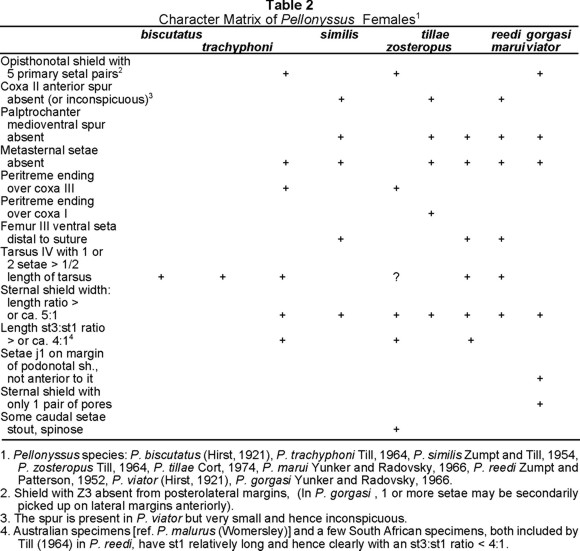
<body><![CDATA[<p align="justify"><font face="verdana" size="2">Till (1964) had paratypes of <i>P. malurus</i> from Australia on hand when she put that name in synonymy under <i>P. reedi.</i> We follow her decision, as have other authors (Micherdzinski, 1980, Domrow, 1987). However, it should be noted that she was tentative regarding this synonymy. She stated that the Australian mites differ from typical <i>P. reedi</i> in having the first pair of sternal setae about 3X as long, the sternal shield relatively narrow, and the anal shield relatively short. She wrote, "However, two groups of mites from birds in Bechuanaland... combine the features of <i>P. reedi</i> and <i>P. malurus....</i> &#91;I&#93;t has been decided, for the present to consider these differences to be within the range of intraspecific variation." Her conclusion is plausible from a zoogeographic standpoint, in that (1) other macronyssids associated with volant hosts appear to have achieved a distribution including South Africa and Australia without human assistance, e.g. the bat parasite <i>Ichoronyssus miniopteri</i> (Zumpt and Patterson, 1952); and (2) the house sparrow (<i>Passer domesticus</i>) is a common host of <i>P. reedi</i> and has become nearly cosmopolitan, partly as a result of human transport.</font></p>     <p align="justify"><font face="verdana" size="2">The collections presented as <i>P. nidicolus</i> by Est&eacute;banes&#45;Gonz&aacute;lez (1997) are reassigned as follows:</font></p>     <p align="justify"><font face="verdana" size="2">MEXICO: Temamatla, <i>Hirundo rustica</i>, 11/8/85, <i>Ornithonyssus sylviarum</i> (Canestrini and Fanzago, 1877); <i>P. reedi.</i> MORELOS: Jonacatec, <i>Columbina inca</i>, 20/2/86, <i>P. marui.</i> Jojutla, Las Huertas, <i>Leptotila verreauxi</i>, 6/4/86, <i>P. marui.</i> 4 km. N Alpuyeca, Columbina passerina, 19/10/85, <i>P.marui.</i> Cuernavaca, Buenavista, <i>Hirundo rustica</i> (nest abandoned), 22/10/85, <i>P. marui.</i> MICHOACAN: Zinap&eacute;cuaro, <i>Campylorhynchus gularis</i>, 21/6/88, <i>P. marui.</i> DISTRITO FEDERAL: Cd. Universitaria, <i>Passer domesticus</i>, 28/4/86, <i>P. reedi.</i> Zona Sur, <i>Amazillia beryllina</i>, 1/9/96, <i>P. gorgasi</i> (nest).</font></p>     <p align="justify"><font face="verdana" size="2"><a href="#f1">Figures 1&#45;6</a> show the opisthonotal shield and the sternal shield of each of the 3 species of <i>Pellonyssus</i> found in the New World. The labelling of the penultimate seta on the opisthonotal shield is here Z4, changed from Radovsky (1998) (where given as S5) due to a reevaluation of the chaetotaxy as part of a general revision of the Macronyssidae. Text references to Z4 in Radovsky (1998) can be similarly corrected to Z3. A text reference in that paper to J5 as being present on the protonymphal pygidial shield is a lapsus calami and should read Z5.</font></p>     <p align="center"><font face="verdana" size="2"><a name="f1"></a></font></p>     <p align="center"><font face="verdana" size="2"><img src="/img/revistas/azm/n82/a3f1.jpg"></font></p>     <p align="justify"><font face="verdana" size="2">Keys to the females, males, and protonymphs of the 3 New World species of <i>Pellonyssus</i> are given below, all 3 now known from Mexico. <a href="#c3">Table 2</a> is a matrix of characters that will help in distinguishing females of all 9 species of <i>Pellonyssus</i> that are recognized as valid at present.</font></p>     <p align="center"><font face="verdana" size="2"><img src="/img/revistas/azm/n82/a3c2.jpg"></font></p>     <p align="center"><font face="verdana" size="2"><a name="c3"></a></font></p>     <p align="center"><font face="verdana" size="2"><img src="/img/revistas/azm/n82/a3c3.jpg"></font></p>     ]]></body>
<body><![CDATA[<p align="justify"><font face="verdana" size="2">Measurements of <i>P. marui</i> and <i>P. gorgasi</i> females indicate differences from <i>P. reedi</i> measurements given in <a href="#c1">Table 1</a>. The <i>P. gorgasi</i> measurements are taken from the ranges given in Radovsky (1998). The <i>P. marui</i> measurements are from 1 paratype collected from <i>Cassidix mexicanus</i> in Panama and from 1 mite each on <i>Columbina inca</i> and <i>C. parenina</i> in Mexico (Est&eacute;banes&#45;Gonz&aacute;lez, 1997). <i>P. gorgasi</i> has a longer podonotal shield (295&#45;345); some smaller setae on dorsal shields (z4 22&#45;30, z5 15&#45;20, J1 15&#45;20); greater median length of sternal shield (17&#45;23); much greater length of st1 (40&#45;59); and longer chelicerae (251&#45;285). The <i>P. marui</i> specimens have some smaller setae on dorsal shields (z4 20&#45;24, z5 15&#45;18, J1 16&#45;19, Z3 13&#45;16) but Z5 longer (25&#45;33); greater median length of sternal shield (17&#45;22); and average smaller caudal setae (67&#45;70).</font></p>     <p align="justify"><font face="verdana" size="2"><i>Ornithonyssus sylviarum</i> (Canestrini and Fanzago, 1877)</font></p>     <p align="justify"><font face="verdana" size="2">Est&eacute;banes&#45;Gonz&aacute;lez (1997) recorded <i>O. sylviarum</i>, at the species level, from the nests of 3 different birds in 3 passeriform families, including <i>Catharus occidentalis</i> (Muscicapidae) from Huitzilac in Morelos. She also noted 3 females of <i>O. sylviarum utrechtensis</i> Micherdzinski, 1980 in the nest of <i>Turdus migratorius</i> (Turdidae) at the same location in Huitzilac. We consider <i>O. s. utrechtensis</i> to be, and here designate it as, a junior subjective synonym of the nominal subspecies <i>O. s. sylviarum</i>, <b>New Synonymy</b>. Micherdzinski (1980) stated that <i>O. s. utrechtensis</i> is distinguishable from the nominal subspecies by the presence of only 2 (rather than 3) setal pairs on the caudal portion of the dorsal shield. He applied this designation to the type series of 6 females, taken from a domestic canary (<i>Serinus canarius</i>, family Fringillidae) in Utrecht, the Netherlands.</font></p>     <p align="justify"><font face="verdana" size="2">The genus <i>Ornithonyssus</i> is primarily found in the Western Hemisphere, with only a few species having an Old World presence through transport in post&#45;Columbian times (Furman and Radovsky, 1963). A subspecies is usually defined geographically, as a distinctive population occupying part of the range of a species. Subspecies of parasites are also sometimes described as limited to a particular host. Basing a subspecies on individuals associated with a domestic host in one location on the Eurasian continent is contrary to the usual definition. The subspecies concept is based on the idea of a restriction of gene flow between the named population and other populations of the species. For animal groups in general, it has not been intended historically that the formal application of a subspecies trinomial be used for intrapopulation variants (Mayr 1982), in this case potentially restricted to a single locality (within Utrecht) and a single host (the introduced <i>Serinus canarius</i>).</font></p>     <p align="justify"><font face="verdana" size="2"><i>O. sylviarum</i> exhibits reduction in the setae on the caudal margins of the dorsal shield, relative to other <i>Ornithonyssus</i>, through the loss of the penultimate setal pair (S5), leaving only 3 pairs (Z3, Z4, Z5), of which Z4 is much reduced as in the genus as a whole (<a href="#f1">Figs. 7&#45;9</a>). Population samples of <i>O. sylviarum</i> typically show variation in the presence of setae of 2 of the 3 remaining pairs, especially Z4 but also Z3. For example, in the 10 females seen from a nest of <i>Carpodacus mexicanus</i> in Auburn, Alabama in the eastern U.S.A., 3 are missing Z4 on 1 side, 1 is missing Z4 on both sides, and 1 is missing Z3 on 1 side.</font></p>     <p align="justify"><font face="verdana" size="2">Finding mites with the defining characteristic of <i>O. s. utrechtensis</i> (Z3 absent, Z4 and Z5 only present) on <i>Turdus migratorius</i> in Mexico further supports the conclusion that the specimens in the type series on <i>Serinus canarius</i> in Utrecht are intrapopulation variants and do not represent a separate subspecies.</font></p>     <p align="justify"><font face="Verdana" size="2">&nbsp;</font></p>     <p align="justify"><font face="verdana" size="2"><b>ACKNOWLEDGMENTS</b></font></p>     <p align="justify"><font face="verdana" size="2">We greatly appreciate the loan of materials from the following: Jeffrey K. Barnes and the New York State Museum, Albany; the National Museum of Natural History, Washington, D.C.; Magdalena K.P. Smith Meyer and the ARC&#45;Plant Protection Research Institute, Pretoria; W. Calvin Welbourn and the Florida State Collection of Arthropods, Gainesville; Gary R. Mullen and Andrew Stoehr, Auburn University, Alabama; and Lynn Royce, Oregon State University, Corvallis.</font></p>     <p align="justify"><font face="Verdana" size="2">&nbsp;</font></p>     ]]></body>
<body><![CDATA[<p align="justify"><font face="verdana" size="2"><b>LITERATURE CITED</b></font></p>     <!-- ref --><p align="justify"><font face="verdana" size="2"><b>Baker, E.W., M.D. Delfinado, &amp; M.J. Abbatiello</b>. 1976. Terrestrial mites of New York. II. Mites in birds' nests (Acarina). <i>J. N. Y. Entomol. Soc</i>. 84:48&#45;66.    &nbsp;&nbsp;&nbsp;&nbsp;&nbsp;&nbsp;&nbsp;&nbsp;[&#160;<a href="javascript:void(0);" onclick="javascript: window.open('/scielo.php?script=sci_nlinks&ref=290251&pid=S0065-1737200100010000300001&lng=','','width=640,height=500,resizable=yes,scrollbars=1,menubar=yes,');">Links</a>&#160;]<!-- end-ref --></font></p>     <!-- ref --><p align="justify"><font face="verdana" size="2"><b>Clark, G.M. &amp; C.E. Yunker</b>. 1956. A new genus and species of Dermanyssidae (Acarina: Mesostigmata) from the English sparrow, with observations on its life cycle. <i>Proc. Helminthol. Soc. Wash</i>. 23:93&#45;101.    &nbsp;&nbsp;&nbsp;&nbsp;&nbsp;&nbsp;&nbsp;&nbsp;[&#160;<a href="javascript:void(0);" onclick="javascript: window.open('/scielo.php?script=sci_nlinks&ref=290253&pid=S0065-1737200100010000300002&lng=','','width=640,height=500,resizable=yes,scrollbars=1,menubar=yes,');">Links</a>&#160;]<!-- end-ref --></font></p>     <!-- ref --><p align="justify"><font face="verdana" size="2"><b>Domrow, R</b>. 1987. Acari Mesostigmata parasitic on Australian vertebrates: an annotated checklist, keys and bibliography. <i>Invertebr. Taxon.</i> 1:817&#45;948.    &nbsp;&nbsp;&nbsp;&nbsp;&nbsp;&nbsp;&nbsp;&nbsp;[&#160;<a href="javascript:void(0);" onclick="javascript: window.open('/scielo.php?script=sci_nlinks&ref=290255&pid=S0065-1737200100010000300003&lng=','','width=640,height=500,resizable=yes,scrollbars=1,menubar=yes,');">Links</a>&#160;]<!-- end-ref --></font></p>     <!-- ref --><p align="justify"><font face="verdana" size="2"><b>Est&eacute;banes&#45;Gonz&aacute;lez, M.L</b>. 1997. Acarofauna en nidos de Aves silvestres en Mexico. <i>Acta zool. Mex. (n,s.)</i> 71:1&#45;15.    &nbsp;&nbsp;&nbsp;&nbsp;&nbsp;&nbsp;&nbsp;&nbsp;[&#160;<a href="javascript:void(0);" onclick="javascript: window.open('/scielo.php?script=sci_nlinks&ref=290257&pid=S0065-1737200100010000300004&lng=','','width=640,height=500,resizable=yes,scrollbars=1,menubar=yes,');">Links</a>&#160;]<!-- end-ref --></font></p>     <!-- ref --><p align="justify"><font face="verdana" size="2"><b>Furman, D. P. &amp; F. J. Radovsky</b>. 1963. A new species of <i>Ornithonyssus</i> from the whitetailed antelope ground squirrel, with a rediagnosis of the genus <i>Ornithonyssus</i> (Acarina: Dermanyssidae). <i>Pan&#45;Pacific Entomol.</i> 39:75&#45;79.    &nbsp;&nbsp;&nbsp;&nbsp;&nbsp;&nbsp;&nbsp;&nbsp;[&#160;<a href="javascript:void(0);" onclick="javascript: window.open('/scielo.php?script=sci_nlinks&ref=290259&pid=S0065-1737200100010000300005&lng=','','width=640,height=500,resizable=yes,scrollbars=1,menubar=yes,');">Links</a>&#160;]<!-- end-ref --></font></p>     <!-- ref --><p align="justify"><font face="verdana" size="2"><b>Mayr, E</b>. 1982. <i>The Growth of Biological Thought: Diversity, Evolution, and Inheritance</i>. Cambridge, Massachusetts: Belknap Press. 974 pp.    &nbsp;&nbsp;&nbsp;&nbsp;&nbsp;&nbsp;&nbsp;&nbsp;[&#160;<a href="javascript:void(0);" onclick="javascript: window.open('/scielo.php?script=sci_nlinks&ref=290261&pid=S0065-1737200100010000300006&lng=','','width=640,height=500,resizable=yes,scrollbars=1,menubar=yes,');">Links</a>&#160;]<!-- end-ref --></font></p>     <!-- ref --><p align="justify"><font face="verdana" size="2"><b>Micherdzinski, W</b>. 1980. <i>Eine taxonomische analyse der familie Macronyssidae Oudemans</i>, <i>1936. I. Subfamilie Ornithonyssinae Lange, 1958 (Acarina, Mesostigmata).</i> Panstwowe Wydawnictwo Naukowe, Warsaw. 264 pp.    &nbsp;&nbsp;&nbsp;&nbsp;&nbsp;&nbsp;&nbsp;&nbsp;[&#160;<a href="javascript:void(0);" onclick="javascript: window.open('/scielo.php?script=sci_nlinks&ref=290263&pid=S0065-1737200100010000300007&lng=','','width=640,height=500,resizable=yes,scrollbars=1,menubar=yes,');">Links</a>&#160;]<!-- end-ref --></font></p>     <!-- ref --><p align="justify"><font face="verdana" size="2"><b>Radovsky, F.J</b>. 1998. Description of the active stases and distribution of <i>Pellonyssus gorgasi</i> Yunker and Radovsky, 1966 (Acari: Macronyssidae) of hummingbirds, and its apparent use of flowers for host transfer. <i>Internat. J. Acarol.</i> 24:99&#45;106.    &nbsp;&nbsp;&nbsp;&nbsp;&nbsp;&nbsp;&nbsp;&nbsp;[&#160;<a href="javascript:void(0);" onclick="javascript: window.open('/scielo.php?script=sci_nlinks&ref=290265&pid=S0065-1737200100010000300008&lng=','','width=640,height=500,resizable=yes,scrollbars=1,menubar=yes,');">Links</a>&#160;]<!-- end-ref --></font></p>     <!-- ref --><p align="justify"><font face="verdana" size="2"><b>Till, W.M</b>. 1964. A revision of the genus <i>Pellonyssus</i> Clark and Yunker (Acari: Mesostigmata). <i>J. Linn. Soc. (Zool.)</i> 45:85&#45;102.    &nbsp;&nbsp;&nbsp;&nbsp;&nbsp;&nbsp;&nbsp;&nbsp;[&#160;<a href="javascript:void(0);" onclick="javascript: window.open('/scielo.php?script=sci_nlinks&ref=290267&pid=S0065-1737200100010000300009&lng=','','width=640,height=500,resizable=yes,scrollbars=1,menubar=yes,');">Links</a>&#160;]<!-- end-ref --></font></p>     <!-- ref --><p align="justify"><font face="verdana" size="2"><b>Womersley, H</b>. 1956. A new genus and 2 new species of Acarina from northern Australia. <i>Proc. Linn Soc. N.S.W.</i> 80:214&#45;216.    &nbsp;&nbsp;&nbsp;&nbsp;&nbsp;&nbsp;&nbsp;&nbsp;[&#160;<a href="javascript:void(0);" onclick="javascript: window.open('/scielo.php?script=sci_nlinks&ref=290269&pid=S0065-1737200100010000300010&lng=','','width=640,height=500,resizable=yes,scrollbars=1,menubar=yes,');">Links</a>&#160;]<!-- end-ref --></font></p>     <p align="justify"><font face="verdana" size="2"><b>Zumpt, F</b>. 1961. <i>The Arthropod Parasites of Vertebrates in Africa South of the Sahara.</i> Vol. 1. Johannesburg: S. Afr. Inst. Med. Res.</font></p>     <!-- ref --><p align="justify"><font face="verdana" size="2"><b>Zumpt, F. &amp; P.M. Patterson</b>. 1952. Three new parasitic mites from the Ethiopian region (Acarina: Laelaptidae). <i>J. Entomol. Soc. Southern Afr.</i> 15:159&#45;164.    &nbsp;&nbsp;&nbsp;&nbsp;&nbsp;&nbsp;&nbsp;&nbsp;[&#160;<a href="javascript:void(0);" onclick="javascript: window.open('/scielo.php?script=sci_nlinks&ref=290272&pid=S0065-1737200100010000300011&lng=','','width=640,height=500,resizable=yes,scrollbars=1,menubar=yes,');">Links</a>&#160;]<!-- end-ref --></font></p>      ]]></body><back>
<ref-list>
<ref id="B1">
<nlm-citation citation-type="journal">
<person-group person-group-type="author">
<name>
<surname><![CDATA[Baker]]></surname>
<given-names><![CDATA[E.W.]]></given-names>
</name>
<name>
<surname><![CDATA[Delfinado]]></surname>
<given-names><![CDATA[M.D.]]></given-names>
</name>
<name>
<surname><![CDATA[Abbatiello]]></surname>
<given-names><![CDATA[M.J.]]></given-names>
</name>
</person-group>
<article-title xml:lang="en"><![CDATA[Terrestrial mites of New York. II. Mites in birds' nests (Acarina)]]></article-title>
<source><![CDATA[J. N. Y. Entomol. Soc.]]></source>
<year>1976</year>
<volume>84</volume>
<page-range>48-66</page-range></nlm-citation>
</ref>
<ref id="B2">
<nlm-citation citation-type="journal">
<person-group person-group-type="author">
<name>
<surname><![CDATA[Clark]]></surname>
<given-names><![CDATA[G.M.]]></given-names>
</name>
<name>
<surname><![CDATA[Yunker]]></surname>
<given-names><![CDATA[C.E.]]></given-names>
</name>
</person-group>
<article-title xml:lang="en"><![CDATA[A new genus and species of Dermanyssidae (Acarina: Mesostigmata) from the English sparrow, with observations on its life cycle]]></article-title>
<source><![CDATA[Proc. Helminthol. Soc. Wash.]]></source>
<year>1956</year>
<volume>23</volume>
<page-range>93-101</page-range></nlm-citation>
</ref>
<ref id="B3">
<nlm-citation citation-type="journal">
<person-group person-group-type="author">
<name>
<surname><![CDATA[Domrow]]></surname>
<given-names><![CDATA[R]]></given-names>
</name>
</person-group>
<article-title xml:lang="en"><![CDATA[Acari Mesostigmata parasitic on Australian vertebrates: an annotated checklist, keys and bibliography]]></article-title>
<source><![CDATA[Invertebr. Taxon.]]></source>
<year>1987</year>
<volume>1</volume>
<page-range>817-948</page-range></nlm-citation>
</ref>
<ref id="B4">
<nlm-citation citation-type="journal">
<person-group person-group-type="author">
<name>
<surname><![CDATA[Estébanes-González]]></surname>
<given-names><![CDATA[M.L]]></given-names>
</name>
</person-group>
<article-title xml:lang="es"><![CDATA[Acarofauna en nidos de Aves silvestres en Mexico]]></article-title>
<source><![CDATA[Acta zool. Mex. (n,s.)]]></source>
<year>1997</year>
<volume>71</volume>
<page-range>1-15</page-range></nlm-citation>
</ref>
<ref id="B5">
<nlm-citation citation-type="journal">
<person-group person-group-type="author">
<name>
<surname><![CDATA[Furman]]></surname>
<given-names><![CDATA[D. P.]]></given-names>
</name>
<name>
<surname><![CDATA[Radovsky]]></surname>
<given-names><![CDATA[F. J.]]></given-names>
</name>
</person-group>
<article-title xml:lang="en"><![CDATA[A new species of Ornithonyssus from the whitetailed antelope ground squirrel, with a rediagnosis of the genus Ornithonyssus (Acarina: Dermanyssidae)]]></article-title>
<source><![CDATA[Pan-Pacific Entomol.]]></source>
<year>1963</year>
<volume>39</volume>
<page-range>75-79</page-range></nlm-citation>
</ref>
<ref id="B6">
<nlm-citation citation-type="book">
<person-group person-group-type="author">
<name>
<surname><![CDATA[Mayr]]></surname>
<given-names><![CDATA[E]]></given-names>
</name>
</person-group>
<source><![CDATA[The Growth of Biological Thought: Diversity, Evolution, and Inheritance]]></source>
<year>1982</year>
<page-range>974</page-range><publisher-loc><![CDATA[Cambridge^eMassachusetts Massachusetts]]></publisher-loc>
<publisher-name><![CDATA[Belknap Press]]></publisher-name>
</nlm-citation>
</ref>
<ref id="B7">
<nlm-citation citation-type="book">
<person-group person-group-type="author">
<name>
<surname><![CDATA[Micherdzinski]]></surname>
<given-names><![CDATA[W]]></given-names>
</name>
</person-group>
<source><![CDATA[Eine taxonomische analyse der familie Macronyssidae Oudemans, 1936. I. Subfamilie Ornithonyssinae Lange, 1958 (Acarina, Mesostigmata).]]></source>
<year>1980</year>
<page-range>264</page-range><publisher-loc><![CDATA[Warsaw ]]></publisher-loc>
<publisher-name><![CDATA[Panstwowe Wydawnictwo Naukowe]]></publisher-name>
</nlm-citation>
</ref>
<ref id="B8">
<nlm-citation citation-type="journal">
<person-group person-group-type="author">
<name>
<surname><![CDATA[Radovsky]]></surname>
<given-names><![CDATA[F.J]]></given-names>
</name>
</person-group>
<article-title xml:lang="en"><![CDATA[Description of the active stases and distribution of Pellonyssus gorgasi Yunker and Radovsky, 1966 (Acari: Macronyssidae) of hummingbirds, and its apparent use of flowers for host transfer]]></article-title>
<source><![CDATA[Internat. J. Acarol.]]></source>
<year>1998</year>
<volume>24</volume>
<page-range>99-106</page-range></nlm-citation>
</ref>
<ref id="B9">
<nlm-citation citation-type="journal">
<person-group person-group-type="author">
<name>
<surname><![CDATA[Till]]></surname>
<given-names><![CDATA[W.M]]></given-names>
</name>
</person-group>
<article-title xml:lang="en"><![CDATA[A revision of the genus Pellonyssus Clark and Yunker (Acari: Mesostigmata)]]></article-title>
<source><![CDATA[J. Linn. Soc. (Zool.)]]></source>
<year>1964</year>
<volume>45</volume>
<page-range>85-102</page-range></nlm-citation>
</ref>
<ref id="B10">
<nlm-citation citation-type="journal">
<person-group person-group-type="author">
<name>
<surname><![CDATA[Womersley]]></surname>
<given-names><![CDATA[H]]></given-names>
</name>
</person-group>
<article-title xml:lang="en"><![CDATA[A new genus and 2 new species of Acarina from northern Australia]]></article-title>
<source><![CDATA[Proc. Linn Soc. N.S.W.]]></source>
<year>1956</year>
<volume>80</volume>
<page-range>214-216</page-range></nlm-citation>
</ref>
<ref id="B11">
<nlm-citation citation-type="journal">
<person-group person-group-type="author">
<name>
<surname><![CDATA[Zumpt]]></surname>
<given-names><![CDATA[F.]]></given-names>
</name>
<name>
<surname><![CDATA[Patterson]]></surname>
<given-names><![CDATA[P.M.]]></given-names>
</name>
</person-group>
<article-title xml:lang="en"><![CDATA[Three new parasitic mites from the Ethiopian region (Acarina: Laelaptidae)]]></article-title>
<source><![CDATA[J. Entomol. Soc. Southern Afr.]]></source>
<year>1952</year>
<volume>15</volume>
<page-range>159-164</page-range></nlm-citation>
</ref>
</ref-list>
</back>
</article>