The Mexican Frankliniella paricutinensis sp. nov. species assemblage, in the "Intonsa group" (Insecta, Thysanoptera: Thripidae)
Roberto M. Johansen
Instituto de Biología, UNAM. Departamento de Zoología, Laboratorio de Entomología. Apdo. Postal 70-153, CP 04510. Coyoacán, México, D. F., MEXICO.
Recibido: 6 de octubre 1998
Aceptado: 21 de octubre 1999
Resumen
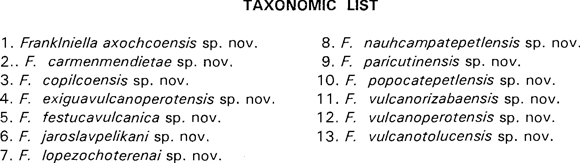
Se describen 13 especies nuevas de Frankliniella en el "Grupo Intonsa", del Eje Volcánico Transversal (una compartida con la Sierra Madre Oriental) de México, mismas que al compartir varios caracteres de coloración y morfología, integran un ensamble específico mexicano Frankliniella desertileonidum Watson y, en menor grado con el ensamble F. intonsa (Trybom). Se incluyen ilustraciones de cabeza, antenas, tórax y abdomen de cada especie.
Palabras clave: Thysanoptera, Ensamble específico Frankliniella paricutinensis, Taxonomía, Especies nuevas, Distribución, México.
Abstract
Thirteen new species of Frankliniella in the "Intonsa group" from the Mexican Volcanic Range (one shared with the Sierra Madre Oriental), are described herein. Because all these species share characters of color and morphology, they integrate a specific assemblage. The probable morphologic relationships with the Mexican Frankliniella desertileonidum Watson species assemblage, and in a minor grade with the F. intonsa (Trybom) species assemblage, are analyzed and discussed, Illustrations of the head, antennae, thorax and abdomen of each species, are included.
Key Words: Thysanoptera, Frankiniella paricutenensis species assemblage, Taxonomy, New Species, Distribution, Mexico.
Introduction
]]> The definition of Frankliniella paricutinensis sp. nov. and 12 related new species as a "specific assemblage" within the "Intonsa group", was possible by means of the recognition of several morphologic characters, like the fore wings coloration and the lack of the postocular setae i (a shared character with theFrankliniella desertileonidum) Watson assemblage, according to Johansen, 1998). The lack of the postocular setae i is supported by the evidence found in one adult specimen of Frankliniella brevisaetaeoneillae Johansen, 1998: in one side the setae formula is: i-iii, IV, in the other: ii-iii, IV. Sakimura & O'Neill (1979) described and ilustrated the same character in some species of the Minuta group: F. pestinae Sakimura & O'Neill and F. crawfordi Sakimura & O'Neill. Another evidence comes from the examination of F. hemerocallis J. C. Crawford adults: the females have the postocular setae formula i-iii, IV, whereas the males ii-iii, IV. However, Frankliniella hemerocallis belongs into a different "species assemblage". It is clear that the postocular setae i commonly exists in all species belonging into the Intonsa group (and in most of the genus species), but it was lost in the Frankliniella paricutinensis species assemblage appear to be like those of the also Mexican montane species F. fallaciosa Priesner and F. parvifossis Priesner. However, in the last two species the postocular setae formula is i-iii, IV, and they belong into the Frankliniella insularis (Franklin) species assemblage.Since the species number in the Intonsa group is still increazing, creating more classification problems, as mentioned by Mound & Marullo (1996), species assembling is a good neutral classification solution. This last proposal is particulary reliable for the New World, where the genus Frankliniella is represented by 151 species, according to Nakahara (1997).
The terms assemblage, and group are used here as neutral terms, according to Mayr and Ashlock (1991).
Material and methods
The adult illustrations from each of the species, were taked from Canada balsam mounted slides. They are realistic microscopic interpretations that were donne using a camera-lucida equipment, and two magnifications: 400 and 1000 X.
Depositories
IBUNAM = Instituto de Biología, Universidad Nacional Autónoma de México, México, D.F.
Abdomen
]]> IXi, IXii, IXiii = Tergite IX major caudal setae, Xi, Xii = Tergite X major subposteromarginal setae.The Frankliniella paricutinensis sp. nov. species assemblage.
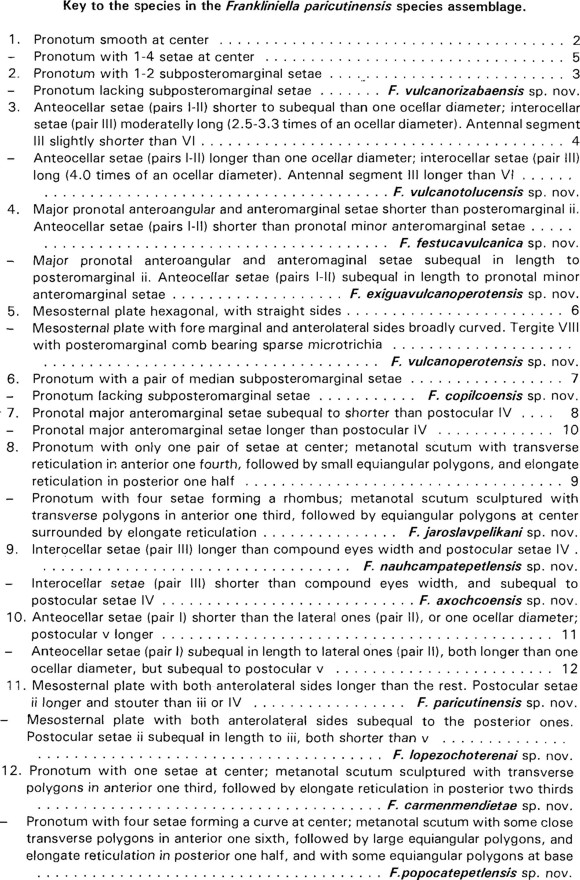
Diagnosis. Small species (females: 1.35-1.86; males 1.21-1.49 mm in length) in the Intonsa group: Body color predominantly dark chestnut to blackish brown, with abundant orange subhypodermal pigment. Antennal segments III-V bicolored yellow and brown. Tarsi yellow to yellowish-brown. Fore wings dark chestnut brown, with a white-hyaline sub-basal band; hind wings whitish-yellow, with a dark brown median longitudinal vitta. Ocellar crescents orange to red. Body setae dark blackish-brown.
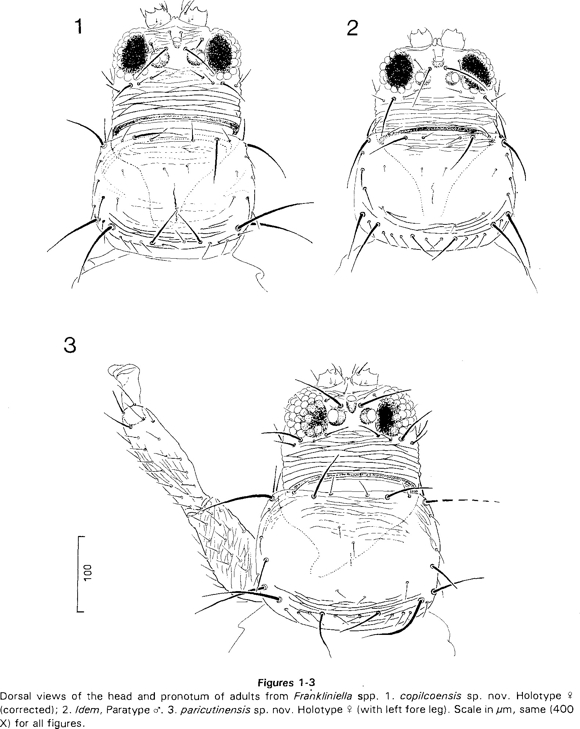
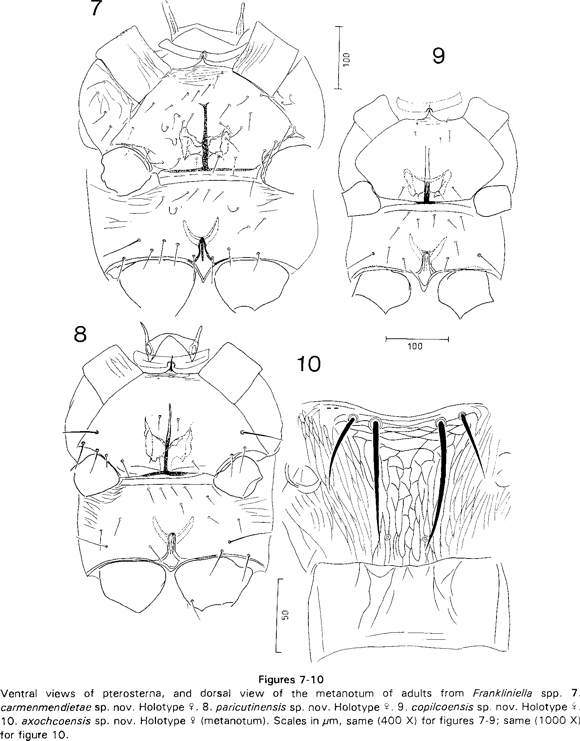
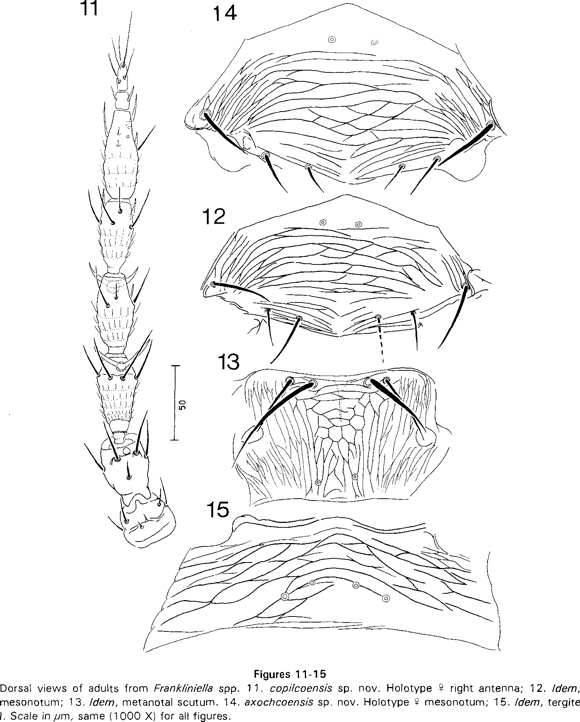
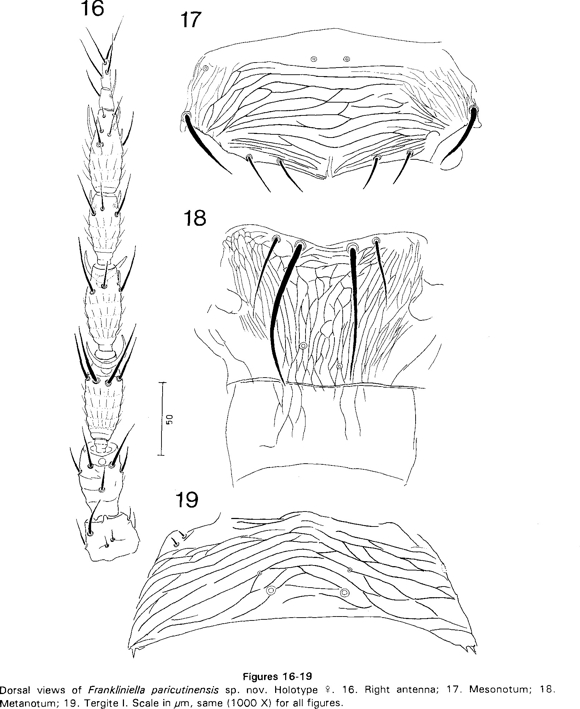
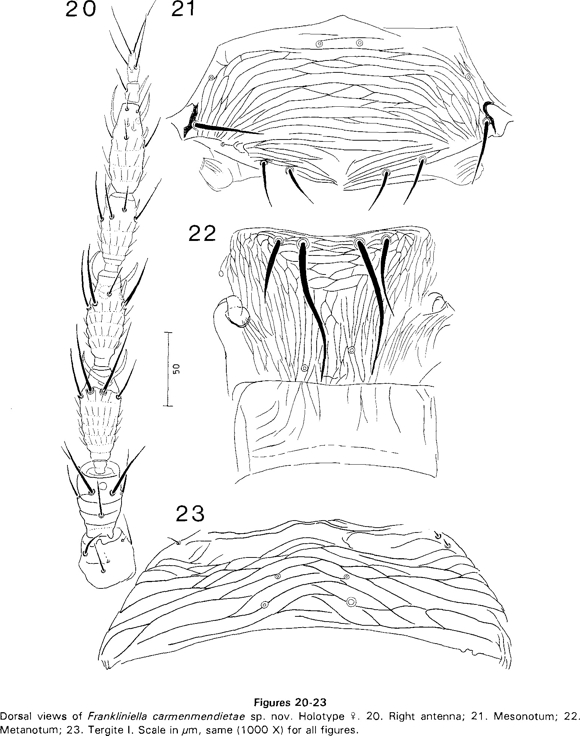
Morphology. Head (Figs. 1-5 (2, 3, 4), 30, 37, 44) broader than long in posterior one half; occiput sculptured with open, parallel and confluent (at middle and sides) striae. Postocular setae formula: II-III, IV. Compound eyes ellipsoidal, slightly or noy protruding. Antennal segments typical in the group (Figs. 11, 16, 20, 33, 40, 47), Ill with slightly fungiform pedicel, IV-VI globose-elongate. Mouth cone pointed, shorter to longer than the dorsal length of head. Pronotum (Figs. 1-5 (2, 3, 4), 30, 37, 44) with is surface mainly smooth, but with some faint transverse striae in anterior margin, which become stronger in posterior margin. Mesonotal plate (Figs. 12, 14, 17, 21, 34, 41, 48) transverse, hexagonal and with open transverse striae, which become confluent at center and sides. Metanotal scutum (Figs. 10, 13, 18, 22, 35, 49) with polygonal reticulation forming a triangle at center (transverse anteriorly, longitudinal behind), and longitudinal striae at sides; setae in anterior margin.
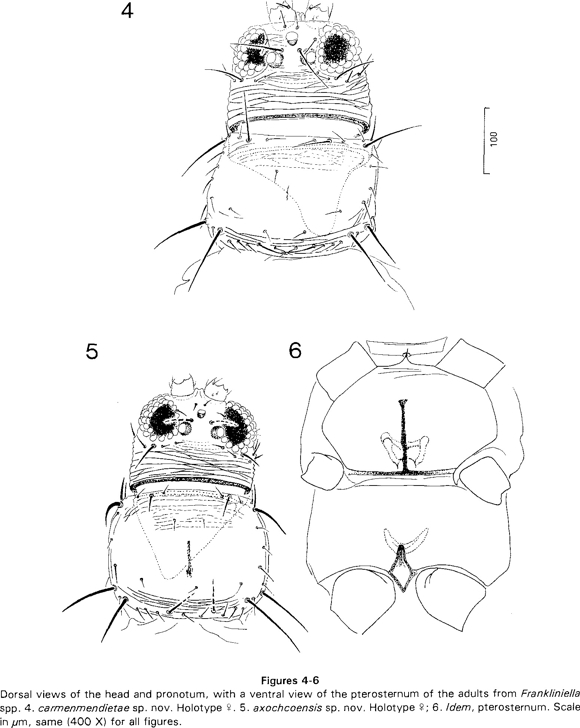
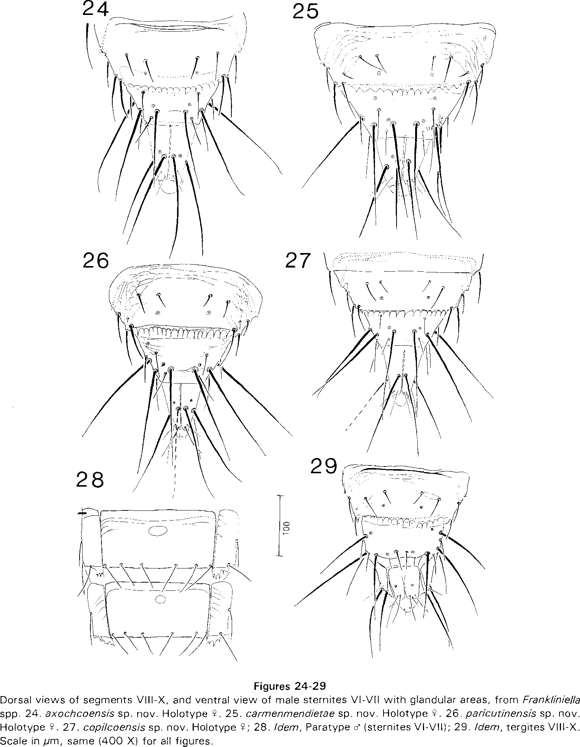
Pterosternum (Figs. 6-8, 31, 38, 45) with transverse hexagonal to nearly pentagonal mesosternum, mesofurca and spinula strong. Tergites VIII (Figs. 24-27, 29, 32, 39, 46) with a complete posteromarginal comb. Segment X longer than broad. Males with one circular to slightly ellipsoidal glandular area on each of sternites II-VII (Fig.28).
]]>
Specific differential characters. Body size proportions are variable between adults of the species. Antennal segments III-IV, as well as tarsi, are variable in color. There are remarkable differences in the head chaetotaxy and occiput sculpture, antennal segments (length versus width); the pronotal sculpture and chaetotaxy. The meso- and metanotal sculpture also varyes, as well as the mesosternal morphology. The tergite I plate is also variable.
Comments.The studied material is scarce, but good. A total of 54 adult specimens were considered; from these 41 are females and only 13 males. From the described 13 new speces, only five had bisexual descriptions and eight were described with females only: four with more then one specimen, and four holotypically.
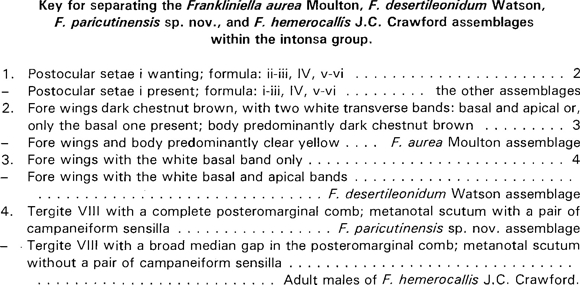
Relations with other assemblages within the Intonsa group. The adults of both sexes from the species in the Frankliniella paricutinensis, F. desertileonidum Watson, and F. aurea Moulton, are different from those in the other assemblages within the Intonsa group, because of the lack of postocular setae i, thus giving the setae formula: ii-iii, IV (two minor setae, plus a long and stouter one), whereas in the other complexes the formula is: i-iii, IV. In the case of the Frankliniella paricutinensis sp. nov. assemblage the fore wings color (dark brown with a sub-basal white band) is the main difference with the Frankliniella desertileonidum assemblage: dark brown, with two white transverse bands: one sub-basal, the other apical in the sense of Johansen (1998). The dark brown fore wings with a white sub-basal transverse band, is a shared character with the species in the Frankliniella intonsa (Trybom) and F. insularis (Franklin) assemblages. In the case of the Frankliniella aurea Moulton species assemblage, the clear yellow fore wings is a shared character with the F. occidentalis (Pergande) species assemblage.
Frankliniella axochcoensis sp. nov.
(Figs. 5-6, 10, 14-15, 24, 94)
Female. Body color typical, except: antennal segments, Il dark chestnut brown, yellow in apical end, Ill yellow, with a white sub-basal ring, and light brown in apical third; IV yellow, brown in apical half; V-VI brown, each with a lighter sub-basal rong. Fore tibiae yellow in both ends. All tarsi yellowish-brown.
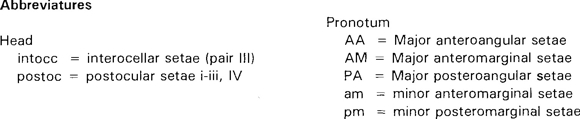
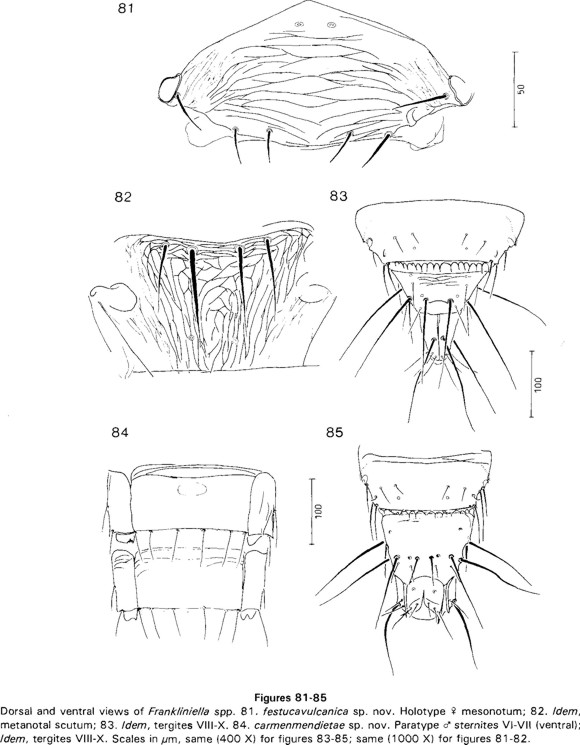
]]> Morphology. Head in dorsal aspect (Fig. 5), broader (1.53 times) than long at middle; cheecks sinouse; occiput sculptured with close transverse striae, becoming closer and confluent at center. Chaetotaxy as follows: anteocellar (pairs I-II) small (pair III) moderately long, shorter to longer than postocular IV. Antennal segments: Ill longer than IV, but both longer than VI. Mouth-cone as long as dorsal length of head. Pronotum (Fig. 5) almost smooth, but with faint transverse and confluent striae on anterior one third; chaetotaxy as follows: major setae, anteroangulars stouter and about twice longer than anteromarginals; inner posteroangulars slightly shorter than outers; 1-2 small subposteromarginals. Pterothorax; mesonotum (Fig. 14); metanotum (Fig. 10); pterosternum (Fig.6) Abdomen; tergite I (Fig.15); tergites VII-X (Fig.24).Measurements (Holotype ♀ in μm). Body length: 1.86 mm.
Head dorsal length: 104. Width at eyes: 150, behind eyes: 148, middle: 160, basal: 156. Chaetotaxy, intocc: 28; postoc: ii-iii 20, IV 30. Compound eyes, length: 56, width: 50. Ocelli, fore: 12, hind: 16. Antennal segments, length (width): I 30 (32), II 40 (26), III 54 (22), IV 52 (22), V 40 (18), VI 50 (20), VII 16 (6). Thorax; pronotum, length: 166; width at middle: 206. Chaetotaxy, major setae: AA 50, AM 40; PA, outer: 86, inner: 80; minor setae: aa 30, am 16, pm i: 20, ii:50, iii: 20. Mesothorax, width: 280; metathorax, width: 315. Fore wings, width at base: 100, middle: 70; veins chaetotaxy, fore: 25, hind: 19. Abdomen; width at segment IV: 360. Tergite IX setae, IX i: 120, IX ii: 140. Tergite X setae, X i: 140.
Material examined. Holotype ♀; paratypes: 6 ♀♀. MEXICO; DISTRITO FEDERAL: Sierra de Ajusco, on road to the Ajusco Vulcano, 2900 m.; 26-I-1979; in dry leaves of shrubs (Alfonso N. García), in IBUNAM.
Comments. Adults of Frankliniella axochcoensis sp. nov., are different from those of the other species in the assemblage, in the smaller body size, and the small head setae. Furthermore, F. axochcoensis is close to F. carmenmendietae because both bear a pair of pronotal subposteromarginal setae. However, in F. axochcoensis the pronotal major anteromarginal setae are subequal to shorter than postocular IV.
Derivatio nominis: from Náhuatl Axochco: atl = water, xochitli = flowing, co = in; in the flowing water, according to Macazaga (1979).
Frankliniella carmenmendietae sp. nov.
(Figs. 4, 7, 20-23, 25, 60, 84, 85, 94)
Female. Body color typical, except: lighter in abdominal segments I-VI. Antennal segments: Il dark chestnut brown, lighter in apical one fourth; Ill yellow, darkened with brown in apical two thirds; IV yellowish-brown in basal one third, the rest dark brown; V dark brown in basal one fourth. Fore tibiae yellow in both ends. Fore tarse yellow, middle and hind yellowish-brown.
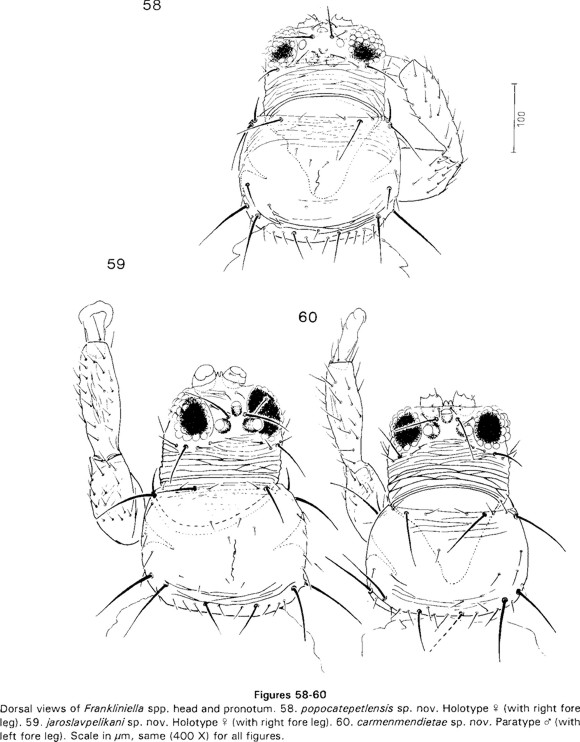
Morphology. Head in dorsal aspect (fig. 4), broader (1.45 times) than long at middle; cheeks straigth; occiput with parallel transverse striae, confluent in both sides. Antennal segments (Fig. 20), III the longest; VI shorter than IV. Mouth-cone shorter than dorsal length of head. Pronotum (FIg. 4) almost smooth, but with some faint transverse striae on anterior margin; with a pair of median small subposteromarginal setae. Pterothorax; mesonotum (Fig. 21); tergite I (Fig.23); tergites VIII-X (Fig. 25); tergite VII with the posteromarginal comb with closer microtrichia at center.
]]> Measurements (Holotype ♀ in μm). Body length: 1.80 mm.Head dorsal length: 124. Width at eyes: 160, behind eyes: 170, middle: 180, basal: 190. Chaetotaxy, intocc: 64; postoc: ii 18, iii 28, IV 50, V 30. Compound eyes, length: 66, width: 50. Ocelli, fore: 14, hind: 16. Antennal segments, length (width): I 30 (32), II 40 (26), III 58 (24), IV 54 (22), V 42 (18), VI 52 (20), VII 10 (8), VIII 18 (6). Thorax; pronotum, length: 160; width ay middle: 220. Chaetotaxy, major setae: AA 30, AM 22; PA, outer: 70, inner: 90; minor setae: aa 34; am 22; pm i: 20, ii: 40, iii: 20. Mesothorax, width: 370; metathorax, width:370. Fore wings, width at base: 120; middle: 70; veins chaetotaxy, fore: 18, hind: 17. Abdomen; width at segment IV: 408. Tergite IX setae, IX i: 144, IX ii: 146. Tergite X setae, X i: 150.
Male (Figs. 60, 84-85). Virtually like adult female. Head and pronotum (Fig. 60) like in female. Sternites II-VII each with an ellipsoidal glandular area (Fig. 84). Tergites VIII-X (Fig. 85).
Measurements (Paratype ♂ in μm). Body length: 1.33 mm.
Head dorsal length: 98. Width at eyes: 132, behind eyes: 130, middle: 140, basal: 134. Chaetotaxy, intocc: 44; postoc: ii-iii 14, IV 40. Compound eyes, length: 52, width: 40. Ocelli, fore: 10, hind: 10. Antennal segments, length (width): I 22 (26), II 34 (22), III 46 (20), IV 40 (18), V 34 (16), VI 44 (16), VII 8 (8), VIII 12 (4). Thorax; pronotum, length: 120, width at middle: 186. Chaetotaxy, major setae: AA 64, AM 44; PA, outer: 68, inner: 66; minor setae: aa 26, am 14; pm i: 12, ii: 30, iii: 12. Mesothorax, width: 240; metathorax, width: 214. Fore wings, width at base: 84, middle: 42; veins chaetotaxy, fore: 19, hind: 16. Abdomen; width at segment IV: 228, Tergite IX setae, IX i: 36, IX ii: 94. Tergite X setae, X i: 110.
Material examined. Holotype ♀, paratypes: 2 ♂♂. MEXICO; DISTRITO FEDERAL: Ciudad de México, Pedregal de San Ángel, 2240 m.; 14-XII-1977 (Holotype ♀) in Senecio praecox (María del Carmen Mendieta), en IBUNAM. Idem, Sierra del Ajusco, km 44 on road Méx-142. (México-City-Cuernavaca, Morelos), 2680 m.; 25-X-1985 (Paratype ♂) in Muhlenbergia macroura within Pinus Forest (Maria Luisa Montes de Oca & Roberto M. Johansen), in IBUNAM. ESTADO DE MEXICO: South of Nevado de Toluca Vulcano, km 22 on road Méx-36 Toluca-Sultepec, 3060 m.; 30-V-1987 (Paratype ♂) in Muhlenbergia sp. within Abies-Pinus Forest (María Luisa Montes de Oca & R. M. Johansen), in IBUNAM.
Comments. Adults of F. carmenmendietae sp. nov., are different from the other species in the assamblage (see comments in F. axochcoensis), because of the trapezoidal dorsal outline of the head, the morphology of the prothorax and tergites VIII-X. This species is named honouring the memory of Miss. María del Carmen Mendieta-Sevilla († 1986) a young Mexican Thysanopterist, as a tribute of friendship.
Frankliniella copilcoensis sp. nov.
Figs. 1-2, 9, 11-13, 27, 29, 94.
Female. Body color typical, except: antennal segments, I Lighter than head; II lighter in apical one third; III yellowish brown, with a sub-basal whitish ring; IV-V lighter in basal one fifth. Fore tibiae yellow in both ends. All trochanters and tarsi yellow.
]]> Morphology. Head in dorsal aspect (Fig.1), broader (1.37) than long at middle; cheeks slightly sinuouse; broader at base; occiput sculptured with open transverse and confluent striae. Antennal segments (Fig. 11). Mouth-cone as long as dorsal length of head. Pronotum (Fig. 1) with some faint transverse striae on anterior margin and posterior one fifth, but some stronger striae in posterior margin; without subposteromarginal setae. Pterothorax; mesonotum (Fig. 12), metanotum (Fig. 13); pterosternum (Fig.9) with hexagonal mesosternal plate. Abdomen; tergites VIII-X (Fig. 27); tergite VIII with posteromarginal comb with well spaced microtrichia.Measurements (Holotype ♀ in μm). Body length: 1.35 mm.
Head dorsal length: 106. Width at eyes: 146, behind eyes: 140, middle: 146, basal: 148. Chaetotaxy, intocc: 48; postoc: ii-iii 18, IV 28. Compound eyes, length: 60, width: 44. Ocelli, fore: 12, hind: 12. Antennal segments, length (width): I 26 (30), II 38 (26), III 59 (22), IV 44 (20), V 40 (18), VI 50 (18), VII 10 (8), VIII 16 (6). Thorax; pronotum, length: 144; width at middle: 190. Chaetotaxy, major setae: AA 60, AM 52; PA, outer: 70, inner: 84; minor setae: aa 30, am 20; pm i: 20, ii: 46, iii: 20. Mesothorax, width: 220; metathorax, width: 250. Fore wings, width at base: 90, middle: 50; veins chaetotaxy, fore: 20, hind: 14. Abdomen; width at segment IV: 300. Tergite IX setae, IX i: 118, IX ii: 136. Tergite X setae, X i: 120.
Male (Figs. 2, 28-29). Virtually like adult female. Head (Fig. 2) with much longer postocular setae ii. Pronotum (Fig. 2) with one subposteromarginal setae. Sternites II-VII each with a circular to slightly ellipsoidal glandular area (Fig. 28). Tergites VIII-X (Fig. 29).
Measurements (Paratype ♂ in μm). Body length: 1.26 mm.
Head dorsal length: 104. Width at eyes: 146, behind eyes: 144, middle: 146, basal: 144. Chaetotaxy, intocc: 60; postoc: ii-iii 20, IV 32. Compound eyes, length: 56, width: 50. Ocelli, fore and hind: 16. Antennal segments, length (width): 1 22 (26), II 34 (22), III 48 (20), IV 42 (20), V 36 (29), VI 44 (16), VII 8 (6), VIII 16 (4). Thorax; pronotum, length: 140, width at middle: 190. Chaetotaxy, major setae: AA 64, AM 50; PA, outer: 70, inner: 76; minor setae: aa 28, am 14; pm i: 16, ii: 40, iii: 16. Mesothorax, width: 230; metathorax, width: 240. Fore wings, width at base: 90, middle: 60; veins chaetotaxy, fore: 17, hind: 16. Abdomen; width at segment IV: 124. Tergite IX setae, IX i: 34, IX ii: 100. Tergite X setae, X i: 110.
Material examined. Holotype ♀; paratypes: 6 ♀♀, 7 ♂♂. MEXICO: DISTRITO FEDERAL: Ciudad de México, Pedregal de San Angel, 2240 m.; 6-X-1977 (Holotype ♀, paratypes: 3 ♀♀); in flowers of Tagetes peduncularis (María del Carmen Mendieta), in IBUNAM; Idem et Ibidem, 31-X-1977 (Paratype ♀) (María del Carmen Mendieta) in IBUNAM. Idem, Sierra de Ajusco km 42 on road Méx-95 (Mexico City- Cuernavaca, Morelos) 3000 m.; 24-I-1987 (Paratypes: 2 ♀♀, 1 ♂), in shrubs of Bacharis and Senecio within Pinus Forest (R. M. Johansen), in IBUNAM; Idem et Ibidem, 21-I-1987 (Paratypes: 3 ♂♂); in Poaceae (Muhlenbergiasp. ?) (R. M. Johansen), in IBUNAM. HIDALGO: Sierra de Pachuca (Volcanic Range), 1 km N of Real del Monte, 2600 m.; 9-XI-1981 (paratypes: 3 ♀♀) in green and dry grass (Muhlenbergia sp. ?), (Roberto M. Johansen), in IBUNAM.
Comments. Adults of Frankliniella copilcoensis sp. nov., are close to those of F. axochcoensis, F. carmenmendietae, F. paricutinensis and F. lopezochoterenai, because they share the following characters: the pronotum with a median transverse row of 1-3 setae, and the pterosternum with a hexagonal mesosternal plate with straigth sides. However, F. copilcoensis is different because it lacks the pronotal median pair of subposteromarginal setae.
Derivatio nominis: From Náhuatl, Copilco: copilli = the lord's crown, co = place, the place of the lordship crown, according to Macazaga, 1979.
Frankliniella exiguavulcanoperotensis sp. nov.
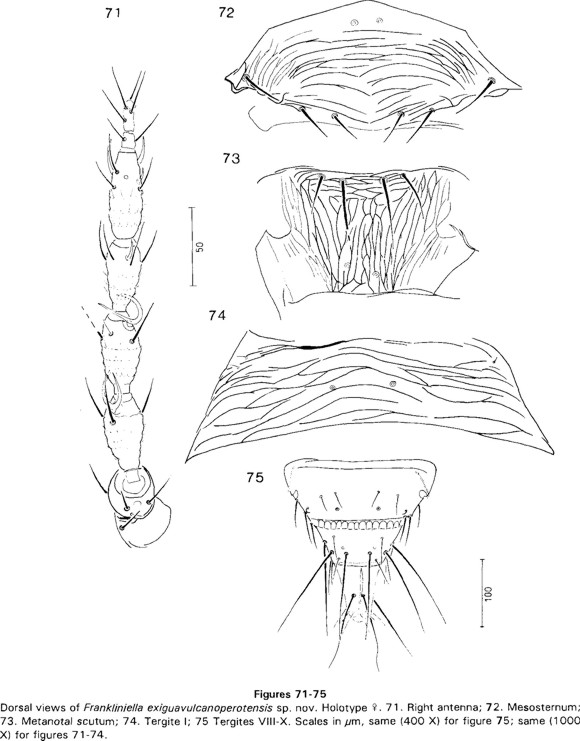
]]> (Figs. 65-66, 71-75, 94)Female. Body color typical, except: antennal segments, III light brown; IV ligth brown in basal one third, the rest darker. Fore tibiae light brown. All tarsi brown. Ocellar crescents crimson red.
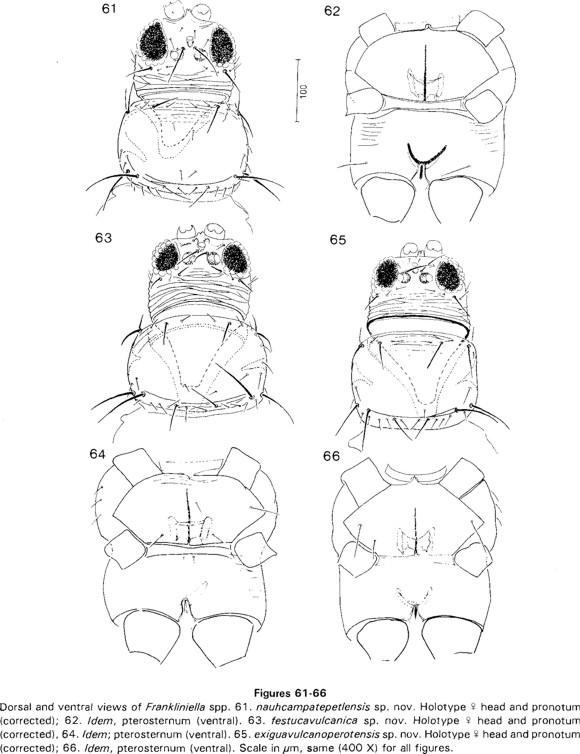
Morphology. Head in dorsal aspect (Fig. 65), broader (1.46 times) than long at middle; cheeks sinuouse, broader at middle; occiput sculptured with close parallel striae. Antennal segments (Fig. 71); segments III and IV subequal in length. Mouth-cone longer than head's dorsal length. Pronotum (Fig. 65) with some faint transverse striae on anterior margin; without setae at center. Pterothorax; mesonotum (Fig. 72); Metanotum (Fig. 73). Abdomen; tergite I (Fig. 74); tergites VIII-X (Fig.75).
Measurements (Holotype ♀ in μm). Body length: 1.23 mm.
Head dorsal length: 90. Width at eyes: 126, behind eyes: 126, middle: 132, basal: 130. Chaetotaxy, intocc: 40; postoc; ii 12, iii 10, IV 36, v 16. Compound eyes, length: 44, width: 36. Ocelli, fore: 10, hind: 10. Antennal segments, legth (width): I 26 (24), II 38 (24), III 44 (22), IV 38 (20), V 34 (18), VI (44 (16), VII 8 (8), VIII 14 (4). Thorax; pronotum, legth: 120; width at middle: 170. Chaetotaxy, major setae: AA 50, AM 40; PA, outer: 54, inner: 60; minor setae: aa 20, am 14; pm i: 12, ii: 36, iii: 10. Mesothorax, width: 216; metathorax, width: 204. Fore wings, width at base: 86, middle: 46; veins chaetotaxy, fore: 18, hind: 13. Abdomen; width at segment IV: 280. Tergite IX setae, IX i: 106, IX ii: 116. Tergite X setae, X i: 110.
Material examined. Holotype ♀. MEXICO; VERACRUZ: Volcanic Range North West source of the Cofre de Perote (Nauhcampatépetl) vulcano, 2880 m.; 8-V-1982; in dry litter under Alnus sp. tree within Pinus-Quercus Forest (Roberto M. Johansen & Aurea Mojica-Guzmán), in IBUNAM.
Comments. Adults of Frankliniella exiguavulcanoperotensis sp. nov., are related to those of F. festucavulcanica. However, in F. exiguavulcanoperotensis the pronotal major anteroangular and anteromarginal setae are subequal in length to the posteromarginal ii (in F. festucavulcanica are shorter).
Derivatio nominis: from Latin: exigua = little, vulcano; Spanish: Perote = nickname of Pero, Pedro (Peter), the name of a city and the near vulcano; Latin: ensis a locative.
Frankliniella festucavulcanica sp. nov.
(Figs. 63-64, 81-83, 94)
]]> Female. Body color typical, except: antennal segments, III yellow; IV yellow in basal one half, the rest darkened with brown; V ligth brown in extreme base, the rest dark brown. Fore tibiae yellowish-brown. All tarsi yellow. Ocellar crescents crimson red.Morphology. Head in dorsal aspect (Fig. 63), broader (1.56 times) than long at middle; cheeks sinuouse, broader at middle; occiput sculptured with close parallel striae. Antennal segments III-IV subequal in length, both shorter than VI. Mouth-cone longer than head's dorsal length. Pronotum (Fig. 63), broader (1.5 times) than long at middle, almost smooth, and without setae at center. Pterothorax; mesonotum (Fig. 81); metanotal scutum (Fig. 82). Abdomen; tergites VIII-X (Fig. 83).
Measurements (Holotype ♀ in μm). Body length: 1.13 mm.
Head dorsal length: 88. Width at eyes: 134, behind eyes: 130, middle: 138, basal: 130. Chaetotaxy, intocc: 36; postoc: ii 18, iii 14, IV 30, v 18. Compound eyes, length: 50, width: 36. Ocelli, fore: 10, hind: 10. Antennal segments, length (width): I 26 (26), II 36 (24), III 40 (20), IV 40 (20), V 36 (18), VI 48 (16), VII 8 (8), VIII 14 (6). Thorax, pronotum length: 126, width at middle: 188. Chaetotaxy, major setae: AA 46, AM 36; PA, outer: 64, inner: 68; minor setae: aa 28, am 14; pm i: 14, ii: 40, iii: 16. Mesothorax, width: 242; metathorax, width: 216. Fore wings, width at base: 68, middle: 50; veins chaetotaxy, fore: 20, hind 13. Abdomen; width at segment IV: 310. Tergite IX setae, IX i: 112, IX ii: 130. Tergite X setae, X i: 128.
Material examined. Holotype ♀. MEXICO; VERACRUZ: Volcanic Range, near summit of the Cofre de Perote Vulcano (Nauhcampatépetl), 4100 m.; 20-VI-1982; in Festuca tolucensis H. B. K. (Roberto M. Johansen), in IBUNAM.
Comments. Adults of Frankliniella festucavolcanica sp. nov., are related to those of F. exiguavulcanoperotensis, because of the body general morphology, and the pronotum without setae at center. However, in adults of F. festucavolcanica the antennal segment III is yellow, and segments IV-V are yellow basally. The tarsi are yellow; the pronotal major anteroangular and anteromarginal setae are shorter than posteromarginal ii. In F. exiguavulcanoperotensis adults, antennal segment III is ligth brown, and IV is light brown, and IV is light brown basally. All tarsi are light brown. The pronotal major anteroangular and anteromarginal setae are subequal in length to posteromarginal ii.
Derivatio nominis: festuca = a montane grass, vulcanica = vulcano related.
Frankliniella jaroslavpelikani sp. nov
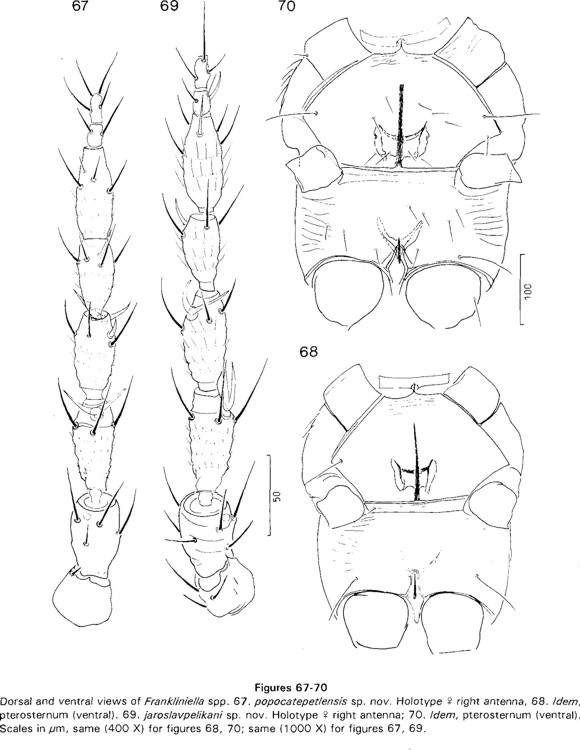
(Figs. 59, 69-70, 88-89, 93-94)
Female. Body color typical, except: antennal segments III yellow; IV yellow in basal one half, the rest darkened with brown. All tarsi light brown. Ocellar crescents crimson red.
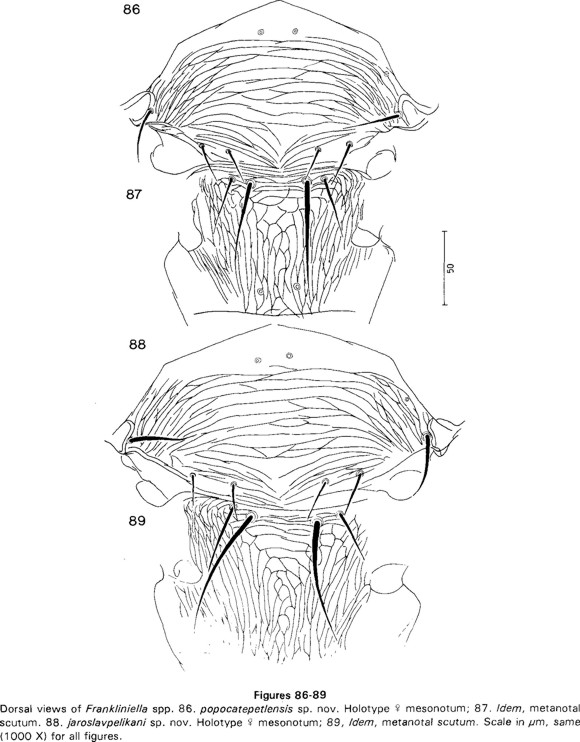
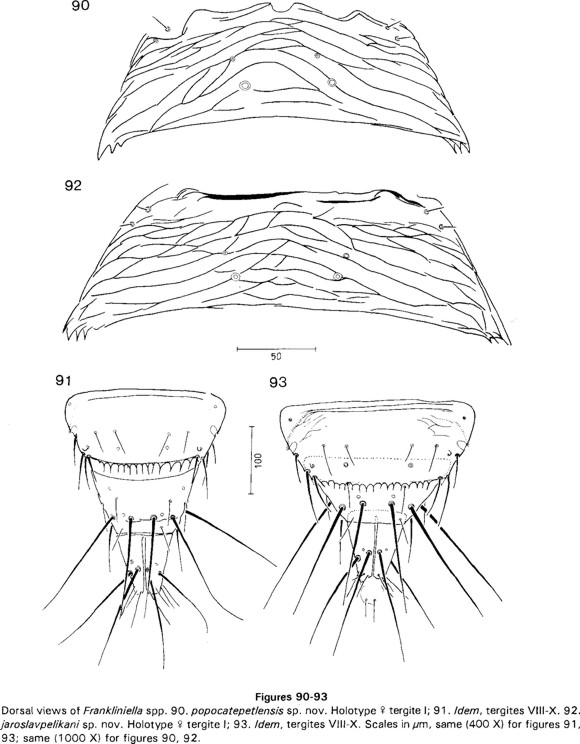
]]> Morphology. Head in dorsal aspect (Fig. 59), broader (1.21 times) than long at middle; cheeks sinuouse, broader at middle; occiput sculptured with close parallel striae, confluent at both sides. Antennal segments (Fig.69), III longer than IV and VI. Mouth-cone almost smooth, except for some faint transverse striae in fore and hind margins; four setae forming a rhombus at center, and two median subposteromarginals. Pterothorax; Mesonotum (Fig. 88); metanotal scutum (Fig. 89). Abdomen; tergite I (Fig. 92); tergites VIII-X (Fig. 93).Measurements (Holotype ♀ in μm). Body length: 1.84 mm.
Head dorsal length: 120. Width at eyes: 142, behind eyes: 140, middle: 146, basal: 140. Chaetotaxy, intocc: 62; postoc: ii16, iii 16, IV 48, v 22. Compound eyes, length: 66, width: 50. Ocelli, fore: 12, hind: 12. Antennal segments, length (width): I 30 (28), II 40 (28), III 58 (24), IV 50 (24), V 36 (20), VI 48 (20), VII 12 (8), VIII 16 (6). Thorax; pronotum, length: 154, width at middle: 204. Chaetotaxy, mjor setae: AA 74, AM 46; PA, outer: 76, inner: 84; minor setae: aa 30, am 12; pm i: 18, ii: 42, iii: 14, Mesothorax, width: 290; metathorax, width: 260. Fore wings, width at base: 110, middle: 70; veins chaetotaxy, fore: 24, hind: 17. Abdomen; width at segment IV: 328. Tergite IX setae, IX i: 142, IX ii: 154. Tergite X setae, X i: 142.
Material examined. Holotype ♀. MEXICO; DISTRITO FEDERAL: Sierra de Ajusco (Volcanic Range), km 42 on road Méx-95 Mexico City-Cuernavaca, 3000 m.; 24-I-1987; in shrubs of Senecio sp. and Bacharis sp. within Pinus Forest (Roberto M. Johansen), in IBUNAM.
Comments. Adults of Frankliniella jaroslavpelikani sp nov., are related to those of F. axochcoensis and F. nauhcampatepetlensis . However, they are different because in F. jaroslavpelikani the pronotum bears four setae at center (only two in Frankliniella axochcoensis and F. nauhcampatepetlensis). There are also differences in the metanotal scutum sculpture.
Derivatio nominis: this species is named honouring Dr. Jaroslav Pelikani, form Brno, Czech Republic, as a tribute of frienship.
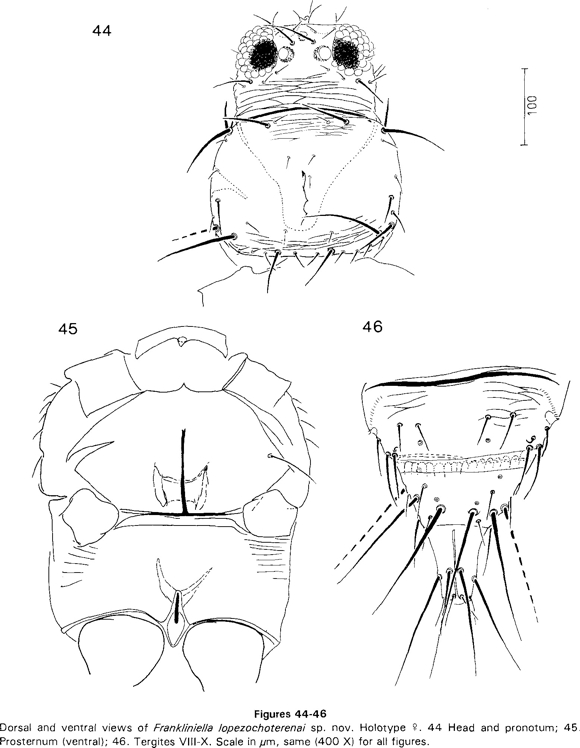
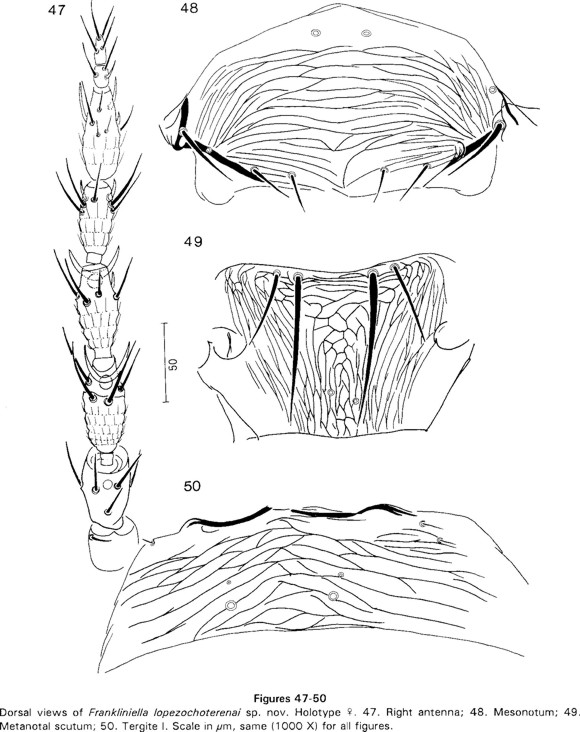
Frankliniella lopezochoterenai sp. nov.
(Figs. 44-50 (45, 46, 47, 48, 49), 94)
Female. Body color typical, except: antennal segments, II dark chestnut brown, clear in apical half; III yellow; IV yellow in basal one half, the rest dark chestnut brown; V dark chestnut brown, lighter in extreme base. All tibiae dark brown; all tarsi light brown. Ocellar crescents crimson red.
Morphology. Head in dorsal aspect (Fig. 44), broader (1.58 times) than long at middle; cheeks sinuouse. Chaetotaxy as follows: anteocellar pair I subequal in length to postocular ii-iii. Antennal segments (Fig. 47) typical. Mouth-cone longer than dorsal length of head, and projected on anterior five sixths of posternum. Pronotum (Fig. 44) broader (1.40 times) than broad at middle. Mesonotum (Fig. 48), metanotal scutum (Fig. 49); pterosternum (Fig. 45). Abdomen; tergite (Fig. 50); tergites VIII-X (Fig. 46).
]]> Measurements (Holotype ♀ in μm). Body length 1.60 mm.Head dorsal length: 100. Width at eyes: 154, behind eyes: 150, middle: 158, basal: 154. Chaetotaxy, intocc: 54; postoc: ii 18, iii 10, IV 46. Compound eyes, length: 60, width: 46. Ocelli, fore: 12, hind: 12. Antennal segments, length (width): I 26 (28), II 40 (26), III 58 (22), IV 60 (22), V 42 (20), VI 48 (20), VII 12 (8), VIII 16 (6). Thorax; pronotum, length: 152; width at middle: 214. Chaetotaxy, major setae: AA 70, AM 50; PA, outer: 76, inner: 88; minor setae: aa 16; pm i: 20, ii: 46, iii: 14. Mesothorax, width: 292, metathorax, width: 270. Fore wings veins chaetotaxy, fore: 22, hind: 18. Abdomen; width at segment IV: 378. Tergite IX setae, IX i: 40, IX ii: 150. Tergite X setae, X i: 146.
Material examined. Holotype ♀, Paratype ♀. MEXICO; MORELOS: Sierra de Tepoztlán, 17 km NE of Cuernavaca, on road Méx.-95; 21-XII-1976; by beating shrubs leaves (Alfonso N. García), in IBUNAM. ESTADO DE MEXICO: Sierra Nevada Iztacíhuatl-Popocatépetl (Volcanic Range), km 16 on road to Tlamacas, 3300 m.; 26-IV-1986 (Paratype ♀), in flowers of Senecio salignus within Pinus Forest (Roberto M. Johansen), in IBUNAM.
Comments. Adults of Frankliniella lopezochoterenai sp. nov., are similar to those of F. paricutinensis. However, in F. lopezochoterenai the postocular setae ii and iii are subequal in length, and the mesosternal plate has both anterolateral sides subequal to both posterolaterals; whereas in F. paricutinensis the postocular setae ii are longer and stouter than iii or v, and the mesosternal plate has both anteromarginal sides much longer than the posteromarginals.
Derivatio nominis: this species is named honouring the Mexican Protozoologist Dr. Eucario López-Ochoterena, as a tribute of friendship.
Frankliniella nauhcampatepetlensis sp. nov.
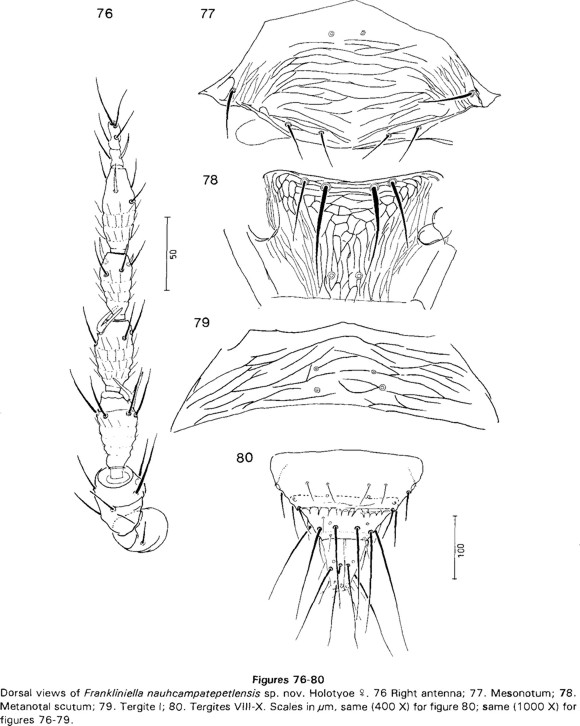
(Figs. 61-62, 76-80, 94)
Female. Body color typical, except: antennal segments, III yellowish-brown in basal two thirds, dark brown in apical one third; IV yellowish-brown. Fore tibiae yellowish-brown. All tarsi yellowish-brown. Ocellar crescents crimson red.
Morphology. Head in dorsal aspect (Fig 61), broader (1.36 times) than long at middle; cheeks sinuouse, broader at middle; occiput sculptured with close parallel striae, confluent at center and both sides. Antennal segments (Fig. 76), III longer than IV and VI. Mouth-cone shorter than head's dorsal length. Pronotum (Fig. 61), broader (1.53 times) than long at middle; almost smooth, but with some striae in anterior margin; with a setae pair at center, and another pair of median subposteromarginals. Pterothorax; mesonotum (Fig. 77); metanotal scutum (Fig. 78). Abdomen; tergite I (Fig. 79); tergites VIII-X (Fig. 80).
Measurements (Holotype ♀ in μm). Body length: 1.82 mm.
]]> Head dorsal length: 104. Width at eyes: 140, behind eyes: 138, middle: 146, basal: 140. Chaetotaxy, intocc: 50; postoc: ii 12, iii, 13, IV 40, v 22. Compound eyes, length: 60, width: 54. Ocelli, fore: 10, hind: 10. Antennal segments, length (width): I 32 (26), II 40 (26), III 58 (22), IV 46 (20), V 40 (20), VI 48 (18), VII 10 (8), VIII 16 (6). Thorax; pronotum length: 150, width at middle: 204. Chaetotaxy, major setae: AA 60, AM 46; PA, outer: 80, inner: 72; minor setae: aa 30, am 16; pm i:16, ii: 38, iii: 16. Mesothorax, width: 298; metathorax, width: 262. Fore wings, width at base: 110, middle: 64; veins chaetotaxy, fore: 22, hind: 17. Abdomen; width at segment IV: 330. Tergite IX setae, IX i: 130, IX ii: 140. Tergite X setae, X i: 138.Material examined. Holotype ♀, Paratype ♀. MEXICO; VERACRUZ: Volcanic Range, North West source of the Cofre de Perote (Nauhcampatépetl) Vulcano, 2280 m.; 8-V-1982 (Holotype ♀, in Stipa sp. grass within Pinus Forest (Roberto M. Johansen & Aurea Mojica-Guzmán), in IBUNAM. DISTRITO FEDERAL: Tlalpan, Sierra de Ajusco (Volcanic Range), km 26 on road to Toluca, 3500 m.; 17-IV-1994 (Paratype ♀), in flowers of Senecio salignus within Pinus Forest (Martha Ortega), in IBUNAM.
Comments. Adults of Frankliniella nauhcampatepetlensis sp. nov., are related to those of F. axochcoensis (see comments). However, they are different as follows: in F. nauhcampatepetlensis, the antennal segments III is yellowish brown basally, IV is yellowish brown basally; the interocellar setae are longer than the compound eyes width, and postocular setae IV; mouth-cone is shorter than head's dorsal length. In F. axochcoensis, the antennal segments III-IV are yellow basally and dark brown apically; V-VI each with a clear sub-basal ring; interocellar setae are shorter than compound eyes width, and postocular setae IV; mouth-cone is subequal to head's dorsal length.
Derivatio nominis: from Náhuatl, nauhcampatépetl, nauhcampa = square thing, with four corners or four parts, tépetl = mountain; squared mountain. From Latin, ensis = locative.
Frankliniella paricutinensis sp. nov.
Female. Body color typical, except: antennal segments, III yellow, brown in apical one fourth; IV yellow in basal one half, with two brownish sub-basal rings; V dark brown with a clear sub-basal ring. Fore tibiae yellow in apical end. All tarsi yellowish-brown.
Morphology. Head in dorsal aspect (Fig. 3), broader (1.52 times) than long at middle; cheeks sinuouse; occiput sculptured with transverse, parallel and confluent striae. Chaetotaxy as follows: interocellars (pair III) longer than eyes and subequal or longer than pronotal major anteromarginal setae; postocular ii longer and stouter than iii. Antennal segments (Fig. 16): III longest; IV and VI subequal in length. Mouth-cone longer than dorsal length of head. Pronotum (Fig. 3) almost smooth, with faint transverse and close striae in anterior one third, and some strong transverse striae in posterior margin; chaetotaxy as follows: major anteroangulars longer than anteromarginals, but shorter than posteroangulars; two minor median subposteromarginals. Pterothorax; mesonotum (Fig. 17), with open and transverse reticulation; metanotal scutum (Fig. 18); pterosternum (Fig. 8); mesosternal plate with anterolateral sides longer than posterolaterals; mesofurca and spinula strong. Tergite I (Fig. 18); tergites VII-X (Fig. 26).
Measurements (Holotype ♀ in μm). Body length: 1.62 mm.
Head dorsal length: 110. Width at eyes: 154, behind eyes: 154, middle: 168, basal: 162. Chaetotaxy, intocc: 62; postoc: ii 26, iii 16, IV 50. Compound eyes, length: 60, width: 40. Ocelli, fore: 12, hind: 16. Antennal segments; length (width): I 30 (30), II 40 (26), III 54 (22), IV 50 (22), V 40 (18), VI 50 (20), VII 12 (8), VIII 18 (6). Thorax; pronotum, length: 160; width at middle: 216. Chaetotaxy, major setae: AA 56, AM 52; PA, outer: 90, inner: 90; minor setae: aa 34, am 20, pm i 20, ii 50, iii 16. Mesothorax, width: 62; metathorax, width: 68. Fore wings, width at base: 100, middle: 68; veins chaetotaxy, fore: 20, hind: 18. Abdomen: width at segment IV: 350. Tergite IX setae, X i: 146, X ii: 160. Tergite X setae, X i: 140.
]]> Male. Virtually like adult female. Antennal segments, III yellow in basal two thirds, brown in apical one third; IV yellow in basal one half, brown in apical one half; V light brown in extreme base, the rest dark brown. All tarsi yellow.Measurements (Paratype ♂ in μm). Body length: 1.49 mm.
Head dorsal length: 102. Width at eyes: 142, behind eyes: 140, middle: 146, basal: 138. Chaetotaxy, intocc: 54; postoc: ii 18, iii 12, IV 44, v 16. Compound eyes, length: 56, width: 46. Ocelli, fore: 10, hind: 10. Antennal segments, length (width): I 24 (26), II 36 (24), III 50 (20), IV 42 (20), V 34 (18), VI 42 (16), VII 10 (6), VIII 14 (4). Thorax: pronotum, length: 124, width at middle: 186. Chaetotaxy, major setae: AA 76, AM 46; PA, outer: 60, inner: 72; minor setae; aa 30, am 16; pm i: 14, ii 46, iii 14. Mesothorax, width: 264; metathorax, width: 200. Fore wings, width at base: 96, middle: 56; veins chaetotaxy, fore: 21, hind: 17. Abdomen; width at segment IV: 214. Tergite IX setae, IX i: 32, IX ii: 98. Tergite X setae, X i: 110.
Material examined. Holotype ♀; paratypes: 10 ♀♀, 2 ♂♂, MEXICO; MICHOACAN: (Volcanic Range), 5 km N of Paricutín Volcano, 2190 m.; 2-XII-1991; (Holotype ♀), in Muhlenbergia sp. grass (Roberto M. Johansen & Aurea Mojica-Guzmán), in IBUNAM. ESTADO DE MEXICO: Sierra Nevada Iztacíhuatl-Popocatépetl (Volcanic Range), km 16 on road to Tlamacas 3300 m.; 26-X-1985 (Paratype ♂) in Muhlenbergia macroura within Pinus Forest (María Luisa Montes de Oca & R. M. Johansen), in IBUNAM; Idem et Ibidem, 23-XI-1985 (Paratype ♀), in Muhlenbergia macruora within Pinus Forest (Ma. Luisa Montes de Oca & R. M. Johansen), in IBUNAM. Idem, km 14 on road to the Nevado de Toluca Volcano (Volcanic Range), 3680 m.; 25-I-1987 (Paratype ♀), in flowers of Senecio salignus within Pinus Forest (R. M. Johansen), in IBUNAM. DISTRITO FEDERAL: Sierra de Ajusco (Volcanic Range), km 42 on road Méx-95 México City-Cuernavaca, 3000 m.; 24-I-1987 (paratypes: 5 ♀♀) in Bacharis and Senecio shrubs within Pinus Forest (R. M. Johansen), in IBUNAM; Idem et Ibidem, 20-III-1987 (Paratype ♀), in flowers of Senecio salignus within Pinus Forest (R. M. Johansen), in IBUNAM; Idem et Ibidem, 30-X-1987 (Paratype ♂), in Muhlenbergia sp. within Pinus Forest (R. M. Johansen), in IBUNAM; Idem et Ibidem, 21-XI-1987 (paratypes: 2 ♀♀), in Muhlenbergia sp. within Pinus Forest (R. M. Johansen), in IBUNAM.
Comments. Adults of Frankliniella paricutinensis sp. nov., are related to those of F. carmenmendietae, because both share the following characters: the pronotal median transverse setae row, the subposteromarginal median setae pair, and the mesosternal plate general outline. However, they are different because in F. paricutinensis the anteocellar setae (pairs I-II) are shorter than postocular ii; the pronotal posteromarginal setae ii are 2.5 times longer and more stout than i; the mesonotum has the transverse striae more open at center; the metanotal scutum has more equiangular polygonal reticulation in anterior one third, whereas in F. carmenmendietae the anteocellar setae (pairs I-II) are longer and stouter than postocular ii; the pronotal posteromarginal setae ii are shorter: 2.0 times longer than i; the mesonotum has closer transverse striae at center; the metanotal scutum has only transverse elongate polygonal reticulation.
Derivation nominis: from the Phorhépecha languaje of Michoacán, México: parhíkutini = on the other side, the name of a famous Volcano, which destroyed a town with the same name in 1943, according to Velazquez-Gallardo (1988).
Frankliniella popocatepetlensis sp. nov.
Female. Body color typical, except: antennal segments, III yellow in basal one third, the rest dark brown; IV light brown in basal one third, dark brown; V dark brown, with a lighter sub-basal ring. Fore tibiae yellowish-brown. Fore tarsi yellow; median and hind tarsi light brown. Ocellar crescents crimson red.
Morphology. Head in dorsal aspect (Fig. 58), broader (1.72 times) than long at middle; cheeks slightly sinuouse, broader at eyes and middle, occiput sculptured with close parallel striae, confluent at middle and both sides. Antennal segments (Fig. 67), III longer than IV and VI. Mouth-cone longer than head's dorsal length. Pronotum (Fig. 58), almost smooth, but with some faint transverse striae in anterior one third and near posterior margin; with four setae forming an open curve and center, and with a median pair of subposteromarginals. Pterothorax; mesonotum (Fig. 86); metanotal scutum (Fig. 87). Abdomen; tergite I (Fig. 90); tergites VIII-X (Fig. 91).
]]> Measurements (Holotype ♀ in μm). Body length: 1.62 mm.Head dorsal length: 86. Width at eyes: 146, behind eyes: 142, middle: 148, basal: 140. Chaetotaxy, intocc: 50; postoc: ii 20, iii 12, IV 42, v 16. Compound eyes, length: 50, width: 40. Ocelli, fore: 12, hind: 10. Antennal segments, length (width): I 28 (28), II 40 (24), III 54 (22), IV 44 (22), V 38 (18), VI 50 (18), VII 10 (8), VIII 14 (6). Thorax; pronotum, length: 156, width at middle: 200. Chaetotaxy, major setae: AA 62, AM 58; PA, outer: 80, inner: 76; minor setae; aa 28, am 16; pm i: 16, ii: 36, iii: 16. Mesothorax, width: 268; metathorax; width: 238. Fore wings, width at base: 102, middle: 60; veins chaetotaxy, fore: 25, hind: 16. Abdomen; width at segment IV: 280. Tergite IX setae, IX i: 126, IX ii: 142. Tergite X setae, X i: 130.
Material examined. Holotype ♀. MEXICO; ESTADO DE MEXICO: Sierra Nevada Iztacíhuatl-Popocatépetl (Volcanic Range), km 16 on road to Tlamacas, 3300 m.; 26-X-1985; in Muhlenbergia macroura within Pinus Forest (María Luisa Montes de Oca & Roberto M. Johansen), in IBUNAM.
Comments. Adults of Frankliniella popocatepetlensis sp. nov., are related to those of F. carmenmendietae. However, they are different in the following characters: in F. popocatepetlensis the pronotum has four setae forming an open curve at center; the metanotal scutum has some close transverse polygons in anterior one sixth, and by large equiangular polygons, followed by elongate reticulation in posterior one half, but with some equiangular polygons at base in F. carmenmendietae, the pronotum has one setae at center; the metanotal scutum is scuptured with tranverse poligons in anterior one third, followed by elongate reticulation in posterior two thirds.
Derivatio nominis: From Náhuatl, popoca tépetl: popoca = to smoke, tépetl = mountain, the smoking mountain, according to Macazaga-Ordoño (1979).
Frankliniella vulcanorizabaensis sp. nov.
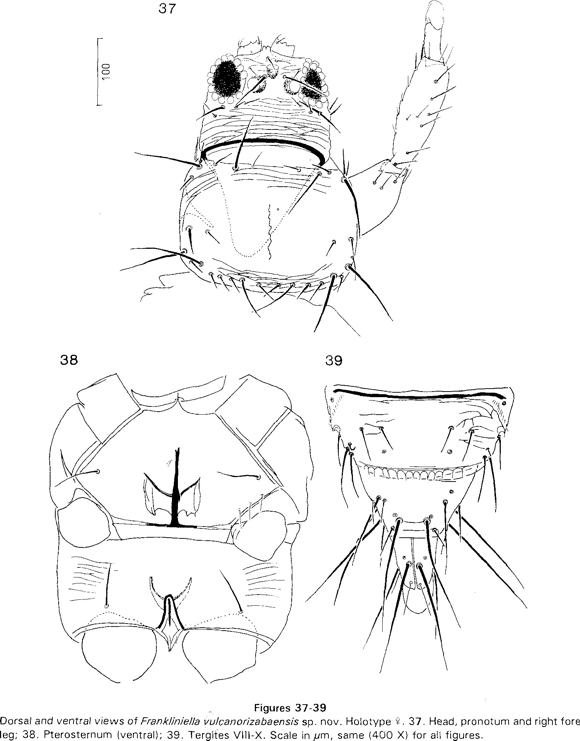
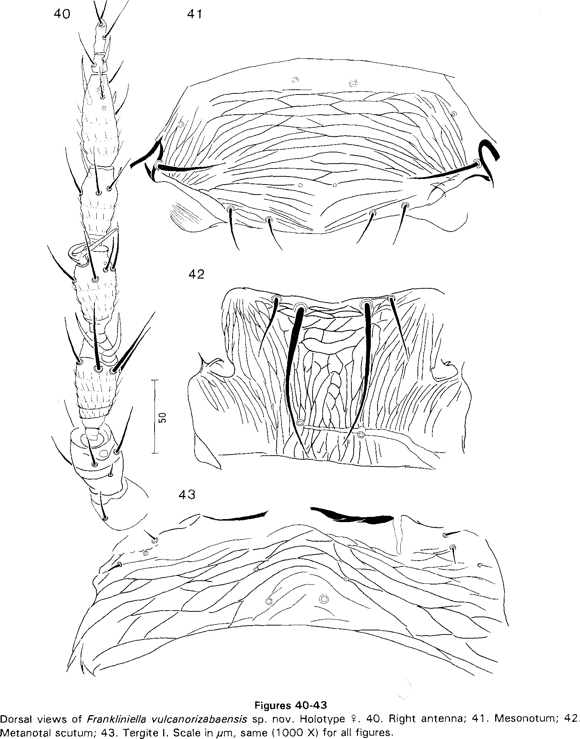
(Figs. 37-43 (38, 39, 40, 41, 42), 94)
Female. Body color typical, except: antennal segments, III yellow in basal one third, the rest dark chestnut brown; V dark chestnut brown, lighter in extreme base. All tibiae brown. All tarse yellow. Ocellar crescents crimson red.
Morphology. Head in dorsal aspect (Fig. 37), broader (1.38 times) than long at middle; cheeks slightly sinuouse. Chaetotaxy as follows: anteocellar setae (pair I) longer than those of pair II, and subequal in length to postocular ii-iii. Antennal segments (Fig. 40) typical. Mouth-cone longer than head's dorsal length, and projected on anterior four fifths of posternum. Pronotum (Fig. 37) broader (1.43 times) than long at middle. Mesonotum (Fig. 41); metanotal scutum (Fig. 42); pterosternum (Fig. 38). Abdomen; tergite I (Fig. 43); tergites VIII-X (Fig. 39).
Measurements (Holotype ♀ in μm). Body length: 1.39 mm.
]]> Head dorsal length: 118. Width at eyes: 154, behind eyes: 156, middle: 164, basal: 160. Chaetotaxy, intocc: 60; postoc: ii 18, iii 16, IV 42. Compound eyes, length: 64, width: 50. Ocelli, fore: 14, hind, 16. Antennal segments, length (width): I 30 (32), II 38 (26), III 60 (24), IV 48 (24), V 46 (20), VI 50 (20), VII 12 (8), VIII 16 (6). Thorax; pronotum, length: 160; width at middle: 230. Chaetotaxy as follows: major setae: AA 80, AM 60; pm, outer: 90, inner: 94; minor setae: aa 32, am 22; pm i: 20, ii: 54, iii: 20. Mesothorax, width: 360; metathorax, width: 333. Fore wings, width at base: 104, middle: 60; veins chaetotaxy, fore: 21, hind: 17. Abdomen; width at segment IV: 378. Tergite IX setae, IX i: 150, IX ii: 148. Tergite X setae, X i: 146.Male. Virtually like adult female, except: antennal segments, III yellow in basal one half, the rest dark brown; IV yellowish-brown in extreme base, the rest darl brown. All tarsi ligth brown.
Measurements (Paratype ♂ in μm). Body length: 1.21 mm.
Head dorsal length: 92. Width at eyes: 128, behind eyes: 132, middle: 148, basal: 148. Chaetotaxy, intocc: 52; postoc: ii 28, iii 12, IV 40, v 16. Compound eyes, length: 52, width: 40. Ocelli, fore: 10, hind: 10. Antennal segments, length (width): I 22 (24), II 36 (22), III 48 (18), IV 40 (18), V 34 (16), VI 46 (16), VII 10 (8), VIII 12 (4). Thorax; pronotum, length: 128, width at middle: 180. Chaetotaxy, major setae: AA 60, AM 52; PA, outer: 58, inner: 64; minor setae: aa 24, am 12; pm i: 14, ii: 30, iii: 14. Mesothorax, width: 230; metathorax, width: 216. Fore wings, width at base: 80, middle: 48; veins chaetotaxy, fore: 20, hind: 14. Abdomen; width at segment IV: 228. Tergite IX setae, IX i: 34, IX ii: 32. Tergite X setae, X i: 110.
Material examined. Holotype ♀; paratypes: 2 ♀♀, 1 ♂. MEXICO; VERACRUZ: Sierra Madre Oriental-Volcanic Range, km 124 on road Méx-150, 1990 m.; 21-I-1997 (Holotype ♀, Paratype ♀), by beating herbaceus within Quercus-Pinus Forest (Ernesto Barrera), in IBUNAM. ESTADO DE MEXICO: Sierra de Ajusco (Volcanic Range), km 44 on road Méx-142 Xochimilco-Oaxtepec, 2680m.; 3-X-1985 (Paratype ♀), in Muhlenbergia macroura within Pinus-Quercus Forest (María Luisa Montes de Oca & Roberto M. Johansen, in IBUNAM; Idem, Volcanic Range, on road to the Nevado de Toluca Volcano, 3480 m.; (Paratype ♂), in Muhlenbergia sp. within Pinus Forest (María Luisa Montes de Oca & Roberto M. Johansen), in IBUNAM.
Comments. Adults of Frankliniella vulcanorizabaensis sp. nov., are related to those of the species lacking pronotal setae at center: F. exiguavulcanoperotensis, F. festucavulcanica, and F. vulcanotolucensis. However, F. vulcanorizabaensis is different because it lacks any pronotal subposteromarginal setae.
Derivatio nominis: from Latin, vulcano = volcano. From Náhuatl, Orizaba, a city and a near volcano (Aulizaba, Aulicaba, Ulizaba, Olizaba), Ahuilliz-apan, ahuilizita = to expend wastefully the wealth, apan = river; " the place of ruined man, because of wastefully expend". From Latin, ensis = locative. From the Pico de Orizaba Volcano.
Frankliniella vulcanoperotensis sp. nov.
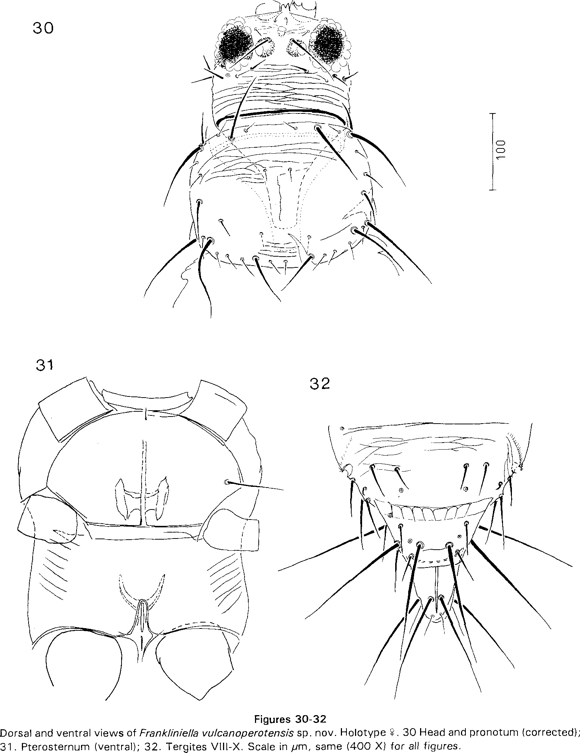
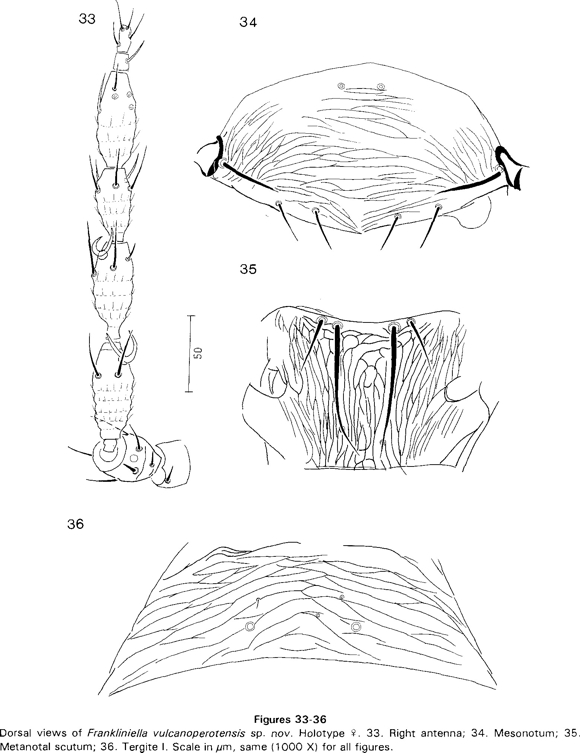
(Figs. 30-36 (31, 32, 33, 34, 35), 94)
Female. Body color typical, except: antennal segments, III yellow; IV yellow in basal one half, the rest dark brown. Fore tibiae yellowish-brown. All tarsi yellow. Ocellar crescents crimson red.
]]> Morphology. Head in dorsal aspect (Fig. 30), broader (1.34 times) than long at middle; cheeks slightly sinuouse. Chaetotaxy as follows: postocular setae ii subequalin length to IV. Antennal segments (Fig. 33) typical. Mouth-cone longer than head's dorsal length, projected on anterior three fourths of prosternum. Pronotum (Fig. 30) broader (1.25 times) than long at middle. Mesonotum (Fig. 34); metanotal scutum (Fig. 35); pterosternum (Fig. 31). Abdomen; tergite I (Fig. 36); tergites VIII-X (Fig. 32).Measurements (Holotype ♀ in μm). Body length 1.45 mm.
Head dorsal length: 110. Width at eyes: 150, behind eyes: 148, middle: 154, basal: 150. Chaetotaxy, intocc: 54; postoc: ii 22, iii 10, IV 46, v 20. Compound eyes, length: 60, width: 40. Ocelli, fore: 12, hind: 10. Antennal segments, length (width): I 30 (28), II 36 (26), III 58 (22), IV 50 (22), V 40 (20), VI 52 (20), VII 10 (8), VIII 12 (6). Thorax; pronotum, length: 164; width at middle: 202. Chaetotaxy as follows: major setae: AA 84, AM 70; PM, outer: 92, inner: 96; minor setae: aa 34, am 16; pm i: 16, ii: 56, iii: 16. Mesothorax, width: 268; metathorax, width: 242. Abdomen; width at segment IV: 315. Tergite IX setae, IX i: 134, IX ii: 144. Tergite X setae, X i: 124.
Male. Virtually like adult female, except: antennal segment IV light brown in basal one half, the rest dark brown. All tarsi yellowish brown.
Measurements (Paratype ♂ in μm). Body length: 1.54 mm.
Head dorsal length: 106. Width at eyes, behind eyes: 134, middle: 140, basal: 130. Chaetotaxy, intocc: 50; postoc: ii 18, iii 12, IV 40, v 16. Compound eyes, length: 50, width: 40. Ocelli, fore: 10, hind: 10. Antennal segments, length (width): I 24 (26), II 34 (22), III 48 (20), IV 40 (18), V 32 (18), VI 44 (18), VII 8 (8), VIII 14 (6). Thorax; pronotum, length: 124, width at middle: 178. Chaetotaxy, major setae: AA 72, AM 60; PA, outer: 66, inner: 74; minor setae: aa 28, am 12; pm i: 16, ii: 54, iii: 14. Mesothorax, width: 242; metathorax, width: 224. Fore wings, width at base: 90, middle: 52; veins chaetotaxy, fore: 19, hind: 16. Abdomen; width at segment IV: 230. Tergite IX setae, IX i: 32, IX ii: 102. Tergite X setae, X i: 110.
Material examined. Holotype ♀, paratypes: 1 ♀, 1 ♂. MEXICO; VERACRUZ: Volcanic Range, near summit of the Cofre de Perote Volcano, 4100 m.; 7-IX-1977 (Holotype ♀), in flowers of Asteraceae (Roberto M. Johansen), in IBUNAM. ESTADO DE MEXICO: Volcanic Range, on road to the Nevado de Toluca Volcano, 3680 m.; 21-III-1987 (Paratype ♀), in flowers of Senecio salignus within Pinus Forest (R. M. Johansen), in IBUNAM; Idem et Ibidem, 3480 m.; 27-VII-1987 (Paratype ♂), in Muhlenbergia sp. within Pinus Forest (María Luisa Montes de Oca & R. M. Johansen), in IBUNAM.
Comments. Adults of Frankliniella vulcanoperotensis sp. nov., share the character of pronotal chaetotaxy (median transverse setae row), with those of Frankliniella axochcoensis, F. carmenmendietae, F. copilcoensis, F. lopezochoterenai, and F. paricutinensis. However, it is different from them, because the mesosternal plate has a broad curved anterior margin (hexagonal in the other species); the tergite VIII has the posteromarginal comb with sparse microtrichia.
Derivatio nominis: from Latin, vulcano = volcano, from Spanish, Pero, Pedro, Perote = big Pero or Pedro (nick name of Pero or Pedro), the name of a city and near volcano; Latín, ensis = locative.
Frankliniella vulcanotolucensis sp. nov.
]]> (Fig. 51-57 (52, 53, 54, 55, 56), 94)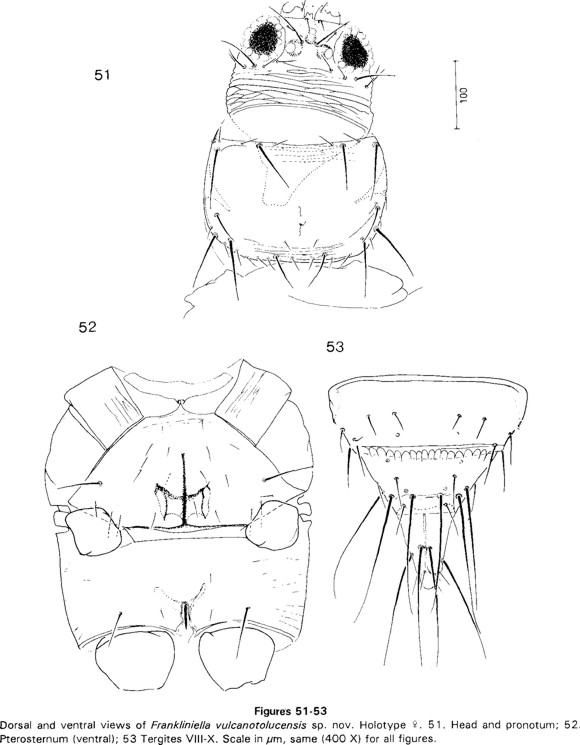
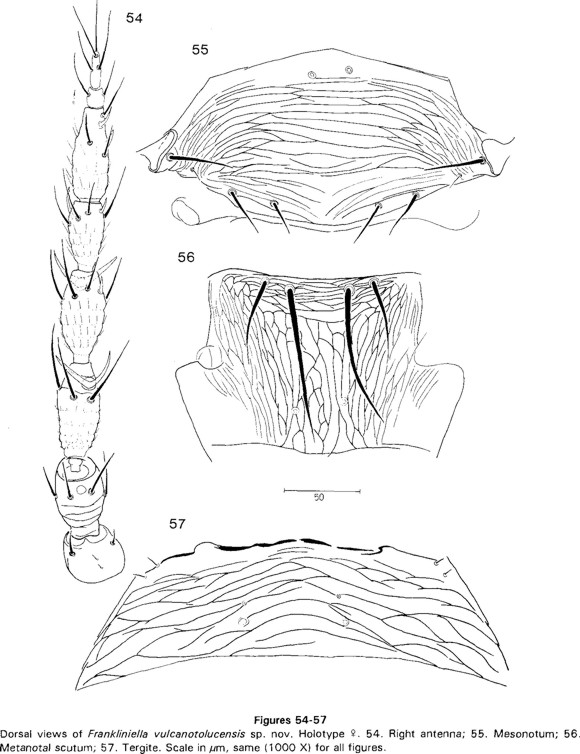
Female. Body color typical, except: antennal segments, III yellow in basal two thirds, the rest dark brown; IV yellow in basal one half, the rest dark brown; V light brown in extreme base, the rest ddark brown. Fore tibiae yellowish-brown. All tarsi yellow. Ocellar crescents crimson red.
Morphology. Head in dorsal aspect (Fig. 51), broader (1.54 times) than long at middle; cheeks very slightly sinuouse, giving the head a trapezoidal outline; occiput sculptured with close transverse and parallel sriae, which become confluent at middle and sides; there is a stronger transverse line at middle. Antennal segments (Fig. 54), III longer than IV and VI. Mouth-cone shorter than head's dorsal length. Pronotum (Fig. 51), almost smooth, but with some faint transverse striae in anterior and posterior margins; without setae at center, but with a median pair of subposteromarginals. Pterothorax; mesonotum (Fig. 55); metanotal scutum (Fig. 56). Abdomen; tergite I (Fig. 57); tergites VIII-X (Fig. 53).
Measurements (Holotype ♀ in μ). Body lenght: 1.81 mm.
Head dorsal length: 110. Width at eyes: 160, behind eyes: 158, middle: 170, basal: 168. Chaetotaxy, intocc: 62; postoc: ii 24, iii 16, IV 48, v 22. Compound eyes, length: 60, width: 46. Ocelli, fore: 12, hind: 10. Antennal segments, length (width): I 30 (30), II 42 (26), III 56 (24), IV 48 (24), V 38 (20), VI 50 (20), VII 12 (10), VIII 18 (6). Thorax; pronotum, length: 146, width at middle: 220. Chaetotaxy, major setae: AA 66, AM 52; PA, outer: 70, inner: 70; minor setae: aa 26, am 16; pm i: 14, ii: 46, iii: 16. Mesothorax, width: 334; metathorax, width: 298. Fore wings, width at base: 116, middle: 70; veins chaetotaxy, fore: 22, hind: 18. Abdomen; width at segment IV: 346. Tergite IX setae, IX i: 150, IX ii: 156. Tergite X setae, X i: 150.
Material examined. Holotype ♀, Paratype ♂. MEXICO; ESTADO DE MEXICO: Volcanic Range, on road to the Nevado de Toluca Volcano, 3480 m.; 25-I-1987 (Holotype ♀), in Muhlenbergia sp. within Pinus Forest (María Luisa Montes de Oca & Roberto M. Johansen), in IBUNAM. DISTRITO FEDERAL: Volcanic Range, Sierra de Ajusco, km 42 on road Méx-95 (México City-Cuernavaca), 3000 m.; 25-IX-1987 (Paratype ♀), in Muhlenbergia sp. within Pinus Forest (R. M. Johansen), in IBUNAM.
Comments. Adults of Frankliniella vulcanotolucensis sp. nov., share the character of the pronotum without any setae at center, with those of F. exiguavulcanoperotensis, F. festucavolcanica, and F. vulcanorizabaensis. However, F. vulcanorizabaensis lacks the pronotal median subposteromarginal setae. Furthermore, F. vulcanotolucensis is different of F. exiguavulcanoperotensis and F. festucavolcanica, in the following characters: the head with a dorsal trapezoidal outline; the mouth-cone shorter than head's dorsal length; the anteocellar setae (pairs I-II) longer than one ocellar diameter; the interocellar (pair III) long (4.0 times of an ocellar diameter); antennal segment III longer than VI. Alternativelly, in F. exiguavulcanoperotensis and F. festucavolcanica, the head has sinuouse cheeks (broader at middle); the mouth-cone is longer than head's dorsal length; the anteocellar setae (pairs I-II) are shorter to subequal than one ocellar diameter; the interocellar setae (pair III) are moderatelly long (2.5-3.3 times of an ocellar diameter); antennal segment III is slightly shorter than VI.
Derivatio nominis: from Latin, vulcano = volcano, ensis = locative; from Náhuatl, Tolocan, Tollocan = the place of the stoop down head; a city and a close volcano, in the State of México, according to Macazaga (1979).
Geografic distribution
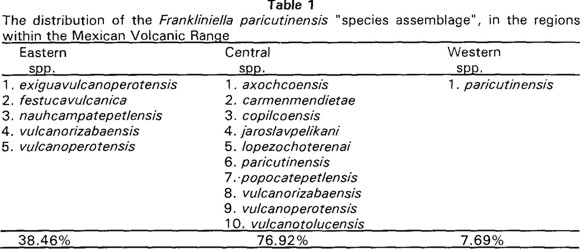
From a preliminary point of view, the Frankliniella paricutinensis "species assemblage" has a recent distribution in Mexico, mainly in the Volcanic Range (Fig. 94), 1990-4100 m. In this last sense the lowest recorder altitude: 1990 m. is for the species F. vulcanorizabaensis in the Sierra Negra, where the Volcanic Range is intruded in the Sierra Madre Oriental. The highest recorded altitude (4100 m.) is for the species Frankliniella festucavolcanica, and also for F. vulcanoperotensis at the Cofre de Perote (Nauhcampatépetl) Volcano; the mein between both altitude extremes is 3226 m. Furthermore, Table 1 shows that the Central Region of the Mexican Volcanic Range (Distrito Federal, Estado de México, and Estado de Morelos) ranks as the first in the species number (10), and with a 76.92%; whereas the Eastern Region (state of Puebla, and state of Veracruz) has the second place with five species (38.46%); the Western Region only has one recorded species (7.69%).
]]>
Another interesting distributional fact, is that while the Frankliniella desertileonidum species assemblage is mainly distributed in the Sierra Madre Oriental (with one species: Frankliniella desertileonidum in the Volcanic Range), the F. paricutinensis species assemblage is mainly distributed in the Volcanic Range (with one species: F. vulcanorizabaensis shared with the Sierra Madre Oriental), The above information is the only available up to the present time.
Some ecologic data
Up the present time, only adults of the species in the Frankliniella paricutinensis species assemblage are know. They live within Quercus-Pinus forests, in litter (pupation site ?), herbaceus, Poaceae, and Asteraceae flowers, but also in Alpine grassiand of Festuca sp.
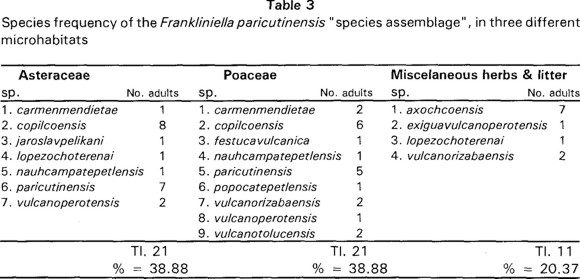
Table 3 shows that nine species with 21 adult individuals (38.88%) of the total recorder adults, were sampled in Poaceae with floral structures (mainly Muhlenbergia macroura).
Perharps some of these specimens are incidental visitors carryed by winds (which are frequent at high altitudes). The Asteraceae flowers, ranked in the second place with seven species, and 21 adult indivuduals, but giving the same porcentage (38.88%) as in the Poaceae.
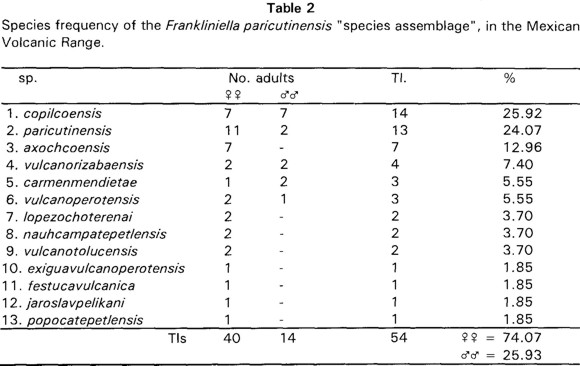
Species within the Frankliniella paricutinensis "species assemblage", are flower dwellers, as shown in my samples. Only four species represented by four adult individuals (20.37%) were sampled by beating herbaceus, and by the Berlese funnel extraction method of litters. Concerning with the species frequency, the species Frankliniella copilcoensis and F. paricutinensis ranked as the most abundant (25.92 and 24.08% respectivelly), followed by: F. axochcoensis (12.96%), F. vulcanorizabaensis (7.40%), F. carmenmendietae, and F. vulcanoperotensis (each with 5.55%). All these six species are known in the bisexual condition.
Since the considered data only included adult samples of all the material found in the IBUNAM Collections, the species frequency as shown in Table 2 has a preliminary basis. It is interesting to say here, that the samplings of the species Frankliniella lopezochoterenai, F. paricutinensis and F. popocatepetlensis in the area of the Sierra Nevada (Iztacíhuatl-Popocatépetl volcanoes), were carryed out monthly during the year 1985, that is nine years before the start of the great volcanic activity of the Popocatépetl Volcano started in december, 1994 to date.
]]>
AKNOWLEDGEMENTS
The author is very gratefull with the following colleagues all from the Instituto de Biología, UNAM., for their valuable participation in this work: María del Carmen Mendieta Sevilla († 1986) for her collections in the Pedregal de San Angel, México, D. F.; María Luisa Montes de Oca, for her valuable collections in many places of the Volcanic Range; Martha Ortega C. and Alfonso N. García for their collections at the Sierra de Ajusco, Distrito Federal and Morelos; Ernesto Barrera Vargas for his collection of Frankliniella vulcanorizabaensis at the Sierra Negra; Javier García-Figueroa and Lucio Rivera Trujillo helped me many times during the many Volcanic Range expeditions. An special thanks is given to Aurea Mojica-Guzmán, for all his devote field and laboratory work.
LITERATURE CITED
Johansen, R. M. 1998. The mexican Frankliniella desertileonidum Watson species assemblage, in the "Intonsa Group" (Insecta, Thysanoptera: Thripidae). Acta Zool. Mex. (n.s.), 75: 143-161. [ Links ]
Macazaga-Ordoño, C. 1979. Nombres geográficos de México. Editorial Inovación, Mexico, D.F., 190 pp + 11 maps. [ Links ]
Mayr, E. & P.P. Ashlock, 1991. Principles of Systematic Zoology, 2nd Ed. Mc Graw Hill, Inc., New York: 476 pp. [ Links ]
Moulton, D., 1948. The genus Frankliniella Karny, with keys for the determination of species (Thysanoptera). Revista de Entomología (Río de Janeiro), 19(1-2): 55-114. [ Links ]
Mound, L.A. & R. Marullo, 1996. The thrips of Central and South America: An introduction (Insecta: Thysanoptera). Memoirs on Entomology, International, Vol. 6: 1-487. [ Links ]
Nakahara, S., 1997. Annotated list of the Frankliniella species of the World (Thysanoptera: Thripidae). Contributions on Entomology, International, 2(4): 355-389. [ Links ]
Sakimura, K. & K. O'Neill, 1979. Frankliniella, redefinition of genus and revision of Minuta Group Species (Thysanoptera: Thripidae). U.S.D.A. Tech. Bull. No. 1572: 1-49. [ Links ]
Velásquez-Gallardo, P. 1988. Diccionario de la Lengua Phorhépecha. Fondo de Cultura Económica, México, 226 pp. [ Links ]
Watson, J.R. 1942. Two new Frankliniella from Mexico (Thysanoptera). The Florida Entomologist, 25 (3): 43-46. [ Links ]
]]>