<?xml version="1.0" encoding="ISO-8859-1"?><article xmlns:mml="http://www.w3.org/1998/Math/MathML" xmlns:xlink="http://www.w3.org/1999/xlink" xmlns:xsi="http://www.w3.org/2001/XMLSchema-instance">
<front>
<journal-meta>
<journal-id>0036-3634</journal-id>
<journal-title><![CDATA[Salud Pública de México]]></journal-title>
<abbrev-journal-title><![CDATA[Salud pública Méx]]></abbrev-journal-title>
<issn>0036-3634</issn>
<publisher>
<publisher-name><![CDATA[Instituto Nacional de Salud Pública]]></publisher-name>
</publisher>
</journal-meta>
<article-meta>
<article-id>S0036-36342014000200006</article-id>
<title-group>
<article-title xml:lang="en"><![CDATA[Clinical and epidemiological features of extrapulmonary tuberculosis in a high incidence region]]></article-title>
<article-title xml:lang="es"><![CDATA[Características clínicas y epidemiológicas de la tuberculosis extrapulmonar en una región de alta incidencia]]></article-title>
</title-group>
<contrib-group>
<contrib contrib-type="author">
<name>
<surname><![CDATA[Pérez-Guzmán]]></surname>
<given-names><![CDATA[Carlos]]></given-names>
</name>
<xref ref-type="aff" rid="A01"/>
</contrib>
<contrib contrib-type="author">
<name>
<surname><![CDATA[Vargas]]></surname>
<given-names><![CDATA[Mario H]]></given-names>
</name>
<xref ref-type="aff" rid="A02"/>
<xref ref-type="aff" rid="A03"/>
</contrib>
<contrib contrib-type="author">
<name>
<surname><![CDATA[Arellano-Macías]]></surname>
<given-names><![CDATA[María del Rosario]]></given-names>
</name>
<xref ref-type="aff" rid="A01"/>
</contrib>
<contrib contrib-type="author">
<name>
<surname><![CDATA[Hernández-Cobos]]></surname>
<given-names><![CDATA[Silvia]]></given-names>
</name>
<xref ref-type="aff" rid="A01"/>
</contrib>
<contrib contrib-type="author">
<name>
<surname><![CDATA[García-Ituarte]]></surname>
<given-names><![CDATA[Aurea Zelindabeth]]></given-names>
</name>
<xref ref-type="aff" rid="A01"/>
</contrib>
<contrib contrib-type="author">
<name>
<surname><![CDATA[Serna-Vela]]></surname>
<given-names><![CDATA[Francisco Javier]]></given-names>
</name>
<xref ref-type="aff" rid="A01"/>
</contrib>
</contrib-group>
<aff id="A01">
<institution><![CDATA[,Secretaría de Salud del Estado de Aguascalientes  ]]></institution>
<addr-line><![CDATA[ Aguascalientes]]></addr-line>
<country>México</country>
</aff>
<aff id="A02">
<institution><![CDATA[,Instituto Nacional de Enfermedades Respiratorias  ]]></institution>
<addr-line><![CDATA[México DF]]></addr-line>
<country>México</country>
</aff>
<aff id="A03">
<institution><![CDATA[,Instituto Mexicano del Seguro Social Centro Médico Nacional Siglo XXI Hospital de Pediatría]]></institution>
<addr-line><![CDATA[México DF]]></addr-line>
<country>México</country>
</aff>
<pub-date pub-type="pub">
<day>00</day>
<month>04</month>
<year>2014</year>
</pub-date>
<pub-date pub-type="epub">
<day>00</day>
<month>04</month>
<year>2014</year>
</pub-date>
<volume>56</volume>
<numero>2</numero>
<fpage>189</fpage>
<lpage>196</lpage>
<copyright-statement/>
<copyright-year/>
<self-uri xlink:href="http://www.scielo.org.mx/scielo.php?script=sci_arttext&amp;pid=S0036-36342014000200006&amp;lng=en&amp;nrm=iso"></self-uri><self-uri xlink:href="http://www.scielo.org.mx/scielo.php?script=sci_abstract&amp;pid=S0036-36342014000200006&amp;lng=en&amp;nrm=iso"></self-uri><self-uri xlink:href="http://www.scielo.org.mx/scielo.php?script=sci_pdf&amp;pid=S0036-36342014000200006&amp;lng=en&amp;nrm=iso"></self-uri><abstract abstract-type="short" xml:lang="en"><p><![CDATA[Objective. To describe the clinical features of extrapulmonary tuberculosis (EXPTB) and to evaluate epidemiological data to search for potential explanations for its high frequency in the state of Aguascalientes, Mexico. Materials and methods. Clinical records of all patients with tuberculosis seen in Aguascalientes in 2008 were reviewed, and official databases were analyzed. Results. EXPTB comprised 60.5% of the 86 cases evaluated, being lymph nodes the main site affected. Patients with EXPTB were younger and more obese than subjects with pulmonary tuberculosis (PTB). One third of cases in either group had diabetes, a frequency much higher than expected. Epidemiological analysis showed that PTB incidence, but not EXPTB incidence, decreases as geographical altitude increases, and had a descendent trend from 1997 to 2011. Conclusions. The lower frequency of PTB (due to its inverse relationship with altitude and its descendent trend in last years) might explain the high frequency of EXPTB. Obesity appeared to protect against developing pulmonary involvement, and diabetes was more frequent than expected among PTB and EXPTB cases.]]></p></abstract>
<abstract abstract-type="short" xml:lang="es"><p><![CDATA[Objetivo. Describir las características clínicas de la tuberculosis extrapulmonar (TBEXP) y evaluar datos epidemiológicos para buscar posibles explicaciones de su alta frecuencia en Aguascalientes, México. Material y métodos. Se revisaron expedientes de todos los pacientes con tuberculosis atendidos en Aguascalientes en 2008 y se analizaron bases de datos oficiales. Resultados. La TBEXP constituyó 60.5% de los 86 casos evaluados, con afectación más común en ganglios linfáticos. Los pacientes con TBEXP fueron más jóvenes y más obesos que aquéllos con tuberculosis pulmonar (TBP). Un tercio de cada grupo tenía diabetes, una frecuencia muy superior a la esperada. El análisis epidemiológico mostró que la incidencia de TBP, pero no de TBEXP, es menor conforme aumenta la altitud geográfica y además está disminuyendo (l997-2011). Conclusiones. La menor incidencia de TBP (por su relación inversa con la altitud y por su tendencia a disminuir en los últimos años) podría explicar la alta frecuencia de TBEXP. La obesidad parece proteger contra la afectación pulmonar, y la diabetes fue más frecuente de lo esperado tanto en TBP como en TBEXP.]]></p></abstract>
<kwd-group>
<kwd lng="en"><![CDATA[Mycobacterium]]></kwd>
<kwd lng="en"><![CDATA[epidemiology]]></kwd>
<kwd lng="en"><![CDATA[demography]]></kwd>
<kwd lng="en"><![CDATA[obesity]]></kwd>
<kwd lng="en"><![CDATA[diabetes mellitus]]></kwd>
<kwd lng="en"><![CDATA[Mexico]]></kwd>
<kwd lng="es"><![CDATA[Mycobacterium]]></kwd>
<kwd lng="es"><![CDATA[epidemiología]]></kwd>
<kwd lng="es"><![CDATA[demografía]]></kwd>
<kwd lng="es"><![CDATA[obesidad]]></kwd>
<kwd lng="es"><![CDATA[diabetes mellitus]]></kwd>
<kwd lng="es"><![CDATA[México]]></kwd>
</kwd-group>
</article-meta>
</front><body><![CDATA[  	    <p align="justify"><font face="verdana" size="4">Art&iacute;culo original</font></p>  	    <p align="justify"><font face="verdana" size="2">&nbsp;</font></p>  	    <p align="center"><font face="verdana" size="4"><b>Clinical and epidemiological features of extrapulmonary tuberculosis in a high incidence region</b></font></p>  	    <p align="center"><font face="verdana" size="2">&nbsp;</font></p>  	    <p align="center"><font face="verdana" size="3"><b>Caracter&iacute;sticas cl&iacute;nicas y epidemiol&oacute;gicas de la tuberculosis extrapulmonar en una regi&oacute;n de alta incidencia</b></font></p>  	    <p align="center"><font face="verdana" size="2">&nbsp;</font></p>  	    <p align="center"><font face="verdana" size="2"><b>Carlos P&eacute;rez&#45;Guzm&aacute;n, MSc,<sup>(1)</sup> Mario H Vargas, MSc,<sup>(2,3)</sup> Mar&iacute;a del Rosario Arellano&#45;Mac&iacute;as, RN,<sup>(1)</sup> Silvia Hern&aacute;ndez&#45;Cobos, RN,<sup>(1)</sup> Aurea Zelindabeth Garc&iacute;a&#45;Ituarte, MD,<sup>(1)</sup> Francisco Javier Serna&#45;Vela, MD.<sup>(1)</sup></b></font></p>  	    <p align="justify"><font face="verdana" size="2">&nbsp;</font></p>  	    <p align="justify"><font face="verdana" size="2">(1) <i>Secretar&iacute;a de Salud del Estado de Aguascalientes. Aguascalientes, M&eacute;xico.</i></font></p>  	    ]]></body>
<body><![CDATA[<p align="justify"><font face="verdana" size="2">(2) <i>Instituto Nacional de Enfermedades Respiratorias. M&eacute;xico DF, M&eacute;xico.</i></font></p>  	    <p align="justify"><font face="verdana" size="2">(3) <i>Unidad de Investigaci&oacute;n M&eacute;dica en Enfermedades Respiratorias, Hospital de Pediatr&iacute;a, Centro M&eacute;dico Nacional Siglo XXI, Instituto Mexicano del Seguro Social. M&eacute;xico DF, M&eacute;xico.</i></font></p>  	    <p align="justify"><font face="verdana" size="2">&nbsp;</font></p>  	    <p align="justify"><font face="verdana" size="2"><a name="n1b"></a><a href="#n1a">Corresponding author</a></font></p>      <p align="justify"><font face="verdana" size="2">&nbsp;</font></p>  	    <p align="justify"><font face="verdana" size="2"><b>Abstract</b></font></p>  	    <p align="justify"><font face="verdana" size="2"><b>Objective.</b> To describe the clinical features of extrapulmonary tuberculosis (EXPTB) and to evaluate epidemiological data to search for potential explanations for its high frequency in the state of Aguascalientes, Mexico.</font></p>  	    <p align="justify"><font face="verdana" size="2"><b>Materials and methods.</b> Clinical records of all patients with tuberculosis seen in Aguascalientes in 2008 were reviewed, and official databases were analyzed.</font></p>  	    <p align="justify"><font face="verdana" size="2"><b>Results.</b> EXPTB comprised 60.5% of the 86 cases evaluated, being lymph nodes the main site affected. Patients with EXPTB were younger and more obese than subjects with pulmonary tuberculosis (PTB). One third of cases in either group had diabetes, a frequency much higher than expected. Epidemiological analysis showed that PTB incidence, but not EXPTB incidence, decreases as geographical altitude increases, and had a descendent trend from 1997 to 2011.</font></p>  	    <p align="justify"><font face="verdana" size="2"><b>Conclusions.</b> The lower frequency of PTB (due to its inverse relationship with altitude and its descendent trend in last years) might explain the high frequency of EXPTB. Obesity appeared to protect against developing pulmonary involvement, and diabetes was more frequent than expected among PTB and EXPTB cases.</font></p>  	    ]]></body>
<body><![CDATA[<p align="justify"><font face="verdana" size="2"><b>Key words</b>: Mycobacterium; epidemiology; demography; obesity; diabetes mellitus; Mexico.</font></p>  	    <p align="justify"><font face="verdana" size="2">&nbsp;</font></p>  	    <p align="justify"><font face="verdana" size="2"><b>Resumen</b></font></p>  	    <p align="justify"><font face="verdana" size="2"><b>Objetivo.</b> Describir las caracter&iacute;sticas cl&iacute;nicas de la tuberculosis extrapulmonar (TBEXP) y evaluar datos epidemiol&oacute;gicos para buscar posibles explicaciones de su alta frecuencia en Aguascalientes, M&eacute;xico.</font></p>  	    <p align="justify"><font face="verdana" size="2"><b>Material y m&eacute;todos.</b> Se revisaron expedientes de todos los pacientes con tuberculosis atendidos en Aguascalientes en 2008 y se analizaron bases de datos oficiales.</font></p>  	    <p align="justify"><font face="verdana" size="2"><b>Resultados.</b> La TBEXP constituy&oacute; 60.5% de los 86 casos evaluados, con afectaci&oacute;n m&aacute;s com&uacute;n en ganglios linf&aacute;ticos. Los pacientes con TBEXP fueron m&aacute;s j&oacute;venes y m&aacute;s obesos que aqu&eacute;llos con tuberculosis pulmonar (TBP). Un tercio de cada grupo ten&iacute;a diabetes, una frecuencia muy superior a la esperada. El an&aacute;lisis epidemiol&oacute;gico mostr&oacute; que la incidencia de TBP, pero no de TBEXP, es menor conforme aumenta la altitud geogr&aacute;fica y adem&aacute;s est&aacute; disminuyendo (l997&#45;2011).</font></p>  	    <p align="justify"><font face="verdana" size="2"><b>Conclusiones.</b> La menor incidencia de TBP (por su relaci&oacute;n inversa con la altitud y por su tendencia a disminuir en los &uacute;ltimos a&ntilde;os) podr&iacute;a explicar la alta frecuencia de TBEXP. La obesidad parece proteger contra la afectaci&oacute;n pulmonar, y la diabetes fue m&aacute;s frecuente de lo esperado tanto en TBP como en TBEXP.</font></p>  	    <p align="justify"><font face="verdana" size="2"><b>Palabras clave</b>: Mycobacterium; epidemiolog&iacute;a; demograf&iacute;a; obesidad; diabetes mellitus; M&eacute;xico.</font></p>  	    <p align="justify"><font face="verdana" size="2">&nbsp;</font></p>  	    <p align="justify"><font face="verdana" size="2">In the Mexican state of Aguascalientes, the average incidence (x 100 000 inhabitants) of pulmonary tuberculosis (PTB) during the 2005&#45;2009 period was 4.28, a figure well below the national average of 13.77 for the same period.<sup>1</sup> In contrast, the mean incidence of extrapulmonary tuberculosis (EXPTB) was 4.38, which was much higher than the national average of 2.69. Thus, among the 32 Mexican states, Aguascalientes had the highest EXPTB/PTB ratio, in as much as EXPTB accounted for 50.6% of all cases of tuberculosis, compared with a national ratio of 16.3%. This exceedingly high frequency of EXPTB is also in contrast with the nearly 15% reported in different series worldwide.<sup>2</sup></font></p>  	    ]]></body>
<body><![CDATA[<p align="justify"><font face="verdana" size="2">While extensive information has been gathered about factors predisposing to PTB, those related with the occurrence of EXPTB in individuals and populations have been less extensively investigated. Some studies have postulated that local EXPTB cases may be related with recent immigration<sup>3,4</sup> or with mycobacteria other than <i>Mycobacterium tuberculosis.<sup>5,6</sup></i></font></p>  	    <p align="justify"><font face="verdana" size="2">Thus, due to the irregular behavior of tuberculosis in Aguascalientes, the aim of the present work was to describe the main demographic and health&#45;related characteristics of patients with EXPTB, in comparison with those of patients with PTB, and to review national or regional epidemiological data in order to raise some potential explanations.</font></p>  	    <p align="justify"><font face="verdana" size="2">&nbsp;</font></p>  	    <p align="justify"><font face="verdana" size="2"><b>Materials and methods</b></font></p>  	    <p align="justify"><font face="verdana" size="2">This was a retrospective, descriptive, and cross&#45;sectional study. Clinical records from all patients catalogued as a case of tuberculosis (pulmonary or extrapulmonary) by our national tuberculosis control program (NTP) and seen in the state of Aguascalientes, Mexico, during 2008 were evaluated. Data was obtained directly from the clinical record at the treating medical unit and by interviewing patients or their relatives if necessary. In Mexico, the diagnosis and treatment of any case of tuberculosis in any medical unit are conducted in accordance with World Health Organization recommendations, which are implemented nationwide by the NTP.<sup>7</sup> Tuberculosis was diagnosed when subjects with clinical and/or imaging data compatible with tuberculosis had at least one of the following criteria: positive sputum smear for acid&#45;fast bacilli (AFB); positive culture for <i>M. tuberculosis;</i> biopsy suggestive of tuberculosis, and/or full response to antitubercular treatment. These case definitions are in line with international guidelines. Cases with incomplete records or patients whose clinical record could not be located were excluded. The study protocol was approved by the Scientific and Ethics Committee of the Aguascalientes State Health Institute (approval 2HGTM&#45;14/10).</font></p>  	    <p align="justify"><font face="verdana" size="2">Additionally, data on the nationwide epidemiology of pulmonary and extrapulmonary tuberculosis was obtained from the internet site of the Direcci&oacute;n General de Epidemiolog&iacute;a,<sup>1</sup> while altitude above sea level (weighted mean of major cities) was obtained from the Instituto Nacional de Estad&iacute;stica y Geograf&iacute;a.<sup>8</sup> Information on other issues such as the prevalence of bovine tuberculosis, and the socioeconomic or health status of population from Aguascalientes or nearby regions was obtained from institutional or government publications.<sup>8&#45;10</sup></font></p>  	    <p align="justify"><font face="verdana" size="2"><b>Data analysis</b></font></p>  	    <p align="justify"><font face="verdana" size="2">Chi square with Yates correction and Fisher exact tests were used to compare frequency variables between the two groups. Interval variables were evaluated according to their distribution by Student's t or Mann&#45;Whitney U tests for pairwise differences, or by ANOVA and Tukey tests or Kruskal&#45;Wallis and Dunn tests for multiple comparisons. The Pearson's correlation coefficient was also utilized. Statistical significance was established at p&lt;0.05 bimarginally. Data was analyzed by using Epi&#45;Info v6.0 software (CDC &amp; WHO, Geneva, Switzerland).</font></p>  	    <p align="justify"><font face="verdana" size="2">&nbsp;</font></p>  	    <p align="justify"><font face="verdana" size="2"><b>Results</b></font></p>  	    ]]></body>
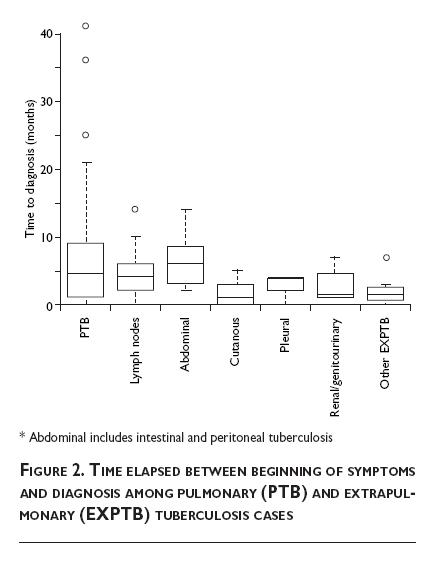
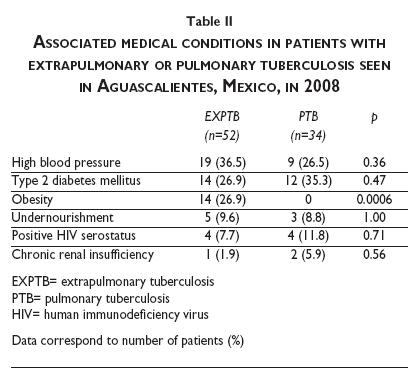
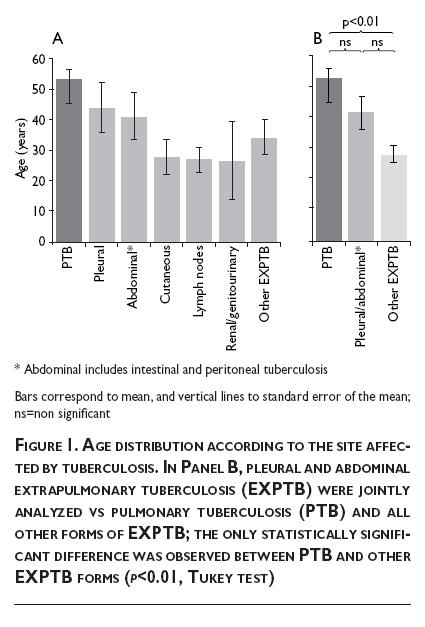
<body><![CDATA[<p align="justify"><font face="verdana" size="2"><b>Clinical data</b></font></p>  	    <p align="justify"><font face="verdana" size="2">In the study period, 93 patients with tuberculosis seen in any medical unit of the Aguascalientes State Health System were identified. From this population, seven patients were excluded because their clinical records could not be located (4 cases) or these records had incomplete information (3 cases). Thus, our final sample comprised 86 patients, 52 (60.5%) with EXPTB forms (4 patients in this group also had positive AFB in sputum), and 34 (39.5%) with PTB, yielding an EXPTB/PTB ratio of 1.5:1.</font></p>  	    <p align="justify"><font face="verdana" size="2">In patients with EXPTB, the most commonly affected site was lymph nodes (42.3%), followed by abdominal cavity (including cases with diagnosis of abdominal, peritoneal or intestinal tuberculosis, 15.4%), skin (11.5%), pleura (7.7%), kidney and genitourinary system (7.7%), meninges (5.8%), disseminated (i.e., miliary tuberculosis, 5.8%) and joints (3.8%). In only two patients the diagnosis of EXPTB was made solely on clinical grounds, whereas in the remaining it was supported by histological (47 subjects), culture (7 subjects) or AFB in sputum (4 subjects) evidences (<a href="/img/revistas/spm/v56n2/a6t1.jpg" target="_blank">table I</a>).</font></p>  	    <p align="justify"><font face="verdana" size="2"><a href="/img/revistas/spm/v56n2/a6t1.jpg" target="_blank">Table I</a> depicts the main findings concerning personal, addictions, occupation, and tuberculosis&#45;related data. Although a slight difference in the proportion of male and female patients was observed in the two forms of tuberculosis, this difference did not reach statistical significance (<i>p</i>=0.45). In relation to age, patients who developed extrapulmonary forms of TB were younger than those with pulmonary disease (31.6 vs. 53.5 years old, respectively, <i>p</i>&lt;0.001). However, as can be noted in <a href="#f1">Figure 1A</a>, age also varied among patients with extrapulmonary forms, with pleural and abdominal tuberculosis being relatively older than subjects with other EXPTB types. When pleural and abdominal forms were jointly analyzed, they did not differ in age from patients with TBP (<a href="#f1">Figure 1B</a>). History of smoking or drug addiction was found in 21% and 12% of patients with PTB, respectively, while none of the patients with EXPTB had these habits (<i>p</i>=0.001 and <i>p</i>=0.02, respectively). The PPD skin test was positive in only 38.8% of patients with EXPTB and in up to 75% of subjects with PTB (<i>p</i>=0.003). Assessment of symptom duration before diagnosis unveiled a mild diagnostic delay in the PTB group (median, 4.5 months) in comparison with the EXPTB group (3.0 months) but this difference, although clinically important, was devoid of statistical significance. <a href="#f2">Figure 2</a> splits the time elapsed before diagnosis according to sites affected, with no statistical difference among them (<i>p</i>=0.13). All patients with PTB had positive AFB in sputum, and <i>M. tuberculosis</i> was cultured in sputum samples from three of them. In EXPTB cases, AFB in sputum was positive in four patients, and the sputum or biopsy culture was positive in seven patients (in one patient both tests were positive). Thus, microbiological confirmation of EXPTB was obtained in 10/52=19.2% patients. No mycobacteria other than <i>M. tuberculosis</i> were recovered from cultures.</font></p>  	    <p align="center"><font face="verdana" size="2"><a name="f1"></a></font></p>  	    <p align="center"><font face="verdana" size="2"><img src="/img/revistas/spm/v56n2/a6f1.jpg"></font></p>  	    <p align="center"><font face="verdana" size="2"><a name="f2"></a></font></p>  	    <p align="center"><font face="verdana" size="2"><img src="/img/revistas/spm/v56n2/a6f2.jpg"></font></p>  	    <p align="justify"><font face="verdana" size="2"><a href="#t2">Table II</a> illustrates the major co&#45;morbidities among the study population. High systemic blood pressure and type 2 diabetes mellitus were the most frequent conditions, but these did not differ between both forms of tuberculosis. Regarding diabetes, although the PTB:EXPTB ratio was relatively higher among persons with diabetes (12:14, ratio of 0.86) than in patients without diabetes (22:38, ratio of 0.58), this variation was devoid of statistical significance. In contrast, while up to 26.9% of subjects with EXPTB had obesity (body mass index &#91;BMI&#93; &#8805; 30 kg/m<sup>2</sup>), no patient with PTB was obese (<i>p</i>&lt;0.001). The frequency of other conditions such as undernourishment, HIV serostatus, and chronic renal insufficiency were not different between both groups.</font></p>  	    <p align="center"><font face="verdana" size="2"><a name="t2"></a></font></p>  	    ]]></body>
<body><![CDATA[<p align="center"><font face="verdana" size="2"><img src="/img/revistas/spm/v56n2/a6t2.jpg"></font></p>  	    <p align="justify"><font face="verdana" size="2"><b>Epidemiological data</b></font></p>  	    <p align="justify"><font face="verdana" size="2">To evaluate the influence of immigration on the frequency of EXPTB in each of the 32 Mexican states (including the Distrito Federal), a correlation analysis was performed between recent immigration (percentage of people who moved to that state in the last five years) and the percentage of EXPTB cases in relation to all forms of tuberculosis (cumulative cases from 2005 to 2009). This analysis showed that the degree of recent immigration was unrelated with the frequency of EXPTB (r=0.05, <i>p</i>=0.78, not illustrated).</font></p>  	    <p align="justify"><font face="verdana" size="2">Because some years ago we reported that the incidence of PTB among the 32 Mexican states was inversely correlated with altitude above sea level,<sup>11</sup> we now evaluated whether this association was also true for EXPTB. As illustrated in <a href="/img/revistas/spm/v56n2/a6f3.jpg" target="_blank">Figure 3</a>, we corroborated that altitude had a strong negative correlation (r= &#45;0.76, <i>p</i>&lt;10&#45;6) with PTB incidence (average 2005&#45;2009), but not with the corresponding EXPTB incidence (r= &#45;0.15, 0=0.41).</font></p>  	    <p align="justify"><font face="verdana" size="2">Finally, temporal trends (1997 to 2011) of EXPTB and PTB in Aguascalientes were compared with those of Guerrero, a Mexican state with one of the highest incidence of PTB, as well as with the nationwide trends (<a href="/img/revistas/spm/v56n2/a6f4.jpg" target="_blank">Figure 4</a>). We found that in the three settings, EXPTB incidence was relatively stable (~3 x100 000 inhabitants). By contrast, PTB had a descendent trend in Aguascalientes (r=&#45;0.86, <i>p</i>&lt;0.001) and nationwide (r=&#45;0.81, <i>p</i>&lt;0.001), but not in Guerrero (r=&#45;0.26, <i>p</i>=0.36).</font></p>  	    <p align="justify"><font face="verdana" size="2">&nbsp;</font></p>  	    <p align="justify"><font face="verdana" size="2"><b>Discussion</b></font></p>  	    <p align="justify"><font face="verdana" size="2">The incidence of EXPTB is usually considered lower than that of pulmonary cases. In the 2011 Report on Global Tuberculosis Control, the World Health Organization estimated that EXPTB accounted for 14.8% of all new cases of tuberculosis worldwide.<sup>2</sup> Separated by regions, this percentage ranged from 4.6% in the Western Pacific Region to 21.8% in the Eastern Mediterranean Region. Among the 22 countries with the highest tuberculosis&#45;burden, China had the lowest (0.7%) and Cambodia the highest (55.3%) proportion of EXPTB, respectively. Some large epidemiological studies are in agreement with these figures. For example, in USA, Peto <i>et al.</i> analyzed 253 299 registered cases of tuberculosis from 1993 to 2006, and concluded that only 18.7% were extrapulmonary forms.<sup>12</sup> Likewise, te Beek <i>et al.</i> studied 13 258 patients with tuberculosis in The Netherlands from 1993 to 2001 and they found that 38% were EXPTB cases.<sup>4</sup> Two recent reports from the European Union found that among the analyzed countries the proportion of EXPTB varied from 4&#45;6 to 44&#45;48% of all tuberculosis cases, and authors postulated that such variation might be due to differences in risk factors for EXPTB, challenges for diagnosing EXPTB,<sup>13</sup> or decreased incidence of PTB.<sup>14</sup></font></p>  	    <p align="justify"><font face="verdana" size="2">In our study, we found a high frequency of EXPTB in the Mexican state of Aguascalientes (60.5%), which is in line with official statistics and previous studies,<sup>1,15</sup> but the reason for this behavior is unclear. Te Beek <i>et al.</i> in The Netherlands<sup>4</sup> and Kruijshaar and Abubakar in Wales<sup>3</sup> suggested that the increasing proportion of EXPTB observed in their countries was related with cases occurring in people born outside The Netherlands and Wales, respectively. However, immigration appears not to be the explanation in Mexico because, according to official statistics, the level of recent immigration in a particular state is not related with the percentage of EXPTB in that region. A second possibility is that mycobacteria other than <i>M. tuberculosis</i> were responsible for the EXPTB cases, for example, <i>M. bovis</i> transmitted from dairy cattle. Although the herd&#45;raising activity is important in Aguascalientes, tuberculosis in cattle is currently under control (prevalence of bovine tuberculosis &lt;0.10%).<sup>9</sup> In addition, even though the number of cultures in our series was small (only 10 in the 52 EXPTB cases, i.e., 19%) <i>M. tuberculosis</i> was the only mycobacteria recovered in the seven positive cultures. This is in agreement with a recent study by Rodr&iacute;guez&#45;N&uacute;&ntilde;ez <i>et al,</i> in which 41 samples of tuberculous lymph nodes from patients residing in Aguascalientes were assessed by in situ hybridization.<sup>16</sup> According to these authors, only <i>M. tuberculosis</i> was detected in all samples (author's personal communication). Contrasting with this study, Alvarado&#45;Esquivel <i>et al.</i> performed PCR and molecular analysis for mycobacterial identification in biological samples from 72 patients with EXPTB in three states near Aguascalientes.<sup>17</sup> Mycobacteria were confirmed in about one third of the samples, but a large percentage (~70%) of non&#45;tuberculous species was identified. Thus, at present the possibility that mycobacteria other than <i>M. tuberculosis</i> were responsible for the EXPTB cases remains open.</font></p>  	    <p align="justify"><font face="verdana" size="2">A third possibility is related with geographical factors. In a previous study, we found that the incidence of PTB among the 32 Mexican states inversely correlated with altitude above sea level.<sup>11</sup> We have now confirmed this relationship by using recent official tuberculosis notification statistics. However, EXPTB incidence rates were not affected by altitude. Thus, the contrasting behavior of PTB and EXPTB in relation to altitude might constitute a major factor in determining the proportion of EXPTB cases in a particular geographical region. In the case of Aguascalientes State, its main cities have a weighted mean altitude of 1 867 m above sea level; thus, its relatively low incidence of PTB might explain the nearly equal EXPTB:PTB ratio.</font></p>  	    ]]></body>
<body><![CDATA[<p align="justify"><font face="verdana" size="2">Finally, temporal trends clearly showed that the nationwide EXPTB incidence has been relatively unchanged in the last 15 years (1997 to 2011). Among the 32 Mexican states, in this time period 21 had an even trend, and only a few showed a downward (seven states) or upward (four states) trend (data not illustrated). By contrast, national PTB incidence is slowly descending as a consequence of the downward trends seen in many states, including Aguascalientes. Although these lower rates are surely due to the successful application of the national tuberculosis control program, paradoxically a failure to detect new PTB cases or their death prior to diagnosis might partially account for these lower trends. This epidemiological behavior is in agreement with a large study made by Sandgren <i>et al.<sup>14</sup></i> in 167 652 cases of EXPTB from the European Union. Like us, they found that the absolute number of notified EXPTB cases remained stable in the period 2002&#45;2011, but notification of PTB cases decreased, leading to an increase in the proportion of EXPTB cases. A similar conclusion was obtained by Garc&iacute;a&#45;Rodr&iacute;guez <i>et</i> al.<sup>18</sup> in the Spanish region of Galicia, where PTB cases showed a greater reduction rate than EXPTB cases during the study period (1991&#45;2008), with a resulting increasing proportion of extrapulmonary cases.</font></p>  	    <p align="justify"><font face="verdana" size="2">Therefore, it seems that a modification of the PTB incidence (either due to geographical factors or as a consequence of temporal trends) is the main factor determining the percentage of EXPTB cases in a particular region.</font></p>  	    <p align="justify"><font face="verdana" size="2">Regarding gender, we found a mild predominance of male subjects among patients with EXPTB. Although this finding agrees with some studies,<sup>19</sup> others have reported a small female predominance.<sup>20,21</sup> On the other hand, subjects with EXPTB as a group were younger than those with pulmonary forms, which is in line with other published studies,<sup>20,22</sup> although further analysis in our series showed that this was only true for EXPTB forms other than pleural and abdominal (<a href="#f1">figure 1</a>). Some possibilities have been already outlined to explain the differences in age of subjects affected by PTB and EXPTB. For example, a relatively lesser maturation of the immune system might predispose younger subjects to develop EXPTB,<sup>23</sup> or decreased lung immunity due to lifestyle factors (smoking) or co&#45;morbid conditions (e.g., COPD) might predispose older subjects to PTB.<sup>22,24</sup> However, as occurs with many other areas concerning knowledge of tuberculosis, the precise mechanisms remain elusive.</font></p>  	    <p align="justify"><font face="verdana" size="2">Three recent meta&#45;analyses coincided that tobacco smoking is a risk factor for the development of PTB,<sup>25&#45;27</sup> but the association between tobacco and extrapulmonary forms of tuberculosis is still unclear. In our study, the smoking habit was absent among patients with EXPTB, contrasting with a 21% prevalence among subjects with PTB. This contrasting frequency of smoking has also been found by Sreeramareddy <i>et al.,</i> who found an almost double frequency of ever smokers among patients with PTB, as compared with subjects with EXPTB (51.7 vs. 23.5%, respectively).<sup>22</sup></font></p>  	    <p align="justify"><font face="verdana" size="2">In our study, the site most commonly affected by EXPTB was lymph nodes (42%), similar to that described in many other reports.<sup>12,16,19,20,22,28,29</sup> The second most affected site, however, varies in different series. For instance, we found intestinal/abdominal/peritoneal tuberculosis in 15% of patients, whereas Peto <i>et al.<sup>12</sup></i> and Kourbatova <i>et al.<sup>19</sup></i> reported pleural disease (19.8 and 21%, respectively), and Nissapatorn <i>et al.<sup>20</sup></i> found disseminated tuberculosis. Although the reasons for these differences could have biological bases, other factors such as diagnostic capabilities or sociodemographic factors might also be responsible to some extent.</font></p>  	    <p align="justify"><font face="verdana" size="2">Symptom duration prior to diagnosis was shorter in patients with EXPTB than in PTB cases. There is scarce information on this issue currently available in the literature. Levine <i>et al.</i> described that symptoms of pleural tuberculosis were present for &lt; 1 month in 62% of cases, whereas in our study, only 26% of subjects with EXPTB had symptoms for &lt; 1 month.<sup>30</sup> Factors responsible for this slight divergence in symptom duration might be related with differences in access to medical services as well as with sociocultural aspects.</font></p>  	    <p align="justify"><font face="verdana" size="2">We found that up to 26.9% of subjects with EXPTB were obese. This percentage closely matches the prevalence of obesity in Aguascalientes State among adults aged 20 years or over (26.7%),<sup>10</sup> which suggests that EXPTB is not related with nutritional status. In contrast, a strong negative relationship between obesity and PTB was observed, inasmuch as no patient in this group was obese. At first glance, this might be explained by the conventional wisdom that PTB, as a chronic illness, leads to weight loss and malnutrition (and hence the ancient term phthisis, "wasting away"). However, the reverse relationship is also likely, i.e., that nutrimental deficiency favors the development of PTB. In this regard, Leung <i>et al.</i> studied a large cohort of 42 116 individuals aged 65 years or over with up to 5 years of follow&#45;up, and these authors found that obesity was a protective factor against active PTB (odds ratio &#91;OR&#93;=0.30, 95% confidence interval &#91;95%CI&#93;: 0.11&#45;0.84), but not for EXPTB (OR=1.20, 95%CI: 0.25&#45;5.80).<sup>31</sup> In line with this concept, biochemical variables often associated with obesity, such as hypercholesterolemia, have also been suggested as protective factors against development of PTB.<sup>32,33</sup></font></p>  	    <p align="justify"><font face="verdana" size="2">In our study, diabetes and systemic hypertension were usual co&#45;morbidities, but their respective frequencies did not differ in both forms of tuberculosis. However, while the 26.5% frequency of high blood pressure among patients with PTB was in agreement with the expected prevalence of this condition in Aguascalientes (27.5% in people aged 40 to 59 years),<sup>10</sup> the 36.5% among subjects with EXPTB was much higher than expected (9.1% in persons 20&#45;39 years of age).<sup>10</sup> Rather than a risk factor per se, perhaps this excess proportion of hypertension among persons with EXPTB might be explained as due to the well&#45;known association between high blood pressure and obesity.<sup>34</sup> The frequency of diabetes was also much higher than expected, but this took place in both groups with tuberculosis (35.3% in PTB vs an expected 14.6% in persons aged 40&#45;59 years, and 26.9% vs. an expected 2.5% in individuals aged 20&#45;39 years).<sup>10</sup> Diabetes is currently considered a predisposing factor for developing PTB,<sup>35,36</sup> however, up to our knowledge this predisposition has not been reported for EXPTB, as our study suggests. Thus, additional research on this issue is warranted.</font></p>  	    <p align="justify"><font face="verdana" size="2">&nbsp;</font></p>  	    <p align="justify"><font face="verdana" size="2"><b>Conclusions</b></font></p>  	    ]]></body>
<body><![CDATA[<p align="justify"><font face="verdana" size="2">In Aguascalientes, EXPTB comprised 60.5% of all cases of tuberculosis. The reason for this high proportion of EXPTB is unclear, but might be related with the decreasing frequency of PTB as altitude above sea level increase, along with the descending trend of PTB incidence observed in the last years. Other factors, such as immigration or undernourishment, appear not to be involved</font></p>  	    <p align="justify"><font face="verdana" size="2">Clinically, patients with EXPTB were younger, with fewer addictions to tobacco or drugs and less positivity to PPD skin test, as compared with subjects with PTB. Obesity was absent in the PTB group, suggesting that this condition might protect subjects from developing pulmonary involvement. About one third of patients in either group had diabetes, a frequency that resulted much higher than expected in Aguascalientes. Our results pointed out that, along with the reinforcement of tuberculosis control programs, physicians should take into account the aforementioned clinical clues in order to improve their clinical ability to suspect EXPTB.</font></p>  	    <p align="justify"><font face="verdana" size="2">&nbsp;</font></p>  	    <p align="justify"><font face="verdana" size="2"><b>References</b></font></p>  	    <!-- ref --><p align="justify"><font face="verdana" size="2">1. Centro Nacional de Vigilancia Epidemiol&oacute;gica y Control de Enfermedades. Anuarios de morbilidad. Mexico: Centro Nacional de Vigilancia Epidemiol&oacute;gica y Control de Enfermedades, 1984&#45;2011.    &nbsp;&nbsp;&nbsp;&nbsp;&nbsp;&nbsp;&nbsp;&nbsp;[&#160;<a href="javascript:void(0);" onclick="javascript: window.open('/scielo.php?script=sci_nlinks&ref=9463801&pid=S0036-3634201400020000600001&lng=','','width=640,height=500,resizable=yes,scrollbars=1,menubar=yes,');">Links</a>&#160;]<!-- end-ref --></font></p>  	    <!-- ref --><p align="justify"><font face="verdana" size="2">2. World Health Organization. Global tuberculosis control: WHO report 2011. Geneva, Switzerland: WHO, 2011.    &nbsp;&nbsp;&nbsp;&nbsp;&nbsp;&nbsp;&nbsp;&nbsp;[&#160;<a href="javascript:void(0);" onclick="javascript: window.open('/scielo.php?script=sci_nlinks&ref=9463803&pid=S0036-3634201400020000600002&lng=','','width=640,height=500,resizable=yes,scrollbars=1,menubar=yes,');">Links</a>&#160;]<!-- end-ref --></font></p>  	    <!-- ref --><p align="justify"><font face="verdana" size="2">3. Kruijshaar ME, Abubakar I. Increase in extrapulmonary tuberculosis in England and Wales 1999&#45;2006. Thorax 2009;64:1090&#45;1095.    &nbsp;&nbsp;&nbsp;&nbsp;&nbsp;&nbsp;&nbsp;&nbsp;[&#160;<a href="javascript:void(0);" onclick="javascript: window.open('/scielo.php?script=sci_nlinks&ref=9463805&pid=S0036-3634201400020000600003&lng=','','width=640,height=500,resizable=yes,scrollbars=1,menubar=yes,');">Links</a>&#160;]<!-- end-ref --></font></p>  	    ]]></body>
<body><![CDATA[<!-- ref --><p align="justify"><font face="verdana" size="2">4. Te Beek LA, van der Werf MJ, Richter C, Borgdorff MW. &#91;Increase in extrapulmonary tuberculosis in The Netherlands associated with an increase in the number of residents with non&#45;Dutch nationality; observational study of data from 1993&#45;2001&#93;. Ned Tijdschr Geneeskd 2008;152:637&#45;642.    &nbsp;&nbsp;&nbsp;&nbsp;&nbsp;&nbsp;&nbsp;&nbsp;[&#160;<a href="javascript:void(0);" onclick="javascript: window.open('/scielo.php?script=sci_nlinks&ref=9463807&pid=S0036-3634201400020000600004&lng=','','width=640,height=500,resizable=yes,scrollbars=1,menubar=yes,');">Links</a>&#160;]<!-- end-ref --></font></p>  	    <!-- ref --><p align="justify"><font face="verdana" size="2">5. Dankner WM, Davis CE. <i>Mycobacterium bovis</i> as a significant cause of tuberculosis in children residing along the United States&#45;Mexico border in the Baja California region. Pediatrics 2000;I05:E79.    &nbsp;&nbsp;&nbsp;&nbsp;&nbsp;&nbsp;&nbsp;&nbsp;[&#160;<a href="javascript:void(0);" onclick="javascript: window.open('/scielo.php?script=sci_nlinks&ref=9463809&pid=S0036-3634201400020000600005&lng=','','width=640,height=500,resizable=yes,scrollbars=1,menubar=yes,');">Links</a>&#160;]<!-- end-ref --></font></p>  	    <!-- ref --><p align="justify"><font face="verdana" size="2">6. Lari N, Rindi L, Cristofani R, Rastogi N, Tortoli E, Garzelli C. Association of <i>Mycobacterium tuberculosis</i> complex isolates of BOVIS and Central Asian (CAS) genotypic lineages with extrapulmonary disease. Clin Microbiol Infect 2009;15:538&#45;543.    &nbsp;&nbsp;&nbsp;&nbsp;&nbsp;&nbsp;&nbsp;&nbsp;[&#160;<a href="javascript:void(0);" onclick="javascript: window.open('/scielo.php?script=sci_nlinks&ref=9463811&pid=S0036-3634201400020000600006&lng=','','width=640,height=500,resizable=yes,scrollbars=1,menubar=yes,');">Links</a>&#160;]<!-- end-ref --></font></p>  	    <!-- ref --><p align="justify"><font face="verdana" size="2">7. World Health Organization. Treatment of tuberculosis: guidelines. 4th ed. Geneve: WHO, 2010.    &nbsp;&nbsp;&nbsp;&nbsp;&nbsp;&nbsp;&nbsp;&nbsp;[&#160;<a href="javascript:void(0);" onclick="javascript: window.open('/scielo.php?script=sci_nlinks&ref=9463813&pid=S0036-3634201400020000600007&lng=','','width=640,height=500,resizable=yes,scrollbars=1,menubar=yes,');">Links</a>&#160;]<!-- end-ref --></font></p>  	    <!-- ref --><p align="justify"><font face="verdana" size="2">8. Instituto Nacional de Estad&iacute;stica y Geograf&iacute;a. Censo de Poblaci&oacute;n y Vivienda 2010: Principales resultados por localidad (ITER). M&eacute;xico: INEGI, 2010.    &nbsp;&nbsp;&nbsp;&nbsp;&nbsp;&nbsp;&nbsp;&nbsp;[&#160;<a href="javascript:void(0);" onclick="javascript: window.open('/scielo.php?script=sci_nlinks&ref=9463815&pid=S0036-3634201400020000600008&lng=','','width=640,height=500,resizable=yes,scrollbars=1,menubar=yes,');">Links</a>&#160;]<!-- end-ref --></font></p>  	    ]]></body>
<body><![CDATA[<!-- ref --><p align="justify"><font face="verdana" size="2">9. Anonymous. Baja prevalencia de tuberculosis bovina. InfoRural; 2009.    &nbsp;&nbsp;&nbsp;&nbsp;&nbsp;&nbsp;&nbsp;&nbsp;[&#160;<a href="javascript:void(0);" onclick="javascript: window.open('/scielo.php?script=sci_nlinks&ref=9463817&pid=S0036-3634201400020000600009&lng=','','width=640,height=500,resizable=yes,scrollbars=1,menubar=yes,');">Links</a>&#160;]<!-- end-ref --></font></p>  	    <!-- ref --><p align="justify"><font face="verdana" size="2">10. Instituto Nacional de Salud P&uacute;blica. Encuesta Nacional de Salud y Nutrici&oacute;n 2006. Resultados por entidad federativa, Aguascalientes. Cuernavaca, M&eacute;xico. INSP, 2007.    &nbsp;&nbsp;&nbsp;&nbsp;&nbsp;&nbsp;&nbsp;&nbsp;[&#160;<a href="javascript:void(0);" onclick="javascript: window.open('/scielo.php?script=sci_nlinks&ref=9463819&pid=S0036-3634201400020000600010&lng=','','width=640,height=500,resizable=yes,scrollbars=1,menubar=yes,');">Links</a>&#160;]<!-- end-ref --></font></p>  	    <!-- ref --><p align="justify"><font face="verdana" size="2">11. Vargas MH, Furuya ME, P&eacute;rez&#45;Guzm&aacute;n C. Effect of altitude on the frequency of pulmonary tuberculosis. Int J Tuberc Lung Dis 2004;8:1321&#45;1324.    &nbsp;&nbsp;&nbsp;&nbsp;&nbsp;&nbsp;&nbsp;&nbsp;[&#160;<a href="javascript:void(0);" onclick="javascript: window.open('/scielo.php?script=sci_nlinks&ref=9463821&pid=S0036-3634201400020000600011&lng=','','width=640,height=500,resizable=yes,scrollbars=1,menubar=yes,');">Links</a>&#160;]<!-- end-ref --></font></p>  	    <!-- ref --><p align="justify"><font face="verdana" size="2">12. Peto HM, Pratt RH, Harrington TA, LoBue PA, Armstrong LR. Epidemiology of extrapulmonary tuberculosis in the United States, 1993&#45;2006. Clin Infect Dis 2009;49:1350&#45;1357.    &nbsp;&nbsp;&nbsp;&nbsp;&nbsp;&nbsp;&nbsp;&nbsp;[&#160;<a href="javascript:void(0);" onclick="javascript: window.open('/scielo.php?script=sci_nlinks&ref=9463823&pid=S0036-3634201400020000600012&lng=','','width=640,height=500,resizable=yes,scrollbars=1,menubar=yes,');">Links</a>&#160;]<!-- end-ref --></font></p>  	    <!-- ref --><p align="justify"><font face="verdana" size="2">13. Solovic I, Jonsson J, Korzeniewska&#45;Kosela M, Chiotan DI, Pace&#45;Asciak A, Slump E, <i>et al.</i> Challenges in diagnosing extrapulmonary tuberculosis in the European Union, 2011. Euro Surveill 2013;18(12):pii=20432.    &nbsp;&nbsp;&nbsp;&nbsp;&nbsp;&nbsp;&nbsp;&nbsp;[&#160;<a href="javascript:void(0);" onclick="javascript: window.open('/scielo.php?script=sci_nlinks&ref=9463825&pid=S0036-3634201400020000600013&lng=','','width=640,height=500,resizable=yes,scrollbars=1,menubar=yes,');">Links</a>&#160;]<!-- end-ref --></font></p>  	    ]]></body>
<body><![CDATA[<!-- ref --><p align="justify"><font face="verdana" size="2">14. Sandgren A, Hollo V, van der Werf MJ. Extrapulmonary tuberculosis in the European Union and European Economic Area, 2002 to 2011. Euro Surveill 2013;18(12). pii: 20431I.    &nbsp;&nbsp;&nbsp;&nbsp;&nbsp;&nbsp;&nbsp;&nbsp;[&#160;<a href="javascript:void(0);" onclick="javascript: window.open('/scielo.php?script=sci_nlinks&ref=9463827&pid=S0036-3634201400020000600014&lng=','','width=640,height=500,resizable=yes,scrollbars=1,menubar=yes,');">Links</a>&#160;]<!-- end-ref --></font></p>  	    <!-- ref --><p align="justify"><font face="verdana" size="2">15. De la Cruz J, Avelar FJ, M&aacute;rquez F, Guerrero&#45;Barrera AL. Panorama epidemiol&oacute;gico de la tuberculosis en Aguascalientes. Investigaci&oacute;n y Ciencia 2008;40:38&#45;41.    &nbsp;&nbsp;&nbsp;&nbsp;&nbsp;&nbsp;&nbsp;&nbsp;[&#160;<a href="javascript:void(0);" onclick="javascript: window.open('/scielo.php?script=sci_nlinks&ref=9463829&pid=S0036-3634201400020000600015&lng=','','width=640,height=500,resizable=yes,scrollbars=1,menubar=yes,');">Links</a>&#160;]<!-- end-ref --></font></p>  	    <!-- ref --><p align="justify"><font face="verdana" size="2">16. Rodr&iacute;guez&#45;Nu&ntilde;ez J, Avelar FJ, M&aacute;rquez F, Rivas&#45;Santiago B, Qui&ntilde;ones C, Guerrero&#45;Barrera AL. <i>Mycobacterium tuberculosis</i> complex detected by modified fluorescent in situ hybridization in lymph nodes of clinical samples. J Infect Dev Ctries 2012;6:58&#45;66.    &nbsp;&nbsp;&nbsp;&nbsp;&nbsp;&nbsp;&nbsp;&nbsp;[&#160;<a href="javascript:void(0);" onclick="javascript: window.open('/scielo.php?script=sci_nlinks&ref=9463831&pid=S0036-3634201400020000600016&lng=','','width=640,height=500,resizable=yes,scrollbars=1,menubar=yes,');">Links</a>&#160;]<!-- end-ref --></font></p>  	    <!-- ref --><p align="justify"><font face="verdana" size="2">17. Alvarado&#45;Esquivel C, Garc&iacute;a&#45;Corral N, Carrero&#45;Dom&iacute;nguez D, Enciso&#45;Moreno JA, Gurrola&#45;Morales T, Portillo&#45;G&oacute;mez L, <i>et al.</i> Molecular analysis of <i>Mycobacterium</i> isolates from extrapulmonary specimens obtained from patients in Mexico. BMC Clin Pathol 2009;9:1.    &nbsp;&nbsp;&nbsp;&nbsp;&nbsp;&nbsp;&nbsp;&nbsp;[&#160;<a href="javascript:void(0);" onclick="javascript: window.open('/scielo.php?script=sci_nlinks&ref=9463833&pid=S0036-3634201400020000600017&lng=','','width=640,height=500,resizable=yes,scrollbars=1,menubar=yes,');">Links</a>&#160;]<!-- end-ref --></font></p>  	    <!-- ref --><p align="justify"><font face="verdana" size="2">18. Garcia&#45;Rodriguez JF, Alvarez&#45;Diaz H, Lorenzo&#45;Garcia MV, Marino&#45;Callejo A, Fernandez&#45;Rial A, Sesma&#45;Sanchez P. Extrapulmonary tuberculosis: epidemiology and risk factors. Enferm Infecc Microbiol Clin 2011;29:502&#45;509.    &nbsp;&nbsp;&nbsp;&nbsp;&nbsp;&nbsp;&nbsp;&nbsp;[&#160;<a href="javascript:void(0);" onclick="javascript: window.open('/scielo.php?script=sci_nlinks&ref=9463835&pid=S0036-3634201400020000600018&lng=','','width=640,height=500,resizable=yes,scrollbars=1,menubar=yes,');">Links</a>&#160;]<!-- end-ref --></font></p>  	    ]]></body>
<body><![CDATA[<!-- ref --><p align="justify"><font face="verdana" size="2">19. Kourbatova EV, Leonard MK, Jr., Romero J, Kraft C, del Rio C, Blumberg HM. Risk factors for mortality among patients with extrapulmonary tuberculosis at an academic inner&#45;city hospital in the US. Eur J Epidemiol 2006;21:715&#45;721.    &nbsp;&nbsp;&nbsp;&nbsp;&nbsp;&nbsp;&nbsp;&nbsp;[&#160;<a href="javascript:void(0);" onclick="javascript: window.open('/scielo.php?script=sci_nlinks&ref=9463837&pid=S0036-3634201400020000600019&lng=','','width=640,height=500,resizable=yes,scrollbars=1,menubar=yes,');">Links</a>&#160;]<!-- end-ref --></font></p>  	    <!-- ref --><p align="justify"><font face="verdana" size="2">20. Nissapatorn V, Kuppusamy I, Rohela M, Anuar AK, Fong MY. Extrapulmonary tuberculosis in Peninsular Malaysia: retrospective study of 195 cases. Southeast Asian J Trop Med Public Health 2004;35 Suppl 2:39&#45;45.    &nbsp;&nbsp;&nbsp;&nbsp;&nbsp;&nbsp;&nbsp;&nbsp;[&#160;<a href="javascript:void(0);" onclick="javascript: window.open('/scielo.php?script=sci_nlinks&ref=9463839&pid=S0036-3634201400020000600020&lng=','','width=640,height=500,resizable=yes,scrollbars=1,menubar=yes,');">Links</a>&#160;]<!-- end-ref --></font></p>  	    <!-- ref --><p align="justify"><font face="verdana" size="2">21. Yang Z, Kong Y, Wilson F, Foxman B, Fowler AH, Marrs CF, <i>et al.</i> Identification of risk factors for extrapulmonary tuberculosis. Clin Infect Dis 2004;38:199&#45;205.    &nbsp;&nbsp;&nbsp;&nbsp;&nbsp;&nbsp;&nbsp;&nbsp;[&#160;<a href="javascript:void(0);" onclick="javascript: window.open('/scielo.php?script=sci_nlinks&ref=9463841&pid=S0036-3634201400020000600021&lng=','','width=640,height=500,resizable=yes,scrollbars=1,menubar=yes,');">Links</a>&#160;]<!-- end-ref --></font></p>  	    <!-- ref --><p align="justify"><font face="verdana" size="2">22. Sreeramareddy CT, Panduru KV, Verma SC, Joshi HS, Bates MN. Comparison of pulmonary and extrapulmonary tuberculosis in Nepal&#45; a hospital&#45;based retrospective study. BMC Infect Dis 2008;8:8.    &nbsp;&nbsp;&nbsp;&nbsp;&nbsp;&nbsp;&nbsp;&nbsp;[&#160;<a href="javascript:void(0);" onclick="javascript: window.open('/scielo.php?script=sci_nlinks&ref=9463843&pid=S0036-3634201400020000600022&lng=','','width=640,height=500,resizable=yes,scrollbars=1,menubar=yes,');">Links</a>&#160;]<!-- end-ref --></font></p>  	    <!-- ref --><p align="justify"><font face="verdana" size="2">23. Forssbohm M, Zwahlen M, Loddenkemper R, Rieder HL. Demographic characteristics of patients with extrapulmonary tuberculosis in Germany. Eur Respir J 2008;31:99&#45;105.    &nbsp;&nbsp;&nbsp;&nbsp;&nbsp;&nbsp;&nbsp;&nbsp;[&#160;<a href="javascript:void(0);" onclick="javascript: window.open('/scielo.php?script=sci_nlinks&ref=9463845&pid=S0036-3634201400020000600023&lng=','','width=640,height=500,resizable=yes,scrollbars=1,menubar=yes,');">Links</a>&#160;]<!-- end-ref --></font></p>  	    ]]></body>
<body><![CDATA[<!-- ref --><p align="justify"><font face="verdana" size="2">24. Jick SS, Lieberman ES, Rahman MU, Choi HK. Glucocorticoid use, other associated factors, and the risk of tuberculosis. Arthritis Rheum 2006;55:19&#45;26.    &nbsp;&nbsp;&nbsp;&nbsp;&nbsp;&nbsp;&nbsp;&nbsp;[&#160;<a href="javascript:void(0);" onclick="javascript: window.open('/scielo.php?script=sci_nlinks&ref=9463847&pid=S0036-3634201400020000600024&lng=','','width=640,height=500,resizable=yes,scrollbars=1,menubar=yes,');">Links</a>&#160;]<!-- end-ref --></font></p>  	    <!-- ref --><p align="justify"><font face="verdana" size="2">25. Bates MN, Khalakdina A, Pai M, Chang L, Lessa F, Smith KR. Risk of tuberculosis from exposure to tobacco smoke: a systematic review and meta&#45;analysis. Arch Intern Med 2007;167:335&#45;342.    &nbsp;&nbsp;&nbsp;&nbsp;&nbsp;&nbsp;&nbsp;&nbsp;[&#160;<a href="javascript:void(0);" onclick="javascript: window.open('/scielo.php?script=sci_nlinks&ref=9463849&pid=S0036-3634201400020000600025&lng=','','width=640,height=500,resizable=yes,scrollbars=1,menubar=yes,');">Links</a>&#160;]<!-- end-ref --></font></p>  	    <!-- ref --><p align="justify"><font face="verdana" size="2">26. Lin HH, Ezzati M, Murray M. Tobacco smoke, indoor air pollution and tuberculosis: a systematic review and meta&#45;analysis. PLoS Med 2007;4:e20.    &nbsp;&nbsp;&nbsp;&nbsp;&nbsp;&nbsp;&nbsp;&nbsp;[&#160;<a href="javascript:void(0);" onclick="javascript: window.open('/scielo.php?script=sci_nlinks&ref=9463851&pid=S0036-3634201400020000600026&lng=','','width=640,height=500,resizable=yes,scrollbars=1,menubar=yes,');">Links</a>&#160;]<!-- end-ref --></font></p>  	    <!-- ref --><p align="justify"><font face="verdana" size="2">27. Slama K, Chiang CY, Enarson DA, Hassmiller K, Fanning A, Gupta P, <i>et al.</i> Tobacco and tuberculosis: a qualitative systematic review and meta&#45;analysis. Int J Tuberc Lung Dis 2007;11:1049&#45;1061.    &nbsp;&nbsp;&nbsp;&nbsp;&nbsp;&nbsp;&nbsp;&nbsp;[&#160;<a href="javascript:void(0);" onclick="javascript: window.open('/scielo.php?script=sci_nlinks&ref=9463853&pid=S0036-3634201400020000600027&lng=','','width=640,height=500,resizable=yes,scrollbars=1,menubar=yes,');">Links</a>&#160;]<!-- end-ref --></font></p>  	    <!-- ref --><p align="justify"><font face="verdana" size="2">28. Cagatay AA, Caliskan Y, Aksoz S, Gulec L, Kucukoglu S, Cagatay Y, <i>et al.</i> Extrapulmonary tuberculosis in immunocompetent adults. Scand J Infect Dis 2004;36:799&#45;806.    &nbsp;&nbsp;&nbsp;&nbsp;&nbsp;&nbsp;&nbsp;&nbsp;[&#160;<a href="javascript:void(0);" onclick="javascript: window.open('/scielo.php?script=sci_nlinks&ref=9463855&pid=S0036-3634201400020000600028&lng=','','width=640,height=500,resizable=yes,scrollbars=1,menubar=yes,');">Links</a>&#160;]<!-- end-ref --></font></p>  	    ]]></body>
<body><![CDATA[<!-- ref --><p align="justify"><font face="verdana" size="2">29. Ebdrup L, Storgaard M, Jensen&#45;Fangel S, Obel N. Ten years of extrapulmonary tuberculosis in a Danish university clinic. Scand J Infect Dis 2003;35:244&#45;246.    &nbsp;&nbsp;&nbsp;&nbsp;&nbsp;&nbsp;&nbsp;&nbsp;[&#160;<a href="javascript:void(0);" onclick="javascript: window.open('/scielo.php?script=sci_nlinks&ref=9463857&pid=S0036-3634201400020000600029&lng=','','width=640,height=500,resizable=yes,scrollbars=1,menubar=yes,');">Links</a>&#160;]<!-- end-ref --></font></p>  	    <!-- ref --><p align="justify"><font face="verdana" size="2">30. Levine H, Szanto PB, Cugell DW. Tuberculous pleurisy. An acute illness. Arch Intern Med I968;122:329&#45;332.    &nbsp;&nbsp;&nbsp;&nbsp;&nbsp;&nbsp;&nbsp;&nbsp;[&#160;<a href="javascript:void(0);" onclick="javascript: window.open('/scielo.php?script=sci_nlinks&ref=9463859&pid=S0036-3634201400020000600030&lng=','','width=640,height=500,resizable=yes,scrollbars=1,menubar=yes,');">Links</a>&#160;]<!-- end-ref --></font></p>  	    <!-- ref --><p align="justify"><font face="verdana" size="2">31. Leung CC, Lam TH, Chan WM, Yew WW, Ho KS, Leung G, <i>et al.</i> Lower risk of tuberculosis in obesity. Arch Intern Med 2007;167:1297&#45;1304.    &nbsp;&nbsp;&nbsp;&nbsp;&nbsp;&nbsp;&nbsp;&nbsp;[&#160;<a href="javascript:void(0);" onclick="javascript: window.open('/scielo.php?script=sci_nlinks&ref=9463861&pid=S0036-3634201400020000600031&lng=','','width=640,height=500,resizable=yes,scrollbars=1,menubar=yes,');">Links</a>&#160;]<!-- end-ref --></font></p>  	    <!-- ref --><p align="justify"><font face="verdana" size="2">32. Deniz O, Gumus S, Yaman H, Ciftci F, Ors F, Cakir E, <i>et al.</i> Serum total cholesterol, HDL&#45;C and LDL&#45;C concentrations significantly correlate with the radiological extent of disease and the degree of smear positivity in patients with pulmonary tuberculosis. Clin Biochem 2007;40:162&#45;166.    &nbsp;&nbsp;&nbsp;&nbsp;&nbsp;&nbsp;&nbsp;&nbsp;[&#160;<a href="javascript:void(0);" onclick="javascript: window.open('/scielo.php?script=sci_nlinks&ref=9463863&pid=S0036-3634201400020000600032&lng=','','width=640,height=500,resizable=yes,scrollbars=1,menubar=yes,');">Links</a>&#160;]<!-- end-ref --></font></p>  	    <!-- ref --><p align="justify"><font face="verdana" size="2">33. P&eacute;rez&#45;Guzm&aacute;n C, Vargas MH, Qui&ntilde;onez F, Bazavilvazo N, Aguilar A. A cholesterol&#45;rich diet accelerates bacteriologic sterilization in pulmonary tuberculosis. Chest 2005;127:643&#45;651.    &nbsp;&nbsp;&nbsp;&nbsp;&nbsp;&nbsp;&nbsp;&nbsp;[&#160;<a href="javascript:void(0);" onclick="javascript: window.open('/scielo.php?script=sci_nlinks&ref=9463865&pid=S0036-3634201400020000600033&lng=','','width=640,height=500,resizable=yes,scrollbars=1,menubar=yes,');">Links</a>&#160;]<!-- end-ref --></font></p>  	    ]]></body>
<body><![CDATA[<!-- ref --><p align="justify"><font face="verdana" size="2">34. Aghamohammadzadeh R, Heagerty AM. Obesity&#45;related hypertension: Epidemiology, pathophysiology, treatments, and the contribution of perivascular adipose tissue. Ann Med 2012;44 Suppl 1:S74&#45;S84.    &nbsp;&nbsp;&nbsp;&nbsp;&nbsp;&nbsp;&nbsp;&nbsp;[&#160;<a href="javascript:void(0);" onclick="javascript: window.open('/scielo.php?script=sci_nlinks&ref=9463867&pid=S0036-3634201400020000600034&lng=','','width=640,height=500,resizable=yes,scrollbars=1,menubar=yes,');">Links</a>&#160;]<!-- end-ref --></font></p>  	    <!-- ref --><p align="justify"><font face="verdana" size="2">35. Dooley KE, Chaisson RE. Tuberculosis and diabetes mellitus: convergence of two epidemics. Lancet Infect Dis 2009;9:737&#45;746.    &nbsp;&nbsp;&nbsp;&nbsp;&nbsp;&nbsp;&nbsp;&nbsp;[&#160;<a href="javascript:void(0);" onclick="javascript: window.open('/scielo.php?script=sci_nlinks&ref=9463869&pid=S0036-3634201400020000600035&lng=','','width=640,height=500,resizable=yes,scrollbars=1,menubar=yes,');">Links</a>&#160;]<!-- end-ref --></font></p>  	    <!-- ref --><p align="justify"><font face="verdana" size="2">36. Kapur A, Harries AD. The double burden of diabetes and tuberculosis &#45; Public health implications. Diabetes Res Clin Pract 20I3;pii: S0168&#45;8227&#45;(12)00497&#45;4.    &nbsp;&nbsp;&nbsp;&nbsp;&nbsp;&nbsp;&nbsp;&nbsp;[&#160;<a href="javascript:void(0);" onclick="javascript: window.open('/scielo.php?script=sci_nlinks&ref=9463871&pid=S0036-3634201400020000600036&lng=','','width=640,height=500,resizable=yes,scrollbars=1,menubar=yes,');">Links</a>&#160;]<!-- end-ref --></font></p>  	    <p align="justify"><font face="verdana" size="2">&nbsp;</font></p>  	    <p align="justify"><font face="verdana" size="2"><b>Received on:</b> December 10, 2012    <br> 	<b>Accepted on:</b> November 13, 2013</font></p>  	    <p align="justify"><font face="verdana" size="2">&nbsp;</font></p>  	    ]]></body>
<body><![CDATA[<p align="justify"><font face="verdana" size="2"><a name="n1a" id="n1a"></a><a href="#n1b"><img src="/img/revistas/spm/v56n2/flecha.jpg"></a>Corresponding author:    <br> 	<b>Dr. Mario H. Vargas.</b>    <br> 	<i>Instituto Nacional de Enfermedades Respiratorias.    <br> 	Tlalpan 4502. 14080 M&eacute;xico DF, M&eacute;xico.    <br></i> E&#45;mail: <a href="mailto:mhvargasb@yahoo.com.mx">mhvargasb@yahoo.com.mx</a></font></p>      <p align="justify"><font face="verdana" size="2">&nbsp;</font></p>  	    <p align="justify"><font face="verdana" size="2"><i>Declaration of conflict of interests.</i> The authors declare that they have no conflict of interests.</font></p>      ]]></body><back>
<ref-list>
<ref id="B1">
<label>1</label><nlm-citation citation-type="book">
<collab>Centro Nacional de Vigilancia Epidemiológica y Control de Enfermedades</collab>
<source><![CDATA[Anuarios de morbilidad]]></source>
<year>1984</year>
<publisher-name><![CDATA[Centro Nacional de Vigilancia Epidemiológica y Control de Enfermedades]]></publisher-name>
</nlm-citation>
</ref>
<ref id="B2">
<label>2</label><nlm-citation citation-type="book">
<collab>World Health Organization</collab>
<source><![CDATA[Global tuberculosis control: WHO report 2011]]></source>
<year>2011</year>
<publisher-loc><![CDATA[Geneva ]]></publisher-loc>
<publisher-name><![CDATA[WHO]]></publisher-name>
</nlm-citation>
</ref>
<ref id="B3">
<label>3</label><nlm-citation citation-type="journal">
<person-group person-group-type="author">
<name>
<surname><![CDATA[Kruijshaar]]></surname>
<given-names><![CDATA[ME]]></given-names>
</name>
<name>
<surname><![CDATA[Abubakar]]></surname>
<given-names><![CDATA[I]]></given-names>
</name>
</person-group>
<article-title xml:lang="en"><![CDATA[Increase in extrapulmonary tuberculosis in England and Wales 1999-2006]]></article-title>
<source><![CDATA[Thorax]]></source>
<year>2009</year>
<volume>64</volume>
<page-range>1090-1095</page-range></nlm-citation>
</ref>
<ref id="B4">
<label>4</label><nlm-citation citation-type="journal">
<person-group person-group-type="author">
<name>
<surname><![CDATA[Te Beek]]></surname>
<given-names><![CDATA[LA]]></given-names>
</name>
<name>
<surname><![CDATA[van der Werf]]></surname>
<given-names><![CDATA[MJ]]></given-names>
</name>
<name>
<surname><![CDATA[Richter]]></surname>
<given-names><![CDATA[C]]></given-names>
</name>
<name>
<surname><![CDATA[Borgdorff]]></surname>
<given-names><![CDATA[MW]]></given-names>
</name>
</person-group>
<article-title xml:lang="en"><![CDATA[Increase in extrapulmonary tuberculosis in The Netherlands associated with an increase in the number of residents with non-Dutch nationalityobservational study of data from 1993-2001]]></article-title>
<source><![CDATA[Ned Tijdschr Geneeskd]]></source>
<year>2008</year>
<volume>152</volume>
<page-range>637-642</page-range></nlm-citation>
</ref>
<ref id="B5">
<label>5</label><nlm-citation citation-type="journal">
<person-group person-group-type="author">
<name>
<surname><![CDATA[Dankner]]></surname>
<given-names><![CDATA[WM]]></given-names>
</name>
<name>
<surname><![CDATA[Davis]]></surname>
<given-names><![CDATA[CE]]></given-names>
</name>
</person-group>
<article-title xml:lang="en"><![CDATA[Mycobacterium bovis as a significant cause of tuberculosis in children residing along the United States-Mexico border in the Baja California region]]></article-title>
<source><![CDATA[Pediatrics]]></source>
<year>2000</year>
<volume>I05</volume>
<page-range>E79</page-range></nlm-citation>
</ref>
<ref id="B6">
<label>6</label><nlm-citation citation-type="journal">
<person-group person-group-type="author">
<name>
<surname><![CDATA[Lari]]></surname>
<given-names><![CDATA[N]]></given-names>
</name>
<name>
<surname><![CDATA[Rindi]]></surname>
<given-names><![CDATA[L]]></given-names>
</name>
<name>
<surname><![CDATA[Cristofani]]></surname>
<given-names><![CDATA[R]]></given-names>
</name>
<name>
<surname><![CDATA[Rastogi]]></surname>
<given-names><![CDATA[N]]></given-names>
</name>
<name>
<surname><![CDATA[Tortoli]]></surname>
<given-names><![CDATA[E]]></given-names>
</name>
<name>
<surname><![CDATA[Garzelli]]></surname>
<given-names><![CDATA[C]]></given-names>
</name>
</person-group>
<article-title xml:lang="en"><![CDATA[Association of Mycobacterium tuberculosis complex isolates of BOVIS and Central Asian (CAS) genotypic lineages with extrapulmonary disease]]></article-title>
<source><![CDATA[Clin Microbiol Infect]]></source>
<year>2009</year>
<volume>15</volume>
<page-range>538-543</page-range></nlm-citation>
</ref>
<ref id="B7">
<label>7</label><nlm-citation citation-type="book">
<collab>World Health Organization</collab>
<source><![CDATA[Treatment of tuberculosis: guidelines]]></source>
<year>2010</year>
<edition>4</edition>
<publisher-loc><![CDATA[Geneve ]]></publisher-loc>
<publisher-name><![CDATA[WHO]]></publisher-name>
</nlm-citation>
</ref>
<ref id="B8">
<label>8</label><nlm-citation citation-type="book">
<collab>Instituto Nacional de Estadística y Geografía</collab>
<source><![CDATA[Censo de Población y Vivienda 2010: Principales resultados por localidad (ITER)]]></source>
<year>2010</year>
<publisher-loc><![CDATA[México ]]></publisher-loc>
<publisher-name><![CDATA[INEGI]]></publisher-name>
</nlm-citation>
</ref>
<ref id="B9">
<label>9</label><nlm-citation citation-type="book">
<source><![CDATA[Baja prevalencia de tuberculosis bovina]]></source>
<year>2009</year>
<publisher-name><![CDATA[InfoRural]]></publisher-name>
</nlm-citation>
</ref>
<ref id="B10">
<label>10</label><nlm-citation citation-type="book">
<collab>Instituto Nacional de Salud Pública</collab>
<source><![CDATA[Encuesta Nacional de Salud y Nutrición 2006.Resultados por entidad federativa, Aguascalientes]]></source>
<year>2007</year>
<publisher-loc><![CDATA[Cuernavaca ]]></publisher-loc>
<publisher-name><![CDATA[INSP]]></publisher-name>
</nlm-citation>
</ref>
<ref id="B11">
<label>11</label><nlm-citation citation-type="journal">
<person-group person-group-type="author">
<name>
<surname><![CDATA[Vargas]]></surname>
<given-names><![CDATA[MH]]></given-names>
</name>
<name>
<surname><![CDATA[Furuya]]></surname>
<given-names><![CDATA[ME]]></given-names>
</name>
<name>
<surname><![CDATA[Pérez-Guzmán]]></surname>
<given-names><![CDATA[C]]></given-names>
</name>
</person-group>
<article-title xml:lang="en"><![CDATA[Effect of altitude on the frequency of pulmonary tuberculosis]]></article-title>
<source><![CDATA[Int J Tuberc Lung Dis]]></source>
<year>2004</year>
<volume>8</volume>
<page-range>1321-1324</page-range></nlm-citation>
</ref>
<ref id="B12">
<label>12</label><nlm-citation citation-type="journal">
<person-group person-group-type="author">
<name>
<surname><![CDATA[Peto]]></surname>
<given-names><![CDATA[HM]]></given-names>
</name>
<name>
<surname><![CDATA[Pratt]]></surname>
<given-names><![CDATA[RH]]></given-names>
</name>
<name>
<surname><![CDATA[Harrington]]></surname>
<given-names><![CDATA[TA]]></given-names>
</name>
<name>
<surname><![CDATA[LoBue]]></surname>
<given-names><![CDATA[PA]]></given-names>
</name>
<name>
<surname><![CDATA[Armstrong]]></surname>
<given-names><![CDATA[LR]]></given-names>
</name>
</person-group>
<article-title xml:lang="en"><![CDATA[Epidemiology of extrapulmonary tuberculosis in the United States, 1993-2006]]></article-title>
<source><![CDATA[Clin Infect Dis]]></source>
<year>2009</year>
<volume>49</volume>
<page-range>1350-1357</page-range></nlm-citation>
</ref>
<ref id="B13">
<label>13</label><nlm-citation citation-type="journal">
<person-group person-group-type="author">
<name>
<surname><![CDATA[Solovic]]></surname>
<given-names><![CDATA[I]]></given-names>
</name>
<name>
<surname><![CDATA[Jonsson]]></surname>
<given-names><![CDATA[J]]></given-names>
</name>
<name>
<surname><![CDATA[Korzeniewska-Kosela]]></surname>
<given-names><![CDATA[M]]></given-names>
</name>
<name>
<surname><![CDATA[Chiotan]]></surname>
<given-names><![CDATA[DI]]></given-names>
</name>
<name>
<surname><![CDATA[Pace-Asciak]]></surname>
<given-names><![CDATA[A]]></given-names>
</name>
<name>
<surname><![CDATA[Slump]]></surname>
<given-names><![CDATA[E]]></given-names>
</name>
</person-group>
<article-title xml:lang="en"><![CDATA[Challenges in diagnosing extrapulmonary tuberculosis in the European Union, 2011]]></article-title>
<source><![CDATA[Euro Surveill]]></source>
<year>2013</year>
<volume>18</volume>
<numero>12</numero>
<issue>12</issue>
<page-range>20432</page-range></nlm-citation>
</ref>
<ref id="B14">
<label>14</label><nlm-citation citation-type="journal">
<person-group person-group-type="author">
<name>
<surname><![CDATA[Sandgren]]></surname>
<given-names><![CDATA[A]]></given-names>
</name>
<name>
<surname><![CDATA[Hollo]]></surname>
<given-names><![CDATA[V]]></given-names>
</name>
<name>
<surname><![CDATA[van der Werf]]></surname>
<given-names><![CDATA[MJ]]></given-names>
</name>
</person-group>
<article-title xml:lang="en"><![CDATA[Extrapulmonary tuberculosis in the European Union and European Economic Area, 2002 to 2011]]></article-title>
<source><![CDATA[Euro Surveill]]></source>
<year>2013</year>
<volume>18</volume>
<numero>12</numero>
<issue>12</issue>
<page-range>20431I</page-range></nlm-citation>
</ref>
<ref id="B15">
<label>15</label><nlm-citation citation-type="journal">
<person-group person-group-type="author">
<name>
<surname><![CDATA[De la Cruz]]></surname>
<given-names><![CDATA[J]]></given-names>
</name>
<name>
<surname><![CDATA[Avelar]]></surname>
<given-names><![CDATA[FJ]]></given-names>
</name>
<name>
<surname><![CDATA[Márquez]]></surname>
<given-names><![CDATA[F]]></given-names>
</name>
<name>
<surname><![CDATA[Guerrero-Barrera]]></surname>
<given-names><![CDATA[AL]]></given-names>
</name>
</person-group>
<article-title xml:lang="es"><![CDATA[Panorama epidemiológico de la tuberculosis en Aguascalientes]]></article-title>
<source><![CDATA[Investigación y Ciencia]]></source>
<year>2008</year>
<volume>40</volume>
<page-range>38-41</page-range></nlm-citation>
</ref>
<ref id="B16">
<label>16</label><nlm-citation citation-type="journal">
<person-group person-group-type="author">
<name>
<surname><![CDATA[Rodríguez-Nuñez]]></surname>
<given-names><![CDATA[J]]></given-names>
</name>
<name>
<surname><![CDATA[Avelar]]></surname>
<given-names><![CDATA[FJ]]></given-names>
</name>
<name>
<surname><![CDATA[Márquez]]></surname>
<given-names><![CDATA[F]]></given-names>
</name>
<name>
<surname><![CDATA[Rivas-Santiago]]></surname>
<given-names><![CDATA[B]]></given-names>
</name>
<name>
<surname><![CDATA[Quiñones]]></surname>
<given-names><![CDATA[C]]></given-names>
</name>
<name>
<surname><![CDATA[Guerrero-Barrera]]></surname>
<given-names><![CDATA[AL]]></given-names>
</name>
</person-group>
<article-title xml:lang="en"><![CDATA[Mycobacterium tuberculosis complex detected by modified fluorescent in situ hybridization in lymph nodes of clinical samples]]></article-title>
<source><![CDATA[J Infect Dev Ctries]]></source>
<year>2012</year>
<volume>6</volume>
<page-range>58-66</page-range></nlm-citation>
</ref>
<ref id="B17">
<label>17</label><nlm-citation citation-type="journal">
<person-group person-group-type="author">
<name>
<surname><![CDATA[Alvarado-Esquivel]]></surname>
<given-names><![CDATA[C]]></given-names>
</name>
<name>
<surname><![CDATA[García-Corral]]></surname>
<given-names><![CDATA[N]]></given-names>
</name>
<name>
<surname><![CDATA[Carrero-Domínguez]]></surname>
<given-names><![CDATA[D]]></given-names>
</name>
<name>
<surname><![CDATA[Enciso-Moreno]]></surname>
<given-names><![CDATA[JA]]></given-names>
</name>
<name>
<surname><![CDATA[Gurrola-Morales]]></surname>
<given-names><![CDATA[T]]></given-names>
</name>
<name>
<surname><![CDATA[Portillo-Gómez]]></surname>
<given-names><![CDATA[L]]></given-names>
</name>
</person-group>
<article-title xml:lang="en"><![CDATA[Molecular analysis of Mycobacterium isolates from extrapulmonary specimens obtained from patients in Mexico]]></article-title>
<source><![CDATA[BMC Clin Pathol]]></source>
<year>2009</year>
<volume>9</volume>
<page-range>1</page-range></nlm-citation>
</ref>
<ref id="B18">
<label>18</label><nlm-citation citation-type="journal">
<person-group person-group-type="author">
<name>
<surname><![CDATA[Garcia-Rodriguez]]></surname>
<given-names><![CDATA[JF]]></given-names>
</name>
<name>
<surname><![CDATA[Alvarez-Diaz]]></surname>
<given-names><![CDATA[H]]></given-names>
</name>
<name>
<surname><![CDATA[Lorenzo-Garcia]]></surname>
<given-names><![CDATA[MV]]></given-names>
</name>
<name>
<surname><![CDATA[Marino-Callejo]]></surname>
<given-names><![CDATA[A]]></given-names>
</name>
<name>
<surname><![CDATA[Fernandez-Rial]]></surname>
<given-names><![CDATA[A]]></given-names>
</name>
<name>
<surname><![CDATA[Sesma-Sanchez]]></surname>
<given-names><![CDATA[P]]></given-names>
</name>
</person-group>
<article-title xml:lang="en"><![CDATA[Extrapulmonary tuberculosis: epidemiology and risk factors]]></article-title>
<source><![CDATA[Enferm Infecc Microbiol Clin]]></source>
<year>2011</year>
<volume>29</volume>
<page-range>502-509</page-range></nlm-citation>
</ref>
<ref id="B19">
<label>19</label><nlm-citation citation-type="journal">
<person-group person-group-type="author">
<name>
<surname><![CDATA[Kourbatova]]></surname>
<given-names><![CDATA[EV]]></given-names>
</name>
<name>
<surname><![CDATA[Leonard]]></surname>
<given-names><![CDATA[MK Jr]]></given-names>
</name>
<name>
<surname><![CDATA[Romero]]></surname>
<given-names><![CDATA[J]]></given-names>
</name>
<name>
<surname><![CDATA[Kraft]]></surname>
<given-names><![CDATA[C]]></given-names>
</name>
<name>
<surname><![CDATA[del Rio]]></surname>
<given-names><![CDATA[C]]></given-names>
</name>
<name>
<surname><![CDATA[Blumberg]]></surname>
<given-names><![CDATA[HM]]></given-names>
</name>
</person-group>
<article-title xml:lang="en"><![CDATA[Risk factors for mortality among patients with extrapulmonary tuberculosis at an academic inner-city hospital in the US]]></article-title>
<source><![CDATA[Eur J Epidemiol]]></source>
<year>2006</year>
<volume>21</volume>
<page-range>715-721</page-range></nlm-citation>
</ref>
<ref id="B20">
<label>20</label><nlm-citation citation-type="journal">
<person-group person-group-type="author">
<name>
<surname><![CDATA[Nissapatorn]]></surname>
<given-names><![CDATA[V]]></given-names>
</name>
<name>
<surname><![CDATA[Kuppusamy]]></surname>
<given-names><![CDATA[I]]></given-names>
</name>
<name>
<surname><![CDATA[Rohela]]></surname>
<given-names><![CDATA[M]]></given-names>
</name>
<name>
<surname><![CDATA[Anuar]]></surname>
<given-names><![CDATA[AK]]></given-names>
</name>
<name>
<surname><![CDATA[Fong]]></surname>
<given-names><![CDATA[MY]]></given-names>
</name>
</person-group>
<article-title xml:lang="en"><![CDATA[Extrapulmonary tuberculosis in Peninsular Malaysia: retrospective study of 195 cases]]></article-title>
<source><![CDATA[Southeast Asian J Trop Med Public Health]]></source>
<year>2004</year>
<volume>35</volume>
<numero>^s2</numero>
<issue>^s2</issue>
<supplement>2</supplement>
<page-range>39-45</page-range></nlm-citation>
</ref>
<ref id="B21">
<label>21</label><nlm-citation citation-type="journal">
<person-group person-group-type="author">
<name>
<surname><![CDATA[Yang]]></surname>
<given-names><![CDATA[Z]]></given-names>
</name>
<name>
<surname><![CDATA[Kong]]></surname>
<given-names><![CDATA[Y]]></given-names>
</name>
<name>
<surname><![CDATA[Wilson]]></surname>
<given-names><![CDATA[F]]></given-names>
</name>
<name>
<surname><![CDATA[Foxman]]></surname>
<given-names><![CDATA[B]]></given-names>
</name>
<name>
<surname><![CDATA[Fowler]]></surname>
<given-names><![CDATA[AH]]></given-names>
</name>
<name>
<surname><![CDATA[Marrs]]></surname>
<given-names><![CDATA[CF]]></given-names>
</name>
</person-group>
<article-title xml:lang="en"><![CDATA[Identification of risk factors for extrapulmonary tuberculosis]]></article-title>
<source><![CDATA[Clin Infect Dis]]></source>
<year>2004</year>
<volume>38</volume>
<page-range>199-205</page-range></nlm-citation>
</ref>
<ref id="B22">
<label>22</label><nlm-citation citation-type="journal">
<person-group person-group-type="author">
<name>
<surname><![CDATA[Sreeramareddy]]></surname>
<given-names><![CDATA[CT]]></given-names>
</name>
<name>
<surname><![CDATA[Panduru]]></surname>
<given-names><![CDATA[KV]]></given-names>
</name>
<name>
<surname><![CDATA[Verma]]></surname>
<given-names><![CDATA[SC]]></given-names>
</name>
<name>
<surname><![CDATA[Joshi]]></surname>
<given-names><![CDATA[HS]]></given-names>
</name>
<name>
<surname><![CDATA[Bates]]></surname>
<given-names><![CDATA[MN]]></given-names>
</name>
</person-group>
<article-title xml:lang="en"><![CDATA[Comparison of pulmonary and extrapulmonary tuberculosis in Nepal- a hospital-based retrospective study]]></article-title>
<source><![CDATA[BMC Infect Dis]]></source>
<year>2008</year>
<volume>8</volume>
<page-range>8</page-range></nlm-citation>
</ref>
<ref id="B23">
<label>23</label><nlm-citation citation-type="journal">
<person-group person-group-type="author">
<name>
<surname><![CDATA[Forssbohm]]></surname>
<given-names><![CDATA[M]]></given-names>
</name>
<name>
<surname><![CDATA[Zwahlen]]></surname>
<given-names><![CDATA[M]]></given-names>
</name>
<name>
<surname><![CDATA[Loddenkemper]]></surname>
<given-names><![CDATA[R]]></given-names>
</name>
<name>
<surname><![CDATA[Rieder]]></surname>
<given-names><![CDATA[HL]]></given-names>
</name>
</person-group>
<article-title xml:lang="en"><![CDATA[Demographic characteristics of patients with extrapulmonary tuberculosis in Germany]]></article-title>
<source><![CDATA[Eur Respir J]]></source>
<year>2008</year>
<volume>31</volume>
<page-range>99-105</page-range></nlm-citation>
</ref>
<ref id="B24">
<label>24</label><nlm-citation citation-type="journal">
<person-group person-group-type="author">
<name>
<surname><![CDATA[Jick]]></surname>
<given-names><![CDATA[SS]]></given-names>
</name>
<name>
<surname><![CDATA[Lieberman]]></surname>
<given-names><![CDATA[ES]]></given-names>
</name>
<name>
<surname><![CDATA[Rahman]]></surname>
<given-names><![CDATA[MU]]></given-names>
</name>
<name>
<surname><![CDATA[Choi]]></surname>
<given-names><![CDATA[HK]]></given-names>
</name>
</person-group>
<article-title xml:lang="en"><![CDATA[Glucocorticoid use, other associated factors, and the risk of tuberculosis]]></article-title>
<source><![CDATA[Arthritis Rheum]]></source>
<year>2006</year>
<volume>55</volume>
<page-range>19-26</page-range></nlm-citation>
</ref>
<ref id="B25">
<label>25</label><nlm-citation citation-type="journal">
<person-group person-group-type="author">
<name>
<surname><![CDATA[Bates]]></surname>
<given-names><![CDATA[MN]]></given-names>
</name>
<name>
<surname><![CDATA[Khalakdina]]></surname>
<given-names><![CDATA[A]]></given-names>
</name>
<name>
<surname><![CDATA[Pai]]></surname>
<given-names><![CDATA[M]]></given-names>
</name>
<name>
<surname><![CDATA[Chang]]></surname>
<given-names><![CDATA[L]]></given-names>
</name>
<name>
<surname><![CDATA[Lessa]]></surname>
<given-names><![CDATA[F]]></given-names>
</name>
<name>
<surname><![CDATA[Smith]]></surname>
<given-names><![CDATA[KR]]></given-names>
</name>
</person-group>
<article-title xml:lang="en"><![CDATA[Risk of tuberculosis from exposure to tobacco smoke: a systematic review and meta-analysis]]></article-title>
<source><![CDATA[Arch Intern Med]]></source>
<year>2007</year>
<volume>167</volume>
<page-range>335-342</page-range></nlm-citation>
</ref>
<ref id="B26">
<label>26</label><nlm-citation citation-type="journal">
<person-group person-group-type="author">
<name>
<surname><![CDATA[Lin]]></surname>
<given-names><![CDATA[HH]]></given-names>
</name>
<name>
<surname><![CDATA[Ezzati]]></surname>
<given-names><![CDATA[M]]></given-names>
</name>
<name>
<surname><![CDATA[Murray]]></surname>
<given-names><![CDATA[M]]></given-names>
</name>
</person-group>
<article-title xml:lang="en"><![CDATA[Tobacco smoke, indoor air pollution and tuberculosis: a systematic review and meta-analysis]]></article-title>
<source><![CDATA[PLoS Med]]></source>
<year>2007</year>
<volume>4</volume>
<page-range>e20</page-range></nlm-citation>
</ref>
<ref id="B27">
<label>27</label><nlm-citation citation-type="journal">
<person-group person-group-type="author">
<name>
<surname><![CDATA[Slama]]></surname>
<given-names><![CDATA[K]]></given-names>
</name>
<name>
<surname><![CDATA[Chiang]]></surname>
<given-names><![CDATA[CY]]></given-names>
</name>
<name>
<surname><![CDATA[Enarson]]></surname>
<given-names><![CDATA[DA]]></given-names>
</name>
<name>
<surname><![CDATA[Hassmiller]]></surname>
<given-names><![CDATA[K]]></given-names>
</name>
<name>
<surname><![CDATA[Fanning]]></surname>
<given-names><![CDATA[A]]></given-names>
</name>
<name>
<surname><![CDATA[Gupta]]></surname>
<given-names><![CDATA[P]]></given-names>
</name>
</person-group>
<article-title xml:lang="en"><![CDATA[Tobacco and tuberculosis: a qualitative systematic review and meta-analysis]]></article-title>
<source><![CDATA[Int J Tuberc Lung Dis]]></source>
<year>2007</year>
<volume>11</volume>
<page-range>1049-1061</page-range></nlm-citation>
</ref>
<ref id="B28">
<label>28</label><nlm-citation citation-type="journal">
<person-group person-group-type="author">
<name>
<surname><![CDATA[Cagatay]]></surname>
<given-names><![CDATA[AA]]></given-names>
</name>
<name>
<surname><![CDATA[Caliskan]]></surname>
<given-names><![CDATA[Y]]></given-names>
</name>
<name>
<surname><![CDATA[Aksoz]]></surname>
<given-names><![CDATA[S]]></given-names>
</name>
<name>
<surname><![CDATA[Gulec]]></surname>
<given-names><![CDATA[L]]></given-names>
</name>
<name>
<surname><![CDATA[Kucukoglu]]></surname>
<given-names><![CDATA[S]]></given-names>
</name>
<name>
<surname><![CDATA[Cagatay]]></surname>
<given-names><![CDATA[Y]]></given-names>
</name>
</person-group>
<article-title xml:lang="en"><![CDATA[Extrapulmonary tuberculosis in immunocompetent adults]]></article-title>
<source><![CDATA[Scand J Infect Dis]]></source>
<year>2004</year>
<volume>36</volume>
<page-range>799-806</page-range></nlm-citation>
</ref>
<ref id="B29">
<label>29</label><nlm-citation citation-type="journal">
<person-group person-group-type="author">
<name>
<surname><![CDATA[Ebdrup]]></surname>
<given-names><![CDATA[L]]></given-names>
</name>
<name>
<surname><![CDATA[Storgaard]]></surname>
<given-names><![CDATA[M]]></given-names>
</name>
<name>
<surname><![CDATA[Jensen-Fangel]]></surname>
<given-names><![CDATA[S]]></given-names>
</name>
<name>
<surname><![CDATA[Obel]]></surname>
<given-names><![CDATA[N]]></given-names>
</name>
</person-group>
<article-title xml:lang="en"><![CDATA[Ten years of extrapulmonary tuberculosis in a Danish university clinic]]></article-title>
<source><![CDATA[Scand J Infect Dis]]></source>
<year>2003</year>
<volume>35</volume>
<page-range>244-246</page-range></nlm-citation>
</ref>
<ref id="B30">
<label>30</label><nlm-citation citation-type="journal">
<person-group person-group-type="author">
<name>
<surname><![CDATA[Levine]]></surname>
<given-names><![CDATA[H]]></given-names>
</name>
<name>
<surname><![CDATA[Szanto]]></surname>
<given-names><![CDATA[PB]]></given-names>
</name>
<name>
<surname><![CDATA[Cugell]]></surname>
<given-names><![CDATA[DW]]></given-names>
</name>
</person-group>
<article-title xml:lang="en"><![CDATA[Tuberculous pleurisy: An acute illness]]></article-title>
<source><![CDATA[Arch Intern Med]]></source>
<year>I968</year>
<volume>122</volume>
<page-range>329-332</page-range></nlm-citation>
</ref>
<ref id="B31">
<label>31</label><nlm-citation citation-type="journal">
<person-group person-group-type="author">
<name>
<surname><![CDATA[Leung]]></surname>
<given-names><![CDATA[CC]]></given-names>
</name>
<name>
<surname><![CDATA[Lam]]></surname>
<given-names><![CDATA[TH]]></given-names>
</name>
<name>
<surname><![CDATA[Chan]]></surname>
<given-names><![CDATA[WM]]></given-names>
</name>
<name>
<surname><![CDATA[Yew]]></surname>
<given-names><![CDATA[WW]]></given-names>
</name>
<name>
<surname><![CDATA[Ho]]></surname>
<given-names><![CDATA[KS]]></given-names>
</name>
<name>
<surname><![CDATA[Leung]]></surname>
<given-names><![CDATA[G]]></given-names>
</name>
</person-group>
<article-title xml:lang="en"><![CDATA[Lower risk of tuberculosis in obesity]]></article-title>
<source><![CDATA[Arch Intern Med]]></source>
<year>2007</year>
<volume>167</volume>
<page-range>1297-1304</page-range></nlm-citation>
</ref>
<ref id="B32">
<label>32</label><nlm-citation citation-type="journal">
<person-group person-group-type="author">
<name>
<surname><![CDATA[Deniz]]></surname>
<given-names><![CDATA[O]]></given-names>
</name>
<name>
<surname><![CDATA[Gumus]]></surname>
<given-names><![CDATA[S]]></given-names>
</name>
<name>
<surname><![CDATA[Yaman]]></surname>
<given-names><![CDATA[H]]></given-names>
</name>
<name>
<surname><![CDATA[Ciftci]]></surname>
<given-names><![CDATA[F]]></given-names>
</name>
<name>
<surname><![CDATA[Ors]]></surname>
<given-names><![CDATA[F]]></given-names>
</name>
<name>
<surname><![CDATA[Cakir]]></surname>
<given-names><![CDATA[E]]></given-names>
</name>
</person-group>
<article-title xml:lang="en"><![CDATA[Serum total cholesterol, HDL-C and LDL-C concentrations significantly correlate with the radiological extent of disease and the degree of smear positivity in patients with pulmonary tuberculosis]]></article-title>
<source><![CDATA[Clin Biochem]]></source>
<year>2007</year>
<volume>40</volume>
<page-range>162-166</page-range></nlm-citation>
</ref>
<ref id="B33">
<label>33</label><nlm-citation citation-type="journal">
<person-group person-group-type="author">
<name>
<surname><![CDATA[Pérez-Guzmán]]></surname>
<given-names><![CDATA[C]]></given-names>
</name>
<name>
<surname><![CDATA[Vargas]]></surname>
<given-names><![CDATA[MH]]></given-names>
</name>
<name>
<surname><![CDATA[Quiñonez]]></surname>
<given-names><![CDATA[F]]></given-names>
</name>
<name>
<surname><![CDATA[Bazavilvazo]]></surname>
<given-names><![CDATA[N]]></given-names>
</name>
<name>
<surname><![CDATA[Aguilar]]></surname>
<given-names><![CDATA[A]]></given-names>
</name>
</person-group>
<article-title xml:lang="en"><![CDATA[A cholesterol-rich diet accelerates bacteriologic sterilization in pulmonary tuberculosis]]></article-title>
<source><![CDATA[Chest]]></source>
<year>2005</year>
<volume>127</volume>
<page-range>643-651</page-range></nlm-citation>
</ref>
<ref id="B34">
<label>34</label><nlm-citation citation-type="journal">
<person-group person-group-type="author">
<name>
<surname><![CDATA[Aghamohammadzadeh]]></surname>
<given-names><![CDATA[R]]></given-names>
</name>
<name>
<surname><![CDATA[Heagerty]]></surname>
<given-names><![CDATA[AM]]></given-names>
</name>
</person-group>
<article-title xml:lang="en"><![CDATA[Obesity-related hypertension: Epidemiology, pathophysiology, treatments, and the contribution of perivascular adipose tissue]]></article-title>
<source><![CDATA[Ann Med]]></source>
<year>2012</year>
<volume>44</volume>
<numero>^s1</numero>
<issue>^s1</issue>
<supplement>1</supplement>
<page-range>S74-S84</page-range></nlm-citation>
</ref>
<ref id="B35">
<label>35</label><nlm-citation citation-type="journal">
<person-group person-group-type="author">
<name>
<surname><![CDATA[Dooley]]></surname>
<given-names><![CDATA[KE]]></given-names>
</name>
<name>
<surname><![CDATA[Chaisson]]></surname>
<given-names><![CDATA[RE]]></given-names>
</name>
</person-group>
<article-title xml:lang="en"><![CDATA[Tuberculosis and diabetes mellitus: convergence of two epidemics]]></article-title>
<source><![CDATA[Lancet Infect Dis]]></source>
<year>2009</year>
<volume>9</volume>
<page-range>737-746</page-range></nlm-citation>
</ref>
<ref id="B36">
<label>36</label><nlm-citation citation-type="journal">
<person-group person-group-type="author">
<name>
<surname><![CDATA[Kapur]]></surname>
<given-names><![CDATA[A]]></given-names>
</name>
<name>
<surname><![CDATA[Harries]]></surname>
<given-names><![CDATA[AD]]></given-names>
</name>
</person-group>
<article-title xml:lang="en"><![CDATA[The double burden of diabetes and tuberculosis - Public health implications]]></article-title>
<source><![CDATA[Diabetes Res Clin Pract]]></source>
<year>20I3</year>
<page-range>S0168-8227</page-range></nlm-citation>
</ref>
</ref-list>
</back>
</article>