<?xml version="1.0" encoding="ISO-8859-1"?><article xmlns:mml="http://www.w3.org/1998/Math/MathML" xmlns:xlink="http://www.w3.org/1999/xlink" xmlns:xsi="http://www.w3.org/2001/XMLSchema-instance">
<front>
<journal-meta>
<journal-id>0036-3634</journal-id>
<journal-title><![CDATA[Salud Pública de México]]></journal-title>
<abbrev-journal-title><![CDATA[Salud pública Méx]]></abbrev-journal-title>
<issn>0036-3634</issn>
<publisher>
<publisher-name><![CDATA[Instituto Nacional de Salud Pública]]></publisher-name>
</publisher>
</journal-meta>
<article-meta>
<article-id>S0036-36342013000100004</article-id>
<title-group>
<article-title xml:lang="en"><![CDATA[Country-level correlates of cervical cancer mortality in Latin America and the Caribbean]]></article-title>
<article-title xml:lang="es"><![CDATA[Determinantes a nivel país de la mortalidad por cáncer cervicouterino en Latinoamérica y el Caribe]]></article-title>
</title-group>
<contrib-group>
<contrib contrib-type="author">
<name>
<surname><![CDATA[Pereira-Scalabrino]]></surname>
<given-names><![CDATA[Ana]]></given-names>
</name>
<xref ref-type="aff" rid="A01"/>
</contrib>
<contrib contrib-type="author">
<name>
<surname><![CDATA[Almonte]]></surname>
<given-names><![CDATA[Maribel]]></given-names>
</name>
<xref ref-type="aff" rid="A02"/>
</contrib>
<contrib contrib-type="author">
<name>
<surname><![CDATA[dos-Santos-Silva]]></surname>
<given-names><![CDATA[Isabel]]></given-names>
</name>
<xref ref-type="aff" rid="A03"/>
</contrib>
</contrib-group>
<aff id="A01">
<institution><![CDATA[,Universidad de Chile Instituto de Nutrición y Tecnología de los Alimentos Unidad de Epidemiología Nutricional y Genética]]></institution>
<addr-line><![CDATA[Santiago ]]></addr-line>
<country>Chile</country>
</aff>
<aff id="A02">
<institution><![CDATA[,Cardiff University Cochrane Institute of Primary Care and Public Health ]]></institution>
<addr-line><![CDATA[ ]]></addr-line>
<country>Wales</country>
</aff>
<aff id="A03">
<institution><![CDATA[,London School of Hygiene and Tropical Medicine Department of Non-Communicable Disease Epidemiology ]]></institution>
<addr-line><![CDATA[ ]]></addr-line>
<country>England</country>
</aff>
<pub-date pub-type="pub">
<day>00</day>
<month>02</month>
<year>2013</year>
</pub-date>
<pub-date pub-type="epub">
<day>00</day>
<month>02</month>
<year>2013</year>
</pub-date>
<volume>55</volume>
<numero>1</numero>
<fpage>5</fpage>
<lpage>15</lpage>
<copyright-statement/>
<copyright-year/>
<self-uri xlink:href="http://www.scielo.org.mx/scielo.php?script=sci_arttext&amp;pid=S0036-36342013000100004&amp;lng=en&amp;nrm=iso"></self-uri><self-uri xlink:href="http://www.scielo.org.mx/scielo.php?script=sci_abstract&amp;pid=S0036-36342013000100004&amp;lng=en&amp;nrm=iso"></self-uri><self-uri xlink:href="http://www.scielo.org.mx/scielo.php?script=sci_pdf&amp;pid=S0036-36342013000100004&amp;lng=en&amp;nrm=iso"></self-uri><abstract abstract-type="short" xml:lang="en"><p><![CDATA[OBJECTIVE: To identify country-level correlates of geographical variations in cervical cancer (CC) mortality in Latin America and the Caribbean (LAC). MATERIALS AND METHODS: CC mortality rates for LAC countries (n=26) were examined in relation to country-specific socio-economic indicators (n=58) and Human Papilloma Virus (HPV) prevalence using linear regression models. RESULTS: High mortality at ages <5 years, low per capita total expenditure on health, and low proportion of the population with access to sanitation were identified as the best independent predictors of CC mortality (R² =77%). In the subset of countries (n=10) with HPV prevalence estimates, these socio-economic indicators together with high-risk HPV prevalence explained almost all the between-country variability in CC mortality (R² =98%). CONCLUSION: The findings suggest that continuing socioeconomic improvements in LAC countries will be associated with further reductions in CC mortality even in the absence of organised population-based screening and vaccination programmes.]]></p></abstract>
<abstract abstract-type="short" xml:lang="es"><p><![CDATA[OBJETIVO: Identificar variables a nivel de país que expliquen las variaciones geográficas en la mortalidad por cáncer cervicouterino (CaCu) en América Latina y el Caribe (AL). MATERIALES Y MÉTODOS: Se examinaron las tasas de mortalidad por CaCu de cada país (n=26) mediante modelos de regresión lineal en relación con indicadores socioeconómicos (n=58) y prevalencia del virus del papiloma humano (VPH). RESULTADOS: Alta mortalidad en menores de cinco años, bajo gasto total en salud per-cápita y baja proporción de población con acceso a saneamiento básico son los mejores predictores de mortalidad por CaCu (R² =77%). En los países (n=10) con estimaciones de prevalencia de VPH, estos indicadores socioeconómicos y la prevalencia de VPH de alto riesgo explicaron el 98% de la variabilidad de CaCu en AL. CONCLUSIÓN: Las mejoras en el nivel socioeconómico en AL están asociadas con reducciones en la mortalidad por CaCu, a pesar de la ausencia de programas organizados de tamizaje e inmunización contra VPH.]]></p></abstract>
<kwd-group>
<kwd lng="en"><![CDATA[uterine cervical neoplasms]]></kwd>
<kwd lng="en"><![CDATA[papillomaviridae]]></kwd>
<kwd lng="en"><![CDATA[mass screening]]></kwd>
<kwd lng="en"><![CDATA[Latin America]]></kwd>
<kwd lng="es"><![CDATA[neoplasias del cuello uterino]]></kwd>
<kwd lng="es"><![CDATA[papillomaviridae humano]]></kwd>
<kwd lng="es"><![CDATA[tamizaje masivo]]></kwd>
<kwd lng="es"><![CDATA[América Latina]]></kwd>
</kwd-group>
</article-meta>
</front><body><![CDATA[ <p align="right"><font size="2" face="Verdana, Arial, Helvetica, sans-serif"><b>ART&Iacute;CULO ORIGINAL</b></font></p>     <p>&nbsp;</p>     <p><font size="4" face="Verdana, Arial, Helvetica, sans-serif"><a name="front"></a><b>Country-level correlates of cervical cancer mortality in Latin America and the Caribbean</b></font></p>     <p>&nbsp;</p>     <p><font size="3" face="Verdana, Arial, Helvetica, sans-serif"><b> Determinantes a nivel pa&iacute;s de la mortalidad por c&aacute;ncer  cervicouterino en Latinoam&eacute;rica y el Caribe</b></font></p>     <p>&nbsp;</p>     <p>&nbsp;</p>     <p><font size="2" face="Verdana, Arial, Helvetica, sans-serif"><b>Ana Pereira-Scalabrino, MD, PhD<sup>I</sup>; Maribel Almonte, PhD<sup>II</sup>; Isabel dos-Santos-Silva MD, PhD<sup>III</sup></b> </font></p>     <p><font size="2" face="Verdana, Arial, Helvetica, sans-serif"><sup>I</sup>Unidad de Epidemiolog&iacute;a Nutricional y Gen&eacute;tica, Instituto de Nutrici&oacute;n y Tecnolog&iacute;a de los Alimentos, Universidad de Chile. Santiago, Chile    <br> <sup>II</sup>Cochrane Institute of Primary Care and Public Health, Cardiff University. Wales, UK    ]]></body>
<body><![CDATA[<br> <sup>III</sup>Department of Non-Communicable Disease Epidemiology, London School of Hygiene and Tropical Medicine. England</font></p>     <p><font size="2" face="Verdana, Arial, Helvetica, sans-serif"><a href="#not01">Corresponding author</a></font></p>     <p>&nbsp;</p>     <p>&nbsp;</p> <hr size="1" noshade>     <p><font size="2" face="Verdana, Arial, Helvetica, sans-serif"><b>ABSTRACT </b></font></p>     <p><font size="2" face="Verdana, Arial, Helvetica, sans-serif"><b>OBJECTIVE:</b> To identify country-level correlates of geographical variations in cervical cancer (CC) mortality in Latin America and the Caribbean (LAC).    <br> <b>MATERIALS AND METHODS: </b>CC mortality rates for LAC countries (n=26) were examined in relation to country-specific socio-economic indicators (n=58) and Human Papilloma Virus (HPV) prevalence using linear regression models.    <br> <b>RESULTS: </b>High mortality at ages &lt;5 years, low per capita total expenditure on health, and low proportion of the population with access to sanitation were identified as the best independent predictors of CC mortality (R<sup>2</sup> =77%). In the subset of countries (n=10) with HPV prevalence estimates, these socio-economic indicators together with high-risk HPV prevalence explained almost all the between-country variability in CC mortality (R<sup>2</sup> =98%).    <br> <b>CONCLUSION:</b> The findings suggest that continuing socioeconomic improvements in LAC countries will be associated with further reductions in CC mortality even in the absence of organised population-based screening and vaccination programmes. </font></p>     <p><font size="2" face="Verdana, Arial, Helvetica, sans-serif"><b>Keywords:</b> uterine cervical neoplasms; papillomaviridae; mass screening; Latin America </font></p> <hr size="1" noshade>     ]]></body>
<body><![CDATA[<p><font size="2" face="Verdana, Arial, Helvetica, sans-serif"><b>RESUMEN </b></font></p>     <p><font size="2" face="Verdana, Arial, Helvetica, sans-serif"><b>OBJETIVO:</b> Identificar variables a nivel de pa&iacute;s que expliquen las variaciones geogr&aacute;ficas en la mortalidad por c&aacute;ncer cervicouterino (CaCu) en Am&eacute;rica Latina y el Caribe (AL).    <br> <b>MATERIALES Y M&Eacute;TODOS: </b>Se examinaron las tasas de mortalidad por CaCu de cada pa&iacute;s (n=26) mediante modelos de regresi&oacute;n lineal en relaci&oacute;n con indicadores socioecon&oacute;micos (n=58) y prevalencia del virus del papiloma humano (VPH).    <br> <b>RESULTADOS: </b>Alta mortalidad en menores de cinco a&ntilde;os, bajo gasto total en salud per-c&aacute;pita y baja proporci&oacute;n de poblaci&oacute;n con acceso a saneamiento b&aacute;sico son los mejores predictores de mortalidad por CaCu (R<sup>2</sup> =77%). En los pa&iacute;ses (n=10) con estimaciones de prevalencia de VPH, estos indicadores socioecon&oacute;micos y la prevalencia de VPH de alto riesgo explicaron el 98% de la variabilidad de CaCu en AL.    <br> <b>CONCLUSI&Oacute;N: </b>Las mejoras en el nivel socioecon&oacute;mico en AL est&aacute;n asociadas con reducciones en la mortalidad por CaCu, a pesar de la ausencia de programas organizados de tamizaje e inmunizaci&oacute;n contra VPH. </font></p>     <p><font size="2" face="Verdana, Arial, Helvetica, sans-serif"><b>Palabras clave:</b> neoplasias del cuello uterino; papillomaviridae humano; tamizaje masivo; Am&eacute;rica Latina</font></p> <hr size="1" noshade>     <p>&nbsp;</p>     <p>&nbsp;</p>     <p><font size="2" face="Verdana, Arial, Helvetica, sans-serif">Cervical cancer (CC) is the second most common female non-skin cancer in the world. According to Globocan 2008,<sup>1</sup> 13% of all CC cases and 11% of all CC deaths worldwide occur in Latin America and the Caribbean (LAC), with rates being higher than in more developed countries. There is, however, marked between-country variability in CC rates in LAC with a four to five-fold difference in rates between high (e.g. Nicaragua and Guyana) and low risk countries (e.g. Uruguay and Chile).<sup>1,2</sup> Persistent infection with high-risk Human Papillomavirus (HPV) is a necessary cause for CC development,<sup>3</sup> but geographical variations in the prevalence of HPV do not seem to fully explain the variability in CC rates worldwide.<sup>4</sup> Organised cervical screening programmes based on cytology can reduce CC incidence and mortality rates<sup>5</sup> by as much as 8090%.<sup>6</sup> Both ecological and individual-based studies have shown that markers of socio-economic (SE) status, such as educational level, are related to CC incidence and mortality, with women with low SE status being at higher risk of developing, or dying from, this cancer.<sup>7,8</sup></font></p>      <p><font size="2" face="Verdana, Arial, Helvetica, sans-serif">We conducted an ecological study to assess the extent to which between-country differences in CC mortality in LAC are accounted by level of SE development, HPV prevalence and screening activity. </font></p>     ]]></body>
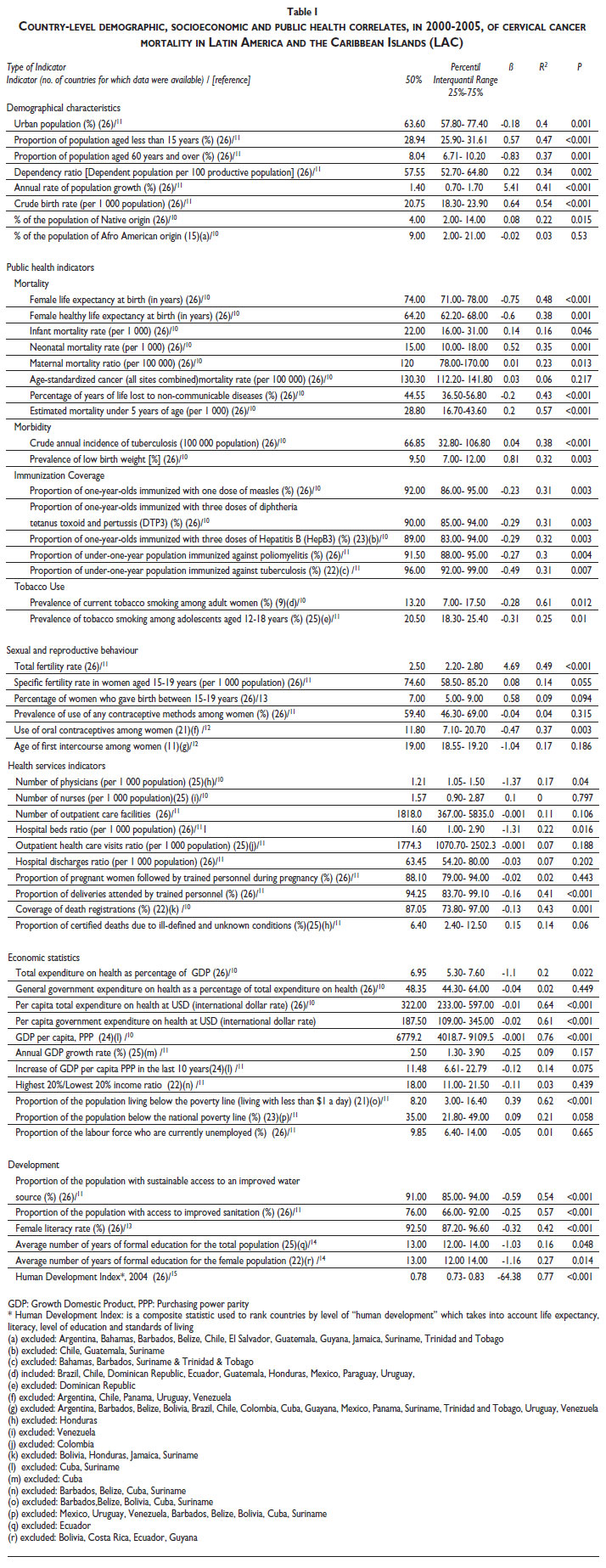
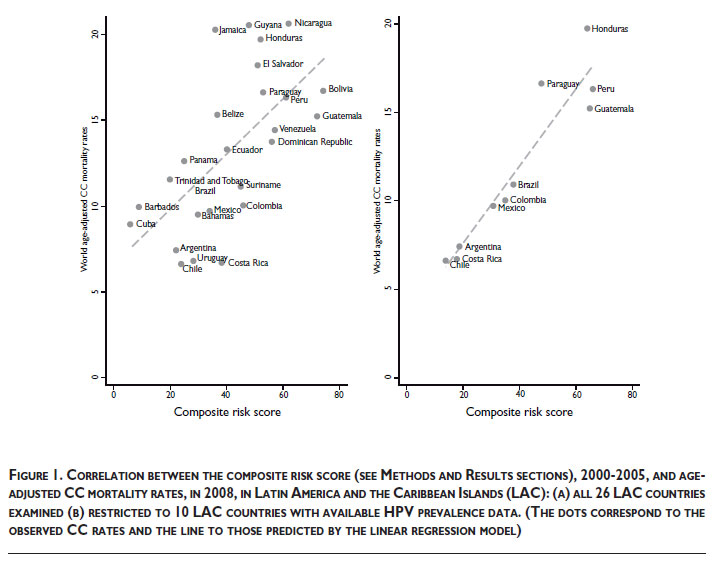
<body><![CDATA[<p>&nbsp;</p>     <p><font size="3" face="Verdana, Arial, Helvetica, sans-serif"><b>Materials and methods </b></font></p>     <p><font size="2" face="Verdana, Arial, Helvetica, sans-serif"><b>CC mortality rates </b></font></p>     <p><font size="2" face="Verdana, Arial, Helvetica, sans-serif">Country-specific CC mortality rates (age-adjusted to the World standard population) for 2008 were extracted from GLOBOCAN 2008.<sup>1</sup> These rates were estimated from death certification data provided by each country to the World Health Organization (WHO) except for Bolivia, Guyana, Honduras, Jamaica and Haiti. For these countries, CC mortality estimates were corrected for under-reporting (Guyana), or derived using data on CC incidence rates and survival (Bolivia) or CC mortality from neighbouring countries (Honduras, Jamaica).<sup>1</sup> Haiti was excluded from the analysis because its GLOBOCAN estimates were markedly different for 2002 and 2008 (i.e. age-adjusted rates of 48 and 10 per 100 000 women, respectively).<sup>1,9</sup> </font></p>     <p><font size="2" face="Verdana, Arial, Helvetica, sans-serif"><b>Level of SE development</b></font></p>      <p><font size="2" face="Verdana, Arial, Helvetica, sans-serif">Data on demographic, SE and public health indicators for the years 2000-2005 were extracted, for each LAC country, from official web pages or reports published by non-governmental organisations, including the WHO,<sup>10</sup> the Pan-American Health Organisation (PAHO),<sup>11-13</sup> the United Nations Statistics Division<sup>14</sup> and Human Development Report.<sup>15</sup> These indicators were categorised into nine strata (<a href="/img/revistas/spm/v55n1/a04tab01.jpg">table I</a>): demographic (eight indicators), mortality (eight), morbidity (two), immunisation coverage (five), tobacco use (two), sexual and reproductive behaviour (six), health services (ten), economic (eleven) and development (six) indicators. Linear univariate regression models, weighted by size of the female population in each country, were fitted to examine the association between each one of these 58 indicators and CC mortality at a country level. For each one of the nine strata described above, the indicator with the highest R<sup>2</sup> , a <i>p</i>-value&lt;0.05 and available data for all LAC countries examined was chosen to be included in a multiple regression model. The tobacco use stratum was excluded because none of its indicators had information for all the countries examined (<a href="/img/revistas/spm/v55n1/a04tab01.jpg">table I</a>). The correlation between the remaining eight selected stratum-specific indicators was then evaluated and whenever two of these were strongly correlated (r&gt;0.80), the one with the larger p-value and/or smaller R<sup>2</sup> was replaced by the next indicator in the same stratum that most closely fulfilled the above criteria. This process was repeated until none of the eight stratum-specific indicators were strongly correlated with each other (r&lt;0.80). A multiple linear regression model was then fitted to the final selection of stratum-specific indicators, and the log-likelihood ratio test used to identify the best independent predictors of CC mortality.</font></p>     <p><font size="2" face="Verdana, Arial, Helvetica, sans-serif">A composite risk score was generated on the basis of the identified predictors. Firstly, the 26 LAC countries were ranked separately according to the values of each one of the identified predictors and a predictor-specific risk score assigned to each country to reflect this ranking (e.g. for a predictor positively associated with CC mortality a score of 1 was assigned to the country with the lowest predictor value and a score of 26 to the country with the highest; for a predictor inversely associated with CC mortality a score of 1 was assigned to the country with the highest predictor value and a score of 26 to the country with the lowest). A composite risk score for each country was then calculated as the sum of its predictor-specific risk scores (i.e. for 3 predictors, country-specific composite scores could range from 3 to 78 depending on the direction of their association with CC mortality). </font></p>     <p><font size="2" face="Verdana, Arial, Helvetica, sans-serif"><b>HPV prevalence</b></font></p>      <p><font size="2" face="Verdana, Arial, Helvetica, sans-serif">Data on country-specific HPV prevalence estimates, any genotype and high-risk genotypes (HPV16 and HPV18), and the women's ages at the time of HPV assessment, were extracted from the WHO/ICO Information Centre on HPV and CC.<sup>16</sup> Its website presents worldwide data on HPV prevalence<sup>4,17</sup> compiled through systematic reviews of the literature published between 1995 and 2009; publications were eligible if HPV assessment was based on polymerase chain reaction (PCR) or Hybrid Capture2 (HC2), and the sample included &gt;90 women with normal cytological findings. Age-specific HPV prevalence estimates were available from the WHO/ICO website for 10 LAC countries (Argentina, Brazil, Chile, Colombia, Costa Rica, Guatemala, Honduras, Mexico, Paraguay and Peru). Regression models, restricted to these 10 countries, were fitted to examine the association between HPV prevalence (any and high-risk HPV) and CC mortality, adjusting for age at HPV ascertainment and also additionally for the SE predictors identified by the analysis described above. </font></p>     <p><font size="2" face="Verdana, Arial, Helvetica, sans-serif"><b> Cervical screening</b></font></p>      ]]></body>
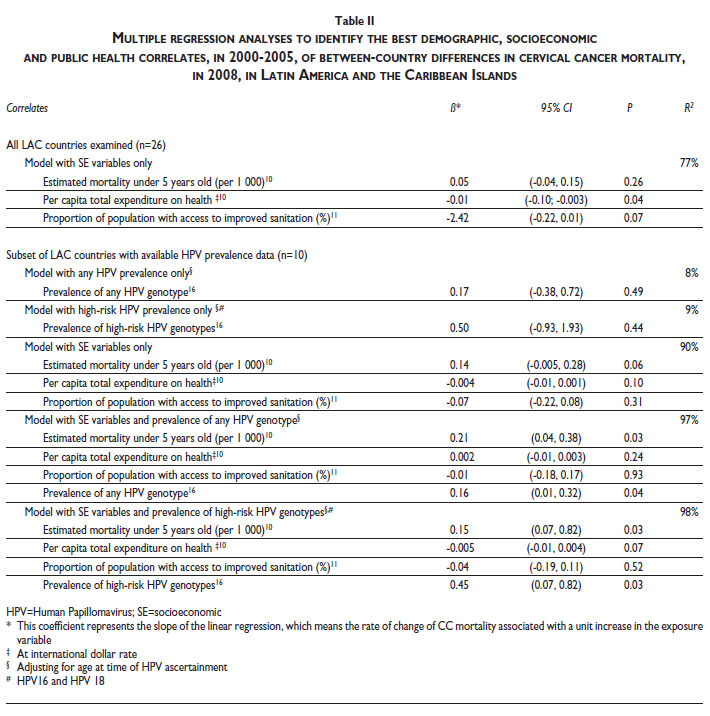
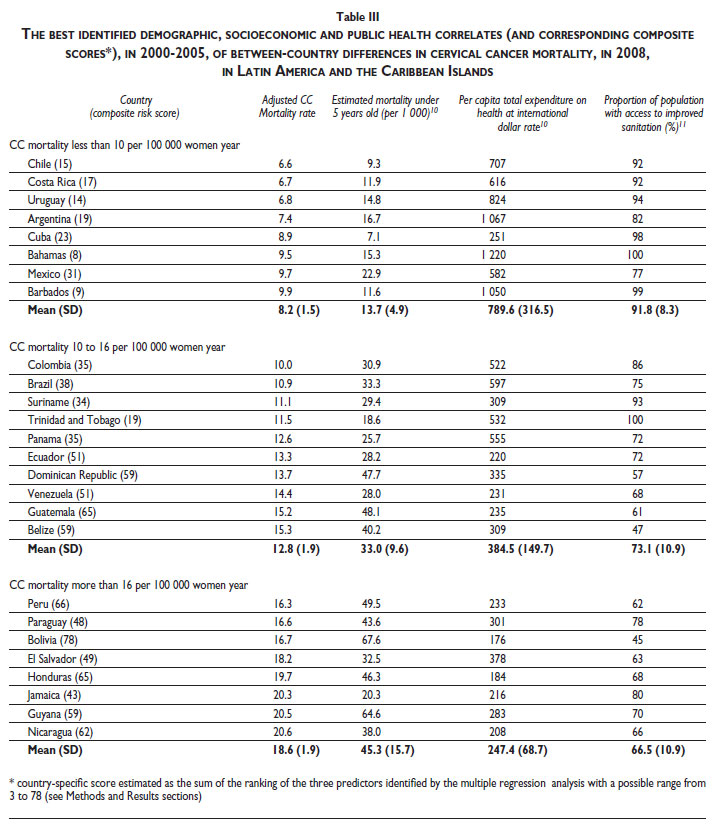
<body><![CDATA[<p><font size="2" face="Verdana, Arial, Helvetica, sans-serif">Information on screening policies and their level of implementation, including Pap smear coverage estimatesfrom nationally representative surveys and other sources, were extracted from a previously published source<sup>18</sup> and updated using the same methodology as previously. Information was also gathered on the use of HPV detection methods and on HPV vaccination policies.</font></p>     <p><font size="2" face="Verdana, Arial, Helvetica, sans-serif">Analyses were conducted in Stata v.10. The study was carried out at the London School of Hygiene and Tropical Medicine. Ethical approval was not required because only publicly-available secondary data were analysed. </font></p>     <p>&nbsp;</p>     <p><font size="3" face="Verdana, Arial, Helvetica, sans-serif"><b>Results </b></font></p>     <p><font size="2" face="Verdana, Arial, Helvetica, sans-serif">There were marked between-country differences for most demographic, SE and public health indicators (<a href="/img/revistas/spm/v55n1/a04tab01.jpg">table I</a>). For instance, there was a 9.5-fold difference between the countries with the highest (Bolivia) and the lowest (Chile) mortality rate among children aged under 5 years, and a 7-fold difference between the countries with the highest (Bahamas) and the lowest (Bolivia) per-capita expenditure on health.</font></p>     <p><font size="2" face="Verdana, Arial, Helvetica, sans-serif">The univariate analyses showed that countries with the highest CC mortality rates tended to be those with the youngest age-structure, lowest degree of urbanisation, lowest SE development and poorest health indicators (<a href="/img/revistas/spm/v55n1/a04tab01.jpg">table I</a>). Crude birth rate, mortality rate under five years, incidence of tuberculosis, proportion of one-year-olds immunized with one dose of measles, total fertility rate, proportion of deliveries attended by trained personnel,per capita total expenditure on health, and proportion of the population with access to improved sanitation were the variables selected to represent each one of the eight strata of indicators in the multiple regression analysis. </font></p>     <p><font size="2" face="Verdana, Arial, Helvetica, sans-serif">Mortality rate under 5 years of age, per capita total expenditure on health and proportion of the population with access to improved sanitation were identified as the best independent predictors of CC mortality in LAC (<a href="/img/revistas/spm/v55n1/a04tab02.jpg">table II</a>), accounting for 77% of the between-country variability in rates. There was a positive linear association between the composite risk score and CC mortality at a country level (<a href="/img/revistas/spm/v55n1/a04fig01.jpg">figure 1</a>).</font></p>     <p><font size="2" face="Verdana, Arial, Helvetica, sans-serif">Stratifying LAC countries according to their CC mortality (<a href="/img/revistas/spm/v55n1/a04tab03.jpg">table III</a>) showed, as expected, that the highest CC mortality-stratum had, on average, the highest mortality rate at age under-5-years, the lowest mean per capita total expenditure on health, and the lowest proportion of the population with access to improved sanitation. </font></p>     <p><font size="2" face="Verdana, Arial, Helvetica, sans-serif">In analyses restricted to the subset of 10 countries with available HPV data, the three independent SE predictors identified above explained 90% of the between-country variability in CC mortality (<a href="/img/revistas/spm/v55n1/a04tab02.jpg">table II</a>) whereas age-adjusted prevalence of any HPV genotype, or of high-risk HPV genotypes, alone explained only 8-9% (<a href="/img/revistas/spm/v55n1/a04tab02.jpg">table II</a>).The correlation between HPV and SE predictors was low (r&lt;0.30). Nevertheless, the R<sup>2</sup> increased to 98% when both SE predictors and high-risk HPV prevalence (to 97% if thelatter was replaced by prevalence of any HPV genotype) were included in the same model (<a href="/img/revistas/spm/v55n1/a04tab02.jpg">table II</a>).</font></p>     <p><font size="2" face="Verdana, Arial, Helvetica, sans-serif">Cytology-based screening programmes were first introduced in LAC in the early 1960s (<a href="/img/revistas/spm/v55n1/a04tab04.jpg">table IV</a>). Most programmes are opportunistic. Only the Chilean national programme recommends a national call-recall system,<sup>19</sup> but there is no evidence that such recommendation has been implemented. A few local organised screening programmes have been set up (e.g. certain regions of Brazil),<sup>20-22</sup> but none has established a call-recall system. Different methodologies and age-groups were used to estimate Pap smear coverage, thus making between-country comparisons difficult. Estimates for Pap-smear coverage within 2-3 years prior to the survey (available for nine countries) ranged from 31 to 69%.<sup>20,23-31</sup> Estimates of the proportion of women ever screened (available for seven countries) ranged from 35 to 85%,<sup>25,29,32-35</sup> being greater than 80% (at ages 15-49) only in El Salvador.<sup>33</sup> Those that report annual screening ranged from 22.7% to 44.8%.<sup>35-38</sup> Screening relied mainly on cytology (Papanicolaou test), but in recent years visual inspection after the application of acetic acid (VIA) and HPV testing have also been incorporated into national screening policies (e.g. the latter is currently being used in primary screening in Mexico and in demonstration projects in Argentina, Colombia, and Peru). National HPV vaccination programmes, targeting girls aged 9-11 years, were initiated in 2008 in Mexico, Panama, Argentina and Peru.<sup>39-43</sup> </font></p>     ]]></body>
<body><![CDATA[<p>&nbsp;</p>     <p><font size="3" face="Verdana, Arial, Helvetica, sans-serif"><b>Discussion </b></font></p>     <p><font size="2" face="Verdana, Arial, Helvetica, sans-serif">This ecological study found that markers of level of SE development were inversely associated with CC mortality. Using data from 127 developing countries, Drain <i>et al</i>.<sup>44</sup> found that country-specific CC incidence rates were negatively associated with health indicators but, in contrast to our study, CC incidence was not inversely associated with most SE indicators; in fact, there was a positive relationship between health expenditure and CC incidence, which was attributed to China having both low health spending and low CC incidence. </font></p>     <p><font size="2" face="Verdana, Arial, Helvetica, sans-serif">Individual-based studies carried out in LAC have shown that CC mortality and incidence are associated with SE status.<sup>45</sup> Women with a low SE status may have a more risky sexual behaviour, thus increasing their likelihood of acquiring a HPV infection, and an increased risk of HPV persistence and progression to pre-invasive lesions due, for instance, to higher smoking prevalence<sup>46</sup> and higher parity.<sup>47</sup> They are also more likely to have poor access to health services including early detection, diagnostic and treatment facilities.<sup>7,48</sup> </font></p>     <p><font size="2" face="Verdana, Arial, Helvetica, sans-serif">Improvements in the SE level of a country, even in the absence of a well-established screening programme, may decrease CC mortality rates,<sup>49</sup> perhaps to declines in HPV prevalence and increased access to early detection and treatment.<sup>50,51</sup> Data from three population-based cancer registries in LAC (Cali in Colombia, Costa Rica and Ecuador) show a decline in CC incidence from 1970 to 1995, a period when Pap smear coverage remained low but SE level improved.<sup>2</sup> </font></p>     <p><font size="2" face="Verdana, Arial, Helvetica, sans-serif">In the subset of 10 countries for which HPV prevalence estimates were available, high-risk HPV prevalence alone explained only 9% of the between-country variability in CC mortality whereas SE correlates explained 90%. However, when both SE correlates and high-risk HPV prevalence were included in the same model, these variables explained practically all between-country variability in CC mortality (R<sup>2</sup> =98%).These findings suggest that SE indicators may be a better correlate of between-country differences in CC mortality than HPV prevalence; however, they may simply reflect the much better quality of the SE data.</font></p>     <p><font size="2" face="Verdana, Arial, Helvetica, sans-serif">The paucity of comparable data on Pap smear coverage precluded examination of the extent to which between-country differences in CC mortality reflected differences in screening activity. The available estimates indicate that coverage is likely to have been low in most countries. Previous studies revealed low cytology quality, poor follow-up and poor treatment compliance.<sup>52</sup> A study carried out by RedPac, an initiative set up to monitor and improve Pap smear quality in LAC, showed that cytology quality was poor in many countries (e.g. percentage of false-negatives in 2000 was 27% in Peru, 23% in Venezuela, and &lt;5% in Chile and Costa Rica).<sup>18,35</sup> The effectiveness of screening was also affected by poor turnaround time,<sup>53</sup> mainly in rural areas,<sup>54</sup> with only 34% abnormal smears being appropriately followed-up in Peru, 59% in Bolivia, and &gt;90% in Chile and Cuba.<sup>18</sup> New screening methods (e.g. visual inspection after acetic acid &#91;VIA&#93; and HPV testing) are being adopted in certain LAC countries (<a href="/img/revistas/spm/v55n1/a04tab04.jpg">table IV</a>) but their introduction is far too recent to have had any major impact on the mortality rates examined here.</font></p>     <p><font size="2" face="Verdana, Arial, Helvetica, sans-serif">Our study is not exempt of limitations. Firstly, the analyses relied on mortality data, which reflects both incidence of, and survival from, CC. There are few population-based cancer registries in LAC and most are local. The quality of the mortality data was also far from ideal. The estimates produced by GLOBOCAN (IARC/WHO) took into account under-registration of death and percentage of registered deaths coded as "ill-defined" conditions, but different methods were used to estimate rates for each country depending on data availability. Secondly, the SE data came from different sources although for every single variable the same source was used for all 26 countries examined; reassuringly, the SE correlations with CC mortality were rather consistent despite the different quality of the data on the various SE indicators. Thirdly, HPV prevalence estimates, available for only 10 countries, were derived from local surveys using HCII or PCR methodology. The extent to which such surveys were nationally representative is unknown. Fourthly, data on screening activity and quality were scarce; national estimates of Pap-smear coverage were available only for a few countries based on different (non-comparable) methodologies. Finally, the findings relate to countries and cannot be extrapolated to an individual level. </font></p>     <p><font size="2" face="Verdana, Arial, Helvetica, sans-serif">In summary, CC mortality remains high in LAC. Our findings imply that improvements in the level of SE development of a country may reduce CC mortality even in the absence of organised screening programmes and HPV vaccination programmes. </font></p>     <p>&nbsp;</p>     ]]></body>
<body><![CDATA[<p><font size="3" face="Verdana, Arial, Helvetica, sans-serif"><b> References</b></font></p>      <!-- ref --><p><font size="2" face="Verdana, Arial, Helvetica, sans-serif">1. Ferlay J, Shin HR, Bray F, Forman D, Mathers C, Parkin D. GLOBOCAN 2008: Cancer Incidence and Mortality Worldwide: IARC CancerBase No. 10 &#91;Internet&#93;. International Agency for Research on Cancer 2010. &#91;cited September 2010&#93; Available from: <a href="http://globocan.iarc.fr" target="_blank">http://globocan.iarc.fr</a> </font>&nbsp;&nbsp;&nbsp;&nbsp;&nbsp;&nbsp;&nbsp;&nbsp;[&#160;<a href="javascript:void(0);" onclick="javascript: window.open('/scielo.php?script=sci_nlinks&ref=9356038&pid=S0036-3634201300010000400001&lng=','','width=640,height=500,resizable=yes,scrollbars=1,menubar=yes,');">Links</a>&#160;]<!-- end-ref --><!-- ref --><p><font size="2" face="Verdana, Arial, Helvetica, sans-serif">2. Parkin DM, Whelan S, Ferlay J, Storm H. Cancer Incidence in Five Continents, Vol. I to VIII. Lyon: IARC scientific publication; 2002;vol. 1 to VIII:78.    &nbsp;&nbsp;&nbsp;&nbsp;&nbsp;&nbsp;&nbsp;&nbsp;[&#160;<a href="javascript:void(0);" onclick="javascript: window.open('/scielo.php?script=sci_nlinks&ref=9356039&pid=S0036-3634201300010000400002&lng=','','width=640,height=500,resizable=yes,scrollbars=1,menubar=yes,');">Links</a>&#160;]<!-- end-ref --> </font></p>     <!-- ref --><p><font size="2" face="Verdana, Arial, Helvetica, sans-serif">3. Walboomers JM, Jacobs MV, Manos MM, Bosch FX, Kummer JA, Shah KV, <i>et al</i>. Human papillomavirus is a necessary cause of invasive cervical cancer worldwide. J Pathol 1999;189(1):12-19.    &nbsp;&nbsp;&nbsp;&nbsp;&nbsp;&nbsp;&nbsp;&nbsp;[&#160;<a href="javascript:void(0);" onclick="javascript: window.open('/scielo.php?script=sci_nlinks&ref=9356041&pid=S0036-3634201300010000400003&lng=','','width=640,height=500,resizable=yes,scrollbars=1,menubar=yes,');">Links</a>&#160;]<!-- end-ref --> </font></p>     <!-- ref --><p><font size="2" face="Verdana, Arial, Helvetica, sans-serif">4. de Sanjose S, Diaz M, Castellsague X, Clifford G, Bruni L, Munoz N, <i>et al</i>. Worldwide prevalence and genotype distribution of cervical human papillomavirus DNA in women with normal cytology: a meta-analysis. The Lancet infectious diseases 2007;7(7):453-459.    &nbsp;&nbsp;&nbsp;&nbsp;&nbsp;&nbsp;&nbsp;&nbsp;[&#160;<a href="javascript:void(0);" onclick="javascript: window.open('/scielo.php?script=sci_nlinks&ref=9356043&pid=S0036-3634201300010000400004&lng=','','width=640,height=500,resizable=yes,scrollbars=1,menubar=yes,');">Links</a>&#160;]<!-- end-ref --> </font></p>     <!-- ref --><p><font size="2" face="Verdana, Arial, Helvetica, sans-serif">5. Anttila A, Ronco G, Clifford G, Bray F, Hakama M, Arbyn M, <i>et al</i>. Cervical cancer screening programmes and policies in 18 European countries. Br J Cancer 2004;91(5):935-941.    &nbsp;&nbsp;&nbsp;&nbsp;&nbsp;&nbsp;&nbsp;&nbsp;[&#160;<a href="javascript:void(0);" onclick="javascript: window.open('/scielo.php?script=sci_nlinks&ref=9356045&pid=S0036-3634201300010000400005&lng=','','width=640,height=500,resizable=yes,scrollbars=1,menubar=yes,');">Links</a>&#160;]<!-- end-ref --> </font></p>     ]]></body>
<body><![CDATA[<!-- ref --><p><font size="2" face="Verdana, Arial, Helvetica, sans-serif">6. Sankaranarayanan R, Budukh AM, Rajkumar R. Effective screening programmes for cervical cancer in low- and middle-income developing countries. Bull World Health Organ 2001;79(10):954-962.    &nbsp;&nbsp;&nbsp;&nbsp;&nbsp;&nbsp;&nbsp;&nbsp;[&#160;<a href="javascript:void(0);" onclick="javascript: window.open('/scielo.php?script=sci_nlinks&ref=9356047&pid=S0036-3634201300010000400006&lng=','','width=640,height=500,resizable=yes,scrollbars=1,menubar=yes,');">Links</a>&#160;]<!-- end-ref --> </font></p>     <!-- ref --><p><font size="2" face="Verdana, Arial, Helvetica, sans-serif">7. Spadea T, D'Errico A, Demaria M, Faggiano F, Pasian S, Zanetti R, <i>et al</i>. Educational inequalities in cancer incidence in Turin, Italy. Eur J Cancer Prev 2009;18(3):169-178.    &nbsp;&nbsp;&nbsp;&nbsp;&nbsp;&nbsp;&nbsp;&nbsp;[&#160;<a href="javascript:void(0);" onclick="javascript: window.open('/scielo.php?script=sci_nlinks&ref=9356049&pid=S0036-3634201300010000400007&lng=','','width=640,height=500,resizable=yes,scrollbars=1,menubar=yes,');">Links</a>&#160;]<!-- end-ref --> </font></p>     <!-- ref --><p><font size="2" face="Verdana, Arial, Helvetica, sans-serif">8. Benard VB, Johnson CJ, Thompson TD, Roland KB, Lai SM, Cokkinides V, <i>et al</i>. Examining the association between socioeconomic status and potential human papillomavirus-associated cancers. Cancer 2008;113(10 Suppl):2910-2918.    &nbsp;&nbsp;&nbsp;&nbsp;&nbsp;&nbsp;&nbsp;&nbsp;[&#160;<a href="javascript:void(0);" onclick="javascript: window.open('/scielo.php?script=sci_nlinks&ref=9356051&pid=S0036-3634201300010000400008&lng=','','width=640,height=500,resizable=yes,scrollbars=1,menubar=yes,');">Links</a>&#160;]<!-- end-ref --> </font></p>     <!-- ref --><p><font size="2" face="Verdana, Arial, Helvetica, sans-serif">9. Ferlay J, Bray F, Pisani P, Parkin DM. GLOBOCAN 2002 Cancer Incidence, Mortality and Prevalence Worldwide. IARC CancerBase No 5, 2004, version 2.0.    &nbsp;&nbsp;&nbsp;&nbsp;&nbsp;&nbsp;&nbsp;&nbsp;[&#160;<a href="javascript:void(0);" onclick="javascript: window.open('/scielo.php?script=sci_nlinks&ref=9356053&pid=S0036-3634201300010000400009&lng=','','width=640,height=500,resizable=yes,scrollbars=1,menubar=yes,');">Links</a>&#160;]<!-- end-ref --> </font></p>     <!-- ref --><p><font size="2" face="Verdana, Arial, Helvetica, sans-serif">10. WHO. Core Health Indicators. &#91;Accessed 20/01/2007&#93;; Available from: <a href="http://www3.who.int/whosis/core/core_select.cfm" target="_blank">http://www3.who.int/whosis/core/core_select.cfm</a> </font>&nbsp;&nbsp;&nbsp;&nbsp;&nbsp;&nbsp;&nbsp;&nbsp;[&#160;<a href="javascript:void(0);" onclick="javascript: window.open('/scielo.php?script=sci_nlinks&ref=9356055&pid=S0036-3634201300010000400010&lng=','','width=640,height=500,resizable=yes,scrollbars=1,menubar=yes,');">Links</a>&#160;]<!-- end-ref --><!-- ref --><p><font size="2" face="Verdana, Arial, Helvetica, sans-serif">11. PAHO. Regional Core Health Data Initiative. Table Generator System. &#91;Accessed 20/01/2007&#93;; Available from: <a href="http://www.paho.org/English/SHA/coredata/tabulator/newTabulator.htm" target="_blank">http://www.paho.org/English/SHA/coredata/tabulator/newTabulator.htm</a> </font>&nbsp;&nbsp;&nbsp;&nbsp;&nbsp;&nbsp;&nbsp;&nbsp;[&#160;<a href="javascript:void(0);" onclick="javascript: window.open('/scielo.php?script=sci_nlinks&ref=9356056&pid=S0036-3634201300010000400011&lng=','','width=640,height=500,resizable=yes,scrollbars=1,menubar=yes,');">Links</a>&#160;]<!-- end-ref --><!-- ref --><p><font size="2" face="Verdana, Arial, Helvetica, sans-serif">12. Organizacion Panamericana de Salud, Unidad de An&aacute;lisis y Estad&iacute;sticas de Salud (HA). Situaci&oacute;n de Salud en las Am&eacute;ricas: Indicadores B&aacute;sicos 2006. Washington, D.C.: Organizaci&oacute;n Panamericana de la Salud; 2006.    &nbsp;&nbsp;&nbsp;&nbsp;&nbsp;&nbsp;&nbsp;&nbsp;[&#160;<a href="javascript:void(0);" onclick="javascript: window.open('/scielo.php?script=sci_nlinks&ref=9356057&pid=S0036-3634201300010000400012&lng=','','width=640,height=500,resizable=yes,scrollbars=1,menubar=yes,');">Links</a>&#160;]<!-- end-ref --> </font></p>     <!-- ref --><p><font size="2" face="Verdana, Arial, Helvetica, sans-serif">13. Organizaci&oacute;n Panamericana de la Salud. G&eacute;nero, salud y desarrollo en las Americas: Indicadores Basicos 2005. Washington, D.C.: OPS, 2005.    &nbsp;&nbsp;&nbsp;&nbsp;&nbsp;&nbsp;&nbsp;&nbsp;[&#160;<a href="javascript:void(0);" onclick="javascript: window.open('/scielo.php?script=sci_nlinks&ref=9356059&pid=S0036-3634201300010000400013&lng=','','width=640,height=500,resizable=yes,scrollbars=1,menubar=yes,');">Links</a>&#160;]<!-- end-ref --> </font></p>     <!-- ref --><p><font size="2" face="Verdana, Arial, Helvetica, sans-serif">14. United Nations Statistical Division. Statistical Databases. &#91;Accessed 25/01/2007&#93;; Available from: <a href="http://unstats.un.org/unsd/databases.htm" target="_blank">http://unstats.un.org/unsd/databases.htm</a> </font>&nbsp;&nbsp;&nbsp;&nbsp;&nbsp;&nbsp;&nbsp;&nbsp;[&#160;<a href="javascript:void(0);" onclick="javascript: window.open('/scielo.php?script=sci_nlinks&ref=9356061&pid=S0036-3634201300010000400014&lng=','','width=640,height=500,resizable=yes,scrollbars=1,menubar=yes,');">Links</a>&#160;]<!-- end-ref --><!-- ref --><p><font size="2" face="Verdana, Arial, Helvetica, sans-serif">15. United Nations Development Programme. Human Development Report, 2006. New York City: UNDP, 2006.    &nbsp;&nbsp;&nbsp;&nbsp;&nbsp;&nbsp;&nbsp;&nbsp;[&#160;<a href="javascript:void(0);" onclick="javascript: window.open('/scielo.php?script=sci_nlinks&ref=9356062&pid=S0036-3634201300010000400015&lng=','','width=640,height=500,resizable=yes,scrollbars=1,menubar=yes,');">Links</a>&#160;]<!-- end-ref --> </font></p>     <!-- ref --><p><font size="2" face="Verdana, Arial, Helvetica, sans-serif">16. WHO/ICO. Information Centre on HPV and Cervical Cancer (HPV Information Centre). &#91;Accessed 2011 15 of July&#93;; Available from: <a href="http://www.who.int/hpvcentre" target="_blank">www.who.int/hpvcentre</a> </font>&nbsp;&nbsp;&nbsp;&nbsp;&nbsp;&nbsp;&nbsp;&nbsp;[&#160;<a href="javascript:void(0);" onclick="javascript: window.open('/scielo.php?script=sci_nlinks&ref=9356064&pid=S0036-3634201300010000400016&lng=','','width=640,height=500,resizable=yes,scrollbars=1,menubar=yes,');">Links</a>&#160;]<!-- end-ref --><!-- ref --><p><font size="2" face="Verdana, Arial, Helvetica, sans-serif">17. Bruni L, Diaz M, Castellsague X, Ferrer E, Bosch FX, de Sanjose S. Cervical human papillomavirus prevalence in 5 continents: metaanalysis of 1 million women with normal cytological findings. J Infect Dis;202(12):1789-1799.    &nbsp;&nbsp;&nbsp;&nbsp;&nbsp;&nbsp;&nbsp;&nbsp;[&#160;<a href="javascript:void(0);" onclick="javascript: window.open('/scielo.php?script=sci_nlinks&ref=9356065&pid=S0036-3634201300010000400017&lng=','','width=640,height=500,resizable=yes,scrollbars=1,menubar=yes,');">Links</a>&#160;]<!-- end-ref --> </font></p>     ]]></body>
<body><![CDATA[<!-- ref --><p><font size="2" face="Verdana, Arial, Helvetica, sans-serif">18. Murillo R, Almonte M, Pereira A, Ferrer E, Gamboa OA, Jeronimo J, <i>et al</i>. Cervical cancer screening programs in Latin America and the Caribbean. Vaccine 2008;26 Suppl 11:L37-48.    &nbsp;&nbsp;&nbsp;&nbsp;&nbsp;&nbsp;&nbsp;&nbsp;[&#160;<a href="javascript:void(0);" onclick="javascript: window.open('/scielo.php?script=sci_nlinks&ref=9356067&pid=S0036-3634201300010000400018&lng=','','width=640,height=500,resizable=yes,scrollbars=1,menubar=yes,');">Links</a>&#160;]<!-- end-ref --> </font></p>     <!-- ref --><p><font size="2" face="Verdana, Arial, Helvetica, sans-serif">19. Ministerio de Salud Chile. Orientaciones para pesquisa y control del c&aacute;ncer cervicouterino. Santiago: Minsal, 1998.    &nbsp;&nbsp;&nbsp;&nbsp;&nbsp;&nbsp;&nbsp;&nbsp;[&#160;<a href="javascript:void(0);" onclick="javascript: window.open('/scielo.php?script=sci_nlinks&ref=9356069&pid=S0036-3634201300010000400019&lng=','','width=640,height=500,resizable=yes,scrollbars=1,menubar=yes,');">Links</a>&#160;]<!-- end-ref --> </font></p>     <!-- ref --><p><font size="2" face="Verdana, Arial, Helvetica, sans-serif">20. Martins L, Thuler L, Valente J. Coverage of the Pap smear in Brazil and its determining factors: a systematic literature review. &#91;In Portuguese&#93;. Rev Bras Ginecol Obstet 2005;27(8):485-492.    &nbsp;&nbsp;&nbsp;&nbsp;&nbsp;&nbsp;&nbsp;&nbsp;[&#160;<a href="javascript:void(0);" onclick="javascript: window.open('/scielo.php?script=sci_nlinks&ref=9356071&pid=S0036-3634201300010000400020&lng=','','width=640,height=500,resizable=yes,scrollbars=1,menubar=yes,');">Links</a>&#160;]<!-- end-ref --> </font></p>     <!-- ref --><p><font size="2" face="Verdana, Arial, Helvetica, sans-serif">21. d'Ottaviano-Morelli MG, Zeferino L, Cecatti JG, Terrabuio DR, Martinez EZ. Prevalence of cervical intraepithelial neoplasia and invasive carcinoma based on cytological screening in the region of Campinas, Sao Paulo, Brazil. Cad Saude Publica 2004;20(1):153-159.    &nbsp;&nbsp;&nbsp;&nbsp;&nbsp;&nbsp;&nbsp;&nbsp;[&#160;<a href="javascript:void(0);" onclick="javascript: window.open('/scielo.php?script=sci_nlinks&ref=9356073&pid=S0036-3634201300010000400021&lng=','','width=640,height=500,resizable=yes,scrollbars=1,menubar=yes,');">Links</a>&#160;]<!-- end-ref --> </font></p>     <!-- ref --><p><font size="2" face="Verdana, Arial, Helvetica, sans-serif">22. Zeferino LC, Pinotti JA, Jorge JP, Westin MC, Tambascia JK, Montemor EB. Organization of cervical cancer screening in Campinas and surrounding region, Sao Paulo State, Brazil. Cad Saude Publica 2006;22(9):1909-1914.    &nbsp;&nbsp;&nbsp;&nbsp;&nbsp;&nbsp;&nbsp;&nbsp;[&#160;<a href="javascript:void(0);" onclick="javascript: window.open('/scielo.php?script=sci_nlinks&ref=9356075&pid=S0036-3634201300010000400022&lng=','','width=640,height=500,resizable=yes,scrollbars=1,menubar=yes,');">Links</a>&#160;]<!-- end-ref --> </font></p>     ]]></body>
<body><![CDATA[<!-- ref --><p><font size="2" face="Verdana, Arial, Helvetica, sans-serif">23. MIDEPLAN. Encuesta CASEN. Santiago de Chile 2006.    &nbsp;&nbsp;&nbsp;&nbsp;&nbsp;&nbsp;&nbsp;&nbsp;[&#160;<a href="javascript:void(0);" onclick="javascript: window.open('/scielo.php?script=sci_nlinks&ref=9356077&pid=S0036-3634201300010000400023&lng=','','width=640,height=500,resizable=yes,scrollbars=1,menubar=yes,');">Links</a>&#160;]<!-- end-ref --> </font></p>     <!-- ref --><p><font size="2" face="Verdana, Arial, Helvetica, sans-serif">24. Ministerio de Salud de la Naci&oacute;n. Encuesta Nacional de Factores de Riesgo 2005: Argentina. Instituto Nacional de Estad&iacute;sticas y Censos de Argentina; 2006.    &nbsp;&nbsp;&nbsp;&nbsp;&nbsp;&nbsp;&nbsp;&nbsp;[&#160;<a href="javascript:void(0);" onclick="javascript: window.open('/scielo.php?script=sci_nlinks&ref=9356079&pid=S0036-3634201300010000400024&lng=','','width=640,height=500,resizable=yes,scrollbars=1,menubar=yes,');">Links</a>&#160;]<!-- end-ref --> </font></p>     <!-- ref --><p><font size="2" face="Verdana, Arial, Helvetica, sans-serif">25. Chen M, Rosero L, Brenes G, Le&oacute;n M, Gonzalez M, Vanegas J. Salud reproductiva y migraci&oacute;n nicarag&uuml;ense en Costa Rica 1999-2000: Resultados de una Encuesta Nacional de Salud Reproductiva. San Jos&eacute;: Programa Centroamericano de Poblaci&oacute;n (PCP) de la Escuela de Estad&iacute;stica e Instituto de Investigaciones en Salud (INISA), Universidad de Costa Rica; 2001.    &nbsp;&nbsp;&nbsp;&nbsp;&nbsp;&nbsp;&nbsp;&nbsp;[&#160;<a href="javascript:void(0);" onclick="javascript: window.open('/scielo.php?script=sci_nlinks&ref=9356081&pid=S0036-3634201300010000400025&lng=','','width=640,height=500,resizable=yes,scrollbars=1,menubar=yes,');">Links</a>&#160;]<!-- end-ref --> </font></p>     <!-- ref --><p><font size="2" face="Verdana, Arial, Helvetica, sans-serif">26. Fernandez-Garrote L, Lence-Anta JJ, Cabezas-Cruz E, Romero T, Camacho R. Evaluation of the cervical cancer control program in Cuba. Bull Pan Am Health Organ 1996;30(4):387-391.    &nbsp;&nbsp;&nbsp;&nbsp;&nbsp;&nbsp;&nbsp;&nbsp;[&#160;<a href="javascript:void(0);" onclick="javascript: window.open('/scielo.php?script=sci_nlinks&ref=9356083&pid=S0036-3634201300010000400026&lng=','','width=640,height=500,resizable=yes,scrollbars=1,menubar=yes,');">Links</a>&#160;]<!-- end-ref --> </font></p>     <!-- ref --><p><font size="2" face="Verdana, Arial, Helvetica, sans-serif">27. Ojeda G, Ord&oacute;&ntilde;ez GM, Ochoa LH. Asociaci&oacute;n Pro-Bienestar de la Familia Colombiana. Salud sexual y reproductiva: resultados encuesta nacional de demograf&iacute;a y salud, 2005. Bogota, Colombia: Asociaci&oacute;n Probienestar de la Familia Colombiana, PROFAMILIA, 2005.    &nbsp;&nbsp;&nbsp;&nbsp;&nbsp;&nbsp;&nbsp;&nbsp;[&#160;<a href="javascript:void(0);" onclick="javascript: window.open('/scielo.php?script=sci_nlinks&ref=9356085&pid=S0036-3634201300010000400027&lng=','','width=640,height=500,resizable=yes,scrollbars=1,menubar=yes,');">Links</a>&#160;]<!-- end-ref --> </font></p>     ]]></body>
<body><![CDATA[<!-- ref --><p><font size="2" face="Verdana, Arial, Helvetica, sans-serif">28. Centro de Estudios de Poblaci&oacute;n y Paternidad Responsable (Ecuador), Centers for Disease Control (U.S.). Ecuador, ENDEMAIN-2004: informe preliminar. Quito, Ecuador &#91;Atlanta, Georgia&#93;: CEPAR; Centros para el Control de Enfermedades, 2005.    &nbsp;&nbsp;&nbsp;&nbsp;&nbsp;&nbsp;&nbsp;&nbsp;[&#160;<a href="javascript:void(0);" onclick="javascript: window.open('/scielo.php?script=sci_nlinks&ref=9356087&pid=S0036-3634201300010000400028&lng=','','width=640,height=500,resizable=yes,scrollbars=1,menubar=yes,');">Links</a>&#160;]<!-- end-ref --> </font></p>     <!-- ref --><p><font size="2" face="Verdana, Arial, Helvetica, sans-serif">29. Centro Paraguayo de Estudios de Poblaci&oacute;n. Centers for Disease Control and Prevention (U.S.), United States. Agency for International Development. Encuesta nacional de demograf&iacute;a y salud sexual y reproductiva 2004, ENDSSR 2004: informe resumido. Asunci&oacute;n, Paraguay: CEPEP, CDC, USAID, 2004.    &nbsp;&nbsp;&nbsp;&nbsp;&nbsp;&nbsp;&nbsp;&nbsp;[&#160;<a href="javascript:void(0);" onclick="javascript: window.open('/scielo.php?script=sci_nlinks&ref=9356089&pid=S0036-3634201300010000400029&lng=','','width=640,height=500,resizable=yes,scrollbars=1,menubar=yes,');">Links</a>&#160;]<!-- end-ref --> </font></p>     <!-- ref --><p><font size="2" face="Verdana, Arial, Helvetica, sans-serif">30. Subsecretaria de Prevenci&oacute;n y Protecci&oacute;n de la Salud. Programa de Acci&iacute;n: C&aacute;ncer Cervicouterino. Mexico: Secretar&iacute;a de Salud, 2002.    &nbsp;&nbsp;&nbsp;&nbsp;&nbsp;&nbsp;&nbsp;&nbsp;[&#160;<a href="javascript:void(0);" onclick="javascript: window.open('/scielo.php?script=sci_nlinks&ref=9356091&pid=S0036-3634201300010000400030&lng=','','width=640,height=500,resizable=yes,scrollbars=1,menubar=yes,');">Links</a>&#160;]<!-- end-ref --> </font></p>     <!-- ref --><p><font size="2" face="Verdana, Arial, Helvetica, sans-serif">31. MIDEPLAN. Encuesta CASEN. Santiago de Chile 2003.    &nbsp;&nbsp;&nbsp;&nbsp;&nbsp;&nbsp;&nbsp;&nbsp;[&#160;<a href="javascript:void(0);" onclick="javascript: window.open('/scielo.php?script=sci_nlinks&ref=9356093&pid=S0036-3634201300010000400031&lng=','','width=640,height=500,resizable=yes,scrollbars=1,menubar=yes,');">Links</a>&#160;]<!-- end-ref --> </font></p>     <!-- ref --><p><font size="2" face="Verdana, Arial, Helvetica, sans-serif">32. Ministerio de Salud de la Rep&uacute;blica Argentina. Subprograma de Deteccion Precoz de C&aacute;ncer de Cuello Uterino. In: Resolucion Ministerial Nº 480/98, Buenos Aires: Buenos Aires, 1998.    &nbsp;&nbsp;&nbsp;&nbsp;&nbsp;&nbsp;&nbsp;&nbsp;[&#160;<a href="javascript:void(0);" onclick="javascript: window.open('/scielo.php?script=sci_nlinks&ref=9356095&pid=S0036-3634201300010000400032&lng=','','width=640,height=500,resizable=yes,scrollbars=1,menubar=yes,');">Links</a>&#160;]<!-- end-ref --> </font></p>     ]]></body>
<body><![CDATA[<!-- ref --><p><font size="2" face="Verdana, Arial, Helvetica, sans-serif">33. Monteith R, Stupp PW, McCracken SD, National Center for Chronic Disease Prevention and Health Promotion (U.S.). Division of Reproductive Health. Reproductive, maternal and child health in Central America: trends and challenges facing women and children: El Salvador, Guatemala, Hondouras, Nicaragua. Atlanta, GA: USAID, 2005.    &nbsp;&nbsp;&nbsp;&nbsp;&nbsp;&nbsp;&nbsp;&nbsp;[&#160;<a href="javascript:void(0);" onclick="javascript: window.open('/scielo.php?script=sci_nlinks&ref=9356097&pid=S0036-3634201300010000400033&lng=','','width=640,height=500,resizable=yes,scrollbars=1,menubar=yes,');">Links</a>&#160;]<!-- end-ref --> </font></p>     <!-- ref --><p><font size="2" face="Verdana, Arial, Helvetica, sans-serif">34. Aguirre R, Bonino M, Espino A, Sapriza G. Programa Mujer y G&eacute;nero del Ministerio de Salud P&uacute;blica. Diagn&oacute;stico de situaci&oacute;n sobre g&eacute;nero y salud en Uruguay. Washington: Panamerican Health Organization, 2006.    &nbsp;&nbsp;&nbsp;&nbsp;&nbsp;&nbsp;&nbsp;&nbsp;[&#160;<a href="javascript:void(0);" onclick="javascript: window.open('/scielo.php?script=sci_nlinks&ref=9356099&pid=S0036-3634201300010000400034&lng=','','width=640,height=500,resizable=yes,scrollbars=1,menubar=yes,');">Links</a>&#160;]<!-- end-ref --> </font></p>     <!-- ref --><p><font size="2" face="Verdana, Arial, Helvetica, sans-serif">35. Lewis J. Analisis de la situacion del cancer cervicouterino en America Latina y el Caribe. Washington, D.C.: OPS, 2004.    &nbsp;&nbsp;&nbsp;&nbsp;&nbsp;&nbsp;&nbsp;&nbsp;[&#160;<a href="javascript:void(0);" onclick="javascript: window.open('/scielo.php?script=sci_nlinks&ref=9356101&pid=S0036-3634201300010000400035&lng=','','width=640,height=500,resizable=yes,scrollbars=1,menubar=yes,');">Links</a>&#160;]<!-- end-ref --> </font></p>     <!-- ref --><p><font size="2" face="Verdana, Arial, Helvetica, sans-serif">36. Ministerio de Salud P&uacute;blica de Guatemala. Encuesta Nacional de Salud Materno Infantil 2002 (Mujeres). Guatemala: Ministerio de Salud, 2002.    &nbsp;&nbsp;&nbsp;&nbsp;&nbsp;&nbsp;&nbsp;&nbsp;[&#160;<a href="javascript:void(0);" onclick="javascript: window.open('/scielo.php?script=sci_nlinks&ref=9356103&pid=S0036-3634201300010000400036&lng=','','width=640,height=500,resizable=yes,scrollbars=1,menubar=yes,');">Links</a>&#160;]<!-- end-ref --> </font></p>     <!-- ref --><p><font size="2" face="Verdana, Arial, Helvetica, sans-serif">37. Instituto Nacional de Estad&iacute;stica e Inform&aacute;tica (INEI) de Per&uacute;. Encuesta nacional de hogares. Per&uacute;: INEI, 1998.    &nbsp;&nbsp;&nbsp;&nbsp;&nbsp;&nbsp;&nbsp;&nbsp;[&#160;<a href="javascript:void(0);" onclick="javascript: window.open('/scielo.php?script=sci_nlinks&ref=9356105&pid=S0036-3634201300010000400037&lng=','','width=640,height=500,resizable=yes,scrollbars=1,menubar=yes,');">Links</a>&#160;]<!-- end-ref --> </font></p>     ]]></body>
<body><![CDATA[<!-- ref --><p><font size="2" face="Verdana, Arial, Helvetica, sans-serif">38. Instituto Nacional de Estad&iacute;sticas y Censos de Nicaragua. Encuesta Nicarag&uuml;ense de Demograf&iacute;a y Salud. Nicaragua: INEI, 2001.    &nbsp;&nbsp;&nbsp;&nbsp;&nbsp;&nbsp;&nbsp;&nbsp;[&#160;<a href="javascript:void(0);" onclick="javascript: window.open('/scielo.php?script=sci_nlinks&ref=9356107&pid=S0036-3634201300010000400038&lng=','','width=640,height=500,resizable=yes,scrollbars=1,menubar=yes,');">Links</a>&#160;]<!-- end-ref --> </font></p>     <!-- ref --><p><font size="2" face="Verdana, Arial, Helvetica, sans-serif">39. Hern&aacute;ndez-&Aacute;vila M, Lazcano-Ponce E, Mart&iacute;nerz-Monta&ntilde;ez O. Public Policies For HPV Screening and Vaccination in Mexico. 27th International Papillomavirus Conference and Clinical Workshop. Berlin, Germany September 17-22, 2011.    &nbsp;&nbsp;&nbsp;&nbsp;&nbsp;&nbsp;&nbsp;&nbsp;[&#160;<a href="javascript:void(0);" onclick="javascript: window.open('/scielo.php?script=sci_nlinks&ref=9356109&pid=S0036-3634201300010000400039&lng=','','width=640,height=500,resizable=yes,scrollbars=1,menubar=yes,');">Links</a>&#160;]<!-- end-ref --> </font></p>     <!-- ref --><p><font size="2" face="Verdana, Arial, Helvetica, sans-serif">40. Instituto Nacional Cancer. Programa Nacional de Controle do Cancer do Colo do Utero: Prevencao. Brasil: INCA Ministerio da Saude;. 2011. &#91;Accessed 10/11/2011&#93;; Available from: <a href="http://www1.inca.gov.br/conteudo_view.asp?id=327" target="_blank">http://www1.inca.gov.br/conteudo_view.asp?id=327</a> </font>&nbsp;&nbsp;&nbsp;&nbsp;&nbsp;&nbsp;&nbsp;&nbsp;[&#160;<a href="javascript:void(0);" onclick="javascript: window.open('/scielo.php?script=sci_nlinks&ref=9356111&pid=S0036-3634201300010000400040&lng=','','width=640,height=500,resizable=yes,scrollbars=1,menubar=yes,');">Links</a>&#160;]<!-- end-ref --><!-- ref --><p><font size="2" face="Verdana, Arial, Helvetica, sans-serif">41. Ministerio de Salud de Per&uacute;. Mas de 85 mil ni&ntilde;as de 10 a&ntilde;os ser&aacute;n vacuandas contral el VPH en Lima y Callao. &#91;Internet&#93;. Per&uacute;;. 7 de Febrero 2011. &#91;Accessed 01/12/2011&#93;; Available from: <a href="http://www.minsa.gob.pe/portada/prensa/notas_auxiliar.asp?nota=9915" target="_blank">http://www.minsa.gob.pe/portada/prensa/notas_auxiliar.asp?nota=9915</a> </font>&nbsp;&nbsp;&nbsp;&nbsp;&nbsp;&nbsp;&nbsp;&nbsp;[&#160;<a href="javascript:void(0);" onclick="javascript: window.open('/scielo.php?script=sci_nlinks&ref=9356112&pid=S0036-3634201300010000400041&lng=','','width=640,height=500,resizable=yes,scrollbars=1,menubar=yes,');">Links</a>&#160;]<!-- end-ref --><!-- ref --><p><font size="2" face="Verdana, Arial, Helvetica, sans-serif">42. Ministerio de Salud, Presidencia de la Naci&oacute;n. Introducci&oacute;n de nuevas vacunas: vacuna contra el Virus Papiloma Humano (VPH)&#91;Internet&#93;. Buenos Aires: Republica Argentina; 15 de Agosto 2011. &#91;Accessed 10/11/2012&#93;; Available from: <a href="http://www.msal.gov.ar/index.php/component/content/article/46/185-vph" target="_blank">http://www.msal.gov.ar/index.php/component/content/article/46/185-vph</a> </font>&nbsp;&nbsp;&nbsp;&nbsp;&nbsp;&nbsp;&nbsp;&nbsp;[&#160;<a href="javascript:void(0);" onclick="javascript: window.open('/scielo.php?script=sci_nlinks&ref=9356113&pid=S0036-3634201300010000400042&lng=','','width=640,height=500,resizable=yes,scrollbars=1,menubar=yes,');">Links</a>&#160;]<!-- end-ref --><!-- ref --><p><font size="2" face="Verdana, Arial, Helvetica, sans-serif">43. Ostrander M. Panama first in region to provide free HPV vaccine to young adolescent girls &#91;Internet&#93; Panama: Unicef; 28 October &#91;cited 20/11/2011&#93;; Available from: <a href="http://www.unicef.org/infobycountry/panama_46169.html" target="_blank">http://www.unicef.org/infobycountry/panama_46169.html</a> </font>&nbsp;&nbsp;&nbsp;&nbsp;&nbsp;&nbsp;&nbsp;&nbsp;[&#160;<a href="javascript:void(0);" onclick="javascript: window.open('/scielo.php?script=sci_nlinks&ref=9356114&pid=S0036-3634201300010000400043&lng=','','width=640,height=500,resizable=yes,scrollbars=1,menubar=yes,');">Links</a>&#160;]<!-- end-ref --><!-- ref --><p><font size="2" face="Verdana, Arial, Helvetica, sans-serif">44. Drain PK, Holmes KK, Hughes JP, Koutsky LA. Determinants of cervical cancer rates in developing countries. Int J Cancer 2002;100(2):199-205.    &nbsp;&nbsp;&nbsp;&nbsp;&nbsp;&nbsp;&nbsp;&nbsp;[&#160;<a href="javascript:void(0);" onclick="javascript: window.open('/scielo.php?script=sci_nlinks&ref=9356115&pid=S0036-3634201300010000400044&lng=','','width=640,height=500,resizable=yes,scrollbars=1,menubar=yes,');">Links</a>&#160;]<!-- end-ref --> </font></p>     ]]></body>
<body><![CDATA[<!-- ref --><p><font size="2" face="Verdana, Arial, Helvetica, sans-serif">45. Eluf-Neto J, Nascimento CM. Cervical cancer in Latin America. Semin Oncol 2001;28(2):188-97.    &nbsp;&nbsp;&nbsp;&nbsp;&nbsp;&nbsp;&nbsp;&nbsp;[&#160;<a href="javascript:void(0);" onclick="javascript: window.open('/scielo.php?script=sci_nlinks&ref=9356117&pid=S0036-3634201300010000400045&lng=','','width=640,height=500,resizable=yes,scrollbars=1,menubar=yes,');">Links</a>&#160;]<!-- end-ref --> </font></p>     <!-- ref --><p><font size="2" face="Verdana, Arial, Helvetica, sans-serif">46. Schaap MM, Kunst AE. Monitoring of socio-economic inequalities in smoking: learning from the experiences of recent scientific studies. Public Health 2009;123(2):103-109.    &nbsp;&nbsp;&nbsp;&nbsp;&nbsp;&nbsp;&nbsp;&nbsp;[&#160;<a href="javascript:void(0);" onclick="javascript: window.open('/scielo.php?script=sci_nlinks&ref=9356119&pid=S0036-3634201300010000400046&lng=','','width=640,height=500,resizable=yes,scrollbars=1,menubar=yes,');">Links</a>&#160;]<!-- end-ref --> </font></p>     <!-- ref --><p><font size="2" face="Verdana, Arial, Helvetica, sans-serif">47. dos Santos Silva I, Beral V. Socioeconomic differences in reproductive behaviour. IARC Scientific Publications 1997(138):285-308.    &nbsp;&nbsp;&nbsp;&nbsp;&nbsp;&nbsp;&nbsp;&nbsp;[&#160;<a href="javascript:void(0);" onclick="javascript: window.open('/scielo.php?script=sci_nlinks&ref=9356121&pid=S0036-3634201300010000400047&lng=','','width=640,height=500,resizable=yes,scrollbars=1,menubar=yes,');">Links</a>&#160;]<!-- end-ref --> </font></p>     <!-- ref --><p><font size="2" face="Verdana, Arial, Helvetica, sans-serif">48. Currin LG, Jack RH, Linklater KM, Mak V, Moller H, Davies EA. Inequalities in the incidence of cervical cancer in South East England 2001-2005: an investigation of population risk factors. BMC Public Health 2009;9:62.    &nbsp;&nbsp;&nbsp;&nbsp;&nbsp;&nbsp;&nbsp;&nbsp;[&#160;<a href="javascript:void(0);" onclick="javascript: window.open('/scielo.php?script=sci_nlinks&ref=9356123&pid=S0036-3634201300010000400048&lng=','','width=640,height=500,resizable=yes,scrollbars=1,menubar=yes,');">Links</a>&#160;]<!-- end-ref --> </font></p>     <!-- ref --><p><font size="2" face="Verdana, Arial, Helvetica, sans-serif">49. Sankaranarayanan R. Royal Society of Tropical Medicine and Hygiene meeting at Manson House, London 17 January 2002. Cervical cancer in developing countries. Trans R Soc Trop Med Hyg 2002;96(6):580-585.    &nbsp;&nbsp;&nbsp;&nbsp;&nbsp;&nbsp;&nbsp;&nbsp;[&#160;<a href="javascript:void(0);" onclick="javascript: window.open('/scielo.php?script=sci_nlinks&ref=9356125&pid=S0036-3634201300010000400049&lng=','','width=640,height=500,resizable=yes,scrollbars=1,menubar=yes,');">Links</a>&#160;]<!-- end-ref --> </font></p>     ]]></body>
<body><![CDATA[<!-- ref --><p><font size="2" face="Verdana, Arial, Helvetica, sans-serif">50. Parikh S, Brennan P, Boffetta P. Meta-analysis of social inequality and the risk of cervical cancer. Int J Cancer 2003;105(5):687-691.    &nbsp;&nbsp;&nbsp;&nbsp;&nbsp;&nbsp;&nbsp;&nbsp;[&#160;<a href="javascript:void(0);" onclick="javascript: window.open('/scielo.php?script=sci_nlinks&ref=9356127&pid=S0036-3634201300010000400050&lng=','','width=640,height=500,resizable=yes,scrollbars=1,menubar=yes,');">Links</a>&#160;]<!-- end-ref --> </font></p>     <!-- ref --><p><font size="2" face="Verdana, Arial, Helvetica, sans-serif">51. Bermudez A. Can we do the same in the developing world? Gynecol Oncol 2005;99(3 Suppl 1):S192-S196.    &nbsp;&nbsp;&nbsp;&nbsp;&nbsp;&nbsp;&nbsp;&nbsp;[&#160;<a href="javascript:void(0);" onclick="javascript: window.open('/scielo.php?script=sci_nlinks&ref=9356129&pid=S0036-3634201300010000400051&lng=','','width=640,height=500,resizable=yes,scrollbars=1,menubar=yes,');">Links</a>&#160;]<!-- end-ref --> </font></p>     <!-- ref --><p><font size="2" face="Verdana, Arial, Helvetica, sans-serif">52. Hunter JL. Cervical cancer in Iquitos, Peru: local realities to guide prevention planning. Cad Saude Publica 2004;20(1):160-171.    &nbsp;&nbsp;&nbsp;&nbsp;&nbsp;&nbsp;&nbsp;&nbsp;[&#160;<a href="javascript:void(0);" onclick="javascript: window.open('/scielo.php?script=sci_nlinks&ref=9356131&pid=S0036-3634201300010000400052&lng=','','width=640,height=500,resizable=yes,scrollbars=1,menubar=yes,');">Links</a>&#160;]<!-- end-ref --> </font></p>     <!-- ref --><p><font size="2" face="Verdana, Arial, Helvetica, sans-serif">53. Denny L, Quinn M, Sankaranarayanan R. Chapter 8: Screening for cervical cancer in developing countries. Vaccine 2006;24 Suppl 3:S71-S77.    &nbsp;&nbsp;&nbsp;&nbsp;&nbsp;&nbsp;&nbsp;&nbsp;[&#160;<a href="javascript:void(0);" onclick="javascript: window.open('/scielo.php?script=sci_nlinks&ref=9356133&pid=S0036-3634201300010000400053&lng=','','width=640,height=500,resizable=yes,scrollbars=1,menubar=yes,');">Links</a>&#160;]<!-- end-ref --> </font></p>     <!-- ref --><p><font size="2" face="Verdana, Arial, Helvetica, sans-serif">54. Mauad EC, Nicolau SM, Moreira LF, Haikel RL, Jr., Longatto-Filho A, Baracat EC. Adherence to cervical and breast cancer programs is crucial to improving screening performance. Rural Remote Health 2009;9(3):1241.    &nbsp;&nbsp;&nbsp;&nbsp;&nbsp;&nbsp;&nbsp;&nbsp;[&#160;<a href="javascript:void(0);" onclick="javascript: window.open('/scielo.php?script=sci_nlinks&ref=9356135&pid=S0036-3634201300010000400054&lng=','','width=640,height=500,resizable=yes,scrollbars=1,menubar=yes,');">Links</a>&#160;]<!-- end-ref --> </font></p>     ]]></body>
<body><![CDATA[<p>&nbsp;</p>     <p>&nbsp;</p>     <p><font size="2" face="Verdana, Arial, Helvetica, sans-serif"><a name="not01"></a><a href="#front"><img src="/img/revistas/spm/v55n1/seta.jpg"border="0"></a> <b>Corresponding author:</b>    <br> Ana Pereira Scalabrino    <br> Unidad de Epidemiolog&iacute;a Nutricional y Gen&eacute;tica, Instituto de Nutrici&oacute;n y Tecnolog&iacute;a de los Alimentos, Universidad de Chile    <br> Av. El L&iacute;bano 5524. Macul    <br> Santiago, Chile    <br> E-mail: <a href="mailto:apereira@inta.uchile.cl">apereira@inta.uchile.cl</a></font></p>     <p><font size="2" face="Verdana, Arial, Helvetica, sans-serif">Received on: February 21, 2012    <br> Accepted on: June 19, 2012    ]]></body>
<body><![CDATA[<br> Declaration of conflict of interests. The authors declare that they have no conflict of interests. </font></p>      ]]></body><back>
<ref-list>
<ref id="B1">
<label>1</label><nlm-citation citation-type="book">
<person-group person-group-type="author">
<name>
<surname><![CDATA[Ferlay]]></surname>
<given-names><![CDATA[J]]></given-names>
</name>
<name>
<surname><![CDATA[Shin]]></surname>
<given-names><![CDATA[HR]]></given-names>
</name>
<name>
<surname><![CDATA[Bray]]></surname>
<given-names><![CDATA[F]]></given-names>
</name>
<name>
<surname><![CDATA[Forman]]></surname>
<given-names><![CDATA[D]]></given-names>
</name>
<name>
<surname><![CDATA[Mathers]]></surname>
<given-names><![CDATA[C]]></given-names>
</name>
<name>
<surname><![CDATA[Parkin]]></surname>
<given-names><![CDATA[D]]></given-names>
</name>
</person-group>
<source><![CDATA[GLOBOCAN 2008: Cancer Incidence and Mortality Worldwide: IARC CancerBase No. 10]]></source>
<year></year>
<publisher-name><![CDATA[International Agency for Research on Cancer 2010]]></publisher-name>
</nlm-citation>
</ref>
<ref id="B2">
<label>2</label><nlm-citation citation-type="book">
<person-group person-group-type="author">
<name>
<surname><![CDATA[Parkin]]></surname>
<given-names><![CDATA[DM]]></given-names>
</name>
<name>
<surname><![CDATA[Whelan]]></surname>
<given-names><![CDATA[S]]></given-names>
</name>
<name>
<surname><![CDATA[Ferlay]]></surname>
<given-names><![CDATA[J]]></given-names>
</name>
<name>
<surname><![CDATA[Storm]]></surname>
<given-names><![CDATA[H]]></given-names>
</name>
</person-group>
<source><![CDATA[Cancer Incidence in Five Continents, Vol.I to VIII]]></source>
<year>2002</year>
<publisher-loc><![CDATA[Lyon ]]></publisher-loc>
<publisher-name><![CDATA[IARC scientific publication]]></publisher-name>
</nlm-citation>
</ref>
<ref id="B3">
<label>3</label><nlm-citation citation-type="journal">
<person-group person-group-type="author">
<name>
<surname><![CDATA[Walboomers]]></surname>
<given-names><![CDATA[JM]]></given-names>
</name>
<name>
<surname><![CDATA[Jacobs]]></surname>
<given-names><![CDATA[MV]]></given-names>
</name>
<name>
<surname><![CDATA[Manos]]></surname>
<given-names><![CDATA[MM]]></given-names>
</name>
<name>
<surname><![CDATA[Bosch]]></surname>
<given-names><![CDATA[FX]]></given-names>
</name>
<name>
<surname><![CDATA[Kummer]]></surname>
<given-names><![CDATA[JA]]></given-names>
</name>
<name>
<surname><![CDATA[Shah]]></surname>
<given-names><![CDATA[KV]]></given-names>
</name>
</person-group>
<article-title xml:lang="en"><![CDATA[Human papillomavirus is a necessary cause of invasive cervical cancer worldwide]]></article-title>
<source><![CDATA[J Pathol]]></source>
<year>1999</year>
<volume>189</volume>
<numero>1</numero>
<issue>1</issue>
<page-range>12-19</page-range></nlm-citation>
</ref>
<ref id="B4">
<label>4</label><nlm-citation citation-type="journal">
<person-group person-group-type="author">
<name>
<surname><![CDATA[de Sanjose]]></surname>
<given-names><![CDATA[S]]></given-names>
</name>
<name>
<surname><![CDATA[Diaz]]></surname>
<given-names><![CDATA[M]]></given-names>
</name>
<name>
<surname><![CDATA[Castellsague]]></surname>
<given-names><![CDATA[X]]></given-names>
</name>
<name>
<surname><![CDATA[Clifford]]></surname>
<given-names><![CDATA[G]]></given-names>
</name>
<name>
<surname><![CDATA[Bruni]]></surname>
<given-names><![CDATA[L]]></given-names>
</name>
<name>
<surname><![CDATA[Munoz]]></surname>
<given-names><![CDATA[N]]></given-names>
</name>
</person-group>
<article-title xml:lang="en"><![CDATA[Worldwide prevalence and genotype distribution of cervical human papillomavirus DNA in women with normal cytology: a meta-analysis]]></article-title>
<source><![CDATA[The Lancet infectious diseases]]></source>
<year>2007</year>
<volume>7</volume>
<numero>7</numero>
<issue>7</issue>
<page-range>453-459</page-range></nlm-citation>
</ref>
<ref id="B5">
<label>5</label><nlm-citation citation-type="journal">
<person-group person-group-type="author">
<name>
<surname><![CDATA[Anttila]]></surname>
<given-names><![CDATA[A]]></given-names>
</name>
<name>
<surname><![CDATA[Ronco]]></surname>
<given-names><![CDATA[G]]></given-names>
</name>
<name>
<surname><![CDATA[Clifford]]></surname>
<given-names><![CDATA[G]]></given-names>
</name>
<name>
<surname><![CDATA[Bray]]></surname>
<given-names><![CDATA[F]]></given-names>
</name>
<name>
<surname><![CDATA[Hakama]]></surname>
<given-names><![CDATA[M]]></given-names>
</name>
<name>
<surname><![CDATA[Arbyn]]></surname>
<given-names><![CDATA[M]]></given-names>
</name>
</person-group>
<article-title xml:lang="en"><![CDATA[Cervical cancer screening programmes and policies in 18 European countries]]></article-title>
<source><![CDATA[Br J Cancer]]></source>
<year>2004</year>
<volume>91</volume>
<numero>5</numero>
<issue>5</issue>
<page-range>935-941</page-range></nlm-citation>
</ref>
<ref id="B6">
<label>6</label><nlm-citation citation-type="journal">
<person-group person-group-type="author">
<name>
<surname><![CDATA[Sankaranarayanan]]></surname>
<given-names><![CDATA[R]]></given-names>
</name>
<name>
<surname><![CDATA[Budukh]]></surname>
<given-names><![CDATA[AM]]></given-names>
</name>
<name>
<surname><![CDATA[Rajkumar]]></surname>
<given-names><![CDATA[R]]></given-names>
</name>
</person-group>
<article-title xml:lang="en"><![CDATA[Effective screening programmes for cervical cancer in low- and middle-income developing countries]]></article-title>
<source><![CDATA[Bull World Health Organ]]></source>
<year>2001</year>
<volume>79</volume>
<numero>10</numero>
<issue>10</issue>
<page-range>954-962</page-range></nlm-citation>
</ref>
<ref id="B7">
<label>7</label><nlm-citation citation-type="journal">
<person-group person-group-type="author">
<name>
<surname><![CDATA[Spadea]]></surname>
<given-names><![CDATA[T]]></given-names>
</name>
<name>
<surname><![CDATA[D'Errico]]></surname>
<given-names><![CDATA[A]]></given-names>
</name>
<name>
<surname><![CDATA[Demaria]]></surname>
<given-names><![CDATA[M]]></given-names>
</name>
<name>
<surname><![CDATA[Faggiano]]></surname>
<given-names><![CDATA[F]]></given-names>
</name>
<name>
<surname><![CDATA[Pasian]]></surname>
<given-names><![CDATA[S]]></given-names>
</name>
<name>
<surname><![CDATA[Zanetti]]></surname>
<given-names><![CDATA[R]]></given-names>
</name>
</person-group>
<article-title xml:lang="en"><![CDATA[Educational inequalities in cancer incidence in Turin, Italy]]></article-title>
<source><![CDATA[Eur J Cancer Prev]]></source>
<year>2009</year>
<volume>18</volume>
<numero>3</numero>
<issue>3</issue>
<page-range>169-178</page-range></nlm-citation>
</ref>
<ref id="B8">
<label>8</label><nlm-citation citation-type="journal">
<person-group person-group-type="author">
<name>
<surname><![CDATA[Benard]]></surname>
<given-names><![CDATA[VB]]></given-names>
</name>
<name>
<surname><![CDATA[Johnson]]></surname>
<given-names><![CDATA[CJ]]></given-names>
</name>
<name>
<surname><![CDATA[Thompson]]></surname>
<given-names><![CDATA[TD]]></given-names>
</name>
<name>
<surname><![CDATA[Roland]]></surname>
<given-names><![CDATA[KB]]></given-names>
</name>
<name>
<surname><![CDATA[Lai]]></surname>
<given-names><![CDATA[SM]]></given-names>
</name>
<name>
<surname><![CDATA[Cokkinides]]></surname>
<given-names><![CDATA[V]]></given-names>
</name>
</person-group>
<article-title xml:lang="en"><![CDATA[Examining the association between socioeconomic status and potential human papillomavirus-associated cancers]]></article-title>
<source><![CDATA[Cancer]]></source>
<year>2008</year>
<volume>113</volume>
<page-range>2910-2918</page-range></nlm-citation>
</ref>
<ref id="B9">
<label>9</label><nlm-citation citation-type="journal">
<person-group person-group-type="author">
<name>
<surname><![CDATA[Ferlay]]></surname>
<given-names><![CDATA[J]]></given-names>
</name>
<name>
<surname><![CDATA[Bray]]></surname>
<given-names><![CDATA[F]]></given-names>
</name>
<name>
<surname><![CDATA[Pisani]]></surname>
<given-names><![CDATA[P]]></given-names>
</name>
<name>
<surname><![CDATA[Parkin]]></surname>
<given-names><![CDATA[DM]]></given-names>
</name>
</person-group>
<article-title xml:lang="en"><![CDATA[GLOBOCAN 2002 Cancer Incidence, Mortality and Prevalence Worldwide]]></article-title>
<source><![CDATA[IARC CancerBase]]></source>
<year>2004</year>
<numero>5</numero>
<issue>5</issue>
</nlm-citation>
</ref>
<ref id="B10">
<label>10</label><nlm-citation citation-type="">
<collab>WHO</collab>
<source><![CDATA[Core Health Indicators]]></source>
<year></year>
</nlm-citation>
</ref>
<ref id="B11">
<label>11</label><nlm-citation citation-type="">
<collab>PAHO^dRegional Core Health Data Initiative</collab>
<source><![CDATA[Table Generator System]]></source>
<year></year>
</nlm-citation>
</ref>
<ref id="B12">
<label>12</label><nlm-citation citation-type="book">
<collab>Organizacion Panamericana de Salud^dUnidad de Análisis y Estadísticas de Salud</collab>
<source><![CDATA[Situación de Salud en las Américas: Indicadores Básicos 2006]]></source>
<year>2006</year>
<publisher-loc><![CDATA[Washington^eD.C. D.C.]]></publisher-loc>
<publisher-name><![CDATA[Organización Panamericana de la Salud]]></publisher-name>
</nlm-citation>
</ref>
<ref id="B13">
<label>13</label><nlm-citation citation-type="book">
<collab>Organización Panamericana de la Salud</collab>
<source><![CDATA[Género, salud y desarrollo en las Americas: Indicadores Basicos 2005]]></source>
<year>2005</year>
<publisher-loc><![CDATA[Washington^eD.C. D.C.]]></publisher-loc>
<publisher-name><![CDATA[OPS]]></publisher-name>
</nlm-citation>
</ref>
<ref id="B14">
<label>14</label><nlm-citation citation-type="">
<collab>United Nations Statistical Division</collab>
<source><![CDATA[Statistical Databases]]></source>
<year></year>
</nlm-citation>
</ref>
<ref id="B15">
<label>15</label><nlm-citation citation-type="book">
<collab>United Nations Development Programme</collab>
<source><![CDATA[Human Development Report, 2006]]></source>
<year>2006</year>
<publisher-loc><![CDATA[New York City ]]></publisher-loc>
<publisher-name><![CDATA[UNDP]]></publisher-name>
</nlm-citation>
</ref>
<ref id="B16">
<label>16</label><nlm-citation citation-type="">
<collab>WHO^dICO</collab>
<source><![CDATA[Information Centre on HPV and Cervical Cancer (HPV Information Centre)]]></source>
<year></year>
</nlm-citation>
</ref>
<ref id="B17">
<label>17</label><nlm-citation citation-type="journal">
<person-group person-group-type="author">
<name>
<surname><![CDATA[Bruni]]></surname>
<given-names><![CDATA[L]]></given-names>
</name>
<name>
<surname><![CDATA[Diaz]]></surname>
<given-names><![CDATA[M]]></given-names>
</name>
<name>
<surname><![CDATA[Castellsague]]></surname>
<given-names><![CDATA[X]]></given-names>
</name>
<name>
<surname><![CDATA[Ferrer]]></surname>
<given-names><![CDATA[E]]></given-names>
</name>
<name>
<surname><![CDATA[Bosch]]></surname>
<given-names><![CDATA[FX]]></given-names>
</name>
<name>
<surname><![CDATA[de Sanjose]]></surname>
<given-names><![CDATA[S]]></given-names>
</name>
</person-group>
<article-title xml:lang="en"><![CDATA[Cervical human papillomavirus prevalence in 5 continents: metaanalysis of 1 million women with normal cytological findings]]></article-title>
<source><![CDATA[J Infect Dis]]></source>
<year></year>
<volume>202</volume>
<numero>12</numero>
<issue>12</issue>
<page-range>1789-1799</page-range></nlm-citation>
</ref>
<ref id="B18">
<label>18</label><nlm-citation citation-type="journal">
<person-group person-group-type="author">
<name>
<surname><![CDATA[Murillo]]></surname>
<given-names><![CDATA[R]]></given-names>
</name>
<name>
<surname><![CDATA[Almonte]]></surname>
<given-names><![CDATA[M]]></given-names>
</name>
<name>
<surname><![CDATA[Pereira]]></surname>
<given-names><![CDATA[A]]></given-names>
</name>
<name>
<surname><![CDATA[Ferrer]]></surname>
<given-names><![CDATA[E]]></given-names>
</name>
<name>
<surname><![CDATA[Gamboa]]></surname>
<given-names><![CDATA[OA]]></given-names>
</name>
<name>
<surname><![CDATA[Jeronimo]]></surname>
<given-names><![CDATA[J]]></given-names>
</name>
</person-group>
<article-title xml:lang="en"><![CDATA[Cervical cancer screening programs in Latin America and the Caribbean]]></article-title>
<source><![CDATA[Vaccine]]></source>
<year>2008</year>
<volume>26</volume>
<numero>^s11</numero>
<issue>^s11</issue>
<supplement>11</supplement>
<page-range>L37-48</page-range></nlm-citation>
</ref>
<ref id="B19">
<label>19</label><nlm-citation citation-type="book">
<collab>Ministerio de Salud Chile</collab>
<source><![CDATA[Orientaciones para pesquisa y control del cáncer cervicouterino]]></source>
<year>1998</year>
<publisher-loc><![CDATA[Santiago ]]></publisher-loc>
<publisher-name><![CDATA[Minsal]]></publisher-name>
</nlm-citation>
</ref>
<ref id="B20">
<label>20</label><nlm-citation citation-type="journal">
<person-group person-group-type="author">
<name>
<surname><![CDATA[Martins]]></surname>
<given-names><![CDATA[L]]></given-names>
</name>
<name>
<surname><![CDATA[Thuler]]></surname>
<given-names><![CDATA[L]]></given-names>
</name>
<name>
<surname><![CDATA[Valente]]></surname>
<given-names><![CDATA[J]]></given-names>
</name>
</person-group>
<article-title xml:lang="en"><![CDATA[Coverage of the Pap smear in Brazil and its determining factors: a systematic literature review]]></article-title>
<source><![CDATA[Rev Bras Ginecol Obstet]]></source>
<year>2005</year>
<volume>27</volume>
<numero>8</numero>
<issue>8</issue>
<page-range>485-492</page-range></nlm-citation>
</ref>
<ref id="B21">
<label>21</label><nlm-citation citation-type="journal">
<collab>d'Ottaviano-Morelli MG.Zeferino L.Cecatti JG.Terrabuio DR.Martinez EZ</collab>
<article-title xml:lang="en"><![CDATA[Prevalence of cervical intraepithelial neoplasia and invasive carcinoma based on cytological screening in the region of Campinas, Sao Paulo, Brazil]]></article-title>
<source><![CDATA[Cad Saude Publica]]></source>
<year>2004</year>
<volume>20</volume>
<numero>1</numero>
<issue>1</issue>
<page-range>153-159</page-range></nlm-citation>
</ref>
<ref id="B22">
<label>22</label><nlm-citation citation-type="journal">
<person-group person-group-type="author">
<name>
<surname><![CDATA[Zeferino]]></surname>
<given-names><![CDATA[LC]]></given-names>
</name>
<name>
<surname><![CDATA[Pinotti]]></surname>
<given-names><![CDATA[JA]]></given-names>
</name>
<name>
<surname><![CDATA[Jorge]]></surname>
<given-names><![CDATA[JP]]></given-names>
</name>
<name>
<surname><![CDATA[Westin]]></surname>
<given-names><![CDATA[MC]]></given-names>
</name>
<name>
<surname><![CDATA[Tambascia]]></surname>
<given-names><![CDATA[JK]]></given-names>
</name>
<name>
<surname><![CDATA[Montemor]]></surname>
<given-names><![CDATA[EB]]></given-names>
</name>
</person-group>
<article-title xml:lang="en"><![CDATA[Organization of cervical cancer screening in Campinas and surrounding region, Sao Paulo State, Brazil]]></article-title>
<source><![CDATA[Cad Saude Publica]]></source>
<year>2006</year>
<volume>22</volume>
<numero>9</numero>
<issue>9</issue>
<page-range>1909-1914</page-range></nlm-citation>
</ref>
<ref id="B23">
<label>23</label><nlm-citation citation-type="">
<collab>MIDEPLAN</collab>
<source><![CDATA[Encuesta CASEN]]></source>
<year>2006</year>
<publisher-loc><![CDATA[Santiago de Chile ]]></publisher-loc>
</nlm-citation>
</ref>
<ref id="B24">
<label>24</label><nlm-citation citation-type="book">
<collab>Ministerio de Salud de la Nación</collab>
<source><![CDATA[Encuesta Nacional de Factores de Riesgo 2005: Argentina]]></source>
<year>2006</year>
<publisher-name><![CDATA[Instituto Nacional de Estadísticas y Censos de Argentina]]></publisher-name>
</nlm-citation>
</ref>
<ref id="B25">
<label>25</label><nlm-citation citation-type="book">
<person-group person-group-type="author">
<name>
<surname><![CDATA[Chen]]></surname>
<given-names><![CDATA[M]]></given-names>
</name>
<name>
<surname><![CDATA[Rosero]]></surname>
<given-names><![CDATA[L]]></given-names>
</name>
<name>
<surname><![CDATA[Brenes]]></surname>
<given-names><![CDATA[G]]></given-names>
</name>
<name>
<surname><![CDATA[León]]></surname>
<given-names><![CDATA[M]]></given-names>
</name>
<name>
<surname><![CDATA[Gonzalez]]></surname>
<given-names><![CDATA[M]]></given-names>
</name>
<name>
<surname><![CDATA[Vanegas]]></surname>
<given-names><![CDATA[J]]></given-names>
</name>
</person-group>
<source><![CDATA[Salud reproductiva y migración nicaragüense en Costa Rica 1999-2000: Resultados de una Encuesta Nacional de Salud Reproductiva.]]></source>
<year>2001</year>
<publisher-loc><![CDATA[San José ]]></publisher-loc>
<publisher-name><![CDATA[Universidad de Costa Rica]]></publisher-name>
</nlm-citation>
</ref>
<ref id="B26">
<label>26</label><nlm-citation citation-type="journal">
<person-group person-group-type="author">
<name>
<surname><![CDATA[Fernandez-Garrote]]></surname>
<given-names><![CDATA[L]]></given-names>
</name>
<name>
<surname><![CDATA[Lence-Anta]]></surname>
<given-names><![CDATA[JJ]]></given-names>
</name>
<name>
<surname><![CDATA[Cabezas-Cruz]]></surname>
<given-names><![CDATA[E]]></given-names>
</name>
<name>
<surname><![CDATA[Romero]]></surname>
<given-names><![CDATA[T]]></given-names>
</name>
<name>
<surname><![CDATA[Camacho]]></surname>
<given-names><![CDATA[R]]></given-names>
</name>
</person-group>
<article-title xml:lang="en"><![CDATA[Evaluation of the cervical cancer control program in Cuba]]></article-title>
<source><![CDATA[Bull Pan Am Health Organ]]></source>
<year>1996</year>
<volume>30</volume>
<numero>4</numero>
<issue>4</issue>
<page-range>387-391</page-range></nlm-citation>
</ref>
<ref id="B27">
<label>27</label><nlm-citation citation-type="book">
<person-group person-group-type="author">
<name>
<surname><![CDATA[Ojeda]]></surname>
<given-names><![CDATA[G]]></given-names>
</name>
<name>
<surname><![CDATA[Ordóñez]]></surname>
<given-names><![CDATA[GM]]></given-names>
</name>
<name>
<surname><![CDATA[Ochoa]]></surname>
<given-names><![CDATA[LH]]></given-names>
</name>
</person-group>
<source><![CDATA[Asociación Pro-Bienestar de la Familia Colombiana: Salud sexual y reproductiva: resultados encuesta nacional de demografía y salud, 2005]]></source>
<year>2005</year>
<publisher-loc><![CDATA[Bogota ]]></publisher-loc>
<publisher-name><![CDATA[Asociación Probienestar de la Familia Colombiana, PROFAMILIA]]></publisher-name>
</nlm-citation>
</ref>
<ref id="B28">
<label>28</label><nlm-citation citation-type="book">
<collab>Centro de Estudios de Población y Paternidad Responsable^dCenters for Disease Control</collab>
<source><![CDATA[Ecuador, ENDEMAIN-2004: informe preliminar]]></source>
<year>2005</year>
<publisher-loc><![CDATA[Quito ]]></publisher-loc>
<publisher-name><![CDATA[CEPARCentros para el Control de Enfermedades]]></publisher-name>
</nlm-citation>
</ref>
<ref id="B29">
<label>29</label><nlm-citation citation-type="book">
<collab>Centro Paraguayo de Estudios de Población</collab>
<source><![CDATA[Centers for Disease Control and Prevention (U.S.), United States: Agency for International Development. Encuesta nacional de demografía y salud sexual y reproductiva 2004, ENDSSR 2004: informe resumido]]></source>
<year>2004</year>
<publisher-loc><![CDATA[Asunción ]]></publisher-loc>
<publisher-name><![CDATA[CEPEP, CDC, USAID]]></publisher-name>
</nlm-citation>
</ref>
<ref id="B30">
<label>30</label><nlm-citation citation-type="book">
<source><![CDATA[Subsecretaria de Prevención y Protección de la Salud.Programa de Acciín: Cáncer Cervicouterino]]></source>
<year>2002</year>
<publisher-loc><![CDATA[Mexico ]]></publisher-loc>
<publisher-name><![CDATA[Secretaría de Salud]]></publisher-name>
</nlm-citation>
</ref>
<ref id="B31">
<label>31</label><nlm-citation citation-type="">
<collab>MIDEPLAN</collab>
<source><![CDATA[Encuesta CASEN]]></source>
<year>2003</year>
<publisher-loc><![CDATA[Santiago de Chile ]]></publisher-loc>
</nlm-citation>
</ref>
<ref id="B32">
<label>32</label><nlm-citation citation-type="book">
<collab>Ministerio de Salud de la República Argentina</collab>
<article-title xml:lang="es"><![CDATA[Subprograma de Deteccion Precoz de Cáncer de Cuello Uterino]]></article-title>
<source><![CDATA[Resolucion Ministerial Nº 480/98,]]></source>
<year>1998</year>
<publisher-loc><![CDATA[Buenos Aires ]]></publisher-loc>
<publisher-name><![CDATA[Buenos Aires]]></publisher-name>
</nlm-citation>
</ref>
<ref id="B33">
<label>33</label><nlm-citation citation-type="book">
<person-group person-group-type="author">
<name>
<surname><![CDATA[Monteith]]></surname>
<given-names><![CDATA[R]]></given-names>
</name>
<name>
<surname><![CDATA[Stupp]]></surname>
<given-names><![CDATA[PW]]></given-names>
</name>
<name>
<surname><![CDATA[McCracken]]></surname>
<given-names><![CDATA[SD]]></given-names>
</name>
</person-group>
<collab>National Center for Chronic Disease Prevention and Health Promotion^dDivision of Reproductive Health</collab>
<source><![CDATA[Reproductive, maternal and child health in Central America: trends and challenges facing women and children: El Salvador, Guatemala, Hondouras, Nicaragua]]></source>
<year>2005</year>
<publisher-loc><![CDATA[Atlanta^eGA GA]]></publisher-loc>
<publisher-name><![CDATA[USAID]]></publisher-name>
</nlm-citation>
</ref>
<ref id="B34">
<label>34</label><nlm-citation citation-type="book">
<person-group person-group-type="author">
<name>
<surname><![CDATA[Aguirre]]></surname>
<given-names><![CDATA[R]]></given-names>
</name>
<name>
<surname><![CDATA[Bonino]]></surname>
<given-names><![CDATA[M]]></given-names>
</name>
<name>
<surname><![CDATA[Espino]]></surname>
<given-names><![CDATA[A]]></given-names>
</name>
<name>
<surname><![CDATA[Sapriza]]></surname>
<given-names><![CDATA[G]]></given-names>
</name>
</person-group>
<source><![CDATA[Programa Mujer y Género del Ministerio de Salud Pública.Diagnóstico de situación sobre género y salud en Uruguay]]></source>
<year>2006</year>
<publisher-loc><![CDATA[Washington ]]></publisher-loc>
<publisher-name><![CDATA[Panamerican Health Organization]]></publisher-name>
</nlm-citation>
</ref>
<ref id="B35">
<label>35</label><nlm-citation citation-type="book">
<person-group person-group-type="author">
<name>
<surname><![CDATA[Lewis]]></surname>
<given-names><![CDATA[J]]></given-names>
</name>
</person-group>
<source><![CDATA[Analisis de la situacion del cancer cervicouterino en America Latina y el Caribe]]></source>
<year>2004</year>
<publisher-loc><![CDATA[Washington^eD.C. D.C.]]></publisher-loc>
<publisher-name><![CDATA[OPS]]></publisher-name>
</nlm-citation>
</ref>
<ref id="B36">
<label>36</label><nlm-citation citation-type="book">
<collab>Ministerio de Salud Pública de Guatemala</collab>
<source><![CDATA[Encuesta Nacional de Salud Materno Infantil 2002 (Mujeres)]]></source>
<year>2002</year>
<publisher-loc><![CDATA[Guatemala ]]></publisher-loc>
<publisher-name><![CDATA[Ministerio de Salud]]></publisher-name>
</nlm-citation>
</ref>
<ref id="B37">
<label>37</label><nlm-citation citation-type="book">
<collab>Instituto Nacional de Estadística e Informática (INEI) de Perú</collab>
<source><![CDATA[Encuesta nacional de hogares]]></source>
<year>1998</year>
<publisher-loc><![CDATA[Perú ]]></publisher-loc>
<publisher-name><![CDATA[INEI]]></publisher-name>
</nlm-citation>
</ref>
<ref id="B38">
<label>38</label><nlm-citation citation-type="book">
<collab>Instituto Nacional de Estadísticas y Censos de Nicaragua</collab>
<source><![CDATA[Encuesta Nicaragüense de Demografía y Salud]]></source>
<year>2001</year>
<publisher-loc><![CDATA[Nicaragua ]]></publisher-loc>
<publisher-name><![CDATA[INEI]]></publisher-name>
</nlm-citation>
</ref>
<ref id="B39">
<label>39</label><nlm-citation citation-type="confpro">
<person-group person-group-type="author">
<name>
<surname><![CDATA[Hernández-Ávila]]></surname>
<given-names><![CDATA[M]]></given-names>
</name>
<name>
<surname><![CDATA[Lazcano-Ponce]]></surname>
<given-names><![CDATA[E]]></given-names>
</name>
<name>
<surname><![CDATA[Martínerz-Montañez]]></surname>
<given-names><![CDATA[O]]></given-names>
</name>
</person-group>
<source><![CDATA[Public Policies For HPV Screening and Vaccination in Mexico]]></source>
<year></year>
<conf-name><![CDATA[ 27th International Papillomavirus Conference and Clinical Workshop]]></conf-name>
<conf-date>September 17-22, 2011</conf-date>
<conf-loc>Berlin </conf-loc>
</nlm-citation>
</ref>
<ref id="B40">
<label>40</label><nlm-citation citation-type="book">
<collab>Instituto Nacional Cancer</collab>
<source><![CDATA[Programa Nacional de Controle do Cancer do Colo do Utero: Prevencao]]></source>
<year>2011</year>
<publisher-name><![CDATA[INCA Ministerio da Saude]]></publisher-name>
</nlm-citation>
</ref>
<ref id="B41">
<label>41</label><nlm-citation citation-type="">
<collab>Ministerio de Salud de Perú</collab>
<source><![CDATA[Mas de 85 mil niñas de 10 años serán vacuandas contral el VPH en Lima y Callao]]></source>
<year>7 de</year>
<month> F</month>
<day>eb</day>
</nlm-citation>
</ref>
<ref id="B42">
<label>42</label><nlm-citation citation-type="book">
<collab>Presidencia de la Nación^dMinisterio de Salud</collab>
<source><![CDATA[Introducción de nuevas vacunas: vacuna contra el Virus Papiloma Humano (VPH)]]></source>
<year>15 d</year>
<month>e </month>
<day>Ag</day>
<publisher-loc><![CDATA[Buenos Aires ]]></publisher-loc>
<publisher-name><![CDATA[Republica Argentina]]></publisher-name>
</nlm-citation>
</ref>
<ref id="B43">
<label>43</label><nlm-citation citation-type="book">
<person-group person-group-type="author">
<name>
<surname><![CDATA[Ostrander]]></surname>
<given-names><![CDATA[M]]></given-names>
</name>
</person-group>
<source><![CDATA[Panama first in region to provide free HPV vaccine to young adolescent girls]]></source>
<year></year>
<publisher-name><![CDATA[Unicef]]></publisher-name>
</nlm-citation>
</ref>
<ref id="B44">
<label>44</label><nlm-citation citation-type="journal">
<person-group person-group-type="author">
<name>
<surname><![CDATA[Drain]]></surname>
<given-names><![CDATA[PK]]></given-names>
</name>
<name>
<surname><![CDATA[Holmes]]></surname>
<given-names><![CDATA[KK]]></given-names>
</name>
<name>
<surname><![CDATA[Hughes]]></surname>
<given-names><![CDATA[JP]]></given-names>
</name>
<name>
<surname><![CDATA[Koutsky]]></surname>
<given-names><![CDATA[LA]]></given-names>
</name>
</person-group>
<article-title xml:lang="en"><![CDATA[Determinants of cervical cancer rates in developing countries]]></article-title>
<source><![CDATA[Int J Cancer]]></source>
<year>2002</year>
<volume>100</volume>
<numero>2</numero>
<issue>2</issue>
<page-range>199-205</page-range></nlm-citation>
</ref>
<ref id="B45">
<label>45</label><nlm-citation citation-type="journal">
<person-group person-group-type="author">
<name>
<surname><![CDATA[Eluf-Neto]]></surname>
<given-names><![CDATA[J]]></given-names>
</name>
<name>
<surname><![CDATA[Nascimento]]></surname>
<given-names><![CDATA[CM]]></given-names>
</name>
</person-group>
<article-title xml:lang="en"><![CDATA[Cervical cancer in Latin America]]></article-title>
<source><![CDATA[Semin Oncol]]></source>
<year>2001</year>
<volume>28</volume>
<numero>2</numero>
<issue>2</issue>
<page-range>188-97</page-range></nlm-citation>
</ref>
<ref id="B46">
<label>46</label><nlm-citation citation-type="journal">
<person-group person-group-type="author">
<name>
<surname><![CDATA[Schaap]]></surname>
<given-names><![CDATA[MM]]></given-names>
</name>
<name>
<surname><![CDATA[Kunst]]></surname>
<given-names><![CDATA[AE]]></given-names>
</name>
</person-group>
<article-title xml:lang="en"><![CDATA[Monitoring of socio-economic inequalities in smoking: learning from the experiences of recent scientific studies]]></article-title>
<source><![CDATA[Public Health]]></source>
<year>2009</year>
<volume>123</volume>
<numero>2</numero>
<issue>2</issue>
<page-range>103-109</page-range></nlm-citation>
</ref>
<ref id="B47">
<label>47</label><nlm-citation citation-type="journal">
<person-group person-group-type="author">
<name>
<surname><![CDATA[dos Santos Silva]]></surname>
<given-names><![CDATA[I]]></given-names>
</name>
<name>
<surname><![CDATA[Beral]]></surname>
<given-names><![CDATA[V]]></given-names>
</name>
</person-group>
<article-title xml:lang="en"><![CDATA[Socioeconomic differences in reproductive behaviour]]></article-title>
<source><![CDATA[IARC Scientific Publications]]></source>
<year>1997</year>
<numero>138</numero>
<issue>138</issue>
<page-range>285-308</page-range></nlm-citation>
</ref>
<ref id="B48">
<label>48</label><nlm-citation citation-type="journal">
<person-group person-group-type="author">
<name>
<surname><![CDATA[Currin]]></surname>
<given-names><![CDATA[LG]]></given-names>
</name>
<name>
<surname><![CDATA[Jack]]></surname>
<given-names><![CDATA[RH]]></given-names>
</name>
<name>
<surname><![CDATA[Linklater]]></surname>
<given-names><![CDATA[KM]]></given-names>
</name>
<name>
<surname><![CDATA[Mak]]></surname>
<given-names><![CDATA[V]]></given-names>
</name>
<name>
<surname><![CDATA[Moller]]></surname>
<given-names><![CDATA[H]]></given-names>
</name>
<name>
<surname><![CDATA[Davies]]></surname>
<given-names><![CDATA[EA]]></given-names>
</name>
</person-group>
<article-title xml:lang="en"><![CDATA[Inequalities in the incidence of cervical cancer in South East England 2001-2005: an investigation of population risk factors]]></article-title>
<source><![CDATA[BMC Public Health]]></source>
<year>2009</year>
<volume>9</volume>
</nlm-citation>
</ref>
<ref id="B49">
<label>49</label><nlm-citation citation-type="journal">
<person-group person-group-type="author">
<name>
<surname><![CDATA[Sankaranarayanan]]></surname>
<given-names><![CDATA[R]]></given-names>
</name>
</person-group>
<article-title xml:lang="en"><![CDATA[Royal Society of Tropical Medicine and Hygiene meeting at Manson House, London 17 January 2002: Cervical cancer in developing countries]]></article-title>
<source><![CDATA[Trans R Soc Trop Med Hyg]]></source>
<year>2002</year>
<volume>96</volume>
<numero>6</numero>
<issue>6</issue>
<page-range>580-585</page-range></nlm-citation>
</ref>
<ref id="B50">
<label>50</label><nlm-citation citation-type="journal">
<person-group person-group-type="author">
<name>
<surname><![CDATA[Parikh]]></surname>
<given-names><![CDATA[S]]></given-names>
</name>
<name>
<surname><![CDATA[Brennan]]></surname>
<given-names><![CDATA[P]]></given-names>
</name>
<name>
<surname><![CDATA[Boffetta]]></surname>
<given-names><![CDATA[P]]></given-names>
</name>
</person-group>
<article-title xml:lang="en"><![CDATA[Meta-analysis of social inequality and the risk of cervical cancer]]></article-title>
<source><![CDATA[Int J Cancer]]></source>
<year>2003</year>
<volume>105</volume>
<numero>5</numero>
<issue>5</issue>
<page-range>687-691</page-range></nlm-citation>
</ref>
<ref id="B51">
<label>51</label><nlm-citation citation-type="journal">
<person-group person-group-type="author">
<name>
<surname><![CDATA[Bermudez]]></surname>
<given-names><![CDATA[A]]></given-names>
</name>
</person-group>
<article-title xml:lang="en"><![CDATA[Can we do the same in the developing world]]></article-title>
<source><![CDATA[Gynecol Oncol]]></source>
<year>2005</year>
<volume>99</volume>
<numero>3^s1</numero>
<issue>3^s1</issue>
<supplement>1</supplement>
<page-range>S192-S196</page-range></nlm-citation>
</ref>
<ref id="B52">
<label>52</label><nlm-citation citation-type="journal">
<person-group person-group-type="author">
<name>
<surname><![CDATA[Hunter]]></surname>
<given-names><![CDATA[JL]]></given-names>
</name>
</person-group>
<article-title xml:lang="en"><![CDATA[Cervical cancer in Iquitos, Peru: local realities to guide prevention planning]]></article-title>
<source><![CDATA[Cad Saude Publica]]></source>
<year>2004</year>
<volume>20</volume>
<numero>1</numero>
<issue>1</issue>
<page-range>160-171</page-range></nlm-citation>
</ref>
<ref id="B53">
<label>53</label><nlm-citation citation-type="journal">
<person-group person-group-type="author">
<name>
<surname><![CDATA[Denny]]></surname>
<given-names><![CDATA[L]]></given-names>
</name>
<name>
<surname><![CDATA[Quinn]]></surname>
<given-names><![CDATA[M]]></given-names>
</name>
<name>
<surname><![CDATA[Sankaranarayanan]]></surname>
<given-names><![CDATA[R]]></given-names>
</name>
</person-group>
<article-title xml:lang="en"><![CDATA[Chapter 8: Screening for cervical cancer in developing countries]]></article-title>
<source><![CDATA[Vaccine]]></source>
<year>2006</year>
<volume>24</volume>
<numero>^s3</numero>
<issue>^s3</issue>
<supplement>3</supplement>
<page-range>S71-S77</page-range></nlm-citation>
</ref>
<ref id="B54">
<label>54</label><nlm-citation citation-type="journal">
<person-group person-group-type="author">
<name>
<surname><![CDATA[Mauad]]></surname>
<given-names><![CDATA[EC]]></given-names>
</name>
<name>
<surname><![CDATA[Nicolau]]></surname>
<given-names><![CDATA[SM]]></given-names>
</name>
<name>
<surname><![CDATA[Moreira]]></surname>
<given-names><![CDATA[LF]]></given-names>
</name>
<name>
<surname><![CDATA[Haikel]]></surname>
<given-names><![CDATA[RL Jr]]></given-names>
</name>
<name>
<surname><![CDATA[Longatto-Filho]]></surname>
<given-names><![CDATA[A]]></given-names>
</name>
<name>
<surname><![CDATA[Baracat]]></surname>
<given-names><![CDATA[EC]]></given-names>
</name>
</person-group>
<article-title xml:lang="en"><![CDATA[Adherence to cervical and breast cancer programs is crucial to improving screening performance]]></article-title>
<source><![CDATA[Rural Remote Health]]></source>
<year>2009</year>
<volume>9</volume>
<numero>3</numero>
<issue>3</issue>
<page-range>1241</page-range></nlm-citation>
</ref>
</ref-list>
</back>
</article>
