<?xml version="1.0" encoding="ISO-8859-1"?><article xmlns:mml="http://www.w3.org/1998/Math/MathML" xmlns:xlink="http://www.w3.org/1999/xlink" xmlns:xsi="http://www.w3.org/2001/XMLSchema-instance">
<front>
<journal-meta>
<journal-id>0036-3634</journal-id>
<journal-title><![CDATA[Salud Pública de México]]></journal-title>
<abbrev-journal-title><![CDATA[Salud pública Méx]]></abbrev-journal-title>
<issn>0036-3634</issn>
<publisher>
<publisher-name><![CDATA[Instituto Nacional de Salud Pública]]></publisher-name>
</publisher>
</journal-meta>
<article-meta>
<article-id>S0036-36342012000500005</article-id>
<title-group>
<article-title xml:lang="en"><![CDATA[Older adults under a mixed regime of infectious and chronic diseases]]></article-title>
</title-group>
<contrib-group>
<contrib contrib-type="author">
<name>
<surname><![CDATA[Samper-Ternent]]></surname>
<given-names><![CDATA[Rafael]]></given-names>
</name>
<xref ref-type="aff" rid="A01"/>
</contrib>
<contrib contrib-type="author">
<name>
<surname><![CDATA[Michaels-Obregon]]></surname>
<given-names><![CDATA[Alejandra]]></given-names>
</name>
<xref ref-type="aff" rid="A02"/>
</contrib>
<contrib contrib-type="author">
<name>
<surname><![CDATA[Wong]]></surname>
<given-names><![CDATA[Rebeca]]></given-names>
</name>
<xref ref-type="aff" rid="A02"/>
</contrib>
<contrib contrib-type="author">
<name>
<surname><![CDATA[Palloni]]></surname>
<given-names><![CDATA[Alberto]]></given-names>
</name>
<xref ref-type="aff" rid="A03"/>
</contrib>
</contrib-group>
<aff id="A01">
<institution><![CDATA[,University of Texas Medical Branch Sealy Center on Aging ]]></institution>
<addr-line><![CDATA[Galveston TX]]></addr-line>
<country>USA</country>
</aff>
<aff id="A02">
<institution><![CDATA[,University of Texas Medical Branch Center on Aging and Health ]]></institution>
<addr-line><![CDATA[Galveston TX]]></addr-line>
<country>USA</country>
</aff>
<aff id="A03">
<institution><![CDATA[,University of Wisconsin Center for Demography and Ecology ]]></institution>
<addr-line><![CDATA[Madison WI]]></addr-line>
<country>USA</country>
</aff>
<pub-date pub-type="pub">
<day>00</day>
<month>10</month>
<year>2012</year>
</pub-date>
<pub-date pub-type="epub">
<day>00</day>
<month>10</month>
<year>2012</year>
</pub-date>
<volume>54</volume>
<numero>5</numero>
<fpage>487</fpage>
<lpage>495</lpage>
<copyright-statement/>
<copyright-year/>
<self-uri xlink:href="http://www.scielo.org.mx/scielo.php?script=sci_arttext&amp;pid=S0036-36342012000500005&amp;lng=en&amp;nrm=iso"></self-uri><self-uri xlink:href="http://www.scielo.org.mx/scielo.php?script=sci_abstract&amp;pid=S0036-36342012000500005&amp;lng=en&amp;nrm=iso"></self-uri><self-uri xlink:href="http://www.scielo.org.mx/scielo.php?script=sci_pdf&amp;pid=S0036-36342012000500005&amp;lng=en&amp;nrm=iso"></self-uri><abstract abstract-type="short" xml:lang="en"><p><![CDATA[OBJECTIVE: Analyze the impact of a mixed regime of infectious and chronic conditions among older adults in Mexico on their health progression. MATERIALS AND METHODS: A total of 12 207 adults from the Mexican Health and Aging Study were included. Logistic regression analyses were conducted to assess the relationship between self-reported health (SRH) and covariates, including infectious and chronic diseases. Changes in SRH between 2001-2003 were analyzed using multinomial analysis. RESULTS: Older age, low SES, poor SRH and type of disease at baseline increase the odds of poor SRH at follow-up. Odds of poor SRH are highest for persons with both types of diseases (OR 2.63, SE 0.24), followed by only chronic (OR 1.86; SE 0.12) and finally only infectious (OR 1.55; SE 0.25). CONCLUSION: Mexico is experiencing a mixed regime of diseases that affects the health and wellbe-ing of older adults. Despite the rising importance of chronic diseases in countries like Mexico, it is premature to disregard the relevance of infectious diseases for public health.]]></p></abstract>
<abstract abstract-type="short" xml:lang="es"><p><![CDATA[OBJETIVO: Analizar el impacto del régimen epidemiológico mixto presente en México sobre la salud de los adultos mayores. MATERIAL Y MÉTODOS: Participaron adultos mayores de la Encuesta Nacional de Salud y Envejecimiento en México (n=12 207). Se usaron regresiones logísticas para evaluar la relación entre autorreporte de salud (ARS) y variables como enfermedades infecciosas y crónicas. Se analizó el cambio en ARS mediante análisis multinomiales. RESULTADOS: Edad, estatus socioeconómico, pobre ARS y tipo de enfermedad aumentan el riesgo de pobre ARS en el futuro. La razón de probabilidades de pobre ARS fue más alta para individuos con ambos tipos de enfermedad (OR 2.63, SE 0.24), seguida por aquellos con crónicas (OR 1.86; SE 0.12) y aquellos con infecciosas (OR 1.55; SE 0.25). CONCLUSIÓN: El régimen mixto presente en México afecta a los adultos mayores. En países como México, es prematuro dejar de lado el impacto de las enfermedades infecciosas para enfocarse únicamente en prevenir las crónicas.]]></p></abstract>
<kwd-group>
<kwd lng="en"><![CDATA[older adults]]></kwd>
<kwd lng="en"><![CDATA[mixed epidemiological regime]]></kwd>
<kwd lng="en"><![CDATA[infectious diseases]]></kwd>
<kwd lng="en"><![CDATA[chronic diseases]]></kwd>
<kwd lng="en"><![CDATA[Mexico]]></kwd>
<kwd lng="es"><![CDATA[adultos mayores]]></kwd>
<kwd lng="es"><![CDATA[régimen epidemiológico mixto]]></kwd>
<kwd lng="es"><![CDATA[enfermedades infecciosas]]></kwd>
<kwd lng="es"><![CDATA[enfermedades crónicas]]></kwd>
<kwd lng="es"><![CDATA[México]]></kwd>
</kwd-group>
</article-meta>
</front><body><![CDATA[ <p align="right"><font face="Verdana" size="2"><b>ORIGINAL ARTICLE</b></font></p>     <p>&nbsp;</p>     <p><a name="top"></a><font face="Verdana" size="4"><b>Older adults under a mixed regime of infectious   and chronic diseases</b></font></p>     <p>&nbsp;</p>     <p>&nbsp;</p>     <p><font size="2" face="Verdana"><b>Rafael Samper-Ternent, MD<sup>I</sup>; Alejandra   Michaels-Obregon, MSc, MBA<sup>II</sup>; Rebeca Wong, PhD<sup>II</sup>; Alberto   Palloni, PhD.<sup>III</sup></b></font></p>     <p><font face="Verdana" size="2"><sup>I</sup>Sealy Center on Aging, University   of Texas Medical Branch. Galveston, TX, USA    <br>  <sup>II</sup>WHO/PAHO Center on Aging and Health, University of Texas Medical   Branch. Galveston, TX, USA    <br>  <sup>III</sup>Center for Demography and Ecology, University of Wisconsin. Madison,   WI, USA</font></p>     <p><font face="Verdana" size="2"><a href="#end">Corresponding author</a></font></p>     ]]></body>
<body><![CDATA[<p>&nbsp;</p>     <p>&nbsp;</p> <hr size="1" noshade>     <p><font face="Verdana" size="2"><b>ABSTRACT</b></font></p>     <p><font face="Verdana" size="2"><b>OBJECTIVE:</b> Analyze the impact of a mixed   regime of infectious and chronic conditions among older adults in Mexico on   their health progression.    <br>  <b>MATERIALS AND METHODS:</b> A total of 12 207 adults from the Mexican Health   and Aging Study were included. Logistic regression analyses were conducted to   assess the relationship between self-reported health (SRH) and covariates, including   infectious and chronic diseases. Changes in SRH between 2001-2003 were analyzed   using multinomial analysis.    <br>  <b>RESULTS:</b> Older age, low SES, poor SRH and type of disease at baseline   increase the odds of poor SRH at follow-up. Odds of poor SRH are highest for   persons with both types of diseases (OR 2.63, SE 0.24), followed by only chronic   (OR 1.86; SE 0.12) and finally only infectious (OR 1.55; SE 0.25).    <br>  <b>CONCLUSION:</b> Mexico is experiencing a mixed regime of diseases that affects   the health and wellbe-ing of older adults. Despite the rising importance of   chronic diseases in countries like Mexico, it is premature to disregard the   relevance of infectious diseases for public health.</font></p>     <p><font face="Verdana" size="2"><b>Key words:</b> older adults; mixed epidemiological   regime; infectious diseases; chronic diseases; Mexico</font></p> <hr size="1" noshade>     <p><font face="Verdana" size="2"><b>RESUMEN</b></font></p>     <p><font face="Verdana" size="2"><b>OBJETIVO:</b> Analizar el impacto del r&eacute;gimen   epidemiol&oacute;gico mixto presente en M&eacute;xico sobre la salud de los   adultos mayores.    ]]></body>
<body><![CDATA[<br>  <b>MATERIAL Y M&Eacute;TODOS:</b> Participaron adultos mayores de la Encuesta   Nacional de Salud y Envejecimiento en M&eacute;xico (n=12 207). Se usaron regresiones   log&iacute;sticas para evaluar la relaci&oacute;n entre autorreporte de salud   (ARS) y variables como enfermedades infecciosas y cr&oacute;nicas. Se analiz&oacute;   el cambio en ARS mediante an&aacute;lisis multinomiales.    <br>  <b>RESULTADOS:</b> Edad, estatus socioecon&oacute;mico, pobre ARS y tipo de   enfermedad aumentan el riesgo de pobre ARS en el futuro. La raz&oacute;n de   probabilidades de pobre ARS fue m&aacute;s alta para individuos con ambos tipos   de enfermedad (OR 2.63, SE 0.24), seguida por aquellos con cr&oacute;nicas (OR   1.86; SE 0.12) y aquellos con infecciosas (OR 1.55; SE 0.25).    <br>  <b>CONCLUSI&Oacute;N:</b> El r&eacute;gimen mixto presente en M&eacute;xico   afecta a los adultos mayores. En pa&iacute;ses como M&eacute;xico, es prematuro   dejar de lado el impacto de las enfermedades infecciosas para enfocarse &uacute;nicamente   en prevenir las cr&oacute;nicas.</font></p>     <p><font face="Verdana" size="2"><b>Palabras clave:</b> adultos mayores; r&eacute;gimen   epidemiol&oacute;gico mixto; enfermedades infecciosas; enfermedades cr&oacute;nicas;   M&eacute;xico</font></p> <hr size="1" noshade>     <p>&nbsp;</p>     <p>&nbsp;</p>     <p><font face="Verdana" size="2">Awell-known account of health and mortality changes   originally proposed by Abdel Omran states that populations undergo three stages   of the socalled epidemiological transition.<sup>1</sup> This framework has been   interpreted in a number of ways but in all cases the original structure remains   unaltered.<sup>2-4</sup> First, there is a presumption that societies move from   initial regimes ruled by injuries and infectious diseases to a terminal one   dominated by chronic conditions, particularly cancer and cardiovascular disease.   Second, although Omran's original model doesn't maintain that all populations   experience the same stages in a particular sequence or following a particular   timing, users of the framework frequently presume that historical transitions   must somehow be ordered.<sup>2,3,5</sup> Third, both the original formulation   and its many applications seem to ignore the underlying forces that trigger   changes within or between the stages.</font></p>     <p><font face="Verdana" size="2">Omran's framework is quite useful to describe   changes experienced by high-income countries, however, its applicability to   low-income countries is questionable. Most low-income countries, particularly   those in Latin America, left behind regimes dominated by infectious diseases   and are experiencing high death rates associated with cancer, cardiovascular   disease and metabolic disorders. <sup>6</sup> Meanwhile, conventional (and emerging)   infectious diseases remain highly prevalent, to the point that mortality attributable   to infectious diseases is higher than would be expected given the mortality   rates associated with chronic diseases.<sup>7</sup> The mixed regime of infectious   and chronic diseases has theoretical implications for health status, mortality   and wellbeing of susceptible populations, in particular older adults.</font></p>     <p><font face="Verdana" size="2">Populations in Latin America attaining older   ages after the year 2000 will be particularly fragile due to unfavorable childhood   experiences.<sup>7</sup> These countries experienced rapid mortality decline   beginning in 1930 or 1940 because of increased medical knowledge and technology   and to a lesser degree, by improvements in living standards. This, in addition   to life-style exposures and changes, produces three outcomes. First, a decrease   in infectious diseases and a corresponding rise in chronic conditions. Second,   increasing frailty of cohorts born right before, during and shortly after the   interventions. And third, a persistence of infectious diseases since some of   their root causes still remain. Mexico is an example where chronic diseases   are increasing similar to some developed countries and yet, infectious diseases   are still common and costly causes of hospital and ambulatory care.<sup>8</sup>   Whether or not and how this mixed regime of diseases affects the wellbeing of   older Mexican adults is not well understood.</font></p>     <p><font face="Verdana" size="2">The current study will use Mexico to highlight   likely consequences of a mixed regime of diseases for older adults. Since infectious   and chronic diseases elicit different biologic responses we seek to understand   the health and mortality consequences of the co-existence of infectious and   chronic diseases. We will determine how self-reported health (SRH) changes in   the presence of different disease categories after controlling for socioeconomic   status (SES). It is well known that self-reported health status is an important   predictor of mortality and is strongly associated with subjective wellbeing.<sup>9,10</sup>   Thus, identification of the effects of mixed health regimes on SRH has potential   implications for population health.</font></p>     ]]></body>
<body><![CDATA[<p>&nbsp;</p>     <p><font face="Verdana" size="3"><b>Materials and methods</b></font></p>     <p><font face="Verdana" size="2"><b>Analysis sample</b></font></p>     <p><font face="Verdana" size="2">Data for this study comes from the Mexican Health   and Aging Study (MHAS, or its name in Spanish ENASEM, Estudio Nacional de Salud   y Envejecimiento en M&eacute;xico). The MHAS is a prospective panel study, nationally   representative of rural and urban areas. This study contains information for   adults 50 years and older that resided in Mexico in 2001, as well as their spouse   or partner. The MHAS was designed to examine the aging process and evaluate   the impact of disease on health, function, and mortality. There are two waves   of information available so far: baseline, collected in 2001 and followup, collected   in 2003. A more detailed description of the study is available elsewhere.<sup>11,12</sup>   This paper uses data from both waves of the study. The analysis sample includes   adults 50 years and older with complete information on all relevant variables   at baseline (n=11 379) and follow-up (n=11 194).</font></p>     <p><font face="Verdana" size="2"><i>Variables</i></font></p>     <p><font face="Verdana" size="2">SRH is the dependent variable for our models   and was measured by asking respondents to rate their health with a 5-item scale   ranging from poor to excellent. The variable has a skewed distribution so we   dichotomized it as poor vs. non-poor health to determine how type of disease   relates to SRH. "Poor" was one category and fair, good, very good and excellent   were grouped as "non-poor". Previous literature has demonstrated that poor SRH   increases mortality risk.<sup>13,14</sup> Additionally, changes in SRH predict   changes in mortality risk.<sup>15</sup></font></p>     <p><font face="Verdana" size="2">We also used age (continuous),<a name="tx1" href="#nt1">*</a>   gender, marital status, residence (urban/rural), assets, wealth index, and education   reported at baseline (2001) as covariables. Marital status was categorized as:   unmarried (single, divorced or separated), married (in a marriage or cohabitation),   and widowed. Residence was dichotomized as rural and urban using 100 000 inhabitants   as the cut-off point. Assets were included at the individual level as a continuous   variable. Data for assets was collected in Mexican pesos, valued at the time   of interview; using the total value of assets minus debts.<sup>16</sup> A wealth   index was included in the analysis because it is a more accurate and equitably   distributed indicator of economic status than income.<sup>17,18</sup> We used   principal component analysis (PCA) to construct this variable including four   dwelling characteristics and six durable goods for the index. Others have reported   reliability and usefulness of results from PCA analysis including dwelling characteristics   and consumer durables to capture economic status among older adults.<sup>19</sup>   The Cronbach's alpha (0.86) indicated a high internal reliability of the wealth   index with the variables included. Only the first factor from the PCA was used   because it explained 47.4% of the variance with an eigen value of 4.3. The wealth   index was included in the models coded as low, medium and high. Due to low educational   attainment in our sample, we categorized education as: low (&lt; 3 years), medium   (3-5 years), and high (&gt; 6 years).</font></p>     <p><font face="Verdana" size="2">Self-report of four infectious diseases was used:   liver or kidney infection, tuberculosis and pneumonia. Respondents were asked   "In the last two years, has a doctor or medical personnel told you that you   have...?" for each disease.<a name="tx2" href="#nt2">**</a> Self-report of seven chronic   diseases was assessed: hypertension, diabetes, heart attack, cancer, lung disease,   stroke, and arthritis. Respondents were asked "Has a doctor or medical personnel   ever told you that you have...?" for each disease. Disease types were dichotomized   (yes <i>vs.</i> no) and grouped to form four categories of at least one reported   disease: infectious, chronic, both (infectious and chronic) and neither. Death   could not be used as a separate transition group because of small sample size,   for example, only 14 individuals had died between both waves in the infectious   disease category. Thus death was included with poor SRH at follow-up.</font></p>     <p><font face="Verdana" size="2"><b>Statistical analysis</b></font></p>     <p><font face="Verdana" size="2">Descriptive statistics are reported as means   and standard deviations for continuous variables and percentages for categorical   variables initially presented by four disease categories (infectious, chronic,   both and neither) at baseline. Sampling weights are used for these analyses.   To describe the change between waves, data is presented by SRH (poor vs. non-poor)   in 2003 according to 2001 characteristics.</font></p>     ]]></body>
<body><![CDATA[<p><font face="Verdana" size="2">To identify the risk of poor SRH at follow-up   (2003), logistic regression analyses were performed with three models including   information from both waves<b>.</b> For all regression analyses the data used   is unweighted. Model 1 included all SES covariates at baseline (2001). Model   2 included all variables from Model 1 and added SRH in 2001. Model 3 added the   four disease categories using "neither" as the reference in addition to all   SES covariates and SRH in 2001. The latter approach has been validated to examine   changes in outcomes using two-panel studies.<sup>20</sup></font></p>     <p><font face="Verdana" size="2">To analyze the transitions in SRH between baseline   and follow-up, estimated probabilities of SRH at follow-up were calculated using   Model 3. The estimated regression coefficients were used to calculate probability   of: 1) reporting poor SRH in 2003 conditional on reporting poor SRH in 2001   ("remain poor"); 2) non-poor SRH in 2003 conditional on poor SRH in 2001 ("improve");   3) poor SRH or death in 2003 conditional on non-poor SRH in 2001 ("worsen");   and 4) non-poor SRH in 2003 conditional on non-poor SRH in 2001 ("remain healthy").   As stated above, due to low mortality incidence between baseline and follow-up,   death was combined with poor SRH in 2003 and then included in the "worsen" transition   category. The probabilities for these transitions (remain poor, improve, worsen,   and remain healthy) were obtained according to the four disease categories reported   at baseline (2001) keeping all other variables at their mean value. To illustrate   the results graphically, probabilities were plotted against age. For all models,   testing was two-sided using an alpha of 0.05. All analyses were performed using   STATA software version 10.</font></p>     <p>&nbsp;</p>     <p><font face="Verdana" size="3"><b>Results</b></font></p>     <p><font face="Verdana" size="2"><a href="/img/revistas/spm/v54n5/a04tab1.jpg">Table&nbsp;I</a> shows characteristics of the sample by   disease category. At baseline, individuals reporting chronic diseases are older   (mean age 63.5&plusmn;9.7) than individuals with neither type of disease (60.5&plusmn;9.1).   Women are more likely to report chronic diseases and both types of disease compared   to men. Conversely, more men than women report infectious diseases despite a   higher percentage reporting neither type of disease (46.9%). Widowed individuals   report having more chronic diseases, and the highest percentage of both types   of disease. Conversely, married individuals self-report to be healthier; they   report the highest percentage of neither and the lowest percentage of both.   More individuals with chronic and with both diseases live in urban areas while   more individuals with infectious and neither disease live in rural areas.</font></p>     <p><font face="Verdana" size="2">Additionally, individuals with higher education,   higher assets and wealth, report the lowest percentage of both diseases and   the highest percentage of neither type of disease. All differences are statistically   significant across the four disease categories (<i>p</i>&lt;.05). In summary,   older individuals with low SES (rural residence, low education, low assets and   low wealth) have higher percentages of infectious diseases, and both types of   diseases. Conversely, absence of diseases is more common among those with higher   SES but reports of chronic diseases increase for these individuals as well.</font></p>     <p><font face="Verdana" size="2"><a href="#tab2">Table&nbsp;II</a> shows self-reported   health in 2003 by baseline characteristics. "Non-poor" includes all individuals   reporting excellent, very good, good and fair health. "Poor" includes all individuals   reporting poor health in addition to individuals that died. Individuals in poor   health at follow-up tended to be older, women, widowed, to live in urban settings,   and to have lower education and lower wealth at baseline compared to those reporting   non-poor health. When analyzing the disease categories by SRH, those with both   types of disease report the highest percentage of poor SRH followed by those   with chronic diseases. Those with neither type of disease report the highest   percentage with non-poor SRH. In summary at follow- up those reporting poor   health or that died had lower SES, tended to live alone and in urban areas compared   to those that reported non-poor health.</font></p>     <p>&nbsp;</p>     <p align="center"><a name="tab2"></a><img src="/img/revistas/spm/v54n5/a04tab2.jpg"></p>     <p>&nbsp;</p>     ]]></body>
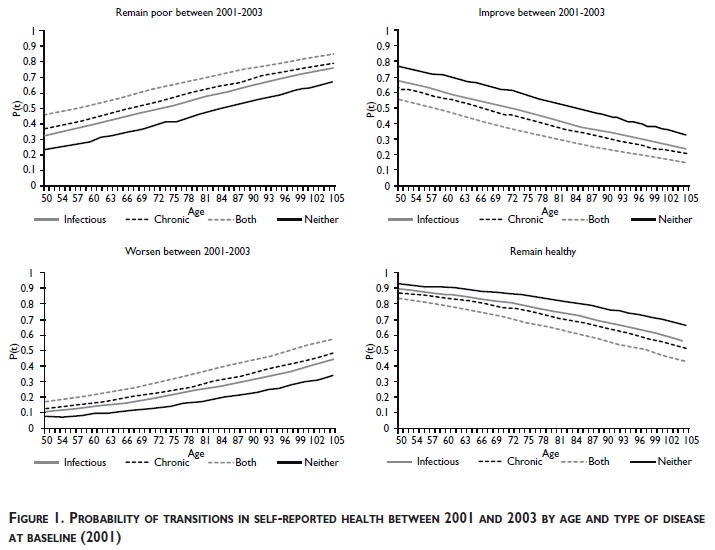
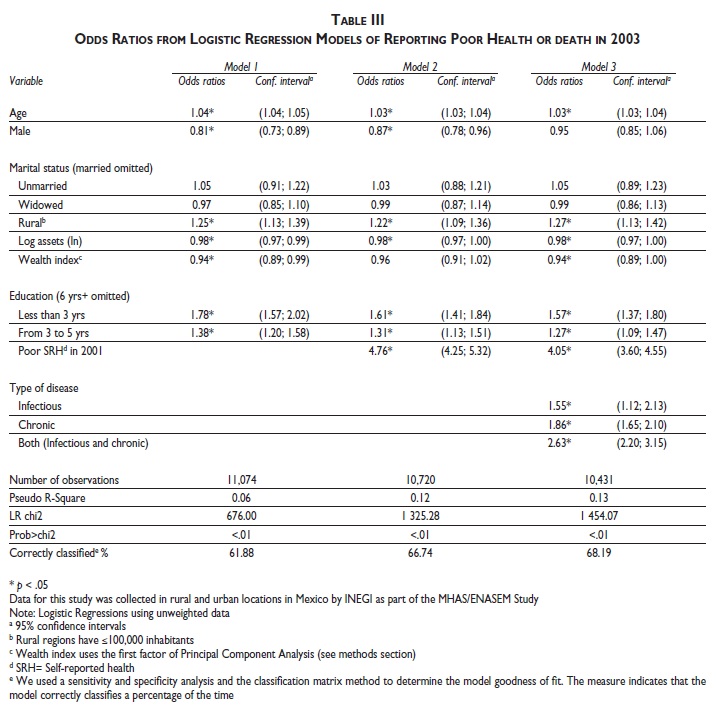
<body><![CDATA[<p><font face="Verdana" size="2">To check for the predictive power of the diseases   further, we examined deaths between waves (n=517). When examining mortality   rates at follow-up by disease in 2001, the highest rates were among individuals   with both types of disease (8.2%), while individuals with neither disease had   the lowest mortality rate (3.8%). Differences were statistically significant   between the four disease categories (<i>p</i>&lt;.001).</font></p>     <p><font face="Verdana" size="2"><a href="/img/revistas/spm/v54n5/a04tab3.jpg">Table&nbsp;III</a> reports odds of poor SRH in 2003 from   three logistic regression models. Model 1 shows that older age, rural residence   and lower education at baseline are associated with higher odds of poor SRH   at follow-up (<i>p</i>&lt;.05). Conversely, males, those with higher assets   and higher wealth have lower odds of poor SRH (<i>p</i>&lt;.05). Model 2 adds   poor SRH in 2001. Age and residence remain significant predictors of poor SRH   at follow-up. Similarly, higher assets and being male remain significant predictors   decreasing the odds of poor SRH or death at follow-up. Wealth is no longer a   significant predictor (Odds Ratio &#91;OR&#93; 0.96, Standard Error &#91;SE&#93; 0.03; <i>p</i>=0.18).   Model 2 also shows that poor SRH in 2001 is the strongest predictor increasing   the odds of poor SRH or death in 2003 (OR 4.75, SE 0.27; <i>p</i>&lt;.0001).   Model 3 adds type of disease. Older age, rural residence, lower education and   poor SRH in 2001 remain significant predictors<i>p</i> &lt;0(.05) of poor SRH   or death in 2003 after controlling for all covariates in Model 2. Higher assets   remains a predictor lowering the odds of poor SRH or death in 2003, while being   a male is no longer a significant predictor =0(<i>p</i>.37). The three disease   categories significantly increase the odds of poor SRH compared to reporting   neither type of disease. The odds are highest for persons with both types of   diseases (OR 2.63, SE 0.24), followed by those with chronic diseases (OR 1.86;   SE 0.12) and finally those with infectious diseases (OR 1.55; SE 0.25)<a name="tx3" href="#nt3">***</a></font></p>     <p><font face="Verdana" size="2"><a href="/img/revistas/spm/v54n5/a04fig1.jpg">Figure 1</a> presents predicted probabilities of   transitions in SRH estimated from Model 3 by type of disease and SRH at baseline.   The probabilities by age show that individuals with both diseases in 2001 have   the highest probability of remaining in poor health or worsening than any other   disease category. Additionally, individuals with neither type of disease are   the least likely to remain in poor health or worsen and are the most likely   to remain healthy and improve between waves. As a final point, individuals with   chronic diseases have higher probability of remaining in poor health or worsening   compared to individuals with infectious diseases.</font></p>     <p><font face="Verdana" size="2">Additional analyses (available from authors)   illustrate that by residence, individuals in urban setting have a higher probability   of remaining poor or worsening compared to those in the rural setting. Those   living in rural settings have a higher probability of staying healthy and improving.   Similarly, those with better SES have higher probability of recovery and remaining   healthy and lower probability of worsening or remaining in poor health.</font></p>     <p>&nbsp;</p>     <p><font face="Verdana" size="3"><b>Discussion</b></font></p>     <p><font face="Verdana" size="2">Our study confirms that type of disease affects   global health of older adults over time. Individuals with both infectious and   chronic diseases have worse SRH compared to those with each type alone. Moreover,   individuals with infectious diseases at baseline report better SRH compared   to those with chronic diseases or both. In contrast, more individuals with chronic   disease or both types of disease at baseline remain with poor SRH or worsen.   Thus, different types of disease increase the odds of poor SRH differently,   even after controlling for SES variables.</font></p>     <p><font face="Verdana" size="2">Our findings contribute to the literature that   strives to determine the health <i>dynamics</i> of older adults.<sup>21,22</sup>   Many older adults suffer from chronic conditions that affect their quality of   life because of the symptoms they can cause, the limitations imposed by them,   and the side effects that treatments originate. In developing countries that   are aging rapidly like Mexico, however, many older adults suffer infectious   and chronic diseases simultaneously while exposed to poverty, malnutrition and   limited healthcare access.<sup>23,24</sup> Thus, a mixed regime of infectious   and chronic diseases poses a unique burden on older adults in Mexico.</font></p>     <p><font face="Verdana" size="2">For these adults, physiological reserve decreases   rapidly and fewer biological resources are available to face acute diseases.<sup>25,26</sup>   This physiologic decline varies noticeably among individuals, manifests differently   for each type of disease and is highly correlated with the number and type of   alterations an individual suffers.<sup>27,28</sup> Chronic diseases affect multiple   physiologic systems simultaneously and cause symptoms once physiologic functioning   is disrupted.<sup>29</sup> On the other hand, infectious diseases are usually   limited to a short period of time, and cause symptoms early in their course,   affecting function mostly of the immune system. <sup>30</sup> With these differences   in mind, our study attempted to clarify the role different disease categories   play on the dynamics of overall health. We conclude that the mixed regime present   in countries like Mexico should perhaps be considered as a <i>stage</i> of the   transition rather than simply a transition between stages as proposed by researchers   using Omran's model. The structural and economic conditions prevalent in developing   countries such as Mexico indicate that these countries may spend considerable   time in this stage before advancing to a different one.</font></p>     <p><font face="Verdana" size="2">Our findings also support the concept of deficit   accumulation as a predictor of adverse outcomes in older adults.<sup>28,31,32</sup>   In <a href="/img/revistas/spm/v54n5/a04tab3.jpg">Table&nbsp;III</a>, individuals with both infectious and chronic diseases have the   highest risk of reporting poor health and dying. Given that individuals age   within a specific context and that this context makes the aging experience unique,   analyzing the effect of different contextual variables on health (self-reported   in this case) seems useful. This study provides evidence that combinations of   different diseases enhances the risk profile for older adults and supports the   idea that rather than analyzing diseases as a group, different disease categories   provide a more comprehensive approach to understand older adults' health and   the aging process, especially in developing countries like Mexico.</font></p>     ]]></body>
<body><![CDATA[<p><font face="Verdana" size="2">Additionally, differences observed between disease   categories support the notion that not only the <i>number</i> but also the <i>type</i>   of disease determines how the over-all health of individuals with different   characteristics changes. Infectious diseases have been commonly related to lower   SES. Individuals with lower SES are exposed to poorer nutrition, worse sanitary   conditions and poor healthcare, increasing their risk for infectious diseases.<sup>33</sup>   Lower SES has also been related to chronic diseases but in a different way.   Lower SES is related to higher rates of complications, higher mortality rates   and poorer compliance with medical treatment for such diseases.<sup>34</sup></font></p>     <p><font face="Verdana" size="2">Our models show that after controlling for type   of disease, rural residence and low education are predictors of worsening health.   Our study reveals new information related to the epidemiologic transition occurring   in Mexico. When two-year transitions in SRH are analyzed, infectious diseases   are predictors of recovery while chronic diseases are predictors of worsening   SRH, remaining with poor SRH or dying. The importance of this result hinges   on the biological differences between infectious and chronic diseases, which   appear to have important consequences. Furthermore, these results highlight   the value of giving adequate attention to infectious disease eradication despite   the exponential rise in chronic diseases in rapidly aging countries like Mexico.   Mixed epidemiological regimes like the one in Mexico challenge previous paradigms   and must be carefully analyzed in the context of demographic and epidemiologic   transitions.</font></p>     <p><font face="Verdana" size="2">Our study contributes to the literature by examining   factors that affect the relationship between SES and SRH. We have identified   type of disease as a potential modifier of this relationship that requires further   analysis. The mixed regime observed in Mexico suggests that countries may not   follow the traditional epidemiologic transition scheme, but rather experience   a <i>unique and different stage </i>worth examining. Nevertheless, our study   has some limitations. First, all the diseases included in our analyses were   self- reported, however, good face validity of self-reports of disease has been   found.<sup>35</sup> Laboratory tests and imaging studies would provide complementary   information to better understand the effect of diseases on overall health. Second,   grouping the conditions in four categories overlooks several aspects of the   disease course for each condition. However, this common categorization provides   important information for prevention and public health. Finally, the low rates   of mortality limit the conclusions we can draw from our data on the effect of   each type of disease and SRH on mortality incidence. A longer follow-up of the   individuals studied will allow for more comprehensive analyses related to mortality   as an outcome.</font></p>     <p><font face="Verdana" size="2">In conclusion, the number and type of disease   affect health status and disease progression and modify the relationship between   SES and health. The biological mechanism and physiological processes behind   each disease are likely to impact how overall health is perceived and reported.   Future studies need to consider other SES indicators such as healthcare access   and health insurance to determine how health policies can target differences   by type of disease. In addition, our study indicates that, despite the epidemiological   transition that has heightened the importance of chronic diseases, countries   that are aging rapidly like Mexico need to pay closer attention to infectious   diseases among older adults, and keep resources focused on their control and   eradication. Disregarding the relevance of infectious diseases for public health   in favor of chronic conditions may be unjustified and somewhat premature.</font></p>     <p>&nbsp;</p>     <p><font face="Verdana" size="3"><b>Acknowledgements</b></font></p>     <p><font face="Verdana" size="2">This work was supported by the National Institute   on Aging at NIH &#91;grant R01 AG025533. Data for this study comes from the Mexican   Health and Aging Study (MHAS), also funded by the National Institute on Aging   (R01 AG018016). Rafael Samper-Ternent is also supported in part by the Health   Resources and Services Administration, the National Cancer Institute, the National   Center for Research Resources and the National Institute on Disability and Rehabilitation   Research &#91;grants UB4HP19213-01, R01 CA133069-01, UL1RR029876). Alberto Palloni's   research is supported by other grants from the National Institute of Aging,   the Fogarty International Center and the Robert Wood Johnson Investigator Awards   in Health Policy &#91;grants R01 AG016209, R37 AG025216, 5D43TW001586 and Research   Grant ID # 67212&#93;. Research at the Center for Demography and Ecology (CDE) and   the Center for Demography of Health and Aging (CDHA), University of Wisconsin-Madison   is supported by the NICHD Center Grant 5R24HD04783 and by NIA Center Grant 5P30AG017266.   Infrastructure support provided by the Sealy Center on Aging at the University   of Texas Medical Branch.</font></p>     <p><font face="Verdana" size="2"><i>Declaration of conflict of interests</i>.   The authors declare that they have no conflict of interests.</font></p>     <p>&nbsp;</p>     <p><font face="Verdana" size="3"><b>References</b></font></p>     ]]></body>
<body><![CDATA[<!-- ref --><p><font face="Verdana" size="2">1. Omran AR. The epidemiologic transition. A   theory of the epidemiology of population change. Milbank Mem Fund Q 1971;49:509-538.    &nbsp;&nbsp;&nbsp;&nbsp;&nbsp;&nbsp;&nbsp;&nbsp;[&#160;<a href="javascript:void(0);" onclick="javascript: window.open('/scielo.php?script=sci_nlinks&ref=9350143&pid=S0036-3634201200050000500001&lng=','','width=640,height=500,resizable=yes,scrollbars=1,menubar=yes,');">Links</a>&#160;]<!-- end-ref --></font></p>     <!-- ref --><p><font face="Verdana" size="2">2. Chen F, Yang Y, Liu G. Social Change and Socioeconomic   Disparities in Health over the Life Course in China: A Cohort Analysis. Am Sociol   Rev, 2010;75:126-150.    &nbsp;&nbsp;&nbsp;&nbsp;&nbsp;&nbsp;&nbsp;&nbsp;[&#160;<a href="javascript:void(0);" onclick="javascript: window.open('/scielo.php?script=sci_nlinks&ref=9350145&pid=S0036-3634201200050000500002&lng=','','width=640,height=500,resizable=yes,scrollbars=1,menubar=yes,');">Links</a>&#160;]<!-- end-ref --></font></p>     <!-- ref --><p><font face="Verdana" size="2">3. Riley JC, Alter G. The epidemiologic transition   and morbidity. Ann Demogr Hist (Paris) 1989:199-213.    &nbsp;&nbsp;&nbsp;&nbsp;&nbsp;&nbsp;&nbsp;&nbsp;[&#160;<a href="javascript:void(0);" onclick="javascript: window.open('/scielo.php?script=sci_nlinks&ref=9350147&pid=S0036-3634201200050000500003&lng=','','width=640,height=500,resizable=yes,scrollbars=1,menubar=yes,');">Links</a>&#160;]<!-- end-ref --></font></p>     <!-- ref --><p><font face="Verdana" size="2">4. Wilmoth JR, Horiuchi S. Rectangularization   revisited: variability of age at death within human populations. Demography   1999;36: 475-495.    &nbsp;&nbsp;&nbsp;&nbsp;&nbsp;&nbsp;&nbsp;&nbsp;[&#160;<a href="javascript:void(0);" onclick="javascript: window.open('/scielo.php?script=sci_nlinks&ref=9350149&pid=S0036-3634201200050000500004&lng=','','width=640,height=500,resizable=yes,scrollbars=1,menubar=yes,');">Links</a>&#160;]<!-- end-ref --></font></p>     <!-- ref --><p><font face="Verdana" size="2">5. Gaziano JM. Fifth phase of the epidemiologic   transition: the age of obesity and inactivity. JAMA 2010;303:275-276.    &nbsp;&nbsp;&nbsp;&nbsp;&nbsp;&nbsp;&nbsp;&nbsp;[&#160;<a href="javascript:void(0);" onclick="javascript: window.open('/scielo.php?script=sci_nlinks&ref=9350151&pid=S0036-3634201200050000500005&lng=','','width=640,height=500,resizable=yes,scrollbars=1,menubar=yes,');">Links</a>&#160;]<!-- end-ref --></font></p>     ]]></body>
<body><![CDATA[<!-- ref --><p><font face="Verdana" size="2">6. Cubillos-Garzon LA, Casas JP, Morillo CA,   Bautista LE. Congestive heart failure in Latin America: the next epidemic. Am   Heart J 2004;147:412-417.    &nbsp;&nbsp;&nbsp;&nbsp;&nbsp;&nbsp;&nbsp;&nbsp;[&#160;<a href="javascript:void(0);" onclick="javascript: window.open('/scielo.php?script=sci_nlinks&ref=9350153&pid=S0036-3634201200050000500006&lng=','','width=640,height=500,resizable=yes,scrollbars=1,menubar=yes,');">Links</a>&#160;]<!-- end-ref --></font></p>     <!-- ref --><p><font face="Verdana" size="2">7. Palloni A, Pinto-Aguirre G, Pelaez M. Demographic   and health conditions of ageing in Latin America and the Caribbean. Int J Epidemiol   2002;31:762-771.    &nbsp;&nbsp;&nbsp;&nbsp;&nbsp;&nbsp;&nbsp;&nbsp;[&#160;<a href="javascript:void(0);" onclick="javascript: window.open('/scielo.php?script=sci_nlinks&ref=9350155&pid=S0036-3634201200050000500007&lng=','','width=640,height=500,resizable=yes,scrollbars=1,menubar=yes,');">Links</a>&#160;]<!-- end-ref --></font></p>     <!-- ref --><p><font face="Verdana" size="2">8. Arredondo A. Costs and financial consequences   of the changing epidemiological profile in Mexico. Health Policy 1997;42:39-48.    &nbsp;&nbsp;&nbsp;&nbsp;&nbsp;&nbsp;&nbsp;&nbsp;[&#160;<a href="javascript:void(0);" onclick="javascript: window.open('/scielo.php?script=sci_nlinks&ref=9350157&pid=S0036-3634201200050000500008&lng=','','width=640,height=500,resizable=yes,scrollbars=1,menubar=yes,');">Links</a>&#160;]<!-- end-ref --></font></p>     <!-- ref --><p><font face="Verdana" size="2">9. Chandola T, Jenkinson C. Validating self-rated   health in different ethnic groups. Ethn Health 2000;5:151-159.    &nbsp;&nbsp;&nbsp;&nbsp;&nbsp;&nbsp;&nbsp;&nbsp;[&#160;<a href="javascript:void(0);" onclick="javascript: window.open('/scielo.php?script=sci_nlinks&ref=9350159&pid=S0036-3634201200050000500009&lng=','','width=640,height=500,resizable=yes,scrollbars=1,menubar=yes,');">Links</a>&#160;]<!-- end-ref --></font></p>     <!-- ref --><p><font face="Verdana" size="2">10. Idler EL, Kasl SV. Self-ratings of health:   do they also predict change in functional ability? J Gerontol B Psychol Sci   Soc Sci 1995;50:S344-S353.    &nbsp;&nbsp;&nbsp;&nbsp;&nbsp;&nbsp;&nbsp;&nbsp;[&#160;<a href="javascript:void(0);" onclick="javascript: window.open('/scielo.php?script=sci_nlinks&ref=9350161&pid=S0036-3634201200050000500010&lng=','','width=640,height=500,resizable=yes,scrollbars=1,menubar=yes,');">Links</a>&#160;]<!-- end-ref --></font></p>     ]]></body>
<body><![CDATA[<!-- ref --><p><font face="Verdana" size="2">11. Mexican Health and Aging Study (2009). &#91;Electronic   version&#93;. &#91;Retrieved: 8-12-2011&#93;. Available from: <a href="http://www.mhas.pop.upenn.edu" target="_blank">www.mhas.pop.upenn.edu</a></font>&nbsp;&nbsp;&nbsp;&nbsp;&nbsp;&nbsp;&nbsp;&nbsp;[&#160;<a href="javascript:void(0);" onclick="javascript: window.open('/scielo.php?script=sci_nlinks&ref=9350163&pid=S0036-3634201200050000500011&lng=','','width=640,height=500,resizable=yes,scrollbars=1,menubar=yes,');">Links</a>&#160;]<!-- end-ref --><!-- ref --><p><font face="Verdana" size="2">12. Wong R, Espinoza M, Palloni A. Mexican older   adults with a wide socioeconomic perspective: health and aging. Salud Publica   Mex 2007;49 Suppl 4: S436-S447.    &nbsp;&nbsp;&nbsp;&nbsp;&nbsp;&nbsp;&nbsp;&nbsp;[&#160;<a href="javascript:void(0);" onclick="javascript: window.open('/scielo.php?script=sci_nlinks&ref=9350164&pid=S0036-3634201200050000500012&lng=','','width=640,height=500,resizable=yes,scrollbars=1,menubar=yes,');">Links</a>&#160;]<!-- end-ref --></font></p>     <!-- ref --><p><font face="Verdana" size="2">13. McGee DL, Liao Y, Cao G, Cooper RS. Self-reported   health status and mortality in a multiethnic US cohort. Am J Epidemiol 1999;149,   41-46.    &nbsp;&nbsp;&nbsp;&nbsp;&nbsp;&nbsp;&nbsp;&nbsp;[&#160;<a href="javascript:void(0);" onclick="javascript: window.open('/scielo.php?script=sci_nlinks&ref=9350166&pid=S0036-3634201200050000500013&lng=','','width=640,height=500,resizable=yes,scrollbars=1,menubar=yes,');">Links</a>&#160;]<!-- end-ref --></font></p>     <!-- ref --><p><font face="Verdana" size="2">14. Wong R, Pelaez M, Palloni A. &#91;Self-reported   general health in older adults in Latin America and the Caribbean: Usefulness   of the indicator&#93;. Rev Panam Salud Publica 2005;17:323-332.    &nbsp;&nbsp;&nbsp;&nbsp;&nbsp;&nbsp;&nbsp;&nbsp;[&#160;<a href="javascript:void(0);" onclick="javascript: window.open('/scielo.php?script=sci_nlinks&ref=9350168&pid=S0036-3634201200050000500014&lng=','','width=640,height=500,resizable=yes,scrollbars=1,menubar=yes,');">Links</a>&#160;]<!-- end-ref --></font></p>     <!-- ref --><p><font face="Verdana" size="2">15. Ciftci EE, Bago d'Uva T, van Doorslaer E,   van Lenthe FJ. Self-percieved Health and Longevity: Do Dynamics Matter? (2009).   &#91;Retrieved: 8-12-2011&#93;. Available from: <a href="http://www.york.ac.uk/res/herc/documents/wp/09_31.pdf" target="_blank">http://www.york.ac.uk/res/herc/documents/wp/09_31.pdf</a></font>&nbsp;&nbsp;&nbsp;&nbsp;&nbsp;&nbsp;&nbsp;&nbsp;[&#160;<a href="javascript:void(0);" onclick="javascript: window.open('/scielo.php?script=sci_nlinks&ref=9350170&pid=S0036-3634201200050000500015&lng=','','width=640,height=500,resizable=yes,scrollbars=1,menubar=yes,');">Links</a>&#160;]<!-- end-ref --><!-- ref --><p><font face="Verdana" size="2">16. Wong R, Espinoza M. Imputation of Non-Response   on Economic Variables in the Mexican Health and Aging Study. MHAS/ENSAME 2003.    &nbsp;&nbsp;&nbsp;&nbsp;&nbsp;&nbsp;&nbsp;&nbsp;[&#160;<a href="javascript:void(0);" onclick="javascript: window.open('/scielo.php?script=sci_nlinks&ref=9350171&pid=S0036-3634201200050000500016&lng=','','width=640,height=500,resizable=yes,scrollbars=1,menubar=yes,');">Links</a>&#160;]<!-- end-ref --></font></p>     ]]></body>
<body><![CDATA[<!-- ref --><p><font face="Verdana" size="2">17. O'Donell O, van Doorslaer E, Wagstaff A,   Lindelow M. Measurement of Living Standards. In: Analyzing Health Equity Using   Household Survey Data: A Guide to Techniques and Their Implementation. 2008:   The World Bank: 69-82.    &nbsp;&nbsp;&nbsp;&nbsp;&nbsp;&nbsp;&nbsp;&nbsp;[&#160;<a href="javascript:void(0);" onclick="javascript: window.open('/scielo.php?script=sci_nlinks&ref=9350173&pid=S0036-3634201200050000500017&lng=','','width=640,height=500,resizable=yes,scrollbars=1,menubar=yes,');">Links</a>&#160;]<!-- end-ref --></font></p>     <!-- ref --><p><font face="Verdana" size="2">18. Wong R, Espinoza-Higgins M. Income and assets   of the population of middle and old age in Mexico. Papeles de Poblaci&oacute;n   2003;37:129-166.    &nbsp;&nbsp;&nbsp;&nbsp;&nbsp;&nbsp;&nbsp;&nbsp;[&#160;<a href="javascript:void(0);" onclick="javascript: window.open('/scielo.php?script=sci_nlinks&ref=9350175&pid=S0036-3634201200050000500018&lng=','','width=640,height=500,resizable=yes,scrollbars=1,menubar=yes,');">Links</a>&#160;]<!-- end-ref --></font></p>     <!-- ref --><p><font face="Verdana" size="2">19. Filmer D, Pritchett LH. Estimating wealth   effects without expenditure data - Or tears: An application to educational enrollments   in states of India. Demography 2001;38:115-132.    &nbsp;&nbsp;&nbsp;&nbsp;&nbsp;&nbsp;&nbsp;&nbsp;[&#160;<a href="javascript:void(0);" onclick="javascript: window.open('/scielo.php?script=sci_nlinks&ref=9350177&pid=S0036-3634201200050000500019&lng=','','width=640,height=500,resizable=yes,scrollbars=1,menubar=yes,');">Links</a>&#160;]<!-- end-ref --></font></p>     <!-- ref --><p><font face="Verdana" size="2">20. Johnson D. Two-wave Panel Analysis: Comparing   Statistical Methods for Studying the Effects of Transitions. J Marriage Fam   2005;67:1061-1075.    &nbsp;&nbsp;&nbsp;&nbsp;&nbsp;&nbsp;&nbsp;&nbsp;[&#160;<a href="javascript:void(0);" onclick="javascript: window.open('/scielo.php?script=sci_nlinks&ref=9350179&pid=S0036-3634201200050000500020&lng=','','width=640,height=500,resizable=yes,scrollbars=1,menubar=yes,');">Links</a>&#160;]<!-- end-ref --></font></p>     <!-- ref --><p><font face="Verdana" size="2">21. Cott CA, Gignac MA, Badley EM. Determinants   of self rated health for Canadians with chronic disease and disability. J Epid   Comm Health 1999;53:731-736.    &nbsp;&nbsp;&nbsp;&nbsp;&nbsp;&nbsp;&nbsp;&nbsp;[&#160;<a href="javascript:void(0);" onclick="javascript: window.open('/scielo.php?script=sci_nlinks&ref=9350181&pid=S0036-3634201200050000500021&lng=','','width=640,height=500,resizable=yes,scrollbars=1,menubar=yes,');">Links</a>&#160;]<!-- end-ref --></font></p>     ]]></body>
<body><![CDATA[<!-- ref --><p><font face="Verdana" size="2">22. Mathers CD, Vos ET, Stevenson CE, Begg SJ.   The burden of disease and injury in Australia. Bull World Health Organ 2001;79:1076-1084.    &nbsp;&nbsp;&nbsp;&nbsp;&nbsp;&nbsp;&nbsp;&nbsp;[&#160;<a href="javascript:void(0);" onclick="javascript: window.open('/scielo.php?script=sci_nlinks&ref=9350183&pid=S0036-3634201200050000500022&lng=','','width=640,height=500,resizable=yes,scrollbars=1,menubar=yes,');">Links</a>&#160;]<!-- end-ref --></font></p>     <!-- ref --><p><font face="Verdana" size="2">23. Gonzalez CA, Ham-Chande R. Funcionalidad   y salud: una tipolog&iacute;a del envejecimiento en M&eacute;xico &#91;Functional   status and health: a typology of aging in Mexico&#93;. Salud Publica Mex 2007;49:S448-S458.    &nbsp;&nbsp;&nbsp;&nbsp;&nbsp;&nbsp;&nbsp;&nbsp;[&#160;<a href="javascript:void(0);" onclick="javascript: window.open('/scielo.php?script=sci_nlinks&ref=9350185&pid=S0036-3634201200050000500023&lng=','','width=640,height=500,resizable=yes,scrollbars=1,menubar=yes,');">Links</a>&#160;]<!-- end-ref --></font></p>     <!-- ref --><p><font face="Verdana" size="2">24. Kuri-Morales P, Emberson J, Alegre-Diaz J,   Tapia-Conyer R, Collins R, Peto R, <i>et al</i>. The prevalence of chronic diseases   and major disease risk factors at different ages among 150,000 men and women   living in Mexico City: cross-sectional analyses of a prospective study. BMC   Public Health 2009;9:9.    &nbsp;&nbsp;&nbsp;&nbsp;&nbsp;&nbsp;&nbsp;&nbsp;[&#160;<a href="javascript:void(0);" onclick="javascript: window.open('/scielo.php?script=sci_nlinks&ref=9350187&pid=S0036-3634201200050000500024&lng=','','width=640,height=500,resizable=yes,scrollbars=1,menubar=yes,');">Links</a>&#160;]<!-- end-ref --></font></p>     <!-- ref --><p><font face="Verdana" size="2">25. Sawhney R, Sehl M, Naeim A. Physiologic aspects   of aging: impact on cancer management and decision making. Part I. Cancer J   2005;11:449-460.    &nbsp;&nbsp;&nbsp;&nbsp;&nbsp;&nbsp;&nbsp;&nbsp;[&#160;<a href="javascript:void(0);" onclick="javascript: window.open('/scielo.php?script=sci_nlinks&ref=9350189&pid=S0036-3634201200050000500025&lng=','','width=640,height=500,resizable=yes,scrollbars=1,menubar=yes,');">Links</a>&#160;]<!-- end-ref --></font></p>     <!-- ref --><p><font face="Verdana" size="2">26. Sehl M, Sawhney R, Naeim A. Physiologic aspects   of aging: impact on cancer management and decision making. Part II. Cancer J   2005;11:461-473.    &nbsp;&nbsp;&nbsp;&nbsp;&nbsp;&nbsp;&nbsp;&nbsp;[&#160;<a href="javascript:void(0);" onclick="javascript: window.open('/scielo.php?script=sci_nlinks&ref=9350191&pid=S0036-3634201200050000500026&lng=','','width=640,height=500,resizable=yes,scrollbars=1,menubar=yes,');">Links</a>&#160;]<!-- end-ref --></font></p>     ]]></body>
<body><![CDATA[<!-- ref --><p><font face="Verdana" size="2">27. Lipsitz LA. Physiological complexity, aging,   and the path to frailty. Sci Aging Knowledge Environ 2004;e16.    &nbsp;&nbsp;&nbsp;&nbsp;&nbsp;&nbsp;&nbsp;&nbsp;[&#160;<a href="javascript:void(0);" onclick="javascript: window.open('/scielo.php?script=sci_nlinks&ref=9350193&pid=S0036-3634201200050000500027&lng=','','width=640,height=500,resizable=yes,scrollbars=1,menubar=yes,');">Links</a>&#160;]<!-- end-ref --></font></p>     <!-- ref --><p><font face="Verdana" size="2">28. Rockwood K, Mitnitski A. Frailty in relation   to the accumulation of deficits. J Gerontol A Biol Sci Med Sci 2007;62, 722-727.    &nbsp;&nbsp;&nbsp;&nbsp;&nbsp;&nbsp;&nbsp;&nbsp;[&#160;<a href="javascript:void(0);" onclick="javascript: window.open('/scielo.php?script=sci_nlinks&ref=9350195&pid=S0036-3634201200050000500028&lng=','','width=640,height=500,resizable=yes,scrollbars=1,menubar=yes,');">Links</a>&#160;]<!-- end-ref --></font></p>     <!-- ref --><p><font face="Verdana" size="2">29. Ben-Shlomo Y, Kuh D. A life course approach   to chronic disease epidemiology: conceptual models, empirical challenges and   interdisciplinary perspectives. Int J Epidemiol 2002;31:285-293.    &nbsp;&nbsp;&nbsp;&nbsp;&nbsp;&nbsp;&nbsp;&nbsp;[&#160;<a href="javascript:void(0);" onclick="javascript: window.open('/scielo.php?script=sci_nlinks&ref=9350197&pid=S0036-3634201200050000500029&lng=','','width=640,height=500,resizable=yes,scrollbars=1,menubar=yes,');">Links</a>&#160;]<!-- end-ref --></font></p>     <!-- ref --><p><font face="Verdana" size="2">30. Hall AJ, Yee LJ, Thomas SL. Life course epidemiology   and infectious diseases. Int J Epidemiol 2002;31:300-301.    &nbsp;&nbsp;&nbsp;&nbsp;&nbsp;&nbsp;&nbsp;&nbsp;[&#160;<a href="javascript:void(0);" onclick="javascript: window.open('/scielo.php?script=sci_nlinks&ref=9350199&pid=S0036-3634201200050000500030&lng=','','width=640,height=500,resizable=yes,scrollbars=1,menubar=yes,');">Links</a>&#160;]<!-- end-ref --></font></p>     <!-- ref --><p><font face="Verdana" size="2">31. Andrew MK, Mitnitski AB, Rockwood K. Social   vulnerability, frailty and mortality in elderly people. PLoS One 2008;3:e2232.    &nbsp;&nbsp;&nbsp;&nbsp;&nbsp;&nbsp;&nbsp;&nbsp;[&#160;<a href="javascript:void(0);" onclick="javascript: window.open('/scielo.php?script=sci_nlinks&ref=9350201&pid=S0036-3634201200050000500031&lng=','','width=640,height=500,resizable=yes,scrollbars=1,menubar=yes,');">Links</a>&#160;]<!-- end-ref --></font></p>     ]]></body>
<body><![CDATA[<!-- ref --><p><font face="Verdana" size="2">32. Song X, Mitnitski A, Rockwood K. Prevalence   and 10-year outcomes of frailty in older adults in relation to deficit accumulation.   J Am Geriatr Soc 2010;58:681-687.    &nbsp;&nbsp;&nbsp;&nbsp;&nbsp;&nbsp;&nbsp;&nbsp;[&#160;<a href="javascript:void(0);" onclick="javascript: window.open('/scielo.php?script=sci_nlinks&ref=9350203&pid=S0036-3634201200050000500032&lng=','','width=640,height=500,resizable=yes,scrollbars=1,menubar=yes,');">Links</a>&#160;]<!-- end-ref --></font></p>     <!-- ref --><p><font face="Verdana" size="2">33. House JS, Kessler RC, Herzog AR. Age, socioeconomic   status, and health. Milbank Quarterly 1990;68:383-411.    &nbsp;&nbsp;&nbsp;&nbsp;&nbsp;&nbsp;&nbsp;&nbsp;[&#160;<a href="javascript:void(0);" onclick="javascript: window.open('/scielo.php?script=sci_nlinks&ref=9350205&pid=S0036-3634201200050000500033&lng=','','width=640,height=500,resizable=yes,scrollbars=1,menubar=yes,');">Links</a>&#160;]<!-- end-ref --></font></p>     <!-- ref --><p><font face="Verdana" size="2">34. Feinstein JS. The relationship between socioeconomic   status and health: A review of the literature. Milbank Quarterly 1993;71:279-322.    &nbsp;&nbsp;&nbsp;&nbsp;&nbsp;&nbsp;&nbsp;&nbsp;[&#160;<a href="javascript:void(0);" onclick="javascript: window.open('/scielo.php?script=sci_nlinks&ref=9350207&pid=S0036-3634201200050000500034&lng=','','width=640,height=500,resizable=yes,scrollbars=1,menubar=yes,');">Links</a>&#160;]<!-- end-ref --></font></p>     <!-- ref --><p><font face="Verdana" size="2">35. Okura Y, Urban LH, Mahoney DW, Jacobsen SJ,   Rodeheffer RJ. Agreement between self-report questionnaires and medical record   data was substantial for diabetes, hypertension, myocardial infarction and stroke   but not for heart failure. J Clin Epidemiol 2004;57:1096-1103.    &nbsp;&nbsp;&nbsp;&nbsp;&nbsp;&nbsp;&nbsp;&nbsp;[&#160;<a href="javascript:void(0);" onclick="javascript: window.open('/scielo.php?script=sci_nlinks&ref=9350209&pid=S0036-3634201200050000500035&lng=','','width=640,height=500,resizable=yes,scrollbars=1,menubar=yes,');">Links</a>&#160;]<!-- end-ref --></font></p>     <p>&nbsp;</p>     <p>&nbsp;</p>     ]]></body>
<body><![CDATA[<p><a name="end" href="#top"><img src="/img/revistas/spm/v54n5/seta.jpg" border="0"></a> <font face="Verdana" size="2"><b>Corresponding author:</b>    <br>  Rafael Samper-Ternent, MD.    <br>  Sealy Center on Aging,    <br>  University of Texas Medical Branch. Rebeca Sealy Room 5.102, 301    <br>  University Boulevard. Galveston, TX 77555-0177 USA.    <br>  E-mail: <a href="mailto:rasamper@utmb.edu">rasamper@utmb.edu</a></font></p>     <p><font face="Verdana" size="2"><b>Received on</b>: June 22, 2011<b>     <br>  Accepted on</b>: May 24, 2012</font></p>     <p>&nbsp;</p>     <p>&nbsp;</p>     ]]></body>
<body><![CDATA[<p><font face="Verdana" size="2"><a name="nt1" href="#tx1">*</a> In separate analysis   we included age squared in the regression to test for nonlinearity. However,   the goodness of fit did not improve and the estimator was not significant.    <br>  <a name="nt2" href="#tx2">**</a> The follow-up question was modified to assess   incidence of infectious or chronic diseases between waves.    <br>  <a name="nt3" href="#tx3">***</a> "Liver or kidney infection" is vague and can   be perceived to confound the results from the regression models. Results remain   virtually unchanged when "liver or kidney infection" is excluded from the "infectious   disease category". The OR for only-infectious or only-chronic diseases increases   by 0.02, and the OR for those with both types of disease decreases by 0.04 in   model 3. </font></p>      ]]></body><back>
<ref-list>
<ref id="B1">
<label>1</label><nlm-citation citation-type="journal">
<person-group person-group-type="author">
<name>
<surname><![CDATA[Omran]]></surname>
<given-names><![CDATA[AR]]></given-names>
</name>
</person-group>
<article-title xml:lang="en"><![CDATA[The epidemiologic transition: A theory of the epidemiology of population change]]></article-title>
<source><![CDATA[Milbank Mem Fund Q]]></source>
<year>1971</year>
<volume>49</volume>
<page-range>509-538</page-range></nlm-citation>
</ref>
<ref id="B2">
<label>2</label><nlm-citation citation-type="journal">
<person-group person-group-type="author">
<name>
<surname><![CDATA[Chen]]></surname>
<given-names><![CDATA[F]]></given-names>
</name>
<name>
<surname><![CDATA[Yang]]></surname>
<given-names><![CDATA[Y]]></given-names>
</name>
<name>
<surname><![CDATA[Liu]]></surname>
<given-names><![CDATA[G]]></given-names>
</name>
</person-group>
<article-title xml:lang="en"><![CDATA[Social Change and Socioeconomic Disparities in Health over the Life Course in China: A Cohort Analysis]]></article-title>
<source><![CDATA[Am Sociol Rev,]]></source>
<year>2010</year>
<volume>75</volume>
<page-range>126-150</page-range></nlm-citation>
</ref>
<ref id="B3">
<label>3</label><nlm-citation citation-type="journal">
<person-group person-group-type="author">
<name>
<surname><![CDATA[Riley]]></surname>
<given-names><![CDATA[JC]]></given-names>
</name>
<name>
<surname><![CDATA[Alter]]></surname>
<given-names><![CDATA[G]]></given-names>
</name>
</person-group>
<article-title xml:lang="en"><![CDATA[The epidemiologic transition and morbidity]]></article-title>
<source><![CDATA[Ann Demogr Hist (Paris)]]></source>
<year>1989</year>
<page-range>199-213</page-range></nlm-citation>
</ref>
<ref id="B4">
<label>4</label><nlm-citation citation-type="journal">
<person-group person-group-type="author">
<name>
<surname><![CDATA[Wilmoth]]></surname>
<given-names><![CDATA[JR]]></given-names>
</name>
<name>
<surname><![CDATA[Horiuchi]]></surname>
<given-names><![CDATA[S]]></given-names>
</name>
</person-group>
<article-title xml:lang="en"><![CDATA[Rectangularization revisited: variability of age at death within human populations]]></article-title>
<source><![CDATA[Demography]]></source>
<year>1999</year>
<volume>36</volume>
<page-range>475-495</page-range></nlm-citation>
</ref>
<ref id="B5">
<label>5</label><nlm-citation citation-type="journal">
<person-group person-group-type="author">
<name>
<surname><![CDATA[Gaziano]]></surname>
<given-names><![CDATA[JM]]></given-names>
</name>
</person-group>
<article-title xml:lang="en"><![CDATA[Fifth phase of the epidemiologic transition: the age of obesity and inactivity]]></article-title>
<source><![CDATA[JAMA]]></source>
<year>2010</year>
<volume>303</volume>
<page-range>275-276</page-range></nlm-citation>
</ref>
<ref id="B6">
<label>6</label><nlm-citation citation-type="journal">
<person-group person-group-type="author">
<name>
<surname><![CDATA[Cubillos-Garzon]]></surname>
<given-names><![CDATA[LA]]></given-names>
</name>
<name>
<surname><![CDATA[Casas]]></surname>
<given-names><![CDATA[JP]]></given-names>
</name>
<name>
<surname><![CDATA[Morillo]]></surname>
<given-names><![CDATA[CA]]></given-names>
</name>
<name>
<surname><![CDATA[Bautista]]></surname>
<given-names><![CDATA[LE]]></given-names>
</name>
</person-group>
<article-title xml:lang="en"><![CDATA[Congestive heart failure in Latin America: the next epidemic]]></article-title>
<source><![CDATA[Am Heart J]]></source>
<year>2004</year>
<volume>147</volume>
<page-range>412-417</page-range></nlm-citation>
</ref>
<ref id="B7">
<label>7</label><nlm-citation citation-type="journal">
<person-group person-group-type="author">
<name>
<surname><![CDATA[Palloni]]></surname>
<given-names><![CDATA[A]]></given-names>
</name>
<name>
<surname><![CDATA[Pinto-Aguirre]]></surname>
<given-names><![CDATA[G]]></given-names>
</name>
<name>
<surname><![CDATA[Pelaez]]></surname>
<given-names><![CDATA[M]]></given-names>
</name>
</person-group>
<article-title xml:lang="en"><![CDATA[Demographic and health conditions of ageing in Latin America and the Caribbean]]></article-title>
<source><![CDATA[Int J Epidemiol]]></source>
<year>2002</year>
<volume>31</volume>
<page-range>762-771</page-range></nlm-citation>
</ref>
<ref id="B8">
<label>8</label><nlm-citation citation-type="journal">
<person-group person-group-type="author">
<name>
<surname><![CDATA[Arredondo]]></surname>
<given-names><![CDATA[A]]></given-names>
</name>
</person-group>
<article-title xml:lang="en"><![CDATA[Costs and financial consequences of the changing epidemiological profile in Mexico]]></article-title>
<source><![CDATA[Health Policy]]></source>
<year>1997</year>
<volume>42</volume>
<page-range>39-48</page-range></nlm-citation>
</ref>
<ref id="B9">
<label>9</label><nlm-citation citation-type="journal">
<person-group person-group-type="author">
<name>
<surname><![CDATA[Chandola]]></surname>
<given-names><![CDATA[T]]></given-names>
</name>
<name>
<surname><![CDATA[Jenkinson]]></surname>
<given-names><![CDATA[C]]></given-names>
</name>
</person-group>
<article-title xml:lang="en"><![CDATA[Validating self-rated health in different ethnic groups]]></article-title>
<source><![CDATA[Ethn Health]]></source>
<year>2000</year>
<volume>5</volume>
<page-range>151-159</page-range></nlm-citation>
</ref>
<ref id="B10">
<label>10</label><nlm-citation citation-type="journal">
<person-group person-group-type="author">
<name>
<surname><![CDATA[Idler]]></surname>
<given-names><![CDATA[EL]]></given-names>
</name>
<name>
<surname><![CDATA[Kasl]]></surname>
<given-names><![CDATA[SV]]></given-names>
</name>
</person-group>
<article-title xml:lang="en"><![CDATA[Self-ratings of health: do they also predict change in functional ability?]]></article-title>
<source><![CDATA[J Gerontol B Psychol Sci Soc Sci]]></source>
<year>1995</year>
<volume>50</volume>
<page-range>S344-S353</page-range></nlm-citation>
</ref>
<ref id="B11">
<label>11</label><nlm-citation citation-type="">
<source><![CDATA[Mexican Health and Aging Study]]></source>
<year>2009</year>
</nlm-citation>
</ref>
<ref id="B12">
<label>12</label><nlm-citation citation-type="journal">
<person-group person-group-type="author">
<name>
<surname><![CDATA[Wong]]></surname>
<given-names><![CDATA[R]]></given-names>
</name>
<name>
<surname><![CDATA[Espinoza]]></surname>
<given-names><![CDATA[M]]></given-names>
</name>
<name>
<surname><![CDATA[Palloni]]></surname>
<given-names><![CDATA[A]]></given-names>
</name>
</person-group>
<article-title xml:lang="en"><![CDATA[Mexican older adults with a wide socioeconomic perspective: health and aging]]></article-title>
<source><![CDATA[Salud Publica Mex]]></source>
<year>2007</year>
<volume>49</volume>
<numero>^s4</numero>
<issue>^s4</issue>
<supplement>4</supplement>
<page-range>S436-S447</page-range></nlm-citation>
</ref>
<ref id="B13">
<label>13</label><nlm-citation citation-type="journal">
<person-group person-group-type="author">
<name>
<surname><![CDATA[McGee]]></surname>
<given-names><![CDATA[DL]]></given-names>
</name>
<name>
<surname><![CDATA[Liao]]></surname>
<given-names><![CDATA[Y]]></given-names>
</name>
<name>
<surname><![CDATA[Cao]]></surname>
<given-names><![CDATA[G]]></given-names>
</name>
<name>
<surname><![CDATA[Cooper]]></surname>
<given-names><![CDATA[RS]]></given-names>
</name>
</person-group>
<article-title xml:lang="en"><![CDATA[Self-reported health status and mortality in a multiethnic US cohort]]></article-title>
<source><![CDATA[Am J Epidemiol]]></source>
<year>1999</year>
<volume>149</volume>
<page-range>41-46</page-range></nlm-citation>
</ref>
<ref id="B14">
<label>14</label><nlm-citation citation-type="journal">
<person-group person-group-type="author">
<name>
<surname><![CDATA[Wong]]></surname>
<given-names><![CDATA[R]]></given-names>
</name>
<name>
<surname><![CDATA[Pelaez]]></surname>
<given-names><![CDATA[M]]></given-names>
</name>
<name>
<surname><![CDATA[Palloni]]></surname>
<given-names><![CDATA[A]]></given-names>
</name>
</person-group>
<article-title xml:lang="en"><![CDATA[Self-reported general health in older adults in Latin America and the Caribbean: Usefulness of the indicator]]></article-title>
<source><![CDATA[Rev Panam Salud Publica]]></source>
<year>2005</year>
<volume>17</volume>
<page-range>323-332</page-range></nlm-citation>
</ref>
<ref id="B15">
<label>15</label><nlm-citation citation-type="">
<person-group person-group-type="author">
<name>
<surname><![CDATA[Ciftci]]></surname>
<given-names><![CDATA[EE]]></given-names>
</name>
<name>
<surname><![CDATA[Bago d'Uva]]></surname>
<given-names><![CDATA[T]]></given-names>
</name>
<name>
<surname><![CDATA[van Doorslaer]]></surname>
<given-names><![CDATA[E]]></given-names>
</name>
<name>
<surname><![CDATA[van Lenthe]]></surname>
<given-names><![CDATA[FJ]]></given-names>
</name>
</person-group>
<source><![CDATA[Self-percieved Health and Longevity: Do Dynamics Matter?]]></source>
<year></year>
</nlm-citation>
</ref>
<ref id="B16">
<label>16</label><nlm-citation citation-type="book">
<person-group person-group-type="author">
<name>
<surname><![CDATA[Wong]]></surname>
<given-names><![CDATA[R]]></given-names>
</name>
<name>
<surname><![CDATA[Espinoza]]></surname>
<given-names><![CDATA[M]]></given-names>
</name>
</person-group>
<source><![CDATA[Imputation of Non-Response on Economic Variables in the Mexican Health and Aging Study]]></source>
<year>2003</year>
<publisher-name><![CDATA[MHAS/ENSAME]]></publisher-name>
</nlm-citation>
</ref>
<ref id="B17">
<label>17</label><nlm-citation citation-type="book">
<person-group person-group-type="author">
<name>
<surname><![CDATA[O'Donell]]></surname>
<given-names><![CDATA[O]]></given-names>
</name>
<name>
<surname><![CDATA[van Doorslaer]]></surname>
<given-names><![CDATA[E]]></given-names>
</name>
<name>
<surname><![CDATA[Wagstaff]]></surname>
<given-names><![CDATA[A]]></given-names>
</name>
<name>
<surname><![CDATA[Lindelow]]></surname>
<given-names><![CDATA[M]]></given-names>
</name>
</person-group>
<article-title xml:lang="en"><![CDATA[Measurement of Living Standards]]></article-title>
<source><![CDATA[Analyzing Health Equity Using Household Survey Data: A Guide to Techniques and Their Implementation]]></source>
<year>2008</year>
<page-range>69-82</page-range><publisher-name><![CDATA[The World Bank]]></publisher-name>
</nlm-citation>
</ref>
<ref id="B18">
<label>18</label><nlm-citation citation-type="journal">
<person-group person-group-type="author">
<name>
<surname><![CDATA[Wong]]></surname>
<given-names><![CDATA[R]]></given-names>
</name>
<name>
<surname><![CDATA[Espinoza-Higgins]]></surname>
<given-names><![CDATA[M]]></given-names>
</name>
</person-group>
<article-title xml:lang="en"><![CDATA[Income and assets of the population of middle and old age in Mexico]]></article-title>
<source><![CDATA[Papeles de Población]]></source>
<year>2003</year>
<volume>37</volume>
<page-range>129-166</page-range></nlm-citation>
</ref>
<ref id="B19">
<label>19</label><nlm-citation citation-type="journal">
<person-group person-group-type="author">
<name>
<surname><![CDATA[Filmer]]></surname>
<given-names><![CDATA[D]]></given-names>
</name>
<name>
<surname><![CDATA[Pritchett]]></surname>
<given-names><![CDATA[LH]]></given-names>
</name>
</person-group>
<article-title xml:lang="en"><![CDATA[Estimating wealth effects without expenditure data - Or tears: An application to educational enrollments in states of India]]></article-title>
<source><![CDATA[Demography]]></source>
<year>2001</year>
<volume>38</volume>
<page-range>115-132</page-range></nlm-citation>
</ref>
<ref id="B20">
<label>20</label><nlm-citation citation-type="journal">
<person-group person-group-type="author">
<name>
<surname><![CDATA[Johnson]]></surname>
<given-names><![CDATA[D]]></given-names>
</name>
</person-group>
<article-title xml:lang="en"><![CDATA[Two-wave Panel Analysis: Comparing Statistical Methods for Studying the Effects of Transitions]]></article-title>
<source><![CDATA[J Marriage Fam]]></source>
<year>2005</year>
<volume>67</volume>
<page-range>1061-1075</page-range></nlm-citation>
</ref>
<ref id="B21">
<label>21</label><nlm-citation citation-type="journal">
<person-group person-group-type="author">
<name>
<surname><![CDATA[Cott]]></surname>
<given-names><![CDATA[CA]]></given-names>
</name>
<name>
<surname><![CDATA[Gignac]]></surname>
<given-names><![CDATA[MA]]></given-names>
</name>
<name>
<surname><![CDATA[Badley]]></surname>
<given-names><![CDATA[EM]]></given-names>
</name>
</person-group>
<article-title xml:lang="en"><![CDATA[Determinants of self rated health for Canadians with chronic disease and disability]]></article-title>
<source><![CDATA[J Epid Comm Health]]></source>
<year>1999</year>
<volume>53</volume>
<page-range>731-736</page-range></nlm-citation>
</ref>
<ref id="B22">
<label>22</label><nlm-citation citation-type="journal">
<person-group person-group-type="author">
<name>
<surname><![CDATA[Mathers]]></surname>
<given-names><![CDATA[CD]]></given-names>
</name>
<name>
<surname><![CDATA[Vos]]></surname>
<given-names><![CDATA[ET]]></given-names>
</name>
<name>
<surname><![CDATA[Stevenson]]></surname>
<given-names><![CDATA[CE]]></given-names>
</name>
<name>
<surname><![CDATA[Begg]]></surname>
<given-names><![CDATA[SJ]]></given-names>
</name>
</person-group>
<article-title xml:lang="en"><![CDATA[The burden of disease and injury in Australia]]></article-title>
<source><![CDATA[Bull World Health Organ]]></source>
<year>2001</year>
<volume>79</volume>
<page-range>1076-1084</page-range></nlm-citation>
</ref>
<ref id="B23">
<label>23</label><nlm-citation citation-type="journal">
<person-group person-group-type="author">
<name>
<surname><![CDATA[Gonzalez]]></surname>
<given-names><![CDATA[CA]]></given-names>
</name>
<name>
<surname><![CDATA[Ham-Chande]]></surname>
<given-names><![CDATA[R]]></given-names>
</name>
</person-group>
<article-title xml:lang="es"><![CDATA[Funcionalidad y salud: una tipología del envejecimiento en México [Functional status and health: a typology of aging in Mexico].]]></article-title>
<source><![CDATA[Salud Publica Mex]]></source>
<year>2007</year>
<volume>49</volume>
<page-range>S448-S458</page-range></nlm-citation>
</ref>
<ref id="B24">
<label>24</label><nlm-citation citation-type="journal">
<person-group person-group-type="author">
<name>
<surname><![CDATA[Kuri-Morales]]></surname>
<given-names><![CDATA[P]]></given-names>
</name>
<name>
<surname><![CDATA[Emberson]]></surname>
<given-names><![CDATA[J]]></given-names>
</name>
<name>
<surname><![CDATA[Alegre-Diaz]]></surname>
<given-names><![CDATA[J]]></given-names>
</name>
<name>
<surname><![CDATA[Tapia-Conyer]]></surname>
<given-names><![CDATA[R]]></given-names>
</name>
<name>
<surname><![CDATA[Collins]]></surname>
<given-names><![CDATA[R]]></given-names>
</name>
<name>
<surname><![CDATA[Peto]]></surname>
<given-names><![CDATA[R]]></given-names>
</name>
</person-group>
<article-title xml:lang="en"><![CDATA[The prevalence of chronic diseases and major disease risk factors at different ages among 150,000 men and women living in Mexico City: cross-sectional analyses of a prospective study]]></article-title>
<source><![CDATA[BMC Public Health]]></source>
<year>2009</year>
<volume>9</volume>
<page-range>9</page-range></nlm-citation>
</ref>
<ref id="B25">
<label>25</label><nlm-citation citation-type="journal">
<person-group person-group-type="author">
<name>
<surname><![CDATA[Sawhney]]></surname>
<given-names><![CDATA[R]]></given-names>
</name>
<name>
<surname><![CDATA[Sehl]]></surname>
<given-names><![CDATA[M]]></given-names>
</name>
<name>
<surname><![CDATA[Naeim]]></surname>
<given-names><![CDATA[A]]></given-names>
</name>
</person-group>
<article-title xml:lang="en"><![CDATA[Physiologic aspects of aging: impact on cancer management and decision making. Part I]]></article-title>
<source><![CDATA[Cancer J]]></source>
<year>2005</year>
<volume>11</volume>
<page-range>449-460</page-range></nlm-citation>
</ref>
<ref id="B26">
<label>26</label><nlm-citation citation-type="journal">
<person-group person-group-type="author">
<name>
<surname><![CDATA[Sehl]]></surname>
<given-names><![CDATA[M]]></given-names>
</name>
<name>
<surname><![CDATA[Sawhney]]></surname>
<given-names><![CDATA[R]]></given-names>
</name>
<name>
<surname><![CDATA[Naeim]]></surname>
<given-names><![CDATA[A]]></given-names>
</name>
</person-group>
<article-title xml:lang="en"><![CDATA[Physiologic aspects of aging: impact on cancer management and decision making. Part II]]></article-title>
<source><![CDATA[Cancer J]]></source>
<year>2005</year>
<volume>11</volume>
<page-range>461-473</page-range></nlm-citation>
</ref>
<ref id="B27">
<label>27</label><nlm-citation citation-type="journal">
<person-group person-group-type="author">
<name>
<surname><![CDATA[Lipsitz]]></surname>
<given-names><![CDATA[LA]]></given-names>
</name>
</person-group>
<article-title xml:lang="en"><![CDATA[Physiological complexity, aging, and the path to frailty]]></article-title>
<source><![CDATA[Sci Aging Knowledge Environ]]></source>
<year>2004</year>
<page-range>e16</page-range></nlm-citation>
</ref>
<ref id="B28">
<label>28</label><nlm-citation citation-type="journal">
<person-group person-group-type="author">
<name>
<surname><![CDATA[Rockwood]]></surname>
<given-names><![CDATA[K]]></given-names>
</name>
<name>
<surname><![CDATA[Mitnitski]]></surname>
<given-names><![CDATA[A]]></given-names>
</name>
</person-group>
<article-title xml:lang="en"><![CDATA[Frailty in relation to the accumulation of deficits]]></article-title>
<source><![CDATA[J Gerontol A Biol Sci Med Sci]]></source>
<year>2007</year>
<volume>62</volume>
<page-range>722-727</page-range></nlm-citation>
</ref>
<ref id="B29">
<label>29</label><nlm-citation citation-type="journal">
<person-group person-group-type="author">
<name>
<surname><![CDATA[Ben-Shlomo]]></surname>
<given-names><![CDATA[Y]]></given-names>
</name>
<name>
<surname><![CDATA[Kuh]]></surname>
<given-names><![CDATA[D]]></given-names>
</name>
</person-group>
<article-title xml:lang="en"><![CDATA[A life course approach to chronic disease epidemiology: conceptual models, empirical challenges and interdisciplinary perspectives]]></article-title>
<source><![CDATA[Int J Epidemiol]]></source>
<year>2002</year>
<volume>31</volume>
<page-range>285-293</page-range></nlm-citation>
</ref>
<ref id="B30">
<label>30</label><nlm-citation citation-type="journal">
<person-group person-group-type="author">
<name>
<surname><![CDATA[Hall]]></surname>
<given-names><![CDATA[AJ]]></given-names>
</name>
<name>
<surname><![CDATA[Yee]]></surname>
<given-names><![CDATA[LJ]]></given-names>
</name>
<name>
<surname><![CDATA[Thomas]]></surname>
<given-names><![CDATA[SL]]></given-names>
</name>
</person-group>
<article-title xml:lang="en"><![CDATA[Life course epidemiology and infectious diseases]]></article-title>
<source><![CDATA[Int J Epidemiol]]></source>
<year>2002</year>
<volume>31</volume>
<page-range>300-301</page-range></nlm-citation>
</ref>
<ref id="B31">
<label>31</label><nlm-citation citation-type="journal">
<person-group person-group-type="author">
<name>
<surname><![CDATA[Andrew]]></surname>
<given-names><![CDATA[MK]]></given-names>
</name>
<name>
<surname><![CDATA[Mitnitski]]></surname>
<given-names><![CDATA[AB]]></given-names>
</name>
<name>
<surname><![CDATA[Rockwood]]></surname>
<given-names><![CDATA[K]]></given-names>
</name>
</person-group>
<article-title xml:lang="en"><![CDATA[Social vulnerability, frailty and mortality in elderly people]]></article-title>
<source><![CDATA[PLoS One]]></source>
<year>2008</year>
<volume>3</volume>
<page-range>e2232</page-range></nlm-citation>
</ref>
<ref id="B32">
<label>32</label><nlm-citation citation-type="journal">
<person-group person-group-type="author">
<name>
<surname><![CDATA[Song]]></surname>
<given-names><![CDATA[X]]></given-names>
</name>
<name>
<surname><![CDATA[Mitnitski]]></surname>
<given-names><![CDATA[A]]></given-names>
</name>
<name>
<surname><![CDATA[Rockwood]]></surname>
<given-names><![CDATA[K]]></given-names>
</name>
</person-group>
<article-title xml:lang="en"><![CDATA[Prevalence and 10-year outcomes of frailty in older adults in relation to deficit accumulation]]></article-title>
<source><![CDATA[J Am Geriatr Soc]]></source>
<year>2010</year>
<volume>58</volume>
<page-range>681-687</page-range></nlm-citation>
</ref>
<ref id="B33">
<label>33</label><nlm-citation citation-type="journal">
<person-group person-group-type="author">
<name>
<surname><![CDATA[House]]></surname>
<given-names><![CDATA[JS]]></given-names>
</name>
<name>
<surname><![CDATA[Kessler]]></surname>
<given-names><![CDATA[RC]]></given-names>
</name>
<name>
<surname><![CDATA[Herzog]]></surname>
<given-names><![CDATA[AR]]></given-names>
</name>
</person-group>
<article-title xml:lang="en"><![CDATA[Age, socioeconomic status, and health]]></article-title>
<source><![CDATA[Milbank Quarterly]]></source>
<year>1990</year>
<volume>68</volume>
<page-range>383-411</page-range></nlm-citation>
</ref>
<ref id="B34">
<label>34</label><nlm-citation citation-type="journal">
<person-group person-group-type="author">
<name>
<surname><![CDATA[Feinstein]]></surname>
<given-names><![CDATA[JS]]></given-names>
</name>
</person-group>
<article-title xml:lang="en"><![CDATA[The relationship between socioeconomic status and health: A review of the literature]]></article-title>
<source><![CDATA[Milbank Quarterly]]></source>
<year>1993</year>
<volume>71</volume>
<page-range>279-322</page-range></nlm-citation>
</ref>
<ref id="B35">
<label>35</label><nlm-citation citation-type="journal">
<person-group person-group-type="author">
<name>
<surname><![CDATA[Okura]]></surname>
<given-names><![CDATA[Y]]></given-names>
</name>
<name>
<surname><![CDATA[Urban]]></surname>
<given-names><![CDATA[LH]]></given-names>
</name>
<name>
<surname><![CDATA[Mahoney]]></surname>
<given-names><![CDATA[DW]]></given-names>
</name>
<name>
<surname><![CDATA[Jacobsen]]></surname>
<given-names><![CDATA[SJ]]></given-names>
</name>
<name>
<surname><![CDATA[Rodeheffer]]></surname>
<given-names><![CDATA[RJ]]></given-names>
</name>
</person-group>
<article-title xml:lang="en"><![CDATA[Agreement between self-report questionnaires and medical record data was substantial for diabetes, hypertension, myocardial infarction and stroke but not for heart failure]]></article-title>
<source><![CDATA[J Clin Epidemiol]]></source>
<year>2004</year>
<volume>57</volume>
<page-range>1096-1103</page-range></nlm-citation>
</ref>
</ref-list>
</back>
</article>