<?xml version="1.0" encoding="ISO-8859-1"?><article xmlns:mml="http://www.w3.org/1998/Math/MathML" xmlns:xlink="http://www.w3.org/1999/xlink" xmlns:xsi="http://www.w3.org/2001/XMLSchema-instance">
<front>
<journal-meta>
<journal-id>0036-3634</journal-id>
<journal-title><![CDATA[Salud Pública de México]]></journal-title>
<abbrev-journal-title><![CDATA[Salud pública Méx]]></abbrev-journal-title>
<issn>0036-3634</issn>
<publisher>
<publisher-name><![CDATA[Instituto Nacional de Salud Pública]]></publisher-name>
</publisher>
</journal-meta>
<article-meta>
<article-id>S0036-36342012000400007</article-id>
<title-group>
<article-title xml:lang="en"><![CDATA[Evaluation of the psychometric performance of the SCOFF questionnaire in a Mexican young adult sample]]></article-title>
<article-title xml:lang="es"><![CDATA[Evaluación del desempeño psicométrico del cuestionario SCOFF en una muestra de adultos jóvenes mexicanos]]></article-title>
</title-group>
<contrib-group>
<contrib contrib-type="author">
<name>
<surname><![CDATA[Sánchez-Armass]]></surname>
<given-names><![CDATA[Omar]]></given-names>
</name>
<xref ref-type="aff" rid="A01"/>
</contrib>
<contrib contrib-type="author">
<name>
<surname><![CDATA[Drumond-Andrade]]></surname>
<given-names><![CDATA[Flavia Cristina]]></given-names>
</name>
<xref ref-type="aff" rid="A02"/>
</contrib>
<contrib contrib-type="author">
<name>
<surname><![CDATA[Wiley]]></surname>
<given-names><![CDATA[Angela R]]></given-names>
</name>
<xref ref-type="aff" rid="A02"/>
</contrib>
<contrib contrib-type="author">
<name>
<surname><![CDATA[Raffaelli]]></surname>
<given-names><![CDATA[Marcela]]></given-names>
</name>
<xref ref-type="aff" rid="A02"/>
</contrib>
<contrib contrib-type="author">
<name>
<surname><![CDATA[Aradillas-García]]></surname>
<given-names><![CDATA[Celia]]></given-names>
</name>
<xref ref-type="aff" rid="A01"/>
</contrib>
</contrib-group>
<aff id="A01">
<institution><![CDATA[,Universidad Autónoma de San Luis Potosí Facultad de Psicología ]]></institution>
<addr-line><![CDATA[San Luis Potosí ]]></addr-line>
<country>Mexico</country>
</aff>
<aff id="A02">
<institution><![CDATA[,University of Illinois at Urbana-Champaign  ]]></institution>
<addr-line><![CDATA[Champaign IL]]></addr-line>
<country>USA</country>
</aff>
<pub-date pub-type="pub">
<day>00</day>
<month>08</month>
<year>2012</year>
</pub-date>
<pub-date pub-type="epub">
<day>00</day>
<month>08</month>
<year>2012</year>
</pub-date>
<volume>54</volume>
<numero>4</numero>
<fpage>375</fpage>
<lpage>382</lpage>
<copyright-statement/>
<copyright-year/>
<self-uri xlink:href="http://www.scielo.org.mx/scielo.php?script=sci_arttext&amp;pid=S0036-36342012000400007&amp;lng=en&amp;nrm=iso"></self-uri><self-uri xlink:href="http://www.scielo.org.mx/scielo.php?script=sci_abstract&amp;pid=S0036-36342012000400007&amp;lng=en&amp;nrm=iso"></self-uri><self-uri xlink:href="http://www.scielo.org.mx/scielo.php?script=sci_pdf&amp;pid=S0036-36342012000400007&amp;lng=en&amp;nrm=iso"></self-uri><abstract abstract-type="short" xml:lang="en"><p><![CDATA[OBJECTIVE: To examine the psychometric performance of the SCOFF, a brief screening instrument for eating disorders (ED). MATERIALS AND METHODS: Mexican university applicants (n= 3594, 55.7% female, M age= 18.1 years) completed self-report measures and a health screen. RESULTS: Confirmatory factor analyses revealed one factor for females. However a bifactor model fits better for males and females. Reliability was lower for females (KR20 = .49) than males (KR20 = .59). More females (24.2%) presented risk for ED (SCOFF > 2) than males (11.2%). Nomological validity indicated that risk for ED in young women was associated with demographic (e.g., parental education), psychological (e.g., depression, weight management efficacy), physical (e.g., BMI), and social (e.g., family conflict) indicators in conceptually coherent ways. Fewer variables were significant for males. CONCLUSION: Although the SCOFF may be a useful ED screen in Mexico, further research must examine its criterion validity, sensitivity, and specificity.]]></p></abstract>
<abstract abstract-type="short" xml:lang="es"><p><![CDATA[OBJETIVO: Examinar el desempeño psicométrico del SCOFF, un instrumento de tamizaje para trastornos de conducta alimentaria (TCA). MATERIAL Y MÉTODOS: Aspirantes mexicanos a una universidad (n = 3594, 55.7% mujeres, edad M = 18.1 años) completaron cuestionarios y una revisión médica. RESULTADOS: Análisis factoriales confirmatorios revelaron un factor para mujeres, aunque un modelo bifactorial funcionó mejor para hombres y mujeres. La fiabilidad fue menor en mujeres (KR20= .49) que en hombres (KR20= .59). Las mujeres (24.2%) presentaron mayor riesgo de TCA (SCOFF > 2) que hombres (11.2%). Validez nomológica indicó que el riesgo de TCA en mujeres jóvenes estuvo asociado con indicadores demográficos (e.g., educación paterna), psicológicos (e.g., depresión, control eficaz de peso), físicos (e.g., IMC), y sociales (e.g., conflicto familiar) de forma conceptualmente coherente. Un subconjunto de estas variables fueron significativas para los hombres. CONCLUSIÓN: El SCOFF podría ser un tamizaje de TCA útil en México. Sin embargo, se requiere más investigación sobre su validez de criterio, sensibilidad y especificidad.]]></p></abstract>
<kwd-group>
<kwd lng="en"><![CDATA[eating disorders]]></kwd>
<kwd lng="en"><![CDATA[psychometrics]]></kwd>
<kwd lng="en"><![CDATA[students]]></kwd>
<kwd lng="en"><![CDATA[Mexico]]></kwd>
<kwd lng="es"><![CDATA[trastornos alimenticios]]></kwd>
<kwd lng="es"><![CDATA[psicometría]]></kwd>
<kwd lng="es"><![CDATA[estudiantes]]></kwd>
<kwd lng="es"><![CDATA[México]]></kwd>
</kwd-group>
</article-meta>
</front><body><![CDATA[ <p align="right"> <font size="2"><strong><font face="Verdana, Arial, Helvetica, sans-serif">ORIGINAL ARTICLE</font></strong></font></p>     <p>&nbsp;</p>     <p><b><font size="4" face="Verdana, Arial, Helvetica, sans-serif">Evaluation of the psychometric performance of the SCOFF questionnaire in a Mexican young adult sample</font></b></p>     <p>&nbsp;</p>     <p><b><font size="3" face="Verdana, Arial, Helvetica, sans-serif">Evaluaci&oacute;n del desempe&ntilde;o psicom&eacute;trico del cuestionario SCOFF en una muestra de adultos j&oacute;venes mexicanos</font></b></p>     <p>&nbsp;</p>     <p>&nbsp;</p>     <p><font size="2" face="Verdana, Arial, Helvetica, sans-serif"><b>Omar  S&aacute;nchez-Armass, PhD<sup>I</sup>; Flavia Cristina Drumond-Andrade, PhD<sup>II</sup>; Angela R Wiley, PhD<sup>II</sup>; Marcela Raffaelli, PhD<sup>II</sup>; Celia Aradillas-Garc&iacute;a, PhD<sup>I</sup>; UP AMIGOS  2008 Study Group<a id="tx*"></a><a href="#nt*"><sup>*</sup></a></b></font></p>     <p><font size="2" face="Verdana, Arial, Helvetica, sans-serif"><sup>I</sup>Facultad de Psicolog&iacute;a, Universidad  Aut&oacute;noma  de San Luis Potos&iacute;.  San Luis Potos&iacute;,  Mexico<br />       <sup>II</sup>University  of Illinois at Urbana-Champaign. Champaign IL, USA</font></p>     <p><font size="2" face="verdana"><a href="#end">Corresponding author</a></font></p>     ]]></body>
<body><![CDATA[<p>&nbsp;</p>     <p>&nbsp;</p> <hr size="1" noshade="noshade" />     <p><font size="2" face="Verdana, Arial, Helvetica, sans-serif"><b>ABSTRACT</b></font></p>     <p><font size="2" face="Verdana, Arial, Helvetica, sans-serif"><b>OBJECTIVE:</b> To examine the psychometric performance of the SCOFF, a brief screening instrument for eating disorders (ED). <br />       <b>MATERIALS  AND METHODS:</b> Mexican university applicants (<i>n</i>= 3594, 55.7% female, <i>M </i>age= 18.1 years) completed self-report measures and a health screen. <br />       <b>RESULTS:</b> Confirmatory factor analyses revealed one factor for females. However a bifactor  model fits better  for males and females. Reliability was lower  for females (<i>KR20 </i>= .49) than males (<i>KR20 </i>= .59). More females (24.2%) presented risk for ED (SCOFF &gt; 2) than males (11.2%). Nomological  validity indicated that risk for ED in young women was associated with demographic (e.g., parental education), psychological  (e.g., depression, weight management efficacy), physical (e.g., BMI), and social (e.g., family conflict) indicators in conceptually coherent ways. Fewer variables were significant for males. <br />       <b>CONCLUSION:</b> Although  the SCOFF may be a useful ED screen in Mexico, further research must examine its criterion  validity, sensitivity, and specificity.</font></p>     <p><font size="2" face="Verdana, Arial, Helvetica, sans-serif"><b>Key words:</b> eating  disorders;  psychometrics;  students; Mexico</font></p> <hr size="1" noshade="noshade" />     <p><font size="2" face="Verdana, Arial, Helvetica, sans-serif"><b>RESUMEN</b></font></p>     <p><font size="2" face="Verdana, Arial, Helvetica, sans-serif"><b>OBJETIVO:</b> Examinar el desempe&ntilde;o psicom&eacute;trico del SCOFF, un instrumento de tamizaje para trastornos de conducta alimentaria (TCA). <br />       <b>MATERIAL Y M&Eacute;TODOS:</b> Aspirantes mexicanos a una universidad  (<i>n </i>= 3594, 55.7% mujeres, edad <i>M </i>= 18.1 a&ntilde;os) completaron cuestionarios y una revisi&oacute;n m&eacute;dica. <br />       <b>RESULTADOS:</b> An&aacute;lisis factoriales confirmatorios revelaron un factor para mujeres, aunque un modelo bifactorial funcion&oacute; mejor  para hombres y mujeres. La fiabilidad fue menor en mujeres (<i>KR20</i>= .49) que en hombres  (<i>KR20</i>= .59). Las mujeres (24.2%) presentaron mayor riesgo de TCA (SCOFF &gt; 2) que hombres (11.2%). Validez nomol&oacute;gica indic&oacute; que el riesgo de TCA en mujeres j&oacute;venes estuvo asociado con indicadores demogr&aacute;ficos (e.g., educaci&oacute;n  paterna), psicol&oacute;gicos (e.g., depresi&oacute;n,  control eficaz de peso), f&iacute;sicos (e.g., IMC), y sociales (e.g., conflicto familiar) de forma conceptualmente coherente.  Un subconjunto  de estas variables fueron significativas para los hombres. <br />       <b>CONCLUSI&Oacute;N:</b> El SCOFF podr&iacute;a ser un tamizaje de TCA  &uacute;til en M&eacute;xico.  Sin embargo,  se requiere m&aacute;s investigaci&oacute;n sobre su validez de criterio,  sensibilidad y especificidad.</font></p>     <p><font size="2" face="Verdana, Arial, Helvetica, sans-serif"><b>Palabras clave:</b> trastornos  alimenticios; psicometr&iacute;a; estudiantes; M&eacute;xico</font></p> <hr size="1" noshade="noshade" />     <p>&nbsp;</p>     <p>&nbsp;</p>     ]]></body>
<body><![CDATA[<p><font size="2" face="Verdana, Arial, Helvetica, sans-serif">Eating disorders (ED)-disruptions in normal eating patterns such as self-starvation, unhealthy dieting,</font> <font size="2" face="Verdana, Arial, Helvetica, sans-serif">or binge/purge  cycles-have been reported around the world.<sup>1,2</sup> Estimates of clinical prevalence rates worldwide range from 0.02 2.2% for anorexia nervosa (AN) and 0.7 5.4% for bulimia nervosa (BN)<sup>3</sup> ; rates of eating disorder not otherwise specified (EDNOS; a diagnosis for people who meet some criteria for AN or BN) are between 3 5%.<sup>4</sup> Although males and females of all ages may be affected by ED, most cases occur in young women.<sup>5,6</sup> ED represent a threat to long-term physical and psychosocial well-being.<sup>6-8</sup> ED are persistent, with symptoms lasting up to 10-15 years for 12 14% of cases, and relapse rates of 4 27%.<sup>9</sup> </font></p>     <p><font size="2" face="Verdana, Arial, Helvetica, sans-serif">ED have been diagnosed primarily in the so-called developed countries, but there is evidence that ED are increasingly common around the world.<sup>1</sup> There is growing recognition of ED in Mexico, with the prevalence of risky behaviors increasing in students aged 12-19 in Mexico City from 1997 to 2003.<sup>10</sup> Prevalence rates differ across studies with different samples and measures.<sup>9</sup> </font><font size="2" face="Verdana, Arial, Helvetica, sans-serif">A nationally representative study reported a BN rate of 0.6% among men and 1.8% among females aged 18-</font><font size="2" face="Verdana, Arial, Helvetica, sans-serif">65, but no cases of AN.<sup>11</sup> A review of previous studies reported ED related behaviors in 5 18% of Mexican female adolescents, university and high school students.<sup>9</sup> </font><font size="2" face="Verdana, Arial, Helvetica, sans-serif">Given the prevalence and related complications of ED, early detection and effective treatment can decrease severity<sup>12</sup> and improve prognosis.<sup>3</sup> </font></p>     <p><font size="2" face="Verdana, Arial, Helvetica, sans-serif">One barrier to early ED detection in Mexico is a lack of brief screening tools. A review of Mexican studies highlights disagreement about the instruments used to identify ED.<sup>11</sup> Common diagnostic tools (e.g., EAT-26<sup>13</sup> , EDI<sup>14</sup> ) are too lengthy for primary care settings with large, non-clinical  samples considering time, convenience, and cost.<sup>15</sup> Unikel and colleagues<sup>9</sup> developed a brief screening instrument for assessing risky eating behaviors for the Mexican population. The</font> <font size="2" face="Verdana, Arial, Helvetica, sans-serif">10-item instrument has high reliability and predictive validity, but has only been used in Mexico and Colombia, limiting international comparisons. Furthermore, although relatively brief, its length still may deter use in some settings.</font></p>     <p><font size="2" face="Verdana, Arial, Helvetica, sans-serif">This study focuses on the widely used SCOFF, introduced by Morgan and colleagues as a simple screening tool for ED.<sup>16</sup> The SCOFF has five questions with good predictive validity.<sup>15-18</sup> It has been translated and adapted to multiple countries, including Finland,<sup>19</sup> France,<sup>20</sup> </font><font size="2" face="Verdana, Arial, Helvetica, sans-serif">Italy,<sup>21</sup> Spain,<sup>22</sup> China, <sup>23</sup> Japan,<sup>17</sup> Korea,<sup>24</sup> Colombia<sup>25-26</sup> and Israel. <sup>27</sup> These studies have shown that the SCOFF is a valuable screening tool. We expand on prior work in several ways<b>. </b>First, we examined not only the SCOFF's reliability but also its factor structure with exploratory </font><font size="2" face="Verdana, Arial, Helvetica, sans-serif">(EFA) and confirmatory factor analyses (CFA). Three prior studies examined the SCOFF's factor structure, with inconsistent results. With a Colombian sample, Campo-Arias <i>et al</i><sup>28</sup> reported a single factor structure for both males and females; Muro-Sans <i>et al</i><sup>22</sup> found a two factor structure for females and a unifactorial solution for males in a Spanish sample. Hautala <i>et al</i><sup>19</sup> , using CFA to test the one and two factor models in Finland, reported good fit for both, with the two factor structure performing slightly better for females.</font></p>     <p><font size="2" face="Verdana, Arial, Helvetica, sans-serif">Second, we examined the SCOFF's nomological validity (the extent to which it correlates in theoretically predicted ways with measures of related constructs), since the larger study from which our data were derived did not include other eating disorder measures. In these analyses, we evaluated associations between the SCOFF and a set of  conceptually-identified  factors related to ED in past research.<sup>6,29</sup> These include indicators of psychological well-being (e.g., depression,<sup>30</sup> stress,<sup>31</sup> substance use,<sup>7</sup> weight-management efficacy,<sup>32</sup> conflict with parents about weight and health lifestyle,<sup>33</sup> ) and general health (sedentary behavior and body mass index &#91;BMI&#93;<sup>34</sup> ). To our knowledge, ours is the first study to evaluate the SCOFF in a Mexican sample, representing a potential contribution to future research and practice.</font></p>     <p>&nbsp;</p>     <p><font size="3" face="Verdana, Arial, Helvetica, sans-serif"><b>Materials and methods</b></font></p>     <p><font size="2" face="Verdana, Arial, Helvetica, sans-serif"><b>Sample</b></font></p>     <p><font size="2" face="Verdana, Arial, Helvetica, sans-serif">The sample included 3 594 young adults aged 16 to 21 years (<i>M </i>age = 18.1, <i>SD </i>= 1.1; 55.6% female) who applied to the Universidad Aut&oacute;noma de San Luis Potos&iacute; in Mexico in 2008. The larger ongoing project involves annual cross-sectional data collection. The study is Institutional Review Board approved and participants provided written consent.<sup>35</sup> </font></p>     <p><b><font size="2" face="Verdana, Arial, Helvetica, sans-serif">Measures</font></b></p>     ]]></body>
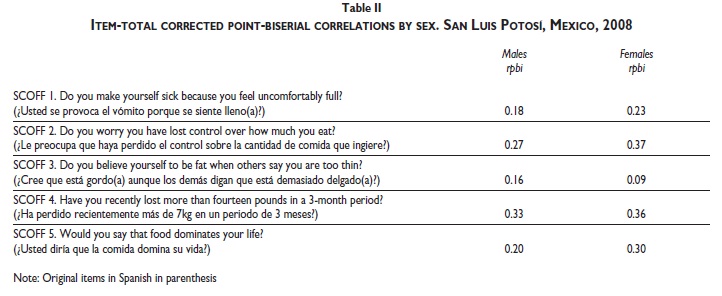
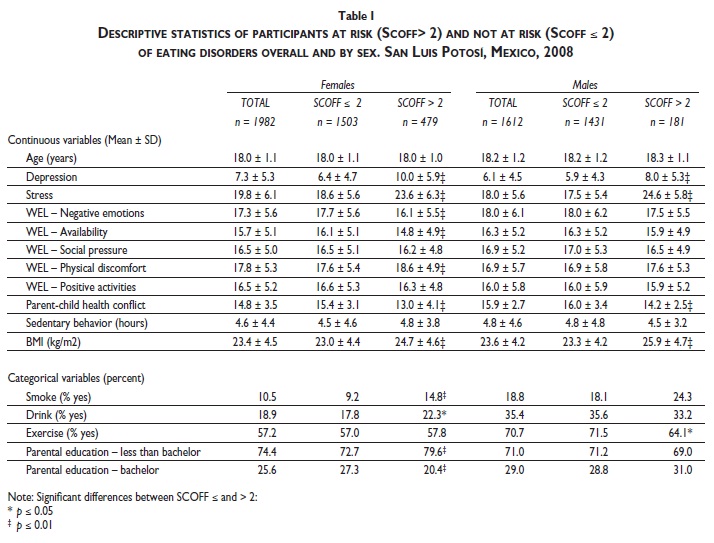
<body><![CDATA[<p><font size="2" face="Verdana, Arial, Helvetica, sans-serif">Respondents completed self-report questionnaires and a physical examination. Validated measures were used when available. Other measures were adapted following standard translation/back-translation procedures. This study draws on a subset of measures (<a href="/img/revistas/spm/v54n4/a07tab01.jpg">Table I</a>).</font></p>     <p><font size="2" face="Verdana, Arial, Helvetica, sans-serif"><i>Demographic characteristics.</i> Respondents reported their gender, age (in years), and highest level of education for either parent.</font></p>     <p><font size="2" face="Verdana, Arial, Helvetica, sans-serif"><i>Disordered eating. </i>The SCOFF<sup>16</sup> assesses five core aspects of AN and BN (see <a href="/img/revistas/spm/v54n4/a07tab02.jpg">Table II </a>for items). Each "yes" response is given 1 point, and a total score computed by summing. Scores above 2 are considered a positive screen for AN or BN.<sup>16</sup> The validated Spanish version of the SCOFF<sup>36</sup> was used; original wording for all items was preserved.</font> </p>     <p><font size="2" face="Verdana, Arial, Helvetica, sans-serif"><i>Psychological well-being. </i>Respondents completed depression, stress, and substance use measures. The CESD-10<sup>37</sup> assesses depressive symptoms in the past week with 4 response options from "Rarely or none of the time (less than 1 day)" to "All of the time (5-7 days)." Positive items are reversed and their values (0 to 3) are summed. The CESD-10 had excellent psychometric properties with Mexican adolescents (Î± = .93<sup>38</sup> ; in the current sample Î± = .79). Respondents rated their stress in the last month in 6 areas (romantic partner, family, finances, general health, weight, and "other") from 1 = <i>Not at all </i>to 6 = <i>Extremely</i>. An overall score was computed by summing (Î± = .71). There were two dichotomous (0 = <i>no</i>, 1 = <i>yes</i>) substance use items: "Do you smoke?" and "Do you drink alcohol?"</font></p>     <p><font size="2" face="Verdana, Arial, Helvetica, sans-serif"><i>Weight-management  self-efficacy.</i> The Weight Efficacy</font> <font size="2" face="Verdana, Arial, Helvetica, sans-serif">Lifestyle Questionnaire (WEL)<sup>39</sup> assesses self-efficacy </font><font size="2" face="Verdana, Arial, Helvetica, sans-serif">in controlling food consumption under five conditions (4 items per domain): <i>negative emotions </i>(Î± = .89), <i>social pressure </i>(Î± = .84), <i>availability </i>(Î± = .83), <i>physical discomfort </i>(Î± = .87), and <i>positive activities </i>(Î± = .82). Items are rated from 1 = <i>Never </i>to 6 = <i>Always</i>. A score for each domain was computed by summing, with higher scores indicating a higher level of weight management self-efficacy.</font></p>     <p><font size="2" face="Verdana, Arial, Helvetica, sans-serif"><i>Parent-child health conflicts. </i>The Young Adult-Parent Conflicts About Lifestyle (YAPCAL) scale<sup>35</sup> consists of three items assessing frequency of family conflict due to respondents' health lifestyle (weight, exercise, and eating patterns) on a scale from 1 (<i>Never</i>) to 6 (<i>Always</i>). An overall score was created by summing; higher scores indicate more conflict (Î± = .75).</font></p>     <p><font size="2" face="Verdana, Arial, Helvetica, sans-serif"><i>Physical activity</i>. A dichotomous item asked "Do you do regular physical activity?" (0 = <i>no</i>, 1 = <i>yes</i>). Sedentary behavior was calculated by summing the daily hours participants reported watching television and playing videogames (actual range = 0 - 14 hours).</font></p>     <p><font size="2" face="Verdana, Arial, Helvetica, sans-serif"><i>BMI. </i>Height was recorded to the nearest 0.5 centimeter</font> <font size="2" face="Verdana, Arial, Helvetica, sans-serif">and weight to the nearest 0.1 kg and BMI calculated as kg/m<sup>2</sup> . Respondents were classified as underweight</font><font size="2" face="Verdana, Arial, Helvetica, sans-serif">(&lt;18.50), normal weight (18.50&#150;24.99), overweight and</font> <font size="2" face="Verdana, Arial, Helvetica, sans-serif">obese (<u>&gt;</u> 25.0).<sup>40</sup> </font></p>     <p><b><font size="2" face="Verdana, Arial, Helvetica, sans-serif">Data analysis</font></b></p>     <p><font size="2" face="Verdana, Arial, Helvetica, sans-serif">Data analysis was conducted with R version 2.9.<sup>41</sup> Significance level was set at 95% and kept constant across multiple comparisons with Bonferroni's correction. Item-level and factor analyses analyzed psychometric performance.<sup>42</sup> </font> <font size="2" face="Verdana, Arial, Helvetica, sans-serif">Point-biserial correlations were calculated to estimate each SCOFF item's discriminatory power. Reliability was assessed with Kuder and Richardson's formula 20 (KR20) and McDonald's omega (Ï‰). For the factor analyses, the male and female samples were each randomly split. A principal components exploratory factor analysis (EFA) with promax rotation was used on the first halves; the Very Simple Structure and Velicer MAP criteria were used for factor selection.<sup>43</sup> On the second halves, maximum likelihood CFA tested previously reported models in the literature (one factor M1 and two factor solution M2, which consisted of <i>Loss of Control Over Food </i>&#91;items 2, 4, and</font> <font size="2" face="Verdana, Arial, Helvetica, sans-serif">5&#93; and <i>Purging Behaviors </i>&#91;items 1 and 3&#93;).<sup>19,22,28</sup> </font></p>     ]]></body>
<body><![CDATA[<p><font size="2" face="Verdana, Arial, Helvetica, sans-serif">To examine nomological validity, we compared re</font><font size="2" face="Verdana, Arial, Helvetica, sans-serif">spondents with positive and negative ED screens on the</font> <font size="2" face="Verdana, Arial, Helvetica, sans-serif">conceptually-identified indicators. Univariate normal</font><font size="2" face="Verdana, Arial, Helvetica, sans-serif">ity and normal distribution of residuals were assessed</font> <font size="2" face="Verdana, Arial, Helvetica, sans-serif">with the Shapiro-Wilk test.<sup>44</sup> Residual homogeneity</font> <font size="2" face="Verdana, Arial, Helvetica, sans-serif">of variance was evaluated with the Brown-Forsythe</font> <font size="2" face="Verdana, Arial, Helvetica, sans-serif">test.<sup>45</sup> Group mean comparisons were performed with</font> <font size="2" face="Verdana, Arial, Helvetica, sans-serif">Student's t-test or Mann-Whitney's U test, depending on</font> <font size="2" face="Verdana, Arial, Helvetica, sans-serif">normality and homogeneity of variance of residuals.</font></p>     <p>&nbsp;</p>     <p><font size="3" face="Verdana, Arial, Helvetica, sans-serif"><b>Results</b></font></p>     <p><font size="2" face="Verdana, Arial, Helvetica, sans-serif">Nearly one quarter (24.2%) of female respondents, and 11.2% of male respondents, scored above 2 on the SCOFF, indicating a positive screen for ED. <a href="/img/revistas/spm/v54n4/a07tab01.jpg">Table I</a> presents the descriptive statistics of participants at risk and not at risk of ED overall and by sex.</font></p>     <p><b><font size="2" face="Verdana, Arial, Helvetica, sans-serif">Female participants</font></b></p>     <p><font size="2" face="Verdana, Arial, Helvetica, sans-serif"><i>Psychometric analyses. </i>The average score on the SCOFF was 0.87 (<i>SD </i>= 0.99). The corrected item-total pointbiserial correlations are presented in <a href="/img/revistas/spm/v54n4/a07tab02.jpg">Table II</a>. The KaiserMeyer-Olkin measure of sample adequacy test was 0.61, and Bartlett's test of sphericity was significant, Ï‡<sup>2</sup> (10) =</font> <font size="2" face="Verdana, Arial, Helvetica, sans-serif">303.7, <i>p </i>&lt; .001, indicating that the items shared enough common variance to attempt a factor analysis. EFA with</font> <font size="2" face="Verdana, Arial, Helvetica, sans-serif">983 participants yielded a unifactorial solution with an eigenvalue of 1.68 (34% of variance explained). KR20 was 0.49 (Ï‰ = 0.62). Inter-item tetrachoric correlations ranged from 0.04 to 0.58. Results of the CFA for the second half of female participants (<i>n = </i>999) are presented in <a href="/img/revistas/spm/v54n4/a07tab03.jpg">Table III</a>. Inter-item tetrachoric correlations ranged from 0.22 to 0.58. Goodness-of-fit statistics indicated a good fit for both M1 and M2. Reliability for M1 were KR20 = .48 and Ï‰ = 0.49. KR20 for M2 factors were .48 and .17 respectively, with an Ï‰ = .61.</font></p>     <p><font size="2" face="Verdana, Arial, Helvetica, sans-serif">SCOFF <i>Validity</i>. Comparisons of females with positive versus negative screens revealed multiple differences (<a href="/img/revistas/spm/v54n4/a07tab01.jpg">Table I</a>). Those with positive screens reported higher psychological distress (depressive symptoms, stress, and substance use), lower weight management efficacy in two contexts (when experiencing negative emotions and when food is available), and higher BMI. </font><font size="2" face="Verdana, Arial, Helvetica, sans-serif">They endorsed higher weight management efficacy when experiencing physical discomfort and lower levels of health-related conflict with parents. They had less educated parents than those with a negative screen. Being overweight or obese was associated with higher likelihood of endorsing items 1, 2, 3 and 5, whereas being underweight was associated with lower likelihood of endorsing items 2, 4 and 5 compared to those of normal weight (available upon request).</font></p>     <p><b><font size="2" face="Verdana, Arial, Helvetica, sans-serif">Male participants</font></b></p>     <p><font size="2" face="Verdana, Arial, Helvetica, sans-serif"><i>Psychometric analyses. </i>The average score on the SCOFF was 0.49 (<i>SD </i>= 0.79). Corrected item-total point-biserial correlations are presented in <a href="/img/revistas/spm/v54n4/a07tab02.jpg">Table II</a>. KMO was 0.62, and Bartlett's test was significant, Ï‡<sup>2</sup> (10) = 200.2, <i>p </i>&lt; .001. EFA with 806 participants yielded a unifactorial solution with an eigenvalue of 1.64 (33% of variance explained); KR20 was 0.62 (Ï‰ = 0.49). Inter-item tetrachoric correlations ranged from .10 to .47. Results of the CFA for the second half of male participants (<i>n </i>= 806) are presented in <a href="/img/revistas/spm/v54n4/a07tab03.jpg">Table III</a>. Goodness-of-fit statistics indicated a good fit only for M2; factor loadings ranged from .30 to .46. Factor reliability coefficients were .40 and .18, respectively, with an Ï‰ = .48.</font></p>     <p><font size="2" face="Verdana, Arial, Helvetica, sans-serif">SCOFF <i>Validity</i>. Males with a positive ED screen had higher levels of depression and stress, higher BMI, </font><font size="2" face="Verdana, Arial, Helvetica, sans-serif">and were less likely to exercise than their counterparts (<a href="/img/revistas/spm/v54n4/a07tab01.jpg">Table I</a>). They reported lower levels of weight and lifestyle conflicts with their parents. The probability of endorsing items 1, 2 and 3 was higher among those with BMI &gt; 25; whereas endorsing items 2 and 4 was lower among underweight than normal weight males (available upon request).</font></p>     ]]></body>
<body><![CDATA[<p>&nbsp;</p>     <p><font size="3" face="Verdana, Arial, Helvetica, sans-serif"><b>Discussion</b></font></p>     <p><font size="2" face="Verdana, Arial, Helvetica, sans-serif">As ED become more common worldwide, effective yet brief screening tools are needed for use across countries. The SCOFF has been used widely to assess ED in developed countries, but its use in Latin America has been limited.<sup>25,26,28</sup> To our knowledge, ours is the first study to evaluate the SCOFF's psychometric performance in Mexico. We evaluated the internal consistency, factor structure, and nomological validity of the SCOFF in a sample of Mexican young adults. Findings provide information on the utility of the SCOFF as a screening measure in Mexico, and allow identification of future research directions.</font></p>     <p><font size="2" face="Verdana, Arial, Helvetica, sans-serif">The internal consistency of the SCOFF questionnaire was moderately low for both males (KR20 = .62) and females (KR20 = .49). Although these internal consistency coefficients are lower than generally deemed desirable, they are similar to those reported in other</font> <font size="2" face="Verdana, Arial, Helvetica, sans-serif">studies (.44 .58) that concluded the SCOFF is a valuable screening tool.<sup>21-23,25,28</sup> Only two studies that found lower internal consistencies (0.2 &#150; 0.4) have concluded that the SCOFF has limited use as a screening instrument.<sup>24,26</sup> </font><font size="2" face="Verdana, Arial, Helvetica, sans-serif">Because the SCOFF is short (just five items) with a simple response format (yes/no) and focuses on diverse behaviors indicative of distinct types of ED, modest reliability estimates are expected.<sup>46</sup> </font></p>     <p><font size="2" face="Verdana, Arial, Helvetica, sans-serif">In terms of factor structure, most studies assume the SCOFF has a unidimensional factor structure. However, two recent studies<sup>19,22</sup> raise the possibility that the SCOFF may yield two factors reflecting different aspects of ED (control over food vs. purging behavior). Building on this work, we conducted both EFA and CFA on random halves of the male and female samples. EFA indicated only one factor but CFA indicated that a two factor solution may be preferable for males. In EFA, the explained variance for the males (33%) was similar to Muro-Sans and colleagues<sup>22</sup> (35%) and Campo-Arias and colleagues<sup>28</sup> (35%). However, explained variance for females (34%) was lower than they reported in these two studies (55 and 37, respectively). Future testing of the two models is needed to establish clinical utility of the SCOFF in Mexico.</font></p>     <p><font size="2" face="Verdana, Arial, Helvetica, sans-serif">Despite moderate reliability, the SCOFF has shown good predictive validity in studies conducted by the original  developers and by other teams.<sup>17-22,25,28</sup> In analyses to evaluate nomological validity, respondents with positive vs. negative ED screens were found to differ in psychosocial and physical wellbeing, consistent with past research.<sup>7, 30-33</sup> As expected, depression, stress and BMI were higher among both males and females with positive screens. Females with positive ED screens evidenced lower weight management efficacy, except in the presence of physical discomfort when they were more efficacious. This latter association may be related to the nature of ED; for example, those with more ED symptoms may have successfully endured physical discomfort while controlling their intake or purging, thus increasing their efficacy in this realm. Counter to expectation, both males and females with positive screens reported lower levels of lifestyle and weight conflict with parents. This may reflect heightened secrecy and disengagement experienced by young adults with disordered eating.<sup>47</sup> Taken together, these patterns of association provide preliminary evidence for the nomological validity of the SCOFF in our sample of Mexican young adults. Future studies that evaluate criterion validity (e.g., by comparing the SCOFF to established measures of ED) would provide a stronger test of the SCOFF's utility for use in Mexico.</font></p>     <p><font size="2" face="Verdana, Arial, Helvetica, sans-serif">Although not a central goal of the study, findings confirm that Mexican women are more likely to have ED</font> <font size="2" face="Verdana, Arial, Helvetica, sans-serif">than men, consistent with gender differences reported in other populations.<sup>1,7,29</sup> Twice as many females than males had a positive screen for ED (24.2 <i>vs. </i>11.2%). The ratio was more balanced than may be expected, given published gender ratios that vary from 2:1 &#150; 4:1 in early adolescence<sup>19,48</sup> to 10:1 20:1 in adulthood<sup>29</sup> <b>; </b>these findings, however, are consistent with other studies involving university students.<sup>49,50</sup> Prevalence of positive ED screens among female applicants to UASLP were lower than those reported in SCOFF studies conducted in Korea (34.8%)<sup>24</sup> and Colombia (39.4%).<sup>25</sup> However, rates were considerably higher than reported among</font> <font size="2" face="Verdana, Arial, Helvetica, sans-serif">10-19 year olds in the 2006 Mexican National Health and Nutrition Survey (0.4% among males and 1.0% among females);<sup>51</sup> and in a study of Mexican female university students.<sup>52</sup> These differences likely reflect variations in age groups, measurement approaches (e.g., use of screeners vs. diagnostic instruments, instrument sensitivity and specificity), and criteria for classifying risk level for ED. Nevertheless, findings are consistent with the 2006 Mexican National Survey on Health and Nutrition, which reported that 17.3% of adolescent males and 25.8% of adolescent females reported at least one of the following: worrying about gaining weight, binge eating, loss of control, dieting, fasting, or excessive exercising. Considering the content of the SCOFF items, it is understandable that the rates of risky eating behaviors are similar.<sup>53</sup> </font></p>     <p><font size="2" face="Verdana, Arial, Helvetica, sans-serif">This paper adds to the literature assessing the psychometric performance of the SCOFF in different populations. The study had a number of strengths (e.g., large sample size, multiple correlates of ED). Future research can address study limitations. Established ED measures (e.g., EAT-26,<sup>13</sup> EDI<sup>14</sup> ) should be used to assess the SCOFF's criterion validity, specificity and sensitivity in clinical and non-clinical samples. In addition, country-specific research is needed to establish whether the specified SCOFF cut-off of 2 is appropriate for the Mexican context. Finally, future examinations of correlates of the SCOFF should utilize more nuanced and validated measures of health behaviors.</font></p>     <p><font size="2" face="Verdana, Arial, Helvetica, sans-serif">ED are recognized as a growing public health concern in Mexico. Given the potentially serious health consequences of ED, there is a need for brief screening measures for use in general populations. The current study of Mexican college applicants revealed psychometric properties that were largely comparable to published reports from other countries.<sup>21-23, 25,28</sup> Given the inconsistency of some findings, additional examination of the SCOFF's psychometric properties and predictive utility is needed to establish its usefulness as a general screening tool. In the meantime, the use of instruments, such as the Brief Disordered Eating Questionnaire,<sup>9</sup> </font><font size="2" face="Verdana, Arial, Helvetica, sans-serif">which has been shown good reliability and predictive validity in Mexican samples, should be used whenever time permits. Ultimately, a better understanding of ED in Mexico could inform the development of health education programs.</font></p>     <p>&nbsp;</p>     ]]></body>
<body><![CDATA[<p><font size="3" face="Verdana, Arial, Helvetica, sans-serif"><b>References</b></font></p>     <!-- ref --><p><font size="2" face="Verdana, Arial, Helvetica, sans-serif">1. World  Health Organization (WHO).  Prevention of mental disorders: Effective interventions and policy options: Summary report. WHO Department of Mental Health and Substance Abuse. Geneva: WHO, 2004.    &nbsp;&nbsp;&nbsp;&nbsp;&nbsp;&nbsp;&nbsp;&nbsp;[&#160;<a href="javascript:void(0);" onclick="javascript: window.open('/scielo.php?script=sci_nlinks&ref=9404768&pid=S0036-3634201200040000700001&lng=','','width=640,height=500,resizable=yes,scrollbars=1,menubar=yes,');">Links</a>&#160;]<!-- end-ref --></font></p>     <!-- ref --><p><font size="2" face="Verdana, Arial, Helvetica, sans-serif">2. Hoek H, van Hoek D. Review of the prevalence and incidence of eating disorders. Int J  Eat Disord  2003;34:383-396.    &nbsp;&nbsp;&nbsp;&nbsp;&nbsp;&nbsp;&nbsp;&nbsp;[&#160;<a href="javascript:void(0);" onclick="javascript: window.open('/scielo.php?script=sci_nlinks&ref=9404770&pid=S0036-3634201200040000700002&lng=','','width=640,height=500,resizable=yes,scrollbars=1,menubar=yes,');">Links</a>&#160;]<!-- end-ref --></font></p>     <!-- ref --><p><font size="2" face="Verdana, Arial, Helvetica, sans-serif"> 3. Perry L, Morgan J, Reid F, Brunton  J, O'Brien  A, Luck A, <i>et al</i>. Screening for  symptoms  of eating disorders:  Reliability of the SCOFF screening tool  with written  compared to oral delivery. Int J  Eat Disord 2002;32:466-472.    &nbsp;&nbsp;&nbsp;&nbsp;&nbsp;&nbsp;&nbsp;&nbsp;[&#160;<a href="javascript:void(0);" onclick="javascript: window.open('/scielo.php?script=sci_nlinks&ref=9404772&pid=S0036-3634201200040000700003&lng=','','width=640,height=500,resizable=yes,scrollbars=1,menubar=yes,');">Links</a>&#160;]<!-- end-ref --> </font></p>     <!-- ref --><p><font size="2" face="Verdana, Arial, Helvetica, sans-serif">4. Rodr&iacute;guez B, Oudhof  H, Gonz&aacute;lez&#150;Arratia  N, Unikel&#150;Santoncini C, Becerril MI. Conductas alimentarias de riesgo: Prevalencia en mujeres de nivel superior del Estado de M&eacute;xico. ICSA&#150;UAEH 2008;6:159-170.    &nbsp;&nbsp;&nbsp;&nbsp;&nbsp;&nbsp;&nbsp;&nbsp;[&#160;<a href="javascript:void(0);" onclick="javascript: window.open('/scielo.php?script=sci_nlinks&ref=9404774&pid=S0036-3634201200040000700004&lng=','','width=640,height=500,resizable=yes,scrollbars=1,menubar=yes,');">Links</a>&#160;]<!-- end-ref --> </font></p>     <!-- ref --><p><font size="2" face="Verdana, Arial, Helvetica, sans-serif">5. Jacobi C, Hayward  C, De Zwaan M, Kraemer  HC, Agras WS. Coming  to terms with risk factors for eating disorders: Application of risk terminology  and suggestions for a general taxonomy.  Psychol Bull 2004;130:19-65.    &nbsp;&nbsp;&nbsp;&nbsp;&nbsp;&nbsp;&nbsp;&nbsp;[&#160;<a href="javascript:void(0);" onclick="javascript: window.open('/scielo.php?script=sci_nlinks&ref=9404776&pid=S0036-3634201200040000700005&lng=','','width=640,height=500,resizable=yes,scrollbars=1,menubar=yes,');">Links</a>&#160;]<!-- end-ref --> </font></p>     <!-- ref --><p><font size="2" face="Verdana, Arial, Helvetica, sans-serif">6. Tish Davidson AM. Eating disorders. In: Longe JL, ed. The Gale Encyclopedia of Diets: A Guide to Health and Nutrition. Detroit: Gale, 2008:329-333.    &nbsp;&nbsp;&nbsp;&nbsp;&nbsp;&nbsp;&nbsp;&nbsp;[&#160;<a href="javascript:void(0);" onclick="javascript: window.open('/scielo.php?script=sci_nlinks&ref=9404778&pid=S0036-3634201200040000700006&lng=','','width=640,height=500,resizable=yes,scrollbars=1,menubar=yes,');">Links</a>&#160;]<!-- end-ref --> </font></p>     <!-- ref --><p><font size="2" face="Verdana, Arial, Helvetica, sans-serif">7. Fairburn CG, Harrison PJ. Eating   disorders. Lancet 2003;361:407-416.    &nbsp;&nbsp;&nbsp;&nbsp;&nbsp;&nbsp;&nbsp;&nbsp;[&#160;<a href="javascript:void(0);" onclick="javascript: window.open('/scielo.php?script=sci_nlinks&ref=9404780&pid=S0036-3634201200040000700007&lng=','','width=640,height=500,resizable=yes,scrollbars=1,menubar=yes,');">Links</a>&#160;]<!-- end-ref --> </font></p>     <!-- ref --><p><font size="2" face="Verdana, Arial, Helvetica, sans-serif">8. Ruuska J, Koivisto  A, Rantanen P, Kaltiala-Heino  R. Psychosocial functioning needs attention  in adolescent eating disorders.  Nord  J  Psychiatry 2007;61:452-458.    &nbsp;&nbsp;&nbsp;&nbsp;&nbsp;&nbsp;&nbsp;&nbsp;[&#160;<a href="javascript:void(0);" onclick="javascript: window.open('/scielo.php?script=sci_nlinks&ref=9404782&pid=S0036-3634201200040000700008&lng=','','width=640,height=500,resizable=yes,scrollbars=1,menubar=yes,');">Links</a>&#160;]<!-- end-ref --> </font></p>     <!-- ref --><p><font size="2" face="Verdana, Arial, Helvetica, sans-serif">9. Unikel-Santoncini C, Boj&oacute;rquez-Chapela I, Carre&ntilde;o-Garc&iacute;a  S. Validaci&oacute;n de un cuestionario breve para medir conductas alimentarias de riesgo. Salud Publica Mex 2004;46:509-515.    &nbsp;&nbsp;&nbsp;&nbsp;&nbsp;&nbsp;&nbsp;&nbsp;[&#160;<a href="javascript:void(0);" onclick="javascript: window.open('/scielo.php?script=sci_nlinks&ref=9404784&pid=S0036-3634201200040000700009&lng=','','width=640,height=500,resizable=yes,scrollbars=1,menubar=yes,');">Links</a>&#160;]<!-- end-ref --></font></p>     <!-- ref --><p><font size="2" face="Verdana, Arial, Helvetica, sans-serif"> 10. Unikel-Santoncini C, Boj&oacute;rquez-Chapela I, Villatoro-Velazquez J, Fleiz-Bautista C, Medina-Mora ME. Conductas alimentarias de riesgo en poblaci&oacute;n estudiantil del Distrito  Federal: Tendencias 1997-2003. Rev Invest Clin 2006;58:15-27.    &nbsp;&nbsp;&nbsp;&nbsp;&nbsp;&nbsp;&nbsp;&nbsp;[&#160;<a href="javascript:void(0);" onclick="javascript: window.open('/scielo.php?script=sci_nlinks&ref=9404786&pid=S0036-3634201200040000700010&lng=','','width=640,height=500,resizable=yes,scrollbars=1,menubar=yes,');">Links</a>&#160;]<!-- end-ref --> </font></p>     <!-- ref --><p><font size="2" face="Verdana, Arial, Helvetica, sans-serif">11. Medina-Mora ME, Borges G, Lara-Mu&ntilde;oz C, Benjel C, Blanco-Jaimes J, Fleiz-Bautista C, <i>et al</i>. Prevalencia de trastornos  mentales y uso de servicios: Resultados de la encuesta nacional de epidemiolog&iacute;a  psiqui&aacute;trica en M&eacute;xico.  Salud Ment<b>al </b>2003;26:1-16.    &nbsp;&nbsp;&nbsp;&nbsp;&nbsp;&nbsp;&nbsp;&nbsp;[&#160;<a href="javascript:void(0);" onclick="javascript: window.open('/scielo.php?script=sci_nlinks&ref=9404788&pid=S0036-3634201200040000700011&lng=','','width=640,height=500,resizable=yes,scrollbars=1,menubar=yes,');">Links</a>&#160;]<!-- end-ref --></font></p>     <!-- ref --><p><font size="2" face="Verdana, Arial, Helvetica, sans-serif"> 12. Parker SC, Lyons J, Bonner J. Eating disorders  in graduate students: Exploring  the SCOFF questionnaire  as a simple screening tool.  J  Am Coll Health 2005;54:103-107.    &nbsp;&nbsp;&nbsp;&nbsp;&nbsp;&nbsp;&nbsp;&nbsp;[&#160;<a href="javascript:void(0);" onclick="javascript: window.open('/scielo.php?script=sci_nlinks&ref=9404790&pid=S0036-3634201200040000700012&lng=','','width=640,height=500,resizable=yes,scrollbars=1,menubar=yes,');">Links</a>&#160;]<!-- end-ref --></font></p>     <!-- ref --><p><font size="2" face="Verdana, Arial, Helvetica, sans-serif">13. Garner DM, Olmsted MP, Bohr Y, Garfinkel PE. The  Eating Attitudes Test: Psychometric features and clinical correlates. Psychol Med 1982;12:871-878.    &nbsp;&nbsp;&nbsp;&nbsp;&nbsp;&nbsp;&nbsp;&nbsp;[&#160;<a href="javascript:void(0);" onclick="javascript: window.open('/scielo.php?script=sci_nlinks&ref=9404792&pid=S0036-3634201200040000700013&lng=','','width=640,height=500,resizable=yes,scrollbars=1,menubar=yes,');">Links</a>&#160;]<!-- end-ref --> </font></p>     <!-- ref --><p><font size="2" face="Verdana, Arial, Helvetica, sans-serif">14. Garner DM, Olmstead MP, Polivy J. Development  and validation of a multidimensional  eating disorder  inventory  for anorexia nervosa and bulimia. Int J Eat Disord  1983;2:15-34.    &nbsp;&nbsp;&nbsp;&nbsp;&nbsp;&nbsp;&nbsp;&nbsp;[&#160;<a href="javascript:void(0);" onclick="javascript: window.open('/scielo.php?script=sci_nlinks&ref=9404794&pid=S0036-3634201200040000700014&lng=','','width=640,height=500,resizable=yes,scrollbars=1,menubar=yes,');">Links</a>&#160;]<!-- end-ref --></font></p>     <!-- ref --><p><font size="2" face="Verdana, Arial, Helvetica, sans-serif"> 15. Luck AJ, Morgan  JF, Reid F, O'Brien  A, Brunton  J, Price C, <i>et al</i>. The SCOFF questionnaire and clinical interview  for eating disorders in general practice: Comparative study. BMJ 2002;325:755-756.    &nbsp;&nbsp;&nbsp;&nbsp;&nbsp;&nbsp;&nbsp;&nbsp;[&#160;<a href="javascript:void(0);" onclick="javascript: window.open('/scielo.php?script=sci_nlinks&ref=9404796&pid=S0036-3634201200040000700015&lng=','','width=640,height=500,resizable=yes,scrollbars=1,menubar=yes,');">Links</a>&#160;]<!-- end-ref --></font></p>     <!-- ref --><p><font size="2" face="Verdana, Arial, Helvetica, sans-serif"> 16. Morgan JF, Reid F, Lacey JH. The SCOFF questionnaire:  assessment of a new screening tool  for  eating disorders.  BMJ 1999;319:1467-1468.    &nbsp;&nbsp;&nbsp;&nbsp;&nbsp;&nbsp;&nbsp;&nbsp;[&#160;<a href="javascript:void(0);" onclick="javascript: window.open('/scielo.php?script=sci_nlinks&ref=9404798&pid=S0036-3634201200040000700016&lng=','','width=640,height=500,resizable=yes,scrollbars=1,menubar=yes,');">Links</a>&#160;]<!-- end-ref --> </font></p>     <!-- ref --><p><font size="2" face="Verdana, Arial, Helvetica, sans-serif">17. Noma  S, Nakai  Y, Hamagaki  S, Uehara M, Hayashi A, Hayashi T. Comparison  between the SCOFF questionnaire and the Eating Attitudes Test in patients with eating disorders. Int J  Psychiatry Clin Pract 2006;10:27-32.    &nbsp;&nbsp;&nbsp;&nbsp;&nbsp;&nbsp;&nbsp;&nbsp;[&#160;<a href="javascript:void(0);" onclick="javascript: window.open('/scielo.php?script=sci_nlinks&ref=9404800&pid=S0036-3634201200040000700017&lng=','','width=640,height=500,resizable=yes,scrollbars=1,menubar=yes,');">Links</a>&#160;]<!-- end-ref --> </font></p>     <!-- ref --><p><font size="2" face="Verdana, Arial, Helvetica, sans-serif">18. Hill  LS, Reid F, Morgan  JF, Lacey JH. SCOFF, the development  of an eating disorder  screening questionnaire.  Int J  Eat Disord  2010;43:344-351.    &nbsp;&nbsp;&nbsp;&nbsp;&nbsp;&nbsp;&nbsp;&nbsp;[&#160;<a href="javascript:void(0);" onclick="javascript: window.open('/scielo.php?script=sci_nlinks&ref=9404802&pid=S0036-3634201200040000700018&lng=','','width=640,height=500,resizable=yes,scrollbars=1,menubar=yes,');">Links</a>&#160;]<!-- end-ref --> </font></p>     <!-- ref --><p><font size="2" face="Verdana, Arial, Helvetica, sans-serif">19. Hautala L, Junnila J, Alin J, Gronroos  M, Maunula AM, Karukivi M, <i>et al</i>. Uncovering hidden eating disorders using the SCOFF questionnaire: Cross-sectional survey of adolescents and comparison with nurse assessments.  Int  J  Nurs Stud 2009;46:1439-1447.    &nbsp;&nbsp;&nbsp;&nbsp;&nbsp;&nbsp;&nbsp;&nbsp;[&#160;<a href="javascript:void(0);" onclick="javascript: window.open('/scielo.php?script=sci_nlinks&ref=9404804&pid=S0036-3634201200040000700019&lng=','','width=640,height=500,resizable=yes,scrollbars=1,menubar=yes,');">Links</a>&#160;]<!-- end-ref --> </font></p>     <!-- ref --><p><font size="2" face="Verdana, Arial, Helvetica, sans-serif">20. Garcia FD, Grigioni S, Chalali  S, Meyrignac G, Thibaut  F, Dechelotte P. Validation of the French version of SCOFF questionnaire for screening of eating disorders among adults. World J Biol Psychiatry 2010;11:888-893.    &nbsp;&nbsp;&nbsp;&nbsp;&nbsp;&nbsp;&nbsp;&nbsp;[&#160;<a href="javascript:void(0);" onclick="javascript: window.open('/scielo.php?script=sci_nlinks&ref=9404806&pid=S0036-3634201200040000700020&lng=','','width=640,height=500,resizable=yes,scrollbars=1,menubar=yes,');">Links</a>&#160;]<!-- end-ref --></font></p>     <!-- ref --><p><font size="2" face="Verdana, Arial, Helvetica, sans-serif"> 21. Siervo  M, Boschi V, Papa A, Bellini O, Falconi C. Application  of the SCOFF, Eating Attitude Test 26 (EAT 26) and Eating Inventory  (TFEQ) Questionnaires in young women seeking diet-therapy.  Eat Weight  Disord 2005;10:76-82.    &nbsp;&nbsp;&nbsp;&nbsp;&nbsp;&nbsp;&nbsp;&nbsp;[&#160;<a href="javascript:void(0);" onclick="javascript: window.open('/scielo.php?script=sci_nlinks&ref=9404808&pid=S0036-3634201200040000700021&lng=','','width=640,height=500,resizable=yes,scrollbars=1,menubar=yes,');">Links</a>&#160;]<!-- end-ref --> </font></p>     <!-- ref --><p><font size="2" face="Verdana, Arial, Helvetica, sans-serif">22. Muro-Sans  P, Amador-Campos JA, Morgan  JF. The SCOFF-c: Psychometric  properties  of the Catalan version in a Spanish adolescent  sample. J Psychosom Res 2008;64;81-86.    &nbsp;&nbsp;&nbsp;&nbsp;&nbsp;&nbsp;&nbsp;&nbsp;[&#160;<a href="javascript:void(0);" onclick="javascript: window.open('/scielo.php?script=sci_nlinks&ref=9404810&pid=S0036-3634201200040000700022&lng=','','width=640,height=500,resizable=yes,scrollbars=1,menubar=yes,');">Links</a>&#160;]<!-- end-ref --> </font></p>     <!-- ref --><p><font size="2" face="Verdana, Arial, Helvetica, sans-serif">23. Leung  SF, Lee KL,  Lee SM, Leung  SC, Hung  WS,  Lee WL, <i>et al</i>. Psychometric  properties  of the SCOFF questionnaire (Chinese version) for screening eating disorders in Hong Kong secondary school students : A cross-sectional study. Int J  Nurs Stud 2009;46:239-247.    &nbsp;&nbsp;&nbsp;&nbsp;&nbsp;&nbsp;&nbsp;&nbsp;[&#160;<a href="javascript:void(0);" onclick="javascript: window.open('/scielo.php?script=sci_nlinks&ref=9404812&pid=S0036-3634201200040000700023&lng=','','width=640,height=500,resizable=yes,scrollbars=1,menubar=yes,');">Links</a>&#160;]<!-- end-ref --> </font></p>     <!-- ref --><p><font size="2" face="Verdana, Arial, Helvetica, sans-serif">24. Jung DS, Lee SY, Kim  KN,  Kand  JH. A reliability study of the Korean version of SCOFF (K-SCOFF) Questionnaires.  Korean J  Obes 2005;14;108-113.    &nbsp;&nbsp;&nbsp;&nbsp;&nbsp;&nbsp;&nbsp;&nbsp;[&#160;<a href="javascript:void(0);" onclick="javascript: window.open('/scielo.php?script=sci_nlinks&ref=9404814&pid=S0036-3634201200040000700024&lng=','','width=640,height=500,resizable=yes,scrollbars=1,menubar=yes,');">Links</a>&#160;]<!-- end-ref --></font></p>     <!-- ref --><p><font size="2" face="Verdana, Arial, Helvetica, sans-serif"> 25. Rueda-Jaimes GE, Diaz-Martinez LA, Ortiz-Barajas DP, Pinzon-Plata C, Rodriguez-Martinez J, Cadena-Afanador  LP. Validaci&oacute;n del cuestionario  SCOFF para el cribado de los trastornos  del comportamiento  alimentario en adolescentes escolarizados. Aten Primaria 2005;35:89-94.    &nbsp;&nbsp;&nbsp;&nbsp;&nbsp;&nbsp;&nbsp;&nbsp;[&#160;<a href="javascript:void(0);" onclick="javascript: window.open('/scielo.php?script=sci_nlinks&ref=9404816&pid=S0036-3634201200040000700025&lng=','','width=640,height=500,resizable=yes,scrollbars=1,menubar=yes,');">Links</a>&#160;]<!-- end-ref --> </font></p>     <!-- ref --><p><font size="2" face="Verdana, Arial, Helvetica, sans-serif">26. Campo-Arias A, Cogollo Z, Diaz CE. Cuestionario  SCOFF parar tamizaje de trastornos  de la conducta alimentaria: Consistencia interna en estudiantes de un colegio de Cartegena, Colombia. Duazary 2007;4:14-18.    &nbsp;&nbsp;&nbsp;&nbsp;&nbsp;&nbsp;&nbsp;&nbsp;[&#160;<a href="javascript:void(0);" onclick="javascript: window.open('/scielo.php?script=sci_nlinks&ref=9404818&pid=S0036-3634201200040000700026&lng=','','width=640,height=500,resizable=yes,scrollbars=1,menubar=yes,');">Links</a>&#160;]<!-- end-ref --> </font></p>     <!-- ref --><p><font size="2" face="Verdana, Arial, Helvetica, sans-serif">27. Kaluski DN,  Natamba BK, Goldsmith  R, Shimony T, Berry  EM. Deter minants of disordered  eating behaviors among Israeli adolescent girls. Eat Disord 2008;16:146-159.    &nbsp;&nbsp;&nbsp;&nbsp;&nbsp;&nbsp;&nbsp;&nbsp;[&#160;<a href="javascript:void(0);" onclick="javascript: window.open('/scielo.php?script=sci_nlinks&ref=9404820&pid=S0036-3634201200040000700027&lng=','','width=640,height=500,resizable=yes,scrollbars=1,menubar=yes,');">Links</a>&#160;]<!-- end-ref --></font></p>     <!-- ref --><p><font size="2" face="Verdana, Arial, Helvetica, sans-serif"> 28. Campo-Arias A, D&iacute;az-Mart&iacute;nez LA, Rueda-Jaimes GE, Mart&iacute;nez-Mantilla JA, Amaya-Naranjo W,  Campillo  HA.  Consistencia  interna  y an&aacute;lisis factorial del cuestionario  SCOFF para tamizaje de trastorno  de conducta alimentaria en adolescentes estudiantes: Una comparaci&oacute;n por g&eacute;nero. Univ Psychol 2006;5:295-304.    &nbsp;&nbsp;&nbsp;&nbsp;&nbsp;&nbsp;&nbsp;&nbsp;[&#160;<a href="javascript:void(0);" onclick="javascript: window.open('/scielo.php?script=sci_nlinks&ref=9404822&pid=S0036-3634201200040000700028&lng=','','width=640,height=500,resizable=yes,scrollbars=1,menubar=yes,');">Links</a>&#160;]<!-- end-ref --> </font></p>     <!-- ref --><p><font size="2" face="Verdana, Arial, Helvetica, sans-serif">29. Polivy P, Herman CP. Causes of eating disorders.  Annu Rev Psychol 2002;53:187-213.    &nbsp;&nbsp;&nbsp;&nbsp;&nbsp;&nbsp;&nbsp;&nbsp;[&#160;<a href="javascript:void(0);" onclick="javascript: window.open('/scielo.php?script=sci_nlinks&ref=9404824&pid=S0036-3634201200040000700029&lng=','','width=640,height=500,resizable=yes,scrollbars=1,menubar=yes,');">Links</a>&#160;]<!-- end-ref --> </font></p>     <!-- ref --><p><font size="2" face="Verdana, Arial, Helvetica, sans-serif">30.  Fox  JRE, Power  MJ. Eating disorders and multi-level models of emotion: An integrated model. Clin Psychol Psychother 2009;16:240-267.    &nbsp;&nbsp;&nbsp;&nbsp;&nbsp;&nbsp;&nbsp;&nbsp;[&#160;<a href="javascript:void(0);" onclick="javascript: window.open('/scielo.php?script=sci_nlinks&ref=9404826&pid=S0036-3634201200040000700030&lng=','','width=640,height=500,resizable=yes,scrollbars=1,menubar=yes,');">Links</a>&#160;]<!-- end-ref --></font></p>     <!-- ref --><p><font size="2" face="Verdana, Arial, Helvetica, sans-serif"> 31. Pike KM, Wilfley  D, Hilbert  A, Fairburn GC, Dohm FA, StriegelMoore  RH. Antecedent life events of binge eating disorder. Psychiatry Res 2006;142:19-29.    &nbsp;&nbsp;&nbsp;&nbsp;&nbsp;&nbsp;&nbsp;&nbsp;[&#160;<a href="javascript:void(0);" onclick="javascript: window.open('/scielo.php?script=sci_nlinks&ref=9404828&pid=S0036-3634201200040000700031&lng=','','width=640,height=500,resizable=yes,scrollbars=1,menubar=yes,');">Links</a>&#160;]<!-- end-ref --> </font></p>     <!-- ref --><p><font size="2" face="Verdana, Arial, Helvetica, sans-serif">32. Berman ES. The relationship  between eating self-efficacy and eating disorder  symptoms in a non-clinical sample. Eating Behav 2006;7:79-90.    &nbsp;&nbsp;&nbsp;&nbsp;&nbsp;&nbsp;&nbsp;&nbsp;[&#160;<a href="javascript:void(0);" onclick="javascript: window.open('/scielo.php?script=sci_nlinks&ref=9404830&pid=S0036-3634201200040000700032&lng=','','width=640,height=500,resizable=yes,scrollbars=1,menubar=yes,');">Links</a>&#160;]<!-- end-ref --></font></p>     <!-- ref --><p><font size="2" face="Verdana, Arial, Helvetica, sans-serif"> 33. Pike KM, Hilbert  A, Wilfley  DE, Fairburn CG, Dohms FA, Walsh BT, <i>et al</i>. Toward an understanding of risk factors for anorexia nervosa: a case-control study. Psychol Med 2008;38:1443-1453.    &nbsp;&nbsp;&nbsp;&nbsp;&nbsp;&nbsp;&nbsp;&nbsp;[&#160;<a href="javascript:void(0);" onclick="javascript: window.open('/scielo.php?script=sci_nlinks&ref=9404832&pid=S0036-3634201200040000700033&lng=','','width=640,height=500,resizable=yes,scrollbars=1,menubar=yes,');">Links</a>&#160;]<!-- end-ref --> </font></p>     <!-- ref --><p><font size="2" face="Verdana, Arial, Helvetica, sans-serif">34. Fan Y, Li Y, Liu A, Hu X, Ma G, Xu G. Associations  between  body mass index, weight control  concerns and behaviors, and eating disorder symptoms among nonclinical Chinese adolescents. BMC Public Health 2010;10:314-326.    &nbsp;&nbsp;&nbsp;&nbsp;&nbsp;&nbsp;&nbsp;&nbsp;[&#160;<a href="javascript:void(0);" onclick="javascript: window.open('/scielo.php?script=sci_nlinks&ref=9404834&pid=S0036-3634201200040000700034&lng=','','width=640,height=500,resizable=yes,scrollbars=1,menubar=yes,');">Links</a>&#160;]<!-- end-ref --> </font></p>     <!-- ref --><p><font size="2" face="Verdana, Arial, Helvetica, sans-serif">35. Wiley  A, Flood T, Andrade FCD, Aradillas-Garcia C, 2009 Up Amigos Study Group. Relationships between the Organization, Climate, and Frequency of Family Mealtimes and Weight  Status in Mexico. J  Adolesc Health 2011; 49: 222-224.    &nbsp;&nbsp;&nbsp;&nbsp;&nbsp;&nbsp;&nbsp;&nbsp;[&#160;<a href="javascript:void(0);" onclick="javascript: window.open('/scielo.php?script=sci_nlinks&ref=9404836&pid=S0036-3634201200040000700035&lng=','','width=640,height=500,resizable=yes,scrollbars=1,menubar=yes,');">Links</a>&#160;]<!-- end-ref --> </font></p>     <!-- ref --><p><font size="2" face="Verdana, Arial, Helvetica, sans-serif">36. Garcia-Campayo J, Sanz-Carrillo C, Iba&ntilde;ez JA, Lou  S, Solano V, Alda M. Validation  of the Spanish version  of the SCOFF questionnaire</font> <font size="2" face="Verdana, Arial, Helvetica, sans-serif">for the screening of eating disorders in primary care. J  Psychosom Res 2005;59:51-55.    &nbsp;&nbsp;&nbsp;&nbsp;&nbsp;&nbsp;&nbsp;&nbsp;[&#160;<a href="javascript:void(0);" onclick="javascript: window.open('/scielo.php?script=sci_nlinks&ref=9404838&pid=S0036-3634201200040000700036&lng=','','width=640,height=500,resizable=yes,scrollbars=1,menubar=yes,');">Links</a>&#160;]<!-- end-ref --> </font></p>     <!-- ref --><p><font size="2" face="Verdana, Arial, Helvetica, sans-serif">37. Kohout FJ, Berkman  LF, Evans DA, Cornoni-Huntley J. Two  shorter  forms of the CES-D (Center  for Epidemiological Studies Depression) depression symptoms index. J  Aging Health 1993;5:179-193.    &nbsp;&nbsp;&nbsp;&nbsp;&nbsp;&nbsp;&nbsp;&nbsp;[&#160;<a href="javascript:void(0);" onclick="javascript: window.open('/scielo.php?script=sci_nlinks&ref=9404840&pid=S0036-3634201200040000700037&lng=','','width=640,height=500,resizable=yes,scrollbars=1,menubar=yes,');">Links</a>&#160;]<!-- end-ref --> </font></p>     <!-- ref --><p><font size="2" face="Verdana, Arial, Helvetica, sans-serif">38. Gonz&aacute;lez-Forteza C, Jim&eacute;nez-Tapia JA, Ramos-Lira  L, Wagner  FA. Aplicaci&oacute;n  de la Escala de Depresi&oacute;n  del Center  of Epidemiological Studies en adolescentes de la Ciudad de M&eacute;xico.  Salud Publica Mex 2008;50:292-299.    &nbsp;&nbsp;&nbsp;&nbsp;&nbsp;&nbsp;&nbsp;&nbsp;[&#160;<a href="javascript:void(0);" onclick="javascript: window.open('/scielo.php?script=sci_nlinks&ref=9404842&pid=S0036-3634201200040000700038&lng=','','width=640,height=500,resizable=yes,scrollbars=1,menubar=yes,');">Links</a>&#160;]<!-- end-ref --></font></p>     <!-- ref --><p><font size="2" face="Verdana, Arial, Helvetica, sans-serif"> 39. Clark  MM, Abrams  DB, Niaura  RS, Eaton CA,  Rossi JS. Self-efficacy in weight management. J  Consult Clin Psychol 1991;59:739-744.    &nbsp;&nbsp;&nbsp;&nbsp;&nbsp;&nbsp;&nbsp;&nbsp;[&#160;<a href="javascript:void(0);" onclick="javascript: window.open('/scielo.php?script=sci_nlinks&ref=9404844&pid=S0036-3634201200040000700039&lng=','','width=640,height=500,resizable=yes,scrollbars=1,menubar=yes,');">Links</a>&#160;]<!-- end-ref --> </font></p>     <!-- ref --><p><font size="2" face="Verdana, Arial, Helvetica, sans-serif">40. NHLBI  Panel. Identification, Evaluation and Treatment  of Overweight  and Obesity in Adults. Obes Res 1998;6 suppl 2:1-80.    &nbsp;&nbsp;&nbsp;&nbsp;&nbsp;&nbsp;&nbsp;&nbsp;[&#160;<a href="javascript:void(0);" onclick="javascript: window.open('/scielo.php?script=sci_nlinks&ref=9404846&pid=S0036-3634201200040000700040&lng=','','width=640,height=500,resizable=yes,scrollbars=1,menubar=yes,');">Links</a>&#160;]<!-- end-ref --> </font></p>     <!-- ref --><p><font size="2" face="Verdana, Arial, Helvetica, sans-serif">41. Ihaka R, Gentleman  RR. A language for  data analysis and graphics. J Comput Graph Stat 1996;5:299-314.    &nbsp;&nbsp;&nbsp;&nbsp;&nbsp;&nbsp;&nbsp;&nbsp;[&#160;<a href="javascript:void(0);" onclick="javascript: window.open('/scielo.php?script=sci_nlinks&ref=9404848&pid=S0036-3634201200040000700041&lng=','','width=640,height=500,resizable=yes,scrollbars=1,menubar=yes,');">Links</a>&#160;]<!-- end-ref --> </font></p>     <!-- ref --><p><font size="2" face="Verdana, Arial, Helvetica, sans-serif">42. Nunnally J, Bernstein I. Psychometric theory. New York: McGraw-Hill Inc, 1994.    &nbsp;&nbsp;&nbsp;&nbsp;&nbsp;&nbsp;&nbsp;&nbsp;[&#160;<a href="javascript:void(0);" onclick="javascript: window.open('/scielo.php?script=sci_nlinks&ref=9404850&pid=S0036-3634201200040000700042&lng=','','width=640,height=500,resizable=yes,scrollbars=1,menubar=yes,');">Links</a>&#160;]<!-- end-ref --> </font></p>     <!-- ref --><p><font size="2" face="Verdana, Arial, Helvetica, sans-serif">43. Revelle W, Rocklin T. Very Simple Structure:  An alternative procedure  for estimating the optimal number of interpretable  factors. Multivariate  Behav Res 1979;14:403-414.    &nbsp;&nbsp;&nbsp;&nbsp;&nbsp;&nbsp;&nbsp;&nbsp;[&#160;<a href="javascript:void(0);" onclick="javascript: window.open('/scielo.php?script=sci_nlinks&ref=9404852&pid=S0036-3634201200040000700043&lng=','','width=640,height=500,resizable=yes,scrollbars=1,menubar=yes,');">Links</a>&#160;]<!-- end-ref --></font></p>     <!-- ref --><p><font size="2" face="Verdana, Arial, Helvetica, sans-serif"> 44. Heiberger RM, Holland B. Statistical analysis and data display: and intermediate course with examples in S-Plus , R, and SAS. New York: Springer, 2004.    &nbsp;&nbsp;&nbsp;&nbsp;&nbsp;&nbsp;&nbsp;&nbsp;[&#160;<a href="javascript:void(0);" onclick="javascript: window.open('/scielo.php?script=sci_nlinks&ref=9404854&pid=S0036-3634201200040000700044&lng=','','width=640,height=500,resizable=yes,scrollbars=1,menubar=yes,');">Links</a>&#160;]<!-- end-ref --> </font></p>     <!-- ref --><p><font size="2" face="Verdana, Arial, Helvetica, sans-serif">45. Brown  MB, Forsythe AB. Robust tests for the equality of variances. J Am Stat Assoc 1974;69:364-367.    &nbsp;&nbsp;&nbsp;&nbsp;&nbsp;&nbsp;&nbsp;&nbsp;[&#160;<a href="javascript:void(0);" onclick="javascript: window.open('/scielo.php?script=sci_nlinks&ref=9404856&pid=S0036-3634201200040000700045&lng=','','width=640,height=500,resizable=yes,scrollbars=1,menubar=yes,');">Links</a>&#160;]<!-- end-ref --> </font></p>     <!-- ref --><p><font size="2" face="Verdana, Arial, Helvetica, sans-serif">46. Streiner DL. Being inconsistent about consistency: When coefficient alpha does and doesn't matter.  J  Pers Assess 2003;80:217-222.    &nbsp;&nbsp;&nbsp;&nbsp;&nbsp;&nbsp;&nbsp;&nbsp;[&#160;<a href="javascript:void(0);" onclick="javascript: window.open('/scielo.php?script=sci_nlinks&ref=9404858&pid=S0036-3634201200040000700046&lng=','','width=640,height=500,resizable=yes,scrollbars=1,menubar=yes,');">Links</a>&#160;]<!-- end-ref --></font></p>     <!-- ref --><p><font size="2" face="Verdana, Arial, Helvetica, sans-serif"> 47. Knatz  S, Maginot T, Story M, Neumark-Sztainer D, Boutelle K. Prevalence rates and psychological predictors  of secretive eating in overweight and obese adolescents. Child Obes 2011;7:30-35.    &nbsp;&nbsp;&nbsp;&nbsp;&nbsp;&nbsp;&nbsp;&nbsp;[&#160;<a href="javascript:void(0);" onclick="javascript: window.open('/scielo.php?script=sci_nlinks&ref=9404860&pid=S0036-3634201200040000700047&lng=','','width=640,height=500,resizable=yes,scrollbars=1,menubar=yes,');">Links</a>&#160;]<!-- end-ref --> </font></p>     <!-- ref --><p><font size="2" face="Verdana, Arial, Helvetica, sans-serif">48. J&aacute;uregui-Lobera I, Romero-Candau  J, Bola&ntilde;os-R&iacute;os P, MontesBerriat&uacute;a C, D&iacute;az-Jaramillo R, Monta&ntilde;a-Gonz&aacute;lez MT, <i>et al</i>. Conducta  alimentaria e imagen corporal  en una muestra  de adolescentes  de Sevilla. Nutri Hosp 2009;24:568-573.    &nbsp;&nbsp;&nbsp;&nbsp;&nbsp;&nbsp;&nbsp;&nbsp;[&#160;<a href="javascript:void(0);" onclick="javascript: window.open('/scielo.php?script=sci_nlinks&ref=9404862&pid=S0036-3634201200040000700048&lng=','','width=640,height=500,resizable=yes,scrollbars=1,menubar=yes,');">Links</a>&#160;]<!-- end-ref --></font></p>     <!-- ref --><p><font size="2" face="Verdana, Arial, Helvetica, sans-serif"> 49. Lameiras-Fern&aacute;ndez M, Calado-Otero  M, Rodr&iacute;guez-Castro Y, Fern&aacute;ndez-Prieto M. Los trastornos  de la conducta alimentaria en estudiantes universitarios  espa&ntilde;oles. Actas Esp Psiquiatr 2002;30:343-349.    &nbsp;&nbsp;&nbsp;&nbsp;&nbsp;&nbsp;&nbsp;&nbsp;[&#160;<a href="javascript:void(0);" onclick="javascript: window.open('/scielo.php?script=sci_nlinks&ref=9404864&pid=S0036-3634201200040000700049&lng=','','width=640,height=500,resizable=yes,scrollbars=1,menubar=yes,');">Links</a>&#160;]<!-- end-ref --> </font></p>     <!-- ref --><p><font size="2" face="Verdana, Arial, Helvetica, sans-serif">50. Saucedo-Molina  TJ, Unikel-Santoncini C. Conductas alimentarias de riesgo, interiorizaci&oacute;n  del ideal est&eacute;tico  de delgadez e &iacute;ndice de masa corporal en estudiantes hidalguenses de preparatoria  y licenciatura de una instituci&oacute;n  privada. Salud Mental 2010;33:1-19.    &nbsp;&nbsp;&nbsp;&nbsp;&nbsp;&nbsp;&nbsp;&nbsp;[&#160;<a href="javascript:void(0);" onclick="javascript: window.open('/scielo.php?script=sci_nlinks&ref=9404866&pid=S0036-3634201200040000700050&lng=','','width=640,height=500,resizable=yes,scrollbars=1,menubar=yes,');">Links</a>&#160;]<!-- end-ref --> </font></p>     <!-- ref --><p><font size="2" face="Verdana, Arial, Helvetica, sans-serif">51. Barriguete-Mel&eacute;ndez JA, Unikel-Santoncini  C, Aguilar-Salinas C, C&oacute;rdoba-Villalobos JA, Shamah T, Barquera  S, <i>et al</i>. Prevalence of abnormal eating behaviors in adolescents in Mexico: Mexican national health and nutrition  survey 2006. Salud Publica Mex 2009;51:638-644.    &nbsp;&nbsp;&nbsp;&nbsp;&nbsp;&nbsp;&nbsp;&nbsp;[&#160;<a href="javascript:void(0);" onclick="javascript: window.open('/scielo.php?script=sci_nlinks&ref=9404868&pid=S0036-3634201200040000700051&lng=','','width=640,height=500,resizable=yes,scrollbars=1,menubar=yes,');">Links</a>&#160;]<!-- end-ref --> </font></p>     <!-- ref --><p><font size="2" face="Verdana, Arial, Helvetica, sans-serif">52. Mancilla  JM, Alvarez  G, L&oacute;pez  X, Mercado  L, Manr&iacute;quez  E, Rom&aacute;n M. Trastornos alimentarios y factores asociados en universitarias  mexicanas. Psicol Cienc Soc 1998;2:34-58.    &nbsp;&nbsp;&nbsp;&nbsp;&nbsp;&nbsp;&nbsp;&nbsp;[&#160;<a href="javascript:void(0);" onclick="javascript: window.open('/scielo.php?script=sci_nlinks&ref=9404870&pid=S0036-3634201200040000700052&lng=','','width=640,height=500,resizable=yes,scrollbars=1,menubar=yes,');">Links</a>&#160;]<!-- end-ref --> </font></p>     <!-- ref --><p><font size="2" face="Verdana, Arial, Helvetica, sans-serif">53.  Olaiz-Fern&aacute;ndez G, Rivera-Dommarco  J, Shamah-Levy T, Rojas R, Villalpando-Hern&aacute;ndez S, Hern&aacute;ndez-&Aacute;vila  M, <i>et al</i>, eds. Encuesta Nacional de Salud y Nutrici&oacute;n 2006.  Cuernavaca, M&eacute;xico: Instituto  Nacional de Salud P&uacute;blica, 2006. 382                                                                                                               salud p&uacute;blica de m&eacute;xico / vol. 54, no. 4, julio-agosto de 2012</font>&nbsp;&nbsp;&nbsp;&nbsp;&nbsp;&nbsp;&nbsp;&nbsp;[&#160;<a href="javascript:void(0);" onclick="javascript: window.open('/scielo.php?script=sci_nlinks&ref=9404872&pid=S0036-3634201200040000700053&lng=','','width=640,height=500,resizable=yes,scrollbars=1,menubar=yes,');">Links</a>&#160;]<!-- end-ref --><p>&nbsp;</p>     <p>&nbsp;</p>     <p><a name="end" id="end"></a><a href="#top"><img src="/img/revistas/spm/v54n4/seta.jpg" border="0" /></a> <font size="2" face="Verdana, Arial, Helvetica, sans-serif"><b>Corresponding  author:</b> <br />   Dr. Omar S&aacute;nchez-Armass. <br />   Universidad Aut&oacute;noma  de San Luis Potos&iacute;, Facultad de Psicolog&iacute;a<br />   Carretera  Central Km. 424.5. 78494. <br />   San Luis Potos&iacute;,  M&eacute;xico.<br />   E-mail: <a href="mailto:omarsac@gmail.com">omarsac@gmail.com</a></font></p>     <p><font size="2" face="Verdana, Arial, Helvetica, sans-serif">Received on: May 24, 2011 <br />   Accepted  on: March 30, 2012</font></p>     ]]></body>
<body><![CDATA[<p>&nbsp;</p>     <p>&nbsp;</p>     <p><font size="2" face="Verdana, Arial, Helvetica, sans-serif">Declaration of conflict of interests: The authors  declares not  to have conflict of interests.<br />       <a id="nt*"></a><a href="#tx*">*</a> Study group  members:  Carmen  Rojas, Eduardo Medina Cerda,  Esperanza de la Cruz  Mendoza,  Juan Manuel  Vargas Morales (Universidad Auton&oacute;ma de San Luis Potos&iacute;, M&eacute;xico) y Margarita Ter&aacute;n Garc&iacute;a (University  of Illinois at Urbana-Champaign, USA).</font></p>      ]]></body><back>
<ref-list>
<ref id="B1">
<label>1</label><nlm-citation citation-type="book">
<collab>World Health Organization</collab>
<source><![CDATA[Prevention of mental disorders: Effective interventions and policy options: Summary report. WHO Department of Mental Health and Substance Abuse]]></source>
<year>2004</year>
<publisher-loc><![CDATA[Geneva ]]></publisher-loc>
<publisher-name><![CDATA[WHO]]></publisher-name>
</nlm-citation>
</ref>
<ref id="B2">
<label>2</label><nlm-citation citation-type="journal">
<person-group person-group-type="author">
<name>
<surname><![CDATA[Hoek]]></surname>
<given-names><![CDATA[H]]></given-names>
</name>
<name>
<surname><![CDATA[van Hoek]]></surname>
<given-names><![CDATA[D]]></given-names>
</name>
</person-group>
<article-title xml:lang="en"><![CDATA[Review of the prevalence and incidence of eating disorders]]></article-title>
<source><![CDATA[Int J Eat Disord]]></source>
<year>2003</year>
<volume>34</volume>
<page-range>383-396</page-range></nlm-citation>
</ref>
<ref id="B3">
<label>3</label><nlm-citation citation-type="journal">
<person-group person-group-type="author">
<name>
<surname><![CDATA[Perry]]></surname>
<given-names><![CDATA[L]]></given-names>
</name>
<name>
<surname><![CDATA[Morgan]]></surname>
<given-names><![CDATA[J]]></given-names>
</name>
<name>
<surname><![CDATA[Reid]]></surname>
<given-names><![CDATA[F]]></given-names>
</name>
<name>
<surname><![CDATA[Brunton]]></surname>
<given-names><![CDATA[J]]></given-names>
</name>
<name>
<surname><![CDATA[O'Brien]]></surname>
<given-names><![CDATA[A]]></given-names>
</name>
<name>
<surname><![CDATA[Luck]]></surname>
<given-names><![CDATA[A]]></given-names>
</name>
</person-group>
<article-title xml:lang="en"><![CDATA[Screening for symptoms of eating disorders: Reliability of the SCOFF screening tool with written compared to oral delivery]]></article-title>
<source><![CDATA[Int J Eat Disord]]></source>
<year>2002</year>
<volume>32</volume>
<page-range>466-472</page-range></nlm-citation>
</ref>
<ref id="B4">
<label>4</label><nlm-citation citation-type="journal">
<person-group person-group-type="author">
<name>
<surname><![CDATA[Rodríguez]]></surname>
<given-names><![CDATA[B]]></given-names>
</name>
<name>
<surname><![CDATA[Oudhof]]></surname>
<given-names><![CDATA[H]]></given-names>
</name>
<name>
<surname><![CDATA[González-Arratia]]></surname>
<given-names><![CDATA[N]]></given-names>
</name>
<name>
<surname><![CDATA[Unikel-Santoncini]]></surname>
<given-names><![CDATA[C]]></given-names>
</name>
<name>
<surname><![CDATA[Becerril]]></surname>
<given-names><![CDATA[MI]]></given-names>
</name>
</person-group>
<article-title xml:lang="es"><![CDATA[Conductas alimentarias de riesgo: Prevalencia en mujeres de nivel superior del Estado de México]]></article-title>
<source><![CDATA[ICSA-UAEH]]></source>
<year>2008</year>
<volume>6</volume>
<page-range>159-170</page-range></nlm-citation>
</ref>
<ref id="B5">
<label>5</label><nlm-citation citation-type="journal">
<person-group person-group-type="author">
<name>
<surname><![CDATA[Jacobi]]></surname>
<given-names><![CDATA[C]]></given-names>
</name>
<name>
<surname><![CDATA[Hayward]]></surname>
<given-names><![CDATA[C]]></given-names>
</name>
<name>
<surname><![CDATA[De Zwaan]]></surname>
<given-names><![CDATA[M]]></given-names>
</name>
<name>
<surname><![CDATA[Kraemer]]></surname>
<given-names><![CDATA[HC]]></given-names>
</name>
<name>
<surname><![CDATA[Agras]]></surname>
<given-names><![CDATA[WS]]></given-names>
</name>
</person-group>
<article-title xml:lang="en"><![CDATA[Coming to terms with risk factors for eating disorders: Application of risk terminology and suggestions for a general taxonomy]]></article-title>
<source><![CDATA[Psychol Bull]]></source>
<year>2004</year>
<volume>130</volume>
<page-range>19-65</page-range></nlm-citation>
</ref>
<ref id="B6">
<label>6</label><nlm-citation citation-type="book">
<person-group person-group-type="author">
<name>
<surname><![CDATA[Tish Davidson]]></surname>
<given-names><![CDATA[AM]]></given-names>
</name>
</person-group>
<article-title xml:lang="en"><![CDATA[Eating disorders]]></article-title>
<person-group person-group-type="editor">
<name>
<surname><![CDATA[Longe]]></surname>
<given-names><![CDATA[JL]]></given-names>
</name>
</person-group>
<source><![CDATA[The Gale Encyclopedia of Diets: A Guide to Health and Nutrition]]></source>
<year>2008</year>
<page-range>329-333</page-range><publisher-loc><![CDATA[Detroit ]]></publisher-loc>
<publisher-name><![CDATA[Gale]]></publisher-name>
</nlm-citation>
</ref>
<ref id="B7">
<label>7</label><nlm-citation citation-type="journal">
<person-group person-group-type="author">
<name>
<surname><![CDATA[Fairburn]]></surname>
<given-names><![CDATA[CG]]></given-names>
</name>
<name>
<surname><![CDATA[Harrison]]></surname>
<given-names><![CDATA[PJ]]></given-names>
</name>
</person-group>
<article-title xml:lang="en"><![CDATA[Eating disorders]]></article-title>
<source><![CDATA[Lancet]]></source>
<year>2003</year>
<volume>361</volume>
<page-range>407-416</page-range></nlm-citation>
</ref>
<ref id="B8">
<label>8</label><nlm-citation citation-type="journal">
<person-group person-group-type="author">
<name>
<surname><![CDATA[Ruuska]]></surname>
<given-names><![CDATA[J]]></given-names>
</name>
<name>
<surname><![CDATA[Koivisto]]></surname>
<given-names><![CDATA[A]]></given-names>
</name>
<name>
<surname><![CDATA[Rantanen]]></surname>
<given-names><![CDATA[P]]></given-names>
</name>
<name>
<surname><![CDATA[Kaltiala-Heino]]></surname>
<given-names><![CDATA[R]]></given-names>
</name>
</person-group>
<article-title xml:lang="en"><![CDATA[Psychosocial functioning needs attention in adolescent eating disorders]]></article-title>
<source><![CDATA[Nord J Psychiatry]]></source>
<year>2007</year>
<volume>61</volume>
<page-range>452-458</page-range></nlm-citation>
</ref>
<ref id="B9">
<label>9</label><nlm-citation citation-type="journal">
<person-group person-group-type="author">
<name>
<surname><![CDATA[Unikel-Santoncini]]></surname>
<given-names><![CDATA[C]]></given-names>
</name>
<name>
<surname><![CDATA[Bojórquez-Chapela]]></surname>
<given-names><![CDATA[I]]></given-names>
</name>
<name>
<surname><![CDATA[Carreño-García]]></surname>
<given-names><![CDATA[S]]></given-names>
</name>
</person-group>
<article-title xml:lang="es"><![CDATA[Validación de un cuestionario breve para medir conductas alimentarias de riesgo]]></article-title>
<source><![CDATA[Salud Publica Mex]]></source>
<year>2004</year>
<volume>46</volume>
<page-range>509-515</page-range></nlm-citation>
</ref>
<ref id="B10">
<label>10</label><nlm-citation citation-type="journal">
<person-group person-group-type="author">
<name>
<surname><![CDATA[Unikel-Santoncini]]></surname>
<given-names><![CDATA[C]]></given-names>
</name>
<name>
<surname><![CDATA[Bojórquez-Chapela]]></surname>
<given-names><![CDATA[I]]></given-names>
</name>
<name>
<surname><![CDATA[Villatoro-Velazquez]]></surname>
<given-names><![CDATA[J]]></given-names>
</name>
<name>
<surname><![CDATA[Fleiz-Bautista]]></surname>
<given-names><![CDATA[C]]></given-names>
</name>
<name>
<surname><![CDATA[Medina-Mora]]></surname>
<given-names><![CDATA[ME]]></given-names>
</name>
</person-group>
<article-title xml:lang="es"><![CDATA[Conductas alimentarias de riesgo en población estudiantil del Distrito Federal: Tendencias 1997-2003]]></article-title>
<source><![CDATA[Rev Invest Clin]]></source>
<year>2006</year>
<volume>58</volume>
<page-range>15-27</page-range></nlm-citation>
</ref>
<ref id="B11">
<label>11</label><nlm-citation citation-type="journal">
<person-group person-group-type="author">
<name>
<surname><![CDATA[Medina-Mora]]></surname>
<given-names><![CDATA[ME]]></given-names>
</name>
<name>
<surname><![CDATA[Borges]]></surname>
<given-names><![CDATA[G]]></given-names>
</name>
<name>
<surname><![CDATA[Lara-Muñoz]]></surname>
<given-names><![CDATA[C]]></given-names>
</name>
<name>
<surname><![CDATA[Benjel]]></surname>
<given-names><![CDATA[C]]></given-names>
</name>
<name>
<surname><![CDATA[Blanco-Jaimes]]></surname>
<given-names><![CDATA[J]]></given-names>
</name>
<name>
<surname><![CDATA[Fleiz-Bautista]]></surname>
<given-names><![CDATA[C]]></given-names>
</name>
</person-group>
<article-title xml:lang="es"><![CDATA[Prevalencia de trastornos mentales y uso de servicios: Resultados de la encuesta nacional de epidemiología psiquiátrica en México]]></article-title>
<source><![CDATA[Salud Mental]]></source>
<year>2003</year>
<volume>26</volume>
<page-range>1-16</page-range></nlm-citation>
</ref>
<ref id="B12">
<label>12</label><nlm-citation citation-type="journal">
<person-group person-group-type="author">
<name>
<surname><![CDATA[Parker]]></surname>
<given-names><![CDATA[SC]]></given-names>
</name>
<name>
<surname><![CDATA[Lyons]]></surname>
<given-names><![CDATA[J]]></given-names>
</name>
<name>
<surname><![CDATA[Bonner]]></surname>
<given-names><![CDATA[J]]></given-names>
</name>
</person-group>
<article-title xml:lang="en"><![CDATA[Eating disorders in graduate students: Exploring the SCOFF questionnaire as a simple screening tool]]></article-title>
<source><![CDATA[J Am Coll Health]]></source>
<year>2005</year>
<volume>54</volume>
<page-range>103-107</page-range></nlm-citation>
</ref>
<ref id="B13">
<label>13</label><nlm-citation citation-type="journal">
<person-group person-group-type="author">
<name>
<surname><![CDATA[Garner]]></surname>
<given-names><![CDATA[DM]]></given-names>
</name>
<name>
<surname><![CDATA[Olmsted]]></surname>
<given-names><![CDATA[MP]]></given-names>
</name>
<name>
<surname><![CDATA[Bohr]]></surname>
<given-names><![CDATA[Y]]></given-names>
</name>
<name>
<surname><![CDATA[Garfinkel]]></surname>
<given-names><![CDATA[PE]]></given-names>
</name>
</person-group>
<article-title xml:lang="en"><![CDATA[The Eating Attitudes Test: Psychometric features and clinical correlates]]></article-title>
<source><![CDATA[Psychol Med]]></source>
<year>1982</year>
<volume>12</volume>
<page-range>871-878</page-range></nlm-citation>
</ref>
<ref id="B14">
<label>14</label><nlm-citation citation-type="journal">
<person-group person-group-type="author">
<name>
<surname><![CDATA[Garner]]></surname>
<given-names><![CDATA[DM]]></given-names>
</name>
<name>
<surname><![CDATA[Olmstead]]></surname>
<given-names><![CDATA[MP]]></given-names>
</name>
<name>
<surname><![CDATA[Polivy]]></surname>
<given-names><![CDATA[J]]></given-names>
</name>
</person-group>
<article-title xml:lang="en"><![CDATA[Development and validation of a multidimensional eating disorder inventory for anorexia nervosa and bulimia]]></article-title>
<source><![CDATA[Int J Eat Disord]]></source>
<year>1983</year>
<volume>2</volume>
<page-range>15-34</page-range></nlm-citation>
</ref>
<ref id="B15">
<label>15</label><nlm-citation citation-type="journal">
<person-group person-group-type="author">
<name>
<surname><![CDATA[Luck]]></surname>
<given-names><![CDATA[AJ]]></given-names>
</name>
<name>
<surname><![CDATA[Morgan]]></surname>
<given-names><![CDATA[JF]]></given-names>
</name>
<name>
<surname><![CDATA[Reid]]></surname>
<given-names><![CDATA[F]]></given-names>
</name>
<name>
<surname><![CDATA[O'Brien]]></surname>
<given-names><![CDATA[A]]></given-names>
</name>
<name>
<surname><![CDATA[Brunton]]></surname>
<given-names><![CDATA[J]]></given-names>
</name>
<name>
<surname><![CDATA[Price]]></surname>
<given-names><![CDATA[C]]></given-names>
</name>
</person-group>
<article-title xml:lang="en"><![CDATA[The SCOFF questionnaire and clinical interview for eating disorders in general practice: Comparative study]]></article-title>
<source><![CDATA[BMJ]]></source>
<year>2002</year>
<volume>325</volume>
<page-range>755-756</page-range></nlm-citation>
</ref>
<ref id="B16">
<label>16</label><nlm-citation citation-type="journal">
<person-group person-group-type="author">
<name>
<surname><![CDATA[Morgan]]></surname>
<given-names><![CDATA[JF]]></given-names>
</name>
<name>
<surname><![CDATA[Reid]]></surname>
<given-names><![CDATA[F]]></given-names>
</name>
<name>
<surname><![CDATA[Lacey]]></surname>
<given-names><![CDATA[JH]]></given-names>
</name>
</person-group>
<article-title xml:lang="en"><![CDATA[The SCOFF questionnaire: assessment of a new screening tool for eating disorders]]></article-title>
<source><![CDATA[BMJ]]></source>
<year>1999</year>
<volume>319</volume>
<page-range>1467-1468</page-range></nlm-citation>
</ref>
<ref id="B17">
<label>17</label><nlm-citation citation-type="journal">
<person-group person-group-type="author">
<name>
<surname><![CDATA[Noma]]></surname>
<given-names><![CDATA[S]]></given-names>
</name>
<name>
<surname><![CDATA[Nakai]]></surname>
<given-names><![CDATA[Y]]></given-names>
</name>
<name>
<surname><![CDATA[Hamagaki]]></surname>
<given-names><![CDATA[S]]></given-names>
</name>
<name>
<surname><![CDATA[Uehara]]></surname>
<given-names><![CDATA[M]]></given-names>
</name>
<name>
<surname><![CDATA[Hayashi]]></surname>
<given-names><![CDATA[A]]></given-names>
</name>
<name>
<surname><![CDATA[Hayashi]]></surname>
<given-names><![CDATA[T]]></given-names>
</name>
</person-group>
<article-title xml:lang="en"><![CDATA[Comparison between the SCOFF questionnaire and the Eating Attitudes Test in patients with eating disorders]]></article-title>
<source><![CDATA[Int J Psychiatry Clin Pract]]></source>
<year>2006</year>
<volume>10</volume>
<page-range>27-32</page-range></nlm-citation>
</ref>
<ref id="B18">
<label>18</label><nlm-citation citation-type="journal">
<person-group person-group-type="author">
<name>
<surname><![CDATA[Hill]]></surname>
<given-names><![CDATA[LS]]></given-names>
</name>
<name>
<surname><![CDATA[Reid]]></surname>
<given-names><![CDATA[F]]></given-names>
</name>
<name>
<surname><![CDATA[Morgan]]></surname>
<given-names><![CDATA[JF]]></given-names>
</name>
<name>
<surname><![CDATA[Lacey]]></surname>
<given-names><![CDATA[JH]]></given-names>
</name>
</person-group>
<article-title xml:lang="en"><![CDATA[SCOFF, the development of an eating disorder screening questionnaire]]></article-title>
<source><![CDATA[Int J Eat Disord]]></source>
<year>2010</year>
<volume>43</volume>
<page-range>344-351</page-range></nlm-citation>
</ref>
<ref id="B19">
<label>19</label><nlm-citation citation-type="journal">
<person-group person-group-type="author">
<name>
<surname><![CDATA[Hautala]]></surname>
<given-names><![CDATA[L]]></given-names>
</name>
<name>
<surname><![CDATA[Junnila]]></surname>
<given-names><![CDATA[J]]></given-names>
</name>
<name>
<surname><![CDATA[Alin]]></surname>
<given-names><![CDATA[J]]></given-names>
</name>
<name>
<surname><![CDATA[Gronroos]]></surname>
<given-names><![CDATA[M]]></given-names>
</name>
<name>
<surname><![CDATA[Maunula]]></surname>
<given-names><![CDATA[AM]]></given-names>
</name>
<name>
<surname><![CDATA[Karukivi]]></surname>
<given-names><![CDATA[M]]></given-names>
</name>
</person-group>
<article-title xml:lang="en"><![CDATA[Uncovering hidden eating disorders using the SCOFF questionnaire: Cross-sectional survey of adolescents and comparison with nurse assessments]]></article-title>
<source><![CDATA[Int J Nurs Stud]]></source>
<year>2009</year>
<volume>46</volume>
<page-range>1439-1447</page-range></nlm-citation>
</ref>
<ref id="B20">
<label>20</label><nlm-citation citation-type="journal">
<person-group person-group-type="author">
<name>
<surname><![CDATA[Garcia]]></surname>
<given-names><![CDATA[FD]]></given-names>
</name>
<name>
<surname><![CDATA[Grigioni]]></surname>
<given-names><![CDATA[S]]></given-names>
</name>
<name>
<surname><![CDATA[Chalali]]></surname>
<given-names><![CDATA[S]]></given-names>
</name>
<name>
<surname><![CDATA[Meyrignac]]></surname>
<given-names><![CDATA[G]]></given-names>
</name>
<name>
<surname><![CDATA[Thibaut]]></surname>
<given-names><![CDATA[F]]></given-names>
</name>
<name>
<surname><![CDATA[Dechelotte]]></surname>
<given-names><![CDATA[P]]></given-names>
</name>
</person-group>
<article-title xml:lang="en"><![CDATA[Validation of the French version of SCOFF questionnaire for screening of eating disorders among adults]]></article-title>
<source><![CDATA[World J Biol Psychiatry]]></source>
<year>2010</year>
<volume>11</volume>
<page-range>888-893</page-range></nlm-citation>
</ref>
<ref id="B21">
<label>21</label><nlm-citation citation-type="journal">
<person-group person-group-type="author">
<name>
<surname><![CDATA[Siervo]]></surname>
<given-names><![CDATA[M]]></given-names>
</name>
<name>
<surname><![CDATA[Boschi]]></surname>
<given-names><![CDATA[V]]></given-names>
</name>
<name>
<surname><![CDATA[Papa]]></surname>
<given-names><![CDATA[A]]></given-names>
</name>
<name>
<surname><![CDATA[Bellini]]></surname>
<given-names><![CDATA[O]]></given-names>
</name>
<name>
<surname><![CDATA[Falconi]]></surname>
<given-names><![CDATA[C]]></given-names>
</name>
</person-group>
<article-title xml:lang="en"><![CDATA[Application of the SCOFF, Eating Attitude Test 26 (EAT 26) and Eating Inventory (TFEQ) Questionnaires in young women seeking diet-therapy]]></article-title>
<source><![CDATA[Eat Weight Disord]]></source>
<year>2005</year>
<volume>10</volume>
<page-range>76-82</page-range></nlm-citation>
</ref>
<ref id="B22">
<label>22</label><nlm-citation citation-type="journal">
<person-group person-group-type="author">
<name>
<surname><![CDATA[Muro-Sans]]></surname>
<given-names><![CDATA[P]]></given-names>
</name>
<name>
<surname><![CDATA[Amador-Campos]]></surname>
<given-names><![CDATA[JA]]></given-names>
</name>
<name>
<surname><![CDATA[Morgan]]></surname>
<given-names><![CDATA[JF]]></given-names>
</name>
</person-group>
<article-title xml:lang="en"><![CDATA[The SCOFF-c: Psychometric properties of the Catalan version in a Spanish adolescent sample]]></article-title>
<source><![CDATA[J Psychosom Res]]></source>
<year>2008</year>
<volume>64</volume>
<page-range>81-86</page-range></nlm-citation>
</ref>
<ref id="B23">
<label>23</label><nlm-citation citation-type="journal">
<person-group person-group-type="author">
<name>
<surname><![CDATA[Leung]]></surname>
<given-names><![CDATA[SF]]></given-names>
</name>
<name>
<surname><![CDATA[Lee]]></surname>
<given-names><![CDATA[KL]]></given-names>
</name>
<name>
<surname><![CDATA[Lee]]></surname>
<given-names><![CDATA[SM]]></given-names>
</name>
<name>
<surname><![CDATA[Leung]]></surname>
<given-names><![CDATA[SC]]></given-names>
</name>
<name>
<surname><![CDATA[Hung]]></surname>
<given-names><![CDATA[WS]]></given-names>
</name>
<name>
<surname><![CDATA[Lee]]></surname>
<given-names><![CDATA[WL]]></given-names>
</name>
</person-group>
<article-title xml:lang="en"><![CDATA[Psychometric properties of the SCOFF questionnaire (Chinese version) for screening eating disorders in Hong Kong secondary school students: A cross-sectional study]]></article-title>
<source><![CDATA[Int J Nurs Stud]]></source>
<year>2009</year>
<volume>46</volume>
<page-range>239-247</page-range></nlm-citation>
</ref>
<ref id="B24">
<label>24</label><nlm-citation citation-type="journal">
<person-group person-group-type="author">
<name>
<surname><![CDATA[Jung]]></surname>
<given-names><![CDATA[DS]]></given-names>
</name>
<name>
<surname><![CDATA[Lee]]></surname>
<given-names><![CDATA[SY]]></given-names>
</name>
<name>
<surname><![CDATA[Kim]]></surname>
<given-names><![CDATA[KN]]></given-names>
</name>
<name>
<surname><![CDATA[Kand]]></surname>
<given-names><![CDATA[JH]]></given-names>
</name>
</person-group>
<article-title xml:lang="en"><![CDATA[A reliability study of the Korean version of SCOFF (K-SCOFF) Questionnaires]]></article-title>
<source><![CDATA[Korean J Obes]]></source>
<year>2005</year>
<volume>14</volume>
<page-range>108-113</page-range></nlm-citation>
</ref>
<ref id="B25">
<label>25</label><nlm-citation citation-type="journal">
<person-group person-group-type="author">
<name>
<surname><![CDATA[Rueda-Jaimes]]></surname>
<given-names><![CDATA[GE]]></given-names>
</name>
<name>
<surname><![CDATA[Diaz-Martinez]]></surname>
<given-names><![CDATA[LA]]></given-names>
</name>
<name>
<surname><![CDATA[Ortiz-Barajas]]></surname>
<given-names><![CDATA[DP]]></given-names>
</name>
<name>
<surname><![CDATA[Pinzon-Plata]]></surname>
<given-names><![CDATA[C]]></given-names>
</name>
<name>
<surname><![CDATA[Rodriguez-Martinez]]></surname>
<given-names><![CDATA[J]]></given-names>
</name>
<name>
<surname><![CDATA[Cadena-Afanador]]></surname>
<given-names><![CDATA[LP]]></given-names>
</name>
</person-group>
<article-title xml:lang="es"><![CDATA[Validación del cuestionario SCOFF para el cribado de los trastornos del comportamiento alimentario en adolescentes escolarizados]]></article-title>
<source><![CDATA[Aten Primaria]]></source>
<year>2005</year>
<volume>35</volume>
<page-range>89-94</page-range></nlm-citation>
</ref>
<ref id="B26">
<label>26</label><nlm-citation citation-type="journal">
<person-group person-group-type="author">
<name>
<surname><![CDATA[Campo-Arias]]></surname>
<given-names><![CDATA[A]]></given-names>
</name>
<name>
<surname><![CDATA[Cogollo]]></surname>
<given-names><![CDATA[Z]]></given-names>
</name>
<name>
<surname><![CDATA[Diaz]]></surname>
<given-names><![CDATA[CE]]></given-names>
</name>
</person-group>
<article-title xml:lang="es"><![CDATA[Cuestionario SCOFF parar tamizaje de trastornos de la conducta alimentaria: Consistencia interna en estudiantes de un colegio de Cartegena, Colombia]]></article-title>
<source><![CDATA[Duazary]]></source>
<year>2007</year>
<volume>4</volume>
<page-range>14-18</page-range></nlm-citation>
</ref>
<ref id="B27">
<label>27</label><nlm-citation citation-type="journal">
<person-group person-group-type="author">
<name>
<surname><![CDATA[Kaluski]]></surname>
<given-names><![CDATA[DN]]></given-names>
</name>
<name>
<surname><![CDATA[Natamba]]></surname>
<given-names><![CDATA[BK]]></given-names>
</name>
<name>
<surname><![CDATA[Goldsmith]]></surname>
<given-names><![CDATA[R]]></given-names>
</name>
<name>
<surname><![CDATA[Shimony]]></surname>
<given-names><![CDATA[T]]></given-names>
</name>
<name>
<surname><![CDATA[Berry]]></surname>
<given-names><![CDATA[EM]]></given-names>
</name>
</person-group>
<article-title xml:lang="en"><![CDATA[Deter minants of disordered eating behaviors among Israeli adolescent girls]]></article-title>
<source><![CDATA[Eat Disord]]></source>
<year>2008</year>
<volume>16</volume>
<page-range>146-159</page-range></nlm-citation>
</ref>
<ref id="B28">
<label>28</label><nlm-citation citation-type="journal">
<person-group person-group-type="author">
<name>
<surname><![CDATA[Campo-Arias]]></surname>
<given-names><![CDATA[A]]></given-names>
</name>
<name>
<surname><![CDATA[Díaz-Martínez]]></surname>
<given-names><![CDATA[LA]]></given-names>
</name>
<name>
<surname><![CDATA[Rueda-Jaimes]]></surname>
<given-names><![CDATA[GE]]></given-names>
</name>
<name>
<surname><![CDATA[Martínez-Mantilla]]></surname>
<given-names><![CDATA[JA]]></given-names>
</name>
<name>
<surname><![CDATA[Amaya-Naranjo]]></surname>
<given-names><![CDATA[W]]></given-names>
</name>
<name>
<surname><![CDATA[Campillo]]></surname>
<given-names><![CDATA[HA]]></given-names>
</name>
</person-group>
<article-title xml:lang="es"><![CDATA[Consistencia interna y análisis factorial del cuestionario SCOFF para tamizaje de trastorno de conducta alimentaria en adolescentes estudiantes: Una comparación por género]]></article-title>
<source><![CDATA[Univ Psychol]]></source>
<year>2006</year>
<volume>5</volume>
<page-range>295-304</page-range></nlm-citation>
</ref>
<ref id="B29">
<label>29</label><nlm-citation citation-type="journal">
<person-group person-group-type="author">
<name>
<surname><![CDATA[Polivy]]></surname>
<given-names><![CDATA[P]]></given-names>
</name>
<name>
<surname><![CDATA[Herman]]></surname>
<given-names><![CDATA[CP]]></given-names>
</name>
</person-group>
<article-title xml:lang="en"><![CDATA[Causes of eating disorders]]></article-title>
<source><![CDATA[Annu Rev Psychol]]></source>
<year>2002</year>
<volume>53</volume>
<page-range>187-213</page-range></nlm-citation>
</ref>
<ref id="B30">
<label>30</label><nlm-citation citation-type="journal">
<person-group person-group-type="author">
<name>
<surname><![CDATA[Fox]]></surname>
<given-names><![CDATA[JRE]]></given-names>
</name>
<name>
<surname><![CDATA[Power]]></surname>
<given-names><![CDATA[MJ]]></given-names>
</name>
</person-group>
<article-title xml:lang="en"><![CDATA[Eating disorders and multi-level models of emotion: An integrated model]]></article-title>
<source><![CDATA[Clin Psychol Psychother]]></source>
<year>2009</year>
<volume>16</volume>
<page-range>240-267</page-range></nlm-citation>
</ref>
<ref id="B31">
<label>31</label><nlm-citation citation-type="journal">
<person-group person-group-type="author">
<name>
<surname><![CDATA[Pike]]></surname>
<given-names><![CDATA[KM]]></given-names>
</name>
<name>
<surname><![CDATA[Wilfley]]></surname>
<given-names><![CDATA[D]]></given-names>
</name>
<name>
<surname><![CDATA[Hilbert]]></surname>
<given-names><![CDATA[A]]></given-names>
</name>
<name>
<surname><![CDATA[Fairburn]]></surname>
<given-names><![CDATA[GC]]></given-names>
</name>
<name>
<surname><![CDATA[Dohm]]></surname>
<given-names><![CDATA[FA]]></given-names>
</name>
<name>
<surname><![CDATA[StriegelMoore]]></surname>
<given-names><![CDATA[RH]]></given-names>
</name>
</person-group>
<article-title xml:lang="en"><![CDATA[Antecedent life events of binge eating disorder]]></article-title>
<source><![CDATA[Psychiatry Res]]></source>
<year>2006</year>
<volume>142</volume>
<page-range>19-29</page-range></nlm-citation>
</ref>
<ref id="B32">
<label>32</label><nlm-citation citation-type="journal">
<person-group person-group-type="author">
<name>
<surname><![CDATA[Berman]]></surname>
<given-names><![CDATA[ES]]></given-names>
</name>
</person-group>
<article-title xml:lang="en"><![CDATA[The relationship between eating self-efficacy and eating disorder symptoms in a non-clinical sample]]></article-title>
<source><![CDATA[Eating Behav]]></source>
<year>2006</year>
<volume>7</volume>
<page-range>79-90</page-range></nlm-citation>
</ref>
<ref id="B33">
<label>33</label><nlm-citation citation-type="journal">
<person-group person-group-type="author">
<name>
<surname><![CDATA[Pike]]></surname>
<given-names><![CDATA[KM]]></given-names>
</name>
<name>
<surname><![CDATA[Hilbert]]></surname>
<given-names><![CDATA[A]]></given-names>
</name>
<name>
<surname><![CDATA[Wilfley]]></surname>
<given-names><![CDATA[DE]]></given-names>
</name>
<name>
<surname><![CDATA[Fairburn]]></surname>
<given-names><![CDATA[CG]]></given-names>
</name>
<name>
<surname><![CDATA[Dohms]]></surname>
<given-names><![CDATA[FA]]></given-names>
</name>
<name>
<surname><![CDATA[Walsh]]></surname>
<given-names><![CDATA[BT]]></given-names>
</name>
</person-group>
<article-title xml:lang="en"><![CDATA[Toward an understanding of risk factors for anorexia nervosa: a case-control study]]></article-title>
<source><![CDATA[Psychol Med]]></source>
<year>2008</year>
<volume>38</volume>
<page-range>1443-1453</page-range></nlm-citation>
</ref>
<ref id="B34">
<label>34</label><nlm-citation citation-type="journal">
<person-group person-group-type="author">
<name>
<surname><![CDATA[Fan]]></surname>
<given-names><![CDATA[Y]]></given-names>
</name>
<name>
<surname><![CDATA[Li]]></surname>
<given-names><![CDATA[Y]]></given-names>
</name>
<name>
<surname><![CDATA[Liu]]></surname>
<given-names><![CDATA[A]]></given-names>
</name>
<name>
<surname><![CDATA[Hu]]></surname>
<given-names><![CDATA[X]]></given-names>
</name>
<name>
<surname><![CDATA[Ma]]></surname>
<given-names><![CDATA[G]]></given-names>
</name>
<name>
<surname><![CDATA[Xu]]></surname>
<given-names><![CDATA[G]]></given-names>
</name>
</person-group>
<article-title xml:lang="en"><![CDATA[Associations between body mass index, weight control concerns and behaviors, and eating disorder symptoms among nonclinical Chinese adolescents]]></article-title>
<source><![CDATA[BMC Public Health]]></source>
<year>2010</year>
<volume>10</volume>
<page-range>314-326</page-range></nlm-citation>
</ref>
<ref id="B35">
<label>35</label><nlm-citation citation-type="journal">
<person-group person-group-type="author">
<name>
<surname><![CDATA[Wiley]]></surname>
<given-names><![CDATA[A]]></given-names>
</name>
<name>
<surname><![CDATA[Flood]]></surname>
<given-names><![CDATA[T]]></given-names>
</name>
<name>
<surname><![CDATA[Andrade]]></surname>
<given-names><![CDATA[FCD]]></given-names>
</name>
<name>
<surname><![CDATA[Aradillas-Garcia]]></surname>
<given-names><![CDATA[C]]></given-names>
</name>
</person-group>
<collab>2009 Up Amigos Study Group</collab>
<article-title xml:lang="en"><![CDATA[Relationships between the Organization, Climate, and Frequency of Family Mealtimes and Weight Status in Mexico]]></article-title>
<source><![CDATA[J Adolesc Health]]></source>
<year>2011</year>
<volume>49</volume>
<page-range>222-224</page-range></nlm-citation>
</ref>
<ref id="B36">
<label>36</label><nlm-citation citation-type="journal">
<person-group person-group-type="author">
<name>
<surname><![CDATA[Garcia-Campayo]]></surname>
<given-names><![CDATA[J]]></given-names>
</name>
<name>
<surname><![CDATA[Sanz-Carrillo]]></surname>
<given-names><![CDATA[C]]></given-names>
</name>
<name>
<surname><![CDATA[Ibañez]]></surname>
<given-names><![CDATA[JA]]></given-names>
</name>
<name>
<surname><![CDATA[Lou]]></surname>
<given-names><![CDATA[S]]></given-names>
</name>
<name>
<surname><![CDATA[Solano]]></surname>
<given-names><![CDATA[V]]></given-names>
</name>
<name>
<surname><![CDATA[Alda]]></surname>
<given-names><![CDATA[M]]></given-names>
</name>
</person-group>
<article-title xml:lang="en"><![CDATA[Validation of the Spanish version of the SCOFF questionnaire for the screening of eating disorders in primary care]]></article-title>
<source><![CDATA[J Psychosom Res]]></source>
<year>2005</year>
<volume>59</volume>
<page-range>51-55</page-range></nlm-citation>
</ref>
<ref id="B37">
<label>37</label><nlm-citation citation-type="journal">
<person-group person-group-type="author">
<name>
<surname><![CDATA[Kohout]]></surname>
<given-names><![CDATA[FJ]]></given-names>
</name>
<name>
<surname><![CDATA[Berkman]]></surname>
<given-names><![CDATA[LF]]></given-names>
</name>
<name>
<surname><![CDATA[Evans]]></surname>
<given-names><![CDATA[DA]]></given-names>
</name>
<name>
<surname><![CDATA[Cornoni-Huntley]]></surname>
<given-names><![CDATA[J]]></given-names>
</name>
</person-group>
<article-title xml:lang="en"><![CDATA[Two shorter forms of the CES-D (Center for Epidemiological Studies Depression) depression symptoms index]]></article-title>
<source><![CDATA[J Aging Health]]></source>
<year>1993</year>
<volume>5</volume>
<page-range>179-193</page-range></nlm-citation>
</ref>
<ref id="B38">
<label>38</label><nlm-citation citation-type="journal">
<person-group person-group-type="author">
<name>
<surname><![CDATA[González-Forteza]]></surname>
<given-names><![CDATA[C]]></given-names>
</name>
<name>
<surname><![CDATA[Jiménez-Tapia]]></surname>
<given-names><![CDATA[JA]]></given-names>
</name>
<name>
<surname><![CDATA[Ramos-Lira]]></surname>
<given-names><![CDATA[L]]></given-names>
</name>
<name>
<surname><![CDATA[Wagner]]></surname>
<given-names><![CDATA[FA]]></given-names>
</name>
</person-group>
<article-title xml:lang="es"><![CDATA[Aplicación de la Escala de Depresión del Center of Epidemiological Studies en adolescentes de la Ciudad de México]]></article-title>
<source><![CDATA[Salud Publica Mex]]></source>
<year>2008</year>
<volume>50</volume>
<page-range>292-299</page-range></nlm-citation>
</ref>
<ref id="B39">
<label>39</label><nlm-citation citation-type="journal">
<person-group person-group-type="author">
<name>
<surname><![CDATA[Clark]]></surname>
<given-names><![CDATA[MM]]></given-names>
</name>
<name>
<surname><![CDATA[Abrams]]></surname>
<given-names><![CDATA[DB]]></given-names>
</name>
<name>
<surname><![CDATA[Niaura]]></surname>
<given-names><![CDATA[RS]]></given-names>
</name>
<name>
<surname><![CDATA[Eaton]]></surname>
<given-names><![CDATA[CA]]></given-names>
</name>
<name>
<surname><![CDATA[Rossi]]></surname>
<given-names><![CDATA[JS]]></given-names>
</name>
</person-group>
<article-title xml:lang="en"><![CDATA[Self-efficacy in weight management]]></article-title>
<source><![CDATA[J Consult Clin Psychol]]></source>
<year>1991</year>
<volume>59</volume>
<page-range>739-744</page-range></nlm-citation>
</ref>
<ref id="B40">
<label>40</label><nlm-citation citation-type="journal">
<person-group person-group-type="author">
<name>
<surname><![CDATA[NHLBI Panel]]></surname>
</name>
</person-group>
<article-title xml:lang="en"><![CDATA[Identification, Evaluation and Treatment of Overweight and Obesity in Adults]]></article-title>
<source><![CDATA[Obes Res]]></source>
<year>1998</year>
<volume>6</volume>
<numero>^s2</numero>
<issue>^s2</issue>
<supplement>2</supplement>
<page-range>1-80</page-range></nlm-citation>
</ref>
<ref id="B41">
<label>41</label><nlm-citation citation-type="journal">
<person-group person-group-type="author">
<name>
<surname><![CDATA[Ihaka]]></surname>
<given-names><![CDATA[R]]></given-names>
</name>
<name>
<surname><![CDATA[Gentleman]]></surname>
<given-names><![CDATA[RR]]></given-names>
</name>
</person-group>
<article-title xml:lang="en"><![CDATA[A language for data analysis and graphics]]></article-title>
<source><![CDATA[J Comput Graph Stat]]></source>
<year>1996</year>
<volume>5</volume>
<page-range>299-314</page-range></nlm-citation>
</ref>
<ref id="B42">
<label>42</label><nlm-citation citation-type="book">
<person-group person-group-type="author">
<name>
<surname><![CDATA[Nunnally]]></surname>
<given-names><![CDATA[J]]></given-names>
</name>
<name>
<surname><![CDATA[Bernstein]]></surname>
<given-names><![CDATA[I]]></given-names>
</name>
</person-group>
<source><![CDATA[Psychometric theory]]></source>
<year>1994</year>
<publisher-loc><![CDATA[New York ]]></publisher-loc>
<publisher-name><![CDATA[McGraw-Hill Inc]]></publisher-name>
</nlm-citation>
</ref>
<ref id="B43">
<label>43</label><nlm-citation citation-type="journal">
<person-group person-group-type="author">
<name>
<surname><![CDATA[Revelle]]></surname>
<given-names><![CDATA[W]]></given-names>
</name>
<name>
<surname><![CDATA[Rocklin]]></surname>
<given-names><![CDATA[T]]></given-names>
</name>
</person-group>
<article-title xml:lang="en"><![CDATA[Very Simple Structure: An alternative procedure for estimating the optimal number of interpretable factors]]></article-title>
<source><![CDATA[Multivariate Behav Res]]></source>
<year>1979</year>
<volume>14</volume>
<page-range>403-414</page-range></nlm-citation>
</ref>
<ref id="B44">
<label>44</label><nlm-citation citation-type="book">
<person-group person-group-type="author">
<name>
<surname><![CDATA[Heiberger]]></surname>
<given-names><![CDATA[RM]]></given-names>
</name>
<name>
<surname><![CDATA[Holland]]></surname>
<given-names><![CDATA[B]]></given-names>
</name>
</person-group>
<source><![CDATA[Statistical analysis and data display: and intermediate course with examples in S-Plus , R, and SAS]]></source>
<year>2004</year>
<publisher-loc><![CDATA[New York ]]></publisher-loc>
<publisher-name><![CDATA[Springer]]></publisher-name>
</nlm-citation>
</ref>
<ref id="B45">
<label>45</label><nlm-citation citation-type="journal">
<person-group person-group-type="author">
<name>
<surname><![CDATA[Brown]]></surname>
<given-names><![CDATA[MB]]></given-names>
</name>
<name>
<surname><![CDATA[Forsythe]]></surname>
<given-names><![CDATA[AB]]></given-names>
</name>
</person-group>
<article-title xml:lang="en"><![CDATA[Robust tests for the equality of variances]]></article-title>
<source><![CDATA[J Am Stat Assoc]]></source>
<year>1974</year>
<volume>69</volume>
<page-range>364-367</page-range></nlm-citation>
</ref>
<ref id="B46">
<label>46</label><nlm-citation citation-type="journal">
<person-group person-group-type="author">
<name>
<surname><![CDATA[Streiner]]></surname>
<given-names><![CDATA[DL]]></given-names>
</name>
</person-group>
<article-title xml:lang="en"><![CDATA[Being inconsistent about consistency: When coefficient alpha does and doesn't matter]]></article-title>
<source><![CDATA[J Pers Assess]]></source>
<year>2003</year>
<volume>80</volume>
<page-range>217-222</page-range></nlm-citation>
</ref>
<ref id="B47">
<label>47</label><nlm-citation citation-type="journal">
<person-group person-group-type="author">
<name>
<surname><![CDATA[Knatz]]></surname>
<given-names><![CDATA[S]]></given-names>
</name>
<name>
<surname><![CDATA[Maginot]]></surname>
<given-names><![CDATA[T]]></given-names>
</name>
<name>
<surname><![CDATA[Story]]></surname>
<given-names><![CDATA[M]]></given-names>
</name>
<name>
<surname><![CDATA[Neumark-Sztainer]]></surname>
<given-names><![CDATA[D]]></given-names>
</name>
<name>
<surname><![CDATA[Boutelle]]></surname>
<given-names><![CDATA[K]]></given-names>
</name>
</person-group>
<article-title xml:lang="en"><![CDATA[Prevalence rates and psychological predictors of secretive eating in overweight and obese adolescents]]></article-title>
<source><![CDATA[Child Obes]]></source>
<year>2011</year>
<volume>7</volume>
<page-range>30-35</page-range></nlm-citation>
</ref>
<ref id="B48">
<label>48</label><nlm-citation citation-type="journal">
<person-group person-group-type="author">
<name>
<surname><![CDATA[Jáuregui-Lobera]]></surname>
<given-names><![CDATA[I]]></given-names>
</name>
<name>
<surname><![CDATA[Romero-Candau]]></surname>
<given-names><![CDATA[J]]></given-names>
</name>
<name>
<surname><![CDATA[Bolaños-Ríos]]></surname>
<given-names><![CDATA[P]]></given-names>
</name>
<name>
<surname><![CDATA[MontesBerriatúa]]></surname>
<given-names><![CDATA[C]]></given-names>
</name>
<name>
<surname><![CDATA[Díaz-Jaramillo]]></surname>
<given-names><![CDATA[R]]></given-names>
</name>
<name>
<surname><![CDATA[Montaña-González]]></surname>
<given-names><![CDATA[MT]]></given-names>
</name>
</person-group>
<article-title xml:lang="es"><![CDATA[Conducta alimentaria e imagen corporal en una muestra de adolescentes de Sevilla]]></article-title>
<source><![CDATA[Nutri Hosp]]></source>
<year>2009</year>
<volume>24</volume>
<page-range>568-573</page-range></nlm-citation>
</ref>
<ref id="B49">
<label>49</label><nlm-citation citation-type="journal">
<person-group person-group-type="author">
<name>
<surname><![CDATA[Lameiras-Fernández]]></surname>
<given-names><![CDATA[M]]></given-names>
</name>
<name>
<surname><![CDATA[Calado-Otero]]></surname>
<given-names><![CDATA[M]]></given-names>
</name>
<name>
<surname><![CDATA[Rodríguez-Castro]]></surname>
<given-names><![CDATA[Y]]></given-names>
</name>
<name>
<surname><![CDATA[Fernández-Prieto]]></surname>
<given-names><![CDATA[M]]></given-names>
</name>
</person-group>
<article-title xml:lang="es"><![CDATA[Los trastornos de la conducta alimentaria en estudiantes universitarios españoles]]></article-title>
<source><![CDATA[Actas Esp Psiquiatr]]></source>
<year>2002</year>
<volume>30</volume>
<page-range>343-349</page-range></nlm-citation>
</ref>
<ref id="B50">
<label>50</label><nlm-citation citation-type="journal">
<person-group person-group-type="author">
<name>
<surname><![CDATA[Saucedo-Molina]]></surname>
<given-names><![CDATA[TJ]]></given-names>
</name>
<name>
<surname><![CDATA[Unikel-Santoncini]]></surname>
<given-names><![CDATA[C]]></given-names>
</name>
</person-group>
<article-title xml:lang="es"><![CDATA[Conductas alimentarias de riesgo, interiorización del ideal estético de delgadez e índice de masa corporal en estudiantes hidalguenses de preparatoria y licenciatura de una institución privada]]></article-title>
<source><![CDATA[Salud Mental]]></source>
<year>2010</year>
<volume>33</volume>
<page-range>1-19</page-range></nlm-citation>
</ref>
<ref id="B51">
<label>51</label><nlm-citation citation-type="journal">
<person-group person-group-type="author">
<name>
<surname><![CDATA[Barriguete-Meléndez]]></surname>
<given-names><![CDATA[JA]]></given-names>
</name>
<name>
<surname><![CDATA[Unikel-Santoncini]]></surname>
<given-names><![CDATA[C]]></given-names>
</name>
<name>
<surname><![CDATA[Aguilar-Salinas]]></surname>
<given-names><![CDATA[C]]></given-names>
</name>
<name>
<surname><![CDATA[Córdoba-Villalobos]]></surname>
<given-names><![CDATA[JA]]></given-names>
</name>
<name>
<surname><![CDATA[Shamah]]></surname>
<given-names><![CDATA[T]]></given-names>
</name>
<name>
<surname><![CDATA[Barquera]]></surname>
<given-names><![CDATA[S]]></given-names>
</name>
</person-group>
<article-title xml:lang="en"><![CDATA[Prevalence of abnormal eating behaviors in adolescents in Mexico: Mexican national health and nutrition survey 2006]]></article-title>
<source><![CDATA[Salud Publica Mex]]></source>
<year>2009</year>
<volume>51</volume>
<page-range>638-644</page-range></nlm-citation>
</ref>
<ref id="B52">
<label>52</label><nlm-citation citation-type="journal">
<person-group person-group-type="author">
<name>
<surname><![CDATA[Mancilla]]></surname>
<given-names><![CDATA[JM]]></given-names>
</name>
<name>
<surname><![CDATA[Alvarez]]></surname>
<given-names><![CDATA[G]]></given-names>
</name>
<name>
<surname><![CDATA[López]]></surname>
<given-names><![CDATA[X]]></given-names>
</name>
<name>
<surname><![CDATA[Mercado]]></surname>
<given-names><![CDATA[L]]></given-names>
</name>
<name>
<surname><![CDATA[Manríquez]]></surname>
<given-names><![CDATA[E]]></given-names>
</name>
<name>
<surname><![CDATA[Román]]></surname>
<given-names><![CDATA[M]]></given-names>
</name>
</person-group>
<article-title xml:lang="es"><![CDATA[Trastornos alimentarios y factores asociados en universitarias mexicanas]]></article-title>
<source><![CDATA[Psicol Cienc Soc]]></source>
<year>1998</year>
<volume>2</volume>
<page-range>34-58</page-range></nlm-citation>
</ref>
<ref id="B53">
<label>53</label><nlm-citation citation-type="book">
<person-group person-group-type="author">
<name>
<surname><![CDATA[Olaiz-Fernández]]></surname>
<given-names><![CDATA[G]]></given-names>
</name>
<name>
<surname><![CDATA[Rivera-Dommarco]]></surname>
<given-names><![CDATA[J]]></given-names>
</name>
<name>
<surname><![CDATA[Shamah-Levy]]></surname>
<given-names><![CDATA[T]]></given-names>
</name>
<name>
<surname><![CDATA[Rojas]]></surname>
<given-names><![CDATA[R]]></given-names>
</name>
<name>
<surname><![CDATA[Villalpando-Hernández]]></surname>
<given-names><![CDATA[S]]></given-names>
</name>
<name>
<surname><![CDATA[Hernández-Ávila]]></surname>
<given-names><![CDATA[M]]></given-names>
</name>
</person-group>
<source><![CDATA[Encuesta Nacional de Salud y Nutrición 2006.Cuernavaca,]]></source>
<year>2006</year>
<publisher-loc><![CDATA[México ]]></publisher-loc>
<publisher-name><![CDATA[Instituto Nacional de Salud Pública]]></publisher-name>
</nlm-citation>
</ref>
</ref-list>
</back>
</article>
