<?xml version="1.0" encoding="ISO-8859-1"?><article xmlns:mml="http://www.w3.org/1998/Math/MathML" xmlns:xlink="http://www.w3.org/1999/xlink" xmlns:xsi="http://www.w3.org/2001/XMLSchema-instance">
<front>
<journal-meta>
<journal-id>0036-3634</journal-id>
<journal-title><![CDATA[Salud Pública de México]]></journal-title>
<abbrev-journal-title><![CDATA[Salud pública Méx]]></abbrev-journal-title>
<issn>0036-3634</issn>
<publisher>
<publisher-name><![CDATA[Instituto Nacional de Salud Pública]]></publisher-name>
</publisher>
</journal-meta>
<article-meta>
<article-id>S0036-36342012000400006</article-id>
<title-group>
<article-title xml:lang="en"><![CDATA[Neighborhood socio-environmental vulnerability and infant mortality in Hermosillo, Sonora]]></article-title>
<article-title xml:lang="es"><![CDATA[Vulnerabilidad socioambiental y mortalidad infantil en barrios de Hermosillo, Sonora]]></article-title>
</title-group>
<contrib-group>
<contrib contrib-type="author">
<name>
<surname><![CDATA[Lara-Valencia]]></surname>
<given-names><![CDATA[Francisco]]></given-names>
</name>
<xref ref-type="aff" rid="A01"/>
</contrib>
<contrib contrib-type="author">
<name>
<surname><![CDATA[Álvarez-Hernández]]></surname>
<given-names><![CDATA[Gerardo]]></given-names>
</name>
<xref ref-type="aff" rid="A02"/>
</contrib>
<contrib contrib-type="author">
<name>
<surname><![CDATA[Harlow]]></surname>
<given-names><![CDATA[Siobán D]]></given-names>
</name>
<xref ref-type="aff" rid="A03"/>
</contrib>
<contrib contrib-type="author">
<name>
<surname><![CDATA[Denman]]></surname>
<given-names><![CDATA[Catalina]]></given-names>
</name>
</contrib>
<contrib contrib-type="author">
<name>
<surname><![CDATA[García-Pérez]]></surname>
<given-names><![CDATA[Hilda]]></given-names>
</name>
<xref ref-type="aff" rid="A01"/>
</contrib>
</contrib-group>
<aff id="A01">
<institution><![CDATA[,Arizona State University School of Transborder Studies ]]></institution>
<addr-line><![CDATA[Tempe ]]></addr-line>
<country>USA</country>
</aff>
<aff id="A02">
<institution><![CDATA[,Universidad de Sonora Departamento de Medicina y Ciencias de la Salud ]]></institution>
<addr-line><![CDATA[Hermosillo Sonora]]></addr-line>
<country>México</country>
</aff>
<aff id="A03">
<institution><![CDATA[,University of Michigan School of Public Health ]]></institution>
<addr-line><![CDATA[Ann Arbor Michigan ]]></addr-line>
<country>USA</country>
</aff>
<pub-date pub-type="pub">
<day>00</day>
<month>08</month>
<year>2012</year>
</pub-date>
<pub-date pub-type="epub">
<day>00</day>
<month>08</month>
<year>2012</year>
</pub-date>
<volume>54</volume>
<numero>4</numero>
<fpage>367</fpage>
<lpage>374</lpage>
<copyright-statement/>
<copyright-year/>
<self-uri xlink:href="http://www.scielo.org.mx/scielo.php?script=sci_arttext&amp;pid=S0036-36342012000400006&amp;lng=en&amp;nrm=iso"></self-uri><self-uri xlink:href="http://www.scielo.org.mx/scielo.php?script=sci_abstract&amp;pid=S0036-36342012000400006&amp;lng=en&amp;nrm=iso"></self-uri><self-uri xlink:href="http://www.scielo.org.mx/scielo.php?script=sci_pdf&amp;pid=S0036-36342012000400006&amp;lng=en&amp;nrm=iso"></self-uri><abstract abstract-type="short" xml:lang="en"><p><![CDATA[OBJECTIVE: This paper explores the impact of contextual variables at the neighborhood level on a health marker in the city of Hermosillo, Mexico and discusses the importance of collaboration between planners and health professional to minimize the negative effect of contextual factors on urban health. MATERIALS AND METHODS: Few studies in Mexico have assessed health outcomes at the intra-urban scale and their interaction with neighborhood-level contextual variables. Using spatial analysis and geographical information systems, the paper explores the association between infant mortality and an index of socio-environmental vulnerability used to measure urban contextual factors. RESULTS: Two high infant mortality clusters were detected within neighborhoods characterized by relatively good environmental conditions and one in a neighborhood with a poor environment. CONCLUSIONS: Our results show the clustering of high infant mortality areas and some association with built environment factors in Hermosillo. The results support the need to reconnect public health and urban planning as a way to create healthier environments in Mexican cities.]]></p></abstract>
<abstract abstract-type="short" xml:lang="es"><p><![CDATA[OBJETIVO: Este artículo explora el papel de factores contextuales a nivel de colonia sobre un marcador de salud en la ciudad de Hermosillo, México y discute la importancia de la colaboración entre planificadores urbanos y profesionales de la salud para minimizar el impacto negativo de factores contextuales sobre la salud de la población urbana. MATERIAL Y MÉTODOS: Pocos estudios en México han evaluado las condiciones de salud a escala intra-urbana y su interacción con variables contextuales a nivel de colonia. Utilizando análisis espacial y sistemas de información geográfica, el artículo explora la relación entre mortalidad infantil y un índice de vulnerabilidad socio-ambiental construido para medir factores contextuales urbanos. RESULTADOS: Dos conglomerados de alta mortalidad infantil fueron detectados dentro de colonias caracterizadas por condiciones ambientales relativamente buenas y uno en una colonia con un ambiente pobre. CONCLUSIONES: Los resultados indican la formación de conglomerados de alta mortalidad infantil y una conexión moderada con factores del medio ambiente construido en Hermosillo. Estos resultados apoyan la necesidad de reconectar la salud pública y la planeación urbana como un método para crear ambientes más sanos en las ciudades de México.]]></p></abstract>
<kwd-group>
<kwd lng="en"><![CDATA[urban health]]></kwd>
<kwd lng="en"><![CDATA[infant mortality]]></kwd>
<kwd lng="en"><![CDATA[health disparities]]></kwd>
<kwd lng="en"><![CDATA[city planning]]></kwd>
<kwd lng="en"><![CDATA[geographic information systems]]></kwd>
<kwd lng="en"><![CDATA[Mexico]]></kwd>
<kwd lng="es"><![CDATA[salud urbana]]></kwd>
<kwd lng="es"><![CDATA[mortalidad infantil]]></kwd>
<kwd lng="es"><![CDATA[disparidades de salud]]></kwd>
<kwd lng="es"><![CDATA[planificación de ciudades]]></kwd>
<kwd lng="es"><![CDATA[sistemas de información geográfica]]></kwd>
<kwd lng="es"><![CDATA[México]]></kwd>
</kwd-group>
</article-meta>
</front><body><![CDATA[ <p align="right"><font size="2"><strong><font face="Verdana, Arial, Helvetica, sans-serif">ORIGINAL ARTICLE</font></strong></font></p>     <p>&nbsp;</p>     <p><b><font size="4" face="Verdana, Arial, Helvetica, sans-serif">Neighborhood socio-environmental vulnerability and infant mortality in Hermosillo, Sonora</font></b></p>     <p>&nbsp;</p>     <p> <b><font size="3" face="Verdana, Arial, Helvetica, sans-serif">Vulnerabilidad socioambiental y mortalidad infantil en barrios de Hermosillo, Sonora</font></b></p>     <p>&nbsp;</p>     <p>&nbsp;</p>     <p><b><font size="2" face="Verdana, Arial, Helvetica, sans-serif">Francisco Lara-Valencia, PhD<sup>I</sup>; Gerardo  &Aacute;lvarez-Hern&aacute;ndez,  PhD<sup>II</sup>; Siob&aacute;n D Harlow, PhD<sup>III</sup>; Catalina Denman, PhD<sup>IV</sup>; Hilda Garc&iacute;a-P&eacute;rez, PhD<sup>I</sup></font></b></p>     <p><font size="2" face="Verdana, Arial, Helvetica, sans-serif"><font size="2" face="Verdana, Arial, Helvetica, sans-serif"><sup>I</sup></font>School of Transborder  Studies, Arizona State University.  Tempe, USA<br />       <font size="2" face="Verdana, Arial, Helvetica, sans-serif"><sup>II</sup></font></font><font size="2" face="Verdana, Arial, Helvetica, sans-serif">Departamento  de Medicina y Ciencias de la Salud. Universidad de Sonora. Hermosillo,  Sonora, M&eacute;xico<br />       <font size="2" face="Verdana, Arial, Helvetica, sans-serif"><sup>III</sup></font>School of Public Health, University of Michigan. Ann Arbor  Michigan, USA<br />       <font size="2" face="Verdana, Arial, Helvetica, sans-serif"><sup>IV</sup></font></font><font size="2" face="Verdana, Arial, Helvetica, sans-serif">El Colegio de Sonora. Hermosillo,  Sonora M&eacute;xico</font></p>     <p><font size="2" face="verdana"><a href="#end">Corresponding author</a></font></p>     ]]></body>
<body><![CDATA[<p>&nbsp;</p>     <p>&nbsp;</p> <hr size="1" noshade="noshade" />     <p><font size="2" face="Verdana, Arial, Helvetica, sans-serif"><b>ABSTRACT</b></font></p>     <p><font size="2" face="Verdana, Arial, Helvetica, sans-serif"><b>OBJECTIVE:</b> This paper explores the impact of contextual variables at the neighborhood level on a health marker in the city of Hermosillo, Mexico and discusses the importance of collaboration  between planners and health professional to minimize the negative effect of contextual  factors on urban health. <br />       <b>MATERIALS  AND METHODS:</b> Few studies in Mexico have assessed health  outcomes  at the intra-urban scale and their interaction with neighborhood-level contextual variables. Using spatial analysis and geographical information systems, the paper explores the association between infant mortality  and an index of socio-environmental vulnerability used to measure urban contextual  factors. <br />       <b>RESULTS:</b> Two high infant mortality  clusters were detected within neighborhoods characterized by relatively good environmental conditions and one in a neighborhood with a poor environment. <br />       <b>CONCLUSIONS:</b> Our  results show the clustering of high infant mortality  areas and some association with built environment factors in Hermosillo. The results support the need to reconnect public health and urban planning as a way to create healthier environments in Mexican cities.</font></p>     <p><font size="2" face="Verdana, Arial, Helvetica, sans-serif"><b>Key words:</b> urban health; infant mortality; health disparities;</font> <font size="2" face="Verdana, Arial, Helvetica, sans-serif">city planning; geographic information  systems; Mexico</font></p> <hr size="1" noshade="noshade" />     <p><font size="2" face="Verdana, Arial, Helvetica, sans-serif"><b>RESUMEN</b></font></p>     <p><font size="2" face="Verdana, Arial, Helvetica, sans-serif"><b>OBJETIVO:</b> Este art&iacute;culo explora el papel de factores contextuales a nivel de colonia sobre un marcador de salud en la ciudad de Hermosillo,  M&eacute;xico y discute la importancia de la colaboraci&oacute;n entre planificadores urbanos y profesionales de la salud para minimizar el impacto negativo de factores contextuales sobre la salud de la poblaci&oacute;n  urbana. <br />       <b>MATERIAL Y M&Eacute;TODOS:</b> Pocos estudios en M&eacute;xico  han evaluado las condiciones  de salud a escala intra-urbana y su interacci&oacute;n con variables contextuales a nivel de colonia. Utilizando an&aacute;lisis espacial y sistemas de informaci&oacute;n  geogr&aacute;fica, el art&iacute;culo explora la relaci&oacute;n entre mortalidad infantil y un &iacute;ndice de vulnerabilidad socio-ambiental construido para medir factores contextuales urbanos. <br />       <b>RESULTADOS:</b> Dos conglomerados de alta mortalidad infantil fueron detectados dentro de colonias caracterizadas por condiciones ambientales relativamente buenas y uno en una colonia con un ambiente pobre. <br />       <b>CONCLUSIONES:</b> Los resultados indican la formaci&oacute;n  de conglomerados de alta mortalidad infantil y una conexi&oacute;n  moderada con factores del medio ambiente construido en Hermosillo. Estos resultados apoyan la necesidad de reconectar  la salud p&uacute;blica y la planeaci&oacute;n urbana como un m&eacute;todo  para crear ambientes m&aacute;s sanos en las ciudades de M&eacute;xico.</font></p>     <p><font size="2" face="Verdana, Arial, Helvetica, sans-serif"><b>Palabras clave:</b> salud urbana; mortalidad  infantil; disparidades de salud; planificaci&oacute;n de ciudades; sistemas de informaci&oacute;n geogr&aacute;fica; M&eacute;xico</font></p> <hr size="1" noshade="noshade" />     <p>&nbsp;</p>     <p>&nbsp;</p>     ]]></body>
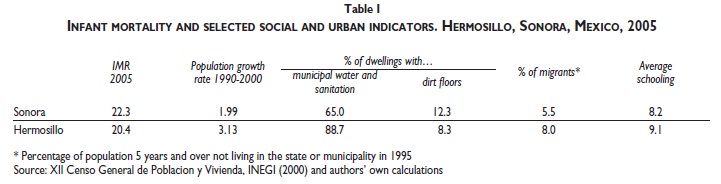
<body><![CDATA[<p><font size="2" face="Verdana, Arial, Helvetica, sans-serif"> While epidemiologists and other health experts have made considerable progress in understanding the impact of individual-level characteristics on infant mortality, considerably less is known about how social and material context at the neighborhood level affect children's survival chances within urban areas. As evidence of the effects of neighborhood context on health outcomes piles up, especially that of the built environment, the need to close this research gap grows in urgency.<sup>1-3</sup> The built environment refers to the physical settings for human activity ranging in scale from homes to neighborhoods and cities, including their supporting infrastructure, such as transportation systems, open space, buildings, sanitation and derived patterns of human activity that "can plausibly be considered determinants of population health."<sup>4</sup> </font></p>     <p><font size="2" face="Verdana, Arial, Helvetica, sans-serif">Calls in favor of this theoretical  expansion  also emphasize the need to use "true area data" that reflects the social and physical qualities of place rather than compositional measurements.<sup>5-7</sup> Compositional measurements usually rely on aggregation of individual socioeconomic characteristics to construct composite indices that are later used to characterize places in terms of social deprivation or exclusion.<sup>8,9</sup> Instances of these measurements include summaries of the attributes of individuals occupying an area, for example, the percentage of unemployed workers in a neighborhood. In contrast, contextual approaches characterize places using dimensions that are not reducible to the individual level because they are part of the built environment. Some of these dimensions relate to the physical properties of places where people live, work or play (e.g. number of neighborhood parks and distance to nearest grocery store) and some other relate to intangible attributes of a place resulting from the social interactions occurring within it (e.g. population density and land use). Elements of the built environment are not evenly distributed within cities and are constantly changing, so levels of exposure vary in space and time creating neighborhoods which are more health damaging or health promoting.<sup>10-12</sup> Therefore, the built environment contributes directly to intraurban health disparities, an area of growing concern for public health professionals.</font></p>     <p><font size="2" face="Verdana, Arial, Helvetica, sans-serif">In fact, several studies have shown that proximity to care facilities is correlated with a reduction in infant mortality rates, both in urban and rural settings.<sup>13-15</sup> Recent studies exploring the connection between the built environment and urban health have found a positive correlation between green space and different</font> <font size="2" face="Verdana, Arial, Helvetica, sans-serif">health outcomes.<sup>16-18</sup> These studies link access to urban                                             parks and community amenities with the increased engagement of children and adults in outdoor activities and the formation of stronger social ties in urban</font> <font size="2" face="Verdana, Arial, Helvetica, sans-serif">neighborhoods.<sup>19,20</sup> Furthermore,  current planning theories suggest that through urban design, mixed land use patterns, and adequate transportation systems, it is feasible to increase walking and other forms of physical activity, protective factors against obesity and comorbidities like diabetes and heart disease.<sup>21,22</sup> The results of these studies highlights the need to reconnect public health and urban planning as a way to address many of the health needs of city residents. </font></p>     <p><font size="2" face="Verdana, Arial, Helvetica, sans-serif">By using a multi-scale set of contextual factors as explanatory variables, this research aims to explore the role of material contextual variables at the neighborhood level in explaining the spatial distribution of infant mortality rates in the Mexican city of Hermosillo. The analysis is not intended to make inferences about the individual-level impacts of these variables but to explore their spatial association at the neighborhood level.<sup>23</sup> It is hypothesized that unplanned neighborhoods present adverse environmental conditions and generally have worse health indicators, and conversely, planned neighborhoods contain better environmental conditions and are healthier. Therefore, it is not expected that the health-built environment gradient will be homogeneous for all the variables  across Hermosillo's neighborhoods. Consequently, the objectives of this research are threefold: a) to develop evidence for a material based explanation of public health in midsize Mexican cities, b) to identify the contribution of the built environment to urban health disparities, and c) to reflect on the role that a partnership between urban planners and health professionals could play reducing health disparities through the creation of healthier neighborhoods.</font></p>     <p>&nbsp;</p>     <p><font size="3" face="Verdana, Arial, Helvetica, sans-serif"><b>Materials and methods</b></font></p>     <p><b><font size="2" face="Verdana, Arial, Helvetica, sans-serif">Study area</font></b></p>     <p><font size="2" face="Verdana, Arial, Helvetica, sans-serif">The city of Hermosillo, Mexico is located in the northwest portion of United States-Mexico border region. Hermosillo is a growing regional hub for trade, transportation, and specialized services, with a growing industrial base that includes an automotive assembly plant and approximately 30 <i>maquiladora </i>plants<a id="tx*"></a><a href="#nt*"><sup>*</sup></a> that produce for the global market. During the last decade, the population of Hermosillo grew 3% annually, above the annual state and national averages. In 2010, Hermosillo has 784 322 inhabitants, up from 176 600 in 1970.   <squp>   24</sup> The location of Hermosillo, in a low valley </font><font size="2" face="Verdana, Arial, Helvetica, sans-serif">close to a coastal area, facilitates the provision of urban services and reduces the friction between population growth and the supply of land for affordable housing. Nevertheless, a proportion of residents, especially those living in recently created informal neighborhoods, lack running water, sanitation, and other basic urban services. Compared to other cities in Mexico,<sup>25</sup> overall ecological degradation and marginalization is not severe in Hermosillo and infant mortality is among the lowest in the state of Sonora (20.4/1000)  (<a href="/img/revistas/spm/v54n4/a06tab01.jpg">table I</a>).</font></p>     <p><b><font size="2" face="Verdana, Arial, Helvetica, sans-serif">Estimating contextual factors</font></b></p>     <p><font size="2" face="Verdana, Arial, Helvetica, sans-serif">In order to characterize the spatial pattern of contextual factors, we derived a composite built environment vulnerability index (BEVI), which is aggregated by areal unit. In conceptualizing the index, we adopted a definition of vulnerability comprising risk and risk exposure on the one hand and adaptive behaviors on the other.<sup>26</sup> Adaptive capacity is seen as a key concept from a planning and public policy perspective because highlights vulnerability as a social construct that can be modified through social, technological, institutional and cultural adaptive mechanisms. A composite index like this can be a valuable planning and public policy tool due to its capacity to summarize, contrast, and evaluate complex realities. </font></p>     ]]></body>
<body><![CDATA[<p><font size="2" face="Verdana, Arial, Helvetica, sans-serif">The index comprises the three dimensions that are often associated with the concept of the built environment: shelter conditions, neighborhood quality, and city connectivity. The final selection of components and data indicators for each dimension was based on conceptual relevance as indicated in the literature and as well on availability of appropriate data at the local level.<sup>11-12</sup> Final calculations were performed using a set of variables extracted from the 2000 Mexican census and fieldwork conducted in 2004, as outlined in <a href="/img/revistas/spm/v54n4/a06tab02.jpg">table II</a>.</font></p>     <p><font size="2" face="Verdana, Arial, Helvetica, sans-serif"> In constructing the BEVI, observations for each variable within the index were standardized to permit averaging as the items are measured in different units. Using a commonly utilized approach,<sup>27</sup> we adjusted the observation for each item to take a value between 0 and 1 using the formula:</font></p>     <p align="center"><font size="2" face="Verdana, Arial, Helvetica, sans-serif">Cij= &#91;X<sub>ij</sub>-<sub>minXi</sub>&#93;/&#91;<sub>max</sub>X<sub>i</sub>-<sub>min</sub>X<sub>i</sub>&#93;</font></p>     <p><font size="2" face="Verdana, Arial, Helvetica, sans-serif">where: Cij stands for the standardized observation associated with the <i>i</i>th component for census tract <i>j</i>; Xij stands for the value of the i<i>th </i>component in the index for census tract <i>j</i>; <sub>Max</sub>X<sub>i</sub> and <sub>Min</sub>X<sub>i</sub> stand for the maximum and minimum values of the <i>i</i>th component for all census tracts in the city. If a given census tract presents a value for <i>i </i>equal to the minimum value in city <i>j</i>, the value for C<i>ij </i>would be zero. On the other hand, the greater the</font> <font size="2" face="Verdana, Arial, Helvetica, sans-serif">difference between a particular census tract and the minimum value of that same component in city <i>j</i>, the higher will be the value of C<i>ij</i>. Therefore, the value of C<i>ij </i>would range between 0 and 1. Once standardized values for each individual variable were obtained, we calculated the summary score corresponding to each dimension by averaging the value of the relevant individual indicators. In this analysis, we explore contextual impact using unweighted values. The composite index estimates the overall environmental context of the different census tracts as follows:</font></p>     <p><font size="2" face="Verdana, Arial, Helvetica, sans-serif">BEVIij = <i>w</i><sub>1</sub>Shelter<sub>ij</sub> + <i>w</i><sub>2</sub>Community<sub>ij</sub> + <i>w</i><sub>3</sub>City<sub>ij</sub>,</font></p>     <p><font size="2" face="Verdana, Arial, Helvetica, sans-serif">where BEVI<sub>ij</sub> is the degree of built environment vulnerability index for census tract <i>i </i>in city <i>j </i>with the requirement that âˆ‘<sub>Wi</sub>= 1.00, where <i>w</i>i represents weights assigned to each of the three dimension included in the index.</font></p>     <p><b><font size="2" face="Verdana, Arial, Helvetica, sans-serif">Identifying infant mortality hotspots</font></b></p>     <p><font size="2" face="Verdana, Arial, Helvetica, sans-serif">Records of infant deaths reported between 2000 and 2003 (n= 673) were obtained from the Health Department of the State of Sonora. Data on live births during the same period were obtained from the Sonora's civil registry (n= 46 105). All the information was integrated into a geographical information system, using boundary maps from the 2000 national housing and population census (INEGI). The research protocol was reviewed and approved by the Institutional Review Board of the University of Michigan and by the Bioethics Committee of <i>El Colegio de Sonora</i>. </font></p>     <p><font size="2" face="Verdana, Arial, Helvetica, sans-serif">A well-known difficulty with small geographical units such as census tracts is that they typically generate a low frequency of events such as births and deaths. As a result of this small area rates can be unstable, often producing disproportionately high figures.<sup>28,29</sup> The problem of small areas can be overcome by adding time and/or enlarging geographical area units.<sup>29,30</sup> The first strategy, named <i>periodization</i>, aggregates 2&#150;5 years of data. The second, <i>regionalization</i>, consists of building larger areas from smaller ones based on physical adjacency and socioeconomic similarity. In this analysis, we used a combination of both strategies to calculate infant mortality rates at the neighborhood scale. Infant mortality rates were calculated by dividing the number of deaths of children under one year of age by the number of live births in the period of study.</font></p>     <p><b><font size="2" face="Verdana, Arial, Helvetica, sans-serif">Spatial analysis</font></b></p>     ]]></body>
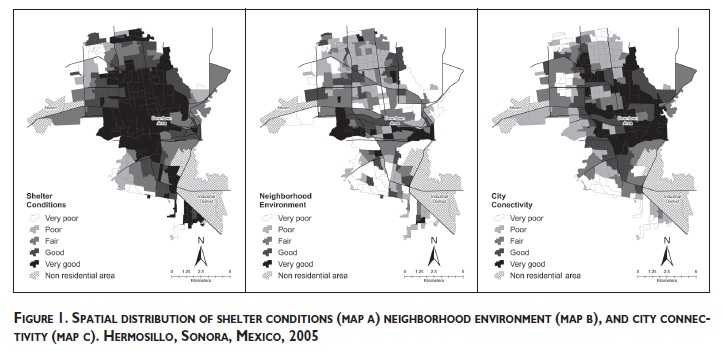
<body><![CDATA[<p><font size="2" face="Verdana, Arial, Helvetica, sans-serif">The spatial analysis of infant mortality, as well as the analysis of the index of vulnerability, is based in two commonly used test statistics for spatial clusters, Moran's I (global and local) and the Gi* statistic proposed by Ord and Getis.<sup>31</sup> These two statistics complement each other and preferably are used in combination. The Moran's I is a test for spatial autocorrelation and tells us if high and low infant mortality rates (IMR) are more clustered that would be expected by pure chance. To establish a significance test for the local Moran index, we used the method proposed by Anselin,<sup>32</sup> a pseudo distribution simulation by permutation of the attribute values among the areas. Based on this pseudodistribution, statistical tests are used to indicate local index values with alpha 0.05, 0.01, and 0.001. The Gi* statistic complements the Moran's I because it indicates whether the clusters are resulting from the lumping of census tracts with high IMR or the lumping of census tracts with low IMR and reveals where the clusters are located. Hence, the combination of these two tests improve the analysis in that the Gi* statistics shows the location of high mortality clusters that often are referred in the literature as hot spots.<sup>33</sup></font></p>     <p>&nbsp;</p>     <p><b><font size="3" face="Verdana, Arial, Helvetica, sans-serif">Results</font></b></p>     <p><font size="2" face="Verdana, Arial, Helvetica, sans-serif">Maps representing the distribution of each dimension in the composite index of vulnerability were created and examined to assess whether there is any observable spatial pattern. As can be seen in <a href="/img/revistas/spm/v54n4/a06fig01.jpg">figure 1</a>, Hermosillo is a city of contrasts with neighborhoods in the central part showing better environmental conditions in terms of shelter (map A) and integration to the urban structure (map C) than peripheral neighborhoods. However, some central neighborhoods also face a lack of urban amenities and integration to the city, probably as a result of poor planning during its creation and/or chronic neglect by municipal authorities.</font></p>     <p><font size="2" face="Verdana, Arial, Helvetica, sans-serif"> The composite index of vulnerability showed a significant spatial autocorrelation (Global Moran's I= 0.62, with significance of 99%), indicating substantial clustering. The Local Moran's I significance map (not shown) indicated four clusters, two of them related to low values of vulnerability (located at the center and northwest section of the city), and two related to high values of vulnerability (southeast and northeast sections). </font></p>     <p><font size="2" face="Verdana, Arial, Helvetica, sans-serif">The values of the Local Moran's I correlated very well with observable intraurban disparities in Hermosillo. The southeast section of the city had an explosive growth in recent times and corresponds to an area of non-regulated settlements that are occupied by migrant workers and poor families and have limited public investment and substandard housing. The northeast section is also an area comprised of irregular settlements, a high concentration of poor families, and precarious environmental conditions due to low quality housing, a lack of urban services, and a peripheral location. Because of their informal character, these neighborhoods were poorly planned and their physical conditions have improved slowly probably as a consequence of the limited fiscal and technical resources characteristic of most Mexican cities. </font></p>     <p><font size="2" face="Verdana, Arial, Helvetica, sans-serif">In contrasts, at the center of Hermosillo, the map showed a significant cluster of well-urbanized and wellserved neighborhoods inhabited mostly by middle class families. The cluster formed in the northwest area of the city has similar environmental characteristics and is comprised by neighborhoods where the wealthiest part of the population of Hermosillo lives. So far, local indicators of spatial autocorrelation were able to distinguish the intense intraurban disparities in the concentrations of wealth and poverty in Hermosillo. </font></p>     <p><font size="2" face="Verdana, Arial, Helvetica, sans-serif">The nature of these clusters was explored using Gi*, as presented in <a href="/img/revistas/spm/v54n4/a06fig02.jpg">figure 2</a>. Areas marked in dark gray indicate significant clusters with low values for IMR and BEVI, while areas marked in black indicate significant clusters with high IMR and BEVI<a id="tx1"></a><a href="#nt1"><sup>1</sup></a>. Census tracts that did not form any type of cluster are marked in light gray. </font></p>     <p><font size="2" face="Verdana, Arial, Helvetica, sans-serif">Map A in <a href="/img/revistas/spm/v54n4/a06fig02.jpg">figure 2</a> shows three significant clusters of high infant mortality; the first in the southwest fringe of the city, the second at the periphery of downtown, and the third in the northwest central section. These clusters are formed where census tracts with infant mortality rates exceed the city average by a factor of two or three. The cluster at the southwest section had the highest rates in the city. This map also displays several clusters with low infant mortality rates scattered throughout the city, though any of these clusters was statistically significant. </font></p>     <p><font size="2" face="Verdana, Arial, Helvetica, sans-serif">The distribution of environmental vulnerability can be seen in map B in <a href="/img/revistas/spm/v54n4/a06fig02.jpg">figure 2</a>. The central and northeast sections of Hermosillo host two large clusters with low vulnerability levels. These clusters contain most of the upper-class residential areas in the city, as well as downtown and other centrally located neighborhoods. Two large clusters of high vulnerability are apparent in the southwest and northwest corners of the city. As indicated earlier, most of the neighborhoods within these clusters are newly created settlements and even some keep a few semi-rural characteristics. High vulnerability is concentrated along the edge of the city where urban expansion adopts the form of unplanned growth. </font></p>     ]]></body>
<body><![CDATA[<p><font size="2" face="Verdana, Arial, Helvetica, sans-serif">A comparison of both maps shows that high levels of vulnerability and high mortality rates coincide spatially in the southeast corner of the city. The high mortality cluster in this location is contained completely within the high vulnerability cluster in the same section. However, this type of co-location is not valid for the two other high mortality clusters identified in the city, which coincide partially with a cluster of low vulnerability.</font></p>     <p>&nbsp;</p>     <p><font size="3" face="Verdana, Arial, Helvetica, sans-serif"><b>Discussion</b></font></p>     <p><font size="2" face="Verdana, Arial, Helvetica, sans-serif">Exploratory and confirmatory data analysis methods were used to assess the link between exposure to area vulnerability and infant mortality in neighborhoods of Hermosillo. Univariate and bivariate Moran's I were calculated for all the explanatory variables, the composite index of vulnerability and the dependent variable. All the explanatory variables were characterized by positive spatial autocorrelation, as well as the index. On the other hand, infant mortality rates, the dependent variable, displayed low levels of statistically significant spatial autocorrelation, indicating some degree of randomness in its spatial distribution. Overall, we found that the link between environmental conditions and health status remains elusive, suggesting in part, than a better model of this relation is probably complex and multifaceted.</font></p>     <p><font size="2" face="Verdana, Arial, Helvetica, sans-serif"> Although the results obtained fail to confirm the expected association between vulnerability and infant mortality, the study identified hot spots of infant mortality within the city of Hermosillo. Two of the high infant mortality clusters are located within neighborhoods characterized by relative good environmental conditions and one in a neighborhood with a quite precarious environment. </font></p>     <p><font size="2" face="Verdana, Arial, Helvetica, sans-serif">Indeed, the cluster with the highest infant mortality rates in the city overlaps the cluster with the highest environmental vulnerability. The neighborhoods within this cluster have no parks, lack adequate public transportation, are far from medical facilities, housing is of poor quality and overcrowded, and basic sanitation and water are not available for most families. All of these conditions are clearly related to socioeconomic status and are well known predictors of poor health status. For example, poorly designed housing, constructed with low quality materials is associated with dampness, mold, allergens, and inefficient energy use. In turn, those are associated with poor respiratory health among infant and young children.<sup>34</sup> In developing countries, the lack of transport and poor road conditions are closely related to many negative health outcomes.<sup>35</sup> Transport cost and travel time can be a strong deterrent in the use of health services, even when care and treatment are desired.<sup>36</sup> For </font><font size="2" face="Verdana, Arial, Helvetica, sans-serif">many residents of the neighborhoods included in the cluster, walking can be the primary mode of transportation, especially during the night when the bus service is interrupted. </font></p>     <p><font size="2" face="Verdana, Arial, Helvetica, sans-serif">These results also underscore that exploratory analytical methods, such as univariate Moran's I and bivariate Moran's I, can provide an indication of the potential effect of contextual factors on health outcomes and the formation of risk areas within cities. As indicated earlier, there is increasing evidence that neighborhood context affect the health of individuals living therein and based in our results, it is not unreasonable to assume that through better data and more comprehensive models it can be possible to monitor neighborhoods material transformation and its impact on health. The primary advantage of this type of analysis is that spatial variations in morbidity and mortality can be spotted fairly quickly and correlated with such conditions. Caution is necessary, however, since the implementation of this type of analysis face substantial challenges. </font></p>     <p><font size="2" face="Verdana, Arial, Helvetica, sans-serif">First, a major challenge in studying the link between the built environment and community health is to have access to data on the built environment that are spatially matched and sufficiently detailed to connect with specific health outcomes. As suggested by Cummins,<sup>7</sup> specific health outcomes are connected with specific physical and social features of neighborhoods, and only through the connection of this specificity is it possible to reconstruct the causal pathway between health and context. As this study has shown, the advances in the use of GIS to derive measures of the built environment from a variety of existing data sources are making it easier to spatially tie detailed health data with specific data on the built environment. Still, the datasets available in Mexico are generally limited to a few basic elements which not necessarily relate to factors conceptually and practically relevant from a social epidemiology perspective. The high mortality rates observed in some middle class neighborhoods in Hermosillo could be the reflection of the exposure to other environmental factors that were not included in the construction of BEVI, such as closeness to industrial facilities, availability of safe water, or air pollution. </font></p>     <p><font size="2" face="Verdana, Arial, Helvetica, sans-serif">Finally, the use of census tracts as neighborhood surrogates and the lack of alternate geographies (e.g. urban blocks) to conduct sensitivity analysis let unsolved the so called modifiable areal unit problem (MAUP). The MAUP refers to sensitivity of results to the size and form of the areal units for which data was collected and that is common to ecological studies focusing on spatial variations of disease and mortality.<sup>33</sup> Despite the advances observed in recent years, datasets featuring information on exposure and outcome variable still </font><font size="2" face="Verdana, Arial, Helvetica, sans-serif">limited in Mexico. In our case, this difficulty limited our ability to perform such analysis. It is possible that the spatial pattern of infant mortality in Hermosillo reflects a mixed residential development, with households of lower social status located within census tract above the city average, as noted elsewhere.<sup>37</sup> Moreover, it is likely that using smaller units, such as urban blocks, we could have detected stronger associations and patterns not easily detected at the census tract scale.<sup>38</sup></font></p>     <p>&nbsp;</p>     ]]></body>
<body><![CDATA[<p><font size="3" face="Verdana, Arial, Helvetica, sans-serif"><b>Conclusions</b></font></p>     <p><font size="2" face="Verdana, Arial, Helvetica, sans-serif">This study provides some evidence of the link between neighborhood  material conditions and community health in Hermosillo. As indicated above, city neighborhoods reporting high infant mortality prevalence are more likely to be low income residential areas formed in recent times. They also tend to be poorly planned and lack basic urban services such as running water and sanitation. Current urbanization trends in Hermosillo, including urban sprawl and fragmentation,  induce levels of geographical isolation that might increase the difficulties of the poor to benefit from the advantages of urban living. This evidence also underscores the need to reconnect public health and city planning. After all, the slum-dwelling conditions created by rapid industrialization and urbanization in some Hermosillo's neighborhoods are not too distant from the conditions that gave rise to the close connection between urban planning and public health at the end of the 19<sup>th</sup> century.<sup>39</sup> </font></p>     <p><font size="2" face="Verdana, Arial, Helvetica, sans-serif">Urban planners and public health professional must collaborate again to improve current and future health outcomes in Hermosillo through the design and planning of healthier neighborhoods including adequate housing,  parks, community health centers, and, in general, decent living conditions. Ultimately, this will require a long-term effort toward the creation of a transdisciplinary conceptual framework allowing planners and public health professionals to embrace the concept that health and social and material environments are closely linked.<sup>4,23,39</sup></font></p>     <p>&nbsp;</p>     <p><font size="3" face="Verdana, Arial, Helvetica, sans-serif"><b>Acknowledgements</b></font></p>     <p><font size="2" face="Verdana, Arial, Helvetica, sans-serif">The authors acknowledge the support of the National Council for Science and Technology (CONACYT) in Mexico and the National Institute of Health (Grant #TW006489)  funded by the Fogarty  International Center and the Office of Behavioral and Social Sciences Research in the United States.</font></p>     <p>&nbsp;</p>     <p><font size="3" face="Verdana, Arial, Helvetica, sans-serif"><b>References</b></font></p>     <!-- ref --><p><font size="2" face="Verdana, Arial, Helvetica, sans-serif">1. Coen  S, Ross N. Exploring  the material  basis for health: characteristics of parks in Montreal Neighborhoods  with contrasting health outcomes. Health Place 2006;12:361-371.    &nbsp;&nbsp;&nbsp;&nbsp;&nbsp;&nbsp;&nbsp;&nbsp;[&#160;<a href="javascript:void(0);" onclick="javascript: window.open('/scielo.php?script=sci_nlinks&ref=9404588&pid=S0036-3634201200040000600001&lng=','','width=640,height=500,resizable=yes,scrollbars=1,menubar=yes,');">Links</a>&#160;]<!-- end-ref --></font></p>     ]]></body>
<body><![CDATA[<!-- ref --><p><font size="2" face="Verdana, Arial, Helvetica, sans-serif">2. Freudenberg N, Galea S, Vlahov  D. Beyond  urban  penalty  and urban  sprawl:  back to living conditions  as the focus of urban health. J  Community Health 2005;30 (1):1-11.    &nbsp;&nbsp;&nbsp;&nbsp;&nbsp;&nbsp;&nbsp;&nbsp;[&#160;<a href="javascript:void(0);" onclick="javascript: window.open('/scielo.php?script=sci_nlinks&ref=9404590&pid=S0036-3634201200040000600002&lng=','','width=640,height=500,resizable=yes,scrollbars=1,menubar=yes,');">Links</a>&#160;]<!-- end-ref --></font></p>     <!-- ref --><p><font size="2" face="Verdana, Arial, Helvetica, sans-serif">3. Diez-Roux A. Bringing context back into  epidemiology:  variables and fallacies in multilevel  analysis. Am J  Public Health 1998;88:216-222.    &nbsp;&nbsp;&nbsp;&nbsp;&nbsp;&nbsp;&nbsp;&nbsp;[&#160;<a href="javascript:void(0);" onclick="javascript: window.open('/scielo.php?script=sci_nlinks&ref=9404592&pid=S0036-3634201200040000600003&lng=','','width=640,height=500,resizable=yes,scrollbars=1,menubar=yes,');">Links</a>&#160;]<!-- end-ref --></font></p>     <!-- ref --><p><font size="2" face="Verdana, Arial, Helvetica, sans-serif">4. Northridge  M, Sclar E. A joint urban planning and public health framework: contributions to health impact assessment. Am J  Public Health</font> <font size="2" face="Verdana, Arial, Helvetica, sans-serif">2003;93(1):118-121.    &nbsp;&nbsp;&nbsp;&nbsp;&nbsp;&nbsp;&nbsp;&nbsp;[&#160;<a href="javascript:void(0);" onclick="javascript: window.open('/scielo.php?script=sci_nlinks&ref=9404594&pid=S0036-3634201200040000600004&lng=','','width=640,height=500,resizable=yes,scrollbars=1,menubar=yes,');">Links</a>&#160;]<!-- end-ref --></font></p>     <!-- ref --><p><font size="2" face="Verdana, Arial, Helvetica, sans-serif">5. Cummins S, Macintyre SA, Davidson S, Ellaway A. Measuring neighborhood  social and material context:  generation and interpretation of ecological data from routine and non-routine  sources. Health Place</font> <font size="2" face="Verdana, Arial, Helvetica, sans-serif">2005;11:249-260.    &nbsp;&nbsp;&nbsp;&nbsp;&nbsp;&nbsp;&nbsp;&nbsp;[&#160;<a href="javascript:void(0);" onclick="javascript: window.open('/scielo.php?script=sci_nlinks&ref=9404596&pid=S0036-3634201200040000600005&lng=','','width=640,height=500,resizable=yes,scrollbars=1,menubar=yes,');">Links</a>&#160;]<!-- end-ref --></font></p>     <!-- ref --><p><font size="2" face="Verdana, Arial, Helvetica, sans-serif">6. Macintyre S, Ellaway A, Cumming S. Place effects  on heath:  how</font> <font size="2" face="Verdana, Arial, Helvetica, sans-serif">can we conceptualize, operationalize  and measure them? Soc Sci Med</font> <font size="2" face="Verdana, Arial, Helvetica, sans-serif">2002;55:125-139.    &nbsp;&nbsp;&nbsp;&nbsp;&nbsp;&nbsp;&nbsp;&nbsp;[&#160;<a href="javascript:void(0);" onclick="javascript: window.open('/scielo.php?script=sci_nlinks&ref=9404598&pid=S0036-3634201200040000600006&lng=','','width=640,height=500,resizable=yes,scrollbars=1,menubar=yes,');">Links</a>&#160;]<!-- end-ref --></font></p>     ]]></body>
<body><![CDATA[<!-- ref --><p><font size="2" face="Verdana, Arial, Helvetica, sans-serif">7. Macintyre S, Maciver  S, Sooman  A. Area,  class and health:  should  be focusing  on place or people? J  Soc Policy 1993;22(2):213-234.    &nbsp;&nbsp;&nbsp;&nbsp;&nbsp;&nbsp;&nbsp;&nbsp;[&#160;<a href="javascript:void(0);" onclick="javascript: window.open('/scielo.php?script=sci_nlinks&ref=9404600&pid=S0036-3634201200040000600007&lng=','','width=640,height=500,resizable=yes,scrollbars=1,menubar=yes,');">Links</a>&#160;]<!-- end-ref --></font></p>     <!-- ref --><p><font size="2" face="Verdana, Arial, Helvetica, sans-serif">8. Diez-Roux A. A glossary for  multilevel  analysis. Epid Bull 2003;24(3).    &nbsp;&nbsp;&nbsp;&nbsp;&nbsp;&nbsp;&nbsp;&nbsp;[&#160;<a href="javascript:void(0);" onclick="javascript: window.open('/scielo.php?script=sci_nlinks&ref=9404602&pid=S0036-3634201200040000600008&lng=','','width=640,height=500,resizable=yes,scrollbars=1,menubar=yes,');">Links</a>&#160;]<!-- end-ref --></font></p>     <!-- ref --><p><font size="2" face="Verdana, Arial, Helvetica, sans-serif">9. Morgenstern H. Ecologic studies in epidemiology: concepts, principles, and methods. A Rev of Public Health 1995;16:61-81.    &nbsp;&nbsp;&nbsp;&nbsp;&nbsp;&nbsp;&nbsp;&nbsp;[&#160;<a href="javascript:void(0);" onclick="javascript: window.open('/scielo.php?script=sci_nlinks&ref=9404604&pid=S0036-3634201200040000600009&lng=','','width=640,height=500,resizable=yes,scrollbars=1,menubar=yes,');">Links</a>&#160;]<!-- end-ref --></font></p>     <!-- ref --><p><font size="2" face="Verdana, Arial, Helvetica, sans-serif">10. Diez-Roux A. Investigating neighborhood and area effects on health. Am J  Public Health 2001;91(11):1783-1789.    &nbsp;&nbsp;&nbsp;&nbsp;&nbsp;&nbsp;&nbsp;&nbsp;[&#160;<a href="javascript:void(0);" onclick="javascript: window.open('/scielo.php?script=sci_nlinks&ref=9404606&pid=S0036-3634201200040000600010&lng=','','width=640,height=500,resizable=yes,scrollbars=1,menubar=yes,');">Links</a>&#160;]<!-- end-ref --></font></p>     <!-- ref --><p><font size="2" face="Verdana, Arial, Helvetica, sans-serif">11. Hillemeier  M, Lynch J, Harper S, Casper M. Measuring contextual  characteristics for community  health. Health Services Research 2003;38:6</font>&nbsp;&nbsp;&nbsp;&nbsp;&nbsp;&nbsp;&nbsp;&nbsp;[&#160;<a href="javascript:void(0);" onclick="javascript: window.open('/scielo.php?script=sci_nlinks&ref=9404608&pid=S0036-3634201200040000600011&lng=','','width=640,height=500,resizable=yes,scrollbars=1,menubar=yes,');">Links</a>&#160;]<!-- end-ref --><!-- ref --><p><font size="2" face="Verdana, Arial, Helvetica, sans-serif">12. Yen I, Kaplan G. Poverty  area residence and changes in depression and perceived health status: evidence from  the Alameda County  Study. Int J  Epidemiol 1999;28(1):90-94.    &nbsp;&nbsp;&nbsp;&nbsp;&nbsp;&nbsp;&nbsp;&nbsp;[&#160;<a href="javascript:void(0);" onclick="javascript: window.open('/scielo.php?script=sci_nlinks&ref=9404609&pid=S0036-3634201200040000600012&lng=','','width=640,height=500,resizable=yes,scrollbars=1,menubar=yes,');">Links</a>&#160;]<!-- end-ref --></font></p>     <!-- ref --><p><font size="2" face="Verdana, Arial, Helvetica, sans-serif">13. Frankenberg  E. The effects of access to health care on infant mortality  in Indonesia. Health Trans Rev 1995;5:143-163</font>&nbsp;&nbsp;&nbsp;&nbsp;&nbsp;&nbsp;&nbsp;&nbsp;[&#160;<a href="javascript:void(0);" onclick="javascript: window.open('/scielo.php?script=sci_nlinks&ref=9404611&pid=S0036-3634201200040000600013&lng=','','width=640,height=500,resizable=yes,scrollbars=1,menubar=yes,');">Links</a>&#160;]<!-- end-ref --><!-- ref --><p><font size="2" face="Verdana, Arial, Helvetica, sans-serif">14. Rip M, Keen C, Woods D. Intra-urban variations of neonatal and postneonatal mortality  in a developing  city. Soc Sci Med 1987;25:889-894.    &nbsp;&nbsp;&nbsp;&nbsp;&nbsp;&nbsp;&nbsp;&nbsp;[&#160;<a href="javascript:void(0);" onclick="javascript: window.open('/scielo.php?script=sci_nlinks&ref=9404612&pid=S0036-3634201200040000600014&lng=','','width=640,height=500,resizable=yes,scrollbars=1,menubar=yes,');">Links</a>&#160;]<!-- end-ref --></font></p>     <!-- ref --><p><font size="2" face="Verdana, Arial, Helvetica, sans-serif">15. Fayissa B. The determinants of infant and child mortality in developing countries: The case of Sub-Sahara Africa. Rev Black Polit Econ</font> <font size="2" face="Verdana, Arial, Helvetica, sans-serif">2001;29(3):83-89</font>&nbsp;&nbsp;&nbsp;&nbsp;&nbsp;&nbsp;&nbsp;&nbsp;[&#160;<a href="javascript:void(0);" onclick="javascript: window.open('/scielo.php?script=sci_nlinks&ref=9404614&pid=S0036-3634201200040000600015&lng=','','width=640,height=500,resizable=yes,scrollbars=1,menubar=yes,');">Links</a>&#160;]<!-- end-ref --><!-- ref --><p><font size="2" face="Verdana, Arial, Helvetica, sans-serif">16.  Maas  J, Verheij RA, Groenewegen PP, de Vries  S, Spreewenberg P. Green  space, urbanity  and health: how  strong  is the relation?  J  Epidemiol Community Health 2006;60:587-592</font>&nbsp;&nbsp;&nbsp;&nbsp;&nbsp;&nbsp;&nbsp;&nbsp;[&#160;<a href="javascript:void(0);" onclick="javascript: window.open('/scielo.php?script=sci_nlinks&ref=9404615&pid=S0036-3634201200040000600016&lng=','','width=640,height=500,resizable=yes,scrollbars=1,menubar=yes,');">Links</a>&#160;]<!-- end-ref --><!-- ref --><p><font size="2" face="Verdana, Arial, Helvetica, sans-serif">17. Sick-Nielsen T, Bruun-Hansten K. Do green areas affect health? Results from  a Danish survey on the use of green areas and health indicators.  Health and Place 2007;13(4):839-850</font>&nbsp;&nbsp;&nbsp;&nbsp;&nbsp;&nbsp;&nbsp;&nbsp;[&#160;<a href="javascript:void(0);" onclick="javascript: window.open('/scielo.php?script=sci_nlinks&ref=9404616&pid=S0036-3634201200040000600017&lng=','','width=640,height=500,resizable=yes,scrollbars=1,menubar=yes,');">Links</a>&#160;]<!-- end-ref --><!-- ref --><p><font size="2" face="Verdana, Arial, Helvetica, sans-serif">18.  van  den  Berg   AE,  Maas  J, Verheij RA, Groenewegen PP. Green space as a buffer between  stressful life events and health. Soc Sci Med</font> <font size="2" face="Verdana, Arial, Helvetica, sans-serif">2010;70(8):1203-1210.    &nbsp;&nbsp;&nbsp;&nbsp;&nbsp;&nbsp;&nbsp;&nbsp;[&#160;<a href="javascript:void(0);" onclick="javascript: window.open('/scielo.php?script=sci_nlinks&ref=9404617&pid=S0036-3634201200040000600018&lng=','','width=640,height=500,resizable=yes,scrollbars=1,menubar=yes,');">Links</a>&#160;]<!-- end-ref --></font></p>     <!-- ref --><p><font size="2" face="Verdana, Arial, Helvetica, sans-serif">19. Walker  C. The public value of urban parks. The Urban Institute, The Wallace Foundation 2004: 1-8. &#91;Accessed February 15, 2011&#93; Available at: <a href="http://www.urban.org/uploadedPDF/311011_urban_parks.pdf" target="_blank">http://www.urban.org/uploadedPDF/311011_urban_parks.pdf</a>.    &nbsp;&nbsp;&nbsp;&nbsp;&nbsp;&nbsp;&nbsp;&nbsp;[&#160;<a href="javascript:void(0);" onclick="javascript: window.open('/scielo.php?script=sci_nlinks&ref=9404619&pid=S0036-3634201200040000600019&lng=','','width=640,height=500,resizable=yes,scrollbars=1,menubar=yes,');">Links</a>&#160;]<!-- end-ref --> </font></p>     <!-- ref --><p><font size="2" face="Verdana, Arial, Helvetica, sans-serif">20. Baylina M, Prats M, Ortiz  A. Espacios de juego como  escenarios educativos urbanos. Ciudades 2005;67:20-24.    &nbsp;&nbsp;&nbsp;&nbsp;&nbsp;&nbsp;&nbsp;&nbsp;[&#160;<a href="javascript:void(0);" onclick="javascript: window.open('/scielo.php?script=sci_nlinks&ref=9404621&pid=S0036-3634201200040000600020&lng=','','width=640,height=500,resizable=yes,scrollbars=1,menubar=yes,');">Links</a>&#160;]<!-- end-ref --></font></p>     <!-- ref --><p><font size="2" face="Verdana, Arial, Helvetica, sans-serif">21. Handy  SL, Boarnet MG, Ewing R, Killingsworth  RE. How  the built environment  affects physical activity: views from urban planning. Am J Prev Med 2002; 23(2 Suppl):64-73.    &nbsp;&nbsp;&nbsp;&nbsp;&nbsp;&nbsp;&nbsp;&nbsp;[&#160;<a href="javascript:void(0);" onclick="javascript: window.open('/scielo.php?script=sci_nlinks&ref=9404623&pid=S0036-3634201200040000600021&lng=','','width=640,height=500,resizable=yes,scrollbars=1,menubar=yes,');">Links</a>&#160;]<!-- end-ref --></font></p>     <!-- ref --><p><font size="2" face="Verdana, Arial, Helvetica, sans-serif">22. Booth KM, Pinkston MM, Carlos-Poston WS. Obesity and the built environment. J  Am Diet Assoc 2005;105:S110-S117.    &nbsp;&nbsp;&nbsp;&nbsp;&nbsp;&nbsp;&nbsp;&nbsp;[&#160;<a href="javascript:void(0);" onclick="javascript: window.open('/scielo.php?script=sci_nlinks&ref=9404625&pid=S0036-3634201200040000600022&lng=','','width=640,height=500,resizable=yes,scrollbars=1,menubar=yes,');">Links</a>&#160;]<!-- end-ref --></font></p>     <!-- ref --><p><font size="2" face="Verdana, Arial, Helvetica, sans-serif">23. Idrovo  A. Three criteria  for ecological fallacy. Environmental  Health Perspective 2011; 119:a332-a332. &#91;Accessed 2011 December&#93;  Available at: <a href="http://dx.doi.org/10.1289/ehp.1103768" target="_blank">http://dx.doi.org/10.1289/ehp.1103768</a></font>&nbsp;&nbsp;&nbsp;&nbsp;&nbsp;&nbsp;&nbsp;&nbsp;[&#160;<a href="javascript:void(0);" onclick="javascript: window.open('/scielo.php?script=sci_nlinks&ref=9404627&pid=S0036-3634201200040000600023&lng=','','width=640,height=500,resizable=yes,scrollbars=1,menubar=yes,');">Links</a>&#160;]<!-- end-ref --><!-- ref --><p><font size="2" face="Verdana, Arial, Helvetica, sans-serif">24. Instituto Nacional  de Estad&iacute;stica y Geograf&iacute;a (INEGI). Censo de Poblaci&oacute;n y Vivienda 2010. Resultados preliminares. M&eacute;xico: INEGI, 2010.    &nbsp;&nbsp;&nbsp;&nbsp;&nbsp;&nbsp;&nbsp;&nbsp;[&#160;<a href="javascript:void(0);" onclick="javascript: window.open('/scielo.php?script=sci_nlinks&ref=9404628&pid=S0036-3634201200040000600024&lng=','','width=640,height=500,resizable=yes,scrollbars=1,menubar=yes,');">Links</a>&#160;]<!-- end-ref --></font></p>     ]]></body>
<body><![CDATA[<!-- ref --><p><font size="2" face="Verdana, Arial, Helvetica, sans-serif">25. Consejo Nacional de Poblaci&oacute;n. &Iacute;ndices de Desarrollo  Humano, 2000. M&eacute;xico: CONAPO,  2001.    &nbsp;&nbsp;&nbsp;&nbsp;&nbsp;&nbsp;&nbsp;&nbsp;[&#160;<a href="javascript:void(0);" onclick="javascript: window.open('/scielo.php?script=sci_nlinks&ref=9404630&pid=S0036-3634201200040000600025&lng=','','width=640,height=500,resizable=yes,scrollbars=1,menubar=yes,');">Links</a>&#160;]<!-- end-ref --></font></p>     <!-- ref --><p><font size="2" face="Verdana, Arial, Helvetica, sans-serif">26. Bohle H, Downing  T, Watts  M. Climate change and social vulnerability: the sociology and geography of food insecurity. Global Environmental  Change 1994;4:37-48.    &nbsp;&nbsp;&nbsp;&nbsp;&nbsp;&nbsp;&nbsp;&nbsp;[&#160;<a href="javascript:void(0);" onclick="javascript: window.open('/scielo.php?script=sci_nlinks&ref=9404632&pid=S0036-3634201200040000600026&lng=','','width=640,height=500,resizable=yes,scrollbars=1,menubar=yes,');">Links</a>&#160;]<!-- end-ref --></font></p>     <!-- ref --><p><font size="2" face="Verdana, Arial, Helvetica, sans-serif">27. Briguglio L. Preliminary study on the construction of an index for ranking countries according to their  economic vulnerability. Geneva, Switzerland: UNCTAD/LDC/Misc,  1992:4.    &nbsp;&nbsp;&nbsp;&nbsp;&nbsp;&nbsp;&nbsp;&nbsp;[&#160;<a href="javascript:void(0);" onclick="javascript: window.open('/scielo.php?script=sci_nlinks&ref=9404634&pid=S0036-3634201200040000600027&lng=','','width=640,height=500,resizable=yes,scrollbars=1,menubar=yes,');">Links</a>&#160;]<!-- end-ref --></font></p>     <!-- ref --><p><font size="2" face="Verdana, Arial, Helvetica, sans-serif">28. Whitman S, Silva A, Shah A, Ansell D. Diversity and disparity: GIS</font> <font size="2" face="Verdana, Arial, Helvetica, sans-serif">and small-area analysis in six Chicago neighborhoods. J  Medical Syst</font> <font size="2" face="Verdana, Arial, Helvetica, sans-serif">2004;28:397-411.    &nbsp;&nbsp;&nbsp;&nbsp;&nbsp;&nbsp;&nbsp;&nbsp;[&#160;<a href="javascript:void(0);" onclick="javascript: window.open('/scielo.php?script=sci_nlinks&ref=9404636&pid=S0036-3634201200040000600028&lng=','','width=640,height=500,resizable=yes,scrollbars=1,menubar=yes,');">Links</a>&#160;]<!-- end-ref --></font></p>     <!-- ref --><p><font size="2" face="Verdana, Arial, Helvetica, sans-serif">29. Auffrey C. Mapping disparity in infant mortality:  using technology to describe local dimensions of infant deaths. Illn Crises Loss 1999;7:64-76.    &nbsp;&nbsp;&nbsp;&nbsp;&nbsp;&nbsp;&nbsp;&nbsp;[&#160;<a href="javascript:void(0);" onclick="javascript: window.open('/scielo.php?script=sci_nlinks&ref=9404638&pid=S0036-3634201200040000600029&lng=','','width=640,height=500,resizable=yes,scrollbars=1,menubar=yes,');">Links</a>&#160;]<!-- end-ref --></font></p>     ]]></body>
<body><![CDATA[<!-- ref --><p><font size="2" face="Verdana, Arial, Helvetica, sans-serif">30. Coulton CJ. Vital records:  a source for neighborhood indicators. The Urban Institute. &#91;Accessed July 31, 2006&#93;  Available at: <a href="http://www2.urban.org/nnip/pdf/vitalrec.pdf" target="_blank">http://www2.urban.org/nnip/pdf/vitalrec.pdf</a></font>&nbsp;&nbsp;&nbsp;&nbsp;&nbsp;&nbsp;&nbsp;&nbsp;[&#160;<a href="javascript:void(0);" onclick="javascript: window.open('/scielo.php?script=sci_nlinks&ref=9404640&pid=S0036-3634201200040000600030&lng=','','width=640,height=500,resizable=yes,scrollbars=1,menubar=yes,');">Links</a>&#160;]<!-- end-ref --><!-- ref --><p><font size="2" face="Verdana, Arial, Helvetica, sans-serif">31. Ord  JK, Getis  A. Local spatial autocorrelation  statistics: distribution issues and an Application. Geographical Analysis 1995;27(4):286-306.    &nbsp;&nbsp;&nbsp;&nbsp;&nbsp;&nbsp;&nbsp;&nbsp;[&#160;<a href="javascript:void(0);" onclick="javascript: window.open('/scielo.php?script=sci_nlinks&ref=9404641&pid=S0036-3634201200040000600031&lng=','','width=640,height=500,resizable=yes,scrollbars=1,menubar=yes,');">Links</a>&#160;]<!-- end-ref --></font></p>     <!-- ref --><p><font size="2" face="Verdana, Arial, Helvetica, sans-serif">32. Anselin L. Local indicators of spatial association. Geogr Anal</font> <font size="2" face="Verdana, Arial, Helvetica, sans-serif">1995;27(2):93-115</font>&nbsp;&nbsp;&nbsp;&nbsp;&nbsp;&nbsp;&nbsp;&nbsp;[&#160;<a href="javascript:void(0);" onclick="javascript: window.open('/scielo.php?script=sci_nlinks&ref=9404643&pid=S0036-3634201200040000600032&lng=','','width=640,height=500,resizable=yes,scrollbars=1,menubar=yes,');">Links</a>&#160;]<!-- end-ref --><!-- ref --><p><font size="2" face="Verdana, Arial, Helvetica, sans-serif">33. Wang, F. Quantitative  methods and application in GIS. Boca Raton: Taylor  and Francis, 2006.    &nbsp;&nbsp;&nbsp;&nbsp;&nbsp;&nbsp;&nbsp;&nbsp;[&#160;<a href="javascript:void(0);" onclick="javascript: window.open('/scielo.php?script=sci_nlinks&ref=9404644&pid=S0036-3634201200040000600033&lng=','','width=640,height=500,resizable=yes,scrollbars=1,menubar=yes,');">Links</a>&#160;]<!-- end-ref --></font></p>     <!-- ref --><p><font size="2" face="Verdana, Arial, Helvetica, sans-serif">34. Matte  T, Jacobs D. Housing and health: current issues and implications  for  research and progress. J  Urban Health 2000;77:7-25.    &nbsp;&nbsp;&nbsp;&nbsp;&nbsp;&nbsp;&nbsp;&nbsp;[&#160;<a href="javascript:void(0);" onclick="javascript: window.open('/scielo.php?script=sci_nlinks&ref=9404646&pid=S0036-3634201200040000600034&lng=','','width=640,height=500,resizable=yes,scrollbars=1,menubar=yes,');">Links</a>&#160;]<!-- end-ref --></font></p>     <!-- ref --><p><font size="2" face="Verdana, Arial, Helvetica, sans-serif">35. Dora C, Phillips M (Ed). Transport,  environment  and health. World Health Organization. Regional Office for Europe. 2000. &#91;Accessed February 20, 2011&#93; Available at: <a href="http://www.euro.who.int/data/assets/pdf_file/0003/87573/E72015.pdf" target="_blank">http://www.euro.who.int/data/assets/pdf_file/0003/87573/E72015.pdf</a>.    &nbsp;&nbsp;&nbsp;&nbsp;&nbsp;&nbsp;&nbsp;&nbsp;[&#160;<a href="javascript:void(0);" onclick="javascript: window.open('/scielo.php?script=sci_nlinks&ref=9404648&pid=S0036-3634201200040000600035&lng=','','width=640,height=500,resizable=yes,scrollbars=1,menubar=yes,');">Links</a>&#160;]<!-- end-ref --></font></p>     ]]></body>
<body><![CDATA[<!-- ref --><p><font size="2" face="Verdana, Arial, Helvetica, sans-serif">36. Lule G, Ssembatya M. Intention to deliver and pregnancy outcomes, International  Development  Research Center,  &#91;Accesed February 20,</font> <font size="2" face="Verdana, Arial, Helvetica, sans-serif">2011&#93; Available at: <a href="http://www.idrc.ca/en/ev-28387-201-1-DO_TOPIC.html" target="_blank">http://www.idrc.ca/en/ev-28387-201-1-DO_TOPIC.html</a>.    &nbsp;&nbsp;&nbsp;&nbsp;&nbsp;&nbsp;&nbsp;&nbsp;[&#160;<a href="javascript:void(0);" onclick="javascript: window.open('/scielo.php?script=sci_nlinks&ref=9404650&pid=S0036-3634201200040000600036&lng=','','width=640,height=500,resizable=yes,scrollbars=1,menubar=yes,');">Links</a>&#160;]<!-- end-ref --></font></p>     <!-- ref --><p><font size="2" face="Verdana, Arial, Helvetica, sans-serif">37. Alvarez-Hernandez  G, Lara-Valencia F, Castro-Reyes  PA, Rasc&oacute;nPacheco RA. An analysis of spatial and socio-economic determinants of tuberculosis in Hermosillo,  Sonora. 2000-2006. Int J  Tuberc Lung Diseas</font> <font size="2" face="Verdana, Arial, Helvetica, sans-serif">2010;14(6):708-713</font>&nbsp;&nbsp;&nbsp;&nbsp;&nbsp;&nbsp;&nbsp;&nbsp;[&#160;<a href="javascript:void(0);" onclick="javascript: window.open('/scielo.php?script=sci_nlinks&ref=9404652&pid=S0036-3634201200040000600037&lng=','','width=640,height=500,resizable=yes,scrollbars=1,menubar=yes,');">Links</a>&#160;]<!-- end-ref --><!-- ref --><p><font size="2" face="Verdana, Arial, Helvetica, sans-serif">38. Krieger N, Waterman PD, Chen JT, Soobader  MJ, Subramanian  SV. Monitoring  socioeconomic inequalities in sexually transmitted infections, tuberculosis, and violence: geocoding and choice of area-based socioeconomic measures&#151;The  Public Health Disparities  Geocoding  Project  (US). Pub Health Rep 2003;118:240-260.    &nbsp;&nbsp;&nbsp;&nbsp;&nbsp;&nbsp;&nbsp;&nbsp;[&#160;<a href="javascript:void(0);" onclick="javascript: window.open('/scielo.php?script=sci_nlinks&ref=9404653&pid=S0036-3634201200040000600038&lng=','','width=640,height=500,resizable=yes,scrollbars=1,menubar=yes,');">Links</a>&#160;]<!-- end-ref --></font></p>     <!-- ref --><p><font size="2" face="Verdana, Arial, Helvetica, sans-serif">39. Corburn J. Confronting the challenges is reconnecting  urban planning and public health. Am J  Public Health 2004;94(4):541-545.    &nbsp;&nbsp;&nbsp;&nbsp;&nbsp;&nbsp;&nbsp;&nbsp;[&#160;<a href="javascript:void(0);" onclick="javascript: window.open('/scielo.php?script=sci_nlinks&ref=9404655&pid=S0036-3634201200040000600039&lng=','','width=640,height=500,resizable=yes,scrollbars=1,menubar=yes,');">Links</a>&#160;]<!-- end-ref --></font></p>     <p>&nbsp;</p>     <p>&nbsp;</p>     <p><a name="end" id="end"></a><a href="#top"><img src="/img/revistas/spm/v54n4/seta.jpg" border="0" /></a> <font size="2" face="Verdana, Arial, Helvetica, sans-serif"><b>Corresponding  author:</b> <br />   Francisco Lara-Valencia.<br />   School of Transborder  Studies, Arizona State University,  Tempe, USA.<br />   E-mail: <a href="mailto:francisco.lara@asu.edu">francisco.lara@asu.edu</a></font></p>     ]]></body>
<body><![CDATA[<p><font size="2" face="Verdana, Arial, Helvetica, sans-serif">Received  on:  July 19, 2011 <br />   Accepted  on: February 23, 2012</font></p>     <p>&nbsp;</p>     <p>&nbsp;</p>     <p><font size="2" face="Verdana, Arial, Helvetica, sans-serif">Declaration of conflict of interests: The  authors  declare  that  they  have no conflict of interests.<br />       <a id="nt*"></a><a href="#tx*">*</a> A <i>maquiladora </i>is a foreign owned/operated factory or assembly plant established in Mexico under preferential tariff programs created to encourage the development of industry in Mexico.</font><br />       <font size="2" face="Verdana, Arial, Helvetica, sans-serif"><a id="nt1"></a><a href="#tx1">1</a> Although the normality of Gi* depends partially on the number of neighborhoods, following the convention, it is assumed that index is normally distributed. Significant census tracts are those with zvalues of 1.96 or greater, the 95% significant level for a two-tailed distribution.</font></p>      ]]></body><back>
<ref-list>
<ref id="B1">
<label>1</label><nlm-citation citation-type="journal">
<person-group person-group-type="author">
<name>
<surname><![CDATA[Coen]]></surname>
<given-names><![CDATA[S]]></given-names>
</name>
<name>
<surname><![CDATA[Ross]]></surname>
<given-names><![CDATA[N]]></given-names>
</name>
</person-group>
<article-title xml:lang="en"><![CDATA[Exploring the material basis for health: characteristics of parks in Montreal Neighborhoods with contrasting health outcomes]]></article-title>
<source><![CDATA[Health Place]]></source>
<year>2006</year>
<volume>12</volume>
<page-range>361-371</page-range></nlm-citation>
</ref>
<ref id="B2">
<label>2</label><nlm-citation citation-type="journal">
<person-group person-group-type="author">
<name>
<surname><![CDATA[Freudenberg]]></surname>
<given-names><![CDATA[N]]></given-names>
</name>
<name>
<surname><![CDATA[Galea]]></surname>
<given-names><![CDATA[S]]></given-names>
</name>
<name>
<surname><![CDATA[Vlahov]]></surname>
<given-names><![CDATA[D]]></given-names>
</name>
</person-group>
<article-title xml:lang="en"><![CDATA[Beyond urban penalty and urban sprawl: back to living conditions as the focus of urban health]]></article-title>
<source><![CDATA[J Community Health]]></source>
<year>2005</year>
<volume>30</volume>
<numero>1</numero>
<issue>1</issue>
<page-range>1-11</page-range></nlm-citation>
</ref>
<ref id="B3">
<label>3</label><nlm-citation citation-type="journal">
<person-group person-group-type="author">
<name>
<surname><![CDATA[Diez-Roux]]></surname>
<given-names><![CDATA[A]]></given-names>
</name>
</person-group>
<article-title xml:lang="en"><![CDATA[Bringing context back into epidemiology: variables and fallacies in multilevel analysis]]></article-title>
<source><![CDATA[Am J Public Health]]></source>
<year>1998</year>
<volume>88</volume>
<page-range>216-222</page-range></nlm-citation>
</ref>
<ref id="B4">
<label>4</label><nlm-citation citation-type="journal">
<person-group person-group-type="author">
<name>
<surname><![CDATA[Northridge]]></surname>
<given-names><![CDATA[M]]></given-names>
</name>
<name>
<surname><![CDATA[Sclar]]></surname>
<given-names><![CDATA[E]]></given-names>
</name>
</person-group>
<article-title xml:lang="en"><![CDATA[A joint urban planning and public health framework: contributions to health impact assessment]]></article-title>
<source><![CDATA[Am J Public Health]]></source>
<year>2003</year>
<volume>93</volume>
<numero>1</numero>
<issue>1</issue>
<page-range>118-121</page-range></nlm-citation>
</ref>
<ref id="B5">
<label>5</label><nlm-citation citation-type="journal">
<person-group person-group-type="author">
<name>
<surname><![CDATA[Cummins]]></surname>
<given-names><![CDATA[S]]></given-names>
</name>
<name>
<surname><![CDATA[Macintyre]]></surname>
<given-names><![CDATA[SA]]></given-names>
</name>
<name>
<surname><![CDATA[Davidson]]></surname>
<given-names><![CDATA[S]]></given-names>
</name>
<name>
<surname><![CDATA[Ellaway]]></surname>
<given-names><![CDATA[A]]></given-names>
</name>
</person-group>
<article-title xml:lang="en"><![CDATA[Measuring neighborhood social and material context: generation and interpretation of ecological data from routine and non-routine sources]]></article-title>
<source><![CDATA[Health Place]]></source>
<year>2005</year>
<volume>11</volume>
<page-range>249-260</page-range></nlm-citation>
</ref>
<ref id="B6">
<label>6</label><nlm-citation citation-type="journal">
<person-group person-group-type="author">
<name>
<surname><![CDATA[Macintyre]]></surname>
<given-names><![CDATA[S]]></given-names>
</name>
<name>
<surname><![CDATA[Ellaway]]></surname>
<given-names><![CDATA[A]]></given-names>
</name>
<name>
<surname><![CDATA[Cumming]]></surname>
<given-names><![CDATA[S]]></given-names>
</name>
</person-group>
<article-title xml:lang="en"><![CDATA[Place effects on heath: how can we conceptualize, operationalize and measure them?]]></article-title>
<source><![CDATA[Soc Sci Med]]></source>
<year>2002</year>
<volume>55</volume>
<page-range>125-139</page-range></nlm-citation>
</ref>
<ref id="B7">
<label>7</label><nlm-citation citation-type="journal">
<person-group person-group-type="author">
<name>
<surname><![CDATA[Macintyre]]></surname>
<given-names><![CDATA[S]]></given-names>
</name>
<name>
<surname><![CDATA[Maciver]]></surname>
<given-names><![CDATA[S]]></given-names>
</name>
<name>
<surname><![CDATA[Sooman]]></surname>
<given-names><![CDATA[A]]></given-names>
</name>
</person-group>
<article-title xml:lang="en"><![CDATA[Area, class and health: should be focusing on place or people?]]></article-title>
<source><![CDATA[J Soc Policy]]></source>
<year>1993</year>
<volume>22</volume>
<numero>2</numero>
<issue>2</issue>
<page-range>213-234</page-range></nlm-citation>
</ref>
<ref id="B8">
<label>8</label><nlm-citation citation-type="journal">
<person-group person-group-type="author">
<name>
<surname><![CDATA[Diez-Roux]]></surname>
<given-names><![CDATA[A]]></given-names>
</name>
</person-group>
<article-title xml:lang="en"><![CDATA[A glossary for multilevel analysis]]></article-title>
<source><![CDATA[Epid Bull]]></source>
<year>2003</year>
<volume>24</volume>
<numero>3</numero>
<issue>3</issue>
</nlm-citation>
</ref>
<ref id="B9">
<label>9</label><nlm-citation citation-type="journal">
<person-group person-group-type="author">
<name>
<surname><![CDATA[Morgenstern]]></surname>
<given-names><![CDATA[H]]></given-names>
</name>
</person-group>
<article-title xml:lang="en"><![CDATA[Ecologic studies in epidemiology: concepts, principles, and methods]]></article-title>
<source><![CDATA[A Rev of Public Health]]></source>
<year>1995</year>
<volume>16</volume>
<page-range>61-81</page-range></nlm-citation>
</ref>
<ref id="B10">
<label>10</label><nlm-citation citation-type="journal">
<person-group person-group-type="author">
<name>
<surname><![CDATA[Diez-Roux]]></surname>
<given-names><![CDATA[A]]></given-names>
</name>
</person-group>
<article-title xml:lang="en"><![CDATA[Investigating neighborhood and area effects on health]]></article-title>
<source><![CDATA[Am J Public Health]]></source>
<year>2001</year>
<volume>91</volume>
<numero>11</numero>
<issue>11</issue>
<page-range>1783-1789</page-range></nlm-citation>
</ref>
<ref id="B11">
<label>11</label><nlm-citation citation-type="journal">
<person-group person-group-type="author">
<name>
<surname><![CDATA[Hillemeier]]></surname>
<given-names><![CDATA[M]]></given-names>
</name>
<name>
<surname><![CDATA[Lynch]]></surname>
<given-names><![CDATA[J]]></given-names>
</name>
<name>
<surname><![CDATA[Harper]]></surname>
<given-names><![CDATA[S]]></given-names>
</name>
<name>
<surname><![CDATA[Casper]]></surname>
<given-names><![CDATA[M]]></given-names>
</name>
</person-group>
<article-title xml:lang="en"><![CDATA[Measuring contextual characteristics for community health]]></article-title>
<source><![CDATA[Health Services Research]]></source>
<year>2003</year>
<volume>38</volume>
<page-range>6</page-range></nlm-citation>
</ref>
<ref id="B12">
<label>12</label><nlm-citation citation-type="journal">
<person-group person-group-type="author">
<name>
<surname><![CDATA[Yen]]></surname>
<given-names><![CDATA[I]]></given-names>
</name>
<name>
<surname><![CDATA[Kaplan]]></surname>
<given-names><![CDATA[G]]></given-names>
</name>
</person-group>
<article-title xml:lang="en"><![CDATA[Poverty area residence and changes in depression and perceived health status: evidence from the Alameda County Study]]></article-title>
<source><![CDATA[Int J Epidemiol]]></source>
<year>1999</year>
<volume>28</volume>
<numero>1</numero>
<issue>1</issue>
<page-range>90-94</page-range></nlm-citation>
</ref>
<ref id="B13">
<label>13</label><nlm-citation citation-type="journal">
<person-group person-group-type="author">
<name>
<surname><![CDATA[Frankenberg]]></surname>
<given-names><![CDATA[E]]></given-names>
</name>
</person-group>
<article-title xml:lang="en"><![CDATA[The effects of access to health care on infant mortality in Indonesia]]></article-title>
<source><![CDATA[Health Trans Rev]]></source>
<year>1995</year>
<volume>5</volume>
<page-range>143-163</page-range></nlm-citation>
</ref>
<ref id="B14">
<label>14</label><nlm-citation citation-type="journal">
<person-group person-group-type="author">
<name>
<surname><![CDATA[Rip]]></surname>
<given-names><![CDATA[M]]></given-names>
</name>
<name>
<surname><![CDATA[Keen]]></surname>
<given-names><![CDATA[C]]></given-names>
</name>
<name>
<surname><![CDATA[Woods]]></surname>
<given-names><![CDATA[D]]></given-names>
</name>
</person-group>
<article-title xml:lang="en"><![CDATA[Intra-urban variations of neonatal and postneonatal mortality in a developing city]]></article-title>
<source><![CDATA[Soc Sci Med]]></source>
<year>1987</year>
<volume>25</volume>
<page-range>889-894</page-range></nlm-citation>
</ref>
<ref id="B15">
<label>15</label><nlm-citation citation-type="journal">
<person-group person-group-type="author">
<name>
<surname><![CDATA[Fayissa]]></surname>
<given-names><![CDATA[B]]></given-names>
</name>
</person-group>
<article-title xml:lang="en"><![CDATA[The determinants of infant and child mortality in developing countries: The case of Sub-Sahara Africa]]></article-title>
<source><![CDATA[Rev Black Polit Econ]]></source>
<year>2001</year>
<volume>29</volume>
<numero>3</numero>
<issue>3</issue>
<page-range>83-89</page-range></nlm-citation>
</ref>
<ref id="B16">
<label>16</label><nlm-citation citation-type="journal">
<person-group person-group-type="author">
<name>
<surname><![CDATA[Maas]]></surname>
<given-names><![CDATA[J]]></given-names>
</name>
<name>
<surname><![CDATA[Verheij]]></surname>
<given-names><![CDATA[RA]]></given-names>
</name>
<name>
<surname><![CDATA[Groenewegen]]></surname>
<given-names><![CDATA[PP]]></given-names>
</name>
<name>
<surname><![CDATA[de Vries]]></surname>
<given-names><![CDATA[S]]></given-names>
</name>
<name>
<surname><![CDATA[Spreewenberg]]></surname>
<given-names><![CDATA[P]]></given-names>
</name>
</person-group>
<article-title xml:lang="en"><![CDATA[Green space, urbanity and health: how strong is the relation?]]></article-title>
<source><![CDATA[J Epidemiol Community Health]]></source>
<year>2006</year>
<volume>60</volume>
<page-range>587-592</page-range></nlm-citation>
</ref>
<ref id="B17">
<label>17</label><nlm-citation citation-type="journal">
<person-group person-group-type="author">
<name>
<surname><![CDATA[Sick-Nielsen]]></surname>
<given-names><![CDATA[T]]></given-names>
</name>
<name>
<surname><![CDATA[Bruun-Hansten]]></surname>
<given-names><![CDATA[K]]></given-names>
</name>
</person-group>
<article-title xml:lang="en"><![CDATA[Do green areas affect health: Results from a Danish survey on the use of green areas and health indicators]]></article-title>
<source><![CDATA[Health and Place]]></source>
<year>2007</year>
<volume>13</volume>
<numero>4</numero>
<issue>4</issue>
<page-range>839-850</page-range></nlm-citation>
</ref>
<ref id="B18">
<label>18</label><nlm-citation citation-type="journal">
<person-group person-group-type="author">
<name>
<surname><![CDATA[van den Berg]]></surname>
<given-names><![CDATA[AE]]></given-names>
</name>
<name>
<surname><![CDATA[Maas]]></surname>
<given-names><![CDATA[J]]></given-names>
</name>
<name>
<surname><![CDATA[Verheij]]></surname>
<given-names><![CDATA[RA]]></given-names>
</name>
<name>
<surname><![CDATA[Groenewegen]]></surname>
<given-names><![CDATA[PP]]></given-names>
</name>
</person-group>
<article-title xml:lang="en"><![CDATA[Green space as a buffer between stressful life events and health]]></article-title>
<source><![CDATA[Soc Sci Med]]></source>
<year>2010</year>
<volume>70</volume>
<numero>8</numero>
<issue>8</issue>
<page-range>1203-1210</page-range></nlm-citation>
</ref>
<ref id="B19">
<label>19</label><nlm-citation citation-type="book">
<person-group person-group-type="author">
<name>
<surname><![CDATA[Walker]]></surname>
<given-names><![CDATA[C]]></given-names>
</name>
</person-group>
<source><![CDATA[The public value of urban parks]]></source>
<year></year>
<publisher-name><![CDATA[The Urban Institute]]></publisher-name>
</nlm-citation>
</ref>
<ref id="B20">
<label>20</label><nlm-citation citation-type="journal">
<person-group person-group-type="author">
<name>
<surname><![CDATA[Baylina]]></surname>
<given-names><![CDATA[M]]></given-names>
</name>
<name>
<surname><![CDATA[Prats]]></surname>
<given-names><![CDATA[M]]></given-names>
</name>
<name>
<surname><![CDATA[Ortiz]]></surname>
<given-names><![CDATA[A]]></given-names>
</name>
</person-group>
<article-title xml:lang="es"><![CDATA[Espacios de juego como escenarios educativos urbanos]]></article-title>
<source><![CDATA[Ciudades]]></source>
<year>2005</year>
<volume>67</volume>
<page-range>20-24</page-range></nlm-citation>
</ref>
<ref id="B21">
<label>21</label><nlm-citation citation-type="journal">
<person-group person-group-type="author">
<name>
<surname><![CDATA[Handy]]></surname>
<given-names><![CDATA[SL]]></given-names>
</name>
<name>
<surname><![CDATA[Boarnet]]></surname>
<given-names><![CDATA[MG]]></given-names>
</name>
<name>
<surname><![CDATA[Ewing]]></surname>
<given-names><![CDATA[R]]></given-names>
</name>
<name>
<surname><![CDATA[Killingsworth]]></surname>
<given-names><![CDATA[RE]]></given-names>
</name>
</person-group>
<article-title xml:lang="en"><![CDATA[How the built environment affects physical activity: views from urban planning]]></article-title>
<source><![CDATA[Am J Prev Med]]></source>
<year>2002</year>
<volume>23</volume>
<page-range>64-73</page-range></nlm-citation>
</ref>
<ref id="B22">
<label>22</label><nlm-citation citation-type="journal">
<person-group person-group-type="author">
<name>
<surname><![CDATA[Booth]]></surname>
<given-names><![CDATA[KM]]></given-names>
</name>
<name>
<surname><![CDATA[Pinkston]]></surname>
<given-names><![CDATA[MM]]></given-names>
</name>
<name>
<surname><![CDATA[Carlos-Poston]]></surname>
<given-names><![CDATA[WS]]></given-names>
</name>
</person-group>
<article-title xml:lang="en"><![CDATA[Obesity and the built environment]]></article-title>
<source><![CDATA[J Am Diet Assoc]]></source>
<year>2005</year>
<volume>105</volume>
<page-range>S110-S117</page-range></nlm-citation>
</ref>
<ref id="B23">
<label>23</label><nlm-citation citation-type="">
<person-group person-group-type="author">
<name>
<surname><![CDATA[Idrovo]]></surname>
<given-names><![CDATA[A]]></given-names>
</name>
</person-group>
<source><![CDATA[Three criteria for ecological fallacy]]></source>
<year>2011</year>
<page-range>a332-a332</page-range></nlm-citation>
</ref>
<ref id="B24">
<label>24</label><nlm-citation citation-type="book">
<collab>Instituto Nacional de Estadística y Geografía</collab>
<source><![CDATA[Censo de Población y Vivienda 2010.Resultados preliminares]]></source>
<year>2010</year>
<publisher-loc><![CDATA[México ]]></publisher-loc>
<publisher-name><![CDATA[INEGI]]></publisher-name>
</nlm-citation>
</ref>
<ref id="B25">
<label>25</label><nlm-citation citation-type="book">
<collab>Consejo Nacional de Población</collab>
<source><![CDATA[Índices de Desarrollo Humano, 2000]]></source>
<year>2001</year>
<publisher-loc><![CDATA[México ]]></publisher-loc>
<publisher-name><![CDATA[CONAPO]]></publisher-name>
</nlm-citation>
</ref>
<ref id="B26">
<label>26</label><nlm-citation citation-type="journal">
<person-group person-group-type="author">
<name>
<surname><![CDATA[Bohle]]></surname>
<given-names><![CDATA[H]]></given-names>
</name>
<name>
<surname><![CDATA[Downing]]></surname>
<given-names><![CDATA[T]]></given-names>
</name>
<name>
<surname><![CDATA[Watts]]></surname>
<given-names><![CDATA[M]]></given-names>
</name>
</person-group>
<article-title xml:lang="en"><![CDATA[Climate change and social vulnerability: the sociology and geography of food insecurity]]></article-title>
<source><![CDATA[Global Environmental Change]]></source>
<year>1994</year>
<volume>4</volume>
<page-range>37-48</page-range></nlm-citation>
</ref>
<ref id="B27">
<label>27</label><nlm-citation citation-type="journal">
<person-group person-group-type="author">
<name>
<surname><![CDATA[Briguglio]]></surname>
<given-names><![CDATA[L]]></given-names>
</name>
</person-group>
<article-title xml:lang="en"><![CDATA[Preliminary study on the construction of an index for ranking countries according to their economic vulnerability]]></article-title>
<source><![CDATA[Geneva, Switzerland: UNCTAD/LDC/Misc,]]></source>
<year>1992</year>
<page-range>4</page-range></nlm-citation>
</ref>
<ref id="B28">
<label>28</label><nlm-citation citation-type="journal">
<person-group person-group-type="author">
<name>
<surname><![CDATA[Whitman]]></surname>
<given-names><![CDATA[S]]></given-names>
</name>
<name>
<surname><![CDATA[Silva]]></surname>
<given-names><![CDATA[A]]></given-names>
</name>
<name>
<surname><![CDATA[Shah]]></surname>
<given-names><![CDATA[A]]></given-names>
</name>
<name>
<surname><![CDATA[Ansell]]></surname>
<given-names><![CDATA[D]]></given-names>
</name>
</person-group>
<article-title xml:lang="en"><![CDATA[Diversity and disparity: GIS and small-area analysis in six Chicago neighborhoods]]></article-title>
<source><![CDATA[J Medical Syst]]></source>
<year>2004</year>
<volume>28</volume>
<page-range>397-411</page-range></nlm-citation>
</ref>
<ref id="B29">
<label>29</label><nlm-citation citation-type="journal">
<person-group person-group-type="author">
<name>
<surname><![CDATA[Auffrey]]></surname>
<given-names><![CDATA[C]]></given-names>
</name>
</person-group>
<article-title xml:lang="en"><![CDATA[Mapping disparity in infant mortality: using technology to describe local dimensions of infant deaths]]></article-title>
<source><![CDATA[Illn Crises Loss]]></source>
<year>1999</year>
<volume>7</volume>
<page-range>64-76</page-range></nlm-citation>
</ref>
<ref id="B30">
<label>30.</label><nlm-citation citation-type="book">
<person-group person-group-type="author">
<name>
<surname><![CDATA[Coulton]]></surname>
<given-names><![CDATA[CJ]]></given-names>
</name>
</person-group>
<source><![CDATA[Vital records: a source for neighborhood indicators]]></source>
<year></year>
<publisher-name><![CDATA[The Urban Institute]]></publisher-name>
</nlm-citation>
</ref>
<ref id="B31">
<label>31</label><nlm-citation citation-type="journal">
<person-group person-group-type="author">
<name>
<surname><![CDATA[Ord]]></surname>
<given-names><![CDATA[JK]]></given-names>
</name>
<name>
<surname><![CDATA[Getis]]></surname>
<given-names><![CDATA[A]]></given-names>
</name>
</person-group>
<article-title xml:lang="en"><![CDATA[Local spatial autocorrelation statistics: distribution issues and an Application]]></article-title>
<source><![CDATA[Geographical Analysis]]></source>
<year>1995</year>
<volume>27</volume>
<numero>4</numero>
<issue>4</issue>
<page-range>286-306</page-range></nlm-citation>
</ref>
<ref id="B32">
<label>32</label><nlm-citation citation-type="journal">
<person-group person-group-type="author">
<name>
<surname><![CDATA[Anselin]]></surname>
<given-names><![CDATA[L]]></given-names>
</name>
</person-group>
<article-title xml:lang="en"><![CDATA[Local indicators of spatial association]]></article-title>
<source><![CDATA[Geogr Anal]]></source>
<year>1995</year>
<volume>27</volume>
<numero>2</numero>
<issue>2</issue>
<page-range>93-115</page-range></nlm-citation>
</ref>
<ref id="B33">
<label>33</label><nlm-citation citation-type="book">
<person-group person-group-type="author">
<name>
<surname><![CDATA[Wang]]></surname>
<given-names><![CDATA[F]]></given-names>
</name>
</person-group>
<source><![CDATA[Quantitative methods and application in GIS]]></source>
<year>2006</year>
<publisher-loc><![CDATA[Boca Raton ]]></publisher-loc>
<publisher-name><![CDATA[Taylor and Francis]]></publisher-name>
</nlm-citation>
</ref>
<ref id="B34">
<label>34</label><nlm-citation citation-type="journal">
<person-group person-group-type="author">
<name>
<surname><![CDATA[Matte]]></surname>
<given-names><![CDATA[T]]></given-names>
</name>
<name>
<surname><![CDATA[Jacobs]]></surname>
<given-names><![CDATA[D]]></given-names>
</name>
</person-group>
<article-title xml:lang="en"><![CDATA[Housing and health: current issues and implications for research and progress]]></article-title>
<source><![CDATA[J Urban Health]]></source>
<year>2000</year>
<volume>77</volume>
<page-range>7-25</page-range></nlm-citation>
</ref>
<ref id="B35">
<label>35</label><nlm-citation citation-type="book">
<person-group person-group-type="author">
<name>
<surname><![CDATA[Dora]]></surname>
<given-names><![CDATA[C]]></given-names>
</name>
<name>
<surname><![CDATA[Phillips]]></surname>
<given-names><![CDATA[M]]></given-names>
</name>
</person-group>
<source><![CDATA[Transport, environment and health. World Health Organization]]></source>
<year>2000</year>
<publisher-name><![CDATA[Regional Office for Europe]]></publisher-name>
</nlm-citation>
</ref>
<ref id="B36">
<label>36</label><nlm-citation citation-type="book">
<person-group person-group-type="author">
<name>
<surname><![CDATA[Lule]]></surname>
<given-names><![CDATA[G]]></given-names>
</name>
<name>
<surname><![CDATA[Ssembatya]]></surname>
<given-names><![CDATA[M]]></given-names>
</name>
</person-group>
<source><![CDATA[Intention to deliver and pregnancy outcomes]]></source>
<year></year>
<publisher-name><![CDATA[International Development Research Center]]></publisher-name>
</nlm-citation>
</ref>
<ref id="B37">
<label>37</label><nlm-citation citation-type="journal">
<person-group person-group-type="author">
<name>
<surname><![CDATA[Alvarez-Hernandez]]></surname>
<given-names><![CDATA[G]]></given-names>
</name>
<name>
<surname><![CDATA[Lara-Valencia]]></surname>
<given-names><![CDATA[F]]></given-names>
</name>
<name>
<surname><![CDATA[Castro-Reyes]]></surname>
<given-names><![CDATA[PA]]></given-names>
</name>
<name>
<surname><![CDATA[RascónPacheco]]></surname>
<given-names><![CDATA[RA]]></given-names>
</name>
</person-group>
<article-title xml:lang="en"><![CDATA[An analysis of spatial and socio-economic determinants of tuberculosis in Hermosillo, Sonora: 2000-2006]]></article-title>
<source><![CDATA[Int J Tuberc Lung Diseas]]></source>
<year>2010</year>
<volume>14</volume>
<numero>6</numero>
<issue>6</issue>
<page-range>708-713</page-range></nlm-citation>
</ref>
<ref id="B38">
<label>38</label><nlm-citation citation-type="journal">
<person-group person-group-type="author">
<name>
<surname><![CDATA[Krieger]]></surname>
<given-names><![CDATA[N]]></given-names>
</name>
<name>
<surname><![CDATA[Waterman]]></surname>
<given-names><![CDATA[PD]]></given-names>
</name>
<name>
<surname><![CDATA[Chen]]></surname>
<given-names><![CDATA[JT]]></given-names>
</name>
<name>
<surname><![CDATA[Soobader]]></surname>
<given-names><![CDATA[MJ]]></given-names>
</name>
<name>
<surname><![CDATA[Subramanian]]></surname>
<given-names><![CDATA[SV]]></given-names>
</name>
</person-group>
<article-title xml:lang="en"><![CDATA[Monitoring socioeconomic inequalities in sexually transmitted infections, tuberculosis, and violence: geocoding and choice of area-based socioeconomic measures-The Public Health Disparities Geocoding Project (US)]]></article-title>
<source><![CDATA[Pub Health Rep]]></source>
<year>2003</year>
<volume>118</volume>
<page-range>240-260</page-range></nlm-citation>
</ref>
<ref id="B39">
<label>39</label><nlm-citation citation-type="journal">
<person-group person-group-type="author">
<name>
<surname><![CDATA[Corburn]]></surname>
<given-names><![CDATA[J]]></given-names>
</name>
</person-group>
<article-title xml:lang="en"><![CDATA[Confronting the challenges is reconnecting urban planning and public health]]></article-title>
<source><![CDATA[Am J Public Health]]></source>
<year>2004</year>
<volume>94</volume>
<numero>4</numero>
<issue>4</issue>
<page-range>541-545</page-range></nlm-citation>
</ref>
</ref-list>
</back>
</article>
