<?xml version="1.0" encoding="ISO-8859-1"?><article xmlns:mml="http://www.w3.org/1998/Math/MathML" xmlns:xlink="http://www.w3.org/1999/xlink" xmlns:xsi="http://www.w3.org/2001/XMLSchema-instance">
<front>
<journal-meta>
<journal-id>0036-3634</journal-id>
<journal-title><![CDATA[Salud Pública de México]]></journal-title>
<abbrev-journal-title><![CDATA[Salud pública Méx]]></abbrev-journal-title>
<issn>0036-3634</issn>
<publisher>
<publisher-name><![CDATA[Instituto Nacional de Salud Pública]]></publisher-name>
</publisher>
</journal-meta>
<article-meta>
<article-id>S0036-36342011000800005</article-id>
<title-group>
<article-title xml:lang="en"><![CDATA[Household catastrophic health expenditures: a comparative analysis of twelve Latin American and Caribbean Countries]]></article-title>
<article-title xml:lang="es"><![CDATA[Gastos catastróficos en salud de los hogares: un análisis comparativo de doce países en América Latina y el Caribe]]></article-title>
</title-group>
<contrib-group>
<contrib contrib-type="author">
<name>
<surname><![CDATA[Knaul]]></surname>
<given-names><![CDATA[Felicia Marie]]></given-names>
</name>
</contrib>
<contrib contrib-type="author">
<name>
<surname><![CDATA[Wong]]></surname>
<given-names><![CDATA[Rebeca]]></given-names>
</name>
</contrib>
<contrib contrib-type="author">
<name>
<surname><![CDATA[Arreola-Ornelas]]></surname>
<given-names><![CDATA[Héctor]]></given-names>
</name>
</contrib>
<contrib contrib-type="author">
<name>
<surname><![CDATA[Méndez]]></surname>
<given-names><![CDATA[Oscar]]></given-names>
</name>
</contrib>
<contrib contrib-type="author">
<name>
<surname><![CDATA[Bitran]]></surname>
<given-names><![CDATA[Ricardo]]></given-names>
</name>
</contrib>
<contrib contrib-type="author">
<name>
<surname><![CDATA[Campino]]></surname>
<given-names><![CDATA[Antonio Carlos]]></given-names>
</name>
</contrib>
<contrib contrib-type="author">
<name>
<surname><![CDATA[Flórez Nieto]]></surname>
<given-names><![CDATA[Carmen Elisa]]></given-names>
</name>
</contrib>
<contrib contrib-type="author">
<name>
<surname><![CDATA[Fontes]]></surname>
<given-names><![CDATA[Roberto lunes]]></given-names>
</name>
</contrib>
<contrib contrib-type="author">
<name>
<surname><![CDATA[Giedion]]></surname>
<given-names><![CDATA[Ursula]]></given-names>
</name>
</contrib>
<contrib contrib-type="author">
<name>
<surname><![CDATA[Maceira]]></surname>
<given-names><![CDATA[Daniel]]></given-names>
</name>
</contrib>
<contrib contrib-type="author">
<name>
<surname><![CDATA[Rathe]]></surname>
<given-names><![CDATA[Magdalena]]></given-names>
</name>
</contrib>
<contrib contrib-type="author">
<name>
<surname><![CDATA[Valdivia]]></surname>
<given-names><![CDATA[Martin]]></given-names>
</name>
</contrib>
<contrib contrib-type="author">
<name>
<surname><![CDATA[Vargas]]></surname>
<given-names><![CDATA[Juan Rafael]]></given-names>
</name>
</contrib>
<contrib contrib-type="author">
<name>
<surname><![CDATA[Díaz]]></surname>
<given-names><![CDATA[Juan José]]></given-names>
</name>
</contrib>
<contrib contrib-type="author">
<name>
<surname><![CDATA[Econ]]></surname>
<given-names><![CDATA[María Dolores Montoya]]></given-names>
</name>
</contrib>
<contrib contrib-type="author">
<name>
<surname><![CDATA[Valdes]]></surname>
<given-names><![CDATA[Werner]]></given-names>
</name>
</contrib>
<contrib contrib-type="author">
<name>
<surname><![CDATA[Carmona]]></surname>
<given-names><![CDATA[Ricardo Valladares]]></given-names>
</name>
</contrib>
<contrib contrib-type="author">
<name>
<surname><![CDATA[Zuniga]]></surname>
<given-names><![CDATA[Maria Paola]]></given-names>
</name>
</contrib>
<contrib contrib-type="author">
<name>
<surname><![CDATA[Lafontaine]]></surname>
<given-names><![CDATA[Liv]]></given-names>
</name>
</contrib>
<contrib contrib-type="author">
<name>
<surname><![CDATA[Muñoz]]></surname>
<given-names><![CDATA[Rodrigo]]></given-names>
</name>
</contrib>
<contrib contrib-type="author">
<name>
<surname><![CDATA[Pardo]]></surname>
<given-names><![CDATA[Renata]]></given-names>
</name>
</contrib>
<contrib contrib-type="author">
<name>
<surname><![CDATA[Reynoso]]></surname>
<given-names><![CDATA[Ana María]]></given-names>
</name>
</contrib>
<contrib contrib-type="author">
<name>
<surname><![CDATA[Santana]]></surname>
<given-names><![CDATA[María Isabel]]></given-names>
</name>
</contrib>
<contrib contrib-type="author">
<name>
<surname><![CDATA[Vidarte]]></surname>
<given-names><![CDATA[Rosa]]></given-names>
</name>
</contrib>
</contrib-group>
<aff id="A01">
<institution><![CDATA[,Harvard University  ]]></institution>
<addr-line><![CDATA[ ]]></addr-line>
<country>USA</country>
</aff>
<aff id="A02">
<institution><![CDATA[,Fundación Mexicana para la Salud  ]]></institution>
<addr-line><![CDATA[ ]]></addr-line>
<country>Mexico</country>
</aff>
<aff id="A03">
<institution><![CDATA[,Fundación Mexicana para la Salud Instituto Carlos Slim de la Salud ]]></institution>
<addr-line><![CDATA[ ]]></addr-line>
<country>Mexico</country>
</aff>
<aff id="A04">
<institution><![CDATA[,University of Texas Medical Branch  ]]></institution>
<addr-line><![CDATA[ ]]></addr-line>
</aff>
<aff id="A05">
<institution><![CDATA[,Federación Interamericana de Economía de la Salud  ]]></institution>
<addr-line><![CDATA[ ]]></addr-line>
<country>Chile</country>
</aff>
<aff id="A06">
<institution><![CDATA[,Universidad de Sao Paulo  ]]></institution>
<addr-line><![CDATA[ ]]></addr-line>
<country>Brazil</country>
</aff>
<aff id="A07">
<institution><![CDATA[,Universidad de los Andes  ]]></institution>
<addr-line><![CDATA[ ]]></addr-line>
<country>Colombia</country>
</aff>
<aff id="A08">
<institution><![CDATA[,Banco Interamericano de Desarrollo  ]]></institution>
<addr-line><![CDATA[ ]]></addr-line>
<country>USA</country>
</aff>
<aff id="A09">
<institution><![CDATA[,Centro de Estudios de Estado y Sociedad  ]]></institution>
<addr-line><![CDATA[ ]]></addr-line>
<country>Argentina</country>
</aff>
<aff id="A10">
<institution><![CDATA[,Fundación Plenitud  ]]></institution>
<addr-line><![CDATA[ ]]></addr-line>
<country>Dominican Republic</country>
</aff>
<aff id="A11">
<institution><![CDATA[,Universidad de Costa Rica  ]]></institution>
<addr-line><![CDATA[Costa Rica ]]></addr-line>
</aff>
<aff id="A12">
<institution><![CDATA[,Ministerio de Salud  ]]></institution>
<addr-line><![CDATA[ ]]></addr-line>
<country>Bolivia</country>
</aff>
<aff id="A13">
<institution><![CDATA[,Ministerio de la Protección Social  ]]></institution>
<addr-line><![CDATA[ ]]></addr-line>
<country>Colombia</country>
</aff>
<pub-date pub-type="pub">
<day>00</day>
<month>00</month>
<year>2011</year>
</pub-date>
<pub-date pub-type="epub">
<day>00</day>
<month>00</month>
<year>2011</year>
</pub-date>
<volume>53</volume>
<fpage>s85</fpage>
<lpage>s95</lpage>
<copyright-statement/>
<copyright-year/>
<self-uri xlink:href="http://www.scielo.org.mx/scielo.php?script=sci_arttext&amp;pid=S0036-36342011000800005&amp;lng=en&amp;nrm=iso"></self-uri><self-uri xlink:href="http://www.scielo.org.mx/scielo.php?script=sci_abstract&amp;pid=S0036-36342011000800005&amp;lng=en&amp;nrm=iso"></self-uri><self-uri xlink:href="http://www.scielo.org.mx/scielo.php?script=sci_pdf&amp;pid=S0036-36342011000800005&amp;lng=en&amp;nrm=iso"></self-uri><abstract abstract-type="short" xml:lang="es"><p><![CDATA[OBJETIVO: Comparar los patrones de gastos catastróficos en salud en 12 países de América Latina y el Caribe. MATERIAL Y MÉTODOS: Se estimó la prevalencia de gastos catastróficos de manera uniforme para doce países usando encuestas de hogares. Se emplearon dos tipos de indicadores para medir la prevalencia basados en el gasto de bolsillo en salud: a) en relación con una línea de pobreza internacional; y b) en relación con la capacidad de pago del hogar en términos de su propia canasta alimentaria. Se estimaron razones para comparar el nivel de gastos catastróficos entre subgrupos poblacionales definidos por variables económicas y sociales. RESULTADOS: El porcentaje de hogares con gastos catastróficos variaron de 1 a 25% en los 12 países. En general, la residencia rural, el bajo nivel de ingresos, la presencia de adultos mayores, y la carencia de aseguramiento en salud de los hogares se asocian con mayor propensión a sufrir gastos catastróficos en salud. Sin embargo, existe una marcada heterogeneidad por país. CONCLUSIONES: Los estudios comparativos entre países pueden servir para examinar cómo los sistemas de salud contribuyen a la protección social de los hogares en América Latina.]]></p></abstract>
<abstract abstract-type="short" xml:lang="en"><p><![CDATA[OBJECTIVE: Compare patterns of catastrophic health expenditures in 12 countries in Latin America and the Caribbean. MATERIAL AND METHODS: Prevalence of catastrophic expenses was estimated uniformly at the household level using household surveys. Two types of prevalence indicators were used based on out-of-pocket health expense: a) relative to an international poverty line, and b) relative to the household's ability to pay net of their food basket. Ratios of catastrophic expenditures were estimated across subgroups defined by economic and social variables. RESULTS: The percent of households with catastrophic health expenditures ranged from 1 to 25% in the twelve countries. In general, rural residence, lowest quintile of income, presence of older adults, and lack of health insurance in the household are associated with higher propensity of catastrophic health expenditures. However, there is vast heterogeneity by country. CONCLUSIONS: Cross national studies may serve to examine how health systems contribute to the social protection of Latin American households.]]></p></abstract>
<kwd-group>
<kwd lng="es"><![CDATA[gastos en salud]]></kwd>
<kwd lng="es"><![CDATA[protección social en salud]]></kwd>
<kwd lng="es"><![CDATA[salud]]></kwd>
<kwd lng="es"><![CDATA[América Latina]]></kwd>
<kwd lng="en"><![CDATA[Health expenditures]]></kwd>
<kwd lng="en"><![CDATA[social policy]]></kwd>
<kwd lng="en"><![CDATA[health]]></kwd>
<kwd lng="en"><![CDATA[Latin America]]></kwd>
</kwd-group>
</article-meta>
</front><body><![CDATA[ <p align="right"><font face="Verdana, Arial, Helvetica, sans-serif" size="2"><b>ART&Iacute;CULO    ORIGINAL</b></font></p>     <p>&nbsp;</p>     <p><a name="top"></a><font face="Verdana, Arial, Helvetica, sans-serif" size="4"><b>Household    catastrophic health expenditures: a comparative analysis of twelve Latin American    and Caribbean Countries</b></font></p>     <p>&nbsp;</p>     <p><font face="Verdana, Arial, Helvetica, sans-serif" size="3"><b>Gastos catastr&oacute;ficos    en salud de los hogares: un an&aacute;lisis comparativo de doce pa&iacute;ses    en Am&eacute;rica Latina y el Caribe</b></font></p>     <p>&nbsp;</p>     <p>&nbsp;</p>     <p><font face="Verdana, Arial, Helvetica, sans-serif" size="2"><b>Felicia Marie    Knaul, PhD Econ<sup>I, III</sup>; Rebeca Wong, PhD Econ<sup>IV</sup>; H&eacute;ctor    Arreola-Ornelas, M Health Econ<sup>II, III</sup>; Oscar M&eacute;ndez, Analis<sup>II,    III</sup>; Ricardo Bitran, PhD Econ<sup>V, VI, XVII</sup>; Antonio Carlos Campino,    PhD Econ<sup>VII, XVII</sup>; Carmen Elisa Fl&oacute;rez Nieto, PhD Econ<sup>VIII,    XVII</sup>; Roberto lunes Fontes, PhD Econ<sup>VII, IX, XVII</sup>; Ursula Giedion,    PhD Econ<sup>IX, XVII</sup>; Daniel Maceira, PhD Econ<sup>X, XVII</sup>; Magdalena    Rathe, PhD Econ<sup>XI, XVII</sup>; Martin Valdivia PhD Econ<sup>XII, XVII</sup>;    Juan Rafael Vargas, PhD Econ<sup>XIII, XVII</sup>; Juan Jos&eacute; D&iacute;az,    PhD Econ<sup>XII, XVII</sup>; Mar&iacute;a Dolores Montoya D&iacute;az, PhD    Econ<sup>VII, XVII</sup>; Werner Valdes, BA Econ<sup>XIV, XVII</sup>; Ricardo    Valladares Carmona, BA Econ<sup>XV, XVII</sup>; Maria Paola Zuniga, PhD Econ<sup>XIII,    XVII</sup>; Liv Lafontaine, BA Econ<sup>II, III, XVII</sup>; Rodrigo Mu&ntilde;oz,    Eng<sup>V, VI, XVII</sup>; Renata Pardo, M Econ,<sup>XVI, XVII</sup>; Ana Mar&iacute;a    Reynoso, M Econ<sup>X, XVII</sup>; Mar&iacute;a Isabel Santana, BA Econ<sup>XI,    XVII</sup>; Rosa Vidarte, BA Econ<sup>XII, XVII</sup></b></font></p>     <p><font face="Verdana, Arial, Helvetica, sans-serif" size="2"><sup>I</sup>Harvard    Global Equity Initiative, Harvard University, USA    <br>   <sup>II</sup>Competitividad y Salud, Fundaci&oacute;n Mexicana para la Salud,    Mexico    ]]></body>
<body><![CDATA[<br>   <sup>III</sup>Observatorio de la Salud, Instituto Carlos Slim de la Salud y    Fundaci&oacute;n Mexicana para la Salud, Mexico    <br>   <sup>IV</sup>University of Texas Medical Branch, USA    <br>   <sup>V</sup>Bitran y Asociados, Chile    <br>   <sup>VI</sup>Federaci&oacute;n Interamericana de Econom&iacute;a de la Salud,    Chile    <br>   <sup>VII</sup>Universidad de Sao Paulo, Brazil    <br>   <sup>VIII</sup>Universidad de los Andes, Colombia    <br>   <sup>IX</sup>Banco Interamericano de Desarrollo, USA    <br>   <sup>X</sup>Centro de Estudios de Estado y Sociedad, Argentina    <br>   <sup>XI</sup>Fundaci&oacute;n Plenitud, Dominican Republic    <br>   <sup>XII</sup>Grupo de An&aacute;lisis para el Desarrollo, Peru    ]]></body>
<body><![CDATA[<br>   <sup>XIII</sup>Universidad de Costa Rica, Costa Rica    <br>   <sup>XIV</sup>Ministerio de Salud, Bolivia    <br>   <sup>XV</sup>Independent Consultant, Guatemala    <br>   <sup>XVI</sup>Direcci&oacute;n General de Planeaci&oacute;n del Ministerio de    la Protecci&oacute;n Social, Colombia<b>    <br>   </b> <sup>XVII</sup>Network on Health Financing and Social Protection in Latin    America and the Caribbean (LANET)</font></p>     <p><font face="Verdana, Arial, Helvetica, sans-serif" size="2"><a href="#back">Address    reprint requests to:</a></font></p>     <p>&nbsp;</p>     <p>&nbsp;</p> <hr size="1" noshade>     <p><font face="Verdana, Arial, Helvetica, sans-serif" size="2"><b>RESUMEN</b></font></p>     <p><font face="Verdana, Arial, Helvetica, sans-serif" size="2"><b>OBJETIVO:</b>    Comparar los patrones de gastos catastr&oacute;ficos en salud en 12 pa&iacute;ses    de Am&eacute;rica Latina y el Caribe.    ]]></body>
<body><![CDATA[<br>   <b>MATERIAL Y M&Eacute;TODOS:</b> Se estim&oacute; la prevalencia de gastos    catastr&oacute;ficos de manera uniforme para doce pa&iacute;ses usando encuestas    de hogares. Se emplearon dos tipos de indicadores para medir la prevalencia    basados en el gasto de bolsillo en salud: a) en relaci&oacute;n con una l&iacute;nea    de pobreza internacional; y b) en relaci&oacute;n con la capacidad de pago del    hogar en t&eacute;rminos de su propia canasta alimentaria. Se estimaron razones    para comparar el nivel de gastos catastr&oacute;ficos entre subgrupos poblacionales    definidos por variables econ&oacute;micas y sociales. <b>    <br>   RESULTADOS:</b> El porcentaje de hogares con gastos catastr&oacute;ficos variaron    de 1 a 25% en los 12 pa&iacute;ses. En general, la residencia rural, el bajo    nivel de ingresos, la presencia de adultos mayores, y la carencia de aseguramiento    en salud de los hogares se asocian con mayor propensi&oacute;n a sufrir gastos    catastr&oacute;ficos en salud. Sin embargo, existe una marcada heterogeneidad    por pa&iacute;s.    <br>   <b>CONCLUSIONES:</b> Los estudios comparativos entre pa&iacute;ses pueden servir    para examinar c&oacute;mo los sistemas de salud contribuyen a la protecci&oacute;n    social de los hogares en Am&eacute;rica Latina.</font></p>     <p><font face="Verdana, Arial, Helvetica, sans-serif" size="2"><b>Palabras clave:</b>    gastos en salud; protecci&oacute;n social en salud; salud; Am&eacute;rica Latina</font></p> <hr size="1" noshade>     <p><font face="Verdana, Arial, Helvetica, sans-serif" size="2"><b>ABSTRACT</b></font></p>     <p><font face="Verdana, Arial, Helvetica, sans-serif" size="2"><b>OBJECTIVE:</b>    Compare patterns of catastrophic health expenditures in 12 countries in Latin    America and the Caribbean.    <br>   <b>MATERIAL AND METHODS:</b> Prevalence of catastrophic expenses was estimated    uniformly at the household level using household surveys. Two types of prevalence    indicators were used based on out-of-pocket health expense: a) relative to an    international poverty line, and b) relative to the household's ability to pay    net of their food basket. Ratios of catastrophic expenditures were estimated    across subgroups defined by economic and social variables.    <br>   <b>RESULTS:</b> The percent of households with catastrophic health expenditures    ranged from 1 to 25% in the twelve countries. In general, rural residence, lowest    quintile of income, presence of older adults, and lack of health insurance in    the household are associated with higher propensity of catastrophic health expenditures.    However, there is vast heterogeneity by country.    <br>   <b>CONCLUSIONS:</b> Cross national studies may serve to examine how health systems    contribute to the social protection of Latin American households.</font></p>     <p><font face="Verdana, Arial, Helvetica, sans-serif" size="2"><b>Key words:</b>    Health expenditures; social policy; health; Latin America</font></p> <hr size="1" noshade>     ]]></body>
<body><![CDATA[<p>&nbsp;</p>     <p>&nbsp;</p>     <p><font face="Verdana, Arial, Helvetica, sans-serif" size="2">Lack of financial    protection in health is a widespread problem plaguing most of the Latin America    and Caribbean (LAC) region. The effect of this lack of protection is that families    can suffer the burden of the illness but also the economic ruin and impoverishment    of financing their care, yielding increased poverty in the short and long run.    International recognition of this challenge to health systems has been growing,    spurred by the World Health Report 2000.<sup>1</sup> Academic work and national    and international policy efforts increasingly recognize the importance of evaluating    health system performance and financing to achieve greater financial protection.<sup>2-22</sup></font></p>     <p><font face="Verdana, Arial, Helvetica, sans-serif" size="2">Direct, out-of-pocket    (OOP) payment for health at point of service is considered the most inefficient    and inequitable means of financing a health system<sup>1.</sup> In these systems    there is little room for risk pooling, competition among providers is reduced,    and patients pay more than they would with a prepayment scheme due to the fragmentation    of risk and the urgency of treatment. In these systems, the greatest burden    tends to be placed on the family. If the cost of care exceeds the ability to    pay at the time of service, catastrophic and potentially impoverishing expenditures    arise or necessary care is forgone. Families are often forced to choose between    satisfying other basic needs such as education, food and housing, or purchasing    health care and saving loved-ones from illness, suffering and often shortening    life spans. Thus, health spending can be an important additional source of poverty.<sup>2,10,17,23-24</sup>    If households cannot insure against health shocks, this phenomenon may have    both long as well as short-run implications.<sup>10,25-26</sup>Yet in many LAC    countries, financial protection for health continues to be segmented and fragmented.    Large parts of the population are excluded from access to public pre-payment    options such as social security, and resort to paying directly and out of pocket.<sup>27</sup>    This paper analyzes the distribution of the effects of lack of financial protection    expressed through the prevalence of catastrophic and impoverishing expenses,    across a sample of 12 countries in the region -Argentina, Bolivia, Brazil, Chile,    Colombia, Costa Rica, Dominican Republic, Ecuador, Guatemala, Mexico, Nicaragua    and Peru.</font></p>     <p><font face="Verdana, Arial, Helvetica, sans-serif" size="2">The key research    questions analyzed in this paper are: 1) Do countries differ in the extent to    which people suffer extreme or catastrophic health payments? 2) Which population    sub-groups are most severely affected by catastrophic health payments? 3) Does    a pattern of differential catastrophic spending by certain sub-groups emerge    across the countries in the study? and, 4) Can these basic results be linked    to specific features of the health care systems suggesting avenues for further    research? Cross-national and cross-cultural research provides an opportunity    to enhance understanding of multiple schemes and their consequences in terms    of wellbeing of the population but this type of research is under-utilized.<sup>28</sup>    Adequate data and the use of methodological approaches that are comparable across    countries is needed, both of which are often difficult to obtain. This paper    provides a first look at the analytical potential of the comparative approach    and generates hypotheses about the relative vulnerability of the different sub-groups    with a cross-national comparative perspective. The paper adds to the existing    literature on catastrophe from health spending by stratifying the analysis by    specific population groups within countries. In addition, for several of the    countries there are no published papers on the level or distribution of catastrophic    spending, and they have not been part of previous comparative work on health    spending. For comparative work, refer to <sup>1,4-7,10,14-16,29-30</sup></font></p>     <p><font face="Verdana, Arial, Helvetica, sans-serif" size="2">The twelve countries    included in this comparative paper differ greatly in population size and structure,    level of economic development, stage of demographic transition, and health care    system organization and financial protection. With respect to population size,    the countries range from Brazil with 189 million to Costa Rica with only 4.4    million. According to 2008 data, the study countries include 486 million people    and account for 85% of the population of the LAC region. The majority of countries    in the sample are largely urban with the highest rates in Argentina, Brazil,    and Chile all close to 90%. Still, the smaller and poorer countries tend to    have lower levels and Guatemala stands out at 49%. Other than Guatemala at 2.5%,    the rates of growth of the populations are all below replacement, ranging from    1.9% per year in Bolivia to 1% in Chile and Mexico. All countries have experienced    large drops in mortality and fertility rates, with consequential aging of the    population.<sup>30</sup> While the majority of countries enjoy life expectancy    at birth well over 70 years and in Costa Rica it is 78, the figure is 66 in    Bolivia and 70 in Guatemala. Of particular importance for this paper, the countries    differ also in the levels of expenditure and the mechanisms offered to provide    health care to their populations.</font></p>     <p><font face="Verdana, Arial, Helvetica, sans-serif" size="2">While varied, and    despite ongoing reform of several health financing systems and most notably    in Chile, Colombia, Mexico and the Dominican Republic, the systems are still    characterized by fragmentation. This means that multiple systems interact to    provide health care.<sup>10,31</sup> In addition, within each system, different    forms of pooling risk exist and the poor, informal and rural populations are    often excluded from formal insurance, prepayment or risk pooling schemes.<sup>32-34</sup>    Notable exceptions are the single social insurance provider in Costa Rica and    the systems in Colombia and Mexico that offer specific insurance options for    all populations.<sup>2-3,17,35-37</sup> With respect to the level of government    spending on health as a share of GDP, Peru is the lowest at 4.3% compared to    the highest 10% for Argentina. Brazil, Argentina, Dominican Republic, Ecuador,    Guatemala and Mexico all have health systems in which private expenditures account    for 50% or more of total health spending and in most countries the majority    is out-of-pocket. Only Colombia has a notably low rate.<sup>38</sup> This brief    summary portrays the heterogeneity of countries in the study, setting the stage    for our comparative analysis. Thus, in the analyses of catastrophic health expenditures    that follow, we expect a wide range of variation in the relative exposure of    population subgroups across these countries.</font></p>     <p><font face="Verdana, Arial, Helvetica, sans-serif" size="2">The work in this    paper derived from a multi-site project titled 'Health Financing and Social    Protection in Latin America and the Caribbean,' coordinated by the Mexican Health    Foundation. This project began in mid 2007 including 7 countries and was initially    financed by the International Development Research Center of Canada. The LAC    Health Observatory, an inter-institutional project of the Carlos Slim Health    Institute and the Mexican Health Foundation, later provided additional support    to include other countries and develop a LAC research network on financial protection.    The multi-site team that worked on this paper included local investigators,    seeking to obtain comparable results across the countries. This labor-intensive    feature of the project maximized the potential for systematic comparisons across    the countries. The research teams discussed variable definitions, analysis units,    and programming codes, ultimately using the same programming tools and codes    to obtain tabulations. Country teams prepared their own data base, using common    programs to produce their respective tabulations for this paper. Survey instruments    and methods were analyzed to identify differences across countries. The overall    project included in-depth country studies to explore the organization of health    system financing in each country, which complement and provide background for    the quantitative analysis presented here. Thus, the data and analyses in this    paper draw on country-specific work and background papers available from the    authors.</font></p>     <p>&nbsp;</p>     <p><font face="Verdana, Arial, Helvetica, sans-serif" size="3"><b>Material and    Methods</b></font></p>     ]]></body>
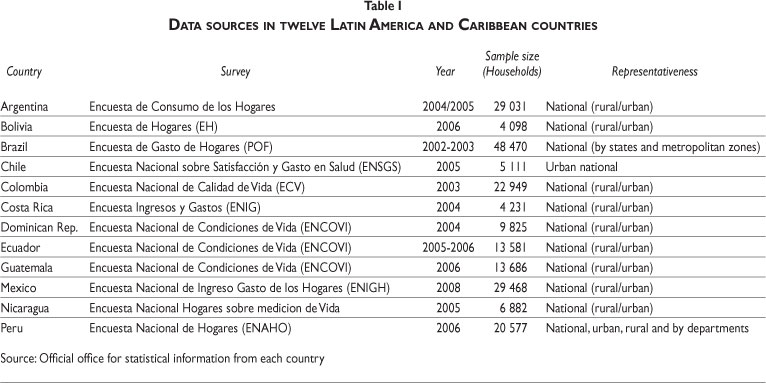
<body><![CDATA[<p><font face="Verdana, Arial, Helvetica, sans-serif" size="2"><b>Study Design</b></font></p>     <p><font face="Verdana, Arial, Helvetica, sans-serif" size="2">Each of the twelve    participating country research team selected the most appropriate available    household survey that met the requirements of the study. We gave high priority    to using surveys with detailed measures of expenditures at the household level,    disaggregated by type of expenditure such as health care or food, and basic    socio demographic information on the household. <a href="/img/revistas/spm/v53s2/05t01.jpg">Table    I</a> presents a description of the selected surveys, which varied in design    and purpose. For example, the data for Bolivia, Brazil, Mexico and Peru were    derived from household expenditure surveys; in the surveys for Colombia, Costa    Rica, Dominican Republic, Ecuador, Guatemala and Nicaragua the objective was    to measure social and quality of life conditions, such as income and poverty.    The Argentina and Chile surveys were designed to measure health care utilization    and expenditures. Further, unlike the others, the survey for Chile cover only    the urban areas of the country thus no analysis of rural / urban differences    is possible for Chile, constraining the comparability with other surveys. Through    detailed group analysis of the results for each country and efforts to standardize    variable definitions, the researchers sought to minimize the impact of these    differences in survey design on the comparative results.</font></p>     <p><font face="Verdana, Arial, Helvetica, sans-serif" size="2"><b>Definition of    study variables</b></font></p>     <p><font face="Verdana, Arial, Helvetica, sans-serif" size="2">We constructed    a core set of variables: total household expenditures, health care expenditures,    and household characteristics such as household size, area of residence, household    composition by age of its members, and availability of health insurance. By    agreeing on a core set of variables and carefully reviewing differences across    surveys, we constructed variables that were strictly comparable across countries.</font></p>     <p><font face="Verdana, Arial, Helvetica, sans-serif" size="2"><i>Catastrophic    Health Expenditures.</i> We used two indicators to assess the prevalence of    catastrophic health care expenditures as follows:</font></p>     <blockquote>        <p><font face="Verdana, Arial, Helvetica, sans-serif" size="2">a)&nbsp; The      basic indicator 'CHE1' is calculated as out of pocket payments for health      as proportion of income or total expenditures in a given period of time. We      use total health expenditures as the numerator. We adopted a common convention      and used as the denominator total household expenditure net of food spending,      which better captures the effect of health expenditures on disposable income.<sup>39-40</sup></font></p>       <p><font face="Verdana, Arial, Helvetica, sans-serif" size="2">b)&nbsp; The      second indicator 'CHE2' (type Wagstaff and vanDoerslaer) uses a slightly different      definition for the denominator, as the total household expenditure net of      a standard value: subsistence expenditures equivalent to a poverty line of      $1 USD PPP (international purchasing power parity dollar). This convention      has been adopted by several authors.<sup>24</sup></font></p> </blockquote>     <p><font face="Verdana, Arial, Helvetica, sans-serif" size="2">Both indicators    aim to capture the same concept of health expenditures but the difference is    in the point of reference to define the expenditures as catastrophic. CHE1 uses    as reference the capacity to pay based on net income of the household after    meeting the basic needs of food. On the other hand, CHE2 uses as reference an    international standard of subsistence, to maximize the ability to make cross-country    comparisons. For our purposes, a household is defined as having incurred catastrophic    health expenditures if the out of pocket health share exceeds 30% of the point    of reference. In addition, for CHE2 any expenditure by poor households, that    is, households below the $1 USD PPP line, is considered a catastrophic expenditure    since households are already poor. Thus by definition CHE2&gt;=CHE1.</font></p>     <p><font face="Verdana, Arial, Helvetica, sans-serif" size="2"><i>Stratification    variables</i></font></p>     ]]></body>
<body><![CDATA[<p><font face="Verdana, Arial, Helvetica, sans-serif" size="2">We calculated the    prevalence of catastrophic health care expenditures among households in each    country, and by sub-groups of the households according to the following stratification    variables: Area of residence -urban or rural. Household composition in categories    according to the age of members -with at least one child (of 5 years old or    younger) but no elderly (60 or more years old), with at least one elderly but    no children, with both children and elderly members, and with neither children    nor elderly members. Household size according to the number of members in three    categories: large (5 or more members), medium (3-4 members), and small (2 or    fewer). For health insurance, we classified households as 'yes' if at least    one adult member of the household had coverage and as 'no' if no member of the    household had health care coverage. Finally, we classified households by income    using the total expenditures of the household using quintiles of the distribution    in each country (poorest to richest).</font></p>     <p>&nbsp;</p>     <p><font face="Verdana, Arial, Helvetica, sans-serif" size="3"><b>Methods</b></font></p>     <p><font face="Verdana, Arial, Helvetica, sans-serif" size="2">Levels of health    spending in a country depend on the composition of the population (for example    by household sizes, or by age of its people). Thus we used a standardized measure    of the total prevalence of catastrophic health expenditures to maximize the    potential for comparability. We took the distribution of the households by household    size in the sum of all countries as the standard population. This method holds    constant the distribution of the population, and differences in health spending    across countries can be attributed to factors other than the differential composition    of their populations.</font></p>     <p><font face="Verdana, Arial, Helvetica, sans-serif" size="2">The variation in    the surveys available and the methodology for gathering data on health expenditure    in each survey constrained the direct comparability of measures across countries.    To overcome this feature at least partly we compared across sub-groups within    each country (for example large versus small households). These comparisons    are appropriate assuming that the survey captured health payments by the households    of the various sub-groups equally in each country. Thus we calculated the prevalence    of catastrophic health expenditures for the total of households in each country,    and by sub-groups defined by the stratification variables. We obtained point    and interval (95%) estimates of prevalence. For each country we then constructed    ratios of prevalence of catastrophic health expenditures across categories of    the stratification variables, in order to assess whether some strata of the    population show relatively higher exposure than others. Using the interval estimates    for each of the sub-groups in a given ratio, we assess whether the ratio of    the two estimates is significantly different than one. This forms the basis    for the comparisons across countries. For example, if the ratio of prevalence    among households with older adults divided by the prevalence among those without    older adults is 1.3 in country A and 2.5 in country B, and the respective intervals    do not overlap, then we conclude that, relative to households without older    adults, households with older adults in country B are more likely to report    catastrophic health expenditures than those in country A. Thus households with    older adults seem more exposed to financial health risk and lack financial protection    in B than in A.</font></p>     <p>&nbsp;</p>     <p><font face="Verdana, Arial, Helvetica, sans-serif" size="3"><b>Results</b></font></p>     <p><font face="Verdana, Arial, Helvetica, sans-serif" size="2"><a href="/img/revistas/spm/v53s2/05t02.jpg">Table    II</a> presents descriptive statistics using the survey samples for the twelve    countries. The proportion of rural households ranges from a high in Guatemala    (46%) and Nicaragua (42%) to 15% in Brazil and 7% in Argentina. Recall that    the Chile sample includes only urban areas. The proportion of households that    have at least one elderly member ranges from a high of 30% in Chile and Peru,    and 25% in Argentina, to a low of 15% in Bolivia and 18% in Costa Rica. Household    size is on average the largest in Nicaragua and Guatemala, where more than 50%    of households have 5 or more members. With respect to health insurance coverage,    the range is from 27% of households reporting coverage in Brazil and Bolivia,    to 90% in Costa Rica.</font></p>     <p><font face="Verdana, Arial, Helvetica, sans-serif" size="2"><a href="/img/revistas/spm/v53s2/05t03.jpg">Table    III</a> presents the prevalence of catastrophic spending according to the two    indicators CHE1 and CHE 2. The unstandardized prevalence of catastrophic health    expenditures varies across the countries in the study and depending on the indicator.    For CHE1 they range from 0.4% in Costa Rica to around 2-5% in Colombia, Bolivia,    Brazil, Mexico and Peru, to around 7-11% in Argentina, Dominican Republic, Ecuador,    Guatemala and Nicaragua. The standardized figures yield similar relative ranking    of the countries. Costa Rica presents very low prevalence, while Guatemala shows    the highest prevalence of catastrophic expenditures.</font></p>     <p><font face="Verdana, Arial, Helvetica, sans-serif" size="2"><i>Rural versus    Urban Residents.</i> We compared the percent of households with catastrophic    expenditures in rural areas to those residing in urban areas for each country    (except for Chile). Recall that a value greater than 1.0 for the ratio implies    that catastrophic spending is more common in the numerator group (rural areas)    relative to subsistence or disposable income than in the denominator group (urban    areas). In all countries in the study other than Argentina, catastrophic expenditures    are more prevalent in rural than in urban areas and these differences are statistically    significant in almost all cases (<a href="/img/revistas/spm/v53s2/05t04.jpg">Table    IV</a>). Costa Rica and Dominican Republic have the lowest ratios, implying    a smaller difference between rural and urban areas. Peru, Guatemala and Brazil    have moderate ratios compared to the rest of the countries. Bolivia, Colombia,    Mexico, Nicaragua and Ecuador show the largest gaps between rural and urban    households with prevalence of around 2-4 times in rural households compared    to the prevalence in urban areas.</font></p>     ]]></body>
<body><![CDATA[<p><font face="Verdana, Arial, Helvetica, sans-serif" size="2"><i>Poor versus    Rich Households.</i> We contrasted the percent reporting catastrophic health    expenditures in the poorest quintile compared to that in the richest quintile.    Ratio values greater than 1.0 mean that the poorest households are more exposed    to having catastrophic health expenditures compared to the richest households.    CHE2 provides a clearer pattern, and in all countries except Chile the percent    with catastrophic health expenditures is higher among poor households (<a href="/img/revistas/spm/v53s2/05t04.jpg">Table    IV</a>). For CHE1 the ratios are lower and for several countries below 1. The    poorer countries (such as >Nicaragua and Ecuador) tend to have greater differentials,    particularly for CHE2. Bolivia shows a very high difference of 28 times the    prevalence among poorest compared to households in the richest income quintile    and between CHE1 and CHE2 which may point to difficulties with these data.</font></p>     <p><font face="Verdana, Arial, Helvetica, sans-serif" size="2"><i>Age of Household    Members.</i> For this contrast, we present the ratio of the percent of households    reporting catastrophic health expenditures in each group, using as reference    the group of households with neither children nor elderly members. In general,    countries have higher exposure to catastrophic health expenditures among households    with children compared to households with no children and no elderly (<a href="/img/revistas/spm/v53s2/05t04.jpg">Table    IV</a>). Still, the results vary across countries and are less marked for CHE1    than CHE2. For 10 of the 12 countries using CHE2, households with children tend    to be more exposed to financial crisis from health spending, with statistically    significant differences in 9 of these countries.</font></p>     <p><font face="Verdana, Arial, Helvetica, sans-serif" size="2">All 12 countries    have higher levels of catastrophic health expenditures among households with    elderly members compared to households with no children and no elderly, and    this holds for both indicators. The ratios are particularly high for Argentina,    Costa Rica, Dominican Republic and Mexico. The results also show that for CHE2    all countries have higher propensity of catastrophic health expenditures among    households with children and elderly compared to households without either group    (<a href="/img/revistas/spm/v53s2/05t04.jpg">Table IV</a>). For CHE1 almost    all countries also have ratios over 1. In Argentina, Dominican Republic, Ecuador,    Guatemala and Nicaragua the ratios are approximately 2:1, and in the remaining    countries the ratios are substantially higher. Overall, the results suggest    that the propensity to suffer catastrophic health expenditures tends to be higher    for families with young children, and more so for families with elderly household    members. <i>Household Size.</i> We present the ratio of catastrophic health    expenditures among medium and large households relative to the percent among    small households. In most countries, households with 3-4 members are less likely    to experience catastrophic health expenditures than small households of 1-2    members (<a href="/img/revistas/spm/v53s2/05t04.jpg">Table IV</a>). The exceptions    are Bolivia and Nicaragua where the ratio is above 1 for CHE2, although these    are not statistically significant. In all countries with the exception of Argentina    and Dominican Republic, but only for CHE2, large households have higher prevalence    of catastrophic health expenditures than small households. The gap is largest    in Bolivia and Nicaragua. <i>Health Insurance Coverage.</i> We compare the prevalence    of catastrophic health expenditures by whether or not the household includes    an insured household member (<a href="/img/revistas/spm/v53s2/05t04.jpg">Table    IV</a>). For the majority of the countries, the propensity to incur in catastrophic    spending is, as expected, higher among households without insurance and the    results are largely consistent for both CHE1 and CHE2 and statistically significant.    The exceptions are Argentina and Chile, Costa Rica and Peru (with a ratio close    to 1.0 for CHE2).</font></p>     <p>&nbsp;</p>     <p><font face="Verdana, Arial, Helvetica, sans-serif" size="3"><b>Discussion</b></font></p>     <p><font face="Verdana, Arial, Helvetica, sans-serif" size="2">We assessed the    extent to which households in Latin America suffer catastrophic health expenditures    with a focus on the relative risk for sub-groups of the population in each of    the countries. We defined these groups according to characteristics that suggest    similar conditions or lifestyles, for example level of income. Our approach    aimed to make cross-country comparisons to enhance the results obtained from    one single country and to maximize the impact of the results obtained. Since    populations in each country are exposed to different socioeconomic and health    sector contexts, cross-national comparisons helped us draw general conclusions    about the relationship between certain population traits and the risk of suffering    catastrophic health expenditures, increasing the precision of a given policy    conclusion.</font></p>     <p><font face="Verdana, Arial, Helvetica, sans-serif" size="2">Thus our comparative    results can be interpreted as a measure of how certain groups are more susceptible    to suffer catastrophic expenditures than others across countries. Although as    mentioned, our emphasis is not on absolute levels, the prevalence of catastrophic    spending by households portrays a heterogeneous set of countries. We find absolute    values of prevalence that vary widely, from less than 1% of households in Costa    Rica and 2% in Brazil (two countries where social security covers the large    majority of the population), to 10-15% of households in Nicaragua, Guatemala,    Dominican Republic, Argentina, and urban Chile.</font></p>     <p><font face="Verdana, Arial, Helvetica, sans-serif" size="2">The results on    the relative levels across subgroups show patterns that are important for policies    targeted to improve the equity of health financing in these countries (<a href="/img/revistas/spm/v53s2/05t05.jpg">Table    V</a>). First, it is clear that for all countries, certain groups of the population    are more exposed to catastrophic expenses and these groups can be identified    and targeted in each country. Second, there are common attributes that define    high risk of catastrophic expenses for the region: households in rural areas,    uninsured, poor households, and households with children or with elderly members.    Some of the results are consistent with previous literature<sup>5-7,10,</sup>    <sup>29,33-34</sup> but our work also finds a systematic high risk for rural    households and among households with elderly members (with or without children).<sup>5</sup>    While this pattern may reflect expensive health care needs of older adults,    the presence of elderly members in the household may reflect a coping mechanism    of poor households, who may recourse to co-residence with elderly family members    to meet consumption needs. Similarly, large households seem more likely to incur    in catastrophic expenses, and this type of living arrangement could be a coping    mechanism sought by many poor households for economic survival.</font></p>     <p><font face="Verdana, Arial, Helvetica, sans-serif" size="2">The differences    between uninsured/insured house-holds are not as great as might be expected    if insurance were effectively protecting households from spending out of pocket.    While these results are somewhat surprising, it may indicate that households    with insurance are spending out-of-pocket for uncovered expenses such as medications,    or in order to avoid long waits. Furthermore, uninsured households may forego    health spending and thus not incur in financial catastrophe, although they may    be subject to greater health catastrophe as a result of avoiding timely care.    Another important aspect is that insured populations may be self-selected. Lack    of insurance may be an indicator of particular types of households that also    have a different attitude towards spending on health care. This may be true    for some countries more than others, in particular in those countries in which    insurance is a matter of choice. Moreover, health insurance varies tremendously    across countries. Thus for example, in some countries coverage may represent    almost zero expenditures out of pocket while it may represent large out of pocket    expenses in others.</font></p>     <p><font face="Verdana, Arial, Helvetica, sans-serif" size="2">Another important    conclusion of this collective work is that the indicator used for catastrophic    health expenditures can affect substantially the results; this was evident from    using two indicators: out of pocket health share (CHE1) and health expenditures    net of a standard value (CHE2). Once again, the absolute values obtained with    the two indicators are expected to differ, by definition, but our use of the    relative standing of different groups took into account this possible source    of variation. For countries with particularly high rates of absolute poverty,    CHE1 may actually show more catastrophic spending among the richest compared    to the poorest households as was the case in Bolivia, Peru and Guatemala. With    the measure that takes into account spending on health at any level by families    living below the poverty line, the result is the opposite as shown by the high    differentials found. Additional support for this explanation comes from the    results for Brazil, Colombia, Guatemala and Mexico where the ratio for the first    indicator, though greater than 1.0, is much lower than for the second. In addition,    we may be capturing non-spending by poorer households who cannot pay for health    care and thus are exposed to even greater health crises.</font></p>     ]]></body>
<body><![CDATA[<p><font face="Verdana, Arial, Helvetica, sans-serif" size="2">As is typically    true for cross-national comparisons, the greatest challenge for this study was    the comparability of data across countries. The data sets for the various countries    were not designed with cross-country comparisons in mind. Thus there were important    differences in field protocols, concepts and wording and design of questionnaires.    It would be advantageous to apply a standard battery of questions in all countries    for the analysis of health care spending. This convention would greatly facilitate    cross-country analyses, but this harmonization effort also can potentially improve    the quality of the national data sets. This collective effort would require    concerted action, and could be led and financially supported by organizations    such as the World Health Organization and its regional arm the PanAmerican Health    Organization, and financial institutions such as the Interamerican Development    Bank and the World Bank.</font></p>     <p><font face="Verdana, Arial, Helvetica, sans-serif" size="2">This paper reflects    the effort by a collection of country-specific research teams that committed    to harmonizing variables across the data sets to facilitate comparisons. One    limitation is that the measure used for expenditures and to calculate prevalence    of catastrophic health expenditures assumes that households facing potentially    large medical expenditures sacrifice consumption. The definition ignores the    differential ability of households to draw from savings, assets, family transfers,    or other coping mechanisms to protect consumption of other goods. Previous research    has argued that this approach can provide a misleading idea of the consequences    for impoverishment of health shocks, in particular in the short run.<sup>15,26</sup>    This can be especially relevant in populations where informal coping mechanisms    are common, which can be the case in many of the societies represented by the    study countries, and these mechanisms may further differ across sub-groups in    a country or across countries. Future research on this line of work could seek    to improve on these features of the data samples, and assess more accurately    the impact of health shocks on the economies of households in poor societies.    Considering longer time horizons of health expenditures and longitudinal data    on patterns over time will be essential for answering these questions. Are the    same households exhibiting catastrophic expenses over time? For how long?</font></p>     <p><font face="Verdana, Arial, Helvetica, sans-serif" size="2">Our limitations    notwithstanding, the approach used to quantify and compare the patterns of catastrophic    health care expenditures contributes to our understanding of the groups that    most need additional financial protection to prevent the consequences of health    shocks, and could be used to monitor the progress of health systems in securing    financial protection of vulnerable groups in Latin America. The systems to finance    health care and their coverage of the population vary widely in the region,    from Brazil's unified tax-based to Costa Rica's unified social health insurance    scheme, both offering universal coverage. In between there are fragmented health    systems that include Health Ministries covering with limited-benefit packages    the population with no capacity to pay, while social health insurance schemes    cover formal workers more-effectively. Innovative schemes include Colombia's    regulated competition model that reaches universal coverage and has encouraged    reforms in countries like the Dominican Republic and Peru. Chile's Auge scheme    seeks universal coverage with a limited package and guaranteed waiting times,    and Mexico's Seguro Popular offers tax-financed coverage through social insurance    covering the previously uninsured. While several countries contract private    providers for their public schemes, all permit the private sector with limited    regulation to sell services to those able to pay. Further work should deepen    the analysis on how the patterns of catastrophic spending are related to the    features of health financing in each country.</font></p>     <p>&nbsp;</p>     <p><font face="Verdana, Arial, Helvetica, sans-serif" size="3"><b>ACKNOWLEDGEMENTS</b></font></p>     <p><font face="Verdana, Arial, Helvetica, sans-serif" size="2">Authors are grateful    to IDRC (Grant 103905-001), the Carlos Slim Institute for Health through the    LAC Health Observatory, the Consejo Promotor Competitividad y Salud and the    Mexican Health Foundation for financial support and institutional support. Support    is also recognized from CONACyT (grant 85055 Fondo Sectorial de Investigaci&oacute;n    para la Educaci&oacute;n and grant SALUD-2004-C01-191 Fondo Sectorial de Investigaci&oacute;n    en Salud y Seguridad Social).</font></p>     <p><font face="Verdana, Arial, Helvetica, sans-serif" size="2">All authors contributed    to this paper through their involvement in the 'Network on Health Financing    and Social Protection in Latin America and the Caribbean (LANET) and / or the    IDRC-funded project mentioned above. Other members of LANET who contributed    to the work of the group are: Ana Mylena Aguilar; Mar&iacute;a Luisa Escobar;    Amanda Glassman; Ramiro Guerrero Carvajal; Jorine Muiser; Gustavo Nigenda; Maja    Pleich; Rocio Saenz; Vito Sciaraffia; Vito Sciaraffia Jr; Cecilia Vidal; NilhdaVillacres.</font></p>     <p><font face="Verdana, Arial, Helvetica, sans-serif" size="2"><i>Declaration    of conflicts of interest:</i> The authors declare that they have no conflict    of interests.</font></p>     <p>&nbsp;</p>     <p><font face="Verdana, Arial, Helvetica, sans-serif" size="3"><b>References</b></font></p>     ]]></body>
<body><![CDATA[<!-- ref --><p><font face="Verdana, Arial, Helvetica, sans-serif" size="2">1. World Health    Organization. The World Health Report 2000: Health Systems: Improving Performance,    Geneva: World Health Organization, 2000.    &nbsp;&nbsp;&nbsp;&nbsp;&nbsp;&nbsp;&nbsp;&nbsp;[&#160;<a href="javascript:void(0);" onclick="javascript: window.open('/scielo.php?script=sci_nlinks&ref=9330356&pid=S0036-3634201100080000500001&lng=','','width=640,height=500,resizable=yes,scrollbars=1,menubar=yes,');">Links</a>&#160;]<!-- end-ref --></font></p>     <!-- ref --><p><font face="Verdana, Arial, Helvetica, sans-serif" size="2">2. Frenk J, G&oacute;mez-Dant&eacute;s    O, Knaul FM. The democratization of health in Mexico: financial innovations    for universal coverage. Bull World Health Organ. 2009;87:542-48.    &nbsp;&nbsp;&nbsp;&nbsp;&nbsp;&nbsp;&nbsp;&nbsp;[&#160;<a href="javascript:void(0);" onclick="javascript: window.open('/scielo.php?script=sci_nlinks&ref=9330358&pid=S0036-3634201100080000500002&lng=','','width=640,height=500,resizable=yes,scrollbars=1,menubar=yes,');">Links</a>&#160;]<!-- end-ref --></font></p>     <!-- ref --><p><font face="Verdana, Arial, Helvetica, sans-serif" size="2">3. Frenk J, G&oacute;mez-Dant&eacute;s    O. Ideas and ideals: ethical basis of health reform in Mexico. Lancet 2009;373:1406-08.    &nbsp;&nbsp;&nbsp;&nbsp;&nbsp;&nbsp;&nbsp;&nbsp;[&#160;<a href="javascript:void(0);" onclick="javascript: window.open('/scielo.php?script=sci_nlinks&ref=9330360&pid=S0036-3634201100080000500003&lng=','','width=640,height=500,resizable=yes,scrollbars=1,menubar=yes,');">Links</a>&#160;]<!-- end-ref --></font></p>     <!-- ref --><p><font face="Verdana, Arial, Helvetica, sans-serif" size="2">4. Leive A, Xu    K. Coping with out-of-pocket health payments: empirical evidence from 15 African    countries. Bull World Health Organ 2008;86:849-46.    &nbsp;&nbsp;&nbsp;&nbsp;&nbsp;&nbsp;&nbsp;&nbsp;[&#160;<a href="javascript:void(0);" onclick="javascript: window.open('/scielo.php?script=sci_nlinks&ref=9330362&pid=S0036-3634201100080000500004&lng=','','width=640,height=500,resizable=yes,scrollbars=1,menubar=yes,');">Links</a>&#160;]<!-- end-ref --></font></p>     <!-- ref --><p><font face="Verdana, Arial, Helvetica, sans-serif" size="2">5. Xu K, Evans    D, Carrin G,Aguilar-River AM, Musgrove T, Evans T. 2007. Protecting Households    from Catastrophic Health Spending. Health Aff (Millwood); 26(4).    &nbsp;&nbsp;&nbsp;&nbsp;&nbsp;&nbsp;&nbsp;&nbsp;[&#160;<a href="javascript:void(0);" onclick="javascript: window.open('/scielo.php?script=sci_nlinks&ref=9330364&pid=S0036-3634201100080000500005&lng=','','width=640,height=500,resizable=yes,scrollbars=1,menubar=yes,');">Links</a>&#160;]<!-- end-ref --></font></p>     ]]></body>
<body><![CDATA[<!-- ref --><p><font face="Verdana, Arial, Helvetica, sans-serif" size="2">6. Xu K, Evans    DB, Carrin G, Aguilar-Rivera AM. Designing health financing systems to reduce    catastrophic health expenditures. Technical Brief for Policy Makers No.2. Geneva:    WHO 2005.    &nbsp;&nbsp;&nbsp;&nbsp;&nbsp;&nbsp;&nbsp;&nbsp;[&#160;<a href="javascript:void(0);" onclick="javascript: window.open('/scielo.php?script=sci_nlinks&ref=9330366&pid=S0036-3634201100080000500006&lng=','','width=640,height=500,resizable=yes,scrollbars=1,menubar=yes,');">Links</a>&#160;]<!-- end-ref --></font></p>     <!-- ref --><p><font face="Verdana, Arial, Helvetica, sans-serif" size="2">7. Xu K, Evans    DB, Kawabata K, Zeramdini R,Klavus J, Murray CJ. Household catastrophic health    expenditure: a multicountry analysis. Lancet 2003; 362: 111-117.    &nbsp;&nbsp;&nbsp;&nbsp;&nbsp;&nbsp;&nbsp;&nbsp;[&#160;<a href="javascript:void(0);" onclick="javascript: window.open('/scielo.php?script=sci_nlinks&ref=9330368&pid=S0036-3634201100080000500007&lng=','','width=640,height=500,resizable=yes,scrollbars=1,menubar=yes,');">Links</a>&#160;]<!-- end-ref --></font></p>     <!-- ref --><p><font face="Verdana, Arial, Helvetica, sans-serif" size="2">8. Carrin G, James    C. Evans. Achieving universal health coverage: developing the health financing    system. Techniccal briefs for policy-makers. No. l Geneve: World Health Organization,    2005.    &nbsp;&nbsp;&nbsp;&nbsp;&nbsp;&nbsp;&nbsp;&nbsp;[&#160;<a href="javascript:void(0);" onclick="javascript: window.open('/scielo.php?script=sci_nlinks&ref=9330370&pid=S0036-3634201100080000500008&lng=','','width=640,height=500,resizable=yes,scrollbars=1,menubar=yes,');">Links</a>&#160;]<!-- end-ref --></font></p>     <!-- ref --><p><font face="Verdana, Arial, Helvetica, sans-serif" size="2">9. O'Donnell O,    van Doorslaer E, Rannan-Eliya R, Somanathan A, Adihkari S, Akkazieva B, et al.,Who    pays for health care in Asia? J Health Econ. 2008; 27: 460-75 pmid: 18179832.    &nbsp;&nbsp;&nbsp;&nbsp;&nbsp;&nbsp;&nbsp;&nbsp;[&#160;<a href="javascript:void(0);" onclick="javascript: window.open('/scielo.php?script=sci_nlinks&ref=9330372&pid=S0036-3634201100080000500009&lng=','','width=640,height=500,resizable=yes,scrollbars=1,menubar=yes,');">Links</a>&#160;]<!-- end-ref --></font></p>     <!-- ref --><p><font face="Verdana, Arial, Helvetica, sans-serif" size="2">10. Baeza C. and    Packard TG. Beyond survival: protecting households from health shocks in Latin    America. The World Bank and Stanford University Press.Washington DC: World Bank,    2006.    &nbsp;&nbsp;&nbsp;&nbsp;&nbsp;&nbsp;&nbsp;&nbsp;[&#160;<a href="javascript:void(0);" onclick="javascript: window.open('/scielo.php?script=sci_nlinks&ref=9330374&pid=S0036-3634201100080000500010&lng=','','width=640,height=500,resizable=yes,scrollbars=1,menubar=yes,');">Links</a>&#160;]<!-- end-ref --></font></p>     ]]></body>
<body><![CDATA[<!-- ref --><p><font face="Verdana, Arial, Helvetica, sans-serif" size="2">11. Van Doorslaer    E,Wagstaff A, Rutten F, eds. Equity in the finance and delivery of health care:    An international perspective. Oxford: Oxford University Press, 1993.    &nbsp;&nbsp;&nbsp;&nbsp;&nbsp;&nbsp;&nbsp;&nbsp;[&#160;<a href="javascript:void(0);" onclick="javascript: window.open('/scielo.php?script=sci_nlinks&ref=9330376&pid=S0036-3634201100080000500011&lng=','','width=640,height=500,resizable=yes,scrollbars=1,menubar=yes,');">Links</a>&#160;]<!-- end-ref --></font></p>     <!-- ref --><p><font face="Verdana, Arial, Helvetica, sans-serif" size="2">12. Van Doorslaer    E,Wagstaff A,Van der Burg H. The redistributive effect of health care finance    in twelve OECD countries. J Health Econ, l999; 18(3):291-313.    &nbsp;&nbsp;&nbsp;&nbsp;&nbsp;&nbsp;&nbsp;&nbsp;[&#160;<a href="javascript:void(0);" onclick="javascript: window.open('/scielo.php?script=sci_nlinks&ref=9330378&pid=S0036-3634201100080000500012&lng=','','width=640,height=500,resizable=yes,scrollbars=1,menubar=yes,');">Links</a>&#160;]<!-- end-ref --></font></p>     <!-- ref --><p><font face="Verdana, Arial, Helvetica, sans-serif" size="2">13. Van Doerslaer    E, O'Donnell O, Rannan-Eliya RP, et al. Paying out-of-pocket for health care    in Asia: Catastrophic and poverty impact. Equitap Project Working Paper No.2.    Thailand: EQUITAP, 2005.    &nbsp;&nbsp;&nbsp;&nbsp;&nbsp;&nbsp;&nbsp;&nbsp;[&#160;<a href="javascript:void(0);" onclick="javascript: window.open('/scielo.php?script=sci_nlinks&ref=9330380&pid=S0036-3634201100080000500013&lng=','','width=640,height=500,resizable=yes,scrollbars=1,menubar=yes,');">Links</a>&#160;]<!-- end-ref --><!-- ref --> 14.Van Doorslaer E, O'Donnell O, Ranan-Eliya R, et    al. Catastrophic payments for health care in Asia. Health Econ. 2007; 16(11):1127-1275.    &nbsp;&nbsp;&nbsp;&nbsp;&nbsp;&nbsp;&nbsp;&nbsp;[&#160;<a href="javascript:void(0);" onclick="javascript: window.open('/scielo.php?script=sci_nlinks&ref=9330381&pid=S0036-3634201100080000500014&lng=','','width=640,height=500,resizable=yes,scrollbars=1,menubar=yes,');">Links</a>&#160;]<!-- end-ref --></font></p>     <!-- ref --><p><font face="Verdana, Arial, Helvetica, sans-serif" size="2">15. Flores G, Krishnakumar    J, O'Donnell O,Van Doorslaer E. Coping with health care costs: implications    for the measurement of catastrophic expenditures and poverty. Health Econ. 2008    pmid: 18246595.    &nbsp;&nbsp;&nbsp;&nbsp;&nbsp;&nbsp;&nbsp;&nbsp;[&#160;<a href="javascript:void(0);" onclick="javascript: window.open('/scielo.php?script=sci_nlinks&ref=9330383&pid=S0036-3634201100080000500015&lng=','','width=640,height=500,resizable=yes,scrollbars=1,menubar=yes,');">Links</a>&#160;]<!-- end-ref --></font></p>     <!-- ref --><p><font face="Verdana, Arial, Helvetica, sans-serif" size="2">16. Knaul, Felicia    M., Hector Arreola-Ornelas, Oscar M&eacute;ndez-Carniado, et al. Evidence Is    Good For Your Health System: Policy Reform to Remedy Catastrophic and Impoverishing    Health Spending in Mexico, Lancet, 2006; 368 (9549), 1828-41.    &nbsp;&nbsp;&nbsp;&nbsp;&nbsp;&nbsp;&nbsp;&nbsp;[&#160;<a href="javascript:void(0);" onclick="javascript: window.open('/scielo.php?script=sci_nlinks&ref=9330385&pid=S0036-3634201100080000500016&lng=','','width=640,height=500,resizable=yes,scrollbars=1,menubar=yes,');">Links</a>&#160;]<!-- end-ref --></font></p>     <!-- ref --><p><font face="Verdana, Arial, Helvetica, sans-serif" size="2">17. Knaul, Felicia    and Julio Frenk. Health Insurance in Mexico: Achieving Universal Health Insurance    through Stuctural Reform, Health Aff (Millwood). 2005; 24 (6), 1467-76.    &nbsp;&nbsp;&nbsp;&nbsp;&nbsp;&nbsp;&nbsp;&nbsp;[&#160;<a href="javascript:void(0);" onclick="javascript: window.open('/scielo.php?script=sci_nlinks&ref=9330387&pid=S0036-3634201100080000500017&lng=','','width=640,height=500,resizable=yes,scrollbars=1,menubar=yes,');">Links</a>&#160;]<!-- end-ref --></font></p>     <!-- ref --><p><font face="Verdana, Arial, Helvetica, sans-serif" size="2">18. Secretar&iacute;a    de Salud. Salud: M&eacute;xico 200l. Informaci&oacute;npara la rendici&oacute;n    de cuentas. M&eacute;xico, DF: Secretar&iacute;a de Salud, 2002.    &nbsp;&nbsp;&nbsp;&nbsp;&nbsp;&nbsp;&nbsp;&nbsp;[&#160;<a href="javascript:void(0);" onclick="javascript: window.open('/scielo.php?script=sci_nlinks&ref=9330389&pid=S0036-3634201100080000500018&lng=','','width=640,height=500,resizable=yes,scrollbars=1,menubar=yes,');">Links</a>&#160;]<!-- end-ref --></font></p>     <!-- ref --><p><font face="Verdana, Arial, Helvetica, sans-serif" size="2">19. Secretar&iacute;a    de Salud. Salud: M&eacute;xico 2002. Informaci&oacute;npara la rendici&oacute;n    de cuentas. M&eacute;xico, DF: Secretar&iacute;a de Salud, 2003.    &nbsp;&nbsp;&nbsp;&nbsp;&nbsp;&nbsp;&nbsp;&nbsp;[&#160;<a href="javascript:void(0);" onclick="javascript: window.open('/scielo.php?script=sci_nlinks&ref=9330391&pid=S0036-3634201100080000500019&lng=','','width=640,height=500,resizable=yes,scrollbars=1,menubar=yes,');">Links</a>&#160;]<!-- end-ref --></font></p>     <!-- ref --><p><font face="Verdana, Arial, Helvetica, sans-serif" size="2">20. Secretar&iacute;a    de Salud. Salud: M&eacute;xico 2003. Informaci&oacute;npara la rendici&oacute;n    de cuentas. M&eacute;xico, DF: Secretar&iacute;a de Salud, 2004.    &nbsp;&nbsp;&nbsp;&nbsp;&nbsp;&nbsp;&nbsp;&nbsp;[&#160;<a href="javascript:void(0);" onclick="javascript: window.open('/scielo.php?script=sci_nlinks&ref=9330393&pid=S0036-3634201100080000500020&lng=','','width=640,height=500,resizable=yes,scrollbars=1,menubar=yes,');">Links</a>&#160;]<!-- end-ref --></font></p>     <!-- ref --><p><font face="Verdana, Arial, Helvetica, sans-serif" size="2">21. Secretar&iacute;a    de Salud. Salud: M&eacute;xico 2004. Informaci&oacute;npara la rendici&oacute;n    de cuentas. M&eacute;xico, DF: Secretar&iacute;a de Salud, 2005.    &nbsp;&nbsp;&nbsp;&nbsp;&nbsp;&nbsp;&nbsp;&nbsp;[&#160;<a href="javascript:void(0);" onclick="javascript: window.open('/scielo.php?script=sci_nlinks&ref=9330395&pid=S0036-3634201100080000500021&lng=','','width=640,height=500,resizable=yes,scrollbars=1,menubar=yes,');">Links</a>&#160;]<!-- end-ref --></font></p>     <!-- ref --><p><font face="Verdana, Arial, Helvetica, sans-serif" size="2">22. Secretar&iacute;a    de Salud. Salud: M&eacute;xico 200l-2005. Informaci&oacute;n para la rendici&oacute;n    de cuentas. M&eacute;xico, DF: Secretar&iacute;a de Salud, 2006.    &nbsp;&nbsp;&nbsp;&nbsp;&nbsp;&nbsp;&nbsp;&nbsp;[&#160;<a href="javascript:void(0);" onclick="javascript: window.open('/scielo.php?script=sci_nlinks&ref=9330397&pid=S0036-3634201100080000500022&lng=','','width=640,height=500,resizable=yes,scrollbars=1,menubar=yes,');">Links</a>&#160;]<!-- end-ref --></font></p>     <!-- ref --><p><font face="Verdana, Arial, Helvetica, sans-serif" size="2"> 23. Van Doorslaer    E., O'Donnell O., Ranna-Eliya R.P. et al. Effect of payments for health care    on poverty estimates in ll countries in Asia: an analysis of household survey    data. Lancet, 2006; 368: 1357-64.    &nbsp;&nbsp;&nbsp;&nbsp;&nbsp;&nbsp;&nbsp;&nbsp;[&#160;<a href="javascript:void(0);" onclick="javascript: window.open('/scielo.php?script=sci_nlinks&ref=9330399&pid=S0036-3634201100080000500023&lng=','','width=640,height=500,resizable=yes,scrollbars=1,menubar=yes,');">Links</a>&#160;]<!-- end-ref --></font></p>     <!-- ref --><p><font face="Verdana, Arial, Helvetica, sans-serif" size="2">24. Wagstaff A,Van    Doorslaer E. Catastrophe and impoverishment in paying for health care: with    applications to Vietnam 1993-1998. Health Econ. 2003; 12: 921-34 doi: 10.1002/hec.776    pmid: 14601155.    &nbsp;&nbsp;&nbsp;&nbsp;&nbsp;&nbsp;&nbsp;&nbsp;[&#160;<a href="javascript:void(0);" onclick="javascript: window.open('/scielo.php?script=sci_nlinks&ref=9330401&pid=S0036-3634201100080000500024&lng=','','width=640,height=500,resizable=yes,scrollbars=1,menubar=yes,');">Links</a>&#160;]<!-- end-ref --></font></p>     <!-- ref --><p><font face="Verdana, Arial, Helvetica, sans-serif" size="2">25. Gertler P.,    Gruber J. Insuring consumption against illness. Am Econ Rev. 2002; 92:51-70.    &nbsp;&nbsp;&nbsp;&nbsp;&nbsp;&nbsp;&nbsp;&nbsp;[&#160;<a href="javascript:void(0);" onclick="javascript: window.open('/scielo.php?script=sci_nlinks&ref=9330403&pid=S0036-3634201100080000500025&lng=','','width=640,height=500,resizable=yes,scrollbars=1,menubar=yes,');">Links</a>&#160;]<!-- end-ref --></font></p>     <!-- ref --><p><font face="Verdana, Arial, Helvetica, sans-serif" size="2">26. Wagstaff, Adam,    The Economic Consequences of Health Shocks. World Bank Policy Research Working    Paper No. 3644, 2005.    &nbsp;&nbsp;&nbsp;&nbsp;&nbsp;&nbsp;&nbsp;&nbsp;[&#160;<a href="javascript:void(0);" onclick="javascript: window.open('/scielo.php?script=sci_nlinks&ref=9330405&pid=S0036-3634201100080000500026&lng=','','width=640,height=500,resizable=yes,scrollbars=1,menubar=yes,');">Links</a>&#160;]<!-- end-ref --></font></p>     <!-- ref --><p><font face="Verdana, Arial, Helvetica, sans-serif" size="2">27. Londo&ntilde;o,    Juan-Luis and Julio Frenk. Structural Pluralism: Towards an Innovative Model    for Health System Reform in Latin America, Health Policy, l997; 41(1), 1-36.    &nbsp;&nbsp;&nbsp;&nbsp;&nbsp;&nbsp;&nbsp;&nbsp;[&#160;<a href="javascript:void(0);" onclick="javascript: window.open('/scielo.php?script=sci_nlinks&ref=9330407&pid=S0036-3634201100080000500027&lng=','','width=640,height=500,resizable=yes,scrollbars=1,menubar=yes,');">Links</a>&#160;]<!-- end-ref --></font></p>     <!-- ref --><p><font face="Verdana, Arial, Helvetica, sans-serif" size="2">28. Wong, R, A    Palloni. Aging in Mexico and Latin America, Chapter ll in International Handbook    of Population Aging, (eds), Springer Netherlands, 2009.    &nbsp;&nbsp;&nbsp;&nbsp;&nbsp;&nbsp;&nbsp;&nbsp;[&#160;<a href="javascript:void(0);" onclick="javascript: window.open('/scielo.php?script=sci_nlinks&ref=9330409&pid=S0036-3634201100080000500028&lng=','','width=640,height=500,resizable=yes,scrollbars=1,menubar=yes,');">Links</a>&#160;]<!-- end-ref --></font></p>     <!-- ref --><p><font face="Verdana, Arial, Helvetica, sans-serif" size="2">29. Murray CJL,    Knaul F, Xu K, Mugrove P, Kawabata K. Defining and measuring fairness of financial    contribution. World Health Organization. Global Programme on Evidence. WorkingPaper    24, 2000.    &nbsp;&nbsp;&nbsp;&nbsp;&nbsp;&nbsp;&nbsp;&nbsp;[&#160;<a href="javascript:void(0);" onclick="javascript: window.open('/scielo.php?script=sci_nlinks&ref=9330411&pid=S0036-3634201100080000500029&lng=','','width=640,height=500,resizable=yes,scrollbars=1,menubar=yes,');">Links</a>&#160;]<!-- end-ref --></font></p>     <!-- ref --><p><font face="Verdana, Arial, Helvetica, sans-serif" size="2">30. Perticara,    M. Incidencia de los Gastos de Bolsillo en Salud en Siete Paises Latinoamericanos,    Santiago de Chile, CEPAL, 2008.    &nbsp;&nbsp;&nbsp;&nbsp;&nbsp;&nbsp;&nbsp;&nbsp;[&#160;<a href="javascript:void(0);" onclick="javascript: window.open('/scielo.php?script=sci_nlinks&ref=9330413&pid=S0036-3634201100080000500030&lng=','','width=640,height=500,resizable=yes,scrollbars=1,menubar=yes,');">Links</a>&#160;]<!-- end-ref --></font></p>     <!-- ref --><p><font face="Verdana, Arial, Helvetica, sans-serif" size="2">31. Gottret P,    Schieber G. Health financing revisited: a practitioner's guide. Washington,    DC: The World Bank, 2006.    &nbsp;&nbsp;&nbsp;&nbsp;&nbsp;&nbsp;&nbsp;&nbsp;[&#160;<a href="javascript:void(0);" onclick="javascript: window.open('/scielo.php?script=sci_nlinks&ref=9330415&pid=S0036-3634201100080000500031&lng=','','width=640,height=500,resizable=yes,scrollbars=1,menubar=yes,');">Links</a>&#160;]<!-- end-ref --></font></p>     <!-- ref --><p><font face="Verdana, Arial, Helvetica, sans-serif" size="2">32. World Health    Organization, The World Health Report 2008: Primary Health Care: Now More Than    Ever, Geneva: World Health Organization, 2008.    &nbsp;&nbsp;&nbsp;&nbsp;&nbsp;&nbsp;&nbsp;&nbsp;[&#160;<a href="javascript:void(0);" onclick="javascript: window.open('/scielo.php?script=sci_nlinks&ref=9330417&pid=S0036-3634201100080000500032&lng=','','width=640,height=500,resizable=yes,scrollbars=1,menubar=yes,');">Links</a>&#160;]<!-- end-ref --></font></p>     <!-- ref --><p><font face="Verdana, Arial, Helvetica, sans-serif" size="2">33. Knaul FM, Arreola    H, M&eacute;ndez O, Miranda M. Preventing impoverishment, promoting equity and    protecting households from financial crisis: Universal Insurance through Institutional    Reform in Mexico. In: Addressing Challenges of Health Systems in the Developing    World. Peter Smith and Diana Pinto, editors. Global Development Network and    Edward Elgar. Cheltenham, UK, 2009.    &nbsp;&nbsp;&nbsp;&nbsp;&nbsp;&nbsp;&nbsp;&nbsp;[&#160;<a href="javascript:void(0);" onclick="javascript: window.open('/scielo.php?script=sci_nlinks&ref=9330419&pid=S0036-3634201100080000500033&lng=','','width=640,height=500,resizable=yes,scrollbars=1,menubar=yes,');">Links</a>&#160;]<!-- end-ref --></font></p>     <!-- ref --><p><font face="Verdana, Arial, Helvetica, sans-serif" size="2">34. Knaul FM, Arreola-Ornelas    H, M&eacute;ndez-Carniado O, Torres AC. Impoverishing and catastrophic household    health spending among families with older adults in Mexico: A health reform    priority. Chapter 18. The Health of Aging Hispanics: The Mexican-Origin Population.    Angel, JL, Whitfield KE. (Eds.). New York: Springer Publishing, 2007.    &nbsp;&nbsp;&nbsp;&nbsp;&nbsp;&nbsp;&nbsp;&nbsp;[&#160;<a href="javascript:void(0);" onclick="javascript: window.open('/scielo.php?script=sci_nlinks&ref=9330421&pid=S0036-3634201100080000500034&lng=','','width=640,height=500,resizable=yes,scrollbars=1,menubar=yes,');">Links</a>&#160;]<!-- end-ref --></font></p>     <!-- ref --><p><font face="Verdana, Arial, Helvetica, sans-serif" size="2">35. Glassman AL,    Escobar ML, Giuffrida A, and Giede&oacute;n U. Few to Many: Ten Years of Health    Insurance Expansion in Colombia. Inter-American Development Bank and Brookings    Institution, Washington, D.C., USA; 2009.    &nbsp;&nbsp;&nbsp;&nbsp;&nbsp;&nbsp;&nbsp;&nbsp;[&#160;<a href="javascript:void(0);" onclick="javascript: window.open('/scielo.php?script=sci_nlinks&ref=9330423&pid=S0036-3634201100080000500035&lng=','','width=640,height=500,resizable=yes,scrollbars=1,menubar=yes,');">Links</a>&#160;]<!-- end-ref --></font></p>     <!-- ref --><p><font face="Verdana, Arial, Helvetica, sans-serif" size="2">36. Musgrove P.    Colombia: Approaching Universal Coverage. Health Aff (Millwood). 2010; 29:4,    739-740.    &nbsp;&nbsp;&nbsp;&nbsp;&nbsp;&nbsp;&nbsp;&nbsp;[&#160;<a href="javascript:void(0);" onclick="javascript: window.open('/scielo.php?script=sci_nlinks&ref=9330425&pid=S0036-3634201100080000500036&lng=','','width=640,height=500,resizable=yes,scrollbars=1,menubar=yes,');">Links</a>&#160;]<!-- end-ref --></font></p>     <!-- ref --><p><font face="Verdana, Arial, Helvetica, sans-serif" size="2">37. Muiser J, Herring    A,Vargas JR. Understanding ten years of stagnation in Costa Rica's drive for    universal coverage. Well-Being and Social Policy journal, 2008; 4:2.    &nbsp;&nbsp;&nbsp;&nbsp;&nbsp;&nbsp;&nbsp;&nbsp;[&#160;<a href="javascript:void(0);" onclick="javascript: window.open('/scielo.php?script=sci_nlinks&ref=9330427&pid=S0036-3634201100080000500037&lng=','','width=640,height=500,resizable=yes,scrollbars=1,menubar=yes,');">Links</a>&#160;]<!-- end-ref --></font></p>     <!-- ref --><p><font face="Verdana, Arial, Helvetica, sans-serif" size="2">38. World Bank.    World Development Indicators database. Washington DC: World Bank, 2010. Online    (<a href="http://data.worldbank.org" target="_blank">http://data.worldbank.org</a>).    Accessed september 27, 2010.    &nbsp;&nbsp;&nbsp;&nbsp;&nbsp;&nbsp;&nbsp;&nbsp;[&#160;<a href="javascript:void(0);" onclick="javascript: window.open('/scielo.php?script=sci_nlinks&ref=9330429&pid=S0036-3634201100080000500038&lng=','','width=640,height=500,resizable=yes,scrollbars=1,menubar=yes,');">Links</a>&#160;]<!-- end-ref --></font></p>     <!-- ref --><p><font face="Verdana, Arial, Helvetica, sans-serif" size="2">39. O'Donnell,    O., E van Doorslaer, A Wagstaff, and M Lindelow. Analyzing Health Equity Using    Household Survey Data, Washington, D.C., The World Bank Press, 2008.    &nbsp;&nbsp;&nbsp;&nbsp;&nbsp;&nbsp;&nbsp;&nbsp;[&#160;<a href="javascript:void(0);" onclick="javascript: window.open('/scielo.php?script=sci_nlinks&ref=9330431&pid=S0036-3634201100080000500039&lng=','','width=640,height=500,resizable=yes,scrollbars=1,menubar=yes,');">Links</a>&#160;]<!-- end-ref --></font></p>     <!-- ref --><p><font face="Verdana, Arial, Helvetica, sans-serif" size="2">40. Van Doorslaer    E., O'Donnell O., Ranna-Eliya R.P. et al. Effect of payments for health care    on poverty estimates in ll countries in Asia: an analysis of household survey    data. Lancet, 2006; 368: 1357-64.    &nbsp;&nbsp;&nbsp;&nbsp;&nbsp;&nbsp;&nbsp;&nbsp;[&#160;<a href="javascript:void(0);" onclick="javascript: window.open('/scielo.php?script=sci_nlinks&ref=9330433&pid=S0036-3634201100080000500040&lng=','','width=640,height=500,resizable=yes,scrollbars=1,menubar=yes,');">Links</a>&#160;]<!-- end-ref --></font></p>     <p>&nbsp;</p>     ]]></body>
<body><![CDATA[<p>&nbsp;</p>     <p><font face="Verdana, Arial, Helvetica, sans-serif" size="2"><b><a name="back"></a>    <a href="#top"><img src="/img/revistas/spm/v53s2/seta.jpg" border="0"></a> Address    reprint requests to:</b>     <br>   Dr. H&eacute;ctor Arreola &Oacute;rnelas.    <br>   Fundaci&oacute;n Mexicana para la Salud.    <br>   Perif&eacute;rico Sur 4809, El Arenal,    <br>   Tlalpan 14610 M&eacute;xico, D.F.    <br>   E-mail: <a href="mailto:harreola@funsalud.org.mx">harreola@funsalud.org.mx</a></font></p>     <p><font face="Verdana, Arial, Helvetica, sans-serif" size="2">Received on: October    11, 2010    <br>   Acepted on: April 14, 2011 </font></p>      ]]></body><back>
<ref-list>
<ref id="B1">
<label>1</label><nlm-citation citation-type="book">
<collab>World Health Organization</collab>
<source><![CDATA[The World Health Report 2000: Health Systems: Improving Performance]]></source>
<year>2000</year>
<publisher-loc><![CDATA[Geneva ]]></publisher-loc>
<publisher-name><![CDATA[World Health Organization]]></publisher-name>
</nlm-citation>
</ref>
<ref id="B2">
<label>2</label><nlm-citation citation-type="journal">
<person-group person-group-type="author">
<name>
<surname><![CDATA[Frenk]]></surname>
<given-names><![CDATA[J]]></given-names>
</name>
<name>
<surname><![CDATA[Gómez-Dantés]]></surname>
<given-names><![CDATA[O]]></given-names>
</name>
<name>
<surname><![CDATA[Knaul]]></surname>
<given-names><![CDATA[FM]]></given-names>
</name>
</person-group>
<article-title xml:lang="en"><![CDATA[The democratization of health in Mexico: financial innovations for universal coverage]]></article-title>
<source><![CDATA[Bull World Health Organ]]></source>
<year>2009</year>
<volume>87</volume>
<page-range>542-48</page-range></nlm-citation>
</ref>
<ref id="B3">
<label>3</label><nlm-citation citation-type="journal">
<person-group person-group-type="author">
<name>
<surname><![CDATA[Frenk]]></surname>
<given-names><![CDATA[J]]></given-names>
</name>
<name>
<surname><![CDATA[Gómez-Dantés]]></surname>
<given-names><![CDATA[O]]></given-names>
</name>
</person-group>
<article-title xml:lang="en"><![CDATA[Ideas and ideals: ethical basis of health reform in Mexico]]></article-title>
<source><![CDATA[Lancet]]></source>
<year>2009</year>
<volume>373</volume>
<page-range>1406-08</page-range></nlm-citation>
</ref>
<ref id="B4">
<label>4</label><nlm-citation citation-type="journal">
<person-group person-group-type="author">
<name>
<surname><![CDATA[Leive]]></surname>
<given-names><![CDATA[A]]></given-names>
</name>
<name>
<surname><![CDATA[Xu]]></surname>
<given-names><![CDATA[K]]></given-names>
</name>
</person-group>
<article-title xml:lang="en"><![CDATA[Coping with out-of-pocket health payments: empirical evidence from 15 African countries]]></article-title>
<source><![CDATA[Bull World Health Organ]]></source>
<year>2008</year>
<volume>86</volume>
<page-range>849-46</page-range></nlm-citation>
</ref>
<ref id="B5">
<label>5</label><nlm-citation citation-type="journal">
<person-group person-group-type="author">
<name>
<surname><![CDATA[Xu]]></surname>
<given-names><![CDATA[K]]></given-names>
</name>
<name>
<surname><![CDATA[Evans]]></surname>
<given-names><![CDATA[D]]></given-names>
</name>
<name>
<surname><![CDATA[Carrin]]></surname>
<given-names><![CDATA[G]]></given-names>
</name>
<name>
<surname><![CDATA[Aguilar-River]]></surname>
<given-names><![CDATA[AM]]></given-names>
</name>
<name>
<surname><![CDATA[Musgrove]]></surname>
<given-names><![CDATA[T]]></given-names>
</name>
<name>
<surname><![CDATA[Evans]]></surname>
<given-names><![CDATA[T]]></given-names>
</name>
</person-group>
<article-title xml:lang="en"><![CDATA[2007: Protecting Households from Catastrophic Health Spending]]></article-title>
<source><![CDATA[Health Aff (Millwood)]]></source>
<year></year>
<volume>26</volume>
<numero>4</numero>
<issue>4</issue>
</nlm-citation>
</ref>
<ref id="B6">
<label>6</label><nlm-citation citation-type="book">
<person-group person-group-type="author">
<name>
<surname><![CDATA[Xu]]></surname>
<given-names><![CDATA[K]]></given-names>
</name>
<name>
<surname><![CDATA[Evans]]></surname>
<given-names><![CDATA[DB]]></given-names>
</name>
<name>
<surname><![CDATA[Carrin]]></surname>
<given-names><![CDATA[G]]></given-names>
</name>
<name>
<surname><![CDATA[Aguilar-Rivera]]></surname>
<given-names><![CDATA[AM]]></given-names>
</name>
</person-group>
<source><![CDATA[Designing health financing systems to reduce catastrophic health expenditures]]></source>
<year>2005</year>
<publisher-loc><![CDATA[Geneva ]]></publisher-loc>
<publisher-name><![CDATA[WHO]]></publisher-name>
</nlm-citation>
</ref>
<ref id="B7">
<label>7</label><nlm-citation citation-type="journal">
<person-group person-group-type="author">
<name>
<surname><![CDATA[Xu]]></surname>
<given-names><![CDATA[K]]></given-names>
</name>
<name>
<surname><![CDATA[Evans]]></surname>
<given-names><![CDATA[DB]]></given-names>
</name>
<name>
<surname><![CDATA[Kawabata]]></surname>
<given-names><![CDATA[K]]></given-names>
</name>
<name>
<surname><![CDATA[Zeramdini]]></surname>
<given-names><![CDATA[R]]></given-names>
</name>
<name>
<surname><![CDATA[Klavus]]></surname>
<given-names><![CDATA[J]]></given-names>
</name>
<name>
<surname><![CDATA[Murray]]></surname>
<given-names><![CDATA[CJ]]></given-names>
</name>
</person-group>
<article-title xml:lang="en"><![CDATA[Household catastrophic health expenditure: a multicountry analysis]]></article-title>
<source><![CDATA[Lancet]]></source>
<year>2003</year>
<volume>362</volume>
<page-range>111-117</page-range></nlm-citation>
</ref>
<ref id="B8">
<label>8</label><nlm-citation citation-type="book">
<person-group person-group-type="author">
<name>
<surname><![CDATA[Carrin]]></surname>
<given-names><![CDATA[G]]></given-names>
</name>
<name>
<surname><![CDATA[James]]></surname>
<given-names><![CDATA[C]]></given-names>
</name>
</person-group>
<source><![CDATA[Evans: Achieving universal health coverage: developing the health financing system]]></source>
<year>2005</year>
<publisher-loc><![CDATA[Geneve ]]></publisher-loc>
<publisher-name><![CDATA[World Health Organization]]></publisher-name>
</nlm-citation>
</ref>
<ref id="B9">
<label>9</label><nlm-citation citation-type="journal">
<person-group person-group-type="author">
<name>
<surname><![CDATA[O'Donnell]]></surname>
<given-names><![CDATA[O]]></given-names>
</name>
<name>
<surname><![CDATA[van Doorslaer]]></surname>
<given-names><![CDATA[E]]></given-names>
</name>
<name>
<surname><![CDATA[Rannan-Eliya]]></surname>
<given-names><![CDATA[R]]></given-names>
</name>
<name>
<surname><![CDATA[Somanathan]]></surname>
<given-names><![CDATA[A]]></given-names>
</name>
<name>
<surname><![CDATA[Adihkari]]></surname>
<given-names><![CDATA[S]]></given-names>
</name>
<name>
<surname><![CDATA[Akkazieva]]></surname>
<given-names><![CDATA[B]]></given-names>
</name>
</person-group>
<article-title xml:lang="en"><![CDATA[Who pays for health care in Asia?]]></article-title>
<source><![CDATA[J Health Econ]]></source>
<year>2008</year>
<volume>27</volume>
<page-range>460-75</page-range></nlm-citation>
</ref>
<ref id="B10">
<label>10</label><nlm-citation citation-type="book">
<person-group person-group-type="author">
<name>
<surname><![CDATA[Baeza]]></surname>
<given-names><![CDATA[C]]></given-names>
</name>
<name>
<surname><![CDATA[Packard]]></surname>
<given-names><![CDATA[TG.]]></given-names>
</name>
</person-group>
<source><![CDATA[Beyond survival: protecting households from health shocks in Latin America]]></source>
<year>2006</year>
<publisher-loc><![CDATA[Washington^eDC DC]]></publisher-loc>
<publisher-name><![CDATA[The World Bank and Stanford University Press.World Bank]]></publisher-name>
</nlm-citation>
</ref>
<ref id="B11">
<label>11</label><nlm-citation citation-type="book">
<person-group person-group-type="author">
<name>
<surname><![CDATA[Van Doorslaer]]></surname>
<given-names><![CDATA[E]]></given-names>
</name>
<name>
<surname><![CDATA[Wagstaff]]></surname>
<given-names><![CDATA[A]]></given-names>
</name>
<name>
<surname><![CDATA[Rutten]]></surname>
<given-names><![CDATA[F]]></given-names>
</name>
</person-group>
<source><![CDATA[Equity in the finance and delivery of health care: An international perspective]]></source>
<year>1993</year>
<publisher-loc><![CDATA[Oxford ]]></publisher-loc>
<publisher-name><![CDATA[Oxford University Press]]></publisher-name>
</nlm-citation>
</ref>
<ref id="B12">
<label>12</label><nlm-citation citation-type="journal">
<person-group person-group-type="author">
<name>
<surname><![CDATA[Van Doorslaer]]></surname>
<given-names><![CDATA[E]]></given-names>
</name>
<name>
<surname><![CDATA[Wagstaff]]></surname>
<given-names><![CDATA[A]]></given-names>
</name>
<name>
<surname><![CDATA[Van der Burg]]></surname>
<given-names><![CDATA[H]]></given-names>
</name>
</person-group>
<article-title xml:lang="en"><![CDATA[The redistributive effect of health care finance in twelve OECD countries]]></article-title>
<source><![CDATA[J Health Econ]]></source>
<year>l999</year>
<volume>18</volume>
<numero>3</numero>
<issue>3</issue>
<page-range>291-313</page-range></nlm-citation>
</ref>
<ref id="B13">
<label>13</label><nlm-citation citation-type="book">
<person-group person-group-type="author">
<name>
<surname><![CDATA[Van Doerslaer]]></surname>
<given-names><![CDATA[E]]></given-names>
</name>
<name>
<surname><![CDATA[O'Donnell]]></surname>
<given-names><![CDATA[O]]></given-names>
</name>
<name>
<surname><![CDATA[Rannan-Eliya]]></surname>
<given-names><![CDATA[RP]]></given-names>
</name>
</person-group>
<source><![CDATA[Paying out-of-pocket for health care in Asia: Catastrophic and poverty impact]]></source>
<year>2005</year>
<publisher-name><![CDATA[EQUITAP]]></publisher-name>
</nlm-citation>
</ref>
<ref id="B14">
<label>14</label><nlm-citation citation-type="journal">
<person-group person-group-type="author">
<name>
<surname><![CDATA[Van Doorslaer]]></surname>
<given-names><![CDATA[E]]></given-names>
</name>
<name>
<surname><![CDATA[O'Donnell]]></surname>
<given-names><![CDATA[O]]></given-names>
</name>
<name>
<surname><![CDATA[Ranan-Eliya]]></surname>
<given-names><![CDATA[R]]></given-names>
</name>
</person-group>
<article-title xml:lang="en"><![CDATA[Catastrophic payments for health care in Asia]]></article-title>
<source><![CDATA[Health Econ]]></source>
<year>2007</year>
<volume>16</volume>
<numero>11</numero>
<issue>11</issue>
<page-range>1127-1275</page-range></nlm-citation>
</ref>
<ref id="B15">
<label>15</label><nlm-citation citation-type="journal">
<person-group person-group-type="author">
<name>
<surname><![CDATA[Flores]]></surname>
<given-names><![CDATA[G]]></given-names>
</name>
<name>
<surname><![CDATA[Krishnakumar]]></surname>
<given-names><![CDATA[J]]></given-names>
</name>
<name>
<surname><![CDATA[O'Donnell]]></surname>
<given-names><![CDATA[O]]></given-names>
</name>
<name>
<surname><![CDATA[Van Doorslaer]]></surname>
<given-names><![CDATA[E]]></given-names>
</name>
</person-group>
<article-title xml:lang="en"><![CDATA[Coping with health care costs: implications for the measurement of catastrophic expenditures and poverty]]></article-title>
<source><![CDATA[Health Econ.]]></source>
<year>2008</year>
</nlm-citation>
</ref>
<ref id="B16">
<label>16</label><nlm-citation citation-type="journal">
<person-group person-group-type="author">
<name>
<surname><![CDATA[Knaul]]></surname>
<given-names><![CDATA[Felicia M.]]></given-names>
</name>
<name>
<surname><![CDATA[Arreola-Ornelas]]></surname>
<given-names><![CDATA[Hector]]></given-names>
</name>
<name>
<surname><![CDATA[Méndez-Carniado]]></surname>
<given-names><![CDATA[Oscar]]></given-names>
</name>
</person-group>
<article-title xml:lang="en"><![CDATA[Evidence Is Good For Your Health System: Policy Reform to Remedy Catastrophic and Impoverishing Health Spending in Mexico]]></article-title>
<source><![CDATA[Lancet]]></source>
<year>2006</year>
<volume>368</volume>
<numero>9549</numero>
<issue>9549</issue>
<page-range>1828-41</page-range></nlm-citation>
</ref>
<ref id="B17">
<label>17</label><nlm-citation citation-type="journal">
<person-group person-group-type="author">
<name>
<surname><![CDATA[Knaul]]></surname>
<given-names><![CDATA[Felicia]]></given-names>
</name>
<name>
<surname><![CDATA[Frenk]]></surname>
<given-names><![CDATA[Julio]]></given-names>
</name>
</person-group>
<article-title xml:lang="en"><![CDATA[Health Insurance in Mexico: Achieving Universal Health Insurance through Stuctural Reform]]></article-title>
<source><![CDATA[Health Aff (Millwood)]]></source>
<year>2005</year>
<volume>24</volume>
<numero>6</numero>
<issue>6</issue>
<page-range>1467-76</page-range></nlm-citation>
</ref>
<ref id="B18">
<label>18</label><nlm-citation citation-type="book">
<collab>Secretaría de Salud</collab>
<source><![CDATA[Salud: México 200l. Informaciónpara la rendición de cuentas]]></source>
<year>2002</year>
<publisher-loc><![CDATA[México^eDF DF]]></publisher-loc>
<publisher-name><![CDATA[Secretaría de Salud]]></publisher-name>
</nlm-citation>
</ref>
<ref id="B19">
<label>19</label><nlm-citation citation-type="book">
<collab>Secretaría de Salud</collab>
<source><![CDATA[Salud: México 2002. Informaciónpara la rendición de cuentas]]></source>
<year>2003</year>
<publisher-loc><![CDATA[^eDF DF]]></publisher-loc>
<publisher-name><![CDATA[Secretaría de Salud]]></publisher-name>
</nlm-citation>
</ref>
<ref id="B20">
<label>20</label><nlm-citation citation-type="book">
<collab>Secretaría de Salud</collab>
<source><![CDATA[Salud: México 2003. Informaciónpara la rendición de cuentas]]></source>
<year>2004</year>
<publisher-name><![CDATA[Secretaría de Salud]]></publisher-name>
</nlm-citation>
</ref>
<ref id="B21">
<label>21</label><nlm-citation citation-type="book">
<collab>Secretaría de Salud</collab>
<source><![CDATA[Salud: México 2004. Informaciónpara la rendición de cuentas]]></source>
<year>2005</year>
<publisher-name><![CDATA[Secretaría de Salud]]></publisher-name>
</nlm-citation>
</ref>
<ref id="B22">
<label>22</label><nlm-citation citation-type="book">
<collab>Secretaría de Salud</collab>
<source><![CDATA[Salud: México 200l-2005. Información para la rendición de cuentas]]></source>
<year>2006</year>
<publisher-name><![CDATA[Secretaría de Salud]]></publisher-name>
</nlm-citation>
</ref>
<ref id="B23">
<label>23</label><nlm-citation citation-type="journal">
<person-group person-group-type="author">
<name>
<surname><![CDATA[Van Doorslaer]]></surname>
<given-names><![CDATA[E.]]></given-names>
</name>
<name>
<surname><![CDATA[O'Donnell]]></surname>
<given-names><![CDATA[O.]]></given-names>
</name>
<name>
<surname><![CDATA[Ranna-Eliya]]></surname>
<given-names><![CDATA[R]]></given-names>
</name>
</person-group>
<article-title xml:lang="en"><![CDATA[P: et al. Effect of payments for health care on poverty estimates in ll countries in Asia: an analysis of household survey data]]></article-title>
<source><![CDATA[Lancet,]]></source>
<year>2006</year>
<volume>368</volume>
<page-range>1357-64</page-range></nlm-citation>
</ref>
<ref id="B24">
<label>24</label><nlm-citation citation-type="journal">
<person-group person-group-type="author">
<name>
<surname><![CDATA[Wagstaff]]></surname>
<given-names><![CDATA[A]]></given-names>
</name>
<name>
<surname><![CDATA[Van Doorslaer]]></surname>
<given-names><![CDATA[E]]></given-names>
</name>
</person-group>
<article-title xml:lang="en"><![CDATA[Catastrophe and impoverishment in paying for health care: with applications to Vietnam 1993-1998]]></article-title>
<source><![CDATA[Health Econ]]></source>
<year>2003</year>
<volume>12</volume>
<page-range>921-34</page-range></nlm-citation>
</ref>
<ref id="B25">
<label>25</label><nlm-citation citation-type="journal">
<person-group person-group-type="author">
<name>
<surname><![CDATA[Gertler]]></surname>
<given-names><![CDATA[P.]]></given-names>
</name>
<name>
<surname><![CDATA[Gruber]]></surname>
<given-names><![CDATA[J]]></given-names>
</name>
</person-group>
<article-title xml:lang="en"><![CDATA[Insuring consumption against illness]]></article-title>
<source><![CDATA[Am Econ Rev]]></source>
<year>2002</year>
<volume>92</volume>
<page-range>51-70</page-range></nlm-citation>
</ref>
<ref id="B26">
<label>26</label><nlm-citation citation-type="">
<person-group person-group-type="author">
<name>
<surname><![CDATA[Wagstaff]]></surname>
<given-names><![CDATA[Adam]]></given-names>
</name>
</person-group>
<source><![CDATA[The Economic Consequences of Health Shocks]]></source>
<year>2005</year>
</nlm-citation>
</ref>
<ref id="B27">
<label>27</label><nlm-citation citation-type="journal">
<person-group person-group-type="author">
<name>
<surname><![CDATA[Londoño]]></surname>
<given-names><![CDATA[Juan-Luis]]></given-names>
</name>
<name>
<surname><![CDATA[Frenk]]></surname>
<given-names><![CDATA[Julio]]></given-names>
</name>
</person-group>
<article-title xml:lang="en"><![CDATA[Structural Pluralism: Towards an Innovative Model for Health System Reform in Latin America]]></article-title>
<source><![CDATA[Health Policy]]></source>
<year>l997</year>
<volume>41</volume>
<numero>1</numero>
<issue>1</issue>
<page-range>1-36</page-range></nlm-citation>
</ref>
<ref id="B28">
<label>28</label><nlm-citation citation-type="book">
<person-group person-group-type="author">
<name>
<surname><![CDATA[Wong]]></surname>
<given-names><![CDATA[R]]></given-names>
</name>
<name>
<surname><![CDATA[Palloni]]></surname>
<given-names><![CDATA[A]]></given-names>
</name>
</person-group>
<source><![CDATA[Aging in Mexico and Latin America, Chapter ll in International Handbook of Population Aging]]></source>
<year>2009</year>
<publisher-name><![CDATA[Springer]]></publisher-name>
</nlm-citation>
</ref>
<ref id="B29">
<label>29</label><nlm-citation citation-type="book">
<person-group person-group-type="author">
<name>
<surname><![CDATA[Murray]]></surname>
<given-names><![CDATA[CJL]]></given-names>
</name>
<name>
<surname><![CDATA[Knaul]]></surname>
<given-names><![CDATA[F]]></given-names>
</name>
<name>
<surname><![CDATA[Xu]]></surname>
<given-names><![CDATA[K]]></given-names>
</name>
<name>
<surname><![CDATA[Mugrove]]></surname>
<given-names><![CDATA[P]]></given-names>
</name>
<name>
<surname><![CDATA[Kawabata]]></surname>
<given-names><![CDATA[K]]></given-names>
</name>
</person-group>
<source><![CDATA[Defining and measuring fairness of financial contribution]]></source>
<year>2000</year>
<publisher-name><![CDATA[World Health Organization]]></publisher-name>
</nlm-citation>
</ref>
<ref id="B30">
<label>30</label><nlm-citation citation-type="book">
<person-group person-group-type="author">
<name>
<surname><![CDATA[Perticara]]></surname>
<given-names><![CDATA[M.]]></given-names>
</name>
</person-group>
<source><![CDATA[Incidencia de los Gastos de Bolsillo en Salud en Siete Paises Latinoamericanos]]></source>
<year>2008</year>
<publisher-loc><![CDATA[Santiago de Chile ]]></publisher-loc>
<publisher-name><![CDATA[CEPAL]]></publisher-name>
</nlm-citation>
</ref>
<ref id="B31">
<label>31</label><nlm-citation citation-type="book">
<person-group person-group-type="author">
<name>
<surname><![CDATA[Gottret]]></surname>
<given-names><![CDATA[P]]></given-names>
</name>
<name>
<surname><![CDATA[Schieber]]></surname>
<given-names><![CDATA[G]]></given-names>
</name>
</person-group>
<source><![CDATA[Health financing revisited: a practitioner's guide]]></source>
<year>2006</year>
<publisher-loc><![CDATA[Washington^eDC DC]]></publisher-loc>
<publisher-name><![CDATA[The World Bank]]></publisher-name>
</nlm-citation>
</ref>
<ref id="B32">
<label>32</label><nlm-citation citation-type="book">
<collab>World Health Organization</collab>
<source><![CDATA[The World Health Report 2008: Primary Health Care: Now More Than Ever]]></source>
<year>2008</year>
<publisher-loc><![CDATA[Geneva ]]></publisher-loc>
<publisher-name><![CDATA[World Health Organization]]></publisher-name>
</nlm-citation>
</ref>
<ref id="B33">
<label>33</label><nlm-citation citation-type="">
<person-group person-group-type="author">
<name>
<surname><![CDATA[Knaul]]></surname>
<given-names><![CDATA[FM]]></given-names>
</name>
<name>
<surname><![CDATA[Arreola]]></surname>
<given-names><![CDATA[H]]></given-names>
</name>
<name>
<surname><![CDATA[Méndez]]></surname>
<given-names><![CDATA[O]]></given-names>
</name>
<name>
<surname><![CDATA[Miranda]]></surname>
<given-names><![CDATA[M]]></given-names>
</name>
</person-group>
<article-title xml:lang="en"><![CDATA[Preventing impoverishment, promoting equity and protecting households from financial crisis: Universal Insurance through Institutional Reform in Mexico]]></article-title>
<person-group person-group-type="editor">
<name>
<surname><![CDATA[Smith]]></surname>
<given-names><![CDATA[Peter]]></given-names>
</name>
<name>
<surname><![CDATA[Pinto]]></surname>
<given-names><![CDATA[Diana]]></given-names>
</name>
</person-group>
<source><![CDATA[Global Development Network and Edward Elgar]]></source>
<year>2009</year>
<publisher-loc><![CDATA[Cheltenham^eUK UK]]></publisher-loc>
</nlm-citation>
</ref>
<ref id="B34">
<label>34</label><nlm-citation citation-type="book">
<person-group person-group-type="author">
<name>
<surname><![CDATA[Knaul]]></surname>
<given-names><![CDATA[FM]]></given-names>
</name>
<name>
<surname><![CDATA[Arreola-Ornelas]]></surname>
<given-names><![CDATA[H]]></given-names>
</name>
<name>
<surname><![CDATA[Méndez-Carniado]]></surname>
<given-names><![CDATA[O]]></given-names>
</name>
<name>
<surname><![CDATA[Torres]]></surname>
<given-names><![CDATA[AC]]></given-names>
</name>
</person-group>
<article-title xml:lang="en"><![CDATA[Impoverishing and catastrophic household health spending among families with older adults in Mexico: A health reform priority. Chapter 18. The Health of Aging Hispanics: The Mexican-Origin Population]]></article-title>
<person-group person-group-type="editor">
<name>
<surname><![CDATA[Angel]]></surname>
<given-names><![CDATA[JL]]></given-names>
</name>
<name>
<surname><![CDATA[Whitfield]]></surname>
<given-names><![CDATA[KE.]]></given-names>
</name>
</person-group>
<source><![CDATA[]]></source>
<year>2007</year>
<publisher-loc><![CDATA[New York ]]></publisher-loc>
<publisher-name><![CDATA[Springer Publishing]]></publisher-name>
</nlm-citation>
</ref>
<ref id="B35">
<label>35</label><nlm-citation citation-type="">
<person-group person-group-type="author">
<name>
<surname><![CDATA[Glassman]]></surname>
<given-names><![CDATA[AL]]></given-names>
</name>
<name>
<surname><![CDATA[Escobar]]></surname>
<given-names><![CDATA[ML]]></given-names>
</name>
<name>
<surname><![CDATA[Giuffrida]]></surname>
<given-names><![CDATA[A]]></given-names>
</name>
<name>
<surname><![CDATA[and Giedeón]]></surname>
<given-names><![CDATA[U]]></given-names>
</name>
</person-group>
<source><![CDATA[Few to Many: Ten Years of Health Insurance Expansion in Colombia. Inter-American Development Bank and Brookings Institution]]></source>
<year>2009</year>
<publisher-loc><![CDATA[Washington^eD.C. D.C.]]></publisher-loc>
</nlm-citation>
</ref>
<ref id="B36">
<label>36</label><nlm-citation citation-type="journal">
<person-group person-group-type="author">
<name>
<surname><![CDATA[Musgrove]]></surname>
<given-names><![CDATA[P]]></given-names>
</name>
</person-group>
<article-title xml:lang="en"><![CDATA[Colombia: Approaching Universal Coverage]]></article-title>
<source><![CDATA[Health Aff (Millwood)]]></source>
<year>2010</year>
<volume>29</volume>
<numero>4</numero>
<issue>4</issue>
<page-range>739-740</page-range></nlm-citation>
</ref>
<ref id="B37">
<label>37</label><nlm-citation citation-type="journal">
<person-group person-group-type="author">
<name>
<surname><![CDATA[Muiser]]></surname>
<given-names><![CDATA[J]]></given-names>
</name>
<name>
<surname><![CDATA[Herring]]></surname>
<given-names><![CDATA[A]]></given-names>
</name>
<name>
<surname><![CDATA[Vargas]]></surname>
<given-names><![CDATA[JR]]></given-names>
</name>
</person-group>
<article-title xml:lang="en"><![CDATA[Understanding ten years of stagnation in Costa Rica's drive for universal coverage]]></article-title>
<source><![CDATA[Well-Being and Social Policy journal,]]></source>
<year>2008</year>
<volume>4</volume>
<page-range>2</page-range></nlm-citation>
</ref>
<ref id="B38">
<label>38</label><nlm-citation citation-type="book">
<collab>World Bank</collab>
<source><![CDATA[World Development Indicators database]]></source>
<year>2010</year>
<month>se</month>
<day>pt</day>
<publisher-loc><![CDATA[Washington^eDC DC]]></publisher-loc>
<publisher-name><![CDATA[World Bank]]></publisher-name>
</nlm-citation>
</ref>
<ref id="B39">
<label>39</label><nlm-citation citation-type="book">
<person-group person-group-type="author">
<name>
<surname><![CDATA[O'Donnell]]></surname>
<given-names><![CDATA[O.]]></given-names>
</name>
<name>
<surname><![CDATA[E van]]></surname>
<given-names><![CDATA[Doorslaer]]></given-names>
</name>
<name>
<surname><![CDATA[A]]></surname>
<given-names><![CDATA[Wagstaff]]></given-names>
</name>
<name>
<surname><![CDATA[M]]></surname>
<given-names><![CDATA[Lindelow]]></given-names>
</name>
</person-group>
<source><![CDATA[Analyzing Health Equity Using Household Survey Data]]></source>
<year>2008</year>
<publisher-loc><![CDATA[Washington^eD.C. D.C.]]></publisher-loc>
<publisher-name><![CDATA[The World Bank Press]]></publisher-name>
</nlm-citation>
</ref>
<ref id="B40">
<label>40</label><nlm-citation citation-type="journal">
<person-group person-group-type="author">
<name>
<surname><![CDATA[Van Doorslaer]]></surname>
<given-names><![CDATA[E.]]></given-names>
</name>
<name>
<surname><![CDATA[O'Donnell]]></surname>
<given-names><![CDATA[O.]]></given-names>
</name>
<name>
<surname><![CDATA[Ranna-Eliya]]></surname>
<given-names><![CDATA[R]]></given-names>
</name>
</person-group>
<article-title xml:lang="en"><![CDATA[P: et al. Effect of payments for health care on poverty estimates in ll countries in Asia: an analysis of household survey data]]></article-title>
<source><![CDATA[Lancet,]]></source>
<year>2006</year>
<volume>368</volume>
<page-range>1357-64</page-range></nlm-citation>
</ref>
</ref-list>
</back>
</article>
