<?xml version="1.0" encoding="ISO-8859-1"?><article xmlns:mml="http://www.w3.org/1998/Math/MathML" xmlns:xlink="http://www.w3.org/1999/xlink" xmlns:xsi="http://www.w3.org/2001/XMLSchema-instance">
<front>
<journal-meta>
<journal-id>0036-3634</journal-id>
<journal-title><![CDATA[Salud Pública de México]]></journal-title>
<abbrev-journal-title><![CDATA[Salud pública Méx]]></abbrev-journal-title>
<issn>0036-3634</issn>
<publisher>
<publisher-name><![CDATA[Instituto Nacional de Salud Pública]]></publisher-name>
</publisher>
</journal-meta>
<article-meta>
<article-id>S0036-36342010000800020</article-id>
<title-group>
<article-title xml:lang="en"><![CDATA[Differential impact of local and federal smoke-free legislation in Mexico: a longitudinal study among adult smokers]]></article-title>
<article-title xml:lang="es"><![CDATA[Impacto diferencial de la legislación federal y local de espacios libres de humo de tabaco en México: un estudio longitudinal entre fumadores adultos]]></article-title>
</title-group>
<contrib-group>
<contrib contrib-type="author">
<name>
<surname><![CDATA[Thrasher]]></surname>
<given-names><![CDATA[James F]]></given-names>
</name>
<xref ref-type="aff" rid="A01"/>
<xref ref-type="aff" rid="A02"/>
</contrib>
<contrib contrib-type="author">
<name>
<surname><![CDATA[Swayampakala]]></surname>
<given-names><![CDATA[Kamala]]></given-names>
</name>
<xref ref-type="aff" rid="A01"/>
</contrib>
<contrib contrib-type="author">
<name>
<surname><![CDATA[Arillo-Santillán]]></surname>
<given-names><![CDATA[Edna]]></given-names>
</name>
<xref ref-type="aff" rid="A02"/>
</contrib>
<contrib contrib-type="author">
<name>
<surname><![CDATA[Sebrié]]></surname>
<given-names><![CDATA[Ernesto]]></given-names>
</name>
<xref ref-type="aff" rid="A03"/>
</contrib>
<contrib contrib-type="author">
<name>
<surname><![CDATA[Walsemann]]></surname>
<given-names><![CDATA[Katrina M]]></given-names>
</name>
<xref ref-type="aff" rid="A01"/>
</contrib>
<contrib contrib-type="author">
<name>
<surname><![CDATA[Bottai]]></surname>
<given-names><![CDATA[Matteo]]></given-names>
</name>
<xref ref-type="aff" rid="A01"/>
</contrib>
</contrib-group>
<aff id="A01">
<institution><![CDATA[,University of South Carolina Arnold School of Public Health ]]></institution>
<addr-line><![CDATA[Columbia SC]]></addr-line>
<country>USA</country>
</aff>
<aff id="A02">
<institution><![CDATA[,Instituto Nacional de Salud Pública  ]]></institution>
<addr-line><![CDATA[Cuernavaca Morelos]]></addr-line>
<country>México</country>
</aff>
<aff id="A03">
<institution><![CDATA[,Roswell Park Cancer Institute Department of Health Behavior ]]></institution>
<addr-line><![CDATA[Buffalo NY]]></addr-line>
<country>USA</country>
</aff>
<pub-date pub-type="pub">
<day>00</day>
<month>00</month>
<year>2010</year>
</pub-date>
<pub-date pub-type="epub">
<day>00</day>
<month>00</month>
<year>2010</year>
</pub-date>
<volume>52</volume>
<fpage>S244</fpage>
<lpage>S253</lpage>
<copyright-statement/>
<copyright-year/>
<self-uri xlink:href="http://www.scielo.org.mx/scielo.php?script=sci_arttext&amp;pid=S0036-36342010000800020&amp;lng=en&amp;nrm=iso"></self-uri><self-uri xlink:href="http://www.scielo.org.mx/scielo.php?script=sci_abstract&amp;pid=S0036-36342010000800020&amp;lng=en&amp;nrm=iso"></self-uri><self-uri xlink:href="http://www.scielo.org.mx/scielo.php?script=sci_pdf&amp;pid=S0036-36342010000800020&amp;lng=en&amp;nrm=iso"></self-uri><abstract abstract-type="short" xml:lang="en"><p><![CDATA[Objective. To assess the impact of Mexico City and federal smoke-free legislation on secondhand tobacco smoke (SHS) exposure and support for smoke-free laws. Material and Methods. Pre- and post-law data were analyzed from a cohort of adult smokers who participated in the International Tobacco Control (ITC) Policy Evaluation Suvey in four Mexican cities. For each indicator, we estimated prevalence, changes in prevalence, and between-city differences in rates of change. Results. Self-reported exposure to smoke-free media campaigns generally increased more dramatically in Mexico City. Support for prohibiting smoking in regulated venues increased overall, but at a greater rate in Mexico City than in other cities. In bars and restaurants/cafés, self-reported SHS exposure had significantly greater decreases in Mexico City than in other cities; however, workplace exposure decreased in Tijuana and Guadalajara, but not in Mexico City or Ciudad Juárez. Conclusions. Although federal smoke-free legislation was associated with important changes smoke-free policy impact, the comprehensive smoke-free law in Mexico City was generally accompanied by a greater rate of change.]]></p></abstract>
<abstract abstract-type="short" xml:lang="es"><p><![CDATA[Objetivo. Evaluar el impacto de la legislación federal y del Distrito Federal (DF) de espacios libres de humo de tabaco (ELHT) sobre la exposición al humo de tabaco y el apoyo a las leyes. Material y métodos. Se analizaron datos antes y después de la ley en una cohorte de fumadores adultos de cuatro ciudades mexicanas donde se aplicó la Encuesta Internacional para Evaluar las Políticas Públicas para el Control del Tabaco (Encuesta ITC). Para cada indicador, se estimó la prevalencia, cambios en la prevalencia y diferencias entre ciudades en las tasas de cambio. Resultados. La exposición autorreportada a las campañas sobre los ELHT incrementaron dramáticamente en el DF. El apoyo para prohibir fumar en lugares regulados aumentó en general, pero aumentó más en el DF. La exposición autorreportada al humo de tabaco en bares y restaurantes, en el DF disminuyó significativamente más que en las otras ciudades; sin embargo, la exposición en lugares de trabajo disminuyó en Tijuana y Guadalajara, pero no en el DF o Ciudad Juárez. Conclusiones. La ley federal que promovió ELHT tuvo impactos importantes; sin embargo, la ley del DF, que es más integral, fue acompañada por unas mayores tasas de cambio.]]></p></abstract>
<kwd-group>
<kwd lng="en"><![CDATA[tobacco]]></kwd>
<kwd lng="en"><![CDATA[public policy]]></kwd>
<kwd lng="en"><![CDATA[tobacco smoke pollution]]></kwd>
<kwd lng="en"><![CDATA[mass media]]></kwd>
<kwd lng="es"><![CDATA[tabaco]]></kwd>
<kwd lng="es"><![CDATA[política pública]]></kwd>
<kwd lng="es"><![CDATA[contaminación por humo de tabaco]]></kwd>
<kwd lng="es"><![CDATA[medios de comunicación]]></kwd>
</kwd-group>
</article-meta>
</front><body><![CDATA[ <p align="right"><font face="Verdana" size="4"><b><font size="2">SOCIAL MARKETING</font></b></font></p>     <p>&nbsp;</p>     <p><font face="Verdana" size="4"><b>Differential impact of local and federal smoke-free    legislation in Mexico: a longitudinal study among adult smokers </b></font></p>     <p>&nbsp;</p>     <p><b><font size="3" face="Verdana, Arial, Helvetica, sans-serif">Impacto diferencial    de la legislaci&oacute;n federal y local de espacios libres de humo de tabaco    en M&eacute;xico: un estudio longitudinal entre fumadores adultos</font></b></p>     <p>&nbsp;</p>     <p>&nbsp;</p>     <p><b><font face="Verdana" size="2">James F Thrasher, MA, MS, PhD<sup>I,II</sup>;    Kamala Swayampakala, MS<sup>I</sup>; Edna Arillo-Santill&aacute;n, MA<sup>II</sup>;    Ernesto Sebri&eacute;, MD, MPH<sup>III</sup>; Katrina M Walsemann, PhD, MPH<sup>I</sup>;    Matteo Bottai, DSc.<sup>I</sup></font></b></p>     <p><font face="Verdana" size="2"><sup>I</sup>Arnold School of Public Health, University    of South Carolina. Columbia, SC, USA.    <br>   </font><font face="Verdana" size="2"><sup>II</sup>Instituto Nacional de Salud    P&uacute;blica. Cuernavaca, Morelos, M&eacute;xico.    ]]></body>
<body><![CDATA[<br>   </font><font face="Verdana" size="2"><sup>III</sup>Department of Health Behavior,    Roswell Park Cancer Institute. Buffalo, NY, USA.</font></p>     <p>&nbsp;</p>     <p>&nbsp;</p> <hr size="1" noshade>     <p><font face="Verdana" size="2"><b>ABSTRACT</b></font></p>     <p><font face="Verdana" size="2">Objective. To assess the impact of Mexico City    and federal smoke-free legislation on secondhand tobacco smoke (SHS) exposure    and support for smoke-free laws. Material and Methods. Pre- and post-law data    were analyzed from a cohort of adult smokers who participated in the International    Tobacco Control (ITC) Policy Evaluation Suvey in four Mexican cities. For each    indicator, we estimated prevalence, changes in prevalence, and between-city    differences in rates of change. Results. Self-reported exposure to smoke-free    media campaigns generally increased more dramatically in Mexico City. Support    for prohibiting smoking in regulated venues increased overall, but at a greater    rate in Mexico City than in other cities. In bars and restaurants/caf&eacute;s,    self-reported SHS exposure had significantly greater decreases in Mexico City    than in other cities; however, workplace exposure decreased in Tijuana and Guadalajara,    but not in Mexico City or Ciudad Ju&aacute;rez. Conclusions. Although federal    smoke-free legislation was associated with important changes smoke-free policy    impact, the comprehensive smoke-free law in Mexico City was generally accompanied    by a greater rate of change.</font></p>     <p><font face="Verdana" size="3"><b><font size="2">Key words:</font></b><font size="2">    tobacco; public policy; tobacco smoke pollution; mass media</font></font></p> <hr size="1" noshade>     <p><font face="Verdana" size="2"><b>RESUMEN</b></font></p>     <p><font face="Verdana" size="2">Objetivo. Evaluar el impacto de la legislaci&oacute;n    federal y del Distrito Federal (DF) de espacios libres de humo de tabaco (ELHT)    sobre la exposici&oacute;n al humo de tabaco y el apoyo a las leyes. Material    y m&eacute;todos. Se analizaron datos antes y despu&eacute;s de la ley en una    cohorte de fumadores adultos de cuatro ciudades mexicanas donde se aplic&oacute;    la Encuesta Internacional para Evaluar las Pol&iacute;ticas P&uacute;blicas    para el Control del Tabaco (Encuesta ITC). Para cada indicador, se estim&oacute;    la prevalencia, cambios en la prevalencia y diferencias entre ciudades en las    tasas de cambio. Resultados. La exposici&oacute;n autorreportada a las campa&ntilde;as    sobre los ELHT incrementaron dram&aacute;ticamente en el DF. El apoyo para prohibir    fumar en lugares regulados aument&oacute; en general, pero aument&oacute; m&aacute;s    en el DF. La exposici&oacute;n autorreportada al humo de tabaco en bares y restaurantes,    en el DF disminuy&oacute; significativamente m&aacute;s que en las otras ciudades;    sin embargo, la exposici&oacute;n en lugares de trabajo disminuy&oacute; en    Tijuana y Guadalajara, pero no en el DF o Ciudad Ju&aacute;rez. Conclusiones.    La ley federal que promovi&oacute; ELHT tuvo impactos importantes; sin embargo,    la ley del DF, que es m&aacute;s integral, fue acompa&ntilde;ada por unas mayores    tasas de cambio. </font></p>     <p><font face="Verdana" size="2"><b>Palabras clave:</b> tabaco; pol&iacute;tica    p&uacute;blica; contaminaci&oacute;n por humo de tabaco; medios de comunicaci&oacute;n</font></p> <hr size="1" noshade>     <p>&nbsp;</p>     ]]></body>
<body><![CDATA[<p>&nbsp;</p>     <p><font face="Verdana" size="2">Smoke-free policies are fundamental to the World    Health Organization - Framework Convention on Tobacco Control (WHO-FCTC)1 because    they decrease exposure to toxic secondhand tobacco smoke (SHS), reduce tobacco    consumption and promote quitting,2,3 and shift social norms against smoking.4,5,6    When high-income countries ban all smoking within enclosed public places and    workplaces, public support for smoke-free policies generally increases,7-11    even among smokers.7-13 However, weaker laws that allow smoking in designated    areas have resulted in lesser or no change in smoke-free policy support.14</font></p>     <p><font face="Verdana" size="2"> Across Latin American countries, support is    generally high for banning smoking in all workplaces.15,16,17 Most Mexicans    recognize the harms of SHS and support smoke-free policies.17,18,19,20 In early    2008, about 80% of Mexicans supported prohibiting smoking in enclosed public    places and workplaces,19 and longitudinal research among Mexico City adults    indicated similarly high levels of support, with significant increases in support    after smoke-free policy implementation.21</font></p>     <p><font face="Verdana" size="2"> Comprehensive smoke-free laws have been most    successful when they are accompanied by mass media campaigns that reinforce    the law's rationale and encourage a new social norm of not smoking in public    places.12,22,<a href="#tx1">*</a><a name="nt01"></a> Under such circumstances,    substantial and consistent declines in SHS exposure are found across indicators,    including those from observational studies,7,23 surveys of self-reported SHS    exposure,7,12,24 biomarkers of SHS exposure,7,24,25 and air quality assessments.7">707">,8">808">    Nevertheless, and despite enjoying high levels of popular support, the implementation    of smoke-free laws in low- and middle-income countries may encounter difficulties    that stem from such factors as greater social acceptability of tobacco use,    shorter histories of programs and policies to combat tobacco-related diseases,    and a greater tolerance of law breaking.18,26,27 Longitudinal survey research    among Mexico City inhabitants has suggested substantial decreases in SHS exposure    after implementation of the city's smoke-free policy.21 However, compliance    was not incomplete and no studies have assessed whether the Mexico City law    was any more effective in reducing SHS exposure or shifting support for smoke-free    policies than the more ambiguous and weaker federal law that was implemented    during the same period.</font></p>     <p>&nbsp;</p>     <p><font face="Verdana" size="3"><b>Mexican smoke-free legislation</b></font></p>     <p><font face="Verdana" size="2">Before 2008, smoke-free policies in Mexico were    limited mainly to government buildings and hospitals,16 and compliance was generally    low.28 In February 2008, however, the Mexico City legislature passed a local    law that prohibited smoking inside all enclosed public places and workplaces,    including restaurants, bars, and public transport.29,30,31 This law became effective    on April 3, 2008. During the month before and after the law came into effect,    the Mexico City Ministry of Health's (MoH) community health promoters educated    businesses about the law. During this time, the Mexico City MoH along with civil    society organizations aired radio spots and disseminated print materials describing    the rationale for the law.28 From September through December 2008, a campaign    emphasizing the benefits of smoke-free policies and reinforcing the new smoke-free    social norms was aired on television, radio, print media and billboards.22,<a href="#tx2">*</a><a name="nt02"></a>    </font></p>     <p><font face="Verdana" size="2"> In May 2008, the Mexican    President signed federal legislation that prohibited most types of tobacco advertising,    stipulated pictorial warning labels on cigarette packages, and established smoke-free    areas within public places and workplaces. This federal law became effective    in August 2008. At that time, the federal MoH ran a national radio and TV campaign    that called attention to dangers of SHS and the benefits of smoke-free environments.    Simultaneously, the government disseminated information about the new federal    law, stating that smoking was banned in all enclosed workplaces, including restaurants    and bars, until regulations were published to define the conditions under which    smoking could take place. However, these regulations were not published until    June 2009, which created some uncertainty among business owners and the public    about the policy.</font></p>     <p><font face="Verdana" size="2"> National and local Mexico City media coverage    of these smoke-free laws was similar to that found in high-income countries.    Analyses of print media indicate that coverage was mostly neutral or in favor    of smoke-free policies, generally giving voice to arguments about the dangers    of SHS and governments' obligation to protect citizens from these dangers. However,    arguments about discrimination against smokers, the rights of smokers, and the    "slippery slope" of regulating behavior were also prevalent,5,31,32    and the volume of coverage against the smoke-free laws reached its apex in February    2008, when both federal and local legislation were at the point of passing their    respective legislative chambers.32</font></p>     <p><font face="Verdana" size="2"> This study aimed to determine    the impact of the comprehensive smoke-free law in Mexico City compared to the    federal smoke-free law, during the period when smoking was prohibited in all    workplaces, before regulations appeared to define designated smoking places.    We used data collected from a panel of adult smokers at the end of 2007 (pre-law)    and the end of 2008 (post-law), examining the prevalence and changes in exposure    to SHS media campaigns, support for smoke-free laws, and self-reported SHS exposure    in regulated venues.</font></p>     ]]></body>
<body><![CDATA[<p>&nbsp;</p>     <p><font face="Verdana" size="3"><b>Material and Methods</b></font></p>     <p><font face="Verdana" size="2">Study sample Data were drawn from waves 2 and    3 of the Mexico administrations of the International Tobacco Control Policy    Evaluation Project (ITC Project), an international effort to understand tobacco    policy impacts among cohorts of adult smokers in different countries.16,33 The    stratified, multi-stage sampling scheme has been described elsewhere in greater    detail,17 but generally involved sampling block groups within four major cities    (i.e., Mexico City, Guadalajara, Tijuana, and Ciudad Ju&aacute;rez). Face-to-face    interviews were conducted with a random sample of approximately 270 adult smokers    in each city. At wave 1, 64% of households approached were enumerated and 89%    of eligible, selected participants were interviewed. Seventy percent (756/1    079) of wave 1 participants were successfully re-interviewed at wave 2, when    data were collected between November and December 2007. Wave 2 data collection    included replenishment with 289 randomly selected adult smokers who lived in    the same or contiguous block groups within selected census tracts. Wave 3 data    collection took place between November and December 2008, and 73% (762/1045)    of the wave 2 sample was successfully re-interviewed. Those lost to follow up    were replenished with randomly selected smokers who lived within the same census    tracts (n=300). To increase the precision of estimates involving Mexico City,    the sample size was increased there using identical sampling procedures to select    new block groups and randomly select 135 eligible smokers who lived there. Sampling    weights were developed to reflect the probability of selection of respondents    and rescaled to equal the sample size within each city, in order to produce    more efficient estimates34 and to avoid having Mexico City observations overwhelm    observations from other cities. The protocol was approved by the ethics review    board at the Mexican National Institute of Public Health, and all subjects provided    written informed consent before participating.</font></p>     <p>&nbsp;</p>     <p><font face="Verdana" size="3"><b>Measures</b></font></p>     <p><font face="Verdana" size="2">Standard questions asked participants how much    they agreed with prohibiting smoking in each type of venue that the smoke-free    law regulated (i.e., workplaces in general; restaurants and caf&eacute;s; bars,    cantinas, and discotheques; hotels). Five-point Likert-scale response options,    ranging from strongly disagree to strongly agree, were dichotomized as strongly    agree/agree (1) versus all else (0). Self-report questions from other studies35    were used to ask about SHS exposure in regulated venues. Participants who reported    working in enclosed areas were asked how often someone had smoked inside their    workplace during the previous 30 days (none; once; a few times; a lot; always),    and responses were dichotomized as none (0) versus at least once (1). Participants    who reported having gone to a public venue regulated by the smoke-free law in    the previous 30 days (i.e., restaurants or caf&eacute;s; informal eateries or    fondas; bars or discos) were asked if anyone had smoked inside that venue during    their last visit. Finally, participants were asked the last time they saw a    smoke-free media campaign through each of the following channels: television;    radio; newspapers or magazines; and billboards and posters. This question changed    across waves, in order to increase sensitivity of exposure assessment for campaigns    that emphasized smoke-free policy at wave 3 (i.e., campaigns that promote not    smoking in enclosed areas) instead of the wave 2 focus on SHS dangers (i.e.,    campaigns about the dangers of tobacco smoke, wave 2). Response options were    the same at both waves (i.e., last seven days; between a week and a month ago;    between a month and six months ago; more than six months ago; never), and were    dichotomized to reflect exposure within the previous six months (1) or not (0).    Finally, standard questions were used to assess socio-demographics and smoking    status (i.e., to account for people who quit over the study period). </font></p>     <p>&nbsp;</p>     <p><font face="Verdana" size="3"><b>Analyses</b></font></p>     <p><font face="Verdana" size="2">Data were analyzed using    SAS, version 9.2. All analyses adjust for the complex sampling design using    SAS survey procedures. Analyses assessing longitudinal change also adjusted    for the non-independence of repeated observations by using the cluster statement    for each individual. ANOVA was used to assess differences in the mean of continuous    variables, both across cities and over time within cities. Similarly, chi-square    tests were used to assess within and across city differences in categorical    variables. For each survey period, we estimated the city-level prevalence of    key indicators of interest (i.e., SHS campaign exposure through each media channel;    support for smoke-free policies in each venue; self-reported SHS exposure in    each venue). To assess statistical significance of city-level changes over time,    data were pooled across waves and multiple logistic regression models were estimated    for each city. Each indicator of interest was regressed on a binary variable    indicating pre- vs. post-law assessment (i.e., wave 2 vs. wave 3) and control    variables. To assess whether changes over time were different in Mexico City    compared to other cities, data were pooled from all four cities and logistic    models were estimated for each indicator of interest, regressing the indicator    on the binary variable indicating pre- vs. post-law assessment, dummy variables    for each city (with Mexico City as the referent group), an interaction between    survey wave and city, and control variables. Finally, differences in prevalence    at the post-law assessment involved estimating cross-sectional logistic regression    models for each indicator as a function of control variables and city, and the    statistical significance was examined for the adjusted odds ratios that compared    each city with Mexico City.</font></p>     <p>&nbsp;</p>     ]]></body>
<body><![CDATA[<p><font face="Verdana" size="3"><b>Results</b></font></p>     <p><b><font face="Verdana" size="2">Sample characteristics</font></b></p>     <p><font face="Verdana" size="2"><a href="/img/revistas/spm/v52s2/a16tab01.jpg">Table    I</a> shows the characteristics of the samples in each city at pre- and post-law.    The percentage of the sample that was successfully followed ranged from highs    of 88% (241/275) in Guadalajara and 78% (204/261) in Mexico City to lows of    62% (147/238) in Ciudad Ju&aacute;rez and 55% in Tijuana (149/271). No statistically    significant sociodemographic, smoking- or policy-related differences were found    between attrition and follow up samples, except for the higher income of the    follow up sample in Ju&aacute;rez and the lower education of the followup sample    in Guadalajara. Within all cities, the percentage of female participants and    monthly household income was stable over time. The Mexico City samples were    similar in terms of age, education, current smoking status and working indoors,    but in the folow up sample a lower percentage of people reported having gone    to restaurants or fondas in the previous month, and more people reported going    to bars. In Guadalajara, education and frequency of going to regulated venues    remained consistent over time, but the post-law sample was slightly older, more    likely to work indoors, and to have quit smoking. Both Tijuana samples had a    similar prevalence of working indoors, having gone to bars in the previous month,    and current smoking status; however, the post-law sample was slightly younger,    had lower educational achievement and had higher prevalence of going to restaurants    and fondas in the previous month. Finally, the Ciudad Ju&aacute;rez samples    were comparable, except that the post-law sample had a higher prevalence of    visiting fondas and bars in the previous month and was more likely to have quit    smoking. Statistically significant differences across each city sample are indicated    in <a href="/img/revistas/spm/v52s2/a16tab01.jpg">Table I</a>. </font></p>     <p>&nbsp;</p>     <p><font face="Verdana" size="3"><b>Smoke-free campaign exposure</b></font></p>     <p><font face="Verdana" size="2"><a href="/img/revistas/spm/v52s2/a16img01.jpg">Figure    1</a> shows the crude prevalence estimates of self-reported exposure within    the previous six months to a smoke-free media campaigns via four separate media    channels. Assessments of the statistical significance of changes within and    differences across cities involved adjustment for socio-demographics and current    smoking status. Only in Mexico City did the prevalence of exposure increase    significantly across all four media channels, and the post-law prevalence estimate    was 68% to 88% for each channel assessed. When assessing exposure to smoke-free    television ads, the proportional increase in Mexico City (44% to 88%) was greater    than changes found in all other cities, and only Guadalajara had a comparably    high prevalence at the post-law assessment (i.e., 83%). Similar results were    found for exposure to smoke-free campaigns heard through the radio, except that    post-law exposure was significantly higher in Mexico City than in Guadalajara    (i.e., 70% and 59%, respectively). Regarding exposure to smoke-free campaign    print materials, whether through newspaper and magazines or billboards and posters,    Mexico City was the only city with significantly increased exposure. This increase    was significantly greater and the post-law estimate higher than in all other    cities. </font></p>     <p>&nbsp;</p>     <p><font face="Verdana" size="3"><b>Support for smoke-free policies</b></font></p>     <p><font face="Verdana" size="2">Crude prevalence of support for smoke-free policies    in a variety of venues was estimated for each city pre- and post-law (<a href="/img/revistas/spm/v52s2/a16img02.jpg">Figure    2</a>). Tests for differences in support for smoke-free policies were assessed    both within and across cities while controlling for socio-demographics and current    smoking status. In general, support increased across all venues in all cities,    except in Ciudad Ju&aacute;rez, where point estimates suggested a tendency toward    increasing support within all venues, but which never reached statistical significance.    Across all venues, support for smoke-free policies increased at a significantly    faster rate in Mexico City than in Ciudad Ju&aacute;rez; except for the case    of smoke-free hotels, the adjusted prevalence of support at post-law was significantly    higher in Mexico City. With regard to smoke-free workplaces, support in Mexico    City increased at a similar rate as in Guadalajara and Tijuana, and all three    had a similarly high prevalence of support at the post-law assessment (range    85% to 90%). Support for smoke-free restaurants increased at a faster rate in    Mexico than in these other two cities; however, the post-law prevalence of support    was similar (range 67% to 75%). Support in Tijuana was high before the law (74%)    and did not change (75%). Support for smoke-free bars increased more rapidly    in Mexico City (18% to 54%) than in the other cities, resulting in higher support    in Mexico City at follow-up as compared to Guadalajara or Ciudad Ju&aacute;rez    (46% and 43%, respectively). Finally, support for smoke-free hotels increased    at similar rates in Mexico City and in Tijuana over the study period, with no    significant increase found in Guadalajara or Ciudad Ju&aacute;rez. At the post-law    assessment, the prevalence of support for smoke-free hotels was significantly    higher in Tijuana compared to Mexico City (i.e., 79% vs 60%, respectively).</font></p>     <p>&nbsp;</p>     ]]></body>
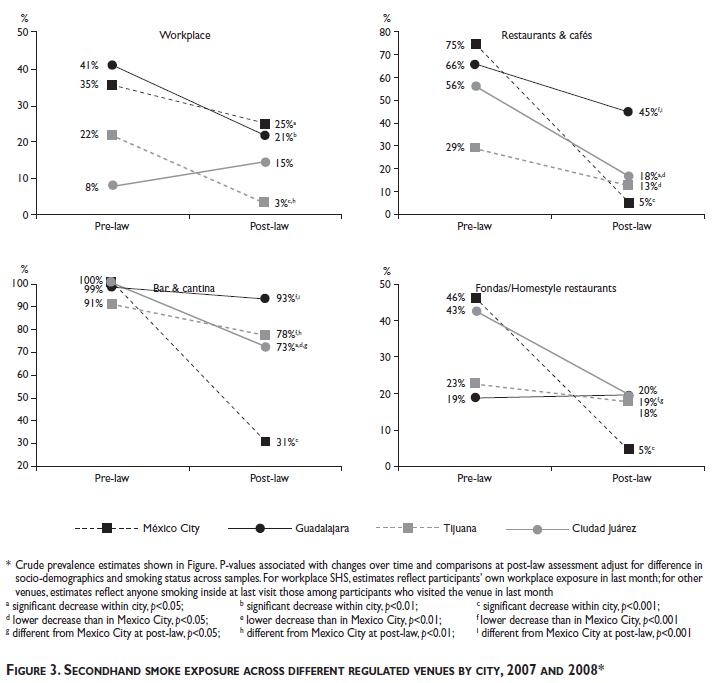
<body><![CDATA[<p><font face="Verdana" size="3"><b>Self-reported secondhand smoke exposure</b></font></p>     <p><font face="Verdana" size="2">The crude prevalence of self-reported SHS exposure    was also estimated (<a href="/img/revistas/spm/v52s2/a16img03.jpg">Figure    3</a>), with assessments of change over time and differences between cities    determined after adjustment for socio-demographics and smoking status. Prevalence    of self-reported smoking within private workplaces was assessed only among people    who reported working in enclosed workplaces. Self-reported SHS exposure inside    of enclosed workplaces in the previous month decreased significantly in Mexico    City, Guadalajara, and Tijuana, but not in Ciudad Ju&aacute;rez. Only Tijuana    had a significantly different prevalence of self-reported workplace SHS exposure    at follow-up when compared to Mexico City (3% vs. 25%, respectively). Self-reported    SHS exposure at the last visit to restaurants and caf&eacute;s, as well as in    bars and cantinas, decreased at a faster rate in Mexico City (i.e., 75% to 5%    and 100% to 31%, respectively) than in the other cities. The post-law prevalence    of self-reported SHS in bars and cantinas was significantly lower in Mexico    City than in all three other cities; however, the post-law prevalence in restaurants    and caf&eacute;s was lower in Mexico City (5%) than in Guadalajara (45%), but    not Tijuana or Ju&aacute;rez. Mexico City was the only city to experience statistically    significant declines in self-reported SHS exposure in fondas during the study    period (46% to 5%).</font></p>     <p>&nbsp;</p>     <p><font face="Verdana" size="3"><b>Discussion</b></font></p>     <p><font face="Verdana" size="2">Our results are generally consistent with other    studies that indicate support for smoke-free policies increases after smoke-free    laws are implemented,7-11 even among smokers.7-13 In our study, support for    smoke-free laws increased over the study period, although support for smoke-free    restaurants, caf&eacute;s, bars and cantinas, increased at a faster rate in    Mexico City than in other cities. This may be partly because Mexico City implemented    a 100% smoking ban in all indoor workplaces and public places, whereas other    cities were subject to the more ambiguous federal smoke-free law. Although federal    and state authorities tried to communicate to the public that smoking was banned    in all the same venues until regulations were developed to define designated    smoking areas, this ambiguity appears to have invited some laxity in implementation    of this temporary measure. Significant decreases in self-reported SHS exposure    within these same venues were greater in Mexico City than in other cities, as    well. These results lend support to the contention that the 100% smoke-free    law in Mexico City was accompanied by changes in attitudes and reductions in    self-reported SHS exposure that were above and beyond what would have happened    if Mexico City was subject to federal law.21 Furthermore, study results indicated    significant increases and higher overall exposure to smoke-free mass media campaigns    through all channels in Mexico City, which suggests that media campaigns there    helped shift social norms in favor of smoke-free environments.22,29,<a href="#tx3">*</a><a name="nt03"></a>    Increases in the prevalence of exposure to SHS campaigns through radio and television    were also found for Guadalajara, suggesting that the federal campaign primarily    reached that market but not Tijuana or Ju&aacute;rez. </font></p>     <p><font face="Verdana" size="2"> The federal smoke-free law, particularly in    Guadalajara and Tijuana, was accompanied by important decreases in self-reported    SHS and increases in support for smoke-free policies. These findings are noteworthy    because the entry into force of the federal law appears to have influenced attitudes    and behaviors in these cities, in spite of any confusion about the status of    the law before smoke-free regulations were published. Some of the changes found    in Guadalajara may be due to higher exposure to radio and television smoke-free    campaigns, which were aired to support the federal law. Nevertheless, self-reported    SHS exposure in bars and cantinas were still high (73% in Ju&aacute;rez to 93%    in Guadalajara). Non-compliance was also highest in these venues for Mexico    City (31%), for which other surveys provide estimates from smokers and nonsmokers    that are consistent with these.21 Also, the prevalence of self-reported SHS    exposure within workplaces was generally similar across all cities (15% to 30%)    except Tijuana (3%). Furthermore, self-reported workplace SHS exposure decreased    dramatically in Guadalajara and Tijuana while remaining stable in Mexico City.    To improve compliance, media campaigns and governmental efforts may require    publicizing the punishment of all types of non-compliant workplaces, including    those that are not within the hospitality sector. Such efforts are likely to    benefit from the momentum of growing support for smoke-free policies across    all segments of the Mexican population.</font></p>     <p><font face="Verdana" size="2"> Study results for the US border town of Tijuana    confirm previous studies suggesting the influence of tourism and associated    secular influences from California,36 which has prohibited smoking in restaurants    and bars for over a decade. Indeed, our data from before the federal law took    effect indicate that support for smoke-free restaurants and caf&eacute;s was    substantially higher in Tijuana than in other Mexican cities (74% vs 45%-52%)    and that self-reported SHS exposure in these venues was much lower (29% vs 56%    to 75%). On the other hand, smoke-free El Paso, Texas,37 does not appear to    have influenced Ciudad Ju&aacute;rez as much.</font></p>     <p><font face="Verdana" size="2"> This study has some limitations that should    temper our conclusions. The study samples were not entirely equivalent either    across cities or within cities over time. However, our analyses involved statistical    controls for measured differences; because most of our analytic sample comprised    data from re-interviewed individuals, our analyses included some additional    controls for unmeasured variables. Nevertheless, cities showed differential    attrition rates, which may have influenced results even though those lost to    follow up were generally not significantly different form those who were followed    up. Our use of a replenishment sample may not have sufficiently addressed any    issues introduced by attrition or its differential influence across cities.    Furthermore, those who participated may have differed in important ways from    those who did not participate. Although participants may have been more favorable    to tobacco control policy than the general population, we did not collect data    from nonparticipants and cannot determine the directionality of selection bias.    Our results, however, are consistent with other survey research conducted in    Mexico City,21 and sample characteristics are consistent with those from the    2008 administration of the Encuesta Nacional de Ingreso y Gasto de los Hogares,    suggesting the external validity of the results. Finally, post-test analysis    occurred shortly after the smoke-free policies took effect but prior to the    publication of the federal smoke-free regulations; hence, some of the changes    found in Guadalajara, Tijuana and Ciudad Ju&aacute;rez may be due to secular    trends that were under way before the federal law was passed. Further research    is necessary to understand the impact of these regulations, which allow for    smoking in designated areas. </font></p>     <p><font face="Verdana" size="2"> Overall, this study provides evidence that smoke-free    policies can work in middle-income countries. Comprehensive smoke-free policies    that prohibit smoking in all enclosed workplaces, including restaurants and    bars, appear acceptable to smokers, whose acceptance may be bolstered by media    campaigns that remind them of the benefits of these laws for others. Indeed,    comprehensive smoke-free policies not only appear to do a better job of decreasing    toxic SHS exposure, but they also appear to be accompanied by greater increases    in support and normative shifts that provide the foundation for other tobacco    control policies which, over the long term, decrease tobacco consumption and    tobacco-related disease.38</font></p>     <p>&nbsp;</p>     ]]></body>
<body><![CDATA[<p><font face="Verdana" size="3"><b>Declaration of conflicts of interest</b></font></p>     <p><font face="Verdana" size="2">We declare that we have no    conflicts of interest.</font></p>     <p>&nbsp;</p>     <p><font face="Verdana" size="3"><b>Acknowledgements</b></font></p>     <p><font face="Verdana" size="2">Funding for data collection    on this study came from Consejo Nacional de Ciencia y Tecnolog&iacute;a (CONACyT Convocatoria    Salud-2007-C01-70032), as well as a project funded by the Union Against Tuberculosis    and Lung Disease (Mexico 1-06). Analysis and writing of the article was also    funded by CONACyT and the National Cancer Institute (P01 CA138389), with additional    funding provided by an unrestricted grant from Johnson &amp; Johnson. Dr Ernesto    Sebri&eacute; was supported by the Flight Attendant Medical Research Institute (FAMRI).    </font></p>     <p>&nbsp;</p>     <p><font face="Verdana" size="3"><b>References</b></font></p>     <!-- ref --><p><font face="Verdana" size="2">01. WHO. Framework Convention on Tobacco Control.    Geneva, Switzerland: World Health Organization, Tobacco Free Initiative, 2003.    &nbsp;&nbsp;&nbsp;&nbsp;&nbsp;&nbsp;&nbsp;&nbsp;[&#160;<a href="javascript:void(0);" onclick="javascript: window.open('/scielo.php?script=sci_nlinks&ref=9313193&pid=S0036-3634201000080002000001&lng=','','width=640,height=500,resizable=yes,scrollbars=1,menubar=yes,');">Links</a>&#160;]<!-- end-ref --></font></p>     <!-- ref --><p><font face="Verdana" size="2">02. Brownson RC, Hopkins DP, Wakefield M. Effects    of smoking restrictions in the workplace. Annu Rev Public Health 2002;23:333-348.    &nbsp;&nbsp;&nbsp;&nbsp;&nbsp;&nbsp;&nbsp;&nbsp;[&#160;<a href="javascript:void(0);" onclick="javascript: window.open('/scielo.php?script=sci_nlinks&ref=9313195&pid=S0036-3634201000080002000002&lng=','','width=640,height=500,resizable=yes,scrollbars=1,menubar=yes,');">Links</a>&#160;]<!-- end-ref --></font></p>     <!-- ref --><p><font face="Verdana" size="2">03. Fichtenberg CM, Glantz SA. Effect of smoke-free    policies on smoking behavior: A systematic review. BMJ 2002;325(7357):188.    &nbsp;&nbsp;&nbsp;&nbsp;&nbsp;&nbsp;&nbsp;&nbsp;[&#160;<a href="javascript:void(0);" onclick="javascript: window.open('/scielo.php?script=sci_nlinks&ref=9313197&pid=S0036-3634201000080002000003&lng=','','width=640,height=500,resizable=yes,scrollbars=1,menubar=yes,');">Links</a>&#160;]<!-- end-ref --></font></p>     <!-- ref --><p><font face="Verdana" size="2">04. Wasserman J, Manning WG, Newhouse JP, Winkler    JD. The effects of excise taxes and regulations on cigarette smoking. J Health    Econ 1991;10(1):43-64.    &nbsp;&nbsp;&nbsp;&nbsp;&nbsp;&nbsp;&nbsp;&nbsp;[&#160;<a href="javascript:void(0);" onclick="javascript: window.open('/scielo.php?script=sci_nlinks&ref=9313199&pid=S0036-3634201000080002000004&lng=','','width=640,height=500,resizable=yes,scrollbars=1,menubar=yes,');">Links</a>&#160;]<!-- end-ref --></font></p>     <!-- ref --><p><font face="Verdana" size="2">05. Jacobson PD, Zapawa LM. Clean indoor air    restrictions. In: Rabin RL, Sugarman SD, eds. Regulating tobacco. New York:    Oxford University Press, 2001;207-244.    &nbsp;&nbsp;&nbsp;&nbsp;&nbsp;&nbsp;&nbsp;&nbsp;[&#160;<a href="javascript:void(0);" onclick="javascript: window.open('/scielo.php?script=sci_nlinks&ref=9313201&pid=S0036-3634201000080002000005&lng=','','width=640,height=500,resizable=yes,scrollbars=1,menubar=yes,');">Links</a>&#160;]<!-- end-ref --></font></p>     <!-- ref --><p><font face="Verdana" size="2">06. Hamilton WL, Biener L, Brennan RT. Do local    tobacco regulations influence perceived smoking norms? Evidence from adult and    youth surveys in Massachusetts. Health Educ Res 2008;23(4):709-22.    &nbsp;&nbsp;&nbsp;&nbsp;&nbsp;&nbsp;&nbsp;&nbsp;[&#160;<a href="javascript:void(0);" onclick="javascript: window.open('/scielo.php?script=sci_nlinks&ref=9313203&pid=S0036-3634201000080002000006&lng=','','width=640,height=500,resizable=yes,scrollbars=1,menubar=yes,');">Links</a>&#160;]<!-- end-ref --></font></p>     <!-- ref --><p><font face="Verdana" size="2">07. Edwards R, Thomson G, Wilson N, Waa A, Bullen    C, O'Dea D, et al. After the smoke has cleared: Evaluation of the impact of    a new national smoke-free law in New Zealand. Tob Control 2008;17(1):1-10.    &nbsp;&nbsp;&nbsp;&nbsp;&nbsp;&nbsp;&nbsp;&nbsp;[&#160;<a href="javascript:void(0);" onclick="javascript: window.open('/scielo.php?script=sci_nlinks&ref=9313205&pid=S0036-3634201000080002000007&lng=','','width=640,height=500,resizable=yes,scrollbars=1,menubar=yes,');">Links</a>&#160;]<!-- end-ref --></font></p>     <!-- ref --><p><font face="Verdana" size="2">08. Gorini G, Chellini E, Galeone D. What happened    in Italy? A brief summary of studies conducted in Italy to evaluate the impact    of the smoking ban. Annals of Oncology 2007;18(10):1620-1622.    &nbsp;&nbsp;&nbsp;&nbsp;&nbsp;&nbsp;&nbsp;&nbsp;[&#160;<a href="javascript:void(0);" onclick="javascript: window.open('/scielo.php?script=sci_nlinks&ref=9313207&pid=S0036-3634201000080002000008&lng=','','width=640,height=500,resizable=yes,scrollbars=1,menubar=yes,');">Links</a>&#160;]<!-- end-ref --></font></p>     <!-- ref --><p><font face="Verdana" size="2">09. Tang H, Cowling D, Lloyd J, Rogers T, Koumjian    K, Stevens C, et al. Changes of attitudes and patronage behaviors in response    to a smoke-free law. Am J Public Health 2003;93:611-617.    &nbsp;&nbsp;&nbsp;&nbsp;&nbsp;&nbsp;&nbsp;&nbsp;[&#160;<a href="javascript:void(0);" onclick="javascript: window.open('/scielo.php?script=sci_nlinks&ref=9313209&pid=S0036-3634201000080002000009&lng=','','width=640,height=500,resizable=yes,scrollbars=1,menubar=yes,');">Links</a>&#160;]<!-- end-ref --></font></p>     <!-- ref --><p><font face="Verdana" size="2">10. Friss RH, Safer AM. Analysis of responses    of Long Beach, California residents to the smoke-free bars law. Public Health    2005;119:1116-1121.    &nbsp;&nbsp;&nbsp;&nbsp;&nbsp;&nbsp;&nbsp;&nbsp;[&#160;<a href="javascript:void(0);" onclick="javascript: window.open('/scielo.php?script=sci_nlinks&ref=9313211&pid=S0036-3634201000080002000010&lng=','','width=640,height=500,resizable=yes,scrollbars=1,menubar=yes,');">Links</a>&#160;]<!-- end-ref --></font></p>     <!-- ref --><p><font face="Verdana" size="2">11. Rayens M, Hahn E, Langley R, Hedgecock S,    Butler K, Greathouse-Maggio L. Public opinion and smoke-free laws. Policy Polit    Nurs Pract 2007;8(4):262-270.    &nbsp;&nbsp;&nbsp;&nbsp;&nbsp;&nbsp;&nbsp;&nbsp;[&#160;<a href="javascript:void(0);" onclick="javascript: window.open('/scielo.php?script=sci_nlinks&ref=9313213&pid=S0036-3634201000080002000011&lng=','','width=640,height=500,resizable=yes,scrollbars=1,menubar=yes,');">Links</a>&#160;]<!-- end-ref --></font></p>     <!-- ref --><p><font face="Verdana" size="2">12. Fong GT, Hyland A, Borland R, Hammond D,    Hastings G, McNeil AD, et al. Reductions in tobacco smoke pollution and increases    in support for smoke-free public places following the implementation of comprehensive    smoke-free workplace legislation in the Republic of Ireland: Findings from the    ITC Ireland/UK survey. Tob Control 2006;15(Sup 3):iii51-iii58.    &nbsp;&nbsp;&nbsp;&nbsp;&nbsp;&nbsp;&nbsp;&nbsp;[&#160;<a href="javascript:void(0);" onclick="javascript: window.open('/scielo.php?script=sci_nlinks&ref=9313215&pid=S0036-3634201000080002000012&lng=','','width=640,height=500,resizable=yes,scrollbars=1,menubar=yes,');">Links</a>&#160;]<!-- end-ref --></font></p>     <!-- ref --><p><font face="Verdana" size="2">13. Hyland A, Higbee C, Borland R, Travers M,    Hastings G, Fong GT, et al. Attitudes and beliefs about secondhand smoke and    smoke-free policies in four countries: Findings from the International Tob Control    Four Country Survey. Nicotine Tob Res 2009;11(6):642-649.    &nbsp;&nbsp;&nbsp;&nbsp;&nbsp;&nbsp;&nbsp;&nbsp;[&#160;<a href="javascript:void(0);" onclick="javascript: window.open('/scielo.php?script=sci_nlinks&ref=9313217&pid=S0036-3634201000080002000013&lng=','','width=640,height=500,resizable=yes,scrollbars=1,menubar=yes,');">Links</a>&#160;]<!-- end-ref --></font></p>     <!-- ref --><p><font face="Verdana" size="2">14. Biener L, Garrett C, Skeer M, Siegel M, Connolly    G. The effects on smokers of Boston's smoke-free bar ordinance: A longitudinal    analysis of changes in compliance, patronage, policy support and smoking at    home. </font><font face="Verdana" size="2">J Public Health Manag Pract    2007;13(6):630-636.    &nbsp;&nbsp;&nbsp;&nbsp;&nbsp;&nbsp;&nbsp;&nbsp;[&#160;<a href="javascript:void(0);" onclick="javascript: window.open('/scielo.php?script=sci_nlinks&ref=9313219&pid=S0036-3634201000080002000014&lng=','','width=640,height=500,resizable=yes,scrollbars=1,menubar=yes,');">Links</a>&#160;]<!-- end-ref --></font></p>     <!-- ref --><p><font face="Verdana" size="2">15. Sebri&eacute; EM, Schoj V, Glantz SA. Smoke    free environments in Latin America: On the road to real change? Prev Control    2008;3:21-35.    &nbsp;&nbsp;&nbsp;&nbsp;&nbsp;&nbsp;&nbsp;&nbsp;[&#160;<a href="javascript:void(0);" onclick="javascript: window.open('/scielo.php?script=sci_nlinks&ref=9313221&pid=S0036-3634201000080002000015&lng=','','width=640,height=500,resizable=yes,scrollbars=1,menubar=yes,');">Links</a>&#160;]<!-- end-ref --></font></p>     <!-- ref --><p><font face="Verdana" size="2">16. Thrasher JF, Chaloupka F, Hammond D, Fong    GT, Borland R, Hastings G, et al. Evaluaci&oacute;n de las pol&iacute;ticas    contra el tabaquismo en pa&iacute;ses latinoamericanos en la era del Convenio    Marco para el Control del Tabaco Evaluation of tobacco control policies in    Latin American countries during the era of the Framework Convention on Tobacco    Control. Salud Publica Mex 2006;48(Supp 1):S155-S166.    &nbsp;&nbsp;&nbsp;&nbsp;&nbsp;&nbsp;&nbsp;&nbsp;[&#160;<a href="javascript:void(0);" onclick="javascript: window.open('/scielo.php?script=sci_nlinks&ref=9313223&pid=S0036-3634201000080002000016&lng=','','width=640,height=500,resizable=yes,scrollbars=1,menubar=yes,');">Links</a>&#160;]<!-- end-ref --></font></p>     <!-- ref --><p><font face="Verdana" size="2">17. Thrasher JF, Boado M, Sebri&eacute; EM, Bianco    E. Smoke-free policies and the social acceptability of smoking in Uruguay and    Mexico: Findings from the International Tobacco Control Policy Evaluation (ITC)    Project. Nicotine Tob Res 2009;11:591-599.    &nbsp;&nbsp;&nbsp;&nbsp;&nbsp;&nbsp;&nbsp;&nbsp;[&#160;<a href="javascript:void(0);" onclick="javascript: window.open('/scielo.php?script=sci_nlinks&ref=9313225&pid=S0036-3634201000080002000017&lng=','','width=640,height=500,resizable=yes,scrollbars=1,menubar=yes,');">Links</a>&#160;]<!-- end-ref --></font></p>     <!-- ref --><p><font face="Verdana" size="2">18. Thrasher JF, Besley JC, Gonz&aacute;lez W.    Perceived justice and popular support for public health laws: A case study around    comprehensive smoke-free legislation in Mexico City. Soc Sci Med 2010;70:787-793.    &nbsp;&nbsp;&nbsp;&nbsp;&nbsp;&nbsp;&nbsp;&nbsp;[&#160;<a href="javascript:void(0);" onclick="javascript: window.open('/scielo.php?script=sci_nlinks&ref=9313227&pid=S0036-3634201000080002000018&lng=','','width=640,height=500,resizable=yes,scrollbars=1,menubar=yes,');">Links</a>&#160;]<!-- end-ref --></font></p>     <!-- ref --><p><font face="Verdana" size="2">19. Abundis F. La Ley General de Control del    Tabaco y la opini&oacute;n p&uacute;blica The General Law of Tobacco Control    and public opinion. Salud Publica Mex 2008;50(Supp 3):S366-S371.    &nbsp;&nbsp;&nbsp;&nbsp;&nbsp;&nbsp;&nbsp;&nbsp;[&#160;<a href="javascript:void(0);" onclick="javascript: window.open('/scielo.php?script=sci_nlinks&ref=9313229&pid=S0036-3634201000080002000019&lng=','','width=640,height=500,resizable=yes,scrollbars=1,menubar=yes,');">Links</a>&#160;]<!-- end-ref --></font></p>     <!-- ref --><p><font face="Verdana" size="2">20. Thrasher JF, Bentley ME. The meanings and    context of smoking among Mexican university students. Public Health Rep 2006;121(5):578-585.    &nbsp;&nbsp;&nbsp;&nbsp;&nbsp;&nbsp;&nbsp;&nbsp;[&#160;<a href="javascript:void(0);" onclick="javascript: window.open('/scielo.php?script=sci_nlinks&ref=9313231&pid=S0036-3634201000080002000020&lng=','','width=640,height=500,resizable=yes,scrollbars=1,menubar=yes,');">Links</a>&#160;]<!-- end-ref --></font></p>     <!-- ref --><p><font face="Verdana" size="2">21. Thrasher JF, P&eacute;rez-Hern&aacute;ndez    R, Swayampakala et al. Translating the World Health OrganizationÂ´s Framework    Convention on Tobacco Control: Policy support, norms, and secondhand smoke exposure    before and after implementation of a comprehensive smoke-free policy in Mexico    City. Am J Public Health. Epub 2010 May 13.    &nbsp;&nbsp;&nbsp;&nbsp;&nbsp;&nbsp;&nbsp;&nbsp;[&#160;<a href="javascript:void(0);" onclick="javascript: window.open('/scielo.php?script=sci_nlinks&ref=9313233&pid=S0036-3634201000080002000021&lng=','','width=640,height=500,resizable=yes,scrollbars=1,menubar=yes,');">Links</a>&#160;]<!-- end-ref --></font></p>     <!-- ref --><p><font face="Verdana" size="2">22. Villalobos V, Ortiz-Ramirez O, Thrasher JF,    et al. Mercadotecnia social para promover pol&iacute;ticas p&uacute;blicas de    salud: El desarrollo de una campa&ntilde;a para promover la norma social de    no fumar en restaurantes y bares del Distrito Federal, M&eacute;xico. Salud    Publica Mex 2010;52(suppl 2):S127-S135.    &nbsp;&nbsp;&nbsp;&nbsp;&nbsp;&nbsp;&nbsp;&nbsp;[&#160;<a href="javascript:void(0);" onclick="javascript: window.open('/scielo.php?script=sci_nlinks&ref=9313235&pid=S0036-3634201000080002000022&lng=','','width=640,height=500,resizable=yes,scrollbars=1,menubar=yes,');">Links</a>&#160;]<!-- end-ref --></font></p>     <!-- ref --><p><font face="Verdana" size="2">23. Skeer M, Land ML, Cheng DM, Siegel MB. Smoking    in Boston bars before and after a 100% smoke-free regulation: An assessment    of early compliance. J Public Health Manag Pract 2004;10(6):501-507.    &nbsp;&nbsp;&nbsp;&nbsp;&nbsp;&nbsp;&nbsp;&nbsp;[&#160;<a href="javascript:void(0);" onclick="javascript: window.open('/scielo.php?script=sci_nlinks&ref=9313237&pid=S0036-3634201000080002000023&lng=','','width=640,height=500,resizable=yes,scrollbars=1,menubar=yes,');">Links</a>&#160;]<!-- end-ref --></font></p>     <!-- ref --><p><font face="Verdana" size="2">24. Haw SJ, Gruer L. Changes in exposure of adult    non-smokers to secondhand smoke after implementation of smoke-free legislation    in Scotland: National cross-sectional survey. BMJ 2007;335(335):549-552.    &nbsp;&nbsp;&nbsp;&nbsp;&nbsp;&nbsp;&nbsp;&nbsp;[&#160;<a href="javascript:void(0);" onclick="javascript: window.open('/scielo.php?script=sci_nlinks&ref=9313239&pid=S0036-3634201000080002000024&lng=','','width=640,height=500,resizable=yes,scrollbars=1,menubar=yes,');">Links</a>&#160;]<!-- end-ref --></font></p>     <!-- ref --><p><font face="Verdana" size="2">25. Akhtar P, Currie D, Currie C, Haw S. Changes    in child exposure to environmental tobacco smoke (CHETS) study after implementation    of smoke-free legislation in Scotland: National cross-sectional survey. BMJ    2007;335:545.    &nbsp;&nbsp;&nbsp;&nbsp;&nbsp;&nbsp;&nbsp;&nbsp;[&#160;<a href="javascript:void(0);" onclick="javascript: window.open('/scielo.php?script=sci_nlinks&ref=9313241&pid=S0036-3634201000080002000025&lng=','','width=640,height=500,resizable=yes,scrollbars=1,menubar=yes,');">Links</a>&#160;]<!-- end-ref --></font></p>     <!-- ref --><p><font face="Verdana" size="2">26. Thrasher JF, Reynales-Shigematsu L, Baezconde-Garbanati    L, Villalobos V, T&eacute;llez-Gir&oacute;n P, Arillo-Santill&aacute;n E, et    al. Promoting the effective translation of the Framework Convention on Tobacco    Control: A case study of challenges and opportunities for strategic communications    in Mexico. Eval Health Prof 2008;31(2):145-166.    &nbsp;&nbsp;&nbsp;&nbsp;&nbsp;&nbsp;&nbsp;&nbsp;[&#160;<a href="javascript:void(0);" onclick="javascript: window.open('/scielo.php?script=sci_nlinks&ref=9313243&pid=S0036-3634201000080002000026&lng=','','width=640,height=500,resizable=yes,scrollbars=1,menubar=yes,');">Links</a>&#160;]<!-- end-ref --></font></p>     <!-- ref --><p><font face="Verdana" size="2">27. Sussman S, Pokhrel P, Black D, Kohrman M,    Hamann S, Vateesatokit P, et al. Tobacco control in developing countries: Tanzania,    Nepal, China, and Thailand as examples. Nicotine Tob Res 2007;9(3):S447-S457.    &nbsp;&nbsp;&nbsp;&nbsp;&nbsp;&nbsp;&nbsp;&nbsp;[&#160;<a href="javascript:void(0);" onclick="javascript: window.open('/scielo.php?script=sci_nlinks&ref=9313245&pid=S0036-3634201000080002000027&lng=','','width=640,height=500,resizable=yes,scrollbars=1,menubar=yes,');">Links</a>&#160;]<!-- end-ref --></font></p>     <!-- ref --><p><font face="Verdana" size="2">28. Navas-Acien A, Vald&eacute;s-Salgado R. Niveles    de nicotina en el ambiente de lugares p&uacute;blicos y de trabajo del Distrito    Federal. In: Vald&eacute;s Salgado R, Lazcano-Ponce EC, Hern&aacute;ndez-Avila    M, eds. Primer informe sobre el combate al tabaquismo. Cuernavaca, Morelos:    Instituto Nacional de Salud P&uacute;blica, 2005;169-176.    &nbsp;&nbsp;&nbsp;&nbsp;&nbsp;&nbsp;&nbsp;&nbsp;[&#160;<a href="javascript:void(0);" onclick="javascript: window.open('/scielo.php?script=sci_nlinks&ref=9313247&pid=S0036-3634201000080002000028&lng=','','width=640,height=500,resizable=yes,scrollbars=1,menubar=yes,');">Links</a>&#160;]<!-- end-ref --></font></p>     <!-- ref --><p><font face="Verdana" size="2">29. Gonz&aacute;lez-Roldan JF. Abogac&iacute;a    para el control del tabaco en M&eacute;xico: Retos y recomendaciones. Salud    Publica Mex 2008;50(Supp 3):S391-S400.    &nbsp;&nbsp;&nbsp;&nbsp;&nbsp;&nbsp;&nbsp;&nbsp;[&#160;<a href="javascript:void(0);" onclick="javascript: window.open('/scielo.php?script=sci_nlinks&ref=9313249&pid=S0036-3634201000080002000029&lng=','','width=640,height=500,resizable=yes,scrollbars=1,menubar=yes,');">Links</a>&#160;]<!-- end-ref --></font></p>     <!-- ref --><p><font face="Verdana" size="2">30. Mondrag&oacute;n y Kalb M. Prohibici&oacute;n    de fumar en lugares p&uacute;blicos y mercantiles: Retos para implementar la    ley en el Distrito Federal. Salud Publica Mex 2008;50(Supp 3):S401-S404.    &nbsp;&nbsp;&nbsp;&nbsp;&nbsp;&nbsp;&nbsp;&nbsp;[&#160;<a href="javascript:void(0);" onclick="javascript: window.open('/scielo.php?script=sci_nlinks&ref=9313251&pid=S0036-3634201000080002000030&lng=','','width=640,height=500,resizable=yes,scrollbars=1,menubar=yes,');">Links</a>&#160;]<!-- end-ref --></font></p>     <!-- ref --><p><font face="Verdana" size="2">31. Guillermo-Tenorio X. Expacios 100% libres    de humo: una realidad del Distrito Federal. Salud Publica Mex 2008;50(Supp 3):S384-S390.    &nbsp;&nbsp;&nbsp;&nbsp;&nbsp;&nbsp;&nbsp;&nbsp;[&#160;<a href="javascript:void(0);" onclick="javascript: window.open('/scielo.php?script=sci_nlinks&ref=9313253&pid=S0036-3634201000080002000031&lng=','','width=640,height=500,resizable=yes,scrollbars=1,menubar=yes,');">Links</a>&#160;]<!-- end-ref --></font></p>     <!-- ref --><p><font face="Verdana" size="2">32. Llaguno-Aguilar SE, Dorantes-Alonso AC, Thrasher    JF, Villalobos V, Besley JC. An&aacute;lisis de la cobertura del tema de tabaco    en medios impresos mexicanos Analysis of the coverage of tobacco in Mexican    print media. Salud Publica Mex 2008;50(Supp 3):S348-S354.    &nbsp;&nbsp;&nbsp;&nbsp;&nbsp;&nbsp;&nbsp;&nbsp;[&#160;<a href="javascript:void(0);" onclick="javascript: window.open('/scielo.php?script=sci_nlinks&ref=9313255&pid=S0036-3634201000080002000032&lng=','','width=640,height=500,resizable=yes,scrollbars=1,menubar=yes,');">Links</a>&#160;]<!-- end-ref --></font></p>     <!-- ref --><p><font face="Verdana" size="2">33. Fong GT, Cummings KM, Borland R, Hastings    G, Hyland A, Giovino GA, et al. The conceptual framework of the International    Tobacco Control Policy Evaluation Project. Tob Control 2006;15(Supp 3):iii3-iii11.    &nbsp;&nbsp;&nbsp;&nbsp;&nbsp;&nbsp;&nbsp;&nbsp;[&#160;<a href="javascript:void(0);" onclick="javascript: window.open('/scielo.php?script=sci_nlinks&ref=9313257&pid=S0036-3634201000080002000033&lng=','','width=640,height=500,resizable=yes,scrollbars=1,menubar=yes,');">Links</a>&#160;]<!-- end-ref --></font></p>     <!-- ref --><p><font face="Verdana" size="2">34. Korn EL, Graubard BI. Analysis of health    surveys. New York: Wiley-Interscience, 1999.    &nbsp;&nbsp;&nbsp;&nbsp;&nbsp;&nbsp;&nbsp;&nbsp;[&#160;<a href="javascript:void(0);" onclick="javascript: window.open('/scielo.php?script=sci_nlinks&ref=9313259&pid=S0036-3634201000080002000034&lng=','','width=640,height=500,resizable=yes,scrollbars=1,menubar=yes,');">Links</a>&#160;]<!-- end-ref --></font></p>     <!-- ref --><p><font face="Verdana" size="2">35. IARC. IARC Handbooks of Cancer Prevention:    Tobacco Control. Volume 12. Methods for Evaluating Tobacco Control Policies.    Lyon, France: International Agency for Research on Cancer, 2009.    &nbsp;&nbsp;&nbsp;&nbsp;&nbsp;&nbsp;&nbsp;&nbsp;[&#160;<a href="javascript:void(0);" onclick="javascript: window.open('/scielo.php?script=sci_nlinks&ref=9313261&pid=S0036-3634201000080002000035&lng=','','width=640,height=500,resizable=yes,scrollbars=1,menubar=yes,');">Links</a>&#160;]<!-- end-ref --></font></p>     <!-- ref --><p><font face="Verdana" size="2">36. Mart&iacute;nez-Donate AP, Hovell MF, Hofstetter    CR, Gonz&aacute;lez-P&eacute;rez GJ, Kotay A, Adams MA. Crossing borders: the    impact of the California Tobacco Control Program on both sides of the US-Mexico    border. Am J Public Health 2008;98(2):258-267.    &nbsp;&nbsp;&nbsp;&nbsp;&nbsp;&nbsp;&nbsp;&nbsp;[&#160;<a href="javascript:void(0);" onclick="javascript: window.open('/scielo.php?script=sci_nlinks&ref=9313263&pid=S0036-3634201000080002000036&lng=','','width=640,height=500,resizable=yes,scrollbars=1,menubar=yes,');">Links</a>&#160;]<!-- end-ref --></font></p>     <!-- ref --><p><font face="Verdana" size="2">37. Reynolds JH, Hobart RL, Ayala P, Eischen    MH. Clean indoor air in El Paso, Texas: a case study. Prev Chronic Dis 2005;2(1):A22.    &nbsp;&nbsp;&nbsp;&nbsp;&nbsp;&nbsp;&nbsp;&nbsp;[&#160;<a href="javascript:void(0);" onclick="javascript: window.open('/scielo.php?script=sci_nlinks&ref=9313265&pid=S0036-3634201000080002000037&lng=','','width=640,height=500,resizable=yes,scrollbars=1,menubar=yes,');">Links</a>&#160;]<!-- end-ref --></font></p>     <!-- ref --><p><font face="Verdana" size="2">38. Alamar B, Glantz SA. Effect of increased    social unacceptability of cigarette smoking on reduction in cigarette consumption.    Am J Public Health 2006;96(8):1359-1363.    &nbsp;&nbsp;&nbsp;&nbsp;&nbsp;&nbsp;&nbsp;&nbsp;[&#160;<a href="javascript:void(0);" onclick="javascript: window.open('/scielo.php?script=sci_nlinks&ref=9313267&pid=S0036-3634201000080002000038&lng=','','width=640,height=500,resizable=yes,scrollbars=1,menubar=yes,');">Links</a>&#160;]<!-- end-ref --></font></p>     <p>&nbsp;</p>     <p>&nbsp;</p>     <p><font face="Verdana" size="2">Received on: February 5, 2010    <br>   Accepted on: May 14, 2010</font></p>     <p>&nbsp;</p>     <p><font face="Verdana" size="2">    <br>   Address reprint requests to: James F. Thrasher, PhD. Department of Health Promotion,    Education &amp; Behavior,    ]]></body>
<body><![CDATA[<br>   Arnold School of Public Health. 800 Sumter Street, Room 215 Columbia, SC 29208    USA.    <br>   E-mail: <a href="mailto:thrasher@mailbox.sc.edu">thrasher@mailbox.sc.edu</a></font></p>     <p>&nbsp;</p>     <p>&nbsp;</p>     <p><font face="Verdana" size="2"><a href="#nt01">*</a><a name="tx1"></a> Thrasher    JF, Huang L, P&eacute;rez-Hern&aacute;ndez R, et al. Porque todos respiramos    los mismo: Evaluation of a social marketing campaign to support Mexico City&acute;s    comprehensive smoke-free law. Am J Public Health. Forthcoming.    <br>   </font><font face="Verdana" size="2"><a href="#nt02">*</a><a name="tx2"></a>    Thrasher JF, Huang L, P&eacute;rez-Hern&aacute;ndez R, et al. Porque todos respiramos    los mismo: Evaluation of a social marketing campaign to support Mexico City&acute;s    comprehensive smoke-free law. Am J Public Health. Forthcoming.    <br>   </font><font face="Verdana" size="2"><a href="#nt03">*</a><a name="tx3"></a>    Thrasher JF, Huang L, P&eacute;rez-Hern&aacute;ndez R, et al. Porque todos respiramos    los mismo: Evaluation of a social marketing campaign to support Mexico City&acute;s    comprehensive smoke-free law. Am J Public Health. Forthcoming.</font></p>      ]]></body><back>
<ref-list>
<ref id="B1">
<label>1</label><nlm-citation citation-type="book">
<collab>WHO</collab>
<source><![CDATA[Framework Convention on Tobacco Control]]></source>
<year>2003</year>
<publisher-loc><![CDATA[Geneva ]]></publisher-loc>
<publisher-name><![CDATA[World Health Organization, Tobacco Free Initiative]]></publisher-name>
</nlm-citation>
</ref>
<ref id="B2">
<label>2</label><nlm-citation citation-type="journal">
<person-group person-group-type="author">
<name>
<surname><![CDATA[Brownson]]></surname>
<given-names><![CDATA[RC]]></given-names>
</name>
<name>
<surname><![CDATA[Hopkins]]></surname>
<given-names><![CDATA[DP]]></given-names>
</name>
<name>
<surname><![CDATA[Wakefield]]></surname>
<given-names><![CDATA[M]]></given-names>
</name>
</person-group>
<article-title xml:lang="en"><![CDATA[Effects of smoking restrictions in the workplace]]></article-title>
<source><![CDATA[Annu Rev Public Health]]></source>
<year>2002</year>
<volume>23</volume>
<page-range>333-348</page-range></nlm-citation>
</ref>
<ref id="B3">
<label>3</label><nlm-citation citation-type="journal">
<person-group person-group-type="author">
<name>
<surname><![CDATA[Fichtenberg]]></surname>
<given-names><![CDATA[CM]]></given-names>
</name>
<name>
<surname><![CDATA[Glantz]]></surname>
<given-names><![CDATA[SA]]></given-names>
</name>
</person-group>
<article-title xml:lang="en"><![CDATA[Effect of smoke-free policies on smoking behavior: A systematic review]]></article-title>
<source><![CDATA[BMJ]]></source>
<year>2002</year>
<volume>325</volume>
<numero>7357</numero>
<issue>7357</issue>
<page-range>188</page-range></nlm-citation>
</ref>
<ref id="B4">
<label>4</label><nlm-citation citation-type="journal">
<person-group person-group-type="author">
<name>
<surname><![CDATA[Wasserman]]></surname>
<given-names><![CDATA[J]]></given-names>
</name>
<name>
<surname><![CDATA[Manning]]></surname>
<given-names><![CDATA[WG]]></given-names>
</name>
<name>
<surname><![CDATA[Newhouse]]></surname>
<given-names><![CDATA[JP]]></given-names>
</name>
<name>
<surname><![CDATA[Winkler]]></surname>
<given-names><![CDATA[JD]]></given-names>
</name>
</person-group>
<article-title xml:lang="en"><![CDATA[The effects of excise taxes and regulations on cigarette smoking]]></article-title>
<source><![CDATA[J Health Econ]]></source>
<year>1991</year>
<volume>10</volume>
<numero>1</numero>
<issue>1</issue>
<page-range>43-64</page-range></nlm-citation>
</ref>
<ref id="B5">
<label>5</label><nlm-citation citation-type="book">
<person-group person-group-type="author">
<name>
<surname><![CDATA[Jacobson]]></surname>
<given-names><![CDATA[PD]]></given-names>
</name>
<name>
<surname><![CDATA[Zapawa]]></surname>
<given-names><![CDATA[LM]]></given-names>
</name>
</person-group>
<article-title xml:lang="en"><![CDATA[Clean indoor air restrictions]]></article-title>
<person-group person-group-type="editor">
<name>
<surname><![CDATA[Rabin]]></surname>
<given-names><![CDATA[RL]]></given-names>
</name>
<name>
<surname><![CDATA[Sugarman]]></surname>
<given-names><![CDATA[SD]]></given-names>
</name>
</person-group>
<source><![CDATA[Regulating tobacco]]></source>
<year>2001</year>
<page-range>207-244</page-range><publisher-loc><![CDATA[New York ]]></publisher-loc>
<publisher-name><![CDATA[Oxford University Press]]></publisher-name>
</nlm-citation>
</ref>
<ref id="B6">
<label>6</label><nlm-citation citation-type="journal">
<person-group person-group-type="author">
<name>
<surname><![CDATA[Hamilton]]></surname>
<given-names><![CDATA[WL]]></given-names>
</name>
<name>
<surname><![CDATA[Biener]]></surname>
<given-names><![CDATA[L]]></given-names>
</name>
<name>
<surname><![CDATA[Brennan]]></surname>
<given-names><![CDATA[RT]]></given-names>
</name>
</person-group>
<article-title xml:lang="en"><![CDATA[Do local tobacco regulations influence perceived smoking norms: Evidence from adult and youth surveys in Massachusetts]]></article-title>
<source><![CDATA[Health Educ Res]]></source>
<year>2008</year>
<volume>23</volume>
<numero>4</numero>
<issue>4</issue>
<page-range>709-22</page-range></nlm-citation>
</ref>
<ref id="B7">
<label>7</label><nlm-citation citation-type="journal">
<person-group person-group-type="author">
<name>
<surname><![CDATA[Edwards]]></surname>
<given-names><![CDATA[R]]></given-names>
</name>
<name>
<surname><![CDATA[Thomson]]></surname>
<given-names><![CDATA[G]]></given-names>
</name>
<name>
<surname><![CDATA[Wilson]]></surname>
<given-names><![CDATA[N]]></given-names>
</name>
<name>
<surname><![CDATA[Waa]]></surname>
<given-names><![CDATA[A]]></given-names>
</name>
<name>
<surname><![CDATA[Bullen]]></surname>
<given-names><![CDATA[C]]></given-names>
</name>
<name>
<surname><![CDATA[O'Dea]]></surname>
<given-names><![CDATA[D]]></given-names>
</name>
</person-group>
<article-title xml:lang="en"><![CDATA[After the smoke has cleared: Evaluation of the impact of a new national smoke-free law in New Zealand]]></article-title>
<source><![CDATA[Tob Control]]></source>
<year>2008</year>
<volume>17</volume>
<numero>1</numero>
<issue>1</issue>
<page-range>1-10</page-range></nlm-citation>
</ref>
<ref id="B8">
<label>8</label><nlm-citation citation-type="journal">
<person-group person-group-type="author">
<name>
<surname><![CDATA[Gorini]]></surname>
<given-names><![CDATA[G]]></given-names>
</name>
<name>
<surname><![CDATA[Chellini]]></surname>
<given-names><![CDATA[E]]></given-names>
</name>
<name>
<surname><![CDATA[Galeone]]></surname>
<given-names><![CDATA[D]]></given-names>
</name>
</person-group>
<article-title xml:lang="en"><![CDATA[What happened in Italy: A brief summary of studies conducted in Italy to evaluate the impact of the smoking ban]]></article-title>
<source><![CDATA[Annals of Oncology]]></source>
<year>2007</year>
<volume>18</volume>
<numero>10</numero>
<issue>10</issue>
<page-range>1620-1622</page-range></nlm-citation>
</ref>
<ref id="B9">
<label>9</label><nlm-citation citation-type="journal">
<person-group person-group-type="author">
<name>
<surname><![CDATA[Tang]]></surname>
<given-names><![CDATA[H]]></given-names>
</name>
<name>
<surname><![CDATA[Cowling]]></surname>
<given-names><![CDATA[D]]></given-names>
</name>
<name>
<surname><![CDATA[Lloyd]]></surname>
<given-names><![CDATA[J]]></given-names>
</name>
<name>
<surname><![CDATA[Rogers]]></surname>
<given-names><![CDATA[T]]></given-names>
</name>
<name>
<surname><![CDATA[Koumjian]]></surname>
<given-names><![CDATA[K]]></given-names>
</name>
<name>
<surname><![CDATA[Stevens]]></surname>
<given-names><![CDATA[C]]></given-names>
</name>
</person-group>
<article-title xml:lang="en"><![CDATA[Changes of attitudes and patronage behaviors in response to a smoke-free law]]></article-title>
<source><![CDATA[Am J Public Health]]></source>
<year>2003</year>
<volume>93</volume>
<page-range>611-617</page-range></nlm-citation>
</ref>
<ref id="B10">
<label>10</label><nlm-citation citation-type="journal">
<person-group person-group-type="author">
<name>
<surname><![CDATA[Friss]]></surname>
<given-names><![CDATA[RH]]></given-names>
</name>
<name>
<surname><![CDATA[Safer]]></surname>
<given-names><![CDATA[AM]]></given-names>
</name>
</person-group>
<article-title xml:lang="en"><![CDATA[Analysis of responses of Long Beach, California residents to the smoke-free bars law]]></article-title>
<source><![CDATA[Public Health]]></source>
<year>2005</year>
<volume>119</volume>
<page-range>1116-1121</page-range></nlm-citation>
</ref>
<ref id="B11">
<label>11</label><nlm-citation citation-type="journal">
<person-group person-group-type="author">
<name>
<surname><![CDATA[Rayens]]></surname>
<given-names><![CDATA[M]]></given-names>
</name>
<name>
<surname><![CDATA[Hahn]]></surname>
<given-names><![CDATA[E]]></given-names>
</name>
<name>
<surname><![CDATA[Langley]]></surname>
<given-names><![CDATA[R]]></given-names>
</name>
<name>
<surname><![CDATA[Hedgecock]]></surname>
<given-names><![CDATA[S]]></given-names>
</name>
<name>
<surname><![CDATA[Butler]]></surname>
<given-names><![CDATA[K]]></given-names>
</name>
<name>
<surname><![CDATA[Greathouse-Maggio]]></surname>
<given-names><![CDATA[L]]></given-names>
</name>
</person-group>
<article-title xml:lang="en"><![CDATA[Public opinion and smoke-free laws]]></article-title>
<source><![CDATA[Policy Polit Nurs Pract]]></source>
<year>2007</year>
<volume>8</volume>
<numero>4</numero>
<issue>4</issue>
<page-range>262-270</page-range></nlm-citation>
</ref>
<ref id="B12">
<label>12</label><nlm-citation citation-type="journal">
<person-group person-group-type="author">
<name>
<surname><![CDATA[Fong]]></surname>
<given-names><![CDATA[GT]]></given-names>
</name>
<name>
<surname><![CDATA[Hyland]]></surname>
<given-names><![CDATA[A]]></given-names>
</name>
<name>
<surname><![CDATA[Borland]]></surname>
<given-names><![CDATA[R]]></given-names>
</name>
<name>
<surname><![CDATA[Hammond]]></surname>
<given-names><![CDATA[D]]></given-names>
</name>
<name>
<surname><![CDATA[Hastings]]></surname>
<given-names><![CDATA[G]]></given-names>
</name>
<name>
<surname><![CDATA[McNeil]]></surname>
<given-names><![CDATA[AD]]></given-names>
</name>
</person-group>
<article-title xml:lang="en"><![CDATA[Reductions in tobacco smoke pollution and increases in support for smoke-free public places following the implementation of comprehensive smoke-free workplace legislation in the Republic of Ireland: Findings from the ITC Ireland/UK survey]]></article-title>
<source><![CDATA[Tob Control]]></source>
<year>2006</year>
<volume>15</volume>
<numero>^sSup 3</numero>
<issue>^sSup 3</issue>
<supplement>Sup 3</supplement>
<page-range>iii51-iii58</page-range></nlm-citation>
</ref>
<ref id="B13">
<label>13</label><nlm-citation citation-type="journal">
<person-group person-group-type="author">
<name>
<surname><![CDATA[Hyland]]></surname>
<given-names><![CDATA[A]]></given-names>
</name>
<name>
<surname><![CDATA[Higbee]]></surname>
<given-names><![CDATA[C]]></given-names>
</name>
<name>
<surname><![CDATA[Borland]]></surname>
<given-names><![CDATA[R]]></given-names>
</name>
<name>
<surname><![CDATA[Travers]]></surname>
<given-names><![CDATA[M]]></given-names>
</name>
<name>
<surname><![CDATA[Hastings]]></surname>
<given-names><![CDATA[G]]></given-names>
</name>
<name>
<surname><![CDATA[Fong]]></surname>
<given-names><![CDATA[GT]]></given-names>
</name>
</person-group>
<article-title xml:lang="en"><![CDATA[Attitudes and beliefs about secondhand smoke and smoke-free policies in four countries: Findings from the International Tob Control Four Country Survey]]></article-title>
<source><![CDATA[Nicotine Tob Res]]></source>
<year>2009</year>
<volume>11</volume>
<numero>6</numero>
<issue>6</issue>
<page-range>642-649</page-range></nlm-citation>
</ref>
<ref id="B14">
<label>14</label><nlm-citation citation-type="journal">
<person-group person-group-type="author">
<name>
<surname><![CDATA[Biener]]></surname>
<given-names><![CDATA[L]]></given-names>
</name>
<name>
<surname><![CDATA[Garrett]]></surname>
<given-names><![CDATA[C]]></given-names>
</name>
<name>
<surname><![CDATA[Skeer]]></surname>
<given-names><![CDATA[M]]></given-names>
</name>
<name>
<surname><![CDATA[Siegel]]></surname>
<given-names><![CDATA[M]]></given-names>
</name>
<name>
<surname><![CDATA[Connolly]]></surname>
<given-names><![CDATA[G]]></given-names>
</name>
</person-group>
<article-title xml:lang="en"><![CDATA[The effects on smokers of Boston's smoke-free bar ordinance: A longitudinal analysis of changes in compliance, patronage, policy support and smoking at home.]]></article-title>
<source><![CDATA[J Public Health Manag Pract]]></source>
<year>2007</year>
<volume>13</volume>
<numero>6</numero>
<issue>6</issue>
<page-range>630-636</page-range></nlm-citation>
</ref>
<ref id="B15">
<label>15</label><nlm-citation citation-type="journal">
<person-group person-group-type="author">
<name>
<surname><![CDATA[Sebrié]]></surname>
<given-names><![CDATA[EM]]></given-names>
</name>
<name>
<surname><![CDATA[Schoj]]></surname>
<given-names><![CDATA[V]]></given-names>
</name>
<name>
<surname><![CDATA[Glantz]]></surname>
<given-names><![CDATA[SA]]></given-names>
</name>
</person-group>
<article-title xml:lang="en"><![CDATA[Smoke free environments in Latin America: On the road to real change?]]></article-title>
<source><![CDATA[Prev Control]]></source>
<year>2008</year>
<volume>3</volume>
<page-range>21-35</page-range></nlm-citation>
</ref>
<ref id="B16">
<label>16</label><nlm-citation citation-type="journal">
<person-group person-group-type="author">
<name>
<surname><![CDATA[Thrasher]]></surname>
<given-names><![CDATA[JF]]></given-names>
</name>
<name>
<surname><![CDATA[Chaloupka]]></surname>
<given-names><![CDATA[F]]></given-names>
</name>
<name>
<surname><![CDATA[Hammond]]></surname>
<given-names><![CDATA[D]]></given-names>
</name>
<name>
<surname><![CDATA[Fong]]></surname>
<given-names><![CDATA[GT]]></given-names>
</name>
<name>
<surname><![CDATA[Borland]]></surname>
<given-names><![CDATA[R]]></given-names>
</name>
<name>
<surname><![CDATA[Hastings]]></surname>
<given-names><![CDATA[G]]></given-names>
</name>
</person-group>
<article-title xml:lang="es"><![CDATA[Evaluación de las políticas contra el tabaquismo en países latinoamericanos en la era del Convenio Marco para el Control del Tabaco [Evaluation of tobacco control policies in Latin American countries during the era of the Framework Convention on Tobacco Control]]]></article-title>
<source><![CDATA[Salud Publica Mex]]></source>
<year>2006</year>
<volume>48</volume>
<numero>^sSupp 1</numero>
<issue>^sSupp 1</issue>
<supplement>Supp 1</supplement>
<page-range>S155-S166</page-range></nlm-citation>
</ref>
<ref id="B17">
<label>17</label><nlm-citation citation-type="journal">
<person-group person-group-type="author">
<name>
<surname><![CDATA[Thrasher]]></surname>
<given-names><![CDATA[JF]]></given-names>
</name>
<name>
<surname><![CDATA[Boado]]></surname>
<given-names><![CDATA[M]]></given-names>
</name>
<name>
<surname><![CDATA[Sebrié]]></surname>
<given-names><![CDATA[EM]]></given-names>
</name>
<name>
<surname><![CDATA[Bianco]]></surname>
<given-names><![CDATA[E]]></given-names>
</name>
</person-group>
<article-title xml:lang="en"><![CDATA[Smoke-free policies and the social acceptability of smoking in Uruguay and Mexico: Findings from the International Tobacco Control Policy Evaluation (ITC) Project]]></article-title>
<source><![CDATA[Nicotine Tob Res]]></source>
<year>2009</year>
<volume>11</volume>
<page-range>591-599</page-range></nlm-citation>
</ref>
<ref id="B18">
<label>18</label><nlm-citation citation-type="journal">
<person-group person-group-type="author">
<name>
<surname><![CDATA[Thrasher]]></surname>
<given-names><![CDATA[JF]]></given-names>
</name>
<name>
<surname><![CDATA[Besley]]></surname>
<given-names><![CDATA[JC]]></given-names>
</name>
<name>
<surname><![CDATA[González]]></surname>
<given-names><![CDATA[W]]></given-names>
</name>
</person-group>
<article-title xml:lang="en"><![CDATA[Perceived justice and popular support for public health laws: A case study around comprehensive smoke-free legislation in Mexico City]]></article-title>
<source><![CDATA[Soc Sci Med]]></source>
<year>2010</year>
<volume>70</volume>
<page-range>787-793</page-range></nlm-citation>
</ref>
<ref id="B19">
<label>19</label><nlm-citation citation-type="journal">
<person-group person-group-type="author">
<name>
<surname><![CDATA[Abundis]]></surname>
<given-names><![CDATA[F]]></given-names>
</name>
</person-group>
<article-title xml:lang="es"><![CDATA[La Ley General de Control del Tabaco y la opinión pública [The General Law of Tobacco Control and public opinion]]]></article-title>
<source><![CDATA[Salud Publica Mex]]></source>
<year>2008</year>
<volume>50</volume>
<numero>^sSupp 3</numero>
<issue>^sSupp 3</issue>
<supplement>Supp 3</supplement>
<page-range>S366-S371</page-range></nlm-citation>
</ref>
<ref id="B20">
<label>20</label><nlm-citation citation-type="journal">
<person-group person-group-type="author">
<name>
<surname><![CDATA[Thrasher]]></surname>
<given-names><![CDATA[JF]]></given-names>
</name>
<name>
<surname><![CDATA[Bentley]]></surname>
<given-names><![CDATA[ME]]></given-names>
</name>
</person-group>
<article-title xml:lang="en"><![CDATA[The meanings and context of smoking among Mexican university students]]></article-title>
<source><![CDATA[Public Health Rep]]></source>
<year>2006</year>
<volume>121</volume>
<numero>5</numero>
<issue>5</issue>
<page-range>578-585</page-range></nlm-citation>
</ref>
<ref id="B21">
<label>21</label><nlm-citation citation-type="journal">
<person-group person-group-type="author">
<name>
<surname><![CDATA[Thrasher]]></surname>
<given-names><![CDATA[JF]]></given-names>
</name>
<name>
<surname><![CDATA[Pérez-Hernández]]></surname>
<given-names><![CDATA[R]]></given-names>
</name>
<name>
<surname><![CDATA[Swayampakala]]></surname>
</name>
</person-group>
<article-title xml:lang="en"><![CDATA[Translating the World Health OrganizationÂ´s Framework Convention on Tobacco Control: Policy support, norms, and secondhand smoke exposure before and after implementation of a comprehensive smoke-free policy in Mexico City]]></article-title>
<source><![CDATA[Am J Public Health]]></source>
<year>2010</year>
<month> M</month>
<day>ay</day>
</nlm-citation>
</ref>
<ref id="B22">
<label>22</label><nlm-citation citation-type="journal">
<person-group person-group-type="author">
<name>
<surname><![CDATA[Villalobos]]></surname>
<given-names><![CDATA[V]]></given-names>
</name>
<name>
<surname><![CDATA[Ortiz-Ramirez]]></surname>
<given-names><![CDATA[O]]></given-names>
</name>
<name>
<surname><![CDATA[Thrasher]]></surname>
<given-names><![CDATA[JF]]></given-names>
</name>
</person-group>
<article-title xml:lang="es"><![CDATA[Mercadotecnia social para promover políticas públicas de salud: El desarrollo de una campaña para promover la norma social de no fumar en restaurantes y bares del Distrito Federal, México]]></article-title>
<source><![CDATA[Salud Publica Mex]]></source>
<year>2010</year>
<volume>52</volume>
<numero>^s2</numero>
<issue>^s2</issue>
<supplement>2</supplement>
<page-range>S127-S135</page-range></nlm-citation>
</ref>
<ref id="B23">
<label>23</label><nlm-citation citation-type="journal">
<person-group person-group-type="author">
<name>
<surname><![CDATA[Skeer]]></surname>
<given-names><![CDATA[M]]></given-names>
</name>
<name>
<surname><![CDATA[Land]]></surname>
<given-names><![CDATA[ML]]></given-names>
</name>
<name>
<surname><![CDATA[Cheng]]></surname>
<given-names><![CDATA[DM]]></given-names>
</name>
<name>
<surname><![CDATA[Siegel]]></surname>
<given-names><![CDATA[MB]]></given-names>
</name>
</person-group>
<article-title xml:lang="en"><![CDATA[Smoking in Boston bars before and after a 100% smoke-free regulation: An assessment of early compliance]]></article-title>
<source><![CDATA[J Public Health Manag Pract]]></source>
<year>2004</year>
<volume>10</volume>
<numero>6</numero>
<issue>6</issue>
<page-range>501-507</page-range></nlm-citation>
</ref>
<ref id="B24">
<label>24</label><nlm-citation citation-type="journal">
<person-group person-group-type="author">
<name>
<surname><![CDATA[Haw]]></surname>
<given-names><![CDATA[SJ]]></given-names>
</name>
<name>
<surname><![CDATA[Gruer]]></surname>
<given-names><![CDATA[L]]></given-names>
</name>
</person-group>
<article-title xml:lang="en"><![CDATA[Changes in exposure of adult non-smokers to secondhand smoke after implementation of smoke-free legislation in Scotland: National cross-sectional survey]]></article-title>
<source><![CDATA[BMJ]]></source>
<year>2007</year>
<volume>335</volume>
<numero>335</numero>
<issue>335</issue>
<page-range>549-552</page-range></nlm-citation>
</ref>
<ref id="B25">
<label>25</label><nlm-citation citation-type="journal">
<person-group person-group-type="author">
<name>
<surname><![CDATA[Akhtar]]></surname>
<given-names><![CDATA[P]]></given-names>
</name>
<name>
<surname><![CDATA[Currie]]></surname>
<given-names><![CDATA[D]]></given-names>
</name>
<name>
<surname><![CDATA[Currie]]></surname>
<given-names><![CDATA[C]]></given-names>
</name>
<name>
<surname><![CDATA[Haw]]></surname>
<given-names><![CDATA[S]]></given-names>
</name>
</person-group>
<article-title xml:lang="en"><![CDATA[Changes in child exposure to environmental tobacco smoke (CHETS) study after implementation of smoke-free legislation in Scotland: National cross-sectional survey]]></article-title>
<source><![CDATA[BMJ]]></source>
<year>2007</year>
<volume>335</volume>
<page-range>545</page-range></nlm-citation>
</ref>
<ref id="B26">
<label>26</label><nlm-citation citation-type="journal">
<person-group person-group-type="author">
<name>
<surname><![CDATA[Thrasher]]></surname>
<given-names><![CDATA[JF]]></given-names>
</name>
<name>
<surname><![CDATA[Reynales-Shigematsu]]></surname>
<given-names><![CDATA[L]]></given-names>
</name>
<name>
<surname><![CDATA[Baezconde-Garbanati]]></surname>
<given-names><![CDATA[L]]></given-names>
</name>
<name>
<surname><![CDATA[Villalobos]]></surname>
<given-names><![CDATA[V]]></given-names>
</name>
<name>
<surname><![CDATA[Téllez-Girón]]></surname>
<given-names><![CDATA[P]]></given-names>
</name>
<name>
<surname><![CDATA[Arillo-Santillán]]></surname>
<given-names><![CDATA[E]]></given-names>
</name>
</person-group>
<article-title xml:lang="en"><![CDATA[Promoting the effective translation of the Framework Convention on Tobacco Control: A case study of challenges and opportunities for strategic communications in Mexico]]></article-title>
<source><![CDATA[Eval Health Prof]]></source>
<year>2008</year>
<volume>31</volume>
<numero>2</numero>
<issue>2</issue>
<page-range>145-166</page-range></nlm-citation>
</ref>
<ref id="B27">
<label>27</label><nlm-citation citation-type="journal">
<person-group person-group-type="author">
<name>
<surname><![CDATA[Sussman]]></surname>
<given-names><![CDATA[S]]></given-names>
</name>
<name>
<surname><![CDATA[Pokhrel]]></surname>
<given-names><![CDATA[P]]></given-names>
</name>
<name>
<surname><![CDATA[Black]]></surname>
<given-names><![CDATA[D]]></given-names>
</name>
<name>
<surname><![CDATA[Kohrman]]></surname>
<given-names><![CDATA[M]]></given-names>
</name>
<name>
<surname><![CDATA[Hamann]]></surname>
<given-names><![CDATA[S]]></given-names>
</name>
<name>
<surname><![CDATA[Vateesatokit]]></surname>
<given-names><![CDATA[P]]></given-names>
</name>
</person-group>
<article-title xml:lang="en"><![CDATA[Tobacco control in developing countries: Tanzania, Nepal, China, and Thailand as examples]]></article-title>
<source><![CDATA[Nicotine Tob Res]]></source>
<year>2007</year>
<volume>9</volume>
<numero>3</numero>
<issue>3</issue>
<page-range>S447-S457</page-range></nlm-citation>
</ref>
<ref id="B28">
<label>28</label><nlm-citation citation-type="book">
<person-group person-group-type="author">
<name>
<surname><![CDATA[Navas-Acien]]></surname>
<given-names><![CDATA[A]]></given-names>
</name>
<name>
<surname><![CDATA[Valdés-Salgado]]></surname>
<given-names><![CDATA[R]]></given-names>
</name>
</person-group>
<article-title xml:lang="es"><![CDATA[Niveles de nicotina en el ambiente de lugares públicos y de trabajo del Distrito Federal]]></article-title>
<person-group person-group-type="editor">
<name>
<surname><![CDATA[Valdés Salgado]]></surname>
<given-names><![CDATA[R]]></given-names>
</name>
<name>
<surname><![CDATA[Lazcano-Ponce]]></surname>
<given-names><![CDATA[EC]]></given-names>
</name>
<name>
<surname><![CDATA[Hernández-Avila]]></surname>
<given-names><![CDATA[M]]></given-names>
</name>
</person-group>
<source><![CDATA[Primer informe sobre el combate al tabaquismo]]></source>
<year>2005</year>
<page-range>169-176</page-range><publisher-loc><![CDATA[Cuernavaca^eMorelos Morelos]]></publisher-loc>
<publisher-name><![CDATA[Instituto Nacional de Salud Pública]]></publisher-name>
</nlm-citation>
</ref>
<ref id="B29">
<label>29</label><nlm-citation citation-type="journal">
<person-group person-group-type="author">
<name>
<surname><![CDATA[González-Roldan]]></surname>
<given-names><![CDATA[JF]]></given-names>
</name>
</person-group>
<article-title xml:lang="es"><![CDATA[Abogacía para el control del tabaco en México: Retos y recomendaciones]]></article-title>
<source><![CDATA[Salud Publica Mex]]></source>
<year>2008</year>
<volume>50</volume>
<numero>^sSupp 3</numero>
<issue>^sSupp 3</issue>
<supplement>Supp 3</supplement>
<page-range>S391-S400</page-range></nlm-citation>
</ref>
<ref id="B30">
<label>30</label><nlm-citation citation-type="journal">
<person-group person-group-type="author">
<name>
<surname><![CDATA[Mondragón y Kalb]]></surname>
<given-names><![CDATA[M]]></given-names>
</name>
</person-group>
<article-title xml:lang="es"><![CDATA[Prohibición de fumar en lugares públicos y mercantiles: Retos para implementar la ley en el Distrito Federal]]></article-title>
<source><![CDATA[Salud Publica Mex]]></source>
<year>2008</year>
<volume>50</volume>
<numero>^sSupp 3</numero>
<issue>^sSupp 3</issue>
<supplement>Supp 3</supplement>
<page-range>S401-S404</page-range></nlm-citation>
</ref>
<ref id="B31">
<label>31</label><nlm-citation citation-type="journal">
<person-group person-group-type="author">
<name>
<surname><![CDATA[Guillermo-Tenorio]]></surname>
<given-names><![CDATA[X]]></given-names>
</name>
</person-group>
<article-title xml:lang="es"><![CDATA[Expacios 100% libres de humo: una realidad del Distrito Federal]]></article-title>
<source><![CDATA[Salud Publica Mex]]></source>
<year>2008</year>
<volume>50</volume>
<numero>^sSupp 3</numero>
<issue>^sSupp 3</issue>
<supplement>Supp 3</supplement>
<page-range>S384-S390</page-range></nlm-citation>
</ref>
<ref id="B32">
<label>32</label><nlm-citation citation-type="journal">
<person-group person-group-type="author">
<name>
<surname><![CDATA[Llaguno-Aguilar]]></surname>
<given-names><![CDATA[SE]]></given-names>
</name>
<name>
<surname><![CDATA[Dorantes-Alonso]]></surname>
<given-names><![CDATA[AC]]></given-names>
</name>
<name>
<surname><![CDATA[Thrasher]]></surname>
<given-names><![CDATA[JF]]></given-names>
</name>
<name>
<surname><![CDATA[Villalobos]]></surname>
<given-names><![CDATA[V]]></given-names>
</name>
<name>
<surname><![CDATA[Besley]]></surname>
<given-names><![CDATA[JC]]></given-names>
</name>
</person-group>
<article-title xml:lang="es"><![CDATA[Análisis de la cobertura del tema de tabaco en medios impresos mexicanos [Analysis of the coverage of tobacco in Mexican print media]]]></article-title>
<source><![CDATA[Salud Publica Mex]]></source>
<year>2008</year>
<volume>50</volume>
<numero>^sSupp 3</numero>
<issue>^sSupp 3</issue>
<supplement>Supp 3</supplement>
<page-range>S348-S354</page-range></nlm-citation>
</ref>
<ref id="B33">
<label>33</label><nlm-citation citation-type="journal">
<person-group person-group-type="author">
<name>
<surname><![CDATA[Fong]]></surname>
<given-names><![CDATA[GT]]></given-names>
</name>
<name>
<surname><![CDATA[Cummings]]></surname>
<given-names><![CDATA[KM]]></given-names>
</name>
<name>
<surname><![CDATA[Borland]]></surname>
<given-names><![CDATA[R]]></given-names>
</name>
<name>
<surname><![CDATA[Hastings]]></surname>
<given-names><![CDATA[G]]></given-names>
</name>
<name>
<surname><![CDATA[Hyland]]></surname>
<given-names><![CDATA[A]]></given-names>
</name>
<name>
<surname><![CDATA[Giovino]]></surname>
<given-names><![CDATA[GA]]></given-names>
</name>
</person-group>
<article-title xml:lang="en"><![CDATA[The conceptual framework of the International Tobacco Control Policy Evaluation Project]]></article-title>
<source><![CDATA[Tob Control]]></source>
<year>2006</year>
<volume>15</volume>
<numero>^sSupp 3</numero>
<issue>^sSupp 3</issue>
<supplement>Supp 3</supplement>
<page-range>iii3-iii11</page-range></nlm-citation>
</ref>
<ref id="B34">
<label>34</label><nlm-citation citation-type="book">
<person-group person-group-type="author">
<name>
<surname><![CDATA[Korn]]></surname>
<given-names><![CDATA[EL]]></given-names>
</name>
<name>
<surname><![CDATA[Graubard]]></surname>
<given-names><![CDATA[BI]]></given-names>
</name>
</person-group>
<source><![CDATA[Analysis of health surveys]]></source>
<year>1999</year>
<publisher-loc><![CDATA[New York ]]></publisher-loc>
<publisher-name><![CDATA[Wiley-Interscience]]></publisher-name>
</nlm-citation>
</ref>
<ref id="B35">
<label>35</label><nlm-citation citation-type="book">
<collab>IARC</collab>
<source><![CDATA[IARC Handbooks of Cancer Prevention: Tobacco Control. Volume 12. Methods for Evaluating Tobacco Control Policies]]></source>
<year>2009</year>
<publisher-loc><![CDATA[Lyon ]]></publisher-loc>
<publisher-name><![CDATA[International Agency for Research on Cancer]]></publisher-name>
</nlm-citation>
</ref>
<ref id="B36">
<label>36</label><nlm-citation citation-type="journal">
<person-group person-group-type="author">
<name>
<surname><![CDATA[Martínez-Donate]]></surname>
<given-names><![CDATA[AP]]></given-names>
</name>
<name>
<surname><![CDATA[Hovell]]></surname>
<given-names><![CDATA[MF]]></given-names>
</name>
<name>
<surname><![CDATA[Hofstetter]]></surname>
<given-names><![CDATA[CR]]></given-names>
</name>
<name>
<surname><![CDATA[González-Pérez]]></surname>
<given-names><![CDATA[GJ]]></given-names>
</name>
<name>
<surname><![CDATA[Kotay]]></surname>
<given-names><![CDATA[A]]></given-names>
</name>
<name>
<surname><![CDATA[Adams]]></surname>
<given-names><![CDATA[MA]]></given-names>
</name>
</person-group>
<article-title xml:lang="en"><![CDATA[Crossing borders: the impact of the California Tobacco Control Program on both sides of the US-Mexico border]]></article-title>
<source><![CDATA[Am J Public Health]]></source>
<year>2008</year>
<volume>98</volume>
<numero>2</numero>
<issue>2</issue>
<page-range>258-267</page-range></nlm-citation>
</ref>
<ref id="B37">
<label>37</label><nlm-citation citation-type="journal">
<person-group person-group-type="author">
<name>
<surname><![CDATA[Reynolds]]></surname>
<given-names><![CDATA[JH]]></given-names>
</name>
<name>
<surname><![CDATA[Hobart]]></surname>
<given-names><![CDATA[RL]]></given-names>
</name>
<name>
<surname><![CDATA[Ayala]]></surname>
<given-names><![CDATA[P]]></given-names>
</name>
<name>
<surname><![CDATA[Eischen]]></surname>
<given-names><![CDATA[MH]]></given-names>
</name>
</person-group>
<article-title xml:lang="en"><![CDATA[Clean indoor air in El Paso, Texas: a case study]]></article-title>
<source><![CDATA[Prev Chronic Dis]]></source>
<year>2005</year>
<volume>2</volume>
<numero>1</numero>
<issue>1</issue>
<page-range>A22</page-range></nlm-citation>
</ref>
<ref id="B38">
<label>38</label><nlm-citation citation-type="journal">
<person-group person-group-type="author">
<name>
<surname><![CDATA[Alamar]]></surname>
<given-names><![CDATA[B]]></given-names>
</name>
<name>
<surname><![CDATA[Glantz]]></surname>
<given-names><![CDATA[SA]]></given-names>
</name>
</person-group>
<article-title xml:lang="en"><![CDATA[Effect of increased social unacceptability of cigarette smoking on reduction in cigarette consumption]]></article-title>
<source><![CDATA[Am J Public Health]]></source>
<year>2006</year>
<volume>96</volume>
<numero>8</numero>
<issue>8</issue>
<page-range>1359-1363</page-range></nlm-citation>
</ref>
</ref-list>
</back>
</article>