<?xml version="1.0" encoding="ISO-8859-1"?><article xmlns:mml="http://www.w3.org/1998/Math/MathML" xmlns:xlink="http://www.w3.org/1999/xlink" xmlns:xsi="http://www.w3.org/2001/XMLSchema-instance">
<front>
<journal-meta>
<journal-id>0036-3634</journal-id>
<journal-title><![CDATA[Salud Pública de México]]></journal-title>
<abbrev-journal-title><![CDATA[Salud pública Méx]]></abbrev-journal-title>
<issn>0036-3634</issn>
<publisher>
<publisher-name><![CDATA[Instituto Nacional de Salud Pública]]></publisher-name>
</publisher>
</journal-meta>
<article-meta>
<article-id>S0036-36342010000700008</article-id>
<title-group>
<article-title xml:lang="en"><![CDATA[Prevalence of dyslipidemias in the Mexican National Health and Nutrition Survey 2006]]></article-title>
<article-title xml:lang="es"><![CDATA[Prevalencia de las dislipidemias en la Encuesta Nacional de Salud y Nutrición 2006]]></article-title>
</title-group>
<contrib-group>
<contrib contrib-type="author">
<name>
<surname><![CDATA[Aguilar-Salinas]]></surname>
<given-names><![CDATA[Carlos A]]></given-names>
</name>
<xref ref-type="aff" rid="A01"/>
</contrib>
<contrib contrib-type="author">
<name>
<surname><![CDATA[Gómez-Pérez]]></surname>
<given-names><![CDATA[Francisco J]]></given-names>
</name>
<xref ref-type="aff" rid="A01"/>
</contrib>
<contrib contrib-type="author">
<name>
<surname><![CDATA[Rull]]></surname>
<given-names><![CDATA[Juan]]></given-names>
</name>
<xref ref-type="aff" rid="A01"/>
</contrib>
<contrib contrib-type="author">
<name>
<surname><![CDATA[Villalpando]]></surname>
<given-names><![CDATA[Salvador]]></given-names>
</name>
<xref ref-type="aff" rid="A02"/>
</contrib>
<contrib contrib-type="author">
<name>
<surname><![CDATA[Barquera]]></surname>
<given-names><![CDATA[Simón]]></given-names>
</name>
<xref ref-type="aff" rid="A02"/>
</contrib>
<contrib contrib-type="author">
<name>
<surname><![CDATA[Rojas]]></surname>
<given-names><![CDATA[Rosalba]]></given-names>
</name>
<xref ref-type="aff" rid="A02"/>
</contrib>
</contrib-group>
<aff id="A01">
<institution><![CDATA[,Instituto Nacional de Ciencias Médicas y Nutrición Salvador Zubirán  ]]></institution>
<addr-line><![CDATA[México DF]]></addr-line>
<country>México</country>
</aff>
<aff id="A02">
<institution><![CDATA[,Instituto Nacional de Salud Pública  ]]></institution>
<addr-line><![CDATA[Cuernavaca Morelos]]></addr-line>
<country>México</country>
</aff>
<pub-date pub-type="pub">
<day>00</day>
<month>00</month>
<year>2010</year>
</pub-date>
<pub-date pub-type="epub">
<day>00</day>
<month>00</month>
<year>2010</year>
</pub-date>
<volume>52</volume>
<fpage>S44</fpage>
<lpage>S53</lpage>
<copyright-statement/>
<copyright-year/>
<self-uri xlink:href="http://www.scielo.org.mx/scielo.php?script=sci_arttext&amp;pid=S0036-36342010000700008&amp;lng=en&amp;nrm=iso"></self-uri><self-uri xlink:href="http://www.scielo.org.mx/scielo.php?script=sci_abstract&amp;pid=S0036-36342010000700008&amp;lng=en&amp;nrm=iso"></self-uri><self-uri xlink:href="http://www.scielo.org.mx/scielo.php?script=sci_pdf&amp;pid=S0036-36342010000700008&amp;lng=en&amp;nrm=iso"></self-uri><abstract abstract-type="short" xml:lang="en"><p><![CDATA[OBJECTIVE: To describe the prevalence of lipid abnormalities found in the Mexican National Health and Nutrition Survey 2006 (ENSANut 2006). MATERIAL AND METHODS: Information was obtained from 4 040 subjects aged 20 to 69 years, studied after a 9- to 12-hour fast. RESULTS: Median lipid concentrations were: cholesterol 198.5 mg/dl, triglycerides 139.6 mg/dl, HDL-cholesterol 39.0 mg/dl, non-HDL-cholesterol 159.5 mg/dl and LDL-cholesterol 131.5 mg/dl. The most frequent abnormality was HDL-cholesterol below 40 mg/dl with a prevalence of 60.5% (95%CI 58.2-62.8%). Hypercholesterolemia (> 200 mg/dl) had a frequency of abnormality of 43.6% (95%CI 41.4-46.0%). Only 8.6% of the hypercholesterolemic subjects knew their diagnosis. Hypertriglyceridemia (> 150 mg/dl) was observed in 31.5% (IC 95% 29.3-33.9%) of the population. CONLUSIONS: The ENSANUT 2006 data confirm that the prevalence of hypoalphalipoproteinemia and other forms of dyslipidemia in Mexican adults is very high.]]></p></abstract>
<abstract abstract-type="short" xml:lang="es"><p><![CDATA[OBJETIVO: Presentar la prevalencia de las dislipidemias observada en la Encuesta Nacional de Salud y Nutrición 2006 (ENSANUT 2006). MATERIAL Y MÉTODOS: Se incluyeron 4040 individuos con edad entre 20 y 69 años estudiados bajo un ayuno de 9 a 12 horas. RESULTADOS: Las concentraciones medias de los lípidos sanguíneos fueron colesterol 198.5 mg/dl, triglicéridos 139.6 mg/dl, colesterol HDL 39.0 mg/dl, colesterol noHDL 159.5 mg/dl y colesterol LDL 131.5 mg/dl. La anormalidad más común fue la hipoalfalipoproteinemia (colesterol HDL< 40 mg/dl); su prevalencia fue 60.5% (IC95% 58.2-62.8%). La hipercolesterolemia (colesterol &gt; 200 mg/dl) fue la segunda anormalidad en frecuencia, con 43.6% (IC95% 41.4-46.0%). Sólo el 8.6% de los casos conocía su diagnóstico. La hipertrigliceridemia (&gt; 150 mg/dl) fue observada en 31.5% (IC95% 29.3-33.9%) de la población en estudio. CONCLUSIONES: Los datos de la ENSANUT 2006 confirman que la prevalencia de hipoalfalipoproteinemia y otras formas de dislipidemia es muy alta en los adultos mexicanos.]]></p></abstract>
<kwd-group>
<kwd lng="en"><![CDATA[cholesterol]]></kwd>
<kwd lng="en"><![CDATA[triglycerides]]></kwd>
<kwd lng="en"><![CDATA[cholesterol, HDL]]></kwd>
<kwd lng="en"><![CDATA[cholesterol, LDL]]></kwd>
<kwd lng="en"><![CDATA[hypoalphalipoproteinemia]]></kwd>
<kwd lng="en"><![CDATA[Mexico]]></kwd>
<kwd lng="es"><![CDATA[colesterol]]></kwd>
<kwd lng="es"><![CDATA[triglicéridos]]></kwd>
<kwd lng="es"><![CDATA[colesterol HDL]]></kwd>
<kwd lng="es"><![CDATA[colesterol LDL]]></kwd>
<kwd lng="es"><![CDATA[hipoalfalipoproteinemia]]></kwd>
<kwd lng="es"><![CDATA[México]]></kwd>
</kwd-group>
</article-meta>
</front><body><![CDATA[  		 				    <p align="right"><font size="2" face="Verdana"><b>ART&Iacute;CULO ORIGINAL</b></font></p> 	    <p>&nbsp;</p> 				    <p><font size="4" face="Verdana"><b>Prevalence of dyslipidemias in the Mexican National Health and Nutrition Survey 2006</b></font></p> 	    <p>&nbsp;</p> 				    <p><font size="3" face="Verdana"><b>Prevalencia de las dislipidemias en la Encuesta Nacional de Salud y Nutrici&oacute;n 2006</b></font></p> 	    <p>&nbsp;</p> 				    <p>&nbsp;</p> 				    <p><font size="2" face="Verdana"><b>Carlos A Aguilar&#45;Salinas MC,M Esp,<sup>I</sup>; Francisco J G&oacute;mez&#45;P&eacute;rez MC, M Esp,<sup>I</sup>; Juan Rull, MC, M Esp,<sup>I</sup>; Salvador Villalpando MC, Dr Sc,<sup>II</sup>; Sim&oacute;n Barquera MC, PhD,<sup>II</sup>; Rosalba Rojas MC, PhD<sup>II</sup></b></font></p> 	    <p><font size="2" face="Verdana"><sup>I</sup>Instituto Nacional de Ciencias M&eacute;dicas y Nutrici&oacute;n Salvador Zubir&aacute;n. M&eacute;xico DF, M&eacute;xico     ]]></body>
<body><![CDATA[<br> 	<sup>II</sup>Instituto Nacional de Salud P&uacute;blica. Cuernavaca, Morelos, M&eacute;xico</font></p> 	    <p>&nbsp;</p> 				    <p>&nbsp;</p> 				<hr size="1" noshade> 				    <p><font size="2" face="Verdana"><b>ABSTRACT</b></font></p> 	    <p><font size="2" face="Verdana"><b>OBJECTIVE:</b> To describe the prevalence of lipid abnormalities found in the Mexican National Health and Nutrition Survey 2006 (ENSANut 2006).     <br>     <b>MATERIAL AND METHODS:</b> Information was obtained from 4 040 subjects aged 20 to 69 years, studied after a 9&#45; to 12&#45;hour fast.     <br>     <b>RESULTS:</b> Median lipid concentrations were: cholesterol 198.5 mg/dl, triglycerides 139.6 mg/dl, HDL&#45;cholesterol 39.0 mg/dl, non&#45;HDL&#45;cholesterol 159.5 mg/dl and LDL&#45;cholesterol 131.5 mg/dl. The most frequent abnormality was HDL&#45;cholesterol below 40 mg/dl with a prevalence of 60.5% (95%CI 58.2&#45;62.8%). Hypercholesterolemia (<u>&gt;</u> 200 mg/dl) had a frequency of abnormality of 43.6% (95%CI 41.4&#45;46.0%). Only 8.6% of the hypercholesterolemic subjects knew their diagnosis. Hypertriglyceridemia (<u>&gt;</u> 150 mg/dl) was observed in 31.5% (IC 95% 29.3&#45;33.9%) of the population.     <br>     <b>CONLUSIONS:</b> The ENSANUT 2006 data confirm that the prevalence of hypoalphalipoproteinemia and other forms of dyslipidemia in Mexican adults is very high.</font></p> 	    <p><font size="2" face="Verdana"><b>Key words:</b> cholesterol; triglycerides; cholesterol, HDL; cholesterol, LDL; hypoalphalipoproteinemia; Mexico</font></p> <hr size="1" noshade> 				    <p><font size="2" face="Verdana"><b>RESUMEN</b></font></p> 	    ]]></body>
<body><![CDATA[<p><font size="2" face="Verdana"><b>OBJETIVO:</b> Presentar la prevalencia de las dislipidemias observada en la Encuesta Nacional de Salud y Nutrici&oacute;n 2006 (ENSANUT 2006).     <br>     <b>MATERIAL Y M&Eacute;TODOS:</b> Se incluyeron 4040 individuos con edad entre 20 y 69 a&ntilde;os estudiados bajo un ayuno de 9 a 12 horas.     <br>     <b>RESULTADOS:</b> Las concentraciones medias de los l&iacute;pidos sangu&iacute;neos fueron colesterol 198.5 mg/dl, triglic&eacute;ridos 139.6 mg/dl, colesterol HDL 39.0 mg/dl, colesterol noHDL 159.5 mg/dl y colesterol LDL 131.5 mg/dl. La anormalidad m&aacute;s com&uacute;n fue la hipoalfalipoproteinemia (colesterol HDL&lt; 40 mg/dl); su prevalencia fue 60.5% (IC95% 58.2&#45;62.8%). La hipercolesterolemia (colesterol <u>&gt;</u> 200 mg/dl) fue la segunda anormalidad en frecuencia, con 43.6% (IC95% 41.4&#45;46.0%). S&oacute;lo el 8.6% de los casos conoc&iacute;a su diagn&oacute;stico. La hipertrigliceridemia (<u>&gt;</u> 150 mg/dl) fue observada en 31.5% (IC95% 29.3&#45;33.9%) de la poblaci&oacute;n en estudio.     <br>     <b>CONCLUSIONES:</b> Los datos de la ENSANUT 2006 confirman que la prevalencia de hipoalfalipoproteinemia y otras formas de dislipidemia es muy alta en los adultos mexicanos. </font></p> 	    <p><font size="2" face="Verdana"><b>Palabras clave:</b> colesterol; triglic&eacute;ridos; colesterol HDL; colesterol LDL; hipoalfalipoproteinemia; M&eacute;xico</font></p> <hr size="1" noshade> 				    <p>&nbsp;</p> 				    <p>&nbsp;</p> 				    <p><font size="2" face="Verdana">Chronic non&#45;transmissible diseases are the primary health problem in Mexico, with coronary heart disease and diabetes as the first and second causes of death in Mexico, respectively, followed by stroke.<sup>1</sup> Detection and treatment of lipid disorders are key to the prevention and management of clinical outcomes of chronic non&#45;transmissible diseases. Two nationally representative population&#45;based surveys have shown that lipid abnormalities are the most common cardiovascular risk factors among Mexican adults,<sup>2,3</sup> and hypoalphalipoproteinemia, followed by hypertriglyceridemia, were the abnormalities with the highest prevalence. In addition, 11.7% of Mexican adults have an LDL&#45;cholesterol concentration high enough to qualify for pharmacological treatment.<sup>4</sup> The large percentage of the Mexican population affected by lipid disorders is explained by the interaction of genetic and environmental factors. Risk alleles for having either hypertriglyceridemia or hypoalphalipoproteinemia have a significantly higher frequency among Mexicans compared to other populations.<sup>5</sup> This genetic susceptibility interacts with several environmental factors, such as diets containing large amounts of fat, carbohydrates and calories which are common in this population.<sup>6</sup> Other major contributors include tobacco and alcohol consumption and a sedentary lifestyle. Because the Mexican population is aging,<sup>7</sup> a periodic assessment of the prevalence of cardiovascular risk factors is necessary. This information will help to predict cardiovascular mortality trends for the following years and to design preventive strategies to cope with this health problem.</font></p> 	    <p><font size="2" face="Verdana"> During 2006, the Ministry of Health of Mexico conducted the National Health and Nutrition Survey, (Encuesta Nacional de Salud y Nutrici&oacute;n, ENSANut 2006) to estimate the prevalence of obesity, type 2 diabetes, renal pathology, hypertension and dyslipidemia, among many other health conditions. The objective of the report herein is to describe the prevalence of lipid abnormalities in this survey. Results are presented using an epidemiological and a clinically&#45;oriented approach.</font></p> 				    <p>&nbsp;</p> 				    ]]></body>
<body><![CDATA[<p><font size="3" face="Verdana"><b>Material and Methods</b></font></p> 				    <p><font size="2" face="Verdana"><b>Population sample</b></font></p> 				    <p><font size="2" face="Verdana">The objectives and design of the survey have been published elsewhere.<sup>8</sup> In summary, this is a cross&#45;sectional study designed to be representative of individuals living in metropolitan areas (state capitals or cities with a population over 100000), and urban (population 2500 to 99999 inhabitants) and rural settings (less than 2500 inhabitants). A multistage, stratified probabilistic sampling procedure was used. The country was divided into four regions (northern, westcentral, central and southern). All of the states in Mexico were included and a random sample of Basic Geographical Statistical Units was obtained in each state. Neighborhood blocks were randomly selected, and for each home, one randomly selected adult, adolescent, infant and health service user was invited to participate. Military, religious, health and other institutions were excluded. A target of 4731 individuals and 1476 households was estimated for every state. The sample size was considered to be able to detect risk factors at the state level, with a prevalence of at least 8.1% and a relative error of estimation of 0.25, a design effect of 1.7 and a non&#45;response rate of 20%. The number of households was increased to 1620 in 13 states to assure enough power to be representative of the communities participating in the <i>Oportunidades</i> program. The total number of households was 48600. This sample size allows for assessing conditions with a prevalence equal to or greater than 0.4%. The study was conducted in accordance with the Helsinki Declaration of Human Studies. Informed consent was obtained from each participant, with a separate consent form signed by participants who provided blood samples. The research and ethics committees of the Instituto Nacional de Salud P&uacute;blica approved the study protocol.</font></p> 	    <p><font size="2" face="Verdana"><b>Personal interview</b></font></p> 				    <p><font size="2" face="Verdana">A general structured interview was conducted. A previously standardized questionnaire was used to obtain information on demographic and socioeconomic aspects, family health history, personal medical history, and lifestyle factors. During the same visit, anthropometric and blood pressure measurements were obtained. Systolic (1st&#45;phase) and diastolic (5th&#45;phase) blood pressures were measured to the nearest even digit with a sphygmomanometer with the subject in the supine position after a 5&#45;minute rest. Participants removed their shoes and upper garments. Height was measured to the nearest 0.5 cm. Body weight was measured on a scale calibrated daily and recorded to the nearest 0.1 kg. Body mass index (BMI) was calculated as weight (kg) divided by height (m<sup>2</sup>) and was used as an index of overall adiposity. The equipment was regularly calibrated using reference samples provided by the manufacturer. </font></p> 	    <p><font size="2" face="Verdana"><b>Methods</b></font></p> 				    <p><font size="2" face="Verdana">Blood samples were obtained from approximately 30% of the adult population. A random sub&#45;sample of subjects with 8 or more hours of fasting was obtained (n=6 613). This report includes the results of 4040 subjects who had the 9&#45; to 12&#45;h fasting period required for a complete lipid profile. These cases were randomly distributed among study subjects. No differences were found between this study's sub&#45;sample and the ENSANut 2006 population as a whole with regard to age (p=0.49), sex (p=0.34) and body mass index (p=0.59). All analytical measurements were performed at the Instituto Nacional de Salud P&uacute;blica. The sampling procedure was standardized during a two&#45;week training course. The subjects were sampled at their homes and they remained sitting for five minutes before the blood was drawn.</font></p> 				    <p><font size="2" face="Verdana"> Total cholesterol was determined using enzymatic hydrolysis and oxidation. Triglycerides concentration was measured after lipase hydrolysis in an automatic analyzer with a tungsten lamp (Prestige 24i, Tokyo Boeki Medical System LTD, Tokyo, Japan). The interassay CV was 3.04% for total cholesterol and 5.7% for triglycerides. HDL&#45;cholesterol was measured using an enzymatic colorimetric direct method after eliminating chylomicrons, VLDL, and LDL by enzymatic digestion; the interassay CV was 5.02%. To assure the precision and exactitude of the determinations, concentrations of total cholesterol, HDL&#45;cholesterol and triglycerides were adjusted to a standard curve constructed with the determinations of NIST standard reference materials 909b and 1951b, levels I and II, using a 1:1 dilution. LDL&#45;cholesterol concentration was estimated with the Friedewald formula.9 Cases with triglycerides above 400 mg/dl were not considered for the estimation of the corresponding LDL&#45;cholesterol values (n=39). </font></p> 				    <p><font size="2" face="Verdana"><b>Definitions</b></font></p> 				    <p><font size="2" face="Verdana">Hypertriglyceridemia was defined as a fasting plasma concentration <u>&gt;</u> 150 mg/dl. Hypercholesterolemia was defined as a total cholesterol <u>&gt;</u>200 mg/dl. Hypoalphalipoproteinemia was considered present if HDL&#45;cholesterol was &lt; 40 mg/dl. Mixed hyperlipidemia was defined by the presence of cholesterol <u>&gt;</u> 200 mg/dl plus triglycerides <u>&gt;</u> 150 mg/dl. Normotriglyceridemic hypoalphalipoproteinemia was defined as HDL&#45;cholesterol &lt; 40 mg/dl and triglycerides &lt; 150 mg/dl. These cut points were selected based on National Cholesterol Education Program recommendations.<sup>10</sup> Overweight was defined as BMI 25&#45;30 kg/m<sup>2</sup> and obesity as BMI <u>&gt;</u> 30 kg/m<sup>2</sup>. Diabetes was diagnosed if there was a previous medical diagnosis or in the presence of a fasting plasma glucose value <u>&gt;</u> 126 mg/dl and no previous history of diabetes. Hypertension was diagnosed when the systolic pressure was <u>&gt;</u> 140 mm Hg and/or diastolic pressure was <u>&gt;</u> 90 mm Hg and/or current use of antihypertensive medications. Blood pressure was measured twice during two different visits if the initial measurement was <u>&gt;</u> 120/80. </font></p> 	    ]]></body>
<body><![CDATA[<p><font size="2" face="Verdana"><b>Statistical analysis</b></font></p> 				    <p><font size="2" face="Verdana">The database was validated through recognition of missing values, outliers and inconsistencies between variables. Due to the characteristics of the survey design, the sample was analyzed as a complex sample using SPSS for Windows version 15. Weights were assigned to correct potential deviations from the age and sex distribution reported in the 2000 population census. Data are presented as medians and 95% confidence intervals (95%CI). Sex&#45;specific estimates were calculated by age group for total cholesterol, HDL&#45;C and triglycerides. The sex&#45;specific prevalence and 95%CI of hypercholesterolemia, hypoalphalipoproteinemia, hypertriglyceridemia, hypertriglyceridemia with hypoalphalipoproteinemia and mixed dyslipidemias were calculated by age and sex groups.</font></p> 				    <p>&nbsp;</p> 				    <p><font size="3" face="Verdana"><b>Results</b></font></p> 				    <p><font size="2" face="Verdana">A total of 4 040 adult cases (1 871 men and 2 169 women) were included in the study. The median age was 40.3 years (95% CI 39.5&#45;40.9). Almost half had an elementary educational level or less (47.9%, 95% CI 44.4&#45;51.5%) while 9.8% (95% CI 7.7&#45;12.4%) had a degree. Median lipid concentrations were: cholesterol 198.5 mg/dl, triglycerides 139.6 mg/dl, HDL&#45;cholesterol 39.0 mg/dl, non&#45;HDL&#45;cholesterol 159.5 mg/dl and LDL&#45;cholesterol 131.5 mg/dl. </font></p> 				    <p><font size="2" face="Verdana"> <a href="#tab01">Table I</a> shows the median lipid concentration (95%CI) for age and sex groups. After controlling for age, women have higher concentrations of cholesterol, non&#45;HDL&#45;cholesterol and HDL&#45;cholesterol, whereas men had higher triglycerides levels. Differences remained unaltered after controlling for BMI. As expected, a trend for higher cholesterol and triglycerides levels was observed as subjects aged (p&lt;0.05 for all lipid parameters). No significant differences for HDL&#45;cholesterol concentrations were found among age groups.</font></p> 				    <p><a name="tab01"></a></p> 				    <p>&nbsp;</p> 				    <p align="center"><img src="/img/revistas/spm/v52s1/a08tab01.gif"></p> 				    <p>&nbsp;</p> 				    ]]></body>
<body><![CDATA[<p><font size="2" face="Verdana"> The medical diagnosis of hypercholesterolemia was done prior to the survey, with a finding of 8.6% (7.2&#45;10.1%); the percentage was less for hypertriglyceridemia (3.8%, 3.0&#45;4.9%). No differences were found between sexes in this regard. Of those with a medical diagnosis of hypercholesterolemia, 71.8% (63.9&#45;78.5%) have received treatment; the percentage was similar for those with the medical diagnosis of hypertriglyceridemia (77.6%, 66.2&#45;86.0%). Drug therapy has been prescribed in a large proportion of treated cases &#91;77.1% (67.8&#45;84.3%) for cases with hypercholesterolemia and 83.6% (71.5&#45;91.2%) for those with hypertriglyceridemia&#93;. Diet was the sole therapy for 21.2% and 16.4% of subjects with hypercholesterolemia and hypertriglyceridemia, respectively. When comparing with previously diagnosed subjects with hypercholesterolemia, median age (49.3 vs. 39.5 years old, p&lt;0.001), triglycerides (167.4 <i>vs.</i> 137.1 mg/dl, p&lt;0.001), cholesterol (214 <i>vs.</i> 197 mg/dl, p&lt;0.01) and non&#45;HDL&#45;cholesterol (174.9 vs. 158 mg/dl, p&lt;0.001) concentrations were significantly greater. No differences in plasma lipids levels were found among cases that had received any form of lipid lowering therapy compared to the rest of the population. </font></p> 	    <p><font size="2" face="Verdana"><b>Prevalence of isolated lipid abnormalities</b></font></p> 				    <p><font size="2" face="Verdana">Prevalences for hypertriglyceridemia, hypercholesterolemia and hypoalphalipoproteinemia are shown in <a href="#tab02">Table II</a>. The most frequent abnormality was hypoalphalipoproteinemia (60.5%, 58.2&#45;62.8%) and the second most frequent abnormality was hypercholesterolemia (<u>&gt;</u> 200 mg/dl) (43.6%, 95%CI 41.4&#45;46.0%). Finally, hypertriglyceridemia (triglycerides <u>&gt;</u> 150 mg/dl) was found in 31.5% (IC 95% 29.3&#45;33.9%) of the population.</font></p> 				    <p><a name="tab02"></a></p> 				    <p>&nbsp;</p> 				    <p align="center"><img src="/img/revistas/spm/v52s1/a08tab02.gif"></p> 				    <p>&nbsp;</p> 	    <p><font size="2" face="Verdana"> LDL&#45;cholesterol above 130 mg/dl was reported in 41.4% (37.6&#45;45.3%) of men, 50.0% (46.7&#45;53.3%) of women and 46.0 % (43.5&#45;48.6%) of the whole population. Non&#45;HDL&#45;cholesterol above 160 mg/dl was present in 39.1% of men (35.3&#45;43.0%), 45.3% of women (42.0&#45;48.6%) and 42.4% of the whole population (39.9&#45;45.0%). </font></p> 				    <p><font size="2" face="Verdana"><b>Sociodemographic characteristics of patients with lipid disorders (<a href="#tab03">Table III</a>)</b></font></p> 				    <p><a name="tab03"></a></p> 				    ]]></body>
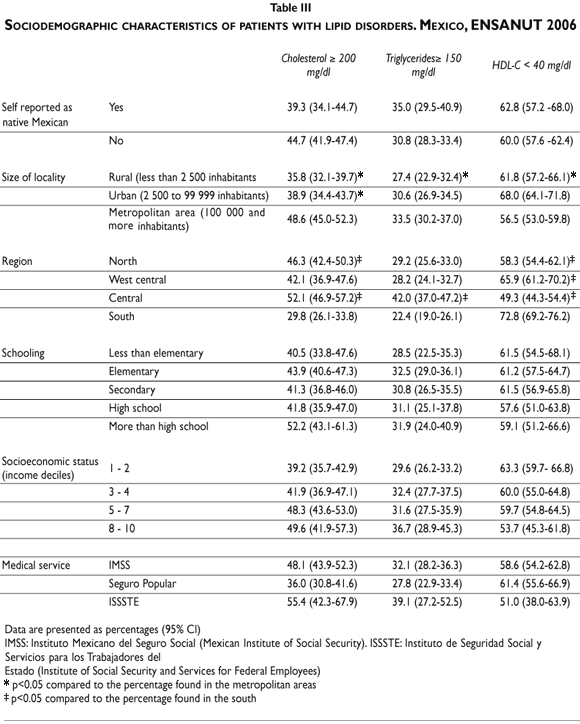
<body><![CDATA[<p>&nbsp;</p> 				    <p align="center"><img src="/img/revistas/spm/v52s1/a08tab03.gif"></p> 				    <p>&nbsp;</p> 	    <p><font size="2" face="Verdana">Environmental factors are major determinants of the prevalence of lipid disorders. For example, hypercholesterolemia was found mainly in metropolitan areas or in subjects living in central or northern Mexico. Its prevalence was not significantly influenced by education level or socioeconomic status, although a trend for a higher prevalence was observed among individuals with medical services provided by ISSSTE (social security and services institute for federal employees)</font></p> 				    <p><font size="2" face="Verdana"> Hypertriglyceridemia was also more often seen in adults living in metropolitan areas, as well as those living in central Mexico. Its prevalence was also not influenced by education level or socioeconomic status, and it was more common in subjects with access to medical services provided by ISSSTE.</font></p> 				    <p><font size="2" face="Verdana"> Conversely, low HDL&#45;cholesterol levels were more common in subjects living in rural communities or in southern Mexico. No difference was observed related to education, although a trend for a higher prevalence was observed in lower income groups. </font></p> 				    <p><font size="2" face="Verdana"><b>Prevalence of lipid phenotypes (<a href="#tab04">Table IV</a>)</b></font></p> 				    <p><a name="tab04"></a></p> 				    <p>&nbsp;</p> 				    <p align="center"><img src="/img/revistas/spm/v52s1/a08tab04.gif"></p> 				    ]]></body>
<body><![CDATA[<p>&nbsp;</p> 	    <p><font size="2" face="Verdana">Lipid abnormalities could be due to multiple etiologies and are associated with different cardiovascular risk factors. This is especially true for hypertriglyceridemia. Thus, the crude description of the prevalence of isolated lipid abnormalities is a gross estimation of the lipid&#45;related cardiovascular risk of a population. A more precise description is obtained when the lipid abnormalities are grouped as lipid phenotypes. </font></p> 				    <p><font size="2" face="Verdana"> The simultaneous elevation of cholesterol and triglycerides concentrations is the lipid profile associated with the highest atherogenic risk and was observed in 18.2% (95%CI 16.3&#45;20.2%) of the population. Its prevalence increased in direct proportion with age, reaching its maximum in the 40&#45;49 age group. Hypertriglyceridemia/hypoalphalipoproteinemia, also having an atherogenic profile, was observed in 18.3% of the general population; the prevalence was significantly higher in men compared to women (p &lt; 0.01). In addition, isolated hypercholesterolemia, which is also associated with an increased cardiovascular risk, was observed in 25.3% of the population. Finally, isolated hypertriglyceridemia was found in 13.3% of study subjects.</font></p> 				    <p><font size="2" face="Verdana"> Normal concentrations of both cholesterol and triglycerides were found in 43.1% (95%CI 40.7&#45;45.6%) of participants. However, as shown in <a href="#tab04">Table IV</a>, more than 60% of Mexican adults aged 50 or older are at risk of having cardiovascular outcomes based on their cholesterol and/or triglycerides concentrations. </font></p> 	    <p><font size="2" face="Verdana"><b>Lipid abnormalities in cases with excess body weight and type 2 diabetes (<a href="#tab05">Table V</a>) </b></font></p> 	    <p><a name="tab05"></a></p> 	    <p>&nbsp;</p> 	    <p align="center"><img src="/img/revistas/spm/v52s1/a08tab05.gif"></p> 	    <p>&nbsp;</p> 	    <p><font size="2" face="Verdana">In our study sample, 1 534 participants were overweight and 1 240 were obese. As shown in <a href="#tab05">Table V</a>, the prevalence of lipid abnormalities was similar between obese and overweight cases. Hypoalphalipoproteinemia was the most frequent lipid abnormality; its prevalence was significantly higher compared to that found among lean subjects. The prevalence of hypertriglyceridemia was two times higher in individuals with excess body weight compared to the lean group. Excess body weight had no effect on either mean LDL&#45;cholesterol concentration or the prevalence of high LDL&#45;cholesterol levels (&gt;130 mg/dl). Nevertheless, patients with a BMI above 25 kg/m2 have a higher prevalence of several atherogenic profiles (i.e. mixed hyperlipidemia). </font></p> 	    ]]></body>
<body><![CDATA[<p><font size="2" face="Verdana"> Type 2 diabetes was present in 488 subjects; 40% were obese. Patients with diabetes and obesity had higher triglycerides and non&#45;HDL&#45;cholesterol concentrations compared to normoglycemic obese individuals, in addition to a higher prevalence of mixed hyperlipidemia. An LDL&#45;cholesterol concentration above 100 mg/dl was found in 74.8% (95%CI 72.5&#45;76.9%) of individuals previously diagnosed with diabetes. However, only 7.6% (95%CI 6.3&#45;9.1%) of those were previously diagnosed as having hypercholesterolemia. </font></p> 				    <p>&nbsp;</p> 				    <p><font size="3" face="Verdana"><b>Discussion</b></font></p> 				    <p><font size="2" face="Verdana">Two previous nationally representative population&#45;based surveys<sup>2,3</sup> and several regional studies<sup>11,12</sup> had found that dyslipidemia is the most frequent cardiovascular risk factor in Mexican adults, while the National Health and Nutrition Survey 2006, which expands this information, finds that close to 60% of Mexican adults have hypoalphalipoproteinemia (&lt; 40 mg/dl). In addition, hypercholesterolemia (cholesterol <u>&gt;</u> 200 mg/dl) is present in 43.6% and hypertriglyceridemia (triglycerides <u>&gt;</u> 150 mg/dl) was observed in almost 30% of the population. Several atherogenic lipid phenotypes were frequent in this population, with isolated hypercholesterolemia, mixed hyperlipidemia, and the combination of high triglycerides/low HDL being the most common. The majority of cases remain undiagnosed despite the high prevalence of these conditions. These data will be useful for planning future cardiovascular prevention programs </font></p> 	    <p><font size="2" face="Verdana"> Based on the results reported herein, it is estimated that there are 14.8 million Mexican adults with hypercholesterolemia and 10.6 million with hypertriglyceridemia. In addition, 20.5 million have low HDL&#45;cholesterol levels and 6.1 million adults have mixed hyperlipidemia, which is the lipid profile associated with the greatest risk of having cardiovascular events. These numbers summarize the challenge that lipid disorders represent for the Mexican health system.</font></p> 				    <p><font size="2" face="Verdana"> Dyslipidemias are caused by the interaction of genetic and environmental factors, and Mexicans have a genetic susceptibility for having abnormal plasma lipids,<sup>5</sup> while Mexican&#45;Americans are the ethnic group living in the US with the highest prevalence of hypoalphalipoproteinemia and hypertriglyceridemia.<sup>13</sup> Several susceptibility alleles for having abnormal concentrations of HDL&#45;cholesterol and triglycerides are common in our population, such as the R230C variant of the ATP&#45;binding cassette transporter A&#45;1<sup>14</sup> and several alleles of the <i>LIPC, CETP, MLXIPL, LPL</i> and the <i>ApoAI&#45;CIII&#45;AIV&#45;AV</i> genes.<sup>15</sup> In addition, the high consumption of either simple carbohydrates or fat (and alcohol in some groups) and the growing number of adults with a sedentary lifestyle contribute to the high prevalence of hypertriglyceridemia and low HDL&#45;cholesterol. Mexican adults consume a large amount of their calories (a mean of 359) as soft drinks and other sugar&#45;rich beverages.<sup>16</sup> As an expectable result, the prevalence of obesity grew from 23.7% in 2000 to 30.8% in 2006.<sup>7</sup> </font></p> 	    <p><font size="2" face="Verdana"> The contribution of some environmental factors was also assessed in the report herein. Both hypercholesterolemia and hypertriglyceridemia were found mainly in individuals living in metropolitan areas or in central or northern Mexico. Its prevalence was not influenced by education level or socioeconomic status. Conversely, hypoalphalipoproteinemia was more common in subjects living in rural communities or in southern Mexico; a trend for a higher prevalence was observed in subjects who declare themselves as native Mexicans or in the lowest income stratum. </font></p> 				    <p><font size="2" face="Verdana"> We expect to find a significant growth in the prevalence of all lipid disorders compared to that found in 1994 and 2000. This hypothesis was true for hypercholesterolemia. Our report confirms the growing trend observed between 1993 and 2000. Mean cholesterol concentrations increased from 182 to 198.5 mg/dl between 1993 and 2006. Deterioration of cholesterol concentrations was more severe in women (from 171 to 202.9 mg/dl) compared to men (from 178 to 193 mg/dl). As a result, the prevalence of hypercholesterolemia grew from 27.1% in 1993 to 43.6% in 2006. While an increment was observed in all age groups during this period, the extent of the change was significantly greater in young adults (from 13.9% to 34.8% in the 20&#45;29 age&#45;group) compared to that found in older subjects (from 45.2 to 55.2% for the 50 to 59 age&#45;group). This remarkable change in the prevalence of hypercholesterolemia was seen in both young men (from 17.4 to 33.5% in the age group 20&#45;29) and women (from 11.1 to 36.0%).<sup>17</sup> The trend found in Mexican adults is unlike that seen in the US.<sup>18</sup> Though mean cholesterol levels have decreased in recent years due to the frequent use of statin therapy in older adults,<sup>19</sup> no significant change occurred in the prevalence of low HDL&#45;cholesterol between 1993 and 2006 (61, 63 and 60.5% in the 1993, 2000 and 2006 surveys, respectively). This is in accordance with the strong genetic component of HDL&#45;cholesterol levels.<sup>20</sup> In addition, the components of an unhealthy lifestyle may have mixed effects on HDL&#45;cholesterol levels. For example, the lowering effect of obesity on mean HDL&#45;cholesterol concentrations<sup>21</sup> may be offset by the raising effect of a higher fat intake.<sup>22</sup> Finally, mean triglycerides levels were lower in this survey as compared to previous reports (213 in 1993 <i>vs.</i> 139 mg/dl in 2006). This surprising result may be due to changes in the sampling process that occurred between surveys. For the current study, patients were contacted one day prior to the interview and were asked to have been fasting when the blood sample was scheduled. Interviewers confirmed the fasting conditions of the participants. Since triglycerides values are strongly influenced by the sampling process,<sup>23</sup> we believe that the additional precautions may have influenced the results reported herein. </font></p> 	    <p><font size="2" face="Verdana"> Data shown in <a href="#tab05">Table V</a> are an example of the well&#45;known deleterious effect of obesity and type 2 diabetes on plasma lipids. Excess body weight (BMI <u>&gt;</u>25 kg/m<sup>2</sup>) is associated with increased concentrations of triglycerides and non&#45;HDL&#45;cholesterol with or without hypoalphalipoproteinemia.<sup>24</sup> Hyperglycemia heightens the severity of these abnormalities and increases the proportion of cases with abnormal plasma lipid levels.<sup>25</sup> Although diabetes is not associated with high LDL&#45;cholesterol levels, a large proportion (74.8%) of previously diagnosed individuals with diabetes had an LDL&#45;cholesterol level above the recommended threshold; and yet, only 7.6% of those were previously diagnosed as having hypercholesterolemia. These observations reinforce the urgent need to train physicians and patients to systematically identify and treat lipid disorders, since this intervention has proved to be cost&#45;effective to reduce the macrovascular complications of type 2 diabetes.<sup>26</sup> </font></p> 	    <p><font size="2" face="Verdana"> The limitations of the study should be recognized. Differences in analytical methods may limit our ability to make direct comparisons between reports. Also, we were not able to assess the impact of lipid lowering therapies. Regrettably, the questionnaire did not include enough information to assess adherence to therapy.</font></p> 	    ]]></body>
<body><![CDATA[<p>&nbsp;</p> 	    <p><font size="3" face="Verdana"><b>Conclusions</b></font></p> 	    <p><font size="2" face="Verdana">Our data confirm that the prevalence of hypoalphalipoproteinemia and other forms of dyslipidemia is high in Mexican adults. Preventive programs are urgently needed in Mexico to face the challenges that lipid disorders represent. Our health and education systems must be redesigned to confront chronic disorders (such as dyslipidemias) and to reverse the adoption of unhealthy habits. The majority of cases remain undiagnosed despite the high prevalence of these conditions. Primary care physicians should be trained to properly identify and treat such conditions. In addition, the population should be educated to adopt a healthy lifestyle; otherwise, the continuous increase in life expectancy achieved over the past few decades will end in the near future.</font></p> 	    <p>&nbsp;</p> 	    <p><font size="3" face="Verdana"><b>Conflicts of interest</b></font></p> 	    <p><font size="2" face="Verdana">We declare that we have no conflicts of interest.</font></p> 				    <p>&nbsp;</p> 				    <p><font size="3" face="Verdana"><b>References</b></font></p> 				    <!-- ref --><p><font size="2" face="Verdana">1. Secretar&iacute;a de Salud. Subsecretar&iacute;a de Prevenci&oacute;n y Protecci&oacute;n de la Salud. Anuarios de Morbilidad 1984&#45;2002. Mexico DF: Secretar&iacute;a de Salud, 2002.    &nbsp;&nbsp;&nbsp;&nbsp;&nbsp;&nbsp;&nbsp;&nbsp;[&#160;<a href="javascript:void(0);" onclick="javascript: window.open('/scielo.php?script=sci_nlinks&ref=9309232&pid=S0036-3634201000070000800001&lng=','','width=640,height=500,resizable=yes,scrollbars=1,menubar=yes,');">Links</a>&#160;]<!-- end-ref --></font></p> 				    ]]></body>
<body><![CDATA[<!-- ref --><p><font size="2" face="Verdana"> 2. Aguilar&#45;Salinas CA, Olaiz G, Valles V, R&iacute;os JM, G&oacute;mez&#45;P&eacute;rez FJ, Rull JA, <i>et al. </i>High prevalence of low HDL&#45;cholesterol concentrations and mixed hyperlipidemia in a Mexican nationwide survey. J Lipid Res 2001;42:1298&#45; 1307.    &nbsp;&nbsp;&nbsp;&nbsp;&nbsp;&nbsp;&nbsp;&nbsp;[&#160;<a href="javascript:void(0);" onclick="javascript: window.open('/scielo.php?script=sci_nlinks&ref=9309234&pid=S0036-3634201000070000800002&lng=','','width=640,height=500,resizable=yes,scrollbars=1,menubar=yes,');">Links</a>&#160;]<!-- end-ref --></font></p> 				    <!-- ref --><p><font size="2" face="Verdana"> 3. Barquera S, Flores M, Olaiz&#45;Fern&aacute;ndez G, Monterrubio E, Villalpando S, Gonz&aacute;lez C, <i>et al.</i> Dyslipidemias and obesity in Mexico. Salud Publica Mex 2007;49 suppl 3:S338&#45;S347.    &nbsp;&nbsp;&nbsp;&nbsp;&nbsp;&nbsp;&nbsp;&nbsp;[&#160;<a href="javascript:void(0);" onclick="javascript: window.open('/scielo.php?script=sci_nlinks&ref=9309236&pid=S0036-3634201000070000800003&lng=','','width=640,height=500,resizable=yes,scrollbars=1,menubar=yes,');">Links</a>&#160;]<!-- end-ref --></font></p> 				    <!-- ref --><p><font size="2" face="Verdana"> 4. Rojas R, Aguilar&#45;Salinas CA, G&oacute;mez&#45;P&eacute;rez FJ, Valles V, Franco A, Olaiz G, <i>et al.</i> Applicability of the National Cholesterol Education Program III (NCEP&#45;III) Guidelines for treatment of dyslipidemia in a non&#45;Caucasian population: A Mexican Nation&#45;Wide Survey. Rev Invest Clin 2005;57:28&#45;37.    &nbsp;&nbsp;&nbsp;&nbsp;&nbsp;&nbsp;&nbsp;&nbsp;[&#160;<a href="javascript:void(0);" onclick="javascript: window.open('/scielo.php?script=sci_nlinks&ref=9309238&pid=S0036-3634201000070000800004&lng=','','width=640,height=500,resizable=yes,scrollbars=1,menubar=yes,');">Links</a>&#160;]<!-- end-ref --></font></p> 				    <!-- ref --><p><font size="2" face="Verdana"> 5. Aguilar&#45;Salinas CA, Canizales&#45;Quinteros S, Rojas&#45;Mart&iacute;nez R, Mehta R, Villarreal&#45;Molina MT, Arellano&#45;Campos O, et al. Hypoalphalipoproteinemia in populations of Native American ancestry: an opportunity to assess the interaction of genes and the environment. Curr Opin Lipidol 2009;20:92&#45;97</font>&nbsp;&nbsp;&nbsp;&nbsp;&nbsp;&nbsp;&nbsp;&nbsp;[&#160;<a href="javascript:void(0);" onclick="javascript: window.open('/scielo.php?script=sci_nlinks&ref=9309240&pid=S0036-3634201000070000800005&lng=','','width=640,height=500,resizable=yes,scrollbars=1,menubar=yes,');">Links</a>&#160;]<!-- end-ref --><!-- ref --><p><font size="2" face="Verdana"> 6. Stevens G, Dias RH, Thomas KJA, Rivera JA, Carvalho N, Barquera S, <i>et al.</i> Characterizing the epidemiological transition in Mexico: National and subnational burden of diseases, injuries, and risk factors. PLoS Med 5: e125. doi:10.1371/journal.pmed.0050125</font>&nbsp;&nbsp;&nbsp;&nbsp;&nbsp;&nbsp;&nbsp;&nbsp;[&#160;<a href="javascript:void(0);" onclick="javascript: window.open('/scielo.php?script=sci_nlinks&ref=9309241&pid=S0036-3634201000070000800006&lng=','','width=640,height=500,resizable=yes,scrollbars=1,menubar=yes,');">Links</a>&#160;]<!-- end-ref --><!-- ref --><p><font size="2" face="Verdana"> 7. C&oacute;rdova&#45;Villalobos JA, Barriguete&#45;Mel&eacute;ndez JA, Lara&#45;Esqueda A, Barquera S, Rosas&#45;Peralta M, Hern&aacute;ndez&#45;Avila M, <i>et al.</i> Chronic non&#45;communicable diseases in Mexico: epidemiologic synopsis and integral prevention. Salud Publica Mex 2008;50:419&#45;427.    &nbsp;&nbsp;&nbsp;&nbsp;&nbsp;&nbsp;&nbsp;&nbsp;[&#160;<a href="javascript:void(0);" onclick="javascript: window.open('/scielo.php?script=sci_nlinks&ref=9309242&pid=S0036-3634201000070000800007&lng=','','width=640,height=500,resizable=yes,scrollbars=1,menubar=yes,');">Links</a>&#160;]<!-- end-ref --></font></p> 				    ]]></body>
<body><![CDATA[<!-- ref --><p><font size="2" face="Verdana"> 8. Barquera S, Campos&#45;Nonato I, Carri&oacute;n&#45;R&aacute;bago C, Villalpando S, L&oacute;pez&#45;Ridaura R, Rojas&#45;Mart&iacute;nez R, Aguilar&#45;Salinas C. Methodology for the analysis of type 2 diabetes, metabolic syndrome and cardiovascular disease risk indicators in the ENSANUT 2006. Salud Publica Mex 2010;52 suppl 1:S4&#45;S10.    &nbsp;&nbsp;&nbsp;&nbsp;&nbsp;&nbsp;&nbsp;&nbsp;[&#160;<a href="javascript:void(0);" onclick="javascript: window.open('/scielo.php?script=sci_nlinks&ref=9309244&pid=S0036-3634201000070000800008&lng=','','width=640,height=500,resizable=yes,scrollbars=1,menubar=yes,');">Links</a>&#160;]<!-- end-ref --></font></p> 				    <!-- ref --><p><font size="2" face="Verdana"> 9. Friedewald WT, Levy IR, Fredrickson DS. Estimation of the concentration of low density lipoproteins cholesterol in plasma without the use of the ultracentrifuge. Clin Chem 1972; 18:449&#45;502.    &nbsp;&nbsp;&nbsp;&nbsp;&nbsp;&nbsp;&nbsp;&nbsp;[&#160;<a href="javascript:void(0);" onclick="javascript: window.open('/scielo.php?script=sci_nlinks&ref=9309246&pid=S0036-3634201000070000800009&lng=','','width=640,height=500,resizable=yes,scrollbars=1,menubar=yes,');">Links</a>&#160;]<!-- end-ref --></font></p> 				    <!-- ref --><p><font size="2" face="Verdana"> 10. Expert Panel on detection, evaluation and treatment of high blood cholesterol in adults. Executive summary of the third report of the national cholesterol education program (NCEP) expert panel on detection, evaluation and treatment of high blood cholesterol in adults (adult treatment panel III). JAMA 2001; 285: 2486&#45;2497.    &nbsp;&nbsp;&nbsp;&nbsp;&nbsp;&nbsp;&nbsp;&nbsp;[&#160;<a href="javascript:void(0);" onclick="javascript: window.open('/scielo.php?script=sci_nlinks&ref=9309248&pid=S0036-3634201000070000800010&lng=','','width=640,height=500,resizable=yes,scrollbars=1,menubar=yes,');">Links</a>&#160;]<!-- end-ref --></font></p> 				    <!-- ref --><p><font size="2" face="Verdana"> 11. Gonz&aacute;lez&#45;Villalpando C, Stern MP, Vald&eacute;s R, Mitchell B, Haffner S. Niveles de l&iacute;pidos sangu&iacute;neos en poblaci&oacute;n abierta urbana: patr&oacute;n de riesgo aterog&eacute;nico elevado. Rev Invest Clin 1993; 45:127&#45;132.    &nbsp;&nbsp;&nbsp;&nbsp;&nbsp;&nbsp;&nbsp;&nbsp;[&#160;<a href="javascript:void(0);" onclick="javascript: window.open('/scielo.php?script=sci_nlinks&ref=9309250&pid=S0036-3634201000070000800011&lng=','','width=640,height=500,resizable=yes,scrollbars=1,menubar=yes,');">Links</a>&#160;]<!-- end-ref --></font></p> 				    <!-- ref --><p><font size="2" face="Verdana"> 12. Gonz&aacute;lez&#45;Villalpando C, Stern MP, Arredondo PB, Mart&iacute;nez DS, Haffner S. Undiagnosed hypercholesterolemia. A serious health challenge. The Mexico City Diabetes Study. Arch Med Res 1996; 27:19&#45;23.    &nbsp;&nbsp;&nbsp;&nbsp;&nbsp;&nbsp;&nbsp;&nbsp;[&#160;<a href="javascript:void(0);" onclick="javascript: window.open('/scielo.php?script=sci_nlinks&ref=9309252&pid=S0036-3634201000070000800012&lng=','','width=640,height=500,resizable=yes,scrollbars=1,menubar=yes,');">Links</a>&#160;]<!-- end-ref --></font></p> 				    ]]></body>
<body><![CDATA[<!-- ref --><p><font size="2" face="Verdana"> 13. Palloni A, Morenoff JD. Interpreting the paradoxical in the hispanic paradox: demographic and epidemiologic approaches. Ann N Y Acad Sci 2001;954:140&#45;174.    &nbsp;&nbsp;&nbsp;&nbsp;&nbsp;&nbsp;&nbsp;&nbsp;[&#160;<a href="javascript:void(0);" onclick="javascript: window.open('/scielo.php?script=sci_nlinks&ref=9309254&pid=S0036-3634201000070000800013&lng=','','width=640,height=500,resizable=yes,scrollbars=1,menubar=yes,');">Links</a>&#160;]<!-- end-ref --></font></p> 				    <!-- ref --><p><font size="2" face="Verdana"> 14. Villarreal&#45;Molina MT, Aguilar&#45;Salinas CA, Rodr&iacute;guez&#45;Cruz M, Ria&ntilde;o D, Villalobos&#45;Comparan M, Flores&#45;Dorantes MT, et al. The ABCA1 R230C variant affects HDL&#45;cholesterol levels and body mass index in the Mexican population: Association with obesity and obesity&#45;related comorbidities. Diabetes 2007;56:1881&#45;1887</font>&nbsp;&nbsp;&nbsp;&nbsp;&nbsp;&nbsp;&nbsp;&nbsp;[&#160;<a href="javascript:void(0);" onclick="javascript: window.open('/scielo.php?script=sci_nlinks&ref=9309256&pid=S0036-3634201000070000800014&lng=','','width=640,height=500,resizable=yes,scrollbars=1,menubar=yes,');">Links</a>&#160;]<!-- end-ref --><!-- ref --><p><font size="2" face="Verdana"> 15. Kooner J, Chambers JC, Aguilar&#45;Salinas CA, Hinds DA, Hyde CL, Warnes GR, <i>et al.</i> Genome&#45;wide scan identifies variation in MLXIPL associated with plasma triglycerides. Nature Genetics 2008;40:149&#45;151.    &nbsp;&nbsp;&nbsp;&nbsp;&nbsp;&nbsp;&nbsp;&nbsp;[&#160;<a href="javascript:void(0);" onclick="javascript: window.open('/scielo.php?script=sci_nlinks&ref=9309257&pid=S0036-3634201000070000800015&lng=','','width=640,height=500,resizable=yes,scrollbars=1,menubar=yes,');">Links</a>&#160;]<!-- end-ref --></font></p> 				    <!-- ref --><p><font size="2" face="Verdana"> 16. Rivera JA, Mu&ntilde;oz&#45;Hern&aacute;ndez O, Rosas&#45;Peralta M, Aguilar&#45;Salinas CA, Popkin BM, Willett WC. Beverage consumption for a healthy life: recommendations for the Mexican population. Rev Invest Clin 2008;60:157&#45;180.    &nbsp;&nbsp;&nbsp;&nbsp;&nbsp;&nbsp;&nbsp;&nbsp;[&#160;<a href="javascript:void(0);" onclick="javascript: window.open('/scielo.php?script=sci_nlinks&ref=9309259&pid=S0036-3634201000070000800016&lng=','','width=640,height=500,resizable=yes,scrollbars=1,menubar=yes,');">Links</a>&#160;]<!-- end-ref --></font></p> 				    <!-- ref --><p><font size="2" face="Verdana"> 17. Olaiz&#45;Fernandez G, Rivera&#45;Dommarco J, Shamah&#45;Levy T, Rojas R, Villalpando&#45;Hern&aacute;ndez S, Hern&aacute;ndez&#45;Avila M, <i>et al.</i> Encuesta Nacional de Salud y Nutrici&oacute;n 2006. Cuernavaca, Mexico: Instituto Nacional de Salud P&uacute;blica, 2006.    &nbsp;&nbsp;&nbsp;&nbsp;&nbsp;&nbsp;&nbsp;&nbsp;[&#160;<a href="javascript:void(0);" onclick="javascript: window.open('/scielo.php?script=sci_nlinks&ref=9309261&pid=S0036-3634201000070000800017&lng=','','width=640,height=500,resizable=yes,scrollbars=1,menubar=yes,');">Links</a>&#160;]<!-- end-ref --></font></p> 				    <!-- ref --><p><font size="2" face="Verdana"> 18. Carroll MD, Lacher DA, Sorlie PD, Cleeman J, Gordon D, Wolz M, <i>et al.</i> Trends in serum lipids and lipoproteins of adults 1960&#45;2002. JAMA 2005;294: 1773&#45;1781.    &nbsp;&nbsp;&nbsp;&nbsp;&nbsp;&nbsp;&nbsp;&nbsp;[&#160;<a href="javascript:void(0);" onclick="javascript: window.open('/scielo.php?script=sci_nlinks&ref=9309263&pid=S0036-3634201000070000800018&lng=','','width=640,height=500,resizable=yes,scrollbars=1,menubar=yes,');">Links</a>&#160;]<!-- end-ref --></font></p> 				    <!-- ref --><p><font size="2" face="Verdana"> 19. Ford ES, Li C, Zhao C, Mokdad A. Concentrations of low&#45;density lipoprotein cholesterol and total cholesterol among children and adolescents in the United States. Circulation 2009;119:1108&#45;1115</font>&nbsp;&nbsp;&nbsp;&nbsp;&nbsp;&nbsp;&nbsp;&nbsp;[&#160;<a href="javascript:void(0);" onclick="javascript: window.open('/scielo.php?script=sci_nlinks&ref=9309265&pid=S0036-3634201000070000800019&lng=','','width=640,height=500,resizable=yes,scrollbars=1,menubar=yes,');">Links</a>&#160;]<!-- end-ref --><!-- ref --><p><font size="2" face="Verdana"> 20. Holleboom AG, Vergeer M, Hovingh K, Kastelein J, Kuivenhoven JA. The value of HDL genetics. Cur Opin Lipidol 2008;19:385&#45;394.    &nbsp;&nbsp;&nbsp;&nbsp;&nbsp;&nbsp;&nbsp;&nbsp;[&#160;<a href="javascript:void(0);" onclick="javascript: window.open('/scielo.php?script=sci_nlinks&ref=9309266&pid=S0036-3634201000070000800020&lng=','','width=640,height=500,resizable=yes,scrollbars=1,menubar=yes,');">Links</a>&#160;]<!-- end-ref --></font></p> 				    <!-- ref --><p><font size="2" face="Verdana"> 21. Merchant AT, Anand SS, Kelemen LE, Vuksan V, Jacobs R, Davis B, et al. Carbohydrate intake and HDL in a multiethnic population. Am J Clin Nutr 2007;85:225&#45;230.    &nbsp;&nbsp;&nbsp;&nbsp;&nbsp;&nbsp;&nbsp;&nbsp;[&#160;<a href="javascript:void(0);" onclick="javascript: window.open('/scielo.php?script=sci_nlinks&ref=9309268&pid=S0036-3634201000070000800021&lng=','','width=640,height=500,resizable=yes,scrollbars=1,menubar=yes,');">Links</a>&#160;]<!-- end-ref --></font></p> 				    <!-- ref --><p><font size="2" face="Verdana"> 22. Mooradian A, Haas M, Wong N. The effect of select nutrients on serum high&#45;density lipoprotein cholesterol and apolipoprotein A&#45;I Levels. Endocrine Reviews 2006; 27:2&#45;16.    &nbsp;&nbsp;&nbsp;&nbsp;&nbsp;&nbsp;&nbsp;&nbsp;[&#160;<a href="javascript:void(0);" onclick="javascript: window.open('/scielo.php?script=sci_nlinks&ref=9309270&pid=S0036-3634201000070000800022&lng=','','width=640,height=500,resizable=yes,scrollbars=1,menubar=yes,');">Links</a>&#160;]<!-- end-ref --></font></p> 				    <!-- ref --><p><font size="2" face="Verdana"> 23. Cooper GR, Myers GL, Smith SJ, Schlant RC. Blood lipid measurements. Variations and practical utility. JAMA 1992;267:1652&#45;1660.    &nbsp;&nbsp;&nbsp;&nbsp;&nbsp;&nbsp;&nbsp;&nbsp;[&#160;<a href="javascript:void(0);" onclick="javascript: window.open('/scielo.php?script=sci_nlinks&ref=9309272&pid=S0036-3634201000070000800023&lng=','','width=640,height=500,resizable=yes,scrollbars=1,menubar=yes,');">Links</a>&#160;]<!-- end-ref --></font></p> 				    ]]></body>
<body><![CDATA[<!-- ref --><p><font size="2" face="Verdana"> 24. Mittendorfer B, Patterson BW, Klein S, Sidossis S. VLDL&#45;triglyceride kinetics during hyperglycemiahyperinsulinemia: effects of sex and obesity. Am J Physiol Endocrinol Metab 2003; 284: E708&#45;E715.    &nbsp;&nbsp;&nbsp;&nbsp;&nbsp;&nbsp;&nbsp;&nbsp;[&#160;<a href="javascript:void(0);" onclick="javascript: window.open('/scielo.php?script=sci_nlinks&ref=9309274&pid=S0036-3634201000070000800024&lng=','','width=640,height=500,resizable=yes,scrollbars=1,menubar=yes,');">Links</a>&#160;]<!-- end-ref --></font></p> 				    <!-- ref --><p><font size="2" face="Verdana"> 25. Adiels M, Olofsson S, Taskinen MR, Boren J. Diabetic dyslipidaemia. Curr Opin Lipidol 17:238&#45;246.    &nbsp;&nbsp;&nbsp;&nbsp;&nbsp;&nbsp;&nbsp;&nbsp;[&#160;<a href="javascript:void(0);" onclick="javascript: window.open('/scielo.php?script=sci_nlinks&ref=9309276&pid=S0036-3634201000070000800025&lng=','','width=640,height=500,resizable=yes,scrollbars=1,menubar=yes,');">Links</a>&#160;]<!-- end-ref --></font></p> 				    <!-- ref --><p><font size="2" face="Verdana"> 26. Aguilar&#45;Salinas CA, Mehta R, Rojas R, G&oacute;mez&#45;P&eacute;rez FJ, Olaiz G, Rull JA. Management of the metabolic syndrome as a strategy for preventing the macrovascular complications of type 2 diabetes: controversial issues. Current Diabetes Reviews 2005:1:145&#45;158</font>&nbsp;&nbsp;&nbsp;&nbsp;&nbsp;&nbsp;&nbsp;&nbsp;[&#160;<a href="javascript:void(0);" onclick="javascript: window.open('/scielo.php?script=sci_nlinks&ref=9309278&pid=S0036-3634201000070000800026&lng=','','width=640,height=500,resizable=yes,scrollbars=1,menubar=yes,');">Links</a>&#160;]<!-- end-ref --><p>&nbsp;</p> 				    <p>&nbsp;</p>     <p><font size="2" face="Verdana">Received on: August 5, 2009     <br>  			    Accepted on: October 2, 2009</font></p>     <p>&nbsp;</p>     ]]></body>
<body><![CDATA[<p>&nbsp;</p>     <p><font size="2" face="Verdana">Address       reprint requests to:        PhD. Rosalba Rojas Mart&iacute;nez. Instituto Nacional de Salud P&uacute;blica. Av. Universidad 655, col Santa Mar&iacute;a Ahuacatitl&aacute;n.  62100 Cuernavaca, Morelos, M&eacute;xico. E&#45;mail: <a href="mailto:rosalba_rojas@yahoo.com">rosalba_rojas@yahoo.com</a></font></p>      ]]></body><back>
<ref-list>
<ref id="B1">
<label>1</label><nlm-citation citation-type="book">
<collab>Secretaría de Salud</collab>
<source><![CDATA[Subsecretaría de Prevención y Protección de la Salud. Anuarios de Morbilidad 1984-2002]]></source>
<year>2002</year>
<publisher-loc><![CDATA[Mexico^eDF DF]]></publisher-loc>
<publisher-name><![CDATA[Secretaría de Salud]]></publisher-name>
</nlm-citation>
</ref>
<ref id="B2">
<label>2</label><nlm-citation citation-type="journal">
<person-group person-group-type="author">
<name>
<surname><![CDATA[Aguilar-Salinas]]></surname>
<given-names><![CDATA[CA]]></given-names>
</name>
<name>
<surname><![CDATA[Olaiz]]></surname>
<given-names><![CDATA[G]]></given-names>
</name>
<name>
<surname><![CDATA[Valles]]></surname>
<given-names><![CDATA[V]]></given-names>
</name>
<name>
<surname><![CDATA[Ríos]]></surname>
<given-names><![CDATA[JM]]></given-names>
</name>
<name>
<surname><![CDATA[Gómez-Pérez]]></surname>
<given-names><![CDATA[FJ]]></given-names>
</name>
<name>
<surname><![CDATA[Rull]]></surname>
<given-names><![CDATA[JA]]></given-names>
</name>
</person-group>
<article-title xml:lang="en"><![CDATA[High prevalence of low HDL-cholesterol concentrations and mixed hyperlipidemia in a Mexican nationwide survey]]></article-title>
<source><![CDATA[J Lipid Res]]></source>
<year>2001</year>
<volume>42</volume>
<page-range>1298-1307</page-range></nlm-citation>
</ref>
<ref id="B3">
<label>3</label><nlm-citation citation-type="journal">
<person-group person-group-type="author">
<name>
<surname><![CDATA[Barquera]]></surname>
<given-names><![CDATA[S]]></given-names>
</name>
<name>
<surname><![CDATA[Flores]]></surname>
<given-names><![CDATA[M]]></given-names>
</name>
<name>
<surname><![CDATA[Olaiz-Fernández]]></surname>
<given-names><![CDATA[G]]></given-names>
</name>
<name>
<surname><![CDATA[Monterrubio]]></surname>
<given-names><![CDATA[E]]></given-names>
</name>
<name>
<surname><![CDATA[Villalpando]]></surname>
<given-names><![CDATA[S]]></given-names>
</name>
<name>
<surname><![CDATA[González]]></surname>
<given-names><![CDATA[C]]></given-names>
</name>
</person-group>
<article-title xml:lang="en"><![CDATA[Dyslipidemias and obesity in Mexico]]></article-title>
<source><![CDATA[Salud Publica Mex]]></source>
<year>2007</year>
<volume>49</volume>
<numero>^s3</numero>
<issue>^s3</issue>
<supplement>3</supplement>
<page-range>S338-S347</page-range></nlm-citation>
</ref>
<ref id="B4">
<label>4</label><nlm-citation citation-type="journal">
<person-group person-group-type="author">
<name>
<surname><![CDATA[Rojas]]></surname>
<given-names><![CDATA[R]]></given-names>
</name>
<name>
<surname><![CDATA[Aguilar-Salinas]]></surname>
<given-names><![CDATA[CA]]></given-names>
</name>
<name>
<surname><![CDATA[Gómez-Pérez]]></surname>
<given-names><![CDATA[FJ]]></given-names>
</name>
<name>
<surname><![CDATA[Valles]]></surname>
<given-names><![CDATA[V]]></given-names>
</name>
<name>
<surname><![CDATA[Franco]]></surname>
<given-names><![CDATA[A]]></given-names>
</name>
<name>
<surname><![CDATA[Olaiz]]></surname>
<given-names><![CDATA[G]]></given-names>
</name>
</person-group>
<article-title xml:lang="en"><![CDATA[Applicability of the National Cholesterol Education Program III (NCEP-III) Guidelines for treatment of dyslipidemia in a non-Caucasian population: A Mexican Nation-Wide Survey]]></article-title>
<source><![CDATA[Rev Invest Clin]]></source>
<year>2005</year>
<volume>57</volume>
<page-range>28-37</page-range></nlm-citation>
</ref>
<ref id="B5">
<label>5</label><nlm-citation citation-type="journal">
<person-group person-group-type="author">
<name>
<surname><![CDATA[Aguilar-Salinas]]></surname>
<given-names><![CDATA[CA]]></given-names>
</name>
<name>
<surname><![CDATA[Canizales-Quinteros]]></surname>
<given-names><![CDATA[S]]></given-names>
</name>
<name>
<surname><![CDATA[Rojas-Martínez]]></surname>
<given-names><![CDATA[R]]></given-names>
</name>
<name>
<surname><![CDATA[Mehta]]></surname>
<given-names><![CDATA[R]]></given-names>
</name>
<name>
<surname><![CDATA[Villarreal-Molina]]></surname>
<given-names><![CDATA[MT]]></given-names>
</name>
<name>
<surname><![CDATA[Arellano-Campos]]></surname>
<given-names><![CDATA[O]]></given-names>
</name>
</person-group>
<article-title xml:lang="en"><![CDATA[Hypoalphalipoproteinemia in populations of Native American ancestry: an opportunity to assess the interaction of genes and the environment]]></article-title>
<source><![CDATA[Curr Opin Lipidol]]></source>
<year>2009</year>
<volume>20</volume>
<page-range>92-97</page-range></nlm-citation>
</ref>
<ref id="B6">
<label>6</label><nlm-citation citation-type="journal">
<person-group person-group-type="author">
<name>
<surname><![CDATA[Stevens]]></surname>
<given-names><![CDATA[G]]></given-names>
</name>
<name>
<surname><![CDATA[Dias]]></surname>
<given-names><![CDATA[RH]]></given-names>
</name>
<name>
<surname><![CDATA[Thomas]]></surname>
<given-names><![CDATA[KJA]]></given-names>
</name>
<name>
<surname><![CDATA[Rivera]]></surname>
<given-names><![CDATA[JA]]></given-names>
</name>
<name>
<surname><![CDATA[Carvalho]]></surname>
<given-names><![CDATA[N]]></given-names>
</name>
<name>
<surname><![CDATA[Barquera]]></surname>
<given-names><![CDATA[S]]></given-names>
</name>
</person-group>
<article-title xml:lang="en"><![CDATA[Characterizing the epidemiological transition in Mexico: National and subnational burden of diseases, injuries, and risk factors]]></article-title>
<source><![CDATA[PLoS Med]]></source>
<year></year>
<volume>5</volume>
<page-range>e125</page-range></nlm-citation>
</ref>
<ref id="B7">
<label>7</label><nlm-citation citation-type="journal">
<person-group person-group-type="author">
<name>
<surname><![CDATA[Córdova-Villalobos]]></surname>
<given-names><![CDATA[JA]]></given-names>
</name>
<name>
<surname><![CDATA[Barriguete-Meléndez]]></surname>
<given-names><![CDATA[JA]]></given-names>
</name>
<name>
<surname><![CDATA[Lara-Esqueda]]></surname>
<given-names><![CDATA[A]]></given-names>
</name>
<name>
<surname><![CDATA[Barquera]]></surname>
<given-names><![CDATA[S]]></given-names>
</name>
<name>
<surname><![CDATA[Rosas-Peralta]]></surname>
<given-names><![CDATA[M]]></given-names>
</name>
<name>
<surname><![CDATA[Hernández-Avila]]></surname>
<given-names><![CDATA[M]]></given-names>
</name>
</person-group>
<article-title xml:lang="en"><![CDATA[Chronic non-communicable diseases in Mexico: epidemiologic synopsis and integral prevention]]></article-title>
<source><![CDATA[Salud Publica Mex]]></source>
<year>2008</year>
<volume>50</volume>
<page-range>419-427</page-range></nlm-citation>
</ref>
<ref id="B8">
<label>8</label><nlm-citation citation-type="journal">
<person-group person-group-type="author">
<name>
<surname><![CDATA[Barquera]]></surname>
<given-names><![CDATA[S]]></given-names>
</name>
<name>
<surname><![CDATA[Campos-Nonato]]></surname>
<given-names><![CDATA[I]]></given-names>
</name>
<name>
<surname><![CDATA[Carrión-Rábago]]></surname>
<given-names><![CDATA[C]]></given-names>
</name>
<name>
<surname><![CDATA[Villalpando]]></surname>
<given-names><![CDATA[S]]></given-names>
</name>
<name>
<surname><![CDATA[López-Ridaura]]></surname>
<given-names><![CDATA[R]]></given-names>
</name>
<name>
<surname><![CDATA[Rojas-Martínez]]></surname>
<given-names><![CDATA[R]]></given-names>
</name>
<name>
<surname><![CDATA[Aguilar-Salinas]]></surname>
<given-names><![CDATA[C]]></given-names>
</name>
</person-group>
<article-title xml:lang="en"><![CDATA[Methodology for the analysis of type 2 diabetes, metabolic syndrome and cardiovascular disease risk indicators in the ENSANUT 2006]]></article-title>
<source><![CDATA[Salud Publica Mex]]></source>
<year>2010</year>
<volume>52</volume>
<numero>^s1</numero>
<issue>^s1</issue>
<supplement>1</supplement>
<page-range>S4-S10</page-range></nlm-citation>
</ref>
<ref id="B9">
<label>9</label><nlm-citation citation-type="journal">
<person-group person-group-type="author">
<name>
<surname><![CDATA[Friedewald]]></surname>
<given-names><![CDATA[WT]]></given-names>
</name>
<name>
<surname><![CDATA[Levy]]></surname>
<given-names><![CDATA[IR]]></given-names>
</name>
<name>
<surname><![CDATA[Fredrickson]]></surname>
<given-names><![CDATA[DS]]></given-names>
</name>
</person-group>
<article-title xml:lang="en"><![CDATA[Estimation of the concentration of low density lipoproteins cholesterol in plasma without the use of the ultracentrifuge]]></article-title>
<source><![CDATA[Clin Chem]]></source>
<year>1972</year>
<volume>18</volume>
<page-range>449-502</page-range></nlm-citation>
</ref>
<ref id="B10">
<label>10</label><nlm-citation citation-type="journal">
<article-title xml:lang="en"><![CDATA[Executive summary of the third report of the national cholesterol education program (NCEP) expert panel on detection, evaluation and treatment of high blood cholesterol in adults (adult treatment panel III)]]></article-title>
<source><![CDATA[JAMA]]></source>
<year>2001</year>
<volume>285</volume>
<page-range>2486-2497</page-range></nlm-citation>
</ref>
<ref id="B11">
<label>11</label><nlm-citation citation-type="journal">
<person-group person-group-type="author">
<name>
<surname><![CDATA[González-Villalpando]]></surname>
<given-names><![CDATA[C]]></given-names>
</name>
<name>
<surname><![CDATA[Stern]]></surname>
<given-names><![CDATA[MP]]></given-names>
</name>
<name>
<surname><![CDATA[Valdés]]></surname>
<given-names><![CDATA[R]]></given-names>
</name>
<name>
<surname><![CDATA[Mitchell]]></surname>
<given-names><![CDATA[B]]></given-names>
</name>
<name>
<surname><![CDATA[Haffner]]></surname>
<given-names><![CDATA[S]]></given-names>
</name>
</person-group>
<article-title xml:lang="es"><![CDATA[Niveles de lípidos sanguíneos en población abierta urbana: patrón de riesgo aterogénico elevado]]></article-title>
<source><![CDATA[Rev Invest Clin]]></source>
<year>1993</year>
<volume>45</volume>
<page-range>127-132</page-range></nlm-citation>
</ref>
<ref id="B12">
<label>12</label><nlm-citation citation-type="journal">
<person-group person-group-type="author">
<name>
<surname><![CDATA[González-Villalpando]]></surname>
<given-names><![CDATA[C]]></given-names>
</name>
<name>
<surname><![CDATA[Stern]]></surname>
<given-names><![CDATA[MP]]></given-names>
</name>
<name>
<surname><![CDATA[Arredondo]]></surname>
<given-names><![CDATA[PB]]></given-names>
</name>
<name>
<surname><![CDATA[Martínez]]></surname>
<given-names><![CDATA[DS]]></given-names>
</name>
<name>
<surname><![CDATA[Haffner]]></surname>
<given-names><![CDATA[S]]></given-names>
</name>
</person-group>
<article-title xml:lang="en"><![CDATA[Undiagnosed hypercholesterolemia: A serious health challenge. The Mexico City Diabetes Study]]></article-title>
<source><![CDATA[Arch Med Res]]></source>
<year>1996</year>
<volume>27</volume>
<page-range>19-23</page-range></nlm-citation>
</ref>
<ref id="B13">
<label>13</label><nlm-citation citation-type="journal">
<person-group person-group-type="author">
<name>
<surname><![CDATA[Palloni]]></surname>
<given-names><![CDATA[A]]></given-names>
</name>
<name>
<surname><![CDATA[Morenoff]]></surname>
<given-names><![CDATA[JD]]></given-names>
</name>
</person-group>
<article-title xml:lang="en"><![CDATA[Interpreting the paradoxical in the hispanic paradox: demographic and epidemiologic approaches]]></article-title>
<source><![CDATA[Ann N Y Acad Sci]]></source>
<year>2001</year>
<volume>954</volume>
<page-range>140-174</page-range></nlm-citation>
</ref>
<ref id="B14">
<label>14</label><nlm-citation citation-type="journal">
<person-group person-group-type="author">
<name>
<surname><![CDATA[Villarreal-Molina]]></surname>
<given-names><![CDATA[MT]]></given-names>
</name>
<name>
<surname><![CDATA[Aguilar-Salinas]]></surname>
<given-names><![CDATA[CA]]></given-names>
</name>
<name>
<surname><![CDATA[Rodríguez-Cruz]]></surname>
<given-names><![CDATA[M]]></given-names>
</name>
<name>
<surname><![CDATA[Riaño]]></surname>
<given-names><![CDATA[D]]></given-names>
</name>
<name>
<surname><![CDATA[Villalobos-Comparan]]></surname>
<given-names><![CDATA[M]]></given-names>
</name>
<name>
<surname><![CDATA[Flores-Dorantes]]></surname>
<given-names><![CDATA[MT]]></given-names>
</name>
</person-group>
<article-title xml:lang="en"><![CDATA[The ABCA1 R230C variant affects HDL-cholesterol levels and body mass index in the Mexican population: Association with obesity and obesity-related comorbidities]]></article-title>
<source><![CDATA[Diabetes]]></source>
<year>2007</year>
<volume>56</volume>
<page-range>1881-1887</page-range></nlm-citation>
</ref>
<ref id="B15">
<label>15</label><nlm-citation citation-type="journal">
<person-group person-group-type="author">
<name>
<surname><![CDATA[Kooner]]></surname>
<given-names><![CDATA[J]]></given-names>
</name>
<name>
<surname><![CDATA[Chambers]]></surname>
<given-names><![CDATA[JC]]></given-names>
</name>
<name>
<surname><![CDATA[Aguilar-Salinas]]></surname>
<given-names><![CDATA[CA]]></given-names>
</name>
<name>
<surname><![CDATA[Hinds]]></surname>
<given-names><![CDATA[DA]]></given-names>
</name>
<name>
<surname><![CDATA[Hyde]]></surname>
<given-names><![CDATA[CL]]></given-names>
</name>
<name>
<surname><![CDATA[Warnes]]></surname>
<given-names><![CDATA[GR]]></given-names>
</name>
</person-group>
<article-title xml:lang="en"><![CDATA[Genome-wide scan identifies variation in MLXIPL associated with plasma triglycerides]]></article-title>
<source><![CDATA[Nature Genetics]]></source>
<year>2008</year>
<volume>40</volume>
<page-range>149-151</page-range></nlm-citation>
</ref>
<ref id="B16">
<label>16</label><nlm-citation citation-type="journal">
<person-group person-group-type="author">
<name>
<surname><![CDATA[Rivera]]></surname>
<given-names><![CDATA[JA]]></given-names>
</name>
<name>
<surname><![CDATA[Muñoz-Hernández]]></surname>
<given-names><![CDATA[O]]></given-names>
</name>
<name>
<surname><![CDATA[Rosas-Peralta]]></surname>
<given-names><![CDATA[M]]></given-names>
</name>
<name>
<surname><![CDATA[Aguilar-Salinas]]></surname>
<given-names><![CDATA[CA]]></given-names>
</name>
<name>
<surname><![CDATA[Popkin]]></surname>
<given-names><![CDATA[BM]]></given-names>
</name>
<name>
<surname><![CDATA[Willett]]></surname>
<given-names><![CDATA[WC]]></given-names>
</name>
</person-group>
<article-title xml:lang="en"><![CDATA[Beverage consumption for a healthy life: recommendations for the Mexican population]]></article-title>
<source><![CDATA[Rev Invest Clin]]></source>
<year>2008</year>
<volume>60</volume>
<page-range>157-180</page-range></nlm-citation>
</ref>
<ref id="B17">
<label>17</label><nlm-citation citation-type="book">
<person-group person-group-type="author">
<name>
<surname><![CDATA[Olaiz-Fernandez]]></surname>
<given-names><![CDATA[G]]></given-names>
</name>
<name>
<surname><![CDATA[Rivera-Dommarco]]></surname>
<given-names><![CDATA[J]]></given-names>
</name>
<name>
<surname><![CDATA[Shamah-Levy]]></surname>
<given-names><![CDATA[T]]></given-names>
</name>
<name>
<surname><![CDATA[Rojas]]></surname>
<given-names><![CDATA[R]]></given-names>
</name>
<name>
<surname><![CDATA[Villalpando-Hernández]]></surname>
<given-names><![CDATA[S]]></given-names>
</name>
<name>
<surname><![CDATA[Hernández-Avila]]></surname>
<given-names><![CDATA[M]]></given-names>
</name>
</person-group>
<source><![CDATA[Encuesta Nacional de Salud y Nutrición 2006]]></source>
<year>2006</year>
<publisher-loc><![CDATA[Cuernavaca ]]></publisher-loc>
<publisher-name><![CDATA[Instituto Nacional de Salud Pública]]></publisher-name>
</nlm-citation>
</ref>
<ref id="B18">
<label>18</label><nlm-citation citation-type="journal">
<person-group person-group-type="author">
<name>
<surname><![CDATA[Carroll]]></surname>
<given-names><![CDATA[MD]]></given-names>
</name>
<name>
<surname><![CDATA[Lacher]]></surname>
<given-names><![CDATA[DA]]></given-names>
</name>
<name>
<surname><![CDATA[Sorlie]]></surname>
<given-names><![CDATA[PD]]></given-names>
</name>
<name>
<surname><![CDATA[Cleeman]]></surname>
<given-names><![CDATA[J]]></given-names>
</name>
<name>
<surname><![CDATA[Gordon]]></surname>
<given-names><![CDATA[D]]></given-names>
</name>
<name>
<surname><![CDATA[Wolz]]></surname>
<given-names><![CDATA[M]]></given-names>
</name>
</person-group>
<article-title xml:lang="en"><![CDATA[Trends in serum lipids and lipoproteins of adults 1960-2002]]></article-title>
<source><![CDATA[JAMA]]></source>
<year>2005</year>
<volume>294</volume>
<page-range>1773-1781</page-range></nlm-citation>
</ref>
<ref id="B19">
<label>19</label><nlm-citation citation-type="journal">
<person-group person-group-type="author">
<name>
<surname><![CDATA[Ford]]></surname>
<given-names><![CDATA[ES]]></given-names>
</name>
<name>
<surname><![CDATA[Li]]></surname>
<given-names><![CDATA[C]]></given-names>
</name>
<name>
<surname><![CDATA[Zhao]]></surname>
<given-names><![CDATA[C]]></given-names>
</name>
<name>
<surname><![CDATA[Mokdad]]></surname>
<given-names><![CDATA[A]]></given-names>
</name>
</person-group>
<article-title xml:lang="en"><![CDATA[Concentrations of low-density lipoprotein cholesterol and total cholesterol among children and adolescents in the United States]]></article-title>
<source><![CDATA[Circulation]]></source>
<year>2009</year>
<volume>119</volume>
<page-range>1108-1115</page-range></nlm-citation>
</ref>
<ref id="B20">
<label>20</label><nlm-citation citation-type="journal">
<person-group person-group-type="author">
<name>
<surname><![CDATA[Holleboom]]></surname>
<given-names><![CDATA[AG]]></given-names>
</name>
<name>
<surname><![CDATA[Vergeer]]></surname>
<given-names><![CDATA[M]]></given-names>
</name>
<name>
<surname><![CDATA[Hovingh]]></surname>
<given-names><![CDATA[K]]></given-names>
</name>
<name>
<surname><![CDATA[Kastelein]]></surname>
<given-names><![CDATA[J]]></given-names>
</name>
<name>
<surname><![CDATA[Kuivenhoven]]></surname>
<given-names><![CDATA[JA]]></given-names>
</name>
</person-group>
<article-title xml:lang="en"><![CDATA[The value of HDL genetics]]></article-title>
<source><![CDATA[Cur Opin Lipidol]]></source>
<year>2008</year>
<volume>19</volume>
<page-range>385-394</page-range></nlm-citation>
</ref>
<ref id="B21">
<label>21</label><nlm-citation citation-type="journal">
<person-group person-group-type="author">
<name>
<surname><![CDATA[Merchant]]></surname>
<given-names><![CDATA[AT]]></given-names>
</name>
<name>
<surname><![CDATA[Anand]]></surname>
<given-names><![CDATA[SS]]></given-names>
</name>
<name>
<surname><![CDATA[Kelemen]]></surname>
<given-names><![CDATA[LE]]></given-names>
</name>
<name>
<surname><![CDATA[Vuksan]]></surname>
<given-names><![CDATA[V]]></given-names>
</name>
<name>
<surname><![CDATA[Jacobs]]></surname>
<given-names><![CDATA[R]]></given-names>
</name>
<name>
<surname><![CDATA[Davis]]></surname>
<given-names><![CDATA[B]]></given-names>
</name>
</person-group>
<article-title xml:lang="en"><![CDATA[Carbohydrate intake and HDL in a multiethnic population]]></article-title>
<source><![CDATA[Am J Clin Nutr]]></source>
<year>2007</year>
<volume>85</volume>
<page-range>225-230</page-range></nlm-citation>
</ref>
<ref id="B22">
<label>22</label><nlm-citation citation-type="journal">
<person-group person-group-type="author">
<name>
<surname><![CDATA[Mooradian]]></surname>
<given-names><![CDATA[A]]></given-names>
</name>
<name>
<surname><![CDATA[Haas]]></surname>
<given-names><![CDATA[M]]></given-names>
</name>
<name>
<surname><![CDATA[Wong]]></surname>
<given-names><![CDATA[N]]></given-names>
</name>
</person-group>
<article-title xml:lang="en"><![CDATA[The effect of select nutrients on serum high-density lipoprotein cholesterol and apolipoprotein A-I Levels]]></article-title>
<source><![CDATA[Endocrine Reviews]]></source>
<year>2006</year>
<volume>27</volume>
<page-range>2-16</page-range></nlm-citation>
</ref>
<ref id="B23">
<label>23</label><nlm-citation citation-type="journal">
<person-group person-group-type="author">
<name>
<surname><![CDATA[Cooper]]></surname>
<given-names><![CDATA[GR]]></given-names>
</name>
<name>
<surname><![CDATA[Myers]]></surname>
<given-names><![CDATA[GL]]></given-names>
</name>
<name>
<surname><![CDATA[Smith]]></surname>
<given-names><![CDATA[SJ]]></given-names>
</name>
<name>
<surname><![CDATA[Schlant]]></surname>
<given-names><![CDATA[RC]]></given-names>
</name>
</person-group>
<article-title xml:lang="en"><![CDATA[Blood lipid measurements: Variations and practical utility]]></article-title>
<source><![CDATA[JAMA]]></source>
<year>1992</year>
<volume>267</volume>
<page-range>1652-1660</page-range></nlm-citation>
</ref>
<ref id="B24">
<label>24</label><nlm-citation citation-type="journal">
<person-group person-group-type="author">
<name>
<surname><![CDATA[Mittendorfer]]></surname>
<given-names><![CDATA[B]]></given-names>
</name>
<name>
<surname><![CDATA[Patterson]]></surname>
<given-names><![CDATA[BW]]></given-names>
</name>
<name>
<surname><![CDATA[Klein]]></surname>
<given-names><![CDATA[S]]></given-names>
</name>
<name>
<surname><![CDATA[Sidossis]]></surname>
<given-names><![CDATA[S]]></given-names>
</name>
</person-group>
<article-title xml:lang="en"><![CDATA[VLDL-triglyceride kinetics during hyperglycemiahyperinsulinemia: effects of sex and obesity]]></article-title>
<source><![CDATA[Am J Physiol Endocrinol Metab]]></source>
<year>2003</year>
<volume>284</volume>
<page-range>E708-E715</page-range></nlm-citation>
</ref>
<ref id="B25">
<label>25</label><nlm-citation citation-type="journal">
<person-group person-group-type="author">
<name>
<surname><![CDATA[Adiels]]></surname>
<given-names><![CDATA[M]]></given-names>
</name>
<name>
<surname><![CDATA[Olofsson]]></surname>
<given-names><![CDATA[S]]></given-names>
</name>
<name>
<surname><![CDATA[Taskinen]]></surname>
<given-names><![CDATA[MR]]></given-names>
</name>
<name>
<surname><![CDATA[Boren]]></surname>
<given-names><![CDATA[J]]></given-names>
</name>
</person-group>
<article-title xml:lang="en"><![CDATA[Diabetic dyslipidaemia]]></article-title>
<source><![CDATA[Curr Opin Lipidol]]></source>
<year></year>
<volume>17</volume>
<page-range>238-246</page-range></nlm-citation>
</ref>
<ref id="B26">
<label>26</label><nlm-citation citation-type="journal">
<person-group person-group-type="author">
<name>
<surname><![CDATA[Aguilar-Salinas]]></surname>
<given-names><![CDATA[CA]]></given-names>
</name>
<name>
<surname><![CDATA[Mehta]]></surname>
<given-names><![CDATA[R]]></given-names>
</name>
<name>
<surname><![CDATA[Rojas]]></surname>
<given-names><![CDATA[R]]></given-names>
</name>
<name>
<surname><![CDATA[Gómez-Pérez]]></surname>
<given-names><![CDATA[FJ]]></given-names>
</name>
<name>
<surname><![CDATA[Olaiz]]></surname>
<given-names><![CDATA[G]]></given-names>
</name>
<name>
<surname><![CDATA[Rull]]></surname>
<given-names><![CDATA[JA]]></given-names>
</name>
</person-group>
<article-title xml:lang="en"><![CDATA[Management of the metabolic syndrome as a strategy for preventing the macrovascular complications of type 2 diabetes: controversial issues]]></article-title>
<source><![CDATA[Current Diabetes Reviews]]></source>
<year>2005</year>
<volume>1</volume>
<page-range>145-158</page-range></nlm-citation>
</ref>
</ref-list>
</back>
</article>