<?xml version="1.0" encoding="ISO-8859-1"?><article xmlns:mml="http://www.w3.org/1998/Math/MathML" xmlns:xlink="http://www.w3.org/1999/xlink" xmlns:xsi="http://www.w3.org/2001/XMLSchema-instance">
<front>
<journal-meta>
<journal-id>0036-3634</journal-id>
<journal-title><![CDATA[Salud Pública de México]]></journal-title>
<abbrev-journal-title><![CDATA[Salud pública Méx]]></abbrev-journal-title>
<issn>0036-3634</issn>
<publisher>
<publisher-name><![CDATA[Instituto Nacional de Salud Pública]]></publisher-name>
</publisher>
</journal-meta>
<article-meta>
<article-id>S0036-36342009001000019</article-id>
<title-group>
<article-title xml:lang="en"><![CDATA[Prevalence of abnormal eating behaviors in adolescents in Mexico: Mexican National Health and Nutrition Survey 2006]]></article-title>
<article-title xml:lang="es"><![CDATA[Prevalencia de conductas alimentarias anormales de adolescentes en México: Encuesta Nacional de Salud y Nutrición ENSANUT 2006]]></article-title>
</title-group>
<contrib-group>
<contrib contrib-type="author">
<name>
<surname><![CDATA[Barriguete-Meléndez]]></surname>
<given-names><![CDATA[Jorge Armando]]></given-names>
</name>
<xref ref-type="aff" rid="A01"/>
</contrib>
<contrib contrib-type="author">
<name>
<surname><![CDATA[Unikel-Santoncini]]></surname>
<given-names><![CDATA[Claudia]]></given-names>
</name>
<xref ref-type="aff" rid="A02"/>
</contrib>
<contrib contrib-type="author">
<name>
<surname><![CDATA[Aguilar-Salinas]]></surname>
<given-names><![CDATA[Carlos]]></given-names>
</name>
<xref ref-type="aff" rid="A01"/>
</contrib>
<contrib contrib-type="author">
<name>
<surname><![CDATA[Córdoba-Villalobos]]></surname>
<given-names><![CDATA[José Ángel]]></given-names>
</name>
<xref ref-type="aff" rid="A03"/>
</contrib>
<contrib contrib-type="author">
<name>
<surname><![CDATA[Shamah]]></surname>
<given-names><![CDATA[Teresa]]></given-names>
</name>
<xref ref-type="aff" rid="A04"/>
</contrib>
<contrib contrib-type="author">
<name>
<surname><![CDATA[Barquera]]></surname>
<given-names><![CDATA[Simón]]></given-names>
</name>
<xref ref-type="aff" rid="A04"/>
</contrib>
<contrib contrib-type="author">
<name>
<surname><![CDATA[Rivera]]></surname>
<given-names><![CDATA[Juan A]]></given-names>
</name>
<xref ref-type="aff" rid="A04"/>
</contrib>
<contrib contrib-type="author">
<name>
<surname><![CDATA[Hernández-Ávila]]></surname>
<given-names><![CDATA[Mauricio]]></given-names>
</name>
<xref ref-type="aff" rid="A03"/>
</contrib>
</contrib-group>
<aff id="A01">
<institution><![CDATA[,Instituto Nacional de Ciencias Médicas y Nutrición Salvador Zubirán  ]]></institution>
<addr-line><![CDATA[México DF]]></addr-line>
<country>México</country>
</aff>
<aff id="A02">
<institution><![CDATA[,Instituto Nacional de Psiquiatría Ramón de la Fuente Muñiz Dirección de Investigaciones Epidemiológicas y Psicosociales ]]></institution>
<addr-line><![CDATA[México DF]]></addr-line>
<country>México</country>
</aff>
<aff id="A03">
<institution><![CDATA[,Secretaría de Salud  ]]></institution>
<addr-line><![CDATA[México DF]]></addr-line>
<country>México</country>
</aff>
<aff id="A04">
<institution><![CDATA[,Instituto Nacional de Salud Pública  ]]></institution>
<addr-line><![CDATA[Cuernavaca Morelos]]></addr-line>
<country>México</country>
</aff>
<pub-date pub-type="pub">
<day>00</day>
<month>00</month>
<year>2009</year>
</pub-date>
<pub-date pub-type="epub">
<day>00</day>
<month>00</month>
<year>2009</year>
</pub-date>
<volume>51</volume>
<fpage>S638</fpage>
<lpage>S644</lpage>
<copyright-statement/>
<copyright-year/>
<self-uri xlink:href="http://www.scielo.org.mx/scielo.php?script=sci_arttext&amp;pid=S0036-36342009001000019&amp;lng=en&amp;nrm=iso"></self-uri><self-uri xlink:href="http://www.scielo.org.mx/scielo.php?script=sci_abstract&amp;pid=S0036-36342009001000019&amp;lng=en&amp;nrm=iso"></self-uri><self-uri xlink:href="http://www.scielo.org.mx/scielo.php?script=sci_pdf&amp;pid=S0036-36342009001000019&amp;lng=en&amp;nrm=iso"></self-uri><abstract abstract-type="short" xml:lang="en"><p><![CDATA[OBJECTIVE: To describe the prevalence of abnormal eating behaviors in a population-based nationwide survey. MATERIAL AND METHODS: A stratified, probabilistic, multistage design sampling process was used. The Brief Questionnaire for Risky Eating Behaviors was included in the Mexican Health and Nutrition Survey 2006 (ENSANUT 2006) and administered to participants 10-19 years old (n= 25 166). The study had the power to describe nationwide characteristics by age, regions and urban/rural settings. RESULTS: A high risk for having an eating disorder was found in 0.8% of the total participants (0.4% male adolescents and 1.0% female). Inhabitants in large cities showed higher risk for having an abnormal eating behavior compared to subjects living in other settings. The highest prevalences were found in males > 15 years old and females > 13 years old for all evaluated behaviors. CONCLUSIONS: Results show less prevalence of risky eating behaviors among adolescents in comparison to other populations. The female/male ratio was 3:1, far different from the 9:1 shown in a previous study in Mexico City, but similar to results from the US national eating disorders screening.]]></p></abstract>
<abstract abstract-type="short" xml:lang="es"><p><![CDATA[OBJETIVOS: Describir la prevalencia de conductas alimentarias anormales en una encuesta nacional de base poblacional. MATERIAL Y MÉTODOS: Diseño muestral probabilístico, polietápico, por conglomerados y estratificado. Se utilizó el Cuestionario Breve de de Conductas Alimentarias de Riesgo de la ENSANUT 2006, en adolescentes entre 10 y 19 años de edad (n= 25 166) de ambos sexos, con resultado nacional, por región y tipo de localidad. RESULTADOS: En 0.8% de los participantes se encontró alto riesgo de desarrollar un trastorno de conducta alimentaria (0.4% hombres y 1.0% mujeres). La edad de mayor riesgo fue > 15 años en hombres y > 13 en mujeres. Los habitantes de áreas metropolitanas presentan un riesgo mayor que la población rural y urbana. CONCLUSIONES: La prevalencia de conductas alimentarias de riesgo en adolescentes es menor en comparación con otras poblaciones. La relación mujer/hombre resultó de 3:1, muy diferente del 9:1 encontrado en población estudiantil de la Ciudad de México, pero similar a lo reportado en la encuesta nacional de trastornos alimentarios en EUA.]]></p></abstract>
<kwd-group>
<kwd lng="en"><![CDATA[adolescents]]></kwd>
<kwd lng="en"><![CDATA[eating, eating disorders]]></kwd>
<kwd lng="en"><![CDATA[national surveys]]></kwd>
<kwd lng="en"><![CDATA[Mexico]]></kwd>
<kwd lng="es"><![CDATA[adolescentes]]></kwd>
<kwd lng="es"><![CDATA[conducta alimentaria]]></kwd>
<kwd lng="es"><![CDATA[trastornos de la conducta alimentaria]]></kwd>
<kwd lng="es"><![CDATA[encuestas nacionales]]></kwd>
<kwd lng="es"><![CDATA[México]]></kwd>
</kwd-group>
</article-meta>
</front><body><![CDATA[ <p align="right"><font size="2" face="Verdana"><b>ORIGINAL ARTICLES</b></font></p>     <p>&nbsp;</p>     <p><font size="4" face="verdana"><b>Prevalence of abnormal eating    behaviors in adolescents in Mexico (Mexican National Health and Nutrition Survey    2006)</b></font></p>     <p>&nbsp;</p>     <p><font size="3" face="verdana"><b>Prevalencia de conductas alimentarias anormales    de adolescentes en M&eacute;xico (Encuesta Nacional de Salud y    Nutrici&oacute;n ENSANUT 2006)</b></font></p>     <p>&nbsp;</p>     <p>&nbsp;</p>     <p><font size="2" face="Verdana"><B>Jorge Armando Barriguete&#45;Mel&eacute;ndez, MD<SUP>I</sup>;    Claudia Unikel&#45;Santoncini, PhD<SUP>II</SUP>; Carlos Aguilar&#45;Salinas, MD<SUP>I</sup>;    Jos&eacute; &Aacute;ngel C&oacute;rdoba&#45;Villalobos, MD<SUP>III</SUP>; Teresa    Shamah, PhD<SUP>IV</SUP>; Sim&oacute;n Barquera, PhD<SUP>IV</sup>; Juan A Rivera,    PhD<SUP>IV</SUP>; Mauricio Hern&aacute;ndez&#45;&Aacute;vila, DSP<SUP>III</SUP></b></font></p>     <p><font size="2" face="Verdana"><sup>I</sup>Instituto Nacional de Ciencias M&eacute;dicas    y Nutrici&oacute;n Salvador Zubir&aacute;n. M&eacute;xico DF, M&eacute;xico    <br>   <sup>II</sup>Direcci&oacute;n de Investigaciones Epidemiol&oacute;gicas y Psicosociales,    Instituto Nacional de Psiquiatr&iacute;a Ram&oacute;n de la Fuente Mu&ntilde;iz.    M&eacute;xico DF, M&eacute;xico    ]]></body>
<body><![CDATA[<br>   <sup>III</sup>Secretar&iacute;a de Salud. M&eacute;xico DF, M&eacute;xico    <br>   <sup>IV</sup>Instituto Nacional de Salud P&uacute;blica. Cuernavaca, Morelos,    M&eacute;xico DF, M&eacute;xico</font></p>      <p>&nbsp;</p>     <p>&nbsp;</p> <hr size="1" noshade>     <p><font size="2" face="VERDANA"><b>ABSTRACT</b></font></p>     <p><font size="2" face="Verdana"><B>OBJECTIVE:</b> To describe the prevalence of    abnormal eating behaviors in a population&#45;based nationwide survey.    <br>   <B>MATERIAL AND METHODS:</B> A stratified, probabilistic, multistage design    sampling process was used. The Brief Questionnaire for Risky Eating Behaviors    was included in the Mexican Health and Nutrition Survey 2006 (ENSANUT 2006)    and administered to participants 10&#45;19 years old (<I>n=</I> 25 166). The study    had the power to describe nationwide characteristics by age, regions and urban/rural    settings.    <br>   <B>RESULTS:</B> A high risk for having an eating disorder was found in 0.8%    of the total participants (0.4% male adolescents and 1.0% female). Inhabitants    in large cities showed higher risk for having an abnormal eating behavior compared    to subjects living in other settings. The highest prevalences were found in    males &gt; 15 years old and females &gt; 13 years old for all evaluated behaviors.    <br>   <B>CONCLUSIONS:</B> Results show less prevalence of risky eating behaviors among    adolescents in comparison to other populations. The female/male ratio was 3:1,    far different from the 9:1 shown in a previous study in Mexico City, but similar    to results from the US national eating disorders screening. </font></p>     <p><font size="2" face="Verdana"><b>Key words:</b> adolescents; eating, eating    disorders; national surveys; Mexico</font></p> <hr size="1" noshade>     ]]></body>
<body><![CDATA[<p><font size="2" face="VERDANA"><b>RESUMEN</b></font></p>     <p><font size="2" face="Verdana"><B>OBJETIVOS:</b> Describir la prevalencia de conductas    alimentarias anormales en una encuesta nacional de base poblacional.    <br>   <B>MATERIAL Y M&Eacute;TODOS:</B> Dise&ntilde;o muestral probabil&iacute;stico,    poliet&aacute;pico, por conglomerados y estratificado. Se utiliz&oacute; el    Cuestionario Breve de de Conductas Alimentarias de Riesgo de la ENSANUT 2006,    en adolescentes entre 10 y 19 a&ntilde;os de edad (<I>n=</I> 25 166) de ambos    sexos, con resultado nacional, por regi&oacute;n y tipo de localidad.    <br>   <B>RESULTADOS:</B> En 0.8% de los participantes se encontr&oacute; alto riesgo    de desarrollar un trastorno de conducta alimentaria (0.4% hombres y 1.0% mujeres).    La edad de mayor riesgo fue &gt; 15 a&ntilde;os en hombres y &gt; 13 en mujeres.    Los habitantes de &aacute;reas metropolitanas presentan un riesgo mayor que    la poblaci&oacute;n rural y urbana.    <br>   <B>CONCLUSIONES:</B> La prevalencia de conductas alimentarias de riesgo en adolescentes    es menor en comparaci&oacute;n con otras poblaciones. La relaci&oacute;n mujer/hombre    result&oacute; de 3:1, muy diferente del 9:1 encontrado en poblaci&oacute;n    estudiantil de la Ciudad de M&eacute;xico, pero similar a lo reportado en la    encuesta nacional de trastornos alimentarios en EUA.</font></p>     <p><font size="2" face="Verdana"><b>Palabras clave:</b> adolescentes; conducta    alimentaria; trastornos de la conducta alimentaria; encuestas nacionales; M&eacute;xico</font></p> <hr size="1" noshade>     <p>&nbsp;</p>     <p>&nbsp;</p>     <p><FONT size="2" face="Verdana">Eating behavior is a bio&#45;psycho&#45;social phenomenon    determined by environmental and familial factors, traditions and culture. It    is constructed early in life, functions as a homeostatic system during life    crises and is a key regulator of emotional stability. But it may become detrimental,    as happens in binge&#45;eating disorder and other unspecified eating disorders.    The stressful conditions of urban life and the unfulfillment of many primary    social and emotional needs in a large percentage of the population (regardless    of gender) are fertile soil for abnormal eating behavior. Two recent lines of    research, body image and genetics, will expand eating behavior studies; the authors    are working in both as well as in prevention in the Mexican population.</font></p>     <p><font size="2" face="Verdana">A continuous growth in the number of cases of    eating disorders and risky eating behaviors has been observed in Mexico during    the past two decades. The interest in these disorders has increased among clinicians    and researchers.<SUP>1</SUP> There is an urgent need for nationwide, population&#45;based    estimates of the prevalence of these conditions. In Mexico, the only available    nationwide data was obtained from the "National Survey on Psychiatric Epidemiology"    in which only one of the eating disorders, bulimia, was reported. Bulimia was    considered present in 1.8% of women and 0.6% of men aged 18&#45;65 years old participating    in the study.<SUP>2</SUP> Regional studies such as the "Survey on Drugs    and Alcohol Consumption Prevalence among Mexico City Population" have provided    data on some special populations, such as students,<SUP>3</SUP> using questionnaires    as screening tools for detecting abnormal eating behaviors. An increase in the    number of individuals having these inadequate behaviors has been described for    the 1997&#45;2006 period (from 3.4 to 8.1% in women and from 1.3 to 4.1% in men).    Preoccupation with gaining weight increased from 5.4 to 11.5% in males and from    15.3 to 29.8% in females in the same period.<SUP>4,5</SUP> Binge eating was    reported in 5% and loss of control while eating in 3% of men and women in the    1997 survey. Similar conclusions have been reached by several authors<SUP>6,7</SUP>    in studies done in children, adolescents, adults and populations considered    at risk for having eating disorders.<SUP>8&#45;12</SUP> These reports have provided    consistent results, with both abnormal eating behaviors and eating disorders    being reported frequently among genders<SUP>4,13,14</SUP> and not differing    between socioeconomic groups<SUP>15</SUP> or regions.<SUP>1</sup></font></p>     ]]></body>
<body><![CDATA[<p><font size="2" face="Verdana"> Eating behavior could be a forgotten link    between the environmental and the biological factors that drive the chronic    disease epidemic that westernized societies are confronting. Eating behavior    is a key component that should be considered in the evaluation and treatment    of several common chronic disorders. Multidisciplinary approaches capable of    modifying abnormal eating behaviors are required to achieve adequate adherence    to therapy.<SUP>16&#45;18</SUP> This conclusion is valid for the treatment of diabetes,<SUP>19</SUP>    obesity,<SUP>20,21</SUP> drug addiction<SUP>22,23</SUP> and the majority of    chronic diseases<SUP>24</SUP> and its importance has been reviewed recently    by Cordova.<SUP>25</SUP> </font></p>     <p><font size="2" face="Verdana"> Regrettably, the contribution of eating disorders    to the chronic disorders epidemic that Mexico is having cannot be estimated    because eating disorders have not been evaluated in Mexican population&#45;based    surveys. The Mexican Health Nutrition Survey 2006 (ENSANUT 2006) is the first    survey in which a validated questionnaire that identifies persons with abnormal    eating behaviors is included. Its application was limited to the age group 10&#45;19    years (<I>n=</I> 25 166). Thus our objective was to describe the prevalence    of abnormal eating behaviors in Mexican adolescents using a population&#45;based    nationwide survey.</font></p>     <p>&nbsp;</p>     <p><font size="3" face="Verdana"><b>Material and Methods</b></font></p>     <p><font size="2" face="Verdana">A validated version of the "Brief questionnaire    for risky eating behaviors"<SUP>3</SUP> was included in the ENSANUT 2006.    This questionnaire has been previously used in the "Survey on Drugs and    Alcohol Consumption Prevalence among Mexico City School Age Population."    The original version was modified and the resulting questionnaire was validated in    Mexico with a group of women, with and without eating disorders.<SUP>26</SUP></font></p>     <p><font size="2" face="Verdana"><b>Mexican Health and Nutrition Survey 2006 </b></font></p>     <p><font size="2" face="Verdana">The design and procedures of the ENSANUT 2006    have been described in detail elsewhere. Briefly, it includes the evaluation    of 48 304 households, 206 700 individuals, 24 098 boys and girls, 25 166 adolescents,    45 446 adults, 50 027 blood samples, and 90 267 anthropometric measurements.    A probabilistic, multistage, stratified analysis was used. The design, implementation    and data capture were carried out during 2005 and 2006.</font></p>     <p><font size="2" face="Verdana"> The sample size was capable of detecting    conditions that have a prevalence of at least 8.1% with a relative error of    estimation of 0.25, a non&#45;response rate of 20%, and a confidence level of 95%    at the state level; a design effect of 1.7 was allowed. The study was done in    accordance with the Helsinki Declaration of Human Studies.</font></p>     <p><font size="2" face="Verdana"> In this report, we used the information for    25 056 adolescents (50.3% females and 49.7% males) aged 10 to 19 years old.    The proportion between genders was similar throughout the age range. </font></p>     <p><font size="2" face="Verdana"><b>The brief questionnaire for risky eating behaviors</b></font></p>     ]]></body>
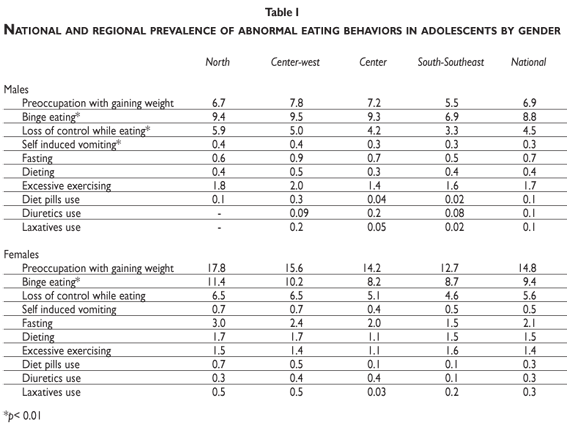
<body><![CDATA[<p><font size="2" face="Verdana">The questionnaire is a self&#45;administered evaluation    composed by ten items that assess eating behaviors and the presence of over&#45;riding    fears of gaining weight during the previous three months. Every item has four    response options (never= 0, sometimes= 1, frequently= 2 (twice a week) and very    frequently= 3 (more than two times in a week). The sum of points was used to    classify cases as being at risk for having an eating disorder (&gt; 10 points).<SUP>27</sup></font></p>     <p><font size="2" face="Verdana"><b>Statistical analysis</b></font></p>     <p><font size="2" face="Verdana">The statistical analysis was done using SPSS    for Windows version 12.0. Frequencies are presented stratified by age, gender,    region (north, center&#45;west, center and south&#45;southeast)<a name="tx01"></a><a href="#nt01"><sup>*</sup></a> and type of setting    (metropolitan areas, urban or rural). The data presented show the percentage    of adolescents that responded to the frequently or very frequently response    option. A variance analysis was carried out to compare data by age (grouped    in two ranges 10&#45;13, 14&#45;19), gender, region and type of setting, with a randomly    selected sample of 15% of the total cases to confirm that statistical differences    were not the result of an effect of the sample size.</font></p>     <p><font size="2" face="Verdana"><b>Ethical considerations</b></font></p>     <p><font size="2" face="Verdana">All participants signed an informed consent previous    to the survey interview. The survey and the written consent form were approved    by the Ethics Committee of the National Institute of Public Health.</font></p>     <p>&nbsp;</p>     <p><font size="3" face="Verdana"><b>Results</b></font></p>     <p><font size="2" face="Verdana">The study sample included 25 056 individuals    aged 10&#45;19 representative of this age group in Mexico. The risk for having an    eating disorder (a total score &gt; 10 points) was found in 0.8% of the participants    (0.4% of all males and 1.0% of all females). </font></p>     <p><font size="2" face="Verdana"> Preoccupation with weight gain, binge eating    and loss of control while eating were quite frequent in both genders (<a href="#tab01">Table   I</a>), however fasting was significant only for women. The rest of the behaviors    yielded percentages lower than 2%. Intense fear of gaining weight during the    previous three months was reported by 6.9% of the males and 14.8% of all females,    binge eating was found in 8.8% of men and 9.4% of women. Loss of control while    eating was found in 4.5% of men and 5.6% of women and fasting was found in 2.1%    of women only. Statistical differences between boys and girls were found in    preoccupation with gaining weight, fasting and dieting (<I>p</I> &lt; 0.01).</font></p>     <p><a name="tab01"></a></p>     ]]></body>
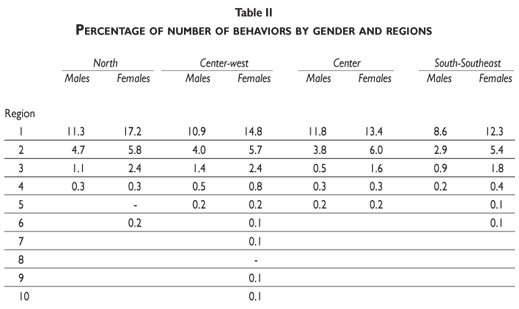
<body><![CDATA[<p>&nbsp;</p>     <p align="center"><img src="/img/revistas/spm/v51s4/a19tab01.gif"></p>     <p>&nbsp;</p>     <p><font size="2" face="Verdana">The number of items in the questionnaire that    were answered positively was similar between genders. Overall, a total of 11.2%    of the population reported one abnormal eating behavior, 2.8% reported two,    0.6% reported three and only 0.1% reported four positive responses. The responses    by gender are shown in <a href="#tab02">Table II</a>; men had as many as five different eating behaviors    while women had as many as 10 in the center&#45;west region. Five percent of women    had an average of two behaviors and up to 4% had three or more behaviors (<a href="#tab02">Table   II</a>).</font></p>     <p><a name="tab02"></a></p>     <p>&nbsp;</p>     <p align="center"><img src="/img/revistas/spm/v51s4/a19tab02.gif"></p>     <p>&nbsp;</p>     <p><font size="2" face="Verdana"><b>Analysis by region</b></font></p>     <p><font size="2" face="Verdana">The highest percentages of positive responses (three    or more) were found in the northern and center&#45;west regions for males (1.4%    and 2.1%, respectively) and the center&#45;west and northern regions for women (3.8%)    followed by the northern region (2.4%). Among male adolescents, differences    were found among binge eating, loss of control and self&#45;induced vomiting between    the northern region and the other three regions. For female adolescents, differences    were only found in binge eating among the northern and the other regions (<a href="#tab01">Tables   I</a> and <a href="#tab02">II</a>).</font></p>     ]]></body>
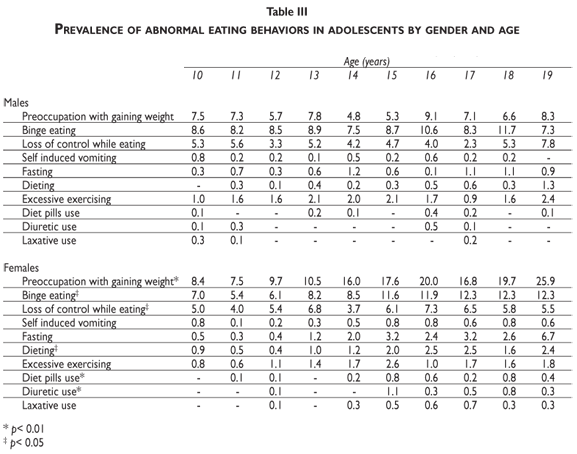
<body><![CDATA[<p><font size="2" face="Verdana"><b>Analysis by age group</b></font></p>     <p><font size="2" face="Verdana">All abnormal eating behaviors became more common    in direct proportion with age among females, mostly after age 13, while among    males, the time effect was less clear. The prevalence of preoccupation with    gaining weight varied between 4.8 to 9.1% among males and 7.5 to 25.9% in females.    The analysis for male adolescents did not yield any statistical differences,    and for females differences were found between the two age groups for preoccupation    with gaining weight, binge eating, loss of control, dieting, and diet pills    and diuretic use (<a href="#tab03">Table III</a>).</font></p>     <p><a name="tab03"></a></p>     <p>&nbsp;</p>     <p align="center"><img src="/img/revistas/spm/v51s4/a19tab03.gif"></p>     <p>&nbsp;</p>     <p><font size="2" face="Verdana"><b>Analysis by urban or rural locations</b></font></p>     <p><font size="2" face="Verdana">Prevalence in urban locations is double that    of rural ones for both male and female adolescents. Fear of gaining weight,    binge eating and loss of control while eating were more common among subjects    living in urban settings, whilst most behaviors were 50% less common in rural    settings. Statistical differences were found in binge eating in males between    rural and urban settings, but not between metropolitan and urban locations.    Among females, differences were found between rural settings and metropolitan    areas for preoccupation, binge eating and loss of control, and between both    urban settings and rural ones for dieting (<a href="#tab04">Table IV</a>).</font></p>     <p><a name="tab04"></a></p>     <p>&nbsp;</p>     ]]></body>
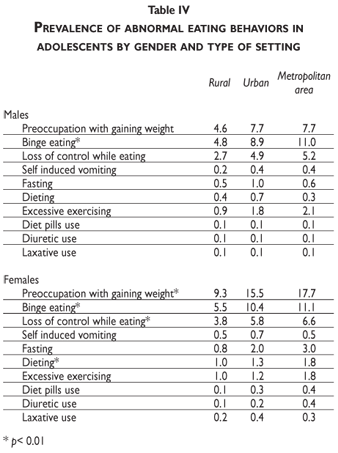
<body><![CDATA[<p align="center"><img src="/img/revistas/spm/v51s4/a19tab04.gif"></p>     <p>&nbsp;</p>    <p><font size="3" face="Verdana"><b>Discussion</b></font></p>     <p><font size="2" face="Verdana">Our data confirm that the prevalence of diverse    abnormal eating behaviors is significant among Mexican adolescents. This analysis    represents the first attempt to characterize the population at high risk of    abnormal eating behaviors with a nationally representative sample in a Latin    American country using a previously validated questionnaire. The sample size    allowed us to present information stratified by age and gender groups. Information    is also shown by region and by location. The results will be helpful to guide    the National Strategy for Clinical Prevention of Eating Disorders in Mexico    with regard to adolescents, and to consider the risk of abnormal eating behavior    when preventive initiatives are designed to address obesity and nutrition&#45;related    chronic diseases.</font></p>     <p><font size="2" face="Verdana"> The prevalence of abnormal eating behaviors    reported here was lower than that observed in the "Survey on Drugs and    Alcohol Consumption Prevalence among Mexico City School Age Population."    This is probably due to differences in the inclusion criteria. Our report included    a representative sample of the Mexican adolescent population, while the previous    study limited their observations to adolescents attending junior high and high    schools in Mexico City. Several reports have identified that schools could be    stressful environments that contribute to the appearance of eating disorders.<SUP>28</SUP>    In addition, adolescents in schools are more exposed to media messages that    influence their eating behaviors and beliefs. Our results also differ from previous    reports in the proportion of affected males. We observed that the difference    between genders is smaller (one male for every three females) than that presented    in regional studies focused on students (one male for every nine females). Our    findings are similar to those reported by Hudson, Hiripi, Pope and Kessler<SUP>28</SUP>    in the first nationwide representative survey done in the United States related    to eating disorders. These data support the need of population&#45;based data instead    of regional studies that have a limited ability to represent the overall population    and the real magnitude of the problem.</font></p>     <p><font size="2" face="Verdana"> One of the most frequent abnormal eating    behaviors found in Mexican adolescents is an intense fear of gaining weight    (6.9% among males and 14.8% in females). The prevalence of this characteristic    increased as adolescents became older. Medical services and media messages may    involuntarily contribute to the problem, particularly after the rapid increase    in the obesity prevalence recently documented. Properly selected information    provided by teachers and a healthy family environment are critical factors to    counteract unfavorable messages that lead to the construction of an abnormal    body image, and to improve healthy patterns to prevent obesity.</font></p>     <p><font size="2" face="Verdana"> Bing eating was a common abnormality both    in males (8.8%) and females (9.4%). The reported prevalence was higher than    that reported in a similar study of the American population (2.0% in males and    3.5% in females).<SUP>28</SUP> This abnormal behavior is clinically relevant    because it has been associated with several chronic disorders such as obesity    and diabetes).<SUP>21,29,30</SUP> Its presence should be sought in all patients    with metabolic syndrome. Failure to treat it results in lack of adherence to    therapy. Other behaviors that were frequent in the analyzed population were    loss of control while eating and excessive exercising and fasting, both important    predisposing features for the development of eating disorders that must be taken    into account while designing preventive strategies.</font></p>     <p><font size="2" face="Verdana"> Finally, abnormal eating behaviors were more    common in urban locations, however, the prevalence in rural areas, while lower,    must be considered a serious problem.<SUP>31</SUP> Given the regional and location    patterns, we think that eating disorders in Mexico are not necessarily a problem    limited to a specific socio&#45;demographic group. </font></p>     <p><font size="2" face="Verdana"> In addition to the importance of preventing    abnormal eating behaviors, better training and knowledge of these problems could    improve our understanding of adherence in chronic diseases, which require significant    lifestyle changes.<SUP>32&#45;34</SUP> These results are important because eating    disorders are pathologies associated with risk for addictions<SUP>22,23 </SUP>and    obesity,<SUP>21</SUP> two main health problems in adolescents in Mexico. </font></p>     <p><font size="2" face="Verdana"> Since these pathologies have a minor prevalence    compared to the non&#45;communicable chronic diseases studied in the ENSANUT, there    was not enough power to stratify by state. These results were useful to understand    the magnitude and characteristics of eating behavior risks in the Mexican adolescent    population and the information could be useful to design targeted public health    strategies to prevent eating disorders in populations at risk.</font></p>     ]]></body>
<body><![CDATA[<p><font size="2" face="Verdana"><b>Acknowledgments</b></font></p>     <p><font size="2" face="Verdana">We would like to acknowledge the invaluable support    of Georgina Alarc&oacute;n Jim&eacute;nez in the statistical calculations.</font></p>     <p>&nbsp;</p>     <p><font size="3" face="Verdana"><b>References</b></font></p>     <!-- ref --><p><font size="2" face="Verdana">1. Unikel C, Bojorquez I. A review of eating    disorders research in Mexico. Int J Psychol 2007;42:59&#45;68.    &nbsp;&nbsp;&nbsp;&nbsp;&nbsp;&nbsp;&nbsp;&nbsp;[&#160;<a href="javascript:void(0);" onclick="javascript: window.open('/scielo.php?script=sci_nlinks&ref=9295614&pid=S0036-3634200900100001900001&lng=','','width=640,height=500,resizable=yes,scrollbars=1,menubar=yes,');">Links</a>&#160;]<!-- end-ref --></font></p>     <!-- ref --><p><FONT size="2" face="Verdana">2. Medina&#45;Mora ME, Borges G, Lara C, Benjet C,    Blanco J, Fleiz C, <I>et al</I>. Prevalencia de trastornos mentales y uso de    servicios: Resultados de la Encuesta Nacional de Epidemiolog&iacute;a Psiqui&aacute;trica    en M&eacute;xico. Salud Ment 2003;26:1&#45;16.    &nbsp;&nbsp;&nbsp;&nbsp;&nbsp;&nbsp;&nbsp;&nbsp;[&#160;<a href="javascript:void(0);" onclick="javascript: window.open('/scielo.php?script=sci_nlinks&ref=9295616&pid=S0036-3634200900100001900002&lng=','','width=640,height=500,resizable=yes,scrollbars=1,menubar=yes,');">Links</a>&#160;]<!-- end-ref --></font></p>     <!-- ref --><p><font size="2" face="Verdana">3. Unikel C, Villatoro J, Medina&#45;Mora ME, Fleiz    C, Alcantar EN, Hern&aacute;ndez SA. Conductas alimentarias de riesgo en adolescentes    mexicanos. Datos en poblaci&oacute;n estudiantil del Distrito Federal. Rev Invest    Clin 2000;52:140&#45;147.    &nbsp;&nbsp;&nbsp;&nbsp;&nbsp;&nbsp;&nbsp;&nbsp;[&#160;<a href="javascript:void(0);" onclick="javascript: window.open('/scielo.php?script=sci_nlinks&ref=9295618&pid=S0036-3634200900100001900003&lng=','','width=640,height=500,resizable=yes,scrollbars=1,menubar=yes,');">Links</a>&#160;]<!-- end-ref --></font></p>     ]]></body>
<body><![CDATA[<!-- ref --><p><font size="2" face="Verdana">4. Unikel C, Bojorquez I, Villatoro JA, Fleiz    C, Medina&#45;Mora ME. Conductas alimentarias de riesgo en poblaci&oacute;n estudiantil    del Distrito Federal: tendencias 1997&#45;2003. Rev Invest Clin 2006;58:15&#45;27.    &nbsp;&nbsp;&nbsp;&nbsp;&nbsp;&nbsp;&nbsp;&nbsp;[&#160;<a href="javascript:void(0);" onclick="javascript: window.open('/scielo.php?script=sci_nlinks&ref=9295620&pid=S0036-3634200900100001900004&lng=','','width=640,height=500,resizable=yes,scrollbars=1,menubar=yes,');">Links</a>&#160;]<!-- end-ref --></font></p>     <!-- ref --><p><FONT size="2" face="Verdana">5. Villatoro J, Guti&eacute;rrez M, Quiroz N,    Moreno M, Gayt&aacute;n L, Gayt&aacute;n F, <I>et al</I>. Encuesta de Consumo    de Drogas en Estudiantes 2006. Mexico City: Instituto Nacional de Psiquiatr&iacute;a    Ram&oacute;n de la Fuente Mu&ntilde;iz, 2007.    &nbsp;&nbsp;&nbsp;&nbsp;&nbsp;&nbsp;&nbsp;&nbsp;[&#160;<a href="javascript:void(0);" onclick="javascript: window.open('/scielo.php?script=sci_nlinks&ref=9295622&pid=S0036-3634200900100001900005&lng=','','width=640,height=500,resizable=yes,scrollbars=1,menubar=yes,');">Links</a>&#160;]<!-- end-ref --> </font></p>     <!-- ref --><p><font size="2" face="Verdana">6. G&oacute;mez&#45;Peresmitr&eacute; G, Alvarado    G, Moreno L, Saloma S, Pineda G. Trastornos de la alimentaci&oacute;n. Factores    de riesgo en tres diferentes grupos de edad: pre&#45;p&uacute;beres, p&uacute;beres    y adolescentes. Rev Mex Psicol 2001;18:313&#45;324.    &nbsp;&nbsp;&nbsp;&nbsp;&nbsp;&nbsp;&nbsp;&nbsp;[&#160;<a href="javascript:void(0);" onclick="javascript: window.open('/scielo.php?script=sci_nlinks&ref=9295624&pid=S0036-3634200900100001900006&lng=','','width=640,height=500,resizable=yes,scrollbars=1,menubar=yes,');">Links</a>&#160;]<!-- end-ref --></font></p>     <!-- ref --><p><FONT size="2" face="Verdana">7. Mancilla JM, G&oacute;mez&#45;Peresmitr&eacute;    G, Alvarez GL, Franco K, V&aacute;zquez R, L&oacute;pez X, <I>et al.</I> Trastornos    del comportamiento alimentario en M&eacute;xico. En: Mancilla JM, G&oacute;mez&#45;Peresmitr&eacute;    G, comp. Trastornos alimentarios en Hispanoam&eacute;rica. Mexico: El Manual    Moderno, 2006:123&#45;171.    &nbsp;&nbsp;&nbsp;&nbsp;&nbsp;&nbsp;&nbsp;&nbsp;[&#160;<a href="javascript:void(0);" onclick="javascript: window.open('/scielo.php?script=sci_nlinks&ref=9295626&pid=S0036-3634200900100001900007&lng=','','width=640,height=500,resizable=yes,scrollbars=1,menubar=yes,');">Links</a>&#160;]<!-- end-ref --></font></p>     <!-- ref --><p><font size="2" face="Verdana">8. Alvarez G. Modelos de factores predictores    de trastornos del comportamiento alimentario en tres muestras de mujeres mexicanas    (Doctoral thesis). Mexico City: Universidad Nacional Aut&oacute;noma de M&eacute;xico,    2006.    &nbsp;&nbsp;&nbsp;&nbsp;&nbsp;&nbsp;&nbsp;&nbsp;[&#160;<a href="javascript:void(0);" onclick="javascript: window.open('/scielo.php?script=sci_nlinks&ref=9295628&pid=S0036-3634200900100001900008&lng=','','width=640,height=500,resizable=yes,scrollbars=1,menubar=yes,');">Links</a>&#160;]<!-- end-ref --></font></p>     ]]></body>
<body><![CDATA[<!-- ref --><p><font size="2" face="Verdana">9. Caballero A, Halmi K, Sunday S. A comparison    of cognitive and behavioral symptoms between Mexican and American eating disorder    patients. Int J Eat Disord 2003;34:136&#45;141.    &nbsp;&nbsp;&nbsp;&nbsp;&nbsp;&nbsp;&nbsp;&nbsp;[&#160;<a href="javascript:void(0);" onclick="javascript: window.open('/scielo.php?script=sci_nlinks&ref=9295630&pid=S0036-3634200900100001900009&lng=','','width=640,height=500,resizable=yes,scrollbars=1,menubar=yes,');">Links</a>&#160;]<!-- end-ref --></font></p>     <!-- ref --><p><font size="2" face="Verdana">10. Franco K. Perfeccionismo y trastornos del    comportamiento alimentario: una aproximaci&oacute;n multidimensional (Thesis).    Mexico City: Universidad Nacional Aut&oacute;noma de M&eacute;xico, 2007.    &nbsp;&nbsp;&nbsp;&nbsp;&nbsp;&nbsp;&nbsp;&nbsp;[&#160;<a href="javascript:void(0);" onclick="javascript: window.open('/scielo.php?script=sci_nlinks&ref=9295632&pid=S0036-3634200900100001900010&lng=','','width=640,height=500,resizable=yes,scrollbars=1,menubar=yes,');">Links</a>&#160;]<!-- end-ref --></font></p>     <!-- ref --><p><font size="2" face="Verdana">11. Unikel C. Factores de riesgo en los trastornos    de la conducta alimentaria (Thesis). Mexico City: Universidad Nacional Aut&oacute;noma    de M&eacute;xico, 2003.    &nbsp;&nbsp;&nbsp;&nbsp;&nbsp;&nbsp;&nbsp;&nbsp;[&#160;<a href="javascript:void(0);" onclick="javascript: window.open('/scielo.php?script=sci_nlinks&ref=9295634&pid=S0036-3634200900100001900011&lng=','','width=640,height=500,resizable=yes,scrollbars=1,menubar=yes,');">Links</a>&#160;]<!-- end-ref --></font></p>     <!-- ref --><p><font size="2" face="Verdana">12. Hern&aacute;ndez A. Factores de riesgo en    trastornos de la conducta alimentaria en atletas gimnastas mexicanas (Thesis).    Mexico City: Universidad Nacional Aut&oacute;noma de M&eacute;xico, 2006.    &nbsp;&nbsp;&nbsp;&nbsp;&nbsp;&nbsp;&nbsp;&nbsp;[&#160;<a href="javascript:void(0);" onclick="javascript: window.open('/scielo.php?script=sci_nlinks&ref=9295636&pid=S0036-3634200900100001900012&lng=','','width=640,height=500,resizable=yes,scrollbars=1,menubar=yes,');">Links</a>&#160;]<!-- end-ref --></font></p>     <!-- ref --><p><font size="2" face="Verdana">13. G&oacute;mez&#45;Peresmitr&eacute; G, Granados    AM, J&aacute;uregui J, Tafoya SA, Unikel C. Trastornos de la alimentaci&oacute;n:    factores de riesgo asociados con imagen corporal y con conducta alimentaria    en muestras del g&eacute;nero masculino. Psicol Contemporanea 2000;7:4&#45;15.    &nbsp;&nbsp;&nbsp;&nbsp;&nbsp;&nbsp;&nbsp;&nbsp;[&#160;<a href="javascript:void(0);" onclick="javascript: window.open('/scielo.php?script=sci_nlinks&ref=9295638&pid=S0036-3634200900100001900013&lng=','','width=640,height=500,resizable=yes,scrollbars=1,menubar=yes,');">Links</a>&#160;]<!-- end-ref --></font></p>     ]]></body>
<body><![CDATA[<!-- ref --><p><font size="2" face="Verdana">14. Rojo L, Barriguete JA, Livianos L. Factores    de riesgo socioculturales de los trastornos alimentarios. Monograf&iacute;as    de Psiquiatr&iacute;a, Trastornos de la conducta alimentaria 2006;18(2):65&#45;70.    &nbsp;&nbsp;&nbsp;&nbsp;&nbsp;&nbsp;&nbsp;&nbsp;[&#160;<a href="javascript:void(0);" onclick="javascript: window.open('/scielo.php?script=sci_nlinks&ref=9295640&pid=S0036-3634200900100001900014&lng=','','width=640,height=500,resizable=yes,scrollbars=1,menubar=yes,');">Links</a>&#160;]<!-- end-ref --></font></p>     <!-- ref --><p><font size="2" face="Verdana">15. Rivera L. Relaci&oacute;n entre el nivel    socioecon&oacute;mico y la presencia de factores de riesgo para el desarrollo    de des&oacute;rdenes alimentarios en mujeres de 16 a 19 a&ntilde;os. (Thesis).    Mexico City: Universidad Nacional Aut&oacute;noma de M&eacute;xico, 1997.    &nbsp;&nbsp;&nbsp;&nbsp;&nbsp;&nbsp;&nbsp;&nbsp;[&#160;<a href="javascript:void(0);" onclick="javascript: window.open('/scielo.php?script=sci_nlinks&ref=9295642&pid=S0036-3634200900100001900015&lng=','','width=640,height=500,resizable=yes,scrollbars=1,menubar=yes,');">Links</a>&#160;]<!-- end-ref --></font></p>     <!-- ref --><p><font size="2" face="Verdana">16. Barriguete JA, Aguilar CA, Moro MR, R&iacute;os    E, Lerin S. &Eacute;lever un enfant ce n'est pas seulement le nourrir: Approche    ethnopsychanalytique de la crianza chez les Pur&eacute;pechas du Mexique. L'Autre.    Cliniques, cultures et soci&eacute;t&eacute;s. Revue Transculturelle. Cliniques    des Am&eacute;riques 2003;4:347&#45;357.    &nbsp;&nbsp;&nbsp;&nbsp;&nbsp;&nbsp;&nbsp;&nbsp;[&#160;<a href="javascript:void(0);" onclick="javascript: window.open('/scielo.php?script=sci_nlinks&ref=9295644&pid=S0036-3634200900100001900016&lng=','','width=640,height=500,resizable=yes,scrollbars=1,menubar=yes,');">Links</a>&#160;]<!-- end-ref --></font></p>     <!-- ref --><p><font size="2" face="Verdana">17. Barriguete JA, Rivera MT, P&eacute;rez A,    Emmelhainz M. La conducta alimentaria y el equilibrio bio&#45;psico&#45;familiar. Rev    Iberoamericana Psicol 2005;13:68&#45;73.    &nbsp;&nbsp;&nbsp;&nbsp;&nbsp;&nbsp;&nbsp;&nbsp;[&#160;<a href="javascript:void(0);" onclick="javascript: window.open('/scielo.php?script=sci_nlinks&ref=9295646&pid=S0036-3634200900100001900017&lng=','','width=640,height=500,resizable=yes,scrollbars=1,menubar=yes,');">Links</a>&#160;]<!-- end-ref --></font></p>     <!-- ref --><p><font size="2" face="Verdana">18. Barriguete JA. L 'Alliance th&eacute;rapeutique    dans l'anorexie mentale. Revue Perspectives Psychiatriques 2002;41:24&#45;32.    &nbsp;&nbsp;&nbsp;&nbsp;&nbsp;&nbsp;&nbsp;&nbsp;[&#160;<a href="javascript:void(0);" onclick="javascript: window.open('/scielo.php?script=sci_nlinks&ref=9295648&pid=S0036-3634200900100001900018&lng=','','width=640,height=500,resizable=yes,scrollbars=1,menubar=yes,');">Links</a>&#160;]<!-- end-ref --></font></p>     ]]></body>
<body><![CDATA[<!-- ref --><p><font size="2" face="Verdana">19. P&eacute;rez A, Barriguete JA, Rivera T.    Prevenci&oacute;n de las alteraciones de la conducta alimentaria en grupos espec&iacute;ficos:    Diabetes Mellitus. Rev Iberoamericana Psicol 2005;13:84&#45;87.    &nbsp;&nbsp;&nbsp;&nbsp;&nbsp;&nbsp;&nbsp;&nbsp;[&#160;<a href="javascript:void(0);" onclick="javascript: window.open('/scielo.php?script=sci_nlinks&ref=9295650&pid=S0036-3634200900100001900019&lng=','','width=640,height=500,resizable=yes,scrollbars=1,menubar=yes,');">Links</a>&#160;]<!-- end-ref --></font></p>     <!-- ref --><p><font size="2" face="Verdana">20. Barriguete JA. Trastornos de la conducta    alimentaria en el sobrepeso y la obesidad. Obesidad y riesgo cardiometab&oacute;lico.    Revista Enlaces M&eacute;dicos Francia&#45;M&eacute;xico. Fundaci&oacute;n Franco&#45;Mexicana    para la Medicina IAP 2006;4:31&#45;38.    &nbsp;&nbsp;&nbsp;&nbsp;&nbsp;&nbsp;&nbsp;&nbsp;[&#160;<a href="javascript:void(0);" onclick="javascript: window.open('/scielo.php?script=sci_nlinks&ref=9295652&pid=S0036-3634200900100001900020&lng=','','width=640,height=500,resizable=yes,scrollbars=1,menubar=yes,');">Links</a>&#160;]<!-- end-ref --></font></p>     <!-- ref --><p><font size="2" face="Verdana">21. Devlin M, Golfein JA, Dobrow I. What is this    thing called BED? Current Status of Binge Eating Disorder Nosology. Int J Eat    Disord 2003;34:2&#45;18.    &nbsp;&nbsp;&nbsp;&nbsp;&nbsp;&nbsp;&nbsp;&nbsp;[&#160;<a href="javascript:void(0);" onclick="javascript: window.open('/scielo.php?script=sci_nlinks&ref=9295654&pid=S0036-3634200900100001900021&lng=','','width=640,height=500,resizable=yes,scrollbars=1,menubar=yes,');">Links</a>&#160;]<!-- end-ref --></font></p>     <!-- ref --><p><FONT size="2" face="Verdana">22. Franco L, Dorer M, Manzo M, Safia A, Jakson    C, Keel P, <I>et al</I>. Predictors of Onset and Recovery for Alcohol Abuse    in eating disorders. Orlando (FL): Conference of the Academy for Eating Disorders,    2004.    &nbsp;&nbsp;&nbsp;&nbsp;&nbsp;&nbsp;&nbsp;&nbsp;[&#160;<a href="javascript:void(0);" onclick="javascript: window.open('/scielo.php?script=sci_nlinks&ref=9295656&pid=S0036-3634200900100001900022&lng=','','width=640,height=500,resizable=yes,scrollbars=1,menubar=yes,');">Links</a>&#160;]<!-- end-ref --></font></p>     <!-- ref --><p><font size="2" face="Verdana">23. Mission interminist&eacute;rielle de Lutte    contre la Drogue et les Toxicomanies (MILDT). La pr&eacute;vention des toxicomanies.    Paris: La Documentation Fran&ccedil;aise, 2003.    &nbsp;&nbsp;&nbsp;&nbsp;&nbsp;&nbsp;&nbsp;&nbsp;[&#160;<a href="javascript:void(0);" onclick="javascript: window.open('/scielo.php?script=sci_nlinks&ref=9295658&pid=S0036-3634200900100001900023&lng=','','width=640,height=500,resizable=yes,scrollbars=1,menubar=yes,');">Links</a>&#160;]<!-- end-ref --></font></p>     ]]></body>
<body><![CDATA[<!-- ref --><p><font size="2" face="Verdana">24. Rivera T, Parra S, Barriguete JA. Trastornos    de la conducta alimentaria como factor de riesgo para la osteoporosis. Salud    Publica Mex 2005;47:308&#45;318.    &nbsp;&nbsp;&nbsp;&nbsp;&nbsp;&nbsp;&nbsp;&nbsp;[&#160;<a href="javascript:void(0);" onclick="javascript: window.open('/scielo.php?script=sci_nlinks&ref=9295660&pid=S0036-3634200900100001900024&lng=','','width=640,height=500,resizable=yes,scrollbars=1,menubar=yes,');">Links</a>&#160;]<!-- end-ref --></font></p>     <!-- ref --><p><FONT size="2" face="Verdana">25. C&oacute;rdova&#45;Villalobos JA, Barriguete&#45;Mel&eacute;ndez    JA, Lara&#45;Esqueda A, Barquera S, Rosas&#45;Peralta M, Hern&aacute;ndez&#45;&Aacute;vila    M, <I>et al</I>. Las enfermedades cr&oacute;nicas no transmisibles en M&eacute;xico:    sinopsis epidemiol&oacute;gica y prevenci&oacute;n integral. Salud Publica Mex    2008;5:419&#45;427.    &nbsp;&nbsp;&nbsp;&nbsp;&nbsp;&nbsp;&nbsp;&nbsp;[&#160;<a href="javascript:void(0);" onclick="javascript: window.open('/scielo.php?script=sci_nlinks&ref=9295662&pid=S0036-3634200900100001900025&lng=','','width=640,height=500,resizable=yes,scrollbars=1,menubar=yes,');">Links</a>&#160;]<!-- end-ref --></font></p>     <!-- ref --><p><font size="2" face="Verdana">26. Hudson JI, Hiripi E, Pope HG, Kessler RC.    The prevalence and correlates of eating disorders in the national comorbidity    replication survey. Biol Psychiatry 2007; 61:348&#45;358.    &nbsp;&nbsp;&nbsp;&nbsp;&nbsp;&nbsp;&nbsp;&nbsp;[&#160;<a href="javascript:void(0);" onclick="javascript: window.open('/scielo.php?script=sci_nlinks&ref=9295664&pid=S0036-3634200900100001900026&lng=','','width=640,height=500,resizable=yes,scrollbars=1,menubar=yes,');">Links</a>&#160;]<!-- end-ref --></font></p>     <!-- ref --><p><font size="2" face="Verdana">27. Unikel C, Bojorquez I, Carre&ntilde;o S.    Validaci&oacute;n de un cuestionario breve para medir conductas alimentarias    de riesgo. Salud Publica Mex 2004;46:509&#45;515.    &nbsp;&nbsp;&nbsp;&nbsp;&nbsp;&nbsp;&nbsp;&nbsp;[&#160;<a href="javascript:void(0);" onclick="javascript: window.open('/scielo.php?script=sci_nlinks&ref=9295666&pid=S0036-3634200900100001900027&lng=','','width=640,height=500,resizable=yes,scrollbars=1,menubar=yes,');">Links</a>&#160;]<!-- end-ref --></font></p>     <!-- ref --><p><font size="2" face="Verdana">28. Levine MP, Smolak L, Moodey AF, Shuman MD,    Hessen LD. Normative developmental challenges and dieting and eating disturbances    in middle school girls. Int J Eat Disord 1994;15:11&#45;20.    &nbsp;&nbsp;&nbsp;&nbsp;&nbsp;&nbsp;&nbsp;&nbsp;[&#160;<a href="javascript:void(0);" onclick="javascript: window.open('/scielo.php?script=sci_nlinks&ref=9295668&pid=S0036-3634200900100001900028&lng=','','width=640,height=500,resizable=yes,scrollbars=1,menubar=yes,');">Links</a>&#160;]<!-- end-ref --></font></p>     ]]></body>
<body><![CDATA[<!-- ref --><p><font size="2" face="Verdana">29. Brownley KA, Berkman ND, Sedway AJ, Lohr    NK, Bulik MC. Binge Eating Disorder treatment: a systematic review of randomized    controlled trials. Int J Eat Disord 2007;40:337&#45;348.    &nbsp;&nbsp;&nbsp;&nbsp;&nbsp;&nbsp;&nbsp;&nbsp;[&#160;<a href="javascript:void(0);" onclick="javascript: window.open('/scielo.php?script=sci_nlinks&ref=9295670&pid=S0036-3634200900100001900029&lng=','','width=640,height=500,resizable=yes,scrollbars=1,menubar=yes,');">Links</a>&#160;]<!-- end-ref --></font></p>     <!-- ref --><p><font size="2" face="Verdana">30. Stein RI, Kenardy J, Wiseman CV, Zoler DJ,    Arnow BA, Wifley DE. What's driving the binge in Binge Eating Disorder? A prospective    examination of precursors and consequences. Int J Eat Disord 2007;40:195&#45;203.    &nbsp;&nbsp;&nbsp;&nbsp;&nbsp;&nbsp;&nbsp;&nbsp;[&#160;<a href="javascript:void(0);" onclick="javascript: window.open('/scielo.php?script=sci_nlinks&ref=9295672&pid=S0036-3634200900100001900030&lng=','','width=640,height=500,resizable=yes,scrollbars=1,menubar=yes,');">Links</a>&#160;]<!-- end-ref --></font></p>     <!-- ref --><p><font size="2" face="Verdana">31. Nasser M, Katzman MA, Gordon RA, Ed. Eating    disorders and cultures in transition. New York (NY): Taylor and Francis, 2001.    &nbsp;&nbsp;&nbsp;&nbsp;&nbsp;&nbsp;&nbsp;&nbsp;[&#160;<a href="javascript:void(0);" onclick="javascript: window.open('/scielo.php?script=sci_nlinks&ref=9295674&pid=S0036-3634200900100001900031&lng=','','width=640,height=500,resizable=yes,scrollbars=1,menubar=yes,');">Links</a>&#160;]<!-- end-ref --></font></p>     <!-- ref --><p><font size="2" face="Verdana">32. Edmuns H, Hill AJ. Dieting and the family    context of eating in young adolescent children. Int J Eat Disord 1999;25:435&#45;440.    &nbsp;&nbsp;&nbsp;&nbsp;&nbsp;&nbsp;&nbsp;&nbsp;[&#160;<a href="javascript:void(0);" onclick="javascript: window.open('/scielo.php?script=sci_nlinks&ref=9295676&pid=S0036-3634200900100001900032&lng=','','width=640,height=500,resizable=yes,scrollbars=1,menubar=yes,');">Links</a>&#160;]<!-- end-ref --></font></p>     <!-- ref --><p><font size="2" face="Verdana">33. Fonseca H, Ireland M, Resnick MD. Familial    correlates of extreme weight control behaviors among adolescents. Int J Eat    Disord 2002;32:441&#45;448.    &nbsp;&nbsp;&nbsp;&nbsp;&nbsp;&nbsp;&nbsp;&nbsp;[&#160;<a href="javascript:void(0);" onclick="javascript: window.open('/scielo.php?script=sci_nlinks&ref=9295678&pid=S0036-3634200900100001900033&lng=','','width=640,height=500,resizable=yes,scrollbars=1,menubar=yes,');">Links</a>&#160;]<!-- end-ref --></font></p>     ]]></body>
<body><![CDATA[<!-- ref --><p><font size="2" face="Verdana">34. Anderson DA, Martens PM, Cimini DM. Do female    college students who purge report greater alcohol use and negative alcohol&#45;related    consequences? Int J Eat Disord 2003;37:65&#45;68.    &nbsp;&nbsp;&nbsp;&nbsp;&nbsp;&nbsp;&nbsp;&nbsp;[&#160;<a href="javascript:void(0);" onclick="javascript: window.open('/scielo.php?script=sci_nlinks&ref=9295680&pid=S0036-3634200900100001900034&lng=','','width=640,height=500,resizable=yes,scrollbars=1,menubar=yes,');">Links</a>&#160;]<!-- end-ref --></font></p>     <p>&nbsp;</p>     <p>&nbsp;</p>     <p><FONT size="2" FACE="Verdana">Received on: May 7, 2008    <br>   Accepted on: December 17, 2008</font></p>     <p>&nbsp;</p>     <p>&nbsp;</p>     <p><font size="2" face="Verdana">Address       reprint requests to: Dr. J. Armando Barriguete M. Oficina del C. Secretario de Salud. Lieja 7, col. Ju&aacute;rez. 06600 delegaci&oacute;n Cuauht&eacute;moc, M&eacute;xico, DF, M&eacute;xico. E&#45;mail: <a href="mailto:barriguete@quetzal.innsz.mx">barriguete@quetzal.innsz.mx</a>    <br> <a name="nt01"></a><a href="#tx01">*</a> North: Baja California Norte, Baja California Sur, Sonora, Chihuahua, Coahuila, Nuevo Le&oacute;n, Tamaulipas; Center&#45;west: Aguascalientes, Nayarit, Jalisco, Colima, Sinaloa, Michoac&aacute;n, Guanajuato, Durango, San Luis Potos&iacute;, Zacatecas; Center: Distrito Federal, Estado de M&eacute;xico, Quer&eacute;taro, Puebla, Hidalgo, Tlaxcala, Morelos; South&#45;southeast: Chiapas, Yucat&aacute;n, Campeche, Quintana Roo, Oaxaca, Guerrero, Tabasco, Veracruz.</font></p>     ]]></body>
<body><![CDATA[ ]]></body><back>
<ref-list>
<ref id="B1">
<label>1</label><nlm-citation citation-type="journal">
<person-group person-group-type="author">
<name>
<surname><![CDATA[Unikel]]></surname>
<given-names><![CDATA[C]]></given-names>
</name>
<name>
<surname><![CDATA[Bojorquez]]></surname>
<given-names><![CDATA[I]]></given-names>
</name>
</person-group>
<article-title xml:lang="en"><![CDATA[A review of eating disorders research in Mexico]]></article-title>
<source><![CDATA[Int J Psychol]]></source>
<year>2007</year>
<volume>42</volume>
<page-range>59-68</page-range></nlm-citation>
</ref>
<ref id="B2">
<label>2</label><nlm-citation citation-type="journal">
<person-group person-group-type="author">
<name>
<surname><![CDATA[Medina-Mora]]></surname>
<given-names><![CDATA[ME]]></given-names>
</name>
<name>
<surname><![CDATA[Borges]]></surname>
<given-names><![CDATA[G]]></given-names>
</name>
<name>
<surname><![CDATA[Lara]]></surname>
<given-names><![CDATA[C]]></given-names>
</name>
<name>
<surname><![CDATA[Benjet]]></surname>
<given-names><![CDATA[C]]></given-names>
</name>
<name>
<surname><![CDATA[Blanco]]></surname>
<given-names><![CDATA[J]]></given-names>
</name>
<name>
<surname><![CDATA[Fleiz]]></surname>
<given-names><![CDATA[C]]></given-names>
</name>
</person-group>
<article-title xml:lang="es"><![CDATA[Prevalencia de trastornos mentales y uso de servicios: Resultados de la Encuesta Nacional de Epidemiología Psiquiátrica en México]]></article-title>
<source><![CDATA[Salud Ment]]></source>
<year>2003</year>
<volume>26</volume>
<page-range>1-16</page-range></nlm-citation>
</ref>
<ref id="B3">
<label>3</label><nlm-citation citation-type="journal">
<person-group person-group-type="author">
<name>
<surname><![CDATA[Unikel]]></surname>
<given-names><![CDATA[C]]></given-names>
</name>
<name>
<surname><![CDATA[Villatoro]]></surname>
<given-names><![CDATA[J]]></given-names>
</name>
<name>
<surname><![CDATA[Medina-Mora]]></surname>
<given-names><![CDATA[ME]]></given-names>
</name>
<name>
<surname><![CDATA[Fleiz]]></surname>
<given-names><![CDATA[C]]></given-names>
</name>
<name>
<surname><![CDATA[Alcantar]]></surname>
<given-names><![CDATA[EN]]></given-names>
</name>
<name>
<surname><![CDATA[Hernández]]></surname>
<given-names><![CDATA[SA]]></given-names>
</name>
</person-group>
<article-title xml:lang="es"><![CDATA[Conductas alimentarias de riesgo en adolescentes mexicanos: Datos en población estudiantil del Distrito Federal]]></article-title>
<source><![CDATA[Rev Invest Clin]]></source>
<year>2000</year>
<volume>52</volume>
<page-range>140-147</page-range></nlm-citation>
</ref>
<ref id="B4">
<label>4</label><nlm-citation citation-type="journal">
<person-group person-group-type="author">
<name>
<surname><![CDATA[Unikel]]></surname>
<given-names><![CDATA[C]]></given-names>
</name>
<name>
<surname><![CDATA[Bojorquez]]></surname>
<given-names><![CDATA[I]]></given-names>
</name>
<name>
<surname><![CDATA[Villatoro]]></surname>
<given-names><![CDATA[JA]]></given-names>
</name>
<name>
<surname><![CDATA[Fleiz]]></surname>
<given-names><![CDATA[C]]></given-names>
</name>
<name>
<surname><![CDATA[Medina-Mora]]></surname>
<given-names><![CDATA[ME]]></given-names>
</name>
</person-group>
<article-title xml:lang="es"><![CDATA[Conductas alimentarias de riesgo en población estudiantil del Distrito Federal: tendencias 1997-2003]]></article-title>
<source><![CDATA[Rev Invest Clin]]></source>
<year>2006</year>
<volume>58</volume>
<page-range>15-27</page-range></nlm-citation>
</ref>
<ref id="B5">
<label>5</label><nlm-citation citation-type="book">
<person-group person-group-type="author">
<name>
<surname><![CDATA[Villatoro]]></surname>
<given-names><![CDATA[J]]></given-names>
</name>
<name>
<surname><![CDATA[Gutiérrez]]></surname>
<given-names><![CDATA[M]]></given-names>
</name>
<name>
<surname><![CDATA[Quiroz]]></surname>
<given-names><![CDATA[N]]></given-names>
</name>
<name>
<surname><![CDATA[Moreno]]></surname>
<given-names><![CDATA[M]]></given-names>
</name>
<name>
<surname><![CDATA[Gaytán]]></surname>
<given-names><![CDATA[L]]></given-names>
</name>
<name>
<surname><![CDATA[Gaytán]]></surname>
<given-names><![CDATA[F]]></given-names>
</name>
</person-group>
<source><![CDATA[Encuesta de Consumo de Drogas en Estudiantes 2006]]></source>
<year>2007</year>
<publisher-loc><![CDATA[Mexico City ]]></publisher-loc>
<publisher-name><![CDATA[Instituto Nacional de Psiquiatría Ramón de la Fuente Muñiz]]></publisher-name>
</nlm-citation>
</ref>
<ref id="B6">
<label>6</label><nlm-citation citation-type="journal">
<person-group person-group-type="author">
<name>
<surname><![CDATA[Gómez-Peresmitré]]></surname>
<given-names><![CDATA[G]]></given-names>
</name>
<name>
<surname><![CDATA[Alvarado]]></surname>
<given-names><![CDATA[G]]></given-names>
</name>
<name>
<surname><![CDATA[Moreno]]></surname>
<given-names><![CDATA[L]]></given-names>
</name>
<name>
<surname><![CDATA[Saloma]]></surname>
<given-names><![CDATA[S]]></given-names>
</name>
<name>
<surname><![CDATA[Pineda]]></surname>
<given-names><![CDATA[G]]></given-names>
</name>
</person-group>
<article-title xml:lang="es"><![CDATA[Trastornos de la alimentación: Factores de riesgo en tres diferentes grupos de edad: pre-púberes, púberes y adolescentes]]></article-title>
<source><![CDATA[Rev Mex Psicol]]></source>
<year>2001</year>
<volume>18</volume>
<page-range>313-324</page-range></nlm-citation>
</ref>
<ref id="B7">
<label>7</label><nlm-citation citation-type="book">
<person-group person-group-type="author">
<name>
<surname><![CDATA[Mancilla]]></surname>
<given-names><![CDATA[JM]]></given-names>
</name>
<name>
<surname><![CDATA[Gómez-Peresmitré]]></surname>
<given-names><![CDATA[G]]></given-names>
</name>
<name>
<surname><![CDATA[Alvarez]]></surname>
<given-names><![CDATA[GL]]></given-names>
</name>
<name>
<surname><![CDATA[Franco]]></surname>
<given-names><![CDATA[K]]></given-names>
</name>
<name>
<surname><![CDATA[Vázquez]]></surname>
<given-names><![CDATA[R]]></given-names>
</name>
<name>
<surname><![CDATA[López]]></surname>
<given-names><![CDATA[X]]></given-names>
</name>
</person-group>
<article-title xml:lang="es"><![CDATA[Trastornos del comportamiento alimentario en México]]></article-title>
<person-group person-group-type="editor">
<name>
<surname><![CDATA[Mancilla]]></surname>
<given-names><![CDATA[JM]]></given-names>
</name>
<name>
<surname><![CDATA[Gómez-Peresmitré]]></surname>
<given-names><![CDATA[G]]></given-names>
</name>
</person-group>
<source><![CDATA[Trastornos alimentarios en Hispanoamérica]]></source>
<year>2006</year>
<page-range>123-171</page-range><publisher-name><![CDATA[El Manual Moderno]]></publisher-name>
</nlm-citation>
</ref>
<ref id="B8">
<label>8</label><nlm-citation citation-type="">
<person-group person-group-type="author">
<name>
<surname><![CDATA[Alvarez]]></surname>
<given-names><![CDATA[G]]></given-names>
</name>
</person-group>
<source><![CDATA[Modelos de factores predictores de trastornos del comportamiento alimentario en tres muestras de mujeres mexicanas]]></source>
<year></year>
</nlm-citation>
</ref>
<ref id="B9">
<label>9</label><nlm-citation citation-type="journal">
<person-group person-group-type="author">
<name>
<surname><![CDATA[Caballero]]></surname>
<given-names><![CDATA[A]]></given-names>
</name>
<name>
<surname><![CDATA[Halmi]]></surname>
<given-names><![CDATA[K]]></given-names>
</name>
<name>
<surname><![CDATA[Sunday]]></surname>
<given-names><![CDATA[S]]></given-names>
</name>
</person-group>
<article-title xml:lang="en"><![CDATA[A comparison of cognitive and behavioral symptoms between Mexican and American eating disorder patients]]></article-title>
<source><![CDATA[Int J Eat Disord]]></source>
<year>2003</year>
<volume>34</volume>
<page-range>136-141</page-range></nlm-citation>
</ref>
<ref id="B10">
<label>10</label><nlm-citation citation-type="">
<person-group person-group-type="author">
<name>
<surname><![CDATA[Franco]]></surname>
<given-names><![CDATA[K]]></given-names>
</name>
</person-group>
<source><![CDATA[Perfeccionismo y trastornos del comportamiento alimentario: una aproximación multidimensional]]></source>
<year></year>
</nlm-citation>
</ref>
<ref id="B11">
<label>11</label><nlm-citation citation-type="">
<person-group person-group-type="author">
<name>
<surname><![CDATA[Unikel]]></surname>
<given-names><![CDATA[C]]></given-names>
</name>
</person-group>
<source><![CDATA[Factores de riesgo en los trastornos de la conducta alimentaria]]></source>
<year></year>
</nlm-citation>
</ref>
<ref id="B12">
<label>12</label><nlm-citation citation-type="">
<person-group person-group-type="author">
<name>
<surname><![CDATA[Hernández]]></surname>
<given-names><![CDATA[A]]></given-names>
</name>
</person-group>
<source><![CDATA[Factores de riesgo en trastornos de la conducta alimentaria en atletas gimnastas mexicanas]]></source>
<year></year>
</nlm-citation>
</ref>
<ref id="B13">
<label>13</label><nlm-citation citation-type="journal">
<person-group person-group-type="author">
<name>
<surname><![CDATA[Gómez-Peresmitré]]></surname>
<given-names><![CDATA[G]]></given-names>
</name>
<name>
<surname><![CDATA[Granados]]></surname>
<given-names><![CDATA[AM]]></given-names>
</name>
<name>
<surname><![CDATA[Jáuregui]]></surname>
<given-names><![CDATA[J]]></given-names>
</name>
<name>
<surname><![CDATA[Tafoya]]></surname>
<given-names><![CDATA[SA]]></given-names>
</name>
<name>
<surname><![CDATA[Unikel]]></surname>
<given-names><![CDATA[C]]></given-names>
</name>
</person-group>
<article-title xml:lang="es"><![CDATA[Trastornos de la alimentación: factores de riesgo asociados con imagen corporal y con conducta alimentaria en muestras del género masculino]]></article-title>
<source><![CDATA[Psicol Contemporanea]]></source>
<year>2000</year>
<volume>7</volume>
<page-range>4-15</page-range></nlm-citation>
</ref>
<ref id="B14">
<label>14</label><nlm-citation citation-type="journal">
<person-group person-group-type="author">
<name>
<surname><![CDATA[Rojo]]></surname>
<given-names><![CDATA[L]]></given-names>
</name>
<name>
<surname><![CDATA[Barriguete]]></surname>
<given-names><![CDATA[JA]]></given-names>
</name>
<name>
<surname><![CDATA[Livianos]]></surname>
<given-names><![CDATA[L]]></given-names>
</name>
</person-group>
<article-title xml:lang="es"><![CDATA[Factores de riesgo socioculturales de los trastornos alimentarios]]></article-title>
<source><![CDATA[Monografías de Psiquiatría, Trastornos de la conducta alimentaria]]></source>
<year>2006</year>
<volume>18</volume>
<numero>2</numero>
<issue>2</issue>
<page-range>65-70</page-range></nlm-citation>
</ref>
<ref id="B15">
<label>15</label><nlm-citation citation-type="">
<person-group person-group-type="author">
<name>
<surname><![CDATA[Rivera]]></surname>
<given-names><![CDATA[L]]></given-names>
</name>
</person-group>
<source><![CDATA[Relación entre el nivel socioeconómico y la presencia de factores de riesgo para el desarrollo de desórdenes alimentarios en mujeres de 16 a 19 años]]></source>
<year></year>
</nlm-citation>
</ref>
<ref id="B16">
<label>16</label><nlm-citation citation-type="journal">
<person-group person-group-type="author">
<name>
<surname><![CDATA[Barriguete]]></surname>
<given-names><![CDATA[JA]]></given-names>
</name>
<name>
<surname><![CDATA[Aguilar]]></surname>
<given-names><![CDATA[CA]]></given-names>
</name>
<name>
<surname><![CDATA[Moro]]></surname>
<given-names><![CDATA[MR]]></given-names>
</name>
<name>
<surname><![CDATA[Ríos]]></surname>
<given-names><![CDATA[E]]></given-names>
</name>
<name>
<surname><![CDATA[Lerin]]></surname>
<given-names><![CDATA[S]]></given-names>
</name>
</person-group>
<article-title xml:lang="fr"><![CDATA[Élever un enfant ce n'est pas seulement le nourrir: Approche ethnopsychanalytique de la crianza chez les Purépechas du Mexique. L'Autre. Cliniques, cultures et sociétés. Revue Transculturelle]]></article-title>
<source><![CDATA[Cliniques des Amériques]]></source>
<year>2003</year>
<volume>4</volume>
<page-range>347-357</page-range></nlm-citation>
</ref>
<ref id="B17">
<label>17</label><nlm-citation citation-type="journal">
<person-group person-group-type="author">
<name>
<surname><![CDATA[Barriguete]]></surname>
<given-names><![CDATA[JA]]></given-names>
</name>
<name>
<surname><![CDATA[Rivera]]></surname>
<given-names><![CDATA[MT]]></given-names>
</name>
<name>
<surname><![CDATA[Pérez]]></surname>
<given-names><![CDATA[A]]></given-names>
</name>
<name>
<surname><![CDATA[Emmelhainz]]></surname>
<given-names><![CDATA[M]]></given-names>
</name>
</person-group>
<article-title xml:lang="es"><![CDATA[La conducta alimentaria y el equilibrio bio-psico-familiar]]></article-title>
<source><![CDATA[Rev Iberoamericana Psicol]]></source>
<year>2005</year>
<volume>13</volume>
<page-range>68-73</page-range></nlm-citation>
</ref>
<ref id="B18">
<label>18</label><nlm-citation citation-type="journal">
<person-group person-group-type="author">
<name>
<surname><![CDATA[Barriguete]]></surname>
<given-names><![CDATA[JA]]></given-names>
</name>
</person-group>
<article-title xml:lang="fr"><![CDATA[L 'Alliance thérapeutique dans l'anorexie mentale]]></article-title>
<source><![CDATA[Revue Perspectives Psychiatriques]]></source>
<year>2002</year>
<volume>41</volume>
<page-range>24-32</page-range></nlm-citation>
</ref>
<ref id="B19">
<label>19</label><nlm-citation citation-type="journal">
<person-group person-group-type="author">
<name>
<surname><![CDATA[Pérez]]></surname>
<given-names><![CDATA[A]]></given-names>
</name>
<name>
<surname><![CDATA[Barriguete]]></surname>
<given-names><![CDATA[JA]]></given-names>
</name>
<name>
<surname><![CDATA[Rivera]]></surname>
<given-names><![CDATA[T]]></given-names>
</name>
</person-group>
<article-title xml:lang="es"><![CDATA[Prevención de las alteraciones de la conducta alimentaria en grupos específicos: Diabetes Mellitus]]></article-title>
<source><![CDATA[Rev Iberoamericana Psicol]]></source>
<year>2005</year>
<volume>13</volume>
<page-range>84-87</page-range></nlm-citation>
</ref>
<ref id="B20">
<label>20</label><nlm-citation citation-type="journal">
<person-group person-group-type="author">
<name>
<surname><![CDATA[Barriguete]]></surname>
<given-names><![CDATA[JA]]></given-names>
</name>
</person-group>
<article-title xml:lang="es"><![CDATA[Trastornos de la conducta alimentaria en el sobrepeso y la obesidad: Obesidad y riesgo cardiometabólico]]></article-title>
<source><![CDATA[Revista Enlaces Médicos Francia-México. Fundación Franco-Mexicana para la Medicina IAP]]></source>
<year>2006</year>
<volume>4</volume>
<page-range>31-38</page-range></nlm-citation>
</ref>
<ref id="B21">
<label>21</label><nlm-citation citation-type="journal">
<person-group person-group-type="author">
<name>
<surname><![CDATA[Devlin]]></surname>
<given-names><![CDATA[M]]></given-names>
</name>
<name>
<surname><![CDATA[Golfein]]></surname>
<given-names><![CDATA[JA]]></given-names>
</name>
<name>
<surname><![CDATA[Dobrow]]></surname>
<given-names><![CDATA[I]]></given-names>
</name>
</person-group>
<article-title xml:lang="en"><![CDATA[What is this thing called BED?: Current Status of Binge Eating Disorder Nosology]]></article-title>
<source><![CDATA[Int J Eat Disord]]></source>
<year>2003</year>
<volume>34</volume>
<page-range>2-18</page-range></nlm-citation>
</ref>
<ref id="B22">
<label>22</label><nlm-citation citation-type="book">
<person-group person-group-type="author">
<name>
<surname><![CDATA[Franco]]></surname>
<given-names><![CDATA[L]]></given-names>
</name>
<name>
<surname><![CDATA[Dorer]]></surname>
<given-names><![CDATA[M]]></given-names>
</name>
<name>
<surname><![CDATA[Manzo]]></surname>
<given-names><![CDATA[M]]></given-names>
</name>
<name>
<surname><![CDATA[Safia]]></surname>
<given-names><![CDATA[A]]></given-names>
</name>
<name>
<surname><![CDATA[Jakson]]></surname>
<given-names><![CDATA[C]]></given-names>
</name>
<name>
<surname><![CDATA[Keel]]></surname>
<given-names><![CDATA[P]]></given-names>
</name>
</person-group>
<source><![CDATA[Predictors of Onset and Recovery for Alcohol Abuse in eating disorders]]></source>
<year>2004</year>
<publisher-loc><![CDATA[Orlando^eFL FL]]></publisher-loc>
<publisher-name><![CDATA[Conference of the Academy for Eating Disorders]]></publisher-name>
</nlm-citation>
</ref>
<ref id="B23">
<label>23</label><nlm-citation citation-type="book">
<source><![CDATA[Mission interministérielle de Lutte contre la Drogue et les Toxicomanies (MILDT): La prévention des toxicomanies]]></source>
<year>2003</year>
<publisher-loc><![CDATA[Paris ]]></publisher-loc>
<publisher-name><![CDATA[La Documentation Française]]></publisher-name>
</nlm-citation>
</ref>
<ref id="B24">
<label>24</label><nlm-citation citation-type="journal">
<person-group person-group-type="author">
<name>
<surname><![CDATA[Rivera]]></surname>
<given-names><![CDATA[T]]></given-names>
</name>
<name>
<surname><![CDATA[Parra]]></surname>
<given-names><![CDATA[S]]></given-names>
</name>
<name>
<surname><![CDATA[Barriguete]]></surname>
<given-names><![CDATA[JA]]></given-names>
</name>
</person-group>
<article-title xml:lang="es"><![CDATA[Trastornos de la conducta alimentaria como factor de riesgo para la osteoporosis]]></article-title>
<source><![CDATA[Salud Publica Mex]]></source>
<year>2005</year>
<volume>47</volume>
<page-range>308-318</page-range></nlm-citation>
</ref>
<ref id="B25">
<label>25</label><nlm-citation citation-type="journal">
<person-group person-group-type="author">
<name>
<surname><![CDATA[Córdova-Villalobos]]></surname>
<given-names><![CDATA[JA]]></given-names>
</name>
<name>
<surname><![CDATA[Barriguete-Meléndez]]></surname>
<given-names><![CDATA[JA]]></given-names>
</name>
<name>
<surname><![CDATA[Lara-Esqueda]]></surname>
<given-names><![CDATA[A]]></given-names>
</name>
<name>
<surname><![CDATA[Barquera]]></surname>
<given-names><![CDATA[S]]></given-names>
</name>
<name>
<surname><![CDATA[Rosas-Peralta]]></surname>
<given-names><![CDATA[M]]></given-names>
</name>
<name>
<surname><![CDATA[Hernández-Ávila]]></surname>
<given-names><![CDATA[M]]></given-names>
</name>
</person-group>
<article-title xml:lang="es"><![CDATA[Las enfermedades crónicas no transmisibles en México: sinopsis epidemiológica y prevención integral]]></article-title>
<source><![CDATA[Salud Publica Mex]]></source>
<year>2008</year>
<volume>5</volume>
<page-range>419-427</page-range></nlm-citation>
</ref>
<ref id="B26">
<label>26</label><nlm-citation citation-type="journal">
<person-group person-group-type="author">
<name>
<surname><![CDATA[Hudson]]></surname>
<given-names><![CDATA[JI]]></given-names>
</name>
<name>
<surname><![CDATA[Hiripi]]></surname>
<given-names><![CDATA[E]]></given-names>
</name>
<name>
<surname><![CDATA[Pope]]></surname>
<given-names><![CDATA[HG]]></given-names>
</name>
<name>
<surname><![CDATA[Kessler]]></surname>
<given-names><![CDATA[RC]]></given-names>
</name>
</person-group>
<article-title xml:lang="en"><![CDATA[The prevalence and correlates of eating disorders in the national comorbidity replication survey]]></article-title>
<source><![CDATA[Biol Psychiatry]]></source>
<year>2007</year>
<volume>61</volume>
<page-range>348-358</page-range></nlm-citation>
</ref>
<ref id="B27">
<label>27</label><nlm-citation citation-type="journal">
<person-group person-group-type="author">
<name>
<surname><![CDATA[Unikel]]></surname>
<given-names><![CDATA[C]]></given-names>
</name>
<name>
<surname><![CDATA[Bojorquez]]></surname>
<given-names><![CDATA[I]]></given-names>
</name>
<name>
<surname><![CDATA[Carreño]]></surname>
<given-names><![CDATA[S]]></given-names>
</name>
</person-group>
<article-title xml:lang="es"><![CDATA[Validación de un cuestionario breve para medir conductas alimentarias de riesgo]]></article-title>
<source><![CDATA[Salud Publica Mex]]></source>
<year>2004</year>
<volume>46</volume>
<page-range>509-515</page-range></nlm-citation>
</ref>
<ref id="B28">
<label>28</label><nlm-citation citation-type="journal">
<person-group person-group-type="author">
<name>
<surname><![CDATA[Levine]]></surname>
<given-names><![CDATA[MP]]></given-names>
</name>
<name>
<surname><![CDATA[Smolak]]></surname>
<given-names><![CDATA[L]]></given-names>
</name>
<name>
<surname><![CDATA[Moodey]]></surname>
<given-names><![CDATA[AF]]></given-names>
</name>
<name>
<surname><![CDATA[Shuman]]></surname>
<given-names><![CDATA[MD]]></given-names>
</name>
<name>
<surname><![CDATA[Hessen]]></surname>
<given-names><![CDATA[LD]]></given-names>
</name>
</person-group>
<article-title xml:lang="en"><![CDATA[Normative developmental challenges and dieting and eating disturbances in middle school girls]]></article-title>
<source><![CDATA[Int J Eat Disord]]></source>
<year>1994</year>
<volume>15</volume>
<page-range>11-20</page-range></nlm-citation>
</ref>
<ref id="B29">
<label>29</label><nlm-citation citation-type="journal">
<person-group person-group-type="author">
<name>
<surname><![CDATA[Brownley]]></surname>
<given-names><![CDATA[KA]]></given-names>
</name>
<name>
<surname><![CDATA[Berkman]]></surname>
<given-names><![CDATA[ND]]></given-names>
</name>
<name>
<surname><![CDATA[Sedway]]></surname>
<given-names><![CDATA[AJ]]></given-names>
</name>
<name>
<surname><![CDATA[Lohr]]></surname>
<given-names><![CDATA[NK]]></given-names>
</name>
<name>
<surname><![CDATA[Bulik]]></surname>
<given-names><![CDATA[MC]]></given-names>
</name>
</person-group>
<article-title xml:lang="en"><![CDATA[Binge Eating Disorder treatment: a systematic review of randomized controlled trials]]></article-title>
<source><![CDATA[Int J Eat Disord]]></source>
<year>2007</year>
<volume>40</volume>
<page-range>337-348</page-range></nlm-citation>
</ref>
<ref id="B30">
<label>30</label><nlm-citation citation-type="journal">
<person-group person-group-type="author">
<name>
<surname><![CDATA[Stein]]></surname>
<given-names><![CDATA[RI]]></given-names>
</name>
<name>
<surname><![CDATA[Kenardy]]></surname>
<given-names><![CDATA[J]]></given-names>
</name>
<name>
<surname><![CDATA[Wiseman]]></surname>
<given-names><![CDATA[CV]]></given-names>
</name>
<name>
<surname><![CDATA[Zoler]]></surname>
<given-names><![CDATA[DJ]]></given-names>
</name>
<name>
<surname><![CDATA[Arnow]]></surname>
<given-names><![CDATA[BA]]></given-names>
</name>
<name>
<surname><![CDATA[Wifley]]></surname>
<given-names><![CDATA[DE]]></given-names>
</name>
</person-group>
<article-title xml:lang="en"><![CDATA[What's driving the binge in Binge Eating Disorder?: A prospective examination of precursors and consequences]]></article-title>
<source><![CDATA[Int J Eat Disord]]></source>
<year>2007</year>
<volume>40</volume>
<page-range>195-203</page-range></nlm-citation>
</ref>
<ref id="B31">
<label>31</label><nlm-citation citation-type="book">
<person-group person-group-type="author">
<name>
<surname><![CDATA[Nasser]]></surname>
<given-names><![CDATA[M]]></given-names>
</name>
<name>
<surname><![CDATA[Katzman]]></surname>
<given-names><![CDATA[MA]]></given-names>
</name>
<name>
<surname><![CDATA[Gordon]]></surname>
<given-names><![CDATA[RA]]></given-names>
</name>
</person-group>
<source><![CDATA[Eating disorders and cultures in transition]]></source>
<year>2001</year>
<publisher-loc><![CDATA[New York^eNY NY]]></publisher-loc>
<publisher-name><![CDATA[Taylor and Francis]]></publisher-name>
</nlm-citation>
</ref>
<ref id="B32">
<label>32</label><nlm-citation citation-type="journal">
<person-group person-group-type="author">
<name>
<surname><![CDATA[Edmuns]]></surname>
<given-names><![CDATA[H]]></given-names>
</name>
<name>
<surname><![CDATA[Hill]]></surname>
<given-names><![CDATA[AJ]]></given-names>
</name>
</person-group>
<article-title xml:lang="en"><![CDATA[Dieting and the family context of eating in young adolescent children]]></article-title>
<source><![CDATA[Int J Eat Disord]]></source>
<year>1999</year>
<volume>25</volume>
<page-range>435-440</page-range></nlm-citation>
</ref>
<ref id="B33">
<label>33</label><nlm-citation citation-type="journal">
<person-group person-group-type="author">
<name>
<surname><![CDATA[Fonseca]]></surname>
<given-names><![CDATA[H]]></given-names>
</name>
<name>
<surname><![CDATA[Ireland]]></surname>
<given-names><![CDATA[M]]></given-names>
</name>
<name>
<surname><![CDATA[Resnick]]></surname>
<given-names><![CDATA[MD]]></given-names>
</name>
</person-group>
<article-title xml:lang="en"><![CDATA[Familial correlates of extreme weight control behaviors among adolescents]]></article-title>
<source><![CDATA[Int J Eat Disord]]></source>
<year>2002</year>
<volume>32</volume>
<page-range>441-448</page-range></nlm-citation>
</ref>
<ref id="B34">
<label>34</label><nlm-citation citation-type="journal">
<person-group person-group-type="author">
<name>
<surname><![CDATA[Anderson]]></surname>
<given-names><![CDATA[DA]]></given-names>
</name>
<name>
<surname><![CDATA[Martens]]></surname>
<given-names><![CDATA[PM]]></given-names>
</name>
<name>
<surname><![CDATA[Cimini]]></surname>
<given-names><![CDATA[DM]]></given-names>
</name>
</person-group>
<article-title xml:lang="en"><![CDATA[Do female college students who purge report greater alcohol use and negative alcohol-related consequences?]]></article-title>
<source><![CDATA[Int J Eat Disord]]></source>
<year>2003</year>
<volume>37</volume>
<page-range>65-68</page-range></nlm-citation>
</ref>
</ref-list>
</back>
</article>