<?xml version="1.0" encoding="ISO-8859-1"?><article xmlns:mml="http://www.w3.org/1998/Math/MathML" xmlns:xlink="http://www.w3.org/1999/xlink" xmlns:xsi="http://www.w3.org/2001/XMLSchema-instance">
<front>
<journal-meta>
<journal-id>0036-3634</journal-id>
<journal-title><![CDATA[Salud Pública de México]]></journal-title>
<abbrev-journal-title><![CDATA[Salud pública Méx]]></abbrev-journal-title>
<issn>0036-3634</issn>
<publisher>
<publisher-name><![CDATA[Instituto Nacional de Salud Pública]]></publisher-name>
</publisher>
</journal-meta>
<article-meta>
<article-id>S0036-36342009001000018</article-id>
<title-group>
<article-title xml:lang="en"><![CDATA[Overweight and obesity in school children aged 5 to 11 years participating in food assistance programs in Mexico]]></article-title>
<article-title xml:lang="es"><![CDATA[Sobrepeso y obesidad en niños de 5 a 11 años de edad beneficiarios de programas de ayuda alimentaria en México]]></article-title>
</title-group>
<contrib-group>
<contrib contrib-type="author">
<name>
<surname><![CDATA[Cuevas-Nasu]]></surname>
<given-names><![CDATA[Lucía]]></given-names>
</name>
<xref ref-type="aff" rid="A01"/>
</contrib>
<contrib contrib-type="author">
<name>
<surname><![CDATA[Hernández-Prado]]></surname>
<given-names><![CDATA[Bernardo]]></given-names>
</name>
<xref ref-type="aff" rid="A01"/>
</contrib>
<contrib contrib-type="author">
<name>
<surname><![CDATA[Shamah-Levy]]></surname>
<given-names><![CDATA[Teresa]]></given-names>
</name>
<xref ref-type="aff" rid="A01"/>
</contrib>
<contrib contrib-type="author">
<name>
<surname><![CDATA[Monterrubio]]></surname>
<given-names><![CDATA[Eric A]]></given-names>
</name>
<xref ref-type="aff" rid="A01"/>
</contrib>
<contrib contrib-type="author">
<name>
<surname><![CDATA[Morales-Ruan]]></surname>
<given-names><![CDATA[María del Carmen]]></given-names>
</name>
<xref ref-type="aff" rid="A01"/>
</contrib>
<contrib contrib-type="author">
<name>
<surname><![CDATA[Moreno-Macías]]></surname>
<given-names><![CDATA[Lidia B]]></given-names>
</name>
<xref ref-type="aff" rid="A02"/>
</contrib>
</contrib-group>
<aff id="A01">
<institution><![CDATA[,Instituto Nacional de Salud Pública  ]]></institution>
<addr-line><![CDATA[Cuernavaca Morelos]]></addr-line>
<country>México</country>
</aff>
<aff id="A02">
<institution><![CDATA[,Universidad Autónoma de Yucatán Facultad de Medicina ]]></institution>
<addr-line><![CDATA[Yucatán ]]></addr-line>
<country>México</country>
</aff>
<pub-date pub-type="pub">
<day>00</day>
<month>00</month>
<year>2009</year>
</pub-date>
<pub-date pub-type="epub">
<day>00</day>
<month>00</month>
<year>2009</year>
</pub-date>
<volume>51</volume>
<fpage>S630</fpage>
<lpage>S637</lpage>
<copyright-statement/>
<copyright-year/>
<self-uri xlink:href="http://www.scielo.org.mx/scielo.php?script=sci_arttext&amp;pid=S0036-36342009001000018&amp;lng=en&amp;nrm=iso"></self-uri><self-uri xlink:href="http://www.scielo.org.mx/scielo.php?script=sci_abstract&amp;pid=S0036-36342009001000018&amp;lng=en&amp;nrm=iso"></self-uri><self-uri xlink:href="http://www.scielo.org.mx/scielo.php?script=sci_pdf&amp;pid=S0036-36342009001000018&amp;lng=en&amp;nrm=iso"></self-uri><abstract abstract-type="short" xml:lang="en"><p><![CDATA[OBJECTIVE: To determine the association between overweight and obesity among Mexican school-aged children and participation in the Liconsa milk and the School Breakfast food assistance programs. MATERIAL AND METHODS: Data from 15 003 school-aged children included in the Mexican National Health and Nutrition Survey 2006 (ENSANUT 2006) were analyzed. Information on body mass index (BMI) and participation in food assistance programs was obtained. Descriptive analyses were conducted and logistic regression models were adjusted. RESULTS: Prevalence of overweight and obesity was 17.3% and 9%, respectively. No significant association between overweight and obesity and participation in Liconsa was found. Among school-aged children in the middle socioeconomic status quintile, those enrolled in the School Breakfast program were more likely to be overweight than those not enrolled (OR= 1.6, 95% CI 1.1, 2.3). CONCLUSIONS: We found no association between the Liconsa and the School Breakfast programs and overweight or obesity in school-aged children.]]></p></abstract>
<abstract abstract-type="short" xml:lang="es"><p><![CDATA[OBJETIVO: Determinar la asociación entre el sobrepeso y la obesidad en niños de edad escolar y la pertenencia a los programas de asistencia alimentaria Liconsa o Desayunos Escolares en México. MATERIAL Y MÉTODOS: Se analizó la información de 15 003 niños en edad escolar de la Encuesta Nacional de Salud y Nutrición 2006 (ENSANUT 2006). Se obtuvo el índice de masa corporal (IMC) e información sobre participación en programas de asistencia alimentaria. Se realizaron análisis descriptivos y se ajustaron modelos de regresión logística. RESULTADOS: La prevalencia de sobrepeso y obesidad fue de 17.3 y 9%, respectivamente. No hubo asociación significativa entre el sobrepeso y obesidad y ser beneficiario de Liconsa. En el quintil socioeconómico medio, los beneficiarios de Desayunos Escolares tuvieron mayores posibilidades de presentar sobrepeso que los no beneficiarios (RM= 1.6, IC 95% 1.1,2.3). CONCLUSIONES: No se encontró asociación entre ser beneficiario de Liconsa o Desayunos Escolares con el sobrepeso y obesidad en este grupo de edad.]]></p></abstract>
<kwd-group>
<kwd lng="en"><![CDATA[obesity]]></kwd>
<kwd lng="en"><![CDATA[children]]></kwd>
<kwd lng="en"><![CDATA[government programs]]></kwd>
<kwd lng="en"><![CDATA[Mexico]]></kwd>
<kwd lng="es"><![CDATA[obesidad]]></kwd>
<kwd lng="es"><![CDATA[escolares]]></kwd>
<kwd lng="es"><![CDATA[programas de gobierno]]></kwd>
<kwd lng="es"><![CDATA[México]]></kwd>
</kwd-group>
</article-meta>
</front><body><![CDATA[ <p align="right"><font size="2" face="Verdana"><b>ORIGINAL ARTICLES</b></font></p>     <p>&nbsp;</p>     <p><font size="4" face="verdana"><b>Overweight and obesity in    school children aged 5 to 11 years participating in food assistance programs    in Mexico</b></font></p>     <p>&nbsp;</p>     <p><font size="3" face="verdana"><b>Sobrepeso y obesidad en ni&ntilde;os de 5    a 11 a&ntilde;os de edad beneficiarios    de programas de ayuda alimentaria en M&eacute;xico</b></font></p>     <p>&nbsp;</p>     <p>&nbsp;</p>     <p><font size="2" face="Verdana"><b>Luc&iacute;a Cuevas&#45;Nasu, MSc<SUP>I</SUP>;    Bernardo Hern&aacute;ndez&#45;Prado, PhD<SUP>I</SUP>; Teresa Shamah&#45;Levy, MSc<SUP>I</sup>;    Eric A Monterrubio, MSc<SUP>I</SUP>;    Mar&iacute;a del Carmen Morales&#45;Ruan, MSc<SUP>I</SUP>; Lidia B Moreno&#45;Mac&iacute;as,  BSc<SUP>II</SUP></b></font></p>     <p><font size="2" face="Verdana"><sup>I</sup>Instituto Nacional de Salud P&uacute;blica.    Cuernavaca, Morelos, M&eacute;xico    <br>   <sup>II</sup>Facultad de Medicina. Universidad Aut&oacute;noma de Yucat&aacute;n. Yucat&aacute;n, M&eacute;xico</font></p>      ]]></body>
<body><![CDATA[<p>&nbsp;</p>     <p>&nbsp;</p> <hr size="1" noshade>     <p><font size="2" face="VERDANA"><b>ABSTRACT</b></font></p>     <p><font size="2" face="Verdana"><B>OBJECTIVE:</b> To determine the association    between overweight and obesity among Mexican school&#45;aged children and participation    in the Liconsa milk and the School Breakfast food assistance programs.    <br>   <B>MATERIAL AND METHODS:</B> Data from 15 003 school&#45;aged children included    in the Mexican National Health and Nutrition Survey 2006 (ENSANUT 2006) were    analyzed. Information on body mass index (BMI) and participation in food assistance    programs was obtained. Descriptive analyses were conducted and logistic regression    models were adjusted.    <br>   <B>RESULTS:</B> Prevalence of overweight and obesity was 17.3% and 9%, respectively.    No significant association between overweight and obesity and participation    in Liconsa was found. Among school&#45;aged children in the middle socioeconomic    status quintile, those enrolled in the School Breakfast program were more likely    to be overweight than those not enrolled (<I>OR</I>= 1.6, 95% <I>CI</I> 1.1,    2.3).    <br>   <B>CONCLUSIONS:</B> We found no association between the Liconsa and the School    Breakfast programs and overweight or obesity in school&#45;aged children.</font></p>     <p><FONT SIZE=2 face="Verdana"><b>Key words:</b> obesity; children; government    programs; Mexico</font></p> <hr size="1" noshade>     <p><font size="2" face="VERDANA"><b>RESUMEN</b></font></p>     <p><font size="2" face="Verdana"><B>OBJETIVO:</b> Determinar la asociaci&oacute;n    entre el sobrepeso y la obesidad en ni&ntilde;os de edad escolar y la pertenencia    a los programas de asistencia alimentaria Liconsa o Desayunos Escolares en M&eacute;xico.    ]]></body>
<body><![CDATA[<br>   <B>MATERIAL Y M&Eacute;TODOS:</B> Se analiz&oacute; la informaci&oacute;n de    15 003 ni&ntilde;os en edad escolar de la Encuesta Nacional de Salud y Nutrici&oacute;n    2006 (ENSANUT 2006). Se obtuvo el &iacute;ndice de masa corporal (IMC) e informaci&oacute;n    sobre participaci&oacute;n en programas de asistencia alimentaria. Se realizaron    an&aacute;lisis descriptivos y se ajustaron modelos de regresi&oacute;n log&iacute;stica.    <br>   <B>RESULTADOS:</B> La prevalencia de sobrepeso y obesidad fue de 17.3 y 9%,    respectivamente. No hubo asociaci&oacute;n significativa entre el sobrepeso    y obesidad y ser beneficiario de Liconsa. En el quintil socioecon&oacute;mico    medio, los beneficiarios de Desayunos Escolares tuvieron mayores posibilidades    de presentar sobrepeso que los no beneficiarios (<I>RM</I>= 1.6, <I>IC</I> 95%    1.1,2.3).    <br>   <B>CONCLUSIONES:</B> No se encontr&oacute; asociaci&oacute;n entre ser beneficiario    de Liconsa o Desayunos Escolares con el sobrepeso y obesidad en este grupo de    edad.</font></p>     <p><font size="2" face="Verdana"><b>Palabras clave:</b> obesidad; escolares; programas    de gobierno; M&eacute;xico</font></p> <hr size="1" noshade>     <p>&nbsp;</p>     <p>&nbsp;</p>     <p><font size="2" face="Verdana">Mexico has a long history of implementing food    assistance programs. The objective of these programs has been to enhance the    nutritional status of vulnerable populations and to improve family living conditions.    Currently, the most widely implemented national food assistance programs focusing    on school&#45;aged children (children aged 5 to 11 years) are the Liconsa milk program    and the School Breakfast program.</font></p>     <p><font size="2" face="Verdana">The goal of the School Breakfast program, directed    by the National System for the Integral Family Development (DIF), is to improve    the nutritional status of preschool and school&#45;aged children, thereby enabling    children's preparedness for learning and decreasing school dropout. More than    5.6 million breakfasts are distributed daily to preschool, elementary and special    education students who are identified as at&#45;risk for undernutrition and who    attend schools regulated by the Secretariat of Public Education (SEP). Breakfast    provides roughly 30% of the recommended daily energy and protein dietary intake.<SUP>1</SUP></font></p>     <p><font size="2" face="Verdana"> Liconsa is a social assistance program which    aims to enhance the nutritional status of low&#45;income families by providing non&#45;skimmed    milk fortified with vitamins and minerals for children aged 6 months to 15 years,    pregnant and breast&#45;feeding women, women 45 to 59 years old, people with chronic    diseases, handicapped persons older than 12 years and adults older than 60 years.    Currently, the program benefits 5 820 762 individuals and distributes roughly    3 142 000 liters of milk to 1 800 municipalities daily. Milk supply for each    beneficiary household varies from 4 to 24 liters per week.<SUP>2</SUP> The Liconsa    milk program is assessed according to government guidelines; evaluation includes    coverage, impact, cost&#45;benefit analysis and recipient's perception. The evaluation    of the program has documented an improvement in nutritional status and children's    development and decreased anemia within the recipient population.<SUP>3</SUP></font></p>     <p><font size="2" face="Verdana"> According to data from the Mexican National    Health and Nutrition Survey 2006 (ENSANUT 2006), the combined prevalence of    overweight and obesity among the school&#45;aged children population group in Mexico    increased from 18.6% to 26% in the past 7 years.<SUP>4 </SUP>Originally, food    assistance programs were created in order to deal with nutritional deficiencies,    especially undernutrition;<SUP>5</SUP> nevertheless, because the prevalence    of overweight and obesity has increased in the last decades in the school&#45;age    population in Mexico, the programs face a different nutritional profile than    the one that existed when they were created. Since the composition of the food    provided by this program may have a substantial caloric content, and these programs    may target not only the poorest populations in Mexico, it is worthwhile to question    if the programs may be contributing to overweight and obesity problems, rather    than solving the undernutrition problems of the population.</font></p>     ]]></body>
<body><![CDATA[<p><font size="2" face="Verdana"> To date, the association between overweight    and obesity in children and participation in any food assistance program has    not been studied.</font></p>     <p><font size="2" face="Verdana"> This study aims to determine the association    between the prevalence of overweight and obesity among Mexican school&#45;aged children    with enrollment in School Breakfasts and Liconsa milk food assistance programs.</font></p>     <p>&nbsp;</p>     <p><font size="3" face="Verdana"><b>Material and Methods</b></font></p>     <p><font size="2" face="Verdana"><b>Population and sample size</b></font></p>     <p><font size="2" face="Verdana">Data from the school&#45;aged Mexican population    5 to 11 years old included in the ENSANUT 2006 conducted from October 2005 to    May 2006 were analyzed. The survey collected information from a probabilistic    sample representative at the national and state levels of four regions across    the country. This sample included rural and urban localities. The ENSANUT 2006    was designed as a probabilistic, multistage, stratified and clustered study.    Sample size calculation and methodology have been described elsewhere.<SUP>6</SUP></font></p>     <p><font size="2" face="Verdana"> Before data collection, written consent from    children's parents or guardians was obtained. Survey protocol was approved by    the Ethics, Research, and Biosecurity Institutional Review Boards from the National    Institute of Public Health (INSP).</font></p>     <p><font size="2" face="Verdana"><b>Study design</b></font></p>     <p><font size="2" face="Verdana">A cross&#45;sectional study was carried out to evaluate    the prevalence of overweight and obesity in school children aged 5 to 11 years    and any association with participation in the Liconsa or the School Breakfast    food assistance programs. Nutritional status was assessed by calculating body    mass index &#91;BMI= weight (kg)/height (m<SUP>2</SUP>)&#93;. This index was used to    classify children with overweight or obesity according to the specific cutoff    points for age and sex recommended by the International Obesity Task Force.<SUP>7</SUP>    These cutoff points are based on an international reference population that    includes data from several countries and generates specific BMI centiles for    children related to BMI cutoff points for adults (25 kg/m<SUP>2</SUP> for overweight    and 30 kg/m<SUP>2</SUP> for obesity). BMI values below 10 and above 38 were    excluded as implausible.</font></p>     <p><font size="2" face="Verdana"> A questionnaire on food assistance programs    was administered to mothers of children selected for the study at their homes.    Specific questions were asked about the milk assistance program Liconsa, and    a copy of the mother's affiliation card was requested to verify the names of    the beneficiaries.</font></p>     ]]></body>
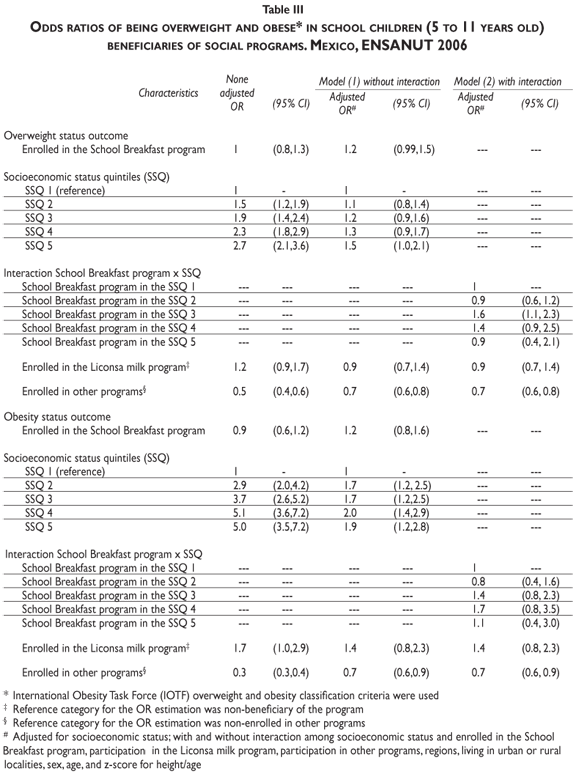
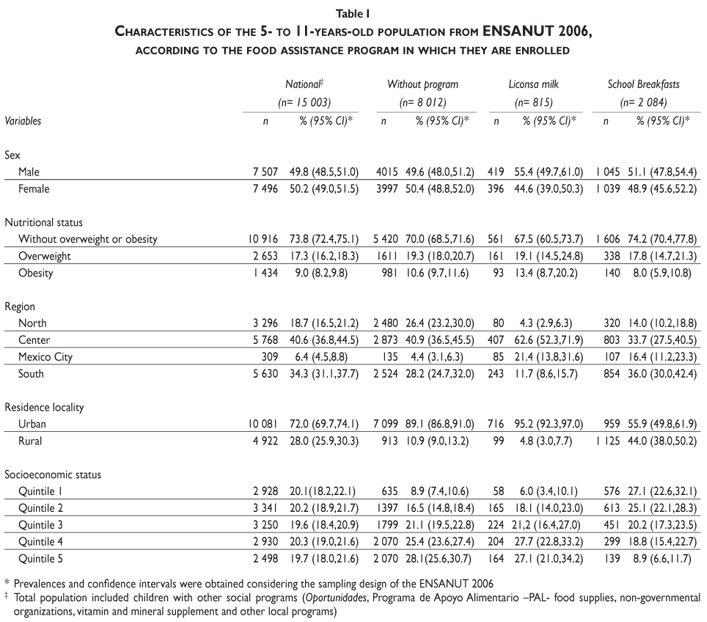
<body><![CDATA[<p><font size="2" face="Verdana"> Independent variables included participation    in the Liconsa or the School Breakfast programs and variables that may potentially    confound the association between overweight/obesity and the participation in    those programs, such as region of residence (north, center, Mexico City, and    south), living in urban or rural localities (population over or under 2 500    inhabitants, respectively), sex, age, height&#45;for&#45;age z&#45;score, socioeconomic    status index (made up by principal component analysis with variables such as    flooring, potable water, ownership of electronic appliances such as radio, television,    refrigerator, washing machine, and stove) according to the indices established    by the 1999 National Nutrition Survey (ENN 99),<SUP>8</SUP> and enrollment in    other social assistance programs, including <I>Oportunidades</I>, Despensas    del Programa de Apoyo Alimentario &#150;PAL&#45; (food supplies), Cocinas del DIF (DIF    Kitchens), Dietary Supplement (vitamins and minerals) and support from non&#45;governmental    organizations.</font></p>     <p><font size="2" face="Verdana"><b>Data collection and analysis</b></font></p>     <p><font size="2" face="Verdana">Anthropometric data was obtained using the weight    and height measurement techniques recommended in the INSP Nutrition Project    Procedure Handbook.<SUP>9</SUP> Personnel was trained to follow these standardized    recommended procedures and protocols.<SUP>10,11</SUP> Weight was measured with    electronic scales accurate to 100 g (Tanita Corporation, model 1631, China),    and height with 1&#45;mm&#45;unit 2&#45;m stadimeters (Dynatop, model E&#45;1, Mexico). </font></p>     <p><font size="2" face="Verdana"> Experts developed the questionnaire for the    survey and trained the interviewers. INSP personnel developed an electronic    questionnaire using the Microsoft Visual Fox Pro 7.0 development program. During    the interview, interviewers equipped with laptop computers were able to enter    data directly into the electronic questionnaires. All data were backed&#45;up and    sent daily to the INSP. The database was cleaned and missing or implausible    weight and height values were revised and corrected.</font></p>     <p><font size="2" face="Verdana"><b>Analysis</b></font></p>     <p><font size="2" face="Verdana">All statistic analyses were adjusted for the complex    survey design.<SUP>12</SUP> A descriptive data analysis was carried out to characterize    the study population. Multinomial logistic regression models (using three levels:    without overweight or obesity, overweight, and obesity) were adjusted for biological    plausiblity and socially relevant variables to evaluate the association between    prevalence of overweight and obesity and participation in each of the assessed    programs. Crude and adjusted odds ratios (OR) with 95% confidence intervals    were estimated to identify the association between participation in the Liconsa    and the School Breakfast programs and the likelihood of being overweight or    obese. Non&#45;beneficiary children in the same age group living in urban localities    were used as a reference population for the Liconsa milk program. For the School    Breakfast program, the reference population included non&#45;beneficiary children    in the same age group living in either urban or rural localities. We explored    some interactions with biological and social relevance, specifically between    participation in food assistance programs with residence region and socioeconomic    status. The interactions were considered statistically significant when <I>p</I>    &lt; 0.1<SUP>13</SUP> and principal effects were considered significant if they    had a <I>p</I> &lt; 0.05. Statistical analyses took into account the stratified    design and the clustered sampling. The expansion factor was included to consider    the sample distribution at the national level. Data analysis was performed using    the Stata SVY module for complex samples (StataCorp., Stata Statistical Software:    Release 7.0. College Station, TX: Stata Corporation, 2001) and SPSS (SPSS for    Windows, Rel. 15.0. 2006. Chicago: SPSS Inc.).</font></p>     <p>&nbsp;</p>     <p><font size="3" face="Verdana"><b>Results</b></font></p>     <p><font size="2" face="Verdana">Prevalence of overweight and obesity was estimated    in 15 003 children, representing 15 714 000 school&#45;aged children nationwide,    considering the expansion factor. Distribution according to participation in    a food assistance program indicated that at the national level 8.8% of school    children were recipients of the Liconsa milk program, while 13.4% of school    children were enrolled in the School Breakfast program. Only 2% of children    were beneficiaries of both programs. Prevalence of overweight and obesity was    21.4% in school&#45;aged children beneficiaries of any food assistance program (data    not shown). <a href="/img/revistas/spm/v51s4/a18tab01.gif">Table I</a> shows the descriptive characteristics of the study population    according to different programs studied.</font></p>     <p><font size="2" face="Verdana"> In Mexico, 17.3% of school&#45;aged children    were overweight and 9.0% were obese. The highest prevalence of overweight (19.1%)    and obesity (13.4%) corresponded to those children who benefit from the Liconsa    milk program, of whom 95.2% live in urban localities. About 55% of these children    were in the highest socioeconomic status quintiles and nearly 63% lived in the    center region of the country (<a href="/img/revistas/spm/v51s4/a18tab01.gif">Table I</a>).</font></p>     ]]></body>
<body><![CDATA[<p><font size="2" face="Verdana"> Children receiving the School Breakfast program    showed a lower prevalence of overweight (17.8%) and obesity (8.0%) compared    to those receiving the Liconsa milk program. Slightly more than 50% of DIF beneficiaries    lived in urban localities, were in the socioeconomic status lowest quintiles    (1 and 2), and were mainly distributed in the center and south regions of the    country (<a href="/img/revistas/spm/v51s4/a18tab01.gif">Table I</a>). Mean age was 8.1 years (95% CI, 8.0&#45;8.1) (<a href="#tab02">Table   II</a>).</font></p>     <p><a name="tab02"></a></p>     <p>&nbsp;</p>     <p align="center"><img src="/img/revistas/spm/v51s4/a18tab02.gif"></p>     <p>&nbsp;</p>     <p><font size="2" face="Verdana"> Logistic regression models were fit to evaluate    the association of overweight and obesity and participation in the Liconsa and    the School Breakfast programs. Adjustment was made for the following covariables:    region, residence locality, sex, socioeconomic status, age, and height&#45;for&#45;age    z&#45;score. Comparison groups for these models were children of the same age group,    non&#45;beneficiaries of the programs and, regarding the Liconsa milk program, living    in urban localities.</font></p>     <p><font size="2" face="Verdana"> The logistic models found no association    between overweight and participation in the Liconsa milk program (OR= 0.9, 95%    CI 0.7&#45;1.4, after adjustment for the above&#45;mentioned covariates). An association    between obesity and being enrolled in the Liconsa milk program was found for    the crude model (OR= 1.7, 95% CI 1.0&#45;2.9). However, the magnitude of the association    decreased and was not significantly different from the null value after adjustment    for the covariables (OR= 1.4, 95% CI 0.8&#45;2.3) (<a href="#tab03">Table III</a>). No significant interactions    were found between region and socioeconomic status and participation in the    Liconsa milk program.</font></p>     <p><a name="tab03"></a></p>     <p>&nbsp;</p>     <p align="center"><img src="/img/revistas/spm/v51s4/a18tab03.gif"></p>     ]]></body>
<body><![CDATA[<p>&nbsp;</p>     <p><font size="2" face="Verdana"> For the School Breakfast program, a marginal    association with the likelihood of being overweight in children who benefit    from the program was found (OR= 1.2 95% CI 0.99, 1.5) after adjustment for region,    residence locality, sex, socioeconomic status, and height&#45;for&#45;age z&#45;score covariables    (<a href="#tab03">Table III</a>). The magnitude of the relationship between the School Breakfast    program and prevalence of obesity or overweight varied according to socioeconomic    stratum. Children from the middle socioeconomic status quintile (quintile 3)    who received the program were more likely to be overweight than those who did    not receive the program (OR= 1.6, 95% CI 1.1, 2.3) (<a href="#tab03">Table   III</a>). </font></p>     <p><font size="2" face="Verdana"> No association was found between obesity    (OR= 1.2, 95% CI 0.8&#45;1.6) and participation in the School Breakfast program    after adjustment for the variables mentioned above (<a href="#tab03">Table   III</a>). </font></p>     <p><font size="2" face="Verdana"> It was not possible to explore the interaction    between participation in the Liconsa milk program and in the School Breakfast    program, as only 2% of the school&#45;aged children are beneficiaries of both programs.</font></p>     <p>&nbsp;</p>     <p><font size="3" face="Verdana"><b>Discussion</b></font></p>     <p><font size="2" face="Verdana">Results from this study showed no positive association    between overweight and obesity in school&#45;aged children and participation in    the Liconsa milk program when compared to non&#45;recipient, urban school&#45;aged children.    In addition, no positive association was found for obesity for children participating    in the School Breakfast program when compared with school&#45;aged, non&#45;recipient    children, after adjustment for potentially confounding factors. However, we    did observe a trend for being overweight in children who are beneficiaries of    this program with respect to socioeconomic status. Within the middle socioeconomic    status quintile (quintile 3), children who received the School Breakfast program    were more likely to be overweight than those who did not receive it. </font></p>     <p><font size="2" face="Verdana"> Food assistance programs in Mexico have historically    focused on mitigating nutritional deficiencies in vulnerable population groups,    specifically infants.<SUP>5</SUP> In this study, we found that a fifth of the    school&#45;aged children (21.4%) who benefit from any food assistance program have    an excess of weight, up from 19.5% in 1999.<SUP>14</SUP> These programs need    to be redirected to target the existing nutritional problems of the Mexican    population.<SUP>15</SUP> We must ensure that food assistance programs are not    contributing to the development of overweight and obesity in the beneficiary    population.</font></p>     <p><font size="2" face="Verdana"> A state&#45;level study of the School Breakfast    program had similar results to our national&#45;level study. Neither found a positive    association between the program and increased prevalence of obesity and overweight.<SUP>16</SUP>    The findings from these studies are consistent with those from studies conducted    in the United States, which have not found an increase in the likelihood of    being overweight due to participation in any food assistance program for this    age group.<SUP>17&#45;19</SUP> Nonetheless, the higher likelihood of being overweight    for those who receive the program found in the middle socioeconomic status quintile    might be related to a greater availability among this socioeconomic strata of processed    food items, such as refined flour and sugars with high quantities of energy.</font></p>     <p><font size="2" face="Verdana"> An evaluation carried out in participants from    the School Breakfast program in the State of Mexico showed that one of the most    consumed food items according to the analysis of food frequency semiquantitative    questionnaires is soda. Additionally, this same evaluation found that the main    food items that 38% of the children enrolled in the program consume after leaving    school are sandwiches, hamburgers, hot dogs, <I>tortas</I> and <I>tamales</I>,    potentially worsening the overweight and obesity trends.<SUP>20</SUP> </font></p>     ]]></body>
<body><![CDATA[<p><font size="2" face="Verdana">An important implication of this study is that,    given the current nutritional status of the Mexican population, food assistance    programs may not be suitably targeting populations to meet their stated objectives.    We found that more than 95% of school children enrolled in the Liconsa milk    program live in urban localities in the center region of the country and more    than two thirds are in the highest socioeconomic status quintiles (4 and 5).    Thus, the current recipient population does not meet program guidelines,<SUP>2</SUP>    which state that milk subsidies should target poor and marginal population groups.    We suggest a more detailed analysis of the current beneficiary population and    a redistribution of benefits to the poorest families with school&#45;aged children.</font></p>     <p><font size="2" face="Verdana"> Milk distributed through the Liconsa milk    program was supplemented with micronutrients in 2004. In subsequent evaluations,    it was noted that among children under 5 years old, there was a noticeable decrease    in anemia prevalence and iron deficiency in children who started drinking supplemented    milk from an early age,<SUP>3</SUP> higher stature, more muscle mass, and better    mental development.<SUP>2 </SUP>Among school&#45;aged children there is a high prevalence    of iron deficiency anemia (17%);<SUP>21</SUP> however, we still lack sufficient    evidence for school&#45;aged children as to the effect of Liconsa milk consumption    on decreasing such iron deficiency and increasing the body composition of the    beneficiaries. Given the high prevalence of overweight and obesity, we recommend    evaluating whether the consumption of whole enriched milk is recommended for    this age group.<SUP>22</SUP></font></p>     <p><font size="2" face="Verdana"> With respect to the School Breakfast program,    slightly more than half of the beneficiaries live in urban localities and more    than 50% of the children are in the lowest socioeconomic status quintiles (1    and 2). According to the program guidelines, the target population should be    children at risk of malnutrition or with some degree of current malnutrition.<SUP>1</SUP>    In this study, a quarter of the recipient children were found to have an excess    of weight (BMI &gt; 25) similar to the current national prevalence of excessive    weight in the school&#45;aged population (26%).<SUP>4</SUP> Even though overweight    and obesity among recipient children may be associated with a broader process    of increasing overweight and obesity rates independent of participation in this    program, it is advisable to redefine program objectives to help decrease this    major health problem among school&#45;aged children.</font></p>     <p><font size="2" face="Verdana"> This study has some limitations that may    affect the interpretation of the results. Because of its cross&#45;sectional design,    it is not possible to establish causality. Nevertheless, the probabilistic national    sample allowed us to observe the distribution of this phenomenon at the national    level, allowing for association inference. Another limitation is that benefit    consumption (i.e. milk or school breakfast intake) and other variables such    as diet and physical activity, which may be influential for the development    of excess weight, were not controlled for in the study because they were not    available for the whole sample of school&#45;aged children included in this analysis.</font></p>     <p><font size="2" face="Verdana"> In Mexico, there is still a lack of information    about the association between overweight and obesity in school&#45;aged children    and enrollment in any food assistance program. This study begins to fill the    gap of information on this issue but other studies are needed to fully assess    this issue. This study found no evidence of a specific association between the    Liconsa milk assistance program and the DIF School Breakfast program with overweight    or obesity among school&#45;aged children in Mexico. However, we did observe a high    prevalence of overweight and obesity in food assistance beneficiaries from this    age group. Therefore, we recommend that each program be evaluated according    to its stated objectives and assure that the benefits of these programs are    being directed appropriately to targeted, nutritionally vulnerable populations.    Additionally, these programs should also assess and formulate objectives that    will help address the growing epidemic of overweight and obesity among Mexican    school&#45;aged children population.</font></p>     <p>&nbsp;</p>     <p><font size="3" face="Verdana"><b>References</b></font></p>     <!-- ref --><p><FONT size="2" face="Verdana">1. Sistema Nacional para el Desarrollo Integral    de la Familia DIF. Programa de Desayunos Escolares, lineamientos generales de    operaci&oacute;n (2007). Mexico: DIF, June 6, 2007. &#91;Consulted 2007 June 6&#93;.    Available at: <a href="http://www.dif.gob.mx/54.html#desayunos" target="_blank">http://www.dif.gob.mx/54.html#desayunos</a>.    &nbsp;&nbsp;&nbsp;&nbsp;&nbsp;&nbsp;&nbsp;&nbsp;[&#160;<a href="javascript:void(0);" onclick="javascript: window.open('/scielo.php?script=sci_nlinks&ref=9352632&pid=S0036-3634200900100001800001&lng=','','width=640,height=500,resizable=yes,scrollbars=1,menubar=yes,');">Links</a>&#160;]<!-- end-ref --></font></p>     <!-- ref --><p><FONT size="2" face="Verdana"> 2. Secretar&iacute;a de Desarrollo Social. Programa    de abasto social de leche Liconsa, lineamientos generales de operaci&oacute;n    (2007). Mexico: LICONSA, 2007. &#91;Consulted 2007 June 7&#93;. Available at: <a href="http://www.liconsa.gob.mx/" target="_blank">http://www.liconsa.gob.mx/</a></font>&nbsp;&nbsp;&nbsp;&nbsp;&nbsp;&nbsp;&nbsp;&nbsp;[&#160;<a href="javascript:void(0);" onclick="javascript: window.open('/scielo.php?script=sci_nlinks&ref=9352634&pid=S0036-3634200900100001800002&lng=','','width=640,height=500,resizable=yes,scrollbars=1,menubar=yes,');">Links</a>&#160;]<!-- end-ref --><!-- ref --><p><font size="2" face="Verdana">3. Villalpando S, Shamah T, Rivera JA, Lara Y,    Monterrubio E. Fortifying milk with ferrous gluconate and zinc oxide in a public    nutrition program reduced the prevalence of anemia in toddlers. J Nutr 2006;136:2633&#45;2637.    &nbsp;&nbsp;&nbsp;&nbsp;&nbsp;&nbsp;&nbsp;&nbsp;[&#160;<a href="javascript:void(0);" onclick="javascript: window.open('/scielo.php?script=sci_nlinks&ref=9352635&pid=S0036-3634200900100001800003&lng=','','width=640,height=500,resizable=yes,scrollbars=1,menubar=yes,');">Links</a>&#160;]<!-- end-ref --></font></p>     <!-- ref --><p><FONT size="2" face="Verdana">4. Rivera&#45;Dommarco J, Cuevas&#45;Nasu L, Shamah&#45;Levy    T, Villalpando&#45;Hern&aacute;ndez S, &Aacute;vila&#45;Arcos MA, Jimenez&#45;Aguilar A.    Estado nutricio. In: Olaiz&#45;Fern&aacute;ndez G, Rivera&#45;Dommarco J, Shamah&#45;Levy    T, Rojas R, Villalpando&#45;Hern&aacute;ndez S, Hern&aacute;ndez&#45;Avila M, <I>et    al</I>. Encuesta Nacional de Salud y Nutrici&oacute;n 2006. Cuernavaca, M&eacute;xico:    Instituto Nacional de Salud P&uacute;blica, 2006: 85&#45;103.    &nbsp;&nbsp;&nbsp;&nbsp;&nbsp;&nbsp;&nbsp;&nbsp;[&#160;<a href="javascript:void(0);" onclick="javascript: window.open('/scielo.php?script=sci_nlinks&ref=9352637&pid=S0036-3634200900100001800004&lng=','','width=640,height=500,resizable=yes,scrollbars=1,menubar=yes,');">Links</a>&#160;]<!-- end-ref --></font></p>     <!-- ref --><p><font size="2" face="Verdana">5. Barquera S, Rivera&#45;Dommarco JA, Gasca&#45;Garc&iacute;a    A. Pol&iacute;ticas y programas de alimentaci&oacute;n y nutrici&oacute;n en    M&eacute;xico. Salud Publica Mex 2001;43:1&#45;14.    &nbsp;&nbsp;&nbsp;&nbsp;&nbsp;&nbsp;&nbsp;&nbsp;[&#160;<a href="javascript:void(0);" onclick="javascript: window.open('/scielo.php?script=sci_nlinks&ref=9352639&pid=S0036-3634200900100001800005&lng=','','width=640,height=500,resizable=yes,scrollbars=1,menubar=yes,');">Links</a>&#160;]<!-- end-ref --></font></p>     <!-- ref --><p><FONT size="2" face="Verdana">6. Palma O, Shamah&#45;Levy T, Franco A, Olaiz G,    M&eacute;ndez&#45;Ram&iacute;rez I. Metodolog&iacute;a. In: Olaiz&#45;Fern&aacute;ndez    G, Rivera&#45;Dommarco J, Shamah&#45;Levy T, Rojas R, Villalpando&#45;Hern&aacute;ndez S,    Hern&aacute;ndez&#45;Avila M, <I>et al</I>. Encuesta Nacional de Salud y Nutrici&oacute;n    2006. Cuernavaca, M&eacute;xico: Instituto Nacional de Salud P&uacute;blica,    2006: 19&#45;33.    &nbsp;&nbsp;&nbsp;&nbsp;&nbsp;&nbsp;&nbsp;&nbsp;[&#160;<a href="javascript:void(0);" onclick="javascript: window.open('/scielo.php?script=sci_nlinks&ref=9352641&pid=S0036-3634200900100001800006&lng=','','width=640,height=500,resizable=yes,scrollbars=1,menubar=yes,');">Links</a>&#160;]<!-- end-ref --></font></p>     <!-- ref --><p><font size="2" face="Verdana">7. Cole TJ, Bellizzi MC, Flegal KM, Dietz WH.    Establishing a standard definition for child overweight and obesity worldwide:    International survey. BMJ 2000;320:1240&#45;1243.    &nbsp;&nbsp;&nbsp;&nbsp;&nbsp;&nbsp;&nbsp;&nbsp;[&#160;<a href="javascript:void(0);" onclick="javascript: window.open('/scielo.php?script=sci_nlinks&ref=9352643&pid=S0036-3634200900100001800007&lng=','','width=640,height=500,resizable=yes,scrollbars=1,menubar=yes,');">Links</a>&#160;]<!-- end-ref --></font></p>     ]]></body>
<body><![CDATA[<!-- ref --><p><font size="2" face="Verdana">8. Resano E, Mendez I, Shamah T, Rivera J, Sepulveda    J. Methods of the National Nutrition Survey 1999. Salud Publica Mex 2003:45    Suppl 4:558&#45;564.    &nbsp;&nbsp;&nbsp;&nbsp;&nbsp;&nbsp;&nbsp;&nbsp;[&#160;<a href="javascript:void(0);" onclick="javascript: window.open('/scielo.php?script=sci_nlinks&ref=9352645&pid=S0036-3634200900100001800008&lng=','','width=640,height=500,resizable=yes,scrollbars=1,menubar=yes,');">Links</a>&#160;]<!-- end-ref --></font></p>     <!-- ref --><p><FONT size="2" face="Verdana">9. Cuevas&#45;Nasu L, Garc&iacute;a&#45;Feregrino R,    Mendoza&#45;Olivares JS, Jaimes&#45;Ter&aacute;n MS, Shamah&#45;Levy T, Rivera&#45;Dommarco    J. Antropometr&iacute;a. In: Manual de procedimientos para proyectos de nutrici&oacute;n.    Cuernavaca, Mexico: Instituto Nacional de Salud P&uacute;blica, 2006. Available    at: <a href="http://www.insp.mx" target="_blank">http://.www.insp.mx</a>.    &nbsp;&nbsp;&nbsp;&nbsp;&nbsp;&nbsp;&nbsp;&nbsp;[&#160;<a href="javascript:void(0);" onclick="javascript: window.open('/scielo.php?script=sci_nlinks&ref=9352647&pid=S0036-3634200900100001800009&lng=','','width=640,height=500,resizable=yes,scrollbars=1,menubar=yes,');">Links</a>&#160;]<!-- end-ref --></font></p>     <!-- ref --><p><font size="2" face="Verdana">10. Lohman TG, Roche AF, Martorell R, ed. Anthropometrics    standardization reference manual. Champaign (IL): Human Kinetics Books, 1988.    &nbsp;&nbsp;&nbsp;&nbsp;&nbsp;&nbsp;&nbsp;&nbsp;[&#160;<a href="javascript:void(0);" onclick="javascript: window.open('/scielo.php?script=sci_nlinks&ref=9352649&pid=S0036-3634200900100001800010&lng=','','width=640,height=500,resizable=yes,scrollbars=1,menubar=yes,');">Links</a>&#160;]<!-- end-ref --></font></p>     <!-- ref --><p><font size="2" face="Verdana">11. Habicht JP. Estandarizaci&oacute;n de m&eacute;todos    epidemiol&oacute;gicos cuantitativos sobre el terreno. Bol Oficina Sanit Panam    1974;76:375&#45;385.    &nbsp;&nbsp;&nbsp;&nbsp;&nbsp;&nbsp;&nbsp;&nbsp;[&#160;<a href="javascript:void(0);" onclick="javascript: window.open('/scielo.php?script=sci_nlinks&ref=9352651&pid=S0036-3634200900100001800011&lng=','','width=640,height=500,resizable=yes,scrollbars=1,menubar=yes,');">Links</a>&#160;]<!-- end-ref --></font></p>     <!-- ref --><p><font size="2" face="Verdana">12. Skinner CJ, Holt D, Smith TMF. Applied Analysis    of Complex Surveys. New York (NY): John Wiley &amp; Sons, 1989.    &nbsp;&nbsp;&nbsp;&nbsp;&nbsp;&nbsp;&nbsp;&nbsp;[&#160;<a href="javascript:void(0);" onclick="javascript: window.open('/scielo.php?script=sci_nlinks&ref=9352653&pid=S0036-3634200900100001800012&lng=','','width=640,height=500,resizable=yes,scrollbars=1,menubar=yes,');">Links</a>&#160;]<!-- end-ref --></font></p>     ]]></body>
<body><![CDATA[<!-- ref --><p><font size="2" face="Verdana">13. Hosmer DW, Lemeshow MS. Applied Logistic    Regression. New York (NY): John Wiley &amp; Sons, 1989.    &nbsp;&nbsp;&nbsp;&nbsp;&nbsp;&nbsp;&nbsp;&nbsp;[&#160;<a href="javascript:void(0);" onclick="javascript: window.open('/scielo.php?script=sci_nlinks&ref=9352655&pid=S0036-3634200900100001800013&lng=','','width=640,height=500,resizable=yes,scrollbars=1,menubar=yes,');">Links</a>&#160;]<!-- end-ref --></font></p>     <!-- ref --><p><FONT size="2" face="Verdana">14. Hernandez B, Cuevas&#45;Nasu L, Shamah&#45;Levy T,    Monterrubio EA, Ramirez&#45;Silva CI, Garcia&#45;Feregrino R, <I>et al</I>. Factors    associated with overweight and obesity in Mexican school&#45;age children: Results from the    National Nutrition Survey 1999. Salud Publica Mex 2003;45 Suppl 4:S551&#45;S557.    &nbsp;&nbsp;&nbsp;&nbsp;&nbsp;&nbsp;&nbsp;&nbsp;[&#160;<a href="javascript:void(0);" onclick="javascript: window.open('/scielo.php?script=sci_nlinks&ref=9352657&pid=S0036-3634200900100001800014&lng=','','width=640,height=500,resizable=yes,scrollbars=1,menubar=yes,');">Links</a>&#160;]<!-- end-ref --></font></p>     <!-- ref --><p><FONT size="2" face="Verdana"> 15. Shamah&#45;Levy T, Rivera&#45;Dommarco J, Nogueira&#45;Flores    L, Jim&eacute;nez&#45;Aguilar A, Mundo&#45;Rosas V, Villalpando&#45;Hern&aacute;ndez S.    Programas de ayuda alimentaria. In: Olaiz&#45;Fern&aacute;ndez G, Rivera&#45;Dommarco    J, Shamah&#45;Levy T, Rojas R, Villalpando&#45;Hern&aacute;ndez S, Hern&aacute;ndez&#45;Avila    M, <I>et al</I>. Encuesta Nacional de Salud y Nutrici&oacute;n 2006. Cuernavaca,    M&eacute;xico: Instituto Nacional de Salud P&uacute;blica, 2006: 121&#45;131.    &nbsp;&nbsp;&nbsp;&nbsp;&nbsp;&nbsp;&nbsp;&nbsp;[&#160;<a href="javascript:void(0);" onclick="javascript: window.open('/scielo.php?script=sci_nlinks&ref=9352659&pid=S0036-3634200900100001800015&lng=','','width=640,height=500,resizable=yes,scrollbars=1,menubar=yes,');">Links</a>&#160;]<!-- end-ref --></font></p>     <!-- ref --><p><font size="2" face="Verdana">16. Ram&iacute;rez&#45;L&oacute;pez E, Grijalva&#45;Haro    MI, Valencia ME, Ponce JA, Artalejo E. Impacto de un programa de Desayunos escolares    en la prevalencia de obesidad y factores de riesgo cardiovascular en ni&ntilde;os    sonorenses. Salud Publica Mex 2005;47:126&#45;133.    &nbsp;&nbsp;&nbsp;&nbsp;&nbsp;&nbsp;&nbsp;&nbsp;[&#160;<a href="javascript:void(0);" onclick="javascript: window.open('/scielo.php?script=sci_nlinks&ref=9352661&pid=S0036-3634200900100001800016&lng=','','width=640,height=500,resizable=yes,scrollbars=1,menubar=yes,');">Links</a>&#160;]<!-- end-ref --></font></p>     <!-- ref --><p><FONT size="2" face="Verdana">17. Ploeg MV, Mancino L, Lin BH, Guthrie J. US    food assistance programs and trends in children's weight. Int J Pediatr Obes    2007;29:1&#45;9.    &nbsp;&nbsp;&nbsp;&nbsp;&nbsp;&nbsp;&nbsp;&nbsp;[&#160;<a href="javascript:void(0);" onclick="javascript: window.open('/scielo.php?script=sci_nlinks&ref=9352663&pid=S0036-3634200900100001800017&lng=','','width=640,height=500,resizable=yes,scrollbars=1,menubar=yes,');">Links</a>&#160;]<!-- end-ref --></font></p>     ]]></body>
<body><![CDATA[<!-- ref --><p><FONT size="2" face="Verdana"> 18. Hofferth SL, Curtin S. Poverty, food programs,    and childhood obesity. J Policy Anal Manage 2005;24(4):703&#45;726.    &nbsp;&nbsp;&nbsp;&nbsp;&nbsp;&nbsp;&nbsp;&nbsp;[&#160;<a href="javascript:void(0);" onclick="javascript: window.open('/scielo.php?script=sci_nlinks&ref=9352665&pid=S0036-3634200900100001800018&lng=','','width=640,height=500,resizable=yes,scrollbars=1,menubar=yes,');">Links</a>&#160;]<!-- end-ref --></font></p>     <!-- ref --><p><FONT size="2" face="Verdana"> 19. Jones SJ, Jahns L, Laraia BA, Haughton B.    Lower risk of overweight in school&#45;aged food insecure girls who participate    in food assistance: Results from the panel study of income dynamics child development    supplement. Arch Pediatr Adolesc Med 2003;157(8):780&#45;784.    &nbsp;&nbsp;&nbsp;&nbsp;&nbsp;&nbsp;&nbsp;&nbsp;[&#160;<a href="javascript:void(0);" onclick="javascript: window.open('/scielo.php?script=sci_nlinks&ref=9352667&pid=S0036-3634200900100001800019&lng=','','width=640,height=500,resizable=yes,scrollbars=1,menubar=yes,');">Links</a>&#160;]<!-- end-ref --></font></p>     <!-- ref --><p><font size="2" face="Verdana">20. Instituto Nacional de Salud P&uacute;blica.    Informe final del proyecto "Contribuci&oacute;n del programa de desayunos    escolares del DIF Estado de M&eacute;xico en el estado de nutrici&oacute;n de los    ni&ntilde;os escolares." Mexico: Instituto Nacional de Salud P&uacute;blica, 2007.    &nbsp;&nbsp;&nbsp;&nbsp;&nbsp;&nbsp;&nbsp;&nbsp;[&#160;<a href="javascript:void(0);" onclick="javascript: window.open('/scielo.php?script=sci_nlinks&ref=9352669&pid=S0036-3634200900100001800020&lng=','','width=640,height=500,resizable=yes,scrollbars=1,menubar=yes,');">Links</a>&#160;]<!-- end-ref --></font></p>     <!-- ref --><p><FONT size="2" face="Verdana">21. Villalpando&#45;Hern&aacute;ndez S, Mundo&#45;Rosas    V, Shamah&#45;Levy T, Rivera&#45;Dommarco J, Mauricio&#45;L&oacute;pez ER. Anemia. In: Olaiz&#45;Fern&aacute;ndez    G, Rivera&#45;Dommarco J, Shamah&#45;Levy T, Rojas R, Villalpando&#45;Hern&aacute;ndez S,    Hern&aacute;ndez&#45;Avila M, <I>et al</I>. Encuesta Nacional de Salud y Nutrici&oacute;n    2006. Cuernavaca, M&eacute;xico: Instituto Nacional de Salud P&uacute;blica,    2006: 111&#45;119.    &nbsp;&nbsp;&nbsp;&nbsp;&nbsp;&nbsp;&nbsp;&nbsp;[&#160;<a href="javascript:void(0);" onclick="javascript: window.open('/scielo.php?script=sci_nlinks&ref=9352671&pid=S0036-3634200900100001800021&lng=','','width=640,height=500,resizable=yes,scrollbars=1,menubar=yes,');">Links</a>&#160;]<!-- end-ref --> </font></p>     <!-- ref --><p><FONT size="2" face="Verdana"> 22. US Department of Health and Human Services,    US Department of Agriculture, Dietary Advisory Guidelines Committee. Dietary    Guidelines for Americans, 2005. &#91;Consulted on 2007 December 7&#93;. Available at:    <a href="http://www.healthierus.gov/dietaryguidelines" target="_blank">www.healthierus.gov/dietaryguidelines</a></font>&nbsp;&nbsp;&nbsp;&nbsp;&nbsp;&nbsp;&nbsp;&nbsp;[&#160;<a href="javascript:void(0);" onclick="javascript: window.open('/scielo.php?script=sci_nlinks&ref=9352673&pid=S0036-3634200900100001800022&lng=','','width=640,height=500,resizable=yes,scrollbars=1,menubar=yes,');">Links</a>&#160;]<!-- end-ref --><p>&nbsp;</p>     ]]></body>
<body><![CDATA[<p>&nbsp;</p>     <p><FONT size="2" FACE="Verdana">Received on: April 11, 2008    <br>   Accepted on: March 31, 2009</font></p>     <p>&nbsp;</p>     <p>&nbsp;</p>     <p><font size="2" face="Verdana">Address     reprint requests to: MSc. Luc&iacute;a Cuevas Nasu. Centro de Investigaciones     en Nutrici&oacute;n y Salud. Instituto Nacional de Salud P&uacute;blica. Av. Universidad 655, col. Santa Mar&iacute;a Ahuacatitl&aacute;n. 62100 Cuernavaca, Morelos, M&eacute;xico. E&#45;mail: <a href="mailto:lcuevas@insp.mx">lcuevas@insp.mx</a></font></p>      ]]></body><back>
<ref-list>
<ref id="B1">
<label>1</label><nlm-citation citation-type="book">
<collab>Sistema Nacional para el Desarrollo Integral de la Familia DIF</collab>
<source><![CDATA[Programa de Desayunos Escolares, lineamientos generales de operación (2007)]]></source>
<year>June</year>
<month> 6</month>
<day>, </day>
<publisher-name><![CDATA[DIF]]></publisher-name>
</nlm-citation>
</ref>
<ref id="B2">
<label>2</label><nlm-citation citation-type="book">
<collab>Secretaría de Desarrollo Social</collab>
<source><![CDATA[Programa de abasto social de leche Liconsa, lineamientos generales de operación (2007)]]></source>
<year>2007</year>
<publisher-name><![CDATA[LICONSA]]></publisher-name>
</nlm-citation>
</ref>
<ref id="B3">
<label>3</label><nlm-citation citation-type="journal">
<person-group person-group-type="author">
<name>
<surname><![CDATA[Villalpando]]></surname>
<given-names><![CDATA[S]]></given-names>
</name>
<name>
<surname><![CDATA[Shamah]]></surname>
<given-names><![CDATA[T]]></given-names>
</name>
<name>
<surname><![CDATA[Rivera]]></surname>
<given-names><![CDATA[JA]]></given-names>
</name>
<name>
<surname><![CDATA[Lara]]></surname>
<given-names><![CDATA[Y]]></given-names>
</name>
<name>
<surname><![CDATA[Monterrubio]]></surname>
<given-names><![CDATA[E]]></given-names>
</name>
</person-group>
<article-title xml:lang="en"><![CDATA[Fortifying milk with ferrous gluconate and zinc oxide in a public nutrition program reduced the prevalence of anemia in toddlers]]></article-title>
<source><![CDATA[J Nutr]]></source>
<year>2006</year>
<volume>136</volume>
<page-range>2633-2637</page-range></nlm-citation>
</ref>
<ref id="B4">
<label>4</label><nlm-citation citation-type="book">
<person-group person-group-type="author">
<name>
<surname><![CDATA[Rivera-Dommarco]]></surname>
<given-names><![CDATA[J]]></given-names>
</name>
<name>
<surname><![CDATA[Cuevas-Nasu]]></surname>
<given-names><![CDATA[L]]></given-names>
</name>
<name>
<surname><![CDATA[Shamah-Levy]]></surname>
<given-names><![CDATA[T]]></given-names>
</name>
<name>
<surname><![CDATA[Villalpando-Hernández]]></surname>
<given-names><![CDATA[S]]></given-names>
</name>
<name>
<surname><![CDATA[Ávila-Arcos]]></surname>
<given-names><![CDATA[MA]]></given-names>
</name>
<name>
<surname><![CDATA[Jimenez-Aguilar]]></surname>
<given-names><![CDATA[A]]></given-names>
</name>
</person-group>
<article-title xml:lang="es"><![CDATA[Estado nutricio]]></article-title>
<person-group person-group-type="editor">
<name>
<surname><![CDATA[Olaiz-Fernández]]></surname>
<given-names><![CDATA[G]]></given-names>
</name>
<name>
<surname><![CDATA[Rivera-Dommarco]]></surname>
<given-names><![CDATA[J]]></given-names>
</name>
<name>
<surname><![CDATA[Shamah-Levy]]></surname>
<given-names><![CDATA[T]]></given-names>
</name>
<name>
<surname><![CDATA[Rojas]]></surname>
<given-names><![CDATA[R]]></given-names>
</name>
<name>
<surname><![CDATA[Villalpando-Hernández]]></surname>
<given-names><![CDATA[S]]></given-names>
</name>
<name>
<surname><![CDATA[Hernández-Avila]]></surname>
<given-names><![CDATA[M]]></given-names>
</name>
</person-group>
<source><![CDATA[Encuesta Nacional de Salud y Nutrición 2006]]></source>
<year>2006</year>
<page-range>85-103</page-range><publisher-loc><![CDATA[Cuernavaca ]]></publisher-loc>
<publisher-name><![CDATA[Instituto Nacional de Salud Pública]]></publisher-name>
</nlm-citation>
</ref>
<ref id="B5">
<label>5</label><nlm-citation citation-type="journal">
<person-group person-group-type="author">
<name>
<surname><![CDATA[Barquera]]></surname>
<given-names><![CDATA[S]]></given-names>
</name>
<name>
<surname><![CDATA[Rivera-Dommarco]]></surname>
<given-names><![CDATA[JA]]></given-names>
</name>
<name>
<surname><![CDATA[Gasca-García]]></surname>
<given-names><![CDATA[A]]></given-names>
</name>
</person-group>
<article-title xml:lang="es"><![CDATA[Políticas y programas de alimentación y nutrición en México]]></article-title>
<source><![CDATA[Salud Publica Mex]]></source>
<year>2001</year>
<volume>43</volume>
<page-range>1-14</page-range></nlm-citation>
</ref>
<ref id="B6">
<label>6</label><nlm-citation citation-type="book">
<person-group person-group-type="author">
<name>
<surname><![CDATA[Palma]]></surname>
<given-names><![CDATA[O]]></given-names>
</name>
<name>
<surname><![CDATA[Shamah-Levy]]></surname>
<given-names><![CDATA[T]]></given-names>
</name>
<name>
<surname><![CDATA[Franco]]></surname>
<given-names><![CDATA[A]]></given-names>
</name>
<name>
<surname><![CDATA[Olaiz]]></surname>
<given-names><![CDATA[G]]></given-names>
</name>
<name>
<surname><![CDATA[Méndez-Ramírez]]></surname>
<given-names><![CDATA[I]]></given-names>
</name>
</person-group>
<article-title xml:lang="es"><![CDATA[Metodología]]></article-title>
<person-group person-group-type="editor">
<name>
<surname><![CDATA[Olaiz-Fernández]]></surname>
<given-names><![CDATA[G]]></given-names>
</name>
<name>
<surname><![CDATA[Rivera-Dommarco]]></surname>
<given-names><![CDATA[J]]></given-names>
</name>
<name>
<surname><![CDATA[Shamah-Levy]]></surname>
<given-names><![CDATA[T]]></given-names>
</name>
<name>
<surname><![CDATA[Rojas]]></surname>
<given-names><![CDATA[R]]></given-names>
</name>
<name>
<surname><![CDATA[Villalpando-Hernández]]></surname>
<given-names><![CDATA[S]]></given-names>
</name>
<name>
<surname><![CDATA[Hernández-Avila]]></surname>
<given-names><![CDATA[M]]></given-names>
</name>
</person-group>
<source><![CDATA[Encuesta Nacional de Salud y Nutrición 2006]]></source>
<year>2006</year>
<page-range>19-33</page-range><publisher-loc><![CDATA[Cuernavaca ]]></publisher-loc>
<publisher-name><![CDATA[Instituto Nacional de Salud Pública]]></publisher-name>
</nlm-citation>
</ref>
<ref id="B7">
<label>7</label><nlm-citation citation-type="journal">
<person-group person-group-type="author">
<name>
<surname><![CDATA[Cole]]></surname>
<given-names><![CDATA[TJ]]></given-names>
</name>
<name>
<surname><![CDATA[Bellizzi]]></surname>
<given-names><![CDATA[MC]]></given-names>
</name>
<name>
<surname><![CDATA[Flegal]]></surname>
<given-names><![CDATA[KM]]></given-names>
</name>
<name>
<surname><![CDATA[Dietz]]></surname>
<given-names><![CDATA[WH]]></given-names>
</name>
</person-group>
<article-title xml:lang="en"><![CDATA[Establishing a standard definition for child overweight and obesity worldwide: International survey]]></article-title>
<source><![CDATA[BMJ]]></source>
<year>2000</year>
<volume>320</volume>
<page-range>1240-1243</page-range></nlm-citation>
</ref>
<ref id="B8">
<label>8</label><nlm-citation citation-type="journal">
<person-group person-group-type="author">
<name>
<surname><![CDATA[Resano]]></surname>
<given-names><![CDATA[E]]></given-names>
</name>
<name>
<surname><![CDATA[Mendez]]></surname>
<given-names><![CDATA[I]]></given-names>
</name>
<name>
<surname><![CDATA[Shamah]]></surname>
<given-names><![CDATA[T]]></given-names>
</name>
<name>
<surname><![CDATA[Rivera]]></surname>
<given-names><![CDATA[J]]></given-names>
</name>
<name>
<surname><![CDATA[Sepulveda]]></surname>
<given-names><![CDATA[J]]></given-names>
</name>
</person-group>
<article-title xml:lang="en"><![CDATA[Methods of the National Nutrition Survey 1999]]></article-title>
<source><![CDATA[Salud Publica Mex]]></source>
<year>2003</year>
<volume>45</volume>
<numero>^s4</numero>
<issue>^s4</issue>
<supplement>4</supplement>
<page-range>558-564</page-range></nlm-citation>
</ref>
<ref id="B9">
<label>9</label><nlm-citation citation-type="book">
<person-group person-group-type="author">
<name>
<surname><![CDATA[Cuevas-Nasu]]></surname>
<given-names><![CDATA[L]]></given-names>
</name>
<name>
<surname><![CDATA[García-Feregrino]]></surname>
<given-names><![CDATA[R]]></given-names>
</name>
<name>
<surname><![CDATA[Mendoza-Olivares]]></surname>
<given-names><![CDATA[JS]]></given-names>
</name>
<name>
<surname><![CDATA[Jaimes-Terán]]></surname>
<given-names><![CDATA[MS]]></given-names>
</name>
<name>
<surname><![CDATA[Shamah-Levy]]></surname>
<given-names><![CDATA[T]]></given-names>
</name>
<name>
<surname><![CDATA[Rivera-Dommarco]]></surname>
<given-names><![CDATA[J]]></given-names>
</name>
</person-group>
<article-title xml:lang="es"><![CDATA[Antropometría]]></article-title>
<source><![CDATA[Manual de procedimientos para proyectos de nutrición]]></source>
<year>2006</year>
<publisher-loc><![CDATA[Cuernavaca ]]></publisher-loc>
<publisher-name><![CDATA[Instituto Nacional de Salud Pública]]></publisher-name>
</nlm-citation>
</ref>
<ref id="B10">
<label>10</label><nlm-citation citation-type="book">
<person-group person-group-type="author">
<name>
<surname><![CDATA[Lohman]]></surname>
<given-names><![CDATA[TG]]></given-names>
</name>
<name>
<surname><![CDATA[Roche]]></surname>
<given-names><![CDATA[AF]]></given-names>
</name>
<name>
<surname><![CDATA[Martorell]]></surname>
<given-names><![CDATA[R]]></given-names>
</name>
</person-group>
<source><![CDATA[Anthropometrics standardization reference manual]]></source>
<year>1988</year>
<publisher-loc><![CDATA[Champaign^eIL IL]]></publisher-loc>
<publisher-name><![CDATA[Human Kinetics Books]]></publisher-name>
</nlm-citation>
</ref>
<ref id="B11">
<label>11</label><nlm-citation citation-type="journal">
<person-group person-group-type="author">
<name>
<surname><![CDATA[Habicht]]></surname>
<given-names><![CDATA[JP]]></given-names>
</name>
</person-group>
<article-title xml:lang="es"><![CDATA[Estandarización de métodos epidemiológicos cuantitativos sobre el terreno]]></article-title>
<source><![CDATA[Bol Oficina Sanit Panam]]></source>
<year>1974</year>
<volume>76</volume>
<page-range>375-385</page-range></nlm-citation>
</ref>
<ref id="B12">
<label>12</label><nlm-citation citation-type="book">
<person-group person-group-type="author">
<name>
<surname><![CDATA[Skinner]]></surname>
<given-names><![CDATA[CJ]]></given-names>
</name>
<name>
<surname><![CDATA[Holt]]></surname>
<given-names><![CDATA[D]]></given-names>
</name>
<name>
<surname><![CDATA[Smith]]></surname>
<given-names><![CDATA[TMF]]></given-names>
</name>
</person-group>
<source><![CDATA[Applied Analysis of Complex Surveys]]></source>
<year>1989</year>
<publisher-loc><![CDATA[New York^eNY NY]]></publisher-loc>
<publisher-name><![CDATA[John Wiley & Sons]]></publisher-name>
</nlm-citation>
</ref>
<ref id="B13">
<label>13</label><nlm-citation citation-type="book">
<person-group person-group-type="author">
<name>
<surname><![CDATA[Hosmer]]></surname>
<given-names><![CDATA[DW]]></given-names>
</name>
<name>
<surname><![CDATA[Lemeshow]]></surname>
<given-names><![CDATA[MS]]></given-names>
</name>
</person-group>
<source><![CDATA[Applied Logistic Regression]]></source>
<year>1989</year>
<publisher-loc><![CDATA[New York^eNY NY]]></publisher-loc>
<publisher-name><![CDATA[John Wiley & Sons]]></publisher-name>
</nlm-citation>
</ref>
<ref id="B14">
<label>14</label><nlm-citation citation-type="journal">
<person-group person-group-type="author">
<name>
<surname><![CDATA[Hernandez]]></surname>
<given-names><![CDATA[B]]></given-names>
</name>
<name>
<surname><![CDATA[Cuevas-Nasu]]></surname>
<given-names><![CDATA[L]]></given-names>
</name>
<name>
<surname><![CDATA[Shamah-Levy]]></surname>
<given-names><![CDATA[T]]></given-names>
</name>
<name>
<surname><![CDATA[Monterrubio]]></surname>
<given-names><![CDATA[EA]]></given-names>
</name>
<name>
<surname><![CDATA[Ramirez-Silva]]></surname>
<given-names><![CDATA[CI]]></given-names>
</name>
<name>
<surname><![CDATA[Garcia-Feregrino]]></surname>
<given-names><![CDATA[R]]></given-names>
</name>
</person-group>
<article-title xml:lang="en"><![CDATA[Factors associated with overweight and obesity in Mexican school-age children: Results from the National Nutrition Survey 1999]]></article-title>
<source><![CDATA[Salud Publica Mex]]></source>
<year>2003</year>
<volume>45</volume>
<numero>^s4</numero>
<issue>^s4</issue>
<supplement>4</supplement>
<page-range>S551-S557</page-range></nlm-citation>
</ref>
<ref id="B15">
<label>15</label><nlm-citation citation-type="book">
<person-group person-group-type="author">
<name>
<surname><![CDATA[Shamah-Levy]]></surname>
<given-names><![CDATA[T]]></given-names>
</name>
<name>
<surname><![CDATA[Rivera-Dommarco]]></surname>
<given-names><![CDATA[J]]></given-names>
</name>
<name>
<surname><![CDATA[Nogueira-Flores]]></surname>
<given-names><![CDATA[L]]></given-names>
</name>
<name>
<surname><![CDATA[Jiménez-Aguilar]]></surname>
<given-names><![CDATA[A]]></given-names>
</name>
<name>
<surname><![CDATA[Mundo-Rosas]]></surname>
<given-names><![CDATA[V]]></given-names>
</name>
<name>
<surname><![CDATA[Villalpando-Hernández]]></surname>
<given-names><![CDATA[S]]></given-names>
</name>
</person-group>
<article-title xml:lang="es"><![CDATA[Programas de ayuda alimentaria]]></article-title>
<person-group person-group-type="editor">
<name>
<surname><![CDATA[Olaiz-Fernández]]></surname>
<given-names><![CDATA[G]]></given-names>
</name>
<name>
<surname><![CDATA[Rivera-Dommarco]]></surname>
<given-names><![CDATA[J]]></given-names>
</name>
<name>
<surname><![CDATA[Shamah-Levy]]></surname>
<given-names><![CDATA[T]]></given-names>
</name>
<name>
<surname><![CDATA[Rojas]]></surname>
<given-names><![CDATA[R]]></given-names>
</name>
<name>
<surname><![CDATA[Villalpando-Hernández]]></surname>
<given-names><![CDATA[S]]></given-names>
</name>
<name>
<surname><![CDATA[Hernández-Avila]]></surname>
<given-names><![CDATA[M]]></given-names>
</name>
</person-group>
<source><![CDATA[Encuesta Nacional de Salud y Nutrición 2006]]></source>
<year>2006</year>
<page-range>121-131</page-range><publisher-loc><![CDATA[Cuernavaca ]]></publisher-loc>
<publisher-name><![CDATA[Instituto Nacional de Salud Pública]]></publisher-name>
</nlm-citation>
</ref>
<ref id="B16">
<label>16</label><nlm-citation citation-type="journal">
<person-group person-group-type="author">
<name>
<surname><![CDATA[Ramírez-López]]></surname>
<given-names><![CDATA[E]]></given-names>
</name>
<name>
<surname><![CDATA[Grijalva-Haro]]></surname>
<given-names><![CDATA[MI]]></given-names>
</name>
<name>
<surname><![CDATA[Valencia]]></surname>
<given-names><![CDATA[ME]]></given-names>
</name>
<name>
<surname><![CDATA[Ponce]]></surname>
<given-names><![CDATA[JA]]></given-names>
</name>
<name>
<surname><![CDATA[Artalejo]]></surname>
<given-names><![CDATA[E]]></given-names>
</name>
</person-group>
<article-title xml:lang="es"><![CDATA[Impacto de un programa de Desayunos escolares en la prevalencia de obesidad y factores de riesgo cardiovascular en niños sonorenses]]></article-title>
<source><![CDATA[Salud Publica Mex]]></source>
<year>2005</year>
<volume>47</volume>
<page-range>126-133</page-range></nlm-citation>
</ref>
<ref id="B17">
<label>17</label><nlm-citation citation-type="journal">
<person-group person-group-type="author">
<name>
<surname><![CDATA[Ploeg]]></surname>
<given-names><![CDATA[MV]]></given-names>
</name>
<name>
<surname><![CDATA[Mancino]]></surname>
<given-names><![CDATA[L]]></given-names>
</name>
<name>
<surname><![CDATA[Lin]]></surname>
<given-names><![CDATA[BH]]></given-names>
</name>
<name>
<surname><![CDATA[Guthrie]]></surname>
<given-names><![CDATA[J]]></given-names>
</name>
</person-group>
<article-title xml:lang="en"><![CDATA[US food assistance programs and trends in children's weight]]></article-title>
<source><![CDATA[Int J Pediatr Obes]]></source>
<year>2007</year>
<volume>29</volume>
<page-range>1-9</page-range></nlm-citation>
</ref>
<ref id="B18">
<label>18</label><nlm-citation citation-type="journal">
<person-group person-group-type="author">
<name>
<surname><![CDATA[Hofferth]]></surname>
<given-names><![CDATA[SL]]></given-names>
</name>
<name>
<surname><![CDATA[Curtin]]></surname>
<given-names><![CDATA[S]]></given-names>
</name>
</person-group>
<article-title xml:lang="en"><![CDATA[Poverty, food programs, and childhood obesity]]></article-title>
<source><![CDATA[J Policy Anal Manage]]></source>
<year>2005</year>
<volume>24</volume>
<numero>4</numero>
<issue>4</issue>
<page-range>703-726</page-range></nlm-citation>
</ref>
<ref id="B19">
<label>19</label><nlm-citation citation-type="journal">
<person-group person-group-type="author">
<name>
<surname><![CDATA[Jones]]></surname>
<given-names><![CDATA[SJ]]></given-names>
</name>
<name>
<surname><![CDATA[Jahns]]></surname>
<given-names><![CDATA[L]]></given-names>
</name>
<name>
<surname><![CDATA[Laraia]]></surname>
<given-names><![CDATA[BA]]></given-names>
</name>
<name>
<surname><![CDATA[Haughton]]></surname>
<given-names><![CDATA[B]]></given-names>
</name>
</person-group>
<article-title xml:lang="en"><![CDATA[Lower risk of overweight in school-aged food insecure girls who participate in food assistance: Results from the panel study of income dynamics child development supplement]]></article-title>
<source><![CDATA[Arch Pediatr Adolesc Med]]></source>
<year>2003</year>
<volume>157</volume>
<numero>8</numero>
<issue>8</issue>
<page-range>780-784</page-range></nlm-citation>
</ref>
<ref id="B20">
<label>20</label><nlm-citation citation-type="book">
<collab>Instituto Nacional de Salud Pública</collab>
<source><![CDATA[Informe final del proyecto "Contribución del programa de desayunos escolares del DIF Estado de México en el estado de nutrición de los niños escolares."]]></source>
<year>2007</year>
<publisher-name><![CDATA[Instituto Nacional de Salud Pública]]></publisher-name>
</nlm-citation>
</ref>
<ref id="B21">
<label>21</label><nlm-citation citation-type="book">
<person-group person-group-type="author">
<name>
<surname><![CDATA[Villalpando-Hernández]]></surname>
<given-names><![CDATA[S]]></given-names>
</name>
<name>
<surname><![CDATA[Mundo-Rosas]]></surname>
<given-names><![CDATA[V]]></given-names>
</name>
<name>
<surname><![CDATA[Shamah-Levy]]></surname>
<given-names><![CDATA[T]]></given-names>
</name>
<name>
<surname><![CDATA[Rivera-Dommarco]]></surname>
<given-names><![CDATA[J]]></given-names>
</name>
<name>
<surname><![CDATA[Mauricio-López]]></surname>
<given-names><![CDATA[ER]]></given-names>
</name>
</person-group>
<article-title xml:lang="es"><![CDATA[Anemia]]></article-title>
<person-group person-group-type="editor">
<name>
<surname><![CDATA[Olaiz-Fernández]]></surname>
<given-names><![CDATA[G]]></given-names>
</name>
<name>
<surname><![CDATA[Rivera-Dommarco]]></surname>
<given-names><![CDATA[J]]></given-names>
</name>
<name>
<surname><![CDATA[Shamah-Levy]]></surname>
<given-names><![CDATA[T]]></given-names>
</name>
<name>
<surname><![CDATA[Rojas]]></surname>
<given-names><![CDATA[R]]></given-names>
</name>
<name>
<surname><![CDATA[Villalpando-Hernández]]></surname>
<given-names><![CDATA[S]]></given-names>
</name>
<name>
<surname><![CDATA[Hernández-Avila]]></surname>
<given-names><![CDATA[M]]></given-names>
</name>
</person-group>
<source><![CDATA[Encuesta Nacional de Salud y Nutrición 2006]]></source>
<year>2006</year>
<page-range>111-119</page-range><publisher-loc><![CDATA[Cuernavaca ]]></publisher-loc>
<publisher-name><![CDATA[Instituto Nacional de Salud Pública]]></publisher-name>
</nlm-citation>
</ref>
<ref id="B22">
<label>22</label><nlm-citation citation-type="">
<collab>US Department of Health and Human Services</collab>
<collab>US Department of Agriculture</collab>
<collab>Dietary Advisory Guidelines Committee</collab>
<source><![CDATA[Dietary Guidelines for Americans]]></source>
<year>2005</year>
</nlm-citation>
</ref>
</ref-list>
</back>
</article>