<?xml version="1.0" encoding="ISO-8859-1"?><article xmlns:mml="http://www.w3.org/1998/Math/MathML" xmlns:xlink="http://www.w3.org/1999/xlink" xmlns:xsi="http://www.w3.org/2001/XMLSchema-instance">
<front>
<journal-meta>
<journal-id>0036-3634</journal-id>
<journal-title><![CDATA[Salud Pública de México]]></journal-title>
<abbrev-journal-title><![CDATA[Salud pública Méx]]></abbrev-journal-title>
<issn>0036-3634</issn>
<publisher>
<publisher-name><![CDATA[Instituto Nacional de Salud Pública]]></publisher-name>
</publisher>
</journal-meta>
<article-meta>
<article-id>S0036-36342009001000016</article-id>
<title-group>
<article-title xml:lang="en"><![CDATA[Obesity, overweight, screen time and physical activity in Mexican adolescents]]></article-title>
<article-title xml:lang="es"><![CDATA[Obesidad, sobrepeso, tiempo frente a la pantalla y actividad física en adolescentes mexicanos]]></article-title>
</title-group>
<contrib-group>
<contrib contrib-type="author">
<name>
<surname><![CDATA[Morales-Ruán]]></surname>
<given-names><![CDATA[María del Carmen]]></given-names>
</name>
<xref ref-type="aff" rid="A01"/>
</contrib>
<contrib contrib-type="author">
<name>
<surname><![CDATA[Hernández-Prado]]></surname>
<given-names><![CDATA[Bernardo]]></given-names>
</name>
<xref ref-type="aff" rid="A01"/>
</contrib>
<contrib contrib-type="author">
<name>
<surname><![CDATA[Gómez-Acosta]]></surname>
<given-names><![CDATA[Luz María]]></given-names>
</name>
<xref ref-type="aff" rid="A01"/>
</contrib>
<contrib contrib-type="author">
<name>
<surname><![CDATA[Shamah-Levy]]></surname>
<given-names><![CDATA[Teresa]]></given-names>
</name>
<xref ref-type="aff" rid="A01"/>
</contrib>
<contrib contrib-type="author">
<name>
<surname><![CDATA[Cuevas-Nasu]]></surname>
<given-names><![CDATA[Lucía]]></given-names>
</name>
<xref ref-type="aff" rid="A01"/>
</contrib>
</contrib-group>
<aff id="A01">
<institution><![CDATA[,Instituto Nacional de Salud Pública  ]]></institution>
<addr-line><![CDATA[Cuernavaca Morelos]]></addr-line>
<country>México</country>
</aff>
<pub-date pub-type="pub">
<day>00</day>
<month>00</month>
<year>2009</year>
</pub-date>
<pub-date pub-type="epub">
<day>00</day>
<month>00</month>
<year>2009</year>
</pub-date>
<volume>51</volume>
<fpage>S613</fpage>
<lpage>S620</lpage>
<copyright-statement/>
<copyright-year/>
<self-uri xlink:href="http://www.scielo.org.mx/scielo.php?script=sci_arttext&amp;pid=S0036-36342009001000016&amp;lng=en&amp;nrm=iso"></self-uri><self-uri xlink:href="http://www.scielo.org.mx/scielo.php?script=sci_abstract&amp;pid=S0036-36342009001000016&amp;lng=en&amp;nrm=iso"></self-uri><self-uri xlink:href="http://www.scielo.org.mx/scielo.php?script=sci_pdf&amp;pid=S0036-36342009001000016&amp;lng=en&amp;nrm=iso"></self-uri><abstract abstract-type="short" xml:lang="en"><p><![CDATA[OBJECTIVE: To determine whether screen time and physical activity is related to overweight or obesity in adolescents. MATERIAL AND METHODS: Cross-sectional design. Adolescents aged 10 to 19 were included in the Mexican National Health and Nutrition Survey 2006 (ENSANUT 2006). The dependent variable was overweight or obesity; the independent variable was screen time. A logistic regression model was created to estimate the relationship of overweight and obesity to various factors, including screen time, physical activity, study vs. no study, age, sex, indigenous ethnicity, alcohol consumption and tobacco use. RESULTS: A total of 18 784 adolescents were included. A positive relation between screen time and overweight and obesity was found. CONCLUSIONS: Screen time is associated with overweight and obesity in Mexican adolescents.]]></p></abstract>
<abstract abstract-type="short" xml:lang="es"><p><![CDATA[OBJETIVO: Determinar si el tiempo que los adolescentes permanecen frente a pantalla y realizan actividad física se asocia con el sobrepeso o la obesidad. MATERIAL Y MÉTODOS: Diseño transversal. Se incluyeron adolescentes de 10 a 19 años de edad, de la Encuesta Nacional de Salud y Nutrición 2006 (ENSANUT 2006). La variable dependiente fue el sobrepeso u obesidad y la independiente el tiempo frente a la pantalla. Se ajustó un modelo de regresión logística para estimar la relación entre el sobrepeso u obesidad con el tiempo frente a la pantalla, actividad física, edad, sexo, condición de estudiante, indigenismo, tabaquismo y consumo de alcohol. RESULTADOS: Se estudió a 18 784 adolescentes. Se encontró una asociación positiva entre el tiempo frente a pantalla y el sobrepeso u obesidad. CONCLUSIONES: El tiempo que los adolescentes mexicanos pasan frente a pantalla está asociado con el sobrepeso u obesidad.]]></p></abstract>
<kwd-group>
<kwd lng="en"><![CDATA[overweight]]></kwd>
<kwd lng="en"><![CDATA[obesity]]></kwd>
<kwd lng="en"><![CDATA[television]]></kwd>
<kwd lng="en"><![CDATA[adolescents]]></kwd>
<kwd lng="en"><![CDATA[Mexico]]></kwd>
<kwd lng="es"><![CDATA[sobrepeso]]></kwd>
<kwd lng="es"><![CDATA[obesidad]]></kwd>
<kwd lng="es"><![CDATA[televisión]]></kwd>
<kwd lng="es"><![CDATA[adolescentes]]></kwd>
<kwd lng="es"><![CDATA[México]]></kwd>
</kwd-group>
</article-meta>
</front><body><![CDATA[ <p align="right"><font size="2" face="Verdana"><b>ORIGINAL ARTICLES</b></font></p>     <p>&nbsp;</p>     <p><font size="4" face="verdana"><b>Obesity, overweight, screen    time and physical activity in Mexican adolescents</b></font></p>     <p>&nbsp;</p>     <p><font size="3" face="verdana"><b>Obesidad, sobrepeso, tiempo frente a la pantalla    y actividad f&iacute;sica en adolescentes    mexicanos</b></font></p>     <p>&nbsp;</p>     <p>&nbsp;</p>     <p><font size="2" face="Verdana"><b>Mar&iacute;a del Carmen Morales&#45;Ru&aacute;n,    MSc; Bernardo Hern&aacute;ndez&#45;Prado, DSc; Luz Mar&iacute;a G&oacute;mez&#45;Acosta,    MSc; Teresa Shamah&#45;Levy, MSc; Luc&iacute;a Cuevas&#45;Nasu, MSc</b></font></p>     <p><font size="2" face="Verdana">Instituto Nacional de Salud P&uacute;blica. Cuernavaca,    Morelos, M&eacute;xico</font></p>      <p>&nbsp;</p>     ]]></body>
<body><![CDATA[<p>&nbsp;</p> <hr size="1" noshade>     <p><font size="2" face="VERDANA"><b>ABSTRACT</b></font></p>     <p><font size="2" face="Verdana"><B>OBJECTIVE:</b> To determine whether screen time    and physical activity is related to overweight or obesity in adolescents.    <br>   <B>MATERIAL AND METHODS:</B> Cross&#45;sectional design. Adolescents aged 10 to    19 were included in the Mexican National Health and Nutrition Survey 2006 (ENSANUT    2006). The dependent variable was overweight or obesity; the independent variable    was screen time. A logistic regression model was created to estimate the relationship    of overweight and obesity to various factors, including screen time, physical    activity, study <I>vs</I>. no study, age, sex, indigenous ethnicity, alcohol    consumption and tobacco use.    <br>   <B>RESULTS:</B> A total of 18 784 adolescents were included. A positive relation    between screen time and overweight and obesity was found.    <br>   <B>CONCLUSIONS:</B> Screen time is associated with overweight and obesity in    Mexican adolescents.</font></p>     <p><FONT SIZE=2 face="Verdana"><b>Key words:</b> overweight; obesity; television/utilization;    adolescents; Mexico</font></p> <hr size="1" noshade>     <p><font size="2" face="VERDANA"><b>RESUMEN</b></font></p>     <p><font size="2" face="Verdana"><B>OBJETIVO:</b> Determinar si el tiempo que los    adolescentes permanecen frente a pantalla y realizan actividad f&iacute;sica    se asocia con el sobrepeso o la obesidad.    <br>   <B>MATERIAL Y M&Eacute;TODOS:</B> Dise&ntilde;o transversal. Se incluyeron adolescentes    de 10 a 19 a&ntilde;os de edad, de la Encuesta Nacional de Salud y Nutrici&oacute;n    2006 (ENSANUT 2006). La variable dependiente fue el sobrepeso u obesidad y la    independiente el tiempo frente a la pantalla. Se ajust&oacute; un modelo de    regresi&oacute;n log&iacute;stica para estimar la relaci&oacute;n entre el sobrepeso    u obesidad con el tiempo frente a la pantalla, actividad f&iacute;sica, edad,    sexo, condici&oacute;n de estudiante, indigenismo, tabaquismo y consumo de alcohol.    ]]></body>
<body><![CDATA[<br>   <B>RESULTADOS:</B> Se estudi&oacute; a 18 784 adolescentes. Se encontr&oacute;    una asociaci&oacute;n positiva entre el tiempo frente a pantalla y el sobrepeso    u obesidad.    <br>   <B>CONCLUSIONES:</B> El tiempo que los adolescentes mexicanos pasan frente a    pantalla est&aacute; asociado con el sobrepeso u obesidad.</font></p>     <p><font size="2" face="Verdana"><b>Palabras clave:</b> sobrepeso; obesidad; televisi&oacute;n/utilizaci&oacute;n;    adolescentes; M&eacute;xico</font></p> <hr size="1" noshade>     <p>&nbsp;</p>     <p>&nbsp;</p>     <p><font size="2" face="Verdana">Obesity is a worldwide health problem. In 2005,    the WHO estimated that 1 600 million people exceeded normal weight.<SUP>1</SUP>    Obesity is a risk factor for the development of chronic diseases and is increasingly    observed among adolescents and children. </font></p>     <p><font size="2" face="Verdana">The majority of the 150&#45;200 million children    with excess weight worldwide live in developing countries.<SUP>2</SUP> According    to the Mexican National Health and Nutrition Survey 2006 (ENSANUT 2006), 31.1%    of Mexican male adolescents and 32.5% of Mexican female adolescents aged 12    to 19 are overweight or obese.<SUP>3</SUP></font></p>     <p><font size="2" face="Verdana"> Several studies have noted that obesity or    overweight during childhood or adolescence increases the risk of obesity in    adulthood<SUP>4,5</SUP> and that obesity that begins in adolescence and continues    into adulthood increases morbidity and mortality risks.<SUP>6&#45;8 </SUP>Moreover,    obesity in adolescence may negatively impact self&#45;image, resulting in low self&#45;esteem    and depression,<SUP>9&#45;11</SUP> social discrimination and difficulty in performing    physical activities. </font></p>     <p><font size="2" face="Verdana"> Strong determinants for overweight and obesity    include a diet rich in fat and high calorie foods,<SUP>12,13</SUP> with inadequate    fresh fruit and vegetable intake,<SUP>14</SUP> limited physical activity<SUP>15    </SUP>and increased TV viewing time.<SUP>16&#45;19</SUP> Watching TV for long hours    may lead to an increased risk of obesity both through reduction of energy use    and changes in diet.<SUP>20 </sup></font></p>     <p><font size="2" face="Verdana"> TV viewing time and a higher prevalence of    obesity have been documented in a US population,<SUP>21</SUP> and to a lesser    extent in a Mexican population.<SUP>22</SUP> While there is some evidence for    this association in Mexico, there is currently no research focusing on Mexican    adolescents. This study aims to determine whether screen time and physical activity    are related to overweight and obesity in a nationwide sample of Mexican adolescents.</font></p>     ]]></body>
<body><![CDATA[<p>&nbsp;</p>     <p><font size="3" face="Verdana"><b>Material and methods</b></font></p>     <p><font size="2" face="Verdana"><I>Design</i>: ENSANUT 2006 is a cross&#45;sectional probabilistic survey, representative at national,    regional and state levels in Mexico. This survey utilized a stratified multistage    sampling design. Basic Geographical Statistical Areas (BGSAs) were selected    in the first sampling stage. In a second stage, six blocks were selected at    random for each of the BGSA with a probability proportional to the number of    homes. Subsequently, in each of the blocks a selection of six houses was chosen    using systematic random sampling. In each of the houses, using simple random    sampling, an adult, an adolescent, a child and a user of health services were    chosen to answer the questionnaires. General methods for ENSANUT 2006 have been    described elsewhere.<SUP>23</sup></font></p>     <p><font size="2" face="Verdana"><I>Subjects</i>: Our sample consisted of adolescents    aged 10 to 19 living in selected homes at the time of the survey. Informed consent    was obtained from the head of the family and verbal consent was obtained from    adolescents after the researchers explained the purpose of the survey and the    nature of the measurements to be taken from the adolescents. Study procedures    were approved by the Research, Ethics and Biosafety Commissions of the National    Institute of Public Health (INSP). </font></p>     <p><font size="2" face="Verdana"><b>Outcome measurements</b></font></p>     <p><font size="2" face="Verdana"><I>Overweight and obesity. </i>Height and weight    were measured and used to calculate body mass index (weight in kilograms/height    in meters<SUP>2</SUP>). Weight was determined using <I>Tanita</I> electronic    scales with 100 g accuracy. Height was measured using Dynatop anthropometers    with a capacity of 2 meters and accuracy to 1 mm. Standardization procedures    using the <I>Habitch</I> technique<SUP>24</SUP> were established beforehand    to minimize errors.</font></p>     <p><font size="2" face="Verdana">Classification into overweight and obesity was    made according to the International Obesity Task Force (IOTF) proposed distribution    and cutoff&#45;points.<SUP>25</SUP> Nine adolescents with BMI under 10 or above    58 k/m<SUP>2</SUP> were excluded from the analysis. The dependent variable in    this study was overweight plus obesity. </font></p>     <p><font size="2" face="Verdana"><b>Exposure measurements</b></font></p>     <p><font size="2" face="Verdana"><I>Physical activity and screen time:</i> Information    on the number of hours per week adolescents spent engaging in active or passive    activity was collected using a semi&#45;quantitative questionnaire. This instrument    is based on the Youth Activity Questionnaire developed and validated in adolescents    aged 10 to 14 from low and middle income populations in Mexico City.<SUP>26</sup></font></p>     <p><font size="2" face="Verdana">Screen time was defined as time spent viewing    television, videos, or playing video games in TV or computers.</font></p>     ]]></body>
<body><![CDATA[<p><font size="2" face="Verdana"> Vigorous physical activity was defined as    activity requiring an energy expenditure &gt; 6 MET/hour<a name="tx01"></a><a href="#nt01"><sup>*</sup></a> (metabolic equivalent),    including playing soccer, basketball, volleyball, practicing karate or other    martial arts, riding a bicycle, skating or skateboarding, dancing or taking    dancing lessons, swimming, and other games and sports requiring running or physical    exertion; moderate physical activity was defined as activity requiring energy    expenditure of 3.0 to 6 MET/hour including cleaning the house, walking (including    walking to school) with weight (for example, a schoolbag).<SUP>27</SUP> Sedentary/light    activities were defined as those requiring minimal energy expenditure (&lt;    3 MET/hour) including watching TV, films, videos, or playing videogames. </font></p>     <p><font size="2" face="Verdana"><b>Covariates</b></font></p>     <p><font size="2" face="Verdana"><I>Socio&#45;demographic characteristics</i>: Information    on age, urban or rural place of residence, and indigenous ethnicity (using as    proxy whether the head of the family spoke an indigenous language) was collected    at the time measurements were taken. A socioeconomic status index was constructed    using variables on dwelling conditions, possession of appliances and other goods,<SUP>28</SUP>    and categorized in tertiles (low, medium, high).</font></p>     <p><font size="2" face="Verdana"><I>Studying at present:</i> Adolescents were asked    whether they were students at the time of the survey.</font></p>     <p><font size="2" face="Verdana"><I>Habits on alcohol consumption and tobacco use</i>:    Adolescents were asked whether they smoked or drank alcohol.</font></p>     <p><font size="2" face="Verdana"><b>Statistical analysis</b></font></p>     <p><font size="2" face="Verdana">Analyses were adjusted according to the sampling    design of ENSANUT 2006 using the SVY module for complex samples of STATA Version  9.2.<a name="tx02"></a><a href="#nt02"><sup>**</sup></a></font></p>     <p><font size="2" face="Verdana"> The analysis was carried out considering    the dependent variable (BMI) as dichotomous (absence or presence of overweight    or obesity).</font></p>     <p><font size="2" face="Verdana"> Screen time was classified as acceptable,    borderline excessive, and excessive. Screen time was regarded as acceptable    if it was up to 7 hours but less than 14 hours per week (the equivalent of 1    to 2 hours per day). The American Academy of Pediatrics recommends no more than    one to two hours per day.<SUP>29</SUP> Screen time was considered borderline    excessive if it was between 14 and 21 hours per week (average 2 hours and 30    minutes per day), and excessive if it was over 21 hours per week (three or more    hours per day).</font></p>     <p><font size="2" face="Verdana"> Adolescents were classified according to    the amount of time they practiced moderate and vigorous physical activities    as active, moderately active and inactive. Adolescents who reported performing    7 or more hours a week of moderate or vigorous physical activity were classified    as active.<SUP>30</SUP> Those reporting 4 to 6.99 hours of physical activity    per week were considered moderately active, and those reporting less than 4    hours of moderate or vigorous physical activity per week were considered inactive.</font></p>     ]]></body>
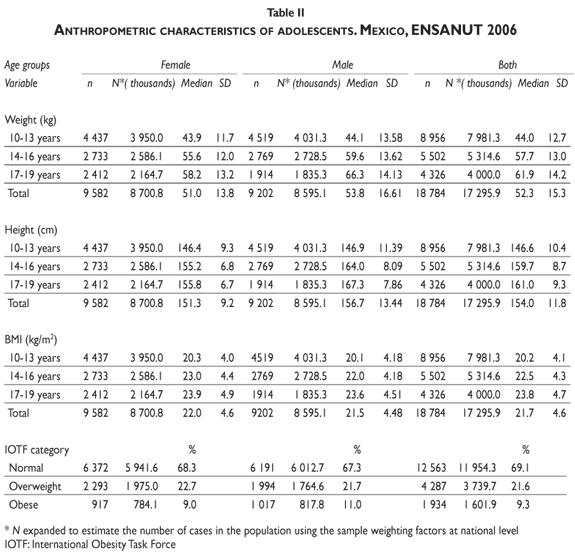
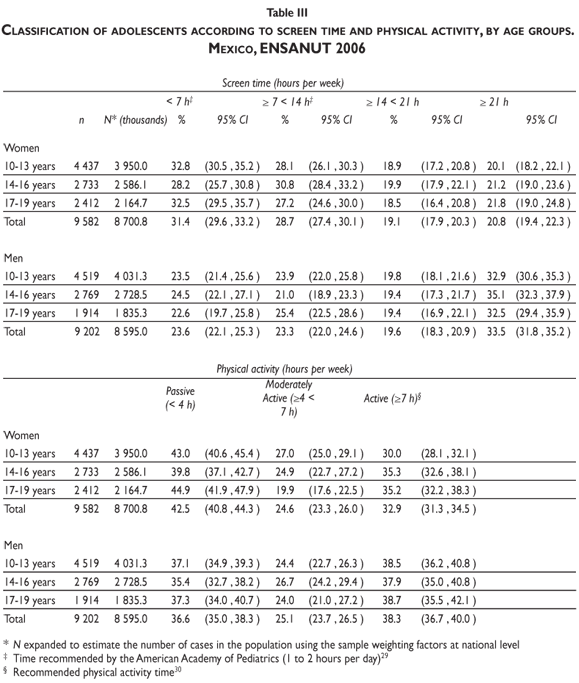
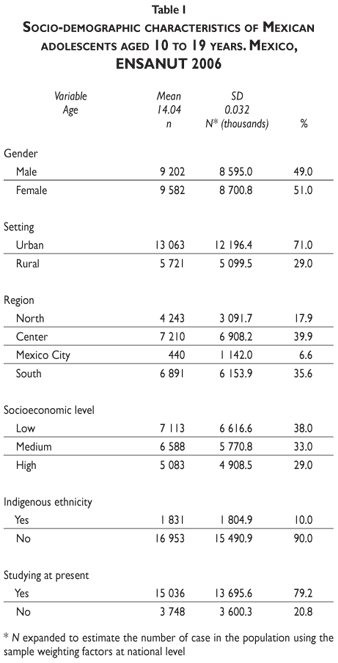
<body><![CDATA[<p><font size="2" face="Verdana"> Additionally, an index including both physical    activity time and screen time was created to describe categories of activity:    adolescents who reported screen time of 21 or more hours per week and performing    less than 4 hours of moderate or vigorous physical activity were described as    <I>very passive</I>; those reporting screen time less than 7 hours and performing    less than 4 hours of physical activity were categorized as <I>moderately passive</I>;    adolescents with screen time less than 7 hours and performing moderate to vigorous    physical activity more than 7 hours per week were classified as <I>very active</I>,    and those with screen time more than 21 hours per week but performing more than    7 hours of physical activity per week were regarded as <I>slightly active</I>.</font></p>     <p><font size="2" face="Verdana">A logistic regression model was fit to estimate    the relationship between being overweight or obese and screen time and one was    fit to estimate the relationship between being overweight or obese and its association    with screen time and time devoted to vigorous or moderate physical activity    per week. The first model was controlled for gender, urban or rural environment,    indigenous ethnicity, studying at present, tobacco use, alcohol consumption,    and physical activity classification. The second model was controlled for the    same variables except physical activity. A 0.05 level of significance was used    for all results.</font></p>     <p>&nbsp;</p>     <p><font size="3" face="Verdana"><b>Results</b></font></p>     <p><font size="2" face="Verdana">There were 24 921 adolescent respondents to the    physical activity questionnaire. A BMI for 18 784 adolescents was obtained (9    582 females and 9 202 males). Seventy&#45;one percent of the adolescents lived in    an urban setting and 10% belonged to indigenous groups. A total of 38.0% were    of low socioeconomic status, 33.0% of medium and 29% of high socioeconomic status    (<a href="#tab01">Table I</a>). Mean age was 14.04&plusmn;0.032 years and mean weight in adolescents was    52.3&plusmn;15.3 kg, with a mean height of 154.0&plusmn;11.8 cm and a mean BMI of 21.7&plusmn;4.6.    <a href="#tab02">Table II</a> shows means by age groups. Overall, overweight and obesity prevalences    were 21.6% and 9.3%, respectively.</font></p>     <p><a name="tab01"></a></p>     <p>&nbsp;</p>     <p align="center"><img src="/img/revistas/spm/v51s4/a16tab01.gif"></p>     <p>&nbsp;</p>     <p><a name="tab02"></a></p>     ]]></body>
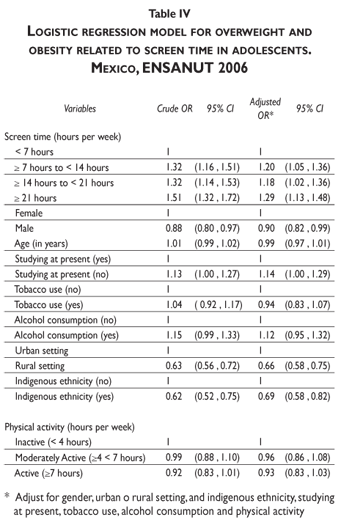
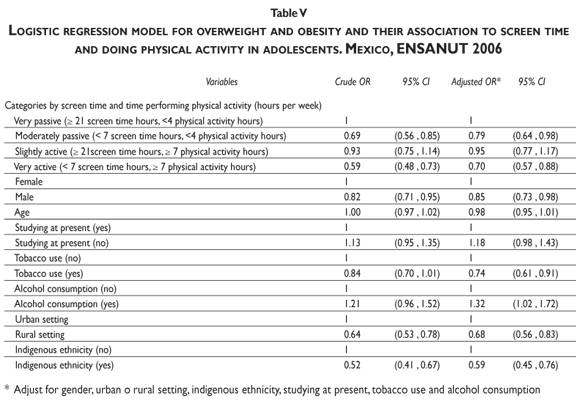
<body><![CDATA[<p>&nbsp;</p>     <p align="center"><img src="/img/revistas/spm/v51s4/a16tab02.gif"></p>     <p>&nbsp;</p>     <p><font size="2" face="Verdana"> A total of 23.6% (95% CI; 22.1, 25.3) of    males and 31.4% (95% CI; 29.6, 33.2) of females spent at least 7 hours per week    on screen time and 23.3% (95% CI; 22.0&#45;24.6) of males and 28.7% (95% CI; 27.4&#45;30.1)    of females spent between 7 and 13.9 hours per week on screen time; for 19.1%    (95% CI; 17.9,20.3) of female adolescents screen time was between 14 to 20.9    hours and for 33.5% (95% CI; 31.8,35.2) of males it was more than 21 hours per    week, or the equivalent of over three hours every day; this percentage was lower    for females (20.8%, 95% CI; 19.4, 22.3) (<a href="#tab03">Table III</a>).</font></p>     <p><a name="tab03"></a></p>     <p>&nbsp;</p>     <p align="center"><img src="/img/revistas/spm/v51s4/a16tab03.gif"></p>     <p>&nbsp;</p>     <p><font size="2" face="Verdana"> A total of 42.5% (95% CI; 40.8, 44.3) of    females were classified as passive, 24.6% (95% CI; 23.3, 26.0) as moderately    active and 32.9% (95% CI; 31.3, 34.5) as active. This was different from males,    36.6% of whom were classified as passive (95% CI; 35.0, 38.3), 25.1% (95%CI;    23.7, 26.5) as moderately active and 38.3% (95%CI; 36.7, 40.0) as active (<a href="#tab03">Table   III</a>).</font></p>     <p><font size="2" face="Verdana"> Results from the first logistic regression    model showed that screen time was positively associated with the prevalence    of overweight and obesity, after adjustment for age, sex, studying at present,    tobacco use, alcohol consumption, urban or rural setting, indigenous ethnicity,    and physical activity (<a href="#tab04">Table IV</a>). Adolescents from rural settings were less    likely to be overweight or obese when compared to those living in urban settings    (OR 0.63, 95% CI; 0.56, 0.72). Adolescents not attending school were more prone    to be overweight or obese when compared to those who attended school.</font></p>     ]]></body>
<body><![CDATA[<p><a name="tab04"></a></p>     <p>&nbsp;</p>     <p align="center"><img src="/img/revistas/spm/v51s4/a16tab04.gif"></p>     <p>&nbsp;</p>     <p><font size="2" face="Verdana"> In the second logistic regression model (<a href="#tab05">Table       V</a>), adolescents who were <I>very active</I> (screen time less than 7 hours per    week and physically active) were less likely to be overweight or obese when    compared to the all the other adolescents together (OR 0.59, 95% CI; 0.48, 0.73).</font></p>     <p><a name="tab05"></a></p>     <p>&nbsp;</p>     <p align="center"><img src="/img/revistas/spm/v51s4/a16tab05.gif"></p>     <p>&nbsp;</p>     <p><font size="3" face="Verdana"><b>Discussion</b></font></p>     ]]></body>
<body><![CDATA[<p><font size="2" face="Verdana">Screen time was positively associated with overweight    or obesity in a probabilistic sample of Mexican adolescents. There was no association    between intense or moderate physical activity and overweight or obesity. Furthermore,    in the analysis with variables that consider screen time and time dedicated    to physical activities, the categories with higher odds of obesity and overweight    were the ones that had high screen time, suggesting a high relevance of this    variable in the prevention of obesity and overweight</font></p>     <p><font size="2" face="Verdana"> This finding is very important because it    is the first to document the time that adolescents performed physical activity    and screen time at the national level in Mexican adolescents. In addition, this    study can be a basis for intervention programs to reduce screen time, given    the high prevalence of overweight and obesity in adolescents in the country.</font></p>     <p><font size="2" face="Verdana"> The results of this study corroborate the    findings of the Youth Risk Behavior Survey 1999,<SUP>21</SUP> which also found    an association between TV viewing time and overweight and a weak association    between physical activity and a reduction in BMI. In a European cross&#45;sectional    study<SUP>31</SUP> researchers have also reported a positive association between    TV viewing time and overweight or obesity.</font></p>     <p><font size="2" face="Verdana"> Other studies with the objective of investigating    the association of TV viewing and physical activity with overweight in adolescents<SUP>32</SUP>    have found that adolescents watching low levels of TV did not have increased    odds of overweight, with the exception of females with low TV viewing and low    physical activity (OR 1.48); females with high TV viewing and low physical activity    had the highest odds of overweight (OR 3.11).</font></p>     <p><font size="2" face="Verdana"> One of the limits of this study was the lack    of information about food consumption practices during screen time. It is not    possible to distinguish whether the association between screen time, especially    TV viewing, and overweight and obesity occurs due to a reduction of physical    activity or an increase in energy consumption attributable to snacking while    watching TV. Studies have found evidence that food consumption increases during    the time spent watching TV.<SUP>33&#45;35</SUP> This limitation, however, does not    invalidate the association between screen time and being overweight and obese,    since the study controlled for physical activity.</font></p>     <p><font size="2" face="Verdana"> The cross&#45;sectional design does not distinguish    the direction of the association; it is possible that excess body weight causes    reduced physical activity and sedentary behavior. </font></p>     <p><font size="2" face="Verdana"> Another possible limitation is the instrument    used to measure screen time and physical activity. The instrument is based on    reports from the adolescents and not on direct observation or the use of an    accelerometer. Nevertheless, this instrument that has been validated for the    Mexican population, has been proven to be valid, and yielded reproducible results    for screen time and moderate and vigorous activity measurements.<SUP>26</sup></font></p>     <p><font size="2" face="Verdana"> The instrument used to assess physical activity    or screen time, although validated in the Mexican population, may have non&#45;random    measurement errors that could attenuate the association between physical activity    and screen time with obesity. Therefore, the estimates presented may be conservative    and the associations may be stronger than the ones documented in this paper.</font></p>     <p><font size="2" face="Verdana"> The strength of this study lies in its design,    which is probabilistic and includes a national representative sample. However,    since this was a cross&#45;sectional study, it was not possible to determine a cause&#45;effect    relation between screen time and overweight and obesity in adolescents. Other    longitudinal studies corroborate a similar relationship.<SUP>36</SUP> Randomized    trials in which the intervention was a reduction in TV viewing time have found    a reduction in obesity.<SUP>37,38</sup></font></p>     <p><font size="2" face="Verdana"> In the US and UK, there is consensus that    children should have at least 60 minutes of moderate to vigorous physical activity    daily.<SUP>39,40</SUP> In Canada, public health policies recommend not only    increasing moderate and intense physical activity but also reducing sedentary    activity.</font></p>     ]]></body>
<body><![CDATA[<p><font size="2" face="Verdana"> This recommendation is important and applicable    to the adolescent population in Mexico, given the high prevalence of adolescents    who are inactive and the inadequate prevalence of screen time. </font></p>     <p><font size="2" face="Verdana"> Obesity prevalence among adolescents in Mexico    and lack of physical activity indicate the need to promote intense physical activity    and to reduce sedentary activity such as TV viewing and videogame playing.</font></p>     <p>&nbsp;</p>     <p><font size="3" face="Verdana"><b>References</b></font></p>     <!-- ref --><p><FONT size="2" face="Verdana">1. Organizaci&oacute;n Mundial de la Salud. Obesidad    y sobrepeso. Descriptive note 311. September 2006. &#91;Consulted 2007 March 13&#93;.    Available at: <a href="http://www.who.int" target="_blank">www.who.int</a>.    &nbsp;&nbsp;&nbsp;&nbsp;&nbsp;&nbsp;&nbsp;&nbsp;[&#160;<a href="javascript:void(0);" onclick="javascript: window.open('/scielo.php?script=sci_nlinks&ref=9352269&pid=S0036-3634200900100001600001&lng=','','width=640,height=500,resizable=yes,scrollbars=1,menubar=yes,');">Links</a>&#160;]<!-- end-ref -->    </font></p>     <!-- ref --><p><font size="2" face="Verdana">2. Lobstein T, Baur L, Uauy R, IASO. International    Obesity Task Force. Obesity in children and young people: a crisis in public    health. Obes Rev 2004;5 (suppl 1):4&#45;104.    &nbsp;&nbsp;&nbsp;&nbsp;&nbsp;&nbsp;&nbsp;&nbsp;[&#160;<a href="javascript:void(0);" onclick="javascript: window.open('/scielo.php?script=sci_nlinks&ref=9352271&pid=S0036-3634200900100001600002&lng=','','width=640,height=500,resizable=yes,scrollbars=1,menubar=yes,');">Links</a>&#160;]<!-- end-ref --></font></p>     <!-- ref --><p><FONT size="2" face="Verdana">3. Olaiz&#45;Fern&aacute;ndez G, Rivera&#45;Dommarco    J, Shamah&#45;Levy T, Rojas R, Villalpando&#45;Hern&aacute;ndez S, Hern&aacute;ndez&#45;&Aacute;vila    M, <I>et al</I>. Encuesta Nacional de Salud y Nutrici&oacute;n 2006. Cuernavaca,    M&eacute;xico: Instituto Nacional de Salud P&uacute;blica, 2006.    &nbsp;&nbsp;&nbsp;&nbsp;&nbsp;&nbsp;&nbsp;&nbsp;[&#160;<a href="javascript:void(0);" onclick="javascript: window.open('/scielo.php?script=sci_nlinks&ref=9352273&pid=S0036-3634200900100001600003&lng=','','width=640,height=500,resizable=yes,scrollbars=1,menubar=yes,');">Links</a>&#160;]<!-- end-ref --></font></p>     ]]></body>
<body><![CDATA[<!-- ref --><p><font size="2" face="Verdana">4. Stark O, Atkins E, Wolff OH, Douglas JWB.    Longitudinal study of obesity in the National Survey of Health and Development.    Br Med J 1981;283:12&#45;17.    &nbsp;&nbsp;&nbsp;&nbsp;&nbsp;&nbsp;&nbsp;&nbsp;[&#160;<a href="javascript:void(0);" onclick="javascript: window.open('/scielo.php?script=sci_nlinks&ref=9352275&pid=S0036-3634200900100001600004&lng=','','width=640,height=500,resizable=yes,scrollbars=1,menubar=yes,');">Links</a>&#160;]<!-- end-ref --></font></p>     <!-- ref --><p><font size="2" face="Verdana">5. Freedman D, Kettel L, Serdula M, Dietz W,    Srinivasan S, Berenson G. The relation of childhood BMI to adult adiposity:    the Bogalusa Heart Study. Pediatrics 2005;115:22&#45;27.    &nbsp;&nbsp;&nbsp;&nbsp;&nbsp;&nbsp;&nbsp;&nbsp;[&#160;<a href="javascript:void(0);" onclick="javascript: window.open('/scielo.php?script=sci_nlinks&ref=9352277&pid=S0036-3634200900100001600005&lng=','','width=640,height=500,resizable=yes,scrollbars=1,menubar=yes,');">Links</a>&#160;]<!-- end-ref --></font></p>     <!-- ref --><p><font size="2" face="Verdana">6. Must A, Jacques PF, Dallal GE, Bajema CJ,    Dietz WH. Long&#45;term morbidity and mortality of overweight adolescents: a follow&#45;up    of the Harvard Growth Study of 1922 to 1935. N Engl J Med 1992;327:1350&#45;1355.    &nbsp;&nbsp;&nbsp;&nbsp;&nbsp;&nbsp;&nbsp;&nbsp;[&#160;<a href="javascript:void(0);" onclick="javascript: window.open('/scielo.php?script=sci_nlinks&ref=9352279&pid=S0036-3634200900100001600006&lng=','','width=640,height=500,resizable=yes,scrollbars=1,menubar=yes,');">Links</a>&#160;]<!-- end-ref --></font></p>     <!-- ref --><p><font size="2" face="Verdana">7. Dietz W. J. Childhood weight affects adult    morbidity and Mortality. J Nutr 1998;128: 411S&#45;414S.    &nbsp;&nbsp;&nbsp;&nbsp;&nbsp;&nbsp;&nbsp;&nbsp;[&#160;<a href="javascript:void(0);" onclick="javascript: window.open('/scielo.php?script=sci_nlinks&ref=9352281&pid=S0036-3634200900100001600007&lng=','','width=640,height=500,resizable=yes,scrollbars=1,menubar=yes,');">Links</a>&#160;]<!-- end-ref --></font></p>     <!-- ref --><p><font size="2" face="Verdana">8. Dietz W. Health consequences of obesity in    youth: childhood predictors of adult disease. Pediatrics 1998;101;518&#45;525.    &nbsp;&nbsp;&nbsp;&nbsp;&nbsp;&nbsp;&nbsp;&nbsp;[&#160;<a href="javascript:void(0);" onclick="javascript: window.open('/scielo.php?script=sci_nlinks&ref=9352283&pid=S0036-3634200900100001600008&lng=','','width=640,height=500,resizable=yes,scrollbars=1,menubar=yes,');">Links</a>&#160;]<!-- end-ref --></font></p>     ]]></body>
<body><![CDATA[<!-- ref --><p><font size="2" face="Verdana">9. Erickson SJ, Robinson TN, Haydel KF, Killen    JD. Are overweight children unhappy? Body mass index, depressive symptoms, and    overweight concerns in elementary school children. Arch Pediatr Adolesc Med    2000;154:931&#45;935.    &nbsp;&nbsp;&nbsp;&nbsp;&nbsp;&nbsp;&nbsp;&nbsp;[&#160;<a href="javascript:void(0);" onclick="javascript: window.open('/scielo.php?script=sci_nlinks&ref=9352285&pid=S0036-3634200900100001600009&lng=','','width=640,height=500,resizable=yes,scrollbars=1,menubar=yes,');">Links</a>&#160;]<!-- end-ref --></font></p>     <!-- ref --><p><FONT size="2" face="Verdana">10. Xie B, Chou CP, Spurjit&#45;Metz D, Liu C, Xia    J, Gong J, <I>et al</I>. Effects of perceived peer isolation and social    support availability on the relationship between body mass index and depressive    symptoms. Int J Obes (Lond) 2005;29(9):1137&#45;1143.    &nbsp;&nbsp;&nbsp;&nbsp;&nbsp;&nbsp;&nbsp;&nbsp;[&#160;<a href="javascript:void(0);" onclick="javascript: window.open('/scielo.php?script=sci_nlinks&ref=9352287&pid=S0036-3634200900100001600010&lng=','','width=640,height=500,resizable=yes,scrollbars=1,menubar=yes,');">Links</a>&#160;]<!-- end-ref --></font></p>     <!-- ref --><p><font size="2" face="Verdana">11. Needhham BL, Crosnoe R. Overweight status and     depressive symptoms during adolescence. J Adolesc Health 2005;36(1):48&#45;55.    &nbsp;&nbsp;&nbsp;&nbsp;&nbsp;&nbsp;&nbsp;&nbsp;[&#160;<a href="javascript:void(0);" onclick="javascript: window.open('/scielo.php?script=sci_nlinks&ref=9352289&pid=S0036-3634200900100001600011&lng=','','width=640,height=500,resizable=yes,scrollbars=1,menubar=yes,');">Links</a>&#160;]<!-- end-ref --></font></p>     <!-- ref --><p><font size="2" face="Verdana">12. WHO/FAO. Diet, nutrition and the prevention    of chronic diseases. Report of a Joint WHO/FAO Expert Consultation. World Health    Organ Tech Rep Ser 2003;916:i&#150;viii, 1&#45;149.    &nbsp;&nbsp;&nbsp;&nbsp;&nbsp;&nbsp;&nbsp;&nbsp;[&#160;<a href="javascript:void(0);" onclick="javascript: window.open('/scielo.php?script=sci_nlinks&ref=9352291&pid=S0036-3634200900100001600012&lng=','','width=640,height=500,resizable=yes,scrollbars=1,menubar=yes,');">Links</a>&#160;]<!-- end-ref --></font></p>     <!-- ref --><p><font size="2" face="Verdana">13. Quatromoni PA, Copenhafer DL, D'Agostino    RB, Millen BE. Dietary patterns predict the development of overweight in women:    The Framingham Nutrition Studies. J Am Diet Assoc 2002;102:1239&#45;1246.    &nbsp;&nbsp;&nbsp;&nbsp;&nbsp;&nbsp;&nbsp;&nbsp;[&#160;<a href="javascript:void(0);" onclick="javascript: window.open('/scielo.php?script=sci_nlinks&ref=9352293&pid=S0036-3634200900100001600013&lng=','','width=640,height=500,resizable=yes,scrollbars=1,menubar=yes,');">Links</a>&#160;]<!-- end-ref --></font></p>     ]]></body>
<body><![CDATA[<!-- ref --><p><font size="2" face="Verdana">14. Schulz M, Nothlings U, Hoffmann K, Bergmann    MM, Boeing H. Identification of a food pattern characterized by high&#45;fiber and    low&#45;fat food choices associated with low prospective weight change in the EPICPotsdam    cohort. J Nutr 2005;135:1183&#45;1189.    &nbsp;&nbsp;&nbsp;&nbsp;&nbsp;&nbsp;&nbsp;&nbsp;[&#160;<a href="javascript:void(0);" onclick="javascript: window.open('/scielo.php?script=sci_nlinks&ref=9352295&pid=S0036-3634200900100001600014&lng=','','width=640,height=500,resizable=yes,scrollbars=1,menubar=yes,');">Links</a>&#160;]<!-- end-ref --></font></p>     <!-- ref --><p><font size="2" face="Verdana">15. US Department of Health and Human Services.    Physical activity and health: a report of the surgeon general. Atlanta (GA):    US Department of Health and Human Services, Center for Chronic Diseases Prevention    and Health Promotion, 1996.    &nbsp;&nbsp;&nbsp;&nbsp;&nbsp;&nbsp;&nbsp;&nbsp;[&#160;<a href="javascript:void(0);" onclick="javascript: window.open('/scielo.php?script=sci_nlinks&ref=9352297&pid=S0036-3634200900100001600015&lng=','','width=640,height=500,resizable=yes,scrollbars=1,menubar=yes,');">Links</a>&#160;]<!-- end-ref --> </font></p>     <!-- ref --><p><font size="2" face="Verdana">16. Maffeis C, Talamini G, Tat&ograve; L. Influence    of diet, physical activity and parent's obesity on children's adiposity: a four    year longitudinal study. Int J Obes Relat Metab Disord 1998;22:758&#45;764.    &nbsp;&nbsp;&nbsp;&nbsp;&nbsp;&nbsp;&nbsp;&nbsp;[&#160;<a href="javascript:void(0);" onclick="javascript: window.open('/scielo.php?script=sci_nlinks&ref=9352299&pid=S0036-3634200900100001600016&lng=','','width=640,height=500,resizable=yes,scrollbars=1,menubar=yes,');">Links</a>&#160;]<!-- end-ref --></font></p>     <!-- ref --><p><font size="2" face="Verdana">17. Crespo CJ, Smit E, Trojano RP, Barlet SJ,    MaceraCA, Andersen RE. Television watching, energy intake, and obesity in US    children: results from the third National Health and Nutrition Examination Survey,    1988&#45;1994. Arch Pediatr Adolesc Med 2001;155(3):360&#45;365.    &nbsp;&nbsp;&nbsp;&nbsp;&nbsp;&nbsp;&nbsp;&nbsp;[&#160;<a href="javascript:void(0);" onclick="javascript: window.open('/scielo.php?script=sci_nlinks&ref=9352301&pid=S0036-3634200900100001600017&lng=','','width=640,height=500,resizable=yes,scrollbars=1,menubar=yes,');">Links</a>&#160;]<!-- end-ref --> </font></p>     <!-- ref --><p><font size="2" face="Verdana">18. Dietz WH. Physical activity and childhood    obesity. Nutrition 1991;7:295&#45;297.    &nbsp;&nbsp;&nbsp;&nbsp;&nbsp;&nbsp;&nbsp;&nbsp;[&#160;<a href="javascript:void(0);" onclick="javascript: window.open('/scielo.php?script=sci_nlinks&ref=9352303&pid=S0036-3634200900100001600018&lng=','','width=640,height=500,resizable=yes,scrollbars=1,menubar=yes,');">Links</a>&#160;]<!-- end-ref --></font></p>     ]]></body>
<body><![CDATA[<!-- ref --><p><font size="2" face="Verdana">19. Gortmaker S, Must A, Sobol A, Peterson K,    Colditz G, Dietz W. Television viewing as a cause of increasing obesity among    children in the United States, 1986&#45;1990. Arch Pediatr Adolesc Med 1996;150:356&#45;362.    &nbsp;&nbsp;&nbsp;&nbsp;&nbsp;&nbsp;&nbsp;&nbsp;[&#160;<a href="javascript:void(0);" onclick="javascript: window.open('/scielo.php?script=sci_nlinks&ref=9352305&pid=S0036-3634200900100001600019&lng=','','width=640,height=500,resizable=yes,scrollbars=1,menubar=yes,');">Links</a>&#160;]<!-- end-ref --></font></p>     <!-- ref --><p><font size="2" face="Verdana">20. Dietz WH, Gortmaker SL. Do we fatten our    children at the television set? Obesity and television viewing in children and    adolescents. Pediatrics 1985;75:807&#45;812.    &nbsp;&nbsp;&nbsp;&nbsp;&nbsp;&nbsp;&nbsp;&nbsp;[&#160;<a href="javascript:void(0);" onclick="javascript: window.open('/scielo.php?script=sci_nlinks&ref=9352307&pid=S0036-3634200900100001600020&lng=','','width=640,height=500,resizable=yes,scrollbars=1,menubar=yes,');">Links</a>&#160;]<!-- end-ref --></font></p>     <!-- ref --><p><font size="2" face="Verdana">21. Einsenmann J, Bartee T, WANG Q. Physical    Activity, TV viewing, and weight in US youth: 1999 Youth Risk Behavior Survey.    Obes Res 2002;10:379&#45;385.    &nbsp;&nbsp;&nbsp;&nbsp;&nbsp;&nbsp;&nbsp;&nbsp;[&#160;<a href="javascript:void(0);" onclick="javascript: window.open('/scielo.php?script=sci_nlinks&ref=9352309&pid=S0036-3634200900100001600021&lng=','','width=640,height=500,resizable=yes,scrollbars=1,menubar=yes,');">Links</a>&#160;]<!-- end-ref --></font></p>     <!-- ref --><p><font size="2" face="Verdana">22. Hernandez B, Gortmaker SL, Colditz GA, Peterson    KE, Laird NM, Parra&#45;Cabrera S. Association of obesity with physical activity,    television programs and other forms of video viewing among children in Mexico    City. Int J Obes 1999;23:845&#45;854.    &nbsp;&nbsp;&nbsp;&nbsp;&nbsp;&nbsp;&nbsp;&nbsp;[&#160;<a href="javascript:void(0);" onclick="javascript: window.open('/scielo.php?script=sci_nlinks&ref=9352311&pid=S0036-3634200900100001600022&lng=','','width=640,height=500,resizable=yes,scrollbars=1,menubar=yes,');">Links</a>&#160;]<!-- end-ref --></font></p>     <!-- ref --><p><FONT size="2" face="Verdana">23. Palma O Shamah&#45;Levy T, Franco A, Olaiz G,    M&eacute;ndez&#45;Ram&iacute;rez I. Metodolog&iacute;a. In: Olaiz&#45;Fern&aacute;ndez    G, Rivera&#45;Dommarco J, Shamah&#45;Levy T, Rojas R, Villalpando&#45;Hern&aacute;ndez S,    Hern&aacute;ndez&#45;Avila M, <I>et al</I>. Encuesta Nacional de Salud y Nutrici&oacute;n    2006. Cuernavaca, M&eacute;xico: Instituto Nacional de Salud P&uacute;blica,    2006: 19&#45;33.    &nbsp;&nbsp;&nbsp;&nbsp;&nbsp;&nbsp;&nbsp;&nbsp;[&#160;<a href="javascript:void(0);" onclick="javascript: window.open('/scielo.php?script=sci_nlinks&ref=9352313&pid=S0036-3634200900100001600023&lng=','','width=640,height=500,resizable=yes,scrollbars=1,menubar=yes,');">Links</a>&#160;]<!-- end-ref --></font></p>     ]]></body>
<body><![CDATA[<!-- ref --><p><font size="2" face="Verdana">24. Habitch JP. Estandarizaci&oacute;n de m&eacute;todos    epidemiol&oacute;gicos cuantitativos sobre el terreno. (Standardization of anthropometric    methods in the field.) PAHO Bull 1974;76:375&#45;384.    &nbsp;&nbsp;&nbsp;&nbsp;&nbsp;&nbsp;&nbsp;&nbsp;[&#160;<a href="javascript:void(0);" onclick="javascript: window.open('/scielo.php?script=sci_nlinks&ref=9352315&pid=S0036-3634200900100001600024&lng=','','width=640,height=500,resizable=yes,scrollbars=1,menubar=yes,');">Links</a>&#160;]<!-- end-ref --></font></p>     <!-- ref --><p><font size="2" face="Verdana">25. Cole T, Bellizi M. Establishing a standard    definition for child overweight and obesity worldwide: international survey.    BMJ 2000;320:1&#45;6.    &nbsp;&nbsp;&nbsp;&nbsp;&nbsp;&nbsp;&nbsp;&nbsp;[&#160;<a href="javascript:void(0);" onclick="javascript: window.open('/scielo.php?script=sci_nlinks&ref=9352317&pid=S0036-3634200900100001600025&lng=','','width=640,height=500,resizable=yes,scrollbars=1,menubar=yes,');">Links</a>&#160;]<!-- end-ref --></font></p>     <!-- ref --><p><font size="2" face="Verdana">26. Hern&aacute;ndez B, Gortmarker S, Larid N,    Colditz G, Parra&#45;Cabrera, Peterson K. Validez y reproducibilidad de un cuestionario    de actividad e inactividad f&iacute;sica para escolares de la ciudad de M&eacute;xico.    Salud Publica Mex 2000;42:315&#45;323.    &nbsp;&nbsp;&nbsp;&nbsp;&nbsp;&nbsp;&nbsp;&nbsp;[&#160;<a href="javascript:void(0);" onclick="javascript: window.open('/scielo.php?script=sci_nlinks&ref=9352319&pid=S0036-3634200900100001600026&lng=','','width=640,height=500,resizable=yes,scrollbars=1,menubar=yes,');">Links</a>&#160;]<!-- end-ref --></font></p>     <!-- ref --><p><FONT size="2" face="Verdana">27. Ainsworth BE, Haskell WL, Whitt MC, Irwin    ML, Swartz AM, Strath SJ, <I>et al</I>. Compendium of physical activities. Med    Sci Sports Exerc 2000;32(9 Suppl):S498&#45;S504.    &nbsp;&nbsp;&nbsp;&nbsp;&nbsp;&nbsp;&nbsp;&nbsp;[&#160;<a href="javascript:void(0);" onclick="javascript: window.open('/scielo.php?script=sci_nlinks&ref=9352321&pid=S0036-3634200900100001600027&lng=','','width=640,height=500,resizable=yes,scrollbars=1,menubar=yes,');">Links</a>&#160;]<!-- end-ref --></font></p>     <!-- ref --><p><font size="2" face="Verdana">28. Resano E, M&eacute;ndez I, Shamah T, Rivera    J, Sep&uacute;lveda J. Methods of the National Nutrition Survey 1999. Salud    Publica Mex 2003:45 Suppl 4:S558&#45;S564.    &nbsp;&nbsp;&nbsp;&nbsp;&nbsp;&nbsp;&nbsp;&nbsp;[&#160;<a href="javascript:void(0);" onclick="javascript: window.open('/scielo.php?script=sci_nlinks&ref=9352323&pid=S0036-3634200900100001600028&lng=','','width=640,height=500,resizable=yes,scrollbars=1,menubar=yes,');">Links</a>&#160;]<!-- end-ref --></font></p>     ]]></body>
<body><![CDATA[<!-- ref --><p><font size="2" face="Verdana">29. American Academy of Pediatrics. Committee    on Public Education Pediatrics. Pediatrics 2001;108:1222&#45;1225.    &nbsp;&nbsp;&nbsp;&nbsp;&nbsp;&nbsp;&nbsp;&nbsp;[&#160;<a href="javascript:void(0);" onclick="javascript: window.open('/scielo.php?script=sci_nlinks&ref=9352325&pid=S0036-3634200900100001600029&lng=','','width=640,height=500,resizable=yes,scrollbars=1,menubar=yes,');">Links</a>&#160;]<!-- end-ref --></font></p>     <!-- ref --><p><font size="2" face="Verdana">30. Council on Sports Medicine and Fitness and    Council on School Health. Active Healthy Living: Prevention of Childhood Obesity    Through Increased Physical Activity. Pediatrics 2006;117:1834&#45;1842.    &nbsp;&nbsp;&nbsp;&nbsp;&nbsp;&nbsp;&nbsp;&nbsp;[&#160;<a href="javascript:void(0);" onclick="javascript: window.open('/scielo.php?script=sci_nlinks&ref=9352327&pid=S0036-3634200900100001600030&lng=','','width=640,height=500,resizable=yes,scrollbars=1,menubar=yes,');">Links</a>&#160;]<!-- end-ref --></font></p>     <!-- ref --><p><FONT size="2" face="Verdana">31. Velde S, De Bourdeaudhuij I,Thorsdottir I,    Rasmussen M, Hagstr&ouml;mer M, Klepp KI, <I>et al</I>. Patterns in sedentary    and exercise behaviors and associations with overweight in 9&#45;14&#45;year&#45;old boys    and girls &#150;a cross&#45;sectional study. BMC Public Health 2007;31:7&#45;16.    &nbsp;&nbsp;&nbsp;&nbsp;&nbsp;&nbsp;&nbsp;&nbsp;[&#160;<a href="javascript:void(0);" onclick="javascript: window.open('/scielo.php?script=sci_nlinks&ref=9352329&pid=S0036-3634200900100001600031&lng=','','width=640,height=500,resizable=yes,scrollbars=1,menubar=yes,');">Links</a>&#160;]<!-- end-ref --></font></p>     <!-- ref --><p><FONT size="2" face="Verdana"> 32. Eisenmann JC, Bartee RT, Smith DT, Welk    GJ, Fu Q. Combined influence of physical activity and television viewing on    the risk of overweight in US youth. Int J Obes 2008;32:613&#45;618.    &nbsp;&nbsp;&nbsp;&nbsp;&nbsp;&nbsp;&nbsp;&nbsp;[&#160;<a href="javascript:void(0);" onclick="javascript: window.open('/scielo.php?script=sci_nlinks&ref=9352331&pid=S0036-3634200900100001600032&lng=','','width=640,height=500,resizable=yes,scrollbars=1,menubar=yes,');">Links</a>&#160;]<!-- end-ref --></font></p>     <!-- ref --><p><font size="2" face="Verdana">33. Cleland VJ, Schmidt MD, Dwyer T, Venn AJ.    Television viewing and abdominal obesity in young adults: is the association    mediated by food and beverage consumption during viewing time or reduced leisure&#45;time    physical activity? Am J Clin Nutr 2008;87(5):1148&#45;1155.    &nbsp;&nbsp;&nbsp;&nbsp;&nbsp;&nbsp;&nbsp;&nbsp;[&#160;<a href="javascript:void(0);" onclick="javascript: window.open('/scielo.php?script=sci_nlinks&ref=9352333&pid=S0036-3634200900100001600033&lng=','','width=640,height=500,resizable=yes,scrollbars=1,menubar=yes,');">Links</a>&#160;]<!-- end-ref --></font></p>     ]]></body>
<body><![CDATA[<!-- ref --><p><font size="2" face="Verdana">34. Coon KA, Goldberg J, Rogers BL, Tucker KL.    Relationships between use of television during meals and children's food consumption    patterns. Pediatrics 2001;107:E7.    &nbsp;&nbsp;&nbsp;&nbsp;&nbsp;&nbsp;&nbsp;&nbsp;[&#160;<a href="javascript:void(0);" onclick="javascript: window.open('/scielo.php?script=sci_nlinks&ref=9352335&pid=S0036-3634200900100001600034&lng=','','width=640,height=500,resizable=yes,scrollbars=1,menubar=yes,');">Links</a>&#160;]<!-- end-ref --></font></p>     <!-- ref --><p><font size="2" face="Verdana">35. Stroebele N, de Castro JM. Television viewing    is associated with an increase in meal frequency in humans. Appetite 2004;42:111&#45;113.    &nbsp;&nbsp;&nbsp;&nbsp;&nbsp;&nbsp;&nbsp;&nbsp;[&#160;<a href="javascript:void(0);" onclick="javascript: window.open('/scielo.php?script=sci_nlinks&ref=9352337&pid=S0036-3634200900100001600035&lng=','','width=640,height=500,resizable=yes,scrollbars=1,menubar=yes,');">Links</a>&#160;]<!-- end-ref --></font></p>     <!-- ref --><p><FONT size="2" face="Verdana">36. Xu F, Li J, Ware RS, Owen N. Associations    of television viewing time with excess body weight among urban and rural high&#45;school    students in regional mainland China. Public Health Nutr 2008;11(9):891&#45;896.    &nbsp;&nbsp;&nbsp;&nbsp;&nbsp;&nbsp;&nbsp;&nbsp;[&#160;<a href="javascript:void(0);" onclick="javascript: window.open('/scielo.php?script=sci_nlinks&ref=9352339&pid=S0036-3634200900100001600036&lng=','','width=640,height=500,resizable=yes,scrollbars=1,menubar=yes,');">Links</a>&#160;]<!-- end-ref --></font></p>     <!-- ref --><p><font size="2" face="Verdana">37. Robinson TN. Reducing children's television    viewing to prevent obesity: a randomized controlled trial. JAMA 1999;282:1561&#45;1567.    &nbsp;&nbsp;&nbsp;&nbsp;&nbsp;&nbsp;&nbsp;&nbsp;[&#160;<a href="javascript:void(0);" onclick="javascript: window.open('/scielo.php?script=sci_nlinks&ref=9352341&pid=S0036-3634200900100001600037&lng=','','width=640,height=500,resizable=yes,scrollbars=1,menubar=yes,');">Links</a>&#160;]<!-- end-ref --></font></p>     <!-- ref --><p><FONT size="2" face="Verdana">38. Gortmaker SL, Peterson K, Wiecha J, Sobol    AM, Dixit S, Fox MK, <I>et al</I> . Reducing obesity via a school&#45;based interdisciplinary    intervention among youth: Planet Health. Arch Pediatr Adolesc Med 1999;153:409&#45;418.    &nbsp;&nbsp;&nbsp;&nbsp;&nbsp;&nbsp;&nbsp;&nbsp;[&#160;<a href="javascript:void(0);" onclick="javascript: window.open('/scielo.php?script=sci_nlinks&ref=9352343&pid=S0036-3634200900100001600038&lng=','','width=640,height=500,resizable=yes,scrollbars=1,menubar=yes,');">Links</a>&#160;]<!-- end-ref --></font></p>     ]]></body>
<body><![CDATA[<!-- ref --><p><font size="2" face="Verdana">39. Biddle S, Sallis J, Cavill N. Policy framework    for young people and health&#45;enhancing physical activity. In: Biddle S, Sallis    J, Cavill N, Ed. Young and active: young people and physical activity. London,    England: Health Education Authority, 1998: 3&#45;16.    &nbsp;&nbsp;&nbsp;&nbsp;&nbsp;&nbsp;&nbsp;&nbsp;[&#160;<a href="javascript:void(0);" onclick="javascript: window.open('/scielo.php?script=sci_nlinks&ref=9352345&pid=S0036-3634200900100001600039&lng=','','width=640,height=500,resizable=yes,scrollbars=1,menubar=yes,');">Links</a>&#160;]<!-- end-ref --></font></p>     <!-- ref --><p><FONT size="2" face="Verdana">40. Strong WB, Malina RM, Blimkie CJ, Daniels    SR, Dishman RK, Gutin B, <I>et al.</I> Evidence based physical activity for    school&#45;age youth. J Pediatr 2005;146:732&#45;737.    &nbsp;&nbsp;&nbsp;&nbsp;&nbsp;&nbsp;&nbsp;&nbsp;[&#160;<a href="javascript:void(0);" onclick="javascript: window.open('/scielo.php?script=sci_nlinks&ref=9352347&pid=S0036-3634200900100001600040&lng=','','width=640,height=500,resizable=yes,scrollbars=1,menubar=yes,');">Links</a>&#160;]<!-- end-ref --></font></p>     <p>&nbsp;</p>     <p>&nbsp;</p>     <p><FONT size="2" FACE="Verdana">Received on: April 11, 2008    <br>   Accepted on: February 25, 2009</font></p>     <p>&nbsp;</p>     <p>&nbsp;</p>     ]]></body>
<body><![CDATA[<p><font size="2" face="Verdana">Address       reprint requests to: Ma. del Carmen Morales Ru&aacute;n.   Centro de Investigaci&oacute;n en Nutrici&oacute;n y Salud, Instituto Nacional   de Salud P&uacute;blica.   Av. Universidad 655, col. Santa Mar&iacute;a Ahuacatitl&aacute;n. 62100 Cuernavaca,   Morelos M&eacute;xico. E&#45;mail: <a href="mailto:cmruan@insp.mx">cmruan@insp.mx</a>    <br> <a name="nt01"></a><a href="#tx01">*</a> A unit of metabolic equivalent (MET) represents a multiple of the oxygen consumption at rest, which in turn corresponds to 3.5 mL O2/kg min&#45;1. For example, if a person exercising expends 10 MET, that is 10 times the amount of oxygen consumed when at rest.    <br> <a name="nt02"></a><a href="#tx02">**</a> Stata Corp. Intercooled Stata 9.2 College Station Texas, USA, 2006.</font></p>      ]]></body><back>
<ref-list>
<ref id="B1">
<label>1</label><nlm-citation citation-type="">
<collab>Organización Mundial de la Salud</collab>
<source><![CDATA[Obesidad y sobrepeso: Descriptive note 311]]></source>
<year>Sept</year>
<month>em</month>
<day>be</day>
</nlm-citation>
</ref>
<ref id="B2">
<label>2</label><nlm-citation citation-type="journal">
<person-group person-group-type="author">
<name>
<surname><![CDATA[Lobstein]]></surname>
<given-names><![CDATA[T]]></given-names>
</name>
<name>
<surname><![CDATA[Baur]]></surname>
<given-names><![CDATA[L]]></given-names>
</name>
<name>
<surname><![CDATA[Uauy]]></surname>
<given-names><![CDATA[R]]></given-names>
</name>
</person-group>
<collab>International Obesity Task Force</collab>
<article-title xml:lang="en"><![CDATA[Obesity in children and young people: a crisis in public health]]></article-title>
<source><![CDATA[Obes Rev]]></source>
<year>2004</year>
<volume>5</volume>
<numero>^s1</numero>
<issue>^s1</issue>
<supplement>1</supplement>
<page-range>4-104</page-range></nlm-citation>
</ref>
<ref id="B3">
<label>3</label><nlm-citation citation-type="book">
<person-group person-group-type="author">
<name>
<surname><![CDATA[Olaiz-Fernández]]></surname>
<given-names><![CDATA[G]]></given-names>
</name>
<name>
<surname><![CDATA[Rivera-Dommarco]]></surname>
<given-names><![CDATA[J]]></given-names>
</name>
<name>
<surname><![CDATA[Shamah-Levy]]></surname>
<given-names><![CDATA[T]]></given-names>
</name>
<name>
<surname><![CDATA[Rojas]]></surname>
<given-names><![CDATA[R]]></given-names>
</name>
<name>
<surname><![CDATA[Villalpando-Hernández]]></surname>
<given-names><![CDATA[S]]></given-names>
</name>
<name>
<surname><![CDATA[Hernández-Ávila]]></surname>
<given-names><![CDATA[M]]></given-names>
</name>
</person-group>
<source><![CDATA[Encuesta Nacional de Salud y Nutrición 2006]]></source>
<year>2006</year>
<publisher-loc><![CDATA[Cuernavaca ]]></publisher-loc>
<publisher-name><![CDATA[Instituto Nacional de Salud Pública]]></publisher-name>
</nlm-citation>
</ref>
<ref id="B4">
<label>4</label><nlm-citation citation-type="journal">
<person-group person-group-type="author">
<name>
<surname><![CDATA[Stark]]></surname>
<given-names><![CDATA[O]]></given-names>
</name>
<name>
<surname><![CDATA[Atkins]]></surname>
<given-names><![CDATA[E]]></given-names>
</name>
<name>
<surname><![CDATA[Wolff]]></surname>
<given-names><![CDATA[OH]]></given-names>
</name>
<name>
<surname><![CDATA[Douglas]]></surname>
<given-names><![CDATA[JWB]]></given-names>
</name>
</person-group>
<article-title xml:lang="en"><![CDATA[Longitudinal study of obesity in the National Survey of Health and Development]]></article-title>
<source><![CDATA[Br Med J]]></source>
<year>1981</year>
<volume>283</volume>
<page-range>12-17</page-range></nlm-citation>
</ref>
<ref id="B5">
<label>5</label><nlm-citation citation-type="journal">
<person-group person-group-type="author">
<name>
<surname><![CDATA[Freedman]]></surname>
<given-names><![CDATA[D]]></given-names>
</name>
<name>
<surname><![CDATA[Kettel]]></surname>
<given-names><![CDATA[L]]></given-names>
</name>
<name>
<surname><![CDATA[Serdula]]></surname>
<given-names><![CDATA[M]]></given-names>
</name>
<name>
<surname><![CDATA[Dietz]]></surname>
<given-names><![CDATA[W]]></given-names>
</name>
<name>
<surname><![CDATA[Srinivasan]]></surname>
<given-names><![CDATA[S]]></given-names>
</name>
<name>
<surname><![CDATA[Berenson]]></surname>
<given-names><![CDATA[G]]></given-names>
</name>
</person-group>
<article-title xml:lang="en"><![CDATA[The relation of childhood BMI to adult adiposity: the Bogalusa Heart Study]]></article-title>
<source><![CDATA[Pediatrics]]></source>
<year>2005</year>
<volume>115</volume>
<page-range>22-27</page-range></nlm-citation>
</ref>
<ref id="B6">
<label>6</label><nlm-citation citation-type="journal">
<person-group person-group-type="author">
<name>
<surname><![CDATA[Must]]></surname>
<given-names><![CDATA[A]]></given-names>
</name>
<name>
<surname><![CDATA[Jacques]]></surname>
<given-names><![CDATA[PF]]></given-names>
</name>
<name>
<surname><![CDATA[Dallal]]></surname>
<given-names><![CDATA[GE]]></given-names>
</name>
<name>
<surname><![CDATA[Bajema]]></surname>
<given-names><![CDATA[CJ]]></given-names>
</name>
<name>
<surname><![CDATA[Dietz]]></surname>
<given-names><![CDATA[WH]]></given-names>
</name>
</person-group>
<article-title xml:lang="en"><![CDATA[Long-term morbidity and mortality of overweight adolescents: a follow-up of the Harvard Growth Study of 1922 to 1935]]></article-title>
<source><![CDATA[N Engl J Med]]></source>
<year>1992</year>
<volume>327</volume>
<page-range>1350-1355</page-range></nlm-citation>
</ref>
<ref id="B7">
<label>7</label><nlm-citation citation-type="journal">
<person-group person-group-type="author">
<name>
<surname><![CDATA[Dietz]]></surname>
<given-names><![CDATA[W. J.]]></given-names>
</name>
</person-group>
<article-title xml:lang="en"><![CDATA[Childhood weight affects adult morbidity and Mortality]]></article-title>
<source><![CDATA[J Nutr]]></source>
<year>1998</year>
<volume>128</volume>
<page-range>411S-414S</page-range></nlm-citation>
</ref>
<ref id="B8">
<label>8</label><nlm-citation citation-type="journal">
<person-group person-group-type="author">
<name>
<surname><![CDATA[Dietz]]></surname>
<given-names><![CDATA[W]]></given-names>
</name>
</person-group>
<article-title xml:lang="en"><![CDATA[Health consequences of obesity in youth: childhood predictors of adult disease]]></article-title>
<source><![CDATA[Pediatrics]]></source>
<year>1998</year>
<volume>101</volume>
<page-range>518-525</page-range></nlm-citation>
</ref>
<ref id="B9">
<label>9</label><nlm-citation citation-type="journal">
<person-group person-group-type="author">
<name>
<surname><![CDATA[Erickson]]></surname>
<given-names><![CDATA[SJ]]></given-names>
</name>
<name>
<surname><![CDATA[Robinson]]></surname>
<given-names><![CDATA[TN]]></given-names>
</name>
<name>
<surname><![CDATA[Haydel]]></surname>
<given-names><![CDATA[KF]]></given-names>
</name>
<name>
<surname><![CDATA[Killen]]></surname>
<given-names><![CDATA[JD]]></given-names>
</name>
</person-group>
<article-title xml:lang="en"><![CDATA[Are overweight children unhappy?: Body mass index, depressive symptoms, and overweight concerns in elementary school children]]></article-title>
<source><![CDATA[Arch Pediatr Adolesc Med]]></source>
<year>2000</year>
<volume>154</volume>
<page-range>931-935</page-range></nlm-citation>
</ref>
<ref id="B10">
<label>10</label><nlm-citation citation-type="journal">
<person-group person-group-type="author">
<name>
<surname><![CDATA[Xie]]></surname>
<given-names><![CDATA[B]]></given-names>
</name>
<name>
<surname><![CDATA[Chou]]></surname>
<given-names><![CDATA[CP]]></given-names>
</name>
<name>
<surname><![CDATA[Spurjit-Metz]]></surname>
<given-names><![CDATA[D]]></given-names>
</name>
<name>
<surname><![CDATA[Liu]]></surname>
<given-names><![CDATA[C]]></given-names>
</name>
<name>
<surname><![CDATA[Xia]]></surname>
<given-names><![CDATA[J]]></given-names>
</name>
<name>
<surname><![CDATA[Gong]]></surname>
<given-names><![CDATA[J]]></given-names>
</name>
</person-group>
<article-title xml:lang="en"><![CDATA[Effects of perceived peer isolation and social support availability on the relationship between body mass index and depressive symptoms]]></article-title>
<source><![CDATA[Int J Obes (Lond)]]></source>
<year>2005</year>
<volume>29</volume>
<numero>9</numero>
<issue>9</issue>
<page-range>1137-1143</page-range></nlm-citation>
</ref>
<ref id="B11">
<label>11</label><nlm-citation citation-type="journal">
<person-group person-group-type="author">
<name>
<surname><![CDATA[Needhham]]></surname>
<given-names><![CDATA[BL]]></given-names>
</name>
<name>
<surname><![CDATA[Crosnoe]]></surname>
<given-names><![CDATA[R]]></given-names>
</name>
</person-group>
<article-title xml:lang="en"><![CDATA[Overweight status and depressive symptoms during adolescence]]></article-title>
<source><![CDATA[J Adolesc Health]]></source>
<year>2005</year>
<volume>36</volume>
<numero>1</numero>
<issue>1</issue>
<page-range>48-55</page-range></nlm-citation>
</ref>
<ref id="B12">
<label>12</label><nlm-citation citation-type="journal">
<collab>WHO</collab>
<collab>FAO</collab>
<article-title xml:lang="en"><![CDATA[Diet, nutrition and the prevention of chronic diseases: Report of a Joint WHO/FAO Expert Consultation]]></article-title>
<source><![CDATA[World Health Organ Tech Rep Ser]]></source>
<year>2003</year>
<volume>916</volume>
<numero>i-viii</numero>
<issue>i-viii</issue>
<page-range>1-149</page-range></nlm-citation>
</ref>
<ref id="B13">
<label>13</label><nlm-citation citation-type="journal">
<person-group person-group-type="author">
<name>
<surname><![CDATA[Quatromoni]]></surname>
<given-names><![CDATA[PA]]></given-names>
</name>
<name>
<surname><![CDATA[Copenhafer]]></surname>
<given-names><![CDATA[DL]]></given-names>
</name>
<name>
<surname><![CDATA[D'Agostino]]></surname>
<given-names><![CDATA[RB]]></given-names>
</name>
<name>
<surname><![CDATA[Millen]]></surname>
<given-names><![CDATA[BE]]></given-names>
</name>
</person-group>
<article-title xml:lang="en"><![CDATA[Dietary patterns predict the development of overweight in women: The Framingham Nutrition Studies]]></article-title>
<source><![CDATA[J Am Diet Assoc]]></source>
<year>2002</year>
<volume>102</volume>
<page-range>1239-1246</page-range></nlm-citation>
</ref>
<ref id="B14">
<label>14</label><nlm-citation citation-type="journal">
<person-group person-group-type="author">
<name>
<surname><![CDATA[Schulz]]></surname>
<given-names><![CDATA[M]]></given-names>
</name>
<name>
<surname><![CDATA[Nothlings]]></surname>
<given-names><![CDATA[U]]></given-names>
</name>
<name>
<surname><![CDATA[Hoffmann]]></surname>
<given-names><![CDATA[K]]></given-names>
</name>
<name>
<surname><![CDATA[Bergmann]]></surname>
<given-names><![CDATA[MM]]></given-names>
</name>
<name>
<surname><![CDATA[Boeing]]></surname>
<given-names><![CDATA[H]]></given-names>
</name>
</person-group>
<article-title xml:lang="en"><![CDATA[Identification of a food pattern characterized by high-fiber and low-fat food choices associated with low prospective weight change in the EPICPotsdam cohort]]></article-title>
<source><![CDATA[J Nutr]]></source>
<year>2005</year>
<volume>135</volume>
<page-range>1183-1189</page-range></nlm-citation>
</ref>
<ref id="B15">
<label>15</label><nlm-citation citation-type="book">
<collab>US Department of Health and Human Services</collab>
<source><![CDATA[Physical activity and health: a report of the surgeon general]]></source>
<year>1996</year>
<publisher-loc><![CDATA[Atlanta^eGA GA]]></publisher-loc>
<publisher-name><![CDATA[US Department of Health and Human Services, Center for Chronic Diseases Prevention and Health Promotion]]></publisher-name>
</nlm-citation>
</ref>
<ref id="B16">
<label>16</label><nlm-citation citation-type="journal">
<person-group person-group-type="author">
<name>
<surname><![CDATA[Maffeis]]></surname>
<given-names><![CDATA[C]]></given-names>
</name>
<name>
<surname><![CDATA[Talamini]]></surname>
<given-names><![CDATA[G]]></given-names>
</name>
<name>
<surname><![CDATA[Tatò]]></surname>
<given-names><![CDATA[L]]></given-names>
</name>
</person-group>
<article-title xml:lang="en"><![CDATA[Influence of diet, physical activity and parent's obesity on children's adiposity: a four year longitudinal study]]></article-title>
<source><![CDATA[Int J Obes Relat Metab Disord]]></source>
<year>1998</year>
<volume>22</volume>
<page-range>758-764</page-range></nlm-citation>
</ref>
<ref id="B17">
<label>17</label><nlm-citation citation-type="journal">
<person-group person-group-type="author">
<name>
<surname><![CDATA[Crespo]]></surname>
<given-names><![CDATA[CJ]]></given-names>
</name>
<name>
<surname><![CDATA[Smit]]></surname>
<given-names><![CDATA[E]]></given-names>
</name>
<name>
<surname><![CDATA[Trojano]]></surname>
<given-names><![CDATA[RP]]></given-names>
</name>
<name>
<surname><![CDATA[Barlet]]></surname>
<given-names><![CDATA[SJ]]></given-names>
</name>
<name>
<surname><![CDATA[Macera]]></surname>
<given-names><![CDATA[CA]]></given-names>
</name>
<name>
<surname><![CDATA[Andersen]]></surname>
<given-names><![CDATA[RE]]></given-names>
</name>
</person-group>
<article-title xml:lang="en"><![CDATA[Television watching, energy intake, and obesity in US children: results from the third National Health and Nutrition Examination Survey, 1988-1994]]></article-title>
<source><![CDATA[Arch Pediatr Adolesc Med]]></source>
<year>2001</year>
<volume>155</volume>
<numero>3</numero>
<issue>3</issue>
<page-range>360-365</page-range></nlm-citation>
</ref>
<ref id="B18">
<label>18</label><nlm-citation citation-type="journal">
<person-group person-group-type="author">
<name>
<surname><![CDATA[Dietz]]></surname>
<given-names><![CDATA[WH]]></given-names>
</name>
</person-group>
<article-title xml:lang="en"><![CDATA[Physical activity and childhood obesity]]></article-title>
<source><![CDATA[Nutrition]]></source>
<year>1991</year>
<volume>7</volume>
<page-range>295-297</page-range></nlm-citation>
</ref>
<ref id="B19">
<label>19</label><nlm-citation citation-type="journal">
<person-group person-group-type="author">
<name>
<surname><![CDATA[Gortmaker]]></surname>
<given-names><![CDATA[S]]></given-names>
</name>
<name>
<surname><![CDATA[Must]]></surname>
<given-names><![CDATA[A]]></given-names>
</name>
<name>
<surname><![CDATA[Sobol]]></surname>
<given-names><![CDATA[A]]></given-names>
</name>
<name>
<surname><![CDATA[Peterson]]></surname>
<given-names><![CDATA[K]]></given-names>
</name>
<name>
<surname><![CDATA[Colditz]]></surname>
<given-names><![CDATA[G]]></given-names>
</name>
<name>
<surname><![CDATA[Dietz]]></surname>
<given-names><![CDATA[W]]></given-names>
</name>
</person-group>
<article-title xml:lang="en"><![CDATA[Television viewing as a cause of increasing obesity among children in the United States, 1986-1990]]></article-title>
<source><![CDATA[Arch Pediatr Adolesc Med]]></source>
<year>1996</year>
<volume>150</volume>
<page-range>356-362</page-range></nlm-citation>
</ref>
<ref id="B20">
<label>20</label><nlm-citation citation-type="journal">
<person-group person-group-type="author">
<name>
<surname><![CDATA[Dietz]]></surname>
<given-names><![CDATA[WH]]></given-names>
</name>
<name>
<surname><![CDATA[Gortmaker]]></surname>
<given-names><![CDATA[SL]]></given-names>
</name>
</person-group>
<article-title xml:lang="en"><![CDATA[Do we fatten our children at the television set?: Obesity and television viewing in children and adolescents]]></article-title>
<source><![CDATA[Pediatrics]]></source>
<year>1985</year>
<volume>75</volume>
<page-range>807-812</page-range></nlm-citation>
</ref>
<ref id="B21">
<label>21</label><nlm-citation citation-type="journal">
<person-group person-group-type="author">
<name>
<surname><![CDATA[Einsenmann]]></surname>
<given-names><![CDATA[J]]></given-names>
</name>
<name>
<surname><![CDATA[Bartee]]></surname>
<given-names><![CDATA[T]]></given-names>
</name>
<name>
<surname><![CDATA[WANG]]></surname>
<given-names><![CDATA[Q]]></given-names>
</name>
</person-group>
<article-title xml:lang="en"><![CDATA[Physical Activity, TV viewing, and weight in US youth: 1999 Youth Risk Behavior Survey]]></article-title>
<source><![CDATA[Obes Res]]></source>
<year>2002</year>
<volume>10</volume>
<page-range>379-385</page-range></nlm-citation>
</ref>
<ref id="B22">
<label>22</label><nlm-citation citation-type="journal">
<person-group person-group-type="author">
<name>
<surname><![CDATA[Hernandez]]></surname>
<given-names><![CDATA[B]]></given-names>
</name>
<name>
<surname><![CDATA[Gortmaker]]></surname>
<given-names><![CDATA[SL]]></given-names>
</name>
<name>
<surname><![CDATA[Colditz]]></surname>
<given-names><![CDATA[GA]]></given-names>
</name>
<name>
<surname><![CDATA[Peterson]]></surname>
<given-names><![CDATA[KE]]></given-names>
</name>
<name>
<surname><![CDATA[Laird]]></surname>
<given-names><![CDATA[NM]]></given-names>
</name>
<name>
<surname><![CDATA[Parra-Cabrera]]></surname>
<given-names><![CDATA[S]]></given-names>
</name>
</person-group>
<article-title xml:lang="en"><![CDATA[Association of obesity with physical activity, television programs and other forms of video viewing among children in Mexico City]]></article-title>
<source><![CDATA[Int J Obes]]></source>
<year>1999</year>
<volume>23</volume>
<page-range>845-854</page-range></nlm-citation>
</ref>
<ref id="B23">
<label>23</label><nlm-citation citation-type="book">
<person-group person-group-type="author">
<name>
<surname><![CDATA[Palma]]></surname>
<given-names><![CDATA[O]]></given-names>
</name>
<name>
<surname><![CDATA[Shamah-Levy]]></surname>
<given-names><![CDATA[T]]></given-names>
</name>
<name>
<surname><![CDATA[Franco]]></surname>
<given-names><![CDATA[A]]></given-names>
</name>
<name>
<surname><![CDATA[Olaiz]]></surname>
<given-names><![CDATA[G]]></given-names>
</name>
<name>
<surname><![CDATA[Méndez-Ramírez]]></surname>
<given-names><![CDATA[I]]></given-names>
</name>
</person-group>
<article-title xml:lang="es"><![CDATA[Metodología]]></article-title>
<person-group person-group-type="editor">
<name>
<surname><![CDATA[Olaiz-Fernández]]></surname>
<given-names><![CDATA[G]]></given-names>
</name>
<name>
<surname><![CDATA[Rivera-Dommarco]]></surname>
<given-names><![CDATA[J]]></given-names>
</name>
<name>
<surname><![CDATA[Shamah-Levy]]></surname>
<given-names><![CDATA[T]]></given-names>
</name>
<name>
<surname><![CDATA[Rojas]]></surname>
<given-names><![CDATA[R]]></given-names>
</name>
<name>
<surname><![CDATA[Villalpando-Hernández]]></surname>
<given-names><![CDATA[S]]></given-names>
</name>
<name>
<surname><![CDATA[Hernández-Avila]]></surname>
<given-names><![CDATA[M]]></given-names>
</name>
</person-group>
<source><![CDATA[Encuesta Nacional de Salud y Nutrición 2006]]></source>
<year>2006</year>
<page-range>19-33</page-range><publisher-loc><![CDATA[Cuernavaca ]]></publisher-loc>
<publisher-name><![CDATA[Instituto Nacional de Salud Pública]]></publisher-name>
</nlm-citation>
</ref>
<ref id="B24">
<label>24</label><nlm-citation citation-type="journal">
<person-group person-group-type="author">
<name>
<surname><![CDATA[Habitch]]></surname>
<given-names><![CDATA[JP]]></given-names>
</name>
</person-group>
<article-title xml:lang="es"><![CDATA[Estandarización de métodos epidemiológicos cuantitativos sobre el terreno]]></article-title>
<source><![CDATA[PAHO Bull]]></source>
<year>1974</year>
<volume>76</volume>
<page-range>375-384</page-range></nlm-citation>
</ref>
<ref id="B25">
<label>25</label><nlm-citation citation-type="journal">
<person-group person-group-type="author">
<name>
<surname><![CDATA[Cole]]></surname>
<given-names><![CDATA[T]]></given-names>
</name>
<name>
<surname><![CDATA[Bellizi]]></surname>
<given-names><![CDATA[M]]></given-names>
</name>
</person-group>
<article-title xml:lang="en"><![CDATA[Establishing a standard definition for child overweight and obesity worldwide: international survey]]></article-title>
<source><![CDATA[BMJ]]></source>
<year>2000</year>
<volume>320</volume>
<page-range>1-6</page-range></nlm-citation>
</ref>
<ref id="B26">
<label>26</label><nlm-citation citation-type="journal">
<person-group person-group-type="author">
<name>
<surname><![CDATA[Hernández]]></surname>
<given-names><![CDATA[B]]></given-names>
</name>
<name>
<surname><![CDATA[Gortmarker]]></surname>
<given-names><![CDATA[S]]></given-names>
</name>
<name>
<surname><![CDATA[Larid]]></surname>
<given-names><![CDATA[N]]></given-names>
</name>
<name>
<surname><![CDATA[Colditz]]></surname>
<given-names><![CDATA[G]]></given-names>
</name>
<name>
<surname><![CDATA[Parra-Cabrera]]></surname>
</name>
<name>
<surname><![CDATA[Peterson]]></surname>
<given-names><![CDATA[K]]></given-names>
</name>
</person-group>
<article-title xml:lang="es"><![CDATA[Validez y reproducibilidad de un cuestionario de actividad e inactividad física para escolares de la ciudad de México]]></article-title>
<source><![CDATA[Salud Publica Mex]]></source>
<year>2000</year>
<volume>42</volume>
<page-range>315-323</page-range></nlm-citation>
</ref>
<ref id="B27">
<label>27</label><nlm-citation citation-type="journal">
<person-group person-group-type="author">
<name>
<surname><![CDATA[Ainsworth]]></surname>
<given-names><![CDATA[BE]]></given-names>
</name>
<name>
<surname><![CDATA[Haskell]]></surname>
<given-names><![CDATA[WL]]></given-names>
</name>
<name>
<surname><![CDATA[Whitt]]></surname>
<given-names><![CDATA[MC]]></given-names>
</name>
<name>
<surname><![CDATA[Irwin]]></surname>
<given-names><![CDATA[ML]]></given-names>
</name>
<name>
<surname><![CDATA[Swartz]]></surname>
<given-names><![CDATA[AM]]></given-names>
</name>
<name>
<surname><![CDATA[Strath]]></surname>
<given-names><![CDATA[SJ]]></given-names>
</name>
</person-group>
<article-title xml:lang="en"><![CDATA[Compendium of physical activities]]></article-title>
<source><![CDATA[Med Sci Sports Exerc]]></source>
<year>2000</year>
<volume>32</volume>
<numero>^s9</numero>
<issue>^s9</issue>
<supplement>9</supplement>
<page-range>S498-S504</page-range></nlm-citation>
</ref>
<ref id="B28">
<label>28</label><nlm-citation citation-type="journal">
<person-group person-group-type="author">
<name>
<surname><![CDATA[Resano]]></surname>
<given-names><![CDATA[E]]></given-names>
</name>
<name>
<surname><![CDATA[Méndez]]></surname>
<given-names><![CDATA[I]]></given-names>
</name>
<name>
<surname><![CDATA[Shamah]]></surname>
<given-names><![CDATA[T]]></given-names>
</name>
<name>
<surname><![CDATA[Rivera]]></surname>
<given-names><![CDATA[J]]></given-names>
</name>
<name>
<surname><![CDATA[Sepúlveda]]></surname>
<given-names><![CDATA[J]]></given-names>
</name>
</person-group>
<article-title xml:lang="en"><![CDATA[Methods of the National Nutrition Survey 1999]]></article-title>
<source><![CDATA[Salud Publica Mex]]></source>
<year>2003</year>
<volume>45</volume>
<numero>^s4</numero>
<issue>^s4</issue>
<supplement>4</supplement>
<page-range>S558-S564</page-range></nlm-citation>
</ref>
<ref id="B29">
<label>29</label><nlm-citation citation-type="journal">
<collab>American Academy of Pediatrics</collab>
<article-title xml:lang="en"><![CDATA[Committee on Public Education Pediatrics]]></article-title>
<source><![CDATA[Pediatrics]]></source>
<year>2001</year>
<volume>108</volume>
<page-range>1222-1225</page-range></nlm-citation>
</ref>
<ref id="B30">
<label>30</label><nlm-citation citation-type="journal">
<collab>Council on Sports Medicine and Fitness and Council on School Health</collab>
<article-title xml:lang="en"><![CDATA[Active Healthy Living: Prevention of Childhood Obesity Through Increased Physical Activity]]></article-title>
<source><![CDATA[Pediatrics]]></source>
<year>2006</year>
<volume>117</volume>
<page-range>1834-1842</page-range></nlm-citation>
</ref>
<ref id="B31">
<label>31</label><nlm-citation citation-type="journal">
<person-group person-group-type="author">
<name>
<surname><![CDATA[Velde]]></surname>
<given-names><![CDATA[S]]></given-names>
</name>
<name>
<surname><![CDATA[De Bourdeaudhuij]]></surname>
<given-names><![CDATA[I]]></given-names>
</name>
<name>
<surname><![CDATA[Thorsdottir]]></surname>
<given-names><![CDATA[I]]></given-names>
</name>
<name>
<surname><![CDATA[Rasmussen]]></surname>
<given-names><![CDATA[M]]></given-names>
</name>
<name>
<surname><![CDATA[Hagströmer]]></surname>
<given-names><![CDATA[M]]></given-names>
</name>
<name>
<surname><![CDATA[Klepp]]></surname>
<given-names><![CDATA[KI]]></given-names>
</name>
</person-group>
<article-title xml:lang="en"><![CDATA[Patterns in sedentary and exercise behaviors and associations with overweight in 9-14-year-old boys and girls: a cross-sectional study]]></article-title>
<source><![CDATA[BMC Public Health]]></source>
<year>2007</year>
<volume>31</volume>
<page-range>7-16</page-range></nlm-citation>
</ref>
<ref id="B32">
<label>32</label><nlm-citation citation-type="journal">
<person-group person-group-type="author">
<name>
<surname><![CDATA[Eisenmann]]></surname>
<given-names><![CDATA[JC]]></given-names>
</name>
<name>
<surname><![CDATA[Bartee]]></surname>
<given-names><![CDATA[RT]]></given-names>
</name>
<name>
<surname><![CDATA[Smith]]></surname>
<given-names><![CDATA[DT]]></given-names>
</name>
<name>
<surname><![CDATA[Welk]]></surname>
<given-names><![CDATA[GJ]]></given-names>
</name>
<name>
<surname><![CDATA[Fu]]></surname>
<given-names><![CDATA[Q]]></given-names>
</name>
</person-group>
<article-title xml:lang="en"><![CDATA[Combined influence of physical activity and television viewing on the risk of overweight in US youth]]></article-title>
<source><![CDATA[Int J Obes]]></source>
<year>2008</year>
<volume>32</volume>
<page-range>613-618</page-range></nlm-citation>
</ref>
<ref id="B33">
<label>33</label><nlm-citation citation-type="journal">
<person-group person-group-type="author">
<name>
<surname><![CDATA[Cleland]]></surname>
<given-names><![CDATA[VJ]]></given-names>
</name>
<name>
<surname><![CDATA[Schmidt]]></surname>
<given-names><![CDATA[MD]]></given-names>
</name>
<name>
<surname><![CDATA[Dwyer]]></surname>
<given-names><![CDATA[T]]></given-names>
</name>
<name>
<surname><![CDATA[Venn]]></surname>
<given-names><![CDATA[AJ]]></given-names>
</name>
</person-group>
<article-title xml:lang="en"><![CDATA[Television viewing and abdominal obesity in young adults: is the association mediated by food and beverage consumption during viewing time or reduced leisure-time physical activity?]]></article-title>
<source><![CDATA[Am J Clin Nutr]]></source>
<year>2008</year>
<volume>87</volume>
<numero>5</numero>
<issue>5</issue>
<page-range>1148-1155</page-range></nlm-citation>
</ref>
<ref id="B34">
<label>34</label><nlm-citation citation-type="journal">
<person-group person-group-type="author">
<name>
<surname><![CDATA[Coon]]></surname>
<given-names><![CDATA[KA]]></given-names>
</name>
<name>
<surname><![CDATA[Goldberg]]></surname>
<given-names><![CDATA[J]]></given-names>
</name>
<name>
<surname><![CDATA[Rogers]]></surname>
<given-names><![CDATA[BL]]></given-names>
</name>
<name>
<surname><![CDATA[Tucker]]></surname>
<given-names><![CDATA[KL]]></given-names>
</name>
</person-group>
<article-title xml:lang="en"><![CDATA[Relationships between use of television during meals and children's food consumption patterns]]></article-title>
<source><![CDATA[Pediatrics]]></source>
<year>2001</year>
<volume>107</volume>
<page-range>E7</page-range></nlm-citation>
</ref>
<ref id="B35">
<label>35</label><nlm-citation citation-type="journal">
<person-group person-group-type="author">
<name>
<surname><![CDATA[Stroebele]]></surname>
<given-names><![CDATA[N]]></given-names>
</name>
<name>
<surname><![CDATA[de Castro]]></surname>
<given-names><![CDATA[JM]]></given-names>
</name>
</person-group>
<article-title xml:lang="en"><![CDATA[Television viewing is associated with an increase in meal frequency in humans]]></article-title>
<source><![CDATA[Appetite]]></source>
<year>2004</year>
<volume>42</volume>
<page-range>111-113</page-range></nlm-citation>
</ref>
<ref id="B36">
<label>36</label><nlm-citation citation-type="journal">
<person-group person-group-type="author">
<name>
<surname><![CDATA[Xu]]></surname>
<given-names><![CDATA[F]]></given-names>
</name>
<name>
<surname><![CDATA[Li]]></surname>
<given-names><![CDATA[J]]></given-names>
</name>
<name>
<surname><![CDATA[Ware]]></surname>
<given-names><![CDATA[RS]]></given-names>
</name>
<name>
<surname><![CDATA[Owen]]></surname>
<given-names><![CDATA[N]]></given-names>
</name>
</person-group>
<article-title xml:lang="en"><![CDATA[Associations of television viewing time with excess body weight among urban and rural high-school students in regional mainland China]]></article-title>
<source><![CDATA[Public Health Nutr]]></source>
<year>2008</year>
<volume>11</volume>
<numero>9</numero>
<issue>9</issue>
<page-range>891-896</page-range></nlm-citation>
</ref>
<ref id="B37">
<label>37</label><nlm-citation citation-type="journal">
<person-group person-group-type="author">
<name>
<surname><![CDATA[Robinson]]></surname>
<given-names><![CDATA[TN]]></given-names>
</name>
</person-group>
<article-title xml:lang="en"><![CDATA[Reducing children's television viewing to prevent obesity: a randomized controlled trial]]></article-title>
<source><![CDATA[JAMA]]></source>
<year>1999</year>
<volume>282</volume>
<page-range>1561-1567</page-range></nlm-citation>
</ref>
<ref id="B38">
<label>38</label><nlm-citation citation-type="journal">
<person-group person-group-type="author">
<name>
<surname><![CDATA[Gortmaker]]></surname>
<given-names><![CDATA[SL]]></given-names>
</name>
<name>
<surname><![CDATA[Peterson]]></surname>
<given-names><![CDATA[K]]></given-names>
</name>
<name>
<surname><![CDATA[Wiecha]]></surname>
<given-names><![CDATA[J]]></given-names>
</name>
<name>
<surname><![CDATA[Sobol]]></surname>
<given-names><![CDATA[AM]]></given-names>
</name>
<name>
<surname><![CDATA[Dixit]]></surname>
<given-names><![CDATA[S]]></given-names>
</name>
<name>
<surname><![CDATA[Fox]]></surname>
<given-names><![CDATA[MK]]></given-names>
</name>
</person-group>
<article-title xml:lang="en"><![CDATA[Reducing obesity via a school-based interdisciplinary intervention among youth: Planet Health]]></article-title>
<source><![CDATA[Arch Pediatr Adolesc Med]]></source>
<year>1999</year>
<volume>153</volume>
<page-range>409-418</page-range></nlm-citation>
</ref>
<ref id="B39">
<label>39</label><nlm-citation citation-type="book">
<person-group person-group-type="author">
<name>
<surname><![CDATA[Biddle]]></surname>
<given-names><![CDATA[S]]></given-names>
</name>
<name>
<surname><![CDATA[Sallis]]></surname>
<given-names><![CDATA[J]]></given-names>
</name>
<name>
<surname><![CDATA[Cavill]]></surname>
<given-names><![CDATA[N]]></given-names>
</name>
</person-group>
<article-title xml:lang="en"><![CDATA[Policy framework for young people and health-enhancing physical activity]]></article-title>
<person-group person-group-type="editor">
<name>
<surname><![CDATA[Biddle]]></surname>
<given-names><![CDATA[S]]></given-names>
</name>
<name>
<surname><![CDATA[Sallis]]></surname>
<given-names><![CDATA[J]]></given-names>
</name>
<name>
<surname><![CDATA[Cavill]]></surname>
<given-names><![CDATA[N]]></given-names>
</name>
</person-group>
<source><![CDATA[Young and active: young people and physical activity]]></source>
<year>1998</year>
<page-range>3-16</page-range><publisher-loc><![CDATA[London ]]></publisher-loc>
<publisher-name><![CDATA[Health Education Authority]]></publisher-name>
</nlm-citation>
</ref>
<ref id="B40">
<label>40</label><nlm-citation citation-type="journal">
<person-group person-group-type="author">
<name>
<surname><![CDATA[Strong]]></surname>
<given-names><![CDATA[WB]]></given-names>
</name>
<name>
<surname><![CDATA[Malina]]></surname>
<given-names><![CDATA[RM]]></given-names>
</name>
<name>
<surname><![CDATA[Blimkie]]></surname>
<given-names><![CDATA[CJ]]></given-names>
</name>
<name>
<surname><![CDATA[Daniels]]></surname>
<given-names><![CDATA[SR]]></given-names>
</name>
<name>
<surname><![CDATA[Dishman]]></surname>
<given-names><![CDATA[RK]]></given-names>
</name>
<name>
<surname><![CDATA[Gutin]]></surname>
<given-names><![CDATA[B]]></given-names>
</name>
</person-group>
<article-title xml:lang="en"><![CDATA[Evidence based physical activity for school-age youth]]></article-title>
<source><![CDATA[J Pediatr]]></source>
<year>2005</year>
<volume>146</volume>
<page-range>732-737</page-range></nlm-citation>
</ref>
</ref-list>
</back>
</article>