<?xml version="1.0" encoding="ISO-8859-1"?><article xmlns:mml="http://www.w3.org/1998/Math/MathML" xmlns:xlink="http://www.w3.org/1999/xlink" xmlns:xsi="http://www.w3.org/2001/XMLSchema-instance">
<front>
<journal-meta>
<journal-id>0036-3634</journal-id>
<journal-title><![CDATA[Salud Pública de México]]></journal-title>
<abbrev-journal-title><![CDATA[Salud pública Méx]]></abbrev-journal-title>
<issn>0036-3634</issn>
<publisher>
<publisher-name><![CDATA[Instituto Nacional de Salud Pública]]></publisher-name>
</publisher>
</journal-meta>
<article-meta>
<article-id>S0036-36342009001000010</article-id>
<title-group>
<article-title xml:lang="en"><![CDATA[Energy and nutrient intake in Mexican adolescents: analysis of the Mexican National Health and Nutrition Survey 2006]]></article-title>
<article-title xml:lang="es"><![CDATA[Ingesta de energía y nutrimentos en adolescentes mexicanos: análisis de la Encuesta Nacional de Salud y Nutrición 2006]]></article-title>
</title-group>
<contrib-group>
<contrib contrib-type="author">
<name>
<surname><![CDATA[Rodríguez-Ramírez]]></surname>
<given-names><![CDATA[Sonia]]></given-names>
</name>
<xref ref-type="aff" rid="A01"/>
</contrib>
<contrib contrib-type="author">
<name>
<surname><![CDATA[Mundo-Rosas]]></surname>
<given-names><![CDATA[Verónica]]></given-names>
</name>
<xref ref-type="aff" rid="A01"/>
</contrib>
<contrib contrib-type="author">
<name>
<surname><![CDATA[Shamah-Levy]]></surname>
<given-names><![CDATA[Teresa]]></given-names>
</name>
<xref ref-type="aff" rid="A01"/>
</contrib>
<contrib contrib-type="author">
<name>
<surname><![CDATA[Ponce-Martínez]]></surname>
<given-names><![CDATA[Xóchitl]]></given-names>
</name>
<xref ref-type="aff" rid="A01"/>
</contrib>
<contrib contrib-type="author">
<name>
<surname><![CDATA[Jiménez-Aguilar]]></surname>
<given-names><![CDATA[Alejandra]]></given-names>
</name>
<xref ref-type="aff" rid="A01"/>
</contrib>
<contrib contrib-type="author">
<name>
<surname><![CDATA[González-de Cossío]]></surname>
<given-names><![CDATA[Teresa]]></given-names>
</name>
<xref ref-type="aff" rid="A01"/>
</contrib>
</contrib-group>
<aff id="A01">
<institution><![CDATA[,Instituto Nacional de Salud Pública Centro de Investigación en Nutrición y Salud ]]></institution>
<addr-line><![CDATA[Cuernavaca Morelos]]></addr-line>
<country>México</country>
</aff>
<pub-date pub-type="pub">
<day>00</day>
<month>00</month>
<year>2009</year>
</pub-date>
<pub-date pub-type="epub">
<day>00</day>
<month>00</month>
<year>2009</year>
</pub-date>
<volume>51</volume>
<fpage>S551</fpage>
<lpage>S561</lpage>
<copyright-statement/>
<copyright-year/>
<self-uri xlink:href="http://www.scielo.org.mx/scielo.php?script=sci_arttext&amp;pid=S0036-36342009001000010&amp;lng=en&amp;nrm=iso"></self-uri><self-uri xlink:href="http://www.scielo.org.mx/scielo.php?script=sci_abstract&amp;pid=S0036-36342009001000010&amp;lng=en&amp;nrm=iso"></self-uri><self-uri xlink:href="http://www.scielo.org.mx/scielo.php?script=sci_pdf&amp;pid=S0036-36342009001000010&amp;lng=en&amp;nrm=iso"></self-uri><abstract abstract-type="short" xml:lang="en"><p><![CDATA[OBJECTIVE: To describe energy and nutrient intake and adequacy percentages in Mexican adolescents included in the Mexican National Health and Nutrition Survey 2006 (ENSANUT 2006) as well as the proportion of population at risk of dietary inadequacy. MATERIAL AND METHODS: Data were analyzed from 7-day food-frequency questionnaires for 8442 male and female adolescents 12-19 years old. Energy and nutrient adequacies as percentage of the Estimated Average Requirement were calculated and comparisons were done by region, residence area, and socioeconomic status (SES). RESULTS: Energy intake was 1903 kcal [adequacy percentage (AP=75%)] in boys, and 1 571 kcal (AP=79.2%) in girls. Intake of most nutrients (zinc, iron, vitamin C and A) was lower in subjects of low SES, living in the southern region and in rural areas. CONCLUSIONS: The rural area, the southern region, and the lower socioeconomic status show the lowest intakes and percentages of nutrient adequacy for both male and female adolescents, in particular vitamin A, folates, heme iron, zinc, and calcium.]]></p></abstract>
<abstract abstract-type="short" xml:lang="es"><p><![CDATA[OBJETIVO: Describir la ingestión y porcentajes de adecuación de energía y nutrimentos en adolescentes mexicanos que participaron en la Encuesta Nacional de Salud y Nutrición 2006 (ENSANUT 2006). MATERIAL Y MÉTODOS: Se analizó la información de frecuencia de consumo de alimentos de 7 días de 8 442 adolescentes de uno u otro sexo, de entre 12 a 19 años de edad. Se calculó la adecuación de energía y nutrimentos utilizando el requerimiento promedio estimado y se hicieron comparaciones por región, área de residencia y estrato socioeconómico. RESULTADOS: La ingestión energética fue de 1 903 kcal [porcentaje de adecuación (PA=75%)] en adolescentes del sexo masculino y de 1 571 kcal (PA=79.2%) en las de sexo femenino. La ingestión de varios nutrimentos (zinc, hierro, vitaminas C y A) fue más baja en los adolescentes de estrato socioeconómico bajo, en la región sur y en áreas rurales. CONCLUSIONES: Las y los adolescentes que viven en área rural, en la región sur y que son de estrato socieconómico bajo presentan las ingestiones y porcentajes de adecuación de nutrimentos más bajos, en particular de vitamina A, folatos, hierro heme, zinc y calcio.]]></p></abstract>
<kwd-group>
<kwd lng="en"><![CDATA[adolescents]]></kwd>
<kwd lng="en"><![CDATA[energy and nutrient intake]]></kwd>
<kwd lng="en"><![CDATA[nutrition surveys]]></kwd>
<kwd lng="en"><![CDATA[Mexico]]></kwd>
<kwd lng="es"><![CDATA[adolescentes]]></kwd>
<kwd lng="es"><![CDATA[energía y consumo de nutrimentos]]></kwd>
<kwd lng="es"><![CDATA[encuestas de nutrición]]></kwd>
<kwd lng="es"><![CDATA[México]]></kwd>
</kwd-group>
</article-meta>
</front><body><![CDATA[ <p align="right"><font size="2" face="Verdana"><b>ORIGINAL ARTICLES</b></font></p>     <p>&nbsp;</p>     <p><font size="4" face="verdana"><b>Energy and nutrient intake    in Mexican adolescents: analysis of the Mexican National Health and Nutrition   Survey 2006</b></font></p>     <p>&nbsp;</p>     <p><font size="3" face="verdana"><b>Ingesta de energ&iacute;a y nutrimentos en       adolescentes mexicanos: an&aacute;lisis    de la Encuesta Nacional de Salud    y Nutrici&oacute;n 2006</b></font></p>     <p>&nbsp;</p>     <p>&nbsp;</p>     <p><font size="2" face="Verdana"><b>Sonia Rodr&iacute;guez&#45;Ram&iacute;rez, MSc;    Ver&oacute;nica Mundo&#45;Rosas, MSc; Teresa Shamah&#45;Levy, MSc; X&oacute;chitl    Ponce&#45;Mart&iacute;nez, MSc; Alejandra Jim&eacute;nez&#45;Aguilar, MSc; Teresa Gonz&aacute;lez&#45;de    Coss&iacute;o, PhD</b></font></p>     <p><font size="2" face="Verdana">Centro de Investigaci&oacute;n en Nutrici&oacute;n    y Salud, Instituto Nacional de Salud P&uacute;blica. Cuernavaca, Morelos, M&eacute;xico</font></p>      <p>&nbsp;</p>     ]]></body>
<body><![CDATA[<p>&nbsp;</p> <hr size="1" noshade>     <p><font size="2" face="VERDANA"><b>ABSTRACT</b></font></p>     <p><font size="2" face="Verdana"><B>OBJECTIVE:</b> To describe energy and nutrient    intake and adequacy percentages in Mexican adolescents included in the Mexican    National Health and Nutrition Survey 2006 (ENSANUT 2006) as well as the proportion    of population at risk of dietary inadequacy.    <br>   <B>MATERIAL AND METHODS:</B> Data were analyzed from 7&#45;day food&#45;frequency questionnaires    for 8442 male and female adolescents 12&#45;19 years old. Energy and nutrient adequacies    as percentage of the Estimated Average Requirement were calculated and comparisons    were done by region, residence area, and socioeconomic status (SES).    <br>   <B>RESULTS:</B> Energy intake was 1903 kcal &#91;adequacy percentage (AP=75%)&#93; in    boys, and 1 571 kcal (AP=79.2%) in girls. Intake of most nutrients (zinc, iron,    vitamin C and A) was lower in subjects of low SES, living in the southern region    and in rural areas.    <br>   <B>CONCLUSIONS:</B> The rural area, the southern region, and the lower socioeconomic    status show the lowest intakes and percentages of nutrient adequacy for both    male and female adolescents, in particular vitamin A, folates, heme iron, zinc,    and calcium.</font></p>     <p><font size="2" face="Verdana"><b>Key words:</b> adolescents; energy and nutrient   intake; nutrition surveys; Mexico</font></p> <hr size="1" noshade>     <p><font size="2" face="VERDANA"><b>RESUMEN</b></font></p>     <p><font size="2" face="Verdana"><B>OBJETIVO:</b> Describir la ingesti&oacute;n    y porcentajes de adecuaci&oacute;n de energ&iacute;a y nutrimentos en adolescentes    mexicanos que participaron en la Encuesta Nacional de Salud y Nutrici&oacute;n    2006 (ENSANUT 2006).    <br>   <B>MATERIAL Y M&Eacute;TODOS:</B> Se analiz&oacute; la informaci&oacute;n de    frecuencia de consumo de alimentos de 7 d&iacute;as de 8 442 adolescentes de    uno u otro sexo, de entre 12 a 19 a&ntilde;os de edad. Se calcul&oacute; la    adecuaci&oacute;n de energ&iacute;a y nutrimentos utilizando el requerimiento    promedio estimado y se hicieron comparaciones por regi&oacute;n, &aacute;rea    de residencia y estrato socioecon&oacute;mico.    ]]></body>
<body><![CDATA[<br>   <B>RESULTADOS: </B> La ingesti&oacute;n energ&eacute;tica fue de 1 903 kcal    &#91;porcentaje de adecuaci&oacute;n (PA=75%)&#93; en adolescentes del sexo masculino    y de 1 571 kcal (PA=79.2%) en las de sexo femenino. La ingesti&oacute;n de varios    nutrimentos (zinc, hierro, vitaminas C y A) fue m&aacute;s baja en los adolescentes    de estrato socioecon&oacute;mico bajo, en la regi&oacute;n sur y en &aacute;reas    rurales.    <br>   <B>CONCLUSIONES: </B> Las y los adolescentes que viven en &aacute;rea rural,    en la regi&oacute;n sur y que son de estrato sociecon&oacute;mico bajo presentan    las ingestiones y porcentajes de adecuaci&oacute;n de nutrimentos m&aacute;s    bajos, en particular de vitamina A, folatos, hierro heme, zinc y calcio.</font></p>     <p><font size="2" face="Verdana"><b>Palabras clave:</b> adolescentes; energ&iacute;a    y consumo de nutrimentos; encuestas de nutrici&oacute;n; M&eacute;xico</font></p> <hr size="1" noshade>     <p>&nbsp;</p>     <p>&nbsp;</p>     <p><FONT size="2" FACE="Verdana">Mexico is undergoing a nutritional and epidemiological    transition mainly affecting the early stages of life.<SUP>1</SUP> The coexistence    of nutrient deficiencies and chronic degenerative diseases constitutes a challenge    for public health decision makers.<SUP>2</SUP> Thus, the reason for analyzing    the role of diet as a determinant of nutrition problems is to develop strategies    that may lead to changes in dietary behaviors, which may contribute to the prevention    and control of those public health problems.<SUP>3</SUP> A relationship between    low micronutrient intake and linear growth retardation and anemia, among other    morbidities, has been documented in children, adolescents and women of childbearing    age.<SUP>4&#45;6 </SUP>On the other hand, a positive energy balance related to low    physical activity and an intake of an energy&#45;dense diet rich in processed or    fast foods, high in fat and refined carbohydrates, and low in fiber and micronutrients    result in excess weight both in early life stages (infancy and adolescence)    and in adult life, a great public health concern due to its health consequences.<SUP>7,8</SUP>    In addition, this type of diet is not only a causal factor of overweight and    obesity but also of other chronic degenerative diseases.<SUP>9&#45;11</SUP> Several    socioeconomic, environmental and demographic factors affect food intake and    hence dietary quality.<SUP>12</SUP> For example, it has been documented that    Mexican women 12 to 49 years old and children 1 to 11 years old from low socioeconomic    status living in rural areas in the southern region have the lowest percentages    of micronutrient adequacy.<SUP>13&#45;15</sup></font></p>     <p><font size="2" face="Verdana">Adolescence is defined by the World Health Organization    as the period of human life between 10 and 19 years of age.<SUP>16 </SUP>Adolescents    experience a lower prevalence of infectious diseases compared to younger population    groups and lower chronic degenerative disease rates compared to populations    of adults and older adults.<SUP>17</SUP> Consequently, little attention has    been paid to this population group regarding the assessment of its nutrition    status, even though adolescents are prone to nutrition deficiencies, as their    rapid growth demands a higher intake of energy and important nutrients like    iron, calcium, zinc, vitamin A, vitamin C, and folate, among others.<SUP>18</SUP></font></p>     <p><font size="2" face="Verdana"> Data from the Mexican National Health and    Nutrition Survey 2006 (ENSANUT 2006) showed a stunting prevalence of 12.3% in    female adolescents 12 to 17 years old (estimate made with 1977 NCHS/WHO references)    and an anemia prevalence of 11.5% in male and female adolescents aged 12 to    19 years.<SUP>19</SUP> The survey also revealed that one of each three adolescents    is overweight or obese (both boys and girls aged 12 to 19 years).<SUP>19</SUP>    It is therefore necessary to identify the dietary characteristics in this population    group to develop nutrition strategies according to its needs. </font></p>     <p><font size="2" face="Verdana"> The objective of this analysis was to describe    the energy and nutrient intake and adequacy percentages in Mexican adolescents    12 to 19 years old who participated in the ENSANUT 2006, and the proportion    of the population at risk of dietary inadequacy. A second goal was to analyze    differences in intake and adequacy, and in the risk of nutrient inadequacy by    age group, area, geographic region and socioeconomic status.</font></p>     <p>&nbsp;</p>     ]]></body>
<body><![CDATA[<p><font size="3" face="Verdana"><b>Material and Methods</b></font></p>     <p><font size="2" face="Verdana">Data were analyzed from ENSANUT 2006, a cross&#45;sectional,    probabilistic, national and state representative survey conducted from October    2005 to May 2006. The survey aimed to characterize health and nutrition status    from different age groups in the Mexican population. A detailed description    of sampling procedures was published by Olaiz <I>et al</I>.<SUP>20</SUP> The    study population for this analysis consisted of Mexican adolescent boys and    girls 12 to 19 years old.</font></p>     <p><font size="2" face="Verdana"><I>Dietary information: </i>A modified 7&#45;day food&#45;frequency    questionnaire was used to estimate intake in adolescents. This questionnaire    was already validated previously in other studies.<SUP>21 </SUP>In this case,    the amount of portions of consumed food was included to increase its precision.    Data for consumed foods (those that represented 95% of the total consumption)    from the 24&#45;hour recall questionnaire were identified from the National Nutrition    Survey 1999 (ENN&#45;99),<SUP>22</SUP> obtaining a final list of 101 foods. Each    adolescent was interviewed by personnel trained and standardized in data collection.    Details about personnel training are found in the Procedure Handbook for Nutrition    Projects developed by the National Institute of Public Health (INSP).<SUP>23</SUP>    For each food, study participants were asked number of days of intake    per week, times&#45;a&#45;day, portion size (very small, small, medium, large, and very    large), and number of portions consumed. Conversion of daily food quantities    into energy and nutrient units was done using a food composition table compiled    by the INSP, which was used in ENN&#45;99.<a name="tx01"></a><a href="#nt01"><sup>*</sup></a> Intake of energy, carbohydrates, proteins,    iron (total and heme), zinc, vitamin C, vitamin A, folates, calcium and fiber    were analyzed. Adequacy percentage of the above dietary components was calculated    as well. Reference data from the Estimated Average Requirement (EAR) recommended    by the United States Institute of Medicine were used to calculate the adequacy    percentages of proteins, total iron, zinc, vitamin C, vitamin A, folate, and    calcium.<SUP>24&#45;30</SUP> Values of 50 and 30% of energy intake from carbohydrates    and fat, respectively, were used as suitable proportions of the total energy    intake. For energy adequacy, reference data from the Estimated Energy Requirement    (EER) recommended by the same institute was used.<SUP>31</SUP> For using the    EER estimation equations a physical activity factor had to be included. Briefly,    326 observations (3.7%) were eliminated because the adequacy percentage of energy    and/or adequacy percentages of some nutrients were above 5 SDs, or adequacy    percentage of energy was lower than 25%. The data processing to obtain nutrients    was done in Access (Microsoft Office, 2003) using the Visual Basic code and    SQL queries. Data cleaning was performed with Stata version 9.2 (Stata Corporation,    TX, USA), and SPSS version 15.0 (SPSS Inc., Chicago, IL, USA). More details    about the processing of dietary information are available in the paper on methodological    analysis of dietary data.<SUP>2</sup></font></p>     <p><font size="2" face="Verdana"><I>Geographic region: </i>The country was divided    into four geographic regions: north, center, Mexico City (including its metropolitan    area) and south.</font></p>     <p><font size="2" face="Verdana"><I>Residence Area:</i> For the analysis by type    of residence area, urban locations were considered as those with <u>&gt;</u>2500  inhabitants, and rural locations otherwise.</font></p>     <p><font size="2" face="Verdana"><I>Socioeconomic status:</i> An indicator of socioeconomic    status (SES), or well&#45;being was constructed through a principal components analysis.<SUP>32</SUP>    It included variables related to housing conditions (such as flooring and roofing    materials), ownership of home appliances (refrigerator, stove, washing machine,    TV set, radio, videoplayer, telephone, and computer), and number of rooms (other    than bathroom, kitchen, and corridors). The first component accounted for 46%    of the total variance. The standardized factor obtained was divided into tertiles    to present three SES categories: low, middle, and high.</font></p>     <p><font size="2" face="Verdana">Information on physiologic status of the adolescent    girls was also obtained, which was categorized into nonpregnant, pregnant, breastfeeding,    and pregnant&#45;breastfeeding.</font></p>     <p><font size="2" face="Verdana"> Informed consent was obtained from each subject    or subject's parent or guardian for their participation in the study. The survey    protocol was approved by the Ethics Committee of the National Institute of Public    Health, Mexico.</font></p>     <p><font size="2" face="Verdana"><I>Data analysis:</i> Descriptive statistics of    medians, 25 and 75 percentiles of intake, and adequacy of nutrients of interest    were obtained. The prevalence of population at risk of dietary inadequacy was    estimated. Those subjects whose intake was below 100% of the recommended were    considered at risk of deficiency for that particular nutrient.</font></p>     <p><font size="2" face="Verdana">Differences among geographic regions, residence    areas, and SES categories were analyzed and <I>p</I> value was adjusted by multiple    comparisons (Bonferroni adjustment).<SUP>33</SUP> Continuous dietary variables    do not have normal distributions and logarithmic transformations were performed.    Differences between categories were conducted with <I>t</I> tests. In addition,    differences in the prevalence of populations at risk of inadequate intake (adequate    intake&lt;100%) among residence areas, regions, and socioeconomic status were    analyzed through </font><font>&#967;</font><font size="2" face="verdana"><SUP>2</sup> test.</font></p>     ]]></body>
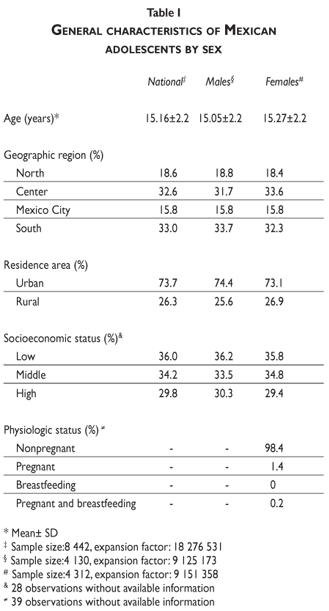
<body><![CDATA[<p><font size="2" face="Verdana">  Analyses were conducted using the Stata 9.0    program <I>SVY</I> module for survey data to adjust for the expansion factor    and the design effect.</font></p>     <p>&nbsp;</p>     <p><font size="3" face="Verdana"><b>Results</b></font></p>     <p><font size="2" face="Verdana">Data from 8 442 Mexican adolescents (4130 boys    and 4312 girls) aged 12 to 19 years old were analyzed, representing 18276531    individuals nationwide, by applying the expansion factor.</font></p>     <p><font size="2" face="Verdana"> Mean age was 15.16 &plusmn; 2.2 years. Roughly 74%    belonged to urban areas; about 30% lived in the center of the country and another    30% in the south (<a href="#tab01">Table I</a>). Most female adolescents were not pregnant (98.4%),    only 1.6% was pregnant or pregnant and breastfeeding.</font></p>     <p><a name="tab01"></a></p>     <p>&nbsp;</p>     <p align="center"><img src="/img/revistas/spm/v51s4/a10tab01.gif"></p>     <p>&nbsp;</p>     <p><font size="2" face="Verdana"> With regard to dietary information, 11.6%    of energy intake was derived from protein, 27.7% from fat, and 62.4% from carbohydrate    intake in both male and female adolescents.</font></p>     ]]></body>
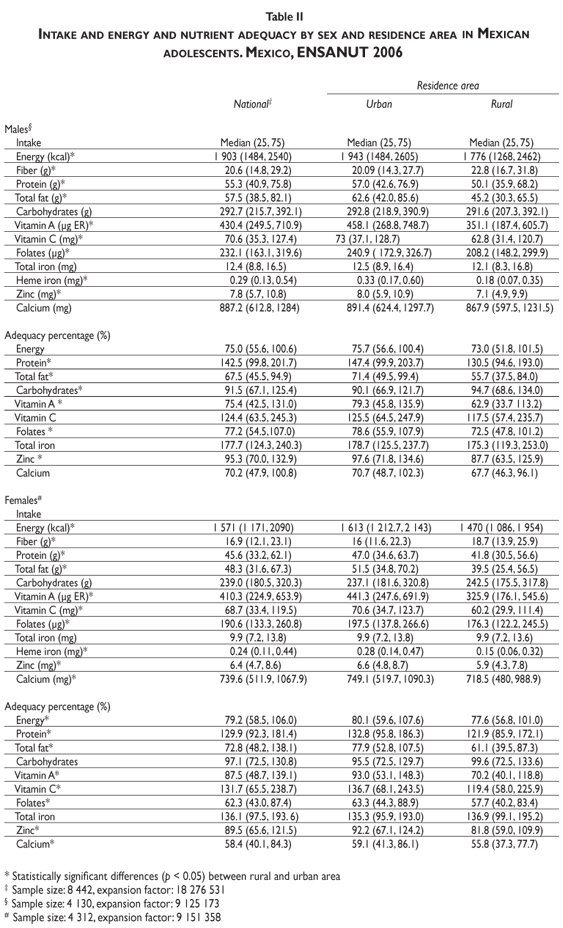
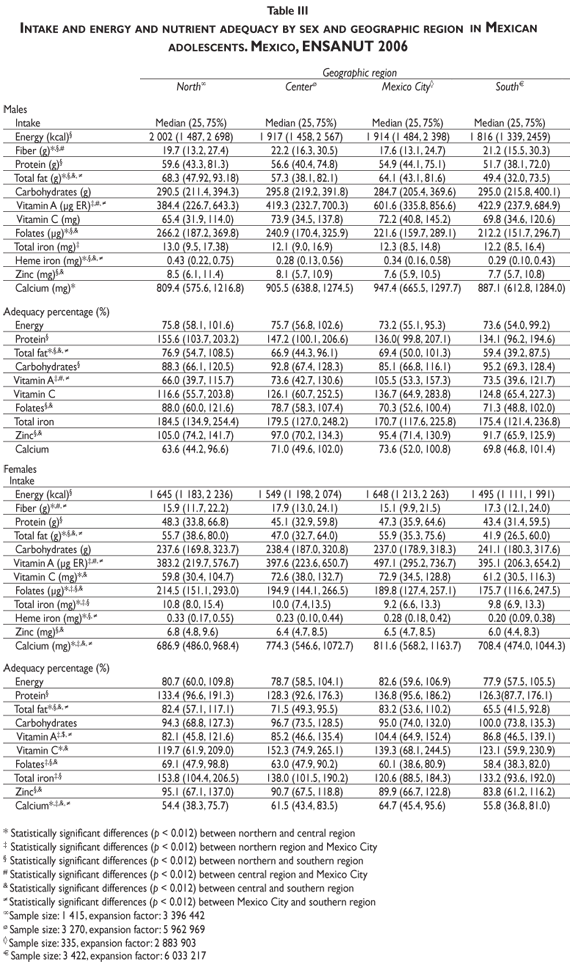
<body><![CDATA[<p><font size="2" face="Verdana"> <a href="#tab02">Table II</a> shows intake and energy and nutrient    adequacy percentages by sex and residence area. Median energy intake in boys    was higher in urban than in rural areas (1 943 kcal <I>vs</I>. 1 776 kcal (<I>p&lt;</I>    0.05)). Fiber intake varied from 20 g in the urban to 22.8 g in the rural areas,    with statistically significant difference between areas (<I>p&lt;</I> 0.05).    Protein and fat intakes were higher in the urban than in the rural areas; the    same pattern was observed for the micronutrients analyzed (vitamins A and C,    folates, iron, zinc, and calcium). Heme iron intake was higher in the urban    (0.33 mg) than in the rural areas (0.18 mg) (<I>p&lt;</I> 0.05), corresponding    to 2.8% and 1.5% of total iron, respectively.</font></p>     <p><a name="tab02"></a></p>     <p>&nbsp;</p>     <p align="center"><img src="/img/revistas/spm/v51s4/a10tab02.gif"></p>     <p>&nbsp;</p>     <p><font size="2" face="Verdana">  Energy intake was 1 571 kcal for female adolescents,    and it was higher in urban than in rural areas (1 613 kcal <I>vs</I>. 1 470    kcal, respectively (<I>p&lt;</I> 0.05)). Fiber intake ranged from 16 g in urban    to 18.7 g in rural areas (<I>p&lt;</I> 0.05). Protein (47 g) and total fat (51.5    g) intakes were higher in urban than in rural areas (protein 41.8 g, and total    fat 39.5 g, <I>p&lt;</I> 0.05). In general, the urban area had a higher micronutrient    intake than the rural area. For example, heme iron intake was 0.28 mg in urban    and 0.15 mg in rural areas (<I>p&lt;</I> 0.05).</font></p>     <p><font size="2" face="Verdana"><a href="#tab03">Table III</a> shows intake and adequacy percentages    by geographic region and sex. In male adolescents, the highest energy intake    and adequacy was observed in the north (2 002 kcal), followed by those in the    center (1 917 kcal) and Mexico City (1 914 kcal), and the lowest was registered    in the south (1 816 kcal). Fiber intake was higher in the center and in the    south. The highest vitamin A intake was in Mexico City and the highest vitamin    C intake was in the center. Folate intake was higher in the northern and central    regions. Total iron and zinc intakes were higher in the northern region; the    same occurred with heme iron.</font></p>     <p><a name="tab03"></a></p>     <p>&nbsp;</p>     <p align="center"><img src="/img/revistas/spm/v51s4/a10tab03.gif"></p>     ]]></body>
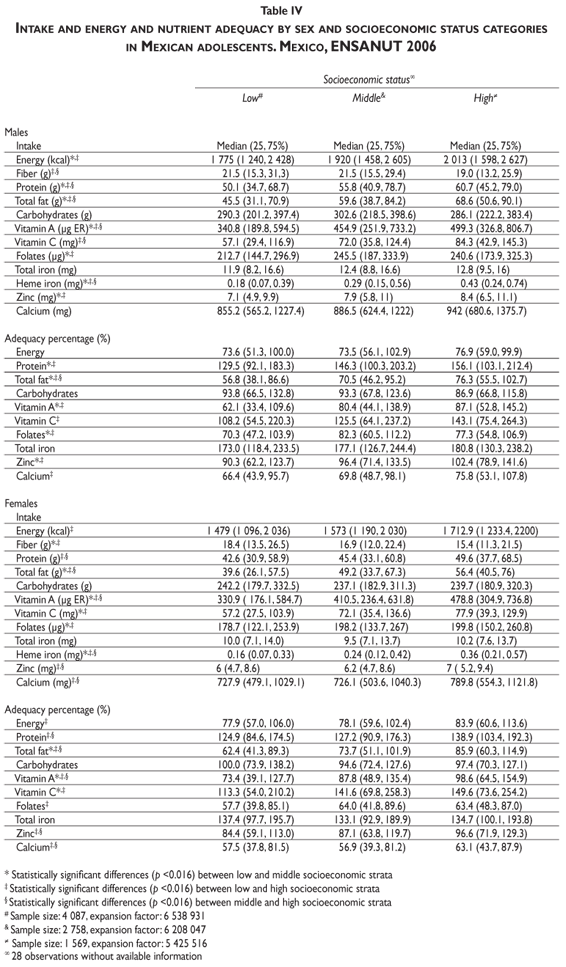
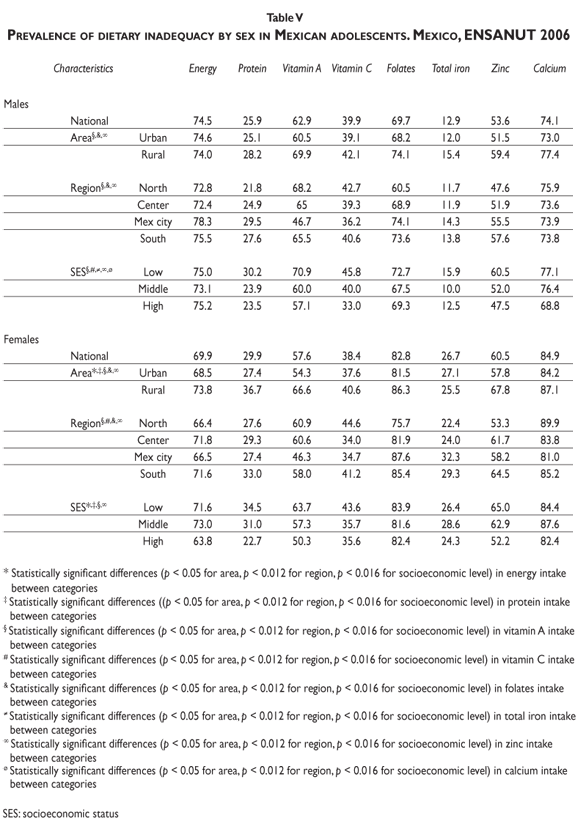
<body><![CDATA[<p>&nbsp;</p>     <p><font size="2" face="Verdana"> In female adolescents, the highest energy    intake was observed in Mexico City (1648 kcal), followed by the northern and    central regions (1645 kcal and 1549 kcal, respectively), and the lowest intake    occurred in the southern region (1495 kcal). Fiber intake was higher in the    central and southern regions. Vitamin A intake was higher in the Mexico City    region and vitamin C intake was higher in the central region. Folates, total    iron, and zinc intakes were higher in the northern region. Calcium intake was    higher in the Mexico City region than in the other regions.</font></p>     <p><font size="2" face="Verdana"> Intake and nutrient adequacy by sex and by    SES categories is presented in <a href="#tab04">Table IV</a>. For male adolescents, the lowest energy    intake was reported in the low compared with the middle and high SES groups    (<I>p&lt;</I> 0.016). The lowest quantity of fiber was reported in the high    SES (<I>p&lt;</I> 0.016, compared with the other two groups). Intakes of protein    and fat were higher in the high SES (<I>p&lt;</I> 0.016). Intakes of vitamins    A and C were also higher in the high than in the middle and low SES groups <I>(p&lt;</I>    0.016). Intake of folates was higher in the middle than in the low SES group    (<I>p&lt;</I> 0.016). Intakes of heme iron, as an indicator of meat intake,    was higher in the high SES than in the middle and low SES groups (<I>p&lt;</I>    0.016). The same pattern was observed for zinc intake, which was higher in the    high SES than in the other two strata.</font></p>     <p><a name="tab04"></a></p>     <p>&nbsp;</p>     <p align="center"><img src="/img/revistas/spm/v51s4/a10tab04.gif"></p>     <p>&nbsp;</p>     <p><font size="2" face="Verdana">  In both female and male adolescents, the lowest    energy intake and the greatest fiber intake were reported in the lower SES,    with a statistically significant difference compared with the middle and high    SES categories (<I>p&lt;</I> 0.016). Intakes of protein and total fat were higher    in the high than in the middle and low SES groups (<I>p&lt;</I> 0.016); the    same happened with intakes of vitamins A and C (<I>p</I>&lt;0.016). Folate intake    was lower in the low SES (<I>p&lt;</I> 0.016). Intake of heme iron was higher    in the high SES than in the middle and low SES groups (<I>p&lt;</I> 0.016).    The same pattern was observed for zinc, its intake being higher in the high    than in the other two categories of SES (<I>p&lt;</I> 0.016). Calcium quantity was     lower in the low and middle than in the high SES groups (<I>p&lt;</I> 0.016).</font></p>     <p><font size="2" face="Verdana">  <a href="#tab05">Table V</a> shows the prevalence of population    at risk of dietary inadequacy by different characteristics. For male adolescents    in rural areas, a higher risk was found of inadequate intake of vitamin A, folates    and zinc as compared with boys in urban areas (<I>p</I>&lt; 0.05). For female    adolescents in rural areas, there was also a higher prevalence of risk of inadequate    intakes of energy, protein, vitamin A, vitamin C, folates, and zinc compared    with girls in urban areas (<I>p&lt;</I> 0.05). In general, the southern region    presented the highest prevalences of population at risk of dietary inadequacy    in both male and female adolescents. By socioeconomic status, the lowest category    presented the highest prevalences of population at risk of dietary inadequacy    in both male and female adolescents.</font></p>     <p><a name="tab05"></a></p>     ]]></body>
<body><![CDATA[<p>&nbsp;</p>     <p align="center"><img src="/img/revistas/spm/v51s4/a10tab05.gif"></p>     <p>&nbsp;</p>     <p><font size="3" face="Verdana"><b>Discussion</b></font></p>     <p><font size="2" face="Verdana">This is    the first study that includes male adolescents in the analysis of food intake,    energy and nutrient adequacy percentages in a nationwide representative sample    in Mexico. </font></p>     <p><font size="2" face="Verdana"> Data analysis by residence area, geographic    region, and SES show important trends related to the nutrition and epidemiological    transition that Mexico is experiencing. The rural area, the southern region,    and the lower SES have the lowest intakes and percentages of nutrient adequacy,    in particular, vitamin A, folates, heme iron, zinc, and calcium, for both boys    and girls. This information agrees with the prevalences of nutrient deficiencies    (through biochemical indicators), stunting, and anemia observed in Mexico in    these populations.<SUP>19,34</SUP> Overall, these results suggest an increase    in the energy and nutrient intake compared with those reported in the ENN&#45;99.    For example, for female adolescents the energy adequacy percentage below 100%    (between 75 and 79%) is somewhat higher than that reported in the ENN&#45;99 for    females aged 12 to 49 years (70.7%) and females aged 12 to 19 years (76.3%).<SUP>14,35</SUP>    These results are congruent with the observed increase in the prevalence of    overweight (1.7 percentual points (pp)) and obesity (2.3 pp) from 1999 to 2006.<SUP>19</SUP>    Although dietary data collection methods are not comparable between these two    Mexican surveys since the 24&#45;hour recall method was used in the ENN&#45;99, these    comparisons offer a general idea of changes in consumption patterns. For fiber,    we found the same differences by residence area as in the ENN&#45;99 a higher intake    in the rural than in the urban areas. </font></p>     <p><font size="2" face="Verdana"> Results from this survey and from other studies    in adolescents are similar regarding differences between urban and rural areas;    urban adolescents consume a higher intake of refined cereals, sugars, and animal    products than rural ones. Consequently, there is a higher intake of energy,    total and saturated fat, and proteins from animal sources in urban settings,    which results in a higher risk of overweight and obesity.<SUP>36</SUP> Another    example is the health and nutrition survey carried out in China in 1993,<SUP>37</SUP>    which showed a higher protein intake in the urban (74.3 g) than in the rural    areas (72.1 g) in adolescents 14 to 18 years old, similar to that found in the    Mexican population.</font></p>     <p><font size="2" face="Verdana"> Special attention must be placed on bioavailable    iron, since its deficiency represents an important problem in the Mexican population.    The problem is not total iron intake, which is high (boys consume 12.4 mg/d    and girls 9.9 mg/d and total iron adequacy is 178% in boys and 136% in girls)    not corresponding to anemia (11.5% in both male and female adolescents)<SUP>19</SUP>    and iron deficiency (40.5% in girls aged 12 to 19 years)<SUP>34</SUP> prevalences    found in the Mexican population. The data presented in this survey refer to    total iron intake, mostly consisting of nonheme iron, whose bioavailability    is very low.<SUP>38</SUP> Moreover, the percentage of heme iron included in    the total iron intake of Mexican adolescents is very low compared with that    of other populations (2.5% for both Mexican males and females <I>vs</I>. 10%    to 15.5% for populations in countries like the United States).<SUP>39,40 </SUP>In    addition, we must consider that the reference used for the estimated average    requirement (based on the diet of the United States population) takes into account    a bioavailability of 18%, which is higher than the bioavailability in Mexico.<SUP>27,41</SUP></font></p>     <p><font size="2" face="Verdana">Though cohort analyses were not performed, these    data suggest an increase of energy and macronutrient intakes in the female population,    which is a determinant for the development of chronic degenerative diseases,<SUP>8</SUP>    but not of commonly deficient micronutrients. We expect that micronutrient deficiency    persists in this population.<SUP>42</SUP> Such persistent deficiencies complicate    the public health nutrition profile because chronic degenerative diseases and    micronutrient deficiencies contribute to the global burden of disease and generate    high costs for public health.<SUP>43,44</SUP> </font></p>     <p><font size="2" face="Verdana"> There are some limitations in this study.    We should stress that the instrument used for the collection of dietary data    for this survey (food frequency questionnaire) determines not only the within&#45;subject    variability, but also that between subjects, as the data collection period spans    an entire week. The seasonal effect could be a limitant, since we do not have    data for the whole year to determine intake variability. Fortunately, the survey    was conducted during a relatively long time period (from October 2005 to May    2006), so data on intake variability is available at the group level. Also,    it was the same period as the data collection for the ENN&#45;99.<SUP>22</SUP> </font></p>     ]]></body>
<body><![CDATA[<p><font size="2" face="Verdana"> Finally, it is worth noting that our results    indicate important differences in intake and adequacy among residence area,    geographic region, and socioeconomic status. These types of studies are needed    to better understand the role of nutrition in the prevention of certain diseases;    its objective is to identify risk factors that may cause health problems in    a population. More attention should be paid to nutrition in adolescence, taking    into account the data collected in this survey, in order to help develop adequate    strategies to control and prevent the nutrition problems of this population,    improving diet quality and increasing their nutritional status looking toward    adult life.</font></p>     <p>&nbsp;</p>     <p><font size="3" face="Verdana"><b>References</b></font></p>     <!-- ref --><p><FONT size="2" FACE="Verdana">1. Rivera J, Barquera S, Campirano F, Campos    I, Safdie M, Tovar V. Epidemiological and nutritional transition in Mexico:    Rapid increase of non&#45;communicable chronic diseases and obesity. Public Health    Nutr 2002;5(1A):113&#45;122.    &nbsp;&nbsp;&nbsp;&nbsp;&nbsp;&nbsp;&nbsp;&nbsp;[&#160;<a href="javascript:void(0);" onclick="javascript: window.open('/scielo.php?script=sci_nlinks&ref=9293803&pid=S0036-3634200900100001000001&lng=','','width=640,height=500,resizable=yes,scrollbars=1,menubar=yes,');">Links</a>&#160;]<!-- end-ref --></font></p>     <!-- ref --><p><font size="2" face="Verdana">2. Drewnowski A, Popkin BM. The nutrition transition:    New trends in the global diet. Nutr Rev 1997;55:31&#45;43.    &nbsp;&nbsp;&nbsp;&nbsp;&nbsp;&nbsp;&nbsp;&nbsp;[&#160;<a href="javascript:void(0);" onclick="javascript: window.open('/scielo.php?script=sci_nlinks&ref=9293805&pid=S0036-3634200900100001000002&lng=','','width=640,height=500,resizable=yes,scrollbars=1,menubar=yes,');">Links</a>&#160;]<!-- end-ref --></font></p>     <!-- ref --><p><font size="2" face="Verdana">3. Romieu I, Hernandez&#45;Avila M, Rivera JA, Ruel    MT, Parra S. Dietary studies in countries experiencing a health transition:    Mexico and Central America. Am J Clin Nutr 1997;65(suppl):1159S&#45;1165S.    &nbsp;&nbsp;&nbsp;&nbsp;&nbsp;&nbsp;&nbsp;&nbsp;[&#160;<a href="javascript:void(0);" onclick="javascript: window.open('/scielo.php?script=sci_nlinks&ref=9293807&pid=S0036-3634200900100001000003&lng=','','width=640,height=500,resizable=yes,scrollbars=1,menubar=yes,');">Links</a>&#160;]<!-- end-ref --></font></p>     <!-- ref --><p><font size="2" face="Verdana">4. Brown KH, Person JM, Rivera J, Allen LH. Effect    of supplemental zinc on the growth and serum zinc concentrations of prepubertal    children: a meta&#45;analysis of randomized controlled trials. Am J Clin Nutr 2002;75:1062&#45;1071.    &nbsp;&nbsp;&nbsp;&nbsp;&nbsp;&nbsp;&nbsp;&nbsp;[&#160;<a href="javascript:void(0);" onclick="javascript: window.open('/scielo.php?script=sci_nlinks&ref=9293809&pid=S0036-3634200900100001000004&lng=','','width=640,height=500,resizable=yes,scrollbars=1,menubar=yes,');">Links</a>&#160;]<!-- end-ref --></font></p>     <!-- ref --><p><font size="2" face="Verdana">5. Lira PI, Ashworth A, Morris SS. Effect of    zinc supplementation on the morbidity, immune function, and growth of low&#45;birth&#45;weight,    full&#45;term infants in northeast Brazil. Am J Clin Nutr 1998;68:418S&#45;424S.    &nbsp;&nbsp;&nbsp;&nbsp;&nbsp;&nbsp;&nbsp;&nbsp;[&#160;<a href="javascript:void(0);" onclick="javascript: window.open('/scielo.php?script=sci_nlinks&ref=9293811&pid=S0036-3634200900100001000005&lng=','','width=640,height=500,resizable=yes,scrollbars=1,menubar=yes,');">Links</a>&#160;]<!-- end-ref --></font></p>     <!-- ref --><p><font size="2" face="Verdana">6. Bhargava A, Bouis H, Scrimshaw N. Dietary    intake and socioeconomic factors are associated with the hemoglobin concentration    of Bangladeshi women. J Nutr 2001;131:758&#45;764.    &nbsp;&nbsp;&nbsp;&nbsp;&nbsp;&nbsp;&nbsp;&nbsp;[&#160;<a href="javascript:void(0);" onclick="javascript: window.open('/scielo.php?script=sci_nlinks&ref=9293813&pid=S0036-3634200900100001000006&lng=','','width=640,height=500,resizable=yes,scrollbars=1,menubar=yes,');">Links</a>&#160;]<!-- end-ref --></font></p>     <!-- ref --><p><font size="2" face="Verdana">7. Ogden CL, Flegal KM, Carroll MD, Johnson CL.    Prevalence and trends in overweight among US children and adolescents, 1999&#45;2000.    JAMA 2002;288:1728&#45;1732.    &nbsp;&nbsp;&nbsp;&nbsp;&nbsp;&nbsp;&nbsp;&nbsp;[&#160;<a href="javascript:void(0);" onclick="javascript: window.open('/scielo.php?script=sci_nlinks&ref=9293815&pid=S0036-3634200900100001000007&lng=','','width=640,height=500,resizable=yes,scrollbars=1,menubar=yes,');">Links</a>&#160;]<!-- end-ref --></font></p>     <!-- ref --><p><font size="2" face="Verdana">8. Hedley AA, Ogden CL, Johnson CL, Carroll MD,    Curtin LR, Flegal KM. Prevalence of overweight and obesity among US children,    adolescents, and adults, 1999&#45;2002. JAMA 2004;291:2847&#45;2850.    &nbsp;&nbsp;&nbsp;&nbsp;&nbsp;&nbsp;&nbsp;&nbsp;[&#160;<a href="javascript:void(0);" onclick="javascript: window.open('/scielo.php?script=sci_nlinks&ref=9293817&pid=S0036-3634200900100001000008&lng=','','width=640,height=500,resizable=yes,scrollbars=1,menubar=yes,');">Links</a>&#160;]<!-- end-ref --></font></p>     <!-- ref --><p><font size="2" face="Verdana">9. Bowman SA, Gortmaker SL, Ebbeling CB, Pereira    MA, Ludwig DS. Effects of fast&#45;food consumption on energy intake and diet quality    among children in a national household survey. Pediatrics 2004;113:112&#45;118.    &nbsp;&nbsp;&nbsp;&nbsp;&nbsp;&nbsp;&nbsp;&nbsp;[&#160;<a href="javascript:void(0);" onclick="javascript: window.open('/scielo.php?script=sci_nlinks&ref=9293819&pid=S0036-3634200900100001000009&lng=','','width=640,height=500,resizable=yes,scrollbars=1,menubar=yes,');">Links</a>&#160;]<!-- end-ref --></font></p>     <!-- ref --><p><font size="2" face="Verdana">10. Drewnowski A, Specter SE. Poverty and obesity:    the role of energy density and energy costs. Am J Clin Nutr 2004;79(1):6&#45;16.    &nbsp;&nbsp;&nbsp;&nbsp;&nbsp;&nbsp;&nbsp;&nbsp;[&#160;<a href="javascript:void(0);" onclick="javascript: window.open('/scielo.php?script=sci_nlinks&ref=9293821&pid=S0036-3634200900100001000010&lng=','','width=640,height=500,resizable=yes,scrollbars=1,menubar=yes,');">Links</a>&#160;]<!-- end-ref --></font></p>     <!-- ref --><p><font size="2" face="Verdana">11. Prentice AM, Jebb SA. Fast foods, energy    density and obesity: A possible mechanistic link. Obes Rev 2003;4:187&#45;194.    &nbsp;&nbsp;&nbsp;&nbsp;&nbsp;&nbsp;&nbsp;&nbsp;[&#160;<a href="javascript:void(0);" onclick="javascript: window.open('/scielo.php?script=sci_nlinks&ref=9293823&pid=S0036-3634200900100001000011&lng=','','width=640,height=500,resizable=yes,scrollbars=1,menubar=yes,');">Links</a>&#160;]<!-- end-ref --></font></p>     <!-- ref --><p><font size="2" face="Verdana">12. Murphy S, Rose D, Hudes M, Viteri F. Demographic    and economic factors associated with dietary quality for adults in the 1987&#45;88    nationwide food consumption survey. J Am Diet Assoc 1992;92:1352&#45;1357.    &nbsp;&nbsp;&nbsp;&nbsp;&nbsp;&nbsp;&nbsp;&nbsp;[&#160;<a href="javascript:void(0);" onclick="javascript: window.open('/scielo.php?script=sci_nlinks&ref=9293825&pid=S0036-3634200900100001000012&lng=','','width=640,height=500,resizable=yes,scrollbars=1,menubar=yes,');">Links</a>&#160;]<!-- end-ref --></font></p>     <!-- ref --><p><font size="2" face="Verdana">13. Flores M, Melgar H, Cort&eacute;s C, Rivera    M, Rivera J, Sep&uacute;lveda J. Consumo de energ&iacute;a y nutrimentos en    mujeres mexicanas en edad reproductiva. Salud Publica Mex 1998;40:161&#45;171.    &nbsp;&nbsp;&nbsp;&nbsp;&nbsp;&nbsp;&nbsp;&nbsp;[&#160;<a href="javascript:void(0);" onclick="javascript: window.open('/scielo.php?script=sci_nlinks&ref=9293827&pid=S0036-3634200900100001000013&lng=','','width=640,height=500,resizable=yes,scrollbars=1,menubar=yes,');">Links</a>&#160;]<!-- end-ref --></font></p>     <!-- ref --><p><font size="2" face="Verdana">14. Barquera S, Rivera JA, Espinosa&#45;Montero J,    Safdie M, Campirano F, Monterrubio EA. Energy and nutrient consumption in Mexican    women 12&#45;49 y of age: Analysis of the National Nutrition Survey 1999. Salud    Publica Mex 2003;45 suppl 4:S530&#45;S539.    &nbsp;&nbsp;&nbsp;&nbsp;&nbsp;&nbsp;&nbsp;&nbsp;[&#160;<a href="javascript:void(0);" onclick="javascript: window.open('/scielo.php?script=sci_nlinks&ref=9293829&pid=S0036-3634200900100001000014&lng=','','width=640,height=500,resizable=yes,scrollbars=1,menubar=yes,');">Links</a>&#160;]<!-- end-ref --></font></p>     <!-- ref --><p><font size="2" face="Verdana">15. Barquera S, Rivera JA, Safdie M, Flores M,    Campos&#45;Nonato I, Campirano F. Energy and nutrient intake in preschool and school    age Mexican children: National Nutrition Survey 1999. Salud Publica Mex 2003;45    suppl 4:S540&#45;S550.    &nbsp;&nbsp;&nbsp;&nbsp;&nbsp;&nbsp;&nbsp;&nbsp;[&#160;<a href="javascript:void(0);" onclick="javascript: window.open('/scielo.php?script=sci_nlinks&ref=9293831&pid=S0036-3634200900100001000015&lng=','','width=640,height=500,resizable=yes,scrollbars=1,menubar=yes,');">Links</a>&#160;]<!-- end-ref --></font></p>     <!-- ref --><p><FONT size="2" FACE="Verdana">16. World Health Organization. Adolescent Health    and Development. 2000. &#91;Consulted on 2008 January 17)&#93;. Available at: <a href="http://www.who.int/child&#45;adolescent&#45;health/OVERVIEW/AHD/adh_over.htm" target="_blank">http://www.who.int/child&#45;adolescent&#45;health/OVERVIEW/AHD/adh_over.htm</a>.    &nbsp;&nbsp;&nbsp;&nbsp;&nbsp;&nbsp;&nbsp;&nbsp;[&#160;<a href="javascript:void(0);" onclick="javascript: window.open('/scielo.php?script=sci_nlinks&ref=9293833&pid=S0036-3634200900100001000016&lng=','','width=640,height=500,resizable=yes,scrollbars=1,menubar=yes,');">Links</a>&#160;]<!-- end-ref --></font></p>     <!-- ref --><p><font size="2" face="Verdana">17. World Health Organization. Young people's    health &#8722;A challenge for society. Report of a WHO study group on young    people and health for all by the year 2000. Geneva:WHO, 1986. Technical report    series No. 731.    &nbsp;&nbsp;&nbsp;&nbsp;&nbsp;&nbsp;&nbsp;&nbsp;[&#160;<a href="javascript:void(0);" onclick="javascript: window.open('/scielo.php?script=sci_nlinks&ref=9293835&pid=S0036-3634200900100001000017&lng=','','width=640,height=500,resizable=yes,scrollbars=1,menubar=yes,');">Links</a>&#160;]<!-- end-ref --></font></p>     <!-- ref --><p><font size="2" face="Verdana">18. World Health Organization. WHO discussion    paper on adolescence. &#91;Consulted on 2007 October 30&#93;. Available at: <a href="http://www.who.int/child&#45;adolescent health/New_Publications/ADH/ISBN_92_4_159366_0.pdf" target="_blank">http://www.who.int/child&#45;adolescent    health/New_Publications/ADH/ISBN_92_4_159366_0.pdf</a>.    &nbsp;&nbsp;&nbsp;&nbsp;&nbsp;&nbsp;&nbsp;&nbsp;[&#160;<a href="javascript:void(0);" onclick="javascript: window.open('/scielo.php?script=sci_nlinks&ref=9293837&pid=S0036-3634200900100001000018&lng=','','width=640,height=500,resizable=yes,scrollbars=1,menubar=yes,');">Links</a>&#160;]<!-- end-ref --> </font></p>     <!-- ref --><p><FONT size="2" FACE="Verdana">19. Rivera Dommarco J, Cuevas Nasu L, Shamah&#45;Levy    T, Villalpando&#45;Hern&aacute;ndez S, Avila&#45;Arcos MA, Jim&eacute;nez&#45;Aguilar A.    Estado nutricio. In: Olaiz&#45;Fern&aacute;ndez G, Rivera&#45;Dommarco J, Shamah&#45;Levy    T, Rojas R, Villalpando&#45;Hern&aacute;ndez S, Hern&aacute;ndez&#45;Avila M, <I>et    al</I>. Encuesta Nacional de Salud y Nutrici&oacute;n 2006. Cuernavaca, M&eacute;xico:    Instituto Nacional de Salud P&uacute;blica, 2006: 85&#45;103.    &nbsp;&nbsp;&nbsp;&nbsp;&nbsp;&nbsp;&nbsp;&nbsp;[&#160;<a href="javascript:void(0);" onclick="javascript: window.open('/scielo.php?script=sci_nlinks&ref=9293839&pid=S0036-3634200900100001000019&lng=','','width=640,height=500,resizable=yes,scrollbars=1,menubar=yes,');">Links</a>&#160;]<!-- end-ref --></font></p>     <!-- ref --><p><FONT size="2" FACE="Verdana"> 20. Palma O, Shamah&#45;Levy T, Franco A, Olaiz    G, M&eacute;ndez&#45;Ram&iacute;rez I. Metodolog&iacute;a. En: Olaiz&#45;Fern&aacute;ndez    G, Rivera&#45;Dommarco J, Shamah&#45;Levy T, Rojas R, Villalpando&#45;Hern&aacute;ndez S,    Hern&aacute;ndez&#45;Avila M, <I>et al</I>. Encuesta Nacional de Salud y Nutrici&oacute;n    2006. Cuernavaca, M&eacute;xico: Instituto Nacional de Salud P&uacute;blica,    2006: 19&#45;33.    &nbsp;&nbsp;&nbsp;&nbsp;&nbsp;&nbsp;&nbsp;&nbsp;[&#160;<a href="javascript:void(0);" onclick="javascript: window.open('/scielo.php?script=sci_nlinks&ref=9293841&pid=S0036-3634200900100001000020&lng=','','width=640,height=500,resizable=yes,scrollbars=1,menubar=yes,');">Links</a>&#160;]<!-- end-ref --></font></p>     <!-- ref --><p><font size="2" face="Verdana">21. Hern&aacute;ndez&#45;Avila M, Romieu I, Parra    S, Hern&aacute;ndez&#45;Avila J, Madrigal H, Willett W. Validity and reproducibility    of a food frequency questionnaire to assess dietary intake of women living in    Mexico City. Salud Publica Mex 1998;39:133&#45;140.    &nbsp;&nbsp;&nbsp;&nbsp;&nbsp;&nbsp;&nbsp;&nbsp;[&#160;<a href="javascript:void(0);" onclick="javascript: window.open('/scielo.php?script=sci_nlinks&ref=9293843&pid=S0036-3634200900100001000021&lng=','','width=640,height=500,resizable=yes,scrollbars=1,menubar=yes,');">Links</a>&#160;]<!-- end-ref --></font></p>     <!-- ref --><p><font size="2" face="Verdana">22. Rivera&#45;Dommarco J, Shamah&#45;Levy T, Villalpando&#45;Hern&aacute;ndez    S, Gonz&aacute;lez de Coss&iacute;o T, Hern&aacute;ndez&#45;Prado B, Sep&uacute;lveda    J. Encuesta Nacional de Nutrici&oacute;n 1999. Estado nutricio de ni&ntilde;os    y mujeres en M&eacute;xico. Cuernavaca, Morelos: Instituto Nacional de Salud    P&uacute;blica, 2001.    &nbsp;&nbsp;&nbsp;&nbsp;&nbsp;&nbsp;&nbsp;&nbsp;[&#160;<a href="javascript:void(0);" onclick="javascript: window.open('/scielo.php?script=sci_nlinks&ref=9293845&pid=S0036-3634200900100001000022&lng=','','width=640,height=500,resizable=yes,scrollbars=1,menubar=yes,');">Links</a>&#160;]<!-- end-ref --></font></p>     <!-- ref --><p><font size="2" face="Verdana">23. Ram&iacute;rez CI, Mundo V, Rodr&iacute;guez    SC, Vizuet NI, Hern&aacute;ndez N, Jim&eacute;nez A. Encuestas diet&eacute;ticas:    Recordatorio de 24 horas y Frecuencia de consumo de alimentos. In: Manual de    procedimientos para proyectos de nutrici&oacute;n. Cuernavaca, M&eacute;xico:    Instituto Nacional de Salud P&uacute;blica,2006.    &nbsp;&nbsp;&nbsp;&nbsp;&nbsp;&nbsp;&nbsp;&nbsp;[&#160;<a href="javascript:void(0);" onclick="javascript: window.open('/scielo.php?script=sci_nlinks&ref=9293847&pid=S0036-3634200900100001000023&lng=','','width=640,height=500,resizable=yes,scrollbars=1,menubar=yes,');">Links</a>&#160;]<!-- end-ref --></font></p>     <!-- ref --><p><font size="2" face="Verdana">24. A Report of the Panel on Macronutrients,    Subcommittees on Upper Reference Levels of Nutrients and Interpretation and    Uses of Dietary Reference Intakes, and the Standing Committee on the Scientific    Evaluation of Dietary Reference Intakes. Dietary Reference Intakes for Energy,    Carbohydrate, Fiber, Fat, Fatty Acids, Cholesterol, Protein, and Amino Acids    (Macronutrients). Washington, DC: Institute of Medicine, The National Academies    Press, 2005: 589&#45;630.    &nbsp;&nbsp;&nbsp;&nbsp;&nbsp;&nbsp;&nbsp;&nbsp;[&#160;<a href="javascript:void(0);" onclick="javascript: window.open('/scielo.php?script=sci_nlinks&ref=9293849&pid=S0036-3634200900100001000024&lng=','','width=640,height=500,resizable=yes,scrollbars=1,menubar=yes,');">Links</a>&#160;]<!-- end-ref --></font></p>     <!-- ref --><p><font size="2" face="Verdana">25. Panel on Dietary Antioxidants and Related    Compounds, Subcommittees on Upper Reference Levels of Nutrients and Interpretation    and Uses of DRIs, Standing Committee on the Scientific Evaluation of Dietary    Reference Intakes, Food and Nutrition Board, Institute of Medicine. Vitamin    C. In: Dietary reference intakes for: Vitamin C, Vitamin E, selenium and carotenoids.    Washington, DC: Institute of Medicine, The National Academies Press, 2000: 95&#45;185.    &nbsp;&nbsp;&nbsp;&nbsp;&nbsp;&nbsp;&nbsp;&nbsp;[&#160;<a href="javascript:void(0);" onclick="javascript: window.open('/scielo.php?script=sci_nlinks&ref=9293851&pid=S0036-3634200900100001000025&lng=','','width=640,height=500,resizable=yes,scrollbars=1,menubar=yes,');">Links</a>&#160;]<!-- end-ref --></font></p>     <!-- ref --><p><font size="2" face="Verdana">26. Panel on Micronutrients, Subcommittees on    Upper Reference Levels of Nutrients and of Interpretation and Use of Dietary    Reference Intakes, and the Standing Committee on the Scientific Evaluation of    Dietary Reference Intakes. Vitamin A. In: Dietary reference intakes for: Vitamin    A, Vitamin K, arsenic, boron, chromium, copper, iodine, iron, manganese, molybdenum,    nickel, silicon, vanadium and zinc. Washington, DC: Institute of Medicine, National    Academies Press, 2000: 82&#45;161.    &nbsp;&nbsp;&nbsp;&nbsp;&nbsp;&nbsp;&nbsp;&nbsp;[&#160;<a href="javascript:void(0);" onclick="javascript: window.open('/scielo.php?script=sci_nlinks&ref=9293853&pid=S0036-3634200900100001000026&lng=','','width=640,height=500,resizable=yes,scrollbars=1,menubar=yes,');">Links</a>&#160;]<!-- end-ref --></font></p>     <!-- ref --><p><font size="2" face="Verdana">27. Panel on Micronutrients, Subcommittees on    Upper Reference Levels of Nutrients and of Interpretation and Use of Dietary    Reference Intakes, and the Standing Committee on the Scientific Evaluation of    Dietary Reference Intakes. Iron. In: Dietary reference intakes for: Vitamin    A, Vitamin K, arsenic, boron, chromium, copper, iodine, iron, manganese, molybdenum,    nickel, silicon, vanadium and zinc. Washington, DC: Institute of Medicine, National    Academies Press, 2000: 290&#45;393.    &nbsp;&nbsp;&nbsp;&nbsp;&nbsp;&nbsp;&nbsp;&nbsp;[&#160;<a href="javascript:void(0);" onclick="javascript: window.open('/scielo.php?script=sci_nlinks&ref=9293855&pid=S0036-3634200900100001000027&lng=','','width=640,height=500,resizable=yes,scrollbars=1,menubar=yes,');">Links</a>&#160;]<!-- end-ref --></font></p>     <!-- ref --><p><font size="2" face="Verdana">28. Panel on Micronutrients, Subcommittees on    Upper Reference Levels of Nutrients and of Interpretation and Use of Dietary    Reference Intakes, and the Standing Committee on the Scientific Evaluation of    Dietary Reference Intakes. Zinc. In: Dietary reference intakes for: Vitamin    A, Vitamin K, arsenic, boron, chromium, copper, iodine, iron, manganese, molybdenum,    nickel, silicon, vanadium and zinc. Washington, DC: Institute of Medicine, National    Academies Press, 2000: 442&#45;501.    &nbsp;&nbsp;&nbsp;&nbsp;&nbsp;&nbsp;&nbsp;&nbsp;[&#160;<a href="javascript:void(0);" onclick="javascript: window.open('/scielo.php?script=sci_nlinks&ref=9293857&pid=S0036-3634200900100001000028&lng=','','width=640,height=500,resizable=yes,scrollbars=1,menubar=yes,');">Links</a>&#160;]<!-- end-ref --></font></p>     <!-- ref --><p><font size="2" face="Verdana">29. A Report of the Standing Committee on the    Scientific Evaluation of Dietary Reference Intakes and its Panel on Folate,    Other B Vitamins, and Choline and Subcommittee on Upper Reference Levels of    Nutrients, Food and Nutrition Board, Institute of Medicine. Folate: In: Dietary    reference intakes for: Thiamin, riboflavin, niacin, vitamina B6, folate, Vitamin    B12, pantothenic acid, biotin and choline. Washington, DC: Institute of Medicine,    National Academies Press, 2000: 196&#45;305.    &nbsp;&nbsp;&nbsp;&nbsp;&nbsp;&nbsp;&nbsp;&nbsp;[&#160;<a href="javascript:void(0);" onclick="javascript: window.open('/scielo.php?script=sci_nlinks&ref=9293859&pid=S0036-3634200900100001000029&lng=','','width=640,height=500,resizable=yes,scrollbars=1,menubar=yes,');">Links</a>&#160;]<!-- end-ref --></font></p>     <!-- ref --><p><font size="2" face="Verdana">30. Standing Committee on the Scientific Evaluation    of Dietary Reference Intakes, Food and Nutrition Board, Institute of Medicine.    Calcium. In: Dietary reference intakes for: Calcium, phosphorus, magnesium,    Vitamin D and fluoride. Washington, DC: Institute of Medicine, National Academies    Press, 2000: 71&#45;145.    &nbsp;&nbsp;&nbsp;&nbsp;&nbsp;&nbsp;&nbsp;&nbsp;[&#160;<a href="javascript:void(0);" onclick="javascript: window.open('/scielo.php?script=sci_nlinks&ref=9293861&pid=S0036-3634200900100001000030&lng=','','width=640,height=500,resizable=yes,scrollbars=1,menubar=yes,');">Links</a>&#160;]<!-- end-ref --></font></p>     <!-- ref --><p><font size="2" face="Verdana">31. Institute of Medicine. Energy. In: Dietary    Reference Intakes for Energy, Carbohydrates, Fiber, Fat, Protein and Amino Acids    (Macronutrients). Washington, DC: Institute of Medicine, National Academy Press,    2005: 589&#45;630.    &nbsp;&nbsp;&nbsp;&nbsp;&nbsp;&nbsp;&nbsp;&nbsp;[&#160;<a href="javascript:void(0);" onclick="javascript: window.open('/scielo.php?script=sci_nlinks&ref=9293863&pid=S0036-3634200900100001000031&lng=','','width=640,height=500,resizable=yes,scrollbars=1,menubar=yes,');">Links</a>&#160;]<!-- end-ref --></font></p>     <!-- ref --><p><font size="2" face="Verdana">32. Reyment R, J&ouml;reskog K. Applied factor    analysis in the natural sciences. Cambridge, UK: Cambridge University Press,    1996: 371.    &nbsp;&nbsp;&nbsp;&nbsp;&nbsp;&nbsp;&nbsp;&nbsp;[&#160;<a href="javascript:void(0);" onclick="javascript: window.open('/scielo.php?script=sci_nlinks&ref=9293865&pid=S0036-3634200900100001000032&lng=','','width=640,height=500,resizable=yes,scrollbars=1,menubar=yes,');">Links</a>&#160;]<!-- end-ref --></font></p>     <!-- ref --><p><FONT size="2" FACE="Verdana">33. University of New England. One&#45;Way ANOVA    Bonferroni adjustment. &#91;Consulted on 2008 April 4&#93;. Available at: <A HREF="http://www.une.edu.au/WebStat/unit_materials/c7_anova/oneway_bonferroni_adjust.htm" target="_blank">http://www.une.edu.au/WebStat/unit_materials/c7_anova/oneway_bonferroni_adjust.htm</A>.    &nbsp;&nbsp;&nbsp;&nbsp;&nbsp;&nbsp;&nbsp;&nbsp;[&#160;<a href="javascript:void(0);" onclick="javascript: window.open('/scielo.php?script=sci_nlinks&ref=9293867&pid=S0036-3634200900100001000033&lng=','','width=640,height=500,resizable=yes,scrollbars=1,menubar=yes,');">Links</a>&#160;]<!-- end-ref --></font></p>     <!-- ref --><p><FONT size="2" FACE="Verdana"> 34. Villalpando S, Garc&iacute;a&#45;Guerra A, Ram&iacute;rez&#45;Silva    CI, Mej&iacute;a&#45;Rodr&iacute;guez F, Matute G, Shamah&#45;Levy T, <I>et al</I>.    Iron, zinc and iodine status in Mexican children under 12 years and women 12&#45;49    years of age. A probabilistic national survey. Salud Publica Mex 2003;45 suppl    4:S520&#45;S529.    &nbsp;&nbsp;&nbsp;&nbsp;&nbsp;&nbsp;&nbsp;&nbsp;[&#160;<a href="javascript:void(0);" onclick="javascript: window.open('/scielo.php?script=sci_nlinks&ref=9293869&pid=S0036-3634200900100001000034&lng=','','width=640,height=500,resizable=yes,scrollbars=1,menubar=yes,');">Links</a>&#160;]<!-- end-ref --></font></p>     <!-- ref --><p><font size="2" face="Verdana">35. Flores M, Rodr&iacute;guez S, Barquera S,    Lozada AL. Patrones dietarios en adolescentes mexicanas. Una comparaci&oacute;n    de dos m&eacute;todos. Encuesta Nacional de Nutrici&oacute;n, 1999. Salud Publica    Mex 2007;49:263&#45;273.    &nbsp;&nbsp;&nbsp;&nbsp;&nbsp;&nbsp;&nbsp;&nbsp;[&#160;<a href="javascript:void(0);" onclick="javascript: window.open('/scielo.php?script=sci_nlinks&ref=9293871&pid=S0036-3634200900100001000035&lng=','','width=640,height=500,resizable=yes,scrollbars=1,menubar=yes,');">Links</a>&#160;]<!-- end-ref --></font></p>     <!-- ref --><p><FONT size="2" FACE="Verdana">36. Ruel MT, Haddad L, Garret LJ. Some urban    facts of life: Implications for research and policy.  World Dev 1999;27:1917&#45;1938.    &nbsp;&nbsp;&nbsp;&nbsp;&nbsp;&nbsp;&nbsp;&nbsp;[&#160;<a href="javascript:void(0);" onclick="javascript: window.open('/scielo.php?script=sci_nlinks&ref=9293873&pid=S0036-3634200900100001000036&lng=','','width=640,height=500,resizable=yes,scrollbars=1,menubar=yes,');">Links</a>&#160;]<!-- end-ref --></font></p>     <!-- ref --><p><font size="2" face="Verdana">37 Wang Y, Popkin B, Zhai F. The nutritional    status and dietary pattern of Chinese adolescents, 1991 and 1993. Eur J Clin    Nutr 1998;52:908&#45;916.    &nbsp;&nbsp;&nbsp;&nbsp;&nbsp;&nbsp;&nbsp;&nbsp;[&#160;<a href="javascript:void(0);" onclick="javascript: window.open('/scielo.php?script=sci_nlinks&ref=9293875&pid=S0036-3634200900100001000037&lng=','','width=640,height=500,resizable=yes,scrollbars=1,menubar=yes,');">Links</a>&#160;]<!-- end-ref --></font></p>     <!-- ref --><p><font size="2" face="Verdana">38 Rodriguez SC, Hotz C, Rivera J. Bioavailable    dietary iron is associated with hemoglobin concentration in Mexican preschool    children. J Nutr 2007;137:2304&#45;2310.    &nbsp;&nbsp;&nbsp;&nbsp;&nbsp;&nbsp;&nbsp;&nbsp;[&#160;<a href="javascript:void(0);" onclick="javascript: window.open('/scielo.php?script=sci_nlinks&ref=9293877&pid=S0036-3634200900100001000038&lng=','','width=640,height=500,resizable=yes,scrollbars=1,menubar=yes,');">Links</a>&#160;]<!-- end-ref --></font></p>     <!-- ref --><p><font size="2" face="Verdana">39. Raper NR, Rosenthal JC, Woteki CE. Estimates    of available iron in diets of individuals 1 year old and older in the Nationwide    Food Consumption Survey. J Am Diet Assoc 1984;84:783&#45;787.    &nbsp;&nbsp;&nbsp;&nbsp;&nbsp;&nbsp;&nbsp;&nbsp;[&#160;<a href="javascript:void(0);" onclick="javascript: window.open('/scielo.php?script=sci_nlinks&ref=9293879&pid=S0036-3634200900100001000039&lng=','','width=640,height=500,resizable=yes,scrollbars=1,menubar=yes,');">Links</a>&#160;]<!-- end-ref --></font></p>     <!-- ref --><p><font size="2" face="Verdana">40. Ramakrishnan U, Frith&#45;Terhune A, Cogswell    M, Kettel&#45;Khan L. Dietary intake does not account for differences in low iron    stores among Mexican American and non&#45;Hispanic white women: Third National Health    and Nutrition Examination Survey, 1988&#45;1994. J Nutr 2002;132: 996&#45;1001.    &nbsp;&nbsp;&nbsp;&nbsp;&nbsp;&nbsp;&nbsp;&nbsp;[&#160;<a href="javascript:void(0);" onclick="javascript: window.open('/scielo.php?script=sci_nlinks&ref=9293881&pid=S0036-3634200900100001000040&lng=','','width=640,height=500,resizable=yes,scrollbars=1,menubar=yes,');">Links</a>&#160;]<!-- end-ref --></font></p>     <!-- ref --><p><FONT size="2" FACE="Verdana">41. Rivera J, Hotz C, Rodr&iacute;guez S, Garc&iacute;a    A, P&eacute;rez A, Mart&iacute;nez H, <I>et al</I>. Hierro. Recomendaciones    de ingesti&oacute;n de nutrimentos para la poblaci&oacute;n mexicana Tomo I.    Mexico City: Editorial Panamericana, 2005: 245&#45;247.    &nbsp;&nbsp;&nbsp;&nbsp;&nbsp;&nbsp;&nbsp;&nbsp;[&#160;<a href="javascript:void(0);" onclick="javascript: window.open('/scielo.php?script=sci_nlinks&ref=9293883&pid=S0036-3634200900100001000041&lng=','','width=640,height=500,resizable=yes,scrollbars=1,menubar=yes,');">Links</a>&#160;]<!-- end-ref --></font></p>     <!-- ref --><p><font size="2" face="Verdana">42. Standing Comite on Nutrition (SCN). 5th Report    on the World Nutrition Situation. Nutrition for Improved Development Outcomes.    Geneva: Standing Comite on Nutrition, 2004.    &nbsp;&nbsp;&nbsp;&nbsp;&nbsp;&nbsp;&nbsp;&nbsp;[&#160;<a href="javascript:void(0);" onclick="javascript: window.open('/scielo.php?script=sci_nlinks&ref=9293885&pid=S0036-3634200900100001000042&lng=','','width=640,height=500,resizable=yes,scrollbars=1,menubar=yes,');">Links</a>&#160;]<!-- end-ref --></font></p>     <!-- ref --><p><FONT size="2" FACE="Verdana">43. Lopez AD, Mathers CD, Ezzati M, Jamison DT,    Murray CJ. Global and regional burden of disease and risk factors, 2001: Systematic    analysis of population health data. Lancet 2006;29;368(9533):365.    &nbsp;&nbsp;&nbsp;&nbsp;&nbsp;&nbsp;&nbsp;&nbsp;[&#160;<a href="javascript:void(0);" onclick="javascript: window.open('/scielo.php?script=sci_nlinks&ref=9293887&pid=S0036-3634200900100001000043&lng=','','width=640,height=500,resizable=yes,scrollbars=1,menubar=yes,');">Links</a>&#160;]<!-- end-ref --> </font></p>     <!-- ref --><p><font size="2" face="Verdana">44. Ezzati M, Lopez AD, Rodgers A, Vander&#45;Hoorn    S, Murray CJ, and the Comparative Risk Assessment Collaborating Group. Selected    major risk factors and global and regional burden of disease. Lancet 2002; 2;360(9343):1342&#45;1343.    &nbsp;&nbsp;&nbsp;&nbsp;&nbsp;&nbsp;&nbsp;&nbsp;[&#160;<a href="javascript:void(0);" onclick="javascript: window.open('/scielo.php?script=sci_nlinks&ref=9293889&pid=S0036-3634200900100001000044&lng=','','width=640,height=500,resizable=yes,scrollbars=1,menubar=yes,');">Links</a>&#160;]<!-- end-ref --></font></p>     <p>&nbsp;</p>     <p>&nbsp;</p>     <p><FONT size="2" FACE="Verdana">Received on: April 11, 2008    <br>   Accepted on: January 22, 2009</font></p>     <p>&nbsp;</p>     <p>&nbsp;</p>     <p><font size="2" face="Verdana">Address       reprint requests to: Sonia Rodr&iacute;guez Ram&iacute;rez. Instituto       Nacional de Salud P&uacute;blica, Av. Universidad 655, col. Santa Mar&iacute;a Ahuacatitl&aacute;n. 62100 Cuernavaca, Morelos, M&eacute;xico. E&#45;mail: <a href="mailto:scrodrig@insp.mx">scrodrig@insp.mx</a>    <br> <a name="nt01"></a><a href="#tx01">*</a> Safdie M, Barquera S, Porcayo M, Rodr&iacute;guez S, Ram&iacute;rez C, Rivera J, et al. Bases de datos del valor nutritivo de los alimentos. Compilaci&oacute;n del Instituto Nacional de Salud P&uacute;blica. M&eacute;xico, 2004 (Unpublished document).</font></p>      ]]></body><back>
<ref-list>
<ref id="B1">
<label>1</label><nlm-citation citation-type="journal">
<person-group person-group-type="author">
<name>
<surname><![CDATA[Rivera]]></surname>
<given-names><![CDATA[J]]></given-names>
</name>
<name>
<surname><![CDATA[Barquera]]></surname>
<given-names><![CDATA[S]]></given-names>
</name>
<name>
<surname><![CDATA[Campirano]]></surname>
<given-names><![CDATA[F]]></given-names>
</name>
<name>
<surname><![CDATA[Campos]]></surname>
<given-names><![CDATA[I]]></given-names>
</name>
<name>
<surname><![CDATA[Safdie]]></surname>
<given-names><![CDATA[M]]></given-names>
</name>
<name>
<surname><![CDATA[Tovar]]></surname>
<given-names><![CDATA[V]]></given-names>
</name>
</person-group>
<article-title xml:lang="en"><![CDATA[Epidemiological and nutritional transition in Mexico: Rapid increase of non-communicable chronic diseases and obesity]]></article-title>
<source><![CDATA[Public Health Nutr]]></source>
<year>2002</year>
<volume>5</volume>
<numero>1A</numero>
<issue>1A</issue>
<page-range>113-122</page-range></nlm-citation>
</ref>
<ref id="B2">
<label>2</label><nlm-citation citation-type="journal">
<person-group person-group-type="author">
<name>
<surname><![CDATA[Drewnowski]]></surname>
<given-names><![CDATA[A]]></given-names>
</name>
<name>
<surname><![CDATA[Popkin]]></surname>
<given-names><![CDATA[BM]]></given-names>
</name>
</person-group>
<article-title xml:lang="en"><![CDATA[The nutrition transition: New trends in the global diet]]></article-title>
<source><![CDATA[Nutr Rev]]></source>
<year>1997</year>
<volume>55</volume>
<page-range>31-43</page-range></nlm-citation>
</ref>
<ref id="B3">
<label>3</label><nlm-citation citation-type="journal">
<person-group person-group-type="author">
<name>
<surname><![CDATA[Romieu]]></surname>
<given-names><![CDATA[I]]></given-names>
</name>
<name>
<surname><![CDATA[Hernandez-Avila]]></surname>
<given-names><![CDATA[M]]></given-names>
</name>
<name>
<surname><![CDATA[Rivera]]></surname>
<given-names><![CDATA[JA]]></given-names>
</name>
<name>
<surname><![CDATA[Ruel]]></surname>
<given-names><![CDATA[MT]]></given-names>
</name>
<name>
<surname><![CDATA[Parra]]></surname>
<given-names><![CDATA[S]]></given-names>
</name>
</person-group>
<article-title xml:lang="en"><![CDATA[Dietary studies in countries experiencing a health transition: Mexico and Central America]]></article-title>
<source><![CDATA[Am J Clin Nutr]]></source>
<year>1997</year>
<volume>65</volume>
<numero>^ssuppl</numero>
<issue>^ssuppl</issue>
<supplement>suppl</supplement>
<page-range>1159S-1165S</page-range></nlm-citation>
</ref>
<ref id="B4">
<label>4</label><nlm-citation citation-type="journal">
<person-group person-group-type="author">
<name>
<surname><![CDATA[Brown]]></surname>
<given-names><![CDATA[KH]]></given-names>
</name>
<name>
<surname><![CDATA[Person]]></surname>
<given-names><![CDATA[JM]]></given-names>
</name>
<name>
<surname><![CDATA[Rivera]]></surname>
<given-names><![CDATA[J]]></given-names>
</name>
<name>
<surname><![CDATA[Allen]]></surname>
<given-names><![CDATA[LH]]></given-names>
</name>
</person-group>
<article-title xml:lang="en"><![CDATA[Effect of supplemental zinc on the growth and serum zinc concentrations of prepubertal children: a meta-analysis of randomized controlled trials]]></article-title>
<source><![CDATA[Am J Clin Nutr]]></source>
<year>2002</year>
<volume>75</volume>
<page-range>1062-1071</page-range></nlm-citation>
</ref>
<ref id="B5">
<label>5</label><nlm-citation citation-type="journal">
<person-group person-group-type="author">
<name>
<surname><![CDATA[Lira]]></surname>
<given-names><![CDATA[PI]]></given-names>
</name>
<name>
<surname><![CDATA[Ashworth]]></surname>
<given-names><![CDATA[A]]></given-names>
</name>
<name>
<surname><![CDATA[Morris]]></surname>
<given-names><![CDATA[SS]]></given-names>
</name>
</person-group>
<article-title xml:lang="en"><![CDATA[Effect of zinc supplementation on the morbidity, immune function, and growth of low-birth-weight, full-term infants in northeast Brazil]]></article-title>
<source><![CDATA[Am J Clin Nutr]]></source>
<year>1998</year>
<volume>68</volume>
<page-range>418S-424S</page-range></nlm-citation>
</ref>
<ref id="B6">
<label>6</label><nlm-citation citation-type="journal">
<person-group person-group-type="author">
<name>
<surname><![CDATA[Bhargava]]></surname>
<given-names><![CDATA[A]]></given-names>
</name>
<name>
<surname><![CDATA[Bouis]]></surname>
<given-names><![CDATA[H]]></given-names>
</name>
<name>
<surname><![CDATA[Scrimshaw]]></surname>
<given-names><![CDATA[N]]></given-names>
</name>
</person-group>
<article-title xml:lang="en"><![CDATA[Dietary intake and socioeconomic factors are associated with the hemoglobin concentration of Bangladeshi women]]></article-title>
<source><![CDATA[J Nutr]]></source>
<year>2001</year>
<volume>131</volume>
<page-range>758-764</page-range></nlm-citation>
</ref>
<ref id="B7">
<label>7</label><nlm-citation citation-type="journal">
<person-group person-group-type="author">
<name>
<surname><![CDATA[Ogden]]></surname>
<given-names><![CDATA[CL]]></given-names>
</name>
<name>
<surname><![CDATA[Flegal]]></surname>
<given-names><![CDATA[KM]]></given-names>
</name>
<name>
<surname><![CDATA[Carroll]]></surname>
<given-names><![CDATA[MD]]></given-names>
</name>
<name>
<surname><![CDATA[Johnson]]></surname>
<given-names><![CDATA[CL]]></given-names>
</name>
</person-group>
<article-title xml:lang="en"><![CDATA[Prevalence and trends in overweight among US children and adolescents, 1999-2000]]></article-title>
<source><![CDATA[JAMA]]></source>
<year>2002</year>
<volume>288</volume>
<page-range>1728-1732</page-range></nlm-citation>
</ref>
<ref id="B8">
<label>8</label><nlm-citation citation-type="journal">
<person-group person-group-type="author">
<name>
<surname><![CDATA[Hedley]]></surname>
<given-names><![CDATA[AA]]></given-names>
</name>
<name>
<surname><![CDATA[Ogden]]></surname>
<given-names><![CDATA[CL]]></given-names>
</name>
<name>
<surname><![CDATA[Johnson]]></surname>
<given-names><![CDATA[CL]]></given-names>
</name>
<name>
<surname><![CDATA[Carroll]]></surname>
<given-names><![CDATA[MD]]></given-names>
</name>
<name>
<surname><![CDATA[Curtin]]></surname>
<given-names><![CDATA[LR]]></given-names>
</name>
<name>
<surname><![CDATA[Flegal]]></surname>
<given-names><![CDATA[KM]]></given-names>
</name>
</person-group>
<article-title xml:lang="en"><![CDATA[Prevalence of overweight and obesity among US children, adolescents, and adults, 1999-2002]]></article-title>
<source><![CDATA[JAMA]]></source>
<year>2004</year>
<volume>291</volume>
<page-range>2847-2850</page-range></nlm-citation>
</ref>
<ref id="B9">
<label>9</label><nlm-citation citation-type="journal">
<person-group person-group-type="author">
<name>
<surname><![CDATA[Bowman]]></surname>
<given-names><![CDATA[SA]]></given-names>
</name>
<name>
<surname><![CDATA[Gortmaker]]></surname>
<given-names><![CDATA[SL]]></given-names>
</name>
<name>
<surname><![CDATA[Ebbeling]]></surname>
<given-names><![CDATA[CB]]></given-names>
</name>
<name>
<surname><![CDATA[Pereira]]></surname>
<given-names><![CDATA[MA]]></given-names>
</name>
<name>
<surname><![CDATA[Ludwig]]></surname>
<given-names><![CDATA[DS]]></given-names>
</name>
</person-group>
<article-title xml:lang="en"><![CDATA[Effects of fast-food consumption on energy intake and diet quality among children in a national household survey]]></article-title>
<source><![CDATA[Pediatrics]]></source>
<year>2004</year>
<volume>113</volume>
<page-range>112-118</page-range></nlm-citation>
</ref>
<ref id="B10">
<label>10</label><nlm-citation citation-type="journal">
<person-group person-group-type="author">
<name>
<surname><![CDATA[Drewnowski]]></surname>
<given-names><![CDATA[A]]></given-names>
</name>
<name>
<surname><![CDATA[Specter]]></surname>
<given-names><![CDATA[SE]]></given-names>
</name>
</person-group>
<article-title xml:lang="en"><![CDATA[Poverty and obesity: the role of energy density and energy costs]]></article-title>
<source><![CDATA[Am J Clin Nutr]]></source>
<year>2004</year>
<volume>79</volume>
<numero>1</numero>
<issue>1</issue>
<page-range>6-16</page-range></nlm-citation>
</ref>
<ref id="B11">
<label>11</label><nlm-citation citation-type="journal">
<person-group person-group-type="author">
<name>
<surname><![CDATA[Prentice]]></surname>
<given-names><![CDATA[AM]]></given-names>
</name>
<name>
<surname><![CDATA[Jebb]]></surname>
<given-names><![CDATA[SA]]></given-names>
</name>
</person-group>
<article-title xml:lang="en"><![CDATA[Fast foods, energy density and obesity: A possible mechanistic link]]></article-title>
<source><![CDATA[Obes Rev]]></source>
<year>2003</year>
<volume>4</volume>
<page-range>187-194</page-range></nlm-citation>
</ref>
<ref id="B12">
<label>12</label><nlm-citation citation-type="journal">
<person-group person-group-type="author">
<name>
<surname><![CDATA[Murphy]]></surname>
<given-names><![CDATA[S]]></given-names>
</name>
<name>
<surname><![CDATA[Rose]]></surname>
<given-names><![CDATA[D]]></given-names>
</name>
<name>
<surname><![CDATA[Hudes]]></surname>
<given-names><![CDATA[M]]></given-names>
</name>
<name>
<surname><![CDATA[Viteri]]></surname>
<given-names><![CDATA[F]]></given-names>
</name>
</person-group>
<article-title xml:lang="en"><![CDATA[Demographic and economic factors associated with dietary quality for adults in the 1987-88 nationwide food consumption survey]]></article-title>
<source><![CDATA[J Am Diet Assoc]]></source>
<year>1992</year>
<volume>92</volume>
<page-range>1352-1357</page-range></nlm-citation>
</ref>
<ref id="B13">
<label>13</label><nlm-citation citation-type="journal">
<person-group person-group-type="author">
<name>
<surname><![CDATA[Flores]]></surname>
<given-names><![CDATA[M]]></given-names>
</name>
<name>
<surname><![CDATA[Melgar]]></surname>
<given-names><![CDATA[H]]></given-names>
</name>
<name>
<surname><![CDATA[Cortés]]></surname>
<given-names><![CDATA[C]]></given-names>
</name>
<name>
<surname><![CDATA[Rivera]]></surname>
<given-names><![CDATA[M]]></given-names>
</name>
<name>
<surname><![CDATA[Rivera]]></surname>
<given-names><![CDATA[J]]></given-names>
</name>
<name>
<surname><![CDATA[Sepúlveda]]></surname>
<given-names><![CDATA[J]]></given-names>
</name>
</person-group>
<article-title xml:lang="es"><![CDATA[Consumo de energía y nutrimentos en mujeres mexicanas en edad reproductiva]]></article-title>
<source><![CDATA[Salud Publica Mex]]></source>
<year>1998</year>
<volume>40</volume>
<page-range>161-171</page-range></nlm-citation>
</ref>
<ref id="B14">
<label>14</label><nlm-citation citation-type="journal">
<person-group person-group-type="author">
<name>
<surname><![CDATA[Barquera]]></surname>
<given-names><![CDATA[S]]></given-names>
</name>
<name>
<surname><![CDATA[Rivera]]></surname>
<given-names><![CDATA[JA]]></given-names>
</name>
<name>
<surname><![CDATA[Espinosa-Montero]]></surname>
<given-names><![CDATA[J]]></given-names>
</name>
<name>
<surname><![CDATA[Safdie]]></surname>
<given-names><![CDATA[M]]></given-names>
</name>
<name>
<surname><![CDATA[Campirano]]></surname>
<given-names><![CDATA[F]]></given-names>
</name>
<name>
<surname><![CDATA[Monterrubio]]></surname>
<given-names><![CDATA[EA]]></given-names>
</name>
</person-group>
<article-title xml:lang="en"><![CDATA[Energy and nutrient consumption in Mexican women 12-49 y of age: Analysis of the National Nutrition Survey 1999]]></article-title>
<source><![CDATA[Salud Publica Mex]]></source>
<year>2003</year>
<volume>45</volume>
<numero>^s4</numero>
<issue>^s4</issue>
<supplement>4</supplement>
<page-range>S530-S539</page-range></nlm-citation>
</ref>
<ref id="B15">
<label>15</label><nlm-citation citation-type="journal">
<person-group person-group-type="author">
<name>
<surname><![CDATA[Barquera]]></surname>
<given-names><![CDATA[S]]></given-names>
</name>
<name>
<surname><![CDATA[Rivera]]></surname>
<given-names><![CDATA[JA]]></given-names>
</name>
<name>
<surname><![CDATA[Safdie]]></surname>
<given-names><![CDATA[M]]></given-names>
</name>
<name>
<surname><![CDATA[Flores]]></surname>
<given-names><![CDATA[M]]></given-names>
</name>
<name>
<surname><![CDATA[Campos-Nonato]]></surname>
<given-names><![CDATA[I]]></given-names>
</name>
<name>
<surname><![CDATA[Campirano]]></surname>
<given-names><![CDATA[F]]></given-names>
</name>
</person-group>
<article-title xml:lang="en"><![CDATA[Energy and nutrient intake in preschool and school age Mexican children: National Nutrition Survey 1999]]></article-title>
<source><![CDATA[Salud Publica Mex]]></source>
<year>2003</year>
<volume>45</volume>
<numero>^s4</numero>
<issue>^s4</issue>
<supplement>4</supplement>
<page-range>S540-S550</page-range></nlm-citation>
</ref>
<ref id="B16">
<label>16</label><nlm-citation citation-type="">
<collab>World Health Organization</collab>
<source><![CDATA[Adolescent Health and Development: 2000]]></source>
<year></year>
</nlm-citation>
</ref>
<ref id="B17">
<label>17</label><nlm-citation citation-type="book">
<collab>World Health Organization</collab>
<source><![CDATA[Young people's health &#8722;A challenge for society: Report of a WHO study group on young people and health for all by the year 2000]]></source>
<year>1986</year>
<publisher-loc><![CDATA[Geneva ]]></publisher-loc>
<publisher-name><![CDATA[WHO]]></publisher-name>
</nlm-citation>
</ref>
<ref id="B18">
<label>18</label><nlm-citation citation-type="">
<collab>World Health Organization</collab>
<source><![CDATA[WHO discussion paper on adolescence]]></source>
<year></year>
</nlm-citation>
</ref>
<ref id="B19">
<label>19</label><nlm-citation citation-type="book">
<person-group person-group-type="author">
<name>
<surname><![CDATA[Rivera Dommarco]]></surname>
<given-names><![CDATA[J]]></given-names>
</name>
<name>
<surname><![CDATA[Cuevas Nasu]]></surname>
<given-names><![CDATA[L]]></given-names>
</name>
<name>
<surname><![CDATA[Shamah-Levy]]></surname>
<given-names><![CDATA[T]]></given-names>
</name>
<name>
<surname><![CDATA[Villalpando-Hernández]]></surname>
<given-names><![CDATA[S]]></given-names>
</name>
<name>
<surname><![CDATA[Avila-Arcos]]></surname>
<given-names><![CDATA[MA]]></given-names>
</name>
<name>
<surname><![CDATA[Jiménez-Aguilar]]></surname>
<given-names><![CDATA[A]]></given-names>
</name>
</person-group>
<article-title xml:lang="es"><![CDATA[Estado nutricio]]></article-title>
<person-group person-group-type="editor">
<name>
<surname><![CDATA[Olaiz-Fernández]]></surname>
<given-names><![CDATA[G]]></given-names>
</name>
<name>
<surname><![CDATA[Rivera-Dommarco]]></surname>
<given-names><![CDATA[J]]></given-names>
</name>
<name>
<surname><![CDATA[Shamah-Levy]]></surname>
<given-names><![CDATA[T]]></given-names>
</name>
<name>
<surname><![CDATA[Rojas]]></surname>
<given-names><![CDATA[R]]></given-names>
</name>
<name>
<surname><![CDATA[Villalpando-Hernández]]></surname>
<given-names><![CDATA[S]]></given-names>
</name>
<name>
<surname><![CDATA[Hernández-Avila]]></surname>
<given-names><![CDATA[M]]></given-names>
</name>
</person-group>
<source><![CDATA[Encuesta Nacional de Salud y Nutrición 2006]]></source>
<year>2006</year>
<page-range>85-103</page-range><publisher-loc><![CDATA[Cuernavaca ]]></publisher-loc>
<publisher-name><![CDATA[Instituto Nacional de Salud Pública]]></publisher-name>
</nlm-citation>
</ref>
<ref id="B20">
<label>20</label><nlm-citation citation-type="book">
<person-group person-group-type="author">
<name>
<surname><![CDATA[Palma]]></surname>
<given-names><![CDATA[O]]></given-names>
</name>
<name>
<surname><![CDATA[Shamah-Levy]]></surname>
<given-names><![CDATA[T]]></given-names>
</name>
<name>
<surname><![CDATA[Franco]]></surname>
<given-names><![CDATA[A]]></given-names>
</name>
<name>
<surname><![CDATA[Olaiz]]></surname>
<given-names><![CDATA[G]]></given-names>
</name>
<name>
<surname><![CDATA[Méndez-Ramírez]]></surname>
<given-names><![CDATA[I]]></given-names>
</name>
</person-group>
<article-title xml:lang="es"><![CDATA[Metodología]]></article-title>
<person-group person-group-type="editor">
<name>
<surname><![CDATA[Olaiz-Fernández]]></surname>
<given-names><![CDATA[G]]></given-names>
</name>
<name>
<surname><![CDATA[Rivera-Dommarco]]></surname>
<given-names><![CDATA[J]]></given-names>
</name>
<name>
<surname><![CDATA[Shamah-Levy]]></surname>
<given-names><![CDATA[T]]></given-names>
</name>
<name>
<surname><![CDATA[Rojas]]></surname>
<given-names><![CDATA[R]]></given-names>
</name>
<name>
<surname><![CDATA[Villalpando-Hernández]]></surname>
<given-names><![CDATA[S]]></given-names>
</name>
<name>
<surname><![CDATA[Hernández-Avila]]></surname>
<given-names><![CDATA[M]]></given-names>
</name>
</person-group>
<source><![CDATA[Encuesta Nacional de Salud y Nutrición 2006]]></source>
<year>2006</year>
<page-range>19-33</page-range><publisher-loc><![CDATA[Cuernavaca ]]></publisher-loc>
<publisher-name><![CDATA[Instituto Nacional de Salud Pública]]></publisher-name>
</nlm-citation>
</ref>
<ref id="B21">
<label>21</label><nlm-citation citation-type="journal">
<person-group person-group-type="author">
<name>
<surname><![CDATA[Hernández-Avila]]></surname>
<given-names><![CDATA[M]]></given-names>
</name>
<name>
<surname><![CDATA[Romieu]]></surname>
<given-names><![CDATA[I]]></given-names>
</name>
<name>
<surname><![CDATA[Parra]]></surname>
<given-names><![CDATA[S]]></given-names>
</name>
<name>
<surname><![CDATA[Hernández-Avila]]></surname>
<given-names><![CDATA[J]]></given-names>
</name>
<name>
<surname><![CDATA[Madrigal]]></surname>
<given-names><![CDATA[H]]></given-names>
</name>
<name>
<surname><![CDATA[Willett]]></surname>
<given-names><![CDATA[W]]></given-names>
</name>
</person-group>
<article-title xml:lang="en"><![CDATA[Validity and reproducibility of a food frequency questionnaire to assess dietary intake of women living in Mexico City]]></article-title>
<source><![CDATA[Salud Publica Mex]]></source>
<year>1998</year>
<volume>39</volume>
<page-range>133-140</page-range></nlm-citation>
</ref>
<ref id="B22">
<label>22</label><nlm-citation citation-type="book">
<person-group person-group-type="author">
<name>
<surname><![CDATA[Rivera-Dommarco]]></surname>
<given-names><![CDATA[J]]></given-names>
</name>
<name>
<surname><![CDATA[Shamah-Levy]]></surname>
<given-names><![CDATA[T]]></given-names>
</name>
<name>
<surname><![CDATA[Villalpando-Hernández]]></surname>
<given-names><![CDATA[S]]></given-names>
</name>
<name>
<surname><![CDATA[González de Cossío]]></surname>
<given-names><![CDATA[T]]></given-names>
</name>
<name>
<surname><![CDATA[Hernández-Prado]]></surname>
<given-names><![CDATA[B]]></given-names>
</name>
<name>
<surname><![CDATA[Sepúlveda]]></surname>
<given-names><![CDATA[J]]></given-names>
</name>
</person-group>
<source><![CDATA[Encuesta Nacional de Nutrición 1999: Estado nutricio de niños y mujeres en México]]></source>
<year>2001</year>
<publisher-loc><![CDATA[Cuernavaca^eMorelos Morelos]]></publisher-loc>
<publisher-name><![CDATA[Instituto Nacional de Salud Pública]]></publisher-name>
</nlm-citation>
</ref>
<ref id="B23">
<label>23</label><nlm-citation citation-type="book">
<person-group person-group-type="author">
<name>
<surname><![CDATA[Ramírez]]></surname>
<given-names><![CDATA[CI]]></given-names>
</name>
<name>
<surname><![CDATA[Mundo]]></surname>
<given-names><![CDATA[V]]></given-names>
</name>
<name>
<surname><![CDATA[Rodríguez]]></surname>
<given-names><![CDATA[SC]]></given-names>
</name>
<name>
<surname><![CDATA[Vizuet]]></surname>
<given-names><![CDATA[NI]]></given-names>
</name>
<name>
<surname><![CDATA[Hernández]]></surname>
<given-names><![CDATA[N]]></given-names>
</name>
<name>
<surname><![CDATA[Jiménez]]></surname>
<given-names><![CDATA[A]]></given-names>
</name>
</person-group>
<article-title xml:lang="es"><![CDATA[Encuestas dietéticas: Recordatorio de 24 horas y Frecuencia de consumo de alimentos]]></article-title>
<source><![CDATA[Manual de procedimientos para proyectos de nutrición]]></source>
<year>2006</year>
<publisher-loc><![CDATA[Cuernavaca ]]></publisher-loc>
<publisher-name><![CDATA[Instituto Nacional de Salud Pública]]></publisher-name>
</nlm-citation>
</ref>
<ref id="B24">
<label>24</label><nlm-citation citation-type="book">
<source><![CDATA[A Report of the Panel on Macronutrients, Subcommittees on Upper Reference Levels of Nutrients and Interpretation and Uses of Dietary Reference Intakes, and the Standing Committee on the Scientific Evaluation of Dietary Reference Intakes: Dietary Reference Intakes for Energy, Carbohydrate, Fiber, Fat, Fatty Acids, Cholesterol, Protein, and Amino Acids (Macronutrients)]]></source>
<year>2005</year>
<page-range>589-630</page-range><publisher-loc><![CDATA[Washington^eDC DC]]></publisher-loc>
<publisher-name><![CDATA[Institute of MedicineThe National Academies Press]]></publisher-name>
</nlm-citation>
</ref>
<ref id="B25">
<label>25</label><nlm-citation citation-type="book">
<article-title xml:lang="en"><![CDATA[Panel on Dietary Antioxidants and Related Compounds, Subcommittees on Upper Reference Levels of Nutrients and Interpretation and Uses of DRIs, Standing Committee on the Scientific Evaluation of Dietary Reference Intakes, Food and Nutrition Board, Institute of Medicine: Vitamin C]]></article-title>
<source><![CDATA[Dietary reference intakes for: Vitamin C, Vitamin E, selenium and carotenoids]]></source>
<year>2000</year>
<page-range>95-185</page-range><publisher-loc><![CDATA[Washington^eDC DC]]></publisher-loc>
<publisher-name><![CDATA[Institute of MedicineThe National Academies Press]]></publisher-name>
</nlm-citation>
</ref>
<ref id="B26">
<label>26</label><nlm-citation citation-type="book">
<article-title xml:lang="en"><![CDATA[Panel on Micronutrients, Subcommittees on Upper Reference Levels of Nutrients and of Interpretation and Use of Dietary Reference Intakes, and the Standing Committee on the Scientific Evaluation of Dietary Reference Intakes: Vitamin A]]></article-title>
<source><![CDATA[Dietary reference intakes for: Vitamin A, Vitamin K, arsenic, boron, chromium, copper, iodine, iron, manganese, molybdenum, nickel, silicon, vanadium and zinc]]></source>
<year>2000</year>
<page-range>82-161</page-range><publisher-loc><![CDATA[Washington^eDC DC]]></publisher-loc>
<publisher-name><![CDATA[Institute of MedicineNational Academies Press]]></publisher-name>
</nlm-citation>
</ref>
<ref id="B27">
<label>27</label><nlm-citation citation-type="book">
<article-title xml:lang="en"><![CDATA[Panel on Micronutrients, Subcommittees on Upper Reference Levels of Nutrients and of Interpretation and Use of Dietary Reference Intakes, and the Standing Committee on the Scientific Evaluation of Dietary Reference Intakes: Iron]]></article-title>
<source><![CDATA[Dietary reference intakes for: Vitamin A, Vitamin K, arsenic, boron, chromium, copper, iodine, iron, manganese, molybdenum, nickel, silicon, vanadium and zinc]]></source>
<year>2000</year>
<page-range>290-393</page-range><publisher-loc><![CDATA[Washington^eDC DC]]></publisher-loc>
<publisher-name><![CDATA[Institute of MedicineNational Academies Press]]></publisher-name>
</nlm-citation>
</ref>
<ref id="B28">
<label>28</label><nlm-citation citation-type="book">
<article-title xml:lang="en"><![CDATA[Panel on Micronutrients, Subcommittees on Upper Reference Levels of Nutrients and of Interpretation and Use of Dietary Reference Intakes, and the Standing Committee on the Scientific Evaluation of Dietary Reference Intakes: Zinc]]></article-title>
<source><![CDATA[Dietary reference intakes for: Vitamin A, Vitamin K, arsenic, boron, chromium, copper, iodine, iron, manganese, molybdenum, nickel, silicon, vanadium and zinc]]></source>
<year>2000</year>
<page-range>442-501</page-range><publisher-loc><![CDATA[Washington^eDC DC]]></publisher-loc>
<publisher-name><![CDATA[Institute of MedicineNational Academies Press]]></publisher-name>
</nlm-citation>
</ref>
<ref id="B29">
<label>29</label><nlm-citation citation-type="book">
<article-title xml:lang="en"><![CDATA[A Report of the Standing Committee on the Scientific Evaluation of Dietary Reference Intakes and its Panel on Folate, Other B Vitamins, and Choline and Subcommittee on Upper Reference Levels of Nutrients, Food and Nutrition Board, Institute of Medicine: Folate]]></article-title>
<source><![CDATA[Dietary reference intakes for: Thiamin, riboflavin, niacin, vitamina B6, folate, Vitamin B12, pantothenic acid, biotin and choline]]></source>
<year>2000</year>
<page-range>196-305</page-range><publisher-loc><![CDATA[Washington^eDC DC]]></publisher-loc>
<publisher-name><![CDATA[Institute of MedicineNational Academies Press]]></publisher-name>
</nlm-citation>
</ref>
<ref id="B30">
<label>30</label><nlm-citation citation-type="book">
<article-title xml:lang="en"><![CDATA[Standing Committee on the Scientific Evaluation of Dietary Reference Intakes, Food and Nutrition Board, Institute of Medicine: Calcium]]></article-title>
<source><![CDATA[Dietary reference intakes for: Calcium, phosphorus, magnesium, Vitamin D and fluoride]]></source>
<year>2000</year>
<page-range>71-145</page-range><publisher-loc><![CDATA[Washington^eDC DC]]></publisher-loc>
<publisher-name><![CDATA[Institute of Medicine, National Academies Press]]></publisher-name>
</nlm-citation>
</ref>
<ref id="B31">
<label>31</label><nlm-citation citation-type="book">
<collab>Institute of Medicine</collab>
<article-title xml:lang="en"><![CDATA[Energy]]></article-title>
<source><![CDATA[Dietary Reference Intakes for Energy, Carbohydrates, Fiber, Fat, Protein and Amino Acids (Macronutrients)]]></source>
<year>2005</year>
<page-range>589-630</page-range><publisher-loc><![CDATA[Washington^eDC DC]]></publisher-loc>
<publisher-name><![CDATA[Institute of MedicineNational Academy Press]]></publisher-name>
</nlm-citation>
</ref>
<ref id="B32">
<label>32</label><nlm-citation citation-type="book">
<person-group person-group-type="author">
<name>
<surname><![CDATA[Reyment]]></surname>
<given-names><![CDATA[R]]></given-names>
</name>
<name>
<surname><![CDATA[Jöreskog]]></surname>
<given-names><![CDATA[K]]></given-names>
</name>
</person-group>
<source><![CDATA[Applied factor analysis in the natural sciences]]></source>
<year>1996</year>
<page-range>371</page-range><publisher-loc><![CDATA[Cambridge^eUK UK]]></publisher-loc>
<publisher-name><![CDATA[Cambridge University Press]]></publisher-name>
</nlm-citation>
</ref>
<ref id="B33">
<label>33</label><nlm-citation citation-type="">
<collab>University of New England</collab>
<source><![CDATA[One-Way ANOVA Bonferroni adjustment]]></source>
<year></year>
</nlm-citation>
</ref>
<ref id="B34">
<label>34</label><nlm-citation citation-type="journal">
<person-group person-group-type="author">
<name>
<surname><![CDATA[Villalpando]]></surname>
<given-names><![CDATA[S]]></given-names>
</name>
<name>
<surname><![CDATA[García-Guerra]]></surname>
<given-names><![CDATA[A]]></given-names>
</name>
<name>
<surname><![CDATA[Ramírez-Silva]]></surname>
<given-names><![CDATA[CI]]></given-names>
</name>
<name>
<surname><![CDATA[Mejía-Rodríguez]]></surname>
<given-names><![CDATA[F]]></given-names>
</name>
<name>
<surname><![CDATA[Matute]]></surname>
<given-names><![CDATA[G]]></given-names>
</name>
<name>
<surname><![CDATA[Shamah-Levy]]></surname>
<given-names><![CDATA[T]]></given-names>
</name>
</person-group>
<article-title xml:lang="en"><![CDATA[Iron, zinc and iodine status in Mexican children under 12 years and women 12-49 years of age: A probabilistic national survey]]></article-title>
<source><![CDATA[Salud Publica Mex]]></source>
<year>2003</year>
<volume>45</volume>
<numero>^s4</numero>
<issue>^s4</issue>
<supplement>4</supplement>
<page-range>S520-S529</page-range></nlm-citation>
</ref>
<ref id="B35">
<label>35</label><nlm-citation citation-type="journal">
<person-group person-group-type="author">
<name>
<surname><![CDATA[Flores]]></surname>
<given-names><![CDATA[M]]></given-names>
</name>
<name>
<surname><![CDATA[Rodríguez]]></surname>
<given-names><![CDATA[S]]></given-names>
</name>
<name>
<surname><![CDATA[Barquera]]></surname>
<given-names><![CDATA[S]]></given-names>
</name>
<name>
<surname><![CDATA[Lozada]]></surname>
<given-names><![CDATA[AL]]></given-names>
</name>
</person-group>
<article-title xml:lang="es"><![CDATA[Patrones dietarios en adolescentes mexicanas: Una comparación de dos métodos. Encuesta Nacional de Nutrición, 1999]]></article-title>
<source><![CDATA[Salud Publica Mex]]></source>
<year>2007</year>
<volume>49</volume>
<page-range>263-273</page-range></nlm-citation>
</ref>
<ref id="B36">
<label>36</label><nlm-citation citation-type="journal">
<person-group person-group-type="author">
<name>
<surname><![CDATA[Ruel]]></surname>
<given-names><![CDATA[MT]]></given-names>
</name>
<name>
<surname><![CDATA[Haddad]]></surname>
<given-names><![CDATA[L]]></given-names>
</name>
<name>
<surname><![CDATA[Garret]]></surname>
<given-names><![CDATA[LJ]]></given-names>
</name>
</person-group>
<article-title xml:lang="en"><![CDATA[Some urban facts of life: Implications for research and policy]]></article-title>
<source><![CDATA[World Dev]]></source>
<year>1999</year>
<volume>27</volume>
<page-range>1917-1938</page-range></nlm-citation>
</ref>
<ref id="B37">
<label>37</label><nlm-citation citation-type="journal">
<person-group person-group-type="author">
<name>
<surname><![CDATA[Wang]]></surname>
<given-names><![CDATA[Y]]></given-names>
</name>
<name>
<surname><![CDATA[Popkin]]></surname>
<given-names><![CDATA[B]]></given-names>
</name>
<name>
<surname><![CDATA[Zhai]]></surname>
<given-names><![CDATA[F]]></given-names>
</name>
</person-group>
<article-title xml:lang="en"><![CDATA[The nutritional status and dietary pattern of Chinese adolescents, 1991 and 1993]]></article-title>
<source><![CDATA[Eur J Clin Nutr]]></source>
<year>1998</year>
<volume>52</volume>
<page-range>908-916</page-range></nlm-citation>
</ref>
<ref id="B38">
<label>38</label><nlm-citation citation-type="journal">
<person-group person-group-type="author">
<name>
<surname><![CDATA[Rodriguez]]></surname>
<given-names><![CDATA[SC]]></given-names>
</name>
<name>
<surname><![CDATA[Hotz]]></surname>
<given-names><![CDATA[C]]></given-names>
</name>
<name>
<surname><![CDATA[Rivera]]></surname>
<given-names><![CDATA[J]]></given-names>
</name>
</person-group>
<article-title xml:lang="en"><![CDATA[Bioavailable dietary iron is associated with hemoglobin concentration in Mexican preschool children]]></article-title>
<source><![CDATA[J Nutr]]></source>
<year>2007</year>
<volume>137</volume>
<page-range>2304-2310</page-range></nlm-citation>
</ref>
<ref id="B39">
<label>39</label><nlm-citation citation-type="journal">
<person-group person-group-type="author">
<name>
<surname><![CDATA[Raper]]></surname>
<given-names><![CDATA[NR]]></given-names>
</name>
<name>
<surname><![CDATA[Rosenthal]]></surname>
<given-names><![CDATA[JC]]></given-names>
</name>
<name>
<surname><![CDATA[Woteki]]></surname>
<given-names><![CDATA[CE]]></given-names>
</name>
</person-group>
<article-title xml:lang="en"><![CDATA[Estimates of available iron in diets of individuals 1 year old and older in the Nationwide Food Consumption Survey]]></article-title>
<source><![CDATA[J Am Diet Assoc]]></source>
<year>1984</year>
<volume>84</volume>
<page-range>783-787</page-range></nlm-citation>
</ref>
<ref id="B40">
<label>40</label><nlm-citation citation-type="journal">
<person-group person-group-type="author">
<name>
<surname><![CDATA[Ramakrishnan]]></surname>
<given-names><![CDATA[U]]></given-names>
</name>
<name>
<surname><![CDATA[Frith-Terhune]]></surname>
<given-names><![CDATA[A]]></given-names>
</name>
<name>
<surname><![CDATA[Cogswell]]></surname>
<given-names><![CDATA[M]]></given-names>
</name>
<name>
<surname><![CDATA[Kettel-Khan]]></surname>
<given-names><![CDATA[L]]></given-names>
</name>
</person-group>
<article-title xml:lang="en"><![CDATA[Dietary intake does not account for differences in low iron stores among Mexican American and non-Hispanic white women: Third National Health and Nutrition Examination Survey, 1988-1994]]></article-title>
<source><![CDATA[J Nutr]]></source>
<year>2002</year>
<volume>132</volume>
<page-range>996-1001</page-range></nlm-citation>
</ref>
<ref id="B41">
<label>41</label><nlm-citation citation-type="book">
<person-group person-group-type="author">
<name>
<surname><![CDATA[Rivera]]></surname>
<given-names><![CDATA[J]]></given-names>
</name>
<name>
<surname><![CDATA[Hotz]]></surname>
<given-names><![CDATA[C]]></given-names>
</name>
<name>
<surname><![CDATA[Rodríguez]]></surname>
<given-names><![CDATA[S]]></given-names>
</name>
<name>
<surname><![CDATA[García]]></surname>
<given-names><![CDATA[A]]></given-names>
</name>
<name>
<surname><![CDATA[Pérez]]></surname>
<given-names><![CDATA[A]]></given-names>
</name>
<name>
<surname><![CDATA[Martínez]]></surname>
<given-names><![CDATA[H]]></given-names>
</name>
</person-group>
<source><![CDATA[Hierro: Recomendaciones de ingestión de nutrimentos para la población mexicana]]></source>
<year>2005</year>
<page-range>245-247</page-range><publisher-loc><![CDATA[Mexico City ]]></publisher-loc>
<publisher-name><![CDATA[Editorial Panamericana]]></publisher-name>
</nlm-citation>
</ref>
<ref id="B42">
<label>42</label><nlm-citation citation-type="book">
<collab>Standing Comite on Nutrition</collab>
<source><![CDATA[5th Report on the World Nutrition Situation: Nutrition for Improved Development Outcomes]]></source>
<year>2004</year>
<publisher-loc><![CDATA[Geneva ]]></publisher-loc>
<publisher-name><![CDATA[Standing Comite on Nutrition]]></publisher-name>
</nlm-citation>
</ref>
<ref id="B43">
<label>43</label><nlm-citation citation-type="journal">
<person-group person-group-type="author">
<name>
<surname><![CDATA[Lopez]]></surname>
<given-names><![CDATA[AD]]></given-names>
</name>
<name>
<surname><![CDATA[Mathers]]></surname>
<given-names><![CDATA[CD]]></given-names>
</name>
<name>
<surname><![CDATA[Ezzati]]></surname>
<given-names><![CDATA[M]]></given-names>
</name>
<name>
<surname><![CDATA[Jamison]]></surname>
<given-names><![CDATA[DT]]></given-names>
</name>
<name>
<surname><![CDATA[Murray]]></surname>
<given-names><![CDATA[CJ]]></given-names>
</name>
</person-group>
<article-title xml:lang="en"><![CDATA[Global and regional burden of disease and risk factors, 2001: Systematic analysis of population health data]]></article-title>
<source><![CDATA[Lancet]]></source>
<year>2006</year>
<volume>29</volume><volume>368</volume>
<numero>9533</numero>
<issue>9533</issue>
</nlm-citation>
</ref>
<ref id="B44">
<label>44</label><nlm-citation citation-type="journal">
<person-group person-group-type="author">
<name>
<surname><![CDATA[Ezzati]]></surname>
<given-names><![CDATA[M]]></given-names>
</name>
<name>
<surname><![CDATA[Lopez]]></surname>
<given-names><![CDATA[AD]]></given-names>
</name>
<name>
<surname><![CDATA[Rodgers]]></surname>
<given-names><![CDATA[A]]></given-names>
</name>
<name>
<surname><![CDATA[Vander-Hoorn]]></surname>
<given-names><![CDATA[S]]></given-names>
</name>
<name>
<surname><![CDATA[Murray]]></surname>
<given-names><![CDATA[CJ]]></given-names>
</name>
</person-group>
<collab>Comparative Risk Assessment Collaborating Group</collab>
<article-title xml:lang="en"><![CDATA[Selected major risk factors and global and regional burden of disease]]></article-title>
<source><![CDATA[Lancet]]></source>
<year>2002</year>
<volume>360</volume>
<numero>9343</numero>
<issue>9343</issue>
<page-range>1342-1343</page-range></nlm-citation>
</ref>
</ref-list>
</back>
</article>