<?xml version="1.0" encoding="ISO-8859-1"?><article xmlns:mml="http://www.w3.org/1998/Math/MathML" xmlns:xlink="http://www.w3.org/1999/xlink" xmlns:xsi="http://www.w3.org/2001/XMLSchema-instance">
<front>
<journal-meta>
<journal-id>0036-3634</journal-id>
<journal-title><![CDATA[Salud Pública de México]]></journal-title>
<abbrev-journal-title><![CDATA[Salud pública Méx]]></abbrev-journal-title>
<issn>0036-3634</issn>
<publisher>
<publisher-name><![CDATA[Instituto Nacional de Salud Pública]]></publisher-name>
</publisher>
</journal-meta>
<article-meta>
<article-id>S0036-36342009001000008</article-id>
<title-group>
<article-title xml:lang="en"><![CDATA[Energy and nutrient intake in Mexican children 1 to 4 years old: results from the Mexican National Health and Nutrition Survey 2006]]></article-title>
<article-title xml:lang="es"><![CDATA[Consumo de energía y nutrimentos en niños mexicanos de 1 a 4 años de edad: resultados de la Encuesta Nacional de Salud y Nutrición 2006]]></article-title>
</title-group>
<contrib-group>
<contrib contrib-type="author">
<name>
<surname><![CDATA[Mundo-Rosas]]></surname>
<given-names><![CDATA[Verónica]]></given-names>
</name>
<xref ref-type="aff" rid="A01"/>
</contrib>
<contrib contrib-type="author">
<name>
<surname><![CDATA[Rodríguez-Ramírez]]></surname>
<given-names><![CDATA[Sonia]]></given-names>
</name>
<xref ref-type="aff" rid="A01"/>
</contrib>
<contrib contrib-type="author">
<name>
<surname><![CDATA[Shamah-Levy]]></surname>
<given-names><![CDATA[Teresa]]></given-names>
</name>
<xref ref-type="aff" rid="A01"/>
</contrib>
</contrib-group>
<aff id="A01">
<institution><![CDATA[,Instituto Nacional de Salud Pública Centro de Investigación en Nutrición y Salud ]]></institution>
<addr-line><![CDATA[Cuernavaca Morelos]]></addr-line>
<country>México</country>
</aff>
<pub-date pub-type="pub">
<day>00</day>
<month>00</month>
<year>2009</year>
</pub-date>
<pub-date pub-type="epub">
<day>00</day>
<month>00</month>
<year>2009</year>
</pub-date>
<volume>51</volume>
<fpage>S530</fpage>
<lpage>S539</lpage>
<copyright-statement/>
<copyright-year/>
<self-uri xlink:href="http://www.scielo.org.mx/scielo.php?script=sci_arttext&amp;pid=S0036-36342009001000008&amp;lng=en&amp;nrm=iso"></self-uri><self-uri xlink:href="http://www.scielo.org.mx/scielo.php?script=sci_abstract&amp;pid=S0036-36342009001000008&amp;lng=en&amp;nrm=iso"></self-uri><self-uri xlink:href="http://www.scielo.org.mx/scielo.php?script=sci_pdf&amp;pid=S0036-36342009001000008&amp;lng=en&amp;nrm=iso"></self-uri><abstract abstract-type="short" xml:lang="en"><p><![CDATA[OBJECTIVE: To document the energy and nutrient intake of Mexican preschool children using data from the Mexican National Health and Nutrition Survey 2006 (ENSANUT 2006). MATERIAL AND METHODS: Dietary data from 3 552 children less than 5 years old collected through a semi-quantitative food frequency questionnaire were analyzed. Energy and nutrient daily intakes and adequacies were calculated. Comparisons were made by geographic region, residence locality, and socioeconomic status. RESULTS: The Mexico City region showed the highest energy (103.2%), carbohydrate (109.9%), and fat (110.1%) adequacies. The highest proportion of preschoolers with energy and micronutrients inadequacy (adequacy < 100%) was observed in children of indigenous ethnicity, low socioeconomic status, living in rural localities, and in the south region. CONCLUSIONS: This information may help as an indicator of food availability and access in different population strata and as a tool to focus interventions on those who may better benefit from food assistance programs.]]></p></abstract>
<abstract abstract-type="short" xml:lang="es"><p><![CDATA[OBJETIVO: Documentar el consumo de energía y nutrimentos en niños mexicanos menores de cinco años, a partir de datos de la Encuesta Nacional de Salud y Nutrición 2006 (ENSANUT 2006), realizada en México en 2006. MMATERIAL Y MÉTODOS: Se analizó información de un cuestionario semicuantitativo de frecuencia de consumo de alimentos de 3552 niños. Se calcularon consumos y adecuaciones diarias de energía y nutrimentos, comparando por región geográfica, tipo de localidad y nivel socioeconómico. RESULTADOS: La región Ciudad de México presentó la adecuación más alta de energía (103.2%), carbohidratos (109.9%) y grasa (110.1%). Las proporciones más altas de inadecuación (adecuación < 100%) en energía y micronutrimentos se observaron en las localidades rurales, indígenas, región sur y nivel socioeconómico bajo. CONCLUSIONES: Esta información es un indicador de la disponibilidad y acceso a los alimentos de diferentes estratos de la población y una herramienta para focalizar a los beneficiarios de programas de asistencia alimentaria.]]></p></abstract>
<kwd-group>
<kwd lng="en"><![CDATA[diet]]></kwd>
<kwd lng="en"><![CDATA[nutrients]]></kwd>
<kwd lng="en"><![CDATA[children]]></kwd>
<kwd lng="en"><![CDATA[Mexico]]></kwd>
<kwd lng="es"><![CDATA[dieta]]></kwd>
<kwd lng="es"><![CDATA[nutrimentos]]></kwd>
<kwd lng="es"><![CDATA[preescolares]]></kwd>
<kwd lng="es"><![CDATA[México]]></kwd>
</kwd-group>
</article-meta>
</front><body><![CDATA[ <p align="right"><font size="2" face="Verdana"><b>ORIGINAL ARTICLES</b></font></p>     <p>&nbsp;</p>     <p><font size="4" face="verdana"><b>Energy and nutrient intake    in Mexican children 1 to 4 years old. Results from the Mexican National Health    and Nutrition Survey 2006</b></font></p>     <p>&nbsp;</p>     <p><font size="3" face="verdana"><b>Consumo de energ&iacute;a y nutrimentos en        ni&ntilde;os mexicanos de 1 a 4    a&ntilde;os de edad. Resultados de la Encuesta Nacional de    Salud y Nutrici&oacute;n 2006</b></font></p>     <p>&nbsp;</p>     <p>&nbsp;</p>     <p><font size="2" face="Verdana"><B>Ver&oacute;nica Mundo&#45;Rosas, MSc; Sonia Rodr&iacute;guez&#45;Ram&iacute;rez    MSc; Teresa Shamah&#45;Levy, MSc</b></font></p>     <p><font size="2" face="Verdana">Centro de Investigaci&oacute;n en Nutrici&oacute;n    y Salud, Instituto Nacional de Salud P&uacute;blica. Cuernavaca, Morelos, M&eacute;xico</font></p>      <p>&nbsp;</p>     ]]></body>
<body><![CDATA[<p>&nbsp;</p> <hr size="1" noshade>     <p><font size="2" face="VERDANA"><b>ABSTRACT</b></font></p>     <p><font size="2" face="Verdana"><B>OBJECTIVE:</b> To document the energy and nutrient    intake of Mexican preschool children using data from the Mexican National Health    and Nutrition Survey 2006 (ENSANUT 2006).    <br>   <B>MATERIAL AND METHODS:</B> Dietary data from 3 552 children less than 5 years    old collected through a semi&#45;quantitative food frequency questionnaire were    analyzed. Energy and nutrient daily intakes and adequacies were calculated.    Comparisons were made by geographic region, residence locality, and socioeconomic    status.    <br>   <B>RESULTS:</B> The Mexico City region showed the highest energy (103.2%), carbohydrate    (109.9%), and fat (110.1%) adequacies. The highest proportion of preschoolers    with energy and micronutrients inadequacy (adequacy &lt; 100%) was observed    in children of indigenous ethnicity, low socioeconomic status, living in rural    localities, and in the south region.    <br>   <B>CONCLUSIONS:</B> This information may help as an indicator of food availability    and access in different population strata and as a tool to focus interventions    on those who may better benefit from food assistance programs. </font></p>     <p><font size="2" face="Verdana"><b>Key words:</b> diet;    nutrients; children; Mexico</font></p> <hr size="1" noshade>     <p><font size="2" face="VERDANA"><b>RESUMEN</b></font></p>     <p><font size="2" face="Verdana"><B>OBJETIVO:</b> Documentar el consumo de energ&iacute;a    y nutrimentos en ni&ntilde;os mexicanos menores de cinco a&ntilde;os, a partir    de datos de la Encuesta Nacional de Salud y Nutrici&oacute;n 2006 (ENSANUT 2006),    realizada en M&eacute;xico en 2006.    <br>   <B>MMATERIAL Y M&Eacute;TODOS:</B> Se analiz&oacute; informaci&oacute;n de un    cuestionario semicuantitativo de frecuencia de consumo de alimentos de 3552    ni&ntilde;os. Se calcularon consumos y adecuaciones diarias de energ&iacute;a    y nutrimentos, comparando por regi&oacute;n geogr&aacute;fica, tipo de localidad    y nivel socioecon&oacute;mico.    ]]></body>
<body><![CDATA[<br>   <B>RESULTADOS:</B> La regi&oacute;n Ciudad de M&eacute;xico present&oacute;    la adecuaci&oacute;n m&aacute;s alta de energ&iacute;a (103.2%), carbohidratos    (109.9%) y grasa (110.1%). Las proporciones m&aacute;s altas de inadecuaci&oacute;n    (adecuaci&oacute;n &lt; 100%) en energ&iacute;a y micronutrimentos se observaron    en las localidades rurales, ind&iacute;genas, regi&oacute;n sur y nivel socioecon&oacute;mico    bajo.    <br>   <B>CONCLUSIONES:</B> Esta informaci&oacute;n es un indicador de la disponibilidad    y acceso a los alimentos de diferentes estratos de la poblaci&oacute;n y una    herramienta para focalizar a los beneficiarios de programas de asistencia alimentaria.</font></p>     <p><font size="2" face="Verdana"><b>Palabras clave:</b> dieta; nutrimentos; preescolares;    M&eacute;xico</font></p> <hr size="1" noshade>     <p>&nbsp;</p>     <p>&nbsp;</p>     <p><FONT size="2" FACE="Verdana">Mexico, as other countries from Latin America,    is undergoing a nutritional and epidemiological transition characterized by    a significant increase in mortality rates from chronic, non&#45;transmissible diseases,    such as type 2 diabetes, hypertension, and myocardial infarction,<SUP>1</SUP>    and by an increase in prevalence of overweight and obesity.<SUP>2,3</SUP> Conversely,    morbidity and mortality related to acute infectious diseases, such as diarrhea    and respiratory infections, have decreased significantly over the last decades.<SUP>4,5</SUP>    In addition, an important decrease in the prevalence of stunting (10.1 percent    points between 1988 and 2006)<SUP>3</SUP> and anemia (4.3 percent points between    1999 and 2006)<SUP>6</SUP> in preschool children has been documented. However,    prevalences are still high; at present, the prevalence of stunting is 9.9% and    anemia 16.6%. A significant proportion of children and women of childbearing    age are affected by deficiency of micronutrients such as iron and zinc.<SUP>7</SUP>    Apart from increasing morbidity and mortality rates, said deficiency has an    adverse effect on children's growth and psychomotor development.<SUP>8,9</sup></font></p>     <p><font size="2" face="Verdana">Those conditions are the result of sociodemographic    and lifestyle changes, in which dietary behaviors could be playing an important    role.<SUP>10</sup></font></p>     <p><font size="2" face="Verdana"> In Mexico, the national nutrition surveys    conducted in 1988 and 1999 have documented the energy and macronutrient intakes<SUP>11,12</SUP>    in several population groups, making it possible to observe the polarization    of food intake and nutrient contribution among population groups from different    socioeconomic strata and regions of the country. For example, a low intake of    iron, zinc, folic acid, calcium, and vitamins A and C has been observed in preschool    children of low socioeconomic status living in the southern region, in contrast    with high adequacies of fat and proteins and low intake of fiber in children    living in the northern and Mexico City regions.<SUP>13</sup></font></p>     <p><font size="2" face="Verdana"> The objective of this study is to document    the current intakes of energy and macro and micronutrients by children less    than 5 years old, according to characteristics such as locality, region and    socioeconomic status. </font></p>     <p>&nbsp;</p>     ]]></body>
<body><![CDATA[<p><font size="3" face="Verdana"><b>Material and Methods</b></font></p>     <p><font size="2" face="Verdana">We analyzed information from the Mexican National    Health and Nutrition Survey 2006 (ENSANUT 2006) conducted in Mexico, which was    a probabilistic, stratified, and clustered sampling study representative at    the national, regional and state levels. The design of the survey allowed the    collection of data related to the health and nutrition status of the Mexican    population. </font></p>     <p><font size="2" face="Verdana"><b>Population and sample size</b></font></p>     <p><font size="2" face="Verdana">The ENSANUT 2006 included a total sample of 48600    households. A subsample corresponding to a third of the whole sample was selected    for dietary information.<SUP>14</SUP> The proportion of eligible households    contributed data on children aged 1&#45;4 years of age was 24%.</font></p>     <p><font size="2" face="Verdana"> On the basis of this criterion, dietary information    from 3552 children aged 1 year to 4 years and 11 months, who represent 7836674    children nationwide, is included in this study. </font></p>     <p><font size="2" face="Verdana"> Subjects who agreed to participate in the    study gave informed consent. The protocol for the survey was approved by the    Ethics, Research, and Biosafety Committees from the National Institute of Public    Health (INSP). </font></p>     <p><font size="2" face="Verdana"><b>Data collection</b></font></p>     <p><font size="2" face="Verdana">Data were collected between October 2005 and    May 2006. Information on food intake of preschool children was obtained through    an adapted version of the semi&#45;quantitative food frequency questionnaire found    in the Procedure Handbook for Nutrition Projects, published by the INSP.<SUP>15</SUP>    Food is classified in the questionnaire as follows: dairy products, fruits,    vegetables, home&#45;made fast food, meats, sausages and eggs, fish and shellfish,    legumes, cereals and tubers, corn products, beverages, snacks, candies and desserts,    soups, creams and noodles, tortillas, and several other foods (spices, sugar,    fats). In addition, data on consumption of nutrient supplements were collected,    the analysis of which will not be presented in this paper.</font></p>     <p><font size="2" face="Verdana"> This questionnaire was already validated    previously in other studies.<SUP>16 </SUP>At this time, the portion amounts    of consumed food were included to increase its precision. The consumed foods    (those that represented 95% of the total consumption) from the data of the 24&#45;hour    recall questionnaire were identified from the 1999 National Nutrition Survey    (ENN 99),<SUP>12</SUP> obtaining a final list of 102 foods.</font></p>     <p><font size="2" face="Verdana"> The questionnaire was administered by trained    and standardized personnel who entered the information into laptop computers.    Personnel used food weighing scales (Ohaus Compact Scales. Pine Brook, NJ. USA.    Mod. CS5000), cups and measuring spoons, as well as food tables to better identify    portion sizes and quantities of foods included in the questionnaire. Portion    weight, according to its size (standard, small, very small, regular, large, and    very large) was established for every food included in the questionnaire.</font></p>     ]]></body>
<body><![CDATA[<p><font size="2" face="Verdana"> The questionnaire was administered to the mother    or to the person in charge of feeding the child in order to obtain information    regarding the child's food consumption during the 7 days before the interview.</font></p>     <p><font size="2" face="Verdana"><b>Variables</b></font></p>     <p><font size="2" face="Verdana">Energy and nutrient intake. The estimated quantity    of energy, fiber, and macro and micronutrients was calculated using four food    composition tables and three datasets<SUP>17</SUP> compiled by a group of researchers    from the INSP. These tables include nutritional value of fortified foods with    the highest consumption in Mexico, such as cereals and dairy, besides milk distributed    by the nutrition program Liconsa and supplement distributed by the Transfer    Conditions Program <I>Oportunidades</I>.</font></p>     <p><font size="2" face="Verdana">As for micronutrients, only those of importance    for public health (vitamins A and C, folates, total iron, heme iron, zinc, and    calcium) were reported. </font></p>     <p><font size="2" face="Verdana"><I>Intake adequacy percentages.</i> The adequacy    was calculated by presenting actual intakes as a percent of the Estimated Average    Requirement for proteins, iron, zinc, vitamin C, retinol equivalents; folates    were calculated according to age and sex.<SUP>18&#45;21 </sup></font></p>     <p><font size="2" face="Verdana">For calcium, adequate intake value was used,    since the estimated average requirement value has not been calculated due to    lack of information for such calculations.<SUP>22</SUP> For carbohydrates and    fat, 50 and 30%, respectively, of the energy derived from those macronutrients    were used as adequacy values.</font></p>     <p><font size="2" face="Verdana"> The percentage of energy adequacy was estimated    on the basis of the Estimated Energy Requirement (EER).<SUP>23</SUP> For using    the EER estimation equations, a physical activity factor had to be included.    Because there are no antecedents of physical activity in the Mexican population    of preschool age, the low physical activity factor was assigned according to    the results of the Torun <I>et al.</I> study (1996).<SUP>24</sup></font></p>     <p><font size="2" face="Verdana"><I>Inadequacy.</i> A child was classified with    energy and macro and micronutrient inadequacy when his/her intake was below    100% of the requirement.</font></p>     <p><font size="2" face="Verdana"><I>Socioeconomic status. </i>A wellbeing indicator    was made using a principal components index<SUP>25 </SUP>that included such    variables as housing conditions, flooring and roofing materials, ownership of    home appliances and electronics (refrigerator, gas stove, and washing machine,    TV set, radio, videoplayer, telephone, and computer), and number of rooms (not    including bathrooms, kitchen, and halls). The first component accounted for    46% of the total variance. The resulting standardized factor was divided into    tertiles to categorize three socioeconomic status groups: low, middle, and high.</font></p>     <p><font size="2" face="Verdana"><I>Regions. </i>The country was divided into four    geographic regions: north, center, Mexico City, and south.<a name="tx01"></a><a href="#nt01"><sup>*</sup></a></font></p>     ]]></body>
<body><![CDATA[<p><font size="2" face="Verdana"><I>Type of locality. </i>Localities were classified    according to population number as rural (&lt;2500 inhabitants) or urban (<u>&gt;</u>  2 500 inhabitants). </font></p>     <p><font size="2" face="Verdana"><I>Nutritional status. </i>Data on length/height    and weight were transformed to z&#45;scores using the WHO/NCHS/CDC reference pattern.<SUP>26</SUP>    Children were classified as underweight, stunted, and wasted according to their    z&#45;score (&lt; &#45;2 standard deviations for weight&#45;for&#45;age, length/height&#45;for&#45;age    and weight&#45;for&#45;length/height). Children were classified as overweight when their    z&#45;score for weight&#45;for&#45;height was &gt;2 standard deviations. </font></p>     <p><font size="2" face="Verdana"><I>Indigenous ethnicity. </i>Children who spoke    a native language were considered indigenous; those who spoke only Spanish were    considered non&#45;indigenous. </font></p>     <p><font size="2" face="Verdana"><b>Data analysis</b></font></p>     <p><font size="2" face="Verdana">Intakes and percentages of energy, carbohydrates,    proteins, and fat adequacies reported on the individual level greater than 5    standard deviations from their respective means were excluded from the analysis.    Likewise, energy adequacy percentages less than 25% were eliminated, as they    were implausible values. Details on data managing and cleaning can be found    in another article of this supplement.<SUP>27</SUP> In total, 407 observations,    accounting for 10.3% of the original sample were excluded. </font></p>     <p><font size="2" face="Verdana"> Due to the data elimination during the cleaning    process, we calculated new expansion factors. </font></p>     <p><font size="2" face="Verdana">Because data on intake and energy, macro, and    micronutrient adequacy percentages are biased toward high values, they are shown    as medians, 25 and 75 percentiles of the distribution. </font></p>     <p><font size="2" face="Verdana"><I> T</i> tests were done to observe differences    between intake and energy and nutrient adequacy percentages. Transformations    of the dietary continuous variables were generated to approach a normal distribution    for dietary variables. Chi&#45;square tests were also done to observe differences    in the proportions of inadequacy, stratifying by variables of interest. Differences    among geographic regions, type of locality, and socioeconomic status categories    were analyzed and p&#45;value was adjusted by multiple comparisons (Bonferroni adjustment).<SUP>28</sup></font></p>     <p><font size="2" face="Verdana">Processing of all results was performed using    the SVY module of the Stata Program version 9.0 in order to adjust for the design    effect of the survey.</font></p>     <p>&nbsp;</p>     ]]></body>
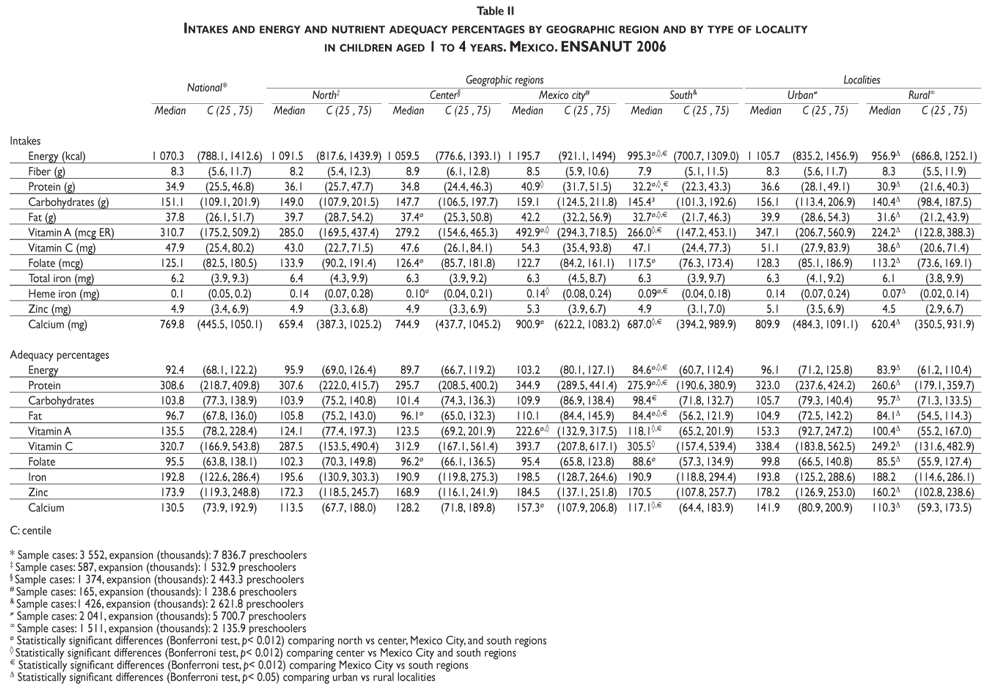
<body><![CDATA[<p><font size="3" face="Verdana"><b>Results</b></font></p>     <p><font size="2" face="Verdana">General characteristics of the study population    are presented in <a href="#tab01">Table I</a>. Most preschoolers (40.2%) lived in the south region,    57.5% lived in urban localities, and a small proportion spoke an indigenous    language (5.9%). Stunting was observed in 12.6%, and 52.5% was in the lower    socioeconomic tertile.</font></p>     <p><a name="tab01"></a></p>     <p>&nbsp;</p>     <p align="center"><img src="/img/revistas/spm/v51s4/a08tab01.gif"></p>     <p>&nbsp;</p>     <p><font size="2" face="Verdana"><b>Energy and macronutrient intakes and adequacy    percentages</b></font></p>     <p><font size="2" face="Verdana">Nationwide, median energy intake was 1 070 kcal    and median fiber intake was 8.3 g. Total iron intake was 6.2 mg, of which 1.6%    corresponded to heme iron (0.1 mg). The adequacy percentage of almost all macronutrients    was above 100%, except folates (95.5%), energy (92.4%) and fat (96.7%) (<a href="/img/revistas/spm/v51s4/a08tab02.gif">Table   II</a>).</font></p>     <p><font size="2" face="Verdana"> Significant differences (<I>p</I>&lt; 0.05)    were found between the Mexico City and the south regions; the former had higher    intakes and adequacies of energy, macronutrients, vitamin A, and calcium than    the latter.</font></p>     <p><font size="2" face="Verdana">The Mexico City region had the highest intake    of heme iron (0.14 mg, 2.2% of total iron intake), whereas the lowest intake    corresponded to the southern region (0.09 mg, 1.4% of total iron intake) (when    comparing both regions).</font></p>     ]]></body>
<body><![CDATA[<p><font size="2" face="Verdana"> However, macro and micronutrient adequacies    were above 100% in the four regions, except fat and folate in the center (96.1%    and 92.2%, respectively) and south (84.4% and 88.6%, respectively) regions.    Adequacies of about 300% for protein and vitamin C were observed in all regions    of the country.</font></p>     <p><font size="2" face="Verdana"> According to type of locality, greater intakes    of energy, macronutrients, vitamins A and C, folates, heme iron, and calcium    were observed in urban than in rural localities (<I>p</I>&lt; 0.05). The same    was noted for energy and macro and micronutrient adequacy percentages (<I>p</I>&lt;    0.05), except iron. </font></p>     <p><font size="2" face="Verdana"><b>Energy and micronutrient inadequacies </b></font></p>     <p><font size="2" face="Verdana"><a href="#tab03">Table III</a> presents the proportion of children    with energy, fat, and micronutrient inadequacies according to several characteristics.</font></p>     <p><a name="tab03"></a></p>     <p>&nbsp;</p>     <p align="center"><img src="/img/revistas/spm/v51s4/a08tab03.gif"></p>     <p>&nbsp;</p>     <p><font size="2" face="Verdana"> Nationwide, the highest proportions of inadequacy    in preschoolers are found in fat (52.3%), vitamin A (33.6%), folate (52.2%)    and calcium (36.4%) intakes.</font></p>     <p><font size="2" face="Verdana"> By disaggregating this data by years of age,    we noted that children in the groups of 1&#45; and 4&#45;years&#45;old had a greater proportion    of inadequacy compared with 2&#45; and 4&#45;years&#45;old children (<I>p</I>&lt; 0.05).    Noticeably, the highest proportion of children with iron inadequacy are 1 year&#45;olds    (28.4%) compared with other age groups (<I>p</I>&lt; 0.05).</font></p>     ]]></body>
<body><![CDATA[<p><font size="2" face="Verdana">  Regarding indigenous ethnicity, indigenous    children had a greater proportion of energy and nutrient inadequacy, about 20%,    compared with non&#45;indigenous children (<I>p</I>&lt; 0.05).</font></p>     <p><font size="2" face="Verdana">The comparison by regions showed that most preschool    children with energy, fat, vitamin A, and calcium inadequacies lived in the    south region (significant differences between regions).</font></p>     <p><font size="2" face="Verdana"> By type of locality, we found that most children    with inadequacy lived in rural localities, the differences being significant    for energy, fat, vitamins A and C, folate, and calcium inadequacies. </font></p>     <p><font size="2" face="Verdana"> Significant differences were also noted by    socioeconomic status, with energy inadequacy in 66.1% of children in the low    and 47.9% of children in the high fertile. Likewise, differences in fat (62.9%    lower and 42.8% upper strata), vitamin A (43.8% lower and 23.0% high tertile),    and calcium (45.9% low and 28.6% high tertile) inadequacies were observed.</font></p>     <p><font size="2" face="Verdana"><b>Energy proportion provided by macronutrients</b></font></p>     <p><font size="2" face="Verdana"><a href="#tab04">Table IV</a> shows the proportions of contribution    of macronutrients to total energy intake. Nationwide, carbohydrates accounted    for 56.7%, proteins for 13.1%, and fat for 32.3% of total energy consumed by    preschoolers. When analyzing the macronutrient contribution by age in preschool    children, we observed that the proportion of energy from carbohydrates slightly    increased with age.</font></p>     <p><a name="tab04"></a></p>     <p>&nbsp;</p>     <p align="center"><img src="/img/revistas/spm/v51s4/a08tab04.gif"></p>     <p>&nbsp;</p>     ]]></body>
<body><![CDATA[<p><font size="2" face="Verdana"> Comparisons by nutritional status showed    that energy proportion from fat was greater in obese children compared with    those with low weight.</font></p>     <p><font size="2" face="Verdana"> Fat contributed 23.7% of total energy intake    for indigenous <I>vs</I>. 32.4% for non&#45;indigenous children.</font></p>     <p><font size="2" face="Verdana">Energy proportion from carbohydrates was greater    in the south region (compared with the central and Mexico City regions), while    energy proportion from fat was greater in the north region.</font></p>     <p><font size="2" face="Verdana"> A greater proportion of energy from carbohydrates    was observed in rural compared with urban localities, whereas a greater proportion    of energy from fat was found in urban localities.</font></p>     <p><font size="2" face="Verdana"> The proportion of energy from carbohydrates    was greater in the lower than in the highest tertiles and the proportion from    proteins was greater in the highest than in the lower tertiles.</font></p>     <p>&nbsp;</p>     <p><font size="3" face="Verdana"><b>Discussion</b></font></p>     <p><font size="2" face="Verdana">This manuscript describes current energy and    macro and micronutrients intakes in preschoolers, as well as the differences    between geographic regions and rural and urban localities in Mexico. </font></p>     <p><font size="2" face="Verdana"> The results of this study indicate a greater    intake of energy, fat, and other nutrients on the part of preschoolers living    in urban localities compared with those living in rural localities. In addition,    the greatest energy, protein, vitamins A and C, zinc, and calcium adequacies    were observed in the Mexico City region. This information agrees with the analyses    performed with data from the ENN 99.<SUP>13</sup></font></p>     <p><font size="2" face="Verdana"> The sprawling urbanization in low&#45;income    countries such as Mexico, with a high intake of food with high energy content    and a decrease in physical activity, have led to an increase in overweight and    obesity.<SUP>29</SUP> Some studies showed that the intake of processed foods    provides about 39% of energy, animal protein, fat, and carbohydrates of Mexican    preschoolers' diet.<SUP>32</SUP> In addition, another study carried out in 2002    by the National Institute of Medical Sciences and Nutrition, including families    from Mexico City and its metropolitan area, reported that per capita consumption    of soft drinks was 60 ml. The information was collected through 24&#45;hour recalls.    Sugar was found to be the second most consumed food by the population in the    lowest socioeconomic quartile.<SUP>31</sup></font></p>     ]]></body>
<body><![CDATA[<p><font size="2" face="Verdana"> Furthermore, although adequacies in total    iron intake are above international recommendations (roughly 190%), the bioavailable    iron content in the diet of Mexican preschoolers is low (1.6%) in relation to    their physiologic needs (2.7% to 6.1% of total iron consumed). Thus, iron deficiency    is still highly prevalent in this population.<SUP>32</SUP> </font></p>     <p><font size="2" face="Verdana"> The marked inequality observed in the country    as to the proportion of the population with energy and nutrient inadequacies    according to socioeconomic conditions is worrisome. A fifth of the population    living in the southern region, in rural localities, and of low socioeconomic    status has vitamin A, folate and calcium inadequacies. This proportion increases    when analysis by indigenous ethnicity is made: about one&#45;third of the indigenous    population has energy and nutrient inadequacies; the latter may be affecting    the nutritional status of those children, as it has been observed that indigenous    children living in urban and rural localities have a 3&#45; and 2&#45;fold greater prevalence    of low height and low weight, respectively, compared with non&#45;indigenous children.<SUP>33</sup></font></p>     <p><font size="2" face="Verdana"> The coexistence of high energy and nutrient    intakes in urban localities and high proportions of populations with micronutrient    inadequacy in the lowest socioeconomic status, together with the presence of    overweight and obesity in the country, is characteristic of a nutritional polarization.    This phenomenon, known as "the double burden of malnutrition", has    been observed in countries such as India, the Philippines, and China.<SUP>34</SUP></font></p>     <p><font size="2" face="Verdana"> As for the macronutrient contribution to    diet, in general the proportions are within those recommended for this group    of age;<SUP>35</SUP> however, children with overweight (&gt; +2 z&#45;score) and    those living in urban locations show the highest proportion (34%, close to the    upper limit of recommendations) of fat contribution to diet. The low intake    of fiber is noticeable in this age group (about 8 g/day), being little more    than half of that recommended for children 1 to 3 years old, and less than one&#45;third    of that recommended for children 4 years old and over.<SUP>36</SUP></font></p>     <p><font size="2" face="Verdana"> Data showed in this study has some limitations:    The use of an instrument such as the food frequency questionnaire may cause    an overestimation of the reported information about vitamins and minerals. However,    it is a validated instrument to report energy and macronutrient intakes.<SUP>37,38    </SUP>Another limitation is that in children it is common to underreport certain    kinds of food such as snacks, candies and biscuits.<SUP>39</SUP> But in this    survey we tried to minimize this potential information bias during the interview    of the person in charge of caring for the children. An additional limitation    is that we did not have enough information about the amount of nutrient supplement    (number of pills or spoonfuls), leading to a possible underestimation of the    nutrient intake. However, we do not believe that it is a significant problem    in the estimation of nutrient intake, since only 11% of the children reported    consuming nutrient supplements. Hence, this information was not included in    the analysis.</font></p>     <p><font size="2" face="Verdana"> Comparisons with data from the prior national    surveys are not possible since information was collected through a different    instrument.<SUP>40</SUP> Despite such limitations, the results allowed us to    observe that comparisons by geographic regions and types of localities are consistent    with the survey findings.</font></p>     <p><font size="2" face="Verdana"> The high adequacy of protein calls for the    necessity of a secondary analysis for differentiating its intake depending on    the source (vegetal or animal). That analysis could help as a protein quality    indicator, and differences among population strata could be observed as well.</font></p>     <p><font size="2" face="Verdana"> In view of the documented results, it becomes    more important to know, in detail, which foods predominate in the preschoolers'    diets and to detect those that could be affecting their quality. To date, the    level of association between dietary factors and overweight/obesity in Mexican    preschool children is not known. Nonetheless, there is available scientific    evidence pointing to dietary factors, mainly the consumption of soft drinks,    as playing a role in the presence of obesity in children in the United States    of America.<SUP>41</sup></font></p>     <p><font size="2" face="Verdana"> The information related to iron intake is    noteworthy. When comparing iron intake data from the ENN 99 with the same data    from this study we can observe a large difference in the consumption of this    nutrient. However, this difference could be accounted for by methodological    procedures, as data on food composition, including iron, was more accurate in    the 2006 survey.</font></p>     <p><font size="2" face="Verdana"> In conclusion, knowledge about children's    food intake and the measurement of levels up to those that meet international    recommendations on energy and nutrient intake for children can be valuable tools    to formulate or redesign health, education, and nutrition interventions aimed    at this age group and to target at&#45;risk population groups. </font></p>     ]]></body>
<body><![CDATA[<p><font size="2" face="Verdana"><b>Acknowledgements</b></font></p>     <p><font size="2" face="Verdana">We would like to acknowledge the collaboration    of Alfonso Jes&uacute;s Mendoza Ram&iacute;rez for assistance in database management    and X&oacute;chitl Ponce Mart&iacute;nez for her remarks.</font></p>     <p>&nbsp;</p>     <p><font size="3" face="Verdana"><b>References</b></font></p>     <!-- ref --><p><font size="2" face="Verdana">1. Albala C, Vio F, Ya&ntilde;ez M. Epidemiological    transition in Latin America: A comparison of four countries. Rev Med Chil 1997;125(6):719&#45;727.    &nbsp;&nbsp;&nbsp;&nbsp;&nbsp;&nbsp;&nbsp;&nbsp;[&#160;<a href="javascript:void(0);" onclick="javascript: window.open('/scielo.php?script=sci_nlinks&ref=9293372&pid=S0036-3634200900100000800001&lng=','','width=640,height=500,resizable=yes,scrollbars=1,menubar=yes,');">Links</a>&#160;]<!-- end-ref --></font></p>     <!-- ref --><p><font size="2" face="Verdana">2. Rivera J, Barquera S, Campirano F, Campos    I, Safdie M, Tovar V. Epidemiological and nutritional transition in Mexico:    Rapid increase of non&#45;communicable chronic diseases and obesity. Public Health    Nutr 2002;14:113&#45;122.    &nbsp;&nbsp;&nbsp;&nbsp;&nbsp;&nbsp;&nbsp;&nbsp;[&#160;<a href="javascript:void(0);" onclick="javascript: window.open('/scielo.php?script=sci_nlinks&ref=9293374&pid=S0036-3634200900100000800002&lng=','','width=640,height=500,resizable=yes,scrollbars=1,menubar=yes,');">Links</a>&#160;]<!-- end-ref --></font></p>     <!-- ref --><p><font size="2" face="Verdana">3. Rivera&#45;Dommarco J, Cuevas&#45;Nasu L, Shamah&#45;Levy    T, Villalpando&#45;Hern&aacute;ndez S, Avila&#45;Arcos MA, Jim&eacute;nez&#45;Aguilar A.    Estado nutricio. M&eacute;xico:In: Olaiz&#45;Fern&aacute;ndez G, Rivera&#45;Dommarco    J, Shamah&#45;Levy T, Rojas R, Villalpando&#45;Hern&aacute;ndez S, Hern&aacute;ndez&#45;Avila    M, Sep&uacute;lveda&#45;Amor J. Encuesta Nacional de Salud y Nutrici&oacute;n 2006.    Cuernavaca, M&eacute;xico: Instituto Nacional de Salud P&uacute;blica, 2006:    85&#45;103.    &nbsp;&nbsp;&nbsp;&nbsp;&nbsp;&nbsp;&nbsp;&nbsp;[&#160;<a href="javascript:void(0);" onclick="javascript: window.open('/scielo.php?script=sci_nlinks&ref=9293376&pid=S0036-3634200900100000800003&lng=','','width=640,height=500,resizable=yes,scrollbars=1,menubar=yes,');">Links</a>&#160;]<!-- end-ref --></font></p>     ]]></body>
<body><![CDATA[<!-- ref --><p><FONT size="2" FACE="Verdana">4. Barquera S, Hotz C, Rivera J, Tolentino L,    Espinoza J, Campos I, <I>et al.</I> Food consumption, food expenditure, anthropometric    status and nutrition&#45;related diseases in Mexico. In: The double burden of malnutrition.    Food and Nutrition Paper. Rome: Food and Agriculture Organization of the United    Nations, 2006: 1&#45;18.    &nbsp;&nbsp;&nbsp;&nbsp;&nbsp;&nbsp;&nbsp;&nbsp;[&#160;<a href="javascript:void(0);" onclick="javascript: window.open('/scielo.php?script=sci_nlinks&ref=9293378&pid=S0036-3634200900100000800004&lng=','','width=640,height=500,resizable=yes,scrollbars=1,menubar=yes,');">Links</a>&#160;]<!-- end-ref --></font></p>     <!-- ref --><p><FONT size="2" FACE="Verdana"> 5. Sepulveda J, Bustreo F, Tapia R, Rivera J,    Lozano R, Lozano R, <I>et al.</I> Improvement of child survival in Mexico: The    diagonal approach. Health System Reform in Mexico. Lancet 2006;368(9551):2017&#45;2027.    &nbsp;&nbsp;&nbsp;&nbsp;&nbsp;&nbsp;&nbsp;&nbsp;[&#160;<a href="javascript:void(0);" onclick="javascript: window.open('/scielo.php?script=sci_nlinks&ref=9293380&pid=S0036-3634200900100000800005&lng=','','width=640,height=500,resizable=yes,scrollbars=1,menubar=yes,');">Links</a>&#160;]<!-- end-ref --></font></p>     <!-- ref --><p><FONT size="2" FACE="Verdana"> 6. Villalpando&#45;Hern&aacute;ndez S, Mundo&#45;Rosas    V, Shamah&#45;Levy T, Rivera&#45;Dommarco J, Mauricio&#45;L&oacute;pez ER. Anemia. In: Olaiz&#45;Fern&aacute;ndez    G, Rivera&#45;Dommarco J, Shamah&#45;Levy T, Rojas R, Villalpando&#45;Hern&aacute;ndez S,    Hern&aacute;ndez&#45;Avila M, <I>et al.</I> Encuesta Nacional de Salud y Nutrici&oacute;n    2006. Cuernavaca, M&eacute;xico: Instituto Nacional de Salud P&uacute;blica,    2006: 111&#45;119.    &nbsp;&nbsp;&nbsp;&nbsp;&nbsp;&nbsp;&nbsp;&nbsp;[&#160;<a href="javascript:void(0);" onclick="javascript: window.open('/scielo.php?script=sci_nlinks&ref=9293382&pid=S0036-3634200900100000800006&lng=','','width=640,height=500,resizable=yes,scrollbars=1,menubar=yes,');">Links</a>&#160;]<!-- end-ref --></font></p>     <!-- ref --><p><FONT size="2" FACE="Verdana"> 7. Villalpando S, Garc&iacute;a A, Ram&iacute;rez    I, Mejia F, Matute G, Shamah T, <I>et al.</I> Iron, zinc and iodide status in    Mexican children under 12 years and women 12&#45;49 years of age. A probabilistic    national survey. Salud Publica Mex 2003;45 Suppl 4:S520&#45;S529.    &nbsp;&nbsp;&nbsp;&nbsp;&nbsp;&nbsp;&nbsp;&nbsp;[&#160;<a href="javascript:void(0);" onclick="javascript: window.open('/scielo.php?script=sci_nlinks&ref=9293384&pid=S0036-3634200900100000800007&lng=','','width=640,height=500,resizable=yes,scrollbars=1,menubar=yes,');">Links</a>&#160;]<!-- end-ref --></font></p>     <!-- ref --><p><font size="2" face="Verdana">8. Pollit E, Saco&#45;Pollit C, Jahari A, Husaini    M, Huang J. Effects of an energy and micronutrient supplement on mental development    and behavior under natural conditions in undernourished children in Indonesia.    Eur J Clin Nutr 2000;54:80&#45;90.    &nbsp;&nbsp;&nbsp;&nbsp;&nbsp;&nbsp;&nbsp;&nbsp;[&#160;<a href="javascript:void(0);" onclick="javascript: window.open('/scielo.php?script=sci_nlinks&ref=9293386&pid=S0036-3634200900100000800008&lng=','','width=640,height=500,resizable=yes,scrollbars=1,menubar=yes,');">Links</a>&#160;]<!-- end-ref --></font></p>     ]]></body>
<body><![CDATA[<!-- ref --><p><font size="2" face="Verdana">9. James WP, Nelson M, Ralph A. Socioeconomic    determinants of health. The contribution of nutrition to inequalities in health.    BMJ 1997;314(7093):1545&#45;1549.    &nbsp;&nbsp;&nbsp;&nbsp;&nbsp;&nbsp;&nbsp;&nbsp;[&#160;<a href="javascript:void(0);" onclick="javascript: window.open('/scielo.php?script=sci_nlinks&ref=9293388&pid=S0036-3634200900100000800009&lng=','','width=640,height=500,resizable=yes,scrollbars=1,menubar=yes,');">Links</a>&#160;]<!-- end-ref --></font></p>     <!-- ref --><p><font size="2" face="Verdana">10. Romieu I, Hernandez M, Rivera J, Ruel M,    Parra S. Dietary studies in countries experiencing a health transition: Mexico    and Central America. Am J Clin Nutr 1997;65 Suppl:1159S&#45;1165S.    &nbsp;&nbsp;&nbsp;&nbsp;&nbsp;&nbsp;&nbsp;&nbsp;[&#160;<a href="javascript:void(0);" onclick="javascript: window.open('/scielo.php?script=sci_nlinks&ref=9293390&pid=S0036-3634200900100000800010&lng=','','width=640,height=500,resizable=yes,scrollbars=1,menubar=yes,');">Links</a>&#160;]<!-- end-ref --></font></p>     <!-- ref --><p><font size="2" face="Verdana">11. Flores M, Cort&eacute;s C, Rivera M, Rivera    J, Sep&uacute;lveda J. Consumo de energ&iacute;a y nutrimentos en mujeres mexicanas    en edad reproductiva. Salud Publica Mex 1998;40:161&#45;171.    &nbsp;&nbsp;&nbsp;&nbsp;&nbsp;&nbsp;&nbsp;&nbsp;[&#160;<a href="javascript:void(0);" onclick="javascript: window.open('/scielo.php?script=sci_nlinks&ref=9293392&pid=S0036-3634200900100000800011&lng=','','width=640,height=500,resizable=yes,scrollbars=1,menubar=yes,');">Links</a>&#160;]<!-- end-ref --></font></p>     <!-- ref --><p><font size="2" face="Verdana">12. Rivera J, Shamah T, Villalpando S, Gonz&aacute;lez    de Coss&iacute;o, Hern&aacute;ndez B, Sep&uacute;lveda J. Encuesta Nacional    de Nutrici&oacute;n 1999. Estado nutricio de ni&ntilde;os y mujeres en M&eacute;xico.    Cuernavaca, Morelos, Mexico: Instituto Nacional de Salud P&uacute;blica, 2001.    &nbsp;&nbsp;&nbsp;&nbsp;&nbsp;&nbsp;&nbsp;&nbsp;[&#160;<a href="javascript:void(0);" onclick="javascript: window.open('/scielo.php?script=sci_nlinks&ref=9293394&pid=S0036-3634200900100000800012&lng=','','width=640,height=500,resizable=yes,scrollbars=1,menubar=yes,');">Links</a>&#160;]<!-- end-ref --></font></p>     <!-- ref --><p><font size="2" face="Verdana">13. Barquera S, Rivera J, Safdie M, Flores M,    Campos I, Campirano F. Energy and nutrient intake in preschool and school age    Mexican children: National Nutrition Survey 1999. Salud Publica Mex 2003;45    Suppl 4:S540&#45;S550.    &nbsp;&nbsp;&nbsp;&nbsp;&nbsp;&nbsp;&nbsp;&nbsp;[&#160;<a href="javascript:void(0);" onclick="javascript: window.open('/scielo.php?script=sci_nlinks&ref=9293396&pid=S0036-3634200900100000800013&lng=','','width=640,height=500,resizable=yes,scrollbars=1,menubar=yes,');">Links</a>&#160;]<!-- end-ref --></font></p>     ]]></body>
<body><![CDATA[<!-- ref --><p><FONT size="2" FACE="Verdana">14. Palma O, Shamah&#45;Levy T, Franco A, Olaiz G,    M&eacute;ndez&#45;Ram&iacute;rez I. Metodolog&iacute;a. In: Olaiz&#45;Fern&aacute;ndez    G, Rivera&#45;Dommarco J, Shamah&#45;Levy T, Rojas R, Villalpando&#45;Hern&aacute;ndez S,    Hern&aacute;ndez&#45;Avila M, <I>et al.</I> Encuesta Nacional de Salud y Nutrici&oacute;n    2006. Cuernavaca, M&eacute;xico: Instituto Nacional de Salud P&uacute;blica,    2006: 19&#45;33.    &nbsp;&nbsp;&nbsp;&nbsp;&nbsp;&nbsp;&nbsp;&nbsp;[&#160;<a href="javascript:void(0);" onclick="javascript: window.open('/scielo.php?script=sci_nlinks&ref=9293398&pid=S0036-3634200900100000800014&lng=','','width=640,height=500,resizable=yes,scrollbars=1,menubar=yes,');">Links</a>&#160;]<!-- end-ref --></font></p>     <!-- ref --><p><font size="2" face="Verdana">15. Ram&iacute;rez I, Mundo V, Rodr&iacute;guez    S, Vizuet I, Hern&aacute;ndez N, Jim&eacute;nez A. Encuestas diet&eacute;ticas.    En: Manual de procedimientos para proyectos de nutrici&oacute;n. 2006. &#91;Consulted    2007 November&#93;. Available at: <a href="http://www.insp.mx/Portal/insp_publica/proy_nutricion.pdf" target="_blank">http://www.insp.mx/Portal/insp_publica/proy_nutricion.pdf</a>.    &nbsp;&nbsp;&nbsp;&nbsp;&nbsp;&nbsp;&nbsp;&nbsp;[&#160;<a href="javascript:void(0);" onclick="javascript: window.open('/scielo.php?script=sci_nlinks&ref=9293400&pid=S0036-3634200900100000800015&lng=','','width=640,height=500,resizable=yes,scrollbars=1,menubar=yes,');">Links</a>&#160;]<!-- end-ref --></font></p>     <!-- ref --><p><font size="2" face="Verdana">16. Hern&aacute;ndez&#45;Avila M, Romieu I, Parra    S, Hern&aacute;ndez&#45;Avila J, Madrigal H, Willett W. Validity and reproducibility    of a food frequency questionnaire to assess dietary intake of women living in    Mexico City. Salud Publica Mex 1998;39:133&#45;140.    &nbsp;&nbsp;&nbsp;&nbsp;&nbsp;&nbsp;&nbsp;&nbsp;[&#160;<a href="javascript:void(0);" onclick="javascript: window.open('/scielo.php?script=sci_nlinks&ref=9293402&pid=S0036-3634200900100000800016&lng=','','width=640,height=500,resizable=yes,scrollbars=1,menubar=yes,');">Links</a>&#160;]<!-- end-ref --></font></p>     <!-- ref --><p><FONT size="2" FACE="Verdana">17. Safdie M, Barquera S, Porcayo M, Rodr&iacute;guez    S, Ram&iacute;rez C, Rivera J, <I>et al.</I> Bases de datos del valor nutritivo    de los alimentos. Compilaci&oacute;n del Instituto Nacional de Salud P&uacute;blica.    Mexico: Instituto Nacional de Salud P&uacute;blica, 2004.    &nbsp;&nbsp;&nbsp;&nbsp;&nbsp;&nbsp;&nbsp;&nbsp;[&#160;<a href="javascript:void(0);" onclick="javascript: window.open('/scielo.php?script=sci_nlinks&ref=9293404&pid=S0036-3634200900100000800017&lng=','','width=640,height=500,resizable=yes,scrollbars=1,menubar=yes,');">Links</a>&#160;]<!-- end-ref --></font></p>     <!-- ref --><p><font size="2" face="Verdana">18. Institute of Medicine. Protein. In: Dietary    Reference Intakes (DRI'S) for Energy, Carbohydrates, Fiber, Fat, Protein and    Amino Acids (Macronutrients). Washington, DC: Institute of Medicine, 2005: 589&#45;630.    &nbsp;&nbsp;&nbsp;&nbsp;&nbsp;&nbsp;&nbsp;&nbsp;[&#160;<a href="javascript:void(0);" onclick="javascript: window.open('/scielo.php?script=sci_nlinks&ref=9293406&pid=S0036-3634200900100000800018&lng=','','width=640,height=500,resizable=yes,scrollbars=1,menubar=yes,');">Links</a>&#160;]<!-- end-ref --></font></p>     ]]></body>
<body><![CDATA[<!-- ref --><p><font size="2" face="Verdana">19. Institute of Medicine. Vitamin C. In: Dietary    reference intakes for: Vitamin C, Vitamin E, selenium and carotenoids. Washington,    DC: Institute of Medicine, National Academy Press, 2000: 95&#45;185.    &nbsp;&nbsp;&nbsp;&nbsp;&nbsp;&nbsp;&nbsp;&nbsp;[&#160;<a href="javascript:void(0);" onclick="javascript: window.open('/scielo.php?script=sci_nlinks&ref=9293408&pid=S0036-3634200900100000800019&lng=','','width=640,height=500,resizable=yes,scrollbars=1,menubar=yes,');">Links</a>&#160;]<!-- end-ref --></font></p>     <!-- ref --><p><font size="2" face="Verdana">20. Institute of Medicine. Dietary reference    intakes for: vitamin A, vitamin K, arsenic, boron, chromium, copper, iodine,    iron, manganese, molybdenum, nickel, silicon, vanadium and zinc. Washington,    DC: Institute of Medicine, National Academy Press, 2000: 650.    &nbsp;&nbsp;&nbsp;&nbsp;&nbsp;&nbsp;&nbsp;&nbsp;[&#160;<a href="javascript:void(0);" onclick="javascript: window.open('/scielo.php?script=sci_nlinks&ref=9293410&pid=S0036-3634200900100000800020&lng=','','width=640,height=500,resizable=yes,scrollbars=1,menubar=yes,');">Links</a>&#160;]<!-- end-ref --> </font></p>     <!-- ref --><p><font size="2" face="Verdana">21. Institute of Medicine. Folate: In: Dietary    reference intakes for: Thiamin, riboflavin, niacin, vitamin B6, folate, vitamin    B12, pantothenic acid, biotin and choline. Washington, DC: Institute of Medicine,    National Academy Press, 2000: 196&#45;305.    &nbsp;&nbsp;&nbsp;&nbsp;&nbsp;&nbsp;&nbsp;&nbsp;[&#160;<a href="javascript:void(0);" onclick="javascript: window.open('/scielo.php?script=sci_nlinks&ref=9293412&pid=S0036-3634200900100000800021&lng=','','width=640,height=500,resizable=yes,scrollbars=1,menubar=yes,');">Links</a>&#160;]<!-- end-ref --></font></p>     <!-- ref --><p><font size="2" face="Verdana">22. Institute of Medicine. Calcium. In: Dietary    reference intakes for: Calcium, phosphorus, magnesium, vitamin D and fluoride.    Washington, DC: Institute of Medicine, National Academy Press, 2000: 71&#45;145.    &nbsp;&nbsp;&nbsp;&nbsp;&nbsp;&nbsp;&nbsp;&nbsp;[&#160;<a href="javascript:void(0);" onclick="javascript: window.open('/scielo.php?script=sci_nlinks&ref=9293414&pid=S0036-3634200900100000800022&lng=','','width=640,height=500,resizable=yes,scrollbars=1,menubar=yes,');">Links</a>&#160;]<!-- end-ref --></font></p>     <!-- ref --><p><font size="2" face="Verdana">23. Institute of Medicine. Dietary reference    intakes for: Energy. Washington, DC: Institute of Medicine, National Academy    Press, 2000: 107&#45;264.    &nbsp;&nbsp;&nbsp;&nbsp;&nbsp;&nbsp;&nbsp;&nbsp;[&#160;<a href="javascript:void(0);" onclick="javascript: window.open('/scielo.php?script=sci_nlinks&ref=9293416&pid=S0036-3634200900100000800023&lng=','','width=640,height=500,resizable=yes,scrollbars=1,menubar=yes,');">Links</a>&#160;]<!-- end-ref --></font></p>     ]]></body>
<body><![CDATA[<!-- ref --><p><font size="2" face="Verdana">24. Torun B, Daviel PSW, Livingstone MBE, Poalisso    M, Sackett R, Spurr GB. Energy requirements and dietary energy recommendations    for children and adolescents 1 to 18 years old. Eur J Clin Nutr 1996;50:S37&#45;S81.    &nbsp;&nbsp;&nbsp;&nbsp;&nbsp;&nbsp;&nbsp;&nbsp;[&#160;<a href="javascript:void(0);" onclick="javascript: window.open('/scielo.php?script=sci_nlinks&ref=9293418&pid=S0036-3634200900100000800024&lng=','','width=640,height=500,resizable=yes,scrollbars=1,menubar=yes,');">Links</a>&#160;]<!-- end-ref --></font></p>     <!-- ref --><p><font size="2" face="Verdana">25. Hair JF, Anderson R, Tatham R, Black W. Multivariate    data analysis with readings. 3rd. ed. New York (NY): Macmillan Publishing Company,    1992: 223&#45;253.    &nbsp;&nbsp;&nbsp;&nbsp;&nbsp;&nbsp;&nbsp;&nbsp;[&#160;<a href="javascript:void(0);" onclick="javascript: window.open('/scielo.php?script=sci_nlinks&ref=9293420&pid=S0036-3634200900100000800025&lng=','','width=640,height=500,resizable=yes,scrollbars=1,menubar=yes,');">Links</a>&#160;]<!-- end-ref --></font></p>     <!-- ref --><p><font size="2" face="Verdana">26. World Health Organization. Measurement of    nutritional impact. Geneva: WHO, 1979.    &nbsp;&nbsp;&nbsp;&nbsp;&nbsp;&nbsp;&nbsp;&nbsp;[&#160;<a href="javascript:void(0);" onclick="javascript: window.open('/scielo.php?script=sci_nlinks&ref=9293422&pid=S0036-3634200900100000800026&lng=','','width=640,height=500,resizable=yes,scrollbars=1,menubar=yes,');">Links</a>&#160;]<!-- end-ref --></font></p>     <!-- ref --><p><font size="2" face="Verdana">27. Rodriguez S, Mundo V, Jimenez A, Shamah T.    Methodology for the analysis of dietary data from the Mexican National Health    and Nutrition Survey 2006. Salud Publica Mex 2009;51 suppl 4:S523&#45;S529.    &nbsp;&nbsp;&nbsp;&nbsp;&nbsp;&nbsp;&nbsp;&nbsp;[&#160;<a href="javascript:void(0);" onclick="javascript: window.open('/scielo.php?script=sci_nlinks&ref=9293424&pid=S0036-3634200900100000800027&lng=','','width=640,height=500,resizable=yes,scrollbars=1,menubar=yes,');">Links</a>&#160;]<!-- end-ref --></font></p>     <!-- ref --><p><font size="2" face="Verdana">28. University of New England. One&#45;Way ANOVA    Bonferroni adjustment. &#91;Consulted on 2008 April 4&#93;. Available at: <a href="http://www.une.edu.au/WebStat/unit_materials/c7_anova/oneway_bonferroni_adjust.htm" target="_blank">http://www.une.edu.au/WebStat/unit_materials/c7_anova/oneway_bonferroni_adjust.htm</a></font>&nbsp;&nbsp;&nbsp;&nbsp;&nbsp;&nbsp;&nbsp;&nbsp;[&#160;<a href="javascript:void(0);" onclick="javascript: window.open('/scielo.php?script=sci_nlinks&ref=9293426&pid=S0036-3634200900100000800028&lng=','','width=640,height=500,resizable=yes,scrollbars=1,menubar=yes,');">Links</a>&#160;]<!-- end-ref --><!-- ref --><p><font size="2" face="Verdana">29. Popkin BM. The nutrition transition in low&#45;income    countries: An emerging crisis. Nutr Rev 1994;52(9): 285&#45;298.    &nbsp;&nbsp;&nbsp;&nbsp;&nbsp;&nbsp;&nbsp;&nbsp;[&#160;<a href="javascript:void(0);" onclick="javascript: window.open('/scielo.php?script=sci_nlinks&ref=9293427&pid=S0036-3634200900100000800029&lng=','','width=640,height=500,resizable=yes,scrollbars=1,menubar=yes,');">Links</a>&#160;]<!-- end-ref --></font></p>     <!-- ref --><p><font size="2" face="Verdana">30. Gonz&aacute;lez D, Gonz&aacute;lez&#45;Coss&iacute;o    T, Barquera S, Rivera J. Alimentos industrializados en la dieta de los preescolares    mexicanos. Salud Publica Mex 2007;49:345&#45;356.    &nbsp;&nbsp;&nbsp;&nbsp;&nbsp;&nbsp;&nbsp;&nbsp;[&#160;<a href="javascript:void(0);" onclick="javascript: window.open('/scielo.php?script=sci_nlinks&ref=9293429&pid=S0036-3634200900100000800030&lng=','','width=640,height=500,resizable=yes,scrollbars=1,menubar=yes,');">Links</a>&#160;]<!-- end-ref --></font></p>     <!-- ref --><p><font size="2" face="Verdana">31. &Aacute;vila&#45;Curiel A, Shamah&#45;Levy T, Ch&aacute;vez&#45;Villasana    A, Galindo&#45;G&oacute;mez C. Encuesta Urbana de Alimentaci&oacute;n y Nutrici&oacute;n    en la Zona Metropolitana de la Ciudad de M&eacute;xico 2002. M&eacute;xico,    DF: Instituto Nacional de Ciencias M&eacute;dicas y Nutrici&oacute;n Salvador    Zubir&aacute;n, Instituto Nacional de Salud P&uacute;blica, 2003: 81&#45;98.    &nbsp;&nbsp;&nbsp;&nbsp;&nbsp;&nbsp;&nbsp;&nbsp;[&#160;<a href="javascript:void(0);" onclick="javascript: window.open('/scielo.php?script=sci_nlinks&ref=9293431&pid=S0036-3634200900100000800031&lng=','','width=640,height=500,resizable=yes,scrollbars=1,menubar=yes,');">Links</a>&#160;]<!-- end-ref --></font></p>     <!-- ref --><p><font size="2" face="Verdana">32. Rodriguez S, Hotz C, Rivera J. Bioavailable    dietary iron is associated with hemoglobin concentration in Mexican preschool    children. J Nutr 2007;137:2304&#45;2310.    &nbsp;&nbsp;&nbsp;&nbsp;&nbsp;&nbsp;&nbsp;&nbsp;[&#160;<a href="javascript:void(0);" onclick="javascript: window.open('/scielo.php?script=sci_nlinks&ref=9293433&pid=S0036-3634200900100000800032&lng=','','width=640,height=500,resizable=yes,scrollbars=1,menubar=yes,');">Links</a>&#160;]<!-- end-ref --></font></p>     <!-- ref --><p><font size="2" face="Verdana">33. Rivera J, Monterrubio E, Gonzalez&#45;Cossio    T, Garcia R, Garcia A, Sepulveda J. Nutritional status of indigenous children    younger than five years of age in Mexico: Results of a National Probabilistic    Survey. Salud Publica Mex 2003;45 Ssuppl 4:S466&#45;S476.    &nbsp;&nbsp;&nbsp;&nbsp;&nbsp;&nbsp;&nbsp;&nbsp;[&#160;<a href="javascript:void(0);" onclick="javascript: window.open('/scielo.php?script=sci_nlinks&ref=9293435&pid=S0036-3634200900100000800033&lng=','','width=640,height=500,resizable=yes,scrollbars=1,menubar=yes,');">Links</a>&#160;]<!-- end-ref --></font></p>     <!-- ref --><p><font size="2" face="Verdana">34. Kennedy G, Nantel G, Shetty. Assessment of    the double burden of malnutrition in six case study countries. In: The double    burden of malnutrition. Food and Nutrition Paper. Rome: Food and Agriculture    Organization of the United Nations, 2006: 1&#45;18.    &nbsp;&nbsp;&nbsp;&nbsp;&nbsp;&nbsp;&nbsp;&nbsp;[&#160;<a href="javascript:void(0);" onclick="javascript: window.open('/scielo.php?script=sci_nlinks&ref=9293437&pid=S0036-3634200900100000800034&lng=','','width=640,height=500,resizable=yes,scrollbars=1,menubar=yes,');">Links</a>&#160;]<!-- end-ref --></font></p>     <!-- ref --><p><font size="2" face="Verdana">35. Department of Health and Human Services.    U.S. Department of Agriculture. Dietary Guidelines for Americans. U.S. Washington,    DC: DHHS, USDA. &#91;Consulted 2007 October&#93;. Available at: <a href="http://www.healthierus.gov/dietaryguidelines" target="_blank">www.healthierus.gov/dietaryguidelines</a>.    &nbsp;&nbsp;&nbsp;&nbsp;&nbsp;&nbsp;&nbsp;&nbsp;[&#160;<a href="javascript:void(0);" onclick="javascript: window.open('/scielo.php?script=sci_nlinks&ref=9293439&pid=S0036-3634200900100000800035&lng=','','width=640,height=500,resizable=yes,scrollbars=1,menubar=yes,');">Links</a>&#160;]<!-- end-ref --></font></p>     <!-- ref --><p><FONT size="2" FACE="Verdana">36. Gidding S, Dennison B, Birch L, Daniels S,    Gilman M, Lichtenstein A, <I>et al.</I> Dietary recommendations for children    and adolescents. A guide for practitioners: Consensus Statement from the American    Heart Association. AHA Circulation 2005;112; 2061&#45;2075.    &nbsp;&nbsp;&nbsp;&nbsp;&nbsp;&nbsp;&nbsp;&nbsp;[&#160;<a href="javascript:void(0);" onclick="javascript: window.open('/scielo.php?script=sci_nlinks&ref=9293441&pid=S0036-3634200900100000800036&lng=','','width=640,height=500,resizable=yes,scrollbars=1,menubar=yes,');">Links</a>&#160;]<!-- end-ref --></font></p>     <!-- ref --><p><font size="2" face="Verdana">37. Andersen LF, Lande B, Trygg K, Hay G. Validation    of a semi&#45;quantitative food&#45;frequency questionnaire used among 2&#45;year&#45;old Norwegian    children. Public Health Nutr 2004; 7(6): 757&#45;764.    &nbsp;&nbsp;&nbsp;&nbsp;&nbsp;&nbsp;&nbsp;&nbsp;[&#160;<a href="javascript:void(0);" onclick="javascript: window.open('/scielo.php?script=sci_nlinks&ref=9293443&pid=S0036-3634200900100000800037&lng=','','width=640,height=500,resizable=yes,scrollbars=1,menubar=yes,');">Links</a>&#160;]<!-- end-ref --></font></p>     <!-- ref --><p><FONT size="2" FACE="Verdana">38. Malekshahb AF, Kimiagar M, Saadatian&#45;Elahi    M, Pourshams A, Nouraie M, Goglani G, <I>et al.</I> Validity and reliability    of a new food frequency questionnaire compared to 24 h recalls and biochemical    measurements: Pilot phase of Golestan cohort study of esophageal cancer. Eur    J Clin Nutr 2006;60(8): 971&#45;977.    &nbsp;&nbsp;&nbsp;&nbsp;&nbsp;&nbsp;&nbsp;&nbsp;[&#160;<a href="javascript:void(0);" onclick="javascript: window.open('/scielo.php?script=sci_nlinks&ref=9293445&pid=S0036-3634200900100000800038&lng=','','width=640,height=500,resizable=yes,scrollbars=1,menubar=yes,');">Links</a>&#160;]<!-- end-ref --></font></p>     <!-- ref --><p><FONT size="2" FACE="Verdana"> 39. Bingham SA, Cassidy A, Cole TJ, Welch A,    Runswick SA, Black AE, <I>et al.</I> Validation of weighed records and other    methods of dietary assessment using the 24&#45;h urine nitrogen technique and other    biological markets. British Journal of Nutrition 1995; 73: 531&#45;550.    &nbsp;&nbsp;&nbsp;&nbsp;&nbsp;&nbsp;&nbsp;&nbsp;[&#160;<a href="javascript:void(0);" onclick="javascript: window.open('/scielo.php?script=sci_nlinks&ref=9293447&pid=S0036-3634200900100000800039&lng=','','width=640,height=500,resizable=yes,scrollbars=1,menubar=yes,');">Links</a>&#160;]<!-- end-ref --></font></p>     <!-- ref --><p><font size="2" face="Verdana">40. Barquera S, Rivera J, Safdie M, Flores M,    Campos I, Campirano F. Energy and nutrient intake in preschool and school age    Mexican children: National Nutrition Survey 1999. Salud Publica Mex 2003;45    Suppl 4: S540&#45;S550.    &nbsp;&nbsp;&nbsp;&nbsp;&nbsp;&nbsp;&nbsp;&nbsp;[&#160;<a href="javascript:void(0);" onclick="javascript: window.open('/scielo.php?script=sci_nlinks&ref=9293449&pid=S0036-3634200900100000800040&lng=','','width=640,height=500,resizable=yes,scrollbars=1,menubar=yes,');">Links</a>&#160;]<!-- end-ref --></font></p>     <!-- ref --><p><font size="2" face="Verdana">41. O'Connor TM, Yang SJ, Nicklas T. Beverage    intake among preschool children and its effect on weight status. Pediatrics    2006;118(4):1010&#45;1018.    &nbsp;&nbsp;&nbsp;&nbsp;&nbsp;&nbsp;&nbsp;&nbsp;[&#160;<a href="javascript:void(0);" onclick="javascript: window.open('/scielo.php?script=sci_nlinks&ref=9293451&pid=S0036-3634200900100000800041&lng=','','width=640,height=500,resizable=yes,scrollbars=1,menubar=yes,');">Links</a>&#160;]<!-- end-ref --></font></p>     <p>&nbsp;</p>     <p>&nbsp;</p>     <p><FONT size="2" FACE="Verdana">Received on: April 11, 2008    <br> Accepted on: April 17, 2009 </font></p>     <p>&nbsp;</p>     ]]></body>
<body><![CDATA[<p>&nbsp;</p>     <p><font size="2" face="Verdana">Address       reprint requests to: Ver&oacute;nica Mundo Rosas. Instituto Nacional de Salud P&uacute;blica. Av. Universidad 655, col. Santa Mar&iacute;a Ahuacatitl&aacute;n. 62100 Cuernavaca, Morelos, M&eacute;xico. E&#45;mail: <a href="mailto:vmundo@insp.mx">vmundo@insp.mx</a>    <br> <a name="nt01"></a><a href="#tx01">*</a> North: Baja California, Baja California Sur, Coahuila, Chihuahua, Durango, Nuevo Leon, Sonora, and Tamaulipas states. Center: Aguascalientes, Colima, Guanajuato, Jalisco, State of Mexico (except Mexico City's Metropolitan area), Michoacan, Morelos, Nayarit, Queretaro, San Luis Potosi, Sinaloa, and Zacatecas states. Mexico City: Mexico City and its metropolitan area. South: Campeche, Chiapas, Guerrero, Hidalgo, Oaxaca, Puebla, Quintana Roo, Tabasco, Tlaxcala, Veracruz, and Yucatan states.</font></p>      ]]></body><back>
<ref-list>
<ref id="B1">
<label>1</label><nlm-citation citation-type="journal">
<person-group person-group-type="author">
<name>
<surname><![CDATA[Albala]]></surname>
<given-names><![CDATA[C]]></given-names>
</name>
<name>
<surname><![CDATA[Vio]]></surname>
<given-names><![CDATA[F]]></given-names>
</name>
<name>
<surname><![CDATA[Yañez]]></surname>
<given-names><![CDATA[M]]></given-names>
</name>
</person-group>
<article-title xml:lang="en"><![CDATA[Epidemiological transition in Latin America: A comparison of four countries]]></article-title>
<source><![CDATA[Rev Med Chil]]></source>
<year>1997</year>
<volume>125</volume>
<numero>6</numero>
<issue>6</issue>
<page-range>719-72</page-range></nlm-citation>
</ref>
<ref id="B2">
<label>2</label><nlm-citation citation-type="journal">
<person-group person-group-type="author">
<name>
<surname><![CDATA[Rivera]]></surname>
<given-names><![CDATA[J]]></given-names>
</name>
<name>
<surname><![CDATA[Barquera]]></surname>
<given-names><![CDATA[S]]></given-names>
</name>
<name>
<surname><![CDATA[Campirano]]></surname>
<given-names><![CDATA[F]]></given-names>
</name>
<name>
<surname><![CDATA[Campos]]></surname>
<given-names><![CDATA[I]]></given-names>
</name>
<name>
<surname><![CDATA[Safdie]]></surname>
<given-names><![CDATA[M]]></given-names>
</name>
<name>
<surname><![CDATA[Tovar]]></surname>
<given-names><![CDATA[V]]></given-names>
</name>
</person-group>
<article-title xml:lang="en"><![CDATA[Epidemiological and nutritional transition in Mexico: Rapid increase of non-communicable chronic diseases and obesity]]></article-title>
<source><![CDATA[Public Health Nutr]]></source>
<year>2002</year>
<volume>14</volume>
<page-range>113-122</page-range></nlm-citation>
</ref>
<ref id="B3">
<label>3</label><nlm-citation citation-type="book">
<person-group person-group-type="author">
<name>
<surname><![CDATA[Rivera-Dommarco]]></surname>
<given-names><![CDATA[J]]></given-names>
</name>
<name>
<surname><![CDATA[Cuevas-Nasu]]></surname>
<given-names><![CDATA[L]]></given-names>
</name>
<name>
<surname><![CDATA[Shamah-Levy]]></surname>
<given-names><![CDATA[T]]></given-names>
</name>
<name>
<surname><![CDATA[Villalpando-Hernández]]></surname>
<given-names><![CDATA[S]]></given-names>
</name>
<name>
<surname><![CDATA[Avila-Arcos]]></surname>
<given-names><![CDATA[MA]]></given-names>
</name>
<name>
<surname><![CDATA[Jiménez-Aguilar]]></surname>
<given-names><![CDATA[A]]></given-names>
</name>
</person-group>
<article-title xml:lang="es"><![CDATA[Estado nutricio: México]]></article-title>
<person-group person-group-type="editor">
<name>
<surname><![CDATA[Olaiz-Fernández]]></surname>
<given-names><![CDATA[G]]></given-names>
</name>
<name>
<surname><![CDATA[Rivera-Dommarco]]></surname>
<given-names><![CDATA[J]]></given-names>
</name>
<name>
<surname><![CDATA[Shamah-Levy]]></surname>
<given-names><![CDATA[T]]></given-names>
</name>
<name>
<surname><![CDATA[Rojas]]></surname>
<given-names><![CDATA[R]]></given-names>
</name>
<name>
<surname><![CDATA[Villalpando-Hernández]]></surname>
<given-names><![CDATA[S]]></given-names>
</name>
<name>
<surname><![CDATA[Hernández-Avila]]></surname>
<given-names><![CDATA[M]]></given-names>
</name>
<name>
<surname><![CDATA[Sepúlveda-Amor]]></surname>
<given-names><![CDATA[J]]></given-names>
</name>
</person-group>
<source><![CDATA[Encuesta Nacional de Salud y Nutrición 2006]]></source>
<year>2006</year>
<page-range>85-103</page-range><publisher-loc><![CDATA[Cuernavaca ]]></publisher-loc>
<publisher-name><![CDATA[Instituto Nacional de Salud Pública]]></publisher-name>
</nlm-citation>
</ref>
<ref id="B4">
<label>4</label><nlm-citation citation-type="book">
<person-group person-group-type="author">
<name>
<surname><![CDATA[Barquera]]></surname>
<given-names><![CDATA[S]]></given-names>
</name>
<name>
<surname><![CDATA[Hotz]]></surname>
<given-names><![CDATA[C]]></given-names>
</name>
<name>
<surname><![CDATA[Rivera]]></surname>
<given-names><![CDATA[J]]></given-names>
</name>
<name>
<surname><![CDATA[Tolentino]]></surname>
<given-names><![CDATA[L]]></given-names>
</name>
<name>
<surname><![CDATA[Espinoza]]></surname>
<given-names><![CDATA[J]]></given-names>
</name>
<name>
<surname><![CDATA[Campos]]></surname>
<given-names><![CDATA[I]]></given-names>
</name>
</person-group>
<article-title xml:lang="en"><![CDATA[Food consumption, food expenditure, anthropometric status and nutrition-related diseases in Mexico]]></article-title>
<source><![CDATA[The double burden of malnutrition: Food and Nutrition Paper]]></source>
<year>2006</year>
<page-range>1-18</page-range><publisher-loc><![CDATA[Rome ]]></publisher-loc>
<publisher-name><![CDATA[Food and Agriculture Organization of the United Nations]]></publisher-name>
</nlm-citation>
</ref>
<ref id="B5">
<label>5</label><nlm-citation citation-type="journal">
<person-group person-group-type="author">
<name>
<surname><![CDATA[Sepulveda]]></surname>
<given-names><![CDATA[J]]></given-names>
</name>
<name>
<surname><![CDATA[Bustreo]]></surname>
<given-names><![CDATA[F]]></given-names>
</name>
<name>
<surname><![CDATA[Tapia]]></surname>
<given-names><![CDATA[R]]></given-names>
</name>
<name>
<surname><![CDATA[Rivera]]></surname>
<given-names><![CDATA[J]]></given-names>
</name>
<name>
<surname><![CDATA[Lozano]]></surname>
<given-names><![CDATA[R]]></given-names>
</name>
<name>
<surname><![CDATA[Lozano]]></surname>
<given-names><![CDATA[R]]></given-names>
</name>
</person-group>
<article-title xml:lang="en"><![CDATA[Improvement of child survival in Mexico: The diagonal approach. Health System Reform in Mexico]]></article-title>
<source><![CDATA[Lancet]]></source>
<year>2006</year>
<volume>368</volume>
<numero>9551</numero>
<issue>9551</issue>
<page-range>2017-2027</page-range></nlm-citation>
</ref>
<ref id="B6">
<label>6</label><nlm-citation citation-type="book">
<person-group person-group-type="author">
<name>
<surname><![CDATA[Villalpando-Hernández]]></surname>
<given-names><![CDATA[S]]></given-names>
</name>
<name>
<surname><![CDATA[Mundo-Rosas]]></surname>
<given-names><![CDATA[V]]></given-names>
</name>
<name>
<surname><![CDATA[Shamah-Levy]]></surname>
<given-names><![CDATA[T]]></given-names>
</name>
<name>
<surname><![CDATA[Rivera-Dommarco]]></surname>
<given-names><![CDATA[J]]></given-names>
</name>
<name>
<surname><![CDATA[Mauricio-López]]></surname>
<given-names><![CDATA[ER]]></given-names>
</name>
</person-group>
<article-title xml:lang="es"><![CDATA[Anemia]]></article-title>
<person-group person-group-type="editor">
<name>
<surname><![CDATA[Olaiz-Fernández]]></surname>
<given-names><![CDATA[G]]></given-names>
</name>
<name>
<surname><![CDATA[Rivera-Dommarco]]></surname>
<given-names><![CDATA[J]]></given-names>
</name>
<name>
<surname><![CDATA[Shamah-Levy]]></surname>
<given-names><![CDATA[T]]></given-names>
</name>
<name>
<surname><![CDATA[Rojas]]></surname>
<given-names><![CDATA[R]]></given-names>
</name>
<name>
<surname><![CDATA[Villalpando-Hernández]]></surname>
<given-names><![CDATA[S]]></given-names>
</name>
<name>
<surname><![CDATA[Hernández-Avila]]></surname>
<given-names><![CDATA[M]]></given-names>
</name>
</person-group>
<source><![CDATA[Encuesta Nacional de Salud y Nutrición 2006]]></source>
<year>2006</year>
<page-range>111-119</page-range><publisher-loc><![CDATA[Cuernavaca ]]></publisher-loc>
<publisher-name><![CDATA[Instituto Nacional de Salud Pública]]></publisher-name>
</nlm-citation>
</ref>
<ref id="B7">
<label>7</label><nlm-citation citation-type="journal">
<person-group person-group-type="author">
<name>
<surname><![CDATA[Villalpando]]></surname>
<given-names><![CDATA[S]]></given-names>
</name>
<name>
<surname><![CDATA[García]]></surname>
<given-names><![CDATA[A]]></given-names>
</name>
<name>
<surname><![CDATA[Ramírez]]></surname>
<given-names><![CDATA[I]]></given-names>
</name>
<name>
<surname><![CDATA[Mejia]]></surname>
<given-names><![CDATA[F]]></given-names>
</name>
<name>
<surname><![CDATA[Matute]]></surname>
<given-names><![CDATA[G]]></given-names>
</name>
<name>
<surname><![CDATA[Shamah]]></surname>
<given-names><![CDATA[T]]></given-names>
</name>
</person-group>
<article-title xml:lang="en"><![CDATA[Iron, zinc and iodide status in Mexican children under 12 years and women 12-49 years of age: A probabilistic national survey]]></article-title>
<source><![CDATA[Salud Publica Mex]]></source>
<year>2003</year>
<volume>45</volume>
<numero>^s4</numero>
<issue>^s4</issue>
<supplement>4</supplement>
<page-range>S520-S529</page-range></nlm-citation>
</ref>
<ref id="B8">
<label>8</label><nlm-citation citation-type="journal">
<person-group person-group-type="author">
<name>
<surname><![CDATA[Pollit]]></surname>
<given-names><![CDATA[E]]></given-names>
</name>
<name>
<surname><![CDATA[Saco-Pollit]]></surname>
<given-names><![CDATA[C]]></given-names>
</name>
<name>
<surname><![CDATA[Jahari]]></surname>
<given-names><![CDATA[A]]></given-names>
</name>
<name>
<surname><![CDATA[Husaini]]></surname>
<given-names><![CDATA[M]]></given-names>
</name>
<name>
<surname><![CDATA[Huang]]></surname>
<given-names><![CDATA[J]]></given-names>
</name>
</person-group>
<article-title xml:lang="en"><![CDATA[Effects of an energy and micronutrient supplement on mental development and behavior under natural conditions in undernourished children in Indonesia]]></article-title>
<source><![CDATA[Eur J Clin Nutr]]></source>
<year>2000</year>
<volume>54</volume>
<page-range>80-90</page-range></nlm-citation>
</ref>
<ref id="B9">
<label>9</label><nlm-citation citation-type="journal">
<person-group person-group-type="author">
<name>
<surname><![CDATA[James]]></surname>
<given-names><![CDATA[WP]]></given-names>
</name>
<name>
<surname><![CDATA[Nelson]]></surname>
<given-names><![CDATA[M]]></given-names>
</name>
<name>
<surname><![CDATA[Ralph]]></surname>
<given-names><![CDATA[A]]></given-names>
</name>
</person-group>
<article-title xml:lang="en"><![CDATA[Socioeconomic determinants of health: The contribution of nutrition to inequalities in health]]></article-title>
<source><![CDATA[BMJ]]></source>
<year>1997</year>
<volume>314</volume>
<numero>7093</numero>
<issue>7093</issue>
<page-range>1545-1549</page-range></nlm-citation>
</ref>
<ref id="B10">
<label>10</label><nlm-citation citation-type="journal">
<person-group person-group-type="author">
<name>
<surname><![CDATA[Romieu]]></surname>
<given-names><![CDATA[I]]></given-names>
</name>
<name>
<surname><![CDATA[Hernandez]]></surname>
<given-names><![CDATA[M]]></given-names>
</name>
<name>
<surname><![CDATA[Rivera]]></surname>
<given-names><![CDATA[J]]></given-names>
</name>
<name>
<surname><![CDATA[Ruel]]></surname>
<given-names><![CDATA[M]]></given-names>
</name>
<name>
<surname><![CDATA[Parra]]></surname>
<given-names><![CDATA[S]]></given-names>
</name>
</person-group>
<article-title xml:lang="en"><![CDATA[Dietary studies in countries experiencing a health transition: Mexico and Central America]]></article-title>
<source><![CDATA[Am J Clin Nutr]]></source>
<year>1997</year>
<volume>65</volume>
<numero>^sSuppl</numero>
<issue>^sSuppl</issue>
<supplement>Suppl</supplement>
<page-range>1159S-1165S</page-range></nlm-citation>
</ref>
<ref id="B11">
<label>11</label><nlm-citation citation-type="journal">
<person-group person-group-type="author">
<name>
<surname><![CDATA[Flores]]></surname>
<given-names><![CDATA[M]]></given-names>
</name>
<name>
<surname><![CDATA[Cortés]]></surname>
<given-names><![CDATA[C]]></given-names>
</name>
<name>
<surname><![CDATA[Rivera]]></surname>
<given-names><![CDATA[M]]></given-names>
</name>
<name>
<surname><![CDATA[Rivera]]></surname>
<given-names><![CDATA[J]]></given-names>
</name>
<name>
<surname><![CDATA[Sepúlveda]]></surname>
<given-names><![CDATA[J]]></given-names>
</name>
</person-group>
<article-title xml:lang="es"><![CDATA[Consumo de energía y nutrimentos en mujeres mexicanas en edad reproductiva]]></article-title>
<source><![CDATA[Salud Publica Mex]]></source>
<year>1998</year>
<volume>40</volume>
<page-range>161-171</page-range></nlm-citation>
</ref>
<ref id="B12">
<label>12</label><nlm-citation citation-type="book">
<person-group person-group-type="author">
<name>
<surname><![CDATA[Rivera]]></surname>
<given-names><![CDATA[J]]></given-names>
</name>
<name>
<surname><![CDATA[Shamah]]></surname>
<given-names><![CDATA[T]]></given-names>
</name>
<name>
<surname><![CDATA[Villalpando]]></surname>
<given-names><![CDATA[S]]></given-names>
</name>
<name>
<surname><![CDATA[González de Cossío]]></surname>
</name>
<name>
<surname><![CDATA[Hernández]]></surname>
<given-names><![CDATA[B]]></given-names>
</name>
<name>
<surname><![CDATA[Sepúlveda]]></surname>
<given-names><![CDATA[J]]></given-names>
</name>
</person-group>
<source><![CDATA[Encuesta Nacional de Nutrición 1999: Estado nutricio de niños y mujeres en México]]></source>
<year>2001</year>
<publisher-loc><![CDATA[Cuernavaca^eMorelos Morelos]]></publisher-loc>
<publisher-name><![CDATA[Instituto Nacional de Salud Pública]]></publisher-name>
</nlm-citation>
</ref>
<ref id="B13">
<label>13</label><nlm-citation citation-type="journal">
<person-group person-group-type="author">
<name>
<surname><![CDATA[Barquera]]></surname>
<given-names><![CDATA[S]]></given-names>
</name>
<name>
<surname><![CDATA[Rivera]]></surname>
<given-names><![CDATA[J]]></given-names>
</name>
<name>
<surname><![CDATA[Safdie]]></surname>
<given-names><![CDATA[M]]></given-names>
</name>
<name>
<surname><![CDATA[Flores]]></surname>
<given-names><![CDATA[M]]></given-names>
</name>
<name>
<surname><![CDATA[Campos]]></surname>
<given-names><![CDATA[I]]></given-names>
</name>
<name>
<surname><![CDATA[Campirano]]></surname>
<given-names><![CDATA[F]]></given-names>
</name>
</person-group>
<article-title xml:lang="en"><![CDATA[Energy and nutrient intake in preschool and school age Mexican children: National Nutrition Survey 1999]]></article-title>
<source><![CDATA[Salud Publica Mex]]></source>
<year>2003</year>
<volume>45</volume>
<numero>^s4</numero>
<issue>^s4</issue>
<supplement>4</supplement>
<page-range>S540-S550</page-range></nlm-citation>
</ref>
<ref id="B14">
<label>14</label><nlm-citation citation-type="book">
<person-group person-group-type="author">
<name>
<surname><![CDATA[Palma]]></surname>
<given-names><![CDATA[O]]></given-names>
</name>
<name>
<surname><![CDATA[Shamah-Levy]]></surname>
<given-names><![CDATA[T]]></given-names>
</name>
<name>
<surname><![CDATA[Franco]]></surname>
<given-names><![CDATA[A]]></given-names>
</name>
<name>
<surname><![CDATA[Olaiz]]></surname>
<given-names><![CDATA[G]]></given-names>
</name>
<name>
<surname><![CDATA[Méndez-Ramírez]]></surname>
<given-names><![CDATA[I]]></given-names>
</name>
</person-group>
<article-title xml:lang="pt"><![CDATA[Metodología]]></article-title>
<person-group person-group-type="editor">
<name>
<surname><![CDATA[Olaiz-Fernández]]></surname>
<given-names><![CDATA[G]]></given-names>
</name>
<name>
<surname><![CDATA[Rivera-Dommarco]]></surname>
<given-names><![CDATA[J]]></given-names>
</name>
<name>
<surname><![CDATA[Shamah-Levy]]></surname>
<given-names><![CDATA[T]]></given-names>
</name>
<name>
<surname><![CDATA[Rojas]]></surname>
<given-names><![CDATA[R]]></given-names>
</name>
<name>
<surname><![CDATA[Villalpando-Hernández]]></surname>
<given-names><![CDATA[S]]></given-names>
</name>
<name>
<surname><![CDATA[Hernández-Avila]]></surname>
<given-names><![CDATA[M]]></given-names>
</name>
</person-group>
<source><![CDATA[Encuesta Nacional de Salud y Nutrición 2006]]></source>
<year>2006</year>
<page-range>19-33</page-range><publisher-loc><![CDATA[Cuernavaca ]]></publisher-loc>
<publisher-name><![CDATA[Instituto Nacional de Salud Pública]]></publisher-name>
</nlm-citation>
</ref>
<ref id="B15">
<label>15</label><nlm-citation citation-type="">
<person-group person-group-type="author">
<name>
<surname><![CDATA[Ramírez]]></surname>
<given-names><![CDATA[I]]></given-names>
</name>
<name>
<surname><![CDATA[Mundo]]></surname>
<given-names><![CDATA[V]]></given-names>
</name>
<name>
<surname><![CDATA[Rodríguez]]></surname>
<given-names><![CDATA[S]]></given-names>
</name>
<name>
<surname><![CDATA[Vizuet]]></surname>
<given-names><![CDATA[I]]></given-names>
</name>
<name>
<surname><![CDATA[Hernández]]></surname>
<given-names><![CDATA[N]]></given-names>
</name>
<name>
<surname><![CDATA[Jiménez]]></surname>
<given-names><![CDATA[A]]></given-names>
</name>
</person-group>
<article-title xml:lang="es"><![CDATA[Encuestas dietéticas]]></article-title>
<source><![CDATA[Manual de procedimientos para proyectos de nutrición]]></source>
<year>2006</year>
</nlm-citation>
</ref>
<ref id="B16">
<label>16</label><nlm-citation citation-type="journal">
<person-group person-group-type="author">
<name>
<surname><![CDATA[Hernández-Avila]]></surname>
<given-names><![CDATA[M]]></given-names>
</name>
<name>
<surname><![CDATA[Romieu]]></surname>
<given-names><![CDATA[I]]></given-names>
</name>
<name>
<surname><![CDATA[Parra]]></surname>
<given-names><![CDATA[S]]></given-names>
</name>
<name>
<surname><![CDATA[Hernández-Avila]]></surname>
<given-names><![CDATA[J]]></given-names>
</name>
<name>
<surname><![CDATA[Madrigal]]></surname>
<given-names><![CDATA[H]]></given-names>
</name>
<name>
<surname><![CDATA[Willett]]></surname>
<given-names><![CDATA[W]]></given-names>
</name>
</person-group>
<article-title xml:lang="en"><![CDATA[Validity and reproducibility of a food frequency questionnaire to assess dietary intake of women living in Mexico City]]></article-title>
<source><![CDATA[Salud Publica Mex]]></source>
<year>1998</year>
<volume>39</volume>
<page-range>133-140</page-range></nlm-citation>
</ref>
<ref id="B17">
<label>17</label><nlm-citation citation-type="book">
<person-group person-group-type="author">
<name>
<surname><![CDATA[Safdie]]></surname>
<given-names><![CDATA[M]]></given-names>
</name>
<name>
<surname><![CDATA[Barquera]]></surname>
<given-names><![CDATA[S]]></given-names>
</name>
<name>
<surname><![CDATA[Porcayo]]></surname>
<given-names><![CDATA[M]]></given-names>
</name>
<name>
<surname><![CDATA[Rodríguez]]></surname>
<given-names><![CDATA[S]]></given-names>
</name>
<name>
<surname><![CDATA[Ramírez]]></surname>
<given-names><![CDATA[C]]></given-names>
</name>
<name>
<surname><![CDATA[Rivera]]></surname>
<given-names><![CDATA[J]]></given-names>
</name>
</person-group>
<source><![CDATA[Bases de datos del valor nutritivo de los alimentos: Compilación del Instituto Nacional de Salud Pública]]></source>
<year>2004</year>
<publisher-loc><![CDATA[Mexico ]]></publisher-loc>
<publisher-name><![CDATA[Instituto Nacional de Salud Pública]]></publisher-name>
</nlm-citation>
</ref>
<ref id="B18">
<label>18</label><nlm-citation citation-type="book">
<collab>Institute of Medicine</collab>
<article-title xml:lang="en"><![CDATA[Protein]]></article-title>
<source><![CDATA[Dietary Reference Intakes (DRI'S) for Energy, Carbohydrates, Fiber, Fat, Protein and Amino Acids (Macronutrients)]]></source>
<year>2005</year>
<page-range>589-630</page-range><publisher-loc><![CDATA[Washington^eDC DC]]></publisher-loc>
<publisher-name><![CDATA[Institute of Medicine]]></publisher-name>
</nlm-citation>
</ref>
<ref id="B19">
<label>19</label><nlm-citation citation-type="book">
<collab>Institute of Medicine</collab>
<article-title xml:lang="en"><![CDATA[Vitamin C]]></article-title>
<source><![CDATA[Dietary reference intakes for: Vitamin C, Vitamin E, selenium and carotenoids]]></source>
<year>2000</year>
<page-range>95-185</page-range><publisher-loc><![CDATA[Washington^eDC DC]]></publisher-loc>
<publisher-name><![CDATA[Institute of MedicineNational Academy Press]]></publisher-name>
</nlm-citation>
</ref>
<ref id="B20">
<label>20</label><nlm-citation citation-type="book">
<collab>Institute of Medicine</collab>
<source><![CDATA[Dietary reference intakes for: vitamin A, vitamin K, arsenic, boron, chromium, copper, iodine, iron, manganese, molybdenum, nickel, silicon, vanadium and zinc]]></source>
<year>2000</year>
<page-range>650</page-range><publisher-loc><![CDATA[Washington^eDC DC]]></publisher-loc>
<publisher-name><![CDATA[Institute of MedicineNational Academy Press]]></publisher-name>
</nlm-citation>
</ref>
<ref id="B21">
<label>21</label><nlm-citation citation-type="book">
<collab>Institute of Medicine</collab>
<article-title xml:lang="en"><![CDATA[Folate]]></article-title>
<source><![CDATA[Dietary reference intakes for: Thiamin, riboflavin, niacin, vitamin B6, folate, vitamin B12, pantothenic acid, biotin and choline]]></source>
<year>2000</year>
<page-range>196-305</page-range><publisher-loc><![CDATA[Washington^eDC DC]]></publisher-loc>
<publisher-name><![CDATA[Institute of MedicineNational Academy Press]]></publisher-name>
</nlm-citation>
</ref>
<ref id="B22">
<label>22</label><nlm-citation citation-type="book">
<collab>Institute of Medicine</collab>
<article-title xml:lang="en"><![CDATA[Calcium]]></article-title>
<source><![CDATA[Dietary reference intakes for: Calcium, phosphorus, magnesium, vitamin D and fluoride]]></source>
<year>2000</year>
<page-range>71-145</page-range><publisher-loc><![CDATA[Washington^eDC DC]]></publisher-loc>
<publisher-name><![CDATA[Institute of MedicineNational Academy Press]]></publisher-name>
</nlm-citation>
</ref>
<ref id="B23">
<label>23</label><nlm-citation citation-type="book">
<collab>Institute of Medicine</collab>
<source><![CDATA[Dietary reference intakes for: Energy]]></source>
<year>2000</year>
<page-range>107-264</page-range><publisher-loc><![CDATA[Washington^eDC DC]]></publisher-loc>
<publisher-name><![CDATA[Institute of MedicineNational Academy Press]]></publisher-name>
</nlm-citation>
</ref>
<ref id="B24">
<label>24</label><nlm-citation citation-type="journal">
<person-group person-group-type="author">
<name>
<surname><![CDATA[Torun]]></surname>
<given-names><![CDATA[B]]></given-names>
</name>
<name>
<surname><![CDATA[Daviel]]></surname>
<given-names><![CDATA[PSW]]></given-names>
</name>
<name>
<surname><![CDATA[Livingstone]]></surname>
<given-names><![CDATA[MBE]]></given-names>
</name>
<name>
<surname><![CDATA[Poalisso]]></surname>
<given-names><![CDATA[M]]></given-names>
</name>
<name>
<surname><![CDATA[Sackett]]></surname>
<given-names><![CDATA[R]]></given-names>
</name>
<name>
<surname><![CDATA[Spurr]]></surname>
<given-names><![CDATA[GB]]></given-names>
</name>
</person-group>
<article-title xml:lang="en"><![CDATA[Energy requirements and dietary energy recommendations for children and adolescents 1 to 18 years old]]></article-title>
<source><![CDATA[Eur J Clin Nutr]]></source>
<year>1996</year>
<volume>50</volume>
<page-range>S37-S81</page-range></nlm-citation>
</ref>
<ref id="B25">
<label>25</label><nlm-citation citation-type="book">
<person-group person-group-type="author">
<name>
<surname><![CDATA[Hair]]></surname>
<given-names><![CDATA[JF]]></given-names>
</name>
<name>
<surname><![CDATA[Anderson]]></surname>
<given-names><![CDATA[R]]></given-names>
</name>
<name>
<surname><![CDATA[Tatham]]></surname>
<given-names><![CDATA[R]]></given-names>
</name>
<name>
<surname><![CDATA[Black]]></surname>
<given-names><![CDATA[W]]></given-names>
</name>
</person-group>
<source><![CDATA[Multivariate data analysis with readings]]></source>
<year>1992</year>
<edition>3</edition>
<page-range>223-253</page-range><publisher-loc><![CDATA[New York^eNY NY]]></publisher-loc>
<publisher-name><![CDATA[Macmillan Publishing Company]]></publisher-name>
</nlm-citation>
</ref>
<ref id="B26">
<label>26</label><nlm-citation citation-type="book">
<collab>World Health Organization</collab>
<source><![CDATA[Measurement of nutritional impact]]></source>
<year>1979</year>
<publisher-loc><![CDATA[Geneva ]]></publisher-loc>
<publisher-name><![CDATA[WHO]]></publisher-name>
</nlm-citation>
</ref>
<ref id="B27">
<label>27</label><nlm-citation citation-type="journal">
<person-group person-group-type="author">
<name>
<surname><![CDATA[Rodriguez]]></surname>
<given-names><![CDATA[S]]></given-names>
</name>
<name>
<surname><![CDATA[Mundo]]></surname>
<given-names><![CDATA[V]]></given-names>
</name>
<name>
<surname><![CDATA[Jimenez]]></surname>
<given-names><![CDATA[A]]></given-names>
</name>
<name>
<surname><![CDATA[Shamah]]></surname>
<given-names><![CDATA[T]]></given-names>
</name>
</person-group>
<article-title xml:lang="en"><![CDATA[Methodology for the analysis of dietary data from the Mexican National Health and Nutrition Survey 2006]]></article-title>
<source><![CDATA[Salud Publica Mex]]></source>
<year>2009</year>
<volume>51</volume>
<numero>^s4</numero>
<issue>^s4</issue>
<supplement>4</supplement>
<page-range>S523-S529</page-range></nlm-citation>
</ref>
<ref id="B28">
<label>28</label><nlm-citation citation-type="">
<collab>University of New England</collab>
<source><![CDATA[One-Way ANOVA Bonferroni adjustment]]></source>
<year></year>
</nlm-citation>
</ref>
<ref id="B29">
<label>29</label><nlm-citation citation-type="journal">
<person-group person-group-type="author">
<name>
<surname><![CDATA[Popkin]]></surname>
<given-names><![CDATA[BM]]></given-names>
</name>
</person-group>
<article-title xml:lang="en"><![CDATA[The nutrition transition in low-income countries: An emerging crisis]]></article-title>
<source><![CDATA[Nutr Rev]]></source>
<year>1994</year>
<volume>52</volume>
<numero>9</numero>
<issue>9</issue>
<page-range>285-298</page-range></nlm-citation>
</ref>
<ref id="B30">
<label>30</label><nlm-citation citation-type="journal">
<person-group person-group-type="author">
<name>
<surname><![CDATA[González]]></surname>
<given-names><![CDATA[D]]></given-names>
</name>
<name>
<surname><![CDATA[González-Cossío]]></surname>
<given-names><![CDATA[T]]></given-names>
</name>
<name>
<surname><![CDATA[Barquera]]></surname>
<given-names><![CDATA[S]]></given-names>
</name>
<name>
<surname><![CDATA[Rivera]]></surname>
<given-names><![CDATA[J]]></given-names>
</name>
</person-group>
<article-title xml:lang="es"><![CDATA[Alimentos industrializados en la dieta de los preescolares mexicanos]]></article-title>
<source><![CDATA[Salud Publica Mex]]></source>
<year>2007</year>
<volume>49</volume>
<page-range>345-356</page-range></nlm-citation>
</ref>
<ref id="B31">
<label>31</label><nlm-citation citation-type="book">
<person-group person-group-type="author">
<name>
<surname><![CDATA[Ávila-Curiel]]></surname>
<given-names><![CDATA[A]]></given-names>
</name>
<name>
<surname><![CDATA[Shamah-Levy]]></surname>
<given-names><![CDATA[T]]></given-names>
</name>
<name>
<surname><![CDATA[Chávez-Villasana]]></surname>
<given-names><![CDATA[A]]></given-names>
</name>
<name>
<surname><![CDATA[Galindo-Gómez]]></surname>
<given-names><![CDATA[C]]></given-names>
</name>
</person-group>
<source><![CDATA[Encuesta Urbana de Alimentación y Nutrición en la Zona Metropolitana de la Ciudad de México 2002]]></source>
<year>2003</year>
<page-range>81-98</page-range><publisher-loc><![CDATA[México^eDF DF]]></publisher-loc>
<publisher-name><![CDATA[Instituto Nacional de Ciencias Médicas y Nutrición Salvador ZubiránInstituto Nacional de Salud Pública]]></publisher-name>
</nlm-citation>
</ref>
<ref id="B32">
<label>32</label><nlm-citation citation-type="journal">
<person-group person-group-type="author">
<name>
<surname><![CDATA[Rodriguez]]></surname>
<given-names><![CDATA[S]]></given-names>
</name>
<name>
<surname><![CDATA[Hotz]]></surname>
<given-names><![CDATA[C]]></given-names>
</name>
<name>
<surname><![CDATA[Rivera]]></surname>
<given-names><![CDATA[J]]></given-names>
</name>
</person-group>
<article-title xml:lang="en"><![CDATA[Bioavailable dietary iron is associated with hemoglobin concentration in Mexican preschool children]]></article-title>
<source><![CDATA[J Nutr]]></source>
<year>2007</year>
<volume>137</volume>
<page-range>2304-2310</page-range></nlm-citation>
</ref>
<ref id="B33">
<label>33</label><nlm-citation citation-type="journal">
<person-group person-group-type="author">
<name>
<surname><![CDATA[Rivera]]></surname>
<given-names><![CDATA[J]]></given-names>
</name>
<name>
<surname><![CDATA[Monterrubio]]></surname>
<given-names><![CDATA[E]]></given-names>
</name>
<name>
<surname><![CDATA[Gonzalez-Cossio]]></surname>
<given-names><![CDATA[T]]></given-names>
</name>
<name>
<surname><![CDATA[Garcia]]></surname>
<given-names><![CDATA[R]]></given-names>
</name>
<name>
<surname><![CDATA[Garcia]]></surname>
<given-names><![CDATA[A]]></given-names>
</name>
<name>
<surname><![CDATA[Sepulveda]]></surname>
<given-names><![CDATA[J]]></given-names>
</name>
</person-group>
<article-title xml:lang="en"><![CDATA[Nutritional status of indigenous children younger than five years of age in Mexico: Results of a National Probabilistic Survey]]></article-title>
<source><![CDATA[Salud Publica Mex]]></source>
<year>2003</year>
<volume>45</volume>
<numero>^s4</numero>
<issue>^s4</issue>
<supplement>4</supplement>
<page-range>S466-S476</page-range></nlm-citation>
</ref>
<ref id="B34">
<label>34</label><nlm-citation citation-type="book">
<person-group person-group-type="author">
<name>
<surname><![CDATA[Kennedy]]></surname>
<given-names><![CDATA[G]]></given-names>
</name>
<name>
<surname><![CDATA[Nantel]]></surname>
<given-names><![CDATA[G]]></given-names>
</name>
<name>
<surname><![CDATA[Shetty]]></surname>
</name>
</person-group>
<article-title xml:lang="en"><![CDATA[Assessment of the double burden of malnutrition in six case study countries]]></article-title>
<source><![CDATA[The double burden of malnutrition: Food and Nutrition Paper]]></source>
<year>2006</year>
<page-range>1-18</page-range><publisher-loc><![CDATA[Rome ]]></publisher-loc>
<publisher-name><![CDATA[Food and Agriculture Organization of the United Nations]]></publisher-name>
</nlm-citation>
</ref>
<ref id="B35">
<label>35</label><nlm-citation citation-type="book">
<collab>Department of Health and Human Services</collab>
<collab>U.S. Department of Agriculture</collab>
<source><![CDATA[Dietary Guidelines for Americans. U.S]]></source>
<year></year>
<publisher-loc><![CDATA[Washington^eDC DC]]></publisher-loc>
<publisher-name><![CDATA[DHHSUSDA]]></publisher-name>
</nlm-citation>
</ref>
<ref id="B36">
<label>36</label><nlm-citation citation-type="journal">
<person-group person-group-type="author">
<name>
<surname><![CDATA[Gidding]]></surname>
<given-names><![CDATA[S]]></given-names>
</name>
<name>
<surname><![CDATA[Dennison]]></surname>
<given-names><![CDATA[B]]></given-names>
</name>
<name>
<surname><![CDATA[Birch]]></surname>
<given-names><![CDATA[L]]></given-names>
</name>
<name>
<surname><![CDATA[Daniels]]></surname>
<given-names><![CDATA[S]]></given-names>
</name>
<name>
<surname><![CDATA[Gilman]]></surname>
<given-names><![CDATA[M]]></given-names>
</name>
<name>
<surname><![CDATA[Lichtenstein]]></surname>
<given-names><![CDATA[A]]></given-names>
</name>
</person-group>
<article-title xml:lang="en"><![CDATA[Dietary recommendations for children and adolescents: A guide for practitioners: Consensus Statement from the American Heart Association]]></article-title>
<source><![CDATA[AHA Circulation]]></source>
<year>2005</year>
<volume>112</volume>
<page-range>2061-2075</page-range></nlm-citation>
</ref>
<ref id="B37">
<label>37</label><nlm-citation citation-type="journal">
<person-group person-group-type="author">
<name>
<surname><![CDATA[Andersen]]></surname>
<given-names><![CDATA[LF]]></given-names>
</name>
<name>
<surname><![CDATA[Lande]]></surname>
<given-names><![CDATA[B]]></given-names>
</name>
<name>
<surname><![CDATA[Trygg]]></surname>
<given-names><![CDATA[K]]></given-names>
</name>
<name>
<surname><![CDATA[Hay]]></surname>
<given-names><![CDATA[G]]></given-names>
</name>
</person-group>
<article-title xml:lang="en"><![CDATA[Validation of a semi-quantitative food-frequency questionnaire used among 2-year-old Norwegian children]]></article-title>
<source><![CDATA[Public Health Nutr]]></source>
<year>2004</year>
<volume>7</volume>
<numero>6</numero>
<issue>6</issue>
<page-range>757-764</page-range></nlm-citation>
</ref>
<ref id="B38">
<label>38</label><nlm-citation citation-type="journal">
<person-group person-group-type="author">
<name>
<surname><![CDATA[Malekshahb]]></surname>
<given-names><![CDATA[AF]]></given-names>
</name>
<name>
<surname><![CDATA[Kimiagar]]></surname>
<given-names><![CDATA[M]]></given-names>
</name>
<name>
<surname><![CDATA[Saadatian-Elahi]]></surname>
<given-names><![CDATA[M]]></given-names>
</name>
<name>
<surname><![CDATA[Pourshams]]></surname>
<given-names><![CDATA[A]]></given-names>
</name>
<name>
<surname><![CDATA[Nouraie]]></surname>
<given-names><![CDATA[M]]></given-names>
</name>
<name>
<surname><![CDATA[Goglani]]></surname>
<given-names><![CDATA[G]]></given-names>
</name>
</person-group>
<article-title xml:lang="en"><![CDATA[Validity and reliability of a new food frequency questionnaire compared to 24 h recalls and biochemical measurements: Pilot phase of Golestan cohort study of esophageal cancer]]></article-title>
<source><![CDATA[Eur J Clin Nutr]]></source>
<year>2006</year>
<volume>60</volume>
<numero>8</numero>
<issue>8</issue>
<page-range>971-977</page-range></nlm-citation>
</ref>
<ref id="B39">
<label>39</label><nlm-citation citation-type="journal">
<person-group person-group-type="author">
<name>
<surname><![CDATA[Bingham]]></surname>
<given-names><![CDATA[SA]]></given-names>
</name>
<name>
<surname><![CDATA[Cassidy]]></surname>
<given-names><![CDATA[A]]></given-names>
</name>
<name>
<surname><![CDATA[Cole]]></surname>
<given-names><![CDATA[TJ]]></given-names>
</name>
<name>
<surname><![CDATA[Welch]]></surname>
<given-names><![CDATA[A]]></given-names>
</name>
<name>
<surname><![CDATA[Runswick]]></surname>
<given-names><![CDATA[SA]]></given-names>
</name>
<name>
<surname><![CDATA[Black]]></surname>
<given-names><![CDATA[AE]]></given-names>
</name>
</person-group>
<article-title xml:lang="en"><![CDATA[Validation of weighed records and other methods of dietary assessment using the 24-h urine nitrogen technique and other biological markets]]></article-title>
<source><![CDATA[British Journal of Nutrition]]></source>
<year>1995</year>
<volume>73</volume>
<page-range>531-550</page-range></nlm-citation>
</ref>
<ref id="B40">
<label>40</label><nlm-citation citation-type="journal">
<person-group person-group-type="author">
<name>
<surname><![CDATA[Barquera]]></surname>
<given-names><![CDATA[S]]></given-names>
</name>
<name>
<surname><![CDATA[Rivera]]></surname>
<given-names><![CDATA[J]]></given-names>
</name>
<name>
<surname><![CDATA[Safdie]]></surname>
<given-names><![CDATA[M]]></given-names>
</name>
<name>
<surname><![CDATA[Flores]]></surname>
<given-names><![CDATA[M]]></given-names>
</name>
<name>
<surname><![CDATA[Campos]]></surname>
<given-names><![CDATA[I]]></given-names>
</name>
<name>
<surname><![CDATA[Campirano]]></surname>
<given-names><![CDATA[F]]></given-names>
</name>
</person-group>
<article-title xml:lang="en"><![CDATA[Energy and nutrient intake in preschool and school age Mexican children: National Nutrition Survey 1999]]></article-title>
<source><![CDATA[Salud Publica Mex]]></source>
<year>2003</year>
<volume>45</volume>
<numero>^s4</numero>
<issue>^s4</issue>
<supplement>4</supplement>
<page-range>S540-S550</page-range></nlm-citation>
</ref>
<ref id="B41">
<label>41</label><nlm-citation citation-type="journal">
<person-group person-group-type="author">
<name>
<surname><![CDATA[O'Connor]]></surname>
<given-names><![CDATA[TM]]></given-names>
</name>
<name>
<surname><![CDATA[Yang]]></surname>
<given-names><![CDATA[SJ]]></given-names>
</name>
<name>
<surname><![CDATA[Nicklas]]></surname>
<given-names><![CDATA[T]]></given-names>
</name>
</person-group>
<article-title xml:lang="en"><![CDATA[Beverage intake among preschool children and its effect on weight status]]></article-title>
<source><![CDATA[Pediatrics]]></source>
<year>2006</year>
<volume>118</volume>
<numero>4</numero>
<issue>4</issue>
<page-range>1010-1018</page-range></nlm-citation>
</ref>
</ref-list>
</back>
</article>