<?xml version="1.0" encoding="ISO-8859-1"?><article xmlns:mml="http://www.w3.org/1998/Math/MathML" xmlns:xlink="http://www.w3.org/1999/xlink" xmlns:xsi="http://www.w3.org/2001/XMLSchema-instance">
<front>
<journal-meta>
<journal-id>0036-3634</journal-id>
<journal-title><![CDATA[Salud Pública de México]]></journal-title>
<abbrev-journal-title><![CDATA[Salud pública Méx]]></abbrev-journal-title>
<issn>0036-3634</issn>
<publisher>
<publisher-name><![CDATA[Instituto Nacional de Salud Pública]]></publisher-name>
</publisher>
</journal-meta>
<article-meta>
<article-id>S0036-36342009000700013</article-id>
<title-group>
<article-title xml:lang="en"><![CDATA[High dietary calcium intake decreases bone mobilization during pregnancy in humans]]></article-title>
<article-title xml:lang="es"><![CDATA[Alto consumo de calcio en la dieta, disminuye la movilización ósea durante el embarazo en seres humanos]]></article-title>
</title-group>
<contrib-group>
<contrib contrib-type="author">
<name>
<surname><![CDATA[Avendaño-Badillo]]></surname>
<given-names><![CDATA[Diana]]></given-names>
</name>
<xref ref-type="aff" rid="A01"/>
</contrib>
<contrib contrib-type="author">
<name>
<surname><![CDATA[Hernández-Ávila]]></surname>
<given-names><![CDATA[Mauricio]]></given-names>
</name>
<xref ref-type="aff" rid="A02"/>
</contrib>
<contrib contrib-type="author">
<name>
<surname><![CDATA[Hernández-Cadena]]></surname>
<given-names><![CDATA[Leticia]]></given-names>
</name>
<xref ref-type="aff" rid="A03"/>
</contrib>
<contrib contrib-type="author">
<name>
<surname><![CDATA[Rueda-Hernández]]></surname>
<given-names><![CDATA[Gabriela]]></given-names>
</name>
<xref ref-type="aff" rid="A03"/>
</contrib>
<contrib contrib-type="author">
<name>
<surname><![CDATA[Solano-González]]></surname>
<given-names><![CDATA[Maritsa]]></given-names>
</name>
<xref ref-type="aff" rid="A03"/>
</contrib>
<contrib contrib-type="author">
<name>
<surname><![CDATA[Ibarra]]></surname>
<given-names><![CDATA[Luis G]]></given-names>
</name>
<xref ref-type="aff" rid="A01"/>
</contrib>
<contrib contrib-type="author">
<name>
<surname><![CDATA[Hu]]></surname>
<given-names><![CDATA[Howard]]></given-names>
</name>
<xref ref-type="aff" rid="A04"/>
</contrib>
<contrib contrib-type="author">
<name>
<surname><![CDATA[Téllez-Rojo]]></surname>
<given-names><![CDATA[Martha M.]]></given-names>
</name>
<xref ref-type="aff" rid="A03"/>
</contrib>
</contrib-group>
<aff id="A01">
<institution><![CDATA[,National Institute of Rehabilitation  ]]></institution>
<addr-line><![CDATA[ ]]></addr-line>
<country>Mexico</country>
</aff>
<aff id="A02">
<institution><![CDATA[,Ministry of Health  ]]></institution>
<addr-line><![CDATA[ ]]></addr-line>
<country>Mexico</country>
</aff>
<aff id="A03">
<institution><![CDATA[,National Institute of Public Health  ]]></institution>
<addr-line><![CDATA[ ]]></addr-line>
<country>Mexico</country>
</aff>
<aff id="A04">
<institution><![CDATA[,University of Michigan Department of Environmental Health Sciences ]]></institution>
<addr-line><![CDATA[ ]]></addr-line>
</aff>
<pub-date pub-type="pub">
<day>00</day>
<month>00</month>
<year>2009</year>
</pub-date>
<pub-date pub-type="epub">
<day>00</day>
<month>00</month>
<year>2009</year>
</pub-date>
<volume>51</volume>
<fpage>s100</fpage>
<lpage>s107</lpage>
<copyright-statement/>
<copyright-year/>
<self-uri xlink:href="http://www.scielo.org.mx/scielo.php?script=sci_arttext&amp;pid=S0036-36342009000700013&amp;lng=en&amp;nrm=iso"></self-uri><self-uri xlink:href="http://www.scielo.org.mx/scielo.php?script=sci_abstract&amp;pid=S0036-36342009000700013&amp;lng=en&amp;nrm=iso"></self-uri><self-uri xlink:href="http://www.scielo.org.mx/scielo.php?script=sci_pdf&amp;pid=S0036-36342009000700013&amp;lng=en&amp;nrm=iso"></self-uri><abstract abstract-type="short" xml:lang="en"><p><![CDATA[Calcium metabolism of the mother is modified during pregnancy because of the mineralization of the fetus skeleton. OBJECTIVE: To evaluate the association of calcium intake and bone demineralization during pregnancy. MATERIAL AND METHODS: At each trimester of pregnancy a validated food frequency intake questionnaire was administered to assess individual daily calcium intake in a cohort of 206 pregnant women, residents of Mexico City. Samples of urine were collected to measure levels of the cross-linked N-telopeptide of type I collagen (NTx), which is a biomarker of bone resorption. The association between calcium ingestion and bone resorption was analyzed using random effects models; non-linear associations were explored using generalized additive models. RESULTS: Progressive increases in NTx levels were observed during pregnancy; with mean and standard deviation (SD) values during the first, second and third trimester of 76.50 (SD=38), 101.02 (SD=48.86) and 144.83 (SD=61.33) nmol BCE/mmol creatinine, respectively. Higher dietary calcium intake was associated with lower bone resorption (&#946;=-0.015; p<0.05). The association between age and NTx showed a non-linear trend with an inflexion point around 33 years: increase in maternal age below that point was associated with a decrease in bone resorption, while in older women the increase in age was associated with an increased resorption. CONCLUSIONS: Our results suggest that calcium ingestion, specifically from dairy products, reduces bone resorption during pregnancy. For each 300mg (a glass of milk) of calcium intake there is an estimated reduction in NTx level of 4.8 nmol BCE/mmol of creatinine (p<0.05).]]></p></abstract>
<abstract abstract-type="short" xml:lang="es"><p><![CDATA[El metabolismo de calcio es modificado durante el embarazo debido a la mineralización del esqueleto del feto. OBJETIVO: Evaluar la asociación entre la ingesta de calcio y la desmineralización ósea durante el embarazo. MATERIAL Y MÉTODOS: Se administró un Cuestionario de Frecuencia de Consumo de alimentos en cada trimestre del embarazo para evaluar el consumo de calcio en una cohorte de 206 mujeres residentes de la Ciudad de México. Se recolectaron muestras de orina para medir los niveles de N-telopéptido de colágeno tipo I (NTx), biomarcador de resorción. Se hicieron modelos de efectos aleatorios; se estudiaron asociaciones no lineales utilizando modelos aditivos generalizados. RESULTADOS: Se observó aumento progresivo en los niveles de NTx durante el embarazo. El mayor consumo de calcio se asoció con una menor resorción ósea (&#946;=- 0.015, p<0,05). CONCLUSIONES: Los resultados sugieren que la ingestión de calcio reduce la resorción ósea en el embarazo.]]></p></abstract>
<kwd-group>
<kwd lng="en"><![CDATA[pregnancy]]></kwd>
<kwd lng="en"><![CDATA[bone resorption]]></kwd>
<kwd lng="en"><![CDATA[N-telopeptides]]></kwd>
<kwd lng="en"><![CDATA[calcium intake]]></kwd>
<kwd lng="en"><![CDATA[longitudinal study]]></kwd>
<kwd lng="en"><![CDATA[dairy products]]></kwd>
<kwd lng="es"><![CDATA[embarazo]]></kwd>
<kwd lng="es"><![CDATA[resorción ósea]]></kwd>
<kwd lng="es"><![CDATA[N-telopéptidos]]></kwd>
<kwd lng="es"><![CDATA[ingesta de calcio]]></kwd>
<kwd lng="es"><![CDATA[estudio longitudinal]]></kwd>
<kwd lng="es"><![CDATA[productos lácteos]]></kwd>
</kwd-group>
</article-meta>
</front><body><![CDATA[ <p align="right"><font size="2" face="Verdana"><b>ART&Iacute;CULO ORIGINAL</b></font></p>     <p>&nbsp;</p>     <p><font size="4" face="verdana"><b>High dietary calcium intake decreases bone    mobilization during pregnancy in humans</b></font></p>     <p>&nbsp;</p>     <p><b><font size="3" face="verdana">Alto consumo de calcio en la dieta, disminuye la movilizaci&oacute;n &oacute;sea durante el embarazo en seres humanos</font></b></p>     <p>&nbsp;</p>     <p>&nbsp;</p>     <p><font size="2" face="Verdana"><b>Diana Avenda&ntilde;o&#45;Badillo, MD, MC<SUP>I</SUP>;    Mauricio Hern&aacute;ndez&#45;&Aacute;vila, MD ScD<SUP>II, III</sup>; Leticia Hern&aacute;ndez&#45;Cadena,    ScD<SUP>III</SUP>; Gabriela Rueda&#45;Hern&aacute;ndez, MD<SUP>III</SUP>; Maritsa    Solano&#45;Gonz&aacute;lez, BSc<SUP>III</sup>; Luis G Ibarra, MD<SUP>I</SUP>; Howard    Hu, ScD, MD<SUP>IV</SUP>; Martha M. T&eacute;llez&#45;Rojo, ScD<SUP>III</sup></b></font></p>     <p><font size="2" face="Verdana"><sup>I</sup>National Institute of Rehabilitation,    Mexico    <br>   <sup>II</sup>Ministry of Health, Mexico    ]]></body>
<body><![CDATA[<br>   <sup>III</sup>National Institute of Public Health, Mexico    <br>   <sup>IV</sup>Department of Environmental Health Sciences, University of Michigan.    Ann Arbor, MI, USA</font></p>     <p>&nbsp;</p>     <p>&nbsp;</p> <hr size="1" noshade>     <p><font size="2" face="VERDANA"><b>ABSTRACT</b></font></p>     <p><font size="2" face="Verdana">Calcium metabolism of the mother is modified    during pregnancy because of the mineralization of the fetus skeleton.    <br>   <b>OBJECTIVE:</b> To evaluate the association of calcium intake and bone demineralization    during pregnancy.    <br>   <b>MATERIAL AND METHODS:</b> At each trimester of pregnancy a validated food    frequency intake questionnaire was administered to assess individual daily calcium    intake in a cohort of 206 pregnant women, residents of Mexico City. Samples    of urine were collected to measure levels of the cross&#45;linked N&#45;telopeptide    of type I collagen (NTx), which is a biomarker of bone resorption. The association    between calcium ingestion and bone resorption was analyzed using random effects    models; non&#45;linear associations were explored using generalized additive models.    <br>   <b>RESULTS:</b> Progressive increases in NTx levels were observed during pregnancy;    with mean and standard deviation (<I>SD</I>) values during the first, second    and third trimester of 76.50 (<I>SD</I>=38), 101.02 (<I>SD</I>=48.86) and 144.83    (<I>SD</I>=61.33) nmol BCE/mmol creatinine, respectively. Higher dietary calcium    intake was associated with lower bone resorption (</font><font>&#946;</font><font size="2" face="verdana">=&#45;0.015;    <I>p</I>&lt;0.05). The association between age and NTx showed a non&#45;linear trend    with an inflexion point around 33 years: increase in maternal age below that    point was associated with a decrease in bone resorption, while in older women    the increase in age was associated with an increased resorption.    <br>   <b>CONCLUSIONS:</b> Our results suggest that calcium ingestion, specifically    from dairy products, reduces bone resorption during pregnancy. For each 300mg    (a glass of milk) of calcium intake there is an estimated reduction in NTx level    of 4.8 nmol BCE/mmol of creatinine (<I>p</I>&lt;0.05).</font></p>     ]]></body>
<body><![CDATA[<p><font size="2" face="Verdana"><b>Key words:</b> pregnancy; bone resorption;    N&#45;telopeptides; calcium intake; longitudinal study; dairy products</font></p> <hr size="1" noshade>     <p><font size="2" face="Verdana"><b>RESUMEN</b></font></p>     <p><font size="2" face="Verdana">El metabolismo de calcio es modificado durante    el embarazo debido a la mineralizaci&oacute;n del esqueleto del feto.    <br>   <b>OBJETIVO:</b> Evaluar la asociaci&oacute;n entre la ingesta de calcio y la    desmineralizaci&oacute;n &oacute;sea durante el embarazo.    <br>   <b>MATERIAL Y M&Eacute;TODOS:</b> Se administr&oacute; un Cuestionario de Frecuencia    de Consumo de alimentos en cada trimestre del embarazo para evaluar el consumo    de calcio en una cohorte de 206 mujeres residentes de la Ciudad de M&eacute;xico.    Se recolectaron muestras de orina para medir los niveles de N&#45;telop&eacute;ptido    de col&aacute;geno tipo I (NTx), biomarcador de resorci&oacute;n. Se hicieron    modelos de efectos aleatorios; se estudiaron asociaciones no lineales utilizando    modelos aditivos generalizados.    <br>   <b>RESULTADOS:</b> Se observ&oacute; aumento progresivo en los niveles de NTx    durante el embarazo. El mayor consumo de calcio se asoci&oacute; con una menor    resorci&oacute;n &oacute;sea (</font><font>&#946;</font><font size="2" face="verdana">=&#45;    0.015, <I>p</I>&lt;0,05).    <br>   <b>CONCLUSIONES:</b> Los resultados sugieren que la ingesti&oacute;n de calcio    reduce la resorci&oacute;n &oacute;sea en el embarazo. </font></p>     <p><font size="2" face="Verdana"><b>Palabras clave:</b>    embarazo; resorci&oacute;n &oacute;sea; N&#45;telop&eacute;ptidos; ingesta de calcio;    estudio longitudinal; productos l&aacute;cteos</font></p> <hr size="1" noshade>     <p>&nbsp;</p>     <p>&nbsp;</p>     ]]></body>
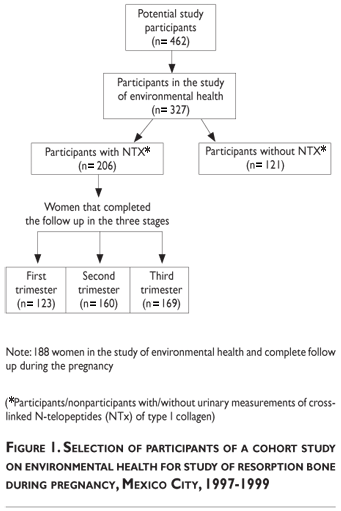
<body><![CDATA[<p><font size="2" face="Verdana">During pregnancy, maternal calcium physiology    adapts to meet the calcium demands of the growing fetus. Approximately 13 to    33 grams of calcium are needed for fetal ossification.<SUP>1</SUP> Physiological    responses to the demand for calcium during pregnancy include increased calcium    absorption, renal calcium conservation and an increase in bone turnover during    the third trimester.<SUP>2&#45;5</SUP> These changes occur as a result of modified    levels of 1,25&#45;dihydroxyvitamin D concentration, insulin&#45;like growth factor    (ilGF&#45;I) and parathyroid hormone (PTH).<SUP>6&#45;8</SUP> </font> </p>     <p><font size="2" face="Verdana"> Increases in bone mineral density (BMD) at cortical    bone sites and decreases in BMD at trabecular bone sites<SUP>3,4</SUP> have    been associated with pregnancy and the latter suggests an increased risk for    osteoporosis in subsequent years of life. However, studies conducted predominantly    among populations with high dietary calcium intake indicate that neither extended    lactation nor multiple pregnancies are associated with subsequent osteoporosis,    whether measured by BMD levels or by assessment of fracture risk.<SUP>9,10</SUP>    It is possible that populations with an adequate calcium intake are able to    compensate for bone mass lost during pregnancy and lactation.</font></p>     <p><font size="2" face="Verdana"> There have been few studies aimed to understand    calcium physiology during pregnancy that have been conducted among populations    with low dietary calcium intakes.<SUP>5,11,12</SUP> One study on a Mexican population    of women with low calcium intakes (average calcium intake for pregnant women    in Mexico has been estimated by the 1999 National Nutrition Survey at 565&#45;800    mg/day) suggested that parity and lactation were inversely associated with BMD    measured at later stages in life.<SUP>13</SUP> However, these findings were    not replicated in a recent study.<SUP>14</SUP> </font></p>     <p><font size="2" face="Verdana"> A study conducted among women with low calcium    intakes in Brazil<SUP>5</SUP> concluded that calcium needs during pregnancy    are partly met by high efficiency calcium absorption and renal calcium conservation,    suggesting an important role for maternal dietary calcium intake. However, in    that study the association between dietary calcium intake and bone remodeling    was not explored. This is important because all studies conducted that have    examined changes in bone density or biomarkers of bone remodeling suggest that    bone remodeling increases during late pregnancy, concomitant with fetal ossification.    This implies an important role of resorption and formation bone in contributing    to the need of calcium at this stage of pregnancy.</font></p>     <p><font size="2" face="Verdana"> In this study we longitudinally evaluated the    changes in bone turnover during gestation to examine the association between    dietary calcium intake and markers of bone turnover over the course of pregnancy.    We evaluated the hypothesis that dietary calcium intake will be inversely associated    with markers of bone turnover.</font></p>     <p>&nbsp;</p>     <p><font size="3" face="verdana"><b>Material and Methods</b></font></p>     <p><font size="2" face="Verdana">All participants were healthy women between 15    and 43 years of age recruited between May 1997 and April 1999 from one of four    prenatal care clinics of the Mexican Institute of Social Security (IMSS, per    its abbreviation in Spanish) in Mexico City to participate in a study to assess    the relation between different lead biomarkers over the course of pregnancy    and lactation.<SUP>15</SUP> Women were eligible for participation if they were    willing to declare intention to remain available throughout the study and desired    to become pregnant in the near future or had not yet reached gestational week    14 in a current pregnancy. Women were excluded from the study if they did not    intend to breastfeed, had illnesses that modified their calcium metabolism,    received a physician's diagnosis of multiple pregnancies, or had other medical    problems including history of preeclampsia or pregnancy&#45;related hypertension,    psychiatric or cardiac disease, gestational diabetes, history of frequent urinary    tract infections, seizure disorders requiring daily medications or ailments    that required medication with corticosteroids. </font></p>     <p><font size="2" face="Verdana"> Participants went to the Mexican National Institute    of Public Health (INSP) Research Facility in Mexico City for a baseline evaluation    that included environmental risk factor assessment, a food frequency questionnaire    to evaluate dietary calcium intake, and a physical exam including a urine sample    to measure N&#45;telopeptide (NTx) of type I collagen &#150;a biomarker of bone resorption.    Women were scheduled for follow&#45;up evaluations at 12, 24, and 34 weeks of gestational    age and at 1, 3, 7, and 12 months postpartum. Questionnaire data, maternal anthropometry,    and samples of urine (second morning sample), blood and plasma for lead analysis    were collected during follow&#45;up visits. Anthropometric measurements were conducted    by trained nurses via standardized methods.</font></p>     <p><font size="2" face="Verdana"> Collection of urine samples was implemented    several months after the cohort was assembled, reducing the number of participants    represented by NTx data to 206. This subgroup of 206 participants will be subsequently    referred to as "participants in the NTx study" (<a href="#fig01">Figure    1</a>). Urine was collected and stored in clean containers which were frozen    to &#45;70°C and shipped to the Harvard School of Public Health Toxicology Laboratory    for cross&#45;linked N&#45;telopeptides analysis. Samples were analyzed with a commercially    available competitive&#45;inhibition enzyme&#45;linked immunosorbent assay (Osteomark;    Ostex International; Seattle, WA). NTx concentrations were expressed as nanomoles    of bone collagen equivalents normalized to creatinine (nmol BCE/mmol creatinine).    The intra&#45; and inter&#45;assay coefficients of variation were below 10%. The analysis    was blinded to characteristics of the participants other than urine NTx concentration.    </font></p>     ]]></body>
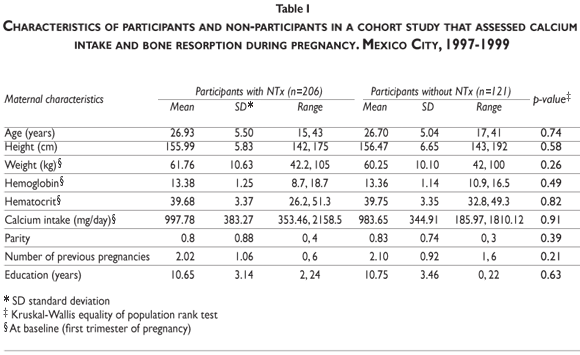
<body><![CDATA[<p><a name="fig01"></a></p>     <p>&nbsp;</p>     <p align="center"><img src="/img/revistas/spm/v51s1/a13fig01.gif"></p>     <p>&nbsp;</p>     <p><font size="2" face="Verdana">Daily calcium and calorie intake was assessed    in each trimester using a self&#45;administered food frequency questionnaire (FFQ)    of 82 foods, developed and validated among women living in Mexico City using    a previously reported methodology.<SUP>16</SUP> The FFQ listed foods that were    predictive of nutrient ingestion to quantify the relative ingestion of various    micronutrients. For each food listed, the amount was specified according to    common portion sizes, such as a cup, an egg, or a tortilla, whenever possible.    A specific computer program was developed to derive the relative ingestion of    each specific nutrient.</font></p>     <p><font size="2" face="Verdana"> To evaluate the association between calcium    ingestion and urinary NTx concentration over the course of pregnancy, we generated    two longitudinal multivariate linear models adjusted by participant age, height    and gestational age. In a first approach, we evaluated the total ingestion of    calcium. In a second approach, we divided the total calcium intake into either    dairy or non&#45;dairy sources. We adjusted for total caloric intake in both approaches.    NTx concentration was log&#45;e transformed because it was not normally distributed.    To assess the robustness of our findings, we repeated analyses including women    with complete information in the three trimesters (n=92). To assess the potential    effect of a threshold, we explored the non&#45;linear associations between all predictors    and the outcome variable using generalized additive models (GAM).<SUP>17</SUP>    The correlation due to repeated measurements over time on the same subject was    taken into account through a random intercept.<SUP>18</SUP> The statistical    analysis was conducted with Stata 7 and S&#45;Plus 2000. </font></p>     <p><font size="2" face="Verdana"> The research protocol used was approved by the    Human Subjects Committees of the National Institute of Public Health of Mexico    (INSP), the Harvard School of Public Health, and by the participating hospitals.    All of the subjects received and signed a detailed written informed consent    form, including an explanation of the study and its procedures.</font></p>     <p>&nbsp;</p>     <p><font size="3" face="verdana"><b>Results</b></font></p>     <p><font size="2" face="Verdana">The mean age of the participants was 27 years    (range 15&#150;43 years) and there were no significant differences in age, height,    weight, hemoglobin, hematocrit, calcium intake, parity, previous number of pregnancies,    and education between women who participated in the NTx substudy and those who    did not (<a href="#tab01">Table I</a>).</font></p>     ]]></body>
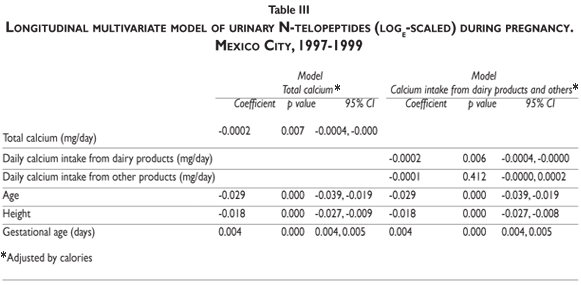
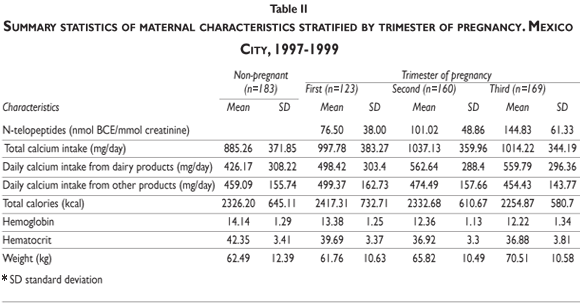
<body><![CDATA[<p><a name="tab01"></a></p>     <p>&nbsp;</p>     <p align="center"><img src="/img/revistas/spm/v51s1/a13tab01.gif"></p>     <p>&nbsp;</p>     <p><font size="2" face="Verdana"><a href="#tab02">Table II</a> displays summary    statistics of NTx, dietary calcium ingestion (from dairy and non&#45;dairy products),    calories, hemoglobin, hematocrit, and maternal weight by trimester of pregnancy    alongside corresponding statistics for the reference group of 183 non&#45;pregnant    women. Also shown are the descriptive statistics of maternal characteristics.    The calcium ingestion from non&#45;dairy sources was similar in both pregnant and    non&#45;pregnant women, although there is a slightly more dairy&#45;based calcium intake    in the pregnant women than in the non&#45;pregnant (997.78 SD=383.27 versus 885.26,    SD=371.85). NTx (SD) increased (<I>p</I>&lt;0.01) over the course of pregnancy,    with mean levels of 76.50 (38.00), 101.02 (48.86) and 144.83 (61.33) nmol BCE/mmol    creatinine in the first, second, and third trimesters, respectively. </font></p>     <p><a name="tab02"></a></p>     <p>&nbsp;</p>     <p align="center"><img src="/img/revistas/spm/v51s1/a13tab02.gif"></p>     <p>&nbsp;</p>     <p><font size="2" face="Verdana">After using a longitudinal multivariate model    to adjust for height, maternal age, gestational age,and caloric intake (<a href="#tab03">Table    III</a>, model Total calcium), we detected a significant inverse association    between calcium intake and NTx (log&#45;e transformed). When we split total calcium    intake into dairy and non&#45;dairy products, an inverse association with NTx was    detected for both sources, but only the former was statistically significant    (<a href="#tab03">Table III</a>, model Intake Calcium). Also, we found a negative    association between adjusted means for NTx and daily calcium intake from dairy    products. </font></p>     ]]></body>
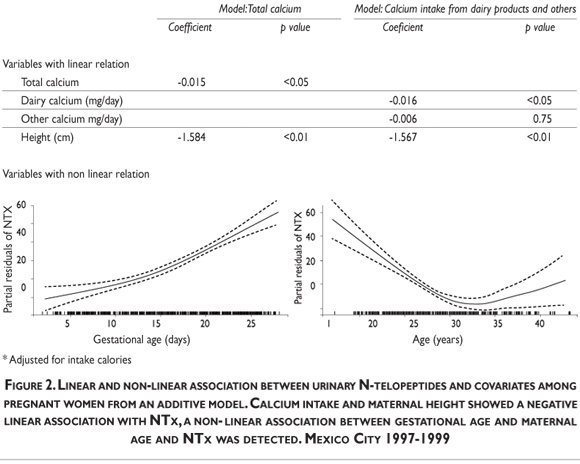
<body><![CDATA[<p><a name="tab03"></a></p>     <p>&nbsp;</p>     <p align="center"><img src="/img/revistas/spm/v51s1/a13tab03.gif"></p>     <p>&nbsp;</p>     <p><font size="2" face="Verdana"><a href="#fig02">Figure 2</a> shows the linear    and non&#45;linear results obtained from an additive model. Calcium intake and maternal    height showed a negative linear association with NTx, while a threshold was    detected for gestational and maternal age. We estimated that every 300g of calcium    intake was associated with a 4.8nM BCE/mM creatinine decrease in bone resorption    marker, </font><font>&#946;</font><font size="2" face="verdana">=&#45;0.016 (<I>p</I>&lt;0.05).    Regarding gestational age, our results suggest that there is an initial positive    association until approximately 160 days of gestation, followed by a steeper    positive association reflecting a more accelerated bone resorption activity    in the second half of pregnancy. This trend was significantly different from    a linear curve (<I>p</I>&lt;0.01) and suggests the existence of a threshold.    Additionally, a clear non&#45;linear association between maternal age and NTx was    detected. This association was negative until approximately 30 years of age.    Between 30 and 34 years of age a threshold was detected and after this period    there is a significant positive deviation (<I>p</I>&lt;0.01). </font></p>     <p><a name="fig02"></a></p>     <p>&nbsp;</p>     <p align="center"><img src="/img/revistas/spm/v51s1/a13fig02.gif"></p>     <p>&nbsp;</p>     <p><font size="2" face="Verdana">To assess the robustness of our findings, we    repeated the analyses in the sub&#45;sample of women who completed follow&#45;up and    had no missing data over the three trimesters of pregnancy (<I>n</I>=92). Since    the results were essentially the same, only models which incorporated all the    available information are presented.</font></p>     ]]></body>
<body><![CDATA[<p>&nbsp;</p>     <p><font size="3" face="verdana"><b>Discussion</b></font></p>     <p><font size="2" face="Verdana">In this longitudinal study we observed a linear    negative association between dietary calcium intake and biomarkers of bone resorption    during pregnancy. We also documented that height and age were important determinants    of bone resorption. </font></p>     <p><font size="2" face="Verdana"> Our results show that NTx levels were greatest    in the third trimester, which is consistent with other studies that have observed    that ultrasonographic maternal bone propagation velocity decreases in the second    and third trimesters<SUP>19&#45;23</SUP> and studies that have shown increases in    various bone resorption biomarkers (DPyr, Pyr, CTx and NTx) principally during    the third trimester.<SUP>24&#45;27</SUP> Our observation that the greatest increase    in NTx values occurs after approximately 160 days of gestation may reflect an    increase in the fetal demand for mineralization and therefore greater bone resorption    in the second half of pregnancy.<SUP>25,27,28</sup></font></p>     <p><font size="2" face="Verdana"> The significant negative correlation we found    between NTx and dietary calcium intake suggests that dietary calcium does alter    skeletal response to the increased demand for calcium during pregnancy and that    increases in bone resorption during this period may be attenuated by parallel    increases in dietary calcium. This is concordant with a study conducted in 23    adolescent mothers<SUP>29</SUP> that documented significant decrements in bone    density measured in the lumbar spine during pregnancy and observed that an increased    calcium intake during pregnancy appeared to be protective against maternal loss    of trabecular bone at the lumbar spine. Our results are also similar to those    reported by Zeni et al<SUP>11</SUP> who showed longitudinal changes of bone    turnover during pregnancy among a group of 39 pregnant women and documented    an increase in bone resorption markers, with the highest increment observed    in the third trimester and a significant negative correlation between NTx and    dietary calcium intake. Protective results of a 1200 mg calcium supplementation    on bone resorption were also documented in a randomized crossover trial among    31 pregnant women in Mexico City.<SUP>30</SUP> The benefits of calcium intake    may not only reduce bone resorption during pregnancy but also may inhibit bone    lead mobilization, an endogenous source or prenatal lead exposure <SUP>15</SUP>.</font></p>     <p><font size="2" face="Verdana"> In our study, the separation of calcium between    dairy and non&#45;dairy sources may have provided an improved estimate of calcium    intake. Although a recent review of calcium bioavailability<SUP>31</SUP> concluded    that there is no evidence to suggest that the calcium in milk is more efficiently    used than any calcium salt, it is known that the calcium in milk and dairy products    is better absorbed than the calcium in spinach or watercress because the plants    have high oxalate contents. Among the Mexican population in our study, tortillas    are a staple of the diet and an important source of non&#45;dairy dietary calcium.    Calcium in tortillas is compromised by phytate, which is present in large quantities    in maize kernels, thereby reducing its bioavailabity.</font></p>     <p><font size="2" face="Verdana"> The reduced sample size of this study compromises    the exploration of a mother's age as a potential modifier of bone remodeling    activity during pregnancy. However, we observed that bone resorption activity    was higher in younger women and that an inflection point was detected around    34 years of age, where older women showed an increasing trend toward bone resorption.    There are no reported studies regarding the effect of maternal age to which    we could compare our results; further research may help to clarify the biological    importance of maternal age with regard to bone remodeling during pregnancy.</font></p>     <p><font size="2" face="Verdana"> Another limitation to our study is that we did    not measure other biomarkers of bone metabolism or hormonal changes and therefore    were unable to develop a fully integrative view of bone metabolism during pregnancy.    A previous study performed throughout the course of pregnancy on an Asian population    reports a bone turnover ratio reflecting stronger bone resorption than bone    formation when measured with osteocalcin.<SUP>28</SUP> Another study on a Caucasian    population found increases in bone formation during the second and third trimesters,    21% and 25% respectively, as measured by specific alkaline phosphate levels    in bone (b&#45;ALP), and 44% and 133%, respectively, with regard to carboxyterminal    propeptide of procollagen type 1(PICP).<SUP>11</SUP> The stage of pregnancy    at which the imbalance between resorption and formation is highest is still    a matter of controversy.<SUP>11, 25, 28</SUP> Disagreements between study results    may be explained by the fact that different biomarkers of bone formation reflect    different aspects of the dynamics of bone formation and that different populations    studied may have unequal levels of b&#45;ALP or other biomarkers.<SUP>32</SUP> </font></p>     <p><font size="2" face="Verdana"> Our results suggest the need to evaluate dietary    requirements for calcium during pregnancy and the need to conduct additional    studies to further explore the association between pregnancy and lactation and    the risk of osteoporosis within populations with lower calcium intake that experience    pregnancy at earlier ages. Additional information is also needed about the adolescent    population that has not yet reached peak bone density mass and may be more vulnerable    to the effects of pregnancy on bone health. </font></p>     <p><font size="2" face="Verdana"> It is also important to conduct new studies    to assess the influence of genetic factors and lifestyle on increased bone resorption    and to simultaneously evaluate bone resorption and bone formation processes    during a period of life that is characterized by an accelerated bone metabolism    process. Investigations should be undertaken to further explore the possible    effects of calcium supplementation and the use of NTx as a diagnostic tool for    identifying women at increased risk for bone resorption. Some final recommendations    would be to improve the milk&#45;based calcium ingestion of pregnant women, especially    among younger women. </font></p>     ]]></body>
<body><![CDATA[<p><font size="2" face="Verdana"><b>Acknowledgments</b></font></p>     <p><font size="2" face="Verdana">We acknowledge the American British Cowdray Medical    Center for providing us with the research facilities to conduct the study. This    research was made possible by grants RO1 ES007821 and 5P42ES05947 from the US    National Institute of Environmental Health Sciences (Research Triangle Park,    North Carolina), by NCRR GCRC M01RR02635 from the US NIH, and by grants 29192&#45;M    and 38867&#45;M from the Mexican National Council of Science and Technology (CONACyT)    (Mexico City, Mexico). The contents of this article are solely the responsibility    of the authors.</font></p>     <p>&nbsp;</p>     <p><font size="3" face="verdana"><b>References</b></font></p>     <!-- ref --><p><font size="2" face="Verdana">1. Kovacs CS, Kronenberg HM. Maternal&#45;fetal calcium    and bone metabolism during pregnancy, puerperium, and lactation. Endocrine Reviews    1997;18:832&#45;872.</font>&nbsp;&nbsp;&nbsp;&nbsp;&nbsp;&nbsp;&nbsp;&nbsp;[&#160;<a href="javascript:void(0);" onclick="javascript: window.open('/scielo.php?script=sci_nlinks&ref=9283488&pid=S0036-3634200900070001300001&lng=','','width=640,height=500,resizable=yes,scrollbars=1,menubar=yes,');">Links</a>&#160;]<!-- end-ref --><!-- ref --><p><font size="2" face="Verdana">2. Heaney RP, Skillman TG: Calcium metabolism    in normal human pregnancy. J Clin Endocr 1971;33:661&#45;670.</font>&nbsp;&nbsp;&nbsp;&nbsp;&nbsp;&nbsp;&nbsp;&nbsp;[&#160;<a href="javascript:void(0);" onclick="javascript: window.open('/scielo.php?script=sci_nlinks&ref=9283489&pid=S0036-3634200900070001300002&lng=','','width=640,height=500,resizable=yes,scrollbars=1,menubar=yes,');">Links</a>&#160;]<!-- end-ref --><!-- ref --><p><font size="2" face="Verdana">3. Naylor KE, Iqbal P, Fledelius C, Fraser RB,    Eastell R.The effect of pregnancy on bone density and bone turnover. J Bone    Miner Res 2000;15:129&#45;137.</font>&nbsp;&nbsp;&nbsp;&nbsp;&nbsp;&nbsp;&nbsp;&nbsp;[&#160;<a href="javascript:void(0);" onclick="javascript: window.open('/scielo.php?script=sci_nlinks&ref=9283490&pid=S0036-3634200900070001300003&lng=','','width=640,height=500,resizable=yes,scrollbars=1,menubar=yes,');">Links</a>&#160;]<!-- end-ref --><!-- ref --><p><font size="2" face="Verdana">4. Ritchie LD, Fung EB, Halloran BP, Turnlund    JR, Van Loan MD, Cann CE, King JC. A longitudinal study of calcium homeostasis    during pregnancy and lactation and after the resumption of menses. Am J Clin    Nutr 1998;67:693&#45;701.</font>&nbsp;&nbsp;&nbsp;&nbsp;&nbsp;&nbsp;&nbsp;&nbsp;[&#160;<a href="javascript:void(0);" onclick="javascript: window.open('/scielo.php?script=sci_nlinks&ref=9283491&pid=S0036-3634200900070001300004&lng=','','width=640,height=500,resizable=yes,scrollbars=1,menubar=yes,');">Links</a>&#160;]<!-- end-ref --><!-- ref --><p><font size="2" face="Verdana">5. Vargas Zapata CL, Donangelo CM, Woodhouse    LR, Abrams SA, Spencer EM, King JC. Calcium homeostasis during pregnancy and    lactation in Brazilian women with low calcium intakes: a longitudinal study.    Am J Clin Nutr 2004;80:417&#45;422.</font>&nbsp;&nbsp;&nbsp;&nbsp;&nbsp;&nbsp;&nbsp;&nbsp;[&#160;<a href="javascript:void(0);" onclick="javascript: window.open('/scielo.php?script=sci_nlinks&ref=9283492&pid=S0036-3634200900070001300005&lng=','','width=640,height=500,resizable=yes,scrollbars=1,menubar=yes,');">Links</a>&#160;]<!-- end-ref --><!-- ref --><p><font size="2" face="Verdana">6. Kovacs CS. Calcium and bone metabolism in    pregnancy and lactation. J Clin Endocrin Metab 2001;86:2344&#45;2348.</font>&nbsp;&nbsp;&nbsp;&nbsp;&nbsp;&nbsp;&nbsp;&nbsp;[&#160;<a href="javascript:void(0);" onclick="javascript: window.open('/scielo.php?script=sci_nlinks&ref=9283493&pid=S0036-3634200900070001300006&lng=','','width=640,height=500,resizable=yes,scrollbars=1,menubar=yes,');">Links</a>&#160;]<!-- end-ref --><!-- ref --><p><font size="2" face="Verdana">7. King JC. Effect of reproduction on the bioavailability    of calcium, zinc and selenium. J Nutr 2001;131:1355S&#45;1358S.</font>&nbsp;&nbsp;&nbsp;&nbsp;&nbsp;&nbsp;&nbsp;&nbsp;[&#160;<a href="javascript:void(0);" onclick="javascript: window.open('/scielo.php?script=sci_nlinks&ref=9283494&pid=S0036-3634200900070001300007&lng=','','width=640,height=500,resizable=yes,scrollbars=1,menubar=yes,');">Links</a>&#160;]<!-- end-ref --><!-- ref --><p><font size="2" face="Verdana">8. Prentice A.Maternal calcium metabolism and    bone mineral status. Am J Clin Nutr 2000;71(suppl):1312S&#45;1316S.</font>&nbsp;&nbsp;&nbsp;&nbsp;&nbsp;&nbsp;&nbsp;&nbsp;[&#160;<a href="javascript:void(0);" onclick="javascript: window.open('/scielo.php?script=sci_nlinks&ref=9283495&pid=S0036-3634200900070001300008&lng=','','width=640,height=500,resizable=yes,scrollbars=1,menubar=yes,');">Links</a>&#160;]<!-- end-ref --><!-- ref --><p><font size="2" face="Verdana">9. Karlsson C, Obrant KJ, Karlsson M. Pregnancy    and lactation confer reversible bone loss in humans. Osteoporos Int 2001;12:828&#45;834.</font>&nbsp;&nbsp;&nbsp;&nbsp;&nbsp;&nbsp;&nbsp;&nbsp;[&#160;<a href="javascript:void(0);" onclick="javascript: window.open('/scielo.php?script=sci_nlinks&ref=9283496&pid=S0036-3634200900070001300009&lng=','','width=640,height=500,resizable=yes,scrollbars=1,menubar=yes,');">Links</a>&#160;]<!-- end-ref --><!-- ref --><p><font size="2" face="Verdana">10. Paton LM, Alexander JL, Nowson CA, Margerison    C, Frame MG, Kaymakci B, Wark JD. Pregnancy and lactation have no longterm deleterious    effect on measures of bone mineral in healthy women: A twin study. Am J Clin    Nutr 2003;77:707&#45;714.</font>&nbsp;&nbsp;&nbsp;&nbsp;&nbsp;&nbsp;&nbsp;&nbsp;[&#160;<a href="javascript:void(0);" onclick="javascript: window.open('/scielo.php?script=sci_nlinks&ref=9283497&pid=S0036-3634200900070001300010&lng=','','width=640,height=500,resizable=yes,scrollbars=1,menubar=yes,');">Links</a>&#160;]<!-- end-ref --><!-- ref --><p><font size="2" face="Verdana">11. Zeni SN, Ortela Soler CR, Lazzari A, Lopez    L, Suarez M, Di Gregorio S, Somoza JI, de Portela ML. Interassociation between    bone turnover markers and dietary calcium intake in pregnant women: a longitudinal    study. Bone 2003;33:606&#45;613.</font>&nbsp;&nbsp;&nbsp;&nbsp;&nbsp;&nbsp;&nbsp;&nbsp;[&#160;<a href="javascript:void(0);" onclick="javascript: window.open('/scielo.php?script=sci_nlinks&ref=9283498&pid=S0036-3634200900070001300011&lng=','','width=640,height=500,resizable=yes,scrollbars=1,menubar=yes,');">Links</a>&#160;]<!-- end-ref --><!-- ref --><p><font size="2" face="Verdana">12. Prentice A, Jarjou LMA, Stirling DM, Buffenstein    R, Fairweather&#45;Tait S. Biochemical markers of calcium and bone metabolism during    18 months of lactation in Gambian women accustomed to a low calcium intake and    in those consuming a calcium supplement. J Clin Endocrinol Metab 1998;83:1059&#45;1066.</font>&nbsp;&nbsp;&nbsp;&nbsp;&nbsp;&nbsp;&nbsp;&nbsp;[&#160;<a href="javascript:void(0);" onclick="javascript: window.open('/scielo.php?script=sci_nlinks&ref=9283499&pid=S0036-3634200900070001300012&lng=','','width=640,height=500,resizable=yes,scrollbars=1,menubar=yes,');">Links</a>&#160;]<!-- end-ref --><!-- ref --><p><font size="2" face="Verdana">13. Parra&#45;Cabrera S, Hernandez&#45;Avila M, Tamayo&#45;y&#45;Orozco    J, Lopez&#45;Carrillo L, Meneses&#45;Gonz&aacute;lez F. Exercise and reproductive factors    as predictors of bone density among osteoporotic women in Mexico City. Calcif    Tissue Int 1996;59:89&#45;94.</font>&nbsp;&nbsp;&nbsp;&nbsp;&nbsp;&nbsp;&nbsp;&nbsp;[&#160;<a href="javascript:void(0);" onclick="javascript: window.open('/scielo.php?script=sci_nlinks&ref=9283500&pid=S0036-3634200900070001300013&lng=','','width=640,height=500,resizable=yes,scrollbars=1,menubar=yes,');">Links</a>&#160;]<!-- end-ref --><!-- ref --><p><font size="2" face="Verdana">14. Lopez&#45;Caudana AE, Tellez&#45;Rojo Solis MM, Hernandez&#45;Avila    M, Clark P, Juarez&#45;Marquez SA, Lazcano&#45;Ponce EC, Salmeron&#45;Castro J. Predictors    of bone mineral density in female workers in Morelos State, Mexico.Arch Med    Res. 2004;35:172&#45;180.</font>&nbsp;&nbsp;&nbsp;&nbsp;&nbsp;&nbsp;&nbsp;&nbsp;[&#160;<a href="javascript:void(0);" onclick="javascript: window.open('/scielo.php?script=sci_nlinks&ref=9283501&pid=S0036-3634200900070001300014&lng=','','width=640,height=500,resizable=yes,scrollbars=1,menubar=yes,');">Links</a>&#160;]<!-- end-ref --><!-- ref --><p><font size="2" face="Verdana">15. Tellez&#45;Rojo MM. Hernandez&#45;Avila M. Lamadrid&#45;Figueroa    H. Smith D. Hernandez&#45;Cadena L. Mercado A. Aro A. Schwartz J. Hu H. Impact of    bone lead and bone resorption on plasma and whole blood lead levels during pregnancy.    Am J Epidemiol 2004;160:668&#45;678.</font>&nbsp;&nbsp;&nbsp;&nbsp;&nbsp;&nbsp;&nbsp;&nbsp;[&#160;<a href="javascript:void(0);" onclick="javascript: window.open('/scielo.php?script=sci_nlinks&ref=9283502&pid=S0036-3634200900070001300015&lng=','','width=640,height=500,resizable=yes,scrollbars=1,menubar=yes,');">Links</a>&#160;]<!-- end-ref --><!-- ref --><p><font size="2" face="Verdana">16. Hernandez&#45;Avila M. Romieu I. Parra S. Hernandez&#45;Avila    J. Madrigal H. Willett W. Validity and reproducibility of a food frequency questionnaire    to assess dietary intake of women living in Mexico City. Salud Pub Mex 1998;40:133&#45;140.</font>&nbsp;&nbsp;&nbsp;&nbsp;&nbsp;&nbsp;&nbsp;&nbsp;[&#160;<a href="javascript:void(0);" onclick="javascript: window.open('/scielo.php?script=sci_nlinks&ref=9283503&pid=S0036-3634200900070001300016&lng=','','width=640,height=500,resizable=yes,scrollbars=1,menubar=yes,');">Links</a>&#160;]<!-- end-ref --><!-- ref --><p><font size="2" face="Verdana">17. Hastie TJ, Tibshirani RJ. Generalized additive    models. London: Chapman and Hall, Inc. 1990. Methodology, biostats section.</font>&nbsp;&nbsp;&nbsp;&nbsp;&nbsp;&nbsp;&nbsp;&nbsp;[&#160;<a href="javascript:void(0);" onclick="javascript: window.open('/scielo.php?script=sci_nlinks&ref=9283504&pid=S0036-3634200900070001300017&lng=','','width=640,height=500,resizable=yes,scrollbars=1,menubar=yes,');">Links</a>&#160;]<!-- end-ref --><!-- ref --><p><font size="2" face="Verdana">18. Brown H, Prescott R. Applied Mixed Models    in Medicine. Chichester: John Wiley and Sons; 2001.</font>&nbsp;&nbsp;&nbsp;&nbsp;&nbsp;&nbsp;&nbsp;&nbsp;[&#160;<a href="javascript:void(0);" onclick="javascript: window.open('/scielo.php?script=sci_nlinks&ref=9283505&pid=S0036-3634200900070001300018&lng=','','width=640,height=500,resizable=yes,scrollbars=1,menubar=yes,');">Links</a>&#160;]<!-- end-ref --><!-- ref --><p><font size="2" face="Verdana">19. Yamaga A, Taga M, Minaguchi H, Sato L. Changes    in bone mass as determined by ultrasound and biochemical markers of bone turnover    during pregnancy and puerperium: A longitudinal study. J Clin Endocrinol Metab    1996;81:752&#45;756.</font>&nbsp;&nbsp;&nbsp;&nbsp;&nbsp;&nbsp;&nbsp;&nbsp;[&#160;<a href="javascript:void(0);" onclick="javascript: window.open('/scielo.php?script=sci_nlinks&ref=9283506&pid=S0036-3634200900070001300019&lng=','','width=640,height=500,resizable=yes,scrollbars=1,menubar=yes,');">Links</a>&#160;]<!-- end-ref --><!-- ref --><p><font size="2" face="Verdana">20. Kolthoff N, Eiken P, Kristensen B, Nielsen    SP. Bone mineral changes during pregnancy and lactation: a longitudinal cohort    study. Clin Sci 1998;94:405&#150;412.</font>&nbsp;&nbsp;&nbsp;&nbsp;&nbsp;&nbsp;&nbsp;&nbsp;[&#160;<a href="javascript:void(0);" onclick="javascript: window.open('/scielo.php?script=sci_nlinks&ref=9283507&pid=S0036-3634200900070001300020&lng=','','width=640,height=500,resizable=yes,scrollbars=1,menubar=yes,');">Links</a>&#160;]<!-- end-ref --><!-- ref --><p><font size="2" face="Verdana">21. Aguado F, Revilla M, Hernandez ER, Menendez    M, Cortes&#45;Prieto J, Villa LF, Rico H. Ultrasonographic bone velocity in pregnancy:    a longitudinal study. Am J Obstet Gynecol 1998;178:1016&#45;1021.</font>&nbsp;&nbsp;&nbsp;&nbsp;&nbsp;&nbsp;&nbsp;&nbsp;[&#160;<a href="javascript:void(0);" onclick="javascript: window.open('/scielo.php?script=sci_nlinks&ref=9283508&pid=S0036-3634200900070001300021&lng=','','width=640,height=500,resizable=yes,scrollbars=1,menubar=yes,');">Links</a>&#160;]<!-- end-ref --><!-- ref --><p><font size="2" face="Verdana">22. To WK, Wong MWN, Leung TW, Association between    bone mineral density changes in pregnancy and maternal and pregnancy characteristics:    a longitudinal study. Acta Obstet Gynecol Scand 2003;82:820&#45;827.</font>&nbsp;&nbsp;&nbsp;&nbsp;&nbsp;&nbsp;&nbsp;&nbsp;[&#160;<a href="javascript:void(0);" onclick="javascript: window.open('/scielo.php?script=sci_nlinks&ref=9283509&pid=S0036-3634200900070001300022&lng=','','width=640,height=500,resizable=yes,scrollbars=1,menubar=yes,');">Links</a>&#160;]<!-- end-ref --><!-- ref --><p><font size="2" face="Verdana">23. Gambacciani M. Spinetti A. Gallo R. Cappagli    B. Teti GC. Facchini V. Ultrasonographic bone characteristics during normal    pregnancy: longitudinal and cross&#45;sectional evaluation. Am J Obs Gynecol 1995;173:890&#45;893.</font>&nbsp;&nbsp;&nbsp;&nbsp;&nbsp;&nbsp;&nbsp;&nbsp;[&#160;<a href="javascript:void(0);" onclick="javascript: window.open('/scielo.php?script=sci_nlinks&ref=9283510&pid=S0036-3634200900070001300023&lng=','','width=640,height=500,resizable=yes,scrollbars=1,menubar=yes,');">Links</a>&#160;]<!-- end-ref --><!-- ref --><p><font size="2" face="Verdana">24. More C, Bhattoa HP, Bettembuk P, Balogh A.    The effects of pregnancy and lactation on hormonal status and biochemical markers    of bone turnover. European J Obstet Gynec Reprod Bio 2003;106:209&#45;213.</font>&nbsp;&nbsp;&nbsp;&nbsp;&nbsp;&nbsp;&nbsp;&nbsp;[&#160;<a href="javascript:void(0);" onclick="javascript: window.open('/scielo.php?script=sci_nlinks&ref=9283511&pid=S0036-3634200900070001300024&lng=','','width=640,height=500,resizable=yes,scrollbars=1,menubar=yes,');">Links</a>&#160;]<!-- end-ref --><!-- ref --><p><font size="2" face="Verdana">25. Black, AJ, Topping J, Durham B, Farquharson    RG, Fraser WD. A detailed assessment of alterations in bone turnover, calcium    homeostasis, and bone density in normal pregnancy. J Bone Miner Res 2000;15:557&#45;563.</font>&nbsp;&nbsp;&nbsp;&nbsp;&nbsp;&nbsp;&nbsp;&nbsp;[&#160;<a href="javascript:void(0);" onclick="javascript: window.open('/scielo.php?script=sci_nlinks&ref=9283512&pid=S0036-3634200900070001300025&lng=','','width=640,height=500,resizable=yes,scrollbars=1,menubar=yes,');">Links</a>&#160;]<!-- end-ref --><!-- ref --><p><font size="2" face="Verdana">26. Cross NA, Hillman LS, Allen SH, Krause GF,    Vieira NE. Calcium homeostasis and bone metabolism during pregnancy, lactation,    and post&#45;weaning: a longitudinal study. Am J Clin Nutr 1995;61:514&#45;523.</font>&nbsp;&nbsp;&nbsp;&nbsp;&nbsp;&nbsp;&nbsp;&nbsp;[&#160;<a href="javascript:void(0);" onclick="javascript: window.open('/scielo.php?script=sci_nlinks&ref=9283513&pid=S0036-3634200900070001300026&lng=','','width=640,height=500,resizable=yes,scrollbars=1,menubar=yes,');">Links</a>&#160;]<!-- end-ref --><!-- ref --><p><font size="2" face="Verdana">27. Yamaga A, Taga M, Minaguchi H. Changes in    urinary excretions of C&#45;telopeptide and cross&#45;linked N&#45;telopeptide of type 1    collagen during pregnancy and puerperium. Endocrine J 1997;44:733&#45;738.</font>&nbsp;&nbsp;&nbsp;&nbsp;&nbsp;&nbsp;&nbsp;&nbsp;[&#160;<a href="javascript:void(0);" onclick="javascript: window.open('/scielo.php?script=sci_nlinks&ref=9283514&pid=S0036-3634200900070001300027&lng=','','width=640,height=500,resizable=yes,scrollbars=1,menubar=yes,');">Links</a>&#160;]<!-- end-ref --><!-- ref --><p><font size="2" face="Verdana">28. Yoon B&#45;K, Lee J&#45;W, Choi D, Roh C&#45;R, Lee J&#45;H.    Changes in biochemical bone markers during pregnancy and puerperium. J Korean    Med Sci 2000;15:189&#45;193.</font>&nbsp;&nbsp;&nbsp;&nbsp;&nbsp;&nbsp;&nbsp;&nbsp;[&#160;<a href="javascript:void(0);" onclick="javascript: window.open('/scielo.php?script=sci_nlinks&ref=9283515&pid=S0036-3634200900070001300028&lng=','','width=640,height=500,resizable=yes,scrollbars=1,menubar=yes,');">Links</a>&#160;]<!-- end-ref --><!-- ref --><p><font size="2" face="Verdana">29. O'Brien KO, Nathanson MS, Mancini J, Witter    FR. Calcium absorption is significantly higher in adolescents during pregnancy    than in the early postpartum period. Am J Clin Nutr 2003;78:1188&#45;1193.</font>&nbsp;&nbsp;&nbsp;&nbsp;&nbsp;&nbsp;&nbsp;&nbsp;[&#160;<a href="javascript:void(0);" onclick="javascript: window.open('/scielo.php?script=sci_nlinks&ref=9283516&pid=S0036-3634200900070001300029&lng=','','width=640,height=500,resizable=yes,scrollbars=1,menubar=yes,');">Links</a>&#160;]<!-- end-ref --><!-- ref --><p><font size="2" face="Verdana">30. Janakiraman V, Ettinger A, Mercado&#45;Garcia    A, Hu H, Hernandez&#45;Avila M. Calcium supplements and bone resorption in pregnancy.    Am J Prev Med 2003;24:260&#45;264.</font>&nbsp;&nbsp;&nbsp;&nbsp;&nbsp;&nbsp;&nbsp;&nbsp;[&#160;<a href="javascript:void(0);" onclick="javascript: window.open('/scielo.php?script=sci_nlinks&ref=9283517&pid=S0036-3634200900070001300030&lng=','','width=640,height=500,resizable=yes,scrollbars=1,menubar=yes,');">Links</a>&#160;]<!-- end-ref --><!-- ref --><p><font size="2" face="Verdana">31. Gu&eacute;guen L, Pointillart A. The bioavailability    of dietary calcium. J Am Coll Nutr 2000; 19:119S&#45;136S.</font>&nbsp;&nbsp;&nbsp;&nbsp;&nbsp;&nbsp;&nbsp;&nbsp;[&#160;<a href="javascript:void(0);" onclick="javascript: window.open('/scielo.php?script=sci_nlinks&ref=9283518&pid=S0036-3634200900070001300031&lng=','','width=640,height=500,resizable=yes,scrollbars=1,menubar=yes,');">Links</a>&#160;]<!-- end-ref --><!-- ref --><p><font size="2" face="Verdana">32. Gundberg CM, Looker AC, Nieman D, Calvo MS.    Patterns of ostecalcin and bone specific alkaline phosphatase by age, gender,    and race or ethnicity. Bone 2002;31:703&#45;708.</font>&nbsp;&nbsp;&nbsp;&nbsp;&nbsp;&nbsp;&nbsp;&nbsp;[&#160;<a href="javascript:void(0);" onclick="javascript: window.open('/scielo.php?script=sci_nlinks&ref=9283519&pid=S0036-3634200900070001300032&lng=','','width=640,height=500,resizable=yes,scrollbars=1,menubar=yes,');">Links</a>&#160;]<!-- end-ref --><p>&nbsp;</p>     <p>&nbsp;</p>     <p><font size="2" face="Verdana">Received on: November 10, 2008    <br>   Accepted on: December 11, 2008</font></p>     ]]></body>
<body><![CDATA[<p>&nbsp;</p>     <p>&nbsp;</p>     <p><font size="2" face="Verdana">Address reprint requests to: Martha M. T&eacute;llez&#45;Rojo.    Oficina #325. Instituto Nacional de Salud P&uacute;blica. Av.    Universidad #655 Col Sta. Ma. Ahuacatitl&aacute;n. Cuernavaca, Mor. M&eacute;xico.    CP 62508.    <br>   E&#45;mail: <a href="mailto:mmtellez@insp.mx">mmtellez@insp.mx</a></font></p>      ]]></body><back>
<ref-list>
<ref id="B1">
<label>1</label><nlm-citation citation-type="journal">
<person-group person-group-type="author">
<name>
<surname><![CDATA[Kovacs]]></surname>
<given-names><![CDATA[CS]]></given-names>
</name>
<name>
<surname><![CDATA[Kronenberg]]></surname>
<given-names><![CDATA[HM]]></given-names>
</name>
</person-group>
<article-title xml:lang="en"><![CDATA[Maternal-fetal calcium and bone metabolism during pregnancy, puerperium, and lactation]]></article-title>
<source><![CDATA[Endocrine Reviews]]></source>
<year>1997</year>
<volume>18</volume>
<page-range>832-872</page-range></nlm-citation>
</ref>
<ref id="B2">
<label>2</label><nlm-citation citation-type="journal">
<person-group person-group-type="author">
<name>
<surname><![CDATA[Heaney]]></surname>
<given-names><![CDATA[RP]]></given-names>
</name>
<name>
<surname><![CDATA[Skillman]]></surname>
<given-names><![CDATA[TG]]></given-names>
</name>
</person-group>
<article-title xml:lang="en"><![CDATA[Calcium metabolism in normal human pregnancy]]></article-title>
<source><![CDATA[J Clin Endocr]]></source>
<year>1971</year>
<volume>33</volume>
<page-range>661-670</page-range></nlm-citation>
</ref>
<ref id="B3">
<label>3</label><nlm-citation citation-type="journal">
<person-group person-group-type="author">
<name>
<surname><![CDATA[Naylor]]></surname>
<given-names><![CDATA[KE]]></given-names>
</name>
<name>
<surname><![CDATA[Iqbal]]></surname>
<given-names><![CDATA[P]]></given-names>
</name>
<name>
<surname><![CDATA[Fledelius]]></surname>
<given-names><![CDATA[C]]></given-names>
</name>
<name>
<surname><![CDATA[Fraser]]></surname>
<given-names><![CDATA[RB]]></given-names>
</name>
<name>
<surname><![CDATA[Eastell]]></surname>
<given-names><![CDATA[R]]></given-names>
</name>
</person-group>
<article-title xml:lang="en"><![CDATA[The effect of pregnancy on bone density and bone turnover]]></article-title>
<source><![CDATA[J Bone Miner Res]]></source>
<year>2000</year>
<volume>15</volume>
<page-range>129-137</page-range></nlm-citation>
</ref>
<ref id="B4">
<label>4</label><nlm-citation citation-type="journal">
<person-group person-group-type="author">
<name>
<surname><![CDATA[Ritchie]]></surname>
<given-names><![CDATA[LD]]></given-names>
</name>
<name>
<surname><![CDATA[Fung]]></surname>
<given-names><![CDATA[EB]]></given-names>
</name>
<name>
<surname><![CDATA[Halloran]]></surname>
<given-names><![CDATA[BP]]></given-names>
</name>
<name>
<surname><![CDATA[Turnlund]]></surname>
<given-names><![CDATA[JR]]></given-names>
</name>
<name>
<surname><![CDATA[Van Loan]]></surname>
<given-names><![CDATA[MD]]></given-names>
</name>
<name>
<surname><![CDATA[Cann]]></surname>
<given-names><![CDATA[CE]]></given-names>
</name>
<name>
<surname><![CDATA[King]]></surname>
<given-names><![CDATA[JC]]></given-names>
</name>
</person-group>
<article-title xml:lang="en"><![CDATA[A longitudinal study of calcium homeostasis during pregnancy and lactation and after the resumption of menses]]></article-title>
<source><![CDATA[Am J Clin Nutr]]></source>
<year>1998</year>
<volume>67</volume>
<page-range>693-701</page-range></nlm-citation>
</ref>
<ref id="B5">
<label>5</label><nlm-citation citation-type="journal">
<person-group person-group-type="author">
<name>
<surname><![CDATA[Vargas Zapata]]></surname>
<given-names><![CDATA[CL]]></given-names>
</name>
<name>
<surname><![CDATA[Donangelo]]></surname>
<given-names><![CDATA[CM]]></given-names>
</name>
<name>
<surname><![CDATA[Woodhouse]]></surname>
<given-names><![CDATA[LR]]></given-names>
</name>
<name>
<surname><![CDATA[Abrams]]></surname>
<given-names><![CDATA[SA]]></given-names>
</name>
<name>
<surname><![CDATA[Spencer]]></surname>
<given-names><![CDATA[EM]]></given-names>
</name>
<name>
<surname><![CDATA[King]]></surname>
<given-names><![CDATA[JC]]></given-names>
</name>
</person-group>
<article-title xml:lang="en"><![CDATA[Calcium homeostasis during pregnancy and lactation in Brazilian women with low calcium intakes: a longitudinal study]]></article-title>
<source><![CDATA[Am J Clin Nutr]]></source>
<year>2004</year>
<volume>80</volume>
<page-range>417-422</page-range></nlm-citation>
</ref>
<ref id="B6">
<label>6</label><nlm-citation citation-type="journal">
<person-group person-group-type="author">
<name>
<surname><![CDATA[Kovacs]]></surname>
<given-names><![CDATA[CS]]></given-names>
</name>
</person-group>
<article-title xml:lang="en"><![CDATA[Calcium and bone metabolism in pregnancy and lactation]]></article-title>
<source><![CDATA[J Clin Endocrin Metab]]></source>
<year>2001</year>
<volume>86</volume>
<page-range>2344-2348</page-range></nlm-citation>
</ref>
<ref id="B7">
<label>7</label><nlm-citation citation-type="journal">
<person-group person-group-type="author">
<name>
<surname><![CDATA[King]]></surname>
<given-names><![CDATA[JC]]></given-names>
</name>
</person-group>
<article-title xml:lang="en"><![CDATA[Effect of reproduction on the bioavailability of calcium, zinc and selenium]]></article-title>
<source><![CDATA[J Nutr]]></source>
<year>2001</year>
<volume>131</volume>
<page-range>1355S-1358S</page-range></nlm-citation>
</ref>
<ref id="B8">
<label>8</label><nlm-citation citation-type="journal">
<person-group person-group-type="author">
<name>
<surname><![CDATA[Prentice]]></surname>
<given-names><![CDATA[A]]></given-names>
</name>
</person-group>
<article-title xml:lang="en"><![CDATA[Maternal calcium metabolism and bone mineral status]]></article-title>
<source><![CDATA[Am J Clin Nutr]]></source>
<year>2000</year>
<volume>71</volume>
<numero>suppl</numero>
<issue>suppl</issue>
<page-range>1312S-1316S</page-range></nlm-citation>
</ref>
<ref id="B9">
<label>9</label><nlm-citation citation-type="journal">
<person-group person-group-type="author">
<name>
<surname><![CDATA[Karlsson]]></surname>
<given-names><![CDATA[C]]></given-names>
</name>
<name>
<surname><![CDATA[Obrant]]></surname>
<given-names><![CDATA[KJ]]></given-names>
</name>
<name>
<surname><![CDATA[Karlsson]]></surname>
<given-names><![CDATA[M]]></given-names>
</name>
</person-group>
<article-title xml:lang="en"><![CDATA[Pregnancy and lactation confer reversible bone loss in humans]]></article-title>
<source><![CDATA[Osteoporos Int]]></source>
<year>2001</year>
<volume>12</volume>
<page-range>828-834</page-range></nlm-citation>
</ref>
<ref id="B10">
<label>10</label><nlm-citation citation-type="journal">
<person-group person-group-type="author">
<name>
<surname><![CDATA[Paton]]></surname>
<given-names><![CDATA[LM]]></given-names>
</name>
<name>
<surname><![CDATA[Alexander]]></surname>
<given-names><![CDATA[JL]]></given-names>
</name>
<name>
<surname><![CDATA[Nowson]]></surname>
<given-names><![CDATA[CA]]></given-names>
</name>
<name>
<surname><![CDATA[Margerison]]></surname>
<given-names><![CDATA[C]]></given-names>
</name>
<name>
<surname><![CDATA[Frame]]></surname>
<given-names><![CDATA[MG]]></given-names>
</name>
<name>
<surname><![CDATA[Kaymakci]]></surname>
<given-names><![CDATA[B]]></given-names>
</name>
<name>
<surname><![CDATA[Wark]]></surname>
<given-names><![CDATA[JD]]></given-names>
</name>
</person-group>
<article-title xml:lang="en"><![CDATA[Pregnancy and lactation have no longterm deleterious effect on measures of bone mineral in healthy women: A twin study]]></article-title>
<source><![CDATA[Am J Clin Nutr]]></source>
<year>2003</year>
<volume>77</volume>
<page-range>707-714</page-range></nlm-citation>
</ref>
<ref id="B11">
<label>11</label><nlm-citation citation-type="journal">
<person-group person-group-type="author">
<name>
<surname><![CDATA[Zeni]]></surname>
<given-names><![CDATA[SN]]></given-names>
</name>
<name>
<surname><![CDATA[Ortela Soler]]></surname>
<given-names><![CDATA[CR]]></given-names>
</name>
<name>
<surname><![CDATA[Lazzari]]></surname>
<given-names><![CDATA[A]]></given-names>
</name>
<name>
<surname><![CDATA[Lopez]]></surname>
<given-names><![CDATA[L]]></given-names>
</name>
<name>
<surname><![CDATA[Suarez]]></surname>
<given-names><![CDATA[M]]></given-names>
</name>
<name>
<surname><![CDATA[Di Gregorio]]></surname>
<given-names><![CDATA[S]]></given-names>
</name>
<name>
<surname><![CDATA[Somoza]]></surname>
<given-names><![CDATA[JI]]></given-names>
</name>
<name>
<surname><![CDATA[de Portela]]></surname>
<given-names><![CDATA[ML]]></given-names>
</name>
</person-group>
<article-title xml:lang="en"><![CDATA[Interassociation between bone turnover markers and dietary calcium intake in pregnant women: a longitudinal study]]></article-title>
<source><![CDATA[Bone]]></source>
<year>2003</year>
<volume>33</volume>
<page-range>606-613</page-range></nlm-citation>
</ref>
<ref id="B12">
<label>12</label><nlm-citation citation-type="journal">
<person-group person-group-type="author">
<name>
<surname><![CDATA[Prentice]]></surname>
<given-names><![CDATA[A]]></given-names>
</name>
<name>
<surname><![CDATA[Jarjou]]></surname>
<given-names><![CDATA[LMA]]></given-names>
</name>
<name>
<surname><![CDATA[Stirling]]></surname>
<given-names><![CDATA[DM]]></given-names>
</name>
<name>
<surname><![CDATA[Buffenstein]]></surname>
<given-names><![CDATA[R]]></given-names>
</name>
<name>
<surname><![CDATA[Fairweather-Tait]]></surname>
<given-names><![CDATA[S]]></given-names>
</name>
</person-group>
<article-title xml:lang="en"><![CDATA[Biochemical markers of calcium and bone metabolism during 18 months of lactation in Gambian women accustomed to a low calcium intake and in those consuming a calcium supplement]]></article-title>
<source><![CDATA[J Clin Endocrinol Metab]]></source>
<year>1998</year>
<volume>83</volume>
<page-range>1059-1066</page-range></nlm-citation>
</ref>
<ref id="B13">
<label>13</label><nlm-citation citation-type="journal">
<person-group person-group-type="author">
<name>
<surname><![CDATA[Parra-Cabrera]]></surname>
<given-names><![CDATA[S]]></given-names>
</name>
<name>
<surname><![CDATA[Hernandez-Avila]]></surname>
<given-names><![CDATA[M]]></given-names>
</name>
<name>
<surname><![CDATA[Tamayo-y-Orozco]]></surname>
<given-names><![CDATA[J]]></given-names>
</name>
<name>
<surname><![CDATA[Lopez-Carrillo]]></surname>
<given-names><![CDATA[L]]></given-names>
</name>
<name>
<surname><![CDATA[Meneses-González]]></surname>
<given-names><![CDATA[F]]></given-names>
</name>
</person-group>
<article-title xml:lang="en"><![CDATA[Exercise and reproductive factors as predictors of bone density among osteoporotic women in Mexico City]]></article-title>
<source><![CDATA[Calcif Tissue Int]]></source>
<year>1996</year>
<volume>59</volume>
<page-range>89-94</page-range></nlm-citation>
</ref>
<ref id="B14">
<label>14</label><nlm-citation citation-type="journal">
<person-group person-group-type="author">
<name>
<surname><![CDATA[Lopez-Caudana]]></surname>
<given-names><![CDATA[AE]]></given-names>
</name>
<name>
<surname><![CDATA[Tellez-Rojo Solis]]></surname>
<given-names><![CDATA[MM]]></given-names>
</name>
<name>
<surname><![CDATA[Hernandez-Avila]]></surname>
<given-names><![CDATA[M]]></given-names>
</name>
<name>
<surname><![CDATA[Clark]]></surname>
<given-names><![CDATA[P]]></given-names>
</name>
<name>
<surname><![CDATA[Juarez-Marquez]]></surname>
<given-names><![CDATA[SA]]></given-names>
</name>
<name>
<surname><![CDATA[Lazcano-Ponce]]></surname>
<given-names><![CDATA[EC]]></given-names>
</name>
<name>
<surname><![CDATA[Salmeron-Castro]]></surname>
<given-names><![CDATA[J]]></given-names>
</name>
</person-group>
<article-title xml:lang="en"><![CDATA[Predictors of bone mineral density in female workers in Morelos State, Mexico]]></article-title>
<source><![CDATA[Arch Med Res]]></source>
<year>2004</year>
<volume>35</volume>
<page-range>172-180</page-range></nlm-citation>
</ref>
<ref id="B15">
<label>15</label><nlm-citation citation-type="journal">
<person-group person-group-type="author">
<name>
<surname><![CDATA[Tellez-Rojo]]></surname>
<given-names><![CDATA[MM]]></given-names>
</name>
<name>
<surname><![CDATA[Hernandez-Avila]]></surname>
<given-names><![CDATA[M]]></given-names>
</name>
<name>
<surname><![CDATA[Lamadrid-Figueroa]]></surname>
<given-names><![CDATA[H]]></given-names>
</name>
<name>
<surname><![CDATA[Smith]]></surname>
<given-names><![CDATA[D]]></given-names>
</name>
<name>
<surname><![CDATA[Hernandez-Cadena]]></surname>
<given-names><![CDATA[L]]></given-names>
</name>
<name>
<surname><![CDATA[Mercado]]></surname>
<given-names><![CDATA[A]]></given-names>
</name>
<name>
<surname><![CDATA[Aro]]></surname>
<given-names><![CDATA[A]]></given-names>
</name>
<name>
<surname><![CDATA[Schwartz]]></surname>
<given-names><![CDATA[J]]></given-names>
</name>
<name>
<surname><![CDATA[Hu]]></surname>
<given-names><![CDATA[H]]></given-names>
</name>
</person-group>
<article-title xml:lang="en"><![CDATA[Impact of bone lead and bone resorption on plasma and whole blood lead levels during pregnancy]]></article-title>
<source><![CDATA[Am J Epidemiol]]></source>
<year>2004</year>
<volume>160</volume>
<page-range>668-678</page-range></nlm-citation>
</ref>
<ref id="B16">
<label>16</label><nlm-citation citation-type="journal">
<person-group person-group-type="author">
<name>
<surname><![CDATA[Hernandez-Avila]]></surname>
<given-names><![CDATA[M]]></given-names>
</name>
<name>
<surname><![CDATA[Romieu]]></surname>
<given-names><![CDATA[I]]></given-names>
</name>
<name>
<surname><![CDATA[Parra]]></surname>
<given-names><![CDATA[S]]></given-names>
</name>
<name>
<surname><![CDATA[Hernandez-Avila]]></surname>
<given-names><![CDATA[J]]></given-names>
</name>
<name>
<surname><![CDATA[Madrigal]]></surname>
<given-names><![CDATA[H]]></given-names>
</name>
<name>
<surname><![CDATA[Willett]]></surname>
<given-names><![CDATA[W]]></given-names>
</name>
</person-group>
<article-title xml:lang="en"><![CDATA[Validity and reproducibility of a food frequency questionnaire to assess dietary intake of women living in Mexico City]]></article-title>
<source><![CDATA[Salud Pub Mex]]></source>
<year>1998</year>
<volume>40</volume>
<page-range>133-140</page-range></nlm-citation>
</ref>
<ref id="B17">
<label>17</label><nlm-citation citation-type="book">
<person-group person-group-type="author">
<name>
<surname><![CDATA[Hastie]]></surname>
<given-names><![CDATA[TJ]]></given-names>
</name>
<name>
<surname><![CDATA[Tibshirani]]></surname>
<given-names><![CDATA[RJ]]></given-names>
</name>
</person-group>
<source><![CDATA[Generalized additive models]]></source>
<year>1990</year>
<publisher-loc><![CDATA[London ]]></publisher-loc>
<publisher-name><![CDATA[Chapman and Hall, Inc]]></publisher-name>
</nlm-citation>
</ref>
<ref id="B18">
<label>18</label><nlm-citation citation-type="book">
<person-group person-group-type="author">
<name>
<surname><![CDATA[Brown]]></surname>
<given-names><![CDATA[H]]></given-names>
</name>
<name>
<surname><![CDATA[Prescott]]></surname>
<given-names><![CDATA[R]]></given-names>
</name>
</person-group>
<source><![CDATA[Applied Mixed Models in Medicine]]></source>
<year>2001</year>
<publisher-loc><![CDATA[Chichester ]]></publisher-loc>
<publisher-name><![CDATA[John Wiley and Sons]]></publisher-name>
</nlm-citation>
</ref>
<ref id="B19">
<label>19</label><nlm-citation citation-type="journal">
<person-group person-group-type="author">
<name>
<surname><![CDATA[Yamaga]]></surname>
<given-names><![CDATA[A]]></given-names>
</name>
<name>
<surname><![CDATA[Taga]]></surname>
<given-names><![CDATA[M]]></given-names>
</name>
<name>
<surname><![CDATA[Minaguchi]]></surname>
<given-names><![CDATA[H]]></given-names>
</name>
<name>
<surname><![CDATA[Sato]]></surname>
<given-names><![CDATA[L]]></given-names>
</name>
</person-group>
<article-title xml:lang="en"><![CDATA[Changes in bone mass as determined by ultrasound and biochemical markers of bone turnover during pregnancy and puerperium: A longitudinal study]]></article-title>
<source><![CDATA[J Clin Endocrinol Metab]]></source>
<year>1996</year>
<volume>81</volume>
<page-range>752-756</page-range></nlm-citation>
</ref>
<ref id="B20">
<label>20</label><nlm-citation citation-type="journal">
<person-group person-group-type="author">
<name>
<surname><![CDATA[Kolthoff]]></surname>
<given-names><![CDATA[N]]></given-names>
</name>
<name>
<surname><![CDATA[Eiken]]></surname>
<given-names><![CDATA[P]]></given-names>
</name>
<name>
<surname><![CDATA[Kristensen]]></surname>
<given-names><![CDATA[B]]></given-names>
</name>
<name>
<surname><![CDATA[Nielsen]]></surname>
<given-names><![CDATA[SP]]></given-names>
</name>
</person-group>
<article-title xml:lang="en"><![CDATA[Bone mineral changes during pregnancy and lactation: a longitudinal cohort study]]></article-title>
<source><![CDATA[Clin Sci]]></source>
<year>1998</year>
<volume>94</volume>
<page-range>405-412</page-range></nlm-citation>
</ref>
<ref id="B21">
<label>21</label><nlm-citation citation-type="journal">
<person-group person-group-type="author">
<name>
<surname><![CDATA[Aguado]]></surname>
<given-names><![CDATA[F]]></given-names>
</name>
<name>
<surname><![CDATA[Revilla]]></surname>
<given-names><![CDATA[M]]></given-names>
</name>
<name>
<surname><![CDATA[Hernandez]]></surname>
<given-names><![CDATA[ER]]></given-names>
</name>
<name>
<surname><![CDATA[Menendez]]></surname>
<given-names><![CDATA[M]]></given-names>
</name>
<name>
<surname><![CDATA[Cortes-Prieto]]></surname>
<given-names><![CDATA[J]]></given-names>
</name>
<name>
<surname><![CDATA[Villa]]></surname>
<given-names><![CDATA[LF]]></given-names>
</name>
<name>
<surname><![CDATA[Rico]]></surname>
<given-names><![CDATA[H]]></given-names>
</name>
</person-group>
<article-title xml:lang="en"><![CDATA[Ultrasonographic bone velocity in pregnancy: a longitudinal study]]></article-title>
<source><![CDATA[Am J Obstet Gynecol]]></source>
<year>1998</year>
<volume>178</volume>
<page-range>1016-1021</page-range></nlm-citation>
</ref>
<ref id="B22">
<label>22</label><nlm-citation citation-type="journal">
<person-group person-group-type="author">
<name>
<surname><![CDATA[To]]></surname>
<given-names><![CDATA[WK]]></given-names>
</name>
<name>
<surname><![CDATA[Wong]]></surname>
<given-names><![CDATA[MWN]]></given-names>
</name>
<name>
<surname><![CDATA[Leung]]></surname>
<given-names><![CDATA[TW]]></given-names>
</name>
</person-group>
<article-title xml:lang="en"><![CDATA[Association between bone mineral density changes in pregnancy and maternal and pregnancy characteristics: a longitudinal study]]></article-title>
<source><![CDATA[Acta Obstet Gynecol Scand]]></source>
<year>2003</year>
<volume>82</volume>
<page-range>820-827</page-range></nlm-citation>
</ref>
<ref id="B23">
<label>23</label><nlm-citation citation-type="journal">
<person-group person-group-type="author">
<name>
<surname><![CDATA[Gambacciani]]></surname>
<given-names><![CDATA[M]]></given-names>
</name>
<name>
<surname><![CDATA[Spinetti]]></surname>
<given-names><![CDATA[A]]></given-names>
</name>
<name>
<surname><![CDATA[Gallo]]></surname>
<given-names><![CDATA[R]]></given-names>
</name>
<name>
<surname><![CDATA[Cappagli]]></surname>
<given-names><![CDATA[B]]></given-names>
</name>
<name>
<surname><![CDATA[Teti]]></surname>
<given-names><![CDATA[GC]]></given-names>
</name>
<name>
<surname><![CDATA[Facchini]]></surname>
<given-names><![CDATA[V]]></given-names>
</name>
</person-group>
<article-title xml:lang="en"><![CDATA[Ultrasonographic bone characteristics during normal pregnancy: longitudinal and cross-sectional evaluation]]></article-title>
<source><![CDATA[Am J Obs Gynecol]]></source>
<year>1995</year>
<volume>173</volume>
<page-range>890-893</page-range></nlm-citation>
</ref>
<ref id="B24">
<label>24</label><nlm-citation citation-type="journal">
<person-group person-group-type="author">
<name>
<surname><![CDATA[More]]></surname>
<given-names><![CDATA[C]]></given-names>
</name>
<name>
<surname><![CDATA[Bhattoa]]></surname>
<given-names><![CDATA[HP]]></given-names>
</name>
<name>
<surname><![CDATA[Bettembuk]]></surname>
<given-names><![CDATA[P]]></given-names>
</name>
<name>
<surname><![CDATA[Balogh]]></surname>
<given-names><![CDATA[A]]></given-names>
</name>
</person-group>
<article-title xml:lang="en"><![CDATA[The effects of pregnancy and lactation on hormonal status and biochemical markers of bone turnover]]></article-title>
<source><![CDATA[European J Obstet Gynec Reprod Bio]]></source>
<year>2003</year>
<volume>106</volume>
<page-range>209-213</page-range></nlm-citation>
</ref>
<ref id="B25">
<label>25</label><nlm-citation citation-type="journal">
<person-group person-group-type="author">
<name>
<surname><![CDATA[Black]]></surname>
</name>
<name>
<surname><![CDATA[AJ]]></surname>
</name>
<name>
<surname><![CDATA[Topping]]></surname>
<given-names><![CDATA[J]]></given-names>
</name>
<name>
<surname><![CDATA[Durham]]></surname>
<given-names><![CDATA[B]]></given-names>
</name>
<name>
<surname><![CDATA[Farquharson]]></surname>
<given-names><![CDATA[RG]]></given-names>
</name>
<name>
<surname><![CDATA[Fraser]]></surname>
<given-names><![CDATA[WD]]></given-names>
</name>
</person-group>
<article-title xml:lang="en"><![CDATA[A detailed assessment of alterations in bone turnover, calcium homeostasis, and bone density in normal pregnancy]]></article-title>
<source><![CDATA[J Bone Miner Res]]></source>
<year>2000</year>
<volume>15</volume>
<page-range>557-563</page-range></nlm-citation>
</ref>
<ref id="B26">
<label>26</label><nlm-citation citation-type="journal">
<person-group person-group-type="author">
<name>
<surname><![CDATA[Cross]]></surname>
<given-names><![CDATA[NA]]></given-names>
</name>
<name>
<surname><![CDATA[Hillman]]></surname>
<given-names><![CDATA[LS]]></given-names>
</name>
<name>
<surname><![CDATA[Allen]]></surname>
<given-names><![CDATA[SH]]></given-names>
</name>
<name>
<surname><![CDATA[Krause]]></surname>
<given-names><![CDATA[GF]]></given-names>
</name>
<name>
<surname><![CDATA[Vieira]]></surname>
<given-names><![CDATA[NE]]></given-names>
</name>
</person-group>
<article-title xml:lang="en"><![CDATA[Calcium homeostasis and bone metabolism during pregnancy, lactation, and post-weaning: a longitudinal study]]></article-title>
<source><![CDATA[Am J Clin Nutr]]></source>
<year>1995</year>
<volume>61</volume>
<page-range>514-523</page-range></nlm-citation>
</ref>
<ref id="B27">
<label>27</label><nlm-citation citation-type="journal">
<person-group person-group-type="author">
<name>
<surname><![CDATA[Yamaga]]></surname>
<given-names><![CDATA[A]]></given-names>
</name>
<name>
<surname><![CDATA[Taga]]></surname>
<given-names><![CDATA[M]]></given-names>
</name>
<name>
<surname><![CDATA[Minaguchi]]></surname>
<given-names><![CDATA[H]]></given-names>
</name>
</person-group>
<article-title xml:lang="en"><![CDATA[Changes in urinary excretions of C-telopeptide and cross-linked N-telopeptide of type 1 collagen during pregnancy and puerperium]]></article-title>
<source><![CDATA[Endocrine J]]></source>
<year>1997</year>
<volume>44</volume>
<page-range>733-738</page-range></nlm-citation>
</ref>
<ref id="B28">
<label>28</label><nlm-citation citation-type="journal">
<person-group person-group-type="author">
<name>
<surname><![CDATA[Yoon B-K]]></surname>
</name>
<name>
<surname><![CDATA[Lee J-W]]></surname>
</name>
<name>
<surname><![CDATA[Choi]]></surname>
<given-names><![CDATA[D]]></given-names>
</name>
<name>
<surname><![CDATA[Roh C-R]]></surname>
</name>
<name>
<surname><![CDATA[Lee J-H]]></surname>
</name>
</person-group>
<article-title xml:lang="en"><![CDATA[Changes in biochemical bone markers during pregnancy and puerperium]]></article-title>
<source><![CDATA[J Korean Med Sci]]></source>
<year>2000</year>
<volume>15</volume>
<page-range>189-193</page-range></nlm-citation>
</ref>
<ref id="B29">
<label>29</label><nlm-citation citation-type="journal">
<person-group person-group-type="author">
<name>
<surname><![CDATA[O'Brien KO]]></surname>
</name>
<name>
<surname><![CDATA[Nathanson]]></surname>
<given-names><![CDATA[MS]]></given-names>
</name>
<name>
<surname><![CDATA[Mancini]]></surname>
<given-names><![CDATA[J]]></given-names>
</name>
<name>
<surname><![CDATA[Witter]]></surname>
<given-names><![CDATA[FR]]></given-names>
</name>
</person-group>
<article-title xml:lang="en"><![CDATA[Calcium absorption is significantly higher in adolescents during pregnancy than in the early postpartum period]]></article-title>
<source><![CDATA[Am J Clin Nutr]]></source>
<year>2003</year>
<volume>78</volume>
<page-range>1188-1193</page-range></nlm-citation>
</ref>
<ref id="B30">
<label>30</label><nlm-citation citation-type="journal">
<person-group person-group-type="author">
<name>
<surname><![CDATA[Janakiraman]]></surname>
<given-names><![CDATA[V]]></given-names>
</name>
<name>
<surname><![CDATA[Ettinger]]></surname>
<given-names><![CDATA[A]]></given-names>
</name>
<name>
<surname><![CDATA[Mercado-Garcia]]></surname>
<given-names><![CDATA[A]]></given-names>
</name>
<name>
<surname><![CDATA[Hu]]></surname>
<given-names><![CDATA[H]]></given-names>
</name>
<name>
<surname><![CDATA[Hernandez-Avila]]></surname>
<given-names><![CDATA[M]]></given-names>
</name>
</person-group>
<article-title xml:lang="en"><![CDATA[Calcium supplements and bone resorption in pregnancy]]></article-title>
<source><![CDATA[Am J Prev Med]]></source>
<year>2003</year>
<volume>24</volume>
<page-range>260-264</page-range></nlm-citation>
</ref>
<ref id="B31">
<label>31</label><nlm-citation citation-type="journal">
<person-group person-group-type="author">
<name>
<surname><![CDATA[Guéguen]]></surname>
<given-names><![CDATA[L]]></given-names>
</name>
<name>
<surname><![CDATA[Pointillart]]></surname>
<given-names><![CDATA[A]]></given-names>
</name>
</person-group>
<article-title xml:lang="en"><![CDATA[The bioavailability of dietary calcium]]></article-title>
<source><![CDATA[J Am Coll Nutr]]></source>
<year>2000</year>
<volume>19</volume>
<page-range>119S-136S</page-range></nlm-citation>
</ref>
<ref id="B32">
<label>32</label><nlm-citation citation-type="journal">
<person-group person-group-type="author">
<name>
<surname><![CDATA[Gundberg]]></surname>
<given-names><![CDATA[CM]]></given-names>
</name>
<name>
<surname><![CDATA[Looker]]></surname>
<given-names><![CDATA[AC]]></given-names>
</name>
<name>
<surname><![CDATA[Nieman]]></surname>
<given-names><![CDATA[D]]></given-names>
</name>
<name>
<surname><![CDATA[Calvo]]></surname>
<given-names><![CDATA[MS]]></given-names>
</name>
</person-group>
<article-title xml:lang="en"><![CDATA[Patterns of ostecalcin and bone specific alkaline phosphatase by age, gender, and race or ethnicity]]></article-title>
<source><![CDATA[Bone]]></source>
<year>2002</year>
<volume>31</volume>
<page-range>703-708</page-range></nlm-citation>
</ref>
</ref-list>
</back>
</article>