<?xml version="1.0" encoding="ISO-8859-1"?><article xmlns:mml="http://www.w3.org/1998/Math/MathML" xmlns:xlink="http://www.w3.org/1999/xlink" xmlns:xsi="http://www.w3.org/2001/XMLSchema-instance">
<front>
<journal-meta>
<journal-id>0036-3634</journal-id>
<journal-title><![CDATA[Salud Pública de México]]></journal-title>
<abbrev-journal-title><![CDATA[Salud pública Méx]]></abbrev-journal-title>
<issn>0036-3634</issn>
<publisher>
<publisher-name><![CDATA[Instituto Nacional de Salud Pública]]></publisher-name>
</publisher>
</journal-meta>
<article-meta>
<article-id>S0036-36342009000300015</article-id>
<title-group>
<article-title xml:lang="en"><![CDATA[Clinical usefulness of the nested polymerase chain reaction in the diagnosis of extrapulmonary tuberculosis]]></article-title>
<article-title xml:lang="es"><![CDATA[Utilidad clínica de la reacción en cadena de la polimerasa anidada para el diagnóstico de tuberculosis extrapulmonar]]></article-title>
</title-group>
<contrib-group>
<contrib contrib-type="author">
<name>
<surname><![CDATA[García-Elorriaga]]></surname>
<given-names><![CDATA[Guadalupe]]></given-names>
</name>
<xref ref-type="aff" rid="A01"/>
</contrib>
<contrib contrib-type="author">
<name>
<surname><![CDATA[Gracida-Osorno]]></surname>
<given-names><![CDATA[Carlos]]></given-names>
</name>
<xref ref-type="aff" rid="A02"/>
</contrib>
<contrib contrib-type="author">
<name>
<surname><![CDATA[Carrillo-Montes]]></surname>
<given-names><![CDATA[Guadalupe]]></given-names>
</name>
<xref ref-type="aff" rid="A01"/>
</contrib>
<contrib contrib-type="author">
<name>
<surname><![CDATA[González-Bonilla]]></surname>
<given-names><![CDATA[César]]></given-names>
</name>
<xref ref-type="aff" rid="A01"/>
</contrib>
</contrib-group>
<aff id="A01">
<institution><![CDATA[,Instituto Mexicano del Seguro Social Centro Médico Nacional La Raza Hospital de Infectología]]></institution>
<addr-line><![CDATA[Mexico City ]]></addr-line>
<country>Mexico</country>
</aff>
<aff id="A02">
<institution><![CDATA[,IMSS CMNR Hospital de Especialidades]]></institution>
<addr-line><![CDATA[Mexico City ]]></addr-line>
<country>Mexico</country>
</aff>
<pub-date pub-type="pub">
<day>00</day>
<month>06</month>
<year>2009</year>
</pub-date>
<pub-date pub-type="epub">
<day>00</day>
<month>06</month>
<year>2009</year>
</pub-date>
<volume>51</volume>
<numero>3</numero>
<fpage>240</fpage>
<lpage>245</lpage>
<copyright-statement/>
<copyright-year/>
<self-uri xlink:href="http://www.scielo.org.mx/scielo.php?script=sci_arttext&amp;pid=S0036-36342009000300015&amp;lng=en&amp;nrm=iso"></self-uri><self-uri xlink:href="http://www.scielo.org.mx/scielo.php?script=sci_abstract&amp;pid=S0036-36342009000300015&amp;lng=en&amp;nrm=iso"></self-uri><self-uri xlink:href="http://www.scielo.org.mx/scielo.php?script=sci_pdf&amp;pid=S0036-36342009000300015&amp;lng=en&amp;nrm=iso"></self-uri><abstract abstract-type="short" xml:lang="en"><p><![CDATA[OBJECTIVE:To evaluate the effectiveness of nested polymerase chain reaction (PCR) for diagnosis of extrapulmonary tuberculosis (ETB), as well as the impact of PCR results on clinical management. MATERIALS AND METHODS:We conducted a study of nested PCR tests in 45 patients and a review of patient hospital files, calculating sensitivity, specificity, positive predictive value (PPV), and negative predictive value (NPV). RESULTS:PCR was positive in 51% of cases; PCR sensitivity for diagnosing TB was 86%, specificity was 79%, PPV was 76%, and NPV was 88%. When solely analyzing urine samples, sensitivity and NPV increased to 100%. PCR exerted an influence on management in 27% of patients. CONCLUSIONS:PCR for rapid diagnosis of extrapulmonary TB has an adequate effect, which improves when performed on urine. The results of PCR exerted an acceptable impact on the clinical management of these patients.]]></p></abstract>
<abstract abstract-type="short" xml:lang="es"><p><![CDATA[OBJETIVO:Evaluar la eficacia de la reacción en cadena de la polimerasa (PCR) anidada para el diagnóstico de tuberculosis extrapulmonar, así como el impacto de sus resultados en el manejo clínico. MATERIAL Y MÉTODOS: Se realizó PCR anidada en 45 pacientes y se llevó a cabo la revisión de expedientes. Se calculó sensibilidad, especificidad, valor predictivo positivo (VPP) y valor predictivo negativo (VPN). RESULTADOS:La PCR fue positiva en 51% de los casos, la sensibilidad fue de 86%, la especificidad de 79%, el VPP de 76% y el VPN de 88%. Al analizar solamente las muestras de orina, la sensibilidad y VPN se incrementaron a 100%. La PCR influyó en el manejo de 27% de los pacientes. CONCLUSIONES:La PCR para el diagnóstico rápido de TB extrapulmonar tiene una eficacia adecuada, la cual mejora cuando se realiza en orina. El resultado de la PCR tuvo un impacto aceptable en el manejo clínico de estos pacientes.]]></p></abstract>
<kwd-group>
<kwd lng="en"><![CDATA[tuberculosis]]></kwd>
<kwd lng="en"><![CDATA[extrapulmonary tuberculosis]]></kwd>
<kwd lng="en"><![CDATA[polymerase chain reaction]]></kwd>
<kwd lng="en"><![CDATA[nested polymerase chain reaction]]></kwd>
<kwd lng="es"><![CDATA[tuberculosis]]></kwd>
<kwd lng="es"><![CDATA[tuberculosis extrapulmonar]]></kwd>
<kwd lng="es"><![CDATA[reacción en cadena de la polimerasa]]></kwd>
<kwd lng="es"><![CDATA[reacción en cadena de la polimerasa anidada]]></kwd>
</kwd-group>
</article-meta>
</front><body><![CDATA[ <p align="right"><font face="Verdana, Arial, Helvetica, sans-serif" size="2"><b>ART&Iacute;CULO    ORIGINAL</b></font></p>     <p>&nbsp;</p>     <p><font face="Verdana, Arial, Helvetica, sans-serif" size="4"><b>Clinical usefulness    of the nested polymerase chain reaction in the diagnosis of extrapulmonary tuberculosis</b></font></p>     <p>&nbsp;</p>     <p><font face="Verdana, Arial, Helvetica, sans-serif" size="3"><b>Utilidad cl&iacute;nica    de la reacci&oacute;n en cadena de la polimerasa anidada para el diagn&oacute;stico    de tuberculosis extrapulmonar</b></font></p>     <p>&nbsp;</p>     <p>&nbsp;</p>     <p><font face="Verdana, Arial, Helvetica, sans-serif" size="2"><b>Guadalupe Garc&iacute;a-Elorriaga,    PhD<sup>I</sup>; Carlos Gracida-Osorno, MD<sup>II</sup>; Guadalupe Carrillo-Montes,    MD<sup>I</sup>; C&eacute;sar Gonz&aacute;lez-Bonilla, PhD<sup>I</sup></b></font></p>     <p><font face="Verdana, Arial, Helvetica, sans-serif" size="2"><sup>I</sup>Unidad    de Investigaci&oacute;n M&eacute;dica en Inmunolog&iacute;a e Infectolog&iacute;a,    Hospital de Infectolog&iacute;a, Centro M&eacute;dico Nacional La Raza (CMNR),    Instituto Mexicano del Seguro Social (IMSS). Mexico City, Mexico    <br>   <sup>II</sup>Hospital de Especialidades, CMNR, IMSS. Mexico City, Mexico</font></p>     ]]></body>
<body><![CDATA[<p>&nbsp;</p>     <p>&nbsp;</p> <hr size="1" noshade>     <p><font face="Verdana, Arial, Helvetica, sans-serif" size="2"><b>ABSTRACT</b></font></p>     <p><font face="Verdana, Arial, Helvetica, sans-serif" size="2"><b>OBJECTIVE:</b>To    evaluate the effectiveness of nested polymerase chain reaction (PCR) for diagnosis    of extrapulmonary tuberculosis (ETB), as well as the impact of PCR results on    clinical management.    <br>   <b>MATERIALS AND METHODS:</b>We conducted a study of nested PCR tests in 45    patients and a review of patient hospital files, calculating sensitivity, specificity,    positive predictive value (PPV), and negative predictive value (NPV).     <br>   <b>RESULTS:</b>PCR was positive in 51% of cases; PCR sensitivity for diagnosing    TB was 86%, specificity was 79%, PPV was 76%, and NPV was 88%. When solely analyzing    urine samples, sensitivity and NPV increased to 100%. PCR exerted an influence    on management in 27% of patients.    <br>   <b>CONCLUSIONS:</b>PCR for rapid diagnosis of extrapulmonary TB has an adequate    effect, which improves when performed on urine. The results of PCR exerted an    acceptable impact on the clinical management of these patients.</font></p>     <p><font face="Verdana, Arial, Helvetica, sans-serif" size="2"><b>Key words:</b>    tuberculosis; extrapulmonary tuberculosis; polymerase chain reaction; nested    polymerase chain reaction</font></p> <hr size="1" noshade>     <p><font face="Verdana, Arial, Helvetica, sans-serif" size="2"><b>RESUMEN</b></font></p>     <p><font face="Verdana, Arial, Helvetica, sans-serif" size="2"><b>OBJETIVO:</b>Evaluar    la eficacia de la reacci&oacute;n en cadena de la polimerasa (PCR) anidada para    el diagn&oacute;stico de tuberculosis extrapulmonar, as&iacute; como el impacto    de sus resultados en el manejo cl&iacute;nico.    ]]></body>
<body><![CDATA[<br>   <b>MATERIAL Y M&Eacute;TODOS:</b> Se realiz&oacute; PCR anidada en 45 pacientes    y se llev&oacute; a cabo la revisi&oacute;n de expedientes. Se calcul&oacute;    sensibilidad, especificidad, valor predictivo positivo (VPP) y valor predictivo    negativo (VPN).    <br>   <b>RESULTADOS:</b>La PCR fue positiva en 51% de los casos, la sensibilidad fue    de 86%, la especificidad de 79%, el VPP de 76% y el VPN de 88%. Al analizar    solamente las muestras de orina, la sensibilidad y VPN se incrementaron a 100%.    La PCR influy&oacute; en el manejo de 27% de los pacientes.    <br>   <b>CONCLUSIONES:</b>La PCR para el diagn&oacute;stico r&aacute;pido de TB extrapulmonar    tiene una eficacia adecuada, la cual mejora cuando se realiza en orina. El resultado    de la PCR tuvo un impacto aceptable en el manejo cl&iacute;nico de estos pacientes.</font></p>     <p><font face="Verdana, Arial, Helvetica, sans-serif" size="2"><b>Palabras clave:    </b>tuberculosis; tuberculosis extrapulmonar; reacci&oacute;n en cadena de la    polimerasa; reacci&oacute;n en cadena de la polimerasa anidada</font></p> <hr size="1" noshade>     <p>&nbsp;</p>     <p>&nbsp;</p>     <p><font face="Verdana, Arial, Helvetica, sans-serif" size="2">The diagnostic    approach to tuberculosis (TB) has changed little since the era of Robert Koch,    whose rapid diagnostic test for TB was bacilloscopy, which is insensitive and    unspecific.<sup>1</sup> Species identification with the traditional L&ouml;wenstein-Jensen    culture, considered the bacteriologic gold standard, requires 4 to12 weeks for    development. Liquid culture media developed by Middlebrook (7H9 and -12) for    radiometric and colorimetric systems allow for development of <i>Mycobacterium    tuberculosis</i> (MTB) within a 2 to 3-week period, detecting small inocula    such as those of 200-300 colony-forming units per ml.<sup>2, 3</sup></font></p>     <p><font face="Verdana, Arial, Helvetica, sans-serif" size="2">Other TB diagnostic    methods include blood cultures for extrapulmonary TB (ETB) and serologic tests    by Enzyme-linked ImmunoSorbent Assay (ELISA), which do not present sufficient    sensitivity and specificity to be useful and determination of adenosine deaminase.<sup>4,    5</sup></font></p>     <p><font face="Verdana, Arial, Helvetica, sans-serif" size="2">The development    of DNA amplification techniques such as polymerase chain reaction (PCR) has    focused the attention of investigators toward this direction. The concept of    specific genetic-material amplification at detectable levels would be very attractive.    The use of PCR in TB diagnosis is defined in a limited fashion; studies to date    include small samples, different initiators, different diagnostic criteria,    and distinct or poorly explained gold standards as well as clinical criteria,    rendering comparison among these studies difficult. PCR use in the identification    of MTB has exhibited excellent results, with a sensitivity that can range from    65 to 100% and a specificity of 98%, in addition to the reduction of waiting    days to initiate treatment (from 3 to 5 days, approximately); thus, some institutions    have implemented its use as a diagnostic resource. Among the disadvantages found    of PCR are its high cost ($125 US dollars &#91;USD&#93;) and the need for adequate    infrastructure, as well as requiring qualified personnel to perform this technique.    However, no other method offers the population a rapid, sensitive and relatively    accessible result.<sup>6-13</sup></font></p>     <p><font face="Verdana, Arial, Helvetica, sans-serif" size="2">With regard to    clinical usefulness, articles have been published on PCR in pulmonary TB (PTB),    correlating clinical, culture and PCR data. One of the largest series was the    evaluation of 844 respiratory tract samples from 421 patients over a period    of six months. When carrying out a comparison with the culture, a sensitivity    of 93.6% and a specificity of 97.8% were found, with a positive predictive value    (PPV) of 95.5% and a negative predictive value (NPV) of 70%.<sup>14</sup> The    usefulness of PCR has been discussed in articles and editorials, with resulting    controversy concerning its application. This is due to the fact that although    PCR has a high sensitivity, the presence of contamination or the inability to    detect infection with live bacilli has limited its use, and that it cannot be    substituted for the culture.<sup>15</sup></font></p>     ]]></body>
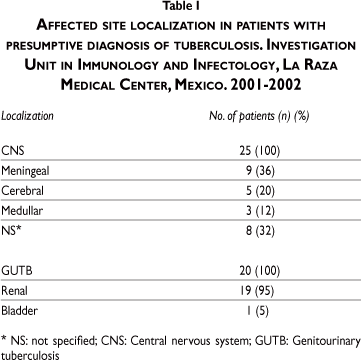
<body><![CDATA[<p><font face="Verdana, Arial, Helvetica, sans-serif" size="2">ETB represents    an even greater diagnostic problem than PTB because it presents with less frequency    and occurs with little liberation of bacilli, as well as the fact that it is    localized in sites that are difficult to access. This combination of situations    gives rise to a difficulty in bacteriologic confirmation, thus implying more    invasive procedures for sample obtention.<sup>16</sup> Due to the relatively    low number of cases,<sup>17</sup> diagnosis of ETB is initially omitted and    clinical signs remain undetected by the majority of clinics.<sup>18</sup></font></p>     <p><font face="Verdana, Arial, Helvetica, sans-serif" size="2">Concerning tuberculous    meningitis (TBM), this disease develops with greater frequency when a meningeal    calcification or a sub-cortical focus (Rich focus) discharges its contents into    the subarachnoidal space. It is known that TBM is often accompanied by miliary    TB, but the interrelationship between the development of Rich focus and miliary    TB continues to be controversial.<sup>19,20</sup> Conventional bacteriologic    methods rarely detect MTB in cerebrospinal fluid (CSF) and are, thus, of limited    use in TBM diagnosis; TBM's suggestive clinical characteristics are frequently    supported by indirect evidence, such as CSF examination and computed tomography    (CT) of the head.<sup>21</sup></font></p>     <p><font face="Verdana, Arial, Helvetica, sans-serif" size="2">Genitourinary TB    (GUTB) continues to be a serious diagnostic problem for the microbiological    laboratory, because the World Health Organization (WHO) has proscribed performing    bacilloscopy in urine due to its low specificity, since acid fast bacilli (AFB)    are environmental saprophytes. In addition, in developing countries such as    Mexico the use of the culture is unfortunately not accessible at all clinical    care levels.<b><sup>22</sup></b></font></p>     <p><font face="Verdana, Arial, Helvetica, sans-serif" size="2">Due to the previously    mentioned situations, the objective of the present study was to evaluate the    clinical usefulness and optimization of PCR for rapid molecular diagnosis of    extrapulmonary tuberculosis.</font></p>     <p>&nbsp;</p>     <p><font face="Verdana, Arial, Helvetica, sans-serif" size="3"><b>Materials and    Methods</b></font></p>     <p><font face="Verdana, Arial, Helvetica, sans-serif" size="2">The study was approved    by the Ethics Committee at the Infectology Hospital at "La Raza" Medical Center    and all participants gave written informed consent. We performed the nested    PCR test on extrapulmonary samples from 45 patients from January 2001 to August    2002. We then carried out a retrospective study based on data obtained from    the Clinical Microbiology Laboratory and a review of patient files. These patients    were seen at the Mexican Institute of Social Security's (IMSS) La Raza Medical    Center in Mexico City, a tertiary-level hospital that generally cares for patients    with chronic illnesses. We reviewed clinical annotations on patients from 10    days after the request date for the PCR to analyze its impact on patient management.    Similarly, we reviewed later clinical annotations to decide whether the final    diagnosis of the case was or was not TB, considering the treating physician's    clinic as the gold standard, including treatment response. In this respect,    we determined the usefulness of PCR with regard to confirmation of the clinical    suspicion, diagnostic support, treatment restoration in the case of a positive    test, and compatibility with the remainder of laboratory and medical office    examinations. All suspected ETB patients were considered as confirmed cases    (positive culture or AFB smear), highly probable cases (meeting all the clinical    criteria and with all supporting evidences being positive, but having no bacterial    isolation) and cases without TB.</font></p>     <p><font face="Verdana, Arial, Helvetica, sans-serif" size="2">We studied 25 samples    from the cerebrospinal fluid (CSF) of patients with tuberculosis of the central    nervous system (CNS) and 20 samples of urine from patients with GUTB.</font></p>     <p><font face="Verdana, Arial, Helvetica, sans-serif" size="2"><i>Polymerase chain    reaction (PCR):</i> the mycobacterial strain utilized as a positive control    was <i>M. tuberculosis</i> H37Rv. The DNA was isolated with guanidine isothiocyanate    and phenol utilizing 500 </font><font size="2">&#956;</font><font face="Verdana, Arial, Helvetica, sans-serif" size="2">l of the TRIzol reagent    (Gibco BRL) according to the procedure described by Chomczynski.<sup>23</sup>    The specimens were also processed in the same way. The DNA was resuspended in    50 </font><font size="2">&#956;</font><font face="Verdana, Arial, Helvetica, sans-serif" size="2">l of distilled water after precipitation with    ethanol at 75%. This solution was heated at 55 ºC for 20 min. We determined    its absorbance relationship at 260/280 nm and took 5 </font><font size="2">&#956;</font><font face="Verdana, Arial, Helvetica, sans-serif" size="2">l    for amplification by PCR of genes coding for the 32-kDa protein,<sup>24</sup>    the MTP40 species-specific protein<sup>25</sup> and the IS6110 sequence insertion.<sup>26</sup>    The initiator sequences employed for amplifying the species-specific gene were    PT1 (5'CGG CAA CGC GCC GTC GGT GG) and PT2 (5'CCC CCC ACG GCA CCG CCG GG), with    a resulting fragment of 396 bp.<sup>27</sup> For IS6110 insertion-element amplification,    the specific MercatoBenzoThiazole (MBT)-complex initiators were IS5 (5'CGG AGA    CGG TGC GTA AGT GG) and IS6 (5'GAT GGA CCG CCA GGG CTT GC), with a 984-bp amplification    fragment. The specific initiators for amplifying the gene coding for the antigen    </font><font size="2">&#945;</font><font face="Verdana, Arial, Helvetica, sans-serif" size="2"> of 32-kDa present in all described mycobacteria    (genus-specific) were MT1 (5'TTC CTG ACC AGC GAG CTG CCG) and MT2 (5'CCC CAG    TAC TCC CAG CTG TGC), with a 506-bp amplification fragment.<sup>28-31</sup>    All reactions were taken to a final volume of 50 </font><font size="2">&#956;</font><font face="Verdana, Arial, Helvetica, sans-serif" size="2">l    containing 100 ng of purified DNA from the reference strain as well as from    each clinical specimen, reaction buffer 1X, 2.5 U of Taq polymerase, 0.2 mM    of each triphosphate deoxynucleoside, and 20 pM of each of the three pairs of    initiators. The reaction was carried out in a thermocycler (Biometra). Cycles    included initial denaturation at 94 ºC for 5 min, followed by 35 repeated denaturation    cycles at 94 ºC for 1 min, annealing at 71 ºC for 2 min, and extension at 72    ºC for 3 min. Subsequently, a final extension was carried out at 72 ºC for 10    min.</font></p>     <p><font face="Verdana, Arial, Helvetica, sans-serif" size="2">To increase amplification    sensitivity, we performed nested PCR, amplifying an internal segment of the    specific gene designed by Del Portillo;<sup>27</sup> internal initiators in    the second PCR corresponded to nucleosides 44-65 (PT3, 5'-CAC CAC GTT AGG GAT    GCA CTG C-3') and 244-265 (PT4, 5'-CTG ATG GTC TCC GAC ACG TTC G-3'), which    amplified the 223-bp internal region.<sup>32</sup> For this second step, we    took 5 </font><font size="2">&#956;</font><font face="Verdana, Arial, Helvetica, sans-serif" size="2">l of the multiplex PCR product and transferred    this into 45 ml of the pre-mixed solution containing the PCR regents at the    same previously described concentration.<sup>24</sup> Amplification was repeated    for 30 cycles with the same time and temperature parameters as described previously,    except for an annealing at 75 ºC for 2 min, an extension at 72 ºC for 2 min,    and a final extension at 72 ºC for 7 min. After the 1/10 amplification of the    PCR reaction mixture, this was analyzed by electrophoresis in agarose at 1.5%    containing 0.5 </font><font size="2">&#956;</font><font face="Verdana, Arial, Helvetica, sans-serif" size="2">g/ml of ethidium bromide and was    visualized with an ultraviolet (UV) transilluminator.</font></p>     ]]></body>
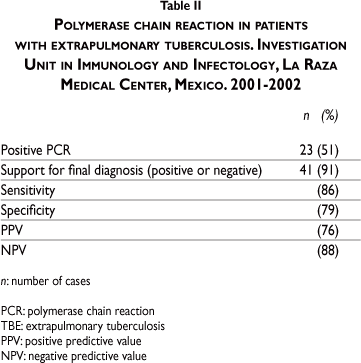
<body><![CDATA[<p><font face="Verdana, Arial, Helvetica, sans-serif" size="2"><i>Analysis</i>:    we calculated sensitivity, specificity, positive predictive value (PPV), and    negative predictive value (NPV) according to Galen &amp; Gambino,<sup>33</sup>    as compared with the treating physician's clinic, including treatment response    and the prevalence of TB in the studied population.</font></p>     <p>&nbsp;</p>     <p><font face="Verdana, Arial, Helvetica, sans-serif" size="3"><b>Results</b></font></p>     <p><font face="Verdana, Arial, Helvetica, sans-serif" size="2">With regard to    patients with a presumptive diagnosis of ETB, TB of the central nervous system    (CNS) was present in 25 (49%), specifying cerebral affectation in five patients    (9.8%), medullar in three (6%), meningeal in nine (18), unspecified in eight    (17%), GUTB in 20 (39%) patients, renal-level in 19 (37%), and gall bladder    in one (2%) patient (<a href="#t1">Table I</a>).</font></p>     <p><a name="t1"></a></p>     <p>&nbsp;</p>     <p align="center"><img src="/img/revistas/spm/v51n3/15t1.gif"></p>     <p>&nbsp;</p>     <p><font face="Verdana, Arial, Helvetica, sans-serif" size="2">Of these previously    mentioned cases, ETB diagnosis was confirmed in 25 (56%) patients by their clinical    picture, including the treatment and culture, acid fast bacilli and medical    office studies. Among PCR results, 23 (51%) positive tests were reported. The    clinic considered that the PCR result supported the final diagnosis (whether    positive or negative) in 41 (91%) patients. PCR sensitivity for diagnosing ETB    was 86%, specificity was 79%, PPV was 76%, and NPV, 88% (<a href="#t2">Table    II</a>).</font></p>     <p><a name="t2"></a></p>     ]]></body>
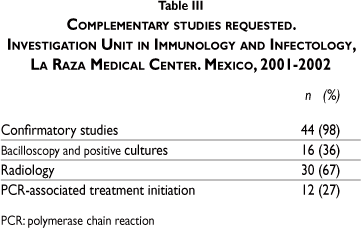
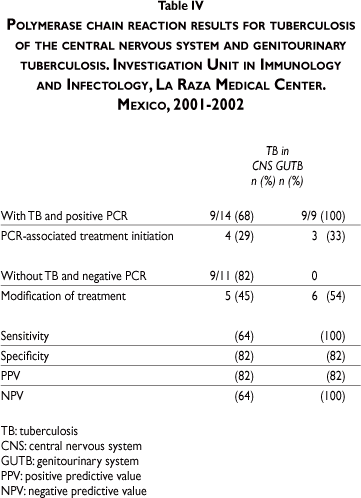
<body><![CDATA[<p>&nbsp;</p>     <p align="center"><img src="/img/revistas/spm/v51n3/15t2.gif"></p>     <p>&nbsp;</p>     <p><font face="Verdana, Arial, Helvetica, sans-serif" size="2">Confirmatory studies    were requested in 44 (98%) patients; positive bacilloscopy and culture were    found in sixteen (36%) patients and a positive radiologic study finding was    observed in 30 (67%) patients. PCR result-based treatment was initiated in twelve    (27%) patients (<a href="#t3">Table III</a>).</font></p>     <p><a name="t3"></a></p>     <p>&nbsp;</p>     <p align="center"><img src="/img/revistas/spm/v51n3/15t3.gif"></p>     <p>&nbsp;</p>     <p><font face="Verdana, Arial, Helvetica, sans-serif" size="2">To evaluate clinical    usefulness, we documented the PCR result and the treating physician's final    decision for initiating treatment, as well as the result obtained case-by-case.    Of the 25 patients with presumptive diagnosis of TB in CNS, only 14 were finally    considered as positive for TB; of these, nine (68%) presented positive results    with PCR and treatment was initiated based on these results in four (29%) patients.    Nonetheless, in five (38%) cases with high clinical suspicion, treatment was    initiated despite negative results by PCR. Finally, TB diagnosis was discarded    in 11 patients, nine (82%) of whom had negative results by PCR, with treatment    modification based on these results in five (45%). One (9%) false positive result    was reported in which the patient had a diagnosis of HIV and Hodgkin lymphoma    (<a href="#t4">Table IV</a>).</font></p>     <p><a name="t4"></a></p>     ]]></body>
<body><![CDATA[<p>&nbsp;</p>     <p align="center"><img src="/img/revistas/spm/v51n3/15t4.gif"></p>     <p>&nbsp;</p>     <p><font face="Verdana, Arial, Helvetica, sans-serif" size="2">Regarding PCR test    in urine, we analyzed 20 cases; of these, nine were finally considered as positive    for TB and all presented positive results by PCR, with three (33%) initiating    treatment based on this result. In cases considered negative, initial treatment    was modified based on the PCR result in six (54%) patients. Two false positives    occurred due to presenting negative cultures and these patients were found to    be asymptomatic (<a href="#t4">Table IV</a>).</font></p>     <p><font face="Verdana, Arial, Helvetica, sans-serif" size="2">Six patients presented    a positive culture in CSF and only two in urine. The patients' evolution with    presumptive diagnosis but without bacteriologic confirmation was clinically    toward tuberculous disease.</font></p>     <p><font face="Verdana, Arial, Helvetica, sans-serif" size="2">For renal TB, abdominal    radiographs, intravenous urography, retrograde pyelography and computed tomography    (CT) demonstrated various patterns of calcifications, including amorphous, granular    and lobar patterns.</font></p>     <p>&nbsp;</p>     <p><font face="Verdana, Arial, Helvetica, sans-serif" size="3"><b>Discussion</b></font></p>     <p><font face="Verdana, Arial, Helvetica, sans-serif" size="2">The clinical presentation    of ETB is frequently atypical; tissue samples for confirmation of the diagnosis    can be difficult to obtain on some occasions, and conventional diagnostic methods    possess low sensitivity. The availability of CT, magnetic resonance (MR), and    endoscopy aid greatly in anatomic localization.<sup>34</sup></font></p>     <p><font face="Verdana, Arial, Helvetica, sans-serif" size="2">Our study coincided    with the literature, finding only 36% of cases of ETB with a positive culture.    This information is useful retrospectively because several weeks are necessary    for the culture to develop.<sup>35</sup> In the present study, PCR exhibited    greater sensitivity than microscopy and the culture, and could facilitate therapeutic    decisions for patients with a clinical suspicion of ETB; as was found by other    authors.<sup>36-38</sup></font></p>     ]]></body>
<body><![CDATA[<p><font face="Verdana, Arial, Helvetica, sans-serif" size="2">For diagnosis of    GUTB, although a high index for clinical suspicion is necessary,<sup>39</sup>    PCR can be useful for cases in which bacteriologic and clinical diagnoses of    TB are not conclusive.<sup>40</sup> We found PCR to be a very rapid diagnostic    method for GUTB. It was sensitive, specific, and prevented waiting to initiate    treatment because the sensitivity, specificity, PPV, and NPV for ETB were 76,    84, 82, and 78%, respectively; on analyzing only urine samples sensitivity and    NPV rose to 100%.</font></p>     <p><font face="Verdana, Arial, Helvetica, sans-serif" size="2">In our study, nested    PCR dramatically increased sensitivity and specificity of DNA amplification    over the conventional single-step PCR, in that initial multiplex PCR did not    detect any sample as positive. The fact that amplification by nested PCR improves    sensitivity and specificity renders it necessary for rapid diagnosis of ETB    in the clinical laboratory.<sup>41, 42</sup></font></p>     <p><font face="Verdana, Arial, Helvetica, sans-serif" size="2">In Mexico, there    are very few studies that have detected the usefulness of PCR in ETB. Our data    are in agreement with some,<sup>43, 44</sup> while a discrepancy exists with    another.<sup>45</sup></font></p>     <p><font face="Verdana, Arial, Helvetica, sans-serif" size="2">Rapid molecular    diagnostic tests for PTB influences decisions concerning the initiation of antituberculosis    therapy (antiTB) depending on the clinical suspicion. This includes patients    for whom bacilloscopy is positive but clinical suspicion is intermediate or    low, and patients for whom bacilloscopy is negative but clinical suspicion of    PTB is high or intermediate.</font></p>     <p><font face="Verdana, Arial, Helvetica, sans-serif" size="2">Nevertheless, in    the area in which clinical data are most scarce -molecular diagnosis in non-respiratory    samples such as sterile body fluids (especially urine, CSF, and pleural fluids),    and gastric and tissue aspirates including formalin-fixed samples- participation    is required by multiple institutions to carry out an optimal clinical study    design to evaluate PCR in extrapulmonary samples. Protocols should be developed    to standardize sample processing with a sufficient number of protocols at each    site to obtain an adequate quantity of positive results and to be able to validate    these.<sup>46,47</sup></font></p>     <p><font face="Verdana, Arial, Helvetica, sans-serif" size="2">In conclusion,    even though this is a preliminary study, our results permitted us to claim the    usefulness of this fast and reliable diagnostic procedure as an important tool    against TB when used together with the clinical data available. Rapid molecular    diagnosis of ETB in our environment possesses adequate efficiency, which improves    when it is carried out in urine. The PCR result exerted an acceptable impact    on the clinical management of these patients. At present we are evaluating a    larger number of clinical samples, comparing these with cultures such as the    gold standard.</font></p>     <p>&nbsp;</p>     <p><font face="Verdana, Arial, Helvetica, sans-serif" size="3"><b>References</b></font></p>     <p><font face="Verdana, Arial, Helvetica, sans-serif" size="2">1. Murray PR, Rosenthal    KS, Kobayashi GS. Medical Microbiology. 5th ed. Philadelphia (PA): Elsevier-    Mosby, 2005.</font></p>     <!-- ref --><p><font face="Verdana, Arial, Helvetica, sans-serif" size="2">2. Middlebrook    G, Riggiardo Z, Tiggertt W. Automatable radiometric detection of growth of <i>M.    tuberculosis</i> in selective media. Am Rev Resp Dis 1977;115:1066.</font>&nbsp;&nbsp;&nbsp;&nbsp;&nbsp;&nbsp;&nbsp;&nbsp;[&#160;<a href="javascript:void(0);" onclick="javascript: window.open('/scielo.php?script=sci_nlinks&ref=9275042&pid=S0036-3634200900030001500002&lng=','','width=640,height=500,resizable=yes,scrollbars=1,menubar=yes,');">Links</a>&#160;]<!-- end-ref --><!-- ref --><p><font face="Verdana, Arial, Helvetica, sans-serif" size="2">3. Anargyros P,    Astill DS, Lim IS. Comparison of improved BACTEC and L-J media for culture of    Mycobacteria from clinical specimens. J Clin Microbiol 1990;28:1288-1291.</font>&nbsp;&nbsp;&nbsp;&nbsp;&nbsp;&nbsp;&nbsp;&nbsp;[&#160;<a href="javascript:void(0);" onclick="javascript: window.open('/scielo.php?script=sci_nlinks&ref=9275043&pid=S0036-3634200900030001500003&lng=','','width=640,height=500,resizable=yes,scrollbars=1,menubar=yes,');">Links</a>&#160;]<!-- end-ref --><!-- ref --><p><font face="Verdana, Arial, Helvetica, sans-serif" size="2">4. Kaneko K, Onodera    O, Miyatake T, Tsuji S. Rapid diagnosis of tuberculous meningitis by polymerase    chain reaction (PCR). Neurology 1990;40:1617-1618.</font>&nbsp;&nbsp;&nbsp;&nbsp;&nbsp;&nbsp;&nbsp;&nbsp;[&#160;<a href="javascript:void(0);" onclick="javascript: window.open('/scielo.php?script=sci_nlinks&ref=9275044&pid=S0036-3634200900030001500004&lng=','','width=640,height=500,resizable=yes,scrollbars=1,menubar=yes,');">Links</a>&#160;]<!-- end-ref --><!-- ref --><p><font face="Verdana, Arial, Helvetica, sans-serif" size="2">5. Bhigjee AI,    Padayachee R, Paruk H, Hallwirth-Pillay KD, Marais S, Connoly C. Diagnosis of    tuberculous meningitis: clinical and laboratory parameters. Int J Infect Dis    2007;11:348-354.</font>&nbsp;&nbsp;&nbsp;&nbsp;&nbsp;&nbsp;&nbsp;&nbsp;[&#160;<a href="javascript:void(0);" onclick="javascript: window.open('/scielo.php?script=sci_nlinks&ref=9275045&pid=S0036-3634200900030001500005&lng=','','width=640,height=500,resizable=yes,scrollbars=1,menubar=yes,');">Links</a>&#160;]<!-- end-ref --><!-- ref --><p><font face="Verdana, Arial, Helvetica, sans-serif" size="2">6. Desaid D, Nataraj    G, Kulkarni S, Bichile L, Mehta P, Baveja S, <i>et al</i>. Utility of the polymerase    chain reaction in the diagnosis of tuberculous meningitis. Res Microbiol 2006;157(10):967-970.</font>&nbsp;&nbsp;&nbsp;&nbsp;&nbsp;&nbsp;&nbsp;&nbsp;[&#160;<a href="javascript:void(0);" onclick="javascript: window.open('/scielo.php?script=sci_nlinks&ref=9275046&pid=S0036-3634200900030001500006&lng=','','width=640,height=500,resizable=yes,scrollbars=1,menubar=yes,');">Links</a>&#160;]<!-- end-ref --><!-- ref --><p><font face="Verdana, Arial, Helvetica, sans-serif" size="2">7. Gopi A, Madhavan    SM, Sharma SK, Sahn SA. Diagnosis and treatment of tuberculous pleural effusion    in 2006. Chest 2007;131:880.</font>&nbsp;&nbsp;&nbsp;&nbsp;&nbsp;&nbsp;&nbsp;&nbsp;[&#160;<a href="javascript:void(0);" onclick="javascript: window.open('/scielo.php?script=sci_nlinks&ref=9275047&pid=S0036-3634200900030001500007&lng=','','width=640,height=500,resizable=yes,scrollbars=1,menubar=yes,');">Links</a>&#160;]<!-- end-ref --><!-- ref --><p><font face="Verdana, Arial, Helvetica, sans-serif" size="2">8. Caws M, Wilson    SM, Clough C, Drobniewski F. Role of IS6110-targeted PCR, culture, biochemical,    clinical, and immunological criteria for diagnosis of tuberculous meningitis.    J Clin Microbiol 2000;38:3150-3155.</font>&nbsp;&nbsp;&nbsp;&nbsp;&nbsp;&nbsp;&nbsp;&nbsp;[&#160;<a href="javascript:void(0);" onclick="javascript: window.open('/scielo.php?script=sci_nlinks&ref=9275048&pid=S0036-3634200900030001500008&lng=','','width=640,height=500,resizable=yes,scrollbars=1,menubar=yes,');">Links</a>&#160;]<!-- end-ref --><!-- ref --><p><font face="Verdana, Arial, Helvetica, sans-serif" size="2">9. Juan RS, S&aacute;nchez-Su&aacute;rez    C, Rebollo MJ, Folgueira D, Palenque E, Ortu&ntilde;o B, <i>et al</i>. Interferon    gamma quantification in cerebrospinal fluid compared with PCR for the diagnosis    of tuberculous meningitis. J Neurol 2006;253(10):1323-1330.</font>&nbsp;&nbsp;&nbsp;&nbsp;&nbsp;&nbsp;&nbsp;&nbsp;[&#160;<a href="javascript:void(0);" onclick="javascript: window.open('/scielo.php?script=sci_nlinks&ref=9275049&pid=S0036-3634200900030001500009&lng=','','width=640,height=500,resizable=yes,scrollbars=1,menubar=yes,');">Links</a>&#160;]<!-- end-ref --><!-- ref --><p><font face="Verdana, Arial, Helvetica, sans-serif" size="2">10. Neggi SS, Anand    R, Pasha ST, Gupta S, Basir SF, Khare S, <i>et al</i>. Diagnostic potential    of IS6110, 38kDa, 65kDa and 85B sequence-based polymerase chain reaction in    the diagnosis of <i>Mycobacterium tuberculosis</i> in clinical samples. Indian    J Med Microbiol 2007;25:43.</font>&nbsp;&nbsp;&nbsp;&nbsp;&nbsp;&nbsp;&nbsp;&nbsp;[&#160;<a href="javascript:void(0);" onclick="javascript: window.open('/scielo.php?script=sci_nlinks&ref=9275050&pid=S0036-3634200900030001500010&lng=','','width=640,height=500,resizable=yes,scrollbars=1,menubar=yes,');">Links</a>&#160;]<!-- end-ref --><!-- ref --><p><font face="Verdana, Arial, Helvetica, sans-serif" size="2">11. Rafi W, Venkataswamy    MM, Ravi V, Chandramuki A. Rapid diagnosis of tuberculous meningitis: A comparative    evaluation of in-house PCR assays involving three mycobacterial DNA sequences,    IS6110, MPB-64 and 65 kDa antigen. J Neurol Sci 2007;252:163-168.</font>&nbsp;&nbsp;&nbsp;&nbsp;&nbsp;&nbsp;&nbsp;&nbsp;[&#160;<a href="javascript:void(0);" onclick="javascript: window.open('/scielo.php?script=sci_nlinks&ref=9275051&pid=S0036-3634200900030001500011&lng=','','width=640,height=500,resizable=yes,scrollbars=1,menubar=yes,');">Links</a>&#160;]<!-- end-ref --><!-- ref --><p><font face="Verdana, Arial, Helvetica, sans-serif" size="2">12. Rafi W, Venkataswamy    MM, Nagarathna S, Satischandra P, Chandramuki A. Role of IS6110 uniplex PCR    in the diagnosis of tuberculous meningitis: experience at a tertiary neurocentre.    Int J Tuberc Lung Dis 2007;11:209-214.</font>&nbsp;&nbsp;&nbsp;&nbsp;&nbsp;&nbsp;&nbsp;&nbsp;[&#160;<a href="javascript:void(0);" onclick="javascript: window.open('/scielo.php?script=sci_nlinks&ref=9275052&pid=S0036-3634200900030001500012&lng=','','width=640,height=500,resizable=yes,scrollbars=1,menubar=yes,');">Links</a>&#160;]<!-- end-ref --><!-- ref --><p><font face="Verdana, Arial, Helvetica, sans-serif" size="2">13. Chakravorty    S, Sen MK, Tyagy JS. Diagnosis of extrapulmonary tuberculosis by smear, culture,    and PCR using universal sample processing technology. J Clin Microbiol 2005;43:4357-4362.</font>&nbsp;&nbsp;&nbsp;&nbsp;&nbsp;&nbsp;&nbsp;&nbsp;[&#160;<a href="javascript:void(0);" onclick="javascript: window.open('/scielo.php?script=sci_nlinks&ref=9275053&pid=S0036-3634200900030001500013&lng=','','width=640,height=500,resizable=yes,scrollbars=1,menubar=yes,');">Links</a>&#160;]<!-- end-ref --><!-- ref --><p><font face="Verdana, Arial, Helvetica, sans-serif" size="2">14. Stephen P,    Sharon L, Catanzaro A. Clinical efficacy of amplified <i>M. tuberculosis</i>    direct test for the diagnosis of pulmonary tuberculosis. Am J Respir Crit Care    Med 1996;153:1606-1610.</font>&nbsp;&nbsp;&nbsp;&nbsp;&nbsp;&nbsp;&nbsp;&nbsp;[&#160;<a href="javascript:void(0);" onclick="javascript: window.open('/scielo.php?script=sci_nlinks&ref=9275054&pid=S0036-3634200900030001500014&lng=','','width=640,height=500,resizable=yes,scrollbars=1,menubar=yes,');">Links</a>&#160;]<!-- end-ref --><!-- ref --><p><font face="Verdana, Arial, Helvetica, sans-serif" size="2">15. Barnes P. Rapid    diagnostic test of tuberculosis: progress but no gold standard. Am J Respir    Crit Care Med 1997;155:1497-1498.</font>&nbsp;&nbsp;&nbsp;&nbsp;&nbsp;&nbsp;&nbsp;&nbsp;[&#160;<a href="javascript:void(0);" onclick="javascript: window.open('/scielo.php?script=sci_nlinks&ref=9275055&pid=S0036-3634200900030001500015&lng=','','width=640,height=500,resizable=yes,scrollbars=1,menubar=yes,');">Links</a>&#160;]<!-- end-ref --><!-- ref --><p><font face="Verdana, Arial, Helvetica, sans-serif" size="2">16. American Thoracic    Society. Diagnostic standards and classification of tuberculosis in adults and    children. Am J Respir Crit Care Med 2000;161:1376-1395.</font>&nbsp;&nbsp;&nbsp;&nbsp;&nbsp;&nbsp;&nbsp;&nbsp;[&#160;<a href="javascript:void(0);" onclick="javascript: window.open('/scielo.php?script=sci_nlinks&ref=9275056&pid=S0036-3634200900030001500016&lng=','','width=640,height=500,resizable=yes,scrollbars=1,menubar=yes,');">Links</a>&#160;]<!-- end-ref --><!-- ref --><p><font face="Verdana, Arial, Helvetica, sans-serif" size="2">17. Centers for    Disease Control and Prevention: Reported Tuberculosis in the United States.    1997. Atlanta (GA): Centers for Disease Control and Prevention, 1998.</font>&nbsp;&nbsp;&nbsp;&nbsp;&nbsp;&nbsp;&nbsp;&nbsp;[&#160;<a href="javascript:void(0);" onclick="javascript: window.open('/scielo.php?script=sci_nlinks&ref=9275057&pid=S0036-3634200900030001500017&lng=','','width=640,height=500,resizable=yes,scrollbars=1,menubar=yes,');">Links</a>&#160;]<!-- end-ref --><!-- ref --><p><font face="Verdana, Arial, Helvetica, sans-serif" size="2">18. Ozkutuk A,    Kirdar S, Ozden S, Esen N. Evaluation of Cobas Amplicor MTB test to detect <i>Mycobacterium    tuberculosis</i> in pulmonary and extrapulmonary specimens. New Microbiol 2006;29:269-273.</font>&nbsp;&nbsp;&nbsp;&nbsp;&nbsp;&nbsp;&nbsp;&nbsp;[&#160;<a href="javascript:void(0);" onclick="javascript: window.open('/scielo.php?script=sci_nlinks&ref=9275058&pid=S0036-3634200900030001500018&lng=','','width=640,height=500,resizable=yes,scrollbars=1,menubar=yes,');">Links</a>&#160;]<!-- end-ref --><!-- ref --><p><font face="Verdana, Arial, Helvetica, sans-serif" size="2">19. Delgado-Morales    M, Ch&aacute;vez-Mac&iacute;as LG, Olvera-Rabiela JE, L&oacute;pez-Luna J, Carrera-Gonz&aacute;lez    E, Manrique-Ortega J. Algunos datos de la neurotuberculosis obtenidos de la    revisi&oacute;n de 13 689 autopsias. Patologia 1992;30:139-143.</font>&nbsp;&nbsp;&nbsp;&nbsp;&nbsp;&nbsp;&nbsp;&nbsp;[&#160;<a href="javascript:void(0);" onclick="javascript: window.open('/scielo.php?script=sci_nlinks&ref=9275059&pid=S0036-3634200900030001500019&lng=','','width=640,height=500,resizable=yes,scrollbars=1,menubar=yes,');">Links</a>&#160;]<!-- end-ref --><!-- ref --><p><font face="Verdana, Arial, Helvetica, sans-serif" size="2">20. Donald PR,    Schaaf HS, Schoeman JF. Tuberculous meningitis and miliary tuberculosis: the    Rich focus revisited. J Infect 2005:50:193-195.</font>&nbsp;&nbsp;&nbsp;&nbsp;&nbsp;&nbsp;&nbsp;&nbsp;[&#160;<a href="javascript:void(0);" onclick="javascript: window.open('/scielo.php?script=sci_nlinks&ref=9275060&pid=S0036-3634200900030001500020&lng=','','width=640,height=500,resizable=yes,scrollbars=1,menubar=yes,');">Links</a>&#160;]<!-- end-ref --><!-- ref --><p><font face="Verdana, Arial, Helvetica, sans-serif" size="2">21. Seth P, Ahuja    GK, Bhanu NV, Behari M, Bhowmik S, Broor S, <i>et al</i>. Evaluation of polymerase    chain reaction for rapid diagnosis of clinically suspected tuberculous meningitis.    Tuber Lung Dis 1996;77: 353-357.</font>&nbsp;&nbsp;&nbsp;&nbsp;&nbsp;&nbsp;&nbsp;&nbsp;[&#160;<a href="javascript:void(0);" onclick="javascript: window.open('/scielo.php?script=sci_nlinks&ref=9275061&pid=S0036-3634200900030001500021&lng=','','width=640,height=500,resizable=yes,scrollbars=1,menubar=yes,');">Links</a>&#160;]<!-- end-ref --><!-- ref --><p><font face="Verdana, Arial, Helvetica, sans-serif" size="2">22. Norma Oficial    Mexicana. NOM-006-SSA2-1993. Para la prevenci&oacute;n y control de la tuberculosis    en la atenci&oacute;n primaria a la salud. Mexico: Secretary of Health, 1993.</font>&nbsp;&nbsp;&nbsp;&nbsp;&nbsp;&nbsp;&nbsp;&nbsp;[&#160;<a href="javascript:void(0);" onclick="javascript: window.open('/scielo.php?script=sci_nlinks&ref=9275062&pid=S0036-3634200900030001500022&lng=','','width=640,height=500,resizable=yes,scrollbars=1,menubar=yes,');">Links</a>&#160;]<!-- end-ref --><!-- ref --><p><font face="Verdana, Arial, Helvetica, sans-serif" size="2">23. Chomczynski    P. A reagent for the single-step simultaneous isolation of RNA, DNA and proteins    from cell and tissue samples. Biotechniques 1993; 15:532-537.</font>&nbsp;&nbsp;&nbsp;&nbsp;&nbsp;&nbsp;&nbsp;&nbsp;[&#160;<a href="javascript:void(0);" onclick="javascript: window.open('/scielo.php?script=sci_nlinks&ref=9275063&pid=S0036-3634200900030001500023&lng=','','width=640,height=500,resizable=yes,scrollbars=1,menubar=yes,');">Links</a>&#160;]<!-- end-ref --><!-- ref --><p><font face="Verdana, Arial, Helvetica, sans-serif" size="2">24. Borremans,    M, de Wit L, Volckaert G, Ooms J, de Bruyn J, Huygen K, van Vooren JP, Stelandre    M, Verhofstadt R, Content J, <i>et al</i>. Cloning, sequence determination,    and expression of a 32-kilodalton-protein gene of <i>Mycobacterium tuberculosis</i>.    Infect Immun 1989;57:3123-3130.</font>&nbsp;&nbsp;&nbsp;&nbsp;&nbsp;&nbsp;&nbsp;&nbsp;[&#160;<a href="javascript:void(0);" onclick="javascript: window.open('/scielo.php?script=sci_nlinks&ref=9275064&pid=S0036-3634200900030001500024&lng=','','width=640,height=500,resizable=yes,scrollbars=1,menubar=yes,');">Links</a>&#160;]<!-- end-ref --><!-- ref --><p><font face="Verdana, Arial, Helvetica, sans-serif" size="2">25. Parra CA, Londo&ntilde;o    LP, Del Portillo P, Patarroyo ME. Isolation, characterization, and molecular    cloning of a specific <i>Mycobacterium tuberculosis</i> antigen gene: identification    of a species-specific sequence. Infect Immun 1991;59:3411-3417.</font>&nbsp;&nbsp;&nbsp;&nbsp;&nbsp;&nbsp;&nbsp;&nbsp;[&#160;<a href="javascript:void(0);" onclick="javascript: window.open('/scielo.php?script=sci_nlinks&ref=9275065&pid=S0036-3634200900030001500025&lng=','','width=640,height=500,resizable=yes,scrollbars=1,menubar=yes,');">Links</a>&#160;]<!-- end-ref --><!-- ref --><p><font face="Verdana, Arial, Helvetica, sans-serif" size="2">26. Thierry D,    Brisson-Noel A, Vincent-Levy-Frebault V, Nguyen S, Guesdon JL, Gicquel B. Characterization    of a <i>Mycobacterium tuberculosis</i> insertion sequence, IS6110, and its application    in diagnosis. J Clin Microbiol 1990;28:2668-2673.</font>&nbsp;&nbsp;&nbsp;&nbsp;&nbsp;&nbsp;&nbsp;&nbsp;[&#160;<a href="javascript:void(0);" onclick="javascript: window.open('/scielo.php?script=sci_nlinks&ref=9275066&pid=S0036-3634200900030001500026&lng=','','width=640,height=500,resizable=yes,scrollbars=1,menubar=yes,');">Links</a>&#160;]<!-- end-ref --><!-- ref --><p><font face="Verdana, Arial, Helvetica, sans-serif" size="2">27. Del Portillo    P, Murillo LA, Patarroyo ME. Amplification of a species-specific DNA fragment    of <i>Mycobacterium tuberculosis</i> and its possible use in diagnosis. J Clin    Microbiol 1991;29:2163-2168.</font>&nbsp;&nbsp;&nbsp;&nbsp;&nbsp;&nbsp;&nbsp;&nbsp;[&#160;<a href="javascript:void(0);" onclick="javascript: window.open('/scielo.php?script=sci_nlinks&ref=9275067&pid=S0036-3634200900030001500027&lng=','','width=640,height=500,resizable=yes,scrollbars=1,menubar=yes,');">Links</a>&#160;]<!-- end-ref --><!-- ref --><p><font face="Verdana, Arial, Helvetica, sans-serif" size="2">28. Kitaura H,    Ohara N, Matsuo T, Tasaka H, Kobayashi K, Yamada T. Cloning, sequencing and    expression of the gene for alpha antigen from <i>Mycobacterium intracellulare</i>    and use of PCR for the rapid identification of <i>Mycobacterium intracellulare.</i>    Biochem Biophys Res Commun 1993;196:1466-1473.</font>&nbsp;&nbsp;&nbsp;&nbsp;&nbsp;&nbsp;&nbsp;&nbsp;[&#160;<a href="javascript:void(0);" onclick="javascript: window.open('/scielo.php?script=sci_nlinks&ref=9275068&pid=S0036-3634200900030001500028&lng=','','width=640,height=500,resizable=yes,scrollbars=1,menubar=yes,');">Links</a>&#160;]<!-- end-ref --><!-- ref --><p><font face="Verdana, Arial, Helvetica, sans-serif" size="2">29. Matsuo K, Yamaguchi    R, Yamazaki A, Tasaka H, Terasaka K, Yamada T. Cloning and expression of the    gene for the cross-reactive alpha antigen of <i>Mycobacterium kansasii</i>.    Infect Immun 1990;58:550-556.</font>&nbsp;&nbsp;&nbsp;&nbsp;&nbsp;&nbsp;&nbsp;&nbsp;[&#160;<a href="javascript:void(0);" onclick="javascript: window.open('/scielo.php?script=sci_nlinks&ref=9275069&pid=S0036-3634200900030001500029&lng=','','width=640,height=500,resizable=yes,scrollbars=1,menubar=yes,');">Links</a>&#160;]<!-- end-ref --><!-- ref --><p><font face="Verdana, Arial, Helvetica, sans-serif" size="2">30. Matsuo K, Yamaguchi    R, Yamazaki A, Tasaka H, Yamada T. Cloning and expression of the <i>Mycobacterium    bovis</i> BCG gene for extracellular alpha antigen. J Bacteriol 1988;170:3847-3854.</font>&nbsp;&nbsp;&nbsp;&nbsp;&nbsp;&nbsp;&nbsp;&nbsp;[&#160;<a href="javascript:void(0);" onclick="javascript: window.open('/scielo.php?script=sci_nlinks&ref=9275070&pid=S0036-3634200900030001500030&lng=','','width=640,height=500,resizable=yes,scrollbars=1,menubar=yes,');">Links</a>&#160;]<!-- end-ref --><!-- ref --><p><font face="Verdana, Arial, Helvetica, sans-serif" size="2">31. Ohara N, Matsuo    K, Yamaguchi R, Yamazaki A, Tasaka H, Yamada T. Cloning and sequencing of the    gene for alpha antigen from <i>Mycobacterium avium</i> and mapping of B-cell    epitopes. Infect Immun 1993;61:1173-1179.</font>&nbsp;&nbsp;&nbsp;&nbsp;&nbsp;&nbsp;&nbsp;&nbsp;[&#160;<a href="javascript:void(0);" onclick="javascript: window.open('/scielo.php?script=sci_nlinks&ref=9275071&pid=S0036-3634200900030001500031&lng=','','width=640,height=500,resizable=yes,scrollbars=1,menubar=yes,');">Links</a>&#160;]<!-- end-ref --><!-- ref --><p><font face="Verdana, Arial, Helvetica, sans-serif" size="2">32. Gori A, Franzetti    F, Marchetti G, Catozzi L, Corbellino M. Specific detection of <i>Mycobacterium    tuberculosis</i> by mtp40 nested PCR. J Clin Microbiol 1996;34:2866-2867.</font>&nbsp;&nbsp;&nbsp;&nbsp;&nbsp;&nbsp;&nbsp;&nbsp;[&#160;<a href="javascript:void(0);" onclick="javascript: window.open('/scielo.php?script=sci_nlinks&ref=9275072&pid=S0036-3634200900030001500032&lng=','','width=640,height=500,resizable=yes,scrollbars=1,menubar=yes,');">Links</a>&#160;]<!-- end-ref --><!-- ref --><p><font face="Verdana, Arial, Helvetica, sans-serif" size="2">33. Galen RS, Gambino    RS. Beyond normality: the predictive value and efficiency of medical diagnosis.    New York (NY): John Wiley and Sons, 1975.</font>&nbsp;&nbsp;&nbsp;&nbsp;&nbsp;&nbsp;&nbsp;&nbsp;[&#160;<a href="javascript:void(0);" onclick="javascript: window.open('/scielo.php?script=sci_nlinks&ref=9275073&pid=S0036-3634200900030001500033&lng=','','width=640,height=500,resizable=yes,scrollbars=1,menubar=yes,');">Links</a>&#160;]<!-- end-ref --><!-- ref --><p><font face="Verdana, Arial, Helvetica, sans-serif" size="2">34. Sharma SK,    Mohan A. Extrapulmonary tuberculosis. Indian J Med Res 2004;120:316-353.</font>&nbsp;&nbsp;&nbsp;&nbsp;&nbsp;&nbsp;&nbsp;&nbsp;[&#160;<a href="javascript:void(0);" onclick="javascript: window.open('/scielo.php?script=sci_nlinks&ref=9275074&pid=S0036-3634200900030001500034&lng=','','width=640,height=500,resizable=yes,scrollbars=1,menubar=yes,');">Links</a>&#160;]<!-- end-ref --><!-- ref --><p><font face="Verdana, Arial, Helvetica, sans-serif" size="2">35. Folgueira L,    Delgado R, Palenque E, Noriega AR. Polymerase chain reaction for rapid diagnosis    of tuberculous meningitis in AIDS patients. Neurology 1994;44:1336-1338.</font>&nbsp;&nbsp;&nbsp;&nbsp;&nbsp;&nbsp;&nbsp;&nbsp;[&#160;<a href="javascript:void(0);" onclick="javascript: window.open('/scielo.php?script=sci_nlinks&ref=9275075&pid=S0036-3634200900030001500035&lng=','','width=640,height=500,resizable=yes,scrollbars=1,menubar=yes,');">Links</a>&#160;]<!-- end-ref --><!-- ref --><p><font face="Verdana, Arial, Helvetica, sans-serif" size="2">36. Nguyen LN,    Kox LF, Pham LD, Kuijper S, Kolk AH. The potential contribution of the polymerase    chain reaction to the diagnosis of tuberculous meningitis. Arch Neurol 1996;53:771-776.</font>&nbsp;&nbsp;&nbsp;&nbsp;&nbsp;&nbsp;&nbsp;&nbsp;[&#160;<a href="javascript:void(0);" onclick="javascript: window.open('/scielo.php?script=sci_nlinks&ref=9275076&pid=S0036-3634200900030001500036&lng=','','width=640,height=500,resizable=yes,scrollbars=1,menubar=yes,');">Links</a>&#160;]<!-- end-ref --><!-- ref --><p><font face="Verdana, Arial, Helvetica, sans-serif" size="2">37. Kolk AH, Kox    LF, van Leeuwen J, Kuijper S, Hansen HM. Clinical utility of the polymerase    chain reaction in the diagnosis of extrapulmonary tuberculosis. Eur Resp J 1998;11(6):1222-1226.</font>&nbsp;&nbsp;&nbsp;&nbsp;&nbsp;&nbsp;&nbsp;&nbsp;[&#160;<a href="javascript:void(0);" onclick="javascript: window.open('/scielo.php?script=sci_nlinks&ref=9275077&pid=S0036-3634200900030001500037&lng=','','width=640,height=500,resizable=yes,scrollbars=1,menubar=yes,');">Links</a>&#160;]<!-- end-ref --><!-- ref --><p><font face="Verdana, Arial, Helvetica, sans-serif" size="2">38. Conaty SJ,    Claxton AP, Enoch DA, Hayward AC, Lipman MC, Gillespie SH. The interpretation    of nucleic acid amplification tests for tuberculosis: do rapid tests change    treatment decisions? J Infect 2005;50:187-192.</font>&nbsp;&nbsp;&nbsp;&nbsp;&nbsp;&nbsp;&nbsp;&nbsp;[&#160;<a href="javascript:void(0);" onclick="javascript: window.open('/scielo.php?script=sci_nlinks&ref=9275078&pid=S0036-3634200900030001500038&lng=','','width=640,height=500,resizable=yes,scrollbars=1,menubar=yes,');">Links</a>&#160;]<!-- end-ref --><!-- ref --><p><font face="Verdana, Arial, Helvetica, sans-serif" size="2">39. Hemal AK, Gupta    NP, Rajeev TP, Kumar R, Dar L, Seth P. Polymerase chain reaction in clinically    suspected genitourinary tuberculosis: comparison with intravenous urography,    bladder biopsy, and urine acid fast bacilli. Urology 2000;56:570-574.</font>&nbsp;&nbsp;&nbsp;&nbsp;&nbsp;&nbsp;&nbsp;&nbsp;[&#160;<a href="javascript:void(0);" onclick="javascript: window.open('/scielo.php?script=sci_nlinks&ref=9275079&pid=S0036-3634200900030001500039&lng=','','width=640,height=500,resizable=yes,scrollbars=1,menubar=yes,');">Links</a>&#160;]<!-- end-ref --><!-- ref --><p><font face="Verdana, Arial, Helvetica, sans-serif" size="2">40. Torrea G, van    de Perre P, Ouedraogo M, Zouqba A, Sawadogo A, Dinqtoumda B, <i>et al</i>. PCR-based    detection of the <i>M. tuberculosis</i> complex in urine of HIV-infected and    uninfected pulmonary and extrapulmonary tuberculosis patients in Burkina Faso.    J Med Microbiol 2005;54(Pt 1):39-44.</font>&nbsp;&nbsp;&nbsp;&nbsp;&nbsp;&nbsp;&nbsp;&nbsp;[&#160;<a href="javascript:void(0);" onclick="javascript: window.open('/scielo.php?script=sci_nlinks&ref=9275080&pid=S0036-3634200900030001500040&lng=','','width=640,height=500,resizable=yes,scrollbars=1,menubar=yes,');">Links</a>&#160;]<!-- end-ref --><!-- ref --><p><font face="Verdana, Arial, Helvetica, sans-serif" size="2">41. Nakajima H,    Hatamura T, Ikemoto T, Ueda K, Nakagawa T, Shimizu A. Evaluation of the polymerase    chain reaction for diagnosis of tuberculous meningitis. Rinsho Byori 1995;43:843-846.</font>&nbsp;&nbsp;&nbsp;&nbsp;&nbsp;&nbsp;&nbsp;&nbsp;[&#160;<a href="javascript:void(0);" onclick="javascript: window.open('/scielo.php?script=sci_nlinks&ref=9275081&pid=S0036-3634200900030001500041&lng=','','width=640,height=500,resizable=yes,scrollbars=1,menubar=yes,');">Links</a>&#160;]<!-- end-ref --><!-- ref --><p><font face="Verdana, Arial, Helvetica, sans-serif" size="2">42. Takahashi T,    Nakayama T, Tamura M, Ogawa K, Tsuda H, Morita A. Nested polymerase chain reaction    for assessing the clinical course of tuberculous meningitis. Neurology 2005;64:1789-1793.</font>&nbsp;&nbsp;&nbsp;&nbsp;&nbsp;&nbsp;&nbsp;&nbsp;[&#160;<a href="javascript:void(0);" onclick="javascript: window.open('/scielo.php?script=sci_nlinks&ref=9275082&pid=S0036-3634200900030001500042&lng=','','width=640,height=500,resizable=yes,scrollbars=1,menubar=yes,');">Links</a>&#160;]<!-- end-ref --><!-- ref --><p><font face="Verdana, Arial, Helvetica, sans-serif" size="2">43. Portillo-G&oacute;mez    L, Morris SL, Panduro A. Rapid and efficient detection of extra-pulmonary <i>M.    tuberculosis</i> by PCR analysis. Int J Tuberc Lung Dis 2000;4:361-370.</font>&nbsp;&nbsp;&nbsp;&nbsp;&nbsp;&nbsp;&nbsp;&nbsp;[&#160;<a href="javascript:void(0);" onclick="javascript: window.open('/scielo.php?script=sci_nlinks&ref=9275083&pid=S0036-3634200900030001500043&lng=','','width=640,height=500,resizable=yes,scrollbars=1,menubar=yes,');">Links</a>&#160;]<!-- end-ref --><!-- ref --><p><font face="Verdana, Arial, Helvetica, sans-serif" size="2">44. Moguel-Mor&aacute;n    MC, Hern&aacute;ndez DA, Pe&ntilde;a Montes de Oca PM, Gallegos-Arreola MP,    Flores-Mart&iacute;nez SE. Detection of <i>M. tuberculosis</i> by polymerase    chain reaction in a selected population in northwestern Mexico. Rev Panam Salud    Publica 2000;7:389-394.</font>&nbsp;&nbsp;&nbsp;&nbsp;&nbsp;&nbsp;&nbsp;&nbsp;[&#160;<a href="javascript:void(0);" onclick="javascript: window.open('/scielo.php?script=sci_nlinks&ref=9275084&pid=S0036-3634200900030001500044&lng=','','width=640,height=500,resizable=yes,scrollbars=1,menubar=yes,');">Links</a>&#160;]<!-- end-ref --><!-- ref --><p><font face="Verdana, Arial, Helvetica, sans-serif" size="2">45. Kato-Maeda    M, Bobadilla-del Valle M, Mart&iacute;nez-Gamboa A, Hern&aacute;ndez-Cruz A,    Ram&iacute;rez-Mora I, Cer&oacute;n-Enr&iacute;quez N, <i>et al</i>. Eficacia    e impacto de la prueba de la reacci&oacute;n en cadena de la polimerasa en el    diagn&oacute;stico de tuberculosis extrapulmonar. Rev Invest Clin 2002;54:509-514.</font>&nbsp;&nbsp;&nbsp;&nbsp;&nbsp;&nbsp;&nbsp;&nbsp;[&#160;<a href="javascript:void(0);" onclick="javascript: window.open('/scielo.php?script=sci_nlinks&ref=9275085&pid=S0036-3634200900030001500045&lng=','','width=640,height=500,resizable=yes,scrollbars=1,menubar=yes,');">Links</a>&#160;]<!-- end-ref --><!-- ref --><p><font face="Verdana, Arial, Helvetica, sans-serif" size="2">46. Wise GJ, Shteynshiyuger    A. An update on lower urinary tract tuberculosis. Curr Urol Rep 2008;9:305-313.</font>&nbsp;&nbsp;&nbsp;&nbsp;&nbsp;&nbsp;&nbsp;&nbsp;[&#160;<a href="javascript:void(0);" onclick="javascript: window.open('/scielo.php?script=sci_nlinks&ref=9275086&pid=S0036-3634200900030001500046&lng=','','width=640,height=500,resizable=yes,scrollbars=1,menubar=yes,');">Links</a>&#160;]<!-- end-ref --><!-- ref --><p><font face="Verdana, Arial, Helvetica, sans-serif" size="2">47. Rahman ML,    Basher A, Rashid M, Islam M, Kuddus R, Arif SM, <i>et al</i>. Central nervous    system tuberculosis and adjuvant corticosteroid therapy. Mymensingh Med J 2009;18:47-51.</font>&nbsp;&nbsp;&nbsp;&nbsp;&nbsp;&nbsp;&nbsp;&nbsp;[&#160;<a href="javascript:void(0);" onclick="javascript: window.open('/scielo.php?script=sci_nlinks&ref=9275087&pid=S0036-3634200900030001500047&lng=','','width=640,height=500,resizable=yes,scrollbars=1,menubar=yes,');">Links</a>&#160;]<!-- end-ref --><p>&nbsp;</p>     <p>&nbsp;</p>     <p><font face="Verdana, Arial, Helvetica, sans-serif" size="2">Received on: August    5, 2008    <br>   Accepted on: February 27, 2009</font></p>     <p>&nbsp;</p>     ]]></body>
<body><![CDATA[<p>&nbsp;</p>     <p><font face="Verdana, Arial, Helvetica, sans-serif" size="2">Address reprint    requests to: Dra. Guadalupe Garc&iacute;a Elorriaga. Unidad de Investigaci&oacute;n    M&eacute;dica en Inmunolog&iacute;a e Infectolog&iacute;a. Hospital de Infectolog&iacute;a,    CMNR, IMSS. Av. Jacarandas y Seris, col. La Raza. 02990 Mexico City, Mexico.    E-mail: <a href="mailto:gelorriaga@webtelmex.net.mx">gelorriaga@webtelmex.net.mx</a></font></p>      ]]></body><back>
<ref-list>
<ref id="B1">
<label>1</label><nlm-citation citation-type="book">
<person-group person-group-type="author">
<name>
<surname><![CDATA[Murray]]></surname>
<given-names><![CDATA[PR]]></given-names>
</name>
<name>
<surname><![CDATA[Rosenthal]]></surname>
<given-names><![CDATA[KS]]></given-names>
</name>
<name>
<surname><![CDATA[Kobayashi]]></surname>
<given-names><![CDATA[GS]]></given-names>
</name>
</person-group>
<source><![CDATA[Medical Microbiology]]></source>
<year>2005</year>
<edition>5</edition>
<publisher-loc><![CDATA[Philadelphia^ePA PA]]></publisher-loc>
<publisher-name><![CDATA[Elsevier- Mosby]]></publisher-name>
</nlm-citation>
</ref>
<ref id="B2">
<label>2</label><nlm-citation citation-type="journal">
<person-group person-group-type="author">
<name>
<surname><![CDATA[Middlebrook]]></surname>
<given-names><![CDATA[G]]></given-names>
</name>
<name>
<surname><![CDATA[Riggiardo]]></surname>
<given-names><![CDATA[Z]]></given-names>
</name>
<name>
<surname><![CDATA[Tiggertt]]></surname>
<given-names><![CDATA[W]]></given-names>
</name>
</person-group>
<article-title xml:lang="en"><![CDATA[Automatable radiometric detection of growth of M. tuberculosis in selective media]]></article-title>
<source><![CDATA[Am Rev Resp Dis]]></source>
<year>1977</year>
<volume>115</volume>
<page-range>1066</page-range></nlm-citation>
</ref>
<ref id="B3">
<label>3</label><nlm-citation citation-type="journal">
<person-group person-group-type="author">
<name>
<surname><![CDATA[Anargyros]]></surname>
<given-names><![CDATA[P]]></given-names>
</name>
<name>
<surname><![CDATA[Astill]]></surname>
<given-names><![CDATA[DS]]></given-names>
</name>
<name>
<surname><![CDATA[Lim]]></surname>
<given-names><![CDATA[IS]]></given-names>
</name>
</person-group>
<article-title xml:lang="en"><![CDATA[Comparison of improved BACTEC and L-J media for culture of Mycobacteria from clinical specimens]]></article-title>
<source><![CDATA[J Clin Microbiol]]></source>
<year>1990</year>
<volume>28</volume>
<page-range>1288-1291</page-range></nlm-citation>
</ref>
<ref id="B4">
<label>4</label><nlm-citation citation-type="journal">
<person-group person-group-type="author">
<name>
<surname><![CDATA[Kaneko]]></surname>
<given-names><![CDATA[K]]></given-names>
</name>
<name>
<surname><![CDATA[Onodera]]></surname>
<given-names><![CDATA[O]]></given-names>
</name>
<name>
<surname><![CDATA[Miyatake]]></surname>
<given-names><![CDATA[T]]></given-names>
</name>
<name>
<surname><![CDATA[Tsuji]]></surname>
<given-names><![CDATA[S]]></given-names>
</name>
</person-group>
<article-title xml:lang="en"><![CDATA[Rapid diagnosis of tuberculous meningitis by polymerase chain reaction (PCR)]]></article-title>
<source><![CDATA[Neurology]]></source>
<year>1990</year>
<volume>40</volume>
<page-range>1617-1618</page-range></nlm-citation>
</ref>
<ref id="B5">
<label>5</label><nlm-citation citation-type="journal">
<person-group person-group-type="author">
<name>
<surname><![CDATA[Bhigjee]]></surname>
<given-names><![CDATA[AI]]></given-names>
</name>
<name>
<surname><![CDATA[Padayachee]]></surname>
<given-names><![CDATA[R]]></given-names>
</name>
<name>
<surname><![CDATA[Paruk]]></surname>
<given-names><![CDATA[H]]></given-names>
</name>
<name>
<surname><![CDATA[Hallwirth-Pillay]]></surname>
<given-names><![CDATA[KD]]></given-names>
</name>
<name>
<surname><![CDATA[Marais]]></surname>
<given-names><![CDATA[S]]></given-names>
</name>
<name>
<surname><![CDATA[Connoly]]></surname>
<given-names><![CDATA[C]]></given-names>
</name>
</person-group>
<article-title xml:lang="en"><![CDATA[Diagnosis of tuberculous meningitis: clinical and laboratory parameters]]></article-title>
<source><![CDATA[Int J Infect Dis]]></source>
<year>2007</year>
<volume>11</volume>
<page-range>348-354</page-range></nlm-citation>
</ref>
<ref id="B6">
<label>6</label><nlm-citation citation-type="journal">
<person-group person-group-type="author">
<name>
<surname><![CDATA[Desaid]]></surname>
<given-names><![CDATA[D]]></given-names>
</name>
<name>
<surname><![CDATA[Nataraj]]></surname>
<given-names><![CDATA[G]]></given-names>
</name>
<name>
<surname><![CDATA[Kulkarni]]></surname>
<given-names><![CDATA[S]]></given-names>
</name>
<name>
<surname><![CDATA[Bichile]]></surname>
<given-names><![CDATA[L]]></given-names>
</name>
<name>
<surname><![CDATA[Mehta]]></surname>
<given-names><![CDATA[P]]></given-names>
</name>
<name>
<surname><![CDATA[Baveja]]></surname>
<given-names><![CDATA[S]]></given-names>
</name>
</person-group>
<article-title xml:lang="en"><![CDATA[Utility of the polymerase chain reaction in the diagnosis of tuberculous meningitis]]></article-title>
<source><![CDATA[Res Microbiol]]></source>
<year>2006</year>
<volume>157</volume>
<numero>10</numero>
<issue>10</issue>
<page-range>967-970</page-range></nlm-citation>
</ref>
<ref id="B7">
<label>7</label><nlm-citation citation-type="journal">
<person-group person-group-type="author">
<name>
<surname><![CDATA[Gopi]]></surname>
<given-names><![CDATA[A]]></given-names>
</name>
<name>
<surname><![CDATA[Madhavan]]></surname>
<given-names><![CDATA[SM]]></given-names>
</name>
<name>
<surname><![CDATA[Sharma]]></surname>
<given-names><![CDATA[SK]]></given-names>
</name>
<name>
<surname><![CDATA[Sahn]]></surname>
<given-names><![CDATA[SA]]></given-names>
</name>
</person-group>
<article-title xml:lang="en"><![CDATA[Diagnosis and treatment of tuberculous pleural effusion in 2006]]></article-title>
<source><![CDATA[Chest]]></source>
<year>2007</year>
<volume>131</volume>
<page-range>880</page-range></nlm-citation>
</ref>
<ref id="B8">
<label>8</label><nlm-citation citation-type="journal">
<person-group person-group-type="author">
<name>
<surname><![CDATA[Caws]]></surname>
<given-names><![CDATA[M]]></given-names>
</name>
<name>
<surname><![CDATA[Wilson]]></surname>
<given-names><![CDATA[SM]]></given-names>
</name>
<name>
<surname><![CDATA[Clough]]></surname>
<given-names><![CDATA[C]]></given-names>
</name>
<name>
<surname><![CDATA[Drobniewski]]></surname>
<given-names><![CDATA[F]]></given-names>
</name>
</person-group>
<article-title xml:lang="en"><![CDATA[Role of IS6110-targeted PCR, culture, biochemical, clinical, and immunological criteria for diagnosis of tuberculous meningitis]]></article-title>
<source><![CDATA[J Clin Microbiol]]></source>
<year>2000</year>
<volume>38</volume>
<page-range>3150-3155</page-range></nlm-citation>
</ref>
<ref id="B9">
<label>9</label><nlm-citation citation-type="journal">
<person-group person-group-type="author">
<name>
<surname><![CDATA[Juan]]></surname>
<given-names><![CDATA[RS]]></given-names>
</name>
<name>
<surname><![CDATA[Sánchez-Suárez]]></surname>
<given-names><![CDATA[C]]></given-names>
</name>
<name>
<surname><![CDATA[Rebollo]]></surname>
<given-names><![CDATA[MJ]]></given-names>
</name>
<name>
<surname><![CDATA[Folgueira]]></surname>
<given-names><![CDATA[D]]></given-names>
</name>
<name>
<surname><![CDATA[Palenque]]></surname>
<given-names><![CDATA[E]]></given-names>
</name>
<name>
<surname><![CDATA[Ortuño]]></surname>
<given-names><![CDATA[B]]></given-names>
</name>
</person-group>
<article-title xml:lang="en"><![CDATA[Interferon gamma quantification in cerebrospinal fluid compared with PCR for the diagnosis of tuberculous meningitis]]></article-title>
<source><![CDATA[J Neurol]]></source>
<year>2006</year>
<volume>253</volume>
<numero>10</numero>
<issue>10</issue>
<page-range>1323-1330</page-range></nlm-citation>
</ref>
<ref id="B10">
<label>10</label><nlm-citation citation-type="journal">
<person-group person-group-type="author">
<name>
<surname><![CDATA[Neggi]]></surname>
<given-names><![CDATA[SS]]></given-names>
</name>
<name>
<surname><![CDATA[Anand]]></surname>
<given-names><![CDATA[R]]></given-names>
</name>
<name>
<surname><![CDATA[Pasha]]></surname>
<given-names><![CDATA[ST]]></given-names>
</name>
<name>
<surname><![CDATA[Gupta]]></surname>
<given-names><![CDATA[S]]></given-names>
</name>
<name>
<surname><![CDATA[Basir]]></surname>
<given-names><![CDATA[SF]]></given-names>
</name>
<name>
<surname><![CDATA[Khare]]></surname>
<given-names><![CDATA[S]]></given-names>
</name>
</person-group>
<article-title xml:lang="en"><![CDATA[Diagnostic potential of IS6110, 38kDa, 65kDa and 85B sequence-based polymerase chain reaction in the diagnosis of Mycobacterium tuberculosis in clinical samples]]></article-title>
<source><![CDATA[Indian J Med Microbiol]]></source>
<year>2007</year>
<volume>25</volume>
<page-range>43</page-range></nlm-citation>
</ref>
<ref id="B11">
<label>11</label><nlm-citation citation-type="journal">
<person-group person-group-type="author">
<name>
<surname><![CDATA[Rafi]]></surname>
<given-names><![CDATA[W]]></given-names>
</name>
<name>
<surname><![CDATA[Venkataswamy]]></surname>
<given-names><![CDATA[MM]]></given-names>
</name>
<name>
<surname><![CDATA[Ravi]]></surname>
<given-names><![CDATA[V]]></given-names>
</name>
<name>
<surname><![CDATA[Chandramuki]]></surname>
<given-names><![CDATA[A]]></given-names>
</name>
</person-group>
<article-title xml:lang="en"><![CDATA[Rapid diagnosis of tuberculous meningitis: A comparative evaluation of in-house PCR assays involving three mycobacterial DNA sequences, IS6110, MPB-64 and 65 kDa antigen]]></article-title>
<source><![CDATA[J Neurol Sci]]></source>
<year>2007</year>
<volume>252</volume>
<page-range>163-168</page-range></nlm-citation>
</ref>
<ref id="B12">
<label>12</label><nlm-citation citation-type="journal">
<person-group person-group-type="author">
<name>
<surname><![CDATA[Rafi]]></surname>
<given-names><![CDATA[W]]></given-names>
</name>
<name>
<surname><![CDATA[Venkataswamy]]></surname>
<given-names><![CDATA[MM]]></given-names>
</name>
<name>
<surname><![CDATA[Nagarathna]]></surname>
<given-names><![CDATA[S]]></given-names>
</name>
<name>
<surname><![CDATA[Satischandra]]></surname>
<given-names><![CDATA[P]]></given-names>
</name>
<name>
<surname><![CDATA[Chandramuki]]></surname>
<given-names><![CDATA[A]]></given-names>
</name>
</person-group>
<article-title xml:lang="en"><![CDATA[Role of IS6110 uniplex PCR in the diagnosis of tuberculous meningitis: experience at a tertiary neurocentre]]></article-title>
<source><![CDATA[Int J Tuberc Lung Dis]]></source>
<year>2007</year>
<volume>11</volume>
<page-range>209-214</page-range></nlm-citation>
</ref>
<ref id="B13">
<label>13</label><nlm-citation citation-type="journal">
<person-group person-group-type="author">
<name>
<surname><![CDATA[Chakravorty]]></surname>
<given-names><![CDATA[S]]></given-names>
</name>
<name>
<surname><![CDATA[Sen]]></surname>
<given-names><![CDATA[MK]]></given-names>
</name>
<name>
<surname><![CDATA[Tyagy]]></surname>
<given-names><![CDATA[JS]]></given-names>
</name>
</person-group>
<article-title xml:lang="en"><![CDATA[Diagnosis of extrapulmonary tuberculosis by smear, culture, and PCR using universal sample processing technology]]></article-title>
<source><![CDATA[J Clin Microbiol]]></source>
<year>2005</year>
<volume>43</volume>
<page-range>4357-4362</page-range></nlm-citation>
</ref>
<ref id="B14">
<label>14</label><nlm-citation citation-type="journal">
<person-group person-group-type="author">
<name>
<surname><![CDATA[Stephen]]></surname>
<given-names><![CDATA[P]]></given-names>
</name>
<name>
<surname><![CDATA[Sharon]]></surname>
<given-names><![CDATA[L]]></given-names>
</name>
<name>
<surname><![CDATA[Catanzaro]]></surname>
<given-names><![CDATA[A]]></given-names>
</name>
</person-group>
<article-title xml:lang="en"><![CDATA[Clinical efficacy of amplified M. tuberculosis direct test for the diagnosis of pulmonary tuberculosis]]></article-title>
<source><![CDATA[Am J Respir Crit Care Med]]></source>
<year>1996</year>
<volume>153</volume>
<page-range>1606-1610</page-range></nlm-citation>
</ref>
<ref id="B15">
<label>15</label><nlm-citation citation-type="journal">
<person-group person-group-type="author">
<name>
<surname><![CDATA[Barnes]]></surname>
<given-names><![CDATA[P]]></given-names>
</name>
</person-group>
<article-title xml:lang="en"><![CDATA[Rapid diagnostic test of tuberculosis: progress but no gold standard]]></article-title>
<source><![CDATA[Am J Respir Crit Care Med]]></source>
<year>1997</year>
<volume>155</volume>
<page-range>1497-1498</page-range></nlm-citation>
</ref>
<ref id="B16">
<label>16</label><nlm-citation citation-type="journal">
<collab>American Thoracic Society</collab>
<article-title xml:lang="en"><![CDATA[Diagnostic standards and classification of tuberculosis in adults and children]]></article-title>
<source><![CDATA[Am J Respir Crit Care Med]]></source>
<year>2000</year>
<volume>161</volume>
<page-range>1376-1395</page-range></nlm-citation>
</ref>
<ref id="B17">
<label>17</label><nlm-citation citation-type="book">
<collab>Centers for Disease Control and Prevention</collab>
<source><![CDATA[Reported Tuberculosis in the United States: 1997]]></source>
<year>1998</year>
<publisher-loc><![CDATA[Atlanta^eGA GA]]></publisher-loc>
<publisher-name><![CDATA[Centers for Disease Control and Prevention]]></publisher-name>
</nlm-citation>
</ref>
<ref id="B18">
<label>18</label><nlm-citation citation-type="journal">
<person-group person-group-type="author">
<name>
<surname><![CDATA[Ozkutuk]]></surname>
<given-names><![CDATA[A]]></given-names>
</name>
<name>
<surname><![CDATA[Kirdar]]></surname>
<given-names><![CDATA[S]]></given-names>
</name>
<name>
<surname><![CDATA[Ozden]]></surname>
<given-names><![CDATA[S]]></given-names>
</name>
<name>
<surname><![CDATA[Esen]]></surname>
<given-names><![CDATA[N]]></given-names>
</name>
</person-group>
<article-title xml:lang="en"><![CDATA[Evaluation of Cobas Amplicor MTB test to detect Mycobacterium tuberculosis in pulmonary and extrapulmonary specimens]]></article-title>
<source><![CDATA[New Microbiol]]></source>
<year>2006</year>
<volume>29</volume>
<page-range>269-273</page-range></nlm-citation>
</ref>
<ref id="B19">
<label>19</label><nlm-citation citation-type="journal">
<person-group person-group-type="author">
<name>
<surname><![CDATA[Delgado-Morales]]></surname>
<given-names><![CDATA[M]]></given-names>
</name>
<name>
<surname><![CDATA[Chávez-Macías]]></surname>
<given-names><![CDATA[LG]]></given-names>
</name>
<name>
<surname><![CDATA[Olvera-Rabiela]]></surname>
<given-names><![CDATA[JE]]></given-names>
</name>
<name>
<surname><![CDATA[López-Luna]]></surname>
<given-names><![CDATA[J]]></given-names>
</name>
<name>
<surname><![CDATA[Carrera-González]]></surname>
<given-names><![CDATA[E]]></given-names>
</name>
<name>
<surname><![CDATA[Manrique-Ortega]]></surname>
<given-names><![CDATA[J]]></given-names>
</name>
</person-group>
<article-title xml:lang="es"><![CDATA[Algunos datos de la neurotuberculosis obtenidos de la revisión de 13 689 autopsias]]></article-title>
<source><![CDATA[Patologia]]></source>
<year>1992</year>
<volume>30</volume>
<page-range>139-143</page-range></nlm-citation>
</ref>
<ref id="B20">
<label>20</label><nlm-citation citation-type="journal">
<person-group person-group-type="author">
<name>
<surname><![CDATA[Donald]]></surname>
<given-names><![CDATA[PR]]></given-names>
</name>
<name>
<surname><![CDATA[Schaaf]]></surname>
<given-names><![CDATA[HS]]></given-names>
</name>
<name>
<surname><![CDATA[Schoeman]]></surname>
<given-names><![CDATA[JF]]></given-names>
</name>
</person-group>
<article-title xml:lang="en"><![CDATA[Tuberculous meningitis and miliary tuberculosis: the Rich focus revisited]]></article-title>
<source><![CDATA[J Infect]]></source>
<year>2005</year>
<volume>50</volume>
<page-range>193-195</page-range></nlm-citation>
</ref>
<ref id="B21">
<label>21</label><nlm-citation citation-type="journal">
<person-group person-group-type="author">
<name>
<surname><![CDATA[Seth]]></surname>
<given-names><![CDATA[P]]></given-names>
</name>
<name>
<surname><![CDATA[Ahuja]]></surname>
<given-names><![CDATA[GK]]></given-names>
</name>
<name>
<surname><![CDATA[Bhanu]]></surname>
<given-names><![CDATA[NV]]></given-names>
</name>
<name>
<surname><![CDATA[Behari]]></surname>
<given-names><![CDATA[M]]></given-names>
</name>
<name>
<surname><![CDATA[Bhowmik]]></surname>
<given-names><![CDATA[S]]></given-names>
</name>
<name>
<surname><![CDATA[Broor]]></surname>
<given-names><![CDATA[S]]></given-names>
</name>
</person-group>
<article-title xml:lang="en"><![CDATA[Evaluation of polymerase chain reaction for rapid diagnosis of clinically suspected tuberculous meningitis]]></article-title>
<source><![CDATA[Tuber Lung Dis]]></source>
<year>1996</year>
<volume>77</volume>
<page-range>353-357</page-range></nlm-citation>
</ref>
<ref id="B22">
<label>22</label><nlm-citation citation-type="book">
<source><![CDATA[Norma Oficial Mexicana: NOM-006-SSA2-1993. Para la prevención y control de la tuberculosis en la atención primaria a la salud]]></source>
<year>1993</year>
<publisher-loc><![CDATA[Mexico ]]></publisher-loc>
<publisher-name><![CDATA[Secretary of Health]]></publisher-name>
</nlm-citation>
</ref>
<ref id="B23">
<label>23</label><nlm-citation citation-type="journal">
<person-group person-group-type="author">
<name>
<surname><![CDATA[Chomczynski]]></surname>
<given-names><![CDATA[P]]></given-names>
</name>
</person-group>
<article-title xml:lang="en"><![CDATA[A reagent for the single-step simultaneous isolation of RNA, DNA and proteins from cell and tissue samples]]></article-title>
<source><![CDATA[Biotechniques]]></source>
<year>1993</year>
<volume>15</volume>
<page-range>532-537</page-range></nlm-citation>
</ref>
<ref id="B24">
<label>24</label><nlm-citation citation-type="journal">
<person-group person-group-type="author">
<name>
<surname><![CDATA[Borremans]]></surname>
<given-names><![CDATA[M]]></given-names>
</name>
<name>
<surname><![CDATA[de Wit]]></surname>
<given-names><![CDATA[L]]></given-names>
</name>
<name>
<surname><![CDATA[Volckaert]]></surname>
<given-names><![CDATA[G]]></given-names>
</name>
<name>
<surname><![CDATA[Ooms]]></surname>
<given-names><![CDATA[J]]></given-names>
</name>
<name>
<surname><![CDATA[de Bruyn]]></surname>
<given-names><![CDATA[J]]></given-names>
</name>
<name>
<surname><![CDATA[Huygen]]></surname>
<given-names><![CDATA[K]]></given-names>
</name>
<name>
<surname><![CDATA[van Vooren]]></surname>
<given-names><![CDATA[JP]]></given-names>
</name>
<name>
<surname><![CDATA[Stelandre]]></surname>
<given-names><![CDATA[M]]></given-names>
</name>
<name>
<surname><![CDATA[Verhofstadt]]></surname>
<given-names><![CDATA[R]]></given-names>
</name>
<name>
<surname><![CDATA[Content]]></surname>
<given-names><![CDATA[J]]></given-names>
</name>
</person-group>
<article-title xml:lang="en"><![CDATA[Cloning, sequence determination, and expression of a 32-kilodalton-protein gene of Mycobacterium tuberculosis]]></article-title>
<source><![CDATA[Infect Immun]]></source>
<year>1989</year>
<volume>57</volume>
<page-range>3123-3130</page-range></nlm-citation>
</ref>
<ref id="B25">
<label>25</label><nlm-citation citation-type="journal">
<person-group person-group-type="author">
<name>
<surname><![CDATA[Parra]]></surname>
<given-names><![CDATA[CA]]></given-names>
</name>
<name>
<surname><![CDATA[Londoño]]></surname>
<given-names><![CDATA[LP]]></given-names>
</name>
<name>
<surname><![CDATA[Del Portillo]]></surname>
<given-names><![CDATA[P]]></given-names>
</name>
<name>
<surname><![CDATA[Patarroyo]]></surname>
<given-names><![CDATA[ME]]></given-names>
</name>
</person-group>
<article-title xml:lang="en"><![CDATA[Isolation, characterization, and molecular cloning of a specific Mycobacterium tuberculosis antigen gene: identification of a species-specific sequence]]></article-title>
<source><![CDATA[Infect Immun]]></source>
<year>1991</year>
<volume>59</volume>
<page-range>3411-3417</page-range></nlm-citation>
</ref>
<ref id="B26">
<label>26</label><nlm-citation citation-type="journal">
<person-group person-group-type="author">
<name>
<surname><![CDATA[Thierry]]></surname>
<given-names><![CDATA[D]]></given-names>
</name>
<name>
<surname><![CDATA[Brisson-Noel]]></surname>
<given-names><![CDATA[A]]></given-names>
</name>
<name>
<surname><![CDATA[Vincent-Levy-Frebault]]></surname>
<given-names><![CDATA[V]]></given-names>
</name>
<name>
<surname><![CDATA[Nguyen]]></surname>
<given-names><![CDATA[S]]></given-names>
</name>
<name>
<surname><![CDATA[Guesdon]]></surname>
<given-names><![CDATA[JL]]></given-names>
</name>
<name>
<surname><![CDATA[Gicquel]]></surname>
<given-names><![CDATA[B]]></given-names>
</name>
</person-group>
<article-title xml:lang="en"><![CDATA[Characterization of a Mycobacterium tuberculosis insertion sequence, IS6110, and its application in diagnosis]]></article-title>
<source><![CDATA[J Clin Microbiol]]></source>
<year>1990</year>
<volume>28</volume>
<page-range>2668-2673</page-range></nlm-citation>
</ref>
<ref id="B27">
<label>27</label><nlm-citation citation-type="journal">
<person-group person-group-type="author">
<name>
<surname><![CDATA[Del Portillo]]></surname>
<given-names><![CDATA[P]]></given-names>
</name>
<name>
<surname><![CDATA[Murillo]]></surname>
<given-names><![CDATA[LA]]></given-names>
</name>
<name>
<surname><![CDATA[Patarroyo]]></surname>
<given-names><![CDATA[ME]]></given-names>
</name>
</person-group>
<article-title xml:lang="en"><![CDATA[Amplification of a species-specific DNA fragment of Mycobacterium tuberculosis and its possible use in diagnosis]]></article-title>
<source><![CDATA[J Clin Microbiol]]></source>
<year>1991</year>
<volume>29</volume>
<page-range>2163-2168</page-range></nlm-citation>
</ref>
<ref id="B28">
<label>28</label><nlm-citation citation-type="journal">
<person-group person-group-type="author">
<name>
<surname><![CDATA[Kitaura]]></surname>
<given-names><![CDATA[H]]></given-names>
</name>
<name>
<surname><![CDATA[Ohara]]></surname>
<given-names><![CDATA[N]]></given-names>
</name>
<name>
<surname><![CDATA[Matsuo]]></surname>
<given-names><![CDATA[T]]></given-names>
</name>
<name>
<surname><![CDATA[Tasaka]]></surname>
<given-names><![CDATA[H]]></given-names>
</name>
<name>
<surname><![CDATA[Kobayashi]]></surname>
<given-names><![CDATA[K]]></given-names>
</name>
<name>
<surname><![CDATA[Yamada]]></surname>
<given-names><![CDATA[T]]></given-names>
</name>
</person-group>
<article-title xml:lang="en"><![CDATA[Cloning, sequencing and expression of the gene for alpha antigen from Mycobacterium intracellulare and use of PCR for the rapid identification of Mycobacterium intracellulare]]></article-title>
<source><![CDATA[Biochem Biophys Res Commun]]></source>
<year>1993</year>
<volume>196</volume>
<page-range>1466-1473</page-range></nlm-citation>
</ref>
<ref id="B29">
<label>29</label><nlm-citation citation-type="journal">
<person-group person-group-type="author">
<name>
<surname><![CDATA[Matsuo]]></surname>
<given-names><![CDATA[K]]></given-names>
</name>
<name>
<surname><![CDATA[Yamaguchi]]></surname>
<given-names><![CDATA[R]]></given-names>
</name>
<name>
<surname><![CDATA[Yamazaki]]></surname>
<given-names><![CDATA[A]]></given-names>
</name>
<name>
<surname><![CDATA[Tasaka]]></surname>
<given-names><![CDATA[H]]></given-names>
</name>
<name>
<surname><![CDATA[Terasaka]]></surname>
<given-names><![CDATA[K]]></given-names>
</name>
<name>
<surname><![CDATA[Yamada]]></surname>
<given-names><![CDATA[T]]></given-names>
</name>
</person-group>
<article-title xml:lang="en"><![CDATA[Cloning and expression of the gene for the cross-reactive alpha antigen of Mycobacterium kansasii]]></article-title>
<source><![CDATA[Infect Immun]]></source>
<year>1990</year>
<volume>58</volume>
<page-range>550-556</page-range></nlm-citation>
</ref>
<ref id="B30">
<label>30</label><nlm-citation citation-type="journal">
<person-group person-group-type="author">
<name>
<surname><![CDATA[Matsuo]]></surname>
<given-names><![CDATA[K]]></given-names>
</name>
<name>
<surname><![CDATA[Yamaguchi]]></surname>
<given-names><![CDATA[R]]></given-names>
</name>
<name>
<surname><![CDATA[Yamazaki]]></surname>
<given-names><![CDATA[A]]></given-names>
</name>
<name>
<surname><![CDATA[Tasaka]]></surname>
<given-names><![CDATA[H]]></given-names>
</name>
<name>
<surname><![CDATA[Yamada]]></surname>
<given-names><![CDATA[T]]></given-names>
</name>
</person-group>
<article-title xml:lang="en"><![CDATA[Cloning and expression of the Mycobacterium bovis BCG gene for extracellular alpha antigen]]></article-title>
<source><![CDATA[J Bacteriol]]></source>
<year>1988</year>
<volume>170</volume>
<page-range>3847-3854</page-range></nlm-citation>
</ref>
<ref id="B31">
<label>31</label><nlm-citation citation-type="journal">
<person-group person-group-type="author">
<name>
<surname><![CDATA[Ohara]]></surname>
<given-names><![CDATA[N]]></given-names>
</name>
<name>
<surname><![CDATA[Matsuo]]></surname>
<given-names><![CDATA[K]]></given-names>
</name>
<name>
<surname><![CDATA[Yamaguchi]]></surname>
<given-names><![CDATA[R]]></given-names>
</name>
<name>
<surname><![CDATA[Yamazaki]]></surname>
<given-names><![CDATA[A]]></given-names>
</name>
<name>
<surname><![CDATA[Tasaka]]></surname>
<given-names><![CDATA[H]]></given-names>
</name>
<name>
<surname><![CDATA[Yamada]]></surname>
<given-names><![CDATA[T]]></given-names>
</name>
</person-group>
<article-title xml:lang="en"><![CDATA[Cloning and sequencing of the gene for alpha antigen from Mycobacterium avium and mapping of B-cell epitopes]]></article-title>
<source><![CDATA[Infect Immun]]></source>
<year>1993</year>
<volume>61</volume>
<page-range>1173-1179</page-range></nlm-citation>
</ref>
<ref id="B32">
<label>32</label><nlm-citation citation-type="journal">
<person-group person-group-type="author">
<name>
<surname><![CDATA[Gori]]></surname>
<given-names><![CDATA[A]]></given-names>
</name>
<name>
<surname><![CDATA[Franzetti]]></surname>
<given-names><![CDATA[F]]></given-names>
</name>
<name>
<surname><![CDATA[Marchetti]]></surname>
<given-names><![CDATA[G]]></given-names>
</name>
<name>
<surname><![CDATA[Catozzi]]></surname>
<given-names><![CDATA[L]]></given-names>
</name>
<name>
<surname><![CDATA[Corbellino]]></surname>
<given-names><![CDATA[M]]></given-names>
</name>
</person-group>
<article-title xml:lang="en"><![CDATA[Specific detection of Mycobacterium tuberculosis by mtp40 nested PCR]]></article-title>
<source><![CDATA[J Clin Microbiol]]></source>
<year>1996</year>
<volume>34</volume>
<page-range>2866-2867</page-range></nlm-citation>
</ref>
<ref id="B33">
<label>33</label><nlm-citation citation-type="book">
<person-group person-group-type="author">
<name>
<surname><![CDATA[Galen]]></surname>
<given-names><![CDATA[RS]]></given-names>
</name>
<name>
<surname><![CDATA[Gambino]]></surname>
<given-names><![CDATA[RS]]></given-names>
</name>
</person-group>
<source><![CDATA[Beyond normality: the predictive value and efficiency of medical diagnosis]]></source>
<year>1975</year>
<publisher-loc><![CDATA[New York^eNY NY]]></publisher-loc>
<publisher-name><![CDATA[John Wiley and Sons]]></publisher-name>
</nlm-citation>
</ref>
<ref id="B34">
<label>34</label><nlm-citation citation-type="journal">
<person-group person-group-type="author">
<name>
<surname><![CDATA[Sharma]]></surname>
<given-names><![CDATA[SK]]></given-names>
</name>
<name>
<surname><![CDATA[Mohan]]></surname>
<given-names><![CDATA[A]]></given-names>
</name>
</person-group>
<article-title xml:lang="en"><![CDATA[Extrapulmonary tuberculosis]]></article-title>
<source><![CDATA[Indian J Med Res]]></source>
<year>2004</year>
<volume>120</volume>
<page-range>316-353</page-range></nlm-citation>
</ref>
<ref id="B35">
<label>35</label><nlm-citation citation-type="journal">
<person-group person-group-type="author">
<name>
<surname><![CDATA[Folgueira]]></surname>
<given-names><![CDATA[L]]></given-names>
</name>
<name>
<surname><![CDATA[Delgado]]></surname>
<given-names><![CDATA[R]]></given-names>
</name>
<name>
<surname><![CDATA[Palenque]]></surname>
<given-names><![CDATA[E]]></given-names>
</name>
<name>
<surname><![CDATA[Noriega]]></surname>
<given-names><![CDATA[AR]]></given-names>
</name>
</person-group>
<article-title xml:lang="en"><![CDATA[Polymerase chain reaction for rapid diagnosis of tuberculous meningitis in AIDS patients]]></article-title>
<source><![CDATA[Neurology]]></source>
<year>1994</year>
<volume>44</volume>
<page-range>1336-1338</page-range></nlm-citation>
</ref>
<ref id="B36">
<label>36</label><nlm-citation citation-type="journal">
<person-group person-group-type="author">
<name>
<surname><![CDATA[Nguyen]]></surname>
<given-names><![CDATA[LN]]></given-names>
</name>
<name>
<surname><![CDATA[Kox]]></surname>
<given-names><![CDATA[LF]]></given-names>
</name>
<name>
<surname><![CDATA[Pham]]></surname>
<given-names><![CDATA[LD]]></given-names>
</name>
<name>
<surname><![CDATA[Kuijper]]></surname>
<given-names><![CDATA[S]]></given-names>
</name>
<name>
<surname><![CDATA[Kolk]]></surname>
<given-names><![CDATA[AH]]></given-names>
</name>
</person-group>
<article-title xml:lang="en"><![CDATA[The potential contribution of the polymerase chain reaction to the diagnosis of tuberculous meningitis]]></article-title>
<source><![CDATA[Arch Neurol]]></source>
<year>1996</year>
<volume>53</volume>
<page-range>771-776</page-range></nlm-citation>
</ref>
<ref id="B37">
<label>37</label><nlm-citation citation-type="journal">
<person-group person-group-type="author">
<name>
<surname><![CDATA[Kolk]]></surname>
<given-names><![CDATA[AH]]></given-names>
</name>
<name>
<surname><![CDATA[Kox]]></surname>
<given-names><![CDATA[LF]]></given-names>
</name>
<name>
<surname><![CDATA[van Leeuwen]]></surname>
<given-names><![CDATA[J]]></given-names>
</name>
<name>
<surname><![CDATA[Kuijper]]></surname>
<given-names><![CDATA[S]]></given-names>
</name>
<name>
<surname><![CDATA[Hansen]]></surname>
<given-names><![CDATA[HM]]></given-names>
</name>
</person-group>
<article-title xml:lang="en"><![CDATA[Clinical utility of the polymerase chain reaction in the diagnosis of extrapulmonary tuberculosis]]></article-title>
<source><![CDATA[Eur Resp J]]></source>
<year>1998</year>
<volume>11</volume>
<numero>6</numero>
<issue>6</issue>
<page-range>1222-1226</page-range></nlm-citation>
</ref>
<ref id="B38">
<label>38</label><nlm-citation citation-type="journal">
<person-group person-group-type="author">
<name>
<surname><![CDATA[Conaty]]></surname>
<given-names><![CDATA[SJ]]></given-names>
</name>
<name>
<surname><![CDATA[Claxton]]></surname>
<given-names><![CDATA[AP]]></given-names>
</name>
<name>
<surname><![CDATA[Enoch]]></surname>
<given-names><![CDATA[DA]]></given-names>
</name>
<name>
<surname><![CDATA[Hayward]]></surname>
<given-names><![CDATA[AC]]></given-names>
</name>
<name>
<surname><![CDATA[Lipman]]></surname>
<given-names><![CDATA[MC]]></given-names>
</name>
<name>
<surname><![CDATA[Gillespie]]></surname>
<given-names><![CDATA[SH]]></given-names>
</name>
</person-group>
<article-title xml:lang="en"><![CDATA[The interpretation of nucleic acid amplification tests for tuberculosis: do rapid tests change treatment decisions?]]></article-title>
<source><![CDATA[J Infect]]></source>
<year>2005</year>
<volume>50</volume>
<page-range>187-192</page-range></nlm-citation>
</ref>
<ref id="B39">
<label>39</label><nlm-citation citation-type="journal">
<person-group person-group-type="author">
<name>
<surname><![CDATA[Hemal]]></surname>
<given-names><![CDATA[AK]]></given-names>
</name>
<name>
<surname><![CDATA[Gupta]]></surname>
<given-names><![CDATA[NP]]></given-names>
</name>
<name>
<surname><![CDATA[Rajeev]]></surname>
<given-names><![CDATA[TP]]></given-names>
</name>
<name>
<surname><![CDATA[Kumar]]></surname>
<given-names><![CDATA[R]]></given-names>
</name>
<name>
<surname><![CDATA[Dar]]></surname>
<given-names><![CDATA[L]]></given-names>
</name>
<name>
<surname><![CDATA[Seth]]></surname>
<given-names><![CDATA[P]]></given-names>
</name>
</person-group>
<article-title xml:lang="en"><![CDATA[Polymerase chain reaction in clinically suspected genitourinary tuberculosis: comparison with intravenous urography, bladder biopsy, and urine acid fast bacilli]]></article-title>
<source><![CDATA[Urology]]></source>
<year>2000</year>
<volume>56</volume>
<page-range>570-574</page-range></nlm-citation>
</ref>
<ref id="B40">
<label>40</label><nlm-citation citation-type="journal">
<person-group person-group-type="author">
<name>
<surname><![CDATA[Torrea]]></surname>
<given-names><![CDATA[G]]></given-names>
</name>
<name>
<surname><![CDATA[van de Perre]]></surname>
<given-names><![CDATA[P]]></given-names>
</name>
<name>
<surname><![CDATA[Ouedraogo]]></surname>
<given-names><![CDATA[M]]></given-names>
</name>
<name>
<surname><![CDATA[Zouqba]]></surname>
<given-names><![CDATA[A]]></given-names>
</name>
<name>
<surname><![CDATA[Sawadogo]]></surname>
<given-names><![CDATA[A]]></given-names>
</name>
<name>
<surname><![CDATA[Dinqtoumda]]></surname>
<given-names><![CDATA[B]]></given-names>
</name>
</person-group>
<article-title xml:lang="en"><![CDATA[PCR-based detection of the M. tuberculosis complex in urine of HIV-infected and uninfected pulmonary and extrapulmonary tuberculosis patients in Burkina Faso]]></article-title>
<source><![CDATA[J Med Microbiol]]></source>
<year>2005</year>
<volume>54</volume>
<page-range>39-44</page-range></nlm-citation>
</ref>
<ref id="B41">
<label>41</label><nlm-citation citation-type="journal">
<person-group person-group-type="author">
<name>
<surname><![CDATA[Nakajima]]></surname>
<given-names><![CDATA[H]]></given-names>
</name>
<name>
<surname><![CDATA[Hatamura]]></surname>
<given-names><![CDATA[T]]></given-names>
</name>
<name>
<surname><![CDATA[Ikemoto]]></surname>
<given-names><![CDATA[T]]></given-names>
</name>
<name>
<surname><![CDATA[Ueda]]></surname>
<given-names><![CDATA[K]]></given-names>
</name>
<name>
<surname><![CDATA[Nakagawa]]></surname>
<given-names><![CDATA[T]]></given-names>
</name>
<name>
<surname><![CDATA[Shimizu]]></surname>
<given-names><![CDATA[A]]></given-names>
</name>
</person-group>
<article-title xml:lang="en"><![CDATA[Evaluation of the polymerase chain reaction for diagnosis of tuberculous meningitis]]></article-title>
<source><![CDATA[Rinsho Byori]]></source>
<year>1995</year>
<volume>43</volume>
<page-range>843-846</page-range></nlm-citation>
</ref>
<ref id="B42">
<label>42</label><nlm-citation citation-type="journal">
<person-group person-group-type="author">
<name>
<surname><![CDATA[Takahashi]]></surname>
<given-names><![CDATA[T]]></given-names>
</name>
<name>
<surname><![CDATA[Nakayama]]></surname>
<given-names><![CDATA[T]]></given-names>
</name>
<name>
<surname><![CDATA[Tamura]]></surname>
<given-names><![CDATA[M]]></given-names>
</name>
<name>
<surname><![CDATA[Ogawa]]></surname>
<given-names><![CDATA[K]]></given-names>
</name>
<name>
<surname><![CDATA[Tsuda]]></surname>
<given-names><![CDATA[H]]></given-names>
</name>
<name>
<surname><![CDATA[Morita]]></surname>
<given-names><![CDATA[A]]></given-names>
</name>
</person-group>
<article-title xml:lang="en"><![CDATA[Nested polymerase chain reaction for assessing the clinical course of tuberculous meningitis]]></article-title>
<source><![CDATA[Neurology]]></source>
<year>2005</year>
<volume>64</volume>
<page-range>1789-1793</page-range></nlm-citation>
</ref>
<ref id="B43">
<label>43</label><nlm-citation citation-type="journal">
<person-group person-group-type="author">
<name>
<surname><![CDATA[Portillo-Gómez]]></surname>
<given-names><![CDATA[L]]></given-names>
</name>
<name>
<surname><![CDATA[Morris]]></surname>
<given-names><![CDATA[SL]]></given-names>
</name>
<name>
<surname><![CDATA[Panduro]]></surname>
<given-names><![CDATA[A]]></given-names>
</name>
</person-group>
<article-title xml:lang="en"><![CDATA[Rapid and efficient detection of extra-pulmonary M. tuberculosis by PCR analysis]]></article-title>
<source><![CDATA[Int J Tuberc Lung Dis]]></source>
<year>2000</year>
<volume>4</volume>
<page-range>361-370</page-range></nlm-citation>
</ref>
<ref id="B44">
<label>44</label><nlm-citation citation-type="journal">
<person-group person-group-type="author">
<name>
<surname><![CDATA[Moguel-Morán]]></surname>
<given-names><![CDATA[MC]]></given-names>
</name>
<name>
<surname><![CDATA[Hernández]]></surname>
<given-names><![CDATA[DA]]></given-names>
</name>
<name>
<surname><![CDATA[Peña Montes de Oca]]></surname>
<given-names><![CDATA[PM]]></given-names>
</name>
<name>
<surname><![CDATA[Gallegos-Arreola]]></surname>
<given-names><![CDATA[MP]]></given-names>
</name>
<name>
<surname><![CDATA[Flores-Martínez]]></surname>
<given-names><![CDATA[SE]]></given-names>
</name>
</person-group>
<article-title xml:lang="en"><![CDATA[Detection of M. tuberculosis by polymerase chain reaction in a selected population in northwestern Mexico]]></article-title>
<source><![CDATA[Rev Panam Salud Publica]]></source>
<year>2000</year>
<volume>7</volume>
<page-range>389-394</page-range></nlm-citation>
</ref>
<ref id="B45">
<label>45</label><nlm-citation citation-type="journal">
<person-group person-group-type="author">
<name>
<surname><![CDATA[Kato-Maeda]]></surname>
<given-names><![CDATA[M]]></given-names>
</name>
<name>
<surname><![CDATA[Bobadilla-del Valle]]></surname>
<given-names><![CDATA[M]]></given-names>
</name>
<name>
<surname><![CDATA[Martínez-Gamboa]]></surname>
<given-names><![CDATA[A]]></given-names>
</name>
<name>
<surname><![CDATA[Hernández-Cruz]]></surname>
<given-names><![CDATA[A]]></given-names>
</name>
<name>
<surname><![CDATA[Ramírez-Mora]]></surname>
<given-names><![CDATA[I]]></given-names>
</name>
<name>
<surname><![CDATA[Cerón-Enríquez]]></surname>
<given-names><![CDATA[N]]></given-names>
</name>
</person-group>
<article-title xml:lang="es"><![CDATA[Eficacia e impacto de la prueba de la reacción en cadena de la polimerasa en el diagnóstico de tuberculosis extrapulmonar]]></article-title>
<source><![CDATA[Rev Invest Clin]]></source>
<year>2002</year>
<volume>54</volume>
<page-range>509-514</page-range></nlm-citation>
</ref>
<ref id="B46">
<label>46</label><nlm-citation citation-type="journal">
<person-group person-group-type="author">
<name>
<surname><![CDATA[Wise]]></surname>
<given-names><![CDATA[GJ]]></given-names>
</name>
<name>
<surname><![CDATA[Shteynshiyuger]]></surname>
<given-names><![CDATA[A]]></given-names>
</name>
</person-group>
<article-title xml:lang="en"><![CDATA[An update on lower urinary tract tuberculosis]]></article-title>
<source><![CDATA[Curr Urol Rep]]></source>
<year>2008</year>
<volume>9</volume>
<page-range>305-313</page-range></nlm-citation>
</ref>
<ref id="B47">
<label>47</label><nlm-citation citation-type="journal">
<person-group person-group-type="author">
<name>
<surname><![CDATA[Rahman]]></surname>
<given-names><![CDATA[ML]]></given-names>
</name>
<name>
<surname><![CDATA[Basher]]></surname>
<given-names><![CDATA[A]]></given-names>
</name>
<name>
<surname><![CDATA[Rashid]]></surname>
<given-names><![CDATA[M]]></given-names>
</name>
<name>
<surname><![CDATA[Islam]]></surname>
<given-names><![CDATA[M]]></given-names>
</name>
<name>
<surname><![CDATA[Kuddus]]></surname>
<given-names><![CDATA[R]]></given-names>
</name>
<name>
<surname><![CDATA[Arif]]></surname>
<given-names><![CDATA[SM]]></given-names>
</name>
</person-group>
<article-title xml:lang="en"><![CDATA[Central nervous system tuberculosis and adjuvant corticosteroid therapy]]></article-title>
<source><![CDATA[Mymensingh Med J]]></source>
<year>2009</year>
<volume>18</volume>
<page-range>47-51</page-range></nlm-citation>
</ref>
</ref-list>
</back>
</article>