<?xml version="1.0" encoding="ISO-8859-1"?><article xmlns:mml="http://www.w3.org/1998/Math/MathML" xmlns:xlink="http://www.w3.org/1999/xlink" xmlns:xsi="http://www.w3.org/2001/XMLSchema-instance">
<front>
<journal-meta>
<journal-id>0036-3634</journal-id>
<journal-title><![CDATA[Salud Pública de México]]></journal-title>
<abbrev-journal-title><![CDATA[Salud pública Méx]]></abbrev-journal-title>
<issn>0036-3634</issn>
<publisher>
<publisher-name><![CDATA[Instituto Nacional de Salud Pública]]></publisher-name>
</publisher>
</journal-meta>
<article-meta>
<article-id>S0036-36342008000800012</article-id>
<title-group>
<article-title xml:lang="en"><![CDATA[Physical activity and persons with intellectual disability: some considerations for Latin America]]></article-title>
<article-title xml:lang="es"><![CDATA[Actividad física en personas con discapacidad intelectual: algunas consideraciones para América Latina]]></article-title>
</title-group>
<contrib-group>
<contrib contrib-type="author">
<name>
<surname><![CDATA[Temple]]></surname>
<given-names><![CDATA[Viviene A]]></given-names>
</name>
<xref ref-type="aff" rid="A01"/>
</contrib>
<contrib contrib-type="author">
<name>
<surname><![CDATA[Stanish]]></surname>
<given-names><![CDATA[Heidi I]]></given-names>
</name>
<xref ref-type="aff" rid="A02"/>
</contrib>
</contrib-group>
<aff id="A01">
<institution><![CDATA[,University of Victoria School of Physical Education ]]></institution>
<addr-line><![CDATA[ ]]></addr-line>
<country>Canada</country>
</aff>
<aff id="A02">
<institution><![CDATA[,University of Massachusetts Department of Exercise Science and Physical Education ]]></institution>
<addr-line><![CDATA[Boston ]]></addr-line>
<country>USA</country>
</aff>
<pub-date pub-type="pub">
<day>00</day>
<month>00</month>
<year>2008</year>
</pub-date>
<pub-date pub-type="epub">
<day>00</day>
<month>00</month>
<year>2008</year>
</pub-date>
<volume>50</volume>
<fpage>s185</fpage>
<lpage>s193</lpage>
<copyright-statement/>
<copyright-year/>
<self-uri xlink:href="http://www.scielo.org.mx/scielo.php?script=sci_arttext&amp;pid=S0036-36342008000800012&amp;lng=en&amp;nrm=iso"></self-uri><self-uri xlink:href="http://www.scielo.org.mx/scielo.php?script=sci_abstract&amp;pid=S0036-36342008000800012&amp;lng=en&amp;nrm=iso"></self-uri><self-uri xlink:href="http://www.scielo.org.mx/scielo.php?script=sci_pdf&amp;pid=S0036-36342008000800012&amp;lng=en&amp;nrm=iso"></self-uri><abstract abstract-type="short" xml:lang="en"><p><![CDATA[Physical activity is a personal and societal investment in health. In Latin America, rates of non-communicable diseases are growing and there is burgeoning interest in physical activity as a preventative health measure. This paper describes physical activity among adults with intellectual disability from a public health perspective; and provides recommendations related to the need for, and measurement of, physical activity among persons with intellectual disability in Latin America.]]></p></abstract>
<abstract abstract-type="short" xml:lang="es"><p><![CDATA[La actividad física es una inversión en salud, tanto personal como social. En América Latina las tasas de enfermedades no transmisibles van en aumento y existe un creciente interés en la actividad física como medida de salud preventiva. Este artículo describe la actividad física entre adultos con discapacidad intelectual desde la perspectiva de la salud pública y proporciona recomendaciones pertinentes a la necesidad y medición de la actividad física entre personas con discapacidad intelectual en América Latina.]]></p></abstract>
<kwd-group>
<kwd lng="en"><![CDATA[intellectual disability]]></kwd>
<kwd lng="en"><![CDATA[physical activity]]></kwd>
<kwd lng="en"><![CDATA[health benefits]]></kwd>
<kwd lng="en"><![CDATA[non-communicable diseases]]></kwd>
<kwd lng="en"><![CDATA[Latin America]]></kwd>
<kwd lng="es"><![CDATA[discapacidad intelectual]]></kwd>
<kwd lng="es"><![CDATA[actividad física]]></kwd>
<kwd lng="es"><![CDATA[beneficios a la salud]]></kwd>
<kwd lng="es"><![CDATA[enfermedades no transmisibles]]></kwd>
<kwd lng="es"><![CDATA[América Latina]]></kwd>
</kwd-group>
</article-meta>
</front><body><![CDATA[ <p align="right"><font size="2" face="Verdana"><b>ART&Iacute;CULO DE REVISI&Oacute;N</b></font></p>     <p>&nbsp;</p>     <p><font size="4" face="verdana"><b>Physical activity and persons with intellectual    disability: some considerations for Latin America</b></font></p>     <p>&nbsp;</p>     <p><font size="3" face="verdana"><b>Actividad f&iacute;sica en personas con discapacidad    intelectual: algunas consideraciones para Am&eacute;rica Latina</b></font></p>     <p>&nbsp;</p>     <p>&nbsp;</p>     <p><font size="2" face="Verdana"><b>Viviene A Temple, PhD,<SUP>I</SUP>; Heidi    I Stanish, PhD.<SUP>II</sup></b></font></p>     <p><font size="2" face="Verdana"><sup>I</sup>School of Physical Education, University    of Victoria, BC, Canada    <br>   <sup>II</sup>Department of Exercise Science and Physical Education, University    of Massachusetts Boston, USA</font></p>     ]]></body>
<body><![CDATA[<p>&nbsp;</p>     <p>&nbsp;</p> <hr size="1" noshade>     <p><font size="2" face="Verdana"><b>ABSTRACT</b></font></p>     <p><font size="2" face="Verdana">Physical activity is a personal and societal    investment in health. In Latin America, rates of non-communicable diseases are    growing and there is burgeoning interest in physical activity as a preventative    health measure. This paper describes physical activity among adults with intellectual    disability from a public health perspective; and provides recommendations related    to the need for, and measurement of, physical activity among persons with intellectual    disability in Latin America. </font></p>     <p><font size="2" face="Verdana"><b>Key words:</b> intellectual disability; physical    activity; health benefits; non-communicable diseases; Latin America</font></p> <hr size="1" noshade>     <p><font size="2" face="Verdana"><b>RESUMEN</b></font></p>     <p><font size="2" face="Verdana">La actividad f&iacute;sica es una inversi&oacute;n    en salud, tanto personal como social. En Am&eacute;rica Latina las tasas de    enfermedades no transmisibles van en aumento y existe un creciente inter&eacute;s    en la actividad f&iacute;sica como medida de salud preventiva. Este art&iacute;culo    describe la actividad f&iacute;sica entre adultos con discapacidad intelectual    desde la perspectiva de la salud p&uacute;blica y proporciona recomendaciones    pertinentes a la necesidad y medici&oacute;n de la actividad f&iacute;sica entre    personas con discapacidad intelectual en Am&eacute;rica Latina.</font></p>     <p><font size="2" face="Verdana"><b>Palabras clave:</b> discapacidad intelectual;    actividad f&iacute;sica; beneficios a la salud; enfermedades no transmisibles;    Am&eacute;rica Latina</font></p> <hr size="1" noshade>     <p>&nbsp;</p>     <p>&nbsp;</p>     ]]></body>
<body><![CDATA[<p><font size="2" face="Verdana">One of three objectives of the Pan American Regional    Strategy on Nutrition in Health and Development 2006-2015 is "To promote    the adoption of healthy dietary habits, active lifestyles, the control of obesity-    and nutrition-related chronic diseases".<SUP>1</SUP> The aim of this paper    is to describe what is known about participation by adults with intellectual    disability in physical activity consistent with public health recommendations    and discuss the need to, and process of, measuring physical activity among persons    with intellectual disability in Latin America. </font></p>     <p><font size="2" face="Verdana"><b>Benefits of physical activity</b></font></p>     <p><font size="2" face="Verdana">"Over the last decade there has been an    increasing body of evidence supporting active lifestyles as one of the best    investments for individual and community health".<SUP>2</SUP> National    and international organizations such as the World Health Organization (WHO)    have identified that accruing 30 minutes of moderate intensity physical activity    (3.5-7 kilocalories per minute or 3.0-6.0 metabolic equivalents) on most, preferably    all, days of the week serves as a preventative health measure.<SUP>3, 4</SUP>    Engaging in regular moderate intensity physical activity, such as brisk walking,    has protective effects for several chronic diseases, including coronary heart    disease, hypertension, type 2 diabetes, osteoporosis, and colon cancer.<SUP>5</SUP>    In addition, strength and balance training can reduce the risk of falls and    increase functional status among older people.<SUP>4</sup></font></p>     <p><font size="2" face="Verdana"> In a discussion on physical activity and sedentary    behavior, Vuori<SUP>6</SUP> notes that the health benefits associated with physical    activity are more wide-ranging than the mere absence of disease. Physical activity    is a vital biological stimulus needed to maintain the structure and function    of the body’s organs and organ systems.<SUP>6</SUP> In addition, regular physical    activity is associated with reduced anxiety and depression,<SUP>5</SUP> enhanced    social inclusion,<SUP>7</SUP> and a sense of belonging.<SUP>7</SUP> Physical    activity reduces overall adiposity in a dose-response relationship,<SUP>8</SUP>    helps maintain muscle mass when dieting,<SUP>8</SUP> and has positive effects    on fat metabolism.<SUP>9</SUP> It has been demonstrated that individuals considered    to have metabolic syndrome &#91;three or more of: high blood pressure, high blood    glucose, high plasma triglycerides, low HDL cholesterol, abdominal obesity<SUP>10</SUP>    respond positively to aerobic physical activity&#93;.<SUP>11</SUP> In addition,    when fat oxidation has been effected by chronic undernutrion during growth and    development, increasing physical activity to levels over 1.8 times resting metabolic    rate (that is, being physically active) accelerates fat oxidation whereas sedentary    behavior (1.4 times resting metabolic rate) does not.<SUP>9</sup></font></p>     <p><font size="2" face="Verdana"> Physical activity, and strength training in    particular, can help improve bone health<SUP>12</SUP> and physical functioning<SUP>13</SUP>    as people age. The risk of osteoporotic fractures is lower among active individuals    because of higher bone density and decreased risk of falling associated with    better balance, strength, range of motion, and more stable gait.<SUP>14</sup></font></p>     <p><font size="2" face="Verdana"> The health benefits of physical activity have    been recognized for more than 30 years. In addition to preventing many non-communicable    diseases, physical activity can enhance physical, mental, and social wellbeing,    as well as quality of life. </font></p>     <p><font size="2" face="Verdana"><b>Health risks associated with inactivity among    adults with intellectual disability</b></font></p>     <p><font size="2" face="Verdana">It is well documented that people with intellectual    disability experience high rates of morbidity and mortality associated with    non-communicable diseases.<SUP>15</SUP> People with intellectual disability    have higher rates of diabetes, high blood pressure, cardiovascular disease,    and obesity than adults without intellectual disability,<SUP>16-20</SUP> and    low levels of physical fitness.<SUP>21, 22</SUP> Draheim<SUP>16</SUP> explained    that although deaths from cardiovascular disease in the United States have declined    over the last 30 years, there has not been a comparable decline in deaths among    adults with intellectual disability. Draheim argued that adults with intellectual    disability, particularly those who live in the community, were more susceptible    to the risk factors for cardiovascular disease, such as obesity, smoking, and    sedentary lifestyles. </font></p>     <p><font size="2" face="Verdana"> Findings related to osteoporosis and low bone    mass among adults with intellectual disability are ambiguous. Several studies    indicate that rates of osteoporosis are higher among adults with intellectual    disability than the general population (for example<SUP>23, 24</SUP>) whereas    other studies reveal no differences between groups after controlling for age    and body mass index.<SUP>25, 26</SUP> Whether the prevalence of osteoporosis    differs between adults with intellectual disability and those without intellectual    disability is unclear; however, many adults with intellectual disability have    low bone density as well as numerous risk factors for osteoporosis.<SUP>23,    26</SUP> These health profiles are attributed to and suggestive of highly sedentary    behavior, but there is a scarcity of data to support this conclusion.</font></p>     <p><font size="2" face="Verdana"><b>Physical activity behavior of adults with    intellectual disability</b></font></p>     ]]></body>
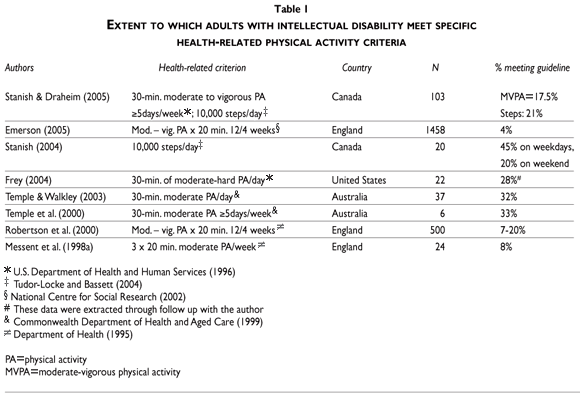
<body><![CDATA[<p><font size="2" face="Verdana">In a recent literature review, Temple, <I>et    al.</I><SUP>27</SUP> evaluated 801 citations produced from key word searches    for the terms mental retardation, intellectual disability, learning disability,    or developmental disability combined with physical activity or habitual exercise.    Of the abstracts reviewed, 14 articles examined some form of participation in    physical activity. All of the studies were conducted in ‘developed’ countries,    specifically Australia, Canada, the United States, and England. The categorization    of nations as ‘developed’ or ‘developing’ can be contentious. The use of these    terms in this article is informed by the work of Fujiura, <I>et al.</I><SUP>28</SUP>    On a pragmatic level, developed nations are the United States, Canada, countries    of Western Europe, Australia, New Zealand, and established market economies    of Asia (Japan, South Korea, and Taiwan). Of the 14 articles reviewed by Temple    and coworkers, eight investigated participation in physical activity consistent    with a health-related criterion (<a href="#tab01">table I</a>). The following    is a brief synopsis of the major findings of these studies.</font></p>     <p><a name="tab01"></a></p>     <p>&nbsp;</p>     <p align="center"><img src="/img/revistas/spm/v50s2/a12tab01.gif"></p>     <p>&nbsp;</p>     <p><font size="2" face="Verdana"> The three studies that assessed physical activity    using accelerometers<SUP>29-31</SUP> indicate that approximately one third of    ambulatory adults with mild or moderate intellectual disability are sufficiently    active to accrue health benefits. Temple and coworkers<SUP>30</SUP> used direct    observation and accelerometry to record the physical activity behavior of six    (three men and three women) individuals with intellectual disability over seven    consecutive days. Direct observation data revealed that two participants achieved    30-minutes of moderate intensity physical activity per day. Moderate intensity    physical activity was accrued mainly via walking for transport and gardening    as part of supported employment. A follow-up study by Temple and Walkley<SUP>31</SUP>    examined participation in physical activity via 3-day diary recordings<SUP>32</SUP>    completed by proxy respondents and via accelerometry. Participants were 37 adults    living in supported group homes with mild to moderate intellectual disability.    Data were collected for three days; two weekdays and one weekend day. On average,    participants accrued more than 1-hour per day of moderate intensity physical    activity. As previously observed by Temple and coworkers,<SUP>30</SUP> there    was considerable between-subject variability. Only 32% of participants met the    recommended 30-minutes of moderate intensity physical activity per day despite    the group average of 68 minutes per day. Frey<SUP>29</SUP> reported similar    findings based on a comparison of physical activity levels between adults with    and without intellectual disability using GTM1 accelerometers. Participants    were 22 adults with mild intellectual disability (ID) and 17 sedentary controls    (SC) and nine active controls (AC) without intellectual disability. The proportion    of each group achieving 30-minutes of moderate intensity physical activity per    day was: ID, 28%; SC, 47%; and AC, 89%. The group with ID did not regularly    engage in continuous moderate activity greater than 10 minutes in duration.    Primary avenues of activity for ID and SC groups were household chores, yard    work, walking and, for the former, Special Olympics; while AC participants engaged    in a variety of sports/activities such as jogging and tennis. It was concluded    that adults with intellectual disability are similar to the over 50% of the    general population that is classified as sedentary; however the proportion of    individuals with intellectual disability accumulating 30-minutes of continuous    moderate activity was less than in those without this diagnosis. </font></p>     <p><font size="2" face="Verdana"> Using a larger sample than the accelerometer    studies with a broader participant age range, Stanish and Draheim<SUP>33</SUP>    found fewer adults with intellectual disability met the minimum activity guidelines    of the Centers for Disease Control.<SUP>34</SUP> Physical activity was assessed    using the National Health and Nutrition Examination Survey (NHANES III) and    steps per day via pedometry. Participants were 103 adults (65 men and 38 women)    with mild or moderate intellectual disability. Pedometers were worn for seven    consecutive days and survey interviews were conducted with both participants    with intellectual disability and direct care providers. Survey data revealed    that 17.5% of participants accrued the recommended duration of 30-minutes per    day. Similar findings were reported in studies from England using the criteria    of at least 12 bouts of 20 minutes moderate (&gt;5 and &lt;7.5 kilocalories    per minute) to vigorous (<U>></u>7.5 kilocalories per minute) activity occurring    over four weeks.<SUP>35-37</SUP> This threshold had been identified as offering    some protection against coronary heart disease<SUP>38</SUP> and the proportion    of participants meeting this criterion ranged from 4 to 20 per cent.</font></p>     <p><font size="2" face="Verdana"><i>Walking behavior</i></font></p>     <p><font size="2" face="Verdana"> A growing body of evidence suggests that individuals    who accumulate 10000 steps per day have less body fat and lower blood pressure    than less active individuals<SUP>39, 40</SUP> and fewer steps per day are associated    with increased body mass index, waist circumference, and diastolic blood pressure.<SUP>41</SUP>    Walking is a primary mode of activity in people without disabilities and also    appears to be one of the most common physical activities carried out by persons    with intellectual disability.<SUP>30, 31, 42</sup></font></p>     <p><font size="2" face="Verdana"> Despite the prevalence of walking as a primary    activity mode, only a handful of studies have actually assessed this health    behavior in adults with intellectual disability. Stanish<SUP>44</SUP> studied    walking behavior in a small sample of 20 individuals with mild intellectual    disability (12 females, 8 males aged 19-65 years). Average steps per day for    males and females without Down syndrome were 11885&plusmn;5646 and 11809&plusmn;4652, respectively.    When analyzed according to diagnosis, males and females with Down syndrome (<I>n</I>=    9) 5450&plusmn;2316 and 8816 &plusmn;4094 acquired fewer steps than those without Down syndrome.    Participants walked less on weekends, with nine participants (45%) achieving    10000 steps or more on weekdays and only four (20%) achieving this criterion    on weekend days. This is contrary to previous research that found no differences    in weekend versus weekday physical activity in this population.<SUP>29</SUP>    In a larger sample of 103 adults, Stanish and Draheim<SUP>33</SUP> found that    participants with intellectual disability walked an average fewer steps per    day (7832) than the guideline of 10000 steps per day and only 21% met the same.</font></p>     ]]></body>
<body><![CDATA[<p><font size="2" face="Verdana"> Although walking is a prevalent form of physical    activity among adults with intellectual disability, the intensity is low or    low-moderate and may not be sufficient to promote health.<SUP>30, 31, 42</SUP>    Some evidence to support this premise was recently established by Stanish and    Draheim,<SUP>43</SUP> who found no differences in body composition or blood    pressure among adults with intellectual disability who were classified as ‘sedentary’    (&lt;5000 steps/day), ‘low active’ (5000-7499 steps/day), ‘somewhat active’    (7500-9999 steps/day), and ‘active’ (<u>&gt;</u>10000 steps/day). As Le Masurier<SUP>45</SUP>    points out, if walking is to be used as an effective physical activity intervention    it should be consistent with the current recommendations, particularly with    regard to intensity of effort, as well as duration or step counts.</font></p>     <p><font size="2" face="Verdana"><b>Limitations of approaches used to measure    physical activity among adults with intellectual disability</b></font></p>     <p><font size="2" face="Verdana">As previously mentioned, 14 studies have examined    lifestyle physical activity among adults with intellectual disability in developed    countries. Those studies either sought to describe physical activity levels    and patterns among adults with intellectual disability<SUP>29-31, 35, 42, 44,    46</SUP> or they measured physical activity as a risk factor for non-communicable    diseases.<SUP>18, 19, 37, 47, 48</SUP> Approaches to measuring physical activity    varied widely across these studies and there are two major methodological limitations    worth noting. The first limitation relates to the validity or accuracy of the    actual measurement instrument. None of the questionnaire and interview studies    report the accuracy or reliability of the survey instrument used. Two studies<SUP>47,    19</SUP> used a single item within a questionnaire as an indicator of physical    activity without providing evidence of either criterion or predictive validity    of the item, and one study<SUP>18</SUP> did not provide any details of questions    used to elicit physical activity levels. Some preliminary evidence of concurrent    validity between care provider diary recordings and accelerometry has been provided    by Temple and Walkley<SUP>31</SUP> who reported a correlation of .78 over three    days of monitoring. In contrast, Frey<SUP>29</SUP> found caregivers and adults    with intellectual disability had difficulty keeping accurate diaries.</font></p>     <p><font size="2" face="Verdana"> A second limitation was the lack of evidence    of accuracy and reliability of those being interviewed or surveyed. A questionnaire    or interview was used with adults with intellectual disability and their care    provider in four studies.<SUP>42,46-48</SUP> However, the authors did not provide    evidence of the respondents’ ability to provide accurate and reliable information,    and did not describe the nature of the care provider’s assistance in answering    the questions. Since these studies were conducted, Stanish and Draheim<SUP>33</SUP>    reported that the relationship between total weekly steps (measured via pedometer)    and minutes of walking per week or minutes of physical activity per week (derived    from the responses to the NHANES III Physical Activity by adults with intellectual    disability with the assistance of direct care workers) were not significant    or meaningful; <I>r</I>= -.01 and <I>r</I>= .06, respectively. Other studies<SUP>18,    19, 35, 37</SUP> used proxy respondents such as parents and care staff without    demonstrating the validity of this approach.</font></p>     <p><font size="2" face="Verdana"> The majority of research studies on physical    activity and intellectual disability used volunteer participants and the majority    of those participants could be characterized as having mild or moderate intellectual    disability.<SUP>27</SUP> In addition, few studies included comparison groups,    and only Frey<SUP>29</SUP> provided sufficient details to indicate that the    same testing protocol was used. Because the existing studies lack appropriate    comparison groups or matched controls it is difficult to determine how active    adults with intellectual disability are with relation to the general population.</font></p>     <p><font size="2" face="Verdana"><b>Levels of physical activity in Latin America</b></font></p>     <p><font size="2" face="Verdana">Obesity and related non-communicable diseases    are growing rapidly in Latin America and the Caribbean. Two-six out of 10 adults    (53 million) are overweight or obese.<SUP>1</SUP> In most parts of Latin America,    obesity is already the second most important risk factor for mortality and disease;<SUP>49</SUP>    and cardiovascular disease is the leading cause of death.<SUP>50</SUP> In Mexico,    the mortality rate for non-communicable diseases nearly doubled from 1950 to    2000.<SUP>51</SUP> Although deaths from coronary heart disease did decline from    1970 to 2000 in Latin America, the reduction was not as favorable as it was    in the United States and Canada.<SUP>52</SUP> This, and persistent undernutrition,    places high demands on economies because of lost productivity and the cost of    treating chronic conditions.<SUP>1</SUP> For example, Barcelo<SUP>50</SUP> estimated    that in Mexico the direct costs of diabetes and hypertension will have increased    by 11 and 14% respectively between 2004 and 2006. In developed nations, changes    in the environment and lifestyles have resulted in increased consumption of    food rich in fat and lower levels of physical activity, both of which contribute    to obesity. In developing nations undernutrition and obesity tend to coexist.<SUP>53</SUP>    However, data from countries in the Region of the Americas indicate half to    three quarters of the population are inactive and not meeting WHO minimum physical    activity guidelines;<SUP>49,54</SUP> and physical inactivity has become one    of the five main risk factors for morbidity and mortality in Latin America.<SUP>55</SUP></font></p>     <p><font size="2" face="Verdana"> The few studies available related to physical    activity in Latin America suggest that a majority of the population is not sufficiently    physically active for health. Hallal and coworkers<SUP>56</SUP> examined the    walking habits of more than 6000 individuals in a southern Brazilian city using    the short form of the International Physical Activity Questionnaire. In 2002,    data were collected on all domains (work-related, commuting, leisure) for 3182    individuals, and in 2003 data were collected on leisure time walking only on    3100 individuals. Results from the ‘all domains’ study indicated that 40% of    participants accrued 150-minutes or more of physical activity per week across    three or more days of the week. When compared with the WHO recommendation of    30-minutes of moderate intensity physical activity on five or more days of the    week, the percentage of participants achieving the mark dropped to 33.8% –a    participation rate lower than the United States average of 45.4 per cent.<SUP>57</SUP>    When Hallal and coworkers considered only leisure time physical activity, 10%    of those surveyed achieved 30-minutes of moderate intensity physical activity    on five or more days of the week. Higher socioeconomic status, level of education,    and increased age (until 70+ years) were positively associated with levels of    physical activity. </font></p>     <p><font size="2" face="Verdana"> The level of leisure time physical activity    reported by Hallal and coworkers was higher than Monteiro and colleagues’ earlier    study of leisure time physical activity in Brazil.<SUP>58</SUP> These authors    found that among 11033 Brazilians, only 3% engaged in the WHO recommended levels    of physical activity during leisure time. The main form of physical activity    reported by participants who accrued 30-minutes of moderate intensity physical    activity on five or more days per week was walking/jogging (men= 66%, women=    81%). Team sport was a relatively common source of physical activity among men,    particularly for those who engaged in less regular activity. Among women, sports    were not a common source of physical activity. After walking, going to the gym/muscular    exercise was the second most frequent form of physical activity for women. </font></p>     <p><font size="2" face="Verdana"> Two other published manuscripts from Latin America    suggest that levels of physical activity are low. Data published from the National    Household Survey of Peru indicate that 12.8% of men and 10.5% of women engage    in regular sports activity.<SUP>59</SUP> Regular sports activity was defined    as engaging in sport either every day or every other day. Although these findings    are difficult to compare with the WHO recommendation for physical activity,    they do suggest that levels of physical activity are low. Seclen-Palacin and    Jacoby<SUP>59</SUP> also reported that levels of regular sports activity were    positively associated with higher levels of formal education and employment    status (employed <I>vs</I>. unemployed). Levels of physical activity were lowest    in metropolitan Lima (10.6%) compared with other regions of Peru, and were highest    among men aged 50-55 years and women aged 40-45 years. Salinas <I>et al.</I><SUP>60</SUP>    also cited urbanization as an important factor associated with low levels of    physical activity in Chile. These authors reported that 9% of the Chilean population    engaged in 30-minutes of physical activity on three or more days of the week.</font></p>     ]]></body>
<body><![CDATA[<p><font size="2" face="Verdana"> Leisure time physical activity and physical    activity in general was higher for women in Mexico than the previously cited    studies on physical activity in Latin America. Hernandez and coworkers<SUP>61</SUP>    found that among a National sample (<I>n</I>= 2367) of girls and women (aged    12-49 years) in Mexico, average participation in physical activity was relatively    high. Constructs of physical activity examined were engagement in vigorous physical    activity (<u>&gt;</u> 5 metabolic equivalents) and engagement in sedentary activities    (watching television, sitting while working and the like). Two questions were    used to examine sport and habitual exercise as a specific sub-set of vigorous    physical activity. Participants were asked whether they had engaged in any sport    or physical exercise on the day before the interview or habitually e.g. run,    walk, bicycle, dance, swim, or play volleyball. If the response was positive,    participants were asked how much time they spent in sports and exercise (either    the day before the interview or in the last week). Results indicated that an    average of 1.25 hours per day was spent in vigorous physical activity. Of the    time spent in vigorous physical activity, 0.08 hours (&plusmn;0.27 hours) was spent    in sport or habitual exercise. Nine percent of the women indicated that they    spent an hour engaged in sport or exercise on the previous day, and 15.9% of    participants said they engaged in sport or exercise regularly. Girls and women    younger than 21 years of age and those with less than a secondary education    were more likely to be inactive. Hernandez and coworkers did not set out to    measure energy expenditure or moderate intensity physical activity consistent    with the WHO recommendations; rather their intent was to identify the most and    least active women in the sample. However, their findings related to vigorous    physical activity suggest that many women in Mexico currently meet WHO recommendations    for physical activity and perhaps Mexican women are more active than women elsewhere    in Latin America. In addition, consistent with findings of Monteiro and coworkers<SUP>58</SUP>    lifestyle physical activity, rather than sports and exercise, was the major    source of physical activity.</font></p>     <p><font size="2" face="Verdana"> The limited published data on participation    in physical activity in Latin America suggest that less than one third of those    surveyed are meeting the WHO recommendation for physical activity across all    domains. When leisure time physical activity is considered, the proportion drops    to 10% or less. Women in Mexico may be more active than others in Latin America,    and major forms of physical activity are walking and lifestyle activities. Those    most likely to be active are older and have higher formal education. The trend    for those in the 30-50 year age group to be more active than those in their    twenties or late teens is not typical of developed nations,<SUP>62</SUP> suggesting    that patterns of participation in physical activity in Latin America may be    somewhat unique.</font></p>     <p><font size="2" face="Verdana"><b>Levels of physical activity among adults with    intellectual disability in Latin America</b></font></p>     <p><font size="2" face="Verdana">Fujiura and coworkers<SUP>28</SUP> rhetorically    asked "How much of the world’s population lives with a disability and what    are the circumstances of their lives?" Their answer was that the current    state of knowledge can be summarized as "we really do not know" (p.    296). This is apparent for participation in physical activity among adults with    intellectual disability in Latin America and the developing world in general.</font></p>     <p><font size="2" face="Verdana"> It is known that there are more than 200000    Special Olympics athletes in Latin America and there are Special Olympics offices    in Panama, Santiago, Lima, and Caracas.<SUP>63</SUP> Latin American athletes    participate in a diverse array of sports including football, alpine and cross-country    skiing, team handball, tennis, and bocce. Moreover, it is known there has been    phenomenal growth in participation in Special Olympics in Mexico. In 2000, an    estimated 5000 athletes participated in Special Olympics in Mexico, whereas    by 2006, 22000 athletes participated.<a name="tx"></a><a href="#nt"><sup>*</sup></a>    This growth may be indicative of the increased awareness of the benefits of    physical activity for persons with intellectual disability; as well as some    untapped demand for programs. </font></p>     <p><font size="2" face="Verdana"> In the absence of physical activity data; physical    fitness levels of persons with intellectual disability have been examined as    indicators of participation in physical activity. Research in developed countries    consistently shows that individuals with intellectual disability are less fit    than their peers without a disability, and that fitness levels are generally    low.<SUP>21, 64, 65</SUP> Although no data from Latin America were available,    three studies of fitness among adolescents with intellectual disability in Thailand    and Africa suggest that this pattern also applies in developing countries. Percent    body fat, cardiorespiratory endurance, flexibility, and muscular endurance were    evaluated for 28 adolescents with mild to moderate intellectual disability and    14 peers without a disability in Bangkok. Results indicated that adolescents    with intellectual disability had low cardiorespiratory endurance, leg strength,    and flexibility.<SUP>66</SUP> More definitively, Onyewadume<SUP>67</SUP> compared    fitness levels of Black African early adolescents with and without mild intellectual    disability in Botswana. Adolescents without intellectual disability had significantly    better percent body fat, grip strength, trunk flexion, combined back and leg    strength, vertical jump, push ups, and Rockport walking test scores than adolescents    with mild intellectual disability. In an earlier study, Onyewadume and Amusa<SUP>68</SUP>    demonstrated that adolescent African Special Olympic athletes preparing for    the 10th Special Olympics World Summer Games had low levels of fitness on all    components of fitness measured (BMI, percent body fat, selected muscle circumferences,    trunk flexion and extension, grip and back strength, jumping, sit ups, push    ups, and cardio-respiratory endurance). </font></p>     <p><font size="2" face="Verdana"> The available information related to the participation    in physical activity by persons with intellectual disability suggests that very    little is known, but that there is interest in being physically active. Data    from developing nations outside of Latin America indicate that persons with    intellectual disability have poorer fitness profiles than those without intellectual    disability; a pattern consistent with developed countries. On the whole, physical    activity for persons with intellectual disability receives little attention    in both developed and developing nations. </font></p>     <p><font size="2" face="Verdana"><b>Conclusions</b></font></p>     <p><font size="2" face="Verdana">The health benefits of physical activity have    been recognized for more than three decades, and there is burgeoning interest    in physical activity for health in Latin America. Evidence from studies conducted    in the developed world suggests that less than one third of adults with intellectual    disability are sufficiently active for health. On the whole, these studies were    conducted on persons with mild intellectual disability with few mobility difficulties.    Therefore these rates of physical activity are likely to be inflated. Methodological    limitations of studies conducted to date do not permit rigorous analysis of    differences in activity patterns between adults with and without intellectual    disability. </font></p>     <p><font size="2" face="Verdana"> Mortality due to non-communicable diseases such    as cardiovascular disease is high in Latin American countries and it appears    that a majority of the general population is inactive. However, virtually nothing    is known about the physical activity levels of adults with intellectual disability.    This implies that even if levels of participation mirror the general population,    persons with intellectual disability would largely be inactive and at risk for    non-communicable diseases; but this is speculation. This much is known: that    participation in Special Olympics in Latin America is growing; which suggests    that there may be increasing awareness of the need for physical activity among    persons with intellectual disability and a demand for programs. </font></p>     ]]></body>
<body><![CDATA[<p><font size="2" face="Verdana"> The Pan American Health Organization<SUP>1</SUP>    suggests that timely and accurate information on the patterns of physical activity    is needed for policy-making, planning, program implementation, and measuring    progress and success. Although the Pan American Health Organization may not    have been referring to sub-populations such as persons with intellectual disability;    collection of data on this population is important. Data such as these are important    because very little has been gathered about participation in physical activity    by persons with intellectual disability outside of developed countries. Having    baseline data on activity levels and barriers to participation for persons with    intellectual disability and persons without disability set the stage for both    advocacy and reform. When data exist is it easier to convince government and    non-governmental organizations of the need to develop and implement supportive    policies, programs, and environments. </font></p>     <p><font size="2" face="Verdana"> Based on the findings from the studies conducted    on physical activity and intellectual disability in developed countries the    following comments are provided for consideration by those interested in the    measurement and facilitating of physical activity among adults with intellectual    disability in Latin America. Specific approaches to intervention are not mentioned    here as they are reported in another paper in this special issue. </font></p>     <blockquote>        <p><font size="2" face="Verdana">1. Motion sensors (pedometers and accelerometers)      have been used successfully with adults with intellectual disability. They      provide a direct and objective measure of physical activity; and do not rely      on participant or proxy recall. In addition, pedometers are relatively inexpensive.      Accordingly, using motion sensors to assess physical activity among adults      with intellectual disability is worth considering; and at the present time,      the most valid approach to measuring physical activity in this population.    <br>     2. In the general population, when direct observation or the use of motion      sensors is neither practical nor ideal, questionnaires are often used. They      provide inexpensive and relatively unobtrusive estimates of physical activity.      However, people with intellectual disability exhibit delays in cognitive functioning,      including attention, memory, generalization, and language/communication. To      date, very little work has been done to validate the use of questionnaires      with persons with intellectual disability, with proxy respondents (such as      parents or care providers), or with both an individual with intellectual disability      and a key support person. Therefore, before questionnaires are used for research      or public health purposes in this population, validation work needs to be      done to determine whether the data will be useful.    <br>     3. The most common form of physical activity among persons with intellectual      disability is walking. Dr. Enrique Jacoby noted that walking is seen as a      best solution to the problem of insufficient physical activity in the Americas.<SUP>53</SUP>      This is also likely to be a very good solution for people with intellectual      disability. Notwithstanding the growing presence of Special Olympics in the      region and the joy and challenges of playing sport, lifestyle intervention      is recommended. Building physical activity into everyday through purposeful      activity such as gardening, engaging in chores around the house, walking for      transport, and walking for exercise. Physical activity that is built into      everyday life is more likely to be sustainable.</font></p> </blockquote>     <p><font size="2" face="Verdana"> The life expectancy of people with intellectual    disability is increasing. Accordingly, more attention has been given to preventing    secondary disabling conditions and non-communicable diseases like obesity, diabetes,    and hypertension in efforts to improve overall health and quality of life. Promoting    moderate levels of physical activity among people with intellectual disability    is an important goal for public health and public policy. An important component    of this process is to establish current physical activity levels of persons    with intellectual disability in Latin America. Valid, reliable data is a <I>sine    qua non </I>condition for the evaluation of the health situation, decision-making,    and programming for health,<SUP>1</SUP> and for advocacy.</font></p>     <p>&nbsp;</p>     <p><font size="3" face="Verdana"><b>References</b></font></p>     <!-- ref --><p><font size="2" face="Verdana">1. Pan American Health Organization. Health indicators:    Building blocks for health situation analysis. In: Epidemiol Bull 2001;22:1-5.</font>&nbsp;&nbsp;&nbsp;&nbsp;&nbsp;&nbsp;&nbsp;&nbsp;[&#160;<a href="javascript:void(0);" onclick="javascript: window.open('/scielo.php?script=sci_nlinks&ref=9263847&pid=S0036-3634200800080001200001&lng=','','width=640,height=500,resizable=yes,scrollbars=1,menubar=yes,');">Links</a>&#160;]<!-- end-ref --><!-- ref --><p><font size="2" face="Verdana">2. Bauman A, Bellew B, Vita P, Brown W, Owen    N. Getting Australia active: Towards better practice for the promotion of physical    activity. Melbourne, Australia: National Public Health Partnership;2002:iii.</font>&nbsp;&nbsp;&nbsp;&nbsp;&nbsp;&nbsp;&nbsp;&nbsp;[&#160;<a href="javascript:void(0);" onclick="javascript: window.open('/scielo.php?script=sci_nlinks&ref=9263848&pid=S0036-3634200800080001200002&lng=','','width=640,height=500,resizable=yes,scrollbars=1,menubar=yes,');">Links</a>&#160;]<!-- end-ref --><p><font size="2" face="Verdana">3. US Department of Health and Human Services.    Healthy People 2010: Understanding and improving health. 2nd ed. Washington,    DC: US Government Printing Office, 2000.</font></p>     <!-- ref --><p><font size="2" face="Verdana">4. World Health Organization. WHO global strategy    on diet, physical activity and health; 2005. Available from <a href="http://www.who.int/dietphysicalactivity/media/en/gsfs_pa.pdf" target="_blank">http://www.who.int/dietphysicalactivity/media/en/gsfs_pa.pdf</a>.    &#91;Accessed on 6 December 2006&#93;.</font>&nbsp;&nbsp;&nbsp;&nbsp;&nbsp;&nbsp;&nbsp;&nbsp;[&#160;<a href="javascript:void(0);" onclick="javascript: window.open('/scielo.php?script=sci_nlinks&ref=9263850&pid=S0036-3634200800080001200004&lng=','','width=640,height=500,resizable=yes,scrollbars=1,menubar=yes,');">Links</a>&#160;]<!-- end-ref --><!-- ref --><p><font size="2" face="Verdana">5. Pate RR, Pratt M, Blair SN, <I>et al.</I>    Physical activity and public health: A recommendation from the Centers for Disease    Control and Prevention and the American College of Sports Medicine. J Am Med    Assoc 1995;273:402-407.</font>&nbsp;&nbsp;&nbsp;&nbsp;&nbsp;&nbsp;&nbsp;&nbsp;[&#160;<a href="javascript:void(0);" onclick="javascript: window.open('/scielo.php?script=sci_nlinks&ref=9263851&pid=S0036-3634200800080001200005&lng=','','width=640,height=500,resizable=yes,scrollbars=1,menubar=yes,');">Links</a>&#160;]<!-- end-ref --><!-- ref --><p><font size="2" face="Verdana">6. Haapanen N, Miilunpalo S, Vuori I, Oja P,    Pasanen M. Characteristics of leisure time physical activity associated with    decreased risk of premature all-cause and cardiovascular disease mortality in    middle-aged men. Am J Epidemiol 1996;143:870-880.</font>&nbsp;&nbsp;&nbsp;&nbsp;&nbsp;&nbsp;&nbsp;&nbsp;[&#160;<a href="javascript:void(0);" onclick="javascript: window.open('/scielo.php?script=sci_nlinks&ref=9263852&pid=S0036-3634200800080001200006&lng=','','width=640,height=500,resizable=yes,scrollbars=1,menubar=yes,');">Links</a>&#160;]<!-- end-ref --><!-- ref --><p><font size="2" face="Verdana">7. Gaylord V, Lieberman L, Abery B, Lais G. Social    inclusion through recreation: What’s the connection? Impact: Feature Issue on    Social Inclusion Through Recreation for Persons with Disabilities 2003;16:2-3,32.</font>&nbsp;&nbsp;&nbsp;&nbsp;&nbsp;&nbsp;&nbsp;&nbsp;[&#160;<a href="javascript:void(0);" onclick="javascript: window.open('/scielo.php?script=sci_nlinks&ref=9263853&pid=S0036-3634200800080001200007&lng=','','width=640,height=500,resizable=yes,scrollbars=1,menubar=yes,');">Links</a>&#160;]<!-- end-ref --><!-- ref --><p><font size="2" face="Verdana">8. Vainio H, Bianchini F, eds. Weight control    and physical activity (Vol. 6). Lyon: IARC Press, 2002.</font>&nbsp;&nbsp;&nbsp;&nbsp;&nbsp;&nbsp;&nbsp;&nbsp;[&#160;<a href="javascript:void(0);" onclick="javascript: window.open('/scielo.php?script=sci_nlinks&ref=9263854&pid=S0036-3634200800080001200008&lng=','','width=640,height=500,resizable=yes,scrollbars=1,menubar=yes,');">Links</a>&#160;]<!-- end-ref --><!-- ref --><p><font size="2" face="Verdana">9. Frisancho AR. Reduced rate of fat oxidation:    A metabolic pathway to obesity in developing nations. Am J Hum Biol 2003;15:522-532.</font>&nbsp;&nbsp;&nbsp;&nbsp;&nbsp;&nbsp;&nbsp;&nbsp;[&#160;<a href="javascript:void(0);" onclick="javascript: window.open('/scielo.php?script=sci_nlinks&ref=9263855&pid=S0036-3634200800080001200009&lng=','','width=640,height=500,resizable=yes,scrollbars=1,menubar=yes,');">Links</a>&#160;]<!-- end-ref --><!-- ref --><p><font size="2" face="Verdana">10. Ford ES, Giles WH, Dietz WH. Prevalence of    the Metabolic Syndrome among US Adults. Findings from the third National health    and nutrition survey. JAMA 2002;287:356-359.</font>&nbsp;&nbsp;&nbsp;&nbsp;&nbsp;&nbsp;&nbsp;&nbsp;[&#160;<a href="javascript:void(0);" onclick="javascript: window.open('/scielo.php?script=sci_nlinks&ref=9263856&pid=S0036-3634200800080001200010&lng=','','width=640,height=500,resizable=yes,scrollbars=1,menubar=yes,');">Links</a>&#160;]<!-- end-ref --><!-- ref --><p><font size="2" face="Verdana">11. Katzmarzyk PT, Leon AS, Wilmore JH, Skinner    JS, Rao DC, Rankinen T, <I>et al.</I> Targeting the metabolic syndrome with    exercise: Evidence from the HERITAGE Family Study. Med Sci Sports Exerc 2003;35:1703-1709.</font>&nbsp;&nbsp;&nbsp;&nbsp;&nbsp;&nbsp;&nbsp;&nbsp;[&#160;<a href="javascript:void(0);" onclick="javascript: window.open('/scielo.php?script=sci_nlinks&ref=9263857&pid=S0036-3634200800080001200011&lng=','','width=640,height=500,resizable=yes,scrollbars=1,menubar=yes,');">Links</a>&#160;]<!-- end-ref --><!-- ref --><p><font size="2" face="Verdana">12. Layne JE, Nelson ME. The effects of progressive    resistance training on bone density: A review. Med Sci Sports Exerc 1999;31:25-30.</font>&nbsp;&nbsp;&nbsp;&nbsp;&nbsp;&nbsp;&nbsp;&nbsp;[&#160;<a href="javascript:void(0);" onclick="javascript: window.open('/scielo.php?script=sci_nlinks&ref=9263858&pid=S0036-3634200800080001200012&lng=','','width=640,height=500,resizable=yes,scrollbars=1,menubar=yes,');">Links</a>&#160;]<!-- end-ref --><!-- ref --><p><font size="2" face="Verdana">13. Roth SM, Ferrel RE, Hurley BF. Strength training    for the prevention and treatment of sarcopenia. J Nutr Health Aging 2000; 4:143-155.</font>&nbsp;&nbsp;&nbsp;&nbsp;&nbsp;&nbsp;&nbsp;&nbsp;[&#160;<a href="javascript:void(0);" onclick="javascript: window.open('/scielo.php?script=sci_nlinks&ref=9263859&pid=S0036-3634200800080001200013&lng=','','width=640,height=500,resizable=yes,scrollbars=1,menubar=yes,');">Links</a>&#160;]<!-- end-ref --><!-- ref --><p><font size="2" face="Verdana">14. American Geriatrics Society, British Geriatrics    Society, and American Academy of Orthopaedic Surgeons Panel on Falls Prevention.    Guidelines for the prevention of falls in older persons. J Am Geriatr Soc 2001;49:    664-672.</font>&nbsp;&nbsp;&nbsp;&nbsp;&nbsp;&nbsp;&nbsp;&nbsp;[&#160;<a href="javascript:void(0);" onclick="javascript: window.open('/scielo.php?script=sci_nlinks&ref=9263860&pid=S0036-3634200800080001200014&lng=','','width=640,height=500,resizable=yes,scrollbars=1,menubar=yes,');">Links</a>&#160;]<!-- end-ref --><!-- ref --><p><font size="2" face="Verdana">15. Sutherland G, Couch MA, Iacono T. Health    issues for adults with developmental disability. Res Dev Disabil 2002;23:422-445.</font>&nbsp;&nbsp;&nbsp;&nbsp;&nbsp;&nbsp;&nbsp;&nbsp;[&#160;<a href="javascript:void(0);" onclick="javascript: window.open('/scielo.php?script=sci_nlinks&ref=9263861&pid=S0036-3634200800080001200015&lng=','','width=640,height=500,resizable=yes,scrollbars=1,menubar=yes,');">Links</a>&#160;]<!-- end-ref --><!-- ref --><p><font size="2" face="Verdana">16. Draheim C. Cardiovascular disease prevalence    and risk factors of persons with mental retardation. Ment Retard Dev Disabil    Res Rev 2006;12:3-12.</font>&nbsp;&nbsp;&nbsp;&nbsp;&nbsp;&nbsp;&nbsp;&nbsp;[&#160;<a href="javascript:void(0);" onclick="javascript: window.open('/scielo.php?script=sci_nlinks&ref=9263862&pid=S0036-3634200800080001200016&lng=','','width=640,height=500,resizable=yes,scrollbars=1,menubar=yes,');">Links</a>&#160;]<!-- end-ref --><!-- ref --><p><font size="2" face="Verdana">17. Draheim CC, McCubbin JA, Williams DP. Differences    in cardiovascular disease risk between non-diabetic adults with Down syndrome    and mental retardation. Am J Ment Retard 2002;107:201-211.</font>&nbsp;&nbsp;&nbsp;&nbsp;&nbsp;&nbsp;&nbsp;&nbsp;[&#160;<a href="javascript:void(0);" onclick="javascript: window.open('/scielo.php?script=sci_nlinks&ref=9263863&pid=S0036-3634200800080001200017&lng=','','width=640,height=500,resizable=yes,scrollbars=1,menubar=yes,');">Links</a>&#160;]<!-- end-ref --><!-- ref --><p><font size="2" face="Verdana">18. Janicki MP, Davidson PW, Henderson CM, McCallion    P, Taets JD, Force LT, <I>et al.</I> Health characteristics and health services    utilization in older adults with intellectual disability living in community    residences. J Intellect Disabil Res 2002;46:287-298.</font>&nbsp;&nbsp;&nbsp;&nbsp;&nbsp;&nbsp;&nbsp;&nbsp;[&#160;<a href="javascript:void(0);" onclick="javascript: window.open('/scielo.php?script=sci_nlinks&ref=9263864&pid=S0036-3634200800080001200018&lng=','','width=640,height=500,resizable=yes,scrollbars=1,menubar=yes,');">Links</a>&#160;]<!-- end-ref --><!-- ref --><p><font size="2" face="Verdana">19. Rimmer JH, Braddock D, Marks B. Health characteristics    and behaviors of adults with mental retardation residing in three living arrangements.    Res Dev Disabil 1995;16:489-499.</font>&nbsp;&nbsp;&nbsp;&nbsp;&nbsp;&nbsp;&nbsp;&nbsp;[&#160;<a href="javascript:void(0);" onclick="javascript: window.open('/scielo.php?script=sci_nlinks&ref=9263865&pid=S0036-3634200800080001200019&lng=','','width=640,height=500,resizable=yes,scrollbars=1,menubar=yes,');">Links</a>&#160;]<!-- end-ref --><!-- ref --><p><font size="2" face="Verdana">20. Rimmer JH, Yamaki K. Obesity and intellectual    disability. Ment Retard Dev Disabil Res Rev 2006;12:22-27.</font>&nbsp;&nbsp;&nbsp;&nbsp;&nbsp;&nbsp;&nbsp;&nbsp;[&#160;<a href="javascript:void(0);" onclick="javascript: window.open('/scielo.php?script=sci_nlinks&ref=9263866&pid=S0036-3634200800080001200020&lng=','','width=640,height=500,resizable=yes,scrollbars=1,menubar=yes,');">Links</a>&#160;]<!-- end-ref --><!-- ref --><p><font size="2" face="Verdana">21. Fernhall B, Pitetti KH. Limitations to physical    work capacity in individuals with mental retardation. Clin Exerc Physiol 2001;3:176-185.</font>&nbsp;&nbsp;&nbsp;&nbsp;&nbsp;&nbsp;&nbsp;&nbsp;[&#160;<a href="javascript:void(0);" onclick="javascript: window.open('/scielo.php?script=sci_nlinks&ref=9263867&pid=S0036-3634200800080001200021&lng=','','width=640,height=500,resizable=yes,scrollbars=1,menubar=yes,');">Links</a>&#160;]<!-- end-ref --><!-- ref --><p><font size="2" face="Verdana">22. Graham A, Reid G. Physical fitness of adults    with an intellectual disability: A 13-year follow-up study. Res Q Exerc Sport    2000;71:152-161.</font>&nbsp;&nbsp;&nbsp;&nbsp;&nbsp;&nbsp;&nbsp;&nbsp;[&#160;<a href="javascript:void(0);" onclick="javascript: window.open('/scielo.php?script=sci_nlinks&ref=9263868&pid=S0036-3634200800080001200022&lng=','','width=640,height=500,resizable=yes,scrollbars=1,menubar=yes,');">Links</a>&#160;]<!-- end-ref --><!-- ref --><p><font size="2" face="Verdana">23. Center JR, Beange H, McElduff A. People with    mental retardation have an increased prevalence of osteoporosis: A population    study. Am J Ment Retard 1998;103:19-28.</font>&nbsp;&nbsp;&nbsp;&nbsp;&nbsp;&nbsp;&nbsp;&nbsp;[&#160;<a href="javascript:void(0);" onclick="javascript: window.open('/scielo.php?script=sci_nlinks&ref=9263869&pid=S0036-3634200800080001200023&lng=','','width=640,height=500,resizable=yes,scrollbars=1,menubar=yes,');">Links</a>&#160;]<!-- end-ref --><!-- ref --><p><font size="2" face="Verdana">24. Center JR, McElduff A, Beange H. Osteoporosis    in groups with intellectual disability. Australian and New Zealand Journal of    Developmental Disabilities 1994;19:251-258.</font>&nbsp;&nbsp;&nbsp;&nbsp;&nbsp;&nbsp;&nbsp;&nbsp;[&#160;<a href="javascript:void(0);" onclick="javascript: window.open('/scielo.php?script=sci_nlinks&ref=9263870&pid=S0036-3634200800080001200024&lng=','','width=640,height=500,resizable=yes,scrollbars=1,menubar=yes,');">Links</a>&#160;]<!-- end-ref --><!-- ref --><p><font size="2" face="Verdana">25. Felix M, McCubbin J, Shaw J. Bone mineral    density, body composition, and muscle strength in premenopausal women with mental    retardation. Adapt Phys Activ Q 1998;15:345-356.</font>&nbsp;&nbsp;&nbsp;&nbsp;&nbsp;&nbsp;&nbsp;&nbsp;[&#160;<a href="javascript:void(0);" onclick="javascript: window.open('/scielo.php?script=sci_nlinks&ref=9263871&pid=S0036-3634200800080001200025&lng=','','width=640,height=500,resizable=yes,scrollbars=1,menubar=yes,');">Links</a>&#160;]<!-- end-ref --><!-- ref --><p><font size="2" face="Verdana">26. Foster BL, Walkley JW, Temple VA. An examination    of the bone mineral density of women with an intellectual disability. Adapt    Phys Activ Q 2001;18:49-59.</font>&nbsp;&nbsp;&nbsp;&nbsp;&nbsp;&nbsp;&nbsp;&nbsp;[&#160;<a href="javascript:void(0);" onclick="javascript: window.open('/scielo.php?script=sci_nlinks&ref=9263872&pid=S0036-3634200800080001200026&lng=','','width=640,height=500,resizable=yes,scrollbars=1,menubar=yes,');">Links</a>&#160;]<!-- end-ref --><!-- ref --><p><font size="2" face="Verdana">27. Temple VA, Frey GC, Stanish HI. Physical    activity of adults with mental retardation. Review and research needs. Am J    Health Promot 2006;21:2-12.</font>&nbsp;&nbsp;&nbsp;&nbsp;&nbsp;&nbsp;&nbsp;&nbsp;[&#160;<a href="javascript:void(0);" onclick="javascript: window.open('/scielo.php?script=sci_nlinks&ref=9263873&pid=S0036-3634200800080001200027&lng=','','width=640,height=500,resizable=yes,scrollbars=1,menubar=yes,');">Links</a>&#160;]<!-- end-ref --><!-- ref --><p><font size="2" face="Verdana">28. Fujiura GT, Park HJ, Rutkowski-Kmitta V.    Disability statistics in the developing world: A reflection on the meanings    in our numbers. Journal of Applied Research in Intellectual Disabilities 2005;18:295-304.</font>&nbsp;&nbsp;&nbsp;&nbsp;&nbsp;&nbsp;&nbsp;&nbsp;[&#160;<a href="javascript:void(0);" onclick="javascript: window.open('/scielo.php?script=sci_nlinks&ref=9263874&pid=S0036-3634200800080001200028&lng=','','width=640,height=500,resizable=yes,scrollbars=1,menubar=yes,');">Links</a>&#160;]<!-- end-ref --><!-- ref --><p><font size="2" face="Verdana">29. Frey G. Comparison of physical activity levels    between adults with and without mental retardation. J Phys Act Health 2004;1:235-245.</font>&nbsp;&nbsp;&nbsp;&nbsp;&nbsp;&nbsp;&nbsp;&nbsp;[&#160;<a href="javascript:void(0);" onclick="javascript: window.open('/scielo.php?script=sci_nlinks&ref=9263875&pid=S0036-3634200800080001200029&lng=','','width=640,height=500,resizable=yes,scrollbars=1,menubar=yes,');">Links</a>&#160;]<!-- end-ref --><!-- ref --><p><font size="2" face="Verdana">30. Temple VA, Anderson C, Walkley JW. Physical    activity levels of individuals living in a group home. J Intellect Dev Disabil    2000;25:327-341.</font>&nbsp;&nbsp;&nbsp;&nbsp;&nbsp;&nbsp;&nbsp;&nbsp;[&#160;<a href="javascript:void(0);" onclick="javascript: window.open('/scielo.php?script=sci_nlinks&ref=9263876&pid=S0036-3634200800080001200030&lng=','','width=640,height=500,resizable=yes,scrollbars=1,menubar=yes,');">Links</a>&#160;]<!-- end-ref --><!-- ref --><p><font size="2" face="Verdana">31. Temple VA, Walkley JW. Physical activity    of adults with intellectual disability. J Intellect Dev Disabil 2003;28:323-334.</font>&nbsp;&nbsp;&nbsp;&nbsp;&nbsp;&nbsp;&nbsp;&nbsp;[&#160;<a href="javascript:void(0);" onclick="javascript: window.open('/scielo.php?script=sci_nlinks&ref=9263877&pid=S0036-3634200800080001200031&lng=','','width=640,height=500,resizable=yes,scrollbars=1,menubar=yes,');">Links</a>&#160;]<!-- end-ref --><!-- ref --><p><font size="2" face="Verdana">32. Bouchard C, Tremblay A, Leblanc C, Lortie    G, Savard R. Method to assess energy expenditure in children and adults. Am    J Clin Nutr 1983;37:461-467.</font>&nbsp;&nbsp;&nbsp;&nbsp;&nbsp;&nbsp;&nbsp;&nbsp;[&#160;<a href="javascript:void(0);" onclick="javascript: window.open('/scielo.php?script=sci_nlinks&ref=9263878&pid=S0036-3634200800080001200032&lng=','','width=640,height=500,resizable=yes,scrollbars=1,menubar=yes,');">Links</a>&#160;]<!-- end-ref --><!-- ref --><p><font size="2" face="Verdana">33. Stanish HI, Draheim CC. Assessment of walking    activity using a pedometer and survey in adults with mental retardation. Adapt    Phys Activ Q 2005;22:136-145.</font>&nbsp;&nbsp;&nbsp;&nbsp;&nbsp;&nbsp;&nbsp;&nbsp;[&#160;<a href="javascript:void(0);" onclick="javascript: window.open('/scielo.php?script=sci_nlinks&ref=9263879&pid=S0036-3634200800080001200033&lng=','','width=640,height=500,resizable=yes,scrollbars=1,menubar=yes,');">Links</a>&#160;]<!-- end-ref --><!-- ref --><p><font size="2" face="Verdana">34. U.S. Department of Health and Human Services.    Physical activity and health: A report of the Surgeon General. Atlanta, Georgia:    US Department of Health and Human Services, Public Health Service, CDC, National    Center for Chronic Disease Prevention and Health Promotion, 1996.</font>&nbsp;&nbsp;&nbsp;&nbsp;&nbsp;&nbsp;&nbsp;&nbsp;[&#160;<a href="javascript:void(0);" onclick="javascript: window.open('/scielo.php?script=sci_nlinks&ref=9263880&pid=S0036-3634200800080001200034&lng=','','width=640,height=500,resizable=yes,scrollbars=1,menubar=yes,');">Links</a>&#160;]<!-- end-ref --><!-- ref --><p><font size="2" face="Verdana">35. Emerson E. Underweight, obesity and exercise    among adults with intellectual disabilities in supported accommodation in Northern    England. J Intellect Disabil Res 2005;49:134-143.</font>&nbsp;&nbsp;&nbsp;&nbsp;&nbsp;&nbsp;&nbsp;&nbsp;[&#160;<a href="javascript:void(0);" onclick="javascript: window.open('/scielo.php?script=sci_nlinks&ref=9263881&pid=S0036-3634200800080001200035&lng=','','width=640,height=500,resizable=yes,scrollbars=1,menubar=yes,');">Links</a>&#160;]<!-- end-ref --><!-- ref --><p><font size="2" face="Verdana">36. Messent PR, Cooke CB, Long J. Physical activity,    exercise and health of adults with mild and moderate learning disabilities.    British Journal of Learning Disabilities 1998;26:17-22.</font>&nbsp;&nbsp;&nbsp;&nbsp;&nbsp;&nbsp;&nbsp;&nbsp;[&#160;<a href="javascript:void(0);" onclick="javascript: window.open('/scielo.php?script=sci_nlinks&ref=9263882&pid=S0036-3634200800080001200036&lng=','','width=640,height=500,resizable=yes,scrollbars=1,menubar=yes,');">Links</a>&#160;]<!-- end-ref --><!-- ref --><p><font size="2" face="Verdana">37. Robertson J, Emerson E, Gregory N, Hatton    C, Turner S, Kessissoglou S, <I>et al.</I> Lifestyle related risk factors for    poor health in residential settings for people with intellectual disabilities.    Res Dev Disabil 2000; 21, 469-486.</font>&nbsp;&nbsp;&nbsp;&nbsp;&nbsp;&nbsp;&nbsp;&nbsp;[&#160;<a href="javascript:void(0);" onclick="javascript: window.open('/scielo.php?script=sci_nlinks&ref=9263883&pid=S0036-3634200800080001200037&lng=','','width=640,height=500,resizable=yes,scrollbars=1,menubar=yes,');">Links</a>&#160;]<!-- end-ref --><!-- ref --><p><font size="2" face="Verdana">38. Department of Health. The Health Survey for    England 1993. London: HMSO, 1995.</font>&nbsp;&nbsp;&nbsp;&nbsp;&nbsp;&nbsp;&nbsp;&nbsp;[&#160;<a href="javascript:void(0);" onclick="javascript: window.open('/scielo.php?script=sci_nlinks&ref=9263884&pid=S0036-3634200800080001200038&lng=','','width=640,height=500,resizable=yes,scrollbars=1,menubar=yes,');">Links</a>&#160;]<!-- end-ref --><!-- ref --><p><font size="2" face="Verdana">39. Moreau KL, Degarmo R, Langley J, McMahon    C, Howley ET, Bassett DR, <I>et al.</I> Increasing daily walking lowers blood    pressure in postmenopausal women. Med Sci Sports Exerc 2001; 33:1825-1831.</font>&nbsp;&nbsp;&nbsp;&nbsp;&nbsp;&nbsp;&nbsp;&nbsp;[&#160;<a href="javascript:void(0);" onclick="javascript: window.open('/scielo.php?script=sci_nlinks&ref=9263885&pid=S0036-3634200800080001200039&lng=','','width=640,height=500,resizable=yes,scrollbars=1,menubar=yes,');">Links</a>&#160;]<!-- end-ref --><!-- ref --><p><font size="2" face="Verdana">40. Tudor-Locke C, Ainsworth BE, Whitt MC, Thompson    RW, Addy CL, Jones DA. The relationship between pedometer-determined ambulatory    activity and body composition variables. Int J Obes Relat Metab Disord 2001;    25:1571-1578.</font>&nbsp;&nbsp;&nbsp;&nbsp;&nbsp;&nbsp;&nbsp;&nbsp;[&#160;<a href="javascript:void(0);" onclick="javascript: window.open('/scielo.php?script=sci_nlinks&ref=9263886&pid=S0036-3634200800080001200040&lng=','','width=640,height=500,resizable=yes,scrollbars=1,menubar=yes,');">Links</a>&#160;]<!-- end-ref --><!-- ref --><p><font size="2" face="Verdana">41. Chan CB, Spangler E, Valcour J, Tudor-Locke    C. Cross-sectional relationship of pedometer-determined ambulatory activity    to indicators of health. Obes Res 2003; 11:1563-1570.</font>&nbsp;&nbsp;&nbsp;&nbsp;&nbsp;&nbsp;&nbsp;&nbsp;[&#160;<a href="javascript:void(0);" onclick="javascript: window.open('/scielo.php?script=sci_nlinks&ref=9263887&pid=S0036-3634200800080001200041&lng=','','width=640,height=500,resizable=yes,scrollbars=1,menubar=yes,');">Links</a>&#160;]<!-- end-ref --><!-- ref --><p><font size="2" face="Verdana">42. Draheim CC, Williams DP, McCubbin JA. Prevalence    of physical inactivity and recommended physical activity in community-based    adults with mental retardation. Ment Retard 2002; 40:436-444.</font>&nbsp;&nbsp;&nbsp;&nbsp;&nbsp;&nbsp;&nbsp;&nbsp;[&#160;<a href="javascript:void(0);" onclick="javascript: window.open('/scielo.php?script=sci_nlinks&ref=9263888&pid=S0036-3634200800080001200042&lng=','','width=640,height=500,resizable=yes,scrollbars=1,menubar=yes,');">Links</a>&#160;]<!-- end-ref --><!-- ref --><p><font size="2" face="Verdana">43. Stanish HI, Draheim CC. Walking activity,    body composition, and blood pressure in adults with intellectual disabilities.    Journal of Applied Research in Intellectual Disabilities 20:183-190.</font>&nbsp;&nbsp;&nbsp;&nbsp;&nbsp;&nbsp;&nbsp;&nbsp;[&#160;<a href="javascript:void(0);" onclick="javascript: window.open('/scielo.php?script=sci_nlinks&ref=9263889&pid=S0036-3634200800080001200043&lng=','','width=640,height=500,resizable=yes,scrollbars=1,menubar=yes,');">Links</a>&#160;]<!-- end-ref --><!-- ref --><p><font size="2" face="Verdana">44. Stanish HI. Accuracy of pedometers and walking    activity in adults with mental retardation. Adapt Phys Activ Q 2004; 21:167-179.</font>&nbsp;&nbsp;&nbsp;&nbsp;&nbsp;&nbsp;&nbsp;&nbsp;[&#160;<a href="javascript:void(0);" onclick="javascript: window.open('/scielo.php?script=sci_nlinks&ref=9263890&pid=S0036-3634200800080001200044&lng=','','width=640,height=500,resizable=yes,scrollbars=1,menubar=yes,');">Links</a>&#160;]<!-- end-ref --><!-- ref --><p><font size="2" face="Verdana">45. Le Masurier GG. Walk which way? ACSM’s Health    &amp; Fitness Journal 2004; 8:7-10.</font>&nbsp;&nbsp;&nbsp;&nbsp;&nbsp;&nbsp;&nbsp;&nbsp;[&#160;<a href="javascript:void(0);" onclick="javascript: window.open('/scielo.php?script=sci_nlinks&ref=9263891&pid=S0036-3634200800080001200045&lng=','','width=640,height=500,resizable=yes,scrollbars=1,menubar=yes,');">Links</a>&#160;]<!-- end-ref --><!-- ref --><p><font size="2" face="Verdana">46. Messent PR, Cooke CB, Long J. Daily physical    activity in adults with mild and moderate learning disabilities: Is there enough?    Disabil Rehabil 1998; 20:424-427.</font>&nbsp;&nbsp;&nbsp;&nbsp;&nbsp;&nbsp;&nbsp;&nbsp;[&#160;<a href="javascript:void(0);" onclick="javascript: window.open('/scielo.php?script=sci_nlinks&ref=9263892&pid=S0036-3634200800080001200046&lng=','','width=640,height=500,resizable=yes,scrollbars=1,menubar=yes,');">Links</a>&#160;]<!-- end-ref --><!-- ref --><p><font size="2" face="Verdana">47. Beange H, McElduff A, Baker W. Medical disorders    of adults with mental retardation: A population study. Am J Ment Retard 1995;    99:595-604.</font>&nbsp;&nbsp;&nbsp;&nbsp;&nbsp;&nbsp;&nbsp;&nbsp;[&#160;<a href="javascript:void(0);" onclick="javascript: window.open('/scielo.php?script=sci_nlinks&ref=9263893&pid=S0036-3634200800080001200047&lng=','','width=640,height=500,resizable=yes,scrollbars=1,menubar=yes,');">Links</a>&#160;]<!-- end-ref --><!-- ref --><p><font size="2" face="Verdana">48. Wells MB, Turner S, Martin DM, Roy A. Health    gain through screening-coronary heart disease and stroke: Developing primary    health care services for people with intellectual disability. J Intellect Dev    Disabil 1997; 22:251-263.</font>&nbsp;&nbsp;&nbsp;&nbsp;&nbsp;&nbsp;&nbsp;&nbsp;[&#160;<a href="javascript:void(0);" onclick="javascript: window.open('/scielo.php?script=sci_nlinks&ref=9263894&pid=S0036-3634200800080001200048&lng=','','width=640,height=500,resizable=yes,scrollbars=1,menubar=yes,');">Links</a>&#160;]<!-- end-ref --><!-- ref --><p><font size="2" face="Verdana">49. World Health Organization. The world health    report 2002. Reducing risks, promoting healthy life. Geneva 2002.</font>&nbsp;&nbsp;&nbsp;&nbsp;&nbsp;&nbsp;&nbsp;&nbsp;[&#160;<a href="javascript:void(0);" onclick="javascript: window.open('/scielo.php?script=sci_nlinks&ref=9263895&pid=S0036-3634200800080001200049&lng=','','width=640,height=500,resizable=yes,scrollbars=1,menubar=yes,');">Links</a>&#160;]<!-- end-ref --><!-- ref --><p><font size="2" face="Verdana">50. Barcelo A. Cardiovascular diseases in Latin    America and the Caribbean. Lancet 2006; 368:625-626.</font>&nbsp;&nbsp;&nbsp;&nbsp;&nbsp;&nbsp;&nbsp;&nbsp;[&#160;<a href="javascript:void(0);" onclick="javascript: window.open('/scielo.php?script=sci_nlinks&ref=9263896&pid=S0036-3634200800080001200050&lng=','','width=640,height=500,resizable=yes,scrollbars=1,menubar=yes,');">Links</a>&#160;]<!-- end-ref --><!-- ref --><p><font size="2" face="Verdana">51. Consejo Nacional de Poblacion. La situacion    demografica de Mexico 2000. Mexico, DF. Consejo Nacional de Poblaci&oacute;n,    2001.</font>&nbsp;&nbsp;&nbsp;&nbsp;&nbsp;&nbsp;&nbsp;&nbsp;[&#160;<a href="javascript:void(0);" onclick="javascript: window.open('/scielo.php?script=sci_nlinks&ref=9263897&pid=S0036-3634200800080001200051&lng=','','width=640,height=500,resizable=yes,scrollbars=1,menubar=yes,');">Links</a>&#160;]<!-- end-ref --><!-- ref --><p><font size="2" face="Verdana">52. Rodriguez T, Malvezzi M, Chatenoud L, Bosetti    C, Levi F, Negri E, <I>et al.</I> Trends in mortality from coronary heart and    cerebrovascular diseases in the Americas: 1970-2000. Heart 2006; 92:453-460.</font>&nbsp;&nbsp;&nbsp;&nbsp;&nbsp;&nbsp;&nbsp;&nbsp;[&#160;<a href="javascript:void(0);" onclick="javascript: window.open('/scielo.php?script=sci_nlinks&ref=9263898&pid=S0036-3634200800080001200052&lng=','','width=640,height=500,resizable=yes,scrollbars=1,menubar=yes,');">Links</a>&#160;]<!-- end-ref --><!-- ref --><p> <font size="2" face="Verdana">53. Centers for Disease Control and Prevention    and the World Health Organization. CDC/WHO Partners Meeting: Implementation    of WHO Physical Activity Strategy. Geneva: WHO, 2004.</font>&nbsp;&nbsp;&nbsp;&nbsp;&nbsp;&nbsp;&nbsp;&nbsp;[&#160;<a href="javascript:void(0);" onclick="javascript: window.open('/scielo.php?script=sci_nlinks&ref=9263899&pid=S0036-3634200800080001200053&lng=','','width=640,height=500,resizable=yes,scrollbars=1,menubar=yes,');">Links</a>&#160;]<!-- end-ref --><!-- ref --><p><font size="2" face="Verdana">54. Pan American Health Organization. Physical    Activity Fact Sheet #3, Physical Inactivity: A major health risk factor in the    Americas. In P. A. S. B. R. O. o. t. W. H. O. Food and Nutrition Program/Division    of Health Promotion and Protection, 2002: Author.</font>&nbsp;&nbsp;&nbsp;&nbsp;&nbsp;&nbsp;&nbsp;&nbsp;[&#160;<a href="javascript:void(0);" onclick="javascript: window.open('/scielo.php?script=sci_nlinks&ref=9263900&pid=S0036-3634200800080001200054&lng=','','width=640,height=500,resizable=yes,scrollbars=1,menubar=yes,');">Links</a>&#160;]<!-- end-ref --><!-- ref --><p><font size="2" face="Verdana">55. Jacoby E, Bull F, Neiman A. Rapid changes    in lifestyle make increased physical activity a priority for the Americas. Pan    Am J Public Health 2003;14:226-228.</font>&nbsp;&nbsp;&nbsp;&nbsp;&nbsp;&nbsp;&nbsp;&nbsp;[&#160;<a href="javascript:void(0);" onclick="javascript: window.open('/scielo.php?script=sci_nlinks&ref=9263901&pid=S0036-3634200800080001200055&lng=','','width=640,height=500,resizable=yes,scrollbars=1,menubar=yes,');">Links</a>&#160;]<!-- end-ref --><!-- ref --><p><font size="2" face="Verdana">56. Hallal PC, Azevedo MR, Reichert FF, Siqueira    FV, Araujo CLP, Victora CG. Who, when, and how much? Epidemiology of walking    in a middle-income country. Am J Prev Med 2005; 28:156-161.</font>&nbsp;&nbsp;&nbsp;&nbsp;&nbsp;&nbsp;&nbsp;&nbsp;[&#160;<a href="javascript:void(0);" onclick="javascript: window.open('/scielo.php?script=sci_nlinks&ref=9263902&pid=S0036-3634200800080001200056&lng=','','width=640,height=500,resizable=yes,scrollbars=1,menubar=yes,');">Links</a>&#160;]<!-- end-ref --><!-- ref --><p><font size="2" face="Verdana">57. Centers for Disease Control and Prevention.    Prevalence of physical activity, including lifestyle activities among adults    - United States, 2000-2001. Morbidity and Mortality Weekly Report 2003; 52:764-769.</font>&nbsp;&nbsp;&nbsp;&nbsp;&nbsp;&nbsp;&nbsp;&nbsp;[&#160;<a href="javascript:void(0);" onclick="javascript: window.open('/scielo.php?script=sci_nlinks&ref=9263903&pid=S0036-3634200800080001200057&lng=','','width=640,height=500,resizable=yes,scrollbars=1,menubar=yes,');">Links</a>&#160;]<!-- end-ref --><!-- ref --><p><font size="2" face="Verdana">58. Monteiro CA, Conde WL, Matsudo SM, Matsudo    VR, Bonsenor IM, Lotufo PA. A descriptive epidemiology of leisure-time physical    activity in Brazil, 1996-1997. Pan Am J Public Health 2003; 14:246-253.</font>&nbsp;&nbsp;&nbsp;&nbsp;&nbsp;&nbsp;&nbsp;&nbsp;[&#160;<a href="javascript:void(0);" onclick="javascript: window.open('/scielo.php?script=sci_nlinks&ref=9263904&pid=S0036-3634200800080001200058&lng=','','width=640,height=500,resizable=yes,scrollbars=1,menubar=yes,');">Links</a>&#160;]<!-- end-ref --><!-- ref --><p><font size="2" face="Verdana">59. Seclen-Palacin JA, Jacoby ER. Sociodemographic    and environmental factors associated with sports physical activity in the urban    population of Peru. Pan Am J Public Health 2003; 14:255-264.</font>&nbsp;&nbsp;&nbsp;&nbsp;&nbsp;&nbsp;&nbsp;&nbsp;[&#160;<a href="javascript:void(0);" onclick="javascript: window.open('/scielo.php?script=sci_nlinks&ref=9263905&pid=S0036-3634200800080001200059&lng=','','width=640,height=500,resizable=yes,scrollbars=1,menubar=yes,');">Links</a>&#160;]<!-- end-ref --><!-- ref --><p><font size="2" face="Verdana">60. Salinas J, Vio F. Promoting health and physical    activity in Chile: A policy priority. Pan Am J Public Health 2003; 14:281-288.</font>&nbsp;&nbsp;&nbsp;&nbsp;&nbsp;&nbsp;&nbsp;&nbsp;[&#160;<a href="javascript:void(0);" onclick="javascript: window.open('/scielo.php?script=sci_nlinks&ref=9263906&pid=S0036-3634200800080001200060&lng=','','width=640,height=500,resizable=yes,scrollbars=1,menubar=yes,');">Links</a>&#160;]<!-- end-ref --><!-- ref --><p><font size="2" face="Verdana">61. Hernandez B, de Haene J, Barquera S, Monterrubio    E, Rivera J, Shamah T, <I>et al.</I> Factors associated with physical activity    among Mexican women of childbearing age. Rev Panam Salud Publica 2003; 14:235-245.</font>&nbsp;&nbsp;&nbsp;&nbsp;&nbsp;&nbsp;&nbsp;&nbsp;[&#160;<a href="javascript:void(0);" onclick="javascript: window.open('/scielo.php?script=sci_nlinks&ref=9263907&pid=S0036-3634200800080001200061&lng=','','width=640,height=500,resizable=yes,scrollbars=1,menubar=yes,');">Links</a>&#160;]<!-- end-ref --><!-- ref --><p><font size="2" face="Verdana">62. US Department of Health and Human Services.    Physical activity fundamental to preventing disease. In O. o. t. A. S. f. P.    a. Evaluation, 2002: Author.</font>&nbsp;&nbsp;&nbsp;&nbsp;&nbsp;&nbsp;&nbsp;&nbsp;[&#160;<a href="javascript:void(0);" onclick="javascript: window.open('/scielo.php?script=sci_nlinks&ref=9263908&pid=S0036-3634200800080001200062&lng=','','width=640,height=500,resizable=yes,scrollbars=1,menubar=yes,');">Links</a>&#160;]<!-- end-ref --><!-- ref --><p><font size="2" face="Verdana">63. Special Olympics. Latin America, 2007, from    <a href="http://www.specialolympics.org" target="_blank">http://www.specialolympics.org</a>.    &#91;Acceced 12 January 2007&#93;</font>&nbsp;&nbsp;&nbsp;&nbsp;&nbsp;&nbsp;&nbsp;&nbsp;[&#160;<a href="javascript:void(0);" onclick="javascript: window.open('/scielo.php?script=sci_nlinks&ref=9263909&pid=S0036-3634200800080001200063&lng=','','width=640,height=500,resizable=yes,scrollbars=1,menubar=yes,');">Links</a>&#160;]<!-- end-ref --><!-- ref --><p><font size="2" face="Verdana">64. Pitetti KH, Yarmer DA. Lower body strength    of children and adolescents with and without mental retardation: A comparison.    Adapt Phys Activ Q 2002; 19:68-81.</font>&nbsp;&nbsp;&nbsp;&nbsp;&nbsp;&nbsp;&nbsp;&nbsp;[&#160;<a href="javascript:void(0);" onclick="javascript: window.open('/scielo.php?script=sci_nlinks&ref=9263910&pid=S0036-3634200800080001200064&lng=','','width=640,height=500,resizable=yes,scrollbars=1,menubar=yes,');">Links</a>&#160;]<!-- end-ref --><!-- ref --><p><font size="2" face="Verdana">65. Pitetti KH, Yarmer DA, Fernhall B. Cardiovascular    fitness and body composition of youth with and without mental retardation. Adapt    Phys Activ Q 2001; 18:127-141.</font>&nbsp;&nbsp;&nbsp;&nbsp;&nbsp;&nbsp;&nbsp;&nbsp;[&#160;<a href="javascript:void(0);" onclick="javascript: window.open('/scielo.php?script=sci_nlinks&ref=9263911&pid=S0036-3634200800080001200065&lng=','','width=640,height=500,resizable=yes,scrollbars=1,menubar=yes,');">Links</a>&#160;]<!-- end-ref --><!-- ref --><p><font size="2" face="Verdana">66. Chaiwanichsiri D, Sanguanrungsirikul S, Suwannakul    W. Poor physical fitness of adolescents with mental retardation at Rajanukul    School, Bangkok. J Med Assoc Thai 2000; 83:1387-1392.</font>&nbsp;&nbsp;&nbsp;&nbsp;&nbsp;&nbsp;&nbsp;&nbsp;[&#160;<a href="javascript:void(0);" onclick="javascript: window.open('/scielo.php?script=sci_nlinks&ref=9263912&pid=S0036-3634200800080001200066&lng=','','width=640,height=500,resizable=yes,scrollbars=1,menubar=yes,');">Links</a>&#160;]<!-- end-ref --><!-- ref --><p><font size="2" face="Verdana">67. Onyewadume IU. Fitness of black African early    adolescents with and without mild mental retardation. Adapt Phys Activ Q 2006;    23:277-292.</font>&nbsp;&nbsp;&nbsp;&nbsp;&nbsp;&nbsp;&nbsp;&nbsp;[&#160;<a href="javascript:void(0);" onclick="javascript: window.open('/scielo.php?script=sci_nlinks&ref=9263913&pid=S0036-3634200800080001200067&lng=','','width=640,height=500,resizable=yes,scrollbars=1,menubar=yes,');">Links</a>&#160;]<!-- end-ref --><!-- ref --><p><font size="2" face="Verdana">68. Onyewadume IU, Amusa LO. Physical fitness    profile of Special Olympic-bound athletes: Implications for performance success,    injury proneness and future preparations. Research Bi-annual for Movement 2002;    18:18-36.</font>&nbsp;&nbsp;&nbsp;&nbsp;&nbsp;&nbsp;&nbsp;&nbsp;[&#160;<a href="javascript:void(0);" onclick="javascript: window.open('/scielo.php?script=sci_nlinks&ref=9263914&pid=S0036-3634200800080001200068&lng=','','width=640,height=500,resizable=yes,scrollbars=1,menubar=yes,');">Links</a>&#160;]<!-- end-ref --><p>&nbsp;</p>     <p>&nbsp;</p>     <p><font size="2" face="Verdana">Accepted on: November 15, 2007</font></p>     ]]></body>
<body><![CDATA[<p>&nbsp;</p>     <p>&nbsp;</p>     <p><font size="2" face="Verdana">Address reprint requests to: Viviene Temple,    School of Physical Education, Faculty of Education, University of Victoria,    P.O. Box 3015 STN CSC, Victoria, British Columbia V8W 3P1, Canada. E-mail: <A HREF=" mailto:vtemple@uvic.ca ">vtemple@uvic.ca</A>    <br>   <a name="nt"></a><a href="#tx">*</a> Beth Alldridge, Special Olympics North    America, personal communication, 15 January 2007. </font></p>      ]]></body><back>
<ref-list>
<ref id="B1">
<label>1</label><nlm-citation citation-type="journal">
<collab>Pan American Health Organization</collab>
<article-title xml:lang="en"><![CDATA[Health indicators: Building blocks for health situation analysis]]></article-title>
<source><![CDATA[Epidemiol Bull]]></source>
<year>2001</year>
<volume>22</volume>
<page-range>1-5</page-range></nlm-citation>
</ref>
<ref id="B2">
<label>2</label><nlm-citation citation-type="book">
<person-group person-group-type="author">
<name>
<surname><![CDATA[Bauman]]></surname>
<given-names><![CDATA[A]]></given-names>
</name>
<name>
<surname><![CDATA[Bellew]]></surname>
<given-names><![CDATA[B]]></given-names>
</name>
<name>
<surname><![CDATA[Vita]]></surname>
<given-names><![CDATA[P]]></given-names>
</name>
<name>
<surname><![CDATA[Brown]]></surname>
<given-names><![CDATA[W]]></given-names>
</name>
<name>
<surname><![CDATA[Owen]]></surname>
<given-names><![CDATA[N]]></given-names>
</name>
</person-group>
<source><![CDATA[Getting Australia active: Towards better practice for the promotion of physical activity]]></source>
<year>2002</year>
<publisher-loc><![CDATA[Melbourne ]]></publisher-loc>
<publisher-name><![CDATA[National Public Health Partnership]]></publisher-name>
</nlm-citation>
</ref>
<ref id="B3">
<label>3</label><nlm-citation citation-type="book">
<collab>US Department of Health and Human Services</collab>
<source><![CDATA[Healthy People 2010: Understanding and improving health]]></source>
<year>2000</year>
<edition>2nd ed.</edition>
<publisher-loc><![CDATA[^eDC DC]]></publisher-loc>
<publisher-name><![CDATA[US Government Printing Office]]></publisher-name>
</nlm-citation>
</ref>
<ref id="B4">
<label>4</label><nlm-citation citation-type="">
<collab>World Health Organization</collab>
<source><![CDATA[WHO global strategy on diet, physical activity and health]]></source>
<year>2005</year>
</nlm-citation>
</ref>
<ref id="B5">
<label>5</label><nlm-citation citation-type="journal">
<person-group person-group-type="author">
<name>
<surname><![CDATA[Pate]]></surname>
<given-names><![CDATA[RR]]></given-names>
</name>
<name>
<surname><![CDATA[Pratt]]></surname>
<given-names><![CDATA[M]]></given-names>
</name>
<name>
<surname><![CDATA[Blair]]></surname>
<given-names><![CDATA[SN]]></given-names>
</name>
</person-group>
<article-title xml:lang="en"><![CDATA[Physical activity and public health: A recommendation from the Centers for Disease Control and Prevention and the American College of Sports Medicine]]></article-title>
<source><![CDATA[J Am Med Assoc]]></source>
<year>1995</year>
<volume>273</volume>
<page-range>402-407</page-range></nlm-citation>
</ref>
<ref id="B6">
<label>6</label><nlm-citation citation-type="journal">
<person-group person-group-type="author">
<name>
<surname><![CDATA[Haapanen]]></surname>
<given-names><![CDATA[N]]></given-names>
</name>
<name>
<surname><![CDATA[Miilunpalo]]></surname>
<given-names><![CDATA[S]]></given-names>
</name>
<name>
<surname><![CDATA[Vuori]]></surname>
<given-names><![CDATA[I]]></given-names>
</name>
<name>
<surname><![CDATA[Oja]]></surname>
<given-names><![CDATA[P]]></given-names>
</name>
<name>
<surname><![CDATA[Pasanen]]></surname>
<given-names><![CDATA[M]]></given-names>
</name>
</person-group>
<article-title xml:lang="en"><![CDATA[Characteristics of leisure time physical activity associated with decreased risk of premature all-cause and cardiovascular disease mortality in middle-aged men]]></article-title>
<source><![CDATA[Am J Epidemiol]]></source>
<year>1996</year>
<volume>143</volume>
<page-range>870-880</page-range></nlm-citation>
</ref>
<ref id="B7">
<label>7</label><nlm-citation citation-type="journal">
<person-group person-group-type="author">
<name>
<surname><![CDATA[Gaylord]]></surname>
<given-names><![CDATA[V]]></given-names>
</name>
<name>
<surname><![CDATA[Lieberman]]></surname>
<given-names><![CDATA[L]]></given-names>
</name>
<name>
<surname><![CDATA[Abery]]></surname>
<given-names><![CDATA[B]]></given-names>
</name>
<name>
<surname><![CDATA[Lais]]></surname>
<given-names><![CDATA[G]]></given-names>
</name>
</person-group>
<article-title xml:lang="en"><![CDATA[Social inclusion through recreation: What’s the connection?]]></article-title>
<source><![CDATA[Impact: Feature Issue on Social Inclusion Through Recreation for Persons with Disabilities]]></source>
<year>2003</year>
<volume>16</volume>
<page-range>2-3</page-range></nlm-citation>
</ref>
<ref id="B8">
<label>8</label><nlm-citation citation-type="book">
<person-group person-group-type="author">
<name>
<surname><![CDATA[Vainio]]></surname>
<given-names><![CDATA[H]]></given-names>
</name>
<name>
<surname><![CDATA[Bianchini]]></surname>
<given-names><![CDATA[F]]></given-names>
</name>
</person-group>
<source><![CDATA[Weight control and physical activity: Vol. 6]]></source>
<year>2002</year>
<publisher-loc><![CDATA[Lyon ]]></publisher-loc>
<publisher-name><![CDATA[IARC Press]]></publisher-name>
</nlm-citation>
</ref>
<ref id="B9">
<label>9</label><nlm-citation citation-type="journal">
<person-group person-group-type="author">
<name>
<surname><![CDATA[Frisancho]]></surname>
<given-names><![CDATA[AR]]></given-names>
</name>
</person-group>
<article-title xml:lang="en"><![CDATA[Reduced rate of fat oxidation: A metabolic pathway to obesity in developing nations]]></article-title>
<source><![CDATA[Am J Hum Biol]]></source>
<year>2003</year>
<volume>15</volume>
<page-range>522-532</page-range></nlm-citation>
</ref>
<ref id="B10">
<label>10</label><nlm-citation citation-type="journal">
<person-group person-group-type="author">
<name>
<surname><![CDATA[Ford]]></surname>
<given-names><![CDATA[ES]]></given-names>
</name>
<name>
<surname><![CDATA[Giles]]></surname>
<given-names><![CDATA[WH]]></given-names>
</name>
<name>
<surname><![CDATA[Dietz]]></surname>
<given-names><![CDATA[WH]]></given-names>
</name>
</person-group>
<article-title xml:lang="en"><![CDATA[Prevalence of the Metabolic Syndrome among US Adults: Findings from the third National health and nutrition survey]]></article-title>
<source><![CDATA[JAMA]]></source>
<year>2002</year>
<volume>287</volume>
<page-range>356-359</page-range></nlm-citation>
</ref>
<ref id="B11">
<label>11</label><nlm-citation citation-type="journal">
<person-group person-group-type="author">
<name>
<surname><![CDATA[Katzmarzyk]]></surname>
<given-names><![CDATA[PT]]></given-names>
</name>
<name>
<surname><![CDATA[Leon]]></surname>
<given-names><![CDATA[AS]]></given-names>
</name>
<name>
<surname><![CDATA[Wilmore]]></surname>
<given-names><![CDATA[JH]]></given-names>
</name>
<name>
<surname><![CDATA[Skinner]]></surname>
<given-names><![CDATA[JS]]></given-names>
</name>
<name>
<surname><![CDATA[Rao]]></surname>
<given-names><![CDATA[DC]]></given-names>
</name>
<name>
<surname><![CDATA[Rankinen]]></surname>
<given-names><![CDATA[T]]></given-names>
</name>
</person-group>
<article-title xml:lang="en"><![CDATA[Targeting the metabolic syndrome with exercise: Evidence from the HERITAGE Family Study]]></article-title>
<source><![CDATA[Med Sci Sports Exerc]]></source>
<year>2003</year>
<volume>35</volume>
<page-range>1703-1709</page-range></nlm-citation>
</ref>
<ref id="B12">
<label>12</label><nlm-citation citation-type="journal">
<person-group person-group-type="author">
<name>
<surname><![CDATA[Layne]]></surname>
<given-names><![CDATA[JE]]></given-names>
</name>
<name>
<surname><![CDATA[Nelson]]></surname>
<given-names><![CDATA[ME]]></given-names>
</name>
</person-group>
<article-title xml:lang="en"><![CDATA[The effects of progressive resistance training on bone density: A review]]></article-title>
<source><![CDATA[Med Sci Sports Exerc]]></source>
<year>1999</year>
<volume>31</volume>
<page-range>25-30</page-range></nlm-citation>
</ref>
<ref id="B13">
<label>13</label><nlm-citation citation-type="journal">
<person-group person-group-type="author">
<name>
<surname><![CDATA[Roth]]></surname>
<given-names><![CDATA[SM]]></given-names>
</name>
<name>
<surname><![CDATA[Ferrel]]></surname>
<given-names><![CDATA[RE]]></given-names>
</name>
<name>
<surname><![CDATA[Hurley]]></surname>
<given-names><![CDATA[BF]]></given-names>
</name>
</person-group>
<article-title xml:lang="en"><![CDATA[Strength training for the prevention and treatment of sarcopenia]]></article-title>
<source><![CDATA[J Nutr Health Aging]]></source>
<year>2000</year>
<volume>4</volume>
<page-range>143-155</page-range></nlm-citation>
</ref>
<ref id="B14">
<label>14</label><nlm-citation citation-type="journal">
<collab>American Geriatrics Society</collab>
<collab>British Geriatrics Society</collab>
<collab>American Academy of Orthopaedic Surgeons Panel on Falls Prevention</collab>
<article-title xml:lang="en"><![CDATA[Guidelines for the prevention of falls in older persons]]></article-title>
<source><![CDATA[J Am Geriatr Soc]]></source>
<year>2001</year>
<volume>49</volume>
<page-range>664-672</page-range></nlm-citation>
</ref>
<ref id="B15">
<label>15</label><nlm-citation citation-type="journal">
<person-group person-group-type="author">
<name>
<surname><![CDATA[Sutherland]]></surname>
<given-names><![CDATA[G]]></given-names>
</name>
<name>
<surname><![CDATA[Couch]]></surname>
<given-names><![CDATA[MA]]></given-names>
</name>
<name>
<surname><![CDATA[Iacono]]></surname>
<given-names><![CDATA[T]]></given-names>
</name>
</person-group>
<article-title xml:lang="en"><![CDATA[Health issues for adults with developmental disability]]></article-title>
<source><![CDATA[Res Dev Disabil]]></source>
<year>2002</year>
<volume>23</volume>
<page-range>422-445</page-range></nlm-citation>
</ref>
<ref id="B16">
<label>16</label><nlm-citation citation-type="journal">
<person-group person-group-type="author">
<name>
<surname><![CDATA[Draheim]]></surname>
<given-names><![CDATA[C]]></given-names>
</name>
</person-group>
<article-title xml:lang="en"><![CDATA[Cardiovascular disease prevalence and risk factors of persons with mental retardation]]></article-title>
<source><![CDATA[Ment Retard Dev Disabil Res Rev]]></source>
<year>2006</year>
<volume>12</volume>
<page-range>3-12</page-range></nlm-citation>
</ref>
<ref id="B17">
<label>17</label><nlm-citation citation-type="journal">
<person-group person-group-type="author">
<name>
<surname><![CDATA[Draheim]]></surname>
<given-names><![CDATA[CC]]></given-names>
</name>
<name>
<surname><![CDATA[McCubbin]]></surname>
<given-names><![CDATA[JA]]></given-names>
</name>
<name>
<surname><![CDATA[Williams]]></surname>
<given-names><![CDATA[DP]]></given-names>
</name>
</person-group>
<article-title xml:lang="en"><![CDATA[Differences in cardiovascular disease risk between non-diabetic adults with Down syndrome and mental retardation]]></article-title>
<source><![CDATA[Am J Ment Retard]]></source>
<year>2002</year>
<volume>107</volume>
<page-range>201-211</page-range></nlm-citation>
</ref>
<ref id="B18">
<label>18</label><nlm-citation citation-type="journal">
<person-group person-group-type="author">
<name>
<surname><![CDATA[Janicki]]></surname>
<given-names><![CDATA[MP]]></given-names>
</name>
<name>
<surname><![CDATA[Davidson]]></surname>
<given-names><![CDATA[PW]]></given-names>
</name>
<name>
<surname><![CDATA[Henderson]]></surname>
<given-names><![CDATA[CM]]></given-names>
</name>
<name>
<surname><![CDATA[McCallion]]></surname>
<given-names><![CDATA[P]]></given-names>
</name>
<name>
<surname><![CDATA[Taets]]></surname>
<given-names><![CDATA[JD]]></given-names>
</name>
<name>
<surname><![CDATA[Force]]></surname>
<given-names><![CDATA[LT]]></given-names>
</name>
</person-group>
<article-title xml:lang="en"><![CDATA[Health characteristics and health services utilization in older adults with intellectual disability living in community residences]]></article-title>
<source><![CDATA[J Intellect Disabil Res]]></source>
<year>2002</year>
<volume>46</volume>
<page-range>287-298</page-range></nlm-citation>
</ref>
<ref id="B19">
<label>19</label><nlm-citation citation-type="journal">
<person-group person-group-type="author">
<name>
<surname><![CDATA[Rimmer]]></surname>
<given-names><![CDATA[JH]]></given-names>
</name>
<name>
<surname><![CDATA[Braddock]]></surname>
<given-names><![CDATA[D]]></given-names>
</name>
<name>
<surname><![CDATA[Marks]]></surname>
<given-names><![CDATA[B]]></given-names>
</name>
</person-group>
<article-title xml:lang="en"><![CDATA[Health characteristics and behaviors of adults with mental retardation residing in three living arrangements]]></article-title>
<source><![CDATA[Res Dev Disabil]]></source>
<year>1995</year>
<volume>16</volume>
<page-range>489-499</page-range></nlm-citation>
</ref>
<ref id="B20">
<label>20</label><nlm-citation citation-type="journal">
<person-group person-group-type="author">
<name>
<surname><![CDATA[Rimmer]]></surname>
<given-names><![CDATA[JH]]></given-names>
</name>
<name>
<surname><![CDATA[Yamaki]]></surname>
<given-names><![CDATA[K]]></given-names>
</name>
</person-group>
<article-title xml:lang="en"><![CDATA[Obesity and intellectual disability]]></article-title>
<source><![CDATA[Ment Retard Dev Disabil Res Rev]]></source>
<year>2006</year>
<volume>12</volume>
<page-range>22-27</page-range></nlm-citation>
</ref>
<ref id="B21">
<label>21</label><nlm-citation citation-type="journal">
<person-group person-group-type="author">
<name>
<surname><![CDATA[Fernhall]]></surname>
<given-names><![CDATA[B]]></given-names>
</name>
<name>
<surname><![CDATA[Pitetti]]></surname>
<given-names><![CDATA[KH]]></given-names>
</name>
</person-group>
<article-title xml:lang="en"><![CDATA[Limitations to physical work capacity in individuals with mental retardation]]></article-title>
<source><![CDATA[Clin Exerc Physiol]]></source>
<year>2001</year>
<volume>3</volume>
<page-range>176-185</page-range></nlm-citation>
</ref>
<ref id="B22">
<label>22</label><nlm-citation citation-type="journal">
<person-group person-group-type="author">
<name>
<surname><![CDATA[Graham]]></surname>
<given-names><![CDATA[A]]></given-names>
</name>
<name>
<surname><![CDATA[Reid]]></surname>
<given-names><![CDATA[G]]></given-names>
</name>
</person-group>
<article-title xml:lang="en"><![CDATA[Physical fitness of adults with an intellectual disability: A 13-year follow-up study]]></article-title>
<source><![CDATA[Res Q Exerc Sport]]></source>
<year>2000</year>
<volume>71</volume>
<page-range>152-161</page-range></nlm-citation>
</ref>
<ref id="B23">
<label>23</label><nlm-citation citation-type="journal">
<person-group person-group-type="author">
<name>
<surname><![CDATA[Center]]></surname>
<given-names><![CDATA[JR]]></given-names>
</name>
<name>
<surname><![CDATA[Beange]]></surname>
<given-names><![CDATA[H]]></given-names>
</name>
<name>
<surname><![CDATA[McElduff]]></surname>
<given-names><![CDATA[A]]></given-names>
</name>
</person-group>
<article-title xml:lang="en"><![CDATA[People with mental retardation have an increased prevalence of osteoporosis: A population study]]></article-title>
<source><![CDATA[Am J Ment Retard]]></source>
<year>1998</year>
<volume>103</volume>
<page-range>19-28</page-range></nlm-citation>
</ref>
<ref id="B24">
<label>24</label><nlm-citation citation-type="journal">
<person-group person-group-type="author">
<name>
<surname><![CDATA[Center]]></surname>
<given-names><![CDATA[JR]]></given-names>
</name>
<name>
<surname><![CDATA[McElduff]]></surname>
<given-names><![CDATA[A]]></given-names>
</name>
<name>
<surname><![CDATA[Beange]]></surname>
<given-names><![CDATA[H]]></given-names>
</name>
</person-group>
<article-title xml:lang="en"><![CDATA[Osteoporosis in groups with intellectual disability]]></article-title>
<source><![CDATA[Australian and New Zealand Journal of Developmental Disabilities]]></source>
<year>1994</year>
<volume>19</volume>
<page-range>251-258</page-range></nlm-citation>
</ref>
<ref id="B25">
<label>25</label><nlm-citation citation-type="journal">
<person-group person-group-type="author">
<name>
<surname><![CDATA[Felix]]></surname>
<given-names><![CDATA[M]]></given-names>
</name>
<name>
<surname><![CDATA[McCubbin]]></surname>
<given-names><![CDATA[J]]></given-names>
</name>
<name>
<surname><![CDATA[Shaw]]></surname>
<given-names><![CDATA[J]]></given-names>
</name>
</person-group>
<article-title xml:lang="en"><![CDATA[Bone mineral density, body composition, and muscle strength in premenopausal women with mental retardation]]></article-title>
<source><![CDATA[Adapt Phys Activ Q]]></source>
<year>1998</year>
<volume>15</volume>
<page-range>345-356</page-range></nlm-citation>
</ref>
<ref id="B26">
<label>26</label><nlm-citation citation-type="journal">
<person-group person-group-type="author">
<name>
<surname><![CDATA[Foster]]></surname>
<given-names><![CDATA[BL]]></given-names>
</name>
<name>
<surname><![CDATA[Walkley]]></surname>
<given-names><![CDATA[JW]]></given-names>
</name>
<name>
<surname><![CDATA[Temple]]></surname>
<given-names><![CDATA[VA]]></given-names>
</name>
</person-group>
<article-title xml:lang="en"><![CDATA[An examination of the bone mineral density of women with an intellectual disability]]></article-title>
<source><![CDATA[Adapt Phys Activ Q]]></source>
<year>2001</year>
<volume>18</volume>
<page-range>49-59</page-range></nlm-citation>
</ref>
<ref id="B27">
<label>27</label><nlm-citation citation-type="journal">
<person-group person-group-type="author">
<name>
<surname><![CDATA[Temple]]></surname>
<given-names><![CDATA[VA]]></given-names>
</name>
<name>
<surname><![CDATA[Frey]]></surname>
<given-names><![CDATA[GC]]></given-names>
</name>
<name>
<surname><![CDATA[Stanish]]></surname>
<given-names><![CDATA[HI]]></given-names>
</name>
</person-group>
<article-title xml:lang="en"><![CDATA[Physical activity of adults with mental retardation: Review and research needs]]></article-title>
<source><![CDATA[Am J Health Promot]]></source>
<year>2006</year>
<volume>21</volume>
<page-range>2-12</page-range></nlm-citation>
</ref>
<ref id="B28">
<label>28</label><nlm-citation citation-type="journal">
<person-group person-group-type="author">
<name>
<surname><![CDATA[Fujiura]]></surname>
<given-names><![CDATA[GT]]></given-names>
</name>
<name>
<surname><![CDATA[Park]]></surname>
<given-names><![CDATA[HJ]]></given-names>
</name>
<name>
<surname><![CDATA[Rutkowski-Kmitta]]></surname>
<given-names><![CDATA[V]]></given-names>
</name>
</person-group>
<article-title xml:lang="en"><![CDATA[Disability statistics in the developing world: A reflection on the meanings in our numbers]]></article-title>
<source><![CDATA[Journal of Applied Research in Intellectual Disabilities]]></source>
<year>2005</year>
<volume>18</volume>
<page-range>295-304</page-range></nlm-citation>
</ref>
<ref id="B29">
<label>29</label><nlm-citation citation-type="journal">
<person-group person-group-type="author">
<name>
<surname><![CDATA[Frey]]></surname>
<given-names><![CDATA[G]]></given-names>
</name>
</person-group>
<article-title xml:lang="en"><![CDATA[Comparison of physical activity levels between adults with and without mental retardation]]></article-title>
<source><![CDATA[J Phys Act Health]]></source>
<year>2004</year>
<volume>1</volume>
<page-range>235-245</page-range></nlm-citation>
</ref>
<ref id="B30">
<label>30</label><nlm-citation citation-type="journal">
<person-group person-group-type="author">
<name>
<surname><![CDATA[Temple]]></surname>
<given-names><![CDATA[VA]]></given-names>
</name>
<name>
<surname><![CDATA[Anderson]]></surname>
<given-names><![CDATA[C]]></given-names>
</name>
<name>
<surname><![CDATA[Walkley]]></surname>
<given-names><![CDATA[JW]]></given-names>
</name>
</person-group>
<article-title xml:lang="en"><![CDATA[Physical activity levels of individuals living in a group home]]></article-title>
<source><![CDATA[J Intellect Dev Disabil]]></source>
<year>2000</year>
<volume>25</volume>
<page-range>327-341</page-range></nlm-citation>
</ref>
<ref id="B31">
<label>31</label><nlm-citation citation-type="journal">
<person-group person-group-type="author">
<name>
<surname><![CDATA[Temple]]></surname>
<given-names><![CDATA[VA]]></given-names>
</name>
<name>
<surname><![CDATA[Walkley]]></surname>
<given-names><![CDATA[JW]]></given-names>
</name>
</person-group>
<article-title xml:lang="en"><![CDATA[Physical activity of adults with intellectual disability]]></article-title>
<source><![CDATA[J Intellect Dev Disabil]]></source>
<year>2003</year>
<volume>28</volume>
<page-range>323-334</page-range></nlm-citation>
</ref>
<ref id="B32">
<label>32</label><nlm-citation citation-type="journal">
<person-group person-group-type="author">
<name>
<surname><![CDATA[Bouchard]]></surname>
<given-names><![CDATA[C]]></given-names>
</name>
<name>
<surname><![CDATA[Tremblay]]></surname>
<given-names><![CDATA[A]]></given-names>
</name>
<name>
<surname><![CDATA[Leblanc]]></surname>
<given-names><![CDATA[C]]></given-names>
</name>
<name>
<surname><![CDATA[Lortie]]></surname>
<given-names><![CDATA[G]]></given-names>
</name>
<name>
<surname><![CDATA[Savard]]></surname>
<given-names><![CDATA[R]]></given-names>
</name>
</person-group>
<article-title xml:lang="en"><![CDATA[Method to assess energy expenditure in children and adults]]></article-title>
<source><![CDATA[Am J Clin Nutr]]></source>
<year>1983</year>
<volume>37</volume>
<page-range>461-467</page-range></nlm-citation>
</ref>
<ref id="B33">
<label>33</label><nlm-citation citation-type="journal">
<person-group person-group-type="author">
<name>
<surname><![CDATA[Stanish]]></surname>
<given-names><![CDATA[HI]]></given-names>
</name>
<name>
<surname><![CDATA[Draheim]]></surname>
<given-names><![CDATA[CC]]></given-names>
</name>
</person-group>
<article-title xml:lang="en"><![CDATA[Assessment of walking activity using a pedometer and survey in adults with mental retardation]]></article-title>
<source><![CDATA[Adapt Phys Activ Q]]></source>
<year>2005</year>
<volume>22</volume>
<page-range>136-145</page-range></nlm-citation>
</ref>
<ref id="B34">
<label>34</label><nlm-citation citation-type="book">
<collab>U.S. Department of Health and Human Services</collab>
<source><![CDATA[Physical activity and health: A report of the Surgeon General]]></source>
<year>1996</year>
<publisher-loc><![CDATA[Atlanta^eGeorgia Georgia]]></publisher-loc>
<publisher-name><![CDATA[Department of Health and Human Services, Public Health Service, CDC, National Center for Chronic Disease Prevention and Health Promotion]]></publisher-name>
</nlm-citation>
</ref>
<ref id="B35">
<label>35</label><nlm-citation citation-type="journal">
<person-group person-group-type="author">
<name>
<surname><![CDATA[Emerson]]></surname>
<given-names><![CDATA[E]]></given-names>
</name>
</person-group>
<article-title xml:lang="en"><![CDATA[Underweight, obesity and exercise among adults with intellectual disabilities in supported accommodation in Northern England]]></article-title>
<source><![CDATA[J Intellect Disabil Res]]></source>
<year>2005</year>
<volume>49</volume>
<page-range>134-143</page-range></nlm-citation>
</ref>
<ref id="B36">
<label>36</label><nlm-citation citation-type="journal">
<person-group person-group-type="author">
<name>
<surname><![CDATA[Messent]]></surname>
<given-names><![CDATA[PR]]></given-names>
</name>
<name>
<surname><![CDATA[Cooke]]></surname>
<given-names><![CDATA[CB]]></given-names>
</name>
<name>
<surname><![CDATA[Long]]></surname>
<given-names><![CDATA[J]]></given-names>
</name>
</person-group>
<article-title xml:lang="en"><![CDATA[Physical activity, exercise and health of adults with mild and moderate learning disabilities]]></article-title>
<source><![CDATA[British Journal of Learning Disabilities]]></source>
<year>1998</year>
<volume>26</volume>
<page-range>17-22</page-range></nlm-citation>
</ref>
<ref id="B37">
<label>37</label><nlm-citation citation-type="journal">
<person-group person-group-type="author">
<name>
<surname><![CDATA[Robertson]]></surname>
<given-names><![CDATA[J]]></given-names>
</name>
<name>
<surname><![CDATA[Emerson]]></surname>
<given-names><![CDATA[E]]></given-names>
</name>
<name>
<surname><![CDATA[Gregory]]></surname>
<given-names><![CDATA[N]]></given-names>
</name>
<name>
<surname><![CDATA[Hatton]]></surname>
<given-names><![CDATA[C]]></given-names>
</name>
<name>
<surname><![CDATA[Turner]]></surname>
<given-names><![CDATA[S]]></given-names>
</name>
<name>
<surname><![CDATA[Kessissoglou]]></surname>
<given-names><![CDATA[S]]></given-names>
</name>
</person-group>
<article-title xml:lang="en"><![CDATA[Lifestyle related risk factors for poor health in residential settings for people with intellectual disabilities]]></article-title>
<source><![CDATA[Res Dev Disabil]]></source>
<year>2000</year>
<volume>21</volume>
<page-range>469-486</page-range></nlm-citation>
</ref>
<ref id="B38">
<label>38</label><nlm-citation citation-type="book">
<collab>Department of Health</collab>
<source><![CDATA[The Health Survey for England 1993]]></source>
<year>1995</year>
<publisher-loc><![CDATA[London ]]></publisher-loc>
<publisher-name><![CDATA[HMSO]]></publisher-name>
</nlm-citation>
</ref>
<ref id="B39">
<label>39</label><nlm-citation citation-type="journal">
<person-group person-group-type="author">
<name>
<surname><![CDATA[Moreau]]></surname>
<given-names><![CDATA[KL]]></given-names>
</name>
<name>
<surname><![CDATA[Degarmo]]></surname>
<given-names><![CDATA[R]]></given-names>
</name>
<name>
<surname><![CDATA[Langley]]></surname>
<given-names><![CDATA[J]]></given-names>
</name>
<name>
<surname><![CDATA[McMahon]]></surname>
<given-names><![CDATA[C]]></given-names>
</name>
<name>
<surname><![CDATA[Howley]]></surname>
<given-names><![CDATA[ET]]></given-names>
</name>
<name>
<surname><![CDATA[Bassett]]></surname>
<given-names><![CDATA[DR]]></given-names>
</name>
</person-group>
<article-title xml:lang="en"><![CDATA[Increasing daily walking lowers blood pressure in postmenopausal women]]></article-title>
<source><![CDATA[Med Sci Sports Exerc]]></source>
<year>2001</year>
<volume>33</volume>
<page-range>1825-1831</page-range></nlm-citation>
</ref>
<ref id="B40">
<label>40</label><nlm-citation citation-type="journal">
<person-group person-group-type="author">
<name>
<surname><![CDATA[Tudor-Locke]]></surname>
<given-names><![CDATA[C]]></given-names>
</name>
<name>
<surname><![CDATA[Ainsworth]]></surname>
<given-names><![CDATA[BE]]></given-names>
</name>
<name>
<surname><![CDATA[Whitt]]></surname>
<given-names><![CDATA[MC]]></given-names>
</name>
<name>
<surname><![CDATA[Thompson]]></surname>
<given-names><![CDATA[RW]]></given-names>
</name>
<name>
<surname><![CDATA[Addy]]></surname>
<given-names><![CDATA[CL]]></given-names>
</name>
<name>
<surname><![CDATA[Jones]]></surname>
<given-names><![CDATA[DA]]></given-names>
</name>
</person-group>
<article-title xml:lang="en"><![CDATA[The relationship between pedometer-determined ambulatory activity and body composition variables]]></article-title>
<source><![CDATA[Int J Obes Relat Metab Disord]]></source>
<year>2001</year>
<volume>25</volume>
<page-range>1571-1578</page-range></nlm-citation>
</ref>
<ref id="B41">
<label>41</label><nlm-citation citation-type="journal">
<person-group person-group-type="author">
<name>
<surname><![CDATA[Chan]]></surname>
<given-names><![CDATA[CB]]></given-names>
</name>
<name>
<surname><![CDATA[Spangler]]></surname>
<given-names><![CDATA[E]]></given-names>
</name>
<name>
<surname><![CDATA[Valcour]]></surname>
<given-names><![CDATA[J]]></given-names>
</name>
<name>
<surname><![CDATA[Tudor-Locke]]></surname>
<given-names><![CDATA[C]]></given-names>
</name>
</person-group>
<article-title xml:lang="en"><![CDATA[Cross-sectional relationship of pedometer-determined ambulatory activity to indicators of health]]></article-title>
<source><![CDATA[Obes Res]]></source>
<year>2003</year>
<volume>11</volume>
<page-range>1563-1570</page-range></nlm-citation>
</ref>
<ref id="B42">
<label>42</label><nlm-citation citation-type="journal">
<person-group person-group-type="author">
<name>
<surname><![CDATA[Draheim]]></surname>
<given-names><![CDATA[CC]]></given-names>
</name>
<name>
<surname><![CDATA[Williams]]></surname>
<given-names><![CDATA[DP]]></given-names>
</name>
<name>
<surname><![CDATA[McCubbin]]></surname>
<given-names><![CDATA[JA]]></given-names>
</name>
</person-group>
<article-title xml:lang="en"><![CDATA[Prevalence of physical inactivity and recommended physical activity in community-based adults with mental retardation]]></article-title>
<source><![CDATA[Ment Retard]]></source>
<year>2002</year>
<volume>40</volume>
<page-range>436-444</page-range></nlm-citation>
</ref>
<ref id="B43">
<label>43</label><nlm-citation citation-type="journal">
<person-group person-group-type="author">
<name>
<surname><![CDATA[Stanish]]></surname>
<given-names><![CDATA[HI]]></given-names>
</name>
<name>
<surname><![CDATA[Draheim]]></surname>
<given-names><![CDATA[CC]]></given-names>
</name>
</person-group>
<article-title xml:lang="en"><![CDATA[Walking activity, body composition, and blood pressure in adults with intellectual disabilities]]></article-title>
<source><![CDATA[Journal of Applied Research in Intellectual Disabilities]]></source>
<year></year>
<volume>20</volume>
<page-range>183-190</page-range></nlm-citation>
</ref>
<ref id="B44">
<label>44</label><nlm-citation citation-type="journal">
<person-group person-group-type="author">
<name>
<surname><![CDATA[Stanish]]></surname>
<given-names><![CDATA[HI]]></given-names>
</name>
</person-group>
<article-title xml:lang="en"><![CDATA[Accuracy of pedometers and walking activity in adults with mental retardation]]></article-title>
<source><![CDATA[Adapt Phys Activ Q]]></source>
<year>2004</year>
<volume>21</volume>
<page-range>167-179</page-range></nlm-citation>
</ref>
<ref id="B45">
<label>45</label><nlm-citation citation-type="journal">
<person-group person-group-type="author">
<name>
<surname><![CDATA[Le Masurier]]></surname>
<given-names><![CDATA[GG]]></given-names>
</name>
</person-group>
<article-title xml:lang="en"><![CDATA[Walk which way?]]></article-title>
<source><![CDATA[ACSM’s Health & Fitness Journal]]></source>
<year>2004</year>
<volume>8</volume>
<page-range>7-10</page-range></nlm-citation>
</ref>
<ref id="B46">
<label>46</label><nlm-citation citation-type="journal">
<person-group person-group-type="author">
<name>
<surname><![CDATA[Messent]]></surname>
<given-names><![CDATA[PR]]></given-names>
</name>
<name>
<surname><![CDATA[Cooke]]></surname>
<given-names><![CDATA[CB]]></given-names>
</name>
<name>
<surname><![CDATA[Long]]></surname>
<given-names><![CDATA[J]]></given-names>
</name>
</person-group>
<article-title xml:lang="en"><![CDATA[Daily physical activity in adults with mild and moderate learning disabilities: Is there enough?]]></article-title>
<source><![CDATA[Disabil Rehabil]]></source>
<year>1998</year>
<volume>20</volume>
<page-range>424-427</page-range></nlm-citation>
</ref>
<ref id="B47">
<label>47</label><nlm-citation citation-type="journal">
<person-group person-group-type="author">
<name>
<surname><![CDATA[Beange]]></surname>
<given-names><![CDATA[H]]></given-names>
</name>
<name>
<surname><![CDATA[McElduff]]></surname>
<given-names><![CDATA[A]]></given-names>
</name>
<name>
<surname><![CDATA[Baker]]></surname>
<given-names><![CDATA[W]]></given-names>
</name>
</person-group>
<article-title xml:lang="en"><![CDATA[Medical disorders of adults with mental retardation: A population study]]></article-title>
<source><![CDATA[Am J Ment Retard]]></source>
<year>1995</year>
<volume>99</volume>
<page-range>595-604</page-range></nlm-citation>
</ref>
<ref id="B48">
<label>48</label><nlm-citation citation-type="journal">
<person-group person-group-type="author">
<name>
<surname><![CDATA[Wells]]></surname>
<given-names><![CDATA[MB]]></given-names>
</name>
<name>
<surname><![CDATA[Turner]]></surname>
<given-names><![CDATA[S]]></given-names>
</name>
<name>
<surname><![CDATA[Martin]]></surname>
<given-names><![CDATA[DM]]></given-names>
</name>
<name>
<surname><![CDATA[Roy]]></surname>
<given-names><![CDATA[A]]></given-names>
</name>
</person-group>
<article-title xml:lang="en"><![CDATA[Health gain through screening-coronary heart disease and stroke: Developing primary health care services for people with intellectual disability]]></article-title>
<source><![CDATA[J Intellect Dev Disabil]]></source>
<year>1997</year>
<volume>22</volume>
<page-range>251-263</page-range></nlm-citation>
</ref>
<ref id="B49">
<label>49</label><nlm-citation citation-type="">
<collab>World Health Organization</collab>
<source><![CDATA[The world health report 2002: Reducing risks, promoting healthy life]]></source>
<year>2002</year>
<publisher-loc><![CDATA[Geneva ]]></publisher-loc>
</nlm-citation>
</ref>
<ref id="B50">
<label>50</label><nlm-citation citation-type="journal">
<person-group person-group-type="author">
<name>
<surname><![CDATA[Barcelo]]></surname>
<given-names><![CDATA[A]]></given-names>
</name>
</person-group>
<article-title xml:lang="en"><![CDATA[Cardiovascular diseases in Latin America and the Caribbean]]></article-title>
<source><![CDATA[Lancet]]></source>
<year>2006</year>
<volume>368</volume>
<page-range>625-626</page-range></nlm-citation>
</ref>
<ref id="B51">
<label>51</label><nlm-citation citation-type="book">
<collab>Consejo Nacional de Poblacion</collab>
<source><![CDATA[La situacion demografica de Mexico 2000]]></source>
<year>2001</year>
<publisher-loc><![CDATA[Mexico^eDF DF]]></publisher-loc>
<publisher-name><![CDATA[Consejo Nacional de Población]]></publisher-name>
</nlm-citation>
</ref>
<ref id="B52">
<label>52</label><nlm-citation citation-type="journal">
<person-group person-group-type="author">
<name>
<surname><![CDATA[Rodriguez]]></surname>
<given-names><![CDATA[T]]></given-names>
</name>
<name>
<surname><![CDATA[Malvezzi]]></surname>
<given-names><![CDATA[M]]></given-names>
</name>
<name>
<surname><![CDATA[Chatenoud]]></surname>
<given-names><![CDATA[L]]></given-names>
</name>
<name>
<surname><![CDATA[Bosetti]]></surname>
<given-names><![CDATA[C]]></given-names>
</name>
<name>
<surname><![CDATA[Levi]]></surname>
<given-names><![CDATA[F]]></given-names>
</name>
<name>
<surname><![CDATA[Negri]]></surname>
<given-names><![CDATA[E]]></given-names>
</name>
</person-group>
<article-title xml:lang="en"><![CDATA[Trends in mortality from coronary heart and cerebrovascular diseases in the Americas: 1970-2000]]></article-title>
<source><![CDATA[Heart]]></source>
<year>2006</year>
<volume>92</volume>
<page-range>453-460</page-range></nlm-citation>
</ref>
<ref id="B53">
<label>53</label><nlm-citation citation-type="book">
<collab>Centers for Disease Control and Prevention and the World Health Organization</collab>
<source><![CDATA[CDC/WHO Partners Meeting: Implementation of WHO Physical Activity Strategy]]></source>
<year>2004</year>
<publisher-loc><![CDATA[Geneva ]]></publisher-loc>
<publisher-name><![CDATA[WHO]]></publisher-name>
</nlm-citation>
</ref>
<ref id="B54">
<label>54</label><nlm-citation citation-type="book">
<collab>Pan American Health Organization</collab>
<article-title xml:lang="en"><![CDATA[Physical Activity Fact Sheet #3, Physical Inactivity: A major health risk factor in the Americas]]></article-title>
<collab>P. A. S. B. R. O. o. t. W. H . O.</collab>
<source><![CDATA[Food and Nutrition Program/Division of Health Promotion and Protection]]></source>
<year>2002</year>
<publisher-name><![CDATA[Author]]></publisher-name>
</nlm-citation>
</ref>
<ref id="B55">
<label>55</label><nlm-citation citation-type="journal">
<person-group person-group-type="author">
<name>
<surname><![CDATA[Jacoby]]></surname>
<given-names><![CDATA[E]]></given-names>
</name>
<name>
<surname><![CDATA[Bull]]></surname>
<given-names><![CDATA[F]]></given-names>
</name>
<name>
<surname><![CDATA[Neiman]]></surname>
<given-names><![CDATA[A]]></given-names>
</name>
</person-group>
<article-title xml:lang="en"><![CDATA[Rapid changes in lifestyle make increased physical activity a priority for the Americas]]></article-title>
<source><![CDATA[Pan Am J Public Health]]></source>
<year>2003</year>
<volume>14</volume>
<page-range>226-228</page-range></nlm-citation>
</ref>
<ref id="B56">
<label>56</label><nlm-citation citation-type="journal">
<person-group person-group-type="author">
<name>
<surname><![CDATA[Hallal]]></surname>
<given-names><![CDATA[PC]]></given-names>
</name>
<name>
<surname><![CDATA[Azevedo]]></surname>
<given-names><![CDATA[MR]]></given-names>
</name>
<name>
<surname><![CDATA[Reichert]]></surname>
<given-names><![CDATA[FF]]></given-names>
</name>
<name>
<surname><![CDATA[Siqueira]]></surname>
<given-names><![CDATA[FV]]></given-names>
</name>
<name>
<surname><![CDATA[Araujo]]></surname>
<given-names><![CDATA[CLP]]></given-names>
</name>
<name>
<surname><![CDATA[Victora]]></surname>
<given-names><![CDATA[CG]]></given-names>
</name>
</person-group>
<article-title xml:lang="en"><![CDATA[Who, when, and how much?: Epidemiology of walking in a middle-income country]]></article-title>
<source><![CDATA[Am J Prev Med]]></source>
<year>2005</year>
<volume>28</volume>
<page-range>156-161</page-range></nlm-citation>
</ref>
<ref id="B57">
<label>57</label><nlm-citation citation-type="journal">
<collab>Centers for Disease Control and Prevention</collab>
<article-title xml:lang="en"><![CDATA[Prevalence of physical activity, including lifestyle activities among adults - United States, 2000-2001]]></article-title>
<source><![CDATA[Morbidity and Mortality Weekly Report]]></source>
<year>2003</year>
<volume>52</volume>
<page-range>764-769</page-range></nlm-citation>
</ref>
<ref id="B58">
<label>58</label><nlm-citation citation-type="journal">
<person-group person-group-type="author">
<name>
<surname><![CDATA[Monteiro]]></surname>
<given-names><![CDATA[CA]]></given-names>
</name>
<name>
<surname><![CDATA[Conde]]></surname>
<given-names><![CDATA[WL]]></given-names>
</name>
<name>
<surname><![CDATA[Matsudo]]></surname>
<given-names><![CDATA[SM]]></given-names>
</name>
<name>
<surname><![CDATA[Matsudo]]></surname>
<given-names><![CDATA[VR]]></given-names>
</name>
<name>
<surname><![CDATA[Bonsenor]]></surname>
<given-names><![CDATA[IM]]></given-names>
</name>
<name>
<surname><![CDATA[Lotufo]]></surname>
<given-names><![CDATA[PA]]></given-names>
</name>
</person-group>
<article-title xml:lang="en"><![CDATA[A descriptive epidemiology of leisure-time physical activity in Brazil, 1996-1997]]></article-title>
<source><![CDATA[Pan Am J Public Health]]></source>
<year>2003</year>
<volume>14</volume>
<page-range>246-253</page-range></nlm-citation>
</ref>
<ref id="B59">
<label>59</label><nlm-citation citation-type="journal">
<person-group person-group-type="author">
<name>
<surname><![CDATA[Seclen-Palacin]]></surname>
<given-names><![CDATA[JA]]></given-names>
</name>
<name>
<surname><![CDATA[Jacoby]]></surname>
<given-names><![CDATA[ER]]></given-names>
</name>
</person-group>
<article-title xml:lang="en"><![CDATA[Sociodemographic and environmental factors associated with sports physical activity in the urban population of Peru]]></article-title>
<source><![CDATA[Pan Am J Public Health]]></source>
<year>2003</year>
<volume>14</volume>
<page-range>255-264</page-range></nlm-citation>
</ref>
<ref id="B60">
<label>60</label><nlm-citation citation-type="journal">
<person-group person-group-type="author">
<name>
<surname><![CDATA[Salinas]]></surname>
<given-names><![CDATA[J]]></given-names>
</name>
<name>
<surname><![CDATA[Vio]]></surname>
<given-names><![CDATA[F]]></given-names>
</name>
</person-group>
<article-title xml:lang="en"><![CDATA[Promoting health and physical activity in Chile: A policy priority]]></article-title>
<source><![CDATA[Pan Am J Public Health]]></source>
<year>2003</year>
<volume>14</volume>
<page-range>281-288</page-range></nlm-citation>
</ref>
<ref id="B61">
<label>61</label><nlm-citation citation-type="journal">
<person-group person-group-type="author">
<name>
<surname><![CDATA[Hernandez]]></surname>
<given-names><![CDATA[B]]></given-names>
</name>
<name>
<surname><![CDATA[de Haene]]></surname>
<given-names><![CDATA[J]]></given-names>
</name>
<name>
<surname><![CDATA[Barquera]]></surname>
<given-names><![CDATA[S]]></given-names>
</name>
<name>
<surname><![CDATA[Monterrubio]]></surname>
<given-names><![CDATA[E]]></given-names>
</name>
<name>
<surname><![CDATA[Rivera]]></surname>
<given-names><![CDATA[J]]></given-names>
</name>
<name>
<surname><![CDATA[Shamah]]></surname>
<given-names><![CDATA[T]]></given-names>
</name>
</person-group>
<article-title xml:lang="en"><![CDATA[Factors associated with physical activity among Mexican women of childbearing age]]></article-title>
<source><![CDATA[Rev Panam Salud Publica]]></source>
<year>2003</year>
<volume>14</volume>
<page-range>235-245</page-range></nlm-citation>
</ref>
<ref id="B62">
<label>62</label><nlm-citation citation-type="book">
<collab>US Department of Health and Human Services</collab>
<article-title xml:lang="en"><![CDATA[Physical activity fundamental to preventing disease]]></article-title>
<collab>O. o. t. A. S. f. P. a.</collab>
<source><![CDATA[Evaluation]]></source>
<year>2002</year>
<publisher-name><![CDATA[Author]]></publisher-name>
</nlm-citation>
</ref>
<ref id="B63">
<label>63</label><nlm-citation citation-type="">
<source><![CDATA[Special Olympics: Latin America, 2007]]></source>
<year></year>
</nlm-citation>
</ref>
<ref id="B64">
<label>64</label><nlm-citation citation-type="journal">
<person-group person-group-type="author">
<name>
<surname><![CDATA[Pitetti]]></surname>
<given-names><![CDATA[KH]]></given-names>
</name>
<name>
<surname><![CDATA[Yarmer]]></surname>
<given-names><![CDATA[DA]]></given-names>
</name>
</person-group>
<article-title xml:lang="en"><![CDATA[Lower body strength of children and adolescents with and without mental retardation: A comparison]]></article-title>
<source><![CDATA[Adapt Phys Activ Q]]></source>
<year>2002</year>
<volume>19</volume>
<page-range>68-81</page-range></nlm-citation>
</ref>
<ref id="B65">
<label>65</label><nlm-citation citation-type="journal">
<person-group person-group-type="author">
<name>
<surname><![CDATA[Pitetti]]></surname>
<given-names><![CDATA[KH]]></given-names>
</name>
<name>
<surname><![CDATA[Yarmer]]></surname>
<given-names><![CDATA[DA]]></given-names>
</name>
<name>
<surname><![CDATA[Fernhall]]></surname>
<given-names><![CDATA[B]]></given-names>
</name>
</person-group>
<article-title xml:lang="en"><![CDATA[Cardiovascular fitness and body composition of youth with and without mental retardation]]></article-title>
<source><![CDATA[Adapt Phys Activ Q]]></source>
<year>2001</year>
<volume>18</volume>
<page-range>127-141</page-range></nlm-citation>
</ref>
<ref id="B66">
<label>66</label><nlm-citation citation-type="journal">
<person-group person-group-type="author">
<name>
<surname><![CDATA[Chaiwanichsiri]]></surname>
<given-names><![CDATA[D]]></given-names>
</name>
<name>
<surname><![CDATA[Sanguanrungsirikul]]></surname>
<given-names><![CDATA[S]]></given-names>
</name>
<name>
<surname><![CDATA[Suwannakul]]></surname>
<given-names><![CDATA[W]]></given-names>
</name>
</person-group>
<article-title xml:lang="en"><![CDATA[Poor physical fitness of adolescents with mental retardation at Rajanukul School, Bangkok]]></article-title>
<source><![CDATA[J Med Assoc Thai]]></source>
<year>2000</year>
<volume>83</volume>
<page-range>1387-1392</page-range></nlm-citation>
</ref>
<ref id="B67">
<label>67</label><nlm-citation citation-type="journal">
<person-group person-group-type="author">
<name>
<surname><![CDATA[Onyewadume]]></surname>
<given-names><![CDATA[IU]]></given-names>
</name>
</person-group>
<article-title xml:lang="en"><![CDATA[Fitness of black African early adolescents with and without mild mental retardation]]></article-title>
<source><![CDATA[Adapt Phys Activ Q]]></source>
<year>2006</year>
<volume>23</volume>
<page-range>277-292</page-range></nlm-citation>
</ref>
<ref id="B68">
<label>68</label><nlm-citation citation-type="journal">
<person-group person-group-type="author">
<name>
<surname><![CDATA[Onyewadume]]></surname>
<given-names><![CDATA[IU]]></given-names>
</name>
<name>
<surname><![CDATA[Amusa]]></surname>
<given-names><![CDATA[LO]]></given-names>
</name>
</person-group>
<article-title xml:lang="en"><![CDATA[Physical fitness profile of Special Olympic-bound athletes: Implications for performance success, injury proneness and future preparations]]></article-title>
<source><![CDATA[Research Bi-annual for Movement]]></source>
<year>2002</year>
<volume>18</volume>
<page-range>18-36</page-range></nlm-citation>
</ref>
</ref-list>
</back>
</article>
