<?xml version="1.0" encoding="ISO-8859-1"?><article xmlns:mml="http://www.w3.org/1998/Math/MathML" xmlns:xlink="http://www.w3.org/1999/xlink" xmlns:xsi="http://www.w3.org/2001/XMLSchema-instance">
<front>
<journal-meta>
<journal-id>0036-3634</journal-id>
<journal-title><![CDATA[Salud Pública de México]]></journal-title>
<abbrev-journal-title><![CDATA[Salud pública Méx]]></abbrev-journal-title>
<issn>0036-3634</issn>
<publisher>
<publisher-name><![CDATA[Instituto Nacional de Salud Pública]]></publisher-name>
</publisher>
</journal-meta>
<article-meta>
<article-id>S0036-36342008000700015</article-id>
<title-group>
<article-title xml:lang="en"><![CDATA[Injury prevention and control: reflections on the state and the direction of the field]]></article-title>
<article-title xml:lang="es"><![CDATA[Prevención y control de lesiones por causas externas: reflexiones sobre la situación actual y futura]]></article-title>
</title-group>
<contrib-group>
<contrib contrib-type="author">
<name>
<surname><![CDATA[Segui-Gomez]]></surname>
<given-names><![CDATA[Maria]]></given-names>
</name>
<xref ref-type="aff" rid="A01"/>
</contrib>
<contrib contrib-type="author">
<name>
<surname><![CDATA[Miller]]></surname>
<given-names><![CDATA[Mathew]]></given-names>
</name>
<xref ref-type="aff" rid="A02"/>
</contrib>
</contrib-group>
<aff id="A01">
<institution><![CDATA[,Universidad de Navarra European Center for Injury Prevention ]]></institution>
<addr-line><![CDATA[ ]]></addr-line>
<country>Spain</country>
</aff>
<aff id="A02">
<institution><![CDATA[,Harvard Injury Control Center  ]]></institution>
<addr-line><![CDATA[ ]]></addr-line>
<country>USA</country>
</aff>
<pub-date pub-type="pub">
<day>00</day>
<month>00</month>
<year>2008</year>
</pub-date>
<pub-date pub-type="epub">
<day>00</day>
<month>00</month>
<year>2008</year>
</pub-date>
<volume>50</volume>
<fpage>s101</fpage>
<lpage>s111</lpage>
<copyright-statement/>
<copyright-year/>
<self-uri xlink:href="http://www.scielo.org.mx/scielo.php?script=sci_arttext&amp;pid=S0036-36342008000700015&amp;lng=en&amp;nrm=iso"></self-uri><self-uri xlink:href="http://www.scielo.org.mx/scielo.php?script=sci_abstract&amp;pid=S0036-36342008000700015&amp;lng=en&amp;nrm=iso"></self-uri><self-uri xlink:href="http://www.scielo.org.mx/scielo.php?script=sci_pdf&amp;pid=S0036-36342008000700015&amp;lng=en&amp;nrm=iso"></self-uri><abstract abstract-type="short" xml:lang="en"><p><![CDATA[OBJECTIVE: To provide an assessment of the contours of the injury field today and to raise questions about our future direction. MATERIAL AND METHODS: We classified the self-reported activities of injury centers, assessed trends in injury-related publications in peer review journals, and compared data on current funding levels. RESULTS: The 47 identified centers are more likely to focus on unintentional injuries and on prevention than on intentional injuries, biomechanics, acute care or rehabilitation. Injury-related publications have doubled over the past decade, yet remained dwarfed by those on other diseases. Funding for injury prevention remains incommensurate with the burden of injury. Within the injury field itself, publications and funding are not commensurate with the burden imposed by particular injuries. CONCLUSION: Our responsibilities as injury prevention professionals will increase not only because of the projected increase in the global burden of injury but also because of our expanded conceptualization of what the scope of injury prevention should be. The lack of clarity we project about the substantive areas of our expertise and the incommensurate funding for our efforts relative to their toll on global health represent challenges to our field's coherence and ultimate effectiveness.]]></p></abstract>
<abstract abstract-type="short" xml:lang="es"><p><![CDATA[OBJETIVO: Valorar el estado actual del área de la prevención de lesiones y plantear el futuro de la misma. MATERIAL Y MÉTODOS: Clasificamos las actividades llevadas a cabo por diferentes centros de prevención de lesiones; recabamos información sobre la tendencia en las publicaciones en revistas científicas, y comparamos los datos sobre financiación. RESULTADOS: Evaluamos las actividades de 47 instituciones. En general, los centros realizan actividades relacionadas con las lesiones no intencionadas y en la prevención en detrimento de las lesiones intencionales, la biomecánica, asistencia sanitaria o la rehabilitación. Las publicaciones relacionadas con el área de las lesiones se han duplicado en la pasada década, aunque siguen muy por debajo de las publicaciones de otras enfermedades. La financiación destinada a la prevención de lesiones sigue siendo desproporcionada con respecto a la carga de enfermedad. Dentro del propio ámbito de la prevención de lesiones, tanto la financiación como las publicaciones no se adecuan a la carga impuesta por diferentes tipos de lesiones. CONCLUSIÓN: Nuestra responsabilidad aumenta en tanto que aumenta la carga de las lesiones sobre la población mundial y al mismo tiempo se amplía nuestra visión sobre lo que constituye una lesión. En vista de las discrepancias sobre la percepción, necesidades y escasez de financiación, hemos de estudiar con detenimiento las estrategias de futuro.]]></p></abstract>
<kwd-group>
<kwd lng="en"><![CDATA[injury prevention]]></kwd>
<kwd lng="en"><![CDATA[burden]]></kwd>
<kwd lng="en"><![CDATA[professionalism]]></kwd>
<kwd lng="en"><![CDATA[strategic thinking]]></kwd>
<kwd lng="es"><![CDATA[prevención lesiones]]></kwd>
<kwd lng="es"><![CDATA[accidentes]]></kwd>
<kwd lng="es"><![CDATA[carga]]></kwd>
<kwd lng="es"><![CDATA[profesión]]></kwd>
<kwd lng="es"><![CDATA[estrategia]]></kwd>
</kwd-group>
</article-meta>
</front><body><![CDATA[ <p align="right"><font face="Verdana" size="2"><b>ART&Iacute;CULO DE REVISI&Oacute;N</b></font></P>     <p>&nbsp;</P>     <p><font face="Verdana" size="4"><b>Injury prevention and control: reflections    on the state and the direction of the field</b></font></P>     <p>&nbsp;</P>     <p><font face="Verdana" size="3"><b>Prevenci&oacute;n y control de lesiones por    causas externas: reflexiones sobre la situaci&oacute;n actual y futura</b></font></P>     <p>&nbsp;</P>     <p>&nbsp;</P>     <p><font face="Verdana" size="2"><b>Maria Segui-Gomez MD, ScD<SUP>I</SUP>; Mathew    Miller MD, ScD<SUP>II</sup></b></font></P>     <P><font face="Verdana" size="2"><SUP>I</sup>European Center for Injury Prevention    at Universidad de Navarra, Spain    <br>   <SUP>II</sup>Harvard Injury Control Center,    USA</font></P>     ]]></body>
<body><![CDATA[<p>&nbsp;</p>     <p>&nbsp;</p> <HR SIZE="1" NOSHADE>     <P><font face="Verdana" size="2"><b>ABSTRACT </b></font></P>     <p><font face="Verdana" size="2"><B>OBJECTIVE:</b> To provide an assessment of    the contours of the injury field today and to raise questions about our future    direction.    <br>   <B>MATERIAL AND METHODS:</b> We classified the self-reported activities of injury    centers, assessed trends in injury-related publications in peer review journals,    and compared data on current funding levels.    <br>   <B>RESULTS:</b> The 47 identified centers are more likely to focus on unintentional    injuries and on prevention than on intentional injuries, biomechanics, acute    care or rehabilitation. Injury-related publications have doubled over the past    decade, yet remained dwarfed by those on other diseases. Funding for injury    prevention remains incommensurate with the burden of injury. Within the injury    field itself, publications and funding are not commensurate with the burden    imposed by particular injuries.    <br>   <B>CONCLUSION:</B> Our responsibilities as injury prevention professionals will    increase not only because of the projected increase in the global burden of    injury but also because of our expanded conceptualization of what the scope    of injury prevention should be. The lack of clarity we project about the substantive    areas of our expertise and the incommensurate funding for our efforts relative    to their toll on global health represent challenges to our field's coherence    and ultimate effectiveness.</font></P>     <p><font face="Verdana" size="2"><b>Key words: </b>injury prevention; burden;    professionalism; strategic thinking</font></P> <hr size="1" NOSHADE>     <p><font face="Verdana" size="2"><b>RESUMEN</b></font></P>     <p><font face="Verdana" size="2"><B>OBJETIVO:</b> Valorar el estado actual del    &aacute;rea de la prevenci&oacute;n de lesiones y plantear el futuro de la misma.    ]]></body>
<body><![CDATA[<br>   <B>MATERIAL Y M&Eacute;TODOS:</b> Clasificamos las actividades llevadas a cabo    por diferentes centros de prevenci&oacute;n de lesiones; recabamos informaci&oacute;n    sobre la tendencia en las publicaciones en revistas cient&iacute;ficas, y comparamos    los datos sobre financiaci&oacute;n.    <br>   <B>RESULTADOS:</b> Evaluamos las actividades de 47 instituciones. En general,    los centros realizan actividades relacionadas con las lesiones no intencionadas    y en la prevenci&oacute;n en detrimento de las lesiones intencionales, la biomec&aacute;nica,    asistencia sanitaria o la rehabilitaci&oacute;n. Las publicaciones relacionadas    con el &aacute;rea de las lesiones se han duplicado en la pasada d&eacute;cada,    aunque siguen muy por debajo de las publicaciones de otras enfermedades. La    financiaci&oacute;n destinada a la prevenci&oacute;n de lesiones sigue siendo    desproporcionada con respecto a la carga de enfermedad. Dentro del propio &aacute;mbito    de la prevenci&oacute;n de lesiones, tanto la financiaci&oacute;n como las publicaciones    no se adecuan a la carga impuesta por diferentes tipos de lesiones.    <br>   <B>CONCLUSI&Oacute;N:</B> Nuestra responsabilidad aumenta en tanto que aumenta    la carga de las lesiones sobre la poblaci&oacute;n mundial y al mismo tiempo    se ampl&iacute;a nuestra visi&oacute;n sobre lo que constituye una lesi&oacute;n.    En vista de las discrepancias sobre la percepci&oacute;n, necesidades y escasez    de financiaci&oacute;n, hemos de estudiar con detenimiento las estrategias de    futuro.</font></P>     <p><font face="Verdana" size="2"><b>Palabras clave:</b> prevenci&oacute;n lesiones;    accidentes; carga; profesi&oacute;n; estrategia</font></P> <hr size="1" NOSHADE>     <p>&nbsp;</P>     <p>&nbsp;</P>     <p><font face="Verdana" size="2">Injury prevention as a field of academic inquiry    and scientific knowledge is over sixty years old<SUP>1</SUP> and still a child.    The disciplinary boundaries, substantive foci, and philosophical mission that    define our field today differ in identifiable ways from those of even a decade    ago and suggest, albeit contingently, what the field may look like tens years    hence. In the following pages we present measures of the magnitude and scope    of the injury field, describe how our identity as a field has changed in recent    decades, summarize the mission statements and active projects of organizations    that self-identify as injury prevention and control centers, report summary    statistics for scholarly publications on injury over the past decade, and examine    available estimates of current funding of injury relative to other major causes    of mortality and morbidity as well as the distribution of funding within the    field itself. We are glad for the opportunity to reflect on the contours of    the injury field today and to raise questions about the challenges that will    shape our future. </font></P>      <P><font face="Verdana" size="2"><b>The Facts</b></font></P>      <p><font face="Verdana" size="2"><i>I) Magnitude of the Injury Burden</i></font></P>     <p><font face="Verdana" size="2">Sixty years ago the data available to measure    rates of injury mortality and morbidity were far less sophisticated and reliable    than they are today. Yet even crude comparisons of injuries today and those    of half a century ago point to areas of obvious success and failure. In the    developed world we have witnessed a dramatic fall in mortality due to unintentional    injury, although recent reports in the US suggest that this fall may have been    temporary.<SUP>2</SUP> We have seen little improvement in the incidence of intentional    injury (suicide and homicide), which today comprise a large proportion of all    injury deaths worldwide (see below).<SUP>3</SUP> In the developing world, success    in reducing the toll of injury has lagged far behind those observed in more    affluent societies.<SUP>4 </sup></font></P>     ]]></body>
<body><![CDATA[<p><font face="Verdana" size="2"> Even our greatest successes in the developed    world, such as reducing motor vehicle fatality rates (a reduction which warranted    the label of being one of the 10 most important public health successes in the    US during the 20th century),<SUP>5</SUP> are tempered by the recognition that    in 2007 injuries continue to be a leading cause of death, disability and suffering.<SUP>6</SUP>    </font></P>     <p><font face="Verdana" size="2"> In their latest estimates, the World Health    Organization reports approximately five million deaths worldwide in Group III    conditions: road traffic "accidents", self-inflicted injuries, violence and    war, falls and "other". As <a href="/img/revistas/spm/v50s1/html/a15fig01.htm">figure    1</a> illustrates, fatalities in Group III are about one-fourth of the deaths    attributed to infectious diseases (group I) and about one-sixth of the deaths    attributed to chronic conditions (group II). Grouped together, injuries tend    to rank as the fourth to sixth as cause of death in many developed and developing    countries. <a href="/img/revistas/spm/v50s1/html/a15tab01.htm">Table I</a> summarizes    how specific injury mechanisms rank as leading causes of death compared to rankings    that attempt to capture the impact of non-fatal injuries as measured in DALYS.    </font></P>     <p><font face="Verdana" size="2"> Despite the preventive efforts developed to    date, predictions for 2030 are for large increases in the numbers of fatal and    non-fatal injuries, rising to some seven million deaths per year. Specific mechanisms    of injury, including self-inflicted injury and road traffic collisions, are    predicted to rise in the ranks as leading causes of death and disability. By    2030, for example, road traffic victims are expected to become the 4<SUP>th</SUP>    leading cause of DALYs lost. It is sobering to view the data in <a href="/img/revistas/spm/v50s1/html/a15fig01.htm">figure    1</a>, where even the most researched, intervened-upon and successfully prevented    fatal injury –motor vehicle-related fatalities– is predicted to rise. </font></P>     <p><font face="Verdana" size="2"> A 2003 WHO report identified road traffic crashes    (along with cardiovascular disease and tobacco) as one of three "neglected    diseases" in the world because (they argued): we know the magnitude of    the burden, we know the causes, and we know of the appropriate policies to address    them.<SUP>7</SUP> Yet, injuries remain ignored in many forums, including those    that grease the wheels of funding mechanisms by both governmental and non-governmental    sources. A number of examples illustrate this point: </font></P>     <blockquote>        <p><font face="Verdana" size="2">• A recent report on neglected diseases, defined      as those diseases seen as primarily affecting people living in poverty in      developing countries, and in particular in rural areas, did not mention motor      vehicle injuries, suicide or homicide (or any other injury for that matter).<SUP>8</sup></font></P>       <p><font face="Verdana" size="2">• A 2007 book for health care providers in      less developed environments entitled <I>The child health care course</I> contains      no chapter to injury prevention.<SUP>9 </sup></font></P>       <p><font face="Verdana" size="2">• In several countries in which injury is a      leading cause of death and disability, stated health targets frequently do      not include injuries in their top 10 priorities.<SUP>10</sup></font></P> </blockquote>     <p><font face="Verdana" size="2"><i>II) Identity as a Field</i></font></P>     <p><font face="Verdana" size="2">i) How we see ourselves</font></P>     ]]></body>
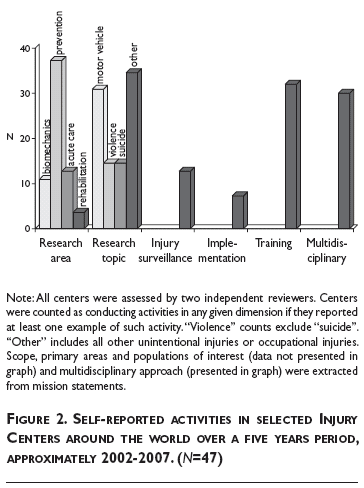
<body><![CDATA[<p><font face="Verdana" size="2">The most commonly cited definition of "injury"    is physical damage resulting from energy transfer in excess of cellular tolerance.<SUP>11</SUP>    Traditionally, physical damage from energy transfer was considered an injury    regardless of the mechanism by which it was immediately caused and irrespective    of the role of intent. Yet we have embraced physical transfer of energy as a    defining criterion only so far: war- or terrorism-related injuries, counted    as an injury outcome by the WHO, is seldom the focus of our best science or    evaluations; outcomes of frequent but lower energy transfers (e.g. those common    in occupational settings) get little play at our conferences.</font></P>     <p><font face="Verdana" size="2"> We have greatly expanded the scope of our field    over the past decade or so by including injuries with an intentional component    (e.g., suicide and homicide). The prospect of this expansion was accompanied    by internecine tension within the field as well as healthy debate about who    we are and who we want to become (see, for example, the debates about whether    the journal<I> Injury Prevention </I>should include articles on violence-related    injuries).<SUP>12-14</SUP> The erosion of the intent-based partition between    injury prevention and other disciplines, chiefly those of mental health and    criminal justice, stemmed from our recognition that etiologic factors identified    in epidemiologic studies of unintentional injury (e.g., alcohol consumption)    are cross-cutting risk factors for intentional injury. For example, increasing    the minimum legal drinking age was motivated by a desire to reduce motor vehicle    crashes but it also had the benefit of reducing suicide rates among 18-23 year    olds.<SUP>15</SUP> </font></P>     <p><font face="Verdana" size="2"> In affirming that it is not the fugitive attribute    of intention that defines our field, we have expanded not only our opportunities    but also our responsibilities since we are now obliged to grapple with issues    such as the psychological harm, maldevelopment or deprivation related to the    intentional use of physical force or power.<SUP>16</SUP> Over the next several    years we will have to contend not only with other definitional issues, such    as whether to include under the injury umbrella outcomes like adverse events    from medical interventions, but also with how to expand our own methodological    expertise beyond the types of epidemiologic studies that have thus far largely    defined our work. </font></P>     <p><font face="Verdana" size="2">ii) What we claim we do</font></P>     <p><font face="Verdana" size="2">A search of injury prevention and/or control    (research) centers provides one account of who we claim to be and what we claim    to do. In this section we present data derived from searching the websites of    umbrella organizations such as ISVIP (International Society for Violence and    Injury Prevention), SAVIR (Society for Advancement of Violence and Injury Research),    and EuroSafe. We identified the member organizations and visited their websites,    which led to identifying a few more organizations. In total, we identified 47    institutions related to each other in this way and for which we found information    on their websites (either in English or Spanish), although we do not assume    that we identified all relevant associations (<a href="/img/revistas/spm/v50s1/html/a15apx01.htm">appendix    A</a>). </font></P>     <p><font face="Verdana" size="2"> Our goal was to review their mission statements    and their listing of active projects. The criteria we chose to use in our assessment    are partly derived from the categories of actions put forward by the USA Committee    on Trauma Research (precursor to the current USA CDC National Center for Injury    Research).<SUP>11</SUP> These include: a) conduct and support research in biomechanics,    injury epidemiology and prevention, acute care and rehabilitation; b) establish    injury surveillance systems and support prevention activities (i.e., implementation);    and c) promote professional education and training. (We omit from this list    both the establishment of clearinghouses and leading agencies and the establishment    of injury research centers themselves). In addition, we assessed whether their    research activities focused on motor vehicle, homicide, suicide or others and    whether the centers reported a multidisciplinary composition. </font></P>     <p><font face="Verdana" size="2"> The assessment of the areas of work was particularly    challenging because reporting on the websites is neither comparable between    sites nor comprehensive or exhaustive. There is variation across all possible    dimensions. For example, some centers claim to have local and others international    interests, some focus on children, others on rural injuries, and others on occupational    issues. These limitations notwithstanding, <a href="#fig02">figure 2</a> shows    that practically all the reviewed centers reported training activities and a    majority reported a multidisciplinary approach to injury prevention and research    efforts. Within research efforts, more centers focus on prevention than on biomechanics    or rehabilitation; most claim at least one ongoing research project on motor    vehicle safety or other unintentional injuries.</font></P>     <p><a name="fig02"></a></P>     <p>&nbsp;</P>     <p align="center"><img src="/img/revistas/spm/v50s1/a15fig02.gif"></P>     ]]></body>
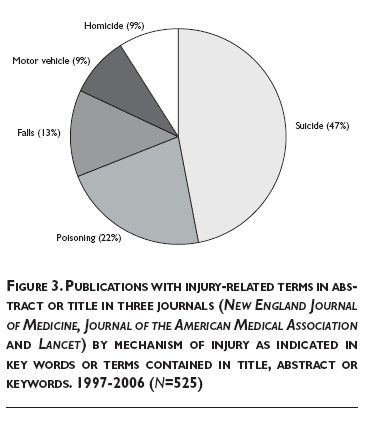
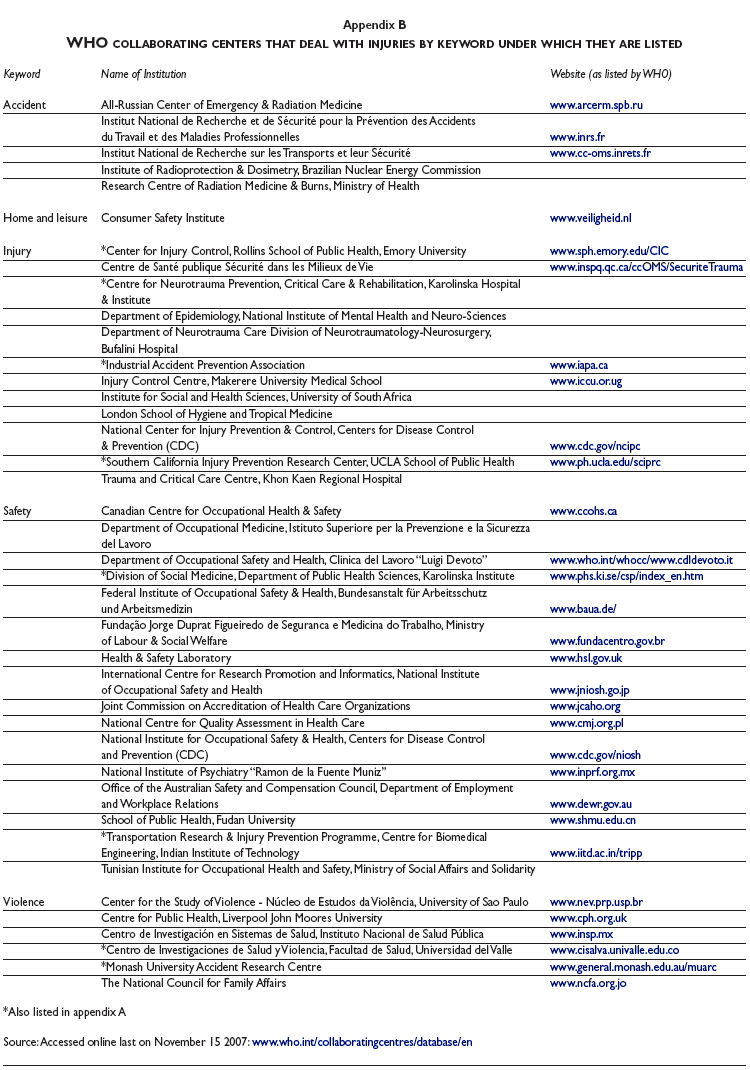
<body><![CDATA[<p>&nbsp;</p>     <p><font face="Verdana" size="2">iii) How we are seen (or not seen) by others</font></P>     <p><font face="Verdana" size="2">The terms used by the WHO to describe some injuries    (e.g, traffic "accidents") reflect a shortcoming in our efforts to    convince others that injuries are patterned and amenable to measurement –and    therefore, no more an accident than the occurrence of cancer or infectious disease.    Just how indistinct or, at best, fractured our field is in the eyes of the WHO    is reflected by the difficulty we personally had identifying those WHO collaborating    centers involved in injury prevention activities. In order to identify how many    of the nearly 900 WHO collaborating centers worldwide have injury prevention    as a focus, we needed to individually search in their global database<SUP>17</SUP>    for "injury", "safety", "violence", "home    and leisure", and "accident" to come up with what we identified    as the 40 centers with expertise in our area (depending upon whether we want    to include nuclear-related injuries or adverse events in the count, otherwise    32) (<a href="/img/revistas/spm/v50s1/html/a15apx02.htm">appendix B</a>) (Interestingly, 32 of    these centers had not been identified in the search presented in the previous    paragraph, maybe another sign of the fragmentation in the field.) </font></P>     <p><font face="Verdana" size="2"> We do not fault the WHO for failing to discern    cohesion where no obvious cohesion exists. Rather, the difficulty identifying    centers of injury research and practice reflects the fragmentary nature of the    injury field itself. This fragmentation may also help explain, in part, why    injuries are not as conspicuously apparent to the public, public health journals    and funding institutions as would be merited by the toll of injury measured    in any of a number of ways. How, after all, can we expect "outsiders"    to intuitively see the common thread of energy releases as the underlying etiological    mechanism uniting the different areas of injury prevention, when we ourselves    have a less than integrated sense of who we are? </font></P>     <p><font face="Verdana" size="2"> In another attempt to evaluate how others see    us, we reviewed publications from 1997 to 2006 in the three journals with the    highest impact factor in the area of Public Health and Medicine (<I>New England    Journal of Medicine, Journal of American Medical Association</I> and <I>Lancet</I>).    Our search in Pub Med contained the terms motor vehicle injuries, poisoning,    falls, suicide and homicide. The distribution by injury mechanism of the 545    identified publications (7% of all publications in these journals) is seen in    <a href="#fig03">figure 3</a>. We wonder whether the readers of these widely    distributed journals realize these publications all relate to injury and whether    the authors themselves would identify their focus as "injury prevention".</font></P>     <p><a name="fig03"></a></P>     <p>&nbsp;</P>     <p align="center"><img src="/img/revistas/spm/v50s1/a15fig03.gif"></P>     <p>&nbsp;</p>     <p><font face="Verdana" size="2"> It seems to us that an important and open question    is whether the common thread of "energy release" or "(possible)    psychological harm" is strong enough to hold us together in the years to    come and, by extension, whether the mission of reducing the burden of injury    and violence is better served by striving for greater intellectual and political    cohesion among those studying injury today or by redirecting our energies to    promote members of other established fields to take a greater interest in injury    outcomes. These two strategies are not generically antagonistic and indeed we    believe that these two goals can be pursued simultaneously. On the other hand,    how we should distribute our efforts in service of each of these aims is unclear    and, to our minds, a question that needs to be more openly discussed. </font></P>     ]]></body>
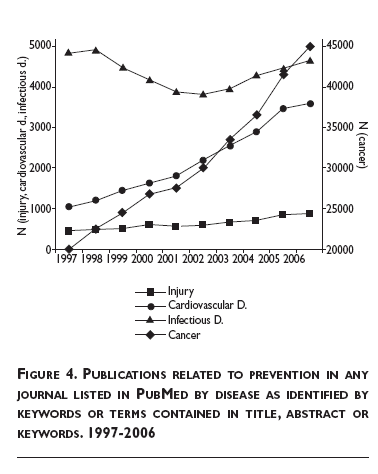
<body><![CDATA[<p><font face="Verdana" size="2"><i>III) Production</i></font></P>     <p><font face="Verdana" size="2">i) Publications</font></P>     <p><font face="Verdana" size="2">Our communications during the 9<SUP>th</SUP>    World Conference on Injury Prevention should serve as a snapshot of our current    activities. We counted the 1200 English or Spanish-accepted abstracts according    to the self-reported categories chosen by the submitting authors. Research-related    submissions lead the pack with 27% involving transport safety, 20% violence    (onto others), 15% other unintentional injuries, 5% acute care and rehabilitation,    and 3% self-inflicted violence (another 7% works were about occupational injuries,    but these could belong to several of the above presented categories). An additional    10% of the communications relate to methodological advances and development    of injury surveillance systems, 7% to capacity building, and 6% to policy issues    (Martha Hijar, personal communication).</font></P>     <p><font face="Verdana" size="2"> Peer-reviewed publications are another way to    document our work. Thus, we conducted another Pub Med search using the terms    cancer, cardiovascular disease, respiratory illness or disease, infectious disease    (including AIDS), and injury. Since we did not restrict the search to papers    written in English, our counts include publications in other languages with    an abstract in English. In addition, we narrowed the search by adding the term    "prevention" to all categories. As seen in <a href="#fig04">figure    4</a>, the number of injury and injury prevention publications in PubMed has    almost doubled since 1997 (rising from 427 to 872). Over this same time period,    publications in cardiovascular disease and cancer more than quadrupled. In absolute    terms, publications about injury prevention are dwarfed by those focusing on    cardiovascular disease, cancer, and especially those about infectious diseases.    </font></P>     <p><a name="fig04"></a></P>     <p>&nbsp;</P>     <p align="center"><img src="/img/revistas/spm/v50s1/a15fig04.gif"></P>     <p>&nbsp;</p>     <p><font face="Verdana" size="2">ii) Training</font></P>     <p><font face="Verdana" size="2">Another measure of our productivity and viability    as a field is how well we have attracted students into the injury profession.    Graduate-level courses in injury prevention<SUP>18</SUP> are offered at many    universities around the world and even undergraduates are now exposed to the    science of injury prevention.<SUP>19</SUP> There are, however, no doctoral or    master programs in injury prevention <I>per se</I>. Other potentially useful    metrics, such as the number of students who concentrate their graduate level    theses in injury related topics, were not readily available. Membership in professional    organizations is another proxy of commitment to a field which, if accurate,    may be a harbinger of lean times to come. For example, the membership of the    Injury Control and Emergency Health Section of the American Public Health Association    has slightly decreased over the past years (Susan Scavo Gallagher, personal    communication).</font></P>     ]]></body>
<body><![CDATA[<p><font face="Verdana" size="2"><i>IV. Resources</i></font></P>     <p><font face="Verdana" size="2">Our identity and productivity is shaped by the    resources (both human and economic) we secure to conduct our work. The disproportion    between the health burden of conditions and money devoted to investigate them    was first highlighted in the early 1980s in a publication focusing on the USA.<SUP>20</SUP>    Almost 30 years later, the data indicate that we are still far from securing    funding proportionate to the toll of injury.<SUP>21</SUP> Our own search suggests    that the discrepancy applies to the toll of injury relative to that of other    major causes of mortality and morbidity (e.g., cardiovascular disease, cancer    or infectious diseases) and to the toll of different injury mechanisms within    injury itself. It seems to us that we undermine our claim for the former to    the extent that we do not take seriously the imbalances in the latter. </font></P>     <p><font face="Verdana" size="2"> Although data on funding are hard to find, <a href="/img/revistas/spm/v50s1/html/a15tab02.htm">table    II</a> illustrates our best effort to characterize research budgets. In the    US, injury research gets less than 5% of the joint budgets of the USA National    Health Institute (NIH)<SUP>22</SUP> and Centers for Disease Control and Prevention    (CDC),<SUP>23</SUP> an amount approximately 15 times smaller than the condition    with the largest budget: infectious disease. This is an optimistic reading of    our situation, since the NIH injury-related funding includes funding for adverse    effects/medical errors, a topic that sits on the edge of what "belongs"    to our scope of interest.</font></P>     <p><font face="Verdana" size="2"> The figures for Europe are even more elusive.    Shown in <a href="/img/revistas/spm/v50s1/html/a15tab02.htm">table II</a> are the amounts devoted    to research and implementation programs by condition by the agency responsible    for Public Health in the European Union.<SUP>24</SUP> There is injury-related    research in other agencies (for example, funding for motor vehicle safety from    the agency responsible for Transport). However, determining how much money actually    goes into this type of research is very difficult from the publicly available    files. </font></P>     <p><font face="Verdana" size="2"> Within the injury field itself, the distribution    of funding is also not proportionate to the burden imposed by particular injury    subgroups. Consider the case for funding directed towards suicide as an injury    compared to that for all other funding for intentional injury (<a href="/img/revistas/spm/v50s1/html/a15tab02.htm">table    II</a>, bottom part). As these data indicate, funding for suicide constituted    approximately 2% of all dollars spent on intentional injuries by the CDC in    2006. Moreover, injury related, population-based research on suicide is not    to an appreciable extent being supported by other agencies that conduct suicide    research as these agencies have been largely governed by a research agenda in    thrall to a medicalized model of suicide etiology, prevention and treatment.    Indeed, one of the impediments to attracting better funding for population based    approaches to preventing suicide is the failure to see injury prevention approaches,    such as lethal means restriction, as critically important to suicide prevention    strategies.</font></P> <B>     <P><font face="Verdana" size="2">Limitations</font></P> </B>      <p><font face="Verdana" size="2">This paper is meant to stimulate discussions    among and between junior and senior colleagues in regards to the immediate future    of our field. We have tried to inform this discussion by providing data we found    relevant. Our figures are limited by a number of factors, such as their availability    in either English or Spanish, the instruments used in our search (computerized    records such as PubMed counts, websites), the difficulties associated with finding    funding information, and the different standards used by researchers and research    centers in reporting on their activities. Despite our hope and efforts to portray    a global picture of our field, we found little data on activities in areas such    as Africa, Asia, and Central and South America. We acknowledge that some of    chosen criteria are arbitrary, but we have aimed to being explicit about them.    If data that counter some of our interpretations are uncovered we would be delighted    to hear about it. </font></P> <B>     <P><font face="Verdana" size="2">Conclusions</font></P> </B>      <p><font face="Verdana" size="2">The burden of injury is growing and there is    much to do. In the course of writing this paper we have identified many dedicated    individuals and organizations that are well situated to do this work. Indeed,    at least 79 institutions around the world see themselves as committed to injury-related    research and we note with special appreciation that 1 500 professionals will    be attending the 9<SUP>th</SUP> World Conference. </font></P>     <p><font face="Verdana" size="2"> Having taken stock of our field, we believe    that there are reasons to be optimistic about our potential if we take seriously    our obligation to think closely about our responsibilities across the three    dimensions we have considered herein: the scope of our substantive charge, the    priorities we accord types of injuries within our scope, and the strategies    we pursue to broaden and deepen the methodological expertise among members of    our field even as we strive to collaborate with experts in related areas of    scientific inquiry. </font></P>     ]]></body>
<body><![CDATA[<p><font face="Verdana" size="2"> As professionals, we in the injury field possess    a number of strengths that should steady our resolve to confront the challenges    outlined in our paper: a) we know well how to characterize injury and injury    severity thanks to the development on injury coding systems; b) we believe in    a conceptual model that separates injuries from the (possibly injurious) event    to which they are temporally linked and to the exposure that led to that event;    c) philosophically we favor structural and environmental changes that apply    to all population as opposed to an individualistic-oriented approach to prevention;    d) many of us have been trained in identifying the epidemiological and biostatistical    tools that best fit the nature and distribution of our data; and e) we have    historically developed alliances and working relationships with professionals    of other disciplines as we understand injuries to be a complex phenomenon.</font></P>     <p><font face="Verdana" size="2"> Yet, to secure our success we need to learn    from the strategies pursued by other fields that will enable the injury field    to most effectively meet the particular challenges herewith outlined. One skill    we need to develop is how to become more persuasive advocates of the preventability    of injuries and violence and to link the idea of preventability to research    needs in terms that resonate with the missions of potential funders –governmental    and otherwise. Even as importantly, we need to produce the research that demonstrates    preventability to discus how best to integrate more intervention research specialists    amongst us, and to secure greater funding and status for evaluative research.    We need to reevaluate the role of behavioral sciences in injury prevention,    and we need to develop injury and violence-specific curricula as well as to    foster the use of injury and violence related examples into the courses in other    disciplines, especially those that are focused on methodological innovation.    </font></P>     <p><font face="Verdana" size="2"> Our goal in writing this article was not to    reprise the many excellent papers that have documented the structural, political,    economic and intellectual developments that have led to the establishment of    injury prevention as a recognized field of scientific inquiry.<SUP>1,21</SUP>    Neither did we set out to pay well-deserved homage to the individuals and organizations    largely responsible for the success of injury prevention. Rather, we hoped to    hold a mirror up to the injury field itself, to look at the image we project    to the world at large and to attempt to discern, if only dimly, what we need    to attend to right now to look our best in the years to come.</font></P> <B>     <P><font face="Verdana" size="2">Acknowledgments</font></P> </B>      <p><font face="Verdana" size="2">We appreciate Martha´s Hijar willingness to have    this piece published in this monographic number of <I>Revista de Salud P&uacute;blica    de M&eacute;xico</I> and the permission from the editorial to have a Spanish    translation freely downloadable from the following website (<A HREF="http://www.unav.es/ecip" target="_blank">www.unav.es/ecip</A>).    We thank Susan Scavo Gallagher for her comments to a previous version of this    manuscript. We also want to thank Montserrat Ruiz-Perez who assisted with the    editing of the manuscript both in English and Spanish. We would also like to    thank James Mercy for his help pointing us to data sources for injury funding.    Last, we are in debt with Eduardo del Pozo de Dios who assisted us with some    of the queries needed to complete this paper. Partial funding for the development    of this manuscript comes from Mutua Monta&ntilde;esa (MSG).</font></P>     <p>&nbsp;</P>     <P><font face="Verdana" size="3"><b>References </b></font></P>      <!-- ref --><P><font face="Verdana" size="2">1. Waller JA. Public health then and now - reflections    on a half century of injury control. Am J Public Health 1994;84(4):664-670.</font>&nbsp;&nbsp;&nbsp;&nbsp;&nbsp;&nbsp;&nbsp;&nbsp;[&#160;<a href="javascript:void(0);" onclick="javascript: window.open('/scielo.php?script=sci_nlinks&ref=9262021&pid=S0036-3634200800070001500001&lng=','','width=640,height=500,resizable=yes,scrollbars=1,menubar=yes,');">Links</a>&#160;]<!-- end-ref --><!-- ref --><P><font face="Verdana" size="2">2. Increases in age-group-specific injury mortality,    US 1999-2004. MMWR 2007;56:1281-1284</font>&nbsp;&nbsp;&nbsp;&nbsp;&nbsp;&nbsp;&nbsp;&nbsp;[&#160;<a href="javascript:void(0);" onclick="javascript: window.open('/scielo.php?script=sci_nlinks&ref=9262022&pid=S0036-3634200800070001500002&lng=','','width=640,height=500,resizable=yes,scrollbars=1,menubar=yes,');">Links</a>&#160;]<!-- end-ref --><!-- ref --><P><font face="Verdana" size="2">3. Mini&ntilde;o AM, Heron MP, Murphy SL, Kochanek    KD, Centers for Disease Control and Prevention. National Center for Health Statistics.    National Vital Statistics System. Deaths: Final data for 2004. Natl Vital Stat    Rep 2007;55(19):1-119. &#91;Accessed on December 13, 2007&#93;. Available online at:    <A HREF="http://www.cdc.gov/nchs/data/nvsr/nvsr55/nvsr55_19.pdf" target="_blank">http://www.cdc.gov/nchs/data/nvsr/nvsr55/nvsr55_19.pdf</A>.</font>&nbsp;&nbsp;&nbsp;&nbsp;&nbsp;&nbsp;&nbsp;&nbsp;[&#160;<a href="javascript:void(0);" onclick="javascript: window.open('/scielo.php?script=sci_nlinks&ref=9262023&pid=S0036-3634200800070001500003&lng=','','width=640,height=500,resizable=yes,scrollbars=1,menubar=yes,');">Links</a>&#160;]<!-- end-ref --><!-- ref --><P><font face="Verdana" size="2">4. Mathers CD, Loncar D. Projections of global    mortality and burden of disease from 2002 to 2030. PLOS Med 2006;3:2011-2029.</font>&nbsp;&nbsp;&nbsp;&nbsp;&nbsp;&nbsp;&nbsp;&nbsp;[&#160;<a href="javascript:void(0);" onclick="javascript: window.open('/scielo.php?script=sci_nlinks&ref=9262024&pid=S0036-3634200800070001500004&lng=','','width=640,height=500,resizable=yes,scrollbars=1,menubar=yes,');">Links</a>&#160;]<!-- end-ref --><!-- ref --><P><font face="Verdana" size="2">5. Centers for Disease Control and Prevention.    Ten great public health achievements. MMWR 1999;48(12):241-243. &#91;Accessed on    Jan 30, 2007&#93;. Available online at: <a href="http://www.cdc.gov/mmwr/preview/mmwrhtml/00056796.htm" target="_blank">http://www.cdc.gov/mmwr/preview/mmwrhtml/00056796.htm</a>.</font>&nbsp;&nbsp;&nbsp;&nbsp;&nbsp;&nbsp;&nbsp;&nbsp;[&#160;<a href="javascript:void(0);" onclick="javascript: window.open('/scielo.php?script=sci_nlinks&ref=9262025&pid=S0036-3634200800070001500005&lng=','','width=640,height=500,resizable=yes,scrollbars=1,menubar=yes,');">Links</a>&#160;]<!-- end-ref --><!-- ref --><P><font face="Verdana" size="2">6. World Health Organization. World Health Statistics    2007. France: World Health Organization, 2007. &#91;    &nbsp;&nbsp;&nbsp;&nbsp;&nbsp;&nbsp;&nbsp;&nbsp;[&#160;<a href="javascript:void(0);" onclick="javascript: window.open('/scielo.php?script=sci_nlinks&ref=9262026&pid=S0036-3634200800070001500006&lng=','','width=640,height=500,resizable=yes,scrollbars=1,menubar=yes,');">Links</a>&#160;]<!-- end-ref -->Accessed on Nov 1, 2007&#93;. Available    online at: <a href="http://www.who.int/whosis/whostat2007/en/index.html" target="_blank">http://www.who.int/whosis/whostat2007/en/index.html</a>.</font></P>     <!-- ref --><P><font face="Verdana" size="2">7. World Health Organization. The World Health    Report 2003: Shaping the Future. Geneva: World Health Organization, 2003. &#91;    &nbsp;&nbsp;&nbsp;&nbsp;&nbsp;&nbsp;&nbsp;&nbsp;[&#160;<a href="javascript:void(0);" onclick="javascript: window.open('/scielo.php?script=sci_nlinks&ref=9262028&pid=S0036-3634200800070001500007&lng=','','width=640,height=500,resizable=yes,scrollbars=1,menubar=yes,');">Links</a>&#160;]<!-- end-ref -->Accessed    on Jan 30, 2007&#93;. Available online at: <a href="http://www.who.int/whr/2003/en/" target="_blank">http://www.who.int/whr/2003/en/</a>.</font></P>     <!-- ref --><P><font face="Verdana" size="2">8. Hunt P, Bueno de Mesquita K, Oldring L. Neglected    diseases: A human rights analysis. Social, economic and behavioral research.    Special Topics Nº 6.Geneva: World Health Organization, 2007. &#91;    &nbsp;&nbsp;&nbsp;&nbsp;&nbsp;&nbsp;&nbsp;&nbsp;[&#160;<a href="javascript:void(0);" onclick="javascript: window.open('/scielo.php?script=sci_nlinks&ref=9262030&pid=S0036-3634200800070001500008&lng=','','width=640,height=500,resizable=yes,scrollbars=1,menubar=yes,');">Links</a>&#160;]<!-- end-ref -->Accessed on Nov    1, 2007&#93;. Available online as PDF file &#91;64p.&#93; at: <A HREF="http://www.who.int/tdr/publications/publications/pdf/seb_topic6.pdf" target="_blank">http://www.who.int/tdr/publications/publications/pdf/seb_topic6.pdf</A>.</font></P>     <!-- ref --><P><font face="Verdana" size="2">9. Woods D. Child Health Care: A learning programme    for professionals. Version 1.0.1 Updated 23 August 2007 Awerbuck D, ed. Eduhealthcare,    2007.</font>&nbsp;&nbsp;&nbsp;&nbsp;&nbsp;&nbsp;&nbsp;&nbsp;[&#160;<a href="javascript:void(0);" onclick="javascript: window.open('/scielo.php?script=sci_nlinks&ref=9262032&pid=S0036-3634200800070001500009&lng=','','width=640,height=500,resizable=yes,scrollbars=1,menubar=yes,');">Links</a>&#160;]<!-- end-ref --><!-- ref --><P><font face="Verdana" size="2">10. Minister of Health, New Zealand Government.    Moving towards healthier futures 2007/08. Wellington, 2007. &#91;Accessed on Nov    1, 2007&#93;. Available online as PDF file &#91;48p.&#93; at: <A HREF="http://www.moh.govt.nz/moh.nsf/pagesmh/6635/$File/health-targets-aug07.pdf" target="_blank">http://www.moh.govt.nz/moh.nsf/pagesmh/6635/$File/health-targets-aug07.pdf</A>.</font>&nbsp;&nbsp;&nbsp;&nbsp;&nbsp;&nbsp;&nbsp;&nbsp;[&#160;<a href="javascript:void(0);" onclick="javascript: window.open('/scielo.php?script=sci_nlinks&ref=9262033&pid=S0036-3634200800070001500010&lng=','','width=640,height=500,resizable=yes,scrollbars=1,menubar=yes,');">Links</a>&#160;]<!-- end-ref --><!-- ref --><P><font face="Verdana" size="2">11. National Committee for Injury Prevention    and Control. Injury Prevention: meeting the challenge. Am J Prev Med 1989;5(3,    supp 1):297.</font>&nbsp;&nbsp;&nbsp;&nbsp;&nbsp;&nbsp;&nbsp;&nbsp;[&#160;<a href="javascript:void(0);" onclick="javascript: window.open('/scielo.php?script=sci_nlinks&ref=9262034&pid=S0036-3634200800070001500011&lng=','','width=640,height=500,resizable=yes,scrollbars=1,menubar=yes,');">Links</a>&#160;]<!-- end-ref --><!-- ref --><P><font face="Verdana" size="2">12. Rivara FP. Looking to the future. Inj Prev    1998;4(3):168-169.</font>&nbsp;&nbsp;&nbsp;&nbsp;&nbsp;&nbsp;&nbsp;&nbsp;[&#160;<a href="javascript:void(0);" onclick="javascript: window.open('/scielo.php?script=sci_nlinks&ref=9262035&pid=S0036-3634200800070001500012&lng=','','width=640,height=500,resizable=yes,scrollbars=1,menubar=yes,');">Links</a>&#160;]<!-- end-ref --><!-- ref --><P><font face="Verdana" size="2">13. Pless IB. Violence in the journal. Inj Prev    1999;5(1):1-2.</font>&nbsp;&nbsp;&nbsp;&nbsp;&nbsp;&nbsp;&nbsp;&nbsp;[&#160;<a href="javascript:void(0);" onclick="javascript: window.open('/scielo.php?script=sci_nlinks&ref=9262036&pid=S0036-3634200800070001500013&lng=','','width=640,height=500,resizable=yes,scrollbars=1,menubar=yes,');">Links</a>&#160;]<!-- end-ref --><!-- ref --><P><font face="Verdana" size="2">14. Fisher L. Traditional public health injury    control does not apply to violence. Inj Prev 1999;5(1):13-14.</font>&nbsp;&nbsp;&nbsp;&nbsp;&nbsp;&nbsp;&nbsp;&nbsp;[&#160;<a href="javascript:void(0);" onclick="javascript: window.open('/scielo.php?script=sci_nlinks&ref=9262037&pid=S0036-3634200800070001500014&lng=','','width=640,height=500,resizable=yes,scrollbars=1,menubar=yes,');">Links</a>&#160;]<!-- end-ref --><!-- ref --><P><font face="Verdana" size="2">15. Birckmayer J, Hemenway D. Minimum age drinking    laws and youth suicide, 1970-1990. Am J Public Health 1999;89(9):1365-1368.</font>&nbsp;&nbsp;&nbsp;&nbsp;&nbsp;&nbsp;&nbsp;&nbsp;[&#160;<a href="javascript:void(0);" onclick="javascript: window.open('/scielo.php?script=sci_nlinks&ref=9262038&pid=S0036-3634200800070001500015&lng=','','width=640,height=500,resizable=yes,scrollbars=1,menubar=yes,');">Links</a>&#160;]<!-- end-ref --><!-- ref --><P><font face="Verdana" size="2">16. World Health Organization. WHO report on    violence and health. Geneva: World Health Organization, 2002. &#91;    &nbsp;&nbsp;&nbsp;&nbsp;&nbsp;&nbsp;&nbsp;&nbsp;[&#160;<a href="javascript:void(0);" onclick="javascript: window.open('/scielo.php?script=sci_nlinks&ref=9262039&pid=S0036-3634200800070001500016&lng=','','width=640,height=500,resizable=yes,scrollbars=1,menubar=yes,');">Links</a>&#160;]<!-- end-ref -->Accessed on Jan    30, 2007&#93;. Available online as PDF file at: <a href="http://www.who.int/violence_injury_prevention/violence/world_report/en/full_en.pdf" target="_blank">http://www.who.int/violence_injury_prevention/violence/world_report/en/full_en.pdf</a>.</font></P>     <!-- ref --><P><font face="Verdana" size="2">17. World Health Organization. WHO Collaborating    Centers Database. Available at <a href="http://www.who.int/collaboratingcentres/database/en/" target="_blank">http://www.who.int/collaboratingcentres/database/en/</a>    </font>&nbsp;&nbsp;&nbsp;&nbsp;&nbsp;&nbsp;&nbsp;&nbsp;[&#160;<a href="javascript:void(0);" onclick="javascript: window.open('/scielo.php?script=sci_nlinks&ref=9262041&pid=S0036-3634200800070001500017&lng=','','width=640,height=500,resizable=yes,scrollbars=1,menubar=yes,');">Links</a>&#160;]<!-- end-ref --><!-- ref --><P><font face="Verdana" size="2">18. Association of Schools of Public Health,    Centers for Disease Control and Prevention. Summary of Research, Teaching, Training,    Practice: Injury Prevention and Control. Injury Prevention and Control in Accredited    Schools of Public Health: 2002-2003. Association of Schools of Public Health,    2004.</font>&nbsp;&nbsp;&nbsp;&nbsp;&nbsp;&nbsp;&nbsp;&nbsp;[&#160;<a href="javascript:void(0);" onclick="javascript: window.open('/scielo.php?script=sci_nlinks&ref=9262042&pid=S0036-3634200800070001500018&lng=','','width=640,height=500,resizable=yes,scrollbars=1,menubar=yes,');">Links</a>&#160;]<!-- end-ref --><!-- ref --><P><font face="Verdana" size="2">19. Villaveces A, Kammeyer JA, Bencevic H. Injury    prevention education in medical schools: An international survey of medical    students. Inj Prev 2005;11(6):343-347.</font>&nbsp;&nbsp;&nbsp;&nbsp;&nbsp;&nbsp;&nbsp;&nbsp;[&#160;<a href="javascript:void(0);" onclick="javascript: window.open('/scielo.php?script=sci_nlinks&ref=9262043&pid=S0036-3634200800070001500019&lng=','','width=640,height=500,resizable=yes,scrollbars=1,menubar=yes,');">Links</a>&#160;]<!-- end-ref --><!-- ref --><P><font face="Verdana" size="2">20. Hartunian N, Smart C, Thompson M. The incidence    and economic costs of major health impairments. Lexington, MA: Lexington Books,    1981.</font>&nbsp;&nbsp;&nbsp;&nbsp;&nbsp;&nbsp;&nbsp;&nbsp;[&#160;<a href="javascript:void(0);" onclick="javascript: window.open('/scielo.php?script=sci_nlinks&ref=9262044&pid=S0036-3634200800070001500020&lng=','','width=640,height=500,resizable=yes,scrollbars=1,menubar=yes,');">Links</a>&#160;]<!-- end-ref --><!-- ref --><P><font face="Verdana" size="2">21. Committee on Injury Prevention and Control.    Division of Health Promotion and Disease Prevention. Institute of Medicine.    Reducing the Burden of Injury: Advancing Prevention and Treatment. Bonnie RJ,    Fulco CE, Liverman CT, eds. Washington DC: National Academy Press, 1999. </font>&nbsp;&nbsp;&nbsp;&nbsp;&nbsp;&nbsp;&nbsp;&nbsp;[&#160;<a href="javascript:void(0);" onclick="javascript: window.open('/scielo.php?script=sci_nlinks&ref=9262045&pid=S0036-3634200800070001500021&lng=','','width=640,height=500,resizable=yes,scrollbars=1,menubar=yes,');">Links</a>&#160;]<!-- end-ref --><!-- ref --><P><font face="Verdana" size="2">22. National Institute of Health. Estimates of    Funding for Various Diseases, Conditions, Research Areas. &#91;Accessed on Oct 30,    2007&#93;. Available online at: <a href="http://www.nih.gov/news/fundingresearchareas.htm" target="_blank">http://www.nih.gov/news/fundingresearchareas.htm</a>.</font>&nbsp;&nbsp;&nbsp;&nbsp;&nbsp;&nbsp;&nbsp;&nbsp;[&#160;<a href="javascript:void(0);" onclick="javascript: window.open('/scielo.php?script=sci_nlinks&ref=9262046&pid=S0036-3634200800070001500022&lng=','','width=640,height=500,resizable=yes,scrollbars=1,menubar=yes,');">Links</a>&#160;]<!-- end-ref --><!-- ref --><P><font face="Verdana" size="2">23. Centers for Disease Control and Prevention.    Budget figures. &#91;Accessed on Oct 30, 2007&#93;. Available at: <A HREF="http://www.cdc.gov/search.do?q=budget+president&amp;btnG.x=0&btnG.y=0&sort=date%3AD%3AL%3Ad1&ud=1&oe=utf8&ie=utf8" target="_blank">http://www.cdc.gov/search.do?q=budget+president&amp;btnG.    x=0&amp;btnG.y=0&amp;sort=date%3AD%3AL%3Ad1&amp;ud=1&amp;oe=utf8&amp;ie=utf8</A>.</font>&nbsp;&nbsp;&nbsp;&nbsp;&nbsp;&nbsp;&nbsp;&nbsp;[&#160;<a href="javascript:void(0);" onclick="javascript: window.open('/scielo.php?script=sci_nlinks&ref=9262047&pid=S0036-3634200800070001500023&lng=','','width=640,height=500,resizable=yes,scrollbars=1,menubar=yes,');">Links</a>&#160;]<!-- end-ref --><!-- ref --><P><font face="Verdana" size="2">24. European Commission. DG Health and Consumer    Protection. List of Projects funded for years 2003-2006. &#91;Accessed on Oct 30,    2007&#93;. Available at: <a href="http://ec.europa.eu/health/ph_projects/action1_en.print.htm" target="_blank">http://ec.europa.eu/health/ph_projects/action1_en.print.htm</a>.</font>&nbsp;&nbsp;&nbsp;&nbsp;&nbsp;&nbsp;&nbsp;&nbsp;[&#160;<a href="javascript:void(0);" onclick="javascript: window.open('/scielo.php?script=sci_nlinks&ref=9262048&pid=S0036-3634200800070001500024&lng=','','width=640,height=500,resizable=yes,scrollbars=1,menubar=yes,');">Links</a>&#160;]<!-- end-ref --><p>&nbsp;</p>     <p>&nbsp;</p>     <p><font face="Verdana" size="2">Received on: November 20, 2007    <br>   Accepted on: December 6, 2007</font></p>     <p>&nbsp;</p>     ]]></body>
<body><![CDATA[<p>&nbsp;</p>     <p><font face="Verdana" size="2">Address reprint requests to: Maria Segui-Gomez.    C/ Irunlarrea 1, 31008 Pamplona, Navarra, Spain. E-mail: <a href="mailto:msegui@unav.es">msegui@unav.es</a></font></p>     <p>&nbsp;</p>     <p>&nbsp;</p>     <p><font face="Verdana" size="3"><b>Appendix</b></font></p>     <p>&nbsp;</p>     <p align="center"><a href="/img/revistas/spm/v50s1/html/a15apx01.htm"><img src="/img/revistas/spm/v50s1/a15apx1p.gif" border="0"></a></p>     <p align="center"><font face="Verdana" size="2"><a href="/img/revistas/spm/v50s1/html/a15apx01.htm">Appendix    A - Haga un click para ampliar</a></font></p>     <p>&nbsp;</p>     <p>&nbsp;</p>     ]]></body>
<body><![CDATA[<p align="center"><a href="/img/revistas/spm/v50s1/a15apx02.gif"><img src="/img/revistas/spm/v50s1/a15apx2p.gif" border="0"></a></p>     <p align="center"><font face="Verdana" size="2"><a href="/img/revistas/spm/v50s1/html/a15apx02.htm">Appendix    B - Haga un click para ampliar</a></font></p>     <p>&nbsp;</p>      ]]></body><back>
<ref-list>
<ref id="B1">
<label>1</label><nlm-citation citation-type="journal">
<person-group person-group-type="author">
<name>
<surname><![CDATA[Waller]]></surname>
<given-names><![CDATA[JA]]></given-names>
</name>
</person-group>
<article-title xml:lang="en"><![CDATA[Public health then and now - reflections on a half century of injury control]]></article-title>
<source><![CDATA[Am J Public Health]]></source>
<year>1994</year>
<volume>84</volume>
<numero>4</numero>
<issue>4</issue>
<page-range>664-670</page-range></nlm-citation>
</ref>
<ref id="B2">
<label>2</label><nlm-citation citation-type="journal">
<article-title xml:lang="en"><![CDATA[Increases in age-group-specific injury mortality, US 1999-2004]]></article-title>
<source><![CDATA[MMWR]]></source>
<year>2007</year>
<volume>56</volume>
<page-range>1281-1284</page-range></nlm-citation>
</ref>
<ref id="B3">
<label>3</label><nlm-citation citation-type="journal">
<person-group person-group-type="author">
<name>
<surname><![CDATA[Miniño]]></surname>
<given-names><![CDATA[AM]]></given-names>
</name>
<name>
<surname><![CDATA[Heron]]></surname>
<given-names><![CDATA[MP]]></given-names>
</name>
<name>
<surname><![CDATA[Murphy]]></surname>
<given-names><![CDATA[SL]]></given-names>
</name>
<name>
<surname><![CDATA[Kochanek]]></surname>
<given-names><![CDATA[KD]]></given-names>
</name>
</person-group>
<article-title xml:lang="en"><![CDATA[Centers for Disease Control and Prevention. National Center for Health Statistics. National Vital Statistics System. Deaths: Final data for 2004]]></article-title>
<source><![CDATA[Natl Vital Stat Rep]]></source>
<year>2007</year>
<volume>55</volume>
<numero>19</numero>
<issue>19</issue>
<page-range>1-119</page-range></nlm-citation>
</ref>
<ref id="B4">
<label>4</label><nlm-citation citation-type="journal">
<person-group person-group-type="author">
<name>
<surname><![CDATA[Mathers]]></surname>
<given-names><![CDATA[CD]]></given-names>
</name>
<name>
<surname><![CDATA[Loncar]]></surname>
<given-names><![CDATA[D]]></given-names>
</name>
</person-group>
<article-title xml:lang="en"><![CDATA[Projections of global mortality and burden of disease from 2002 to 2030]]></article-title>
<source><![CDATA[PLOS Med]]></source>
<year>2006</year>
<volume>3</volume>
<page-range>2011-2029</page-range></nlm-citation>
</ref>
<ref id="B5">
<label>5</label><nlm-citation citation-type="journal">
<article-title xml:lang="en"><![CDATA[Centers for Disease Control and Prevention: Ten great public health achievements]]></article-title>
<source><![CDATA[MMWR]]></source>
<year>1999</year>
<volume>48</volume>
<numero>12</numero>
<issue>12</issue>
<page-range>241-243</page-range></nlm-citation>
</ref>
<ref id="B6">
<label>6</label><nlm-citation citation-type="book">
<collab>World Health Organization</collab>
<source><![CDATA[World Health Statistics 2007]]></source>
<year>2007</year>
<publisher-loc><![CDATA[France ]]></publisher-loc>
<publisher-name><![CDATA[World Health Organization]]></publisher-name>
</nlm-citation>
</ref>
<ref id="B7">
<label>7</label><nlm-citation citation-type="book">
<collab>World Health Organization</collab>
<source><![CDATA[The World Health Report 2003:Shaping the Future]]></source>
<year>2003</year>
<publisher-loc><![CDATA[Geneva ]]></publisher-loc>
<publisher-name><![CDATA[World Health Organization]]></publisher-name>
</nlm-citation>
</ref>
<ref id="B8">
<label>8</label><nlm-citation citation-type="book">
<person-group person-group-type="author">
<name>
<surname><![CDATA[Hunt]]></surname>
<given-names><![CDATA[P]]></given-names>
</name>
</person-group>
<collab>Bueno de Mesquita K.Oldring L</collab>
<source><![CDATA[Neglected diseases:A human rights analysis: Social, economic and behavioral research. Special Topics Nº 6]]></source>
<year>2007</year>
<publisher-loc><![CDATA[Geneva ]]></publisher-loc>
<publisher-name><![CDATA[World Health Organization]]></publisher-name>
</nlm-citation>
</ref>
<ref id="B9">
<label>9</label><nlm-citation citation-type="book">
<person-group person-group-type="author">
<name>
<surname><![CDATA[Woods]]></surname>
<given-names><![CDATA[D]]></given-names>
</name>
</person-group>
<source><![CDATA[Child Health Care: A learning programme for professionals. Version 1.0.1]]></source>
<year>23 A</year>
<month>ug</month>
<day>us</day>
<publisher-name><![CDATA[Eduhealthcare]]></publisher-name>
</nlm-citation>
</ref>
<ref id="B10">
<label>10</label><nlm-citation citation-type="">
<collab>New Zealand Government^dMinister of Health</collab>
<source><![CDATA[Moving towards healthier futures 2007/08: Wellington, 2007]]></source>
<year></year>
</nlm-citation>
</ref>
<ref id="B11">
<label>11</label><nlm-citation citation-type="journal">
<collab>National Committee for Injury Prevention and Control</collab>
<article-title xml:lang="en"><![CDATA[Injury Prevention: meeting the challenge]]></article-title>
<source><![CDATA[Am J Prev Med]]></source>
<year>1989</year>
<volume>5</volume>
<numero>3^s1</numero>
<issue>3^s1</issue>
<supplement>1</supplement>
<page-range>297</page-range></nlm-citation>
</ref>
<ref id="B12">
<label>12</label><nlm-citation citation-type="journal">
<person-group person-group-type="author">
<name>
<surname><![CDATA[Rivara]]></surname>
<given-names><![CDATA[FP]]></given-names>
</name>
</person-group>
<article-title xml:lang="en"><![CDATA[Looking to the future]]></article-title>
<source><![CDATA[Inj Prev]]></source>
<year>1998</year>
<volume>4</volume>
<numero>3</numero>
<issue>3</issue>
<page-range>168-169</page-range></nlm-citation>
</ref>
<ref id="B13">
<label>13</label><nlm-citation citation-type="journal">
<person-group person-group-type="author">
<name>
<surname><![CDATA[Pless]]></surname>
<given-names><![CDATA[IB]]></given-names>
</name>
</person-group>
<article-title xml:lang="en"><![CDATA[Violence in the journal]]></article-title>
<source><![CDATA[Inj Prev]]></source>
<year>1999</year>
<volume>5</volume>
<numero>1</numero>
<issue>1</issue>
<page-range>1-2</page-range></nlm-citation>
</ref>
<ref id="B14">
<label>14</label><nlm-citation citation-type="journal">
<person-group person-group-type="author">
<name>
<surname><![CDATA[Fisher]]></surname>
<given-names><![CDATA[L]]></given-names>
</name>
</person-group>
<article-title xml:lang="en"><![CDATA[Traditional public health injury control does not apply to violence]]></article-title>
<source><![CDATA[Inj Prev]]></source>
<year>1999</year>
<volume>5</volume>
<numero>1</numero>
<issue>1</issue>
<page-range>13-14</page-range></nlm-citation>
</ref>
<ref id="B15">
<label>15</label><nlm-citation citation-type="journal">
<person-group person-group-type="author">
<name>
<surname><![CDATA[Birckmayer]]></surname>
<given-names><![CDATA[J]]></given-names>
</name>
<name>
<surname><![CDATA[Hemenway]]></surname>
<given-names><![CDATA[D]]></given-names>
</name>
</person-group>
<article-title xml:lang="en"><![CDATA[Minimum age drinking laws and youth suicide, 1970-1990]]></article-title>
<source><![CDATA[Am J Public Health]]></source>
<year>1999</year>
<volume>89</volume>
<numero>9</numero>
<issue>9</issue>
<page-range>1365-1368</page-range></nlm-citation>
</ref>
<ref id="B16">
<label>16</label><nlm-citation citation-type="book">
<collab>World Health Organization</collab>
<source><![CDATA[WHO report on violence and health]]></source>
<year>2002</year>
<publisher-loc><![CDATA[Geneva ]]></publisher-loc>
<publisher-name><![CDATA[World Health Organization]]></publisher-name>
</nlm-citation>
</ref>
<ref id="B17">
<label>17</label><nlm-citation citation-type="">
<collab>World Health Organization</collab>
<source><![CDATA[WHO Collaborating Centers Database]]></source>
<year></year>
</nlm-citation>
</ref>
<ref id="B18">
<label>18</label><nlm-citation citation-type="book">
<collab>Association of Schools of Public Health^dCenters for Disease Control and Prevention</collab>
<source><![CDATA[Summary of Research, Teaching, Training, Practice: Injury Prevention and Control. Injury Prevention and Control in Accredited Schools of Public Health: 2002-2003]]></source>
<year>2004</year>
<publisher-name><![CDATA[Association of Schools of Public Health]]></publisher-name>
</nlm-citation>
</ref>
<ref id="B19">
<label>19</label><nlm-citation citation-type="journal">
<person-group person-group-type="author">
<name>
<surname><![CDATA[Villaveces]]></surname>
<given-names><![CDATA[A]]></given-names>
</name>
<name>
<surname><![CDATA[Kammeyer]]></surname>
<given-names><![CDATA[JA]]></given-names>
</name>
<name>
<surname><![CDATA[Bencevic]]></surname>
<given-names><![CDATA[H]]></given-names>
</name>
</person-group>
<article-title xml:lang="en"><![CDATA[Injury prevention education in medical schools: An international survey of medical students]]></article-title>
<source><![CDATA[Inj Prev]]></source>
<year>2005</year>
<volume>11</volume>
<numero>6</numero>
<issue>6</issue>
<page-range>343-347</page-range></nlm-citation>
</ref>
<ref id="B20">
<label>20</label><nlm-citation citation-type="book">
<person-group person-group-type="author">
<name>
<surname><![CDATA[Hartunian]]></surname>
<given-names><![CDATA[N]]></given-names>
</name>
<name>
<surname><![CDATA[Smart]]></surname>
<given-names><![CDATA[C]]></given-names>
</name>
<name>
<surname><![CDATA[Thompson]]></surname>
<given-names><![CDATA[M]]></given-names>
</name>
</person-group>
<source><![CDATA[The incidence and economic costs of major health impairments.]]></source>
<year>1981</year>
<publisher-loc><![CDATA[Lexington^eMA MA]]></publisher-loc>
<publisher-name><![CDATA[Lexington Books]]></publisher-name>
</nlm-citation>
</ref>
<ref id="B21">
<label>21</label><nlm-citation citation-type="">
<collab>Committee on Injury Prevention and Control^dDivision of Health Promotion and Disease Prevention. Institute of Medicine</collab>
<article-title xml:lang="en"><![CDATA[Reducing the Burden of Injury: Advancing Prevention and Treatment]]></article-title>
<person-group person-group-type="author">
<name>
<surname><![CDATA[Bonnie]]></surname>
<given-names><![CDATA[RJ]]></given-names>
</name>
<name>
<surname><![CDATA[Fulco]]></surname>
<given-names><![CDATA[CE]]></given-names>
</name>
<name>
<surname><![CDATA[Liverman]]></surname>
<given-names><![CDATA[CT]]></given-names>
</name>
</person-group>
<source><![CDATA[]]></source>
<year></year>
</nlm-citation>
</ref>
<ref id="B22">
<label>22</label><nlm-citation citation-type="">
<collab>National Institute of Health</collab>
<source><![CDATA[Estimates of Funding for Various Diseases: Conditions, Research Areas]]></source>
<year></year>
</nlm-citation>
</ref>
<ref id="B23">
<label>23</label><nlm-citation citation-type="">
<collab>Centers for Disease Control and Prevention</collab>
<source><![CDATA[Budget figures]]></source>
<year></year>
</nlm-citation>
</ref>
<ref id="B24">
<label>24</label><nlm-citation citation-type="">
<collab>European Commission</collab>
<source><![CDATA[DG Health and Consumer Protection: List of Projects funded for years 2003-2006]]></source>
<year></year>
</nlm-citation>
</ref>
</ref-list>
</back>
</article>