<?xml version="1.0" encoding="ISO-8859-1"?><article xmlns:mml="http://www.w3.org/1998/Math/MathML" xmlns:xlink="http://www.w3.org/1999/xlink" xmlns:xsi="http://www.w3.org/2001/XMLSchema-instance">
<front>
<journal-meta>
<journal-id>0036-3634</journal-id>
<journal-title><![CDATA[Salud Pública de México]]></journal-title>
<abbrev-journal-title><![CDATA[Salud pública Méx]]></abbrev-journal-title>
<issn>0036-3634</issn>
<publisher>
<publisher-name><![CDATA[Instituto Nacional de Salud Pública]]></publisher-name>
</publisher>
</journal-meta>
<article-meta>
<article-id>S0036-36342008000500014</article-id>
<title-group>
<article-title xml:lang="en"><![CDATA[Human Papillomavirus infection in men residing in Brazil, Mexico, and the USA]]></article-title>
<article-title xml:lang="es"><![CDATA[Infección por Virus de Papiloma Humano en hombres de Brasil, México y EUA]]></article-title>
</title-group>
<aff id="A">
<institution><![CDATA[,  ]]></institution>
<addr-line><![CDATA[ ]]></addr-line>
</aff>
<pub-date pub-type="pub">
<day>00</day>
<month>10</month>
<year>2008</year>
</pub-date>
<pub-date pub-type="epub">
<day>00</day>
<month>10</month>
<year>2008</year>
</pub-date>
<volume>50</volume>
<numero>5</numero>
<fpage>408</fpage>
<lpage>418</lpage>
<copyright-statement/>
<copyright-year/>
<self-uri xlink:href="http://www.scielo.org.mx/scielo.php?script=sci_arttext&amp;pid=S0036-36342008000500014&amp;lng=en&amp;nrm=iso"></self-uri><self-uri xlink:href="http://www.scielo.org.mx/scielo.php?script=sci_abstract&amp;pid=S0036-36342008000500014&amp;lng=en&amp;nrm=iso"></self-uri><self-uri xlink:href="http://www.scielo.org.mx/scielo.php?script=sci_pdf&amp;pid=S0036-36342008000500014&amp;lng=en&amp;nrm=iso"></self-uri><abstract abstract-type="short" xml:lang="en"><p><![CDATA[OBJECTIVE: To assess Human Papillomavirus (HPV) type distribution among men ages 18 years and older recruited from three different countries utilizing a common protocol for sampling HPV detection, and to evaluate whether HPV detection differs by age and country. MATERIAL AD METHODS: The study protocol includes a pre-enrollment run-in visit, a baseline (enrollment) visit, and nine additional visits after enrollment scheduled six months apart. For this analysis, the first 1160 men who completed both the run-in and baseline visit were included. To maximize sampling and prevent fraying of applicators, three different applicators were utilized to sample the external genitalia of participants among different anatomic sites. These samples were later combined to form a single sample for the detection of HPV using polymerase chain reaction (PCR) for amplification of a fragment of the HPV L1 gene. RESULTS: Among 1160 men from Brazil, Mexico, and the United States (U.S.), overall HPV prevalence was 65.2%; with 12.0% oncogenic types only, 20.7% non-oncogenic types only, 17.8% both oncogenic and non-oncogenic, and 14.7% unclassified infections. Multiple HPV types were detected in 25.7% of study participants. HPV prevalence was higher in Brazil (72.3%) than in the U.S. (61.3%) and Mexico (61.9%). HPV 16 (6.5%), 51 (6.5%), and 59 (5.3%) were the most commonly detected oncogenic infections, and HPV 84 (7.7%), 62 (7.3%), and 6 (6.6%) were the most commonly detected non-oncogenic infections. Overall HPV prevalence was not associated with age. However, significant associations with age were observed when specific categories of oncogenic, non-oncogenic, and unclassified HPV infections were considered. CONCLUSIONS: Studies of HPV type distribution among a broad age range of men from multiple countries is needed to fill the information gap internationally with respect to our knowledge of HPV infection in men.]]></p></abstract>
<abstract abstract-type="short" xml:lang="es"><p><![CDATA[OBJETIVO: Evaluar la distribución tipo específica de infección por Virus del Papiloma Humano (VPH) entre hombres de 18 años o más de tres países con un protocolo común para el muestreo de la detección de VPH, y evaluar si la detección de VPH varía de acuerdo con la edad y el país. MATERIAL Y MÉTODOS: El estudio incluye diversas etapas que inician con la identificación de hombres susceptibles, una medición basal (visita de enrolamiento) y nueve visitas adicionales programadas cada seis meses. En este artículo, se presenta el análisis de los primeros 1160 hombres que fueron incluídos en el estudio. Para maximizar la posibilidad de detección de VPH se utilizó un cepillo de dacrón que muestreó en forma combinada diferentes sitios anatómicos. Para la determinación de ADN de VPH se utilizó ión en cadena de polimerasa (PCR) por amplificación de un fragmento del gen de VPH L1. RESULTADOS: Entre 1160 hombres de Brasil, México y EUA, la prevalencia global de VPH fue de 65.2%, con solamente 12% de tipos oncogénicos, 20.7% de tipos de VPH no oncogénicos, 17.8% de muestras positivas a tipos oncogénicos y no oncogénicos; y finalmente 14.7% de infecciones no clasificadas. Múltiples tipos de VPH fueron detectados en 25.7% de los participantes en el estudio. La prevalencia de VPH fue más alta en Brasil (72.3%), comparada con la observada en EUA (61.3%) y México (61.9%). Los tipos de VPH 16 (6.5%), 51 (6.5%) y 59 (5.3%) fueron los más comúnmente observados con poder oncogénico. El VPH 84 (7.7%), 62 (7.3%) y 6 (6.6%) fueron las infecciones no oncogénicas más comunes. CONCLUSIONES: Son necesarios estudios de la distribución de VPH en un amplio margen de edad entre hombres de múltiples países, para establecer con mayor precisión, el conocimiento de la historia natural de la infección por VPH en hombres.]]></p></abstract>
<kwd-group>
<kwd lng="en"><![CDATA[HPV]]></kwd>
<kwd lng="en"><![CDATA[males]]></kwd>
<kwd lng="en"><![CDATA[multicenter study]]></kwd>
<kwd lng="en"><![CDATA[sexual behavior]]></kwd>
<kwd lng="es"><![CDATA[VPH]]></kwd>
<kwd lng="es"><![CDATA[hombres]]></kwd>
<kwd lng="es"><![CDATA[estudio multicéntrico]]></kwd>
<kwd lng="es"><![CDATA[conducta sexual]]></kwd>
</kwd-group>
</article-meta>
</front><body><![CDATA[ <p align="right"><font size="2" face="Verdana"><b>ART&Iacute;CULO ORIGINAL</b></font></p>     <p>&nbsp;</p>     <p><font size="4" face="verdana"><b><a name="tx"></a>Human Papillomavirus infection    in men residing in Brazil, Mexico, and the USA</b></font></p>     <p>&nbsp;</p>     <p><font size="3" face="verdana"><b>Infecci&oacute;n por Virus de Papiloma Humano    en hombres de Brasil, M&eacute;xico y EUA</b></font></p>     <p>&nbsp;</p>     <p>&nbsp;</p>     <p><font size="2" face="Verdana"><b>HPV Study group in men from Brazil, USA and    Mexico<a href="#nt"><sup>*</sup></a></b></font></p>     <p>&nbsp;</p>     <p>&nbsp;</p> <hr size="1" noshade>     ]]></body>
<body><![CDATA[<p><font size="2" face="Verdana"><b>ABSTRACT</b></font></p>     <p><font size="2" face="Verdana"><B>OBJECTIVE:</b> To assess Human Papillomavirus    (HPV) type distribution among men ages 18 years and older recruited from three    different countries utilizing a common protocol for sampling HPV detection,    and to evaluate whether HPV detection differs by age and country.    <br>   <B>MATERIAL AD METHODS:</B> The study protocol includes a pre&#45;enrollment run&#45;in    visit, a baseline (enrollment) visit, and nine additional visits after enrollment    scheduled six months apart. For this analysis, the first 1160 men who completed    both the run&#45;in and baseline visit were included. To maximize sampling and prevent    fraying of applicators, three different applicators were utilized to sample    the external genitalia of participants among different anatomic sites. These    samples were later combined to form a single sample for the detection of HPV    using polymerase chain reaction (PCR) for amplification of a fragment of the    HPV L1 gene.    <br>   <B>RESULTS:</B> Among 1160 men from Brazil, Mexico, and the United States (U.S.),    overall HPV prevalence was 65.2%; with 12.0% oncogenic types only, 20.7% non&#45;oncogenic    types only, 17.8% both oncogenic and non&#45;oncogenic, and 14.7% unclassified infections.    Multiple HPV types were detected in 25.7% of study participants. HPV prevalence    was higher in Brazil (72.3%) than in the U.S. (61.3%) and Mexico (61.9%). HPV    16 (6.5%), 51 (6.5%), and 59 (5.3%) were the most commonly detected oncogenic    infections, and HPV 84 (7.7%), 62 (7.3%), and 6 (6.6%) were the most commonly    detected non&#45;oncogenic infections. Overall HPV prevalence was not associated    with age. However, significant associations with age were observed when specific    categories of oncogenic, non&#45;oncogenic, and unclassified HPV infections were    considered.    <br>   <B>CONCLUSIONS:</B> Studies of HPV type distribution among a broad age range    of men from multiple countries is needed to fill the information gap internationally    with respect to our knowledge of HPV infection in men.</font></p>     <p><font size="2" face="Verdana"><b>Key words:</b> HPV; males; multicenter study;    sexual behavior</font></p> <hr size="1" noshade>     <p><font size="2" face="Verdana"><b>RESUMEN</b></font></p>     <p><font size="2" face="Verdana"><B>OBJETIVO:</b> Evaluar la distribuci&oacute;n    tipo espec&iacute;fica de infecci&oacute;n por Virus del Papiloma Humano (VPH)    entre hombres de 18 a&ntilde;os o m&aacute;s de tres pa&iacute;ses con un protocolo    com&uacute;n para el muestreo de la detecci&oacute;n de VPH, y evaluar si la    detecci&oacute;n de VPH var&iacute;a de acuerdo con la edad y el pa&iacute;s.    <br>   <B>MATERIAL Y M&Eacute;TODOS:</B> El estudio incluye diversas etapas que inician    con la identificaci&oacute;n de hombres susceptibles, una medici&oacute;n basal    (visita de enrolamiento) y nueve visitas adicionales programadas cada seis meses.    En este art&iacute;culo, se presenta el an&aacute;lisis de los primeros 1160    hombres que fueron inclu&iacute;dos en el estudio. Para maximizar la posibilidad    de detecci&oacute;n de VPH se utiliz&oacute; un cepillo de dacr&oacute;n que    muestre&oacute; en forma combinada diferentes sitios anat&oacute;micos. Para    la determinaci&oacute;n de ADN de VPH se utiliz&oacute; i&oacute;n en cadena    de polimerasa (PCR) por amplificaci&oacute;n de un fragmento del gen de VPH    L1.    <br>   <B>RESULTADOS:</B> Entre 1160 hombres de Brasil, M&eacute;xico y EUA, la prevalencia    global de VPH fue de 65.2%, con solamente 12% de tipos oncog&eacute;nicos, 20.7%    de tipos de VPH no oncog&eacute;nicos, 17.8% de muestras positivas a tipos oncog&eacute;nicos    y no oncog&eacute;nicos; y finalmente 14.7% de infecciones no clasificadas.    M&uacute;ltiples tipos de VPH fueron detectados en 25.7% de los participantes    en el estudio. La prevalencia de VPH fue m&aacute;s alta en Brasil (72.3%),    comparada con la observada en EUA (61.3%) y M&eacute;xico (61.9%). Los tipos    de VPH 16 (6.5%), 51 (6.5%) y 59 (5.3%) fueron los m&aacute;s com&uacute;nmente    observados con poder oncog&eacute;nico. El VPH 84 (7.7%), 62 (7.3%) y 6 (6.6%)    fueron las infecciones no oncog&eacute;nicas m&aacute;s comunes.    ]]></body>
<body><![CDATA[<br>   <B>CONCLUSIONES:</B> Son necesarios estudios de la distribuci&oacute;n de VPH    en un amplio margen de edad entre hombres de m&uacute;ltiples pa&iacute;ses,    para establecer con mayor precisi&oacute;n, el conocimiento de la historia natural    de la infecci&oacute;n por VPH en hombres.</font></p>     <p><font size="2" face="Verdana"><b>Palabras clave:</b> VPH; hombres; estudio    multic&eacute;ntrico; conducta sexual</font></p> <hr size="1" noshade>     <p>&nbsp;</p>     <p>&nbsp;</p>     <p><font size="2" face="Verdana">Male HPV infection significantly contributes    to infection and subsequent cervical disease in women.<SUP>1&#45;4</SUP> Case&#45;control    studies of women with cervical cancer and their husbands have demonstrated that    men's sexual behavior affects women's risk of cervical neoplasia, even when    controlling for female sexual activity.<SUP>1&#45;7</SUP> In areas with a high incidence    of cervical cancer, men's sexual behavior is in itself a risk factor for cervical    neoplasia.<SUP>7</SUP> More recently we have recognized that HPV contributes    to men's burden of diseases such as anal, penile, and oropharyngeal cancers    and genital warts.<SUP>8</SUP> A growing interest in understanding HPV infection    in men necessitates the characterization of these infections in terms of type    distribution across countries. Unfortunately, there is a paucity of studies    that can shed light on male HPV type distribution in any one country or across    countries.</font></p>     <p><font size="2" face="Verdana">Few HPV studies have been conducted among heterosexual    men, with only a subset reporting HPV type distribution and age&#45;specific prevalence    estimates.<SUP>9</SUP> No studies to date have included a broad age range of    men from multiple countries, which limits our ability to draw conclusions about    differences in HPV type distribution among men. For example, observed differences    in HPV type distribution in men may be due to differences in tissue tropism    for particular HPV types due to anatomic site sampled. Alternatively, they may    be due to differences in populations studied, similar to what we understand    for cervical HPV.<SUP>10</SUP> This information is needed to inform future prevention    efforts that may influence infection and disease reduction in men and consequently    in women. The purpose of the current study was to assess HPV type&#45;distribution    among men ages 18 years and older recruited from three different countries utilizing    a common protocol for sampling and HPV detection, and to evaluate whether HPV    detection differs by age and country.</font></p>     <p>&nbsp;</p>     <p><font size="3" face="Verdana"><b>Materials and methods</b></font></p>     <p><font size="2" face="Verdana">Men enrolled from March 2005 to December 2006    in the ongoing HPV in Men (HIM) Study were included in this analysis. Participants    were recruited from Sao Paulo, Brazil; Cuernavaca, Mexico; Tampa, Florida; and    surrounding areas. To encourage compliance with follow&#45;up, men received compensation    or food or transportation reimbursement for their participation. Prior to study    initiation, the Human Subjects Committees of the University of South Florida,    the CRT&#45;DST/Aids, Brazil, and the National Institute of Public Health of Mexico    approved all study procedures. All participants gave written informed consent.</font></p>     <p><font size="2" face="Verdana"><I>Population.</i> The study population consisted    of men who met the following eligibility criteria: a) ages 18&#45;70 years; b) residents    of one of three sites &#150;Sao Paulo, Brazil; the state of Morelos, Mexico; or southern    Florida, U.S.; c) report no prior diagnosis of penile or anal cancers; d) have    never been diagnosed with genital or anal warts; e) currently report no symptoms    of a sexually transmitted infection (STI) or treatment for an STI; f) not participating    in an HPV vaccine study; g) no history of HIV or AIDS; h) no history of imprisonment,    homelessness, or drug treatment during the past six months; and i) willing to    comply with ten scheduled visits every six months for four years with no plans    to relocate within the next four years.</font></p>     ]]></body>
<body><![CDATA[<p><font size="2" face="Verdana">Men were recruited from three different population    sources &#150;general population, universities, and organized health care systems    (Mexico only)&#150; to increase access to men with a broad range of ages, sexual    behaviors, and HPV risk. In Brazil, men were recruited from the general population    at a facility for urogenital care (Centro de Referencia e Tratamento de Doencas    Sexualmente Transmissiveis e AIDS) and through general media advertising. Men    presenting for non&#45;STI related conditions were enrolled in the present study.    In addition, the spouses and partners of women participating in a large cohort    study of the natural history of HPV infection and risk of cervical neoplasia    conducted in Sao Paulo since 1993 were also recruited. At the Cuernavaca, Mexico    site, the underlying population was employees and beneficiaries of the Instituto    Mexicano de Seguro Social (IMSS), factory employees, and officials of the Mexican    army that are permanently assigned to this geographic area. In the U.S., the    underlying population was from the University of South Florida and the greater    Tampa metropolitan area. Flyers and posters were distributed throughout the    campus and community, and we administered monthly educational presentations.    In addition, men from the broader Tampa Bay, FL, community were recruited through    the mail and media using brochures and flyers as well as advertisements in local    and university papers.</font></p>     <p><font size="2" face="Verdana"><b>Study Protocol</b></font></p>     <p><font size="2" face="Verdana">The <I>HIM Study</I> protocol includes a pre&#45;enrollment    run&#45;in visit, a baseline (enrollment) visit, and nine additional visits after    enrollment scheduled six months apart. For this analysis, the first 1160 men    who completed both the run&#45;in and baseline visit were included.</font></p>     <p><font size="2" face="Verdana"><I>Risk Factor Questionnaire:</i> An extensive    sexual history and health questionnaire given at enrollment assessed socio&#45;demographic    characteristics, sexual and contraceptive history, condom use practices, alcohol    and tobacco use, and history of abnormal Pap smears in female partners. The    questionnaire required roughly 20 minutes to complete and was administered using    Computer&#45;Assisted Self&#45;Interviewing (CASI).</font></p>     <p><font size="2" face="Verdana"><I>HPV Penile and Scrotal Sampling: </i>To maximize    sampling and prevent fraying of applicators, three different pre&#45;wetted Dacron    applicators were utilized to sample the external genitalia of participants,    and were later combined to form a single sample for the detection of HPV. This    method has been previously shown to maximize HPV detection among men and to    result in reproducible genital HPV detection in men.<SUP>11,12</SUP> The study    clinician at each site first swept 360º around the coronal sulcus    and then another 360º around the glans penis and placed this swab    into a separate collection vial with STM labeled by anatomic site. A second    wet swab was used to sample the entire skin surface of each of the quadrants    of the shaft of the penis (left and right ventral, and left and right dorsal)    and placed into a vial labeled "shaft." A third Dacron swab moistened    with normal saline was utilized for scrotum sampling and stored in 450 </font><font>&#181;</font><font size="2" face="verdana">l    STM. The Dacron swabs used for each anatomic site were placed in a bar&#45;coded    20&#45;ml Falcon tube and sent to the Moffit Cancer Center for HPV testing. All    HPV samples were stored at &#150;70o C until PCR analyses and genotyping were conducted.    Prior to DNA extraction, the three samples of normal anogenital skin were combined    to produce one DNA extract per participant clinic visit.</font></p>     <p><font size="2" face="Verdana"><i>HPV Analyses</i></font></p>     <p><font size="2" face="Verdana">HPV testing of collected material was conducted    using polymerase chain reaction (PCR) for amplification of a fragment of the    HPV L1 gene.<SUP>13</SUP> DNA extraction was performed using the QIAamp DNA    Mini Kit (QIAGEN, Valencia, CA) according to the instructions from the manufacturer.    Briefly, 200</font><font>&#181;</font><font size="2" face="verdana">l aliquots of clinical material were digested with 20</font><font>&#181;</font><font size="2" face="verdana">l    proteinase K solution for 1hr at 65º C, followed by 200</font><font>&#181;</font><font size="2" face="verdana">l    of lysis buffer.</font></p>     <p><font size="2" face="Verdana">Specimens were tested for the presence of HPV    by amplifying 50</font><font>&#181;</font><font size="2" face="verdana">l of the DNA extracts using the Linear Array HPV genotyping    test following the instructions from the manufacturer (Roche Diagnostics, Indianapolis,    IN). Samples were amplified using Perkin&#45;Elmer GeneAmp PCR System 9700 as directed    by the linear array protocol. HPV genotyping was conducted on all samples regardless    of HPV PCR result.<SUP>14</SUP> </font><font>&#946;</font><font size="2" face="verdana">&#45;globin was detected in 99.7% of samples    tested (1156/1160). Samples that amplified HPV on PCR but did not hybridize    with a specific HPV type on genotype were categorized as unclassified infections.    As it is unclear whether these are HPV infections or co&#45;amplification of other    genes, we report the prevalence of these products separately in tables. The    following 13 HPV types were categorized as oncogenic: 16, 18, 31, 33, 35, 39,    45, 51, 52, 56, 58, 59, and 66.<SUP>15</SUP> The other (non&#45;oncogenic) types    detected with the Linear Array methodology of Roche were 6, 11, 26, 40, 42,    44, 53, 54, 61, 62, 64, 67, 68, 69, 70, 71, 72, 73, 81, 82, 83, 84, IS39, and    CP6108.</font></p>     <p><font size="2" face="Verdana">All unclassified samples were characterized by    direct sequencing of a fragment of the L1 gene. Amplicons for sequencing were    generated by Nested PCR using the PGMY09/11<SUP>13</SUP> and GP5/6+ primers<SUP>16</SUP>    in a 50</font><font>&#181;</font><font size="2" face="verdana">l reaction. In brief, 1 </font><font>&#181;</font><font size="2" face="verdana">l of DNA isolated from the biological    specimen was used first in the PGMY09/11 reaction; these products were diluted    1/50 prior to use in the GP5/6+ reaction, with standard reagents and reaction    conditions, except for the use of a lower concentration of GP5/6+ primers (0.1</font><font>&#181;</font><font size="2" face="verdana">M).    After visualization of PCR products by gel electrophoresis, 1 </font><font>&#181;</font><font size="2" face="verdana">l of the    nested&#45;PCR products of about 150 bp were submitted to sequencing using GP6+    primer. Uncoupled dyes were eliminated from samples by ethanol precipitation    prior to sequencing on an Applied Biosystems 3130xl Genetic Analyzer apparatus    using the "BigDye Terminator v3.1 Sequencing Kit" according to the    manufacturer protocols. Sequence identity was determined by comparison with    the "BlastN database" of the NCBI, and those with scores greater than    "e&#45;15" were conclusively typed.</font></p>     <p><font size="2" face="Verdana"><i>Statistical Analysis</i></font></p>     ]]></body>
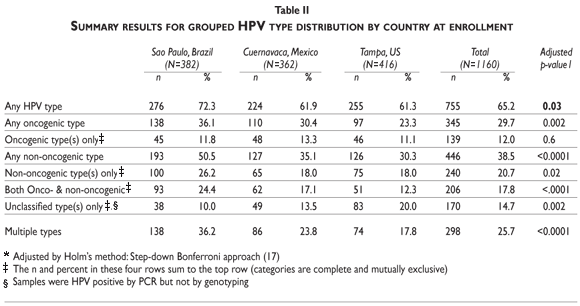
<body><![CDATA[<p><font size="2" face="Verdana">A participant was considered positive for 'any    HPV' if he tested HPV positive by PCR or by genotyping. The category of 'any    oncogenic type' included those who were positive for only oncogenic genotypes    and those who were positive for both oncogenic and non&#45;oncogenic types. Only    single or multiple infections with non&#45;oncogenic HPV types were classified as    "any non&#45;oncogenic type". Samples testing positive for HPV by PCR    but negative for all of the 37 genotypes were labeled "unclassified."</font></p>     <p><font size="2" face="Verdana">Differences in the distribution of demographic    characteristics and HPV prevalence were explored by country and by age, and    associations were tested with Pearson's Chi&#45;square test. Participants were given    the option of refusing to answer each of the questions on the Web&#45;based survey    and these refusals were treated as missing observations. Associations between    types of HPV infections and country were evaluated using Pearson's Chi&#45;square    test, and the raw p&#45;values were adjusted for multiple comparisons using the    step&#45;down Bonferroni approach.<SUP>17</SUP> Differences in the distribution    of HPV type 6, 11, 16, and 18 by country were evaluated using Fisher's exact    test.</font></p>     <p>&nbsp;</p>     <p><font size="3" face="verdana"><b>Results</b></font></p>     <p><font size="2" face="Verdana">A total of 1 160 men completing an enrollment    visit (362 from Mexico, 382 from Brazil, and 416 from the U.S.) were included    in this analysis. Forty&#45;nine percent of participants were ages 18&#45;29 yrs, 41.4%    were ages 30&#45;44 yrs, and 9.6% were ages 45&#45;70 yrs (<a href="#tab01">Table I</a>).    The majority of study participants were non&#45;white, with 33.0% reporting mixed    race and 41.9% reporting Hispanic ethnicity. Approximately 45% of participants    were either married or cohabiting, and 46.9% reported being single or never    married. The majority (53.1%) of participants had completed 13 or more years    of education. Overall, 8.9% of participants reported never having had sexual    intercourse with a female. The majority of men reported 1 to 9 female sexual    partners in his lifetime. Circumcision was common in the US (83.2%) and rare    in Mexico (14.1%) and Brazil (14.9%). Statistically significant differences    were observed in the distribution of all study characteristics evaluated by    country.</font></p>     <p><a name="tab01"></a></p>     <p>&nbsp;</p>     <p align="center"><img src="/img/revistas/spm/v50n5/a14tab01.gif"></p>     <p>&nbsp;</p>     <p><font size="2" face="Verdana"><a href="#tab02">Table II</a> presents HPV prevalence    by country for oncogenic, non&#45;oncogenic, unclassified, and multiple infections    and compares prevalence across countries. Overall HPV prevalence in the study    population was 65.2%. Twelve percent of infections were with oncogenic HPV types    only, 20.7% with non&#45;oncogenic HPV types only, 17.8% were mixed oncogenic and    non&#45;oncogenic, and 14.7% were with only unclassified HPV infections. Multiple    HPV types were detected in 25.7% of study participants. Prevalence of any HPV    infection was highest in Brazil (72.3%) and lowest in the U.S. (61.3%) and Mexico    (61.9%) (<I>p</I>=0.03). A similar trend in prevalence across countries was    observed for oncogenic HPV (<I>p</I>=0.002), non&#45;oncogenic HPV (<I>p</I>&lt;0.0001),    and multiple HPV infections (<I>p</I>&lt;0.0001). Unclassified infections were    highest in the US (20.0%), with lower prevalence observed in Mexico (13.5%)    and Brazil (10.0%) (<I>p</I>=0.002).</font></p>     ]]></body>
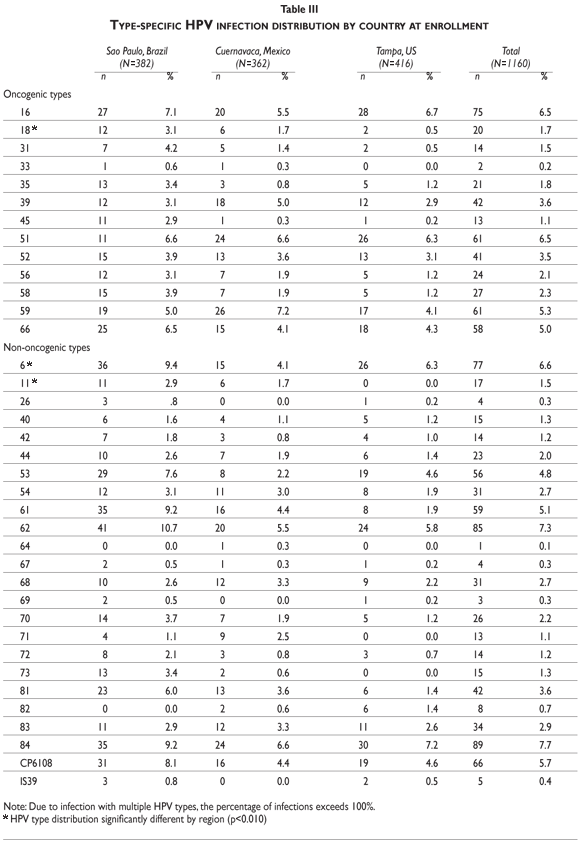
<body><![CDATA[<p><a name="tab02"></a></p>     <p>&nbsp;</p>     <p align="center"><img src="/img/revistas/spm/v50n5/a14tab02.gif"></p>     <p>&nbsp;</p>     <p><font size="2" face="Verdana">Across the three international populations, HPV    16 (6.5%) and 51 (6.5%) were the most commonly detected oncogenic infections,    followed by HPV types 59 (5.3%), 66 (5.0%), 39 (3.6%), and 52 (3.5%) (<a href="#tab03">Table    III</a>). Among the non&#45;oncogenic infections, HPV type 84 was most commonly    detected (7.7%), followed by HPV types 62 (7.3%), 6 (6.6%), and CP6108 (5.7%).    HPV type distribution varied across countries. For example, in Brazil and the    U.S., HPV 16 was the most common oncogenic infection detected, whereas in Mexico    HPV 59 was the most common type. Among the non&#45;oncogenic infections, HPV 62    was the most commonly detected in Brazil, and HPV 84 was the most commonly detected    type in Mexico and the U.S. Prevalence of the current prophylactic HPV vaccine    types were: 5.5%&#45;7.1% for HPV 16, 0.5%&#45;3.1% for HPV 18, 4.1%&#45;9.4% for HPV 6,    and 0.0%&#45;2.9% for HPV 11. Significant differences in the prevalence of HPV types    6, 11, and 18 were observed by country, with Brazil having the highest prevalence    of these infections (all <I>p</I>&lt;0.01).</font></p>     <p><a name="tab03"></a></p>     <p>&nbsp;</p>     <p align="center"><img src="/img/revistas/spm/v50n5/a14tab03.gif"></p>     <p>&nbsp;</p>     <p><font size="2" face="Verdana">Results from sequencing "unclassified infection"    specimens demonstrated that most unclassified infections probably represent    spurious PCR products. We were able to re&#45;amplify, with a nested PCR protocol    aiming a smaller PCR fragment (150bp), only 60 of the 204 specimens and were    able to generate readable sequences from 41 of these. Of those specimens that    generated readable sequences, 41.2% contained cutaneous HPV types (HPV types    2, 3, 12, 17, 22, 23, 62, 69, 74, 87, 91, 107), 39% had very low copy number    anogenital types (HPV 6, 33, 39, 42, 44, 52, 56, 59, 84), and 1% contained novel    HPV types.</font></p>     ]]></body>
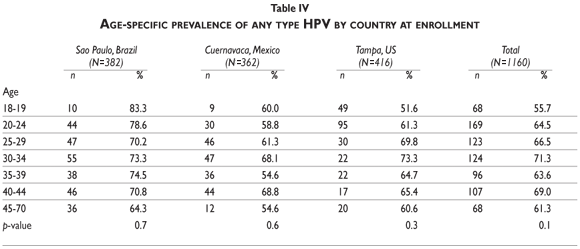
<body><![CDATA[<p><font size="2" face="Verdana">No significant differences in overall HPV prevalence    were observed by age, regardless of country examined (<a href="#tab04">table    IV</a>). Similarly, there was no clear association with age when unclassified    HPV infections were eliminated from the analysis. However, when men ages 18&#45;19    years old were compared to all other age groups, prevalence estimates were significantly    lower among the younger men (27.9% <I>vs</I>. 50.4%, data not shown). When HPV    infections were grouped by oncogenic potential and examined by age, across the    three countries, we observed a significant association between age and oncogenic    HPV infections (figure 1). Oncogenic infections increased with age between 18    and 34 years (peak prevalence of 40.8% at ages 30&#45;34 years) and decreased with    age from age 35 to 70 years (<I>p</I>=0.001). Non&#45;oncogenic infections significantly    increased with age with a low prevalence of 9.8% among 18&#45;19 year olds and a    peak prevalence of 27.9% among men ages 45&#45;70 years (<I>p</I>=0.002). Unclassified    infections significantly decreased with age (<I>p</I>=0.001).</font></p>     <p><a name="tab04"></a></p>     <p>&nbsp;</p>     <p align="center"><img src="/img/revistas/spm/v50n5/a14tab04.gif"></p>     <p>&nbsp;</p>     <p><font size="3" face="verdana"><b>Discussion</b></font></p>     <p><font size="2" face="Verdana">In this manuscript we present HPV type distribution    by country and associations with HPV infections and age. A common protocol was    utilized in clinics in the US, Mexico, and Brazil, allowing for direct comparisons    of HPV prevalence. This is the first international comparison of HPV type distribution    across 37 genotypes in a general population of men. Among men enrolled in the    <I>HIM Study</I>, overall HPV prevalence based on genotyping was 50.5%, with    62.3% in Brazil, 48.4% in Mexico, and 41.3% in the US. Approximately 15% of    men were positive for unclassified HPV types, defined as samples positive by    PCR but negative based on genotyping by hybridization against 37 individual    HPV types. These genotype prevalence estimates are higher than previously reported    in men.<SUP>9</SUP> This may be a result of more complete genital sampling in    men than previously conducted and application of more sensitive HPV detection    methodology with genotyping of 37 different HPV types.<SUP>18</SUP> Due to these    differences, as well as inconsistencies in the HPV types considered oncogenic    (13 or more HPV types) in previous publications, it is difficult to make direct    comparisons of HPV prevalence across studies. This problem is accentuated when    examining infection with any HPV and grouped infections such as oncogenic or    non&#45;oncogenic HPV prevalence.</font></p>     <p><font size="2" face="Verdana">Prophylactic HPV vaccine types 6 and 11 (non&#45;oncogenic    types) and 16 and 18 (oncogenic types) were detected in 14.7% of participants;    HPV 6 was detected in 6.6%, HPV 11 in 1.5%, HPV 16 in 6.5%, and HPV 18 in 1.7%    of <I>HIM Study </I>participants. Significant differences in the prevalence    of vaccine related HPV infections were observed by country for HPV types 6,    11, and 18, although there was no significant difference in the prevalence of    HPV 16. This trend mirrored the observed overall HPV prevalence differences    by country: Brazil had the highest prevalence overall as well as for individual    vaccine related HPV types.</font></p>     <p><font size="2" face="Verdana">To our knowledge, only two prior studies examined    HPV prevalence among men in Brazil. One study was a small cross&#45;sectional study,<SUP>19</SUP>    and in the other all men were husbands of wives enrolled in a cervical cancer    case&#45;control study.<SUP>20</SUP> Among husbands of controls, HPV prevalence    was approximately 40% and approximately 16% were HPV 16 positive. The overall    HPV prevalence estimates in that study were lower than the Brazil arm of the    <I>HIM Study</I> (72.3%), although the HPV 16 prevalence detected was higher    than the Brazil cohort (7.1%).</font></p>     <p><font size="2" face="Verdana">Three previous studies estimated HPV prevalence    among men residing in Mexico. Excluding unclassified infections, prevalence    estimates were 44.6%<SUP>21</SUP> and 42.7%<SUP>22</SUP> in each of the first    two studies and were similar to those observed in the Mexican arm of the <I>HIM    Study</I>. In the third study, conducted among men attending vasectomy clinics    nationally, the prevalence estimate was considerably lower, at 8.7%.<SUP>23</SUP>    Prevalence of any oncogenic HPV infection (14 HPV types) in the cross&#45;sectional    study of students and factory workers was 19.8%, a value lower than the 30.4%    observed in the current study.<SUP>22</SUP> Prevalence of type&#45;specific infection    was not reported in this study. Interestingly, among Mexican military men enrolled    in a prospective study,<SUP>21</SUP> prevalence of any oncogenic infection at    baseline was 34.8% (16 HPV types). Prevalence of HPV types 6, 11, 16, and 18    was 4.3%, 3.4%, 6.0%, and 3.7%, respectively, values similar to those observed    among Mexican men in the <I>HIM Study</I>.</font></p>     ]]></body>
<body><![CDATA[<p><font size="2" face="Verdana">Four HPV studies among U.S. men have been published    to date, with a reported range in HPV prevalence of 28.2% (where limited sampling    and genotyping was conducted) to 42&#45;45.5%.<SUP>18,24&#45;26</SUP> The latter U.S.    studies included men residing in Hawaii,<SUP>24</SUP> Seattle,<SUP>25</SUP>    and Arizona <SUP>18</SUP> and utilized sampling and genotyping methods similar    to those reported in the current study. Among community men residing in Arizona    and Florida who were sampled at both external genital sites and anal canal,    HPV prevalence was 51.2% and another 14.3% were infected with unclassified infections.<SUP>18</SUP>    Prevalence of HPV types 6, 11, 16, and 18 was 4.8%, 0.4%, 11.4%, 1.9%. In a    small cross&#45;sectional study conducted in Hawaii, approximately 2.5%, 1.5%, 6.5%,    and 3.0% were positive for HPV types 6, 11, 16, and 18, respectively, values    similar to those reported in the <I>HIM Study</I>.<SUP>24</SUP> Collectively    it appears that HPV infection in men is common and consistently high among men    in different regions of the U.S. and the Americas. HPV type distribution appears    to vary by population included within countries as well across countries.</font></p>     <p><font size="2" face="Verdana">A relatively high proportion of unclassified    infections was observed (10&#45;20%) in the <I>HIM Study </I>cohort, similar to    other reports.<SUP>18,22,27,28</SUP> With the Linear Array HPV genotyping test    used in this study it was possible to detect 37 HPV types. However, due to the    large number of HPV types that infect human epithelium, this assay is unable    to characterize a portion (14.7% in this study) of the infections detected on    PCR. We recently reported a similar prevalence of unclassified HPV infections    detected in the external genital epithelium of U.S. men.<SUP>18</SUP> Likewise,    among studies that have tested for at least 20 HPV types in male genital skin,    the range of unclassified HPV types reported is between 1.8&#45;11.6%.<SUP>6,22,26&#45;28</SUP>    The significance of the unclassified infections is not known. This may represent    infection with HPV types other than the 37 that are included in the linear array    assay of Roche, or this may represent non&#45;specific amplification of gene sequences    that are not HPV related. As HPV type distribution appears to differ in men    compared to women, it is important to characterize the HPV types that comprise    this "unclassified" group. Results from direct sequencing of the gene    products of PCR of the specimens included in this study indicate the presence    of HPV types 2, 3, 12, 17, 22, 23, 74, 87, 91, and 107, types not currently    included in the linear array assay. Bleeker and colleagues,<SUP>27</SUP> sequenced    "unclassified" specimens and found six additional HPV types (HPV types    3, 10, 32, 34, 86, and jc9710) that are not included in the linear array assay,    accounting for between 0.8 and 3.8% of the HPV positive results. Studies of    anal HPV infection among men who have sex with men have also reported the presence    of HPV types that are not included in the linear array genotyping detection    system utilized in the current study. These types include HPV 2, 13, 34, and    57, <SUP>29</SUP> and Pap 155, Pap 291, and AE2.<SUP>30</SUP> Understanding    the significance of these HPV types requires additional study.</font></p>     <p><font size="2" face="Verdana">Overall, the prevalence of any HPV among men    enrolled in the <I>HIM Study</I> was not associated with age. However, differing    patterns of age association were observed depending on the category of HPV infection    assessed. For example, a linear increase in non&#45;oncogenic infections with age    was observed, a bi&#45;modal distribution with age was observed for oncogenic infections    such that the younger and older males had the lowest prevalence of HPV. In contrast    to these two patterns, a significant linear decrease in unclassified infections    was observed with age. Among men participating in a small cross&#45;sectional study    in Mexico HPV prevalence was lower in the youngest age group (&lt;20 years);    however, these differences did not reach statistical significance.<SUP>22</SUP>    In contrast to this, risk of HPV acquisition appeared to be higher in the younger    age group in a small prospective study conducted in Mexico.<SUP>21</SUP> Among    studies conducted in the U.S., no association with age was observed.<SUP>18,26</SUP>    In a cross&#45;sectional study conducted in Denmark an inverse association with    age was observed.<SUP>31</SUP> These data illustrate the complexity of HPV infection    in men and highlight the need for prospective data that can distinguish differences    in incidence and duration of infection by age in men.</font></p>     <p><font size="2" face="Verdana">As with any study there are limitations that    influence the interpretation of results. By recruiting men from a variety of    sources in the community we have attempted to enroll a representative population    of men for study. However, as with any study, men who are interested and committed    actually enrolled to the study, reducing the generalizability of the study findings.    In addition, recruitment of study participants occurs in only one metropolitan    area per country. Therefore, results do not represent the country as a whole.    Study entry criteria that excluded men with active STIs were intended to decrease    the likelihood of overestimating HPV prevalence. However, men who are interested    in study participation may have had a sexual partner with HPV related lesions    thereby increasing their interest and likelihood of participation in the study.    This may have increased observed HPV prevalence.</font></p>     <p><font size="2" face="Verdana">In conclusion, a high prevalence of HPV infections    in men across the three countries evaluated, Brazil, Mexico, and the U.S. was    observed. Differences in overall HPV prevalence and type specific prevalence    between countries were observed. The relationship between age and HPV prevalence    in men enrolled in the <I>HIM Study</I> varies by type of infection examined.    Studies of HPV type distribution in other regions of the world, utilizing rigorous    methods of sampling and sample analyses, are needed to further clarify HPV type    distribution and age differences among men.</font></p>     <p>&nbsp;</p>     <p><font size="3" face="Verdana"><b>Acknowledgments</b></font></p>     <p><font size="2" face="Verdana">The authors would like to thank the following    staff for their dedication in recruiting, examining, and maintaining cohort    participants, as well conducting HPV DNA laboratory analyses: Kathy Eyring,    CCRP; Christine Gage, ARNP; Kayoko Kay; Pauline Schwalm&#45;Andel; Rana Zaki, MPH,    Sireesha Banduvula, MS, Kyle Wolf, Danelle Smith, MS, Steven McAnany, Shannon    McCarthy, and the Tissue Core staff of the Moffitt Cancer Center for their help    managing biological samples from the US site; B Fietzek, E Brito, F Cernicchiaro,    F Silva, G Ribeiro, J Antunes, L Galan, R Bocalon, R Hessel, R Matsuo, R Otero,    R Terreri, S Araujo, V Relvas, V Souza from the Brazil site; A Cruz, P Hern&aacute;ndez,    A Rodr&iacute;guez&#45;Cid, G Alvarez, O Rojas, DA Salazar, N Herrera, A Rodr&iacute;guez,    R Alvear &#45; AL Landa and P Rom&aacute;n from the Mexico site.</font></p>     <p><font size="2" face="Verdana">The authors would also like to thank the Digene    Corporation for kindly providing STM for the collection and storage of samples    at no charge to the study.</font></p>     <p><font size="2" face="Verdana"><I>Funding Sources:</i> This project was supported    through a grant from the National Cancer Institute, National Institutes of Health,    CA#. RO1CA098803. Publication and report contents are solely the responsibility    of the authors and do not necessarily represent the official views of NCI/NIH.    Dr. Nielson was supported by NCI grant R25 CA078447.</font></p>     ]]></body>
<body><![CDATA[<p><font size="2" face="Verdana"><I>Conflicts of interest: </i>Presented in part:    23<SUP>rd</SUP> International Papillomavirus Conference and Clinical Workshop,    September 2006, Prague, Czech Republic, Abstract # P&#45; PS 26&#45;3.</font></p>     <p>&nbsp;</p>     <p><font size="3" face="Verdana"><b>References</b></font></p>     <!-- ref --><p><font size="2" face="Verdana">1. Agarwal SS, Sehgal A, Sardana S, Kumar A,    Luthra UK. Role of male behavior in cervical carcinogenesis among women with    one lifetime sexual partner. Cancer 1993;<I>72:</I>1666&#45;1669.</font>&nbsp;&nbsp;&nbsp;&nbsp;&nbsp;&nbsp;&nbsp;&nbsp;[&#160;<a href="javascript:void(0);" onclick="javascript: window.open('/scielo.php?script=sci_nlinks&ref=9257294&pid=S0036-3634200800050001400001&lng=','','width=640,height=500,resizable=yes,scrollbars=1,menubar=yes,');">Links</a>&#160;]<!-- end-ref --><!-- ref --><p><font size="2" face="Verdana">2. Buckley JD, Harris RW, Doll R, Vessey MP,    Williams PT. Case&#45;control study of the husbands of women with dysplasia or carcinoma    of the cervix uteri. Lancet 1981;<I>2:</I>1010&#45;1015.</font>&nbsp;&nbsp;&nbsp;&nbsp;&nbsp;&nbsp;&nbsp;&nbsp;[&#160;<a href="javascript:void(0);" onclick="javascript: window.open('/scielo.php?script=sci_nlinks&ref=9257295&pid=S0036-3634200800050001400002&lng=','','width=640,height=500,resizable=yes,scrollbars=1,menubar=yes,');">Links</a>&#160;]<!-- end-ref --><!-- ref --><p><font size="2" face="Verdana">3. Thomas DB, Ray RM, Pardthaisong T, Chutivangse    S, Koetsawang S, Silpisornkosol S, <I>et al.</I> Prostitution, condom use, and    invasive squamous cell cervical cancer in Thailand. Am J Epidemiol 1996;143<I>:</I>779&#45;786.</font>&nbsp;&nbsp;&nbsp;&nbsp;&nbsp;&nbsp;&nbsp;&nbsp;[&#160;<a href="javascript:void(0);" onclick="javascript: window.open('/scielo.php?script=sci_nlinks&ref=9257296&pid=S0036-3634200800050001400003&lng=','','width=640,height=500,resizable=yes,scrollbars=1,menubar=yes,');">Links</a>&#160;]<!-- end-ref --><!-- ref --><p><font size="2" face="Verdana">4. Zunzunegui MV, King MC, Coria CF, Charlet    J. Male influences on cervical cancer risk. Am J Epidemiol 1986;123<I>:</I>302&#45;307.</font>&nbsp;&nbsp;&nbsp;&nbsp;&nbsp;&nbsp;&nbsp;&nbsp;[&#160;<a href="javascript:void(0);" onclick="javascript: window.open('/scielo.php?script=sci_nlinks&ref=9257297&pid=S0036-3634200800050001400004&lng=','','width=640,height=500,resizable=yes,scrollbars=1,menubar=yes,');">Links</a>&#160;]<!-- end-ref --><!-- ref --><p><font size="2" face="Verdana">5. Bosch FX, Castellsague X, Munoz N, De SDanjos&eacute;    S, Ghaffari AM, Gonz&aacute;lez LC. Meijer CU, Shah KV, De Sanjos&eacute; S,    <I>et al</I>. Male sexual behavior and human papillomavirus DNA: key risk factors    for cervical cancer in Spain. J Natl Cancer Inst 1996;88<I>:</I>1060&#45;1067.</font>&nbsp;&nbsp;&nbsp;&nbsp;&nbsp;&nbsp;&nbsp;&nbsp;[&#160;<a href="javascript:void(0);" onclick="javascript: window.open('/scielo.php?script=sci_nlinks&ref=9257298&pid=S0036-3634200800050001400005&lng=','','width=640,height=500,resizable=yes,scrollbars=1,menubar=yes,');">Links</a>&#160;]<!-- end-ref --><!-- ref --><p><font size="2" face="Verdana">6. Castellsague X, Bosch FX, Munoz N, <I>et al</I>.    Male circumcision, penile human papillomavirus infection, and cervical cancer    in female partners. N Engl J Med 1996;346<I>:</I>1105&#45;1112.</font>&nbsp;&nbsp;&nbsp;&nbsp;&nbsp;&nbsp;&nbsp;&nbsp;[&#160;<a href="javascript:void(0);" onclick="javascript: window.open('/scielo.php?script=sci_nlinks&ref=9257299&pid=S0036-3634200800050001400006&lng=','','width=640,height=500,resizable=yes,scrollbars=1,menubar=yes,');">Links</a>&#160;]<!-- end-ref --><!-- ref --><p><font size="2" face="Verdana">7. Shah KV. Human papillomaviruses and anogenital    cancers. N Engl J Med 1997;<I>337:</I>1386&#45;1388.</font>&nbsp;&nbsp;&nbsp;&nbsp;&nbsp;&nbsp;&nbsp;&nbsp;[&#160;<a href="javascript:void(0);" onclick="javascript: window.open('/scielo.php?script=sci_nlinks&ref=9257300&pid=S0036-3634200800050001400007&lng=','','width=640,height=500,resizable=yes,scrollbars=1,menubar=yes,');">Links</a>&#160;]<!-- end-ref --><!-- ref --><p><font size="2" face="Verdana">8. Giuliano AR, Salmon D. The Case for a Gender    Neutral (Universal) HPV Vaccination Policy in the US. Cancer Epidemiol Biomarkers    Prev. 2008;(4):805&#45;808.</font>&nbsp;&nbsp;&nbsp;&nbsp;&nbsp;&nbsp;&nbsp;&nbsp;[&#160;<a href="javascript:void(0);" onclick="javascript: window.open('/scielo.php?script=sci_nlinks&ref=9257301&pid=S0036-3634200800050001400008&lng=','','width=640,height=500,resizable=yes,scrollbars=1,menubar=yes,');">Links</a>&#160;]<!-- end-ref --><!-- ref --><p><font size="2" face="Verdana">9. Dunne EF, Nielson CM, Stone KM, Markowitz    LE, Giuliano AR. Prevalence of HPV infection among men: A systematic review    of the literature. J Infect Dis 2006;194<I>:</I>1044&#45;1057.</font>&nbsp;&nbsp;&nbsp;&nbsp;&nbsp;&nbsp;&nbsp;&nbsp;[&#160;<a href="javascript:void(0);" onclick="javascript: window.open('/scielo.php?script=sci_nlinks&ref=9257302&pid=S0036-3634200800050001400009&lng=','','width=640,height=500,resizable=yes,scrollbars=1,menubar=yes,');">Links</a>&#160;]<!-- end-ref --><!-- ref --><p><font size="2" face="Verdana">10. Clifford GM, Smith JS, Aguado T, Franceschi    S. Comparison of HPV type distribution in high&#45;grade cervical lesions and cervical    cancer: a meta&#45;analysis. Br J Cancer 2003;89<I>:</I>101&#45;105.</font>&nbsp;&nbsp;&nbsp;&nbsp;&nbsp;&nbsp;&nbsp;&nbsp;[&#160;<a href="javascript:void(0);" onclick="javascript: window.open('/scielo.php?script=sci_nlinks&ref=9257303&pid=S0036-3634200800050001400010&lng=','','width=640,height=500,resizable=yes,scrollbars=1,menubar=yes,');">Links</a>&#160;]<!-- end-ref --><!-- ref --><p><font size="2" face="Verdana">11. Flores R, Abalos TA, Nielson CM, Abrahamsen    M, Harris RB, Giuliano AR. Reliability of sample collection and laboratory testing    for HPV Detection in Men. J Virol Methods 2008;149(1):136&#45;143.</font>&nbsp;&nbsp;&nbsp;&nbsp;&nbsp;&nbsp;&nbsp;&nbsp;[&#160;<a href="javascript:void(0);" onclick="javascript: window.open('/scielo.php?script=sci_nlinks&ref=9257304&pid=S0036-3634200800050001400011&lng=','','width=640,height=500,resizable=yes,scrollbars=1,menubar=yes,');">Links</a>&#160;]<!-- end-ref --><!-- ref --><p><font size="2" face="Verdana">12. Giuliano AR, Nielson CM, Flores R, Dunne    EF, Abrahamsen M, Papenfuss MR, <I>et al</I>. The optimal anatomic sites for    sampling heterosexual men for human papillomavirus (HPV) detection: the HPV    detection in men study. J Infect Dis 2007;196<I>:</I>1146&#45;1152.</font>&nbsp;&nbsp;&nbsp;&nbsp;&nbsp;&nbsp;&nbsp;&nbsp;[&#160;<a href="javascript:void(0);" onclick="javascript: window.open('/scielo.php?script=sci_nlinks&ref=9257305&pid=S0036-3634200800050001400012&lng=','','width=640,height=500,resizable=yes,scrollbars=1,menubar=yes,');">Links</a>&#160;]<!-- end-ref --><!-- ref --><p><font size="2" face="Verdana">13. Gravitt PE, Peyton CL, Alessi TQ, Wheeler    CM, Coutlee F, Hildesheim A, <I>et al</I>. Improved amplification of genital    human papillomaviruses. Journal of Clinical Microbiology 2000;38<I>:</I>357&#45;361.</font>&nbsp;&nbsp;&nbsp;&nbsp;&nbsp;&nbsp;&nbsp;&nbsp;[&#160;<a href="javascript:void(0);" onclick="javascript: window.open('/scielo.php?script=sci_nlinks&ref=9257306&pid=S0036-3634200800050001400013&lng=','','width=640,height=500,resizable=yes,scrollbars=1,menubar=yes,');">Links</a>&#160;]<!-- end-ref --><!-- ref --><p><font size="2" face="Verdana">14. Gravitt PE, Peyton CL, Apple RJ, Wheeler    CM. Genotyping of 27 human papillomavirus types by using L1 consensus PCR products    by a single&#45;hybridization, reverse line blot detection method. Journal of Clinical    Microbiology 1998;36<I>:</I>3020&#45;3027.</font>&nbsp;&nbsp;&nbsp;&nbsp;&nbsp;&nbsp;&nbsp;&nbsp;[&#160;<a href="javascript:void(0);" onclick="javascript: window.open('/scielo.php?script=sci_nlinks&ref=9257307&pid=S0036-3634200800050001400014&lng=','','width=640,height=500,resizable=yes,scrollbars=1,menubar=yes,');">Links</a>&#160;]<!-- end-ref --><!-- ref --><p><font size="2" face="Verdana">15. Cogliano V, Baan R, Straif K, Grosse Y, Secretan    B, El Ghissassa F, <I>et al</I>. Carcinogenicity of human papillomaviruses.    Lancet Oncology 2005;6<I>:</I>204.</font>&nbsp;&nbsp;&nbsp;&nbsp;&nbsp;&nbsp;&nbsp;&nbsp;[&#160;<a href="javascript:void(0);" onclick="javascript: window.open('/scielo.php?script=sci_nlinks&ref=9257308&pid=S0036-3634200800050001400015&lng=','','width=640,height=500,resizable=yes,scrollbars=1,menubar=yes,');">Links</a>&#160;]<!-- end-ref --><!-- ref --><p><font size="2" face="Verdana">16. de Roda Husman AM, Walboomers JM, van den    Brule AJ, Meijer CJ, Snijders PJ. The use of general primers GP5 and GP6 elongated    at their 3' ends with adjacent highly conserved sequences improves human papillomavirus    detection by PCR. J Gen Virol 1995;76(Pt 4):1057&#45;1062.</font>&nbsp;&nbsp;&nbsp;&nbsp;&nbsp;&nbsp;&nbsp;&nbsp;[&#160;<a href="javascript:void(0);" onclick="javascript: window.open('/scielo.php?script=sci_nlinks&ref=9257309&pid=S0036-3634200800050001400016&lng=','','width=640,height=500,resizable=yes,scrollbars=1,menubar=yes,');">Links</a>&#160;]<!-- end-ref --><!-- ref --><p><font size="2" face="Verdana">17. Holm S. A Simple Sequentially Rejective Bonferroni    Test Procedure. Scandinavian Journal of Statistics 1979;6<I>:</I>65&#45;70.</font>&nbsp;&nbsp;&nbsp;&nbsp;&nbsp;&nbsp;&nbsp;&nbsp;[&#160;<a href="javascript:void(0);" onclick="javascript: window.open('/scielo.php?script=sci_nlinks&ref=9257310&pid=S0036-3634200800050001400017&lng=','','width=640,height=500,resizable=yes,scrollbars=1,menubar=yes,');">Links</a>&#160;]<!-- end-ref --><!-- ref --><p><font size="2" face="Verdana">18. Nielson CM, Flores R, Harris RB, Abrahamsen    M, Papenfuss MR, Dunne EF, <I>et al</I>. Human papillomavirus prevalence and    type distribution in male anogenital sites and semen. Cancer Epidemiol Biomarkers    Prev. 2007;16<I>:</I>1107&#45;1114.</font>&nbsp;&nbsp;&nbsp;&nbsp;&nbsp;&nbsp;&nbsp;&nbsp;[&#160;<a href="javascript:void(0);" onclick="javascript: window.open('/scielo.php?script=sci_nlinks&ref=9257311&pid=S0036-3634200800050001400018&lng=','','width=640,height=500,resizable=yes,scrollbars=1,menubar=yes,');">Links</a>&#160;]<!-- end-ref --><!-- ref --><p><font size="2" face="Verdana">19. Rombaldi RL, Serafini EP, Villa LL, Vanni    AC, Barea F, Frassini R, <I>et al</I>. Infection with human papillomaviruses    of sexual partners of women having cervical intraepithelial neoplasia. Braz    J Med Biol Res. 2006;39<I>:</I>177&#45;87.</font>&nbsp;&nbsp;&nbsp;&nbsp;&nbsp;&nbsp;&nbsp;&nbsp;[&#160;<a href="javascript:void(0);" onclick="javascript: window.open('/scielo.php?script=sci_nlinks&ref=9257312&pid=S0036-3634200800050001400019&lng=','','width=640,height=500,resizable=yes,scrollbars=1,menubar=yes,');">Links</a>&#160;]<!-- end-ref --><!-- ref --><p><font size="2" face="Verdana">20. Franceschi S, Castellsague X, Dal Maso L,    Smith JS, Plummer M, Ngelangel C, <I>et al</I>. Prevalence and determinants    of human papillomavirus genital infection in men. Br J Cancer 2002;86<I>:</I>705&#45;711.</font>&nbsp;&nbsp;&nbsp;&nbsp;&nbsp;&nbsp;&nbsp;&nbsp;[&#160;<a href="javascript:void(0);" onclick="javascript: window.open('/scielo.php?script=sci_nlinks&ref=9257313&pid=S0036-3634200800050001400020&lng=','','width=640,height=500,resizable=yes,scrollbars=1,menubar=yes,');">Links</a>&#160;]<!-- end-ref --><p><font size="2" face="Verdana">21. Lajous M, Mueller N, Cruz&#45;Valdez A, Aguilar    LV, Franceschi, S, Hern&aacute;ndez&#45;Avila M, <I>et al</I>. Determinants of prevalence,    acquisition, and persistence of human papillomavirus in healthy Mexican military    men. Cancer Epidemiol Biomarkers Prev 2005;14<I>:</I>1710&#45;1716.</font></p>     <!-- ref --><p><font size="2" face="Verdana">22. Lazcano&#45;Ponce E, Herrero R, Munoz N, Hern&aacute;ndez&#45;Avila    M, Salmeron J, Leyva A, <I>et al</I>. High prevalence of human papillomavirus    infection in Mexican males: comparative study of penile&#45;urethral swabs and urine    samples. Sex Transm Dis 2001;28<I>:</I>277&#45;280.</font>&nbsp;&nbsp;&nbsp;&nbsp;&nbsp;&nbsp;&nbsp;&nbsp;[&#160;<a href="javascript:void(0);" onclick="javascript: window.open('/scielo.php?script=sci_nlinks&ref=9257315&pid=S0036-3634200800050001400022&lng=','','width=640,height=500,resizable=yes,scrollbars=1,menubar=yes,');">Links</a>&#160;]<!-- end-ref --><!-- ref --><p><font size="2" face="Verdana">23. Vaccarella S, Lazcano&#45;Ponce E, Castro&#45;Garduno    JA, Valdez A, D&iacute;az V, Schiavon R, <I>et al.</I> Prevalence and determinants    of human papillomavirus infection in men attending vasectomy clinics in Mexico.    Int J Cancer 2006;119<I>:</I>1934&#45;1939.</font>&nbsp;&nbsp;&nbsp;&nbsp;&nbsp;&nbsp;&nbsp;&nbsp;[&#160;<a href="javascript:void(0);" onclick="javascript: window.open('/scielo.php?script=sci_nlinks&ref=9257316&pid=S0036-3634200800050001400023&lng=','','width=640,height=500,resizable=yes,scrollbars=1,menubar=yes,');">Links</a>&#160;]<!-- end-ref --><!-- ref --><p><font size="2" face="Verdana">24. Hernandez BY, Goodman MT, Wilkens LR, Thompson    P, Zhu X, Wong W, <I>et al</I>. Comparison of physician&#45; and self&#45;collected    genital specimens for detection of human papillomavirus in men. J Clin Microbiol    2006;44<I>:</I>513&#45;517.</font>&nbsp;&nbsp;&nbsp;&nbsp;&nbsp;&nbsp;&nbsp;&nbsp;[&#160;<a href="javascript:void(0);" onclick="javascript: window.open('/scielo.php?script=sci_nlinks&ref=9257317&pid=S0036-3634200800050001400024&lng=','','width=640,height=500,resizable=yes,scrollbars=1,menubar=yes,');">Links</a>&#160;]<!-- end-ref --><!-- ref --><p><font size="2" face="Verdana">25. Weaver BA, Holmes KK, Kiviat N, Lee SK, Meyer    C, Stern M, <I>et al</I>. Evaluation of genital sites and sampling techniques    for detection of human papillomavirus DNA in men. J Infect Dis 2004;189<I>:</I>677&#45;685.</font>&nbsp;&nbsp;&nbsp;&nbsp;&nbsp;&nbsp;&nbsp;&nbsp;[&#160;<a href="javascript:void(0);" onclick="javascript: window.open('/scielo.php?script=sci_nlinks&ref=9257318&pid=S0036-3634200800050001400025&lng=','','width=640,height=500,resizable=yes,scrollbars=1,menubar=yes,');">Links</a>&#160;]<!-- end-ref --><!-- ref --><p><font size="2" face="Verdana">26. Baldwin SB, Wallace DR, Papenfuss MR, Abrahamsen    M, Vaught LC, Giuliano AR. Condom use and other factors affecting penile human    papillomavirus detection in men attending a sexually transmitted disease clinic.    Sex Transm Dis 2004;31<I>:</I>601&#45;607.</font>&nbsp;&nbsp;&nbsp;&nbsp;&nbsp;&nbsp;&nbsp;&nbsp;[&#160;<a href="javascript:void(0);" onclick="javascript: window.open('/scielo.php?script=sci_nlinks&ref=9257319&pid=S0036-3634200800050001400026&lng=','','width=640,height=500,resizable=yes,scrollbars=1,menubar=yes,');">Links</a>&#160;]<!-- end-ref --><!-- ref --><p><font size="2" face="Verdana">27. Bleeker MC, Hogewoning C, Berkhof J, Voorhorst    FJ, Hesselink AT, van Diemen PM, <I>et al</I>. Concordance of specific human    papillomavirus types in sex partners is more prevalent than would be expected    by chance and is associated with increased viral loads. Clin Infect Dis 2005;41<I>:</I>612&#45;620.</font>&nbsp;&nbsp;&nbsp;&nbsp;&nbsp;&nbsp;&nbsp;&nbsp;[&#160;<a href="javascript:void(0);" onclick="javascript: window.open('/scielo.php?script=sci_nlinks&ref=9257320&pid=S0036-3634200800050001400027&lng=','','width=640,height=500,resizable=yes,scrollbars=1,menubar=yes,');">Links</a>&#160;]<!-- end-ref --><!-- ref --><p><font size="2" face="Verdana">28. Shin HR, Vaccarella S, Roh JW, Ju YH, Oh    JK, Kong HJ, <I>et al</I>. Prevalence and determinants of genital infection    with papillomavirus, in female and male university students in Busan, South    Korea. J Infect Dis 2004;190<I>:</I>468&#45;476.</font>&nbsp;&nbsp;&nbsp;&nbsp;&nbsp;&nbsp;&nbsp;&nbsp;[&#160;<a href="javascript:void(0);" onclick="javascript: window.open('/scielo.php?script=sci_nlinks&ref=9257321&pid=S0036-3634200800050001400028&lng=','','width=640,height=500,resizable=yes,scrollbars=1,menubar=yes,');">Links</a>&#160;]<!-- end-ref --><!-- ref --><p><font size="2" face="Verdana">29. Palefsky JM, Holly EA, Ralston ML, Jay N.    Prevalence and risk factors for human papillomavirus infection of the anal canal    in human immunodeficiency virus (HIV)&#45;positive and HIV&#45;negative homosexual men.    J Infect Dis 1998;177<I>:</I>361&#45;367.</font>&nbsp;&nbsp;&nbsp;&nbsp;&nbsp;&nbsp;&nbsp;&nbsp;[&#160;<a href="javascript:void(0);" onclick="javascript: window.open('/scielo.php?script=sci_nlinks&ref=9257322&pid=S0036-3634200800050001400029&lng=','','width=640,height=500,resizable=yes,scrollbars=1,menubar=yes,');">Links</a>&#160;]<!-- end-ref --><!-- ref --><p><font size="2" face="Verdana">30. Piketty C, Darragh TM, Da Costa M, Bruneval    P, Heard I, Kazatchkine MD, <I>et al</I>. High prevalence of anal human papillomavirus    infection and anal cancer precursors among HIV&#45;infected persons in the absence    of anal intercourse. Ann Intern Med 2003;138<I>:</I>453&#45;459.</font>&nbsp;&nbsp;&nbsp;&nbsp;&nbsp;&nbsp;&nbsp;&nbsp;[&#160;<a href="javascript:void(0);" onclick="javascript: window.open('/scielo.php?script=sci_nlinks&ref=9257323&pid=S0036-3634200800050001400030&lng=','','width=640,height=500,resizable=yes,scrollbars=1,menubar=yes,');">Links</a>&#160;]<!-- end-ref --><!-- ref --><p><font size="2" face="Verdana">31. Svare EI, Kjaer S, Worm AM, Osterlind A,    Meijer CJ, van den Brule AJ. Risk factors for genital HPV DNA in men resemble    those found in women: a study of male attendees at a Danish STD clinic. Sex    Transm Infect 2002;78<I>:</I>215&#45;218.</font>&nbsp;&nbsp;&nbsp;&nbsp;&nbsp;&nbsp;&nbsp;&nbsp;[&#160;<a href="javascript:void(0);" onclick="javascript: window.open('/scielo.php?script=sci_nlinks&ref=9257324&pid=S0036-3634200800050001400031&lng=','','width=640,height=500,resizable=yes,scrollbars=1,menubar=yes,');">Links</a>&#160;]<!-- end-ref --><p>&nbsp;</p>     <p>&nbsp;</p>     <p><font size="2" face="Verdana">Received on: April 7, 2008    <br>   Accepted on: July 10, 2008</font></p>     <p>&nbsp;</p>     <p>&nbsp;</p>     ]]></body>
<body><![CDATA[<p><font size="2" face="Verdana">Address reprint requests to: Dr. Anna R. Giuliano,    H. Lee Moffitt Cancer Center and Research Institute, 12902 Magnolia Drive MRC    2067D, Tampa, FL 33612. E&#45;mail: <a href="mailto:Anna.Giuliano@moffitt.org">Anna.Giuliano@moffitt.org</a>    Dr. Luisa Villa. Ludwig Institute for Cancer Research, Hospital Alem&atilde;o    Oswaldo Cruz R.    <br>   Jo&atilde;o Juli&atilde;o 245 01323&#45;903 S&atilde;o Paulo, SP, Brazil. E&#45;mail:    llvilla@ludwig.org.b Dr. Eduardo Lazcano&#45;Ponce. Instituto Nacional de Salud    P&uacute;blica.    <br>   Av. Universidad 655, col. Sta. Mar&iacute;a Ahuacatitl&aacute;n. 62508 Cuernavaca,    Morelos M&eacute;xico. E&#45;mail: <a href="mailto:elazcano@insp.mx">elazcano@insp.mx</a>    <br>   <a name="nt"></a><a href="#tx">*</a> <B>Brazil: </B>Meire Akemi Ishibashi,<SUP>1</SUP>    Juliana A Antunes,<SUP>1 </SUP>Maria Filomena C. Aoki,<SUP>1</SUP> Rossana Bombig    Terreri,<SUP>1</SUP> Elisa Brito,<SUP>1</SUP> Roberto Carvalho Silva,<SUP>1</SUP>    Ricardo F Cunha,<SUP>1 </SUP>Fernanda F Da Silva,<SUP>1</SUP> Sandra de Ara&uacute;jo,<SUP>1</SUP>    Maria Socorro F de Souza,<SUP>1</SUP> Vera Lucia de Souza,<SUP>1</SUP> Rosangela    Delgado,<SUP>1</SUP> Birgit Fietzek,<SUP>2</SUP> Lenice Galan,<SUP>2</SUP> Jos&eacute;    Carlos Gon&ccedil;alves,<SUP>1</SUP> Raquel Hessel,<SUP>2</SUP> Roberta Lima    Bocalon,<SUP>1</SUP> Ros&aacute;ria M Martinez Otero,<SUP>1</SUP> Viviane Maria    Relvas,<SUP>2</SUP> Maria das Gra&ccedil;as Ribeiro,<SUP>1</SUP> Luiz Roberto    Ribeiro Vitor,<SUP>1</SUP> Concei&ccedil;&atilde;o M Serr&atilde;o Azevedo,<SUP>1</SUP>    Luisa Villa,<SUP>2</SUP> Rubens Yoshiaki Matsuo.<SUP>1 </sup>    <br>   <B>USA:</b> M Abrahamsen,<SUP>3</SUP> ML Baggio,<SUP>3</SUP> Kathy Eyring,<SUP>3</SUP>    Roberto Flores,<SUP>3</SUP> Christine Gage,<SUP>3</SUP> Anna R. Giuliano,<SUP>3</SUP>    Emily Jolles,<SUP>3</SUP> Kayoko Kay,<SUP>3</SUP> J&#45;H Lee,<SUP>3</SUP> M Papenfuss,<SUP>3</SUP>    Danelle Smith,<SUP>3</SUP> Kyle Wolf.    <br>   <B>Mexico:</b> Ren&eacute; de Jes&uacute;s Alvear V&aacute;zques,<SUP>4</SUP>    Aurelio Cruz Valdez,<SUP>5</SUP> Griselda D&iacute;az Garc&iacute;a,<SUP>4</SUP>    Susana Guti&eacute;rrez Mu&ntilde;oz,<SUP>5</SUP> Mar&iacute;a del Pilar Hern&aacute;ndez    Nevarez,<SUP>5</SUP> Nadia Herrera Guti&eacute;rrez,<SUP>4</SUP> Ana Laura Landa    V&eacute;lez,<SUP>4</SUP> Eduardo Lazcano&#45;Ponce,<SUP>5</SUP> &Aacute;lvaro Pas&aacute;ran    Garc&iacute;a,<SUP>4</SUP> Manuel Quiterio Trenado,<SUP>4</SUP> Alfonso Rodr&iacute;guez    Cid,<SUP>5</SUP> Alicia Rodr&iacute;guez Galv&aacute;n,<SUP>4</SUP> Oscar Rojas    Ju&aacute;rez,<SUP>4</SUP> Paola Rom&aacute;n Rodr&iacute;guez,<SUP>4</SUP>    Dar&iacute;o Antonio Salazar Sotelo,<SUP>4</SUP> Jorge Salmer&oacute;n Castro.<SUP>4</sup>    <br>   (1) Centro de Refer&ecirc;ncia e Treinamento em DST/Aids (CRT&#45;DST/Aids). S&atilde;o    Paulo, Brazil    <br>   (2) Ludwig Institute for Cancer Research. S&atilde;o Paulo, Brazil.    <br>   (3) H. Lee Moffitt Cancer Center and Research Institute. Tampa, Florida.    <br>   (4) Unidad de Investigaci&oacute;n Epidemiol&oacute;gica y en Servicios de Salud,    Instituto Mexicano del Seguro Social. Cuernavaca, M&eacute;xico    ]]></body>
<body><![CDATA[<br>   (5) Instituto Nacional de Salud P&uacute;blica. Cuernavaca, M&eacute;xico</font></p>      ]]></body><back>
<ref-list>
<ref id="B1">
<label>1</label><nlm-citation citation-type="journal">
<person-group person-group-type="author">
<name>
<surname><![CDATA[Agarwal]]></surname>
<given-names><![CDATA[SS]]></given-names>
</name>
<name>
<surname><![CDATA[Sehgal]]></surname>
<given-names><![CDATA[A]]></given-names>
</name>
<name>
<surname><![CDATA[Sardana]]></surname>
<given-names><![CDATA[S]]></given-names>
</name>
<name>
<surname><![CDATA[Kumar]]></surname>
<given-names><![CDATA[A]]></given-names>
</name>
<name>
<surname><![CDATA[Luthra]]></surname>
<given-names><![CDATA[UK]]></given-names>
</name>
</person-group>
<article-title xml:lang="en"><![CDATA[Role of male behavior in cervical carcinogenesis among women with one lifetime sexual partner]]></article-title>
<source><![CDATA[Cancer]]></source>
<year>1993</year>
<volume>72</volume>
<page-range>1666-1669</page-range></nlm-citation>
</ref>
<ref id="B2">
<label>2</label><nlm-citation citation-type="journal">
<person-group person-group-type="author">
<name>
<surname><![CDATA[Buckley]]></surname>
<given-names><![CDATA[JD]]></given-names>
</name>
<name>
<surname><![CDATA[Harris]]></surname>
<given-names><![CDATA[RW]]></given-names>
</name>
<name>
<surname><![CDATA[Doll]]></surname>
<given-names><![CDATA[R]]></given-names>
</name>
<name>
<surname><![CDATA[Vessey]]></surname>
<given-names><![CDATA[MP]]></given-names>
</name>
<name>
<surname><![CDATA[Williams]]></surname>
<given-names><![CDATA[PT]]></given-names>
</name>
</person-group>
<article-title xml:lang="en"><![CDATA[Case-control study of the husbands of women with dysplasia or carcinoma of the cervix uteri]]></article-title>
<source><![CDATA[Lancet]]></source>
<year>1981</year>
<volume>2</volume>
<page-range>1010-1015</page-range></nlm-citation>
</ref>
<ref id="B3">
<label>3</label><nlm-citation citation-type="journal">
<person-group person-group-type="author">
<name>
<surname><![CDATA[Thomas]]></surname>
<given-names><![CDATA[DB]]></given-names>
</name>
<name>
<surname><![CDATA[Ray]]></surname>
<given-names><![CDATA[RM]]></given-names>
</name>
<name>
<surname><![CDATA[Pardthaisong]]></surname>
<given-names><![CDATA[T]]></given-names>
</name>
<name>
<surname><![CDATA[Chutivangse]]></surname>
<given-names><![CDATA[S]]></given-names>
</name>
<name>
<surname><![CDATA[Koetsawang]]></surname>
<given-names><![CDATA[S]]></given-names>
</name>
<name>
<surname><![CDATA[Silpisornkosol]]></surname>
<given-names><![CDATA[S]]></given-names>
</name>
</person-group>
<article-title xml:lang="en"><![CDATA[Prostitution, condom use, and invasive squamous cell cervical cancer in Thailand]]></article-title>
<source><![CDATA[Am J Epidemiol]]></source>
<year>1996</year>
<volume>143</volume>
<page-range>779-786</page-range></nlm-citation>
</ref>
<ref id="B4">
<label>4</label><nlm-citation citation-type="journal">
<person-group person-group-type="author">
<name>
<surname><![CDATA[Zunzunegui]]></surname>
<given-names><![CDATA[MV]]></given-names>
</name>
<name>
<surname><![CDATA[King]]></surname>
<given-names><![CDATA[MC]]></given-names>
</name>
<name>
<surname><![CDATA[Coria]]></surname>
<given-names><![CDATA[CF]]></given-names>
</name>
<name>
<surname><![CDATA[Charlet]]></surname>
<given-names><![CDATA[J]]></given-names>
</name>
</person-group>
<article-title xml:lang="en"><![CDATA[Male influences on cervical cancer risk]]></article-title>
<source><![CDATA[Am J Epidemiol]]></source>
<year>1986</year>
<volume>123</volume>
<page-range>302-307</page-range></nlm-citation>
</ref>
<ref id="B5">
<label>5</label><nlm-citation citation-type="journal">
<person-group person-group-type="author">
<name>
<surname><![CDATA[Bosch]]></surname>
<given-names><![CDATA[FX]]></given-names>
</name>
<name>
<surname><![CDATA[Castellsague]]></surname>
<given-names><![CDATA[X]]></given-names>
</name>
<name>
<surname><![CDATA[Munoz]]></surname>
<given-names><![CDATA[N]]></given-names>
</name>
<name>
<surname><![CDATA[De SDanjosé]]></surname>
<given-names><![CDATA[S]]></given-names>
</name>
<name>
<surname><![CDATA[Ghaffari]]></surname>
<given-names><![CDATA[AM]]></given-names>
</name>
<name>
<surname><![CDATA[González]]></surname>
<given-names><![CDATA[LC]]></given-names>
</name>
<name>
<surname><![CDATA[Meijer]]></surname>
<given-names><![CDATA[CU]]></given-names>
</name>
<name>
<surname><![CDATA[Shah]]></surname>
<given-names><![CDATA[KV]]></given-names>
</name>
<name>
<surname><![CDATA[De Sanjosé]]></surname>
<given-names><![CDATA[S]]></given-names>
</name>
</person-group>
<article-title xml:lang="en"><![CDATA[Male sexual behavior and human papillomavirus DNA: key risk factors for cervical cancer in Spain]]></article-title>
<source><![CDATA[J Natl Cancer Inst]]></source>
<year>1996</year>
<volume>88</volume>
<page-range>1060-1067</page-range></nlm-citation>
</ref>
<ref id="B6">
<label>6</label><nlm-citation citation-type="journal">
<person-group person-group-type="author">
<name>
<surname><![CDATA[Castellsague]]></surname>
<given-names><![CDATA[X]]></given-names>
</name>
<name>
<surname><![CDATA[Bosch]]></surname>
<given-names><![CDATA[FX]]></given-names>
</name>
<name>
<surname><![CDATA[Munoz]]></surname>
<given-names><![CDATA[N]]></given-names>
</name>
</person-group>
<article-title xml:lang="en"><![CDATA[Male circumcision, penile human papillomavirus infection, and cervical cancer in female partners]]></article-title>
<source><![CDATA[N Engl J Med]]></source>
<year>1996</year>
<volume>346</volume>
<page-range>1105-1112</page-range></nlm-citation>
</ref>
<ref id="B7">
<label>7</label><nlm-citation citation-type="journal">
<person-group person-group-type="author">
<name>
<surname><![CDATA[Shah]]></surname>
<given-names><![CDATA[KV]]></given-names>
</name>
</person-group>
<article-title xml:lang="en"><![CDATA[Human papillomaviruses and anogenital cancers]]></article-title>
<source><![CDATA[N Engl J Med]]></source>
<year>1997</year>
<volume>337</volume>
<page-range>1386-1388</page-range></nlm-citation>
</ref>
<ref id="B8">
<label>8</label><nlm-citation citation-type="journal">
<person-group person-group-type="author">
<name>
<surname><![CDATA[Giuliano]]></surname>
<given-names><![CDATA[AR]]></given-names>
</name>
<name>
<surname><![CDATA[Salmon]]></surname>
<given-names><![CDATA[D]]></given-names>
</name>
</person-group>
<article-title xml:lang="en"><![CDATA[The Case for a Gender Neutral (Universal) HPV Vaccination Policy in the US]]></article-title>
<source><![CDATA[Cancer Epidemiol Biomarkers Prev]]></source>
<year>2008</year>
<numero>4</numero>
<issue>4</issue>
<page-range>805-808</page-range></nlm-citation>
</ref>
<ref id="B9">
<label>9</label><nlm-citation citation-type="journal">
<person-group person-group-type="author">
<name>
<surname><![CDATA[Dunne]]></surname>
<given-names><![CDATA[EF]]></given-names>
</name>
<name>
<surname><![CDATA[Nielson]]></surname>
<given-names><![CDATA[CM]]></given-names>
</name>
<name>
<surname><![CDATA[Stone]]></surname>
<given-names><![CDATA[KM]]></given-names>
</name>
<name>
<surname><![CDATA[Markowitz]]></surname>
<given-names><![CDATA[LE]]></given-names>
</name>
<name>
<surname><![CDATA[Giuliano]]></surname>
<given-names><![CDATA[AR]]></given-names>
</name>
</person-group>
<article-title xml:lang="en"><![CDATA[Prevalence of HPV infection among men: A systematic review of the literature]]></article-title>
<source><![CDATA[J Infect Dis]]></source>
<year>2006</year>
<volume>194</volume>
<page-range>1044-1057</page-range></nlm-citation>
</ref>
<ref id="B10">
<label>10</label><nlm-citation citation-type="journal">
<person-group person-group-type="author">
<name>
<surname><![CDATA[Clifford]]></surname>
<given-names><![CDATA[GM]]></given-names>
</name>
<name>
<surname><![CDATA[Smith]]></surname>
<given-names><![CDATA[JS]]></given-names>
</name>
<name>
<surname><![CDATA[Aguado]]></surname>
<given-names><![CDATA[T]]></given-names>
</name>
<name>
<surname><![CDATA[Franceschi]]></surname>
<given-names><![CDATA[S]]></given-names>
</name>
</person-group>
<article-title xml:lang="en"><![CDATA[Comparison of HPV type distribution in high-grade cervical lesions and cervical cancer: a meta-analysis]]></article-title>
<source><![CDATA[Br J Cancer]]></source>
<year>2003</year>
<volume>89</volume>
<page-range>101-105</page-range></nlm-citation>
</ref>
<ref id="B11">
<label>11</label><nlm-citation citation-type="journal">
<person-group person-group-type="author">
<name>
<surname><![CDATA[Flores]]></surname>
<given-names><![CDATA[R]]></given-names>
</name>
<name>
<surname><![CDATA[Abalos]]></surname>
<given-names><![CDATA[TA]]></given-names>
</name>
<name>
<surname><![CDATA[Nielson]]></surname>
<given-names><![CDATA[CM]]></given-names>
</name>
<name>
<surname><![CDATA[Abrahamsen]]></surname>
<given-names><![CDATA[M]]></given-names>
</name>
<name>
<surname><![CDATA[Harris]]></surname>
<given-names><![CDATA[RB]]></given-names>
</name>
<name>
<surname><![CDATA[Giuliano]]></surname>
<given-names><![CDATA[AR]]></given-names>
</name>
</person-group>
<article-title xml:lang="en"><![CDATA[Reliability of sample collection and laboratory testing for HPV Detection in Men]]></article-title>
<source><![CDATA[J Virol Methods]]></source>
<year>2008</year>
<volume>149</volume>
<numero>1</numero>
<issue>1</issue>
<page-range>136-143</page-range></nlm-citation>
</ref>
<ref id="B12">
<label>12</label><nlm-citation citation-type="journal">
<person-group person-group-type="author">
<name>
<surname><![CDATA[Giuliano]]></surname>
<given-names><![CDATA[AR]]></given-names>
</name>
<name>
<surname><![CDATA[Nielson]]></surname>
<given-names><![CDATA[CM]]></given-names>
</name>
<name>
<surname><![CDATA[Flores]]></surname>
<given-names><![CDATA[R]]></given-names>
</name>
<name>
<surname><![CDATA[Dunne]]></surname>
<given-names><![CDATA[EF]]></given-names>
</name>
<name>
<surname><![CDATA[Abrahamsen]]></surname>
<given-names><![CDATA[M]]></given-names>
</name>
<name>
<surname><![CDATA[Papenfuss]]></surname>
<given-names><![CDATA[MR]]></given-names>
</name>
</person-group>
<article-title xml:lang="en"><![CDATA[The optimal anatomic sites for sampling heterosexual men for human papillomavirus (HPV) detection: the HPV detection in men study]]></article-title>
<source><![CDATA[J Infect Dis]]></source>
<year>2007</year>
<volume>196</volume>
<page-range>1146-1152</page-range></nlm-citation>
</ref>
<ref id="B13">
<label>13</label><nlm-citation citation-type="journal">
<person-group person-group-type="author">
<name>
<surname><![CDATA[Gravitt]]></surname>
<given-names><![CDATA[PE]]></given-names>
</name>
<name>
<surname><![CDATA[Peyton]]></surname>
<given-names><![CDATA[CL]]></given-names>
</name>
<name>
<surname><![CDATA[Alessi]]></surname>
<given-names><![CDATA[TQ]]></given-names>
</name>
<name>
<surname><![CDATA[Wheeler]]></surname>
<given-names><![CDATA[CM]]></given-names>
</name>
<name>
<surname><![CDATA[Coutlee]]></surname>
<given-names><![CDATA[F]]></given-names>
</name>
<name>
<surname><![CDATA[Hildesheim]]></surname>
<given-names><![CDATA[A]]></given-names>
</name>
</person-group>
<article-title xml:lang="en"><![CDATA[Improved amplification of genital human papillomaviruses]]></article-title>
<source><![CDATA[Journal of Clinical Microbiology]]></source>
<year>2000</year>
<volume>38</volume>
<page-range>357-361</page-range></nlm-citation>
</ref>
<ref id="B14">
<label>14</label><nlm-citation citation-type="journal">
<person-group person-group-type="author">
<name>
<surname><![CDATA[Gravitt]]></surname>
<given-names><![CDATA[PE]]></given-names>
</name>
<name>
<surname><![CDATA[Peyton]]></surname>
<given-names><![CDATA[CL]]></given-names>
</name>
<name>
<surname><![CDATA[Apple]]></surname>
<given-names><![CDATA[RJ]]></given-names>
</name>
<name>
<surname><![CDATA[Wheeler]]></surname>
<given-names><![CDATA[CM]]></given-names>
</name>
</person-group>
<article-title xml:lang="en"><![CDATA[Genotyping of 27 human papillomavirus types by using L1 consensus PCR products by a single-hybridization, reverse line blot detection method]]></article-title>
<source><![CDATA[Journal of Clinical Microbiology]]></source>
<year>1998</year>
<volume>36</volume>
<page-range>3020-3027</page-range></nlm-citation>
</ref>
<ref id="B15">
<label>15</label><nlm-citation citation-type="journal">
<person-group person-group-type="author">
<name>
<surname><![CDATA[Cogliano]]></surname>
<given-names><![CDATA[V]]></given-names>
</name>
<name>
<surname><![CDATA[Baan]]></surname>
<given-names><![CDATA[R]]></given-names>
</name>
<name>
<surname><![CDATA[Straif]]></surname>
<given-names><![CDATA[K]]></given-names>
</name>
<name>
<surname><![CDATA[Grosse]]></surname>
<given-names><![CDATA[Y]]></given-names>
</name>
<name>
<surname><![CDATA[Secretan]]></surname>
<given-names><![CDATA[B]]></given-names>
</name>
<name>
<surname><![CDATA[El Ghissassa]]></surname>
<given-names><![CDATA[F]]></given-names>
</name>
</person-group>
<article-title xml:lang="en"><![CDATA[Carcinogenicity of human papillomaviruses]]></article-title>
<source><![CDATA[Lancet Oncology]]></source>
<year>2005</year>
<volume>6</volume>
<page-range>204</page-range></nlm-citation>
</ref>
<ref id="B16">
<label>16</label><nlm-citation citation-type="journal">
<collab>de Roda Husman AM.Walboomers JM.van den Brule AJ.Meijer CJ.Snijders PJ</collab>
<article-title xml:lang="en"><![CDATA[The use of general primers GP5 and GP6 elongated at their 3' ends with adjacent highly conserved sequences improves human papillomavirus detection by PCR]]></article-title>
<source><![CDATA[J Gen Virol]]></source>
<year>1995</year>
<volume>76</volume>
<numero>Pt 4</numero>
<issue>Pt 4</issue>
<page-range>1057-1062</page-range></nlm-citation>
</ref>
<ref id="B17">
<label>17</label><nlm-citation citation-type="journal">
<person-group person-group-type="author">
<name>
<surname><![CDATA[Holm]]></surname>
<given-names><![CDATA[S]]></given-names>
</name>
</person-group>
<article-title xml:lang="en"><![CDATA[A Simple Sequentially Rejective Bonferroni Test Procedure]]></article-title>
<source><![CDATA[Scandinavian Journal of Statistics]]></source>
<year>1979</year>
<volume>6</volume>
<page-range>65-70</page-range></nlm-citation>
</ref>
<ref id="B18">
<label>18</label><nlm-citation citation-type="journal">
<person-group person-group-type="author">
<name>
<surname><![CDATA[Nielson]]></surname>
<given-names><![CDATA[CM]]></given-names>
</name>
<name>
<surname><![CDATA[Flores]]></surname>
<given-names><![CDATA[R]]></given-names>
</name>
<name>
<surname><![CDATA[Harris]]></surname>
<given-names><![CDATA[RB]]></given-names>
</name>
<name>
<surname><![CDATA[Abrahamsen]]></surname>
<given-names><![CDATA[M]]></given-names>
</name>
<name>
<surname><![CDATA[Papenfuss]]></surname>
<given-names><![CDATA[MR]]></given-names>
</name>
<name>
<surname><![CDATA[Dunne]]></surname>
<given-names><![CDATA[EF]]></given-names>
</name>
</person-group>
<article-title xml:lang="en"><![CDATA[Human papillomavirus prevalence and type distribution in male anogenital sites and semen]]></article-title>
<source><![CDATA[Cancer Epidemiol Biomarkers Prev]]></source>
<year>2007</year>
<volume>16</volume>
<page-range>1107-1114</page-range></nlm-citation>
</ref>
<ref id="B19">
<label>19</label><nlm-citation citation-type="journal">
<person-group person-group-type="author">
<name>
<surname><![CDATA[Rombaldi]]></surname>
<given-names><![CDATA[RL]]></given-names>
</name>
<name>
<surname><![CDATA[Serafini]]></surname>
<given-names><![CDATA[EP]]></given-names>
</name>
<name>
<surname><![CDATA[Villa]]></surname>
<given-names><![CDATA[LL]]></given-names>
</name>
<name>
<surname><![CDATA[Vanni]]></surname>
<given-names><![CDATA[AC]]></given-names>
</name>
<name>
<surname><![CDATA[Barea]]></surname>
<given-names><![CDATA[F]]></given-names>
</name>
<name>
<surname><![CDATA[Frassini]]></surname>
<given-names><![CDATA[R]]></given-names>
</name>
</person-group>
<article-title xml:lang="en"><![CDATA[Infection with human papillomaviruses of sexual partners of women having cervical intraepithelial neoplasia]]></article-title>
<source><![CDATA[Braz J Med Biol Res]]></source>
<year>2006</year>
<volume>39</volume>
<page-range>177-87</page-range></nlm-citation>
</ref>
<ref id="B20">
<label>20</label><nlm-citation citation-type="journal">
<person-group person-group-type="author">
<name>
<surname><![CDATA[Franceschi]]></surname>
<given-names><![CDATA[S]]></given-names>
</name>
<name>
<surname><![CDATA[Castellsague]]></surname>
<given-names><![CDATA[X]]></given-names>
</name>
<name>
<surname><![CDATA[Dal Maso]]></surname>
<given-names><![CDATA[L]]></given-names>
</name>
<name>
<surname><![CDATA[Smith]]></surname>
<given-names><![CDATA[JS]]></given-names>
</name>
<name>
<surname><![CDATA[Plummer]]></surname>
<given-names><![CDATA[M]]></given-names>
</name>
<name>
<surname><![CDATA[Ngelangel]]></surname>
<given-names><![CDATA[C]]></given-names>
</name>
</person-group>
<article-title xml:lang="en"><![CDATA[Prevalence and determinants of human papillomavirus genital infection in men]]></article-title>
<source><![CDATA[Br J Cancer]]></source>
<year>2002</year>
<volume>86</volume>
<page-range>705-711</page-range></nlm-citation>
</ref>
<ref id="B21">
<label>21</label><nlm-citation citation-type="journal">
<person-group person-group-type="author">
<name>
<surname><![CDATA[Lajous]]></surname>
<given-names><![CDATA[M]]></given-names>
</name>
<name>
<surname><![CDATA[Mueller]]></surname>
<given-names><![CDATA[N]]></given-names>
</name>
<name>
<surname><![CDATA[Cruz-Valdez]]></surname>
<given-names><![CDATA[A]]></given-names>
</name>
<name>
<surname><![CDATA[Aguilar]]></surname>
<given-names><![CDATA[LV]]></given-names>
</name>
<name>
<surname><![CDATA[Franceschi]]></surname>
</name>
</person-group>
<article-title xml:lang="en"><![CDATA[Determinants of prevalence, acquisition, and persistence of human papillomavirus in healthy Mexican military men]]></article-title>
<source><![CDATA[Cancer Epidemiol Biomarkers Prev]]></source>
<year>2005</year>
<volume>14</volume>
<page-range>1710-1716</page-range></nlm-citation>
</ref>
<ref id="B22">
<label>22</label><nlm-citation citation-type="journal">
<person-group person-group-type="author">
<name>
<surname><![CDATA[Lazcano-Ponce]]></surname>
<given-names><![CDATA[E]]></given-names>
</name>
<name>
<surname><![CDATA[Herrero]]></surname>
<given-names><![CDATA[R]]></given-names>
</name>
<name>
<surname><![CDATA[Munoz]]></surname>
<given-names><![CDATA[N]]></given-names>
</name>
<name>
<surname><![CDATA[Hernández-Avila]]></surname>
<given-names><![CDATA[M]]></given-names>
</name>
<name>
<surname><![CDATA[Salmeron]]></surname>
<given-names><![CDATA[J]]></given-names>
</name>
<name>
<surname><![CDATA[Leyva]]></surname>
<given-names><![CDATA[A]]></given-names>
</name>
</person-group>
<article-title xml:lang="en"><![CDATA[High prevalence of human papillomavirus infection in Mexican males: comparative study of penile-urethral swabs and urine samples]]></article-title>
<source><![CDATA[Sex Transm Dis]]></source>
<year>2001</year>
<volume>28</volume>
<page-range>277-280</page-range></nlm-citation>
</ref>
<ref id="B23">
<label>23</label><nlm-citation citation-type="journal">
<person-group person-group-type="author">
<name>
<surname><![CDATA[Vaccarella]]></surname>
<given-names><![CDATA[S]]></given-names>
</name>
<name>
<surname><![CDATA[Lazcano-Ponce]]></surname>
<given-names><![CDATA[E]]></given-names>
</name>
<name>
<surname><![CDATA[Castro-Garduno]]></surname>
<given-names><![CDATA[JA]]></given-names>
</name>
<name>
<surname><![CDATA[Valdez]]></surname>
<given-names><![CDATA[A]]></given-names>
</name>
<name>
<surname><![CDATA[Díaz]]></surname>
<given-names><![CDATA[V]]></given-names>
</name>
<name>
<surname><![CDATA[Schiavon]]></surname>
<given-names><![CDATA[R]]></given-names>
</name>
</person-group>
<article-title xml:lang="en"><![CDATA[Prevalence and determinants of human papillomavirus infection in men attending vasectomy clinics in Mexico]]></article-title>
<source><![CDATA[Int J Cancer]]></source>
<year>2006</year>
<volume>119</volume>
<page-range>1934-1939</page-range></nlm-citation>
</ref>
<ref id="B24">
<label>24</label><nlm-citation citation-type="journal">
<person-group person-group-type="author">
<name>
<surname><![CDATA[Hernandez]]></surname>
<given-names><![CDATA[BY]]></given-names>
</name>
<name>
<surname><![CDATA[Goodman]]></surname>
<given-names><![CDATA[MT]]></given-names>
</name>
<name>
<surname><![CDATA[Wilkens]]></surname>
<given-names><![CDATA[LR]]></given-names>
</name>
<name>
<surname><![CDATA[Thompson]]></surname>
<given-names><![CDATA[P]]></given-names>
</name>
<name>
<surname><![CDATA[Zhu]]></surname>
<given-names><![CDATA[X]]></given-names>
</name>
<name>
<surname><![CDATA[Wong]]></surname>
<given-names><![CDATA[W]]></given-names>
</name>
</person-group>
<article-title xml:lang="en"><![CDATA[Comparison of physician- and self-collected genital specimens for detection of human papillomavirus in men]]></article-title>
<source><![CDATA[J Clin Microbiol]]></source>
<year>2006</year>
<volume>44</volume>
<page-range>513-517</page-range></nlm-citation>
</ref>
<ref id="B25">
<label>25</label><nlm-citation citation-type="journal">
<person-group person-group-type="author">
<name>
<surname><![CDATA[Weaver]]></surname>
<given-names><![CDATA[BA]]></given-names>
</name>
<name>
<surname><![CDATA[Holmes]]></surname>
<given-names><![CDATA[KK]]></given-names>
</name>
<name>
<surname><![CDATA[Kiviat]]></surname>
<given-names><![CDATA[N]]></given-names>
</name>
<name>
<surname><![CDATA[Lee]]></surname>
<given-names><![CDATA[SK]]></given-names>
</name>
<name>
<surname><![CDATA[Meyer]]></surname>
<given-names><![CDATA[C]]></given-names>
</name>
<name>
<surname><![CDATA[Stern]]></surname>
<given-names><![CDATA[M]]></given-names>
</name>
</person-group>
<article-title xml:lang="en"><![CDATA[Evaluation of genital sites and sampling techniques for detection of human papillomavirus DNA in men]]></article-title>
<source><![CDATA[J Infect Dis]]></source>
<year>2004</year>
<volume>189</volume>
<page-range>677-685</page-range></nlm-citation>
</ref>
<ref id="B26">
<label>26</label><nlm-citation citation-type="journal">
<person-group person-group-type="author">
<name>
<surname><![CDATA[Baldwin]]></surname>
<given-names><![CDATA[SB]]></given-names>
</name>
<name>
<surname><![CDATA[Wallace]]></surname>
<given-names><![CDATA[DR]]></given-names>
</name>
<name>
<surname><![CDATA[Papenfuss]]></surname>
<given-names><![CDATA[MR]]></given-names>
</name>
<name>
<surname><![CDATA[Abrahamsen]]></surname>
<given-names><![CDATA[M]]></given-names>
</name>
<name>
<surname><![CDATA[Vaught]]></surname>
<given-names><![CDATA[LC]]></given-names>
</name>
<name>
<surname><![CDATA[Giuliano]]></surname>
<given-names><![CDATA[AR]]></given-names>
</name>
</person-group>
<article-title xml:lang="en"><![CDATA[Condom use and other factors affecting penile human papillomavirus detection in men attending a sexually transmitted disease clinic]]></article-title>
<source><![CDATA[Sex Transm Dis]]></source>
<year>2004</year>
<volume>31</volume>
<page-range>601-607</page-range></nlm-citation>
</ref>
<ref id="B27">
<label>27</label><nlm-citation citation-type="journal">
<person-group person-group-type="author">
<name>
<surname><![CDATA[Bleeker]]></surname>
<given-names><![CDATA[MC]]></given-names>
</name>
<name>
<surname><![CDATA[Hogewoning]]></surname>
<given-names><![CDATA[C]]></given-names>
</name>
<name>
<surname><![CDATA[Berkhof]]></surname>
<given-names><![CDATA[J]]></given-names>
</name>
<name>
<surname><![CDATA[Voorhorst]]></surname>
<given-names><![CDATA[FJ]]></given-names>
</name>
<name>
<surname><![CDATA[Hesselink]]></surname>
<given-names><![CDATA[AT]]></given-names>
</name>
<name>
<surname><![CDATA[van Diemen]]></surname>
<given-names><![CDATA[PM]]></given-names>
</name>
</person-group>
<article-title xml:lang="en"><![CDATA[Concordance of specific human papillomavirus types in sex partners is more prevalent than would be expected by chance and is associated with increased viral loads]]></article-title>
<source><![CDATA[Clin Infect Dis]]></source>
<year>2005</year>
<volume>41</volume>
<page-range>612-620</page-range></nlm-citation>
</ref>
<ref id="B28">
<label>28</label><nlm-citation citation-type="journal">
<person-group person-group-type="author">
<name>
<surname><![CDATA[Shin]]></surname>
<given-names><![CDATA[HR]]></given-names>
</name>
<name>
<surname><![CDATA[Vaccarella]]></surname>
<given-names><![CDATA[S]]></given-names>
</name>
<name>
<surname><![CDATA[Roh]]></surname>
<given-names><![CDATA[JW]]></given-names>
</name>
<name>
<surname><![CDATA[Ju]]></surname>
<given-names><![CDATA[YH]]></given-names>
</name>
<name>
<surname><![CDATA[Oh]]></surname>
<given-names><![CDATA[JK]]></given-names>
</name>
<name>
<surname><![CDATA[Kong]]></surname>
<given-names><![CDATA[HJ]]></given-names>
</name>
</person-group>
<article-title xml:lang="en"><![CDATA[Prevalence and determinants of genital infection with papillomavirus, in female and male university students in Busan, South Korea]]></article-title>
<source><![CDATA[J Infect Dis]]></source>
<year>2004</year>
<volume>190</volume>
<page-range>468-476</page-range></nlm-citation>
</ref>
<ref id="B29">
<label>29</label><nlm-citation citation-type="journal">
<person-group person-group-type="author">
<name>
<surname><![CDATA[Palefsky]]></surname>
<given-names><![CDATA[JM]]></given-names>
</name>
<name>
<surname><![CDATA[Holly]]></surname>
<given-names><![CDATA[EA]]></given-names>
</name>
<name>
<surname><![CDATA[Ralston]]></surname>
<given-names><![CDATA[ML]]></given-names>
</name>
<name>
<surname><![CDATA[Jay]]></surname>
<given-names><![CDATA[N]]></given-names>
</name>
</person-group>
<article-title xml:lang="en"><![CDATA[Prevalence and risk factors for human papillomavirus infection of the anal canal in human immunodeficiency virus (HIV)-positive and HIV-negative homosexual men]]></article-title>
<source><![CDATA[J Infect Dis]]></source>
<year>1998</year>
<volume>177</volume>
<page-range>361-367</page-range></nlm-citation>
</ref>
<ref id="B30">
<label>30</label><nlm-citation citation-type="journal">
<person-group person-group-type="author">
<name>
<surname><![CDATA[Piketty]]></surname>
<given-names><![CDATA[C]]></given-names>
</name>
<name>
<surname><![CDATA[Darragh]]></surname>
<given-names><![CDATA[TM]]></given-names>
</name>
<name>
<surname><![CDATA[Da Costa]]></surname>
<given-names><![CDATA[M]]></given-names>
</name>
<name>
<surname><![CDATA[Bruneval]]></surname>
<given-names><![CDATA[P]]></given-names>
</name>
<name>
<surname><![CDATA[Heard]]></surname>
<given-names><![CDATA[I]]></given-names>
</name>
<name>
<surname><![CDATA[Kazatchkine]]></surname>
<given-names><![CDATA[MD]]></given-names>
</name>
</person-group>
<article-title xml:lang="en"><![CDATA[High prevalence of anal human papillomavirus infection and anal cancer precursors among HIV-infected persons in the absence of anal intercourse]]></article-title>
<source><![CDATA[Ann Intern Med]]></source>
<year>2003</year>
<volume>138</volume>
<page-range>453-459</page-range></nlm-citation>
</ref>
<ref id="B31">
<label>31</label><nlm-citation citation-type="journal">
<person-group person-group-type="author">
<name>
<surname><![CDATA[Svare]]></surname>
<given-names><![CDATA[EI]]></given-names>
</name>
<name>
<surname><![CDATA[Kjaer]]></surname>
<given-names><![CDATA[S]]></given-names>
</name>
<name>
<surname><![CDATA[Worm]]></surname>
<given-names><![CDATA[AM]]></given-names>
</name>
<name>
<surname><![CDATA[Osterlind]]></surname>
<given-names><![CDATA[A]]></given-names>
</name>
<name>
<surname><![CDATA[Meijer]]></surname>
<given-names><![CDATA[CJ]]></given-names>
</name>
</person-group>
<collab>van den Brule AJ</collab>
<article-title xml:lang="en"><![CDATA[Risk factors for genital HPV DNA in men resemble those found in women: a study of male attendees at a Danish STD clinic]]></article-title>
<source><![CDATA[Sex Transm Infect]]></source>
<year>2002</year>
<volume>78</volume>
<page-range>215-218</page-range></nlm-citation>
</ref>
</ref-list>
</back>
</article>