<?xml version="1.0" encoding="ISO-8859-1"?><article xmlns:mml="http://www.w3.org/1998/Math/MathML" xmlns:xlink="http://www.w3.org/1999/xlink" xmlns:xsi="http://www.w3.org/2001/XMLSchema-instance">
<front>
<journal-meta>
<journal-id>0036-3634</journal-id>
<journal-title><![CDATA[Salud Pública de México]]></journal-title>
<abbrev-journal-title><![CDATA[Salud pública Méx]]></abbrev-journal-title>
<issn>0036-3634</issn>
<publisher>
<publisher-name><![CDATA[Instituto Nacional de Salud Pública]]></publisher-name>
</publisher>
</journal-meta>
<article-meta>
<article-id>S0036-36342007000900005</article-id>
<title-group>
<article-title xml:lang="en"><![CDATA[Dyslipidemias and obesity in Mexico]]></article-title>
</title-group>
<contrib-group>
<contrib contrib-type="author">
<name>
<surname><![CDATA[Barquera]]></surname>
<given-names><![CDATA[Simón]]></given-names>
</name>
<xref ref-type="aff" rid="A01"/>
</contrib>
<contrib contrib-type="author">
<name>
<surname><![CDATA[Flores]]></surname>
<given-names><![CDATA[Mario]]></given-names>
</name>
<xref ref-type="aff" rid="A01"/>
</contrib>
<contrib contrib-type="author">
<name>
<surname><![CDATA[Olaiz-Fernández]]></surname>
<given-names><![CDATA[Gustavo]]></given-names>
</name>
<xref ref-type="aff" rid="A02"/>
</contrib>
<contrib contrib-type="author">
<name>
<surname><![CDATA[Monterrubio]]></surname>
<given-names><![CDATA[Eric]]></given-names>
</name>
<xref ref-type="aff" rid="A01"/>
</contrib>
<contrib contrib-type="author">
<name>
<surname><![CDATA[Villalpando]]></surname>
<given-names><![CDATA[Salvador]]></given-names>
</name>
<xref ref-type="aff" rid="A01"/>
</contrib>
<contrib contrib-type="author">
<name>
<surname><![CDATA[González]]></surname>
<given-names><![CDATA[Carlos]]></given-names>
</name>
<xref ref-type="aff" rid="A01"/>
</contrib>
<contrib contrib-type="author">
<name>
<surname><![CDATA[Rivera]]></surname>
<given-names><![CDATA[Juan Ángel]]></given-names>
</name>
<xref ref-type="aff" rid="A01"/>
</contrib>
<contrib contrib-type="author">
<name>
<surname><![CDATA[Sepúlveda]]></surname>
<given-names><![CDATA[Jaime]]></given-names>
</name>
<xref ref-type="aff" rid="A01"/>
</contrib>
</contrib-group>
<aff id="A01">
<institution><![CDATA[,Instituto Nacional de Salud Pública  ]]></institution>
<addr-line><![CDATA[ ]]></addr-line>
<country>México</country>
</aff>
<aff id="A02">
<institution><![CDATA[,Secretaría de Salud  ]]></institution>
<addr-line><![CDATA[ ]]></addr-line>
<country>México</country>
</aff>
<pub-date pub-type="pub">
<day>00</day>
<month>00</month>
<year>2007</year>
</pub-date>
<pub-date pub-type="epub">
<day>00</day>
<month>00</month>
<year>2007</year>
</pub-date>
<volume>49</volume>
<fpage>s338</fpage>
<lpage>s347</lpage>
<copyright-statement/>
<copyright-year/>
<self-uri xlink:href="http://www.scielo.org.mx/scielo.php?script=sci_arttext&amp;pid=S0036-36342007000900005&amp;lng=en&amp;nrm=iso"></self-uri><self-uri xlink:href="http://www.scielo.org.mx/scielo.php?script=sci_abstract&amp;pid=S0036-36342007000900005&amp;lng=en&amp;nrm=iso"></self-uri><self-uri xlink:href="http://www.scielo.org.mx/scielo.php?script=sci_pdf&amp;pid=S0036-36342007000900005&amp;lng=en&amp;nrm=iso"></self-uri><abstract abstract-type="short" xml:lang="en"><p><![CDATA[OBJECTIVE: To describe in a national sample 1) the mean total cholesterol (TC), HDL-cholesterol (HDLc) and triglyceride (TG) concentrations, 2) the prevalence of the most common lipid abnormalities and 3) the association between obesity and these conditions. MATERIAL AND METHODS: We analyzed the nationally representative, cross-sectional Me-xican Health Survey (2000). The final analytic sample used consisted of 2 351 individuals at fasting state. TC, HDLc and TG were determined. BMI was classified according to the WHO cut-off points. Sex-specific means and 95% confidence intervals (95%CI) were calculated by age group for TC, HDLc and TG. The prevalence of: a) hypercholesterolemia (HC), b) hypoalphalipoproteinemia (HA), c) hypertriglyceridemia (HT), d) HT with HA and e) HC with HT was calculated adjusting for age. Multivariate logistic regression models were estimated to analyze the association of obesity to the prevalence of dyslipidemias. RESULTS: The mean TC, HDLc, and TG concentrations were: 197.5 mg/dl (95% CI= 194.0, 201.1), 38.4 mg/dl (95% CI= 37.2, 39.5) and 181.7 mg/dl (95% CI= 172.7, 190.6), respectively. HC was present in 40.5% of the adult females (95% CI=35.5, 45.4) and 44.6 of the adult males (95% CI=37.7, 51.4); HA was the most prevalent form of dyslipidemia, present in 64.7% (95% CI=58.7, 70.8) and 61.4% (95% CI=54.4, 68.3) of females and males, respectively. Obesity increased ~1.4 times the probability ratio (PR) of having HC among women and 1.9 among men. CONCLUSION: TC concentrations from our study in Mexico were similar to those found for Mexican-Americans and the prevalence of HC was slightly lower than the one reported in the US; however, it increased ~26% from 1988 to 2000. HA was the most frequent lipid abnormality followed by HT. Regions showed no significant differences, contrary to what has been previously reported.]]></p></abstract>
<abstract abstract-type="short" xml:lang="es"><p><![CDATA[OBJETIVO: Describir en una muestra nacional las concentraciones de 1) colesterol total (CT), colesterol-HDL (cHDL) y triglicéridos, 2) la prevalencia de las anomalías lipídicas más comunes y 3) identificar la asociación entre obesidad y estas condiciones. MATERIAL Y MÉTODOS: Se analizó la Encuesta Nacional de Salud (2000), una encuesta representativa y transversal. La muestra analítica final consistió en 2 351 individuos en ayuno. Se determinaron las concentraciones de CT, cHDL y TG. El índice de masa corporal se clasificó de acuerdo con los puntos de corte de la OMS. Se calcularon las medias y el intervalo de confianza del 95% (IC95%) estratificado por sexo para CT, cHDL y TG. La prevalencia de a) hipercolesterolemia (HC), b) hipoalfalipoproteinemia (HA), c) hipertrigliceridemia (HT), d) HT con HA y e) HC con HT se calculó ajustando por edad. Se estimaron modelos de regresión logística mul-tivariada para analizar la asociación de la obesidad a la prevalencia de dislipidemias. RESULTADOS: Las medias de CT, cHDL y TG fueron: 197.5 mg/dl (IC95%= 194.0, 201.1), 38.4 mg/dl (IC95%= 37.2, 39.5) y 181.7 mg/dl (IC95%= 172.7, 190.6) respectivamente. La prevalencia de HC fue de 40.5% en mujeres (IC95%=35.5, 45.4) y 44.6 en hombres (IC95%=37.7, 51.4); HA fue la forma más prevalente de dislipidemia, presente en 64.7% (IC95%=58.7, 70.8) y 61.4% (IC95%=54.4, 68.3) de las mujeres y los hombres respectivamente. La obesidad aumentó ~1.4 veces la razón de probabilidad de tener HC en mujeres y 1.9 en hombres. CONCLUSIÓN: Las concentraciones de CT de nuestro estudio fueron similares a las encontradas en mexicanos residentes en los EUA y la prevalencia de HC fue ligeramente menor que la reportada en dicho país; sin embargo aumentó ~26% de 1988 a 2000. Las HA fueron la anomalía lipídica más frecuente seguida de HT. Las regiones no mostraron diferencias significativas, contrario a lo que se había reportado previamente.]]></p></abstract>
<kwd-group>
<kwd lng="en"><![CDATA[triglycerides]]></kwd>
<kwd lng="en"><![CDATA[HDL-cholesterol]]></kwd>
<kwd lng="en"><![CDATA[central adiposity]]></kwd>
<kwd lng="en"><![CDATA[overweight]]></kwd>
<kwd lng="en"><![CDATA[national surveys]]></kwd>
<kwd lng="en"><![CDATA[Mexico]]></kwd>
<kwd lng="es"><![CDATA[triglicéridos]]></kwd>
<kwd lng="es"><![CDATA[colesterol HDL]]></kwd>
<kwd lng="es"><![CDATA[adiposidad central]]></kwd>
<kwd lng="es"><![CDATA[sobrepeso]]></kwd>
<kwd lng="es"><![CDATA[encuestas nacionales]]></kwd>
<kwd lng="es"><![CDATA[México]]></kwd>
</kwd-group>
</article-meta>
</front><body><![CDATA[ <p align="right"><font face="Verdana, Arial, Helvetica, sans-serif" size="2"><b>ART&Iacute;CULO    ORIGINAL</b></font></p>     <p>&nbsp;</p>     <p><a name="top"></a><font face="Verdana, Arial, Helvetica, sans-serif" size="4"><b>Dyslipidemias    and obesity in Mexico</b></font></p>     <p>&nbsp;</p>     <p>&nbsp;</p>     <p><font face="Verdana, Arial, Helvetica, sans-serif" size="2"><b>Sim&oacute;n    Barquera, MD, MS, PhD<sup>I</sup>; Mario Flores, MD, MS<sup>I</sup>; Gustavo    Olaiz-Fern&aacute;ndez, MD, MSP<sup>II;</sup> Eric Monterrubio, MS<sup>I</sup>;    Salvador Villalpando, MD, PhD<sup>I</sup>; Carlos Gonz&aacute;lez, MD<sup>I;</sup>    Juan &Aacute;ngel Rivera, MS, PhD<sup>I</sup>; Jaime Sep&uacute;lveda, MC, M    en C, D en C<sup>I</sup></b></font></p>     <p><font face="Verdana, Arial, Helvetica, sans-serif" size="2"><sup>I</sup>Instituto    Nacional de Salud P&uacute;blica. M&eacute;xico <sup>    <br>   II</sup>Secretar&iacute;a de Salud. M&eacute;xico</font></p>     <p>&nbsp;</p>     <p>&nbsp;</p> <hr size="1" noshade>    ]]></body>
<body><![CDATA[<p><font face="Verdana, Arial, Helvetica, sans-serif" size="2"><b>ABSTRACT</b></font></p>     <p><font face="Verdana, Arial, Helvetica, sans-serif" size="2"><b>OBJECTIVE: </b>   To describe in a national sample 1) the mean total cholesterol (TC), HDL-cholesterol    (HDLc) and triglyceride (TG) concentrations, 2) the prevalence of the most common    lipid abnormalities and 3) the association between obesity and these conditions.        <br><b>MATERIAL AND METHODS: </b>We analyzed the nationally representative, cross-sectional    Me-xican Health Survey (2000). The final analytic sample used consisted of 2    351 individuals at fasting state. TC, HDLc and TG were determined. BMI was classified    according to the WHO cut-off points. Sex-specific means and 95% confidence intervals    (95%<i>CI</i>) were calculated by age group for TC, HDLc and TG. The prevalence    of: a) hypercholesterolemia (HC), b) hypoalphalipoproteinemia (HA), c) hypertriglyceridemia    (HT), d) HT with HA and e) HC with HT was calculated adjusting for age. Multivariate    logistic regression models were estimated to analyze the association of obesity    to the prevalence of dyslipidemias.     <br><b>RESULTS: </b>The mean TC, HDLc, and TG    concentrations were: 197.5 mg/dl (95% <i>CI</i>= 194.0, 201.1), 38.4 mg/dl (95%    <i>CI</i>= 37.2, 39.5) and 181.7 mg/dl (95% <i>CI</i>= 172.7, 190.6), respectively.    HC was present in 40.5% of the adult females (95% <i>CI</i>=35.5, 45.4) and    44.6 of the adult males (95% <i>CI</i>=37.7, 51.4); HA was the most prevalent    form of dyslipidemia, present in 64.7% (95% <i>CI</i>=58.7, 70.8) and 61.4%    (95% <i>CI</i>=54.4, 68.3) of females and males, respectively. Obesity increased    ~1.4 times the probability ratio (PR) of having HC among women and 1.9 among    men.     <br><b>CONCLUSION: </b>TC concentrations from our study in Mexico were similar    to those found for Mexican-Americans and the prevalence of HC was slightly lower    than the one reported in the US; however, it increased ~26% from 1988 to 2000.    HA was the most frequent lipid abnormality followed by HT. Regions showed no    significant differences, contrary to what has been previously reported.</font></p>     <p><font face="Verdana, Arial, Helvetica, sans-serif" size="2"><b>Keywords:</b>    triglycerides; HDL-cholesterol; central adiposity; overweight; national surveys;    Mexico</font></p> <hr size="1" noshade>    <p><font face="Verdana, Arial, Helvetica, sans-serif" size="2"><b>RESUMEN</b></font></p>     <p><font face="Verdana, Arial, Helvetica, sans-serif" size="2"><b>OBJETIVO: </b>    Describir en una muestra nacional las concentraciones de 1) colesterol total    (CT), colesterol-HDL (cHDL) y triglic&eacute;ridos, 2) la prevalencia de las    anomal&iacute;as lip&iacute;dicas m&aacute;s comunes y 3) identificar la asociaci&oacute;n    entre obesidad y estas condiciones.     <br>   <b>MATERIAL Y M&Eacute;TODOS: </b>Se analiz&oacute; la Encuesta Nacional de    Salud (2000), una encuesta representativa y transversal. La muestra anal&iacute;tica    final consisti&oacute; en 2 351 individuos en ayuno. Se determinaron las concentraciones    de CT, cHDL y TG. El &iacute;ndice de masa corporal se clasific&oacute; de acuerdo    con los puntos de corte de la OMS. Se calcularon las medias y el intervalo de    confianza del 95% (<i>IC</i>95%) estratificado por sexo para CT, cHDL y TG.    La prevalencia de a) hipercolesterolemia (HC), b) hipoalfalipoproteinemia (HA),    c) hipertrigliceridemia (HT), d) HT con HA y e) HC con HT se calcul&oacute;    ajustando por edad. Se estimaron modelos de regresi&oacute;n log&iacute;stica    mul-tivariada para analizar la asociaci&oacute;n de la obesidad a la prevalencia    de dislipidemias.     <br>   <b>RESULTADOS: </b>Las medias de CT, cHDL y TG fueron: 197.5 mg/dl (<i>IC</i>95%=    194.0, 201.1), 38.4 mg/dl (<i>IC</i>95%= 37.2, 39.5) y 181.7 mg/dl (<i>IC</i>95%=    172.7, 190.6) respectivamente. La prevalencia de HC fue de 40.5% en mujeres    (<i>IC</i>95%=35.5, 45.4) y 44.6 en hombres (<i>IC</i>95%=37.7, 51.4); HA fue    la forma m&aacute;s prevalente de dislipidemia, presente en 64.7% (<i>IC</i>95%=58.7,    70.8) y 61.4% (<i>IC</i>95%=54.4, 68.3) de las mujeres y los hombres respectivamente.    La obesidad aument&oacute; ~1.4 veces la raz&oacute;n de probabilidad de tener    HC en mujeres y 1.9 en hombres. <b>     ]]></body>
<body><![CDATA[<br>   CONCLUSI&Oacute;N:</b> Las concentraciones de CT de nuestro estudio fueron similares    a las encontradas en mexicanos residentes en los EUA y la prevalencia de HC    fue ligeramente menor que la reportada en dicho pa&iacute;s; sin embargo aument&oacute;    ~26% de 1988 a 2000. Las HA fueron la anomal&iacute;a lip&iacute;dica m&aacute;s    frecuente seguida de HT. Las regiones no mostraron diferencias significativas,    contrario a lo que se hab&iacute;a reportado previamente.</font></p>     <p><font face="Verdana, Arial, Helvetica, sans-serif" size="2"><b>Palabras clave:</b>    triglic&eacute;ridos; colesterol HDL; adiposidad central; sobrepeso; encuestas    nacionales; M&eacute;xico</font></p> <hr size="1" noshade>    <p>&nbsp;</p>    <p>&nbsp;</p>     <p><font face="Verdana, Arial, Helvetica, sans-serif" size="2">Mexico is a middle-income    country which has ex- perienced in the last decades a significant shift in socio-economic    conditions and urbanization, with an impact on diet and sedentary life styles.    These changes have been associated with the epidemiologic transition currently    experienced in diverse developing countries, characterized by high prevalences    of obesity and nutrition-related, non-communicable chronic diseases (NCCDs).<sup>1,2</sup>    The development of a national system of health surveys has allowed the identification    of diverse public health problems in Mexico, such as nutrition-related NCCDs.    In order to face the resulting rapid rise in mortality, the National Health    Plan (2001-2006) is addressing for the first time, explicitly as health priorities,    diverse emerging diseases such as obesity, diabetes, high blood pressure and    dyslipidemias.<sup>3</sup></font></p>     <p><font face="Verdana, Arial, Helvetica, sans-serif" size="2">Hypercholesterolemia    and other blood lipid abnormalities are major modifiable risk factors for coronary    heart disease (CHD),<sup>4-6</sup> and represent the second cause of general    mortality in the country with 10.8% of all-cause mortality (2003).<sup>7</sup>    However, the characteristics of hypercholesterolemia in Mexico have only been    described at the national level recently.<sup>8-11</sup> The National Seroepidemiologic    Survey (1988) reported higher cholesterol levels and prevalences of hypercholesterolemia    between the more developed north and the less developed south country regions.    On average, it was found that Mexico had lower mean total cholesterol concentrations    than populations from the US and Europe; however, these concentrations were    similar to those of subjects from the north country region.<sup>9</sup> High-density    lipoprotein cholesterol (HDLc) was not determined in that survey, but a study    in urban population of Mexico City reported low mean concentrations.<sup>12</sup>    The National Chronic Diseases Survey (1994) provided information about HDLc    and other lipid abnormalities in urban areas of the country.<sup>10,13</sup>    Using this survey, Aguilar-Salinas et al, found that low HDLc (&lt;0.9 mmol/L    &#91;&lt;35mg/dl&#93;) concentrations was the most prevalent lipid abnormality (46.2%    in men and 28.7% in women). This study compared the mean lipid concentrations    with results from other populations, finding that urban Mexicans had the higher    values for triglycerides and the lowest for HDLc.</font></p>     <p><font face="Verdana, Arial, Helvetica, sans-serif" size="2">The objective of    this study is to describe in a natio-nal sample a) the mean total cholesterol,    HDL-cholesterol and triglycerides concentrations, b) the prevalence of the most    common lipid abnormalities stratified by sex, age, area and region, as well    as c) to identify the association between body mass index and central adiposity    with these conditions.</font></p>     <p>&nbsp;</p>     <p><font face="Verdana, Arial, Helvetica, sans-serif" size="3"><b>Material    and Methods</b></font></p>     <p><font face="Verdana, Arial, Helvetica, sans-serif" size="2">The present study    used data from the nationally representative, cross-sectional Mexican Health    Survey (MHS), implemented in 2000.<sup>14</sup> A multi-stage sampling procedure    was used. A detailed description of the sampling design and methods is available    in this supplement.<sup>15</sup> From the primary sampling units, a total of    45 726 households were selected, which included 24 856 men and 26 747 women    over the age of twenty years from urban and rural areas. A structured questionnaire    was used to obtain socio-demographic data, family history, clinical symptoms,    and medical treatment for various chronic diseases. A single blood sample was    drawn by trained personnel from approximately 44 000 cases and the serum was    frozen at -150&deg; C degrees until analysis. For the purpose of this study,    all individuals who had a 9- to 12-h fasting period at the moment of the blood    collection were selected (n=2 478). Diverse biochemical parameters were measured    in these subjects. The final analytic sample for blood lipids consisted of 2    351 individuals. There were no statistically significant differences between    fasting (FA) and non-fasting (NFA) cases for the following individual and socio-demographic    variables: sex, education, location, and region. Small differences were found    in age (FA= 38.9&plusmn;15.6 years, NFA=41.8&plusmn;16.2 years), weight (FA=    66.9&plusmn;14.7 kg, NFA=67.7&plusmn;15.1 kg), and height (FA= 157.5&plusmn;9.6    cm, NFA=156.7&plusmn;9.4 cm). Blood pressure was similar between the fasting    and non-fasting cases (FA= systolic= 121&plusmn;0.6, diastolic=80&plusmn;0.5    mmHg), (NFA= 123&plusmn;0.1, diastolic=80.0&plusmn;0.1). The prevalence of high    blood pressure was higher in NFA (34.9%) than in FA (31%, <i>p</i>&lt;0.01).    The prevalence of medical diagnosis of hypercholesterolemia was similar between    the groups (NFA= 7.6%, FA=6.5%, p=0.06).</font></p>     ]]></body>
<body><![CDATA[<p><font face="Verdana, Arial, Helvetica, sans-serif" size="2">Consent for participation    was obtained from all participants. The project was approved by the scientific    and ethics committees of the National Institute of Public Health. In addition,    data collection was implemented considering the confidentiality and reserve    rights stipulated by the Mexican Statistical and Geographic information law.<sup>16</sup></font></p>     <p><font face="Verdana, Arial, Helvetica, sans-serif" size="2"><b>Cholesterol    and dyslipidemias</b></font></p>     <p><font face="Verdana, Arial, Helvetica, sans-serif" size="2">The blood samples    of fasting individuals were analyzed to determine serum total cholesterol, high-density    cholesterol (HDLc) and triglycerides using a semi-automatic spectrophotometer    (Prestige 241- Boeki Medical Systems LTD, Tokyo, Japan) in our Nutrition and    Metabolism laboratory at the National Institute of Public Health. Hypercholesterolemia    was defined as a serum concentration <u>&gt;</u>200 mg/dl (5.2 mmol/L), hypoalphalipoproteinemia    was defined as a HDL cholesterol (HDLc) concentration &lt;40 mg/dl (1.0 mmol/L),    hypertriglyceridemia was defined as a serum concentration <u>&gt;</u>150 mg/dl    (1.7 mmol/L).<sup>17</sup> In addition, the prevalence of the following dyslipidemias    is described: Hypertriglyceridemia with hypoalphalipoproteinemia, defined as    triglycerides <u>&gt;</u>200 mg/dl (2.26 mmol/L) and HDL cholesterol &lt;35    mg/dl (0.9 mmol/L) and mixed dyslipidemias, defined as triglycerides <u>&gt;</u>200    mg/dl (2.26 mmol/L) and cholesterol <u>&gt;</u>240 mg/dl (6.31 mmol/L).<sup>10</sup></font></p>     <p><font face="Verdana, Arial, Helvetica, sans-serif" size="2"><b>Anthropometric    variables</b></font></p>     <p><font face="Verdana, Arial, Helvetica, sans-serif" size="2">Following internationally    accepted techniques, standardized personnel measured height to the nearest 0.1    cm, using a stadiometer (model 202, Seca Ltd, Birmingham, UK) and weight using    a digital scale (1631 solar scale, Tanita Corp, Tokyo, Japan) with an error    of 5 mm and 0.1kg, respectively. Waist circumference (WC) was measured at the    mid point between the highest part of the iliac crest and the lowest part of    the ribs margin of the median axial line. The body mass index (BMI) was calculated    by dividing the weight in kilograms by the height in m<sup>2</sup> and categorized    according to the World Health Organization (WHO) cut-off points into: normal    weight (18.5-24.9 kg/m<sup>2</sup>), overweight (25-29.9 kg/m<sup>2</sup>) and    obesity (<u>&gt;</u>30 kg/m<sup>2</sup>);<sup>18</sup> if WC was <u>&gt;</u>102    cm in males or <u>&gt;</u>88 cm in females the subject was classified as having    abdominal adiposity based on the National Institutes of Health guidelines.<sup>17</sup></font></p>     <p><font face="Verdana, Arial, Helvetica, sans-serif" size="2"><b>Geographic regions</b></font></p>     <p><font face="Verdana, Arial, Helvetica, sans-serif" size="2">The regions were    defined as follows: North region (Baja California, Southern Baja California,    Coahuila, Du-rango, Nuevo Leon, Sonora, Sinaloa, Tamaulipas and Zacatecas),    Central region (Aguascalientes, Colima, Guanajuato, Hidalgo, Jalisco, Mexico,    Michoacan, Naya-rit, Queretaro, San Luis Potosi and Tlaxcala), Me-tropo-litan    area of Mexico City and South Region (Campeche, Chiapas, Guerrero, Morelos,    Oaxaca, Puebla, Quintana Roo, Tabasco, Veracruz and Yucatan). This regionalization    scheme has been used in many epidemiologic transition analyses for within country    comparisons.<sup>19,20</sup> The North region is highly industrialized and productive,    with lower unemployment rates than the rest of the country. This region has    also a close cultural and economic relationship with the southern border of    the US. The Central region is less developed than the North but includes some    major cities such as Guadalajara. Mexico City is highly urbanized, and the most    heterogeneous country region with approximately 20 million inhabitants; it has    high immigration from the southern states and poverty pockets, together with    good access to many types of subsidies and basic services. Finally, the South    region is less developed, with higher poverty rates, maternal and child undernutrition,    the highest rates of infant mortality and the highest proportion of indigenous    inhabitants.</font></p>     <p><font face="Verdana, Arial, Helvetica, sans-serif" size="2"><b>Statistical    analysis</b></font></p>     <p><font face="Verdana, Arial, Helvetica, sans-serif" size="2">Due to the characteristics    of the survey design, in the present study the estimates were calculated controlling    for intra-cluster correlation using STATA 8.2 (College Station, TX, USA).<a name="top1"></a><a href="#back1"><sup>*</sup></a>    First, a descriptive analysis of the population characteristics was conducted.    Sex-specific means and 95% confidence intervals (95%CI) were calculated by age    group for total cholesterol, HDLc and triglycerides. In a second step, age-adjusted,    sex-specific means were estimated stratifying by: BMI, abdominal obesity, region    and area.</font></p>     <p><font face="Verdana, Arial, Helvetica, sans-serif" size="2">The sex-specific    prevalence and 95% CI of: a) hypercholesterolemia, b) hipoalhpalipoproteinemia,    c) hypertriglyceridemia, d) hypertriglyceridemia with hypoalphalipoproteinemia    and e) mixed dyslipidemias were calculated first by age group and subsequently    by region and area, adjusting for age. Next, five non-conditional multivariate    logistic regression models were estimated to analyze by sex, the contribution    of BMI category (normal, overweight and obese) or abdominal adiposity as the    main independent variables, to the prevalence of the five previously defined    dyslipidemias. Other explored variables included in the models as potential    confounders include: age, familiar history of dyslipidemias; country region;    previously diagnosed hypercholesterolemia and tobacco consumption (number of    cigarettes smoked/day). Only those variables that had values higher than <i>p</i>&lt;0.25    in the bivariate analysis were included. Control variables significant or marginally    significant (<i>p</i>&lt;0.09) were kept in the final models. Interactions that    were important from a theoretical point of view such as BMI category and abdominal    adiposity by region were tested, however, no interaction was significant at    a <i>p</i>&lt;0.15 level. The model's adjustment was carried out using maximum    likelihood estimates and considering a p-value cutoff point of &gt;0.10 which    indicated an appropriate adjustment. Probability ratios were estimated from    odds ratios using the method proposed by Zhang.<sup>21,22</sup> As a final step    we calculated the probabilities of having hypercholesterolemia, hypoalphalipoproteinemia    and hypertriglyceridemia and any possible combination of these abnormalities    in the analytic sample and in the obese and normal groups, and represented the    obtained coefficients of normal and obese subjects in two area-proportional    Venn diagrams to visually convey information about their interacting characteristics.<sup>23</sup></font></p>     ]]></body>
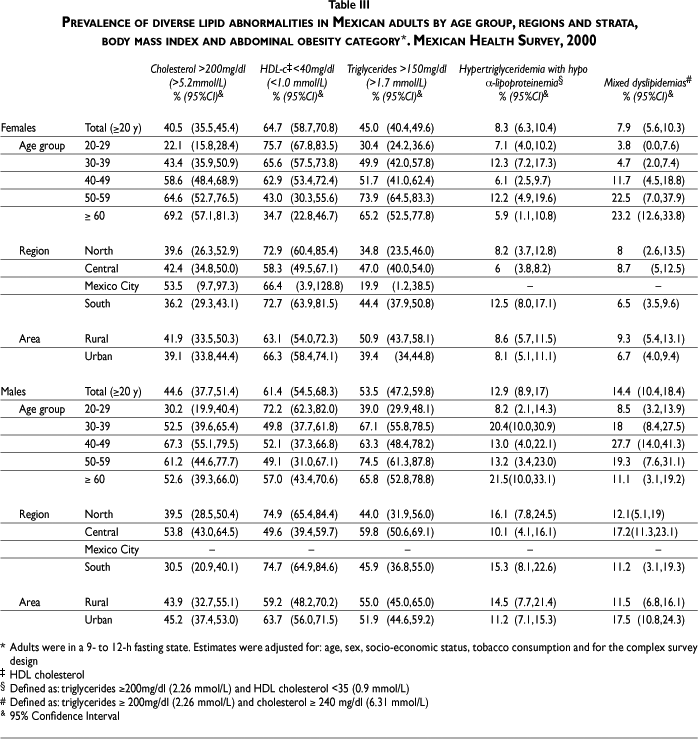
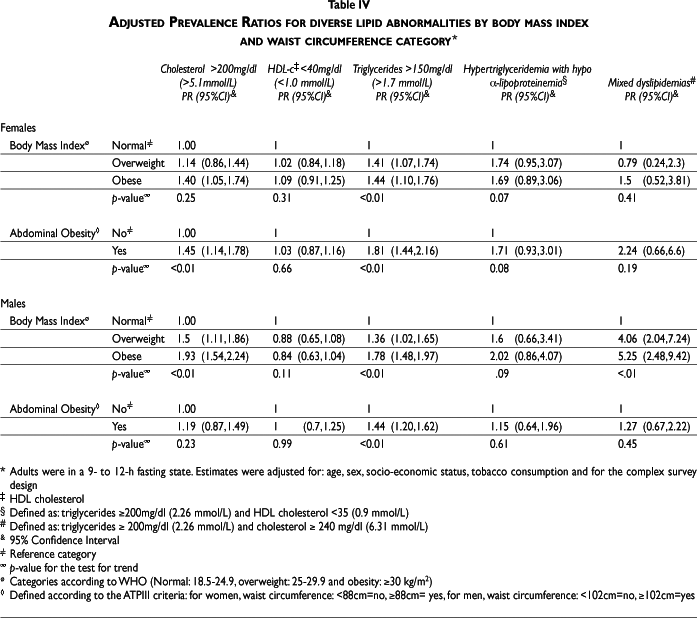
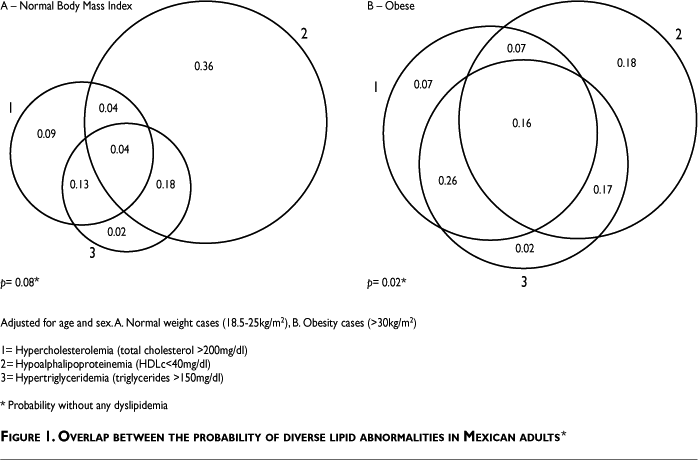
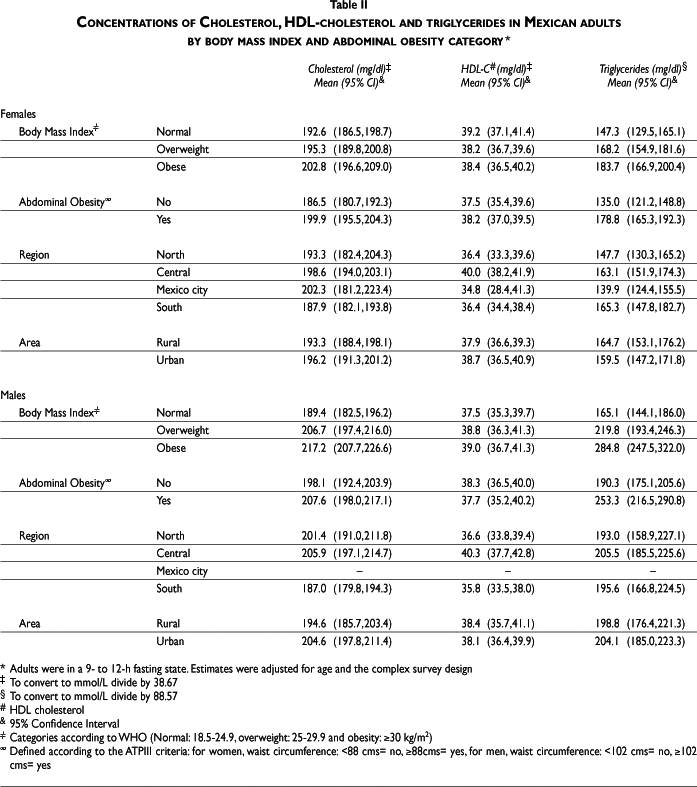
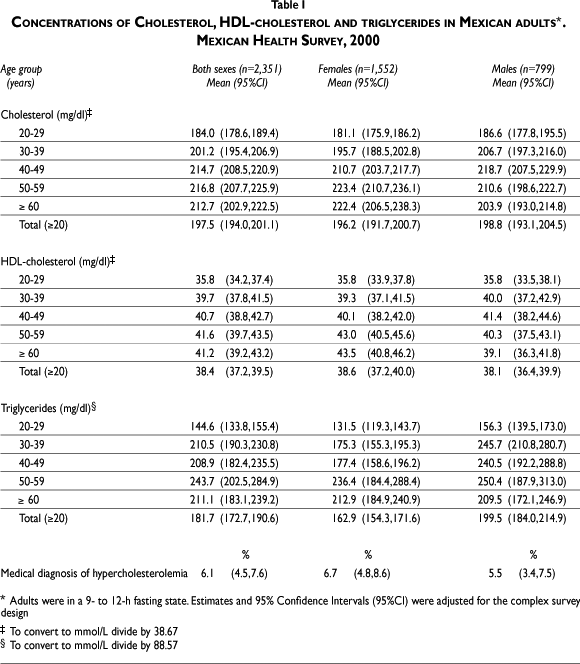
<body><![CDATA[<p>&nbsp;</p>    <p><font face="Verdana, Arial, Helvetica, sans-serif" size="3"><b>Results</b></font></p>     <p><font face="Verdana, Arial, Helvetica, sans-serif" size="2">Our study included    2 351 adults 20-y of age from the Mexican National Health Survey (2000) who    where at fasting during the interview. The mean total cholesterol (TC), HDLc,    and triglycerides (TG) concentrations were: 197.5 mg/dl (95%CI= 194.0, 201.1),    38.4 mg/dl (95%CI= 37.2, 39.5) and 181.7 mg/dl (95%CI= 172.7, 190.6) respectively.    A total of 38.2% of the population were overweight (37.6% females, 38.8% males)    and 21.1% were obese (26.5% females, 16.0% males). Abdominal obesity was present    in 38.2% of the cases (58.0% females, 19.6% males).</font></p>     <p><font face="Verdana, Arial, Helvetica, sans-serif" size="2"><a href="#tab1">Table    I</a> shows the mean cholesterol, HDLc and triglycerides concentrations by age    group. Adults 20-29-y of age had significantly lower TC and TG concentrations    compared to adults &gt;29-y of age. HDLc showed no statistically significant    differences by age group. Males had significantly higher TG concentrations than    females (199 vs 163 mg/dl <i>p</i>&lt;0.05), but no statistically significant    differences were found by sex for TC and HDLc. Less than 7% of our population    had been previously diagnosed with hypercholesterolemia. Mean TC, HDLc and TG    concentrations were estimated by BMI category, abdominal obesity category, region    and area, finding only a few statistically significant differences after adjusting    by age (<a href="/img/revistas/spm/v49s3/04t2.gif">Table II</a>). Females with abdominal obesity    had higher TC (200 <i>vs</i> 187 mg/dl, <i>p</i>&lt;0.05) and TG (179 vs 135    mg/dl, <i>p</i>&lt;0.05) than those without it, but showed no significant difference    by BMI category. Males showed lower concentrations of TC and TG in normal BMI    adults compared to overweight and obese but no significant differences were    observed for HDLc. In this group, abdominal obesity was only associated to higher    concentrations of triglycerides (253 vs 190 mg/dl, <i>p</i>&lt;0.05). No statistically    significant differences were found by region or area for males or females with    the exception of TC in males, which was higher in the central region than in    the south region (206 <i>vs</i> 187 mg/dl, <i>p</i>&lt;0.05).</font></p>     <p><a name="tab1"></a></p>     <p>&nbsp;</p>     <p align="center"><img src="/img/revistas/spm/v49s3/04t1.gif"></p>     <p>&nbsp;</p>     <p><font face="Verdana, Arial, Helvetica, sans-serif" size="2">Prevalences of    the five previously described dysli-pidemias are presented stratified by sex,    age, region and area in <a href="/img/revistas/spm/v49s3/04t3.gif">table III</a>. Hypercholesterolemia    (TC &gt;200 mg/dl) was present in 40.5% of the adult females (95%CI= 35.5, 45.4)    and 44.6 of the adult males (95%CI= 37.7, 51.4); hypoalphalipoproteinemia (HDLc&lt;40    mg/dl) was the most prevalent form of dyslipidemia, present in 64.7% (95%CI=    58.7, 70.8) and 61.4% (95%CI= 54.4, 68.3) of females and males, respectively.    Hypertriglyceridemia with hypoalphalipoproteinemia and mixed dyslipidemias were    significantly more prevalent in males than in females.</font></p>     <p><font face="Verdana, Arial, Helvetica, sans-serif" size="2"><a href="/img/revistas/spm/v49s3/04t4.gif">Table    IV</a> shows the prevalence ratios (PR) of having a dyslipidemia by BMI or abdominal    adiposity stratifying by sex and adjusting for age and other previously mentioned    confounders. In females, obesity and abdominal obesity increased ~1.4 the PR    of having hypercholesterolemia, but overweight was not significantly associated.    In males, overweight increased 1.5 the PR and obesity increased it by 1.93,    but abdominal obesity did not increase significantly the adjusted PR of having    hypercholesterolemia. Hypoalphalipoproteinemias were not associated to BMI category    or abdominal obesity in males or females. Hypertriglyceridemia was associated    to both obesity category and abdominal obesity in males and females. Hypertriglyceridemia    with hypoalphalipoproteinemia had no significant associations with the adiposity    indicators in females and males. Mixed dyslipidemias increased with BMI category    and had a significant test for trend in males but not in females. Obese males    were 5.25 times more likely to have mixed dyslipidemias than normal males (95%    CI= 2.48, 9.42). The age and sex-adjusted probabilities of having more than    one lipid abnormality in obese Mexican adults compared to those of normal BMI    is illustrated in <a href="/img/revistas/spm/v49s3/04f1.gif">Figure 1</a> with Venn diagrams    for (a) cases classified as normal and (b) those with obesity. The probabilities    of co-existence of hypercholesterolemia, hypoalphalipoproteinemia, and hypertriglyceridemia    are represented by the primary circles (1, 2, 3 respectively), and the combinations    of these conditions are represented by the overlap areas within the circles.    This figure shows that hypoalphalipoproteinemia is the dyslipidemia with the    highest probability of occurrence in Mexicans. Adults with obesity had higher    probability coefficients for most of the combinations of lipid abnormalities.</font></p>     ]]></body>
<body><![CDATA[<p>&nbsp;</p>    <p><font face="Verdana, Arial, Helvetica, sans-serif" size="3"><b>Discussion</b></font></p>     <p><font face="Verdana, Arial, Helvetica, sans-serif" size="2">This study shows    the mean concentrations of total cholesterol (TC), HDL cholesterol (HDLc) and    triglycerides (TG), as well as their association with overweight and obesity    as BMI categories, and with abdominal adiposity in the sample of fasting adults    from the MHS (2000). Cholesterol concentrations from our study in Mexico are    remarkably similar to those found for Mexican-Americans participating in NHANES,<sup>24</sup>    and the prevalence of hypercholesterolemia is slightly lower than the reported    average in the US.<sup>25</sup> However, whether continued increase in cholesterol    concentrations will occur in Mexico is not clear, but may be likely to occur,    given the observed trend where hypercholesterolemia increased ~5% from 1988<sup>11</sup>    to 1994 and 21% from 1994<sup>10</sup> to 2000 (this study). Recently, we documented    a 29% increase in fat intake as percentage of total calories in the country,    from 1988 to 1999.<sup>26</sup> This is a relevant determinant of serum total    cholesterol and the trend in Mexico is contrary to the one in the US where a    decrease in fat consumption has been observed as well as a reduction of cardiovascular    mortality.<sup>27,28</sup> If fat consumption remains with a similar trend in    Mexico, it is likely that the prevalence of hypercholesterolemia will increase    in the next years. Cholesterol-lowering medications have been identified as    a potential important factor for the reduction of cholesterol levels in the    US. In Mexico, only ~6% of the population acknowledged to have a previous medical    diagnose of this condition. Thus, pharmacological treatment is not likely to    be a factor producing effects at the population level at this time. As has been    concluded from earlier studies, hypoalphalipoproteinemia is the most frequent    lipid abnormality, followed by hypertriglyceridemia in Mexican adults<sup>10</sup>    and other Latin-American populations.<sup>29</sup> Concentrations of HDLc &lt;40mg/dl    are considered a cardiovascular risk factor;<sup>17</sup> in Mexico, the prevalence    of this condition was &gt;60% for males and females, and &gt;70% for adults    of 20-29-y of age, and adults living in the north and south country regions.    The estimated probability for low HDLc without other lipid abnormalities was    higher in normal than obese adults, suggesting a genetic component for this    condition (<a href="/img/revistas/spm/v49s3/04f1.gif">Figure 1</a>). We did not observe important    differences of HDLc concentrations by sex as previously described in Mexico    and other countries. Although we found a higher mean HDLc concentration in females,    it was not significantly different from males. Further studies, such as the    new Mexican Health and Nutrition survey currently in analysis, will be necessary    to clarify this relationship in Mexico, since the number of cases was limited    by the fasting condition reducing the power to detect differences. Information    regarding physical activity was not collected in this survey so we were unable    to evaluate the contribution of this lifestyle condition to the HDLc levels    in Mexican population. In Mexico, as in the US and other countries, obesity    has been increasing in children and adults;<sup>1,22,26,30</sup> this is a known    factor associated with cardiovascular risk. In our study, obese adults were    more likely to have hypertriglyceridemia and hypercholesterolemia than adults    of normal BMI. In addition, obese adults were four times more likely to have    three lipid abnormalities in comparison with normal BMI adults (<i>p</i>=0.16    vs <i>p</i>=0.04) (<a href="/img/revistas/spm/v49s3/04f1.gif">figure 1</a>). Thus, if the increasing    trend in obesity persists; the coexistence of multiple dyslipidemias could become    more prevalent in the next years. A clear relationship was observed between    BMI categories (in males) and central adiposity (in females) for hypertriglyceridemia.    Thus, the lipid profiles of obese and non-obese populations have relevant differences    with the consequent associated risks.</font></p>     <p><font face="Verdana, Arial, Helvetica, sans-serif" size="2">Regions showed    no significant differences, contrary to what has been previously reported.<sup>9</sup>    This is consistent with the regional catch-up phenomenon observed for NCCD mortality<sup>19</sup>    and to fat consumption patterns.<sup>31</sup> In both examples the less developed    south region had lower levels of mortality and fat consumption compared to the    north region during the 80s; but recently a more homogeneous pattern across    regions is observed, explained by greater changes in the south region. These    changes may be related to the experienced shift in lifestyles with reduction    of physical activity, and a diet with increasing availability of fast and ready-to-eat    foods (traditional and non-traditional), as well as consumption of processed    foods rich in partially-saturated fat.<sup>2,32</sup></font></p>     <p><font face="Verdana, Arial, Helvetica, sans-serif" size="2">This information    is consistent with diverse reports of lipid profiles in Mexican and Mexican-Americans.    In contrast with the MCDS (1994) this information included subjects living in    rural areas; however, differences between urban and rural population were not    significant. One possibility is that adults living in rural areas have modified    their life-styles to have a similar lipid profile than urban adults in recent    times.</font></p>     <p><font face="Verdana, Arial, Helvetica, sans-serif" size="2">Lipid abnormalities    are a major cardiovascular risk factor. Although ethnic differences in the lipid    profile have been described; an environmental influence on the trends has been    observed in Mexico and is likely to have a major role. The relative increase    in the mortality rate for acute myocardial infarction and diabetes mellitus    was &gt;50% during the 1980-2000 period, which is an indicator of the burden    of disease that is occurring in this nutrition and epidemiologic transition.<sup>1</sup>    Since our data were obtained from the individuals at fasting state during the    survey and represented less than 6% of the total participants, the external    validity of the study could be compromised. Some stratification such as by region    could have limited the power to detect significant differences. Thus, this information    needs to be confirmed by nationally representative data from new surveys.</font></p>     <p><font face="Verdana, Arial, Helvetica, sans-serif" size="2">Sound commitment    from government authorities, participation from the society, promotion and education    about healthy lifestyles, improved training of doctors and health professionals,    and responsibility and commitment from the food and pharmacological industries    are only some of areas of opportunity for improvement that could have an impact    on this public health problem.<sup>33</sup></font></p>     <p>&nbsp;</p>    <p><font face="Verdana, Arial, Helvetica, sans-serif" size="3"><b>Acknowledgments</b></font></p>     <p><font face="Verdana, Arial, Helvetica, sans-serif" size="2">This study was    possible thanks to the Mexican National Council of Science and Technology (CONACyT)    grant number 37194-M (Barquera S, Olaiz G, Villalpando S, Rivera J, Gonz&aacute;lez    C, Sep&uacute;lveda J. Contribution of overweight and obesity to the development    of risk factors for chronic diseases: analysis of the National Health Survey).    We would like to acknowledge the assistance of Ricardo Robledo, PhD who implemented    the techniques for the biochemical determinations. In addition we would like    to thank Ismael Campos, MD, MS, Citlali Carri&oacute;n, MS and Juan Espinosa,    MS for their valuable assistance during the data analysis process, Carlos Aguilar-Salinas    MD, for his input in the selection of cutoff points and interpretation of results    and Richard Cooper MD, for his valuable comments to an earlier draft of this    report.</font></p>     ]]></body>
<body><![CDATA[<p>&nbsp;</p>    <p><font face="Verdana, Arial, Helvetica, sans-serif" size="3"><b>References</b></font></p>     <!-- ref --><p><font face="Verdana, Arial, Helvetica, sans-serif" size="2">1. Rivera-Dommarco    J, Barquera S, Campirano F, Campos-Nonato I, Safdie M, Tovar V. The Epidemiological    and Nutritional Transition in Mexico: rapid increase of non-communicable chronic    diseases and obesity. Public Health Nutrition 2002;14(44):113-122.</font>&nbsp;&nbsp;&nbsp;&nbsp;&nbsp;&nbsp;&nbsp;&nbsp;[&#160;<a href="javascript:void(0);" onclick="javascript: window.open('/scielo.php?script=sci_nlinks&ref=9245818&pid=S0036-3634200700090000500001&lng=','','width=640,height=500,resizable=yes,scrollbars=1,menubar=yes,');">Links</a>&#160;]<!-- end-ref --><!-- ref --><p><font face="Verdana, Arial, Helvetica, sans-serif" size="2">2. Drewnowski A,    Popkin BM. The nutrition transition: new trends in the global diet. &#91;Review&#93;    &#91;57 refs&#93;. Nutrition Reviews 1997;55(2):31-43.</font>&nbsp;&nbsp;&nbsp;&nbsp;&nbsp;&nbsp;&nbsp;&nbsp;[&#160;<a href="javascript:void(0);" onclick="javascript: window.open('/scielo.php?script=sci_nlinks&ref=9245819&pid=S0036-3634200700090000500002&lng=','','width=640,height=500,resizable=yes,scrollbars=1,menubar=yes,');">Links</a>&#160;]<!-- end-ref --><!-- ref --><p><font face="Verdana, Arial, Helvetica, sans-serif" size="2">3. Programa Nacional    de Salud 2001-2006. M&eacute;xico, DF: Secretar&iacute;a de Salud, 2001.</font>&nbsp;&nbsp;&nbsp;&nbsp;&nbsp;&nbsp;&nbsp;&nbsp;[&#160;<a href="javascript:void(0);" onclick="javascript: window.open('/scielo.php?script=sci_nlinks&ref=9245820&pid=S0036-3634200700090000500003&lng=','','width=640,height=500,resizable=yes,scrollbars=1,menubar=yes,');">Links</a>&#160;]<!-- end-ref --><!-- ref --><p><font face="Verdana, Arial, Helvetica, sans-serif" size="2">4. Castelli W,    Garrison R, Wilson P, Abbott R, LKalousdian S, Kannel W. Incidence of coronary    heart disease and lipoprotein cholesterol levels. The Framingham Study. JAMA    1986;256(20):2835-2838.</font>&nbsp;&nbsp;&nbsp;&nbsp;&nbsp;&nbsp;&nbsp;&nbsp;[&#160;<a href="javascript:void(0);" onclick="javascript: window.open('/scielo.php?script=sci_nlinks&ref=9245821&pid=S0036-3634200700090000500004&lng=','','width=640,height=500,resizable=yes,scrollbars=1,menubar=yes,');">Links</a>&#160;]<!-- end-ref --><!-- ref --><p><font face="Verdana, Arial, Helvetica, sans-serif" size="2">5. Gordon D, Knoke    J, Probstfield J, Superko R, HA. T. High-density lipoprotein cholesterol and    coronary heart disease in hypercholesterolemic men: the Lipid Research Clinics    Coronary Primary Prevention Trial. Circulation 1986;74(6):1217-1225.</font>&nbsp;&nbsp;&nbsp;&nbsp;&nbsp;&nbsp;&nbsp;&nbsp;[&#160;<a href="javascript:void(0);" onclick="javascript: window.open('/scielo.php?script=sci_nlinks&ref=9245822&pid=S0036-3634200700090000500005&lng=','','width=640,height=500,resizable=yes,scrollbars=1,menubar=yes,');">Links</a>&#160;]<!-- end-ref --><!-- ref --><p><font face="Verdana, Arial, Helvetica, sans-serif" size="2">6. Escobedo J,    Escamilla-Cejudo J, Santos-Burgoa C. Colesterol s&eacute;rico y diabetes mellitus:    principales factores de riesgo independientes en la mortalidad por cardiopat&iacute;a    isqu&eacute;mica en M&eacute;xico. Arch Inst Cardiol Mex 1994;64:189-195.</font>&nbsp;&nbsp;&nbsp;&nbsp;&nbsp;&nbsp;&nbsp;&nbsp;[&#160;<a href="javascript:void(0);" onclick="javascript: window.open('/scielo.php?script=sci_nlinks&ref=9245823&pid=S0036-3634200700090000500006&lng=','','width=640,height=500,resizable=yes,scrollbars=1,menubar=yes,');">Links</a>&#160;]<!-- end-ref --><!-- ref --><p><font face="Verdana, Arial, Helvetica, sans-serif" size="2">7. Sistema Nacional    de Informaci&oacute;n en Salud. Principales causas de mortalidad general, 2003.    M&eacute;xico DF: Secretar&iacute;a de Salud, 2005.</font>&nbsp;&nbsp;&nbsp;&nbsp;&nbsp;&nbsp;&nbsp;&nbsp;[&#160;<a href="javascript:void(0);" onclick="javascript: window.open('/scielo.php?script=sci_nlinks&ref=9245824&pid=S0036-3634200700090000500007&lng=','','width=640,height=500,resizable=yes,scrollbars=1,menubar=yes,');">Links</a>&#160;]<!-- end-ref --><!-- ref --><p><font face="Verdana, Arial, Helvetica, sans-serif" size="2">8. Tapia-Conyer    R, Guti&eacute;rrez G, Sep&uacute;lveda J. Metodolog&iacute;a de la Encuesta    Nacional Seroepidemiol&oacute;gica, M&eacute;xico. Salud Publica Mex 1992;34:124-135.</font>&nbsp;&nbsp;&nbsp;&nbsp;&nbsp;&nbsp;&nbsp;&nbsp;[&#160;<a href="javascript:void(0);" onclick="javascript: window.open('/scielo.php?script=sci_nlinks&ref=9245825&pid=S0036-3634200700090000500008&lng=','','width=640,height=500,resizable=yes,scrollbars=1,menubar=yes,');">Links</a>&#160;]<!-- end-ref --><!-- ref --><p><font face="Verdana, Arial, Helvetica, sans-serif" size="2">9. Posadas-Romero    C, Tapia-Conyer R, Lerman-Gaber I, et al. Cholesterol levels and prevalence    of hypercholesterolemia in a Mexican adult population. Atherosclerosis 1995;118:275-284.</font>&nbsp;&nbsp;&nbsp;&nbsp;&nbsp;&nbsp;&nbsp;&nbsp;[&#160;<a href="javascript:void(0);" onclick="javascript: window.open('/scielo.php?script=sci_nlinks&ref=9245826&pid=S0036-3634200700090000500009&lng=','','width=640,height=500,resizable=yes,scrollbars=1,menubar=yes,');">Links</a>&#160;]<!-- end-ref --><!-- ref --><p><font face="Verdana, Arial, Helvetica, sans-serif" size="2">10. Aguilar-Salinas    CA, Olaiz G, Valles V, <i>et al.</i> High prevalence of low HDL cholesterol    concentrations and mixed hyperlipidemia in a Mexican nationwide survey. J Lipid    Res 2001;42:1298-1307.</font>&nbsp;&nbsp;&nbsp;&nbsp;&nbsp;&nbsp;&nbsp;&nbsp;[&#160;<a href="javascript:void(0);" onclick="javascript: window.open('/scielo.php?script=sci_nlinks&ref=9245827&pid=S0036-3634200700090000500010&lng=','','width=640,height=500,resizable=yes,scrollbars=1,menubar=yes,');">Links</a>&#160;]<!-- end-ref --><!-- ref --><p><font face="Verdana, Arial, Helvetica, sans-serif" size="2">11. Posadas-Romero    C, Sep&uacute;lveda J, Tapia-Conyer R, Magos C, Cardoso-Salda&ntilde;a G, Zamora-Gonz&aacute;lez    J. Valores de colesterol s&eacute;rico en la poblaci&oacute;n mexicana. Salud    Publica Mex 1992;34:157-167.</font>&nbsp;&nbsp;&nbsp;&nbsp;&nbsp;&nbsp;&nbsp;&nbsp;[&#160;<a href="javascript:void(0);" onclick="javascript: window.open('/scielo.php?script=sci_nlinks&ref=9245828&pid=S0036-3634200700090000500011&lng=','','width=640,height=500,resizable=yes,scrollbars=1,menubar=yes,');">Links</a>&#160;]<!-- end-ref --><!-- ref --><p><font face="Verdana, Arial, Helvetica, sans-serif" size="2">12. Gonzalez C,    Stern M, Valdez R, Brazton M, Haffner H. Niveles de l&iacute;pidos sangu&iacute;neos    y riesgo aterog&eacute;nico en poblaci&oacute;n abierta urbana. Rev Inv Clin    1993;45:127-132.</font>&nbsp;&nbsp;&nbsp;&nbsp;&nbsp;&nbsp;&nbsp;&nbsp;[&#160;<a href="javascript:void(0);" onclick="javascript: window.open('/scielo.php?script=sci_nlinks&ref=9245829&pid=S0036-3634200700090000500012&lng=','','width=640,height=500,resizable=yes,scrollbars=1,menubar=yes,');">Links</a>&#160;]<!-- end-ref --><!-- ref --><p><font face="Verdana, Arial, Helvetica, sans-serif" size="2">13. Valles V, Aguilar-Salinas    C, G&oacute;mez-P&eacute;rez FJ, <i>et al.</i> Apolipoprotein B and A-I distribution    in the Mexican urban adults: results of a nationwide survey. Metabolism 2002;51(5):560-568.</font>&nbsp;&nbsp;&nbsp;&nbsp;&nbsp;&nbsp;&nbsp;&nbsp;[&#160;<a href="javascript:void(0);" onclick="javascript: window.open('/scielo.php?script=sci_nlinks&ref=9245830&pid=S0036-3634200700090000500013&lng=','','width=640,height=500,resizable=yes,scrollbars=1,menubar=yes,');">Links</a>&#160;]<!-- end-ref --><!-- ref --><p><font face="Verdana, Arial, Helvetica, sans-serif" size="2">14. Olaiz G, Rojas    R, Barquera S, et al. Encuesta Nacional de Salud 2000. Tomo 2. La salud de los    adultos. Cuernavaca, Mor: Instituto Nacional de Salud P&uacute;blica, 2003.</font>&nbsp;&nbsp;&nbsp;&nbsp;&nbsp;&nbsp;&nbsp;&nbsp;[&#160;<a href="javascript:void(0);" onclick="javascript: window.open('/scielo.php?script=sci_nlinks&ref=9245831&pid=S0036-3634200700090000500014&lng=','','width=640,height=500,resizable=yes,scrollbars=1,menubar=yes,');">Links</a>&#160;]<!-- end-ref --><!-- ref --><p><font face="Verdana, Arial, Helvetica, sans-serif" size="2">15. Barquera S,    Carri&oacute;n MC, Campos I, Espinosa J, Rivera JA, Olaiz G. Methodology of    the fasting sub-sample from the Mexican Health Survey, 2000. Salud Publica Mex    2007;49:S420-S425.</font>&nbsp;&nbsp;&nbsp;&nbsp;&nbsp;&nbsp;&nbsp;&nbsp;[&#160;<a href="javascript:void(0);" onclick="javascript: window.open('/scielo.php?script=sci_nlinks&ref=9245832&pid=S0036-3634200700090000500015&lng=','','width=640,height=500,resizable=yes,scrollbars=1,menubar=yes,');">Links</a>&#160;]<!-- end-ref --><!-- ref --><p><font face="Verdana, Arial, Helvetica, sans-serif" size="2">16. Ley de Informaci&oacute;n    Estad&iacute;stica y Geogr&aacute;fica. Diario Oficial de la Federaci&oacute;n,    Estados Unidos Mexicanos. 1980.</font>&nbsp;&nbsp;&nbsp;&nbsp;&nbsp;&nbsp;&nbsp;&nbsp;[&#160;<a href="javascript:void(0);" onclick="javascript: window.open('/scielo.php?script=sci_nlinks&ref=9245833&pid=S0036-3634200700090000500016&lng=','','width=640,height=500,resizable=yes,scrollbars=1,menubar=yes,');">Links</a>&#160;]<!-- end-ref --><!-- ref --><p><font face="Verdana, Arial, Helvetica, sans-serif" size="2">17. Expert panel    on detection evaluation and treatment of high blood cholesterol in adults. Executive    summary of the third report of the national cholesterol education program (NCEP)    expert panel on detection, evaluation and treatment of high blood cholesterol    in adults (adult treatment panel III). JAMA 2001;287:356-359.</font>&nbsp;&nbsp;&nbsp;&nbsp;&nbsp;&nbsp;&nbsp;&nbsp;[&#160;<a href="javascript:void(0);" onclick="javascript: window.open('/scielo.php?script=sci_nlinks&ref=9245834&pid=S0036-3634200700090000500017&lng=','','width=640,height=500,resizable=yes,scrollbars=1,menubar=yes,');">Links</a>&#160;]<!-- end-ref --><!-- ref --><p><font face="Verdana, Arial, Helvetica, sans-serif" size="2">18. WHO. Physical    status: the use and interpretation of anthropometry. Geneva: World Health Organization,    1995.</font>&nbsp;&nbsp;&nbsp;&nbsp;&nbsp;&nbsp;&nbsp;&nbsp;[&#160;<a href="javascript:void(0);" onclick="javascript: window.open('/scielo.php?script=sci_nlinks&ref=9245835&pid=S0036-3634200700090000500018&lng=','','width=640,height=500,resizable=yes,scrollbars=1,menubar=yes,');">Links</a>&#160;]<!-- end-ref --><!-- ref --><p><font face="Verdana, Arial, Helvetica, sans-serif" size="2">19. Barquera S,    Tovar-Guzm&aacute;n V, Campos-Nonato I, Gonz&aacute;lez-Villalpando C, Rivera-Dommarco    J. Geography of diabetes mellitus mortality in Mexico: an epidemiologic transition    analysis. Arch Med Res 2003;34(5):407-414.</font>&nbsp;&nbsp;&nbsp;&nbsp;&nbsp;&nbsp;&nbsp;&nbsp;[&#160;<a href="javascript:void(0);" onclick="javascript: window.open('/scielo.php?script=sci_nlinks&ref=9245836&pid=S0036-3634200700090000500019&lng=','','width=640,height=500,resizable=yes,scrollbars=1,menubar=yes,');">Links</a>&#160;]<!-- end-ref --><!-- ref --><p><font face="Verdana, Arial, Helvetica, sans-serif" size="2">20. Hernandez-Diaz    S, Peterson K, Dixit S, et al. Association of maternal short stature with stunting    in Mexican children: common genes vs common environment. Eur J Clin Nutr 1999;53:938-945.</font>&nbsp;&nbsp;&nbsp;&nbsp;&nbsp;&nbsp;&nbsp;&nbsp;[&#160;<a href="javascript:void(0);" onclick="javascript: window.open('/scielo.php?script=sci_nlinks&ref=9245837&pid=S0036-3634200700090000500020&lng=','','width=640,height=500,resizable=yes,scrollbars=1,menubar=yes,');">Links</a>&#160;]<!-- end-ref --><!-- ref --><p><font face="Verdana, Arial, Helvetica, sans-serif" size="2">21. Zhang J, Yu    KF. What's the relative risk? A method of correcting the odds ratio in cohort    studies of common outcomes. JAMA 1998;280(19):1690-1691.</font>&nbsp;&nbsp;&nbsp;&nbsp;&nbsp;&nbsp;&nbsp;&nbsp;[&#160;<a href="javascript:void(0);" onclick="javascript: window.open('/scielo.php?script=sci_nlinks&ref=9245838&pid=S0036-3634200700090000500021&lng=','','width=640,height=500,resizable=yes,scrollbars=1,menubar=yes,');">Links</a>&#160;]<!-- end-ref --><!-- ref --><p><font face="Verdana, Arial, Helvetica, sans-serif" size="2">22. Must A, Spadano    J, Coakley EH, Field AE, Colditz G, Dietz WH. The disease burden associated    with overweight and obesity. Jama 1999;282(16):1523-1529.</font>&nbsp;&nbsp;&nbsp;&nbsp;&nbsp;&nbsp;&nbsp;&nbsp;[&#160;<a href="javascript:void(0);" onclick="javascript: window.open('/scielo.php?script=sci_nlinks&ref=9245839&pid=S0036-3634200700090000500022&lng=','','width=640,height=500,resizable=yes,scrollbars=1,menubar=yes,');">Links</a>&#160;]<!-- end-ref --><!-- ref --><p><font face="Verdana, Arial, Helvetica, sans-serif" size="2">23. Chow S, Ruskey    F. Drawing area-proportional Venn and Euler diagrams. Proc Graph Drawing 2004;2912:466-477.</font>&nbsp;&nbsp;&nbsp;&nbsp;&nbsp;&nbsp;&nbsp;&nbsp;[&#160;<a href="javascript:void(0);" onclick="javascript: window.open('/scielo.php?script=sci_nlinks&ref=9245840&pid=S0036-3634200700090000500023&lng=','','width=640,height=500,resizable=yes,scrollbars=1,menubar=yes,');">Links</a>&#160;]<!-- end-ref --><!-- ref --><p><font face="Verdana, Arial, Helvetica, sans-serif" size="2">24. Carroll MD,    Lacher DA, Sorlie PD, <i>et al.</i> Trends in serum lipids and lipoproteins    of adults, 1960-2002. Jama 2005;294(14):1773-1781.</font>&nbsp;&nbsp;&nbsp;&nbsp;&nbsp;&nbsp;&nbsp;&nbsp;[&#160;<a href="javascript:void(0);" onclick="javascript: window.open('/scielo.php?script=sci_nlinks&ref=9245841&pid=S0036-3634200700090000500024&lng=','','width=640,height=500,resizable=yes,scrollbars=1,menubar=yes,');">Links</a>&#160;]<!-- end-ref --><!-- ref --><p><font face="Verdana, Arial, Helvetica, sans-serif" size="2">25. Ford E, Mokdad    A, Giles W, Mensah G. Serum total cholesterol concentrations and awareness,    treatment, and control of hypercholesterolemia among US adults. Findings from    the National Health and Nutrition Examination Survey, 1999 to 2000. Circulation    2003;107:2185-2189.</font>&nbsp;&nbsp;&nbsp;&nbsp;&nbsp;&nbsp;&nbsp;&nbsp;[&#160;<a href="javascript:void(0);" onclick="javascript: window.open('/scielo.php?script=sci_nlinks&ref=9245842&pid=S0036-3634200700090000500025&lng=','','width=640,height=500,resizable=yes,scrollbars=1,menubar=yes,');">Links</a>&#160;]<!-- end-ref --><!-- ref --><p><font face="Verdana, Arial, Helvetica, sans-serif" size="2">26. Rivera J, Barquera    S, Gonzalez-Cossio T, Olaiz G, Sepulveda J. Nutrition transition in Mexico and    other Latin American countries. Nutrition Reviews 2004;62(7):S1-S9.</font>&nbsp;&nbsp;&nbsp;&nbsp;&nbsp;&nbsp;&nbsp;&nbsp;[&#160;<a href="javascript:void(0);" onclick="javascript: window.open('/scielo.php?script=sci_nlinks&ref=9245843&pid=S0036-3634200700090000500026&lng=','','width=640,height=500,resizable=yes,scrollbars=1,menubar=yes,');">Links</a>&#160;]<!-- end-ref --><!-- ref --><p><font face="Verdana, Arial, Helvetica, sans-serif" size="2">27. Cooper R, Cutler    J, Desvigne-Nickens P, et al. Trends and disparities in coronary heart disease,    stroke, and other cardiovascular diseases in the United States: findings of    the national conference on cardiovascular disease prevention. Circulation 2000;102(25):3137-3147.</font>&nbsp;&nbsp;&nbsp;&nbsp;&nbsp;&nbsp;&nbsp;&nbsp;[&#160;<a href="javascript:void(0);" onclick="javascript: window.open('/scielo.php?script=sci_nlinks&ref=9245844&pid=S0036-3634200700090000500027&lng=','','width=640,height=500,resizable=yes,scrollbars=1,menubar=yes,');">Links</a>&#160;]<!-- end-ref --><!-- ref --><p><font face="Verdana, Arial, Helvetica, sans-serif" size="2">28. Cooper R, Stamler    J, Dyer A, Garside D. The decline in mortality from coronary heart disease,    USA, 1968-1975. J Chronic Dis 1978;31(12): 709-720.'</font>&nbsp;&nbsp;&nbsp;&nbsp;&nbsp;&nbsp;&nbsp;&nbsp;[&#160;<a href="javascript:void(0);" onclick="javascript: window.open('/scielo.php?script=sci_nlinks&ref=9245845&pid=S0036-3634200700090000500028&lng=','','width=640,height=500,resizable=yes,scrollbars=1,menubar=yes,');">Links</a>&#160;]<!-- end-ref --><!-- ref --><p><font face="Verdana, Arial, Helvetica, sans-serif" size="2">29. Florez H, Silva    E, Fern&aacute;ndez V, et al. Prevalence and risk factors associated with the    metabolic syndrome and dyslipidemia in White, Black, Amerindian and mixed Hispanics    in Zulia state, Venezuela. Diabetes Res Clin Pract 2005;69:63-77.</font>&nbsp;&nbsp;&nbsp;&nbsp;&nbsp;&nbsp;&nbsp;&nbsp;[&#160;<a href="javascript:void(0);" onclick="javascript: window.open('/scielo.php?script=sci_nlinks&ref=9245846&pid=S0036-3634200700090000500029&lng=','','width=640,height=500,resizable=yes,scrollbars=1,menubar=yes,');">Links</a>&#160;]<!-- end-ref --><!-- ref --><p><font face="Verdana, Arial, Helvetica, sans-serif" size="2">30. Smith S, Clark    L, Cooper R, et al. Discovering the full spectrum of cardiovascular disease.    Minority Health Summit 2003. Report of the obesity, metabolic syndrome and hypertension    writing group. Circulation 2005;111:e134-e139.</font>&nbsp;&nbsp;&nbsp;&nbsp;&nbsp;&nbsp;&nbsp;&nbsp;[&#160;<a href="javascript:void(0);" onclick="javascript: window.open('/scielo.php?script=sci_nlinks&ref=9245847&pid=S0036-3634200700090000500030&lng=','','width=640,height=500,resizable=yes,scrollbars=1,menubar=yes,');">Links</a>&#160;]<!-- end-ref --><!-- ref --><p><font face="Verdana, Arial, Helvetica, sans-serif" size="2">31. Barquera S,    Hotz C, Rivera J, <i>et al.</i> Food consumption, food expenditure, anthropometric    status and nutrition related diseases in Mexico. Nutrition and the double-burden    of disease in developing countries.    Rome: Food and Agricultural Organization (FAO), 2006:161-257.</font>&nbsp;&nbsp;&nbsp;&nbsp;&nbsp;&nbsp;&nbsp;&nbsp;[&#160;<a href="javascript:void(0);" onclick="javascript: window.open('/scielo.php?script=sci_nlinks&ref=9245848&pid=S0036-3634200700090000500031&lng=','','width=640,height=500,resizable=yes,scrollbars=1,menubar=yes,');">Links</a>&#160;]<!-- end-ref --><!-- ref --><p><font face="Verdana, Arial, Helvetica, sans-serif" size="2">32. Drewnowski    A, Popkin BM. The nutrition transition: new trends in the global diet. Nutrition    Reviews 1997;55(2):31-43.</font>&nbsp;&nbsp;&nbsp;&nbsp;&nbsp;&nbsp;&nbsp;&nbsp;[&#160;<a href="javascript:void(0);" onclick="javascript: window.open('/scielo.php?script=sci_nlinks&ref=9245849&pid=S0036-3634200700090000500032&lng=','','width=640,height=500,resizable=yes,scrollbars=1,menubar=yes,');">Links</a>&#160;]<!-- end-ref --><!-- ref --><p><font face="Verdana, Arial, Helvetica, sans-serif" size="2">33. Epping-Jordan    J, Pruitt S, Wagner E. Improving the quality of health care for chronic conditions.    Qual Saf Health Care 2004;13:299-305.</font>&nbsp;&nbsp;&nbsp;&nbsp;&nbsp;&nbsp;&nbsp;&nbsp;[&#160;<a href="javascript:void(0);" onclick="javascript: window.open('/scielo.php?script=sci_nlinks&ref=9245850&pid=S0036-3634200700090000500033&lng=','','width=640,height=500,resizable=yes,scrollbars=1,menubar=yes,');">Links</a>&#160;]<!-- end-ref --><p>&nbsp;</p>     <p>&nbsp;</p>     <p><font face="Verdana, Arial, Helvetica, sans-serif" size="2">Received on: February    2, 2006    <br>   Accepted on: October 20, 2006</font></p>     <p>&nbsp;</p>     ]]></body>
<body><![CDATA[<p>&nbsp;</p>     <p><font face="Verdana, Arial, Helvetica, sans-serif" size="2">Address reprint    requests to: PhD. Sim&oacute;n Barquera. Instituto Nacional de Salud P&uacute;blica.    Av. Universidad 655, Col. Santa Mar&iacute;a Ahuacatitl&aacute;n. 62508    Cuernavaca, Morelos, M&eacute;xico. E-mail:    <a href= "mailto:sbarquera@insp.mx">sbarquera@insp.mx</a>    <br>   <a name="back1"></a><a href="#top1">*</a> Stata Corp. Stata reference manual.    Release 7. College Station, TX, USA: Stata Press, 2001.</font></p>      ]]></body><back>
<ref-list>
<ref id="B1">
<label>1</label><nlm-citation citation-type="journal">
<person-group person-group-type="author">
<name>
<surname><![CDATA[Rivera-Dommarco]]></surname>
<given-names><![CDATA[J]]></given-names>
</name>
<name>
<surname><![CDATA[Barquera]]></surname>
<given-names><![CDATA[S]]></given-names>
</name>
<name>
<surname><![CDATA[Campirano]]></surname>
<given-names><![CDATA[F]]></given-names>
</name>
<name>
<surname><![CDATA[Campos-Nonato]]></surname>
<given-names><![CDATA[I]]></given-names>
</name>
<name>
<surname><![CDATA[Safdie]]></surname>
<given-names><![CDATA[M]]></given-names>
</name>
<name>
<surname><![CDATA[Tovar]]></surname>
<given-names><![CDATA[V]]></given-names>
</name>
</person-group>
<article-title xml:lang="en"><![CDATA[The Epidemiological and Nutritional Transition in Mexico: rapid increase of non-communicable chronic diseases and obesity]]></article-title>
<source><![CDATA[Public Health Nutrition]]></source>
<year>2002</year>
<volume>14</volume>
<numero>44</numero>
<issue>44</issue>
<page-range>113-122</page-range></nlm-citation>
</ref>
<ref id="B2">
<label>2</label><nlm-citation citation-type="journal">
<person-group person-group-type="author">
<name>
<surname><![CDATA[Drewnowski]]></surname>
<given-names><![CDATA[A]]></given-names>
</name>
<name>
<surname><![CDATA[Popkin]]></surname>
<given-names><![CDATA[BM]]></given-names>
</name>
</person-group>
<article-title xml:lang="en"><![CDATA[The nutrition transition: new trends in the global diet]]></article-title>
<source><![CDATA[Nutrition Reviews]]></source>
<year>1997</year>
<volume>55</volume>
<numero>2</numero>
<issue>2</issue>
<page-range>31-43</page-range></nlm-citation>
</ref>
<ref id="B3">
<label>3</label><nlm-citation citation-type="book">
<source><![CDATA[Programa Nacional de Salud 2001-2006]]></source>
<year>2001</year>
<publisher-loc><![CDATA[México^eDF DF]]></publisher-loc>
<publisher-name><![CDATA[Secretaría de Salud]]></publisher-name>
</nlm-citation>
</ref>
<ref id="B4">
<label>4</label><nlm-citation citation-type="journal">
<person-group person-group-type="author">
<name>
<surname><![CDATA[Castelli]]></surname>
<given-names><![CDATA[W]]></given-names>
</name>
<name>
<surname><![CDATA[Garrison]]></surname>
<given-names><![CDATA[R]]></given-names>
</name>
<name>
<surname><![CDATA[Wilson]]></surname>
<given-names><![CDATA[P]]></given-names>
</name>
<name>
<surname><![CDATA[Abbott]]></surname>
<given-names><![CDATA[R]]></given-names>
</name>
<name>
<surname><![CDATA[LKalousdian]]></surname>
<given-names><![CDATA[S]]></given-names>
</name>
<name>
<surname><![CDATA[Kannel]]></surname>
<given-names><![CDATA[W]]></given-names>
</name>
</person-group>
<article-title xml:lang="en"><![CDATA[Incidence of coronary heart disease and lipoprotein cholesterol levels: The Framingham Study]]></article-title>
<source><![CDATA[JAMA]]></source>
<year>1986</year>
<volume>256</volume>
<numero>20</numero>
<issue>20</issue>
<page-range>2835-2838</page-range></nlm-citation>
</ref>
<ref id="B5">
<label>5</label><nlm-citation citation-type="journal">
<person-group person-group-type="author">
<name>
<surname><![CDATA[Gordon]]></surname>
<given-names><![CDATA[D]]></given-names>
</name>
<name>
<surname><![CDATA[Knoke]]></surname>
<given-names><![CDATA[J]]></given-names>
</name>
<name>
<surname><![CDATA[Probstfield]]></surname>
<given-names><![CDATA[J]]></given-names>
</name>
<name>
<surname><![CDATA[Superko]]></surname>
<given-names><![CDATA[R]]></given-names>
</name>
<name>
<surname><![CDATA[HA]]></surname>
<given-names><![CDATA[T]]></given-names>
</name>
</person-group>
<article-title xml:lang="en"><![CDATA[High-density lipoprotein cholesterol and coronary heart disease in hypercholesterolemic men: the Lipid Research Clinics Coronary Primary Prevention Trial]]></article-title>
<source><![CDATA[Circulation]]></source>
<year>1986</year>
<volume>74</volume>
<numero>6</numero>
<issue>6</issue>
<page-range>1217-1225</page-range></nlm-citation>
</ref>
<ref id="B6">
<label>6</label><nlm-citation citation-type="journal">
<person-group person-group-type="author">
<name>
<surname><![CDATA[Escobedo]]></surname>
<given-names><![CDATA[J]]></given-names>
</name>
<name>
<surname><![CDATA[Escamilla-Cejudo]]></surname>
<given-names><![CDATA[J]]></given-names>
</name>
<name>
<surname><![CDATA[Santos-Burgoa]]></surname>
<given-names><![CDATA[C]]></given-names>
</name>
</person-group>
<article-title xml:lang="es"><![CDATA[Colesterol sérico y diabetes mellitus: principales factores de riesgo independientes en la mortalidad por cardiopatía isquémica en México]]></article-title>
<source><![CDATA[Arch Inst Cardiol Mex]]></source>
<year>1994</year>
<volume>64</volume>
<page-range>189-195</page-range></nlm-citation>
</ref>
<ref id="B7">
<label>7</label><nlm-citation citation-type="book">
<collab>Sistema Nacional de Información en Salud</collab>
<source><![CDATA[Principales causas de mortalidad general, 2003]]></source>
<year>2005</year>
<publisher-loc><![CDATA[México^eDF DF]]></publisher-loc>
<publisher-name><![CDATA[Secretaría de Salud]]></publisher-name>
</nlm-citation>
</ref>
<ref id="B8">
<label>8</label><nlm-citation citation-type="journal">
<person-group person-group-type="author">
<name>
<surname><![CDATA[Tapia-Conyer]]></surname>
<given-names><![CDATA[R]]></given-names>
</name>
<name>
<surname><![CDATA[Gutiérrez]]></surname>
<given-names><![CDATA[G]]></given-names>
</name>
<name>
<surname><![CDATA[Sepúlveda]]></surname>
<given-names><![CDATA[J]]></given-names>
</name>
</person-group>
<article-title xml:lang="es"><![CDATA[Metodología de la Encuesta Nacional Seroepidemiológica, México]]></article-title>
<source><![CDATA[Salud Publica Mex]]></source>
<year>1992</year>
<volume>34</volume>
<page-range>124-135</page-range></nlm-citation>
</ref>
<ref id="B9">
<label>9</label><nlm-citation citation-type="journal">
<person-group person-group-type="author">
<name>
<surname><![CDATA[Posadas-Romero]]></surname>
<given-names><![CDATA[C]]></given-names>
</name>
<name>
<surname><![CDATA[Tapia-Conyer]]></surname>
<given-names><![CDATA[R]]></given-names>
</name>
<name>
<surname><![CDATA[Lerman-Gaber]]></surname>
<given-names><![CDATA[I]]></given-names>
</name>
</person-group>
<article-title xml:lang="en"><![CDATA[Cholesterol levels and prevalence of hypercholesterolemia in a Mexican adult population]]></article-title>
<source><![CDATA[Atherosclerosis]]></source>
<year>1995</year>
<volume>118</volume>
<page-range>275-284</page-range></nlm-citation>
</ref>
<ref id="B10">
<label>10</label><nlm-citation citation-type="journal">
<person-group person-group-type="author">
<name>
<surname><![CDATA[Aguilar-Salinas]]></surname>
<given-names><![CDATA[CA]]></given-names>
</name>
<name>
<surname><![CDATA[Olaiz]]></surname>
<given-names><![CDATA[G]]></given-names>
</name>
<name>
<surname><![CDATA[Valles]]></surname>
<given-names><![CDATA[V]]></given-names>
</name>
</person-group>
<article-title xml:lang="en"><![CDATA[High prevalence of low HDL cholesterol concentrations and mixed hyperlipidemia in a Mexican nationwide survey]]></article-title>
<source><![CDATA[J Lipid Res]]></source>
<year>2001</year>
<volume>42</volume>
<page-range>1298-1307</page-range></nlm-citation>
</ref>
<ref id="B11">
<label>11</label><nlm-citation citation-type="journal">
<person-group person-group-type="author">
<name>
<surname><![CDATA[Posadas-Romero]]></surname>
<given-names><![CDATA[C]]></given-names>
</name>
<name>
<surname><![CDATA[Sepúlveda]]></surname>
<given-names><![CDATA[J]]></given-names>
</name>
<name>
<surname><![CDATA[Tapia-Conyer]]></surname>
<given-names><![CDATA[R]]></given-names>
</name>
<name>
<surname><![CDATA[Magos]]></surname>
<given-names><![CDATA[C]]></given-names>
</name>
<name>
<surname><![CDATA[Cardoso-Saldaña]]></surname>
<given-names><![CDATA[G]]></given-names>
</name>
<name>
<surname><![CDATA[Zamora-González]]></surname>
<given-names><![CDATA[J]]></given-names>
</name>
</person-group>
<article-title xml:lang="es"><![CDATA[Valores de colesterol sérico en la población mexicana]]></article-title>
<source><![CDATA[Salud Publica Mex]]></source>
<year>1992</year>
<volume>34</volume>
<page-range>157-167</page-range></nlm-citation>
</ref>
<ref id="B12">
<label>12</label><nlm-citation citation-type="journal">
<person-group person-group-type="author">
<name>
<surname><![CDATA[Gonzalez]]></surname>
<given-names><![CDATA[C]]></given-names>
</name>
<name>
<surname><![CDATA[Stern]]></surname>
<given-names><![CDATA[M]]></given-names>
</name>
<name>
<surname><![CDATA[Valdez]]></surname>
<given-names><![CDATA[R]]></given-names>
</name>
<name>
<surname><![CDATA[Brazton]]></surname>
<given-names><![CDATA[M]]></given-names>
</name>
<name>
<surname><![CDATA[Haffner]]></surname>
<given-names><![CDATA[H]]></given-names>
</name>
</person-group>
<article-title xml:lang="es"><![CDATA[Niveles de lípidos sanguíneos y riesgo aterogénico en población abierta urbana]]></article-title>
<source><![CDATA[Rev Inv Clin]]></source>
<year>1993</year>
<volume>45</volume>
<page-range>127-132</page-range></nlm-citation>
</ref>
<ref id="B13">
<label>13</label><nlm-citation citation-type="journal">
<person-group person-group-type="author">
<name>
<surname><![CDATA[Valles]]></surname>
<given-names><![CDATA[V]]></given-names>
</name>
<name>
<surname><![CDATA[Aguilar-Salinas]]></surname>
<given-names><![CDATA[C]]></given-names>
</name>
<name>
<surname><![CDATA[Gómez-Pérez]]></surname>
<given-names><![CDATA[FJ]]></given-names>
</name>
</person-group>
<article-title xml:lang="en"><![CDATA[Apolipoprotein B and A-I distribution in the Mexican urban adults: results of a nationwide survey]]></article-title>
<source><![CDATA[Metabolism]]></source>
<year>2002</year>
<volume>51</volume>
<numero>5</numero>
<issue>5</issue>
<page-range>560-568</page-range></nlm-citation>
</ref>
<ref id="B14">
<label>14</label><nlm-citation citation-type="book">
<person-group person-group-type="author">
<name>
<surname><![CDATA[Olaiz]]></surname>
<given-names><![CDATA[G]]></given-names>
</name>
<name>
<surname><![CDATA[Rojas]]></surname>
<given-names><![CDATA[R]]></given-names>
</name>
<name>
<surname><![CDATA[Barquera]]></surname>
<given-names><![CDATA[S]]></given-names>
</name>
</person-group>
<source><![CDATA[Encuesta Nacional de Salud 2000]]></source>
<year>2003</year>
<publisher-loc><![CDATA[Cuernavaca^eMor Mor]]></publisher-loc>
<publisher-name><![CDATA[Instituto Nacional de Salud Pública]]></publisher-name>
</nlm-citation>
</ref>
<ref id="B15">
<label>15</label><nlm-citation citation-type="journal">
<person-group person-group-type="author">
<name>
<surname><![CDATA[Barquera]]></surname>
<given-names><![CDATA[S]]></given-names>
</name>
<name>
<surname><![CDATA[Carrión]]></surname>
<given-names><![CDATA[MC]]></given-names>
</name>
<name>
<surname><![CDATA[Campos]]></surname>
<given-names><![CDATA[I]]></given-names>
</name>
<name>
<surname><![CDATA[Espinosa]]></surname>
<given-names><![CDATA[J]]></given-names>
</name>
<name>
<surname><![CDATA[Rivera]]></surname>
<given-names><![CDATA[JA]]></given-names>
</name>
<name>
<surname><![CDATA[Olaiz]]></surname>
<given-names><![CDATA[G]]></given-names>
</name>
</person-group>
<article-title xml:lang="en"><![CDATA[Methodology of the fasting sub-sample from the Mexican Health Survey, 2000]]></article-title>
<source><![CDATA[Salud Publica Mex]]></source>
<year>2007</year>
<volume>49</volume>
<page-range>S420-S425</page-range></nlm-citation>
</ref>
<ref id="B16">
<label>16</label><nlm-citation citation-type="journal">
<article-title xml:lang="es"><![CDATA[Ley de Información Estadística y Geográfica]]></article-title>
<source><![CDATA[Diario Oficial de la Federación, Estados Unidos Mexicanos]]></source>
<year>1980</year>
</nlm-citation>
</ref>
<ref id="B17">
<label>17</label><nlm-citation citation-type="journal">
<article-title xml:lang="en"><![CDATA[Expert panel on detection evaluation and treatment of high blood cholesterol in adults: Executive summary of the third report of the national cholesterol education program (NCEP) expert panel on detection, evaluation and treatment of high blood cholesterol in adults (adult treatment panel III)]]></article-title>
<source><![CDATA[JAMA]]></source>
<year>2001</year>
<volume>287</volume>
<page-range>356-359</page-range></nlm-citation>
</ref>
<ref id="B18">
<label>18</label><nlm-citation citation-type="book">
<collab>WHO</collab>
<source><![CDATA[Physical status: the use and interpretation of anthropometry]]></source>
<year>1995</year>
<publisher-loc><![CDATA[Geneva ]]></publisher-loc>
<publisher-name><![CDATA[World Health Organization]]></publisher-name>
</nlm-citation>
</ref>
<ref id="B19">
<label>19</label><nlm-citation citation-type="journal">
<person-group person-group-type="author">
<name>
<surname><![CDATA[Barquera]]></surname>
<given-names><![CDATA[S]]></given-names>
</name>
<name>
<surname><![CDATA[Tovar-Guzmán]]></surname>
<given-names><![CDATA[V]]></given-names>
</name>
<name>
<surname><![CDATA[Campos-Nonato]]></surname>
<given-names><![CDATA[I]]></given-names>
</name>
<name>
<surname><![CDATA[González-Villalpando]]></surname>
<given-names><![CDATA[C]]></given-names>
</name>
<name>
<surname><![CDATA[Rivera-Dommarco]]></surname>
<given-names><![CDATA[J]]></given-names>
</name>
</person-group>
<article-title xml:lang="en"><![CDATA[Geography of diabetes mellitus mortality in Mexico: an epidemiologic transition analysis]]></article-title>
<source><![CDATA[Arch Med Res]]></source>
<year>2003</year>
<volume>34</volume>
<numero>5</numero>
<issue>5</issue>
<page-range>407-414</page-range></nlm-citation>
</ref>
<ref id="B20">
<label>20</label><nlm-citation citation-type="journal">
<person-group person-group-type="author">
<name>
<surname><![CDATA[Hernandez-Diaz]]></surname>
<given-names><![CDATA[S]]></given-names>
</name>
<name>
<surname><![CDATA[Peterson]]></surname>
<given-names><![CDATA[K]]></given-names>
</name>
<name>
<surname><![CDATA[Dixit]]></surname>
<given-names><![CDATA[S]]></given-names>
</name>
</person-group>
<article-title xml:lang="en"><![CDATA[Association of maternal short stature with stunting in Mexican children: common genes vs common environment]]></article-title>
<source><![CDATA[Eur J Clin Nutr]]></source>
<year>1999</year>
<volume>53</volume>
<page-range>938-945</page-range></nlm-citation>
</ref>
<ref id="B21">
<label>21</label><nlm-citation citation-type="journal">
<person-group person-group-type="author">
<name>
<surname><![CDATA[Zhang]]></surname>
<given-names><![CDATA[J]]></given-names>
</name>
<name>
<surname><![CDATA[Yu]]></surname>
<given-names><![CDATA[KF]]></given-names>
</name>
</person-group>
<article-title xml:lang="en"><![CDATA[What's the relative risk?: A method of correcting the odds ratio in cohort studies of common outcomes]]></article-title>
<source><![CDATA[JAMA]]></source>
<year>1998</year>
<volume>280</volume>
<numero>19</numero>
<issue>19</issue>
<page-range>1690-1691</page-range></nlm-citation>
</ref>
<ref id="B22">
<label>22</label><nlm-citation citation-type="journal">
<person-group person-group-type="author">
<name>
<surname><![CDATA[Must]]></surname>
<given-names><![CDATA[A]]></given-names>
</name>
<name>
<surname><![CDATA[Spadano]]></surname>
<given-names><![CDATA[J]]></given-names>
</name>
</person-group>
<source><![CDATA[Jama]]></source>
<year>1999</year>
<volume>282</volume>
<numero>16</numero>
<issue>16</issue>
<page-range>1523-1529</page-range></nlm-citation>
</ref>
<ref id="B23">
<label>23</label><nlm-citation citation-type="journal">
<person-group person-group-type="author">
<name>
<surname><![CDATA[Chow]]></surname>
<given-names><![CDATA[S]]></given-names>
</name>
<name>
<surname><![CDATA[Ruskey]]></surname>
<given-names><![CDATA[F]]></given-names>
</name>
</person-group>
<article-title xml:lang="en"><![CDATA[Drawing area-proportional Venn and Euler diagrams]]></article-title>
<source><![CDATA[Proc Graph Drawing]]></source>
<year>2004</year>
<volume>2912</volume>
<page-range>466-477</page-range></nlm-citation>
</ref>
<ref id="B24">
<label>24</label><nlm-citation citation-type="journal">
<person-group person-group-type="author">
<name>
<surname><![CDATA[Carroll]]></surname>
<given-names><![CDATA[MD]]></given-names>
</name>
<name>
<surname><![CDATA[Lacher]]></surname>
<given-names><![CDATA[DA]]></given-names>
</name>
<name>
<surname><![CDATA[Sorlie]]></surname>
<given-names><![CDATA[PD]]></given-names>
</name>
</person-group>
<article-title xml:lang="en"><![CDATA[Trends in serum lipids and lipoproteins of adults, 1960-2002]]></article-title>
<source><![CDATA[Jama]]></source>
<year>2005</year>
<volume>294</volume>
<numero>14</numero>
<issue>14</issue>
<page-range>1773-1781</page-range></nlm-citation>
</ref>
<ref id="B25">
<label>25</label><nlm-citation citation-type="journal">
<person-group person-group-type="author">
<name>
<surname><![CDATA[Ford]]></surname>
<given-names><![CDATA[E]]></given-names>
</name>
<name>
<surname><![CDATA[Mokdad]]></surname>
<given-names><![CDATA[A]]></given-names>
</name>
<name>
<surname><![CDATA[Giles]]></surname>
<given-names><![CDATA[W]]></given-names>
</name>
<name>
<surname><![CDATA[Mensah]]></surname>
<given-names><![CDATA[G]]></given-names>
</name>
</person-group>
<article-title xml:lang="en"><![CDATA[Serum total cholesterol concentrations and awareness, treatment, and control of hypercholesterolemia among US adults: Findings from the National Health and Nutrition Examination Survey, 1999 to 2000]]></article-title>
<source><![CDATA[Circulation]]></source>
<year>2003</year>
<volume>107</volume>
<page-range>2185-2189</page-range></nlm-citation>
</ref>
<ref id="B26">
<label>26</label><nlm-citation citation-type="journal">
<person-group person-group-type="author">
<name>
<surname><![CDATA[Rivera]]></surname>
<given-names><![CDATA[J]]></given-names>
</name>
<name>
<surname><![CDATA[Barquera]]></surname>
<given-names><![CDATA[S]]></given-names>
</name>
<name>
<surname><![CDATA[Gonzalez-Cossio]]></surname>
<given-names><![CDATA[T]]></given-names>
</name>
<name>
<surname><![CDATA[Olaiz]]></surname>
<given-names><![CDATA[G]]></given-names>
</name>
<name>
<surname><![CDATA[Sepulveda]]></surname>
<given-names><![CDATA[J]]></given-names>
</name>
</person-group>
<article-title xml:lang="en"><![CDATA[Nutrition transition in Mexico and other Latin American countries]]></article-title>
<source><![CDATA[Nutrition Reviews]]></source>
<year>2004</year>
<volume>62</volume>
<numero>7</numero>
<issue>7</issue>
<page-range>S1-S9</page-range></nlm-citation>
</ref>
<ref id="B27">
<label>27</label><nlm-citation citation-type="journal">
<person-group person-group-type="author">
<name>
<surname><![CDATA[Cooper]]></surname>
<given-names><![CDATA[R]]></given-names>
</name>
<name>
<surname><![CDATA[Cutler]]></surname>
<given-names><![CDATA[J]]></given-names>
</name>
<name>
<surname><![CDATA[Desvigne-Nickens]]></surname>
<given-names><![CDATA[P]]></given-names>
</name>
</person-group>
<article-title xml:lang="en"><![CDATA[Trends and disparities in coronary heart disease, stroke, and other cardiovascular diseases in the United States: findings of the national conference on cardiovascular disease prevention]]></article-title>
<source><![CDATA[Circulation]]></source>
<year>2000</year>
<volume>102</volume>
<numero>25</numero>
<issue>25</issue>
<page-range>3137-3147</page-range></nlm-citation>
</ref>
<ref id="B28">
<label>28</label><nlm-citation citation-type="journal">
<person-group person-group-type="author">
<name>
<surname><![CDATA[Cooper]]></surname>
<given-names><![CDATA[R]]></given-names>
</name>
<name>
<surname><![CDATA[Stamler]]></surname>
<given-names><![CDATA[J]]></given-names>
</name>
<name>
<surname><![CDATA[Dyer]]></surname>
<given-names><![CDATA[A]]></given-names>
</name>
<name>
<surname><![CDATA[Garside]]></surname>
<given-names><![CDATA[D]]></given-names>
</name>
</person-group>
<article-title xml:lang="en"><![CDATA[The decline in mortality from coronary heart disease, USA, 1968-1975]]></article-title>
<source><![CDATA[J Chronic Dis]]></source>
<year>1978</year>
<volume>31</volume>
<numero>12</numero>
<issue>12</issue>
<page-range>709-720</page-range></nlm-citation>
</ref>
<ref id="B29">
<label>29</label><nlm-citation citation-type="journal">
<person-group person-group-type="author">
<name>
<surname><![CDATA[Florez]]></surname>
<given-names><![CDATA[H]]></given-names>
</name>
<name>
<surname><![CDATA[Silva]]></surname>
<given-names><![CDATA[E]]></given-names>
</name>
<name>
<surname><![CDATA[Fernández]]></surname>
<given-names><![CDATA[V]]></given-names>
</name>
</person-group>
<article-title xml:lang="en"><![CDATA[Prevalence and risk factors associated with the metabolic syndrome and dyslipidemia in White, Black, Amerindian and mixed Hispanics in Zulia state, Venezuela]]></article-title>
<source><![CDATA[Diabetes Res Clin Pract]]></source>
<year>2005</year>
<volume>69</volume>
<page-range>63-77</page-range></nlm-citation>
</ref>
<ref id="B30">
<label>30</label><nlm-citation citation-type="journal">
<person-group person-group-type="author">
<name>
<surname><![CDATA[Smith]]></surname>
<given-names><![CDATA[S]]></given-names>
</name>
<name>
<surname><![CDATA[Clark]]></surname>
<given-names><![CDATA[L]]></given-names>
</name>
<name>
<surname><![CDATA[Cooper]]></surname>
<given-names><![CDATA[R]]></given-names>
</name>
</person-group>
<article-title xml:lang="en"><![CDATA[Discovering the full spectrum of cardiovascular disease: Minority Health Summit 2003. Report of the obesity, metabolic syndrome and hypertension writing group]]></article-title>
<source><![CDATA[Circulation]]></source>
<year>2005</year>
<volume>111</volume>
<page-range>e134-e139</page-range></nlm-citation>
</ref>
<ref id="B31">
<label>31</label><nlm-citation citation-type="book">
<person-group person-group-type="author">
<name>
<surname><![CDATA[Barquera]]></surname>
<given-names><![CDATA[S]]></given-names>
</name>
<name>
<surname><![CDATA[Hotz]]></surname>
<given-names><![CDATA[C]]></given-names>
</name>
<name>
<surname><![CDATA[Rivera]]></surname>
<given-names><![CDATA[J]]></given-names>
</name>
</person-group>
<source><![CDATA[Food consumption, food expenditure, anthropometric status and nutrition related diseases in Mexico: Nutrition and the double-burden of disease in developing countries]]></source>
<year>2006</year>
<page-range>161-257</page-range><publisher-loc><![CDATA[Rome ]]></publisher-loc>
<publisher-name><![CDATA[Food and Agricultural Organization (FAO)]]></publisher-name>
</nlm-citation>
</ref>
<ref id="B32">
<label>32</label><nlm-citation citation-type="journal">
<person-group person-group-type="author">
<name>
<surname><![CDATA[Drewnowski]]></surname>
<given-names><![CDATA[A]]></given-names>
</name>
<name>
<surname><![CDATA[Popkin]]></surname>
<given-names><![CDATA[BM]]></given-names>
</name>
</person-group>
<article-title xml:lang="en"><![CDATA[The nutrition transition: new trends in the global diet]]></article-title>
<source><![CDATA[Nutrition Reviews]]></source>
<year>1997</year>
<volume>55</volume>
<numero>2</numero>
<issue>2</issue>
<page-range>31-43</page-range></nlm-citation>
</ref>
<ref id="B33">
<label>33</label><nlm-citation citation-type="journal">
<person-group person-group-type="author">
<name>
<surname><![CDATA[Epping-Jordan]]></surname>
<given-names><![CDATA[J]]></given-names>
</name>
<name>
<surname><![CDATA[Pruitt]]></surname>
<given-names><![CDATA[S]]></given-names>
</name>
<name>
<surname><![CDATA[Wagner]]></surname>
<given-names><![CDATA[E]]></given-names>
</name>
</person-group>
<article-title xml:lang="en"><![CDATA[Improving the quality of health care for chronic conditions]]></article-title>
<source><![CDATA[Qual Saf Health Care]]></source>
<year>2004</year>
<volume>13</volume>
<page-range>299-305</page-range></nlm-citation>
</ref>
</ref-list>
</back>
</article>