<?xml version="1.0" encoding="ISO-8859-1"?><article xmlns:mml="http://www.w3.org/1998/Math/MathML" xmlns:xlink="http://www.w3.org/1999/xlink" xmlns:xsi="http://www.w3.org/2001/XMLSchema-instance">
<front>
<journal-meta>
<journal-id>0036-3634</journal-id>
<journal-title><![CDATA[Salud Pública de México]]></journal-title>
<abbrev-journal-title><![CDATA[Salud pública Méx]]></abbrev-journal-title>
<issn>0036-3634</issn>
<publisher>
<publisher-name><![CDATA[Instituto Nacional de Salud Pública]]></publisher-name>
</publisher>
</journal-meta>
<article-meta>
<article-id>S0036-36342007000300005</article-id>
<title-group>
<article-title xml:lang="en"><![CDATA[Individual risk factors for Plasmodium vivax infection in the residual malaria transmission focus of Oaxaca, Mexico]]></article-title>
<article-title xml:lang="es"><![CDATA[Factores individuales de riesgo para la infección con Plasmodium vivax en el foco residual de transmisión de paludismo de Oaxaca, México]]></article-title>
</title-group>
<contrib-group>
<contrib contrib-type="author">
<name>
<surname><![CDATA[Danis-Lozano]]></surname>
<given-names><![CDATA[Rogelio]]></given-names>
</name>
<xref ref-type="aff" rid="A01"/>
</contrib>
<contrib contrib-type="author">
<name>
<surname><![CDATA[Rodríguez]]></surname>
<given-names><![CDATA[Mario Henry]]></given-names>
</name>
<xref ref-type="aff" rid="A02"/>
</contrib>
<contrib contrib-type="author">
<name>
<surname><![CDATA[Betanzos-Reyes]]></surname>
<given-names><![CDATA[Ángel F]]></given-names>
</name>
<xref ref-type="aff" rid="A01"/>
</contrib>
<contrib contrib-type="author">
<name>
<surname><![CDATA[Hernández-Avila]]></surname>
<given-names><![CDATA[Juan Eugenio]]></given-names>
</name>
<xref ref-type="aff" rid="A03"/>
</contrib>
<contrib contrib-type="author">
<name>
<surname><![CDATA[González-Cerón]]></surname>
<given-names><![CDATA[Lilia]]></given-names>
</name>
<xref ref-type="aff" rid="A01"/>
</contrib>
<contrib contrib-type="author">
<name>
<surname><![CDATA[Méndez-Galván]]></surname>
<given-names><![CDATA[Jorge F]]></given-names>
</name>
<xref ref-type="aff" rid="A04"/>
</contrib>
<contrib contrib-type="author">
<name>
<surname><![CDATA[Velázquez-Monroy]]></surname>
<given-names><![CDATA[Oscar J]]></given-names>
</name>
<xref ref-type="aff" rid="A04"/>
</contrib>
<contrib contrib-type="author">
<name>
<surname><![CDATA[Tapia-Conyer]]></surname>
<given-names><![CDATA[Roberto]]></given-names>
</name>
<xref ref-type="aff" rid="A05"/>
</contrib>
</contrib-group>
<aff id="A01">
<institution><![CDATA[,National Institute of Public Health Center for Malaria Research ]]></institution>
<addr-line><![CDATA[ ]]></addr-line>
<country>Mexico</country>
</aff>
<aff id="A02">
<institution><![CDATA[,National Institute of Public Health Center for Research on Infectious Diseases ]]></institution>
<addr-line><![CDATA[ ]]></addr-line>
<country>Mexico</country>
</aff>
<aff id="A03">
<institution><![CDATA[,National Institute of Public Health Department of Informatics and Geographic Medicine ]]></institution>
<addr-line><![CDATA[ ]]></addr-line>
<country>Mexico</country>
</aff>
<aff id="A04">
<institution><![CDATA[,Ministry of Health National Coordination of Epidemiological Surveillance Vector-Borne Diseases Program]]></institution>
<addr-line><![CDATA[ ]]></addr-line>
<country>Mexico</country>
</aff>
<aff id="A05">
<institution><![CDATA[,Ministry of Health Underministry of Health and Prevention ]]></institution>
<addr-line><![CDATA[ ]]></addr-line>
<country>Mexico</country>
</aff>
<pub-date pub-type="pub">
<day>00</day>
<month>06</month>
<year>2007</year>
</pub-date>
<pub-date pub-type="epub">
<day>00</day>
<month>06</month>
<year>2007</year>
</pub-date>
<volume>49</volume>
<numero>3</numero>
<fpage>199</fpage>
<lpage>209</lpage>
<copyright-statement/>
<copyright-year/>
<self-uri xlink:href="http://www.scielo.org.mx/scielo.php?script=sci_arttext&amp;pid=S0036-36342007000300005&amp;lng=en&amp;nrm=iso"></self-uri><self-uri xlink:href="http://www.scielo.org.mx/scielo.php?script=sci_abstract&amp;pid=S0036-36342007000300005&amp;lng=en&amp;nrm=iso"></self-uri><self-uri xlink:href="http://www.scielo.org.mx/scielo.php?script=sci_pdf&amp;pid=S0036-36342007000300005&amp;lng=en&amp;nrm=iso"></self-uri><abstract abstract-type="short" xml:lang="en"><p><![CDATA[OBJECTIVE: To identify individual risk factors for malaria infection of inhabitants in the residual transmission focus on the Pacific coast of Oaxaca, Mexico. MATERIALS AND METHODS: A population-based, matched case-control study was conducted from January 2002 to July 2003 comparing the frequency of exposure to individual risk factors in subjects presenting clinical malaria and uninfected controls. A malaria case was defined as an individual living in the study area presenting malaria symptoms and a Plasmodium vivax-positive thick blood smear; controls were individuals negative to P. vivax parasites and antibodies of the same gender and with &plusmn; five years as the case. A standardized questionnaire was used to record information about the individual risk factors associated with malaria episodes in cases and two controls for each case. RESULTS: In a multiple conditional logistic regression model analysis of data from 119 cases and 238 controls, 18 out of 99 variables were significantly associated (p< 0.05) with increased risk of malaria, including: being born in another locality (RM 3.16, 95% IC 1.16-6.13); speaking only an autochthonous language (RM= 2.48, 95% IC 1.19-3.77); having poor knowledge about malaria (RM= 2.26 95% IC 1.10-4.66 P< 0.02); the amount of vegetation around the house (RM= 20.43, 95% IC 5.98-70.87, P< 0.000; RM= 3.78, 95% IC 1.21-11.80, for 60-100% and 30-59%, respectively); living in houses constructed with perishable materials (RM= 2.85, 95% IC 1.62-5.01); living on the periphery of the town (RM= 6.23, 95% IC 3.50-11.0); sleeping on a dirt floor (RM= 2.98, 95% IC 1.78-5.01) or with two or more people in the same bed (RM= 1.85, 95% CI 1.09-3.14); not using bed nets (RM= 2.39, 95% IC 1.18-4.83, P< 0.003) or using bed nets with holes (RM= 13.93, 95 IC 2.48-78.01); traveling outside of the village (RM= 9.16, 95% IC 1.98-42.2); and previous malaria cases in the house (RM= 5.84, 95% IC 3.33-10.22). CONCLUSIONS: Risk of malaria infection was associated with socio-cultural and environmental factors exposing individuals to mosquito bites. A higher risk of malaria infection occurred outside the locality and by intradomiciliar transmission probably as a result of relapsing asymptomatic relatives.]]></p></abstract>
<abstract abstract-type="short" xml:lang="es"><p><![CDATA[OBJETIVO: Identificar los factores de riesgo individuales determinantes para contraer paludismo en habitantes del foco residual de transmisión de paludismo localizado en la costa del Pacífico de Oaxaca. MATERIAL Y MÉTODOS: Se realizó un estudio pareado de casos y controles, con base poblacional de enero de 2002 a julio de 2003, comparando la frecuencia de exposición a diversos factores de riesgo individuales en sujetos que presentaron un cuadro clínico de paludismo y controles no infectados. Un caso de paludismo fue definido como un individuo que vive en el área de estudio que presentó síntomas de paludismo y diagnosticado positivo a P. vivax en examen de gota gruesa de sangre, los controles fueron individuos negativos a parásitos y anticuerpos anti-P. vivax del mismo sexo y &plusmn; cinco años la edad del caso. Se usó un cuestionario estandarizado para registrar información de factores de riesgo individuales asociados a episodios de paludismo en casos y dos controles por caso. RESULTADOS: El análisis en un modelo de regresión logística condicional múltiple, 18 de 99 variables fueron significativamente asociadas (p< 0.05) con el incremento en el riesgo de paludismo, incluyendo: nacer fuera de la localidad (RM 3.16, 95% IC 1.16-6.13); hablar sólo un idioma autóctono (RM= 2.48, 95% IC 1.19-3.77); pobre conocimiento de cómo se transmite y trata el paludismo (RM= 2.26 95% IC 1.10-4.66 P< 0.02); cobertura de vegetación alrededor de la casa (RM= 20.43, 95% IC 5.98-70.87, P< 0.000; RM= 3.78, 95% IC 1.21-11.80, para 60-100% y 30-59%, respectivamente); casas construidas con materiales perecederos (RM= 2.85, 95% IC 1.62-5.01); localización de la casa en la periferia de la localidad (RM= 6.23, 95% IC 3.50-11.0); dormir en el suelo (RM= 2.98, 95% IC 1.78-5.01); dormir con dos o más personas en la misma cama (RM= 1.85, 95% CI 1.09-3.14); no uso de mosquiteros (RM= 2.39, 95% IC 1.18-4.83, P< 0.003), uso de mosquiteros con agujeros (RM= 13.93, 95 IC 2.48-78.01); viajes fuera de la localidad de residencia (RM= 9.16, 95% IC 1.98-42.2); y casos previos de paludismo en la casa (RM= 5.84, 95% IC 3.33-10.22). CONCLUSIONES: El riesgo para la infección de paludismo se asoció a factores socioculturales y ambientales que incrementan la exposición de los individuos a la picadura de mosquitos. Un riesgo mayor de infectarse por paludismo ocurrió en la periferia de la localidad y por transmisión intradomiciliaria probablemente a causa de los familiares asintomáticos con recaídas.]]></p></abstract>
<kwd-group>
<kwd lng="en"><![CDATA[malaria]]></kwd>
<kwd lng="en"><![CDATA[Plasmodium vivax]]></kwd>
<kwd lng="en"><![CDATA[risk factors]]></kwd>
<kwd lng="en"><![CDATA[Mexico]]></kwd>
<kwd lng="es"><![CDATA[malaria]]></kwd>
<kwd lng="es"><![CDATA[Plasmodium vivax]]></kwd>
<kwd lng="es"><![CDATA[factores de riesgo]]></kwd>
<kwd lng="es"><![CDATA[México]]></kwd>
</kwd-group>
</article-meta>
</front><body><![CDATA[ <p align="right"><font face="Verdana, Arial, Helvetica, sans-serif" size="2"><b>ART&Iacute;CULO    ORIGINAL</b></font></p>     <p>&nbsp;</p>     <p><font face="Verdana, Arial, Helvetica, sans-serif" size="4"><b>Individual risk    factors for <i>Plasmodium vivax</i> infection in the residual malaria transmission    focus of Oaxaca, Mexico</b></font></p>     <p>&nbsp;</p>     <p><font face="Verdana, Arial, Helvetica, sans-serif" size="3"><b>Factores individuales    de riesgo para la infecci&oacute;n con <i>Plasmodium vivax</i> en el foco residual    de transmisi&oacute;n de paludismo de Oaxaca, M&eacute;xico</b></font></p>     <p>&nbsp;</p>     <p>&nbsp;</p>     <p><font face="Verdana, Arial, Helvetica, sans-serif" size="2"><b>Rogelio Danis-Lozano,    MSc, DSc<sup>I</sup>; Mario Henry Rodr&iacute;guez, MD, PhD<sup>II</sup>;    &Aacute;ngel F Betanzos-Reyes, MD, MSP<sup>I</sup>; Juan    Eugenio Hern&aacute;ndez-Avila, MSc<sup>III</sup>;  Lilia Gonz&aacute;lez-Cer&oacute;n,    QBP, DSc<sup>I</sup>; Jorge    F M&eacute;ndez-Galv&aacute;n, MD, MPH<sup>IV</sup>; Oscar J Vel&aacute;zquez-Monroy,    MD, MPH<sup>IV</sup>; Roberto Tapia-Conyer, MD, DSc.<sup>V</sup></b></font></p>     <p><font face="Verdana, Arial, Helvetica, sans-serif" size="2"><sup>I</sup>Center    for Malaria Research, National Institute of Public Health. Mexico    <br>   <sup>II</sup>Center for Research on Infectious Diseases, National Institute    of Public Health. Mexico    ]]></body>
<body><![CDATA[<br>   <sup>III</sup>Department of Informatics and Geographic Medicine, National Institute    of Public Health. Mexico    <br>   <sup>IV</sup>Vector-Borne Diseases Program, National Coordination of Epidemiological    Surveillance, Ministry of Health. Mexico    <br>   <sup>V</sup>Underministry    of Health and Prevention, Ministry of Health. Mexico</font></p>      <p>&nbsp;</p>     <p>&nbsp;</p>  <hr size="1" noshade>     <p><font face="Verdana, Arial, Helvetica, sans-serif" size="2"><b>ABSTRACT</b></font></p>      <p><font face="Verdana, Arial, Helvetica, sans-serif" size="2"><b>OBJECTIVE:</b>    To identify individual risk factors for malaria infection of inhabitants in    the residual transmission focus on the Pacific coast of Oaxaca, Mexico.    <br>   <b>MATERIALS AND METHODS: </b> A population-based, matched case-control study    was conducted from January 2002 to July 2003 comparing the frequency of exposure    to individual risk factors in subjects presenting clinical malaria and uninfected    controls. A malaria case was defined as an individual living in the study area    presenting malaria symptoms and a <i>Plasmodium vivax-</i>positive thick blood    smear; controls were individuals negative to <i>P. vivax</i> parasites and antibodies    of the same gender and with &plusmn; five years as the case. A standardized    questionnaire was used to record information about the individual risk factors    associated with malaria episodes in cases and two controls for each case.    <br>   <b>RESULTS:</b> In a multiple conditional logistic regression model analysis    of data from 119 cases and 238 controls, 18 out of 99 variables were significantly    associated (<i>p</i>&lt; 0.05) with increased risk of malaria, including: being    born in another locality (RM 3.16, 95% IC 1.16-6.13); speaking only an autochthonous    language (RM= 2.48, 95% IC 1.19-3.77); having poor knowledge about malaria (RM=    2.26 95% IC 1.10-4.66 <i>P</i>&lt; 0.02); the amount of vegetation around the    house (RM= 20.43, 95% IC 5.98-70.87, <i>P</i>&lt; 0.000; RM= 3.78, 95% IC 1.21-11.80,    for 60-100% and 30-59%, respectively); living in houses constructed with perishable    materials (RM= 2.85, 95% IC 1.62-5.01); living on the periphery of the town    (RM= 6.23, 95% IC 3.50-11.0); sleeping on a dirt floor (RM= 2.98, 95% IC 1.78-5.01)    or with two or more people in the same bed (RM= 1.85, 95% CI 1.09-3.14); not    using bed nets (RM= 2.39, 95% IC 1.18-4.83, <i>P</i>&lt; 0.003) or using bed    nets with holes (RM= 13.93, 95 IC 2.48-78.01); traveling outside of the village    (RM= 9.16, 95% IC 1.98-42.2); and previous malaria cases in the house (RM= 5.84,    95% IC 3.33-10.22).<b>    <br>   CONCLUSIONS: </b>Risk of malaria infection was associated with socio-cultural    and environmental factors exposing individuals to mosquito bites. A higher risk    of malaria infection occurred outside the locality and by intradomiciliar transmission    probably as a result of relapsing asymptomatic relatives.</font></p>      ]]></body>
<body><![CDATA[<p><font face="Verdana, Arial, Helvetica, sans-serif" size="2"><b>Key words:</b>    malaria; <i>Plasmodium vivax</i>; risk factors; Mexico</font></p> <hr size="1" noshade>     <p><font face="Verdana, Arial, Helvetica, sans-serif" size="2"><b>RESUMEN</b></font></p>      <p><font face="Verdana, Arial, Helvetica, sans-serif" size="2"><b>OBJETIVO: </b>    Identificar los factores de riesgo individuales determinantes para contraer    paludismo en habitantes del foco residual de transmisi&oacute;n de paludismo    localizado en la costa del Pac&iacute;fico de Oaxaca. <b>    <br>   MATERIAL Y M&Eacute;TODOS: </b> Se realiz&oacute; un estudio pareado de casos    y controles, con base poblacional de enero de 2002 a julio de 2003, comparando    la frecuencia de exposici&oacute;n a diversos factores de riesgo individuales    en sujetos que presentaron un cuadro cl&iacute;nico de paludismo y controles    no infectados. Un caso de paludismo fue definido como un individuo que vive    en el &aacute;rea de estudio que present&oacute; s&iacute;ntomas de paludismo    y diagnosticado positivo a <i>P. vivax</i> en examen de gota gruesa de sangre,    los controles fueron individuos negativos a par&aacute;sitos y anticuerpos anti-<i>P.    vivax</i> del mismo sexo y &plusmn; cinco a&ntilde;os la edad del caso. Se us&oacute;    un cuestionario estandarizado para registrar informaci&oacute;n de factores    de riesgo individuales asociados a episodios de paludismo en casos y dos controles    por caso.    <br>   <b>RESULTADOS:</b> El an&aacute;lisis en un modelo de regresi&oacute;n log&iacute;stica    condicional m&uacute;ltiple, 18 de 99 variables fueron significativamente asociadas    (<i>p</i>&lt; 0.05) con el incremento en el riesgo de paludismo, incluyendo:    nacer fuera de la localidad (RM 3.16, 95% IC 1.16-6.13); hablar s&oacute;lo    un idioma aut&oacute;ctono (RM= 2.48, 95% IC 1.19-3.77); pobre conocimiento    de c&oacute;mo se transmite y trata el paludismo (RM= 2.26 95% IC 1.10-4.66    <i>P</i>&lt; 0.02); cobertura de vegetaci&oacute;n alrededor de la casa (RM=    20.43, 95% IC 5.98-70.87, <i>P</i>&lt; 0.000; RM= 3.78, 95% IC 1.21-11.80, para    60-100% y 30-59%, respectivamente); casas construidas con materiales perecederos    (RM= 2.85, 95% IC 1.62-5.01); localizaci&oacute;n de la casa en la periferia    de la localidad (RM= 6.23, 95% IC 3.50-11.0); dormir en el suelo (RM= 2.98,    95% IC 1.78-5.01); dormir con dos o m&aacute;s personas en la misma cama (RM=    1.85, 95% CI 1.09-3.14); no uso de mosquiteros (RM= 2.39, 95% IC 1.18-4.83,    <i>P</i>&lt; 0.003), uso de mosquiteros con agujeros (RM= 13.93, 95 IC 2.48-78.01);    viajes fuera de la localidad de residencia (RM= 9.16, 95% IC 1.98-42.2); y casos    previos de paludismo en la casa (RM= 5.84, 95% IC 3.33-10.22).    <br>   <b>CONCLUSIONES: </b> El riesgo para la infecci&oacute;n de paludismo se asoci&oacute;    a factores socioculturales y ambientales que incrementan la exposici&oacute;n    de los individuos a la picadura de mosquitos. Un riesgo mayor de infectarse    por paludismo ocurri&oacute; en la periferia de la localidad y por transmisi&oacute;n    intradomiciliaria probablemente a causa de los familiares asintom&aacute;ticos    con reca&iacute;das.</font></p>      <p><font face="Verdana, Arial, Helvetica, sans-serif" size="2"><b>Palabras clave:</b>    malaria; <i>Plasmodium vivax</i>; factores de riesgo; M&eacute;xico</font></p> <hr size="1" noshade>     <p>&nbsp;</p>     <p>&nbsp;</p>     <p><font face="Verdana, Arial, Helvetica, sans-serif" size="2">Malaria transmission    is under control in most regions of Mexico, but persists in residual foci located    on the Pacific coast. In the past, these foci were the origin of outbreaks when    malaria control activities declined.<sup>1</sup> The main residual focus of    malaria transmission is located in the foothills and on the coast of Oaxaca    state. The number of reported malaria cases in the area presented a progressive    decrease between 1990 (9 112 cases) and 1997 (844 cases), but an outbreak occurred    in 1998 (over 15 000 cases). All cases are caused by <i>Plasmodium vivax</i>    and the main vectors are <i>Anopheles pseudopunctipennis</i> and <i>An. albimanus</i>.</font></p>      ]]></body>
<body><![CDATA[<p><font face="Verdana, Arial, Helvetica, sans-serif" size="2">Recent studies circumscribed the residual transmission focus around the city of Pochutla.<sup>2</sup> These studies demonstrated substantial variability in malaria transmission among localities and that the main factors determining malaria transmission in this focus are related to climate and geographic and hydrologic conditions that favor the nearby breeding of mosquito vectors. This exceptional combination of conditions supporting mosquito vector abundance could explain the malariogenic potential and resilience to control within the focus. Additionally, the proximity of malarious villages to the main roads suggested that short-range human movements were responsible for the dispersion of the transmission around Pochutla, but it was not possible to identify the individual risk factors for malaria infection. Understanding these factors may help to better identify key components perpetuating malaria transmission in the focus. Presented herein are the results of a case-control study conducted to identify determinant risk factors for clinical malaria in the residual malaria transmission focus of Oaxaca.</font></p>      <p>&nbsp;</p>     <p><font face="Verdana, Arial, Helvetica, sans-serif" size="3"><b>Material and    Methods</b></font></p>      <p><font face="Verdana, Arial, Helvetica, sans-serif" size="2"><b>Study area</b></font></p>      <p><font face="Verdana, Arial, Helvetica, sans-serif" size="2">The study protocol and the informed consent letter signed by participants prior to interviews and sampling was approved by the Ethics Committee of the National Institute of Public Health, Mexico. The study area occupies a corridor of 150 km along the Pacific Ocean coast of the state of Oaxaca, between 15º 35'N and 16º N and between 96º W and 97º W. Malaria cases peak during the dry season between October and May. The mean annual temperature in the area is 26 ºC with relative humidity of 85%. This area reported the highest number of malaria cases in the country during the outbreak of 1998.</font></p>      <p><font face="Verdana, Arial, Helvetica, sans-serif" size="2">The study included 60 villages with 25 583 inhabitants. Localities were selected following a balanced sampling strategy<sup>3</sup> according to a 4-level malaria transmission intensity index based on the annual malaria incidence and persistence of transmission during the previous 10 years.<sup>2</sup> The localities were selected based on the distribution of this index by size of the village and its distribution according to elevation: coast (0-200 masl), foothills (200-750 masl) and mountain ranges (750-1500 masl). Accordingly, 15 villages from the coast, 29 from the foothills and 16 from the mountain ranges were selected (figure 1). The inhabitants belong to Mexican ethnic groups that speak Spanish and Zapotecan. The majority of them subsist from cultivating corn, beans, and peppers, while a smaller proportion cultivates coffee and raises cattle. People live in small villages of around 60 to 250 houses, usually connected by unpaved roads. Houses are made of mud or bamboo, thatch or corrugated tin sheet roofs, and few are made of brick with concrete walls.</font></p>      <p><font face="Verdana, Arial, Helvetica, sans-serif" size="2"><b>Epidemiological survey</b></font></p>      <p><font face="Verdana, Arial, Helvetica, sans-serif" size="2">A census, along with a cross-sectional prevalence survey to measure anti-<i>P. vivax</i> antibodies, were carried out during October and December 2001 in 23 of the villages where the case-control study was conducted (Danis R. <i>et al</i>. in preparation). Dried blood samples from finger pricks were collected on filter papers and the presence of antibodies against <i>P. vivax</i> in the samples was investigated using an ELISA.<sup>4</sup> Matched controls for the case-control study were selected in this survey among subjects who were negative to anti-<i>P. vivax</i> antibodies.</font></p>      <p><font face="Verdana, Arial, Helvetica, sans-serif" size="2"><b>Study design and case definitions</b></font></p>      <p><font face="Verdana, Arial, Helvetica, sans-serif" size="2">A prospective case-control study was conducted<sup>5</sup> in the health jurisdictions of the coastal and central valleys of Oaxaca from January 2002 to July 2003. Malaria cases were detected in the community by the Malaria Control Program's active case detection system and by passive surveillance (febrile individuals seeking care from community health workers or health clinics). A case of malaria was defined as an individual currently living in the study area with no antecedents of previous malaria episodes, presenting symptoms compatible with malaria (febrile paroxysms, isolated intermittent fever, headache, malaise and sweating) that began in a period no more than two weeks before the interview, and who had a positive blood film for malaria (<i>P. vivax</i> parasites in Giemsa-stained thick blood smear). Each case was matched with two controls defined as individuals, with an age of &plusmn; five years as the case, living in the study area, with no symptoms of malaria and who were negative for <i>P. vivax</i> parasites by thick blood smear examination and negative for antibodies to <i>P. vivax</i> in the sero-epidemiological survey. Matched controls should have been present in the area on the day the case was diagnosed (at risk of becoming a case). For malaria cases recruited in villages not included in the census, controls provided blood samples for investigating <i>P. vivax</i> parasites using microscopy and antibodies to <i>P. vivax</i> using ELISA. Only subjects with negative results were included as controls.</font></p>      ]]></body>
<body><![CDATA[<p><font face="Verdana, Arial, Helvetica, sans-serif" size="2"><b>Selection of cases and controls</b></font></p>      <p><font face="Verdana, Arial, Helvetica, sans-serif" size="2">Malaria incidence in the residing population was monitored from January 2002 to July 2003 and registered on a weekly basis, enabling the collection of the information during the entire study period. Malaria cases were detected by community health workers (active case detection) from patients seeking care from either health workers or local clinics, and registered on a weekly basis. Blood samples were taken from all suspected malaria cases and slides were examined by trained technicians in the laboratory closest to the Malaria Control Program (MCP). All positive cases received anti-malaria treatment according to the MCP treatment scheme (1 500 mg of chloroquine and 15 mg/kg of primaquine for adults).<sup>6</sup> Patients that fulfilled the inclusion criteria were recruited into the study and interviewed within a week. Controls were matched and interviewed within a week to adjust for the seasonality of transmission.</font></p>      <p><font face="Verdana, Arial, Helvetica, sans-serif" size="2"><b>Sample-size calculations</b></font></p>      <p><font face="Verdana, Arial, Helvetica, sans-serif" size="2">According to our study design,<sup>7</sup> the sample size was calculated using Epi Info version 6.0, using sample size and power module for cohort studies. The population in the study area was 713 968. Assuming a frequency of disease in the non-exposed of 0.04 (approximately 3.9 per 100 000) based on malaria incidence reports by the MCP, a significance level of 0.95, a statistical power of 80% and a minimum detectable odds ratio difference of 0.5, the required sample size for the cohort was 621 714 people.</font></p>      <p><font face="Verdana, Arial, Helvetica, sans-serif" size="2"><b>Exposure variables</b></font></p>      <p><font face="Verdana, Arial, Helvetica, sans-serif" size="2">A questionnaire previously validated in towns in the same state was used to collect the information. It recorded the activities of each individual during the two weeks before the onset of symptoms of the case. Trained technicians carried out the interviews and conducted observations and measurements. The questionnaire contained eight modules. The first module (identification section) included the subject's name, age, gender and birthplace. The second module included three questions on schooling, literacy and spoken languages. The third module had 40 questions on occupation and domestic, recreational and religious activities, including the time during the day or night when they were practiced and the frequency and location in which they were practiced. The fourth module, with nine questions, investigated activities and time expending at the work place, and contact with people coming from malaria endemic areas. The fifth module, with seven questions, investigated sleeping conditions and use of protection against mosquito bites, including: number of beds and bed nets per person, perception about mosquitoes and use of protective measures against the mosquitoes (mosquito coils, indoor insecticides, smoke and blankets). The sixth module, with six questions, investigated previous malaria episodes in the household, including: number of episodes, treatment and number of treatment days. The seventh module had 19 questions on movements outside the village, as well as the history of traveling outside town within the preceding 12 months before disease onset, including: sites visited, number and frequency of visits, duration, main reasons for the visits, activities during the stay, and use of protection measures in these sites. The eighth module, with three questions, investigated the use of health services and/or other types of health care and the availability and access to health services. If the interviewee reported using bed nets, the interviewer inspected the conditions of the bed net. Interviewers also recorded the characteristics and type of construction materials of the houses, their location within the village, the presence of animals and the amount of vegetation (0-20, 21-29, 30-50 and 60-100%) in a perimeter of 10 m around the house. Reproducibility among trained technicians in this activity was very good (K= 0.91).</font></p>      <p><font face="Verdana, Arial, Helvetica, sans-serif" size="2">A Malaria Knowledge Index (MKI) was constructed for each interviewed person according to three main questions: How is malaria transmitted? How is malaria treated? And how could malaria be prevented? This index allowed for combining the information from more than one question, increasing the power of these variables.<sup>8</sup> Each answer was graded according to how close it came to the correct one. For instance, to the possible answers as to how malaria is transmitted, a value of two was given if the answer was "by mosquito bites" and a value of zero was given if the answer was "I don't know." The answer to the question as to how malaria is cured was given a value of two if the answer was "anti-malarial drugs," but if the answer was "by analgesics" a value of zero was given; to how malaria is prevented, a value of two was given if the answer was "tablets," "insecticides," "bed nets" or "removal of algae"; if the answer was "smoke," a value of one was given. A value of zero was given if the answer was "I don't know." The index had three categories according to the number of correct answers: low (score of 0 to 1) medium (scores between 2 and 4) and high (scores of 5 or more).<sup>9</sup></font></p>      <p><font face="Verdana, Arial, Helvetica, sans-serif" size="2"><b>Statistical analysis</b></font></p>      <p><font face="Verdana, Arial, Helvetica, sans-serif" size="2">Coded data were double-entered into a database. The association of each risk factor with malaria cases was first analyzed with a bivariate model (odds ratios &#91;OR&#93; and 95% confidence intervals &#91;95% CI&#93;). The parameter with the lowest OR in each category was used as reference in the models. Variables associated with malaria cases in the bivariate analysis (<i>p</i>&lt; 0.2) were selected and analyzed using multiple conditional logistic regression models.<sup>10</sup> A multivariate conditional logistic regression model was used to adjust for confounding variables. Models were fitted, including all the exploratory variables, and subsequently dropped one by one until only those that were statistically significant remained (<i>p</i>-value of the Likelihood Ratio Test &gt; 0.05). Several interaction parameters were examined. The adjusted attributable risk was population-calculated from each of the final logistic regression models.<sup>11</sup> In order to avoid an excessive correlation (colinearity) among independent variables, associations were evaluated using a test of independence (chi square) for qualitative variables, the Cramer correlation coefficient for contingency charts with one or more degrees of freedom, and the Pearson coefficient of lineal correlation for quantitative variables. To test for dose response effect on multilevel categorical variables, a likelihood ratio test with the lineal combination of the parameters representing each level of the variable was conducted. All analyses were conducted using Stata version 8.0, Software (Stata Corporation, Collage Station, TX, USA).</font></p>      <p>&nbsp;</p>     ]]></body>
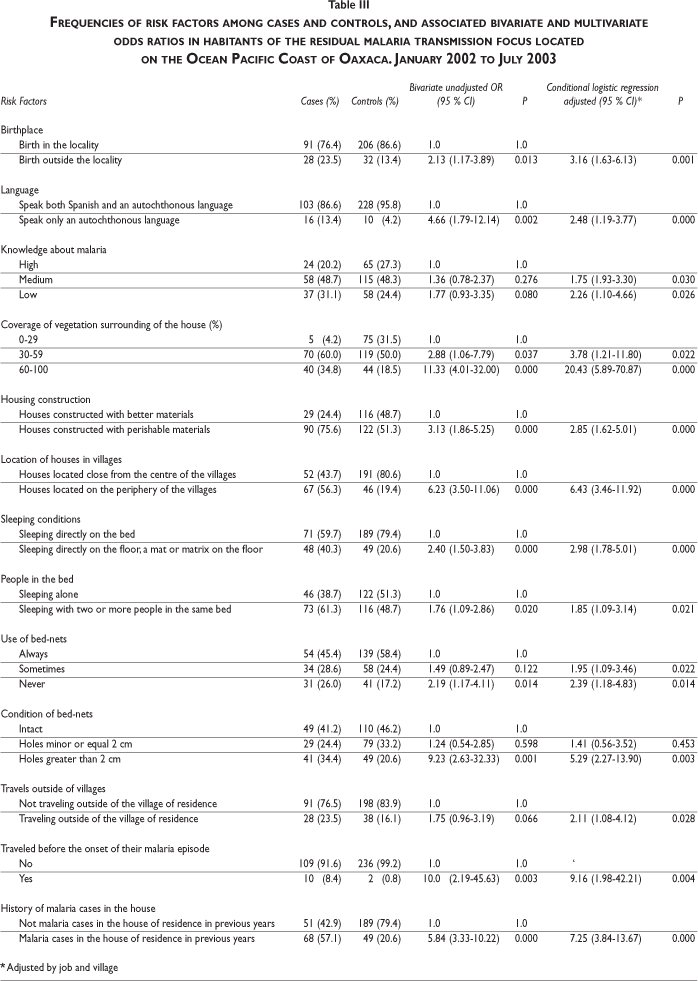
<body><![CDATA[<p><font face="Verdana, Arial, Helvetica, sans-serif" size="3"><b>Results</b></font></p>      <p><font face="Verdana, Arial, Helvetica, sans-serif" size="2"><b>General characteristics of the cases</b></font></p>      <p><font face="Verdana, Arial, Helvetica, sans-serif" size="2">A total of 119    cases, out of 155 that occurred in the area during the study period, and 238    controls were included in the study, with a gender ratio of 1.44 men per woman    (211/146). Nobody refused to be interviewed and the number of cases included    in the study was determined solely by the opportunity for detection and the    possibility of conducting the interview within two weeks after detection. The    majority of cases, 50.7% (33 cases), were recruited from the foothills, 40%    from localities on the mountain ranges (26 cases) and 9.2 (6 cases) from the    coastal region (<a href="/img/revistas/spm/v49n3/05t1.gif">table I</a>). Sixty-five cases (54.6%    of the included cases) originated in villages where the anti-<i>P. vivax</i>    seroprevalence study was carried out. The number of malaria cases was highest    in the 5 to 10 year old population group (<a href="#tab2">table II</a>), but    the percentage distribution of cases among age strata was not statistically    different (<i>p=</i> 0.57) and the age distribution was not different (<i>p</i>=    0.082) from that of the whole population.</font></p>     <p><a name="tab2"></a></p>     <p>&nbsp;</p>     <p align="center"><img src="/img/revistas/spm/v49n3/05t2.gif"></p>     <p>&nbsp;</p>      <p><font face="Verdana, Arial, Helvetica, sans-serif" size="2"><b>Association between malaria and risk factors</b></font></p>      <p><font face="Verdana, Arial, Helvetica, sans-serif" size="2">Frequencies for    risk factors among cases and controls and associated bivariate and multivariate    odds ratios are presented in <a href="/img/revistas/spm/v49n3/05t3.gif">table III</a>. Eighteen    variables out of 99 were significantly associated (<i>p</i> &lt; 0.05) with    increased risk of malaria. Correlation coefficient values were less than 0.8    in all cases, indicating no colinearity. The percentages of cases and controls    that referred to a place of birth other than the locality where they were living    were 23.5 and 13.45%, respectively, and this condition was associated with a    three-fold (OR 3.16, 95% CI 1.16-6.13) greater risk of malaria infection.</font></p>      <p><font face="Verdana, Arial, Helvetica, sans-serif" size="2">The risk of malaria infection increased in subjects who spoke only an autochthonous language (13.4%, OR 2.48, 95% CI 1.19-3.77) compared to subjects who spoke Spanish and both Spanish and an autochthonous language (4.2%).</font></p>      ]]></body>
<body><![CDATA[<p><font face="Verdana, Arial, Helvetica, sans-serif" size="2">The proportions of cases in the medium and low MKI levels were 48.7% and 31.0%, respectively, compared to 48.3 and 24.4 % of controls, respectively. These knowledge levels were associated with an increased risk of disease (OR 1.75, 95% IC 1.93-3.30, P &lt; 0.030 and OR 2.26 95% IC 1.10-4.66 P &lt; 0.02, respectively).</font></p>      <p><font face="Verdana, Arial, Helvetica, sans-serif" size="2">The coverage of vegetation surrounding 60 to 100% and 30 to 59% of the house occurred in 34.8% and 63.0% of cases, respectively, and in 18.4% and 50.0% of controls, respectively. These coverages were strongly associated with risk of malaria infection (OR= 20.43, 95% IC 5.98-70.87, <i>P</i> &lt; 0.000; OR= 3.78, 95% IC 1.21-11.80, respectively).</font></p>      <p><font face="Verdana, Arial, Helvetica, sans-serif" size="2">A larger number of the cases (75.6%) had houses constructed with perishable materials, incomplete walls and no bedrooms, compared with those of controls (51.3%). The risk due to housing was OR= 2.85 (95% IC 1.62-5.01), after controlling for occupation and place of residence. The adjusted fraction and risk of infection attributable to poorly constructed houses was 48.6%.</font></p>      <p><font face="Verdana, Arial, Helvetica, sans-serif" size="2">The proportion of cases living in houses located far from the centre of the villages (56.3%) was higher than in controls (19.4%) and the risk of infection in houses located at the periphery of the villages was six-fold compared to those living downtown (OR 6.43, 95% IC 3.46-11.92). The adjusted fraction for risk of infection was 47.2%.</font></p>      <p><font face="Verdana, Arial, Helvetica, sans-serif" size="2">Sleeping on a dirt floor, a mat or a mattress on the floor was indicated by 40.3% of the cases, corresponding to a two-fold (OR 2.98, 95% CI 1.78-5.01) increased risk of malaria than controls (20.6%). Sixty-one percent of cases and 48.7% of controls indicated sleeping with two or more people in the same bed, resulting in a higher risk of infection (OR 1.85, 95% CI 1.09-3.14).</font></p>      <p><font face="Verdana, Arial, Helvetica, sans-serif" size="2">The proportion of the cases (26.0%) not using bed nets was higher than that of the controls (17.2), resulting in a higher risk of malaria infection (OR= 2.39, 95% IC 1.18-4.83, <i>p</i>&lt; 0.014). Bed nets with holes greater than 2 cm were observed in 34.4% of cases and 20.6 % controls, resulting in a five-fold (RM= 5.2, 95% IC 2.27-13.9) increased malaria risk. The use of smoke, mosquito coils and commercial insecticides had no significant effect on risk of malaria in bivariate and multivariate models.</font></p>      <p><font face="Verdana, Arial, Helvetica, sans-serif" size="2">The frequency of traveling outside villages was higher among cases (23.5%) than controls (16.1%). Subjects who reported traveling compared to those individuals who did not travel had a two-fold increase (OR 2.11, 95% IC 1.08-4.12) in the risk of malaria, and a strong increased risk was observed among individuals who traveled before the onset of their malaria episode (OR 9.16, 95% IC 1.98-42.2). The presence of malaria cases in the household in previous years was reported by 20.6% (49 of 238) of controls and by 57.1% (68 of 119) of the cases, corresponding to an almost six-fold increase (OR 7.25, 95% CI 3.84-13.67) in the risk of malaria infection.</font></p>      <p><font face="Verdana, Arial, Helvetica, sans-serif" size="2">Although a dose-response effect was investigated for several variables, only the amount of vegetation coverage around and the conditions of the bed nets were significant in the logistic model.</font></p>      <p>&nbsp;</p>     <p><font face="Verdana, Arial, Helvetica, sans-serif" size="3"><b>Discussion</b></font></p>      ]]></body>
<body><![CDATA[<p><font face="Verdana, Arial, Helvetica, sans-serif" size="2">The number of malaria cases included in the study corresponds to 76% of the total incident cases in the area during the period. The geographic distribution of cases confirms that malaria transmission occurs mainly in foothill localities.<sup>2</sup> The distribution of cases peaked in the 10 to 15 years age group, although a continuous increase of anti- <i>P. vivax</i> antibody prevalence with age was documented in the sero-epidemiological survey (Danis <i>et al</i>. in preparation). This is indicative of low but persistent malaria transmission similar to that of other unstable hypoendemic areas on the continent where malaria occurs at all ages, but young and middle-age adults are at a higher risk.<sup>12,13</sup></font></p>      <p><font face="Verdana, Arial, Helvetica, sans-serif" size="2">Previous studies on individual risk factors for malaria in Mexico were limited to the Lacandon Forest in Chiapas.<sup>9</sup> In the focus of Oaxaca, the results of the study herein indicate many similarities between the risks of infection in both foci, with some local peculiarities. Similar to that in other malaria endemic areas in the world,<sup>14,15</sup> the main socio-demographic factor that influenced the individual risk of malaria infection in both Mexican foci was to have been born in a different place from the locality of residence. The immigrant condition as a risk of malaria has been long recognized,<sup>12,16</sup> and it has been adduced that encountering new parasite strains not recognized by the immigrants' immune system is a main determinant for the increase in malaria infection in this group.<sup>17,18</sup> But poor knowledge about the disease and its prevention, as well as a higher exposure to mosquito bites conditioned by the occupational activities during the extended process of integration into the new community,<sup>19</sup> could also contribute to an increase in this risk for incomers.</font></p>      <p><font face="Verdana, Arial, Helvetica, sans-serif" size="2">Social status as a risk factor for malaria within the ethnically diverse localities in the Pochutla focus was evidenced by a higher risk in individuals that speak only an autochthonous language. Ethnicity determines and maintains the position of individuals in the social hierarchy and, as a consequence, their attitude and practices determine the quality of their health.<sup>20</sup> This also affects their interaction with MCP personnel and delays seeking treatment which consequently increases the risk of infection.<sup>21</sup> Disregarding ethnicity, delayed diagnosis and treatment seeking attitudes, conditioned by the perception of the disease, could explain the increased risk of malaria in people who have poor knowledge of malaria,<sup>22,23</sup> as it also occurs in other endemic areas of Mexico<sup>9, 21</sup> and the world.<sup>24,25</sup></font></p>      <p><font face="Verdana, Arial, Helvetica, sans-serif" size="2">The main environmental    factor determining malaria transmission in the area was the number of rivers    and streams around the localities.<sup>2</sup> It is shown here that occupants    of houses in the periphery of the communities had an increased risk of malaria    infection, probably because of their proximity to <i>An. pseudopunctipennis</i>    larval breeding sites, the main malaria vector in the area.<sup>26,27</sup>    In this sense, vegetation plays an important role as a refuge and resting place    for blood-seeking adult mosquito populations,<sup>28,29</sup> which explains    why the amount of vegetation around households was a determinant of the risk    level for malaria infection; in fact a significant dose-response effect was    found in our logistic mode (<a href="/img/revistas/spm/v49n3/05t3.gif">table III</a>), reinforcing    our conclusion that this environmental condition is associated with malaria    infection.</font></p>      <p><font face="Verdana, Arial, Helvetica, sans-serif" size="2">Although <i>An. pseudopunctipennis</i> is exophilic, it readily enters houses to feed, thus the need for conditions that allow for its free transit in and out of houses.<sup>30</sup> Most people in the study area lived in poorly constructed houses, but a larger number of cases lived in houses made of perishable materials with incomplete walls. This is a common feature in most endemic malaria areas, and a higher risk of malaria has been associated with housing construction that facilitates human-mosquito contact.<sup>6,31-33</sup></font></p>      <p><font face="Verdana, Arial, Helvetica, sans-serif" size="2">Sleeping on the floor or mats on the floor, as well as with more than one person in the same bed, also reflect poor economic household conditions, but it is also possible that mosquito attraction increased in these households because of an increase in human-released chemoattractants in reduced spaces.<sup>34</sup></font></p>      <p><font face="Verdana, Arial, Helvetica, sans-serif" size="2">The efficacy of    insecticide-impregnated bed nets in conferring high protection against child    mortality has been proven in <i>P. falciparum</i> malaria areas.<sup>35-38</sup>    As impregnated bed nets have little effect on morbidity, they have not been    recommended for the control of <i>P. vivax</i> malaria. Nevertheless, untreated    bed nets have been proven to protect against <i>P. vivax</i> infection in the    Lacandon Forest<sup>9</sup> and other endemic areas,<sup>39</sup> and in the    present study people that do not use or irregularly use untreated bed nets had    a higher risk for <i>P. vivax</i> malaria. The increased risk when bed nets    had holes bigger that 2cm, documented in both Mexican transmission foci,<sup>9</sup>    could be explained by the free entrance and the accumulation of mosquito attractant    in the secluded microenvironment of the bed net. A significant dose-response    effect as bed net conditions deteriorated was found in our logistic model (<a href="/img/revistas/spm/v49n3/05t3.gif">table    III</a>), indicating that as access to the interior of the bed net increases,    the risk of infection also increases. This possibility warrants further study    as damaged, untreated bed nets are used with the possible false assumption of    protection.</font></p>      <p><font face="Verdana, Arial, Helvetica, sans-serif" size="2">Human movements within the economic development nucleus around Pochutla City was identified as a determinant for high malaria transmission intensity among localities in the residual focus.<sup>2</sup> Here, we documented that traveling outside of the village of residence increased the individual risk of malaria infection, and that the detected risk was much higher in those that traveled before the onset of their symptoms, suggesting that many infections occurred outside the village of residence. Short-term population migrations and circular migrations from non- endemic to endemic areas have been associated with malaria epidemics in other areas,<sup>40,41</sup> and malaria outbreaks have been associated with movements in the interior of endemic areas.<sup>42</sup> Malaria infection in these cases could result from a combination of factors, such as the intensity of malaria transmission, precarious housing conditions and poor protection against mosquitoes in the visiting site.</font></p>      <p><font face="Verdana, Arial, Helvetica, sans-serif" size="2"><i>Plasmodium vivax</i> hypnozoites survive in hepatocytes for extended periods of time.<sup>43,44</sup> The reactivation of these parasite forms are responsible for new malaria episodes (relapses) in patients that were cured of a primary attack of the disease,<sup>45</sup> and the participation of these relapses in the occurrence of malaria outbreaks has been documented.<sup>46,47</sup> In Mexico, the grouping of new and secondary cases results in a concentration of 80% of the malaria cases in 11% of the localities in endemic areas. In these localities, malaria is also focalized only in a small portion of the houses.<sup>48</sup> This is in accordance with a six-fold risk of malaria in houses in the Pochutla focus where another family member had presented a clinical episode of the disease, and indicates that transmission is focalized to houses where the parasite is made available by the initial introduction of an infected family member, and it is maintained for several years by symptomatic or asymptomatic relapses.</font></p>      <p><font face="Verdana, Arial, Helvetica, sans-serif" size="2">The precise time when malaria cases acquired their infections cannot be identified because cases were associated with more than one situation that exposed them to mosquito bites during their daily activities. However, it has been useful to identify the most common individual risk factors for malaria infection in the Oaxaca focus. This could be useful for guiding malaria control strategies in the area. New malaria control strategies have been put in place in this and other residual foci in the country, including the abatement of mosquito abundance by participatory community treatment of larval breeding sites, the reduction of <i>P. vivax</i> infection relapses by means of repeated treatment with chloroquine and primaquine,<sup>6</sup> and the special attention provided to indigenous communities by bilingual (Zapotecan and Spanish) MCP health workers. The results of the present study indicate that these strategies could be complemented by other interventions which could incorporate the participation of the community, such as improving housing conditions<sup>49</sup> and the periodical clearing of vegetation around houses. Additional activities should include education interventions to improve knowledge about malaria diagnosis and seeking treatment, as well as the need to increase protection measures while traveling. The use of bed nets deserves particular attention; this protection measure is very effective when bed nets are treated with insecticides,<sup>35-38, 50</sup> even when some holes normally develop as a result of wear-and-tear. The results of the present study indicate that although untreated nets provide protection, when holes appear this protective effect reverts and the risk of malaria infection increases. These results indicate that, on the one hand, the use of bed nets as a participative community anti-malaria intervention should be promoted among inhabitants of the residual focus; but on the other hand, the need to maintain bed nets in good condition should be stressed.</font></p>      ]]></body>
<body><![CDATA[<p>&nbsp;</p>     <p><font face="Verdana, Arial, Helvetica, sans-serif" size="3"><b>Acknowledgments</b></font></p>      <p><font face="Verdana, Arial, Helvetica, sans-serif" size="2">This study was supported by a grant from the International Development Research Centre, Canada (IDRC No. 100194) and a grant from the National Council for Research and Technology, Mexico (CONACyT no. 31466-M).</font></p>      <p>&nbsp;</p>     <p><font face="Verdana, Arial, Helvetica, sans-serif" size="3"><b>References</b></font></p>      <!-- ref --><p><font face="Verdana, Arial, Helvetica, sans-serif" size="2">1. Tellaeche AM. La evoluci&oacute;n y la situaci&oacute;n actual del paludismo en M&eacute;xico. In: A cien a&ntilde;os del descubrimiento de Ross. El paludismo en Mexico. Kumate J, Mart&iacute;nez-Palomo A, eds. Mexico City: El Colegio Nacional, 1998:209-226.</font>&nbsp;&nbsp;&nbsp;&nbsp;&nbsp;&nbsp;&nbsp;&nbsp;[&#160;<a href="javascript:void(0);" onclick="javascript: window.open('/scielo.php?script=sci_nlinks&ref=9292466&pid=S0036-3634200700030000500001&lng=','','width=640,height=500,resizable=yes,scrollbars=1,menubar=yes,');">Links</a>&#160;]<!-- end-ref --><!-- ref --><p><font face="Verdana, Arial, Helvetica, sans-serif" size="2">2. Hern&aacute;ndez-Avila JE, Rodr&iacute;guez MH, Betanzos-Reyes A F, et al. Determinant factors for malaria transmission in the main hyper-endemic focus of Mexico. Salud Pub Mex 2006;48:405-417.</font>&nbsp;&nbsp;&nbsp;&nbsp;&nbsp;&nbsp;&nbsp;&nbsp;[&#160;<a href="javascript:void(0);" onclick="javascript: window.open('/scielo.php?script=sci_nlinks&ref=9292467&pid=S0036-3634200700030000500002&lng=','','width=640,height=500,resizable=yes,scrollbars=1,menubar=yes,');">Links</a>&#160;]<!-- end-ref --><!-- ref --><p><font face="Verdana, Arial, Helvetica, sans-serif" size="2">3. Royall RM, Herson JH. Robust estimation in finite population. I. J Am Statist Assoc 1973;68:880-889.</font>&nbsp;&nbsp;&nbsp;&nbsp;&nbsp;&nbsp;&nbsp;&nbsp;[&#160;<a href="javascript:void(0);" onclick="javascript: window.open('/scielo.php?script=sci_nlinks&ref=9292468&pid=S0036-3634200700030000500003&lng=','','width=640,height=500,resizable=yes,scrollbars=1,menubar=yes,');">Links</a>&#160;]<!-- end-ref --><!-- ref --><p><font face="Verdana, Arial, Helvetica, sans-serif" size="2">4. Gonz&aacute;lez-Cer&oacute;n L, Rodr&iacute;guez MH. An enzyme-linked immunosorbent assay using detergent-soluble <i>Plasmodium vivax</i> antigen for seroepidemiological surveys. Trans R Soc Trop Med Hyg 1991; 85:358-361.</font>&nbsp;&nbsp;&nbsp;&nbsp;&nbsp;&nbsp;&nbsp;&nbsp;[&#160;<a href="javascript:void(0);" onclick="javascript: window.open('/scielo.php?script=sci_nlinks&ref=9292469&pid=S0036-3634200700030000500004&lng=','','width=640,height=500,resizable=yes,scrollbars=1,menubar=yes,');">Links</a>&#160;]<!-- end-ref --><!-- ref --><p><font face="Verdana, Arial, Helvetica, sans-serif" size="2">5. Schlesselman JJ. Case-control studies. Design, conduct, analysis. New York: Oxford University Press, 1982.</font>&nbsp;&nbsp;&nbsp;&nbsp;&nbsp;&nbsp;&nbsp;&nbsp;[&#160;<a href="javascript:void(0);" onclick="javascript: window.open('/scielo.php?script=sci_nlinks&ref=9292470&pid=S0036-3634200700030000500005&lng=','','width=640,height=500,resizable=yes,scrollbars=1,menubar=yes,');">Links</a>&#160;]<!-- end-ref --><!-- ref --><p><font face="Verdana, Arial, Helvetica, sans-serif" size="2">6. Chanon KE, M&eacute;ndez-Galv&aacute;n JF, Galindo-Jaramillo JM, Olgu&iacute;n-Bernal H, Borja-Aburto VH. Cooperative actions to achieve malaria control without the use of DDT. Int J Hyg Environ Health 2003;20:387-394.</font>&nbsp;&nbsp;&nbsp;&nbsp;&nbsp;&nbsp;&nbsp;&nbsp;[&#160;<a href="javascript:void(0);" onclick="javascript: window.open('/scielo.php?script=sci_nlinks&ref=9292471&pid=S0036-3634200700030000500006&lng=','','width=640,height=500,resizable=yes,scrollbars=1,menubar=yes,');">Links</a>&#160;]<!-- end-ref --><!-- ref --><p><font face="Verdana, Arial, Helvetica, sans-serif" size="2">7. Rothman KJ, Greenland S. Modern epidemiology. 2nd. edition. Philadelphia: Lippincott-Raven Publishers, 1998:93-114.</font>&nbsp;&nbsp;&nbsp;&nbsp;&nbsp;&nbsp;&nbsp;&nbsp;[&#160;<a href="javascript:void(0);" onclick="javascript: window.open('/scielo.php?script=sci_nlinks&ref=9292472&pid=S0036-3634200700030000500007&lng=','','width=640,height=500,resizable=yes,scrollbars=1,menubar=yes,');">Links</a>&#160;]<!-- end-ref --><!-- ref --><p><font face="Verdana, Arial, Helvetica, sans-serif" size="2">8 Bronfman M, Tuir&aacute;n R. La desigualdad ante la muerte: clases sociales y mortalidad. Cuad Med Soc 1984;30:53-75.</font>&nbsp;&nbsp;&nbsp;&nbsp;&nbsp;&nbsp;&nbsp;&nbsp;[&#160;<a href="javascript:void(0);" onclick="javascript: window.open('/scielo.php?script=sci_nlinks&ref=9292473&pid=S0036-3634200700030000500008&lng=','','width=640,height=500,resizable=yes,scrollbars=1,menubar=yes,');">Links</a>&#160;]<!-- end-ref --><!-- ref --><p><font face="Verdana, Arial, Helvetica, sans-serif" size="2">9. Danis-Lozano R, Rodr&iacute;guez MH, Gonz&aacute;lez-Cer&oacute;n L, Hern&aacute;ndez-Avila M. Risk factors for <i>Plasmodium vivax</i> infection in the Lacandon forest, southern Mexico. Epidemiol Infect 1999;122:461-469.</font>&nbsp;&nbsp;&nbsp;&nbsp;&nbsp;&nbsp;&nbsp;&nbsp;[&#160;<a href="javascript:void(0);" onclick="javascript: window.open('/scielo.php?script=sci_nlinks&ref=9292474&pid=S0036-3634200700030000500009&lng=','','width=640,height=500,resizable=yes,scrollbars=1,menubar=yes,');">Links</a>&#160;]<!-- end-ref --><!-- ref --><p><font face="Verdana, Arial, Helvetica, sans-serif" size="2">10. Hosmer DW, Lemeshow S. Applied Logistic Regression. New York:Wiley,1989:1-23</font>&nbsp;&nbsp;&nbsp;&nbsp;&nbsp;&nbsp;&nbsp;&nbsp;[&#160;<a href="javascript:void(0);" onclick="javascript: window.open('/scielo.php?script=sci_nlinks&ref=9292475&pid=S0036-3634200700030000500010&lng=','','width=640,height=500,resizable=yes,scrollbars=1,menubar=yes,');">Links</a>&#160;]<!-- end-ref --><!-- ref --><p><font face="Verdana, Arial, Helvetica, sans-serif" size="2">11. Bruzzi P, Green SB, Byar DP, Brinton LA, Schairer C. Estimating the population attributable risk of multiple risk factors using case-control data. Am J Epidemiol 1985;122:904-914.</font>&nbsp;&nbsp;&nbsp;&nbsp;&nbsp;&nbsp;&nbsp;&nbsp;[&#160;<a href="javascript:void(0);" onclick="javascript: window.open('/scielo.php?script=sci_nlinks&ref=9292476&pid=S0036-3634200700030000500011&lng=','','width=640,height=500,resizable=yes,scrollbars=1,menubar=yes,');">Links</a>&#160;]<!-- end-ref --><!-- ref --><p><font face="Verdana, Arial, Helvetica, sans-serif" size="2">12. Camargo LM, Ferreira MU, Krieger H, De Camargo EP, Da Silva LP. Unstable hypoendemic malaria in Rondonia (western Amazon region, Brazil): epidemic outbreaks and work-associated incidence in an agro-industrial rural settlement. Am J Trop Med Hyg 1994;51:16-25.</font>&nbsp;&nbsp;&nbsp;&nbsp;&nbsp;&nbsp;&nbsp;&nbsp;[&#160;<a href="javascript:void(0);" onclick="javascript: window.open('/scielo.php?script=sci_nlinks&ref=9292477&pid=S0036-3634200700030000500012&lng=','','width=640,height=500,resizable=yes,scrollbars=1,menubar=yes,');">Links</a>&#160;]<!-- end-ref --><!-- ref --><p><font face="Verdana, Arial, Helvetica, sans-serif" size="2">13. Camargo LM, dal Colletto GM, Ferreira MU, et al. Hypoendemic malaria in Rondonia (Brazil, western Amazon region): seasonal variation and risk groups in an urban locality. Am J Trop Med Hyg 1996;55:32-38.</font>&nbsp;&nbsp;&nbsp;&nbsp;&nbsp;&nbsp;&nbsp;&nbsp;[&#160;<a href="javascript:void(0);" onclick="javascript: window.open('/scielo.php?script=sci_nlinks&ref=9292478&pid=S0036-3634200700030000500013&lng=','','width=640,height=500,resizable=yes,scrollbars=1,menubar=yes,');">Links</a>&#160;]<!-- end-ref --><!-- ref --><p><font face="Verdana, Arial, Helvetica, sans-serif" size="2">14. Lansang MA, Belizario VY, Bustos MD, Saul A, Aguirre A. Risk factors for infection with malaria in a low endemic community in Bataan, the Philippines. Acta Trop 1997;63:257-265.</font>&nbsp;&nbsp;&nbsp;&nbsp;&nbsp;&nbsp;&nbsp;&nbsp;[&#160;<a href="javascript:void(0);" onclick="javascript: window.open('/scielo.php?script=sci_nlinks&ref=9292479&pid=S0036-3634200700030000500014&lng=','','width=640,height=500,resizable=yes,scrollbars=1,menubar=yes,');">Links</a>&#160;]<!-- end-ref --><!-- ref --><p><font face="Verdana, Arial, Helvetica, sans-serif" size="2">15. Peppiatt R, Byass P. Risk factors for malaria among British missionaries living in tropical countries. Trop Med Hyg 1990;93:397-402.</font>&nbsp;&nbsp;&nbsp;&nbsp;&nbsp;&nbsp;&nbsp;&nbsp;[&#160;<a href="javascript:void(0);" onclick="javascript: window.open('/scielo.php?script=sci_nlinks&ref=9292480&pid=S0036-3634200700030000500015&lng=','','width=640,height=500,resizable=yes,scrollbars=1,menubar=yes,');">Links</a>&#160;]<!-- end-ref --><!-- ref --><p><font face="Verdana, Arial, Helvetica, sans-serif" size="2">16. Sevilla-Casas E. Human mobility and malaria risk in the Naya river basin of Colombia. Soc Sci Med 1993;37:1155-1167.</font>&nbsp;&nbsp;&nbsp;&nbsp;&nbsp;&nbsp;&nbsp;&nbsp;[&#160;<a href="javascript:void(0);" onclick="javascript: window.open('/scielo.php?script=sci_nlinks&ref=9292481&pid=S0036-3634200700030000500016&lng=','','width=640,height=500,resizable=yes,scrollbars=1,menubar=yes,');">Links</a>&#160;]<!-- end-ref --><!-- ref --><p><font face="Verdana, Arial, Helvetica, sans-serif" size="2">17. Lines J, Armstrong JR. For a few parasites more: Inoculum size, vector control and strain-specific immunity to malaria. Parasitol Today 1992;8:381-383.</font>&nbsp;&nbsp;&nbsp;&nbsp;&nbsp;&nbsp;&nbsp;&nbsp;[&#160;<a href="javascript:void(0);" onclick="javascript: window.open('/scielo.php?script=sci_nlinks&ref=9292482&pid=S0036-3634200700030000500017&lng=','','width=640,height=500,resizable=yes,scrollbars=1,menubar=yes,');">Links</a>&#160;]<!-- end-ref --><!-- ref --><p><font face="Verdana, Arial, Helvetica, sans-serif" size="2">18. Molineaux L. <i>Plasmodium falciparum</i> malaria: some epidemiological implications of parasite and host diversity. Ann Trop Med Parasitol 1996;90:379-393.</font>&nbsp;&nbsp;&nbsp;&nbsp;&nbsp;&nbsp;&nbsp;&nbsp;[&#160;<a href="javascript:void(0);" onclick="javascript: window.open('/scielo.php?script=sci_nlinks&ref=9292483&pid=S0036-3634200700030000500018&lng=','','width=640,height=500,resizable=yes,scrollbars=1,menubar=yes,');">Links</a>&#160;]<!-- end-ref --><!-- ref --><p><font face="Verdana, Arial, Helvetica, sans-serif" size="2">19. Moreno Valle R, Su&aacute;rez Torres G. Report of Mexico on the malaria eradication campaign and on the present situation of epidemiological surveillance operations. Salud Pub Mex 1965;7:9-31.</font>&nbsp;&nbsp;&nbsp;&nbsp;&nbsp;&nbsp;&nbsp;&nbsp;[&#160;<a href="javascript:void(0);" onclick="javascript: window.open('/scielo.php?script=sci_nlinks&ref=9292484&pid=S0036-3634200700030000500019&lng=','','width=640,height=500,resizable=yes,scrollbars=1,menubar=yes,');">Links</a>&#160;]<!-- end-ref --><!-- ref --><p><font face="Verdana, Arial, Helvetica, sans-serif" size="2">20. Diderichsen F, Whitehead M, Burstr&ouml;m B, &Aring;berg M, &Ouml;stlin P. Studying policy context and health equity by class and gender: a conceptual framework. Global Health Equity Initiative, Internal Document 1998:29-39.</font>&nbsp;&nbsp;&nbsp;&nbsp;&nbsp;&nbsp;&nbsp;&nbsp;[&#160;<a href="javascript:void(0);" onclick="javascript: window.open('/scielo.php?script=sci_nlinks&ref=9292485&pid=S0036-3634200700030000500020&lng=','','width=640,height=500,resizable=yes,scrollbars=1,menubar=yes,');">Links</a>&#160;]<!-- end-ref --><!-- ref --><p><font face="Verdana, Arial, Helvetica, sans-serif" size="2">21 Rodr&iacute;guez AD, Penilla RP, Rodr&iacute;guez MH, Hemingway J, Francisco Betanzos A, Hern&aacute;ndez-Avila JE. Knowledge and beliefs about malaria transmission and practices for vector control in southern Mexico. Salud Pub Mex 2003;45:110-116.</font>&nbsp;&nbsp;&nbsp;&nbsp;&nbsp;&nbsp;&nbsp;&nbsp;[&#160;<a href="javascript:void(0);" onclick="javascript: window.open('/scielo.php?script=sci_nlinks&ref=9292486&pid=S0036-3634200700030000500021&lng=','','width=640,height=500,resizable=yes,scrollbars=1,menubar=yes,');">Links</a>&#160;]<!-- end-ref --><!-- ref --><p><font face="Verdana, Arial, Helvetica, sans-serif" size="2">22. Hla-Shein,    Than-Tun-Sein, Soe-Soe, Tin-Aung, Ne-Win, Khin-Saw-Aye. The level of knowledge,    attitude and practice in relation to malaria in Oo-do village, Myanmar. Southeast    Asian J Trop Med Pub Health 1998; 29:546-549.</font>&nbsp;&nbsp;&nbsp;&nbsp;&nbsp;&nbsp;&nbsp;&nbsp;[&#160;<a href="javascript:void(0);" onclick="javascript: window.open('/scielo.php?script=sci_nlinks&ref=9292487&pid=S0036-3634200700030000500022&lng=','','width=640,height=500,resizable=yes,scrollbars=1,menubar=yes,');">Links</a>&#160;]<!-- end-ref --><!-- ref --><p><font face="Verdana, Arial, Helvetica, sans-serif" size="2">23. Weber R, Schlagenhauf P, Amsler L, Steffen R. Knowledge, attitudes and practices of business travelers regarding malaria risk and prevention. J Travel Med 2003;10:219-224.</font>&nbsp;&nbsp;&nbsp;&nbsp;&nbsp;&nbsp;&nbsp;&nbsp;[&#160;<a href="javascript:void(0);" onclick="javascript: window.open('/scielo.php?script=sci_nlinks&ref=9292488&pid=S0036-3634200700030000500023&lng=','','width=640,height=500,resizable=yes,scrollbars=1,menubar=yes,');">Links</a>&#160;]<!-- end-ref --><!-- ref --><p><font face="Verdana, Arial, Helvetica, sans-serif" size="2">24. Ruebush TK 2nd, Weller SC, Klein RE. Knowledge and beliefs about malaria on the Pacific coastal plain of Guatemala. Am J Trop Med Hyg 1992;46:451-459.</font>&nbsp;&nbsp;&nbsp;&nbsp;&nbsp;&nbsp;&nbsp;&nbsp;[&#160;<a href="javascript:void(0);" onclick="javascript: window.open('/scielo.php?script=sci_nlinks&ref=9292489&pid=S0036-3634200700030000500024&lng=','','width=640,height=500,resizable=yes,scrollbars=1,menubar=yes,');">Links</a>&#160;]<!-- end-ref --><!-- ref --><p><font face="Verdana, Arial, Helvetica, sans-serif" size="2">25. Adongo PB, Kirkwood B, Kendall C. How local community knowledge about malaria affects insecticide-treated net use in northern Ghana. Trop Med Int Health 2005;10:366-378.</font>&nbsp;&nbsp;&nbsp;&nbsp;&nbsp;&nbsp;&nbsp;&nbsp;[&#160;<a href="javascript:void(0);" onclick="javascript: window.open('/scielo.php?script=sci_nlinks&ref=9292490&pid=S0036-3634200700030000500025&lng=','','width=640,height=500,resizable=yes,scrollbars=1,menubar=yes,');">Links</a>&#160;]<!-- end-ref --><!-- ref --><p><font face="Verdana, Arial, Helvetica, sans-serif" size="2">26. Fern&aacute;ndez-Salas I, Roberts DR, Rodr&iacute;guez MH, Marina-Fern&aacute;ndez CF. Bionomics of larval populations of <i>Anopheles pseudopunctipennis</i> in the Tapachula foothills area, southern Mexico. J Am Mosq Control Assoc 1994;10:477-486.</font>&nbsp;&nbsp;&nbsp;&nbsp;&nbsp;&nbsp;&nbsp;&nbsp;[&#160;<a href="javascript:void(0);" onclick="javascript: window.open('/scielo.php?script=sci_nlinks&ref=9292491&pid=S0036-3634200700030000500026&lng=','','width=640,height=500,resizable=yes,scrollbars=1,menubar=yes,');">Links</a>&#160;]<!-- end-ref --><!-- ref --><p><font face="Verdana, Arial, Helvetica, sans-serif" size="2">27. Van Der Hoek W, Konradsen F, Amerasinghe PH, Perera D, Piyaratne MK, Amerasinghe FP. Towards a risk map of malaria for Sri Lanka: the importance of house location relative to vector breeding sites. Int J Epidemiol 2003;32:280-285.</font>&nbsp;&nbsp;&nbsp;&nbsp;&nbsp;&nbsp;&nbsp;&nbsp;[&#160;<a href="javascript:void(0);" onclick="javascript: window.open('/scielo.php?script=sci_nlinks&ref=9292492&pid=S0036-3634200700030000500027&lng=','','width=640,height=500,resizable=yes,scrollbars=1,menubar=yes,');">Links</a>&#160;]<!-- end-ref --><!-- ref --><p><font face="Verdana, Arial, Helvetica, sans-serif" size="2">28. Rodr&iacute;guez AD, Rodr&iacute;guez MH, Meza RA, et al. Dynamics of population densities and vegetation associations of <i>Anopheles albimanus</i> larvae in a coastal area of southern Chiapas, Mexico. J Am Mosq Control Assoc 1993;9:46-58.</font>&nbsp;&nbsp;&nbsp;&nbsp;&nbsp;&nbsp;&nbsp;&nbsp;[&#160;<a href="javascript:void(0);" onclick="javascript: window.open('/scielo.php?script=sci_nlinks&ref=9292493&pid=S0036-3634200700030000500028&lng=','','width=640,height=500,resizable=yes,scrollbars=1,menubar=yes,');">Links</a>&#160;]<!-- end-ref --><!-- ref --><p><font face="Verdana, Arial, Helvetica, sans-serif" size="2">29. Casas M, Rodr&iacute;guez MH, Bown DN. Peri-intradomicillary behavior in relation to host-seeking of <i>Anopheles pseudopunctipennis</i> in southern Mexico. J Am Mosq Control Assoc 1994;10:355-362.</font>&nbsp;&nbsp;&nbsp;&nbsp;&nbsp;&nbsp;&nbsp;&nbsp;[&#160;<a href="javascript:void(0);" onclick="javascript: window.open('/scielo.php?script=sci_nlinks&ref=9292494&pid=S0036-3634200700030000500029&lng=','','width=640,height=500,resizable=yes,scrollbars=1,menubar=yes,');">Links</a>&#160;]<!-- end-ref --><!-- ref --><p><font face="Verdana, Arial, Helvetica, sans-serif" size="2">30. Fern&aacute;ndez-Salas I, Rodr&iacute;guez MH, Roberts DR, Rodr&iacute;guez MC, Wirtz RA. Bionomics of adult <i>Anopheles pseudopunctipennis</i> (Diptera: Culicidae) in the Tapachula foothills area of southern Mexico. J Med Entomol 1994;31:663-670.</font>&nbsp;&nbsp;&nbsp;&nbsp;&nbsp;&nbsp;&nbsp;&nbsp;[&#160;<a href="javascript:void(0);" onclick="javascript: window.open('/scielo.php?script=sci_nlinks&ref=9292495&pid=S0036-3634200700030000500030&lng=','','width=640,height=500,resizable=yes,scrollbars=1,menubar=yes,');">Links</a>&#160;]<!-- end-ref --><!-- ref --><p><font face="Verdana, Arial, Helvetica, sans-serif" size="2">31. Schofield CJ, White GB. House design and domestic vectors of disease. Trans R Soc Trop Med Hyg 1984;78:285-292.</font>&nbsp;&nbsp;&nbsp;&nbsp;&nbsp;&nbsp;&nbsp;&nbsp;[&#160;<a href="javascript:void(0);" onclick="javascript: window.open('/scielo.php?script=sci_nlinks&ref=9292496&pid=S0036-3634200700030000500031&lng=','','width=640,height=500,resizable=yes,scrollbars=1,menubar=yes,');">Links</a>&#160;]<!-- end-ref --><!-- ref --><p><font face="Verdana, Arial, Helvetica, sans-serif" size="2">32. Gamage-Mendis AC, Carter R, Mendis C, De Zoysa AP, Herath PR, Mendis KN. Clustering of malaria infections within an endemic population: risk of malaria associated with the type of housing construction. Am J Trop Med Hyg 1991;45:77-85.</font>&nbsp;&nbsp;&nbsp;&nbsp;&nbsp;&nbsp;&nbsp;&nbsp;[&#160;<a href="javascript:void(0);" onclick="javascript: window.open('/scielo.php?script=sci_nlinks&ref=9292497&pid=S0036-3634200700030000500032&lng=','','width=640,height=500,resizable=yes,scrollbars=1,menubar=yes,');">Links</a>&#160;]<!-- end-ref --><!-- ref --><p><font face="Verdana, Arial, Helvetica, sans-serif" size="2">33. Konradsen F, Amerasinghe P, van der Hoek W, Amerasinghe F, Perera D, Piyaratne M. Strong association between house characteristics and malaria vectors in Sri Lanka. Am J Trop Med Hyg 2003;68:177-181.</font>&nbsp;&nbsp;&nbsp;&nbsp;&nbsp;&nbsp;&nbsp;&nbsp;[&#160;<a href="javascript:void(0);" onclick="javascript: window.open('/scielo.php?script=sci_nlinks&ref=9292498&pid=S0036-3634200700030000500033&lng=','','width=640,height=500,resizable=yes,scrollbars=1,menubar=yes,');">Links</a>&#160;]<!-- end-ref --><!-- ref --><p><font face="Verdana, Arial, Helvetica, sans-serif" size="2">34. Torres-Estrada JL, Rodr&iacute;guez MH. Physico-chemical signals involved in host localization and in the induction of mosquito bites. Salud Pub Mex 2003;45:497-505.</font>&nbsp;&nbsp;&nbsp;&nbsp;&nbsp;&nbsp;&nbsp;&nbsp;[&#160;<a href="javascript:void(0);" onclick="javascript: window.open('/scielo.php?script=sci_nlinks&ref=9292499&pid=S0036-3634200700030000500034&lng=','','width=640,height=500,resizable=yes,scrollbars=1,menubar=yes,');">Links</a>&#160;]<!-- end-ref --><!-- ref --><p><font face="Verdana, Arial, Helvetica, sans-serif" size="2">35. Rozendaal JA, Voorham J, Van Hoof JP, Oostburg BF. Efficacy of mosquito nets treated with permethrin in Suriname. Med Vet Entomol 1989;3:353-365.</font>&nbsp;&nbsp;&nbsp;&nbsp;&nbsp;&nbsp;&nbsp;&nbsp;[&#160;<a href="javascript:void(0);" onclick="javascript: window.open('/scielo.php?script=sci_nlinks&ref=9292500&pid=S0036-3634200700030000500035&lng=','','width=640,height=500,resizable=yes,scrollbars=1,menubar=yes,');">Links</a>&#160;]<!-- end-ref --><!-- ref --><p><font face="Verdana, Arial, Helvetica, sans-serif" size="2">36. Burkot TR, Garner P, Paru R, et al. Effects of untreated bed nets on the transmission of <i>Plasmodium falciparum, P. vivax and Wuchereria bancrofti</i> in Papua New Guinea. Trans R Soc Trop Med Hyg 1990;84:773-779.</font>&nbsp;&nbsp;&nbsp;&nbsp;&nbsp;&nbsp;&nbsp;&nbsp;[&#160;<a href="javascript:void(0);" onclick="javascript: window.open('/scielo.php?script=sci_nlinks&ref=9292501&pid=S0036-3634200700030000500036&lng=','','width=640,height=500,resizable=yes,scrollbars=1,menubar=yes,');">Links</a>&#160;]<!-- end-ref --><!-- ref --><p><font face="Verdana, Arial, Helvetica, sans-serif" size="2">37. D'Alessandro U, Olaleye BO, McGuire W, et al. A comparison of the efficacy of insecticide-treated and untreated bed nets in preventing malaria in Gambian children. Trans R Soc Trop Med Hyg 1995;89:596-598.</font>&nbsp;&nbsp;&nbsp;&nbsp;&nbsp;&nbsp;&nbsp;&nbsp;[&#160;<a href="javascript:void(0);" onclick="javascript: window.open('/scielo.php?script=sci_nlinks&ref=9292502&pid=S0036-3634200700030000500037&lng=','','width=640,height=500,resizable=yes,scrollbars=1,menubar=yes,');">Links</a>&#160;]<!-- end-ref --><!-- ref --><p><font face="Verdana, Arial, Helvetica, sans-serif" size="2">38. Lindblade KA, Eisele TP, Gimnig JE, et al. Sustainability of reductions in malaria transmission and infant mortality in western Kenya with use of insecticide-treated bednets: 4 to 6 years of follow-up. JAMA 2004;291:2571-2580.</font>&nbsp;&nbsp;&nbsp;&nbsp;&nbsp;&nbsp;&nbsp;&nbsp;[&#160;<a href="javascript:void(0);" onclick="javascript: window.open('/scielo.php?script=sci_nlinks&ref=9292503&pid=S0036-3634200700030000500038&lng=','','width=640,height=500,resizable=yes,scrollbars=1,menubar=yes,');">Links</a>&#160;]<!-- end-ref --><!-- ref --><p><font face="Verdana, Arial, Helvetica, sans-serif" size="2">39. Bradley AK, Greenwood BM, Greenwood AM, et al. Bed-nets (mosquito-nets) and morbidity from malaria. Lancet 1986;26:204-207.</font>&nbsp;&nbsp;&nbsp;&nbsp;&nbsp;&nbsp;&nbsp;&nbsp;[&#160;<a href="javascript:void(0);" onclick="javascript: window.open('/scielo.php?script=sci_nlinks&ref=9292504&pid=S0036-3634200700030000500039&lng=','','width=640,height=500,resizable=yes,scrollbars=1,menubar=yes,');">Links</a>&#160;]<!-- end-ref --><!-- ref --><p><font face="Verdana, Arial, Helvetica, sans-serif" size="2">40. Osorio L, Todd J, Bradley DJ. Travel histories as risk factors in the analysis of urban malaria in Colombia. Am J Trop Med Hyg 2004;71:380-386.</font>&nbsp;&nbsp;&nbsp;&nbsp;&nbsp;&nbsp;&nbsp;&nbsp;[&#160;<a href="javascript:void(0);" onclick="javascript: window.open('/scielo.php?script=sci_nlinks&ref=9292505&pid=S0036-3634200700030000500040&lng=','','width=640,height=500,resizable=yes,scrollbars=1,menubar=yes,');">Links</a>&#160;]<!-- end-ref --><!-- ref --><p><font face="Verdana, Arial, Helvetica, sans-serif" size="2">41. Somboon P, Aramrattana A, Lines J, Webber R. Entomological and epidemiological investigations of malaria transmission in relation to population movements in forest areas of north-west Thailand. Southeast Asian J Trop Med Public Health 1998;29:3-9.</font>&nbsp;&nbsp;&nbsp;&nbsp;&nbsp;&nbsp;&nbsp;&nbsp;[&#160;<a href="javascript:void(0);" onclick="javascript: window.open('/scielo.php?script=sci_nlinks&ref=9292506&pid=S0036-3634200700030000500041&lng=','','width=640,height=500,resizable=yes,scrollbars=1,menubar=yes,');">Links</a>&#160;]<!-- end-ref --><!-- ref --><p><font face="Verdana, Arial, Helvetica, sans-serif" size="2">42. Comm SA, Noorhidayah I, Osman A. Seasonal migration: a case control study of malaria prevention in Sabah. Med J Malaysia 1999;54:200-209.</font>&nbsp;&nbsp;&nbsp;&nbsp;&nbsp;&nbsp;&nbsp;&nbsp;[&#160;<a href="javascript:void(0);" onclick="javascript: window.open('/scielo.php?script=sci_nlinks&ref=9292507&pid=S0036-3634200700030000500042&lng=','','width=640,height=500,resizable=yes,scrollbars=1,menubar=yes,');">Links</a>&#160;]<!-- end-ref --><!-- ref --><p><font face="Verdana, Arial, Helvetica, sans-serif" size="2">43. Garnham PC.    Relapses and atency in malaria. Protozoology 1967; 2:55-64.</font>&nbsp;&nbsp;&nbsp;&nbsp;&nbsp;&nbsp;&nbsp;&nbsp;[&#160;<a href="javascript:void(0);" onclick="javascript: window.open('/scielo.php?script=sci_nlinks&ref=9292508&pid=S0036-3634200700030000500043&lng=','','width=640,height=500,resizable=yes,scrollbars=1,menubar=yes,');">Links</a>&#160;]<!-- end-ref --><!-- ref --><p><font face="Verdana, Arial, Helvetica, sans-serif" size="2">44. Garnham PC. The liver in malaria with special reference to the exoerythrocytic phase. Ann Trop Med Parasitol 1987; 81:531-537.</font>&nbsp;&nbsp;&nbsp;&nbsp;&nbsp;&nbsp;&nbsp;&nbsp;[&#160;<a href="javascript:void(0);" onclick="javascript: window.open('/scielo.php?script=sci_nlinks&ref=9292509&pid=S0036-3634200700030000500044&lng=','','width=640,height=500,resizable=yes,scrollbars=1,menubar=yes,');">Links</a>&#160;]<!-- end-ref --><!-- ref --><p><font face="Verdana, Arial, Helvetica, sans-serif" size="2">45. Hankey DD, Jones R Jr, Coatney GR, et al. Korean vivax malaria. I. Natural history and response to chloroquine. Am J Trop Med Hyg 1953;2:958-969.</font>&nbsp;&nbsp;&nbsp;&nbsp;&nbsp;&nbsp;&nbsp;&nbsp;[&#160;<a href="javascript:void(0);" onclick="javascript: window.open('/scielo.php?script=sci_nlinks&ref=9292510&pid=S0036-3634200700030000500045&lng=','','width=640,height=500,resizable=yes,scrollbars=1,menubar=yes,');">Links</a>&#160;]<!-- end-ref --><!-- ref --><p><font face="Verdana, Arial, Helvetica, sans-serif" size="2">46. Feighner BH, Pak SI, Novakoski WL, Kelsey LL, Strickman D. Reemergence of <i>Plasmodium vivax</i> malaria in the republic of Korea. Emerg Infect Dis 1998;4:295-297.</font>&nbsp;&nbsp;&nbsp;&nbsp;&nbsp;&nbsp;&nbsp;&nbsp;[&#160;<a href="javascript:void(0);" onclick="javascript: window.open('/scielo.php?script=sci_nlinks&ref=9292511&pid=S0036-3634200700030000500046&lng=','','width=640,height=500,resizable=yes,scrollbars=1,menubar=yes,');">Links</a>&#160;]<!-- end-ref --><!-- ref --><p><font face="Verdana, Arial, Helvetica, sans-serif" size="2">47. Chade DD, Le Maitre A, Tilluckdharry CC. An outbreak of <i>Plasmodium vivax</i> malaria in Trinidad, WI. Ann Trop Med Parasitol 1992;86:583-590.</font>&nbsp;&nbsp;&nbsp;&nbsp;&nbsp;&nbsp;&nbsp;&nbsp;[&#160;<a href="javascript:void(0);" onclick="javascript: window.open('/scielo.php?script=sci_nlinks&ref=9292512&pid=S0036-3634200700030000500047&lng=','','width=640,height=500,resizable=yes,scrollbars=1,menubar=yes,');">Links</a>&#160;]<!-- end-ref --><!-- ref --><p><font face="Verdana, Arial, Helvetica, sans-serif" size="2">48. Centro Nacional de Vigilancia Epidemiol&oacute;gica y Control de Enfermedades. Direcci&oacute;n Programa de Prevenci&oacute;n y Control de Enfermedades Transmitidas por Vectores. Departamento de Paludismo. 2003.</font>&nbsp;&nbsp;&nbsp;&nbsp;&nbsp;&nbsp;&nbsp;&nbsp;[&#160;<a href="javascript:void(0);" onclick="javascript: window.open('/scielo.php?script=sci_nlinks&ref=9292513&pid=S0036-3634200700030000500048&lng=','','width=640,height=500,resizable=yes,scrollbars=1,menubar=yes,');">Links</a>&#160;]<!-- end-ref --><!-- ref --><p><font face="Verdana, Arial, Helvetica, sans-serif" size="2">49. Charlwood JD, Pinto J, Ferrara PR, et al. Raised houses reduce mosquito bites. Malar J 2003;2:45.</font>&nbsp;&nbsp;&nbsp;&nbsp;&nbsp;&nbsp;&nbsp;&nbsp;[&#160;<a href="javascript:void(0);" onclick="javascript: window.open('/scielo.php?script=sci_nlinks&ref=9292514&pid=S0036-3634200700030000500049&lng=','','width=640,height=500,resizable=yes,scrollbars=1,menubar=yes,');">Links</a>&#160;]<!-- end-ref --><!-- ref --><p><font face="Verdana, Arial, Helvetica, sans-serif" size="2">50. Rhee M, Sissoko    M, Perry S, McFarland W, Parsonnet J, Doumbo O. Use of insecticide-treated nets    (ITNs) following a malaria education intervention in Piron, Mali: a control    trial with systematic allocation of households. Malar J 2005;4:35.</font>&nbsp;&nbsp;&nbsp;&nbsp;&nbsp;&nbsp;&nbsp;&nbsp;[&#160;<a href="javascript:void(0);" onclick="javascript: window.open('/scielo.php?script=sci_nlinks&ref=9292515&pid=S0036-3634200700030000500050&lng=','','width=640,height=500,resizable=yes,scrollbars=1,menubar=yes,');">Links</a>&#160;]<!-- end-ref --><p>&nbsp;</p>     <p>&nbsp;</p>     <p><font face="Verdana, Arial, Helvetica, sans-serif" size="2">Received on: July    25, 2006    <br>   Accepted on: January 25, 2007</font></p>     <p>&nbsp;</p>     ]]></body>
<body><![CDATA[<p>&nbsp;</p>     <p><font face="Verdana, Arial, Helvetica, sans-serif" size="2">Address reprint    requests to: Dr. Mario H. Rodr&iacute;guez. Center for Research on Infectious    Diseases, National Institute of Public Health, Av. Universidad 655 col. Santa    Mar&iacute;a Ahuacatitl&aacute;n. 62508 Cuernavaca Morelos, M&eacute;xico. E-mail:    <a href="mailto:mhenry@correo.insp.mx">mhenry@correo.insp.mx</a></font></p>      ]]></body><back>
<ref-list>
<ref id="B1">
<label>1</label><nlm-citation citation-type="book">
<person-group person-group-type="author">
<name>
<surname><![CDATA[Tellaeche]]></surname>
<given-names><![CDATA[AM]]></given-names>
</name>
</person-group>
<article-title xml:lang="es"><![CDATA[La evolución y la situación actual del paludismo en México]]></article-title>
<person-group person-group-type="editor">
<name>
<surname><![CDATA[Kumate]]></surname>
<given-names><![CDATA[J]]></given-names>
</name>
<name>
<surname><![CDATA[Martínez-Palomo]]></surname>
<given-names><![CDATA[A]]></given-names>
</name>
</person-group>
<source><![CDATA[A cien años del descubrimiento de Ross: El paludismo en Mexico]]></source>
<year>1998</year>
<page-range>209-226</page-range><publisher-loc><![CDATA[Mexico City ]]></publisher-loc>
<publisher-name><![CDATA[El Colegio Nacional]]></publisher-name>
</nlm-citation>
</ref>
<ref id="B2">
<label>2</label><nlm-citation citation-type="journal">
<person-group person-group-type="author">
<name>
<surname><![CDATA[Hernández-Avila]]></surname>
<given-names><![CDATA[JE]]></given-names>
</name>
<name>
<surname><![CDATA[Rodríguez]]></surname>
<given-names><![CDATA[MH]]></given-names>
</name>
<name>
<surname><![CDATA[Betanzos-Reyes]]></surname>
<given-names><![CDATA[A F]]></given-names>
</name>
</person-group>
<article-title xml:lang="en"><![CDATA[Determinant factors for malaria transmission in the main hyper-endemic focus of Mexico]]></article-title>
<source><![CDATA[Salud Pub Mex]]></source>
<year>2006</year>
<volume>48</volume>
<page-range>405-417</page-range></nlm-citation>
</ref>
<ref id="B3">
<label>3</label><nlm-citation citation-type="journal">
<person-group person-group-type="author">
<name>
<surname><![CDATA[Royall]]></surname>
<given-names><![CDATA[RM]]></given-names>
</name>
<name>
<surname><![CDATA[Herson]]></surname>
<given-names><![CDATA[JH]]></given-names>
</name>
</person-group>
<article-title xml:lang="en"><![CDATA[Robust estimation in finite population: I]]></article-title>
<source><![CDATA[J Am Statist Assoc]]></source>
<year>1973</year>
<volume>68</volume>
<page-range>880-889</page-range></nlm-citation>
</ref>
<ref id="B4">
<label>4</label><nlm-citation citation-type="journal">
<person-group person-group-type="author">
<name>
<surname><![CDATA[González-Cerón]]></surname>
<given-names><![CDATA[L]]></given-names>
</name>
<name>
<surname><![CDATA[Rodríguez]]></surname>
<given-names><![CDATA[MH]]></given-names>
</name>
</person-group>
<article-title xml:lang="en"><![CDATA[An enzyme-linked immunosorbent assay using detergent-soluble Plasmodium vivax antigen for seroepidemiological surveys]]></article-title>
<source><![CDATA[Trans R Soc Trop Med Hyg]]></source>
<year>1991</year>
<volume>85</volume>
<page-range>358-361</page-range></nlm-citation>
</ref>
<ref id="B5">
<label>5</label><nlm-citation citation-type="book">
<person-group person-group-type="author">
<name>
<surname><![CDATA[Schlesselman]]></surname>
<given-names><![CDATA[JJ]]></given-names>
</name>
</person-group>
<source><![CDATA[Case-control studies: Design, conduct, analysis]]></source>
<year>1982</year>
<publisher-loc><![CDATA[New York ]]></publisher-loc>
<publisher-name><![CDATA[Oxford University Press]]></publisher-name>
</nlm-citation>
</ref>
<ref id="B6">
<label>6</label><nlm-citation citation-type="journal">
<person-group person-group-type="author">
<name>
<surname><![CDATA[Chanon]]></surname>
<given-names><![CDATA[KE]]></given-names>
</name>
<name>
<surname><![CDATA[Méndez-Galván]]></surname>
<given-names><![CDATA[JF]]></given-names>
</name>
<name>
<surname><![CDATA[Galindo-Jaramillo]]></surname>
<given-names><![CDATA[JM]]></given-names>
</name>
<name>
<surname><![CDATA[Olguín-Bernal]]></surname>
<given-names><![CDATA[H]]></given-names>
</name>
<name>
<surname><![CDATA[Borja-Aburto]]></surname>
<given-names><![CDATA[VH]]></given-names>
</name>
</person-group>
<article-title xml:lang="en"><![CDATA[Cooperative actions to achieve malaria control without the use of DDT]]></article-title>
<source><![CDATA[Int J Hyg Environ Health]]></source>
<year>2003</year>
<volume>20</volume>
<page-range>387-394</page-range></nlm-citation>
</ref>
<ref id="B7">
<label>7</label><nlm-citation citation-type="book">
<person-group person-group-type="author">
<name>
<surname><![CDATA[Rothman]]></surname>
<given-names><![CDATA[KJ]]></given-names>
</name>
<name>
<surname><![CDATA[Greenland]]></surname>
<given-names><![CDATA[S]]></given-names>
</name>
</person-group>
<source><![CDATA[Modern epidemiology]]></source>
<year>1998</year>
<edition>2</edition>
<page-range>93-114</page-range><publisher-loc><![CDATA[Philadelphia ]]></publisher-loc>
<publisher-name><![CDATA[Lippincott-Raven Publishers]]></publisher-name>
</nlm-citation>
</ref>
<ref id="B8">
<label>8</label><nlm-citation citation-type="journal">
<person-group person-group-type="author">
<name>
<surname><![CDATA[Bronfman]]></surname>
<given-names><![CDATA[M]]></given-names>
</name>
<name>
<surname><![CDATA[Tuirán]]></surname>
<given-names><![CDATA[R]]></given-names>
</name>
</person-group>
<article-title xml:lang="es"><![CDATA[La desigualdad ante la muerte: clases sociales y mortalidad]]></article-title>
<source><![CDATA[Cuad Med Soc]]></source>
<year>1984</year>
<volume>30</volume>
<page-range>53-75</page-range></nlm-citation>
</ref>
<ref id="B9">
<label>9</label><nlm-citation citation-type="journal">
<person-group person-group-type="author">
<name>
<surname><![CDATA[Danis-Lozano]]></surname>
<given-names><![CDATA[R]]></given-names>
</name>
<name>
<surname><![CDATA[Rodríguez]]></surname>
<given-names><![CDATA[MH]]></given-names>
</name>
<name>
<surname><![CDATA[González-Cerón]]></surname>
<given-names><![CDATA[L]]></given-names>
</name>
<name>
<surname><![CDATA[Hernández-Avila]]></surname>
<given-names><![CDATA[M]]></given-names>
</name>
</person-group>
<article-title xml:lang="en"><![CDATA[Risk factors for Plasmodium vivax infection in the Lacandon forest, southern Mexico]]></article-title>
<source><![CDATA[Epidemiol Infect]]></source>
<year>1999</year>
<volume>122</volume>
<page-range>461-469</page-range></nlm-citation>
</ref>
<ref id="B10">
<label>10</label><nlm-citation citation-type="book">
<person-group person-group-type="author">
<name>
<surname><![CDATA[Hosmer]]></surname>
<given-names><![CDATA[DW]]></given-names>
</name>
<name>
<surname><![CDATA[Lemeshow]]></surname>
<given-names><![CDATA[S]]></given-names>
</name>
</person-group>
<source><![CDATA[Applied Logistic Regression]]></source>
<year>1989</year>
<page-range>1-23</page-range><publisher-loc><![CDATA[New York ]]></publisher-loc>
<publisher-name><![CDATA[Wiley]]></publisher-name>
</nlm-citation>
</ref>
<ref id="B11">
<label>11</label><nlm-citation citation-type="journal">
<person-group person-group-type="author">
<name>
<surname><![CDATA[Bruzzi]]></surname>
<given-names><![CDATA[P]]></given-names>
</name>
<name>
<surname><![CDATA[Green]]></surname>
<given-names><![CDATA[SB]]></given-names>
</name>
<name>
<surname><![CDATA[Byar]]></surname>
<given-names><![CDATA[DP]]></given-names>
</name>
<name>
<surname><![CDATA[Brinton]]></surname>
<given-names><![CDATA[LA]]></given-names>
</name>
<name>
<surname><![CDATA[Schairer]]></surname>
<given-names><![CDATA[C]]></given-names>
</name>
</person-group>
<article-title xml:lang="en"><![CDATA[Estimating the population attributable risk of multiple risk factors using case-control data]]></article-title>
<source><![CDATA[Am J Epidemiol]]></source>
<year>1985</year>
<volume>122</volume>
<page-range>904-914</page-range></nlm-citation>
</ref>
<ref id="B12">
<label>12</label><nlm-citation citation-type="journal">
<person-group person-group-type="author">
<name>
<surname><![CDATA[Camargo]]></surname>
<given-names><![CDATA[LM]]></given-names>
</name>
<name>
<surname><![CDATA[Ferreira]]></surname>
<given-names><![CDATA[MU]]></given-names>
</name>
<name>
<surname><![CDATA[Krieger]]></surname>
<given-names><![CDATA[H]]></given-names>
</name>
<name>
<surname><![CDATA[De Camargo]]></surname>
<given-names><![CDATA[EP]]></given-names>
</name>
<name>
<surname><![CDATA[Da Silva]]></surname>
<given-names><![CDATA[LP]]></given-names>
</name>
</person-group>
<article-title xml:lang="en"><![CDATA[Unstable hypoendemic malaria in Rondonia (western Amazon region, Brazil): epidemic outbreaks and work-associated incidence in an agro-industrial rural settlement]]></article-title>
<source><![CDATA[Am J Trop Med Hyg]]></source>
<year>1994</year>
<volume>51</volume>
<page-range>16-25</page-range></nlm-citation>
</ref>
<ref id="B13">
<label>13</label><nlm-citation citation-type="journal">
<person-group person-group-type="author">
<name>
<surname><![CDATA[Camargo]]></surname>
<given-names><![CDATA[LM]]></given-names>
</name>
<name>
<surname><![CDATA[dal Colletto]]></surname>
<given-names><![CDATA[GM]]></given-names>
</name>
<name>
<surname><![CDATA[Ferreira]]></surname>
<given-names><![CDATA[MU]]></given-names>
</name>
</person-group>
<article-title xml:lang="en"><![CDATA[Hypoendemic malaria in Rondonia (Brazil, western Amazon region): seasonal variation and risk groups in an urban locality]]></article-title>
<source><![CDATA[Am J Trop Med Hyg]]></source>
<year>1996</year>
<volume>55</volume>
<page-range>32-38</page-range></nlm-citation>
</ref>
<ref id="B14">
<label>14</label><nlm-citation citation-type="journal">
<person-group person-group-type="author">
<name>
<surname><![CDATA[Lansang]]></surname>
<given-names><![CDATA[MA]]></given-names>
</name>
<name>
<surname><![CDATA[Belizario]]></surname>
<given-names><![CDATA[VY]]></given-names>
</name>
<name>
<surname><![CDATA[Bustos]]></surname>
<given-names><![CDATA[MD]]></given-names>
</name>
<name>
<surname><![CDATA[Saul]]></surname>
<given-names><![CDATA[A]]></given-names>
</name>
<name>
<surname><![CDATA[Aguirre]]></surname>
<given-names><![CDATA[A]]></given-names>
</name>
</person-group>
<article-title xml:lang="en"><![CDATA[Risk factors for infection with malaria in a low endemic community in Bataan, the Philippines]]></article-title>
<source><![CDATA[Acta Trop]]></source>
<year>1997</year>
<volume>63</volume>
<page-range>257-265</page-range></nlm-citation>
</ref>
<ref id="B15">
<label>15</label><nlm-citation citation-type="journal">
<person-group person-group-type="author">
<name>
<surname><![CDATA[Peppiatt]]></surname>
<given-names><![CDATA[R]]></given-names>
</name>
<name>
<surname><![CDATA[Byass]]></surname>
<given-names><![CDATA[P]]></given-names>
</name>
</person-group>
<article-title xml:lang="en"><![CDATA[Risk factors for malaria among British missionaries living in tropical countries]]></article-title>
<source><![CDATA[Trop Med Hyg]]></source>
<year>1990</year>
<volume>93</volume>
<page-range>397-402</page-range></nlm-citation>
</ref>
<ref id="B16">
<label>16</label><nlm-citation citation-type="journal">
<person-group person-group-type="author">
<name>
<surname><![CDATA[Sevilla-Casas]]></surname>
<given-names><![CDATA[E]]></given-names>
</name>
</person-group>
<article-title xml:lang="en"><![CDATA[Human mobility and malaria risk in the Naya river basin of Colombia]]></article-title>
<source><![CDATA[Soc Sci Med]]></source>
<year>1993</year>
<volume>37</volume>
<page-range>1155-1167</page-range></nlm-citation>
</ref>
<ref id="B17">
<label>17</label><nlm-citation citation-type="journal">
<person-group person-group-type="author">
<name>
<surname><![CDATA[Lines]]></surname>
<given-names><![CDATA[J]]></given-names>
</name>
<name>
<surname><![CDATA[Armstrong]]></surname>
<given-names><![CDATA[JR]]></given-names>
</name>
</person-group>
<article-title xml:lang="en"><![CDATA[For a few parasites more: Inoculum size, vector control and strain-specific immunity to malaria]]></article-title>
<source><![CDATA[Parasitol Today]]></source>
<year>1992</year>
<volume>8</volume>
<page-range>381-383</page-range></nlm-citation>
</ref>
<ref id="B18">
<label>18</label><nlm-citation citation-type="journal">
<person-group person-group-type="author">
<name>
<surname><![CDATA[Molineaux]]></surname>
<given-names><![CDATA[L]]></given-names>
</name>
</person-group>
<article-title xml:lang="en"><![CDATA[Plasmodium falciparum malaria: some epidemiological implications of parasite and host diversity]]></article-title>
<source><![CDATA[Ann Trop Med Parasitol]]></source>
<year>1996</year>
<volume>90</volume>
<page-range>379-393</page-range></nlm-citation>
</ref>
<ref id="B19">
<label>19</label><nlm-citation citation-type="journal">
<person-group person-group-type="author">
<name>
<surname><![CDATA[Moreno Valle]]></surname>
<given-names><![CDATA[R]]></given-names>
</name>
<name>
<surname><![CDATA[Suárez Torres]]></surname>
<given-names><![CDATA[G]]></given-names>
</name>
</person-group>
<article-title xml:lang="en"><![CDATA[Report of Mexico on the malaria eradication campaign and on the present situation of epidemiological surveillance operations]]></article-title>
<source><![CDATA[Salud Pub Mex]]></source>
<year>1965</year>
<volume>7</volume>
<page-range>9-31</page-range></nlm-citation>
</ref>
<ref id="B20">
<label>20</label><nlm-citation citation-type="journal">
<person-group person-group-type="author">
<name>
<surname><![CDATA[Diderichsen]]></surname>
<given-names><![CDATA[F]]></given-names>
</name>
<name>
<surname><![CDATA[Whitehead]]></surname>
<given-names><![CDATA[M]]></given-names>
</name>
<name>
<surname><![CDATA[Burström]]></surname>
<given-names><![CDATA[B]]></given-names>
</name>
<name>
<surname><![CDATA[Åberg]]></surname>
<given-names><![CDATA[M]]></given-names>
</name>
<name>
<surname><![CDATA[Östlin]]></surname>
<given-names><![CDATA[P]]></given-names>
</name>
</person-group>
<article-title xml:lang="en"><![CDATA[Studying policy context and health equity by class and gender: a conceptual framework]]></article-title>
<source><![CDATA[Global Health Equity Initiative]]></source>
<year>1998</year>
<page-range>29-39</page-range></nlm-citation>
</ref>
<ref id="B21">
<label>21</label><nlm-citation citation-type="journal">
<person-group person-group-type="author">
<name>
<surname><![CDATA[Rodríguez]]></surname>
<given-names><![CDATA[AD]]></given-names>
</name>
<name>
<surname><![CDATA[Penilla]]></surname>
<given-names><![CDATA[RP]]></given-names>
</name>
<name>
<surname><![CDATA[Rodríguez]]></surname>
<given-names><![CDATA[MH]]></given-names>
</name>
<name>
<surname><![CDATA[Hemingway]]></surname>
<given-names><![CDATA[J]]></given-names>
</name>
<name>
<surname><![CDATA[Francisco Betanzos]]></surname>
<given-names><![CDATA[A]]></given-names>
</name>
<name>
<surname><![CDATA[Hernández-Avila]]></surname>
<given-names><![CDATA[JE]]></given-names>
</name>
</person-group>
<article-title xml:lang="en"><![CDATA[Knowledge and beliefs about malaria transmission and practices for vector control in southern Mexico]]></article-title>
<source><![CDATA[Salud Pub Mex]]></source>
<year>2003</year>
<volume>45</volume>
<page-range>110-116</page-range></nlm-citation>
</ref>
<ref id="B22">
<label>22</label><nlm-citation citation-type="journal">
<person-group person-group-type="author">
<name>
<surname><![CDATA[Hla-Shein]]></surname>
</name>
<name>
<surname><![CDATA[Than-Tun-Sein]]></surname>
</name>
<name>
<surname><![CDATA[Soe-Soe]]></surname>
</name>
<name>
<surname><![CDATA[Tin-Aung]]></surname>
</name>
<name>
<surname><![CDATA[Ne-Win]]></surname>
</name>
<name>
<surname><![CDATA[Khin-Saw-Aye]]></surname>
</name>
</person-group>
<article-title xml:lang="en"><![CDATA[The level of knowledge, attitude and practice in relation to malaria in Oo-do village, Myanmar. Southeast Asian]]></article-title>
<source><![CDATA[J Trop Med Pub Health]]></source>
<year>1998</year>
<volume>29</volume>
<page-range>546-549</page-range></nlm-citation>
</ref>
<ref id="B23">
<label>23</label><nlm-citation citation-type="journal">
<person-group person-group-type="author">
<name>
<surname><![CDATA[Weber]]></surname>
<given-names><![CDATA[R]]></given-names>
</name>
<name>
<surname><![CDATA[Schlagenhauf]]></surname>
<given-names><![CDATA[P]]></given-names>
</name>
<name>
<surname><![CDATA[Amsler]]></surname>
<given-names><![CDATA[L]]></given-names>
</name>
<name>
<surname><![CDATA[Steffen]]></surname>
<given-names><![CDATA[R]]></given-names>
</name>
</person-group>
<article-title xml:lang="en"><![CDATA[Knowledge, attitudes and practices of business travelers regarding malaria risk and prevention]]></article-title>
<source><![CDATA[J Travel Med]]></source>
<year>2003</year>
<volume>10</volume>
<page-range>219-224</page-range></nlm-citation>
</ref>
<ref id="B24">
<label>24</label><nlm-citation citation-type="journal">
<person-group person-group-type="author">
<name>
<surname><![CDATA[Ruebush]]></surname>
<given-names><![CDATA[TK 2nd]]></given-names>
</name>
<name>
<surname><![CDATA[Weller]]></surname>
<given-names><![CDATA[SC]]></given-names>
</name>
<name>
<surname><![CDATA[Klein]]></surname>
<given-names><![CDATA[RE]]></given-names>
</name>
</person-group>
<article-title xml:lang="en"><![CDATA[Knowledge and beliefs about malaria on the Pacific coastal plain of Guatemala]]></article-title>
<source><![CDATA[Am J Trop Med Hyg]]></source>
<year>1992</year>
<volume>46</volume>
<page-range>451-459</page-range></nlm-citation>
</ref>
<ref id="B25">
<label>25</label><nlm-citation citation-type="journal">
<person-group person-group-type="author">
<name>
<surname><![CDATA[Adongo]]></surname>
<given-names><![CDATA[PB]]></given-names>
</name>
<name>
<surname><![CDATA[Kirkwood]]></surname>
<given-names><![CDATA[B]]></given-names>
</name>
<name>
<surname><![CDATA[Kendall]]></surname>
<given-names><![CDATA[C]]></given-names>
</name>
</person-group>
<article-title xml:lang="en"><![CDATA[How local community knowledge about malaria affects insecticide-treated net use in northern Ghana]]></article-title>
<source><![CDATA[Trop Med Int Health]]></source>
<year>2005</year>
<volume>10</volume>
<page-range>366-378</page-range></nlm-citation>
</ref>
<ref id="B26">
<label>26</label><nlm-citation citation-type="journal">
<person-group person-group-type="author">
<name>
<surname><![CDATA[Fernández-Salas]]></surname>
<given-names><![CDATA[I]]></given-names>
</name>
<name>
<surname><![CDATA[Roberts]]></surname>
<given-names><![CDATA[DR]]></given-names>
</name>
<name>
<surname><![CDATA[Rodríguez]]></surname>
<given-names><![CDATA[MH]]></given-names>
</name>
<name>
<surname><![CDATA[Marina-Fernández]]></surname>
<given-names><![CDATA[CF]]></given-names>
</name>
</person-group>
<article-title xml:lang="en"><![CDATA[Bionomics of larval populations of Anopheles pseudopunctipennis in the Tapachula foothills area, southern Mexico]]></article-title>
<source><![CDATA[J Am Mosq Control Assoc]]></source>
<year>1994</year>
<volume>10</volume>
<page-range>477-486</page-range></nlm-citation>
</ref>
<ref id="B27">
<label>27</label><nlm-citation citation-type="journal">
<person-group person-group-type="author">
<name>
<surname><![CDATA[Van Der Hoek]]></surname>
<given-names><![CDATA[W]]></given-names>
</name>
<name>
<surname><![CDATA[Konradsen]]></surname>
<given-names><![CDATA[F]]></given-names>
</name>
<name>
<surname><![CDATA[Amerasinghe]]></surname>
<given-names><![CDATA[PH]]></given-names>
</name>
<name>
<surname><![CDATA[Perera]]></surname>
<given-names><![CDATA[D]]></given-names>
</name>
<name>
<surname><![CDATA[Piyaratne]]></surname>
<given-names><![CDATA[MK]]></given-names>
</name>
<name>
<surname><![CDATA[Amerasinghe]]></surname>
<given-names><![CDATA[FP]]></given-names>
</name>
</person-group>
<article-title xml:lang="en"><![CDATA[Towards a risk map of malaria for Sri Lanka: the importance of house location relative to vector breeding sites]]></article-title>
<source><![CDATA[Int J Epidemiol]]></source>
<year>2003</year>
<volume>32</volume>
<page-range>280-285</page-range></nlm-citation>
</ref>
<ref id="B28">
<label>28</label><nlm-citation citation-type="journal">
<person-group person-group-type="author">
<name>
<surname><![CDATA[Rodríguez]]></surname>
<given-names><![CDATA[AD]]></given-names>
</name>
<name>
<surname><![CDATA[Rodríguez]]></surname>
<given-names><![CDATA[MH]]></given-names>
</name>
<name>
<surname><![CDATA[Meza]]></surname>
<given-names><![CDATA[RA]]></given-names>
</name>
</person-group>
<article-title xml:lang="en"><![CDATA[Dynamics of population densities and vegetation associations of Anopheles albimanus larvae in a coastal area of southern Chiapas, Mexico]]></article-title>
<source><![CDATA[J Am Mosq Control Assoc]]></source>
<year>1993</year>
<volume>9</volume>
<page-range>46-58</page-range></nlm-citation>
</ref>
<ref id="B29">
<label>29</label><nlm-citation citation-type="journal">
<person-group person-group-type="author">
<name>
<surname><![CDATA[Casas]]></surname>
<given-names><![CDATA[M]]></given-names>
</name>
<name>
<surname><![CDATA[Rodríguez]]></surname>
<given-names><![CDATA[MH]]></given-names>
</name>
<name>
<surname><![CDATA[Bown]]></surname>
<given-names><![CDATA[DN]]></given-names>
</name>
</person-group>
<article-title xml:lang="en"><![CDATA[Peri-intradomicillary behavior in relation to host-seeking of Anopheles pseudopunctipennis in southern Mexico]]></article-title>
<source><![CDATA[J Am Mosq Control Assoc]]></source>
<year>1994</year>
<volume>10</volume>
<page-range>355-362</page-range></nlm-citation>
</ref>
<ref id="B30">
<label>30</label><nlm-citation citation-type="journal">
<person-group person-group-type="author">
<name>
<surname><![CDATA[Fernández-Salas]]></surname>
<given-names><![CDATA[I]]></given-names>
</name>
<name>
<surname><![CDATA[Rodríguez]]></surname>
<given-names><![CDATA[MH]]></given-names>
</name>
<name>
<surname><![CDATA[Roberts]]></surname>
<given-names><![CDATA[DR]]></given-names>
</name>
<name>
<surname><![CDATA[Rodríguez]]></surname>
<given-names><![CDATA[MC]]></given-names>
</name>
<name>
<surname><![CDATA[Wirtz]]></surname>
<given-names><![CDATA[RA]]></given-names>
</name>
</person-group>
<article-title xml:lang="en"><![CDATA[Bionomics of adult Anopheles pseudopunctipennis (Diptera: Culicidae) in the Tapachula foothills area of southern Mexico]]></article-title>
<source><![CDATA[J Med Entomol]]></source>
<year>1994</year>
<volume>31</volume>
<page-range>663-670</page-range></nlm-citation>
</ref>
<ref id="B31">
<label>31</label><nlm-citation citation-type="journal">
<person-group person-group-type="author">
<name>
<surname><![CDATA[Schofield]]></surname>
<given-names><![CDATA[CJ]]></given-names>
</name>
<name>
<surname><![CDATA[White]]></surname>
<given-names><![CDATA[GB]]></given-names>
</name>
</person-group>
<article-title xml:lang="en"><![CDATA[House design and domestic vectors of disease]]></article-title>
<source><![CDATA[Trans R Soc Trop Med Hyg]]></source>
<year>1984</year>
<volume>78</volume>
<page-range>285-292</page-range></nlm-citation>
</ref>
<ref id="B32">
<label>32</label><nlm-citation citation-type="journal">
<person-group person-group-type="author">
<name>
<surname><![CDATA[Gamage-Mendis]]></surname>
<given-names><![CDATA[AC]]></given-names>
</name>
<name>
<surname><![CDATA[Carter]]></surname>
<given-names><![CDATA[R]]></given-names>
</name>
<name>
<surname><![CDATA[Mendis]]></surname>
<given-names><![CDATA[C]]></given-names>
</name>
<name>
<surname><![CDATA[De Zoysa]]></surname>
<given-names><![CDATA[AP]]></given-names>
</name>
<name>
<surname><![CDATA[Herath]]></surname>
<given-names><![CDATA[PR]]></given-names>
</name>
<name>
<surname><![CDATA[Mendis]]></surname>
<given-names><![CDATA[KN]]></given-names>
</name>
</person-group>
<article-title xml:lang="en"><![CDATA[Clustering of malaria infections within an endemic population: risk of malaria associated with the type of housing construction]]></article-title>
<source><![CDATA[Am J Trop Med Hyg]]></source>
<year>1991</year>
<volume>45</volume>
<page-range>77-85</page-range></nlm-citation>
</ref>
<ref id="B33">
<label>33</label><nlm-citation citation-type="journal">
<person-group person-group-type="author">
<name>
<surname><![CDATA[Konradsen]]></surname>
<given-names><![CDATA[F]]></given-names>
</name>
<name>
<surname><![CDATA[Amerasinghe]]></surname>
<given-names><![CDATA[P]]></given-names>
</name>
<name>
<surname><![CDATA[van der Hoek]]></surname>
<given-names><![CDATA[W]]></given-names>
</name>
<name>
<surname><![CDATA[Amerasinghe]]></surname>
<given-names><![CDATA[F]]></given-names>
</name>
<name>
<surname><![CDATA[Perera]]></surname>
<given-names><![CDATA[D]]></given-names>
</name>
<name>
<surname><![CDATA[Piyaratne]]></surname>
<given-names><![CDATA[M]]></given-names>
</name>
</person-group>
<article-title xml:lang="en"><![CDATA[Strong association between house characteristics and malaria vectors in Sri Lanka]]></article-title>
<source><![CDATA[Am J Trop Med Hyg]]></source>
<year>2003</year>
<volume>68</volume>
<page-range>177-181</page-range></nlm-citation>
</ref>
<ref id="B34">
<label>34</label><nlm-citation citation-type="journal">
<person-group person-group-type="author">
<name>
<surname><![CDATA[Torres-Estrada]]></surname>
<given-names><![CDATA[JL]]></given-names>
</name>
<name>
<surname><![CDATA[Rodríguez]]></surname>
<given-names><![CDATA[MH]]></given-names>
</name>
</person-group>
<article-title xml:lang="en"><![CDATA[Physico-chemical signals involved in host localization and in the induction of mosquito bites]]></article-title>
<source><![CDATA[Salud Pub Mex]]></source>
<year>2003</year>
<volume>45</volume>
<page-range>497-505</page-range></nlm-citation>
</ref>
<ref id="B35">
<label>35</label><nlm-citation citation-type="journal">
<person-group person-group-type="author">
<name>
<surname><![CDATA[Rozendaal]]></surname>
<given-names><![CDATA[JA]]></given-names>
</name>
<name>
<surname><![CDATA[Voorham]]></surname>
<given-names><![CDATA[J]]></given-names>
</name>
<name>
<surname><![CDATA[Van Hoof]]></surname>
<given-names><![CDATA[JP]]></given-names>
</name>
<name>
<surname><![CDATA[Oostburg]]></surname>
<given-names><![CDATA[BF]]></given-names>
</name>
</person-group>
<article-title xml:lang="en"><![CDATA[Efficacy of mosquito nets treated with permethrin in Suriname]]></article-title>
<source><![CDATA[Med Vet Entomol]]></source>
<year>1989</year>
<volume>3</volume>
<page-range>353-365</page-range></nlm-citation>
</ref>
<ref id="B36">
<label>36</label><nlm-citation citation-type="journal">
<person-group person-group-type="author">
<name>
<surname><![CDATA[Burkot]]></surname>
<given-names><![CDATA[TR]]></given-names>
</name>
<name>
<surname><![CDATA[Garner]]></surname>
<given-names><![CDATA[P]]></given-names>
</name>
<name>
<surname><![CDATA[Paru]]></surname>
<given-names><![CDATA[R]]></given-names>
</name>
</person-group>
<source><![CDATA[Trans R Soc Trop Med Hyg]]></source>
<year>1990</year>
<volume>84</volume>
<page-range>773-779</page-range></nlm-citation>
</ref>
<ref id="B37">
<label>37</label><nlm-citation citation-type="journal">
<person-group person-group-type="author">
<name>
<surname><![CDATA[D'Alessandro]]></surname>
<given-names><![CDATA[U]]></given-names>
</name>
<name>
<surname><![CDATA[Olaleye]]></surname>
<given-names><![CDATA[BO]]></given-names>
</name>
<name>
<surname><![CDATA[McGuire]]></surname>
<given-names><![CDATA[W]]></given-names>
</name>
</person-group>
<article-title xml:lang="en"><![CDATA[A comparison of the efficacy of insecticide-treated and untreated bed nets in preventing malaria in Gambian children]]></article-title>
<source><![CDATA[Trans R Soc Trop Med Hyg]]></source>
<year>1995</year>
<volume>89</volume>
<page-range>596-598</page-range></nlm-citation>
</ref>
<ref id="B38">
<label>38</label><nlm-citation citation-type="journal">
<person-group person-group-type="author">
<name>
<surname><![CDATA[Lindblade]]></surname>
<given-names><![CDATA[KA]]></given-names>
</name>
<name>
<surname><![CDATA[Eisele]]></surname>
<given-names><![CDATA[TP]]></given-names>
</name>
<name>
<surname><![CDATA[Gimnig]]></surname>
<given-names><![CDATA[JE]]></given-names>
</name>
</person-group>
<article-title xml:lang="en"><![CDATA[Sustainability of reductions in malaria transmission and infant mortality in western Kenya with use of insecticide-treated bednets: 4 to 6 years of follow-up]]></article-title>
<source><![CDATA[JAMA]]></source>
<year>2004</year>
<volume>291</volume>
<page-range>2571-2580</page-range></nlm-citation>
</ref>
<ref id="B39">
<label>39</label><nlm-citation citation-type="journal">
<person-group person-group-type="author">
<name>
<surname><![CDATA[Bradley]]></surname>
<given-names><![CDATA[AK]]></given-names>
</name>
<name>
<surname><![CDATA[Greenwood]]></surname>
<given-names><![CDATA[BM]]></given-names>
</name>
<name>
<surname><![CDATA[Greenwood]]></surname>
<given-names><![CDATA[AM]]></given-names>
</name>
</person-group>
<article-title xml:lang="en"><![CDATA[Bed-nets (mosquito-nets) and morbidity from malaria]]></article-title>
<source><![CDATA[Lancet]]></source>
<year>1986</year>
<volume>26</volume>
<page-range>204-207</page-range></nlm-citation>
</ref>
<ref id="B40">
<label>40</label><nlm-citation citation-type="journal">
<person-group person-group-type="author">
<name>
<surname><![CDATA[Osorio]]></surname>
<given-names><![CDATA[L]]></given-names>
</name>
<name>
<surname><![CDATA[Todd]]></surname>
<given-names><![CDATA[J]]></given-names>
</name>
<name>
<surname><![CDATA[Bradley]]></surname>
<given-names><![CDATA[DJ]]></given-names>
</name>
</person-group>
<article-title xml:lang="en"><![CDATA[Travel histories as risk factors in the analysis of urban malaria in Colombia]]></article-title>
<source><![CDATA[Am J Trop Med Hyg]]></source>
<year>2004</year>
<volume>71</volume>
<page-range>380-386</page-range></nlm-citation>
</ref>
<ref id="B41">
<label>41</label><nlm-citation citation-type="journal">
<person-group person-group-type="author">
<name>
<surname><![CDATA[Somboon]]></surname>
<given-names><![CDATA[P]]></given-names>
</name>
<name>
<surname><![CDATA[Aramrattana]]></surname>
<given-names><![CDATA[A]]></given-names>
</name>
<name>
<surname><![CDATA[Lines]]></surname>
<given-names><![CDATA[J]]></given-names>
</name>
<name>
<surname><![CDATA[Webber]]></surname>
<given-names><![CDATA[R]]></given-names>
</name>
</person-group>
<article-title xml:lang="en"><![CDATA[Entomological and epidemiological investigations of malaria transmission in relation to population movements in forest areas of north-west Thailand]]></article-title>
<source><![CDATA[Southeast Asian J Trop Med Public Health]]></source>
<year>1998</year>
<volume>29</volume>
<page-range>3-9</page-range></nlm-citation>
</ref>
<ref id="B42">
<label>42</label><nlm-citation citation-type="journal">
<person-group person-group-type="author">
<name>
<surname><![CDATA[Comm]]></surname>
<given-names><![CDATA[SA]]></given-names>
</name>
<name>
<surname><![CDATA[Noorhidayah]]></surname>
<given-names><![CDATA[I]]></given-names>
</name>
<name>
<surname><![CDATA[Osman]]></surname>
<given-names><![CDATA[A]]></given-names>
</name>
</person-group>
<article-title xml:lang="en"><![CDATA[Seasonal migration: a case control study of malaria prevention in Sabah]]></article-title>
<source><![CDATA[Med J Malaysia]]></source>
<year>1999</year>
<volume>54</volume>
<page-range>200-209</page-range></nlm-citation>
</ref>
<ref id="B43">
<label>43</label><nlm-citation citation-type="journal">
<person-group person-group-type="author">
<name>
<surname><![CDATA[Garnham]]></surname>
<given-names><![CDATA[PC]]></given-names>
</name>
</person-group>
<article-title xml:lang="en"><![CDATA[Relapses and atency in malaria]]></article-title>
<source><![CDATA[Protozoology]]></source>
<year>1967</year>
<volume>2</volume>
<page-range>55-64</page-range></nlm-citation>
</ref>
<ref id="B44">
<label>44</label><nlm-citation citation-type="journal">
<person-group person-group-type="author">
<name>
<surname><![CDATA[Garnham]]></surname>
<given-names><![CDATA[PC]]></given-names>
</name>
</person-group>
<article-title xml:lang="en"><![CDATA[The liver in malaria with special reference to the exoerythrocytic phase]]></article-title>
<source><![CDATA[Ann Trop Med Parasitol]]></source>
<year>1987</year>
<volume>81</volume>
<page-range>531-537</page-range></nlm-citation>
</ref>
<ref id="B45">
<label>45</label><nlm-citation citation-type="journal">
<person-group person-group-type="author">
<name>
<surname><![CDATA[Hankey]]></surname>
<given-names><![CDATA[DD]]></given-names>
</name>
<name>
<surname><![CDATA[Jones]]></surname>
<given-names><![CDATA[R Jr]]></given-names>
</name>
<name>
<surname><![CDATA[Coatney]]></surname>
<given-names><![CDATA[GR]]></given-names>
</name>
</person-group>
<article-title xml:lang="en"><![CDATA[Korean vivax malaria: I. Natural history and response to chloroquine]]></article-title>
<source><![CDATA[Am J Trop Med Hyg]]></source>
<year>1953</year>
<volume>2</volume>
<page-range>958-969</page-range></nlm-citation>
</ref>
<ref id="B46">
<label>46</label><nlm-citation citation-type="journal">
<person-group person-group-type="author">
<name>
<surname><![CDATA[Feighner]]></surname>
<given-names><![CDATA[BH]]></given-names>
</name>
<name>
<surname><![CDATA[Pak]]></surname>
<given-names><![CDATA[SI]]></given-names>
</name>
<name>
<surname><![CDATA[Novakoski]]></surname>
<given-names><![CDATA[WL]]></given-names>
</name>
<name>
<surname><![CDATA[Kelsey]]></surname>
<given-names><![CDATA[LL]]></given-names>
</name>
<name>
<surname><![CDATA[Strickman]]></surname>
<given-names><![CDATA[D]]></given-names>
</name>
</person-group>
<article-title xml:lang="en"><![CDATA[Reemergence of Plasmodium vivax malaria in the republic of Korea]]></article-title>
<source><![CDATA[Emerg Infect Dis]]></source>
<year>1998</year>
<volume>4</volume>
<page-range>295-297</page-range></nlm-citation>
</ref>
<ref id="B47">
<label>47</label><nlm-citation citation-type="journal">
<person-group person-group-type="author">
<name>
<surname><![CDATA[Chade]]></surname>
<given-names><![CDATA[DD]]></given-names>
</name>
<name>
<surname><![CDATA[Le Maitre]]></surname>
<given-names><![CDATA[A]]></given-names>
</name>
<name>
<surname><![CDATA[Tilluckdharry]]></surname>
<given-names><![CDATA[CC]]></given-names>
</name>
</person-group>
<article-title xml:lang="en"><![CDATA[An outbreak of Plasmodium vivax malaria in Trinidad, WI]]></article-title>
<source><![CDATA[Ann Trop Med Parasitol]]></source>
<year>1992</year>
<volume>86</volume>
<page-range>583-590</page-range></nlm-citation>
</ref>
<ref id="B48">
<label>48</label><nlm-citation citation-type="book">
<collab>Centro Nacional de Vigilancia Epidemiológica y Control de Enfermedades</collab>
<source><![CDATA[Dirección Programa de Prevención y Control de Enfermedades Transmitidas por Vectores]]></source>
<year>2003</year>
<publisher-name><![CDATA[Departamento de Paludismo]]></publisher-name>
</nlm-citation>
</ref>
<ref id="B49">
<label>49</label><nlm-citation citation-type="journal">
<person-group person-group-type="author">
<name>
<surname><![CDATA[Charlwood]]></surname>
<given-names><![CDATA[JD]]></given-names>
</name>
<name>
<surname><![CDATA[Pinto]]></surname>
<given-names><![CDATA[J]]></given-names>
</name>
<name>
<surname><![CDATA[Ferrara]]></surname>
<given-names><![CDATA[PR]]></given-names>
</name>
</person-group>
<article-title xml:lang="en"><![CDATA[Raised houses reduce mosquito bites]]></article-title>
<source><![CDATA[Malar J]]></source>
<year>2003</year>
<volume>2</volume>
<page-range>45</page-range></nlm-citation>
</ref>
<ref id="B50">
<label>50</label><nlm-citation citation-type="journal">
<person-group person-group-type="author">
<name>
<surname><![CDATA[Rhee]]></surname>
<given-names><![CDATA[M]]></given-names>
</name>
<name>
<surname><![CDATA[Sissoko]]></surname>
<given-names><![CDATA[M]]></given-names>
</name>
<name>
<surname><![CDATA[Perry]]></surname>
<given-names><![CDATA[S]]></given-names>
</name>
<name>
<surname><![CDATA[McFarland]]></surname>
<given-names><![CDATA[W]]></given-names>
</name>
<name>
<surname><![CDATA[Parsonnet]]></surname>
<given-names><![CDATA[J]]></given-names>
</name>
<name>
<surname><![CDATA[Doumbo]]></surname>
<given-names><![CDATA[O]]></given-names>
</name>
</person-group>
<article-title xml:lang="en"><![CDATA[Use of insecticide-treated nets (ITNs) following a malaria education intervention in Piron, Mali: a control trial with systematic allocation of households]]></article-title>
<source><![CDATA[Malar J]]></source>
<year>2005</year>
<volume>4</volume>
<page-range>35</page-range></nlm-citation>
</ref>
</ref-list>
</back>
</article>