<?xml version="1.0" encoding="ISO-8859-1"?><article xmlns:mml="http://www.w3.org/1998/Math/MathML" xmlns:xlink="http://www.w3.org/1999/xlink" xmlns:xsi="http://www.w3.org/2001/XMLSchema-instance">
<front>
<journal-meta>
<journal-id>0036-3634</journal-id>
<journal-title><![CDATA[Salud Pública de México]]></journal-title>
<abbrev-journal-title><![CDATA[Salud pública Méx]]></abbrev-journal-title>
<issn>0036-3634</issn>
<publisher>
<publisher-name><![CDATA[Instituto Nacional de Salud Pública]]></publisher-name>
</publisher>
</journal-meta>
<article-meta>
<article-id>S0036-36342007000200004</article-id>
<title-group>
<article-title xml:lang="en"><![CDATA[Prevalence of the metabolic syndrome and associated lifestyles in adult males from Oaxaca, Mexico]]></article-title>
<article-title xml:lang="es"><![CDATA[Prevalencia del síndrome metabólico y su asociación con estilo de vida en hombres adultos de Oaxaca, México]]></article-title>
</title-group>
<contrib-group>
<contrib contrib-type="author">
<name>
<surname><![CDATA[Ramírez-Vargas]]></surname>
<given-names><![CDATA[Estanislao]]></given-names>
</name>
<xref ref-type="aff" rid="A01"/>
<xref ref-type="aff" rid="A02"/>
</contrib>
<contrib contrib-type="author">
<name>
<surname><![CDATA[Arnaud-Viñas]]></surname>
<given-names><![CDATA[María del Rosario]]></given-names>
</name>
<xref ref-type="aff" rid="A03"/>
</contrib>
<contrib contrib-type="author">
<name>
<surname><![CDATA[Delisle]]></surname>
<given-names><![CDATA[Hélène]]></given-names>
</name>
<xref ref-type="aff" rid="A04"/>
<xref ref-type="aff" rid="A05"/>
</contrib>
</contrib-group>
<aff id="A01">
<institution><![CDATA[,Mexican Institute of Social Security General Hospital ]]></institution>
<addr-line><![CDATA[ ]]></addr-line>
</aff>
<aff id="A02">
<institution><![CDATA[,UABJO School of Medicine Research Center of Medical and Biological Sciences]]></institution>
<addr-line><![CDATA[Oaxaca ]]></addr-line>
<country>Mexico</country>
</aff>
<aff id="A03">
<institution><![CDATA[,National Polytechnology Institute Investigation Center for Regional Integral Development ]]></institution>
<addr-line><![CDATA[Oaxaca ]]></addr-line>
<country>Mexico</country>
</aff>
<aff id="A04">
<institution><![CDATA[,WHO Collaborating Centre on Nutrition Changes and Development  ]]></institution>
<addr-line><![CDATA[ ]]></addr-line>
</aff>
<aff id="A05">
<institution><![CDATA[,University of Montreal School of Medicine Department of Nutrition]]></institution>
<addr-line><![CDATA[ ]]></addr-line>
<country>Canada</country>
</aff>
<pub-date pub-type="pub">
<day>00</day>
<month>04</month>
<year>2007</year>
</pub-date>
<pub-date pub-type="epub">
<day>00</day>
<month>04</month>
<year>2007</year>
</pub-date>
<volume>49</volume>
<numero>2</numero>
<fpage>94</fpage>
<lpage>102</lpage>
<copyright-statement/>
<copyright-year/>
<self-uri xlink:href="http://www.scielo.org.mx/scielo.php?script=sci_arttext&amp;pid=S0036-36342007000200004&amp;lng=en&amp;nrm=iso"></self-uri><self-uri xlink:href="http://www.scielo.org.mx/scielo.php?script=sci_abstract&amp;pid=S0036-36342007000200004&amp;lng=en&amp;nrm=iso"></self-uri><self-uri xlink:href="http://www.scielo.org.mx/scielo.php?script=sci_pdf&amp;pid=S0036-36342007000200004&amp;lng=en&amp;nrm=iso"></self-uri><abstract abstract-type="short" xml:lang="en"><p><![CDATA[OBJECTIVE: To determine the associations of metabolic syndrome (MS) with residential area and lifestyle in men from Oaxaca, Mexico. MATERIAL AND METHODS: A cross-sectional study was conducted in 1998 in 325 apparently healthy men 35 to 65 years of age in four residential areas: rural, urban poor, urban middle, and urban rich. MS was defined according to International Diabetes Federation (IDF) guidelines. Information on physical activity and diet was collected by questionnaire. Based on two 24-hour recalls, a diet quality index (DQI) using eight WHO recommendations to prevent chronic diseases was constructed. RESULTS: The MS rate was 41.2%; twice as high in urban (45.4%) than rural (27.6%) subjects. A significantly higher risk of MS was associated with low DQI in urban poor (OR 2.5; CI: 1.0-6.3) and rich (OR 3.2; CI: 1.5-8.6), compared to rural subjects. Physical activity was an independent protective factor. CONCLUSIONS: MS is highly prevalent in apparently healthy men in urban areas, illustrating the role of diet and lifestyle transition.]]></p></abstract>
<abstract abstract-type="short" xml:lang="es"><p><![CDATA[OBJETIVO: Determinar las asociaciones entre el síndrome metabólico (SM) con el área residencial y el estilo de vida en hombres de Oaxaca, México. MATERIAL Y MÉTODOS: Estudio transversal en 325 adultos en cuatro áreas residenciales: rural y urbano (pobre, medio y rico), realizado en 1998. Se utilizó la definición de IDF para SM y documentó la actividad física y dieta. Con base en dos recordatorios de 24-horas, se construyó un índice de calidad nutricional (ICN) utilizando ocho recomendaciones de la OMS para la prevención de enfermedades crónicas. RESULTADOS:. La prevalencia general del SM fue de 41.2%, y doblemente mayor en urbanos ricos (45.4%) que en rurales (27.6%). Un riesgo significativamente más elevado de SM se asoció con un ICN bajo en urbanos pobres y en sujetos ricos (OR 3.2; IC: 1.5-8.6). La actividad física fue un factor protector independiente. CONCLUSIONES: El SM es altamente prevalente en hombres aparentemente sanos en áreas urbanas, lo cual refleja el papel de la transición nutricional y del estilo de vida.]]></p></abstract>
<kwd-group>
<kwd lng="en"><![CDATA[metabolic syndrome]]></kwd>
<kwd lng="en"><![CDATA[IDF definition]]></kwd>
<kwd lng="en"><![CDATA[cardiovascular risk factors]]></kwd>
<kwd lng="en"><![CDATA[nutrition transition]]></kwd>
<kwd lng="en"><![CDATA[lifestyle]]></kwd>
<kwd lng="en"><![CDATA[Mexico]]></kwd>
<kwd lng="es"><![CDATA[síndrome metabólico]]></kwd>
<kwd lng="es"><![CDATA[definición IDF]]></kwd>
<kwd lng="es"><![CDATA[factores de riesgo cardiovascular]]></kwd>
<kwd lng="es"><![CDATA[transición nutricional]]></kwd>
<kwd lng="es"><![CDATA[estilo de vida]]></kwd>
<kwd lng="es"><![CDATA[México]]></kwd>
</kwd-group>
</article-meta>
</front><body><![CDATA[ <p align="right"><font size="2" face="Verdana"><b>ART&Iacute;CULO ORIGINAL</b></font></p>     <p>&nbsp;</p>     <p><font size="4" face="verdana"><b>Prevalence of the metabolic syndrome and associated    lifestyles in adult males from Oaxaca, Mexico</b></font></p>     <p>&nbsp;</p>     <p><font size="3" face="verdana"><b>Prevalencia del s&iacute;ndrome metab&oacute;lico    y su asociaci&oacute;n con estilo de vida en hombres adultos de Oaxaca, M&eacute;xico</b>    </font></p>     <p>&nbsp;</p>     <p>&nbsp;</p>     <p><font size="2" face="Verdana"><b>Estanislao Ram&iacute;rez-Vargas, PhD Candidate<sup>I,    II</sup>; Mar&iacute;a del Rosario Arnaud-Vi&ntilde;as, PhD,<SUP>III</SUP>;    H&eacute;l&egrave;ne Delisle, PhD.<SUP>IV</SUP></b></font></p>     <p><font size="2" face="Verdana"><sup>I</sup>Zone 1 General Hospital, Mexican    Institute of Social Security. Oaxaca, Mexico    <BR>   <sup>II</sup>Research Center of Medical and Biological Sciences, UABJO School    of Medicine. Oaxaca, Mexico    ]]></body>
<body><![CDATA[<BR>   <sup>III</sup>Director, Inter-disciplinary Investigation Center for Regional    Integral Development, National Polytechnology Institute. Oaxaca, Mexico    <BR>   <sup>IV</sup>Director, WHO Collaborating Centre on Nutrition Changes and Development    (TRANSNUT). Department of Nutrition, School of Medicine University of Montreal,    Canada</font></p>     <p>&nbsp;</p>     <p>&nbsp;</p> <hr size="1" noshade>     <p><font size="2" face="VERDANA"><b>ABSTRACT</b></font></p>     <p><font size="2" face="Verdana"><B>OBJECTIVE:</B> To determine the associations    of metabolic syndrome (MS) with residential area and lifestyle in men from Oaxaca,    Mexico.    <br>   <B>MATERIAL AND METHODS:</B> A cross-sectional study was conducted in 1998 in    325 apparently healthy men 35 to 65 years of age in four residential areas:    rural, urban poor, urban middle, and urban rich. MS was defined according to    International Diabetes Federation (IDF) guidelines. Information on physical    activity and diet was collected by questionnaire. Based on two 24-hour recalls,    a diet quality index (DQI) using eight WHO recommendations to prevent chronic    diseases was constructed.    <br>   <B>RESULTS:</B> The MS rate was 41.2%; twice as high in urban (45.4%) than rural    (27.6%) subjects. A significantly higher risk of MS was associated with low    DQI in urban poor (OR 2.5; CI: 1.0-6.3) and rich (OR 3.2; CI: 1.5-8.6), compared    to rural subjects. Physical activity was an independent protective factor.    <br>   <B>CONCLUSIONS:</B> MS is highly prevalent in apparently healthy men in urban    areas, illustrating the role of diet and lifestyle transition. </font></p>     <p><font size="2" face="Verdana"><b>Key words:</b> metabolic syndrome; IDF definition;    cardiovascular risk factors; nutrition transition; lifestyle; Mexico</font></p> <hr size="1" noshade>     ]]></body>
<body><![CDATA[<p><font size="2" face="VERDANA"><b>RESUMEN</b></font></p>     <p><font size="2" face="Verdana"><B>OBJETIVO:</b> Determinar las asociaciones    entre el s&iacute;ndrome metab&oacute;lico (SM) con el &aacute;rea residencial    y el estilo de vida en hombres de Oaxaca, M&eacute;xico.    <br>   <B>MATERIAL Y M&Eacute;TODOS:</B> Estudio transversal en 325 adultos en cuatro    &aacute;reas residenciales: rural y urbano (pobre, medio y rico), realizado    en 1998. Se utiliz&oacute; la definici&oacute;n de IDF para SM y document&oacute;    la actividad f&iacute;sica y dieta. Con base en dos recordatorios de 24-horas,    se construy&oacute; un &iacute;ndice de calidad nutricional (ICN) utilizando    ocho recomendaciones de la OMS para la prevenci&oacute;n de enfermedades cr&oacute;nicas.    <br>   <B>RESULTADOS:</B> La prevalencia general del SM fue de 41.2%, y doblemente    mayor en urbanos ricos (45.4%) que en rurales (27.6%). Un riesgo significativamente    m&aacute;s elevado de SM se asoci&oacute; con un ICN bajo en urbanos pobres    y en sujetos ricos (OR 3.2; IC: 1.5-8.6). La actividad f&iacute;sica fue un    factor protector independiente.    <br>   <B>CONCLUSIONES:</B> El SM es altamente prevalente en hombres aparentemente    sanos en &aacute;reas urbanas, lo cual refleja el papel de la transici&oacute;n    nutricional y del estilo de vida. </font></p>     <p><font size="2" face="Verdana"><b>Palabras clave:</b> s&iacute;ndrome metab&oacute;lico;    definici&oacute;n IDF; factores de riesgo cardiovascular; transici&oacute;n    nutricional; estilo de vida; M&eacute;xico</font></p> <hr size="1" noshade>     <p>&nbsp;</p>     <p>&nbsp;</p>     <p><font size="2" face="Verdana">Metabolic syndrome (MS) is a clustering of cardiovascular    risk factors, <I>i.e.</I> abdominal obesity, low high-density lipoprotein (HDL)    cholesterol, elevated triglycerides, hyperinsulinemia, hyperglycemia and hypertension.<SUP>1,2</SUP>    The first official definition of MS was introduced by an expert panel of the    World Health Organization in 1998.<SUP>3</SUP> Subsequently, the National Cholesterol    Education Program's Adult Treatment Panel III (NCEP: ATP III)<SUP>4</SUP> and    the EGIR (European Group for the Study of Insulin Resistance)<SUP>5</SUP> have    formulated slightly different definitions. A more recent definition is that    proposed by the International Diabetes Federation (IDF).<SUP>6</SUP> All of    these agree on essential components, that is, dysglycemia or glucose intolerance,    obesity, hypertension, and dyslipidaemia, but they do differ in the cut-off    criteria and consequently, MS rates vary according to the definition used. Only    WHO, however, includes insulin resistance, assessed using the clamp method,    as a criterion. The definition of IDF uses abdominal obesity based on waist    circumference as a core component of MS. The principal reason for this first    criterion is that abdominal obesity is independently associated with every other    MS component including insulin resistance.<SUP>7,8</SUP> While the latter is    expensive and technically difficult to measure, the former is easily assessed.    The IDF stated that this new definition, which emphasizes the importance of    central obesity with cut-offs adapted to ethnic group, would be adopted worldwide,    as it proves convenient and useful in clinical practice and epidemiological    studies. </font></p>     <p><font size="2" face="Verdana"> The etiology of MS is not yet understood, but    presumably represents a complex interaction between genetic, metabolic    and behavioural factors, such as diet and physical activity.<SUP>9,10</SUP>    There is also evidence that undernutrition during foetal life and    early childhood may cause permanent changes in human metabolism and    thus affect the development of the metabolic syndrome in later life.<SUP>11</SUP>    A sedentary lifestyle and the lack of physical activity are important factors    in the development of the syndrome.<SUP>12,13</SUP> Total physical energy    expenditure and fitness (measured as maximal oxygen consumption)    have independent effects on MS components.<SUP>14</SUP> </font></p>     ]]></body>
<body><![CDATA[<p><font size="2" face="Verdana"> The Mexican National Survey of Health 2000 (ENSA)<SUP>15</SUP>    contributes very important data on the high prevalence of markers of cardiovascular    disease (CVD) risk: in the adult population (age 20 years and above), the prevalence    of diabetes was 7.5%, hypertension 30.7%, and obesity 23.7%.<SUP>15</SUP> Diabetes    and CVD are now the first causes of death in Mexico.<SUP>16</SUP> </font></p>     <p><font size="2" face="Verdana"> The morbidity and mortality profile of Mexico    has been changing in the last decades because of the epidemiological and nutritional    transition.<SUP>16-17</SUP> In Mexico, as well as other similar countries of    Latin America, a phenomenon of epidemiological polarization is observed, meaning    that developed industrial states of northern Mexico have an epidemiological    profile similar to that of developed countries; in contrast, less developed    southern states (including Oaxaca state) reflect less advanced transitional    epidemiological profiles.<SUP>17,18</SUP> The global burden of disease among    poor people includes increased diabetes and other non-communicable chronic diseases    in addition to infection and communicable diseases.<SUP>19,20</SUP> </font></p>     <p><font size="2" face="Verdana"> Urbanization usually means increased access    to energy-dense industrialized foods, which may have an adverse effect on dietary    patterns with metabolic consequences, particularly for underserved vulnerable    populations.<SUP>21</SUP> Furthermore, rapid urbanization is accompanied by    technological changes –in work and transportation– leading to reduced physical    activity in the working place and leisure time, as well as to changes in food    patterns.<SUP>22</SUP> </font></p>     <p><font size="2" face="Verdana"> Our objective is to describe the association    of MS with residential area as an indicator of socio-economic status and lifestyle    patterns (physical activity, smoking and diet) in apparently healthy men from    Oaxaca, Mexico.</font></p>     <p>&nbsp;</p>     <p><font size="3" face="Verdana"><b>Material and Methods </b></font></p>     <p><font size="2" face="Verdana">This descriptive, cross-sectional study was conducted    in rural and urban areas of Oaxaca, Mexico. We randomly selected 325 apparently    healthy men between 35 and 65 years of age. All the subjects with medical diagnosis    of metabolic disease or another serious disease were excluded from the study.    The sample size was determined considering a prevalence of 15% MS,<SUP>23</SUP>    and a marginal error of 4%, with a level of confidence of 95%. The sample was    stratified by residential area. The urban population selection was done by consulting    the municipal database of Oaxaca and the classification of residential area    by cadastral payment in three categories (poor, middle and rich neighborhood).    A rural area in the central valley of Oaxaca was also selected, by consulting    the XI census of the National Institute of Statistics and Geography of Mexico.<SUP>24</SUP>    Three towns were selected at random among those with less than 2500 inhabitants,    the urban-rural cut-off<SUP>25 </SUP>value (San Javier, San Raymundo Jalpan    and San Juan de Dios). Rich proprietors of farms were excluded. </font></p>     <p><font size="2" face="Verdana"> The study was approved by the Committee of Research    and Ethics of the Oaxaca Delegation of the Mexican Institute of the Social Security    and by the Hospital Center of the Universit&eacute; de Montr&eacute;al (CHUM),    Canada. All subjects signed the informed consent form. </font></p>     <p><font size="2" face="Verdana"><b>Operational definitions </b></font></p>     <p><font size="2" face="Verdana">Metabolic syndrome (MS) was defined according    to IDF guidelines:<SUP>6</SUP> central obesity (defined as waist circumference    <u>&gt;</u> 94 cm), plus any two of the following factors: triglycerides (TG)    <u>&gt;</u> 150 mg/dL (1.7 mmol/L), HDL-Cholesterol (HDL-C) &lt; 40 mg/dL (&lt;1.03    MMOL/l), systolic blood pressure (SBP) <u>&gt;</u> 130 or diastolic (DBP) <u>&gt;</u>    85 mm Hg, and fasting plasma glucose <u>&gt;</u> 100 mg/dL (5.6 mmol/L). </font></p>     ]]></body>
<body><![CDATA[<p><font size="2" face="Verdana"> Insulin resistance was calculated by Homeostatic    Model Assessment (HOMA): glucose (mg/dL) X insulin (mU/mL)/405.<SUP>26</SUP>    Insulin resistance was considered at values <u>&gt;</u> 2.68, based on data    for the USA population.<SUP>27</SUP> </font></p>     <p><font size="2" face="Verdana"><b>Biological and biochemical parameters </b></font></p>     <p><font size="2" face="Verdana">Anthropometric measurements: Height and weight    were measured in light clothing. Body mass index (BMI) was computed as weight    (kg)/height (m).<SUP>2</SUP> Waist circumference (WC) was measured at mid-point    between the lower costal margin and the level of the anterior superior iliac    crest; a flexible clinical measuring tape was used. Sitting systolic (SBP) and    diastolic (DBP) blood pressures were measured using a standard sphygmomanometer.    Two readings were obtained and averaged at 5-minute intervals. </font></p>     <p><font size="2" face="Verdana"> The blood samples were collected in all subjects    after an overnight fast of at least 12 hours. Glucose was measured using the    glucose-oxidase method. TG and cholesterol were measured using a kit of enzymatic    reagents. HDL-C was measured after precipitation of lipoproteins that contain    apoprotein B with phosphotungstate and magnesium chloride. The kits and reagents    were obtained from Boehringer Mannheim, (Germany). Insulin was measured by the    method of chemiluminescence with reagents of Diagnostic Products Corporation    (DPC, Los Angeles, CA, USA). </font></p>     <p><font size="2" face="Verdana"> A questionnaire was administered to collect    data on lifestyle and family history of diabetes and hypertension. For physical    activity, we used a questionnaire validated in Canada but not in the study population.<SUP>28</SUP>    Four aspects were considered: means of transportation to go to work; physical    activity level of the main occupation; leisure sport activity; and time spent    watching television. We also documented tobacco consumption. Other data included    family history of hypertension and diabetes. </font></p>     <p><font size="2" face="Verdana"> A score of physical activity was created considering    four variables with four levels each: 1) means of transportation <I>(walking,    bicycle, motorcycle, automobile)</I>; 2) physical activity level for main occupation    <I>(sitting; standing and walking; carrying light load /climbing stairs; heavy    work)</I>; 3) sport <I>(none or rarely, 2-3 times/month, 1-2 times/week, and    <u>&gt;</u> 3 times/week);</I> and 4) hours/week watching television <I>(<u>&gt;</u>13,    8-12, 4-7 and <u>&lt;</u> 3)</I>. For each item, the lowest level of physical    activity was assigned the value of 1, with a maximum of 4 assigned to the highest    level. The maximum physical activity score was 16; computed scores ranged between    4 and 15. Score tertiles <I>(<u>&lt;</u>7, 8-10 and <u>&gt;</u>11)</I> were    used in the analyses. Daily cigarette consumption was also categorized <I>(0-5    and <u>&gt;</u>6)</I>. Dietary intake was assessed using two non-consecutive    24-hour recalls.<SUP>29</SUP> A diet quality index, or "preventive"    score was constructed on the basis of eight recommendations of the FAO/OMS Committee    of Experts for the prevention of chronic diseases.<SUP>30</SUP> The positive    components of the index are: daily consumption of <u>&gt;</u> 400 g fruits and    vegetables; protein <u>&gt;</u>10% total energy; total fat &lt;30% total energy;    saturated fat &lt;10% total energy; polyunsaturated fat 6-10% total energy;    cholesterol &lt;300 mg; sucrose &lt;300 mg; and total dietary fibre <u>&gt;</u>25    g. Compliance with each item was assigned a value of 1 and non-compliance, a    value of 0. The maximum value for the index was 8. Observed values ranged between    2 and 8. Index tertiles were used in the analyses <I>(2-4, 5-6 and 7-8)</I>,    corresponding to low, medium and high dietary preventive score. </font></p>     <p><font size="2" face="Verdana"><b>Statistical analysis </b></font></p>     <p><font size="2" face="Verdana">Analysis of data was done with SPSS/PC statistical    analysis software, version 11 for Windows (SPSS, Chicago, IL). The Chi-square    test was used to analyze the statistical differences among proportions for the    characteristics of the study participants. One-way ANOVA was used to assess    the differences in physical and biochemical parameters in the four residential    areas. Logistic regression models were used to estimate the odds of MS according    to residential area, diet quality, physical activity and smoking habits. Crude    and adjusted (for age and family history of diabetes and hypertension) odds    ratios <I>(OR)</I> and confidence intervals (95% CI) are described. An explicative    multivariate logistic regression model of MS on independent variables also included    the interaction between residential area and diet quality score, where the reference    category was subjects living in rural areas and those with a high "preventive"    diet score. Control variables were age, and family history of diabetes and hypertension.    </font></p>     <p><font size="2" face="Verdana"> The area under curve ROC is described, with    a cut-off point of 0.5 to obtain the sensitivity and the specificity of the    fit model. To evaluate goodness of fit, we included the value (p) of Hosmer    and Lemeshow test to models I, II and III. In the multiple logistic regression    model with interactions, we report adjusted odds ratios.<SUP>31</SUP> </font></p>     <p>&nbsp;</p>     ]]></body>
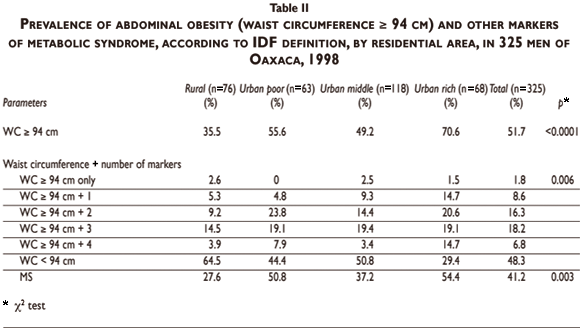
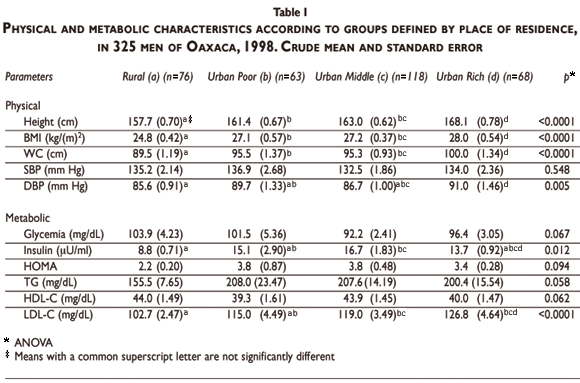
<body><![CDATA[<p><font size="3" face="Verdana"><b>Results </b></font></p>     <p><font size="2" face="Verdana">According to the IDF definition, the overall    MS prevalence was 41.2%. The mean age of subjects with and without MS was similar:    49.0 years (S.E. 0.80) and 49.3 years (S.E. 0.67). </font></p>     <p><font size="2" face="Verdana"> Physical and metabolic characteristics of subjects    according to residential area are shown in <a href="#tab01">Table I</a>. The    highest weight, height, body mass index (BMI), waist circumference (WC) and    diastolic blood pressure (DBP) were observed in the rich urban group (<I>p</I>&lt;0.005),    while the lowest insulin, HOMA, triglycerides (TG) and LDL-C levels were observed    in the rural group. The latter group also showed the highest HDL-C and glycemia    concentrations (<a href="#tab01">Table I</a>). </font></p>     <p><a name="tab01"></a></p>     <p>&nbsp;</p>     <p align="center"><img src="/img/revistas/spm/v49n2/a04tab01.gif"></p>     <p>&nbsp;</p>     <p><font size="2" face="Verdana">Mean BMI in rural and urban groups was 24.9±3.6    and 27.1±4.6, respectively. The prevalence of obesity (BMI <u>&gt;</u>30)    was 9.3% in rural subjects, 25.9% in urban poor, 33.3% in urban middle and 31.5%    in urban rich neighborhoods (<I>p</I>=0.014). </font></p>     <p><font size="2" face="Verdana"> The overall prevalence of abdominal obesity    was 51.7%; that of glycemia<u>&gt;</u>100 mg/dL was 26.8%; TG<u>&gt;</u>150    mg/dL was 59.1%; HDL-C&lt;40mg/dL, 52.3%; SBP<u>&gt;</u>130 mm Hg, 61.5%; and    DBP<u>&gt;</u>85 mm Hg, 61.8%. Rural and poor urban groups showed the highest    prevalence of disglycemia (38.2% and 31.7 %, respectively, <I>p</I>&lt;0.005).    Urban poor and rich groups showed the highest prevalence of TG<u>&gt;</u>150    mg/dL (58.7% and 57.4%, respectively), while the rural group showed a prevalence    of 43.4% (<I>p</I>=0.037). Urban poor and rich groups also showed the highest    prevalence of HDL-C&lt;40mg/dL (58.7% and 64.7%, respectively), while it was    44.7% in the rural subjects (<I>p</I>=0.037). The rate of high diastolic blood    pressure (<u>&gt;</u>85 mm Hg) among urban poor and rich groups was 71.4% and    72.1%, respectively. There was no significant difference between the high diastolic    and systolic blood pressure groups. </font></p>     <p><font size="2" face="Verdana"> Abdominal obesity is the core abnormality for    MS according to the IDF definition. Its prevalence (WC<u>&gt;</u>94 cm) and    the number of additional markers of MS by residential area are shown in <a href="#tab02">Table    II</a>. Abdominal obesity was highest in urban rich (70.6%) and there was a    downward gradient, with 55.6% in the urban poor, 49.2% in the middle urban group,    and 35.5% in the rural group (<I>p</I>&lt;0.0001). MS, that is, abdominal obesity    plus two other abnormalities, was present in 54.4% of the urban rich, 50.8%    of the urban poor, and it was lower in the middle urban group (37.2%) and in    the rural subjects (27.6%) (<I>p</I>&lt;0.006). </font></p>     ]]></body>
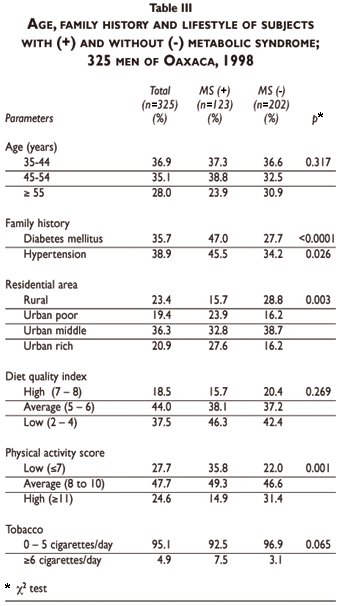
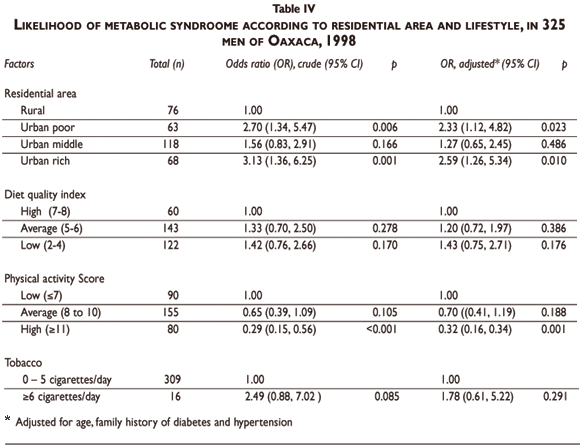
<body><![CDATA[<p><a name="tab02"></a></p>     <p>&nbsp;</p>     <p align="center"><img src="/img/revistas/spm/v49n2/a04tab02.gif"></p>     <p>&nbsp;</p>     <p><font size="2" face="Verdana">MS was significantly associated with having a    family history of diabetes and hypertension, as well as with residential area    and physical activity (<a href="#tab03">Table III</a>). However, diet quality    was not significantly different between subjects having or not having MS. We    found a trend for less smoking among subjects without MS. The relative rate    of MS (adjusted for age, family history of diabetes and hypertension) according    to residential area and lifestyle is shown in <a href="#tab04">Table IV</a>.    We observed a significantly higher adjusted rate of MS in subjects living in    urban areas compared to those living in rural areas, excluding the intermediate    neighborhood group. Physical activity was a protective factor, particularly    for the higher score level (<I>p</I>&lt;0,001). Diet quality and smoking status    were not significant, even if we observed a trend of higher risk of MS among    subjects with low preventive diet score (<a href="#tab04">Table IV</a>). </font></p>     <p><a name="tab03"></a></p>     <p>&nbsp;</p>     <p align="center"><img src="/img/revistas/spm/v49n2/a04tab03.gif"></p>     <p>&nbsp;</p>     <p><a name="tab04"></a></p>     ]]></body>
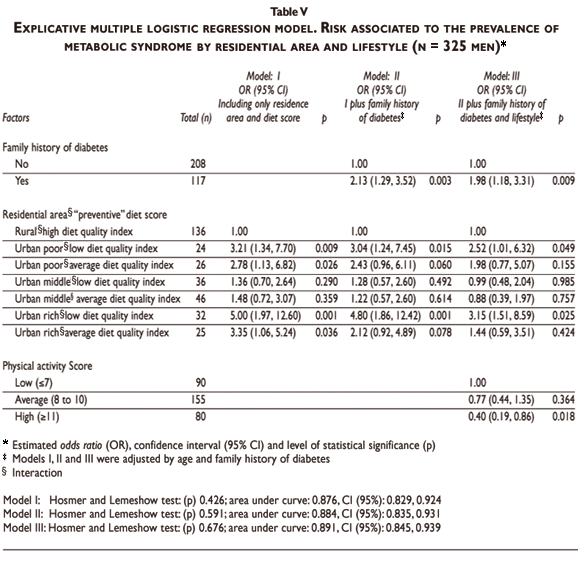
<body><![CDATA[<p>&nbsp;</p>     <p align="center"><img src="/img/revistas/spm/v49n2/a04tab04.gif"></p>     <p>&nbsp;</p>     <p><font size="2" face="Verdana">The results of the multiple logistic regression    for the estimation of MS risk according to family history of diabetes, residence    area, and lifestyle, adjusting by age and family history of hypertension, are    shown in <a href="#tab05">Table V</a>. A family history of diabetes was another    risk factor independently associated to MS (<a href="#tab05">Table V</a>). There    was a significant interaction between residence area and diet quality. When    considering as reference the rural subjects with a high preventive diet score,    urban poor and rich neighborhood subjects with low diet quality (preventive    score) had a significantly higher risk of MS; a trend was also observed for    medium diet quality. Physical activity was an independent protective factor,    particularly at score level <u>&gt;</u>11 compared to score level <u>&lt;</u>7.    Tobacco smoking was not significant. </font></p>     <p><a name="tab05"></a></p>     <p>&nbsp;</p>     <p align="center"><img src="/img/revistas/spm/v49n2/a04tab05.gif"></p>     <p>&nbsp;</p>     <p><font size="3" face="Verdana"><b>Discussion </b></font></p>     <p><font size="2" face="Verdana">The overall prevalence of MS among adult men    from Oaxaca was higher than in Mexican-Americans (41.2% <I>vs </I>31.9%, respectively),    who have the highest prevalence of MS in the USA.<SUP>32</SUP> Using the NCEP    ATP-III definition, Aguilar-Salinas et al.<SUP>33</SUP> found a national MS    prevalence of 26.6% in Mexican men and women aged 20-69 years. In a recent population-based    study in Mexico City, a higher MS prevalence rate was observed (39.9%).<SUP>34</SUP>    The prevalence of MS in the present study is high but no previous studies on    MS in rural or urban areas in Oaxaca are available for comparison. </font></p>     ]]></body>
<body><![CDATA[<p><font size="2" face="Verdana"> We found a significant association between family    history of type 2 diabetes and MS. A family history of diabetes is a marker    of genetic predisposition to components of MS, as shown by Hunt et al.<SUP>35</SUP>    who reported that in non-obese subjects, the odds ratios were 2.5 (95% CI:1.1–6.1)    and 2.9 (95% CI:1.2–7.0) for history of diabetes and hypertension. These and    other results may imply that family history is associated with the development    of MS.<SUP>36</SUP> </font></p>     <p><font size="2" face="Verdana"> A major finding of our study is that physical    activity was a significant and independent protective factor, even after adjusting    for family history and for the interaction of residence area and diet quality.    These findings are consistent with those from previous studies suggesting that    the pathogenesis of MS is largely attributable to dietary factors and physical    activity. Lack of physical activity or a sedentary lifestyle plays an important    role in the development of MS,<SUP>37</SUP> and this also applies to our study    population. Tobacco consumption only showed a weak and non-significant association    with MS, and the homogeneity of the sample in this regard may provide a partial    explanation. It should also be mentioned that alcohol consumption was not assessed    in our study. </font></p>     <p><font size="2" face="Verdana"> Urban subjects showed a higher prevalence of    MS (45.4%), compared to those living in rural areas (27.6%). Among urban participants,    those living in poor and in rich areas (but not in the intermediate category    neighborhoods) were at significantly higher odds of MS than rural men, even    after adjusting for age and family history of diabetes. </font></p>     <p><font size="2" face="Verdana"> Anthropometric measurements showed a gradient    of higher values with increasing social level of residential area. Rural subjects    and urban poor men had the shortest height, while urban rich had the highest.    It has been shown that nutritional status during the first years of life is    an important factor contributing to final height.<SUP>38,39</SUP> A shorter    height may reflect a compromised nutritional status in early life, which increases    the risk of developing the MS phenotype.<SUP>40,41</SUP> Indeed, some studies    have shown that final height is inversely related to insulin resistance, diabetes    mellitus and cardiovascular disease.<SUP>42,43</SUP> In our study, however,    we cannot totally exclude some confounding of adult height with ethnicity related    to different levels of genetic admixture with native Indians, who are notoriously    short.<SUP>44</SUP> Rural men were shorter, and they also have a lower BMI and    WC. For rural people in southern Mexico, access to food is often limited because    of lack of resources.<SUP>45</SUP> This may contribute to a better metabolic    profile (insulin, HOMA, TG, HDL-Cholesterol) through a more "protective"    diet, not by choice but necessity. </font></p>     <p><font size="2" face="Verdana"> We examined the effects of diet on MS controlling    for age and family history of diabetes. Poor and rich urban subjects whose diet    is low on the prevention scale presented a greater risk of MS compared to rural    subjects with a high diet quality index. It is known that a high fat diet can    contribute to the development of MS,<SUP>46,47</SUP> as is also the case for    a high sugar intake.<SUP>48</SUP> </font></p>     <p><font size="2" face="Verdana"> The 35.5% rate of abdominal obesity (waist circumference    <u>&gt;</u> 94 cm) is impressive, in view of its relationship with metabolic    alterations of MS.<SUP>7,8</SUP> In a recent national study, the cut-off points    for BMI and WC to identify the risk of diabetes mellitus in the Mexican male    population were even lower than international values (24 for BMI and 88.8 cm    for WC).<SUP>49</SUP> For hypertension the cut-off values were 24.2 and 87.4    cm for BMI and WC, respectively. It was proposed that the ideal BMI is less    than 22 and ideal WC is less than 83 cm, in men.<SUP>49</SUP> According to these    limits, it can be said that a very high proportion of the urban population,    regardless its socio-economic status, is at high risk for diabetes and hypertension.    </font></p>     <p><font size="2" face="Verdana"> One strength of this study is the significant    preventive role of physical activity which was observed in Mexican men <I>vis-&agrave;-vis</I>    MS. The cross-sectional nature of the study and the exclusion by design of people    with already diagnosed diabetes may be considered study weaknesses. Finally,    the size of the sample was not sufficient to manage the interactions with the    number of factors analyzed in the multiple logistic regression models. </font></p>     <p><font size="2" face="Verdana"> The prevalence of MS in this study was very    high, particularly in the rich or poor urban subjects. Rural subjects may still    be protected by a more active lifestyle and possibly also by a lower access    to processed, energy-dense industrial foods. The results predict a very devastating    epidemiological panorama for Mexico and other countries at similar stages of    the nutrition transition, unless appropriate preventive measures are implemented.    Similar preventable factors of CVD risk have been observed worldwide.<SUP>50</SUP>    These factors are primarily healthier eating and greater physical activity,    as emphasized by WHO in its 2004 strategy.<SUP>51</SUP> </font></p>     <p><font size="2" face="Verdana"> Health and nutrition education of the urban    Mexican population is compelling, and the role of health institutions in this    regard is critical. Perhaps even more urgent is urban planning allowing for    greater physical activity, as well as for better transportation and for leisure    time recreational activities, even in poorer neighborhoods. This investment    would be much smaller than the massive economic burden associated with an escalating    rate of obesity and associated health problems.</font></p>     <p>&nbsp;</p>     ]]></body>
<body><![CDATA[<p><font size="3" face="Verdana"><b>Bibliography </b></font></p>     <!-- ref --><p><font size="2" face="Verdana">1. Reilly MP, Rader DJ. The metabolic syndrome:    more than the sum of its parts? Circulation 2003;108:1546-1551. </font>&nbsp;&nbsp;&nbsp;&nbsp;&nbsp;&nbsp;&nbsp;&nbsp;[&#160;<a href="javascript:void(0);" onclick="javascript: window.open('/scielo.php?script=sci_nlinks&ref=9233328&pid=S0036-3634200700020000400001&lng=','','width=640,height=500,resizable=yes,scrollbars=1,menubar=yes,');">Links</a>&#160;]<!-- end-ref --><!-- ref --><p><font size="2" face="Verdana">2. Lakka H-M, Laaksonen DE, Lakka TA, Niskanen    LK, Kumpusalo E, Tuomilehto J,<I> et al</I>. The metabolic syndrome and total    and cardiovascular disease mortality in middle-age men. JAMA 2002;288:2709-2716.    </font>&nbsp;&nbsp;&nbsp;&nbsp;&nbsp;&nbsp;&nbsp;&nbsp;[&#160;<a href="javascript:void(0);" onclick="javascript: window.open('/scielo.php?script=sci_nlinks&ref=9233329&pid=S0036-3634200700020000400002&lng=','','width=640,height=500,resizable=yes,scrollbars=1,menubar=yes,');">Links</a>&#160;]<!-- end-ref --><!-- ref --><p><font size="2" face="Verdana">3. Alberti KG, Zimmet PZ. Definition, diagnosis    and classification of diabetes mellitus and its complications. Part 1: diagnosis    and classification of diabetes mellitus, provisional report of a WHO consultation.    Diabet Med 1998;15:539-553. </font>&nbsp;&nbsp;&nbsp;&nbsp;&nbsp;&nbsp;&nbsp;&nbsp;[&#160;<a href="javascript:void(0);" onclick="javascript: window.open('/scielo.php?script=sci_nlinks&ref=9233330&pid=S0036-3634200700020000400003&lng=','','width=640,height=500,resizable=yes,scrollbars=1,menubar=yes,');">Links</a>&#160;]<!-- end-ref --><!-- ref --><p><font size="2" face="Verdana">4. Executive Summary of The Third Report of The    National Cholesterol Education Program (NCEP) Expert Panel on Detection, Evaluation,    And Treatment of High Blood Cholesterol In Adults (Adult Treatment Panel III).    JAMA 2001;285:2486-2497. </font>&nbsp;&nbsp;&nbsp;&nbsp;&nbsp;&nbsp;&nbsp;&nbsp;[&#160;<a href="javascript:void(0);" onclick="javascript: window.open('/scielo.php?script=sci_nlinks&ref=9233331&pid=S0036-3634200700020000400004&lng=','','width=640,height=500,resizable=yes,scrollbars=1,menubar=yes,');">Links</a>&#160;]<!-- end-ref --><!-- ref --><p><font size="2" face="Verdana">5. Balkau B, Charles MA. Comment on the provisional    report from the WHO consultation. European Group for the Study of Insulin Resistance    (EGIR). Diabet Med 1999;16:442-443. </font>&nbsp;&nbsp;&nbsp;&nbsp;&nbsp;&nbsp;&nbsp;&nbsp;[&#160;<a href="javascript:void(0);" onclick="javascript: window.open('/scielo.php?script=sci_nlinks&ref=9233332&pid=S0036-3634200700020000400005&lng=','','width=640,height=500,resizable=yes,scrollbars=1,menubar=yes,');">Links</a>&#160;]<!-- end-ref --><!-- ref --><p><font size="2" face="Verdana">6. Alberti KG, Zimmet P, Shaw J, The metabolic    syndrome - a new worldwide definition. Lancet 2005;366:1059-1062. </font>&nbsp;&nbsp;&nbsp;&nbsp;&nbsp;&nbsp;&nbsp;&nbsp;[&#160;<a href="javascript:void(0);" onclick="javascript: window.open('/scielo.php?script=sci_nlinks&ref=9233333&pid=S0036-3634200700020000400006&lng=','','width=640,height=500,resizable=yes,scrollbars=1,menubar=yes,');">Links</a>&#160;]<!-- end-ref --><!-- ref --><p><font size="2" face="Verdana">7. Carr DB, Utzschneider KM, Hull RL, Kodama    K, Retzlaff BM, Brunzell JD, <I>et al. </I>Intra-abdominal fat is a major determinant    of the National Cholesterol Education Program Adult Treatment Panel III criteria    for the metabolic syndrome. Diabetes 2004;53:2087-2094. </font>&nbsp;&nbsp;&nbsp;&nbsp;&nbsp;&nbsp;&nbsp;&nbsp;[&#160;<a href="javascript:void(0);" onclick="javascript: window.open('/scielo.php?script=sci_nlinks&ref=9233334&pid=S0036-3634200700020000400007&lng=','','width=640,height=500,resizable=yes,scrollbars=1,menubar=yes,');">Links</a>&#160;]<!-- end-ref --><!-- ref --><p><font size="2" face="Verdana">8. Pouliot MC, Despr&eacute;s JP, Lemieux S,    Moorjani S, Bouchard C, Tremblay A <I>et al</I>. Waist circumference and abdominal    sagittal diameter: best simple anthropometric indexes of abdominal visceral    adipose tissue accumulation and related cardiovascular risk in men and women.    Am J Cardiol 1994;73:460-468. </font>&nbsp;&nbsp;&nbsp;&nbsp;&nbsp;&nbsp;&nbsp;&nbsp;[&#160;<a href="javascript:void(0);" onclick="javascript: window.open('/scielo.php?script=sci_nlinks&ref=9233335&pid=S0036-3634200700020000400008&lng=','','width=640,height=500,resizable=yes,scrollbars=1,menubar=yes,');">Links</a>&#160;]<!-- end-ref --><!-- ref --><p><font size="2" face="Verdana">9. Groop L. Genetics of the metabolic syndrome.    Br J Nutr 2000;83 Suppl 1:S39-S48. </font>&nbsp;&nbsp;&nbsp;&nbsp;&nbsp;&nbsp;&nbsp;&nbsp;[&#160;<a href="javascript:void(0);" onclick="javascript: window.open('/scielo.php?script=sci_nlinks&ref=9233336&pid=S0036-3634200700020000400009&lng=','','width=640,height=500,resizable=yes,scrollbars=1,menubar=yes,');">Links</a>&#160;]<!-- end-ref --><!-- ref --><p><font size="2" face="Verdana">10. Lidfeldt J, Nyberg P, Nerbrand C, Samsioe    G, Schersten B, Agardh CD. Socio-demographic and psychosocial factors are associated    with features of the metabolic syndrome: the Women's Health in the Lund Area    (WHILA) study. Diabetes Obes Metab 2003;5:106-112. </font>&nbsp;&nbsp;&nbsp;&nbsp;&nbsp;&nbsp;&nbsp;&nbsp;[&#160;<a href="javascript:void(0);" onclick="javascript: window.open('/scielo.php?script=sci_nlinks&ref=9233337&pid=S0036-3634200700020000400010&lng=','','width=640,height=500,resizable=yes,scrollbars=1,menubar=yes,');">Links</a>&#160;]<!-- end-ref --><!-- ref --><p><font size="2" face="Verdana">11. Hales CN, Barker DJP. The thrifty phenotype    hypothesis. Br Med Bull 2001;60:5-20. </font>&nbsp;&nbsp;&nbsp;&nbsp;&nbsp;&nbsp;&nbsp;&nbsp;[&#160;<a href="javascript:void(0);" onclick="javascript: window.open('/scielo.php?script=sci_nlinks&ref=9233338&pid=S0036-3634200700020000400011&lng=','','width=640,height=500,resizable=yes,scrollbars=1,menubar=yes,');">Links</a>&#160;]<!-- end-ref --><!-- ref --><p><font size="2" face="Verdana">12. Torjesen PA, Birkeland KI, Anderssen SA,    Hjermann I, Holme I, Urdal P. Lifestyle changes may reverse development of the    insulin resistance syndrome. The Oslo Diet and Exercise Study: a randomized    trial. Diabetes Care 1997;20:26-31. </font>&nbsp;&nbsp;&nbsp;&nbsp;&nbsp;&nbsp;&nbsp;&nbsp;[&#160;<a href="javascript:void(0);" onclick="javascript: window.open('/scielo.php?script=sci_nlinks&ref=9233339&pid=S0036-3634200700020000400012&lng=','','width=640,height=500,resizable=yes,scrollbars=1,menubar=yes,');">Links</a>&#160;]<!-- end-ref --><!-- ref --><p><font size="2" face="Verdana">13. Eriksson J, Taimela S, Koivisto VA. Exercise    and the metabolic syndrome. Diabetologia 1997;40:125-135. </font>&nbsp;&nbsp;&nbsp;&nbsp;&nbsp;&nbsp;&nbsp;&nbsp;[&#160;<a href="javascript:void(0);" onclick="javascript: window.open('/scielo.php?script=sci_nlinks&ref=9233340&pid=S0036-3634200700020000400013&lng=','','width=640,height=500,resizable=yes,scrollbars=1,menubar=yes,');">Links</a>&#160;]<!-- end-ref --><!-- ref --><p><font size="2" face="Verdana">14. Wareham NJ, Hennings SJ, Byrne CD, Hales    CN, Prentice AM, Day NE. A quantitative analysis of the relationship between    habitual energy expenditure, fitness and the metabolic cardiovascular syndrome.    Br J Nutr 1998;80:235-241. </font>&nbsp;&nbsp;&nbsp;&nbsp;&nbsp;&nbsp;&nbsp;&nbsp;[&#160;<a href="javascript:void(0);" onclick="javascript: window.open('/scielo.php?script=sci_nlinks&ref=9233341&pid=S0036-3634200700020000400014&lng=','','width=640,height=500,resizable=yes,scrollbars=1,menubar=yes,');">Links</a>&#160;]<!-- end-ref --><!-- ref --><p><font size="2" face="Verdana">15. Olaiz G, Rojas R, Barquera S, Shamah T, Aguilar    C, Cravioto P, <I>et al</I>. Encuesta Nacional de Salud 2000. Tomo 2 La salud    de los adultos. Cuernavaca, Morelos, M&eacute;xico: INSP, 2003. </font>&nbsp;&nbsp;&nbsp;&nbsp;&nbsp;&nbsp;&nbsp;&nbsp;[&#160;<a href="javascript:void(0);" onclick="javascript: window.open('/scielo.php?script=sci_nlinks&ref=9233342&pid=S0036-3634200700020000400015&lng=','','width=640,height=500,resizable=yes,scrollbars=1,menubar=yes,');">Links</a>&#160;]<!-- end-ref --><!-- ref --><p><font size="2" face="Verdana">16. Rivera JA, Barquera S, Campirano F, Campos    I, Safdie M, Tovar V. Epidemiological and nutritional transition in Mexico:    rapid increase of non-communicable chronic diseases and obesity. Public Health    Nutrition 2002;5:113-122, Estad&iacute;sticas vitales, Da&ntilde;os a la Salud    y Mortalidad. M&eacute;xico, Direcci&oacute;n General de Estad&iacute;stica    e Inform&aacute;tica. Secretar&iacute;a de Salud, 2002. </font>&nbsp;&nbsp;&nbsp;&nbsp;&nbsp;&nbsp;&nbsp;&nbsp;[&#160;<a href="javascript:void(0);" onclick="javascript: window.open('/scielo.php?script=sci_nlinks&ref=9233343&pid=S0036-3634200700020000400016&lng=','','width=640,height=500,resizable=yes,scrollbars=1,menubar=yes,');">Links</a>&#160;]<!-- end-ref --><!-- ref --><p><font size="2" face="Verdana">17. Frenk J, Frejka T, Bobadilla JL, Stern C,    Lozano M, Sep&uacute;lveda J, <I>et al. </I>The epidemiologic transition in    Latin America &#91;in Spanish&#93;. Bol Oficina Sanit Panam 1991;111(6):485-496. </font>&nbsp;&nbsp;&nbsp;&nbsp;&nbsp;&nbsp;&nbsp;&nbsp;[&#160;<a href="javascript:void(0);" onclick="javascript: window.open('/scielo.php?script=sci_nlinks&ref=9233344&pid=S0036-3634200700020000400017&lng=','','width=640,height=500,resizable=yes,scrollbars=1,menubar=yes,');">Links</a>&#160;]<!-- end-ref --><!-- ref --><p><font size="2" face="Verdana">18. Hernandez-Diaz S, Peterson K, Dixit S, Hernandez-Prado    B, Parra S, Barquera S, <I>et al</I>. Association of maternal short stature    with stunting in Mexican children: common genes vs common environment. Eur J    Clin Nutr 1999;53:938-945. </font>&nbsp;&nbsp;&nbsp;&nbsp;&nbsp;&nbsp;&nbsp;&nbsp;[&#160;<a href="javascript:void(0);" onclick="javascript: window.open('/scielo.php?script=sci_nlinks&ref=9233345&pid=S0036-3634200700020000400018&lng=','','width=640,height=500,resizable=yes,scrollbars=1,menubar=yes,');">Links</a>&#160;]<!-- end-ref --><!-- ref --><p><font size="2" face="Verdana">19. Drewnowski A, Popkin BM. The nutrition transition:    new trends in the global diet. Nutr Rev 1997;55(2):31-43. </font>&nbsp;&nbsp;&nbsp;&nbsp;&nbsp;&nbsp;&nbsp;&nbsp;[&#160;<a href="javascript:void(0);" onclick="javascript: window.open('/scielo.php?script=sci_nlinks&ref=9233346&pid=S0036-3634200700020000400019&lng=','','width=640,height=500,resizable=yes,scrollbars=1,menubar=yes,');">Links</a>&#160;]<!-- end-ref --><!-- ref --><p><font size="2" face="Verdana">20. Pe&ntilde;a M, Bacallao J. Obesity and poverty:    an emerging problem in the Americas. In: Pe&ntilde;a MaBJ, ed. Obesity and Poverty:    A New Public Health Challenge. PAHO Scientific Publication No. 576. Washington,    DC: Pan American Health Organization, 2000;132. </font>&nbsp;&nbsp;&nbsp;&nbsp;&nbsp;&nbsp;&nbsp;&nbsp;[&#160;<a href="javascript:void(0);" onclick="javascript: window.open('/scielo.php?script=sci_nlinks&ref=9233347&pid=S0036-3634200700020000400020&lng=','','width=640,height=500,resizable=yes,scrollbars=1,menubar=yes,');">Links</a>&#160;]<!-- end-ref --><!-- ref --><p><font size="2" face="Verdana">21. Harpham T, Stephens C. Urbanization and health    in developing countries. World Health Stat Q 1991;44:62-69. </font>&nbsp;&nbsp;&nbsp;&nbsp;&nbsp;&nbsp;&nbsp;&nbsp;[&#160;<a href="javascript:void(0);" onclick="javascript: window.open('/scielo.php?script=sci_nlinks&ref=9233348&pid=S0036-3634200700020000400021&lng=','','width=640,height=500,resizable=yes,scrollbars=1,menubar=yes,');">Links</a>&#160;]<!-- end-ref --><!-- ref --><p><font size="2" face="Verdana">22. Popkin BM. The nutrition transition in low-income    countries: an emerging crisis. Nutr Rev 1994;52:285-298 </font>&nbsp;&nbsp;&nbsp;&nbsp;&nbsp;&nbsp;&nbsp;&nbsp;[&#160;<a href="javascript:void(0);" onclick="javascript: window.open('/scielo.php?script=sci_nlinks&ref=9233349&pid=S0036-3634200700020000400022&lng=','','width=640,height=500,resizable=yes,scrollbars=1,menubar=yes,');">Links</a>&#160;]<!-- end-ref --><!-- ref --><p><font size="2" face="Verdana">23. Zamora-Gonzalez J, Yamamoto-Kimura L, Lerman-Garber    I, Gardoso-Salda&ntilde;a G, Fajardo-Gutierrez A, Posadas-Romero C. Clustering    of metabolic disorders and hyperinsulinemia in Mexico City. Int J Obesity 1996;20:311-318.    </font>&nbsp;&nbsp;&nbsp;&nbsp;&nbsp;&nbsp;&nbsp;&nbsp;[&#160;<a href="javascript:void(0);" onclick="javascript: window.open('/scielo.php?script=sci_nlinks&ref=9233350&pid=S0036-3634200700020000400023&lng=','','width=640,height=500,resizable=yes,scrollbars=1,menubar=yes,');">Links</a>&#160;]<!-- end-ref --><!-- ref --><p><font size="2" face="Verdana">24. Instituto Nacional de Estad&iacute;stica,    Geograf&iacute;a e Inform&aacute;tica. XI Censo de poblaci&oacute;n y vivienda.    M&eacute;xico: INEGI, 1990. </font>&nbsp;&nbsp;&nbsp;&nbsp;&nbsp;&nbsp;&nbsp;&nbsp;[&#160;<a href="javascript:void(0);" onclick="javascript: window.open('/scielo.php?script=sci_nlinks&ref=9233351&pid=S0036-3634200700020000400024&lng=','','width=640,height=500,resizable=yes,scrollbars=1,menubar=yes,');">Links</a>&#160;]<!-- end-ref --><!-- ref --><p><font size="2" face="Verdana">25. Villalvazo-Pe&ntilde;a P, Corona-Medina JP,    Garc&iacute;a-Mora S. Urbano-rural, constante b&uacute;squeda de fronteras conceptuales.    Revista de informaci&oacute;n y an&aacute;lisis 2002;20:17-24. </font>&nbsp;&nbsp;&nbsp;&nbsp;&nbsp;&nbsp;&nbsp;&nbsp;[&#160;<a href="javascript:void(0);" onclick="javascript: window.open('/scielo.php?script=sci_nlinks&ref=9233352&pid=S0036-3634200700020000400025&lng=','','width=640,height=500,resizable=yes,scrollbars=1,menubar=yes,');">Links</a>&#160;]<!-- end-ref --><!-- ref --><p><font size="2" face="Verdana">26. Matthews D, Hosler JP, Rudenski AS, Naylor    BA, Treacher DF, Turner R. Homeostasis model assessment: Insulin resistance    and B-cell function from fasting plasma glucose and insulin concentration in    man. Diabetologia 1985;28:412-419. </font>&nbsp;&nbsp;&nbsp;&nbsp;&nbsp;&nbsp;&nbsp;&nbsp;[&#160;<a href="javascript:void(0);" onclick="javascript: window.open('/scielo.php?script=sci_nlinks&ref=9233353&pid=S0036-3634200700020000400026&lng=','','width=640,height=500,resizable=yes,scrollbars=1,menubar=yes,');">Links</a>&#160;]<!-- end-ref --><!-- ref --><p><font size="2" face="Verdana">27. Ford ES, Giles WA. Comparison of the Prevalence    of the Metabolic Syndrome Using Two Proposed Definitions. Diabetes Care 2003;26:    575-581. </font>&nbsp;&nbsp;&nbsp;&nbsp;&nbsp;&nbsp;&nbsp;&nbsp;[&#160;<a href="javascript:void(0);" onclick="javascript: window.open('/scielo.php?script=sci_nlinks&ref=9233354&pid=S0036-3634200700020000400027&lng=','','width=640,height=500,resizable=yes,scrollbars=1,menubar=yes,');">Links</a>&#160;]<!-- end-ref --><!-- ref --><p><font size="2" face="Verdana">28. Daveluy C, Pica L, Audet N, Courtemanche    R, Lapointe F. Enqu&ecirc;te sociale et de sant&eacute; 1998, 2nd edition. Qu&eacute;bec:    Institut de la statistique du Qu&eacute;bec, 2000. </font>&nbsp;&nbsp;&nbsp;&nbsp;&nbsp;&nbsp;&nbsp;&nbsp;[&#160;<a href="javascript:void(0);" onclick="javascript: window.open('/scielo.php?script=sci_nlinks&ref=9233355&pid=S0036-3634200700020000400028&lng=','','width=640,height=500,resizable=yes,scrollbars=1,menubar=yes,');">Links</a>&#160;]<!-- end-ref --><!-- ref --><p><font size="2" face="Verdana">29. Gibson RS. Principles of nutritional assessment.    New York: Oxford University Press, 1990. </font>&nbsp;&nbsp;&nbsp;&nbsp;&nbsp;&nbsp;&nbsp;&nbsp;[&#160;<a href="javascript:void(0);" onclick="javascript: window.open('/scielo.php?script=sci_nlinks&ref=9233356&pid=S0036-3634200700020000400029&lng=','','width=640,height=500,resizable=yes,scrollbars=1,menubar=yes,');">Links</a>&#160;]<!-- end-ref --><!-- ref --><p><font size="2" face="Verdana">30. Food and Agriculture Organization/World Health    Organization. Expert Consultation, Diet, nutrition and the prevention of chronic    diseases. Geneva: WHO, 2003:1-108. </font>&nbsp;&nbsp;&nbsp;&nbsp;&nbsp;&nbsp;&nbsp;&nbsp;[&#160;<a href="javascript:void(0);" onclick="javascript: window.open('/scielo.php?script=sci_nlinks&ref=9233357&pid=S0036-3634200700020000400030&lng=','','width=640,height=500,resizable=yes,scrollbars=1,menubar=yes,');">Links</a>&#160;]<!-- end-ref --><!-- ref --><p><font size="2" face="Verdana">31. Breslow NE, Day NE. Statistical methods in    cancer research, Lyon: International Agency for Research on Cancer, 1987. </font>&nbsp;&nbsp;&nbsp;&nbsp;&nbsp;&nbsp;&nbsp;&nbsp;[&#160;<a href="javascript:void(0);" onclick="javascript: window.open('/scielo.php?script=sci_nlinks&ref=9233358&pid=S0036-3634200700020000400031&lng=','','width=640,height=500,resizable=yes,scrollbars=1,menubar=yes,');">Links</a>&#160;]<!-- end-ref --><!-- ref --><p><font size="2" face="Verdana">32. Ford E, Giles W, Dietz W. Prevalence of the    metabolic syndrome among US adults. JAMA 2002;287:356-359.</font>&nbsp;&nbsp;&nbsp;&nbsp;&nbsp;&nbsp;&nbsp;&nbsp;[&#160;<a href="javascript:void(0);" onclick="javascript: window.open('/scielo.php?script=sci_nlinks&ref=9233359&pid=S0036-3634200700020000400032&lng=','','width=640,height=500,resizable=yes,scrollbars=1,menubar=yes,');">Links</a>&#160;]<!-- end-ref --><!-- ref --><p><font size="2" face="Verdana">33. Aguilar-Salinas CA, Rojas R, G&oacute;mez-P&eacute;rez    FJ, Valles V, R&iacute;os-Torres JM, Franco A, <I>et al</I>. High prevalence    of metabolic syndrome in Mexico. Arch Med Res 2004;35:76-81. </font>&nbsp;&nbsp;&nbsp;&nbsp;&nbsp;&nbsp;&nbsp;&nbsp;[&#160;<a href="javascript:void(0);" onclick="javascript: window.open('/scielo.php?script=sci_nlinks&ref=9233360&pid=S0036-3634200700020000400033&lng=','','width=640,height=500,resizable=yes,scrollbars=1,menubar=yes,');">Links</a>&#160;]<!-- end-ref --><!-- ref --><p><font size="2" face="Verdana">34. Lorenzo C, Williams K, Gonzalez-Villalpando    C and Haffner SM. The Prevalence of the Metabolic Syndrome Did Not Increase    in Mexico City Between 1990–1992 and 1997–1999 Despite More Central Obesity.    Diabetes Care 2005;28:2480-2485. </font>&nbsp;&nbsp;&nbsp;&nbsp;&nbsp;&nbsp;&nbsp;&nbsp;[&#160;<a href="javascript:void(0);" onclick="javascript: window.open('/scielo.php?script=sci_nlinks&ref=9233361&pid=S0036-3634200700020000400034&lng=','','width=640,height=500,resizable=yes,scrollbars=1,menubar=yes,');">Links</a>&#160;]<!-- end-ref --><!-- ref --><p><font size="2" face="Verdana">35. Hunt KJ, Heiss G, Sholinsky PD, Province    MA, FHS Investigators. Familial History of Metabolic Disorders and the Multiple    Metabolic Syndrome: The NHLBI Family Heart Study. Genet Epidemiol 2000; 19:395-409.    </font>&nbsp;&nbsp;&nbsp;&nbsp;&nbsp;&nbsp;&nbsp;&nbsp;[&#160;<a href="javascript:void(0);" onclick="javascript: window.open('/scielo.php?script=sci_nlinks&ref=9233362&pid=S0036-3634200700020000400035&lng=','','width=640,height=500,resizable=yes,scrollbars=1,menubar=yes,');">Links</a>&#160;]<!-- end-ref --><!-- ref --><p><font size="2" face="Verdana">36. Eko&eacute; JM, Thomas F, Balkau B, Eschwege    E, Delisle H. Effect of maternal diabetes on the patterns of selected insulin    resistance syndrome parameters in normal glucose tolerant subjects of two Algonquin    Indian communities in Quebec. Diabetes Care 1996;19:822-826. </font>&nbsp;&nbsp;&nbsp;&nbsp;&nbsp;&nbsp;&nbsp;&nbsp;[&#160;<a href="javascript:void(0);" onclick="javascript: window.open('/scielo.php?script=sci_nlinks&ref=9233363&pid=S0036-3634200700020000400036&lng=','','width=640,height=500,resizable=yes,scrollbars=1,menubar=yes,');">Links</a>&#160;]<!-- end-ref --><!-- ref --><p><font size="2" face="Verdana">37. Irwin ML, Ainsworth BE, Mayer-Davis EJ, Addy    CL, Pate RR, Durstine JL. Physical activity and the metabolic syndrome in a    tri-ethnic sample of women. Obes Res 2002;10:1030-1037. </font>&nbsp;&nbsp;&nbsp;&nbsp;&nbsp;&nbsp;&nbsp;&nbsp;[&#160;<a href="javascript:void(0);" onclick="javascript: window.open('/scielo.php?script=sci_nlinks&ref=9233364&pid=S0036-3634200700020000400037&lng=','','width=640,height=500,resizable=yes,scrollbars=1,menubar=yes,');">Links</a>&#160;]<!-- end-ref --><!-- ref --><p><font size="2" face="Verdana">38. Norgan NG. Long-term physiological and economic    consequences of growth retardation in children and adolescents. Proc Nutr Soc    2000;59:245-256. </font>&nbsp;&nbsp;&nbsp;&nbsp;&nbsp;&nbsp;&nbsp;&nbsp;[&#160;<a href="javascript:void(0);" onclick="javascript: window.open('/scielo.php?script=sci_nlinks&ref=9233365&pid=S0036-3634200700020000400038&lng=','','width=640,height=500,resizable=yes,scrollbars=1,menubar=yes,');">Links</a>&#160;]<!-- end-ref --><!-- ref --><p><font size="2" face="Verdana">39. Wadsworth MEJ, Hardy RJ, Paul AA, Marshall    SF, Cole TJ. Leg and trunk length at 43 years in relation to childhood health,    diet and family circumstances; evidence from the 1946 national birth cohort.    Int J Epidemiol 2002;31:383-390. </font>&nbsp;&nbsp;&nbsp;&nbsp;&nbsp;&nbsp;&nbsp;&nbsp;[&#160;<a href="javascript:void(0);" onclick="javascript: window.open('/scielo.php?script=sci_nlinks&ref=9233366&pid=S0036-3634200700020000400039&lng=','','width=640,height=500,resizable=yes,scrollbars=1,menubar=yes,');">Links</a>&#160;]<!-- end-ref --><!-- ref --><p><font size="2" face="Verdana">40. Boney CM, Verma A, Tucker R, Vohr BR. Metabolic    syndrome in childhood: Association with birth weight, maternal obesity, and    gestational diabetes mellitus. Pediatrics 2005;115:e290-296. </font>&nbsp;&nbsp;&nbsp;&nbsp;&nbsp;&nbsp;&nbsp;&nbsp;[&#160;<a href="javascript:void(0);" onclick="javascript: window.open('/scielo.php?script=sci_nlinks&ref=9233367&pid=S0036-3634200700020000400040&lng=','','width=640,height=500,resizable=yes,scrollbars=1,menubar=yes,');">Links</a>&#160;]<!-- end-ref --><!-- ref --><p><font size="2" face="Verdana">41. Li C, Johnson MS, Goran MI. Effects of Low    Birth Weight on Insulin Resistance Syndrome in Caucasian and African-American    Children. Diabetes Care 2001;24:2035-2042. </font>&nbsp;&nbsp;&nbsp;&nbsp;&nbsp;&nbsp;&nbsp;&nbsp;[&#160;<a href="javascript:void(0);" onclick="javascript: window.open('/scielo.php?script=sci_nlinks&ref=9233368&pid=S0036-3634200700020000400041&lng=','','width=640,height=500,resizable=yes,scrollbars=1,menubar=yes,');">Links</a>&#160;]<!-- end-ref --><!-- ref --><p><font size="2" face="Verdana">42. Leger J, Levy-Marchal C, Bloch J, Pinet A,    Chevenne D, Porquet D, <I>et al</I>. Reduced final height and indications for    insulin resistance in 20 year olds born small for gestational age: regional    cohort study. Br Med J 1997;315:341-347. </font>&nbsp;&nbsp;&nbsp;&nbsp;&nbsp;&nbsp;&nbsp;&nbsp;[&#160;<a href="javascript:void(0);" onclick="javascript: window.open('/scielo.php?script=sci_nlinks&ref=9233369&pid=S0036-3634200700020000400042&lng=','','width=640,height=500,resizable=yes,scrollbars=1,menubar=yes,');">Links</a>&#160;]<!-- end-ref --><!-- ref --><p><font size="2" face="Verdana">43. Smith GD, Greenwood R, Gunnell D, Sweetnam    P, Yarnell J, Elwood P. Leg length, insulin resistance, and coronary heart disease    risk: The Caerphilly Study. J Epidemiol Community Health 2001;55:867-872. </font>&nbsp;&nbsp;&nbsp;&nbsp;&nbsp;&nbsp;&nbsp;&nbsp;[&#160;<a href="javascript:void(0);" onclick="javascript: window.open('/scielo.php?script=sci_nlinks&ref=9233370&pid=S0036-3634200700020000400043&lng=','','width=640,height=500,resizable=yes,scrollbars=1,menubar=yes,');">Links</a>&#160;]<!-- end-ref --><!-- ref --><p><font size="2" face="Verdana">44. Malina RM, Buschang PH, Aronson WL, Selby    HA. Aging in selected anthropometric dimensions in a rural Zapotec-speaking    community in the Valley of Oaxaca, Mexico. Soc Sci Med 1982;16:217-222. </font>&nbsp;&nbsp;&nbsp;&nbsp;&nbsp;&nbsp;&nbsp;&nbsp;[&#160;<a href="javascript:void(0);" onclick="javascript: window.open('/scielo.php?script=sci_nlinks&ref=9233371&pid=S0036-3634200700020000400044&lng=','','width=640,height=500,resizable=yes,scrollbars=1,menubar=yes,');">Links</a>&#160;]<!-- end-ref --><!-- ref --><p><font size="2" face="Verdana">45. Rivera JA, Sepulveda-Amor J. Conclusions    from the Mexican National Nutrition Survey 1999: translating results into nutrition    policy. Salud Publica Mex 2003;45 Suppl 4:S565-S575. </font>&nbsp;&nbsp;&nbsp;&nbsp;&nbsp;&nbsp;&nbsp;&nbsp;[&#160;<a href="javascript:void(0);" onclick="javascript: window.open('/scielo.php?script=sci_nlinks&ref=9233372&pid=S0036-3634200700020000400045&lng=','','width=640,height=500,resizable=yes,scrollbars=1,menubar=yes,');">Links</a>&#160;]<!-- end-ref --><!-- ref --><p><font size="2" face="Verdana">46. Vessby B. Dietary fat, fatty acid composition    in plasma and the metabolic syndrome. Curr Opin Lipidol 2003;14:15-19. </font>&nbsp;&nbsp;&nbsp;&nbsp;&nbsp;&nbsp;&nbsp;&nbsp;[&#160;<a href="javascript:void(0);" onclick="javascript: window.open('/scielo.php?script=sci_nlinks&ref=9233373&pid=S0036-3634200700020000400046&lng=','','width=640,height=500,resizable=yes,scrollbars=1,menubar=yes,');">Links</a>&#160;]<!-- end-ref --><!-- ref --><p><font size="2" face="Verdana">47. Warensjo E, Sundstrom J, Lind L, Vessby B.    Factor analysis of fatty acids in serum lipids as a measure of dietary fat quality    in relation to the metabolic syndrome in men. Am J Clin Nutr 2006;84:442-448.    </font>&nbsp;&nbsp;&nbsp;&nbsp;&nbsp;&nbsp;&nbsp;&nbsp;[&#160;<a href="javascript:void(0);" onclick="javascript: window.open('/scielo.php?script=sci_nlinks&ref=9233374&pid=S0036-3634200700020000400047&lng=','','width=640,height=500,resizable=yes,scrollbars=1,menubar=yes,');">Links</a>&#160;]<!-- end-ref --><!-- ref --><p><font size="2" face="Verdana">48. Liu S, Manson JE. Dietary carbohydrates,    physical inactivity, obesity, and the 'metabolic syndrome' as predictors of    coronary heart disease. Curr Opin Lipidol 2001;12:395-404. </font>&nbsp;&nbsp;&nbsp;&nbsp;&nbsp;&nbsp;&nbsp;&nbsp;[&#160;<a href="javascript:void(0);" onclick="javascript: window.open('/scielo.php?script=sci_nlinks&ref=9233375&pid=S0036-3634200700020000400048&lng=','','width=640,height=500,resizable=yes,scrollbars=1,menubar=yes,');">Links</a>&#160;]<!-- end-ref --><!-- ref --><p><font size="2" face="Verdana">49. S&aacute;nchez-Castillo CP, Vel&aacute;zquez-Monroy    O, Berber A, Lara-Esqueda A, Tapia-Conyer R, James WPT. Anthropometric cutoff    points for predicting chronic diseases in the Mexican National Health Survey    2000. Obesity Research 2003;11:442-445. </font>&nbsp;&nbsp;&nbsp;&nbsp;&nbsp;&nbsp;&nbsp;&nbsp;[&#160;<a href="javascript:void(0);" onclick="javascript: window.open('/scielo.php?script=sci_nlinks&ref=9233376&pid=S0036-3634200700020000400049&lng=','','width=640,height=500,resizable=yes,scrollbars=1,menubar=yes,');">Links</a>&#160;]<!-- end-ref --><!-- ref --><p><font size="2" face="Verdana">50. Yusuf S, Hawken S, Ounpuu S, Dans T, Avezum    A, Lanas F, <I>et al</I>. Effect of potentially modifiable risk factors associated    with myocardial infarction in 52 countries (the INTERHEART study): case-control    study. Lancet 2004;364:937-952. </font>&nbsp;&nbsp;&nbsp;&nbsp;&nbsp;&nbsp;&nbsp;&nbsp;[&#160;<a href="javascript:void(0);" onclick="javascript: window.open('/scielo.php?script=sci_nlinks&ref=9233377&pid=S0036-3634200700020000400050&lng=','','width=640,height=500,resizable=yes,scrollbars=1,menubar=yes,');">Links</a>&#160;]<!-- end-ref --><!-- ref --><p><font size="2" face="Verdana">51. WHO. Global Strategy on Diet, Physical Activity    and Health. Resolution WHA57.17, 2004. R17-en.pdf» Available in: <a href="http://www.who.int/gb/ebwha/pdf_files/WHA57/A57_ R17-en.pdf" target="_blank">http://www.who.int/gb/ebwha/pdf_files/WHA57/A57_    R17-en.pdf</a>.</font>&nbsp;&nbsp;&nbsp;&nbsp;&nbsp;&nbsp;&nbsp;&nbsp;[&#160;<a href="javascript:void(0);" onclick="javascript: window.open('/scielo.php?script=sci_nlinks&ref=9233378&pid=S0036-3634200700020000400051&lng=','','width=640,height=500,resizable=yes,scrollbars=1,menubar=yes,');">Links</a>&#160;]<!-- end-ref --><p>&nbsp;</p>     <p>&nbsp;</p>     <p><font size="2" face="Verdana">Received on: March 22, 2006    <br>   Accepted on: July 28, 2006</font></p>     <p>&nbsp;</p>     <p>&nbsp;</p>     <p><font size="2" face="Verdana">Address reprint request to: PhD. H&eacute;l&egrave;ne    Delisle. Department of Nutrition, Faculty of Medicine, University of Montreal.    CP 6128 succ. Centre-ville, Montr&eacute;al H3C 3J7, Canada. E- mail: <a href="mailto:helene.delisle@umontreal.ca">helene.delisle@umontreal.ca</a></font></p>      ]]></body><back>
<ref-list>
<ref id="B1">
<label>1</label><nlm-citation citation-type="journal">
<person-group person-group-type="author">
<name>
<surname><![CDATA[Reilly]]></surname>
<given-names><![CDATA[MP]]></given-names>
</name>
<name>
<surname><![CDATA[Rader]]></surname>
<given-names><![CDATA[DJ]]></given-names>
</name>
</person-group>
<article-title xml:lang="en"><![CDATA[The metabolic syndrome: more than the sum of its parts?]]></article-title>
<source><![CDATA[Circulation]]></source>
<year>2003</year>
<volume>108</volume>
<page-range>1546-1551</page-range></nlm-citation>
</ref>
<ref id="B2">
<label>2</label><nlm-citation citation-type="journal">
<person-group person-group-type="author">
<name>
<surname><![CDATA[Lakka]]></surname>
<given-names><![CDATA[H-M]]></given-names>
</name>
<name>
<surname><![CDATA[Laaksonen]]></surname>
<given-names><![CDATA[DE]]></given-names>
</name>
<name>
<surname><![CDATA[Lakka]]></surname>
<given-names><![CDATA[TA]]></given-names>
</name>
<name>
<surname><![CDATA[Niskanen]]></surname>
<given-names><![CDATA[LK]]></given-names>
</name>
<name>
<surname><![CDATA[Kumpusalo]]></surname>
<given-names><![CDATA[E]]></given-names>
</name>
<name>
<surname><![CDATA[Tuomilehto]]></surname>
<given-names><![CDATA[J]]></given-names>
</name>
</person-group>
<article-title xml:lang="en"><![CDATA[The metabolic syndrome and total and cardiovascular disease mortality in middle-age men]]></article-title>
<source><![CDATA[JAMA]]></source>
<year>2002</year>
<volume>288</volume>
<page-range>2709-2716</page-range></nlm-citation>
</ref>
<ref id="B3">
<label>3</label><nlm-citation citation-type="journal">
<person-group person-group-type="author">
<name>
<surname><![CDATA[Alberti]]></surname>
<given-names><![CDATA[KG]]></given-names>
</name>
<name>
<surname><![CDATA[Zimmet]]></surname>
<given-names><![CDATA[PZ]]></given-names>
</name>
</person-group>
<article-title xml:lang="en"><![CDATA[Definition, diagnosis and classification of diabetes mellitus and its complications: Part 1: diagnosis and classification of diabetes mellitus, provisional report of a WHO consultation]]></article-title>
<source><![CDATA[Diabet Med]]></source>
<year>1998</year>
<volume>15</volume>
<page-range>539-553</page-range></nlm-citation>
</ref>
<ref id="B4">
<label>4</label><nlm-citation citation-type="journal">
<article-title xml:lang="en"><![CDATA[Executive Summary of The Third Report of The National Cholesterol Education Program (NCEP) Expert Panel on Detection, Evaluation, And Treatment of High Blood Cholesterol In Adults (Adult Treatment Panel III)]]></article-title>
<source><![CDATA[JAMA]]></source>
<year>2001</year>
<volume>285</volume>
<page-range>2486-2497</page-range></nlm-citation>
</ref>
<ref id="B5">
<label>5</label><nlm-citation citation-type="journal">
<person-group person-group-type="author">
<name>
<surname><![CDATA[Balkau]]></surname>
<given-names><![CDATA[B]]></given-names>
</name>
<name>
<surname><![CDATA[Charles]]></surname>
<given-names><![CDATA[MA]]></given-names>
</name>
</person-group>
<article-title xml:lang="en"><![CDATA[Comment on the provisional report from the WHO consultation: European Group for the Study of Insulin Resistance (EGIR)]]></article-title>
<source><![CDATA[Diabet Med]]></source>
<year>1999</year>
<volume>16</volume>
<page-range>442-443</page-range></nlm-citation>
</ref>
<ref id="B6">
<label>6</label><nlm-citation citation-type="journal">
<person-group person-group-type="author">
<name>
<surname><![CDATA[Alberti]]></surname>
<given-names><![CDATA[KG]]></given-names>
</name>
<name>
<surname><![CDATA[Zimmet]]></surname>
<given-names><![CDATA[P]]></given-names>
</name>
<name>
<surname><![CDATA[Shaw]]></surname>
<given-names><![CDATA[J]]></given-names>
</name>
</person-group>
<article-title xml:lang="en"><![CDATA[The metabolic syndrome - a new worldwide definition]]></article-title>
<source><![CDATA[Lancet]]></source>
<year>2005</year>
<volume>366</volume>
<page-range>1059-1062</page-range></nlm-citation>
</ref>
<ref id="B7">
<label>7</label><nlm-citation citation-type="journal">
<person-group person-group-type="author">
<name>
<surname><![CDATA[Carr]]></surname>
<given-names><![CDATA[DB]]></given-names>
</name>
<name>
<surname><![CDATA[Utzschneider]]></surname>
<given-names><![CDATA[KM]]></given-names>
</name>
<name>
<surname><![CDATA[Hull]]></surname>
<given-names><![CDATA[RL]]></given-names>
</name>
<name>
<surname><![CDATA[Kodama]]></surname>
<given-names><![CDATA[K]]></given-names>
</name>
<name>
<surname><![CDATA[Retzlaff]]></surname>
<given-names><![CDATA[BM]]></given-names>
</name>
<name>
<surname><![CDATA[Brunzell]]></surname>
<given-names><![CDATA[JD]]></given-names>
</name>
</person-group>
<article-title xml:lang="en"><![CDATA[Intra-abdominal fat is a major determinant of the National Cholesterol Education Program Adult Treatment Panel III criteria for the metabolic syndrome]]></article-title>
<source><![CDATA[Diabetes]]></source>
<year>2004</year>
<volume>53</volume>
<page-range>2087-2094</page-range></nlm-citation>
</ref>
<ref id="B8">
<label>8</label><nlm-citation citation-type="journal">
<person-group person-group-type="author">
<name>
<surname><![CDATA[Pouliot]]></surname>
<given-names><![CDATA[MC]]></given-names>
</name>
<name>
<surname><![CDATA[Després]]></surname>
<given-names><![CDATA[JP]]></given-names>
</name>
<name>
<surname><![CDATA[Lemieux]]></surname>
<given-names><![CDATA[S]]></given-names>
</name>
<name>
<surname><![CDATA[Moorjani]]></surname>
<given-names><![CDATA[S]]></given-names>
</name>
<name>
<surname><![CDATA[Bouchard]]></surname>
<given-names><![CDATA[C]]></given-names>
</name>
<name>
<surname><![CDATA[Tremblay]]></surname>
<given-names><![CDATA[A]]></given-names>
</name>
</person-group>
<article-title xml:lang="en"><![CDATA[Waist circumference and abdominal sagittal diameter: best simple anthropometric indexes of abdominal visceral adipose tissue accumulation and related cardiovascular risk in men and women]]></article-title>
<source><![CDATA[Am J Cardiol]]></source>
<year>1994</year>
<volume>73</volume>
<page-range>460-468</page-range></nlm-citation>
</ref>
<ref id="B9">
<label>9</label><nlm-citation citation-type="journal">
<person-group person-group-type="author">
<name>
<surname><![CDATA[Groop]]></surname>
<given-names><![CDATA[L]]></given-names>
</name>
</person-group>
<article-title xml:lang="en"><![CDATA[Genetics of the metabolic syndrome]]></article-title>
<source><![CDATA[Br J Nutr]]></source>
<year>2000</year>
<volume>83</volume>
<numero>^s1</numero>
<issue>^s1</issue>
<supplement>1</supplement>
<page-range>S39-S48</page-range></nlm-citation>
</ref>
<ref id="B10">
<label>10</label><nlm-citation citation-type="journal">
<person-group person-group-type="author">
<name>
<surname><![CDATA[Lidfeldt]]></surname>
<given-names><![CDATA[J]]></given-names>
</name>
<name>
<surname><![CDATA[Nyberg]]></surname>
<given-names><![CDATA[P]]></given-names>
</name>
<name>
<surname><![CDATA[Nerbrand]]></surname>
<given-names><![CDATA[C]]></given-names>
</name>
<name>
<surname><![CDATA[Samsioe]]></surname>
<given-names><![CDATA[G]]></given-names>
</name>
<name>
<surname><![CDATA[Schersten]]></surname>
<given-names><![CDATA[B]]></given-names>
</name>
<name>
<surname><![CDATA[Agardh]]></surname>
<given-names><![CDATA[CD]]></given-names>
</name>
</person-group>
<article-title xml:lang="en"><![CDATA[Socio-demographic and psychosocial factors are associated with features of the metabolic syndrome: the Women's Health in the Lund Area (WHILA) study]]></article-title>
<source><![CDATA[Diabetes Obes Metab]]></source>
<year>2003</year>
<volume>5</volume>
<page-range>106-112</page-range></nlm-citation>
</ref>
<ref id="B11">
<label>11</label><nlm-citation citation-type="journal">
<person-group person-group-type="author">
<name>
<surname><![CDATA[Hales]]></surname>
<given-names><![CDATA[CN]]></given-names>
</name>
<name>
<surname><![CDATA[Barker]]></surname>
<given-names><![CDATA[DJP]]></given-names>
</name>
</person-group>
<article-title xml:lang="en"><![CDATA[The thrifty phenotype hypothesis]]></article-title>
<source><![CDATA[Br Med Bull]]></source>
<year>2001</year>
<volume>60</volume>
<page-range>5-20</page-range></nlm-citation>
</ref>
<ref id="B12">
<label>12</label><nlm-citation citation-type="journal">
<person-group person-group-type="author">
<name>
<surname><![CDATA[Torjesen]]></surname>
<given-names><![CDATA[PA]]></given-names>
</name>
<name>
<surname><![CDATA[Birkeland]]></surname>
<given-names><![CDATA[KI]]></given-names>
</name>
<name>
<surname><![CDATA[Anderssen]]></surname>
<given-names><![CDATA[SA]]></given-names>
</name>
<name>
<surname><![CDATA[Hjermann]]></surname>
<given-names><![CDATA[I]]></given-names>
</name>
<name>
<surname><![CDATA[Holme]]></surname>
<given-names><![CDATA[I]]></given-names>
</name>
<name>
<surname><![CDATA[Urdal]]></surname>
<given-names><![CDATA[P]]></given-names>
</name>
</person-group>
<article-title xml:lang="en"><![CDATA[Lifestyle changes may reverse development of the insulin resistance syndrome: The Oslo Diet and Exercise Study: a randomized trial]]></article-title>
<source><![CDATA[Diabetes Care]]></source>
<year>1997</year>
<volume>20</volume>
<page-range>26-31</page-range></nlm-citation>
</ref>
<ref id="B13">
<label>13</label><nlm-citation citation-type="journal">
<person-group person-group-type="author">
<name>
<surname><![CDATA[Eriksson]]></surname>
<given-names><![CDATA[J]]></given-names>
</name>
<name>
<surname><![CDATA[Taimela]]></surname>
<given-names><![CDATA[S]]></given-names>
</name>
<name>
<surname><![CDATA[Koivisto]]></surname>
<given-names><![CDATA[VA]]></given-names>
</name>
</person-group>
<article-title xml:lang="en"><![CDATA[Exercise and the metabolic syndrome]]></article-title>
<source><![CDATA[Diabetologia]]></source>
<year>1997</year>
<volume>40</volume>
<page-range>125-135</page-range></nlm-citation>
</ref>
<ref id="B14">
<label>14</label><nlm-citation citation-type="journal">
<person-group person-group-type="author">
<name>
<surname><![CDATA[Wareham]]></surname>
<given-names><![CDATA[NJ]]></given-names>
</name>
<name>
<surname><![CDATA[Hennings]]></surname>
<given-names><![CDATA[SJ]]></given-names>
</name>
<name>
<surname><![CDATA[Byrne]]></surname>
<given-names><![CDATA[CD]]></given-names>
</name>
<name>
<surname><![CDATA[Hales]]></surname>
<given-names><![CDATA[CN]]></given-names>
</name>
<name>
<surname><![CDATA[Prentice]]></surname>
<given-names><![CDATA[AM]]></given-names>
</name>
<name>
<surname><![CDATA[Day]]></surname>
<given-names><![CDATA[NE]]></given-names>
</name>
</person-group>
<article-title xml:lang="en"><![CDATA[A quantitative analysis of the relationship between habitual energy expenditure, fitness and the metabolic cardiovascular syndrome]]></article-title>
<source><![CDATA[Br J Nutr]]></source>
<year>1998</year>
<volume>80</volume>
<page-range>235-241</page-range></nlm-citation>
</ref>
<ref id="B15">
<label>15</label><nlm-citation citation-type="book">
<person-group person-group-type="author">
<name>
<surname><![CDATA[Olaiz]]></surname>
<given-names><![CDATA[G]]></given-names>
</name>
<name>
<surname><![CDATA[Rojas]]></surname>
<given-names><![CDATA[R]]></given-names>
</name>
<name>
<surname><![CDATA[Barquera]]></surname>
<given-names><![CDATA[S]]></given-names>
</name>
<name>
<surname><![CDATA[Shamah]]></surname>
<given-names><![CDATA[T]]></given-names>
</name>
<name>
<surname><![CDATA[Aguilar]]></surname>
<given-names><![CDATA[C]]></given-names>
</name>
<name>
<surname><![CDATA[Cravioto]]></surname>
<given-names><![CDATA[P]]></given-names>
</name>
</person-group>
<source><![CDATA[Encuesta Nacional de Salud 2000: Tomo 2 La salud de los adultos]]></source>
<year>2003</year>
<publisher-loc><![CDATA[Cuernavaca^eMorelos Morelos]]></publisher-loc>
<publisher-name><![CDATA[INSP]]></publisher-name>
</nlm-citation>
</ref>
<ref id="B16">
<label>16</label><nlm-citation citation-type="journal">
<person-group person-group-type="author">
<name>
<surname><![CDATA[Rivera]]></surname>
<given-names><![CDATA[JA]]></given-names>
</name>
<name>
<surname><![CDATA[Barquera]]></surname>
<given-names><![CDATA[S]]></given-names>
</name>
<name>
<surname><![CDATA[Campirano]]></surname>
<given-names><![CDATA[F]]></given-names>
</name>
<name>
<surname><![CDATA[Campos]]></surname>
<given-names><![CDATA[I]]></given-names>
</name>
<name>
<surname><![CDATA[Safdie]]></surname>
<given-names><![CDATA[M]]></given-names>
</name>
<name>
<surname><![CDATA[Tovar]]></surname>
<given-names><![CDATA[V]]></given-names>
</name>
</person-group>
<article-title xml:lang="en"><![CDATA[Epidemiological and nutritional transition in Mexico: rapid increase of non-communicable chronic diseases and obesity]]></article-title>
<source><![CDATA[Public Health Nutrition]]></source>
<year>2002</year>
<volume>5</volume>
<page-range>113-122</page-range></nlm-citation>
</ref>
<ref id="B17">
<label>17</label><nlm-citation citation-type="journal">
<person-group person-group-type="author">
<name>
<surname><![CDATA[Frenk]]></surname>
<given-names><![CDATA[J]]></given-names>
</name>
<name>
<surname><![CDATA[Frejka]]></surname>
<given-names><![CDATA[T]]></given-names>
</name>
<name>
<surname><![CDATA[Bobadilla]]></surname>
<given-names><![CDATA[JL]]></given-names>
</name>
<name>
<surname><![CDATA[Stern]]></surname>
<given-names><![CDATA[C]]></given-names>
</name>
<name>
<surname><![CDATA[Lozano]]></surname>
<given-names><![CDATA[M]]></given-names>
</name>
<name>
<surname><![CDATA[Sepúlveda]]></surname>
<given-names><![CDATA[J]]></given-names>
</name>
</person-group>
<article-title xml:lang="en"><![CDATA[The epidemiologic transition in Latin America]]></article-title>
<source><![CDATA[Bol Oficina Sanit Panam]]></source>
<year>1991</year>
<volume>111</volume>
<numero>6</numero>
<issue>6</issue>
<page-range>485-496</page-range></nlm-citation>
</ref>
<ref id="B18">
<label>18</label><nlm-citation citation-type="journal">
<person-group person-group-type="author">
<name>
<surname><![CDATA[Hernandez-Diaz]]></surname>
<given-names><![CDATA[S]]></given-names>
</name>
<name>
<surname><![CDATA[Peterson]]></surname>
<given-names><![CDATA[K]]></given-names>
</name>
<name>
<surname><![CDATA[Dixit]]></surname>
<given-names><![CDATA[S]]></given-names>
</name>
<name>
<surname><![CDATA[Hernandez-Prado]]></surname>
<given-names><![CDATA[B]]></given-names>
</name>
<name>
<surname><![CDATA[Parra]]></surname>
<given-names><![CDATA[S]]></given-names>
</name>
<name>
<surname><![CDATA[Barquera]]></surname>
<given-names><![CDATA[S]]></given-names>
</name>
</person-group>
<article-title xml:lang="en"><![CDATA[Association of maternal short stature with stunting in Mexican children: common genes vs common environment]]></article-title>
<source><![CDATA[Eur J Clin Nutr]]></source>
<year>1999</year>
<volume>53</volume>
<page-range>938-945</page-range></nlm-citation>
</ref>
<ref id="B19">
<label>19</label><nlm-citation citation-type="journal">
<person-group person-group-type="author">
<name>
<surname><![CDATA[Drewnowski]]></surname>
<given-names><![CDATA[A]]></given-names>
</name>
<name>
<surname><![CDATA[Popkin]]></surname>
<given-names><![CDATA[BM]]></given-names>
</name>
</person-group>
<article-title xml:lang="en"><![CDATA[The nutrition transition: new trends in the global diet]]></article-title>
<source><![CDATA[Nutr Rev]]></source>
<year>1997</year>
<volume>55</volume>
<numero>2</numero>
<issue>2</issue>
<page-range>31-43</page-range></nlm-citation>
</ref>
<ref id="B20">
<label>20</label><nlm-citation citation-type="book">
<person-group person-group-type="author">
<name>
<surname><![CDATA[Peña]]></surname>
<given-names><![CDATA[M]]></given-names>
</name>
<name>
<surname><![CDATA[Bacallao]]></surname>
<given-names><![CDATA[J]]></given-names>
</name>
</person-group>
<article-title xml:lang="en"><![CDATA[Obesity and poverty: an emerging problem in the Americas]]></article-title>
<person-group person-group-type="editor">
<name>
<surname><![CDATA[Peña]]></surname>
<given-names><![CDATA[MaBJ]]></given-names>
</name>
</person-group>
<source><![CDATA[Obesity and Poverty: A New Public Health Challenge]]></source>
<year>2000</year>
<page-range>132</page-range><publisher-loc><![CDATA[Washington^eDC DC]]></publisher-loc>
<publisher-name><![CDATA[Pan American Health Organization]]></publisher-name>
</nlm-citation>
</ref>
<ref id="B21">
<label>21</label><nlm-citation citation-type="journal">
<person-group person-group-type="author">
<name>
<surname><![CDATA[Harpham]]></surname>
<given-names><![CDATA[T]]></given-names>
</name>
<name>
<surname><![CDATA[Stephens]]></surname>
<given-names><![CDATA[C]]></given-names>
</name>
</person-group>
<article-title xml:lang="en"><![CDATA[Urbanization and health in developing countries]]></article-title>
<source><![CDATA[World Health Stat Q]]></source>
<year>1991</year>
<volume>44</volume>
<page-range>62-69</page-range></nlm-citation>
</ref>
<ref id="B22">
<label>22</label><nlm-citation citation-type="journal">
<person-group person-group-type="author">
<name>
<surname><![CDATA[Popkin]]></surname>
<given-names><![CDATA[BM]]></given-names>
</name>
</person-group>
<article-title xml:lang="en"><![CDATA[The nutrition transition in low-income countries: an emerging crisis]]></article-title>
<source><![CDATA[Nutr Rev]]></source>
<year>1994</year>
<volume>52</volume>
<page-range>285-298</page-range></nlm-citation>
</ref>
<ref id="B23">
<label>23</label><nlm-citation citation-type="journal">
<person-group person-group-type="author">
<name>
<surname><![CDATA[Zamora-Gonzalez]]></surname>
<given-names><![CDATA[J]]></given-names>
</name>
<name>
<surname><![CDATA[Yamamoto-Kimura]]></surname>
<given-names><![CDATA[L]]></given-names>
</name>
<name>
<surname><![CDATA[Lerman-Garber]]></surname>
<given-names><![CDATA[I]]></given-names>
</name>
<name>
<surname><![CDATA[Gardoso-Saldaña]]></surname>
<given-names><![CDATA[G]]></given-names>
</name>
<name>
<surname><![CDATA[Fajardo-Gutierrez]]></surname>
<given-names><![CDATA[A]]></given-names>
</name>
<name>
<surname><![CDATA[Posadas-Romero]]></surname>
<given-names><![CDATA[C]]></given-names>
</name>
</person-group>
<article-title xml:lang="en"><![CDATA[Clustering of metabolic disorders and hyperinsulinemia in Mexico City]]></article-title>
<source><![CDATA[Int J Obesity]]></source>
<year>1996</year>
<volume>20</volume>
<page-range>311-318</page-range></nlm-citation>
</ref>
<ref id="B24">
<label>24</label><nlm-citation citation-type="book">
<collab>Instituto Nacional de Estadística, Geografía e Informática</collab>
<source><![CDATA[XI Censo de población y vivienda]]></source>
<year>1990</year>
<publisher-name><![CDATA[INEGI]]></publisher-name>
</nlm-citation>
</ref>
<ref id="B25">
<label>25</label><nlm-citation citation-type="journal">
<person-group person-group-type="author">
<name>
<surname><![CDATA[Villalvazo-Peña]]></surname>
<given-names><![CDATA[P]]></given-names>
</name>
<name>
<surname><![CDATA[Corona-Medina]]></surname>
<given-names><![CDATA[JP]]></given-names>
</name>
<name>
<surname><![CDATA[García-Mora]]></surname>
<given-names><![CDATA[S]]></given-names>
</name>
</person-group>
<article-title xml:lang="es"><![CDATA[Urbano-rural, constante búsqueda de fronteras conceptuales]]></article-title>
<source><![CDATA[Revista de información y análisis]]></source>
<year>2002</year>
<volume>20</volume>
<page-range>17-24</page-range></nlm-citation>
</ref>
<ref id="B26">
<label>26</label><nlm-citation citation-type="journal">
<person-group person-group-type="author">
<name>
<surname><![CDATA[Matthews]]></surname>
<given-names><![CDATA[D]]></given-names>
</name>
<name>
<surname><![CDATA[Hosler]]></surname>
<given-names><![CDATA[JP]]></given-names>
</name>
<name>
<surname><![CDATA[Rudenski]]></surname>
<given-names><![CDATA[AS]]></given-names>
</name>
<name>
<surname><![CDATA[Naylor]]></surname>
<given-names><![CDATA[BA]]></given-names>
</name>
<name>
<surname><![CDATA[Treacher]]></surname>
<given-names><![CDATA[DF]]></given-names>
</name>
<name>
<surname><![CDATA[Turner]]></surname>
<given-names><![CDATA[R]]></given-names>
</name>
</person-group>
<article-title xml:lang="en"><![CDATA[Homeostasis model assessment: Insulin resistance and B-cell function from fasting plasma glucose and insulin concentration in man]]></article-title>
<source><![CDATA[Diabetologia]]></source>
<year>1985</year>
<volume>28</volume>
<page-range>412-419</page-range></nlm-citation>
</ref>
<ref id="B27">
<label>27</label><nlm-citation citation-type="journal">
<person-group person-group-type="author">
<name>
<surname><![CDATA[Ford]]></surname>
<given-names><![CDATA[ES]]></given-names>
</name>
<name>
<surname><![CDATA[Giles]]></surname>
<given-names><![CDATA[WA]]></given-names>
</name>
</person-group>
<article-title xml:lang="en"><![CDATA[Comparison of the Prevalence of the Metabolic Syndrome Using Two Proposed Definitions]]></article-title>
<source><![CDATA[Diabetes Care]]></source>
<year>2003</year>
<volume>26</volume>
<page-range>575-581</page-range></nlm-citation>
</ref>
<ref id="B28">
<label>28</label><nlm-citation citation-type="book">
<person-group person-group-type="author">
<name>
<surname><![CDATA[Daveluy]]></surname>
<given-names><![CDATA[C]]></given-names>
</name>
<name>
<surname><![CDATA[Pica]]></surname>
<given-names><![CDATA[L]]></given-names>
</name>
<name>
<surname><![CDATA[Audet]]></surname>
<given-names><![CDATA[N]]></given-names>
</name>
<name>
<surname><![CDATA[Courtemanche]]></surname>
<given-names><![CDATA[R]]></given-names>
</name>
<name>
<surname><![CDATA[Lapointe]]></surname>
<given-names><![CDATA[F]]></given-names>
</name>
</person-group>
<source><![CDATA[Enquête sociale et de santé 1998]]></source>
<year>2000</year>
<edition>2nd edition</edition>
<publisher-loc><![CDATA[Québec ]]></publisher-loc>
<publisher-name><![CDATA[Institut de la statistique du Québec]]></publisher-name>
</nlm-citation>
</ref>
<ref id="B29">
<label>29</label><nlm-citation citation-type="book">
<person-group person-group-type="author">
<name>
<surname><![CDATA[Gibson]]></surname>
<given-names><![CDATA[RS]]></given-names>
</name>
</person-group>
<source><![CDATA[Principles of nutritional assessment]]></source>
<year>1990</year>
<publisher-loc><![CDATA[New York ]]></publisher-loc>
<publisher-name><![CDATA[Oxford University Press]]></publisher-name>
</nlm-citation>
</ref>
<ref id="B30">
<label>30</label><nlm-citation citation-type="book">
<collab>World Health Organization^dFood and Agriculture Organization</collab>
<source><![CDATA[Expert Consultation, Diet, nutrition and the prevention of chronic diseases]]></source>
<year>2003</year>
<page-range>1-108</page-range><publisher-loc><![CDATA[Geneva ]]></publisher-loc>
<publisher-name><![CDATA[WHO]]></publisher-name>
</nlm-citation>
</ref>
<ref id="B31">
<label>31</label><nlm-citation citation-type="book">
<person-group person-group-type="author">
<name>
<surname><![CDATA[Breslow]]></surname>
<given-names><![CDATA[NE]]></given-names>
</name>
<name>
<surname><![CDATA[Day]]></surname>
<given-names><![CDATA[NE]]></given-names>
</name>
</person-group>
<source><![CDATA[Statistical methods in cancer research]]></source>
<year>1987</year>
<publisher-loc><![CDATA[Lyon ]]></publisher-loc>
<publisher-name><![CDATA[International Agency for Research on Cancer]]></publisher-name>
</nlm-citation>
</ref>
<ref id="B32">
<label>32</label><nlm-citation citation-type="journal">
<person-group person-group-type="author">
<name>
<surname><![CDATA[Ford]]></surname>
<given-names><![CDATA[E]]></given-names>
</name>
<name>
<surname><![CDATA[Giles]]></surname>
<given-names><![CDATA[W]]></given-names>
</name>
<name>
<surname><![CDATA[Dietz]]></surname>
<given-names><![CDATA[W]]></given-names>
</name>
</person-group>
<article-title xml:lang="en"><![CDATA[Prevalence of the metabolic syndrome among US adults]]></article-title>
<source><![CDATA[JAMA]]></source>
<year>2002</year>
<volume>287</volume>
<page-range>356-359</page-range></nlm-citation>
</ref>
<ref id="B33">
<label>33</label><nlm-citation citation-type="journal">
<person-group person-group-type="author">
<name>
<surname><![CDATA[Aguilar-Salinas]]></surname>
<given-names><![CDATA[CA]]></given-names>
</name>
<name>
<surname><![CDATA[Rojas]]></surname>
<given-names><![CDATA[R]]></given-names>
</name>
<name>
<surname><![CDATA[Gómez-Pérez]]></surname>
<given-names><![CDATA[FJ]]></given-names>
</name>
<name>
<surname><![CDATA[Valles]]></surname>
<given-names><![CDATA[V]]></given-names>
</name>
<name>
<surname><![CDATA[Ríos-Torres]]></surname>
<given-names><![CDATA[JM]]></given-names>
</name>
<name>
<surname><![CDATA[Franco]]></surname>
<given-names><![CDATA[A]]></given-names>
</name>
</person-group>
<article-title xml:lang="en"><![CDATA[High prevalence of metabolic syndrome in Mexico]]></article-title>
<source><![CDATA[Arch Med Res]]></source>
<year>2004</year>
<volume>35</volume>
<page-range>76-81</page-range></nlm-citation>
</ref>
<ref id="B34">
<label>34</label><nlm-citation citation-type="journal">
<person-group person-group-type="author">
<name>
<surname><![CDATA[Lorenzo]]></surname>
<given-names><![CDATA[C]]></given-names>
</name>
<name>
<surname><![CDATA[Williams]]></surname>
<given-names><![CDATA[K]]></given-names>
</name>
<name>
<surname><![CDATA[Gonzalez-Villalpando]]></surname>
<given-names><![CDATA[C]]></given-names>
</name>
<name>
<surname><![CDATA[Haffner]]></surname>
<given-names><![CDATA[SM]]></given-names>
</name>
</person-group>
<article-title xml:lang="en"><![CDATA[The Prevalence of the Metabolic Syndrome Did Not Increase in Mexico City Between 1990-1992 and 1997-1999 Despite More Central Obesity]]></article-title>
<source><![CDATA[Diabetes Care]]></source>
<year>2005</year>
<volume>28</volume>
<page-range>2480-2485</page-range></nlm-citation>
</ref>
<ref id="B35">
<label>35</label><nlm-citation citation-type="journal">
<person-group person-group-type="author">
<name>
<surname><![CDATA[Hunt]]></surname>
<given-names><![CDATA[KJ]]></given-names>
</name>
<name>
<surname><![CDATA[Heiss]]></surname>
<given-names><![CDATA[G]]></given-names>
</name>
<name>
<surname><![CDATA[Sholinsky]]></surname>
<given-names><![CDATA[PD]]></given-names>
</name>
<name>
<surname><![CDATA[Province]]></surname>
<given-names><![CDATA[MA]]></given-names>
</name>
</person-group>
<article-title xml:lang="en"><![CDATA[FHS Investigators: Familial History of Metabolic Disorders and the Multiple Metabolic Syndrome: The NHLBI Family Heart Study]]></article-title>
<source><![CDATA[Genet Epidemiol]]></source>
<year>2000</year>
<volume>19</volume>
<page-range>395-409</page-range></nlm-citation>
</ref>
<ref id="B36">
<label>36</label><nlm-citation citation-type="journal">
<person-group person-group-type="author">
<name>
<surname><![CDATA[Ekoé]]></surname>
<given-names><![CDATA[JM]]></given-names>
</name>
<name>
<surname><![CDATA[Thomas]]></surname>
<given-names><![CDATA[F]]></given-names>
</name>
<name>
<surname><![CDATA[Balkau]]></surname>
<given-names><![CDATA[B]]></given-names>
</name>
<name>
<surname><![CDATA[Eschwege]]></surname>
<given-names><![CDATA[E]]></given-names>
</name>
<name>
<surname><![CDATA[Delisle]]></surname>
<given-names><![CDATA[H]]></given-names>
</name>
</person-group>
<article-title xml:lang="en"><![CDATA[Effect of maternal diabetes on the patterns of selected insulin resistance syndrome parameters in normal glucose tolerant subjects of two Algonquin Indian communities in Quebec]]></article-title>
<source><![CDATA[Diabetes Care]]></source>
<year>1996</year>
<volume>19</volume>
<page-range>822-826</page-range></nlm-citation>
</ref>
<ref id="B37">
<label>37</label><nlm-citation citation-type="journal">
<person-group person-group-type="author">
<name>
<surname><![CDATA[Irwin]]></surname>
<given-names><![CDATA[ML]]></given-names>
</name>
<name>
<surname><![CDATA[Ainsworth]]></surname>
<given-names><![CDATA[BE]]></given-names>
</name>
<name>
<surname><![CDATA[Mayer-Davis]]></surname>
<given-names><![CDATA[EJ]]></given-names>
</name>
<name>
<surname><![CDATA[Addy]]></surname>
<given-names><![CDATA[CL]]></given-names>
</name>
<name>
<surname><![CDATA[Pate]]></surname>
<given-names><![CDATA[RR]]></given-names>
</name>
<name>
<surname><![CDATA[Durstine]]></surname>
<given-names><![CDATA[JL]]></given-names>
</name>
</person-group>
<article-title xml:lang="en"><![CDATA[Physical activity and the metabolic syndrome in a tri-ethnic sample of women]]></article-title>
<source><![CDATA[Obes Res]]></source>
<year>2002</year>
<volume>10</volume>
<page-range>1030-1037</page-range></nlm-citation>
</ref>
<ref id="B38">
<label>38</label><nlm-citation citation-type="journal">
<person-group person-group-type="author">
<name>
<surname><![CDATA[Norgan]]></surname>
<given-names><![CDATA[NG]]></given-names>
</name>
</person-group>
<article-title xml:lang="en"><![CDATA[Long-term physiological and economic consequences of growth retardation in children and adolescents]]></article-title>
<source><![CDATA[Proc Nutr Soc]]></source>
<year>2000</year>
<volume>59</volume>
<page-range>245-256</page-range></nlm-citation>
</ref>
<ref id="B39">
<label>39</label><nlm-citation citation-type="journal">
<person-group person-group-type="author">
<name>
<surname><![CDATA[Wadsworth]]></surname>
<given-names><![CDATA[MEJ]]></given-names>
</name>
<name>
<surname><![CDATA[Hardy]]></surname>
<given-names><![CDATA[RJ]]></given-names>
</name>
<name>
<surname><![CDATA[Paul]]></surname>
<given-names><![CDATA[AA]]></given-names>
</name>
<name>
<surname><![CDATA[Marshall]]></surname>
<given-names><![CDATA[SF]]></given-names>
</name>
<name>
<surname><![CDATA[Cole]]></surname>
<given-names><![CDATA[TJ]]></given-names>
</name>
</person-group>
<article-title xml:lang="en"><![CDATA[Leg and trunk length at 43 years in relation to childhood health, diet and family circumstances; evidence from the 1946 national birth cohort]]></article-title>
<source><![CDATA[Int J Epidemiol]]></source>
<year>2002</year>
<volume>31</volume>
<page-range>383-390</page-range></nlm-citation>
</ref>
<ref id="B40">
<label>40</label><nlm-citation citation-type="journal">
<person-group person-group-type="author">
<name>
<surname><![CDATA[Boney]]></surname>
<given-names><![CDATA[CM]]></given-names>
</name>
<name>
<surname><![CDATA[Verma]]></surname>
<given-names><![CDATA[A]]></given-names>
</name>
<name>
<surname><![CDATA[Tucker]]></surname>
<given-names><![CDATA[R]]></given-names>
</name>
<name>
<surname><![CDATA[Vohr]]></surname>
<given-names><![CDATA[BR]]></given-names>
</name>
</person-group>
<article-title xml:lang="en"><![CDATA[Metabolic syndrome in childhood: Association with birth weight, maternal obesity, and gestational diabetes mellitus]]></article-title>
<source><![CDATA[Pediatrics]]></source>
<year>2005</year>
<volume>115</volume>
<page-range>e290-296</page-range></nlm-citation>
</ref>
<ref id="B41">
<label>41</label><nlm-citation citation-type="journal">
<person-group person-group-type="author">
<name>
<surname><![CDATA[Li]]></surname>
<given-names><![CDATA[C]]></given-names>
</name>
<name>
<surname><![CDATA[Johnson]]></surname>
<given-names><![CDATA[MS]]></given-names>
</name>
<name>
<surname><![CDATA[Goran]]></surname>
<given-names><![CDATA[MI]]></given-names>
</name>
</person-group>
<article-title xml:lang="en"><![CDATA[Effects of Low Birth Weight on Insulin Resistance Syndrome in Caucasian and African-American Children]]></article-title>
<source><![CDATA[Diabetes Care]]></source>
<year>2001</year>
<volume>24</volume>
<page-range>2035-2042</page-range></nlm-citation>
</ref>
<ref id="B42">
<label>42</label><nlm-citation citation-type="journal">
<person-group person-group-type="author">
<name>
<surname><![CDATA[Leger]]></surname>
<given-names><![CDATA[J]]></given-names>
</name>
<name>
<surname><![CDATA[Levy-Marchal]]></surname>
<given-names><![CDATA[C]]></given-names>
</name>
<name>
<surname><![CDATA[Bloch]]></surname>
<given-names><![CDATA[J]]></given-names>
</name>
<name>
<surname><![CDATA[Pinet]]></surname>
<given-names><![CDATA[A]]></given-names>
</name>
<name>
<surname><![CDATA[Chevenne]]></surname>
<given-names><![CDATA[D]]></given-names>
</name>
<name>
<surname><![CDATA[Porquet]]></surname>
<given-names><![CDATA[D]]></given-names>
</name>
</person-group>
<article-title xml:lang="en"><![CDATA[Reduced final height and indications for insulin resistance in 20 year olds born small for gestational age: regional cohort study]]></article-title>
<source><![CDATA[Br Med J]]></source>
<year>1997</year>
<volume>315</volume>
<page-range>341-347</page-range></nlm-citation>
</ref>
<ref id="B43">
<label>43</label><nlm-citation citation-type="journal">
<person-group person-group-type="author">
<name>
<surname><![CDATA[Smith]]></surname>
<given-names><![CDATA[GD]]></given-names>
</name>
<name>
<surname><![CDATA[Greenwood]]></surname>
<given-names><![CDATA[R]]></given-names>
</name>
<name>
<surname><![CDATA[Gunnell]]></surname>
<given-names><![CDATA[D]]></given-names>
</name>
<name>
<surname><![CDATA[Sweetnam]]></surname>
<given-names><![CDATA[P]]></given-names>
</name>
<name>
<surname><![CDATA[Yarnell]]></surname>
<given-names><![CDATA[J]]></given-names>
</name>
<name>
<surname><![CDATA[Elwood]]></surname>
<given-names><![CDATA[P]]></given-names>
</name>
</person-group>
<article-title xml:lang="en"><![CDATA[Leg length, insulin resistance, and coronary heart disease risk: The Caerphilly Study]]></article-title>
<source><![CDATA[J Epidemiol Community Health]]></source>
<year>2001</year>
<volume>55</volume>
<page-range>867-872</page-range></nlm-citation>
</ref>
<ref id="B44">
<label>44</label><nlm-citation citation-type="journal">
<person-group person-group-type="author">
<name>
<surname><![CDATA[Malina]]></surname>
<given-names><![CDATA[RM]]></given-names>
</name>
<name>
<surname><![CDATA[Buschang]]></surname>
<given-names><![CDATA[PH]]></given-names>
</name>
<name>
<surname><![CDATA[Aronson]]></surname>
<given-names><![CDATA[WL]]></given-names>
</name>
<name>
<surname><![CDATA[Selby]]></surname>
<given-names><![CDATA[HA]]></given-names>
</name>
</person-group>
<article-title xml:lang="en"><![CDATA[Aging in selected anthropometric dimensions in a rural Zapotec-speaking community in the Valley of Oaxaca, Mexico]]></article-title>
<source><![CDATA[Soc Sci Med]]></source>
<year>1982</year>
<volume>16</volume>
<page-range>217-222</page-range></nlm-citation>
</ref>
<ref id="B45">
<label>45</label><nlm-citation citation-type="journal">
<person-group person-group-type="author">
<name>
<surname><![CDATA[Rivera]]></surname>
<given-names><![CDATA[JA]]></given-names>
</name>
<name>
<surname><![CDATA[Sepulveda-Amor]]></surname>
<given-names><![CDATA[J]]></given-names>
</name>
</person-group>
<article-title xml:lang="en"><![CDATA[Conclusions from the Mexican National Nutrition Survey 1999: translating results into nutrition policy]]></article-title>
<source><![CDATA[Salud Publica Mex]]></source>
<year>2003</year>
<volume>45</volume>
<numero>^s4</numero>
<issue>^s4</issue>
<supplement>4</supplement>
<page-range>S565-S575</page-range></nlm-citation>
</ref>
<ref id="B46">
<label>46</label><nlm-citation citation-type="journal">
<person-group person-group-type="author">
<name>
<surname><![CDATA[Vessby]]></surname>
<given-names><![CDATA[B]]></given-names>
</name>
</person-group>
<article-title xml:lang="en"><![CDATA[Dietary fat, fatty acid composition in plasma and the metabolic syndrome]]></article-title>
<source><![CDATA[Curr Opin Lipidol]]></source>
<year>2003</year>
<volume>14</volume>
<page-range>15-19</page-range></nlm-citation>
</ref>
<ref id="B47">
<label>47</label><nlm-citation citation-type="journal">
<person-group person-group-type="author">
<name>
<surname><![CDATA[Warensjo]]></surname>
<given-names><![CDATA[E]]></given-names>
</name>
<name>
<surname><![CDATA[Sundstrom]]></surname>
<given-names><![CDATA[J]]></given-names>
</name>
<name>
<surname><![CDATA[Lind]]></surname>
<given-names><![CDATA[L]]></given-names>
</name>
<name>
<surname><![CDATA[Vessby]]></surname>
<given-names><![CDATA[B]]></given-names>
</name>
</person-group>
<article-title xml:lang="en"><![CDATA[Factor analysis of fatty acids in serum lipids as a measure of dietary fat quality in relation to the metabolic syndrome in men]]></article-title>
<source><![CDATA[Am J Clin Nutr]]></source>
<year>2006</year>
<volume>84</volume>
<page-range>442-448</page-range></nlm-citation>
</ref>
<ref id="B48">
<label>48</label><nlm-citation citation-type="journal">
<person-group person-group-type="author">
<name>
<surname><![CDATA[Liu]]></surname>
<given-names><![CDATA[S]]></given-names>
</name>
<name>
<surname><![CDATA[Manson]]></surname>
<given-names><![CDATA[JE]]></given-names>
</name>
</person-group>
<article-title xml:lang="en"><![CDATA[Dietary carbohydrates, physical inactivity, obesity, and the 'metabolic syndrome' as predictors of coronary heart disease]]></article-title>
<source><![CDATA[Curr Opin Lipidol]]></source>
<year>2001</year>
<volume>12</volume>
<page-range>395-404</page-range></nlm-citation>
</ref>
<ref id="B49">
<label>49</label><nlm-citation citation-type="journal">
<person-group person-group-type="author">
<name>
<surname><![CDATA[Sánchez-Castillo]]></surname>
<given-names><![CDATA[CP]]></given-names>
</name>
<name>
<surname><![CDATA[Velázquez-Monroy]]></surname>
<given-names><![CDATA[O]]></given-names>
</name>
<name>
<surname><![CDATA[Berber]]></surname>
<given-names><![CDATA[A]]></given-names>
</name>
<name>
<surname><![CDATA[Lara-Esqueda]]></surname>
<given-names><![CDATA[A]]></given-names>
</name>
<name>
<surname><![CDATA[Tapia-Conyer]]></surname>
<given-names><![CDATA[R]]></given-names>
</name>
<name>
<surname><![CDATA[James]]></surname>
<given-names><![CDATA[WPT]]></given-names>
</name>
</person-group>
<article-title xml:lang="en"><![CDATA[Anthropometric cutoff points for predicting chronic diseases in the Mexican National Health Survey 2000]]></article-title>
<source><![CDATA[Obesity Research]]></source>
<year>2003</year>
<volume>11</volume>
<page-range>442-445</page-range></nlm-citation>
</ref>
<ref id="B50">
<label>50</label><nlm-citation citation-type="journal">
<person-group person-group-type="author">
<name>
<surname><![CDATA[Yusuf]]></surname>
<given-names><![CDATA[S]]></given-names>
</name>
<name>
<surname><![CDATA[Hawken]]></surname>
<given-names><![CDATA[S]]></given-names>
</name>
<name>
<surname><![CDATA[Ounpuu]]></surname>
<given-names><![CDATA[S]]></given-names>
</name>
<name>
<surname><![CDATA[Dans]]></surname>
<given-names><![CDATA[T]]></given-names>
</name>
<name>
<surname><![CDATA[Avezum]]></surname>
<given-names><![CDATA[A]]></given-names>
</name>
<name>
<surname><![CDATA[Lanas]]></surname>
<given-names><![CDATA[F]]></given-names>
</name>
</person-group>
<article-title xml:lang="en"><![CDATA[Effect of potentially modifiable risk factors associated with myocardial infarction in 52 countries (the INTERHEART study): case-control study]]></article-title>
<source><![CDATA[Lancet]]></source>
<year>2004</year>
<volume>364</volume>
<page-range>937-952</page-range></nlm-citation>
</ref>
<ref id="B51">
<label>51</label><nlm-citation citation-type="">
<collab>WHO</collab>
<source><![CDATA[Global Strategy on Diet, Physical Activity and Health: Resolution WHA57.17]]></source>
<year>2004</year>
</nlm-citation>
</ref>
</ref-list>
</back>
</article>