<?xml version="1.0" encoding="ISO-8859-1"?><article xmlns:mml="http://www.w3.org/1998/Math/MathML" xmlns:xlink="http://www.w3.org/1999/xlink" xmlns:xsi="http://www.w3.org/2001/XMLSchema-instance">
<front>
<journal-meta>
<journal-id>0036-3634</journal-id>
<journal-title><![CDATA[Salud Pública de México]]></journal-title>
<abbrev-journal-title><![CDATA[Salud pública Méx]]></abbrev-journal-title>
<issn>0036-3634</issn>
<publisher>
<publisher-name><![CDATA[Instituto Nacional de Salud Pública]]></publisher-name>
</publisher>
</journal-meta>
<article-meta>
<article-id>S0036-36342006000400006</article-id>
<title-group>
<article-title xml:lang="en"><![CDATA[Acceptability and perceived side effects of insecticide indoor residual spraying under different resistance management strategies]]></article-title>
<article-title xml:lang="es"><![CDATA[Aceptabilidad y efectos secundarios percibidos del rociado residual intradomiciliario de insecticidas bajo diferentes esquemas de manejo de resistencia]]></article-title>
</title-group>
<contrib-group>
<contrib contrib-type="author">
<name>
<surname><![CDATA[Rodríguez]]></surname>
<given-names><![CDATA[Américo David]]></given-names>
</name>
<xref ref-type="aff" rid="A01"/>
</contrib>
<contrib contrib-type="author">
<name>
<surname><![CDATA[Penilla]]></surname>
<given-names><![CDATA[Rosa Patricia]]></given-names>
</name>
<xref ref-type="aff" rid="A01"/>
</contrib>
<contrib contrib-type="author">
<name>
<surname><![CDATA[Rodríguez]]></surname>
<given-names><![CDATA[Mario Henry]]></given-names>
</name>
<xref ref-type="aff" rid="A02"/>
</contrib>
<contrib contrib-type="author">
<name>
<surname><![CDATA[Hemingway]]></surname>
<given-names><![CDATA[Janet]]></given-names>
</name>
<xref ref-type="aff" rid="A03"/>
</contrib>
<contrib contrib-type="author">
<name>
<surname><![CDATA[Trejo]]></surname>
<given-names><![CDATA[Antonio]]></given-names>
</name>
<xref ref-type="aff" rid="A01"/>
</contrib>
<contrib contrib-type="author">
<name>
<surname><![CDATA[Hernández-Avila]]></surname>
<given-names><![CDATA[Juan Eugenio]]></given-names>
</name>
<xref ref-type="aff" rid="A04"/>
</contrib>
</contrib-group>
<aff id="A01">
<institution><![CDATA[,Instituto Nacional de Salud Pública Centro de Investigación de Paludismo ]]></institution>
<addr-line><![CDATA[Tapachula Chiapas]]></addr-line>
<country>México</country>
</aff>
<aff id="A02">
<institution><![CDATA[,INSP Centro de Investigación sobre Enfermedades Infecciosas ]]></institution>
<addr-line><![CDATA[Cuernavaca Morelos]]></addr-line>
<country>México</country>
</aff>
<aff id="A03">
<institution><![CDATA[,Liverpool School of Tropical Medicine  ]]></institution>
<addr-line><![CDATA[Pembroke Place ]]></addr-line>
<country>UK</country>
</aff>
<aff id="A04">
<institution><![CDATA[,INSP Department of Informatics and Geographic Medicine ]]></institution>
<addr-line><![CDATA[Cuernavaca Morelos]]></addr-line>
<country>México</country>
</aff>
<pub-date pub-type="pub">
<day>00</day>
<month>08</month>
<year>2006</year>
</pub-date>
<pub-date pub-type="epub">
<day>00</day>
<month>08</month>
<year>2006</year>
</pub-date>
<volume>48</volume>
<numero>4</numero>
<fpage>317</fpage>
<lpage>324</lpage>
<copyright-statement/>
<copyright-year/>
<self-uri xlink:href="http://www.scielo.org.mx/scielo.php?script=sci_arttext&amp;pid=S0036-36342006000400006&amp;lng=en&amp;nrm=iso"></self-uri><self-uri xlink:href="http://www.scielo.org.mx/scielo.php?script=sci_abstract&amp;pid=S0036-36342006000400006&amp;lng=en&amp;nrm=iso"></self-uri><self-uri xlink:href="http://www.scielo.org.mx/scielo.php?script=sci_pdf&amp;pid=S0036-36342006000400006&amp;lng=en&amp;nrm=iso"></self-uri><abstract abstract-type="short" xml:lang="en"><p><![CDATA[OBJECTIVE: To assess household acceptability and perceived side effects of residual indoor pyrethroid (PYR), carbamate and organophosphate insecticides sprayed by annual rotation (ROT), spatial mosaic (MOS), and a single insecticide (DDT or PYR) in communities of the coastal plain of Chiapas, Mexico. MATERIAL AND METHODS: A questionnaire to assess the acceptability and perceived side effects of indoor insecticides was administered to one member of 30% of the families in eight villages of Chiapas. The association of different insecticide treatments with their responses was evaluated (Chi-square). The intensity of side effects indicated under different treatments was compared in an ordered logistic model, using a severity index as the response variable. RESULTS: Insecticide spraying as a probable cause of symptoms was identified by 2.1% of interviewees. A significantly high percentage of persons with blurred vision, dizziness, sneezing, coughing, numbness, watery eyes, and itching lived in villages under MOS and ROT and a high severity index was significantly associated with ROT treatment. Reduction of mosquito bites and cockroaches were the perceived main benefits, and most villagers that perceived no benefits lived in DDT treated villages. Most of the interviewees welcomed spraying (83.7%), but the smell and having to remove furniture from houses were the main arguments against it. CONCLUSIONS: Acceptability correlated with insecticide spray coverage, although the most frequent suggestion for improvement was to increase the understanding of the objectives of spraying in the communities. The frequency of side effects was low, but higher in localities where a combination of insecticides was applied. This is a limitation for the use of this type of resistance management strategy in public health.]]></p></abstract>
<abstract abstract-type="short" xml:lang="es"><p><![CDATA[OBJETIVO: Evaluar la aceptabilidad y los efectos secundarios del rociado intradomiciliar de insecticidas pyrethroides (PYR), carbamato y organophosphato rociados en rotación anual (ROT), en mosaico espacial (MOS), o solos (DDT o PYR) en hogares de comunidades de la costa de Chiapas. México. MATERIAL Y MÉTODOS: Se aplicó un cuestionario a un miembro de 30% de las familias de ocho localidades de Chiapas para evaluar aceptabilidad y efectos secundarios del rociado. Se usaron análisis de ji cuadrada para determinar la asociación de los insecticidas rociados con las respuestas y se comparó la intensidad de efectos secundarios referidos bajo los diferentes tratamientos en un modelo logístico ordenado usando un índice de severidad como variable de respuesta. RESULTADOS: Los insecticidas rociados como causa probable de síntomas fueron referidos por 2.1% de entrevistados, pero 12% de ellos asociaron los síntomas con otras causas. Un porcentaje significativamente alto de personas que refirieron visión borrosa, vértigo, estornudos, tos, entumecimiento, lagrimeo y comezón vivía en bajo MOS y ROT, mientras que el índice de severidad se asoció con el rociado ROT. La reducción en la picadura de mosquitos y en el número de cucarachas fueron los principales beneficios percibidos, y la mayoría de los lugareños que no percibieron los beneficios vivía en localidades tratadas con DDT. La mayoría de entrevistados aceptaron bien el rociado (83.7%), pero el mal olor y tener que sacar los muebles de las casas fueron los argumentos principales en contra. CONCLUSIONES: La cobertura de rociado correlacionó con la aceptabilidad, aunque la sugerencia más frecuente para incrementarla fue la de explicar los objetivos del rociado en las comunidades. La frecuencia de efectos secundarios fue baja, pero mayor en localidades donde se aplicó una combinación de insecticidas, lo que representa una limitación para el uso de esta estrategia de manejo de resistencia a estos químicos en salud pública .]]></p></abstract>
<kwd-group>
<kwd lng="en"><![CDATA[indoor insecticide spraying]]></kwd>
<kwd lng="en"><![CDATA[acceptability]]></kwd>
<kwd lng="en"><![CDATA[side-effects]]></kwd>
<kwd lng="en"><![CDATA[Mexico]]></kwd>
<kwd lng="es"><![CDATA[insecticida]]></kwd>
<kwd lng="es"><![CDATA[rociado intradomiciliar]]></kwd>
<kwd lng="es"><![CDATA[aceptabilidad]]></kwd>
<kwd lng="es"><![CDATA[efectos secundarios]]></kwd>
<kwd lng="es"><![CDATA[México]]></kwd>
</kwd-group>
</article-meta>
</front><body><![CDATA[ <p align="right"><font size="2" face="Verdana"><b>ART&Iacute;CULO ORIGINAL</b></font></p>     <p>&nbsp;</p>     <p><font size="4" face="verdana"><b>Acceptability and perceived side effects of    insecticide indoor residual spraying under different resistance management strategies    </b></font></p>     <p>&nbsp;</p>     <p><font size="3" face="verdana"><b>Aceptabilidad y efectos secundarios percibidos    del rociado residual intradomiciliario de insecticidas bajo diferentes esquemas    de manejo de resistencia</b></font></p>     <p>&nbsp;</p>     <p>&nbsp;</p>     <p><font size="2" face="Verdana"><b>Am&eacute;rico David Rodr&iacute;guez, PhD<sup>I</sup>;    Rosa Patricia Penilla, PhD<sup>I</sup>; Mario Henry Rodr&iacute;guez, PhD<sup>II</sup>;    Janet Hemingway, PhD<sup>III</sup>; Antonio Trejo, MSc<sup>I</sup>; Juan Eugenio    Hern&aacute;ndez-Avila, MSc<sup>IV</sup></b></font></p>     <p><font size="2" face="Verdana"><sup>I</sup>Centro de Investigaci&oacute;n de    Paludismo, Instituto Nacional de Salud P&uacute;blica (INSP), Tapachula, Chiapas,    M&eacute;xico    <br>   <sup>II</sup>Centro de Investigaci&oacute;n sobre Enfermedades Infecciosas,    INSP, Cuernavaca, Morelos, M&eacute;xico    ]]></body>
<body><![CDATA[<br>   <sup>III</sup>Liverpool School of Tropical Medicine, Pembroke Place. UK    <br>   <sup>IV</sup>Department of Informatics and Geographic Medicine, INSP, Cuernavaca,    Morelos, M&eacute;xico</font></p>     <p>&nbsp;</p>     <p>&nbsp;</p> <hr size="1" noshade>     <p><font size="2" face="Verdana"><b>ABSTRACT</b></font></p>     <p><font size="2" face="Verdana"><B>OBJECTIVE:</B> To assess household acceptability    and perceived side effects of residual indoor pyrethroid (PYR), carbamate and    organophosphate insecticides sprayed by annual rotation (ROT), spatial mosaic    (MOS), and a single insecticide (DDT or PYR) in communities of the coastal plain    of Chiapas, Mexico.    <br>   <B>MATERIAL AND METHODS:</B> A questionnaire to assess the acceptability and    perceived side effects of indoor insecticides was administered to one member    of 30% of the families in eight villages of Chiapas. The association of different    insecticide treatments with their responses was evaluated (Chi-square). The    intensity of side effects indicated under different treatments was compared    in an ordered logistic model, using a severity index as the response variable.    <br>   <B>RESULTS:</B> Insecticide spraying as a probable cause of symptoms was identified    by 2.1% of interviewees. A significantly high percentage of persons with blurred    vision, dizziness, sneezing, coughing, numbness, watery eyes, and itching lived    in villages under MOS and ROT and a high severity index was significantly associated    with ROT treatment. Reduction of mosquito bites and cockroaches were the perceived    main benefits, and most villagers that perceived no benefits lived in DDT treated    villages. Most of the interviewees welcomed spraying (83.7%), but the smell    and having to remove furniture from houses were the main arguments against it.    <br>   <B>CONCLUSIONS:</B> Acceptability correlated with insecticide spray coverage,    although the most frequent suggestion for improvement was to increase the understanding    of the objectives of spraying in the communities. The frequency of side effects    was low, but higher in localities where a combination of insecticides was applied.    This is a limitation for the use of this type of resistance management strategy    in public health. </font></p>     <p><font size="2" face="Verdana"><b>Key words:</b> indoor insecticide spraying,    acceptability, side-effects, Mexico</font></p> <hr size="1" noshade>     ]]></body>
<body><![CDATA[<p><font size="2" face="Verdana"><b>RESUMEN</b></font></p>     <p><font size="2" face="Verdana"><B>OBJETIVO:</B> Evaluar la aceptabilidad y los    efectos secundarios del rociado intradomiciliar de insecticidas pyrethroides    (PYR), carbamato y organophosphato rociados en rotaci&oacute;n anual (ROT),    en mosaico espacial (MOS), o solos (DDT o PYR) en hogares de comunidades de    la costa de Chiapas. M&eacute;xico.    <br>   <B>MATERIAL Y M&Eacute;TODOS:</B> Se aplic&oacute; un cuestionario a un miembro    de 30% de las familias de ocho localidades de Chiapas para evaluar aceptabilidad    y efectos secundarios del rociado. Se usaron an&aacute;lisis de ji cuadrada    para determinar la asociaci&oacute;n de los insecticidas rociados con las respuestas    y se compar&oacute; la intensidad de efectos secundarios referidos bajo los    diferentes tratamientos en un modelo log&iacute;stico ordenado usando un &iacute;ndice    de severidad como variable de respuesta.    <br>   <B>RESULTADOS:</B> Los insecticidas rociados como causa probable de s&iacute;ntomas    fueron referidos por 2.1% de entrevistados, pero 12% de ellos asociaron los    s&iacute;ntomas con otras causas. Un porcentaje significativamente alto de personas    que refirieron visi&oacute;n borrosa, v&eacute;rtigo, estornudos, tos, entumecimiento,    lagrimeo y comez&oacute;n viv&iacute;a en bajo MOS y ROT, mientras que el &iacute;ndice    de severidad se asoci&oacute; con el rociado ROT. La reducci&oacute;n en la    picadura de mosquitos y en el n&uacute;mero de cucarachas fueron los principales    beneficios percibidos, y la mayor&iacute;a de los lugare&ntilde;os que no percibieron    los beneficios viv&iacute;a en localidades tratadas con DDT. La mayor&iacute;a    de entrevistados aceptaron bien el rociado (83.7%), pero el mal olor y tener    que sacar los muebles de las casas fueron los argumentos principales en contra.        <br>   <B>CONCLUSIONES:</B> La cobertura de rociado correlacion&oacute; con la aceptabilidad,    aunque la sugerencia m&aacute;s frecuente para incrementarla fue la de explicar    los objetivos del rociado en las comunidades. La frecuencia de efectos secundarios    fue baja, pero mayor en localidades donde se aplic&oacute; una combinaci&oacute;n    de insecticidas, lo que representa una limitaci&oacute;n para el uso de esta    estrategia de manejo de resistencia a estos qu&iacute;micos en salud p&uacute;blica    . </font></p>     <p><font size="2" face="Verdana"><b>Palabras clave:</b> insecticida, rociado intradomiciliar,    aceptabilidad, efectos secundarios, M&eacute;xico</font></p> <hr size="1" noshade>     <p>&nbsp;</p>     <p>&nbsp; </p>     <p><font size="2" face="Verdana">Community acceptability is required for the implementation    of disease vector control programmes, and it is particularly relevant in indoor    residual spraying. Spraying coverage depends on whether householders perceive    the intervention as beneficial, in terms of how effective the insecticide is    against mosquitoes and other nuisance insects, as well as the number and intensity    of unwanted side effects.<SUP>1,2</SUP> </font></p>     <p><font size="2" face="Verdana"> The perceived side effects of insecticide indoor    spraying could motivate a poor acceptance of these types of interventions. Side    effects are more commonly reported in insecticide spraying personnel,<SUP>3-7</SUP>    but some minor side effects have been observed in villagers exposed to some    indoor sprayed insecticides.<SUP>5,6,8</SUP> Side effects vary with the chemical    type of the insecticide used<SUP>5,9,10</SUP> and their residuality.<SUP>9</SUP>    Humans exposed to pyrethroids may experience abnormal skin sensations and upper    respiratory irritation,<SUP> 11,12</SUP> as well as sneezing and coughing.<SUP>5</SUP>    The most common symptoms associated with organophosphates are headache, dizziness,    fatigue, nausea, breathing problems, abdominal cramps and tingling in extremities.<SUP>9,10</SUP>    </font></p>     ]]></body>
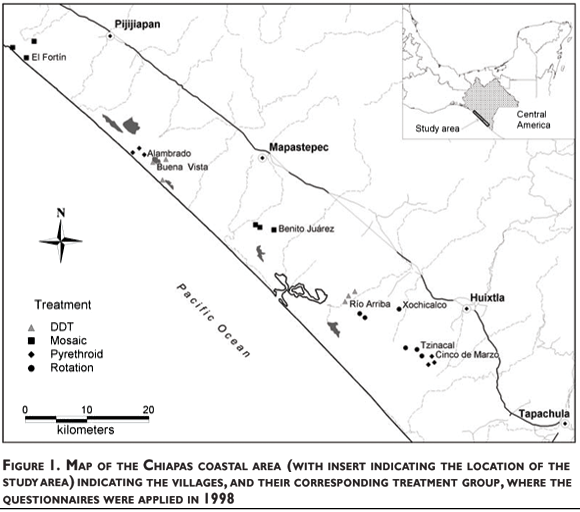
<body><![CDATA[<p><font size="2" face="Verdana"> Meanwhile, more rational methods for applying    insecticides are necessary to avoid or halt the increasing resistance to the    available chemicals used in the control of insect disease vectors. The application    of insecticides in a mosaic pattern (MOS), or their rotation (ROT), proposed    as strategies for insecticide resistance management,<SUP>13</SUP> require the    use of more than one chemical type of insecticides. Besides their effectiveness    in resistance management, prior to the upscale of implementation, the community    acceptability of spraying strategies is a very important aspect needing evaluation,    as the perceived side effects of insecticides and their acceptability by villagers    could be a decisive factor in choosing the types of insecticides to be included    in the programme. </font></p>     <p><font size="2" face="Verdana"> We report herein the results of a survey on    insecticide spraying acceptability conducted in villages from an area where    an insecticide resistance management programme was under evaluation. As insecticides    of four different chemical classes were being used in the programme, along with    investigating acceptability of the different treatments, information on the    villagers' perceived side effects of the treatment was also obtained. </font></p>     <p>&nbsp;</p>     <p><font size="3" face="Verdana"><b>Material and Methods </b></font></p>     <p><font size="2" face="Verdana">The study was conducted in an area of the coastal    plain of Chiapas, Mexico while insecticide resistance management strategies    were under evaluation.<SUP>14</SUP> Annual rotation (ROT) of three different    classes of insecticides (organophosphate &#91;OP&#93;, pyrethroid &#91;PYR&#93;, and carbamate    &#91;CARB&#93;) and spatial mosaic spraying (MOS) of two different classes of insecticides    (OP and PYR) were compared with the use of a single insecticide (DDT or PYR)    (<a href="#fig01">Figure 1</a>). The project and letters of informed consent    signed by each participant before entering the study were approved by the Ethics    Committee of the National Institute of Public Health. Previous to the insecticide    application villagers were asked to remove their furniture, cooking utensils    and food and were advised to avoid entering their houses for at least one hour    after the application of the insecticide. </font></p>     <p><a name="fig01"></a></p>     <p>&nbsp;</p>     <p align="center"><img src="/img/revistas/spm/v48n4/a06fig01.gif"></p>     <p>&nbsp;</p>     <p><font size="2" face="Verdana"> Questionnaires to investigate perceived side    effects and acceptability were administered in eight of the 24 study villages    from April to May of 1998 (two villages per treatment and all four insecticide    classes were included in the resistance management programme) (<a href="#tab01">Table    I</a>). The number of households included in the survey varied among villages    depending on the availability of respondents. At least 30% of the families per    village was included and, in some small villages, all families were interviewed.    The number of families per locality ensured detection of significant differences    at 95% confidence level. Trained interviewers administered questionnaires to    one member of each family who indicated having good knowledge of the family    and who agreed to be interviewed.</font></p>     ]]></body>
<body><![CDATA[<p><a name="tab01"></a></p>     <p>&nbsp;</p>     <p align="center"><img src="/img/revistas/spm/v48n4/a06tab01.gif"></p>     <p>&nbsp;</p>     <p><font size="2" face="Verdana"> Previous to the application of the questionnaire,    our interest in retrieving information in order to aid in future planning of    insecticide spraying programmes was explained. The questionnaire consisted of    three parts: One series of questions retrieved information on the family structure,    the occupation of each member and the time they waited before entering the house    after the spraying was conducted; a second series of questions enquired about    symptoms in any family member that could be related to insecticide exposure,    their duration and their perceived causes;<SUP>9,10,15</SUP> and the third section    included a series of specific questions about their perceived direct and secondary    benefits, and unwanted effects of insecticide spraying. </font></p>     <p><font size="2" face="Verdana"> To diminish the hesitance of interviewees to    respond with possibly contentious answers, they were asked about their opinion    on why other villagers refuse insecticide spraying, and a list of possible causes    (smell, irritation or other health problems, poisoning of domestic animals,    having to take the furniture outside, stains the walls, creates disorder, is    a waist of time, other) was offered. It is believed that their answers mostly    reflected the interviewees' own perceptions of the discomforts caused by    spraying. What they would change about the spraying activities to improve acceptability    was a final open question. In this context, acceptability was assessed using    three parameters: non-refusal to indoor spraying, perceived beneficial effects    and discomforts. In other vector control interventions,<SUP>16 </SUP>acceptability    is usually measured according to the house coverage in the community. Indoor    residual spraying is better accepted if villagers perceive any benefit from    it. </font></p>     <p><font size="2" face="Verdana"> Chi-square analyses<SUP>17</SUP> were used to    assess any effect of different insecticide treatments on the responses given    by interviewees in the last two sections of the questionnaire. An index of severity    of side effect symptoms was built according to the number of symptoms indicated    by interviewed subjects. Severity was categorized as high if headache, abdominal    pain, vomiting or nausea was accompanied by at least another symptom and mild    when only one symptom was mentioned. To compare the intensity of side effects    in the human populations among different insecticide treatments, an ordered    logistic model<SUP>18</SUP> was fitted to the data using the categorized severity    index as the response variable, and insecticide treatments as predictors. An    ordered logistic model is an extension to the logistic model that allows modelling    data where the response variable is an ordinal one with more than two possible    outcomes. The model was adjusted for the time elapsed between insecticide spraying    and the interview date and also for the reported waiting time before entering    the house after spraying. </font></p>     <p>&nbsp;</p>     <p><font size="3" face="Verdana"><b>Results </b></font></p>     <p><font size="2" face="Verdana"><I>Demographic information</I>. A total of 200    people were interviewed, one corresponding to each family; 125 (62.5%) were    females and 75 (37.5%) males. The age of interviewees ranged from 18 to 78 years    (mean of 39.2 ± 13.7 SD years). The highest percentage (39.2%)of females    was between 25 and 40 years old, while the highest percentage of males (46.6%)    was between 40 and 55 years old. There were on average 5.1 inhabitants per house    (range 1-13). Interviewees included the mother (58.0%), the father (35.5%),    the eldest son (3.0%), the eldest daughter (2.0%) or the grandmother (1.0%).    The most frequent occupations of interviewees were housewives (58.5%), farmers    (18.0%) and fishermen (16.5%). Most interviewees had incomplete elementary education    (40.8% females and 38.6% males), 22.5% were illiterate (20.8% females and 25.3%    males) and 4.0% had completed high school or above (0.8% females and 9.3% males).    </font></p>     ]]></body>
<body><![CDATA[<p><font size="2" face="Verdana"> No significant differences in the time waited    to enter houses after spraying occurred among villages treated with DDT, PYR    and MOS (<I>p</I>&gt; 0.05), but the waiting time was significantly lower in    the localities under ROT (<I>p</I>= 0.022). The average time villagers waited    to enter their houses was 92 minutes (111.2 SD, range= 12 minutes to 24 hours).    Most of the villagers (51.7%) entered their houses between one and two hours    after spraying, 21.5% entered between two and three hours and 15.6% entered    before the first hour. Villagers from the villages treated with DDT waited on    average 110.2 (± 203.4 SD) minutes, those in MOS villages waited 111.1    (± 71.5 SD) minutes, in PYR treated villages the wait was 83.6 (±    42.6 SD) minutes and villagers waited 70.6 (± 64 SD) minutes in ROT treated    villages. </font></p>     <p><font size="2" face="Verdana"><I>Symptoms possibly associated with pesticide    exposure</I>. Seventy per cent of the interviewees reported at least one of    the symptoms researched in the study, and 40% of the households were classified    in the high severity category. The symptoms most frequently listed (<a href="#tab02">Table    II</a>) were headache (33.5%), abdominal pain (21.6%), dysuria (18.9%) and vomiting    (8.1%) in persons over five years old. Vomiting was also cited in children under    five-years-old (5.7%). The most lasting symptoms were itching (240 ± 153    hours), sneezing (94 ± 95.5 hours), coughing (87 ± 63.7 hours) and    numbness (78 ± 68.9 hours); however, these were the less frequently referred    symptoms. </font></p>     <p><a name="tab02"></a></p>     <p>&nbsp;</p>     <p align="center"><img src="/img/revistas/spm/v48n4/a06tab02.gif"></p>     <p>&nbsp;</p>     <p><font size="2" face="Verdana"> The probable causes of symptoms most frequently    listed by villagers were sun exposure (39.3%, for headache, nausea, blurred    vision, dizziness, ringing ears, sneezing, coughing, dysuria, and watery eyes),    food poisoning (17.7%, for vomiting, abdominal pain and itching), parasites    (15%, for itching), flu (13.8) and other causes (10.4%, for finger numbness)    (<a href="#tab03">Table III</a>). Insecticide spraying was adduced as a cause    by only 2.1% of the interviewees reporting symptoms. Among the other causes    listed were allergy, Parkinson's disease, and excess of work. </font></p>     <p><a name="tab03"></a></p>     <p>&nbsp;</p>     <p align="center"><img src="/img/revistas/spm/v48n4/a06tab03.gif"></p>     ]]></body>
<body><![CDATA[<p>&nbsp;</p>     <p><font size="2" face="Verdana">A significantly higher percentage of people with    blurred vision (70%), dizziness (52%), sneezing (59%), coughing (59%), numbness    (67%), watery eyes (59%) and itching (56%) occurred in villages under the MOS    (OP and PYR) (<I>p</I>&lt; 0.05); while a significantly higher percentage of    people with dysuria were from villages under the ROT (OP, PYR, and CARB) and    the PYR treatments (40 and 33%, respectively, <I>p</I>&lt; 0.05). No significant    differences among treatments were found in the percentage of people with headache,    nausea, vomiting, ringing ears, and abdominal pain, (<I>p</I>&gt; 0.05). The    results of the ordered logistic model indicated a positive association between    the report of symptoms in the household and the different insecticide spraying    treatments. High severity index in households was associated with ROT treatment.    </font></p>     <p><font size="2" face="Verdana"> The probability of finding a house with high    severity index was higher in villages under ROT treatment (OR= 3.27 95% CI=    &#91;1.46, 7.34&#93;) compared to villages treated with DDT. Other treatments did not    show any significant association with the severity index (<a href="#tab04">Table    IV</a>). The estimated probabilities for the severity index according to the    insecticide treatment are presented in <a href="#tab05">Table V</a>. </font></p>     <p><a name="tab04"></a></p>     <p>&nbsp;</p>     <p align="center"><img src="/img/revistas/spm/v48n4/a06tab04.gif"></p>     <p>&nbsp;</p>     <p><a name="tab05"></a></p>     <p>&nbsp;</p>     <p align="center"><img src="/img/revistas/spm/v48n4/a06tab05.gif"></p>     ]]></body>
<body><![CDATA[<p>&nbsp;</p>     <p><font size="2" face="Verdana"><I>Acceptability of insecticide spraying</I>.    When asked about the benefits of residual spraying, 81.1% of villagers responded    that it was useful in reducing mosquito bites, 8.5% responded that it reduced    cockroaches and 6.6% indicated no benefits (<a href="#tab06">Table VI</a>).    Significant differences occurred among respondents under different treatments    (<font face="Symbol">c</font><SUP>2=</SUP> 30.556, DF= 6, <I>p</I>&lt; 0.0001).    Of those respondents associating spraying with a reduction in cockroaches, 77.7%    were under the ROT strategy. Fifty percent of those responding that there was    no benefit were under DDT treatment. Only 1.9% associated the spray with malaria    transmission prevention. </font></p>     <p><a name="tab06"></a></p>     <p>&nbsp;</p>     <p align="center"><img src="/img/revistas/spm/v48n4/a06tab06.gif"></p>     <p>&nbsp;</p>     <p><font size="2" face="Verdana"> When villagers were asked about benefits in    addition to those first mentioned, malaria prevention increased to 7.2% and    39% listed reduction in cockroaches, but 37.9% responded that there was no other    additional benefit (<a href="#tab04">Table IV</a>). Significant differences    occurred among treatments (<font face="Symbol">c</font><SUP>2=</SUP> 30.059,    DF= 15, <I>p</I>= 0.0117), where 50% of those indicating malaria prevention    and 50% of those listing reduction in mosquitoes were from villages under ROT,    and the lowest percentage (9.2%) of those listing reduction in cockroaches were    from the MOS treatment. </font></p>     <p><font size="2" face="Verdana"> Most interviewees (83.7%) welcomed spraying,    indicating that there was nothing they disliked about it. Half (4.3%) of the    villagers who disliked spraying complained about the smell and 2.4% disliked    having to remove furniture from the house. Other observations included a lack    of insecticide effect, irritation and dizziness resulting from the insecticide    exposure. Significant differences were detected (<font face="Symbol">c</font><SUP>2=</SUP>    17.351, DF= 3, <I>p</I>= 0.0006) when the two most frequent responses (nothing    against it and bad smell) were compared by treatment; the highest percentage    (61.1%) of respondents that disliked the smell and the lowest percentage (18.3%)    that listed nothing against the insecticide came from villages under MOS. </font></p>     <p><font size="2" face="Verdana"> In the opinion of those interviewed, the three    most common causes of why other villagers refuse insecticide spraying were that:    they disliked taking their furniture out of the house (35%), the smell (35%)    and the disorder that it provokes (11%). The responses were statistically different    between treatments (<font face="Symbol">c</font><SUP>2=</SUP> 22.142, DF= 12,    <I>p</I>= 0.036). Compared to other treatments, removing the furniture and the    disorder were significantly lower in the MOS treatment (11 and 13.6%, respectively).    While poisoning of pets was significantly    lower (6.3%) and "a waist of time" was more frequently listed (40%)    in villages under DDT. Allergies and sickness, concerns about possible dangers    for their babies and poor knowledge about insecticide spraying were other causes    listed for refusal. </font></p>     <p><font size="2" face="Verdana"> Numerous answers were received to the open question    on what they would change about the spraying activities to improve acceptability.    The most common suggestions were to improve the understanding of the procedure    in the communities (32%) and to change the smell of the insecticides (15%).    Twelve percent responded that "complaints will never change" and 7%    said to "spray with the furniture inside". Changing the insecticide    was suggested by 4%, "not to kill domestic animals" by another 4%,    "do nothing" was suggested by 7% and 4% did not know what could be    changed. No significant differences were found when the most common suggestions    were compared by treatment (<I>p</I>&gt; 0.05). However, a higher percentage    among those suggesting not to kill domestic animals (43%) and to improve understanding    (40%) was in the ROT treatment. The highest percentages of those suggesting    changing the smell of the insecticide were in the MOS (39%) and the ROT treatments    (29%). </font></p>     ]]></body>
<body><![CDATA[<p>&nbsp;</p>     <p><font size="3" face="Verdana"><b>Discussion </b></font></p>     <p><font size="2" face="Verdana">Villagers referred to a series of symptoms that    could be related to insecticide exposure under different insecticide spraying    strategies. Headache, abdominal pain, dysuria and vomiting were the most frequently    listed; while the less frequent, but most lasting, were itching, sneezing, coughing,    and finger numbness. Although most interviewees associated these symptoms with    sun exposure, food poisoning and parasites, a severity index was constructed    in order to analyze their frequency in relation to the type of insecticide and    the spraying methods applied in the villages. Symptoms and severity index level    varied according to the spraying treatment. High severity level was more frequent    in ROT than in all other treatments. In villages under ROT a combination of    OP, CAR and PYR were used and accordingly, the most frequent symptoms listed    were a mixture of those previously associated with exposure to OP (dizziness,    coughing and numbness) and PYR (sneezing, watery eyes and itching).<SUP>5,9-12</SUP>    The variability in the symptoms associated with different insecticides indicates    that although unrecognized by villagers, insecticide side effects were occurring.    Because of the exposure to the same insecticide, it would be expected that in    the ROT and in the PYR treatments, villagers would have listed similar symptoms    at the same frequency; however, a higher severity index level in ROT- treated    villages opens the possibility of an additive effect of OP, CAR and PYR in these    localities. </font></p>     <p><font size="2" face="Verdana"> On the other hand, some of the symptoms were    listed more frequently during the pre-intervention period<SUP>19</SUP> than    during intervention, suggesting that some symptoms could result from non-occupational    exposure to insecticides. This consideration is of relevance, as according to    a pre-intervention questionnaire, in MOS-treated villages a significantly higher    percentage of villagers used insecticides for agricultural pests than in other    villages in the study. In any case, further studies using direct measures to    detect intoxication by pesticides are required to link symptoms with insecticides    and their sources. </font></p>     <p><font size="2" face="Verdana"> High coverage linked with acceptability are    required for the success of vector control interventions.<SUP>16</SUP> The acceptability    of indoor residual spraying is related to whether householders perceive it as    beneficial. In our study area, villagers' expectations were high before the    spraying intervention: 98% of them agreed with indoor residual spray and 64%    expected a reduction in mosquito bites.<SUP>19</SUP> After two years of spraying,    villagers were more aware of the advantages and disadvantages of indoor spraying,    and the proportion (81%) of interviewees that perceived a reduction in mosquito    bites as its main benefit increased, but a reduction occurred among those that    found nothing they disliked (84%) and agreed with the spraying. This proportion    was similar to the 80% of spraying coverage in the villages where the questionnaire    was administered, and could reflect its relationship with the acceptance of    the intervention. </font></p>     <p><font size="2" face="Verdana"> The causes for refusal vary depending on the    insecticide sprayed. In India, where most vector control is still based on DDT    indoor spraying, the general opinion is against the usefulness of this insecticide,    thus the coverage is poor.<SUP>20</SUP> In our study, 50% of those responding    that there was no benefit from spraying came from the DDT-treatment villages.    Complaints about poisoning domestic animals were significantly lower in the    same villages, while the "wasting of time" respondents were significantly    higher, linking complaints in these villages with the lower efficacy of this    insecticide. Conversely, the greatest numbers of interviewees that listed a    reduction in cockroaches as a benefit from spraying came from ROT-treated localities,    linking the reduction of the multi-insecticide resistance pest with the intervention    and its acceptance. </font></p>     <p><font size="2" face="Verdana"> Only a low percentage of interviewees mentioned    specific aspects that they disliked about the spraying, probably because of    shyness or fear to express their own opinions. Complaints increased when asked    why, in the respondent's opinion, other villagers refuse the spraying, and the    most common answers were: the smell of the insecticides, having to remove the    furniture and the consequent disorder in the house. A noticeable result was    that the dislike of insecticide smell was significantly more frequent in spraying    treatments (MOS and ROT) that included an OP. Accordingly, to improve spraying    acceptability villagers suggested changing the smell of insecticides and spray    with the furniture inside. Acceptability correlated with the spray coverage    achieved, although the most frequent suggestion for improvement was to increase    the understanding of the objectives of spraying by the members of the communities.    This suggests that it is possible to increase the levels of vector control provided    that better awareness in the community is achieved. </font></p>     <p><font size="2" face="Verdana"> Although no causal-effect was documented and    villagers did not link symptoms with insecticide spraying, our results confirm    that insecticides cannot be applied without discomforts. The use of DDT in an    area of high resistance to this compound resulted in low effect against house    pests and the perceived uselessness of the intervention. On the other hand,    more symptoms were associated with the MOS and ROT treatments (<a href="#tab05">Table    V</a>), indicating that the combination of insecticides clearly increased the    frequency and severity of immediate undesired effects. The long-term effect    of these insecticides on the environment and human health awaits investigation.    These results introduce new considerations in the application of these strategies    designed to retard the appearance of resistance to insecticides currently available    for public health. Implementation of prevention strategies rather than vector    control measures will reduce the use of insecticides and therefore the contact    and possible side- and long-term effects on humans. </font></p>     <p><font size="2" face="Verdana"><b>Acknowledgements </b></font></p>     <p><font size="2" face="Verdana">This study was funded by IRAC/GCPF (The Insecticide    Resistance Action Committee of the Global Crop Protection Federation), with    further contributions from companies participating in the Public Health Working    Group of IRAC/GCPF, viz: Agrevo, Bayer, Cheminova, FMC, Mitsui Toatsu, Novartis,    Rhone Poulenc, Sumitomo and Zeneca. </font></p>     ]]></body>
<body><![CDATA[<p>&nbsp;</p>     <p><font size="3" face="Verdana"><b>References </b></font></p>     <!-- ref --><p><font size="2" face="Verdana">1. Rafatjah H. The problem of resurgent bed-bug    infestation in malaria eradication programmes. J Trop Med Hyg 1971;74:53-56.    </font>&nbsp;&nbsp;&nbsp;&nbsp;&nbsp;&nbsp;&nbsp;&nbsp;[&#160;<a href="javascript:void(0);" onclick="javascript: window.open('/scielo.php?script=sci_nlinks&ref=9219814&pid=S0036-3634200600040000600001&lng=','','width=640,height=500,resizable=yes,scrollbars=1,menubar=yes,');">Links</a>&#160;]<!-- end-ref --><!-- ref --><p><font size="2" face="Verdana">2. Njunwa KJ, Lines JD, Magesa SM, Mnzava AE,    Wilkes TJ, Alilio M, <I>et al.</I> Trial of pyrethroid impregnated bednets in    an area of Tanzania holoendemic for malaria. Part 1. Operational methods and    acceptability. Acta Trop 1991;49:87-96. </font>&nbsp;&nbsp;&nbsp;&nbsp;&nbsp;&nbsp;&nbsp;&nbsp;[&#160;<a href="javascript:void(0);" onclick="javascript: window.open('/scielo.php?script=sci_nlinks&ref=9219815&pid=S0036-3634200600040000600002&lng=','','width=640,height=500,resizable=yes,scrollbars=1,menubar=yes,');">Links</a>&#160;]<!-- end-ref --><!-- ref --><p><font size="2" face="Verdana">3. Baker EL Jr, Warren M, Zack M, Dobbin RD,    Miles JW, Miller S, <I>et al</I>. Epidemic malathion poisoning in Pakistan malaria    workers. Lancet 1978;1:31-34. </font>&nbsp;&nbsp;&nbsp;&nbsp;&nbsp;&nbsp;&nbsp;&nbsp;[&#160;<a href="javascript:void(0);" onclick="javascript: window.open('/scielo.php?script=sci_nlinks&ref=9219816&pid=S0036-3634200600040000600003&lng=','','width=640,height=500,resizable=yes,scrollbars=1,menubar=yes,');">Links</a>&#160;]<!-- end-ref --><!-- ref --><p><font size="2" face="Verdana">4. de Zulueta J, Mujtaba SM, Shah IH. Malaria    control and long-term periodicity of the disease in Pakistan. Trans R Soc Trop    Med Hyg 1980;74:624-632. </font>&nbsp;&nbsp;&nbsp;&nbsp;&nbsp;&nbsp;&nbsp;&nbsp;[&#160;<a href="javascript:void(0);" onclick="javascript: window.open('/scielo.php?script=sci_nlinks&ref=9219817&pid=S0036-3634200600040000600004&lng=','','width=640,height=500,resizable=yes,scrollbars=1,menubar=yes,');">Links</a>&#160;]<!-- end-ref --><!-- ref --><p><font size="2" face="Verdana">5. Moretto A. Indoor spraying with the pyrethroid    insecticide lambda-cyhalothrin: effects on spraymen and inhabitants of sprayed    houses. Bull World Health Organ 1991;69:591-594. </font>&nbsp;&nbsp;&nbsp;&nbsp;&nbsp;&nbsp;&nbsp;&nbsp;[&#160;<a href="javascript:void(0);" onclick="javascript: window.open('/scielo.php?script=sci_nlinks&ref=9219818&pid=S0036-3634200600040000600005&lng=','','width=640,height=500,resizable=yes,scrollbars=1,menubar=yes,');">Links</a>&#160;]<!-- end-ref --><!-- ref --><p><font size="2" face="Verdana">6. Chester G, Sabapathy NN, Woollen BH. Exposure    and health assessment during application of lambda-cyhalothrin for malaria vector    control in Pakistan. Bull World Health Organ 1992;70:615-619. </font>&nbsp;&nbsp;&nbsp;&nbsp;&nbsp;&nbsp;&nbsp;&nbsp;[&#160;<a href="javascript:void(0);" onclick="javascript: window.open('/scielo.php?script=sci_nlinks&ref=9219819&pid=S0036-3634200600040000600006&lng=','','width=640,height=500,resizable=yes,scrollbars=1,menubar=yes,');">Links</a>&#160;]<!-- end-ref --><!-- ref --><p><font size="2" face="Verdana">7. Bouma MJ, Nesbit R. Fenitrothion intoxication    during spraying operations in the malaria programme for Afghan refugees in North    West Frontier Province of Pakistan. Trop Geogr Med 1995;47:12-14. </font>&nbsp;&nbsp;&nbsp;&nbsp;&nbsp;&nbsp;&nbsp;&nbsp;[&#160;<a href="javascript:void(0);" onclick="javascript: window.open('/scielo.php?script=sci_nlinks&ref=9219820&pid=S0036-3634200600040000600007&lng=','','width=640,height=500,resizable=yes,scrollbars=1,menubar=yes,');">Links</a>&#160;]<!-- end-ref --><!-- ref --><p><font size="2" face="Verdana">8. Charlwood JD, Alecrim WD, Fe N, Mangabeira    J, Martins VJ. A field trial with lambda-cyhalothrin (ICON) for the intradomiciliary    control of malaria transmitted by <I>Anopheles darlingi</I> Root in Rondonia,    Brazil. Acta Trop 1995;60:3-13. </font>&nbsp;&nbsp;&nbsp;&nbsp;&nbsp;&nbsp;&nbsp;&nbsp;[&#160;<a href="javascript:void(0);" onclick="javascript: window.open('/scielo.php?script=sci_nlinks&ref=9219821&pid=S0036-3634200600040000600008&lng=','','width=640,height=500,resizable=yes,scrollbars=1,menubar=yes,');">Links</a>&#160;]<!-- end-ref --><!-- ref --><p><font size="2" face="Verdana">9. Richter ED, Chuwers P, Levy Y, Gordon M, Grauer    F, Marzouk J, <I>et al</I>. Health effects from exposure to organophosphate    pesticides in workers and residents in Israel. Isr J Med Sci 1992;28:584-597.    </font>&nbsp;&nbsp;&nbsp;&nbsp;&nbsp;&nbsp;&nbsp;&nbsp;[&#160;<a href="javascript:void(0);" onclick="javascript: window.open('/scielo.php?script=sci_nlinks&ref=9219822&pid=S0036-3634200600040000600009&lng=','','width=640,height=500,resizable=yes,scrollbars=1,menubar=yes,');">Links</a>&#160;]<!-- end-ref --><!-- ref --><p><font size="2" face="Verdana">10. Ames RG, Howd RA, Doherty L. Community exposure    to a paraquat drift. Arch Environ Health 1993;48:47-52. </font>&nbsp;&nbsp;&nbsp;&nbsp;&nbsp;&nbsp;&nbsp;&nbsp;[&#160;<a href="javascript:void(0);" onclick="javascript: window.open('/scielo.php?script=sci_nlinks&ref=9219823&pid=S0036-3634200600040000600010&lng=','','width=640,height=500,resizable=yes,scrollbars=1,menubar=yes,');">Links</a>&#160;]<!-- end-ref --><!-- ref --><p><font size="2" face="Verdana">11. Le Quesne PM, Maxwell UC, Butterworth ST.    Transient facial sensory symptoms following exposure to synthetic pyrethroids:    a clinical and electrophysiological assessment. Neurotoxicol 1980;2:1-11. </font>&nbsp;&nbsp;&nbsp;&nbsp;&nbsp;&nbsp;&nbsp;&nbsp;[&#160;<a href="javascript:void(0);" onclick="javascript: window.open('/scielo.php?script=sci_nlinks&ref=9219824&pid=S0036-3634200600040000600011&lng=','','width=640,height=500,resizable=yes,scrollbars=1,menubar=yes,');">Links</a>&#160;]<!-- end-ref --><!-- ref --><p><font size="2" face="Verdana">12. He F, Sun J, Han K, Wu Y, Yao P, Wang S,    <I>et al</I>. Effects of pyrethroid insecticides on subjects engaged in packaging    pyrethroids. Br J Ind Med 1988;45:548-551. </font>&nbsp;&nbsp;&nbsp;&nbsp;&nbsp;&nbsp;&nbsp;&nbsp;[&#160;<a href="javascript:void(0);" onclick="javascript: window.open('/scielo.php?script=sci_nlinks&ref=9219825&pid=S0036-3634200600040000600012&lng=','','width=640,height=500,resizable=yes,scrollbars=1,menubar=yes,');">Links</a>&#160;]<!-- end-ref --><!-- ref --><p><font size="2" face="Verdana">13. Tabashnik BE. Managing resistance with multiple    pesticide tactics: theory, evidence, and recommendations. J Econ Entomol 1989;82:1263-1269.    </font>&nbsp;&nbsp;&nbsp;&nbsp;&nbsp;&nbsp;&nbsp;&nbsp;[&#160;<a href="javascript:void(0);" onclick="javascript: window.open('/scielo.php?script=sci_nlinks&ref=9219826&pid=S0036-3634200600040000600013&lng=','','width=640,height=500,resizable=yes,scrollbars=1,menubar=yes,');">Links</a>&#160;]<!-- end-ref --><!-- ref --><p><font size="2" face="Verdana">14. Penilla RP, Rodriguez AD, Hemingway J, Torres    JL, Arredondo-Jimenez JI, Rodriguez MH. Resistance management strategies in    malaria vector mosquito control. Baseline data for a large-scale field trial    against <I>Anopheles albimanus</I> in Mexico. Med Vet Entomol 1998;12:217-233.    </font>&nbsp;&nbsp;&nbsp;&nbsp;&nbsp;&nbsp;&nbsp;&nbsp;[&#160;<a href="javascript:void(0);" onclick="javascript: window.open('/scielo.php?script=sci_nlinks&ref=9219827&pid=S0036-3634200600040000600014&lng=','','width=640,height=500,resizable=yes,scrollbars=1,menubar=yes,');">Links</a>&#160;]<!-- end-ref --><!-- ref --><p><font size="2" face="Verdana">15. Scarborough ME, Ames RG, Lipsett MJ, Jackson    RJ. Acute health effects of community exposure to cotton defoliants. Arch Environ    Health 1989;44:355-360. </font>&nbsp;&nbsp;&nbsp;&nbsp;&nbsp;&nbsp;&nbsp;&nbsp;[&#160;<a href="javascript:void(0);" onclick="javascript: window.open('/scielo.php?script=sci_nlinks&ref=9219828&pid=S0036-3634200600040000600015&lng=','','width=640,height=500,resizable=yes,scrollbars=1,menubar=yes,');">Links</a>&#160;]<!-- end-ref --><!-- ref --><p><font size="2" face="Verdana">16. Srivastava HC, Kant R, Bhatt RM, Sharma SK,    Sharma VP. Epidemiological observations on malaria in villages of Buhari PHC,    Surat, Gujarat. Indian J Malariol 1995;32:140-152. </font>&nbsp;&nbsp;&nbsp;&nbsp;&nbsp;&nbsp;&nbsp;&nbsp;[&#160;<a href="javascript:void(0);" onclick="javascript: window.open('/scielo.php?script=sci_nlinks&ref=9219829&pid=S0036-3634200600040000600016&lng=','','width=640,height=500,resizable=yes,scrollbars=1,menubar=yes,');">Links</a>&#160;]<!-- end-ref --><!-- ref --><p><font size="2" face="Verdana">17. Zar JH. Biostatistical analysis. 2nd edition.    Englewood Cliffs: Prentice-Hall, 1984. </font>&nbsp;&nbsp;&nbsp;&nbsp;&nbsp;&nbsp;&nbsp;&nbsp;[&#160;<a href="javascript:void(0);" onclick="javascript: window.open('/scielo.php?script=sci_nlinks&ref=9219830&pid=S0036-3634200600040000600017&lng=','','width=640,height=500,resizable=yes,scrollbars=1,menubar=yes,');">Links</a>&#160;]<!-- end-ref --><!-- ref --><p><font size="2" face="Verdana">18. McCullag P, Nelder JA. Generalized linear    models. 2nd edition. New York: Chapman and Hall, 1989. </font>&nbsp;&nbsp;&nbsp;&nbsp;&nbsp;&nbsp;&nbsp;&nbsp;[&#160;<a href="javascript:void(0);" onclick="javascript: window.open('/scielo.php?script=sci_nlinks&ref=9219831&pid=S0036-3634200600040000600018&lng=','','width=640,height=500,resizable=yes,scrollbars=1,menubar=yes,');">Links</a>&#160;]<!-- end-ref --><!-- ref --><p><font size="2" face="Verdana">19. Rodr&iacute;guez AD, Penilla RP, Rodr&iacute;guez    MH, Hemingway J, Betanzos AF, Hernandez-Avila JE. Knowledge and beliefs about    malaria transmission and practices for vector control in Southern Mexico. Salud    Publica Mex 2003;45:110-116. </font>&nbsp;&nbsp;&nbsp;&nbsp;&nbsp;&nbsp;&nbsp;&nbsp;[&#160;<a href="javascript:void(0);" onclick="javascript: window.open('/scielo.php?script=sci_nlinks&ref=9219832&pid=S0036-3634200600040000600019&lng=','','width=640,height=500,resizable=yes,scrollbars=1,menubar=yes,');">Links</a>&#160;]<!-- end-ref --><!-- ref --><p><font size="2" face="Verdana">20. Sampath TRR, Yadav RS, Sharma VP, Adak T.    Evaluation of lambdacyhalothrin-impregnated bednets in a malaria endemic area    of India. Part I. Implementation and acceptability of the trial. J Am Mosq Control    Assoc 1998;14:431-436.</font>&nbsp;&nbsp;&nbsp;&nbsp;&nbsp;&nbsp;&nbsp;&nbsp;[&#160;<a href="javascript:void(0);" onclick="javascript: window.open('/scielo.php?script=sci_nlinks&ref=9219833&pid=S0036-3634200600040000600020&lng=','','width=640,height=500,resizable=yes,scrollbars=1,menubar=yes,');">Links</a>&#160;]<!-- end-ref --><p>&nbsp;</p>     <p>&nbsp;</p>     <p><font size="2" face="Verdana">Received on: October 3, 2006     <br>   Accepted on: April 25, 2006 </font></p>     <p>&nbsp;</p>     <p>&nbsp;</p>     <p><font size="2" face="Verdana">Address reprint request to: Dr. Mario Henry Rodr&iacute;guez.    Centro de Investigaci&oacute;n sobre Enfermedades Infecciosas, Instituto Nacional    de Salud P&uacute;blica. Av. Universidad 655, Col. Sta, Mar&iacute;a Ahuacatitl&aacute;n.    62508 Cuernavaca, Morelos, Mexico. Email: <a href="mailto:mhenry@insp.mx">mhenry@insp.mx</a>    </font></p>      ]]></body><back>
<ref-list>
<ref id="B1">
<label>1</label><nlm-citation citation-type="journal">
<person-group person-group-type="author">
<name>
<surname><![CDATA[Rafatjah]]></surname>
<given-names><![CDATA[H]]></given-names>
</name>
</person-group>
<article-title xml:lang="en"><![CDATA[The problem of resurgent bed-bug infestation in malaria eradication programmes]]></article-title>
<source><![CDATA[J Trop Med Hyg]]></source>
<year>1971</year>
<volume>74</volume>
<page-range>53-56</page-range></nlm-citation>
</ref>
<ref id="B2">
<label>2</label><nlm-citation citation-type="journal">
<person-group person-group-type="author">
<name>
<surname><![CDATA[Njunwa]]></surname>
<given-names><![CDATA[KJ]]></given-names>
</name>
<name>
<surname><![CDATA[Lines]]></surname>
<given-names><![CDATA[JD]]></given-names>
</name>
<name>
<surname><![CDATA[Magesa]]></surname>
<given-names><![CDATA[SM]]></given-names>
</name>
<name>
<surname><![CDATA[Mnzava]]></surname>
<given-names><![CDATA[AE]]></given-names>
</name>
<name>
<surname><![CDATA[Wilkes]]></surname>
<given-names><![CDATA[TJ]]></given-names>
</name>
<name>
<surname><![CDATA[Alilio]]></surname>
<given-names><![CDATA[M]]></given-names>
</name>
</person-group>
<article-title xml:lang="en"><![CDATA[Trial of pyrethroid impregnated bednets in an area of Tanzania holoendemic for malaria: Part 1. Operational methods and acceptability]]></article-title>
<source><![CDATA[Acta Trop]]></source>
<year>1991</year>
<volume>49</volume>
<page-range>87-96</page-range></nlm-citation>
</ref>
<ref id="B3">
<label>3</label><nlm-citation citation-type="journal">
<person-group person-group-type="author">
<name>
<surname><![CDATA[Baker]]></surname>
<given-names><![CDATA[EL Jr]]></given-names>
</name>
<name>
<surname><![CDATA[Warren]]></surname>
<given-names><![CDATA[M]]></given-names>
</name>
<name>
<surname><![CDATA[Zack]]></surname>
<given-names><![CDATA[M]]></given-names>
</name>
<name>
<surname><![CDATA[Dobbin]]></surname>
<given-names><![CDATA[RD]]></given-names>
</name>
<name>
<surname><![CDATA[Miles]]></surname>
<given-names><![CDATA[JW]]></given-names>
</name>
<name>
<surname><![CDATA[Miller]]></surname>
<given-names><![CDATA[S]]></given-names>
</name>
</person-group>
<article-title xml:lang="en"><![CDATA[Epidemic malathion poisoning in Pakistan malaria workers]]></article-title>
<source><![CDATA[Lancet]]></source>
<year>1978</year>
<volume>1</volume>
<page-range>31-34</page-range></nlm-citation>
</ref>
<ref id="B4">
<label>4</label><nlm-citation citation-type="journal">
<person-group person-group-type="author">
<name>
<surname><![CDATA[de Zulueta]]></surname>
<given-names><![CDATA[J]]></given-names>
</name>
<name>
<surname><![CDATA[Mujtaba]]></surname>
<given-names><![CDATA[SM]]></given-names>
</name>
<name>
<surname><![CDATA[Shah]]></surname>
<given-names><![CDATA[IH]]></given-names>
</name>
</person-group>
<article-title xml:lang="en"><![CDATA[Malaria control and long-term periodicity of the disease in Pakistan]]></article-title>
<source><![CDATA[Trans R Soc Trop Med Hyg]]></source>
<year>1980</year>
<volume>74</volume>
<page-range>624-632</page-range></nlm-citation>
</ref>
<ref id="B5">
<label>5</label><nlm-citation citation-type="journal">
<person-group person-group-type="author">
<name>
<surname><![CDATA[Moretto]]></surname>
<given-names><![CDATA[A]]></given-names>
</name>
</person-group>
<article-title xml:lang="en"><![CDATA[Indoor spraying with the pyrethroid insecticide lambda-cyhalothrin: effects on spraymen and inhabitants of sprayed houses]]></article-title>
<source><![CDATA[Bull World Health Organ]]></source>
<year>1991</year>
<volume>69</volume>
<page-range>591-594</page-range></nlm-citation>
</ref>
<ref id="B6">
<label>6</label><nlm-citation citation-type="journal">
<person-group person-group-type="author">
<name>
<surname><![CDATA[Chester]]></surname>
<given-names><![CDATA[G]]></given-names>
</name>
<name>
<surname><![CDATA[Sabapathy]]></surname>
<given-names><![CDATA[NN]]></given-names>
</name>
<name>
<surname><![CDATA[Woollen]]></surname>
<given-names><![CDATA[BH]]></given-names>
</name>
</person-group>
<article-title xml:lang="en"><![CDATA[Exposure and health assessment during application of lambda-cyhalothrin for malaria vector control in Pakistan]]></article-title>
<source><![CDATA[Bull World Health Organ]]></source>
<year>1992</year>
<volume>70</volume>
<page-range>615-619</page-range></nlm-citation>
</ref>
<ref id="B7">
<label>7</label><nlm-citation citation-type="journal">
<person-group person-group-type="author">
<name>
<surname><![CDATA[Bouma]]></surname>
<given-names><![CDATA[MJ]]></given-names>
</name>
<name>
<surname><![CDATA[Nesbit]]></surname>
<given-names><![CDATA[R]]></given-names>
</name>
</person-group>
<article-title xml:lang="en"><![CDATA[Fenitrothion intoxication during spraying operations in the malaria programme for Afghan refugees in North West Frontier Province of Pakistan]]></article-title>
<source><![CDATA[Trop Geogr Med]]></source>
<year>1995</year>
<volume>47</volume>
<page-range>12-14</page-range></nlm-citation>
</ref>
<ref id="B8">
<label>8</label><nlm-citation citation-type="journal">
<person-group person-group-type="author">
<name>
<surname><![CDATA[Charlwood]]></surname>
<given-names><![CDATA[JD]]></given-names>
</name>
<name>
<surname><![CDATA[Alecrim]]></surname>
<given-names><![CDATA[WD]]></given-names>
</name>
<name>
<surname><![CDATA[Fe]]></surname>
<given-names><![CDATA[N]]></given-names>
</name>
<name>
<surname><![CDATA[Mangabeira]]></surname>
<given-names><![CDATA[J]]></given-names>
</name>
<name>
<surname><![CDATA[Martins]]></surname>
<given-names><![CDATA[VJ]]></given-names>
</name>
</person-group>
<article-title xml:lang="en"><![CDATA[A field trial with lambda-cyhalothrin (ICON) for the intradomiciliary control of malaria transmitted by Anopheles darlingi Root in Rondonia, Brazil]]></article-title>
<source><![CDATA[Acta Trop]]></source>
<year>1995</year>
<volume>60</volume>
<page-range>3-13</page-range></nlm-citation>
</ref>
<ref id="B9">
<label>9</label><nlm-citation citation-type="journal">
<person-group person-group-type="author">
<name>
<surname><![CDATA[Richter]]></surname>
<given-names><![CDATA[ED]]></given-names>
</name>
<name>
<surname><![CDATA[Chuwers]]></surname>
<given-names><![CDATA[P]]></given-names>
</name>
<name>
<surname><![CDATA[Levy]]></surname>
<given-names><![CDATA[Y]]></given-names>
</name>
<name>
<surname><![CDATA[Gordon]]></surname>
<given-names><![CDATA[M]]></given-names>
</name>
<name>
<surname><![CDATA[Grauer]]></surname>
<given-names><![CDATA[F]]></given-names>
</name>
<name>
<surname><![CDATA[Marzouk]]></surname>
<given-names><![CDATA[J]]></given-names>
</name>
</person-group>
<article-title xml:lang="en"><![CDATA[Health effects from exposure to organophosphate pesticides in workers and residents in Israel]]></article-title>
<source><![CDATA[Isr J Med Sci]]></source>
<year>1992</year>
<volume>28</volume>
<page-range>584-597</page-range></nlm-citation>
</ref>
<ref id="B10">
<label>10</label><nlm-citation citation-type="journal">
<person-group person-group-type="author">
<name>
<surname><![CDATA[Ames]]></surname>
<given-names><![CDATA[RG]]></given-names>
</name>
<name>
<surname><![CDATA[Howd]]></surname>
<given-names><![CDATA[RA]]></given-names>
</name>
<name>
<surname><![CDATA[Doherty]]></surname>
<given-names><![CDATA[L]]></given-names>
</name>
</person-group>
<article-title xml:lang="en"><![CDATA[Community exposure to a paraquat drift]]></article-title>
<source><![CDATA[Arch Environ Health]]></source>
<year>1993</year>
<volume>48</volume>
<page-range>47-52</page-range></nlm-citation>
</ref>
<ref id="B11">
<label>11</label><nlm-citation citation-type="journal">
<person-group person-group-type="author">
<name>
<surname><![CDATA[Le Quesne]]></surname>
<given-names><![CDATA[PM]]></given-names>
</name>
<name>
<surname><![CDATA[Maxwell]]></surname>
<given-names><![CDATA[UC]]></given-names>
</name>
<name>
<surname><![CDATA[Butterworth]]></surname>
<given-names><![CDATA[ST]]></given-names>
</name>
</person-group>
<article-title xml:lang="en"><![CDATA[Transient facial sensory symptoms following exposure to synthetic pyrethroids: a clinical and electrophysiological assessment]]></article-title>
<source><![CDATA[Neurotoxicol]]></source>
<year>1980</year>
<volume>2</volume>
<page-range>1-11</page-range></nlm-citation>
</ref>
<ref id="B12">
<label>12</label><nlm-citation citation-type="journal">
<person-group person-group-type="author">
<name>
<surname><![CDATA[He]]></surname>
<given-names><![CDATA[F]]></given-names>
</name>
<name>
<surname><![CDATA[Sun]]></surname>
<given-names><![CDATA[J]]></given-names>
</name>
<name>
<surname><![CDATA[Han]]></surname>
<given-names><![CDATA[K]]></given-names>
</name>
<name>
<surname><![CDATA[Wu]]></surname>
<given-names><![CDATA[Y]]></given-names>
</name>
<name>
<surname><![CDATA[Yao]]></surname>
<given-names><![CDATA[P]]></given-names>
</name>
<name>
<surname><![CDATA[Wang]]></surname>
<given-names><![CDATA[S]]></given-names>
</name>
</person-group>
<article-title xml:lang="en"><![CDATA[Effects of pyrethroid insecticides on subjects engaged in packaging pyrethroids]]></article-title>
<source><![CDATA[Br J Ind Med]]></source>
<year>1988</year>
<volume>45</volume>
<page-range>548-551</page-range></nlm-citation>
</ref>
<ref id="B13">
<label>13</label><nlm-citation citation-type="journal">
<person-group person-group-type="author">
<name>
<surname><![CDATA[Tabashnik]]></surname>
<given-names><![CDATA[BE]]></given-names>
</name>
</person-group>
<article-title xml:lang="en"><![CDATA[Managing resistance with multiple pesticide tactics: theory, evidence, and recommendations]]></article-title>
<source><![CDATA[J Econ Entomol]]></source>
<year>1989</year>
<volume>82</volume>
<page-range>1263-1269</page-range></nlm-citation>
</ref>
<ref id="B14">
<label>14</label><nlm-citation citation-type="journal">
<person-group person-group-type="author">
<name>
<surname><![CDATA[Penilla]]></surname>
<given-names><![CDATA[RP]]></given-names>
</name>
<name>
<surname><![CDATA[Rodriguez]]></surname>
<given-names><![CDATA[AD]]></given-names>
</name>
<name>
<surname><![CDATA[Hemingway]]></surname>
<given-names><![CDATA[J]]></given-names>
</name>
<name>
<surname><![CDATA[Torres]]></surname>
<given-names><![CDATA[JL]]></given-names>
</name>
<name>
<surname><![CDATA[Arredondo-Jimenez]]></surname>
<given-names><![CDATA[JI]]></given-names>
</name>
<name>
<surname><![CDATA[Rodriguez]]></surname>
<given-names><![CDATA[MH]]></given-names>
</name>
</person-group>
<article-title xml:lang="en"><![CDATA[Resistance management strategies in malaria vector mosquito control: Baseline data for a large-scale field trial against Anopheles albimanus in Mexico]]></article-title>
<source><![CDATA[Med Vet Entomol]]></source>
<year>1998</year>
<volume>12</volume>
<page-range>217-233</page-range></nlm-citation>
</ref>
<ref id="B15">
<label>15</label><nlm-citation citation-type="journal">
<person-group person-group-type="author">
<name>
<surname><![CDATA[Scarborough]]></surname>
<given-names><![CDATA[ME]]></given-names>
</name>
<name>
<surname><![CDATA[Ames]]></surname>
<given-names><![CDATA[RG]]></given-names>
</name>
<name>
<surname><![CDATA[Lipsett]]></surname>
<given-names><![CDATA[MJ]]></given-names>
</name>
<name>
<surname><![CDATA[Jackson]]></surname>
<given-names><![CDATA[RJ]]></given-names>
</name>
</person-group>
<article-title xml:lang="en"><![CDATA[Acute health effects of community exposure to cotton defoliants]]></article-title>
<source><![CDATA[Arch Environ Health]]></source>
<year>1989</year>
<volume>44</volume>
<page-range>355-360</page-range></nlm-citation>
</ref>
<ref id="B16">
<label>16</label><nlm-citation citation-type="journal">
<person-group person-group-type="author">
<name>
<surname><![CDATA[Srivastava]]></surname>
<given-names><![CDATA[HC]]></given-names>
</name>
<name>
<surname><![CDATA[Kant]]></surname>
<given-names><![CDATA[R]]></given-names>
</name>
<name>
<surname><![CDATA[Bhatt]]></surname>
<given-names><![CDATA[RM]]></given-names>
</name>
<name>
<surname><![CDATA[Sharma]]></surname>
<given-names><![CDATA[SK]]></given-names>
</name>
<name>
<surname><![CDATA[Sharma]]></surname>
<given-names><![CDATA[VP]]></given-names>
</name>
</person-group>
<article-title xml:lang="en"><![CDATA[Epidemiological observations on malaria in villages of Buhari PHC, Surat, Gujarat]]></article-title>
<source><![CDATA[Indian J Malariol]]></source>
<year>1995</year>
<volume>32</volume>
<page-range>140-152</page-range></nlm-citation>
</ref>
<ref id="B17">
<label>17</label><nlm-citation citation-type="book">
<person-group person-group-type="author">
<name>
<surname><![CDATA[Zar]]></surname>
<given-names><![CDATA[JH]]></given-names>
</name>
</person-group>
<source><![CDATA[Biostatistical analysis]]></source>
<year>1984</year>
<edition>2nd</edition>
<publisher-loc><![CDATA[Englewood Cliffs ]]></publisher-loc>
<publisher-name><![CDATA[Prentice-Hall]]></publisher-name>
</nlm-citation>
</ref>
<ref id="B18">
<label>18</label><nlm-citation citation-type="book">
<person-group person-group-type="author">
<name>
<surname><![CDATA[McCullag]]></surname>
<given-names><![CDATA[P]]></given-names>
</name>
<name>
<surname><![CDATA[Nelder]]></surname>
<given-names><![CDATA[JA]]></given-names>
</name>
</person-group>
<source><![CDATA[Generalized linear models]]></source>
<year>1989</year>
<edition>2nd</edition>
<publisher-loc><![CDATA[New York ]]></publisher-loc>
<publisher-name><![CDATA[Chapman and Hall]]></publisher-name>
</nlm-citation>
</ref>
<ref id="B19">
<label>19</label><nlm-citation citation-type="journal">
<person-group person-group-type="author">
<name>
<surname><![CDATA[Rodríguez]]></surname>
<given-names><![CDATA[AD]]></given-names>
</name>
<name>
<surname><![CDATA[Penilla]]></surname>
<given-names><![CDATA[RP]]></given-names>
</name>
<name>
<surname><![CDATA[Rodríguez]]></surname>
<given-names><![CDATA[MH]]></given-names>
</name>
<name>
<surname><![CDATA[Hemingway]]></surname>
<given-names><![CDATA[J]]></given-names>
</name>
<name>
<surname><![CDATA[Betanzos]]></surname>
<given-names><![CDATA[AF]]></given-names>
</name>
<name>
<surname><![CDATA[Hernandez-Avila]]></surname>
<given-names><![CDATA[JE]]></given-names>
</name>
</person-group>
<article-title xml:lang="en"><![CDATA[Knowledge and beliefs about malaria transmission and practices for vector control in Southern Mexico]]></article-title>
<source><![CDATA[Salud Publica Mex]]></source>
<year>2003</year>
<volume>45</volume>
<page-range>110-116</page-range></nlm-citation>
</ref>
<ref id="B20">
<label>20</label><nlm-citation citation-type="journal">
<person-group person-group-type="author">
<name>
<surname><![CDATA[Sampath]]></surname>
<given-names><![CDATA[TRR]]></given-names>
</name>
<name>
<surname><![CDATA[Yadav]]></surname>
<given-names><![CDATA[RS]]></given-names>
</name>
<name>
<surname><![CDATA[Sharma]]></surname>
<given-names><![CDATA[VP]]></given-names>
</name>
<name>
<surname><![CDATA[Adak]]></surname>
<given-names><![CDATA[T]]></given-names>
</name>
</person-group>
<article-title xml:lang="en"><![CDATA[Evaluation of lambdacyhalothrin-impregnated bednets in a malaria endemic area of India: Part I. Implementation and acceptability of the trial]]></article-title>
<source><![CDATA[J Am Mosq Control Assoc]]></source>
<year>1998</year>
<volume>14</volume>
<page-range>431-436</page-range></nlm-citation>
</ref>
</ref-list>
</back>
</article>
