<?xml version="1.0" encoding="ISO-8859-1"?><article xmlns:mml="http://www.w3.org/1998/Math/MathML" xmlns:xlink="http://www.w3.org/1999/xlink" xmlns:xsi="http://www.w3.org/2001/XMLSchema-instance">
<front>
<journal-meta>
<journal-id>0036-3634</journal-id>
<journal-title><![CDATA[Salud Pública de México]]></journal-title>
<abbrev-journal-title><![CDATA[Salud pública Méx]]></abbrev-journal-title>
<issn>0036-3634</issn>
<publisher>
<publisher-name><![CDATA[Instituto Nacional de Salud Pública]]></publisher-name>
</publisher>
</journal-meta>
<article-meta>
<article-id>S0036-36342003001000006</article-id>
<title-group>
<article-title xml:lang="en"><![CDATA[Anemia in Mexican women: a public health problem]]></article-title>
<article-title xml:lang="es"><![CDATA[Anemia en mujeres mexicanas: un problema de salud pública]]></article-title>
</title-group>
<contrib-group>
<contrib contrib-type="author">
<name>
<surname><![CDATA[Shamah-Levy]]></surname>
<given-names><![CDATA[Teresa]]></given-names>
</name>
<xref ref-type="aff" rid="A01"/>
</contrib>
<contrib contrib-type="author">
<name>
<surname><![CDATA[Villalpando]]></surname>
<given-names><![CDATA[Salvador]]></given-names>
</name>
<xref ref-type="aff" rid="A01"/>
</contrib>
<contrib contrib-type="author">
<name>
<surname><![CDATA[Rivera]]></surname>
<given-names><![CDATA[Juan A.]]></given-names>
</name>
<xref ref-type="aff" rid="A01"/>
</contrib>
<contrib contrib-type="author">
<name>
<surname><![CDATA[Mejía-Rodríguez]]></surname>
<given-names><![CDATA[Fabiola]]></given-names>
</name>
<xref ref-type="aff" rid="A01"/>
</contrib>
<contrib contrib-type="author">
<name>
<surname><![CDATA[Camacho-Cisneros]]></surname>
<given-names><![CDATA[Martha]]></given-names>
</name>
<xref ref-type="aff" rid="A01"/>
</contrib>
<contrib contrib-type="author">
<name>
<surname><![CDATA[Monterrubio]]></surname>
<given-names><![CDATA[Eric A]]></given-names>
</name>
<xref ref-type="aff" rid="A01"/>
</contrib>
</contrib-group>
<aff id="A01">
<institution><![CDATA[,Instituto Nacional de Salud Pública Centro de Investigación en Nutrición y Salud ]]></institution>
<addr-line><![CDATA[Cuernavaca Morelos]]></addr-line>
<country>México</country>
</aff>
<pub-date pub-type="pub">
<day>00</day>
<month>00</month>
<year>2003</year>
</pub-date>
<pub-date pub-type="epub">
<day>00</day>
<month>00</month>
<year>2003</year>
</pub-date>
<volume>45</volume>
<fpage>499</fpage>
<lpage>507</lpage>
<copyright-statement/>
<copyright-year/>
<self-uri xlink:href="http://www.scielo.org.mx/scielo.php?script=sci_arttext&amp;pid=S0036-36342003001000006&amp;lng=en&amp;nrm=iso"></self-uri><self-uri xlink:href="http://www.scielo.org.mx/scielo.php?script=sci_abstract&amp;pid=S0036-36342003001000006&amp;lng=en&amp;nrm=iso"></self-uri><self-uri xlink:href="http://www.scielo.org.mx/scielo.php?script=sci_pdf&amp;pid=S0036-36342003001000006&amp;lng=en&amp;nrm=iso"></self-uri><abstract abstract-type="short" xml:lang="en"><p><![CDATA[OBJECTIVE: The purpose of this study is to quantify the prevalence and distribution of anemia among women of childbearing age (12 to 49 years) participating in the 1999 National Nutrition Survey (NNS-1999). MATERIAL AND METHODS: The survey had a probabilistic design and was representative at the national level, of urban and rural areas and four regions: North, South, Center, and Mexico City. Hemoglobin concentration was determined in capillary blood samples using a portable photometer (HemoCue), in 17 194 women, 697 of whom were pregnant. RESULTS: The overall prevalence of anemia was 27.8% in pregnant women and 20.8% in non-pregnant women. Higher prevalences were observed in rural as compared to urban areas, both in pregnant (28.0% vs 27.7%) and non-pregnant (22.6% vs 20.0%) women, but the differences were not statistically significant (p >0.05). Women in the South had the greatest prevalence (23.2%), followed by those in the North (20.9%), Center (20.6%), and Mexico City (16.4%). Non-pregnant indigenous women had a prevalence of 24.8%, while in non-indigenous women the prevalence was 20.4%. CONCLUSIONS: Anemia in women of childbearing age is a growing public health problem that justifies the implementation of interventions for its prevention and control.]]></p></abstract>
<abstract abstract-type="short" xml:lang="es"><p><![CDATA[OBJETIVO: Cuantificar la prevalencia y distribución de anemia de las mujeres en edad fértil (12 a 49 años de edad) captadas en la Encuesta Nacional de Nutrición 1999 (ENN-99). La Encuesta tuvo un diseño probabilístico y es representativa del ámbito nacional mexicano, de zonas urbanas y rurales y de cuatro regiones: norte, centro, Ciudad de México y sur. MATERIAL Y MÉTODOS: La concentración de hemoglobina se determinó en sangre capilar mediante un fotómetro portátil (HemoCue) en 17 194 mujeres, de las cuales 697 estaban embarazadas. RESULTADOS: La prevalencia de anemia en el ámbito nacional fue de 27.8% para mujeres embarazadas y 20.8% para no embarazadas. Se encontró una mayor prevalencia en zonas rurales que en urbanas, tanto en mujeres embarazadas (28.0% vs 27.7%) como en no embarazadas (22.6% vs 20.0%) pero las diferencias no fueron estadísticamente significativas (p>0.05). La región sur presentó la mayor prevalencia de anemia ( 23.2%), seguida de la región norte (20.9%), la centro (20.6%) y la Ciudad de México (16.4%). Las mujeres no embarazadas indígenas presentaron una prevalencia de anemia de 24.8%, mientras que en las no indígenas fue de 20.4%, no siendo esta diferencia estadísticamente significativa. CONCLUSIONES: La anemia en mujeres en edad fértil es un problema de salud pública que justifica la implantación de programas de prevención y control.]]></p></abstract>
<kwd-group>
<kwd lng="en"><![CDATA[nutrition surveys]]></kwd>
<kwd lng="en"><![CDATA[nemia]]></kwd>
<kwd lng="en"><![CDATA[pregnant women]]></kwd>
<kwd lng="en"><![CDATA[hemocue]]></kwd>
<kwd lng="en"><![CDATA[hemoglobin]]></kwd>
<kwd lng="en"><![CDATA[Mexico]]></kwd>
<kwd lng="es"><![CDATA[encuestas nutricionales]]></kwd>
<kwd lng="es"><![CDATA[anemia]]></kwd>
<kwd lng="es"><![CDATA[mujeres embarazadas]]></kwd>
<kwd lng="es"><![CDATA[hemocue]]></kwd>
<kwd lng="es"><![CDATA[hemoglobina]]></kwd>
<kwd lng="es"><![CDATA[México]]></kwd>
</kwd-group>
</article-meta>
</front><body><![CDATA[ <p align="right"><font size="2" face="Verdana"> <b>ORIGINAL ARTICLE</b></font></p>     <p>&nbsp;</p>     <p><font size="4" face="Verdana"><b>Anemia in Mexican women: a public health problem</b></font></p>     <p>&nbsp;</p>     <p><b><font size="3" face="Verdana">Anemia en mujeres mexicanas: un problema de salud p&uacute;blica</font></b></p>     <p>&nbsp;</p>     <p>&nbsp;</p>     <p><font size="2" face="Verdana"><b>Teresa Shamah-Levy, MSc; Salvador Villalpando,    MD, Sc. Dr; Juan A. Rivera, MS, PhD; Fabiola Mej&iacute;a-Rodr&iacute;guez,    BSc; Martha Camacho-Cisneros, BSc; Eric A Monterrubio, BSc</b></font></p>     <p><font size="2" face="Verdana">Centro de Investigaci&oacute;n en Nutrici&oacute;n    y Salud, Instituto Nacional de Salud P&uacute;blica, Cuernavaca, Morelos, M&eacute;xico</font></p>     <p>&nbsp;</p>     ]]></body>
<body><![CDATA[<p>&nbsp;</p> <hr size="1" noshade>     <p><font size="2" face="Verdana"><b>ABSTRACT</b></font></p>     <p><font size="2" face="Verdana"><B>OBJECTIVE:</B> The purpose of this study is    to quantify the prevalence and distribution of anemia among women of childbearing    age (12 to 49 years) participating in the 1999 National Nutrition Survey (NNS-1999).    <B>    <br>   </B><B>MATERIAL AND METHODS:</B> The survey had a probabilistic design and was    representative at the national level, of urban and rural areas and four regions:    North, South, Center, and Mexico City. Hemoglobin concentration was determined    in capillary blood samples using a portable photometer (HemoCue), in 17 194    women, 697 of whom were pregnant. <B>    <br>   </B><B>RESULTS:</B> The overall prevalence of anemia was 27.8% in pregnant women    and 20.8% in non-pregnant women. Higher prevalences were observed in rural as    compared to urban areas, both in pregnant (28.0% <I>vs</I> 27.7%) and non-pregnant    (22.6% <I>vs</I> 20.0%) women, but the differences were not statistically significant    (<I>p</I> &gt;0.05). Women in the South had the greatest prevalence (23.2%),    followed by those in the North (20.9%), Center (20.6%), and Mexico City (16.4%).    Non-pregnant indigenous women had a prevalence of 24.8%, while in non-indigenous    women the prevalence was 20.4%. <B>    <br>   </B><B>CONCLUSIONS:</B> Anemia in women of childbearing age is a growing public    health problem that justifies the implementation of interventions for its prevention    and control. The English version of this paper is available too at: <a href="http://www.insp.mx/salud/index.html">http://www.insp.mx/salud/index.html</a></font></p>     <p><font size="2" face="Verdana"><b>Key words:</b> nutrition surveys; nemia; pregnant    women; hemocue; hemoglobin; Mexico</font></p> <hr size="1" noshade>     <p><font size="2" face="Verdana"><b>RESUMEN</b></font></p>     <p><font size="2" face="Verdana"><B>OBJETIVO:</B> Cuantificar la prevalencia y    distribuci&oacute;n de anemia de las mujeres en edad f&eacute;rtil (12 a 49    a&ntilde;os de edad) captadas en la Encuesta Nacional de Nutrici&oacute;n 1999    (ENN-99). La Encuesta tuvo un dise&ntilde;o probabil&iacute;stico y es representativa    del &aacute;mbito nacional mexicano, de zonas urbanas y rurales y de cuatro    regiones: norte, centro, Ciudad de M&eacute;xico y sur.    <br>   <B>MATERIAL Y M&Eacute;TODOS:</B> La concentraci&oacute;n de hemoglobina se    determin&oacute; en sangre capilar mediante un fot&oacute;metro port&aacute;til    (HemoCue) en 17 194 mujeres, de las cuales 697 estaban embarazadas.    ]]></body>
<body><![CDATA[<br>   <B>RESULTADOS:</B> La prevalencia de anemia en el &aacute;mbito nacional fue    de 27.8% para mujeres embarazadas y 20.8% para no embarazadas. Se encontr&oacute;    una mayor prevalencia en zonas rurales que en urbanas, tanto en mujeres embarazadas    (28.0% <I>vs</I> 27.7%) como en no embarazadas (22.6% <I>vs</I> 20.0%) pero    las diferencias no fueron estad&iacute;sticamente significativas (<I>p</I>&gt;0.05).    La regi&oacute;n sur present&oacute; la mayor prevalencia de anemia ( 23.2%),    seguida de la regi&oacute;n norte (20.9%), la centro (20.6%) y la Ciudad de    M&eacute;xico (16.4%). Las mujeres no embarazadas ind&iacute;genas presentaron    una prevalencia de anemia de 24.8%, mientras que en las no ind&iacute;genas    fue de 20.4%, no siendo esta diferencia estad&iacute;sticamente significativa.    <br>   <B>CONCLUSIONES:</B> La anemia en mujeres en edad f&eacute;rtil es un problema    de salud p&uacute;blica que justifica la implantaci&oacute;n de programas de    prevenci&oacute;n y control. El texto completo en ingl&eacute;s de este art&iacute;culo    tambi&eacute;n est&aacute; disponible en: <a href="http://www.insp.mx/salud/index.html">http://www.insp.mx/salud/index.html</a></font></p>     <p><font size="2" face="Verdana"><b>Palabras clave:</b> encuestas nutricionales;    anemia; mujeres embarazadas; hemocue; hemoglobina; M&eacute;xico</font></p> <hr size="1" noshade>     <p>&nbsp;</p>     <p>&nbsp;</p>     <p><font size="2" face="Verdana">Anemia is the most frequent nutritiona-related    disease worldwide, affecting half of children and pregnant women and between    20 and 25% of non-pregnant women in developing countries.<SUP>1</SUP> Both nutritional    and non-nutritional factors may cause anemia. The most common nutritional cause    is iron deficiency. Other nutritional causes are deficiencies of vitamin B<SUB>12</SUB>,    folic acid, and vitamin A.<SUP>2-4</SUP> Among the non-nutritional causes of    anemia are intestinal parasitic infections such as uncinariasis and trichinosis.<SUP>5-8</SUP>    Other causes include hemodilution during pregnancy, concurrent acute and chronic    infections, and menstrual bleeding.<SUP>9,10</SUP> Iron deficiency also has    deleterious effects on the immune response, exercise endurance, cognitive ability,    and psychosocial development.<SUP>11,12</SUP> </font></p>     <p><font size="2" face="Verdana"> The extent to which anemia affects the health    of mothers and of their newborns is not completely established, but some studies    suggest that anemia during pregnancy has adverse effects on both the mother    and the fetus.<SUP>13,14</SUP> Moreover, severe anemia greatly increases the    risk of maternal death.<SUP>10,14</SUP> Insufficient maternal iron stores are    reflected in low iron stores in the newborn, leading to increased risk of iron    deficiency in the first months of life. Iron deficiency may also have long-term    consequences on the health of both mother and child. For example, iron deficiency    anemia is associated with birth weight and pre-term birth.<STRIKE> </STRIKE>    </font></p>     <p><font size="2" face="Verdana"> The most recent information on the extent and    distribution of anemia in Mexico was reported in the 1988 National Nutrition    Survey.<SUP>15</SUP> The present study was designed to quantify the prevalence    and describe the distribution of anemia in women aged 12 to 49 years, at the    national level, by urban and rural areas and by region, and to assess the trend    in anemia prevalence comparing the findings from this study to those of the    1988 National Nutrition Survey. </font></p>     <p>&nbsp;</p>     <p><font size="3" face="Verdana"><b>Material and Methods </b></font></p>     ]]></body>
<body><![CDATA[<p><font size="2" face="Verdana"><b>Sample design and procedures </b></font></p>     <p><font size="2" face="Verdana">Data for this analysis were obtained from the    1999 National Nutrition Survey (NNS-1999).<SUP>16</SUP> A general description    of the NNS-1999 methods is included elsewhere in this issue. In summary, the    NNS-1999 assembled a probabilistic sample of 21 503 households, representative    at the national level, stratified by urban (pop <u>&gt;</u> 2 500) and rural    residency (population &lt;2 500), and by four geographic regions of Mexico:    <a name="tx01"></a>(North, Center, Mexico City, and South).<a href="#nt01"><sup>*</sup></a>    Families were selected according to a sampling frame developed by INEGI (acronym    from its Spanish name: Mexican National Institute of Statistics, Geography and    Information). </font></p>     <p><font size="2" face="Verdana"> Sampling procedure for NNS-1999 followed a multistage,    stratified, cluster design. The survey included diverse data collection strategies    for different age groups. In each household, data were collected from all children    &lt;5 years of age and school-age children (5-11 years), but only from one woman    aged 12-49 years. </font></p>     <p><font size="2" face="Verdana"> Only one woman between the ages of 12 and 49    was selected from those living in a given household. Data obtained from 18 312    women aged between 12 and 49 years were retrieved for this analysis, including    those subjects having information available on hemoglobin concentrations, physiological    status (pregnant, lactating, non-pregnant non-lactating), ethnic background,    socioeconomic status (SES), maternal parity, education, employment, and maternal    literacy. For this analysis, indigenous background of a family was operationally    defined as at least one woman 12-49 years of age who spoke a native language.    The socioeconomic level was graded using principal components analysis. Selected    variables were flooring material, availability of running water, ownership of    household electrical appliances (washing machine, refrigerator, television,    radio, and stove). This index explained 51.6% of the generalized variance of    the set of variables included. The distribution of this index was divided into    tertiles to classify SES into high, medium, and low strata. Parity was stratified    into three categories: women with less than three children, three to five children,    and more than five children. Maternal education was stratified into five categories:    no education, primary, secondary, high school or equivalent, and completed college    education. Employment status was stratified into three categories: paid job,    student, and housewife. Maternal literacy was divided into two categories:    literate was defined as the ability to read or write a message, and illiterate    otherwise. Some cases were excluded from the analysis when information on hemoglobin    concentration or physiological status was not available. </font></p>     <p><font size="2" face="Verdana"> Informed consent letters were obtained from    women prior to their participation in the survey. The NNS-1999 protocol was    approved by the Ethics Committee of the National Health Public Institute, Mexico.    </font></p>     <p><font size="2" face="Verdana"><b>Definition of anemia </b></font></p>     <p><font size="2" face="Verdana">Anemia was defined as the concentration of hemoglobin    at sea level &lt;12.0 g/dl in non-pregnant women and &lt;11.0 g/dl in pregnant    women.<SUP>17 </SUP>For localities &gt;1 000 m above sea level, hemoglobin values    were adjusted according to the method proposed by Cohen and Hass.<SUP>18</SUP>    These authors derived a hemoglobin-altitude curve from previously published    data of mean hemoglobin concentrations of non-anemic women of childbearing age    at various altitudes. They assumed that the mean hemoglobin concentration of    the iron-sufficient population at sea level was not significantly different    from the mean up to 1 000 meters above the sea level. Four data points were    used from 1 000 to 4 800 meters. </font></p>     <p><font size="2" face="Verdana"> The curve which best fitted the hemoglobin-altitude    for non-anemic women of childbearing age was: </font></p>     <p align="center"><font size="2" face="Verdana">Hemoglobin (g/l)= 120+16.3 X &#91;exp    <SUP>(0.00338 x (altitude - 1000))</SUP>&#93;     <br>   (R<SUP>2</SUP>= 0.995, <I>p</I>&lt; .05)    </font></p>     ]]></body>
<body><![CDATA[<p><font size="2" face="Verdana"> The assumed coefficient of variation of 0.061    of the adjusted estimated hemoglobin values is then used to calculate the hemoglobin    cutoff point at the 2.5 percentile of normal distribution. Using the results    from the mean-hemoglobin equation above, the hemoglobin cutoff to estimate anemia    is calculated as follows: </font></p>     <p align="center"><font size="2" face="Verdana">Hb cutoff = Mean Hb- &#91;(0.061 xMean    Hb) x 1.96&#93; </font></p>     <p><font size="2" face="Verdana"> This model can be used to estimate the prevalence    of iron-deficiency anemia in women of childbearing age, including the period    of pregnancy, at altitudes up to 4 800 m. </font></p>     <p><font size="2" face="Verdana"> Data on altitude of our study communities were    obtained from the INEGI database.<SUP>19</SUP> </font></p>     <p><font size="2" face="Verdana"><b>Hemoglobin measurements </b></font></p>     <p><font size="2" face="Verdana">Blood hemoglobin was determined in a sample of    capillary blood obtained by fingerprick, using the second drop of blood obtained    and measured by a portable photometer (HemoCue, Angelholm, Sweden). This test    is based on a reaction occurring in a plastic cuvette containing a dry reactant    (sodium deoxycholate, sodium nitrite, and sodium azide). This reaction converts    hemoglobin into azide methemoglobin, which is measured at a wavelength of 565    nm in the portable photometer. The photometer is previously calibrated with    a reference cuvette equipped with a red filter, calibrated against the international    hemoglobin standard<SUP>20</SUP> as recommended by the International Committee    of Standardization in Hematology. </font></p>     <p><font size="2" face="Verdana"> There was one photometer for each of the 21    field teams. Photometers were calibrated twice each week during fieldwork, recording    the readings of the control cuvette at the beginning and end of each day. If    the variation was &gt;0.3 g/dl, the photometer was serviced. The intra-observer    variability was assessed by duplicate measurements of a blood sample, once every    20 subjects screened. There were 582 duplicate human blood measurements and    273 measurements of the reference cuvette available for variability analysis    per team. The average difference between duplicates was 0.03 &plusmn; 0.99 g/dl,    <I>p</I>= 0.36 for human blood and -0.024 &plusmn; 0.36 g/dl, <I>p</I>= -0.27    for the duplicates of the reference cuvette. </font></p>     <p><font size="2" face="Verdana"> Values of hemoglobin &lt;4.5 g/dl and &gt;18.5    g/dl were considered as outliers and excluded from the analysis. Women with    hemoglobin values &lt;9 g/dl were treated with ferrous sulfate tablets, and    excluded from the analysis. The final sample size for analysis was 16 497 women,    697 of whom were pregnant at the time of the interview. </font></p>     <p><font size="2" face="Verdana"> For analysis purposes, women were categorized    as pregnant or non-pregnant. Since the distribution of the hemoglobin data was    not different between non-pregnant, non-lactating and lactating women, these    two were merged into the category of non-pregnant women. </font></p>     <p><font size="2" face="Verdana"><b>Statistical analysis </b></font></p>     ]]></body>
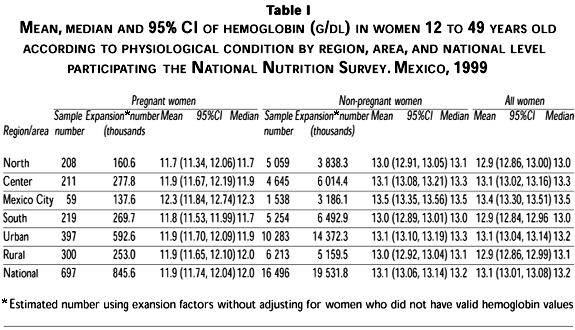
<body><![CDATA[<p><font size="2" face="Verdana">Descriptive data analysis are presented as prevalence    of anemia and mean hemoglobin concentrations with their 95% confidence intervals    (CI). The probability of being anemic was evaluated through a logistic regression    model for complex surveys. The independent variables in the model were those    that have been documented to be associated with anemia: indigenous background,    socioeconomic status, maternal education, employment status and maternal literacy.<SUP>21-26</SUP>    Expansion factors were calculated based on the characteristics of the national    population in 1995. </font></p>     <p><font size="2" face="Verdana"> Regression models for the analysis of potential    predictors of anemia were constructed with data from non-pregnant women only.    </font></p>     <p><font size="2" face="Verdana"> Data entery was done using a Clipper-based program    using formats that included range and contingency validation checks (V. 5.01,    1999; Nantucket<SUP> TM </SUP>Corporation, San Francisco, CA, USA). A descriptive    analysis was run in SPSS for Windows (v. 10, 1999; SPSS Inc, Chicago, IL, USA).    Regression models were adjusted using Stata statistical software (v. 7.0, 2001;    Stata Corp., College Station, TX, USA). </font></p>     <p>&nbsp;</p>     <p><font size="3" face="Verdana"><b>Results </b></font></p>     <p><font size="2" face="Verdana">The final sample for the present analysis was    composed of 17 194 registries of the original NNS-1999 sample due to the exclusion    of 1 119 observations (6.1%), either because they were incomplete or outliers.    The age distribution and the socioeconomic characteristics of the excluded cases    were not different from those of the final sample, either by region, or by urban    and rural distribution. </font></p>     <p><font size="2" face="Verdana"> At the national level, the mean hemoglobin concentration    for pregnant women was 11.9 g/dl (median= 12.0 g/dl) and non pregnant women    was 13.1 g/dl (median=13.2 g/dl). The mean hemoglobin values for urban and rural    pregnant women were identical and were slightly lower in rural areas for non-pregnant    women. Mean hemoglobin values were higher in Mexico City than in other regions    for both pregnant and non-pregnant women. The lowest mean values for pregnant    and non-pregnant women were found in the North and South (<a href="#tab01">Table    I</a>). </font></p>     <p><a name="tab01"></a></p>     <p>&nbsp;</p>     <p align="center"><img src="/img/revistas/spm/v45s4/a06tab01.gif"></p>     ]]></body>
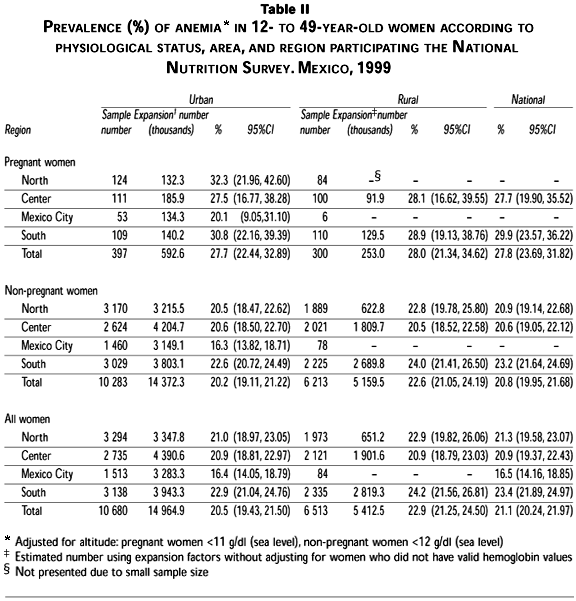
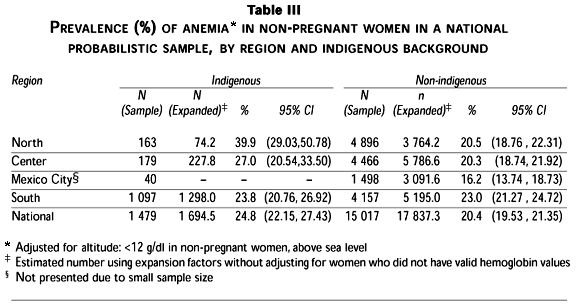
<body><![CDATA[<p>&nbsp;</p>     <p><font size="2" face="Verdana"> The overall prevalence of anemia was 27.8% (95%CI    23.7, 31.8%) for pregnant women and 20.8% (95%CI 19.9, 21.7%) for non-pregnant    women. The prevalence of anemia in pregnant urban women was not different from    that of rural women (27.7 <I>vs</I>. 28.0%). Non-pregnant rural women had a    greater prevalence of anemia than their urban counterparts (22.6 <I>vs</I>.    20.2%). (<a href="#tab02">Table II</a>). </font></p>     <p><a name="tab02"></a></p>     <p>&nbsp;</p>     <p align="center"><img src="/img/revistas/spm/v45s4/a06tab02.gif"></p>     <p>&nbsp;</p>     <p><font size="2" face="Verdana"> Due to small sample sizes, regional prevalences    for rural areas are not presented in Mexico City for either pregnant and non-pregnant    women nor in the north for pregnant women. </font></p>     <p><font size="2" face="Verdana"> In urban and rural non-pregnant women, the highest    prevalence of anemia was found in the South (urban 22.6% and rural 24.0%) and    Mexico City has the lowest prevalence in urban areas. </font></p>     <p><font size="2" face="Verdana"> The overall prevalence of anemia among non-pregnant    women of indigenous ancestry was 24.8% in comparison with 20.4% in non-indigenous    women. For non-pregnant indigenous women, the highest prevalence (39.9%) was    found in the North and the lowest in the South (<a href="#tab03">Table III</a>).    </font></p>     <p><a name="tab03"></a></p>     ]]></body>
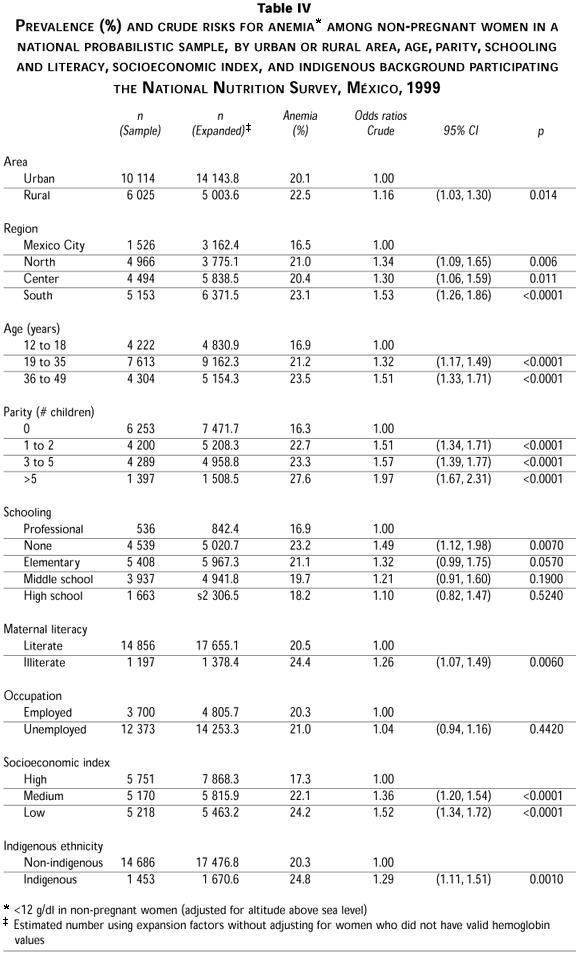
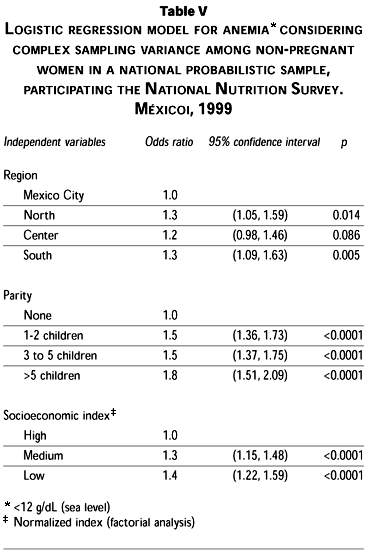
<body><![CDATA[<p>&nbsp;</p>     <p align="center"><img src="/img/revistas/spm/v45s4/a06tab03.gif"></p>     <p>&nbsp;</p>     <p><font size="2" face="Verdana"> The crude odds ratio for anemia was 1.51 for    the older age category (95%CI 1.33, 1.71), 1.49 for women with no schooling    (95%CI 1.12, 1.98), 1.97 for the highest category of parity (95%CI 1.67, 2.31),    1.26 for illiterate mothers (95%CI 1.06, 1.49), 1.52 for low socioeconomic level    (95%CI 1.34, 1.72), and 1.29 for indigenous background (95%CI 1.11, 1.51) (<a href="#tab04">Table    IV</a>). </font></p>     <p><a name="tab04"></a></p>     <p>&nbsp;</p>     <p align="center"><img src="/img/revistas/spm/v45s4/a06tab04.gif"></p>     <p>&nbsp;</p>     <p><font size="2" face="Verdana"> After adjusting for the effect of cluster sampling    and for potential confounders using the logistic regression model, women living    in the South and in the North had a greater risk of anemia than those living    in Mexico City (<I>p</I> = 0.005). Significant risk factors were greater parity    (<I>p</I> &lt;0.0001) and having a medium or low socioeconomic level (<I>p</I>    &lt;0.0001) (<a href="#tab05">Table V</a>). The logistic model was originally    adjusted for indigenous background, maternal education, employment status and    maternal literacy, but none of these variables were statistically significant,    and were therefore removed from the model presented in <a href="#tab05">Table    V</a>. </font></p>     <p><a name="tab05"></a></p>     ]]></body>
<body><![CDATA[<p>&nbsp;</p>     <p align="center"><img src="/img/revistas/spm/v45s4/a06tab05.gif"></p>     <p>&nbsp;</p>     <p><font size="2" face="Verdana"><b>Discussion and conclusions </b></font></p>     <p><font size="2" face="Verdana">Our findings documented that anemia in women    is a serious public health problem in Mexico, affecting about one fifth of non-pregnant    women of reproductive age and over one    fourth of pregnant women. The serious functional consequences of this deficiency    demand the design and implementation of public iron supplementation and food    fortification programs as the most effective strategies to reduce iron-deficiency    anemia. </font></p>     <p><font size="2" face="Verdana"> Data presented here show a persistently high    prevalence of anemia in Mexico among pregnant and non-pregnant    women. Furthermore, based on the 1988 National Nutrition Survey, the prevalence    of anemia increased from 15.4 to 20.8% in women of childbearing age and from    18.2 to 27.8% in pregnant women,<SUP>15</SUP> representing an increment of 35.0    and 52.7% respectively. Several factors may account for the growing prevalence    of anemia. Methodological differences between the two surveys may partially    explain these differences. Hemoglobin was measured on site in the NNS-1999 by    finger-prick capillary testing using a portable photometer, but was not determined    on site in the 1988 survey. Also, venous blood was used in 1988 and capillary    blood in 1999. Therefore, results of the two surveys may not be comparable.    Transportation and storage of the 1988 samples might have influenced hemoglobin    concentration values. Also, hemoglobin concentration in capillary blood may    be more variable than in venous blood because inclusion of extracellular fluid    would decrease the concentration of components present in the red cell fraction<SUP>27</SUP>,    and the amount of extracellular fluid present in finger-prick samples is likely    to be very sensitive to the technician's handling of the patient's finger. </font></p>     <p><font size="2" face="Verdana"> Differences in the prevalence of anemia may    also be explained partly by changes in the dietary patterns of the population.    For instance, based on the economic difficulties experienced in Mexico during    the last ten years, we speculate that recently, diets of a vast section of the    population include lower amounts of animal-based foods. Rivera <I>et al</I><SUP>28</SUP>    found that the purchase of meat and meat-products decreased in the 14 year period    from 1984 to 1998. The lack of public health interventions to prevent and treat    iron deficiency may contribute to the increase in the prevalence of anemia.    It was not until 1998 that nutritional interventions were implemented to decrease    micronutrient deficiencies among poor women in Mexico. Specifically, the Program    for Education, Health and Nutrition (Progresa, now called Oportunidades), which    distributes fortified foods to low-income pregnant and lactating women, as well    as the fortification of wheat and corn flours with iron and other micronutrients    and the distribution by the Ministry of Health of multiple micronutrient supplements    to pregnant women in predominantly indigenous communities. </font></p>     <p><font size="2" face="Verdana"> The highest prevalence of anemia found in pregnant    women should be interpreted cautiously, since it may be due in part to the hemodilution    occurring during the last trimester of pregnancy. The cut-off criteria to diagnose    anemia is lower for pregnant women in order to correct for overdiagnosis; however,    during the first trimester and partially during the second trimester when hemodilution    has little effect on the levels of hemoglobin, overcorrection must occur. We    did not apply specific cut-off points for each trimester of pregnancy, because    we did not have individual information about the length of gestation. </font></p>     <p><font size="2" face="Verdana"> The greatest prevalence of anemia was found    in indigenous women living in rural zones. It is well know that indigenous populations    are the poorest in Mexico and have the lowest availability of social support    resources.<SUP>29</SUP> </font></p>     <p><font size="2" face="Verdana"> It is puzzling that the prevalence of anemia    in the North, considered the most developed area of the country, was comparable    to that found in the South, which is considered the least developed. This phenomenon    was also observed in the 1988 survey and needs further research. </font></p>     ]]></body>
<body><![CDATA[<p><font size="2" face="Verdana"> The prevalence of anemia in Mexico is lower    than that observed in other developing countries where it is approximately 44.0%    in non-pregnant women and 56.0% in pregnant women, and higher than that reported    for developed countries, where it is approximately 12.0% in non-pregnant women    and 18.0% in pregnant women.<SUP>30</SUP> However, other countries with comparable    economic development such as Chile and Costa Rica     have achieved a prevalence similar to that of developed countries.<SUP>30</SUP>    Such an achievement was reached by sustained nutritional interventions, resembling    those that must be undertaken in Mexico in order to reduce the prevalence of    anemia. </font></p>     <p><font size="2" face="Verdana"> This study identified some risk factors associated    with anemia in women such as older age, multiparity,<SUP>31,32</SUP> lower socioeconomic    status, indigenous background and being a resident of rural areas. Most of these    factors are closely related to both poverty and anemia, as has been reported    in other studies.<SUP>14,31-34</SUP> </font></p>     <p><font size="2" face="Verdana"> The increased prevalence of anemia associated    with parity could be due to a progressive depletion of nutritional stores during    pregnancy, that has been documented in women of other developing countries.<SUP>34-36</SUP>    </font></p>     <p><font size="2" face="Verdana"> Additional variables not evaluated in this analysis    should be taken into account, such as dietary factors including intake of foods    with lower iron biodisponibility and cigarette smoking. </font></p>     <p><font size="2" face="Verdana"> This study provides information on the prevalence    of anemia among women of childbearing age in a nationwide representative sample    that included urban and rural areas of the four regions of Mexico. Anemia in    women of childbearing age is a serious public health problem in Mexico, affecting    not only populations living under harsh conditions but also groups with higher    socioeconomic status. Its prevalence has shown increasing trends over the past    10 years, although methodologies differ between surveys and may not be comparable.    The problem should be approached through aggressive interventions targeted at    groups at risk in order to rapidly reduce the prevalence of anemia, thus limiting    its negative short- and long-term effects on other health outcomes. </font></p>     <p><font size="2" face="Verdana"> As mentioned before, several interventions aimed    at reducing micronutrient deficiencies were implemented shortly after the 1999-NNS.    It is therefore expected that anemia prevalence may have been reduced. Some    but not all of these programs are currently being evaluated and it is likely    that the next National Nutrition Survey will be able to assess changes in the    prevalence of anemia in the population after the implementation of these interventions.    In the meanwhile, several strategies may be launched simultaneously, such as    the fortification of foods other than wheat and corn flours and in addition    existing programs should be strengthened. </font></p>     <p><font size="2" face="Verdana"><b>Acknowledgements </b></font></p>     <p><font size="2" face="Verdana">We would like to acknowledge Dra. Teresa Gonz&aacute;lez-Coss&iacute;o    for her comments and suggestions to our manuscript.</font></p>     <p>&nbsp;</p>     <p><font size="3" face="Verdana"><b>References </b></font></p>     ]]></body>
<body><![CDATA[<!-- ref --><p><font size="2" face="Verdana">1. Yip R. Iron fortification: Prevention of iron    deficiency for developing countries. In: Forum on Iron Fortification. Institute    of Food Technologists. Annual Meeting. Atlanta (GA): June 1998. </font>&nbsp;&nbsp;&nbsp;&nbsp;&nbsp;&nbsp;&nbsp;&nbsp;[&#160;<a href="javascript:void(0);" onclick="javascript: window.open('/scielo.php?script=sci_nlinks&ref=9243518&pid=S0036-3634200300100000600001&lng=','','width=640,height=500,resizable=yes,scrollbars=1,menubar=yes,');">Links</a>&#160;]<!-- end-ref --><!-- ref --><p><font size="2" face="Verdana">2. Black AK, Allen LH, Pelto GH, De Mata MP,    Ch&aacute;vez A. Iron, vitamin B-12 and folate status in Mexico: Associated    factors in men and women and during pregnancy and lactation. J Nutr 1994;124:1179-1188.    </font>&nbsp;&nbsp;&nbsp;&nbsp;&nbsp;&nbsp;&nbsp;&nbsp;[&#160;<a href="javascript:void(0);" onclick="javascript: window.open('/scielo.php?script=sci_nlinks&ref=9243519&pid=S0036-3634200300100000600002&lng=','','width=640,height=500,resizable=yes,scrollbars=1,menubar=yes,');">Links</a>&#160;]<!-- end-ref --><!-- ref --><p><font size="2" face="Verdana">3. Freire WB. La anemia por deficiencia de hierro:    estrategias de la OPS/OMS para combatirla. Salud Publica Mex 1998;40:199-205.    </font>&nbsp;&nbsp;&nbsp;&nbsp;&nbsp;&nbsp;&nbsp;&nbsp;[&#160;<a href="javascript:void(0);" onclick="javascript: window.open('/scielo.php?script=sci_nlinks&ref=9243520&pid=S0036-3634200300100000600003&lng=','','width=640,height=500,resizable=yes,scrollbars=1,menubar=yes,');">Links</a>&#160;]<!-- end-ref --><!-- ref --><p><font size="2" face="Verdana">4. Van den Broek NR, Letsky EA. Etiology of anemia    in pregnancy in south Malawi. Am J Clin Nutr 2000;72(Suppl):247S-256S. </font>&nbsp;&nbsp;&nbsp;&nbsp;&nbsp;&nbsp;&nbsp;&nbsp;[&#160;<a href="javascript:void(0);" onclick="javascript: window.open('/scielo.php?script=sci_nlinks&ref=9243521&pid=S0036-3634200300100000600004&lng=','','width=640,height=500,resizable=yes,scrollbars=1,menubar=yes,');">Links</a>&#160;]<!-- end-ref --><!-- ref --><p><font size="2" face="Verdana">5. Bundy DAP, Wong MS, Lewis LL, Horton J. Control    of geohelminths by delivery of targeted chemotherapy through schools. Trans    R Soc Trop Med Hyg 1990;84:115-120. </font>&nbsp;&nbsp;&nbsp;&nbsp;&nbsp;&nbsp;&nbsp;&nbsp;[&#160;<a href="javascript:void(0);" onclick="javascript: window.open('/scielo.php?script=sci_nlinks&ref=9243522&pid=S0036-3634200300100000600005&lng=','','width=640,height=500,resizable=yes,scrollbars=1,menubar=yes,');">Links</a>&#160;]<!-- end-ref --><!-- ref --><p><font size="2" face="Verdana">6. Simmons WK. Control de la deficiencia de hierro    en El Caribe de habla inglesa. Bol Oficina Sanit Panam 1994;117(6):538-546.    </font>&nbsp;&nbsp;&nbsp;&nbsp;&nbsp;&nbsp;&nbsp;&nbsp;[&#160;<a href="javascript:void(0);" onclick="javascript: window.open('/scielo.php?script=sci_nlinks&ref=9243523&pid=S0036-3634200300100000600006&lng=','','width=640,height=500,resizable=yes,scrollbars=1,menubar=yes,');">Links</a>&#160;]<!-- end-ref --><!-- ref --><p><font size="2" face="Verdana">7. Stoltzfus RJ, Dreyfuss ML, Jorgenson T, Chwaya-Hababu    M, Albonico M. Control de la helmintiasis como estrategia para prevenir la deficiencia    de hierro. En: Deficiencia de hierro. Desnutrici&oacute;n oculta en Am&eacute;rica    Latina. CESNI. Centro Asociado de la Facultad de Medicina del Ecuador. 1997:259-278.    </font>&nbsp;&nbsp;&nbsp;&nbsp;&nbsp;&nbsp;&nbsp;&nbsp;[&#160;<a href="javascript:void(0);" onclick="javascript: window.open('/scielo.php?script=sci_nlinks&ref=9243524&pid=S0036-3634200300100000600007&lng=','','width=640,height=500,resizable=yes,scrollbars=1,menubar=yes,');">Links</a>&#160;]<!-- end-ref --><!-- ref --><p><font size="2" face="Verdana">8. Rawlins SC, James O, and Gibbs WN. Current    patterns of uncinariasis and its relationship to iron deficiency anemia. West    Indian Med J 1984;33(4):258-263. </font>&nbsp;&nbsp;&nbsp;&nbsp;&nbsp;&nbsp;&nbsp;&nbsp;[&#160;<a href="javascript:void(0);" onclick="javascript: window.open('/scielo.php?script=sci_nlinks&ref=9243525&pid=S0036-3634200300100000600008&lng=','','width=640,height=500,resizable=yes,scrollbars=1,menubar=yes,');">Links</a>&#160;]<!-- end-ref --><!-- ref --><p><font size="2" face="Verdana">9. International Nutritional Anemia Consultive    Group. Guidelines for the control of maternal nutritional anemia. A report of    the International Nutritional Anemia Consultive Group. Ciudad: INAG, 1999. </font>&nbsp;&nbsp;&nbsp;&nbsp;&nbsp;&nbsp;&nbsp;&nbsp;[&#160;<a href="javascript:void(0);" onclick="javascript: window.open('/scielo.php?script=sci_nlinks&ref=9243526&pid=S0036-3634200300100000600009&lng=','','width=640,height=500,resizable=yes,scrollbars=1,menubar=yes,');">Links</a>&#160;]<!-- end-ref --><!-- ref --><p><font size="2" face="Verdana">10. Brabin BJ, Hakimi M, Pelletier D. An analysis    of anemia and pregnancy-related maternal mortality. J Nutr 2001;131(No. 2S-II):604S-615S.    </font>&nbsp;&nbsp;&nbsp;&nbsp;&nbsp;&nbsp;&nbsp;&nbsp;[&#160;<a href="javascript:void(0);" onclick="javascript: window.open('/scielo.php?script=sci_nlinks&ref=9243527&pid=S0036-3634200300100000600010&lng=','','width=640,height=500,resizable=yes,scrollbars=1,menubar=yes,');">Links</a>&#160;]<!-- end-ref --><!-- ref --><p><font size="2" face="Verdana">11. Hadary CJ, Haas JD. Hemoglobin correction    factors for estimating the prevalence of iron deficiency anemia in pregnant    women residing at high altitudes in Bolivia. Pan Am J Public Health 1999;6(6):392-399.    </font>&nbsp;&nbsp;&nbsp;&nbsp;&nbsp;&nbsp;&nbsp;&nbsp;[&#160;<a href="javascript:void(0);" onclick="javascript: window.open('/scielo.php?script=sci_nlinks&ref=9243528&pid=S0036-3634200300100000600011&lng=','','width=640,height=500,resizable=yes,scrollbars=1,menubar=yes,');">Links</a>&#160;]<!-- end-ref --><!-- ref --><p><font size="2" face="Verdana">12. Iyengar GV, Nair PP. Global outlook on nutrition    and the environment: Meeting the challenges of the next millennium. Sci Total    Environ 2000;249(1-3):331-346. </font>&nbsp;&nbsp;&nbsp;&nbsp;&nbsp;&nbsp;&nbsp;&nbsp;[&#160;<a href="javascript:void(0);" onclick="javascript: window.open('/scielo.php?script=sci_nlinks&ref=9243529&pid=S0036-3634200300100000600012&lng=','','width=640,height=500,resizable=yes,scrollbars=1,menubar=yes,');">Links</a>&#160;]<!-- end-ref --><!-- ref --><p><font size="2" face="Verdana">13. O'Donell A, Chevallier MC. Nutrici&oacute;n    en el ciclo reproductivo: embarazo y lactancia. Bolet&iacute;n CESNI, Buenos    Aires, Argentina: agosto 1999:1-20. </font>&nbsp;&nbsp;&nbsp;&nbsp;&nbsp;&nbsp;&nbsp;&nbsp;[&#160;<a href="javascript:void(0);" onclick="javascript: window.open('/scielo.php?script=sci_nlinks&ref=9243530&pid=S0036-3634200300100000600013&lng=','','width=640,height=500,resizable=yes,scrollbars=1,menubar=yes,');">Links</a>&#160;]<!-- end-ref --><!-- ref --><p><font size="2" face="Verdana">14. Rush D. Nutrition and maternal mortality    in developing world. Am J Clin Nutr 2000;72 (Suppl):212S-240S. </font>&nbsp;&nbsp;&nbsp;&nbsp;&nbsp;&nbsp;&nbsp;&nbsp;[&#160;<a href="javascript:void(0);" onclick="javascript: window.open('/scielo.php?script=sci_nlinks&ref=9243531&pid=S0036-3634200300100000600014&lng=','','width=640,height=500,resizable=yes,scrollbars=1,menubar=yes,');">Links</a>&#160;]<!-- end-ref --><!-- ref --><p><font size="2" face="Verdana">15. Mart&iacute;nez H, Gonz&aacute;lez-Coss&iacute;o    T, Flores M, Rivera DJ, Lezana MA, Sep&uacute;lveda AJ. Anemia en edad reproductiva.    Resultados de una encuesta probabil&iacute;stica nacional. Salud Publica Mex    1995;37:108-119. </font>&nbsp;&nbsp;&nbsp;&nbsp;&nbsp;&nbsp;&nbsp;&nbsp;[&#160;<a href="javascript:void(0);" onclick="javascript: window.open('/scielo.php?script=sci_nlinks&ref=9243532&pid=S0036-3634200300100000600015&lng=','','width=640,height=500,resizable=yes,scrollbars=1,menubar=yes,');">Links</a>&#160;]<!-- end-ref --><!-- ref --><p><font size="2" face="Verdana">16. Rivera-Dommarco J, Shamah Levy T, Villalpando-Hern&aacute;ndez    S, Gonz&aacute;lez-Coss&iacute;o T, Hern&aacute;ndez-Prado B, Sep&uacute;lveda    J, ed. Encuesta Nacional de Nutrici&oacute;n 1999. Estado Nutricio de Ni&ntilde;os    y Mujeres en M&eacute;xico. Cuernavaca, Morelos, M&eacute;xico: Instituto Nacional    de Salud P&uacute;blica; 2001. </font>&nbsp;&nbsp;&nbsp;&nbsp;&nbsp;&nbsp;&nbsp;&nbsp;[&#160;<a href="javascript:void(0);" onclick="javascript: window.open('/scielo.php?script=sci_nlinks&ref=9243533&pid=S0036-3634200300100000600016&lng=','','width=640,height=500,resizable=yes,scrollbars=1,menubar=yes,');">Links</a>&#160;]<!-- end-ref --><!-- ref --><p><font size="2" face="Verdana">17. World Health Organization. The prevalence    of anemia in women: A tabulation of available information. 2nd edition. Geneva:    WHO, 1992. </font>&nbsp;&nbsp;&nbsp;&nbsp;&nbsp;&nbsp;&nbsp;&nbsp;[&#160;<a href="javascript:void(0);" onclick="javascript: window.open('/scielo.php?script=sci_nlinks&ref=9243534&pid=S0036-3634200300100000600017&lng=','','width=640,height=500,resizable=yes,scrollbars=1,menubar=yes,');">Links</a>&#160;]<!-- end-ref --><!-- ref --><p><font size="2" face="Verdana">18. Cohen JH, Hass JD. Hemoglobin correction    factors for estimating the prevalence of iron deficiency anemia in pregnant    women residing at high altitudes in Bolivia. Pan Am J Public Health 1999;6(6):392-399.    </font>&nbsp;&nbsp;&nbsp;&nbsp;&nbsp;&nbsp;&nbsp;&nbsp;[&#160;<a href="javascript:void(0);" onclick="javascript: window.open('/scielo.php?script=sci_nlinks&ref=9243535&pid=S0036-3634200300100000600018&lng=','','width=640,height=500,resizable=yes,scrollbars=1,menubar=yes,');">Links</a>&#160;]<!-- end-ref --><!-- ref --><p><font size="2" face="Verdana">19. Instituto Nacional de Estad&iacute;stica,    Geograf&iacute;a e Inform&aacute;tica. Conteo de poblaci&oacute;n y vivienda    1995: Resultados definitivos: Tabulados B&aacute;sicos. M&eacute;xico, DF: INEGI,    1996. </font>&nbsp;&nbsp;&nbsp;&nbsp;&nbsp;&nbsp;&nbsp;&nbsp;[&#160;<a href="javascript:void(0);" onclick="javascript: window.open('/scielo.php?script=sci_nlinks&ref=9243536&pid=S0036-3634200300100000600019&lng=','','width=640,height=500,resizable=yes,scrollbars=1,menubar=yes,');">Links</a>&#160;]<!-- end-ref --><!-- ref --><p><font size="2" face="Verdana">20. Johns WL, Lewis SM. Tamizaje de la anemia    en atenci&oacute;n primaria de salud mediante hemoglobinometr&iacute;a en una    comunidad tropical. Bol Oficina Sanit Panam 1992;112(3):214-221. </font>&nbsp;&nbsp;&nbsp;&nbsp;&nbsp;&nbsp;&nbsp;&nbsp;[&#160;<a href="javascript:void(0);" onclick="javascript: window.open('/scielo.php?script=sci_nlinks&ref=9243537&pid=S0036-3634200300100000600020&lng=','','width=640,height=500,resizable=yes,scrollbars=1,menubar=yes,');">Links</a>&#160;]<!-- end-ref --><!-- ref --><p><font size="2" face="Verdana"> 21. Alok B, Howarth EB, Nevin SS. Dietary intakes    and socioeconomic factors are associated with the hemoglobin concentration of    Bangladeshi women. J Nutr 2001;131:758-764. </font>&nbsp;&nbsp;&nbsp;&nbsp;&nbsp;&nbsp;&nbsp;&nbsp;[&#160;<a href="javascript:void(0);" onclick="javascript: window.open('/scielo.php?script=sci_nlinks&ref=9243538&pid=S0036-3634200300100000600021&lng=','','width=640,height=500,resizable=yes,scrollbars=1,menubar=yes,');">Links</a>&#160;]<!-- end-ref --><!-- ref --><p><font size="2" face="Verdana">22. Idrus J, Endang L, Achadi, Galloway R, Dyanto    A, Zazri A <I>et al.</I> Reaching young Indonesian women through marriage registries:    An innovative approach for anemia control J Nutr 2000;130:456. </font>&nbsp;&nbsp;&nbsp;&nbsp;&nbsp;&nbsp;&nbsp;&nbsp;[&#160;<a href="javascript:void(0);" onclick="javascript: window.open('/scielo.php?script=sci_nlinks&ref=9243539&pid=S0036-3634200300100000600022&lng=','','width=640,height=500,resizable=yes,scrollbars=1,menubar=yes,');">Links</a>&#160;]<!-- end-ref --><!-- ref --><p><font size="2" face="Verdana">23. Suitor CJW, Gardner J, Willett WC. A comparison    of food frequency and diet recall methods in studies of nutrient intake of low-income    women. J Am Diet Assoc 1989;89:1786-1794. </font>&nbsp;&nbsp;&nbsp;&nbsp;&nbsp;&nbsp;&nbsp;&nbsp;[&#160;<a href="javascript:void(0);" onclick="javascript: window.open('/scielo.php?script=sci_nlinks&ref=9243540&pid=S0036-3634200300100000600023&lng=','','width=640,height=500,resizable=yes,scrollbars=1,menubar=yes,');">Links</a>&#160;]<!-- end-ref --><!-- ref --><p><font size="2" face="Verdana">24.Johnson-Spear MA, Yip R. Hemoglobin difference    between black and white women with comparable iron status: Justification for    race-specific anemia criteria. Am J Clin Nutr 1994;60:117-121. </font>&nbsp;&nbsp;&nbsp;&nbsp;&nbsp;&nbsp;&nbsp;&nbsp;[&#160;<a href="javascript:void(0);" onclick="javascript: window.open('/scielo.php?script=sci_nlinks&ref=9243541&pid=S0036-3634200300100000600024&lng=','','width=640,height=500,resizable=yes,scrollbars=1,menubar=yes,');">Links</a>&#160;]<!-- end-ref --><!-- ref --><p><font size="2" face="Verdana">25.Jackson RT. Separate Hb standards for blacks    and whites: A critical review of the case for separate and unequal Hb standards.    Med Hypotheses 1990;32:181-189. </font>&nbsp;&nbsp;&nbsp;&nbsp;&nbsp;&nbsp;&nbsp;&nbsp;[&#160;<a href="javascript:void(0);" onclick="javascript: window.open('/scielo.php?script=sci_nlinks&ref=9243542&pid=S0036-3634200300100000600025&lng=','','width=640,height=500,resizable=yes,scrollbars=1,menubar=yes,');">Links</a>&#160;]<!-- end-ref --><!-- ref --><p><font size="2" face="Verdana">26. Pehrsson PR, Moser-Veillon PB, Sims LS, Suitor    CW, Russek-Cohen E. Postpartum iron status in nonlactating participants and    nonparticipants in the Special Supplemental Nutrition Program for Women, Infants,    and Children. Am J Clin Nutr 2001;73:86-92. </font>&nbsp;&nbsp;&nbsp;&nbsp;&nbsp;&nbsp;&nbsp;&nbsp;[&#160;<a href="javascript:void(0);" onclick="javascript: window.open('/scielo.php?script=sci_nlinks&ref=9243543&pid=S0036-3634200300100000600026&lng=','','width=640,height=500,resizable=yes,scrollbars=1,menubar=yes,');">Links</a>&#160;]<!-- end-ref --><!-- ref --><p><font size="2" face="Verdana">27. Morris SS, Ruel MT, Cohen RJ, Dewey KG, De    la Briere B, Hassan MN. Precision, accuracy, and reliability of hemoglobin assessment    with use of capillary blood. Am J Clin Nutr 1999;69:1243-1248. </font>&nbsp;&nbsp;&nbsp;&nbsp;&nbsp;&nbsp;&nbsp;&nbsp;[&#160;<a href="javascript:void(0);" onclick="javascript: window.open('/scielo.php?script=sci_nlinks&ref=9243544&pid=S0036-3634200300100000600027&lng=','','width=640,height=500,resizable=yes,scrollbars=1,menubar=yes,');">Links</a>&#160;]<!-- end-ref --><!-- ref --><p><font size="2" face="Verdana">28. Rivera J, Barquera S, Campirano F, Campos    I, Safdie M, Tovar V. Epidemiological and nutritional transition in Mexico:    Rapid increase of non-communicable chronic diseases and obesity. Public Health    Nutr 2002;5(1)113-122. </font>&nbsp;&nbsp;&nbsp;&nbsp;&nbsp;&nbsp;&nbsp;&nbsp;[&#160;<a href="javascript:void(0);" onclick="javascript: window.open('/scielo.php?script=sci_nlinks&ref=9243545&pid=S0036-3634200300100000600028&lng=','','width=640,height=500,resizable=yes,scrollbars=1,menubar=yes,');">Links</a>&#160;]<!-- end-ref --><!-- ref --><p><font size="2" face="Verdana">29. Rivera JA, Monterrubio EA, Gonz&aacute;lez-Coss&iacute;o    T, Garc&iacute;a-Feregrino R, Garc&iacute;a-Guerra A, Sep&uacute;lveda-Amor    J. Nutritional status of indigenous children younger than five years of age    in Mexico: Results of a National Probabilistic Survey Salud Publica Mex 2003;45    suppl 4: s466-S476. </font>&nbsp;&nbsp;&nbsp;&nbsp;&nbsp;&nbsp;&nbsp;&nbsp;[&#160;<a href="javascript:void(0);" onclick="javascript: window.open('/scielo.php?script=sci_nlinks&ref=9243546&pid=S0036-3634200300100000600029&lng=','','width=640,height=500,resizable=yes,scrollbars=1,menubar=yes,');">Links</a>&#160;]<!-- end-ref --><!-- ref --><p><font size="2" face="Verdana">30. United Nations Administrative Committee on    Coordination Sub-Committee on Nutrition (ACC/SCN), in collaboration with International    Food Policy Research Institute. Geneva: ACC/SCN, 2000. The world nutrition situation.    Nutrition throughout the life cycle. </font>&nbsp;&nbsp;&nbsp;&nbsp;&nbsp;&nbsp;&nbsp;&nbsp;[&#160;<a href="javascript:void(0);" onclick="javascript: window.open('/scielo.php?script=sci_nlinks&ref=9243547&pid=S0036-3634200300100000600030&lng=','','width=640,height=500,resizable=yes,scrollbars=1,menubar=yes,');">Links</a>&#160;]<!-- end-ref --><!-- ref --><p><font size="2" face="Verdana">31. Frith-Terhune, AL, Cogswell ME, Kettel-Khan    L, Will JC, Ramakrishnan U. Iron deficiency anemia: Higher prevalence in Mexican    American than in non-Hispanic white females in the third National Health and    Nutrition Examination Survey, 1988-1994. Am J Clin Nutr 2000;72:963-968. </font>&nbsp;&nbsp;&nbsp;&nbsp;&nbsp;&nbsp;&nbsp;&nbsp;[&#160;<a href="javascript:void(0);" onclick="javascript: window.open('/scielo.php?script=sci_nlinks&ref=9243548&pid=S0036-3634200300100000600031&lng=','','width=640,height=500,resizable=yes,scrollbars=1,menubar=yes,');">Links</a>&#160;]<!-- end-ref --><!-- ref --><p><font size="2" face="Verdana">32. Zavaleta N, Caulfield LE, Garc&iacute;a T.    Changes in iron status during pregnancy in Peruvian women receiving prenatal    iron and folic acid supplements with or without zinc. Am J Clin Nutr, 2000;71(4):956-961.    </font>&nbsp;&nbsp;&nbsp;&nbsp;&nbsp;&nbsp;&nbsp;&nbsp;[&#160;<a href="javascript:void(0);" onclick="javascript: window.open('/scielo.php?script=sci_nlinks&ref=9243549&pid=S0036-3634200300100000600032&lng=','','width=640,height=500,resizable=yes,scrollbars=1,menubar=yes,');">Links</a>&#160;]<!-- end-ref --><!-- ref --><p><font size="2" face="Verdana">33. Becerra C, Gonz&aacute;lez GF, Villena A,    De la Cruz D, Flori&aacute;n A. Prevalencia de anemia en gestantes. Hospital    Regional de Pucallpa, Per&uacute;. Rev Panam Salud Publica 1998;3(5):285-291.    </font>&nbsp;&nbsp;&nbsp;&nbsp;&nbsp;&nbsp;&nbsp;&nbsp;[&#160;<a href="javascript:void(0);" onclick="javascript: window.open('/scielo.php?script=sci_nlinks&ref=9243550&pid=S0036-3634200300100000600033&lng=','','width=640,height=500,resizable=yes,scrollbars=1,menubar=yes,');">Links</a>&#160;]<!-- end-ref --><!-- ref --><p><font size="2" face="Verdana">34. Diallo MS, Diallo TS, Diallo FB, Diallo Y,    Camara AY, Onivogui G <I>et al</I>. Anemia and pregnancy: Epidemiologic, clinical    and prognostic study at the university clinic of the Ignace Deen Hospital, Conakry    (Guin&eacute;e). Rev Fr Gynecol Obstet 1995;90:138-141. </font>&nbsp;&nbsp;&nbsp;&nbsp;&nbsp;&nbsp;&nbsp;&nbsp;[&#160;<a href="javascript:void(0);" onclick="javascript: window.open('/scielo.php?script=sci_nlinks&ref=9243551&pid=S0036-3634200300100000600034&lng=','','width=640,height=500,resizable=yes,scrollbars=1,menubar=yes,');">Links</a>&#160;]<!-- end-ref --><!-- ref --><p><font size="2" face="Verdana">35.Villar J, Rivera J. Nutritional supplementation    during two consecutive pregnancies and the interim lactation period: Effect    on birth weight. Pediatrics 1988;81:51-57. </font>&nbsp;&nbsp;&nbsp;&nbsp;&nbsp;&nbsp;&nbsp;&nbsp;[&#160;<a href="javascript:void(0);" onclick="javascript: window.open('/scielo.php?script=sci_nlinks&ref=9243552&pid=S0036-3634200300100000600035&lng=','','width=640,height=500,resizable=yes,scrollbars=1,menubar=yes,');">Links</a>&#160;]<!-- end-ref --><!-- ref --><p><font size="2" face="Verdana">36. Brunvand L, Henriksen C, Larsson M, Sandberg    AS. Iron deficiency among pregnant Pakistanis in Norway and the content of phytic    acid in their diet. Acta Obstet Gynecol Scand 1995;74: 520-525.</font>&nbsp;&nbsp;&nbsp;&nbsp;&nbsp;&nbsp;&nbsp;&nbsp;[&#160;<a href="javascript:void(0);" onclick="javascript: window.open('/scielo.php?script=sci_nlinks&ref=9243553&pid=S0036-3634200300100000600036&lng=','','width=640,height=500,resizable=yes,scrollbars=1,menubar=yes,');">Links</a>&#160;]<!-- end-ref --><p>&nbsp;</p>     <p>&nbsp;</p>     <p><font size="2" face="Verdana">Address reprint requests to    <br>   Mtra. Teresa Shamah Levy    ]]></body>
<body><![CDATA[<br>   Departamento de Vigilancia de la Nutrici&oacute;n, Instituto Nacional de Salud    P&uacute;blica    <br>   Avenida Universidad 655    <br>   colonia Santa Mar&iacute;a Ahuacatitl&aacute;n     <br>   62508 Cuernavaca, Morelos, M&eacute;xico    <br>   E-mail: <a href="mailto:tshamah@correo.insp.mx">tshamah@correo.insp.mx</a></font></p>     <p><font size="2" face="Verdana"><b>Received on:</b> August 20, 2002     <br>   <b>Accepted on:</b> October 14, 2003</font></p>     <p>&nbsp;</p>     <p>&nbsp;</p>     <p><font size="2" face="Verdana"><a name="nt01"></a><a href="#tx01">*</a> North    (Baja California, Baja California Sur, Coahuila, Chihuahua, Durango, Nuevo Le&oacute;n,    Sonora and Tamaulipas), Center (Aguascalientes, Colima, Guanajuato, Jalisco,    M&eacute;xico (excludes urbanised counties and localities adjacent to Mexico    City), Michoac&aacute;n, Morelos, Nayarit, Quer&eacute;taro, San Luis Potos&iacute;,    Sinaloa, Zacatecas), Mexico City (includes Federal District and urbanised counties    from the state of M&eacute;xico). South (Campeche, Chiapas, Guerrero, Hidalgo,    Oaxaca, Puebla, Quintana Roo, Tabasco, Tlaxcala, Veracruz, Yucat&aacute;n)</font></p>     ]]></body>
<body><![CDATA[ ]]></body><back>
<ref-list>
<ref id="B1">
<label>1</label><nlm-citation citation-type="confpro">
<person-group person-group-type="author">
<name>
<surname><![CDATA[Yip]]></surname>
<given-names><![CDATA[R]]></given-names>
</name>
</person-group>
<article-title xml:lang="en"><![CDATA[Iron fortification: Prevention of iron deficiency for developing countries]]></article-title>
<source><![CDATA[]]></source>
<year></year>
<conf-name><![CDATA[ Forum on Iron Fortification]]></conf-name>
<conf-date>June 1998</conf-date>
<conf-loc>Atlanta GA</conf-loc>
</nlm-citation>
</ref>
<ref id="B2">
<label>2</label><nlm-citation citation-type="journal">
<person-group person-group-type="author">
<name>
<surname><![CDATA[Black]]></surname>
<given-names><![CDATA[AK]]></given-names>
</name>
<name>
<surname><![CDATA[Allen]]></surname>
<given-names><![CDATA[LH]]></given-names>
</name>
<name>
<surname><![CDATA[Pelto]]></surname>
<given-names><![CDATA[GH]]></given-names>
</name>
<name>
<surname><![CDATA[De Mata]]></surname>
<given-names><![CDATA[MP]]></given-names>
</name>
<name>
<surname><![CDATA[Chávez]]></surname>
<given-names><![CDATA[A]]></given-names>
</name>
</person-group>
<article-title xml:lang="en"><![CDATA[Iron, vitamin B-12 and folate status in Mexico: Associated factors in men and women and during pregnancy and lactation]]></article-title>
<source><![CDATA[J Nutr]]></source>
<year>1994</year>
<volume>124</volume>
<page-range>1179-1188</page-range></nlm-citation>
</ref>
<ref id="B3">
<label>3</label><nlm-citation citation-type="journal">
<person-group person-group-type="author">
<name>
<surname><![CDATA[Freire]]></surname>
<given-names><![CDATA[WB]]></given-names>
</name>
</person-group>
<article-title xml:lang="es"><![CDATA[La anemia por deficiencia de hierro: estrategias de la OPS/OMS para combatirla]]></article-title>
<source><![CDATA[Salud Publica Mex]]></source>
<year>1998</year>
<volume>40</volume>
<page-range>199-205</page-range></nlm-citation>
</ref>
<ref id="B4">
<label>4</label><nlm-citation citation-type="journal">
<person-group person-group-type="author">
<name>
<surname><![CDATA[Van]]></surname>
<given-names><![CDATA[den Broek NR]]></given-names>
</name>
<name>
<surname><![CDATA[Letsky]]></surname>
<given-names><![CDATA[EA]]></given-names>
</name>
</person-group>
<article-title xml:lang="en"><![CDATA[Etiology of anemia in pregnancy in south Malawi]]></article-title>
<source><![CDATA[Am J Clin Nutr]]></source>
<year>2000</year>
<numero>^s72</numero>
<issue>^s72</issue>
<supplement>72</supplement>
<page-range>247S-256S</page-range></nlm-citation>
</ref>
<ref id="B5">
<label>5</label><nlm-citation citation-type="journal">
<person-group person-group-type="author">
<name>
<surname><![CDATA[Bundy]]></surname>
<given-names><![CDATA[DAP]]></given-names>
</name>
<name>
<surname><![CDATA[Wong]]></surname>
<given-names><![CDATA[MS]]></given-names>
</name>
<name>
<surname><![CDATA[Lewis]]></surname>
<given-names><![CDATA[LL]]></given-names>
</name>
<name>
<surname><![CDATA[Horton]]></surname>
<given-names><![CDATA[J]]></given-names>
</name>
</person-group>
<article-title xml:lang="en"><![CDATA[Control of geohelminths by delivery of targeted chemotherapy through schools]]></article-title>
<source><![CDATA[Trans R Soc Trop Med Hyg]]></source>
<year>1990</year>
<volume>84</volume>
<page-range>115-120</page-range></nlm-citation>
</ref>
<ref id="B6">
<label>6</label><nlm-citation citation-type="journal">
<person-group person-group-type="author">
<name>
<surname><![CDATA[Simmons]]></surname>
<given-names><![CDATA[WK]]></given-names>
</name>
</person-group>
<article-title xml:lang="es"><![CDATA[Control de la deficiencia de hierro en El Caribe de habla inglesa]]></article-title>
<source><![CDATA[Bol Oficina Sanit Panam]]></source>
<year>1994</year>
<volume>117</volume>
<numero>6</numero>
<issue>6</issue>
<page-range>538-546</page-range></nlm-citation>
</ref>
<ref id="B7">
<label>7</label><nlm-citation citation-type="book">
<person-group person-group-type="author">
<name>
<surname><![CDATA[Stoltzfus]]></surname>
<given-names><![CDATA[RJ]]></given-names>
</name>
<name>
<surname><![CDATA[Dreyfuss]]></surname>
<given-names><![CDATA[ML]]></given-names>
</name>
<name>
<surname><![CDATA[Jorgenson]]></surname>
<given-names><![CDATA[T]]></given-names>
</name>
<name>
<surname><![CDATA[Chwaya-Hababu]]></surname>
<given-names><![CDATA[M]]></given-names>
</name>
<name>
<surname><![CDATA[Albonico]]></surname>
<given-names><![CDATA[M]]></given-names>
</name>
</person-group>
<source><![CDATA[Control de la helmintiasis como estrategia para prevenir la deficiencia de hierro]]></source>
<year>1997</year>
<page-range>259-278</page-range><publisher-name><![CDATA[Centro Asociado de la Facultad de Medicina del Ecuador]]></publisher-name>
</nlm-citation>
</ref>
<ref id="B8">
<label>8</label><nlm-citation citation-type="journal">
<person-group person-group-type="author">
<name>
<surname><![CDATA[Rawlins]]></surname>
<given-names><![CDATA[SC]]></given-names>
</name>
<name>
<surname><![CDATA[James]]></surname>
<given-names><![CDATA[O]]></given-names>
</name>
<name>
<surname><![CDATA[Gibbs]]></surname>
<given-names><![CDATA[WN]]></given-names>
</name>
</person-group>
<article-title xml:lang="en"><![CDATA[Current patterns of uncinariasis and its relationship to iron deficiency anemia]]></article-title>
<source><![CDATA[West Indian Med J]]></source>
<year>1984</year>
<volume>33</volume>
<numero>4</numero>
<issue>4</issue>
<page-range>258-263</page-range></nlm-citation>
</ref>
<ref id="B9">
<label>9</label><nlm-citation citation-type="book">
<collab>International Nutritional Anemia Consultive Group</collab>
<source><![CDATA[Guidelines for the control of maternal nutritional anemia]]></source>
<year>1999</year>
<publisher-loc><![CDATA[Ciudad ]]></publisher-loc>
<publisher-name><![CDATA[INAG]]></publisher-name>
</nlm-citation>
</ref>
<ref id="B10">
<label>10</label><nlm-citation citation-type="journal">
<person-group person-group-type="author">
<name>
<surname><![CDATA[Brabin]]></surname>
<given-names><![CDATA[BJ]]></given-names>
</name>
<name>
<surname><![CDATA[Hakimi]]></surname>
<given-names><![CDATA[M]]></given-names>
</name>
<name>
<surname><![CDATA[Pelletier]]></surname>
<given-names><![CDATA[D]]></given-names>
</name>
</person-group>
<article-title xml:lang="en"><![CDATA[An analysis of anemia and pregnancy-related maternal mortality]]></article-title>
<source><![CDATA[J Nutr]]></source>
<year>2001</year>
<numero>131</numero><numero>2S-II</numero>
<issue>131</issue><issue>2S-II</issue>
<page-range>604S-615S</page-range></nlm-citation>
</ref>
<ref id="B11">
<label>11</label><nlm-citation citation-type="journal">
<person-group person-group-type="author">
<name>
<surname><![CDATA[Hadary]]></surname>
<given-names><![CDATA[CJ]]></given-names>
</name>
<name>
<surname><![CDATA[Haas]]></surname>
<given-names><![CDATA[JD]]></given-names>
</name>
</person-group>
<article-title xml:lang="en"><![CDATA[Hemoglobin correction factors for estimating the prevalence of iron deficiency anemia in pregnant women residing at high altitudes in Bolivia]]></article-title>
<source><![CDATA[Pan Am J Public Health]]></source>
<year>1999</year>
<volume>6(6)</volume>
<page-range>392-399</page-range></nlm-citation>
</ref>
<ref id="B12">
<label>12</label><nlm-citation citation-type="journal">
<person-group person-group-type="author">
<name>
<surname><![CDATA[Iyengar]]></surname>
<given-names><![CDATA[GV]]></given-names>
</name>
<name>
<surname><![CDATA[Nair]]></surname>
<given-names><![CDATA[PP]]></given-names>
</name>
</person-group>
<article-title xml:lang="en"><![CDATA[Global outlook on nutrition and the environment: Meeting the challenges of the next millennium]]></article-title>
<source><![CDATA[Sci Total Environ]]></source>
<year>2000</year>
<volume>249</volume>
<numero>1</numero><numero>3</numero>
<issue>1</issue><issue>3</issue>
<page-range>331-346</page-range></nlm-citation>
</ref>
<ref id="B13">
<label>13</label><nlm-citation citation-type="">
<person-group person-group-type="author">
<name>
<surname><![CDATA[O'Donell]]></surname>
<given-names><![CDATA[A]]></given-names>
</name>
<name>
<surname><![CDATA[Chevallier]]></surname>
<given-names><![CDATA[MC]]></given-names>
</name>
</person-group>
<source><![CDATA[Nutrición en el ciclo reproductivo: embarazo y lactancia]]></source>
<year>agos</year>
<month>to</month>
<day> 1</day>
<page-range>1-20</page-range><publisher-loc><![CDATA[Buenos Aires ]]></publisher-loc>
</nlm-citation>
</ref>
<ref id="B14">
<label>14</label><nlm-citation citation-type="journal">
<person-group person-group-type="author">
<name>
<surname><![CDATA[Rush]]></surname>
<given-names><![CDATA[D]]></given-names>
</name>
</person-group>
<article-title xml:lang="en"><![CDATA[Nutrition and maternal mortality in developing world]]></article-title>
<source><![CDATA[Am J Clin Nutr]]></source>
<year>2000</year>
<numero>^s72</numero>
<issue>^s72</issue>
<supplement>72</supplement>
<page-range>212S-240S</page-range></nlm-citation>
</ref>
<ref id="B15">
<label>15</label><nlm-citation citation-type="journal">
<person-group person-group-type="author">
<name>
<surname><![CDATA[Martínez]]></surname>
<given-names><![CDATA[H]]></given-names>
</name>
<name>
<surname><![CDATA[González-Cossío]]></surname>
<given-names><![CDATA[T]]></given-names>
</name>
<name>
<surname><![CDATA[Flores]]></surname>
<given-names><![CDATA[M]]></given-names>
</name>
<name>
<surname><![CDATA[Rivera]]></surname>
<given-names><![CDATA[DJ]]></given-names>
</name>
<name>
<surname><![CDATA[Lezana]]></surname>
<given-names><![CDATA[MA]]></given-names>
</name>
<name>
<surname><![CDATA[Sepúlveda]]></surname>
<given-names><![CDATA[AJ.]]></given-names>
</name>
</person-group>
<article-title xml:lang="es"><![CDATA[Resultados de una encuesta probabilística nacional]]></article-title>
<source><![CDATA[Salud Publica Mex]]></source>
<year>1995</year>
<volume>37</volume>
<page-range>108-119</page-range></nlm-citation>
</ref>
<ref id="B16">
<label>16</label><nlm-citation citation-type="book">
<person-group person-group-type="author">
<name>
<surname><![CDATA[Rivera-Dommarco]]></surname>
<given-names><![CDATA[J]]></given-names>
</name>
<name>
<surname><![CDATA[Shamah Levy]]></surname>
<given-names><![CDATA[T]]></given-names>
</name>
<name>
<surname><![CDATA[Villalpando-Hernández]]></surname>
<given-names><![CDATA[S]]></given-names>
</name>
<name>
<surname><![CDATA[González-Cossío]]></surname>
<given-names><![CDATA[T]]></given-names>
</name>
<name>
<surname><![CDATA[Hernández-Prado]]></surname>
<given-names><![CDATA[B]]></given-names>
</name>
<name>
<surname><![CDATA[Sepúlveda]]></surname>
<given-names><![CDATA[J]]></given-names>
</name>
</person-group>
<source><![CDATA[Encuesta Nacional de Nutrición 1999: Estado Nutricio de Niños y Mujeres en México]]></source>
<year>2001</year>
<publisher-loc><![CDATA[Cuernavaca^eMorelos Morelos]]></publisher-loc>
<publisher-name><![CDATA[Instituto Nacional de Salud Pública]]></publisher-name>
</nlm-citation>
</ref>
<ref id="B17">
<label>17</label><nlm-citation citation-type="book">
<collab>World Health Organization</collab>
<source><![CDATA[The prevalence of anemia in women: A tabulation of available information]]></source>
<year>1992</year>
<edition>2</edition>
<publisher-loc><![CDATA[Geneva ]]></publisher-loc>
<publisher-name><![CDATA[WHO]]></publisher-name>
</nlm-citation>
</ref>
<ref id="B18">
<label>18</label><nlm-citation citation-type="journal">
<person-group person-group-type="author">
<name>
<surname><![CDATA[Cohen]]></surname>
<given-names><![CDATA[JH]]></given-names>
</name>
<name>
<surname><![CDATA[Hass]]></surname>
<given-names><![CDATA[JD]]></given-names>
</name>
</person-group>
<article-title xml:lang="en"><![CDATA[Hemoglobin correction factors for estimating the prevalence of iron deficiency anemia in pregnant women residing at high altitudes in Bolivia]]></article-title>
<source><![CDATA[Pan Am J Public Health]]></source>
<year>1999</year>
<volume>6</volume>
<numero>6</numero>
<issue>6</issue>
<page-range>392-399</page-range></nlm-citation>
</ref>
<ref id="B19">
<label>19</label><nlm-citation citation-type="book">
<collab>Instituto Nacional de Estadística, Geografía e Informática</collab>
<source><![CDATA[Conteo de población y vivienda 1995: Resultados definitivos: Tabulados Básicos]]></source>
<year>1996</year>
<publisher-loc><![CDATA[México^eDF DF]]></publisher-loc>
<publisher-name><![CDATA[INEGI]]></publisher-name>
</nlm-citation>
</ref>
<ref id="B20">
<label>20</label><nlm-citation citation-type="journal">
<person-group person-group-type="author">
<name>
<surname><![CDATA[Johns]]></surname>
<given-names><![CDATA[WL]]></given-names>
</name>
<name>
<surname><![CDATA[Lewis]]></surname>
<given-names><![CDATA[SM]]></given-names>
</name>
</person-group>
<article-title xml:lang="es"><![CDATA[Tamizaje de la anemia en atención primaria de salud mediante hemoglobinometría en una comunidad tropical]]></article-title>
<source><![CDATA[Bol Oficina Sanit Panam]]></source>
<year>1992</year>
<volume>112</volume>
<numero>3</numero>
<issue>3</issue>
<page-range>214-221</page-range></nlm-citation>
</ref>
<ref id="B21">
<label>21</label><nlm-citation citation-type="journal">
<person-group person-group-type="author">
<name>
<surname><![CDATA[Alok]]></surname>
<given-names><![CDATA[B]]></given-names>
</name>
<name>
<surname><![CDATA[Howarth]]></surname>
<given-names><![CDATA[EB]]></given-names>
</name>
<name>
<surname><![CDATA[Nevin]]></surname>
<given-names><![CDATA[SS]]></given-names>
</name>
</person-group>
<article-title xml:lang="en"><![CDATA[Dietary intakes and socioeconomic factors are associated with the hemoglobin concentration of Bangladeshi women]]></article-title>
<source><![CDATA[J Nutr]]></source>
<year>2001</year>
<volume>131</volume>
<page-range>758-764</page-range></nlm-citation>
</ref>
<ref id="B22">
<label>22</label><nlm-citation citation-type="journal">
<person-group person-group-type="author">
<name>
<surname><![CDATA[Idrus]]></surname>
<given-names><![CDATA[J]]></given-names>
</name>
<name>
<surname><![CDATA[Endang]]></surname>
<given-names><![CDATA[L]]></given-names>
</name>
<name>
<surname><![CDATA[Achadi]]></surname>
</name>
<name>
<surname><![CDATA[Galloway]]></surname>
<given-names><![CDATA[R]]></given-names>
</name>
<name>
<surname><![CDATA[Dyanto]]></surname>
<given-names><![CDATA[A]]></given-names>
</name>
<name>
<surname><![CDATA[Zazri]]></surname>
<given-names><![CDATA[A]]></given-names>
</name>
</person-group>
<article-title xml:lang="en"><![CDATA[Reaching young Indonesian women through marriage registries: An innovative approach for anemia control]]></article-title>
<source><![CDATA[J Nutr]]></source>
<year>2000</year>
<volume>130</volume>
<page-range>456</page-range></nlm-citation>
</ref>
<ref id="B23">
<label>23</label><nlm-citation citation-type="journal">
<person-group person-group-type="author">
<name>
<surname><![CDATA[Suitor]]></surname>
<given-names><![CDATA[CJW]]></given-names>
</name>
<name>
<surname><![CDATA[Gardner]]></surname>
<given-names><![CDATA[J]]></given-names>
</name>
<name>
<surname><![CDATA[Willett]]></surname>
<given-names><![CDATA[WC]]></given-names>
</name>
</person-group>
<article-title xml:lang="en"><![CDATA[A comparison of food frequency and diet recall methods in studies of nutrient intake of low-income women]]></article-title>
<source><![CDATA[J Am Diet Assoc]]></source>
<year>1989</year>
<volume>89</volume>
<page-range>1786-1794</page-range></nlm-citation>
</ref>
<ref id="B24">
<label>24</label><nlm-citation citation-type="journal">
<person-group person-group-type="author">
<name>
<surname><![CDATA[Johnson-Spear]]></surname>
<given-names><![CDATA[MA]]></given-names>
</name>
<name>
<surname><![CDATA[Yip]]></surname>
<given-names><![CDATA[R]]></given-names>
</name>
</person-group>
<article-title xml:lang="en"><![CDATA[Hemoglobin difference between black and white women with comparable iron status: Justification for race-specific anemia criteria]]></article-title>
<source><![CDATA[Am J Clin Nutr]]></source>
<year>1994</year>
<volume>60</volume>
<page-range>117-121</page-range></nlm-citation>
</ref>
<ref id="B25">
<label>25</label><nlm-citation citation-type="journal">
<person-group person-group-type="author">
<name>
<surname><![CDATA[Jackson]]></surname>
<given-names><![CDATA[RT]]></given-names>
</name>
</person-group>
<article-title xml:lang="en"><![CDATA[Separate Hb standards for blacks and whites: A critical review of the case for separate and unequal Hb standards]]></article-title>
<source><![CDATA[Med Hypotheses]]></source>
<year>1990</year>
<volume>32</volume>
<page-range>181-189</page-range></nlm-citation>
</ref>
<ref id="B26">
<label>26</label><nlm-citation citation-type="journal">
<person-group person-group-type="author">
<name>
<surname><![CDATA[Pehrsson]]></surname>
<given-names><![CDATA[PR]]></given-names>
</name>
<name>
<surname><![CDATA[Moser-Veillon]]></surname>
<given-names><![CDATA[PB]]></given-names>
</name>
<name>
<surname><![CDATA[Sims]]></surname>
<given-names><![CDATA[LS]]></given-names>
</name>
<name>
<surname><![CDATA[Suitor]]></surname>
<given-names><![CDATA[CW]]></given-names>
</name>
<name>
<surname><![CDATA[Russek-Cohen]]></surname>
<given-names><![CDATA[E]]></given-names>
</name>
</person-group>
<article-title xml:lang="en"><![CDATA[Postpartum iron status in nonlactating participants and nonparticipants in the Special Supplemental Nutrition Program for Women, Infants, and Children]]></article-title>
<source><![CDATA[Am J Clin Nutr]]></source>
<year>2001</year>
<volume>73</volume>
<page-range>86-92</page-range></nlm-citation>
</ref>
<ref id="B27">
<label>27</label><nlm-citation citation-type="journal">
<person-group person-group-type="author">
<name>
<surname><![CDATA[Morris]]></surname>
<given-names><![CDATA[SS]]></given-names>
</name>
<name>
<surname><![CDATA[Ruel]]></surname>
<given-names><![CDATA[MT]]></given-names>
</name>
<name>
<surname><![CDATA[Cohen]]></surname>
<given-names><![CDATA[RJ]]></given-names>
</name>
<name>
<surname><![CDATA[Dewey]]></surname>
<given-names><![CDATA[KG]]></given-names>
</name>
<name>
<surname><![CDATA[De la Briere]]></surname>
<given-names><![CDATA[B]]></given-names>
</name>
<name>
<surname><![CDATA[Hassan]]></surname>
<given-names><![CDATA[MN]]></given-names>
</name>
</person-group>
<article-title xml:lang="en"><![CDATA[Precision, accuracy, and reliability of hemoglobin assessment with use of capillary blood]]></article-title>
<source><![CDATA[Am J Clin Nutr]]></source>
<year>1999</year>
<volume>69</volume>
<page-range>1243-1248</page-range></nlm-citation>
</ref>
<ref id="B28">
<label>28</label><nlm-citation citation-type="journal">
<person-group person-group-type="author">
<name>
<surname><![CDATA[Rivera]]></surname>
<given-names><![CDATA[J]]></given-names>
</name>
<name>
<surname><![CDATA[Barquera]]></surname>
<given-names><![CDATA[S]]></given-names>
</name>
<name>
<surname><![CDATA[Campirano]]></surname>
<given-names><![CDATA[F]]></given-names>
</name>
<name>
<surname><![CDATA[Campos]]></surname>
<given-names><![CDATA[I]]></given-names>
</name>
<name>
<surname><![CDATA[Safdie]]></surname>
<given-names><![CDATA[M]]></given-names>
</name>
<name>
<surname><![CDATA[Tovar]]></surname>
<given-names><![CDATA[V]]></given-names>
</name>
</person-group>
<article-title xml:lang="en"><![CDATA[Epidemiological and nutritional transition in Mexico: Rapid increase of non-communicable chronic diseases and obesity]]></article-title>
<source><![CDATA[Public Health Nutr]]></source>
<year>2002</year>
<volume>5</volume>
<numero>1</numero>
<issue>1</issue>
<page-range>113-122</page-range></nlm-citation>
</ref>
<ref id="B29">
<label>29</label><nlm-citation citation-type="journal">
<person-group person-group-type="author">
<name>
<surname><![CDATA[Rivera]]></surname>
<given-names><![CDATA[JA]]></given-names>
</name>
<name>
<surname><![CDATA[Monterrubio]]></surname>
<given-names><![CDATA[EA]]></given-names>
</name>
<name>
<surname><![CDATA[González-Cossío]]></surname>
<given-names><![CDATA[T]]></given-names>
</name>
<name>
<surname><![CDATA[García-Feregrino]]></surname>
<given-names><![CDATA[R]]></given-names>
</name>
<name>
<surname><![CDATA[García-Guerra]]></surname>
<given-names><![CDATA[A]]></given-names>
</name>
<name>
<surname><![CDATA[Sepúlveda-Amor]]></surname>
<given-names><![CDATA[J]]></given-names>
</name>
</person-group>
<article-title xml:lang="en"><![CDATA[Nutritional status of indigenous children younger than five years of age in Mexico]]></article-title>
<source><![CDATA[Results of a National Probabilistic Survey Salud Publica Mex]]></source>
<year>2003</year>
<volume>45</volume>
<numero>^s4</numero>
<issue>^s4</issue>
<supplement>4</supplement>
<page-range>s466-S476</page-range></nlm-citation>
</ref>
<ref id="B30">
<label>30</label><nlm-citation citation-type="book">
<collab>United Nations Administrative Committee on Coordination Sub-Committee on Nutrition^dInternational Food Policy Research Institute</collab>
<source><![CDATA[The world nutrition situation: Nutrition throughout the life cycle]]></source>
<year>2000</year>
<publisher-loc><![CDATA[Geneva ]]></publisher-loc>
<publisher-name><![CDATA[ACCSCN]]></publisher-name>
</nlm-citation>
</ref>
<ref id="B31">
<label>31</label><nlm-citation citation-type="journal">
<person-group person-group-type="author">
<name>
<surname><![CDATA[Frith-Terhune]]></surname>
<given-names><![CDATA[AL]]></given-names>
</name>
<name>
<surname><![CDATA[Cogswell]]></surname>
<given-names><![CDATA[ME]]></given-names>
</name>
<name>
<surname><![CDATA[Kettel-Khan]]></surname>
<given-names><![CDATA[L]]></given-names>
</name>
<name>
<surname><![CDATA[Will]]></surname>
<given-names><![CDATA[JC]]></given-names>
</name>
<name>
<surname><![CDATA[Ramakrishnan]]></surname>
<given-names><![CDATA[U]]></given-names>
</name>
</person-group>
<article-title xml:lang="en"><![CDATA[Iron deficiency anemia: Higher prevalence in Mexican American than in non-Hispanic white females in the third National Health and Nutrition Examination Survey, 1988-1994]]></article-title>
<source><![CDATA[Am J Clin Nutr]]></source>
<year>2000</year>
<volume>72</volume>
<page-range>963-968</page-range></nlm-citation>
</ref>
<ref id="B32">
<label>32</label><nlm-citation citation-type="journal">
<person-group person-group-type="author">
<name>
<surname><![CDATA[Zavaleta]]></surname>
<given-names><![CDATA[N]]></given-names>
</name>
<name>
<surname><![CDATA[Caulfield]]></surname>
<given-names><![CDATA[LE]]></given-names>
</name>
<name>
<surname><![CDATA[García]]></surname>
<given-names><![CDATA[T]]></given-names>
</name>
</person-group>
<article-title xml:lang="en"><![CDATA[Changes in iron status during pregnancy in Peruvian women receiving prenatal iron and folic acid supplements with or without zinc]]></article-title>
<source><![CDATA[Am J Clin Nutr,]]></source>
<year>2000</year>
<volume>71</volume>
<numero>4</numero>
<issue>4</issue>
<page-range>956-961</page-range></nlm-citation>
</ref>
<ref id="B33">
<label>33</label><nlm-citation citation-type="journal">
<person-group person-group-type="author">
<name>
<surname><![CDATA[Becerra]]></surname>
<given-names><![CDATA[C]]></given-names>
</name>
<name>
<surname><![CDATA[González]]></surname>
<given-names><![CDATA[GF]]></given-names>
</name>
<name>
<surname><![CDATA[Villena]]></surname>
<given-names><![CDATA[A]]></given-names>
</name>
<name>
<surname><![CDATA[De la Cruz]]></surname>
<given-names><![CDATA[D]]></given-names>
</name>
<name>
<surname><![CDATA[Florián]]></surname>
<given-names><![CDATA[A.]]></given-names>
</name>
</person-group>
<article-title xml:lang="es"><![CDATA[Hospital Regional de Pucallpa, Perú]]></article-title>
<source><![CDATA[Rev Panam Salud Publica]]></source>
<year>1998</year>
<volume>3</volume>
<numero>5</numero>
<issue>5</issue>
<page-range>285-291</page-range></nlm-citation>
</ref>
<ref id="B34">
<label>34</label><nlm-citation citation-type="journal">
<person-group person-group-type="author">
<name>
<surname><![CDATA[Diallo]]></surname>
<given-names><![CDATA[MS]]></given-names>
</name>
<name>
<surname><![CDATA[Diallo]]></surname>
<given-names><![CDATA[TS]]></given-names>
</name>
<name>
<surname><![CDATA[Diallo]]></surname>
<given-names><![CDATA[FB]]></given-names>
</name>
<name>
<surname><![CDATA[Diallo]]></surname>
<given-names><![CDATA[Y]]></given-names>
</name>
<name>
<surname><![CDATA[Camara]]></surname>
<given-names><![CDATA[AY]]></given-names>
</name>
<name>
<surname><![CDATA[Onivogui]]></surname>
<given-names><![CDATA[G]]></given-names>
</name>
</person-group>
<article-title xml:lang="en"><![CDATA[Anemia and pregnancy: Epidemiologic, clinical and prognostic study at the university clinic of the Ignace Deen Hospital, Conakry (Guinée)]]></article-title>
<source><![CDATA[Rev Fr Gynecol Obstet]]></source>
<year>1995</year>
<volume>90</volume>
<page-range>138-141</page-range></nlm-citation>
</ref>
<ref id="B35">
<label>35</label><nlm-citation citation-type="journal">
<person-group person-group-type="author">
<name>
<surname><![CDATA[Villar]]></surname>
<given-names><![CDATA[J]]></given-names>
</name>
<name>
<surname><![CDATA[Rivera]]></surname>
<given-names><![CDATA[J]]></given-names>
</name>
</person-group>
<article-title xml:lang="en"><![CDATA[Nutritional supplementation during two consecutive pregnancies and the interim lactation period: Effect on birth weight]]></article-title>
<source><![CDATA[Pediatrics]]></source>
<year>1988</year>
<volume>81</volume>
<page-range>51-57</page-range></nlm-citation>
</ref>
<ref id="B36">
<label>36</label><nlm-citation citation-type="journal">
<person-group person-group-type="author">
<name>
<surname><![CDATA[Brunvand]]></surname>
<given-names><![CDATA[L]]></given-names>
</name>
<name>
<surname><![CDATA[Henriksen]]></surname>
<given-names><![CDATA[C]]></given-names>
</name>
<name>
<surname><![CDATA[Larsson]]></surname>
<given-names><![CDATA[M]]></given-names>
</name>
<name>
<surname><![CDATA[Sandberg]]></surname>
<given-names><![CDATA[AS]]></given-names>
</name>
</person-group>
<article-title xml:lang="en"><![CDATA[Iron deficiency among pregnant Pakistanis in Norway and the content of phytic acid in their diet]]></article-title>
<source><![CDATA[Acta Obstet Gynecol Scand]]></source>
<year>1995</year>
<volume>74</volume>
<page-range>520-525</page-range></nlm-citation>
</ref>
</ref-list>
</back>
</article>