<?xml version="1.0" encoding="ISO-8859-1"?><article xmlns:mml="http://www.w3.org/1998/Math/MathML" xmlns:xlink="http://www.w3.org/1999/xlink" xmlns:xsi="http://www.w3.org/2001/XMLSchema-instance">
<front>
<journal-meta>
<journal-id>0036-3634</journal-id>
<journal-title><![CDATA[Salud Pública de México]]></journal-title>
<abbrev-journal-title><![CDATA[Salud pública Méx]]></abbrev-journal-title>
<issn>0036-3634</issn>
<publisher>
<publisher-name><![CDATA[Instituto Nacional de Salud Pública]]></publisher-name>
</publisher>
</journal-meta>
<article-meta>
<article-id>S0036-36342003001000005</article-id>
<title-group>
<article-title xml:lang="en"><![CDATA[Prevalence of anemia in children 1 to 12 years of age: results from a nationwide probabilistic survey in Mexico]]></article-title>
<article-title xml:lang="es"><![CDATA[Prevalencia de anemia en niños de 1 a 12 años de edad: resultados de una encuesta probabilística nacional de México]]></article-title>
</title-group>
<contrib-group>
<contrib contrib-type="author">
<name>
<surname><![CDATA[Villalpando]]></surname>
<given-names><![CDATA[Salvador]]></given-names>
</name>
<xref ref-type="aff" rid="A01"/>
</contrib>
<contrib contrib-type="author">
<name>
<surname><![CDATA[Shamah-Levy]]></surname>
<given-names><![CDATA[Teresa]]></given-names>
</name>
<xref ref-type="aff" rid="A01"/>
</contrib>
<contrib contrib-type="author">
<name>
<surname><![CDATA[Ramírez-Silva]]></surname>
<given-names><![CDATA[Claudia Ivonne]]></given-names>
</name>
<xref ref-type="aff" rid="A01"/>
</contrib>
<contrib contrib-type="author">
<name>
<surname><![CDATA[Mejía-Rodríguez]]></surname>
<given-names><![CDATA[Fabiola]]></given-names>
</name>
<xref ref-type="aff" rid="A01"/>
</contrib>
<contrib contrib-type="author">
<name>
<surname><![CDATA[Rivera]]></surname>
<given-names><![CDATA[Juan A]]></given-names>
</name>
<xref ref-type="aff" rid="A01"/>
</contrib>
</contrib-group>
<aff id="A01">
<institution><![CDATA[,Instituto Nacional de Salud Pública Centro de Investigación en Nutrición y Salud ]]></institution>
<addr-line><![CDATA[Cuernavaca Morelos]]></addr-line>
<country>México</country>
</aff>
<pub-date pub-type="pub">
<day>00</day>
<month>00</month>
<year>2003</year>
</pub-date>
<pub-date pub-type="epub">
<day>00</day>
<month>00</month>
<year>2003</year>
</pub-date>
<volume>45</volume>
<fpage>490</fpage>
<lpage>498</lpage>
<copyright-statement/>
<copyright-year/>
<self-uri xlink:href="http://www.scielo.org.mx/scielo.php?script=sci_arttext&amp;pid=S0036-36342003001000005&amp;lng=en&amp;nrm=iso"></self-uri><self-uri xlink:href="http://www.scielo.org.mx/scielo.php?script=sci_abstract&amp;pid=S0036-36342003001000005&amp;lng=en&amp;nrm=iso"></self-uri><self-uri xlink:href="http://www.scielo.org.mx/scielo.php?script=sci_pdf&amp;pid=S0036-36342003001000005&amp;lng=en&amp;nrm=iso"></self-uri><abstract abstract-type="short" xml:lang="en"><p><![CDATA[OBJECTIVE: To describe the epidemiology and analyze factors associated with iron deficiency anemia in a probabilistic sample of the Encuesta Nacional de Nutrición 1999 (ENN-99) [National Nutritional Survey 1999 (NNS-99)]. MATERIAL AND METHODS: The sample included 8 111 children aged 1 to 12 years, and was nationaly representative by rural and urban strata and by four geographical regions. Capillary hemoglobin was measured using a portable photometer (HemoCue). The analysis of the determining factors of anemia was performed by odds ratios derived from a logistic regression model and multiple regression models. RESULTS: The prevalence of anemia was 50% in infants <2 years of age, with no significant differences between urban and rural strata or among regions. It varied between 14 and 22% in 6-11 year-old children and was higher in the South region and among the indigenous children. Dietary intake of iron was 50% of the recommended daily allowance in children <2 years of age, but not in older children. Phytate (»500-800 mg/d) and tannin (»19 mg/d) intakes were very high in children over 7 years of age. Hemoglobin was positively associated with nutritional status of children (p=0.01), socioeconomic status (p range 0.05-0.001), duration of lactation in children under 2 years of age (p=0.1), and iron and calcium intake (p=0.02), but not with folic acid or vitamin B12 intake. Hemoglobin was negatively associated with maternal education (p=0.01) in older children, but not in those under 2 years of age. CONCLUSIONS: We present evidence of an alarming national epidemic of anemia, particularly marked in children 12 to 24 months of age. The control of anemia should be considered as an urgent national concern given its grave consequences on the physical and mental development of these children and on their long-term health.]]></p></abstract>
<abstract abstract-type="short" xml:lang="es"><p><![CDATA[OBJETIVO: Describir la epidemiología y analizar los determinantes de la anemia en una muestra probabilística de la Encuesta Nacional de Nutrición 1999 (ENN-99). MATERIAL Y MÉTODOS: La muestra del estudio, hecho en 1999, incluyó 8 111 menores de entre 1 a 12 años de edad, representativa a escala nacional, de estratos rural y urbano y de cuatro regiones geográficas de México. La hemoglobina capilar fue medida mediante un fotómetro portátil (HemoCue). El análisis de los determinantes de anemia se hizo mediante razón de momios obtenidas con un modelo de regresión logística y modelos de regresión múltiple. RESULTADOS: La prevalencia de anemia fue más alta (50%) en menores de dos años de edad, sin diferencias entre urbanos y rurales en las cuatro regiones geográficas. La prevalencia general de anemia varió entre 14 y 22% en niños y niñas de 6 a 12 años de edad, y fue más alta en la región sur y en los niños indígenas. La ingestión de hierro fue muy baja en menores de dos años de edad (50% de la ingesta diaria recomendada), pero no en los mayores; la ingestión de fitatos (»500-800 mg/d) y taninos (»19 mg/d) fue muy alta en niños >7 años de edad. El nivel de hemoglobina se asoció positivamente con el estado nutricio de los niños (p=0.01) y el nivel socioeconómico (intervalo p 0.05-0.001); en menores de dos años de edad, se asoció con la duración del amamantamiento (p=0.1), la ingestión de hierro y de calcio (p=0.02), pero no con la ingestión de ácido fólico ni de vitamina B12. El nivel de hemoglobina se asoció negativamente con la educación materna (p=0.01) en niños mayores, pero no en menores de dos años de edad. CONCLUSIONES: Se presenta evidencia de una alarmante epidemia nacional de anemia en niños, especialmente preocupante en los menores de 24 meses de edad. La anemia debe considerarse como una emergencia nacional, debido a las graves consecuencias que tiene sobre el desarrollo físico y mental de niños y niñas y sobre su salud durante la vida adulta.]]></p></abstract>
<kwd-group>
<kwd lng="en"><![CDATA[National Nutrition Survey]]></kwd>
<kwd lng="en"><![CDATA[anemia, iron deficiency]]></kwd>
<kwd lng="en"><![CDATA[infant]]></kwd>
<kwd lng="en"><![CDATA[child, preschool]]></kwd>
<kwd lng="en"><![CDATA[child]]></kwd>
<kwd lng="en"><![CDATA[Mexico]]></kwd>
<kwd lng="es"><![CDATA[Encuesta Nacional de Nutrición]]></kwd>
<kwd lng="es"><![CDATA[anemia ferropriva]]></kwd>
<kwd lng="es"><![CDATA[lactante]]></kwd>
<kwd lng="es"><![CDATA[infante]]></kwd>
<kwd lng="es"><![CDATA[niño]]></kwd>
<kwd lng="es"><![CDATA[México]]></kwd>
</kwd-group>
</article-meta>
</front><body><![CDATA[ <p align="right"><font size="2" face="Verdana"> <b>ORIGINAL ARTICLE</b></font></p>     <p>&nbsp;</p>     <p><font size="4" face="Verdana"><b>Prevalence of anemia in children 1 to 12 years    of age. Results from a nationwide probabilistic survey in Mexico </b></font></p>     <p>&nbsp;</p>     <p><font size="3" face="Verdana"><b>Prevalencia de anemia en ni&ntilde;os de 1    a 12 a&ntilde;os de edad. Resultados de una encuesta probabil&iacute;stica nacional    de M&eacute;xico</b></font></p>     <p></p>     <p>&nbsp;</p>     <p>&nbsp;</p>     <p><font size="2" face="Verdana"><b>Salvador Villalpando, MD, PhD; Teresa Shamah-Levy,    B Sc; Claudia Ivonne Ram&iacute;rez-Silva, BSc; Fabiola Mej&iacute;a-Rodr&iacute;guez,    BSc; Juan A Rivera, MS, PhD</b></font></p>     <p><font size="2" face="Verdana">Centro de Investigaci&oacute;n en Nutrici&oacute;n    y Salud, Instituto Nacional de Salud P&uacute;blica, Cuernavaca, Morelos, M&eacute;xico</font></p>     ]]></body>
<body><![CDATA[<p>&nbsp;</p>     <p>&nbsp;</p> <hr size="1" noshade>     <p><font size="2" face="Verdana"><b>ABSTRACT</b></font></p>     <p><font size="2" face="Verdana"><B>OBJECTIVE:</B> To describe the epidemiology    and analyze factors associated with iron deficiency anemia in a probabilistic    sample of the Encuesta Nacional de Nutrici&oacute;n 1999 (ENN-99) &#91;National    Nutritional Survey 1999 (NNS-99)&#93;. <B>    <br>   </B><B>MATERIAL AND METHODS:</B> The sample included 8 111 children aged 1 to    12 years, and was nationaly representative by rural and urban strata and by    four geographical regions. Capillary hemoglobin was measured using a portable    photometer (HemoCue). The analysis of the determining factors of anemia was    performed by odds ratios derived from a logistic regression model and multiple    regression models.    <br>   <B>RESULTS:</B> The prevalence of anemia was 50% in infants &lt;2 years of age,    with no significant differences between urban and rural strata or among regions.    It varied between 14 and 22% in 6-11 year-old children and was higher in the    South region and among the indigenous children. Dietary intake of iron was 50%    of the recommended daily allowance in children &lt;2 years of age, but not in    older children. Phytate (<font face="Symbol">&raquo;</font>500-800 mg/d) and    tannin (<font face="Symbol">&raquo;</font>19 mg/d) intakes were very high in    children over 7 years of age. Hemoglobin was positively associated with nutritional    status of children (<I>p=</I>0.01), socioeconomic status (<I>p</I> range 0.05-0.001),    duration of lactation in children under 2 years of age (<I>p</I>=0.1), and iron    and calcium intake (<I>p</I>=0.02), but not with folic acid or vitamin B12 intake.    Hemoglobin was negatively associated with maternal education (<I>p</I>=0.01)    in older children, but not in those under 2 years of age.    <br>   <B>CONCLUSIONS:</B> We present evidence of an alarming national epidemic of    anemia, particularly marked in children 12 to 24 months of age. The control    of anemia should be considered as an urgent national concern given its grave    consequences on the physical and mental development of these children and on    their long-term health. The English version of this paper is available too at:    <a href="http://www.insp.mx/salud/index.html">http://www.insp.mx/salud/index.html</a></font></p>     <p><font size="2" face="Verdana"><b>Key words:</b> National Nutrition Survey;    anemia, iron deficiency; infant; child, preschool; child; Mexico</font></p> <hr size="1" noshade>     <p><font size="2" face="Verdana"><b>RESUMEN</b></font></p>     <p><font size="2" face="Verdana"><B>OBJETIVO:</B> Describir la epidemiolog&iacute;a    y analizar los determinantes de la anemia en una muestra probabil&iacute;stica    de la Encuesta Nacional de Nutrici&oacute;n 1999 (ENN-99). <B>    ]]></body>
<body><![CDATA[<br>   </B><B>MATERIAL Y M&Eacute;TODOS:</B> La muestra del estudio, hecho en 1999,    incluy&oacute; 8 111 menores de entre 1 a 12 a&ntilde;os de edad, representativa    a escala nacional, de estratos rural y urbano y de cuatro regiones geogr&aacute;ficas    de M&eacute;xico. La hemoglobina capilar fue medida mediante un fot&oacute;metro    port&aacute;til (HemoCue). El an&aacute;lisis de los determinantes de anemia    se hizo mediante raz&oacute;n de momios obtenidas con un modelo de regresi&oacute;n    log&iacute;stica y modelos de regresi&oacute;n m&uacute;ltiple. <B>    <br>   </B><B>RESULTADOS:</B> La prevalencia de anemia fue m&aacute;s alta (50%) en    menores de dos a&ntilde;os de edad, sin diferencias entre urbanos y rurales    en las cuatro regiones geogr&aacute;ficas. La prevalencia general de anemia    vari&oacute; entre 14 y 22% en ni&ntilde;os y ni&ntilde;as de 6 a 12 a&ntilde;os    de edad, y fue m&aacute;s alta en la regi&oacute;n sur y en los ni&ntilde;os    ind&iacute;genas. La ingesti&oacute;n de hierro fue muy baja en menores de dos    a&ntilde;os de edad (50% de la ingesta diaria recomendada), pero no en los mayores;    la ingesti&oacute;n de fitatos (<font face="Symbol">&raquo;</font>500-800 mg/d)    y taninos (<font face="Symbol">&raquo;</font>19 mg/d) fue muy alta en ni&ntilde;os    &gt;7 a&ntilde;os de edad. El nivel de hemoglobina se asoci&oacute; positivamente    con el estado nutricio de los ni&ntilde;os <I>(p</I>=0.01) y el nivel socioecon&oacute;mico    (intervalo <I>p</I> 0.05-0.001); en menores de dos a&ntilde;os de edad, se asoci&oacute;    con la duraci&oacute;n del amamantamiento (<I>p</I>=0.1), la ingesti&oacute;n    de hierro y de calcio (<I>p</I>=0.02), pero no con la ingesti&oacute;n de &aacute;cido    f&oacute;lico ni de vitamina B12. El nivel de hemoglobina se asoci&oacute; negativamente    con la educaci&oacute;n materna (<I>p</I>=0.01) en ni&ntilde;os mayores, pero    no en menores de dos a&ntilde;os de edad.    <br>   <B>CONCLUSIONES:</B> Se presenta evidencia de una alarmante epidemia nacional    de anemia en ni&ntilde;os, especialmente preocupante en los menores de 24 meses    de edad. La anemia debe considerarse como una emergencia nacional, debido a    las graves consecuencias que tiene sobre el desarrollo f&iacute;sico y mental    de ni&ntilde;os y ni&ntilde;as y sobre su salud durante la vida adulta. El texto    completo en ingl&eacute;s de este art&iacute;culo tambi&eacute;n est&aacute;    disponible en: <a href="http://www.insp.mx/salud/index.html">http://www.insp.mx/salud/index.html</a></font></p>     <p><font size="2" face="Verdana"><b>Palabras clave:</b> Encuesta Nacional de Nutrici&oacute;n;    anemia ferropriva; lactante; infante; ni&ntilde;o; M&eacute;xico</font></p> <hr size="1" noshade>     <p>&nbsp;</p>     <p>&nbsp;</p>     <p><font size="2" face="Verdana">Anemia is one of the most extensive pandemics,    affecting mostly developing countries. About 3.5 billion persons are affected    by anemia in developing countries.<SUP>1</SUP> In most cases anemia is caused    by iron deficiency, although a smaller proportion is due to deficiencies of    other micronutrients such as folate, and vitamins A and B12.<SUP>2</SUP> Some    diseases accompanied by blood loss, parasitic infections such as filariasis,    and chronic diarrhea, may also result in anemia.<SUP>3</SUP> </font> </p>     <p><font size="2" face="Verdana"> The presence of anemia in children under five    years of age is of particular relevance because it negatively impacts mental    development and future social performance. Children suffering from iron deficiency    anemia during their first two years of life have slower cognitive development    and poorer school performance and work capacity in later years.<SUP>4</SUP>    Iron deficiency anemia has also been associated with a diminished ability to    fight infections by impairing cell-mediated immunity, resulting in greater rates    of morbidity due to acute infections.<SUP>5</SUP> Linear growth and physical    work capacity, especially endurance exercise, are also negatively affected by    iron deficiency anemia.<SUP>6</SUP> </font></p>     <p><font size="2" face="Verdana"> The extent of the infant iron stores at birth    is inversely proportional to the degree of maternal iron deficiency during pregnancy.    Thus, maternal iron stores are associated with earlier development of anemia    during infancy, frequently around 4 months of age.<SUP>7,8</SUP> </font></p>     <p><font size="2" face="Verdana"> Published local surveys assessing the prevalence    of anemia in children less than 12 years of age in Mexico were recently reviewed.<SUP>9</SUP>    In this review the highest prevalence of anemia was found in children under    3 years of age, living in Mexico City (42.7 % for anemia, and 57% for iron deficiency),<SUP>10</SUP>    and in children of low socioeconomic status aged 18 to 36 months, living in    rural areas of the center plateau of Mexico (70% for anemia and 48% for iron    deficiency).<SUP>11</SUP> Only one study from Durango State reported the prevalence    of anemia in school children (16%).<SUP>12</SUP> Some other studies included    in the above mentioned review, reported data that are not easily interpretable.    Some drew their samples from populations seeking medical care in clinics, and    in others, hemoglobin concentration was not corrected for altitude above sea    level to set cutoff points for anemia. </font></p>     ]]></body>
<body><![CDATA[<p><font size="2" face="Verdana"> This research describes the prevalence and distribution    of anemia in a probabilistic sample of children aged 1 to 12 years, from the    Second Mexican National Nutrition Survey (NNS-99), carried out from October    1998 to March 1999. The sample was calculated with a power to be representative    nationwide, in four geographic regions, namely: North, Center, Metropolitan    Mexico City, and South regions. Stratification by urban and rural areas was    performed both at a national and regional level. Also, some potential determinants    of anemia were explored using multiple regression models. </font></p>     <p><font size="2" face="Verdana"> Because of their representativeness and timely    reporting, study findings will be very useful for designing public nutrition    programs, in addition to serving as a valuable instrument for decision-makers    to implement effective nutritional interventions to fight against anemia and    iron deficiency in Mexico. </font></p>     <p>&nbsp;</p>     <p><font size="3" face="Verdana"><b>Material and Methods </b></font></p>     <p><font size="2" face="Verdana">Data were extracted from the database of the    NNS-99. The methodology of this probabilistic survey was published in detail    elsewhere.<SUP>13</SUP> Briefly, the sampling procedure included a randomized    selection of households based on the household sampling frame provided by the    Instituto Nacional de Estadistica, Geograf&iacute;a e Inform&aacute;tica (INEGI),    &#91;National Institute of Statistics, Geography, and Informatics&#93;. Two separate    sub-samples made up of children under 5 years of age and children 6 to 11 years    were selected from one out of every three of the 21 000 households sampled.    </font></p>     <p><font size="2" face="Verdana"> For the present analysis data from children    under 12 years of age were analyzed for: hemoglobin concentration,    birth date, gender, maternal education, socioeconomic status, ethnic origin,    breast-feeding practices, consumption of dietary supplements, and food assistance    program beneficiary status. Maternal education was stratified into five categories    based on the education cycles completed: 1. No schooling, 2. Primary school    (6 years). 3. Secondary school (9 years). 4. High school or higher (&gt;12 years).    Socioeconomic level was categorized using a scale constructed based on a principal    components analysis of household belongings and characteristics. Ethnic origin    was categorized as Indigenous for children of families in which at least one    women 12-49 years spoke a native language.<SUP>13</SUP> Dietary supplements    included vitamin and/or mineral preparations, or enriched food provided within    a formal public nutrition intervention program. Food assistance was considered    present when the family or the study subject were beneficiaries of any program    providing food in kind or at subsidized prices. </font></p>     <p><font size="2" face="Verdana"> Chronological age of children was divided into    one-year intervals. Subjects were categorized as rural if they lived in a community    with less than 2 500 inhabitants. Otherwise they were categorized as urban.    The country was divided arbitrarily into four geographic regions. The North    included the states of Baja California, Baja California Sur, Coahuila, Chihuahua,    Durango, Nuevo Le&oacute;n, Sonora and Tamaulipas. The Center included the states    of Aguascalientes, Colima, Guanajuato, Jalisco, M&eacute;xico, Michoac&aacute;n,    Morelos, Nayarit, Quer&eacute;taro, San Luis Potos&iacute;, Sinaloa and Zacatecas.    The region of Mexico City included the Federal District and the neighboring    urban areas. The South included the states of Campeche, Chiapas, Guerrero, Hidalgo,    Oaxaca, Puebla, Quintana Roo, Tabasco, Tlaxcala, Veracruz and Yucat&aacute;n.    </font></p>     <p><font size="2" face="Verdana"> Hemoglobin concentrations were determined in    a sample of capillary blood obtained by finger prick and measured by HemoCue.    The HemoCue system is based on the principle that a dry reagent composed of    sodium deoxicolate, sodium nitrite, and sodium azide coating the inside surface    of a reactive plastic cuvette, transforms blood hemoglobin into azidemetahemoglobin    and its absorbance is read in a portable photometer (HemoCue, Angelholm, Sweden)    at two different wavelengths (570 and 880 nm) to compensate for sample turbidity.<SUP>14,15</SUP>    </font></p>     <p><font size="2" face="Verdana"> Each of the 21 field teams had a photometer.    Variability of photometers was assessed during fieldwork twice a week using    a three-level liquid quality control check (4C-ESControl, Beckman-Coulter, Miami,    Fla., USA), and recording the readings of the control cuvette at the beginning    and end of each working day. If the variation was greater than 0.3 g/dl, the    photometer was serviced. The intra-observer variability was assessed by duplicate    measurements of a blood sample, every twenty subjects screened. There were 582    duplicate human blood measurements and 273 measurements of the reference cuvette    available for variability analysis per team. The average difference between    duplicates was 0.03 +/- 0.99 g/dl, <I>p</I>=0.36 for human blood and -0.024    +/- 0.36 g/dl<I>, p</I>=-0.27 for the duplicates of the reference cuvette. Hemoglobin    values below 4.5 g/dl and above 18.5 g/dl were considered as spurious and were    excluded from the analysis. </font></p>     <p><font size="2" face="Verdana"> Hemoglobin determinations of children living    in communities located more than 1 000 m above sea level were corrected for    by the following equation published by Ruiz-Arg&uuml;elles <I>et al:</I><SUP>16</SUP>    </font></p>     ]]></body>
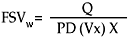
<body><![CDATA[<p align="center"><font size="2" face="Verdana">Hb g/l=(93.3197) * (10<SUP> 2.51    x 10-5 *altitude</SUP>) </font></p>     <p><font size="2" face="Verdana"> Cutoff values to diagnose anemia in children    were: 6-11.9 months old &lt;95 g/l, 12-71 months old &lt;110 g/l and 6-11 years    of age &lt;120 g/l, as recommended by INACG in 1989,<SUP>17</SUP> and by WHO    in 1992.<SUP>18</SUP> </font></p>     <p><font size="2" face="Verdana"> Children's micronutrient intake was assessed    by 24-h recall by the mother. Nutrient values were calculated by multiplying    the portion size in grams of a given food by its nutrient content per gram.    Food composition data were obtained from a database in which micronutrient information    was pooled at the Instituto Nacional de Salud P&uacute;blica (National Institute    of Public Health), Mexico, from 7 published food composition tables<SUP>19-24</SUP>    and from the unpublished composition table: Informaci&oacute;n Nutricional de    Marinela (Marinela &#91;a food industry company&#93; Nutritional Information). </font></p>     <p><font size="2" face="Verdana"> Results from descriptive analysis are presented    as prevalence of anemia and means and standard deviations of hemoglobin concentrations.    The association of anemia with potential explanatory variables such as those    indicative of nutritional status, dietary, and socioeconomic characteristics,    maternal education, employment status, and literacy, was assessed by the odds    ratio derived from a logistic regression model adjusted for complex sampling    to minimize the effects of clustering. In a second series of regressions, hemoglobin    concentration was introduced to the model as a dependent variable; the dietary    intake of iron, folic acid, vitamin B12, and calcium were entered as independent    variables. After prevalences were calculated, they were expanded to represent    the original population using the formula: </font></p>     <p align="center"><img src="/img/revistas/spm/v45s4/a05img01.gif"></p>     <p><font size="2" face="Verdana"> Where: </font></p>     <blockquote>        <p><font size="2" face="Verdana"> PD(V<SUB>w</SUB>) = Probability of selecting      one household for the dietary survey.     <br>     S = Number of households selected for      blood sampling.     <br>     Q = Number of households selected for      the dietary survey. </font></p> </blockquote>     ]]></body>
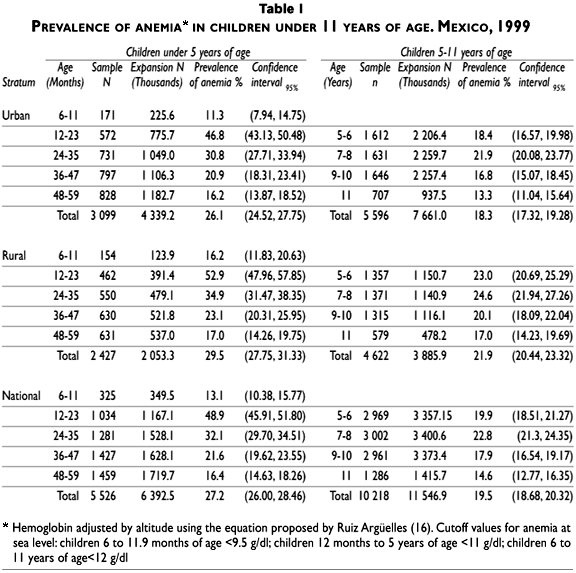
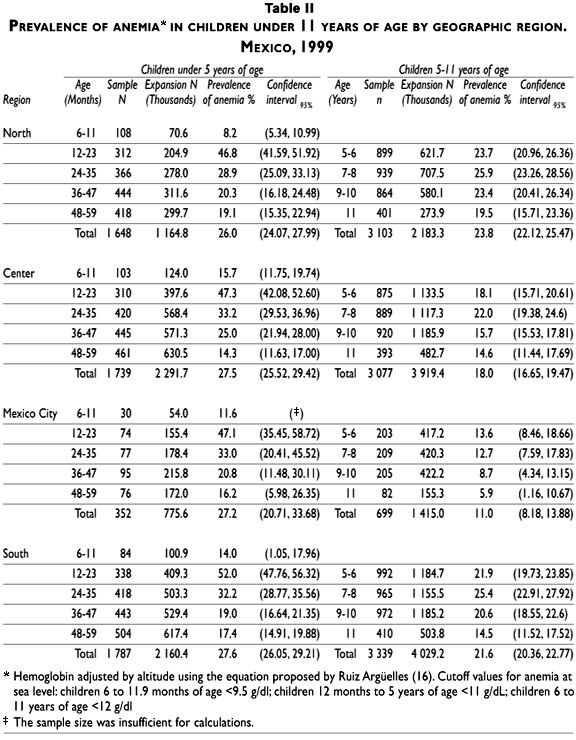
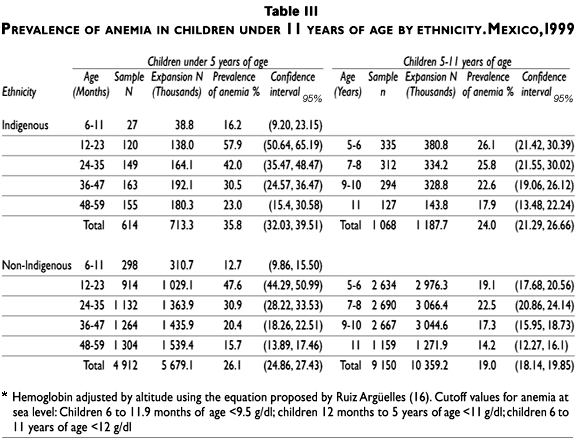
<body><![CDATA[<p><font size="2" face="Verdana"> Expansion factors were calculated based on the    characteristics of the national population in 1995. </font></p>     <p><font size="2" face="Verdana"> Data were entered using the Clipper software    program using data entry formats that included range and contingency validation    checks (version 5.01 Nantucket<SUP> TM </SUP>Corporation 1991 S.F. California).    Descriptive analysis was run in SPSS for Windows (version 10; SPSS Inc, Chicago,    1999). Regression models were adjusted using the Stata statistical software    (V. 7.0, College Station, TX, Stata Corp., 2001). </font></p>     <p>&nbsp;</p>     <p><font size="3" face="Verdana"><b>Results </b></font></p>     <p><font size="2" face="Verdana">The highest prevalence of anemia was found in    infants 12 to 24 months old (48.9%). Rural infants of this age tended to have    a higher prevalence (52.9%) than their urban counterparts (46.8%) however, the    difference was not statistically significant. The prevalence of anemia declined    progressively with age, reaching 16% at 5 years of age, and remained essentially    stable until 11 years of age. Within the 5-11 year interval, the prevalence    varied from 14.6 to 22%. Anemia was more prevalent in rural than in urban children    5-6 years of age (<I>p</I>&lt;0.05), but not at other age intervals (<a href="#tab01">Table    I</a>). </font></p>     <p><a name="tab01"></a></p>     <p>&nbsp;</p>     <p align="center"><img src="/img/revistas/spm/v45s4/a05tab01.gif"></p>     <p>&nbsp;</p>     <p><font size="2" face="Verdana"> Of all regions, the South of the country had    the highest prevalence of anemia in children aged 12 to 24 months of age. No    interregional differences were noted among children of other age intervals (<a href="#tab02">Table    II</a>). The prevalence of anemia was 57.9% in indigenous infants 12 to 24 months    old, and was approximately 10 percentage points higher in indigenous children    younger than 5 years of age than their non-indigenous counterparts. Nevertheless,    at later ages the differences between indigenous and non-indigenous children    were smaller than 7 percentage points (<a href="#tab03">Table III</a>). </font></p>     ]]></body>
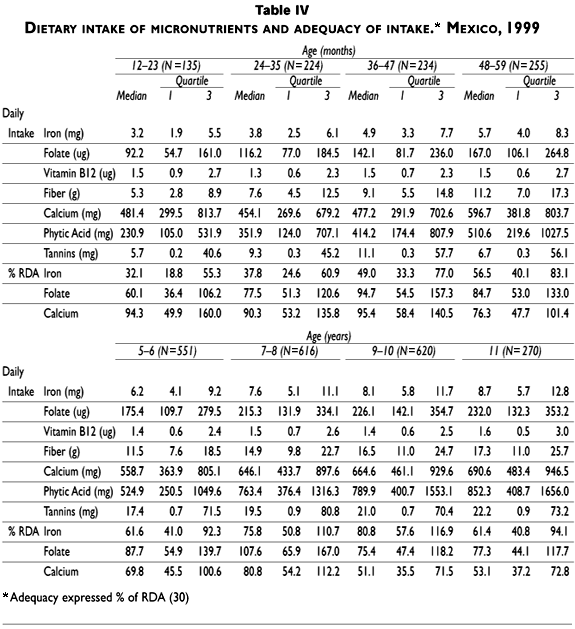
<body><![CDATA[<p><a name="tab02"></a></p>     <p>&nbsp;</p>     <p align="center"><img src="/img/revistas/spm/v45s4/a05tab02.gif"></p>     <p>&nbsp;</p>     <p><a name="tab03"></a></p>     <p>&nbsp;</p>     <p align="center"><img src="/img/revistas/spm/v45s4/a05tab03.gif"></p>     <p>&nbsp;</p>     <p><font size="2" face="Verdana"> The median of dietary iron intake of children    under 5 years of age corresponded to 50% of the RDA (recommended daily allowance)    and increased progressively reaching 80.8% of the RDA at 9-10 years of age.    Folic acid intakes ranged between 75 and 107% of the RDA from 3- 11 years of    age, and Vitamin B12 intake was close to 100% at all ages. The phytic acid and    tannin intakes were relatively high; phytic acid intake was more than 500 mg/d    after 4 years reaching 852 mg/d at 11 years of age. Tannin intake was greater    than 19 mg/d after 7 years of age (<a href="#tab04">Table IV</a>). </font></p>     <p><a name="tab04"></a></p>     ]]></body>
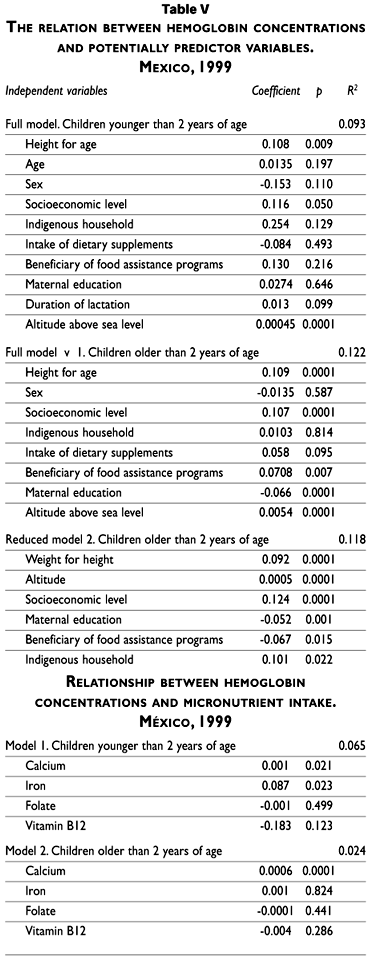
<body><![CDATA[<p>&nbsp;</p>     <p align="center"><img src="/img/revistas/spm/v45s4/a05tab04.gif"></p>     <p>&nbsp;</p>     <p><font size="2" face="Verdana"> In infants 12 to 24 months of age hemoglobin    concentration was significantly and positively associated with height for age    (<I>p</I>&lt; 0.01) and weight for age (<I>p</I>=0.01). Although weight for    height (<I>p</I>=0.07), tended to have a positive association with hemoglobin    concentration, it did not reach statistical significance. Because of the high    co-linearity among the latter indices, they were introduced alternately to the    model. Hemoglobin concentration was also positively associated with socioeconomic    level (<I>p</I>&lt; 0.05), and altitude above sea level <I>(p</I>=0.001). There    was also a trend towards a relationship with duration of lactation (<I>p</I>=0.1).    All of these associations remained stable when nutritional status indices were    alternately introduced to the model. No associations were found between hemoglobin    concentration and age, gender, use of dietary supplements, being a beneficiary    of food assistance programs, ethnic origin, or maternal education (<a href="#tab05">Table    V</a>). In children 25 months to 11 years of age, hemoglobin concentration was    positively associated with nutritional status indices i.e. height for age, weight    for age, and weight for height (<I>p</I>&lt; 0.001). For brevity, only the model    including height for age is presented here. In all models, hemoglobin concentration    was positively associated with socioeconomic status (<I>p</I>&lt; 0.001), participation    in a food assistance program (<I>p</I>=0.01), and altitude above sea level (<I>p</I>=0.001),    and negatively associated with maternal education (<I>p</I>=0.001). A positive    trend was also noted between intake of dietary supplements and hemoglobin concentrations    (<I>p</I>&lt; 0.1). Indigenous ethnicity was associated with hemoglobin levels    only when weight for height was introduced to the model (<I>p</I>&lt; 0.02).    No associations were found between hemoglobin concentration and gender. </font></p>     <p><a name="tab05"></a></p>     <p>&nbsp;</p>     <p align="center"><img src="/img/revistas/spm/v45s4/a05tab05.gif"></p>     <p>&nbsp;</p>     <p><font size="2" face="Verdana"> In infants 12 to 24 months of age, hemoglobin    concentrations were positively associated with iron and calcium intakes (<I>p</I>=0.02).    These associations remained significant after controlling for fiber, phytic    acid, and tannin intakes. There were no associations with folate and vitamin    B12 intakes. On the other hand, in children 25 months to 11 years of age no    association was found between hemoglobin concentration and iron, folate, and    vitamin B12 intakes. However, a positive association was found with calcium    intake (<I>p</I>&lt; 0.001) (<a href="#tab05">Table V</a>). </font></p>     <p>&nbsp;</p>     ]]></body>
<body><![CDATA[<p><font size="3" face="Verdana"><b>Discussion </b></font></p>     <p><font size="2" face="Verdana">The prevalence of anemia was extremely high at    all ages, with a more alarming prevalence occurring in the group of one to two    years of age. Potential factors that may explain the highest prevalence in young    infants are, among others: a) the high prevalence of iron deficiency observed    in pregnant women (see corresponding article reviewing micronutrient status    in this issue), which frequently has an effect on the development of limited    fetal iron stores; b) the amount of iron secreted daily in breast milk is insufficient,    (3 mg/d) to cover the daily iron requirements of the infant (9 mg/d); iron concentrations    in breast milk are independent of the maternal iron status; and c) the transition    from full lactation to the family diet occurs within the first two years of    life, and in this period weaning foods are frequently of low energy and micronutrient    density, especially for iron.<SUP>25-28</SUP> </font></p>     <p><font size="2" face="Verdana"> The robustness of these data is supported by    the coinciding high proportion of anemia with iron deficiency (70%, in terms    of percent transferrin saturation).<SUP>29    </SUP>This high prevalence of anemia in small infants is alarming because of    its expected negative impact on their short- and long-term health status. In    the short-term it will have a negative effect on their ability to combat acute    infections, as well as on their mental development and physical growth. In the    long-term will result in short stature, poor school performance, and a lower    capacity for physical work.<SUP>4,5</SUP> </font></p>     <p><font size="2" face="Verdana"> The daily iron intake of infants 12 to 24 months    of age was well below the RDA, as expected. Hemoglobin was positively associated    with iron intake in this group, the association probably resulted significant    because iron is provided mostly by breast milk, and complementary food used    at this age includes only small amounts of foods with a high content of substances    that interfere with iron absorption. Typical complementary foods include fruits,    vegetables, egg, cereals, wheat flour preparations, rice, and small amounts    of meat and corn tortillas. On the other hand, older children had iron intakes    very close to the RDA (75-81%). Thus, the high prevalence of iron deficiency    anemia seems to be a bioavailability problem and not due to insufficient iron    intake. Furthermore, hemoglobin concentrations in children 25 months to 11 years    of age were not associated with iron, folate, or vitamin B12 intakes. The notion    of anemia being caused by a low availability of iron in this sample is based    also on the following arguments: a) most of the iron consumed by     this group was non-heme iron (data not presented); b) their diet contained a    high amount of iron absorption antagonists, such as phytic acid, tannin and    calcium; and c) the very low intake of substances facilitating non-heme iron    absorption, as indicated by the high prevalence of vitamin C deficiency in this    population (see related article in this issue). Other authors have demonstrated    that the prevalence of anemia is not necessarily correlated with the degree    of iron deficiency.<SUP>2</SUP> In a separate analysis based on the sample of    children herein presented, it was found that 35% of the cases of anemia were    not associated to iron deficiency but to the deficiency of one or more vitamins.<SUP>30    </SUP>A puzzling finding was the positive correlation between calcium intake    and hemoglobin concentrations of children 25 months to 11 years of age, especially    because calcium antagonizes iron absorption. It can be speculated that such    a relationship is not causal, and that calcium intake might be a proxy for the    intake of animal foods. </font></p>     <p><font size="2" face="Verdana"> The persistent positive association between    height for age and the concentration of hemoglobin, and the high prevalence    of stunting in this sample strongly support the existing knowledge of the contribution    of iron deficiency anemia to growth retardation. However, hemoglobin concentrations    were also positively associated, although weakly, with weight for height, an    index for wasting, suggesting a relationship between acute malnutrition and    iron deficiency anemia. The results of this survey are unable to establish whether    iron deficiency anemia is a cause or effect of wasting. </font></p>     <p><font size="2" face="Verdana"> Being a family beneficiary of food assistance    programs was positively associated with the concentrations of hemoglobin in    children older than two years of age but not in younger children. Such a differential    effect might be due to the fact that most food assistance programs do not provide    baby foods adequate for small children; thus, the impact of those programs is    reflected only in older children. The Federal Program for Education Health and    Feeding (Progresa, as abreviated in Spanish) is the only program that provides    a supplement adequate for children of less than two years of age. Food assistance    programs must consider baby foods with adequate energy and micronutrient densities.    </font></p>     <p><font size="2" face="Verdana"> Maternal education is a known determinant of    the health of children, however, in this study it was not related with the concentrations    of hemoglobin of children under two years of age, probably because the introduction    of iron rich foods as weaning foods depends more on cultural-related beliefs    than on the level of maternal education. On the contrary, maternal education    was significantly associated with the concentration    of hemoglobin of children older than 2 years, confirming that common knowledge.    </font></p>     <p><font size="2" face="Verdana"> In sum, we present herein evidence of an alarmingly    high prevalence of anemia in children at a national level, regardless of urban    or rural residence. The prevalence in children between 12 to 24 months of age    is of special concern. Combating and preventing this ailment is a national emergency,    considering the grave consequences of anemia and iron deficiency on the physical    and mental growth and development of these children and on their long-term health.    We do not fail to recognize that some actions have been taken in that regard,    for instance, the enrichment of corn and wheat flours, the fortified food supplement    distributed to children younger than two years of age and pregnant and lactating    women living in extreme poverty by Progresa, and the pharmacological supplement    containing iron and several vitamins included in two public health programs    (Atenci&oacute;n a Poblaci&oacute;n Ind&iacute;gena and Arranque Parejo, Indigenous    Population Care and &quot;Even Start&quot;). The short-term results of those    interventions are in the process of being evaluated. </font></p>     <p>&nbsp;</p>     <p><font size="3" face="Verdana"><b>References </b></font></p>     ]]></body>
<body><![CDATA[<!-- ref --><p><font size="2" face="Verdana">1. United Nations Administrative Committee on    Coordination Nutrition (ACC/SCN) 4<SUP>TH</SUP> Report on the world nutrition    situation. Nutrition throughout the life cycle. Sub-Committee on Geneva:ACC/SCN,    2000. </font>&nbsp;&nbsp;&nbsp;&nbsp;&nbsp;&nbsp;&nbsp;&nbsp;[&#160;<a href="javascript:void(0);" onclick="javascript: window.open('/scielo.php?script=sci_nlinks&ref=9186137&pid=S0036-3634200300100000500001&lng=','','width=640,height=500,resizable=yes,scrollbars=1,menubar=yes,');">Links</a>&#160;]<!-- end-ref --><!-- ref --><p><font size="2" face="Verdana">2. Iyengar GV, Nair PP. Global outlook on nutrition    and the environment: Meeting the challenges    of the next millennium. Sci Total Environ 2000;249:331-346. </font>&nbsp;&nbsp;&nbsp;&nbsp;&nbsp;&nbsp;&nbsp;&nbsp;[&#160;<a href="javascript:void(0);" onclick="javascript: window.open('/scielo.php?script=sci_nlinks&ref=9186138&pid=S0036-3634200300100000500002&lng=','','width=640,height=500,resizable=yes,scrollbars=1,menubar=yes,');">Links</a>&#160;]<!-- end-ref --><!-- ref --><p><font size="2" face="Verdana">3. Comission on the Nutrition Challenges of the    21<SUP>st </SUP>Century. Ending malnutrition by 2020: An agenda for change in    the millennium. Final report to the ACC/SCN. Food Nutr Bull 2000;21:3-88. </font>&nbsp;&nbsp;&nbsp;&nbsp;&nbsp;&nbsp;&nbsp;&nbsp;[&#160;<a href="javascript:void(0);" onclick="javascript: window.open('/scielo.php?script=sci_nlinks&ref=9186139&pid=S0036-3634200300100000500003&lng=','','width=640,height=500,resizable=yes,scrollbars=1,menubar=yes,');">Links</a>&#160;]<!-- end-ref --><!-- ref --><p><font size="2" face="Verdana">4. Sayed NE, Gad A, Nofal L, Netti G. Assessment    of the prevalence and potential determinants of nutritional anemia in Upper    Egypt. Food Nutr Bull 1999;20:417-421. </font>&nbsp;&nbsp;&nbsp;&nbsp;&nbsp;&nbsp;&nbsp;&nbsp;[&#160;<a href="javascript:void(0);" onclick="javascript: window.open('/scielo.php?script=sci_nlinks&ref=9186140&pid=S0036-3634200300100000500004&lng=','','width=640,height=500,resizable=yes,scrollbars=1,menubar=yes,');">Links</a>&#160;]<!-- end-ref --><!-- ref --><p><font size="2" face="Verdana">5. Freire WB. La anemia por deficiencia de hierro,    estrategias de OPS/OMS para combatirla. Salud Publica Mex 1998;40:199-205. </font>&nbsp;&nbsp;&nbsp;&nbsp;&nbsp;&nbsp;&nbsp;&nbsp;[&#160;<a href="javascript:void(0);" onclick="javascript: window.open('/scielo.php?script=sci_nlinks&ref=9186141&pid=S0036-3634200300100000500005&lng=','','width=640,height=500,resizable=yes,scrollbars=1,menubar=yes,');">Links</a>&#160;]<!-- end-ref --><!-- ref --><p><font size="2" face="Verdana">6. Beard JL, Tobin BW. Iron status and exercise.    Am J Clin Nutr 2000;72(Suppl):594S-597S. </font>&nbsp;&nbsp;&nbsp;&nbsp;&nbsp;&nbsp;&nbsp;&nbsp;[&#160;<a href="javascript:void(0);" onclick="javascript: window.open('/scielo.php?script=sci_nlinks&ref=9186142&pid=S0036-3634200300100000500006&lng=','','width=640,height=500,resizable=yes,scrollbars=1,menubar=yes,');">Links</a>&#160;]<!-- end-ref --><!-- ref --><p><font size="2" face="Verdana">7. Men&eacute;ndez C, Todd J, Alonso PL, Francis    N, Lulant S, Ceesay S <I>et al</I>. The effects of iron supplementation during    pregnancy, given by traditional birth attendants, on the prevalence of anemia    and malaria. Trans R Soc Trop Med Hyg 1994;88:590-593. </font>&nbsp;&nbsp;&nbsp;&nbsp;&nbsp;&nbsp;&nbsp;&nbsp;[&#160;<a href="javascript:void(0);" onclick="javascript: window.open('/scielo.php?script=sci_nlinks&ref=9186143&pid=S0036-3634200300100000500007&lng=','','width=640,height=500,resizable=yes,scrollbars=1,menubar=yes,');">Links</a>&#160;]<!-- end-ref --><!-- ref --><p><font size="2" face="Verdana">8. Preziosi P, Prual A, Gal&aacute;n P, Daouda    H, Boureima H, Hercberg S. Effects of iron supplementation on iron status of    pregnant women: Consequences for newborns. Am J Clin Nutr 1997;66:1178-1182.    </font>&nbsp;&nbsp;&nbsp;&nbsp;&nbsp;&nbsp;&nbsp;&nbsp;[&#160;<a href="javascript:void(0);" onclick="javascript: window.open('/scielo.php?script=sci_nlinks&ref=9186144&pid=S0036-3634200300100000500008&lng=','','width=640,height=500,resizable=yes,scrollbars=1,menubar=yes,');">Links</a>&#160;]<!-- end-ref --><!-- ref --><p><font size="2" face="Verdana">9. Rosado JL, Bourges H, SainT-Martin B, Deficiencias    de vitaminas y minerales en M&eacute;xico. Una revisi&oacute;n cr&iacute;tica    del estado de la informaci&oacute;n: I. Deficiencia de minerales, Salud Publica    Mex 1995;37:13-19. </font>&nbsp;&nbsp;&nbsp;&nbsp;&nbsp;&nbsp;&nbsp;&nbsp;[&#160;<a href="javascript:void(0);" onclick="javascript: window.open('/scielo.php?script=sci_nlinks&ref=9186145&pid=S0036-3634200300100000500009&lng=','','width=640,height=500,resizable=yes,scrollbars=1,menubar=yes,');">Links</a>&#160;]<!-- end-ref --><!-- ref --><p><font size="2" face="Verdana">10. Lor&iacute;a A, S&aacute;nchez ML, Garc&iacute;a    J, Piedras J. Anemia nutricional III. Deficiencia de hierro en ni&ntilde;os    menores de 7 a&ntilde;os de edad y de baja condici&oacute;n socioecon&oacute;mica.    Rev Invest Clin 1971;23:11-19. </font>&nbsp;&nbsp;&nbsp;&nbsp;&nbsp;&nbsp;&nbsp;&nbsp;[&#160;<a href="javascript:void(0);" onclick="javascript: window.open('/scielo.php?script=sci_nlinks&ref=9186146&pid=S0036-3634200300100000500010&lng=','','width=640,height=500,resizable=yes,scrollbars=1,menubar=yes,');">Links</a>&#160;]<!-- end-ref --><!-- ref --><p><font size="2" face="Verdana">11. Allen LH, Rosado JL, Casterline JE, L&oacute;pez    P, Mu&ntilde;oz E, Garc&iacute;a PO <I>et al</I>. Lack of hemoglobin response    to iron supplementation in anemic Mexican preschoolers with multiple micronutrient    deficiencies. Am J Clin Nutr 2000;71:1485-1494. </font>&nbsp;&nbsp;&nbsp;&nbsp;&nbsp;&nbsp;&nbsp;&nbsp;[&#160;<a href="javascript:void(0);" onclick="javascript: window.open('/scielo.php?script=sci_nlinks&ref=9186147&pid=S0036-3634200300100000500011&lng=','','width=640,height=500,resizable=yes,scrollbars=1,menubar=yes,');">Links</a>&#160;]<!-- end-ref --><!-- ref --><p><font size="2" face="Verdana">12. Rivera DR, Ruiz AR, Carrillo JH, Hern&aacute;ndez    AB, Sosa S. Prevalencia de anemia en una muestra de escolares de la ciudad de    Durango. Bol Med Hosp Infant Mex 1979;36:507-517. </font>&nbsp;&nbsp;&nbsp;&nbsp;&nbsp;&nbsp;&nbsp;&nbsp;[&#160;<a href="javascript:void(0);" onclick="javascript: window.open('/scielo.php?script=sci_nlinks&ref=9186148&pid=S0036-3634200300100000500012&lng=','','width=640,height=500,resizable=yes,scrollbars=1,menubar=yes,');">Links</a>&#160;]<!-- end-ref --><!-- ref --><p><font size="2" face="Verdana">13. Instituto Nacional de Salud P&uacute;blica.    Encuesta Nacional de Nutrici&oacute;n 1999. Tomo I. Ni&ntilde;os menores de    5 a&ntilde;os. Cuernavaca Morelos, INSP, 2000:14-24. </font>&nbsp;&nbsp;&nbsp;&nbsp;&nbsp;&nbsp;&nbsp;&nbsp;[&#160;<a href="javascript:void(0);" onclick="javascript: window.open('/scielo.php?script=sci_nlinks&ref=9186149&pid=S0036-3634200300100000500013&lng=','','width=640,height=500,resizable=yes,scrollbars=1,menubar=yes,');">Links</a>&#160;]<!-- end-ref --><!-- ref --><p><font size="2" face="Verdana">14. Johns WL, Lewis SM. Primary health screening    by haemoglobinometry in a tropical community.    Bull World Health Organ 1989;67:627-633. </font>&nbsp;&nbsp;&nbsp;&nbsp;&nbsp;&nbsp;&nbsp;&nbsp;[&#160;<a href="javascript:void(0);" onclick="javascript: window.open('/scielo.php?script=sci_nlinks&ref=9186150&pid=S0036-3634200300100000500014&lng=','','width=640,height=500,resizable=yes,scrollbars=1,menubar=yes,');">Links</a>&#160;]<!-- end-ref --><!-- ref --><p><font size="2" face="Verdana">15. Hudson-Thomas M, Brigham KC, Simmons WK.    An evaluation of the HemoCue for measuring haemoglobin in field studies in Jamaica.    Bull World Health Organ 1994;72:423-426. </font>&nbsp;&nbsp;&nbsp;&nbsp;&nbsp;&nbsp;&nbsp;&nbsp;[&#160;<a href="javascript:void(0);" onclick="javascript: window.open('/scielo.php?script=sci_nlinks&ref=9186151&pid=S0036-3634200300100000500015&lng=','','width=640,height=500,resizable=yes,scrollbars=1,menubar=yes,');">Links</a>&#160;]<!-- end-ref --><!-- ref --><p><font size="2" face="Verdana">16. Ruiz-Arg&uuml;elles G, Llorente-Peters A.    Predicci&oacute;n algebraica de par&aacute;metros de serie roja de adultos sanos    residentes en alturas de 0 a 2 670 metros. Rev Invest Clin 1981;33:191-193.    </font>&nbsp;&nbsp;&nbsp;&nbsp;&nbsp;&nbsp;&nbsp;&nbsp;[&#160;<a href="javascript:void(0);" onclick="javascript: window.open('/scielo.php?script=sci_nlinks&ref=9186152&pid=S0036-3634200300100000500016&lng=','','width=640,height=500,resizable=yes,scrollbars=1,menubar=yes,');">Links</a>&#160;]<!-- end-ref --><!-- ref --><p><font size="2" face="Verdana">17. International Nutritional Anemia Consultative    Group (INACG). Guidelines for the Control of Maternal Nutritional Anemia. A    report of the International Nutritional Anemia Consultative Group Washington,    DC: INACG, 1989. </font>&nbsp;&nbsp;&nbsp;&nbsp;&nbsp;&nbsp;&nbsp;&nbsp;[&#160;<a href="javascript:void(0);" onclick="javascript: window.open('/scielo.php?script=sci_nlinks&ref=9186153&pid=S0036-3634200300100000500017&lng=','','width=640,height=500,resizable=yes,scrollbars=1,menubar=yes,');">Links</a>&#160;]<!-- end-ref --><!-- ref --><p><font size="2" face="Verdana">18. World Health Organization. The prevalence    of anemia in women: A tabulation of available information. Geneva Maternal Health    and Safe Motherhood Programme 1992. </font>&nbsp;&nbsp;&nbsp;&nbsp;&nbsp;&nbsp;&nbsp;&nbsp;[&#160;<a href="javascript:void(0);" onclick="javascript: window.open('/scielo.php?script=sci_nlinks&ref=9186154&pid=S0036-3634200300100000500018&lng=','','width=640,height=500,resizable=yes,scrollbars=1,menubar=yes,');">Links</a>&#160;]<!-- end-ref --><!-- ref --><p><font size="2" face="Verdana">19. Morales J, Babinsky V, Bourges H, Camacho    ME. Tablas de Composici&oacute;n de Alimentos    Mexicanos. M&eacute;xico, DF: Instituto Nacional de Ciencias M&eacute;dicas    y Nutrici&oacute;n &quot;Salvador Zubir&aacute;n&quot; 2000. </font>&nbsp;&nbsp;&nbsp;&nbsp;&nbsp;&nbsp;&nbsp;&nbsp;[&#160;<a href="javascript:void(0);" onclick="javascript: window.open('/scielo.php?script=sci_nlinks&ref=9186155&pid=S0036-3634200300100000500019&lng=','','width=640,height=500,resizable=yes,scrollbars=1,menubar=yes,');">Links</a>&#160;]<!-- end-ref --><!-- ref --><p><font size="2" face="Verdana">20. Mu&ntilde;oz M, Ch&aacute;vez A, P&eacute;rez-Gil    F, Rold&aacute;n JA, Hern&aacute;ndez S, Ledesma JA, <I>et al</I>. Tablas de    valor nutritivo de los alimentos de mayor consumo en M&eacute;xico. M&eacute;xico,DF:    Editorial Pax 1996. </font>&nbsp;&nbsp;&nbsp;&nbsp;&nbsp;&nbsp;&nbsp;&nbsp;[&#160;<a href="javascript:void(0);" onclick="javascript: window.open('/scielo.php?script=sci_nlinks&ref=9186156&pid=S0036-3634200300100000500020&lng=','','width=640,height=500,resizable=yes,scrollbars=1,menubar=yes,');">Links</a>&#160;]<!-- end-ref --><!-- ref --><p><font size="2" face="Verdana">21. Department of Agriculture, Agricultural Research    Service. USDA Nutrient Database for Standard Reference, Release 13. Washington,    DC: USA, 1999. </font>&nbsp;&nbsp;&nbsp;&nbsp;&nbsp;&nbsp;&nbsp;&nbsp;[&#160;<a href="javascript:void(0);" onclick="javascript: window.open('/scielo.php?script=sci_nlinks&ref=9186157&pid=S0036-3634200300100000500021&lng=','','width=640,height=500,resizable=yes,scrollbars=1,menubar=yes,');">Links</a>&#160;]<!-- end-ref --><!-- ref --><p><font size="2" face="Verdana">22. Scherer H, Senser F, comp. Food Composition    and Nutrition Tables. Der Zusament Setzung der Lebensmittell, N&auml;hrwert-Tabellenjon    behalf of the Bundersministerium f&uuml;r Ern&auml;hrung, Land Wirts Shaft und    Forstew, London, UK: Medpharm Scientific and CRC Press (Pub), 2000. </font>&nbsp;&nbsp;&nbsp;&nbsp;&nbsp;&nbsp;&nbsp;&nbsp;[&#160;<a href="javascript:void(0);" onclick="javascript: window.open('/scielo.php?script=sci_nlinks&ref=9186158&pid=S0036-3634200300100000500022&lng=','','width=640,height=500,resizable=yes,scrollbars=1,menubar=yes,');">Links</a>&#160;]<!-- end-ref --><!-- ref --><p><font size="2" face="Verdana">23. Instituto de Nutrici&oacute;n de Centro am&eacute;rica    y Panam&aacute;. Tabla de composici&oacute;n de alimentos. Guatemala, CA: INCAP,    1994. </font>&nbsp;&nbsp;&nbsp;&nbsp;&nbsp;&nbsp;&nbsp;&nbsp;[&#160;<a href="javascript:void(0);" onclick="javascript: window.open('/scielo.php?script=sci_nlinks&ref=9186159&pid=S0036-3634200300100000500023&lng=','','width=640,height=500,resizable=yes,scrollbars=1,menubar=yes,');">Links</a>&#160;]<!-- end-ref --><!-- ref --><p><font size="2" face="Verdana">24. University of California. World Food Dietary    Assessment System. V 2.0, Berkley: University of California, USA, 1997. </font>&nbsp;&nbsp;&nbsp;&nbsp;&nbsp;&nbsp;&nbsp;&nbsp;[&#160;<a href="javascript:void(0);" onclick="javascript: window.open('/scielo.php?script=sci_nlinks&ref=9186160&pid=S0036-3634200300100000500024&lng=','','width=640,height=500,resizable=yes,scrollbars=1,menubar=yes,');">Links</a>&#160;]<!-- end-ref --><!-- ref --><p><font size="2" face="Verdana">25. Bhargava M, Iyer PU, Kumar R, Ramji S, Kapani    V, Bhargava SK. Relationship of maternal serum ferritin with foetal serum ferritin,    birth weight and gestation. J Trop Pediatr 1991;37:149-152. </font>&nbsp;&nbsp;&nbsp;&nbsp;&nbsp;&nbsp;&nbsp;&nbsp;[&#160;<a href="javascript:void(0);" onclick="javascript: window.open('/scielo.php?script=sci_nlinks&ref=9186161&pid=S0036-3634200300100000500025&lng=','','width=640,height=500,resizable=yes,scrollbars=1,menubar=yes,');">Links</a>&#160;]<!-- end-ref --><!-- ref --><p><font size="2" face="Verdana">26. Colomer J, Colomer C, Guti&eacute;rrez D,    Jubert A, Nolasco A, Donat J, <I>et al</I>.Anemia during pregnancy as a risk    factor for infant iron deficiency: Report from the Valencia Infant Anemia Cohort    (VIAC) Study. Pediatr Perinatal Epidemiol 1990;4:196-204. </font>&nbsp;&nbsp;&nbsp;&nbsp;&nbsp;&nbsp;&nbsp;&nbsp;[&#160;<a href="javascript:void(0);" onclick="javascript: window.open('/scielo.php?script=sci_nlinks&ref=9186162&pid=S0036-3634200300100000500026&lng=','','width=640,height=500,resizable=yes,scrollbars=1,menubar=yes,');">Links</a>&#160;]<!-- end-ref --><!-- ref --><p><font size="2" face="Verdana">27. Saarinen UM, Simmes MA. Iron absorption from    breast milk, cow's milk, and iron-supplemented formula: An opportunistic use    of changes in the total body iron determined by hemoglobin, ferritin and body    weight in 132 infants. Pediatr Res 1979;13:143-147. </font>&nbsp;&nbsp;&nbsp;&nbsp;&nbsp;&nbsp;&nbsp;&nbsp;[&#160;<a href="javascript:void(0);" onclick="javascript: window.open('/scielo.php?script=sci_nlinks&ref=9186163&pid=S0036-3634200300100000500027&lng=','','width=640,height=500,resizable=yes,scrollbars=1,menubar=yes,');">Links</a>&#160;]<!-- end-ref --><!-- ref --><p><font size="2" face="Verdana">28. Dallman PR. Iron deficiency in the weanling:    A nutritional problem on the way to resolution. Acta Pediatr Scand 1986;323(suppl):59-67.    </font>&nbsp;&nbsp;&nbsp;&nbsp;&nbsp;&nbsp;&nbsp;&nbsp;[&#160;<a href="javascript:void(0);" onclick="javascript: window.open('/scielo.php?script=sci_nlinks&ref=9186164&pid=S0036-3634200300100000500028&lng=','','width=640,height=500,resizable=yes,scrollbars=1,menubar=yes,');">Links</a>&#160;]<!-- end-ref --><!-- ref --><p><font size="2" face="Verdana">29. Shamah-Levy T, Villalpando-Hern&aacute;ndez    S, Rivera-Dommarco J, Mej&iacute;a-Rodr&iacute;guez F, Camacho-Cisneros M, Monterrubio-Flores    E. Anemia in a probabilistic sample of Mexican Women: A public health problem.    Salud Publica Mex 2003;45(Suppl): . </font>&nbsp;&nbsp;&nbsp;&nbsp;&nbsp;&nbsp;&nbsp;&nbsp;[&#160;<a href="javascript:void(0);" onclick="javascript: window.open('/scielo.php?script=sci_nlinks&ref=9186165&pid=S0036-3634200300100000500029&lng=','','width=640,height=500,resizable=yes,scrollbars=1,menubar=yes,');">Links</a>&#160;]<!-- end-ref --><!-- ref --><p><font size="2" face="Verdana">30. P&eacute;rez-Exp&oacute;sito AB. Anemia y    deficiencia de micronutrimentos en mujeres mexicanas de 12 a 49 a&ntilde;os    de edad (Tesis de maestr&iacute;a). Instituto de Salud P&uacute;blica Carlos    III, Madrid Espa&ntilde;a: 2001.</font>&nbsp;&nbsp;&nbsp;&nbsp;&nbsp;&nbsp;&nbsp;&nbsp;[&#160;<a href="javascript:void(0);" onclick="javascript: window.open('/scielo.php?script=sci_nlinks&ref=9186166&pid=S0036-3634200300100000500030&lng=','','width=640,height=500,resizable=yes,scrollbars=1,menubar=yes,');">Links</a>&#160;]<!-- end-ref --><p>&nbsp;</p>     <p>&nbsp;</p>     <p><font size="2" face="Verdana">Address reprint requests to    <br>   Dr. Salvador Villalpando    <br>   Avenida Universidad 655    <br>   Colonia Santa Mar&iacute;a Ahuacatitl&aacute;n     <br>   62508, Cuernavaca, Morelos, M&eacute;xico    <br>   E-mail: <a href="mailto:svillalp@insp.mx">svillalp@insp.mx</a></font></p>     <p><font size="2" face="Verdana">Received on:<b> August 20, 2002    <br>   </b>Accepted on:<b> July 4, 2003</b></font></p>     ]]></body>
<body><![CDATA[ ]]></body><back>
<ref-list>
<ref id="B1">
<label>1</label><nlm-citation citation-type="book">
<collab>United Nations Administrative Committee^dCoordination Nutrition</collab>
<source><![CDATA[Nutrition throughout the life cycle]]></source>
<year>2000</year>
<publisher-name><![CDATA[Sub-Committee on Geneva]]></publisher-name>
</nlm-citation>
</ref>
<ref id="B2">
<label>2</label><nlm-citation citation-type="journal">
<person-group person-group-type="author">
<name>
<surname><![CDATA[Iyengar]]></surname>
<given-names><![CDATA[GV]]></given-names>
</name>
<name>
<surname><![CDATA[Nair]]></surname>
<given-names><![CDATA[PP]]></given-names>
</name>
</person-group>
<article-title xml:lang="en"><![CDATA[Global outlook on nutrition and the environment: Meeting the challenges of the next millennium]]></article-title>
<source><![CDATA[Sci Total Environ]]></source>
<year>2000</year>
<volume>249</volume>
<page-range>331-346</page-range></nlm-citation>
</ref>
<ref id="B3">
<label>3</label><nlm-citation citation-type="journal">
<collab>Comission on the Nutrition Challenges</collab>
<article-title xml:lang="en"><![CDATA[Ending malnutrition by 2020: An agenda for change in the millennium]]></article-title>
<source><![CDATA[Food Nutr Bull]]></source>
<year>2000</year>
<volume>21</volume>
<page-range>3-88</page-range></nlm-citation>
</ref>
<ref id="B4">
<label>4</label><nlm-citation citation-type="journal">
<person-group person-group-type="author">
<name>
<surname><![CDATA[Sayed]]></surname>
<given-names><![CDATA[NE]]></given-names>
</name>
<name>
<surname><![CDATA[Gad]]></surname>
<given-names><![CDATA[A]]></given-names>
</name>
<name>
<surname><![CDATA[Nofal]]></surname>
<given-names><![CDATA[L]]></given-names>
</name>
<name>
<surname><![CDATA[Netti]]></surname>
<given-names><![CDATA[G]]></given-names>
</name>
</person-group>
<article-title xml:lang="en"><![CDATA[Assessment of the prevalence and potential determinants of nutritional anemia in Upper Egypt]]></article-title>
<source><![CDATA[Food Nutr Bull]]></source>
<year>1999</year>
<volume>20</volume>
<page-range>417-421</page-range></nlm-citation>
</ref>
<ref id="B5">
<label>5</label><nlm-citation citation-type="journal">
<person-group person-group-type="author">
<name>
<surname><![CDATA[Freire]]></surname>
<given-names><![CDATA[WB]]></given-names>
</name>
</person-group>
<article-title xml:lang="es"><![CDATA[La anemia por deficiencia de hierro, estrategias de OPS/OMS para combatirla]]></article-title>
<source><![CDATA[Salud Publica Mex]]></source>
<year>1998</year>
<volume>40</volume>
<page-range>199-205</page-range></nlm-citation>
</ref>
<ref id="B6">
<label>6</label><nlm-citation citation-type="journal">
<person-group person-group-type="author">
<name>
<surname><![CDATA[Beard]]></surname>
<given-names><![CDATA[JL]]></given-names>
</name>
<name>
<surname><![CDATA[Tobin]]></surname>
<given-names><![CDATA[BW]]></given-names>
</name>
</person-group>
<article-title xml:lang="en"><![CDATA[Iron status and exercise]]></article-title>
<source><![CDATA[Am J Clin Nutr]]></source>
<year>2000</year>
<volume>72</volume>
<numero>^sSuppl</numero>
<issue>^sSuppl</issue>
<supplement>Suppl</supplement>
<page-range>594S-597S</page-range></nlm-citation>
</ref>
<ref id="B7">
<label>7</label><nlm-citation citation-type="journal">
<person-group person-group-type="author">
<name>
<surname><![CDATA[Menéndez]]></surname>
<given-names><![CDATA[C]]></given-names>
</name>
<name>
<surname><![CDATA[Todd]]></surname>
<given-names><![CDATA[J]]></given-names>
</name>
<name>
<surname><![CDATA[Alonso]]></surname>
<given-names><![CDATA[PL]]></given-names>
</name>
<name>
<surname><![CDATA[Francis]]></surname>
<given-names><![CDATA[N]]></given-names>
</name>
<name>
<surname><![CDATA[Lulant]]></surname>
<given-names><![CDATA[S]]></given-names>
</name>
<name>
<surname><![CDATA[Ceesay]]></surname>
<given-names><![CDATA[S]]></given-names>
</name>
</person-group>
<article-title xml:lang="en"><![CDATA[The effects of iron supplementation during pregnancy, given by traditional birth attendants, on the prevalence of anemia and malaria]]></article-title>
<source><![CDATA[Trans R Soc Trop Med Hyg]]></source>
<year>1994</year>
<volume>88</volume>
<page-range>590-593</page-range></nlm-citation>
</ref>
<ref id="B8">
<label>8</label><nlm-citation citation-type="journal">
<person-group person-group-type="author">
<name>
<surname><![CDATA[Preziosi]]></surname>
<given-names><![CDATA[P]]></given-names>
</name>
<name>
<surname><![CDATA[Prual]]></surname>
<given-names><![CDATA[A]]></given-names>
</name>
<name>
<surname><![CDATA[Galán]]></surname>
<given-names><![CDATA[P]]></given-names>
</name>
<name>
<surname><![CDATA[Daouda]]></surname>
<given-names><![CDATA[H]]></given-names>
</name>
<name>
<surname><![CDATA[Boureima]]></surname>
<given-names><![CDATA[H]]></given-names>
</name>
<name>
<surname><![CDATA[Hercberg]]></surname>
<given-names><![CDATA[S]]></given-names>
</name>
</person-group>
<article-title xml:lang="en"><![CDATA[Effects of iron supplementation on iron status of pregnant women: Consequences for newborns]]></article-title>
<source><![CDATA[Am J Clin Nutr]]></source>
<year>1997</year>
<volume>66</volume>
<page-range>1178-1182</page-range></nlm-citation>
</ref>
<ref id="B9">
<label>9</label><nlm-citation citation-type="journal">
<person-group person-group-type="author">
<name>
<surname><![CDATA[Rosado]]></surname>
<given-names><![CDATA[JL]]></given-names>
</name>
<name>
<surname><![CDATA[Bourges]]></surname>
<given-names><![CDATA[H]]></given-names>
</name>
<name>
<surname><![CDATA[SainT-Martin]]></surname>
<given-names><![CDATA[B]]></given-names>
</name>
</person-group>
<article-title xml:lang="es"><![CDATA[Deficiencias de vitaminas y minerales en México. Una revisión crítica del estado de la información: I. Deficiencia de minerales]]></article-title>
<source><![CDATA[Salud Publica Mex]]></source>
<year>1995</year>
<volume>37</volume>
<page-range>13-19</page-range></nlm-citation>
</ref>
<ref id="B10">
<label>10</label><nlm-citation citation-type="journal">
<person-group person-group-type="author">
<name>
<surname><![CDATA[Loría]]></surname>
<given-names><![CDATA[A]]></given-names>
</name>
<name>
<surname><![CDATA[Sánchez]]></surname>
<given-names><![CDATA[ML]]></given-names>
</name>
<name>
<surname><![CDATA[García]]></surname>
<given-names><![CDATA[J]]></given-names>
</name>
<name>
<surname><![CDATA[Piedras]]></surname>
<given-names><![CDATA[J.]]></given-names>
</name>
</person-group>
<article-title xml:lang="es"><![CDATA[Deficiencia de hierro en niños menores de 7 años de edad y de baja condición socioeconómica]]></article-title>
<source><![CDATA[Rev Invest Clin]]></source>
<year>1971</year>
<volume>23</volume>
<page-range>11-19</page-range></nlm-citation>
</ref>
<ref id="B11">
<label>11</label><nlm-citation citation-type="journal">
<person-group person-group-type="author">
<name>
<surname><![CDATA[Allen]]></surname>
<given-names><![CDATA[LH]]></given-names>
</name>
<name>
<surname><![CDATA[Rosado]]></surname>
<given-names><![CDATA[JL]]></given-names>
</name>
<name>
<surname><![CDATA[Casterline]]></surname>
<given-names><![CDATA[JE]]></given-names>
</name>
<name>
<surname><![CDATA[López]]></surname>
<given-names><![CDATA[P]]></given-names>
</name>
<name>
<surname><![CDATA[Muñoz]]></surname>
<given-names><![CDATA[E]]></given-names>
</name>
<name>
<surname><![CDATA[García]]></surname>
<given-names><![CDATA[PO]]></given-names>
</name>
</person-group>
<article-title xml:lang="en"><![CDATA[Lack of hemoglobin response to iron supplementation in anemic Mexican preschoolers with multiple micronutrient deficiencies]]></article-title>
<source><![CDATA[Am J Clin Nutr]]></source>
<year>2000</year>
<volume>71</volume>
<page-range>1485-1494</page-range></nlm-citation>
</ref>
<ref id="B12">
<label>12</label><nlm-citation citation-type="journal">
<person-group person-group-type="author">
<name>
<surname><![CDATA[Rivera]]></surname>
<given-names><![CDATA[DR]]></given-names>
</name>
<name>
<surname><![CDATA[Ruiz]]></surname>
<given-names><![CDATA[AR]]></given-names>
</name>
<name>
<surname><![CDATA[Carrillo]]></surname>
<given-names><![CDATA[JH]]></given-names>
</name>
<name>
<surname><![CDATA[Hernández]]></surname>
<given-names><![CDATA[AB]]></given-names>
</name>
<name>
<surname><![CDATA[Sosa]]></surname>
<given-names><![CDATA[S]]></given-names>
</name>
</person-group>
<article-title xml:lang="es"><![CDATA[Prevalencia de anemia en una muestra de escolares de la ciudad de Durango]]></article-title>
<source><![CDATA[Bol Med Hosp Infant Mex]]></source>
<year>1979</year>
<volume>36</volume>
<page-range>507-517</page-range></nlm-citation>
</ref>
<ref id="B13">
<label>13</label><nlm-citation citation-type="book">
<collab>Instituto Nacional de Salud Pública</collab>
<source><![CDATA[Encuesta Nacional de Nutrición 1999: Tomo I. Niños menores de 5 años]]></source>
<year>2000</year>
<page-range>14-24</page-range><publisher-loc><![CDATA[Cuernavaca Morelos ]]></publisher-loc>
<publisher-name><![CDATA[INSP]]></publisher-name>
</nlm-citation>
</ref>
<ref id="B14">
<label>14</label><nlm-citation citation-type="journal">
<person-group person-group-type="author">
<name>
<surname><![CDATA[Johns]]></surname>
<given-names><![CDATA[WL]]></given-names>
</name>
<name>
<surname><![CDATA[Lewis]]></surname>
<given-names><![CDATA[SM]]></given-names>
</name>
</person-group>
<article-title xml:lang="en"><![CDATA[Primary health screening by haemoglobinometry in a tropical community]]></article-title>
<source><![CDATA[Bull World Health Organ]]></source>
<year>1989</year>
<volume>67</volume>
<page-range>627-633</page-range></nlm-citation>
</ref>
<ref id="B15">
<label>15</label><nlm-citation citation-type="journal">
<person-group person-group-type="author">
<name>
<surname><![CDATA[Hudson-Thomas]]></surname>
<given-names><![CDATA[M]]></given-names>
</name>
<name>
<surname><![CDATA[Brigham]]></surname>
<given-names><![CDATA[KC]]></given-names>
</name>
<name>
<surname><![CDATA[Simmons]]></surname>
<given-names><![CDATA[WK]]></given-names>
</name>
</person-group>
<article-title xml:lang="en"><![CDATA[An evaluation of the HemoCue for measuring haemoglobin in field studies in Jamaica]]></article-title>
<source><![CDATA[Bull World Health Organ]]></source>
<year>1994</year>
<volume>72</volume>
<page-range>423-426</page-range></nlm-citation>
</ref>
<ref id="B16">
<label>16</label><nlm-citation citation-type="journal">
<person-group person-group-type="author">
<name>
<surname><![CDATA[Ruiz-Argüelles]]></surname>
<given-names><![CDATA[G]]></given-names>
</name>
<name>
<surname><![CDATA[Llorente-Peters]]></surname>
<given-names><![CDATA[A]]></given-names>
</name>
</person-group>
<article-title xml:lang="es"><![CDATA[Predicción algebraica de parámetros de serie roja de adultos sanos residentes en alturas de 0 a 2 670 metros]]></article-title>
<source><![CDATA[Rev Invest Clin]]></source>
<year>1981</year>
<volume>33</volume>
<page-range>191-193</page-range></nlm-citation>
</ref>
<ref id="B17">
<label>17</label><nlm-citation citation-type="book">
<collab>International Nutritional Anemia Consultative Group</collab>
<source><![CDATA[Guidelines for the Control of Maternal Nutritional Anemia]]></source>
<year>1989</year>
<publisher-loc><![CDATA[^eDC DC]]></publisher-loc>
<publisher-name><![CDATA[INACG]]></publisher-name>
</nlm-citation>
</ref>
<ref id="B18">
<label>18</label><nlm-citation citation-type="">
<collab>World Health Organization</collab>
<source><![CDATA[The prevalence of anemia in women: A tabulation of available information]]></source>
<year></year>
</nlm-citation>
</ref>
<ref id="B19">
<label>19</label><nlm-citation citation-type="book">
<person-group person-group-type="author">
<name>
<surname><![CDATA[Morales]]></surname>
<given-names><![CDATA[J]]></given-names>
</name>
<name>
<surname><![CDATA[Babinsky]]></surname>
<given-names><![CDATA[V]]></given-names>
</name>
<name>
<surname><![CDATA[Bourges]]></surname>
</name>
<name>
<surname><![CDATA[Camacho]]></surname>
<given-names><![CDATA[ME]]></given-names>
</name>
</person-group>
<source><![CDATA[Tablas de Composición de Alimentos Mexicanos]]></source>
<year></year>
<publisher-loc><![CDATA[México^eDF DF]]></publisher-loc>
<publisher-name><![CDATA[Instituto Nacional de Ciencias Médicas y Nutrición "Salvador Zubirán" 2000]]></publisher-name>
</nlm-citation>
</ref>
<ref id="B20">
<label>20</label><nlm-citation citation-type="">
<person-group person-group-type="author">
<name>
<surname><![CDATA[Muñoz]]></surname>
<given-names><![CDATA[M]]></given-names>
</name>
<name>
<surname><![CDATA[Chávez]]></surname>
<given-names><![CDATA[A]]></given-names>
</name>
<name>
<surname><![CDATA[Pérez-Gil]]></surname>
<given-names><![CDATA[F]]></given-names>
</name>
<name>
<surname><![CDATA[Roldán]]></surname>
<given-names><![CDATA[JA]]></given-names>
</name>
<name>
<surname><![CDATA[Hernández]]></surname>
<given-names><![CDATA[S]]></given-names>
</name>
<name>
<surname><![CDATA[Ledesma]]></surname>
<given-names><![CDATA[JA]]></given-names>
</name>
</person-group>
<source><![CDATA[Tablas de valor nutritivo de los alimentos de mayor consumo en México]]></source>
<year>1996</year>
<publisher-loc><![CDATA[México^eDF DF]]></publisher-loc>
</nlm-citation>
</ref>
<ref id="B21">
<label>21</label><nlm-citation citation-type="">
<collab>Agricultural Research Service^dDepartment of Agriculture</collab>
<source><![CDATA[USDA Nutrient Database for Standard Reference]]></source>
<year>1999</year>
<publisher-loc><![CDATA[Washington^eDC DC]]></publisher-loc>
</nlm-citation>
</ref>
<ref id="B22">
<label>22</label><nlm-citation citation-type="">
<person-group person-group-type="author">
<name>
<surname><![CDATA[Scherer]]></surname>
<given-names><![CDATA[H]]></given-names>
</name>
<name>
<surname><![CDATA[Senser]]></surname>
<given-names><![CDATA[F]]></given-names>
</name>
</person-group>
<source><![CDATA[Der Zusament Setzung der Lebensmittell, Nährwert-Tabellenjon behalf of the Bundersministerium für Ernährung, Land Wirts Shaft und Forstew]]></source>
<year>2000</year>
<publisher-loc><![CDATA[London^eUK UK]]></publisher-loc>
</nlm-citation>
</ref>
<ref id="B23">
<label>23</label><nlm-citation citation-type="book">
<collab>Instituto de Nutrición de Centro américa y Panamá</collab>
<source><![CDATA[Tabla de composición de alimentos]]></source>
<year>1994</year>
<publisher-loc><![CDATA[Guatemala^eCA CA]]></publisher-loc>
<publisher-name><![CDATA[INCAP]]></publisher-name>
</nlm-citation>
</ref>
<ref id="B24">
<label>24</label><nlm-citation citation-type="book">
<collab>University of California</collab>
<source><![CDATA[World Food Dietary Assessment System]]></source>
<year>1997</year>
<publisher-loc><![CDATA[Berkley ]]></publisher-loc>
<publisher-name><![CDATA[University of California]]></publisher-name>
</nlm-citation>
</ref>
<ref id="B25">
<label>25</label><nlm-citation citation-type="journal">
<person-group person-group-type="author">
<name>
<surname><![CDATA[Bhargava]]></surname>
<given-names><![CDATA[M]]></given-names>
</name>
<name>
<surname><![CDATA[Iyer]]></surname>
<given-names><![CDATA[PU]]></given-names>
</name>
<name>
<surname><![CDATA[Kumar]]></surname>
<given-names><![CDATA[R]]></given-names>
</name>
<name>
<surname><![CDATA[Ramji]]></surname>
<given-names><![CDATA[S]]></given-names>
</name>
<name>
<surname><![CDATA[Kapani]]></surname>
<given-names><![CDATA[V]]></given-names>
</name>
<name>
<surname><![CDATA[Bhargava]]></surname>
<given-names><![CDATA[SK]]></given-names>
</name>
</person-group>
<article-title xml:lang="en"><![CDATA[Relationship of maternal serum ferritin with foetal serum ferritin, birth weight and gestation]]></article-title>
<source><![CDATA[J Trop Pediatr]]></source>
<year>1991</year>
<volume>37</volume>
<page-range>149-152</page-range></nlm-citation>
</ref>
<ref id="B26">
<label>26</label><nlm-citation citation-type="journal">
<person-group person-group-type="author">
<name>
<surname><![CDATA[Colomer]]></surname>
<given-names><![CDATA[J]]></given-names>
</name>
<name>
<surname><![CDATA[Colomer]]></surname>
<given-names><![CDATA[C]]></given-names>
</name>
<name>
<surname><![CDATA[Gutiérrez]]></surname>
<given-names><![CDATA[D]]></given-names>
</name>
<name>
<surname><![CDATA[Jubert]]></surname>
<given-names><![CDATA[A]]></given-names>
</name>
<name>
<surname><![CDATA[Nolasco]]></surname>
<given-names><![CDATA[A]]></given-names>
</name>
<name>
<surname><![CDATA[Donat]]></surname>
<given-names><![CDATA[J]]></given-names>
</name>
<name>
<surname><![CDATA[et]]></surname>
<given-names><![CDATA[al]]></given-names>
</name>
</person-group>
<article-title xml:lang="en"><![CDATA[Anemia during pregnancy as a risk factor for infant iron deficiency: Report from the Valencia Infant Anemia Cohort (VIAC) Study]]></article-title>
<source><![CDATA[Pediatr Perinatal Epidemiol]]></source>
<year>1990</year>
<volume>4</volume>
<page-range>196-204</page-range></nlm-citation>
</ref>
<ref id="B27">
<label>27</label><nlm-citation citation-type="journal">
<person-group person-group-type="author">
<name>
<surname><![CDATA[Saarinen]]></surname>
<given-names><![CDATA[UM]]></given-names>
</name>
<name>
<surname><![CDATA[Simmes]]></surname>
<given-names><![CDATA[MA]]></given-names>
</name>
</person-group>
<article-title xml:lang="en"><![CDATA[Iron absorption from breast milk, cow's milk, and iron-supplemented formula: An opportunistic use of changes in the total body iron determined by hemoglobin, ferritin and body weight in 132 infants]]></article-title>
<source><![CDATA[Pediatr Res]]></source>
<year>1979</year>
<volume>13</volume>
<page-range>143-147</page-range></nlm-citation>
</ref>
<ref id="B28">
<label>28</label><nlm-citation citation-type="journal">
<person-group person-group-type="author">
<name>
<surname><![CDATA[Dallman]]></surname>
<given-names><![CDATA[PR]]></given-names>
</name>
</person-group>
<article-title xml:lang="en"><![CDATA[Iron deficiency in the weanling: A nutritional problem on the way to resolution]]></article-title>
<source><![CDATA[Acta Pediatr Scand]]></source>
<year>1986</year>
<volume>323(suppl)</volume>
<page-range>59-67</page-range></nlm-citation>
</ref>
<ref id="B29">
<label>29</label><nlm-citation citation-type="journal">
<person-group person-group-type="author">
<name>
<surname><![CDATA[Shamah-Levy]]></surname>
<given-names><![CDATA[T]]></given-names>
</name>
<name>
<surname><![CDATA[Villalpando-Hernández]]></surname>
<given-names><![CDATA[S]]></given-names>
</name>
<name>
<surname><![CDATA[Rivera-Dommarco]]></surname>
<given-names><![CDATA[J]]></given-names>
</name>
<name>
<surname><![CDATA[Mejía-Rodríguez]]></surname>
<given-names><![CDATA[F]]></given-names>
</name>
<name>
<surname><![CDATA[Camacho-Cisneros]]></surname>
<given-names><![CDATA[M]]></given-names>
</name>
<name>
<surname><![CDATA[Monterrubio-Flores]]></surname>
<given-names><![CDATA[E]]></given-names>
</name>
</person-group>
<article-title xml:lang="en"><![CDATA[Anemia in a probabilistic sample of Mexican Women: A public health problem]]></article-title>
<source><![CDATA[Salud Publica Mex]]></source>
<year>2003</year>
<numero>^s45</numero>
<issue>^s45</issue>
<supplement>45</supplement>
</nlm-citation>
</ref>
<ref id="B30">
<label>30</label><nlm-citation citation-type="">
<person-group person-group-type="author">
<name>
<surname><![CDATA[Pérez-Expósito]]></surname>
<given-names><![CDATA[AB]]></given-names>
</name>
</person-group>
<source><![CDATA[Anemia y deficiencia de micronutrimentos en mujeres mexicanas de 12 a 49 años de edad]]></source>
<year></year>
</nlm-citation>
</ref>
</ref-list>
</back>
</article>