<?xml version="1.0" encoding="ISO-8859-1"?><article xmlns:mml="http://www.w3.org/1998/Math/MathML" xmlns:xlink="http://www.w3.org/1999/xlink" xmlns:xsi="http://www.w3.org/2001/XMLSchema-instance">
<front>
<journal-meta>
<journal-id>0036-3634</journal-id>
<journal-title><![CDATA[Salud Pública de México]]></journal-title>
<abbrev-journal-title><![CDATA[Salud pública Méx]]></abbrev-journal-title>
<issn>0036-3634</issn>
<publisher>
<publisher-name><![CDATA[Instituto Nacional de Salud Pública]]></publisher-name>
</publisher>
</journal-meta>
<article-meta>
<article-id>S0036-36342003001000004</article-id>
<title-group>
<article-title xml:lang="en"><![CDATA[Breast-feeding practices in Mexico: results from the Second National Nutrition Survey 1999]]></article-title>
<article-title xml:lang="es"><![CDATA[Prácticas de lactancia en México: resultados de la Segunda Encuesta Nacional de Nutrición 1999]]></article-title>
</title-group>
<contrib-group>
<contrib contrib-type="author">
<name>
<surname><![CDATA[González-Cossío]]></surname>
<given-names><![CDATA[Teresa]]></given-names>
</name>
<xref ref-type="aff" rid="A01"/>
</contrib>
<contrib contrib-type="author">
<name>
<surname><![CDATA[Moreno-Macías]]></surname>
<given-names><![CDATA[Hortensia]]></given-names>
</name>
<xref ref-type="aff" rid="A01"/>
</contrib>
<contrib contrib-type="author">
<name>
<surname><![CDATA[Rivera]]></surname>
<given-names><![CDATA[Juan A]]></given-names>
</name>
<xref ref-type="aff" rid="A01"/>
</contrib>
<contrib contrib-type="author">
<name>
<surname><![CDATA[Villalpando]]></surname>
<given-names><![CDATA[Salvador]]></given-names>
</name>
<xref ref-type="aff" rid="A01"/>
</contrib>
<contrib contrib-type="author">
<name>
<surname><![CDATA[Shamah-Levy]]></surname>
<given-names><![CDATA[Teresa]]></given-names>
</name>
<xref ref-type="aff" rid="A01"/>
</contrib>
<contrib contrib-type="author">
<name>
<surname><![CDATA[Monterrubio]]></surname>
<given-names><![CDATA[Eric A]]></given-names>
</name>
<xref ref-type="aff" rid="A01"/>
</contrib>
<contrib contrib-type="author">
<name>
<surname><![CDATA[Hernández-Garduño]]></surname>
<given-names><![CDATA[Adolfo]]></given-names>
</name>
<xref ref-type="aff" rid="A02"/>
</contrib>
</contrib-group>
<aff id="A01">
<institution><![CDATA[,Centro de Investigaciones en Nutrición y Salud Instituto Nacional de Salud Pública ]]></institution>
<addr-line><![CDATA[Cuernavaca Morelos]]></addr-line>
<country>México</country>
</aff>
<aff id="A02">
<institution><![CDATA[,Secretaría de Salud Hospital General de México ]]></institution>
<addr-line><![CDATA[México DF]]></addr-line>
<country>México</country>
</aff>
<pub-date pub-type="pub">
<day>00</day>
<month>00</month>
<year>2003</year>
</pub-date>
<pub-date pub-type="epub">
<day>00</day>
<month>00</month>
<year>2003</year>
</pub-date>
<volume>45</volume>
<fpage>477</fpage>
<lpage>489</lpage>
<copyright-statement/>
<copyright-year/>
<self-uri xlink:href="http://www.scielo.org.mx/scielo.php?script=sci_arttext&amp;pid=S0036-36342003001000004&amp;lng=en&amp;nrm=iso"></self-uri><self-uri xlink:href="http://www.scielo.org.mx/scielo.php?script=sci_abstract&amp;pid=S0036-36342003001000004&amp;lng=en&amp;nrm=iso"></self-uri><self-uri xlink:href="http://www.scielo.org.mx/scielo.php?script=sci_pdf&amp;pid=S0036-36342003001000004&amp;lng=en&amp;nrm=iso"></self-uri><abstract abstract-type="short" xml:lang="en"><p><![CDATA[OBJECTIVE: To assess breast-feeding (BF) practices and determinants of exclusive BF (EBF) <4 and <6 months (mo) among women and infants <23 mo in the NNS-1999. MATERIAL AND METHODS: BF practices from the day and night before the interview were ascertained, and median duration estimated. Determinants of EBF<4 and <6 mo were analysed by logistic regression models for complex surveys. RESULTS: Prevalence of EBF<4 mo was 25.7%, and of <6 mo 20.3%. The overall rate of continued BF (second year) was 30.9%, median duration of BF 9 mo, and the national proportion of children ever breast-fed 92.3%. The probability (p) of EBF<4 mo was determined by infant age and sex, by maternal socio-economic level (SEL) and ethnicity, and by the interaction between infant sex and SEL. The pEBF<6 mo was determined by infant age and length, by maternal ethnicity, and employment. CONCLUSIONS: EBF rates and duration are low in Mexico and have improved only slightly in the last 20 y. Infant and maternal characteristics determine the pEBF. If improvements in infant health are a national priority, aggressive interventions to promote and protect BF are urgently needed in Mexico, as well as formal evaluation of current initiatives.]]></p></abstract>
<abstract abstract-type="short" xml:lang="es"><p><![CDATA[OBJETIVO: Evaluar las prácticas de lactancia y las determinantes de la lactancia exclusiva (LE) hasta <4 y <6 m, en mujeres con hijos menores de 24 m de la segunda Encuesta Nacional de Nutrición 1999. MATERIAL Y MÉTODOS: Las prácticas de lactancia se estimaron del día y la noche anteriores a la entrevista. Los determinantes de LE<4m y LE<6m fueron analizados mediante regresión logística para muestras complejas. RESULTADOS: La prevalencia de LE<4m fue 25.7%, y <6 m 20.3%. La tasa de lactancia continuada (segundo año) 30.9%, mediana de duración de lactancia 9 m, y proporción de amamantados alguna vez 92.3%. La probabilidad (p)LE<4m estuvo determinada por edad, y el sexo del infante, por el nivel socioeconómico y etnicidad maternas, y por la interacción entre el sexo y el nivel socioeconómico. La p LE<6m estuvo determinada por edad y la longitud del infante y por el empleo, etnicidad y nivel socioeconómico de la madre. CONCLUSIONES: La duración y prevalencia de LE son bajas en México, poco mejores que hace 20 años. Las características del infante y de la madre determinan la p LME. Para promover la salud del niño, es urgente implementar programas agresivos de protección y promoción de la lactancia, así como evaluar y adecuar formalmente los existentes.]]></p></abstract>
<kwd-group>
<kwd lng="en"><![CDATA[breast-feeding practices]]></kwd>
<kwd lng="en"><![CDATA[exclusive breast-feeding, breast-feeding duration]]></kwd>
<kwd lng="en"><![CDATA[Mexico]]></kwd>
<kwd lng="es"><![CDATA[prácticas de lactancia materna]]></kwd>
<kwd lng="es"><![CDATA[lactancia materna exclusiva]]></kwd>
<kwd lng="es"><![CDATA[duración de la lactancia materna]]></kwd>
<kwd lng="es"><![CDATA[México]]></kwd>
</kwd-group>
</article-meta>
</front><body><![CDATA[ <p align="right"><font size="2" face="Verdana"><b>ORIGINAL ARTICLE</b></font></p>     <p>&nbsp;</p>     <p><font size="4" face="Verdana"><b>Breast-feeding practices in Mexico: results    from the Second National Nutrition Survey 1999</b></font></p>     <p>&nbsp;</p>     <p><font size="3" face="Verdana"><b>Pr&aacute;cticas de lactancia en M&eacute;xico:    resultados de la Segunda Encuesta Nacional de Nutrici&oacute;n 1999</b></font></p>     <p>&nbsp;</p>     <p>&nbsp;</p>     <p><font size="2" face="Verdana"><b>Teresa Gonz&aacute;lez-Coss&iacute;o, MSc,    PhD<SUP>I</SUP>; Hortensia Moreno-Mac&iacute;as, MSc<SUP>I</SUP>; Juan A Rivera,    MS, PhD<SUP>I</SUP>; Salvador Villalpando, MD, PhD<SUP>I</SUP>; Teresa Shamah-Levy,    BSc<SUP>I</SUP>; Eric A Monterrubio, BSc<SUP>I</SUP>; Adolfo Hern&aacute;ndez-Gardu&ntilde;o,    MD, MSc<SUP>II</SUP></b></font></p>     <p><font size="2" face="Verdana"><sup>I</sup>Instituto Nacional de Salud P&uacute;blica,    Centro de Investigaciones en Nutrici&oacute;n y Salud. Cuernavaca, Morelos,    M&eacute;xico    <br>   <sup>II</sup>Hospital General de M&eacute;xico.    Secretar&iacute;a de Salud. M&eacute;xico, DF, M&eacute;xico</font></p>     ]]></body>
<body><![CDATA[<p>&nbsp;</p>     <p>&nbsp;</p> <hr size="1" noshade>     <p><font size="2" face="Verdana"><b>ABSTRACT</b></font></p>     <p><font size="2" face="Verdana"><B>OBJECTIVE:</B> To assess breast-feeding (BF)    practices and determinants of exclusive BF (EBF) &lt;4 and &lt;6 months (mo)    among women and infants &lt;23 mo in the NNS-1999. <B>    <br>   MATERIAL AND METHODS:</B> BF practices from the day and night before the interview    were ascertained, and median duration estimated. Determinants of EBF&lt;4 and    &lt;6 mo were analysed by logistic regression models for complex surveys. <B>    <br>   RESULTS:</B> Prevalence of EBF&lt;4 mo was 25.7%, and of &lt;6 mo 20.3%. The    overall rate of continued BF (second year) was 30.9%, median duration of BF    9 mo, and the national proportion of children ever breast-fed 92.3%. The probability    (<I>p</I>) of EBF&lt;4 mo was determined by infant age and sex, by maternal    socio-economic level (SEL) and ethnicity, and by the interaction between infant    sex and SEL. The<I> p</I>EBF&lt;6 mo was determined by infant age and length,    by maternal ethnicity, and employment. <B>    <br>   CONCLUSIONS:</B> EBF rates and duration are low in Mexico and have improved    only slightly in the last 20 y. Infant and maternal characteristics determine    the<I> p</I>EBF. If improvements in infant health are a national priority, aggressive    interventions to promote and protect BF are urgently needed in Mexico, as well    as formal evaluation of current initiatives. The English version of this paper    is available too at: <a href="http://www.insp.mx/salud/index.html">http://www.insp.mx/salud/index.html</a></font></p>     <p><font size="2" face="Verdana"><b>Key words:</b> breast-feeding practices; exclusive    breast-feeding, breast-feeding duration; Mexico</font></p> <hr size="1" noshade>     <p><font size="2" face="Verdana"><b>RESUMEN</b></font></p>     <p><font size="2" face="Verdana"><B>OBJETIVO:</B> Evaluar las pr&aacute;cticas    de lactancia y las determinantes de la lactancia exclusiva (LE) hasta &lt;4    y &lt;6 m, en mujeres con hijos menores de 24 m de la segunda Encuesta Nacional    de Nutrici&oacute;n 1999.    ]]></body>
<body><![CDATA[<br>   <B>MATERIAL Y M&Eacute;TODOS:</B> Las pr&aacute;cticas de lactancia se estimaron    del d&iacute;a y la noche anteriores a la entrevista. Los determinantes de LE&lt;4m    y LE&lt;6m fueron analizados mediante regresi&oacute;n log&iacute;stica para    muestras complejas. <B>    <br>   RESULTADOS:</B> La prevalencia de LE&lt;4m fue 25.7%, y &lt;6 m 20.3%. La tasa    de lactancia continuada (segundo a&ntilde;o) 30.9%, mediana de duraci&oacute;n    de lactancia 9 m, y proporci&oacute;n de amamantados alguna vez 92.3%. La probabilidad    (<I>p</I>)LE&lt;4m estuvo determinada por edad, y el sexo del infante, por el    nivel socioecon&oacute;mico y etnicidad maternas, y por la interacci&oacute;n    entre el sexo y el nivel socioecon&oacute;mico. La <I>p </I>LE&lt;6m estuvo    determinada por edad y la longitud del infante y por el empleo, etnicidad y    nivel socioecon&oacute;mico de la madre. <B>    <br>   CONCLUSIONES:</B> La duraci&oacute;n y prevalencia de LE son bajas en M&eacute;xico,    poco mejores que hace 20 a&ntilde;os. Las caracter&iacute;sticas del infante    y de la madre determinan la <I>p </I>LME. Para promover la salud del ni&ntilde;o,    es urgente implementar programas agresivos de protecci&oacute;n y promoci&oacute;n    de la lactancia, as&iacute; como evaluar y adecuar formalmente los existentes.    El texto completo en ingl&eacute;s de este art&iacute;culo tambi&eacute;n est&aacute;    disponible en: <a href="http://www.insp.mx/salud/index.html">http://www.insp.mx/salud/index.html</a></font></p>     <p><font size="2" face="Verdana"><b>Palabras clave:</b> pr&aacute;cticas de lactancia    materna; lactancia materna exclusiva; duraci&oacute;n de la lactancia materna;    M&eacute;xico</font></p> <hr size="1" noshade>     <p>&nbsp;</p>     <p>&nbsp;</p>     <p><font size="2" face="Verdana">Human milk is the most appropriate food for infants,    and contains highly nutritive substances.<SUP>1</SUP> Breast-feeding increases    the infant's opportunities for survival<SUP>2,3 </SUP>promotes better health<SUP>4-6    </SUP>nutritional status<SUP>7</SUP> and cognitive development<SUP>8</SUP> and    appears to be a protective factor against overweight later in life.<SUP>9</SUP>    Breast-feeding also brings advantages to maternal health. Women who breast-feed    have a reduced risk of breast cancer.<SUP>10-12</SUP> Lactating mothers experience    a lowered fertility<SUP>13-15 </SUP>which has implications for population growth.    And those who nurse exclusively for 6 mo, loose more weight and at higher speed    after delivery<SUP>16</SUP> than those who do not breast-feed as intensely.    This effect of exclusive breast-feeding on weight loss is of public health importance    in the face of a dramatic increase in the prevalence of obesity over the last    decade in Mexico, and of the present nutritional transition the country is experimenting.<SUP>17</SUP>    </font></p>     <p><font size="2" face="Verdana"> Breast-feeding practices in Mexico are poor    relative to other countries in Latin America.<SUP>18</SUP> Median duration of    lactation has been reported to be under 9 months in Mexico,<SUP>19,20 </SUP>when    other countries reported 18 months.<SUP>18</SUP> The only previous Mexican national    data documenting exclusive breast-feeding patterns were collected in 1979<SUP>21    </SUP>and for infants below 3 mo of age, it was estimated to be 15.3%. Five    national surveys conducted during the 70's and 80's<SUP>19,20,22-24 </SUP>offer    information on infant feeding behaviour by maternal recall, and describe poor    lactation practices in the country. Low rate of initiation (between 89.3% in    1976 to 77.6% in 1979) and a short (<u>&lt;</u>8.7 mo) median duration of breast-feeding    (reported for two surveys: 1.1 mo for infants &lt;12 mo in 1986, from the National    Health Survey (Encuesta Nacional de Salud –ENSA–)<SUP>20</SUP> and    8.7 mo in the Mexican Fertility Survey (Encuesta Mexicana de Fecundidad –EMF–)    in 1976).<SUP>19</SUP> However, infant feeding practices had improved somewhat    in the past two decades. For example, the percentage of infants never breast-fed,    had declined from close to 22% in 1979<SUP>22</SUP> to approximately 14% in    the first National Nutrition Survey 1988.<SUP>24</SUP> </font></p>     <p><font size="2" face="Verdana"> According to the World Health Organization (WHO),<SUP>25</SUP>    infants should be fed exclusively at the breast for the first 6 mo of life,    and continue breast-feeding for 2 y or more if the mother-infant dyad so desire.    The country's progress should be measured against this target. </font></p>     <p><font size="2" face="Verdana"> In this paper we report the breast-feeding practices    estimated from the National Nutrition Survey-1999 (NNS-1999) conducted in Mexico    from October 1998 through March 1999. The survey was representative at the national    level, for 4 regions, and for rural and urban populations.<SUP>26</SUP> Relevant    nutritional, demographic and socio-economic variables were used to describe    the practices for different groups within the country, and used as predictors    of exclusive-breast-feeding (EBF) for &lt;4 and &lt;6 months. </font></p>     ]]></body>
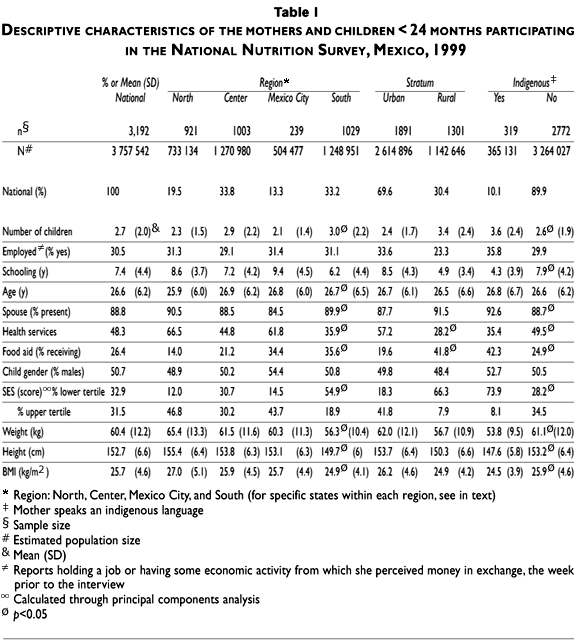
<body><![CDATA[<p>&nbsp;</p>     <p><font size="3" face="Verdana"><b>Material and Methods </b></font></p>     <p><font size="2" face="Verdana"><I>Materials. </I>We used digital baby scales    (Tanita, Tokyo, Jap&oacute;n Model 1583) to measure weight in children weighing    up to 10 kg with a lecture precision of 10g, and of 20g for weight between 10    and 20 kg. Fibre glass stadiometers (locally constructed) were used to measure    length (&lt;2y) or height (&gt;2y). Standardisation procedures were conducted    prior to data collection to minimise technical measurement error. </font></p>     <p><font size="2" face="Verdana"><b>Subjects </b></font></p>     <p><font size="2" face="Verdana">Women of reproductive age (12 to 49y) and their    live children &lt;2y of age who lived in the selected household at the time    of the survey, were included in the analyses. Information on diseased children    was not collected, thus not included in any calculation. </font></p>     <p><font size="2" face="Verdana"><I>Methods. </I>This was a national cross-sectional    survey conducted in Mexico to evaluate the nutritional status, and its main    determinants, of Mexican children and women of reproductive age. </font></p>     <p><font size="2" face="Verdana"><I>Definitions</I>. Exclusive breast-feeding    was defined as consuming nothing but breast milk. Rates were calculated for    &lt;4 and &lt;6 mo of age (i.e., for 0 to 123 days (d) and 0 to &lt; 183 d of    life), and monthly by completed months as recommended by Lung'aho <I>et al</I><SUP>23    </SUP>(i.e., 0 mo=0-30 d, 1 mo=31-61 d, 2 mo=62-91 d, 3 mo=92-122 d, 4 mo=123-152    d, 5 mo=153-182 d). Ever breast-fed was defined as having ever suckled at the    breast to receive colostrum or breast milk. Continued breast-feeding rates were    calculated as recommended, from the number of children aged 12 to &lt;16 mo    and from 20 to &lt;24 mo who received breast milk the day before the interview.    Median duration of any breast-feeding was estimated through moving averages,    and by the Kaplan-Meier method. Results were the same, and moving averages are    presented. </font></p>     <p><font size="2" face="Verdana"> Independent variables included anthropometric    and demographic characteristics of mothers and their infants, and are presented    in <a href="#tab01">Table I</a>. </font></p>     <p><a name="tab01"></a></p>     <p>&nbsp;</p>     ]]></body>
<body><![CDATA[<p align="center"><img src="/img/revistas/spm/v45s4/a04tab01.gif"></p>     <p>&nbsp;</p>     <p><font size="2" face="Verdana"><I>Sampling technique</I>. A national probabilistic    sample was collected, representative of 4 regions <a name="tx01"></a>(North,    Center, Mexico City, and South),<a href="#nt01"><sup>1</sup></a>    and rural (pop &lt;2500) and urban areas (pop <u>&gt;</u> 2500). Families were    selected according to a sampling frame developed by INEGI (acronym from its    Spanish name; Mexican National Institute of Statistics, Geography and Information),    described in detail elsewhere.<SUP>26</SUP> All households with women between    the ages of 12 and 49y, and or children &lt;12 y of age, were included in the    population from which the sample was drawn. The data presented here pertain    to children &lt;2 y of age living in the selected families. There were no exclusion    criteria. Uninhabited (9.8%), non identified households (1.9%), and non-response    (5.9%), were the causes of no data collection. Data were collected from the    82.4% of the households in the sample frame who responded. Written informed    consent was obtained after explaining the purpose and methods of the survey    from all adult participants, and from children's guardians, before data were    collected. </font></p>     <p><font size="2" face="Verdana"><I>Data collection</I>. Data on breast-feeding    practices were collected using two methodologies: status quo and recall data,    as recommended by the WHO.<SUP>25</SUP> Briefly, status quo data describe what    the child under 2y of age was fed the day and the night before the interview.    For recall data the mother is asked to recall the age when specific infant feeding    practices occurred. Mothers were asked at what age their child was fed consistently    at least one food item from each of 7 food groups. The 7 groups were as follows:    1) plain water, 2) non-breast milk, 3) non-nutritive liquids (sugared water    and other water-based drinks including teas, bean or chicken broth, coffee,    soft drinks, or <a name="tx02"></a>'agua miel';<a href="#nt02"><sup>2</sup></a>    but not fruit juices, 4) other liquids (thinned gruel with water or milk, another    cereal with water or milk, coffee with milk, fruit juices), 5) cereals and legumes    (pastas, rice, tortillas, bread, oats, beans, lentils, fava beans and similar    beans); 6) fruits and vegetables; and 7) meat, milk products, and eggs). </font></p>     <p><font size="2" face="Verdana"> Because recall data are based on asking the    mother at what specific age she fed her child a certain food group, we used    data from all children &lt; 2y to estimate breast-feeding duration. Alternatively,    status quo data uses the information provided by the mother, to define her infant    feeding practices the day and night before the interview. Thus the recall method    provides larger sample size but has potential recall biases. The status quo    method (also called current data) is based on a smaller sample size but assumed    to have greater validity to describe breast-feeding practices.<SUP>27</SUP>    We only used recall data to estimate <I>median duration </I>of breast-feeding    of children &lt;24 mo. This way we had information on those infants who had    been breastfed but had stopped breast-feeding at the time of the survey. We    used status quo data for prevalences and to estimate the probabilities of exclusive    breast-feeding. </font></p>     <p><font size="2" face="Verdana"> Prior to the survey, observers were trained    in all areas of data collection by trained and standardised supervisors. During    data collection, supervisors reviewed data every night, and if inconsistencies    or missing data were identified, the observer was asked to return the next day    to the designated households. This strategy was implemented to minimise inconsistencies    and missing data in the field. </font></p>     <p><font size="2" face="Verdana"><I>Statistical analyses. </I>The outcome variables    were breast-feeding practices analysed either: a) as proportions, b) as medians,    or c) as dependent variables in logistic regression models. </font></p>     <blockquote>        <p><font size="2" face="Verdana">a) The proportion of exclusive breast-feeding      infants &lt;4 months was calculated by dividing the total number of children      exclusively breast-fed from birth to &lt;123 d (&lt;4 mo) by the total number      of infants &lt;123 d, regardless of their feeding mode. Proportions for &lt;6      mo were calculated similarly, but for &lt;183 d. The indicator of early (12      to &lt;16 mo) and late (20 to &lt;24 mo) rates for continuation of breast-feeding,      as well as the overall rate of continued breast-feeding in the complete second      year of life (&gt;365 to &lt; 731 d), were calculated as recommended. <SUP>27</SUP>      </font></p> </blockquote>     <p><font size="2" face="Verdana"> We used status quo data to estimate these proportions.    </font></p>     ]]></body>
<body><![CDATA[<blockquote>        <p><font size="2" face="Verdana">b) Median duration of breast-feeding was calculated      by two methods: Kaplan-Meier<SUP>28 </SUP>and 3-month-running averages, assigned      to the middle month. We used recall data. Because we collected data on children      &lt;2y, and there are children who breast-feed longer, calculated medians      may underestimate the true duration. This underestimation is usually not large      because most of the breast-feeding takes place during the first 2y of life.      The magnitude of the underestimation depends on the distribution of feeding      practices by age. </font></p>       <p><font size="2" face="Verdana">c) Logistic regression models for complex surveys<SUP>29</SUP>      were used to predict the probability of being exclusively breast-fed for 4      mo or less (<I>p</I>EBF&lt;4) and for 6 mo or less (<I>p</I>EBF&lt;6) using      status quo data. Probabilities of exclusive breast-feeding were calculated.      The inverse of the sample probabilities of being selected were used as sample      weights. </font></p> </blockquote>     <p><font size="2" face="Verdana"> For many years, the WHO recommendations regarding    the duration of exclusive breast-feeding provided a range of 4 to 6 mo rather    than a specific duration. Since March 2001, the recommendation is specific:    6 mo of EBF. Thus, for some time, reaching at least 4 mo was the target, which    has changed to 6 mo now. For this reason, we analysed the probabilities of being    exclusively breast-fed for both age targets: &lt;4 and &lt;6 mo. </font></p>     <p><font size="2" face="Verdana"> Several biologically meaningful and socially    important determinants of breast-feeding practices were considered to describe    the sample and to construct the regression models. For women these were: number    of children, ethnicity (whether or not she speaks a native language), maternal    schooling (last grade approved at school, in y), age (y), employment <a name="tx03"></a>(yes/no),<a href="#nt03"><sup>3</sup></a>    if living with a partner (yes/no), family's socio-economic level (SEL, an index    constructed through a principal components analysis)<SUP>30</SUP> nutritional    status: (weight (kg), height (m), and body mass index (kg/m<SUP>2</SUP>)), being    a beneficiary of any kind of government <a name="tx04"></a>food     aid<a href="#nt04"><sup>4</sup></a> (yes/no), and access to health <a name="tx05"></a>care    system<a href="#nt05"><SUP>5</SUP></a> (insured or not). Infants' characteristics    considered were: gender, weight and length. We also took into consideration    the family's place of residence: region (North, Center, South, and Mexico City),    and type of setting (rural/urban). Meaningful interactions were evaluated as    well. These included two-way interactions of any of the following two variables:    SEL, maternal schooling, place of residence, ethnicity, number of children,    maternal employment, and infant gender and length. Cuadratic relationships were    evaluated for the relationship between the<I> p</I>EBF&lt;4 or<I> p</I>EBF&lt;6    mo, and maternal age, maternal schooling, SEL, number of children, and infant    age. </font></p>     <p><font size="2" face="Verdana"> Bivariate relationships were first evaluated.    Those associations with<I> p</I> values &lt;0.25 were entered into a full model.    A backwards elimination procedure was followed to reach a model which contained    independent variables with a statistical association with breast-feeding practices    of<I> p</I>&lt; 0.05. Forward procedure was used to test the backward selection.    The models' goodness of fit was tested with the Hosmer-Lemeshow test.<SUP>31</SUP>    Both models had a <I>p</I>&gt; 0.23. Multicollinearity was evaluated through    decomposing the models' matrix of eigenvalues, and evaluating the ratio of the    highest over the lowest eigenvalue.<SUP>32</SUP> Models with values over 10    were not accepted. </font></p>     <p><font size="2" face="Verdana"> Final models contain variables that were statistically    significant after the procedure described above and variables that, based on    subject matter considerations, are considered important regardless of their    statistically significant level. </font></p>     <p><font size="2" face="Verdana"> Descriptive statistics of the study population    are presented (<a href="#tab02">Table II</a>); means &plusmn; standard deviations    (SD) for continuos, and percentages for categorical variables. Student's <I>t</I>    tests for means, and <font face="Symbol">c</font><SUP>2</SUP> for proportions,    were performed to compare data among the strata for each exclusive breast feeding    group. Data entry was done with <a name="tx06"></a>Fox Pro<a href="#nt06"><SUP>6</SUP></a>    and statistical analysis with <a name="tx07"></a>Stata<a href="#nt07"><SUP>7</SUP></a>    (version 7.0, 2001) </font></p>     <p><a name="tab02"></a></p>     <p>&nbsp;</p>     ]]></body>
<body><![CDATA[<p align="center"><font size="2" face="Verdana"><img src="/img/revistas/spm/v45s4/a04tab02.gif"></font></p>     <p>&nbsp;</p>     <p><font size="3" face="Verdana"><b>Results </b></font></p>     <p><font size="2" face="Verdana"><I>Characteristics of study subjects</I>. <a href="#tab01">Table    I</a> presents the demographic, social and anthropometric characteristics of    the families with children &lt;24 mo of age, stratified by region, urban or    rural stratum, and ethnic group (indigenous yes/no). Families have less than    three children on the average; this is highest for indigenous families. Slightly    less than one out of every 3 (30.5%) women in reproductive age reported to have    been employed in the last week in Mexico; this was also highest (35.8%) for    indigenous women. The average number of years of maternal schooling was one    year above completed primary (7.4y). While in Mexico City it was slightly above    secondary school (9.4y), for indigenous mothers it was only 4.3y. The average    maternal age was 26.6y. Almost 9 out of every 10 mothers (88.8%) in the sample    had a spouse at the time of the survey. Half of the families had any kind of    pre-arranged health service (48.3%) with large differences among the categories,    but rural areas, indigenous families, and the south region had much lower percent    families with health service coverage than comparable strata. </font></p>     <p><font size="2" face="Verdana"> Somewhat over one quarter (26.4%) of the families    received some kind of government <a name="tx08"></a>food aid<a href="#nt08"><sup>8</sup></a>    with larger proportions among families from the rural or of indigenous origin.    Combining all types of governmental food aid, a very similar proportion of families    received it in the metropolitan than in the south region, but analysing food    aid by urban or rural location, the percent of beneficiaries in rural area (41.8%)    was twice as high as that in the urban area (19.6%). As expected, half the children    were males. Mothers were somewhat heavy (60.4 kg) and short (152.7 cm on the    average), and had an average body mass index (kg/m<SUP>2</SUP>, BMI) of 25.7;    above the cut-off point used to classify overweight. </font></p>     <p><font size="2" face="Verdana"><I>Breast-feeding proportions. </I><a href="#fig01">Figure    1</a> presents breast-feeding practices by completed months through the first    two years of life. Proportions are presented for exclusive, full, and any type    of breast-feeding, as reported by the status quo method. Data show that breast-feeding    practices decline rapidly with age, the largest decline occurring during the    first six months of life. Exclusive breast-feeding is the most rare of the practices;    slightly over one third (39%) of infants &lt;1 month were fed exclusively at    the breast, and only 86.9% of them receive breast milk at this age. </font></p>     <p><a name="fig01"></a></p>     <p>&nbsp;</p>     <p align="center"><img src="/img/revistas/spm/v45s4/a04fig01.gif"></p>     <p>&nbsp;</p>     ]]></body>
<body><![CDATA[<p><font size="2" face="Verdana"> As indicators of early (12 to &lt;16 mo) and    late (20 to &lt;24 mo) rates for continuation of breast-feeding, the percentage    of children still at the breast at these ages was estimated. One third (36.2%)<SUP>27    </SUP>and one quarter (25.3%) of the children continue to breast-feed in these    two stages respectively. The overall rate of continued breast-feeding in the    complete second year of life (&gt;365 to &lt; 731 d) is 30.9%. </font></p>     <p><font size="2" face="Verdana"> Breast-feeding practices by categories of demographic,    socio-economic and anthropometric characteristics are presented in <a href="#tab02">Table    II</a>. The estimated national median duration of breast-feeding was 9 months.    Duration was longest in the group of indigenous mothers where more than 50%    of the children were still breast-fed at 24 mo; thus median duration could not    be calculated in these ethnic group, but it is certainly longer than 24 mo.    The next longest breast-feeding duration was for those mothers whose infants    were below the population median length <a name="tx09"></a>(&gt;20 mo)<a href="#nt09"><sup>9</sup></a>    followed by those in the south and in the low SEL (15 mo), the rural area, mothers    without formal schooling, and whose height was below the sample mean (14 mo).    The shortest median breast-feeding duration (6 mo) was found in the north region,    in the high SEL, in those not having a spouse present, and in those with <u>&gt;</u>    12y of maternal schooling. The national percent of children in Mexico who were    ever breast-fed was 92.3%. This figure ranged from 88.9% (those with no maternal    schooling) and 94.0-94.1% (those with 1 child and those with &gt;14y of maternal    schooling), with little differences among subgroups. However, the differences    in proportions within categories of schooling, availability of health services,    and maternal BMI, were statistically significant (<I>p</I><u>&lt;</u> 0.05).    A clear trend of increasing proportions of children ever breast-fed with increasing    years of maternal schooling was observed. </font></p>     <p>&nbsp;</p>     <p align="center"><img src="/img/revistas/spm/v45s4/a04fig02.gif" border="0" usemap="#Map">    <map name="Map">     <area shape="rect" coords="141,408,202,425" href="#tab03">   </map> </p>     <p>&nbsp;</p>     <p><font size="2" face="Verdana"> There was a lower proportion of ever breast-fed    children in the group of heavier mothers and in those with no health service    available. </font></p>     <p><font size="2" face="Verdana"> The percent of infants EBF&lt; 4 mo was 25.7%,    and for those EBF&lt; 6 mo was 20.3%. As expected, prevalence of EBF&lt;4 mo    was almost in all categories higher than for &lt;6 mo, except for the Mexico    City and for the indigenous women, where these two sets of prevalences did not    seem to be different. </font></p>     <p><font size="2" face="Verdana"> There are clear differences in EBF proportions    at both time intervals (&lt;4 and &lt;6 mo) within the four regions, between    rural and urban settings, and between ethnic groups (all <I>p</I>&lt;0.001).    The south has almost three times the extent of EBF as the Mexico City. There    is a clear difference among SEL categories with much higher proportions of EBF    in the low compared to the middle or high SEL categories. The probability that    employed women feed their infants exclusively at the breast is markedly lower    than the observed in those self-reported as unemployed at both time points (both    <I>p</I>&lt;0.03). There are not statistically significant differences in the    proportions of EBF, within strata of having a spouse present, number of children,    or maternal age, at either studied times (<I>p</I><u>&gt;</u>0.17). </font></p>     <p><font size="2" face="Verdana"> The association between maternal schooling and    prevalence of EBF is negative at both intervals (<I>p</I>&lt; 0.001), with a    slight disruption of the apparently linear association in the interval between    12 to 14y. The higher the maternal schooling the lower the prevalence of EBF,    with a sharp decline in the rate of reduction after 14 years of maternal schooling.    Over forty percent (41.5) of the women with &lt;1y of maternal schooling reported    EBF&lt;4 and only 3.7% do so in the group of mothers with <u>&gt;</u> 14y of    schooling. The same pattern is observed for EBF&lt;6. Having health service    coverage is negatively associated with the proportion of EBF&lt;4 mo and EBF&lt;6    mo (both <I>p</I>&lt;0.05). </font></p>     <p><font size="2" face="Verdana"> In terms of maternal nutritional status, there    is a notably higher proportion of EBF for the shorter (&lt; mean height) and    the thinner (&lt; mean BMI) mothers (all <I>p</I>&lt;0.001). EBF proportions    for shorter infants (&lt; mean length) are larger than for longer infants. </font></p>     ]]></body>
<body><![CDATA[<p><font size="2" face="Verdana"> Over 10% more girls &lt;4 months were exclusively    breast-fed (31.7%) than boys (20.2%, <I>p</I>&lt;0.01). At &lt;6 months, there    was still a larger proportion of girls who were EBF, but the difference was    smaller (7.1%, <I>p</I>&lt;0.05). </font></p>     <p><font size="2" face="Verdana"> Two logistic regression models were developed    for complex surveys, to describe the infant's probability of EBF&lt;4 mo and    EBF&lt;6 mo (<a href="#tab03">Table III</a>).</font></p>     <p><a name="tab03"></a></p>     <p>&nbsp;</p>     <p align="center"><img src="/img/revistas/spm/v45s4/a04tab03.gif"></p>     <p>&nbsp;</p>     <p><font size="2" face="Verdana"> Infant age, and sex, maternal SEL and ethnicity,    and the interaction between SEL and infant sex, determined the <I>p</I>(EBF&lt;4).    Maternal schooling and employment were included in the model as relevant     variables, but were not associated in a statistically significant way with the    outcome (<I>p</I>=0.97 and <I>p</I>=0.15, respectively). Their inclusion in    the regression models markedly changed the estimated regression coefficients    of the rest of the variables, and increased the multicollinearity of the model.    Thus, we present model <I>p</I>(EBF&lt;4) without these two variables. All probabilities    presented are adjusted for the statistically significant variables in the model.    </font></p>     <p><font size="2" face="Verdana"> At &lt;4 mo, the probability of being EBF declined    with the child's age, from an estimated <I>p(</I>EBF&lt;4) of 0.47 at 10 d of    life, to 0.21 at 110 d. Infants of indigenous mothers had almost twice the <I>p(</I>EBF&lt;4)    (<I>p</I>=0.39) compared to those of non indigenous mothers (<I>p</I>=0.24).    The association between sex and <I>p(</I>EBF&lt;4) depended on the SEL of the    family. In girls, this probability had a modest decline across the SEL values.    It changed little from the lowest (<I>p</I>(EBF&lt;4)= 0.46) to the highest    (<I>p</I>(EBF&lt;4)= 0.33) value of the SEL score. In contrast,     for boys, this probability decreased sharply, from 0.51 in the lowest to 0.11    in the highest SEL. The <I>p(</I>EBF&lt;4) was unaffected by maternal schooling    or employment at this infant age. Maternal schooling was added to the model    either as a dichotomous variable, categorized into three groups, as a line or    as a curve. None of these forms were associated with <I>p(</I>EBF&lt;4) and    inclusion of either forms created multicollinearity problems in the model. </font></p>     <p><font size="2" face="Verdana"> For infants &lt;6 mo, the <I>p</I>(EBF&lt;6)    was determined by infant's age and length, and by maternal ethnicity, SEL and    employment. Again, maternal schooling was not associated with <I>p</I>(EBF&lt;6).    We assessed the pertinence of including age in its linear form, but through    the analyses resulted better if age was categorized, using the median as the    cutt-ff (<u>&lt;</u>, &gt; 95 d). The <I>p</I>(EFF&lt;6) was larger for younger    (<I>p</I>=0.31) than for older infants (<I>p</I>=0.18). The size of the infant,    as estimated by length, was inversely associated with p(EBF&lt;6). The shortest    infants in this age (52 cm) had a twice the <I>p</I>EBF&lt;6 (<I>p</I>=0.34)    than that observed for the largest (67cm) infants (<I>p</I>=0.18). Infants of    indigenous mothers had three times the<I> p</I>(EBF&lt;6) (<I>p</I>=0.34) than    those of non indigenous mothers (<I>p</I>=0.15). Maternal employment at this    age was negatively associated with the outcome. Infants of employed women had    a probability of EBF&lt;6 of 0.19; and this value was 0.30 for infants of mothers    who reported not holding a paid employment the week prior to the interview.    Finally, SEL was also inversely related to the <I>p</I>(EBF&lt;6). This probability    was 0.41 in the lowest and 0.17 in the highest SEL. </font></p>     <p>&nbsp;</p>     ]]></body>
<body><![CDATA[<p><font size="3" face="Verdana"><b>Discussion </b></font></p>     <p><font size="2" face="Verdana">The NNS-1999 offered the opportunity to ascertain    breast-feeding practices in Mexico. The proportion of exclusive breast-feeding    for infants &lt;4 mo is 25.7%, and for those &lt;6 mo is 20.3%. The percent    of infants ever breast-fed is 92.3%. National data on the proportion of exclusive    breast-feeding had only been collected once in Mexico prior to 1999. It was    on 1979<SUP>21</SUP> when breast-feeding practices were evaluated by the status    quo method, the same method we used in this national survey to estimate prevalences    of EBF. We assume that the two surveys are relatively comparable in terms of    their estimate of the rates of EBF because both used the same methodology to    estimate EBF, and both were national representative surveys drawn form a probabilistic    sample proportional to the size and urban: rural population in the country.    For the 1979 national survey, data on exclusive breast-feeding (EBF) were presented    only for those infants who were breast-fed. Our NNS-1999 data derive from all    live children &lt;2y regardless of their feeding mode. We recalculated the proportions    of EBF in 1979 based on all studied children, and estimated that 15.3% of infants    below 3 months of age were fed exclusively at the breast. Over two decades later,    29.4% of infants &lt;3 mo of age are fed exclusively at the breast in Mexico.    The estimated change in the proportion of EBF over these two decades represents    a two-fold increase in 22y. </font></p>     <p><font size="2" face="Verdana"> Although the rate of improvement was substantial,    it is below improvements achieved by other Latin American countries. For example,    in Honduras and Nicaragua increases of 7.75 percent points per year were observed    from 1985 to 2000 and in Brazil increases of 3.8 percent points per year were    documented during the same period <a name="tx10"></a>(UNICEF<a href="#nt10"><sup>10</sup></a>),<SUP>18</SUP>    while in Mexico the increase reported above was equivalent to 0.75 percent point    per year. Should these rates remain unchanged, it would take 93y for Mexico    to increase to 100% of EBF &lt;4 mo; whereas Nicaragua would need only 7.5y    and Brazil 15.3y. </font></p>     <p><font size="2" face="Verdana"> The percentage of infants ever breast-fed in    Mexico had been ascertained more recently and increased from 86.3 in 1988 (NNS-I)    to 92.3 in this National 1999 survey. This is an important improvement which    is probably the result of the breast-feeding initiation promotion in maternity    hospitals. </font></p>     <p><font size="2" face="Verdana"> In relation to the duration of breast-feeding,    two previous national surveys<SUP>19,23</SUP> revealed a median of 8.7 mo in    1976,<SUP>19</SUP> a <I>mean </I>of 10.5 mo in 1987.<SUP>23</SUP> The present    NNS-1999 reports a median of 9 mo; i.e., no meaningful change. The 1976 and    1987 surveys had different time frames than the NNS-1999 to estimate duration    of breast-feeding. In the two previous surveys, mothers in their reproductive    years were asked for how long they breast-fed their last child. In the NNS-1999    we collected child feeding practices for live children &lt;24 mo of age. </font></p>     <p><font size="2" face="Verdana"> Even when 20% of the children were still breast-fed    at 23 mo in the NNS-1999, half of all infants &lt;24 months had stopped breast-feeding    at 9 mo. Thus, no underestimation of the median duration could have been caused    by having still 20% breast-fed infants at 23 mo. </font></p>     <p><font size="2" face="Verdana"> The results of the NNS-1999 show that the proportion    of exclusive breast-fed infants is higher in the south region of Mexico, in    the rural communities, in the indigenous population, in the low SEL, in infants    of unemployed mothers or whose mother had either no schooling, had no health    services, were thinner or shorter. The percentage of exclusive breast-feeding    is also larger for smaller babies and for girls. These proportions range from    28.3% to 48.2% for EBF&lt;4, and from 22.7% to 48.4% for EBF&lt;6 mo (See <a href="#tab02">Table    II</a>). </font></p>     <p><font size="2" face="Verdana"> Two groups of determinants of exclusive breast-feeding    appear relevant: a) maternal characteristics (ethnicity, employment and socio-economic    level), and b) infant characteristics (age, gender, and size as determined by    length as opposed to by weight). </font></p>     <p><font size="2" face="Verdana"> Previous research has documented better practices    in rural Mexico<SUP>33</SUP> and in less educated mothers.<SUP>20</SUP> In our    bivariate analysis, we also found these trends. However, when we use multiple    regression models adjusting for several variables, factors such as rural/urban    location were no longer associated with breast-feeding practices. Clearly, the    analytical strategy used modifies the inferences drawn from the data. </font></p>     <p><font size="2" face="Verdana"> Indigenous women are spread throughout Mexico,    but concentrate in the south where 73.8% of the total indigenous population    lives. Ethnicity is a strong predictor of EBF&lt;4 in Mexico, even after controlling    for the mother's socio-economic level. This finding suggests that it is not    only availability of resources, as indicated by SEL, which influence feeding    practices, but other factors, such as infant rearing practices or culture, determine    infant feeding mode as well. The influence ethnicity has on the prevalence of    exclusive breast-feeding is observed for the entire interval studied; i.e.,    the first 6 mo of life. The WHO recommends EBF for 6 mo, and Mexican indigenous    women are more in agreement with this recommendation than their non-indigenous    counterparts. </font></p>     ]]></body>
<body><![CDATA[<p><font size="2" face="Verdana"> Our results also show that the probability of    exclusive breast-feeding &lt;4 mo is influenced by infant's sex. Girls are more    commonly exclusively breast-fed than boys. P&eacute;rez-Escamilla and co-workers<SUP>34</SUP>    have reported that girls are more frequently exclusively breast-fed than boys    in Brazil and Honduras, but had not observed this in Mexico. Adair and co-workers<SUP>35</SUP>    in the Philippines found that girls were fully breastfed more frequently than    boys. An explanation offered by both groups of authors relate to the mothers'    perception about size of the infants (boys being larger), or to gender bias.    </font></p>     <p><font size="2" face="Verdana"> Gender bias may be related to parental involvement    with their children in different living conditions. This is explained by the    Trivers and Willard<SUP>36</SUP> theory which predicts that parents living in    good conditions will bias their investments to sons, whereas those living in    poor conditions will bias their investment towards girls. For the Trivers and    Willard<SUP>36</SUP> theory to hold, an interaction between condition and gender    should exist. We observed an interaction between gender and our indicator of    socio-economic condition as these relate to the<I> p</I>EBF&lt;4 mo. We do not    know the reason why mothers introduce complementary foods earlier to boys than    to girls; but if we assume they do so because they believe boys need more than    girls, then our study finds support for this theory. Gender bias may be related    to the mother trying to favor boys by feeding them other foods earlier under    the assumption that it is beneficial for their growth. Paradoxically such gender    bias, should it exist, would be counterproductive for boys because early introduction    of foods to the infant is associated with increased morbidity.<SUP>37</SUP>    </font></p>     <p><font size="2" face="Verdana"> The size of an infant may be a cue to the mother,    influencing her infant's feeding practices. Size may shift her decision in either    direction. In one scenario, if the exclusively breastfed child is large, the    mother might interpret this as her milk production being sufficient to support    such growth, and be persuaded to continue exclusive breast-feeding. This was    observed in the Philippines<SUP>35</SUP> where fatter infants (larger ponderal    index (g/cm<SUP>3</SUP>)) were more likely to be EBF&lt;6 mo than the thinner    babies. But in an alternative scenario, growth (size) could be a signal for    the nursing mother indicating a growing need for foods. In this case, larger    infants would be fed complementary foods earlier than smaller ones. </font></p>     <p><font size="2" face="Verdana"> Support for this last scenario was observed    in the present analyses where the probability of being exclusive breastfed &lt;6    mo decreased as infant length increased. </font></p>     <p><font size="2" face="Verdana"> There is evidence that Latin American nursing    women think that bigger babies need more food. Picado and coworkers<SUP>38</SUP>    found that Nicaraguan lactating mothers consider exclusive breast-feeding (in    infants &lt; 1y) insufficient to support growth, and inconvenient for the nursing    mother. Unfortunately no information is given on the age of the child at which    the mother considers EBF to be insufficient. This concept would most probably    be wrong for a two-month old baby, and quite accurate for an eleven-month old    one; both &lt;1y. </font></p>     <p><font size="2" face="Verdana"> Reverse causality has been documented to explain    the negative association between the size (nutritional status) of the infant    and prolonged breast-feeding. It has been observed that mothers decide not to    wean the sicker infants and extend the duration of breast-feeding to protect    the weaker child.<SUP>7,39,40 </SUP>This has been described for infants <I>older    </I>that 6 mo and for a<I>ny</I> and not for <I>exclusive </I>breast-feeding.    Thus, reverse causality cannot explain the greater p(EBF&lt;6) observed in our    data. </font></p>     <p><font size="2" face="Verdana"> Cultural, as well as practical issues influence    maternal infant feeding practices. Employment status, a variable in our model    for exclusive breast-feeding &lt; 6 mo, impose real time constraints for mothers.    The introduction of foods or liquids to the breast-fed infants' diet might be    a strategy for the working mother to reduce the time spent breast-feeding, releasing    more time for work. In a study of time budgets of unemployed mothers,<SUP>41    </SUP>the introduction of complementary feeds to the breast-fed infant observed    was reported to increase, rather than decrease the time spent feeding the baby.    In such context, time constraint may not be a real issue. The inferences done    by Cohen and co-workers apply for mothers not working outside their home. However;    in the case of employed mothers, they can be substituted by another person to    bottle or complementary feed their infants releasing real time to work. There    is ample evidence in the literature that employed nursing mothers or those planning    to return to work, breast-feed less frequently their infants and are less likely    to exclusively breast-feed.<SUP>37,38,42 </SUP>Combining nursing and employment    is not a simple process. Employed mothers need accurate and practical advice,    permission to breast-feed their infants, a private place to extract milk in    their working place, flexible working hours, and encouragement and support from    peers and family to breast-feed as recommended by the WHO. Unless decisive and    targeted breast-feeding protection and promotion for employed mothers is implemented,    breast-feeding rates are expected to be lower than those found for non-employed    mothers. An intervention trial in Chile<SUP>43</SUP> shows that improving working    conditions and lactation knowledge of nursing mothers, such as a place to extract    and store milk, anticipatory counseling, and monthly follow-ups, can increase    the percentage of exclusive breast-feeding during the first six months of life.    </font></p>     <p><font size="2" face="Verdana"> The Baby Friendly Hospital Initiative (BFHI),    put forth by UNICEF and WHO has been implemented in Mexico for over a decade.<SUP>44</SUP>    No formal evaluation of its impact has been conducted in the country, but it    has probably played a role in the changes observed and reported here, especially    in improving the rates of ever breast-feeding or initiation. This initiative    has been observed to improve rates of initiation and duration of breast-feeding<SUP>45,46    </SUP>and the likelihood of improved rates of exclusive and full breast-feeding    at 3 mo. </font></p>     <p><font size="2" face="Verdana"> Clearly, a more efficient implementation of    the BFHI in Mexico, as well as decisive and unambiguous breast-feeding promotion    and protection is needed to improve the poor practices observed in Mexico. Otherwise,    it would take us almost 100y to reach the WHO recommendation of exclusively    breast-feed all infants <a name="tx11"></a>&lt;4 mo.<a href="#nt11"><sup>11</sup></a></font></p>     <p><font size="2" face="Verdana"> A limitation of our study is the lack of qualitative    information regarding the reasons behind infant feeding decisions. We can confidently    state who has better infant feeding practices, but we do not know why, which    is an indispensable piece of information to design potentially effective breast-feeding    promotion programs. Neither do we know who the actors are in these decision    making process. Our data do not provide information on the specific role of    the family members or the health services –private or governmental-, in    the mother's decision to breast-feed. But clearly, these potential actors have    not provided enough quality and timely breast-feeding protection to have had    meaningful impact in the country's breast-feeding practices in the last two    decades as other countries such as Honduras, Nicaragua or Brazil have probably    done. </font></p>     ]]></body>
<body><![CDATA[<p><font size="2" face="Verdana"> Another limitation of our study, shared by studies    using the status quo method in cross sectional studies, is the inference about    the prevalence of EBF. Using the status quo methodology, infants are classified    as exclusively breast-fed if nothing but breast milk was consumed the day and    night prior to the interview. This does not imply that these infants had never    received any other liquid or food, or that they have always been fed the same    way. If there is an interest in estimating the prevalence of those infants who    have been EBF all their life, a modified methodology must be used, and the status    quo method, as used today, would probably underestimate such prevalence. The    magnitude of this bias would depend on the type and frequency of the reversibility    of the infant feeding practices in the studied populations. </font></p>     <p><font size="2" face="Verdana"> Nonetheless, with the available national information    we have a better idea of what type of breast-feeding promotion is needed (exclusive    breast-feeding all infants &lt;6 mo), who needs it the most (employed, highly    educated, non-indigenous women of medium SEL and not living in the south, as    well as those bearing large babies or boys), and when is mostly needed (prior    to initiate breast-feeding). </font></p>     <p><font size="2" face="Verdana"> Qualitative research in nursing and non-nursing    mothers is needed to tailor better breast-feeding promotion and protection programs    in Mexico. Such programs are urgently needed to improve infant feeding practices.    By doing so we may expect better infant health, survival, and cognitive development.    Mothers would benefit as well. Fertility    may be reduced by intense breast-feeding, a powerful family planning strategy    in developing countries. Also, mothers who breast-feed exclusively at the breast    for the recommended WHO-duration, would lose more weight. In the face of the    large overweight prevalence increase in the world and in Mexico, this may be    an excellent measure against increased weight gain with pregnancy. </font></p>     <p>&nbsp;</p>     <p><font size="3" face="Verdana"><b>References </b></font></p>     <!-- ref --><p><font size="2" face="Verdana">1. Institute of Medicine, Subcommittee on Nutrition    During Lactation, Committee on Nutritional Status during Pregnancy and Lactation,    Food and Nutrition Board. Nutrition during Lactation. Washington, DC: National    Academy Press, 1991. </font>&nbsp;&nbsp;&nbsp;&nbsp;&nbsp;&nbsp;&nbsp;&nbsp;[&#160;<a href="javascript:void(0);" onclick="javascript: window.open('/scielo.php?script=sci_nlinks&ref=9185881&pid=S0036-3634200300100000400001&lng=','','width=640,height=500,resizable=yes,scrollbars=1,menubar=yes,');">Links</a>&#160;]<!-- end-ref --><!-- ref --><p><font size="2" face="Verdana">2. Victora CG, Vaughan P, Lombardi C, Fuchs S,    Gigante L, Smith P <I>et al.</I> Evidence for protection by breast-feeding against    infant deaths from infectious diseases in Brazil. Lancet 1987;Aug 8;2(8554):319-322.    </font>&nbsp;&nbsp;&nbsp;&nbsp;&nbsp;&nbsp;&nbsp;&nbsp;[&#160;<a href="javascript:void(0);" onclick="javascript: window.open('/scielo.php?script=sci_nlinks&ref=9185882&pid=S0036-3634200300100000400002&lng=','','width=640,height=500,resizable=yes,scrollbars=1,menubar=yes,');">Links</a>&#160;]<!-- end-ref --><!-- ref --><p><font size="2" face="Verdana">3. Yoon PW, Black R, Moulton L, Becker S. Effect    of not breastfeeding on the risk of diarrheal and respiratory mortality in children    under 2 years of age in Metro Cebu, the Philippines. Am J Epidemiol 1996;143:1142-1148.    </font>&nbsp;&nbsp;&nbsp;&nbsp;&nbsp;&nbsp;&nbsp;&nbsp;[&#160;<a href="javascript:void(0);" onclick="javascript: window.open('/scielo.php?script=sci_nlinks&ref=9185883&pid=S0036-3634200300100000400003&lng=','','width=640,height=500,resizable=yes,scrollbars=1,menubar=yes,');">Links</a>&#160;]<!-- end-ref --><!-- ref --><p><font size="2" face="Verdana">4. L&oacute;pez-Alarc&oacute;n M, Villalpando    S, Fajardo A. Breast-feeding lowers the frequency and duration of acute respiratory    infection and diarrhea in infants under six months of age. J Nutr 1997;127:436-443.    </font>&nbsp;&nbsp;&nbsp;&nbsp;&nbsp;&nbsp;&nbsp;&nbsp;[&#160;<a href="javascript:void(0);" onclick="javascript: window.open('/scielo.php?script=sci_nlinks&ref=9185884&pid=S0036-3634200300100000400004&lng=','','width=640,height=500,resizable=yes,scrollbars=1,menubar=yes,');">Links</a>&#160;]<!-- end-ref --><!-- ref --><p><font size="2" face="Verdana">5. Feachem R, Koblinsky M. Interventions for    the control of diarrhoeal diseases among young children: Promotion of breast-feeding.    Bull World Health Organ 1984;62(2):271-294. </font>&nbsp;&nbsp;&nbsp;&nbsp;&nbsp;&nbsp;&nbsp;&nbsp;[&#160;<a href="javascript:void(0);" onclick="javascript: window.open('/scielo.php?script=sci_nlinks&ref=9185885&pid=S0036-3634200300100000400005&lng=','','width=640,height=500,resizable=yes,scrollbars=1,menubar=yes,');">Links</a>&#160;]<!-- end-ref --><!-- ref --><p><font size="2" face="Verdana">6. Mart&iacute;nez JC, Habicht JP, Ashworth A,    Kirkwood B. Weaning in Southern Brazil: Is There a &quot;Weanling's Dilemma&quot;?    J Nutr 1994;124:1189-1198. </font>&nbsp;&nbsp;&nbsp;&nbsp;&nbsp;&nbsp;&nbsp;&nbsp;[&#160;<a href="javascript:void(0);" onclick="javascript: window.open('/scielo.php?script=sci_nlinks&ref=9185886&pid=S0036-3634200300100000400006&lng=','','width=640,height=500,resizable=yes,scrollbars=1,menubar=yes,');">Links</a>&#160;]<!-- end-ref --><!-- ref --><p><font size="2" face="Verdana">7. Marquis GS, Habicht JP, Lanata CF, Black RE,    Rasmussen KM. Breast milk or animal-product foods improve linear growth of Peruvian    toddlers consuming marginal diets. Am J Clin Nutr 1997;66:1102-1109. </font>&nbsp;&nbsp;&nbsp;&nbsp;&nbsp;&nbsp;&nbsp;&nbsp;[&#160;<a href="javascript:void(0);" onclick="javascript: window.open('/scielo.php?script=sci_nlinks&ref=9185887&pid=S0036-3634200300100000400007&lng=','','width=640,height=500,resizable=yes,scrollbars=1,menubar=yes,');">Links</a>&#160;]<!-- end-ref --><!-- ref --><p><font size="2" face="Verdana">8. Anderson JW, Johnstone B, Remley D. Breast-feeding    and cognitive development: A meta-analysis. Am J Clin Nutr 1999;70:525-535.    </font>&nbsp;&nbsp;&nbsp;&nbsp;&nbsp;&nbsp;&nbsp;&nbsp;[&#160;<a href="javascript:void(0);" onclick="javascript: window.open('/scielo.php?script=sci_nlinks&ref=9185888&pid=S0036-3634200300100000400008&lng=','','width=640,height=500,resizable=yes,scrollbars=1,menubar=yes,');">Links</a>&#160;]<!-- end-ref --><!-- ref --><p><font size="2" face="Verdana">9. Dewey KG. Is breastfeeding protective against    child obesity? J Hum Lact 2003 Feb; 19(1):9-18. </font>&nbsp;&nbsp;&nbsp;&nbsp;&nbsp;&nbsp;&nbsp;&nbsp;[&#160;<a href="javascript:void(0);" onclick="javascript: window.open('/scielo.php?script=sci_nlinks&ref=9185889&pid=S0036-3634200300100000400009&lng=','','width=640,height=500,resizable=yes,scrollbars=1,menubar=yes,');">Links</a>&#160;]<!-- end-ref --><!-- ref --><p><font size="2" face="Verdana">10. Collaborative Group on Hormonal Factors in    Breast Cancer. Breast cancer and breastfeeding: Collaborative reanalysis of    individual data from 47 epidemiological studies in 30 countries, including 50    302 women with breast cancer and 96 973 women without the disease. Lancet 2002;360(9328):187-195.    </font>&nbsp;&nbsp;&nbsp;&nbsp;&nbsp;&nbsp;&nbsp;&nbsp;[&#160;<a href="javascript:void(0);" onclick="javascript: window.open('/scielo.php?script=sci_nlinks&ref=9185890&pid=S0036-3634200300100000400010&lng=','','width=640,height=500,resizable=yes,scrollbars=1,menubar=yes,');">Links</a>&#160;]<!-- end-ref --><!-- ref --><p><font size="2" face="Verdana">11. Tovar-Guzm&aacute;n V, Hern&aacute;ndez-Gir&oacute;n    C, Lazcano-Ponce E, Romieu I, Hern&aacute;ndez-Avila M. Breast cancer in Mexican    women: An epidemiological study with cervical cancer control. Rev Saude Publica    2000;34(2):113-119. </font>&nbsp;&nbsp;&nbsp;&nbsp;&nbsp;&nbsp;&nbsp;&nbsp;[&#160;<a href="javascript:void(0);" onclick="javascript: window.open('/scielo.php?script=sci_nlinks&ref=9185891&pid=S0036-3634200300100000400011&lng=','','width=640,height=500,resizable=yes,scrollbars=1,menubar=yes,');">Links</a>&#160;]<!-- end-ref --><!-- ref --><p><font size="2" face="Verdana">12. Romieu I, Hern&aacute;ndez-Avila M, Lazcano    E, L&oacute;pez L, Romero-Jaime R. Breast cancer and lactation history in mexican    women. Am J Epidemiol 1996;143(6):543-552.    </font>&nbsp;&nbsp;&nbsp;&nbsp;&nbsp;&nbsp;&nbsp;&nbsp;[&#160;<a href="javascript:void(0);" onclick="javascript: window.open('/scielo.php?script=sci_nlinks&ref=9185892&pid=S0036-3634200300100000400012&lng=','','width=640,height=500,resizable=yes,scrollbars=1,menubar=yes,');">Links</a>&#160;]<!-- end-ref --><!-- ref --><p><font size="2" face="Verdana">13. McNeilly AS. Lactational control of reproduction.    Reprod Fertil Dev 2001;13:583-590. </font>&nbsp;&nbsp;&nbsp;&nbsp;&nbsp;&nbsp;&nbsp;&nbsp;[&#160;<a href="javascript:void(0);" onclick="javascript: window.open('/scielo.php?script=sci_nlinks&ref=9185893&pid=S0036-3634200300100000400013&lng=','','width=640,height=500,resizable=yes,scrollbars=1,menubar=yes,');">Links</a>&#160;]<!-- end-ref --><!-- ref --><p><font size="2" face="Verdana">14. Howie PW. Natural regulation of fertility.    Br Med Bull 1993;49:182-199. </font>&nbsp;&nbsp;&nbsp;&nbsp;&nbsp;&nbsp;&nbsp;&nbsp;[&#160;<a href="javascript:void(0);" onclick="javascript: window.open('/scielo.php?script=sci_nlinks&ref=9185894&pid=S0036-3634200300100000400014&lng=','','width=640,height=500,resizable=yes,scrollbars=1,menubar=yes,');">Links</a>&#160;]<!-- end-ref --><!-- ref --><p><font size="2" face="Verdana">15. Dewey K, Cohen R, Landa-Rivera L, Canahuati    J, Brown K. Effects of age at introduction of complementary foods to breast-fed    infants on duration of lactational amenorrhoea in Honduran women. Am J Clin    Nutr 1997;65:1403-1409. </font>&nbsp;&nbsp;&nbsp;&nbsp;&nbsp;&nbsp;&nbsp;&nbsp;[&#160;<a href="javascript:void(0);" onclick="javascript: window.open('/scielo.php?script=sci_nlinks&ref=9185895&pid=S0036-3634200300100000400015&lng=','','width=640,height=500,resizable=yes,scrollbars=1,menubar=yes,');">Links</a>&#160;]<!-- end-ref --><!-- ref --><p><font size="2" face="Verdana">16. Dewey K, Cohen R, Brown K, Landa-Rivera L.    Effects of exclusive breastfeeding for four versus six months on maternal nutritional    status and infant motor development: Results of two randomised trials in Honduras.    J Nutr 2001;131:262-267. </font>&nbsp;&nbsp;&nbsp;&nbsp;&nbsp;&nbsp;&nbsp;&nbsp;[&#160;<a href="javascript:void(0);" onclick="javascript: window.open('/scielo.php?script=sci_nlinks&ref=9185896&pid=S0036-3634200300100000400016&lng=','','width=640,height=500,resizable=yes,scrollbars=1,menubar=yes,');">Links</a>&#160;]<!-- end-ref --><!-- ref --><p><font size="2" face="Verdana">17. Rivera JA, Barquera S, Campirano F, Campos    I, Safdie M, Tovar V. Epidemiological and nutritional transition in Mexico:    Rapid increase of non-communicable chronic diseases and obesity. Public Health    Nutr 2002;5(1A):113-122. </font>&nbsp;&nbsp;&nbsp;&nbsp;&nbsp;&nbsp;&nbsp;&nbsp;[&#160;<a href="javascript:void(0);" onclick="javascript: window.open('/scielo.php?script=sci_nlinks&ref=9185897&pid=S0036-3634200300100000400017&lng=','','width=640,height=500,resizable=yes,scrollbars=1,menubar=yes,');">Links</a>&#160;]<!-- end-ref --><!-- ref --><p><font size="2" face="Verdana">18. UNICEF End Decade Databases - Breastfeeding    Available from: <a href="http://childinfo.org/eddb/brfeed/grpexamr.htm">http://childinfo.org/eddb/brfeed/grpexamr.htm</a>.    Consulted on 6/19/2000. </font>&nbsp;&nbsp;&nbsp;&nbsp;&nbsp;&nbsp;&nbsp;&nbsp;[&#160;<a href="javascript:void(0);" onclick="javascript: window.open('/scielo.php?script=sci_nlinks&ref=9185898&pid=S0036-3634200300100000400018&lng=','','width=640,height=500,resizable=yes,scrollbars=1,menubar=yes,');">Links</a>&#160;]<!-- end-ref --><!-- ref --><p><font size="2" face="Verdana">19. Notzon F. Trends in infant feeding in developing    countries. Pediatrics 1984;74(Suppl):648-665. </font>&nbsp;&nbsp;&nbsp;&nbsp;&nbsp;&nbsp;&nbsp;&nbsp;[&#160;<a href="javascript:void(0);" onclick="javascript: window.open('/scielo.php?script=sci_nlinks&ref=9185899&pid=S0036-3634200300100000400019&lng=','','width=640,height=500,resizable=yes,scrollbars=1,menubar=yes,');">Links</a>&#160;]<!-- end-ref --><!-- ref --><p><font size="2" face="Verdana">20. G&oacute;mez-Dant&eacute;s H, Garnica ME,    Sep&uacute;lveda J, Valdespino-G&oacute;mez JL, Lam N, Herrera M. Patrones de    lactancia y ablactaci&oacute;n en M&eacute;xico. Encuesta Nacional de Salud    1986. Salud Publica Mex 1989;31:725-734. </font>&nbsp;&nbsp;&nbsp;&nbsp;&nbsp;&nbsp;&nbsp;&nbsp;[&#160;<a href="javascript:void(0);" onclick="javascript: window.open('/scielo.php?script=sci_nlinks&ref=9185900&pid=S0036-3634200300100000400020&lng=','','width=640,height=500,resizable=yes,scrollbars=1,menubar=yes,');">Links</a>&#160;]<!-- end-ref --><!-- ref --><p><font size="2" face="Verdana">21. Dimond HJ, Ashworth A. Infant feeding practices    in Kenya, Mexico and Malaysia. The rarity of the exclusively breast-fed infant.    Human Nutr 1987;41A:51-64. </font>&nbsp;&nbsp;&nbsp;&nbsp;&nbsp;&nbsp;&nbsp;&nbsp;[&#160;<a href="javascript:void(0);" onclick="javascript: window.open('/scielo.php?script=sci_nlinks&ref=9185901&pid=S0036-3634200300100000400021&lng=','','width=640,height=500,resizable=yes,scrollbars=1,menubar=yes,');">Links</a>&#160;]<!-- end-ref --><!-- ref --><p><font size="2" face="Verdana">22. Ysunza OA. El abandono de la lactancia materna    en M&eacute;xico. I. Tendencias recientes. Rev Invest Clin 1986;3(supl):41-46.    </font>&nbsp;&nbsp;&nbsp;&nbsp;&nbsp;&nbsp;&nbsp;&nbsp;[&#160;<a href="javascript:void(0);" onclick="javascript: window.open('/scielo.php?script=sci_nlinks&ref=9185902&pid=S0036-3634200300100000400022&lng=','','width=640,height=500,resizable=yes,scrollbars=1,menubar=yes,');">Links</a>&#160;]<!-- end-ref --><!-- ref --><p><font size="2" face="Verdana">23. Anonymous. Mexico 1987: Results from the    Demographic and Health survey (DHS). Stud Fam Plann 1990;21:181-185. </font>&nbsp;&nbsp;&nbsp;&nbsp;&nbsp;&nbsp;&nbsp;&nbsp;[&#160;<a href="javascript:void(0);" onclick="javascript: window.open('/scielo.php?script=sci_nlinks&ref=9185903&pid=S0036-3634200300100000400023&lng=','','width=640,height=500,resizable=yes,scrollbars=1,menubar=yes,');">Links</a>&#160;]<!-- end-ref --><!-- ref --><p><font size="2" face="Verdana">24. Long-Dunlap K, Rivera J, Rivera M, Hern&aacute;ndez-Avila    M, Lezana MA. Feeding patterns of Mexican infants recorded in the 1988 National    Nutrition Survey. Salud P&uacute;blica Mex 1995;37:120-129. </font>&nbsp;&nbsp;&nbsp;&nbsp;&nbsp;&nbsp;&nbsp;&nbsp;[&#160;<a href="javascript:void(0);" onclick="javascript: window.open('/scielo.php?script=sci_nlinks&ref=9185904&pid=S0036-3634200300100000400024&lng=','','width=640,height=500,resizable=yes,scrollbars=1,menubar=yes,');">Links</a>&#160;]<!-- end-ref --><!-- ref --><p><font size="2" face="Verdana">25. Organizaci&oacute;n Mundial de la Salud.    54a. Asamblea Mundial de la Salud. Punto 13.1 del orden del d&iacute;a provisional.    Estrategia mundial para la alimentaci&oacute;n del lactante y del ni&ntilde;o    peque&ntilde;o. Informe de la Secretar&iacute;a. Ginebra: OMS, 2001;A54/7. </font>&nbsp;&nbsp;&nbsp;&nbsp;&nbsp;&nbsp;&nbsp;&nbsp;[&#160;<a href="javascript:void(0);" onclick="javascript: window.open('/scielo.php?script=sci_nlinks&ref=9185905&pid=S0036-3634200300100000400025&lng=','','width=640,height=500,resizable=yes,scrollbars=1,menubar=yes,');">Links</a>&#160;]<!-- end-ref --><!-- ref --><p><font size="2" face="Verdana">26. Rivera J, Shamah T, Villalpando S, Gonz&aacute;lez-Coss&iacute;o    T, Hern&aacute;ndez B, Sep&uacute;lveda J. Encuesta Nacional de Nutrici&oacute;n    1999. Estado Nutricio de ni&ntilde;os y Mujeres en M&eacute;xico. Cuernavaca,    Morelos, M&eacute;xico: INSP, 2001. </font>&nbsp;&nbsp;&nbsp;&nbsp;&nbsp;&nbsp;&nbsp;&nbsp;[&#160;<a href="javascript:void(0);" onclick="javascript: window.open('/scielo.php?script=sci_nlinks&ref=9185906&pid=S0036-3634200300100000400026&lng=','','width=640,height=500,resizable=yes,scrollbars=1,menubar=yes,');">Links</a>&#160;]<!-- end-ref --><!-- ref --><p><font size="2" face="Verdana">27. Lung'aho M, Huffman SL, Labbok MH, Sommerfelt    E, Baker J. Tool kit for monitoring and evaluating breastfeeding practices and    programs. Washington, DC: Wellstart International, Expanded Promotion of Breastfeeding    Program, Septiembre 1996; USAID Policy &amp; Technical Monographs. </font>&nbsp;&nbsp;&nbsp;&nbsp;&nbsp;&nbsp;&nbsp;&nbsp;[&#160;<a href="javascript:void(0);" onclick="javascript: window.open('/scielo.php?script=sci_nlinks&ref=9185907&pid=S0036-3634200300100000400027&lng=','','width=640,height=500,resizable=yes,scrollbars=1,menubar=yes,');">Links</a>&#160;]<!-- end-ref --><!-- ref --><p><font size="2" face="Verdana">28. Hosmer D Jr, Lemeshow S. Applied survival    analysis. Nueva York (NY): John Wiley and Sens, 1999:28-31. </font>&nbsp;&nbsp;&nbsp;&nbsp;&nbsp;&nbsp;&nbsp;&nbsp;[&#160;<a href="javascript:void(0);" onclick="javascript: window.open('/scielo.php?script=sci_nlinks&ref=9185908&pid=S0036-3634200300100000400028&lng=','','width=640,height=500,resizable=yes,scrollbars=1,menubar=yes,');">Links</a>&#160;]<!-- end-ref --><!-- ref --><p><font size="2" face="Verdana">29. Lehtonen R, Pahkinen E. Practical methods    for design and analysis of complex surveys. Chichester, England: John Wiley    &amp; Sons, 1995:269-281. </font>&nbsp;&nbsp;&nbsp;&nbsp;&nbsp;&nbsp;&nbsp;&nbsp;[&#160;<a href="javascript:void(0);" onclick="javascript: window.open('/scielo.php?script=sci_nlinks&ref=9185909&pid=S0036-3634200300100000400029&lng=','','width=640,height=500,resizable=yes,scrollbars=1,menubar=yes,');">Links</a>&#160;]<!-- end-ref --><!-- ref --><p><font size="2" face="Verdana">30. Hair JF, Anderson R, Tatham R, Black W. Multivariate    data analysis with readings. 3a ed. Nueva York (NY): Macmillan Publishing Company,    1992:223-253. </font>&nbsp;&nbsp;&nbsp;&nbsp;&nbsp;&nbsp;&nbsp;&nbsp;[&#160;<a href="javascript:void(0);" onclick="javascript: window.open('/scielo.php?script=sci_nlinks&ref=9185910&pid=S0036-3634200300100000400030&lng=','','width=640,height=500,resizable=yes,scrollbars=1,menubar=yes,');">Links</a>&#160;]<!-- end-ref --><!-- ref --><p><font size="2" face="Verdana">31. Hosmer DW, Lemeshow S. Applied logistic regression.    Nueva York (NY): Wiley &amp; Sons, 1989:140-145. </font>&nbsp;&nbsp;&nbsp;&nbsp;&nbsp;&nbsp;&nbsp;&nbsp;[&#160;<a href="javascript:void(0);" onclick="javascript: window.open('/scielo.php?script=sci_nlinks&ref=9185911&pid=S0036-3634200300100000400031&lng=','','width=640,height=500,resizable=yes,scrollbars=1,menubar=yes,');">Links</a>&#160;]<!-- end-ref --><!-- ref --><p><font size="2" face="Verdana">32. Gujarati D. Basic econometrics. Nueva York    (NY): Mc Graw Hill, 1997:330-334. </font>&nbsp;&nbsp;&nbsp;&nbsp;&nbsp;&nbsp;&nbsp;&nbsp;[&#160;<a href="javascript:void(0);" onclick="javascript: window.open('/scielo.php?script=sci_nlinks&ref=9185912&pid=S0036-3634200300100000400032&lng=','','width=640,height=500,resizable=yes,scrollbars=1,menubar=yes,');">Links</a>&#160;]<!-- end-ref --><!-- ref --><p><font size="2" face="Verdana">33. P&eacute;rez-Escamilla R. Breastfeeding in    Africa and the Latin American and Caribbean Region: The potential role of ubanisation.    J Trop Pediactr 1994;40:137-143. </font>&nbsp;&nbsp;&nbsp;&nbsp;&nbsp;&nbsp;&nbsp;&nbsp;[&#160;<a href="javascript:void(0);" onclick="javascript: window.open('/scielo.php?script=sci_nlinks&ref=9185913&pid=S0036-3634200300100000400033&lng=','','width=640,height=500,resizable=yes,scrollbars=1,menubar=yes,');">Links</a>&#160;]<!-- end-ref --><!-- ref --><p><font size="2" face="Verdana">34. P&eacute;rez-Escamilla R, Lutter CH, Segall    AM, Rivera A, Trevi&ntilde;o-Siller S, Sanghvi T. Exclusive breast-feeding duration    is associated with attitudinal, socioeconomic and biocultural determinants in    three Latin American countries. J Nutr 1995;125:2972-2984. </font>&nbsp;&nbsp;&nbsp;&nbsp;&nbsp;&nbsp;&nbsp;&nbsp;[&#160;<a href="javascript:void(0);" onclick="javascript: window.open('/scielo.php?script=sci_nlinks&ref=9185914&pid=S0036-3634200300100000400034&lng=','','width=640,height=500,resizable=yes,scrollbars=1,menubar=yes,');">Links</a>&#160;]<!-- end-ref --><!-- ref --><p><font size="2" face="Verdana">35. Adair LS, Popkin B, Guilkey DK. The duration    of breast-feeding: How is it affected by biological, sociodemographic, health    sector, and food industry factors? Demography 1993;30:63-80. </font>&nbsp;&nbsp;&nbsp;&nbsp;&nbsp;&nbsp;&nbsp;&nbsp;[&#160;<a href="javascript:void(0);" onclick="javascript: window.open('/scielo.php?script=sci_nlinks&ref=9185915&pid=S0036-3634200300100000400035&lng=','','width=640,height=500,resizable=yes,scrollbars=1,menubar=yes,');">Links</a>&#160;]<!-- end-ref --><!-- ref --><p><font size="2" face="Verdana">36. Trivers RL, Willard DE. Natural selection    of parental ability to vary the sex ratio of offspring. Science 1973;179:90-92.</font>&nbsp;&nbsp;&nbsp;&nbsp;&nbsp;&nbsp;&nbsp;&nbsp;[&#160;<a href="javascript:void(0);" onclick="javascript: window.open('/scielo.php?script=sci_nlinks&ref=9185916&pid=S0036-3634200300100000400036&lng=','','width=640,height=500,resizable=yes,scrollbars=1,menubar=yes,');">Links</a>&#160;]<!-- end-ref --><!-- ref --><p><font size="2" face="Verdana"> 37. Brown K, Black RE, L&oacute;pez-Roma&ntilde;a    G, Credd de Kanashiro H. Infant-feeding practices and their relationship with    diarrhoeal and other diseases in Huascar (Lima) Per&uacute;. Pediatrics 1989;83:31-40.    </font>&nbsp;&nbsp;&nbsp;&nbsp;&nbsp;&nbsp;&nbsp;&nbsp;[&#160;<a href="javascript:void(0);" onclick="javascript: window.open('/scielo.php?script=sci_nlinks&ref=9185917&pid=S0036-3634200300100000400037&lng=','','width=640,height=500,resizable=yes,scrollbars=1,menubar=yes,');">Links</a>&#160;]<!-- end-ref --><!-- ref --><p><font size="2" face="Verdana">38. Picado J, Olson C, Rasmussen KM. Metodolog&iacute;a    combinada para entender la duraci&oacute;n del amamantamiento en barrios pobres    de Managua, Nicaragua. Rev Panam Salud Publica 1997;2:398-407. </font>&nbsp;&nbsp;&nbsp;&nbsp;&nbsp;&nbsp;&nbsp;&nbsp;[&#160;<a href="javascript:void(0);" onclick="javascript: window.open('/scielo.php?script=sci_nlinks&ref=9185918&pid=S0036-3634200300100000400038&lng=','','width=640,height=500,resizable=yes,scrollbars=1,menubar=yes,');">Links</a>&#160;]<!-- end-ref --><!-- ref --><p><font size="2" face="Verdana">39. Simondon KB, Simondon F, Costes R, Delaunay    V, Diallo A. Breast-feeding is associated with improved growth in length, but    not weight, in rural Senegalese toddlers. Am J Clin Nutr 2001;73:959-967. </font>&nbsp;&nbsp;&nbsp;&nbsp;&nbsp;&nbsp;&nbsp;&nbsp;[&#160;<a href="javascript:void(0);" onclick="javascript: window.open('/scielo.php?script=sci_nlinks&ref=9185919&pid=S0036-3634200300100000400039&lng=','','width=640,height=500,resizable=yes,scrollbars=1,menubar=yes,');">Links</a>&#160;]<!-- end-ref --><!-- ref --><p><font size="2" face="Verdana">40. Habicht JP. The association between prolonged    breastfeeding and poor growth-What are the implications? Adv Exp Med Biol 2000;478:193-200.    </font>&nbsp;&nbsp;&nbsp;&nbsp;&nbsp;&nbsp;&nbsp;&nbsp;[&#160;<a href="javascript:void(0);" onclick="javascript: window.open('/scielo.php?script=sci_nlinks&ref=9185920&pid=S0036-3634200300100000400040&lng=','','width=640,height=500,resizable=yes,scrollbars=1,menubar=yes,');">Links</a>&#160;]<!-- end-ref --><!-- ref --><p><font size="2" face="Verdana">41. Cohen RJ, Haddix K, Hurtado E, Dewey KG.    Maternal activity budgets: Feasibility of exclusive breastfeeding for six months    among urban women in Honduras. Soc Sci Med 1995;41:527-536. </font>&nbsp;&nbsp;&nbsp;&nbsp;&nbsp;&nbsp;&nbsp;&nbsp;[&#160;<a href="javascript:void(0);" onclick="javascript: window.open('/scielo.php?script=sci_nlinks&ref=9185921&pid=S0036-3634200300100000400041&lng=','','width=640,height=500,resizable=yes,scrollbars=1,menubar=yes,');">Links</a>&#160;]<!-- end-ref --><!-- ref --><p><font size="2" face="Verdana">42. Roe B, Whittington L, Fein SB, Teisl MF.    Is there a competition between breast-feeding and maternal employment? Demography    1999;36:157-171. </font>&nbsp;&nbsp;&nbsp;&nbsp;&nbsp;&nbsp;&nbsp;&nbsp;[&#160;<a href="javascript:void(0);" onclick="javascript: window.open('/scielo.php?script=sci_nlinks&ref=9185922&pid=S0036-3634200300100000400042&lng=','','width=640,height=500,resizable=yes,scrollbars=1,menubar=yes,');">Links</a>&#160;]<!-- end-ref --><!-- ref --><p><font size="2" face="Verdana">43. Valdes V, Pugin E, Schooley J, Catal&aacute;n    S, Aravena R. Clinical support can make a difference in exclusive breastfeeding    success among working women. J Trop Pediatr 2000;46:149-154. </font>&nbsp;&nbsp;&nbsp;&nbsp;&nbsp;&nbsp;&nbsp;&nbsp;[&#160;<a href="javascript:void(0);" onclick="javascript: window.open('/scielo.php?script=sci_nlinks&ref=9185923&pid=S0036-3634200300100000400043&lng=','','width=640,height=500,resizable=yes,scrollbars=1,menubar=yes,');">Links</a>&#160;]<!-- end-ref --><!-- ref --><p><font size="2" face="Verdana">44. Secretar&iacute;a de Salud. Creaci&oacute;n    del Comit&eacute; Nacional de Lactancia Materna. M&eacute;xico, DF: Diario Oficial    de la Federaci&oacute;n, 1991; Acuerdo N&uacute;mero 95 de la Secretar&iacute;a    de Salud. </font>&nbsp;&nbsp;&nbsp;&nbsp;&nbsp;&nbsp;&nbsp;&nbsp;[&#160;<a href="javascript:void(0);" onclick="javascript: window.open('/scielo.php?script=sci_nlinks&ref=9185924&pid=S0036-3634200300100000400044&lng=','','width=640,height=500,resizable=yes,scrollbars=1,menubar=yes,');">Links</a>&#160;]<!-- end-ref --><!-- ref --><p><font size="2" face="Verdana">45. Fairbank L, O'Meara S, Renfrew MJ, Woolridge    M, Sowden AJ, Lister-Sharp D. A systematic    review to evaluate the effectiveness of interventions to promote the initiation    of breastfeeding. Health Technology Assess 2000;4(25):1-171. </font>&nbsp;&nbsp;&nbsp;&nbsp;&nbsp;&nbsp;&nbsp;&nbsp;[&#160;<a href="javascript:void(0);" onclick="javascript: window.open('/scielo.php?script=sci_nlinks&ref=9185925&pid=S0036-3634200300100000400045&lng=','','width=640,height=500,resizable=yes,scrollbars=1,menubar=yes,');">Links</a>&#160;]<!-- end-ref --><!-- ref --><p><font size="2" face="Verdana">46. Kramer MS, Chalmers B, Hodnett ED, Sevkovskaya    Z, Dzikovich I, Shapiro S <I>et al</I>.    Promotion of breastfeeding intervention trial (PROBIT): A randomised trial in    the Republic of Belarus. JAMA 2001;285:413-420.</font>&nbsp;&nbsp;&nbsp;&nbsp;&nbsp;&nbsp;&nbsp;&nbsp;[&#160;<a href="javascript:void(0);" onclick="javascript: window.open('/scielo.php?script=sci_nlinks&ref=9185926&pid=S0036-3634200300100000400046&lng=','','width=640,height=500,resizable=yes,scrollbars=1,menubar=yes,');">Links</a>&#160;]<!-- end-ref --><p>&nbsp;</p>     <p>&nbsp;</p>     <p><font size="2" face="Verdana">Address reprint requests to    <br>   Dra. Teresa Gonz&aacute;lez-Coss&iacute;o    <br>   Avenida Universidad 655    <br>   colonia Santa Mar&iacute;a Ahuacatitl&aacute;n    <br>   62508 Cuernavaca, Morelos, M&eacute;xico    <br>   E-mail: <a href="mailto:tgonzale@insp.mx">tgonzale@insp.mx</a></font></p>     <p><font size="2" face="Verdana"><b>Received on:</b> August 20, 2002     ]]></body>
<body><![CDATA[<br>   <b>Accepted on:</b> September 12, 2003 </font></p>     <p>&nbsp;</p>     <p>&nbsp;</p>     <p><font size="2" face="Verdana">Portions of this paper were presented at Experimental    Biology, 2002; Nueva Orleans, Louisiana as: Breast-feeding practices in Mexico:    Results of the Second National Nutrition Survey 1999. Abstract A65.4.    <br>   <a name="nt01"></a><a href="#tx01">1</a> North (Baja California, Baja California    Sur, Coahuila, Chihuahua, Durango, Nuevo Le&oacute;n, Sonora and Tamaulipas).    Center (Aguascalientes, Colima, Guanajuato, Jalisco, M&eacute;xico (excludes    urbanised counties and localities adjacent to Mexico City), Michoac&aacute;n,    Morelos, Nayarit, Quer&eacute;taro, San Luis Potos&iacute;, Sinaloa, Zacatecas).    Mexico City (includes Federal District and urbanised counties from the state    of Mexico). South (Campeche, Chiapas, Guerrero, Hidalgo, Oaxaca, Puebla, Quintana    Roo, Tabasco, Tlaxcala, Veracruz, Yucat&aacute;n).    <br>   <a name="nt02"></a><a href="#tx02">2</a> Agua miel: unfermented syrup from the    agave core.    <br>   <a name="nt03"></a><a href="#tx03">3</a> Reports holding a job or having some    economic activity from which she perceived money in exchange, the week prior    to the interview.     <br>   <a name="nt04"></a><a href="#tx04">4</a> Any person of the household receiving    from the government one or more of the following food items: milk, tortillas,    maize or wheat flour, rice, beans, oil, pasta, sugar, salt, school breakfast,    Progresa infant or maternal supplement, sardines, crackers or cookies, or other).        <br>   <a name="nt05"></a><a href="#tx05">5</a> Access to a partial or complete health    insurance provided either by the government (IMSS, SSA ISSSTE, Pemex, Army or    Navy), or by a private employer.     <br>   <a name="nt06"></a><a href="#tx06">6</a> Microsoft Visual Fox Pro Release 6.    Seattle (WA): Microsoft Corporation, 1998-1999.     ]]></body>
<body><![CDATA[<br>   <a name="nt07"></a><a href="#tx07">7</a> Stata Statistical Software:Release    7.0 College Station (TX): Stata Corporation, 2001.    <br>   <a name="nt08"></a><a href="#tx08">8</a> Any person of the household receiving    from the government one or more of the following food items: milk, tortillas,    maize or wheat flour, rice, beans, oil, pasta, sugar, salt, school breakfast,    Progresa infant or maternal supplement, sardines, crackers or cookies).    <br>   <a name="nt09"></a><a href="#tx09">9</a> Infants under median length were younger    than the rest of the sample. The oldest in this sample was 20 mo old.    <br>   <a name="nt10"></a><a href="#tx10">10</a> Bolivia, Brazil, Chile, Colombia,    Dominican Republic, Ecuador, El Salvador, Guatemala, Honduras, Nicaragua, Paraguay,    and Per&uacute;.    <br>   <a name="nt11"></a><a href="#tx11">11</a>    And even longer for &lt;6 mo, the current recommendation.</font></p>      ]]></body><back>
<ref-list>
<ref id="B1">
<label>1</label><nlm-citation citation-type="book">
<collab>Institute of Medicine^dSubcommittee on Nutrition During Lactation, Committee on Nutritional Status during Pregnancy and Lactation</collab>
<source><![CDATA[Food and Nutrition Board: Nutrition during Lactation]]></source>
<year>1991</year>
<publisher-loc><![CDATA[Washington^eDC DC]]></publisher-loc>
<publisher-name><![CDATA[National Academy Press]]></publisher-name>
</nlm-citation>
</ref>
<ref id="B2">
<label>2</label><nlm-citation citation-type="journal">
<person-group person-group-type="author">
<name>
<surname><![CDATA[Victora]]></surname>
<given-names><![CDATA[CG]]></given-names>
</name>
<name>
<surname><![CDATA[Vaughan]]></surname>
<given-names><![CDATA[P]]></given-names>
</name>
<name>
<surname><![CDATA[Lombardi]]></surname>
<given-names><![CDATA[C]]></given-names>
</name>
<name>
<surname><![CDATA[Fuchs]]></surname>
<given-names><![CDATA[S]]></given-names>
</name>
<name>
<surname><![CDATA[Gigante]]></surname>
<given-names><![CDATA[L]]></given-names>
</name>
<name>
<surname><![CDATA[Smith]]></surname>
<given-names><![CDATA[P]]></given-names>
</name>
</person-group>
<article-title xml:lang="en"><![CDATA[Evidence for protection by breast-feeding against infant deaths from infectious diseases in Brazil]]></article-title>
<source><![CDATA[Lancet]]></source>
<year>1987</year>
<month>;A</month>
<day>ug</day>
<volume>2</volume>
<numero>8554</numero>
<issue>8554</issue>
<page-range>319-322</page-range></nlm-citation>
</ref>
<ref id="B3">
<label>3</label><nlm-citation citation-type="journal">
<person-group person-group-type="author">
<name>
<surname><![CDATA[Yoon]]></surname>
<given-names><![CDATA[PW]]></given-names>
</name>
<name>
<surname><![CDATA[Black]]></surname>
<given-names><![CDATA[R]]></given-names>
</name>
<name>
<surname><![CDATA[Moulton]]></surname>
<given-names><![CDATA[L]]></given-names>
</name>
<name>
<surname><![CDATA[Becker]]></surname>
<given-names><![CDATA[S]]></given-names>
</name>
</person-group>
<article-title xml:lang="en"><![CDATA[Effect of not breastfeeding on the risk of diarrheal and respiratory mortality in children under 2 years of age in Metro Cebu, the Philippines]]></article-title>
<source><![CDATA[Am J Epidemiol]]></source>
<year>1996</year>
<volume>143</volume>
<page-range>1142-1148</page-range></nlm-citation>
</ref>
<ref id="B4">
<label>4</label><nlm-citation citation-type="journal">
<person-group person-group-type="author">
<name>
<surname><![CDATA[López-Alarcón]]></surname>
<given-names><![CDATA[M]]></given-names>
</name>
<name>
<surname><![CDATA[Villalpando]]></surname>
<given-names><![CDATA[S]]></given-names>
</name>
<name>
<surname><![CDATA[Fajardo]]></surname>
<given-names><![CDATA[A]]></given-names>
</name>
</person-group>
<article-title xml:lang="en"><![CDATA[Breast-feeding lowers the frequency and duration of acute respiratory infection and diarrhea in infants under six months of age]]></article-title>
<source><![CDATA[J Nutr]]></source>
<year>1997</year>
<volume>127</volume>
<page-range>436-443</page-range></nlm-citation>
</ref>
<ref id="B5">
<label>5</label><nlm-citation citation-type="journal">
<person-group person-group-type="author">
<name>
<surname><![CDATA[Feachem]]></surname>
<given-names><![CDATA[R]]></given-names>
</name>
<name>
<surname><![CDATA[Koblinsky]]></surname>
<given-names><![CDATA[M]]></given-names>
</name>
</person-group>
<article-title xml:lang="en"><![CDATA[Interventions for the control of diarrhoeal diseases among young children: Promotion of breast-feeding]]></article-title>
<source><![CDATA[Bull World Health Organ]]></source>
<year>1984</year>
<volume>62(2)</volume>
<page-range>271-294</page-range></nlm-citation>
</ref>
<ref id="B6">
<label>6</label><nlm-citation citation-type="journal">
<person-group person-group-type="author">
<name>
<surname><![CDATA[Martínez]]></surname>
<given-names><![CDATA[JC]]></given-names>
</name>
<name>
<surname><![CDATA[Habicht]]></surname>
<given-names><![CDATA[JP]]></given-names>
</name>
<name>
<surname><![CDATA[Ashworth]]></surname>
<given-names><![CDATA[A]]></given-names>
</name>
<name>
<surname><![CDATA[Kirkwood]]></surname>
<given-names><![CDATA[B]]></given-names>
</name>
</person-group>
<article-title xml:lang="en"><![CDATA[Weaning in Southern Brazil: Is There a "Weanling's Dilemma"?]]></article-title>
<source><![CDATA[J Nutr]]></source>
<year>1994</year>
<volume>124</volume>
<page-range>1189-1198</page-range></nlm-citation>
</ref>
<ref id="B7">
<label>7</label><nlm-citation citation-type="journal">
<person-group person-group-type="author">
<name>
<surname><![CDATA[Marquis]]></surname>
<given-names><![CDATA[GS]]></given-names>
</name>
<name>
<surname><![CDATA[Habicht]]></surname>
<given-names><![CDATA[JP]]></given-names>
</name>
<name>
<surname><![CDATA[Lanata]]></surname>
<given-names><![CDATA[CF]]></given-names>
</name>
<name>
<surname><![CDATA[Black]]></surname>
<given-names><![CDATA[RE]]></given-names>
</name>
<name>
<surname><![CDATA[Rasmussen]]></surname>
<given-names><![CDATA[KM]]></given-names>
</name>
</person-group>
<article-title xml:lang="en"><![CDATA[Breast milk or animal-product foods improve linear growth of Peruvian toddlers consuming marginal diets]]></article-title>
<source><![CDATA[Am J Clin Nutr]]></source>
<year>1997</year>
<volume>66</volume>
<page-range>1102-1109</page-range></nlm-citation>
</ref>
<ref id="B8">
<label>8</label><nlm-citation citation-type="journal">
<person-group person-group-type="author">
<name>
<surname><![CDATA[Anderson]]></surname>
<given-names><![CDATA[JW]]></given-names>
</name>
<name>
<surname><![CDATA[Johnstone]]></surname>
<given-names><![CDATA[B]]></given-names>
</name>
<name>
<surname><![CDATA[Remley]]></surname>
<given-names><![CDATA[D]]></given-names>
</name>
</person-group>
<article-title xml:lang="en"><![CDATA[Breast-feeding and cognitive development: A meta-analysis]]></article-title>
<source><![CDATA[Am J Clin Nutr]]></source>
<year>1999</year>
<volume>70</volume>
<page-range>525-535</page-range></nlm-citation>
</ref>
<ref id="B9">
<label>9</label><nlm-citation citation-type="journal">
<person-group person-group-type="author">
<name>
<surname><![CDATA[Dewey]]></surname>
<given-names><![CDATA[KG]]></given-names>
</name>
</person-group>
<article-title xml:lang="en"><![CDATA[Is breastfeeding protective against child obesity?]]></article-title>
<source><![CDATA[J Hum Lact]]></source>
<year>2003</year>
<month> F</month>
<day>eb</day>
<volume>19</volume>
<numero>1</numero>
<issue>1</issue>
<page-range>9-18</page-range></nlm-citation>
</ref>
<ref id="B10">
<label>10</label><nlm-citation citation-type="journal">
<person-group person-group-type="author">
<name>
<surname><![CDATA[Collaborative]]></surname>
<given-names><![CDATA[Group]]></given-names>
</name>
</person-group>
<article-title xml:lang="en"><![CDATA[Breast cancer and breastfeeding: Collaborative reanalysis of individual data from 47 epidemiological studies in 30 countries, including 50 302 women with breast cancer and 96 973 women without the disease]]></article-title>
<source><![CDATA[Lancet]]></source>
<year>2002</year>
<volume>360</volume>
<numero>9328</numero>
<issue>9328</issue>
<page-range>187-195</page-range></nlm-citation>
</ref>
<ref id="B11">
<label>11</label><nlm-citation citation-type="journal">
<person-group person-group-type="author">
<name>
<surname><![CDATA[Tovar-Guzmán]]></surname>
<given-names><![CDATA[V]]></given-names>
</name>
<name>
<surname><![CDATA[Hernández-Girón]]></surname>
<given-names><![CDATA[C]]></given-names>
</name>
<name>
<surname><![CDATA[Lazcano-Ponce]]></surname>
<given-names><![CDATA[E]]></given-names>
</name>
<name>
<surname><![CDATA[Romieu]]></surname>
<given-names><![CDATA[I]]></given-names>
</name>
<name>
<surname><![CDATA[Hernández-Avila]]></surname>
<given-names><![CDATA[M]]></given-names>
</name>
</person-group>
<article-title xml:lang="en"><![CDATA[Breast cancer in Mexican women: An epidemiological study with cervical cancer control]]></article-title>
<source><![CDATA[Rev Saude Publica]]></source>
<year>2000</year>
<volume>34</volume>
<numero>2</numero>
<issue>2</issue>
<page-range>113-119</page-range></nlm-citation>
</ref>
<ref id="B12">
<label>12</label><nlm-citation citation-type="journal">
<person-group person-group-type="author">
<name>
<surname><![CDATA[Romieu]]></surname>
<given-names><![CDATA[I]]></given-names>
</name>
<name>
<surname><![CDATA[Hernández-Avila]]></surname>
<given-names><![CDATA[M]]></given-names>
</name>
<name>
<surname><![CDATA[Lazcano]]></surname>
<given-names><![CDATA[E]]></given-names>
</name>
<name>
<surname><![CDATA[López]]></surname>
<given-names><![CDATA[L]]></given-names>
</name>
<name>
<surname><![CDATA[Romero-Jaime]]></surname>
<given-names><![CDATA[R]]></given-names>
</name>
</person-group>
<article-title xml:lang="en"><![CDATA[Breast cancer and lactation history in mexican women]]></article-title>
<source><![CDATA[Am J Epidemiol]]></source>
<year>1996</year>
<volume>143</volume>
<numero>6</numero>
<issue>6</issue>
<page-range>543-552</page-range></nlm-citation>
</ref>
<ref id="B13">
<label>13</label><nlm-citation citation-type="journal">
<person-group person-group-type="author">
<name>
<surname><![CDATA[McNeilly]]></surname>
<given-names><![CDATA[AS]]></given-names>
</name>
</person-group>
<article-title xml:lang="en"><![CDATA[Lactational control of reproduction]]></article-title>
<source><![CDATA[Reprod Fertil Dev]]></source>
<year>2001</year>
<volume>13</volume>
<page-range>583-590</page-range></nlm-citation>
</ref>
<ref id="B14">
<label>14</label><nlm-citation citation-type="journal">
<person-group person-group-type="author">
<name>
<surname><![CDATA[Howie]]></surname>
<given-names><![CDATA[PW]]></given-names>
</name>
</person-group>
<article-title xml:lang="en"><![CDATA[Natural regulation of fertility]]></article-title>
<source><![CDATA[Br Med Bull]]></source>
<year>1993</year>
<volume>49</volume>
<page-range>182-199</page-range></nlm-citation>
</ref>
<ref id="B15">
<label>15</label><nlm-citation citation-type="journal">
<person-group person-group-type="author">
<name>
<surname><![CDATA[Dewey]]></surname>
<given-names><![CDATA[K]]></given-names>
</name>
<name>
<surname><![CDATA[Cohen]]></surname>
<given-names><![CDATA[R]]></given-names>
</name>
<name>
<surname><![CDATA[Landa-Rivera]]></surname>
<given-names><![CDATA[L]]></given-names>
</name>
<name>
<surname><![CDATA[Canahuati]]></surname>
<given-names><![CDATA[J]]></given-names>
</name>
<name>
<surname><![CDATA[Brown]]></surname>
<given-names><![CDATA[K]]></given-names>
</name>
</person-group>
<article-title xml:lang="en"><![CDATA[Effects of age at introduction of complementary foods to breast-fed infants on duration of lactational amenorrhoea in Honduran women]]></article-title>
<source><![CDATA[Am J Clin Nutr]]></source>
<year>1997</year>
<volume>65</volume>
<page-range>1403-1409</page-range></nlm-citation>
</ref>
<ref id="B16">
<label>16</label><nlm-citation citation-type="journal">
<person-group person-group-type="author">
<name>
<surname><![CDATA[Dewey]]></surname>
<given-names><![CDATA[K]]></given-names>
</name>
<name>
<surname><![CDATA[Cohen]]></surname>
<given-names><![CDATA[R]]></given-names>
</name>
<name>
<surname><![CDATA[Brown]]></surname>
<given-names><![CDATA[K]]></given-names>
</name>
<name>
<surname><![CDATA[Landa-Rivera]]></surname>
<given-names><![CDATA[L]]></given-names>
</name>
</person-group>
<article-title xml:lang="en"><![CDATA[Effects of exclusive breastfeeding for four versus six months on maternal nutritional status and infant motor development: Results of two randomised trials in Honduras]]></article-title>
<source><![CDATA[J Nutr]]></source>
<year>2001</year>
<volume>131</volume>
<page-range>262-267</page-range></nlm-citation>
</ref>
<ref id="B17">
<label>17</label><nlm-citation citation-type="journal">
<person-group person-group-type="author">
<name>
<surname><![CDATA[Rivera]]></surname>
<given-names><![CDATA[JA]]></given-names>
</name>
<name>
<surname><![CDATA[Barquera]]></surname>
<given-names><![CDATA[S]]></given-names>
</name>
<name>
<surname><![CDATA[Campirano]]></surname>
<given-names><![CDATA[F]]></given-names>
</name>
<name>
<surname><![CDATA[Campos]]></surname>
<given-names><![CDATA[I]]></given-names>
</name>
<name>
<surname><![CDATA[Safdie]]></surname>
<given-names><![CDATA[M]]></given-names>
</name>
<name>
<surname><![CDATA[Tovar]]></surname>
<given-names><![CDATA[V]]></given-names>
</name>
</person-group>
<article-title xml:lang="en"><![CDATA[Epidemiological and nutritional transition in Mexico: Rapid increase of non-communicable chronic diseases and obesity]]></article-title>
<source><![CDATA[Public Health Nutr]]></source>
<year>2002</year>
<volume>5(1A)</volume>
<page-range>113-122</page-range></nlm-citation>
</ref>
<ref id="B18">
<label>18</label><nlm-citation citation-type="journal">
<source><![CDATA[UNICEF End Decade Databases]]></source>
<year></year>
</nlm-citation>
</ref>
<ref id="B19">
<label>19</label><nlm-citation citation-type="journal">
<person-group person-group-type="author">
<name>
<surname><![CDATA[Notzon]]></surname>
<given-names><![CDATA[F]]></given-names>
</name>
</person-group>
<article-title xml:lang="en"><![CDATA[Trends in infant feeding in developing countries]]></article-title>
<source><![CDATA[Pediatrics]]></source>
<year>1984</year>
<volume>74</volume>
<numero>^sSuppl</numero>
<issue>^sSuppl</issue>
<supplement>Suppl</supplement>
<page-range>648-665</page-range></nlm-citation>
</ref>
<ref id="B20">
<label>20</label><nlm-citation citation-type="journal">
<person-group person-group-type="author">
<name>
<surname><![CDATA[Gómez-Dantés]]></surname>
<given-names><![CDATA[H]]></given-names>
</name>
<name>
<surname><![CDATA[Garnica]]></surname>
<given-names><![CDATA[ME]]></given-names>
</name>
<name>
<surname><![CDATA[Sepúlveda]]></surname>
<given-names><![CDATA[J]]></given-names>
</name>
<name>
<surname><![CDATA[Valdespino-Gómez]]></surname>
<given-names><![CDATA[JL]]></given-names>
</name>
<name>
<surname><![CDATA[Lam]]></surname>
<given-names><![CDATA[N]]></given-names>
</name>
<name>
<surname><![CDATA[Herrera]]></surname>
<given-names><![CDATA[M.]]></given-names>
</name>
</person-group>
<article-title xml:lang="en"><![CDATA[Encuesta Nacional de Salud 1986]]></article-title>
<source><![CDATA[Salud Publica Mex]]></source>
<year>1989</year>
<volume>31</volume>
<page-range>725-734</page-range></nlm-citation>
</ref>
<ref id="B21">
<label>21</label><nlm-citation citation-type="journal">
<person-group person-group-type="author">
<name>
<surname><![CDATA[Dimond]]></surname>
<given-names><![CDATA[HJ]]></given-names>
</name>
<name>
<surname><![CDATA[Ashworth]]></surname>
<given-names><![CDATA[A]]></given-names>
</name>
</person-group>
<article-title xml:lang="en"><![CDATA[Infant feeding practices in Kenya, Mexico and Malaysia: The rarity of the exclusively breast-fed infant]]></article-title>
<source><![CDATA[Human Nutr]]></source>
<year>1987</year>
<volume>41A</volume>
<page-range>51-64</page-range></nlm-citation>
</ref>
<ref id="B22">
<label>22</label><nlm-citation citation-type="journal">
<person-group person-group-type="author">
<name>
<surname><![CDATA[Ysunza]]></surname>
<given-names><![CDATA[OA.]]></given-names>
</name>
</person-group>
<article-title xml:lang="es"><![CDATA[El abandono de la lactancia materna en México: I. Tendencias recientes]]></article-title>
<source><![CDATA[Rev Invest Clin]]></source>
<year>1986</year>
<volume>3(supl)</volume>
<page-range>41-46</page-range></nlm-citation>
</ref>
<ref id="B23">
<label>23</label><nlm-citation citation-type="journal">
<person-group person-group-type="author">
<name>
<surname><![CDATA[Anonymous]]></surname>
</name>
</person-group>
<article-title xml:lang="en"><![CDATA[Mexico 1987: Results from the Demographic and Health survey (DHS)]]></article-title>
<source><![CDATA[Stud Fam Plann]]></source>
<year>1990</year>
<volume>21</volume>
<page-range>181-185</page-range></nlm-citation>
</ref>
<ref id="B24">
<label>24</label><nlm-citation citation-type="journal">
<person-group person-group-type="author">
<name>
<surname><![CDATA[Long-Dunlap]]></surname>
<given-names><![CDATA[K]]></given-names>
</name>
<name>
<surname><![CDATA[Rivera]]></surname>
<given-names><![CDATA[J]]></given-names>
</name>
<name>
<surname><![CDATA[Rivera]]></surname>
<given-names><![CDATA[M]]></given-names>
</name>
<name>
<surname><![CDATA[Hernández-Avila]]></surname>
<given-names><![CDATA[M]]></given-names>
</name>
<name>
<surname><![CDATA[Lezana]]></surname>
<given-names><![CDATA[MA]]></given-names>
</name>
</person-group>
<article-title xml:lang="en"><![CDATA[Feeding patterns of Mexican infants recorded in the 1988 National Nutrition Survey]]></article-title>
<source><![CDATA[Salud Pública Mex]]></source>
<year>1995</year>
<volume>37</volume>
<page-range>120-129</page-range></nlm-citation>
</ref>
<ref id="B25">
<label>25</label><nlm-citation citation-type="book">
<collab>Organización Mundial de la Salud^dAsamblea Mundial de la Salud</collab>
<source><![CDATA[Punto 13.1 del orden del día provisional: Estrategia mundial para la alimentación del lactante y del niño pequeño]]></source>
<year>2001</year>
<publisher-loc><![CDATA[Ginebra ]]></publisher-loc>
<publisher-name><![CDATA[Informe de la SecretaríaOMS]]></publisher-name>
</nlm-citation>
</ref>
<ref id="B26">
<label>26</label><nlm-citation citation-type="book">
<person-group person-group-type="author">
<name>
<surname><![CDATA[Rivera]]></surname>
<given-names><![CDATA[J]]></given-names>
</name>
<name>
<surname><![CDATA[Shamah]]></surname>
<given-names><![CDATA[T]]></given-names>
</name>
<name>
<surname><![CDATA[Villalpando]]></surname>
<given-names><![CDATA[S]]></given-names>
</name>
<name>
<surname><![CDATA[González-Cossío]]></surname>
<given-names><![CDATA[T]]></given-names>
</name>
<name>
<surname><![CDATA[Hernández]]></surname>
<given-names><![CDATA[B]]></given-names>
</name>
<name>
<surname><![CDATA[Sepúlveda]]></surname>
<given-names><![CDATA[J]]></given-names>
</name>
</person-group>
<source><![CDATA[Encuesta Nacional de Nutrición 1999: Estado Nutricio de niños y Mujeres en México]]></source>
<year>2001</year>
<publisher-loc><![CDATA[Cuernavaca^eMorelos Morelos]]></publisher-loc>
<publisher-name><![CDATA[INSP]]></publisher-name>
</nlm-citation>
</ref>
<ref id="B27">
<label>27</label><nlm-citation citation-type="book">
<person-group person-group-type="author">
<name>
<surname><![CDATA[Lung'aho]]></surname>
<given-names><![CDATA[M]]></given-names>
</name>
<name>
<surname><![CDATA[Huffman]]></surname>
<given-names><![CDATA[SL]]></given-names>
</name>
<name>
<surname><![CDATA[Labbok]]></surname>
<given-names><![CDATA[MH]]></given-names>
</name>
<name>
<surname><![CDATA[Sommerfelt]]></surname>
<given-names><![CDATA[E]]></given-names>
</name>
<name>
<surname><![CDATA[Baker]]></surname>
<given-names><![CDATA[J]]></given-names>
</name>
</person-group>
<source><![CDATA[Tool kit for monitoring and evaluating breastfeeding practices and programs. Washington, DC: Wellstart International, Expanded Promotion of Breastfeeding Program]]></source>
<year>Sept</year>
<month>ie</month>
<day>mb</day>
<publisher-name><![CDATA[USAID Policy & Technical Monographs]]></publisher-name>
</nlm-citation>
</ref>
<ref id="B28">
<label>28</label><nlm-citation citation-type="book">
<person-group person-group-type="author">
<name>
<surname><![CDATA[Hosmer]]></surname>
<given-names><![CDATA[D Jr]]></given-names>
</name>
<name>
<surname><![CDATA[Lemeshow]]></surname>
<given-names><![CDATA[S]]></given-names>
</name>
</person-group>
<source><![CDATA[Applied survival analysis]]></source>
<year>1999</year>
<page-range>28-31</page-range><publisher-loc><![CDATA[Nueva York^eNY NY]]></publisher-loc>
<publisher-name><![CDATA[John Wiley and Sens]]></publisher-name>
</nlm-citation>
</ref>
<ref id="B29">
<label>29</label><nlm-citation citation-type="book">
<person-group person-group-type="author">
<name>
<surname><![CDATA[Lehtonen]]></surname>
<given-names><![CDATA[R]]></given-names>
</name>
<name>
<surname><![CDATA[Pahkinen]]></surname>
<given-names><![CDATA[E]]></given-names>
</name>
</person-group>
<source><![CDATA[Practical methods for design and analysis of complex surveys]]></source>
<year>1995</year>
<page-range>269-281</page-range><publisher-loc><![CDATA[Chichester ]]></publisher-loc>
<publisher-name><![CDATA[John Wiley & Sons]]></publisher-name>
</nlm-citation>
</ref>
<ref id="B30">
<label>30</label><nlm-citation citation-type="book">
<person-group person-group-type="author">
<name>
<surname><![CDATA[Hair]]></surname>
<given-names><![CDATA[JF]]></given-names>
</name>
<name>
<surname><![CDATA[Anderson]]></surname>
<given-names><![CDATA[R]]></given-names>
</name>
<name>
<surname><![CDATA[Tatham]]></surname>
<given-names><![CDATA[R]]></given-names>
</name>
<name>
<surname><![CDATA[Black]]></surname>
<given-names><![CDATA[W]]></given-names>
</name>
</person-group>
<source><![CDATA[Multivariate data analysis with readings]]></source>
<year>1992</year>
<edition>3</edition>
<page-range>223-253</page-range><publisher-loc><![CDATA[Nueva York^eNY NY]]></publisher-loc>
<publisher-name><![CDATA[Macmillan Publishing Company]]></publisher-name>
</nlm-citation>
</ref>
<ref id="B31">
<label>31</label><nlm-citation citation-type="book">
<person-group person-group-type="author">
<name>
<surname><![CDATA[Hosmer]]></surname>
<given-names><![CDATA[DW]]></given-names>
</name>
<name>
<surname><![CDATA[Lemeshow]]></surname>
<given-names><![CDATA[S]]></given-names>
</name>
</person-group>
<source><![CDATA[Applied logistic regression]]></source>
<year>1989</year>
<page-range>140-145</page-range><publisher-loc><![CDATA[Nueva York^eNY NY]]></publisher-loc>
<publisher-name><![CDATA[Wiley & Sons]]></publisher-name>
</nlm-citation>
</ref>
<ref id="B32">
<label>32</label><nlm-citation citation-type="book">
<person-group person-group-type="author">
<name>
<surname><![CDATA[Gujarati]]></surname>
<given-names><![CDATA[D]]></given-names>
</name>
</person-group>
<source><![CDATA[Basic econometrics]]></source>
<year>1997</year>
<page-range>330-334</page-range><publisher-loc><![CDATA[Nueva York^eNY NY]]></publisher-loc>
<publisher-name><![CDATA[Mc Graw Hill]]></publisher-name>
</nlm-citation>
</ref>
<ref id="B33">
<label>33</label><nlm-citation citation-type="journal">
<person-group person-group-type="author">
<name>
<surname><![CDATA[Pérez-Escamilla]]></surname>
<given-names><![CDATA[R]]></given-names>
</name>
</person-group>
<article-title xml:lang="en"><![CDATA[Breastfeeding in Africa and the Latin American and Caribbean Region: The potential role of ubanisation]]></article-title>
<source><![CDATA[J Trop Pediactr]]></source>
<year>1994</year>
<volume>40</volume>
<page-range>137-143</page-range></nlm-citation>
</ref>
<ref id="B34">
<label>34</label><nlm-citation citation-type="journal">
<person-group person-group-type="author">
<name>
<surname><![CDATA[Pérez-Escamilla]]></surname>
<given-names><![CDATA[R]]></given-names>
</name>
<name>
<surname><![CDATA[Lutter]]></surname>
<given-names><![CDATA[CH]]></given-names>
</name>
<name>
<surname><![CDATA[Segall]]></surname>
<given-names><![CDATA[AM]]></given-names>
</name>
<name>
<surname><![CDATA[Rivera]]></surname>
<given-names><![CDATA[A]]></given-names>
</name>
<name>
<surname><![CDATA[Treviño-Siller]]></surname>
<given-names><![CDATA[S]]></given-names>
</name>
<name>
<surname><![CDATA[Sanghvi]]></surname>
<given-names><![CDATA[T]]></given-names>
</name>
</person-group>
<article-title xml:lang="en"><![CDATA[Exclusive breast-feeding duration is associated with attitudinal, socioeconomic and biocultural determinants in three Latin American countries]]></article-title>
<source><![CDATA[J Nutr]]></source>
<year>1995</year>
<volume>125</volume>
<page-range>2972-2984</page-range></nlm-citation>
</ref>
<ref id="B35">
<label>35</label><nlm-citation citation-type="journal">
<person-group person-group-type="author">
<name>
<surname><![CDATA[Adair]]></surname>
<given-names><![CDATA[LS]]></given-names>
</name>
<name>
<surname><![CDATA[Popkin]]></surname>
<given-names><![CDATA[B]]></given-names>
</name>
<name>
<surname><![CDATA[Guilkey]]></surname>
<given-names><![CDATA[DK]]></given-names>
</name>
</person-group>
<article-title xml:lang="en"><![CDATA[The duration of breast-feeding: How is it affected by biological, sociodemographic, health sector, and food industry factors?]]></article-title>
<source><![CDATA[Demography]]></source>
<year>1993</year>
<volume>30</volume>
<page-range>63-80</page-range></nlm-citation>
</ref>
<ref id="B36">
<label>36</label><nlm-citation citation-type="journal">
<person-group person-group-type="author">
<name>
<surname><![CDATA[Trivers]]></surname>
<given-names><![CDATA[RL]]></given-names>
</name>
<name>
<surname><![CDATA[Willard]]></surname>
<given-names><![CDATA[DE]]></given-names>
</name>
</person-group>
<article-title xml:lang="en"><![CDATA[Natural selection of parental ability to vary the sex ratio of offspring]]></article-title>
<source><![CDATA[Science]]></source>
<year>1973</year>
<volume>179</volume>
<page-range>90-92</page-range></nlm-citation>
</ref>
<ref id="B37">
<label>37</label><nlm-citation citation-type="journal">
<person-group person-group-type="author">
<name>
<surname><![CDATA[Brown]]></surname>
<given-names><![CDATA[K]]></given-names>
</name>
<name>
<surname><![CDATA[Black]]></surname>
<given-names><![CDATA[RE]]></given-names>
</name>
<name>
<surname><![CDATA[López-Romaña]]></surname>
<given-names><![CDATA[G]]></given-names>
</name>
<name>
<surname><![CDATA[Credd de Kanashiro]]></surname>
<given-names><![CDATA[H]]></given-names>
</name>
</person-group>
<article-title xml:lang="en"><![CDATA[Infant-feeding practices and their relationship with diarrhoeal and other diseases in Huascar (Lima) Perú]]></article-title>
<source><![CDATA[Pediatrics]]></source>
<year>1989</year>
<volume>83</volume>
<page-range>31-40</page-range></nlm-citation>
</ref>
<ref id="B38">
<label>38</label><nlm-citation citation-type="journal">
<person-group person-group-type="author">
<name>
<surname><![CDATA[Picado]]></surname>
<given-names><![CDATA[J]]></given-names>
</name>
<name>
<surname><![CDATA[Olson]]></surname>
<given-names><![CDATA[C]]></given-names>
</name>
<name>
<surname><![CDATA[Rasmussen]]></surname>
<given-names><![CDATA[KM]]></given-names>
</name>
</person-group>
<article-title xml:lang="es"><![CDATA[Metodología combinada para entender la duración del amamantamiento en barrios pobres de Managua, Nicaragua]]></article-title>
<source><![CDATA[Rev Panam Salud Publica]]></source>
<year>1997</year>
<volume>2</volume>
<page-range>398-407</page-range></nlm-citation>
</ref>
<ref id="B39">
<label>39</label><nlm-citation citation-type="journal">
<person-group person-group-type="author">
<name>
<surname><![CDATA[Simondon]]></surname>
<given-names><![CDATA[KB]]></given-names>
</name>
<name>
<surname><![CDATA[Simondon]]></surname>
<given-names><![CDATA[F]]></given-names>
</name>
<name>
<surname><![CDATA[Costes]]></surname>
<given-names><![CDATA[R]]></given-names>
</name>
<name>
<surname><![CDATA[Delaunay]]></surname>
<given-names><![CDATA[V]]></given-names>
</name>
<name>
<surname><![CDATA[Diallo]]></surname>
<given-names><![CDATA[A]]></given-names>
</name>
</person-group>
<article-title xml:lang="en"><![CDATA[Breast-feeding is associated with improved growth in length, but not weight, in rural Senegalese toddlers]]></article-title>
<source><![CDATA[Am J Clin Nutr]]></source>
<year>2001</year>
<volume>73</volume>
<page-range>959-967</page-range></nlm-citation>
</ref>
<ref id="B40">
<label>40</label><nlm-citation citation-type="journal">
<person-group person-group-type="author">
<name>
<surname><![CDATA[Habicht]]></surname>
<given-names><![CDATA[JP]]></given-names>
</name>
</person-group>
<article-title xml:lang="en"><![CDATA[The association between prolonged breastfeeding and poor growth-What are the implications?]]></article-title>
<source><![CDATA[Adv Exp Med Biol]]></source>
<year>2000</year>
<volume>478</volume>
<page-range>193-200</page-range></nlm-citation>
</ref>
<ref id="B41">
<label>41</label><nlm-citation citation-type="journal">
<person-group person-group-type="author">
<name>
<surname><![CDATA[Cohen]]></surname>
<given-names><![CDATA[RJ]]></given-names>
</name>
<name>
<surname><![CDATA[Haddix]]></surname>
<given-names><![CDATA[K]]></given-names>
</name>
<name>
<surname><![CDATA[Hurtado]]></surname>
<given-names><![CDATA[E]]></given-names>
</name>
<name>
<surname><![CDATA[Dewey]]></surname>
<given-names><![CDATA[KG]]></given-names>
</name>
</person-group>
<article-title xml:lang="en"><![CDATA[Maternal activity budgets: Feasibility of exclusive breastfeeding for six months among urban women in Honduras]]></article-title>
<source><![CDATA[Soc Sci Med]]></source>
<year>1995</year>
<volume>41</volume>
<page-range>527-536</page-range></nlm-citation>
</ref>
<ref id="B42">
<label>42</label><nlm-citation citation-type="journal">
<person-group person-group-type="author">
<name>
<surname><![CDATA[Roe]]></surname>
<given-names><![CDATA[B]]></given-names>
</name>
<name>
<surname><![CDATA[Whittington]]></surname>
<given-names><![CDATA[L]]></given-names>
</name>
<name>
<surname><![CDATA[Fein]]></surname>
<given-names><![CDATA[SB]]></given-names>
</name>
<name>
<surname><![CDATA[Teisl]]></surname>
<given-names><![CDATA[MF]]></given-names>
</name>
</person-group>
<article-title xml:lang="en"><![CDATA[Is there a competition between breast-feeding and maternal employment?]]></article-title>
<source><![CDATA[Demography]]></source>
<year>1999</year>
<volume>36</volume>
<page-range>157-171</page-range></nlm-citation>
</ref>
<ref id="B43">
<label>43</label><nlm-citation citation-type="journal">
<person-group person-group-type="author">
<name>
<surname><![CDATA[Valdes]]></surname>
<given-names><![CDATA[V]]></given-names>
</name>
<name>
<surname><![CDATA[Pugin]]></surname>
<given-names><![CDATA[E]]></given-names>
</name>
<name>
<surname><![CDATA[Schooley]]></surname>
<given-names><![CDATA[J]]></given-names>
</name>
<name>
<surname><![CDATA[Catalán]]></surname>
<given-names><![CDATA[S]]></given-names>
</name>
<name>
<surname><![CDATA[Aravena]]></surname>
<given-names><![CDATA[R]]></given-names>
</name>
</person-group>
<article-title xml:lang="en"><![CDATA[Clinical support can make a difference in exclusive breastfeeding success among working women?]]></article-title>
<source><![CDATA[J Trop Pediatr]]></source>
<year>2000</year>
<volume>46</volume>
<page-range>149-154</page-range></nlm-citation>
</ref>
<ref id="B44">
<label>44</label><nlm-citation citation-type="book">
<collab>Secretaría de Salud</collab>
<source><![CDATA[Creación del Comité Nacional de Lactancia Materna]]></source>
<year>1991</year>
<publisher-loc><![CDATA[México^eDF DF]]></publisher-loc>
<publisher-name><![CDATA[Diario Oficial de la Federación]]></publisher-name>
</nlm-citation>
</ref>
<ref id="B45">
<label>45</label><nlm-citation citation-type="journal">
<person-group person-group-type="author">
<name>
<surname><![CDATA[Fairbank]]></surname>
<given-names><![CDATA[L]]></given-names>
</name>
<name>
<surname><![CDATA[O'Meara]]></surname>
<given-names><![CDATA[S]]></given-names>
</name>
<name>
<surname><![CDATA[Renfrew]]></surname>
<given-names><![CDATA[MJ]]></given-names>
</name>
<name>
<surname><![CDATA[Woolridge]]></surname>
<given-names><![CDATA[M]]></given-names>
</name>
<name>
<surname><![CDATA[Sowden]]></surname>
<given-names><![CDATA[AJ]]></given-names>
</name>
<name>
<surname><![CDATA[Lister-Sharp]]></surname>
<given-names><![CDATA[D]]></given-names>
</name>
</person-group>
<article-title xml:lang="en"><![CDATA[A systematic review to evaluate the effectiveness of interventions to promote the initiation of breastfeeding]]></article-title>
<source><![CDATA[Health Technology Assess]]></source>
<year>2000</year>
<volume>4(25)</volume>
<page-range>1-171</page-range></nlm-citation>
</ref>
<ref id="B46">
<label>46</label><nlm-citation citation-type="journal">
<person-group person-group-type="author">
<name>
<surname><![CDATA[Kramer]]></surname>
<given-names><![CDATA[MS]]></given-names>
</name>
<name>
<surname><![CDATA[Chalmers]]></surname>
<given-names><![CDATA[B]]></given-names>
</name>
<name>
<surname><![CDATA[Hodnett]]></surname>
<given-names><![CDATA[ED]]></given-names>
</name>
<name>
<surname><![CDATA[Sevkovskaya]]></surname>
<given-names><![CDATA[Z]]></given-names>
</name>
<name>
<surname><![CDATA[Dzikovich]]></surname>
<given-names><![CDATA[I]]></given-names>
</name>
<name>
<surname><![CDATA[Shapiro]]></surname>
<given-names><![CDATA[S]]></given-names>
</name>
</person-group>
<article-title xml:lang="en"><![CDATA[Promotion of breastfeeding intervention trial (PROBIT): A randomised trial in the Republic of Belarus]]></article-title>
<source><![CDATA[JAMA]]></source>
<year>2001</year>
<volume>285</volume>
<page-range>413-420</page-range></nlm-citation>
</ref>
</ref-list>
</back>
</article>