<?xml version="1.0" encoding="ISO-8859-1"?><article xmlns:mml="http://www.w3.org/1998/Math/MathML" xmlns:xlink="http://www.w3.org/1999/xlink" xmlns:xsi="http://www.w3.org/2001/XMLSchema-instance">
<front>
<journal-meta>
<journal-id>0036-3634</journal-id>
<journal-title><![CDATA[Salud Pública de México]]></journal-title>
<abbrev-journal-title><![CDATA[Salud pública Méx]]></abbrev-journal-title>
<issn>0036-3634</issn>
<publisher>
<publisher-name><![CDATA[Instituto Nacional de Salud Pública]]></publisher-name>
</publisher>
</journal-meta>
<article-meta>
<article-id>S0036-36342003000900017</article-id>
<title-group>
<article-title xml:lang="en"><![CDATA[Prospects for primary prevention of cervical cancer in developing countries]]></article-title>
<article-title xml:lang="es"><![CDATA[Perspectivas de prevención primaria de cáncer cervical en países en desarrollo]]></article-title>
</title-group>
<contrib-group>
<contrib contrib-type="author">
<name>
<surname><![CDATA[Franceschi]]></surname>
<given-names><![CDATA[Silvia]]></given-names>
</name>
<xref ref-type="aff" rid="A01"/>
</contrib>
<contrib contrib-type="author">
<name>
<surname><![CDATA[Clifford]]></surname>
<given-names><![CDATA[Gary]]></given-names>
</name>
<xref ref-type="aff" rid="A01"/>
</contrib>
<contrib contrib-type="author">
<name>
<surname><![CDATA[Plummer]]></surname>
<given-names><![CDATA[Martyn]]></given-names>
</name>
<xref ref-type="aff" rid="A01"/>
</contrib>
</contrib-group>
<aff id="A01">
<institution><![CDATA[,International Agency for Research on Cancer  ]]></institution>
<addr-line><![CDATA[Lyon ]]></addr-line>
<country>France</country>
</aff>
<pub-date pub-type="pub">
<day>00</day>
<month>00</month>
<year>2003</year>
</pub-date>
<pub-date pub-type="epub">
<day>00</day>
<month>00</month>
<year>2003</year>
</pub-date>
<volume>45</volume>
<fpage>430</fpage>
<lpage>436</lpage>
<copyright-statement/>
<copyright-year/>
<self-uri xlink:href="http://www.scielo.org.mx/scielo.php?script=sci_arttext&amp;pid=S0036-36342003000900017&amp;lng=en&amp;nrm=iso"></self-uri><self-uri xlink:href="http://www.scielo.org.mx/scielo.php?script=sci_abstract&amp;pid=S0036-36342003000900017&amp;lng=en&amp;nrm=iso"></self-uri><self-uri xlink:href="http://www.scielo.org.mx/scielo.php?script=sci_pdf&amp;pid=S0036-36342003000900017&amp;lng=en&amp;nrm=iso"></self-uri><abstract abstract-type="short" xml:lang="en"><p><![CDATA[The HPV types that cause cervical cancer are sexually transmitted, but there is little evidence that infection can be avoided by behavioural changes, such as condom use. In contrast, prophylactic vaccines against HPV infection are likely to have high efficacy. In principle, the effectiveness of HPV vaccination as a strategy for cervical cancer control can be measured either by monitoring secular trends in cervical cancer incidence or by conducting randomized trials. The former approach is unlikely to provide convincing evidence of effectiveness, since cervical cancer rates are subject to strong secular trends that are independent of intervention measures. A few phase III trials of HPV prophylactic vaccines are now being started. Such trials are very expensive studies involving frequent and complicated investigations. It is important, however, to start as soon as possible simpler trials designed to demonstrate the effectiveness of HPV vaccine in field conditions, i.e. in developing or intermediate countries which suffer the major burden of mortality from cervical cancer. Such trials may capture a difference in the most severe, and rarest, preinvasive cervical lesions (i.e., the real target of any HPV vaccine) over a prolonged follow-up (20 years at least). The design of such studies is briefly considered for two areas: Southern India and South Korea.]]></p></abstract>
<abstract abstract-type="short" xml:lang="es"><p><![CDATA[Los tipos de virus de papiloma humano (VPH) que causan cáncer cervical son sexualmente transmisibles, pero existe muy poca evidencia sobre que la infección pueda ser evitada por cambios en las conductas sexuales de alto riesgo, tales como el uso del condón. En contraste, vacunas profilácticas en contra del VPH pueden llegar a tener una muy elevada eficacia en la prevención de cáncer cervical. En principio, la efectividad de la vacunación contra el VPH, como estrategia para el control de cáncer cervical, puede ser evaluada por monitoreo secular en las tendencias de incidencia de cáncer cervical o mediante la conducción de ensayos clínicos aleatorizados. El primer tipo de estudios no puede demostrar en forma convincente su efectividad, porque las tasas de incidencia y mortalidad por cáncer cervical son influenciadas fuertemente por tendencias seculares que son independientes de las medidas de intervención. Estudios de fase 3 de vacunas profilácticas contra el VPH están siendo desarrollados actualmente. Cada uno de los ensayos es muy costoso e involucran complejos tipos de diseño. Esto es importante, sin embargo, deben iniciarse, tan pronto como sea posible, ensayos más simples diseñados para demostrar la efectividad de una vacuna contra el VPH en condiciones de campo, como las que pueden existir en países en desarrollo, donde el peso de la mortalidad por cáncer cervical es muy alto. Cada ensayo clínico puede cuantificar una diferencia en la presentación de lesiones precursoras de cáncer (el real blanco de una vacuna contra el VPH) en un periodo de seguimiento prolongado (20 años, al menos). En este artículo se presenta brevemente el posible diseño de este tipo de estudios, considerando dos áreas: India meridional y Corea del Sur.]]></p></abstract>
<kwd-group>
<kwd lng="en"><![CDATA[cervix neoplasms]]></kwd>
<kwd lng="en"><![CDATA[vaccination]]></kwd>
<kwd lng="en"><![CDATA[randomized controlled trials]]></kwd>
<kwd lng="en"><![CDATA[projection]]></kwd>
<kwd lng="es"><![CDATA[vacuna]]></kwd>
<kwd lng="es"><![CDATA[ensayos clínicos]]></kwd>
<kwd lng="es"><![CDATA[cáncer cervical]]></kwd>
<kwd lng="es"><![CDATA[virus de papiloma humano]]></kwd>
<kwd lng="es"><![CDATA[proyecciones]]></kwd>
</kwd-group>
</article-meta>
</front><body><![CDATA[ <p align="right"><font face="Verdana" size="2"><b>ARTICLE    </b> ARTÍCULOS</font></p>     <p>&nbsp;</p>     <p><font face="Verdana" size="4"><b>Prospects for    primary prevention of cervical cancer in developing countries </b></font></p>     <p>&nbsp;</p>     <p><font face="Verdana" size="3"><b>Perspectivas    de prevenci&oacute;n primaria de c&aacute;ncer cervical en pa&iacute;ses en    desarrollo</b></font></p>     <p>&nbsp;</p>     <p>&nbsp;</p>     <p><font face="Verdana" size="2"><b>Silvia Franceschi,    MD; Gary Clifford, Ph D; Martyn Plummer, MA</b></font></p>     <p><font face="Verdana" size="2">International Agency    for Research on Cancer. Lyon, France</font></p>     <p>&nbsp;</p>     ]]></body>
<body><![CDATA[<p>&nbsp;</p> <hr size="1" noshade>     <p><font face="Verdana" size="2"><b>ABSTRACT </b></font></p>     <p><font face="Verdana" size="2">The HPV types that    cause cervical cancer are sexually transmitted, but there is little evidence    that infection can be avoided by behavioural changes, such as condom use. In    contrast, prophylactic vaccines against HPV infection are likely to have high    efficacy. In principle, the effectiveness of HPV vaccination as a strategy for    cervical cancer control can be measured either by monitoring secular trends    in cervical cancer incidence or by conducting randomized trials. The former    approach is unlikely to provide convincing evidence of effectiveness, since    cervical cancer rates are subject to strong secular trends that are independent    of intervention measures. A few phase III trials of HPV prophylactic vaccines    are now being started. Such trials are very expensive studies involving frequent    and complicated investigations. It is important, however, to start as soon as    possible simpler trials designed to demonstrate the effectiveness of HPV vaccine    in field conditions, i.e. in developing or intermediate countries which suffer    the major burden of mortality from cervical cancer. Such trials may capture    a difference in the most severe, and rarest, preinvasive cervical lesions (i.e.,    the real target of any HPV vaccine) over a prolonged follow-up (20 years at    least). The design of such studies is briefly considered for two areas: Southern    India and South Korea. This paper is available at: <a href="http://www.insp.mx/salud/index.html">http://www.insp.mx/salud/index.html</a>    </font></p>     <p><font face="Verdana" size="2"><b>Key words:</b>    cervix neoplasms; vaccination; randomized controlled trials; projection </font></p> <hr size="1" noshade>     <p><font face="Verdana" size="2"><b>RESUMEN </b></font></p>     <p><font face="Verdana" size="2">Los tipos de virus    de papiloma humano (VPH) que causan c&aacute;ncer cervical son sexualmente transmisibles,    pero existe muy poca evidencia sobre que la infecci&oacute;n pueda ser evitada    por cambios en las conductas sexuales de alto riesgo, tales como el uso del    cond&oacute;n. En contraste, vacunas profil&aacute;cticas en contra del VPH    pueden llegar a tener una muy elevada eficacia en la prevenci&oacute;n de c&aacute;ncer    cervical. En principio, la efectividad de la vacunaci&oacute;n contra el VPH,    como estrategia para el control de c&aacute;ncer cervical, puede ser evaluada    por monitoreo secular en las tendencias de incidencia de c&aacute;ncer cervical    o mediante la conducci&oacute;n de ensayos cl&iacute;nicos aleatorizados. El    primer tipo de estudios no puede demostrar en forma convincente su efectividad,    porque las tasas de incidencia y mortalidad por c&aacute;ncer cervical son influenciadas    fuertemente por tendencias seculares que son independientes de las medidas de    intervenci&oacute;n. Estudios de fase 3 de vacunas profil&aacute;cticas contra    el VPH est&aacute;n siendo desarrollados actualmente. Cada uno de los ensayos    es muy costoso e involucran complejos tipos de dise&ntilde;o. Esto es importante,    sin embargo, deben iniciarse, tan pronto como sea posible, ensayos m&aacute;s    simples dise&ntilde;ados para demostrar la efectividad de una vacuna contra    el VPH en condiciones de campo, como las que pueden existir en pa&iacute;ses    en desarrollo, donde el peso de la mortalidad por c&aacute;ncer cervical es    muy alto. Cada ensayo cl&iacute;nico puede cuantificar una diferencia en la    presentaci&oacute;n de lesiones precursoras de c&aacute;ncer (el real blanco    de una vacuna contra el VPH) en un periodo de seguimiento prolongado (20 a&ntilde;os,    al menos). En este art&iacute;culo se presenta brevemente el posible dise&ntilde;o    de este tipo de estudios, considerando dos &aacute;reas: India meridional y    Corea del Sur. Este art&iacute;culo tambi&eacute;n est&aacute; disponible en:    <a href="http://www.insp.mx/salud/index.html">http://www.insp.mx/salud/index.html</a>    </font></p>     <p><font face="Verdana" size="2"><b>Palabras clave:</b>    vacuna; ensayos cl&iacute;nicos; c&aacute;ncer cervical; virus de papiloma humano;    proyecciones </font></p> <hr size="1" noshade>     <p>&nbsp;</p>     <p>&nbsp;</p>     <p><font face="Verdana" size="2">Developing countries    have both higher rates of invasive cervical cancer (ICC) and poorer survival    from ICC than developed countries. More than 80% of deaths from ICC occur in    developing countries, most notably in Latin America, India, and Sub-Saharan    Africa.<SUP>1</SUP> Women in developing countries do not have access to screening    programmes, which have successfully reduced the incidence of cervical cancer    in many developed countries. There are considerable obstacles to setting up    effective screening programmes in low resource settings.<SUP>2,3</SUP> Alternatives    to cytology-based screening that are more appropriate for low resource settings    are currently being explored,<SUP>4,5</SUP> but the most promising means of    reducing the global burden of cervical cancer is the control of HPV infection,    which is the central cause of cervical cancer.<SUP>6,7</SUP> Control of HPV    may be attempted through both non-specific interventions, such as behavioural    modification, and specific interventions such as immunization. </font></p>     ]]></body>
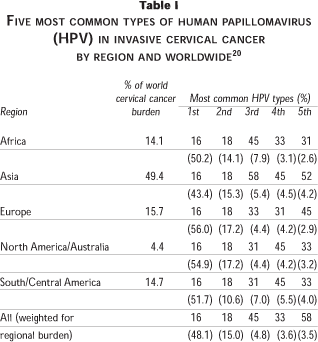
<body><![CDATA[<p><font face="Verdana" size="2"><b>Primary prevention    of HPV </b></font></p>     <p><font face="Verdana" size="2">The demonstration    that ICC is caused by a sexually transmitted virus (i.e., human papillomavirus)<SUP>6,7</SUP>    adds ICC to the list of severe diseases (AIDS tops the list) where "safe    sex" educational campaigns should have a role to play. Some specific characteristics    of HPV infections make it, however, an especially difficult target for this    form of intervention. </font></p>     <p><font face="Verdana" size="2"> Firstly, HPV infection    is very common: at any moment in time between 5% and 40% of adult women and    men are HPV carriers.<SUP>8-10</SUP> Except for genital warts (caused chiefly    by low-risk types 6 and 11<SUP>6</SUP>), the infection is asymptomatic. Indeed,    an association between HPV infection and the number of sexual partners has been    found consistently, but it is weak, on account of the high probability of exposure    with any given partner.<SUP>9,11</SUP> There is no clear evidence as yet that    barrier methods of contraception, most notably condoms, confer a protection    against HPV infection.<SUP>10,11</SUP> The apparent failure of condom use to    prevent HPV infection may be attributable to anatomic reasons (i.e., extension    of HPV infection to genital areas not protected by the condom) and behavioural    reasons (i.e., difficulty of using condoms consistently over long periods, especially    in stable couples). Only circumcision was found associated with a decreased    risk of HPV penile infection among men and cervical cancer among their wives    in a large multi-centric study conducted by the IARC in five countries.<SUP>12</SUP>    </font></p>     <p><font face="Verdana" size="2"> An alternative    strategy to prevent ICC may be trying to intervene on those factors which are    known to facilitate the persistence of HPV infection or the progression into    neoplastic cervical lesions. Such factors include immune suppression,<SUP>6</SUP>    multi-parity,<SUP>13</SUP> long-term use of oral contraceptives,<SUP>14</SUP>    cigarette smoking<SUP>15</SUP> and some sexually transmitted diseases other    than HPV (i.e., HSV-2,<SUP>16</SUP> and <I>Chlamydia trachomatis</I><SUP>17</SUP>).    In contrast to HPV, however, these risk factors are relatively weak (relative    risks of 2 to 3) and are difficult to eliminate for the purpose of ICC prevention.    </font></p>     <p><font face="Verdana" size="2"> Vaccines against    HPV offer by far the best hope of controlling HPV infection. A vaccine that    is safe, effective and cheap would provide an opportunity to diminish the health    inequality that currently exists between developed and developing countries    with respect to ICC. </font></p>     <p><font face="Verdana" size="2"><b>Vaccines against    HPV </b></font></p>     <p><font face="Verdana" size="2">HPV vaccines currently    under development are part of a new generation of vaccines that employ genetic    engineering.<SUP>18</SUP> This allows the production of sub-unit vaccines that    include only a portion of a disease-causing organisms; since they do not contain    cancer-inducing viral genes, these may be safer than vaccines based upon whole    organisms. </font></p>     <p><font face="Verdana" size="2"> Several therapeutic    vaccines against HPV are under investigation.<SUP>18</SUP> They target, in general,    transforming viral proteins such as E6 and E7, and are being tested in early    phase II trials against advanced ICC, as a complement to conventional treatment.    </font></p>     <p><font face="Verdana" size="2"> Prophylactic vaccines    against HPV infection seem, at the moment, more promising than therapeutic ones,    and several different approaches are being investigated (e.g., recombinant live    vector vaccines, protein and peptide vaccines, naked DNA vaccines and edible    vaccines). The most advanced vaccines against HPV are virus-like particles (VLPs).    VLPs result from the ability of the viral capsid proteins L1 and L2 (or L1 alone)    to self-assemble into particles which are empty, but closely ressemble the entire    virus and include conformational epitopes that induce virus-neutralizing antibodies.<SUP>19</SUP>    VLPs have been produced for at least ten HPV types (6, 11, 16, 18, 31, 33, 35,    39, 45, and 58), suggesting that this approach can be applied for a multivalent    vaccine.<SUP>18</SUP> </font></p>     <p><font face="Verdana" size="2"> The protection    conferred by VLP vaccines is type-specific. Over 90 types that infect the genital    tract have been identified, of which approximately 20 are currently considered    "high-risk" types for cervical cancer. Of these "high-risk"    types, a meta-analysis of 10 058 ICC cases from 50 different countries has shown    that HPV types 16 and 18 alone contribute to at least 65% of cervical cancers    worldwide, and that HPV types 45, 31 and 33 contribute to another 10-15%.<SUP>20</SUP>    <a href="#tab1">Table I</a> shows the five most common HPV types in different    regions as derived from this meta-analysis. Fortunately, for most regions of    the world sampled, it appears that the same five "high-risk" types    predominate in cervical cancer, although there is little information on types    other than 16 and 18 for many regions (Africa, India, Middle East), and HPV    52 and 58 appear to contribute a larger proportion of cases from areas in Asia.    Thus, a vaccine that protects against relatively few HPV types has the potential    to prevent a large proportion of cervical cancers worldwide. </font></p>     ]]></body>
<body><![CDATA[<p><a name="tab1"></a></p>     <p>&nbsp;</p>     <p align="center"><img src="/img/revistas/spm/v45s3/3a19t01.gif"></p>     <p>&nbsp;</p>     <p><font face="Verdana" size="2">Independent phase    III randomized clinical trials of L1 VLP vaccines are currently being started    by the National Cancer Institute (NCI) of the United States, Merck and GlaxoSmithKline.    In each trial, the vaccine is administered as a series of three injections (generally    at month 0, 1 and 4).<SUP>18</SUP> The majority of the populations involved    in these trials are from the United States and Latin America. All current trials    use vaccines that include VLPs of both HPV 16 and 18. </font></p>     <p><font face="Verdana" size="2"> An average of    10 000-15 000 young women (age range: 18-22) will be recruited in each such    trial, the aim being to vaccinate as many women not yet exposed to genital HPV    as possible. In fact, a prophylactic vaccine needs to be administered before    a woman has been infected. Ideally, the vaccine should be given to children    where immunization is logistically easier. The present trials, however, are    targeting young women in order to be able to monitor the efficacy of an HPV    vaccine in a reasonable time framework (approximately five years). Adequate    study endpoints for such trials are still being discussed, but they will include,    in the order, the prevention of HPV infection, persistent infection (i.e., repeated    HPV-positive smears at a 6-12 month interval), and cervical lesions (i.e., low-    and high-grade squamous intraepithelial lesions, LSIL and HSIL). </font></p>     <p><font face="Verdana" size="2"> For the moment,    the findings on the efficacy of VLP vaccines in animals and humans have been    very encouraging. Three injections of L1 VLPs protected rabbits, dogs and cattle    against persistent infection and carcinomas caused by species-specific papillomavirus.<SUP>18</SUP>    </font></p>     <p><font face="Verdana" size="2"> In humans, a double-blind,    placebo-controlled trial of 72 volunteers (58 females and 14 males) showed that    the HPV 16 VLP vaccine developed at the NCI is well tolerated and highly immunogenic,    even without adjuvants.<SUP>21</SUP> In the majority of recipients serum antibody    titers that were approximately 40-fold higher than those observed in the natural    infection were achieved. </font></p>     <p><font face="Verdana" size="2"> In a double blind    study of 1533 HPV 16-negative young women, who were followed for 17.4 months    on average, the incidence of persistent HPV 16 infection was 3.8 per 100 women-years    in the placebo group and 0 per 100 women-years in the vaccine group (100 percent    efficacy).<SUP>22</SUP> </font></p>     <p><font face="Verdana" size="2"><b>The need for    effectiveness trials </b></font></p>     ]]></body>
<body><![CDATA[<p><font face="Verdana" size="2">Immediate uptake    of any HPV vaccination worldwide following licensure of a vaccine is unlikely.    Furthermore, it will take a long time for the impact of HPV vaccination to become    visible in vaccinated populations. Even then, the impact of vaccination may    be confounded by changes in the rate of cervical cancer so that secular trends    in cervical cancer rates may not be easily interpretable as evidence for the    effectiveness of vaccination. There is therefore scope for planning long-term    randomized trials of HPV vaccines. These trials will differ from the phase III    efficacy trials that are currently taking place in several respects. In particular,    they may take place under field conditions likely to prevail when a real vaccine    programme is introduced, and will have to include a longer follow up period    (typically more than 10 years) in order to show the efficacy of the vaccine    against truly precancerous lesions such as cervical intra-epithelial neoplasia    (CIN) III. </font></p>     <p><font face="Verdana" size="2"> When considering    the impact of a vaccine on cancer incidence, it is useful to consider past experience    with hepatitis B virus (HBV).<SUP>23</SUP> Like HPV, HBV is a cause of cancer    (hepatocellular carcinoma) in chronically infected individuals. Unlike HPV,    however, HBV is also associated with acute disease at the time of infection    and substantial morbidity and mortality from causes other than cancer.<SUP>24</SUP>    These other factors were sufficient to motivate the development and spread of    vaccines against HBV, which proved effective in preventing acute hepatitis and    the chronic carrier state. Questions remained over the duration of protection    and, in particular, the extent to which vaccination would prevent hepatocellular    carcinoma. </font></p>     <p><font face="Verdana" size="2"> Two different    approaches have been used to answer this question: conducting randomized trials    and following secular trends. The Gambia Hepatitis Intervention Study<SUP>25</SUP>    is a good example of a large randomized trial of HBV vaccine. This is a cluster-randomized    trial of HBV vaccination and liver cancer based on the phased introduction of    HBV vaccination into the Extended Programme of Immunization (EPI) in The Gambia    between 1986 and 1990. Early results from the study showed that vaccination    has an efficacy of 83% against infection and 95% against chronic carriage of    HBV.<SUP>26</SUP> The results for liver cancer are not yet available since the    subjects have not reached the high-risk age range: the study was originally    planned to last 30 to 40 years. The second approach of following secular trends    is illustrated by Taiwan, where a national vaccination programme against HBV    was introduced in 1986. A substantial reduction in childhood liver cancer incidence    is already visible. The incidence rate in children aged 6-14 was 0.70 per 100    000 in 1981-1986 and 0.36 per 100 000 in 1990-1994 (<I>p</I>&lt;0.01).<SUP>27</SUP>    </font></p>     <p><font face="Verdana" size="2"> In the case of    HPV vaccination, it is unlikely that secular trends in cervical cancer incidence    or mortality will provide convincing evidence of effectiveness since cervical    cancer incidence shows considerable temporal variation. A decline in incidence    and mortality from cervical cancer has been observed in many populations before    the introduction of screening programmes.<SUP>28</SUP> The decline may be attributable    to a decrease in early and frequent child bearing,<SUP>13</SUP> to improved    nutrition or genital hygiene, or to other factors related to sexual behaviour.    Conversely, in some developed countries, most notably in the United Kingdom,    the "sexual revolution" of the 1960's has led to an epidemic of HPV    infection and subsequent increase in ICC incidence and mortality in young women.<SUP>28</SUP>    </font></p>     <p><font face="Verdana" size="2"><b>Design considerations    for effectiveness trials </b></font></p>     <p><font face="Verdana" size="2">In order to provide    direct evidence of the effectiveness of HPV vaccination in preventing cancer,    simple randomized trials should be undertaken. Such trials could be conducted    in any country, but in order to accelerate adoption of HPV vaccination in the    populations that most need it, priority should be given to developing countries,    most notably Asia where 50% of ICC worldwide cases occur. These trials should    be large and of long duration (20 years at least) in order to capture a difference    in the most severe preinvasive cervical lesions, which take many years to develop.    Consequently, the design must be simple and cost-effective. The trial design    may be summarized as follows: </font></p> <ul>       <li><font face="Verdana" size="2">Vaccination      of young women before they become exposed to HPV (i.e., in conservative societies,      before marriage). </font></li>       <li><font face="Verdana" size="2">Long-term "opportunistic"      monitoring of side effects (e.g., through monitoring of hospital admissions).      </font></li>       <li><font face="Verdana" size="2">No measurement      of cervical outcomes until the subjects are of sufficient age to benefit from      screening. </font></li>     </ul>     ]]></body>
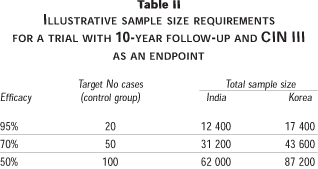
<body><![CDATA[<p><font face="Verdana" size="2"> A fundamental    difference between this trial and the phase III trials currently being conducted    is that there are no plans for early gynaecological examination for the purposes    of the trial only. The lack of early examination is beneficial to the participants    since women under the age of 30 have a very low risk of cervical cancer and    CIN III, but may undergo over-treatment of transient HPV infections which may    manifest themselves clinically as CIN I. A corollary of the lack of early gynaecological    examination is that a population-based screening programme must be in place    for the study participants in due time (e.g., when they reach the age of 30-35).    This will ensure two things: Firstly that the control group receives an adequate    standard of care, secondly that an outcome measurement, at the age when CIN    III peaks, is taken for as many subjects as possible. A second requirement for    this study is the ability to follow-up subjects over a long period, and in particular    to accurately identify the treatment group decades after randomization. </font></p>     <p><font face="Verdana" size="2"><b>Possible locations    for effectiveness trials </b></font></p>     <p><font face="Verdana" size="2">We have considered    the possibility of implementing this design in two areas: a rural area in southern    India and an urban one in South Korea, which are here presented in respect to    their different strengths and weaknesses. </font></p>     <p><font face="Verdana" size="2"> Some areas of    Southern India have a very high risk for cervical cancer. The age standardized    rate for Chennai (Madras) was 38.9 per 100 000 in the early 1990s.<SUP>29</SUP>    This makes it an attractive location for cervical cancer prevention trials.    Long-term follow-up of subjects is probably not feasible in an urban setting    due to the very marked population movement in developing countries. In a rural    setting, the most appropriate study design is a community intervention study    with randomization by village. This provides a simple mechanism for identifying    the treatment group of a subject many years after randomization, since it suffices    to know a subject's place of birth. A cluster randomized trial also presents    the only feasible opportunity to randomize males and thus to evaluate the usefulness    of vaccinating both sexes. Men very rarely develop severe HPV-related diseases    (e.g., cancer of the penis and the anus). They may therefore not respond to    individual randomization, but may agree to do so in the context of a community    intervention. The efficacy of male vaccination will have to be evaluated in    terms of its contribution to the decrease of precancerous lesions in women.    To this extent, "discordant" couples (i.e., couples where only the    husband or wife is vaccinated) will be most informative. The target population    for a trial in Southern India is unmarried women, i.e., women below age 19,    as very early marriage is still common in rural areas. Some illustrative sample    size calculations are shown in <a href="#tab2">Table II</a>. These are based    on an assumption of vaccination at age 15 on a 10-year interval between vaccination    and the first screening examination, with CIN III as an endpoint. The incidence    rates for CIN are imputed from the incidence rates for invasive cervical cancer    by assuming that CIN III occurs five years earlier and at a rate three times    higher (hence 2/3 of CIN III will regress without progression to cancer). Loss-to-follow-up    has not been factored into these calculations, since a realistic assessment    of the rate of loss depends on the specific design of the study. However, in    order to take into account loss to follow-up, a possible decline in cervical    cancer incidence and the overwhelming difficulty of replicating community-based    intervention trials, the target power of the study needs to be very high. These    calculations use a target power of 99%, under the assumption that the chance    to be able to replicate such huge trials is minimal. </font></p>     <p><a name="tab2"></a></p>     <p>&nbsp;</p>     <p align="center"><img src="/img/revistas/spm/v45s3/3a19t02.gif"></p>     <p>&nbsp;</p>     <p><font face="Verdana" size="2"> South Korea is    no longer considered a developing country but, on account of the recency of    the economic and medical development, is still an intermediate-risk country    for cervical cancer. The age standardized rate for Busan county, South Korea    is 21.8 per 100 000, which is 2-4 fold higher than in most western countries.    However, a few characteristics of the population and the health system in South    Korea may be greatly beneficial to the implementation of a clinical trial. Age    at marriage is substantially older (<u>&gt;</u> 25 years) than in rural India    and premarital sexual intercourse is uncommon. In a recent survey coordinated    by IARC, all unmarried women below age 20 were negative for anti-HPV antibodies.    These characteristics of the population may allow the offering of HPV vaccine    to women in the 18-22 year range. A majority of young women in this age range    in South Korea attend higher education and may thus be readily contacted, individually    randomized, and offered the vaccine in university health facilities. Most importantly,    each person in South Korea has a unique national identity number, which will    greatly facilitate long-term follow-up. Finally, the South Korean government    has a strong commitment to implementing population-based screening programmes    in the near future, including cytological screening for the prevention of cervical    cancer in women aged 30 or older. Thus, the follow-up process in such a large    trial of a prophylactic vaccine against HPV may benefit from the present development    of national screening programmes. </font></p>     <p><font face="Verdana" size="2"> <a href="#tab2">Table    II</a> also shows illustrative sample size calculations for a trial in Southern    Korea. The number of subjects required is 40% larger than the trial in Southern    India. The lower incidence rate in South Korea is partially offset by the older    age of the study subjects. </font></p>     ]]></body>
<body><![CDATA[<p>&nbsp;</p>     <p><font face="Verdana" size="3"><b>Conclusions    </b></font></p>     <p><font face="Verdana" size="2">Many challenges    remain in respect to the efficacy and efficiency of prophylactic vaccines against    HPV. </font></p>     <p><font face="Verdana" size="2"> Despite successful    results in animal models, it is not clear which elements of the human immune    system are important in preventing or resolving HPV infections.<SUP>30</SUP>    HPV enters the body through the mucosal membranes and does not spread systemically.    Whether the high levels of circulating neutralizing antibodies induced by VLP    vaccines translate into an adequate and long-lasting immune response at the    mucosal surface is not known. Ways to enhance mucosal immunity and cell-mediated    immunity are being evaluated (e.g., intra-nasal or oral immunization).<SUP>31</SUP>    </font></p>     <p><font face="Verdana" size="2"> Obviously, so-called    chimaeric vaccines (i.e., vaccines able to prevent HPV infection and induce    clearance of the infection at an early stage) would be a much preferable solution.    They would substantially anticipate the benefits of vaccinations that, in the    case of prophylactic vaccines, would take three or four decades to become apparent.    In fact, therapeutic vaccines may benefit not only sexually inexperienced women    who have not yet been infected by HPV, but also older women who may be already    harbouring HPV-related cervical lesions. </font></p>     <p><font face="Verdana" size="2"> Furthermore, while    safety and efficacy are essential for a vaccine, ways to reduce costs and increase    vaccine coverage must also be considered. They will include formulating an oral    vaccine, creating a stable vaccine that does not require an expensive cold-chain    and/or one that can be produced in developing countries.<SUP>18</SUP> Finally,    it is worth bearing in mind that the sexually transmitted nature of HPV infection    will probably enter into the public debate, as will the gender issue (i.e.,    the current restriction of current HPV vaccine to women as a target population).    While the efficacy and opportunity of vaccinating boys as well as girls will    have to be evaluated, ways to tackle an open discussion on HPV infection will    have to be found in developing as well as developed countries. </font></p>     <p><font face="Verdana" size="2"> Notwithstanding    the challenges above, HPV vaccine development holds great promises for reducing    the mortality and morbidity of cervical neoplasia on the world's women. </font></p>     <p>&nbsp;</p>     <p><font face="Verdana" size="3"><b>References </b></font></p>     <!-- ref --><p><font face="Verdana" size="2">1. Pisani P, Parkin    DM, Bray F, Ferlay J. Estimates of the worldwide mortality from 25 cancers in    1990. Int J Cancer 1999;83:18-29. </font>&nbsp;&nbsp;&nbsp;&nbsp;&nbsp;&nbsp;&nbsp;&nbsp;[&#160;<a href="javascript:void(0);" onclick="javascript: window.open('/scielo.php?script=sci_nlinks&ref=9184786&pid=S0036-3634200300090001700001&lng=','','width=640,height=500,resizable=yes,scrollbars=1,menubar=yes,');">Links</a>&#160;]<!-- end-ref --><!-- ref --><p><font face="Verdana" size="2">2. Sherris J, Herdman    C. Preventing cervical cancer in low-resource settings. Outlook 2000;18:1-8.    </font>&nbsp;&nbsp;&nbsp;&nbsp;&nbsp;&nbsp;&nbsp;&nbsp;[&#160;<a href="javascript:void(0);" onclick="javascript: window.open('/scielo.php?script=sci_nlinks&ref=9184787&pid=S0036-3634200300090001700002&lng=','','width=640,height=500,resizable=yes,scrollbars=1,menubar=yes,');">Links</a>&#160;]<!-- end-ref --><!-- ref --><p><font face="Verdana" size="2">3. Sankaranarayanan    R, Budukh AM, Rajkumar R. Effective screening programmes for cervical cancer    in low- and middle-income developing countries. Bull World Health Organ 2001;79:954-962.    </font>&nbsp;&nbsp;&nbsp;&nbsp;&nbsp;&nbsp;&nbsp;&nbsp;[&#160;<a href="javascript:void(0);" onclick="javascript: window.open('/scielo.php?script=sci_nlinks&ref=9184788&pid=S0036-3634200300090001700003&lng=','','width=640,height=500,resizable=yes,scrollbars=1,menubar=yes,');">Links</a>&#160;]<!-- end-ref --><!-- ref --><p><font face="Verdana" size="2">4. Wesley R, Sankaranarayanan    R, Mathew B, Chandralekha B, Aysha Beegum A, Amma NS <I>et al.</I> Evaluation    of visual inspection as a screening test for cervical cancer. Br J Cancer 1997;75:436-440.    </font>&nbsp;&nbsp;&nbsp;&nbsp;&nbsp;&nbsp;&nbsp;&nbsp;[&#160;<a href="javascript:void(0);" onclick="javascript: window.open('/scielo.php?script=sci_nlinks&ref=9184789&pid=S0036-3634200300090001700004&lng=','','width=640,height=500,resizable=yes,scrollbars=1,menubar=yes,');">Links</a>&#160;]<!-- end-ref --><!-- ref --><p><font face="Verdana" size="2">5. Sankaranarayanan    R, Wesley R, Somanathan T, Dhakad N, Shyamalakumary    B, Amma NS <I>et al</I>. Visual inspection of the uterine cervix after the application    of acetic acid in the detection of cervical carcinoma and its precursors. Cancer    1998;83:2150-2156. </font>&nbsp;&nbsp;&nbsp;&nbsp;&nbsp;&nbsp;&nbsp;&nbsp;[&#160;<a href="javascript:void(0);" onclick="javascript: window.open('/scielo.php?script=sci_nlinks&ref=9184790&pid=S0036-3634200300090001700005&lng=','','width=640,height=500,resizable=yes,scrollbars=1,menubar=yes,');">Links</a>&#160;]<!-- end-ref --><!-- ref --><p><font face="Verdana" size="2">6. International    Agency for Research on Cancer. Monographs on the evaluation of carcinogenic    risks to humans. Human papillomaviruses. IARC: Lyon, 1995;Vol. 64. </font>&nbsp;&nbsp;&nbsp;&nbsp;&nbsp;&nbsp;&nbsp;&nbsp;[&#160;<a href="javascript:void(0);" onclick="javascript: window.open('/scielo.php?script=sci_nlinks&ref=9184791&pid=S0036-3634200300090001700006&lng=','','width=640,height=500,resizable=yes,scrollbars=1,menubar=yes,');">Links</a>&#160;]<!-- end-ref --><!-- ref --><p><font face="Verdana" size="2">7. Walboomers JM,    Jacobs MV, Manos MM, Bosch FX, Kummer JA, Shah KV <I>et al</I>. Human papillomavirus    is a necessary cause of invasive cervical cancer worldwide. J Pathol 1999;18:12-19.    </font>&nbsp;&nbsp;&nbsp;&nbsp;&nbsp;&nbsp;&nbsp;&nbsp;[&#160;<a href="javascript:void(0);" onclick="javascript: window.open('/scielo.php?script=sci_nlinks&ref=9184792&pid=S0036-3634200300090001700007&lng=','','width=640,height=500,resizable=yes,scrollbars=1,menubar=yes,');">Links</a>&#160;]<!-- end-ref --><!-- ref --><p><font face="Verdana" size="2">8. Herrero R, Hildesheim    A, Bratti C, Sherman M, Hutchinson M, Morales J <I>et al</I>. A population-based    study of human papillomavirus infection and cervical neoplasia in rural Costa    Rica. J Natl Cancer Inst 2000;92:464-474. </font>&nbsp;&nbsp;&nbsp;&nbsp;&nbsp;&nbsp;&nbsp;&nbsp;[&#160;<a href="javascript:void(0);" onclick="javascript: window.open('/scielo.php?script=sci_nlinks&ref=9184793&pid=S0036-3634200300090001700008&lng=','','width=640,height=500,resizable=yes,scrollbars=1,menubar=yes,');">Links</a>&#160;]<!-- end-ref --><!-- ref --><p><font face="Verdana" size="2">9. Lazcano-Ponce    E, Herrero R, Mu&ntilde;oz N, Cruz A, Shah KV, Alonso P <I>et al</I>. Epidemiology    of HPV infection among Mexican women with normal cervical cytology. Int J Cancer    2001;91:412-420. </font>&nbsp;&nbsp;&nbsp;&nbsp;&nbsp;&nbsp;&nbsp;&nbsp;[&#160;<a href="javascript:void(0);" onclick="javascript: window.open('/scielo.php?script=sci_nlinks&ref=9184794&pid=S0036-3634200300090001700009&lng=','','width=640,height=500,resizable=yes,scrollbars=1,menubar=yes,');">Links</a>&#160;]<!-- end-ref --><!-- ref --><p><font face="Verdana" size="2">10. Franceschi    S, Castellsagu&eacute; X, Dal Maso L, Smith JS, Plummer M, Ngelangel C <I>et    al</I>. Prevalence and determinants of human papillomavirus genital infection    in men. Br J Cancer 2002;86:705-711. </font>&nbsp;&nbsp;&nbsp;&nbsp;&nbsp;&nbsp;&nbsp;&nbsp;[&#160;<a href="javascript:void(0);" onclick="javascript: window.open('/scielo.php?script=sci_nlinks&ref=9184795&pid=S0036-3634200300090001700010&lng=','','width=640,height=500,resizable=yes,scrollbars=1,menubar=yes,');">Links</a>&#160;]<!-- end-ref --><!-- ref --><p><font face="Verdana" size="2">11. Molano M, Posso    H, Weiderpass E, van den Brule AJC, Ronderos M, Franceschi S <I>et al</I>. Prevalence    and determinants of HPV infection among Colombian women with normal cytology.    Br J Cancer. 2002;87:324-333. </font>&nbsp;&nbsp;&nbsp;&nbsp;&nbsp;&nbsp;&nbsp;&nbsp;[&#160;<a href="javascript:void(0);" onclick="javascript: window.open('/scielo.php?script=sci_nlinks&ref=9184796&pid=S0036-3634200300090001700011&lng=','','width=640,height=500,resizable=yes,scrollbars=1,menubar=yes,');">Links</a>&#160;]<!-- end-ref --><!-- ref --><p><font face="Verdana" size="2">12. Castellsagu&eacute;    X, Bosch FX, Mu&ntilde;oz N, Meijer C, Shah K, de Sanjos&eacute; S, Eluf-Neto    J <I>et al</I>. Male circumcision, penile human papillomavirus infection and    cervical cancer in female partners. N Engl J Med 2002;346:1105-1112. </font>&nbsp;&nbsp;&nbsp;&nbsp;&nbsp;&nbsp;&nbsp;&nbsp;[&#160;<a href="javascript:void(0);" onclick="javascript: window.open('/scielo.php?script=sci_nlinks&ref=9184797&pid=S0036-3634200300090001700012&lng=','','width=640,height=500,resizable=yes,scrollbars=1,menubar=yes,');">Links</a>&#160;]<!-- end-ref --><!-- ref --><p><font face="Verdana" size="2">13. Mu&ntilde;oz    N, Franceschi S, Bosetti C, Moreno V, Herrero R, Smith JS <I>et al</I>. Role    of parity and human papillomavirus in cervical cancer: The IARC multicentric    case-control study. Lancet 2002;359:1093-1101. </font>&nbsp;&nbsp;&nbsp;&nbsp;&nbsp;&nbsp;&nbsp;&nbsp;[&#160;<a href="javascript:void(0);" onclick="javascript: window.open('/scielo.php?script=sci_nlinks&ref=9184798&pid=S0036-3634200300090001700013&lng=','','width=640,height=500,resizable=yes,scrollbars=1,menubar=yes,');">Links</a>&#160;]<!-- end-ref --><!-- ref --><p><font face="Verdana" size="2">14. Moreno V, Bosch    FX, Mu&ntilde;oz N, Meijer CJ, Shah KV, Walboomers JM <I>et al</I>. Effect of    oral contraceptives on risk of cervical cancer in women with human papillomavirus    infection: The IARC multicentric case-control study. Lancet 2002;359:1085-1092.    </font>&nbsp;&nbsp;&nbsp;&nbsp;&nbsp;&nbsp;&nbsp;&nbsp;[&#160;<a href="javascript:void(0);" onclick="javascript: window.open('/scielo.php?script=sci_nlinks&ref=9184799&pid=S0036-3634200300090001700014&lng=','','width=640,height=500,resizable=yes,scrollbars=1,menubar=yes,');">Links</a>&#160;]<!-- end-ref --><!-- ref --><p><font face="Verdana" size="2">15. Plummer M,    Herrero R, Franceschi S, Meijer CJLM, Snijders P, Bosch FX <I>et al</I>. Smoking    and cervical cancer: Pooled analysis of are a multicentric case-control study.    Cancer Causes R Control. In press. </font>&nbsp;&nbsp;&nbsp;&nbsp;&nbsp;&nbsp;&nbsp;&nbsp;[&#160;<a href="javascript:void(0);" onclick="javascript: window.open('/scielo.php?script=sci_nlinks&ref=9184800&pid=S0036-3634200300090001700015&lng=','','width=640,height=500,resizable=yes,scrollbars=1,menubar=yes,');">Links</a>&#160;]<!-- end-ref --><!-- ref --><p><font face="Verdana" size="2">16. Smith JS, Herrero    R, Bosetti C, Mu&ntilde;oz N, Bosch FX, Eluf-Neto J <I>et al</I>. Herpes simplex    virus-2 as a human papillomavirus cofactor in the etiology of invasive cervical    cancer. J Natl Cancer Inst. 2002;94:1604-1613. </font>&nbsp;&nbsp;&nbsp;&nbsp;&nbsp;&nbsp;&nbsp;&nbsp;[&#160;<a href="javascript:void(0);" onclick="javascript: window.open('/scielo.php?script=sci_nlinks&ref=9184801&pid=S0036-3634200300090001700016&lng=','','width=640,height=500,resizable=yes,scrollbars=1,menubar=yes,');">Links</a>&#160;]<!-- end-ref --><!-- ref --><p><font face="Verdana" size="2">17. Smith JS, Mu&ntilde;oz    N, Bosetti C, Herrero R, Bosch FX, Eluf-Neto J <I>et al.</I> Chlamydia trachomatis    as an HPV cofactor in the etiology of invasive cervical cancer: A pooled analysis    of seven countries. 19<SUP>th</SUP> International Papillomavirus Conference;    2001;Florianopolis, Brazil. O-135. </font>&nbsp;&nbsp;&nbsp;&nbsp;&nbsp;&nbsp;&nbsp;&nbsp;[&#160;<a href="javascript:void(0);" onclick="javascript: window.open('/scielo.php?script=sci_nlinks&ref=9184802&pid=S0036-3634200300090001700017&lng=','','width=640,height=500,resizable=yes,scrollbars=1,menubar=yes,');">Links</a>&#160;]<!-- end-ref --><!-- ref --><p><font face="Verdana" size="2">18. Kols A, Sherris    J. HPV Vaccines: Promise and challenges. Seattle (WA): PATH, 2000. </font>&nbsp;&nbsp;&nbsp;&nbsp;&nbsp;&nbsp;&nbsp;&nbsp;[&#160;<a href="javascript:void(0);" onclick="javascript: window.open('/scielo.php?script=sci_nlinks&ref=9184803&pid=S0036-3634200300090001700018&lng=','','width=640,height=500,resizable=yes,scrollbars=1,menubar=yes,');">Links</a>&#160;]<!-- end-ref --><!-- ref --><p><font face="Verdana" size="2">19. Harro CD, Pang    YY, Roden RB, Hildesheim A, Wang Z, Reynolds MJ <I>et al.</I> Safety and immunogenicity    trial in adult volunteers of a human papillomavirus 16 L1 virus-like particle    vaccine. J Natl Cancer Inst 2001;21: 284-292. </font>&nbsp;&nbsp;&nbsp;&nbsp;&nbsp;&nbsp;&nbsp;&nbsp;[&#160;<a href="javascript:void(0);" onclick="javascript: window.open('/scielo.php?script=sci_nlinks&ref=9184804&pid=S0036-3634200300090001700019&lng=','','width=640,height=500,resizable=yes,scrollbars=1,menubar=yes,');">Links</a>&#160;]<!-- end-ref --><!-- ref --><p><font face="Verdana" size="2">20. Clifford GM,    Smith JS, Plummer M, Mu&ntilde;oz N, Franceschi S. Human papillomaviruses in    invasive cervical cancer worldwide: A meta-analysis. J Natl Cancer Inst Br J.    Cancer 2003;88:63-73. </font>&nbsp;&nbsp;&nbsp;&nbsp;&nbsp;&nbsp;&nbsp;&nbsp;[&#160;<a href="javascript:void(0);" onclick="javascript: window.open('/scielo.php?script=sci_nlinks&ref=9184805&pid=S0036-3634200300090001700020&lng=','','width=640,height=500,resizable=yes,scrollbars=1,menubar=yes,');">Links</a>&#160;]<!-- end-ref --><!-- ref --><p><font face="Verdana" size="2">21. Evans TG, Bonnez    W, Rose RC, Koenig S, Demeter L, Suzich JA <I>et al</I>. A phase 1 study of    a recombinant viruslike particle vaccine against human papillomavirus type 11    in healthy adult volunteers. J Infect Dis 2001;183:1485-1493. </font>&nbsp;&nbsp;&nbsp;&nbsp;&nbsp;&nbsp;&nbsp;&nbsp;[&#160;<a href="javascript:void(0);" onclick="javascript: window.open('/scielo.php?script=sci_nlinks&ref=9184806&pid=S0036-3634200300090001700021&lng=','','width=640,height=500,resizable=yes,scrollbars=1,menubar=yes,');">Links</a>&#160;]<!-- end-ref --><!-- ref --><p><font face="Verdana" size="2">22. Koutsky LA,    Wheeler Cm, Brown DR, Barr E, Alvarez FB, Chiacchierini LM <I>et al.</I> A controlled    trial of a human papillomavirus type 16 vaccine. N Engl J Med 2002;347:1645-1651.    </font>&nbsp;&nbsp;&nbsp;&nbsp;&nbsp;&nbsp;&nbsp;&nbsp;[&#160;<a href="javascript:void(0);" onclick="javascript: window.open('/scielo.php?script=sci_nlinks&ref=9184807&pid=S0036-3634200300090001700022&lng=','','width=640,height=500,resizable=yes,scrollbars=1,menubar=yes,');">Links</a>&#160;]<!-- end-ref --><!-- ref --><p><font face="Verdana" size="2">23. Franceshi S.    Strategies to reduce the risk of virus-related cancers. Ann Oncol 2000;11:1091-1096.    </font>&nbsp;&nbsp;&nbsp;&nbsp;&nbsp;&nbsp;&nbsp;&nbsp;[&#160;<a href="javascript:void(0);" onclick="javascript: window.open('/scielo.php?script=sci_nlinks&ref=9184808&pid=S0036-3634200300090001700023&lng=','','width=640,height=500,resizable=yes,scrollbars=1,menubar=yes,');">Links</a>&#160;]<!-- end-ref --><!-- ref --><p><font face="Verdana" size="2">24. International    Agency for Research on Cancer. Monographs on the evaluation of carcinogenic    risks to humans. Hepatitis viruses. IARC: Lyon, 1994; Vol. 59. </font>&nbsp;&nbsp;&nbsp;&nbsp;&nbsp;&nbsp;&nbsp;&nbsp;[&#160;<a href="javascript:void(0);" onclick="javascript: window.open('/scielo.php?script=sci_nlinks&ref=9184809&pid=S0036-3634200300090001700024&lng=','','width=640,height=500,resizable=yes,scrollbars=1,menubar=yes,');">Links</a>&#160;]<!-- end-ref --><!-- ref --><p><font face="Verdana" size="2">25. Gambia Hepatitis    Study Group. The Gambia hepatitis intervention study. Cancer Res 1987;47:5782-5787.    </font>&nbsp;&nbsp;&nbsp;&nbsp;&nbsp;&nbsp;&nbsp;&nbsp;[&#160;<a href="javascript:void(0);" onclick="javascript: window.open('/scielo.php?script=sci_nlinks&ref=9184810&pid=S0036-3634200300090001700025&lng=','','width=640,height=500,resizable=yes,scrollbars=1,menubar=yes,');">Links</a>&#160;]<!-- end-ref --><!-- ref --><p><font face="Verdana" size="2">26. Viviani S,    Jack A, Hall AJ, Maine N, Mendy M, Montesano R <I>et al</I>. Hepatitis B vaccination    in infancy in The Gambia: Protection against carriage at 9 years of age. Vaccine    1999;17:2946-2950. </font>&nbsp;&nbsp;&nbsp;&nbsp;&nbsp;&nbsp;&nbsp;&nbsp;[&#160;<a href="javascript:void(0);" onclick="javascript: window.open('/scielo.php?script=sci_nlinks&ref=9184811&pid=S0036-3634200300090001700026&lng=','','width=640,height=500,resizable=yes,scrollbars=1,menubar=yes,');">Links</a>&#160;]<!-- end-ref --><!-- ref --><p><font face="Verdana" size="2">27. Huang K, Lin    S. Nationwide vaccination: A success story in Taiwan. Vaccine 2000;18 (Suppl    1):S35-S38. </font>&nbsp;&nbsp;&nbsp;&nbsp;&nbsp;&nbsp;&nbsp;&nbsp;[&#160;<a href="javascript:void(0);" onclick="javascript: window.open('/scielo.php?script=sci_nlinks&ref=9184812&pid=S0036-3634200300090001700027&lng=','','width=640,height=500,resizable=yes,scrollbars=1,menubar=yes,');">Links</a>&#160;]<!-- end-ref --><!-- ref --><p><font face="Verdana" size="2">28. Beral V, Hermon    C, Mu&ntilde;oz N, Devesa SS. Cervical cancer. Cancer surv 1994;19/20:265-285.    </font>&nbsp;&nbsp;&nbsp;&nbsp;&nbsp;&nbsp;&nbsp;&nbsp;[&#160;<a href="javascript:void(0);" onclick="javascript: window.open('/scielo.php?script=sci_nlinks&ref=9184813&pid=S0036-3634200300090001700028&lng=','','width=640,height=500,resizable=yes,scrollbars=1,menubar=yes,');">Links</a>&#160;]<!-- end-ref --><!-- ref --><p><font face="Verdana" size="2">29. Parkin DM,    Whelan SL, Ferlay J, Raymond L, Young J. Cancer incidence in five continents.    International Agency for Research on Cancer, Lyon: Vol. VII; IARC Scientific    publications No 143. 1997. </font>&nbsp;&nbsp;&nbsp;&nbsp;&nbsp;&nbsp;&nbsp;&nbsp;[&#160;<a href="javascript:void(0);" onclick="javascript: window.open('/scielo.php?script=sci_nlinks&ref=9184814&pid=S0036-3634200300090001700029&lng=','','width=640,height=500,resizable=yes,scrollbars=1,menubar=yes,');">Links</a>&#160;]<!-- end-ref --><!-- ref --><p><font face="Verdana" size="2">30. Konya J, Dillner    J. Immunity to oncogenic human papillomaviruses. Adv Cancer Res 2001;82:205-238.    </font>&nbsp;&nbsp;&nbsp;&nbsp;&nbsp;&nbsp;&nbsp;&nbsp;[&#160;<a href="javascript:void(0);" onclick="javascript: window.open('/scielo.php?script=sci_nlinks&ref=9184815&pid=S0036-3634200300090001700030&lng=','','width=640,height=500,resizable=yes,scrollbars=1,menubar=yes,');">Links</a>&#160;]<!-- end-ref --><!-- ref --><p><font face="Verdana" size="2">31. Nardelli-Haefliger    D, Wirthner D, Schiller J, Lowy DR, Hildesheim A, Ponci F. Specific antibody    levels at the cervix during menstrual cycle of women vaccinated with human papillomavirus    16 virus like particles. J Natl Cancer Inst 2003;95:1128-1137. </font>&nbsp;&nbsp;&nbsp;&nbsp;&nbsp;&nbsp;&nbsp;&nbsp;[&#160;<a href="javascript:void(0);" onclick="javascript: window.open('/scielo.php?script=sci_nlinks&ref=9184816&pid=S0036-3634200300090001700031&lng=','','width=640,height=500,resizable=yes,scrollbars=1,menubar=yes,');">Links</a>&#160;]<!-- end-ref --><p>&nbsp;</p>     <p>&nbsp;</p>     <p><font face="Verdana" size="2"><b>Address reprint    requests:</b>     <br>   Dr Martyn Plummer    <br>   150, Cours Albert Thomas    <br>   F-69372 Lyon, France    <br>   E-mail: <a href="mailto:plummer@iarc.fr">plummer@iarc.fr</a> </font></p>     <p><font face="Verdana" size="2"><b>Received on:</b>    September 17, 2002     <br>   <b>Accepted on:</b> February 17, 2003 </font></p>      ]]></body><back>
<ref-list>
<ref id="B1">
<label>1</label><nlm-citation citation-type="journal">
<person-group person-group-type="author">
<name>
<surname><![CDATA[Pisani]]></surname>
<given-names><![CDATA[P]]></given-names>
</name>
<name>
<surname><![CDATA[Parkin]]></surname>
<given-names><![CDATA[DM]]></given-names>
</name>
<name>
<surname><![CDATA[Bray]]></surname>
<given-names><![CDATA[F]]></given-names>
</name>
<name>
<surname><![CDATA[Ferlay]]></surname>
<given-names><![CDATA[J]]></given-names>
</name>
</person-group>
<article-title xml:lang="en"><![CDATA[Estimates of the worldwide mortality from 25 cancers in 1990]]></article-title>
<source><![CDATA[Int J Cancer]]></source>
<year>1999</year>
<volume>83</volume>
<page-range>18-29</page-range></nlm-citation>
</ref>
<ref id="B2">
<label>2</label><nlm-citation citation-type="journal">
<person-group person-group-type="author">
<name>
<surname><![CDATA[Sherris]]></surname>
<given-names><![CDATA[J]]></given-names>
</name>
<name>
<surname><![CDATA[Herdman]]></surname>
<given-names><![CDATA[C]]></given-names>
</name>
</person-group>
<article-title xml:lang="en"><![CDATA[Preventing cervical cancer in low-resource settings]]></article-title>
<source><![CDATA[Outlook]]></source>
<year>2000</year>
<volume>18</volume>
<page-range>1-8</page-range></nlm-citation>
</ref>
<ref id="B3">
<label>3</label><nlm-citation citation-type="journal">
<person-group person-group-type="author">
<name>
<surname><![CDATA[Sankaranarayanan]]></surname>
<given-names><![CDATA[R]]></given-names>
</name>
<name>
<surname><![CDATA[Budukh]]></surname>
<given-names><![CDATA[AM]]></given-names>
</name>
<name>
<surname><![CDATA[Rajkumar]]></surname>
<given-names><![CDATA[R]]></given-names>
</name>
</person-group>
<article-title xml:lang="en"><![CDATA[Effective screening programmes for cervical cancer in low- and middle-income developing countries]]></article-title>
<source><![CDATA[Bull World Health Organ]]></source>
<year>2001</year>
<volume>79</volume>
<page-range>954-962</page-range></nlm-citation>
</ref>
<ref id="B4">
<label>4</label><nlm-citation citation-type="journal">
<person-group person-group-type="author">
<name>
<surname><![CDATA[Wesley]]></surname>
<given-names><![CDATA[R]]></given-names>
</name>
<name>
<surname><![CDATA[Sankaranarayanan]]></surname>
<given-names><![CDATA[R]]></given-names>
</name>
<name>
<surname><![CDATA[Mathew]]></surname>
<given-names><![CDATA[B]]></given-names>
</name>
<name>
<surname><![CDATA[Chandralekha]]></surname>
<given-names><![CDATA[B]]></given-names>
</name>
<name>
<surname><![CDATA[Aysha]]></surname>
<given-names><![CDATA[Beegum A]]></given-names>
</name>
<name>
<surname><![CDATA[Amma]]></surname>
<given-names><![CDATA[NS]]></given-names>
</name>
</person-group>
<article-title xml:lang="en"><![CDATA[Evaluation of visual inspection as a screening test for cervical cancer]]></article-title>
<source><![CDATA[Br J Cancer]]></source>
<year>1997</year>
<volume>75</volume>
<page-range>436-440</page-range></nlm-citation>
</ref>
<ref id="B5">
<label>5</label><nlm-citation citation-type="journal">
<person-group person-group-type="author">
<name>
<surname><![CDATA[Sankaranarayanan]]></surname>
<given-names><![CDATA[R]]></given-names>
</name>
<name>
<surname><![CDATA[Wesley]]></surname>
<given-names><![CDATA[R]]></given-names>
</name>
<name>
<surname><![CDATA[Somanathan]]></surname>
<given-names><![CDATA[T]]></given-names>
</name>
<name>
<surname><![CDATA[Dhakad]]></surname>
<given-names><![CDATA[N]]></given-names>
</name>
<name>
<surname><![CDATA[Shyamalakumary]]></surname>
<given-names><![CDATA[B]]></given-names>
</name>
<name>
<surname><![CDATA[Amma]]></surname>
<given-names><![CDATA[NS]]></given-names>
</name>
</person-group>
<article-title xml:lang="en"><![CDATA[Visual inspection of the uterine cervix after the application of acetic acid in the detection of cervical carcinoma and its precursors]]></article-title>
<source><![CDATA[Cancer]]></source>
<year>1998</year>
<volume>83</volume>
<page-range>2150-2156</page-range></nlm-citation>
</ref>
<ref id="B6">
<label>6</label><nlm-citation citation-type="book">
<collab>International Agency for Research on Cancer</collab>
<source><![CDATA[Monographs on the evaluation of carcinogenic risks to humans: Human papillomaviruses]]></source>
<year>1995</year>
<publisher-loc><![CDATA[Lyon ]]></publisher-loc>
<publisher-name><![CDATA[IARC]]></publisher-name>
</nlm-citation>
</ref>
<ref id="B7">
<label>7</label><nlm-citation citation-type="journal">
<person-group person-group-type="author">
<name>
<surname><![CDATA[Walboomers]]></surname>
<given-names><![CDATA[JM]]></given-names>
</name>
<name>
<surname><![CDATA[Jacobs]]></surname>
<given-names><![CDATA[MV]]></given-names>
</name>
<name>
<surname><![CDATA[Manos]]></surname>
<given-names><![CDATA[MM]]></given-names>
</name>
<name>
<surname><![CDATA[Bosch]]></surname>
<given-names><![CDATA[FX]]></given-names>
</name>
<name>
<surname><![CDATA[Kummer]]></surname>
<given-names><![CDATA[JA]]></given-names>
</name>
<name>
<surname><![CDATA[Shah]]></surname>
<given-names><![CDATA[KV]]></given-names>
</name>
</person-group>
<article-title xml:lang="en"><![CDATA[Human papillomavirus is a necessary cause of invasive cervical cancer worldwide]]></article-title>
<source><![CDATA[J Pathol]]></source>
<year>1999</year>
<volume>18</volume>
<page-range>12-19</page-range></nlm-citation>
</ref>
<ref id="B8">
<label>8</label><nlm-citation citation-type="journal">
<person-group person-group-type="author">
<name>
<surname><![CDATA[Herrero]]></surname>
<given-names><![CDATA[R]]></given-names>
</name>
<name>
<surname><![CDATA[Hildesheim]]></surname>
<given-names><![CDATA[A]]></given-names>
</name>
<name>
<surname><![CDATA[Bratti]]></surname>
<given-names><![CDATA[C]]></given-names>
</name>
<name>
<surname><![CDATA[Sherman]]></surname>
<given-names><![CDATA[M]]></given-names>
</name>
<name>
<surname><![CDATA[Hutchinson]]></surname>
<given-names><![CDATA[M]]></given-names>
</name>
<name>
<surname><![CDATA[Morales]]></surname>
<given-names><![CDATA[J]]></given-names>
</name>
</person-group>
<article-title xml:lang="en"><![CDATA[A population-based study of human papillomavirus infection and cervical neoplasia in rural Costa Rica]]></article-title>
<source><![CDATA[J Natl Cancer Inst]]></source>
<year>2000</year>
<volume>92</volume>
<page-range>464-474</page-range></nlm-citation>
</ref>
<ref id="B9">
<label>9</label><nlm-citation citation-type="journal">
<person-group person-group-type="author">
<name>
<surname><![CDATA[Lazcano-Ponce]]></surname>
<given-names><![CDATA[E]]></given-names>
</name>
<name>
<surname><![CDATA[Herrero]]></surname>
<given-names><![CDATA[R]]></given-names>
</name>
<name>
<surname><![CDATA[Muñoz]]></surname>
<given-names><![CDATA[N]]></given-names>
</name>
<name>
<surname><![CDATA[Cruz]]></surname>
<given-names><![CDATA[A]]></given-names>
</name>
<name>
<surname><![CDATA[Shah]]></surname>
<given-names><![CDATA[KV]]></given-names>
</name>
<name>
<surname><![CDATA[Alonso]]></surname>
<given-names><![CDATA[P]]></given-names>
</name>
</person-group>
<article-title xml:lang="en"><![CDATA[Epidemiology of HPV infection among Mexican women with normal cervical cytology]]></article-title>
<source><![CDATA[Int J Cancer]]></source>
<year>2001</year>
<volume>91</volume>
<page-range>412-420</page-range></nlm-citation>
</ref>
<ref id="B10">
<label>10</label><nlm-citation citation-type="journal">
<person-group person-group-type="author">
<name>
<surname><![CDATA[Franceschi]]></surname>
<given-names><![CDATA[S]]></given-names>
</name>
<name>
<surname><![CDATA[Castellsagué]]></surname>
<given-names><![CDATA[X]]></given-names>
</name>
<name>
<surname><![CDATA[Dal]]></surname>
<given-names><![CDATA[Maso L]]></given-names>
</name>
<name>
<surname><![CDATA[Smith]]></surname>
<given-names><![CDATA[JS]]></given-names>
</name>
<name>
<surname><![CDATA[Plummer]]></surname>
<given-names><![CDATA[M]]></given-names>
</name>
<name>
<surname><![CDATA[Ngelangel]]></surname>
<given-names><![CDATA[C]]></given-names>
</name>
</person-group>
<article-title xml:lang="en"><![CDATA[Prevalence and determinants of human papillomavirus genital infection in men]]></article-title>
<source><![CDATA[Br J Cancer]]></source>
<year>2002</year>
<volume>86</volume>
<page-range>705-711</page-range></nlm-citation>
</ref>
<ref id="B11">
<label>11</label><nlm-citation citation-type="journal">
<person-group person-group-type="author">
<name>
<surname><![CDATA[Molano]]></surname>
<given-names><![CDATA[M]]></given-names>
</name>
<name>
<surname><![CDATA[Posso]]></surname>
<given-names><![CDATA[H]]></given-names>
</name>
<name>
<surname><![CDATA[Weiderpass]]></surname>
<given-names><![CDATA[E]]></given-names>
</name>
<name>
<surname><![CDATA[van den Brule]]></surname>
<given-names><![CDATA[AJC]]></given-names>
</name>
<name>
<surname><![CDATA[Ronderos]]></surname>
<given-names><![CDATA[M]]></given-names>
</name>
<name>
<surname><![CDATA[Franceschi]]></surname>
<given-names><![CDATA[S]]></given-names>
</name>
</person-group>
<article-title xml:lang="en"><![CDATA[Prevalence and determinants of HPV infection among Colombian women with normal cytology]]></article-title>
<source><![CDATA[Br J Cancer.]]></source>
<year>2002</year>
<volume>87</volume>
<page-range>324-333</page-range></nlm-citation>
</ref>
<ref id="B12">
<label>12</label><nlm-citation citation-type="journal">
<person-group person-group-type="author">
<name>
<surname><![CDATA[Castellsagué]]></surname>
<given-names><![CDATA[X]]></given-names>
</name>
<name>
<surname><![CDATA[Bosch]]></surname>
<given-names><![CDATA[FX]]></given-names>
</name>
<name>
<surname><![CDATA[Muñoz]]></surname>
<given-names><![CDATA[N]]></given-names>
</name>
<name>
<surname><![CDATA[Meijer]]></surname>
<given-names><![CDATA[C]]></given-names>
</name>
<name>
<surname><![CDATA[Shah]]></surname>
<given-names><![CDATA[K]]></given-names>
</name>
<name>
<surname><![CDATA[de Sanjosé]]></surname>
<given-names><![CDATA[S]]></given-names>
</name>
<name>
<surname><![CDATA[Eluf-Neto]]></surname>
<given-names><![CDATA[J]]></given-names>
</name>
</person-group>
<article-title xml:lang="en"><![CDATA[Male circumcision, penile human papillomavirus infection and cervical cancer in female partners]]></article-title>
<source><![CDATA[N Engl J Med]]></source>
<year>2002</year>
<volume>346</volume>
<page-range>1105-1112</page-range></nlm-citation>
</ref>
<ref id="B13">
<label>13</label><nlm-citation citation-type="journal">
<person-group person-group-type="author">
<name>
<surname><![CDATA[Muñoz]]></surname>
<given-names><![CDATA[N]]></given-names>
</name>
<name>
<surname><![CDATA[Franceschi]]></surname>
<given-names><![CDATA[S]]></given-names>
</name>
<name>
<surname><![CDATA[Bosetti]]></surname>
<given-names><![CDATA[C]]></given-names>
</name>
<name>
<surname><![CDATA[Moreno]]></surname>
<given-names><![CDATA[V]]></given-names>
</name>
<name>
<surname><![CDATA[Herrero]]></surname>
<given-names><![CDATA[R]]></given-names>
</name>
<name>
<surname><![CDATA[Smith]]></surname>
<given-names><![CDATA[JS]]></given-names>
</name>
</person-group>
<article-title xml:lang="en"><![CDATA[Role of parity and human papillomavirus in cervical cancer: The IARC multicentric case-control study]]></article-title>
<source><![CDATA[Lancet]]></source>
<year>2002</year>
<volume>359</volume>
<page-range>1093-1101</page-range></nlm-citation>
</ref>
<ref id="B14">
<label>14</label><nlm-citation citation-type="journal">
<person-group person-group-type="author">
<name>
<surname><![CDATA[Moreno]]></surname>
<given-names><![CDATA[V]]></given-names>
</name>
<name>
<surname><![CDATA[Bosch]]></surname>
<given-names><![CDATA[FX]]></given-names>
</name>
<name>
<surname><![CDATA[Muñoz]]></surname>
<given-names><![CDATA[N]]></given-names>
</name>
<name>
<surname><![CDATA[Meijer]]></surname>
<given-names><![CDATA[CJ]]></given-names>
</name>
<name>
<surname><![CDATA[Shah]]></surname>
<given-names><![CDATA[KV]]></given-names>
</name>
<name>
<surname><![CDATA[Walboomers]]></surname>
<given-names><![CDATA[JM]]></given-names>
</name>
</person-group>
<article-title xml:lang="en"><![CDATA[Effect of oral contraceptives on risk of cervical cancer in women with human papillomavirus infection: The IARC multicentric case-control study]]></article-title>
<source><![CDATA[Lancet]]></source>
<year>2002</year>
<volume>359</volume>
<page-range>1085-1092</page-range></nlm-citation>
</ref>
<ref id="B15">
<label>15</label><nlm-citation citation-type="journal">
<person-group person-group-type="author">
<name>
<surname><![CDATA[Plummer]]></surname>
<given-names><![CDATA[M]]></given-names>
</name>
<name>
<surname><![CDATA[Herrero]]></surname>
<given-names><![CDATA[R]]></given-names>
</name>
<name>
<surname><![CDATA[Franceschi]]></surname>
<given-names><![CDATA[S]]></given-names>
</name>
<name>
<surname><![CDATA[Meijer]]></surname>
<given-names><![CDATA[CJLM]]></given-names>
</name>
<name>
<surname><![CDATA[Snijders]]></surname>
<given-names><![CDATA[P]]></given-names>
</name>
<name>
<surname><![CDATA[Bosch]]></surname>
<given-names><![CDATA[FX]]></given-names>
</name>
</person-group>
<article-title xml:lang="en"><![CDATA[Smoking and cervical cancer: Pooled analysis of are a multicentric case-control study]]></article-title>
<source><![CDATA[Cancer Causes R Control]]></source>
<year></year>
</nlm-citation>
</ref>
<ref id="B16">
<label>16</label><nlm-citation citation-type="journal">
<person-group person-group-type="author">
<name>
<surname><![CDATA[Smith]]></surname>
<given-names><![CDATA[JS]]></given-names>
</name>
<name>
<surname><![CDATA[Herrero]]></surname>
<given-names><![CDATA[R]]></given-names>
</name>
<name>
<surname><![CDATA[Bosetti]]></surname>
<given-names><![CDATA[C]]></given-names>
</name>
<name>
<surname><![CDATA[Muñoz]]></surname>
<given-names><![CDATA[N]]></given-names>
</name>
<name>
<surname><![CDATA[Bosch]]></surname>
<given-names><![CDATA[FX]]></given-names>
</name>
<name>
<surname><![CDATA[Eluf-Neto]]></surname>
<given-names><![CDATA[J]]></given-names>
</name>
</person-group>
<article-title xml:lang="en"><![CDATA[Herpes simplex virus-2 as a human papillomavirus cofactor in the etiology of invasive cervical cancer]]></article-title>
<source><![CDATA[J Natl Cancer Inst.]]></source>
<year>2002</year>
<volume>94</volume>
<page-range>1604-1613</page-range></nlm-citation>
</ref>
<ref id="B17">
<label>17</label><nlm-citation citation-type="confpro">
<person-group person-group-type="author">
<name>
<surname><![CDATA[Smith]]></surname>
<given-names><![CDATA[JS]]></given-names>
</name>
<name>
<surname><![CDATA[Muñoz]]></surname>
<given-names><![CDATA[N]]></given-names>
</name>
<name>
<surname><![CDATA[Bosetti]]></surname>
<given-names><![CDATA[C]]></given-names>
</name>
<name>
<surname><![CDATA[Herrero]]></surname>
<given-names><![CDATA[R]]></given-names>
</name>
<name>
<surname><![CDATA[Bosch]]></surname>
<given-names><![CDATA[FX]]></given-names>
</name>
<name>
<surname><![CDATA[Eluf-Neto]]></surname>
<given-names><![CDATA[J]]></given-names>
</name>
</person-group>
<article-title xml:lang="en"><![CDATA[Chlamydia trachomatis as an HPV cofactor in the etiology of invasive cervical cancer: A pooled analysis of seven countries]]></article-title>
<source><![CDATA[]]></source>
<year></year>
<conf-name><![CDATA[19 International Papillomavirus Conference]]></conf-name>
<conf-date>2001</conf-date>
<conf-loc>Florianopolis </conf-loc>
<page-range>O-135</page-range></nlm-citation>
</ref>
<ref id="B18">
<label>18</label><nlm-citation citation-type="book">
<person-group person-group-type="author">
<name>
<surname><![CDATA[Kols]]></surname>
<given-names><![CDATA[A]]></given-names>
</name>
<name>
<surname><![CDATA[Sherris]]></surname>
<given-names><![CDATA[J]]></given-names>
</name>
</person-group>
<source><![CDATA[HPV Vaccines: Promise and challenges]]></source>
<year>2000</year>
<publisher-loc><![CDATA[Seattle ]]></publisher-loc>
<publisher-name><![CDATA[WAPATH]]></publisher-name>
</nlm-citation>
</ref>
<ref id="B19">
<label>19</label><nlm-citation citation-type="journal">
<person-group person-group-type="author">
<name>
<surname><![CDATA[Harro]]></surname>
<given-names><![CDATA[CD]]></given-names>
</name>
<name>
<surname><![CDATA[Pang]]></surname>
<given-names><![CDATA[YY]]></given-names>
</name>
<name>
<surname><![CDATA[Roden]]></surname>
<given-names><![CDATA[RB]]></given-names>
</name>
<name>
<surname><![CDATA[Hildesheim]]></surname>
<given-names><![CDATA[A]]></given-names>
</name>
<name>
<surname><![CDATA[Wang]]></surname>
<given-names><![CDATA[Z]]></given-names>
</name>
<name>
<surname><![CDATA[Reynolds]]></surname>
<given-names><![CDATA[MJ]]></given-names>
</name>
</person-group>
<article-title xml:lang="en"><![CDATA[Safety and immunogenicity trial in adult volunteers of a human papillomavirus 16 L1 virus-like particle vaccine]]></article-title>
<source><![CDATA[J Natl Cancer Inst]]></source>
<year>2001</year>
<volume>21</volume>
<page-range>284-292</page-range></nlm-citation>
</ref>
<ref id="B20">
<label>20</label><nlm-citation citation-type="journal">
<person-group person-group-type="author">
<name>
<surname><![CDATA[Clifford]]></surname>
<given-names><![CDATA[GM]]></given-names>
</name>
<name>
<surname><![CDATA[Smith]]></surname>
<given-names><![CDATA[JS]]></given-names>
</name>
<name>
<surname><![CDATA[Plummer]]></surname>
<given-names><![CDATA[M]]></given-names>
</name>
<name>
<surname><![CDATA[Muñoz]]></surname>
<given-names><![CDATA[N]]></given-names>
</name>
<name>
<surname><![CDATA[Franceschi]]></surname>
<given-names><![CDATA[S.]]></given-names>
</name>
</person-group>
<article-title xml:lang="en"><![CDATA[Human papillomaviruses in invasive cervical cancer worldwide: A meta-analysis]]></article-title>
<source><![CDATA[J Natl Cancer Inst Br J. Cancer]]></source>
<year>2003</year>
<volume>88</volume>
</nlm-citation>
</ref>
<ref id="B21">
<label>21</label><nlm-citation citation-type="journal">
<person-group person-group-type="author">
<name>
<surname><![CDATA[Evans]]></surname>
<given-names><![CDATA[TG]]></given-names>
</name>
<name>
<surname><![CDATA[Bonnez]]></surname>
<given-names><![CDATA[W]]></given-names>
</name>
<name>
<surname><![CDATA[Rose]]></surname>
<given-names><![CDATA[RC]]></given-names>
</name>
<name>
<surname><![CDATA[Koenig]]></surname>
<given-names><![CDATA[S]]></given-names>
</name>
<name>
<surname><![CDATA[Demeter]]></surname>
<given-names><![CDATA[L]]></given-names>
</name>
<name>
<surname><![CDATA[Suzich]]></surname>
<given-names><![CDATA[JA]]></given-names>
</name>
</person-group>
<article-title xml:lang="en"><![CDATA[A phase 1 study of a recombinant viruslike particle vaccine against human papillomavirus type 11 in healthy adult volunteers]]></article-title>
<source><![CDATA[J Infect Dis]]></source>
<year>2001</year>
<volume>183</volume>
<page-range>1485-1493</page-range></nlm-citation>
</ref>
<ref id="B22">
<label>22</label><nlm-citation citation-type="journal">
<person-group person-group-type="author">
<name>
<surname><![CDATA[Koutsky]]></surname>
<given-names><![CDATA[LA]]></given-names>
</name>
<name>
<surname><![CDATA[Wheeler]]></surname>
<given-names><![CDATA[Cm]]></given-names>
</name>
<name>
<surname><![CDATA[Brown]]></surname>
<given-names><![CDATA[DR]]></given-names>
</name>
<name>
<surname><![CDATA[Barr]]></surname>
<given-names><![CDATA[E]]></given-names>
</name>
<name>
<surname><![CDATA[Alvarez]]></surname>
<given-names><![CDATA[FB]]></given-names>
</name>
<name>
<surname><![CDATA[Chiacchierini]]></surname>
<given-names><![CDATA[LM]]></given-names>
</name>
</person-group>
<article-title xml:lang="en"><![CDATA[A controlled trial of a human papillomavirus type 16 vaccine]]></article-title>
<source><![CDATA[N Engl J Med]]></source>
<year>2002</year>
<volume>347</volume>
<page-range>1645-1651</page-range></nlm-citation>
</ref>
<ref id="B23">
<label>23</label><nlm-citation citation-type="journal">
<person-group person-group-type="author">
<name>
<surname><![CDATA[Franceshi]]></surname>
<given-names><![CDATA[S]]></given-names>
</name>
</person-group>
<article-title xml:lang="en"><![CDATA[Strategies to reduce the risk of virus-related cancers]]></article-title>
<source><![CDATA[Ann Oncol]]></source>
<year>2000</year>
<volume>11</volume>
<page-range>1091-1096</page-range></nlm-citation>
</ref>
<ref id="B24">
<label>24</label><nlm-citation citation-type="book">
<collab>International Agency for Research on Cancer</collab>
<source><![CDATA[Monographs on the evaluation of carcinogenic risks to humans: Hepatitis viruses]]></source>
<year>1994</year>
<publisher-loc><![CDATA[Lyon ]]></publisher-loc>
<publisher-name><![CDATA[IARC]]></publisher-name>
</nlm-citation>
</ref>
<ref id="B25">
<label>25</label><nlm-citation citation-type="journal">
<collab>Gambia Hepatitis Study Group</collab>
<article-title xml:lang="en"><![CDATA[The Gambia hepatitis intervention study]]></article-title>
<source><![CDATA[Cancer Res]]></source>
<year>1987</year>
<volume>47</volume>
<page-range>5782-5787</page-range></nlm-citation>
</ref>
<ref id="B26">
<label>26</label><nlm-citation citation-type="journal">
<person-group person-group-type="author">
<name>
<surname><![CDATA[Viviani]]></surname>
<given-names><![CDATA[S]]></given-names>
</name>
<name>
<surname><![CDATA[Jack]]></surname>
<given-names><![CDATA[A]]></given-names>
</name>
<name>
<surname><![CDATA[Hall]]></surname>
<given-names><![CDATA[AJ]]></given-names>
</name>
<name>
<surname><![CDATA[Maine]]></surname>
<given-names><![CDATA[N]]></given-names>
</name>
<name>
<surname><![CDATA[Mendy]]></surname>
<given-names><![CDATA[M]]></given-names>
</name>
<name>
<surname><![CDATA[Montesano]]></surname>
<given-names><![CDATA[R]]></given-names>
</name>
</person-group>
<article-title xml:lang="en"><![CDATA[Hepatitis B vaccination in infancy in The Gambia: Protection against carriage at 9 years of age]]></article-title>
<source><![CDATA[Vaccine]]></source>
<year>1999</year>
<volume>17</volume>
<page-range>2946-2950</page-range></nlm-citation>
</ref>
<ref id="B27">
<label>27</label><nlm-citation citation-type="journal">
<person-group person-group-type="author">
<name>
<surname><![CDATA[Huang]]></surname>
<given-names><![CDATA[K]]></given-names>
</name>
<name>
<surname><![CDATA[Lin]]></surname>
<given-names><![CDATA[S]]></given-names>
</name>
</person-group>
<article-title xml:lang="en"><![CDATA[Nationwide vaccination: A success story in Taiwan]]></article-title>
<source><![CDATA[Vaccine]]></source>
<year>2000</year>
<volume>18</volume>
<numero>^s1</numero>
<issue>^s1</issue>
<supplement>1</supplement>
<page-range>S35-S38</page-range></nlm-citation>
</ref>
<ref id="B28">
<label>28</label><nlm-citation citation-type="journal">
<person-group person-group-type="author">
<name>
<surname><![CDATA[Beral]]></surname>
<given-names><![CDATA[V]]></given-names>
</name>
<name>
<surname><![CDATA[Hermon]]></surname>
<given-names><![CDATA[C]]></given-names>
</name>
<name>
<surname><![CDATA[Muñoz]]></surname>
<given-names><![CDATA[N]]></given-names>
</name>
<name>
<surname><![CDATA[Devesa]]></surname>
<given-names><![CDATA[SS]]></given-names>
</name>
</person-group>
<article-title xml:lang="en"><![CDATA[Cervical cancer]]></article-title>
<source><![CDATA[Cancer surv]]></source>
<year>1994</year>
<volume>19/20</volume>
<page-range>265-285</page-range></nlm-citation>
</ref>
<ref id="B29">
<label>29</label><nlm-citation citation-type="">
<person-group person-group-type="author">
<name>
<surname><![CDATA[Parkin]]></surname>
<given-names><![CDATA[DM]]></given-names>
</name>
<name>
<surname><![CDATA[Whelan]]></surname>
<given-names><![CDATA[SL]]></given-names>
</name>
<name>
<surname><![CDATA[Ferlay]]></surname>
<given-names><![CDATA[J]]></given-names>
</name>
<name>
<surname><![CDATA[Raymond]]></surname>
<given-names><![CDATA[L]]></given-names>
</name>
<name>
<surname><![CDATA[Young]]></surname>
<given-names><![CDATA[J]]></given-names>
</name>
</person-group>
<source><![CDATA[Cancer incidence in five continents: International Agency for Research on Cancer]]></source>
<year>1997</year>
<publisher-loc><![CDATA[Lyon ]]></publisher-loc>
</nlm-citation>
</ref>
<ref id="B30">
<label>30</label><nlm-citation citation-type="journal">
<person-group person-group-type="author">
<name>
<surname><![CDATA[Konya]]></surname>
<given-names><![CDATA[J]]></given-names>
</name>
<name>
<surname><![CDATA[Dillner]]></surname>
<given-names><![CDATA[J]]></given-names>
</name>
</person-group>
<article-title xml:lang="en"><![CDATA[Immunity to oncogenic human papillomaviruses]]></article-title>
<source><![CDATA[Adv Cancer Res]]></source>
<year>2001</year>
<volume>82</volume>
<page-range>205-238</page-range></nlm-citation>
</ref>
<ref id="B31">
<label>31</label><nlm-citation citation-type="journal">
<person-group person-group-type="author">
<name>
<surname><![CDATA[Nardelli-Haefliger]]></surname>
<given-names><![CDATA[D]]></given-names>
</name>
<name>
<surname><![CDATA[Wirthner]]></surname>
<given-names><![CDATA[D]]></given-names>
</name>
<name>
<surname><![CDATA[Schiller]]></surname>
<given-names><![CDATA[J]]></given-names>
</name>
<name>
<surname><![CDATA[Lowy]]></surname>
<given-names><![CDATA[DR]]></given-names>
</name>
<name>
<surname><![CDATA[Hildesheim]]></surname>
<given-names><![CDATA[A]]></given-names>
</name>
<name>
<surname><![CDATA[Ponci]]></surname>
<given-names><![CDATA[F]]></given-names>
</name>
</person-group>
<article-title xml:lang="en"><![CDATA[Specific antibody levels at the cervix during menstrual cycle of women vaccinated with human papillomavirus 16 virus like particles]]></article-title>
<source><![CDATA[J Natl Cancer Inst]]></source>
<year>2003</year>
<volume>95</volume>
<page-range>1128-1137</page-range></nlm-citation>
</ref>
</ref-list>
</back>
</article>
