<?xml version="1.0" encoding="ISO-8859-1"?><article xmlns:mml="http://www.w3.org/1998/Math/MathML" xmlns:xlink="http://www.w3.org/1999/xlink" xmlns:xsi="http://www.w3.org/2001/XMLSchema-instance">
<front>
<journal-meta>
<journal-id>0036-3634</journal-id>
<journal-title><![CDATA[Salud Pública de México]]></journal-title>
<abbrev-journal-title><![CDATA[Salud pública Méx]]></abbrev-journal-title>
<issn>0036-3634</issn>
<publisher>
<publisher-name><![CDATA[Instituto Nacional de Salud Pública]]></publisher-name>
</publisher>
</journal-meta>
<article-meta>
<article-id>S0036-36342003000900012</article-id>
<title-group>
<article-title xml:lang="en"><![CDATA[Screening for cervical cancer: new alternatives and research]]></article-title>
<article-title xml:lang="es"><![CDATA[Detección oportuna de cáncer cervical: nuevas alternativas y pautas de investigación]]></article-title>
</title-group>
<contrib-group>
<contrib contrib-type="author">
<name>
<surname><![CDATA[Lörincz]]></surname>
<given-names><![CDATA[Attila T]]></given-names>
</name>
<xref ref-type="aff" rid="A01"/>
</contrib>
</contrib-group>
<aff id="A01">
<institution><![CDATA[,Digene Corporation  ]]></institution>
<addr-line><![CDATA[ Maryland]]></addr-line>
<country>USA</country>
</aff>
<pub-date pub-type="pub">
<day>00</day>
<month>00</month>
<year>2003</year>
</pub-date>
<pub-date pub-type="epub">
<day>00</day>
<month>00</month>
<year>2003</year>
</pub-date>
<volume>45</volume>
<fpage>376</fpage>
<lpage>387</lpage>
<copyright-statement/>
<copyright-year/>
<self-uri xlink:href="http://www.scielo.org.mx/scielo.php?script=sci_arttext&amp;pid=S0036-36342003000900012&amp;lng=en&amp;nrm=iso"></self-uri><self-uri xlink:href="http://www.scielo.org.mx/scielo.php?script=sci_abstract&amp;pid=S0036-36342003000900012&amp;lng=en&amp;nrm=iso"></self-uri><self-uri xlink:href="http://www.scielo.org.mx/scielo.php?script=sci_pdf&amp;pid=S0036-36342003000900012&amp;lng=en&amp;nrm=iso"></self-uri><abstract abstract-type="short" xml:lang="en"><p><![CDATA[Evidence for the clinical utility of human papillomavirus (HPV) DNA testing has increased over the years and has now become very convincing. Some specific uses of HPV detection are a) triage of women with cytological determinations of atypical squamous cells of undetermined significance (ASC-US) and related management strategies, b) as a marker for test of cure post-treatment, and c) most importantly, as an adjunct to cytology in routine cervical disease screening programs. There are many studies that support each of these applications and include 8 studies on ASC-US triage, 10 on test of cure and 13 on adjunctive or stand-alone HPV screening. The most notable investigation of ASC-US triage was ALTS, a randomized controlled trial of 3 488 women. With respect to routine HPV screening the combined studies included 77 000 women, providing as a histological endpoint more than 1 000 cases of high-grade cervical intraepithelial neoplasia (CIN) or cancer. Testing methods were either the Hybrid Capture 2 (HC2) test or the polymerase chain reaction (PCR) test. HPV testing of women with ASC-US cytology had on average a higher sensitivity (90%) and specificity (70%) than repeating the cytological test (sensitivity 75%, specificity 60%) and was also more sensitive than colposcopy for follow-up. As an adjunct to the Papanicolaou (Pap) cytology test in routine screening, HPV DNA testing was a more sensitive indicator for prevalent high-grade CIN than either conventional or liquid cytology. A combination of HPV DNA and Papanicolaou testing had almost 100% sensitivity and negative predictive value. The specificity of the combined tests was slightly lower than the specificity of the Papanicolaou test. One "double-negative" HPV DNA and Papanicolaou test indicated a higher prognostic assurance against risk of future CIN 3 than three subsequent negative conventional Papanicolaou tests and may safely allow three-year or longer screening intervals for such low- risk women. It appears that HPV DNA testing is on the way to becoming a common testing strategy in cervical cancer prevention programs. Research continues into approaches for improving the performance and cost-effectiveness of HPV detection methods. Hybrid Capture 3 will offer improved HPV typing capabilities and the Rapid Capture machine allows for robot- assisted HPV DNA testing, permitting greater test throughput. PCR test improvements are expected to contribute to the growth of flexible accurate and cost-effective HPV DNA tests. It is likely that improved diagnostic technology along with HPV genotyping and quantitation may provide more value in future. A particularly promising approach is to combine HPV DNA testing with expression levels of other markers such as proliferative or cell cycle regulatory proteins to subdivide HPV- positive women into those who are at greater risk of cancer and those who can be safely followed by screening at longer intervals.]]></p></abstract>
<abstract abstract-type="short" xml:lang="es"><p><![CDATA[Evidencia de la utilidad clínica de la determinación de ADN del virus del papiloma humano se ha incrementado durante los últimos años, y ahora ha llegado a ser convincente. Algunos de los usos específicos de la prueba de este virus son: a) vigilancia de mujeres con diagnóstico de atipia de células escamosas de significancia no determinada (ASC-US) y las relacionadas con su estrategia de manejo, b) como un marcador de curación postratamiento, y c) más importante, como una prueba adicional a la citología en la rutina de programas poblacionales de detección oportuna de cáncer cervical. Existen muchos estudios que son el referente de estas afirmaciones, entre los que se encuentran ocho sobre la vigilancia de ASC-US, 10 que estudiaron curación, y 13 que han evaluado su utilidad en programas de detección poblacional. La más notable investigación sobre ASC-US es conocida como ALTS, un ensayo controlado aleatorizado de 3 488 mujeres. Respecto a la rutina del virus del papiloma humano (VHP) como estrategia de tamizaje, los estudios combinados se hicieron en 77 000 mujeres y dieron como resultado el diagnóstico histológico de más de 1 000 casos de lesiones de alto grado de neoplasia intraepitelial cervical o cáncer. Los métodos utilizados para determinar este virus han sido captura de híbridos de segunda generación (HC2) o la prueba de reacción de polimerasa en cadena (PCR). La prueba del VPH por HC2 en mujeres con diagnóstico citológico de ASC-US HPV han tenido en promedio una muy elevada sensibilidad (90%) y especificidad (70%), en comparación con la prueba repetida de citología (sensibilidad 75%, especificidad 60%); y son más sensibles que la colposcopía para seguimiento. Como una prueba adyuvante al Papanicolaou, la rutina de tamizaje con el VPH ha sido un indicador más sensible para identificar lesiones prevalentes de neoplasia intraepitelial cervical de alto grado que la prueba convencional de Papanicolaou o de citología líquida. Una combinación del VPH y citología cervical tiene casi 100% de sensibilidad y valor predictivo negativo. La especificidad de las pruebas combinadas ha tenido sólo una menor especificidad que la observada en citología. Una prueba "doble negativa" del VPH y citología brinda a la mujer un mejor pronóstico en contra del riesgo de desarrollar neoplasia cervical, en comparación con tres pruebas consecutivas de Papanicolaou, y puede brindar seguridad de un nuevo tamizaje en un intervalo de tres años para mujeres de bajo riesgo. Las pruebas para el virus del papiloma humano posiblemente se constituyan en la estrategia más común de tamizaje en programas poblacionales de detección oportuna de cáncer. La investigación continúa para mejorar la sensibilidad y costo-efectividad de métodos de detección de este virus. La captura de híbridos de tercera generación puede brindar la posibilidad de mejorar la tipificación del virus con máquinas de captura rápida mediante robots para asistir la determinación del virus, permitiendo el tamizaje masivo. La implantación de pruebas de PCR son esperadas para contribuir en el mejoramiento de pruebas más costo-efectivas y flexibles. Es factible que el mejoramiento en la tecnología diganóstica en la genotipificación y cuantificación del virus del papiloma humano puedan proveer mayor valor en el futuro. Una posibilidad promisoria es la combinación de pruebas de este virus con niveles de expresión de otros marcadores como células proliferativas o proteínas del ciclo regulatorio que subdividen mujeres positivas a este virus en aquellas que tienen el más alto riesgo de cáncer y aquellas que, en forma segura, pueden ser tamizadas a más largos intervalos.]]></p></abstract>
<kwd-group>
<kwd lng="en"><![CDATA[cervical cancer]]></kwd>
<kwd lng="en"><![CDATA[screening]]></kwd>
<kwd lng="en"><![CDATA[human papillomavirus]]></kwd>
<kwd lng="en"><![CDATA[Papanicolaou]]></kwd>
<kwd lng="en"><![CDATA[Mexico]]></kwd>
<kwd lng="es"><![CDATA[cáncer cervical]]></kwd>
<kwd lng="es"><![CDATA[detección oportuna de cáncer]]></kwd>
<kwd lng="es"><![CDATA[virus de papiloma humano]]></kwd>
<kwd lng="es"><![CDATA[México]]></kwd>
</kwd-group>
</article-meta>
</front><body><![CDATA[ <p align="right"><font face="Verdana" size="2"><b>ARTICLE    </b> ARTÍCULOS</font></p>     <p>&nbsp;</p>     <p><font face="Verdana" size="4"><b>Screening for cervical cancer: new alternatives    and research </b></font></p>     <p>&nbsp;</p>     <p><font face="Verdana" size="3"><b>Detecci&oacute;n    oportuna de c&aacute;ncer cervical: nuevas alternativas y pautas de investigaci&oacute;n</b></font></p>     <p>&nbsp;</p>     <p>&nbsp;</p>     <p><font face="Verdana" size="2"><b>Attila T L&ouml;rincz,    PhD</b></font></p>     <p><font face="Verdana" size="2"> Digene Corporation,    Gaithersburg, Maryland, USA</font></p>     <p>&nbsp;</p>     ]]></body>
<body><![CDATA[<p>&nbsp;</p> <hr size="1" noshade>     <p><font face="Verdana" size="2"><b>ABSTRACT </b></font></p>     <p><font face="Verdana" size="2">Evidence for the    clinical utility of human papillomavirus (HPV) DNA testing has increased over    the years and has now become very convincing. Some specific uses of HPV detection    are a) triage of women with cytological determinations of atypical squamous    cells of undetermined significance (ASC-US) and related management strategies,    b) as a marker for test of cure post-treatment, and c) most importantly, as    an adjunct to cytology in routine cervical disease screening programs. There    are many studies that support each of these applications and include 8 studies    on ASC-US triage, 10 on test of cure and 13 on adjunctive or stand-alone HPV    screening. The most notable investigation of ASC-US triage was ALTS, a randomized    controlled trial of 3 488 women. With respect to routine HPV screening the combined    studies included 77 000 women, providing as a histological endpoint more than    1 000 cases of high-grade cervical intraepithelial neoplasia (CIN) or cancer.    Testing methods were either the Hybrid Capture 2 (HC2) test or the polymerase    chain reaction (PCR) test. HPV testing of women with ASC-US cytology had on    average a higher sensitivity (90%) and specificity (70%) than repeating the    cytological test (sensitivity 75%, specificity 60%) and was also more sensitive    than colposcopy for follow-up. As an adjunct to the Papanicolaou (Pap) cytology    test in routine screening, HPV DNA testing was a more sensitive indicator for    prevalent high-grade CIN than either conventional or liquid cytology. A combination    of HPV DNA and Papanicolaou testing had almost 100% sensitivity and negative    predictive value. The specificity of the combined tests was slightly lower than    the specificity of the Papanicolaou test. One "double-negative" HPV    DNA and Papanicolaou test indicated a higher prognostic assurance against risk    of future CIN 3 than three subsequent negative conventional Papanicolaou tests    and may safely allow three-year or longer screening intervals for such low-    risk women. It appears that HPV DNA testing is on the way to becoming a common    testing strategy in cervical cancer prevention programs. Research continues    into approaches for improving the performance and cost-effectiveness of HPV    detection methods. Hybrid Capture 3 will offer improved HPV typing capabilities    and the Rapid Capture machine allows for robot- assisted HPV DNA testing, permitting    greater test throughput. PCR test improvements are expected to contribute to    the growth of flexible accurate and cost-effective HPV DNA tests. It is likely    that improved diagnostic technology along with HPV genotyping and quantitation    may provide more value in future. A particularly promising approach is to combine    HPV DNA testing with expression levels of other markers such as proliferative    or cell cycle regulatory proteins to subdivide HPV- positive women into those    who are at greater risk of cancer and those who can be safely followed by screening    at longer intervals. This paper is available too at: <a href="http://www.insp.mx/salud/index.html">http://www.insp.mx/salud/index.html</a>    </font></p>     <p><font face="Verdana" size="2"><b>Key words:</b>    cervical cancer, screening, human papillomavirus, Papanicolaou, Mexico </font></p> <hr size="1" noshade>     <p><font face="Verdana" size="2"><b>RESUMEN</b>    </font></p>     <p><font face="Verdana" size="2">Evidencia de la    utilidad cl&iacute;nica de la determinaci&oacute;n de ADN del virus del papiloma    humano se ha incrementado durante los &uacute;ltimos a&ntilde;os, y ahora ha    llegado a ser convincente. Algunos de los usos espec&iacute;ficos de la prueba    de este virus son: a) vigilancia de mujeres con diagn&oacute;stico de atipia    de c&eacute;lulas escamosas de significancia no determinada (ASC-US) y las relacionadas    con su estrategia de manejo, b) como un marcador de curaci&oacute;n postratamiento,    y c) m&aacute;s importante, como una prueba adicional a la citolog&iacute;a    en la rutina de programas poblacionales de detecci&oacute;n oportuna de c&aacute;ncer    cervical. Existen muchos estudios que son el referente de estas afirmaciones,    entre los que se encuentran ocho sobre la vigilancia de ASC-US, 10 que estudiaron    curaci&oacute;n, y 13 que han evaluado su utilidad en programas de detecci&oacute;n    poblacional. La m&aacute;s notable investigaci&oacute;n sobre ASC-US es conocida    como ALTS, un ensayo controlado aleatorizado de 3 488 mujeres. Respecto a la    rutina del virus del papiloma humano (VHP) como estrategia de tamizaje, los    estudios combinados se hicieron en 77 000 mujeres y dieron como resultado el    diagn&oacute;stico histol&oacute;gico de m&aacute;s de 1 000 casos de lesiones    de alto grado de neoplasia intraepitelial cervical o c&aacute;ncer. Los m&eacute;todos    utilizados para determinar este virus han sido captura de h&iacute;bridos de    segunda generaci&oacute;n (HC2) o la prueba de reacci&oacute;n de polimerasa    en cadena (PCR). La prueba del VPH por HC2 en mujeres con diagn&oacute;stico    citol&oacute;gico de ASC-US HPV han tenido en promedio una muy elevada sensibilidad    (90%) y especificidad (70%), en comparaci&oacute;n con la prueba repetida de    citolog&iacute;a (sensibilidad 75%, especificidad 60%); y son m&aacute;s sensibles    que la colposcop&iacute;a para seguimiento. Como una prueba adyuvante al Papanicolaou,    la rutina de tamizaje con el VPH ha sido un indicador m&aacute;s sensible para    identificar lesiones prevalentes de neoplasia intraepitelial cervical de alto    grado que la prueba convencional de Papanicolaou o de citolog&iacute;a l&iacute;quida.    Una combinaci&oacute;n del VPH y citolog&iacute;a cervical tiene casi 100% de    sensibilidad y valor predictivo negativo. La especificidad de las pruebas combinadas    ha tenido s&oacute;lo una menor especificidad que la observada en citolog&iacute;a.    Una prueba "doble negativa" del VPH y citolog&iacute;a brinda a la    mujer un mejor pron&oacute;stico en contra del riesgo de desarrollar neoplasia    cervical, en comparaci&oacute;n con tres pruebas consecutivas de Papanicolaou,    y puede brindar seguridad de un nuevo tamizaje en un intervalo de tres a&ntilde;os    para mujeres de bajo riesgo. Las pruebas para el virus del papiloma humano posiblemente    se constituyan en la estrategia m&aacute;s com&uacute;n de tamizaje en programas    poblacionales de detecci&oacute;n oportuna de c&aacute;ncer. La investigaci&oacute;n    contin&uacute;a para mejorar la sensibilidad y costo-efectividad de m&eacute;todos    de detecci&oacute;n de este virus. La captura de h&iacute;bridos de tercera    generaci&oacute;n puede brindar la posibilidad de mejorar la tipificaci&oacute;n    del virus con m&aacute;quinas de captura r&aacute;pida mediante robots para    asistir la determinaci&oacute;n del virus, permitiendo el tamizaje masivo. La    implantaci&oacute;n de pruebas de PCR son esperadas para contribuir en el mejoramiento    de pruebas m&aacute;s costo-efectivas y flexibles. Es factible que el mejoramiento    en la tecnolog&iacute;a digan&oacute;stica en la genotipificaci&oacute;n y cuantificaci&oacute;n    del virus del papiloma humano puedan proveer mayor valor en el futuro. Una posibilidad    promisoria es la combinaci&oacute;n de pruebas de este virus con niveles de    expresi&oacute;n de otros marcadores como c&eacute;lulas proliferativas o prote&iacute;nas    del ciclo regulatorio que subdividen mujeres positivas a este virus en aquellas    que tienen el m&aacute;s alto riesgo de c&aacute;ncer y aquellas que, en forma    segura, pueden ser tamizadas a m&aacute;s largos intervalos. Este art&iacute;culo    tambi&eacute;n est&aacute; disponible en: <a href="http://www.insp.mx/salud/index.html">http://www.insp.mx/salud/index.html</a>    </font></p>     <p><font face="Verdana" size="2"><b>Palabras clave:</b>    c&aacute;ncer cervical; detecci&oacute;n oportuna de c&aacute;ncer; virus de    papiloma humano; M&eacute;xico </font></p> <hr size="1" noshade>     <p>&nbsp;</p>     <p>&nbsp;</p>     <p><font face="Verdana" size="2">Cervical and other    anogenital cancers with an HPV-related etiology are among the most important    cancers of women worldwide. The estimated global incidence of cervical cancer    is estimated 470 600 cases per year with approximately 233 400 deaths.<SUP>1</SUP>    Mexico is one of the hotspots for cervical cancer with an incidence of the disease    in many parts of the country of more than 40 per 100 000 women, which unfortunately    has been slowly increasing over the years.<SUP>2</SUP> In contrast, in the United    States of America (USA) and many European countries the incidence of cervical    cancer is quite low, typically on the order of 5 to 15 cases per 100 000 women,    with overall associated mortality of less than 25%. The reasons for these disparities    in cancer incidence are manifold but depend most heavily on the existence and    relative effectiveness of mass screening programs to detect and eradicate premalignant    disease before it becomes malignant and difficult or impossible to treat. Prior    to the introduction of screening cytology the incidence of cervical cancer in    the USA and Europe was quite similar to that of developing countries today.    It was the invention of the cervical cytology test by Dr Papanicolaou<SUP>3</SUP>    that led to the dramatic drop in cervical cancer rates. The Pap test has been    heralded as one of the more important advances in medical science in the 20<SUP>th</SUP>    century. However, despite the success of cytology-based screening programs,    the true sensitivity of the conventional Pap test is on the order of 50 to 60%    in the routine screening setting.<SUP>4-6</SUP> The impressive reduction in    cervical cancer incidence is the result of carefully orchestrated Pap test programs    involving repetition of the test every year or every few years in women with    a history of normal Pap results. And therein lie some of the weaknesses of the    Pap test, including the need for frequent repetition of the test, which raises    costs considerably and results in excessive interventions secondary to the increase    in false-positive rates. Another question relates to prevention effectiveness    as many women still develop cervical cancer despite the presence of extensive    screening programs. In the USA for example approximately 4 000 women per year    are diagnosed with cervical cancer despite fairly routine attendance for cytological    screening. It is increasingly regarded as better practice to administer a more    sensitive test or test combination less frequently than to administer a less    sensitive test more frequently. The exact decisions of implementation and frequency    of repetitions should be based on cost-effectiveness studies. </font></p>     ]]></body>
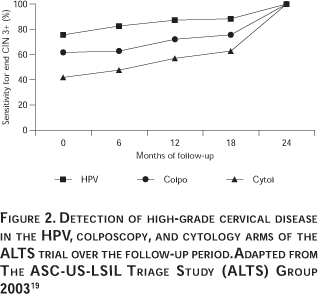
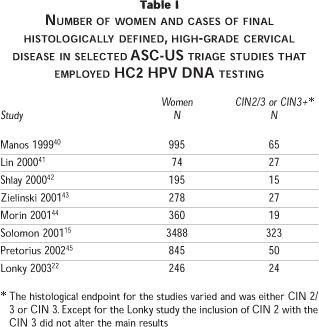
<body><![CDATA[<p><font face="Verdana" size="2"> The current interest    in HPV stems from the fact that a specific group of types, referred to as the    carcinogenic HPVs, are causally involved in the development of certain human    cancers, most notably cervical cancer.<SUP>7</SUP> Over 95% of cervical cancers    have HPV DNA detectable by sensitive methods such as Hybrid Capture 2 (HC2)    and polymerase chain reaction (PCR).<SUP>8-12</SUP> The rationale for the use    of adjunctive HPV DNA testing in screening applications is based on the increasingly    accepted concept of necessary causality and on the basis of the very high negative    predictive value (NPV) of the combined HPV DNA plus Papanicolaou tests, typically    99.9% to 100%. </font></p>     <p>&nbsp;</p>     <p><font face="Verdana" size="3"><b>Material and    Methods </b></font></p>     <p><font face="Verdana" size="2">The HC2 test is    a standardized US FDA-approved test that has been employed extensively in research    studies and has been in routine clinical use for more than three years. HC2<SUP>13</SUP>    can detect one or more of 13 carcinogenic HPV types (16, 18, 31, 33, 35, 39,    45, 51, 52, 56, 58, 59 and 68) at the level of 1 pg/ml each, which corresponds    to 5 900 HPV genomes per test well. There are no FDA-approved PCR tests for    HPV DNA and the studies described herein all employed well-validated research    PCR methods. </font></p>     <p><font face="Verdana" size="2"> Specimens for    HPV testing in the reviewed studies were collected from the transformation zone    by several different techniques. Most commonly a small conical brush was employed    (Digene Cervical Sampler&#153; cervical brush, Digene Corporation, Gaithersburg,    Md USA) that was rotated three times in the cervical<I> os</I> and then placed    into a 1 ml tube of transport medium. Some studies, however, used a standard    plastic spatula and cytobrush combination<SUP>14</SUP> (Cooper Instruments,    Hollywood, Fla USA) or a broom device<SUP>15</SUP> (Cervex-Brush&#174;, Unimar,    Wilton, Conn USA) to collect specimens for deposition into 20 ml of PreservCyt&#174;    (Cytyc Corporation, Boxborough, Mass USA) liquid cytology medium. In the study    by Kjaer <I>et al</I>,<SUP>16</SUP> PCR testing was performed on specimens collected    into phosphate-buffered saline. It is notable that HPV DNA testing in the Portland    study, started in 1989, was conducted on cervicovaginal lavage specimens, a    technique that is inadequate for sampling the endocervical canal. This specimen    limitation is likely accentuated in older women who have a higher frequency    of receding transformation zone and stenotic <I>os</I><SUP>17,18</SUP> and thus    may have compromised the HPV DNA test data. </font></p>     <p><font face="Verdana" size="2"> This review focuses    on the larger ASC-US studies and adjunctive screening studies of 1 000 or more    women that employed HC2 or PCR in a manner that allowed reliable estimates of    accuracy for detecting high-grade CIN or cancer. Unfortunately data for use    of HPV DNA detection as a marker for test of cure are available only from small    groups of women. Studies that employed poorly characterized populations of women    or had more than a minor proportion of special groups such as STD or hospital    clinics were excluded unless convincing evidence was supplied that these groups    were representative of the larger screening population in the general locale    of the study. Studies were required to have a well-described high-grade cervical    disease reference standard rendered by expert pathologists or panels of reviewers.    Histological grading was categorized as either CIN 2/3 or CIN 3. Any cancers    in the studies were included in the CIN groups because the cancers were less    than 10% of the total numbers of high-grade intraepithelial lesions and results    were unaffected by the presence or absence of the cancers (data not shown).    Statistical methods are described below as appropriate with additional details    given in the original publications. 95% confidence intervals calculated for    this review are binomial exact values from StatXact 5.0 (Cytel, Cambridge, Mass    USA). For some studies such as ALTS, 95% CI data for test sensitivities are    as reported and for missing values such as specificities are exact binomials    calculated by StatXact 5.0 on best estimates of the underlying counts as determined    by Bayes methods. </font></p>     <p><font face="Verdana" size="2"><b>HPV DNA testing    for ASC-US triage and related uses </b> </font></p>     <p><font face="Verdana" size="2">The first formally    validated use for HPV DNA testing was ASC-US triage. Numerous studies have been    conducted employing various HPV detection methodologies to understand this application    thoroughly. <a href="#fig1">Figure 1</a> and <a href="#tab1">Table I</a> show    data from the more notable AS-CUS triage studies selected on the somewhat arbitrary    basis of having at least 15 cases of CIN 2/3 and a uniform HPV DNA testing approach    (the HC2 HPV DNA test). <a href="#fig1">Figure 1</a> shows a receiver operator    characteristic (ROC) analysis of the summary data. The most important study    in this category was the ASCUS LSIL Triage Study (ALTS), which was the only    randomized controlled trial and included 3 488 women, with the first round of    baseline visits yielding 323 cases of CIN 2/3 for all three study arms combined    (<a href="#tab1">Table I</a>) and a final yield of 533 cases of CIN 2/3 over    the two year follow-up interval.<SUP>19</SUP> Detailed baseline data for ALTS    has been published by Solomon and Schiffman <I>et al</I>, and others.<SUP>15,20</SUP>    The next most important study was conducted at Kaiser Permanente in California    by Manos <I>et al</I>.<SUP>21</SUP> The Kaiser study preceded ALTS and examined    over 900 women with ASC-US, of whom 64 were shown to have CIN 2/3 (<a href="#tab1">Table    I</a>). All eight studies were consistent and demonstrated that HPV DNA testing    is highly sensitive and specific for detecting CIN 2/3 or CIN 3 (<a href="#fig1">Figure    1</a>). In ALTS the sensitivity and specificity of the HPV DNA testing strategy    estimated after the baseline clinical visits and workup was reported as 96.3%    (95% CI = 91.6-98.8%) and 49% (95% CI = 47.3-50.8%). In contrast the sensitivity    and specificity of repeat ThinPrep liquid cytology was reported as 85.3% (95%    CI = 78.2-90.8%) and 45% (95% CI = 43.4-46.8%). Repeat Pap test data were presented    for only four of the studies but from these it is possible to determine that    the HPV DNA test was not only more sensitive than the Pap test but was also    more specific, as can be deduced from the superior HPV DNA curve in <a href="#fig1">Figure    1</a>. There was an unusual exception in the recent small study of Lonky <I>et    al</I><SUP>22</SUP> where the sensitivity for CIN 2/3 was worse than for CIN    3 alone; in fact for CIN 2/3 the HPV sensitivity was close to the Pap ROC curve.    In contrast, in the other studies for which data were available, the sensitivity    and specificity of the HPV test for CIN 2/3 and for CIN 3 were similar. The    basis for the inconsistency in the Lonky study is currently unclear but could    be related to overcall of CIN 1 and grouping of some of these lesions with the    high-grade category. Longitudinal data from ALTS has revealed that HPV DNA testing    is not only more sensitive than the ThinPrep liquid cytology test but is also    more sensitive than colposcopy.<SUP>19</SUP> Summary data showing test performance    observations for two years of follow-up, are presented in <a href="#fig2">Figure    2</a>. </font></p>     <p><a name="fig1"></a></p>     <p>&nbsp;</p>     ]]></body>
<body><![CDATA[<p align="center"><img src="/img/revistas/spm/v45s3/3a14f01.gif"></p>     <p>&nbsp;</p>     <p><a name="tab1"></a></p>     <p>&nbsp;</p>     <p align="center"><img src="/img/revistas/spm/v45s3/3a14t01.gif"></p>     <p>&nbsp;</p>     <p><a name="fig2"></a></p>     <p>&nbsp;</p>     <p align="center"><img src="/img/revistas/spm/v45s3/3a14f02.gif"></p>     <p>&nbsp;</p>     ]]></body>
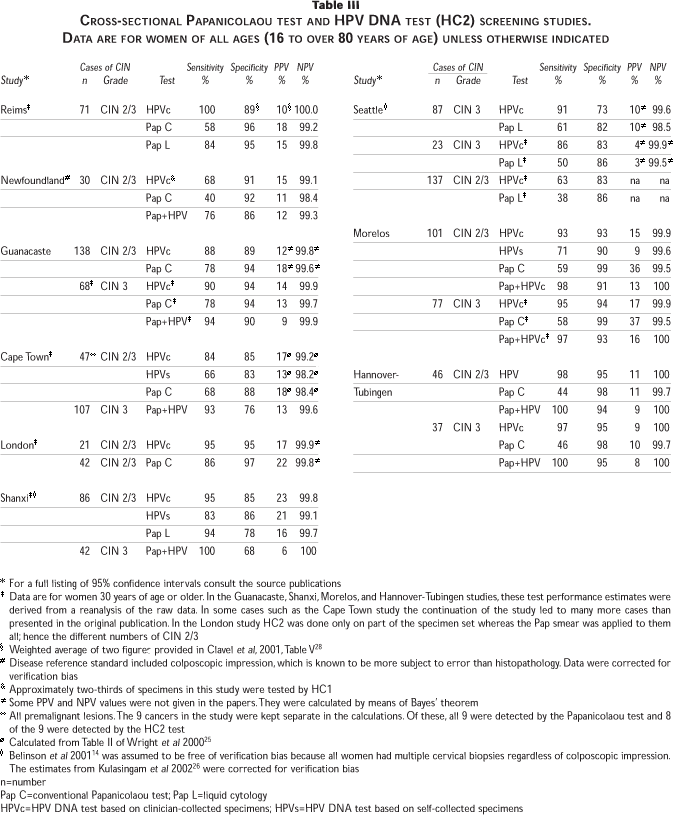
<body><![CDATA[<p><font face="Verdana" size="2"><b>HPV DNA testing    as a marker for test of cure </b></font></p>     <p><font face="Verdana" size="2">The rationale behind    the proposal to use HPV DNA testing to determine the risk of residual or recurrent    CIN 2/3 post-treatment is based on the understanding that without detectable    HPV DNA there is a very low probability of the existence of true CIN 2/3. This    expectation has been essentially confirmed by the ten studies presented in <a href="#tab2">Table    II</a>. Although the studies were each quite small and employed a diversity    of designs and testing methodologies the consistency of the data from these    different research groups in several countries support test of cure as a valid    clinical use for HPV DNA testing. Combining the relevant data from the studies    there were 686 women followed post-treatment from whom 144 (21%, 95% CI = 18-24.2%)    cases of histologically diagnosed residual or recurrent CIN 2/3 were discovered    over the following year. There were 262 (38.2%, 95% CI = 34.5-42%) women in    the combined group who had a positive HPV test for a carcinogenic HPV type during    follow-up and 139 of the 144 cases of CIN 2/3 detected were among these HPV-    positive women. Thus, the overall sensitivity, specificity, positive predictive    value (PPV), and negative predictive value (NPV) of HPV testing for CIN 2/3    post-treatment is estimated as 96.5% (95% CI = 92.1-98.9%), 77.3% (95% CI =    73.5-80.8%), 53% (95% CI = 46.8-59.2%), and 98.8% (95% CI = 97.3-99.6%), respectively.    Most of these studies did not give comparable performance data for repeat Pap    smear testing but it is generally known that repeat cytology is insensitive    for residual disease and follow-up strategies post-treatment usually also include    at least one repeat colposcopy at 4 to 6 months. </font></p>     <p><a name="tab2"></a></p>     <p>&nbsp;</p>     <p align="center"><img src="/img/revistas/spm/v45s3/3a14t02.gif"></p>     <p>&nbsp;</p>     <p><font face="Verdana" size="2"> In some papers    performance data for the Pap test were provided. For example, Paraskevaidis    <I>et al</I>,<SUP>23</SUP> in one of the larger studies of 123 women, presented    data from which the sensitivity of the repeat Pap test was estimated as 48.8%    (95% CI = 32.9-64.9%) and of HPV testing as 92.7% (95% CI = 80-98.5%). In some    papers the specificity of the Pap test was 86.6% (95% CI = 77.3-93.1%), and    of HPV it was 84.1% (95% CI = 74.4-91.3%). PPV and NPV for the Pap test were    64.5% (95% CI = 45.4-80.8%) and 77.2% (95% CI = 67.2-85.3%) respectively, while    for HPV DNA testing PPV and NPV were 74.5% (95% CI = 60.4-85.7%) and 95.8% (95%    CI = 88.3-99.1%) respectively. In a smaller study of only 48 women, Chua<SUP>24</SUP>    reported data from which the sensitivity, specificity, PPV and NPV of the Pap    test were estimated as 50% (95% CI = 29.9-70.1%), 90.9% (95% CI = 70.8-98.9%),    86.7% (95% CI = 59.5-98.3%), and 60.6% (95% CI = 42.1-77.1%) respectively, while    the sensitivity, specificity, PPV, and NPV of the HPV DNA test were estimated    as 92.3% (95% CI = 74.9-99%), 100% (95% CI = 84.6-100%), 100 (95% CI = 85.8-100%)    and 91.7% (95% CI = 73-99%) respectively. </font></p>     <p><font face="Verdana" size="2"><b>HPV DNA testing    for adjunctive screening with cytology or as a stand-alone test </b></font></p>     <p><font face="Verdana" size="2">Numerous large    HPV screening studies have been published that have spanned a broad range of    geographic, ethnic, and socioeconomic groupings, representing many of the major    populations worldwide. The studies considered here varied widely from 1 365    women in Cape Town South Africa<SUP>25</SUP> to 20 810 women in Portland Oregon.<SUP>18</SUP>    Overall, the studies included more than 77 000 women and more than 1 000 cases    of CIN 2/3 spanning four continents and 11 countries. There was little difference    in the performance of the tests whether histologically diagnosed CIN 2/3 or    CIN 3 was the reference except in the Seattle study<SUP>26</SUP> (<a href="/img/revistas/spm/v45s3/3a14t03.gif">Table    III</a>), suggesting that generally there was low misclassification between    CIN 1 and CIN 2. </font></p>     <p><font face="Verdana" size="2"> The prevalence    of CIN 2/3 varied widely (as would be expected given the study settings) and    spanned the gamut from unscreened high-risk populations such as Shanxi Province    China<SUP>14</SUP> (CIN 2/3 prevalence of 4.3%) to much lower risk populations    such as the UK<SUP>27</SUP> (CIN 2/3 prevalence of 1.2%). As would be expected,    the prevalence of CIN 3 was lower but exhibited a similar trend as the CIN 2/3    data with respect to the different populations. </font></p>     ]]></body>
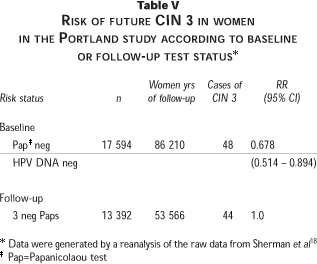
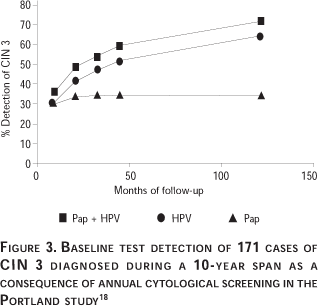
<body><![CDATA[<p><font face="Verdana" size="2"> It is evident    from <a href="/img/revistas/spm/v45s3/3a14t03.gif">Table III</a> that HPV DNA testing by HC2    had a higher sensitivity (in some cases much higher) than cytology. For example,    in the study from Reims France,<SUP>28</SUP> HC2 HPV DNA testing detected 100%    of CIN 2/3 as compared to 58% for the conventional Papanicolaou test (a 72%    increase for HPV DNA) and 84% for the ThinPrep test (a 19% increase for HPV    DNA). Similar or greater differences between HPV DNA testing and cytology were    seen in the studies from Newfoundland Canada,<SUP>29</SUP> Seattle Washington,<SUP>26</SUP>    Morelos Mexico,<SUP>30</SUP> and Hannover-Tubingen Germany,<SUP>31</SUP> whereas    in the other studies the improvement in HPV DNA sensitivity relative to the    Papanicolaou test was somewhat less. There was not a single study in which the    sensitivity of the Papanicolaou test equaled or exceeded the sensitivity of    the HPV DNA test. The same observations can be made for the NPVs; the HPV DNA    NPVs exceeded the Papanicolaou test NPVs in all studies. </font></p>     <p><font face="Verdana" size="2"> The specificity    values for HC2 HPV DNA testing were generally lower than the specificity values    of the Papanicolaou test, except in the Shanxi study<SUP> 14</SUP> where the    specificity of HPV DNA was higher than the specificity of the ThinPrep test.    The PPVs of the Papanicolaou test were overall a little higher than the PPVs    for HPV DNA testing. PPV of the Papanicolaou test was higher in the studies    from London,<SUP>27</SUP> Reims,<SUP>28</SUP> Cape Town,<SUP>25</SUP> and Hannover,<SUP>31</SUP>    and unusually high in Morelos,<SUP>30</SUP> whereas the HPV PPV was higher in    the studies from Seattle,<SUP>26</SUP> Newfoundland,<SUP>29</SUP> Guanacaste,<SUP>32</SUP>    and Shanxi.<SUP>14</SUP> </font></p>     <p><font face="Verdana" size="2"> For most studies    the sensitivity of the Papanicolaou test and the HC2 HPV DNA test combined were    higher than either test alone. In contrast, the specificities of the combined    tests were less than the specificities for either test alone but, in the majority    of these combinations, the specificity decreases were small, on the order of    a few percent. The PPVs of the individual or the combined tests were quite similar    in some studies and decreased for the combination in others. As expected, the    NPVs of HPV DNA combined with the Papanicolaou test were higher and in a few    studies were 100%. </font></p>     <p><font face="Verdana" size="2"> <a href="/img/revistas/spm/v45s3/3a14t04.gif">Table    IV</a> shows the data for the three PCR studies. Of note, the sensitivity of    the Papanicolaou test in Jena Germany was only 20% as compared to the sensitivity    of the HPV DNA test, which was 89%.<SUP>33</SUP> However, in this study the    Papanicolaou test had a specificity of 99% compared to 94% for the HPV DNA PCR    test. In the study from Seattle,<SUP>26</SUP> the PCR test had a sensitivity    of 88% for CIN 3 as compared to 61% for the ThinPrep Papanicolaou test. When    restricted to women older than age 30 the PCR test detected 80% of CIN 3 as    compared to 50% for the ThinPrep Papanicolaou test. In contrast to the study    from Jena,<SUP>33</SUP> the specificity of the HPV DNA PCR test and the ThinPrep    Papanicolaou test in the Seattle study<SUP>26</SUP> were similar. </font></p>     <p><font face="Verdana" size="2"> The PCR study    from Denmark,<SUP>16</SUP> was longitudinal and presented the sensitivity of    the PCR test for CIN 2/3 as 93%. A key contribution of this study was the estimated    risk of CIN 2/3 in women who were cytologically normal but HPV DNA- positive    at baseline and followed for two years. The odds ratios for CIN 2/3 were 692    for persistence of any high-risk HPV type and 813 for persistence of the same    high-risk HPV type compared to the reference group of women who were negative    for HPV DNA at both time points. </font></p>     <p><font face="Verdana" size="2"> Taken as a whole,    the studies indicate that the sensitivity of HPV DNA testing for CIN 2/3 or    CIN 3 were comparable for HC2 and PCR and ranged from 63% to 100% with a median    of approximately 92%. In comparison the sensitivity of the conventional Papanicolaou    test ranged from 20% to 86% with a median value of approximately 59%. The sensitivity    of ThinPrep liquid cytology fell between 38% and 94%. </font></p>     <p><font face="Verdana" size="2"> The Portland study    was a 10-year longitudinal study of HPV natural history that provided data on    the risk of future CIN 3 in cytologically normal HPV-infected women. The study    protocol and data have been described extensively in several publications.<SUP>18,34-37</SUP>    In brief, between April 1, 1989 and November 2, 1990, 23 702 women were enrolled    at Kaiser Permanente clinics in Portland, Oregon. Participants provided a baseline    conventional Papanicolaou test and a cervicovaginal lavage specimen for HPV    DNA testing. A small percentage of women were excluded for various trivial reasons    and the remaining 20 810 women were divided into several groups for further    analysis. </font></p>     <p><font face="Verdana" size="2"> Several questions    related to test performance were studied, including: a) the ability of baseline    HPV DNA and Papanicolaou tests to identify women diagnosed with CIN 3 during    the 10 year duration of the study, b) the relative risk for future CIN 3 in    the subset of women who were cytologically normal at baseline as a function    of HPV DNA positivity, and c) the relative risk of CIN 3 in women with HPV DNA    and Papanicolaou test negative results at baseline as compared to women who    had three normal follow-up Papanicolaou tests regardless of HPV status. HPV    DNA test results were not used for any aspect of the clinical management or    follow-up of the women. The cohort was followed for up to 122 months by standard    cytological screening, which at the time involved annual conventional Papanicolaou    tests for most women. There were no important differences in follow-up characteristics    of HPV DNA-positive versus HPV DNA-negative women.<SUP>18</SUP> One hundred    seventy-one cases of CIN 3 were detected cumulatively during the follow-up period.    </font></p>     <p><font face="Verdana" size="2"> <a href="#tab5">Table    V</a> shows the relative risks of CIN 3 according to Papanicolaou test or combined    test status as determined by maximum likelihood estimation techniques. <a href="#fig3">Figure    3</a> shows the secular trend for CIN 3 diagnosis during follow-up according    to initial positivity by the Papanicolaou test at a cutoff of <u>&gt;</u>ASC-US,    by HPV DNA alone, or by a combination of the two tests. Conceptually the groups    can be viewed as risk stratifications based on the initial Papanicolaou test,    initial HPV DNA, or either test positive as a combination, with the percentage    of the CIN 3s that emanated from each group plotted versus time. Thus, 33% of    the cumulative CIN 3 cases during the 10 years had a positive Papanicolaou test    at baseline. In comparison 64% of CIN 3 patients were HPV DNA positive at baseline    and 69% of CIN 3 patients were positive for either Papanicolaou or HPV DNA or    both tests at baseline. Eighty-six percent (95% CI = 80.3-92.6%) of CIN 3 patients    diagnosed during the first 45 months were positive by either Papanicolaou or    HPV DNA tests or both at baseline.<SUP>18</SUP> </font></p>     <p><a name="tab5"></a></p>     ]]></body>
<body><![CDATA[<p>&nbsp;</p>     <p align="center"><img src="/img/revistas/spm/v45s3/3a14t05.gif"></p>     <p>&nbsp;</p>     <p><a name="fig3"></a></p>     <p>&nbsp;</p>     <p align="center"><img src="/img/revistas/spm/v45s3/3a14f03.gif"></p>     <p>&nbsp;</p>     <p><font face="Verdana" size="2">Another recent    longitudinal study by Bory <I>et al</I><SUP>38</SUP> is consistent with the    observations of the Copenhagen study<SUP>16</SUP> and the Portland study.<SUP>18</SUP>    It was reported that 7.7% (51/659) of the women initially positive for HPV DNA    at baseline and 21.2% (51/241) of women who were persistently positive for oncogenic    HPV DNA types by HC2 were diagnosed with CIN 2/3 on histology within 36 months,    compared to only 0.08% (2/2432) of women initially HPV negative. </font></p>     <p><font face="Verdana" size="2"><b>Advances in    HPV DNA detection </b></font></p>     <p><font face="Verdana" size="2">HC2 employs RNA    probes that hybridize to target DNA. Capture and detection of resulting DNA-RNA    hybrids are accomplished by antibodies to DNA-RNA immobilized on the surface    of a 96-well microplate. Next, alkaline phosphatase-labeled anti-DNA-RNA monoclonal    antibodies are reacted with the immobilized hybrids and the plate is washed.    This is followed by incubation of the bound enzymes with the chemiluminescent    compound CDP-Star&#174; (Tropix PE, Bedford, Mass, USA). Dephosphorylation of    the substrate produces light in a glow reaction that is measured by a luminometer.    Readings are transferred directly into a software program where the results    are analyzed and the number of hybrids immobilized can be quantitated. </font></p>     ]]></body>
<body><![CDATA[<p><font face="Verdana" size="2"> A new format of    Hybrid Capture, Hybrid Capture 3, has been invented and developed specifically    to address the need for rapid, sensitive and specific detection and discrimination    of highly homologous nucleic acid targets.<SUP>39</SUP> The specificity of HC3    is achieved by using biotinylated capture oligonucleotides to hybridize to unique    sequence regions within the desired target and immobilize the target to a streptavidin-coated    surface. Signal is generated by RNA probes that hybridize to other regions of    the target. HC3 provides a highly selective and sensitive method and eliminates    the issue of RNA probe cross-reactivity seen with HC2. To a user the HC3 assay    format is indistinguishable from the HC2 test. HC3 has been applied to the specific    typing and detection of HPV and is capable of discriminating highly related    HPV types such as HPV 18, 45 or HPV 16, 31, 35. Both HC2 and HC3 perform similarly    in the detection of the true HPV target. However, the cross-reactive detection    of other related HPV types has been virtually eliminated in HC3. The HPV HC3    test can be used to detect, differentiate and accurately quantify HPV types    from specimens containing a mixture of HPVs at various concentrations.<SUP>13,39</SUP>    </font></p>     <p><font face="Verdana" size="2"> An automated robotic    platform for Hybrid Capture called the Rapid Capture&#153; System (RCS) has    been developed for high-volume laboratory testing. RCS is a robotic 96-well    microplate processor integrating liquid and plate handling, incubations, shaking    and washing directly from bar-coded primary tubes. Bulk denaturation of specimens    is performed directly in the specimen collection tubes, utilizing a custom rack    assembly, a multi-tube rack vortexer and a 65 &ordm;C waterbath. Following this    denaturation step, specimens are then placed into the RCS platform. Processed    plates are transferred to the DML 2000&#153; luminometer for detection and analysis    utilizing custom software. The RCS protocol provides over 3.5 hours of continuous    hands-free time to the user during a run. The semi-automated application allows    a single user with one RCS, employing an upgraded version of HC2, to test 352    specimens (4 microplates) in an 8-hour shift. </font></p>     <p><font face="Verdana" size="2"><b>Combination    of HPV DNA testing and novel markers </b></font></p>     <p><font face="Verdana" size="2">There has been    criticism of the use of HPV testing for routine screening because most infections    do not progress to cancer and thus there is the danger of excessive and costly    interventions and negative psychological consequence for patients. These criticisms    tend to assume that HPV tests will be conducted in an indiscriminate way by    uninformed clinicians. Not only is this unlikely and not supported by recent    experience in ASC-US triage but it can also be easily minimized by proper education    on appropriate test usage. Nevertheless there are strong arguments for restricting    use of HPV screening to women above the age at which HPV is still behaving as    an STD and concentrate on those where it has become persistent and has the characteristics    of a carcinogen. The best cutoff age is still under debate but is felt to be    in the range of 25 to 35 years. However, even with this age stratification there    is a need for additional improvement in the specificity of HPV tests. The use    of novel markers is proposed as a further way to stratify HPV positive women    into risk groups which can be managed by alternative algorithms. It may be possible    to stratify on the basis of E6 and/or E7 expression levels although direct clinical    data in support of this strategy are presently lacking. Some have suggested    that novel protein markers such as p16, MCM5, EGFR, various cyclins, etc, may    replace the need for HPV testing.<SUP>40</SUP> However, these arguments overlook    the inability of such tests to identify the full extent of the at-risk pool,    namely those women who are persistently HPV infected without concurrent cytological    abnormalities but who are at risk for high-grade disease in the coming years.    We have undertaken an extensive investigation of novel protein markers to help    substratify HPV-positive women. We employed immunocytochemistry to look at issues    of test sensitivity and specificity of the individual and panel protein tests    alone or in combination with HPV DNA testing. Preliminary data reveal that none    of the markers are as sensitive for detection of HSIL as HPV DNA testing and    must be used as panels to reach adequate sensitivity. However, use of such panels    as stand-alone tests suffers from poor specificity (data not shown). In contrast    use of a panel composed of certain cell proliferative and cell regulatory proteins    on HPV- positive women appears to stratify these into groups with adequate sensitivity    and specificity to be considered as a potential triage strategy. This work is    still at an early stage and detailed information will be presented at a later    time. </font></p>     <p>&nbsp;</p>     <p><font face="Verdana" size="3"><b>Discussion </b></font></p>     <p><font face="Verdana" size="2">The results of    available studies provide compelling evidence for the clinical utility of HPV    DNA testing as a management tool for ASC-US triage, for test of cure and as    an adjunct to cervical cytology for routine screening in women older than age    30 years and perhaps in certain settings also at younger ages. The wide diversity    of study locations and risk groupings is a particular strength of the combined    results and indicates that the data may be generalizable to many screening settings    worldwide. The cross-sectional and longitudinal data complement each other and    show that women infected with oncogenic HPV constitute a higher risk group requiring    more vigilant follow-up as compared to women with no evidence of HPV infection    who can be regarded as being at low risk for cervical cancer. </font></p>     <p><font face="Verdana" size="2"> A weakness in    the screening data set relates to the lack of true assessment of all potential    CIN 2/3 on the cervix. There is a concern that even combinations of screening    tests may miss a large proportion of true high-grade neoplasia on the cervix    (the verification bias effect). Such biases, if present, will falsely improve    the appearance of HPV testing performance. However, in the study from Shanxi    province in China there was a rigorous assessment of all women by colposcopy    and biopsy that indicated that the HPV DNA and Papanicolaou test combined detected    essentially all CIN 2/3 and cancers. In several other studies where control    colposcopies were performed on the double-negative women there was virtually    no CIN 2/3 detected.<SUP>26,32,38</SUP> Even if verification bias were present    at high levels in some or most studies it would not change the fact that HPV    DNA is the more sensitive test with or without verification bias. The real impact    of the bias is on the accuracy of our assessment of the absolute values of sensitivity    and specificity. </font></p>     <p><font face="Verdana" size="2"> HPV DNA testing    using HC2 or PCR can identify almost all patients with CIN 3 or more. Adding    a fluid-based cytology test to the HPV DNA test increases sensitivity by approximately    5%. More importantly, the negative predictive values for the combinations were    above 99% for seven studies and were 100% in 4 of the 7. If a patient is negative    for HPV DNA and has a negative Papanicolaou test, the clinician can be reassured    that there is little risk of missed neoplastic disease. </font></p>     <p><font face="Verdana" size="2"> Women who are    HPV DNA positive but who do not have an abnormal Papanicolaou test or clinical    evidence of HPV-related disease should not be viewed as having "false positive"    tests. These are the women at greatest risk of developing an abnormal Papanicolaou    test and cervical neoplasia prospectively, as shown by the Portland, Copenhagen,    and Reims investigators. Such women can be managed by close follow-up and repeat    testing. </font></p>     ]]></body>
<body><![CDATA[<p>&nbsp;</p>     <p><font face="Verdana" size="3"><b>References </b></font></p>     <!-- ref --><p><font face="Verdana" size="2">1. Parkin DM, Bray    F, Ferlay J, Pisani P. Estimating the world cancer burden: Globocan 2000. Int    J Cancer 2001 Oct;94(2):153-156. </font>&nbsp;&nbsp;&nbsp;&nbsp;&nbsp;&nbsp;&nbsp;&nbsp;[&#160;<a href="javascript:void(0);" onclick="javascript: window.open('/scielo.php?script=sci_nlinks&ref=9183536&pid=S0036-3634200300090001200001&lng=','','width=640,height=500,resizable=yes,scrollbars=1,menubar=yes,');">Links</a>&#160;]<!-- end-ref --><!-- ref --><p><font face="Verdana" size="2">2. Lazcano-Ponce    EC, Rasc&oacute;n-Pacheco RA, Lozano-Ascencio R, Velasco-Mondrag&oacute;n HE.    Mortality from cervical carcinoma in Mexico: Impact of screening, 1980-1990.    Acta Cytol 1996;40(3):506-512. </font>&nbsp;&nbsp;&nbsp;&nbsp;&nbsp;&nbsp;&nbsp;&nbsp;[&#160;<a href="javascript:void(0);" onclick="javascript: window.open('/scielo.php?script=sci_nlinks&ref=9183537&pid=S0036-3634200300090001200002&lng=','','width=640,height=500,resizable=yes,scrollbars=1,menubar=yes,');">Links</a>&#160;]<!-- end-ref --><!-- ref --><p><font face="Verdana" size="2">3. Papanicolaou    GN, Traut HF. The diagnostic value of vaginal smears in carcinoma of the uterus.    Am J Obstet Gynecol 1941 Aug;42(2):193-206. </font>&nbsp;&nbsp;&nbsp;&nbsp;&nbsp;&nbsp;&nbsp;&nbsp;[&#160;<a href="javascript:void(0);" onclick="javascript: window.open('/scielo.php?script=sci_nlinks&ref=9183538&pid=S0036-3634200300090001200003&lng=','','width=640,height=500,resizable=yes,scrollbars=1,menubar=yes,');">Links</a>&#160;]<!-- end-ref --><!-- ref --><p><font face="Verdana" size="2">4. Nanda K, McCrory    DC, Myers ER, Bastian LA, Hasselblad V, Hickey JD <I>et al.</I> Accuracy of    the Papanicolaou test in screening for and follow-up of cervical cytologic abnormalities:    A systematic review. Ann Intern Med 2000 May;132(10):810-819. </font>&nbsp;&nbsp;&nbsp;&nbsp;&nbsp;&nbsp;&nbsp;&nbsp;[&#160;<a href="javascript:void(0);" onclick="javascript: window.open('/scielo.php?script=sci_nlinks&ref=9183539&pid=S0036-3634200300090001200004&lng=','','width=640,height=500,resizable=yes,scrollbars=1,menubar=yes,');">Links</a>&#160;]<!-- end-ref --><!-- ref --><p><font face="Verdana" size="2">5. Bastian L, Datta S, Hasselblad V, Hickey J,    Myers E, Nanda K. Evaluation of Cervical Cytology. Rockville, MD: Agency for    Health Care Policy and Research; Feb 1999. Report no 5. Available from: <a href="http://hstat.nlm.nih.gov/">http://hstat.nlm.nih.gov/</a>.    Accessed July 22, 2003. </font>&nbsp;&nbsp;&nbsp;&nbsp;&nbsp;&nbsp;&nbsp;&nbsp;[&#160;<a href="javascript:void(0);" onclick="javascript: window.open('/scielo.php?script=sci_nlinks&ref=9183540&pid=S0036-3634200300090001200005&lng=','','width=640,height=500,resizable=yes,scrollbars=1,menubar=yes,');">Links</a>&#160;]<!-- end-ref --><!-- ref --><p><font face="Verdana" size="2">6. Fahey MT, Irwig    L, Macaskill P. Meta-analysis of Pap test accuracy. Am J Epidemiol 1995 Apr;141(7):680-689.    </font>&nbsp;&nbsp;&nbsp;&nbsp;&nbsp;&nbsp;&nbsp;&nbsp;[&#160;<a href="javascript:void(0);" onclick="javascript: window.open('/scielo.php?script=sci_nlinks&ref=9183541&pid=S0036-3634200300090001200006&lng=','','width=640,height=500,resizable=yes,scrollbars=1,menubar=yes,');">Links</a>&#160;]<!-- end-ref --><!-- ref --><p><font face="Verdana" size="2">7. Bosch FX, L&ouml;rincz    A, Mu&ntilde;oz N, Meijer CJLM, Shah KV. The causal relation between human papillomavirus    and cervical cancer. J Clin Pathol 2002 Apr;55(4):244-65. </font>&nbsp;&nbsp;&nbsp;&nbsp;&nbsp;&nbsp;&nbsp;&nbsp;[&#160;<a href="javascript:void(0);" onclick="javascript: window.open('/scielo.php?script=sci_nlinks&ref=9183542&pid=S0036-3634200300090001200007&lng=','','width=640,height=500,resizable=yes,scrollbars=1,menubar=yes,');">Links</a>&#160;]<!-- end-ref --><!-- ref --><p><font face="Verdana" size="2">8. L&ouml;rincz    AT, Reid R, Jenson AB, Greenberg MD, Lancaster W, Kurman RJ. Human papillomavirus    infection of the cervix: Relative risk associations of 15 common anogenital    types. Obstet Gynecol 1992 Mar;79(3):328-337. </font>&nbsp;&nbsp;&nbsp;&nbsp;&nbsp;&nbsp;&nbsp;&nbsp;[&#160;<a href="javascript:void(0);" onclick="javascript: window.open('/scielo.php?script=sci_nlinks&ref=9183543&pid=S0036-3634200300090001200008&lng=','','width=640,height=500,resizable=yes,scrollbars=1,menubar=yes,');">Links</a>&#160;]<!-- end-ref --><!-- ref --><p><font face="Verdana" size="2">9. Bosch FX, Manos    MM, Mu&ntilde;oz N, Sherman M, Jansen AM, Peto J <I>et al</I>. Prevalence of    human papillomavirus in cervical cancer: A worldwide perspective. J Natl Cancer    Inst 1995 Jun;87(11):796-802. </font>&nbsp;&nbsp;&nbsp;&nbsp;&nbsp;&nbsp;&nbsp;&nbsp;[&#160;<a href="javascript:void(0);" onclick="javascript: window.open('/scielo.php?script=sci_nlinks&ref=9183544&pid=S0036-3634200300090001200009&lng=','','width=640,height=500,resizable=yes,scrollbars=1,menubar=yes,');">Links</a>&#160;]<!-- end-ref --><!-- ref --><p><font face="Verdana" size="2">10. Walboomers    JMM, Jacobs MV, Manos MM, Bosch FX, Kummer JA, Shah KV <I>et al</I>. Human papillomavirus    is a necessary cause of invasive cervical cancer worldwide. J Pathol 1999 Jul;189(1):12-19.    </font>&nbsp;&nbsp;&nbsp;&nbsp;&nbsp;&nbsp;&nbsp;&nbsp;[&#160;<a href="javascript:void(0);" onclick="javascript: window.open('/scielo.php?script=sci_nlinks&ref=9183545&pid=S0036-3634200300090001200010&lng=','','width=640,height=500,resizable=yes,scrollbars=1,menubar=yes,');">Links</a>&#160;]<!-- end-ref --><!-- ref --><p><font face="Verdana" size="2">11. Herrero R,    Hildesheim A, Bratti C, Sherman ME, Hutchinson M, Morales J <I>et al</I>. Population-based    study of human papillomavirus infection and cervical neoplasia in rural Costa    Rica. J Natl Cancer Inst 2000 Mar;92(6):464-474. </font>&nbsp;&nbsp;&nbsp;&nbsp;&nbsp;&nbsp;&nbsp;&nbsp;[&#160;<a href="javascript:void(0);" onclick="javascript: window.open('/scielo.php?script=sci_nlinks&ref=9183546&pid=S0036-3634200300090001200011&lng=','','width=640,height=500,resizable=yes,scrollbars=1,menubar=yes,');">Links</a>&#160;]<!-- end-ref --><!-- ref --><p><font face="Verdana" size="2">12. Thomas DJ.    Sexually transmitted viral infections: Epidemiology and treatment. JOGNN 2001;30(3):316-323.    </font>&nbsp;&nbsp;&nbsp;&nbsp;&nbsp;&nbsp;&nbsp;&nbsp;[&#160;<a href="javascript:void(0);" onclick="javascript: window.open('/scielo.php?script=sci_nlinks&ref=9183547&pid=S0036-3634200300090001200012&lng=','','width=640,height=500,resizable=yes,scrollbars=1,menubar=yes,');">Links</a>&#160;]<!-- end-ref --><!-- ref --><p><font face="Verdana" size="2">13. L&ouml;rincz    A, Anthony J. Advances in HPV detection by Hybrid Capture&#174;. Pap Report    2001;12(6):145-154. </font>&nbsp;&nbsp;&nbsp;&nbsp;&nbsp;&nbsp;&nbsp;&nbsp;[&#160;<a href="javascript:void(0);" onclick="javascript: window.open('/scielo.php?script=sci_nlinks&ref=9183548&pid=S0036-3634200300090001200013&lng=','','width=640,height=500,resizable=yes,scrollbars=1,menubar=yes,');">Links</a>&#160;]<!-- end-ref --><!-- ref --><p><font face="Verdana" size="2">14. Belinson J,    Qiao YL, Pretorius R, Zhang WH, Elson P, Li L <I>et al.</I> Shanxi Province    cervical cancer screening study: A cross-sectional comparative trial of multiple    techniques to detect cervical neoplasia. Gynecol Oncol 2001 Nov;83(2):439-444.    </font>&nbsp;&nbsp;&nbsp;&nbsp;&nbsp;&nbsp;&nbsp;&nbsp;[&#160;<a href="javascript:void(0);" onclick="javascript: window.open('/scielo.php?script=sci_nlinks&ref=9183549&pid=S0036-3634200300090001200014&lng=','','width=640,height=500,resizable=yes,scrollbars=1,menubar=yes,');">Links</a>&#160;]<!-- end-ref --><!-- ref --><p><font face="Verdana" size="2">15. Solomon D,    Schiffman M, Tarone B, for the ALTS Group. Comparison of three management strategies    for patients with Atypical Squamous Cells of Undetermined Significance (ASCUS):    Baseline results from a randomized trial. J Natl Cancer Inst 2001 Feb;93(4):293-299.    </font>&nbsp;&nbsp;&nbsp;&nbsp;&nbsp;&nbsp;&nbsp;&nbsp;[&#160;<a href="javascript:void(0);" onclick="javascript: window.open('/scielo.php?script=sci_nlinks&ref=9183550&pid=S0036-3634200300090001200015&lng=','','width=640,height=500,resizable=yes,scrollbars=1,menubar=yes,');">Links</a>&#160;]<!-- end-ref --><!-- ref --><p><font face="Verdana" size="2">16. Kjaer SK, van    den Brule AJC, Paull G, Svare EI, Sherman ME, Thomsen BL <I>et al</I>. Type    specific persistence of high risk human papillomavirus (HPV) as indicator of    high grade cervical squamous intraepithelial lesions in young women: Population    based prospective follow up study. Br Med J 2002 Sep;325(7364):572-578. </font>&nbsp;&nbsp;&nbsp;&nbsp;&nbsp;&nbsp;&nbsp;&nbsp;[&#160;<a href="javascript:void(0);" onclick="javascript: window.open('/scielo.php?script=sci_nlinks&ref=9183551&pid=S0036-3634200300090001200016&lng=','','width=640,height=500,resizable=yes,scrollbars=1,menubar=yes,');">Links</a>&#160;]<!-- end-ref --><!-- ref --><p><font face="Verdana" size="2">17. Hall S, L&ouml;rincz    A, Shah F, Sherman ME, Abbas F, Paull G <I>et al</I>. Human papillomavirus DNA    detection in cervical specimens by Hybrid Capture: Correlation with cytologic    and histologic diagnoses of squamous intraepithelial lesions of the cervix.    Gynecol Oncol 1996;62:353-359. </font>&nbsp;&nbsp;&nbsp;&nbsp;&nbsp;&nbsp;&nbsp;&nbsp;[&#160;<a href="javascript:void(0);" onclick="javascript: window.open('/scielo.php?script=sci_nlinks&ref=9183552&pid=S0036-3634200300090001200017&lng=','','width=640,height=500,resizable=yes,scrollbars=1,menubar=yes,');">Links</a>&#160;]<!-- end-ref --><!-- ref --><p><font face="Verdana" size="2">18. Sherman ME,    L&ouml;rincz AT, Scott DR, Wacholder S, Castle PE, Glass AG <I>et al</I>. Baseline    cytology, human papillomavirus testing, and risk for cervical neoplasia: A 10-year    cohort analysis. J Natl Cancer Inst 2003 Jan;95(1):46-52. </font>&nbsp;&nbsp;&nbsp;&nbsp;&nbsp;&nbsp;&nbsp;&nbsp;[&#160;<a href="javascript:void(0);" onclick="javascript: window.open('/scielo.php?script=sci_nlinks&ref=9183553&pid=S0036-3634200300090001200018&lng=','','width=640,height=500,resizable=yes,scrollbars=1,menubar=yes,');">Links</a>&#160;]<!-- end-ref --><!-- ref --><p><font face="Verdana" size="2">19. The ASCUS-LSIL    Triage Study (ALTS) Group. Results of a randomized trial on the management of    cytology interpretations of atypical squamous cells of undetermined significance.    Am J Obstet Gynecol 2003 Jun;188(6):1383-1392. </font>&nbsp;&nbsp;&nbsp;&nbsp;&nbsp;&nbsp;&nbsp;&nbsp;[&#160;<a href="javascript:void(0);" onclick="javascript: window.open('/scielo.php?script=sci_nlinks&ref=9183554&pid=S0036-3634200300090001200019&lng=','','width=640,height=500,resizable=yes,scrollbars=1,menubar=yes,');">Links</a>&#160;]<!-- end-ref --><!-- ref --><p><font face="Verdana" size="2">20. Sherman ME,    Schiffman M, Cox JT. Effects of age and human papilloma viral load on colposcopy    triage: Data from the randomized Atypical Squamous Cells of Undetermined Significance/Low-grade    Squamous Intraepithelial Lesion Triage Study (ALTS). J Natl Cancer Inst 2002    Jan;94(2):102-107. </font>&nbsp;&nbsp;&nbsp;&nbsp;&nbsp;&nbsp;&nbsp;&nbsp;[&#160;<a href="javascript:void(0);" onclick="javascript: window.open('/scielo.php?script=sci_nlinks&ref=9183555&pid=S0036-3634200300090001200020&lng=','','width=640,height=500,resizable=yes,scrollbars=1,menubar=yes,');">Links</a>&#160;]<!-- end-ref --><!-- ref --><p><font face="Verdana" size="2">21. Manos MM, Kinney    WK, Hurley LB, Sherman ME, Shieh-Ngai J, Kurman RJ <I>et al</I>. Identifying    women with cervical neoplasia: Using human papillomavirus DNA testing for equivocal    Papanicolaou results. JAMA 1999 May;281(17):1605-1610. </font>&nbsp;&nbsp;&nbsp;&nbsp;&nbsp;&nbsp;&nbsp;&nbsp;[&#160;<a href="javascript:void(0);" onclick="javascript: window.open('/scielo.php?script=sci_nlinks&ref=9183556&pid=S0036-3634200300090001200021&lng=','','width=640,height=500,resizable=yes,scrollbars=1,menubar=yes,');">Links</a>&#160;]<!-- end-ref --><!-- ref --><p><font face="Verdana" size="2">22. Lonky NM, F&eacute;lix    JC, Naidu YM, Wolde-Tsadik G. Triage of atypical squamous cells of undetermined    significance with Hybrid Capture II: Colposcopy and histologic human papillomavirus    correlation. Obstet Gynecol 2003 Mar;101(3):481-489. </font>&nbsp;&nbsp;&nbsp;&nbsp;&nbsp;&nbsp;&nbsp;&nbsp;[&#160;<a href="javascript:void(0);" onclick="javascript: window.open('/scielo.php?script=sci_nlinks&ref=9183557&pid=S0036-3634200300090001200022&lng=','','width=640,height=500,resizable=yes,scrollbars=1,menubar=yes,');">Links</a>&#160;]<!-- end-ref --><!-- ref --><p><font face="Verdana" size="2">23. Paraskevaidis    E, Koliopoulos G, Alamanos Y, Malamou-Mitsi V, Lolis ED, Kitchener HC. Human    papillomavirus testing and the outcome of treatment for cervical intraepithelial    neoplasia. Obstet Gynecol 2001 Nov;98(5 pt 1):833-836. </font>&nbsp;&nbsp;&nbsp;&nbsp;&nbsp;&nbsp;&nbsp;&nbsp;[&#160;<a href="javascript:void(0);" onclick="javascript: window.open('/scielo.php?script=sci_nlinks&ref=9183558&pid=S0036-3634200300090001200023&lng=','','width=640,height=500,resizable=yes,scrollbars=1,menubar=yes,');">Links</a>&#160;]<!-- end-ref --><!-- ref --><p><font face="Verdana" size="2">24. Chua KL, Hjerpe    A. Human papillomavirus analysis as a prognostic marker following conization    of the cervix uteri. Gynecol Oncol 1997;66:108-113. </font>&nbsp;&nbsp;&nbsp;&nbsp;&nbsp;&nbsp;&nbsp;&nbsp;[&#160;<a href="javascript:void(0);" onclick="javascript: window.open('/scielo.php?script=sci_nlinks&ref=9183559&pid=S0036-3634200300090001200024&lng=','','width=640,height=500,resizable=yes,scrollbars=1,menubar=yes,');">Links</a>&#160;]<!-- end-ref --><!-- ref --><p><font face="Verdana" size="2">25. Wright TC,    Jr, Denny L, Kuhn L, Pollack A, L&ouml;rincz A. HPV DNA testing of self-collected    vaginal samples compared with cytologic screening to detect cervical cancer.    JAMA 2000 Jan;283(1):81-86. </font>&nbsp;&nbsp;&nbsp;&nbsp;&nbsp;&nbsp;&nbsp;&nbsp;[&#160;<a href="javascript:void(0);" onclick="javascript: window.open('/scielo.php?script=sci_nlinks&ref=9183560&pid=S0036-3634200300090001200025&lng=','','width=640,height=500,resizable=yes,scrollbars=1,menubar=yes,');">Links</a>&#160;]<!-- end-ref --><!-- ref --><p><font face="Verdana" size="2">26. Kulasingam    SL, Hughes JP, Kiviat NB, Mao C, Weiss NS, Kuypers JM <I>et al</I>. Evaluation    of human papillomavirus testing in primary screening for cervical abnormalities:    Comparison of sensitivity, specificity, and frequency of referral. JAMA 2002    Oct;288(14):1749-1757. </font>&nbsp;&nbsp;&nbsp;&nbsp;&nbsp;&nbsp;&nbsp;&nbsp;[&#160;<a href="javascript:void(0);" onclick="javascript: window.open('/scielo.php?script=sci_nlinks&ref=9183561&pid=S0036-3634200300090001200026&lng=','','width=640,height=500,resizable=yes,scrollbars=1,menubar=yes,');">Links</a>&#160;]<!-- end-ref --><!-- ref --><p><font face="Verdana" size="2">27. Cuzick J, Beverley    E, Ho L, Terry G, Sapper H, Mielzynska I <I>et al</I>. HPV testing in primary    screening of older women. Br J Cancer 1999;81(3):554-558. </font>&nbsp;&nbsp;&nbsp;&nbsp;&nbsp;&nbsp;&nbsp;&nbsp;[&#160;<a href="javascript:void(0);" onclick="javascript: window.open('/scielo.php?script=sci_nlinks&ref=9183562&pid=S0036-3634200300090001200027&lng=','','width=640,height=500,resizable=yes,scrollbars=1,menubar=yes,');">Links</a>&#160;]<!-- end-ref --><!-- ref --><p><font face="Verdana" size="2">28. Clavel C, Masure    M, Bory JP, Putaud I, Mangeonjean C, Lorenzato F <I>et al</I>. Human papillomavirus    testing in primary screening for the detection of high-grade cervical lesions:    a study of 7932 women. Br J Cancer 2001;89(12):1616-1623. </font>&nbsp;&nbsp;&nbsp;&nbsp;&nbsp;&nbsp;&nbsp;&nbsp;[&#160;<a href="javascript:void(0);" onclick="javascript: window.open('/scielo.php?script=sci_nlinks&ref=9183563&pid=S0036-3634200300090001200028&lng=','','width=640,height=500,resizable=yes,scrollbars=1,menubar=yes,');">Links</a>&#160;]<!-- end-ref --><!-- ref --><p><font face="Verdana" size="2">29. Ratnam S, Franco    EL, Ferenczy A. Human papillomavirus testing for primary screening of cervical    cancer precursors. Cancer Epidemiol Biomarkers Prev 2000 Sep;9(9):945-951. </font>&nbsp;&nbsp;&nbsp;&nbsp;&nbsp;&nbsp;&nbsp;&nbsp;[&#160;<a href="javascript:void(0);" onclick="javascript: window.open('/scielo.php?script=sci_nlinks&ref=9183564&pid=S0036-3634200300090001200029&lng=','','width=640,height=500,resizable=yes,scrollbars=1,menubar=yes,');">Links</a>&#160;]<!-- end-ref --><!-- ref --><p><font face="Verdana" size="2">30. Salmer&oacute;n    J, Lazcano-Ponce E, L&ouml;rincz A, Hern&aacute;ndez M, Hern&aacute;ndez P,    Leyva A <I>et al</I>. Comparison of HPV-based assays with Papanicolaou smears    for cervical cancer screening in Morelos State, Mexico. Cancer Causes Control    2003 Aug;14(6):505-512. </font>&nbsp;&nbsp;&nbsp;&nbsp;&nbsp;&nbsp;&nbsp;&nbsp;[&#160;<a href="javascript:void(0);" onclick="javascript: window.open('/scielo.php?script=sci_nlinks&ref=9183565&pid=S0036-3634200300090001200030&lng=','','width=640,height=500,resizable=yes,scrollbars=1,menubar=yes,');">Links</a>&#160;]<!-- end-ref --><!-- ref --><p><font face="Verdana" size="2">31. Petry KU, Menton    S, Menton M, van Loenen-Frosch F, de Carvalho Gomes H, Holz B <I>et al</I>.    Inclusion of HPV testing in routine cervical cancer screening for women above    29 years in Germany: results for 8468 patients. Br J Cancer 2003 May;88(10):1570-1577.    </font>&nbsp;&nbsp;&nbsp;&nbsp;&nbsp;&nbsp;&nbsp;&nbsp;[&#160;<a href="javascript:void(0);" onclick="javascript: window.open('/scielo.php?script=sci_nlinks&ref=9183566&pid=S0036-3634200300090001200031&lng=','','width=640,height=500,resizable=yes,scrollbars=1,menubar=yes,');">Links</a>&#160;]<!-- end-ref --><!-- ref --><p><font face="Verdana" size="2">32. Schiffman M,    Herrero R, Hildesheim A, Sherman ME, Bratti M, Wacholder S <I>et al</I>. HPV    DNA testing in cervical cancer screening: results from women in a high-risk    province of Costa Rica. JAMA 2000 Jan;283(1):87-93. </font>&nbsp;&nbsp;&nbsp;&nbsp;&nbsp;&nbsp;&nbsp;&nbsp;[&#160;<a href="javascript:void(0);" onclick="javascript: window.open('/scielo.php?script=sci_nlinks&ref=9183567&pid=S0036-3634200300090001200032&lng=','','width=640,height=500,resizable=yes,scrollbars=1,menubar=yes,');">Links</a>&#160;]<!-- end-ref --><!-- ref --><p><font face="Verdana" size="2">33. Schneider A,    Hoyer H, Lotz B, Leistritz S, Kuhne-Heid R, Nindl I <I>et al</I>. Screening    for high-grade cervical intra-epithelial neoplasia and cancer by testing for    high-risk HPV, routine cytology or colposcopy. Int J Cancer 2000 Nov;89(6):529-534.    </font>&nbsp;&nbsp;&nbsp;&nbsp;&nbsp;&nbsp;&nbsp;&nbsp;[&#160;<a href="javascript:void(0);" onclick="javascript: window.open('/scielo.php?script=sci_nlinks&ref=9183568&pid=S0036-3634200300090001200033&lng=','','width=640,height=500,resizable=yes,scrollbars=1,menubar=yes,');">Links</a>&#160;]<!-- end-ref --><!-- ref --><p><font face="Verdana" size="2">34. Schiffman MH,    Bauer HM, Hoover RN, Glass AG, Cadell DM, Rush BB <I>et al</I>. Epidemiologic    evidence showing that human papillomavirus infection causes most cervical intraepithelial    neoplasia. J Natl Cancer Inst 1993 Jun;85(12):958-964. </font>&nbsp;&nbsp;&nbsp;&nbsp;&nbsp;&nbsp;&nbsp;&nbsp;[&#160;<a href="javascript:void(0);" onclick="javascript: window.open('/scielo.php?script=sci_nlinks&ref=9183569&pid=S0036-3634200300090001200034&lng=','','width=640,height=500,resizable=yes,scrollbars=1,menubar=yes,');">Links</a>&#160;]<!-- end-ref --><!-- ref --><p><font face="Verdana" size="2">35. Liaw KL, Glass    AG, Manos MM, Greer CE, Scott DR, Sherman M <I>et al</I>. Detection of human    papillomavirus DNA in cytologically normal women and subsequent cervical squamous    intraepithelial lesions. J Natl Cancer Inst 1999 Jun;91(11):954-960. </font>&nbsp;&nbsp;&nbsp;&nbsp;&nbsp;&nbsp;&nbsp;&nbsp;[&#160;<a href="javascript:void(0);" onclick="javascript: window.open('/scielo.php?script=sci_nlinks&ref=9183570&pid=S0036-3634200300090001200035&lng=','','width=640,height=500,resizable=yes,scrollbars=1,menubar=yes,');">Links</a>&#160;]<!-- end-ref --><!-- ref --><p><font face="Verdana" size="2">36. Castle PE,    Wacholder S, L&ouml;rincz AT, Scott DR, Sherman ME, Glass AG <I>et al</I>. A    prospective study of high-grade cervical neoplasia risk among human papillomavirus    infected women. J Natl Cancer Inst 2002 Sep;94(18):1406-1414. </font>&nbsp;&nbsp;&nbsp;&nbsp;&nbsp;&nbsp;&nbsp;&nbsp;[&#160;<a href="javascript:void(0);" onclick="javascript: window.open('/scielo.php?script=sci_nlinks&ref=9183571&pid=S0036-3634200300090001200036&lng=','','width=640,height=500,resizable=yes,scrollbars=1,menubar=yes,');">Links</a>&#160;]<!-- end-ref --><!-- ref --><p><font face="Verdana" size="2">37. L&ouml;rincz    AT, Castle PE, Sherman ME, Scott DR, Glass AG, Wacholder S <I>et al</I>. Viral    load of human papillomavirus and risk of CIN3 or cervical cancer. Lancet 2002    Jul;360(9328):228-229. </font>&nbsp;&nbsp;&nbsp;&nbsp;&nbsp;&nbsp;&nbsp;&nbsp;[&#160;<a href="javascript:void(0);" onclick="javascript: window.open('/scielo.php?script=sci_nlinks&ref=9183572&pid=S0036-3634200300090001200037&lng=','','width=640,height=500,resizable=yes,scrollbars=1,menubar=yes,');">Links</a>&#160;]<!-- end-ref --><!-- ref --><p><font face="Verdana" size="2">38. Bory JP, Cucherousset    J, Lorenzato M, Gabriel R, Quereux C, Birembaut P <I>et al</I>. Recurrent human    papillomavirus infection detected with the hybrid capture II assay selects women    with normal cervical smears at risk for developing high grade cervical lesions:    a longitudinal study of 3 091 women. Int J Cancer 2002 Dec;102(5):519-525. </font>&nbsp;&nbsp;&nbsp;&nbsp;&nbsp;&nbsp;&nbsp;&nbsp;[&#160;<a href="javascript:void(0);" onclick="javascript: window.open('/scielo.php?script=sci_nlinks&ref=9183573&pid=S0036-3634200300090001200038&lng=','','width=640,height=500,resizable=yes,scrollbars=1,menubar=yes,');">Links</a>&#160;]<!-- end-ref --><!-- ref --><p><font face="Verdana" size="2">39. L&ouml;rincz    A, Anthony J. Hybrid Capture&#174;: A system for nucleic acid detection by signal    amplification technology. In: Van Dyke K, Van Dyke C, Woodfork K, Ed. Luminescence    biotechnology: Instruments and applications. Boca Raton,FL: CRC Press; 2002:149-158.    </font>&nbsp;&nbsp;&nbsp;&nbsp;&nbsp;&nbsp;&nbsp;&nbsp;[&#160;<a href="javascript:void(0);" onclick="javascript: window.open('/scielo.php?script=sci_nlinks&ref=9183574&pid=S0036-3634200300090001200039&lng=','','width=640,height=500,resizable=yes,scrollbars=1,menubar=yes,');">Links</a>&#160;]<!-- end-ref --><!-- ref --><p><font face="Verdana" size="2">40. von Knebel    Doeberitz M. New markers for cervical dysplasia to visualise the genomic chaos    created by aberrant oncogenic papillomavirus infections. Eur J Cancer 2002 Nov;38(17):2229-2242.    </font>&nbsp;&nbsp;&nbsp;&nbsp;&nbsp;&nbsp;&nbsp;&nbsp;[&#160;<a href="javascript:void(0);" onclick="javascript: window.open('/scielo.php?script=sci_nlinks&ref=9183575&pid=S0036-3634200300090001200040&lng=','','width=640,height=500,resizable=yes,scrollbars=1,menubar=yes,');">Links</a>&#160;]<!-- end-ref --><!-- ref --><p><font face="Verdana" size="2">41. Lin CT, Tseng    CJ, Lai CH, Hsueh S, Huang HJ, Law KS. High-risk HPV DNA detection by Hybrid    Capture II: An adjunctive test for mildly abnormal cytologic smears in women    <U>&gt;</U>50 years of age. J Reprod Med 2000 Apr;45(4):345-350. </font>&nbsp;&nbsp;&nbsp;&nbsp;&nbsp;&nbsp;&nbsp;&nbsp;[&#160;<a href="javascript:void(0);" onclick="javascript: window.open('/scielo.php?script=sci_nlinks&ref=9183576&pid=S0036-3634200300090001200041&lng=','','width=640,height=500,resizable=yes,scrollbars=1,menubar=yes,');">Links</a>&#160;]<!-- end-ref --><!-- ref --><p><font face="Verdana" size="2">42. Shlay JC, Dunn    T, Byers T, Baron AE, Douglas JM, Jr. Prediction of cervical intraepithelial    neoplasia 2-3 using risk assessment and human papillomavirus testing in women    with atypia on Papanicolaou smears. Obstet Gynecol 2000 Sep;96(3):410-416. </font>&nbsp;&nbsp;&nbsp;&nbsp;&nbsp;&nbsp;&nbsp;&nbsp;[&#160;<a href="javascript:void(0);" onclick="javascript: window.open('/scielo.php?script=sci_nlinks&ref=9183577&pid=S0036-3634200300090001200042&lng=','','width=640,height=500,resizable=yes,scrollbars=1,menubar=yes,');">Links</a>&#160;]<!-- end-ref --><!-- ref --><p><font face="Verdana" size="2">43. Zielinski GD,    Snijders PJF, Rozendaal L, Voorhorst FJ, van der Linden HC, Runsink AP <I>et    al.</I> HPV presence precedes abnormal cytology in women developing cervical    cancer and signals false negative smears. Br J Cancer 2001 Aug;85(3):398-404.    </font>&nbsp;&nbsp;&nbsp;&nbsp;&nbsp;&nbsp;&nbsp;&nbsp;[&#160;<a href="javascript:void(0);" onclick="javascript: window.open('/scielo.php?script=sci_nlinks&ref=9183578&pid=S0036-3634200300090001200043&lng=','','width=640,height=500,resizable=yes,scrollbars=1,menubar=yes,');">Links</a>&#160;]<!-- end-ref --><!-- ref --><p><font face="Verdana" size="2">44. Morin C, Bairati    I, Bouchard C, Fortier M, Roy M, Moore L <I>et al</I>. Managing atypical squamous    cells of undetermined significance in Papanicolaou smears. J Reprod Med 2001    Sep;46(9):799-805. </font>&nbsp;&nbsp;&nbsp;&nbsp;&nbsp;&nbsp;&nbsp;&nbsp;[&#160;<a href="javascript:void(0);" onclick="javascript: window.open('/scielo.php?script=sci_nlinks&ref=9183579&pid=S0036-3634200300090001200044&lng=','','width=640,height=500,resizable=yes,scrollbars=1,menubar=yes,');">Links</a>&#160;]<!-- end-ref --><!-- ref --><p><font face="Verdana" size="2">45. Pretorius RG,    Peterson P, Novak S, Azizi F, Sadeghi M, L&ouml;rincz AT. Comparison of two    signal-amplification DNA tests for high-risk HPV as an aid to colposcopy. J    Reprod Med 2002 Apr;47(4):290-298. </font>&nbsp;&nbsp;&nbsp;&nbsp;&nbsp;&nbsp;&nbsp;&nbsp;[&#160;<a href="javascript:void(0);" onclick="javascript: window.open('/scielo.php?script=sci_nlinks&ref=9183580&pid=S0036-3634200300090001200045&lng=','','width=640,height=500,resizable=yes,scrollbars=1,menubar=yes,');">Links</a>&#160;]<!-- end-ref --><!-- ref --><p><font face="Verdana" size="2">46. Elfgren K,    Bistoletti P, Dillner L, Walboomers JMM, Meijer CJLM, Dillner J. Conization    for cervical intraepithelial neoplasia is followed by disappearance of human    papillomavirus deoxyribonucleic acid and a decline in serum and cervical mucus    antibodies against human papillomavirus antigens. Am J Obstet Gynecol 1996 Mar;174(3):937-942.    </font>&nbsp;&nbsp;&nbsp;&nbsp;&nbsp;&nbsp;&nbsp;&nbsp;[&#160;<a href="javascript:void(0);" onclick="javascript: window.open('/scielo.php?script=sci_nlinks&ref=9183581&pid=S0036-3634200300090001200046&lng=','','width=640,height=500,resizable=yes,scrollbars=1,menubar=yes,');">Links</a>&#160;]<!-- end-ref --><!-- ref --><p><font face="Verdana" size="2">47. Bollen LJM,    Tjong-A-Hung SP, van der Velden J, Mol BW, Boer K, ten Kate FWJ, Bleker OP,    ter Schegget J. Clearance of cervical human papillomavirus infection by treatment    for cervical dysplasia. Sex Transm Dis 1997 Sep;24(8):456-460. </font>&nbsp;&nbsp;&nbsp;&nbsp;&nbsp;&nbsp;&nbsp;&nbsp;[&#160;<a href="javascript:void(0);" onclick="javascript: window.open('/scielo.php?script=sci_nlinks&ref=9183582&pid=S0036-3634200300090001200047&lng=','','width=640,height=500,resizable=yes,scrollbars=1,menubar=yes,');">Links</a>&#160;]<!-- end-ref --><!-- ref --><p><font face="Verdana" size="2">48. Nagai Y, Maehama    T, Asato T, Kanazawa K. Persistence of human papillomavirus infection after    therapeutic conization for CIN 3: is it an alarm for disease recurrence? Gynecol    Oncol 2000;79(2):294-299. </font>&nbsp;&nbsp;&nbsp;&nbsp;&nbsp;&nbsp;&nbsp;&nbsp;[&#160;<a href="javascript:void(0);" onclick="javascript: window.open('/scielo.php?script=sci_nlinks&ref=9183583&pid=S0036-3634200300090001200048&lng=','','width=640,height=500,resizable=yes,scrollbars=1,menubar=yes,');">Links</a>&#160;]<!-- end-ref --><!-- ref --><p><font face="Verdana" size="2">49. Kjellberg L,    Wadell G, Bergman F, Isaksson M, Angstrom T, Dillner J. Regular disappearance    of the human papillomavirus genome after conization of cervical dysplasia by    carbon dioxide laser. Am J Obstet Gynecol 2000 Nov;183(5):1238-1242. </font>&nbsp;&nbsp;&nbsp;&nbsp;&nbsp;&nbsp;&nbsp;&nbsp;[&#160;<a href="javascript:void(0);" onclick="javascript: window.open('/scielo.php?script=sci_nlinks&ref=9183584&pid=S0036-3634200300090001200049&lng=','','width=640,height=500,resizable=yes,scrollbars=1,menubar=yes,');">Links</a>&#160;]<!-- end-ref --><!-- ref --><p><font face="Verdana" size="2">50. Lin CT, Tseng    CJ, Lai CH, Hsueh S, Huang KG, Huang HJ <I>et al</I>. Value of human papillomavirus    deoxyribonucleic acid testing after conization in the prediction of residual    disease in the subsequent hysterectomy specimen. Am J Obstet Gynecol 2001 Apr;184(5):940-945.    </font>&nbsp;&nbsp;&nbsp;&nbsp;&nbsp;&nbsp;&nbsp;&nbsp;[&#160;<a href="javascript:void(0);" onclick="javascript: window.open('/scielo.php?script=sci_nlinks&ref=9183585&pid=S0036-3634200300090001200050&lng=','','width=640,height=500,resizable=yes,scrollbars=1,menubar=yes,');">Links</a>&#160;]<!-- end-ref --><!-- ref --><p><font face="Verdana" size="2">51. Jain S, Tseng    CJ, Horng SG, Soong YK, Pao CC. Negative predictive value of human papillomavirus    test following conization of the cervix uteri. Gynecol Oncol 2001 Jul;82(1):177-180.    </font>&nbsp;&nbsp;&nbsp;&nbsp;&nbsp;&nbsp;&nbsp;&nbsp;[&#160;<a href="javascript:void(0);" onclick="javascript: window.open('/scielo.php?script=sci_nlinks&ref=9183586&pid=S0036-3634200300090001200051&lng=','','width=640,height=500,resizable=yes,scrollbars=1,menubar=yes,');">Links</a>&#160;]<!-- end-ref --><!-- ref --><p><font face="Verdana" size="2">52. Elfgren K,    Jacobs M, Walboomers JMM, Meijer CJLM, Dillner J. Rate of human papillomavirus    clearance after treatment of cervical intraepithelial neoplasia. Obstet Gynecol    2002 Nov;100(5 pt 1):965-971. </font>&nbsp;&nbsp;&nbsp;&nbsp;&nbsp;&nbsp;&nbsp;&nbsp;[&#160;<a href="javascript:void(0);" onclick="javascript: window.open('/scielo.php?script=sci_nlinks&ref=9183587&pid=S0036-3634200300090001200052&lng=','','width=640,height=500,resizable=yes,scrollbars=1,menubar=yes,');">Links</a>&#160;]<!-- end-ref --><!-- ref --><p><font face="Verdana" size="2">53. Bodner K, Bodner-Adler    B, Wierrani F, Kimberger O, Denk C, Grunberger W. Is therapeutic conization    sufficient to eliminate a high-risk HPV infection of the uterine cervix? A clinicopathological    analysis. Anticancer Res 2002;22(6B):3733-3736. </font>&nbsp;&nbsp;&nbsp;&nbsp;&nbsp;&nbsp;&nbsp;&nbsp;[&#160;<a href="javascript:void(0);" onclick="javascript: window.open('/scielo.php?script=sci_nlinks&ref=9183588&pid=S0036-3634200300090001200053&lng=','','width=640,height=500,resizable=yes,scrollbars=1,menubar=yes,');">Links</a>&#160;]<!-- end-ref --><p>&nbsp;</p>     <p>&nbsp;</p>     <p><font face="Verdana" size="2"><b>Address reprint    requests to:</b>     <br>   Attila T L&ouml;rincz, PhD    <br>   Digene Corporation    ]]></body>
<body><![CDATA[<br>   1201 Clopper Road    <br>   Gaithersburg, MD 20878, USA    <br>   E-mail: <a href="mailto:attila.lorincz@digene.com">attila.lorincz@digene.com</a>    </font></p>     <p><font face="Verdana" size="2"><b>Received on:    </b>April 8, 2003     <br>   <b>Accepted on:</b> April 10, 2003</font></p>      ]]></body><back>
<ref-list>
<ref id="B1">
<label>1</label><nlm-citation citation-type="journal">
<person-group person-group-type="author">
<name>
<surname><![CDATA[Parkin]]></surname>
<given-names><![CDATA[DM]]></given-names>
</name>
<name>
<surname><![CDATA[Bray]]></surname>
<given-names><![CDATA[F]]></given-names>
</name>
<name>
<surname><![CDATA[Ferlay]]></surname>
<given-names><![CDATA[J]]></given-names>
</name>
<name>
<surname><![CDATA[Pisani]]></surname>
<given-names><![CDATA[P]]></given-names>
</name>
</person-group>
<article-title xml:lang="en"><![CDATA[Estimating the world cancer burden: Globocan 2000]]></article-title>
<source><![CDATA[Int J Cancer]]></source>
<year>2001</year>
<volume>94</volume>
<numero>2</numero>
<issue>2</issue>
<page-range>153-156</page-range></nlm-citation>
</ref>
<ref id="B2">
<label>2</label><nlm-citation citation-type="journal">
<person-group person-group-type="author">
<name>
<surname><![CDATA[Lazcano-Ponce]]></surname>
<given-names><![CDATA[EC]]></given-names>
</name>
<name>
<surname><![CDATA[Rascón-Pacheco]]></surname>
<given-names><![CDATA[RA]]></given-names>
</name>
<name>
<surname><![CDATA[Lozano-Ascencio]]></surname>
<given-names><![CDATA[R]]></given-names>
</name>
<name>
<surname><![CDATA[Velasco-Mondragón]]></surname>
<given-names><![CDATA[HE]]></given-names>
</name>
</person-group>
<article-title xml:lang="en"><![CDATA[Mortality from cervical carcinoma in Mexico: Impact of screening, 1980-1990]]></article-title>
<source><![CDATA[Acta Cytol]]></source>
<year>1996</year>
<volume>40</volume>
<numero>3</numero>
<issue>3</issue>
<page-range>506-512</page-range></nlm-citation>
</ref>
<ref id="B3">
<label>3</label><nlm-citation citation-type="journal">
<person-group person-group-type="author">
<name>
<surname><![CDATA[Papanicolaou]]></surname>
<given-names><![CDATA[GN]]></given-names>
</name>
<name>
<surname><![CDATA[Traut]]></surname>
<given-names><![CDATA[HF]]></given-names>
</name>
</person-group>
<article-title xml:lang="en"><![CDATA[The diagnostic value of vaginal smears in carcinoma of the uterus]]></article-title>
<source><![CDATA[Am J Obstet Gynecol]]></source>
<year>1941</year>
<volume>42</volume>
<numero>2</numero>
<issue>2</issue>
<page-range>193-206</page-range></nlm-citation>
</ref>
<ref id="B4">
<label>4</label><nlm-citation citation-type="journal">
<person-group person-group-type="author">
<name>
<surname><![CDATA[Nanda]]></surname>
<given-names><![CDATA[K]]></given-names>
</name>
<name>
<surname><![CDATA[McCrory]]></surname>
<given-names><![CDATA[DC]]></given-names>
</name>
<name>
<surname><![CDATA[Myers]]></surname>
<given-names><![CDATA[ER]]></given-names>
</name>
<name>
<surname><![CDATA[Bastian]]></surname>
<given-names><![CDATA[LA]]></given-names>
</name>
<name>
<surname><![CDATA[Hasselblad]]></surname>
<given-names><![CDATA[V]]></given-names>
</name>
<name>
<surname><![CDATA[Hickey]]></surname>
<given-names><![CDATA[JD]]></given-names>
</name>
</person-group>
<article-title xml:lang="en"><![CDATA[Accuracy of the Papanicolaou test in screening for and follow-up of cervical cytologic abnormalities: A systematic review]]></article-title>
<source><![CDATA[Ann Intern Med]]></source>
<year>2000</year>
<volume>132</volume>
<numero>10</numero>
<issue>10</issue>
<page-range>810-819</page-range></nlm-citation>
</ref>
<ref id="B5">
<label>5</label><nlm-citation citation-type="book">
<person-group person-group-type="author">
<name>
<surname><![CDATA[Bastian]]></surname>
<given-names><![CDATA[L]]></given-names>
</name>
<name>
<surname><![CDATA[Datta]]></surname>
<given-names><![CDATA[S]]></given-names>
</name>
<name>
<surname><![CDATA[Hasselblad]]></surname>
<given-names><![CDATA[V]]></given-names>
</name>
<name>
<surname><![CDATA[Hickey]]></surname>
<given-names><![CDATA[J]]></given-names>
</name>
<name>
<surname><![CDATA[Myers]]></surname>
<given-names><![CDATA[E]]></given-names>
</name>
<name>
<surname><![CDATA[Nanda]]></surname>
<given-names><![CDATA[K]]></given-names>
</name>
</person-group>
<source><![CDATA[Evaluation of Cervical Cytology]]></source>
<year>1999</year>
<publisher-loc><![CDATA[Rockville^eMD MD]]></publisher-loc>
<publisher-name><![CDATA[Agency for Health Care Policy and Research]]></publisher-name>
</nlm-citation>
</ref>
<ref id="B6">
<label>6</label><nlm-citation citation-type="journal">
<person-group person-group-type="author">
<name>
<surname><![CDATA[Fahey]]></surname>
<given-names><![CDATA[MT]]></given-names>
</name>
<name>
<surname><![CDATA[Irwig]]></surname>
<given-names><![CDATA[L]]></given-names>
</name>
<name>
<surname><![CDATA[Macaskill]]></surname>
<given-names><![CDATA[P]]></given-names>
</name>
</person-group>
<article-title xml:lang="en"><![CDATA[Meta-analysis of Pap test accuracy]]></article-title>
<source><![CDATA[Am J Epidemiol]]></source>
<year>1995</year>
<volume>141</volume>
<numero>7</numero>
<issue>7</issue>
<page-range>680-689</page-range></nlm-citation>
</ref>
<ref id="B7">
<label>7</label><nlm-citation citation-type="journal">
<person-group person-group-type="author">
<name>
<surname><![CDATA[Bosch]]></surname>
<given-names><![CDATA[FX]]></given-names>
</name>
<name>
<surname><![CDATA[Lörincz]]></surname>
<given-names><![CDATA[A]]></given-names>
</name>
<name>
<surname><![CDATA[Muñoz]]></surname>
<given-names><![CDATA[N]]></given-names>
</name>
<name>
<surname><![CDATA[Meijer]]></surname>
<given-names><![CDATA[CJLM]]></given-names>
</name>
<name>
<surname><![CDATA[Shah]]></surname>
<given-names><![CDATA[KV]]></given-names>
</name>
</person-group>
<article-title xml:lang="en"><![CDATA[The causal relation between human papillomavirus and cervical cancer]]></article-title>
<source><![CDATA[J Clin Pathol]]></source>
<year>2002</year>
<volume>55</volume>
<numero>4</numero>
<issue>4</issue>
<page-range>244-65</page-range></nlm-citation>
</ref>
<ref id="B8">
<label>8</label><nlm-citation citation-type="journal">
<person-group person-group-type="author">
<name>
<surname><![CDATA[Lörincz]]></surname>
<given-names><![CDATA[AT]]></given-names>
</name>
<name>
<surname><![CDATA[Reid]]></surname>
<given-names><![CDATA[R]]></given-names>
</name>
<name>
<surname><![CDATA[Jenson]]></surname>
<given-names><![CDATA[AB]]></given-names>
</name>
<name>
<surname><![CDATA[Greenberg]]></surname>
<given-names><![CDATA[MD]]></given-names>
</name>
<name>
<surname><![CDATA[Lancaster]]></surname>
<given-names><![CDATA[W]]></given-names>
</name>
<name>
<surname><![CDATA[Kurman]]></surname>
<given-names><![CDATA[RJ]]></given-names>
</name>
</person-group>
<article-title xml:lang="en"><![CDATA[Human papillomavirus infection of the cervix: Relative risk associations of 15 common anogenital types]]></article-title>
<source><![CDATA[Obstet Gynecol]]></source>
<year>1992</year>
<volume>79</volume>
<numero>3</numero>
<issue>3</issue>
<page-range>328-337</page-range></nlm-citation>
</ref>
<ref id="B9">
<label>9</label><nlm-citation citation-type="journal">
<person-group person-group-type="author">
<name>
<surname><![CDATA[Bosch]]></surname>
<given-names><![CDATA[FX]]></given-names>
</name>
<name>
<surname><![CDATA[Manos]]></surname>
<given-names><![CDATA[MM]]></given-names>
</name>
<name>
<surname><![CDATA[Muñoz]]></surname>
<given-names><![CDATA[N]]></given-names>
</name>
<name>
<surname><![CDATA[Sherman]]></surname>
<given-names><![CDATA[M]]></given-names>
</name>
<name>
<surname><![CDATA[Jansen]]></surname>
<given-names><![CDATA[AM]]></given-names>
</name>
<name>
<surname><![CDATA[Peto]]></surname>
<given-names><![CDATA[J]]></given-names>
</name>
</person-group>
<article-title xml:lang="en"><![CDATA[Prevalence of human papillomavirus in cervical cancer: A worldwide perspective]]></article-title>
<source><![CDATA[J Natl Cancer Inst]]></source>
<year>1995</year>
<volume>87</volume>
<numero>11</numero>
<issue>11</issue>
<page-range>796-802</page-range></nlm-citation>
</ref>
<ref id="B10">
<label>10</label><nlm-citation citation-type="journal">
<person-group person-group-type="author">
<name>
<surname><![CDATA[Walboomers]]></surname>
<given-names><![CDATA[JMM]]></given-names>
</name>
<name>
<surname><![CDATA[Jacobs]]></surname>
<given-names><![CDATA[MV]]></given-names>
</name>
<name>
<surname><![CDATA[Manos]]></surname>
<given-names><![CDATA[MM]]></given-names>
</name>
<name>
<surname><![CDATA[Bosch]]></surname>
<given-names><![CDATA[FX]]></given-names>
</name>
<name>
<surname><![CDATA[Kummer]]></surname>
<given-names><![CDATA[JA]]></given-names>
</name>
<name>
<surname><![CDATA[Shah]]></surname>
<given-names><![CDATA[KV]]></given-names>
</name>
</person-group>
<article-title xml:lang="en"><![CDATA[Human papillomavirus is a necessary cause of invasive cervical cancer worldwide]]></article-title>
<source><![CDATA[J Pathol]]></source>
<year>1999</year>
<volume>189</volume>
<numero>1</numero>
<issue>1</issue>
<page-range>12-19</page-range></nlm-citation>
</ref>
<ref id="B11">
<label>11</label><nlm-citation citation-type="journal">
<person-group person-group-type="author">
<name>
<surname><![CDATA[Herrero]]></surname>
<given-names><![CDATA[R]]></given-names>
</name>
<name>
<surname><![CDATA[Hildesheim]]></surname>
<given-names><![CDATA[A]]></given-names>
</name>
<name>
<surname><![CDATA[Bratti]]></surname>
<given-names><![CDATA[C]]></given-names>
</name>
<name>
<surname><![CDATA[Sherman]]></surname>
<given-names><![CDATA[ME]]></given-names>
</name>
<name>
<surname><![CDATA[Hutchinson]]></surname>
<given-names><![CDATA[M]]></given-names>
</name>
<name>
<surname><![CDATA[Morales]]></surname>
<given-names><![CDATA[J]]></given-names>
</name>
</person-group>
<article-title xml:lang="en"><![CDATA[Population-based study of human papillomavirus infection and cervical neoplasia in rural Costa Rica]]></article-title>
<source><![CDATA[J Natl Cancer Inst]]></source>
<year>2000</year>
<volume>92</volume>
<numero>6</numero>
<issue>6</issue>
<page-range>464-474</page-range></nlm-citation>
</ref>
<ref id="B12">
<label>12</label><nlm-citation citation-type="journal">
<person-group person-group-type="author">
<name>
<surname><![CDATA[Thomas]]></surname>
<given-names><![CDATA[DJ]]></given-names>
</name>
</person-group>
<article-title xml:lang="en"><![CDATA[Sexually transmitted viral infections: Epidemiology and treatment]]></article-title>
<source><![CDATA[JOGNN]]></source>
<year>2001</year>
<volume>30</volume>
<numero>3</numero>
<issue>3</issue>
<page-range>316-323</page-range></nlm-citation>
</ref>
<ref id="B13">
<label>13</label><nlm-citation citation-type="journal">
<person-group person-group-type="author">
<name>
<surname><![CDATA[Lörincz]]></surname>
<given-names><![CDATA[A]]></given-names>
</name>
<name>
<surname><![CDATA[Anthony]]></surname>
<given-names><![CDATA[J]]></given-names>
</name>
</person-group>
<article-title xml:lang="en"><![CDATA[Advances in HPV detection by Hybrid Capture®]]></article-title>
<source><![CDATA[Pap Report]]></source>
<year>2001</year>
<volume>12</volume>
<numero>6</numero>
<issue>6</issue>
<page-range>145-154</page-range></nlm-citation>
</ref>
<ref id="B14">
<label>14</label><nlm-citation citation-type="journal">
<person-group person-group-type="author">
<name>
<surname><![CDATA[Belinson]]></surname>
<given-names><![CDATA[J]]></given-names>
</name>
<name>
<surname><![CDATA[Qiao]]></surname>
<given-names><![CDATA[YL]]></given-names>
</name>
<name>
<surname><![CDATA[Pretorius]]></surname>
<given-names><![CDATA[R]]></given-names>
</name>
<name>
<surname><![CDATA[Zhang]]></surname>
<given-names><![CDATA[WH]]></given-names>
</name>
<name>
<surname><![CDATA[Elson]]></surname>
<given-names><![CDATA[P]]></given-names>
</name>
<name>
<surname><![CDATA[Li]]></surname>
<given-names><![CDATA[L]]></given-names>
</name>
</person-group>
<article-title xml:lang="en"><![CDATA[Shanxi Province cervical cancer screening study: A cross-sectional comparative trial of multiple techniques to detect cervical neoplasia]]></article-title>
<source><![CDATA[Gynecol Oncol]]></source>
<year>2001</year>
<volume>83</volume>
<numero>2</numero>
<issue>2</issue>
<page-range>439-444</page-range></nlm-citation>
</ref>
<ref id="B15">
<label>15</label><nlm-citation citation-type="journal">
<person-group person-group-type="author">
<name>
<surname><![CDATA[Solomon]]></surname>
<given-names><![CDATA[D]]></given-names>
</name>
<name>
<surname><![CDATA[Schiffman]]></surname>
<given-names><![CDATA[M]]></given-names>
</name>
<name>
<surname><![CDATA[Tarone]]></surname>
<given-names><![CDATA[B]]></given-names>
</name>
<name>
<surname><![CDATA[for]]></surname>
<given-names><![CDATA[the]]></given-names>
</name>
</person-group>
<article-title xml:lang="en"><![CDATA[Comparison of three management strategies for patients with Atypical Squamous Cells of Undetermined Significance (ASCUS): Baseline results from a randomized trial]]></article-title>
<source><![CDATA[J Natl Cancer Inst]]></source>
<year>2001</year>
<volume>93</volume>
<numero>4</numero>
<issue>4</issue>
<page-range>293-299</page-range></nlm-citation>
</ref>
<ref id="B16">
<label>16</label><nlm-citation citation-type="journal">
<person-group person-group-type="author">
<name>
<surname><![CDATA[Kjaer]]></surname>
<given-names><![CDATA[SK]]></given-names>
</name>
<name>
<surname><![CDATA[van]]></surname>
<given-names><![CDATA[den Brule AJC]]></given-names>
</name>
<name>
<surname><![CDATA[Paull]]></surname>
<given-names><![CDATA[G]]></given-names>
</name>
<name>
<surname><![CDATA[Svare]]></surname>
<given-names><![CDATA[EI]]></given-names>
</name>
<name>
<surname><![CDATA[Sherman]]></surname>
<given-names><![CDATA[ME]]></given-names>
</name>
<name>
<surname><![CDATA[Thomsen]]></surname>
<given-names><![CDATA[BL]]></given-names>
</name>
</person-group>
<article-title xml:lang="en"><![CDATA[Type specific persistence of high risk human papillomavirus (HPV) as indicator of high grade cervical squamous intraepithelial lesions in young women: Population based prospective follow up study]]></article-title>
<source><![CDATA[Br Med J]]></source>
<year>2002</year>
<volume>325</volume>
<numero>7364</numero>
<issue>7364</issue>
<page-range>572-578</page-range></nlm-citation>
</ref>
<ref id="B17">
<label>17</label><nlm-citation citation-type="journal">
<person-group person-group-type="author">
<name>
<surname><![CDATA[Hall]]></surname>
<given-names><![CDATA[S]]></given-names>
</name>
<name>
<surname><![CDATA[Lörincz]]></surname>
<given-names><![CDATA[A]]></given-names>
</name>
<name>
<surname><![CDATA[Shah]]></surname>
<given-names><![CDATA[F]]></given-names>
</name>
<name>
<surname><![CDATA[Sherman]]></surname>
<given-names><![CDATA[ME]]></given-names>
</name>
<name>
<surname><![CDATA[Abbas]]></surname>
<given-names><![CDATA[F]]></given-names>
</name>
<name>
<surname><![CDATA[Paull]]></surname>
<given-names><![CDATA[G]]></given-names>
</name>
</person-group>
<article-title xml:lang="en"><![CDATA[Human papillomavirus DNA detection in cervical specimens by Hybrid Capture: Correlation with cytologic and histologic diagnoses of squamous intraepithelial lesions of the cervix]]></article-title>
<source><![CDATA[Gynecol Oncol]]></source>
<year>1996</year>
<volume>62</volume>
<page-range>353-359</page-range></nlm-citation>
</ref>
<ref id="B18">
<label>18</label><nlm-citation citation-type="journal">
<person-group person-group-type="author">
<name>
<surname><![CDATA[Sherman]]></surname>
<given-names><![CDATA[ME]]></given-names>
</name>
<name>
<surname><![CDATA[Lörincz]]></surname>
<given-names><![CDATA[AT]]></given-names>
</name>
<name>
<surname><![CDATA[Scott]]></surname>
<given-names><![CDATA[DR]]></given-names>
</name>
<name>
<surname><![CDATA[Wacholder]]></surname>
<given-names><![CDATA[S]]></given-names>
</name>
<name>
<surname><![CDATA[Castle]]></surname>
<given-names><![CDATA[PE]]></given-names>
</name>
<name>
<surname><![CDATA[Glass]]></surname>
<given-names><![CDATA[AG]]></given-names>
</name>
</person-group>
<article-title xml:lang="en"><![CDATA[Baseline cytology, human papillomavirus testing, and risk for cervical neoplasia: A 10-year cohort analysis]]></article-title>
<source><![CDATA[J Natl Cancer Inst]]></source>
<year>2003</year>
<volume>95</volume>
<numero>1</numero>
<issue>1</issue>
<page-range>46-52</page-range></nlm-citation>
</ref>
<ref id="B19">
<label>19</label><nlm-citation citation-type="journal">
<person-group person-group-type="author">
<name>
<surname><![CDATA[The]]></surname>
<given-names><![CDATA[ASCUS-LSIL]]></given-names>
</name>
</person-group>
<article-title xml:lang="en"><![CDATA[Results of a randomized trial on the management of cytology interpretations of atypical squamous cells of undetermined significance]]></article-title>
<source><![CDATA[Am J Obstet Gynecol]]></source>
<year>2003</year>
<month> J</month>
<day>un</day>
<volume>188</volume>
<numero>6</numero>
<issue>6</issue>
<page-range>1383-1392</page-range></nlm-citation>
</ref>
<ref id="B20">
<label>20</label><nlm-citation citation-type="journal">
<person-group person-group-type="author">
<name>
<surname><![CDATA[Sherman]]></surname>
<given-names><![CDATA[ME]]></given-names>
</name>
<name>
<surname><![CDATA[Schiffman]]></surname>
<given-names><![CDATA[M]]></given-names>
</name>
<name>
<surname><![CDATA[Cox]]></surname>
<given-names><![CDATA[JT]]></given-names>
</name>
</person-group>
<article-title xml:lang="en"><![CDATA[Effects of age and human papilloma viral load on colposcopy triage: Data from the randomized Atypical Squamous Cells of Undetermined Significance/Low-grade Squamous Intraepithelial Lesion Triage Study (ALTS)]]></article-title>
<source><![CDATA[J Natl Cancer Inst]]></source>
<year>2002</year>
<volume>94</volume>
<numero>2</numero>
<issue>2</issue>
<page-range>102-107</page-range></nlm-citation>
</ref>
<ref id="B21">
<label>21</label><nlm-citation citation-type="journal">
<person-group person-group-type="author">
<name>
<surname><![CDATA[Manos]]></surname>
<given-names><![CDATA[MM]]></given-names>
</name>
<name>
<surname><![CDATA[Kinney]]></surname>
<given-names><![CDATA[WK]]></given-names>
</name>
<name>
<surname><![CDATA[Hurley]]></surname>
<given-names><![CDATA[LB]]></given-names>
</name>
<name>
<surname><![CDATA[Sherman]]></surname>
<given-names><![CDATA[ME]]></given-names>
</name>
<name>
<surname><![CDATA[Shieh-Ngai]]></surname>
<given-names><![CDATA[J]]></given-names>
</name>
<name>
<surname><![CDATA[Kurman]]></surname>
<given-names><![CDATA[RJ]]></given-names>
</name>
</person-group>
<article-title xml:lang="en"><![CDATA[Identifying women with cervical neoplasia: Using human papillomavirus DNA testing for equivocal Papanicolaou results]]></article-title>
<source><![CDATA[JAMA]]></source>
<year>1999</year>
<volume>281</volume>
<numero>17</numero>
<issue>17</issue>
<page-range>1605-1610</page-range></nlm-citation>
</ref>
<ref id="B22">
<label>22</label><nlm-citation citation-type="journal">
<person-group person-group-type="author">
<name>
<surname><![CDATA[Lonky]]></surname>
<given-names><![CDATA[NM]]></given-names>
</name>
<name>
<surname><![CDATA[Félix]]></surname>
<given-names><![CDATA[JC]]></given-names>
</name>
<name>
<surname><![CDATA[Naidu]]></surname>
<given-names><![CDATA[YM]]></given-names>
</name>
<name>
<surname><![CDATA[Wolde-Tsadik]]></surname>
<given-names><![CDATA[G]]></given-names>
</name>
</person-group>
<article-title xml:lang="en"><![CDATA[Triage of atypical squamous cells of undetermined significance with Hybrid Capture II: Colposcopy and histologic human papillomavirus correlation]]></article-title>
<source><![CDATA[Obstet Gynecol]]></source>
<year>2003</year>
<volume>101</volume>
<numero>3</numero>
<issue>3</issue>
<page-range>481-489</page-range></nlm-citation>
</ref>
<ref id="B23">
<label>23</label><nlm-citation citation-type="journal">
<person-group person-group-type="author">
<name>
<surname><![CDATA[Paraskevaidis]]></surname>
<given-names><![CDATA[E]]></given-names>
</name>
<name>
<surname><![CDATA[Koliopoulos]]></surname>
<given-names><![CDATA[G]]></given-names>
</name>
<name>
<surname><![CDATA[Alamanos]]></surname>
<given-names><![CDATA[Y]]></given-names>
</name>
<name>
<surname><![CDATA[Malamou-Mitsi]]></surname>
<given-names><![CDATA[V]]></given-names>
</name>
<name>
<surname><![CDATA[Lolis]]></surname>
<given-names><![CDATA[ED]]></given-names>
</name>
<name>
<surname><![CDATA[Kitchener]]></surname>
<given-names><![CDATA[HC]]></given-names>
</name>
</person-group>
<article-title xml:lang="en"><![CDATA[Human papillomavirus testing and the outcome of treatment for cervical intraepithelial neoplasia]]></article-title>
<source><![CDATA[Obstet Gynecol]]></source>
<year>2001</year>
<volume>98</volume>
<page-range>833-836</page-range></nlm-citation>
</ref>
<ref id="B24">
<label>24</label><nlm-citation citation-type="journal">
<person-group person-group-type="author">
<name>
<surname><![CDATA[Chua]]></surname>
<given-names><![CDATA[KL]]></given-names>
</name>
<name>
<surname><![CDATA[Hjerpe]]></surname>
<given-names><![CDATA[A]]></given-names>
</name>
</person-group>
<article-title xml:lang="en"><![CDATA[Human papillomavirus analysis as a prognostic marker following conization of the cervix uteri]]></article-title>
<source><![CDATA[Gynecol Oncol]]></source>
<year>1997</year>
<volume>66</volume>
<page-range>108-113</page-range></nlm-citation>
</ref>
<ref id="B25">
<label>25</label><nlm-citation citation-type="journal">
<person-group person-group-type="author">
<name>
<surname><![CDATA[Wright]]></surname>
<given-names><![CDATA[TC]]></given-names>
</name>
<name>
<surname><![CDATA[Jr,]]></surname>
<given-names><![CDATA[Denny L]]></given-names>
</name>
<name>
<surname><![CDATA[Kuhn]]></surname>
<given-names><![CDATA[L]]></given-names>
</name>
<name>
<surname><![CDATA[Pollack]]></surname>
<given-names><![CDATA[A]]></given-names>
</name>
<name>
<surname><![CDATA[Lörincz]]></surname>
<given-names><![CDATA[A]]></given-names>
</name>
</person-group>
<article-title xml:lang="en"><![CDATA[HPV DNA testing of self-collected vaginal samples compared with cytologic screening to detect cervical cancer]]></article-title>
<source><![CDATA[JAMA]]></source>
<year>2000</year>
<volume>283</volume>
<numero>1</numero>
<issue>1</issue>
<page-range>81-86</page-range></nlm-citation>
</ref>
<ref id="B26">
<label>26</label><nlm-citation citation-type="journal">
<person-group person-group-type="author">
<name>
<surname><![CDATA[Kulasingam]]></surname>
<given-names><![CDATA[SL]]></given-names>
</name>
<name>
<surname><![CDATA[Hughes]]></surname>
<given-names><![CDATA[JP]]></given-names>
</name>
<name>
<surname><![CDATA[Kiviat]]></surname>
<given-names><![CDATA[NB]]></given-names>
</name>
<name>
<surname><![CDATA[Mao]]></surname>
<given-names><![CDATA[C]]></given-names>
</name>
<name>
<surname><![CDATA[Weiss]]></surname>
<given-names><![CDATA[NS]]></given-names>
</name>
<name>
<surname><![CDATA[Kuypers]]></surname>
<given-names><![CDATA[JM]]></given-names>
</name>
</person-group>
<article-title xml:lang="en"><![CDATA[Evaluation of human papillomavirus testing in primary screening for cervical abnormalities: Comparison of sensitivity, specificity, and frequency of referral]]></article-title>
<source><![CDATA[JAMA]]></source>
<year>2002</year>
<volume>288</volume>
<numero>14</numero>
<issue>14</issue>
<page-range>1749-1757</page-range></nlm-citation>
</ref>
<ref id="B27">
<label>27</label><nlm-citation citation-type="journal">
<person-group person-group-type="author">
<name>
<surname><![CDATA[Cuzick]]></surname>
<given-names><![CDATA[J]]></given-names>
</name>
<name>
<surname><![CDATA[Beverley]]></surname>
<given-names><![CDATA[E]]></given-names>
</name>
<name>
<surname><![CDATA[Ho]]></surname>
<given-names><![CDATA[L]]></given-names>
</name>
<name>
<surname><![CDATA[Terry]]></surname>
<given-names><![CDATA[G]]></given-names>
</name>
<name>
<surname><![CDATA[Sapper]]></surname>
<given-names><![CDATA[H]]></given-names>
</name>
<name>
<surname><![CDATA[Mielzynska]]></surname>
<given-names><![CDATA[I]]></given-names>
</name>
</person-group>
<article-title xml:lang="en"><![CDATA[HPV testing in primary screening of older women]]></article-title>
<source><![CDATA[Br J Cancer]]></source>
<year>1999</year>
<volume>81</volume>
<numero>3</numero>
<issue>3</issue>
<page-range>554-558</page-range></nlm-citation>
</ref>
<ref id="B28">
<label>28</label><nlm-citation citation-type="journal">
<person-group person-group-type="author">
<name>
<surname><![CDATA[Clavel]]></surname>
<given-names><![CDATA[C]]></given-names>
</name>
<name>
<surname><![CDATA[Masure]]></surname>
<given-names><![CDATA[M]]></given-names>
</name>
<name>
<surname><![CDATA[Bory]]></surname>
<given-names><![CDATA[JP]]></given-names>
</name>
<name>
<surname><![CDATA[Putaud]]></surname>
<given-names><![CDATA[I]]></given-names>
</name>
<name>
<surname><![CDATA[Mangeonjean]]></surname>
<given-names><![CDATA[C]]></given-names>
</name>
<name>
<surname><![CDATA[Lorenzato]]></surname>
<given-names><![CDATA[F]]></given-names>
</name>
</person-group>
<article-title xml:lang="en"><![CDATA[Human papillomavirus testing in primary screening for the detection of high-grade cervical lesions: a study of 7932 women]]></article-title>
<source><![CDATA[Br J Cancer]]></source>
<year>2001</year>
<volume>89</volume>
<numero>12</numero>
<issue>12</issue>
<page-range>1616-1623</page-range></nlm-citation>
</ref>
<ref id="B29">
<label>29</label><nlm-citation citation-type="journal">
<person-group person-group-type="author">
<name>
<surname><![CDATA[Ratnam]]></surname>
<given-names><![CDATA[S]]></given-names>
</name>
<name>
<surname><![CDATA[Franco]]></surname>
<given-names><![CDATA[EL]]></given-names>
</name>
<name>
<surname><![CDATA[Ferenczy]]></surname>
<given-names><![CDATA[A]]></given-names>
</name>
</person-group>
<article-title xml:lang="en"><![CDATA[Human papillomavirus testing for primary screening of cervical cancer precursors]]></article-title>
<source><![CDATA[Cancer Epidemiol Biomarkers Prev]]></source>
<year>2000</year>
<volume>9</volume>
<numero>9</numero>
<issue>9</issue>
<page-range>945-951</page-range></nlm-citation>
</ref>
<ref id="B30">
<label>30</label><nlm-citation citation-type="journal">
<person-group person-group-type="author">
<name>
<surname><![CDATA[Salmerón]]></surname>
<given-names><![CDATA[J]]></given-names>
</name>
<name>
<surname><![CDATA[Lazcano-Ponce]]></surname>
<given-names><![CDATA[E]]></given-names>
</name>
<name>
<surname><![CDATA[Lörincz]]></surname>
<given-names><![CDATA[A]]></given-names>
</name>
<name>
<surname><![CDATA[Hernández]]></surname>
<given-names><![CDATA[M]]></given-names>
</name>
<name>
<surname><![CDATA[Hernández]]></surname>
<given-names><![CDATA[P]]></given-names>
</name>
<name>
<surname><![CDATA[Leyva]]></surname>
<given-names><![CDATA[A]]></given-names>
</name>
</person-group>
<article-title xml:lang="en"><![CDATA[Comparison of HPV-based assays with Papanicolaou smears for cervical cancer screening in Morelos State, Mexico]]></article-title>
<source><![CDATA[Cancer Causes Control]]></source>
<year>2003</year>
<volume>14</volume>
<numero>6</numero>
<issue>6</issue>
<page-range>505-512</page-range></nlm-citation>
</ref>
<ref id="B31">
<label>31</label><nlm-citation citation-type="journal">
<person-group person-group-type="author">
<name>
<surname><![CDATA[Petry]]></surname>
<given-names><![CDATA[KU]]></given-names>
</name>
<name>
<surname><![CDATA[Menton]]></surname>
<given-names><![CDATA[S]]></given-names>
</name>
<name>
<surname><![CDATA[Menton]]></surname>
<given-names><![CDATA[M]]></given-names>
</name>
<name>
<surname><![CDATA[van]]></surname>
<given-names><![CDATA[Loenen-Frosch F]]></given-names>
</name>
<name>
<surname><![CDATA[de]]></surname>
<given-names><![CDATA[Carvalho Gomes H]]></given-names>
</name>
<name>
<surname><![CDATA[Holz]]></surname>
<given-names><![CDATA[B]]></given-names>
</name>
</person-group>
<article-title xml:lang="en"><![CDATA[Inclusion of HPV testing in routine cervical cancer screening for women above 29 years in Germany: results for 8468 patients]]></article-title>
<source><![CDATA[Br J Cancer]]></source>
<year>2003</year>
<volume>88</volume>
<numero>10</numero>
<issue>10</issue>
<page-range>1570-1577</page-range></nlm-citation>
</ref>
<ref id="B32">
<label>32</label><nlm-citation citation-type="journal">
<person-group person-group-type="author">
<name>
<surname><![CDATA[Schiffman]]></surname>
<given-names><![CDATA[M]]></given-names>
</name>
<name>
<surname><![CDATA[Herrero]]></surname>
<given-names><![CDATA[R]]></given-names>
</name>
<name>
<surname><![CDATA[Hildesheim]]></surname>
<given-names><![CDATA[A]]></given-names>
</name>
<name>
<surname><![CDATA[Sherman]]></surname>
<given-names><![CDATA[ME]]></given-names>
</name>
<name>
<surname><![CDATA[Bratti]]></surname>
<given-names><![CDATA[M]]></given-names>
</name>
<name>
<surname><![CDATA[Wacholder]]></surname>
<given-names><![CDATA[S]]></given-names>
</name>
</person-group>
<article-title xml:lang="en"><![CDATA[HPV DNA testing in cervical cancer screening: results from women in a high-risk province of Costa Rica]]></article-title>
<source><![CDATA[JAMA]]></source>
<year>2000</year>
<volume>283</volume>
<numero>1</numero>
<issue>1</issue>
<page-range>87-93</page-range></nlm-citation>
</ref>
<ref id="B33">
<label>33</label><nlm-citation citation-type="journal">
<person-group person-group-type="author">
<name>
<surname><![CDATA[Schneider]]></surname>
<given-names><![CDATA[A]]></given-names>
</name>
<name>
<surname><![CDATA[Hoyer]]></surname>
<given-names><![CDATA[H]]></given-names>
</name>
<name>
<surname><![CDATA[Lotz]]></surname>
<given-names><![CDATA[B]]></given-names>
</name>
<name>
<surname><![CDATA[Leistritz]]></surname>
<given-names><![CDATA[S]]></given-names>
</name>
<name>
<surname><![CDATA[Kuhne-Heid]]></surname>
<given-names><![CDATA[R]]></given-names>
</name>
<name>
<surname><![CDATA[Nindl]]></surname>
<given-names><![CDATA[I]]></given-names>
</name>
</person-group>
<article-title xml:lang="en"><![CDATA[Screening for high-grade cervical intra-epithelial neoplasia and cancer by testing for high-risk HPV, routine cytology or colposcopy]]></article-title>
<source><![CDATA[Int J Cancer 2000]]></source>
<year>Nov</year>
<volume>89</volume>
<numero>6</numero>
<issue>6</issue>
<page-range>529-534</page-range></nlm-citation>
</ref>
<ref id="B34">
<label>34</label><nlm-citation citation-type="journal">
<person-group person-group-type="author">
<name>
<surname><![CDATA[Schiffman]]></surname>
<given-names><![CDATA[MH]]></given-names>
</name>
<name>
<surname><![CDATA[Bauer]]></surname>
<given-names><![CDATA[HM]]></given-names>
</name>
<name>
<surname><![CDATA[Hoover]]></surname>
<given-names><![CDATA[RN]]></given-names>
</name>
<name>
<surname><![CDATA[Glass]]></surname>
<given-names><![CDATA[AG]]></given-names>
</name>
<name>
<surname><![CDATA[Cadell]]></surname>
<given-names><![CDATA[DM]]></given-names>
</name>
<name>
<surname><![CDATA[Rush]]></surname>
<given-names><![CDATA[BB]]></given-names>
</name>
</person-group>
<article-title xml:lang="en"><![CDATA[Epidemiologic evidence showing that human papillomavirus infection causes most cervical intraepithelial neoplasia]]></article-title>
<source><![CDATA[J Natl Cancer Inst]]></source>
<year>1993</year>
<volume>85</volume>
<numero>12</numero>
<issue>12</issue>
<page-range>958-964</page-range></nlm-citation>
</ref>
<ref id="B35">
<label>35</label><nlm-citation citation-type="journal">
<person-group person-group-type="author">
<name>
<surname><![CDATA[Liaw]]></surname>
<given-names><![CDATA[KL]]></given-names>
</name>
<name>
<surname><![CDATA[Glass]]></surname>
<given-names><![CDATA[AG]]></given-names>
</name>
<name>
<surname><![CDATA[Manos]]></surname>
<given-names><![CDATA[MM]]></given-names>
</name>
<name>
<surname><![CDATA[Greer]]></surname>
<given-names><![CDATA[CE]]></given-names>
</name>
<name>
<surname><![CDATA[Scott]]></surname>
<given-names><![CDATA[DR]]></given-names>
</name>
<name>
<surname><![CDATA[Sherman]]></surname>
<given-names><![CDATA[M]]></given-names>
</name>
</person-group>
<article-title xml:lang="en"><![CDATA[Detection of human papillomavirus DNA in cytologically normal women and subsequent cervical squamous intraepithelial lesions]]></article-title>
<source><![CDATA[J Natl Cancer Inst]]></source>
<year>1999</year>
<volume>91</volume>
<numero>11</numero>
<issue>11</issue>
<page-range>954-960</page-range></nlm-citation>
</ref>
<ref id="B36">
<label>36</label><nlm-citation citation-type="journal">
<person-group person-group-type="author">
<name>
<surname><![CDATA[Castle]]></surname>
<given-names><![CDATA[PE]]></given-names>
</name>
<name>
<surname><![CDATA[Wacholder]]></surname>
<given-names><![CDATA[S]]></given-names>
</name>
<name>
<surname><![CDATA[Lörincz]]></surname>
<given-names><![CDATA[AT]]></given-names>
</name>
<name>
<surname><![CDATA[Scott]]></surname>
<given-names><![CDATA[DR]]></given-names>
</name>
<name>
<surname><![CDATA[Sherman]]></surname>
<given-names><![CDATA[ME]]></given-names>
</name>
<name>
<surname><![CDATA[Glass]]></surname>
<given-names><![CDATA[AG]]></given-names>
</name>
</person-group>
<article-title xml:lang="en"><![CDATA[A prospective study of high-grade cervical neoplasia risk among human papillomavirus infected women]]></article-title>
<source><![CDATA[J Natl Cancer Inst]]></source>
<year>2002</year>
<volume>94</volume>
<numero>18</numero>
<issue>18</issue>
<page-range>1406-1414</page-range></nlm-citation>
</ref>
<ref id="B37">
<label>37</label><nlm-citation citation-type="journal">
<person-group person-group-type="author">
<name>
<surname><![CDATA[Lörincz]]></surname>
<given-names><![CDATA[AT]]></given-names>
</name>
<name>
<surname><![CDATA[Castle]]></surname>
<given-names><![CDATA[PE]]></given-names>
</name>
<name>
<surname><![CDATA[Sherman]]></surname>
<given-names><![CDATA[ME]]></given-names>
</name>
<name>
<surname><![CDATA[Scott]]></surname>
<given-names><![CDATA[DR]]></given-names>
</name>
<name>
<surname><![CDATA[Glass]]></surname>
<given-names><![CDATA[AG]]></given-names>
</name>
<name>
<surname><![CDATA[Wacholder]]></surname>
<given-names><![CDATA[S]]></given-names>
</name>
</person-group>
<article-title xml:lang="en"><![CDATA[Viral load of human papillomavirus and risk of CIN3 or cervical cancer]]></article-title>
<source><![CDATA[Lancet]]></source>
<year>2002</year>
<volume>360</volume>
<numero>9328</numero>
<issue>9328</issue>
<page-range>228-229</page-range></nlm-citation>
</ref>
<ref id="B38">
<label>38</label><nlm-citation citation-type="journal">
<person-group person-group-type="author">
<name>
<surname><![CDATA[Bory]]></surname>
<given-names><![CDATA[JP]]></given-names>
</name>
<name>
<surname><![CDATA[Cucherousset]]></surname>
<given-names><![CDATA[J]]></given-names>
</name>
<name>
<surname><![CDATA[Lorenzato]]></surname>
<given-names><![CDATA[M]]></given-names>
</name>
<name>
<surname><![CDATA[Gabriel]]></surname>
<given-names><![CDATA[R]]></given-names>
</name>
<name>
<surname><![CDATA[Quereux]]></surname>
<given-names><![CDATA[C]]></given-names>
</name>
<name>
<surname><![CDATA[Birembaut]]></surname>
<given-names><![CDATA[P]]></given-names>
</name>
</person-group>
<article-title xml:lang="en"><![CDATA[Recurrent human papillomavirus infection detected with the hybrid capture II assay selects women with normal cervical smears at risk for developing high grade cervical lesions: a longitudinal study of 3 091 women]]></article-title>
<source><![CDATA[Int J Cancer]]></source>
<year>2002</year>
<volume>102</volume>
<numero>5</numero>
<issue>5</issue>
<page-range>519-525</page-range></nlm-citation>
</ref>
<ref id="B39">
<label>39</label><nlm-citation citation-type="book">
<person-group person-group-type="author">
<name>
<surname><![CDATA[Lörincz]]></surname>
<given-names><![CDATA[A]]></given-names>
</name>
<name>
<surname><![CDATA[Anthony]]></surname>
<given-names><![CDATA[J]]></given-names>
</name>
</person-group>
<article-title xml:lang="en"><![CDATA[Hybrid Capture®: A system for nucleic acid detection by signal amplification technology]]></article-title>
<person-group person-group-type="editor">
<name>
<surname><![CDATA[Van Dyke]]></surname>
<given-names><![CDATA[K]]></given-names>
</name>
<name>
<surname><![CDATA[Van Dyke]]></surname>
<given-names><![CDATA[C]]></given-names>
</name>
<name>
<surname><![CDATA[Woodfork]]></surname>
<given-names><![CDATA[K]]></given-names>
</name>
</person-group>
<source><![CDATA[Luminescence biotechnology: Instruments and applications]]></source>
<year>2002</year>
<page-range>149-158</page-range><publisher-loc><![CDATA[Boca Raton^eFL FL]]></publisher-loc>
<publisher-name><![CDATA[CRC Press]]></publisher-name>
</nlm-citation>
</ref>
<ref id="B40">
<label>40</label><nlm-citation citation-type="journal">
<person-group person-group-type="author">
<name>
<surname><![CDATA[von Knebel Doeberitz]]></surname>
<given-names><![CDATA[M]]></given-names>
</name>
</person-group>
<article-title xml:lang="en"><![CDATA[New markers for cervical dysplasia to visualise the genomic chaos created by aberrant oncogenic papillomavirus infections]]></article-title>
<source><![CDATA[Eur J Cancer]]></source>
<year>2002</year>
<volume>38</volume>
<page-range>17</page-range><page-range>2229-2242</page-range></nlm-citation>
</ref>
<ref id="B41">
<label>41</label><nlm-citation citation-type="journal">
<person-group person-group-type="author">
<name>
<surname><![CDATA[Lin]]></surname>
<given-names><![CDATA[CT]]></given-names>
</name>
<name>
<surname><![CDATA[Tseng]]></surname>
<given-names><![CDATA[CJ]]></given-names>
</name>
<name>
<surname><![CDATA[Lai]]></surname>
<given-names><![CDATA[CH]]></given-names>
</name>
<name>
<surname><![CDATA[Hsueh]]></surname>
<given-names><![CDATA[S]]></given-names>
</name>
<name>
<surname><![CDATA[Huang]]></surname>
<given-names><![CDATA[HJ]]></given-names>
</name>
<name>
<surname><![CDATA[Law]]></surname>
<given-names><![CDATA[KS]]></given-names>
</name>
</person-group>
<article-title xml:lang="en"><![CDATA[High-risk HPV DNA detection by Hybrid Capture II: An adjunctive test for mildly abnormal cytologic smears in women >50 years of age]]></article-title>
<source><![CDATA[J Reprod Med]]></source>
<year></year>
<volume>45</volume>
<numero>4</numero>
<issue>4</issue>
<page-range>345-350</page-range></nlm-citation>
</ref>
<ref id="B42">
<label>42</label><nlm-citation citation-type="journal">
<person-group person-group-type="author">
<name>
<surname><![CDATA[Shlay]]></surname>
<given-names><![CDATA[JC]]></given-names>
</name>
<name>
<surname><![CDATA[Dunn]]></surname>
<given-names><![CDATA[T]]></given-names>
</name>
<name>
<surname><![CDATA[Byers]]></surname>
<given-names><![CDATA[T]]></given-names>
</name>
<name>
<surname><![CDATA[Baron]]></surname>
<given-names><![CDATA[AE]]></given-names>
</name>
<name>
<surname><![CDATA[Douglas]]></surname>
<given-names><![CDATA[JM, Jr]]></given-names>
</name>
</person-group>
<article-title xml:lang="en"><![CDATA[Prediction of cervical intraepithelial neoplasia 2-3 using risk assessment and human papillomavirus testing in women with atypia on Papanicolaou smears]]></article-title>
<source><![CDATA[Obstet Gynecol]]></source>
<year>Sep</year>
<volume>96</volume>
<numero>3</numero>
<issue>3</issue>
<page-range>410-416</page-range></nlm-citation>
</ref>
<ref id="B43">
<label>43</label><nlm-citation citation-type="journal">
<person-group person-group-type="author">
<name>
<surname><![CDATA[Zielinski]]></surname>
<given-names><![CDATA[GD]]></given-names>
</name>
<name>
<surname><![CDATA[Snijders]]></surname>
<given-names><![CDATA[PJF]]></given-names>
</name>
<name>
<surname><![CDATA[Rozendaal]]></surname>
<given-names><![CDATA[L]]></given-names>
</name>
<name>
<surname><![CDATA[Voorhorst]]></surname>
<given-names><![CDATA[FJ]]></given-names>
</name>
<name>
<surname><![CDATA[van der Linden]]></surname>
<given-names><![CDATA[HC]]></given-names>
</name>
<name>
<surname><![CDATA[Runsink]]></surname>
<given-names><![CDATA[AP]]></given-names>
</name>
</person-group>
<article-title xml:lang="en"><![CDATA[HPV presence precedes abnormal cytology in women developing cervical cancer and signals false negative smears]]></article-title>
<source><![CDATA[Br J Cancer 2001]]></source>
<year>Aug</year>
<volume>85</volume>
<numero>3</numero>
<issue>3</issue>
<page-range>398-404</page-range></nlm-citation>
</ref>
<ref id="B44">
<label>44</label><nlm-citation citation-type="journal">
<person-group person-group-type="author">
<name>
<surname><![CDATA[Morin]]></surname>
<given-names><![CDATA[C]]></given-names>
</name>
<name>
<surname><![CDATA[Bairati]]></surname>
<given-names><![CDATA[I]]></given-names>
</name>
<name>
<surname><![CDATA[Bouchard]]></surname>
<given-names><![CDATA[C]]></given-names>
</name>
<name>
<surname><![CDATA[Fortier]]></surname>
<given-names><![CDATA[M]]></given-names>
</name>
<name>
<surname><![CDATA[Roy]]></surname>
<given-names><![CDATA[M]]></given-names>
</name>
<name>
<surname><![CDATA[Moore]]></surname>
<given-names><![CDATA[L]]></given-names>
</name>
</person-group>
<article-title xml:lang="en"><![CDATA[Managing atypical squamous cells of undetermined significance in Papanicolaou smears]]></article-title>
<source><![CDATA[J Reprod Med]]></source>
<year>2001</year>
<volume>46</volume>
<numero>9</numero>
<issue>9</issue>
<page-range>799-805</page-range></nlm-citation>
</ref>
<ref id="B45">
<label>45</label><nlm-citation citation-type="journal">
<person-group person-group-type="author">
<name>
<surname><![CDATA[Pretorius]]></surname>
<given-names><![CDATA[RG]]></given-names>
</name>
<name>
<surname><![CDATA[Peterson]]></surname>
<given-names><![CDATA[P]]></given-names>
</name>
<name>
<surname><![CDATA[Novak]]></surname>
<given-names><![CDATA[S]]></given-names>
</name>
<name>
<surname><![CDATA[Azizi]]></surname>
<given-names><![CDATA[F]]></given-names>
</name>
<name>
<surname><![CDATA[Sadeghi]]></surname>
<given-names><![CDATA[M]]></given-names>
</name>
<name>
<surname><![CDATA[Lörincz]]></surname>
<given-names><![CDATA[AT]]></given-names>
</name>
</person-group>
<article-title xml:lang="en"><![CDATA[Comparison of two signal-amplification DNA tests for high-risk HPV as an aid to colposcopy]]></article-title>
<source><![CDATA[J Reprod Med]]></source>
<year>2002</year>
<volume>47</volume>
<numero>4</numero>
<issue>4</issue>
<page-range>290-298</page-range></nlm-citation>
</ref>
<ref id="B46">
<label>46</label><nlm-citation citation-type="journal">
<person-group person-group-type="author">
<name>
<surname><![CDATA[Elfgren]]></surname>
<given-names><![CDATA[K]]></given-names>
</name>
<name>
<surname><![CDATA[Bistoletti]]></surname>
<given-names><![CDATA[P]]></given-names>
</name>
<name>
<surname><![CDATA[Dillner]]></surname>
<given-names><![CDATA[L]]></given-names>
</name>
<name>
<surname><![CDATA[Walboomers]]></surname>
<given-names><![CDATA[JMM]]></given-names>
</name>
<name>
<surname><![CDATA[Meijer]]></surname>
<given-names><![CDATA[CJLM]]></given-names>
</name>
<name>
<surname><![CDATA[Dillner]]></surname>
<given-names><![CDATA[J]]></given-names>
</name>
</person-group>
<article-title xml:lang="en"><![CDATA[Conization for cervical intraepithelial neoplasia is followed by disappearance of human papillomavirus deoxyribonucleic acid and a decline in serum and cervical mucus antibodies against human papillomavirus antigens]]></article-title>
<source><![CDATA[Am J Obstet Gynecol]]></source>
<year>1996</year>
<volume>174</volume>
<numero>3</numero>
<issue>3</issue>
<page-range>937-942</page-range></nlm-citation>
</ref>
<ref id="B47">
<label>47</label><nlm-citation citation-type="journal">
<person-group person-group-type="author">
<name>
<surname><![CDATA[Bollen]]></surname>
<given-names><![CDATA[LJM]]></given-names>
</name>
<name>
<surname><![CDATA[Tjong-A-Hung]]></surname>
<given-names><![CDATA[SP]]></given-names>
</name>
<name>
<surname><![CDATA[van der Velden]]></surname>
<given-names><![CDATA[J]]></given-names>
</name>
<name>
<surname><![CDATA[Mol]]></surname>
<given-names><![CDATA[BW]]></given-names>
</name>
<name>
<surname><![CDATA[Boer]]></surname>
<given-names><![CDATA[K]]></given-names>
</name>
<name>
<surname><![CDATA[ten Kate]]></surname>
<given-names><![CDATA[FWJ]]></given-names>
</name>
<name>
<surname><![CDATA[Bleker]]></surname>
<given-names><![CDATA[OP]]></given-names>
</name>
<name>
<surname><![CDATA[ter]]></surname>
<given-names><![CDATA[Schegget J]]></given-names>
</name>
</person-group>
<article-title xml:lang="en"><![CDATA[Clearance of cervical human papillomavirus infection by treatment for cervical dysplasia]]></article-title>
<source><![CDATA[Sex Transm Dis]]></source>
<year>1997</year>
<volume>24</volume>
<numero>8</numero>
<issue>8</issue>
<page-range>456-460</page-range></nlm-citation>
</ref>
<ref id="B48">
<label>48</label><nlm-citation citation-type="journal">
<person-group person-group-type="author">
<name>
<surname><![CDATA[Nagai]]></surname>
<given-names><![CDATA[Y]]></given-names>
</name>
<name>
<surname><![CDATA[Maehama]]></surname>
<given-names><![CDATA[T]]></given-names>
</name>
<name>
<surname><![CDATA[Asato]]></surname>
<given-names><![CDATA[T]]></given-names>
</name>
<name>
<surname><![CDATA[Kanazawa]]></surname>
<given-names><![CDATA[K]]></given-names>
</name>
</person-group>
<article-title xml:lang="en"><![CDATA[Persistence of human papillomavirus infection after therapeutic conization for CIN 3: is it an alarm for disease recurrence]]></article-title>
<source><![CDATA[Gynecol Oncol]]></source>
<year>2000</year>
<volume>79</volume>
<numero>2</numero>
<issue>2</issue>
<page-range>294-299</page-range></nlm-citation>
</ref>
<ref id="B49">
<label>49</label><nlm-citation citation-type="journal">
<person-group person-group-type="author">
<name>
<surname><![CDATA[Kjellberg]]></surname>
<given-names><![CDATA[L]]></given-names>
</name>
<name>
<surname><![CDATA[Wadell]]></surname>
<given-names><![CDATA[G]]></given-names>
</name>
<name>
<surname><![CDATA[Bergman]]></surname>
<given-names><![CDATA[F]]></given-names>
</name>
<name>
<surname><![CDATA[Isaksson]]></surname>
<given-names><![CDATA[M]]></given-names>
</name>
<name>
<surname><![CDATA[Angstrom]]></surname>
<given-names><![CDATA[T]]></given-names>
</name>
<name>
<surname><![CDATA[Dillner]]></surname>
<given-names><![CDATA[J]]></given-names>
</name>
</person-group>
<article-title xml:lang="en"><![CDATA[Regular disappearance of the human papillomavirus genome after conization of cervical dysplasia by carbon dioxide laser]]></article-title>
<source><![CDATA[Am J Obstet Gynecol]]></source>
<year>2000</year>
<volume>183</volume>
<numero>5</numero>
<issue>5</issue>
<page-range>1238-1242</page-range></nlm-citation>
</ref>
<ref id="B50">
<label>50</label><nlm-citation citation-type="journal">
<person-group person-group-type="author">
<name>
<surname><![CDATA[Lin]]></surname>
<given-names><![CDATA[CT]]></given-names>
</name>
<name>
<surname><![CDATA[Tseng]]></surname>
<given-names><![CDATA[CJ]]></given-names>
</name>
<name>
<surname><![CDATA[Lai]]></surname>
<given-names><![CDATA[CH]]></given-names>
</name>
<name>
<surname><![CDATA[Hsueh]]></surname>
<given-names><![CDATA[S]]></given-names>
</name>
<name>
<surname><![CDATA[Huang]]></surname>
<given-names><![CDATA[KG]]></given-names>
</name>
<name>
<surname><![CDATA[Huang]]></surname>
<given-names><![CDATA[HJ]]></given-names>
</name>
</person-group>
<article-title xml:lang="en"><![CDATA[Value of human papillomavirus deoxyribonucleic acid testing after conization in the prediction of residual disease in the subsequent hysterectomy specimen]]></article-title>
<source><![CDATA[Am J Obstet Gynecol]]></source>
<year>2001</year>
<volume>184</volume>
<numero>5</numero>
<issue>5</issue>
<page-range>940-945</page-range></nlm-citation>
</ref>
<ref id="B51">
<label>51</label><nlm-citation citation-type="journal">
<person-group person-group-type="author">
<name>
<surname><![CDATA[Jain]]></surname>
<given-names><![CDATA[S]]></given-names>
</name>
<name>
<surname><![CDATA[Tseng]]></surname>
<given-names><![CDATA[CJ]]></given-names>
</name>
<name>
<surname><![CDATA[Horng]]></surname>
<given-names><![CDATA[SG]]></given-names>
</name>
<name>
<surname><![CDATA[Soong]]></surname>
<given-names><![CDATA[YK]]></given-names>
</name>
<name>
<surname><![CDATA[Pao]]></surname>
<given-names><![CDATA[CC]]></given-names>
</name>
</person-group>
<article-title xml:lang="en"><![CDATA[Negative predictive value of human papillomavirus test following conization of the cervix uteri]]></article-title>
<source><![CDATA[Gynecol Oncol]]></source>
<year>2001</year>
<volume>82</volume>
<numero>1</numero>
<issue>1</issue>
<page-range>177-180</page-range></nlm-citation>
</ref>
<ref id="B52">
<label>52</label><nlm-citation citation-type="journal">
<person-group person-group-type="author">
<name>
<surname><![CDATA[Elfgren]]></surname>
<given-names><![CDATA[K]]></given-names>
</name>
<name>
<surname><![CDATA[Jacobs]]></surname>
<given-names><![CDATA[M]]></given-names>
</name>
<name>
<surname><![CDATA[Walboomers]]></surname>
<given-names><![CDATA[JMM]]></given-names>
</name>
<name>
<surname><![CDATA[Meijer]]></surname>
<given-names><![CDATA[CJLM]]></given-names>
</name>
<name>
<surname><![CDATA[Dillner]]></surname>
<given-names><![CDATA[J]]></given-names>
</name>
</person-group>
<article-title xml:lang="en"><![CDATA[Rate of human papillomavirus clearance after treatment of cervical intraepithelial neoplasia]]></article-title>
<source><![CDATA[Obstet Gynecol]]></source>
<year>2002</year>
<volume>100</volume>
<page-range>965-971</page-range></nlm-citation>
</ref>
<ref id="B53">
<label>53</label><nlm-citation citation-type="journal">
<person-group person-group-type="author">
<name>
<surname><![CDATA[Bodner]]></surname>
<given-names><![CDATA[K]]></given-names>
</name>
<name>
<surname><![CDATA[Bodner-Adler]]></surname>
<given-names><![CDATA[B]]></given-names>
</name>
<name>
<surname><![CDATA[Wierrani]]></surname>
<given-names><![CDATA[F]]></given-names>
</name>
<name>
<surname><![CDATA[Kimberger]]></surname>
<given-names><![CDATA[O]]></given-names>
</name>
<name>
<surname><![CDATA[Denk]]></surname>
<given-names><![CDATA[C]]></given-names>
</name>
<name>
<surname><![CDATA[Grunberger]]></surname>
<given-names><![CDATA[W]]></given-names>
</name>
</person-group>
<article-title xml:lang="en"><![CDATA[Is therapeutic conization sufficient to eliminate a high-risk HPV infection of the uterine cervix?: A clinicopathological analysis]]></article-title>
<source><![CDATA[Anticancer Res]]></source>
<year>2002</year>
<volume>22</volume>
<numero>6B</numero>
<issue>6B</issue>
<page-range>3733-3736</page-range></nlm-citation>
</ref>
</ref-list>
</back>
</article>