<?xml version="1.0" encoding="ISO-8859-1"?><article xmlns:mml="http://www.w3.org/1998/Math/MathML" xmlns:xlink="http://www.w3.org/1999/xlink" xmlns:xsi="http://www.w3.org/2001/XMLSchema-instance">
<front>
<journal-meta>
<journal-id>0036-3634</journal-id>
<journal-title><![CDATA[Salud Pública de México]]></journal-title>
<abbrev-journal-title><![CDATA[Salud pública Méx]]></abbrev-journal-title>
<issn>0036-3634</issn>
<publisher>
<publisher-name><![CDATA[Instituto Nacional de Salud Pública]]></publisher-name>
</publisher>
</journal-meta>
<article-meta>
<article-id>S0036-36342003000300005</article-id>
<title-group>
<article-title xml:lang="en"><![CDATA[Seroprevalence of hepatitis B in pregnant women in Mexico]]></article-title>
<article-title xml:lang="es"><![CDATA[Seroprevalencia de hepatitis B en mujeres embarazadas en México]]></article-title>
</title-group>
<contrib-group>
<contrib contrib-type="author">
<name>
<surname><![CDATA[Vázquez-Martínez]]></surname>
<given-names><![CDATA[José Luis]]></given-names>
</name>
<xref ref-type="aff" rid="A01"/>
</contrib>
<contrib contrib-type="author">
<name>
<surname><![CDATA[Coreño-Juárez]]></surname>
<given-names><![CDATA[María Ofelia]]></given-names>
</name>
<xref ref-type="aff" rid="A02"/>
</contrib>
<contrib contrib-type="author">
<name>
<surname><![CDATA[Montaño-Estrada]]></surname>
<given-names><![CDATA[Luis Felipe]]></given-names>
</name>
<xref ref-type="aff" rid="A03"/>
</contrib>
<contrib contrib-type="author">
<name>
<surname><![CDATA[Attlan]]></surname>
<given-names><![CDATA[Michaël]]></given-names>
</name>
<xref ref-type="aff" rid="A04"/>
</contrib>
<contrib contrib-type="author">
<name>
<surname><![CDATA[Gómez-Dantés]]></surname>
<given-names><![CDATA[Héctor]]></given-names>
</name>
<xref ref-type="aff" rid="A01"/>
</contrib>
</contrib-group>
<aff id="A01">
<institution><![CDATA[,Instituto Mexicano del Seguro Social (IMSS) División Técnica de Información y Estadísticas en Salud ]]></institution>
<addr-line><![CDATA[México DF]]></addr-line>
<country>México</country>
</aff>
<aff id="A02">
<institution><![CDATA[,Instituto Mexicano del Seguro Social Coordinación de Salud Comunitaria ]]></institution>
<addr-line><![CDATA[México DF]]></addr-line>
<country>México</country>
</aff>
<aff id="A03">
<institution><![CDATA[,Instituto Nacional de Cardiología Ignacio Chávez Departamento de Biología Celular ]]></institution>
<addr-line><![CDATA[México DF]]></addr-line>
<country>México</country>
</aff>
<aff id="A04">
<institution><![CDATA[,Aventis Pasteur México  ]]></institution>
<addr-line><![CDATA[México DF]]></addr-line>
<country>México</country>
</aff>
<pub-date pub-type="pub">
<day>00</day>
<month>06</month>
<year>2003</year>
</pub-date>
<pub-date pub-type="epub">
<day>00</day>
<month>06</month>
<year>2003</year>
</pub-date>
<volume>45</volume>
<numero>3</numero>
<fpage>165</fpage>
<lpage>170</lpage>
<copyright-statement/>
<copyright-year/>
<self-uri xlink:href="http://www.scielo.org.mx/scielo.php?script=sci_arttext&amp;pid=S0036-36342003000300005&amp;lng=en&amp;nrm=iso"></self-uri><self-uri xlink:href="http://www.scielo.org.mx/scielo.php?script=sci_abstract&amp;pid=S0036-36342003000300005&amp;lng=en&amp;nrm=iso"></self-uri><self-uri xlink:href="http://www.scielo.org.mx/scielo.php?script=sci_pdf&amp;pid=S0036-36342003000300005&amp;lng=en&amp;nrm=iso"></self-uri><abstract abstract-type="short" xml:lang="en"><p><![CDATA[OBJECTIVE: To determine the seroprevalence of hepatitis B in pregnant women from several regions of Mexico, as well as the risk factors associated with its occurrence. MATERIAL AND METHODS: A cross-sectional study was conducted between May and August 2000. It included 9 992 pregnant women attending the health services of the Mexican Institute of Social Security (Instituto Mexicano del Seguro Social-IMSS) in five cities: Tijuana, Ciudad Juarez, Acapulco, Cancun, and Mexico City (northeast and southeast regions). RESULTS: The overall prevalence for confirmed cases was 1.65% (165/9 992). The prevalences for individual cities were as follows: Tijuana, 1.27%; Ciudad Juarez, 1.46%; Acapulco, 2.47%; Cancun, 0.93%; northeastern Mexico City, 1.20%, and southeastern Mexico City, 2.52%. The risk factors found to be associated with HBsAg were: age, age at first sexual intercourse, city (Acapulco and southeastern Mexico City), and marital status (single or divorced). CONCLUSIONS: The prevalence of HBsAg in pregnant women (1.65%) was greater than that reported in previous studies and showed geographical differences. This high prevalence suggests that a considerable amount of cases of hepatitis B occurs perinatally and through contact with carriers in the general population. Vaccination of newborns of high-risk pregnant women should be considered.]]></p></abstract>
<abstract abstract-type="short" xml:lang="es"><p><![CDATA[OBJETIVO: Determinar la seroprevalencia de hepatitis B en mujeres embarazadas de varias regiones de México e investigar factores de riesgo asociados. MATERIAL Y MÉTODOS: Durante el periodo de mayo-agosto del año 2000 se realizó un estudio transversal en 9 992 mujeres embarazadas, con acceso a seguridad social (Instituto Mexicano del Seguro Social) en cinco ciudades de México: Tijuana, Ciudad Juárez, Acapulco, Cancún y Distrito Federal (zona noreste y sureste). RESULTADOS: La prevalencia global para casos confirmados fue de 1.65% (165/9 992). Para las ciudades de estudio fue: 1.27% en Tijuana, 1.46% en Ciudad Juárez, 2.47% en Acapulco, 0.93% en Cancún, 1.2% en el noreste del Distrito Federal, y 2.52% en el sureste del Distrito Federal. Los factores de riesgo identificados fueron: edad, edad de inicio de vida sexual, ciudad (Acapulco y región sureste del Distrito Federal) y estado civil (solteras-divorciadas). CONCLUSIONES: La prevalencia de antígeno de superficie del virus de la hepatitis B (HBsAg, por sus siglas en inglés) en embarazadas (1.65%) es mayor a la reportada en investigaciones previas y muestra diferencias geográficas. Esta prevalencia elevada indica un número considerable de casos de hepatitis B ocasionados por vía perinatal y de portadores en nuestra población. Se debe considerar la vacunación en recién nacidos de mujeres embarazadas con alto riesgo.]]></p></abstract>
<kwd-group>
<kwd lng="en"><![CDATA[hepatitis B]]></kwd>
<kwd lng="en"><![CDATA[prevalence]]></kwd>
<kwd lng="en"><![CDATA[pregnancy]]></kwd>
<kwd lng="en"><![CDATA[Mexico]]></kwd>
<kwd lng="es"><![CDATA[hepatitis B]]></kwd>
<kwd lng="es"><![CDATA[prevalencia]]></kwd>
<kwd lng="es"><![CDATA[embarazo]]></kwd>
<kwd lng="es"><![CDATA[México]]></kwd>
</kwd-group>
</article-meta>
</front><body><![CDATA[ <p align="right"><font face="Verdana, Arial, Helvetica, sans-serif" size="2"><b>ART&Iacute;CULO    ORIGINAL</b></font></p>     <p>&nbsp;</p>     <p><b><font face="Verdana, Arial, Helvetica-Normal, sans-serif" size="4">Seroprevalence    of hepatitis B in pregnant women in Mexico</font></b></p>     <p>&nbsp;</p>     <p><b><font face="Verdana, Arial, Helvetica-Normal, sans-serif" size="3">Seroprevalencia    de hepatitis B en mujeres embarazadas en M&eacute;xico</font></b></p>     <p>&nbsp;</p>     <p>&nbsp;</p>     <p><b><font face="Verdana, Arial, Helvetica-Normal, sans-serif" size="2">Jos&eacute;    Luis V&aacute;zquez-Mart&iacute;nez, MSc<sup>I</sup>; Mar&iacute;a Ofelia Core&ntilde;o-Ju&aacute;rez,    MD<sup>II</sup>; Luis Felipe Monta&ntilde;o-Estrada, PhD<sup>III</sup>; Micha&euml;l    Attlan, Ing<sup>IV</sup>; H&eacute;ctor G&oacute;mez-Dant&eacute;s, MSc<sup>I</sup></font></b></p>     <p><font face="Verdana, Arial, Helvetica-Normal, sans-serif" size="2"><SUP>I</sup>Divisi&oacute;n    T&eacute;cnica de Informaci&oacute;n y Estad&iacute;sticas en Salud. Instituto    Mexicano del Seguro Social (IMSS), M&eacute;xico, DF, M&eacute;xico    <br>   </font><font face="Verdana, Arial, Helvetica-Normal, sans-serif" size="2"><SUP>II</sup>Coordinaci&oacute;n    de Salud Comunitaria, IMSS, M&eacute;xico, DF, M&eacute;xico    ]]></body>
<body><![CDATA[<br>   </font><font face="Verdana, Arial, Helvetica-Normal, sans-serif" size="2"><SUP>III</sup>Departamento    de Biolog&iacute;a Celular, Instituto Nacional de Cardiolog&iacute;a Ignacio    Ch&aacute;vez, M&eacute;xico, DF, M&eacute;xico    <br>   </font><font face="Verdana, Arial, Helvetica-Normal, sans-serif" size="2"><SUP>IV</sup>Aventis    Pasteur M&eacute;xico. M&eacute;xico, DF, M&eacute;xico</font></p>     <p>&nbsp;</p>     <p>&nbsp;</p> <hr size="1" noshade>     <p><b><font face="Verdana, Arial, Helvetica-Normal, sans-serif" size="2">ABSTRACT</font></b></p>     <p><b><font face="Verdana, Arial, Helvetica-Normal, sans-serif" size="2">OBJECTIVE:</font></b><font face="Verdana, Arial, Helvetica-Normal, sans-serif" size="2">    To determine the seroprevalence of hepatitis B in pregnant women from several    regions of Mexico, as well as the risk factors associated with its occurrence.    <b>    <br>   MATERIAL AND METHODS:</b> A cross-sectional study was conducted between May    and August 2000. It included 9 992 pregnant women attending the health services    of the Mexican Institute of Social Security (Instituto Mexicano del Seguro Social-IMSS)    in five cities: Tijuana, Ciudad Juarez, Acapulco, Cancun, and Mexico City (northeast    and southeast regions). <b>    <br>   RESULTS:</b> The overall prevalence for confirmed cases was 1.65% (165/9 992).    The prevalences for individual cities were as follows: Tijuana, 1.27%; Ciudad    Juarez, 1.46%; Acapulco, 2.47%; Cancun, 0.93%; northeastern Mexico City, 1.20%,    and southeastern Mexico City, 2.52%. The risk factors found to be associated    with HBsAg were: age, age at first sexual intercourse, city (Acapulco and southeastern    Mexico City), and marital status (single or divorced). <b>    <br>   CONCLUSIONS:</b> The prevalence of HBsAg in pregnant women (1.65%) was greater    than that reported in previous studies and showed geographical differences.    This high prevalence suggests that a considerable amount of cases of hepatitis    B occurs perinatally and through contact with carriers in the general population.    Vaccination of newborns of high-risk pregnant women should be considered. The    English version of this paper is available too at: <a href="http://www.insp.mx/salud/index.html">http://www.insp.mx/salud/index.html</a></font></p>     <p><font face="Verdana, Arial, Helvetica-Normal, sans-serif" size="2"><b>Keywords:</b>    hepatitis B; prevalence; pregnancy; Mexico</font></p> <hr size="1" noshade>     ]]></body>
<body><![CDATA[<p><b><font face="Verdana, Arial, Helvetica-Normal, sans-serif" size="2">RESUMEN</font></b></p>     <p><b><font face="Verdana, Arial, Helvetica-Normal, sans-serif" size="2">OBJETIVO:</font></b><font face="Verdana, Arial, Helvetica-Normal, sans-serif" size="2">    Determinar la seroprevalencia de hepatitis B en mujeres embarazadas de varias    regiones de M&eacute;xico e investigar factores de riesgo asociados. <b>    <br>   MATERIAL Y M&Eacute;TODOS:</b> Durante el periodo de mayo-agosto del a&ntilde;o    2000 se realiz&oacute; un estudio transversal en 9 992 mujeres embarazadas,    con acceso a seguridad social (Instituto Mexicano del Seguro Social) en cinco    ciudades de M&eacute;xico: Tijuana, Ciudad Ju&aacute;rez, Acapulco, Canc&uacute;n    y Distrito Federal (zona noreste y sureste). <b>    <br>   RESULTADOS:</b> La prevalencia global para casos confirmados fue de 1.65% (165/9    992). Para las ciudades de estudio fue: 1.27% en Tijuana, 1.46% en Ciudad Ju&aacute;rez,    2.47% en Acapulco, 0.93% en Canc&uacute;n, 1.2% en el noreste del Distrito Federal,    y 2.52% en el sureste del Distrito Federal. Los factores de riesgo identificados    fueron: edad, edad de inicio de vida sexual, ciudad (Acapulco y regi&oacute;n    sureste del Distrito Federal) y estado civil (solteras-divorciadas).    <br>   <b>CONCLUSIONES:</b> La prevalencia de ant&iacute;geno de superficie del virus    de la hepatitis B (HBsAg, por sus siglas en ingl&eacute;s) en embarazadas (1.65%)    es mayor a la reportada en investigaciones previas y muestra diferencias geogr&aacute;ficas.    Esta prevalencia elevada indica un n&uacute;mero considerable de casos de hepatitis    B ocasionados por v&iacute;a perinatal y de portadores en nuestra poblaci&oacute;n.    Se debe considerar la vacunaci&oacute;n en reci&eacute;n nacidos de mujeres    embarazadas con alto riesgo. El texto completo en ingl&eacute;s de este art&iacute;culo    tambi&eacute;n est&aacute; disponible en: <a href="http://www.insp.mx/salud/index.html">http://www.insp.mx/salud/index.html</a></font></p>     <p><font face="Verdana, Arial, Helvetica-Normal, sans-serif" size="2"><b>Palabras    clave:</b> hepatitis B; prevalencia; embarazo; M&eacute;xico</font></p> <hr size="1" noshade>     <p>&nbsp;</p>     <p>&nbsp;</p>     <p><font face="Verdana, Arial, Helvetica-Normal, sans-serif" size="2">Infection    with the hepatitis B virus (HBV) is considered a public health problem worldwide.    According to World Health Organization (WHO) estimates, there were 400 million    carriers of the infection in 2000. Every year, approximately one million people    die because of the association between HBV and the development of chronic clinical    forms such as active chronic hepatitis, cirrhosis, and hepatic carcinoma.<sup>1-3</sup></font></p>     <p><font face="Verdana, Arial, Helvetica-Normal, sans-serif" size="2">Seroepidemiologic    studies carried out in several Latin American countries revealed a wide range    of prevalences for antibodies against the core antigen (Anti-HBc), ranging from    0.6% in Chile to 21.4% in the Dominican Republic. The seroprevalence in Mexico    was 1.4%, with similar frequencies by gender: 1.3% among males and 1.5% among    females. In Brazil, the prevalence ranged from 1.2% in Fortaleza to 21% in the    area of Manaus, with a greater risk for males (OR 1.32). This study also demonstrated    a 0.1% seroprevalence for the hepatitis B virus surface antigen (HBsAg) in Mexico,    as compared with 1.9% in the Dominican Republic.<sup>4</sup> However, high-prevalence    areas have been identified in the American Continent, particularly in the Amazon    region, where the carrier prevalence in certain communities is as high as 15%    and previous infection up to 84%.<sup>5</sup> In the United States of America,    the incidence of HBV infection dropped 70%, especially among children, health    workers, and other groups exposed to vaccination campaigns during the past decade.<sup>6</sup>    The National Health and Nutrition Examination Survey (NHANES III) study showed    a 0.42% seroprevalence for HBsAg in the population between 6 and 74 years of    age.<sup>7</sup></font></p>     ]]></body>
<body><![CDATA[<p><font face="Verdana, Arial, Helvetica-Normal, sans-serif" size="2">Transmission    mechanisms of infection include vertical transmission from mother to child,    which is associated with a greater probability of generating carriers and consequently    of maintaining the infection in the population. Some authors point out that    the proportion of carriers among children born to mothers with a history of    HBsAg seropositivity can range between 70% and 90%.<sup>1,8</sup> Thus, inclusion    of the vaccine against HBV in the universal vaccination program has been recommended    among the strategies for controlling the infection.<sup>9-11</sup> In the United    States of America and some European countries, prevention of perinatal transmission    by screening for HBsAg in all pregnant women with a history of hepatitis B has    also been recommended. These screening programs would allow the timely administration    of a vaccine in newborns born to seropositive mothers.<sup>8,12-14</sup></font></p>     <p><font face="Verdana, Arial, Helvetica-Normal, sans-serif" size="2">Studies    that describe the magnitude of the problem in Mexico are limited. In 1993, Alvarez-Mu&ntilde;oz    <i>et al,</i> conducted a survey on hepatitis B seroprevalence in pregnant women    seen in two medical settings: a primary health care unit and a hospital specialized    in perinatal care. The seroprevalence for any of the seromarkers (Anti-HBc;    Anti-HBs; HBsAg or Anti-HBe) was 1.67% in the primary health care unit and 2.24%    in the highly specialized hospital. Prevalence of HBsAg was 0.02% (1/5 130)    in pregnant women without complications, and 0.09% (1/1 123) in women with high-risk    pregnancies.<sup>15</sup> A later study conducted during 1995 in 1 500 high-risk    pregnancies at the National Institute of Perinatology in Mexico City, showed    a 0.26% prevalence for HBsAg.<sup>16</sup></font></p>     <p><font face="Verdana, Arial, Helvetica-Normal, sans-serif" size="2">In Mexico,    morbidity data for hepatitis B infection show that it is decreasing, a trend    that is supported by seroprevalence studies, seropositivity in blood banks,    and epidemiologic surveillance systems operating in this country. However, most    cases are of a prevalent type and associated with different transmission mechanisms,    which makes it impossible to define the sources of infection and frequency of    pregnant women who are carriers in the study population. The objective of the    present study is to determine the seroprevalence of hepatitis B infection in    pregnant women who were beneficiaries of the Mexican Institute of Social Security    (Instituto Mexicano del Seguro Social-IMSS) in five cities in Mexico and to    identify associated risk factors.</font></p>     <p>&nbsp;</p>     <p><b><font face="Verdana, Arial, Helvetica, sans-serif" size="3">Material and    Methods</font></b></p>     <p><font face="Verdana, Arial, Helvetica-Normal, sans-serif" size="2">A cross-sectional    study was conducted from March to August 2000. The estimated sample size was    10 000 of the 800 000 pregnant women who are attended each year in the IMSS.    The expected HBsAg prevalence was 0.2%, and the non-response was 30%. Women    were recruited in the study after upon entering IMSS hospital prenatal care    areas in the following cities: Tijuana, Ciudad Juarez, Acapulco, Cancun, and    the eastern part of Mexico City, which was divided into two areas: the northeast    and southeast administrative IMSS areas.</font></p>     <p><font face="Verdana, Arial, Helvetica-Normal, sans-serif" size="2">Seropositivity    to HBsAg, HBeAg, and its corresponding antibody (Anti-HBe) was determined using    serum collected from 5-ml blood samples during the routine prenatal examination    performed for all pregnant women. The blood was centrifuged for 10 minutes at    6 000 rpm and refrigerated for a maximum of 12 hours; once the serum was separated,    it was stored in two 2-ml cryo-tubes and kept in a freezer at &#150;20 &ordm;C.    The samples were not thawed until the moment the assay was performed. The presence    of the hepatitis B virus surface antigen was determined with the product Monolisa    Ag-HBs Plus, a commercial assay made by Sanofi Diagnostics Pasteur (France),    which uses three monoclonal antibodies selected for their ability to bind with    the different subtypes of HBsAg recognized by the World Health Organization.    The serum samples were brought to room temperature and 100 &#181;l of serum    were applied in duplicate per well. Each plate of 96 wells contained 4 wells    with the negative control serum and 2 wells with the positive control serum    included in the kit. Once the plate was filled with the sera and the controls,    50 &#181;l of conjugate solution (tris-HCl/BSA/Tween-20) were applied, and two    different anti-HBsAg monoclonal antibodies peroxidase marked by well; the plate    was covered with adhesive film, and incubated for 2 hours at 40 &ordm;C in a    water bath. When incubation was completed, the adhesive film was removed and    the plate thoroughly cleaned with the washing solution (Tris/NaCl, pH 7.4) included    in the kit. After this, 100 &#181;l of enzymatic developing solution were added    to each well and the plate was incubated for 30 minutes at room temperature    in a dark room. After incubation, 100 &#181;l of stop solution were added and    20 minutes later the plate was read at a wavelength of 450/620 nm in an enzyme-linked    immunosorbent assay (ELISA) EL 311 reader (Bio-Tek Instruments). The cutoff    value was determined using the Bio-Tek KC4 program, according to the following    formula: the average reading of the 4 negative controls plus 0.040; any values    above this figure were considered positive. The level of detection of the assay    is 0.10 ng/ml of HBsAg, and its specificity is 99.98%. Samples whose reading    was 10% or less below the cutoff value were considered indeterminate and the    sample was assayed again in duplicate. If the result was repeated, these samples    were classified as indeterminate.</font></p>     <p><font face="Verdana, Arial, Helvetica-Normal, sans-serif" size="2">The qualitative    determination of HBeAg was only performed on HBsAg-positive samples, using a    commercial assay of ELISA in plates (Monolisa HBeAg) made by the same manufacturer    of the HBsAg assay. The samples were analyzed at the Clinical Immunology Laboratory    of the National Institute of Cardiology "Ignacio Chavez" in Mexico City.</font></p>     <p><font face="Verdana, Arial, Helvetica-Normal, sans-serif" size="2">Using a    questionnaire, the following data were collected from each participant: personal    identification data, age, gynecologic and obstetric variables, transmission    mechanisms, and potential risk factors. Women who were found to be HBsAg positive    continued until the end of their pregnancy and an anti-hepatitis B vaccine was    administered to newborns within 24 hours after birth.</font></p>     <p><font face="Verdana, Arial, Helvetica-Normal, sans-serif" size="2">Data analysis    included central frequency and dispersion measures for continuous variables    and percentages for categorical variables. For the overall seroprevalence and    prevalence in individual cities, 95% confidence intervals were obtained for    each estimate. Indeterminate HBsAg results were incorporated into the global    and individual cities' prevalence rates. Risk factors were assessed using odds    ratios with 95% confidence intervals (95% CI). Adjustment of covariates and    possible confounding variables was done using multivariate logistic regression    analysis. Statistical analysis was performed using the STATA version 6.0 statistical    software (Stata Corp. College Station, TX).</font></p>     ]]></body>
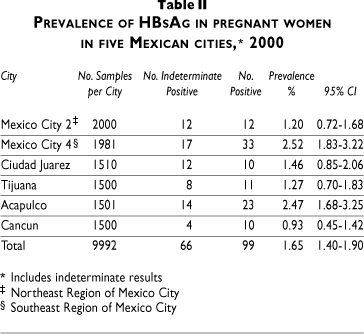
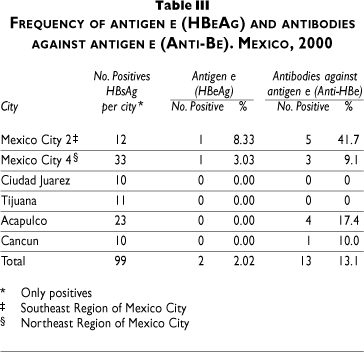
<body><![CDATA[<p>&nbsp;</p>     <p><b><font face="Verdana, Arial, Helvetica, sans-serif" size="3">Results</font></b></p>     <p><font face="Verdana, Arial, Helvetica-Normal, sans-serif" size="2">The total    number of women included in the study was 9 992; 1 500 women were selected per    city with the exception of Mexico City, where 3 981 women were interviewed.    Only 38 women were excluded due to the unavailability of seromarkers. The average    age of women was 26 years (range, 14 to 46), and the average age at first sexual    intercourse was 19 years (range, 11 to 36). According to their marital status,    married women accounted for 75% of the sample; 6.9% were single or divorced,    and 18.2% were living in common law. Widows were the least represented (0.05%).    The educational status of the population was high, since 78% of women had more    than elementary education. The gestational period ranged from 8 to 35 weeks,    with an average of 22 weeks. The median value for the number of previous pregnancies    was 2 and only 11.6% of the women were in their first pregnancy. A history of    hepatitis B vaccination was obtained in 6.4%; a previous blood transfusion was    reported in 4%; 93% reported only one sexual partner in the previous year; 2%    referred a sexually transmitted disease; 4% reported piercing, tattoos, or use    of acupuncture in the past; and only 8% reported signs and symptoms supporting    hepatitis infection (<a href="#tabela1">Table I</a>).</font></p>     <p align="center"><a name="tabela1"></a></p>     <p align="center">&nbsp;</p>     <p align="center"><img src="/img/revistas/spm/v45n3/16478t1.gif"></p>     <p align="center">&nbsp;</p>     <p><font face="Verdana, Arial, Helvetica-Normal, sans-serif" size="2">The overall    prevalence for the surface antigen was without the indeterminate results, 1%,    and for individual cities fluctuated between 0.60 (North-Eastern region of Mexico    City) and 1.67% (Southeastern region of Mexico City). The city of Acapulco shows    the prevalence of 1.53%. <a href="#tabela2">Table II</a> showed a prevalence    for HBsAg, including the indeterminate results (66), and their distribution    per city. The prevalence increased from 1 to 1.65%, reaching a level of 2.5%    in the South-Eastern region of Mexico City and in Acapulco.</font></p>     <p align="center"><a name="tabela2"></a></p>     <p align="center">&nbsp;</p>     ]]></body>
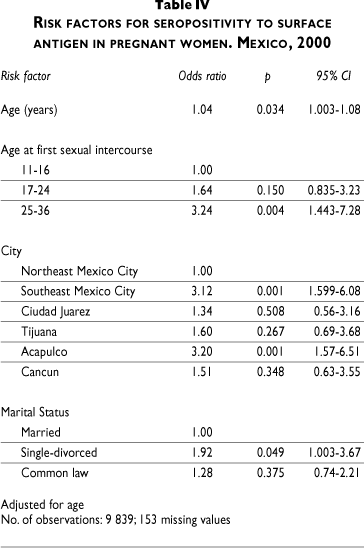
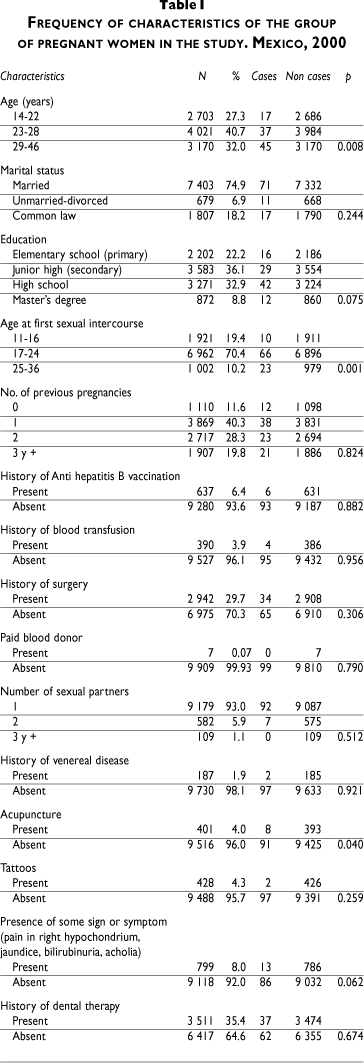
<body><![CDATA[<p align="center"><img src="/img/revistas/spm/v45n3/16478t2.gif"></p>     <p align="center">&nbsp;</p>     <p><font face="Verdana, Arial, Helvetica-Normal, sans-serif" size="2">HBeAg detection    was performed only on positive samples and demonstrated active viral replication    with a higher risk of perinatal transmission. The overall prevalence of antigen    e (HBeAg) was 2% but increased to 3% and 8% in north-eastern and south-eastern    Mexico City, respectively. Detection of corresponding antibody to HBeAg, on    the other hand, demonstrates an immune response that may decrease the risk of    transmission at birth. The prevalence of antibodies against antigen e (Anti-HBe)    was 9.1% in northeastern Mexico City; 41.7% in southeastern Mexico City, 17.4%    in Acapulco, and 10% in Cancun (<a href="#tabela3">Table III</a>).</font></p>     <p align="center"><a name="tabela3"></a></p>     <p align="center">&nbsp;</p>     <p align="center"><img src="/img/revistas/spm/v45n3/16478t3.gif"></p>     <p align="center">&nbsp;</p>     <p><font face="Verdana, Arial, Helvetica-Normal, sans-serif" size="2"><a href="#tabela4">Table    IV</a> shows the risk factors associated with infection. The risk of infection    increased with age (OR 1.04, 95%CI 1.003-1.08). Marital status also influenced    the risk, especially in those single or divorced (OR 1.92, 95% CI 1.00-3.67),    while age at first sexual intercourse (17-24; 25-36) was also associated (OR    1.64, 95%CI 0.83-3.23 to OR 3.24, 95%CI 1.44-7.28). Cities had the highest risks    and were most important in southeastern Mexico City (OR 3.12, 95%CI 1.59-6.08)    and Acapulco (OR 3.20, 95%CI 1.57-6.51).</font></p>     <p align="center"><a name="tabela4"></a></p>     <p align="center">&nbsp;</p>     ]]></body>
<body><![CDATA[<p align="center"><img src="/img/revistas/spm/v45n3/16478t4.gif"></p>     <p>&nbsp;</p>     <p><b><font face="Verdana, Arial, Helvetica, sans-serif" size="3">Discussion</font></b></p>     <p><font face="Verdana, Arial, Helvetica-Normal, sans-serif" size="2">The prevalence    of hepatitis B infection in Mexico is not clearly understood and has not been    adequately studied. HBsAg prevalence in Mexico during the period 1975 to 1985    was estimated to be about 1% (0.33-1.6%),<sup>17</sup> and a national serosurvey    confirmed that the previous HBV infection prevalence rate was 1.4% for Anti-HBc,    and 0.1% for HBsAg.<sup>4</sup> Two other studies were conducted during the    mid-90's at the National Institute of Perinatology (Instituto Nacional de Perinatolog&iacute;a).    Healthy pregnant women and women with perinatal risk showed lower estimates;    0.02% (HBsAg) and 0.09-0.26% (HBsAg), respectively.<sup>15,16</sup> Data from    blood banks in the country from 1997 to 2000, showed a prevalence around 0.5%    (HBsAg),<sup>18</sup> while the seroprevalence of HBsAg in voluntary donors    at two private hospitals in Mexico City was 0.11% and 0.32%.<sup>19,20</sup>    It is possible that the different prevalences mentioned are due to geographic    variations and different sample populations. As we pointed out in our study,    the geographical differences were very clear. Our study was carried out in five    cities in Mexico and included cities in the northern, central, and southern    parts of the country, unlike the studies of Alvarez-Mu&ntilde;oz <i>et al</i>,<sup>15</sup>    who obtained the population sample from only 10 medical units in Mexico City;    the other study was conducted by Ortiz-Garcia <i>et al</i>,<sup>16</sup> in    patients from a highly specialized hospital.</font></p>     <p><font face="Verdana, Arial, Helvetica-Normal, sans-serif" size="2">Potential    limitations of our study are those inherent to any cross-sectional design. The    main one is the impossibility to establish causal associations. Nevertheless,    among its strengths is the generation of hypothesis that should be tested in    further research. A suggestion is made to assess migration and tourism as important    risk factors. Our results agree with the seroprevalence reported by Landa<sup>21</sup>    in the seventies (who found a prevalence of 0.35% in the southern Pacific area;    0.32% in the Southern Central area; 0.25% in the Peninsula de Yucatan; 0.10%    in the northern region, and 0.25% nationwide) and confirms the representative    nature of the cities as places with high prevalence rates of HBsAg. Differences    within cities were also detected in Landa&acute;s study, with a 6.5% overall    prevalence of previous infection (anti-HBs) in Mexico City, but 7.5% for Ciudad    Netzahualcoyotl, 7.35% for Tlatelolco and Tepito, and 3.91% in the San Angel    neighborhood of the city.<sup>21</sup></font></p>     <p><font face="Verdana, Arial, Helvetica-Normal, sans-serif" size="2">Infection    risks naturally increase with age and these results are consistent with those    of other authors.<sup>4,15,22</sup> Other studies also show that an early age    of sexual intercourse is a risk factor for acquiring the infection.<sup>7</sup>    In this study, a higher risk was observed at older ages, a situation that could    be related to age of the sexual partner, who is usually the main source of infection    for women. In this sense the most affected group was that from 25 to 44 years    of age (1.37 per 100 000) and that from 45 to 64 (1.77 per 100 000), figures    that are similar to those observed in all social security beneficiaries for    1999, as well as in the population of Latin America.<sup>23</sup></font></p>     <p><font face="Verdana, Arial, Helvetica-Normal, sans-serif" size="2">Our results    also confirmed that a relationship exists between the presence of infection    and women's marital status, especially in the case of divorcees compared to    married women.<sup>7</sup> Although other risk factors, in particular those    associated with percutaneous transmission, were not identified by our study,    its presence in pregnant women should be an indication to screen for HBsAg.    Since most women who were HBsAg positive were negative to antibodies against    antigen e (Anti-HBe), we presumed that 82% of this group may be considered carriers    of the infection.<sup>24</sup></font></p>     <p><font face="Verdana, Arial, Helvetica-Normal, sans-serif" size="2">The results    herein presented still argue in favor of a low endemicity of HBV infection in    Mexico, which means that the infection remains mainly sexually transmitted.    Nevertheless, a striking finding is that the prevalence in our study resembled    that observed in the Dominican Republic (1.9%).<sup>4</sup> In our study, we    observed a high prevalence of HBsAg in pregnant women, with a potential increase    in the number of new cases caused perinatally and therefore a large increase    in HBV carriers. In addition, we should be aware that "occult HBV" has been    described, especially in patients that are in a window period, and they should    be considered within the infection frequency in the population studied.<sup>25</sup>    Some potential problems with the prevalences detected in the study could be    associated with a high rate of false positives. This could only be possible    if the sensitivity and specificity of the test are low, which is not the case,    since the test used in the study &#150;Monolisa, from Sanofi-Pasteur&#150; is    used as a standard in validation tests in other countries because of its ability    to detect levels as low as 0.12 ng/ml of HBsAg, with high sensitivity and specificity.<sup>26</sup>    However, it must be acknowledged that the soundness of our results would have    improved if we had been able to perform the confirmation of ELISA positive results    by applying the HBsAg neutralization test.</font></p>     <p><font face="Verdana, Arial, Helvetica-Normal, sans-serif" size="2">Considering    the results of this study, the possibility of implementing preventive measures    should be assessed, in particular those established by the WHO and other international    organizations. Blood banks are the only source of information besides information    obtained through specific research. Data obtained from blood banks should guide    the selection of areas with a high seroprevalence, where screening of pregnant    women should be performed. Evaluation of introducing anti-HB vaccine at birth    into the vaccination program should also be considered.<sup>27</sup></font></p>     <p>&nbsp;</p>     ]]></body>
<body><![CDATA[<p><b><font face="Verdana, Arial, Helvetica, sans-serif" size="3">References</font></b></p>     <!-- ref --><p><font face="Verdana, Arial, Helvetica-Normal, sans-serif" size="2">1. World    Health Organization. Hepatitis B vaccine: Making global progress. Epi Update    31. 1996. Ginebra: WHO, 1996.</font>&nbsp;&nbsp;&nbsp;&nbsp;&nbsp;&nbsp;&nbsp;&nbsp;[&#160;<a href="javascript:void(0);" onclick="javascript: window.open('/scielo.php?script=sci_nlinks&ref=9168428&pid=S0036-3634200300030000500001&lng=','','width=640,height=500,resizable=yes,scrollbars=1,menubar=yes,');">Links</a>&#160;]<!-- end-ref --><!-- ref --><p><font face="Verdana, Arial, Helvetica-Normal, sans-serif" size="2">2. Lee WM.    Hepatitis B Virus Infection. N Engl J Med 1997;337:</font><font face="Verdana, Arial, Helvetica-Normal, sans-serif" size="2">1733-1745.</font>&nbsp;&nbsp;&nbsp;&nbsp;&nbsp;&nbsp;&nbsp;&nbsp;[&#160;<a href="javascript:void(0);" onclick="javascript: window.open('/scielo.php?script=sci_nlinks&ref=9168429&pid=S0036-3634200300030000500002&lng=','','width=640,height=500,resizable=yes,scrollbars=1,menubar=yes,');">Links</a>&#160;]<!-- end-ref --><!-- ref --><p><font face="Verdana, Arial, Helvetica-Normal, sans-serif" size="2">3. Beasley    RP, Hwang LY, Lin CC, Chien CS. Hepatocellular carcinoma and hepatitis B virus.    A prospective study of 22707 men in Taiwan. Lancet 1981;2:1129-1133.</font>&nbsp;&nbsp;&nbsp;&nbsp;&nbsp;&nbsp;&nbsp;&nbsp;[&#160;<a href="javascript:void(0);" onclick="javascript: window.open('/scielo.php?script=sci_nlinks&ref=9168430&pid=S0036-3634200300030000500003&lng=','','width=640,height=500,resizable=yes,scrollbars=1,menubar=yes,');">Links</a>&#160;]<!-- end-ref --><!-- ref --><p><font face="Verdana, Arial, Helvetica-Normal, sans-serif" size="2">4. Th&ecirc;mis    RS, Fonseca JC, Rivera L, Fay OH, Tapia R, Santos JI <i>et al</i>. Hepatitis    B seroprevalence in Latin America. Rev Panam Salud Publica 1999;6(6): 378-383.</font>&nbsp;&nbsp;&nbsp;&nbsp;&nbsp;&nbsp;&nbsp;&nbsp;[&#160;<a href="javascript:void(0);" onclick="javascript: window.open('/scielo.php?script=sci_nlinks&ref=9168431&pid=S0036-3634200300030000500004&lng=','','width=640,height=500,resizable=yes,scrollbars=1,menubar=yes,');">Links</a>&#160;]<!-- end-ref --><!-- ref --><p><font face="Verdana, Arial, Helvetica-Normal, sans-serif" size="2">5. Soares    MCP, Menezes RC, Martins SJ, Bensabath G. Epidemiologia dos v&iacute;rus das    hepatites B, C, e D na tribu ind&iacute;gena Parakana Amaz&ocirc;nia Oriental    Brasileira. Bol Oficina Sanit Panam 1994;117:124-134.</font>&nbsp;&nbsp;&nbsp;&nbsp;&nbsp;&nbsp;&nbsp;&nbsp;[&#160;<a href="javascript:void(0);" onclick="javascript: window.open('/scielo.php?script=sci_nlinks&ref=9168432&pid=S0036-3634200300030000500005&lng=','','width=640,height=500,resizable=yes,scrollbars=1,menubar=yes,');">Links</a>&#160;]<!-- end-ref --><!-- ref --><p><font face="Verdana, Arial, Helvetica-Normal, sans-serif" size="2">6. Lok AS,    Heathcote JE, Hoofnagle JH. Management of Hepatitis B: 2000. Gastroenterology    2001;120:1828-1853.</font>&nbsp;&nbsp;&nbsp;&nbsp;&nbsp;&nbsp;&nbsp;&nbsp;[&#160;<a href="javascript:void(0);" onclick="javascript: window.open('/scielo.php?script=sci_nlinks&ref=9168433&pid=S0036-3634200300030000500006&lng=','','width=640,height=500,resizable=yes,scrollbars=1,menubar=yes,');">Links</a>&#160;]<!-- end-ref --><!-- ref --><p><font face="Verdana, Arial, Helvetica-Normal, sans-serif" size="2">7. McQuillan    G, Coleman PJ, Kruszon-Moran D, Moyer LA, Moyer LA, Lambert SB <i>et al</i>.    Prevalence of Hepatitis B Virus Infection in the United States: The National    Health and Nutrition Examination Surveys, 1976 Through 1994. Am J Public Health    1999;89:14-18.</font>&nbsp;&nbsp;&nbsp;&nbsp;&nbsp;&nbsp;&nbsp;&nbsp;[&#160;<a href="javascript:void(0);" onclick="javascript: window.open('/scielo.php?script=sci_nlinks&ref=9168434&pid=S0036-3634200300030000500007&lng=','','width=640,height=500,resizable=yes,scrollbars=1,menubar=yes,');">Links</a>&#160;]<!-- end-ref --><!-- ref --><p><font face="Verdana, Arial, Helvetica-Normal, sans-serif" size="2">8. S&aacute;enz-Gonz&aacute;lez    MC. Hepatitis B, Hepatitis C, Hepatitis D y Hepatitis G, Enfermedades Transmisibles-Hepatitis    B: Medicina Preventiva y Salud P&uacute;blica. Barcelona, Espa&ntilde;a: Ed.    Mason, 2001:540-548.</font>&nbsp;&nbsp;&nbsp;&nbsp;&nbsp;&nbsp;&nbsp;&nbsp;[&#160;<a href="javascript:void(0);" onclick="javascript: window.open('/scielo.php?script=sci_nlinks&ref=9168435&pid=S0036-3634200300030000500008&lng=','','width=640,height=500,resizable=yes,scrollbars=1,menubar=yes,');">Links</a>&#160;]<!-- end-ref --><!-- ref --><p><font face="Verdana, Arial, Helvetica-Normal, sans-serif" size="2">9. Halsey    NA. Discussion of Immunization Practices Advisory Committee/American Academy    of Pediatrics. Recommendations for universal infant hepatitis B vaccination.    Pediatr Infect Dis J 1993 May;12(5):446-449.</font>&nbsp;&nbsp;&nbsp;&nbsp;&nbsp;&nbsp;&nbsp;&nbsp;[&#160;<a href="javascript:void(0);" onclick="javascript: window.open('/scielo.php?script=sci_nlinks&ref=9168436&pid=S0036-3634200300030000500009&lng=','','width=640,height=500,resizable=yes,scrollbars=1,menubar=yes,');">Links</a>&#160;]<!-- end-ref --><!-- ref --><p><font face="Verdana, Arial, Helvetica-Normal, sans-serif" size="2">10. Van    Damme P, Kane M, Meheus A. Integration of hepatitis B vaccination in national    immunization programmes. BMJ 1997;314:</font><font face="Verdana, Arial, Helvetica-Normal, sans-serif" size="2">1033-1036.</font>&nbsp;&nbsp;&nbsp;&nbsp;&nbsp;&nbsp;&nbsp;&nbsp;[&#160;<a href="javascript:void(0);" onclick="javascript: window.open('/scielo.php?script=sci_nlinks&ref=9168437&pid=S0036-3634200300030000500010&lng=','','width=640,height=500,resizable=yes,scrollbars=1,menubar=yes,');">Links</a>&#160;]<!-- end-ref --><!-- ref --><p><font face="Verdana, Arial, Helvetica-Normal, sans-serif" size="2">11. World    Health Organization. Expanded Programme on Immunization Global Advisory Group.    Weekly Epidemiol Record 1992;3:11-16.</font>&nbsp;&nbsp;&nbsp;&nbsp;&nbsp;&nbsp;&nbsp;&nbsp;[&#160;<a href="javascript:void(0);" onclick="javascript: window.open('/scielo.php?script=sci_nlinks&ref=9168438&pid=S0036-3634200300030000500011&lng=','','width=640,height=500,resizable=yes,scrollbars=1,menubar=yes,');">Links</a>&#160;]<!-- end-ref --><!-- ref --><p><font face="Verdana, Arial, Helvetica-Normal, sans-serif" size="2">12. Centers    For Disease Control. Hepatitis B Virus. A comprehensive strategy for eliminating    transmission in the United States through universal childhood vaccination. MMWR    1991;40(RR-13):1-25.</font>&nbsp;&nbsp;&nbsp;&nbsp;&nbsp;&nbsp;&nbsp;&nbsp;[&#160;<a href="javascript:void(0);" onclick="javascript: window.open('/scielo.php?script=sci_nlinks&ref=9168439&pid=S0036-3634200300030000500012&lng=','','width=640,height=500,resizable=yes,scrollbars=1,menubar=yes,');">Links</a>&#160;]<!-- end-ref --><!-- ref --><p><font face="Verdana, Arial, Helvetica-Normal, sans-serif" size="2">13. Centers    For Disease Control. Maternal hepatitis B screening practices &#151; California,    Connecticut, Kansas, and United States, 1992-1993. MMWR Morb Mortal Wkly Rep    1994;43:311- 320.</font>&nbsp;&nbsp;&nbsp;&nbsp;&nbsp;&nbsp;&nbsp;&nbsp;[&#160;<a href="javascript:void(0);" onclick="javascript: window.open('/scielo.php?script=sci_nlinks&ref=9168440&pid=S0036-3634200300030000500013&lng=','','width=640,height=500,resizable=yes,scrollbars=1,menubar=yes,');">Links</a>&#160;]<!-- end-ref --><!-- ref --><p><font face="Verdana, Arial, Helvetica-Normal, sans-serif" size="2">14. Mortimer    PP, Miller E. Commentary: Antenatal screening and targeting should be sufficient    in some countries. BMJ 1997;314:</font><font face="Verdana, Arial, Helvetica-Normal, sans-serif" size="2">1036-1037.</font>&nbsp;&nbsp;&nbsp;&nbsp;&nbsp;&nbsp;&nbsp;&nbsp;[&#160;<a href="javascript:void(0);" onclick="javascript: window.open('/scielo.php?script=sci_nlinks&ref=9168441&pid=S0036-3634200300030000500014&lng=','','width=640,height=500,resizable=yes,scrollbars=1,menubar=yes,');">Links</a>&#160;]<!-- end-ref --><!-- ref --><p><font face="Verdana, Arial, Helvetica-Normal, sans-serif" size="2">15. Alvarez-Mu&ntilde;oz    MT, V&aacute;zquez-Rosales JG, Torres-L&oacute;pez J, Arredondo-Garc&iacute;a    JL, Bustamante-Calvillo ME, Del Rey-Pineda G <i>et al</i>. Infection of pregnant    women with hepatitis B and C viruses and risk for vertical transmission. Arch    Med Res 1997;28(3):415-419.</font>&nbsp;&nbsp;&nbsp;&nbsp;&nbsp;&nbsp;&nbsp;&nbsp;[&#160;<a href="javascript:void(0);" onclick="javascript: window.open('/scielo.php?script=sci_nlinks&ref=9168442&pid=S0036-3634200300030000500015&lng=','','width=640,height=500,resizable=yes,scrollbars=1,menubar=yes,');">Links</a>&#160;]<!-- end-ref --><!-- ref --><p><font face="Verdana, Arial, Helvetica-Normal, sans-serif" size="2">16. Ortiz-Ibarra    FJ, Figueroa-Dami&aacute;n R, Lara-S&aacute;nchez J, Arredondo-Garc&iacute;a    JL, Ahued-Ahued JR. Seroprevalence of hepatitis A, B, C and D infection in pregnant    women. Salud Publica Mex 1996; 38:317-322.</font>&nbsp;&nbsp;&nbsp;&nbsp;&nbsp;&nbsp;&nbsp;&nbsp;[&#160;<a href="javascript:void(0);" onclick="javascript: window.open('/scielo.php?script=sci_nlinks&ref=9168443&pid=S0036-3634200300030000500016&lng=','','width=640,height=500,resizable=yes,scrollbars=1,menubar=yes,');">Links</a>&#160;]<!-- end-ref --><!-- ref --><p><font face="Verdana, Arial, Helvetica-Normal, sans-serif" size="2">17. Hadler    SC, Fay OH, Pinheiro F, Maynard JE. La hepatitis en las Am&eacute;ricas. Informe    del Grupo Colaborador de la OPS. Bol Oficina Sanit Panam 1987;103(3):185-209.</font>&nbsp;&nbsp;&nbsp;&nbsp;&nbsp;&nbsp;&nbsp;&nbsp;[&#160;<a href="javascript:void(0);" onclick="javascript: window.open('/scielo.php?script=sci_nlinks&ref=9168444&pid=S0036-3634200300030000500017&lng=','','width=640,height=500,resizable=yes,scrollbars=1,menubar=yes,');">Links</a>&#160;]<!-- end-ref --><!-- ref --><p><font face="Verdana, Arial, Helvetica-Normal, sans-serif" size="2">18. Organizaci&oacute;n    Panamericana de la Salud. Medicina transfusional en Am&eacute;rica Latina 1994-2000.    Washington, DC: OPS, 2001;OPS/HSE-LAB/04.2001.</font>&nbsp;&nbsp;&nbsp;&nbsp;&nbsp;&nbsp;&nbsp;&nbsp;[&#160;<a href="javascript:void(0);" onclick="javascript: window.open('/scielo.php?script=sci_nlinks&ref=9168445&pid=S0036-3634200300030000500018&lng=','','width=640,height=500,resizable=yes,scrollbars=1,menubar=yes,');">Links</a>&#160;]<!-- end-ref --><!-- ref --><p><font face="Verdana, Arial, Helvetica-Normal, sans-serif" size="2">19. M&eacute;ndez-Sanchez    N, Baptista-Gonz&aacute;lez H, S&aacute;nchez-G&oacute;mez RH, Bordes-Aznar    J, Uribe-Esquivel M. Prevalence of type C and B hepatitis in blood donors at    a third level hospital of Mexico City. Salud Publica Mex 1999;41:475-478.</font>&nbsp;&nbsp;&nbsp;&nbsp;&nbsp;&nbsp;&nbsp;&nbsp;[&#160;<a href="javascript:void(0);" onclick="javascript: window.open('/scielo.php?script=sci_nlinks&ref=9168446&pid=S0036-3634200300030000500019&lng=','','width=640,height=500,resizable=yes,scrollbars=1,menubar=yes,');">Links</a>&#160;]<!-- end-ref --><!-- ref --><p><font face="Verdana, Arial, Helvetica-Normal, sans-serif" size="2">20. Souto-Meiri&ntilde;o    CA, Sim&oacute;n-Dom&iacute;nguez J, Pulido-Priego MA, Hern&aacute;ndez-P&eacute;rez    A, Garc&iacute;a-Hern&aacute;ndez IC, Del R&iacute;o-Chiriboga CA. Prevalence    of A, B and C hepatitis markers in a Mexico City hospital. Salud Publica Mex    1994; 36:257-262.</font>&nbsp;&nbsp;&nbsp;&nbsp;&nbsp;&nbsp;&nbsp;&nbsp;[&#160;<a href="javascript:void(0);" onclick="javascript: window.open('/scielo.php?script=sci_nlinks&ref=9168447&pid=S0036-3634200300030000500020&lng=','','width=640,height=500,resizable=yes,scrollbars=1,menubar=yes,');">Links</a>&#160;]<!-- end-ref --><!-- ref --><p><font face="Verdana, Arial, Helvetica-Normal, sans-serif" size="2">21. Landa    L. Seroepidemiolog&iacute;a de la hepatitis B. Gac Med Mex 1976;111(2):108-113.</font>&nbsp;&nbsp;&nbsp;&nbsp;&nbsp;&nbsp;&nbsp;&nbsp;[&#160;<a href="javascript:void(0);" onclick="javascript: window.open('/scielo.php?script=sci_nlinks&ref=9168448&pid=S0036-3634200300030000500021&lng=','','width=640,height=500,resizable=yes,scrollbars=1,menubar=yes,');">Links</a>&#160;]<!-- end-ref --><!-- ref --><p><font face="Verdana, Arial, Helvetica-Normal, sans-serif" size="2">22. Al-Shamahy    H. Prevalence of hepatitis B surface antigen and risk factors of HVB infection    in a sample of healthy mothers and their infants in Sana<sup>,</sup>A, Yemen.    Ann Saudi Med 2000;20(5):464-467.</font>&nbsp;&nbsp;&nbsp;&nbsp;&nbsp;&nbsp;&nbsp;&nbsp;[&#160;<a href="javascript:void(0);" onclick="javascript: window.open('/scielo.php?script=sci_nlinks&ref=9168449&pid=S0036-3634200300030000500022&lng=','','width=640,height=500,resizable=yes,scrollbars=1,menubar=yes,');">Links</a>&#160;]<!-- end-ref --><!-- ref --><p><font face="Verdana, Arial, Helvetica-Normal, sans-serif" size="2">23. Instituto    Mexicano del Seguro Social. Bolet&iacute;n Epidemiol&oacute;gico Anual 1999,    M&eacute;xico, DF: IMSS, 1999.</font>&nbsp;&nbsp;&nbsp;&nbsp;&nbsp;&nbsp;&nbsp;&nbsp;[&#160;<a href="javascript:void(0);" onclick="javascript: window.open('/scielo.php?script=sci_nlinks&ref=9168450&pid=S0036-3634200300030000500023&lng=','','width=640,height=500,resizable=yes,scrollbars=1,menubar=yes,');">Links</a>&#160;]<!-- end-ref --><!-- ref --><p><font face="Verdana, Arial, Helvetica-Normal, sans-serif" size="2">24. World    Health Organization. WHO-recommended standards for surveillance of selected    vaccine-preventable diseases. Ginebra: WHO, 1998.</font>&nbsp;&nbsp;&nbsp;&nbsp;&nbsp;&nbsp;&nbsp;&nbsp;[&#160;<a href="javascript:void(0);" onclick="javascript: window.open('/scielo.php?script=sci_nlinks&ref=9168451&pid=S0036-3634200300030000500024&lng=','','width=640,height=500,resizable=yes,scrollbars=1,menubar=yes,');">Links</a>&#160;]<!-- end-ref --><!-- ref --><p><font face="Verdana, Arial, Helvetica-Normal, sans-serif" size="2">25. Cacciola    I, Pollicino T, Squadrito G, Cerenzia G, Orlando ME, Raimondo ME. Occult hepatitis    B virus infection in patients with chronic hepatitis C liver disease. N Engl    J Med 1999;341:122-126.</font>&nbsp;&nbsp;&nbsp;&nbsp;&nbsp;&nbsp;&nbsp;&nbsp;[&#160;<a href="javascript:void(0);" onclick="javascript: window.open('/scielo.php?script=sci_nlinks&ref=9168452&pid=S0036-3634200300030000500025&lng=','','width=640,height=500,resizable=yes,scrollbars=1,menubar=yes,');">Links</a>&#160;]<!-- end-ref --><!-- ref --><p><font face="Verdana, Arial, Helvetica-Normal, sans-serif" size="2">26. Suslov    AP, Kuzin SN, Sadikova NV, Elgort DA, Feldsherova AA, Nikolaev VL <i>et al</i>.    Performance of ELISA HBsAg test kits with use of the different types of panels    containing HBsAg. Russian J Immunol 2000;5(2):218-226.</font>&nbsp;&nbsp;&nbsp;&nbsp;&nbsp;&nbsp;&nbsp;&nbsp;[&#160;<a href="javascript:void(0);" onclick="javascript: window.open('/scielo.php?script=sci_nlinks&ref=9168453&pid=S0036-3634200300030000500026&lng=','','width=640,height=500,resizable=yes,scrollbars=1,menubar=yes,');">Links</a>&#160;]<!-- end-ref --><!-- ref --><p><font face="Verdana, Arial, Helvetica-Normal, sans-serif" size="2">27. Mast    EE, Alter MJ, Margolis HS. Strategies to prevent and control hepatitis B and    C virus infections: A global perspective. Vaccine 1999;17: 1730-1733.</font>&nbsp;&nbsp;&nbsp;&nbsp;&nbsp;&nbsp;&nbsp;&nbsp;[&#160;<a href="javascript:void(0);" onclick="javascript: window.open('/scielo.php?script=sci_nlinks&ref=9168454&pid=S0036-3634200300030000500027&lng=','','width=640,height=500,resizable=yes,scrollbars=1,menubar=yes,');">Links</a>&#160;]<!-- end-ref --><p>&nbsp;</p>     <p>&nbsp;</p>     ]]></body>
<body><![CDATA[<p><font face="Verdana, Arial, Helvetica-Normal, sans-serif" size="2"><b>Address    reprint requests to:    <br>   </b>Dr. Jos&eacute; Luis V&aacute;zquez    <br>   Durango 289 6o. piso, colonia Roma    <br>   06700 M&eacute;xico, DF, M&eacute;xico    <br>   E-mail: <a href="mailto:cinth@prodigy.net.mx">cinth@prodigy.net.mx</a></font></p>     <p><b><font face="Verdana, Arial, Helvetica-Normal, sans-serif" size="2">Received    on:</font></b><font face="Verdana, Arial, Helvetica-Normal, sans-serif" size="2">    June 5, 2002<b>    <br>   Accepted on:</b> January 15, 2003</font></p>     <p>&nbsp;</p>     <p>&nbsp;</p>     <p><font face="Verdana, Arial, Helvetica, sans-serif" size="2">The English version    of this paper is available too at: <a href="http://www.insp.mx/salud/index.html">http://www.insp.mx/salud/index.html</a></font></p>     ]]></body>
<body><![CDATA[ ]]></body><back>
<ref-list>
<ref id="B1">
<label>1</label><nlm-citation citation-type="book">
<collab>World Health Organization</collab>
<source><![CDATA[Hepatitis B vaccine: Making global progress. Epi Update 31]]></source>
<year>1996</year>
<publisher-loc><![CDATA[Ginebra ]]></publisher-loc>
<publisher-name><![CDATA[WHO]]></publisher-name>
</nlm-citation>
</ref>
<ref id="B2">
<label>2</label><nlm-citation citation-type="journal">
<person-group person-group-type="author">
<name>
<surname><![CDATA[Lee]]></surname>
<given-names><![CDATA[WM]]></given-names>
</name>
</person-group>
<article-title xml:lang="en"><![CDATA[Hepatitis B Virus Infection]]></article-title>
<source><![CDATA[N Engl J Med]]></source>
<year>1997</year>
<volume>337</volume>
<page-range>1733-1745</page-range></nlm-citation>
</ref>
<ref id="B3">
<label>3</label><nlm-citation citation-type="journal">
<person-group person-group-type="author">
<name>
<surname><![CDATA[Beasley]]></surname>
<given-names><![CDATA[RP]]></given-names>
</name>
<name>
<surname><![CDATA[Hwang]]></surname>
<given-names><![CDATA[LY]]></given-names>
</name>
<name>
<surname><![CDATA[Lin]]></surname>
<given-names><![CDATA[CC]]></given-names>
</name>
<name>
<surname><![CDATA[Chien]]></surname>
<given-names><![CDATA[CS]]></given-names>
</name>
</person-group>
<article-title xml:lang="en"><![CDATA[Hepatocellular carcinoma and hepatitis B virus: A prospective study of 22707 men in Taiwan]]></article-title>
<source><![CDATA[Lancet]]></source>
<year>1981</year>
<volume>2</volume>
<page-range>1129-1133</page-range></nlm-citation>
</ref>
<ref id="B4">
<label>4</label><nlm-citation citation-type="journal">
<person-group person-group-type="author">
<name>
<surname><![CDATA[Thêmis]]></surname>
<given-names><![CDATA[RS]]></given-names>
</name>
<name>
<surname><![CDATA[Fonseca]]></surname>
<given-names><![CDATA[JC]]></given-names>
</name>
<name>
<surname><![CDATA[Rivera]]></surname>
<given-names><![CDATA[L]]></given-names>
</name>
<name>
<surname><![CDATA[Fay]]></surname>
<given-names><![CDATA[OH]]></given-names>
</name>
<name>
<surname><![CDATA[Tapia]]></surname>
<given-names><![CDATA[R]]></given-names>
</name>
<name>
<surname><![CDATA[Santos]]></surname>
<given-names><![CDATA[JI]]></given-names>
</name>
</person-group>
<article-title xml:lang="en"><![CDATA[Hepatitis B seroprevalence in Latin America]]></article-title>
<source><![CDATA[Rev Panam Salud Publica]]></source>
<year>1999</year>
<volume>6</volume>
<numero>6</numero>
<issue>6</issue>
<page-range>378-383</page-range></nlm-citation>
</ref>
<ref id="B5">
<label>5</label><nlm-citation citation-type="journal">
<person-group person-group-type="author">
<name>
<surname><![CDATA[Soares]]></surname>
<given-names><![CDATA[MCP]]></given-names>
</name>
<name>
<surname><![CDATA[Menezes]]></surname>
<given-names><![CDATA[RC]]></given-names>
</name>
<name>
<surname><![CDATA[Martins]]></surname>
<given-names><![CDATA[SJ]]></given-names>
</name>
<name>
<surname><![CDATA[Bensabath]]></surname>
<given-names><![CDATA[G]]></given-names>
</name>
</person-group>
<article-title xml:lang="pt"><![CDATA[Epidemiologia dos vírus das hepatites B, C, e D na tribu indígena Parakana Amazônia Oriental Brasileira]]></article-title>
<source><![CDATA[Bol Oficina Sanit Panam]]></source>
<year>1994</year>
<volume>117</volume>
<page-range>124-134</page-range></nlm-citation>
</ref>
<ref id="B6">
<label>6</label><nlm-citation citation-type="journal">
<person-group person-group-type="author">
<name>
<surname><![CDATA[Lok]]></surname>
<given-names><![CDATA[AS]]></given-names>
</name>
<name>
<surname><![CDATA[Heathcote]]></surname>
<given-names><![CDATA[JE]]></given-names>
</name>
<name>
<surname><![CDATA[Hoofnagle]]></surname>
<given-names><![CDATA[JH]]></given-names>
</name>
</person-group>
<article-title xml:lang="en"><![CDATA[Management of Hepatitis B: 2000]]></article-title>
<source><![CDATA[Gastroenterology]]></source>
<year>2001</year>
<volume>120</volume>
<page-range>1828-1853</page-range></nlm-citation>
</ref>
<ref id="B7">
<label>7</label><nlm-citation citation-type="journal">
<person-group person-group-type="author">
<name>
<surname><![CDATA[McQuillan]]></surname>
<given-names><![CDATA[G]]></given-names>
</name>
<name>
<surname><![CDATA[Coleman]]></surname>
<given-names><![CDATA[PJ]]></given-names>
</name>
<name>
<surname><![CDATA[Kruszon-Moran]]></surname>
<given-names><![CDATA[D]]></given-names>
</name>
<name>
<surname><![CDATA[Moyer]]></surname>
<given-names><![CDATA[LA]]></given-names>
</name>
<name>
<surname><![CDATA[Moyer]]></surname>
<given-names><![CDATA[LA]]></given-names>
</name>
<name>
<surname><![CDATA[Lambert]]></surname>
<given-names><![CDATA[SB]]></given-names>
</name>
</person-group>
<article-title xml:lang="en"><![CDATA[Prevalence of Hepatitis B Virus Infection in the United States: The National Health and Nutrition Examination Surveys, 1976 Through 1994]]></article-title>
<source><![CDATA[Am J Public Health]]></source>
<year>1999</year>
<volume>89</volume>
<page-range>14-18</page-range></nlm-citation>
</ref>
<ref id="B8">
<label>8</label><nlm-citation citation-type="book">
<person-group person-group-type="author">
<name>
<surname><![CDATA[Sáenz-González]]></surname>
<given-names><![CDATA[MC]]></given-names>
</name>
</person-group>
<source><![CDATA[Hepatitis B, Hepatitis C, Hepatitis D y Hepatitis G, Enfermedades Transmisibles-Hepatitis B: Medicina Preventiva y Salud Pública]]></source>
<year>2001</year>
<page-range>540-548</page-range><publisher-loc><![CDATA[Barcelona ]]></publisher-loc>
<publisher-name><![CDATA[Ed. Mason]]></publisher-name>
</nlm-citation>
</ref>
<ref id="B9">
<label>9</label><nlm-citation citation-type="journal">
<person-group person-group-type="author">
<name>
<surname><![CDATA[Halsey]]></surname>
<given-names><![CDATA[NA]]></given-names>
</name>
</person-group>
<article-title xml:lang="en"><![CDATA[Discussion of Immunization Practices Advisory Committee/American Academy of Pediatrics: Recommendations for universal infant hepatitis B vaccination]]></article-title>
<source><![CDATA[Pediatr Infect Dis J]]></source>
<year>1993</year>
<month> M</month>
<day>ay</day>
<volume>12</volume>
<numero>5</numero>
<issue>5</issue>
<page-range>446-449</page-range></nlm-citation>
</ref>
<ref id="B10">
<label>10</label><nlm-citation citation-type="journal">
<person-group person-group-type="author">
<name>
<surname><![CDATA[Van Damme]]></surname>
<given-names><![CDATA[P]]></given-names>
</name>
<name>
<surname><![CDATA[Kane]]></surname>
<given-names><![CDATA[M]]></given-names>
</name>
<name>
<surname><![CDATA[Meheus]]></surname>
<given-names><![CDATA[A]]></given-names>
</name>
</person-group>
<article-title xml:lang="en"><![CDATA[Integration of hepatitis B vaccination in national immunization programmes]]></article-title>
<source><![CDATA[BMJ]]></source>
<year>1997</year>
<volume>314</volume>
<page-range>1033-1036</page-range></nlm-citation>
</ref>
<ref id="B11">
<label>11</label><nlm-citation citation-type="journal">
<collab>World Health Organization</collab>
<article-title xml:lang="en"><![CDATA[Expanded Programme on Immunization Global Advisory Group]]></article-title>
<source><![CDATA[Weekly Epidemiol Record]]></source>
<year>1992</year>
<volume>3</volume>
<page-range>11-16</page-range></nlm-citation>
</ref>
<ref id="B12">
<label>12</label><nlm-citation citation-type="journal">
<collab>Centers For Disease Control</collab>
<article-title xml:lang="en"><![CDATA[Hepatitis B Virus: A comprehensive strategy for eliminating transmission in the United States through universal childhood vaccination]]></article-title>
<source><![CDATA[MMWR]]></source>
<year>1991</year>
<volume>40</volume>
<numero>RR-13</numero>
<issue>RR-13</issue>
<page-range>1-25</page-range></nlm-citation>
</ref>
<ref id="B13">
<label>13</label><nlm-citation citation-type="journal">
<collab>Centers For Disease Control</collab>
<article-title xml:lang="en"><![CDATA[Maternal hepatitis B screening practices - California, Connecticut, Kansas, and United States, 1992-1993]]></article-title>
<source><![CDATA[MMWR Morb Mortal Wkly Rep]]></source>
<year>1994</year>
<volume>43</volume>
<page-range>311- 320</page-range></nlm-citation>
</ref>
<ref id="B14">
<label>14</label><nlm-citation citation-type="journal">
<person-group person-group-type="author">
<name>
<surname><![CDATA[Mortimer]]></surname>
<given-names><![CDATA[PP]]></given-names>
</name>
<name>
<surname><![CDATA[Miller]]></surname>
<given-names><![CDATA[E]]></given-names>
</name>
</person-group>
<article-title xml:lang="en"><![CDATA[Commentary: Antenatal screening and targeting should be sufficient in some countries]]></article-title>
<source><![CDATA[BMJ]]></source>
<year>1997</year>
<volume>314</volume>
<page-range>1036-1037</page-range></nlm-citation>
</ref>
<ref id="B15">
<label>15</label><nlm-citation citation-type="journal">
<person-group person-group-type="author">
<name>
<surname><![CDATA[Alvarez-Muñoz]]></surname>
<given-names><![CDATA[MT]]></given-names>
</name>
<name>
<surname><![CDATA[Vázquez-Rosales]]></surname>
<given-names><![CDATA[JG]]></given-names>
</name>
<name>
<surname><![CDATA[Torres-López]]></surname>
<given-names><![CDATA[J]]></given-names>
</name>
<name>
<surname><![CDATA[Arredondo-García]]></surname>
<given-names><![CDATA[JL]]></given-names>
</name>
<name>
<surname><![CDATA[Bustamante-Calvillo]]></surname>
<given-names><![CDATA[ME]]></given-names>
</name>
<name>
<surname><![CDATA[Del Rey-Pineda]]></surname>
<given-names><![CDATA[G]]></given-names>
</name>
</person-group>
<article-title xml:lang="en"><![CDATA[Infection of pregnant women with hepatitis B and C viruses and risk for vertical transmission]]></article-title>
<source><![CDATA[Arch Med Res]]></source>
<year>1997</year>
<volume>28</volume>
<numero>3</numero>
<issue>3</issue>
<page-range>415-419</page-range></nlm-citation>
</ref>
<ref id="B16">
<label>16</label><nlm-citation citation-type="journal">
<person-group person-group-type="author">
<name>
<surname><![CDATA[Ortiz-Ibarra]]></surname>
<given-names><![CDATA[FJ]]></given-names>
</name>
<name>
<surname><![CDATA[Figueroa-Damián]]></surname>
<given-names><![CDATA[R]]></given-names>
</name>
<name>
<surname><![CDATA[Lara-Sánchez]]></surname>
<given-names><![CDATA[J]]></given-names>
</name>
<name>
<surname><![CDATA[Arredondo-García]]></surname>
<given-names><![CDATA[JL]]></given-names>
</name>
<name>
<surname><![CDATA[Ahued-Ahued]]></surname>
<given-names><![CDATA[JR]]></given-names>
</name>
</person-group>
<article-title xml:lang="en"><![CDATA[Seroprevalence of hepatitis A, B, C and D infection in pregnant women]]></article-title>
<source><![CDATA[Salud Publica Mex]]></source>
<year>1996</year>
<volume>38</volume>
<page-range>317-322</page-range></nlm-citation>
</ref>
<ref id="B17">
<label>17</label><nlm-citation citation-type="journal">
<person-group person-group-type="author">
<name>
<surname><![CDATA[Hadler]]></surname>
<given-names><![CDATA[SC]]></given-names>
</name>
<name>
<surname><![CDATA[Fay]]></surname>
<given-names><![CDATA[OH]]></given-names>
</name>
<name>
<surname><![CDATA[Pinheiro]]></surname>
<given-names><![CDATA[F]]></given-names>
</name>
<name>
<surname><![CDATA[Maynard]]></surname>
<given-names><![CDATA[JE]]></given-names>
</name>
</person-group>
<article-title xml:lang="es"><![CDATA[La hepatitis en las Américas: Informe del Grupo Colaborador de la OPS]]></article-title>
<source><![CDATA[Bol Oficina Sanit Panam]]></source>
<year>1987</year>
<volume>103</volume>
<numero>3</numero>
<issue>3</issue>
<page-range>185-209</page-range></nlm-citation>
</ref>
<ref id="B18">
<label>18</label><nlm-citation citation-type="book">
<collab>Organización Panamericana de la Salud</collab>
<source><![CDATA[Medicina transfusional en América Latina 1994-2000]]></source>
<year>2001</year>
<publisher-loc><![CDATA[Washington^eDC DC]]></publisher-loc>
<publisher-name><![CDATA[OPS]]></publisher-name>
</nlm-citation>
</ref>
<ref id="B19">
<label>19</label><nlm-citation citation-type="journal">
<person-group person-group-type="author">
<name>
<surname><![CDATA[Méndez-Sanchez]]></surname>
<given-names><![CDATA[N]]></given-names>
</name>
<name>
<surname><![CDATA[Baptista-González]]></surname>
<given-names><![CDATA[H]]></given-names>
</name>
<name>
<surname><![CDATA[Sánchez-Gómez]]></surname>
<given-names><![CDATA[RH]]></given-names>
</name>
<name>
<surname><![CDATA[Bordes-Aznar]]></surname>
<given-names><![CDATA[J]]></given-names>
</name>
<name>
<surname><![CDATA[Uribe-Esquivel]]></surname>
<given-names><![CDATA[M]]></given-names>
</name>
</person-group>
<article-title xml:lang="en"><![CDATA[Prevalence of type C and B hepatitis in blood donors at a third level hospital of Mexico City]]></article-title>
<source><![CDATA[Salud Publica Mex]]></source>
<year>1999</year>
<volume>41</volume>
<page-range>475-478</page-range></nlm-citation>
</ref>
<ref id="B20">
<label>20</label><nlm-citation citation-type="journal">
<person-group person-group-type="author">
<name>
<surname><![CDATA[Souto-Meiriño]]></surname>
<given-names><![CDATA[CA]]></given-names>
</name>
<name>
<surname><![CDATA[Simón-Domínguez]]></surname>
<given-names><![CDATA[J]]></given-names>
</name>
<name>
<surname><![CDATA[Pulido-Priego]]></surname>
<given-names><![CDATA[MA]]></given-names>
</name>
<name>
<surname><![CDATA[Hernández-Pérez]]></surname>
<given-names><![CDATA[A]]></given-names>
</name>
<name>
<surname><![CDATA[García-Hernández]]></surname>
<given-names><![CDATA[IC]]></given-names>
</name>
<name>
<surname><![CDATA[Del Río-Chiriboga]]></surname>
<given-names><![CDATA[CA]]></given-names>
</name>
</person-group>
<article-title xml:lang="en"><![CDATA[Prevalence of A, B and C hepatitis markers in a Mexico City hospital]]></article-title>
<source><![CDATA[Salud Publica Mex]]></source>
<year>1994</year>
<volume>36</volume>
<page-range>257-262</page-range></nlm-citation>
</ref>
<ref id="B21">
<label>21</label><nlm-citation citation-type="journal">
<person-group person-group-type="author">
<name>
<surname><![CDATA[Landa]]></surname>
<given-names><![CDATA[L]]></given-names>
</name>
</person-group>
<article-title xml:lang="en"><![CDATA[Seroepidemiología de la hepatitis B]]></article-title>
<source><![CDATA[Gac Med Mex]]></source>
<year>1976</year>
<volume>111</volume>
<numero>2</numero>
<issue>2</issue>
<page-range>108-113</page-range></nlm-citation>
</ref>
<ref id="B22">
<label>22</label><nlm-citation citation-type="journal">
<person-group person-group-type="author">
<name>
<surname><![CDATA[Al-Shamahy]]></surname>
<given-names><![CDATA[H]]></given-names>
</name>
</person-group>
<article-title xml:lang="en"><![CDATA[Prevalence of hepatitis B surface antigen and risk factors of HVB infection in a sample of healthy mothers and their infants in Sana,A, Yemen]]></article-title>
<source><![CDATA[Ann Saudi Med]]></source>
<year>2000</year>
<volume>20</volume>
<numero>5</numero>
<issue>5</issue>
<page-range>464-467</page-range></nlm-citation>
</ref>
<ref id="B23">
<label>23</label><nlm-citation citation-type="book">
<collab>Instituto Mexicano del Seguro Social</collab>
<source><![CDATA[Boletín Epidemiológico Anual 1999]]></source>
<year>1999</year>
<publisher-loc><![CDATA[México^eDF DF]]></publisher-loc>
<publisher-name><![CDATA[IMSS]]></publisher-name>
</nlm-citation>
</ref>
<ref id="B24">
<label>24</label><nlm-citation citation-type="book">
<collab>World Health Organization</collab>
<source><![CDATA[WHO-recommended standards for surveillance of selected vaccine-preventable diseases]]></source>
<year>1998</year>
<publisher-loc><![CDATA[Ginebra ]]></publisher-loc>
<publisher-name><![CDATA[WHO]]></publisher-name>
</nlm-citation>
</ref>
<ref id="B25">
<label>25</label><nlm-citation citation-type="journal">
<person-group person-group-type="author">
<name>
<surname><![CDATA[Cacciola]]></surname>
<given-names><![CDATA[I]]></given-names>
</name>
<name>
<surname><![CDATA[Pollicino]]></surname>
<given-names><![CDATA[T]]></given-names>
</name>
<name>
<surname><![CDATA[Squadrito]]></surname>
<given-names><![CDATA[G]]></given-names>
</name>
<name>
<surname><![CDATA[Cerenzia]]></surname>
<given-names><![CDATA[G]]></given-names>
</name>
<name>
<surname><![CDATA[Orlando]]></surname>
<given-names><![CDATA[ME]]></given-names>
</name>
<name>
<surname><![CDATA[Raimondo]]></surname>
<given-names><![CDATA[ME]]></given-names>
</name>
</person-group>
<article-title xml:lang="en"><![CDATA[Occult hepatitis B virus infection in patients with chronic hepatitis C liver disease]]></article-title>
<source><![CDATA[N Engl J Med]]></source>
<year>1999</year>
<volume>341</volume>
<page-range>122-126</page-range></nlm-citation>
</ref>
<ref id="B26">
<label>26</label><nlm-citation citation-type="journal">
<person-group person-group-type="author">
<name>
<surname><![CDATA[Suslov]]></surname>
<given-names><![CDATA[AP]]></given-names>
</name>
<name>
<surname><![CDATA[Kuzin]]></surname>
<given-names><![CDATA[SN]]></given-names>
</name>
<name>
<surname><![CDATA[Sadikova]]></surname>
<given-names><![CDATA[NV]]></given-names>
</name>
<name>
<surname><![CDATA[Elgort]]></surname>
<given-names><![CDATA[DA]]></given-names>
</name>
<name>
<surname><![CDATA[Feldsherova]]></surname>
<given-names><![CDATA[AA]]></given-names>
</name>
<name>
<surname><![CDATA[Nikolaev]]></surname>
<given-names><![CDATA[VL]]></given-names>
</name>
</person-group>
<article-title xml:lang="en"><![CDATA[Performance of ELISA HBsAg test kits with use of the different types of panels containing HBsAg]]></article-title>
<source><![CDATA[Russian J Immunol]]></source>
<year>2000</year>
<volume>5</volume>
<numero>2</numero>
<issue>2</issue>
<page-range>218-226</page-range></nlm-citation>
</ref>
<ref id="B27">
<label>27</label><nlm-citation citation-type="journal">
<person-group person-group-type="author">
<name>
<surname><![CDATA[Mast]]></surname>
<given-names><![CDATA[EE]]></given-names>
</name>
<name>
<surname><![CDATA[Alter]]></surname>
<given-names><![CDATA[MJ]]></given-names>
</name>
<name>
<surname><![CDATA[Margolis]]></surname>
<given-names><![CDATA[HS]]></given-names>
</name>
</person-group>
<article-title xml:lang="en"><![CDATA[Strategies to prevent and control hepatitis B and C virus infections: A global perspective]]></article-title>
<source><![CDATA[Vaccine]]></source>
<year>1999</year>
<volume>17</volume>
<page-range>1730-1733</page-range></nlm-citation>
</ref>
</ref-list>
</back>
</article>