<?xml version="1.0" encoding="ISO-8859-1"?><article xmlns:mml="http://www.w3.org/1998/Math/MathML" xmlns:xlink="http://www.w3.org/1999/xlink" xmlns:xsi="http://www.w3.org/2001/XMLSchema-instance">
<front>
<journal-meta>
<journal-id>0036-3634</journal-id>
<journal-title><![CDATA[Salud Pública de México]]></journal-title>
<abbrev-journal-title><![CDATA[Salud pública Méx]]></abbrev-journal-title>
<issn>0036-3634</issn>
<publisher>
<publisher-name><![CDATA[Instituto Nacional de Salud Pública]]></publisher-name>
</publisher>
</journal-meta>
<article-meta>
<article-id>S0036-36342003000200005</article-id>
<title-group>
<article-title xml:lang="en"><![CDATA[In vitro antimicrobial susceptibility in clinical isolates of Enterococcus species]]></article-title>
<article-title xml:lang="es"><![CDATA[Susceptibilidad antimicrobiana in vitro en aislamientos clínicos de Enterococcus species]]></article-title>
</title-group>
<contrib-group>
<contrib contrib-type="author">
<name>
<surname><![CDATA[Calderón-Jaimes]]></surname>
<given-names><![CDATA[Ernesto]]></given-names>
</name>
<xref ref-type="aff" rid="A01"/>
</contrib>
<contrib contrib-type="author">
<name>
<surname><![CDATA[Arredondo-García]]></surname>
<given-names><![CDATA[José Luis]]></given-names>
</name>
<xref ref-type="aff" rid="A02"/>
</contrib>
<contrib contrib-type="author">
<name>
<surname><![CDATA[Aguilar-Ituarte]]></surname>
<given-names><![CDATA[Felipe]]></given-names>
</name>
<xref ref-type="aff" rid="A02"/>
<xref ref-type="aff" rid="A03"/>
</contrib>
<contrib contrib-type="author">
<name>
<surname><![CDATA[García-Roca]]></surname>
<given-names><![CDATA[Pilar]]></given-names>
</name>
<xref ref-type="aff" rid="A01"/>
</contrib>
</contrib-group>
<aff id="A01">
<institution><![CDATA[,Hospital Infantil de México Federico Gómez Departamento de Inmunoquímica y Biología Celular ]]></institution>
<addr-line><![CDATA[México D.F.]]></addr-line>
<country>México</country>
</aff>
<aff id="A02">
<institution><![CDATA[,Instituto Nacional de Pediatría Unidad de Investigación Clínica ]]></institution>
<addr-line><![CDATA[México D.F.]]></addr-line>
<country>México</country>
</aff>
<aff id="A03">
<institution><![CDATA[,Hospital Infantil de México Federico Gómez Departamento de Infectología ]]></institution>
<addr-line><![CDATA[México D.F.]]></addr-line>
<country>México</country>
</aff>
<pub-date pub-type="pub">
<day>00</day>
<month>04</month>
<year>2003</year>
</pub-date>
<pub-date pub-type="epub">
<day>00</day>
<month>04</month>
<year>2003</year>
</pub-date>
<volume>45</volume>
<numero>2</numero>
<fpage>96</fpage>
<lpage>101</lpage>
<copyright-statement/>
<copyright-year/>
<self-uri xlink:href="http://www.scielo.org.mx/scielo.php?script=sci_arttext&amp;pid=S0036-36342003000200005&amp;lng=en&amp;nrm=iso"></self-uri><self-uri xlink:href="http://www.scielo.org.mx/scielo.php?script=sci_abstract&amp;pid=S0036-36342003000200005&amp;lng=en&amp;nrm=iso"></self-uri><self-uri xlink:href="http://www.scielo.org.mx/scielo.php?script=sci_pdf&amp;pid=S0036-36342003000200005&amp;lng=en&amp;nrm=iso"></self-uri><abstract abstract-type="short" xml:lang="en"><p><![CDATA[OBJECTIVE: To describe the antimicrobial activity of several antimicrobial agents against 97 clinical significant isolates of Enterococcus spp. MATHERIAL AND METHODS: During a 2-year prospective study at Instituto Nacional de Pediatria (National Institute of Pediatrics) in Mexico City. Ninety seven strains of Enterococcus spp. (60 E. faecalis and 37 E. faecium) were tested against 11 antibiotics. Susceptibility tests were performed with agar, according to the standards of the sNational Committee for Clinical Laboratory Standards (NCCLS). Isolates were screened for high-level resistance (HLR) to beta-lactams, aminoglycosides, glycopeptides and other antibiotics, as well as for vancomycin-phenotypes. Differences between proportions were evaluated with chi2 of Fisher exact fest. RESULTS: Overall resistance rates to the antibiotics tested were: 17/97 (17.5%) to penicillin, ampicillin, amoxicillin-clavulanate and imipenem. There was neither HLR nor beta-lactamase production; 74/97 (48.4%) were resistant to erythromycin; 60% to ciprofloxacin; 31/97 (32%) to gentamicin, and 55/97 (56.7%) to streptomycin. Seven strains were vancomycin-resistant enterococci (VRE), all of them identified as E. faecium; 5/7 with Van A and 2/7 with Van B phenotypes. All the isolates were susceptible to linezolid. The difference in susceptibility among species was significant. CONCLUSIONS: Mutidrug-resistant enterococci is a real problem and continuous surveillance is necessary. The microbiology laboratory is the first line of defense against the spread of multiantibiotic-resistan enterococci in the hospital environment . All the strains recovered should be tested for susceptibility to ampicillin, streptomycin, gentamicin and glycopeptides.]]></p></abstract>
<abstract abstract-type="short" xml:lang="es"><p><![CDATA[OBJECTIVO: Describir la actividad antimicrobiana de varios antibióticos, contra 97 cepas de Enterococcus spp., consideradas como aislamientos clínicamente significativos. MATERIAL Y MÉTODOS: En un estudio prospectivo de dos años, (enero de 1998 a diciembre de 1999) hecho en el Instituto Nacional de Pediatría en la Ciudad de México, se procesaron 97 cepas de Enterococcus (60 de Enterococcus faecalis y 37 de Enterococcus faecium, contra 11 antibióticos. La prueba de susceptibilidad se elaboró con agar, de acuerdo con los estándares del Comité Nacional para el Laboratorio Clínico (NCCLS). Todos los aislamientos fueron probados para determinar la resistencia elevada en contra de beta-lactámicos, aminoglucósidos y glicopéptidos. Asimismo, se determinó el fenotipo de resistencia hacia la vancomicina. Se evaluaron diferencias de proporciones con ji2 o prueba exacta de Fisher. RESULTADOS: La resistencia en general hacia los antibióticos probados fue 17/97 (17.5%) a penicilina, ampicilina, amoxicilina-clavulanato e imipenem. No se encontró resistencia elevada ni presencia de producción de beta-lactamasas; 74/97 (48.4%) fueron resistentes a eritromicina, 60% resistentes a ciprofloxacina, 31/97 (32%) resistentes a gentamicina y 55/97 (56.7%) resistentes a estreptomicina. Siete cepas fueron resistentes a vancomicina, todas ellas E. faecium; 5/7 con el fenotipo A y 2/7 con el fenotipo B. Todas las cepas aisladas fueron susceptibles al linezolid. La diferencia en la susceptibilidad antimicrobiana entre las especies fue significativa. CONCLUSIONES: La resistencia antimicrobiana múltiple de Enterococcus spp. es un problema real y es necesaria su vigilancia. El laboratorio de microbiología es la primera línea de defensa en contra de la diseminación de enterococos con resistencia múltiple en el ambiente hospitalario. Todas las cepas aisladas deberían ser probadas en contra de ampicilina, estreptomicina, gentamicina y glicopéptidos.]]></p></abstract>
<kwd-group>
<kwd lng="en"><![CDATA[drug resistance]]></kwd>
<kwd lng="en"><![CDATA[microbial]]></kwd>
<kwd lng="en"><![CDATA[enterobacteriaceae infections]]></kwd>
<kwd lng="en"><![CDATA[Mexico]]></kwd>
<kwd lng="es"><![CDATA[resistencia microbiana a las drogas]]></kwd>
<kwd lng="es"><![CDATA[infecciones por enterobacteriaceae]]></kwd>
<kwd lng="es"><![CDATA[México]]></kwd>
</kwd-group>
</article-meta>
</front><body><![CDATA[ <p align="right"><font face="verdana" size="2"><b>ART&Iacute;CULO ORIGINAL</b></font></p>     <p>&nbsp;</p>     <p><font face="verdana" size="4"><b>In vitro antimicrobial susceptibility in clinical    isolates of Enterococcus species</b></font></p>     <p>&nbsp;</p>     <p><font face="Verdana" size="3"><b>Susceptibilidad antimicrobiana in vitro en    aislamientos cl&iacute;nicos de Enterococcus species.</b></font></p>     <p>&nbsp;</p>     <p>&nbsp;</p>     <p><font face="verdana" size="2"><b>Ernesto Calder&oacute;n-Jaimes, MC, MSP<SUP>I</SUP>;    Jos&eacute; Luis Arredondo-Garc&iacute;a, MC<SUP>II</SUP> ;Felipe Aguilar-Ituarte,    MC<SUP>II,III</SUP>; Pilar Garc&iacute;a-Roca, QFB.<SUP>I</SUP></b></font></p>     <p><font face="verdana" size="2"><SUP>I</SUP> Departamento de Inmunoqu&iacute;mica y Biolog&iacute;a    Celular, Hospital Infantil de M&eacute;xico Federico G&oacute;mez, M&eacute;xico,    D.F., M&eacute;xico.    <br> <SUP>II</SUP> Unidad de Investigaci&oacute;n Cl&iacute;nica,    Instituto Nacional de Pediatr&iacute;a, M&eacute;xico, D.F., M&eacute;xico.    ]]></body>
<body><![CDATA[<br> <SUP>III</SUP> Departamento de Infectolog&iacute;a, Hospital    Infantil de M&eacute;xico Federico G&oacute;mez, M&eacute;xico, D.F., M&eacute;xico.</font></p>     <p>&nbsp;</p>     <p>&nbsp;</p> <HR>      <p><font face="verdana" size="2"><b>ABSTRACT</b></font></p>     <p><font face="verdana" size="2"><B>OBJECTIVE:</B> To describe the antimicrobial    activity of several antimicrobial agents against 97 clinical significant isolates    of Enterococcus spp.    <br>   <B>MATHERIAL AND METHODS:</B> During a 2-year prospective study at Instituto    Nacional de Pediatria (National Institute of Pediatrics) in Mexico City. Ninety    seven strains of Enterococcus spp. (60 E. faecalis and 37 E. faecium) were tested    against 11 antibiotics. Susceptibility tests were performed with agar, according    to the standards of the sNational Committee for Clinical Laboratory Standards    (NCCLS). Isolates were screened for high-level resistance (HLR) to <font face="Symbol">b</font>-lactams,    aminoglycosides, glycopeptides and other antibiotics, as well as for vancomycin-phenotypes.    Differences between proportions were evaluated with <font face="Symbol">c</font><SUP>2</SUP>    of Fisher exact fest.    <br>   <b>RESULTS:</b> Overall resistance rates to the antibiotics tested were: 17/97    (17.5%) to penicillin, ampicillin, amoxicillin-clavulanate and imipenem. There    was neither HLR nor <font face="Symbol">b</font>-lactamase production; 74/97    (48.4%) were resistant to erythromycin; 60% to ciprofloxacin; 31/97 (32%) to    gentamicin, and 55/97 (56.7%) to streptomycin. Seven strains were vancomycin-resistant    enterococci (VRE), all of them identified as E. faecium; 5/7 with Van A and    2/7 with Van B phenotypes. All the isolates were susceptible to linezolid. The    difference in susceptibility among species was significant.    <br>   <B>CONCLUSIONS:</B> Mutidrug-resistant enterococci is a real problem and continuous    surveillance is necessary. The microbiology laboratory is the first line of    defense against the spread of multiantibiotic-resistan enterococci in the hospital    environment . All the strains recovered should be tested for susceptibility    to ampicillin, streptomycin, gentamicin and glycopeptides. The English version    of this paper is available too at: <a href="http://www.insp.mx/salud/index.html">http://www.insp.mx/salud/index.html</a></font></p>      <p><font face="verdana" size="2"><b>Key words:</b> drug resistance, microbial; enterobacteriaceae infections; Mexico</font></p> <hr>     <p><font face="verdana" size="2"><b>RESUMEN</b></font></p>     ]]></body>
<body><![CDATA[<p><font face="verdana" size="2"><B>OBJECTIVO:</B> Describir la actividad antimicrobiana    de varios antibi&oacute;ticos, contra 97 cepas de Enterococcus spp., consideradas    como aislamientos cl&iacute;nicamente significativos.    <BR>   <B>MATERIAL Y M&Eacute;TODOS:</B> En un estudio prospectivo de dos a&ntilde;os,    (enero de 1998 a diciembre de 1999) hecho en el Instituto Nacional de Pediatr&iacute;a    en la Ciudad de M&eacute;xico, se procesaron 97 cepas de Enterococcus (60 de    Enterococcus faecalis y 37 de Enterococcus faecium, contra 11 antibi&oacute;ticos.    La prueba de susceptibilidad se elabor&oacute; con agar, de acuerdo con los    est&aacute;ndares del Comit&eacute; Nacional para el Laboratorio Cl&iacute;nico    (NCCLS). Todos los aislamientos fueron probados para determinar la resistencia    elevada en contra de <font face="Symbol">b</font>-lact&aacute;micos, aminogluc&oacute;sidos    y glicop&eacute;ptidos. Asimismo, se determin&oacute; el fenotipo de resistencia    hacia la vancomicina. Se evaluaron diferencias de proporciones con <font face="Symbol">c</font><SUP>2</SUP>    o prueba exacta de Fisher.    <br>   <b>RESULTADOS:</b> La resistencia en general hacia los antibi&oacute;ticos probados    fue 17/97 (17.5%) a penicilina, ampicilina, amoxicilina-clavulanato e imipenem.    No se encontr&oacute; resistencia elevada ni presencia de producci&oacute;n    de <font face="Symbol">b</font>-lactamasas; 74/97 (48.4%) fueron resistentes    a eritromicina, 60% resistentes a ciprofloxacina, 31/97 (32%) resistentes a    gentamicina y 55/97 (56.7%) resistentes a estreptomicina. Siete cepas fueron    resistentes a vancomicina, todas ellas E. faecium; 5/7 con el fenotipo A y 2/7    con el fenotipo B. Todas las cepas aisladas fueron susceptibles al linezolid.    La diferencia en la susceptibilidad antimicrobiana entre las especies fue significativa.    <br>   <b>CONCLUSIONES:</b> La resistencia antimicrobiana m&uacute;ltiple de Enterococcus    spp. es un problema real y es necesaria su vigilancia. El laboratorio de microbiolog&iacute;a    es la primera l&iacute;nea de defensa en contra de la diseminaci&oacute;n de    enterococos con resistencia m&uacute;ltiple en el ambiente hospitalario. Todas    las cepas aisladas deber&iacute;an ser probadas en contra de ampicilina, estreptomicina,    gentamicina y glicop&eacute;ptidos. El texto completo en ingl&eacute;s de este    art&iacute;culo tambi&eacute;n est&aacute; disponible en: <a href="http://www.insp.mx/salud/index.html">http://www.insp.mx/salud/index.html</a></font></P>     <p><font face="verdana" size="2"><b>Palabras clave:</b> resistencia microbiana    a las drogas; infecciones por enterobacteriaceae; M&eacute;xico</font></P> <HR>     <p>&nbsp;</p>     <p>&nbsp;</p>     <p><font face="verdana" size="2">Enterococci are normal inhabitants of the gastrointestinal    tract and part of the normal intestinal flora. They are not particularly pathogenic    organisms in humans. Despite their lack of pathogenicity, enterococci have emerged    as significant nosocomial pathogens.<SUP>1-9</SUP> Enterococci are also commonly    recovered from infections of the abdomen, the pelvis, the biliary tract and    wounds. Polymicrobial flora is common in these sites. Enterococci cause infections    of other sites less frequently, for example, in bone, joints and the meninges.<SUP>3,4,10-13</SUP></font></p>     <p><font face="verdana" size="2">Progress in medical technology, such as the use    of various intravascular access devices, magnified the impact of organisms of    relatively low virulence, such as enterococci.<SUP>13</SUP> Of critical importance    is the intensive use of broad-spectrum antibiotics in hospitals, which fosters    a selective pressure favoring the growth of intrinsically drug-resistant commensal    organisms like enterococci.<SUP>6,14-18</SUP></font></p>     <p><font face="verdana" size="2">Resistance to a number of antimicrobial drugs  is characteristic of the genus Enterococcus, although  some species are more intrinsically resistant than others.</font></p>     ]]></body>
<body><![CDATA[<p><font face="verdana" size="2">The role of enterococci as a cause of infections    has become increasingly important, not only because of their documented pathogenic    potential, but also because of the increasing antimicrobial resistance of some    strains, especially resistance to vancomycin (VRE).<SUP>14</SUP> Increasing    use of parenteral third-generation cephalosporins and vancomycin for the treatment    of intravascular device-related infections might have a role in developing enterococcal    resistance.<SUP>6</SUP> Observations of vancomycin-resistant strains have revealed    the presence of several different phenotypes of glycopeptide resistance.<SUP>17</SUP></font></p>     <p><font face="verdana" size="2"> A number of newly-acquired mechanisms of resistance    have emerged or become more frequent in Enterococcus species during the past    decade, including high-level aminoglycoside resistance, beta-lactamase production,    high-level ampicillin resistance, and vancomycin resistance. In United States    hospitals, enterococci have become the second most common nosocomial pathogen    overall, according to Nationwide Surveillance data.<SUP>10,19</SUP> In our study,    97 isolates from pediatric patients with Enterococcus species considered as    clinically significant strains, were tested against several antimicrobials,    to determine the in vitro activity of each agent as well as the phenotype in    those with VRE.</font></p>     <p>&nbsp;</p>     <p><font face="verdana" size="3"><b>Material and Methods</b></font></p>     <p><font face="verdana" size="2">From January 1998 to December 1999, a 2-year  prospective study was carried out at Instituto Nacional  de Pediatria (National Institute of Pediatrics), a  teaching and referral third-level hospital in Mexico City.  Only serious infections were included in the study:  endocarditis (n=4); primary bacteremia (unknown  source) (n=23); catheter- related bacteremia (24); empyema  (4); urosepsis (9); meningitis and /or ventriculitis (11);  intrabdominal infection (3); and deep surgical  wound infection (abscess) (19).</font></p>     <p><font face="verdana" size="2">Clinical definition. Clinical significant bacteremia    or infection due to Enterococcus spp., was defined by isolation of either species    from <u>&gt;</u> 2 blood cultures or from a single blood    culture, if there was a clinically apparent and /or culture-positive source    of infection.</font></p>     <p><font face="verdana" size="2">Bacterial strains. A total of 97 isolates were collected,  60 of them were Enterococcus faecalis and 37 were  Enterococcus faecium. All of them were stored in  double-strength skim milk (Difco,Labs. Detroit, Mich.) at  -70<SUP>0</SUP> C. </font></p>     <p><font face="verdana" size="2"> Enterococcal isolates were identified using dried-overnight  gram-positive combination panels in the MicroScan WalkAway 96 Instrument (Dade  MicroScan, Inc., West Sacramento, CA). Species identification was confirmed by  conventional microbiological testing.<SUP>20,21</SUP>. Prior to testing for susceptibility,  isolates were thawed and subcultured twice to ensure purity and viability.</font></p>     <p><font face="verdana" size="2">Antimicrobials were supplied from the  manufacturers as laboratory powders of known potency; stock  solutions were prepared as recommended by the manufacturers. Antimicrobial used were: Penicillin  G potassium, ampicillin and amoxicillin-clavulanate,  imipenem, erythromycin, streptomycin, gentamicin,  ciprofloxacin, teicoplanin, vancomycin and linezolid.</font></p>     <p><font face="verdana" size="2">Antimicrobial susceptibility testing. The minimal  inhibitory concentration (MIC) was determined in  duplicate by the broth microdilution method in Mueller-Hinton broth (Difco, Mexico City,  Mexico) supplemented with 10 mg of  MgCl<SUB>2</SUB>/l and 20 mg of  CaCl<SUB>2</SUB>/l., with a final inoculum of 1.5 X  10<SUP>5 </SUP>CFU/ml, as recommended by the National Committee for  Clinical Laboratory standards  (NCCLS).<SUP>22</SUP> All plates were incubated at  35<SUP>0</SUP> C for 24 h in ambient air before  determination of Minimal Inhibitory Concentration  (MIC) values. The plates were visually read. NCCLS  breakpoints were used to interpret MIC  data.<SUP>22</SUP> Appropriate quality control was performed by use of  Enterococcus faecalis ATCC-29212 (vancomycin susceptible).  Linezolid is an investigational drug. NCCLS  considered strains with a MIC <u>&lt;</u> 2 &#181;g/ml as susceptible, those  with a MIC=4 &#181;g/ml as intermediate, and those with  a MIC <u>&gt;</u> 8 &#181;g/ml as resistant.<SUP>23</SUP> </font></p>     ]]></body>
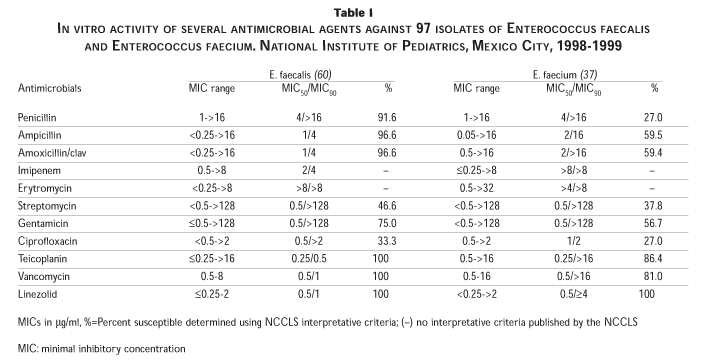
<body><![CDATA[<p><font face="verdana" size="2">Screening for beta-lactamase production was  done using Cefinase disk methodology (a chromogenic  substrate nitrocefin, Cefinase, BBL, Microbiology  Systems, Cockeysville, MD).</font></p>     <p><font face="verdana" size="2">High-level aminoglycoside resistance (HLAR). All  the strains with a MIC <u>&gt;</u> 64 &#181;g/ml to gentamicin and  streptomycin were used to screen for HLAR. Those  strains suspected to be HLAR were confirmed by broth  tube dilution using brain-heart infusion broth with 500  and 1000 &#181;g/ml concentrations of gentamicin, as well  as with 1000 and 2000 &#181;g/ml concentrations of  streptomycin.</font></p>     <p><font face="verdana" size="2">Phenotypes. The Van A phenotype include enterococci    resistant to high levels of vancomycin (MIC <u>&gt;</u> 64/ml) and teicoplanin    (MIC <u>&gt;</u> 8 &#181;g/ml). This resistance is vancomycin- and/or teicoplanin-    inducible.<SUP>18</SUP> Van B organisms are resistant to a range of vancomycin    concentrations, from 4 to <u>&gt;</u> 1024 &#181;g/ml; they typically retain    their susceptibility to teicoplanin. This resistance is also inducible by vancomycin    but not by teicoplanin.<SUP>18</SUP> Differences between proportions were evaluated    with the <font face="Symbol">c</font><SUP>2</SUP> or Fisher exact test (as appropriate).</font></p>     <p>&nbsp;</p>     <p><font face="verdana" size="3"><b>Results</b></font></p>     <p><font face="verdana" size="2">A total of 97 clinical isolates of Enterococcus spp.  (60 E. faecalis and 37 E. faecium) were collected,  identified, and analyzed over a 24-month study period.</font></p>     <p><font face="verdana" size="2"><a href="/img/revistas/spm/v45n2/a05t01.gif">Table I</a> shows the in vitro    activity of antimicrobial agents that were tested according to different species.</font></p>     <p><font face="Symbol" size="2">b</font><font face="verdana" size="2">-lactam    resistance. 5/60 (8.3%) E. faecalis and 27/37 (73.0%) E. faecium were resistant    (overall 32/97; 33%) to penicillin; 2/60 (3.3%) E. faecalis and 15/37 (40.5%)    E. faecium were resistant (overall 17/97, 17.5%)to ampicillin and amoxicillin-clavulanate;    15/97 (15.4%) - </font><font face="verdana" size="2">all of them E. faecium<I>    - </I>were resistant to imipenem. Resistance between species against <font face="Symbol">b</font>-lactams    was significant. There was neither high-level penicillin resistance nor<font face="Symbol">    b</font>-lactamase production among the clinical strains tested.</font></p>      <p><font face="verdana" size="2">High-level aminoglycoside resistance. Fifthteen of  sixty (25.0%) E. faecalis and 16/37 (43.3%) E. faecium  were resistant (overall 31/97; 32%) to gentamicin; 32/60  (53.4 %) E. faecalis and 23/37 (62.1%) E. faecium were  resistant (overall 55/97; 56.7%) to streptomycin.  Resistance to aminoglycosides between species was significant.</font></p>     <p><font face="verdana" size="2">Vancomicin-resistant enterococci. Seven strains  were resistant to vancomycin, all of them E.  faecium;5 of 7 strains were also resistant to teicoplanin. All E.  faecalis strains were susceptible to vancomycin and  teicoplanin.</font></p>     ]]></body>
<body><![CDATA[<p><font face="verdana" size="2">Phenotypes. Five of seven VRE isolates exhibited the  Van A phenotype, and 2/7 exhibited the phenotype Van B.</font></p>     <p><font face="verdana" size="2">Other antimicrobials. Erythromycin inhibited    more than 50% of all strains at or below their respective susceptible breakpoint    concentrations. More than 60% of the strains tested were resistant to ciprofloxacin.    Notably, 100% of all the isolates tested were inhibited by <u>&lt;</u> 4 &#181;g/ml    of linezolid.</font></p>     <p>&nbsp;</p>     <p><font face="verdana" size="3"><b>Discussion </b></font></p>     <p><font face="verdana" size="2">Enterococci are not generally regarded as highly    virulent bacterial pathogens, however, resistance to many antimicrobial drugs    complicates the treatment of enterococcal infections. Acquired resistance to    high concentrations of ampicillin, aminoglycoside, and glycopeptide antibiotics,    specifically vancomycin, has exacerbated this problem.<SUP>6,8,13,14,18,24,25</SUP></font></p>     <p><font face="verdana" size="2">In the last decade enterococci have become  recognized as leading causes of nosocomial bacteremia,  surgical wound infections, and urinary tract infections.</font></p>     <p><font face="verdana" size="2">     Two types of enterococci cause infections: a)  those originating from patients&#180;native flora, which are  unlikely to possess resistance beyond that intrinsic to  the genus, and to be spread between patients from bed  to bed, and b) isolates that possess multiple  antibiotic resistance traits and are capable of nosocomial  transmission. The therapeutic challenge of  multiple-drug resistance enterococci has brought their role as  important nosocomial pathogens into sharper focus.</font></p>     <p><font face="verdana" size="2">Although E. faecium strains are resistant to    ampicillin, aminoglycosides, and glycopeptides more than E. faecalis strains,    the relative proportion of infections caused by these species has not dramatically    changed in recent years.<SUP>14</SUP></font></p>     <p><font face="verdana" size="2">     Different patterns of resistance have been  informed from many countries.<SUP>18</SUP> That information is  scarce in Mexico, particularly in pediatric  patients.<SUP>26,27</SUP> In this study the activity of several antimicrobial  agents against 97 clinical isolates is reported.</font></p>     <p><font face="verdana" size="2">     Considerable resistance of E. faecium isolates  to most of the antibiotics tested was demonstrated  during the study period.</font></p>     ]]></body>
<body><![CDATA[<p><font face="verdana" size="2"> The results of this study confirm that E. faecalis    strains resistant to ampicillin and vancomycin are uncommon; in contrast, E.    faecium strains resistant to vancomycin (7/ 37 strains) and ampicillin (15/37    strains), increased alarmingly. This observation is similar to those reported    by other authors.<SUP>13,14,28-30</SUP></font></p>     <p><font face="verdana" size="2">At least for E. feacalis and E. falcium  against penicillin, ampicillin and imipenem.</font></p>     <p><font face="verdana" size="2">High-level resistance to aminoglycosides is a    real problem, this resistance overcomes the synergy of killing combination therapy.    Ampicillin and vancomycin are not bactericidal unless combined with an aminoglycoside.<SUP>10,12,18</SUP>    High-level gentamicin resistance is most often associated with high-level resistance    to all alternative aminoglycosides</font></p>     <p><font face="verdana" size="2">Since enterococcal resistance to gentamicin and    streptomycin occurs by different mechanisms, it is important to test susceptibility    to both agents. Enterococci with HLR to streptomycin are susceptible to gentamicin.    Gentamicin resistance is a good predictor of resistance to other aminoglycosides;    also, ampicillin resistance is a predictor of imipenem resistance.<SUP>31-33</SUP></font></p>     <p><font face="verdana" size="2">     Glycopeptide-resistance in Enterococcus spp.  (7/97 or 7.2%) is higher than that found by Miranda and  cols.; 5 /235 (2.12%) in E.faecalis and E.faecium  strains.<SUP>26</SUP>Those isolates confirm the various levels of resistance to  vancomycin and teicoplanin.</font></p>     <p><font face="verdana" size="2"> In this study, five of seven isolates of E.    faecium were phenotype Van A and the other 2 were phenotype Van B. It is useful    to identify which species are vancomycin-resistant in enterococcal isolates.    Identification of Van A organisms has implications for treatment and infection    control.<SUP>34,35</SUP></font></p>     <p><font face="verdana" size="2">Other studies on VRE clinical isolates found  that most were Van A phenotype strains of E.  faecium<I>; </I>they were associated with outbreaks in special wards  with immunocompromised patients on long term  antimicrobial regimens, with extended lengths of stay  and higher severity of illness scores.<SUP>36-38</SUP></font></p>     <p><font face="verdana" size="2">Several limitations of the data from this study  make firm conclusions problematic. First, all of the microorganisms tested came  from a single institution. Second, a relatively small number of E. faecium and  E. faecalis were tested; it is possible that these strains might represent only  a few clones. Third, no species other than E. faecalis and E. faecium were included.</font></p>      <p><font face="verdana" size="2"> Once vancomycin-resistant enterococci are established    in the hospital environment, their frequent resistance to multiple antibiotics    make it difficult to avoid further selective pressure in their favor. Enterococcal    infections tend to occur in more debilitated or seriously ill hospitalized patients.    Mortality in patients with VRE bacteremia may reach 60-70%.<SUP>3,14</SUP> From    1989 through 1997, the percentage of infections caused by VRE increased from    0.4 to 23.2 % among patients in the intensive care unit (ICU), and from 0.3    to 15.4% among patients not in the ICU.<SUP>2</SUP></font></p>     <p><font face="verdana" size="2"> Because most enterococci are resistant to the    bactericidal activity of <font face="Symbol">b</font>-lactam and glycopeptide    antibiotics, bactericidal synergy between one of these antibiotics and an aminoglycoside    is needed to treat most serious enterococcal infections. The synergistic bactericidal    effect between aminoglycosides and <font face="Symbol">b</font>-lactam or glycopeptide    antibiotics is lost if there is high-level resistance to either class of drug.    The increasing use of parenteral vancomycin for the treatment of intravascular    device-related infections might have a role in enterococcal resistance.</font></p>     ]]></body>
<body><![CDATA[<p><font face="verdana" size="2">Treatment of multidrug-resistant enterococci  is under an investigational new drug program for  treatment of patients with life-threatening infection due  to vancomycin-resistant E. faecium bacteremia. There  has been a considerable effort to develop alternative  agents; for example, dalfopristin-quinupristin is a  streptogramin antibiotic that has been studied in the  treatment of infections due to vancomycin-resistant E.  faecium. Other investigational agents with activity in  vitro against Enterococcus spp. susceptible or resistant  to glycopeptides include the oxazolidinones. These are  a new class of synthetic antibiotics with good  antienterococcal activity and are different from any  other class. Mechanisms of resistance that affect  antibiotics in current clinical use do not affect the activities  of oxazolidinones. Linezolid is one of the  investigational agents.<SUP>39,40</SUP> In this study linezolid showed  excellent activity against multiantibiotic- resistant  enterococci. Clinical efficacy and safety studies are needed to  determine its real utility. Linezolid has recently  been approved by the Food and Drug Administration.</font></p>     <p><font face="verdana" size="2">The microbiology laboratory is the first line    of defense against the spread of multiantibiotic-resistant enterococci in the    hospital environment. Cooperation and communication between the laboratory and    the infection control program is essential in recognizing enterococci-resistant    isolates from colonization and infection. All of the strains recovered should    be tested for susceptibility to ampicillin, streptomycin, gentamicin, and glycopeptides.</font></p>     <p><font face="verdana" size="2"> It will be necessary to study additional E.    faecalis and E. faecium strains from different hospitals and, if possible to    include less common enterococcal species such as E. gallinarum and E. casseliflavus,    which are relatively infrequent causes of human infections but they have intrinsic    resistance to low concentrations of vancomycin.</font></p>     <p>&nbsp;</p>     <p><font face="verdana" size="3"><b>Acknowledgements</b></font></p>     <p><font face="verdana" size="2">The authors are grateful to Dr. L.E. Espinosa    de los Monteros, M. Sc. Norma Vel&aacute;zquez , Dr. Renata Avila, and Esther    Lombardo for their technical assistance to store the samples and ensure the    purity and viability of strains tested.</font></p>     <p>&nbsp;</p>     <p><font face="verdana" size="3"><b>References</b></font></p>     <!-- ref --><p><font face="verdana" size="2">1. Schaberg DR, Culver DH, Gaynes RP. Mayor trends in the  microbial etiology of nosocomial infection. Am J Med 91;(suppl 3B):72S-75S.</font>&nbsp;&nbsp;&nbsp;&nbsp;&nbsp;&nbsp;&nbsp;&nbsp;[&#160;<a href="javascript:void(0);" onclick="javascript: window.open('/scielo.php?script=sci_nlinks&ref=9167231&pid=S0036-3634200300020000500001&lng=','','width=640,height=500,resizable=yes,scrollbars=1,menubar=yes,');">Links</a>&#160;]<!-- end-ref --><!-- ref --><p><font face="verdana" size="2">2. Centers for Disease Control and Prevention. Nosocomial  enterococci resistant to vancomycin-United States, 1989-1993. MMWR Morb  Mortal Wkly Rep 1993;42:597-599.</font>&nbsp;&nbsp;&nbsp;&nbsp;&nbsp;&nbsp;&nbsp;&nbsp;[&#160;<a href="javascript:void(0);" onclick="javascript: window.open('/scielo.php?script=sci_nlinks&ref=9167232&pid=S0036-3634200300020000500002&lng=','','width=640,height=500,resizable=yes,scrollbars=1,menubar=yes,');">Links</a>&#160;]<!-- end-ref --><!-- ref --><p><font face="verdana" size="2">3. Tornieporth N, Roberts RB, John J, Hafnier A, Riley LW. Risk  factors associated with vancomycin-resistant Enterococcus faecium infection  or colonization in 145 matched case patients and control patients. Clin  Infect Dis 1996;23:767-772.</font>&nbsp;&nbsp;&nbsp;&nbsp;&nbsp;&nbsp;&nbsp;&nbsp;[&#160;<a href="javascript:void(0);" onclick="javascript: window.open('/scielo.php?script=sci_nlinks&ref=9167233&pid=S0036-3634200300020000500003&lng=','','width=640,height=500,resizable=yes,scrollbars=1,menubar=yes,');">Links</a>&#160;]<!-- end-ref --><!-- ref --><p><font face="verdana" size="2">4. Edmond MB, Ober JF, Dawson JD, Weinbaurri DC, Wenzel RP.  Vancomycin-resistant enterococcal bacteremia: Natural history and  attributable mortality. Clin Infect Dis 1996;23:1234-1239.</font>&nbsp;&nbsp;&nbsp;&nbsp;&nbsp;&nbsp;&nbsp;&nbsp;[&#160;<a href="javascript:void(0);" onclick="javascript: window.open('/scielo.php?script=sci_nlinks&ref=9167234&pid=S0036-3634200300020000500004&lng=','','width=640,height=500,resizable=yes,scrollbars=1,menubar=yes,');">Links</a>&#160;]<!-- end-ref --><!-- ref --><p><font face="verdana" size="2">5. Eliopoulos GM. Vancomycin-resistant enterococci: Mechanism and  clinical relevance. Infect Dis Clin North Am 1997;11:851-865.</font>&nbsp;&nbsp;&nbsp;&nbsp;&nbsp;&nbsp;&nbsp;&nbsp;[&#160;<a href="javascript:void(0);" onclick="javascript: window.open('/scielo.php?script=sci_nlinks&ref=9167235&pid=S0036-3634200300020000500005&lng=','','width=640,height=500,resizable=yes,scrollbars=1,menubar=yes,');">Links</a>&#160;]<!-- end-ref --><!-- ref --><p><font face="verdana" size="2">6. Murray BE. The life and times of the enterococcus. Clin Microbiol  Rev 1990;3:45-65.</font>&nbsp;&nbsp;&nbsp;&nbsp;&nbsp;&nbsp;&nbsp;&nbsp;[&#160;<a href="javascript:void(0);" onclick="javascript: window.open('/scielo.php?script=sci_nlinks&ref=9167236&pid=S0036-3634200300020000500006&lng=','','width=640,height=500,resizable=yes,scrollbars=1,menubar=yes,');">Links</a>&#160;]<!-- end-ref --><!-- ref --><p><font face="verdana" size="2">7. Rubin L, Tucci V, Cerenado E, Elioponlos G, Isenberg H.  Vancomycin-resistant Enterococcus faecium in hospitalized children. Infect  Control Hosp Epidemiol 1992;13:700-705.</font>&nbsp;&nbsp;&nbsp;&nbsp;&nbsp;&nbsp;&nbsp;&nbsp;[&#160;<a href="javascript:void(0);" onclick="javascript: window.open('/scielo.php?script=sci_nlinks&ref=9167237&pid=S0036-3634200300020000500007&lng=','','width=640,height=500,resizable=yes,scrollbars=1,menubar=yes,');">Links</a>&#160;]<!-- end-ref --><!-- ref --><p><font face="verdana" size="2">8. Fridkin SK, Gaynes RP. Antimicrobial resistance in intensive care  units. Clin Chest Med 1999;20:303-316.</font>&nbsp;&nbsp;&nbsp;&nbsp;&nbsp;&nbsp;&nbsp;&nbsp;[&#160;<a href="javascript:void(0);" onclick="javascript: window.open('/scielo.php?script=sci_nlinks&ref=9167238&pid=S0036-3634200300020000500008&lng=','','width=640,height=500,resizable=yes,scrollbars=1,menubar=yes,');">Links</a>&#160;]<!-- end-ref --><!-- ref --><p><font face="verdana" size="2">9. Patterson JE, Sweeney AH, Simms M, Carley N, Mangi R, Sabetta J et  al. An analysis of 110 serious enterococcal Infections. Epidemiology,  antibiotic susceptibility, and outcome. Medicine 1995;74:191-200.</font>&nbsp;&nbsp;&nbsp;&nbsp;&nbsp;&nbsp;&nbsp;&nbsp;[&#160;<a href="javascript:void(0);" onclick="javascript: window.open('/scielo.php?script=sci_nlinks&ref=9167239&pid=S0036-3634200300020000500009&lng=','','width=640,height=500,resizable=yes,scrollbars=1,menubar=yes,');">Links</a>&#160;]<!-- end-ref --><!-- ref --><p><font face="verdana" size="2">10. Ross TW. Infectious disease challenge: Vancomycin-resistant  enterococcus and staphylococcus. Drug Topics 1998;142:76-83.</font>&nbsp;&nbsp;&nbsp;&nbsp;&nbsp;&nbsp;&nbsp;&nbsp;[&#160;<a href="javascript:void(0);" onclick="javascript: window.open('/scielo.php?script=sci_nlinks&ref=9167240&pid=S0036-3634200300020000500010&lng=','','width=640,height=500,resizable=yes,scrollbars=1,menubar=yes,');">Links</a>&#160;]<!-- end-ref --><!-- ref --><p><font face="verdana" size="2">11. Murray BE. Vancomycin-resistant enterococci. Am J Med  1997;102: 284-293.</font>&nbsp;&nbsp;&nbsp;&nbsp;&nbsp;&nbsp;&nbsp;&nbsp;[&#160;<a href="javascript:void(0);" onclick="javascript: window.open('/scielo.php?script=sci_nlinks&ref=9167241&pid=S0036-3634200300020000500011&lng=','','width=640,height=500,resizable=yes,scrollbars=1,menubar=yes,');">Links</a>&#160;]<!-- end-ref --><!-- ref --><p><font face="verdana" size="2">12. Murray BE. Diversity among multidrug-resistant enterococci.  Emerg Infect Dis 1998;4:37-47.</font>&nbsp;&nbsp;&nbsp;&nbsp;&nbsp;&nbsp;&nbsp;&nbsp;[&#160;<a href="javascript:void(0);" onclick="javascript: window.open('/scielo.php?script=sci_nlinks&ref=9167242&pid=S0036-3634200300020000500012&lng=','','width=640,height=500,resizable=yes,scrollbars=1,menubar=yes,');">Links</a>&#160;]<!-- end-ref --><!-- ref --><p><font face="verdana" size="2">13. Gold HS. Vancomycin-resistant enterococci: Mechanisms and  clinical observations. Clin Infect Dis 2001;33:210-219.</font>&nbsp;&nbsp;&nbsp;&nbsp;&nbsp;&nbsp;&nbsp;&nbsp;[&#160;<a href="javascript:void(0);" onclick="javascript: window.open('/scielo.php?script=sci_nlinks&ref=9167243&pid=S0036-3634200300020000500013&lng=','','width=640,height=500,resizable=yes,scrollbars=1,menubar=yes,');">Links</a>&#160;]<!-- end-ref --><!-- ref --><p><font face="verdana" size="2">14. Huycke MM, Sahm DF, Gilmore MS. Multiple-drug    resistant enterococci: The nature of the problem and an agenda for the future.    Emerg Infect Dis 1998;4:239-249.</font>&nbsp;&nbsp;&nbsp;&nbsp;&nbsp;&nbsp;&nbsp;&nbsp;[&#160;<a href="javascript:void(0);" onclick="javascript: window.open('/scielo.php?script=sci_nlinks&ref=9167244&pid=S0036-3634200300020000500014&lng=','','width=640,height=500,resizable=yes,scrollbars=1,menubar=yes,');">Links</a>&#160;]<!-- end-ref --><!-- ref --><p><font face="verdana" size="2">15. Hodges TR, Zighelboim-Daum S, Eliopulus GM,    Wennerstein CB, Moellering RC. Antimicrobial susceptibility changes in Enterococcus    faecalis following various penicillin exposure regimens. Antimicrob Agents Chemother    1992;36:121-125.</font>&nbsp;&nbsp;&nbsp;&nbsp;&nbsp;&nbsp;&nbsp;&nbsp;[&#160;<a href="javascript:void(0);" onclick="javascript: window.open('/scielo.php?script=sci_nlinks&ref=9167245&pid=S0036-3634200300020000500015&lng=','','width=640,height=500,resizable=yes,scrollbars=1,menubar=yes,');">Links</a>&#160;]<!-- end-ref --><!-- ref --><p><font face="verdana" size="2">16. Moellering RC. Vancomycin-resistant enterococci. Clin Infect  Dis 1998;26:1196-1199.</font>&nbsp;&nbsp;&nbsp;&nbsp;&nbsp;&nbsp;&nbsp;&nbsp;[&#160;<a href="javascript:void(0);" onclick="javascript: window.open('/scielo.php?script=sci_nlinks&ref=9167246&pid=S0036-3634200300020000500016&lng=','','width=640,height=500,resizable=yes,scrollbars=1,menubar=yes,');">Links</a>&#160;]<!-- end-ref --><!-- ref --><p><font face="verdana" size="2">17. Gold HS, Moellering RC. Drug therapy: Antimicrobial-drug  resistance. N Engl J Med 1996;335:1445-1454.</font>&nbsp;&nbsp;&nbsp;&nbsp;&nbsp;&nbsp;&nbsp;&nbsp;[&#160;<a href="javascript:void(0);" onclick="javascript: window.open('/scielo.php?script=sci_nlinks&ref=9167247&pid=S0036-3634200300020000500017&lng=','','width=640,height=500,resizable=yes,scrollbars=1,menubar=yes,');">Links</a>&#160;]<!-- end-ref --><!-- ref --><p><font face="verdana" size="2">18. Centinkaya Y, Falk P, Mayhall CG. Vancomycin-resistant  enterococci. Clin Microbiol Rev 2000;13:686-707.</font>&nbsp;&nbsp;&nbsp;&nbsp;&nbsp;&nbsp;&nbsp;&nbsp;[&#160;<a href="javascript:void(0);" onclick="javascript: window.open('/scielo.php?script=sci_nlinks&ref=9167248&pid=S0036-3634200300020000500018&lng=','','width=640,height=500,resizable=yes,scrollbars=1,menubar=yes,');">Links</a>&#160;]<!-- end-ref --><!-- ref --><p><font face="verdana" size="2">19. Perl TM. The threat of vancomycin resistance. Am J Med.  1999;106: 26S-37S.</font>&nbsp;&nbsp;&nbsp;&nbsp;&nbsp;&nbsp;&nbsp;&nbsp;[&#160;<a href="javascript:void(0);" onclick="javascript: window.open('/scielo.php?script=sci_nlinks&ref=9167249&pid=S0036-3634200300020000500019&lng=','','width=640,height=500,resizable=yes,scrollbars=1,menubar=yes,');">Links</a>&#160;]<!-- end-ref --><!-- ref --><p><font face="verdana" size="2">20. Facklam RR, Sham DF, Teixeira LM. Enterococcus. En: Murray PR,  Baron EJ, Pfaller MA, Tenover FC, Yolken RA, ed. Manual of clinical  microbiology. 7<SUP>th</SUP> ed. Washington, DC: American Society for Microbiology, 1999:297-305.</font>&nbsp;&nbsp;&nbsp;&nbsp;&nbsp;&nbsp;&nbsp;&nbsp;[&#160;<a href="javascript:void(0);" onclick="javascript: window.open('/scielo.php?script=sci_nlinks&ref=9167250&pid=S0036-3634200300020000500020&lng=','','width=640,height=500,resizable=yes,scrollbars=1,menubar=yes,');">Links</a>&#160;]<!-- end-ref --><!-- ref --><p><font face="verdana" size="2">21. Facklam RR, Collin MD. Identification of Enterococcus species  isolated from human infections by a conventional test scheme. J Clin  Microbiol 1989;27:731-734.</font>&nbsp;&nbsp;&nbsp;&nbsp;&nbsp;&nbsp;&nbsp;&nbsp;[&#160;<a href="javascript:void(0);" onclick="javascript: window.open('/scielo.php?script=sci_nlinks&ref=9167251&pid=S0036-3634200300020000500021&lng=','','width=640,height=500,resizable=yes,scrollbars=1,menubar=yes,');">Links</a>&#160;]<!-- end-ref --><!-- ref --><p><font face="verdana" size="2">22. National Committee for Clinical Laboratory Standards. Methods  for dilution antimicrobial susceptibility tests for bacteria that grow  aerobically. Approved standard-5<SUP>th</SUP> ed. Wayne (PA): NCCLS, 2000; Document  M7-A-5, 27.</font>&nbsp;&nbsp;&nbsp;&nbsp;&nbsp;&nbsp;&nbsp;&nbsp;[&#160;<a href="javascript:void(0);" onclick="javascript: window.open('/scielo.php?script=sci_nlinks&ref=9167252&pid=S0036-3634200300020000500022&lng=','','width=640,height=500,resizable=yes,scrollbars=1,menubar=yes,');">Links</a>&#160;]<!-- end-ref --><!-- ref --><p><font face="verdana" size="2">23. National Committee for Clinical Laboratory Standards.  Performance standards for antimicrobial susceptibility testing. Twelfth  Informational Supplement. Wayne (PA): NCCLS, 2002; Document M100-S12.</font>&nbsp;&nbsp;&nbsp;&nbsp;&nbsp;&nbsp;&nbsp;&nbsp;[&#160;<a href="javascript:void(0);" onclick="javascript: window.open('/scielo.php?script=sci_nlinks&ref=9167253&pid=S0036-3634200300020000500023&lng=','','width=640,height=500,resizable=yes,scrollbars=1,menubar=yes,');">Links</a>&#160;]<!-- end-ref --><!-- ref --><p><font face="verdana" size="2">24. Bonten MJ, Slaughter S, Ambergen AW, Hayden MK, van Voorhis J,  Nathan C et al. The role of &quot;colonization pressure&quot; in the spread of  vancomycin-resistant enterococci: An important infection control  variable. Arch Intern Med 1998;158:1127-1132.</font>&nbsp;&nbsp;&nbsp;&nbsp;&nbsp;&nbsp;&nbsp;&nbsp;[&#160;<a href="javascript:void(0);" onclick="javascript: window.open('/scielo.php?script=sci_nlinks&ref=9167254&pid=S0036-3634200300020000500024&lng=','','width=640,height=500,resizable=yes,scrollbars=1,menubar=yes,');">Links</a>&#160;]<!-- end-ref --><!-- ref --><p><font face="verdana" size="2">25. Palmer SM, Ryback MJ. Vancomycin-resistant enterocci.  Pharmacotherapy 1996;16:819-829.</font>&nbsp;&nbsp;&nbsp;&nbsp;&nbsp;&nbsp;&nbsp;&nbsp;[&#160;<a href="javascript:void(0);" onclick="javascript: window.open('/scielo.php?script=sci_nlinks&ref=9167255&pid=S0036-3634200300020000500025&lng=','','width=640,height=500,resizable=yes,scrollbars=1,menubar=yes,');">Links</a>&#160;]<!-- end-ref --><!-- ref --><p><font face="verdana" size="2">26. Miranda G, Lee L, Kelly C, Sol&oacute;rzano F, Lea&ntilde;os B, Mu&ntilde;oz O et al.  Antimicrobial resistance from enterococci in a pediatric hospital. Plasmids  in Enterococcus faecalis isolates with high-level gentamicin and  streptomycin resistance. Arch Med Res 2001;32:159-163.</font>&nbsp;&nbsp;&nbsp;&nbsp;&nbsp;&nbsp;&nbsp;&nbsp;[&#160;<a href="javascript:void(0);" onclick="javascript: window.open('/scielo.php?script=sci_nlinks&ref=9167256&pid=S0036-3634200300020000500026&lng=','','width=640,height=500,resizable=yes,scrollbars=1,menubar=yes,');">Links</a>&#160;]<!-- end-ref --><!-- ref --><p><font face="verdana" size="2">27. Sifuentes-Osornio J, Ponce deLe&oacute;n A, Mu&ntilde;oz-Trejo T,  Villalobos-Zapata Y, Ontiveros-Rodr&iacute;guez C, G&oacute;mez-Roldan C. Antimicrobial  susceptibility patterns and high-level gentamicin resistance among enterococci  isolated in a Mexican tertiary care center. Rev Invest Clin 1996;48:91-96.</font>&nbsp;&nbsp;&nbsp;&nbsp;&nbsp;&nbsp;&nbsp;&nbsp;[&#160;<a href="javascript:void(0);" onclick="javascript: window.open('/scielo.php?script=sci_nlinks&ref=9167257&pid=S0036-3634200300020000500027&lng=','','width=640,height=500,resizable=yes,scrollbars=1,menubar=yes,');">Links</a>&#160;]<!-- end-ref --><!-- ref --><p><font face="verdana" size="2">28. Pfaller MA, Jones RN, Doern GV, Kugler K, the SENTRY  participants Group. Bacterial pathogens isolated from patients with blood stream  infections: Frequencies of ocurrence and antimicrobial susceptibility  patterns from the SENTRY Antimicrobial Surveillance Program (United  States and Canada, 1997). Antimicrob Agents Chemother 1998;42:1762-1770.</font>&nbsp;&nbsp;&nbsp;&nbsp;&nbsp;&nbsp;&nbsp;&nbsp;[&#160;<a href="javascript:void(0);" onclick="javascript: window.open('/scielo.php?script=sci_nlinks&ref=9167258&pid=S0036-3634200300020000500028&lng=','','width=640,height=500,resizable=yes,scrollbars=1,menubar=yes,');">Links</a>&#160;]<!-- end-ref --><!-- ref --><p><font face="verdana" size="2">29. Sader HS, Jones RN, Gales AC, Winokur P, Kugler KC, Pfaller MA et  al. Antimicrobial susceptibility patterns for pathogens isolated from  patients in Latin American medical centers with a diagnosis of pneumonia:  Analysis of results from the SENTRY. Antimicrobial Surveillance Program  (1997), SENTRY Latin American Study Group. Diagn Microbiol Infect  Dis 1998;32:289-301.</font>&nbsp;&nbsp;&nbsp;&nbsp;&nbsp;&nbsp;&nbsp;&nbsp;[&#160;<a href="javascript:void(0);" onclick="javascript: window.open('/scielo.php?script=sci_nlinks&ref=9167259&pid=S0036-3634200300020000500029&lng=','','width=640,height=500,resizable=yes,scrollbars=1,menubar=yes,');">Links</a>&#160;]<!-- end-ref --><!-- ref --><p><font face="verdana" size="2">30. Gales AC, Jones RN, Pfaller MA, Gordon KA, Sader HS, Sampaio J et  al. Two-year assessment of the pathogen frequency and antimicrobial  resistance patterns among organisms isolated from skin and soft tissue  infections in Latin American hospitals: Result from the SENTRY  Antimicrobial Surveillance Program,1997-98. Int J Infect Dis 2000;4:75-84.</font>&nbsp;&nbsp;&nbsp;&nbsp;&nbsp;&nbsp;&nbsp;&nbsp;[&#160;<a href="javascript:void(0);" onclick="javascript: window.open('/scielo.php?script=sci_nlinks&ref=9167260&pid=S0036-3634200300020000500030&lng=','','width=640,height=500,resizable=yes,scrollbars=1,menubar=yes,');">Links</a>&#160;]<!-- end-ref --><!-- ref --><p><font face="verdana" size="2">31. Arthur M, Reynolds PE, Depardieu F, Corvalin P. Mechanisms of  glycopeptide resistance in enterococci. J Infect Dis 1996;32:11-16.</font>&nbsp;&nbsp;&nbsp;&nbsp;&nbsp;&nbsp;&nbsp;&nbsp;[&#160;<a href="javascript:void(0);" onclick="javascript: window.open('/scielo.php?script=sci_nlinks&ref=9167261&pid=S0036-3634200300020000500031&lng=','','width=640,height=500,resizable=yes,scrollbars=1,menubar=yes,');">Links</a>&#160;]<!-- end-ref --><!-- ref --><p><font face="verdana" size="2">32. Ferretti JJ, Gilmore KS, Courvalin P. Nucleotide sequence analysis  of the gene specifying the bifunctional 6'-aminoglycoside  acetyltransferase 2&quot;-aminoglycoside phosphotransferase enzyme in Streptococcus  faecalis and identification and cloning of gene regions specifying the two  activities. J Bacteriol 1986;167:631-638.</font>&nbsp;&nbsp;&nbsp;&nbsp;&nbsp;&nbsp;&nbsp;&nbsp;[&#160;<a href="javascript:void(0);" onclick="javascript: window.open('/scielo.php?script=sci_nlinks&ref=9167262&pid=S0036-3634200300020000500032&lng=','','width=640,height=500,resizable=yes,scrollbars=1,menubar=yes,');">Links</a>&#160;]<!-- end-ref --><!-- ref --><p><font face="verdana" size="2">33. Weinstein MP. Comparative evaluation of penicillin, ampicillin, and  imipenem MICs and susceptibility breakpoints for  vancomycin-susceptible and vancomycin-resistant Enterococcus faecalis and Enterococcus  faecium. J Clin Microbiol 2001;39:2729-2731.</font>&nbsp;&nbsp;&nbsp;&nbsp;&nbsp;&nbsp;&nbsp;&nbsp;[&#160;<a href="javascript:void(0);" onclick="javascript: window.open('/scielo.php?script=sci_nlinks&ref=9167263&pid=S0036-3634200300020000500033&lng=','','width=640,height=500,resizable=yes,scrollbars=1,menubar=yes,');">Links</a>&#160;]<!-- end-ref --><!-- ref --><p><font face="verdana" size="2">34. Herman DJ, Gerdin DN. Screening and treatment of infections  caused by resistant enterococci. Antimicrob Agent Chemother 1991;35:215-219.</font>&nbsp;&nbsp;&nbsp;&nbsp;&nbsp;&nbsp;&nbsp;&nbsp;[&#160;<a href="javascript:void(0);" onclick="javascript: window.open('/scielo.php?script=sci_nlinks&ref=9167264&pid=S0036-3634200300020000500034&lng=','','width=640,height=500,resizable=yes,scrollbars=1,menubar=yes,');">Links</a>&#160;]<!-- end-ref --><!-- ref --><p><font face="verdana" size="2">35. Quintiliani R, Evers S, Courvalin P. The van B gene confers  various levels of self-transferable resistance to vancomycin in enterococci. J  Infect Dis 1993;167:1220-1223.</font>&nbsp;&nbsp;&nbsp;&nbsp;&nbsp;&nbsp;&nbsp;&nbsp;[&#160;<a href="javascript:void(0);" onclick="javascript: window.open('/scielo.php?script=sci_nlinks&ref=9167265&pid=S0036-3634200300020000500035&lng=','','width=640,height=500,resizable=yes,scrollbars=1,menubar=yes,');">Links</a>&#160;]<!-- end-ref --><!-- ref --><p><font face="verdana" size="2">36. Garbutt J. Ventrapragada M, Littenberg B, Mundy LM. Association  between resistance to vancomycin and death in cases of Enterococcus  faecium bacteremia. Clin Infect Dis 2000;30:466-472.</font>&nbsp;&nbsp;&nbsp;&nbsp;&nbsp;&nbsp;&nbsp;&nbsp;[&#160;<a href="javascript:void(0);" onclick="javascript: window.open('/scielo.php?script=sci_nlinks&ref=9167266&pid=S0036-3634200300020000500036&lng=','','width=640,height=500,resizable=yes,scrollbars=1,menubar=yes,');">Links</a>&#160;]<!-- end-ref --><!-- ref --><p><font face="verdana" size="2">37. Lautenback E, Bilker WB, Brennan PJ. Enterococcal bacteremia:  Risk factors for vancomycin resistance and predictors of mortality. Infect  Control Hosp Epidemiol 1999;20:318-323.</font>&nbsp;&nbsp;&nbsp;&nbsp;&nbsp;&nbsp;&nbsp;&nbsp;[&#160;<a href="javascript:void(0);" onclick="javascript: window.open('/scielo.php?script=sci_nlinks&ref=9167267&pid=S0036-3634200300020000500037&lng=','','width=640,height=500,resizable=yes,scrollbars=1,menubar=yes,');">Links</a>&#160;]<!-- end-ref --><!-- ref --><p><font face="verdana" size="2">38. Lucas G, Lechtzin N, Puryear W, Yaul, Flexner C, Moore R.  Vancomycin-resistant and vancomycin-susceptible enterococcal bacteremia:  Comparison of clinical features and outcomes. Clin Infect Dis 1998;26:1127-1133.</font>&nbsp;&nbsp;&nbsp;&nbsp;&nbsp;&nbsp;&nbsp;&nbsp;[&#160;<a href="javascript:void(0);" onclick="javascript: window.open('/scielo.php?script=sci_nlinks&ref=9167268&pid=S0036-3634200300020000500038&lng=','','width=640,height=500,resizable=yes,scrollbars=1,menubar=yes,');">Links</a>&#160;]<!-- end-ref --><!-- ref --><p><font face="verdana" size="2">39. Naskin GA, Siddiqui F, Stosor V, Hacek D,    Peterson LR. In vitro activities of linezolid against important gram-positive    bacterial pathogens including vancomycin-resistant enterococci. Antimicrob Agents    Chemother 1999;43:2059-2062</font>&nbsp;&nbsp;&nbsp;&nbsp;&nbsp;&nbsp;&nbsp;&nbsp;[&#160;<a href="javascript:void(0);" onclick="javascript: window.open('/scielo.php?script=sci_nlinks&ref=9167269&pid=S0036-3634200300020000500039&lng=','','width=640,height=500,resizable=yes,scrollbars=1,menubar=yes,');">Links</a>&#160;]<!-- end-ref --><!-- ref --><p><font face="verdana" size="2">40. Clement D, Markham A. Linezolid. Drug 2000;59:    815-827.</font>&nbsp;&nbsp;&nbsp;&nbsp;&nbsp;&nbsp;&nbsp;&nbsp;[&#160;<a href="javascript:void(0);" onclick="javascript: window.open('/scielo.php?script=sci_nlinks&ref=9167270&pid=S0036-3634200300020000500040&lng=','','width=640,height=500,resizable=yes,scrollbars=1,menubar=yes,');">Links</a>&#160;]<!-- end-ref --><p>&nbsp;</p>     <p>&nbsp;</p>     ]]></body>
<body><![CDATA[<p><font face="verdana" size="2"><b>Address reprint requests to</b>    <br>   Ernesto Calder&oacute;n-Jaimes    <br>   Departamento de Inmunoqu&iacute;mica y Biolog&iacute;a Celular    <br>   Edificio Mundet Tercer Piso, Hospital Infantil de M&eacute;xico Federico G&oacute;mez    <br>   Calle Dr. M&aacute;rquez 162, Colonia Doctores    <br>   06720, M&eacute;xico, D.F., M&eacute;xico    <br>   e.mail: <a href="mailto:ecalderj@yahoo.com">ecalderj@yahoo.com</a></font></p>     <p><font face="verdana" size="2"><b>Received on</b>: May 20, 2002 <b>Accepted    on</b>: January 9, 2003    <br>   </font><font face="verdana" size="2">We acknowledge the partial support of Pharmacia    and Upjohn, Kalamazoo, Mich. (Dr. Susana Su&aacute;rez).</font></p>     <p><font face="verdana" size="2">The English version of this paper is available    too at: <a href="http://www.insp.mx/salud/index.html">http://www.insp.mx/salud/index.html</a>    ]]></body>
<body><![CDATA[<br> El texto completo ens ingl&eacute;s de este art&iacute;culo    tambi&eacute;n est&aacute; disponible en: <a href="http://www.insp.mx/salud/index.html">http://www.insp.mx/salud/index.html</a></font></p>      ]]></body><back>
<ref-list>
<ref id="B1">
<label>1</label><nlm-citation citation-type="journal">
<person-group person-group-type="author">
<name>
<surname><![CDATA[Schaberg]]></surname>
<given-names><![CDATA[DR]]></given-names>
</name>
<name>
<surname><![CDATA[Culver]]></surname>
<given-names><![CDATA[DH]]></given-names>
</name>
<name>
<surname><![CDATA[Gaynes]]></surname>
<given-names><![CDATA[RP]]></given-names>
</name>
</person-group>
<article-title xml:lang="en"><![CDATA[Mayor trends in the microbial etiology of nosocomial infection]]></article-title>
<source><![CDATA[Am J Med]]></source>
<year></year>
<volume>91</volume>
<numero>^s3B</numero>
<issue>^s3B</issue>
<supplement>3B</supplement>
<page-range>72S-75S</page-range></nlm-citation>
</ref>
<ref id="B2">
<label>2</label><nlm-citation citation-type="journal">
<collab>Centers for Disease Control and Prevention</collab>
<article-title xml:lang="en"><![CDATA[Nosocomial enterococci resistant to vancomycin-United States, 1989-1993]]></article-title>
<source><![CDATA[MMWR Morb Mortal Wkly Rep]]></source>
<year>1993</year>
<volume>42</volume>
<page-range>597-599</page-range></nlm-citation>
</ref>
<ref id="B3">
<label>3</label><nlm-citation citation-type="journal">
<person-group person-group-type="author">
<name>
<surname><![CDATA[Tornieporth]]></surname>
<given-names><![CDATA[N]]></given-names>
</name>
<name>
<surname><![CDATA[Roberts]]></surname>
<given-names><![CDATA[RB]]></given-names>
</name>
<name>
<surname><![CDATA[John]]></surname>
<given-names><![CDATA[J]]></given-names>
</name>
<name>
<surname><![CDATA[Hafnier]]></surname>
<given-names><![CDATA[A]]></given-names>
</name>
<name>
<surname><![CDATA[Riley]]></surname>
<given-names><![CDATA[LW]]></given-names>
</name>
</person-group>
<article-title xml:lang="en"><![CDATA[Risk factors associated with vancomycin-resistant Enterococcus faecium infection or colonization in 145 matched case patients and control patients]]></article-title>
<source><![CDATA[Clin Infect Dis]]></source>
<year>1996</year>
<volume>23</volume>
<page-range>767-772</page-range></nlm-citation>
</ref>
<ref id="B4">
<label>4</label><nlm-citation citation-type="journal">
<person-group person-group-type="author">
<name>
<surname><![CDATA[Edmond]]></surname>
<given-names><![CDATA[MB]]></given-names>
</name>
<name>
<surname><![CDATA[Ober]]></surname>
<given-names><![CDATA[JF]]></given-names>
</name>
<name>
<surname><![CDATA[Dawson]]></surname>
<given-names><![CDATA[JD]]></given-names>
</name>
<name>
<surname><![CDATA[Weinbaurri]]></surname>
<given-names><![CDATA[DC]]></given-names>
</name>
<name>
<surname><![CDATA[Wenzel]]></surname>
<given-names><![CDATA[RP]]></given-names>
</name>
</person-group>
<article-title xml:lang="en"><![CDATA[Vancomycin-resistant enterococcal bacteremia: Natural history and attributable mortality]]></article-title>
<source><![CDATA[Clin Infect Dis]]></source>
<year>1996</year>
<volume>23</volume>
<page-range>1234-1239</page-range></nlm-citation>
</ref>
<ref id="B5">
<label>5</label><nlm-citation citation-type="journal">
<person-group person-group-type="author">
<name>
<surname><![CDATA[Eliopoulos]]></surname>
<given-names><![CDATA[GM]]></given-names>
</name>
</person-group>
<article-title xml:lang="en"><![CDATA[Vancomycin-resistant enterococci: Mechanism and clinical relevance]]></article-title>
<source><![CDATA[Infect Dis Clin North Am]]></source>
<year>1997</year>
<volume>11</volume>
<page-range>851-865</page-range></nlm-citation>
</ref>
<ref id="B6">
<label>6</label><nlm-citation citation-type="journal">
<person-group person-group-type="author">
<name>
<surname><![CDATA[Murray]]></surname>
<given-names><![CDATA[BE]]></given-names>
</name>
</person-group>
<article-title xml:lang="en"><![CDATA[The life and times of the enterococcus]]></article-title>
<source><![CDATA[Clin Microbiol Rev]]></source>
<year>1990</year>
<volume>3</volume>
<page-range>45-65</page-range></nlm-citation>
</ref>
<ref id="B7">
<label>7</label><nlm-citation citation-type="journal">
<person-group person-group-type="author">
<name>
<surname><![CDATA[Rubin]]></surname>
<given-names><![CDATA[L]]></given-names>
</name>
<name>
<surname><![CDATA[Tucci]]></surname>
<given-names><![CDATA[V]]></given-names>
</name>
<name>
<surname><![CDATA[Cerenado]]></surname>
<given-names><![CDATA[E]]></given-names>
</name>
<name>
<surname><![CDATA[Elioponlos]]></surname>
<given-names><![CDATA[G]]></given-names>
</name>
<name>
<surname><![CDATA[Isenberg]]></surname>
<given-names><![CDATA[H]]></given-names>
</name>
</person-group>
<article-title xml:lang="en"><![CDATA[Vancomycin-resistant Enterococcus faecium in hospitalized children]]></article-title>
<source><![CDATA[Infect Control Hosp Epidemiol]]></source>
<year>1992</year>
<volume>13</volume>
<page-range>700-705</page-range></nlm-citation>
</ref>
<ref id="B8">
<label>8</label><nlm-citation citation-type="journal">
<person-group person-group-type="author">
<name>
<surname><![CDATA[Fridkin]]></surname>
<given-names><![CDATA[SK]]></given-names>
</name>
<name>
<surname><![CDATA[Gaynes]]></surname>
<given-names><![CDATA[RP]]></given-names>
</name>
</person-group>
<article-title xml:lang="en"><![CDATA[Antimicrobial resistance in intensive care units]]></article-title>
<source><![CDATA[Clin Chest Med]]></source>
<year>1999</year>
<volume>20</volume>
<page-range>303-316</page-range></nlm-citation>
</ref>
<ref id="B9">
<label>9</label><nlm-citation citation-type="journal">
<person-group person-group-type="author">
<name>
<surname><![CDATA[Patterson]]></surname>
<given-names><![CDATA[JE]]></given-names>
</name>
<name>
<surname><![CDATA[Sweeney]]></surname>
<given-names><![CDATA[AH]]></given-names>
</name>
<name>
<surname><![CDATA[Simms]]></surname>
<given-names><![CDATA[M]]></given-names>
</name>
<name>
<surname><![CDATA[Carley]]></surname>
<given-names><![CDATA[N]]></given-names>
</name>
<name>
<surname><![CDATA[Mangi]]></surname>
<given-names><![CDATA[R]]></given-names>
</name>
<name>
<surname><![CDATA[Sabetta]]></surname>
<given-names><![CDATA[J]]></given-names>
</name>
</person-group>
<article-title xml:lang="en"><![CDATA[An analysis of 110 serious enterococcal Infections: Epidemiology, antibiotic susceptibility, and outcome]]></article-title>
<source><![CDATA[Medicine]]></source>
<year>1995</year>
<volume>74</volume>
<page-range>191-200</page-range></nlm-citation>
</ref>
<ref id="B10">
<label>10</label><nlm-citation citation-type="journal">
<person-group person-group-type="author">
<name>
<surname><![CDATA[Ross]]></surname>
<given-names><![CDATA[TW]]></given-names>
</name>
</person-group>
<article-title xml:lang="en"><![CDATA[Infectious disease challenge: Vancomycin-resistant enterococcus and staphylococcus]]></article-title>
<source><![CDATA[Drug Topics]]></source>
<year>1998</year>
<volume>142</volume>
<page-range>76-83</page-range></nlm-citation>
</ref>
<ref id="B11">
<label>11</label><nlm-citation citation-type="journal">
<person-group person-group-type="author">
<name>
<surname><![CDATA[Murray]]></surname>
<given-names><![CDATA[BE]]></given-names>
</name>
</person-group>
<article-title xml:lang="en"><![CDATA[Vancomycin-resistant enterococci]]></article-title>
<source><![CDATA[Am J Med]]></source>
<year>1997</year>
<volume>102</volume>
<page-range>284-293</page-range></nlm-citation>
</ref>
<ref id="B12">
<label>12</label><nlm-citation citation-type="journal">
<person-group person-group-type="author">
<name>
<surname><![CDATA[Murray]]></surname>
<given-names><![CDATA[BE]]></given-names>
</name>
</person-group>
<article-title xml:lang="en"><![CDATA[Diversity among multidrug-resistant enterococci]]></article-title>
<source><![CDATA[Emerg Infect Dis]]></source>
<year>1998</year>
<volume>4</volume>
<page-range>37-47</page-range></nlm-citation>
</ref>
<ref id="B13">
<label>13</label><nlm-citation citation-type="journal">
<person-group person-group-type="author">
<name>
<surname><![CDATA[Gold]]></surname>
<given-names><![CDATA[HS]]></given-names>
</name>
</person-group>
<article-title xml:lang="en"><![CDATA[Vancomycin-resistant enterococci: Mechanisms and clinical observations]]></article-title>
<source><![CDATA[Clin Infect Dis]]></source>
<year>2001</year>
<volume>33</volume>
<page-range>210-219</page-range></nlm-citation>
</ref>
<ref id="B14">
<label>14</label><nlm-citation citation-type="journal">
<person-group person-group-type="author">
<name>
<surname><![CDATA[Huycke]]></surname>
<given-names><![CDATA[MM]]></given-names>
</name>
<name>
<surname><![CDATA[Sahm]]></surname>
<given-names><![CDATA[DF]]></given-names>
</name>
<name>
<surname><![CDATA[Gilmore]]></surname>
<given-names><![CDATA[MS]]></given-names>
</name>
</person-group>
<article-title xml:lang="en"><![CDATA[Multiple-drug resistant enterococci: The nature of the problem and an agenda for the future]]></article-title>
<source><![CDATA[Emerg Infect Dis]]></source>
<year>1998</year>
<volume>4</volume>
<page-range>239-249</page-range></nlm-citation>
</ref>
<ref id="B15">
<label>15</label><nlm-citation citation-type="journal">
<person-group person-group-type="author">
<name>
<surname><![CDATA[Hodges]]></surname>
<given-names><![CDATA[TR]]></given-names>
</name>
<name>
<surname><![CDATA[Zighelboim-Daum]]></surname>
<given-names><![CDATA[S]]></given-names>
</name>
<name>
<surname><![CDATA[Eliopulus]]></surname>
<given-names><![CDATA[GM]]></given-names>
</name>
<name>
<surname><![CDATA[Wennerstein]]></surname>
<given-names><![CDATA[CB]]></given-names>
</name>
<name>
<surname><![CDATA[Moellering]]></surname>
<given-names><![CDATA[RC]]></given-names>
</name>
</person-group>
<article-title xml:lang="en"><![CDATA[Antimicrobial susceptibility changes in Enterococcus faecalis following various penicillin exposure regimens]]></article-title>
<source><![CDATA[Antimicrob Agents Chemother]]></source>
<year>1992</year>
<volume>36</volume>
<page-range>121-125</page-range></nlm-citation>
</ref>
<ref id="B16">
<label>16</label><nlm-citation citation-type="journal">
<person-group person-group-type="author">
<name>
<surname><![CDATA[Moellering]]></surname>
<given-names><![CDATA[RC]]></given-names>
</name>
</person-group>
<article-title xml:lang="en"><![CDATA[Vancomycin-resistant enterococci]]></article-title>
<source><![CDATA[Clin Infect Dis]]></source>
<year>1998</year>
<volume>26</volume>
<page-range>1196-1199</page-range></nlm-citation>
</ref>
<ref id="B17">
<label>17</label><nlm-citation citation-type="journal">
<person-group person-group-type="author">
<name>
<surname><![CDATA[Gold]]></surname>
<given-names><![CDATA[HS]]></given-names>
</name>
<name>
<surname><![CDATA[Moellering]]></surname>
<given-names><![CDATA[RC]]></given-names>
</name>
</person-group>
<article-title xml:lang="en"><![CDATA[Drug therapy: Antimicrobial-drug resistance]]></article-title>
<source><![CDATA[N Engl J Med]]></source>
<year>1996</year>
<volume>335</volume>
<page-range>1445-1454</page-range></nlm-citation>
</ref>
<ref id="B18">
<label>18</label><nlm-citation citation-type="journal">
<person-group person-group-type="author">
<name>
<surname><![CDATA[Centinkaya]]></surname>
<given-names><![CDATA[Y]]></given-names>
</name>
<name>
<surname><![CDATA[Falk]]></surname>
<given-names><![CDATA[P]]></given-names>
</name>
<name>
<surname><![CDATA[Mayhall]]></surname>
<given-names><![CDATA[CG]]></given-names>
</name>
</person-group>
<article-title xml:lang="en"><![CDATA[Vancomycin-resistant enterococci]]></article-title>
<source><![CDATA[Clin Microbiol Rev]]></source>
<year>2000</year>
<volume>13</volume>
<page-range>686-707</page-range></nlm-citation>
</ref>
<ref id="B19">
<label>19</label><nlm-citation citation-type="journal">
<person-group person-group-type="author">
<name>
<surname><![CDATA[Perl]]></surname>
<given-names><![CDATA[TM]]></given-names>
</name>
</person-group>
<article-title xml:lang="en"><![CDATA[The threat of vancomycin resistance]]></article-title>
<source><![CDATA[Am J Med.]]></source>
<year>1999</year>
<volume>106</volume>
<page-range>26S-37S</page-range></nlm-citation>
</ref>
<ref id="B20">
<label>20</label><nlm-citation citation-type="book">
<person-group person-group-type="author">
<name>
<surname><![CDATA[Facklam]]></surname>
<given-names><![CDATA[RR]]></given-names>
</name>
<name>
<surname><![CDATA[Sham]]></surname>
<given-names><![CDATA[DF]]></given-names>
</name>
<name>
<surname><![CDATA[Teixeira]]></surname>
<given-names><![CDATA[LM]]></given-names>
</name>
</person-group>
<article-title xml:lang="en"><![CDATA[Enterococcus]]></article-title>
<person-group person-group-type="editor">
<name>
<surname><![CDATA[Murray]]></surname>
<given-names><![CDATA[PR]]></given-names>
</name>
<name>
<surname><![CDATA[Baron]]></surname>
<given-names><![CDATA[EJ]]></given-names>
</name>
<name>
<surname><![CDATA[Pfaller]]></surname>
<given-names><![CDATA[MA]]></given-names>
</name>
<name>
<surname><![CDATA[Tenover]]></surname>
<given-names><![CDATA[FC]]></given-names>
</name>
<name>
<surname><![CDATA[Yolken]]></surname>
<given-names><![CDATA[RA]]></given-names>
</name>
</person-group>
<source><![CDATA[Manual of clinical microbiology]]></source>
<year>1999</year>
<edition>7</edition>
<page-range>297-305</page-range><publisher-loc><![CDATA[Washington^eDC DC]]></publisher-loc>
<publisher-name><![CDATA[American Society for Microbiology]]></publisher-name>
</nlm-citation>
</ref>
<ref id="B21">
<label>21</label><nlm-citation citation-type="journal">
<person-group person-group-type="author">
<name>
<surname><![CDATA[Facklam]]></surname>
<given-names><![CDATA[RR]]></given-names>
</name>
<name>
<surname><![CDATA[Collin]]></surname>
<given-names><![CDATA[MD]]></given-names>
</name>
</person-group>
<article-title xml:lang="en"><![CDATA[Identification of Enterococcus species isolated from human infections by a conventional test scheme]]></article-title>
<source><![CDATA[J Clin Microbiol]]></source>
<year>1989</year>
<volume>27</volume>
<page-range>731-734</page-range></nlm-citation>
</ref>
<ref id="B22">
<label>22</label><nlm-citation citation-type="book">
<collab>National Committee for Clinical Laboratory Standards</collab>
<source><![CDATA[Methods for dilution antimicrobial susceptibility tests for bacteria that grow aerobically: Approved standard-5th ed]]></source>
<year>2000</year>
<page-range>Document M7-A-5, 27</page-range><publisher-loc><![CDATA[Wayne (PA) ]]></publisher-loc>
<publisher-name><![CDATA[NCCLS]]></publisher-name>
</nlm-citation>
</ref>
<ref id="B23">
<label>23</label><nlm-citation citation-type="book">
<collab>National Committee for Clinical Laboratory Standards</collab>
<source><![CDATA[Performance standards for antimicrobial susceptibility testing: Twelfth Informational Supplement]]></source>
<year>2002</year>
<page-range>Document M100-S12</page-range><publisher-loc><![CDATA[Wayne (PA) ]]></publisher-loc>
<publisher-name><![CDATA[NCCLS]]></publisher-name>
</nlm-citation>
</ref>
<ref id="B24">
<label>24</label><nlm-citation citation-type="journal">
<person-group person-group-type="author">
<name>
<surname><![CDATA[Bonten]]></surname>
<given-names><![CDATA[MJ]]></given-names>
</name>
<name>
<surname><![CDATA[Slaughter]]></surname>
<given-names><![CDATA[S]]></given-names>
</name>
<name>
<surname><![CDATA[Ambergen]]></surname>
<given-names><![CDATA[AW]]></given-names>
</name>
<name>
<surname><![CDATA[Hayden]]></surname>
<given-names><![CDATA[MK]]></given-names>
</name>
<name>
<surname><![CDATA[van Voorhis]]></surname>
<given-names><![CDATA[J]]></given-names>
</name>
<name>
<surname><![CDATA[Nathan]]></surname>
<given-names><![CDATA[C]]></given-names>
</name>
</person-group>
<article-title xml:lang="en"><![CDATA[The role of "colonization pressure" in the spread of vancomycin-resistant enterococci: An important infection control variable]]></article-title>
<source><![CDATA[Arch Intern Med]]></source>
<year>1998</year>
<volume>158</volume>
<page-range>1127-1132</page-range></nlm-citation>
</ref>
<ref id="B25">
<label>25</label><nlm-citation citation-type="journal">
<person-group person-group-type="author">
<name>
<surname><![CDATA[Palmer]]></surname>
<given-names><![CDATA[SM]]></given-names>
</name>
<name>
<surname><![CDATA[Ryback]]></surname>
<given-names><![CDATA[MJ]]></given-names>
</name>
</person-group>
<article-title xml:lang="en"><![CDATA[Vancomycin-resistant enterocci]]></article-title>
<source><![CDATA[Pharmacotherapy]]></source>
<year>1996</year>
<volume>16</volume>
<page-range>819-829</page-range></nlm-citation>
</ref>
<ref id="B26">
<label>26</label><nlm-citation citation-type="journal">
<person-group person-group-type="author">
<name>
<surname><![CDATA[Miranda]]></surname>
<given-names><![CDATA[G]]></given-names>
</name>
<name>
<surname><![CDATA[Lee]]></surname>
<given-names><![CDATA[L]]></given-names>
</name>
<name>
<surname><![CDATA[Kelly]]></surname>
<given-names><![CDATA[C]]></given-names>
</name>
<name>
<surname><![CDATA[Solórzano]]></surname>
<given-names><![CDATA[F]]></given-names>
</name>
<name>
<surname><![CDATA[Leaños]]></surname>
<given-names><![CDATA[B]]></given-names>
</name>
<name>
<surname><![CDATA[Muñoz]]></surname>
<given-names><![CDATA[O]]></given-names>
</name>
</person-group>
<article-title xml:lang="en"><![CDATA[Antimicrobial resistance from enterococci in a pediatric hospital: Plasmids in Enterococcus faecalis isolates with high-level gentamicin and streptomycin resistance]]></article-title>
<source><![CDATA[Arch Med Res]]></source>
<year>2001</year>
<volume>32</volume>
<page-range>159-163</page-range></nlm-citation>
</ref>
<ref id="B27">
<label>27</label><nlm-citation citation-type="journal">
<person-group person-group-type="author">
<name>
<surname><![CDATA[Sifuentes-Osornio]]></surname>
<given-names><![CDATA[J]]></given-names>
</name>
<name>
<surname><![CDATA[Ponce]]></surname>
<given-names><![CDATA[deLeón A]]></given-names>
</name>
<name>
<surname><![CDATA[Muñoz-Trejo]]></surname>
<given-names><![CDATA[T]]></given-names>
</name>
<name>
<surname><![CDATA[Villalobos-Zapata]]></surname>
<given-names><![CDATA[Y]]></given-names>
</name>
<name>
<surname><![CDATA[Ontiveros-Rodríguez]]></surname>
<given-names><![CDATA[C]]></given-names>
</name>
<name>
<surname><![CDATA[Gómez-Roldan]]></surname>
<given-names><![CDATA[C]]></given-names>
</name>
</person-group>
<article-title xml:lang="en"><![CDATA[Antimicrobial susceptibility patterns and high-level gentamicin resistance among enterococci isolated in a Mexican tertiary care center]]></article-title>
<source><![CDATA[Rev Invest Clin]]></source>
<year>1996</year>
<volume>48</volume>
<page-range>91-96</page-range></nlm-citation>
</ref>
<ref id="B28">
<label>28</label><nlm-citation citation-type="journal">
<person-group person-group-type="author">
<name>
<surname><![CDATA[Pfaller]]></surname>
<given-names><![CDATA[MA]]></given-names>
</name>
<name>
<surname><![CDATA[Jones]]></surname>
<given-names><![CDATA[RN]]></given-names>
</name>
<name>
<surname><![CDATA[Doern]]></surname>
<given-names><![CDATA[GV]]></given-names>
</name>
<name>
<surname><![CDATA[Kugler]]></surname>
<given-names><![CDATA[K]]></given-names>
</name>
</person-group>
<collab>the SENTRY participants Group</collab>
<article-title xml:lang="en"><![CDATA[Bacterial pathogens isolated from patients with blood stream infections: Frequencies of ocurrence and antimicrobial susceptibility patterns from the SENTRY Antimicrobial Surveillance Program (United States and Canada, 1997)]]></article-title>
<source><![CDATA[Antimicrob Agents Chemother]]></source>
<year>1998</year>
<volume>42</volume>
<page-range>1762-1770</page-range></nlm-citation>
</ref>
<ref id="B29">
<label>29</label><nlm-citation citation-type="journal">
<person-group person-group-type="author">
<name>
<surname><![CDATA[Sader]]></surname>
<given-names><![CDATA[HS]]></given-names>
</name>
<name>
<surname><![CDATA[Jones]]></surname>
<given-names><![CDATA[RN]]></given-names>
</name>
<name>
<surname><![CDATA[Gales]]></surname>
<given-names><![CDATA[AC]]></given-names>
</name>
<name>
<surname><![CDATA[Winokur]]></surname>
<given-names><![CDATA[P]]></given-names>
</name>
<name>
<surname><![CDATA[Kugler]]></surname>
<given-names><![CDATA[KC]]></given-names>
</name>
<name>
<surname><![CDATA[Pfaller]]></surname>
<given-names><![CDATA[MA]]></given-names>
</name>
</person-group>
<article-title xml:lang="en"><![CDATA[Antimicrobial susceptibility patterns for pathogens isolated from patients in Latin American medical centers with a diagnosis of pneumonia: Analysis of results from the SENTRY]]></article-title>
<source><![CDATA[Antimicrobial Surveillance Program (1997), SENTRY Latin American Study Group. Diagn Microbiol Infect Dis]]></source>
<year>1998</year>
<volume>32</volume>
<page-range>289-301</page-range></nlm-citation>
</ref>
<ref id="B30">
<label>30</label><nlm-citation citation-type="journal">
<person-group person-group-type="author">
<name>
<surname><![CDATA[Gales]]></surname>
<given-names><![CDATA[AC]]></given-names>
</name>
<name>
<surname><![CDATA[Jones]]></surname>
<given-names><![CDATA[RN]]></given-names>
</name>
<name>
<surname><![CDATA[Pfaller]]></surname>
<given-names><![CDATA[MA]]></given-names>
</name>
<name>
<surname><![CDATA[Gordon]]></surname>
<given-names><![CDATA[KA]]></given-names>
</name>
<name>
<surname><![CDATA[Sader]]></surname>
<given-names><![CDATA[HS]]></given-names>
</name>
<name>
<surname><![CDATA[Sampaio]]></surname>
<given-names><![CDATA[J]]></given-names>
</name>
</person-group>
<article-title xml:lang="en"><![CDATA[Two-year assessment of the pathogen frequency and antimicrobial resistance patterns among organisms isolated from skin and soft tissue infections in Latin American hospitals: Result from the SENTRY Antimicrobial Surveillance Program,1997-98]]></article-title>
<source><![CDATA[Int J Infect Dis]]></source>
<year>2000</year>
<volume>4</volume>
<page-range>75-84</page-range></nlm-citation>
</ref>
<ref id="B31">
<label>31</label><nlm-citation citation-type="journal">
<person-group person-group-type="author">
<name>
<surname><![CDATA[Arthur]]></surname>
<given-names><![CDATA[M]]></given-names>
</name>
<name>
<surname><![CDATA[Reynolds]]></surname>
<given-names><![CDATA[PE]]></given-names>
</name>
<name>
<surname><![CDATA[Depardieu]]></surname>
<given-names><![CDATA[F]]></given-names>
</name>
<name>
<surname><![CDATA[Corvalin]]></surname>
<given-names><![CDATA[P]]></given-names>
</name>
</person-group>
<article-title xml:lang="en"><![CDATA[Mechanisms of glycopeptide resistance in enterococci]]></article-title>
<source><![CDATA[J Infect Dis]]></source>
<year>1996</year>
<volume>32</volume>
<page-range>11-16</page-range></nlm-citation>
</ref>
<ref id="B32">
<label>32</label><nlm-citation citation-type="journal">
<person-group person-group-type="author">
<name>
<surname><![CDATA[Ferretti]]></surname>
<given-names><![CDATA[JJ]]></given-names>
</name>
<name>
<surname><![CDATA[Gilmore]]></surname>
<given-names><![CDATA[KS]]></given-names>
</name>
<name>
<surname><![CDATA[Courvalin]]></surname>
<given-names><![CDATA[P]]></given-names>
</name>
</person-group>
<article-title xml:lang="en"><![CDATA[Nucleotide sequence analysis of the gene specifying the bifunctional 6'-aminoglycoside acetyltransferase 2"-aminoglycoside phosphotransferase enzyme in Streptococcus faecalis and identification and cloning of gene regions specifying the two activities]]></article-title>
<source><![CDATA[J Bacteriol]]></source>
<year>1986</year>
<volume>167</volume>
<page-range>631-638</page-range></nlm-citation>
</ref>
<ref id="B33">
<label>33</label><nlm-citation citation-type="journal">
<person-group person-group-type="author">
<name>
<surname><![CDATA[Weinstein]]></surname>
<given-names><![CDATA[MP]]></given-names>
</name>
</person-group>
<article-title xml:lang="en"><![CDATA[Comparative evaluation of penicillin, ampicillin, and imipenem MICs and susceptibility breakpoints for vancomycin-susceptible and vancomycin-resistant Enterococcus faecalis and Enterococcus faecium]]></article-title>
<source><![CDATA[J Clin Microbiol]]></source>
<year>2001</year>
<volume>39</volume>
<page-range>2729-2731</page-range></nlm-citation>
</ref>
<ref id="B34">
<label>34</label><nlm-citation citation-type="journal">
<person-group person-group-type="author">
<name>
<surname><![CDATA[Herman]]></surname>
<given-names><![CDATA[DJ]]></given-names>
</name>
<name>
<surname><![CDATA[Gerdin]]></surname>
<given-names><![CDATA[DN]]></given-names>
</name>
</person-group>
<article-title xml:lang="en"><![CDATA[Screening and treatment of infections caused by resistant enterococci]]></article-title>
<source><![CDATA[Antimicrob Agent Chemother]]></source>
<year>1991</year>
<volume>35</volume>
<page-range>215-219</page-range></nlm-citation>
</ref>
<ref id="B35">
<label>35</label><nlm-citation citation-type="journal">
<person-group person-group-type="author">
<name>
<surname><![CDATA[Quintiliani]]></surname>
<given-names><![CDATA[R]]></given-names>
</name>
<name>
<surname><![CDATA[Evers]]></surname>
<given-names><![CDATA[S]]></given-names>
</name>
<name>
<surname><![CDATA[Courvalin]]></surname>
<given-names><![CDATA[P]]></given-names>
</name>
</person-group>
<article-title xml:lang="en"><![CDATA[The van B gene confers various levels of self-transferable resistance to vancomycin in enterococci]]></article-title>
<source><![CDATA[J Infect Dis]]></source>
<year>1993</year>
<volume>167</volume>
<page-range>1220-1223</page-range></nlm-citation>
</ref>
<ref id="B36">
<label>36</label><nlm-citation citation-type="journal">
<person-group person-group-type="author">
<name>
<surname><![CDATA[Garbutt]]></surname>
<given-names><![CDATA[J]]></given-names>
</name>
</person-group>
<article-title xml:lang="en"><![CDATA[Ventrapragada M, Littenberg B, Mundy LM: Association between resistance to vancomycin and death in cases of Enterococcus faecium bacteremia]]></article-title>
<source><![CDATA[Clin Infect Dis]]></source>
<year>2000</year>
<volume>30</volume>
<page-range>466-472</page-range></nlm-citation>
</ref>
<ref id="B37">
<label>37</label><nlm-citation citation-type="journal">
<person-group person-group-type="author">
<name>
<surname><![CDATA[Lautenback]]></surname>
<given-names><![CDATA[E]]></given-names>
</name>
<name>
<surname><![CDATA[Bilker]]></surname>
<given-names><![CDATA[WB]]></given-names>
</name>
<name>
<surname><![CDATA[Brennan]]></surname>
<given-names><![CDATA[PJ]]></given-names>
</name>
</person-group>
<article-title xml:lang="en"><![CDATA[Enterococcal bacteremia: Risk factors for vancomycin resistance and predictors of mortality]]></article-title>
<source><![CDATA[Infect Control Hosp Epidemiol]]></source>
<year>1999</year>
<volume>20</volume>
<page-range>318-323</page-range></nlm-citation>
</ref>
<ref id="B38">
<label>38</label><nlm-citation citation-type="journal">
<person-group person-group-type="author">
<name>
<surname><![CDATA[Lucas]]></surname>
<given-names><![CDATA[G]]></given-names>
</name>
<name>
<surname><![CDATA[Lechtzin]]></surname>
<given-names><![CDATA[N]]></given-names>
</name>
<name>
<surname><![CDATA[Puryear]]></surname>
<given-names><![CDATA[W]]></given-names>
</name>
<name>
<surname><![CDATA[Yaul,]]></surname>
<given-names><![CDATA[Flexner C]]></given-names>
</name>
<name>
<surname><![CDATA[Moore]]></surname>
<given-names><![CDATA[R]]></given-names>
</name>
</person-group>
<article-title xml:lang="en"><![CDATA[Vancomycin-resistant and vancomycin-susceptible enterococcal bacteremia: Comparison of clinical features and outcomes]]></article-title>
<source><![CDATA[Clin Infect Dis]]></source>
<year>1998</year>
<volume>26</volume>
<page-range>1127-1133</page-range></nlm-citation>
</ref>
<ref id="B39">
<label>39</label><nlm-citation citation-type="journal">
<person-group person-group-type="author">
<name>
<surname><![CDATA[Naskin]]></surname>
<given-names><![CDATA[GA]]></given-names>
</name>
<name>
<surname><![CDATA[Siddiqui]]></surname>
<given-names><![CDATA[F]]></given-names>
</name>
<name>
<surname><![CDATA[Stosor]]></surname>
<given-names><![CDATA[V]]></given-names>
</name>
<name>
<surname><![CDATA[Hacek]]></surname>
<given-names><![CDATA[D]]></given-names>
</name>
<name>
<surname><![CDATA[Peterson]]></surname>
<given-names><![CDATA[LR]]></given-names>
</name>
</person-group>
<article-title xml:lang="en"><![CDATA[In vitro activities of linezolid against important gram-positive bacterial pathogens including vancomycin-resistant enterococci]]></article-title>
<source><![CDATA[Antimicrob Agents Chemother]]></source>
<year>1999</year>
<volume>43</volume>
<page-range>2059-2062</page-range></nlm-citation>
</ref>
<ref id="B40">
<label>40</label><nlm-citation citation-type="journal">
<person-group person-group-type="author">
<name>
<surname><![CDATA[Clement]]></surname>
<given-names><![CDATA[D]]></given-names>
</name>
<name>
<surname><![CDATA[Markham]]></surname>
<given-names><![CDATA[A]]></given-names>
</name>
</person-group>
<article-title xml:lang="en"><![CDATA[Linezolid]]></article-title>
<source><![CDATA[Drug]]></source>
<year>2000</year>
<volume>59</volume>
<page-range>815-827</page-range></nlm-citation>
</ref>
</ref-list>
</back>
</article>