<?xml version="1.0" encoding="ISO-8859-1"?><article xmlns:mml="http://www.w3.org/1998/Math/MathML" xmlns:xlink="http://www.w3.org/1999/xlink" xmlns:xsi="http://www.w3.org/2001/XMLSchema-instance">
<front>
<journal-meta>
<journal-id>0036-3634</journal-id>
<journal-title><![CDATA[Salud Pública de México]]></journal-title>
<abbrev-journal-title><![CDATA[Salud pública Méx]]></abbrev-journal-title>
<issn>0036-3634</issn>
<publisher>
<publisher-name><![CDATA[Instituto Nacional de Salud Pública]]></publisher-name>
</publisher>
</journal-meta>
<article-meta>
<article-id>S0036-36342002000300007</article-id>
<title-group>
<article-title xml:lang="en"><![CDATA[Gender-related family head schooling and Aedes aegypti larval breeding risk in Southern Mexico]]></article-title>
<article-title xml:lang="es"><![CDATA[Escolaridad con relación al género de los jefes de familia y el riesgo de cría de Aedes aegypti en el sur de México]]></article-title>
</title-group>
<contrib-group>
<contrib contrib-type="author">
<name>
<surname><![CDATA[Danis-Lozano]]></surname>
<given-names><![CDATA[Rogelio]]></given-names>
</name>
<xref ref-type="aff" rid="A01"/>
</contrib>
<contrib contrib-type="author">
<name>
<surname><![CDATA[Rodríguez]]></surname>
<given-names><![CDATA[Mario H]]></given-names>
</name>
<xref ref-type="aff" rid="A02"/>
</contrib>
<contrib contrib-type="author">
<name>
<surname><![CDATA[Hernández-Avila]]></surname>
<given-names><![CDATA[Mauricio]]></given-names>
</name>
<xref ref-type="aff" rid="A03"/>
</contrib>
</contrib-group>
<aff id="A01">
<institution><![CDATA[,Instituto Nacional de Salud Pública Centro de Investigación de Paludismo ]]></institution>
<addr-line><![CDATA[Tapachula Chiapas]]></addr-line>
<country>México</country>
</aff>
<aff id="A02">
<institution><![CDATA[,Instituto Nacional de Salud Pública Centro de Investigación sobre Enfermedades Infecciosas ]]></institution>
<addr-line><![CDATA[Cuernavaca Morelos]]></addr-line>
<country>México</country>
</aff>
<aff id="A03">
<institution><![CDATA[,Instituto Nacional de Salud Pública Centro de Investigación en Salud Poblacional ]]></institution>
<addr-line><![CDATA[Cuernavaca Morelos]]></addr-line>
<country>México</country>
</aff>
<pub-date pub-type="pub">
<day>00</day>
<month>06</month>
<year>2002</year>
</pub-date>
<pub-date pub-type="epub">
<day>00</day>
<month>06</month>
<year>2002</year>
</pub-date>
<volume>44</volume>
<numero>3</numero>
<fpage>237</fpage>
<lpage>242</lpage>
<copyright-statement/>
<copyright-year/>
<self-uri xlink:href="http://www.scielo.org.mx/scielo.php?script=sci_arttext&amp;pid=S0036-36342002000300007&amp;lng=en&amp;nrm=iso"></self-uri><self-uri xlink:href="http://www.scielo.org.mx/scielo.php?script=sci_abstract&amp;pid=S0036-36342002000300007&amp;lng=en&amp;nrm=iso"></self-uri><self-uri xlink:href="http://www.scielo.org.mx/scielo.php?script=sci_pdf&amp;pid=S0036-36342002000300007&amp;lng=en&amp;nrm=iso"></self-uri><abstract abstract-type="short" xml:lang="en"><p><![CDATA[Objective. To investigate if family head genre-associated education is related to the risk of domiciliary Aedes aegypti larval breeding in a dengue-endemic village of Southern Mexico. Material and Methods. A family head was considered to have a low education level if he/she had not completed elementary school. To estimate larval breeding risk within each household, a three-category Maya index was constructed using a weighted estimation of controllable and disposable domestic water containers. A socio-economic index was constructed based on household construction characteristics. Results. Low-level education of either family head was associated to higher larval breeding risk. Households with low-educated mothers had more larval breeding containers. These associations persisted after adjusting for household socio-economic level. Conclusions. These results indicate that households with female family heads with low education levels accumulate more containers that favor Ae. aegypti breeding, and that education campaigns for dengue control should be addressed to this part of the population.]]></p></abstract>
<abstract abstract-type="short" xml:lang="es"><p><![CDATA[Objetivo. Investigar si la escolaridad asociada con el género de los jefes de familia de una localidad endémica de dengue en el sur de México estaba relacionada con el riesgo de cría intradomiciliaria de Aedes aegypti. Material y métodos. Se consideró que un jefe de familia tenía baja educación si él/ella no había completado la educación primaria. Para estimar el riesgo de cría larvaria en cada domicilio se construyó un Indice Maya de tres categorías a partir de la estimación ponderada de recipientes controlables y desechables. Se construyó un índice socioeconómico basado en los materiales de construcción de la casa. Resultados. Niveles bajos de educación de los jefes de familia se asociaron con niveles altos de riesgo de cría de larvas de mosquitos. Pero las casas con jefas de familia con baja educación tuvieron más recipientes en riesgo para la cría de larvas. Estas observaciones no se modificaron después de ajustar por el nivel socioeconómico. Conclusiones. Estos resultados indican que las casas con jefas de familia de baja educación acumulan más recipientes que favorecen la cría de larvas Ae. aegypti, y que sería conveniente que las campañas de educación para el control del dengue se dirigieran hacia esta parte de la población.]]></p></abstract>
<kwd-group>
<kwd lng="en"><![CDATA[Aedes aegypti]]></kwd>
<kwd lng="en"><![CDATA[larval breeding]]></kwd>
<kwd lng="en"><![CDATA[gender]]></kwd>
<kwd lng="en"><![CDATA[education]]></kwd>
<kwd lng="en"><![CDATA[Mexico]]></kwd>
<kwd lng="es"><![CDATA[Aedes aegypti]]></kwd>
<kwd lng="es"><![CDATA[cría de larvas]]></kwd>
<kwd lng="es"><![CDATA[género]]></kwd>
<kwd lng="es"><![CDATA[educación]]></kwd>
<kwd lng="es"><![CDATA[México]]></kwd>
</kwd-group>
</article-meta>
</front><body><![CDATA[ <p align="left"><font size="2"><b><a name="texto"></a>ARTÍCULO ORIGINAL</b></font></p>     <p align="left">&nbsp;     <p align="center"><b><font size=5> Gender-related family head schooling and <I>Aedes aegypti</I> larval breeding risk in Southern Mexico</font></b></p>     <P align="left">&nbsp;     <P align="center"><font size="3">Rogelio Danis-Lozano, MSc,<SUP>(<a href="#nota">1</a>)</SUP> Mario H Rodr&iacute;guez, MD,  PhD,<SUP>(<a href="#nota">2</a>)</SUP></font> <font size="3">Mauricio Hern&aacute;ndez-Avila, MD, PhD.<SUP>(<a href="#nota">3</a>)</SUP>&nbsp;</font>     <p align="left">&nbsp;</p>     <p align="left">&nbsp;</p>     <p align="left"><font size="3"> Danis-Lozano R, Rodr&iacute;guez MH, Hern&aacute;ndez-Avila M.    <br> Gender-related family head schooling</font> <font size="3">and <I>Aedes aegypti</I> larval breeding risk</font> <font size="3">in Southern Mexico.    <br> Salud Publica Mex 2002;44:237-242.    ]]></body>
<body><![CDATA[<br> <b>The English version of this paper is available too  at: <a href="http://www.insp.mx/salud/index.html"> http://www.insp.mx/salud/index.html</a></b></font></p>     <P align="left"><font size="3"><b>Abstract    <br>   Objective</b>. To investigate if family head genre-associated education is related    to the risk of domiciliary <I>Aedes aegypti</I> larval breeding in a dengue-endemic    village of Southern Mexico. <B>Material and Methods</B>. A family head was considered    to have a low education level if he/she had not completed elementary school.    To estimate larval breeding risk within each household, a three-category Maya    index was constructed using a weighted estimation of controllable and disposable    domestic water containers. A socio-economic index was constructed based on household    construction characteristics. <B>Results</B>. Low-level education of either    family head was associated to higher larval breeding risk. Households with low-educated    mothers had more larval breeding containers. These associations persisted after    adjusting for household socio-economic level. <B>Conclusions</B>. These results    indicate that households with female family heads with low education levels    accumulate more containers that favor <I>Ae. aegypti</I> breeding, and that    education campaigns for dengue control should be addressed to this part of the    population. The English version of this paper is available too at: <a href="http://www.insp.mx/salud/index.html">    http://www.insp.mx/salud/index.html</a>    <br> Key words: <I>Aedes aegypti</I>; larval breeding; gender;  education; Mexico</font>     <P align="left">&nbsp;     <P align="left"><font size="3">Danis-Lozano R, Rodr&iacute;guez MH, Hern&aacute;ndez-Avila M.    <br> Escolaridad con relaci&oacute;n al g&eacute;nero de los jefes de familia</font> <font size="3">y el riesgo de cr&iacute;a de <I>Aedes aegypti</I></font> <font size="3">en el sur de M&eacute;xico.    <br> Salud Publica Mex 2002;44:237-242.    <br> <b>El texto completo en ingl&eacute;s de este art&iacute;culo tambi&eacute;n</b></font><b> <font size="3">est&aacute; disponible en: <a href="http://www.insp.mx/salud/index.html"> http://www.insp.mx/salud/index.html</a></font></b>     <P align="left"><font size="3"><b>Resumen    ]]></body>
<body><![CDATA[<br> Objetivo</b>. Investigar si la escolaridad asociada con el  g&eacute;nero de los jefes de familia de una localidad end&eacute;mica de  dengue en el sur de M&eacute;xico estaba relacionada con el riesgo  de cr&iacute;a intradomiciliaria de <I>Aedes  aegypti</I>. <B>Material y m&eacute;todos</B>. Se consider&oacute; que un jefe de familia ten&iacute;a baja  educaci&oacute;n si &eacute;l/ella no hab&iacute;a completado la educaci&oacute;n  primaria. Para estimar el riesgo de cr&iacute;a larvaria en cada domicilio  se construy&oacute; un Indice Maya de tres categor&iacute;as a partir de  la estimaci&oacute;n ponderada de recipientes controlables y  desechables. Se construy&oacute; un &iacute;ndice socioecon&oacute;mico  basado en los materiales de construcci&oacute;n de la casa.  <B>Resultados</B>. Niveles bajos de educaci&oacute;n de los jefes de familia se  asociaron con niveles altos de riesgo de cr&iacute;a de larvas de  mosquitos. Pero las casas con jefas de familia con baja  educaci&oacute;n tuvieron m&aacute;s recipientes en riesgo para la cr&iacute;a de  larvas. Estas observaciones no se modificaron despu&eacute;s de  ajustar por el nivel socioecon&oacute;mico.  <B>Conclusiones</B>. Estos resultados indican que las casas con jefas de familia de baja  educaci&oacute;n acumulan m&aacute;s recipientes que favorecen la cr&iacute;a de  larvas <I>Ae. aegypti,</I> y que ser&iacute;a conveniente que las campa&ntilde;as  de educaci&oacute;n para el control del dengue se dirigieran  hacia esta parte de la poblaci&oacute;n. El texto completo en ingl&eacute;s  de este art&iacute;culo tambi&eacute;n est&aacute; disponible en: <a href="http://www.insp.mx/salud/index.html">  http://www.insp.mx/salud/index.html</a>    <br> Palabras clave: <I>Aedes aegypti</I>; cr&iacute;a de larvas; g&eacute;nero;  educaci&oacute;n; M&eacute;xico</font>     <p align="left">&nbsp;     <p align="left">&nbsp;     <p align="left"><i><b><font size="6">A</font></b><font size="3">edes aegypti</font></i><font size="3">, the main vector of dengue fever in  the Americas, is well adapted to urban  environments, </font><font size="3"> where person-made water containers provide  suitable habitats for their larvae to breed.<SUP>1  </SUP>In tropical areas, discarded metal drums and concrete-built tanks, used  to collect and storage water, are the most frequent  habitats for these larvae. Other containers such as  flowerpots as well as discarded tires and bottles  that accumulate in backyards are also used by this  mosquito to lay its eggs, when rainfall provides the  necessary water substrate. The use of metal drums and  concrete tanks for water storage is used as a remedy to  inadequate water supply services, but in places where  water is efficiently provided, the use of containers for  daily use is determined by culturally-dictated  practices.<SUP>2</SUP> </font>     <P align="left">     <font size="3">     Gender has an important effect on the  distribution of activities within the household. As family  heads are more frequently males, house chores are  more frequently carried out by  housewives.<SUP>3</SUP> Although it is expected that socio-economic factors may have an  important effect on housing conditions, including  water storage practices, a gender-related labor  distribution within the family suggests that these conditions  could be differentially affected by the educational level  of its dwellers.<SUP>3</SUP> We present herein the results of a  study, conducted in Southern Mexico, to investigate  whether the level of schooling of the male and female  family heads was associated to the risk for the presence  of water containers suitable for <I>Ae.  aegypti</I> larval breeding within households. These observations  may provide useful information to better target future  anti-dengue educational programs by health authorities.</font>     <P align="left">&nbsp;          <P align="center"><font size="4">Material and Methods</font>     <P align="left"><font size="3">The study was carried out in Huixtla, (92<sup>º</sup> 97' N; 15<sup>º</sup> 8 W) a city where dengue fever is endemic, with 45 000 inhabitants located on the Pacific Ocean coastal plain of Chiapas, Southern Mexico. A cross-sectional study was carried out between July and August 1994. The locality was divided into four areas (center, intermediate, peripheral and city edges). In each area 62 households were randomly selected for the study (25% of total). Both male and female family heads were interviewed and a questionnaire to investigate socio-demographic conditions was applied. The questionnaire obtained information on house ownership, both family heads' age, schooling and occupation, as well as the number of persons living in the house. A family head was considered to have a low level education if he or she had not completed six years of formal elementary school.</font>     <P align="left">     <font size="3">Following the interview, an entomological  survey within the household and its backyard was carried  out by the same personnel that conducted the  interview. All possible water containers with or without  <I>Ae. aegypti</I> larvae were registered and classified as  controllable and disposable ones. Controllable containers  were those in use in the household that could be  manipulated by man to avoid mosquito larval breeding.  These included: concrete tanks, metal drums, flower  pots, aluminum tanks, small buckets, and other plastic  containers used to carry or storage water.  Disposable containers, abandoned or stored in the backyard,  were those not in use in the household but, in the event  of rainfall, could become breeding sites; these  included: tires, cans, tubs, etc. Bottles were excluded because  they contributed with less than 0.01% to the total  number of disposable containers.</font>     ]]></body>
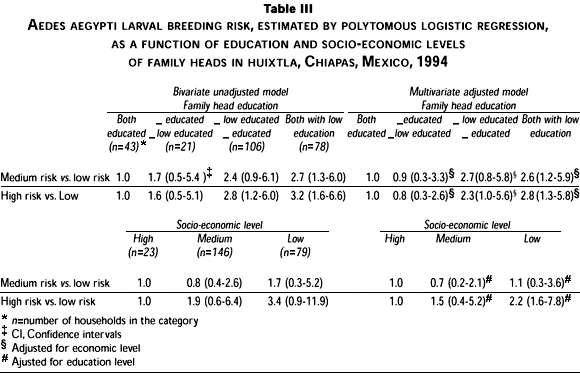
<body><![CDATA[<P align="left">     <font size="3">     We used the Maya index (MI) to estimate  larval breeding risk.<SUP>4</SUP> Briefly, this index was constructed  for each household using two indicators: the Breeding  Risk Indicator (BRI) and the Hygiene Risk Indicator  (HRI). Both indicators were categorized as high, medium  and low according to tertiles distribution. To construct  the Maya index, both, BRI and HRI values of each  household, were plotted in a 3 x 3 matrix where high  <I>Ae. aegypti</I> larval breeding risks categories  corresponded to: BRI3/HRI3, BRI3/HRI2 and BRI2/HRI3,  medium breeding risks were: BRI1/HRI3, BRI2/HRI2,  BRI3/HRI1, and low breeding risks were: BRI1/HRI1, BRI2/HRI1 and BRI1/HRI2. The BRI was obtained  by dividing the number of controllable containers in  the house by the mean number of <I>Ae. aegypti</I>  larvae-positive controllable containers per house among the  surveyed households in the community. The HRI was obtained by dividing the number of disposable  containers by the mean number of <I>Ae.  aegypti</I> larvae-positive disposable containers per house among  the surveyed households in the community.</font>     <P align="left">     <font size="3">     The socio-economic level of each household  was estimated from the following characteristics: type  of floor, walls and roof, and water  supply.<SUP>5</SUP> A socio-economic index was constructed, including low,  medium and high levels according to the household's  percentil distribution. An exploratory analysis was  conducted on each variable to obtain simple frequencies and  histograms. Due to the non-normal distribution of the  two indicators BRI and HRI, Spearman's correlations  were calculated for the number of total containers  per household and the number of positive  containers per household. After documenting significant  correlations between the BRI and HRI indicators among  the households surveyed, these indicators were used to  investigate the probability of the presence of <I>Ae.  aegypti</I> positive containers per household. This probability  was obtained by dividing the proportion of positive  households classified as corresponding to high and  medium BRI or HRI category by the proportion of BRI or  HRI low category households. To assess the  relationship between demographic factors and the risk of  having positive larval habitats we used a polytomous  logistic regression model. This statistical procedure can be  used as an extension of the logistic regression model for  a response variable with three categories. The  covariate coefficients are interpreted as odds ratios, as they  estimate the change in the log odds of having a  medium or high Maya index value by unit change in the  independent variable. All analyses were conducted  using the STATA statistical package.</font>     <P align="left">&nbsp;     <P align="center"><font size="4">Results</font>     <P align="left"><font size="3">A total of 1 965 containers with potentiality for  larval breeding were identified in the 248 houses  surveyed, corresponding to a mean of 7.9 containers per  household. Of these, 44.6% were controllable (10.1% of  these had <I>Ae. aegypti</I> larvae), and 55.4% were disposable  ones (19.1% of these had <I>Ae. aegypti </I>larvae) (<a href="#tab01">Table I</a>).  More than 50% of controllable containers were buckets;  metal drums, plastic containers and tubs contributed  with 5.61% each one. Tires represented 30.7% and cans  21.6% of all disposable containers. Regarding  entomological and larval breeding indexes, the proportion of  houses with low, medium and high MI category were  0.44 (n=109), 0.24 (n=59) and 0.32 (n=80),  respectively. Spearman's correlations against number of total  containers and the number of positive containers  per household resulted in a positive correlation for  controllable and discarded containers (<I>r</I>= 0.40,  <I>p</I>&lt; 0.0001 for BRI, and <I>r</I>= 0.54,  <I>p</I>&lt; 0.0001 for HRI).</font>     <P align="left"><a name="tab01"></a>     <P align="left">&nbsp;     <p align="center"><img src="/img/revistas/spm/v44n3/a07tab01.gif"></p>     <P align="left">&nbsp;     <P align="left">     <font size="3">     Houses with high and medium BRI levels were  32 (<I>p</I>&lt; 0.01) and 8.0 (NS) times more likely to have  <I>Ae. aegypti</I> positive containers than houses of low BRI  level. Similarly, high and medium HRI level houses  were 58 and 12 times more likely to have positive  containers than those of low HRI level (<a href="#tab02">Table II</a>).</font>     ]]></body>
<body><![CDATA[<P align="left">     <a name="tab02"></a>     <P align="left">&nbsp;          <p align="center"><img src="/img/revistas/spm/v44n3/a07tab02.gif"></p>     <P align="left">&nbsp;          <P align="left">     <font size="3">     Twenty-three households corresponded to  high, 146 to medium and 79 to low socio-economic  category levels. Low socio-economic level households were  two times more likely to be included in the medium  MI and three times more likely to be included in the  high MI categories than in the lower MI (<I>OR</I>= 1.95, 95%  CI 0.6-6.4 and <I>OR</I>= 3.45, 95% CI 0.9-11.9,  respectively). Also, medium socio-economic level households  were 1.7 more likely to be included in the high MI  categories than in the low MI (<I>OR</I>= 1.7, 95% CI 0.3-5.2).  After adjusting for the education level of family heads,  the multivariate model indicated that low economic  level households were 1.5 more likely to be included in  the medium MI and 2.2 more likely to be included in  high MI categories than in the lower MI (<I>OR</I> = 1.5, 95% CI 0.4-5.2 and <I>OR</I>= 2.2, 95% CI 1.6-7.8, respectively).  On the other hand, medium economic level  households were 1.1 more likely to be included in the high MI  category than in the low MI (<I>OR</I>= 1.11, 95% CI  0.34-3.6). The analysis of education level of household  family heads and the frequency and abundance of  <I>Ae. aegypti</I> larval habitats, showed that in 43 out of 248  households included in the study, both male and  female household family heads had completed  primary school (17.3%); in 78 both family heads did not  complete primary school (31.4%), in 106 the male  completed primary school but not the female (42.7%), and  in 21 the female completed primary school but not  the male (8.4%).</font>     <P align="left">     <font size="3">     The results of the bivariate analysis are  presented in Table III. Households where the mother did not  complete primary school were two times more likely to  be included in the category of medium MI and three  times </font><font size="3"> times more likely to be included in the high MI than  in the lower MI category (OR= 2.7, 95% CI 1.3-6.0  and OR= 3.2, 95% CI 1.6-6.6, respectively). Households  were only the male family head completed  elementary school were almost three times more likely to be  included in the high MI category (<I>OR</I>= 2.4, 95% CI  0.9-6.1 and <I>OR</I>= 2.8, 95% CI 1.2-6.0, respectively).  Although the analysis indicated that households where only  the female had completed primary school were 1.6 and  1.7 times more likely to be included in medium and  high MI categories, this was not statistically  significant. When adjusted for household economic level in  the multivariate polytomous regression analysis,  these observations remained unchanged (<a href="#tab03">Table III</a>).  This analysis indicated that households where only  females completed primary school were not more likely to  be included within the medium and high MI  categories (<I>OR</I>= 0.9, 95% CI 0.3-3.3 and  <I>OR</I>= 0.8. 95% CI 0.3-2.6, respectively).</font>     <P align="left">     <a name="tab03"></a>     <P align="left">&nbsp;          <p align="center"><img src="/img/revistas/spm/v44n3/a07tab03.gif"></p>     <P align="left">&nbsp;          ]]></body>
<body><![CDATA[<P align="center"><font size="4">Discussion</font>     <P align="left"><font size="3"><I>Aedes aegypti</I> is well adapted to domestic and  peri-domestic environments where larval breeding occurs  in almost any exposed recipient containing  water.<SUP>6-19</SUP> Larval breeding also occurs in containers specifically  used for water storage, a condition facilitated by the lack  of proper water supply. Accordingly, in this study  <I>Ae. Aegypti</I> larval breeding in households was  represented by both controllable and disposable containers,  as documented in other dengue endemic  areas.<SUP>10-13</SUP> The contribution of controllable containers to larval  breeding was high, but larval breeding in disposable  containers was higher (an estimated 70% of total  larval production) similar to that reported  elsewhere.<SUP>1</SUP> </font>     <P align="left">     <font size="3">     As larval breeding sites increase in houses  that accumulate refuse, including discarded  containers,<SUP>13-15</SUP> dengue transmission by  <I>Ae. aegypti</I> has been associated to poor hygienic conditions, which in turn may be  associated to low socioeconomic levels and to low  schooling of the house dwellers.<SUP>16</SUP> The data presented  here indicate that the risk of dengue transmission,  estimated by MI (an estimation of the larval breeding risk  in relation to hygiene levels), is higher in households  of low socioeconomic level, similar to the situation  reported in other areas.<SUP>13</SUP> A correlation between low  socioeconomic and schooling levels has also been  reported.<SUP>1,13</SUP> To our knowledge, this is the first report dealing  with the association of low schooling with the presence  of dengue breeding sites. Additionally, a more  important effect of the education level of the female family  head was documented.</font>     <P align="left">     <font size="3">     Several indexes have been instrumental to  estimating dengue transmission risk, including the  traditional house, recipient, and Breteau  indexes.<SUP>17</SUP> However, these indexes are indicative of the global  transmission risk in the community. Within a community, not  all houses have the same potential for larval breeding,  and the identification of those houses likely to have  high larval production is important to better direct  control activities. The Maya index has been successfully  used to estimate <I>Ae. aegypt</I>i larval breeding in dengue  endemic areas.<SUP>4</SUP> The classification of potencial  breeding sites in controllable and disposable materials  incorporates a domestic hygiene index witthing the  MI. Furthermore, this indicator was a predictive  element in the breeding risk matrix constructed (Maya  index), and indicated that the likelihood of the presence of  <I>Ae. Aegypti</I> larvae in high and medium HRI houses  was 32 and 8-fold than in houses with low HRI.</font>      <P align="left">     <font size="3">     The analysis of the effect of schooling in  adult house dwellers, represented by male and  female family heads, indicated that low education levels  are associated to higher MI. But more important, if at  least one of the family heads has completed primary  school, medium and high MI occur when the housewife is  the uneducated partner. Higher MI was also associated  to low socioeconomic household levels. As low  schooling is common in precarious socioeconomic  conditions, an adjustment was necessary to better  estimate the effect of schooling. In a multiple polytomous  regression analysis, after adjusting for  socioeconomic conditions, the association of medium to high MI  and low schooling persisted, for both family heads or  the housewife only.</font>     <P align="left">     <font size="3">     A limited number of epidemiological studies  on infectious diseases in relation to gender issues are  available.<SUP>18</SUP> These studies indicate the importance of  gender-related activities on women's susceptibility to  the infection and their participation on control  activities. Thus, in Egypt, low-educated and economically  dependent women had little knowledge on malaria  and schistosomiasis and less access to information and  preventive measures.<SUP> 18</SUP> In Bolivia, although most  women are familiar with triatomine bugs inside their  houses, low-educated women are less likely to identify  these insects as Chagas disease  vectors.<SUP>19</SUP> Similar attitudes were observed in our study; although  housewives knew of the presence of <I>Ae.  aegypti</I> larvae in their houses, they were unaware of their potentiality as  biting mosquitoes, and less of their potentiality as  dengue vectors. Also, in Kenya, the usage of  insecticide-impregnated bednets was significantly related to  the mothers' educational level,<SUP>20</SUP> and a comprehensive  review of the literature noted that worldwide, for  each year of mother schooling a decrement of 7-9% in  childhood mortality rate was  documented.<SUP>21</SUP> These studies highlight the role of women in disease prevention  and the need of their education.</font>     <P align="left">     <font size="3">     Cultural conventions imposing different  social roles on men and women are determinant for their  different exposure to vector-borne diseases. Thus, in  India, the risk of malaria infection in men is  determined by their exposure in working settings outside  their home, while women, having the responsibility of  the house chores, are exposed in or nearby household  compounds.<SUP>3, 22</SUP> This social structure may certainly be  responsible for a more important participation of  women in disease control activities within their  households. Women contribution to the community welfare  should be addressed using a holistic approach, in which  along with the recognition of the social conventions  determining their role in family care, their special  needs and direct participation in environmental keeping  are fully recognized and properly promoted.</font>      <P align="left">     <font size="3">     The results of the present study suggest that  dengue control in southern Mexico could benefit with  the participation of female family heads in eliminating  larval breeding. As gender roles are difficult to  change by direct outside interventions, they also indicate  that the best strategy for this purpose could be  educational campaigns especially directed to this sector of the  population.</font>     <p align="left">&nbsp;     <p align="center"><font size="4"> Acknowledgments</font></p>     ]]></body>
<body><![CDATA[<P align="left"><font size="3">We thank technicians Ren&eacute; Monz&oacute;n-Vera, Luis  Dom&iacute;nguez-Sibaja, Crecencio D&iacute;az-Espinoza,  Amilcar Z&uacute;&ntilde;iga-Ambrocy, Jos&eacute; Luis Espinoza, and  Francisco Maldonado-V&aacute;zquez for their assistance in field work.</font>     <P align="left">&nbsp;     <P align="center"><font size="4">References</font>     <!-- ref --><P align="left"><font size="3">1. Lloyd L, Winch P, Ortega-Canto J, Kendall C. Results of a  community-based <I>Aedes aegypti</I> control program in Merida, Yucatan, Mexico. Am J  Trop Med Hyg 1992;46:635-642.</font>    &nbsp;&nbsp;&nbsp;&nbsp;&nbsp;&nbsp;&nbsp;&nbsp;[&#160;<a href="javascript:void(0);" onclick="javascript: window.open('/scielo.php?script=sci_nlinks&ref=9211038&pid=S0036-3634200200030000700001&lng=','','width=640,height=500,resizable=yes,scrollbars=1,menubar=yes,');">Links</a>&#160;]<!-- end-ref --><!-- ref --><P align="left"><font size="3">2. Tidwell MA, Williams DC, Carvalho-Tidwell T, Pe&ntilde;a CJ, Gwinn TA,  Focks DA <I>et al</I>. Baseline data on  <I>Aedes</I> <I>aegypti</I> populations in Santo  Domingo, Dominican Republic. J Am Mosq Control Assoc 1990;6:514-522.</font>    &nbsp;&nbsp;&nbsp;&nbsp;&nbsp;&nbsp;&nbsp;&nbsp;[&#160;<a href="javascript:void(0);" onclick="javascript: window.open('/scielo.php?script=sci_nlinks&ref=9211039&pid=S0036-3634200200030000700002&lng=','','width=640,height=500,resizable=yes,scrollbars=1,menubar=yes,');">Links</a>&#160;]<!-- end-ref --><!-- ref --><P align="left"><font size="3">3. Rathgeber EH, Vlassoff C. Gender and tropical diseases: A new  research focus. Soc Sci Med 1993;37:513-520.</font>    &nbsp;&nbsp;&nbsp;&nbsp;&nbsp;&nbsp;&nbsp;&nbsp;[&#160;<a href="javascript:void(0);" onclick="javascript: window.open('/scielo.php?script=sci_nlinks&ref=9211040&pid=S0036-3634200200030000700003&lng=','','width=640,height=500,resizable=yes,scrollbars=1,menubar=yes,');">Links</a>&#160;]<!-- end-ref --><!-- ref --><P align="left"><font size="3">4. Miller JE, Mart&iacute;nez-Balanzar A, Gazga-Salinas D. Where  <I>Aedes</I> <I>aegypti</I> live in Guerrero; using the Maya index to measure breeding risk. En:  Halstead SB, G&oacute;mez-Dant&eacute;s H. ed. Dengue: A worldwide problem, a  common strategy. M&eacute;xico, D.F.: Ministry of Health, Mexico, and  Rockefeller Foundation, 1992:311-317.</font>    &nbsp;&nbsp;&nbsp;&nbsp;&nbsp;&nbsp;&nbsp;&nbsp;[&#160;<a href="javascript:void(0);" onclick="javascript: window.open('/scielo.php?script=sci_nlinks&ref=9211041&pid=S0036-3634200200030000700004&lng=','','width=640,height=500,resizable=yes,scrollbars=1,menubar=yes,');">Links</a>&#160;]<!-- end-ref --><!-- ref --><P align="left"><font size="3">5. Bronfman M, Guiscafr&eacute; H, Castro V, Castro R, Guti&eacute;rrez G.  Strategies for improving the therapeutic patterns used in acute diarrhea in  primary medical care units. II. The measurement of inequality: A  methodologic strategy analysis of the socioeconomic features of the sample. Arch  Invest Med 1988;19:351-360.</font>    &nbsp;&nbsp;&nbsp;&nbsp;&nbsp;&nbsp;&nbsp;&nbsp;[&#160;<a href="javascript:void(0);" onclick="javascript: window.open('/scielo.php?script=sci_nlinks&ref=9211042&pid=S0036-3634200200030000700005&lng=','','width=640,height=500,resizable=yes,scrollbars=1,menubar=yes,');">Links</a>&#160;]<!-- end-ref --><!-- ref --><P align="left"><font size="3">6. Moore-Chester G, Cline-Barnett L, Ruiz-Tiben E, Lee D,  Romney-Jiseph H, Rivera-Correa E. <I>Aedes  aegypti</I> in Puerto Rico: Environmental determinants of larval abundance and relation to dengue  virus transmission. Am J Trop Med Hyg 1978 27:1225-1231.</font>    &nbsp;&nbsp;&nbsp;&nbsp;&nbsp;&nbsp;&nbsp;&nbsp;[&#160;<a href="javascript:void(0);" onclick="javascript: window.open('/scielo.php?script=sci_nlinks&ref=9211043&pid=S0036-3634200200030000700006&lng=','','width=640,height=500,resizable=yes,scrollbars=1,menubar=yes,');">Links</a>&#160;]<!-- end-ref --><!-- ref --><P align="left"><font size="3">7. Slosek J. <I>Aedes aegypti</I> mosquitoes in the Americas: A review of  their interaction with the human population. Soc Sci Med 1986;23:249-252.</font>    &nbsp;&nbsp;&nbsp;&nbsp;&nbsp;&nbsp;&nbsp;&nbsp;[&#160;<a href="javascript:void(0);" onclick="javascript: window.open('/scielo.php?script=sci_nlinks&ref=9211044&pid=S0036-3634200200030000700007&lng=','','width=640,height=500,resizable=yes,scrollbars=1,menubar=yes,');">Links</a>&#160;]<!-- end-ref --><!-- ref --><P align="left"><font size="3">8. Kuno G. Review of the factors modulating dengue  transmission. Epidemiol Rev 1995;17:321-335.</font>    &nbsp;&nbsp;&nbsp;&nbsp;&nbsp;&nbsp;&nbsp;&nbsp;[&#160;<a href="javascript:void(0);" onclick="javascript: window.open('/scielo.php?script=sci_nlinks&ref=9211045&pid=S0036-3634200200030000700008&lng=','','width=640,height=500,resizable=yes,scrollbars=1,menubar=yes,');">Links</a>&#160;]<!-- end-ref --><!-- ref --><P align="left"><font size="3">9. Tun-Lin W, Kay BH, Barnes A. The premise condition index: A  tool for streamlining surveys of <I>Aedes  aegypti</I>. Am J Trop Med Hyg 1995;53: 591-594.</font>    &nbsp;&nbsp;&nbsp;&nbsp;&nbsp;&nbsp;&nbsp;&nbsp;[&#160;<a href="javascript:void(0);" onclick="javascript: window.open('/scielo.php?script=sci_nlinks&ref=9211046&pid=S0036-3634200200030000700009&lng=','','width=640,height=500,resizable=yes,scrollbars=1,menubar=yes,');">Links</a>&#160;]<!-- end-ref --><!-- ref --><P align="left"><font size="3">10. Focks DA, Sackett SR, Bailey DL, Dame DA. Observations  on container-breeding mosquitoes in New Orleans, Louisiana, with  an estimate of the populations density of <I>Aedes  aegypti</I> (L.) Am J Trop Med Hyg 1981;30:1329-1335.</font>    &nbsp;&nbsp;&nbsp;&nbsp;&nbsp;&nbsp;&nbsp;&nbsp;[&#160;<a href="javascript:void(0);" onclick="javascript: window.open('/scielo.php?script=sci_nlinks&ref=9211047&pid=S0036-3634200200030000700010&lng=','','width=640,height=500,resizable=yes,scrollbars=1,menubar=yes,');">Links</a>&#160;]<!-- end-ref --><!-- ref --><P align="left"><font size="3">11. Samarawickrema WA, Sone F, Kimura E, Self LS, Cummings RF,  Paulson GS. The relative importance and distribution of  <I>Aedes polynesiensis</I> and <I>Aedes  aegypti</I> larval habitats in Samoa. Med Vet Entomol 1993;7:27-36.</font>    &nbsp;&nbsp;&nbsp;&nbsp;&nbsp;&nbsp;&nbsp;&nbsp;[&#160;<a href="javascript:void(0);" onclick="javascript: window.open('/scielo.php?script=sci_nlinks&ref=9211048&pid=S0036-3634200200030000700011&lng=','','width=640,height=500,resizable=yes,scrollbars=1,menubar=yes,');">Links</a>&#160;]<!-- end-ref --><!-- ref --><P align="left"><font size="3">12. Nathan MB. Critical review of <I>Aedes  aegypti</I> control programs in the Caribbean and selected neighboring countries. J Am Mosq Control  Assoc 1993;9:1-7.</font>    &nbsp;&nbsp;&nbsp;&nbsp;&nbsp;&nbsp;&nbsp;&nbsp;[&#160;<a href="javascript:void(0);" onclick="javascript: window.open('/scielo.php?script=sci_nlinks&ref=9211049&pid=S0036-3634200200030000700012&lng=','','width=640,height=500,resizable=yes,scrollbars=1,menubar=yes,');">Links</a>&#160;]<!-- end-ref --><!-- ref --><P align="left"><font size="3">13. Barrera R, Avila J, Gonz&aacute;lez-T&eacute;llez S. Unreliable supply of potable  water and elevated <I>Aedes aegypti</I> larval indices; a causal relationship. J Am  Mosq Control Assoc 1993;9:189-195.</font>    &nbsp;&nbsp;&nbsp;&nbsp;&nbsp;&nbsp;&nbsp;&nbsp;[&#160;<a href="javascript:void(0);" onclick="javascript: window.open('/scielo.php?script=sci_nlinks&ref=9211050&pid=S0036-3634200200030000700013&lng=','','width=640,height=500,resizable=yes,scrollbars=1,menubar=yes,');">Links</a>&#160;]<!-- end-ref --><!-- ref --><P align="left"><font size="3">14. Ko YC, Chen MJ, Yeh SM. The predisposing and protective factors  against dengue virus transmission by mosquito vector. Am J Epidemiol  1992; 136:214-220.</font>    &nbsp;&nbsp;&nbsp;&nbsp;&nbsp;&nbsp;&nbsp;&nbsp;[&#160;<a href="javascript:void(0);" onclick="javascript: window.open('/scielo.php?script=sci_nlinks&ref=9211051&pid=S0036-3634200200030000700014&lng=','','width=640,height=500,resizable=yes,scrollbars=1,menubar=yes,');">Links</a>&#160;]<!-- end-ref --><!-- ref --><P align="left"><font size="3">15. Fern&aacute;ndez-Salas I, Flores-Leal A. El papel del  <I>Aedes aegypti</I> en la epidemiolog&iacute;a del dengue en M&eacute;xico. Salud Publica Mex (Supl)  1995;37: 545-552.</font>    &nbsp;&nbsp;&nbsp;&nbsp;&nbsp;&nbsp;&nbsp;&nbsp;[&#160;<a href="javascript:void(0);" onclick="javascript: window.open('/scielo.php?script=sci_nlinks&ref=9211052&pid=S0036-3634200200030000700015&lng=','','width=640,height=500,resizable=yes,scrollbars=1,menubar=yes,');">Links</a>&#160;]<!-- end-ref --><!-- ref --><P align="left"><font size="3">16. Rodr&iacute;guez-Figueroa L, Rigau-P&eacute;rez JG, Su&aacute;rez EL, Reiter P. Risk  factors for dengue infection during an outbreak in Yanes, Puerto Rico, in 1991.  Am J Trop Med Hyg 1995;52:496-502.</font>    &nbsp;&nbsp;&nbsp;&nbsp;&nbsp;&nbsp;&nbsp;&nbsp;[&#160;<a href="javascript:void(0);" onclick="javascript: window.open('/scielo.php?script=sci_nlinks&ref=9211053&pid=S0036-3634200200030000700016&lng=','','width=640,height=500,resizable=yes,scrollbars=1,menubar=yes,');">Links</a>&#160;]<!-- end-ref --><!-- ref --><P align="left"><font size="3">17. Breteau H. La fievre jaune en Afrique Accidentale Francaise. Un  aspect de la medicine preventive massive. Bull World Health Organ  1954;11: 453-481.</font>    &nbsp;&nbsp;&nbsp;&nbsp;&nbsp;&nbsp;&nbsp;&nbsp;[&#160;<a href="javascript:void(0);" onclick="javascript: window.open('/scielo.php?script=sci_nlinks&ref=9211054&pid=S0036-3634200200030000700017&lng=','','width=640,height=500,resizable=yes,scrollbars=1,menubar=yes,');">Links</a>&#160;]<!-- end-ref --><!-- ref --><P align="left"><font size="3">18. Vlassoff C, Bonilla E. Gender-related differences in the impact of  tropical diseases on women: What do we know? J Biosoc Sci 1994;26:37-53.</font>    &nbsp;&nbsp;&nbsp;&nbsp;&nbsp;&nbsp;&nbsp;&nbsp;[&#160;<a href="javascript:void(0);" onclick="javascript: window.open('/scielo.php?script=sci_nlinks&ref=9211055&pid=S0036-3634200200030000700018&lng=','','width=640,height=500,resizable=yes,scrollbars=1,menubar=yes,');">Links</a>&#160;]<!-- end-ref --><!-- ref --><P align="left"><font size="3">19. Weinke TH, Veberreiter K, Alexander M. Cardiac morbidity due  to Chagas disease in a rural community in Bolivia. Epidemiol  Infect 1988;101:655-660.</font>    &nbsp;&nbsp;&nbsp;&nbsp;&nbsp;&nbsp;&nbsp;&nbsp;[&#160;<a href="javascript:void(0);" onclick="javascript: window.open('/scielo.php?script=sci_nlinks&ref=9211056&pid=S0036-3634200200030000700019&lng=','','width=640,height=500,resizable=yes,scrollbars=1,menubar=yes,');">Links</a>&#160;]<!-- end-ref --><!-- ref --><P align="left"><font size="3">20. Marsh VM, Mutemi W, Some ES, Haaland A, Snow RW. Evaluating  the community education programme of an insecticide-treated bednet  trial on the Kenyan coast. Health Policy Plann 1996;11:280.</font>    &nbsp;&nbsp;&nbsp;&nbsp;&nbsp;&nbsp;&nbsp;&nbsp;[&#160;<a href="javascript:void(0);" onclick="javascript: window.open('/scielo.php?script=sci_nlinks&ref=9211057&pid=S0036-3634200200030000700020&lng=','','width=640,height=500,resizable=yes,scrollbars=1,menubar=yes,');">Links</a>&#160;]<!-- end-ref --><!-- ref --><P align="left"><font size="3">21. Cleland J, Ven Ginneken JK. Maternal education and child survival  in developing countries: The search for pathways of influence. Soc Sci  Med 1988;27:1357.</font>    &nbsp;&nbsp;&nbsp;&nbsp;&nbsp;&nbsp;&nbsp;&nbsp;[&#160;<a href="javascript:void(0);" onclick="javascript: window.open('/scielo.php?script=sci_nlinks&ref=9211058&pid=S0036-3634200200030000700021&lng=','','width=640,height=500,resizable=yes,scrollbars=1,menubar=yes,');">Links</a>&#160;]<!-- end-ref --><!-- ref --><P align="left"><font size="3">22. Reuben R, Panicker KN. A study of human behaviour influencing  man-mosquito contact and of biting activity on children in a south Indian  village community. Ind J Med Res 1979;70:723-729.</font>    &nbsp;&nbsp;&nbsp;&nbsp;&nbsp;&nbsp;&nbsp;&nbsp;[&#160;<a href="javascript:void(0);" onclick="javascript: window.open('/scielo.php?script=sci_nlinks&ref=9211059&pid=S0036-3634200200030000700022&lng=','','width=640,height=500,resizable=yes,scrollbars=1,menubar=yes,');">Links</a>&#160;]<!-- end-ref --><P align="left">&nbsp;      <P align="left">&nbsp;     <p align="left"><font size="3"> This work was financially supported by the Ministry of Health of Mexico.</font>     <P align="left"><font size="3"><a name="nota"></a>(<a href="#texto">1</a>)     Centro de Investigaci&oacute;n de Paludismo, Instituto Nacional de Salud P&uacute;blica, Tapachula, Chiapas, M&eacute;xico.</font>     <P align="left"><font size="3">(<a href="#texto">2</a>)     Centro de Investigaci&oacute;n sobre Enfermedades Infecciosas, Instituto Nacional de Salud P&uacute;blica, Cuernavaca, Morelos, M&eacute;xico.</font>       ]]></body>
<body><![CDATA[<P align="left"><font size="3">(<a href="#texto">3</a>)     Centro de Investigaci&oacute;n en Salud Poblacional, Instituto Nacional de Salud P&uacute;blica, Cuernavaca, Morelos, M&eacute;xico.</font>     <P align="left">&nbsp;     <P align="center"><font size="3"><B>Received on</B>: July 3, 2001 <font FACE="Symbol">·</font> <B>Accepted  on</B>: November 9, 2001    <br> Address requests reprints to: Mario H Rodr&iacute;guez, Centro de Investigaci&oacute;n sobre Enfermedades Infecciosas, Instituto Nacional de Salud P&uacute;blica,   Avenida Universidad 655, Col. Santa Mar&iacute;a Ahuacatitl&aacute;n, 62508, Cuernavaca, Morelos, M&eacute;xico.    <br> E-mail: <a href="mailto:mhenry@insp3.insp.mx"> mhenry@insp3.insp.mx</a></font>      ]]></body><back>
<ref-list>
<ref id="B1">
<label>1</label><nlm-citation citation-type="journal">
<person-group person-group-type="author">
<name>
<surname><![CDATA[Lloyd]]></surname>
<given-names><![CDATA[L]]></given-names>
</name>
<name>
<surname><![CDATA[Winch]]></surname>
<given-names><![CDATA[P]]></given-names>
</name>
<name>
<surname><![CDATA[Ortega-Canto]]></surname>
<given-names><![CDATA[J]]></given-names>
</name>
<name>
<surname><![CDATA[Kendall]]></surname>
<given-names><![CDATA[C]]></given-names>
</name>
</person-group>
<article-title xml:lang="en"><![CDATA[Results of a community-based Aedes aegypti control program in Merida, Yucatan, Mexico]]></article-title>
<source><![CDATA[Am J Trop Med Hyg]]></source>
<year>1992</year>
<volume>46</volume>
<page-range>635-642</page-range></nlm-citation>
</ref>
<ref id="B2">
<label>2</label><nlm-citation citation-type="journal">
<person-group person-group-type="author">
<name>
<surname><![CDATA[Tidwell]]></surname>
<given-names><![CDATA[MA]]></given-names>
</name>
<name>
<surname><![CDATA[Williams]]></surname>
<given-names><![CDATA[DC]]></given-names>
</name>
<name>
<surname><![CDATA[Carvalho-Tidwell]]></surname>
<given-names><![CDATA[T]]></given-names>
</name>
<name>
<surname><![CDATA[Peña]]></surname>
<given-names><![CDATA[CJ]]></given-names>
</name>
<name>
<surname><![CDATA[Gwinn]]></surname>
<given-names><![CDATA[TA]]></given-names>
</name>
<name>
<surname><![CDATA[Focks]]></surname>
<given-names><![CDATA[DA]]></given-names>
</name>
</person-group>
<article-title xml:lang="en"><![CDATA[Baseline data on Aedes aegypti populations in Santo Domingo, Dominican Republic]]></article-title>
<source><![CDATA[J Am Mosq Control Assoc]]></source>
<year>1990</year>
<volume>6</volume>
<page-range>514-522</page-range></nlm-citation>
</ref>
<ref id="B3">
<label>3</label><nlm-citation citation-type="journal">
<person-group person-group-type="author">
<name>
<surname><![CDATA[Rathgeber]]></surname>
<given-names><![CDATA[EH]]></given-names>
</name>
<name>
<surname><![CDATA[Vlassoff]]></surname>
<given-names><![CDATA[C]]></given-names>
</name>
</person-group>
<article-title xml:lang="en"><![CDATA[Gender and tropical diseases: A new research focus]]></article-title>
<source><![CDATA[Soc Sci Med]]></source>
<year>1993</year>
<volume>37</volume>
<page-range>513-520</page-range></nlm-citation>
</ref>
<ref id="B4">
<label>4</label><nlm-citation citation-type="book">
<person-group person-group-type="author">
<name>
<surname><![CDATA[Miller]]></surname>
<given-names><![CDATA[JE]]></given-names>
</name>
<name>
<surname><![CDATA[Martínez-Balanzar]]></surname>
<given-names><![CDATA[A]]></given-names>
</name>
<name>
<surname><![CDATA[Gazga-Salinas]]></surname>
<given-names><![CDATA[D]]></given-names>
</name>
</person-group>
<article-title xml:lang="en"><![CDATA[Where Aedes aegypti live in Guerrero; using the Maya index to measure breeding risk]]></article-title>
<person-group person-group-type="editor">
<name>
<surname><![CDATA[Halstead]]></surname>
<given-names><![CDATA[SB]]></given-names>
</name>
<name>
<surname><![CDATA[Gómez-Dantés]]></surname>
<given-names><![CDATA[H]]></given-names>
</name>
</person-group>
<source><![CDATA[Dengue: A worldwide problem, a common strategy]]></source>
<year>1992</year>
<page-range>311-317</page-range><publisher-loc><![CDATA[México^eD.F. D.F.]]></publisher-loc>
<publisher-name><![CDATA[Ministry of Health, Mexico, and Rockefeller Foundation]]></publisher-name>
</nlm-citation>
</ref>
<ref id="B5">
<label>5</label><nlm-citation citation-type="journal">
<person-group person-group-type="author">
<name>
<surname><![CDATA[Bronfman]]></surname>
<given-names><![CDATA[M]]></given-names>
</name>
<name>
<surname><![CDATA[Guiscafré]]></surname>
<given-names><![CDATA[H]]></given-names>
</name>
<name>
<surname><![CDATA[Castro]]></surname>
<given-names><![CDATA[V]]></given-names>
</name>
<name>
<surname><![CDATA[Castro]]></surname>
<given-names><![CDATA[R]]></given-names>
</name>
<name>
<surname><![CDATA[Gutiérrez]]></surname>
<given-names><![CDATA[G]]></given-names>
</name>
</person-group>
<article-title xml:lang="en"><![CDATA[Strategies for improving the therapeutic patterns used in acute diarrhea in primary medical care units. II. The measurement of inequality: A methodologic strategy analysis of the socioeconomic features of the sample]]></article-title>
<source><![CDATA[Arch Invest Med]]></source>
<year>1988</year>
<volume>19</volume>
<page-range>351-360</page-range></nlm-citation>
</ref>
<ref id="B6">
<label>6</label><nlm-citation citation-type="journal">
<person-group person-group-type="author">
<name>
<surname><![CDATA[Moore-Chester]]></surname>
<given-names><![CDATA[G]]></given-names>
</name>
<name>
<surname><![CDATA[Cline-Barnett]]></surname>
<given-names><![CDATA[L]]></given-names>
</name>
<name>
<surname><![CDATA[Ruiz-Tiben]]></surname>
<given-names><![CDATA[E]]></given-names>
</name>
<name>
<surname><![CDATA[Lee]]></surname>
<given-names><![CDATA[D]]></given-names>
</name>
<name>
<surname><![CDATA[Romney-Jiseph]]></surname>
<given-names><![CDATA[H]]></given-names>
</name>
<name>
<surname><![CDATA[Rivera-Correa]]></surname>
<given-names><![CDATA[E]]></given-names>
</name>
</person-group>
<article-title xml:lang="en"><![CDATA[Aedes aegypti in Puerto Rico: Environmental determinants of larval abundance and relation to dengue virus transmission]]></article-title>
<source><![CDATA[Am J Trop Med Hyg]]></source>
<year>1978</year>
<volume>27</volume>
<page-range>1225-1231</page-range></nlm-citation>
</ref>
<ref id="B7">
<label>7</label><nlm-citation citation-type="journal">
<person-group person-group-type="author">
<name>
<surname><![CDATA[Slosek]]></surname>
<given-names><![CDATA[J]]></given-names>
</name>
</person-group>
<article-title xml:lang="en"><![CDATA[Aedes aegypti mosquitoes in the Americas: A review of their interaction with the human population]]></article-title>
<source><![CDATA[Soc Sci Med]]></source>
<year>1986</year>
<volume>23</volume>
<page-range>249-252</page-range></nlm-citation>
</ref>
<ref id="B8">
<label>8</label><nlm-citation citation-type="journal">
<person-group person-group-type="author">
<name>
<surname><![CDATA[Kuno]]></surname>
<given-names><![CDATA[G]]></given-names>
</name>
</person-group>
<article-title xml:lang="en"><![CDATA[Review of the factors modulating dengue transmission]]></article-title>
<source><![CDATA[Epidemiol Rev]]></source>
<year>1995</year>
<volume>17</volume>
<page-range>321-335</page-range></nlm-citation>
</ref>
<ref id="B9">
<label>9</label><nlm-citation citation-type="journal">
<person-group person-group-type="author">
<name>
<surname><![CDATA[Tun-Lin]]></surname>
<given-names><![CDATA[W]]></given-names>
</name>
<name>
<surname><![CDATA[Kay]]></surname>
<given-names><![CDATA[BH]]></given-names>
</name>
<name>
<surname><![CDATA[Barnes]]></surname>
<given-names><![CDATA[A]]></given-names>
</name>
</person-group>
<article-title xml:lang="en"><![CDATA[The premise condition index: A tool for streamlining surveys of Aedes aegypti]]></article-title>
<source><![CDATA[Am J Trop Med Hyg]]></source>
<year>1995</year>
<volume>53</volume>
<page-range>591-594</page-range></nlm-citation>
</ref>
<ref id="B10">
<label>10</label><nlm-citation citation-type="journal">
<person-group person-group-type="author">
<name>
<surname><![CDATA[Focks]]></surname>
<given-names><![CDATA[DA]]></given-names>
</name>
<name>
<surname><![CDATA[Sackett]]></surname>
<given-names><![CDATA[SR]]></given-names>
</name>
<name>
<surname><![CDATA[Bailey]]></surname>
<given-names><![CDATA[DL]]></given-names>
</name>
<name>
<surname><![CDATA[Dame]]></surname>
<given-names><![CDATA[DA]]></given-names>
</name>
</person-group>
<article-title xml:lang="en"><![CDATA[Observations on container-breeding mosquitoes in New Orleans, Louisiana, with an estimate of the populations density of Aedes aegypti (L. )]]></article-title>
<source><![CDATA[Am J Trop Med Hyg]]></source>
<year>1981</year>
<volume>30</volume>
<page-range>1329-1335</page-range></nlm-citation>
</ref>
<ref id="B11">
<label>11</label><nlm-citation citation-type="journal">
<person-group person-group-type="author">
<name>
<surname><![CDATA[Samarawickrema]]></surname>
<given-names><![CDATA[WA]]></given-names>
</name>
<name>
<surname><![CDATA[Sone]]></surname>
<given-names><![CDATA[F]]></given-names>
</name>
<name>
<surname><![CDATA[Kimura]]></surname>
<given-names><![CDATA[E]]></given-names>
</name>
<name>
<surname><![CDATA[Self]]></surname>
<given-names><![CDATA[LS]]></given-names>
</name>
<name>
<surname><![CDATA[Cummings]]></surname>
<given-names><![CDATA[RF]]></given-names>
</name>
<name>
<surname><![CDATA[Paulson]]></surname>
<given-names><![CDATA[GS]]></given-names>
</name>
</person-group>
<article-title xml:lang="en"><![CDATA[The relative importance and distribution of Aedes polynesiensis and Aedes aegypti larval habitats in Samoa]]></article-title>
<source><![CDATA[Med Vet Entomol]]></source>
<year>1993</year>
<volume>7</volume>
<page-range>27-36</page-range></nlm-citation>
</ref>
<ref id="B12">
<label>12</label><nlm-citation citation-type="journal">
<person-group person-group-type="author">
<name>
<surname><![CDATA[Nathan]]></surname>
<given-names><![CDATA[MB]]></given-names>
</name>
</person-group>
<article-title xml:lang="en"><![CDATA[Critical review of Aedes aegypti control programs in the Caribbean and selected neighboring countries]]></article-title>
<source><![CDATA[J Am Mosq Control Assoc]]></source>
<year>1993</year>
<volume>9</volume>
<page-range>1-7</page-range></nlm-citation>
</ref>
<ref id="B13">
<label>13</label><nlm-citation citation-type="journal">
<person-group person-group-type="author">
<name>
<surname><![CDATA[Barrera]]></surname>
<given-names><![CDATA[R]]></given-names>
</name>
<name>
<surname><![CDATA[Avila]]></surname>
<given-names><![CDATA[J]]></given-names>
</name>
<name>
<surname><![CDATA[González-Téllez]]></surname>
<given-names><![CDATA[S]]></given-names>
</name>
</person-group>
<article-title xml:lang="en"><![CDATA[Unreliable supply of potable water and elevated Aedes aegypti larval indices; a causal relationship]]></article-title>
<source><![CDATA[J Am Mosq Control Assoc]]></source>
<year>1993</year>
<volume>9</volume>
<page-range>189-195</page-range></nlm-citation>
</ref>
<ref id="B14">
<label>14</label><nlm-citation citation-type="journal">
<person-group person-group-type="author">
<name>
<surname><![CDATA[Ko]]></surname>
<given-names><![CDATA[YC]]></given-names>
</name>
<name>
<surname><![CDATA[Chen]]></surname>
<given-names><![CDATA[MJ]]></given-names>
</name>
<name>
<surname><![CDATA[Yeh]]></surname>
<given-names><![CDATA[SM]]></given-names>
</name>
</person-group>
<article-title xml:lang="en"><![CDATA[The predisposing and protective factors against dengue virus transmission by mosquito vector]]></article-title>
<source><![CDATA[Am J Epidemiol]]></source>
<year>1992</year>
<volume>136</volume>
<page-range>214-220</page-range></nlm-citation>
</ref>
<ref id="B15">
<label>15</label><nlm-citation citation-type="journal">
<person-group person-group-type="author">
<name>
<surname><![CDATA[Fernández-Salas]]></surname>
<given-names><![CDATA[I]]></given-names>
</name>
<name>
<surname><![CDATA[Flores-Leal]]></surname>
<given-names><![CDATA[A]]></given-names>
</name>
</person-group>
<article-title xml:lang="es"><![CDATA[El papel del Aedes aegypti en la epidemiología del dengue en México]]></article-title>
<source><![CDATA[Salud Publica Mex]]></source>
<year>1995</year>
<volume>37</volume>
<page-range>545-552</page-range></nlm-citation>
</ref>
<ref id="B16">
<label>16</label><nlm-citation citation-type="journal">
<person-group person-group-type="author">
<name>
<surname><![CDATA[Rodríguez-Figueroa]]></surname>
<given-names><![CDATA[L]]></given-names>
</name>
<name>
<surname><![CDATA[Rigau-Pérez]]></surname>
<given-names><![CDATA[JG]]></given-names>
</name>
<name>
<surname><![CDATA[Suárez]]></surname>
<given-names><![CDATA[EL]]></given-names>
</name>
<name>
<surname><![CDATA[Reiter]]></surname>
<given-names><![CDATA[P]]></given-names>
</name>
</person-group>
<article-title xml:lang="en"><![CDATA[Risk factors for dengue infection during an outbreak in Yanes, Puerto Rico, in 1991]]></article-title>
<source><![CDATA[Am J Trop Med Hyg]]></source>
<year>1995</year>
<volume>52</volume>
<page-range>496-502</page-range></nlm-citation>
</ref>
<ref id="B17">
<label>17</label><nlm-citation citation-type="journal">
<person-group person-group-type="author">
<name>
<surname><![CDATA[Breteau]]></surname>
<given-names><![CDATA[H]]></given-names>
</name>
</person-group>
<article-title xml:lang="en"><![CDATA[La fievre jaune en Afrique Accidentale Francaise: Un aspect de la medicine preventive massive]]></article-title>
<source><![CDATA[Bull World Health Organ]]></source>
<year>1954</year>
<volume>11</volume>
<page-range>453-481</page-range></nlm-citation>
</ref>
<ref id="B18">
<label>18</label><nlm-citation citation-type="journal">
<person-group person-group-type="author">
<name>
<surname><![CDATA[Vlassoff]]></surname>
<given-names><![CDATA[C]]></given-names>
</name>
<name>
<surname><![CDATA[Bonilla]]></surname>
<given-names><![CDATA[E]]></given-names>
</name>
</person-group>
<article-title xml:lang="en"><![CDATA[Gender-related differences in the impact of tropical diseases on women: What do we know?]]></article-title>
<source><![CDATA[J Biosoc Sci]]></source>
<year>1994</year>
<volume>26</volume>
<page-range>37-53</page-range></nlm-citation>
</ref>
<ref id="B19">
<label>19</label><nlm-citation citation-type="journal">
<person-group person-group-type="author">
<name>
<surname><![CDATA[Weinke]]></surname>
<given-names><![CDATA[TH]]></given-names>
</name>
<name>
<surname><![CDATA[Veberreiter]]></surname>
<given-names><![CDATA[K]]></given-names>
</name>
<name>
<surname><![CDATA[Alexander]]></surname>
<given-names><![CDATA[M]]></given-names>
</name>
</person-group>
<article-title xml:lang="en"><![CDATA[Cardiac morbidity due to Chagas disease in a rural community in Bolivia]]></article-title>
<source><![CDATA[Epidemiol Infect]]></source>
<year>1988</year>
<volume>101</volume>
<page-range>655-660</page-range></nlm-citation>
</ref>
<ref id="B20">
<label>20</label><nlm-citation citation-type="journal">
<person-group person-group-type="author">
<name>
<surname><![CDATA[Marsh]]></surname>
<given-names><![CDATA[VM]]></given-names>
</name>
<name>
<surname><![CDATA[Mutemi]]></surname>
<given-names><![CDATA[W]]></given-names>
</name>
<name>
<surname><![CDATA[Some]]></surname>
<given-names><![CDATA[ES]]></given-names>
</name>
<name>
<surname><![CDATA[Haaland]]></surname>
<given-names><![CDATA[A]]></given-names>
</name>
<name>
<surname><![CDATA[Snow]]></surname>
<given-names><![CDATA[RW]]></given-names>
</name>
</person-group>
<article-title xml:lang="en"><![CDATA[Evaluating the community education programme of an insecticide-treated bednet trial on the Kenyan coast]]></article-title>
<source><![CDATA[Health Policy Plann]]></source>
<year>1996</year>
<volume>11</volume>
<page-range>280</page-range></nlm-citation>
</ref>
<ref id="B21">
<label>21</label><nlm-citation citation-type="journal">
<person-group person-group-type="author">
<name>
<surname><![CDATA[Cleland]]></surname>
<given-names><![CDATA[J]]></given-names>
</name>
<name>
<surname><![CDATA[Ven Ginneken]]></surname>
<given-names><![CDATA[JK.]]></given-names>
</name>
</person-group>
<article-title xml:lang="en"><![CDATA[Maternal education and child survival in developing countries: The search for pathways of influence]]></article-title>
<source><![CDATA[Soc Sci Med]]></source>
<year>1988</year>
<volume>27</volume>
<page-range>1357</page-range></nlm-citation>
</ref>
<ref id="B22">
<label>22</label><nlm-citation citation-type="journal">
<person-group person-group-type="author">
<name>
<surname><![CDATA[Reuben]]></surname>
<given-names><![CDATA[R]]></given-names>
</name>
<name>
<surname><![CDATA[Panicker]]></surname>
<given-names><![CDATA[KN]]></given-names>
</name>
</person-group>
<article-title xml:lang="en"><![CDATA[A study of human behaviour influencing man-mosquito contact and of biting activity on children in a south Indian village community]]></article-title>
<source><![CDATA[Ind J Med Res]]></source>
<year>1979</year>
<volume>70</volume>
<page-range>723-729</page-range></nlm-citation>
</ref>
</ref-list>
</back>
</article>