<?xml version="1.0" encoding="ISO-8859-1"?><article xmlns:mml="http://www.w3.org/1998/Math/MathML" xmlns:xlink="http://www.w3.org/1999/xlink" xmlns:xsi="http://www.w3.org/2001/XMLSchema-instance">
<front>
<journal-meta>
<journal-id>0034-8376</journal-id>
<journal-title><![CDATA[Revista de investigación clínica]]></journal-title>
<abbrev-journal-title><![CDATA[Rev. invest. clín.]]></abbrev-journal-title>
<issn>0034-8376</issn>
<publisher>
<publisher-name><![CDATA[Instituto Nacional de Ciencias Médicas y Nutrición Salvador Zubirán]]></publisher-name>
</publisher>
</journal-meta>
<article-meta>
<article-id>S0034-83762005000500002</article-id>
<title-group>
<article-title xml:lang="en"><![CDATA[Endoscopic retrograde cholangiopancreatography in the elderly]]></article-title>
<article-title xml:lang="es"><![CDATA[Colangiopancreatografía endoscópica retrógrada en el adulto mayor]]></article-title>
</title-group>
<contrib-group>
<contrib contrib-type="author">
<name>
<surname><![CDATA[Ávila-Fuñes]]></surname>
<given-names><![CDATA[José Alberto]]></given-names>
</name>
</contrib>
<contrib contrib-type="author">
<name>
<surname><![CDATA[Montaño-Loza]]></surname>
<given-names><![CDATA[Aldo]]></given-names>
</name>
<xref ref-type="aff" rid="A01"/>
</contrib>
<contrib contrib-type="author">
<name>
<surname><![CDATA[Zepeda-Gómez]]></surname>
<given-names><![CDATA[Sergio]]></given-names>
</name>
</contrib>
<contrib contrib-type="author">
<name>
<surname><![CDATA[Meza-Junco]]></surname>
<given-names><![CDATA[Judith]]></given-names>
</name>
</contrib>
<contrib contrib-type="author">
<name>
<surname><![CDATA[Melano-Carranza]]></surname>
<given-names><![CDATA[Efrén]]></given-names>
</name>
</contrib>
<contrib contrib-type="author">
<name>
<surname><![CDATA[Valdovinos-Andraca]]></surname>
<given-names><![CDATA[Francisco]]></given-names>
</name>
</contrib>
<contrib contrib-type="author">
<name>
<surname><![CDATA[Valdovinos-Díaz]]></surname>
<given-names><![CDATA[Miguel A.]]></given-names>
</name>
</contrib>
<contrib contrib-type="author">
<name>
<surname><![CDATA[Ponce de León-Rosales]]></surname>
<given-names><![CDATA[Sergio]]></given-names>
</name>
</contrib>
</contrib-group>
<aff id="A01">
<institution><![CDATA[,Instituto Nacional de Ciencias Médicas y Nutrición Salvador Zubirán Department of Gastroenterology ]]></institution>
<addr-line><![CDATA[Mexico City ]]></addr-line>
</aff>
<pub-date pub-type="pub">
<day>00</day>
<month>10</month>
<year>2005</year>
</pub-date>
<pub-date pub-type="epub">
<day>00</day>
<month>10</month>
<year>2005</year>
</pub-date>
<volume>57</volume>
<numero>5</numero>
<fpage>666</fpage>
<lpage>670</lpage>
<copyright-statement/>
<copyright-year/>
<self-uri xlink:href="http://www.scielo.org.mx/scielo.php?script=sci_arttext&amp;pid=S0034-83762005000500002&amp;lng=en&amp;nrm=iso"></self-uri><self-uri xlink:href="http://www.scielo.org.mx/scielo.php?script=sci_abstract&amp;pid=S0034-83762005000500002&amp;lng=en&amp;nrm=iso"></self-uri><self-uri xlink:href="http://www.scielo.org.mx/scielo.php?script=sci_pdf&amp;pid=S0034-83762005000500002&amp;lng=en&amp;nrm=iso"></self-uri><abstract abstract-type="short" xml:lang="en"><p><![CDATA[Background. Endoscopic retrograde cholangiopancreatography (ERCP) is a widely used technique for the diagnosis and treatment of biliary and pancreatic diseases. Objective. To know the complication rate of ERCP in the elderly. Patients and methods. Patient files who underwent ERCP were reviewed and were divided into two groups: aged 65 and older (group 1) and less than 65 years (group 2). Sociodemographic variables, prophylactic antibiotic use, indications for ERCP and outcomes were assessed. Results. Mean age in group 1 was 72.9 years and 41.7 years in group 2. Group 1 had more comorbidity (p < 0.001). The most frequent indication for the procedure was obstructive jaundice in both groups (63% versus 44%; p = 0.002). Malignancy was more frequent as a cause of biliary obstruction in group 1 (45% versus 21%; p < 0.001). ERCP was performed once in 76% in group 1 and 93% in group 2 (p = 0.001). Prophylactic antibiotics were used more frequently in group 1 (84% versus 60%; p < 0.001). There were no differences between groups regarding infectious complications (p = 0.700). There was no difference in mortality rates between groups. Conclusion. ERCP is a safe procedure in elderly patients. The elderly frequently have more comorbidity. Nevertheless, the complication and mortality rates did not differ in this study. It is noteworthy that elderly patients received prophylactic antibiotics more frequently than younger patients but infectious complications were not different. The patients should not be excluded from ERCP based on their age.]]></p></abstract>
<abstract abstract-type="short" xml:lang="es"><p><![CDATA[Introducción. La colangiopancreatografia retrógrada endoscópica (CPRE) es un procedimiento ampliamente utilizado para el diagnóstico y tratamiento de las enfermedades biliares y pancreáticas. Objetivo. Conocer la frecuencia de complicaciones de la CPRE en los adultos mayores. Pacientes y métodos. Se revisaron los expedientes clínicos de pacientes que se sometieron a CPRE y se dividieron en dos grupos: de 65 años o mayores (grupo 1) y menores de 65 años (grupo 2). Se documentaron variables sociodemográficas, uso de antibióticos profilácticos, indicación de la CPRE y evolución. Resultados. El promedio de edad fue de 72.9 años en el grupo 1 y 41.7 años en el grupo 2. El grupo 1 presentó mayor frecuencia de comorbilidad (p < 0.001). La indicación más frecuente para la realización del procedimiento en ambos grupos fue la ictericia obstructiva (63 vs. 44%; p = 0.002). El cáncer fue más frecuente causa de obstrucción en el grupo 1 (45 vs. 21%; p < 0.001). La CPRE se realizó una vez en 76% del grupo 1 y en 93% en el grupo 2 (p = 0.001). Los antibióticos profilácticos se utilizaron con mayor frecuencia en el grupo 1 (84 vs. 60%; p < 0.001). Sí bien, no hubo diferencias en relación con la frecuencia de complicaciones infecciosas (p = 0.700). No hubo diferencias en mortalidad entre los dos grupos. Conclusión. La CPRE es un procedimiento seguro para los adultos mayores. Los adultos mayores frecuentemente presentan mayor comorbílídad. Sin embargo, la frecuencia de complicaciones y mortalidad no fue diferente en este estudio. Es importante señalar que los adultos mayores recibieron con mayor frecuencia antibióticos profilácticos que los pacientes de menor edad, pero la frecuencia de complicaciones infecciosas no fue diferente. No debe excluirse a los pacientes de la CPRE por su edad.]]></p></abstract>
<kwd-group>
<kwd lng="en"><![CDATA[ERCP]]></kwd>
<kwd lng="en"><![CDATA[Jaundice]]></kwd>
<kwd lng="en"><![CDATA[Elderly]]></kwd>
<kwd lng="en"><![CDATA[Complication]]></kwd>
<kwd lng="es"><![CDATA[CPRE]]></kwd>
<kwd lng="es"><![CDATA[Ictericia]]></kwd>
<kwd lng="es"><![CDATA[Adultos mayores]]></kwd>
</kwd-group>
</article-meta>
</front><body><![CDATA[ <p align="justify"><font face="verdana" size="4">Art&iacute;culo original</font></p>     <p align="justify"><font face="verdana" size="2">&nbsp;</font></p>     <p align="center"><font face="verdana" size="4"><b>Endoscopic retrograde cholangiopancreatography in the elderly</b></font></p>     <p align="justify"><font face="verdana" size="2">&nbsp;</font></p>     <p align="center"><font face="verdana" size="3"><b>Colangiopancreatograf&iacute;a endosc&oacute;pica retr&oacute;grada en el adulto mayor</b></font></p>     <p align="justify"><font face="verdana" size="2">&nbsp;</font></p>     <p align="center"><font face="verdana" size="2"><b>Jos&eacute; Alberto &Aacute;vila&#150;Fu&ntilde;es,* Aldo Monta&ntilde;o&#150;Loza,** Sergio Zepeda&#150;G&oacute;mez,*** Judith Meza&#150;Junco,* Efr&eacute;n Melano&#150;Carranza,**** Francisco Valdovinos&#150;Andraca,*** Miguel A. Valdovinos&#150;D&iacute;az,** Sergio Ponce de Le&oacute;n&#150;Rosales****</b></font></p>     <p align="justify"><font face="verdana" size="2">&nbsp;</font></p>     <p align="justify"><font face="verdana" size="2"><i>Departments of * Geriatrics,</i></font></p>     <p align="justify"><font face="verdana" size="2"><i>** Gastroenterology,</i></font></p>     ]]></body>
<body><![CDATA[<p align="justify"><font face="verdana" size="2"><i>*** Endoscopy and</i></font></p>     <p align="justify"><font face="verdana" size="2"><i>**** Internal Medicine. Instituto Nacional de Ciencias M&eacute;dicas y Nutrici&oacute;n Salvador Zubir&aacute;n.</i></font></p>     <p align="justify"><font face="verdana" size="2">&nbsp;</font></p>     <p align="justify"><font face="verdana" size="2"><b>Reimpresos:</b><i>    <br>   </i><i>Dr. Aldo Monta&ntilde;o Loza<b>    <br>   </b>Instituto Nacional de Ciencias M&eacute;dicas y Nutrici&oacute;n Salvador Zubir&aacute;n. Department of Gastroenterology.    <br>   Vasco de Quiroga # 15, Secci&oacute;n XVI, Tlalpan.    <br>   14080, Mexico City    <br>   Phone 5487&#150;0900, ext. 2706. Fax: 5655&#150;09&#150;42.</i>    <br> Email: <a href="mailto:montano@quetzal.innsz.mx">montano@quetzal.innsz.mx</a></font></p>     ]]></body>
<body><![CDATA[<p align="justify"><font face="verdana" size="2">&nbsp;</font></p>     <p align="justify"><font face="verdana" size="2">Recibido el 10 de marzo de 2005.     <br>   Aceptado el 29 de junio de 2005.</font></p>     <p align="justify"><font face="verdana" size="2">&nbsp;</font></p>     <p align="justify"><font face="verdana" size="2"><b>ABSTRACT</b></font></p>     <p align="justify"><font face="verdana" size="2"><i><b>Background</b>. </i>Endoscopic retrograde cholangiopancreatography (ERCP) is a widely used technique for the diagnosis and treatment of biliary and pancreatic diseases.</font></p>     <p align="justify"><font face="verdana" size="2"><i><b>Objective.</b> </i>To know the complication rate of ERCP in the elderly.</font></p>     <p align="justify"><font face="verdana" size="2"><i><b>Patients and methods.</b> </i>Patient files who underwent ERCP were reviewed and were divided into two groups: aged 65 and older (group 1) and less than 65 years (group 2). Sociodemographic variables, prophylactic antibiotic use, indications for ERCP and outcomes were assessed.</font></p>     <p align="justify"><font face="verdana" size="2"><i><b>Results.</b> </i>Mean age in group 1 was 72.9 years and 41.7 years in group 2. Group 1 had more comorbidity <i>(p &lt; </i>0.001). The most frequent indication for the procedure was obstructive jaundice in both groups (63% <i>versus </i>44%; <i>p </i>= 0.002). Malignancy was more frequent as a cause of biliary obstruction in group 1 (45% <i>versus </i>21%; <i>p &lt; </i>0.001). ERCP was performed once in 76% in group 1 and 93% in group 2 <i>(p </i>= 0.001). Prophylactic antibiotics were used more frequently in group 1 (84% <i>versus </i>60%; <i>p &lt; </i>0.001). There were no differences between groups regarding infectious complications <i>(p </i>= 0.700). There was no difference in mortality rates between groups.</font></p>     <p align="justify"><font face="verdana" size="2"><i><b>Conclusion. </b></i>ERCP is a safe procedure in elderly patients. The elderly frequently have more comorbidity. Nevertheless, the complication and mortality rates did not differ in this study. It is noteworthy that elderly patients received prophylactic antibiotics more frequently than younger patients but infectious complications were not different. The patients should not be excluded from ERCP based on their age.</font></p>     ]]></body>
<body><![CDATA[<p align="justify"><font face="verdana" size="2"><b>Key words. </b>ERCP. Jaundice. Elderly. Complication.</font></p>     <p align="justify"><font face="verdana" size="2">&nbsp;</font></p>     <p align="justify"><font face="verdana" size="2"><b><i>RESUMEN</i></b></font></p>     <p align="justify"><font face="verdana" size="2"><i><b>Introducci&oacute;n.</b> La colangiopancreatografia retr&oacute;grada endosc&oacute;pica (CPRE) es un procedimiento ampliamente utilizado para el diagn&oacute;stico y tratamiento de las enfermedades biliares y pancre&aacute;ticas.</i></font></p>     <p align="justify"><font face="verdana" size="2"><i><b>Objetivo</b>. Conocer la frecuencia de complicaciones de la CPRE en los adultos mayores.</i></font></p>     <p align="justify"><font face="verdana" size="2"><i>Pacientes y m&eacute;todos. Se revisaron los expedientes cl&iacute;nicos de pacientes que se sometieron a CPRE y se dividieron en dos grupos: de 65 a&ntilde;os o mayores (grupo 1) y menores de 65 a&ntilde;os (grupo 2). Se documentaron variables sociodemogr&aacute;ficas, uso de antibi&oacute;ticos profil&aacute;cticos, indicaci&oacute;n de la CPRE y evoluci&oacute;n.</i></font></p>     <p align="justify"><font face="verdana" size="2"><i><b>Resultados. </b>El promedio de edad fue de 72.9 a&ntilde;os en el grupo 1 y 41.7 a&ntilde;os en el grupo 2. El grupo 1 present&oacute; mayor frecuencia de comorbilidad (p &lt; 0.001). La indicaci&oacute;n m&aacute;s frecuente para la realizaci&oacute;n del procedimiento en ambos grupos fue la ictericia obstructiva (63 </i>vs. <i>44%; </i>p = <i>0.002). El c&aacute;ncer fue m&aacute;s frecuente causa de obstrucci&oacute;n en el grupo 1 (45 </i>vs. <i>21%; </i>p <i>&lt; 0.001). La CPRE se realiz&oacute; una vez en 76% del grupo 1 y en 93% en el grupo 2 </i>(p = <i>0.001). Los antibi&oacute;ticos profil&aacute;cticos se utilizaron con mayor frecuencia en el grupo 1 (84 </i>vs. <i>60%; </i>p <i>&lt; 0.001). S&iacute; bien, no hubo diferencias en relaci&oacute;n con la frecuencia de complicaciones infecciosas </i>(p = <i>0.700). No hubo diferencias en mortalidad entre los dos grupos.</i></font></p>     <p align="justify"><font face="verdana" size="2"><i><b>Conclusi&oacute;n.</b> La CPRE es un procedimiento seguro para los adultos mayores. Los adultos mayores frecuentemente presentan mayor comorb&iacute;l&iacute;dad. Sin embargo, la frecuencia de complicaciones y mortalidad no fue diferente en este estudio. Es importante se&ntilde;alar que los adultos mayores recibieron con mayor frecuencia antibi&oacute;ticos profil&aacute;cticos que los pacientes de menor edad, pero la frecuencia de complicaciones infecciosas no fue diferente. No debe excluirse a los pacientes de la CPRE por su edad.</i></font></p>     <p align="justify"><font face="verdana" size="2"><b><i>Palabras clave. </i></b><i>CPRE. Ictericia. Adultos mayores. Complicaciones.</i></font></p>     <p align="justify"><font face="verdana" size="2">&nbsp;</font></p>     ]]></body>
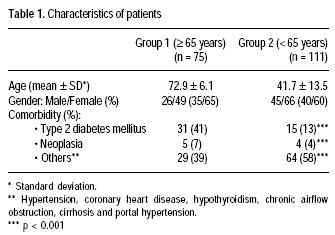
<body><![CDATA[<p align="justify"><font face="verdana" size="2"><b>BACKGROUND</b></font></p>     <p align="justify"><font face="verdana" size="2">Since 1970s, endoscopic retrograde cholangiopancreatography (ERCP) changed the diagnosis and treatment of pancreatic and biliary disease. ERCP as gastrointestinal endoscopy has been proved to be a safe and useful procedure in the elderly population.<sup>1&#150;</sup><sup>9 </sup>Although ERCP is considered as a minimally invasive procedure, it has potential serious complications.<sup>1,2</sup> The incidence of complications has risen with the increment in therapeutic interventions,<sup>1,3</sup> especially when a sphincterotomy is performed or a stent is placed.<sup>12</sup> The prevalence of complications varies among 5.4% to 10% whereas the mortality is reported between 0.5% to 4.7%.<sup>1&#150;</sup><sup>58,10&#150;14</sup></font></p>     <p align="justify"><font face="verdana" size="2">There are well&#150;defined risk factors for post&#150;ERCP complications: less than 59 years of age, opacification of the pancreatic duct and the absence of stones in the common biliary duct.<sup>1</sup> Other proposed risk factors are: difficulty to cannulate the biliary duct, a previously cut sphincter, Oddi's sphincter dysfunction and the numbre of procedures done in the endoscopy unit.<sup>1,15,16</sup> Due to their severity, infectious complications shall be discussed in a separate paragraph. Antibiotic prophylaxis is used based on the extrapolation of the results obtained in surgery of the biliary tract and their utility has not been proved convincingly.<sup>1&#150;3</sup></font></p>     <p align="justify"><font face="verdana" size="2">The aim of this study is to describe the prevalence of post&#150;ERCP complications in the geriatric population in a universitary third level hospital.</font></p>     <p align="justify"><font face="verdana" size="2">&nbsp;</font></p>     <p align="justify"><font face="verdana" size="2"><b>PATIENTS AND METHODS</b></font></p>     <p align="justify"><font face="verdana" size="2">Patient clinical files were reviewed from subjects submitted to ERCP in a universitary tertiary referral center between May 2001 to May 2002. Data regarding age, gender, indication and results of the procedure and complications were collected. The use of prophylactic antibiotics (defined as the administration in the hour prior to the procedure, and up to two more doses afterwards) was noted.</font></p>     <p align="justify"><font face="verdana" size="2">The patients were divided in two groups according to their age: Group 1 <u>&gt;</u> 65 years and Group 2 &lt; 65 years.</font></p>     <p align="justify"><font face="verdana" size="2">Statistical analysis was performed with Student <i>t </i>test, <img src="/img/revistas/ric/v57n5/a2s1.jpg"> and Fisher exact tests. A <i>p </i>value <u>&lt;</u> 0.05 was considered as statistically significant. For <u>&lt;</u> the main variables 95% confidence intervals were calculated. All analyses were made on SPSS version 10.0 for Windows.</font></p>     <p align="justify"><font face="verdana" size="2">During the study period a total of 186 patients underwent ERCP were included. Group 1 was composed of 75 patients and group 2 had 111. The general characteristics are described in<a href="#t1"> table 1</a>. The average age for group 1 was 72.9 &plusmn;6.1 years and in group 2 the average age was 41.7 &plusmn; 13.5 years. Women predominated in both groups <i>(p = </i>0.419). There was a higher comorbidity in group 1, where diabetes mellitus was the most frequent disease <i>(p &lt; </i>0.001).</font></p>     ]]></body>
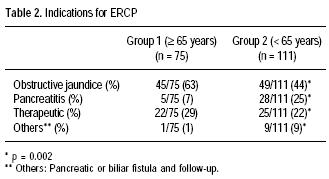
<body><![CDATA[<p align="center"><font face="verdana" size="2"><a name="t1"></a></font></p>     <p align="center"><font face="verdana" size="2"><img src="/img/revistas/ric/v57n5/a2t1.jpg"></font></p>     <p align="justify"><font face="verdana" size="2">The evaluation of obstructive jaundice was the most frequent indication in both groups (63% <i>versus </i>44%; <i>p = </i>0.002). Malignant biliary obstruction was more frequent in group 1 (45% <i>versus </i>21%; <i>p &lt; </i>0.001). Biliary tract drainage was more successful in those with &lt; 65 years (76% <i>versus </i>93%; <i>p = </i>0.001). There were no differences in the way it was drained (p = 0.153); <a href="#t2">tables 2</a> and <a href="/img/revistas/ric/v57n5/a2t3.jpg" target="_blank">3</a>.</font></p>     <p align="center"><font face="verdana" size="2"><a name="t2"></a></font></p>     <p align="center"><font face="verdana" size="2"><img src="/img/revistas/ric/v57n5/a2t2.jpg"></font></p>     <p align="justify"><font face="verdana" size="2">Complications are listed in <a href="/img/revistas/ric/v57n5/a2t4.jpg" target="_blank">table 4</a>. The prevalence of any type of complication attributable to the procedure was not different between the groups <i>(p = </i>0.590). There was one death in each group and was not related to ERCP. There were no differences related to the number of infectious complications (7/75 &#91;8%&#93;, <i>p = </i>0.700 &#91;95% IC 0.34&#150;0.93&#93; <i>versus </i>11/111 &#91;10%&#93;, <i>p = </i>0.611 &#91;95% IC 0.35&#150;0.82&#93;). Antibiotic prophylaxis were used more frequently in group 1 (63/ 75 &#91;84%&#93; <i>versus </i>67/111 &#91;60%&#93;; <i>p &lt; </i>0.001). Of those who did not receive prophylaxis, only two had an infectious complication (p = 0.065). There were no differences between the group that did receive prophylaxis and the group that had a formal antibiotic regime (p =0.572).</font></p>     <p align="justify"><font face="verdana" size="2">&nbsp;</font></p>     <p align="justify"><font face="verdana" size="2"><b>DISCUSSION</b></font></p>     <p align="justify"><font face="verdana" size="2">Endoscopic retrograde cholangiopancreatography has shown to be a safe and well tolerated procedure in the geriatric patient. As in other series, the incidence of complications seems to be independent of age.<sup>1,17</sup> The group aged 65 and older had a significant higher comorbidity and increment in morbi&#150;mortality could be expected, this was not true. The prevalence of complications was not different between the groups, however, the overall frequency was slightly higher than the reported elsewhere.<sup>1,</sup><sup>10,16,18,19</sup> This is probably related to the hospital population, a third level reference hospital with a sicker population.</font></p>     <p align="justify"><font face="verdana" size="2">The indications for the procedure and the findings were similar as those of other groups.<sup>1,18,20 </sup></font></p>     ]]></body>
<body><![CDATA[<p align="justify"><font face="verdana" size="2">Even though the benign obstruction was the most frequent finding in both groups, the malignant obstruction was significantly higher in our series; this is a reflection of the population in our hospital. The number of instrumentations in the biliary tract was similar between both groups and the rate of successful drainage in younger subjects was similar to other series (93%). This was not repeated in the older subjects where the rate of success was 76%, related to the high frequency of malignant stenosis which is harder to cannulate.<sup>8,</sup><sup>20,21</sup> Still, ERCP is a safer procedure to drain the biliary duct than surgery, with a less than one percent mortality.<sup>22&#150;</sup><sup>27</sup></font></p>     <p align="justify"><font face="verdana" size="2">The fear of major complications associated with ERCP in the geriatric population limits its use and its benefits. As in other series, this study show ERCP to be a safe procedure in this patients, even in the very elderly people, with a rate of complications (infectious and non infectious) similar to that of the younger group.<sup>10&#150;18&#150;21&#150;22&#150;28&#150;30</sup></font></p>     <p align="justify"><font face="verdana" size="2">Nevertheless, it is worth to mention that in our series, the older group received more antibiotic prophylaxis than the other group. The incidence of infectious complications was very low and was not different between the two groups. Maxton et al. reported an incidence of post&#150;ERCP colangitis of 26% in patients which required an endoprothesis placement.<sup>20</sup> Thirty&#150;six percent of the patients in the older group required a prothesis, we didn't observe such incidence.</font></p>     <p align="justify"><font face="verdana" size="2">It is not clear if this is the result of the antibiotic prophylaxis because its use is not recommended widely.<sup>31&#150;35</sup> The results in these studies support our findings in which only two patients who did not receive antibiotics had an infectious complication. More research is needed to define why older patients receive more antibiotics and if prophylaxis is necessary in this group of patients.</font></p>     <p align="justify"><font face="verdana" size="2">In conclusion, our series demonstrates that in patients aged 65 and older ERCP is a safe procedure; the incidence of complications is similar to the reported for the younger subjects. Even though the use of antibiotic prophylaxis is wider in the older population, there is no evidence that this practice is the causal effect of the same incidence of infectious complications in the younger group, so its use should be individualized accordingly to comorbidity and clinical circumstances of the patient. Our results support the existing evidence that a patient must not be excluded of the benefits of ERCP based on their age.</font></p>     <p align="justify"><font face="verdana" size="2">&nbsp;</font></p>     <p align="justify"><font face="verdana" size="2"><b>REFERENCES</b></font></p>     <!-- ref --><p align="justify"><font face="verdana" size="2">1. Oi I, Kobayashi  S,  Kondo T.  Endoscopio pancreatocholangiography. <i>Endoscopy </i>1970;  2:   103&#150;6.</font>&nbsp;&nbsp;&nbsp;&nbsp;&nbsp;&nbsp;&nbsp;&nbsp;[&#160;<a href="javascript:void(0);" onclick="javascript: window.open('/scielo.php?script=sci_nlinks&ref=6764673&pid=S0034-8376200500050000200001&lng=','','width=640,height=500,resizable=yes,scrollbars=1,menubar=yes,');">Links</a>&#160;]<!-- end-ref --><!-- ref --><p align="justify"><font face="verdana" size="2">2. Kawai K, Akasaka Y, Murakami K, et al. Endoscopio sphincterotomy of the ampulla's Vater. <i>Gastrointest Endosc </i>1974; 20: 148&#150;51.</font>&nbsp;&nbsp;&nbsp;&nbsp;&nbsp;&nbsp;&nbsp;&nbsp;[&#160;<a href="javascript:void(0);" onclick="javascript: window.open('/scielo.php?script=sci_nlinks&ref=6764674&pid=S0034-8376200500050000200002&lng=','','width=640,height=500,resizable=yes,scrollbars=1,menubar=yes,');">Links</a>&#160;]<!-- end-ref --><!-- ref --><p align="justify"><font face="verdana" size="2">3. Siddique I, Galati J, Ankoma&#150;Sey V, et al. The role of choledoscopy in the  diagnosis and management of biliary tract diseases. <i>Gastrointest Endosc </i>1999; 50: 67&#150;73.</font>&nbsp;&nbsp;&nbsp;&nbsp;&nbsp;&nbsp;&nbsp;&nbsp;[&#160;<a href="javascript:void(0);" onclick="javascript: window.open('/scielo.php?script=sci_nlinks&ref=6764675&pid=S0034-8376200500050000200003&lng=','','width=640,height=500,resizable=yes,scrollbars=1,menubar=yes,');">Links</a>&#160;]<!-- end-ref --><!-- ref --><p align="justify"><font face="verdana" size="2">4. Cotton  PB.   Evaluating  ERCP  is  important  but  difficult. <i>Gut </i>2002;  51:  287&#150;9.</font>&nbsp;&nbsp;&nbsp;&nbsp;&nbsp;&nbsp;&nbsp;&nbsp;[&#160;<a href="javascript:void(0);" onclick="javascript: window.open('/scielo.php?script=sci_nlinks&ref=6764676&pid=S0034-8376200500050000200004&lng=','','width=640,height=500,resizable=yes,scrollbars=1,menubar=yes,');">Links</a>&#160;]<!-- end-ref --><!-- ref --><p align="justify"><font face="verdana" size="2">5. Lockhart SP, Schofield PM, Gribble RJN, et al. Upper gastrointestinal endoscopy in the elderly. <i>BMJ </i>1985; 290: 283.</font>&nbsp;&nbsp;&nbsp;&nbsp;&nbsp;&nbsp;&nbsp;&nbsp;[&#160;<a href="javascript:void(0);" onclick="javascript: window.open('/scielo.php?script=sci_nlinks&ref=6764677&pid=S0034-8376200500050000200005&lng=','','width=640,height=500,resizable=yes,scrollbars=1,menubar=yes,');">Links</a>&#160;]<!-- end-ref --><!-- ref --><p align="justify"><font face="verdana" size="2">6. Brussaard  CC,   Vandewoude   MFJ.   A  prospective   analysis   of elective upper gastrointestinal  endoscopy in the  elderly. <i>Gastrointest Endosc </i>1988; 34:  118&#150;21.</font>&nbsp;&nbsp;&nbsp;&nbsp;&nbsp;&nbsp;&nbsp;&nbsp;[&#160;<a href="javascript:void(0);" onclick="javascript: window.open('/scielo.php?script=sci_nlinks&ref=6764678&pid=S0034-8376200500050000200006&lng=','','width=640,height=500,resizable=yes,scrollbars=1,menubar=yes,');">Links</a>&#160;]<!-- end-ref --><!-- ref --><p align="justify"><font face="verdana" size="2">7. De  la  Mora G,  Marcon  NE.   Endoscopy  in the  elderly. <i>Best Pract Res Clin Gastroenterol </i>2001;  15: 999&#150;1012.</font>&nbsp;&nbsp;&nbsp;&nbsp;&nbsp;&nbsp;&nbsp;&nbsp;[&#160;<a href="javascript:void(0);" onclick="javascript: window.open('/scielo.php?script=sci_nlinks&ref=6764679&pid=S0034-8376200500050000200007&lng=','','width=640,height=500,resizable=yes,scrollbars=1,menubar=yes,');">Links</a>&#160;]<!-- end-ref --><!-- ref --><p align="justify"><font face="verdana" size="2">8. MacMahon M, Walsh TN, Brennan P, et al. Endoscopio retrograde   cholangiopancreatography  in  the   elderly:   a  single  unit audit. <i>Gerontology </i>1993; 39:  28&#150;32.</font>&nbsp;&nbsp;&nbsp;&nbsp;&nbsp;&nbsp;&nbsp;&nbsp;[&#160;<a href="javascript:void(0);" onclick="javascript: window.open('/scielo.php?script=sci_nlinks&ref=6764680&pid=S0034-8376200500050000200008&lng=','','width=640,height=500,resizable=yes,scrollbars=1,menubar=yes,');">Links</a>&#160;]<!-- end-ref --><!-- ref --><p align="justify"><font face="verdana" size="2">9. Seinel&auml; L,  Ahvenainen J,  R&ouml;nneikk&ouml;  J,  et al.  Reasons for and   outcome   of upper   gastrointestinal   endoscopy   in   patients   aged   85   years   or   more:   retrospective   study.   <i>BMJ </i>1998;   317:   575&#150;80.</font>&nbsp;&nbsp;&nbsp;&nbsp;&nbsp;&nbsp;&nbsp;&nbsp;[&#160;<a href="javascript:void(0);" onclick="javascript: window.open('/scielo.php?script=sci_nlinks&ref=6764681&pid=S0034-8376200500050000200009&lng=','','width=640,height=500,resizable=yes,scrollbars=1,menubar=yes,');">Links</a>&#160;]<!-- end-ref --><!-- ref --><p align="justify"><font face="verdana" size="2">10. Scapa E, Berant A,  Leibovitz A, et al.  Endoscopic retrograde cholangiopancreatography in octagenarians. <i>J Clin Gastroenterol </i>1996; 22: 21&#150;2.</font>&nbsp;&nbsp;&nbsp;&nbsp;&nbsp;&nbsp;&nbsp;&nbsp;[&#160;<a href="javascript:void(0);" onclick="javascript: window.open('/scielo.php?script=sci_nlinks&ref=6764682&pid=S0034-8376200500050000200010&lng=','','width=640,height=500,resizable=yes,scrollbars=1,menubar=yes,');">Links</a>&#160;]<!-- end-ref --><!-- ref --><p align="justify"><font face="verdana" size="2">11. Cooper BT, Neumann CS. Upper gastrointestinal endoscopy in patients aged 80 years or more. <i>Age Ageing </i>1986; 15: 343&#150;9.</font>&nbsp;&nbsp;&nbsp;&nbsp;&nbsp;&nbsp;&nbsp;&nbsp;[&#160;<a href="javascript:void(0);" onclick="javascript: window.open('/scielo.php?script=sci_nlinks&ref=6764683&pid=S0034-8376200500050000200011&lng=','','width=640,height=500,resizable=yes,scrollbars=1,menubar=yes,');">Links</a>&#160;]<!-- end-ref --><!-- ref --><p align="justify"><font face="verdana" size="2">12. Safe AF, Owens D. Upper gastrointestinal endoscopy in octogenarians. <i>Br J Clin Pract </i>1991; 45: 99&#150;101.</font>&nbsp;&nbsp;&nbsp;&nbsp;&nbsp;&nbsp;&nbsp;&nbsp;[&#160;<a href="javascript:void(0);" onclick="javascript: window.open('/scielo.php?script=sci_nlinks&ref=6764684&pid=S0034-8376200500050000200012&lng=','','width=640,height=500,resizable=yes,scrollbars=1,menubar=yes,');">Links</a>&#160;]<!-- end-ref --><!-- ref --><p align="justify"><font face="verdana" size="2">13. Sugiyama   M,   Atomi   Y.   Endoscopic   sphinterotomy   for   bile duct stones in patients 90 years of aged and older. <i>Gastrointest Endosc </i>2000;  52:   187&#150;91.</font>&nbsp;&nbsp;&nbsp;&nbsp;&nbsp;&nbsp;&nbsp;&nbsp;[&#160;<a href="javascript:void(0);" onclick="javascript: window.open('/scielo.php?script=sci_nlinks&ref=6764685&pid=S0034-8376200500050000200013&lng=','','width=640,height=500,resizable=yes,scrollbars=1,menubar=yes,');">Links</a>&#160;]<!-- end-ref --><!-- ref --><p align="justify"><font face="verdana" size="2">14. Elizondo J, Gallo S, Valdovinos MA, et al. Retrospective evaluation  of 500  endoscopic  cholangiopancreatographies  performed at the Instituto Nacional de la Nutrici&oacute;n Salvador Zubir&aacute;n. <i>Rev Gastroenterol Mex </i>1989; 54:  19&#150;26.</font>&nbsp;&nbsp;&nbsp;&nbsp;&nbsp;&nbsp;&nbsp;&nbsp;[&#160;<a href="javascript:void(0);" onclick="javascript: window.open('/scielo.php?script=sci_nlinks&ref=6764686&pid=S0034-8376200500050000200014&lng=','','width=640,height=500,resizable=yes,scrollbars=1,menubar=yes,');">Links</a>&#160;]<!-- end-ref --><!-- ref --><p align="justify"><font face="verdana" size="2">15. Loperfido  S,  Angelini G,  Benedetti G.  Major early complications   from   diagnostic   and  therapeutic   ERCP:   A  prospective multicenter study. <i>Gastrointest Endosc </i>1998; 48:  1&#150;10.</font>&nbsp;&nbsp;&nbsp;&nbsp;&nbsp;&nbsp;&nbsp;&nbsp;[&#160;<a href="javascript:void(0);" onclick="javascript: window.open('/scielo.php?script=sci_nlinks&ref=6764687&pid=S0034-8376200500050000200015&lng=','','width=640,height=500,resizable=yes,scrollbars=1,menubar=yes,');">Links</a>&#160;]<!-- end-ref --><!-- ref --><p align="justify"><font face="verdana" size="2">16. Cotton   PB.   Outcomes   of  endoscopy   procedures:   Struggling towards definitions. <i>Gastrointest Endosc </i>1994; 40:  514&#150;18.</font>&nbsp;&nbsp;&nbsp;&nbsp;&nbsp;&nbsp;&nbsp;&nbsp;[&#160;<a href="javascript:void(0);" onclick="javascript: window.open('/scielo.php?script=sci_nlinks&ref=6764688&pid=S0034-8376200500050000200016&lng=','','width=640,height=500,resizable=yes,scrollbars=1,menubar=yes,');">Links</a>&#160;]<!-- end-ref --><!-- ref --><p align="justify"><font face="verdana" size="2">17. Freeman ML, Nelson DB, Sherman S. Complications of endoscopic  biliarysphincterotomy. <i>N Engl J Med   </i>1996;  335:   909&#150;18.</font>&nbsp;&nbsp;&nbsp;&nbsp;&nbsp;&nbsp;&nbsp;&nbsp;[&#160;<a href="javascript:void(0);" onclick="javascript: window.open('/scielo.php?script=sci_nlinks&ref=6764689&pid=S0034-8376200500050000200017&lng=','','width=640,height=500,resizable=yes,scrollbars=1,menubar=yes,');">Links</a>&#160;]<!-- end-ref --><!-- ref --><p align="justify"><font face="verdana" size="2">18. Tanner AR. ERCP: Present practice in a single region. Suggested standards for monitoring performance. <i>Eur J Gastroenterol Hepatol </i>1996; 8:   145&#150;8.</font>&nbsp;&nbsp;&nbsp;&nbsp;&nbsp;&nbsp;&nbsp;&nbsp;[&#160;<a href="javascript:void(0);" onclick="javascript: window.open('/scielo.php?script=sci_nlinks&ref=6764690&pid=S0034-8376200500050000200018&lng=','','width=640,height=500,resizable=yes,scrollbars=1,menubar=yes,');">Links</a>&#160;]<!-- end-ref --><!-- ref --><p align="justify"><font face="verdana" size="2">19. Margulies C, Siquiera ES, Silverman WB. The effect of endoscopic  sphincterotomy  on  acute   and  chronic  complications   of biliary endoprostheses. <i>Gastrointest Endosc </i>1999; 49: 716&#150;19.</font>&nbsp;&nbsp;&nbsp;&nbsp;&nbsp;&nbsp;&nbsp;&nbsp;[&#160;<a href="javascript:void(0);" onclick="javascript: window.open('/scielo.php?script=sci_nlinks&ref=6764691&pid=S0034-8376200500050000200019&lng=','','width=640,height=500,resizable=yes,scrollbars=1,menubar=yes,');">Links</a>&#160;]<!-- end-ref --><!-- ref --><p align="justify"><font face="verdana" size="2">20. Maxton DG,  Tweedle DR,  Martin DF.  Retained common bile duct   stones   after   endoscopic   sphinterotomy:   temporary   and long&#150;term treatment with biliary stenting. <i>Gut </i>1995; 36: 446&#150;9.</font>&nbsp;&nbsp;&nbsp;&nbsp;&nbsp;&nbsp;&nbsp;&nbsp;[&#160;<a href="javascript:void(0);" onclick="javascript: window.open('/scielo.php?script=sci_nlinks&ref=6764692&pid=S0034-8376200500050000200020&lng=','','width=640,height=500,resizable=yes,scrollbars=1,menubar=yes,');">Links</a>&#160;]<!-- end-ref --><!-- ref --><p align="justify"><font face="verdana" size="2">21. Ashton CE, McNabb WR, Wilkinson ML, et al. Endoscopic retrograde   cholangiopancreatography   in   elderly   patients. <i>Age Aging  </i>1998;  27:  683&#150;8.</font>&nbsp;&nbsp;&nbsp;&nbsp;&nbsp;&nbsp;&nbsp;&nbsp;[&#160;<a href="javascript:void(0);" onclick="javascript: window.open('/scielo.php?script=sci_nlinks&ref=6764693&pid=S0034-8376200500050000200021&lng=','','width=640,height=500,resizable=yes,scrollbars=1,menubar=yes,');">Links</a>&#160;]<!-- end-ref --><!-- ref --><p align="justify"><font face="verdana" size="2">22. Subhani JM, Kibbler C, Dooley JS.  Review article: Antibiotic prophylaxis   for  endoscopic   retrograde   cholangiopancreatography (ERCP). <i>Aliment Pharmacol Ther </i>1999;  13:  103&#150;16.</font>&nbsp;&nbsp;&nbsp;&nbsp;&nbsp;&nbsp;&nbsp;&nbsp;[&#160;<a href="javascript:void(0);" onclick="javascript: window.open('/scielo.php?script=sci_nlinks&ref=6764694&pid=S0034-8376200500050000200022&lng=','','width=640,height=500,resizable=yes,scrollbars=1,menubar=yes,');">Links</a>&#160;]<!-- end-ref --><!-- ref --><p align="justify"><font face="verdana" size="2">23. Cotton PB,  Lehman G,  Vennes  J.  Endoscopic  sphincterotomy complications and their management: An attempt at consensus. <i>Gastroenterol Endosc </i>1991; 37: 383&#150;93.</font>&nbsp;&nbsp;&nbsp;&nbsp;&nbsp;&nbsp;&nbsp;&nbsp;[&#160;<a href="javascript:void(0);" onclick="javascript: window.open('/scielo.php?script=sci_nlinks&ref=6764695&pid=S0034-8376200500050000200023&lng=','','width=640,height=500,resizable=yes,scrollbars=1,menubar=yes,');">Links</a>&#160;]<!-- end-ref --><!-- ref --><p align="justify"><font face="verdana" size="2">24. Ingoldby CJH, El&#150;Saadi J, Hall RI. Late results of endoscopic sphincterotomy for bile duct stones in elderly patients and gallbladder in situ. <i>Gut </i>1989; 30:  1129&#150;31.</font>&nbsp;&nbsp;&nbsp;&nbsp;&nbsp;&nbsp;&nbsp;&nbsp;[&#160;<a href="javascript:void(0);" onclick="javascript: window.open('/scielo.php?script=sci_nlinks&ref=6764696&pid=S0034-8376200500050000200024&lng=','','width=640,height=500,resizable=yes,scrollbars=1,menubar=yes,');">Links</a>&#160;]<!-- end-ref --><!-- ref --><p align="justify"><font face="verdana" size="2">25. Crocker JR, Williams SG, Charlton M. Endoscopic therapy for bile duct stones in geriatric population. <i>Post Med J </i>1992; 68: 457&#150;60.</font>&nbsp;&nbsp;&nbsp;&nbsp;&nbsp;&nbsp;&nbsp;&nbsp;[&#160;<a href="javascript:void(0);" onclick="javascript: window.open('/scielo.php?script=sci_nlinks&ref=6764697&pid=S0034-8376200500050000200025&lng=','','width=640,height=500,resizable=yes,scrollbars=1,menubar=yes,');">Links</a>&#160;]<!-- end-ref --><!-- ref --><p align="justify"><font face="verdana" size="2">26. Masci E, Toti G, Mariani A.  Complications of diagnostic and therapeutic ERCP: A prospective multicenter study. <i>Am J Gastroenterol </i>2001; 96:  417&#150;23.</font>&nbsp;&nbsp;&nbsp;&nbsp;&nbsp;&nbsp;&nbsp;&nbsp;[&#160;<a href="javascript:void(0);" onclick="javascript: window.open('/scielo.php?script=sci_nlinks&ref=6764698&pid=S0034-8376200500050000200026&lng=','','width=640,height=500,resizable=yes,scrollbars=1,menubar=yes,');">Links</a>&#160;]<!-- end-ref --><!-- ref --><p align="justify"><font face="verdana" size="2">27. Ho KY, Montes H, Sossenheimer MJ. Features that may predict hospital    admission   following   outpatient   therapeutic    ERCP. <i>Gastrointest Endosc </i>1999; 49:  587&#150;92.</font>&nbsp;&nbsp;&nbsp;&nbsp;&nbsp;&nbsp;&nbsp;&nbsp;[&#160;<a href="javascript:void(0);" onclick="javascript: window.open('/scielo.php?script=sci_nlinks&ref=6764699&pid=S0034-8376200500050000200027&lng=','','width=640,height=500,resizable=yes,scrollbars=1,menubar=yes,');">Links</a>&#160;]<!-- end-ref --><!-- ref --><p align="justify"><font face="verdana" size="2">28. Fleischer   DE.   Better   definition   of  endoscopic   complications and  other  negative  outcomes. <i>Gastrointest Endosc   </i>1994;   40: 511&#150;14.</font>&nbsp;&nbsp;&nbsp;&nbsp;&nbsp;&nbsp;&nbsp;&nbsp;[&#160;<a href="javascript:void(0);" onclick="javascript: window.open('/scielo.php?script=sci_nlinks&ref=6764700&pid=S0034-8376200500050000200028&lng=','','width=640,height=500,resizable=yes,scrollbars=1,menubar=yes,');">Links</a>&#160;]<!-- end-ref --><!-- ref --><p align="justify"><font face="verdana" size="2">29. Mitchell RMS, O'Connor F, Dickey W. Endoscopic retrograde cholangiopancreatography  is  safe  and effective  in patients  90 years of age and older. <i>J Clin Gastroenterol </i>2003; 36: 72&#150;4.</font>&nbsp;&nbsp;&nbsp;&nbsp;&nbsp;&nbsp;&nbsp;&nbsp;[&#160;<a href="javascript:void(0);" onclick="javascript: window.open('/scielo.php?script=sci_nlinks&ref=6764701&pid=S0034-8376200500050000200029&lng=','','width=640,height=500,resizable=yes,scrollbars=1,menubar=yes,');">Links</a>&#160;]<!-- end-ref --><!-- ref --><p align="justify"><font face="verdana" size="2">30. Deans  GT,  Sedman P,  Mart&iacute;n D,  et al.  Are  complications of endoscopic  sphincterotomy  age  related? <i>Gut  </i>1997;  41: 545&#150;8.</font>&nbsp;&nbsp;&nbsp;&nbsp;&nbsp;&nbsp;&nbsp;&nbsp;[&#160;<a href="javascript:void(0);" onclick="javascript: window.open('/scielo.php?script=sci_nlinks&ref=6764702&pid=S0034-8376200500050000200030&lng=','','width=640,height=500,resizable=yes,scrollbars=1,menubar=yes,');">Links</a>&#160;]<!-- end-ref --><!-- ref --><p align="justify"><font face="verdana" size="2">31. Shemesh   E,   Czerniak   A,    Shneabaum   S.   Early   endoscopic sphincterectomy   in  the   management   of acute   gallstone   pancreatitis in elderly patients. <i>JAGS </i>1990; 38: 893&#150;6.</font>&nbsp;&nbsp;&nbsp;&nbsp;&nbsp;&nbsp;&nbsp;&nbsp;[&#160;<a href="javascript:void(0);" onclick="javascript: window.open('/scielo.php?script=sci_nlinks&ref=6764703&pid=S0034-8376200500050000200031&lng=','','width=640,height=500,resizable=yes,scrollbars=1,menubar=yes,');">Links</a>&#160;]<!-- end-ref --><!-- ref --><p align="justify"><font face="verdana" size="2">32. Mehta SN, Pavone E, Barkun JS, et al. Predictors of post&#150;ERCP complications   in   patients   with   suspected   choledocholithiasis. <i>Endoscopy  </i>1998;  30:  457&#150;63.</font>&nbsp;&nbsp;&nbsp;&nbsp;&nbsp;&nbsp;&nbsp;&nbsp;[&#160;<a href="javascript:void(0);" onclick="javascript: window.open('/scielo.php?script=sci_nlinks&ref=6764704&pid=S0034-8376200500050000200032&lng=','','width=640,height=500,resizable=yes,scrollbars=1,menubar=yes,');">Links</a>&#160;]<!-- end-ref --><!-- ref --><p align="justify"><font face="verdana" size="2">33. Monta&ntilde;o&#150;Loza  A,   Valdovinos   F,   Valdovinos   MA.   Profilaxis antimicrobiana en colangiopancreatografia retr&oacute;grada endosc&oacute;pica. <i>Rev Gastroenterol Mex </i>2002; 67 (Suppl. 1):  132&#150;3.</font>&nbsp;&nbsp;&nbsp;&nbsp;&nbsp;&nbsp;&nbsp;&nbsp;[&#160;<a href="javascript:void(0);" onclick="javascript: window.open('/scielo.php?script=sci_nlinks&ref=6764705&pid=S0034-8376200500050000200033&lng=','','width=640,height=500,resizable=yes,scrollbars=1,menubar=yes,');">Links</a>&#160;]<!-- end-ref --><!-- ref --><p align="justify"><font face="verdana" size="2">34. Dajani AS, Taubert KA, Wilson W. Prevention of bacterial endocarditis.  Recommendations by the  American Heart Association. <i>JAMA   </i>1997;  277:   1794&#150;1801.</font>&nbsp;&nbsp;&nbsp;&nbsp;&nbsp;&nbsp;&nbsp;&nbsp;[&#160;<a href="javascript:void(0);" onclick="javascript: window.open('/scielo.php?script=sci_nlinks&ref=6764706&pid=S0034-8376200500050000200034&lng=','','width=640,height=500,resizable=yes,scrollbars=1,menubar=yes,');">Links</a>&#160;]<!-- end-ref --><!-- ref --><p align="justify"><font face="verdana" size="2">35. Meijer WS, Schmitz PI, Jeekel J. Meta&#150;analysis of randomized, controlled   clinical  trials   of  antibiotic   prophylaxis   in   biliary tract surgery. <i>Br J Surg </i>1990; 77: 283&#150;90.</font>&nbsp;&nbsp;&nbsp;&nbsp;&nbsp;&nbsp;&nbsp;&nbsp;[&#160;<a href="javascript:void(0);" onclick="javascript: window.open('/scielo.php?script=sci_nlinks&ref=6764707&pid=S0034-8376200500050000200035&lng=','','width=640,height=500,resizable=yes,scrollbars=1,menubar=yes,');">Links</a>&#160;]<!-- end-ref --> ]]></body><back>
<ref-list>
<ref id="B1">
<label>1</label><nlm-citation citation-type="journal">
<person-group person-group-type="author">
<name>
<surname><![CDATA[Oi]]></surname>
<given-names><![CDATA[I]]></given-names>
</name>
<name>
<surname><![CDATA[Kobayashi]]></surname>
<given-names><![CDATA[S]]></given-names>
</name>
<name>
<surname><![CDATA[Kondo]]></surname>
<given-names><![CDATA[T]]></given-names>
</name>
</person-group>
<article-title xml:lang="en"><![CDATA[Endoscopio pancreatocholangiography]]></article-title>
<source><![CDATA[Endoscopy]]></source>
<year>1970</year>
<volume>2</volume>
<page-range>103-6</page-range></nlm-citation>
</ref>
<ref id="B2">
<label>2</label><nlm-citation citation-type="journal">
<person-group person-group-type="author">
<name>
<surname><![CDATA[Kawai]]></surname>
<given-names><![CDATA[K]]></given-names>
</name>
<name>
<surname><![CDATA[Akasaka]]></surname>
<given-names><![CDATA[Y]]></given-names>
</name>
<name>
<surname><![CDATA[Murakami]]></surname>
<given-names><![CDATA[K]]></given-names>
</name>
</person-group>
<article-title xml:lang="en"><![CDATA[Endoscopio sphincterotomy of the ampulla's Vater]]></article-title>
<source><![CDATA[Gastrointest Endosc]]></source>
<year>1974</year>
<volume>20</volume>
<page-range>148-51</page-range></nlm-citation>
</ref>
<ref id="B3">
<label>3</label><nlm-citation citation-type="journal">
<person-group person-group-type="author">
<name>
<surname><![CDATA[Siddique]]></surname>
<given-names><![CDATA[I]]></given-names>
</name>
<name>
<surname><![CDATA[Galati]]></surname>
<given-names><![CDATA[J]]></given-names>
</name>
<name>
<surname><![CDATA[Ankoma-Sey]]></surname>
<given-names><![CDATA[V]]></given-names>
</name>
</person-group>
<article-title xml:lang="en"><![CDATA[The role of choledoscopy in the diagnosis and management of biliary tract diseases]]></article-title>
<source><![CDATA[Gastrointest Endosc]]></source>
<year>1999</year>
<volume>50</volume>
<page-range>67-73</page-range></nlm-citation>
</ref>
<ref id="B4">
<label>4</label><nlm-citation citation-type="journal">
<person-group person-group-type="author">
<name>
<surname><![CDATA[Cotton]]></surname>
<given-names><![CDATA[PB]]></given-names>
</name>
</person-group>
<article-title xml:lang="en"><![CDATA[Evaluating ERCP is important but difficult]]></article-title>
<source><![CDATA[Gut]]></source>
<year>2002</year>
<volume>51</volume>
<page-range>287-9</page-range></nlm-citation>
</ref>
<ref id="B5">
<label>5</label><nlm-citation citation-type="journal">
<person-group person-group-type="author">
<name>
<surname><![CDATA[Lockhart]]></surname>
<given-names><![CDATA[SP]]></given-names>
</name>
<name>
<surname><![CDATA[Schofield]]></surname>
<given-names><![CDATA[PM]]></given-names>
</name>
<name>
<surname><![CDATA[Gribble]]></surname>
<given-names><![CDATA[RJN]]></given-names>
</name>
</person-group>
<article-title xml:lang="en"><![CDATA[Upper gastrointestinal endoscopy in the elderly]]></article-title>
<source><![CDATA[BMJ]]></source>
<year>1985</year>
<numero>290</numero>
<issue>290</issue>
<page-range>283</page-range></nlm-citation>
</ref>
<ref id="B6">
<label>6</label><nlm-citation citation-type="journal">
<person-group person-group-type="author">
<name>
<surname><![CDATA[Brussaard]]></surname>
<given-names><![CDATA[CC]]></given-names>
</name>
<name>
<surname><![CDATA[Vandewoude]]></surname>
<given-names><![CDATA[MFJ]]></given-names>
</name>
</person-group>
<article-title xml:lang="en"><![CDATA[A prospective analysis of elective upper gastrointestinal endoscopy in the elderly]]></article-title>
<source><![CDATA[Gastrointest Endosc]]></source>
<year>1988</year>
<volume>34</volume>
<page-range>118-21</page-range></nlm-citation>
</ref>
<ref id="B7">
<label>7</label><nlm-citation citation-type="journal">
<person-group person-group-type="author">
<name>
<surname><![CDATA[De la Mora]]></surname>
<given-names><![CDATA[G]]></given-names>
</name>
<name>
<surname><![CDATA[Marcon]]></surname>
<given-names><![CDATA[NE]]></given-names>
</name>
</person-group>
<article-title xml:lang="en"><![CDATA[Endoscopy in the elderly]]></article-title>
<source><![CDATA[Best Pract Res Clin Gastroenterol]]></source>
<year>2001</year>
<volume>15</volume>
<page-range>999-1012</page-range></nlm-citation>
</ref>
<ref id="B8">
<label>8</label><nlm-citation citation-type="journal">
<person-group person-group-type="author">
<name>
<surname><![CDATA[MacMahon]]></surname>
<given-names><![CDATA[M]]></given-names>
</name>
<name>
<surname><![CDATA[Walsh]]></surname>
<given-names><![CDATA[TN]]></given-names>
</name>
<name>
<surname><![CDATA[Brennan]]></surname>
<given-names><![CDATA[P]]></given-names>
</name>
</person-group>
<article-title xml:lang="en"><![CDATA[Endoscopio retrograde cholangiopancreatography in the elderly: a single unit audit]]></article-title>
<source><![CDATA[Gerontology]]></source>
<year>1993</year>
<volume>39</volume>
<page-range>28-32</page-range></nlm-citation>
</ref>
<ref id="B9">
<label>9</label><nlm-citation citation-type="journal">
<person-group person-group-type="author">
<name>
<surname><![CDATA[Seinelä]]></surname>
<given-names><![CDATA[L]]></given-names>
</name>
<name>
<surname><![CDATA[Ahvenainen]]></surname>
<given-names><![CDATA[J]]></given-names>
</name>
<name>
<surname><![CDATA[Rönneikkö]]></surname>
<given-names><![CDATA[J]]></given-names>
</name>
</person-group>
<article-title xml:lang="en"><![CDATA[Reasons for and outcome of upper gastrointestinal endoscopy in patients aged 85 years or more: retrospective study]]></article-title>
<source><![CDATA[BMJ]]></source>
<year>1998</year>
<numero>317</numero>
<issue>317</issue>
<page-range>575-80</page-range></nlm-citation>
</ref>
<ref id="B10">
<label>10</label><nlm-citation citation-type="journal">
<person-group person-group-type="author">
<name>
<surname><![CDATA[Scapa]]></surname>
<given-names><![CDATA[E]]></given-names>
</name>
<name>
<surname><![CDATA[Berant]]></surname>
<given-names><![CDATA[A]]></given-names>
</name>
<name>
<surname><![CDATA[Leibovitz]]></surname>
<given-names><![CDATA[A]]></given-names>
</name>
</person-group>
<article-title xml:lang="en"><![CDATA[Endoscopic retrograde cholangiopancreatography in octagenarians]]></article-title>
<source><![CDATA[J Clin Gastroenterol]]></source>
<year>1996</year>
<volume>22</volume>
<page-range>21-2</page-range></nlm-citation>
</ref>
<ref id="B11">
<label>11</label><nlm-citation citation-type="journal">
<person-group person-group-type="author">
<name>
<surname><![CDATA[Cooper]]></surname>
<given-names><![CDATA[BT]]></given-names>
</name>
<name>
<surname><![CDATA[Neumann]]></surname>
<given-names><![CDATA[CS]]></given-names>
</name>
</person-group>
<article-title xml:lang="en"><![CDATA[Upper gastrointestinal endoscopy in patients aged 80 years or more]]></article-title>
<source><![CDATA[Age Ageing]]></source>
<year>1986</year>
<volume>15</volume>
<page-range>343-9</page-range></nlm-citation>
</ref>
<ref id="B12">
<label>12</label><nlm-citation citation-type="journal">
<person-group person-group-type="author">
<name>
<surname><![CDATA[Safe]]></surname>
<given-names><![CDATA[AF]]></given-names>
</name>
<name>
<surname><![CDATA[Owens]]></surname>
<given-names><![CDATA[D]]></given-names>
</name>
</person-group>
<article-title xml:lang="en"><![CDATA[Upper gastrointestinal endoscopy in octogenarians]]></article-title>
<source><![CDATA[Br J Clin Pract]]></source>
<year>1991</year>
<volume>45</volume>
<page-range>99-101</page-range></nlm-citation>
</ref>
<ref id="B13">
<label>13</label><nlm-citation citation-type="journal">
<person-group person-group-type="author">
<name>
<surname><![CDATA[Sugiyama]]></surname>
<given-names><![CDATA[M]]></given-names>
</name>
<name>
<surname><![CDATA[Atomi]]></surname>
<given-names><![CDATA[Y]]></given-names>
</name>
</person-group>
<article-title xml:lang="en"><![CDATA[Endoscopic sphinterotomy for bile duct stones in patients 90 years of aged and older]]></article-title>
<source><![CDATA[Gastrointest Endosc]]></source>
<year>2000</year>
<volume>52</volume>
<page-range>187-91</page-range></nlm-citation>
</ref>
<ref id="B14">
<label>14</label><nlm-citation citation-type="journal">
<person-group person-group-type="author">
<name>
<surname><![CDATA[Elizondo]]></surname>
<given-names><![CDATA[J]]></given-names>
</name>
<name>
<surname><![CDATA[Gallo]]></surname>
<given-names><![CDATA[S]]></given-names>
</name>
<name>
<surname><![CDATA[Valdovinos]]></surname>
<given-names><![CDATA[MA]]></given-names>
</name>
</person-group>
<article-title xml:lang="en"><![CDATA[Retrospective evaluation of 500 endoscopic cholangiopancreatographies performed at the Instituto Nacional de la Nutrición Salvador Zubirán]]></article-title>
<source><![CDATA[Rev Gastroenterol Mex]]></source>
<year>1989</year>
<volume>54</volume>
<page-range>19-26</page-range></nlm-citation>
</ref>
<ref id="B15">
<label>15</label><nlm-citation citation-type="journal">
<person-group person-group-type="author">
<name>
<surname><![CDATA[Loperfido]]></surname>
<given-names><![CDATA[S]]></given-names>
</name>
<name>
<surname><![CDATA[Angelini]]></surname>
<given-names><![CDATA[G]]></given-names>
</name>
<name>
<surname><![CDATA[Benedetti]]></surname>
<given-names><![CDATA[G]]></given-names>
</name>
</person-group>
<article-title xml:lang="en"><![CDATA[Major early complications from diagnostic and therapeutic ERCP: A prospective multicenter study]]></article-title>
<source><![CDATA[Gastrointest Endosc]]></source>
<year>1998</year>
<volume>48</volume>
<page-range>1-10</page-range></nlm-citation>
</ref>
<ref id="B16">
<label>16</label><nlm-citation citation-type="journal">
<person-group person-group-type="author">
<name>
<surname><![CDATA[Cotton]]></surname>
<given-names><![CDATA[PB]]></given-names>
</name>
</person-group>
<article-title xml:lang="en"><![CDATA[Outcomes of endoscopy procedures: Struggling towards definitions]]></article-title>
<source><![CDATA[Gastrointest Endosc]]></source>
<year>1994</year>
<volume>40</volume>
<page-range>514-18</page-range></nlm-citation>
</ref>
<ref id="B17">
<label>17</label><nlm-citation citation-type="journal">
<person-group person-group-type="author">
<name>
<surname><![CDATA[Freeman]]></surname>
<given-names><![CDATA[ML]]></given-names>
</name>
<name>
<surname><![CDATA[Nelson]]></surname>
<given-names><![CDATA[DB]]></given-names>
</name>
<name>
<surname><![CDATA[Sherman]]></surname>
<given-names><![CDATA[S]]></given-names>
</name>
</person-group>
<article-title xml:lang="en"><![CDATA[Complications of endoscopic biliarysphincterotomy]]></article-title>
<source><![CDATA[N Engl J Med]]></source>
<year>1996</year>
<numero>335</numero>
<issue>335</issue>
<page-range>909-18</page-range></nlm-citation>
</ref>
<ref id="B18">
<label>18</label><nlm-citation citation-type="journal">
<person-group person-group-type="author">
<name>
<surname><![CDATA[Tanner]]></surname>
<given-names><![CDATA[AR]]></given-names>
</name>
</person-group>
<article-title xml:lang="en"><![CDATA[ERCP: Present practice in a single region. Suggested standards for monitoring performance]]></article-title>
<source><![CDATA[Eur J Gastroenterol Hepatol]]></source>
<year>1996</year>
<volume>8</volume>
<page-range>145-8</page-range></nlm-citation>
</ref>
<ref id="B19">
<label>19</label><nlm-citation citation-type="journal">
<person-group person-group-type="author">
<name>
<surname><![CDATA[Margulies]]></surname>
<given-names><![CDATA[C]]></given-names>
</name>
<name>
<surname><![CDATA[Siquiera]]></surname>
<given-names><![CDATA[ES]]></given-names>
</name>
<name>
<surname><![CDATA[Silverman]]></surname>
<given-names><![CDATA[WB]]></given-names>
</name>
</person-group>
<article-title xml:lang="en"><![CDATA[The effect of endoscopic sphincterotomy on acute and chronic complications of biliary endoprostheses]]></article-title>
<source><![CDATA[Gastrointest Endosc]]></source>
<year>1999</year>
<volume>49</volume>
<page-range>716-19</page-range></nlm-citation>
</ref>
<ref id="B20">
<label>20</label><nlm-citation citation-type="journal">
<person-group person-group-type="author">
<name>
<surname><![CDATA[Maxton]]></surname>
<given-names><![CDATA[DG]]></given-names>
</name>
<name>
<surname><![CDATA[Tweedle]]></surname>
<given-names><![CDATA[DR]]></given-names>
</name>
<name>
<surname><![CDATA[Martin]]></surname>
<given-names><![CDATA[DF]]></given-names>
</name>
</person-group>
<article-title xml:lang="en"><![CDATA[Retained common bile duct stones after endoscopic sphinterotomy: temporary and long-term treatment with biliary stenting]]></article-title>
<source><![CDATA[Gut]]></source>
<year>1995</year>
<volume>36</volume>
<page-range>446-9</page-range></nlm-citation>
</ref>
<ref id="B21">
<label>21</label><nlm-citation citation-type="journal">
<person-group person-group-type="author">
<name>
<surname><![CDATA[Ashton]]></surname>
<given-names><![CDATA[CE]]></given-names>
</name>
<name>
<surname><![CDATA[McNabb]]></surname>
<given-names><![CDATA[WR]]></given-names>
</name>
<name>
<surname><![CDATA[Wilkinson]]></surname>
<given-names><![CDATA[ML]]></given-names>
</name>
</person-group>
<article-title xml:lang="en"><![CDATA[Endoscopic retrograde cholangiopancreatography in elderly patients]]></article-title>
<source><![CDATA[Age Aging]]></source>
<year>1998</year>
<volume>27</volume>
<page-range>683-8</page-range></nlm-citation>
</ref>
<ref id="B22">
<label>22</label><nlm-citation citation-type="journal">
<person-group person-group-type="author">
<name>
<surname><![CDATA[Subhani]]></surname>
<given-names><![CDATA[JM]]></given-names>
</name>
<name>
<surname><![CDATA[Kibbler]]></surname>
<given-names><![CDATA[C]]></given-names>
</name>
<name>
<surname><![CDATA[Dooley]]></surname>
<given-names><![CDATA[JS]]></given-names>
</name>
</person-group>
<article-title xml:lang="en"><![CDATA[Review article: Antibiotic prophylaxis for endoscopic retrograde cholangiopancreatography (ERCP)]]></article-title>
<source><![CDATA[Aliment Pharmacol Ther]]></source>
<year>1999</year>
<volume>13</volume>
<page-range>103-16</page-range></nlm-citation>
</ref>
<ref id="B23">
<label>23</label><nlm-citation citation-type="journal">
<person-group person-group-type="author">
<name>
<surname><![CDATA[Cotton]]></surname>
<given-names><![CDATA[PB]]></given-names>
</name>
<name>
<surname><![CDATA[Lehman]]></surname>
<given-names><![CDATA[G]]></given-names>
</name>
<name>
<surname><![CDATA[Vennes]]></surname>
<given-names><![CDATA[J]]></given-names>
</name>
</person-group>
<article-title xml:lang="en"><![CDATA[Endoscopic sphincterotomy complications and their management: An attempt at consensus]]></article-title>
<source><![CDATA[Gastroenterol Endosc]]></source>
<year>1991</year>
<volume>37</volume>
<page-range>383-93</page-range></nlm-citation>
</ref>
<ref id="B24">
<label>24</label><nlm-citation citation-type="journal">
<person-group person-group-type="author">
<name>
<surname><![CDATA[Ingoldby]]></surname>
<given-names><![CDATA[CJH]]></given-names>
</name>
<name>
<surname><![CDATA[El-Saadi]]></surname>
<given-names><![CDATA[J]]></given-names>
</name>
<name>
<surname><![CDATA[Hall]]></surname>
<given-names><![CDATA[RI]]></given-names>
</name>
</person-group>
<article-title xml:lang="en"><![CDATA[Late results of endoscopic sphincterotomy for bile duct stones in elderly patients and gallbladder in situ]]></article-title>
<source><![CDATA[Gut]]></source>
<year>1989</year>
<volume>30</volume>
<page-range>1129-31</page-range></nlm-citation>
</ref>
<ref id="B25">
<label>25</label><nlm-citation citation-type="journal">
<person-group person-group-type="author">
<name>
<surname><![CDATA[Crocker]]></surname>
<given-names><![CDATA[JR]]></given-names>
</name>
<name>
<surname><![CDATA[Williams]]></surname>
<given-names><![CDATA[SG]]></given-names>
</name>
<name>
<surname><![CDATA[Charlton]]></surname>
<given-names><![CDATA[M]]></given-names>
</name>
</person-group>
<article-title xml:lang="en"><![CDATA[Endoscopic therapy for bile duct stones in geriatric population]]></article-title>
<source><![CDATA[Post Med J]]></source>
<year>1992</year>
<volume>68</volume>
<page-range>457-60</page-range></nlm-citation>
</ref>
<ref id="B26">
<label>26</label><nlm-citation citation-type="journal">
<person-group person-group-type="author">
<name>
<surname><![CDATA[Masci]]></surname>
<given-names><![CDATA[E]]></given-names>
</name>
<name>
<surname><![CDATA[Toti]]></surname>
<given-names><![CDATA[G]]></given-names>
</name>
<name>
<surname><![CDATA[Mariani]]></surname>
<given-names><![CDATA[A]]></given-names>
</name>
</person-group>
<article-title xml:lang="en"><![CDATA[Complications of diagnostic and therapeutic ERCP: A prospective multicenter study]]></article-title>
<source><![CDATA[Am J Gastroenterol]]></source>
<year>2001</year>
<volume>96</volume>
<page-range>417-23</page-range></nlm-citation>
</ref>
<ref id="B27">
<label>27</label><nlm-citation citation-type="journal">
<person-group person-group-type="author">
<name>
<surname><![CDATA[Ho]]></surname>
<given-names><![CDATA[KY]]></given-names>
</name>
<name>
<surname><![CDATA[Montes]]></surname>
<given-names><![CDATA[H]]></given-names>
</name>
<name>
<surname><![CDATA[Sossenheimer]]></surname>
<given-names><![CDATA[MJ]]></given-names>
</name>
</person-group>
<article-title xml:lang="en"><![CDATA[Features that may predict hospital admission following outpatient therapeutic ERCP]]></article-title>
<source><![CDATA[Gastrointest Endosc]]></source>
<year>1999</year>
<volume>49</volume>
<page-range>587-92</page-range></nlm-citation>
</ref>
<ref id="B28">
<label>28</label><nlm-citation citation-type="journal">
<person-group person-group-type="author">
<name>
<surname><![CDATA[Fleischer]]></surname>
<given-names><![CDATA[DE]]></given-names>
</name>
</person-group>
<article-title xml:lang="en"><![CDATA[Better definition of endoscopic complications and other negative outcomes]]></article-title>
<source><![CDATA[Gastrointest Endosc]]></source>
<year>1994</year>
<volume>40</volume>
<page-range>511-14</page-range></nlm-citation>
</ref>
<ref id="B29">
<label>29</label><nlm-citation citation-type="journal">
<person-group person-group-type="author">
<name>
<surname><![CDATA[Mitchell]]></surname>
<given-names><![CDATA[RMS]]></given-names>
</name>
<name>
<surname><![CDATA[O'Connor]]></surname>
<given-names><![CDATA[F]]></given-names>
</name>
<name>
<surname><![CDATA[Dickey]]></surname>
<given-names><![CDATA[W]]></given-names>
</name>
</person-group>
<article-title xml:lang="en"><![CDATA[Endoscopic retrograde cholangiopancreatography is safe and effective in patients 90 years of age and older]]></article-title>
<source><![CDATA[J Clin Gastroenterol]]></source>
<year>2003</year>
<volume>36</volume>
<page-range>72-4</page-range></nlm-citation>
</ref>
<ref id="B30">
<label>30</label><nlm-citation citation-type="journal">
<person-group person-group-type="author">
<name>
<surname><![CDATA[Deans]]></surname>
<given-names><![CDATA[GT]]></given-names>
</name>
<name>
<surname><![CDATA[Sedman]]></surname>
<given-names><![CDATA[P]]></given-names>
</name>
<name>
<surname><![CDATA[Martín]]></surname>
<given-names><![CDATA[D]]></given-names>
</name>
</person-group>
<article-title xml:lang="en"><![CDATA[Are complications of endoscopic sphincterotomy age related?]]></article-title>
<source><![CDATA[Gut]]></source>
<year>1997</year>
<volume>41</volume>
<page-range>545-8</page-range></nlm-citation>
</ref>
<ref id="B31">
<label>31</label><nlm-citation citation-type="journal">
<person-group person-group-type="author">
<name>
<surname><![CDATA[Shemesh]]></surname>
<given-names><![CDATA[E]]></given-names>
</name>
<name>
<surname><![CDATA[Czerniak]]></surname>
<given-names><![CDATA[A]]></given-names>
</name>
<name>
<surname><![CDATA[Shneabaum]]></surname>
<given-names><![CDATA[S]]></given-names>
</name>
</person-group>
<article-title xml:lang="en"><![CDATA[Early endoscopic sphincterectomy in the management of acute gallstone pancreatitis in elderly patients]]></article-title>
<source><![CDATA[JAGS]]></source>
<year>1990</year>
<volume>38</volume>
<page-range>893-6</page-range></nlm-citation>
</ref>
<ref id="B32">
<label>32</label><nlm-citation citation-type="journal">
<person-group person-group-type="author">
<name>
<surname><![CDATA[Mehta]]></surname>
<given-names><![CDATA[SN]]></given-names>
</name>
<name>
<surname><![CDATA[Pavone]]></surname>
<given-names><![CDATA[E]]></given-names>
</name>
<name>
<surname><![CDATA[Barkun]]></surname>
<given-names><![CDATA[JS]]></given-names>
</name>
</person-group>
<article-title xml:lang="en"><![CDATA[Predictors of post-ERCP complications in patients with suspected choledocholithiasis]]></article-title>
<source><![CDATA[Endoscopy]]></source>
<year>1998</year>
<volume>30</volume>
<page-range>457-63</page-range></nlm-citation>
</ref>
<ref id="B33">
<label>33</label><nlm-citation citation-type="journal">
<person-group person-group-type="author">
<name>
<surname><![CDATA[Montaño-Loza]]></surname>
<given-names><![CDATA[A]]></given-names>
</name>
<name>
<surname><![CDATA[Valdovinos]]></surname>
<given-names><![CDATA[F]]></given-names>
</name>
<name>
<surname><![CDATA[Valdovinos]]></surname>
<given-names><![CDATA[MA]]></given-names>
</name>
</person-group>
<article-title xml:lang="es"><![CDATA[Profilaxis antimicrobiana en colangiopancreatografia retrógrada endoscópica]]></article-title>
<source><![CDATA[Rev Gastroenterol Mex]]></source>
<year>2002</year>
<volume>67</volume>
<numero>^s1</numero>
<issue>^s1</issue>
<supplement>1</supplement>
<page-range>132-3</page-range></nlm-citation>
</ref>
<ref id="B34">
<label>34</label><nlm-citation citation-type="journal">
<person-group person-group-type="author">
<name>
<surname><![CDATA[Dajani]]></surname>
<given-names><![CDATA[AS]]></given-names>
</name>
<name>
<surname><![CDATA[Taubert]]></surname>
<given-names><![CDATA[KA]]></given-names>
</name>
<name>
<surname><![CDATA[Wilson]]></surname>
<given-names><![CDATA[W]]></given-names>
</name>
</person-group>
<article-title xml:lang="en"><![CDATA[Prevention of bacterial endocarditis: Recommendations by the American Heart Association]]></article-title>
<source><![CDATA[JAMA]]></source>
<year>1997</year>
<numero>277</numero>
<issue>277</issue>
<page-range>1794-1801</page-range></nlm-citation>
</ref>
<ref id="B35">
<label>35</label><nlm-citation citation-type="journal">
<person-group person-group-type="author">
<name>
<surname><![CDATA[Meijer]]></surname>
<given-names><![CDATA[WS]]></given-names>
</name>
<name>
<surname><![CDATA[Schmitz]]></surname>
<given-names><![CDATA[PI]]></given-names>
</name>
<name>
<surname><![CDATA[Jeekel]]></surname>
<given-names><![CDATA[J]]></given-names>
</name>
</person-group>
<article-title xml:lang="en"><![CDATA[Meta-analysis of randomized, controlled clinical trials of antibiotic prophylaxis in biliary tract surgery]]></article-title>
<source><![CDATA[Br J Surg]]></source>
<year>1990</year>
<volume>77</volume>
<page-range>283-90</page-range></nlm-citation>
</ref>
</ref-list>
</back>
</article>