<?xml version="1.0" encoding="ISO-8859-1"?><article xmlns:mml="http://www.w3.org/1998/Math/MathML" xmlns:xlink="http://www.w3.org/1999/xlink" xmlns:xsi="http://www.w3.org/2001/XMLSchema-instance">
<front>
<journal-meta>
<journal-id>0016-7169</journal-id>
<journal-title><![CDATA[Geofísica internacional]]></journal-title>
<abbrev-journal-title><![CDATA[Geofís. Intl]]></abbrev-journal-title>
<issn>0016-7169</issn>
<publisher>
<publisher-name><![CDATA[Universidad Nacional Autónoma de México, Instituto de Geofísica]]></publisher-name>
</publisher>
</journal-meta>
<article-meta>
<article-id>S0016-71692013000400007</article-id>
<title-group>
<article-title xml:lang="es"><![CDATA[Ometepec-Pinotepa Nacional, Mexico Earthquake of 20 March 2012 (Mw7.5): A preliminary report]]></article-title>
</title-group>
<aff id="A">
<institution><![CDATA[,  ]]></institution>
<addr-line><![CDATA[ ]]></addr-line>
</aff>
<pub-date pub-type="pub">
<day>00</day>
<month>06</month>
<year>2013</year>
</pub-date>
<pub-date pub-type="epub">
<day>00</day>
<month>06</month>
<year>2013</year>
</pub-date>
<volume>52</volume>
<numero>2</numero>
<fpage>173</fpage>
<lpage>196</lpage>
<copyright-statement/>
<copyright-year/>
<self-uri xlink:href="http://www.scielo.org.mx/scielo.php?script=sci_arttext&amp;pid=S0016-71692013000400007&amp;lng=en&amp;nrm=iso"></self-uri><self-uri xlink:href="http://www.scielo.org.mx/scielo.php?script=sci_abstract&amp;pid=S0016-71692013000400007&amp;lng=en&amp;nrm=iso"></self-uri><self-uri xlink:href="http://www.scielo.org.mx/scielo.php?script=sci_pdf&amp;pid=S0016-71692013000400007&amp;lng=en&amp;nrm=iso"></self-uri><abstract abstract-type="short" xml:lang="es"><p><![CDATA[A partir de un análisis de los datos locales y regionales del sismo somero e inverso de Ometepec-Pinotepa Nacional (Mw 7.5), del 20 de marzo de 2012, se determinó la localización de su hipocentro en 16.254°N 98.531°W, aproximadamente 5 km fuera de la costa a una profundidad de 20 km. Durante los primeros 4 segundos de la ruptura, el deslizamiento fue relativamente pequeño. Esta fase inicial fue seguida por dos parches de gran deslizamiento, uno de ellos echado arriba del hipocentro, hacia el SE, y el otro echado abajo, hacia el norte. El área de ruptura total, estimada a partir de la inversión de registros de movimientos fuertes cercanos a la fuente, es de ~25 km × 60 km. El sismo fue seguido por un número excepcionalmente grande de réplicas. El área de réplicas coincide espacialmente con la observada en el doblete de 1982 (Mw7.0, 6.9). Sin embargo, el momento sísmico del sismo de 2012 es ~3 veces mayor al de la suma de los momentos del doblete, indicando que las características generales de la ruptura de los dos episodios sísmicos difieren. El área de escaso deslizamiento cerca del hipocentro y las áreas de gran deslizamiento de los dos parches se distinguen por una actividad relativamente pequeña de réplicas. Sin embargo, se observa una clara y sorprendente alineación de las réplicas en dirección NE al este del epicentro. Los cocientes de la energía radiada y el momento sísmico (Es/M0) de cinco sismos en la región de estudio revelan que dichos cocientes son, en el caso de sismos cercanos a la trinchera, un orden de magnitud más pequeños que los observados en eventos que ocurren echado abajo (e.g., los sismos de 2012 y de Copala de 1995). Los sismos cercanos a la trinchera son conocidos por producir una aceleración máxima (PGA) baja. La información disponible sugiere que la interfase de la placa en la región puede ser dividida en tres dominios en dirección del echado: (1) De la trinchera a una distancia de 35 km echado abajo. En este dominio ocurren sismos de M~6 a 7 con valores bajos de (Es/M0). Estos eventos generan un gran número de réplicas. No se sabe si el área donde no han ocurrido rupturas en este dominio de la interfase se desliza asísmicamente (deslizamiento estable) o si se encuentra parcialmente acoplada. (2) De 35 a 100 km a partir de la trinchera. Este dominio está sísmicamente acoplado y es en donde ocurre el deslizamiento stick-slip, generando grandes sismos. Probablemente, parte del dominio se encuentra condicionalmente estable. (3) De 100 a 200 km a partir de la trinchera. En este dominio se han reportado eventos de deslizamiento lento (SSE) y tremores no volcánicos (NVT). El sismo causó daños severos en y cerca de los poblados de Ometepec y Pinotepa Nacional. La PGA excedió 1 g en un sitio blando de la región epicentral. Los valores de PGA observados en sitios duros en función de la distancia epicentral concuerdan razonablemente bien con las leyes de atenuación derivadas a partir de datos de sismos mexicanos interplaca. El sismo se sintió fuertemente en la Ciudad de México. La PGA en Ciudad Universitaria, un sitio duro en la capital del país, fue de 12 gales. Registros de movimientos fuertes en la ciudad desde 1985 muestran que los valores de PGA durante el sismo de 2012 no fueron excepcionales, y que movimientos similares en la ciudad ocuren ~ una vez cada tres años.]]></p></abstract>
<abstract abstract-type="short" xml:lang="en"><p><![CDATA[An analysis of local and regional data produced by the shallow, thrust Ometepec-Pinotepa Nacional earthquake (Mw 7.5) of 20 March 2012 shows that if nucleated at 16.254°N 98.531°W, about 5 km offshore at a depth of about 20 km. During the first 4 seconds the slip was relatively small. It was followed by rupture of two patches with large slip, one updip of the hypocenter to the SE and the other downdip to the north. Total rupture area, estimated from inversion of near-source strong-motion recordings, is ~25 km × 60 km. The earthquake was followed by an exceptionally large number of aftershocks. The aftershock area overlaps with that of the 1982 doublet (Mw7.0, 6.9). However, the seismic moment of the 2012 earthquake is ~3 times the sum of the moments of the doublet, indicating that the gross rupture characteristics of the two earthquake episodes differ. The small-slip area near the hypocenter and large-slip areas of the two patches are characterized by relatively small aftershock activity. A striking, intense, linear NE alignment of the aftershocks is clearly seen. The radiated energy to seismic moment ratios, (Es/M0), of five earthquakes in the region reveal that they are an order of magnitude smaller for near-trench earthquakes than those that occur further downdip (e.g., 2012 and the 1995 Copala earthquakes). The near-trench earthquakes are known to produce low Amax. The available information suggests that the plate interface in the region can be divided in three domains. (1) From the trench to a distance of about 35 km downdip. In this domain M~6 to 7 earthquakes with low values of (Es/M0) occur. These events genearte large number of aftershocks. It is not known whether the remaining area on this part of the interface slips aseismically (stable sliding) or is partially locked. (2) From 35 to 100 km from the trench. This domain is seismically coupled where stick-slip sliding occurs, generating large earthquakes. Part of the area is probably conditionally stable. (3) From 100 to 200 km from the trench. In this domain slow slip events (SSE) and nonvolcanic tremors (NVT) have been reported. The earthquake caused severe damage in and near the towns of Ometepec and Pinotepa Nacional. The PGA exceeded 1 g at a soft site in the epicentral region. Observed PGAs on hard sites as a function of distance are in reasonable agreement with the expected ones from ground motion prediction equations derived using data from Mexican interplate earthquakes. The earthquake was strongly felt in Mexico City. PGA at CU, a hard site in the city, was 12 gal. Strong-motion recordings in the city since 1985 demonstrate that PGAs during the 2012 earthquake were not exceptional, and the similar motion occurs about once in three years.]]></p></abstract>
<kwd-group>
<kwd lng="es"><![CDATA[sismo de Ometepec-Pinotepa Nacional de 2012]]></kwd>
<kwd lng="es"><![CDATA[sismo interplaca]]></kwd>
<kwd lng="es"><![CDATA[deslizamiento y energía radiada]]></kwd>
<kwd lng="es"><![CDATA[movimiento del terreno]]></kwd>
<kwd lng="en"><![CDATA[2012 Ometepec-Pinotepa Nacional earthquake]]></kwd>
<kwd lng="en"><![CDATA[interplate earthquake]]></kwd>
<kwd lng="en"><![CDATA[slip and radiated energy]]></kwd>
<kwd lng="en"><![CDATA[ground motion]]></kwd>
</kwd-group>
</article-meta>
</front><body><![CDATA[  	    <p align="justify"><font face="verdana" size="4">Original paper</font></p>  	    <p align="justify"><font face="verdana" size="2">&nbsp;</font></p>  	    <p align="center"><font face="verdana" size="4"><b>Ometepec&#45;Pinotepa Nacional, Mexico Earthquake of 20 March 2012 (<i>M</i><sub><i>w</i></sub>7.5): A preliminary report</b></font></p>  	    <p align="justify"><font face="verdana" size="2">&nbsp;</font></p>  	    <p align="center"><font face="verdana" size="2"><i>Universidad Nacional Aut&oacute;noma de M&eacute;xico Seismology Group<a name="n0b"></a><a href="#n0a">*</a> (with contribution from Universidad Aut&oacute;noma Metropolitana, Azcapotzalco, M&eacute;xico, D.F.)</i></font></p>  	    <p align="justify"><font face="verdana" size="2">&nbsp;</font></p>  	    <p align="justify"><font face="verdana" size="2">Received: February 02, 2013    <br> Accepted: February 15, 2013    <br> Published on line: March 22, 2013</font></p>  	    ]]></body>
<body><![CDATA[<p align="justify"><font face="verdana" size="2">&nbsp;</font></p>  	    <p align="justify"><font face="verdana" size="2"><b>Resumen</b></font></p>  	    <p align="justify"><font face="verdana" size="2">A partir de un an&aacute;lisis de los datos locales y regionales del sismo somero e inverso de Ometepec&#45;Pinotepa Nacional (<i>M</i><sub><i>w</i></sub> 7.5), del 20 de marzo de 2012, se determin&oacute; la localizaci&oacute;n de su hipocentro en 16.254&deg;N 98.531&deg;W, aproximadamente 5 km fuera de la costa a una profundidad de 20 km. Durante los primeros 4 segundos de la ruptura, el deslizamiento fue relativamente peque&ntilde;o. Esta fase inicial fue seguida por dos parches de gran deslizamiento, uno de ellos echado arriba del hipocentro, hacia el SE, y el otro echado abajo, hacia el norte. El &aacute;rea de ruptura total, estimada a partir de la inversi&oacute;n de registros de movimientos fuertes cercanos a la fuente, es de ~25 km &times; 60 km. El sismo fue seguido por un n&uacute;mero excepcionalmente grande de r&eacute;plicas. El &aacute;rea de r&eacute;plicas coincide espacialmente con la observada en el doblete de 1982 (<i>M</i><sub><i>w</i></sub>7.0, 6.9). Sin embargo, el momento s&iacute;smico del sismo de 2012 es ~3 veces mayor al de la suma de los momentos del doblete, indicando que las caracter&iacute;sticas generales de la ruptura de los dos episodios s&iacute;smicos difieren. El &aacute;rea de escaso deslizamiento cerca del hipocentro y las &aacute;reas de gran deslizamiento de los dos parches se distinguen por una actividad relativamente peque&ntilde;a de r&eacute;plicas. Sin embargo, se observa una clara y sorprendente alineaci&oacute;n de las r&eacute;plicas en direcci&oacute;n NE al este del epicentro. Los cocientes de la energ&iacute;a radiada y el momento s&iacute;smico (<i>E</i><sub><i>s</i></sub>/<i>M</i><sub>0</sub>) de cinco sismos en la regi&oacute;n de estudio revelan que dichos cocientes son, en el caso de sismos cercanos a la trinchera, un orden de magnitud m&aacute;s peque&ntilde;os que los observados en eventos que ocurren echado abajo (e.g., los sismos de 2012 y de Copala de 1995). Los sismos cercanos a la trinchera son conocidos por producir una aceleraci&oacute;n m&aacute;xima (PGA) baja. La informaci&oacute;n disponible sugiere que la interfase de la placa en la regi&oacute;n puede ser dividida en tres dominios en direcci&oacute;n del echado: (1) De la trinchera a una distancia de 35 km echado abajo. En este dominio ocurren sismos de <i>M</i>~6 a 7 con valores bajos de (<i>E</i><sub><i>s</i></sub>/<i>M</i><sub>0</sub>). Estos eventos generan un gran n&uacute;mero de r&eacute;plicas. No se sabe si el &aacute;rea donde no han ocurrido rupturas en este dominio de la interfase se desliza as&iacute;smicamente (deslizamiento estable) o si se encuentra parcialmente acoplada. (2) De 35 a 100 km a partir de la trinchera. Este dominio est&aacute; s&iacute;smicamente acoplado y es en donde ocurre el deslizamiento <i>stick&#45;slip</i>, generando grandes sismos. Probablemente, parte del dominio se encuentra condicionalmente estable. (3) De 100 a 200 km a partir de la trinchera. En este dominio se han reportado eventos de deslizamiento lento (SSE) y tremores no volc&aacute;nicos (NVT). El sismo caus&oacute; da&ntilde;os severos en y cerca de los poblados de Ometepec y Pinotepa Nacional. La <i>PGA</i> excedi&oacute; 1 g en un sitio blando de la regi&oacute;n epicentral. Los valores de <i>PGA</i> observados en sitios duros en funci&oacute;n de la distancia epicentral concuerdan razonablemente bien con las leyes de atenuaci&oacute;n derivadas a partir de datos de sismos mexicanos interplaca. El sismo se sinti&oacute; fuertemente en la Ciudad de M&eacute;xico. La <i>PGA</i> en Ciudad Universitaria, un sitio duro en la capital del pa&iacute;s, fue de 12 gales. Registros de movimientos fuertes en la ciudad desde 1985 muestran que los valores de <i>PGA</i> durante el sismo de 2012 no fueron excepcionales, y que movimientos similares en la ciudad ocuren ~ una vez cada tres a&ntilde;os.</font></p>  	    <p align="justify"><font face="verdana" size="2"><b>Palabras clave:</b> sismo de Ometepec&#45;Pinotepa Nacional de 2012, sismo interplaca, deslizamiento y energ&iacute;a radiada, movimiento del terreno.</font></p>  	    <p align="justify"><font face="verdana" size="2">&nbsp;</font></p>  	    <p align="justify"><font face="verdana" size="2"><b>Abstract</b></font></p>  	    <p align="justify"><font face="verdana" size="2">An analysis of local and regional data produced by the shallow, thrust Ometepec&#45;Pinotepa Nacional earthquake (<i>M</i><sub><i>w</i></sub> 7.5) of 20 March 2012 shows that if nucleated at 16.254&deg;N 98.531&deg;W, about 5 km offshore at a depth of about 20 km. During the first 4 seconds the slip was relatively small. It was followed by rupture of two patches with large slip, one updip of the hypocenter to the SE and the other downdip to the north. Total rupture area, estimated from inversion of near&#45;source strong&#45;motion recordings, is ~25 km &times; 60 km. The earthquake was followed by an exceptionally large number of aftershocks. The aftershock area overlaps with that of the 1982 doublet (<i>M</i><sub><i>w</i></sub>7.0, 6.9). However, the seismic moment of the 2012 earthquake is ~3 times the sum of the moments of the doublet, indicating that the gross rupture characteristics of the two earthquake episodes differ. The small&#45;slip area near the hypocenter and large&#45;slip areas of the two patches are characterized by relatively small aftershock activity. A striking, intense, linear NE alignment of the aftershocks is clearly seen. The radiated energy to seismic moment ratios, (<i>E</i><sub><i>s</i></sub>/<i>M</i><sub>0</sub>), of five earthquakes in the region reveal that they are an order of magnitude smaller for near&#45;trench earthquakes than those that occur further downdip (e.g., 2012 and the 1995 Copala earthquakes). The near&#45;trench earthquakes are known to produce low <i>A</i><sub><i>max</i></sub>. The available information suggests that the plate interface in the region can be divided in three domains. (1) From the trench to a distance of about 35 km downdip. In this domain <i>M</i>~6 to 7 earthquakes with low values of (<i>E</i><sub><i>s</i></sub>/<i>M</i><sub>0</sub>) occur. These events genearte large number of aftershocks. It is not known whether the remaining area on this part of the interface slips aseismically (stable sliding) or is partially locked. (2) From 35 to 100 km from the trench. This domain is seismically coupled where stick&#45;slip sliding occurs, generating large earthquakes. Part of the area is probably conditionally stable. (3) From 100 to 200 km from the trench. In this domain slow slip events (SSE) and nonvolcanic tremors (NVT) have been reported. The earthquake caused severe damage in and near the towns of Ometepec and Pinotepa Nacional. The <i>PGA</i> exceeded 1 g at a soft site in the epicentral region. Observed <i>PGA</i>s on hard sites as a function of distance are in reasonable agreement with the expected ones from ground motion prediction equations derived using data from Mexican interplate earthquakes. The earthquake was strongly felt in Mexico City. <i>PGA</i> at CU, a hard site in the city, was 12 gal. Strong&#45;motion recordings in the city since 1985 demonstrate that <i>PGA</i>s during the 2012 earthquake were not exceptional, and the similar motion occurs about once in three years.</font></p>  	    <p align="justify"><font face="verdana" size="2"><b>Key words:</b> 2012 Ometepec&#45;Pinotepa Nacional earthquake, interplate earthquake, slip and radiated energy, ground motion.</font></p>  	    <p align="justify"><font face="verdana" size="2">&nbsp;</font></p>  	    <p align="justify"><font face="verdana" size="2"><b>Introduction</b></font></p>  	    ]]></body>
<body><![CDATA[<p align="justify"><font face="verdana" size="2">The Ometepec&#45;Pinotepa Nacional earthquake of 20 March 2012 (<i>M</i><sub><i>W</i></sub>7.5) initiated near the mexican coast at the border between the states of Oaxaca and Guerrero. It was a shallow thrust earthquake which ruptured the interface of the subducting oceanic Cocos and overriding continental North America plates. An Earthquake Engineering Research Institute (EERI) special report on the earthquake (Ju&aacute;rez Garc&iacute;a <i>et al.</i>, 2012) states that in the epicentral zone "almost 2,000 houses collapsed or were judged to be total losses, over 3,000 houses sustained heavy damage, and over 3,000 were reported with minor damage." The earthquake was strongly felt in Mexico City.</font></p>  	    <p align="justify"><font face="verdana" size="2">The earthquake was recorded in the epicentral zone at Pinotepa Nacional station (PNIG) which is equipped with a broadband seismograph, an accelerograph, and a GPS receiver with a sampling interval of 1 s (<a href="/img/revistas/geoint/v52n2/a7f1.jpg" target="_blank">Figure 1</a>). This station is operated by the National Seismological Service (SSN, Servicio Sismol&oacute;gico Nacional) of Instituto de Geof&iacute;sica, Universidad Nacional Aut&oacute;noma de M&eacute;xico (UNAM). Data from PNIG are transmitted in real&#45;time to Instituto de Geof&iacute;sica, UNAM. There were several accelerographs in and near the epicentral zone (elements of seismic alert systems for Mexico City and tye City of Oaxaca) which produced strong&#45;motion recordings. There were also a few GPS stations in the area, operating in an autonomous mode, from which coseismic static displacement field could be retrieved. Following the earthquake, a portable network of seven seismic stations was installed in the epicentral area to record aftershocks. At regional distances, the earthquake was recorded by broadband seismographs and accelerographs. The even produced numerous accelerograms in the Valley of Mexico and the City of Oaxaca.</font></p>  	    <p align="justify"><font face="verdana" size="2">Based on the analysis of a subset of this large data set, we present preliminary results on the location of the mainshock and aftershocks, slip distribution on the fault, relationship of the aftershock area with the slip distribution, radiated seismic energy, attenuation of <i>PGA</i> as a function of distance, and ground&#45;motion characteristics in the Valley of Mexico. When possible, we compare the 2012 earthquake with other large Mexican subduction thrust earthquakes, including the 1982 Ometepec doublet (<i>M</i><sub><i>w</i></sub>6.9, 7.0) which may have broken roughly the same segment of the plate boundary and the 1995 Copala earthquake (<i>M</i><sub><i>w</i></sub>7.3) which ruptured the adjacent one. These comparisons help put this earthquake in proper perspective with respect to the other shallow thrust earthquakes along the Mexican subduction zone.</font></p>  	    <p align="justify"><font face="verdana" size="2">&nbsp;</font></p>  	    <p align="justify"><font face="verdana" size="2"><b>Tectonic Setting and Previous Earthquakes in the Region</b></font></p>  	    <p align="justify"><font face="verdana" size="2">In the area of interest, the oceanic Cocos plate subducts below Mexico at a relative convergence rate of 6 cm/yr in the direction N34&deg;E (DeMets <i>et al.</i>, 1990). Shallow, thrust earthquakes along the Pacific coast of Oaxaca, which occur as a consequence of the subduction, exhibit some special characteristics. (1) Large earthquakes seem t occur periodically with a recurrence period of 30&#45;50 years (Singh <i>et al.</i>, 1981). (2) The statistics of earthquakes in the region suggests occurence of characteristic earthquakes of magnitude around 7.6 (Singh <i>et al.</i>, 1983). (3) The rupture process of the earthquakes, as seen on teleseismic Galitzin and long&#45;period WWSSN seismograms, is remarkably simple to the east of 98.2&deg;W but becomes more complex to the west (Chael and Stewart, 1982; Singh and Mortera, 1991).</font></p>  	    <p align="justify"><font face="verdana" size="2">Several parallel ridges of seamounts have been mapped on the se floor of the Cocos plate in the area (Kanjorski, 2003). These seamounts are oriented 15&#45;20&deg; from orthogonal to the trench axis (<a href="/img/revistas/geoint/v52n2/a7f1.jpg" target="_blank">Figure 1</a>). Kanjorski (2003) suggests that characteristics of seismicity in the region are affected by subduction of the seamounts. The oceanic crust is segmented along the seamount&#45;parallel faults at the subduction zone ("silvered" ocean crust model). During large earthquakes each silvered piece of the subducted plate, generally, ruptures independently, the dimension being controlled by the spacingof the parallel seamount chains (50&#45;100 km). We note that the rupture area of the 1982 doublet mostly falls between two parallel faults. As we show later, the rupture area of the 2012 earthquake also lies between these faults and overlaps with that of the 1982 doublet. Based on analysis of local seismicity, Yamamoto <i>et al.</i> (2002, 2013) suggest that the upper plate in the region is also segmented.</font></p>  	    <p align="justify"><font face="verdana" size="2"><a href="/img/revistas/geoint/v52n2/html/a7t1.html" target="_blank">Table 1</a> lists large shallow, thrust earthquakes in the region which have occurred since 1900 near the coast between the latitudes of 95.0&deg;W and 99.0&deg;W. The region covered in this table includes south east Guerrero. <a href="/img/revistas/geoint/v52n2/a7f1.jpg" target="_blank">Figure 1</a> shows the epicentres of these earthquakes. When the aftershock area of an earthquake is reasonably well known from local and regional seismograms, it is illustrated by a contour of unbroken line in the figure. These include aftershock areas of the central Oaxaca earthquake of 1978 (Singh <i>et al.</i>, 1980) and the Ometepec doublet (Nava, 1984). For these earthquakes portable seismographs were deployed in the field. For the 1995 Copala earthquake, both aftershock and slip reas (Courboulex <i>et al.</i>, 1997) are shown. We roughly estimated the aftershock area of the 1996 earthquake, using local, single&#45;station, three&#45;component seismograms at PNIG. This area is illustrated in <a href="/img/revistas/geoint/v52n2/a7f1.jpg" target="_blank">Figure 1</a> by a contour of broken line. There is more uncertainty in the aftershock areas of 1965 and 1968 earthquakes which were estimated from seismograms at regional distances. Hence, these areas are also shown by broken contours. For pre&#45;1965 events the figure only shows the epicenters; even these are poorly known. Due to uncertainty in the location of the large pre1965 earthquakes, the recurrence periods of the events, especially in south east Guerrero, are also uncertain.</font></p>  	    <p align="justify"><font face="verdana" size="2">&nbsp;</font></p>  	    <p align="justify"><font face="verdana" size="2"><b>Seismic Recordings in and near the Epicentral Zone</b></font></p>  	    ]]></body>
<body><![CDATA[<p align="justify"><font face="verdana" size="2">The station PNIG, which, as mentioned earlier, was located near the epicentral region (<a href="/img/revistas/geoint/v52n2/a7f1.jpg" target="_blank">Figure 1</a> and <a href="#f2">Figure 2</a>) and equipped with a broadband seismograph, an accelerograph, and a GPS receiver, played an important role in the analysis of the earthquake. There were seven other accelerographs in the region wich recorded the event (<a href="#f2">Figure 2</a>).</font></p>  	    <p align="center"><font face="verdana" size="2"><a name="f2"></a></font></p>  	    <p align="center"><font face="verdana" size="2"><img src="/img/revistas/geoint/v52n2/a7f2.jpg"></font></p>  	    <p align="justify"><font face="verdana" size="2">After a few seconds of recording, the data stream at PNIG was lost for ~ 4 hours. Much of the seismic data, including the mainshock accelerogram, were retrieved soon after communication was re&#45;established. The broadband seismograms were clipped during the mainshock. <a href="#f3">Figure 3a</a> shows acceleration, velocity, and displacement at PNIG (velocity and displacement were obtained from direct integration of the acceleration). The traces begin at the arrival of P wave. The displacements on NS, EW and Z components, 25 s after P&#45;wave arrival, are &#45; 9.0, &#45; 8.0 and &#45; 8.0 cm, respectively.</font></p>  	    <p align="center"><font face="verdana" size="2"><a name="f3"></a></font></p>  	    <p align="center"><font face="verdana" size="2"><img src="/img/revistas/geoint/v52n2/a7f3.jpg"></font></p>  	    <p align="justify"><font face="verdana" size="2">Since 2011, the GPS network operated by the SSN has been reconfigured to transmit high&#45;rate data in real time. At the time of the Ometepec&#45;Pinotepa Nacional earthquake, the PNIG GPS permanent station had been recently set up, and the real&#45;time processing scheme had not been yet implemented. We performed a high&#45;rate post&#45;processing of PNIG GPS data using Gipsy&#45;Oasis software (Gregorius, 1996) to obtain displacement records. <a href="#f3">Figure 3b</a> compares the displacement field obtained from double numerical integration of PNIG accelerographic records (continuous line) and from GPS 1 Hz data (red crosses). As can be seen, the GPS continuous stream failed for almost 1 minute, probably due to electrical supply failure. Displacement recovered by double numerical integration agrees well with that obtained from the GPS data in the first 10 s. The displacement field from double integration becomes unreliable after about 25 s which is manifested by the drift in the traces. After about 60 s, the displacements on NS, EW, and Z components from GPS data at PNIG are &#45; 6.0, &#45; 10.0, and &#45; 5.0 cm (<a href="#f3">Figure 3b</a>). For comparison, DeMets (personal communication, 2012) reports NS and EW coseismic static displacements at PNIG as &#45; 8.8 and &#45; 11.0 cm. We note that, for the SSN network, this is the first time that displacements retrieved from acceleration and from GPS data can be compared at the same site.</font></p>  	    <p align="justify"><font face="verdana" size="2">Acceleration and velocity time&#45;histories at six other epicentral strong motion stations are illustrated in <a href="/img/revistas/geoint/v52n2/a7f4.jpg" target="_blank">Figure 4</a> and <a href="/img/revistas/geoint/v52n2/a7f5.jpg" target="_blank">Figure 5</a>, respectively. We note that <i>PGA</i> of &frac12; g was exceeded at two stations. At SJLL, the <i>PGA</i> on NS, EW, and Z components were 1070, 1070, and 1040 gal, respectively. This is the highest <i>PGA</i> ever recorded above Mexican subduction zone. High <i>PGA</i> at this station is clearly related to a site effect. An examination of the spectra shows a strong peak at 3.6 Hz. <i>PGA</i> at station LA03 reached 726 gal. Here again, the spectra are peaked at 6.5 Hz, suggesting a strong site effect. <i>PGA</i>, however, did not exceed &frac12; g at any firm strong&#45;motion site, in agreement with previous observations along the Mexican subduction zone (Singh <i>et al.</i>, 1989). A relatively low <i>PGA</i> was recorded at PNIG which is also a firm site. The highest PGV (91 cm/s) was observed at LG01.</font></p>  	    <p align="justify"><font face="verdana" size="2">&nbsp;</font></p>  	    <p align="justify"><font face="verdana" size="2"><b>Mainshock Location</b></font></p>  	    ]]></body>
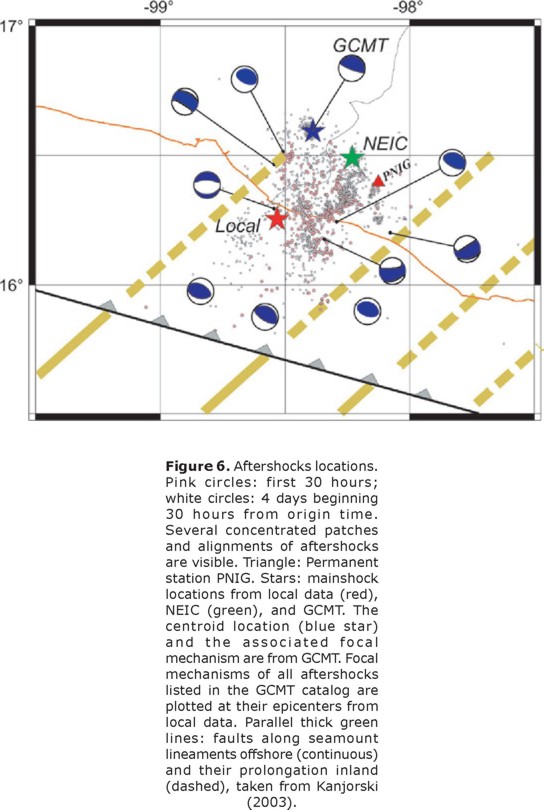
<body><![CDATA[<p align="justify"><font face="verdana" size="2">Locating the mainshock presented the usual difficulties associated with large events recorded at local distances. The SSN broadband network is relatively sparse. There were only 4 stations within a radius of 200 km of the epicenter. The broadband seismograms at PNIG and most other regional stations within a radius of ~300 km from the source were clipped on <i>S</i> wave. However, all SSN stations are equipped with accelerometers. We used accelerations (or velocities derived by simple integration) to read the <i>S</i> phase. We also used recordings from autonomous local and regional accelerographs &#91;(<i>S</i>&#45;<i>P</i>) time if absolute time was found to be incorrect&#93;. It was difficult to read <i>S</i>&#45;wave reliably on local statons. <i>P</i>&#45;wave at PNIG clearly showed that the rupture initiated SW of the station. In the location of the earthquake, the azimuth of the hypocenter from PNIG (250&deg;) was taken into account. The depth was fixed to 20 km as it is the typical depth of plate interface below the Mexican coast. A crustal model, modified from Iglesias <i>et al.</i> (2001), was used in the location of the mainshock and the aftershocks. The model consisted of three layers over a half space: layer 1, thickness = 5.2 km, <i>V</i> <sub>s</sub> = 3.45 km/s, density = 2.68 gm/cm<sup>3</sup>; layer 2, thickness = 10.5 km, <i>V</i> <sub>s</sub> = 3.50 km/s, density = 2.70 gm/cm<sup>3</sup>; layer 3, thickness = 5.2 km, <i>V</i> <sub>s</sub> = 3.45 km/s, density = 2.84 gm/cm<sup>3</sup>; half space, <i>V</i> <sub>s</sub> = 4.45 km/s, density = 3.23 gm/cm<sup>3</sup>. A Poisson solid was assumed to estimated <i>V</i><sub><i>p</i></sub>. Seismograms were converted to SeisAn format (Havskov and Ottem&ouml;ller, 1999) and eartquakes were located using an algorithm by Lienert and Havskov (1995).</font></p>  	    <p align="justify"><font face="verdana" size="2">The locations of the mainshock obtained in this study and the one reported by NEIC, U.S. Geological Survey are listed in <a href="/img/revistas/geoint/v52n2/a7c2.jpg" target="_blank">Table 2</a> and shown in <a href="#f2">Figure 2</a>. The table also lists CMT solutions, including centroid depth, reported by several sources. We note that the NEIC location is 58 km to N40&deg;E of the location from local/regional data.</font></p>  	    <p align="justify"><font face="verdana" size="2">&nbsp;</font></p>  	    <p align="justify"><font face="verdana" size="2"><b>Location of Aftershocks</b></font></p>  	    <p align="justify"><font face="verdana" size="2">We obtained preliminary epicenter locations of 458 aftershocks which occurred in the first 30 hours by reading azimuth and <i>P</i> and <i>S</i> times at PNIG. The depth was fixed at 20 km and the crustal model mentioned above was used in the location. The epicenters of the vents are shown in <a href="#f6">Figure 6</a>. As mentioned earlier, a network of seven portable digital seismographs was deployed in field (<a href="#f2">Figure 2</a>). The network became operational about 30 hours after the mainshock. We located 1235 aftershocks which occurred during the next four days using data from 4 to 7 stations. These are shown in <a href="#f6">Figure 6</a>. To check the accuracy of the epicenters of the early aftershocks based on PNIG only, we selected the largest 50 events which were recorded by the portable network and compared the locations with those determined from PNIG alone. The difference in the epicentral locations is about 10 km on average. The four&#45;day aftershocks (beginning 30 hours after the origin time) roughly define a 50 km &times; 60 km area. This area is larger than the first 30&#45;hour area which is about 40 km &times; 60 km, indicating expansion with time. Several clusters of aftershocks are visible in <a href="#f6">Figure 6</a>. A lineament of aftershocks, oriented ~N45&deg;E, occurs near PNIG. These clusters and the lineament may be related to bathymetric features on the subducted Cocos plate. We noet, however, that they do not coincide with the subducted seamount chains.</font></p>  	    <p align="center"><font face="verdana" size="2"><a name="f6"></a></font></p>  	    <p align="center"><font face="verdana" size="2"><img src="/img/revistas/geoint/v52n2/a7f6.jpg"></font></p>  	    <p align="justify"><font face="verdana" size="2"><a href="#f6">Figure 6</a> shows the GCMT centroid epicenter and focal mechanism of the mainshock from the GCMT catalog. This location is near the north end of the aftershock area, perhaps related to the shift of the NEIC epicenter to north east of the epicenter estimated from the local and regional data. The figure also displays epicenters and focal mechanisms of all large aftershocks. The epicenters are from local and regional data while the focal mechanisms are from GCMT catalog. Most of these larger aftershocks are located at the edge of the aftershock area. The largest aftershock occurred on 2 April 2012 (<i>H</i> = 12 km; <i>M</i><sub><i>w</i></sub>6.1). It has a normal&#45;faulting focal mechanism and is located in the overriding plate. It may have been causally related to the mainshock through stress interaction. An earthquake of similar mechanism occurred about 20 km NW of Acapulco, along the coast, near the town of Coyuca, on 8 October 2001 (<i>M</i><sub><i>w</i></sub>5.8). These events suggest that in situ stress in the upper plate near the coast in these regions is extensional, probably a consequence of tectonic erosion or trench roll back (Pacheco and Singh, 2010).</font></p>  	    <p align="justify"><font face="verdana" size="2"><a href="#f7">Figure 7</a> compares the aftershock areas of the 2012 earthquake estimated from 30&#45;hour and seven&#45;day activity, with tht of seven&#45;day aftershock area of the 1982 doublet (Nava, 1984). The areas roughly overlap. However, the sum of moments of the doublet (5.6&times;10<sup>19</sup> Nm, Astiz and Kanamori, 1984) is only about 1/2 to 1/3 of the momento of the 2012 earthquake (1.3&times;10<sup>20</sup> to 1.98&times;10<sup>20</sup> Nm). It is possible that the 2012 event broke an area which was larger than the doublet area but included it, suggesting a variable rupture mode (Kanamori and McNally, 1982).</font></p>  	    <p align="center"><font face="verdana" size="2"><a name="f7"></a></font></p>  	    ]]></body>
<body><![CDATA[<p align="center"><font face="verdana" size="2"><img src="/img/revistas/geoint/v52n2/a7f7.jpg"></font></p>  	    <p align="justify"><font face="verdana" size="2">&nbsp;</font></p>  	    <p align="justify"><font face="verdana" size="2"><b>Number of aftershocks</b></font></p>  	    <p align="justify"><font face="verdana" size="2">There was a general perception that the aftershocks activity following the 2012 earthquake was unusually intense. The number of aftershocks may be a reflection of the degree of heterogeneity on and near the fault plane. If there is a regional variation in the number of aftershocks then its knowledge is also useful to civil protection authorities. Thus, it is important to know whether the number of aftershocks of the 2012 event was truly large or only a subjective perception. The SSN network has been undergoing expansion and improvement. For this reason, it is not possible to compare the statistics of aftershocks of this earthquake with those of previous large events based on the SSN catalog. Therefore, we used U. S. Geological Survey Earthquake Data Base (<a href="http://earthquake.usgs.gov/earthquakes/eqarchives/epic/epic_rect.php" target="_blank">http://earthquake.usgs.gov/earthquakes/eqarchives/epic/epic_rect.php</a>). For our analysis, we isolated aftershocks of all shallow, thrust events with <i>M</i><sub><i>w</i></sub> &#8805; 6.9 wich occurred along the Mexican subduction zone, from Jalisco&#45;Colima to Oaxaca, beginning 1963 when the World&#45;Wide Standard Seismograph Network became operational. The database lists body&#45;wave magnitude, <i>m</i><sub><i>b</i></sub>, of small and moderate earthquakes and <i>M</i><sub><i>s</i></sub> or <i>M</i><sub><i>w</i></sub> for large earthquakes. For many, recent moderate earthquakes <i>M</i><sub><i>w</i></sub> rather than <i>m</i><sub><i>b</i></sub> is listed. For each earthquake we extracted seismicity during the next 30 days in an area which was chosen to be somewhat larger than the expected rupture area. <a href="/img/revistas/geoint/v52n2/html/a7t1.html#t3" target="_blank">Table 3</a> gives <i>N</i>(<i>m</i><sub><i>b</i></sub>), where <i>N</i> is the number of events with magnitude &#8805; <i>m</i><sub><i>b</i></sub>. <i>N</i> is listed for <i>m</i><sub><i>b</i></sub> = 4.5 and 5.0. The number includes the mainshock. <i>M</i><sub><i>w</i></sub> of moderate earthquakes is taken as <i>m</i><sub><i>b</i></sub>. The catalog is probably complete for <i>m</i><sub><i>b</i></sub> &#8805; 5.0. Events 5 and 10 in <a href="/img/revistas/geoint/v52n2/html/a7t1.html#t3" target="_blank">Table 3</a> are doublets. For these events the 30&#45;day period was counted from the second shock. The seismic moments of the two shocks were added before computing <i>M</i><sub><i>w</i></sub> which is listed in the table.</font></p>      <p align="justify"><font face="verdana" size="2"><a href="#f8">Figure 8a</a> shows the location of the mainshocks. The plot of <i>N</i>(<i>m</i><sub><i>b</i></sub> &#8805; 5) versus <i>M</i><sub><i>w</i></sub> of the mainshock is illustrated in <a href="#f8">Figure 8b</a>. To quantify the lack or access of aftershocks, we assume that <i>N</i> <i>&#945;A</i>, where <i>A</i> is the rupture area (Singh and Su&aacute;rez, 1988). Since <i>M</i><sub><i>w</i></sub> <i>&#945;</i> (2/3)log <i>M</i><sub>0</sub> <i>&#945;</i> log <i>A</i>, it follows that if <i>N</i> <i>&#945;A</i> then log <i>N</i> <i>&#945;M</i><sub><i>w</i></sub> . <i>N</i> versus <i>M</i><sub><i>w</i></sub> data is fitted with log <i>N</i> = <i>M</i><sub><i>w</i></sub> + <i>C</i>. The line defined by this relation, shown in <a href="#f8">Figure 8b</a>, serves to measure lack or excess of aftershocks for te earthquakes listed in <a href="/img/revistas/geoint/v52n2/html/a7t1.html#t3" target="_blank">Table 3</a>. The figure shows that events 1 and 5 (Colima&#45;Jalisco 1995 and Michoac&aacute;n 1985) were the two most deficient ones in the production of aftershocks, while events 11 and 12 (Offshore Pinoteta 1996 and Ometepec&#45;Pinotepa Nacional 2012) were the two most prolific ones. The relative abundance of aftershocks and simplicity of large earthquakes as seen in the region of the study may reflect both a relative abundance of heterogeneities at small scale but smooth fault plane at larger scale.</font></p>  	    <p align="center"><font face="verdana" size="2"><a name="f8"></a></font></p>  	    <p align="center"><font face="verdana" size="2"><img src="/img/revistas/geoint/v52n2/a7f8.jpg"></font></p>  	    <p align="justify"><font face="verdana" size="2">&nbsp;</font></p>  	    <p align="justify"><font face="verdana" size="2"><b>Slip on the Fault from Inversion of Teleseismic Data</b></font></p>  	    <p align="justify"><font face="verdana" size="2">Immediately after the earthquake, teleseismic body and surface waves were inverted to map slip on the fault by groups at NEIC and Caltech (<a href="http://eartquake.usgs.gov/earthquakes/eqinthenews/2012/usc0008m6h/finite_fault.php" target="_blank">http://eartquake.usgs.gov/earthquakes/eqinthenews/2012/usc0008m6h/finite_fault.php</a>; <a href="http://tectonics.caltech.edu/slip_history/2012_Mexico/index.html" target="_blank">http://tectonics.caltech.edu/slip_history/2012_Mexico/index.html</a>). These inversions use the NEIC hypocenter (16.662&deg;N, 98.188&deg;W, <i>H</i> = 20 km; <a href="/img/revistas/geoint/v52n2/a7c2.jpg" target="_blank">Table 2</a>). The results show a compact, nearly circular source whose dimension can be approximated by a square area of 35 km &times; 35 km. As a consequence of using the NEIC hypocenter, in these inversions the slip patch is located well inland, far north from our epicenter. Here we use the same simulated annealing, wavelet domain algorithm used by NEIC (Ji <i>et al.</i>, 2002a,b) to invert teleseismic body and surface waves for the slip on the fault plane. We use an expanded data set compared to the one used for the rapid solution by USGS: a total of 29 <i>P</i>&#45;waves, 15 <i>S</i>&#45;waves, 30 Rayleigh waves and 20 Love waves. We use th hypocenter determined in this study (<a href="/img/revistas/geoint/v52n2/a7c2.jpg" target="_blank">Table 2</a>). We invert for the magnitude, direction and duration of slip at each fault is parameterized by an asymmetric cosine function (Ji <i>et al.</i>, 2002a). The timing of the initial slip is constrained to follow a rupture volicity of 3 km/s. First the body&#45;wave arrivals were aligned on theoretical travel times based on a 1D Earth model. However, we found large apparent time shifts between observed and calculated seismograms, caused by the 3D structure of the Earth. The systematic variation of these shifts with azimuth is probably also responsible for the large mislocation of the hypocenter by global agencies, mentioned above. To minimize the effect of unmodeled 3D structure on the result, we manually aligned the body&#45;wave phases on the first observable arrival in the seismogram. At stations where we could not identify the first arrival, we aligned them to be consistent with neighboring stations. The alignment of the traces is a difficult task as the first arrivals are small relative to the noise level at many stations. Furthermore, comparing the teleseismic waveforms to the ones observed locally we found that the initial weak rupture (see more detail in the following section) was not seen in any of the teleseismic records. To account for this small initial slip near the hypocenter, we shifted all the traces by two seconds. The distribution of slip on the fault plane determined by the inversion is shown in <a href="#f9">Figure 9a</a>. There are two separate regions of slip, both to the East of the hypocenter, one updip and the other one downdip. Each area of slip is about 30 km in diameter and a maximum slip of almost 2 m. It should be emphasized that this is a preliminary solution and that the pattern depends critically on the alignment of the body waves. The solutions we obtained using unaligned seismograms, as well as aligned but not shifted by a constant, have one patch of slip to the north of the hypocenter, similar to the solutions of the groups at NEIC and Caltech. The shift of two seconds is what allows the rupture to get further from the hypocenter before the large slip occurs, in effect allowing two different slip patches. Allowing a much smaller rupture velocity at the beginning could alter this result. However, we note that the two&#45;patch slip model predicts static displacements that are in better agreement with those observed at nearby GPS stations than the one patch model and it is also in better agreement with the slip model obtained from regional data (following section).</font></p>  	    ]]></body>
<body><![CDATA[<p align="center"><font face="verdana" size="2"><a name="f9"></a></font></p>  	    <p align="center"><font face="verdana" size="2"><img src="/img/revistas/geoint/v52n2/a7f9.jpg"></font></p>  	    <p align="justify"><font face="verdana" size="2">&nbsp;</font></p>  	    <p align="justify"><font face="verdana" size="2"><b>Slip on the Fault from Inversion of Near&#45;Source Data</b></font></p>  	    <p align="justify"><font face="verdana" size="2">We inverted the near&#45;source band&#45;pass filtered displacement traces to map the slip on the fault. Because the times at some accelerographs were incorrect, we corrected them using the computed expected <i>P</i> arrival times. The accelerograms were baseline corrected, integrated to obtain velocities, and they were then bandpass filtered (0.025&#45;1.0 Hz). These traces were integrated to obtain the displacements. The data at station HZ04 were ignored since the traces at nearby JAMI station (<a href="#f2">Figure 2</a>) were of much better quality. From a visual inspection of the integrated traces and preliminary results of the inversion, we rejected the vertical displacement seismograms for LG01, SJLL, and LA03 stations (dashed lines in <a href="#f10">Figure 10</a>).</font></p>  	    <p align="center"><font face="verdana" size="2"><a name="f10"></a></font></p>  	    <p align="center"><font face="verdana" size="2"><img src="/img/revistas/geoint/v52n2/a7f10.jpg"></font></p>  	    <p align="justify"><font face="verdana" size="2">We assumed that the faulting was confined to a 90 km &times; 90 km area (<a href="#f7">Figure 7</a>) which has an azimuth = 295&deg;, dip = 13&deg;, and rake = 91&deg;, in rough accordance with the GCMT solution. This area was divided in 18 &times; 18 subfaults. The depth of the fault at the hypocenter (16.254&deg;N, 98.531&deg;W) was 20 km. The inversion was performed in the frequency domain (Cotton and Campillo, 1995) using a simulated annealing inversion scheme (Iglesias <i>et al.</i>, 2002). The displacement spectrum, <i>u</i><sub><i>i</i></sub>(<i>&#969;</i>), at the <i>i</i><sup><i>th</i></sup> station can be written as</font></p>  	    <p align="center"><font face="verdana" size="2"><img src="/img/revistas/geoint/v52n2/a7e1.jpg"></font></p>  	    <p align="justify"><font face="verdana" size="2">where <i>n</i> is the number of subfaults; <i>t</i><sub><i>k</i></sub>, the rupture time (time elapsed from origin time to the initial rupture for each subfault); <i>S</i><sub><i>k</i></sub>, the average displacement for <i>k</i><sup><i>th</i></sup> subfault; <i>g</i><sub><i>ki</i></sub>(<i>&#969;</i>), the displacement transfer function for unitary slip in the <i>k</i><sup><i>th</i></sup> subfault recorded at the <i>i</i><sup><i>th</i></sup> station; and <i>F</i><sub><i>k</i></sub> &#91;<i>R</i><sub><i>k</i></sub>, <i>&#969;</i>&#93;, the source time function depending on rise time <i>R</i><sub><i>k</i></sub>. Following Hernandez <i>et al.</i> (2001), we chose</font></p>  	    ]]></body>
<body><![CDATA[<p align="center"><font face="verdana" size="2"><img src="/img/revistas/geoint/v52n2/a7e2.jpg"></font></p>  	    <p align="justify"><font face="verdana" size="2">We attempted to invert for <i>R</i><sub><i>k</i></sub>. However, after several tests we found that <i>R</i><sub><i>k</i></sub> could not be resolved. Thus, in further inversions we fixed <i>R</i><sub><i>k</i></sub> = 1.7 s.</font></p>  	    <p align="justify"><font face="verdana" size="2">Synthetic seismograms for each subfatult to each station were computed using discrete wave number algorithm (Bouchon, 1982). The crustal model used in the inversion is given above. We took <i>Q</i><sub><i>s</i></sub> = 350 and <i>Q</i><sub><i>p</i></sub> = 600.</font></p>  	    <p align="justify"><font face="verdana" size="2">The differences between observed and synthetic spectra (real and imaginary parts) were minimized at all the discrete frequencies between 0.025 and 1.0 Hz. Each subfault was composed of 49 source points whose rupture was delayed in time by assuming a constant rupture velocity (<i>V</i><sub><i>r</i></sub> = 3.0 km/s). The details of the method are given in Hernandez <i>et al.</i> (2001) and Iglesias <i>et al.</i> (2002).</font></p>  	    <p align="justify"><font face="verdana" size="2">The result of the inversion is shown in <a href="#f9">Figure 9b</a> and the observed and synthetic waveforms are illustrated in <a href="#f10">Figure 10</a>. The fit is reasonable. The inversion yields a seismic moment of 1.1&times;10<sup>20</sup> Nm (<i>M</i><sub><i>w</i></sub>7.3). The observed coseismic static displacements at PINO (the same station as PNIG), OXTP, and MRQL (<a href="#f2">Figure 2</a>) were not used in the inversion. Thus, it is reassuring that the predicted static horizontal displacements at these stations, corresponding to the inverted slip, agree well with the observations (<a href="#f9">Figure 9b</a>).</font></p>  	    <p align="justify"><font face="verdana" size="2">The inversion shows small slip near the hypocenter. Large slip occurs on two patches: one patch is located updip from the hypocenter towards the south&#45;east while the other one is located downdip towards north. Significant slip is confined within an area of ~25 km &times; 60 km (1500 km<sup>2</sup>). The static stress drop, &#916;<i>&#963;</i>, during the earthquake can be estimated from the relation &#916;<i>&#963;</i> = (1/2) (7<i>&#960;</i><sup>3/2</sup>/16) (<i>M</i><sub>0</sub>/A<sup>3/2</sup>) where <i>A</i> is the fault area (Eshelby, 1957). With <i>M</i><sub>0</sub> =1.98&times;10<sup>20</sup> Nm and <i>A</i> = 1500 km<sup>2</sup>, we obtain &#916;<i>&#963;</i> = 4.3 MPa.</font></p>  	    <p align="justify"><font face="verdana" size="2">Back&#45;projection source imaging using teleseismic <i>P</i> waves recorded at USArray in northeast USA shows a dominant westward rupture propagation (L. Meng and J. P. Ampuero, personal communication, 2012). This network, however, has no resolution to detect along dip rupture propagation, which we find to be the dominant direction of rupture (<a href="#f9">Figure 9</a>).</font></p>  	    <p align="justify"><font face="verdana" size="2">From <a href="#f9">Figure 9b</a> we note that the aftershock activity is relatively low in areas of large slip. Do the two patches correspond to the individual events of the 1982 doublet? Comparison of the doublet epicenters (<a href="/img/revistas/geoint/v52n2/a7f1.jpg" target="_blank">Figure 1</a>) with the two patches (<a href="#f9">Figure 9b</a>) does not support this. However, the errors in the locations of the 1982 doublet are probably too large to reach a definitive conclusion.</font></p>  	    <p align="justify"><font face="verdana" size="2">&nbsp;</font></p>  	    <p align="justify"><font face="verdana" size="2"><b>Radiated Seismic Energy</b></font></p>  	    ]]></body>
<body><![CDATA[<p align="justify"><font face="verdana" size="2">Seismic moment, <i>M</i><sub>0</sub>, and radiated seismic energy, <i>E</i><sub><i>s</i></sub>, are the two basic source parameters of an earthquake. We computed <i>E</i><sub><i>s</i></sub> of five recent, large, earthquakes in the region using teleseismic <i>P</i>&#45;wave recordings following the method of Boatwright and Choy (1986). The estimate of the energy flux was obtained from the integral of the squared velocity spectrum of the <i>P</i>&#45;wave group (<i>P</i>, <i>pP</i>, and <i>sP</i> waves), corrected for attenuation and site effect (P&eacute;rez&#45;Campos, 2002; P&eacute;rez&#45;Campos <i>et al.</i>, 2003). The total <i>P</i>&#45;wave energy was then estimated using covariance&#45;weighting least squares (P&eacute;rez&#45;Campos and Beroza, 2001), and correcting for geometrical spreading and radiation pattern. We used <i>q</i> = 15.58 (Boatwright and Choy, 1986), the partitioning between <i>S</i>&#45; and <i>P</i>&#45;wave energy, to estimate the total radiated seismic energy. <a href="/img/revistas/geoint/v52n2/a7c4.jpg" target="_blank">Table 4</a> lists <i>E</i><sub><i>s</i></sub> and <i>E</i><sub><i>s</i></sub>/<i>M</i><sub>0</sub> values of the 2012 and other earthquakes in the region. We note that <i>E</i><sub><i>s</i></sub>/<i>M</i><sub>0</sub> of the 1996 and 1997 earthquakes, both located off&#45;shore, near the trench (<a href="/img/revistas/geoint/v52n2/a7f1.jpg" target="_blank">Figure 1</a>), are an order of magnitude smaller than for the other three events which broke the plate interface further downdip (<a href="#f11">Figure 11</a>). These earthquakes, like some other events near the trench of the Mexican subduction zone, also gave rise to unusually low PGA (Iglesias <i>et al.</i>, 2003). Low <i>E</i><sub><i>s</i></sub>/<i>M</i><sub>0</sub> is typical of near&#45;trench earthquakes (e.g., Lay <i>et al.</i>, 2012).</font></p>  	    <p align="center"><font face="verdana" size="2"><a name="f11"></a></font></p>  	    <p align="center"><font face="verdana" size="2"><img src="/img/revistas/geoint/v52n2/a7f11.jpg"></font></p>  	    <p align="justify"><font face="verdana" size="2">Rupture areas of most large Mexican subduction zone earthquakes straddle the coast, seldom reaching the trench. Those that do (e.g., 1995 Colima&#45;Jalisco, <i>M</i><sub><i>w</i></sub>8.0 earthquake) may cause large tsunami. Thus, for tsunami mitigation, it is critically important to know the state of seismic coupling on the updip part of the plate interface. Certainly, there is evidence of near&#45;trench coupling off&#45;shore Pinotepa and Colima&#45;Jalisco. The great 1787 Oaxaca earthquake (M~8.4 &#45; 8.6), which produced the largest historically documented tsunami in Mexico (N&uacute;&ntilde;ez&#45;Corn&uacute; <i>et al.</i>, 2008; Su&aacute;rez and Albini, 2009), suggests that a significant length of near&#45;trench interface in the region may be capable of strain accumulation. The interface may rupture in moderate <i>M</i>6.5&#45;7.0 earthquakes (as in the case of 1997 and 1996 events) and, occasionally, during great earthquakes when several asperities break in one single episode (1787 event).</font></p>  	    <p align="justify"><font face="verdana" size="2">&nbsp;</font></p>  	    <p align="justify"><font face="verdana" size="2"><b>Observed and Predicted Ground Motions in Mexico</b></font></p>  	    <p align="justify"><font face="verdana" size="2">Prediction of ground motions from future earthquakes is critically important in seismic hazard analysis. Although first accelerographs in Mexico date back to 1962, it was not until 1985 that a modern accelerographic network, called the Guerrero Accelerograph Array, became operational (Anderson <i>et al.</i>, 1994). This network covered the coastal region of Guerrero and part of Michoac&aacute;n. It also included a few stations inland and an attenuation line from the Guerrero coast to Mexico City. The 1985 Michoac&aacute;n earthquake was well&#45;recorded by this newly&#45;installed network. Since 1985, strong&#45;motion stations in Mexico have steadily increased in number. The data have been used to develop ground motion prediction equations (GMPE).</font></p>  	    <p align="justify"><font face="verdana" size="2">The recordings from the 2012 earthquake permit a check on the GMPE for interface earthquakes (Arroyo <i>et al.</i>, 2010). <a href="#f12">Figure 12</a> shows plots of observed and predicted <i>PGA</i> at hard sites as a function of <i>R</i><sub><i>rup</i></sub>, <i>the closest distance from the site to the rupture area</i>. Here <i>PGA</i> = &#91;(<i>A</i><sub><i>n</i></sub> <sup>2</sup> + <i>A</i><sub><i>e</i></sub> <sup>2</sup>)/2&#93;<sup>1/2</sup> (<i>A</i><sub><i>n</i></sub> and <i>A</i><sub><i>e</i></sub> are the peak accelerations on NS and EW components, respectively). The predictions are reasonable for <i>R</i><sub><i>rup</i></sub> &lt; 400 km, beyond which they underestimate the observations. This is expected since only data at distances of <i>R</i><sub><i>rup</i></sub> &lt; 400 km were used by Arroyo <i>et al.</i> (2010) in the regression analysis. In any case, ground motions at such large distances are of little importance in earthquake engineering.</font></p>  	    <p align="center"><font face="verdana" size="2"><a name="f12"></a></font></p>  	    <p align="center"><font face="verdana" size="2"><img src="/img/revistas/geoint/v52n2/a7f12.jpg"></font></p>  	    ]]></body>
<body><![CDATA[<p align="justify"><font face="verdana" size="2"><a href="#f13">Figure 13</a> shows <i>PGA</i> contours in Mexico for the 2012 earthquake. These contours were obtained from recorded data (shown by triangles) using a Bayesian interpolation technique. We note that the maximum contour roughly coincides with the maximum slip on the fault (<a href="#f9">Figure 9</a>). <a href="#f13">Figure 13</a> also shows municipalities where significant structural damage was observed. These municipalities received federal funds for recovery and reconstruction of the affected population (<a href="http://dof.gob.mx/nota_detalle.php?codigo=5241891&amp;fecha=03/04/2012" target="_blank">http://dof.gob.mx/nota_detalle.php?codigo=5241891&amp;fecha=03/04/2012</a>; <a href="http://dof.gob.mx/nota_detalle.php?codigo=5241892&amp;fecha=03/04/2012" target="_blank">http://dof.gob.mx/nota_detalle.php?codigo=5241892&amp;fecha=03/04/2012</a>).</font></p>  	    <p align="center"><font face="verdana" size="2"><a name="f13"></a></font></p>  	    <p align="center"><font face="verdana" size="2"><img src="/img/revistas/geoint/v52n2/a7f13.jpg"></font></p>  	    <p align="justify"><font face="verdana" size="2">&nbsp;</font></p>  	    <p align="justify"><font face="verdana" size="2"><b>Ground Motion in Mexico City</b></font></p>  	    <p align="justify"><font face="verdana" size="2">The 2012 earthquake was strongly felt in Mexico City. Initially it was thought that the city had survived well the onslaught of the largest earthquake since 1985. <a href="#f14">Figure 14</a> compares accelerograms and Fourier spectra of the 2012 (<i>M</i><sub><i>w</i></sub>7.5) and the 1995 Copala (<i>M</i><sub><i>w</i></sub>7.3) earthquakes at CU, a hill&#45;zone site in city. <a href="#f15">Figure 15</a> illustrates the corresponding plots at SCT, a site in the lake&#45;bed zone. The distance from the two sources to Mexico City is roughly equal. The <i>PGA</i>s during the two earthquakes at each of these sites are nearly the same (<a href="/img/revistas/geoint/v52n2/a7c5.jpg" target="_blank">Table 5</a> and <a href="/img/revistas/geoint/v52n2/a7c6.jpg" target="_blank">Table 6</a>). The same is true for Fourier amplitude spectra at frequencies greater than about 1 Hz. At lower frequencies, the Fourier amplitudes of the 2012 earthquake are somewhat greater than of the 1995 event, in agreement with their relative moment magnitudes.</font></p>  	    <p align="center"><font face="verdana" size="2"><a name="f14"></a></font></p>  	    <p align="center"><font face="verdana" size="2"><img src="/img/revistas/geoint/v52n2/a7f14.jpg"></font></p>  	    <p align="center"><font face="verdana" size="2"><a name="f15"></a></font></p>  	    <p align="center"><font face="verdana" size="2"><img src="/img/revistas/geoint/v52n2/a7f15.jpg"></font></p>  	    ]]></body>
<body><![CDATA[<p align="justify"><font face="verdana" size="2">Ten earthquakes which have produced largest <i>PGA</i> at CU since 1985 are listed in <a href="/img/revistas/geoint/v52n2/a7c5.jpg" target="_blank">Table 5</a>. <i>PGA</i> during the 2012 earthquake is 12.0 gal, the fifth largest in the table. Annual exceedance rate of 10 gal is about 0.3. We note that eight out of the 10 events gave rise to roughly similar <i>PGA</i>, between 8 and 14 gal. Thus, the 2012 earthquake was not exceptional in terms of <i>PGA</i>. Note that the <i>PGA</i> at CU during the 1985 earthquake was 30 gal, two and half times greater than during the 2012 event.</font></p>  	    <p align="justify"><font face="verdana" size="2"><a href="/img/revistas/geoint/v52n2/a7c6.jpg" target="_blank">Table 6</a> is similar to <a href="/img/revistas/geoint/v52n2/a7c5.jpg" target="_blank">Table 5</a> but for SCT. <i>PGA</i> at SCT during the 2012 earthquake was 34 gal, which is the third largest in the table. Annual exceedance rate of 20 gal at this site is about 0.3. During five out of the 10 events the <i>PGA</i> at SCT was between 29 and 39 gal. Again, the <i>PGA</i> at SCT during the 2012 earthquake was not exceptionally large (roughly four times less than during 1985 earthquake).</font></p>  	    <p align="justify"><font face="verdana" size="2">&nbsp;</font></p>  	    <p align="justify"><font face="verdana" size="2"><b>A Possible Interpretation</b></font></p>  	    <p align="justify"><font face="verdana" size="2">The 2012 Ometepec&#45;Pinotepa Nacional earthquake may be understood as a single event in a stochastic process:</font></p>  	    <p align="justify"><font face="verdana" size="2">Stress accumulation &rarr; Quiescence &rarr; EARTHQUAKE &rarr; Stress drop &rarr; Regional deformation &rarr; Aftershock sequence &rarr; Stress accumulation &rarr; Quiescence &rarr; EARTHQUAKE &rarr; Stress drop &rarr; Regional deformation &rarr; Aftershock sequence &rarr; ...</font></p>  	    <p align="justify"><font face="verdana" size="2">where time runs from left to right, and the embedded process of stress accumulation shifts its localization at random (Casta&ntilde;os <i>et al.</i>, 2013). Causality appears to require a different process which, however, never happens:</font></p>  	    <p align="justify"><font face="verdana" size="2">Stress accumulation &rarr; Foreshock sequence &rarr; EARTHQUAKE &rarr; Stress drop &rarr; Regional deformation &rarr; Quiescence &rarr; Stress accumulation &rarr; Foreshock sequence &rarr; EARTHQUAKE &rarr; Stress drop &rarr; Regional deformation &rarr; Quiescence &rarr; ...</font></p>  	    <p align="justify"><font face="verdana" size="2">In other words, if all earthquakes are caused by precursory stress accumulation the current logic requires that the seismicity in the region should increase <i>before</i> the main shock, not afterwards. The reason is the Coulomb failure criterion</font></p>  	    <p align="center"><font face="verdana" size="2"><i>&#964;</i> = <i>&#963;</i> tan <i>&#934;</i> + <i>c</i>,</font></p>  	    ]]></body>
<body><![CDATA[<p align="justify"><font face="verdana" size="2">where the stress <i>&#963;</i> on the fault builds up gradually with time while the shear strength <i>&#964;</i> remains constant. Here tan <i>&#934;</i> is the coefficient of internal friction and <i>c</i> is the cohesion. The hypothesis of stress buildup before earthquakes remains a fundamental feature of earthquake theory.</font></p>  	    <p align="justify"><font face="verdana" size="2">But the Coulomb failure criterion admits two symmetrically opposite interpretations: (1) the regional stress <i>&#963;</i>increases in time until it matches or exceeds the constant strength <i>&#964;</i> of the fault, or (2) the shear strength <i>&#964;</i> of the fault decays in time until it is overcome by the stationary regional stress <i>&#963;</i>. Symmetry with respect to time translation yields conservation of energy, as predicted by a famous theorem of Noether (1918): "Every differentiable symmetry in a physical system must be associated with a conserved quantity".</font></p>  	    <p align="justify"><font face="verdana" size="2">The Cocos plate subducts the North America plate at a relative convergence rate of 6 cm/yr in the N34&deg;E direction (DeMets <i>et al.</i>, 1990). The stochastic process described above is merely a random discretization of the steady&#45;state subduction process. The physics of this process requires that fluctuations in the state of stress will be consistent with the Second Law of Thermodynamics: "Earth system processes perform work by degrading sources of free energy, thereby producing entropy" (Kleidon and Lorenz, 2005). This fits the Coulomb failure criterion in its second interpretation, i.e., the shear strength <i>&#964;</i> of the fault decays in time until it is overcome by the stationary regional stress <i>&#963;</i>.</font></p>  	    <p align="justify"><font face="verdana" size="2">What could be the cause of fluctuations in strength on the subduction zone? The answer has to do with the ubiquitous process of stress corrosion in the presence of water. In the active Guerrero subduction zone segmentation is closely related to water content (Husker and Davis, 2009). After a major earthquake the rupture heals at a roughly constant rate with a half&#45;life of 20 years (Casta&ntilde;os <i>et al.</i>, 2013). Aftershocks are related to the healing process, so that the aftershock region is about the same as the rupture region which has not yet healed.</font></p>  	    <p align="justify"><font face="verdana" size="2">&nbsp;</font></p>  	    <p align="justify"><font face="verdana" size="2"><b>Summary and Conclusions</b></font></p>  	    <p align="justify"><font face="verdana" size="2">The 2012 Ometepec&#45;Pinotepa Nacional nucleated about 5 km offshore, near the border between the states of Guerrero and Oaxaca, at a depth of about 20 km. The epicenter reported by NEIC is 58 km toward N40&deg;E. This large difference in the location is partly due to weak beginning of the earthquake so that <i>P</i> phase read at local and regional distances may not correspond to that read at teleseismic distances. In addition, there are such factors as teleseismic station distribution and the velocity structure of the subduction zone which cause a systematic bias of the NEIC epicenters of Mexican earthquakes to be shifted towards the NE (see, e.g., Singh and Lermo, 1985).</font></p>  	    <p align="justify"><font face="verdana" size="2">As a consequence of the mislocation mentioned above, the area of slip distribution mapped from inversion of teleseismic waves by different groups is also shifted to the NE with respect with the one mapped from our inversion of local displacement seismograms. Our preliminary inversion of teleseismic data, using the hypocenter reported here and time shifting discussed above, agrees well with the inversion of the local data. The inversion of local data reveals two patches of large slip, one updip towards SW of the hypocenter and the other downdip to the N. The slip is small near the hypocenter during the first 4 s of rupture. This seems to suggest that the earthquake nucleated in an area of low strength and little strain accumulation. The rupture then broke two stronger asperities. Significant slip extends 25 km updip and 35 km downdip from the coast, and for a length of about 25 km along the strike. This defines a rupture area of about 25 km &times; 60 km.</font></p>  	    <p align="justify"><font face="verdana" size="2">Our slip area roughly coincides with the 30&#45;hour aftershock area. We note that there is relative lack of aftershocks near the hypocenter where the slip is small, as well as in the areas of large slip. This is a pattern reported for many earthquakes (see Das and Henry, 2003 for a review). The aftershocks of the 2012 earthquakes cluster in several patches; in addition a large number of them are aligned in the northeast direction towards the station PNIG. This may be related to heterogeneities on the plate interface related to the subducting bathymetric features. The earthquake produced unusually large number of aftershocks, suggesting more heterogeneous interface on this segment than others along the Mexican subduction zone west of 95&deg;W. We note, however, that neither the NE alignment of the aftershocks nor the two patches of large slip coincide with the prolongation of the sea mounts inland.</font></p>  	    <p align="justify"><font face="verdana" size="2">Although the aftershock areas of 2012 and 1982 doublet roughly overlap, the sum of the seismic moments of the doublet is only about 1/3 that of the 2012 earthquake. Thus, the two events are not a repeat of each other. The 2012 event may have ruptured the doublet fault area plus an additional area, suggesting a variable rupture mode.</font></p>  	    ]]></body>
<body><![CDATA[<p align="justify"><font face="verdana" size="2">The region is an excellent laboratory to study different seismic phenomena related to the subduction process. As sketched in <a href="/img/revistas/geoint/v52n2/a7f16.jpg" target="_blank">Figure 16</a>, the plate interface can be divided in three domains based on their seismic characteristics. This division is similar to the conceptual model proposed by Lay <i>et al.</i> (2012). Moderate to large thrust earthquakes (<i>M</i> ~ 6&#45;7), accompanied by large number of aftershocks, occur on the upper&#45;most "slow earthquake" domain. This domain extends from the trench up to a downdip distance of about 35 km (depth &#8804; 15 km). The earthquakes are characterized by low radiated energy to seismic moment ratio, <i>E</i><sub><i>s</i></sub>/<i>M</i><sub>0</sub>. They also give rise to very low accelerations. A part of the area in this domain may either be creeping (stable sliding) or may be partially locked. The next domain covers a distance range of 35 to 100 km from the trench and depth range of 15&#45;25 km. It is seismically coupled and ruptures in large earthquakes (<i>M</i> ~7&#45;7.5). A fraction of the area is conditionally stable and slips during large events. The domain further downdip, in the distance range of 100 to 200 km from the trench, is very likely the site of slow seismic events (SSEs) and nonvolcanic tremors (NVTs). SSEs and NVTs have been reported in the instrumented adjacent areas of Guerrero to the northwest (<i>e.g.</i>, Kostoglodov <i>et al.</i>, 2003, 2010; Payero <i>et al.</i>, 2008) and central Oaxaca to the southeast (Brudzinski <i>et al.</i>, 2007, 2010). These phenomena have not yet been documented in Ometepec&#45;Pinotepa Nacional region which presently lacks adequate instrumentation.</font></p>  	    <p align="justify"><font face="verdana" size="2">It is possible that the 2012 earthquake was triggered by the SSE which occurred in the adjacent southeast region during late 2011 and mid&#45;2012 (Graham <i>et al.</i>, 2012). At present the details of temporal and spatial evolution of the SSE is not available. We note, however, that the earthquake nucleated offshore, probably more than 75 km updip from the region of SSE. Furthermore, one of the patches of large slip was updip from the hypocenter. To establish a causal relation between the two events, these observations would have to be satisfactorily explained.</font></p>  	    <p align="justify"><font face="verdana" size="2">The earthquake produced the first recording in which the <i>PGA</i> exceeded 1 g above the Mexican subduction zone. It was, however, at a soft site. From a seismic engineering point of view, it is reassuring that the observed <i>PGA</i> as function of distance is well&#45;explained by ground motion prediction equation derived from Mexican data. The earthquake was strongly felt in Mexico City. The <i>PGA</i> at CU, a typical hill&#45;zone site, and at SCT, a representative lake&#45;bed zone site, was 12 and 20 gal, respectively. These <i>PGA</i>s were not unusually large; they occur once in about 3 years.</font></p>  	    <p align="justify"><font face="verdana" size="2">&nbsp;</font></p>  	    <p align="justify"><font face="verdana" size="2"><b>Acknowledgments</b></font></p>  	    <p align="justify"><font face="verdana" size="2">UNAM Seismology Group includes all researchers and technicians, as well as students, of Institute of Geophysics and Institute of Engineering, UNAM, who work in the field of seismology and engineering seismology. In case of a significant earthquake in Mexico, the Group informally coordinates its efforts in data collection from autonomous stations, field deployment of seismographs and accelerographs, analysis of the data, and elaboration of a preliminary report. The credit of the work is shared by all.</font></p>  	    <p align="justify"><font face="verdana" size="2">We thank Civil Protection authorities of the State of Oaxaca, Centro de Instrumentaci&oacute;n y Registros S&iacute;smicos (CIRES) and Centro Nacional de Prevenci&oacute;n de Desastres (CENAPRED) for making available to us the recordings of the mainshock. We are indebted to H. Kanamori for sharing his unpublished results with us and for many fruitful discussions on the 2012 earthquake during his visit to UNAM in August 2012. We appreciate comments and suggestions by H. Kanamori, L. Astiz, R. Castro and C. Mendoza who were reviewers of the manuscript. The research was supported by Conacyt project 82599, and PAPIIT&#45;UNAM projects IN112411 and IN111411&#45;2.</font></p>  	    <p align="justify"><font face="verdana" size="2">&nbsp;</font></p>  	    <p align="justify"><font face="verdana" size="2"><b>Bibliography</b></font></p>  	    <!-- ref --><p align="justify"><font face="verdana" size="2">Anderson J.G., Brune J.N., Prince J., Quaas R., Singh S.K., Almora D., Bodin P., O&ntilde;ate M., V&aacute;squez R., Velasco J.M., 1994, The Guerrero accelerograph network. <i>Geof&iacute;sica Internacional</i>, 33, 341&#45;372.    &nbsp;&nbsp;&nbsp;&nbsp;&nbsp;&nbsp;&nbsp;&nbsp;[&#160;<a href="javascript:void(0);" onclick="javascript: window.open('/scielo.php?script=sci_nlinks&ref=3928115&pid=S0016-7169201300040000700001&lng=','','width=640,height=500,resizable=yes,scrollbars=1,menubar=yes,');">Links</a>&#160;]<!-- end-ref --></font></p>  	    <!-- ref --><p align="justify"><font face="verdana" size="2">Anderson J.G., Singh S.K., Esp&iacute;ndola J.M., Yamamoto J., 1989, Seismic strain release in the Mexican subduction thrust. <i>Phys. Earth Planet. Inter.</i>, 58, 307&#45;322.    &nbsp;&nbsp;&nbsp;&nbsp;&nbsp;&nbsp;&nbsp;&nbsp;[&#160;<a href="javascript:void(0);" onclick="javascript: window.open('/scielo.php?script=sci_nlinks&ref=3928117&pid=S0016-7169201300040000700002&lng=','','width=640,height=500,resizable=yes,scrollbars=1,menubar=yes,');">Links</a>&#160;]<!-- end-ref --></font></p>  	    <!-- ref --><p align="justify"><font face="verdana" size="2">Arroyo D., Garc&iacute;a D., Ordaz M., Mora M.A., Singh S.K., 2010, Strong ground&#45;motion relations for Mexican interplate earthquakes. <i>J. Seismol.</i>, Doi 10.1007/s10950&#45;010&#45;9200&#45;0.    &nbsp;&nbsp;&nbsp;&nbsp;&nbsp;&nbsp;&nbsp;&nbsp;[&#160;<a href="javascript:void(0);" onclick="javascript: window.open('/scielo.php?script=sci_nlinks&ref=3928119&pid=S0016-7169201300040000700003&lng=','','width=640,height=500,resizable=yes,scrollbars=1,menubar=yes,');">Links</a>&#160;]<!-- end-ref --></font></p>  	    <!-- ref --><p align="justify"><font face="verdana" size="2">Astiz L., Kanamori H., 1984, An earthquake doublet in Ometepec, Guerrero, Mexico. <i>Phys. Earth Planet. Inter.</i>, 34, 24&#45;45.    &nbsp;&nbsp;&nbsp;&nbsp;&nbsp;&nbsp;&nbsp;&nbsp;[&#160;<a href="javascript:void(0);" onclick="javascript: window.open('/scielo.php?script=sci_nlinks&ref=3928121&pid=S0016-7169201300040000700004&lng=','','width=640,height=500,resizable=yes,scrollbars=1,menubar=yes,');">Links</a>&#160;]<!-- end-ref --></font></p>  	    <!-- ref --><p align="justify"><font face="verdana" size="2">Astiz L., Kanamori H., Eissler H., 1987, Source characteristics of earthquakes in the Michoacan seismic gap in Mexico. <i>Bull. Seismol. Soc. Am.</i>, 77, 1326&#45;1346.    &nbsp;&nbsp;&nbsp;&nbsp;&nbsp;&nbsp;&nbsp;&nbsp;[&#160;<a href="javascript:void(0);" onclick="javascript: window.open('/scielo.php?script=sci_nlinks&ref=3928123&pid=S0016-7169201300040000700005&lng=','','width=640,height=500,resizable=yes,scrollbars=1,menubar=yes,');">Links</a>&#160;]<!-- end-ref --></font></p>  	    <!-- ref --><p align="justify"><font face="verdana" size="2">Boatwright J., Choy G.L., 1986, Teleseismic estimates of the energy radiated by shallow earthquakes. <i>J. Geophys. Res.</i>, 91, 2095&#45;2112.    &nbsp;&nbsp;&nbsp;&nbsp;&nbsp;&nbsp;&nbsp;&nbsp;[&#160;<a href="javascript:void(0);" onclick="javascript: window.open('/scielo.php?script=sci_nlinks&ref=3928125&pid=S0016-7169201300040000700006&lng=','','width=640,height=500,resizable=yes,scrollbars=1,menubar=yes,');">Links</a>&#160;]<!-- end-ref --></font></p>  	    <!-- ref --><p align="justify"><font face="verdana" size="2">Bouchon M., 1982, The complete synthetics of crustal seismic phases at regional distances. <i>J. Geophys. Res.</i>, 87, 1735&#45;1741.    &nbsp;&nbsp;&nbsp;&nbsp;&nbsp;&nbsp;&nbsp;&nbsp;[&#160;<a href="javascript:void(0);" onclick="javascript: window.open('/scielo.php?script=sci_nlinks&ref=3928127&pid=S0016-7169201300040000700007&lng=','','width=640,height=500,resizable=yes,scrollbars=1,menubar=yes,');">Links</a>&#160;]<!-- end-ref --></font></p>  	    <!-- ref --><p align="justify"><font face="verdana" size="2">Brudzinski M.R., Cabral&#45;Cano E., Correa&#45;Mora F., DeMets C., M&aacute;rquez&#45;Az&uacute;a B., 2007, Slow slip transients along the Oaxaca subduction segment from 1993 to 2007. <i>Geophys. J. Int.</i>, 171, 523&#45;538, DOI:10.1111/j.1365246X.2007.03542.x.    &nbsp;&nbsp;&nbsp;&nbsp;&nbsp;&nbsp;&nbsp;&nbsp;[&#160;<a href="javascript:void(0);" onclick="javascript: window.open('/scielo.php?script=sci_nlinks&ref=3928129&pid=S0016-7169201300040000700008&lng=','','width=640,height=500,resizable=yes,scrollbars=1,menubar=yes,');">Links</a>&#160;]<!-- end-ref --></font></p>  	    <!-- ref --><p align="justify"><font face="verdana" size="2">Brudzinski M.R., Hinojosa&#45;Prieto H.R., Schlanser K.M., Cabral&#45;Cano E., Arciniega&#45;Ceballos A., Diaz&#45;Molina O., DeMets C., 2010, Nonvolcanic tremor along the Oaxaca segment of the Middle America subduction zone. <i>J. Geophys. Res.</i>, 115, B00A23, doi:10.1029/2008JB006061.    &nbsp;&nbsp;&nbsp;&nbsp;&nbsp;&nbsp;&nbsp;&nbsp;[&#160;<a href="javascript:void(0);" onclick="javascript: window.open('/scielo.php?script=sci_nlinks&ref=3928131&pid=S0016-7169201300040000700009&lng=','','width=640,height=500,resizable=yes,scrollbars=1,menubar=yes,');">Links</a>&#160;]<!-- end-ref --></font></p>  	    <!-- ref --><p align="justify"><font face="verdana" size="2">Casta&ntilde;os H., Joshi A., Lomnitz C., Zhang C.&#45;J., 2013, Famous failures: A natural history of disaster, in <i>Extreme Events</i>, AGU Monographs, in press.    &nbsp;&nbsp;&nbsp;&nbsp;&nbsp;&nbsp;&nbsp;&nbsp;[&#160;<a href="javascript:void(0);" onclick="javascript: window.open('/scielo.php?script=sci_nlinks&ref=3928133&pid=S0016-7169201300040000700010&lng=','','width=640,height=500,resizable=yes,scrollbars=1,menubar=yes,');">Links</a>&#160;]<!-- end-ref --></font></p>  	    <!-- ref --><p align="justify"><font face="verdana" size="2">Chael E.P., Stewart G.S., 1982, Recent large earthquakes along the middle American trench and their implications for the subduction process. <i>J. Geophys. Res.</i>, 87, 329&#45;338.    &nbsp;&nbsp;&nbsp;&nbsp;&nbsp;&nbsp;&nbsp;&nbsp;[&#160;<a href="javascript:void(0);" onclick="javascript: window.open('/scielo.php?script=sci_nlinks&ref=3928135&pid=S0016-7169201300040000700011&lng=','','width=640,height=500,resizable=yes,scrollbars=1,menubar=yes,');">Links</a>&#160;]<!-- end-ref --></font></p>  	    <!-- ref --><p align="justify"><font face="verdana" size="2">Cotton F., Campillo M., 1995, Inversion of strong ground motion in the frequency domain: application to the 1992 Landers, California earthquake. <i>J. Geophys. Res.</i>, 100, 3961&#45;3975.    &nbsp;&nbsp;&nbsp;&nbsp;&nbsp;&nbsp;&nbsp;&nbsp;[&#160;<a href="javascript:void(0);" onclick="javascript: window.open('/scielo.php?script=sci_nlinks&ref=3928137&pid=S0016-7169201300040000700012&lng=','','width=640,height=500,resizable=yes,scrollbars=1,menubar=yes,');">Links</a>&#160;]<!-- end-ref --></font></p>  	    <!-- ref --><p align="justify"><font face="verdana" size="2">Courboulex F., Singh S.K., Pacheco J.F., Ammon C., 1997, The 1995 Colima&#45;Jalisco, Mexico, earthquake (Mw 8): A study of the rupture process. <i>Geophys. Res. Lett.</i>, 34, 1019&#45;1022.    &nbsp;&nbsp;&nbsp;&nbsp;&nbsp;&nbsp;&nbsp;&nbsp;[&#160;<a href="javascript:void(0);" onclick="javascript: window.open('/scielo.php?script=sci_nlinks&ref=3928139&pid=S0016-7169201300040000700013&lng=','','width=640,height=500,resizable=yes,scrollbars=1,menubar=yes,');">Links</a>&#160;]<!-- end-ref --></font></p>  	    <!-- ref --><p align="justify"><font face="verdana" size="2">Das S., Henry C., 2003, Spatial relation between main earthquake slip and its aftershock distribution. <i>Rev. Geophys.</i>, 3&#45;1 &#45; 3&#45;23, doi: 10.1029/2003RG000119.    &nbsp;&nbsp;&nbsp;&nbsp;&nbsp;&nbsp;&nbsp;&nbsp;[&#160;<a href="javascript:void(0);" onclick="javascript: window.open('/scielo.php?script=sci_nlinks&ref=3928141&pid=S0016-7169201300040000700014&lng=','','width=640,height=500,resizable=yes,scrollbars=1,menubar=yes,');">Links</a>&#160;]<!-- end-ref --></font></p>  	    <!-- ref --><p align="justify"><font face="verdana" size="2">DeMets C., Gordon R.G., Argus D.F., Stein S., 1990, Current plate motions, <i>Geophys. J. Int.</i>, 101, 427&#45;478.    &nbsp;&nbsp;&nbsp;&nbsp;&nbsp;&nbsp;&nbsp;&nbsp;[&#160;<a href="javascript:void(0);" onclick="javascript: window.open('/scielo.php?script=sci_nlinks&ref=3928143&pid=S0016-7169201300040000700015&lng=','','width=640,height=500,resizable=yes,scrollbars=1,menubar=yes,');">Links</a>&#160;]<!-- end-ref --></font></p>  	    <!-- ref --><p align="justify"><font face="verdana" size="2">Eshelby J.D., 1957, The determination of the elastic field of an ellipsoidal inclusion, and related problems. <i>Proceedings of the Royal Society of London, Series A</i>, 241, 376&#45;396.    &nbsp;&nbsp;&nbsp;&nbsp;&nbsp;&nbsp;&nbsp;&nbsp;[&#160;<a href="javascript:void(0);" onclick="javascript: window.open('/scielo.php?script=sci_nlinks&ref=3928145&pid=S0016-7169201300040000700016&lng=','','width=640,height=500,resizable=yes,scrollbars=1,menubar=yes,');">Links</a>&#160;]<!-- end-ref --></font></p>  	    <!-- ref --><p align="justify"><font face="verdana" size="2">Graham S., Cabral Cano E., Kostoglodov V., Cotte N., Radiguet M., Walpersdorf A., Santiago J.A., Brudzinski M., McCaffrey R., DeMets C., 2012, Animations and modeling of the 2012 slow slip event beneath southern Mexico and the accompanying 20 March 2012 Mw=7.4 Ometepec earthquake. UGM Reuni&oacute;n anual 2012; <i>GEOS, Uni&oacute;n Geof&iacute;sica Mexicana</i>, 32, 263.    &nbsp;&nbsp;&nbsp;&nbsp;&nbsp;&nbsp;&nbsp;&nbsp;[&#160;<a href="javascript:void(0);" onclick="javascript: window.open('/scielo.php?script=sci_nlinks&ref=3928147&pid=S0016-7169201300040000700017&lng=','','width=640,height=500,resizable=yes,scrollbars=1,menubar=yes,');">Links</a>&#160;]<!-- end-ref --></font></p>  	    <!-- ref --><p align="justify"><font face="verdana" size="2">Gregorius T., 1996, Gipsy&#150;OASIS II How it works, manual for class of GIPSY. Jet Propulsion Laboratory, California Institute of Technology, Pasadena, EUA.    &nbsp;&nbsp;&nbsp;&nbsp;&nbsp;&nbsp;&nbsp;&nbsp;[&#160;<a href="javascript:void(0);" onclick="javascript: window.open('/scielo.php?script=sci_nlinks&ref=3928149&pid=S0016-7169201300040000700018&lng=','','width=640,height=500,resizable=yes,scrollbars=1,menubar=yes,');">Links</a>&#160;]<!-- end-ref --></font></p>  	    <!-- ref --><p align="justify"><font face="verdana" size="2">Havskov J., Ottem&ouml;ller L., 1999, Electronic Seismologist: Seis An earthquake analysis software. <i>Seism. Res. Lett.</i>, 70, 532&#45;534.    &nbsp;&nbsp;&nbsp;&nbsp;&nbsp;&nbsp;&nbsp;&nbsp;[&#160;<a href="javascript:void(0);" onclick="javascript: window.open('/scielo.php?script=sci_nlinks&ref=3928151&pid=S0016-7169201300040000700019&lng=','','width=640,height=500,resizable=yes,scrollbars=1,menubar=yes,');">Links</a>&#160;]<!-- end-ref --></font></p>  	    <!-- ref --><p align="justify"><font face="verdana" size="2">Havskov J., Singh S.K., Nava E., Dominguez T., Rodriguez M., 1983, Playa Azul, Michoacan, Mexico, earthquake of 25 October 1981 (Ms = 7.3). <i>Bull. Seismol. Soc. Am.</i>, 73, 449&#45;457.    &nbsp;&nbsp;&nbsp;&nbsp;&nbsp;&nbsp;&nbsp;&nbsp;[&#160;<a href="javascript:void(0);" onclick="javascript: window.open('/scielo.php?script=sci_nlinks&ref=3928153&pid=S0016-7169201300040000700020&lng=','','width=640,height=500,resizable=yes,scrollbars=1,menubar=yes,');">Links</a>&#160;]<!-- end-ref --></font></p>  	    <!-- ref --><p align="justify"><font face="verdana" size="2">Hernandez B., Shapiro N., Singh S.K., Pacheco J., Cotton F., Campillo M., Iglesias A., Cruz V., G&oacute;mez J.M., Alc&aacute;ntara L., 2001, Rupture history of September 30, 1999 intraplate earthquake of Oaxaca, Mexico (Mw=7.5) from inversion of strong motion. <i>Geophys. Res. Lett.</i>, 28, 363&#45;366.    &nbsp;&nbsp;&nbsp;&nbsp;&nbsp;&nbsp;&nbsp;&nbsp;[&#160;<a href="javascript:void(0);" onclick="javascript: window.open('/scielo.php?script=sci_nlinks&ref=3928155&pid=S0016-7169201300040000700021&lng=','','width=640,height=500,resizable=yes,scrollbars=1,menubar=yes,');">Links</a>&#160;]<!-- end-ref --></font></p>  	    <!-- ref --><p align="justify"><font face="verdana" size="2">Husker A., Davis P.M., 2009, Tomography and thermal state of the Cocos plate subduction beneath Mexico City. <i>J.</i> <i>Geophys. Res.</i>, 114, B04306 doi:10.1029/2008JB006039.    &nbsp;&nbsp;&nbsp;&nbsp;&nbsp;&nbsp;&nbsp;&nbsp;[&#160;<a href="javascript:void(0);" onclick="javascript: window.open('/scielo.php?script=sci_nlinks&ref=3928157&pid=S0016-7169201300040000700022&lng=','','width=640,height=500,resizable=yes,scrollbars=1,menubar=yes,');">Links</a>&#160;]<!-- end-ref --></font></p>     <!-- ref --><p align="justify"><font face="verdana" size="2">Iglesias A., Cruz&#45;Atienza V.M., Shapiro N.M., Singh S.K., Pacheco J.F., 2001, Crustal structure of south&#45;central Mexico estimated from the inversion of surface&#45;wave dispersion curves using genetic and simulated annealing algorithms. <i>Geof&iacute;sica Internacional</i>, 40, 181&#45;190.    &nbsp;&nbsp;&nbsp;&nbsp;&nbsp;&nbsp;&nbsp;&nbsp;[&#160;<a href="javascript:void(0);" onclick="javascript: window.open('/scielo.php?script=sci_nlinks&ref=3928159&pid=S0016-7169201300040000700023&lng=','','width=640,height=500,resizable=yes,scrollbars=1,menubar=yes,');">Links</a>&#160;]<!-- end-ref --></font></p>  	    <!-- ref --><p align="justify"><font face="verdana" size="2">Iglesias A., Singh S.K., Pacheco J.F., Alc&aacute;ntara L., Ortiz M., Ordaz M., 2003, Near trench Mexican earthquakes have anomalously low peak accelerations. <i>Bull. Seismol. Soc. Am.</i>, 93, 953&#45;959.    &nbsp;&nbsp;&nbsp;&nbsp;&nbsp;&nbsp;&nbsp;&nbsp;[&#160;<a href="javascript:void(0);" onclick="javascript: window.open('/scielo.php?script=sci_nlinks&ref=3928161&pid=S0016-7169201300040000700024&lng=','','width=640,height=500,resizable=yes,scrollbars=1,menubar=yes,');">Links</a>&#160;]<!-- end-ref --></font></p>  	    <!-- ref --><p align="justify"><font face="verdana" size="2">Iglesias A., Singh S.K., Pacheco J.F., Ordaz M., 2002, A source and wave propagation study of the Copalillo, Mexico, earthquake of 21 July 2000 (Mw 5.9): Implications for seismic hazard in Mexico City from inslab earthquakes. <i>Bull. Seismol. Soc. Am.</i>, 92, 1060&#45;1071.    &nbsp;&nbsp;&nbsp;&nbsp;&nbsp;&nbsp;&nbsp;&nbsp;[&#160;<a href="javascript:void(0);" onclick="javascript: window.open('/scielo.php?script=sci_nlinks&ref=3928163&pid=S0016-7169201300040000700025&lng=','','width=640,height=500,resizable=yes,scrollbars=1,menubar=yes,');">Links</a>&#160;]<!-- end-ref --></font></p>  	    <!-- ref --><p align="justify"><font face="verdana" size="2">Ji C., Wald D.J., Helmberger D.V., 2002a, Source description of the 1999 Hector Mine, California, earthquake, Part I: Wavelet domain inversion theory and resolution analysis. <i>Bull. Seismol. Soc. Am.</i>, 92, 1192&#45;1207.    &nbsp;&nbsp;&nbsp;&nbsp;&nbsp;&nbsp;&nbsp;&nbsp;[&#160;<a href="javascript:void(0);" onclick="javascript: window.open('/scielo.php?script=sci_nlinks&ref=3928165&pid=S0016-7169201300040000700026&lng=','','width=640,height=500,resizable=yes,scrollbars=1,menubar=yes,');">Links</a>&#160;]<!-- end-ref --></font></p>  	    <!-- ref --><p align="justify"><font face="verdana" size="2">Ji C., Wald D.J., Helmberger D.V., 2002b, Source description of the 1999 Hector Mine, California, earthquake, Part II: Complexity of slip history. <i>Bull. Seismol. Soc. Am.</i>, 92, 1208&#45;1226.    &nbsp;&nbsp;&nbsp;&nbsp;&nbsp;&nbsp;&nbsp;&nbsp;[&#160;<a href="javascript:void(0);" onclick="javascript: window.open('/scielo.php?script=sci_nlinks&ref=3928167&pid=S0016-7169201300040000700027&lng=','','width=640,height=500,resizable=yes,scrollbars=1,menubar=yes,');">Links</a>&#160;]<!-- end-ref --></font></p>  	    <!-- ref --><p align="justify"><font face="verdana" size="2">Ju&aacute;rez Garc&iacute;a H., G&oacute;mez Bernal A., Rangel N&uacute;&ntilde;ez J.L., Tena&#45;Colunga A., Rold&aacute;n Islas J., Pelcastre P&eacute;rez E., 2012, Learning from earthquakes: The March 20, 2012, Ometepec, Mexico earthquake. EERI Special Earthquake Report.    &nbsp;&nbsp;&nbsp;&nbsp;&nbsp;&nbsp;&nbsp;&nbsp;[&#160;<a href="javascript:void(0);" onclick="javascript: window.open('/scielo.php?script=sci_nlinks&ref=3928169&pid=S0016-7169201300040000700028&lng=','','width=640,height=500,resizable=yes,scrollbars=1,menubar=yes,');">Links</a>&#160;]<!-- end-ref --></font></p>  	    <!-- ref --><p align="justify"><font face="verdana" size="2">Kanamori H., McNally K.C., 1982, Variable rupture mode of the subduction zone along the Ecuador&#45;Colombia coast. <i>Bull. Seismol. Soc. Am.</i>, 72, 1241&#45;1253.    &nbsp;&nbsp;&nbsp;&nbsp;&nbsp;&nbsp;&nbsp;&nbsp;[&#160;<a href="javascript:void(0);" onclick="javascript: window.open('/scielo.php?script=sci_nlinks&ref=3928171&pid=S0016-7169201300040000700029&lng=','','width=640,height=500,resizable=yes,scrollbars=1,menubar=yes,');">Links</a>&#160;]<!-- end-ref --></font></p>  	    <!-- ref --><p align="justify"><font face="verdana" size="2">Kanjorski N.M., 2003, Cocos plate structure along the middle America subduction zone off Oaxaca and Guerrero, Mexico: Influence of subducting plate morphology on tectonics and seismicity. Ph. D. thesis University of California, San Diego.    &nbsp;&nbsp;&nbsp;&nbsp;&nbsp;&nbsp;&nbsp;&nbsp;[&#160;<a href="javascript:void(0);" onclick="javascript: window.open('/scielo.php?script=sci_nlinks&ref=3928173&pid=S0016-7169201300040000700030&lng=','','width=640,height=500,resizable=yes,scrollbars=1,menubar=yes,');">Links</a>&#160;]<!-- end-ref --></font></p>  	    <!-- ref --><p align="justify"><font face="verdana" size="2">Kleidon A., Lorenz R.D., 2005, Entropy production in Earth system processes, in <i>Non&#45;equilibrium Thermodynamics and the Production of Entropy</i>, A. Kleidon and R.D. Lorenz, eds., Springer, New York.    &nbsp;&nbsp;&nbsp;&nbsp;&nbsp;&nbsp;&nbsp;&nbsp;[&#160;<a href="javascript:void(0);" onclick="javascript: window.open('/scielo.php?script=sci_nlinks&ref=3928175&pid=S0016-7169201300040000700031&lng=','','width=640,height=500,resizable=yes,scrollbars=1,menubar=yes,');">Links</a>&#160;]<!-- end-ref --></font></p>  	    <!-- ref --><p align="justify"><font face="verdana" size="2">Kostoglodov V., Husker A., Shapiro N.M., Payero J.S., Campillo M., Cotte N., Clayton R., 2010, The 2006 slow slip event and nonvolcanic tremor in the Mexican subduction zone. <i>Geophys. Res. Lett.</i>, 37, doi: 10.1029/2010GL045424.    &nbsp;&nbsp;&nbsp;&nbsp;&nbsp;&nbsp;&nbsp;&nbsp;[&#160;<a href="javascript:void(0);" onclick="javascript: window.open('/scielo.php?script=sci_nlinks&ref=3928177&pid=S0016-7169201300040000700032&lng=','','width=640,height=500,resizable=yes,scrollbars=1,menubar=yes,');">Links</a>&#160;]<!-- end-ref --></font></p>  	    <!-- ref --><p align="justify"><font face="verdana" size="2">Kostoglodov V., Singh S.K., Santiago J.A., Larson K.M., Lowry A.R., Bilham R., 2003, A large silent earthquake in the Guerrero seismic gap, Mexico. <i>Geophys. Res. Lett.</i>, 15, doi:10.1029/2003GL017219.    &nbsp;&nbsp;&nbsp;&nbsp;&nbsp;&nbsp;&nbsp;&nbsp;[&#160;<a href="javascript:void(0);" onclick="javascript: window.open('/scielo.php?script=sci_nlinks&ref=3928179&pid=S0016-7169201300040000700033&lng=','','width=640,height=500,resizable=yes,scrollbars=1,menubar=yes,');">Links</a>&#160;]<!-- end-ref --></font></p>  	    <!-- ref --><p align="justify"><font face="verdana" size="2">Lay T., Kanamori H., Ammon C.J., Koper K.D., Hutko A.R., Ye L., Yue H., Rushing T.M., 2012, Depth&#45;varying rupture properties of subduction zone megathrust faults. <i>J. Geophys. Res.</i>, 117, B4, doi:10.1029/2011JB009133.    &nbsp;&nbsp;&nbsp;&nbsp;&nbsp;&nbsp;&nbsp;&nbsp;[&#160;<a href="javascript:void(0);" onclick="javascript: window.open('/scielo.php?script=sci_nlinks&ref=3928181&pid=S0016-7169201300040000700034&lng=','','width=640,height=500,resizable=yes,scrollbars=1,menubar=yes,');">Links</a>&#160;]<!-- end-ref --></font></p>  	    <!-- ref --><p align="justify"><font face="verdana" size="2">Lienert B.R., Havskov J., 1995, A computer program for locating earthquakes both locally and globally. <i>Seism. Res. Lett.</i>, 66, 26&#45;36.    &nbsp;&nbsp;&nbsp;&nbsp;&nbsp;&nbsp;&nbsp;&nbsp;[&#160;<a href="javascript:void(0);" onclick="javascript: window.open('/scielo.php?script=sci_nlinks&ref=3928183&pid=S0016-7169201300040000700035&lng=','','width=640,height=500,resizable=yes,scrollbars=1,menubar=yes,');">Links</a>&#160;]<!-- end-ref --></font></p>  	    <!-- ref --><p align="justify"><font face="verdana" size="2">Nava E., 1984, Estudio de los temblores de Ometepec del 7 de junio de 1982, y sus replicas. Tesis Licenciatura (Ingeniero Geof&iacute;sico), Facultad de Ingenier&iacute;a, UNAM.    &nbsp;&nbsp;&nbsp;&nbsp;&nbsp;&nbsp;&nbsp;&nbsp;[&#160;<a href="javascript:void(0);" onclick="javascript: window.open('/scielo.php?script=sci_nlinks&ref=3928185&pid=S0016-7169201300040000700036&lng=','','width=640,height=500,resizable=yes,scrollbars=1,menubar=yes,');">Links</a>&#160;]<!-- end-ref --></font></p>  	    <!-- ref --><p align="justify"><font face="verdana" size="2">Nishenko S.P., Singh S.K., 1987, The Acapulco&#45;Ometepec, Mexico, earthquakes of 1907&#45;1982: Evidence for a variable recurrence history. <i>Bull. Seismol. Soc. Am.</i>, 77, 1359&#45;1367.    &nbsp;&nbsp;&nbsp;&nbsp;&nbsp;&nbsp;&nbsp;&nbsp;[&#160;<a href="javascript:void(0);" onclick="javascript: window.open('/scielo.php?script=sci_nlinks&ref=3928187&pid=S0016-7169201300040000700037&lng=','','width=640,height=500,resizable=yes,scrollbars=1,menubar=yes,');">Links</a>&#160;]<!-- end-ref --></font></p>  	    <!-- ref --><p align="justify"><font face="verdana" size="2">Noether E., 1918, Invariante Variationsprobleme, <i>Nachr. K&ouml;nig. Gesellsch.Wiss., G&ouml;ttingen, Math&#45;phys. Klasse</i>, 235&#150;257.    &nbsp;&nbsp;&nbsp;&nbsp;&nbsp;&nbsp;&nbsp;&nbsp;[&#160;<a href="javascript:void(0);" onclick="javascript: window.open('/scielo.php?script=sci_nlinks&ref=3928189&pid=S0016-7169201300040000700038&lng=','','width=640,height=500,resizable=yes,scrollbars=1,menubar=yes,');">Links</a>&#160;]<!-- end-ref --></font></p>  	    <!-- ref --><p align="justify"><font face="verdana" size="2">N&uacute;&ntilde;ez&#45;Corn&uacute; F.J., Ortiz M., S&aacute;nchez Aguilar J.J., 2008, The great 1787 Mexican tsunami, <i>Nat. Hazards</i>, doi:10.1007/s11069&#45;008&#45;9239&#45;1.    &nbsp;&nbsp;&nbsp;&nbsp;&nbsp;&nbsp;&nbsp;&nbsp;[&#160;<a href="javascript:void(0);" onclick="javascript: window.open('/scielo.php?script=sci_nlinks&ref=3928191&pid=S0016-7169201300040000700039&lng=','','width=640,height=500,resizable=yes,scrollbars=1,menubar=yes,');">Links</a>&#160;]<!-- end-ref --></font></p>  	    <!-- ref --><p align="justify"><font face="verdana" size="2">N&uacute;&ntilde;ez&#45;Corn&uacute; F., Ponce L., 1989, Zonas s&iacute;smicas de Oaxaca, M&eacute;xico: Sismos m&aacute;ximos y tiempos de recurrencia para el per&iacute;odo 1542&#45;1988. <i>Geof&iacute;sica lnternacional</i>, 28, 587&#45;641.    &nbsp;&nbsp;&nbsp;&nbsp;&nbsp;&nbsp;&nbsp;&nbsp;[&#160;<a href="javascript:void(0);" onclick="javascript: window.open('/scielo.php?script=sci_nlinks&ref=3928193&pid=S0016-7169201300040000700040&lng=','','width=640,height=500,resizable=yes,scrollbars=1,menubar=yes,');">Links</a>&#160;]<!-- end-ref --></font></p>  	    <!-- ref --><p align="justify"><font face="verdana" size="2">Pacheco J.F., Singh S.K., 2010, Seismicity and state of stress in Guerrero segment of the Mexican subduction zone. <i>J. Geophys. Res.</i>, 115, B01303, doi:10.1029/2009JB006453.    &nbsp;&nbsp;&nbsp;&nbsp;&nbsp;&nbsp;&nbsp;&nbsp;[&#160;<a href="javascript:void(0);" onclick="javascript: window.open('/scielo.php?script=sci_nlinks&ref=3928195&pid=S0016-7169201300040000700041&lng=','','width=640,height=500,resizable=yes,scrollbars=1,menubar=yes,');">Links</a>&#160;]<!-- end-ref --></font></p>  	    <!-- ref --><p align="justify"><font face="verdana" size="2">Pacheco J.F., Singh S.K., Dom&iacute;nguez J., Hurtado A., Quintanar L., Jim&eacute;nez Z., Yamamoto J., Guti&eacute;rrez C., Santoyo M., Bandy W., Guzm&aacute;n M., Kostoglodov V., Reyes G., Ram&iacute;rez C., 1997, The October 9, 1995 Colima&#45;Jaslico, Mexico earthquake (Mw 8): An aftershock study and a comparison of this earthquake with those of 1932. <i>Geophys. Res. Lett.</i>, 24, 2223&#45;2226.    &nbsp;&nbsp;&nbsp;&nbsp;&nbsp;&nbsp;&nbsp;&nbsp;[&#160;<a href="javascript:void(0);" onclick="javascript: window.open('/scielo.php?script=sci_nlinks&ref=3928197&pid=S0016-7169201300040000700042&lng=','','width=640,height=500,resizable=yes,scrollbars=1,menubar=yes,');">Links</a>&#160;]<!-- end-ref --></font></p>  	    <!-- ref --><p align="justify"><font face="verdana" size="2">Payero J.S., Kostoglodov V., Shapiro N., Mikumo T., Iglesias A., P&eacute;rez&#45;Campos X., Clayton R.W., 2008, Nonvolcanic tremor observed in the Mexican subduction zone. <i>Geophys. Res. Lett.</i>, 35, L07305, doi: 10.1029/2007GL032877.    &nbsp;&nbsp;&nbsp;&nbsp;&nbsp;&nbsp;&nbsp;&nbsp;[&#160;<a href="javascript:void(0);" onclick="javascript: window.open('/scielo.php?script=sci_nlinks&ref=3928199&pid=S0016-7169201300040000700043&lng=','','width=640,height=500,resizable=yes,scrollbars=1,menubar=yes,');">Links</a>&#160;]<!-- end-ref --></font></p>  	    <!-- ref --><p align="justify"><font face="verdana" size="2">P&eacute;rez&#45;Campos X., 2002, A comprehensive study of the seismic energy. Ph. D. Thesis, Stanford University.    &nbsp;&nbsp;&nbsp;&nbsp;&nbsp;&nbsp;&nbsp;&nbsp;[&#160;<a href="javascript:void(0);" onclick="javascript: window.open('/scielo.php?script=sci_nlinks&ref=3928201&pid=S0016-7169201300040000700044&lng=','','width=640,height=500,resizable=yes,scrollbars=1,menubar=yes,');">Links</a>&#160;]<!-- end-ref --></font></p>  	    <!-- ref --><p align="justify"><font face="verdana" size="2">P&eacute;rez&#45;Campos X., Beroza G.C., 2001, Mechanism dependent scaling of radiated seismic energy. <i>J. Geophys. Res.</i>, 106, 11,127&#45;11,136.    &nbsp;&nbsp;&nbsp;&nbsp;&nbsp;&nbsp;&nbsp;&nbsp;[&#160;<a href="javascript:void(0);" onclick="javascript: window.open('/scielo.php?script=sci_nlinks&ref=3928203&pid=S0016-7169201300040000700045&lng=','','width=640,height=500,resizable=yes,scrollbars=1,menubar=yes,');">Links</a>&#160;]<!-- end-ref --></font></p>  	    <!-- ref --><p align="justify"><font face="verdana" size="2">P&eacute;rez&#45;Campos X., Singh S.K., Beroza G.C., 2003, Reconciling teleseismic and regional estimates of seismic energy, <i>Bull. Seism. Soc. Am.</i>, 93, 2123&#45;2130.    &nbsp;&nbsp;&nbsp;&nbsp;&nbsp;&nbsp;&nbsp;&nbsp;[&#160;<a href="javascript:void(0);" onclick="javascript: window.open('/scielo.php?script=sci_nlinks&ref=3928205&pid=S0016-7169201300040000700046&lng=','','width=640,height=500,resizable=yes,scrollbars=1,menubar=yes,');">Links</a>&#160;]<!-- end-ref --></font></p>  	    <!-- ref --><p align="justify"><font face="verdana" size="2">Quintanar L., 1985, Variaciones espacio&#150;temporales de la sismicidad en la regi&oacute;n costera de Oaxaca de 1950 a 1982 (mb 4.3). <i>Master's thesis</i>, Facultad de Ciencias; Universidad Nacional Aut&oacute;noma de M&eacute;xico, M&eacute;xico D.F., M&eacute;xico.    &nbsp;&nbsp;&nbsp;&nbsp;&nbsp;&nbsp;&nbsp;&nbsp;[&#160;<a href="javascript:void(0);" onclick="javascript: window.open('/scielo.php?script=sci_nlinks&ref=3928207&pid=S0016-7169201300040000700047&lng=','','width=640,height=500,resizable=yes,scrollbars=1,menubar=yes,');">Links</a>&#160;]<!-- end-ref --></font></p>  	    <!-- ref --><p align="justify"><font face="verdana" size="2">Reyes A., Brune J.N., Lomnitz C., 1979, Source mechanism and aftershock study of the Colima, Mexico earthquake of January 30, 1973. <i>Bull. Seismol. Soc. Am.</i>, 69, 1819&#45;1840.    &nbsp;&nbsp;&nbsp;&nbsp;&nbsp;&nbsp;&nbsp;&nbsp;[&#160;<a href="javascript:void(0);" onclick="javascript: window.open('/scielo.php?script=sci_nlinks&ref=3928209&pid=S0016-7169201300040000700048&lng=','','width=640,height=500,resizable=yes,scrollbars=1,menubar=yes,');">Links</a>&#160;]<!-- end-ref --></font></p>  	    <!-- ref --><p align="justify"><font face="verdana" size="2">Singh S.K., Havskov J., Astiz L., 1981, Seismic gaps and recurrence periods of large: A reexamination earthquakes along the Mexican subduction zone. <i>Bull. Seismol. Soc. Am.</i>, 71, 827&#45;843.    &nbsp;&nbsp;&nbsp;&nbsp;&nbsp;&nbsp;&nbsp;&nbsp;[&#160;<a href="javascript:void(0);" onclick="javascript: window.open('/scielo.php?script=sci_nlinks&ref=3928211&pid=S0016-7169201300040000700049&lng=','','width=640,height=500,resizable=yes,scrollbars=1,menubar=yes,');">Links</a>&#160;]<!-- end-ref --></font></p>  	    <!-- ref --><p align="justify"><font face="verdana" size="2">Singh S.K., Havskov J., McNally K., Ponce L., Hearn T., Vassiliou M., 1980, The Oaxaca, Mexico earthquake of 19 November, 1978: A preliminary report on aftershocks. <i>Science</i>, 207, 1211&#45;1213.    &nbsp;&nbsp;&nbsp;&nbsp;&nbsp;&nbsp;&nbsp;&nbsp;[&#160;<a href="javascript:void(0);" onclick="javascript: window.open('/scielo.php?script=sci_nlinks&ref=3928213&pid=S0016-7169201300040000700050&lng=','','width=640,height=500,resizable=yes,scrollbars=1,menubar=yes,');">Links</a>&#160;]<!-- end-ref --></font></p>  	    <!-- ref --><p align="justify"><font face="verdana" size="2">Singh S.K., Lermo J., 1985, Mislocation of Mexican earthquakes as reported in international bulletins. <i>Geof&iacute;sica Internacional</i>, 24, 333&#45;351.    &nbsp;&nbsp;&nbsp;&nbsp;&nbsp;&nbsp;&nbsp;&nbsp;[&#160;<a href="javascript:void(0);" onclick="javascript: window.open('/scielo.php?script=sci_nlinks&ref=3928215&pid=S0016-7169201300040000700051&lng=','','width=640,height=500,resizable=yes,scrollbars=1,menubar=yes,');">Links</a>&#160;]<!-- end-ref --></font></p>  	    <!-- ref --><p align="justify"><font face="verdana" size="2">Singh S.K., Mortera F., 1991, Source&#45;time functions of large Mexican subduction earthquakes, morphology of the Benioff age of the plate and their tectonic implication. <i>J. Geophys. Res.</i>, 96, 21487&#45;21502.    &nbsp;&nbsp;&nbsp;&nbsp;&nbsp;&nbsp;&nbsp;&nbsp;[&#160;<a href="javascript:void(0);" onclick="javascript: window.open('/scielo.php?script=sci_nlinks&ref=3928217&pid=S0016-7169201300040000700052&lng=','','width=640,height=500,resizable=yes,scrollbars=1,menubar=yes,');">Links</a>&#160;]<!-- end-ref --></font></p>  	    <!-- ref --><p align="justify"><font face="verdana" size="2">Singh S.K., Ordaz M., Rodr&iacute;guez M., Quaas R., Mena E., Ottaviani M., Anderson J.G., Almora D., 1989, Analysis of near&#45;source strong motion recordings along the Mexican subduction zone. <i>Bull. Seismol. Soc. Am.</i>, 79, 1697&#45;1717.    &nbsp;&nbsp;&nbsp;&nbsp;&nbsp;&nbsp;&nbsp;&nbsp;[&#160;<a href="javascript:void(0);" onclick="javascript: window.open('/scielo.php?script=sci_nlinks&ref=3928219&pid=S0016-7169201300040000700053&lng=','','width=640,height=500,resizable=yes,scrollbars=1,menubar=yes,');">Links</a>&#160;]<!-- end-ref --></font></p>  	    <!-- ref --><p align="justify"><font face="verdana" size="2">Singh S.K., Pacheco J.F., Alc&aacute;ntara L., Reyes G., Ordaz M., Iglesias A., Alcocer S.M., Gutierrez C., Vald&eacute;s C., Kostoglodov V., Reyes C., Mikumo T., Quass R., Anderson J.G., 2003, A preliminary report on the Tecom&aacute;n, Mexico earthquake of 22 January 2003 (Mw 7.4) and its effects. <i>Seismol. Res. Lett.</i>, 74, 279&#45;289.    &nbsp;&nbsp;&nbsp;&nbsp;&nbsp;&nbsp;&nbsp;&nbsp;[&#160;<a href="javascript:void(0);" onclick="javascript: window.open('/scielo.php?script=sci_nlinks&ref=3928221&pid=S0016-7169201300040000700054&lng=','','width=640,height=500,resizable=yes,scrollbars=1,menubar=yes,');">Links</a>&#160;]<!-- end-ref --></font></p>  	    <!-- ref --><p align="justify"><font face="verdana" size="2">Singh S.K., Rodr&iacute;guez M., Esteva L., 1983, Statistics of small earthquakes and frequency of occurrence of large earthquakes along the Mexican subduction zone. <i>Bull. Seismol. Soc. Am.</i>, 73, 1779&#45;1796.    &nbsp;&nbsp;&nbsp;&nbsp;&nbsp;&nbsp;&nbsp;&nbsp;[&#160;<a href="javascript:void(0);" onclick="javascript: window.open('/scielo.php?script=sci_nlinks&ref=3928223&pid=S0016-7169201300040000700055&lng=','','width=640,height=500,resizable=yes,scrollbars=1,menubar=yes,');">Links</a>&#160;]<!-- end-ref --></font></p>  	    <!-- ref --><p align="justify"><font face="verdana" size="2">Singh S.K., Su&aacute;rez G., 1988, Regional variation in the number of aftershocks (mb &#8805; 5) of large, subduction&#45;zone earthquakes (Mw &#8805; 7.0). <i>Bull. Seismol. Soc. Am.</i>, 78, 230&#45;242.    &nbsp;&nbsp;&nbsp;&nbsp;&nbsp;&nbsp;&nbsp;&nbsp;[&#160;<a href="javascript:void(0);" onclick="javascript: window.open('/scielo.php?script=sci_nlinks&ref=3928225&pid=S0016-7169201300040000700056&lng=','','width=640,height=500,resizable=yes,scrollbars=1,menubar=yes,');">Links</a>&#160;]<!-- end-ref --></font></p>  	    <!-- ref --><p align="justify"><font face="verdana" size="2">Su&aacute;rez G., Albini P., 2009, Evidence for great tsunamigenic earthquakes (M 8.6) along the Mexican subduction zone. <i>Bull. Seismol. Soc. Am.</i>, 99, 892&#150;896.    &nbsp;&nbsp;&nbsp;&nbsp;&nbsp;&nbsp;&nbsp;&nbsp;[&#160;<a href="javascript:void(0);" onclick="javascript: window.open('/scielo.php?script=sci_nlinks&ref=3928227&pid=S0016-7169201300040000700057&lng=','','width=640,height=500,resizable=yes,scrollbars=1,menubar=yes,');">Links</a>&#160;]<!-- end-ref --></font></p>  	    <!-- ref --><p align="justify"><font face="verdana" size="2">UNAM Seismology Group, 1986, The September 19, 1985, Michoacan earthquake: Aftershock distribution and history of rupture. <i>Geophys. Res. Lett.</i>, 13, 573&#45;576.    &nbsp;&nbsp;&nbsp;&nbsp;&nbsp;&nbsp;&nbsp;&nbsp;[&#160;<a href="javascript:void(0);" onclick="javascript: window.open('/scielo.php?script=sci_nlinks&ref=3928229&pid=S0016-7169201300040000700058&lng=','','width=640,height=500,resizable=yes,scrollbars=1,menubar=yes,');">Links</a>&#160;]<!-- end-ref --></font></p>  	    <!-- ref --><p align="justify"><font face="verdana" size="2">Vald&eacute;s&#45;Gonz&aacute;lez C., Novelo&#45;Casanova D.A., 1998, The Western Guerrero, Mexico, seismogenic zone from the microseismicity associated to the 1979 Petatlan and 1985 Zihuatanejo earthquakes. <i>Tectonophysics</i>, 287, 271&#45;277.    &nbsp;&nbsp;&nbsp;&nbsp;&nbsp;&nbsp;&nbsp;&nbsp;[&#160;<a href="javascript:void(0);" onclick="javascript: window.open('/scielo.php?script=sci_nlinks&ref=3928231&pid=S0016-7169201300040000700059&lng=','','width=640,height=500,resizable=yes,scrollbars=1,menubar=yes,');">Links</a>&#160;]<!-- end-ref --></font></p>  	    <!-- ref --><p align="justify"><font face="verdana" size="2">Yamamoto J., Quintanar L., Jimenez Z., 2002, Why earthquake doublets in the Ometepec, Guerrero, Mexico subduction area? <i>Phys. Earth Planet. Inter.</i>, 132, 131&#45;139.    &nbsp;&nbsp;&nbsp;&nbsp;&nbsp;&nbsp;&nbsp;&nbsp;[&#160;<a href="javascript:void(0);" onclick="javascript: window.open('/scielo.php?script=sci_nlinks&ref=3928233&pid=S0016-7169201300040000700060&lng=','','width=640,height=500,resizable=yes,scrollbars=1,menubar=yes,');">Links</a>&#160;]<!-- end-ref --></font></p>  	    <!-- ref --><p align="justify"><font face="verdana" size="2">Yamamoto J., Gonz&aacute;lez&#45;Moran T., Quintanar L., Zavaleta A.B., Zamora A., Espindola V.H., 2013, Seismic pattern of the Guerrero&#45;Oaxaca, Mexico regi&oacute;n, and its relationship to the continental margin structure. <i>Geophys. J. Int.</i>, 192, 375&#45;389, DOI:10.1093/gji/ggs025.    &nbsp;&nbsp;&nbsp;&nbsp;&nbsp;&nbsp;&nbsp;&nbsp;[&#160;<a href="javascript:void(0);" onclick="javascript: window.open('/scielo.php?script=sci_nlinks&ref=3928235&pid=S0016-7169201300040000700061&lng=','','width=640,height=500,resizable=yes,scrollbars=1,menubar=yes,');">Links</a>&#160;]<!-- end-ref --></font></p>  	    <p align="justify"><font face="verdana" size="2">&nbsp;</font></p>  	    <p align="justify"><font face="verdana" size="2"><b>Note</b></font></p>  	    <p align="justify"><font face="verdana" size="2"><a name="n0a"></a><a href="#n0b">*</a> UNAM Seismology Group includes all researchers and technicians of Institute of Geophysics and Institute of Engineering, UNAM, who work in the field of seismology and engineering seismology.</font></p>      ]]></body><back>
<ref-list>
<ref id="B1">
<nlm-citation citation-type="journal">
<person-group person-group-type="author">
<name>
<surname><![CDATA[Anderson]]></surname>
<given-names><![CDATA[J.G.]]></given-names>
</name>
<name>
<surname><![CDATA[Brune]]></surname>
<given-names><![CDATA[J.N.]]></given-names>
</name>
<name>
<surname><![CDATA[Prince]]></surname>
<given-names><![CDATA[J.]]></given-names>
</name>
<name>
<surname><![CDATA[Quaas]]></surname>
<given-names><![CDATA[R.]]></given-names>
</name>
<name>
<surname><![CDATA[Singh]]></surname>
<given-names><![CDATA[S.K.]]></given-names>
</name>
<name>
<surname><![CDATA[Almora]]></surname>
<given-names><![CDATA[D.]]></given-names>
</name>
<name>
<surname><![CDATA[Bodin]]></surname>
<given-names><![CDATA[P.]]></given-names>
</name>
<name>
<surname><![CDATA[Oñate]]></surname>
<given-names><![CDATA[M.]]></given-names>
</name>
<name>
<surname><![CDATA[Vásquez]]></surname>
<given-names><![CDATA[R.]]></given-names>
</name>
<name>
<surname><![CDATA[Velasco]]></surname>
<given-names><![CDATA[J.M.]]></given-names>
</name>
</person-group>
<article-title xml:lang="en"><![CDATA[The Guerrero accelerograph network]]></article-title>
<source><![CDATA[Geofísica Internacional]]></source>
<year>1994</year>
<volume>33</volume>
<page-range>341-372</page-range></nlm-citation>
</ref>
<ref id="B2">
<nlm-citation citation-type="journal">
<person-group person-group-type="author">
<name>
<surname><![CDATA[Anderson]]></surname>
<given-names><![CDATA[J.G.]]></given-names>
</name>
<name>
<surname><![CDATA[Singh]]></surname>
<given-names><![CDATA[S.K.]]></given-names>
</name>
<name>
<surname><![CDATA[Espíndola]]></surname>
<given-names><![CDATA[J.M.]]></given-names>
</name>
<name>
<surname><![CDATA[Yamamoto]]></surname>
<given-names><![CDATA[J.]]></given-names>
</name>
</person-group>
<article-title xml:lang="en"><![CDATA[Seismic strain release in the Mexican subduction thrust]]></article-title>
<source><![CDATA[Phys. Earth Planet. Inter.]]></source>
<year>1989</year>
<volume>58</volume>
<page-range>307-322</page-range></nlm-citation>
</ref>
<ref id="B3">
<nlm-citation citation-type="journal">
<person-group person-group-type="author">
<name>
<surname><![CDATA[Arroyo]]></surname>
<given-names><![CDATA[D.]]></given-names>
</name>
<name>
<surname><![CDATA[García]]></surname>
<given-names><![CDATA[D.]]></given-names>
</name>
<name>
<surname><![CDATA[Ordaz]]></surname>
<given-names><![CDATA[M.]]></given-names>
</name>
<name>
<surname><![CDATA[Mora]]></surname>
<given-names><![CDATA[M.A.]]></given-names>
</name>
<name>
<surname><![CDATA[Singh]]></surname>
<given-names><![CDATA[S.K.]]></given-names>
</name>
</person-group>
<article-title xml:lang="en"><![CDATA[Strong ground-motion relations for Mexican interplate earthquakes]]></article-title>
<source><![CDATA[J. Seismol.]]></source>
<year>2010</year>
</nlm-citation>
</ref>
<ref id="B4">
<nlm-citation citation-type="journal">
<person-group person-group-type="author">
<name>
<surname><![CDATA[Astiz]]></surname>
<given-names><![CDATA[L.]]></given-names>
</name>
<name>
<surname><![CDATA[Kanamori]]></surname>
<given-names><![CDATA[H.]]></given-names>
</name>
</person-group>
<article-title xml:lang="en"><![CDATA[An earthquake doublet in Ometepec, Guerrero, Mexico]]></article-title>
<source><![CDATA[Phys. Earth Planet. Inter.]]></source>
<year>1984</year>
<volume>34</volume>
<page-range>24-45</page-range></nlm-citation>
</ref>
<ref id="B5">
<nlm-citation citation-type="journal">
<person-group person-group-type="author">
<name>
<surname><![CDATA[Astiz]]></surname>
<given-names><![CDATA[L.]]></given-names>
</name>
<name>
<surname><![CDATA[Kanamori]]></surname>
<given-names><![CDATA[H.]]></given-names>
</name>
<name>
<surname><![CDATA[Eissler]]></surname>
<given-names><![CDATA[H.]]></given-names>
</name>
</person-group>
<article-title xml:lang="en"><![CDATA[Source characteristics of earthquakes in the Michoacan seismic gap in Mexico]]></article-title>
<source><![CDATA[Bull. Seismol. Soc. Am.]]></source>
<year>1987</year>
<volume>77</volume>
<page-range>1326-1346</page-range></nlm-citation>
</ref>
<ref id="B6">
<nlm-citation citation-type="journal">
<person-group person-group-type="author">
<name>
<surname><![CDATA[Boatwright]]></surname>
<given-names><![CDATA[J.]]></given-names>
</name>
<name>
<surname><![CDATA[Choy]]></surname>
<given-names><![CDATA[G.L.]]></given-names>
</name>
</person-group>
<article-title xml:lang="en"><![CDATA[Teleseismic estimates of the energy radiated by shallow earthquakes]]></article-title>
<source><![CDATA[J. Geophys. Res.]]></source>
<year>1986</year>
<volume>91</volume>
<page-range>2095-2112</page-range></nlm-citation>
</ref>
<ref id="B7">
<nlm-citation citation-type="journal">
<person-group person-group-type="author">
<name>
<surname><![CDATA[Bouchon]]></surname>
<given-names><![CDATA[M.]]></given-names>
</name>
</person-group>
<article-title xml:lang="en"><![CDATA[The complete synthetics of crustal seismic phases at regional distances]]></article-title>
<source><![CDATA[J. Geophys. Res.]]></source>
<year>1982</year>
<volume>87</volume>
<page-range>1735-1741</page-range></nlm-citation>
</ref>
<ref id="B8">
<nlm-citation citation-type="journal">
<person-group person-group-type="author">
<name>
<surname><![CDATA[Brudzinski]]></surname>
<given-names><![CDATA[M.R.]]></given-names>
</name>
<name>
<surname><![CDATA[Cabral-Cano]]></surname>
<given-names><![CDATA[E.]]></given-names>
</name>
<name>
<surname><![CDATA[Correa-Mora]]></surname>
<given-names><![CDATA[F.]]></given-names>
</name>
<name>
<surname><![CDATA[DeMets]]></surname>
<given-names><![CDATA[C.]]></given-names>
</name>
<name>
<surname><![CDATA[Márquez-Azúa]]></surname>
<given-names><![CDATA[B.]]></given-names>
</name>
</person-group>
<article-title xml:lang="en"><![CDATA[Slow slip transients along the Oaxaca subduction segment from 1993 to 2007]]></article-title>
<source><![CDATA[Geophys. J. Int.]]></source>
<year>2007</year>
<volume>171</volume>
<page-range>523-538</page-range></nlm-citation>
</ref>
<ref id="B9">
<nlm-citation citation-type="journal">
<person-group person-group-type="author">
<name>
<surname><![CDATA[Brudzinski]]></surname>
<given-names><![CDATA[M.R.]]></given-names>
</name>
<name>
<surname><![CDATA[Hinojosa-Prieto]]></surname>
<given-names><![CDATA[H.R.]]></given-names>
</name>
<name>
<surname><![CDATA[Schlanser]]></surname>
<given-names><![CDATA[K.M.]]></given-names>
</name>
<name>
<surname><![CDATA[Cabral-Cano]]></surname>
<given-names><![CDATA[E.]]></given-names>
</name>
<name>
<surname><![CDATA[Arciniega-Ceballos]]></surname>
<given-names><![CDATA[A.]]></given-names>
</name>
<name>
<surname><![CDATA[Diaz-Molina]]></surname>
<given-names><![CDATA[O.]]></given-names>
</name>
<name>
<surname><![CDATA[DeMets]]></surname>
<given-names><![CDATA[C.]]></given-names>
</name>
</person-group>
<article-title xml:lang="en"><![CDATA[Nonvolcanic tremor along the Oaxaca segment of the Middle America subduction zone]]></article-title>
<source><![CDATA[J. Geophys. Res.]]></source>
<year>2010</year>
<volume>115</volume>
<page-range>B00A23</page-range></nlm-citation>
</ref>
<ref id="B10">
<nlm-citation citation-type="book">
<person-group person-group-type="author">
<name>
<surname><![CDATA[Castaños]]></surname>
<given-names><![CDATA[H.]]></given-names>
</name>
<name>
<surname><![CDATA[Joshi]]></surname>
<given-names><![CDATA[A.]]></given-names>
</name>
<name>
<surname><![CDATA[Lomnitz]]></surname>
<given-names><![CDATA[C.]]></given-names>
</name>
<name>
<surname><![CDATA[Zhang]]></surname>
<given-names><![CDATA[C.-J.]]></given-names>
</name>
</person-group>
<source><![CDATA[Famous failures: A natural history of disaster, in Extreme Events]]></source>
<year>2013</year>
<publisher-name><![CDATA[AGU Monographs]]></publisher-name>
</nlm-citation>
</ref>
<ref id="B11">
<nlm-citation citation-type="journal">
<person-group person-group-type="author">
<name>
<surname><![CDATA[Chael]]></surname>
<given-names><![CDATA[E.P.]]></given-names>
</name>
<name>
<surname><![CDATA[Stewart]]></surname>
<given-names><![CDATA[G.S.]]></given-names>
</name>
</person-group>
<article-title xml:lang="en"><![CDATA[Recent large earthquakes along the middle American trench and their implications for the subduction process]]></article-title>
<source><![CDATA[J. Geophys. Res.]]></source>
<year>1982</year>
<volume>87</volume>
<page-range>329-338</page-range></nlm-citation>
</ref>
<ref id="B12">
<nlm-citation citation-type="journal">
<person-group person-group-type="author">
<name>
<surname><![CDATA[Cotton]]></surname>
<given-names><![CDATA[F.]]></given-names>
</name>
<name>
<surname><![CDATA[Campillo]]></surname>
<given-names><![CDATA[M.]]></given-names>
</name>
</person-group>
<article-title xml:lang="en"><![CDATA[Inversion of strong ground motion in the frequency domain: application to the 1992 Landers, California earthquake]]></article-title>
<source><![CDATA[J. Geophys. Res.]]></source>
<year>1995</year>
<volume>100</volume>
<page-range>3961-3975</page-range></nlm-citation>
</ref>
<ref id="B13">
<nlm-citation citation-type="journal">
<person-group person-group-type="author">
<name>
<surname><![CDATA[Courboulex]]></surname>
<given-names><![CDATA[F.]]></given-names>
</name>
<name>
<surname><![CDATA[Singh]]></surname>
<given-names><![CDATA[S.K.]]></given-names>
</name>
<name>
<surname><![CDATA[Pacheco]]></surname>
<given-names><![CDATA[J.F.]]></given-names>
</name>
<name>
<surname><![CDATA[Ammon]]></surname>
<given-names><![CDATA[C.]]></given-names>
</name>
</person-group>
<article-title xml:lang="en"><![CDATA[The 1995 Colima-Jalisco, Mexico, earthquake (Mw 8): A study of the rupture process]]></article-title>
<source><![CDATA[Geophys. Res. Lett.]]></source>
<year>1997</year>
<volume>34</volume>
<page-range>1019-1022</page-range></nlm-citation>
</ref>
<ref id="B14">
<nlm-citation citation-type="journal">
<person-group person-group-type="author">
<name>
<surname><![CDATA[Das]]></surname>
<given-names><![CDATA[S.]]></given-names>
</name>
<name>
<surname><![CDATA[Henry]]></surname>
<given-names><![CDATA[C.]]></given-names>
</name>
</person-group>
<article-title xml:lang="en"><![CDATA[Spatial relation between main earthquake slip and its aftershock distribution]]></article-title>
<source><![CDATA[Rev. Geophys.]]></source>
<year>2003</year>
<page-range>3-23</page-range></nlm-citation>
</ref>
<ref id="B15">
<nlm-citation citation-type="journal">
<person-group person-group-type="author">
<name>
<surname><![CDATA[DeMets]]></surname>
<given-names><![CDATA[C.]]></given-names>
</name>
<name>
<surname><![CDATA[Gordon]]></surname>
<given-names><![CDATA[R.G.]]></given-names>
</name>
<name>
<surname><![CDATA[Argus]]></surname>
<given-names><![CDATA[D.F.]]></given-names>
</name>
<name>
<surname><![CDATA[Stein]]></surname>
<given-names><![CDATA[S.]]></given-names>
</name>
</person-group>
<article-title xml:lang="en"><![CDATA[Current plate motions]]></article-title>
<source><![CDATA[Geophys. J. Int.]]></source>
<year>1990</year>
<page-range>427-478</page-range></nlm-citation>
</ref>
<ref id="B16">
<nlm-citation citation-type="journal">
<person-group person-group-type="author">
<name>
<surname><![CDATA[Eshelby]]></surname>
<given-names><![CDATA[J.D.]]></given-names>
</name>
</person-group>
<article-title xml:lang="en"><![CDATA[The determination of the elastic field of an ellipsoidal inclusion, and related problems]]></article-title>
<source><![CDATA[Proceedings of the Royal Society of London]]></source>
<year>1957</year>
<volume>241</volume>
<page-range>376-396</page-range></nlm-citation>
</ref>
<ref id="B17">
<nlm-citation citation-type="journal">
<person-group person-group-type="author">
<name>
<surname><![CDATA[Graham]]></surname>
<given-names><![CDATA[S.]]></given-names>
</name>
<name>
<surname><![CDATA[Cabral Cano]]></surname>
<given-names><![CDATA[E.]]></given-names>
</name>
<name>
<surname><![CDATA[Kostoglodov]]></surname>
<given-names><![CDATA[V.]]></given-names>
</name>
<name>
<surname><![CDATA[Cotte]]></surname>
<given-names><![CDATA[N.]]></given-names>
</name>
<name>
<surname><![CDATA[Radiguet]]></surname>
<given-names><![CDATA[M.]]></given-names>
</name>
<name>
<surname><![CDATA[Walpersdorf]]></surname>
<given-names><![CDATA[A.]]></given-names>
</name>
<name>
<surname><![CDATA[Santiago]]></surname>
<given-names><![CDATA[J.A.]]></given-names>
</name>
<name>
<surname><![CDATA[Brudzinski]]></surname>
<given-names><![CDATA[M.]]></given-names>
</name>
<name>
<surname><![CDATA[McCaffrey]]></surname>
<given-names><![CDATA[R.]]></given-names>
</name>
<name>
<surname><![CDATA[DeMets]]></surname>
<given-names><![CDATA[C.]]></given-names>
</name>
</person-group>
<article-title xml:lang="en"><![CDATA[Animations and modeling of the 2012 slow slip event beneath southern Mexico and the accompanying 20 March 2012 Mw=7.4 Ometepec earthquake]]></article-title>
<source><![CDATA[GEOS]]></source>
<year>2012</year>
<volume>32</volume>
<page-range>263</page-range></nlm-citation>
</ref>
<ref id="B18">
<nlm-citation citation-type="book">
<person-group person-group-type="author">
<name>
<surname><![CDATA[Gregorius]]></surname>
<given-names><![CDATA[T.]]></given-names>
</name>
</person-group>
<source><![CDATA[Gipsy-OASIS II How it works, manual for class of GIPSY]]></source>
<year>1996</year>
<publisher-loc><![CDATA[Pasadena ]]></publisher-loc>
<publisher-name><![CDATA[Jet Propulsion Laboratory, California Institute of Technology]]></publisher-name>
</nlm-citation>
</ref>
<ref id="B19">
<nlm-citation citation-type="journal">
<person-group person-group-type="author">
<name>
<surname><![CDATA[Havskov]]></surname>
<given-names><![CDATA[J.]]></given-names>
</name>
<name>
<surname><![CDATA[Ottemöller]]></surname>
<given-names><![CDATA[L.]]></given-names>
</name>
</person-group>
<article-title xml:lang="en"><![CDATA[Electronic Seismologist: Seis An earthquake analysis software]]></article-title>
<source><![CDATA[Seism. Res. Lett.]]></source>
<year>1999</year>
<volume>70</volume>
<page-range>532-534</page-range></nlm-citation>
</ref>
<ref id="B20">
<nlm-citation citation-type="journal">
<person-group person-group-type="author">
<name>
<surname><![CDATA[Havskov]]></surname>
<given-names><![CDATA[J.]]></given-names>
</name>
<name>
<surname><![CDATA[Singh]]></surname>
<given-names><![CDATA[S.K.]]></given-names>
</name>
<name>
<surname><![CDATA[Nava]]></surname>
<given-names><![CDATA[E.]]></given-names>
</name>
<name>
<surname><![CDATA[Dominguez]]></surname>
<given-names><![CDATA[T.]]></given-names>
</name>
<name>
<surname><![CDATA[Rodriguez]]></surname>
<given-names><![CDATA[M.]]></given-names>
</name>
</person-group>
<article-title xml:lang="en"><![CDATA[Playa Azul, Michoacan, Mexico, earthquake of 25 October 1981 (Ms = 7.3)]]></article-title>
<source><![CDATA[Bull. Seismol. Soc. Am.]]></source>
<year>1983</year>
<volume>73</volume>
<page-range>449-457</page-range></nlm-citation>
</ref>
<ref id="B21">
<nlm-citation citation-type="journal">
<person-group person-group-type="author">
<name>
<surname><![CDATA[Hernandez]]></surname>
<given-names><![CDATA[B.]]></given-names>
</name>
<name>
<surname><![CDATA[Shapiro]]></surname>
<given-names><![CDATA[N.]]></given-names>
</name>
<name>
<surname><![CDATA[Singh]]></surname>
<given-names><![CDATA[S.K.]]></given-names>
</name>
<name>
<surname><![CDATA[Pacheco]]></surname>
<given-names><![CDATA[J.]]></given-names>
</name>
<name>
<surname><![CDATA[Cotton]]></surname>
<given-names><![CDATA[F.]]></given-names>
</name>
<name>
<surname><![CDATA[Campillo]]></surname>
<given-names><![CDATA[M.]]></given-names>
</name>
<name>
<surname><![CDATA[Iglesias]]></surname>
<given-names><![CDATA[A.]]></given-names>
</name>
<name>
<surname><![CDATA[Cruz]]></surname>
<given-names><![CDATA[V.]]></given-names>
</name>
<name>
<surname><![CDATA[Gómez]]></surname>
<given-names><![CDATA[J.M.]]></given-names>
</name>
<name>
<surname><![CDATA[Alcántara]]></surname>
<given-names><![CDATA[L.]]></given-names>
</name>
</person-group>
<article-title xml:lang="en"><![CDATA[Rupture history of September 30, 1999 intraplate earthquake of Oaxaca, Mexico (Mw=7.5) from inversion of strong motion]]></article-title>
<source><![CDATA[Geophys. Res. Lett.]]></source>
<year>2001</year>
<volume>28</volume>
<page-range>363-366</page-range></nlm-citation>
</ref>
<ref id="B22">
<nlm-citation citation-type="journal">
<person-group person-group-type="author">
<name>
<surname><![CDATA[Husker]]></surname>
<given-names><![CDATA[A.]]></given-names>
</name>
<name>
<surname><![CDATA[Davis]]></surname>
<given-names><![CDATA[P.M.]]></given-names>
</name>
</person-group>
<article-title xml:lang="en"><![CDATA[Tomography and thermal state of the Cocos plate subduction beneath Mexico City]]></article-title>
<source><![CDATA[J. Geophys. Res.]]></source>
<year>2009</year>
<volume>114</volume>
<page-range>B04306</page-range></nlm-citation>
</ref>
<ref id="B23">
<nlm-citation citation-type="journal">
<person-group person-group-type="author">
<name>
<surname><![CDATA[Iglesias]]></surname>
<given-names><![CDATA[A.]]></given-names>
</name>
<name>
<surname><![CDATA[Cruz-Atienza]]></surname>
<given-names><![CDATA[V.M.]]></given-names>
</name>
<name>
<surname><![CDATA[Shapiro]]></surname>
<given-names><![CDATA[N.M.]]></given-names>
</name>
<name>
<surname><![CDATA[Singh]]></surname>
<given-names><![CDATA[S.K.]]></given-names>
</name>
<name>
<surname><![CDATA[Pacheco]]></surname>
<given-names><![CDATA[J.F.]]></given-names>
</name>
</person-group>
<article-title xml:lang="en"><![CDATA[Crustal structure of south-central Mexico estimated from the inversion of surface-wave dispersion curves using genetic and simulated annealing algorithms]]></article-title>
<source><![CDATA[Geofísica Internacional]]></source>
<year>2001</year>
<volume>40</volume>
<page-range>181-190</page-range></nlm-citation>
</ref>
<ref id="B24">
<nlm-citation citation-type="journal">
<person-group person-group-type="author">
<name>
<surname><![CDATA[Iglesias]]></surname>
<given-names><![CDATA[A.]]></given-names>
</name>
<name>
<surname><![CDATA[Singh]]></surname>
<given-names><![CDATA[S.K.]]></given-names>
</name>
<name>
<surname><![CDATA[Pacheco]]></surname>
<given-names><![CDATA[J.F.]]></given-names>
</name>
<name>
<surname><![CDATA[Alcántara]]></surname>
<given-names><![CDATA[L.]]></given-names>
</name>
<name>
<surname><![CDATA[Ortiz]]></surname>
<given-names><![CDATA[M.]]></given-names>
</name>
<name>
<surname><![CDATA[Ordaz]]></surname>
<given-names><![CDATA[M.]]></given-names>
</name>
</person-group>
<article-title xml:lang="en"><![CDATA[Near trench Mexican earthquakes have anomalously low peak accelerations]]></article-title>
<source><![CDATA[Bull. Seismol. Soc. Am.]]></source>
<year>2003</year>
<volume>93</volume>
<page-range>953-959</page-range></nlm-citation>
</ref>
<ref id="B25">
<nlm-citation citation-type="journal">
<person-group person-group-type="author">
<name>
<surname><![CDATA[Iglesias]]></surname>
<given-names><![CDATA[A.]]></given-names>
</name>
<name>
<surname><![CDATA[Singh]]></surname>
<given-names><![CDATA[S.K.]]></given-names>
</name>
<name>
<surname><![CDATA[Pacheco]]></surname>
<given-names><![CDATA[J.F.]]></given-names>
</name>
<name>
<surname><![CDATA[Ordaz]]></surname>
<given-names><![CDATA[M.]]></given-names>
</name>
</person-group>
<article-title xml:lang="en"><![CDATA[A source and wave propagation study of the Copalillo, Mexico, earthquake of 21 July 2000 (Mw 5.9): Implications for seismic hazard in Mexico City from inslab earthquakes]]></article-title>
<source><![CDATA[Bull. Seismol. Soc. Am.]]></source>
<year>2002</year>
<volume>92</volume>
<page-range>1060-1071</page-range></nlm-citation>
</ref>
<ref id="B26">
<nlm-citation citation-type="journal">
<person-group person-group-type="author">
<name>
<surname><![CDATA[Ji]]></surname>
<given-names><![CDATA[C.]]></given-names>
</name>
<name>
<surname><![CDATA[Wald]]></surname>
<given-names><![CDATA[D.J.]]></given-names>
</name>
<name>
<surname><![CDATA[Helmberger]]></surname>
<given-names><![CDATA[D.V.]]></given-names>
</name>
</person-group>
<article-title xml:lang="en"><![CDATA[Source description of the 1999 Hector Mine, California, earthquake, Part I: Wavelet domain inversion theory and resolution analysis]]></article-title>
<source><![CDATA[Bull. Seismol. Soc. Am.]]></source>
<year>2002</year>
<page-range>1192-1207</page-range></nlm-citation>
</ref>
<ref id="B27">
<nlm-citation citation-type="journal">
<person-group person-group-type="author">
<name>
<surname><![CDATA[Ji]]></surname>
<given-names><![CDATA[C.]]></given-names>
</name>
<name>
<surname><![CDATA[Wald]]></surname>
<given-names><![CDATA[D.J.]]></given-names>
</name>
<name>
<surname><![CDATA[Helmberger]]></surname>
<given-names><![CDATA[D.V.]]></given-names>
</name>
</person-group>
<article-title xml:lang="en"><![CDATA[Source description of the 1999 Hector Mine, California, earthquake, Part II: Complexity of slip history]]></article-title>
<source><![CDATA[Bull. Seismol. Soc. Am.]]></source>
<year>2002</year>
<volume>92</volume>
<page-range>1208-1226</page-range></nlm-citation>
</ref>
<ref id="B28">
<nlm-citation citation-type="">
<person-group person-group-type="author">
<name>
<surname><![CDATA[Juárez García]]></surname>
<given-names><![CDATA[H.]]></given-names>
</name>
<name>
<surname><![CDATA[Gómez Bernal]]></surname>
<given-names><![CDATA[A.]]></given-names>
</name>
<name>
<surname><![CDATA[Rangel Núñez]]></surname>
<given-names><![CDATA[J.L.]]></given-names>
</name>
<name>
<surname><![CDATA[Tena-Colunga]]></surname>
<given-names><![CDATA[A.]]></given-names>
</name>
<name>
<surname><![CDATA[Roldán Islas]]></surname>
<given-names><![CDATA[J.]]></given-names>
</name>
<name>
<surname><![CDATA[Pelcastre Pérez]]></surname>
<given-names><![CDATA[E.]]></given-names>
</name>
</person-group>
<source><![CDATA[Learning from earthquakes: The March 20, 2012, Ometepec, Mexico earthquake]]></source>
<year>2012</year>
</nlm-citation>
</ref>
<ref id="B29">
<nlm-citation citation-type="journal">
<person-group person-group-type="author">
<name>
<surname><![CDATA[Kanamori]]></surname>
<given-names><![CDATA[H.]]></given-names>
</name>
<name>
<surname><![CDATA[McNally]]></surname>
<given-names><![CDATA[K.C.]]></given-names>
</name>
</person-group>
<article-title xml:lang="en"><![CDATA[Variable rupture mode of the subduction zone along the Ecuador-Colombia coast]]></article-title>
<source><![CDATA[Bull. Seismol. Soc. Am.]]></source>
<year>1982</year>
<volume>72</volume>
<page-range>1241-1253</page-range></nlm-citation>
</ref>
<ref id="B30">
<nlm-citation citation-type="">
<person-group person-group-type="author">
<name>
<surname><![CDATA[Kanjorski]]></surname>
<given-names><![CDATA[N.M.]]></given-names>
</name>
</person-group>
<source><![CDATA[Cocos plate structure along the middle America subduction zone off Oaxaca and Guerrero, Mexico: Influence of subducting plate morphology on tectonics and seismicity]]></source>
<year>2003</year>
</nlm-citation>
</ref>
<ref id="B31">
<nlm-citation citation-type="book">
<person-group person-group-type="author">
<name>
<surname><![CDATA[Kleidon]]></surname>
<given-names><![CDATA[A.]]></given-names>
</name>
<name>
<surname><![CDATA[Lorenz]]></surname>
<given-names><![CDATA[R.D.]]></given-names>
</name>
<name>
<surname><![CDATA[Kleidon]]></surname>
<given-names><![CDATA[A.]]></given-names>
</name>
<name>
<surname><![CDATA[Lorenz]]></surname>
<given-names><![CDATA[R.D.]]></given-names>
</name>
</person-group>
<source><![CDATA[Entropy production in Earth system processes, in Non-equilibrium Thermodynamics and the Production of Entropy]]></source>
<year>2005</year>
<publisher-loc><![CDATA[New York ]]></publisher-loc>
<publisher-name><![CDATA[Springer]]></publisher-name>
</nlm-citation>
</ref>
<ref id="B32">
<nlm-citation citation-type="journal">
<person-group person-group-type="author">
<name>
<surname><![CDATA[Kostoglodov]]></surname>
<given-names><![CDATA[V.]]></given-names>
</name>
<name>
<surname><![CDATA[Husker]]></surname>
<given-names><![CDATA[A.]]></given-names>
</name>
<name>
<surname><![CDATA[Shapiro]]></surname>
<given-names><![CDATA[N.M.]]></given-names>
</name>
<name>
<surname><![CDATA[Payero]]></surname>
<given-names><![CDATA[J.S.]]></given-names>
</name>
<name>
<surname><![CDATA[Campillo]]></surname>
<given-names><![CDATA[M.]]></given-names>
</name>
<name>
<surname><![CDATA[Cotte]]></surname>
<given-names><![CDATA[N.]]></given-names>
</name>
<name>
<surname><![CDATA[Clayton]]></surname>
<given-names><![CDATA[R.]]></given-names>
</name>
</person-group>
<article-title xml:lang="en"><![CDATA[The 2006 slow slip event and nonvolcanic tremor in the Mexican subduction zone]]></article-title>
<source><![CDATA[Geophys. Res. Lett.]]></source>
<year>2010</year>
<volume>37</volume>
</nlm-citation>
</ref>
<ref id="B33">
<nlm-citation citation-type="journal">
<person-group person-group-type="author">
<name>
<surname><![CDATA[Kostoglodov]]></surname>
<given-names><![CDATA[V.]]></given-names>
</name>
<name>
<surname><![CDATA[Singh]]></surname>
<given-names><![CDATA[S.K.]]></given-names>
</name>
<name>
<surname><![CDATA[Santiago]]></surname>
<given-names><![CDATA[J.A.]]></given-names>
</name>
<name>
<surname><![CDATA[Larson]]></surname>
<given-names><![CDATA[K.M.]]></given-names>
</name>
<name>
<surname><![CDATA[Lowry]]></surname>
<given-names><![CDATA[A.R.]]></given-names>
</name>
<name>
<surname><![CDATA[Bilham]]></surname>
<given-names><![CDATA[R.]]></given-names>
</name>
</person-group>
<article-title xml:lang="en"><![CDATA[A large silent earthquake in the Guerrero seismic gap, Mexico]]></article-title>
<source><![CDATA[Geophys. Res. Lett.]]></source>
<year>2003</year>
<volume>15</volume>
</nlm-citation>
</ref>
<ref id="B34">
<nlm-citation citation-type="journal">
<person-group person-group-type="author">
<name>
<surname><![CDATA[Lay]]></surname>
<given-names><![CDATA[T.]]></given-names>
</name>
<name>
<surname><![CDATA[Kanamori]]></surname>
<given-names><![CDATA[H.]]></given-names>
</name>
<name>
<surname><![CDATA[Ammon]]></surname>
<given-names><![CDATA[C.J.]]></given-names>
</name>
<name>
<surname><![CDATA[Koper]]></surname>
<given-names><![CDATA[K.D.]]></given-names>
</name>
<name>
<surname><![CDATA[Hutko]]></surname>
<given-names><![CDATA[A.R.]]></given-names>
</name>
<name>
<surname><![CDATA[Ye]]></surname>
<given-names><![CDATA[L.]]></given-names>
</name>
<name>
<surname><![CDATA[Yue]]></surname>
<given-names><![CDATA[H.]]></given-names>
</name>
<name>
<surname><![CDATA[Rushing]]></surname>
<given-names><![CDATA[T.M.]]></given-names>
</name>
</person-group>
<article-title xml:lang="en"><![CDATA[Depth-varying rupture properties of subduction zone megathrust faults]]></article-title>
<source><![CDATA[J. Geophys. Res.]]></source>
<year>2012</year>
<volume>117</volume>
<page-range>B4</page-range></nlm-citation>
</ref>
<ref id="B35">
<nlm-citation citation-type="journal">
<person-group person-group-type="author">
<name>
<surname><![CDATA[Lienert]]></surname>
<given-names><![CDATA[B.R.]]></given-names>
</name>
<name>
<surname><![CDATA[Havskov]]></surname>
<given-names><![CDATA[J.]]></given-names>
</name>
</person-group>
<article-title xml:lang="en"><![CDATA[A computer program for locating earthquakes both locally and globally]]></article-title>
<source><![CDATA[Seism. Res. Lett.]]></source>
<year>1995</year>
<volume>66</volume>
<page-range>26-36</page-range></nlm-citation>
</ref>
<ref id="B36">
<nlm-citation citation-type="">
<person-group person-group-type="author">
<name>
<surname><![CDATA[Nava]]></surname>
<given-names><![CDATA[E.]]></given-names>
</name>
</person-group>
<source><![CDATA[Estudio de los temblores de Ometepec del 7 de junio de 1982, y sus replicas]]></source>
<year>1984</year>
</nlm-citation>
</ref>
<ref id="B37">
<nlm-citation citation-type="journal">
<person-group person-group-type="author">
<name>
<surname><![CDATA[Nishenko]]></surname>
<given-names><![CDATA[S.P.]]></given-names>
</name>
<name>
<surname><![CDATA[Singh]]></surname>
<given-names><![CDATA[S.K.]]></given-names>
</name>
</person-group>
<article-title xml:lang="en"><![CDATA[The Acapulco-Ometepec, Mexico, earthquakes of 1907-1982: Evidence for a variable recurrence history]]></article-title>
<source><![CDATA[Bull. Seismol. Soc. Am.]]></source>
<year>1987</year>
<volume>77</volume>
<page-range>1359-1367</page-range></nlm-citation>
</ref>
<ref id="B38">
<nlm-citation citation-type="">
<person-group person-group-type="author">
<name>
<surname><![CDATA[Noether]]></surname>
<given-names><![CDATA[E.]]></given-names>
</name>
</person-group>
<source><![CDATA[Invariante Variationsprobleme]]></source>
<year>1918</year>
<page-range>235-257</page-range><publisher-loc><![CDATA[Göttingen ]]></publisher-loc>
</nlm-citation>
</ref>
<ref id="B39">
<nlm-citation citation-type="journal">
<person-group person-group-type="author">
<name>
<surname><![CDATA[Núñez-Cornú]]></surname>
<given-names><![CDATA[F.J.]]></given-names>
</name>
<name>
<surname><![CDATA[Ortiz]]></surname>
<given-names><![CDATA[M.]]></given-names>
</name>
<name>
<surname><![CDATA[Sánchez Aguilar]]></surname>
<given-names><![CDATA[J.J.]]></given-names>
</name>
</person-group>
<article-title xml:lang="en"><![CDATA[The great 1787 Mexican tsunami]]></article-title>
<source><![CDATA[Nat. Hazards]]></source>
<year>2008</year>
</nlm-citation>
</ref>
<ref id="B40">
<nlm-citation citation-type="journal">
<person-group person-group-type="author">
<name>
<surname><![CDATA[Núñez-Cornú]]></surname>
<given-names><![CDATA[F.]]></given-names>
</name>
<name>
<surname><![CDATA[Ponce]]></surname>
<given-names><![CDATA[L.]]></given-names>
</name>
</person-group>
<article-title xml:lang="es"><![CDATA[Zonas sísmicas de Oaxaca, México: Sismos máximos y tiempos de recurrencia para el período 1542-1988]]></article-title>
<source><![CDATA[Geofísica lnternacional]]></source>
<year>1989</year>
<volume>28</volume>
<page-range>587-641</page-range></nlm-citation>
</ref>
<ref id="B41">
<nlm-citation citation-type="journal">
<person-group person-group-type="author">
<name>
<surname><![CDATA[Pacheco]]></surname>
<given-names><![CDATA[J.F.]]></given-names>
</name>
<name>
<surname><![CDATA[Singh]]></surname>
<given-names><![CDATA[S.K.]]></given-names>
</name>
</person-group>
<article-title xml:lang="en"><![CDATA[Seismicity and state of stress in Guerrero segment of the Mexican subduction zone]]></article-title>
<source><![CDATA[J. Geophys. Res.]]></source>
<year>2010</year>
<volume>115</volume>
<page-range>B01303</page-range></nlm-citation>
</ref>
<ref id="B42">
<nlm-citation citation-type="journal">
<person-group person-group-type="author">
<name>
<surname><![CDATA[Pacheco]]></surname>
<given-names><![CDATA[J.F.]]></given-names>
</name>
<name>
<surname><![CDATA[Singh]]></surname>
<given-names><![CDATA[S.K.]]></given-names>
</name>
<name>
<surname><![CDATA[Domínguez]]></surname>
<given-names><![CDATA[J.]]></given-names>
</name>
<name>
<surname><![CDATA[Hurtado]]></surname>
<given-names><![CDATA[A.]]></given-names>
</name>
<name>
<surname><![CDATA[Quintanar]]></surname>
<given-names><![CDATA[L.]]></given-names>
</name>
<name>
<surname><![CDATA[Jiménez]]></surname>
<given-names><![CDATA[Z.]]></given-names>
</name>
<name>
<surname><![CDATA[Yamamoto]]></surname>
<given-names><![CDATA[J.]]></given-names>
</name>
<name>
<surname><![CDATA[Gutiérrez]]></surname>
<given-names><![CDATA[C.]]></given-names>
</name>
<name>
<surname><![CDATA[Santoyo]]></surname>
<given-names><![CDATA[M.]]></given-names>
</name>
<name>
<surname><![CDATA[Bandy]]></surname>
<given-names><![CDATA[W.]]></given-names>
</name>
<name>
<surname><![CDATA[Guzmán]]></surname>
<given-names><![CDATA[M.]]></given-names>
</name>
<name>
<surname><![CDATA[Kostoglodov]]></surname>
<given-names><![CDATA[V.]]></given-names>
</name>
<name>
<surname><![CDATA[Reyes]]></surname>
<given-names><![CDATA[G.]]></given-names>
</name>
<name>
<surname><![CDATA[Ramírez]]></surname>
<given-names><![CDATA[C.]]></given-names>
</name>
</person-group>
<article-title xml:lang="en"><![CDATA[The October 9, 1995 Colima-Jaslico, Mexico earthquake (Mw 8): An aftershock study and a comparison of this earthquake with those of 1932]]></article-title>
<source><![CDATA[Geophys. Res. Lett.]]></source>
<year>1997</year>
<volume>24</volume>
<page-range>2223-2226</page-range></nlm-citation>
</ref>
<ref id="B43">
<nlm-citation citation-type="journal">
<person-group person-group-type="author">
<name>
<surname><![CDATA[Payero]]></surname>
<given-names><![CDATA[J.S.]]></given-names>
</name>
<name>
<surname><![CDATA[Kostoglodov]]></surname>
<given-names><![CDATA[V.]]></given-names>
</name>
<name>
<surname><![CDATA[Shapiro]]></surname>
<given-names><![CDATA[N.]]></given-names>
</name>
<name>
<surname><![CDATA[Mikumo]]></surname>
<given-names><![CDATA[T.]]></given-names>
</name>
<name>
<surname><![CDATA[Iglesias]]></surname>
<given-names><![CDATA[A.]]></given-names>
</name>
<name>
<surname><![CDATA[Pérez-Campos]]></surname>
<given-names><![CDATA[X.]]></given-names>
</name>
<name>
<surname><![CDATA[Clayton]]></surname>
<given-names><![CDATA[R.W.]]></given-names>
</name>
</person-group>
<article-title xml:lang="en"><![CDATA[Nonvolcanic tremor observed in the Mexican subduction zone]]></article-title>
<source><![CDATA[Geophys. Res. Lett.]]></source>
<year>2008</year>
<volume>35</volume>
<page-range>L07305</page-range></nlm-citation>
</ref>
<ref id="B44">
<nlm-citation citation-type="">
<person-group person-group-type="author">
<name>
<surname><![CDATA[Pérez-Campos]]></surname>
<given-names><![CDATA[X.]]></given-names>
</name>
</person-group>
<source><![CDATA[A comprehensive study of the seismic energy]]></source>
<year>2002</year>
</nlm-citation>
</ref>
<ref id="B45">
<nlm-citation citation-type="journal">
<person-group person-group-type="author">
<name>
<surname><![CDATA[Pérez-Campos]]></surname>
<given-names><![CDATA[X.]]></given-names>
</name>
<name>
<surname><![CDATA[Beroza]]></surname>
<given-names><![CDATA[G.C.]]></given-names>
</name>
</person-group>
<article-title xml:lang="en"><![CDATA[Mechanism dependent scaling of radiated seismic energy]]></article-title>
<source><![CDATA[J. Geophys. Res.]]></source>
<year>2001</year>
<volume>106</volume>
<page-range>11,127-11,136</page-range></nlm-citation>
</ref>
<ref id="B46">
<nlm-citation citation-type="journal">
<person-group person-group-type="author">
<name>
<surname><![CDATA[Pérez-Campos]]></surname>
<given-names><![CDATA[X.]]></given-names>
</name>
<name>
<surname><![CDATA[Singh]]></surname>
<given-names><![CDATA[S.K.]]></given-names>
</name>
<name>
<surname><![CDATA[Beroza]]></surname>
<given-names><![CDATA[G.C.]]></given-names>
</name>
</person-group>
<article-title xml:lang="en"><![CDATA[Reconciling teleseismic and regional estimates of seismic energy]]></article-title>
<source><![CDATA[Bull. Seism. Soc. Am.]]></source>
<year>2003</year>
<volume>93</volume>
<page-range>2123-2130</page-range></nlm-citation>
</ref>
<ref id="B47">
<nlm-citation citation-type="">
<person-group person-group-type="author">
<name>
<surname><![CDATA[Quintanar]]></surname>
<given-names><![CDATA[L.]]></given-names>
</name>
</person-group>
<source><![CDATA[Variaciones espacio-temporales de la sismicidad en la región costera de Oaxaca de 1950 a 1982 (mb 4.3)]]></source>
<year>1985</year>
</nlm-citation>
</ref>
<ref id="B48">
<nlm-citation citation-type="journal">
<person-group person-group-type="author">
<name>
<surname><![CDATA[Reyes]]></surname>
<given-names><![CDATA[A.]]></given-names>
</name>
<name>
<surname><![CDATA[Brune]]></surname>
<given-names><![CDATA[J.N.]]></given-names>
</name>
<name>
<surname><![CDATA[Lomnitz]]></surname>
<given-names><![CDATA[C.]]></given-names>
</name>
</person-group>
<article-title xml:lang="en"><![CDATA[Source mechanism and aftershock study of the Colima, Mexico earthquake of January 30, 1973]]></article-title>
<source><![CDATA[Bull. Seismol. Soc. Am.]]></source>
<year>1979</year>
<volume>69</volume>
<page-range>1819-1840</page-range></nlm-citation>
</ref>
<ref id="B49">
<nlm-citation citation-type="journal">
<person-group person-group-type="author">
<name>
<surname><![CDATA[Singh]]></surname>
<given-names><![CDATA[S.K.]]></given-names>
</name>
<name>
<surname><![CDATA[Havskov]]></surname>
<given-names><![CDATA[J.]]></given-names>
</name>
<name>
<surname><![CDATA[Astiz]]></surname>
<given-names><![CDATA[L.]]></given-names>
</name>
</person-group>
<article-title xml:lang="en"><![CDATA[Seismic gaps and recurrence periods of large: A reexamination earthquakes along the Mexican subduction zone]]></article-title>
<source><![CDATA[Bull. Seismol. Soc. Am.]]></source>
<year>1981</year>
<volume>71</volume>
<page-range>827-843</page-range></nlm-citation>
</ref>
<ref id="B50">
<nlm-citation citation-type="journal">
<person-group person-group-type="author">
<name>
<surname><![CDATA[Singh]]></surname>
<given-names><![CDATA[S.K.]]></given-names>
</name>
<name>
<surname><![CDATA[Havskov]]></surname>
<given-names><![CDATA[J.]]></given-names>
</name>
<name>
<surname><![CDATA[McNally]]></surname>
<given-names><![CDATA[K.]]></given-names>
</name>
<name>
<surname><![CDATA[Ponce]]></surname>
<given-names><![CDATA[L.]]></given-names>
</name>
<name>
<surname><![CDATA[Hearn]]></surname>
<given-names><![CDATA[T.]]></given-names>
</name>
<name>
<surname><![CDATA[Vassiliou]]></surname>
<given-names><![CDATA[M.]]></given-names>
</name>
</person-group>
<article-title xml:lang="en"><![CDATA[The Oaxaca, Mexico earthquake of 19 November, 1978: A preliminary report on aftershocks]]></article-title>
<source><![CDATA[Science]]></source>
<year>1980</year>
<volume>207</volume>
<page-range>1211-1213</page-range></nlm-citation>
</ref>
<ref id="B51">
<nlm-citation citation-type="journal">
<person-group person-group-type="author">
<name>
<surname><![CDATA[Singh]]></surname>
<given-names><![CDATA[S.K.]]></given-names>
</name>
<name>
<surname><![CDATA[Lermo]]></surname>
<given-names><![CDATA[J.]]></given-names>
</name>
</person-group>
<article-title xml:lang="en"><![CDATA[Mislocation of Mexican earthquakes as reported in international bulletins]]></article-title>
<source><![CDATA[Geofísica Internacional]]></source>
<year>1985</year>
<volume>24</volume>
<page-range>333-351</page-range></nlm-citation>
</ref>
<ref id="B52">
<nlm-citation citation-type="journal">
<person-group person-group-type="author">
<name>
<surname><![CDATA[Singh]]></surname>
<given-names><![CDATA[S.K.]]></given-names>
</name>
<name>
<surname><![CDATA[Mortera]]></surname>
<given-names><![CDATA[F.]]></given-names>
</name>
</person-group>
<article-title xml:lang="en"><![CDATA[Source-time functions of large Mexican subduction earthquakes, morphology of the Benioff age of the plate and their tectonic implication]]></article-title>
<source><![CDATA[J. Geophys. Res.]]></source>
<year>1991</year>
<volume>96</volume>
<page-range>21487-21502</page-range></nlm-citation>
</ref>
<ref id="B53">
<nlm-citation citation-type="journal">
<person-group person-group-type="author">
<name>
<surname><![CDATA[Singh]]></surname>
<given-names><![CDATA[S.K.]]></given-names>
</name>
<name>
<surname><![CDATA[Ordaz]]></surname>
<given-names><![CDATA[M.]]></given-names>
</name>
<name>
<surname><![CDATA[Rodríguez]]></surname>
<given-names><![CDATA[M.]]></given-names>
</name>
<name>
<surname><![CDATA[Quaas]]></surname>
<given-names><![CDATA[R.]]></given-names>
</name>
<name>
<surname><![CDATA[Mena]]></surname>
<given-names><![CDATA[E.]]></given-names>
</name>
<name>
<surname><![CDATA[Ottaviani]]></surname>
<given-names><![CDATA[M.]]></given-names>
</name>
<name>
<surname><![CDATA[Anderson]]></surname>
<given-names><![CDATA[J.G.]]></given-names>
</name>
<name>
<surname><![CDATA[Almora]]></surname>
<given-names><![CDATA[D.]]></given-names>
</name>
</person-group>
<article-title xml:lang="en"><![CDATA[Analysis of near-source strong motion recordings along the Mexican subduction zone]]></article-title>
<source><![CDATA[Bull. Seismol. Soc. Am.]]></source>
<year>1989</year>
<volume>79</volume>
<page-range>1697-1717</page-range></nlm-citation>
</ref>
<ref id="B54">
<nlm-citation citation-type="journal">
<person-group person-group-type="author">
<name>
<surname><![CDATA[Singh]]></surname>
<given-names><![CDATA[S.K.]]></given-names>
</name>
<name>
<surname><![CDATA[Pacheco]]></surname>
<given-names><![CDATA[J.F.]]></given-names>
</name>
<name>
<surname><![CDATA[Alcántara]]></surname>
<given-names><![CDATA[L.]]></given-names>
</name>
<name>
<surname><![CDATA[Reyes]]></surname>
<given-names><![CDATA[G.]]></given-names>
</name>
<name>
<surname><![CDATA[Ordaz]]></surname>
<given-names><![CDATA[M.]]></given-names>
</name>
<name>
<surname><![CDATA[Iglesias]]></surname>
<given-names><![CDATA[A.]]></given-names>
</name>
<name>
<surname><![CDATA[Alcocer]]></surname>
<given-names><![CDATA[S.M.]]></given-names>
</name>
<name>
<surname><![CDATA[Gutierrez]]></surname>
<given-names><![CDATA[C.]]></given-names>
</name>
<name>
<surname><![CDATA[Valdés]]></surname>
<given-names><![CDATA[C.]]></given-names>
</name>
<name>
<surname><![CDATA[Kostoglodov]]></surname>
<given-names><![CDATA[V.]]></given-names>
</name>
<name>
<surname><![CDATA[Reyes]]></surname>
<given-names><![CDATA[C.]]></given-names>
</name>
<name>
<surname><![CDATA[Mikumo]]></surname>
<given-names><![CDATA[T.]]></given-names>
</name>
<name>
<surname><![CDATA[Quass]]></surname>
<given-names><![CDATA[R.]]></given-names>
</name>
<name>
<surname><![CDATA[Anderson]]></surname>
<given-names><![CDATA[J.G.]]></given-names>
</name>
</person-group>
<article-title xml:lang="en"><![CDATA[A preliminary report on the Tecomán, Mexico earthquake of 22 January 2003 (Mw 7.4) and its effects]]></article-title>
<source><![CDATA[Seismol. Res. Lett.]]></source>
<year>2003</year>
<volume>74</volume>
<page-range>279-289</page-range></nlm-citation>
</ref>
<ref id="B55">
<nlm-citation citation-type="journal">
<person-group person-group-type="author">
<name>
<surname><![CDATA[Singh]]></surname>
<given-names><![CDATA[S.K.]]></given-names>
</name>
<name>
<surname><![CDATA[Rodríguez]]></surname>
<given-names><![CDATA[M.]]></given-names>
</name>
<name>
<surname><![CDATA[Esteva]]></surname>
<given-names><![CDATA[L.]]></given-names>
</name>
</person-group>
<article-title xml:lang="en"><![CDATA[Statistics of small earthquakes and frequency of occurrence of large earthquakes along the Mexican subduction zone]]></article-title>
<source><![CDATA[Bull. Seismol. Soc. Am.]]></source>
<year>1983</year>
<volume>73</volume>
<page-range>1779-1796</page-range></nlm-citation>
</ref>
<ref id="B56">
<nlm-citation citation-type="journal">
<person-group person-group-type="author">
<name>
<surname><![CDATA[Singh]]></surname>
<given-names><![CDATA[S.K.]]></given-names>
</name>
<name>
<surname><![CDATA[Suárez]]></surname>
<given-names><![CDATA[G.]]></given-names>
</name>
</person-group>
<article-title xml:lang="en"><![CDATA[Regional variation in the number of aftershocks (mb &#8805; 5) of large, subduction-zone earthquakes (Mw &#8805; 7.0)]]></article-title>
<source><![CDATA[Bull. Seismol. Soc. Am.]]></source>
<year>1988</year>
<volume>78</volume>
<page-range>230-242</page-range></nlm-citation>
</ref>
<ref id="B57">
<nlm-citation citation-type="journal">
<person-group person-group-type="author">
<name>
<surname><![CDATA[Suárez]]></surname>
<given-names><![CDATA[G.]]></given-names>
</name>
<name>
<surname><![CDATA[Albini]]></surname>
<given-names><![CDATA[P.]]></given-names>
</name>
</person-group>
<article-title xml:lang="en"><![CDATA[Evidence for great tsunamigenic earthquakes (M 8.6) along the Mexican subduction zone]]></article-title>
<source><![CDATA[Bull. Seismol. Soc. Am.]]></source>
<year>2009</year>
<volume>99</volume>
<page-range>892-896</page-range></nlm-citation>
</ref>
<ref id="B58">
<nlm-citation citation-type="journal">
<collab>UNAM^dSeismology Group</collab>
<article-title xml:lang="en"><![CDATA[The September 19, 1985, Michoacan earthquake: Aftershock distribution and history of rupture]]></article-title>
<source><![CDATA[Geophys. Res. Lett.]]></source>
<year>1986</year>
<volume>13</volume>
<page-range>573-576</page-range></nlm-citation>
</ref>
<ref id="B59">
<nlm-citation citation-type="journal">
<person-group person-group-type="author">
<name>
<surname><![CDATA[Valdés-González]]></surname>
<given-names><![CDATA[C.]]></given-names>
</name>
<name>
<surname><![CDATA[Novelo-Casanova]]></surname>
<given-names><![CDATA[D.A.]]></given-names>
</name>
</person-group>
<article-title xml:lang="en"><![CDATA[The Western Guerrero, Mexico, seismogenic zone from the microseismicity associated to the 1979 Petatlan and 1985 Zihuatanejo earthquakes]]></article-title>
<source><![CDATA[Tectonophysics]]></source>
<year>1998</year>
<volume>287</volume>
<page-range>271-277</page-range></nlm-citation>
</ref>
<ref id="B60">
<nlm-citation citation-type="journal">
<person-group person-group-type="author">
<name>
<surname><![CDATA[Yamamoto]]></surname>
<given-names><![CDATA[J.]]></given-names>
</name>
<name>
<surname><![CDATA[Quintanar]]></surname>
<given-names><![CDATA[L.]]></given-names>
</name>
<name>
<surname><![CDATA[Jimenez]]></surname>
<given-names><![CDATA[Z.]]></given-names>
</name>
</person-group>
<article-title xml:lang="en"><![CDATA[Why earthquake doublets in the Ometepec, Guerrero, Mexico subduction area? Phys]]></article-title>
<source><![CDATA[Earth Planet. Inter.]]></source>
<year>2002</year>
<volume>132</volume>
<page-range>131-139</page-range></nlm-citation>
</ref>
<ref id="B61">
<nlm-citation citation-type="journal">
<person-group person-group-type="author">
<name>
<surname><![CDATA[Yamamoto]]></surname>
<given-names><![CDATA[J.]]></given-names>
</name>
<name>
<surname><![CDATA[González-Moran]]></surname>
<given-names><![CDATA[T.]]></given-names>
</name>
<name>
<surname><![CDATA[Quintanar]]></surname>
<given-names><![CDATA[L.]]></given-names>
</name>
<name>
<surname><![CDATA[Zavaleta]]></surname>
<given-names><![CDATA[A.B.]]></given-names>
</name>
<name>
<surname><![CDATA[Zamora]]></surname>
<given-names><![CDATA[A.]]></given-names>
</name>
<name>
<surname><![CDATA[Espindola]]></surname>
<given-names><![CDATA[V.H.]]></given-names>
</name>
</person-group>
<article-title xml:lang="en"><![CDATA[Seismic pattern of the Guerrero-Oaxaca, Mexico región, and its relationship to the continental margin structure]]></article-title>
<source><![CDATA[Geophys. J. Int.]]></source>
<year>2013</year>
<volume>192</volume>
<page-range>375-389</page-range></nlm-citation>
</ref>
</ref-list>
</back>
</article>