<?xml version="1.0" encoding="ISO-8859-1"?><article xmlns:mml="http://www.w3.org/1998/Math/MathML" xmlns:xlink="http://www.w3.org/1999/xlink" xmlns:xsi="http://www.w3.org/2001/XMLSchema-instance">
<front>
<journal-meta>
<journal-id>0016-7169</journal-id>
<journal-title><![CDATA[Geofísica internacional]]></journal-title>
<abbrev-journal-title><![CDATA[Geofís. Intl]]></abbrev-journal-title>
<issn>0016-7169</issn>
<publisher>
<publisher-name><![CDATA[Universidad Nacional Autónoma de México, Instituto de Geofísica]]></publisher-name>
</publisher>
</journal-meta>
<article-meta>
<article-id>S0016-71692011000200006</article-id>
<title-group>
<article-title xml:lang="en"><![CDATA[Use of MODIS images to study eruptive clouds from Volcán de Fuego de Colima (México) and applications on volcano monitoring]]></article-title>
</title-group>
<contrib-group>
<contrib contrib-type="author">
<name>
<surname><![CDATA[Jiménez-Escalona]]></surname>
<given-names><![CDATA[José Carlos]]></given-names>
</name>
<xref ref-type="aff" rid="A01"/>
</contrib>
<contrib contrib-type="author">
<name>
<surname><![CDATA[Delgado Granados]]></surname>
<given-names><![CDATA[Hugo]]></given-names>
</name>
<xref ref-type="aff" rid="A02"/>
</contrib>
<contrib contrib-type="author">
<name>
<surname><![CDATA[Realmuto]]></surname>
<given-names><![CDATA[Vincent J.]]></given-names>
</name>
<xref ref-type="aff" rid="A03"/>
</contrib>
</contrib-group>
<aff id="A01">
<institution><![CDATA[,Instituto Politécnico Nacional Escuela Superior de Ingeniería Mecánica y Eléctrica. Unida Ticomán ]]></institution>
<addr-line><![CDATA[México D. F.]]></addr-line>
<country>México</country>
</aff>
<aff id="A02">
<institution><![CDATA[,Universidad Nacional Autónoma de México Instituto de Geofísica ]]></institution>
<addr-line><![CDATA[México D. F.]]></addr-line>
<country>México</country>
</aff>
<aff id="A03">
<institution><![CDATA[,California Institute of Technology Jet Propulsion Laboratory ]]></institution>
<addr-line><![CDATA[Pasadena California]]></addr-line>
<country>USA</country>
</aff>
<pub-date pub-type="pub">
<day>00</day>
<month>06</month>
<year>2011</year>
</pub-date>
<pub-date pub-type="epub">
<day>00</day>
<month>06</month>
<year>2011</year>
</pub-date>
<volume>50</volume>
<numero>2</numero>
<fpage>199</fpage>
<lpage>210</lpage>
<copyright-statement/>
<copyright-year/>
<self-uri xlink:href="http://www.scielo.org.mx/scielo.php?script=sci_arttext&amp;pid=S0016-71692011000200006&amp;lng=en&amp;nrm=iso"></self-uri><self-uri xlink:href="http://www.scielo.org.mx/scielo.php?script=sci_abstract&amp;pid=S0016-71692011000200006&amp;lng=en&amp;nrm=iso"></self-uri><self-uri xlink:href="http://www.scielo.org.mx/scielo.php?script=sci_pdf&amp;pid=S0016-71692011000200006&amp;lng=en&amp;nrm=iso"></self-uri><abstract abstract-type="short" xml:lang="es"><p><![CDATA[El monitoreo volcánico utilizando imágenes de satélite constituye un método económico y rutinario. Las mediciones obtenidas con este método permiten obtener información periódica sobre las fluctuaciones de las emisiones de gases tales como el SO2, que es relacionado con los procesos internos del volcán. En este estudio se analiza un período de 36 días (10 de mayo al 15 de junio de 2005), donde se analizaron 113 imágenes MODIS para la detección de SO2. En este período también fue posible detectar y cuantificar 8 de 15 eventos explosivos reportados por la VAAC de Washington. Tomando a las imágenes de satélite como herramienta para el monitoreo de emisiones volcánicas, fue posible estudiar tres casos relacionados con las cenizas volcánicas: 1) seguimiento de ceniza volcánica y gases transportados por el viento, 2) cálculo del tiempo de residencia de la nube de ceniza en la atmósfera, 3) efectos de los vientos cortantes en el ascenso de una columna de ceniza. En cuanto al monitoreo continuo de las emisiones pasivas de SO2, existe una relación entre los eventos explosivos y los picos de incremento de emisiones de SO2 que sugiere una diferencia de aproximadamente 2 días entre los dos acontecimientos que podría indicar el tipo de comportamiento del volcán.]]></p></abstract>
<abstract abstract-type="short" xml:lang="en"><p><![CDATA[Volcano monitoring using satellite images may provide periodic information on gas emission fluctuations such as SO2 emissions related to the processes occurring inside volcanoes. This study analyses a period of 36 days (May 10 to June 15, 2005) of processing 113 MODIS images for the detection of SO2. Within this period it was also possible to detect and quantify 8 of 15 explosive events reported by the Washington VAAC. With the satellite images as tools for monitoring the volcanic emissions, it was possible to determine three cases related to volcanic ashes: 1) follow up of volcanic ash and gases transported by wind, 2) calculation of ash-cloud residence time in the atmosphere, 3) effects of shearing winds during the ascent of an ash plume. Regarding the continuous monitoring of passive emissions of SO2, there is a relationship among explosive events and increasing peaks of SO2 emission suggesting a difference of approximately 2 days between the two events that may anticipate the type of behavior of the volcano.]]></p></abstract>
<kwd-group>
<kwd lng="es"><![CDATA[percepción remota]]></kwd>
<kwd lng="es"><![CDATA[emisiones volcánicas]]></kwd>
<kwd lng="es"><![CDATA[MODIS]]></kwd>
<kwd lng="es"><![CDATA[imagen de satélite]]></kwd>
<kwd lng="es"><![CDATA[volcán de Colima]]></kwd>
<kwd lng="es"><![CDATA[nube volcánica]]></kwd>
<kwd lng="en"><![CDATA[remote sensing]]></kwd>
<kwd lng="en"><![CDATA[volcanic emission]]></kwd>
<kwd lng="en"><![CDATA[MODIS]]></kwd>
<kwd lng="en"><![CDATA[satellite image]]></kwd>
<kwd lng="en"><![CDATA[Colima volcano]]></kwd>
<kwd lng="en"><![CDATA[volcanic cloud]]></kwd>
</kwd-group>
</article-meta>
</front><body><![CDATA[ <p align="justify"><font face="verdana" size="4">Original paper </font></p>     <p align="center"><font face="verdana" size="2">&nbsp;</font></p>     <p align="center"><font face="verdana" size="4"><b>Use of MODIS images to study eruptive clouds from Volc&aacute;n de Fuego de Colima (M&eacute;xico) and applications on volcano monitoring</b></font></p>     <p align="center"><font face="verdana" size="2">&nbsp;</font></p>     <p align="center"><font face="verdana" size="2"><b>Jos&eacute; Carlos Jim&eacute;nez&#150;Escalona<sup>1*</sup>, Hugo Delgado Granados<sup>2</sup> and Vincent J. Realmuto<sup>3</sup></b></font></p>     <p align="justify"><font face="verdana" size="2">&nbsp;</font></p>     <p align="justify"><font face="verdana" size="2"><sup>1 </sup><i>ESIME U. Ticom&aacute;n, Instituto Polit&eacute;cnico Nacional, Av. Ticom&aacute;n 600, Del. Gustavo A. Madero, 07340, M&eacute;xico D. F.; M&eacute;xico. Instituto de Geof&iacute;sica, Universidad Nacional Aut&oacute;noma de M&eacute;xico, Ciudad Universitaria, Del. Coyoac&aacute;n, 04510, M&eacute;xico D. F., M&eacute;xico. </i><sup>*</sup>Corresponding author: <a href="mailto:jjimeneze@ipn.mx">jjimeneze@ipn.mx</a></font></p>     <p align="justify"><font face="verdana" size="2"><sup>2 </sup><i>Instituto de Geof&iacute;sica, Universidad Nacional Aut&oacute;noma de M&eacute;xico, Ciudad Universitaria, Del. Coyoac&aacute;n 04510, M&eacute;xico D. F., M&eacute;xico.</i></font></p>     <p align="justify"><font face="verdana" size="2"><sup>3 </sup><i>Jet Propulsion Laboratory, California Institute of Technology, Pasadena, California, 91109, USA.</i></font></p>     <p align="justify"><font face="verdana" size="2">&nbsp;</font></p>     ]]></body>
<body><![CDATA[<p align="justify"><font face="verdana" size="2">Received: March 11, 2010    <br>   Accepted: November 18, 2010    <br>   Published on line: March 29, 2011 </font></p>     <p align="justify"><font face="verdana" size="2">&nbsp;</font></p>     <p align="justify"><font face="verdana" size="2"><b>Resumen</b></font></p>     <p align="justify"><font face="verdana" size="2">El monitoreo volc&aacute;nico utilizando im&aacute;genes de sat&eacute;lite constituye un m&eacute;todo econ&oacute;mico y rutinario. Las mediciones obtenidas con este m&eacute;todo permiten obtener informaci&oacute;n peri&oacute;dica sobre las fluctuaciones de las emisiones de gases tales como el SO<sub>2</sub>, que es relacionado con los procesos internos del volc&aacute;n. En este estudio se analiza un per&iacute;odo de 36 d&iacute;as (10 de mayo al 15 de junio de 2005), donde se analizaron 113 im&aacute;genes MODIS para la detecci&oacute;n de SO<sub>2</sub>. En este per&iacute;odo tambi&eacute;n fue posible detectar y cuantificar 8 de 15 eventos explosivos reportados por la VAAC de Washington. Tomando a las im&aacute;genes de sat&eacute;lite como herramienta para el monitoreo de emisiones volc&aacute;nicas, fue posible estudiar tres casos relacionados con las cenizas volc&aacute;nicas: 1) seguimiento de ceniza volc&aacute;nica y gases transportados por el viento, 2) c&aacute;lculo del tiempo de residencia de la nube de ceniza en la atm&oacute;sfera, 3) efectos de los vientos cortantes en el ascenso de una columna de ceniza. En cuanto al monitoreo continuo de las emisiones pasivas de SO<sub>2</sub>, existe una relaci&oacute;n entre los eventos explosivos y los picos de incremento de emisiones de SO<sub>2</sub> que sugiere una diferencia de aproximadamente 2 d&iacute;as entre los dos acontecimientos que podr&iacute;a indicar el tipo de comportamiento del volc&aacute;n.</font></p>     <p align="justify"><font face="verdana" size="2"><b>Palabras clave:</b> percepci&oacute;n remota, emisiones volc&aacute;nicas, MODIS, imagen de sat&eacute;lite, volc&aacute;n de Colima, nube volc&aacute;nica.</font></p>     <p align="justify"><font face="verdana" size="2">&nbsp;</font></p>     <p align="justify"><font face="verdana" size="2"><b>Abstract</b></font></p>     <p align="justify"><font face="verdana" size="2">Volcano monitoring using satellite images may provide periodic information on gas emission fluctuations such as SO<sub>2</sub> emissions related to the processes occurring inside volcanoes. This study analyses a period of 36 days (May 10 to June 15, 2005) of processing 113 MODIS images for the detection of SO<sub>2</sub>. Within this period it was also possible to detect and quantify 8 of 15 explosive events reported by the Washington VAAC. With the satellite images as tools for monitoring the volcanic emissions, it was possible to determine three cases related to volcanic ashes: 1) follow up of volcanic ash and gases transported by wind, 2) calculation of ash&#150;cloud residence time in the atmosphere, 3) effects of shearing winds during the ascent of an ash plume.</font></p>     ]]></body>
<body><![CDATA[<p align="justify"><font face="verdana" size="2">Regarding the continuous monitoring of passive emissions of SO<sub>2</sub>, there is a relationship among explosive events and increasing peaks of SO<sub>2</sub> emission suggesting a difference of approximately 2 days between the two events that may anticipate the type of behavior of the volcano.</font></p>     <p align="justify"><font face="verdana" size="2"><b>Key words:</b> remote sensing, volcanic emission, MODIS, satellite image, Colima volcano, volcanic cloud.</font></p>     <p align="justify"><font face="verdana" size="2">&nbsp;</font></p>     <p align="justify"><font face="verdana" size="2"><b>Introduction</b></font></p>     <p align="justify"><font face="verdana" size="2">Development and application of remote sensing techniques for studying and monitoring volcanic emissions is much needed at very active volcanoes. Such techniques may allow following up eruptive activity and become valuable tools due to the capability to observe large areas rapidly and safely. Other advantages are the relatively low&#150;cost of remote sensing laboratories set up and data acquisition (when access to raw data is permitted).</font></p>     <p align="justify"><font face="verdana" size="2">Some satellite sensors like the Total Ozone Mapping Spectrometer (TOMS) are capable to detect ash and SO<sub>2</sub>, but it is not possible to quantify the ash burden of a volcanic cloud. On the other hand, by using Advanced Very High Resolution Radiometer (AVHRR) data it is possible to detect and quantify ash emissions but SO<sub>2</sub> cannot be detected due to the spectral range of the satellite.</font></p>     <p align="justify"><font face="verdana" size="2">Moderate Resolution Imaging Spectrometer (MODIS) instrument aboard the TERRA and AQUA satellites can detect the thermal infrared in a range of 8&#150;12 &#956;m wavelength (band 27 to band 32), and the signatures of ash, SO<sub>2</sub>, sulfates, and ice are present in these bands (Watson <i>et al., </i>2004). By using MODIS imagery it is possible to detect and quantify ash concentrations and ash&#150;cloud areas (Wen and Rose, 1994), and SO<sub>2</sub> concentrations and SO<sub>2</sub>&#150;plume areas (Realmuto <i>et al., </i>1994; Watson <i>et al., </i>2004). The use of MODIS can constitute a robust monitoring technique allowing a constant surveillance, in order to build up databases that may help to study the temporal behavior of the volcanic emissions. The combination of regular monitoring of emissions along with other sources of volcanic information like seismicity can help to understand eruptive activity and the goal is to have long&#150;standing databases that eventually allow having medium to short term forecasting of ash emissions or large&#150;scale eruptions.</font></p>     <p align="justify"><font face="verdana" size="2">In this study, MODIS was used as a tool to initiate a volcanic&#150;emission database that allows the analysis of long standing degassing trends and comparing explosive activities characterized by ash emissions, by looking for a signal or patterns that may lead to forecast events.</font></p>     <p align="justify"><font face="verdana" size="2">&nbsp;</font></p>     <p align="justify"><font face="verdana" size="2"><b>Setting of Volc&aacute;n de Fuego de Colima</b></font></p>     ]]></body>
<body><![CDATA[<p align="justify"><font face="verdana" size="2">Volc&aacute;n de Fuego de Colima (VFC; 19&deg;30'45" N, 103&deg;37' W, 3860 m asi) is the most active volcano in Mexico (Medina&#150;Mart&iacute;nez, 1983; Luhr and Carmichael, 1990; De la Cruz&#150;Reyna, 1993; Bret&oacute;n <i>et al., </i>2002). Several small&#150; and medium&#150;size towns and cities of Colima and Jalisco states lie in the surroundings, and have their main airports around the volcano (<a href="/img/revistas/geoint/v50n2//a6f1.jpg" target="_blank">Figure 1</a>). Approximately 390,000 people live within 40 km of the volcano (Bret&oacute;n <i>et al., </i>2002). The closest and most important urban concentration (Colima City) is located 32 km SSW from the vent. During past eruptions of VFC, other important cities like Guadalajara (located approximately 150 km N, see inset of <a href="/img/revistas/geoint/v50n2//a6f1.jpg" target="_blank">Figure 1</a>) have been affected by ash fallout (Saucedo <i>et al., </i>2010). The airport of Colima City is located approximately 30 km S from the vent and some small local airports near the zone might be affected in case of ash fall events. Furthermore, volcanic products injected into the atmosphere can be transported by the wind several thousands of kilometers away affecting commercial airways (see, Aeronautical Chart edited by JEPPESEN, LA (H/L) 1). With the increase of aeronautical operations, the hazard to civil aviation is always present. Reports of several accidents, without casualties but with several millions of dollars spent in reparation and maintenance do exist (e.g., Casadevall, 1994).</font></p>     <p align="justify"><font face="verdana" size="2">The monitoring system deployed by the Universidad de Colima and the Universidad de Guadalajara consists of 5 seismological stations, 2 video monitoring stations, 12 stations for deformation monitoring (3 benchmarks and 9 reflectors) (Zobin <i>et al., </i>2002). Measurements are complemented with remote monitoring techniques of gases such as COSPEC measurements (Taran <i>et al., </i>2002) and ash cloud detection using satellite images (Galindo and Dom&iacute;nguez, 2002). Some studies have characterized the volcano activity (Galindo and Dom&iacute;nguez, 2002 and 2003, Stevenson and Varley, 2008; Zobin <i>et al., </i>2002 and 2007). Galindo and Dom&iacute;nguez (2002) for instance, reported the presence on October 31, 1997 of a thermal anomaly of 25&deg;C at the summit of the volcano detected by AVHRR data, and identified a small ash cloud on November 1<sup>st</sup>, 1997. Using this technique several ash and SO<sub>2</sub> clouds were detected.</font></p>     <p align="justify"><font face="verdana" size="2">&nbsp;</font></p>     <p align="justify"><font face="verdana" size="2"><b>Activity of Volc&aacute;n de Fuego de Colima and emissions</b></font></p>     <p align="justify"><font face="verdana" size="2">VFC historical data shows that more than 30 explosive eruptions have been identified in the past &#126;500 years, with major eruptions occurring in 1585, 1606, 1622, 1690, 1818, 1890, 1903 and 1913 (De la Cruz&#150;Reyna, 1993; Bret&oacute;n <i>et al., </i>2002). After the most recent Plinian eruption, the January 1913 eruption, six lava&#150;emission episodes have occurred: in 1975&#150;76 (Luhr and Carmichael, 1990), 1981&#150;82 (Luhr and Carmichael, 1990), 1991&#150;94 (Bret&oacute;n <i>et al., </i>2002), 1998&#150;1999 (Zobin <i>et al., </i>2002; Macias <i>et al., </i>2006), 2004&#150;2005 (Mac&iacute;as <i>et al., </i>2006) and 2007 to date (Engberg, 2009).</font></p>     <p align="justify"><font face="verdana" size="2">Saucedo (1997) and Saucedo <i>et al. </i>(2010) describe the eruption of January 20, 1913 as characterized by a volcanic column of 15 to 20 km above the volcano summit, the ash piled up to a thickness of 15 cm at towns &#126;26 km away from the volcano (e.g., Ciudad Guzman, Zapotiltic and El Rinc&oacute;n) and fine ash reached the city of Saltillo, &#126;720 km NNE from VFC (inset <a href="/img/revistas/geoint/v50n2//a6f1.jpg" target="_blank">Figure 1</a>).</font></p>     <p align="justify"><font face="verdana" size="2">Since then, the VFC presented moderate activity until late 1997 when the volcano began a period of strong activity with eruptions. This period was well documented by Mac&iacute;as <i>et al. </i>(2006). From the formation of a lava dome in 1998, VFC has been in a state of continuous activity.</font></p>     <p align="justify"><font face="verdana" size="2">The eruptive period that began in November 1997 was followed in late 1998 with several effusive events, with the collapse of the lava front producing several block&#150;and&#150;ash flows. Taran <i>et al. </i>(2002) measured emission rates of 400 and 1600 ton/day, respectively, in late October and mid&#150;November, 1998. These were the highest emission rates measured in 3 years. On November 26, the VFC discharged more than 20,000 tons/day of SO<sub>2</sub> (Taran <i>et al., </i>2002). A large explosion on February 10, 1999 followed the elevated SO<sub>2</sub> emission rates. This explosion, which produced an ash cloud covering an area of &#126;150 km<sup>2</sup>, was the first large explosion of VFC in the last 80 years. The February 10 explosion marked the end of the effusive phase. The explosive period ended with the most violent explosion of the period on July 17, 1999; which formed a column with a height of 10 km (Mac&iacute;as <i>et al., </i>2006). In late 2001 the eruptive phase changed to effusive again, now characterized by the appearance and growth of a new lava dome (maximum volume 1.49 x 10<sup>6</sup> m<sup>3</sup>) and formation of pyroclastic flows (Varley <i>et al., </i>2004). This phase ended in March 2003 with an increase in the number and energy of Vulcanian explosive events. Mac&iacute;as <i>et al. </i>(2006) reported a new explosive period began in late 2004. In March and April, 2005 were reported eruptions with columns reaching heights of about 3 km. In the year 2005 VFC had one of the largest explosive events of the last 25 years, as reported by Volc&aacute;n de Fuego de Colima Observatory <i>(CVO). </i>This phase began on May 7, 2005 and finished on July 7, 2005. In an effort to correlate SO<sub>2 </sub>flux levels with volumes of ash released during this explosive phase, we studied MODIS data acquired between May 10 and June 15, 2005.</font></p>     <p align="justify"><font face="verdana" size="2">&nbsp;</font></p>     <p align="justify"><font face="verdana" size="2"><b>Data and methods</b></font></p>     ]]></body>
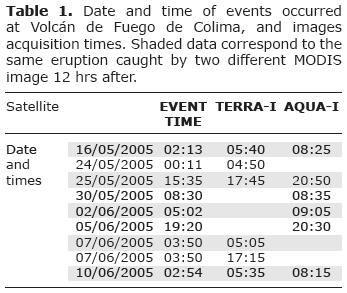
<body><![CDATA[<p align="justify"><font face="verdana" size="2"><i>MODIS imagery</i></font></p>     <p align="justify"><font face="verdana" size="2">Images from NASA's MODIS&#150;Terra and MODIS&#150;Aqua instruments were used in this study. The sensors measure 36 spectral bands in the visible and infrared region of the electromagnetic spectrum (0.405 &#150; 14.385&#956;m), and acquire data at three spatial resolutions 250m, 500m, and 1,000m. The Terra and Aqua satellites are in a polar orbiting path at 705km in altitude above sea level with a swath width of 2,330km (Watson <i>et al., </i>2004; Matiella <i>et al., </i>2008). The region of the spectrum used for observing volcanic clouds corresponds to bands 27, 28, 29, 31 and 32 of the MODIS sensor. These five bands are within the thermal infrared (TIR; 6.535 &#150; 12.270&#956;m) and are sensitive to several volcanogenic species (Watson <i>et al., </i>2004).</font></p>     <p align="justify"><font face="verdana" size="2">Each MODIS instrument acquires 288 images around the Earth every day, passing over certain area approximately twice a day. In the case of the area of interest for this study, an image is obtained once at night time, between the 23:00 hrs and 4:00 hrs local time, and another during daytime, between 11:00 hrs and 15:00 hrs local time. MODIS images were downloaded from NASA website (NASA, LAADS Web, 2009). This website permits the user to select the desired satellite data according to location (based on latitude and longitude), and time of the image.</font></p>     <p align="justify"><font face="verdana" size="2">We got a total of 148 MODIS &iexcl;mages corresponding to the localization of the volcano within the period of analysis. 76% of these scenes were cloud&#150;free, 6% had partial clouds&#150;cover on the area of interest, and 18% with an oblique view of the VFC. Thus, 113 cloudless passes from MODIS&#150;Terra and MODIS&#150;Aqua were used for volcano monitoring and ash cloud detection.</font></p>     <p align="justify"><font face="verdana" size="2">Eight eruptive events with ash emission were detected in 12 MODIS images for the period of analysis. Eruptions on May 16, 25 and June 10, 2005 were imaged by both instruments, providing information of the same emission events at different times. The June 7 event was detected by the MODIS&#150;Terra in the first pass of the day at 5:05 UTC and was identified again during the second pass of the same day at 17:15. The explosive events on May 24 and 30, and June 2 and 5 events, were only detected by one of the instruments.</font></p>     <p align="justify"><font face="verdana" size="2">The Volcanic Ash Advisor Center (VAAC) in Washington reported these 8 events, confirmed later by using the wind direction of the volcanic cloud at the estimated altitude. Events during the period of analysis are shown in <a href="#t1">Table 1</a>.</font></p>     <p align="center"><font face="verdana" size="2"><a name="t1"></a></font></p>     <p align="center"><font face="verdana" size="2"><img src="/img/revistas/geoint/v50n2//a6t1.jpg"></font></p>     <p align="justify"><font face="verdana" size="2">Heights of the clouds were obtained from brightness temperature of MODIS channel 29, checked against atmospheric radiosonde data and compared with VAAC reports and trajectory analysis obtained using the HYbrid Single&#150;Particle Lagrangian Integrated Trajectory model (HYSPLIT) from NOAA developed by Draxler and Hess (1997).</font></p>     <p align="justify"><font face="verdana" size="2"><i>Methods</i></font></p>     ]]></body>
<body><![CDATA[<p align="justify"><font face="verdana" size="2"><i>Ash emission estimation</i></font></p>     <p align="justify"><font face="verdana" size="2">The infrared retrieval scheme used in this work is described by Watson <i>et al. </i>(2004) and Matiella <i>et al. </i>(2008). Each image was analyzed for detecting ash emission signature using the technique developed by Prata (1989a, b); and Wen and Rose (1994). In MODIS TIR &iexcl;mages the ash is detected by using the brightness temperature difference (BTD), between bands 31 (11 &#956;m) and 32 (12 &#956;m). The brightness temperature was obtained modifying the Planck Function formula.</font></p>     <p align="justify"><font face="verdana" size="2">Radiative transfer calculations were used with a semitransparent cloud model based on three assumptions: 1) the shapes of the particles are spherical, 2) the particle size distribution is uniform and monodisperse within each pixel, and 3) the cloud forms a well&#150;defined homogeneous single layer in each pixel (Wen and Rose, 1994). The BTD retrieval method assumes that the particle sizes are within the Mie region (about 1&#150;15 &#956;m diameter) (Prata, 1989b). Accurate retrievals of silicates require knowledge of refraction index data for the silicate minerals. The resulting BTD is negative in volcanic ash clouds but positive in meteorological clouds, as shown in <a href="/img/revistas/geoint/v50n2//a6f2.jpg" target="_blank">Figure 2a</a>.</font></p>     <p align="justify"><font face="verdana" size="2">For retrieval of total mass and area of a volcanic cloud from the MODIS images we use RADIAN NET model developed by Wen and Rose (1994). The values in metric tons of the each total cloud ash burden for the eight explosive events studied in this work are shown in <a href="/img/revistas/geoint/v50n2//a6t2.jpg" target="_blank">Table 2</a>.</font></p>     <p align="justify"><font face="verdana" size="2"><i>SO<sub>2</sub> emission estimation</i></font></p>     <p align="justify"><font face="verdana" size="2">The SO<sub>2</sub> retrieval is also based on the wavelength dependence of absorption features. In order to identify the SO<sub>2</sub> plume we used the technique described by Realmuto <i>et al. </i>(1994) and Watson <i>et al. </i>(2004). The SO<sub>2</sub> plume is evident in the MODIS image with a color combination Red (b29), Green (b32) and Blue (b31), as shown in <a href="/img/revistas/geoint/v50n2//a6f2.jpg" target="_blank">Figures 2b</a> and <a href="/img/revistas/geoint/v50n2//a6f4.jpg" target="_blank">4b</a>. For retrieval of the total SO<sub>2</sub> mass and area from the MODIS image, the MAP_SO2 model developed by Realmuto <i>et al. </i>(1994) was used.</font></p>     <p align="justify"><font face="verdana" size="2">The use of HYSPLIT was an important tool to identify possible trajectories of the ash and SO<sub>2 </sub>plumes. It helped to find and select the analysis area in the satellite image. This model runs starting from the approximate time of emission for 24 hrs at several altitude levels according to the volcanic event.</font></p>     <p align="justify"><font face="verdana" size="2">Comparing the HYSPLIT and MODIS brightness temperature difference, it is possible to predict the ash and SO<sub>2</sub> clouds dispersion (<a href="/img/revistas/geoint/v50n2//a6f2.jpg" target="_blank">Figure 2b</a> and <a href="/img/revistas/geoint/v50n2//a6f2c.jpg" target="_blank">2c</a>).</font></p>     <p align="justify"><font face="verdana" size="2"><i>SO<sub>2</sub> emission rate estimation</i></font></p>     <p align="justify"><font face="verdana" size="2">In order to get an approximate figure of SO<sub>2 </sub>emission rate in the commonly used units of tons per day, we developed a methodology similar to that used for the COSPEC. In the case of COSPEC, several transects are made beneath and across the plume in order to calculate the average emission rate for the period of measurement (for COSPEC methods see Delgado&#150;Granados et. al., 2001). In fact, COSPEC obtains an average value for every measured transect. After that, the estimation of the emission is done using the average of the all plume transects. In contrast, when working with satellite images, we obtain a snap&#150;shot of the plume. Here, we calculate the average emission rate for the MODIS image by considering the total area covered by the plume, the total mass of SO<sub>2</sub> as estimated with MAP_ SO2, the length of the plume along its dispersion axis, and the wind speed at plume altitude. The SO<sub>2</sub> emission rate can be estimated in tons per day as follows:</font></p>     ]]></body>
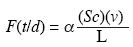
<body><![CDATA[<p align="center"><font face="verdana" size="2"><img src="/img/revistas/geoint/v50n2//a6s1.jpg"></font></p>     <p align="justify"><font face="verdana" size="2">where <i>Sc </i>stands for the total mass concentration in tons retrieved from MODIS image, <i>v</i> stands for the speed of wind, which represent the SO<sub>2 </sub>plume speed in m/s. L stands for the length along the plume SO<sub>2</sub> in km, and a is a constant to adjust the values and units to tons per day <img src="/img/revistas/geoint/v50n2//a6s2.jpg"></font></p>     <p align="justify"><font face="verdana" size="2">&nbsp;</font></p>     <p align="justify"><font face="verdana" size="2"><b>Results</b></font></p>     <p align="justify"><font face="verdana" size="2"><i>Ash cloud monitoring</i></font></p>     <p align="justify"><font face="verdana" size="2">During the study period, the Washington VAAC reported 15 eruptive events. Eight of these eruptions were captured with the MODIS images, and 4 of them were captured by two images at different hours as shown in <a href="#t1">Table 1</a>. The other 7 events were not detected by MODIS, either because the eruption occurred shortly after the image was acquired, or because the ash burden in the volcanic clouds resulting from the explosions was not high enough to survive through the time. For instance, the event of May 26 which was reported at 21:28 UTC, the MODIS&#150;Aqua took the &iexcl;mage by 19:55, just 1:33 hours before the event and the next image taken by the MODIS&#150;Terra at 5:20 UTC, &#126;8 hours after the event. We could not detect the ash cloud in the Terra image, possibly due to dilution of the ash cloud.</font></p>     <p align="justify"><font face="verdana" size="2">One advantage of satellite&#150;based monitoring is the possibility to study some special cases that were not well characterized by COSPEC. Due to the high cost and complicated logistics of ground&#150;based campaigns, there are only 2&#150;3 COSPEC campaigns per month. For our period of study we identified three aspects that required more frequent measurements:</font></p>     <p align="justify"><font face="verdana" size="2">a) Mapping drifting gas and ash clouds. In this case, the resulting cloud from large volcanic emissions is identified and quantified after being transported horizontally by the dominant winds at a certain height. It is observed when there is a constant gas and ash emission for a period of time, long enough to form a large plume of volcanic products traveling in the atmosphere (<a href="/img/revistas/geoint/v50n2//a6f2.jpg" target="_blank">Figure 2a</a>). Thus, satellite monitoring, combined with HYSPLIT trajectory models, provide a more detailed analysis on the concentration, dispersion, and transport in the atmosphere. For risk assessment and civil protection, this vital information is used to identify the zone prone to be affected and make a forecast on the transport and alert to air navigation. This type of volcanic plumes extends for tens and even hundreds of kilometers, reaching populated areas several kilometers from the volcano. An example for this case occurred on June 10 when an explosive event at 2:54 was reported by VAAC and CVO, and detected by MODIS at 05:35 UTC (<a href="/img/revistas/geoint/v50n2//a6f2.jpg" target="_blank">Figure 2a</a> and <a href="/img/revistas/geoint/v50n2//a6f2.jpg" target="_blank">2b</a>), the plume reached an altitude of 10,700 m and was dispersed to the SSE at approximately 11 m/s, attaining a length of approximately 200 km in the 2.5 hr between the start of the event and detection by the MODIS sensor.</font></p>     <p align="justify"><font face="verdana" size="2">b) Analysis of ash cloud residence in the atmosphere. This case consists of tracking ash clouds in order to analyze time residence in the atmosphere. The volcanic cloud of an eruption reported on May 16 at 2:13 UTC was detected by two MODIS images (<a href="/img/revistas/geoint/v50n2//a6f3.jpg" target="_blank">Figure 3</a>), first of them at 5:40 UTC (image from MODIS&#150;Terra), and the second &iexcl;mage was taken at 8:25 UTC (MODIS&#150;Aqua). The ash mass calculated for the first one was &#126;11,700 tons, covering an area of &#126;3,200 km<sup>2</sup>, and found at &#126;80 km east of the volcano (between 19&deg; 44'to 19&deg; 19' N and 102&deg; 6'to 100&deg; 39' W). The Washington VAAC reported a cloud&#150;altitude of approximately 7,600 m asl, displacing at 15 m/s. The second image shows the ash cloud 95 km further east from the observed position of the volcanic cloud in the previous image but with an ash mass&#150;load of &#126;4,000 tons covering an area of &#126;1,600 km<sup>2</sup>. In 2 hours and 45 minutes, the ash cloud lost 67% of its mass and 50% of its area, indicating an ash fall of &#126;5 g/m<sup>2</sup>. This rate is similar to the ash fall reported for Sakurajima volcano (Japan) at &gt;50 km from the vent (Eto, 2001) and same order&#150;of&#150;magnitude as the ash fall estimated for violent Strombolian to Plinian eruptions at Vesuvius (Italy) (Macedonio <i>et al., </i>2008). The ash fall rate of &#126;8' 10<sup>5</sup> g/s is less than in the case of Sakurajima volcano (&#126;21' 10<sup>5 </sup>gr/s). The ash accumulation rate was calculated in &#126;5' 10<sup>&#150;5</sup> gr/m<sup>2</sup>&bull;s.</font></p>     <p align="justify"><font face="verdana" size="2">Ash cloud dispersion depends on the altitude, size particle, form, and the atmospheric dynamics (Pfeiffer <i>et al., </i>2005). These figures are important because estimating the weight settling over the area may help in prevention of roof collapsing for instance, and also it may help to estimate the actual magnitude of the explosive event.</font></p>     ]]></body>
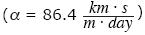
<body><![CDATA[<p align="justify"><font face="verdana" size="2">c) Effects of shearing winds on volcanic clouds. In this case a volcanic plume raises or sinks vertically very fast finding shearing winds during the ascent at different altitudes. This effect makes the cloud to "screw" and vertically moving in the same area but at different heights. This effect should be taken into account while analyzing MODIS images because the plume becomes apparently thicker whereas actually, the plume is passing over the same area twice at different altitudes and moving directions but being only one plume. It is important to note that optically, the plume will be thicker, as there is more ash in the optical path between the sensor and the ground. An example of this case was observed during the event of June 7. An explosive event began at 3:50 UTC and was detected by the MODIS satellite at 5:05 UTC as shown in <a href="/img/revistas/geoint/v50n2//a6f4.jpg" target="_blank">Figure 4</a>. In this case the shearing winds changed the plume direction (<a href="/img/revistas/geoint/v50n2//a6f4.jpg" target="_blank">Figure 4c</a>). As plume forms and leaves the vent, it raises quickly and is taken by high altitude winds (&lt;5,000 masl) towards the south, as the ash plume gets colder and gets away from the vent, it sinks and is caught by lower winds (&lt;4,000 masl) "screwing" down to be driven by winds at nearly 2,000 masl (VFC is 3,860 m high) towards the east. This effect should be taken into account for proper calculation of ash or SO<sub>2</sub> burden.</font></p>     <p align="justify"><font face="verdana" size="2">Values of ash mass concentration for the period of observation are shown at <a href="/img/revistas/geoint/v50n2//a6t2.jpg" target="_blank">Table 2</a>. Six ash emissions are over 2,000 tons, and two of them are over 10,000 tons (reported as the largest events during the studied eruptive period).</font></p>     <p align="justify"><font face="verdana" size="2"><i>Monitoring SO<sub>2</sub> emissions and their relationship to explosive events</i></font></p>     <p align="justify"><font face="verdana" size="2">The use of volcanic plume detection as a continuous monitoring method at active volcanoes allows generation of time series. These data may help to understand the internal behavior of the volcano. Therefore, the analysis of SO<sub>2</sub> emission patterns serves as an insight to the magma behavior inside the volcano as well as the conditions in the plumbing system, particularly if this information is coupled with data from other sources and input to models that may help forecast volcanic eruptions.</font></p>     <p align="justify"><font face="verdana" size="2">Each ash emission can be linked with a peak in SO<sub>2</sub> emission (about 2 or 3 days before the explosive event) as shown in <a href="/img/revistas/geoint/v50n2//a6f5.jpg" target="_blank">Figure 5</a>. For instance, the SO<sub>2</sub> fluxes reported using the MODIS method for May 10 and May 11 were 5,500 and 8,000 tons/day, respectively. However, on May 13, 3 days before the large explosion and ash emission, a large scale degassing occurred with an SO<sub>2</sub> flux of 40,000 tons/day and a plume covering an area of 126 km<sup>2</sup> (plume was dispersed towards the north at 9 m/s, and at an estimated altitude of 6 km). After the event, the gas emissions fell to very low values. This was possibly due to partial sealing of the conduit system, and/or changes in magma viscosity after a strong degassing restricting gas emissions but increasing the pore pressure of the magma. A change in viscosity may have caused gas accumulations with a subsequent internal pressure build up (Newhall <i>et al., </i>1994). Three days later (16 May 2005), the system was opened with an emission of ash and a SO<sub>2 </sub>plume. The SO<sub>2</sub> mass was estimated in 575 tons, covering an area of 308 km<sup>2</sup>, and the emission rate was calculated in 21,000 tons/day. Before a large ash emission, a large SO<sub>2</sub> emission occurs, an effect observable during the ash emissions of May 24, June 02, 05 and 10.</font></p>     <p align="justify"><font face="verdana" size="2"><a href="/img/revistas/geoint/v50n2//a6f6.jpg" target="_blank">Figure 6</a> shows correlation of the MODIS ash retrievals to the MODIS SO<sub>2</sub> flux derived of the MAP_SO2 technique. <a href="/img/revistas/geoint/v50n2//a6f6.jpg" target="_blank">Figure 6a</a> compares the SO<sub>2</sub> flux data obtained during the same day of explosive activity. The comparison between measurements displayed with an index of correlation of approximately r<sup>2</sup> = 0.6. On the other hand, <a href="/img/revistas/geoint/v50n2//a6f6.jpg" target="_blank">Figure 6b</a> shows the comparison of flow measurements obtained from the data SO<sub>2</sub> estimated three days prior to the explosive activity. In this case we observe that the correlation coefficient increases (r<sup>2</sup> = 0.75), suggesting that the relationship between the data of SO<sub>2</sub> three days before an eruption is better than that obtained with data taken the same day. This could indicate a connection between strong degassing during explosive events.</font></p>     <p align="justify"><font face="verdana" size="2">&nbsp;</font></p>     <p align="justify"><font face="verdana" size="2"><b>Conclusions</b></font></p>     <p align="justify"><font face="verdana" size="2">The new technology based on information from satellite images allows obtaining data that are not possible to check with punctual or mobile methods, like plume area and total mass at a specific time. With these images and new programs is possible to obtain a good approximation with the real data, although it is yet not an exact method. Currently, there are different kinds of problems, such as the image resolution, particle size, or shape, etc. Another problem is the time gaps between images, this is because sometimes images are taken before an explosive event occurs, for example May 25 when the volcano activity started at 10:00 UTC but the MODIS images were taken at 5:35 UTC (Terra) and 8:15 UTC (Aqua). For this reason, it was only possible to calculate SO<sub>2</sub> emission in both images, but the ash emission was not possible to retrieve in the next images at 17:45 UTC (Terra) and 20:50 UTC (Aqua).</font></p>     <p align="justify"><font face="verdana" size="2">In the period of analysis there were several cases of plume development while in the atmosphere. Sometimes a puff is emitted and forms a cloud that is dispersed by the wind in the high atmosphere. In other cases, when the emission is constant, it produces a long plume that is easy to observe and record. A third case is found when there is wind shear in the vertical structure of the atmosphere. These three cases should be analyzed with special care.</font></p>     ]]></body>
<body><![CDATA[<p align="justify"><font face="verdana" size="2">An important application of retrieving these data is the possibility to monitor gas emissions at active volcanoes, calculating and estimating the areas, dispersion and mass concentration in a way that might be carried out at low cost. These databases can be used to identify behavioral patterns of internal activity of the volcano and thus, constitute an important element in the generation of predictive models of explosive events. In Mexico the potential monitoring is at the two most active volcanoes, VFC and Popocat&eacute;petl volcano.</font></p>     <p align="justify"><font face="verdana" size="2">&nbsp;</font></p>     <p align="justify"><font face="verdana" size="2"><b>Acknowledgements</b></font></p>     <p align="justify"><font face="verdana" size="2">The first author is grateful to William I. Rose for his assistance while in Michigan Tech for learning remote sensing methods, This research was partially funded by the EHaz program.</font></p>     <p align="justify"><font face="verdana" size="2">&nbsp;</font></p>     <p align="justify"><font face="verdana" size="2"><b>Bibliography</b></font></p>     <!-- ref --><p align="justify"><font face="verdana" size="2">Bret&oacute;n M., Ram&iacute;rez J.J., Navarro C., 2002, Summary of the historical eruptive activity of Volc&aacute;n de Colima, Mexico: 1519&#150;2000. <i>J. Volcano!. Geotherm. Res., </i>117, 21&#150;46.    &nbsp;&nbsp;&nbsp;&nbsp;&nbsp;&nbsp;&nbsp;&nbsp;[&#160;<a href="javascript:void(0);" onclick="javascript: window.open('/scielo.php?script=sci_nlinks&ref=3914325&pid=S0016-7169201100020000600001&lng=','','width=640,height=500,resizable=yes,scrollbars=1,menubar=yes,');">Links</a>&#160;]<!-- end-ref --></font></p>     <!-- ref --><p align="justify"><font face="verdana" size="2">Casadevall T.J., 1994, Volcanic ash and aviation safety, Proc. 1st Int. Symp. on Volcanic Ash and Aviation Safety, U.S. <i>Geol. Surv. Bull., </i>2047, 450 pp.    &nbsp;&nbsp;&nbsp;&nbsp;&nbsp;&nbsp;&nbsp;&nbsp;[&#160;<a href="javascript:void(0);" onclick="javascript: window.open('/scielo.php?script=sci_nlinks&ref=3914327&pid=S0016-7169201100020000600002&lng=','','width=640,height=500,resizable=yes,scrollbars=1,menubar=yes,');">Links</a>&#160;]<!-- end-ref --></font></p>     ]]></body>
<body><![CDATA[<!-- ref --><p align="justify"><font face="verdana" size="2">Draxler R.R. and Hess G.D., 1997, Description of the HYSPLIT_4 modeling system, NOAA Tech Memo ERL ARL&#150;224, Dec, 24p.    &nbsp;&nbsp;&nbsp;&nbsp;&nbsp;&nbsp;&nbsp;&nbsp;[&#160;<a href="javascript:void(0);" onclick="javascript: window.open('/scielo.php?script=sci_nlinks&ref=3914329&pid=S0016-7169201100020000600003&lng=','','width=640,height=500,resizable=yes,scrollbars=1,menubar=yes,');">Links</a>&#160;]<!-- end-ref --></font></p>     <!-- ref --><p align="justify"><font face="verdana" size="2">Delgado&#150;Granados H., C&aacute;rdenas Gonz&aacute;lez L., Pineda S&aacute;nchez N., 2001, Sulfure dioxide emissions from Popocat&eacute;petl volcano (Mexico): case study of a high&#150;emission rate, passively degassing erupting volcano., <i>J. Volcanol. Geotherm. Res., </i>108, 107&#150;120.    &nbsp;&nbsp;&nbsp;&nbsp;&nbsp;&nbsp;&nbsp;&nbsp;[&#160;<a href="javascript:void(0);" onclick="javascript: window.open('/scielo.php?script=sci_nlinks&ref=3914331&pid=S0016-7169201100020000600004&lng=','','width=640,height=500,resizable=yes,scrollbars=1,menubar=yes,');">Links</a>&#160;]<!-- end-ref --></font></p>     <!-- ref --><p align="justify"><font face="verdana" size="2">De la Cruz&#150;Reyna S., 1993, Random patterns of occurrence of explosive eruptions at Colima volcano, Mexico. <i>J. Volcanol. Geotherm. Res., </i>55, 51&#150;68.    &nbsp;&nbsp;&nbsp;&nbsp;&nbsp;&nbsp;&nbsp;&nbsp;[&#160;<a href="javascript:void(0);" onclick="javascript: window.open('/scielo.php?script=sci_nlinks&ref=3914333&pid=S0016-7169201100020000600005&lng=','','width=640,height=500,resizable=yes,scrollbars=1,menubar=yes,');">Links</a>&#160;]<!-- end-ref --></font></p>     <!-- ref --><p align="justify"><font face="verdana" size="2">Engberg E., 2009, SO<sub>2</sub> Emissions al Volc&aacute;n de Colima 2003&#150;2007, MS Thesis, Michigan USA, Michigan Technological University, 34 pp.    &nbsp;&nbsp;&nbsp;&nbsp;&nbsp;&nbsp;&nbsp;&nbsp;[&#160;<a href="javascript:void(0);" onclick="javascript: window.open('/scielo.php?script=sci_nlinks&ref=3914335&pid=S0016-7169201100020000600006&lng=','','width=640,height=500,resizable=yes,scrollbars=1,menubar=yes,');">Links</a>&#160;]<!-- end-ref --></font></p>     <!-- ref --><p align="justify"><font face="verdana" size="2">Eto T., 2001, Estimation of the Amount and Dispersal of Volcanic Ash&#150;fall Deposits Ejected by Vulcanian type Eruption, <i>Rep. Fac. Sci., </i>Kagoshima Univ., 34, 35&#150;46 pp.    &nbsp;&nbsp;&nbsp;&nbsp;&nbsp;&nbsp;&nbsp;&nbsp;[&#160;<a href="javascript:void(0);" onclick="javascript: window.open('/scielo.php?script=sci_nlinks&ref=3914337&pid=S0016-7169201100020000600007&lng=','','width=640,height=500,resizable=yes,scrollbars=1,menubar=yes,');">Links</a>&#160;]<!-- end-ref --></font></p>     ]]></body>
<body><![CDATA[<!-- ref --><p align="justify"><font face="verdana" size="2">Galindo I. and Dom&iacute;nguez T., 2002, Near realtime satellite monitoring during the 1997&#150;2000 activity of Volc&aacute;n de Colima (M&eacute;xico) and its relationship with seismic monitoring, <i>J. Volcanol. Geotherm. Res., </i>117, 91&#150;104.    &nbsp;&nbsp;&nbsp;&nbsp;&nbsp;&nbsp;&nbsp;&nbsp;[&#160;<a href="javascript:void(0);" onclick="javascript: window.open('/scielo.php?script=sci_nlinks&ref=3914339&pid=S0016-7169201100020000600008&lng=','','width=640,height=500,resizable=yes,scrollbars=1,menubar=yes,');">Links</a>&#160;]<!-- end-ref --></font></p>     <!-- ref --><p align="justify"><font face="verdana" size="2">Galindo I. and Dom&iacute;nguez T., 2003, Real&#150;time AVHRR multispectral thermal monitoring and ash emission detection into the atmosphere: The case of Colima volcano (Mexico), <i>Geophys. Monograph, </i>139, 133&#150;150.    &nbsp;&nbsp;&nbsp;&nbsp;&nbsp;&nbsp;&nbsp;&nbsp;[&#160;<a href="javascript:void(0);" onclick="javascript: window.open('/scielo.php?script=sci_nlinks&ref=3914341&pid=S0016-7169201100020000600009&lng=','','width=640,height=500,resizable=yes,scrollbars=1,menubar=yes,');">Links</a>&#160;]<!-- end-ref --></font></p>     <!-- ref --><p align="justify"><font face="verdana" size="2">Luhr J.F., Carmichael I.S.E., 1990, Petrological monitoring of cyclical eruptive activity at volc&aacute;n Colima, Mexico. <i>J. Volcanol. Geotherm. Res., </i>42, 235&#150;260.    &nbsp;&nbsp;&nbsp;&nbsp;&nbsp;&nbsp;&nbsp;&nbsp;[&#160;<a href="javascript:void(0);" onclick="javascript: window.open('/scielo.php?script=sci_nlinks&ref=3914343&pid=S0016-7169201100020000600010&lng=','','width=640,height=500,resizable=yes,scrollbars=1,menubar=yes,');">Links</a>&#160;]<!-- end-ref --></font></p>     <!-- ref --><p align="justify"><font face="verdana" size="2">Macedonio, G., Costa, A., and Folch, A., 2008, Ash fallout scenarios at Vesuvius: numerical simulations and implications for hazard assessment, <i>J. Volcanol. Geotherm. Res., </i>178,366&#150;377.    &nbsp;&nbsp;&nbsp;&nbsp;&nbsp;&nbsp;&nbsp;&nbsp;[&#160;<a href="javascript:void(0);" onclick="javascript: window.open('/scielo.php?script=sci_nlinks&ref=3914345&pid=S0016-7169201100020000600011&lng=','','width=640,height=500,resizable=yes,scrollbars=1,menubar=yes,');">Links</a>&#160;]<!-- end-ref --></font></p>     <!-- ref --><p align="justify"><font face="verdana" size="2">Mac&iacute;as J.L., Saucedo R., Gavilanes J.C., Varley N., Velasco S., Bursik M., Vargas V., Cort&eacute;z A., 2006, Flujos pirocl&aacute;sticos asociados a la actividad explosiva del Volc&aacute;n de Colima y perspectivas futuras. <i>GEOS, </i>25, 3.    &nbsp;&nbsp;&nbsp;&nbsp;&nbsp;&nbsp;&nbsp;&nbsp;[&#160;<a href="javascript:void(0);" onclick="javascript: window.open('/scielo.php?script=sci_nlinks&ref=3914347&pid=S0016-7169201100020000600012&lng=','','width=640,height=500,resizable=yes,scrollbars=1,menubar=yes,');">Links</a>&#160;]<!-- end-ref --></font></p>     ]]></body>
<body><![CDATA[<!-- ref --><p align="justify"><font face="verdana" size="2">Matiella N.M.A., Watson I.M., Delgado&#150;Granados H., Rose W.I., C&aacute;rdenas&#150;Gonz&aacute;lez L., Realmuto V.J., 2008, Volcanic emissions from Popocatepetl volcano, Mexico, quantified using Moderate Resolution Imaging Spectroradiometer (MODIS) infrared data: A case study of the December 2000&#150;January 2001 emissions, <i>J. Volcanol. Geotherm. Res., </i>170, 76&#150;85.    &nbsp;&nbsp;&nbsp;&nbsp;&nbsp;&nbsp;&nbsp;&nbsp;[&#160;<a href="javascript:void(0);" onclick="javascript: window.open('/scielo.php?script=sci_nlinks&ref=3914349&pid=S0016-7169201100020000600013&lng=','','width=640,height=500,resizable=yes,scrollbars=1,menubar=yes,');">Links</a>&#160;]<!-- end-ref --></font></p>     <!-- ref --><p align="justify"><font face="verdana" size="2">Medina Mart&iacute;nez F., 1983, Analysis of the eruptive history of the Volc&aacute;n de Colima, Mexico (1560&#150;1980). <i>Geof&iacute;sica Internacional, </i>22, 157&#150;178.    &nbsp;&nbsp;&nbsp;&nbsp;&nbsp;&nbsp;&nbsp;&nbsp;[&#160;<a href="javascript:void(0);" onclick="javascript: window.open('/scielo.php?script=sci_nlinks&ref=3914351&pid=S0016-7169201100020000600014&lng=','','width=640,height=500,resizable=yes,scrollbars=1,menubar=yes,');">Links</a>&#160;]<!-- end-ref --></font></p>     <!-- ref --><p align="justify"><font face="verdana" size="2">NASA, LAADS Web, Consulted in 2009, <a href="http://ladsweb.nascom.nasa.gov/" target="_blank">http://ladsweb.nascom.nasa.gov/</a></font>&nbsp;&nbsp;&nbsp;&nbsp;&nbsp;&nbsp;&nbsp;&nbsp;[&#160;<a href="javascript:void(0);" onclick="javascript: window.open('/scielo.php?script=sci_nlinks&ref=3914353&pid=S0016-7169201100020000600015&lng=','','width=640,height=500,resizable=yes,scrollbars=1,menubar=yes,');">Links</a>&#160;]<!-- end-ref --><!-- ref --><p align="justify"><font face="verdana" size="2">Newhall C.G., Punongbayan R.S., Gerlach T.M., 1994, Tight and Leaky Volcanoes Implications for Forecasting Explosive Eruptions. Accademia Nazionale Dei Lincei., 112, 13&#150;21.    &nbsp;&nbsp;&nbsp;&nbsp;&nbsp;&nbsp;&nbsp;&nbsp;[&#160;<a href="javascript:void(0);" onclick="javascript: window.open('/scielo.php?script=sci_nlinks&ref=3914354&pid=S0016-7169201100020000600016&lng=','','width=640,height=500,resizable=yes,scrollbars=1,menubar=yes,');">Links</a>&#160;]<!-- end-ref --></font></p>     <!-- ref --><p align="justify"><font face="verdana" size="2">Pfeiffer T., Costa A., Macedonio G., 2005, A model for the numerical simulation of tephra falldeposits, <i>J. Volcanol. Geotherm. Res., </i>140, 273&#150;294.    &nbsp;&nbsp;&nbsp;&nbsp;&nbsp;&nbsp;&nbsp;&nbsp;[&#160;<a href="javascript:void(0);" onclick="javascript: window.open('/scielo.php?script=sci_nlinks&ref=3914356&pid=S0016-7169201100020000600017&lng=','','width=640,height=500,resizable=yes,scrollbars=1,menubar=yes,');">Links</a>&#160;]<!-- end-ref --></font></p>     <!-- ref --><p align="justify"><font face="verdana" size="2">Prata A.J., 1989a. Infrared radiative transfer calculations for volcanic ash clouds. <i>Geophys. Res. Let. </i>16, 1293&#150; 1296.    &nbsp;&nbsp;&nbsp;&nbsp;&nbsp;&nbsp;&nbsp;&nbsp;[&#160;<a href="javascript:void(0);" onclick="javascript: window.open('/scielo.php?script=sci_nlinks&ref=3914358&pid=S0016-7169201100020000600018&lng=','','width=640,height=500,resizable=yes,scrollbars=1,menubar=yes,');">Links</a>&#160;]<!-- end-ref --></font></p>     <!-- ref --><p align="justify"><font face="verdana" size="2">Prata A.J., 1989b. Observations of volcanic ash clouds in the 10&#150;12 m window using AVHRR/2 data. <i>Int. J. Rem. Sen., </i>10, 751&#150; 761.    &nbsp;&nbsp;&nbsp;&nbsp;&nbsp;&nbsp;&nbsp;&nbsp;[&#160;<a href="javascript:void(0);" onclick="javascript: window.open('/scielo.php?script=sci_nlinks&ref=3914360&pid=S0016-7169201100020000600019&lng=','','width=640,height=500,resizable=yes,scrollbars=1,menubar=yes,');">Links</a>&#160;]<!-- end-ref --></font></p>     <!-- ref --><p align="justify"><font face="verdana" size="2">Realmuto V.J., Abrams M.J., Boungiorno M.F., Pieri, D.C., 1994, The use of multispectral thermal infrared image data to estimate the sulfur dioxide flux from volcanoes: a case study from Mt. Etna, Sicily, 1994, July 29, 1986. <i>J. Volcanol. Geotherm. Res., </i>99 (Bl), 481&#150;488.    &nbsp;&nbsp;&nbsp;&nbsp;&nbsp;&nbsp;&nbsp;&nbsp;[&#160;<a href="javascript:void(0);" onclick="javascript: window.open('/scielo.php?script=sci_nlinks&ref=3914362&pid=S0016-7169201100020000600020&lng=','','width=640,height=500,resizable=yes,scrollbars=1,menubar=yes,');">Links</a>&#160;]<!-- end-ref --></font></p>     <!-- ref --><p align="justify"><font face="verdana" size="2">Saucedo G.R., 1997, Reconstrucci&oacute;n de la erupci&oacute;n de 1913 del volc&aacute;n de Colima. MS Thesis, M&eacute;xico D.F., Instituto de Geof&iacute;sica, Universidad Nacional Aut&oacute;noma de M&eacute;xico, 185 pp.    &nbsp;&nbsp;&nbsp;&nbsp;&nbsp;&nbsp;&nbsp;&nbsp;[&#160;<a href="javascript:void(0);" onclick="javascript: window.open('/scielo.php?script=sci_nlinks&ref=3914364&pid=S0016-7169201100020000600021&lng=','','width=640,height=500,resizable=yes,scrollbars=1,menubar=yes,');">Links</a>&#160;]<!-- end-ref --></font></p>     <!-- ref --><p align="justify"><font face="verdana" size="2">Saucedo R., Mac&iacute;as J.L., Gavilanes J.C., Arce J.L., Komorowski J.C., Gardner J.E. and Vald&eacute;z&#150;Moreno G., 2010. Eyewitness, stratigraphy, chemistry, and eruptive dynamics of the 1913 Plinian eruption of Volc&aacute;n de Colima, M&eacute;xico, <i>J. Volcanol. Geotherm. Res., </i>191, 149&#150;166.    &nbsp;&nbsp;&nbsp;&nbsp;&nbsp;&nbsp;&nbsp;&nbsp;[&#160;<a href="javascript:void(0);" onclick="javascript: window.open('/scielo.php?script=sci_nlinks&ref=3914366&pid=S0016-7169201100020000600022&lng=','','width=640,height=500,resizable=yes,scrollbars=1,menubar=yes,');">Links</a>&#160;]<!-- end-ref --></font></p>     <!-- ref --><p align="justify"><font face="verdana" size="2">Stevenson, J.A., Varley N., 2008, Fumarole monitoring with a handheld infrared camera: Volc&aacute;n de Colima, Mexico, 2006&#150;2007, <i>J. Volcanol. Geotherm. Res. </i>177, Issue 4, 911&#150;924.    &nbsp;&nbsp;&nbsp;&nbsp;&nbsp;&nbsp;&nbsp;&nbsp;[&#160;<a href="javascript:void(0);" onclick="javascript: window.open('/scielo.php?script=sci_nlinks&ref=3914368&pid=S0016-7169201100020000600023&lng=','','width=640,height=500,resizable=yes,scrollbars=1,menubar=yes,');">Links</a>&#160;]<!-- end-ref --></font></p>     <!-- ref --><p align="justify"><font face="verdana" size="2">Sulpizio R., Capra L., Sarocchi D., Saucedo R., Gavilanes&#150;Ruiz J.C. and Varley N., 2010, Predicting the block&#150;and&#150;ash flow inundation areas at Volc&aacute;n de Colima (Colima, Mexico) based on the present day (February 2010) status. <i>J. Volcanol. Geotherm. Res., </i>193, 49&#150;66.    &nbsp;&nbsp;&nbsp;&nbsp;&nbsp;&nbsp;&nbsp;&nbsp;[&#160;<a href="javascript:void(0);" onclick="javascript: window.open('/scielo.php?script=sci_nlinks&ref=3914370&pid=S0016-7169201100020000600024&lng=','','width=640,height=500,resizable=yes,scrollbars=1,menubar=yes,');">Links</a>&#160;]<!-- end-ref --></font></p>     <!-- ref --><p align="justify"><font face="verdana" size="2">Varley N., Gavilanes Ruiz J.C., Reyes D&aacute;vila G., Mora Chaparro J.C., 2004, The transition between effusive and explosive volcanism: recent episodes at Volc&aacute;n de Colima. IV Reuni&oacute;n Nacional de Ciencias de la Tierra, 31 oct.&#150;5 nov. Juriquilla, Qro, Mex. Abstrac book, p. 220.    &nbsp;&nbsp;&nbsp;&nbsp;&nbsp;&nbsp;&nbsp;&nbsp;[&#160;<a href="javascript:void(0);" onclick="javascript: window.open('/scielo.php?script=sci_nlinks&ref=3914372&pid=S0016-7169201100020000600025&lng=','','width=640,height=500,resizable=yes,scrollbars=1,menubar=yes,');">Links</a>&#160;]<!-- end-ref --></font></p>     <!-- ref --><p align="justify"><font face="verdana" size="2">Taran Y., Gavilanes J.C., Cortes A., 2002, Chemical and isotopic composition of fumaro&#150;lic gases and the SO<sub>2</sub> fux from Volcan de Colima, Mexico, between the 1994 and 1998 eruptions.    &nbsp;&nbsp;&nbsp;&nbsp;&nbsp;&nbsp;&nbsp;&nbsp;[&#160;<a href="javascript:void(0);" onclick="javascript: window.open('/scielo.php?script=sci_nlinks&ref=3914374&pid=S0016-7169201100020000600026&lng=','','width=640,height=500,resizable=yes,scrollbars=1,menubar=yes,');">Links</a>&#160;]<!-- end-ref --></font></p>     <!-- ref --><p align="justify"><font face="verdana" size="2">Watson I.M., Realmuto V.J., Rose W.I., Prata A.J., Bluth G.J.S., Gu Y. Bader C.E. and Yu T., 2004, Thermal infrared remote sensing of volcanic emission using the moderate resolution imaging spectroradiometer, <i>J. Volcanol. Geotherm. Res., </i>135, 75&#150;89.    &nbsp;&nbsp;&nbsp;&nbsp;&nbsp;&nbsp;&nbsp;&nbsp;[&#160;<a href="javascript:void(0);" onclick="javascript: window.open('/scielo.php?script=sci_nlinks&ref=3914376&pid=S0016-7169201100020000600027&lng=','','width=640,height=500,resizable=yes,scrollbars=1,menubar=yes,');">Links</a>&#160;]<!-- end-ref --></font></p>     <!-- ref --><p align="justify"><font face="verdana" size="2">Wen S., Rose W.I., 1994, Retrieval of sizes and total mass of particles in volcanic clouds using AVHRR bands 4 and 5. <i>J. Geoph. Res.&#150;Atmos., </i>99 (D3), 5421&#150;5431.    &nbsp;&nbsp;&nbsp;&nbsp;&nbsp;&nbsp;&nbsp;&nbsp;[&#160;<a href="javascript:void(0);" onclick="javascript: window.open('/scielo.php?script=sci_nlinks&ref=3914378&pid=S0016-7169201100020000600028&lng=','','width=640,height=500,resizable=yes,scrollbars=1,menubar=yes,');">Links</a>&#160;]<!-- end-ref --></font></p>     <!-- ref --><p align="justify"><font face="verdana" size="2">Zobin V.M., Luhr J.F., Taran Y.A., Bret&oacute;n M., Cort&eacute;s A., De La Cruz&#150;Reyna S., Dom&iacute;nguez T., Galindo I., Gavilanes J.C., Mu&ntilde;iz J.J., Navarro C., Ram&iacute;rez J.J. Reyes G.A., Urs&uacute;a M., Velasco J. Alatorre E., Santiago H., 2002, Overview of the 1997&#150;2000 activity of Volc&aacute;n de Colima, Mexico., J. <i>Volcanol. Geotherm. Res., </i>117,1&#150;19.    &nbsp;&nbsp;&nbsp;&nbsp;&nbsp;&nbsp;&nbsp;&nbsp;[&#160;<a href="javascript:void(0);" onclick="javascript: window.open('/scielo.php?script=sci_nlinks&ref=3914380&pid=S0016-7169201100020000600029&lng=','','width=640,height=500,resizable=yes,scrollbars=1,menubar=yes,');">Links</a>&#160;]<!-- end-ref --></font></p>     <!-- ref --><p align="justify"><font face="verdana" size="2">Zobin V.M., Santiago&#150;Jim&eacute;nez H., Ramirez&#150;Ruiz J.J., Reyes&#150;D&aacute;vila G.A., Bret&oacute;n&#150;Gonz&aacute;lez M., Navarro&#150;Ochoa C., 2007, Quantification of volcanic explosions from tilt records: Volc&aacute;n de Colima, M&eacute;xico, <i>J. Volcano!. Geotherm. Res., </i>166, Issue 2, 117&#150;124.    &nbsp;&nbsp;&nbsp;&nbsp;&nbsp;&nbsp;&nbsp;&nbsp;[&#160;<a href="javascript:void(0);" onclick="javascript: window.open('/scielo.php?script=sci_nlinks&ref=3914382&pid=S0016-7169201100020000600030&lng=','','width=640,height=500,resizable=yes,scrollbars=1,menubar=yes,');">Links</a>&#160;]<!-- end-ref --></font></p>      ]]></body><back>
<ref-list>
<ref id="B1">
<nlm-citation citation-type="journal">
<person-group person-group-type="author">
<name>
<surname><![CDATA[Bretón]]></surname>
<given-names><![CDATA[M]]></given-names>
</name>
<name>
<surname><![CDATA[Ramírez]]></surname>
<given-names><![CDATA[J.J]]></given-names>
</name>
<name>
<surname><![CDATA[Navarro]]></surname>
<given-names><![CDATA[C]]></given-names>
</name>
</person-group>
<article-title xml:lang="en"><![CDATA[Summary of the historical eruptive activity of Volcán de Colima, Mexico: 1519-2000]]></article-title>
<source><![CDATA[J. Volcano!. Geotherm. Res]]></source>
<year>2002</year>
<volume>117</volume>
<page-range>21-46</page-range></nlm-citation>
</ref>
<ref id="B2">
<nlm-citation citation-type="journal">
<person-group person-group-type="author">
<name>
<surname><![CDATA[Casadevall]]></surname>
<given-names><![CDATA[T.J]]></given-names>
</name>
</person-group>
<article-title xml:lang="en"><![CDATA[Volcanic ash and aviation safety]]></article-title>
<source><![CDATA[Proc. 1st Int. Symp. on Volcanic Ash and Aviation Safety, U.S. Geol. Surv. Bull]]></source>
<year>1994</year>
<volume>2047</volume>
<page-range>450 pp</page-range></nlm-citation>
</ref>
<ref id="B3">
<nlm-citation citation-type="">
<person-group person-group-type="author">
<name>
<surname><![CDATA[Draxler]]></surname>
<given-names><![CDATA[R.R.]]></given-names>
</name>
<name>
<surname><![CDATA[Hess]]></surname>
<given-names><![CDATA[G.D.]]></given-names>
</name>
</person-group>
<source><![CDATA[Description of the HYSPLIT_4 modeling system]]></source>
<year>1997</year>
<page-range>24</page-range></nlm-citation>
</ref>
<ref id="B4">
<nlm-citation citation-type="journal">
<person-group person-group-type="author">
<name>
<surname><![CDATA[Delgado-Granados]]></surname>
<given-names><![CDATA[H]]></given-names>
</name>
<name>
<surname><![CDATA[Cárdenas González]]></surname>
<given-names><![CDATA[L]]></given-names>
</name>
<name>
<surname><![CDATA[Pineda Sánchez]]></surname>
<given-names><![CDATA[N]]></given-names>
</name>
</person-group>
<article-title xml:lang="en"><![CDATA[Sulfure dioxide emissions from Popocatépetl volcano (Mexico): case study of a high-emission rate, passively degassing erupting volcano]]></article-title>
<source><![CDATA[J. Volcanol. Geotherm. Res]]></source>
<year>2001</year>
<volume>108</volume>
<page-range>107-120</page-range></nlm-citation>
</ref>
<ref id="B5">
<nlm-citation citation-type="journal">
<person-group person-group-type="author">
<name>
<surname><![CDATA[De la Cruz-Reyna]]></surname>
<given-names><![CDATA[S]]></given-names>
</name>
</person-group>
<article-title xml:lang="en"><![CDATA[Random patterns of occurrence of explosive eruptions at Colima volcano, Mexico]]></article-title>
<source><![CDATA[J. Volcanol. Geotherm. Res]]></source>
<year>1993</year>
<volume>55</volume>
<page-range>51-68</page-range></nlm-citation>
</ref>
<ref id="B6">
<nlm-citation citation-type="">
<person-group person-group-type="author">
<name>
<surname><![CDATA[Engberg]]></surname>
<given-names><![CDATA[E]]></given-names>
</name>
</person-group>
<source><![CDATA[SO2 Emissions al Volcán de Colima 2003-2007]]></source>
<year>2009</year>
<page-range>34</page-range></nlm-citation>
</ref>
<ref id="B7">
<nlm-citation citation-type="journal">
<person-group person-group-type="author">
<name>
<surname><![CDATA[Eto]]></surname>
<given-names><![CDATA[T]]></given-names>
</name>
</person-group>
<article-title xml:lang="en"><![CDATA[Estimation of the Amount and Dispersal of Volcanic Ash-fall Deposits Ejected by Vulcanian type Eruption]]></article-title>
<source><![CDATA[Rep. Fac. Sci]]></source>
<year>2001</year>
<volume>Kagoshima Univ.</volume>
<numero>34</numero>
<issue>34</issue>
<page-range>35-46 pp</page-range></nlm-citation>
</ref>
<ref id="B8">
<nlm-citation citation-type="journal">
<person-group person-group-type="author">
<name>
<surname><![CDATA[Galindo]]></surname>
<given-names><![CDATA[I]]></given-names>
</name>
<name>
<surname><![CDATA[Domínguez]]></surname>
<given-names><![CDATA[T]]></given-names>
</name>
</person-group>
<article-title xml:lang="en"><![CDATA[Near realtime satellite monitoring during the 1997-2000 activity of Volcán de Colima (México) and its relationship with seismic monitoring]]></article-title>
<source><![CDATA[J. Volcanol. Geotherm. Res]]></source>
<year>2002</year>
<volume>117</volume>
<page-range>91-104</page-range></nlm-citation>
</ref>
<ref id="B9">
<nlm-citation citation-type="journal">
<person-group person-group-type="author">
<name>
<surname><![CDATA[Galindo]]></surname>
<given-names><![CDATA[I]]></given-names>
</name>
<name>
<surname><![CDATA[Domínguez]]></surname>
<given-names><![CDATA[T]]></given-names>
</name>
</person-group>
<article-title xml:lang="en"><![CDATA[Real-time AVHRR multispectral thermal monitoring and ash emission detection into the atmosphere: The case of Colima volcano (Mexico)]]></article-title>
<source><![CDATA[Geophys. Monograph]]></source>
<year>2003</year>
<volume>139</volume>
<page-range>133-150</page-range></nlm-citation>
</ref>
<ref id="B10">
<nlm-citation citation-type="journal">
<person-group person-group-type="author">
<name>
<surname><![CDATA[Luhr]]></surname>
<given-names><![CDATA[J.F]]></given-names>
</name>
<name>
<surname><![CDATA[Carmichael]]></surname>
<given-names><![CDATA[I.S.E]]></given-names>
</name>
</person-group>
<article-title xml:lang="en"><![CDATA[Petrological monitoring of cyclical eruptive activity at volcán Colima, Mexico]]></article-title>
<source><![CDATA[J. Volcanol. Geotherm. Res]]></source>
<year>1990</year>
<volume>42</volume>
<page-range>235-260</page-range></nlm-citation>
</ref>
<ref id="B11">
<nlm-citation citation-type="journal">
<person-group person-group-type="author">
<name>
<surname><![CDATA[Macedonio]]></surname>
<given-names><![CDATA[G]]></given-names>
</name>
<name>
<surname><![CDATA[Costa]]></surname>
<given-names><![CDATA[A]]></given-names>
</name>
<name>
<surname><![CDATA[Folch]]></surname>
<given-names><![CDATA[A]]></given-names>
</name>
</person-group>
<article-title xml:lang="en"><![CDATA[Ash fallout scenarios at Vesuvius: numerical simulations and implications for hazard assessment]]></article-title>
<source><![CDATA[J. Volcanol. Geotherm. Res.]]></source>
<year>2008</year>
<volume>178</volume>
<page-range>366-377</page-range></nlm-citation>
</ref>
<ref id="B12">
<nlm-citation citation-type="journal">
<person-group person-group-type="author">
<name>
<surname><![CDATA[Macías]]></surname>
<given-names><![CDATA[J.L.]]></given-names>
</name>
<name>
<surname><![CDATA[Saucedo]]></surname>
<given-names><![CDATA[R]]></given-names>
</name>
<name>
<surname><![CDATA[Gavilanes]]></surname>
<given-names><![CDATA[J.C.]]></given-names>
</name>
<name>
<surname><![CDATA[Varley]]></surname>
<given-names><![CDATA[N]]></given-names>
</name>
<name>
<surname><![CDATA[Velasco]]></surname>
<given-names><![CDATA[S]]></given-names>
</name>
<name>
<surname><![CDATA[Bursik]]></surname>
<given-names><![CDATA[M]]></given-names>
</name>
<name>
<surname><![CDATA[Vargas]]></surname>
<given-names><![CDATA[V]]></given-names>
</name>
<name>
<surname><![CDATA[Cortéz]]></surname>
<given-names><![CDATA[A]]></given-names>
</name>
</person-group>
<article-title xml:lang="es"><![CDATA[Flujos piroclásticos asociados a la actividad explosiva del Volcán de Colima y perspectivas futuras]]></article-title>
<source><![CDATA[GEOS]]></source>
<year>2006</year>
<volume>25</volume>
<numero>3</numero>
<issue>3</issue>
</nlm-citation>
</ref>
<ref id="B13">
<nlm-citation citation-type="journal">
<person-group person-group-type="author">
<name>
<surname><![CDATA[Matiella]]></surname>
<given-names><![CDATA[N.M.A.]]></given-names>
</name>
<name>
<surname><![CDATA[Watson]]></surname>
<given-names><![CDATA[I.M.]]></given-names>
</name>
<name>
<surname><![CDATA[Delgado-Granados]]></surname>
<given-names><![CDATA[H]]></given-names>
</name>
<name>
<surname><![CDATA[Rose]]></surname>
<given-names><![CDATA[W.I.]]></given-names>
</name>
<name>
<surname><![CDATA[Cárdenas-González]]></surname>
<given-names><![CDATA[L]]></given-names>
</name>
<name>
<surname><![CDATA[Realmuto]]></surname>
<given-names><![CDATA[V.J.]]></given-names>
</name>
</person-group>
<article-title xml:lang="en"><![CDATA[Volcanic emissions from Popocatepetl volcano, Mexico, quantified using Moderate Resolution Imaging Spectroradiometer (MODIS) infrared data: A case study of the December 2000-January 2001 emissions]]></article-title>
<source><![CDATA[J. Volcanol. Geotherm. Res.]]></source>
<year>2008</year>
</nlm-citation>
</ref>
<ref id="B14">
<nlm-citation citation-type="journal">
<person-group person-group-type="author">
<name>
<surname><![CDATA[Medina Martínez]]></surname>
<given-names><![CDATA[F]]></given-names>
</name>
</person-group>
<article-title xml:lang="en"><![CDATA[Analysis of the eruptive history of the Volcán de Colima, Mexico (1560-1980)]]></article-title>
<source><![CDATA[Geofísica Internacional]]></source>
<year>1983</year>
<volume>22</volume>
<page-range>157-178</page-range></nlm-citation>
</ref>
<ref id="B15">
<nlm-citation citation-type="">
<collab>NASA</collab>
<source><![CDATA[LAADS Web]]></source>
<year>2009</year>
</nlm-citation>
</ref>
<ref id="B16">
<nlm-citation citation-type="book">
<person-group person-group-type="author">
<name>
<surname><![CDATA[Newhall]]></surname>
<given-names><![CDATA[C.G.]]></given-names>
</name>
<name>
<surname><![CDATA[Punongbayan]]></surname>
<given-names><![CDATA[R.S.]]></given-names>
</name>
<name>
<surname><![CDATA[Gerlach]]></surname>
<given-names><![CDATA[T.M.]]></given-names>
</name>
</person-group>
<source><![CDATA[Tight and Leaky Volcanoes Implications for Forecasting Explosive Eruptions]]></source>
<year>1994</year>
<volume>112</volume>
<page-range>13-21</page-range><publisher-name><![CDATA[Accademia Nazionale Dei Lincei]]></publisher-name>
</nlm-citation>
</ref>
<ref id="B17">
<nlm-citation citation-type="journal">
<person-group person-group-type="author">
<name>
<surname><![CDATA[Pfeiffer]]></surname>
<given-names><![CDATA[T]]></given-names>
</name>
<name>
<surname><![CDATA[Costa]]></surname>
<given-names><![CDATA[A]]></given-names>
</name>
<name>
<surname><![CDATA[Macedonio]]></surname>
<given-names><![CDATA[G]]></given-names>
</name>
</person-group>
<article-title xml:lang="en"><![CDATA[A model for the numerical simulation of tephra falldeposits]]></article-title>
<source><![CDATA[J. Volcanol. Geotherm. Res]]></source>
<year>2005</year>
<volume>140</volume>
<page-range>273-294</page-range></nlm-citation>
</ref>
<ref id="B18">
<nlm-citation citation-type="journal">
<person-group person-group-type="author">
<name>
<surname><![CDATA[Prata]]></surname>
<given-names><![CDATA[A.J.]]></given-names>
</name>
</person-group>
<article-title xml:lang="en"><![CDATA[Infrared radiative transfer calculations for volcanic ash clouds]]></article-title>
<source><![CDATA[Geophys. Res. Let.]]></source>
<year>1989</year>
<volume>16</volume>
<page-range>1293- 1296</page-range></nlm-citation>
</ref>
<ref id="B19">
<nlm-citation citation-type="journal">
<person-group person-group-type="author">
<name>
<surname><![CDATA[Prata]]></surname>
<given-names><![CDATA[A.J.]]></given-names>
</name>
</person-group>
<article-title xml:lang="en"><![CDATA[Observations of volcanic ash clouds in the 10-12 m window using AVHRR/2 data]]></article-title>
<source><![CDATA[Int. J. Rem. Sen.]]></source>
<year>1989</year>
<volume>10</volume>
<page-range>751- 761</page-range></nlm-citation>
</ref>
<ref id="B20">
<nlm-citation citation-type="journal">
<person-group person-group-type="author">
<name>
<surname><![CDATA[Realmuto]]></surname>
<given-names><![CDATA[V.J]]></given-names>
</name>
<name>
<surname><![CDATA[Abrams]]></surname>
<given-names><![CDATA[M.J]]></given-names>
</name>
<name>
<surname><![CDATA[Boungiorno]]></surname>
<given-names><![CDATA[M.F]]></given-names>
</name>
<name>
<surname><![CDATA[Pieri,]]></surname>
<given-names><![CDATA[D.C]]></given-names>
</name>
</person-group>
<article-title xml:lang="en"><![CDATA[The use of multispectral thermal infrared image data to estimate the sulfur dioxide flux from volcanoes: a case study from Mt. Etna, Sicily, 1994, July 29, 1986]]></article-title>
<source><![CDATA[J. Volcanol. Geotherm. Res]]></source>
<year>1994</year>
<volume>99</volume>
<numero>Bl</numero>
<issue>Bl</issue>
<page-range>481-488</page-range></nlm-citation>
</ref>
<ref id="B21">
<nlm-citation citation-type="">
<person-group person-group-type="author">
<name>
<surname><![CDATA[Saucedo]]></surname>
<given-names><![CDATA[G.R.]]></given-names>
</name>
</person-group>
<source><![CDATA[Reconstrucción de la erupción de 1913 del volcán de Colima]]></source>
<year>1997</year>
<page-range>185</page-range></nlm-citation>
</ref>
<ref id="B22">
<nlm-citation citation-type="journal">
<person-group person-group-type="author">
<name>
<surname><![CDATA[Saucedo]]></surname>
<given-names><![CDATA[R]]></given-names>
</name>
<name>
<surname><![CDATA[Macías]]></surname>
<given-names><![CDATA[J.L]]></given-names>
</name>
<name>
<surname><![CDATA[Gavilanes]]></surname>
<given-names><![CDATA[J.C]]></given-names>
</name>
<name>
<surname><![CDATA[Arce]]></surname>
<given-names><![CDATA[J.L]]></given-names>
</name>
<name>
<surname><![CDATA[Komorowski]]></surname>
<given-names><![CDATA[J.C]]></given-names>
</name>
<name>
<surname><![CDATA[Gardner]]></surname>
<given-names><![CDATA[J.E.]]></given-names>
</name>
<name>
<surname><![CDATA[Valdéz-Moreno]]></surname>
<given-names><![CDATA[G]]></given-names>
</name>
</person-group>
<article-title xml:lang="en"><![CDATA[Eyewitness, stratigraphy, chemistry, and eruptive dynamics of the 1913 Plinian eruption of Volcán de Colima, México]]></article-title>
<source><![CDATA[J. Volcanol. Geotherm. Res]]></source>
<year>2010</year>
<volume>191</volume>
<page-range>149-166</page-range></nlm-citation>
</ref>
<ref id="B23">
<nlm-citation citation-type="journal">
<person-group person-group-type="author">
<name>
<surname><![CDATA[Stevenson,]]></surname>
<given-names><![CDATA[J.A]]></given-names>
</name>
<name>
<surname><![CDATA[Varley]]></surname>
<given-names><![CDATA[N]]></given-names>
</name>
</person-group>
<article-title xml:lang="en"><![CDATA[Fumarole monitoring with a handheld infrared camera: Volcán de Colima, Mexico, 2006-2007]]></article-title>
<source><![CDATA[J. Volcanol. Geotherm. Res.]]></source>
<year>2008</year>
<volume>177</volume>
<numero>4</numero>
<issue>4</issue>
<page-range>911-924</page-range></nlm-citation>
</ref>
<ref id="B24">
<nlm-citation citation-type="journal">
<person-group person-group-type="author">
<name>
<surname><![CDATA[Sulpizio]]></surname>
<given-names><![CDATA[R]]></given-names>
</name>
<name>
<surname><![CDATA[Capra]]></surname>
<given-names><![CDATA[L]]></given-names>
</name>
<name>
<surname><![CDATA[Sarocchi]]></surname>
<given-names><![CDATA[D]]></given-names>
</name>
<name>
<surname><![CDATA[Saucedo]]></surname>
<given-names><![CDATA[R]]></given-names>
</name>
<name>
<surname><![CDATA[Gavilanes-Ruiz]]></surname>
<given-names><![CDATA[J.C.]]></given-names>
</name>
<name>
<surname><![CDATA[Varley]]></surname>
<given-names><![CDATA[N]]></given-names>
</name>
</person-group>
<article-title xml:lang="en"><![CDATA[Predicting the block-and-ash flow inundation areas at Volcán de Colima (Colima, Mexico) based on the present day (February 2010) status]]></article-title>
<source><![CDATA[J. Volcanol. Geotherm. Res]]></source>
<year>2010</year>
<volume>193</volume>
<page-range>49-66</page-range></nlm-citation>
</ref>
<ref id="B25">
<nlm-citation citation-type="confpro">
<person-group person-group-type="author">
<name>
<surname><![CDATA[Varley]]></surname>
<given-names><![CDATA[N]]></given-names>
</name>
<name>
<surname><![CDATA[Gavilanes Ruiz]]></surname>
<given-names><![CDATA[J.C.]]></given-names>
</name>
<name>
<surname><![CDATA[Reyes Dávila]]></surname>
<given-names><![CDATA[G]]></given-names>
</name>
<name>
<surname><![CDATA[Mora Chaparro]]></surname>
<given-names><![CDATA[J.C.]]></given-names>
</name>
</person-group>
<source><![CDATA[The transition between effusive and explosive volcanism: recent episodes at Volcán de Colima]]></source>
<year>2004</year>
<conf-name><![CDATA[IV Reunión Nacional de Ciencias de la Tierra]]></conf-name>
<conf-loc>Juriquilla Qro</conf-loc>
<page-range>220</page-range></nlm-citation>
</ref>
<ref id="B26">
<nlm-citation citation-type="">
<person-group person-group-type="author">
<name>
<surname><![CDATA[Taran]]></surname>
<given-names><![CDATA[Y]]></given-names>
</name>
<name>
<surname><![CDATA[Gavilanes]]></surname>
<given-names><![CDATA[J.C.]]></given-names>
</name>
<name>
<surname><![CDATA[Cortes]]></surname>
<given-names><![CDATA[A]]></given-names>
</name>
</person-group>
<source><![CDATA[Chemical and isotopic composition of fumaro-lic gases and the SO2 fux from Volcan de Colima, Mexico, between the 1994 and 1998 eruptions]]></source>
<year>2002</year>
</nlm-citation>
</ref>
<ref id="B27">
<nlm-citation citation-type="journal">
<person-group person-group-type="author">
<name>
<surname><![CDATA[Watson]]></surname>
<given-names><![CDATA[I.M]]></given-names>
</name>
<name>
<surname><![CDATA[Realmuto]]></surname>
<given-names><![CDATA[V.J]]></given-names>
</name>
<name>
<surname><![CDATA[Rose]]></surname>
<given-names><![CDATA[W.I]]></given-names>
</name>
<name>
<surname><![CDATA[Prata]]></surname>
<given-names><![CDATA[A.J]]></given-names>
</name>
<name>
<surname><![CDATA[Bluth]]></surname>
<given-names><![CDATA[G.J.S]]></given-names>
</name>
<name>
<surname><![CDATA[Gu]]></surname>
<given-names><![CDATA[Y]]></given-names>
</name>
<name>
<surname><![CDATA[Bader]]></surname>
<given-names><![CDATA[C.E.]]></given-names>
</name>
<name>
<surname><![CDATA[Yu]]></surname>
<given-names><![CDATA[T]]></given-names>
</name>
</person-group>
<article-title xml:lang="en"><![CDATA[Thermal infrared remote sensing of volcanic emission using the moderate resolution imaging spectroradiometer]]></article-title>
<source><![CDATA[J. Volcanol. Geotherm. Res.]]></source>
<year>2004</year>
<volume>135</volume>
<page-range>75-89</page-range></nlm-citation>
</ref>
<ref id="B28">
<nlm-citation citation-type="journal">
<person-group person-group-type="author">
<name>
<surname><![CDATA[Wen]]></surname>
<given-names><![CDATA[S]]></given-names>
</name>
<name>
<surname><![CDATA[Rose]]></surname>
<given-names><![CDATA[W.I]]></given-names>
</name>
</person-group>
<article-title xml:lang="en"><![CDATA[Retrieval of sizes and total mass of particles in volcanic clouds using AVHRR bands 4 and 5]]></article-title>
<source><![CDATA[J. Geoph. Res.-Atmos]]></source>
<year>1994</year>
<volume>99</volume>
<numero>D3</numero>
<issue>D3</issue>
<page-range>5421-5431</page-range></nlm-citation>
</ref>
<ref id="B29">
<nlm-citation citation-type="journal">
<person-group person-group-type="author">
<name>
<surname><![CDATA[Zobin]]></surname>
<given-names><![CDATA[V.M.]]></given-names>
</name>
<name>
<surname><![CDATA[Luhr]]></surname>
<given-names><![CDATA[J.F.]]></given-names>
</name>
<name>
<surname><![CDATA[Taran]]></surname>
<given-names><![CDATA[Y.A.]]></given-names>
</name>
<name>
<surname><![CDATA[Bretón]]></surname>
<given-names><![CDATA[M]]></given-names>
</name>
<name>
<surname><![CDATA[Cortés]]></surname>
<given-names><![CDATA[A]]></given-names>
</name>
<name>
<surname><![CDATA[De La Cruz-Reyna]]></surname>
<given-names><![CDATA[S]]></given-names>
</name>
<name>
<surname><![CDATA[Domínguez]]></surname>
<given-names><![CDATA[T]]></given-names>
</name>
<name>
<surname><![CDATA[Galindo]]></surname>
<given-names><![CDATA[I]]></given-names>
</name>
<name>
<surname><![CDATA[Gavilanes]]></surname>
<given-names><![CDATA[J.C.]]></given-names>
</name>
<name>
<surname><![CDATA[Muñiz]]></surname>
<given-names><![CDATA[J.J.]]></given-names>
</name>
<name>
<surname><![CDATA[Navarro]]></surname>
<given-names><![CDATA[C]]></given-names>
</name>
<name>
<surname><![CDATA[Ramírez]]></surname>
<given-names><![CDATA[J.J.]]></given-names>
</name>
<name>
<surname><![CDATA[Reyes]]></surname>
<given-names><![CDATA[G.A.]]></given-names>
</name>
<name>
<surname><![CDATA[Ursúa]]></surname>
<given-names><![CDATA[M]]></given-names>
</name>
<name>
<surname><![CDATA[Velasco]]></surname>
<given-names><![CDATA[J]]></given-names>
</name>
<name>
<surname><![CDATA[Alatorre]]></surname>
<given-names><![CDATA[E]]></given-names>
</name>
<name>
<surname><![CDATA[Santiago]]></surname>
<given-names><![CDATA[H]]></given-names>
</name>
</person-group>
<article-title xml:lang="en"><![CDATA[Overview of the 1997-2000 activity of Volcán de Colima, Mexico]]></article-title>
<source><![CDATA[J. Volcanol. Geotherm. Res.]]></source>
<year>2002</year>
<volume>117</volume>
<page-range>1-19</page-range></nlm-citation>
</ref>
<ref id="B30">
<nlm-citation citation-type="journal">
<person-group person-group-type="author">
<name>
<surname><![CDATA[Zobin]]></surname>
<given-names><![CDATA[V.M]]></given-names>
</name>
<name>
<surname><![CDATA[Santiago-Jiménez]]></surname>
<given-names><![CDATA[H]]></given-names>
</name>
<name>
<surname><![CDATA[Ramirez-Ruiz]]></surname>
<given-names><![CDATA[J.J]]></given-names>
</name>
<name>
<surname><![CDATA[Reyes-Dávila]]></surname>
<given-names><![CDATA[G.A]]></given-names>
</name>
<name>
<surname><![CDATA[Bretón-González]]></surname>
<given-names><![CDATA[M]]></given-names>
</name>
<name>
<surname><![CDATA[Navarro-Ochoa]]></surname>
<given-names><![CDATA[C]]></given-names>
</name>
</person-group>
<article-title xml:lang="en"><![CDATA[Quantification of volcanic explosions from tilt records: Volcán de Colima, México]]></article-title>
<source><![CDATA[J. Volcano!. Geotherm. Res.]]></source>
<year>2007</year>
<volume>166</volume>
<numero>2</numero>
<issue>2</issue>
<page-range>117-124</page-range></nlm-citation>
</ref>
</ref-list>
</back>
</article>