<?xml version="1.0" encoding="ISO-8859-1"?><article xmlns:mml="http://www.w3.org/1998/Math/MathML" xmlns:xlink="http://www.w3.org/1999/xlink" xmlns:xsi="http://www.w3.org/2001/XMLSchema-instance">
<front>
<journal-meta>
<journal-id>0016-7169</journal-id>
<journal-title><![CDATA[Geofísica internacional]]></journal-title>
<abbrev-journal-title><![CDATA[Geofís. Intl]]></abbrev-journal-title>
<issn>0016-7169</issn>
<publisher>
<publisher-name><![CDATA[Universidad Nacional Autónoma de México, Instituto de Geofísica]]></publisher-name>
</publisher>
</journal-meta>
<article-meta>
<article-id>S0016-71692010000300002</article-id>
<title-group>
<article-title xml:lang="en"><![CDATA[Source parameters of the July 30, 2006 (Mw 5.5) Gulf of California earthquake and a comparison with other moderate earthquakes in the region]]></article-title>
</title-group>
<contrib-group>
<contrib contrib-type="author">
<name>
<surname><![CDATA[Rodríguez-Lozoya]]></surname>
<given-names><![CDATA[H. E.]]></given-names>
</name>
<xref ref-type="aff" rid="A01"/>
</contrib>
<contrib contrib-type="author">
<name>
<surname><![CDATA[Quintanar Robles]]></surname>
<given-names><![CDATA[L.]]></given-names>
</name>
<xref ref-type="aff" rid="A02"/>
</contrib>
<contrib contrib-type="author">
<name>
<surname><![CDATA[Huerta López]]></surname>
<given-names><![CDATA[C. I.]]></given-names>
</name>
<xref ref-type="aff" rid="A03"/>
</contrib>
<contrib contrib-type="author">
<name>
<surname><![CDATA[Bojórquez Mora]]></surname>
<given-names><![CDATA[E.]]></given-names>
</name>
<xref ref-type="aff" rid="A04"/>
</contrib>
<contrib contrib-type="author">
<name>
<surname><![CDATA[León Monzón]]></surname>
<given-names><![CDATA[I.]]></given-names>
</name>
<xref ref-type="aff" rid="A05"/>
</contrib>
</contrib-group>
<aff id="A01">
<institution><![CDATA[,Universidad Autónoma de Sinaloa Facultad de Ingeniería Civil ]]></institution>
<addr-line><![CDATA[ ]]></addr-line>
<country>Mexico</country>
</aff>
<aff id="A02">
<institution><![CDATA[,Universidad Nacional Autónoma de México Ciudad Universitaria lnstituto de Geofísica]]></institution>
<addr-line><![CDATA[Mexico ]]></addr-line>
<country>Mexico</country>
</aff>
<aff id="A03">
<institution><![CDATA[,University of Puerto Rico Unidad Mayaguez ]]></institution>
<addr-line><![CDATA[Ensenada ]]></addr-line>
<country>Mexico</country>
</aff>
<aff id="A04">
<institution><![CDATA[,Universidad Autónoma de Sinaloa Facultad de Ingeniería Civil ]]></institution>
<addr-line><![CDATA[ ]]></addr-line>
<country>Mexico</country>
</aff>
<aff id="A05">
<institution><![CDATA[,Universidad Autónoma de Sinaloa Facultad de Ciencias Físico-Matemáticas ]]></institution>
<addr-line><![CDATA[ ]]></addr-line>
<country>Mexico</country>
</aff>
<pub-date pub-type="pub">
<day>00</day>
<month>09</month>
<year>2010</year>
</pub-date>
<pub-date pub-type="epub">
<day>00</day>
<month>09</month>
<year>2010</year>
</pub-date>
<volume>49</volume>
<numero>3</numero>
<fpage>119</fpage>
<lpage>129</lpage>
<copyright-statement/>
<copyright-year/>
<self-uri xlink:href="http://www.scielo.org.mx/scielo.php?script=sci_arttext&amp;pid=S0016-71692010000300002&amp;lng=en&amp;nrm=iso"></self-uri><self-uri xlink:href="http://www.scielo.org.mx/scielo.php?script=sci_abstract&amp;pid=S0016-71692010000300002&amp;lng=en&amp;nrm=iso"></self-uri><self-uri xlink:href="http://www.scielo.org.mx/scielo.php?script=sci_pdf&amp;pid=S0016-71692010000300002&amp;lng=en&amp;nrm=iso"></self-uri><abstract abstract-type="short" xml:lang="es"><p><![CDATA[Un sismo de magnitud M W 5.5 ocurrió en julio 30 de 2006 a las 01:20:52.28 (TCU) en la parte central del golfo de California (GdeC), a 226 km de Topolobampo y al noroeste de la falla transforme entre las cuencas de Guaymas y El Carmen. Seis estaciones de banda ancha de la red sísmica NARS-Baja (NE75, NE76, NE77, NE79, NE81 y NE82), y una estación, también de banda ancha, de la red RESBAN (TOPB) registraron este sismo. Todas estas estaciones estuvieron localizadas a distancias de epicentrales de entre 70 y 220 km. Para este sismo, mediante análisis espectral de las ondas SH, se determinó: (i) las dimensión de la fuente, (ii) momento sísmico, (iii) caída de esfuerzos, y (iv) duración y desplazamiento promedio de la fuente. Mediante el proceso de inversión del tensor de momento sísmico se estimó el mecanismo de falla, resultando un mecanismo de falla lateral derecho, el cual concuerda acertadamente con la tectónica regional. Los ejes principales del campo de esfuerzos de este sismo (azimut promedio, 160°) concuerdan también con la orientación regional del campo de esfuerzos del GdeC (aproximadamente 168°). Proponemos que la gran mayoría de los sismos de magnitud moderada que ocurren en esta región presentan un mecanismo de falla tipo lateral derecho con ejes principales de esfuerzos orientados en dirección NW-SE. A partir de la historia sísmica, los movimientos entre las placas pueden ser descritos; adicionalmente, el movimiento a lo largo de las placas del Pacifico y de Norteamérica concuerda bien con el patrón de la actividad sísmica de la región, tal como fue obtenido a partir de los ejes principales de esfuerzo de sismos moderados del GdeC.]]></p></abstract>
<abstract abstract-type="short" xml:lang="en"><p><![CDATA[On July 30, 2006 at 01:20:52.28 (UTC) an earthquake of Mw 5.5, occurred in central Gulf of California (GoC), 226 km from Topolobampo and north-west of the transform fault between Guaymas and El Carmen basins. The earthquake was recorded on six broadband stations of the NARS-Baja seismic network (NE75, NE76, NE77, NE79, NE81 and NE82), and one broadband station of the RESBAN seismic network (TOPB). All stations were located within of epicentral distances of 70 to 220 km. From spectral analysis of SH-waveforms, the source dimensions, seismic moment, stress drop, source time and average displacement of this earthquake were obtained. The fault mechanism estimated by inversion of the seismic moment tensor yields a right lateral strike slip fault mechanism in agreement well with regional tectonics. Principal axes of the stress field (average azimuth 160°) matches the regional trend of the stress field of GoC (about 168°). We propose that the great majority of moderate magnitude earthquakes in this region, have right lateral strike-slip mechanism with principal stress oriented NW-SE. From the seismic history, the motion between plates can be described; moreover, plate motions along the Northwest-Southeast plate boundary between the Pacific and the North-America plates agree well with the regional seismic activity as obtained from the principal stress axes of moderate earthquakes in the region.]]></p></abstract>
<kwd-group>
<kwd lng="es"><![CDATA[Análisis espectral]]></kwd>
<kwd lng="es"><![CDATA[mecanismo de falla lateral derecho]]></kwd>
<kwd lng="es"><![CDATA[ejes principales de esfuerzos]]></kwd>
<kwd lng="en"><![CDATA[Spectral analysis]]></kwd>
<kwd lng="en"><![CDATA[right lateral strike slip fault mechanism]]></kwd>
<kwd lng="en"><![CDATA[Principal axes of the stress]]></kwd>
</kwd-group>
</article-meta>
</front><body><![CDATA[ <p align="justify"><font face="verdana" size="4">Articles</font></p>     <p align="justify"><font face="verdana" size="2">&nbsp;</font></p>     <p align="center"><font face="verdana" size="4"><b>Source parameters of the July 30, 2006 (Mw 5.5) Gulf of California earthquake and a comparison with other moderate earthquakes in the region</b></font></p>     <p align="center"><font face="verdana" size="2">&nbsp;</font></p>     <p align="center"><font face="verdana" size="2"><b>H. E. Rodr&iacute;guez&#150;Lozoya<sup>1</sup>*, L. Quintanar Robles<sup>2</sup>, C. I. Huerta L&oacute;pez<sup>3</sup>, E. Boj&oacute;rquez Mora<sup>4</sup> and I. Le&oacute;n Monz&oacute;n<sup>5</sup></b></font></p>     <p align="justify"><font face="verdana" size="2">&nbsp;</font></p>     <p align="justify"><font face="verdana" size="2"><i><sup>1</sup> Facultad de Arquitectura, Facultad de Ingenier&iacute;a Civil, Universidad Aut&oacute;noma de Sinaloa, Mexico. *Corresponding author: </i><a href="mailto:rolohe1@yahoo.com.mx">rolohe1@yahoo.com.mx</a></font></p>     <p align="justify"><font face="verdana" size="2"><i><sup>2</sup> lnstituto de Geof&iacute;sica, Universidad Nacional Aut&oacute;noma de M&eacute;xico, Ciudad Universitaria, Del. Coyoac&aacute;n, 04510, Mexico City, Mexico.</i></font></p>     <p align="justify"><font face="verdana" size="2"><i><sup>3</sup> Visiting Professor at Department of Civil Engineering and Surveying. Strong Motion Program of Puerto Rico, University of Puerto Rico at Mayaguez, U.SA. Permanent Address: Seismology Department, Earth Sciences Division, CICESE. Ensenada, Mexico. </i></font></p>     <p align="justify"><font face="verdana" size="2"><i><sup>4</sup> Facultad de Ingenier&iacute;a Civil, Universidad Aut&oacute;noma de Sinaloa, Mexico.</i></font></p>     ]]></body>
<body><![CDATA[<p align="justify"><font face="verdana" size="2"><i><sup>5</sup> Facultad de Ciencias F&iacute;sico&#150;Matem&aacute;ticas. Universidad Aut&oacute;noma de Sinaloa, Mexico. </i></font></p>     <p align="justify"><font face="verdana" size="2">&nbsp;</font></p>     <p align="justify"><font face="verdana" size="2">Received: March 12, 2009    <br> Accepted: February 25, 2010</font></p>     <p align="justify"><font face="verdana" size="2">&nbsp;</font></p>     <p align="justify"><font face="verdana" size="2"><b>Resumen</b></font></p>     <p align="justify"><font face="verdana" size="2">Un sismo de magnitud M<sub>W</sub> 5.5 ocurri&oacute; en julio 30 de 2006 a las 01:20:52.28 (TCU) en la parte central del golfo de California (GdeC), a 226 km de Topolobampo y al noroeste de la falla transforme entre las cuencas de Guaymas y El Carmen.</font></p>     <p align="justify"><font face="verdana" size="2">Seis estaciones de banda ancha de la red s&iacute;smica NARS&#150;Baja (NE75, NE76, NE77, NE79, NE81 y NE82), y una estaci&oacute;n, tambi&eacute;n de banda ancha, de la red RESBAN (TOPB) registraron este sismo. Todas estas estaciones estuvieron localizadas a distancias de epicentrales de entre 70 y 220 km. Para este sismo, mediante an&aacute;lisis espectral de las ondas SH, se determin&oacute;: (i) las dimensi&oacute;n de la fuente, (ii) momento s&iacute;smico, (iii) ca&iacute;da de esfuerzos, y (iv) duraci&oacute;n y desplazamiento promedio de la fuente. Mediante el proceso de inversi&oacute;n del tensor de momento s&iacute;smico se estim&oacute; el mecanismo de falla, resultando un mecanismo de falla lateral derecho, el cual concuerda acertadamente con la tect&oacute;nica regional. Los ejes principales del campo de esfuerzos de este sismo (azimut promedio, 160&deg;) concuerdan tambi&eacute;n con la orientaci&oacute;n regional del campo de esfuerzos del GdeC (aproximadamente 168&deg;). Proponemos que la gran mayor&iacute;a de los sismos de magnitud moderada que ocurren en esta regi&oacute;n presentan un mecanismo de falla tipo lateral derecho con ejes principales de esfuerzos orientados en direcci&oacute;n NW&#150;SE.</font></p>     <p align="justify"><font face="verdana" size="2">A partir de la historia s&iacute;smica, los movimientos entre las placas pueden ser descritos; adicionalmente, el movimiento a lo largo de las placas del Pacifico y de Norteam&eacute;rica concuerda bien con el patr&oacute;n de la actividad s&iacute;smica de la regi&oacute;n, tal como fue obtenido a partir de los ejes principales de esfuerzo de sismos moderados del GdeC.</font></p>     <p align="justify"><font face="verdana" size="2"><b>Palabras clave: </b>An&aacute;lisis espectral, mecanismo de falla lateral derecho, ejes principales de esfuerzos. </font></p>     ]]></body>
<body><![CDATA[<p align="justify"><font face="verdana" size="2">&nbsp;</font></p>     <p align="justify"><font face="verdana" size="2"><b>Abstract</b></font></p>     <p align="justify"><font face="verdana" size="2">On July 30, 2006 at 01:20:52.28 (UTC) an earthquake of M<sub>w</sub> 5.5, occurred in central Gulf of California (GoC), 226 km from Topolobampo and north&#150;west of the transform fault between Guaymas and El Carmen basins.</font></p>     <p align="justify"><font face="verdana" size="2">The earthquake was recorded on six broadband stations of the NARS&#150;Baja seismic network (NE75, NE76, NE77, NE79, NE81 and NE82), and one broadband station of the RESBAN seismic network (TOPB). All stations were located within of epicentral distances of 70 to 220 km. From spectral analysis of SH&#150;waveforms, the source dimensions, seismic moment, stress drop, source time and average displacement of this earthquake were obtained. The fault mechanism estimated by inversion of the seismic moment tensor yields a right lateral strike slip fault mechanism in agreement well with regional tectonics. Principal axes of the stress field (average azimuth 160&deg;) matches the regional trend of the stress field of GoC (about 168&deg;). We propose that the great majority of moderate magnitude earthquakes in this region, have right lateral strike&#150;slip mechanism with principal stress oriented NW&#150;SE. From the seismic history, the motion between plates can be described; moreover, plate motions along the Northwest&#150;Southeast plate boundary between the Pacific and the North&#150;America plates agree well with the regional seismic activity as obtained from the principal stress axes of moderate earthquakes in the region.</font></p>     <p align="justify"><font face="verdana" size="2"><b>Key words: </b>Spectral analysis, right lateral strike slip fault mechanism, Principal axes of the stress.</font></p>     <p align="justify"><font face="verdana" size="2">&nbsp;</font></p>     <p align="justify"><font face="verdana" size="2"><b>Introduction</b></font></p>     <p align="justify"><font face="verdana" size="2">On July 30, 2006 at 01:20:52.28 (UTC) an earthquake of M<sub>w</sub> 5.5 was recorded by the Broad Band Seismic Network (RESBAN, <i>Red S&iacute;smica de Banda Ancha), </i>and the Network of Autonomously Recording Seismographs (NARS&#150;Baja) Broad Band Seismic Network, both operated by the Seismology Department of CICESE. The epicentral location of this earthquake was in the central region of the Gulf of California (GoC). Several earthquakes of moderate magnitude occurred in this area during the early sixties to early eighties (Goff <i>et al., </i>1987; Pacheco and Sykes, 1992). More recent earthquakes in the GoC region have been studied by Lopez&#150;Pineda and Rebollar (2005), and Rodriguez&#150;Lozoya <i>et al. </i>(2008), among others.</font></p>     <p align="justify"><font face="verdana" size="2">The July 30, 2006, earthquake was located at the NW of the transform fault that connects the Guaymas and Del Carmen basins, at 26.594&deg; N, 111.036&deg; W (HYPOCENTER code of Lienert <i>et al., </i>1986), near the M<sub>w</sub> =6.2 Loreto Earthquake of March 2003 (Lopez&#150;Pineda and Rebollar, 2005). Focal depth, yielding the smallest residual, was 5.5 km (<a href="/img/revistas/geoint/v49n3/a2f1.jpg" target="_blank">Fig. 1</a>).</font></p>     <p align="justify"><font face="verdana" size="2">An analysis of the source parameters (source dimensions, seismic moment, stress drop, and average displacement) was performed. This was done by means of spectral analysis of the waveforms at the stations which recorded this earthquake. The fault mechanism was estimated by time&#150;domain inversion of the seismic moment tensor (Dreger, 2000), using mainly the waveforms corresponding to regional epicentral distances.</font></p>     ]]></body>
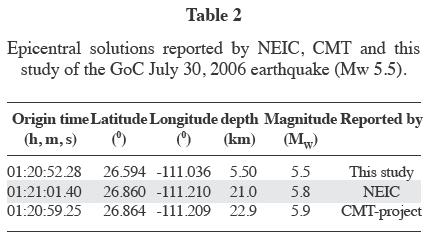
<body><![CDATA[<p align="justify"><font face="verdana" size="2">Finally, we propose that the great majority of moderate magnitude earthquakes in this region have a right&#150;lateral strike&#150;slip focal mechanism. This was inferred from the analysis of historical and recent earthquakes in the GoC region, and particulary from the orientation of the principal stress axis of moderate magnitude GoC earthquakes.</font></p>     <p align="justify"><font face="verdana" size="2">&nbsp;</font></p>     <p align="justify"><font face="verdana" size="2"><b>Broadband seismic stations utilizied</b></font></p>     <p align="justify"><font face="verdana" size="2">We used data from the seven broadband seismic stations: six from the NARS&#150;Baja Broad Band Seismic network (NE75, NE76, NE77, NE79, NE81 and NE82), and one from the RESBAN (TOPB) both operated by CICESE. <a href="/img/revistas/geoint/v49n3/a2f2.jpg" target="_blank">Fig. 2</a> shows the geographical distribution of stations. Solid triangles are NARS&#150;Baja stations and solid squares RESBAN stations. Solid symbols denote the stations used in this study.</font></p>     <p align="justify"><font face="verdana" size="2">NARS&#150;Baja and RESBAN stations are instrumented with broadband STS&#150;2 sensors. Custom recorders were build by Utrecht under the NARS program. Three&#150;component BH (20 sps) and LH (1 sps) channels were recorded. These stations record in a continuous mode, and the data are retrieved approximately every 3 months (Trampert <i>et al., </i>2003).</font></p>     <p align="justify"><font face="verdana" size="2">&nbsp;</font></p>     <p align="justify"><font face="verdana" size="2"><b>Location of the July 30 2006 Gulf of California earthquake</b></font></p>     <p align="justify"><font face="verdana" size="2">Arrival times of P&#150; and S&#150;waves recorded at stations NE75, NE76, NE77, and NE82 of NARS&#150;Baja network, and at TOPB, of RESBAN network were measured for epicentral location. One horizontal component of these record is shown in <a href="/img/revistas/geoint/v49n3/a2f3.jpg" target="_blank">Fig. 3</a>. The stations provided good azimutal coverage. The velocity model shown in <a href="#tabla1">Table 1</a>, from Rebollar <i>et al. </i>(2001), was adopted. The solution uses the HYPOCENTER code of Lienert <i>et al. </i>(1988), and Lienert and Havskov (1995). It satisfies the minimun residual criteria between experimental and theoretical arrival times of P&#150; and S&#150;waves at each station. The epicentral uncertainty was &plusmn; 10 km. Our solution is shown in <a href="#tabla2">Table 2</a>, with solutions by NEIC, and the Global&#150;CMT agencies for comparison. Significant improvement was attributed to a better coverage using local stations. The error of the focal depth was &plusmn;3 km.</font></p>     <p align="center"><font face="verdana" size="2"><a name="tabla1"></a></font></p>     <p align="center"><font face="verdana" size="2"><img src="/img/revistas/geoint/v49n3/a2t1.jpg"></font></p>     ]]></body>
<body><![CDATA[<p align="center"><font face="verdana" size="2"><a name="tabla2"></a></font></p>     <p align="center"><font face="verdana" size="2"><img src="/img/revistas/geoint/v49n3/a2t2.jpg"></font></p>     <p align="justify"><font face="verdana" size="2">We estimate the focal mechanism, by moment tensor inversion, with an initial focal depth at 4 km and iterating by increments of 0.5 km until reaching 6.5 km. The minimun reduced variance was found at h=5.5 km. (<a href="/img/revistas/geoint/v49n3/a2f8.jpg" target="_blank">Fig. 8</a>).</font></p>     <p align="justify"><font face="verdana" size="2">&nbsp;</font></p>     <p align="justify"><font face="verdana" size="2"><b>Source parameters</b></font></p>     <p align="justify"><font face="verdana" size="2">For the July 30, 2006 earthquake, the source dimension (r), seismic moment <i>(M<sub>0</sub>), </i>and average displacement <i>(<img src="/img/revistas/geoint/v49n3/a2e1.jpg">) </i>were obtained. They were estimated from the spectral analysis of recorded signals at stations NE75, NE76, NE77 and TOPB (<a href="#tabla3">Table 3</a>) using Brune's theory (Brune, 1970). The displacement spectrum was computed in a window of 25 s for the horizontal components, which are assumed to contain the SHwave. It was corrected by attenuation, by varying the Q&#150;values in the range of 150 to 450. We observed that only the high frequencies change, while the central portion of the spectrum that contains the corner frequency show no amplitude change. The final Q&#150;value applied for the correction was 350 (Rebollar <i>et al., </i>1995).</font></p>     <p align="center"><font face="verdana" size="2"><a name="tabla3"></a></font></p>     <p align="center"><font face="verdana" size="2"><img src="/img/revistas/geoint/v49n3/a2t3.jpg"></font></p>     <p align="justify"><font face="verdana" size="2"><a href="/img/revistas/geoint/v49n3/a2f4.jpg" target="_blank">Figures 4</a>, <a href="/img/revistas/geoint/v49n3/a2f5.jpg" target="_blank">5</a> and <a href="/img/revistas/geoint/v49n3/a2f6.jpg" target="_blank">6</a> show the SH&#150;wave spectrums for stations NE75, NE77, and TOPB respectively. Also shown is the corner frequency and the spectral value at low frequencies (<i>&Omega;<sub>0</sub></i><sub></sub>) which is proportional to the seismic moment (<i>M<sub>0</sub></i>). We use the following expression to estimate the seismic moment (<i>M<sub>0</sub></i><sub></sub>):</font></p>     <p align="center"><font face="verdana" size="2"><img src="/img/revistas/geoint/v49n3/a2e2.jpg"></font></p>     ]]></body>
<body><![CDATA[<p align="justify"><font face="verdana" size="2">The values for the parameters were <img src="/img/revistas/geoint/v49n3/a2e3.jpg" width="266" height="36"> (Boore and Boatwright, 1984) and k = 2 (amplification factor at free surface). <i>&Omega;<sub>0</sub></i> and <i>R </i>are spectral value at low frequencies and the hypocentral distance at each station, respectively.</font></p>     <p align="justify"><font face="verdana" size="2">For estimation of the source dimension we used Brune's equation (Brune, 1970):</font></p>     <p align="center"><font face="verdana" size="2"><img src="/img/revistas/geoint/v49n3/a2e4.jpg"></font></p>     <p align="justify"><font face="verdana" size="2">where <i>f</i> is the corner frequency measured in Hz, obtained from the intersection of straight lines with the envelope of the spectrum at low and high frequencies. The corner frequency is highly sensitive to local sites effects. However, such an effect was not considered here because all stations were on hard rock.</font></p>     <p align="justify"><font face="verdana" size="2">The average displacement <img src="/img/revistas/geoint/v49n3/a2e1.jpg"> was obtained from</font></p>     <p align="center"><font face="verdana" size="2"><img src="/img/revistas/geoint/v49n3/a2e5.jpg"></font></p>     <p align="justify"><font face="verdana" size="2">where &micro;=3.3 * <img src="/img/revistas/geoint/v49n3/a2e6.jpg">, A = rupture area, <img src="/img/revistas/geoint/v49n3/a2e1.jpg"> = average displacement.</font></p>     <p align="justify"><font face="verdana" size="2">The rupture area was taken as <i>A </i>= 71.5 km<sup>2</sup> from the radius of a the circular fault model. The radius of an equivalent circular crack is related to the corner frequency <i>f </i>of the source spectrum and is calculated from Eq. (2) given by Brune (1970). The average rupture time of this earthquake was estimated as 4.6 s, from:</font></p>     <p align="center"><font face="verdana" size="2"><img src="/img/revistas/geoint/v49n3/a2e7.jpg"></font></p>     <p align="justify"><font face="verdana" size="2">where <img src="/img/revistas/geoint/v49n3/a2e12.jpg"> is the average corner frequency, shown in <a href="#tabla3">Table 3</a>. This value is in agreement with values from earthquakes of similar magnitude in this tectonic region, (Rebollar <i>et al., </i>2001). Finally, the stress drop was computed from the Keyllis&#150;Borok's (1959):</font></p>     ]]></body>
<body><![CDATA[<p align="center"><font face="verdana" size="2"><img src="/img/revistas/geoint/v49n3/a2e8.jpg"></font></p>     <p align="justify"><font face="verdana" size="2">An average stress drop of 11 bars was obtained from the estimated spectra for stations NE75, NE76, NE77, and TOPB. To estimate the above average stress drop value, the radius of a circular source and the seismic moment (Brune, 1970) were previously estimated, obtaining avarage values of 4.7 km and 4.566e24 dyne&#150;cm, respectively.</font></p>     <p align="justify"><font face="verdana" size="2">The estimated average stress drop value of 11 bars was obtained from equation (5) for a circular fault in Stein and Wysession (2003, page 269) or in Keyllis&#150;Borok (1959).</font></p>     <p align="justify"><font face="verdana" size="2">Rebollar <i>et al. </i>(2001), Lopez&#150;Pineda and Rebollar (2005), and others, describe earthquakes of similar magnitude in the Gulf of California where the stress drop varies from 2 to 125 bars. In the 12/03/2003 Loreto earthquake, located near the earthquake studied here, the stress drop was 38 bars.</font></p>     <p align="justify"><font face="verdana" size="2"><a href="#tabla3">Table 3</a> shows the estimated source parameters for each station, as well as the average values.</font></p>     <p align="justify"><font face="verdana" size="2">&nbsp;</font></p>     <p align="justify"><font face="verdana" size="2"><b>Seismic moment tensor</b></font></p>     <p align="justify"><font face="verdana" size="2">To estimate the focal mechanism of this earthquake, the time domain inversion method by Dreger and Helmber&#150;ger, (1991) was used.</font></p>     <p align="justify"><font face="verdana" size="2">This technique yields acceptable solutions using a single three&#150;component seismic station, when using a higher number of stations the solution becomes more stable.</font></p>     <p align="justify"><font face="verdana" size="2">This time domain inversion technique does not take into account the volume change in the source area (isotropic component) but only the double couple (deviatoric component).</font></p>     ]]></body>
<body><![CDATA[<p align="justify"><font face="verdana" size="2">The seismic moment is the scalar parameter of the point source of a double couple. This parameter is related to the size and the displacement of the fault (Aki, 1966).</font></p>     <p align="justify"><font face="verdana" size="2">The method is highly sensitive to the earthquake hypocentral location and requires a reliable focal depth estimation.</font></p>     <p align="justify"><font face="verdana" size="2">A short description of the methodology for the inversion process of the moment tensor is now provided.</font></p>     <p align="justify"><font face="verdana" size="2">It is assumed that the seismic source may be represented as a point source in space and time:</font></p>     <p align="center"><font face="verdana" size="2"><img src="/img/revistas/geoint/v49n3/a2e9.jpg"></font></p>     <p align="justify"><font face="verdana" size="2">where <i>U<sub>n</sub> </i>is the <i>n</i>&#150;th observed component of the displacement, <i>G<sub>ni,j</sub> </i>is the theoretical Green's function of the n&#150;th component for specific force couple orientations, and <i>x </i>and <i>z </i>denote the source&#150;station location, and depth, respectively, and finally <i>M<sub>i,j</sub> </i>is the scalar seismic moment tensor. The equation of the <i>n</i>&#150;th component of the observed displacement is solved using least squares and assuming a constant focal depth for each inversion. The estimated scalar seismic moment tensor <i>M<sub>i,j</sub> </i>can be decomposed by the scalar seismic moment <i>(M<sub>0</sub>), </i>by a double&#150;couple moment tensor and by a compensated linear vector dipole.</font></p>     <p align="justify"><font face="verdana" size="2">Details of the decomposition procedure are given by Jost and Herrmann (1989). The optimal hypocentral depth is found by iterative procedure checking for both: (i) an object function, <i>f, </i>which depends on the RMS of the difference between the theoretical <i>(s) </i>and the observed data (<i>d</i>) divided by the percent double couple (<i>pdc</i>):</font></p>     <p align="center"><font face="verdana" size="2"><img src="/img/revistas/geoint/v49n3/a2e10.jpg"></font></p>     <p align="justify"><font face="verdana" size="2">The variance reduction <i>(VR) </i>is estimated by:</font></p>     <p align="center"><font face="verdana" size="2"><img src="/img/revistas/geoint/v49n3/a2e11.jpg"></font></p>     ]]></body>
<body><![CDATA[<p align="justify"><font face="verdana" size="2">High values of <i>VR </i>and low values of <i>f </i>in our results indicates that an acceptable inversion has been attained with both a good waveform fit and the percentage double couple.</font></p>     <p align="justify"><font face="verdana" size="2">In our study case, we obtain the focal mechanism using the inversion process described above. For the estimation of the synthetic waveforms, the velocity model described by Rebollar <i>et al. </i>(2001) (<a href="#tabla1">Table 1</a>), and the code FKRPROG of Saikia (1994) were used.</font></p>     <p align="justify"><font face="verdana" size="2">The data used in the process of inversion comprise the seismic records obtained at stations NE75, NE76, NE77, NE79, NE81, NE82 and TOPB, with epicentral distances of 196.7, 101.2, 71.7, 486.7, 292.5, 183.1, and 226.07 km, respectively.</font></p>     <p align="justify"><font face="verdana" size="2">Clear P&#150; and S&#150;waves arrivals were extracted for later components rotation and band&#150;pass filtered (0.02 to 0.06 Hz). The iterative inversion process was conducted by va&#150;rying the focal depth, while checking the goodness of the inversion, was measured through the reduced variance; a large value of the reduced variance indicates an acceptable result, and small value will means a non acceptable result (<a href="/img/revistas/geoint/v49n3/a2f8.jpg" target="_blank">Fig. 8</a>).</font></p>     <p align="justify"><font face="verdana" size="2">The final result of the process was obtained after the inversion was conducted for each station (NE75, NE76, NE79, NE81) (<a href="/img/revistas/geoint/v49n3/a2f7.jpg" target="_blank">Fig. 7</a>).</font></p>      <p align="justify"><font face="verdana" size="2">The results of the inversion provided the following geometrical characteristics of the fault mechanism:</font></p>     <p align="justify"><font face="verdana" size="2">Fault plane 1:   strike = 137&deg;, dip = 77&deg;, and rake = 174&deg;, Fault plane 2:   strike = 228&deg;, dip = 85&deg;, and rake = 13&deg;, Seismic Moment of <i>M<sub>0</sub></i><sub></sub> = 6.7x10<sup>24</sup> dyne&#150;cm, Magnitude (M<sub>w</sub>) = 5.9.</font></p>     <p align="justify"><font face="verdana" size="2">In <a href="/img/revistas/geoint/v49n3/a2f7.jpg" target="_blank">Fig. 7</a>, we are showing the comparison between the synthetic and observed data for the longitudinal, transversal and vertical components.</font></p>     <p align="justify"><font face="verdana" size="2">The interpretation for the results described above, is a right lateral strike slip transcurrent fault, which is in excellent agreement with the tectonics of the area where the earthquake was located. Our solution is also in agreement with the solution reported by the NEIC. The comparison between those solutions is shown in <a href="#tabla4">Table 4</a>.</font></p>     <p align="center"><font face="verdana" size="2"><a name="tabla4"></a></font></p>     ]]></body>
<body><![CDATA[<p align="center"><font face="verdana" size="2"><img src="/img/revistas/geoint/v49n3/a2t4.jpg"></font></p>     <p align="center"><font face="verdana" size="2">&nbsp;</font></p>     <p align="justify"><font face="verdana" size="2"><b>State stress in the epicentral region from historical and recent seismic activity</b></font></p>     <p align="justify"><font face="verdana" size="2">In <a href="/img/revistas/geoint/v49n3/a2f9.jpg" target="_blank">Fig. 9</a>, we are showing the epicentral location, focal mechanism, as well as the axis of principal stresses of several seismic events occurred between 1964 and 2006 in the central&#150;south area of the GoC. Those earthquakes are also listed in <a href="/img/revistas/geoint/v49n3/a2t5.jpg" target="_blank">Table 5</a>, with the description of their principal characteristics. The focal mechanism and the epicentral locations of the seismicity shown in <a href="/img/revistas/geoint/v49n3/a2f9.jpg" target="_blank">Fig. 9</a>, are from Goff <i>et al. </i>(1987), Lopez&#150;Pineda and Rebollar (2005), and Rodriguez&#150;Lozoya <i>et al. </i>(2008). As described on the section of inversion of the moment tensor, the fault mechanisms were obtained using the method of Dreger and Helmberger (1991).</font></p>     <p align="justify"><font face="verdana" size="2">In <a href="/img/revistas/geoint/v49n3/a2f9.jpg" target="_blank">Fig. 9</a>, the dominant mechanism is a right lateral strike slip transcurrent fault, which agrees with the regional tectonic of the region.</font></p>     <p align="justify"><font face="verdana" size="2">Goff <i>et al. </i>(1987) concluded that the earthquakes located on the spreading centers show normal faulting, while the earthquakes located in the transform faults correspond to right lateral strike slip focal mechanisms. Rodriguez&#150;Lozoya <i>et al. </i>(2008) obtained focal mechanisms of three earthquakes of moderate magnitude on the Angel de la Guarda, normal fault and the San Lorenzo and Topolobampo transform faults. Our focal mechanisms agree with theirs, and also with the results reported by Goff <i>et al. </i>(1987).</font></p>     <p align="justify"><font face="verdana" size="2">The compressional axis of the earthquakes reported in this study has a north&#150;south orientation, similar to that reported by Rebollar and Reichle (1987) for the northern portion of the GoC. Note orientation of the extensional axis, from which we can explain the extensional behavior of this portion of the GoC.</font></p>     <p align="justify"><font face="verdana" size="2">The tectonics of the GoC were discussed by Goff <i>et al. </i>(1987), Pacheco and Sykes, (1992), Lopez Pineda and Rebollar, (2005) and others. This study compiles for the first time the findings of previous studies and compares these results with ours using recent technique. We conclude that moderate magnitude earthquakes, may be used to identify the direction and amount of displacement on the North America Pacific Plate boundary.</font></p>     <p align="justify"><font face="verdana" size="2">However, for a more detailed description of the behavior of the stresses within the regional context a large number of earthquakes and focal mechanisms might be required.</font></p>     <p align="justify"><font face="verdana" size="2">&nbsp;</font></p>     ]]></body>
<body><![CDATA[<p align="justify"><font face="verdana" size="2"><b>Discussion and conclusions</b></font></p>     <p align="justify"><font face="verdana" size="2">For the July 30, 2006, earthquake <i>(M<sub>W</sub> </i>5.5) we obtained the following results: (i) location north&#150;west of Del Carmen basin, (ii) focal depth of 5.5 (&plusmn;3) km, in agreement with the depths of other earthquakes in the GoC (Lopez&#150;Pineda and Rebollar, 2005, and Rodriguez&#150;Lozoya <i>et al., </i>2008, among others), (iii) the time duration of the source time was 4.6 s, which agrees with results reported in the literature for GoC earthquakes of similar magnitude, (e.g., Goff <i>et al., </i>1987; Lopez&#150;Pineda and Rebollar, 2005; and Rodriguez&#150;Lozoya <i>et al., </i>2008, among others), (v) seismic moment <i>M<sub>0</sub></i><sub></sub> = 4.566*10<sup>24 </sup>dyne&#150;cm (by spectral analysis) or 6.70*10<sup>24</sup> dyne&#150;cm (by Seismic Moment Tensor) (vi) average stress drop value of 11 bars, (vii) radial dimension of the fault of 4.70 km.</font></p>     <p align="justify"><font face="verdana" size="2">Spectral analysis of the July 30, 2006 (<i>M<sub>W</sub></i> 5.5) Gulf of California earthquake (recorded at stations NE75, NE76, NE77 and TOPB) was conducted in order to compute the field of stress drop for the GoC region. The estimated average stress drop value of 11 bars was obtained using the equation (5) for a circular fault (Stein and Wysession, 2003 or Kellis&#150;Borok, (1959). Previous studies of earthquakes with similar characteristics as the one studied in this article were conducted by Rebollar <i>et al. </i>(2001) and Lopez&#150;Pineda and Rebollar (2005). A stress drop average value for the GoC region was reported in the range of 2 to 125 bars. For the relatively recent earthquake of 03/2003 near the epicentral location of the 30/07/2006 GoC earthquake, the stress drop reported by Lopez&#150;Pineda and Rebollar (2005) was 38 bars. Our stress drop estimation falls within the stress drop range proposed for the GoC region.</font></p>     <p align="justify"><font face="verdana" size="2">The seismic moment tensor obtained from the inversion process allows us to interpret a focal mechanism as follows: (i) strike of 137&deg;, (ii) dip of 77&deg;, (iii) a rake of 174&deg; (NEIC solution: (i) strike of 127&deg;, (ii) dip of 77&deg;, and (iii) a rake of 176&deg;). The focal mechanism is right lateral strike slip. This result agrees with the tectonics between the Guaymas and El Carmen basins. The magnitude estimated by means of spectral analysis was M<sub>W</sub>= 5.5, while the one estimated through the inversion of the moment tensor was M<sub>W</sub>=5.9.</font></p>     <p align="justify"><font face="verdana" size="2">The epicentral coordinates of this earthquake are very similar to those of the Loreto earthquake (M<sub>W</sub> 6.2) of March 2003. We propose that the great majority of moderate earthquakes in this region and which are located on or near a transcurrent fault, show a right lateral strike slip focal mechanism.</font></p>     <p align="justify"><font face="verdana" size="2">A comparison with results reported on earlier studies in the GoC region may be used to infer the seismotectonic behavior of the extensional process of the GoC, particulary from an analysis of the orientation of the maximum stress axis of earthquakes in the GoC region.</font></p>     <p align="justify"><font face="verdana" size="2">The NARS&#150;Baja and RESBAN Broadband Seismic Networks are seismic networks that have been monitoring the seismicity in the northern part of Mexico and in the GoC for the last eight years, providing good quality data and allowing the seismologists to conduct seismic studies in order to better understand the tectonic behavior and the stress distribution of the GoC. The spatial gap and the distances between stations and epicenters still represent a constraint on more detailed knowledge of the distribution of the lithosphere extensional process of the GoC.</font></p>     <p align="justify"><font face="verdana" size="2">&nbsp;</font></p>     <p align="justify"><font face="verdana" size="2"><b>Acknowledgements</b></font></p>     <p align="justify"><font face="verdana" size="2">We thank Arturo Perez&#150;Vertti and Arie van Wettum for the maintenance of the NARS&#150;Baja and RESBAN networks. Data recorded on those networks are the core of this investigation. Antonio Mendoza is in charge of database management. The Consejo Nacional de Ciencia y Tecnologia (CONACYT) sponsored partial maintenance of the RESBAN array (project 37038&#150;T). National Science Foundation award 0405437 sponsors maintenance of the NARS&#150;Baja seismic array. Moment tensors were computed using the tdmt&#150;invc package developed by Douglas Dreger of the Berkeley Seismological Laboratory, and Green's functions were computed using the FKRPROG software developed by Chandan Saikia with URS. H.E.R.L. was supported by the University of Sinaloa (UAS).</font></p>     ]]></body>
<body><![CDATA[<p align="justify"><font face="verdana" size="2">&nbsp;</font></p>     <p align="justify"><font face="verdana" size="2"><b>Bibliography</b></font></p>     <!-- ref --><p align="justify"><font face="verdana" size="2">Aki, K., 1966. Generation and propagation of G&#150;waves from the Niigata earthquake of June 16, 1964. Part 2. Estimation of earthquake moment, released energy, and stress&#150;strain drop from the G&#150;waves spectrum, <i>Bull. Earthquake Res. Inst., Tokyo Univ., 44, </i>73&#150;88.    &nbsp;&nbsp;&nbsp;&nbsp;&nbsp;&nbsp;&nbsp;&nbsp;[&#160;<a href="javascript:void(0);" onclick="javascript: window.open('/scielo.php?script=sci_nlinks&ref=3909457&pid=S0016-7169201000030000200001&lng=','','width=640,height=500,resizable=yes,scrollbars=1,menubar=yes,');">Links</a>&#160;]<!-- end-ref --></font></p>     <!-- ref --><p align="justify"><font face="verdana" size="2">Boore, D. M. and J. Boatwright, 1984. Average body&#150;wave radiation coefficient, <i>Bull. Seism. Soc. Am., 74, </i>1,615&#150;1,621.    &nbsp;&nbsp;&nbsp;&nbsp;&nbsp;&nbsp;&nbsp;&nbsp;[&#160;<a href="javascript:void(0);" onclick="javascript: window.open('/scielo.php?script=sci_nlinks&ref=3909459&pid=S0016-7169201000030000200002&lng=','','width=640,height=500,resizable=yes,scrollbars=1,menubar=yes,');">Links</a>&#160;]<!-- end-ref --></font></p>     <!-- ref --><p align="justify"><font face="verdana" size="2">Brune, J. N., 1970. Tectonic stress and the spectra of seismic shear waves from earthquakes, <i>J. Geophys. Res,, 75, </i>4,997&#150;5,009.    &nbsp;&nbsp;&nbsp;&nbsp;&nbsp;&nbsp;&nbsp;&nbsp;[&#160;<a href="javascript:void(0);" onclick="javascript: window.open('/scielo.php?script=sci_nlinks&ref=3909461&pid=S0016-7169201000030000200003&lng=','','width=640,height=500,resizable=yes,scrollbars=1,menubar=yes,');">Links</a>&#160;]<!-- end-ref --></font></p>     <!-- ref --><p align="justify"><font face="verdana" size="2">Dreger, D., 2000. Manual of the Berkeley automatic seismic moment tensor code, Release 1.0, Berkeley Seismological Laboratory, pp. 21.    &nbsp;&nbsp;&nbsp;&nbsp;&nbsp;&nbsp;&nbsp;&nbsp;[&#160;<a href="javascript:void(0);" onclick="javascript: window.open('/scielo.php?script=sci_nlinks&ref=3909463&pid=S0016-7169201000030000200004&lng=','','width=640,height=500,resizable=yes,scrollbars=1,menubar=yes,');">Links</a>&#160;]<!-- end-ref --></font></p>     ]]></body>
<body><![CDATA[<!-- ref --><p align="justify"><font face="verdana" size="2">Douglas, D. S. and D. V. Helmberger, 1991. Complex faulting deduced from broadband modeling of the 28 February 1990 Upland earthquake (ML = 5.2), <i>Bull. Seis. Soc. Am,, 81, 4, </i>1,129&#150;1,144.    &nbsp;&nbsp;&nbsp;&nbsp;&nbsp;&nbsp;&nbsp;&nbsp;[&#160;<a href="javascript:void(0);" onclick="javascript: window.open('/scielo.php?script=sci_nlinks&ref=3909465&pid=S0016-7169201000030000200005&lng=','','width=640,height=500,resizable=yes,scrollbars=1,menubar=yes,');">Links</a>&#160;]<!-- end-ref --></font></p>     <!-- ref --><p align="justify"><font face="verdana" size="2">Goff, J. A., E. A. Bergman and S. C. Solomon, 1987. Earthquake source mechanisms and transform fault tectonics in the Gulf of California, <i>J. Geophys. Res., 92, </i>10,485&#150;10,510.    &nbsp;&nbsp;&nbsp;&nbsp;&nbsp;&nbsp;&nbsp;&nbsp;[&#160;<a href="javascript:void(0);" onclick="javascript: window.open('/scielo.php?script=sci_nlinks&ref=3909467&pid=S0016-7169201000030000200006&lng=','','width=640,height=500,resizable=yes,scrollbars=1,menubar=yes,');">Links</a>&#160;]<!-- end-ref --></font></p>     <!-- ref --><p align="justify"><font face="verdana" size="2">Jost, M. L. and R. B. Herrmann, 1989. A student's guide to and review of moment tensor, <i>Seism. Res. Lett., 60. </i>37&#150;57.    &nbsp;&nbsp;&nbsp;&nbsp;&nbsp;&nbsp;&nbsp;&nbsp;[&#160;<a href="javascript:void(0);" onclick="javascript: window.open('/scielo.php?script=sci_nlinks&ref=3909469&pid=S0016-7169201000030000200007&lng=','','width=640,height=500,resizable=yes,scrollbars=1,menubar=yes,');">Links</a>&#160;]<!-- end-ref --></font></p>     <!-- ref --><p align="justify"><font face="verdana" size="2">Keilis&#150;Borok, V. I., 1959. On the estimation of the displacement in an earthquake source and of source dimensions, <i>Ann. Geofs., 12, </i>205&#150;214.    &nbsp;&nbsp;&nbsp;&nbsp;&nbsp;&nbsp;&nbsp;&nbsp;[&#160;<a href="javascript:void(0);" onclick="javascript: window.open('/scielo.php?script=sci_nlinks&ref=3909471&pid=S0016-7169201000030000200008&lng=','','width=640,height=500,resizable=yes,scrollbars=1,menubar=yes,');">Links</a>&#160;]<!-- end-ref --></font></p>     <!-- ref --><p align="justify"><font face="verdana" size="2">Lienert, B. R., E. Berg and L. N. Frazer, 1986. HYPOCENTER: An earthquake location method using centered, scaled, and adaptively damped least squares, <i>Bull. Seis. Soc. Am., 76, </i>771&#150;783.    &nbsp;&nbsp;&nbsp;&nbsp;&nbsp;&nbsp;&nbsp;&nbsp;[&#160;<a href="javascript:void(0);" onclick="javascript: window.open('/scielo.php?script=sci_nlinks&ref=3909473&pid=S0016-7169201000030000200009&lng=','','width=640,height=500,resizable=yes,scrollbars=1,menubar=yes,');">Links</a>&#160;]<!-- end-ref --></font></p>     ]]></body>
<body><![CDATA[<!-- ref --><p align="justify"><font face="verdana" size="2">Lienert, B. R. and J. Havskov, 1995. A computer program for location earthquakes both locally and globally, <i>Seism. Res. Lett., </i>66, 26&#150;36.    &nbsp;&nbsp;&nbsp;&nbsp;&nbsp;&nbsp;&nbsp;&nbsp;[&#160;<a href="javascript:void(0);" onclick="javascript: window.open('/scielo.php?script=sci_nlinks&ref=3909475&pid=S0016-7169201000030000200010&lng=','','width=640,height=500,resizable=yes,scrollbars=1,menubar=yes,');">Links</a>&#160;]<!-- end-ref --></font></p>     <!-- ref --><p align="justify"><font face="verdana" size="2">L&oacute;pez&#150;Pineda, L. and C. J. Rebollar, 2005. Source characteristics of Loreto Earthquake of 12 March 2003(Mw 6.2) that occurred in the transform fault in the middle of the Gulf of California, Mexico, <i>Bull. Seis. Soc. Am., 95, </i>419&#150;430.    &nbsp;&nbsp;&nbsp;&nbsp;&nbsp;&nbsp;&nbsp;&nbsp;[&#160;<a href="javascript:void(0);" onclick="javascript: window.open('/scielo.php?script=sci_nlinks&ref=3909477&pid=S0016-7169201000030000200011&lng=','','width=640,height=500,resizable=yes,scrollbars=1,menubar=yes,');">Links</a>&#160;]<!-- end-ref --></font></p>     <!-- ref --><p align="justify"><font face="verdana" size="2">Pacheco, J. and L. R. Sykes, 1992. Seismic moment catalog of large shallow earthquakes, 1900 to 1989, <i>Bull. Seis. Soc. Am., 82, </i>1,306&#150;1,349.    &nbsp;&nbsp;&nbsp;&nbsp;&nbsp;&nbsp;&nbsp;&nbsp;[&#160;<a href="javascript:void(0);" onclick="javascript: window.open('/scielo.php?script=sci_nlinks&ref=3909479&pid=S0016-7169201000030000200012&lng=','','width=640,height=500,resizable=yes,scrollbars=1,menubar=yes,');">Links</a>&#160;]<!-- end-ref --></font></p>     <!-- ref --><p align="justify"><font face="verdana" size="2">Rebollar, C. J. and M. S. Reichle, 1987. Analysis of the Seismicity detected in 1982 &#150; 1984 in the northern peninsular ranges of Baja California, <i>Bull. Seis. Soc. Am., 77, </i>173&#150;183.    &nbsp;&nbsp;&nbsp;&nbsp;&nbsp;&nbsp;&nbsp;&nbsp;[&#160;<a href="javascript:void(0);" onclick="javascript: window.open('/scielo.php?script=sci_nlinks&ref=3909481&pid=S0016-7169201000030000200013&lng=','','width=640,height=500,resizable=yes,scrollbars=1,menubar=yes,');">Links</a>&#160;]<!-- end-ref --></font></p>     <!-- ref --><p align="justify"><font face="verdana" size="2">Rebollar, C. J., J. Castillo&#150;Roman and A. Uribe, 1995. Par&aacute;metros de fuente de la actividad s&iacute;smica que ocurri&oacute; en marzo de 1993 en la bah&iacute;a de las Animas, Baja California, Monograf&iacute;a 2, Uni&oacute;n Geof&iacute;sica Mexicana, 229&#150;235.    &nbsp;&nbsp;&nbsp;&nbsp;&nbsp;&nbsp;&nbsp;&nbsp;[&#160;<a href="javascript:void(0);" onclick="javascript: window.open('/scielo.php?script=sci_nlinks&ref=3909483&pid=S0016-7169201000030000200014&lng=','','width=640,height=500,resizable=yes,scrollbars=1,menubar=yes,');">Links</a>&#160;]<!-- end-ref --></font></p>     ]]></body>
<body><![CDATA[<!-- ref --><p align="justify"><font face="verdana" size="2">Rebollar C., J. and M. S. Reichle, 1987. Analysis of Seismicity Detected in 1982&#150;1984 in the Northern Peninsular Ranges of Baja California, <i>Bull. Seis. Soc. Am., 77, 1, </i>173&#150;183.    &nbsp;&nbsp;&nbsp;&nbsp;&nbsp;&nbsp;&nbsp;&nbsp;[&#160;<a href="javascript:void(0);" onclick="javascript: window.open('/scielo.php?script=sci_nlinks&ref=3909485&pid=S0016-7169201000030000200015&lng=','','width=640,height=500,resizable=yes,scrollbars=1,menubar=yes,');">Links</a>&#160;]<!-- end-ref --></font></p>     <!-- ref --><p align="justify"><font face="verdana" size="2">Rebollar, C. J., L. Quintanar, R. Castro, S. M. Day, J. Madrid, J. N. Brune, L. Astiz and F. Vernon, 2001. Source characteristics of a 5.5 magnitude earthquake that occurred in the transform fault system of the Delfin basin in the Gulf of California, <i>Bull. Seismol. Soc. Am., 91, </i>781&#150;791.    &nbsp;&nbsp;&nbsp;&nbsp;&nbsp;&nbsp;&nbsp;&nbsp;[&#160;<a href="javascript:void(0);" onclick="javascript: window.open('/scielo.php?script=sci_nlinks&ref=3909487&pid=S0016-7169201000030000200016&lng=','','width=640,height=500,resizable=yes,scrollbars=1,menubar=yes,');">Links</a>&#160;]<!-- end-ref --></font></p>     <!-- ref --><p align="justify"><font face="verdana" size="2">Rodr&iacute;guez&#150;Lozoya, H. E., 2005. Estudios sismol&oacute;gicos en dos ambientes tect&oacute;nicos del pac&iacute;fico mexicano, CICESE, Unpublished Ph. D. thesis.    &nbsp;&nbsp;&nbsp;&nbsp;&nbsp;&nbsp;&nbsp;&nbsp;[&#160;<a href="javascript:void(0);" onclick="javascript: window.open('/scielo.php?script=sci_nlinks&ref=3909489&pid=S0016-7169201000030000200017&lng=','','width=640,height=500,resizable=yes,scrollbars=1,menubar=yes,');">Links</a>&#160;]<!-- end-ref --></font></p>     <!-- ref --><p align="justify"><font face="verdana" size="2">Rodr&iacute;guez&#150;Lozoya, H. E., L. Quintanar, R. Ortega, C. J. Rebollar and Y. Yagi, 2008. Rupture process of four medium&#150;sized earthquakes that occurred in the Gulf of California, <i>J. Geophys. Res., 113, </i>B10301, doi:10.1029/2007JB005323.    &nbsp;&nbsp;&nbsp;&nbsp;&nbsp;&nbsp;&nbsp;&nbsp;[&#160;<a href="javascript:void(0);" onclick="javascript: window.open('/scielo.php?script=sci_nlinks&ref=3909491&pid=S0016-7169201000030000200018&lng=','','width=640,height=500,resizable=yes,scrollbars=1,menubar=yes,');">Links</a>&#160;]<!-- end-ref --></font></p>     <!-- ref --><p align="justify"><font face="verdana" size="2">Saikia, C. K., 1994. Modified frequency&#150;wavenumber algorithm for regional seismograms using Filon's quadrature; modelling of Lg waves in eastern North America, <i>Geophys. J. Int., 118, </i>142&#150;158.    &nbsp;&nbsp;&nbsp;&nbsp;&nbsp;&nbsp;&nbsp;&nbsp;[&#160;<a href="javascript:void(0);" onclick="javascript: window.open('/scielo.php?script=sci_nlinks&ref=3909493&pid=S0016-7169201000030000200019&lng=','','width=640,height=500,resizable=yes,scrollbars=1,menubar=yes,');">Links</a>&#160;]<!-- end-ref --></font></p>     ]]></body>
<body><![CDATA[<!-- ref --><p align="justify"><font face="verdana" size="2">Stein, S. and M. Wysession, 2003. A introduction to seismology earthquakes and earth structure, Blackwell Publishing, USA, pp. 498.    &nbsp;&nbsp;&nbsp;&nbsp;&nbsp;&nbsp;&nbsp;&nbsp;[&#160;<a href="javascript:void(0);" onclick="javascript: window.open('/scielo.php?script=sci_nlinks&ref=3909495&pid=S0016-7169201000030000200020&lng=','','width=640,height=500,resizable=yes,scrollbars=1,menubar=yes,');">Links</a>&#160;]<!-- end-ref --></font></p>     <!-- ref --><p align="justify"><font face="verdana" size="2">Trampert, J., A. Paulseen, A. van Wettum, J. Ritsema, R. Clayton, R. Castro, C. J. Rebollar and A. Perez&#150;Vertti, 2003. New array monitors seismic activity near Gulf of California in Mexico, <i>Eos, 84, </i>29&#150;32.    &nbsp;&nbsp;&nbsp;&nbsp;&nbsp;&nbsp;&nbsp;&nbsp;[&#160;<a href="javascript:void(0);" onclick="javascript: window.open('/scielo.php?script=sci_nlinks&ref=3909497&pid=S0016-7169201000030000200021&lng=','','width=640,height=500,resizable=yes,scrollbars=1,menubar=yes,');">Links</a>&#160;]<!-- end-ref --></font></p>      ]]></body><back>
<ref-list>
<ref id="B1">
<nlm-citation citation-type="journal">
<person-group person-group-type="author">
<name>
<surname><![CDATA[Aki]]></surname>
<given-names><![CDATA[K.]]></given-names>
</name>
</person-group>
<article-title xml:lang="en"><![CDATA[Generation and propagation of G-waves from the Niigata earthquake of June 16, 1964: Part 2. Estimation of earthquake moment, released energy, and stress-strain drop from the G-waves spectrum]]></article-title>
<source><![CDATA[Bull. Earthquake Res. Inst]]></source>
<year>1966</year>
<volume>44</volume>
<page-range>73-88</page-range><publisher-name><![CDATA[Tokyo Univ.]]></publisher-name>
</nlm-citation>
</ref>
<ref id="B2">
<nlm-citation citation-type="journal">
<person-group person-group-type="author">
<name>
<surname><![CDATA[Boore]]></surname>
<given-names><![CDATA[D. M.]]></given-names>
</name>
<name>
<surname><![CDATA[Boatwright]]></surname>
<given-names><![CDATA[J.]]></given-names>
</name>
</person-group>
<article-title xml:lang="en"><![CDATA[Average body-wave radiation coefficient]]></article-title>
<source><![CDATA[Bull. Seism. Soc. Am]]></source>
<year>1984</year>
<volume>74</volume>
<page-range>1,615-1,621</page-range></nlm-citation>
</ref>
<ref id="B3">
<nlm-citation citation-type="journal">
<person-group person-group-type="author">
<name>
<surname><![CDATA[Brune]]></surname>
<given-names><![CDATA[J. N.]]></given-names>
</name>
</person-group>
<article-title xml:lang="en"><![CDATA[Tectonic stress and the spectra of seismic shear waves from earthquakes]]></article-title>
<source><![CDATA[J. Geophys. Res]]></source>
<year>1970</year>
<volume>75</volume>
<page-range>4,997-5,009</page-range></nlm-citation>
</ref>
<ref id="B4">
<nlm-citation citation-type="book">
<person-group person-group-type="author">
<name>
<surname><![CDATA[Dreger]]></surname>
<given-names><![CDATA[D.]]></given-names>
</name>
</person-group>
<source><![CDATA[Manual of the Berkeley automatic seismic moment tensor code, Release 1.0]]></source>
<year>2000</year>
<page-range>21</page-range><publisher-name><![CDATA[Berkeley Seismological Laboratory]]></publisher-name>
</nlm-citation>
</ref>
<ref id="B5">
<nlm-citation citation-type="journal">
<person-group person-group-type="author">
<name>
<surname><![CDATA[Douglas]]></surname>
<given-names><![CDATA[D. S.]]></given-names>
</name>
<name>
<surname><![CDATA[Helmberger]]></surname>
<given-names><![CDATA[D. V.]]></given-names>
</name>
</person-group>
<article-title xml:lang="en"><![CDATA[Complex faulting deduced from broadband modeling of the 28 February 1990 Upland earthquake (ML = 5.2)]]></article-title>
<source><![CDATA[Bull. Seis. Soc. Am]]></source>
<year>1991</year>
<volume>81</volume>
<numero>4</numero>
<issue>4</issue>
<page-range>1,129-1,144</page-range></nlm-citation>
</ref>
<ref id="B6">
<nlm-citation citation-type="journal">
<person-group person-group-type="author">
<name>
<surname><![CDATA[Goff]]></surname>
<given-names><![CDATA[J. A.]]></given-names>
</name>
<name>
<surname><![CDATA[Bergman]]></surname>
<given-names><![CDATA[E. A.]]></given-names>
</name>
<name>
<surname><![CDATA[Solomon]]></surname>
<given-names><![CDATA[S. C.]]></given-names>
</name>
</person-group>
<article-title xml:lang="en"><![CDATA[Earthquake source mechanisms and transform fault tectonics in the Gulf of California]]></article-title>
<source><![CDATA[J. Geophys. Res.]]></source>
<year>1987</year>
<volume>92</volume>
<page-range>10,485-10,510</page-range></nlm-citation>
</ref>
<ref id="B7">
<nlm-citation citation-type="journal">
<person-group person-group-type="author">
<name>
<surname><![CDATA[Jost]]></surname>
<given-names><![CDATA[M. L.]]></given-names>
</name>
<name>
<surname><![CDATA[Herrmann]]></surname>
<given-names><![CDATA[R. B.]]></given-names>
</name>
</person-group>
<article-title xml:lang="en"><![CDATA[A student's guide to and review of moment tensor]]></article-title>
<source><![CDATA[Seism. Res. Lett]]></source>
<year>1989</year>
<volume>60</volume>
<page-range>37-57</page-range></nlm-citation>
</ref>
<ref id="B8">
<nlm-citation citation-type="journal">
<person-group person-group-type="author">
<name>
<surname><![CDATA[Keilis-Borok]]></surname>
<given-names><![CDATA[V. I.]]></given-names>
</name>
</person-group>
<article-title xml:lang="en"><![CDATA[On the estimation of the displacement in an earthquake source and of source dimensions]]></article-title>
<source><![CDATA[Ann. Geofs]]></source>
<year>1959</year>
<volume>12</volume>
<page-range>205-214</page-range></nlm-citation>
</ref>
<ref id="B9">
<nlm-citation citation-type="journal">
<person-group person-group-type="author">
<name>
<surname><![CDATA[Lienert]]></surname>
<given-names><![CDATA[B. R.]]></given-names>
</name>
<name>
<surname><![CDATA[Berg]]></surname>
<given-names><![CDATA[E.]]></given-names>
</name>
<name>
<surname><![CDATA[Frazer]]></surname>
<given-names><![CDATA[L. N.]]></given-names>
</name>
</person-group>
<article-title xml:lang="en"><![CDATA[HYPOCENTER: An earthquake location method using centered, scaled, and adaptively damped least squares]]></article-title>
<source><![CDATA[Bull. Seis. Soc. Am]]></source>
<year>1986</year>
<volume>76</volume>
<page-range>771-783</page-range></nlm-citation>
</ref>
<ref id="B10">
<nlm-citation citation-type="journal">
<person-group person-group-type="author">
<name>
<surname><![CDATA[Lienert]]></surname>
<given-names><![CDATA[B. R.]]></given-names>
</name>
<name>
<surname><![CDATA[Havskov]]></surname>
<given-names><![CDATA[J.]]></given-names>
</name>
</person-group>
<article-title xml:lang="en"><![CDATA[A computer program for location earthquakes both locally and globally, Seism]]></article-title>
<source><![CDATA[Res. Lett]]></source>
<year>1995</year>
<volume>66</volume>
<page-range>26-36</page-range></nlm-citation>
</ref>
<ref id="B11">
<nlm-citation citation-type="journal">
<person-group person-group-type="author">
<name>
<surname><![CDATA[López-Pineda]]></surname>
<given-names><![CDATA[L.]]></given-names>
</name>
<name>
<surname><![CDATA[Rebollar]]></surname>
<given-names><![CDATA[C. J.]]></given-names>
</name>
</person-group>
<article-title xml:lang="en"><![CDATA[Source characteristics of Loreto Earthquake of 12 March 2003(Mw 6.2) that occurred in the transform fault in the middle of the Gulf of California, Mexico]]></article-title>
<source><![CDATA[Bull. Seis. Soc. Am]]></source>
<year>2005</year>
<volume>95</volume>
<page-range>419-430</page-range></nlm-citation>
</ref>
<ref id="B12">
<nlm-citation citation-type="journal">
<person-group person-group-type="author">
<name>
<surname><![CDATA[Pacheco]]></surname>
<given-names><![CDATA[J.]]></given-names>
</name>
<name>
<surname><![CDATA[Sykes]]></surname>
<given-names><![CDATA[L. R.]]></given-names>
</name>
</person-group>
<article-title xml:lang="en"><![CDATA[Seismic moment catalog of large shallow earthquakes, 1900 to 1989]]></article-title>
<source><![CDATA[Bull. Seis. Soc. Am]]></source>
<year>1992</year>
<volume>82</volume>
<page-range>1,306-1,349</page-range></nlm-citation>
</ref>
<ref id="B13">
<nlm-citation citation-type="journal">
<person-group person-group-type="author">
<name>
<surname><![CDATA[Rebollar]]></surname>
<given-names><![CDATA[C. J.]]></given-names>
</name>
<name>
<surname><![CDATA[Reichle]]></surname>
<given-names><![CDATA[M. S.]]></given-names>
</name>
</person-group>
<article-title xml:lang="en"><![CDATA[Analysis of the Seismicity detected in 1982 - 1984 in the northern peninsular ranges of Baja California]]></article-title>
<source><![CDATA[Bull. Seis. Soc. Am]]></source>
<year>1987</year>
<volume>77</volume>
<page-range>173-183</page-range></nlm-citation>
</ref>
<ref id="B14">
<nlm-citation citation-type="book">
<person-group person-group-type="author">
<name>
<surname><![CDATA[Rebollar]]></surname>
<given-names><![CDATA[C. J.]]></given-names>
</name>
<name>
<surname><![CDATA[Castillo-Roman]]></surname>
<given-names><![CDATA[J.]]></given-names>
</name>
<name>
<surname><![CDATA[Uribe]]></surname>
<given-names><![CDATA[A.]]></given-names>
</name>
</person-group>
<source><![CDATA[Parámetros de fuente de la actividad sísmica que ocurrió en marzo de 1993 en la bahía de las Animas, Baja California]]></source>
<year>1995</year>
<page-range>229-235</page-range><publisher-name><![CDATA[Unión Geofísica Mexicana]]></publisher-name>
</nlm-citation>
</ref>
<ref id="B15">
<nlm-citation citation-type="journal">
<person-group person-group-type="author">
<name>
<surname><![CDATA[Rebollar C.]]></surname>
<given-names><![CDATA[J.]]></given-names>
</name>
<name>
<surname><![CDATA[Reichle]]></surname>
<given-names><![CDATA[M. S.]]></given-names>
</name>
</person-group>
<article-title xml:lang="en"><![CDATA[Analysis of Seismicity Detected in 1982-1984 in the Northern Peninsular Ranges of Baja California]]></article-title>
<source><![CDATA[Bull. Seis. Soc. Am.]]></source>
<year>1987</year>
<volume>77</volume>
<numero>1</numero>
<issue>1</issue>
<page-range>173-183</page-range></nlm-citation>
</ref>
<ref id="B16">
<nlm-citation citation-type="journal">
<person-group person-group-type="author">
<name>
<surname><![CDATA[Rebollar]]></surname>
<given-names><![CDATA[C. J.]]></given-names>
</name>
<name>
<surname><![CDATA[Quintanar]]></surname>
<given-names><![CDATA[L.]]></given-names>
</name>
<name>
<surname><![CDATA[Castro]]></surname>
<given-names><![CDATA[R.]]></given-names>
</name>
<name>
<surname><![CDATA[Day]]></surname>
<given-names><![CDATA[S. M.]]></given-names>
</name>
<name>
<surname><![CDATA[Madrid]]></surname>
<given-names><![CDATA[J.]]></given-names>
</name>
<name>
<surname><![CDATA[Brune]]></surname>
<given-names><![CDATA[J. N.]]></given-names>
</name>
<name>
<surname><![CDATA[Astiz]]></surname>
<given-names><![CDATA[L.]]></given-names>
</name>
<name>
<surname><![CDATA[Vernon]]></surname>
<given-names><![CDATA[F.]]></given-names>
</name>
</person-group>
<article-title xml:lang="en"><![CDATA[Source characteristics of a 5.5 magnitude earthquake that occurred in the transform fault system of the Delfin basin in the Gulf of California]]></article-title>
<source><![CDATA[Bull. Seismol. Soc. Am]]></source>
<year>2001</year>
<volume>91</volume>
<page-range>781-791</page-range></nlm-citation>
</ref>
<ref id="B17">
<nlm-citation citation-type="book">
<person-group person-group-type="author">
<name>
<surname><![CDATA[Rodríguez-Lozoya]]></surname>
<given-names><![CDATA[H. E.]]></given-names>
</name>
</person-group>
<source><![CDATA[Estudios sismológicos en dos ambientes tectónicos del pacífico mexicano]]></source>
<year>2005</year>
<publisher-name><![CDATA[CICESE]]></publisher-name>
</nlm-citation>
</ref>
<ref id="B18">
<nlm-citation citation-type="journal">
<person-group person-group-type="author">
<name>
<surname><![CDATA[Rodríguez-Lozoya]]></surname>
<given-names><![CDATA[H. E.]]></given-names>
</name>
<name>
<surname><![CDATA[Quintanar]]></surname>
<given-names><![CDATA[L.]]></given-names>
</name>
<name>
<surname><![CDATA[Ortega]]></surname>
<given-names><![CDATA[R.]]></given-names>
</name>
<name>
<surname><![CDATA[Rebollar]]></surname>
<given-names><![CDATA[C. J.]]></given-names>
</name>
<name>
<surname><![CDATA[Yagi]]></surname>
<given-names><![CDATA[Y.]]></given-names>
</name>
</person-group>
<article-title xml:lang="en"><![CDATA[Rupture process of four medium-sized earthquakes that occurred in the Gulf of California]]></article-title>
<source><![CDATA[J. Geophys. Res]]></source>
<year>2008</year>
<volume>113</volume>
</nlm-citation>
</ref>
<ref id="B19">
<nlm-citation citation-type="journal">
<person-group person-group-type="author">
<name>
<surname><![CDATA[Saikia]]></surname>
<given-names><![CDATA[C. K.]]></given-names>
</name>
</person-group>
<article-title xml:lang="en"><![CDATA[Modified frequency-wavenumber algorithm for regional seismograms using Filon's quadrature: modelling of Lg waves in eastern North America]]></article-title>
<source><![CDATA[Geophys. J. Int]]></source>
<year>1994</year>
<volume>118</volume>
<page-range>142-158</page-range></nlm-citation>
</ref>
<ref id="B20">
<nlm-citation citation-type="book">
<person-group person-group-type="author">
<name>
<surname><![CDATA[Stein]]></surname>
<given-names><![CDATA[S.]]></given-names>
</name>
<name>
<surname><![CDATA[Wysession]]></surname>
<given-names><![CDATA[M.]]></given-names>
</name>
</person-group>
<source><![CDATA[A introduction to seismology earthquakes and earth structure]]></source>
<year>2003</year>
<page-range>498</page-range><publisher-name><![CDATA[Blackwell Publishing]]></publisher-name>
</nlm-citation>
</ref>
<ref id="B21">
<nlm-citation citation-type="book">
<person-group person-group-type="author">
<name>
<surname><![CDATA[Trampert]]></surname>
<given-names><![CDATA[J.]]></given-names>
</name>
<name>
<surname><![CDATA[Paulseen]]></surname>
<given-names><![CDATA[A.]]></given-names>
</name>
<name>
<surname><![CDATA[van Wettum]]></surname>
<given-names><![CDATA[A.]]></given-names>
</name>
<name>
<surname><![CDATA[Ritsema]]></surname>
<given-names><![CDATA[J.]]></given-names>
</name>
<name>
<surname><![CDATA[Clayton]]></surname>
<given-names><![CDATA[R.]]></given-names>
</name>
<name>
<surname><![CDATA[Castro]]></surname>
<given-names><![CDATA[R.]]></given-names>
</name>
<name>
<surname><![CDATA[Rebollar]]></surname>
<given-names><![CDATA[C. J.]]></given-names>
</name>
<name>
<surname><![CDATA[Perez-Vertti]]></surname>
<given-names><![CDATA[A.]]></given-names>
</name>
</person-group>
<source><![CDATA[New array monitors seismic activity near Gulf of California in Mexico]]></source>
<year>2003</year>
<volume>84</volume>
<page-range>29-32</page-range><publisher-name><![CDATA[Eos]]></publisher-name>
</nlm-citation>
</ref>
</ref-list>
</back>
</article>