<?xml version="1.0" encoding="ISO-8859-1"?><article xmlns:mml="http://www.w3.org/1998/Math/MathML" xmlns:xlink="http://www.w3.org/1999/xlink" xmlns:xsi="http://www.w3.org/2001/XMLSchema-instance">
<front>
<journal-meta>
<journal-id>0016-7169</journal-id>
<journal-title><![CDATA[Geofísica internacional]]></journal-title>
<abbrev-journal-title><![CDATA[Geofís. Intl]]></abbrev-journal-title>
<issn>0016-7169</issn>
<publisher>
<publisher-name><![CDATA[Universidad Nacional Autónoma de México, Instituto de Geofísica]]></publisher-name>
</publisher>
</journal-meta>
<article-meta>
<article-id>S0016-71692009000300001</article-id>
<title-group>
<article-title xml:lang="en"><![CDATA[The south America VLF NETwork (SAVNET): Development, installation status, first results]]></article-title>
</title-group>
<contrib-group>
<contrib contrib-type="author">
<name>
<surname><![CDATA[Raulin]]></surname>
<given-names><![CDATA[J. P.]]></given-names>
</name>
<xref ref-type="aff" rid="A01"/>
</contrib>
<contrib contrib-type="author">
<name>
<surname><![CDATA[Correia de Matos David]]></surname>
<given-names><![CDATA[P.]]></given-names>
</name>
<xref ref-type="aff" rid="A01"/>
</contrib>
<contrib contrib-type="author">
<name>
<surname><![CDATA[Hadano]]></surname>
<given-names><![CDATA[R.]]></given-names>
</name>
<xref ref-type="aff" rid="A02"/>
</contrib>
<contrib contrib-type="author">
<name>
<surname><![CDATA[Saraiva]]></surname>
<given-names><![CDATA[A. C. V.]]></given-names>
</name>
<xref ref-type="aff" rid="A01"/>
</contrib>
<contrib contrib-type="author">
<name>
<surname><![CDATA[Correia]]></surname>
<given-names><![CDATA[E.]]></given-names>
</name>
<xref ref-type="aff" rid="A01"/>
</contrib>
<contrib contrib-type="author">
<name>
<surname><![CDATA[Kaufmann]]></surname>
<given-names><![CDATA[P.]]></given-names>
</name>
<xref ref-type="aff" rid="A03"/>
</contrib>
</contrib-group>
<aff id="A01">
<institution><![CDATA[,Universidade Presbiteriana Mackenzie Escola de Engenharia Centro de Radioastronomia e Astrofísica Mackenzie]]></institution>
<addr-line><![CDATA[São Paulo ]]></addr-line>
<country>Brasil</country>
</aff>
<aff id="A02">
<institution><![CDATA[,Instituto Nacional de Pesquisas Espaciais  ]]></institution>
<addr-line><![CDATA[São José dos Campos ]]></addr-line>
<country>Brasil</country>
</aff>
<aff id="A03">
<institution><![CDATA[,Universidade Estadual de Campinas Centro de Componentes Semiconductores ]]></institution>
<addr-line><![CDATA[ ]]></addr-line>
</aff>
<pub-date pub-type="pub">
<day>00</day>
<month>09</month>
<year>2009</year>
</pub-date>
<pub-date pub-type="epub">
<day>00</day>
<month>09</month>
<year>2009</year>
</pub-date>
<volume>48</volume>
<numero>3</numero>
<fpage>253</fpage>
<lpage>261</lpage>
<copyright-statement/>
<copyright-year/>
<self-uri xlink:href="http://www.scielo.org.mx/scielo.php?script=sci_arttext&amp;pid=S0016-71692009000300001&amp;lng=en&amp;nrm=iso"></self-uri><self-uri xlink:href="http://www.scielo.org.mx/scielo.php?script=sci_abstract&amp;pid=S0016-71692009000300001&amp;lng=en&amp;nrm=iso"></self-uri><self-uri xlink:href="http://www.scielo.org.mx/scielo.php?script=sci_pdf&amp;pid=S0016-71692009000300001&amp;lng=en&amp;nrm=iso"></self-uri><abstract abstract-type="short" xml:lang="es"><p><![CDATA[Se presenta la red South America VLF Networks (SAVNET) que es una nueva instalación de observación en frecuencias muy bajas. SAVNET se instaló recientemente en diversas localidades en América LAtina (Brasil, Perú y Argentina) Consiste en una red de siete receptores cuyo principal objetivo científico es monitorear la actividad solar en escalas temporales cortas (minutos/horas) y extensas (años). Otros objetivos incluyen una mejor comprensión de la estructura espacial de la anomalía Magnética del Atlántico sur, el estudio de fenómenos atmosféricos y la búsqueda sistemática de efectos sismico-electromágneticos genuinos.]]></p></abstract>
<abstract abstract-type="short" xml:lang="en"><p><![CDATA[The South America VLF Network, a new observing facility at Very Low Frequencies is presented. It has been recently installed at different locations in Latin America (in Brazil, Peru and Argentina). It consists of a network of seven Very Low Frequency tracking receivers with the main scientific objective of monitoring the solar activity on short (minutes to hours) and long (years) time scales. Other objectives include a better understanding of the spatial structure of the South Atlantic Magnetic Anomaly, the study of atmospheric phenomena and the search for genuine seismic-electromagnetic effects.]]></p></abstract>
<kwd-group>
<kwd lng="es"><![CDATA[Radio propagación sub-ionosférica]]></kwd>
<kwd lng="es"><![CDATA[muy bajas frequencias]]></kwd>
<kwd lng="es"><![CDATA[clima espacial]]></kwd>
<kwd lng="es"><![CDATA[ciclo de actividad solar]]></kwd>
<kwd lng="en"><![CDATA[Sub-ionospheric radio propagation]]></kwd>
<kwd lng="en"><![CDATA[very low frequencies]]></kwd>
<kwd lng="en"><![CDATA[space weather]]></kwd>
<kwd lng="en"><![CDATA[solar activity cycle]]></kwd>
</kwd-group>
</article-meta>
</front><body><![CDATA[ <p align="justify"><font face="verdana" size="4">Article</font></p>     <p align="justify"><font face="verdana" size="2">&nbsp;</font></p>     <p align="center"><font face="verdana" size="4"><b>The south America VLF NETwork (SAVNET): Development, </b><b>installation status, first results</b></font></p>     <p align="center"><font face="verdana" size="2">&nbsp;</font></p>     <p align="center"><font face="verdana" size="2"><b>J. P. Raulin<sup>1</sup>*, P. Correia de Matos David<sup>1</sup>, R. Hadano<sup>2</sup>, A. C. V. Saraiva<sup>1</sup>, E. Correia<sup>1,2 </sup>and P. Kaufmann<sup>1,3</sup></b></font></p>     <p align="justify"><font face="verdana" size="2">&nbsp;</font></p>     <p align="justify"><font face="verdana" size="2"> <i><sup>1 </sup>Centro de Radioastronomia e Astrof&iacute;sica Mackenzie, Escola de Engenharia. Universidade Presbiteriana Mackenzie, S&atilde;o Paulo, Brasil. * Corresponding author: <a href="mailto:raulin@craam.mackenzie.br">raulin@craam.mackenzie.br</a></i></font></p>     <p align="justify"><font face="verdana" size="2"><i><sup>2 </sup>Instituto Nacional de Pesquisas Espaciais, S&atilde;o Jos&eacute; dos Campos, Brasil.</i></font></p>     <p align="justify"><font face="verdana" size="2"><i><sup>3 </sup>Centro de Componentes Semiconductores, Universidade Estadual de Campinas, Campinas , Brasil</i>.</font></p>     <p align="justify"><font face="verdana" size="2">&nbsp;</font></p>     ]]></body>
<body><![CDATA[<p align="justify"><font face="verdana" size="2">Received: January 10, 2009    <br>   Accepted: June 4, 2009</font></p>     <p align="justify"><font face="verdana" size="2">&nbsp;</font></p>     <p align="justify"><font face="verdana" size="2"><b>Resumen</b></font></p>     <p align="justify"><font face="verdana" size="2">Se presenta la red South America VLF Networks (SAVNET) que es una nueva instalaci&oacute;n de observaci&oacute;n en frecuencias muy bajas. SAVNET se instal&oacute; recientemente en diversas localidades en Am&eacute;rica LAtina (Brasil, Per&uacute; y Argentina) Consiste en una red de siete receptores cuyo principal objetivo cient&iacute;fico es monitorear la actividad solar en escalas temporales cortas (minutos/horas) y extensas (a&ntilde;os). Otros objetivos incluyen una mejor comprensi&oacute;n de la estructura espacial de la anomal&iacute;a Magn&eacute;tica del Atl&aacute;ntico sur, el estudio de fen&oacute;menos atmosf&eacute;ricos y la b&uacute;squeda sistem&aacute;tica de efectos sismico&#150;electrom&aacute;gneticos genuinos.</font></p>     <p align="justify"><font face="verdana" size="2"><b>Palabras clave:</b> Radio propagaci&oacute;n sub&#150;ionosf&eacute;rica, muy bajas frequencias, clima espacial, ciclo de actividad solar.</font></p>     <p align="justify"><font face="verdana" size="2">&nbsp;</font></p>     <p align="justify"><font face="verdana" size="2"><b>Abstract</b></font></p>     <p align="justify"><font face="verdana" size="2">The South America VLF Network, a new observing facility at Very Low Frequencies is presented. It has been recently installed at different locations in Latin America (in Brazil, Peru and Argentina). It consists of a network of seven Very Low Frequency tracking receivers with the main scientific objective of monitoring the solar activity on short (minutes to hours) and long (years) time scales. Other objectives include a better understanding of the spatial structure of the South Atlantic Magnetic Anomaly, the study of atmospheric phenomena and the search for genuine seismic&#150;electromagnetic effects.</font></p>     <p align="justify"><font face="verdana" size="2"><b>Key words:</b> Sub&#150;ionospheric radio propagation, very low frequencies, space weather, solar activity cycle.</font></p>     ]]></body>
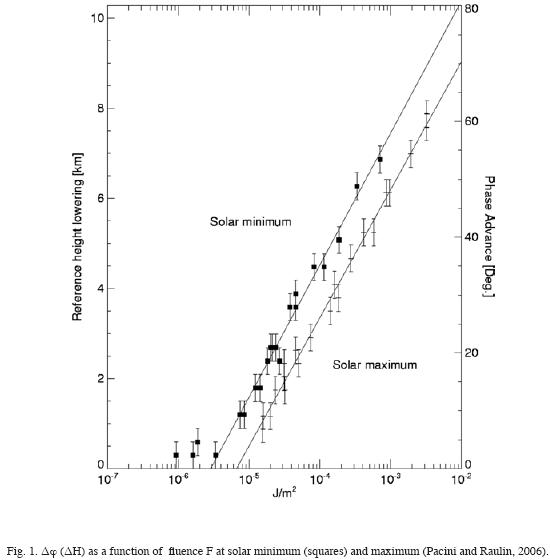
<body><![CDATA[<p align="justify"><font face="verdana" size="2">&nbsp;</font></p>     <p align="justify"><font face="verdana" size="2"><b>Introduction</b></font></p>     <p align="justify"><font face="verdana" size="2">Observations of the ionospheric D&#150;region (~70 km in altitude) are scarce because satellites monitor higher altitudes whereas balloons lower altitudes. This layer is formed by photo&#150;ionization processes due to solar Lyman&#150;&alpha; (Ly&#150;&alpha;) photons (Nicolet and Aikin, 1960) during daytime and at night the D&#150;region disappears. The "Wait" parameters are customarily used to describe the electrical conductivity of the D&#150;region, i. e. H<sub>0</sub> a reference height (km) and, &beta; a conductivity gradient (km<sup>&#150;1</sup>). The D&#150;region can be monitored using Very Low Frequency (VLF) waves propagating to several thousand kilometers within the Earth&#150;Ionosphere Waveguide (EIW) (Wait, 1958; Wait and Spies, 1964). Changes in the EIW walls conductivities imply in variations of the H<sub>0</sub> and &beta; parameters.</font></p>     <p align="justify"><font face="verdana" size="2">During quiet solar conditions, X&#150;ray photons are absorbed above ~ 90 km, and temporal variations of the solar soft X&#150;ray flux do not affect the D&#150;region. However, during solar flares this same flux can vary on time scales of the order of minutes, when active regions are heated to a few tens 10<sup>6</sup> K and the spectra of the soft X&#150;ray emission hardens significantly with an increase of the photon flux in the 0.5&#150;2 &Aring; range. The latter penetrate down to the D&#150;region modifying its conductivity. The response of the D&#150;region to solar perturbations has been extensively studied (for example Mitra, 1974 and references therein). Nevertheless, how its conductivity varies on rapid and long time scales is still unclear.</font></p>     <p align="justify"><font face="verdana" size="2">The South America VLF Network (SAVNET) is a new observing facility with two main goals (1) monitoring solar activity on short and long time scales related to fast solar perturbations (solar flares) and to variations due to the solar activity cycle respectively (2) study of the South Atlantic Magnetic Anomaly (SAMA) spatial structure. Other objectives include the study of atmospheric phenomena and to provide lower ionosphere diagnostics of seismic related electromagnetic effects. Before concluding, we present the status of SAVNET, its objectives, and some details of the installation and the first results obtained.</font></p>     <p align="justify"><font face="verdana" size="2"><b>Monitoring of the solar activity</b></font></p>     <p align="justify"><font face="verdana" size="2">Solar photons with <i>&lambda; &lt; </i>2 &Aring; produced during solar flares modify the conductivity of the lower ionosphere provoking detectable changes in the phase of propagating VLF waves interpreted as a lowering of the reference height, H<sub>0</sub>. Analyzing ~ 1500 solar events, Raulin <i>et al. </i>(2006) found that for solar flares with incident soft X&#150;ray power, I, less than 2 <i>&micro;</i>W/m<sup>2</sup>, the occurrence probability, P, of subsequent ionospheric phase changes are lower during periods of minimum of solar activity than during solar maximum. P is nearly independent of the solar activity if I &gt; 2 <i>&micro;</i>W/m<sup>2</sup>. The lower ionosphere is therefore more sensitive during low solar activity and sensitivity changes could be diagnosed using VLF techniques.</font></p>     <p align="justify"><font face="verdana" size="2">Pacini and Raulin (2006), analyzed the strength of the ionospheric events produced by solar flares as a function of the incident soft X&#150;ray fluence, F (integral of I over time and energy in J/m<sup>2</sup> units). Their result is shown in <a href="#f1">Fig. 1</a> where two clear correlations between the lowering of the reference height, &Delta;H, and F are evident. Here &Delta;H denotes the change of H<sub>0</sub> produced by the solar events. Note that a given solar flare will produce a greater &Delta;H during solar minimum so the authors concluded that H<sub>0</sub> is higher by ~ 1km during these periods.</font></p>     <p align="center"><font face="verdana" size="2"><a name="f1"></a></font></p>     <p align="center"><font face="verdana" size="2"><img src="/img/revistas/geoint/v48n3/a1f1.jpg"></font></p>     ]]></body>
<body><![CDATA[<p align="justify"><font face="verdana" size="2">VLF techniques are suitable to monitor solar activity and infer ionospheric changes which indirectly reveal solar conditions. On the short time scales of solar flares, these can help determine the poorly known conductivity of the low ionosphere and its dynamics.</font></p>     <p align="justify"><font face="verdana" size="2">On solar cycle time scales, VLF techniques could be used to define an ionospheric index representative of solar activity cycle, perhaps the minimum X&#150;ray fluence that produces detectable changes in conductivity, or H<sub>0</sub> and/ or &beta; which also vary along the solar cycle (McRae and Thomson, 2000). The index time variations must follow those of the Ly&#150;&alpha; 1216 &Aring; flux maintaining the quiescent D&#150;region. The Ly&#150;&alpha; incident flux on the Earth plays a leading role in the chemistry of minor species at altitudes of ~ 70&#150;110 km and varies by a few hundred percent along the solar cycle (Lean, 2000). Atmospheric absorption allows its measurement only from high altitudes. Non&#150;continuous measurements have been performed since 1967 with instruments, differing in calibration and accuracy (Floyd <i>et al., </i>2002). Because of the lack of direct Ly&#150;&alpha; flux measurements, its behavior is deduced from proxies (Tobiska <i>et al., </i>2000).</font></p>     <p align="justify"><font face="verdana" size="2"><b>Monitoring the South Atlantic Magnetic Anomaly </b><b>(SAMA)</b></font></p>     <p align="justify"><font face="verdana" size="2">Space Weather effects are enhanced in the SAMA where particles are trapped in the strong geomagnetic field and interact with a denser atmosphere producing higher ionization than anywhere else at the same latitude. Here particle precipitation, PP, in the low ionosphere triggered by geomagnetic storms can be particularly important. Excesses of ionization are especially notable at night when the electronic density is lower. During geomagnetic storms, the lowering of the ionospheric height can equal that observed during daytime due to solar radiation. There is evidence of ionization excesses in the low ionosphere above the SAMA even during geo&#150;magnetically quiet periods (Abdu <i>et al., </i>1981; 2005). Nishino <i>et al. </i>(2002) analyzed ionospheric perturbations above southern Brazil during the recovery phase of a strong geomagnetic storm. No effect was observed in central parts of Brazil. Despite numerous observations in the SAMA, the dynamics of the magnetospheric regions (where energetic particles are trapped) and the detailed processes leading to their precipitation are unknown. PP effects in the ionosphere are probably localized so their detection using VLF monitoring requires different paths. Study of geomagnetic activity coupled with VLF techniques will allow studying the spatial structure and dynamics of PP events by comparison of effects on VLF paths crossing and bypassing the SAMA.</font></p>     <p align="justify"><font face="verdana" size="2"><b>VLF tracking techniques as a diagnostic of Seismic&#150;electromagnetic effects</b></font></p>     <p align="justify"><font face="verdana" size="2">Ionospheric anomalies associated with seismic activity could allow investigation into means of predicting seismic events and minimize their consequences. However, in spite of new evidence provided by ground and space observations in the last eight years, there is no consensus on the association between ionospheric perturbations and seismic activity.</font></p>     <p align="justify"><font face="verdana" size="2">Most seismic&#150;electromagnetic effects are related to perturbations in the E and F2 region of the ionosphere where decreases of the FoF2 frequency are observed (Sharma <i>et al., </i>2006). Anomalies of the sporadic E&#150;layer are also reported (Liperovsky <i>et al., </i>2000). The ionospheric perturbations are ~ 1500 km in size decreasing with distance from the epicenter. Perturbations are observed during ~1 day within &#150;/+ 2 days from the event; Reported an enhancement of "Spread&#150;F" activity before and after earthquakes of intensity M &gt; 5.0, lasting ~ 3 weeks after the event but only detected at distances less than 500 km from the epicenter.</font></p>     <p align="justify"><font face="verdana" size="2">The VLF "terminator time" (TT) occurs earlier at sunrise and later at sunset prior to an earthquake (Hayakawa <i>et al. </i>2002) presumably due to an ionospheric lowering (Molchanov <i>et al., </i>1998; Rodger <i>et al., </i>1999). For 80% of earthquakes, shifts in the TT were found in seismic events of intensity M &gt; 6.0 and with epicenter located at depths lower than 50 km, albeit close to the VLF receivers. VLF receivers in Japan were used to search for perturbations linked to seismic activity (Hayakawa, 2007). Fluctuations of the phase and amplitude of nocturnal signals and anomalies of the Total Electron Content are observed. For the large 2004, December 26 Sumatra earthquake, phase fluctuations were detected up to 2000 km from the epicenter, lasting some days around 2004, December 21, a few days before the seismic event. Other studies show decreases of ~ 1&#150;10 dB in the 19.8 kHz signal from NWC spanning ~ 6 days and an increase of the geomagnetic field by a factor of 3&#150;10 (Horie <i>et al., </i>2007; Rozhnoi <i>et al., </i>2007; Yamauchi <i>et al., </i>2007).</font></p>     <p align="justify"><font face="verdana" size="2">Sharma <i>et al. </i>(2006) report increases of the electron temperature in the F region associated with the occurrence of 6 seismic events. They maintain that Ultra&#150;Low Frequency and VLF waves generated at the epicenter propagate upward and are absorbed in the F region heating the ambient plasma. Sorokin <i>et al. </i>(2005) claim that seismic activity releases electrically charged gases trapped within the Earth crust. Atmospheric convection causes charge separation producing electric fields and currents provoking changes of the atmospheric conductivity which can subsequently be detected.</font></p>     <p align="justify"><font face="verdana" size="2">Spatial and temporal associations between seismic activity and related anomalies in the ionosphere remain very incomplete. SAVNET, complemented by data from the space experiment Direct ElectroMagnetic Emission Through Earthquake Regions &#150; DEMETER&#150; (Parrot <i>et al. </i>2006) will perform a systematic search for diagnostics of seismic activity in the low ionosphere.</font></p>     ]]></body>
<body><![CDATA[<p align="justify"><font face="verdana" size="2"><b>SAVNET: development, installation</b></font></p>     <p align="justify"><font face="verdana" size="2">SAVNET is an international project led by Brazil in collaboration with Argentina and Peru. It is part of the International Heliophysical Year program, and is formally supported by the United Nations Basic Space Science Initiative Program. It involves ~ 10 international research groups, ~ 20 researchers and numerous students from the participating institutions.</font></p>     <p align="justify"><font face="verdana" size="2">SAVNET consists of 7 receiving/tracking VLF stations, located in Latin America. Three stations are in Brazil, 2 in Peru, 1 in Argentina, 1 in the Brazilian Antarctic Research Station Comandante Ferraz (EACF). The receivers track signals from strong communication transmitters, many of them part of the deactivated Omega Network. Each receiver is composed of 3 sensors; 2 sensitive to the magnetic field of the incoming wave (square loop antennae), and 1 to its electric field (a whip antenna). Amplified signals are digitalized using a commercial audio card. Design and construction of sensors and pre&#150;amplifiers were undertaken at the Radio Observatorio do Itapetinga&#150;INPE (Brazil). A precise and stable time reference on time scales of hours or days is needed to measure phase variations. For this a GPS system providing a 1 pulse per second (1&#150;pps) is used. Accurate phase measurements on long time scales are achieved by locking the sound card crystal to the 1&#150;PPS. The VLF tracking receiver prototype was tested in early 2007. As of early 2008, all receivers were installed.</font></p>     <p align="justify"><font face="verdana" size="2"><b>SAVNET: First results</b></font></p>     <p align="justify"><font face="verdana" size="2"><a href="/img/revistas/geoint/v48n3/a1f2.jpg" target="_blank">Fig. 2</a> shows a typical day&#150;night variation observed at Punta Lobos and Piura in Peru, from different transmitters. Very stable phase tracking and phase differences &Delta;&Phi; between night&#150;time and daytime are noticeable. The level of phase variations differs for different paths and mainly depends on the path length. The transient C region spanning ~ 2 hours (10 &#150; 12 UT) is clearly seen and well defined for many of the different transmitter records. Both &Delta;&Phi; and the size of the C&#150;region phase excess can be used to monitor the quiescent solar activity on long time scales. The TT is also well observed and will be used to study seismic&#150;electromagnetic effects.</font></p>     <p align="justify"><font face="verdana" size="2"><a href="/img/revistas/geoint/v48n3/a1f3.jpg" target="_blank">Fig. 3</a> (left panels) exhibits phase variations observed during a solar flare with soft X&#150;ray power of 20 <i>&micro;</i>W/m<sup>2</sup> on 2007, June 1 at ~ 2150 UT. The flare was well detected at Punta Lobos when tracking signals from NAU, NDK, NPM and NLK. Phase changes reached values of ~30 degree/Mm. By comparing the timing and amplitude of the ionospheric response for given solar flares simultaneously observed on different VLF paths, we will be able to study the spatial structure of ionization processes and improve our understanding of the role of the SAMA. Also note the delay between the peak of the soft X&#150;ray profile and that of the phase. These delays should inform us on the poorly defined recombination coefficients in the D&#150;region.</font></p>     <p align="justify"><font face="verdana" size="2">The minimum detectable phase variation can be inferred from the records shown in <a href="/img/revistas/geoint/v48n3/a1f3.jpg" target="_blank">Fig. 3</a> (right panels) which display an example of a very small solar flare on 2007, July 10 at 1600 UT. This flare had a soft X&#150;ray peak power of 0.56 <i>&micro;</i>W/m<sup>2</sup>, i.e. a GOES Class B5.6 event, and although very small, phase variations of the order of 0.8 degree/Mm are well observed. The S/N ratio in the phase temporal variation indicates that much smaller flares can be detected.</font></p>     <p align="justify"><font face="verdana" size="2"><b>Simulations</b></font></p>     <p align="justify"><font face="verdana" size="2">VLF propagation can be understood within the frame of the theory of waveguides, where one must solve the fundamental mode equation <img src="/img/revistas/geoint/v48n3/a1s1.jpg"> R(&theta;) R<sub>g</sub> (&theta;) exp(&#150;2i<i>k</i>sin&theta;)<img src="/img/revistas/geoint/v48n3/a1s1.jpg">= 1, where <i>k </i>is the wave number, R(&theta;) and R<sub>g</sub> (&theta;) are the reflection coefficients, in order to determine the possible modes and the amplitude and phase of the propagating fields.</font></p>     <p align="justify"><font face="verdana" size="2">For the purpose of interpreting the SAVNET data we envision using a VLF propagation code. Presently we are employing Long&#150;Wave Propagation Capability (LWPC) code, developed by the Space and Naval Warfare Systems Centre, San Diego, CA, USA, version 2.1, which allows for the inclusion the Earth's magnetic field in the computations. This code requires as input parameters the characteristics of the transmitting antennae, i. e. their positions and emitting power. Furthermore one must specify the properties of the ionosphere namely, the electron density, electron &#150; neutral collision frequency and ground conductivities. Options include providing the positive ion density, negative ion density, positive ion &#150; neutral collision frequency and negative ion &#150; neutral collision frequency as input parameters (Ferguson, 1998). Mathematical details typical of VLF propagation codes can be found in the literature see e. g. Recommendation ITU&#150;R P.684&#150;3 and Cummer (2000) for comparison between different methods. In the following we consider the waveguide to have an upper boundary of refractive index n<sup>2</sup> = 1&#150; iNe<sup>2</sup>/(&epsilon;<sub>0</sub>mv&omega;) where N is the electron number density, e the electron charge, &epsilon;<sub>0</sub> the permittivity of free space, m the mass of the electron, <i>v</i> the collision frequency and &omega; the angular frequency of the VLF wave, see Budden (1961) or Quemada (1968) for a justification of this equation. The ground conductivity is a known quantity (rec. ITU&#150;R P.832&#150;2) and is tabulated for LWPC and, the intervening media is assumed to be non dispersive.</font></p>     ]]></body>
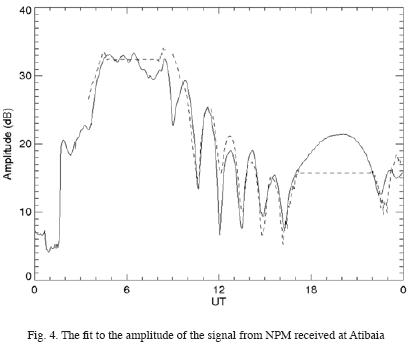
<body><![CDATA[<p align="justify"><font face="verdana" size="2">Using LWPC we have attempted to fit the data with the waveguide cavity as defined in this section. Although some discrepancy is present, as a first result the fit is satisfactory as concerns the amplitude (<a href="#f4">Fig. 4</a>). However there is room for improvement and a better fit will probably require a more detailed ionosphere model. As far as the phases are concerned, we are able to fit the data under day time and night&#150;time conditions as shown in <a href="/img/revistas/geoint/v48n3/a1f5.jpg" target="_blank">Fig. 5</a>, left and right panels respectively.</font></p>     <p align="center"><font face="verdana" size="2"><a name="f4"></a></font></p>     <p align="center"><font face="verdana" size="2"><img src="/img/revistas/geoint/v48n3/a1f4.jpg"></font></p>     <p align="justify"><font face="verdana" size="2">Transient signatures of solar flares, occurring when the low ionosphere is ionized because of the sudden entry of solar X&#150;ray photons can be identified and modelled. Typically a rapid phase advance is observed, which progressively decreases until it reaches its nominal value for an unperturbed ionosphere. This behaviour can be modelled assuming that the D&#150;region conductivity changes as to lower its reference height, followed by a less rapid re&#150;establishment of its unperturbed configuration as the flare vanishes. In <a href="/img/revistas/geoint/v48n3/a1f6.jpg" target="_blank">Fig. 6</a> it is plotted the data along with the fit for a solar flare observed at Piura, Peru. Clearly the fitted points (circles) reproduce the data very satisfactorily. The parameter H is shown as a percentage relative to a reference height; its variation inversely follows that of the flare as expected. The parameter &beta; was held constant.</font></p>     <p align="justify"><font face="verdana" size="2">&nbsp;</font></p>     <p align="justify"><font face="verdana" size="2"><b>Conclusions</b></font></p>     <p align="justify"><font face="verdana" size="2">SAVNET is a new instrumental facility to observe the low ionosphere using very low frequency waves. With SAVNET we intend to indirectly study the solar radiation on different time scales: minutes to hours changes related to solar events will allow study of details of the physical properties of the lower ionosphere; on longer time scales related to the solar activity cycle, SAVNET provides a means to infer the solar Ly&#150;&alpha; radiation, poorly known, but of great importance for Earth atmosphere dynamics. Finally, SAVNET will systematically search for genuine diagnostics of ionospheric perturbations produced by seismic activity.</font></p>     <p align="justify"><font face="verdana" size="2">&nbsp;</font></p>     <p align="justify"><font face="verdana" size="2"><b>Acknowledgements</b></font></p>     <p align="justify"><font face="verdana" size="2">SAVNET project is funded by agency FAPESP (Proc. 2006/02979&#150;0). JPR would like to thank MACKPESQUI&#150;SA, and CNPq through project 304433/2004&#150;7.</font></p>     ]]></body>
<body><![CDATA[<p align="justify"><font face="verdana" size="2">&nbsp;</font></p>     <p align="justify"><font face="verdana" size="2"><b>Bibliography</b></font></p>     <!-- ref --><p align="justify"><font face="verdana" size="2">Abdu, M. A., I. S. Batista, L. R. Piazza and O. Massambani, 1981. Magnetic Storm Associated Enhanced Particle Precipitation in the South Atlantic Anomaly&#150;Evidence from VLF Phase Measurements, <i>J. Geophys. Res., </i>86, 7533&#150;7542</font>&nbsp;&nbsp;&nbsp;&nbsp;&nbsp;&nbsp;&nbsp;&nbsp;[&#160;<a href="javascript:void(0);" onclick="javascript: window.open('/scielo.php?script=sci_nlinks&ref=3905822&pid=S0016-7169200900030000100001&lng=','','width=640,height=500,resizable=yes,scrollbars=1,menubar=yes,');">Links</a>&#160;]<!-- end-ref --><!-- ref --><p align="justify"><font face="verdana" size="2">Abdu, M. A., I. S. Batista, A. J. Carrasco and C. G. M. Brum, 2005. South Atlantic magnetic anomaly ionization: A review and a new focus on electrodynamic effects in the equatorial ionosphere, <i>J. Atm. Sol. Terr. Phys., </i>67, 1463&#150;1657</font>&nbsp;&nbsp;&nbsp;&nbsp;&nbsp;&nbsp;&nbsp;&nbsp;[&#160;<a href="javascript:void(0);" onclick="javascript: window.open('/scielo.php?script=sci_nlinks&ref=3905823&pid=S0016-7169200900030000100002&lng=','','width=640,height=500,resizable=yes,scrollbars=1,menubar=yes,');">Links</a>&#160;]<!-- end-ref --><!-- ref --><p align="justify"><font face="verdana" size="2">Budden, K. G., 1961. The Wave&#150;Guide Mode Theory of Wave Propagation: A Mathematical Treatement of the Propagation of Radio Waves at Great Distance Over Land and Through Water, 1961, Logos Press&#150;Elek Books and Ltd. Prentice&#150;Hall</font>&nbsp;&nbsp;&nbsp;&nbsp;&nbsp;&nbsp;&nbsp;&nbsp;[&#160;<a href="javascript:void(0);" onclick="javascript: window.open('/scielo.php?script=sci_nlinks&ref=3905824&pid=S0016-7169200900030000100003&lng=','','width=640,height=500,resizable=yes,scrollbars=1,menubar=yes,');">Links</a>&#160;]<!-- end-ref --><!-- ref --><p align="justify"><font face="verdana" size="2">Cummer, S. A., 2000. Modeling Electromagnetic Propagation   in   the   Earth&#150;Ionosphere  Waveguide, <i>IEEE Transactions on Antennas and Propagation, 48, 9, </i>1420&#150;1432</font>&nbsp;&nbsp;&nbsp;&nbsp;&nbsp;&nbsp;&nbsp;&nbsp;[&#160;<a href="javascript:void(0);" onclick="javascript: window.open('/scielo.php?script=sci_nlinks&ref=3905825&pid=S0016-7169200900030000100004&lng=','','width=640,height=500,resizable=yes,scrollbars=1,menubar=yes,');">Links</a>&#160;]<!-- end-ref --><!-- ref --><p align="justify"><font face="verdana" size="2">Ferguson, J. A., 1998. Computer Programs for Assessment of Long&#150;Wavelength Radio Communications, version 2.0, SPAWAR tech. Doc. 3030.</font>&nbsp;&nbsp;&nbsp;&nbsp;&nbsp;&nbsp;&nbsp;&nbsp;[&#160;<a href="javascript:void(0);" onclick="javascript: window.open('/scielo.php?script=sci_nlinks&ref=3905826&pid=S0016-7169200900030000100005&lng=','','width=640,height=500,resizable=yes,scrollbars=1,menubar=yes,');">Links</a>&#160;]<!-- end-ref --><!-- ref --><p align="justify"><font face="verdana" size="2">Floyd, L., W. K. Tobiska and R. P. Cebula, 2002. Solar UV Irradiance, its Variation, and its Relevance to the Earth, <i>Adv. Space Res., </i>29, 10, 1427&#150;1440</font>&nbsp;&nbsp;&nbsp;&nbsp;&nbsp;&nbsp;&nbsp;&nbsp;[&#160;<a href="javascript:void(0);" onclick="javascript: window.open('/scielo.php?script=sci_nlinks&ref=3905827&pid=S0016-7169200900030000100006&lng=','','width=640,height=500,resizable=yes,scrollbars=1,menubar=yes,');">Links</a>&#160;]<!-- end-ref --><!-- ref --><p align="justify"><font face="verdana" size="2">Hayakawa, T., J. Kasahara, R. Hino, T. Sato, M. Shinohara, A. Kamimura, N. Nishino, T. Sato and T. Kanazawa, 2002. Heterogeneous Structure Across the Source Regions of the 1968 Tokachi&#150;Oki and the 1994 Sanriku&#150;Haruka&#150;Oki Earthquakes at the Japan Trench Revealed by an Ocean Bottom Seismic Survey, <i>Physics of the Earth and Planetary Interiors, 132, </i>89&#150;104</font>&nbsp;&nbsp;&nbsp;&nbsp;&nbsp;&nbsp;&nbsp;&nbsp;[&#160;<a href="javascript:void(0);" onclick="javascript: window.open('/scielo.php?script=sci_nlinks&ref=3905828&pid=S0016-7169200900030000100007&lng=','','width=640,height=500,resizable=yes,scrollbars=1,menubar=yes,');">Links</a>&#160;]<!-- end-ref --><!-- ref --><p align="justify"><font face="verdana" size="2">Hayakawa, T., 2007. VLF/LF Radio Sounding of Ionospheric Perturbations Associated with Earthquakes, <i>Sensors, 7, </i>1141&#150;1158</font>&nbsp;&nbsp;&nbsp;&nbsp;&nbsp;&nbsp;&nbsp;&nbsp;[&#160;<a href="javascript:void(0);" onclick="javascript: window.open('/scielo.php?script=sci_nlinks&ref=3905829&pid=S0016-7169200900030000100008&lng=','','width=640,height=500,resizable=yes,scrollbars=1,menubar=yes,');">Links</a>&#160;]<!-- end-ref --><!-- ref --><p align="justify"><font face="verdana" size="2">Horie, T., T. Yamauchi, M. Yoshida and M. Hayakawa, 2007. The Wave&#150;like Structure of Ionospheric Perturbation Associated with Sumatra Earthquake of 26 December 2004, as revealed from VLF Observation in Japan of NWC Signals, <i>J. Atm. Sol. Terr. Phys., 69, </i>1021&#150;1028</font>&nbsp;&nbsp;&nbsp;&nbsp;&nbsp;&nbsp;&nbsp;&nbsp;[&#160;<a href="javascript:void(0);" onclick="javascript: window.open('/scielo.php?script=sci_nlinks&ref=3905830&pid=S0016-7169200900030000100009&lng=','','width=640,height=500,resizable=yes,scrollbars=1,menubar=yes,');">Links</a>&#160;]<!-- end-ref --><!-- ref --><p align="justify"><font face="verdana" size="2">Lean, J., 2000. Short&#150;term, Direct Indices of Solar Variability, <i>Spa. Sci. Rev., </i>94, 39&#150;51.</font>&nbsp;&nbsp;&nbsp;&nbsp;&nbsp;&nbsp;&nbsp;&nbsp;[&#160;<a href="javascript:void(0);" onclick="javascript: window.open('/scielo.php?script=sci_nlinks&ref=3905831&pid=S0016-7169200900030000100010&lng=','','width=640,height=500,resizable=yes,scrollbars=1,menubar=yes,');">Links</a>&#160;]<!-- end-ref --><!-- ref --><p align="justify"><font face="verdana" size="2">Liperovsky, V. A., O. A. Pokhotelov, E. V. Liperovskaya, M. Parrot, C. V. Meister and O. A. Alimov, 2000. Modification of Sporadic E&#150;Layers Caused by Seismic Activity, <i>Surveys in Geophysics, 21, </i>449&#150;453</font>&nbsp;&nbsp;&nbsp;&nbsp;&nbsp;&nbsp;&nbsp;&nbsp;[&#160;<a href="javascript:void(0);" onclick="javascript: window.open('/scielo.php?script=sci_nlinks&ref=3905832&pid=S0016-7169200900030000100011&lng=','','width=640,height=500,resizable=yes,scrollbars=1,menubar=yes,');">Links</a>&#160;]<!-- end-ref --><!-- ref --><p align="justify"><font face="verdana" size="2">McRae, W. M.and N. R. Thomson, 2000. VLF Phase and Amplitude: Daytime Ionospheric Parameters, <i>J. Atm. Sol. Terr. Phys., 62, </i>609&#150;618</font>&nbsp;&nbsp;&nbsp;&nbsp;&nbsp;&nbsp;&nbsp;&nbsp;[&#160;<a href="javascript:void(0);" onclick="javascript: window.open('/scielo.php?script=sci_nlinks&ref=3905833&pid=S0016-7169200900030000100012&lng=','','width=640,height=500,resizable=yes,scrollbars=1,menubar=yes,');">Links</a>&#160;]<!-- end-ref --><!-- ref --><p align="justify"><font face="verdana" size="2">Mitra, P. A., in "Ionospheric effects of solar flares", Reidel Pub. Company, 46, 1974.</font>&nbsp;&nbsp;&nbsp;&nbsp;&nbsp;&nbsp;&nbsp;&nbsp;[&#160;<a href="javascript:void(0);" onclick="javascript: window.open('/scielo.php?script=sci_nlinks&ref=3905834&pid=S0016-7169200900030000100013&lng=','','width=640,height=500,resizable=yes,scrollbars=1,menubar=yes,');">Links</a>&#160;]<!-- end-ref --><!-- ref --><p align="justify"><font face="verdana" size="2">Molchanov, O. A., M. Hayakawa, T. Oudoh and E. Kawai, 1998, Precursory effects in the subionospheric VLF signals for the Kobe earthquake, <i>Physics of the Earth and Planetary Interiors, 105, </i>239&#150;248.</font>&nbsp;&nbsp;&nbsp;&nbsp;&nbsp;&nbsp;&nbsp;&nbsp;[&#160;<a href="javascript:void(0);" onclick="javascript: window.open('/scielo.php?script=sci_nlinks&ref=3905835&pid=S0016-7169200900030000100014&lng=','','width=640,height=500,resizable=yes,scrollbars=1,menubar=yes,');">Links</a>&#160;]<!-- end-ref --><!-- ref --><p align="justify"><font face="verdana" size="2">Nicolet, M. and A. C. Aikin, 1960. The Formation of the D Region of the Ionosphere, <i>J. Geophys. Res., 65, </i>1469&#150;1483.</font>&nbsp;&nbsp;&nbsp;&nbsp;&nbsp;&nbsp;&nbsp;&nbsp;[&#160;<a href="javascript:void(0);" onclick="javascript: window.open('/scielo.php?script=sci_nlinks&ref=3905836&pid=S0016-7169200900030000100015&lng=','','width=640,height=500,resizable=yes,scrollbars=1,menubar=yes,');">Links</a>&#160;]<!-- end-ref --><!-- ref --><p align="justify"><font face="verdana" size="2">Nishino, N., N. K. Mikita, K. Yamuto, F. S. Rodrigues, N. J. Schuch and M. A. Abdu, 2002. Unsual Ionospheric Absorption characterizing energetic electron precipitation into the South Atlantic Magnetic Anomaly, <i>Earth Planets &amp; Space, 54, </i>907&#150;916.</font>&nbsp;&nbsp;&nbsp;&nbsp;&nbsp;&nbsp;&nbsp;&nbsp;[&#160;<a href="javascript:void(0);" onclick="javascript: window.open('/scielo.php?script=sci_nlinks&ref=3905837&pid=S0016-7169200900030000100016&lng=','','width=640,height=500,resizable=yes,scrollbars=1,menubar=yes,');">Links</a>&#160;]<!-- end-ref --><!-- ref --><p align="justify"><font face="verdana" size="2">Pacini, A. A.and J.&#150;P. Raulin, 2006. Soft X&#150;ray Flares and Ionospheric Sudden Phase Anomalies Relationship: A Solar Cycle Dependence, <i>J. Geophys. Res. 111, </i>A09301.</font>&nbsp;&nbsp;&nbsp;&nbsp;&nbsp;&nbsp;&nbsp;&nbsp;[&#160;<a href="javascript:void(0);" onclick="javascript: window.open('/scielo.php?script=sci_nlinks&ref=3905838&pid=S0016-7169200900030000100017&lng=','','width=640,height=500,resizable=yes,scrollbars=1,menubar=yes,');">Links</a>&#160;]<!-- end-ref --><!-- ref --><p align="justify"><font face="verdana" size="2">Parrot, M., D. Benoist, J. J. Berthelier, J. Blecki, Y. Chapuis, F. Colin, F. Elie, P. Fergeau, D. Lagoutte, F. Lefeuvre, C. Legendre, M. L&eacute;v&ecirc;que, J. L. Pin&ccedil;on, B. Poirier, H.&#150;C. Seran and P. Zamora, 2006. The Magnetic Field Experiment IMSC and its data Processing Onboard DEMETER: Scientific Objectives, Description and First Results, <i>Planetary and Space Science, 54, </i>5, 441&#150;455.</font>&nbsp;&nbsp;&nbsp;&nbsp;&nbsp;&nbsp;&nbsp;&nbsp;[&#160;<a href="javascript:void(0);" onclick="javascript: window.open('/scielo.php?script=sci_nlinks&ref=3905839&pid=S0016-7169200900030000100018&lng=','','width=640,height=500,resizable=yes,scrollbars=1,menubar=yes,');">Links</a>&#160;]<!-- end-ref --><!-- ref --><p align="justify"><font face="verdana" size="2">Quemada, D., 1968. Ondes dans les plasmas, Hermann, Paris.</font>&nbsp;&nbsp;&nbsp;&nbsp;&nbsp;&nbsp;&nbsp;&nbsp;[&#160;<a href="javascript:void(0);" onclick="javascript: window.open('/scielo.php?script=sci_nlinks&ref=3905840&pid=S0016-7169200900030000100019&lng=','','width=640,height=500,resizable=yes,scrollbars=1,menubar=yes,');">Links</a>&#160;]<!-- end-ref --><!-- ref --><p align="justify"><font face="verdana" size="2">Raulin, J. P., A. A. Pacini, P. Kaufmann, E. Correia and M. A. G. Martinez, 2006. On the Detectability of Solar X&#150;ray Flares Using Very Low Frequency Sudden Phase Anomalies, <i>J. Atm. Sol. Terr. Phys., 68, </i>1029&#150;1035.</font>&nbsp;&nbsp;&nbsp;&nbsp;&nbsp;&nbsp;&nbsp;&nbsp;[&#160;<a href="javascript:void(0);" onclick="javascript: window.open('/scielo.php?script=sci_nlinks&ref=3905841&pid=S0016-7169200900030000100020&lng=','','width=640,height=500,resizable=yes,scrollbars=1,menubar=yes,');">Links</a>&#160;]<!-- end-ref --><!-- ref --><p align="justify"><font face="verdana" size="2">Rodger, C. J., M. A. Clilverd and N. R. Thomson, 1999. Modelling of Subionospheric VLF Signal Perturbations Associated with Earthquakes, <i>Radio Science, 34, </i>1177&#150;1185.</font>&nbsp;&nbsp;&nbsp;&nbsp;&nbsp;&nbsp;&nbsp;&nbsp;[&#160;<a href="javascript:void(0);" onclick="javascript: window.open('/scielo.php?script=sci_nlinks&ref=3905842&pid=S0016-7169200900030000100021&lng=','','width=640,height=500,resizable=yes,scrollbars=1,menubar=yes,');">Links</a>&#160;]<!-- end-ref --><!-- ref --><p align="justify"><font face="verdana" size="2">Rozhno, I. A., O. A. Molchanov, M. Solovieva, V. Gladyshev, O. Akentieva, J. J. Berthelier, M. Parrot, F. Lefeuvre, M. Hayakawa, L. Castellana and P. F. Biagi, 2007. Possible Seismo&#150;Ionosphere Perturbations Revealed by VLF Signals Collected on Ground and on a Satellite, <i>Natural Hazards and Earth System Sciences, </i>7, 617&#150;624.</font>&nbsp;&nbsp;&nbsp;&nbsp;&nbsp;&nbsp;&nbsp;&nbsp;[&#160;<a href="javascript:void(0);" onclick="javascript: window.open('/scielo.php?script=sci_nlinks&ref=3905843&pid=S0016-7169200900030000100022&lng=','','width=640,height=500,resizable=yes,scrollbars=1,menubar=yes,');">Links</a>&#160;]<!-- end-ref --><!-- ref --><p align="justify"><font face="verdana" size="2">Sharma, D. K., M. Israil, C. Ramesh, J. Rai, P. Subrahmanyam and S. C. Garg, 2006. Signature of seismic activities in the F2 region ionospheric electron temperature, <i>J. Atm. Sol. Terr. Phys., 68, </i>691&#150;696.</font>&nbsp;&nbsp;&nbsp;&nbsp;&nbsp;&nbsp;&nbsp;&nbsp;[&#160;<a href="javascript:void(0);" onclick="javascript: window.open('/scielo.php?script=sci_nlinks&ref=3905844&pid=S0016-7169200900030000100023&lng=','','width=640,height=500,resizable=yes,scrollbars=1,menubar=yes,');">Links</a>&#160;]<!-- end-ref --><!-- ref --><p align="justify"><font face="verdana" size="2">Sorokin, V. M., V. M. Chmyrev and A. K. Yaschenko, 2005. Theorertical Model of DC Electric Field Formation in the Ionosphere Stimulated by Seismic Activity, Journal <i>J. Atm. Sol. Terr. Phys., 67, </i>1259&#150;1268.</font>&nbsp;&nbsp;&nbsp;&nbsp;&nbsp;&nbsp;&nbsp;&nbsp;[&#160;<a href="javascript:void(0);" onclick="javascript: window.open('/scielo.php?script=sci_nlinks&ref=3905845&pid=S0016-7169200900030000100024&lng=','','width=640,height=500,resizable=yes,scrollbars=1,menubar=yes,');">Links</a>&#160;]<!-- end-ref --><!-- ref --><p align="justify"><font face="verdana" size="2">Tobiska, W. K., T. Woods, F. Eparvier, R. Viereck, L. Floyd, D. Bouwer, G. Rottman and O. R. White, 2000. The Solar 2000 Empirical Solar Irradiance Model and Forecast Tool, <i>J. Atm. Sol. Terr. Phys., 62, </i>1233&#150;1250.</font>&nbsp;&nbsp;&nbsp;&nbsp;&nbsp;&nbsp;&nbsp;&nbsp;[&#160;<a href="javascript:void(0);" onclick="javascript: window.open('/scielo.php?script=sci_nlinks&ref=3905846&pid=S0016-7169200900030000100025&lng=','','width=640,height=500,resizable=yes,scrollbars=1,menubar=yes,');">Links</a>&#160;]<!-- end-ref --><!-- ref --><p align="justify"><font face="verdana" size="2">Wait, J. R., 1958. Introduction by an Oscillant Magnetic Dipole over two&#150;layer Ground, <i>Applied Science Research, 41, B7, </i>73&#150;80.</font>&nbsp;&nbsp;&nbsp;&nbsp;&nbsp;&nbsp;&nbsp;&nbsp;[&#160;<a href="javascript:void(0);" onclick="javascript: window.open('/scielo.php?script=sci_nlinks&ref=3905847&pid=S0016-7169200900030000100026&lng=','','width=640,height=500,resizable=yes,scrollbars=1,menubar=yes,');">Links</a>&#160;]<!-- end-ref --><!-- ref --><p align="justify"><font face="verdana" size="2">Wait, J. R. and K. Spies, 1964. Characteristics of the Earth Ionosphere Waveguide for VLF Radio Waves, NBS Technical Note U.S., 300.</font>&nbsp;&nbsp;&nbsp;&nbsp;&nbsp;&nbsp;&nbsp;&nbsp;[&#160;<a href="javascript:void(0);" onclick="javascript: window.open('/scielo.php?script=sci_nlinks&ref=3905848&pid=S0016-7169200900030000100027&lng=','','width=640,height=500,resizable=yes,scrollbars=1,menubar=yes,');">Links</a>&#160;]<!-- end-ref --><!-- ref --><p align="justify"><font face="verdana" size="2">Yamauchi, T., S. Maekawa, T. Horie, M. Hayakawa and O. Soloviev, 2007. Subionospheric VLF/LF monitoring of ionospheric perturbations for the Mid&#150;Niigata Earthquake and their Structure and Dynamics, <i>J. Atm. Sol. Terr. Phys., 69, </i>793&#150;802.</font>&nbsp;&nbsp;&nbsp;&nbsp;&nbsp;&nbsp;&nbsp;&nbsp;[&#160;<a href="javascript:void(0);" onclick="javascript: window.open('/scielo.php?script=sci_nlinks&ref=3905849&pid=S0016-7169200900030000100028&lng=','','width=640,height=500,resizable=yes,scrollbars=1,menubar=yes,');">Links</a>&#160;]<!-- end-ref --> ]]></body><back>
<ref-list>
<ref id="B1">
<nlm-citation citation-type="journal">
<person-group person-group-type="author">
<name>
<surname><![CDATA[Abdu]]></surname>
<given-names><![CDATA[M. A.]]></given-names>
</name>
<name>
<surname><![CDATA[Batista]]></surname>
<given-names><![CDATA[I. S.]]></given-names>
</name>
<name>
<surname><![CDATA[Piazza]]></surname>
<given-names><![CDATA[L. R.]]></given-names>
</name>
<name>
<surname><![CDATA[Massambani]]></surname>
<given-names><![CDATA[O]]></given-names>
</name>
</person-group>
<article-title xml:lang="en"><![CDATA[Magnetic Storm Associated Enhanced Particle Precipitation in the South Atlantic Anomaly-Evidence from VLF Phase Measurements]]></article-title>
<source><![CDATA[J. Geophys. Res.]]></source>
<year>1981</year>
<volume>86</volume>
<page-range>7533-7542</page-range></nlm-citation>
</ref>
<ref id="B2">
<nlm-citation citation-type="journal">
<person-group person-group-type="author">
<name>
<surname><![CDATA[Abdu]]></surname>
<given-names><![CDATA[M. A.]]></given-names>
</name>
<name>
<surname><![CDATA[Batista]]></surname>
<given-names><![CDATA[I. S.]]></given-names>
</name>
<name>
<surname><![CDATA[Carrasco]]></surname>
<given-names><![CDATA[A. J.]]></given-names>
</name>
<name>
<surname><![CDATA[Brum]]></surname>
<given-names><![CDATA[C. G. M.]]></given-names>
</name>
</person-group>
<article-title xml:lang="en"><![CDATA[South Atlantic magnetic anomaly ionization: A review and a new focus on electrodynamic effects in the equatorial ionosphere]]></article-title>
<source><![CDATA[J. Atm. Sol. Terr. Phys.]]></source>
<year>2005</year>
<volume>67</volume>
<page-range>1463-1657</page-range></nlm-citation>
</ref>
<ref id="B3">
<nlm-citation citation-type="book">
<person-group person-group-type="author">
<name>
<surname><![CDATA[Budden]]></surname>
<given-names><![CDATA[K. G.]]></given-names>
</name>
</person-group>
<source><![CDATA[The Wave-Guide Mode Theory of Wave Propagation: A Mathematical Treatement of the Propagation of Radio Waves at Great Distance Over Land and Through Water]]></source>
<year>1961</year>
<publisher-name><![CDATA[Logos Press-Elek BooksPrentice-Hall]]></publisher-name>
</nlm-citation>
</ref>
<ref id="B4">
<nlm-citation citation-type="journal">
<person-group person-group-type="author">
<name>
<surname><![CDATA[Cummer]]></surname>
<given-names><![CDATA[S. A.]]></given-names>
</name>
</person-group>
<article-title xml:lang="en"><![CDATA[Modeling Electromagnetic Propagation in the Earth-Ionosphere Waveguide]]></article-title>
<source><![CDATA[IEEE Transactions on Antennas and Propagation]]></source>
<year>2000</year>
<volume>48</volume>
<numero>9</numero>
<issue>9</issue>
<page-range>1420-1432</page-range></nlm-citation>
</ref>
<ref id="B5">
<nlm-citation citation-type="">
<person-group person-group-type="author">
<name>
<surname><![CDATA[Ferguson]]></surname>
<given-names><![CDATA[J. A.]]></given-names>
</name>
</person-group>
<source><![CDATA[Computer Programs for Assessment of Long-Wavelength Radio Communications]]></source>
<year>1998</year>
</nlm-citation>
</ref>
<ref id="B6">
<nlm-citation citation-type="journal">
<person-group person-group-type="author">
<name>
<surname><![CDATA[Floyd]]></surname>
<given-names><![CDATA[L]]></given-names>
</name>
<name>
<surname><![CDATA[Tobiska]]></surname>
<given-names><![CDATA[W. K.]]></given-names>
</name>
<name>
<surname><![CDATA[Cebula]]></surname>
<given-names><![CDATA[R. P.]]></given-names>
</name>
</person-group>
<article-title xml:lang="en"><![CDATA[Solar UV Irradiance, its Variation, and its Relevance to the Earth]]></article-title>
<source><![CDATA[Adv. Space Res.]]></source>
<year>2002</year>
<volume>29</volume>
<numero>10</numero>
<issue>10</issue>
<page-range>1427-1440</page-range></nlm-citation>
</ref>
<ref id="B7">
<nlm-citation citation-type="journal">
<person-group person-group-type="author">
<name>
<surname><![CDATA[Hayakawa]]></surname>
<given-names><![CDATA[T]]></given-names>
</name>
<name>
<surname><![CDATA[Kasahara]]></surname>
<given-names><![CDATA[J]]></given-names>
</name>
<name>
<surname><![CDATA[Hino]]></surname>
<given-names><![CDATA[R]]></given-names>
</name>
<name>
<surname><![CDATA[Sato]]></surname>
<given-names><![CDATA[T]]></given-names>
</name>
<name>
<surname><![CDATA[Shinohara]]></surname>
<given-names><![CDATA[M]]></given-names>
</name>
<name>
<surname><![CDATA[Kamimura]]></surname>
<given-names><![CDATA[A]]></given-names>
</name>
<name>
<surname><![CDATA[Nishino]]></surname>
<given-names><![CDATA[N]]></given-names>
</name>
<name>
<surname><![CDATA[Sato]]></surname>
<given-names><![CDATA[T]]></given-names>
</name>
<name>
<surname><![CDATA[Kanazawa]]></surname>
<given-names><![CDATA[T]]></given-names>
</name>
</person-group>
<article-title xml:lang="en"><![CDATA[Heterogeneous Structure Across the Source Regions of the 1968 Tokachi-Oki and the 1994 Sanriku-Haruka-Oki Earthquakes at the Japan Trench Revealed by an Ocean Bottom Seismic Survey]]></article-title>
<source><![CDATA[Physics of the Earth and Planetary Interiors]]></source>
<year>2002</year>
<volume>132</volume>
<page-range>89-104</page-range></nlm-citation>
</ref>
<ref id="B8">
<nlm-citation citation-type="journal">
<person-group person-group-type="author">
<name>
<surname><![CDATA[Hayakawa]]></surname>
<given-names><![CDATA[T]]></given-names>
</name>
</person-group>
<article-title xml:lang="en"><![CDATA[Radio Sounding of Ionospheric Perturbations Associated with Earthquakes]]></article-title>
<source><![CDATA[Sensors]]></source>
<year>2007</year>
<volume>7</volume>
<page-range>1141-1158</page-range></nlm-citation>
</ref>
<ref id="B9">
<nlm-citation citation-type="journal">
<person-group person-group-type="author">
<name>
<surname><![CDATA[Horie]]></surname>
<given-names><![CDATA[T]]></given-names>
</name>
<name>
<surname><![CDATA[Yamauchi]]></surname>
<given-names><![CDATA[T]]></given-names>
</name>
<name>
<surname><![CDATA[Yoshida]]></surname>
<given-names><![CDATA[M]]></given-names>
</name>
<name>
<surname><![CDATA[Hayakawa]]></surname>
<given-names><![CDATA[M]]></given-names>
</name>
</person-group>
<article-title xml:lang="en"><![CDATA[The Wave-like Structure of Ionospheric Perturbation Associated with Sumatra Earthquake of 26 December 2004, as revealed from VLF Observation in Japan of NWC Signals]]></article-title>
<source><![CDATA[J. Atm. Sol. Terr. Phys.]]></source>
<year>2007</year>
<volume>69</volume>
<page-range>1021-1028</page-range></nlm-citation>
</ref>
<ref id="B10">
<nlm-citation citation-type="journal">
<person-group person-group-type="author">
<name>
<surname><![CDATA[Lean]]></surname>
<given-names><![CDATA[J]]></given-names>
</name>
</person-group>
<article-title xml:lang="en"><![CDATA[Short-term, Direct Indices of Solar Variability]]></article-title>
<source><![CDATA[Spa. Sci. Rev.]]></source>
<year>2000</year>
<volume>94</volume>
<page-range>39-51</page-range></nlm-citation>
</ref>
<ref id="B11">
<nlm-citation citation-type="journal">
<person-group person-group-type="author">
<name>
<surname><![CDATA[Liperovsky]]></surname>
<given-names><![CDATA[V. A.]]></given-names>
</name>
<name>
<surname><![CDATA[Pokhotelov]]></surname>
<given-names><![CDATA[O. A.]]></given-names>
</name>
<name>
<surname><![CDATA[Liperovskaya]]></surname>
<given-names><![CDATA[E. V.]]></given-names>
</name>
<name>
<surname><![CDATA[Parrot]]></surname>
<given-names><![CDATA[M]]></given-names>
</name>
<name>
<surname><![CDATA[Meister]]></surname>
<given-names><![CDATA[C. V.]]></given-names>
</name>
<name>
<surname><![CDATA[Alimov]]></surname>
<given-names><![CDATA[O. A.]]></given-names>
</name>
</person-group>
<article-title xml:lang="en"><![CDATA[Modification of Sporadic E-Layers Caused by Seismic Activity]]></article-title>
<source><![CDATA[Surveys in Geophysics]]></source>
<year>2000</year>
<volume>21</volume>
<page-range>449-453</page-range></nlm-citation>
</ref>
<ref id="B12">
<nlm-citation citation-type="journal">
<person-group person-group-type="author">
<name>
<surname><![CDATA[McRae]]></surname>
<given-names><![CDATA[W. M.]]></given-names>
</name>
<name>
<surname><![CDATA[Thomson]]></surname>
<given-names><![CDATA[N. R.]]></given-names>
</name>
</person-group>
<article-title xml:lang="en"><![CDATA[VLF Phase and Amplitude: Daytime Ionospheric Parameters]]></article-title>
<source><![CDATA[J. Atm. Sol. Terr. Phys.]]></source>
<year>2000</year>
<volume>62</volume>
<page-range>609-618</page-range></nlm-citation>
</ref>
<ref id="B13">
<nlm-citation citation-type="book">
<person-group person-group-type="author">
<name>
<surname><![CDATA[Mitra]]></surname>
<given-names><![CDATA[P. A.]]></given-names>
</name>
</person-group>
<source><![CDATA["Ionospheric effects of solar flares"]]></source>
<year>1974</year>
<volume>46</volume>
<publisher-name><![CDATA[Reidel Pub. Company]]></publisher-name>
</nlm-citation>
</ref>
<ref id="B14">
<nlm-citation citation-type="journal">
<person-group person-group-type="author">
<name>
<surname><![CDATA[Molchanov]]></surname>
<given-names><![CDATA[O. A.]]></given-names>
</name>
<name>
<surname><![CDATA[Hayakawa]]></surname>
<given-names><![CDATA[M]]></given-names>
</name>
<name>
<surname><![CDATA[Oudoh]]></surname>
<given-names><![CDATA[T]]></given-names>
</name>
<name>
<surname><![CDATA[Kawai]]></surname>
<given-names><![CDATA[E]]></given-names>
</name>
</person-group>
<article-title xml:lang="en"><![CDATA[Precursory effects in the subionospheric VLF signals for the Kobe earthquake]]></article-title>
<source><![CDATA[Physics of the Earth and Planetary Interiors]]></source>
<year>1998</year>
<volume>105</volume>
<page-range>239-248</page-range></nlm-citation>
</ref>
<ref id="B15">
<nlm-citation citation-type="journal">
<person-group person-group-type="author">
<name>
<surname><![CDATA[Nicolet]]></surname>
<given-names><![CDATA[M]]></given-names>
</name>
<name>
<surname><![CDATA[Aikin]]></surname>
<given-names><![CDATA[A. C.]]></given-names>
</name>
</person-group>
<article-title xml:lang="en"><![CDATA[The Formation of the D Region of the Ionosphere]]></article-title>
<source><![CDATA[J. Geophys. Res.]]></source>
<year>1960</year>
<volume>65</volume>
<page-range>1469-1483</page-range></nlm-citation>
</ref>
<ref id="B16">
<nlm-citation citation-type="journal">
<person-group person-group-type="author">
<name>
<surname><![CDATA[Nishino]]></surname>
<given-names><![CDATA[N]]></given-names>
</name>
<name>
<surname><![CDATA[Mikita]]></surname>
<given-names><![CDATA[N. K.]]></given-names>
</name>
<name>
<surname><![CDATA[Yamuto]]></surname>
<given-names><![CDATA[K]]></given-names>
</name>
<name>
<surname><![CDATA[Rodrigues]]></surname>
<given-names><![CDATA[F. S.]]></given-names>
</name>
<name>
<surname><![CDATA[Schuch]]></surname>
<given-names><![CDATA[N. J.]]></given-names>
</name>
<name>
<surname><![CDATA[Abdu]]></surname>
<given-names><![CDATA[M. A.]]></given-names>
</name>
</person-group>
<article-title xml:lang="en"><![CDATA[Unsual Ionospheric Absorption characterizing energetic electron precipitation into the South Atlantic Magnetic Anomaly]]></article-title>
<source><![CDATA[Earth Planets & Space]]></source>
<year>2002</year>
<volume>54</volume>
<page-range>907-916</page-range></nlm-citation>
</ref>
<ref id="B17">
<nlm-citation citation-type="journal">
<person-group person-group-type="author">
<name>
<surname><![CDATA[Pacini]]></surname>
<given-names><![CDATA[A. A.]]></given-names>
</name>
<name>
<surname><![CDATA[Raulin]]></surname>
<given-names><![CDATA[J.-P.]]></given-names>
</name>
</person-group>
<article-title xml:lang="en"><![CDATA[Soft X-ray Flares and Ionospheric Sudden Phase Anomalies Relationship: A Solar Cycle Dependence]]></article-title>
<source><![CDATA[J. Geophys. Res.]]></source>
<year>2006</year>
<volume>111</volume>
<page-range>A09301</page-range></nlm-citation>
</ref>
<ref id="B18">
<nlm-citation citation-type="journal">
<person-group person-group-type="author">
<name>
<surname><![CDATA[Parrot]]></surname>
<given-names><![CDATA[M]]></given-names>
</name>
<name>
<surname><![CDATA[Benoist]]></surname>
<given-names><![CDATA[D]]></given-names>
</name>
<name>
<surname><![CDATA[Berthelier]]></surname>
<given-names><![CDATA[J. J.]]></given-names>
</name>
<name>
<surname><![CDATA[Blecki]]></surname>
<given-names><![CDATA[J]]></given-names>
</name>
<name>
<surname><![CDATA[Chapuis]]></surname>
<given-names><![CDATA[Y]]></given-names>
</name>
<name>
<surname><![CDATA[Colin]]></surname>
<given-names><![CDATA[F]]></given-names>
</name>
<name>
<surname><![CDATA[Elie]]></surname>
<given-names><![CDATA[F]]></given-names>
</name>
<name>
<surname><![CDATA[Fergeau]]></surname>
<given-names><![CDATA[P]]></given-names>
</name>
<name>
<surname><![CDATA[Lagoutte]]></surname>
<given-names><![CDATA[D]]></given-names>
</name>
<name>
<surname><![CDATA[Lefeuvre]]></surname>
<given-names><![CDATA[F]]></given-names>
</name>
<name>
<surname><![CDATA[Legendre]]></surname>
<given-names><![CDATA[C]]></given-names>
</name>
<name>
<surname><![CDATA[Lévêque]]></surname>
<given-names><![CDATA[M]]></given-names>
</name>
<name>
<surname><![CDATA[Pinçon]]></surname>
<given-names><![CDATA[J. L.]]></given-names>
</name>
<name>
<surname><![CDATA[Poirier]]></surname>
<given-names><![CDATA[B]]></given-names>
</name>
<name>
<surname><![CDATA[Seran]]></surname>
<given-names><![CDATA[H.-C]]></given-names>
</name>
<name>
<surname><![CDATA[Zamora]]></surname>
<given-names><![CDATA[P]]></given-names>
</name>
</person-group>
<article-title xml:lang="en"><![CDATA[The Magnetic Field Experiment IMSC and its data Processing Onboard DEMETER: Scientific Objectives, Description and First Results]]></article-title>
<source><![CDATA[Planetary and Space Science]]></source>
<year>2006</year>
<volume>54</volume>
<numero>5</numero>
<issue>5</issue>
<page-range>441-455</page-range></nlm-citation>
</ref>
<ref id="B19">
<nlm-citation citation-type="book">
<person-group person-group-type="author">
<name>
<surname><![CDATA[Quemada]]></surname>
<given-names><![CDATA[D]]></given-names>
</name>
</person-group>
<source><![CDATA[Ondes dans les plasmas]]></source>
<year>1968</year>
<publisher-loc><![CDATA[Paris ]]></publisher-loc>
<publisher-name><![CDATA[Hermann]]></publisher-name>
</nlm-citation>
</ref>
<ref id="B20">
<nlm-citation citation-type="journal">
<person-group person-group-type="author">
<name>
<surname><![CDATA[Raulin]]></surname>
<given-names><![CDATA[J. P.]]></given-names>
</name>
<name>
<surname><![CDATA[Pacini]]></surname>
<given-names><![CDATA[A. A.]]></given-names>
</name>
<name>
<surname><![CDATA[Kaufmann]]></surname>
<given-names><![CDATA[P]]></given-names>
</name>
<name>
<surname><![CDATA[Correia]]></surname>
<given-names><![CDATA[E]]></given-names>
</name>
<name>
<surname><![CDATA[Martinez]]></surname>
<given-names><![CDATA[M. A. G.]]></given-names>
</name>
</person-group>
<article-title xml:lang="en"><![CDATA[On the Detectability of Solar X-ray Flares Using Very Low Frequency Sudden Phase Anomalies]]></article-title>
<source><![CDATA[J. Atm. Sol. Terr. Phys.]]></source>
<year>2006</year>
<volume>68</volume>
<page-range>1029-1035</page-range></nlm-citation>
</ref>
<ref id="B21">
<nlm-citation citation-type="journal">
<person-group person-group-type="author">
<name>
<surname><![CDATA[Rodger]]></surname>
<given-names><![CDATA[C. J.]]></given-names>
</name>
<name>
<surname><![CDATA[Clilverd]]></surname>
<given-names><![CDATA[M. A.]]></given-names>
</name>
<name>
<surname><![CDATA[Thomson]]></surname>
<given-names><![CDATA[N. R.]]></given-names>
</name>
</person-group>
<article-title xml:lang="en"><![CDATA[Modelling of Subionospheric VLF Signal Perturbations Associated with Earthquakes,]]></article-title>
<source><![CDATA[Radio Science]]></source>
<year>1999</year>
<volume>34</volume>
<page-range>1177-1185</page-range></nlm-citation>
</ref>
<ref id="B22">
<nlm-citation citation-type="journal">
<person-group person-group-type="author">
<name>
<surname><![CDATA[Rozhno]]></surname>
<given-names><![CDATA[I. A.]]></given-names>
</name>
<name>
<surname><![CDATA[Molchanov]]></surname>
<given-names><![CDATA[O. A.]]></given-names>
</name>
<name>
<surname><![CDATA[Solovieva]]></surname>
<given-names><![CDATA[M]]></given-names>
</name>
<name>
<surname><![CDATA[Gladyshev]]></surname>
<given-names><![CDATA[V]]></given-names>
</name>
<name>
<surname><![CDATA[Akentieva]]></surname>
<given-names><![CDATA[O]]></given-names>
</name>
<name>
<surname><![CDATA[Berthelier]]></surname>
<given-names><![CDATA[J. J.]]></given-names>
</name>
<name>
<surname><![CDATA[Parrot]]></surname>
<given-names><![CDATA[M]]></given-names>
</name>
<name>
<surname><![CDATA[Lefeuvre]]></surname>
<given-names><![CDATA[F]]></given-names>
</name>
<name>
<surname><![CDATA[Hayakawa]]></surname>
<given-names><![CDATA[M]]></given-names>
</name>
<name>
<surname><![CDATA[Castellana]]></surname>
<given-names><![CDATA[L]]></given-names>
</name>
<name>
<surname><![CDATA[Biagi]]></surname>
<given-names><![CDATA[P. F.]]></given-names>
</name>
</person-group>
<article-title xml:lang="en"><![CDATA[Possible Seismo-Ionosphere Perturbations Revealed by VLF Signals Collected on Ground and on a Satellite]]></article-title>
<source><![CDATA[Natural Hazards and Earth System Sciences]]></source>
<year>2007</year>
<volume>7</volume>
<page-range>617-624</page-range></nlm-citation>
</ref>
<ref id="B23">
<nlm-citation citation-type="journal">
<person-group person-group-type="author">
<name>
<surname><![CDATA[Sharma]]></surname>
<given-names><![CDATA[D. K.]]></given-names>
</name>
<name>
<surname><![CDATA[Israil]]></surname>
<given-names><![CDATA[M]]></given-names>
</name>
<name>
<surname><![CDATA[Ramesh]]></surname>
<given-names><![CDATA[C]]></given-names>
</name>
<name>
<surname><![CDATA[Rai]]></surname>
<given-names><![CDATA[J]]></given-names>
</name>
<name>
<surname><![CDATA[Subrahmanyam]]></surname>
<given-names><![CDATA[P]]></given-names>
</name>
<name>
<surname><![CDATA[Garg]]></surname>
<given-names><![CDATA[S. C.]]></given-names>
</name>
</person-group>
<article-title xml:lang="en"><![CDATA[Signature of seismic activities in the F2 region ionospheric electron temperature]]></article-title>
<source><![CDATA[J. Atm. Sol. Terr. Phys.]]></source>
<year>2006</year>
<volume>68</volume>
<page-range>691-696</page-range></nlm-citation>
</ref>
<ref id="B24">
<nlm-citation citation-type="journal">
<person-group person-group-type="author">
<name>
<surname><![CDATA[Sorokin]]></surname>
<given-names><![CDATA[V. M.]]></given-names>
</name>
<name>
<surname><![CDATA[Chmyrev]]></surname>
<given-names><![CDATA[V. M.]]></given-names>
</name>
<name>
<surname><![CDATA[Yaschenko]]></surname>
<given-names><![CDATA[A. K.]]></given-names>
</name>
</person-group>
<article-title xml:lang="en"><![CDATA[Theorertical Model of DC Electric Field Formation in the Ionosphere Stimulated by Seismic Activity]]></article-title>
<source><![CDATA[Journal J. Atm. Sol. Terr. Phys.]]></source>
<year>2005</year>
<volume>67</volume>
<page-range>1259-1268</page-range></nlm-citation>
</ref>
<ref id="B25">
<nlm-citation citation-type="journal">
<person-group person-group-type="author">
<name>
<surname><![CDATA[Tobiska]]></surname>
<given-names><![CDATA[W. K]]></given-names>
</name>
<name>
<surname><![CDATA[Woods]]></surname>
<given-names><![CDATA[T]]></given-names>
</name>
<name>
<surname><![CDATA[Eparvier]]></surname>
<given-names><![CDATA[F]]></given-names>
</name>
<name>
<surname><![CDATA[Viereck]]></surname>
<given-names><![CDATA[R]]></given-names>
</name>
<name>
<surname><![CDATA[Floyd]]></surname>
<given-names><![CDATA[L]]></given-names>
</name>
<name>
<surname><![CDATA[Bouwer]]></surname>
<given-names><![CDATA[D]]></given-names>
</name>
<name>
<surname><![CDATA[Rottman]]></surname>
<given-names><![CDATA[G]]></given-names>
</name>
<name>
<surname><![CDATA[White]]></surname>
<given-names><![CDATA[O. R.]]></given-names>
</name>
</person-group>
<article-title xml:lang="en"><![CDATA[The Solar 2000 Empirical Solar Irradiance Model and Forecast Tool]]></article-title>
<source><![CDATA[J. Atm. Sol. Terr. Phys.]]></source>
<year>2000</year>
<volume>62</volume>
<page-range>1233-1250</page-range></nlm-citation>
</ref>
<ref id="B26">
<nlm-citation citation-type="journal">
<person-group person-group-type="author">
<name>
<surname><![CDATA[Wait]]></surname>
<given-names><![CDATA[J. R.]]></given-names>
</name>
</person-group>
<article-title xml:lang="en"><![CDATA[Introduction by an Oscillant Magnetic Dipole over two-layer Ground]]></article-title>
<source><![CDATA[Applied Science Research]]></source>
<year>1958</year>
<volume>41</volume>
<numero>B7</numero>
<issue>B7</issue>
<page-range>73-80</page-range></nlm-citation>
</ref>
<ref id="B27">
<nlm-citation citation-type="book">
<person-group person-group-type="author">
<name>
<surname><![CDATA[Wait]]></surname>
<given-names><![CDATA[J. R.]]></given-names>
</name>
<name>
<surname><![CDATA[Spies]]></surname>
<given-names><![CDATA[K]]></given-names>
</name>
</person-group>
<source><![CDATA[Characteristics of the Earth Ionosphere Waveguide for VLF Radio Waves]]></source>
<year>1964</year>
<publisher-name><![CDATA[NBS Technical Note U.S.]]></publisher-name>
</nlm-citation>
</ref>
<ref id="B28">
<nlm-citation citation-type="journal">
<person-group person-group-type="author">
<name>
<surname><![CDATA[Yamauchi]]></surname>
<given-names><![CDATA[T]]></given-names>
</name>
<name>
<surname><![CDATA[Maekawa]]></surname>
<given-names><![CDATA[S]]></given-names>
</name>
<name>
<surname><![CDATA[Horie]]></surname>
<given-names><![CDATA[T]]></given-names>
</name>
<name>
<surname><![CDATA[Hayakawa]]></surname>
<given-names><![CDATA[M]]></given-names>
</name>
<name>
<surname><![CDATA[Soloviev]]></surname>
<given-names><![CDATA[O]]></given-names>
</name>
</person-group>
<article-title xml:lang="en"><![CDATA[Subionospheric VLF/LF monitoring of ionospheric perturbations for the Mid-Niigata Earthquake and their Structure and Dynamics]]></article-title>
<source><![CDATA[J. Atm. Sol. Terr. Phys.]]></source>
<year>2007</year>
<volume>69</volume>
<page-range>793-802</page-range></nlm-citation>
</ref>
</ref-list>
</back>
</article>