<?xml version="1.0" encoding="ISO-8859-1"?><article xmlns:mml="http://www.w3.org/1998/Math/MathML" xmlns:xlink="http://www.w3.org/1999/xlink" xmlns:xsi="http://www.w3.org/2001/XMLSchema-instance">
<front>
<journal-meta>
<journal-id>0016-7169</journal-id>
<journal-title><![CDATA[Geofísica internacional]]></journal-title>
<abbrev-journal-title><![CDATA[Geofís. Intl]]></abbrev-journal-title>
<issn>0016-7169</issn>
<publisher>
<publisher-name><![CDATA[Universidad Nacional Autónoma de México, Instituto de Geofísica]]></publisher-name>
</publisher>
</journal-meta>
<article-meta>
<article-id>S0016-71692009000100006</article-id>
<title-group>
<article-title xml:lang="en"><![CDATA[CO2 flux from the volcanic lake of El Chichón (Mexico)]]></article-title>
</title-group>
<contrib-group>
<contrib contrib-type="author">
<name>
<surname><![CDATA[Mazot]]></surname>
<given-names><![CDATA[A]]></given-names>
</name>
<xref ref-type="aff" rid="A01"/>
</contrib>
<contrib contrib-type="author">
<name>
<surname><![CDATA[Taran]]></surname>
<given-names><![CDATA[Y]]></given-names>
</name>
<xref ref-type="aff" rid="A01"/>
</contrib>
</contrib-group>
<aff id="A01">
<institution><![CDATA[,Universidad Nacional Autónoma de México Instituto de Geofísica ]]></institution>
<addr-line><![CDATA[México City ]]></addr-line>
<country>México</country>
</aff>
<pub-date pub-type="pub">
<day>00</day>
<month>03</month>
<year>2009</year>
</pub-date>
<pub-date pub-type="epub">
<day>00</day>
<month>03</month>
<year>2009</year>
</pub-date>
<volume>48</volume>
<numero>1</numero>
<fpage>73</fpage>
<lpage>83</lpage>
<copyright-statement/>
<copyright-year/>
<self-uri xlink:href="http://www.scielo.org.mx/scielo.php?script=sci_arttext&amp;pid=S0016-71692009000100006&amp;lng=en&amp;nrm=iso"></self-uri><self-uri xlink:href="http://www.scielo.org.mx/scielo.php?script=sci_abstract&amp;pid=S0016-71692009000100006&amp;lng=en&amp;nrm=iso"></self-uri><self-uri xlink:href="http://www.scielo.org.mx/scielo.php?script=sci_pdf&amp;pid=S0016-71692009000100006&amp;lng=en&amp;nrm=iso"></self-uri><abstract abstract-type="short" xml:lang="es"><p><![CDATA[El flujo de dióxido de carbono fue medido en marzo de 2007 en la superficie del lago del Volcán El Chichón, México, usando el método de la cámara de acumulación flotante. Los resultados de 162 medidas y la aplicación del método estadístico estándar, desarrollado para estos estudios, demuestran que la tasa de emisión total de CO2 del lago cratérico es relativamente alta. La tasa de emisión total calculada con simulación secuencial Gaussiana fue de 164 ± 9.5 t.d-1 para el área de superficie del lago de 138, 000 m². Se proponen dos mecanismos diferentes de desgasificación (por difusión a través de la interfase agua-aire y por burbujas) después de usar el método estadístico gráfico (GSA). Los flujos más altos fueron observados a lo largo de trazas de fallas deducidas. Una desgasificación alta también fue observada a lo largo de lineamentos que concuerdan con fallas que afectan el basamento de la región. Si se considera que el flujo promedio de CO2 comprendiera todo el fondo del cráter (308,000 m²) se tendría una emisión total del cráter del Volcán El Chichón de por lo menos 370 t.d-1. Este flujo sería cinco veces más alto que el del lago volcánico de Kelud, Indonesia y similar al flujo de CO2 de otros volcanes activos con desgasificación pasiva en el mundo.]]></p></abstract>
<abstract abstract-type="short" xml:lang="en"><p><![CDATA[Carbon dioxide flux was measured in March 2007 at the surface of the volcanic lake of El Chichón volcano, Mexico using the floating accumulation chamber method. The results of 162 measurements and the application of a standard statistical approach developed for these studies showed that the total CO2 flux from the crater lake is relatively high. The total emission rate calculated by sequential Gaussian simulation was 164 ± 9.5 t.d-1from the 138,000 m² area of the lake. Two different mechanisms of degassing (diffusion through the water-air interface and bubbling) are well resolved by a graphical statistical approach (GSA). The highest fluxes were observed along inferred fault traces. Elevated degassing was also observed along main basement faults in the area. The average flux of CO2 over the entire crater floor of El Chichón (~ 308,000 m²) is inferred to exceed 370 t.d-1. Thus the total emission rate of CO2 from El Chichón crater is five times higher than at Kelud volcanic lake, Indonesia, but is similar to emission rates from other passively degassing active volcanoes worldwide.]]></p></abstract>
<kwd-group>
<kwd lng="es"><![CDATA[Flujo de CO2]]></kwd>
<kwd lng="es"><![CDATA[cámara de acumulación]]></kwd>
<kwd lng="es"><![CDATA[lagos cratéricos]]></kwd>
<kwd lng="es"><![CDATA[El Chichón]]></kwd>
<kwd lng="en"><![CDATA[CO2 flux]]></kwd>
<kwd lng="en"><![CDATA[accumulation chamber]]></kwd>
<kwd lng="en"><![CDATA[crater lakes]]></kwd>
<kwd lng="en"><![CDATA[El Chichón]]></kwd>
</kwd-group>
</article-meta>
</front><body><![CDATA[ <p align="justify"><font face="verdana" size="4">Article</font></p>     <p align="justify"><font face="verdana" size="2">&nbsp;</font></p>     <p align="center"><font face="verdana" size="4"><b>CO<sub>2</sub> flux from the volcanic lake of El Chich&oacute;n (Mexico)</b></font></p>     <p align="center"><font face="verdana" size="2">&nbsp;</font></p>     <p align="center"><font face="verdana" size="2"><b>A. Mazot* and Y. Taran</b></font></p>     <p align="center"><font face="verdana" size="2">&nbsp;</font></p>     <p align="justify"><font face="verdana" size="2"><i>Instituto de Geof&iacute;sica, Universidad Nacional Aut&oacute;noma de   M&eacute;xico,   Del.   Coyoac&aacute;n,   04510   M&eacute;xico   City, M&eacute;xico E&#150;mail: <a href="mailto:taran@geofisica.unam.mx">taran@geofisica.unam.mx</a></i></font> <font face="verdana" size="2"><i>* Corresponding author: <a href="mailto:amazot@geofisica.unam.mx">amazot@geofisica.unam.mx</a></i></font></p>     <p align="justify"><font face="verdana" size="2">&nbsp;</font></p>     <p align="justify"><font face="verdana" size="2">Received: July 1, 2008    <br> Accepted: September 19, 2008</font></p>     ]]></body>
<body><![CDATA[<p align="justify"><font face="verdana" size="2">&nbsp;</font></p>     <p align="justify"><font face="verdana" size="2"><b>Resumen</b></font></p>     <p align="justify"><font face="verdana" size="2">El flujo de di&oacute;xido de carbono fue medido en marzo de 2007 en la superficie del lago del Volc&aacute;n El Chich&oacute;n, M&eacute;xico, usando el m&eacute;todo de la c&aacute;mara de acumulaci&oacute;n flotante. Los resultados de 162 medidas y la aplicaci&oacute;n del m&eacute;todo estad&iacute;stico est&aacute;ndar, desarrollado para estos estudios, demuestran que la tasa de emisi&oacute;n total de CO<sub>2 </sub>del lago crat&eacute;rico es relativamente alta. La tasa de emisi&oacute;n total calculada con simulaci&oacute;n secuencial Gaussiana fue de 164 &plusmn; 9.5 t.d<sup>&#150;1</sup> para el &aacute;rea de superficie del lago de 138, 000 m<sup>2</sup>.</font></p>     <p align="justify"><font face="verdana" size="2">Se proponen dos mecanismos diferentes de desgasificaci&oacute;n (por difusi&oacute;n a trav&eacute;s de la interfase agua&#150;aire y por burbujas) despu&eacute;s de usar el m&eacute;todo estad&iacute;stico gr&aacute;fico (GSA). Los flujos m&aacute;s altos fueron observados a lo largo de trazas de fallas deducidas. Una desgasificaci&oacute;n alta tambi&eacute;n fue observada a lo largo de lineamentos que concuerdan con fallas que afectan el basamento de la regi&oacute;n. Si se considera que el flujo promedio de CO<sub>2 </sub>comprendiera todo el fondo del cr&aacute;ter (308,000 m<sup>2</sup>) se tendr&iacute;a una emisi&oacute;n total del cr&aacute;ter del Volc&aacute;n El Chich&oacute;n de por lo menos 370 t.d<sup>&#150;1</sup>. Este flujo ser&iacute;a cinco veces m&aacute;s alto que el del lago volc&aacute;nico de Kelud, Indonesia y similar al flujo de CO<sub>2</sub> de otros volcanes activos con desgasificaci&oacute;n pasiva en el mundo.</font></p>     <p align="justify"><font face="verdana" size="2"><b>Palabras clave:</b> Flujo de CO<sub>2</sub>, c&aacute;mara de acumulaci&oacute;n, lagos crat&eacute;ricos, El Chich&oacute;n.</font></p>     <p align="justify"><font face="verdana" size="2">&nbsp;</font></p>     <p align="justify"><font face="verdana" size="2"><b>Abstract</b></font></p>     <p align="justify"><font face="verdana" size="2">Carbon dioxide flux was measured in March 2007 at the surface of the volcanic lake of El Chich&oacute;n volcano, Mexico using the floating accumulation chamber method. The results of 162 measurements and the application of a standard statistical approach developed for these studies showed that the total CO<sub>2</sub> flux from the crater lake is relatively high. The total emission rate calculated by sequential Gaussian simulation was 164 &plusmn; 9.5 t.d<sup>&#150;1</sup>from the 138,000 m<sup>2</sup> area of the lake. Two different mechanisms of degassing (diffusion through the water&#150;air interface and bubbling) are well resolved by a graphical statistical approach (GSA). The highest fluxes were observed along inferred fault traces. Elevated degassing was also observed along main basement faults in the area. The average flux of CO<sub>2</sub> over the entire crater floor of El Chich&oacute;n (~ 308,000 m<sup>2</sup>) is inferred to exceed 370 t.d<sup>&#150;1</sup>. Thus the total emission rate of CO<sub>2</sub> from El Chich&oacute;n crater is five times higher than at Kelud volcanic lake, Indonesia, but is similar to emission rates from other passively degassing active volcanoes worldwide.</font></p>     <p align="justify"><font face="verdana" size="2"><b>Key words:</b> CO<sub>2</sub> flux, accumulation chamber, crater lakes, El Chich&oacute;n.</font></p>     <p align="justify"><font face="verdana" size="2">&nbsp;</font></p>     ]]></body>
<body><![CDATA[<p align="justify"><font face="verdana" size="2"><b>Introduction</b></font></p>     <p align="justify"><font face="verdana" size="2">Geochemical monitoring of active volcanoes generally includes a periodical or continuous study of the chemistry and/or fluxes of fluids released from the volcano crater or from the volcano edifice where active hydrothermal manifestations are present. In addition to spectroscopic remote sensing of volcanic plumes and direct sampling of fumaroles and hot springs, measurements of the soil diffuse CO<sub>2</sub> degassing by using the method of "accumulation chamber" has become a standard monitoring tool in volcanic and geothermal environments over the last 20 years (e.g. Chiodini <i>et al., </i>1998). Temporal variations in CO<sub>2</sub> fluxes can be related to changes in the volcanic activity and may be important for the mitigation of the volcanic risk (Hern&aacute;ndez <i>et al., </i>2001a, Notsu <i>et al., </i>2005).  Fluxes  of volcanic CO<sub>2</sub>   by diffuse degassing through crater floors (Koepenick <i>et al., </i>1996) or volcanic flanks can be comparable with plume degassing (Wardell <i>et al., </i>2001). Volcanic craters occupied by a lake include Ruapehu in New Zealand, Poas in Costa Rica, Santa Ana in El Salvador, Kelud in Indonesia and El Chich&oacute;n in Mexico. In order to measure the gas flux from crater lakes it is necessary to measure fluxes at the water lake surface. Degassing through the lake surface occurs by bubbles (convective/advective degassing) or by diffusion through the water/air interface. Early measurements of diffuse degassing from lakes by using the "floating accumulation chamber" method were made by Kling <i>et al. </i>(1991) for studying biogenic CO<sub>2</sub> production from an Arctic lake. Bernard <i>et al. </i>(2004) and Mazot (2005) were the first to use this method in a volcanic lake (Santa Ana in El Salvador and Kelud in Indonesia).</font></p>     <p align="justify"><font face="verdana" size="2">In this work, we report the first data on CO<sub>2</sub> flux from the surface of the crater lake of El Chich&oacute;n volcano, Mexico, obtained in March 2007. The aims of this work were (1) to quantify the total CO<sub>2</sub> output from the volcanic lake and the whole crater, (2) to discriminate between mechanisms of degassing (diffusive or by bubbling); (3) to build a CO<sub>2</sub> flux map of degassing patterns from the lake bottom and relate them to local tectonics.</font></p>     <p align="justify"><font face="verdana" size="2">Finally, the total emission rate of CO<sub>2</sub> from El Chich&oacute;n volcano is compared with those from other volcanic sites.</font></p>     <p align="justify"><font face="verdana" size="2">&nbsp;</font></p>     <p align="justify"><font face="verdana" size="2"><b>General setting</b></font></p>     <p align="justify"><font face="verdana" size="2">The El Chich&oacute;n dome complex (17.36N, 93.23W; 1,100 m.a.s.l.) is located in the northwestern part of the State of Chiapas in southeastern Mexico and halfway between the southeastern end of the Trans&#150;Mexican Volcanic Belt (TMVB) and the northwestern end of the Central American Volcanic Arc (CAVA) (<a href="/img/revistas/geoint/v48n1/a6f1.jpg" target="_blank">Fig. 1A</a>). Prior to the 1982 eruption, the volcanic structure consisted of two nested andesitic lava domes (maximum elevation of 1260 m a.s.l.) inside a somma crater (Mac&iacute;as <i>et al, </i>2003; Layer <i>et al., </i>this issue). The 1982 eruption of El Chich&oacute;n volcano ejected 1.1 km<sup>3</sup> of anhydrite&#150;bearing trachyandesite pyroclastic material to form a new 1&#150;km&#150;wide and 200&#150;m&#150;deep crater (Rose <i>et al., </i>1984). Currently, intense hydrothermal activity, consisting of fumaroles (mainly at the boiling point), steaming grounds, a soap&#150;pool and an acidic (pH&asymp;2.3) and warm lake (~30 &deg;C) occur in the summit crater (<a href="/img/revistas/geoint/v48n1/a6f1.jpg" target="_blank">Fig. 1B</a>; Taran <i>et al., </i>1998). With the low pH of the lake, CO<sub>2</sub> is mainly present as a gaseous phase and dissolved in water. So, at this range of pH, the other carbonate species HCO<sub>3</sub>&#150; and CO<sub>3</sub><sup>2</sup>&#150; are not present in the water for which we were sure to measure the whole CO<sub>2</sub> emitted from the lake.</font></p>     <p align="justify"><font face="verdana" size="2">El Chich&oacute;n lies within an area of folded Jurassic evaporates, Cretaceous limestones, and Tertiary terrigenous rocks (Canul and Rocha, 1981; Duffield <i>et al., </i>1984). The region is affected by two faults systems oriented approximately N&#150;S and E&#150;W. The most significant fault of the latter system is the San Juan Fault (<a href="/img/revistas/geoint/v48n1/a6f2.jpg" target="_blank">Fig. 2</a>). Furthermore, the area is characterized by a series of N45&deg; E faults (Chapultenango Fault System) on top of which El Chich&oacute;n has been emplaced (Garc&iacute;a&#150;Palomo <i>et al., </i>2004).</font></p>     <p align="justify"><font face="verdana" size="2">&nbsp;</font></p>     <p align="justify"><font face="verdana" size="2"><b>Procedure and method</b></font></p>     ]]></body>
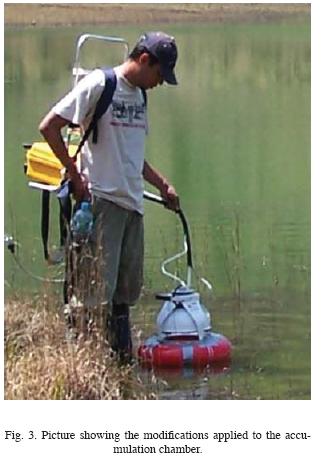
<body><![CDATA[<p align="justify"><font face="verdana" size="2">In March 2007, a total of 162 randomly distributed CO<sub>2</sub> flux measurements, covering an area of 138,000 m<sup>2 </sup>of the lake surface, were carried out (<a href="/img/revistas/geoint/v48n1/a6f1.jpg" target="_blank">Fig. 1B</a>). The GPS position of each measurement point represents the average of two readings (resolution &plusmn; 6 m) taken before and after each CO<sub>2</sub> flux measurement (duration 40&#150;60 sec). The drift between these two readings depended greatly on the wind and could attain 40 m. The accumulation chamber method (Chiodini <i>et al., </i>1998) was modified in order to work on a lake by using a floating chamber (<a href="#f3">Fig. 3</a>). Gas flux was measured by using a chamber equipped with a LICOR LI&#150;8100&#150;103 infrared CO<sub>2</sub> analyzer (IRGA). The measurement accuracy of the CO<sub>2</sub> flux measurements method is assumed to be ~12.5% (Evans <i>et al., </i>2001). As the original method from Chiodini <i>et al. </i>(1998), the CO<sub>2</sub> gas coming from the water lake passes through the chamber and the infra&#150;red sensor, it returns to the chamber where it accumulates with the new CO<sub>2</sub> entering the chamber. The flux is derived by obtaining the increase of the CO<sub>2</sub> concentration with time (ppmvol.s<sup>&#150;1</sup>). Each measurement takes about 40 to 60 seconds. In order to convert volumetric concentrations to mass concentrations (g.m<sup>&#150;2</sup>.d<sup>&#150;1</sup>), atmospheric pressure, temperature and total volume (sum of the chamber, IRGA connection tube, and the floating device) were taken in account. The fieldwork was undertaken under dry and stable meteorological conditions.</font></p>     <p align="center"><font face="verdana" size="2"><a name="f3"></a></font></p>     <p align="center"><font face="verdana" size="2"><img src="/img/revistas/geoint/v48n1/a6f3.jpg"></font></p>     <p align="justify"><font face="verdana" size="2">Computation of total CO<sub>2</sub> flux was based on the graphical statistical approach (GSA) procedure (Chiodini <i>et al., </i>1998, 2001; Cardellini <i>et al., </i>2003). This procedure also permits to differentiate the degassing mechanisms of CO<sub>2</sub>. GSA consists in the partition of CO<sub>2</sub> flux data into different lognormal populations (using the so&#150;called "inflection" points) and in the estimation of the proportion, the mean and the standard deviation of each population following the graphical procedure of Sinclair (1974). The CO<sub>2</sub> output associated to each population is obtained by multiplying the area of the lake by the proportion and the mean CO<sub>2</sub> flux. The total CO<sub>2</sub> release from the entire studied area can be obtained by summing the contribution of each population. The 90% confidence interval of the mean is used to calculate the uncertainty of the total CO<sub>2 </sub>output estimation of each population.</font></p>     <p align="justify"><font face="verdana" size="2">The mapping of degassing areas and estimation of the total CO<sub>2</sub> discharge from the lake and the uncertainty of this estimation, were performed by using the sequential Gaussian simulation (sGs) that is an interpolation algorithm (Deutsch and Journel, 1998). The basic idea of the sGs is to generate a set of equiprobable representations of the spatial distribution of the simulated values, reproducing the statistical (histogram) and spatial (variogram) characteristics of the original data. According to Goovaerts (2001), the differences among all simulated maps (from 100 to 500 realizations) are used to compute the uncertainty of the flux estimation. The sGs approach has already successfully been used for soil CO<sub>2</sub> degassing at other volcanic systems e.g. Chiodini <i>et al., </i>2007 and details about the method in Cardellini <i>et al., </i>2003.</font></p>     <p align="justify"><font face="verdana" size="2">&nbsp;</font></p>     <p align="justify"><font face="verdana" size="2"><b>Results and discussion</b></font></p>     <p align="justify"><font face="verdana" size="2"><i>Probability distribution of the CO<sub>2</sub>flux data</i></font></p>     <p align="justify"><font face="verdana" size="2"><a href="/img/revistas/geoint/v48n1/a6f4.jpg" target="_blank">Fig. 4a</a> shows the histogram of log F<sub>CO2</sub> (where F<sub>CO2</sub> is CO<sub>2</sub> flux in g.m<sup>&#150;2</sup>.d<sup>&#150;1</sup>) versus its frequency. The distribution of CO<sub>2</sub> flux differs from a log&#150;normal distribution indicating that there are at least two different mechanisms of degassing through the lake surface. According to the GSA approach (Sinclair, 1974), the histogram must be transferred to a log probability plot (<a href="/img/revistas/geoint/v48n1/a6f4.jpg" target="_blank">Fig. 4b</a>). This plot indicates that the CO<sub>2</sub> flux data are separated into two different populations recognizable by the inflection point on the curve corresponding to the 83 cumulative percentile. On the plot we can individuate a high CO<sub>2</sub> population (A in <a href="/img/revistas/geoint/v48n1/a6f4.jpg" target="_blank">fig. 4b</a>) corresponding to the 17 % of the data and a low CO<sub>2</sub> population (B in <a href="/img/revistas/geoint/v48n1/a6f4.jpg" target="_blank">fig. 4b</a>) corresponding to the 83 % of F<sub>CO2</sub>. The two&#150;population percentages must be checked and validated by combining both populations in the proportion of 17% A and 83 % B at various levels of log F<sub>CO2</sub>. The checking procedure uses the following relationship: P<sub>M</sub> = f<sub>A</sub>P<sub>A</sub> + f<sub>B</sub>P<sub>B</sub>, where P<sub>M</sub> is the probability of the "mixture", P<sub>A</sub> and P<sub>B</sub> are cumulative probabilities of population A and B from the plot of <a href="/img/revistas/geoint/v48n1/a6f4.jpg" target="_blank">Fig. 4b</a> at a specified x value; f<sub>A</sub> and f<sub>B</sub> are the proportions of populations A and B. In <a href="/img/revistas/geoint/v48n1/a6f4.jpg" target="_blank">fig. 4b</a>, the points of the "mixture" are represented by gray triangles. Afterwards, parameters of the individual partitioned populations can be estimated. To estimate the arithmetic mean value of CO<sub>2</sub> flux and the central 90% confidence interval of the mean in the original data units (in g.m<sup>&#150;2</sup>.d<sup>&#150;1</sup>) for each population, we used, according to Chiodini <i>et al. </i>(1998), the Sichel's t estimator (David, 1977).</font></p>     <p align="justify"><font face="verdana" size="2">A summary of the estimated parameters of partitioned distributions (populations A and B) is reported in <a href="/img/revistas/geoint/v48n1/a6t1.jpg" target="_blank">Table 1</a>. Population Ais characterized by a mean of 6,702 g.m<sup>&#150;2</sup>.d<sup>&#150;1</sup> with a 90% confidence interval of 5,154&#150;10,429 g.m<sup>&#150;2</sup>.d<sup>&#150;1</sup>. Population B is characterized by a mean of 464 g.m<sup>&#150;2</sup>.d<sup>&#150;1 </sup>with a 90% confidence interval of 442&#150;490 g.m<sup>&#150;2</sup>.d<sup>&#150;1</sup>. We suggest that population A corresponds to the flux resulting from bubbles rising through the lake and population B represents the CO<sub>2</sub> degassing by diffusion through the water&#150;air interface (see paragraph 4.3 for details).</font></p>     ]]></body>
<body><![CDATA[<p align="justify"><font face="verdana" size="2">The total flow rate of CO<sub>2</sub> released by the lake, calculated by the GSA method, is (6,702 g.m<sup>&#150;2</sup>.d<sup>&#150;1</sup> x 0.17% + 464 g.m<sup>&#150;2</sup>.d<sup>&#150;1</sup> x 0.83%) x 138,000 m<sup>2</sup> = 210 t.d<sup>&#150;1</sup>with a 90% confidence interval of 172&#150;301 t.d<sup>&#150;1</sup>.</font></p>     <p align="justify"><font face="verdana" size="2"><i>Mapping and sgs estimation of the CO<sub>2</sub> flux from the lake</i></font></p>     <p align="justify"><font face="verdana" size="2">Another statistical method for the estimation of the CO<sub>2</sub> fluxes and the total flow rate is the sequential Gaussian simulation (sGs) (Deutsch and Journel, 1998) method. The 162 measured CO<sub>2</sub> fluxes in randomly distributed points on the lake surface were interpolated by a distribution over a grid of 5,523 square cells (5x5 m<sup>2</sup>) covering an area of 138,075 m<sup>2</sup> using the so&#150;called exponential  variogram model.  Then,   100  simulations of the CO<sub>2</sub> fluxes with the obtained distribution were performed. For each simulation, the CO<sub>2</sub> flux estimated at each cell is multiplied by 25 m<sup>2</sup> and added to the other CO<sub>2</sub> fluxes estimated at the neighborhood cells of the grid to obtain a total lake CO<sub>2</sub> output. The mean of the 100 total simulated CO<sub>2</sub> outputs, 164 t.d<sup>&#150;1</sup>, represents the estimation of the total CO<sub>2</sub> output from the lake area with a standard deviation of 9.5 t.d<sup>&#150;1</sup>. The total CO<sub>2</sub> output determined using GSA method is higher (210 t.d<sup>&#150;1</sup>) than the mean simulated by the sGs method (164 t.d<sup>&#150;1</sup>). In the calculation of the mean of F<sub>CO2</sub>, GSA approach does not take into account the spatial correlation between the data, resulting generally in an overestimation of the uncertainty.</font></p>     <p align="justify"><font face="verdana" size="2">The obtained map (<a href="/img/revistas/geoint/v48n1/a6f5.jpg" target="_blank">Fig. 5</a>) shows that the highest CO<sub>2 </sub>flux "spots" are located close to the eastern shore of the lake near the active fumarolic area. Two linear zones of high flux can be clearly recognized on the map, together with several intensively bubbling "funnels" observed during the campaign. These arrangements along NNW&#150;SSE and W&#150;E alignments may be correlated to the regional faults and the E&#150;W San Juan Fault, respectively (Garc&iacute;a&#150;Palomo <i>et al., </i>2004).</font></p>     <p align="justify"><font face="verdana" size="2"><i>Estimation of the CO<sub>2</sub> diffusion through the lake&#150;air interface</i></font></p>     <p align="justify"><font face="verdana" size="2">Our suggestion that the population of data with lower CO<sub>2</sub> fluxes is provided by the diffusion of CO<sub>2</sub> through water&#150;air interface can be checked using the thin boundary layer model (Liss and Slater, 1974). The flux F between water and air may be calculated by the empirical equation (e.g. McGillis and Wanninkhof, 2006):</font></p>     <p align="center"><font face="verdana" size="2"><img src="/img/revistas/geoint/v48n1/a6s2.jpg"></font></p>     <p align="justify"><font face="verdana" size="2">where k<sub>CO2</sub> is the gas exchange coefficient (in cm.h<sup>&#150;1</sup>) for CO<sub>2</sub>, C<sub>w</sub>   and C<sub>w/a</sub> , refers to the concentration of CO<sub>2 </sub>in water, and in water film at the water&#150;air interface, respectively.</font></p>     <p align="justify"><font face="verdana" size="2">The value of k<sub>CO2</sub> was calculated by using the relationship between windspeed and k<sub>CO2</sub> derived from tracer techniques studies on a small lake (Crusius and Wanninkhof, 2003):</font></p>     <p align="center"><font face="verdana" size="2"><img src="/img/revistas/geoint/v48n1/a6s3.jpg"></font></p>     ]]></body>
<body><![CDATA[<p align="justify"><font face="verdana" size="2">where u<sub>1</sub> is the windspeed measured at 1 m height and Sc is defined as the kinematic viscosity of water at measured temperature divided by the diffusivity of the gas at that temperature. Transfer velocity was adjusted to a Schmidt number of 600 that corresponds to the value for the dissolved atmospheric CO<sub>2</sub> in fresh water at 20&deg;C. The value of Sc<sub>CO2</sub> at 30&deg;C was calculated according to Wanninkhof (1992):</font></p>     <p align="center"><font face="verdana" size="2"><img src="/img/revistas/geoint/v48n1/a6s4.jpg"></font></p>     <p align="justify"><font face="verdana" size="2">At a mean windspeed u1 of 2 m.s<sup>&#150;1</sup>, Sc<sub>CO2</sub> = 360 and k     =1.39.</font></p>     <p align="justify"><font face="verdana" size="2">At saturation conditions of 30 &deg;C and 1 atmosphere, C<sub>w </sub>of the CO<sub>2</sub> gas is 1.32 mg.cm<sup>&#150;3</sup> (Eq. 1). The concentration of CO<sub>2</sub> in the air&#150;water (C<sub>w/a</sub>) interface can be approximated to the concentration of CO<sub>2</sub> in the air&#150;saturated water and corresponds to C&asymp;<sub>w/a</sub>10<sup>&#150;5</sup> mg.cm<sup>&#150;3</sup> and C<sub>w</sub>&gt;&gt;C<sub>w/a</sub>. From the equation (1) and with values for k<sub>CO2</sub> of 1.39 and C<sub>w</sub> of 1.32 mg.cm<sup>&#150;3</sup> we estimated a CO<sub>2</sub> flux by diffusion of 442 g.m<sup>&#150;2</sup>.d&#150;1 that is very close to the mean value of F<sub>CO2</sub> (464 gm<sup>&#150;2</sup>d<sup>&#150;1</sup>) for the low flux of data points (population B).</font></p>     <p align="justify"><font face="verdana" size="2"><i>Estimation of the heat power and comparison with other volcanoes in the world</i></font></p>     <p align="justify"><font face="verdana" size="2">The area of the whole crater floor corresponding to the isohypse 900 m (<a href="/img/revistas/geoint/v48n1/a6f1.jpg" target="_blank">Fig. 1b</a>) was estimated to be as 308,000 m<sup>2</sup>. Hypothesizing that mains NNW&#150;SSE and W&#150;E alignments are recognized on the lake and that there are not so important variations in F<sub>CO2</sub> in soil and water due to the low depth of the lake (average depth 3 meters see Taran and Rouwet, 2008), a rough estimate of the total CO<sub>2</sub> output for the whole crater floor yields ~370 t.d<sup>&#150;1</sup>.</font></p>     <p align="justify"><font face="verdana" size="2">The high CO<sub>2</sub> fluxes plotted on <a href="/img/revistas/geoint/v48n1/a6f6.jpg" target="_blank">figure 6</a>, show that high CO<sub>2</sub> degassing is not necessarily related to active volcanoes. Three different sources of CO<sub>2</sub> degassing are likely: (1) CO<sub>2</sub>, directly coming from a magma chamber, escapes to the surface with other magmatic gases such as SO<sub>2</sub>, H<sub>2</sub>S, HCl and HF, as this is the case for volcanoes Masaya, Nicaragua (P&eacute;rez <i>et al., </i>2000), Miyakejima and Usu, Japan (Hern&aacute;ndez <i>et al., </i>2001a,b), Stromboli, Italy (Carapezza and Federico, 2000), San Salvador, El Salvador (P&eacute;rez <i>et al., </i>2004), Santa Ana, El Salvador (Bernard <i>et al., </i>2004) and Galeras, Colombia (Williams&#150;Jones <i>et al., </i>2000). (2) CO<sub>2</sub> coming from a magma chamber but with a possible contamination due to the crustal carbonate decomposition and subsequent CO<sub>2</sub> release. This type of the CO<sub>2</sub> release could be the case for Solfatara and Vesuvio, Italy (Cardellini <i>et al., </i>2003; Frondini <i>et al., </i>2004), Santorini and Nisyros, Greece (Chiodini <i>et al., </i>1998; Cardellini <i>et al., </i>2003), Yellowstone, USA (Werner <i>et al., </i>2000) and Kelud, Indonesia (Mazot, 2005). (3) CO<sub>2 </sub>degassing at low temperature and coming from carbonate metamorphism, not related to magmatism. Sites that released this kind of CO<sub>2</sub> are for example Dixie Valley, USA (Bergfeld <i>et al., </i>2001) and central Italy (Rogie <i>et al., </i>2000).</font></p>     <p align="justify"><font face="verdana" size="2">The total CO<sub>2</sub> output from El Chichon crater is 1.5 times higher than the effusion rates reported for the summit area at Stromboli (mean flux: 246 t.d<sup>&#150;1</sup>; area: 357,500 m<sup>2</sup>; Carapezza and Federico, 2000) and little lower than those reported for the soil CO<sub>2</sub> flux at Mammoth Mountain in Long Valley Caldera, USA (mean flux: 411 t.d<sup>1</sup>; area: 420,000 m<sup>2</sup>; Sorey <i>et al., </i>1998).</font></p>     <p align="justify"><font face="verdana" size="2">The CO<sub>2</sub> degassing from the volcanic lake of El Chich&oacute;n was compared (<a href="/img/revistas/geoint/v48n1/a6f6.jpg" target="_blank">Fig. 6</a>) with that of Kelud crater lake (Indonesia) and Santa Ana crater lake (El Salvador). In the Kelud crater lake, where CO<sub>2</sub> flux measurements has been carried out since 2001 (Mazot, 2005), the total CO<sub>2</sub> output ranges from 100 t.d<sup>&#150;1</sup> with a mean of 1020 g.m<sup>&#150;2</sup>.d<sup>&#150;1</sup> (2001) to 35 t.d<sup>&#150;1</sup> with a mean of 335 g.m<sup>&#150;2</sup>.d<sup>&#150;1</sup> (2006) and a constant area of 103,600 m<sup>2</sup>. In Santa Ana, where measurement was performed in 2002, CO<sub>2</sub> output corresponds to 7 t.d<sup>&#150;1</sup> in 2002 with a mean of CO<sub>2</sub> flux of 220 g.m<sup>&#150;2</sup>.d<sup>&#150;1</sup> and an area of 30,000 m<sup>2</sup> (Bernard <i>et al, </i>2004). Among these three volcanic lakes, the total CO<sub>2 </sub>output at El Chich&oacute;n in 2007 was up to 5 times higher (164 t.d<sup>&#150;1</sup>) than Kelud volcano and 23 times higher than Santa Ana (<a href="/img/revistas/geoint/v48n1/a6f4.jpg" target="_blank">Fig.4</a>).</font></p>     <p align="justify"><font face="verdana" size="2">Fumarolic gas of El Chich&oacute;n volcano contains about 90 wt% of H<sub>2</sub>O (steam) and 10 wt% of CO<sub>2</sub> (Taran <i>et al., </i>1998; Tassi <i>et al., </i>2003). Assuming that all the CO<sub>2 </sub>released from the crater floor is the result of separation of these gases caused by shallow condensation of hydrothermal steam at ~ 100 &deg;C, beneath the crater floor of the volcano we have ~ 3,700 t/day or ~ 43 kg/s of steam flux and beneath the lake we have ~ 1,640 t/day or ~ 19 kg/s. Using a value for steam enthalpy at 100 &deg;C due to steam condensation (~ 2.257 MJ/kg) we can estimate the heat power due to fumarolic output from the crater floor as 100 and from the lake 43 MW. This heat output is up to 3.5 times higher than the output estimated by Taran and Rouwet (2008) using the heat and chemical balance approach at El Chich&oacute;n lake. Our estimation based on the direct measurements of fluxes seems to be more realistic.</font></p>     ]]></body>
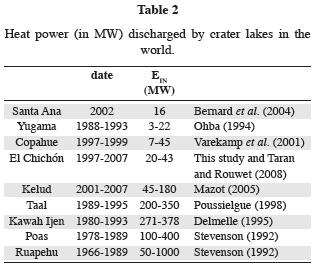
<body><![CDATA[<p align="justify"><font face="verdana" size="2">The heat output corresponding to El Chich&oacute;n lake (43 MW) is comparable with the heat power of other crater lakes of active volcanoes. In Kelud lake, Mazot (2005) calculated values of heat power ranging from 45 to 180 MW in the period 2004&#150;2007 (<a href="#t2">Table 2</a>) by using the heat and chemical balance model of Stevenson (1992). The heat power was estimated on other crater lakes as Kawah Ijen (Indonesia; Delmelle, 1995), Taal (Philippines; Poussielgue, 1998), Poas (Costa Rica; Stevenson, 1992), Yugama (Japan; Ohba <i>et al., </i>1994), Ruapehu (New Zealand; Stevenson, 1992) and Copahue (Argentina; Varekamp <i>et al., </i>2001). The heat output of 100 MW from El Chich&oacute;n crater is relatively small in comparison with the heat power observed at hot (&gt;40 &deg;C) crater lakes, where values  as high as  several hundred MW were estimated (<a href="#t2">Table 2</a>).</font></p>     <p align="center"><font face="verdana" size="2"><a name="t2"></a></font></p>     <p align="center"><font face="verdana" size="2"><img src="/img/revistas/geoint/v48n1/a6t2.jpg"></font></p>     <p align="justify"><font face="verdana" size="2">&nbsp;</font></p>     <p align="justify"><font face="verdana" size="2"><b>Conclusion</b></font></p>     <p align="justify"><font face="verdana" size="2">CO<sub>2</sub> flux measurements made by using the floating accumulation chamber method allowed to estimate the total CO<sub>2</sub> emission from the crater lake of El Chich&oacute;n (138,000 m<sup>2</sup>) to be close to 164 t.d<sup>&#150;1</sup>. For the total area of the crater floor of 308,000 m<sup>2</sup> the total CO<sub>2</sub> emission was estimated at 370 t.d<sup>&#150;1</sup>. This level of the total CO<sub>2</sub> emission and the estimated heat output are comparable with other volcanic and geothermal areas worldwide.</font></p>     <p align="justify"><font face="verdana" size="2">Continuous monitoring of CO<sub>2</sub> flux from the crater lake of El Chich&oacute;n could improve our understanding of the hydrothermal system. This would be complementary to other geochemical investigations and it would be particularly important for detecting possible changes in the activity of the volcano.</font></p>     <p align="justify"><font face="verdana" size="2">&nbsp;</font></p>     <p align="justify"><font face="verdana" size="2"><b>Bibliography</b></font></p>     <!-- ref --><p align="justify"><font face="verdana" size="2">Baubron, J. C., P. Allard, J. C. Sabroux, D. Tedesco and J. P. Toutain, 1990. Soil gas emanations as precursory indicators of volcanic eruptions, <i>J. Geol. Soc. London, 148, </i>571&#150;576.</font>&nbsp;&nbsp;&nbsp;&nbsp;&nbsp;&nbsp;&nbsp;&nbsp;[&#160;<a href="javascript:void(0);" onclick="javascript: window.open('/scielo.php?script=sci_nlinks&ref=3904287&pid=S0016-7169200900010000600001&lng=','','width=640,height=500,resizable=yes,scrollbars=1,menubar=yes,');">Links</a>&#160;]<!-- end-ref --><!-- ref --><p align="justify"><font face="verdana" size="2">Bergfeld, D., F. Goff and C. J. Janik, 2001. Elevated carbon dioxide flux at the Dixie Valley geothermal field, Nevada; relations between surface phenomena and the geothermal reservoir. <i>Chem. Geol., 177, </i>43&#150;66.</font>&nbsp;&nbsp;&nbsp;&nbsp;&nbsp;&nbsp;&nbsp;&nbsp;[&#160;<a href="javascript:void(0);" onclick="javascript: window.open('/scielo.php?script=sci_nlinks&ref=3904288&pid=S0016-7169200900010000600002&lng=','','width=640,height=500,resizable=yes,scrollbars=1,menubar=yes,');">Links</a>&#160;]<!-- end-ref --><!-- ref --><p align="justify"><font face="verdana" size="2">Bernard, A., C. D. Escobar, A. Mazot and R. E. Guti&eacute;rrez, 2004. The acid volcanic lake of Santa Ana volcano, El Salvador. <i>GSA Special Paper, 375, </i>121&#150;134.</font>&nbsp;&nbsp;&nbsp;&nbsp;&nbsp;&nbsp;&nbsp;&nbsp;[&#160;<a href="javascript:void(0);" onclick="javascript: window.open('/scielo.php?script=sci_nlinks&ref=3904289&pid=S0016-7169200900010000600003&lng=','','width=640,height=500,resizable=yes,scrollbars=1,menubar=yes,');">Links</a>&#160;]<!-- end-ref --><!-- ref --><p align="justify"><font face="verdana" size="2">Canul, R. F. and V. L. Rocha, 1981. Informe geol&oacute;gico de la zona geot&eacute;rmica de "El Chichonal," Chiapas: Comisi&oacute;n Federal de Electricidad, Informe (Unpublished internal report).</font>&nbsp;&nbsp;&nbsp;&nbsp;&nbsp;&nbsp;&nbsp;&nbsp;[&#160;<a href="javascript:void(0);" onclick="javascript: window.open('/scielo.php?script=sci_nlinks&ref=3904290&pid=S0016-7169200900010000600004&lng=','','width=640,height=500,resizable=yes,scrollbars=1,menubar=yes,');">Links</a>&#160;]<!-- end-ref --><!-- ref --><p align="justify"><font face="verdana" size="2">Capaccioni, B., Y. Taran, F. Tassi, O. Vaselli, F. Mangani and J. L. Mac&iacute;as, 2004. Source conditions and degradation processes of light hydrocarbons in volcanic gases: an example from El Chich&oacute;n volcano (Chiapas State, Mexico). <i>Chem. Geol., 206, </i>81&#150;96.</font>&nbsp;&nbsp;&nbsp;&nbsp;&nbsp;&nbsp;&nbsp;&nbsp;[&#160;<a href="javascript:void(0);" onclick="javascript: window.open('/scielo.php?script=sci_nlinks&ref=3904291&pid=S0016-7169200900010000600005&lng=','','width=640,height=500,resizable=yes,scrollbars=1,menubar=yes,');">Links</a>&#160;]<!-- end-ref --><!-- ref --><p align="justify"><font face="verdana" size="2">Carapezza, M. L and C. Federico, 2000. The contribution of fluid geochemistry to the volcano monitoring of Stromboli. <i>J. Volcanol. Geotherm. Res., 95, </i>227&#150;245.</font>&nbsp;&nbsp;&nbsp;&nbsp;&nbsp;&nbsp;&nbsp;&nbsp;[&#160;<a href="javascript:void(0);" onclick="javascript: window.open('/scielo.php?script=sci_nlinks&ref=3904292&pid=S0016-7169200900010000600006&lng=','','width=640,height=500,resizable=yes,scrollbars=1,menubar=yes,');">Links</a>&#160;]<!-- end-ref --><!-- ref --><p align="justify"><font face="verdana" size="2">Cardellini, C., G. Chiodini and F. Frondini, 2003. Application of stochastic simulation to CO<sub>2</sub> flux from soil: mapping and quantification of gas release. <i>J. Geophys. Res. 108, 2425, </i>doi:10.1029/ 2002JB002165.</font>&nbsp;&nbsp;&nbsp;&nbsp;&nbsp;&nbsp;&nbsp;&nbsp;[&#160;<a href="javascript:void(0);" onclick="javascript: window.open('/scielo.php?script=sci_nlinks&ref=3904293&pid=S0016-7169200900010000600007&lng=','','width=640,height=500,resizable=yes,scrollbars=1,menubar=yes,');">Links</a>&#160;]<!-- end-ref --><!-- ref --><p align="justify"><font face="verdana" size="2">Chiodini, G., R. Avino, T. Brombach, S. Caliro, C.Cardellini, S. De Vita, F. Frondini, D. Granirei, E. Marotta and G. Ventura, 2004. Fumarolic and diffuse soil degassing west of Mount Epomeo, Ischia, Italy. <i>J. </i><i>Volcanol. Geotherm. Res., 133, </i>291&#150;309.</font>&nbsp;&nbsp;&nbsp;&nbsp;&nbsp;&nbsp;&nbsp;&nbsp;[&#160;<a href="javascript:void(0);" onclick="javascript: window.open('/scielo.php?script=sci_nlinks&ref=3904294&pid=S0016-7169200900010000600008&lng=','','width=640,height=500,resizable=yes,scrollbars=1,menubar=yes,');">Links</a>&#160;]<!-- end-ref --><!-- ref --><p align="justify"><font face="verdana" size="2">Chiodini, G., R. Cioni, M. Guidi, B. Raco and L. Marini, 1998. Soil CO<sub>2</sub> flux measurements in volcanic and geothermal areas. <i>Appl. Geochem., 13, 5, </i>543&#150;552.</font>&nbsp;&nbsp;&nbsp;&nbsp;&nbsp;&nbsp;&nbsp;&nbsp;[&#160;<a href="javascript:void(0);" onclick="javascript: window.open('/scielo.php?script=sci_nlinks&ref=3904295&pid=S0016-7169200900010000600009&lng=','','width=640,height=500,resizable=yes,scrollbars=1,menubar=yes,');">Links</a>&#160;]<!-- end-ref --><!-- ref --><p align="justify"><font face="verdana" size="2">Chiodini, G., F. Frondini, C. Cardellini, D. Granieri, L. Marini and G. Ventura, 2001. CO<sub>2</sub> degassing and energy release at Solfatara volcano, Campi Flegrei, Italy. <i>J. Geophys. Res. 106, B8, </i>16, 213&#150;16, 221.</font>&nbsp;&nbsp;&nbsp;&nbsp;&nbsp;&nbsp;&nbsp;&nbsp;[&#160;<a href="javascript:void(0);" onclick="javascript: window.open('/scielo.php?script=sci_nlinks&ref=3904296&pid=S0016-7169200900010000600010&lng=','','width=640,height=500,resizable=yes,scrollbars=1,menubar=yes,');">Links</a>&#160;]<!-- end-ref --><!-- ref --><p align="justify"><font face="verdana" size="2">Chiodini, G., A. Baldini, F. Barberi, M. L. Carapezza, C. Cardellini, F. Frondini, D. Granieri, and M. Ranaldi, 2007. Carbon dioxide degassing at Latera caldera (Italy): Evidence of geothermal reservoir and evaluation of its potential energy. <i>J. Geophys. Res., 112, B12204, </i>doi:10.1029/2006JB004896.</font>&nbsp;&nbsp;&nbsp;&nbsp;&nbsp;&nbsp;&nbsp;&nbsp;[&#160;<a href="javascript:void(0);" onclick="javascript: window.open('/scielo.php?script=sci_nlinks&ref=3904297&pid=S0016-7169200900010000600011&lng=','','width=640,height=500,resizable=yes,scrollbars=1,menubar=yes,');">Links</a>&#160;]<!-- end-ref --><!-- ref --><p align="justify"><font face="verdana" size="2">Crusius, J. and R. Wanninkhof, 2003. Gas transfer velocities measured at low wind speed over a lake. <i>Limnol. Oceanogr., 48, </i>1010&#150;1017.</font>&nbsp;&nbsp;&nbsp;&nbsp;&nbsp;&nbsp;&nbsp;&nbsp;[&#160;<a href="javascript:void(0);" onclick="javascript: window.open('/scielo.php?script=sci_nlinks&ref=3904298&pid=S0016-7169200900010000600012&lng=','','width=640,height=500,resizable=yes,scrollbars=1,menubar=yes,');">Links</a>&#160;]<!-- end-ref --><!-- ref --><p align="justify"><font face="verdana" size="2">David, M., 1977. Geostatistical ore reserve estimation (Developments in geomathematics 2). Elsevier, New&#150;York, 363 pp.</font>&nbsp;&nbsp;&nbsp;&nbsp;&nbsp;&nbsp;&nbsp;&nbsp;[&#160;<a href="javascript:void(0);" onclick="javascript: window.open('/scielo.php?script=sci_nlinks&ref=3904299&pid=S0016-7169200900010000600013&lng=','','width=640,height=500,resizable=yes,scrollbars=1,menubar=yes,');">Links</a>&#160;]<!-- end-ref --><!-- ref --><p align="justify"><font face="verdana" size="2">Delmelle, P., 1995. Geochemical, isotopic and heat budget study of two volcano hosted hydrothermal systems: the acid crater lakes of Kawah Ijen, Indonesia, and Taal, Philippines, volcanoes. PhD thesis, Universit&eacute; Libre de Bruxelles, Brussels, 247 pp.</font>&nbsp;&nbsp;&nbsp;&nbsp;&nbsp;&nbsp;&nbsp;&nbsp;[&#160;<a href="javascript:void(0);" onclick="javascript: window.open('/scielo.php?script=sci_nlinks&ref=3904300&pid=S0016-7169200900010000600014&lng=','','width=640,height=500,resizable=yes,scrollbars=1,menubar=yes,');">Links</a>&#160;]<!-- end-ref --><!-- ref --><p align="justify"><font face="verdana" size="2">Deutsch, C. V. and A. G. Journel, 1998. GSLIB: Geostatistical Software Library and Users Guide, 2<sup>nd </sup>ed., 369 pp, Oxford Univ. Press, New York.</font>&nbsp;&nbsp;&nbsp;&nbsp;&nbsp;&nbsp;&nbsp;&nbsp;[&#160;<a href="javascript:void(0);" onclick="javascript: window.open('/scielo.php?script=sci_nlinks&ref=3904301&pid=S0016-7169200900010000600015&lng=','','width=640,height=500,resizable=yes,scrollbars=1,menubar=yes,');">Links</a>&#160;]<!-- end-ref --><!-- ref --><p align="justify"><font face="verdana" size="2">Duffield, W. A., R. I. Tilling and R. Canul, 1984. Geology of Chich&oacute;n Volcano, Chiapas, Mexico. <i>J. Volcanol. Geotherm. Res., 20, </i>117&#150;132.</font>&nbsp;&nbsp;&nbsp;&nbsp;&nbsp;&nbsp;&nbsp;&nbsp;[&#160;<a href="javascript:void(0);" onclick="javascript: window.open('/scielo.php?script=sci_nlinks&ref=3904302&pid=S0016-7169200900010000600016&lng=','','width=640,height=500,resizable=yes,scrollbars=1,menubar=yes,');">Links</a>&#160;]<!-- end-ref --><!-- ref --><p align="justify"><font face="verdana" size="2">Evans, W. C., M. L. Sorey, B. M. Kennedy, D. A. Stonestrom, J. D. Rogie and D. L. Shuster, 2001. High CO<sub>2</sub> emissions through porous media : transport mechanisms and implications for flux measurement and fractionation. <i>Chem. Geology, 177, </i>15&#150;29.</font>&nbsp;&nbsp;&nbsp;&nbsp;&nbsp;&nbsp;&nbsp;&nbsp;[&#160;<a href="javascript:void(0);" onclick="javascript: window.open('/scielo.php?script=sci_nlinks&ref=3904303&pid=S0016-7169200900010000600017&lng=','','width=640,height=500,resizable=yes,scrollbars=1,menubar=yes,');">Links</a>&#160;]<!-- end-ref --><!-- ref --><p align="justify"><font face="verdana" size="2">Favara, R., S. Giammanco, S. Inguaggiato and G. Pecoraino, 2001. Preliminary estimate of CO<sub>2</sub> output from Pantelleria Island volcano (Sicily, Italy): evidence of active mantle degassing. <i>Appl. Geochem., 16, </i>883&#150;894.</font>&nbsp;&nbsp;&nbsp;&nbsp;&nbsp;&nbsp;&nbsp;&nbsp;[&#160;<a href="javascript:void(0);" onclick="javascript: window.open('/scielo.php?script=sci_nlinks&ref=3904304&pid=S0016-7169200900010000600018&lng=','','width=640,height=500,resizable=yes,scrollbars=1,menubar=yes,');">Links</a>&#160;]<!-- end-ref --><!-- ref --><p align="justify"><font face="verdana" size="2">Frondini, F., G. Chiodini, S. Caliro, C. Cardellini, D. Granieri and G. Ventura, 2004. Diffuse CO<sub>2</sub> degassing at Vesuvio, Italy. <i>Bull. Volcanol, 66, </i>642&#150;651.</font>&nbsp;&nbsp;&nbsp;&nbsp;&nbsp;&nbsp;&nbsp;&nbsp;[&#160;<a href="javascript:void(0);" onclick="javascript: window.open('/scielo.php?script=sci_nlinks&ref=3904305&pid=S0016-7169200900010000600019&lng=','','width=640,height=500,resizable=yes,scrollbars=1,menubar=yes,');">Links</a>&#160;]<!-- end-ref --><!-- ref --><p align="justify"><font face="verdana" size="2">Garc&iacute;a&#150;Palomo, A., J. L. Mac&iacute;as and J. M. Esp&iacute;ndola, 2004. Strike&#150;slip faults and K&#150;alkaline volcanism at El Chich&oacute;n volcano, southeastern Mexico. <i>J. Volcanol. Geotherm. Res., 136, </i>247&#150;268.</font>&nbsp;&nbsp;&nbsp;&nbsp;&nbsp;&nbsp;&nbsp;&nbsp;[&#160;<a href="javascript:void(0);" onclick="javascript: window.open('/scielo.php?script=sci_nlinks&ref=3904306&pid=S0016-7169200900010000600020&lng=','','width=640,height=500,resizable=yes,scrollbars=1,menubar=yes,');">Links</a>&#160;]<!-- end-ref --><!-- ref --><p align="justify"><font face="verdana" size="2">Goovaerts, P., 2001. Geostatistical modelling of uncertainty in soil science. <i>Geoderma, 103, </i>3&#150;26.</font>&nbsp;&nbsp;&nbsp;&nbsp;&nbsp;&nbsp;&nbsp;&nbsp;[&#160;<a href="javascript:void(0);" onclick="javascript: window.open('/scielo.php?script=sci_nlinks&ref=3904307&pid=S0016-7169200900010000600021&lng=','','width=640,height=500,resizable=yes,scrollbars=1,menubar=yes,');">Links</a>&#160;]<!-- end-ref --><!-- ref --><p align="justify"><font face="verdana" size="2">Hern&aacute;ndez, P. A., K. Notsu, J. M. Salazar, T. Mori, G. Natale, H. Okada, G. Virgili, Y. Shimoike, M. Sato and N. M. Perez , 2001a. Carbon dioxide degassing by advective flow from Usu Volcano, Japan. <i>Science, 292, </i>83&#150;86.</font>&nbsp;&nbsp;&nbsp;&nbsp;&nbsp;&nbsp;&nbsp;&nbsp;[&#160;<a href="javascript:void(0);" onclick="javascript: window.open('/scielo.php?script=sci_nlinks&ref=3904308&pid=S0016-7169200900010000600022&lng=','','width=640,height=500,resizable=yes,scrollbars=1,menubar=yes,');">Links</a>&#160;]<!-- end-ref --><!-- ref --><p align="justify"><font face="verdana" size="2">Hern&aacute;ndez, P. A., J. M. Salazar, Y. Shimoike, T. Mori, K. Notsu and N. M. Perez , 2001b. Diffuse emission of CO<sub>2</sub> from Miyakejima volcano, Japan. <i>Chem. Geol., 177, </i>175&#150;185.</font>&nbsp;&nbsp;&nbsp;&nbsp;&nbsp;&nbsp;&nbsp;&nbsp;[&#160;<a href="javascript:void(0);" onclick="javascript: window.open('/scielo.php?script=sci_nlinks&ref=3904309&pid=S0016-7169200900010000600023&lng=','','width=640,height=500,resizable=yes,scrollbars=1,menubar=yes,');">Links</a>&#160;]<!-- end-ref --><!-- ref --><p align="justify"><font face="verdana" size="2">Kling, G. W., G. W. Kipphut and M. C. Miller, 1991. Artic Lakes and Streams as Gas Conduits to the Atmosphere: Implications for Tundra Carbon Budgets. <i>Science, </i>251, 298&#150;301.</font>&nbsp;&nbsp;&nbsp;&nbsp;&nbsp;&nbsp;&nbsp;&nbsp;[&#160;<a href="javascript:void(0);" onclick="javascript: window.open('/scielo.php?script=sci_nlinks&ref=3904310&pid=S0016-7169200900010000600024&lng=','','width=640,height=500,resizable=yes,scrollbars=1,menubar=yes,');">Links</a>&#160;]<!-- end-ref --><!-- ref --><p align="justify"><font face="verdana" size="2">Koepenick, K. W., S. L. Brantley, J. M. Thompson, G. L. Rowe, A. Nyblade and C. Moshy, 1996. Volatile emissions from the crater and flank of Oldoinyo Lengai volcano, Tanzania. <i>J. Geophys. Res., 101, B6, </i>13819&#150;13830.</font>&nbsp;&nbsp;&nbsp;&nbsp;&nbsp;&nbsp;&nbsp;&nbsp;[&#160;<a href="javascript:void(0);" onclick="javascript: window.open('/scielo.php?script=sci_nlinks&ref=3904311&pid=S0016-7169200900010000600025&lng=','','width=640,height=500,resizable=yes,scrollbars=1,menubar=yes,');">Links</a>&#160;]<!-- end-ref --><!-- ref --><p align="justify"><font face="verdana" size="2">Layer, P. W., A. Garc&iacute;a&#150;Palomo, Jones, J. L. Mac&iacute;as, J. L. Arce and J. C. Mora, 2008. El Chich&oacute;n Volcanic Complex, Chiapas, Mexico: stages of evolution based on field mapping and <sup>40</sup>Ar/<sup>39</sup>Ar geochronology. <i>Geof&iacute;s. Int., 48&#150;1,33&#150;54.</i></font>&nbsp;&nbsp;&nbsp;&nbsp;&nbsp;&nbsp;&nbsp;&nbsp;[&#160;<a href="javascript:void(0);" onclick="javascript: window.open('/scielo.php?script=sci_nlinks&ref=3904312&pid=S0016-7169200900010000600026&lng=','','width=640,height=500,resizable=yes,scrollbars=1,menubar=yes,');">Links</a>&#160;]<!-- end-ref --><!-- ref --><p align="justify"><font face="verdana" size="2">Liss, P. S. and P. G. Slater, 1974. Flux of gases across the air&#150;sea interface. <i>Nature, 247, </i>181&#150;184.</font>&nbsp;&nbsp;&nbsp;&nbsp;&nbsp;&nbsp;&nbsp;&nbsp;[&#160;<a href="javascript:void(0);" onclick="javascript: window.open('/scielo.php?script=sci_nlinks&ref=3904313&pid=S0016-7169200900010000600027&lng=','','width=640,height=500,resizable=yes,scrollbars=1,menubar=yes,');">Links</a>&#160;]<!-- end-ref --><!-- ref --><p align="justify"><font face="verdana" size="2">L&oacute;pez, D., L. Ransom, N. P&eacute;rez, P. Hern&aacute;ndez and J. Monterrosa, 2004. Dynamics of diffuse degassing at Ilopango Caldera, El Salvador. <i>GSA Special Paper, 375, </i>191&#150;202.</font>&nbsp;&nbsp;&nbsp;&nbsp;&nbsp;&nbsp;&nbsp;&nbsp;[&#160;<a href="javascript:void(0);" onclick="javascript: window.open('/scielo.php?script=sci_nlinks&ref=3904314&pid=S0016-7169200900010000600028&lng=','','width=640,height=500,resizable=yes,scrollbars=1,menubar=yes,');">Links</a>&#160;]<!-- end-ref --><!-- ref --><p align="justify"><font face="verdana" size="2">Mac&iacute;as, J. L., J. L. Arce, J. C. Mora, J. M. Esp&iacute;ndola, R. Saucedo and P. Manetti, 2003. A 550&#150;year&#150;old Plinian eruption at El Chich&oacute;n Volcano, Chiapas, Mexico: Explosive volcanism linked to reheating of the magma reservoir. <i>J. Geophys. Res., 108, B12, 2569, </i>doi:10.1029/2003JB002551.</font>&nbsp;&nbsp;&nbsp;&nbsp;&nbsp;&nbsp;&nbsp;&nbsp;[&#160;<a href="javascript:void(0);" onclick="javascript: window.open('/scielo.php?script=sci_nlinks&ref=3904315&pid=S0016-7169200900010000600029&lng=','','width=640,height=500,resizable=yes,scrollbars=1,menubar=yes,');">Links</a>&#160;]<!-- end-ref --><!-- ref --><p align="justify"><font face="verdana" size="2">Mazot, A., 2005. CO<sub>2</sub> degassing and fluid geochemistry at Papandayan and Kelud volcanoes, Java Island, Indonesia. Ph. D. Thesis, Universit&eacute; Libre de Bruxelles, Brussels, 294 pp.</font>&nbsp;&nbsp;&nbsp;&nbsp;&nbsp;&nbsp;&nbsp;&nbsp;[&#160;<a href="javascript:void(0);" onclick="javascript: window.open('/scielo.php?script=sci_nlinks&ref=3904316&pid=S0016-7169200900010000600030&lng=','','width=640,height=500,resizable=yes,scrollbars=1,menubar=yes,');">Links</a>&#160;]<!-- end-ref --><!-- ref --><p align="justify"><font face="verdana" size="2">Mcgillis, W. R. and R. Wanninkhof, 2006. Aqueous CO<sub>2 </sub>gradients for air&#150;sea flux estimates. <i>Mar. Chem., 98, </i>100&#150;108.</font>&nbsp;&nbsp;&nbsp;&nbsp;&nbsp;&nbsp;&nbsp;&nbsp;[&#160;<a href="javascript:void(0);" onclick="javascript: window.open('/scielo.php?script=sci_nlinks&ref=3904317&pid=S0016-7169200900010000600031&lng=','','width=640,height=500,resizable=yes,scrollbars=1,menubar=yes,');">Links</a>&#160;]<!-- end-ref --><!-- ref --><p align="justify"><font face="verdana" size="2">Notsu, K., K. Sugiyama, M. Hosoe, A. Uemura, Y. Shimoike, F. Tsunomori, H. Sumino, J. Yamamoto, T. Mori and P. A. Hern&aacute;ndez, 2005. Diffuse CO<sub>2</sub> efflux from Iwojima volcano, Izu&#150;Ogasawara arc, Japan. <i>J. </i><i>Volcanol. Geotherm. Res., 139, </i>147&#150;161.</font>&nbsp;&nbsp;&nbsp;&nbsp;&nbsp;&nbsp;&nbsp;&nbsp;[&#160;<a href="javascript:void(0);" onclick="javascript: window.open('/scielo.php?script=sci_nlinks&ref=3904318&pid=S0016-7169200900010000600032&lng=','','width=640,height=500,resizable=yes,scrollbars=1,menubar=yes,');">Links</a>&#160;]<!-- end-ref --><!-- ref --><p align="justify"><font face="verdana" size="2">Ohba, T., J. I. Hirabayashi and K. Nogami, 1994. Water, heat and chloride budgets of the crater lake, Yugama at Kusatsu&#150;Shirane volcano, Japan. <i>Geochem. J., 28, </i>217&#150;231.</font>&nbsp;&nbsp;&nbsp;&nbsp;&nbsp;&nbsp;&nbsp;&nbsp;[&#160;<a href="javascript:void(0);" onclick="javascript: window.open('/scielo.php?script=sci_nlinks&ref=3904319&pid=S0016-7169200900010000600033&lng=','','width=640,height=500,resizable=yes,scrollbars=1,menubar=yes,');">Links</a>&#160;]<!-- end-ref --><!-- ref --><p align="justify"><font face="verdana" size="2">P&eacute;rez, N., J. Salazar, P. Hern&aacute;ndez, T. Soriano, D. L. L&oacute;pez and K. Notsu, 2004. Diffuse degassing of CO<sub>2 </sub>from Masaya caldera, Central America. <i>GSA Special Paper, 375, </i>227&#150;236.</font>&nbsp;&nbsp;&nbsp;&nbsp;&nbsp;&nbsp;&nbsp;&nbsp;[&#160;<a href="javascript:void(0);" onclick="javascript: window.open('/scielo.php?script=sci_nlinks&ref=3904320&pid=S0016-7169200900010000600034&lng=','','width=640,height=500,resizable=yes,scrollbars=1,menubar=yes,');">Links</a>&#160;]<!-- end-ref --><!-- ref --><p align="justify"><font face="verdana" size="2">P&eacute;rez, N., J. Salazar, A. Saballos, J. &Aacute;lvarez, F. Segura, P. Hern&aacute;ndez and K. Notsu, 2000. Diffuse degassing of CO<sub>2</sub> from Masaya caldera, Central America. <i>Eos </i><i>Trans AGU, Fall Meet Suppl.</i></font>&nbsp;&nbsp;&nbsp;&nbsp;&nbsp;&nbsp;&nbsp;&nbsp;[&#160;<a href="javascript:void(0);" onclick="javascript: window.open('/scielo.php?script=sci_nlinks&ref=3904321&pid=S0016-7169200900010000600035&lng=','','width=640,height=500,resizable=yes,scrollbars=1,menubar=yes,');">Links</a>&#160;]<!-- end-ref --><!-- ref --><p align="justify"><font face="verdana" size="2">Poussielgue, N., 1998. Signal acoustique et activit&eacute; thermique dans les lacs de crat&egrave;re de volcans actifs. R&eacute;alisation d'une station de mesure hydroacoustique au Taal (Philippines). Ph. D. Thesis, Universit&eacute; de Savoie, Chamb&eacute;ry, France, 246 pp.</font>&nbsp;&nbsp;&nbsp;&nbsp;&nbsp;&nbsp;&nbsp;&nbsp;[&#160;<a href="javascript:void(0);" onclick="javascript: window.open('/scielo.php?script=sci_nlinks&ref=3904322&pid=S0016-7169200900010000600036&lng=','','width=640,height=500,resizable=yes,scrollbars=1,menubar=yes,');">Links</a>&#160;]<!-- end-ref --><!-- ref --><p align="justify"><font face="verdana" size="2">Rogie, J. D., D. M. Kerrick, G. Chiodini and F. Frondini, 2000. Flux   measurements   of   nonvolcanic   CO<sub>2 </sub>emission from some vents in central Italy. <i>J. Geophys. Res., 105, B4, </i>8435&#150;8445.</font>&nbsp;&nbsp;&nbsp;&nbsp;&nbsp;&nbsp;&nbsp;&nbsp;[&#160;<a href="javascript:void(0);" onclick="javascript: window.open('/scielo.php?script=sci_nlinks&ref=3904323&pid=S0016-7169200900010000600037&lng=','','width=640,height=500,resizable=yes,scrollbars=1,menubar=yes,');">Links</a>&#160;]<!-- end-ref --><!-- ref --><p align="justify"><font face="verdana" size="2">Rose, W. I., T. J. Bornhorst, S. P. Halsor, W. A. Capaul, P. S. Plumley, S. R. De La Cruz, M. Mena and R. Mota, 1984. Volc&aacute;n El Chich&oacute;n, Mexico: Pre&#150;1982 S&#150;rich eruptive activity. <i>J. Volcanol. Geotherm. Res., 23, </i>147&#150;167.</font>&nbsp;&nbsp;&nbsp;&nbsp;&nbsp;&nbsp;&nbsp;&nbsp;[&#160;<a href="javascript:void(0);" onclick="javascript: window.open('/scielo.php?script=sci_nlinks&ref=3904324&pid=S0016-7169200900010000600038&lng=','','width=640,height=500,resizable=yes,scrollbars=1,menubar=yes,');">Links</a>&#160;]<!-- end-ref --><!-- ref --><p align="justify"><font face="verdana" size="2">Sinclair, A. J., 1974. Selection of threshold values in  geochemical  data using  probability  graphs.  <i>J. </i><i>Geochem. Explor., 3, </i>129&#150;149.</font>&nbsp;&nbsp;&nbsp;&nbsp;&nbsp;&nbsp;&nbsp;&nbsp;[&#160;<a href="javascript:void(0);" onclick="javascript: window.open('/scielo.php?script=sci_nlinks&ref=3904325&pid=S0016-7169200900010000600039&lng=','','width=640,height=500,resizable=yes,scrollbars=1,menubar=yes,');">Links</a>&#160;]<!-- end-ref --><!-- ref --><p align="justify"><font face="verdana" size="2">Sorey, M. L., W. C. Evans, B. M. Kennedy, C. D. Farrar, L. J. Hainsworth and B. Hausback, 1998. Carbon dioxide and helium emissions from a reservoir of magmatic gas beneath Mammoth Mountain, California. <i>J. Geophys. Res. 103, B7, </i>15303&#150;15323.</font>&nbsp;&nbsp;&nbsp;&nbsp;&nbsp;&nbsp;&nbsp;&nbsp;[&#160;<a href="javascript:void(0);" onclick="javascript: window.open('/scielo.php?script=sci_nlinks&ref=3904326&pid=S0016-7169200900010000600040&lng=','','width=640,height=500,resizable=yes,scrollbars=1,menubar=yes,');">Links</a>&#160;]<!-- end-ref --><!-- ref --><p align="justify"><font face="verdana" size="2">Stevenson, D. S., 1992. Heat transfer in active volcanoes: models of crater lake systems. Ph. D. Thesis, The Open University, United Kingdom, 235 pp.</font>&nbsp;&nbsp;&nbsp;&nbsp;&nbsp;&nbsp;&nbsp;&nbsp;[&#160;<a href="javascript:void(0);" onclick="javascript: window.open('/scielo.php?script=sci_nlinks&ref=3904327&pid=S0016-7169200900010000600041&lng=','','width=640,height=500,resizable=yes,scrollbars=1,menubar=yes,');">Links</a>&#160;]<!-- end-ref --><!-- ref --><p align="justify"><font face="verdana" size="2">Taran, Y., T. P. Fisher, B. Pokrovsky, Y. Sano, M. Armienta and J. L. Mac&iacute;as, 1998. Geochemistry of the volcano&#150;hydrothermal system of El Chichon Volcano, Chiapas, Mexico. <i>Bull. Vol., 59, </i>436&#150;449.</font>&nbsp;&nbsp;&nbsp;&nbsp;&nbsp;&nbsp;&nbsp;&nbsp;[&#160;<a href="javascript:void(0);" onclick="javascript: window.open('/scielo.php?script=sci_nlinks&ref=3904328&pid=S0016-7169200900010000600042&lng=','','width=640,height=500,resizable=yes,scrollbars=1,menubar=yes,');">Links</a>&#160;]<!-- end-ref --><!-- ref --><p align="justify"><font face="verdana" size="2">Taran, Y. and D. Rouwet, 2008. Estimating thermal inflow to El Chich&oacute;n crater lake using the energy&#150;budget, chemical and isotope balance approaches. <i>J. Volcanol. Geotherm. Res. 175, </i>472&#150;481.</font>&nbsp;&nbsp;&nbsp;&nbsp;&nbsp;&nbsp;&nbsp;&nbsp;[&#160;<a href="javascript:void(0);" onclick="javascript: window.open('/scielo.php?script=sci_nlinks&ref=3904329&pid=S0016-7169200900010000600043&lng=','','width=640,height=500,resizable=yes,scrollbars=1,menubar=yes,');">Links</a>&#160;]<!-- end-ref --><!-- ref --><p align="justify"><font face="verdana" size="2">Tassi, F., O. Vaselli, B. Capaccioni, J. L. Mac&iacute;as, A. Nencetti, G. Montegrossi and G. Magro, 2003. Chemical composition of fumarolic gases and spring discharges from El Chich&oacute;n volcano, Mexico: causes and implications of the changes detected over the period 1998&#150;2000. <i>J. Volcanol. Geotherm. Res., 123, </i>105&#150;121.</font>&nbsp;&nbsp;&nbsp;&nbsp;&nbsp;&nbsp;&nbsp;&nbsp;[&#160;<a href="javascript:void(0);" onclick="javascript: window.open('/scielo.php?script=sci_nlinks&ref=3904330&pid=S0016-7169200900010000600044&lng=','','width=640,height=500,resizable=yes,scrollbars=1,menubar=yes,');">Links</a>&#160;]<!-- end-ref --><!-- ref --><p align="justify"><font face="verdana" size="2">Varekamp, J. C., A. P. Ouimette, S. W. Herman, A. Bermudez and D. Delpino, 2001. Hydrothermal element fluxes from Copahue, Argentina: A "beehive" volcano in turmoil. <i>Geology, 29, 11, </i>1059&#150;106.</font>&nbsp;&nbsp;&nbsp;&nbsp;&nbsp;&nbsp;&nbsp;&nbsp;[&#160;<a href="javascript:void(0);" onclick="javascript: window.open('/scielo.php?script=sci_nlinks&ref=3904331&pid=S0016-7169200900010000600045&lng=','','width=640,height=500,resizable=yes,scrollbars=1,menubar=yes,');">Links</a>&#160;]<!-- end-ref --><!-- ref --><p align="justify"><font face="verdana" size="2">Wanninkhof, J., 1992. Relationship between wind speed and gas exchange over the ocean. <i>J. Geophys. Res., 97, C5, </i>7373&#150;7382.</font>&nbsp;&nbsp;&nbsp;&nbsp;&nbsp;&nbsp;&nbsp;&nbsp;[&#160;<a href="javascript:void(0);" onclick="javascript: window.open('/scielo.php?script=sci_nlinks&ref=3904332&pid=S0016-7169200900010000600046&lng=','','width=640,height=500,resizable=yes,scrollbars=1,menubar=yes,');">Links</a>&#160;]<!-- end-ref --><!-- ref --><p align="justify"><font face="verdana" size="2">Wardell, L. J., P. R. Kyle, N. Dunbar and B. Christenson, 2001.&nbsp; White Island volcano, New Zealand : carbon dioxide and sulfur dioxide emission rates and melt inclusion studies. <i>Chemical Geology, 177, </i>187&#150;200.</font>&nbsp;&nbsp;&nbsp;&nbsp;&nbsp;&nbsp;&nbsp;&nbsp;[&#160;<a href="javascript:void(0);" onclick="javascript: window.open('/scielo.php?script=sci_nlinks&ref=3904333&pid=S0016-7169200900010000600047&lng=','','width=640,height=500,resizable=yes,scrollbars=1,menubar=yes,');">Links</a>&#160;]<!-- end-ref --><!-- ref --><p align="justify"><font face="verdana" size="2">Werner, C., S. L. Brantley and K. Boomer, 2000. CO<sub>2 </sub>emissions related to the Yellowstone volcanic system 2. Statistical sampling, total degassing, and transport mechanisms. <i>J. Geophys. Res., 105, B5, </i>10,831&#150;10,846.</font>&nbsp;&nbsp;&nbsp;&nbsp;&nbsp;&nbsp;&nbsp;&nbsp;[&#160;<a href="javascript:void(0);" onclick="javascript: window.open('/scielo.php?script=sci_nlinks&ref=3904334&pid=S0016-7169200900010000600048&lng=','','width=640,height=500,resizable=yes,scrollbars=1,menubar=yes,');">Links</a>&#160;]<!-- end-ref --><!-- ref --><p align="justify"><font face="verdana" size="2">Williams&#150;Jones, G., J. Stix, M. Heiligmann, A. Charland, B. Sherwood Lollar, N. Arner, G. Garz&oacute;n V., J. Barquero and E. Fernandez, 2000. A model of diffuse degassing at three subduction&#150;related volcanoes. <i>Bull Volcanol, 62, </i>130&#150;142.</font>&nbsp;&nbsp;&nbsp;&nbsp;&nbsp;&nbsp;&nbsp;&nbsp;[&#160;<a href="javascript:void(0);" onclick="javascript: window.open('/scielo.php?script=sci_nlinks&ref=3904335&pid=S0016-7169200900010000600049&lng=','','width=640,height=500,resizable=yes,scrollbars=1,menubar=yes,');">Links</a>&#160;]<!-- end-ref --> ]]></body><back>
<ref-list>
<ref id="B1">
<nlm-citation citation-type="journal">
<person-group person-group-type="author">
<name>
<surname><![CDATA[Baubron]]></surname>
<given-names><![CDATA[J. C]]></given-names>
</name>
<name>
<surname><![CDATA[Allard]]></surname>
<given-names><![CDATA[P]]></given-names>
</name>
<name>
<surname><![CDATA[Sabroux]]></surname>
<given-names><![CDATA[J. C.]]></given-names>
</name>
<name>
<surname><![CDATA[Tedesco]]></surname>
<given-names><![CDATA[D]]></given-names>
</name>
<name>
<surname><![CDATA[Toutain]]></surname>
<given-names><![CDATA[J. P.]]></given-names>
</name>
</person-group>
<article-title xml:lang="en"><![CDATA[Soil gas emanations as precursory indicators of volcanic eruptions]]></article-title>
<source><![CDATA[J. Geol. Soc. London]]></source>
<year>1990</year>
<volume>148</volume>
<page-range>571-576</page-range></nlm-citation>
</ref>
<ref id="B2">
<nlm-citation citation-type="journal">
<person-group person-group-type="author">
<name>
<surname><![CDATA[Bergfeld]]></surname>
<given-names><![CDATA[D]]></given-names>
</name>
<name>
<surname><![CDATA[Goff]]></surname>
<given-names><![CDATA[F]]></given-names>
</name>
<name>
<surname><![CDATA[Janik]]></surname>
<given-names><![CDATA[C. J.]]></given-names>
</name>
</person-group>
<article-title xml:lang="en"><![CDATA[Elevated carbon dioxide flux at the Dixie Valley geothermal field, Nevada; relations between surface phenomena and the geothermal reservoir]]></article-title>
<source><![CDATA[Chem. Geol.]]></source>
<year>2001</year>
<volume>177</volume>
<page-range>43-66</page-range></nlm-citation>
</ref>
<ref id="B3">
<nlm-citation citation-type="journal">
<person-group person-group-type="author">
<name>
<surname><![CDATA[Bernard]]></surname>
<given-names><![CDATA[A]]></given-names>
</name>
<name>
<surname><![CDATA[Escobar]]></surname>
<given-names><![CDATA[C. D.]]></given-names>
</name>
<name>
<surname><![CDATA[Mazot]]></surname>
<given-names><![CDATA[A]]></given-names>
</name>
<name>
<surname><![CDATA[Gutiérrez]]></surname>
<given-names><![CDATA[R. E.]]></given-names>
</name>
</person-group>
<article-title xml:lang="en"><![CDATA[The acid volcanic lake of Santa Ana volcano, El Salvador]]></article-title>
<source><![CDATA[GSA Special Paper]]></source>
<year>2004</year>
<volume>375</volume>
<page-range>121-134</page-range></nlm-citation>
</ref>
<ref id="B4">
<nlm-citation citation-type="book">
<person-group person-group-type="author">
<name>
<surname><![CDATA[Canul]]></surname>
<given-names><![CDATA[R. F.]]></given-names>
</name>
<name>
<surname><![CDATA[Rocha]]></surname>
<given-names><![CDATA[V. L.]]></given-names>
</name>
</person-group>
<source><![CDATA[Informe geológico de la zona geotérmica de "El Chichonal," Chiapas]]></source>
<year>1981</year>
<publisher-name><![CDATA[Comisión Federal de Electricidad]]></publisher-name>
</nlm-citation>
</ref>
<ref id="B5">
<nlm-citation citation-type="journal">
<person-group person-group-type="author">
<name>
<surname><![CDATA[Capaccioni]]></surname>
<given-names><![CDATA[B]]></given-names>
</name>
<name>
<surname><![CDATA[Taran]]></surname>
<given-names><![CDATA[Y]]></given-names>
</name>
<name>
<surname><![CDATA[Tassi]]></surname>
<given-names><![CDATA[F]]></given-names>
</name>
<name>
<surname><![CDATA[Vaselli]]></surname>
<given-names><![CDATA[O]]></given-names>
</name>
<name>
<surname><![CDATA[Mangani]]></surname>
<given-names><![CDATA[F]]></given-names>
</name>
<name>
<surname><![CDATA[Macías]]></surname>
<given-names><![CDATA[J. L.]]></given-names>
</name>
</person-group>
<article-title xml:lang="en"><![CDATA[Source conditions and degradation processes of light hydrocarbons in volcanic gases: an example from El Chichón volcano (Chiapas State, Mexico)]]></article-title>
<source><![CDATA[Chem. Geol.]]></source>
<year>2004</year>
<volume>206</volume>
<page-range>81-96</page-range></nlm-citation>
</ref>
<ref id="B6">
<nlm-citation citation-type="journal">
<person-group person-group-type="author">
<name>
<surname><![CDATA[Carapezza]]></surname>
<given-names><![CDATA[M. L]]></given-names>
</name>
<name>
<surname><![CDATA[Federico]]></surname>
<given-names><![CDATA[C]]></given-names>
</name>
</person-group>
<article-title xml:lang="en"><![CDATA[The contribution of fluid geochemistry to the volcano monitoring of Stromboli]]></article-title>
<source><![CDATA[J. Volcanol. Geotherm. Res.]]></source>
<year>2000</year>
<volume>95</volume>
<page-range>227-245</page-range></nlm-citation>
</ref>
<ref id="B7">
<nlm-citation citation-type="journal">
<person-group person-group-type="author">
<name>
<surname><![CDATA[Cardellini]]></surname>
<given-names><![CDATA[C]]></given-names>
</name>
<name>
<surname><![CDATA[Chiodini]]></surname>
<given-names><![CDATA[G]]></given-names>
</name>
<name>
<surname><![CDATA[Frondini]]></surname>
<given-names><![CDATA[F]]></given-names>
</name>
</person-group>
<article-title xml:lang="en"><![CDATA[Application of stochastic simulation to CO2 flux from soil: mapping and quantification of gas release]]></article-title>
<source><![CDATA[J. Geophys. Res.]]></source>
<year>2003</year>
<volume>108</volume>
<page-range>2425</page-range></nlm-citation>
</ref>
<ref id="B8">
<nlm-citation citation-type="journal">
<person-group person-group-type="author">
<name>
<surname><![CDATA[Chiodini]]></surname>
<given-names><![CDATA[G]]></given-names>
</name>
<name>
<surname><![CDATA[Avino]]></surname>
<given-names><![CDATA[R]]></given-names>
</name>
<name>
<surname><![CDATA[Brombach]]></surname>
<given-names><![CDATA[T]]></given-names>
</name>
<name>
<surname><![CDATA[Caliro]]></surname>
<given-names><![CDATA[S]]></given-names>
</name>
<name>
<surname><![CDATA[Cardellini]]></surname>
<given-names><![CDATA[C]]></given-names>
</name>
<name>
<surname><![CDATA[De Vita]]></surname>
<given-names><![CDATA[S]]></given-names>
</name>
<name>
<surname><![CDATA[Frondini]]></surname>
<given-names><![CDATA[F]]></given-names>
</name>
<name>
<surname><![CDATA[Granirei]]></surname>
<given-names><![CDATA[D]]></given-names>
</name>
<name>
<surname><![CDATA[Marotta]]></surname>
<given-names><![CDATA[E]]></given-names>
</name>
<name>
<surname><![CDATA[Ventura]]></surname>
<given-names><![CDATA[G]]></given-names>
</name>
</person-group>
<article-title xml:lang="en"><![CDATA[Fumarolic and diffuse soil degassing west of Mount Epomeo, Ischia, Italy]]></article-title>
<source><![CDATA[J. Volcanol. Geotherm. Res.]]></source>
<year>2004</year>
<volume>133</volume>
<page-range>291-309</page-range></nlm-citation>
</ref>
<ref id="B9">
<nlm-citation citation-type="journal">
<person-group person-group-type="author">
<name>
<surname><![CDATA[Chiodini]]></surname>
<given-names><![CDATA[G]]></given-names>
</name>
<name>
<surname><![CDATA[Cioni]]></surname>
<given-names><![CDATA[R]]></given-names>
</name>
<name>
<surname><![CDATA[Guidi]]></surname>
<given-names><![CDATA[M]]></given-names>
</name>
<name>
<surname><![CDATA[Raco]]></surname>
<given-names><![CDATA[B]]></given-names>
</name>
<name>
<surname><![CDATA[Marini]]></surname>
<given-names><![CDATA[L]]></given-names>
</name>
</person-group>
<article-title xml:lang="en"><![CDATA[Soil CO2 flux measurements in volcanic and geothermal areas]]></article-title>
<source><![CDATA[Appl. Geochem.]]></source>
<year>1998</year>
<volume>13</volume>
<page-range>5, 543-552</page-range></nlm-citation>
</ref>
<ref id="B10">
<nlm-citation citation-type="">
<person-group person-group-type="author">
<name>
<surname><![CDATA[Chiodini]]></surname>
<given-names><![CDATA[G]]></given-names>
</name>
<name>
<surname><![CDATA[Frondini]]></surname>
<given-names><![CDATA[F]]></given-names>
</name>
<name>
<surname><![CDATA[Cardellini]]></surname>
<given-names><![CDATA[C]]></given-names>
</name>
<name>
<surname><![CDATA[Granieri]]></surname>
<given-names><![CDATA[D]]></given-names>
</name>
<name>
<surname><![CDATA[Marini]]></surname>
<given-names><![CDATA[L]]></given-names>
</name>
<name>
<surname><![CDATA[Ventura]]></surname>
<given-names><![CDATA[G]]></given-names>
</name>
</person-group>
<source><![CDATA[]]></source>
<year>2001</year>
<volume>106</volume>
<numero>B8</numero>
<issue>B8</issue>
<page-range>16, 213-16, 221</page-range></nlm-citation>
</ref>
<ref id="B11">
<nlm-citation citation-type="journal">
<person-group person-group-type="author">
<name>
<surname><![CDATA[Chiodini]]></surname>
<given-names><![CDATA[G]]></given-names>
</name>
<name>
<surname><![CDATA[Baldini]]></surname>
<given-names><![CDATA[A]]></given-names>
</name>
<name>
<surname><![CDATA[Barberi]]></surname>
<given-names><![CDATA[F]]></given-names>
</name>
<name>
<surname><![CDATA[Carapezza]]></surname>
<given-names><![CDATA[M. L.]]></given-names>
</name>
<name>
<surname><![CDATA[Cardellini]]></surname>
<given-names><![CDATA[C]]></given-names>
</name>
<name>
<surname><![CDATA[Frondini]]></surname>
<given-names><![CDATA[F]]></given-names>
</name>
<name>
<surname><![CDATA[Granieri]]></surname>
<given-names><![CDATA[D]]></given-names>
</name>
<name>
<surname><![CDATA[Ranaldi]]></surname>
<given-names><![CDATA[M]]></given-names>
</name>
</person-group>
<article-title xml:lang="en"><![CDATA[Carbon dioxide degassing at Latera caldera (Italy): Evidence of geothermal reservoir and evaluation of its potential energy]]></article-title>
<source><![CDATA[J. Geophys. Res.]]></source>
<year>2007</year>
<volume>112</volume>
<numero>B12204</numero>
<issue>B12204</issue>
<page-range>doi:10.1029/2006JB004896</page-range></nlm-citation>
</ref>
<ref id="B12">
<nlm-citation citation-type="journal">
<person-group person-group-type="author">
<name>
<surname><![CDATA[Crusius]]></surname>
<given-names><![CDATA[J]]></given-names>
</name>
<name>
<surname><![CDATA[Wanninkhof]]></surname>
<given-names><![CDATA[R]]></given-names>
</name>
</person-group>
<article-title xml:lang="en"><![CDATA[Gas transfer velocities measured at low wind speed over a lake]]></article-title>
<source><![CDATA[Limnol. Oceanogr.]]></source>
<year>2003</year>
<volume>48</volume>
<page-range>1010-1017</page-range></nlm-citation>
</ref>
<ref id="B13">
<nlm-citation citation-type="book">
<person-group person-group-type="author">
<name>
<surname><![CDATA[David]]></surname>
<given-names><![CDATA[M]]></given-names>
</name>
</person-group>
<source><![CDATA[Geostatistical ore reserve estimation]]></source>
<year>1977</year>
<volume>2</volume>
<page-range>363</page-range><publisher-loc><![CDATA[New-York ]]></publisher-loc>
<publisher-name><![CDATA[Elsevier]]></publisher-name>
</nlm-citation>
</ref>
<ref id="B14">
<nlm-citation citation-type="">
<person-group person-group-type="author">
<name>
<surname><![CDATA[Delmelle]]></surname>
<given-names><![CDATA[P]]></given-names>
</name>
</person-group>
<source><![CDATA[Geochemical, isotopic and heat budget study of two volcano hosted hydrothermal systems: the acid crater lakes of Kawah Ijen, Indonesia, and Taal, Philippines, volcanoes]]></source>
<year>1995</year>
<page-range>247</page-range></nlm-citation>
</ref>
<ref id="B15">
<nlm-citation citation-type="book">
<person-group person-group-type="author">
<name>
<surname><![CDATA[Deutsch]]></surname>
<given-names><![CDATA[C. V.]]></given-names>
</name>
<name>
<surname><![CDATA[Journel]]></surname>
<given-names><![CDATA[A. G.]]></given-names>
</name>
</person-group>
<source><![CDATA[GSLIB: Geostatistical Software Library and Users Guide]]></source>
<year>1998</year>
<edition>2</edition>
<page-range>369</page-range><publisher-loc><![CDATA[New York ]]></publisher-loc>
<publisher-name><![CDATA[Oxford Univ. Press]]></publisher-name>
</nlm-citation>
</ref>
<ref id="B16">
<nlm-citation citation-type="journal">
<person-group person-group-type="author">
<name>
<surname><![CDATA[Duffield]]></surname>
<given-names><![CDATA[W. A.]]></given-names>
</name>
<name>
<surname><![CDATA[Tilling]]></surname>
<given-names><![CDATA[R. I.]]></given-names>
</name>
<name>
<surname><![CDATA[Canul]]></surname>
<given-names><![CDATA[R]]></given-names>
</name>
</person-group>
<article-title xml:lang="en"><![CDATA[Geology of Chichón Volcano, Chiapas, Mexico]]></article-title>
<source><![CDATA[J. Volcanol. Geotherm. Res.]]></source>
<year>1984</year>
<volume>20</volume>
<page-range>117-132</page-range></nlm-citation>
</ref>
<ref id="B17">
<nlm-citation citation-type="journal">
<person-group person-group-type="author">
<name>
<surname><![CDATA[Evans]]></surname>
<given-names><![CDATA[W. C]]></given-names>
</name>
<name>
<surname><![CDATA[Sorey]]></surname>
<given-names><![CDATA[M. L.]]></given-names>
</name>
<name>
<surname><![CDATA[Kennedy]]></surname>
<given-names><![CDATA[B. M.]]></given-names>
</name>
<name>
<surname><![CDATA[Stonestrom]]></surname>
<given-names><![CDATA[D. A.]]></given-names>
</name>
<name>
<surname><![CDATA[Rogie]]></surname>
<given-names><![CDATA[J. D.]]></given-names>
</name>
<name>
<surname><![CDATA[Shuster]]></surname>
<given-names><![CDATA[D. L.]]></given-names>
</name>
</person-group>
<article-title xml:lang="en"><![CDATA[High CO2 emissions through porous media: transport mechanisms and implications for flux measurement and fractionation]]></article-title>
<source><![CDATA[Chem. Geology]]></source>
<year>2001</year>
<volume>177</volume>
<page-range>15-29</page-range></nlm-citation>
</ref>
<ref id="B18">
<nlm-citation citation-type="journal">
<person-group person-group-type="author">
<name>
<surname><![CDATA[Favara]]></surname>
<given-names><![CDATA[R]]></given-names>
</name>
<name>
<surname><![CDATA[Giammanco]]></surname>
<given-names><![CDATA[S]]></given-names>
</name>
<name>
<surname><![CDATA[Inguaggiato]]></surname>
<given-names><![CDATA[S]]></given-names>
</name>
<name>
<surname><![CDATA[Pecoraino]]></surname>
<given-names><![CDATA[G]]></given-names>
</name>
</person-group>
<article-title xml:lang="en"><![CDATA[Preliminary estimate of CO2 output from Pantelleria Island volcano (Sicily, Italy): evidence of active mantle degassing]]></article-title>
<source><![CDATA[Appl. Geochem.]]></source>
<year>2001</year>
<volume>16</volume>
<page-range>883-894</page-range></nlm-citation>
</ref>
<ref id="B19">
<nlm-citation citation-type="journal">
<person-group person-group-type="author">
<name>
<surname><![CDATA[Frondini]]></surname>
<given-names><![CDATA[F]]></given-names>
</name>
<name>
<surname><![CDATA[Chiodini]]></surname>
<given-names><![CDATA[G]]></given-names>
</name>
<name>
<surname><![CDATA[Caliro]]></surname>
<given-names><![CDATA[S]]></given-names>
</name>
<name>
<surname><![CDATA[Cardellini]]></surname>
<given-names><![CDATA[C]]></given-names>
</name>
<name>
<surname><![CDATA[Granieri]]></surname>
<given-names><![CDATA[D]]></given-names>
</name>
<name>
<surname><![CDATA[Ventura]]></surname>
<given-names><![CDATA[G]]></given-names>
</name>
</person-group>
<article-title xml:lang="en"><![CDATA[Diffuse CO2 degassing at Vesuvio, Italy]]></article-title>
<source><![CDATA[Bull. Volcanol]]></source>
<year>2004</year>
<volume>66</volume>
<page-range>642-651</page-range></nlm-citation>
</ref>
<ref id="B20">
<nlm-citation citation-type="journal">
<person-group person-group-type="author">
<name>
<surname><![CDATA[García-Palomo]]></surname>
<given-names><![CDATA[A]]></given-names>
</name>
<name>
<surname><![CDATA[Macías]]></surname>
<given-names><![CDATA[J. L.]]></given-names>
</name>
<name>
<surname><![CDATA[Espíndola]]></surname>
<given-names><![CDATA[J. M.]]></given-names>
</name>
</person-group>
<article-title xml:lang="en"><![CDATA[Strike-slip faults and K-alkaline volcanism at El Chichón volcano, southeastern Mexico]]></article-title>
<source><![CDATA[J. Volcanol. Geotherm. Res.]]></source>
<year>2004</year>
<volume>136</volume>
<page-range>247-268</page-range></nlm-citation>
</ref>
<ref id="B21">
<nlm-citation citation-type="journal">
<person-group person-group-type="author">
<name>
<surname><![CDATA[Goovaerts]]></surname>
<given-names><![CDATA[P]]></given-names>
</name>
</person-group>
<article-title xml:lang="en"><![CDATA[Geostatistical modelling of uncertainty in soil science]]></article-title>
<source><![CDATA[Geoderma]]></source>
<year>2001</year>
<volume>103</volume>
<page-range>3-26</page-range></nlm-citation>
</ref>
<ref id="B22">
<nlm-citation citation-type="journal">
<person-group person-group-type="author">
<name>
<surname><![CDATA[Hernández]]></surname>
<given-names><![CDATA[P. A]]></given-names>
</name>
<name>
<surname><![CDATA[Notsu]]></surname>
<given-names><![CDATA[K]]></given-names>
</name>
<name>
<surname><![CDATA[Salazar]]></surname>
<given-names><![CDATA[J. M.]]></given-names>
</name>
<name>
<surname><![CDATA[Mori]]></surname>
<given-names><![CDATA[T]]></given-names>
</name>
<name>
<surname><![CDATA[Natale]]></surname>
<given-names><![CDATA[G]]></given-names>
</name>
<name>
<surname><![CDATA[Okada]]></surname>
<given-names><![CDATA[H]]></given-names>
</name>
<name>
<surname><![CDATA[Virgili]]></surname>
<given-names><![CDATA[G]]></given-names>
</name>
<name>
<surname><![CDATA[Shimoike]]></surname>
<given-names><![CDATA[Y]]></given-names>
</name>
<name>
<surname><![CDATA[Sato]]></surname>
<given-names><![CDATA[M]]></given-names>
</name>
<name>
<surname><![CDATA[Perez]]></surname>
<given-names><![CDATA[N. M.]]></given-names>
</name>
</person-group>
<article-title xml:lang="en"><![CDATA[Carbon dioxide degassing by advective flow from Usu Volcano, Japan]]></article-title>
<source><![CDATA[Science]]></source>
<year>2001</year>
<month>a</month>
<volume>292</volume>
<page-range>83-86</page-range></nlm-citation>
</ref>
<ref id="B23">
<nlm-citation citation-type="journal">
<person-group person-group-type="author">
<name>
<surname><![CDATA[Hernández]]></surname>
<given-names><![CDATA[P. A]]></given-names>
</name>
<name>
<surname><![CDATA[Salazar]]></surname>
<given-names><![CDATA[J. M.]]></given-names>
</name>
<name>
<surname><![CDATA[Shimoike]]></surname>
<given-names><![CDATA[Y]]></given-names>
</name>
<name>
<surname><![CDATA[Mori]]></surname>
<given-names><![CDATA[T]]></given-names>
</name>
<name>
<surname><![CDATA[Notsu]]></surname>
<given-names><![CDATA[K]]></given-names>
</name>
<name>
<surname><![CDATA[Perez]]></surname>
<given-names><![CDATA[N. M.]]></given-names>
</name>
</person-group>
<article-title xml:lang="en"><![CDATA[Diffuse emission of CO2 from Miyakejima volcano, Japan]]></article-title>
<source><![CDATA[Chem. Geol.]]></source>
<year>2001</year>
<month>b</month>
<volume>177</volume>
<page-range>175-185</page-range></nlm-citation>
</ref>
<ref id="B24">
<nlm-citation citation-type="journal">
<person-group person-group-type="author">
<name>
<surname><![CDATA[Kling]]></surname>
<given-names><![CDATA[G. W]]></given-names>
</name>
<name>
<surname><![CDATA[Kipphut]]></surname>
<given-names><![CDATA[G. W.]]></given-names>
</name>
<name>
<surname><![CDATA[Miller]]></surname>
<given-names><![CDATA[M. C.]]></given-names>
</name>
</person-group>
<article-title xml:lang="en"><![CDATA[Artic Lakes and Streams as Gas Conduits to the Atmosphere: Implications for Tundra Carbon Budgets]]></article-title>
<source><![CDATA[Science]]></source>
<year>1991</year>
<volume>251</volume>
<page-range>298-301</page-range></nlm-citation>
</ref>
<ref id="B25">
<nlm-citation citation-type="journal">
<person-group person-group-type="author">
<name>
<surname><![CDATA[Koepenick]]></surname>
<given-names><![CDATA[K. W]]></given-names>
</name>
<name>
<surname><![CDATA[Brantley]]></surname>
<given-names><![CDATA[S. L.]]></given-names>
</name>
<name>
<surname><![CDATA[Thompson]]></surname>
<given-names><![CDATA[J. M.]]></given-names>
</name>
<name>
<surname><![CDATA[Rowe]]></surname>
<given-names><![CDATA[G. L.]]></given-names>
</name>
<name>
<surname><![CDATA[Nyblade]]></surname>
<given-names><![CDATA[A]]></given-names>
</name>
<name>
<surname><![CDATA[Moshy]]></surname>
<given-names><![CDATA[C]]></given-names>
</name>
</person-group>
<article-title xml:lang="en"><![CDATA[Volatile emissions from the crater and flank of Oldoinyo Lengai volcano, Tanzania]]></article-title>
<source><![CDATA[J. Geophys. Res.]]></source>
<year>1996</year>
<volume>101</volume>
<numero>B6</numero>
<issue>B6</issue>
<page-range>13819-13830</page-range></nlm-citation>
</ref>
<ref id="B26">
<nlm-citation citation-type="journal">
<person-group person-group-type="author">
<name>
<surname><![CDATA[Layer]]></surname>
<given-names><![CDATA[P. W.]]></given-names>
</name>
<name>
<surname><![CDATA[García-Palomo, Jones]]></surname>
<given-names><![CDATA[A]]></given-names>
</name>
<name>
<surname><![CDATA[Macías]]></surname>
<given-names><![CDATA[J. L.]]></given-names>
</name>
<name>
<surname><![CDATA[Arce]]></surname>
<given-names><![CDATA[J. L.]]></given-names>
</name>
<name>
<surname><![CDATA[Mora]]></surname>
<given-names><![CDATA[J. C.]]></given-names>
</name>
</person-group>
<article-title xml:lang="en"><![CDATA[El Chichón Volcanic Complex, Chiapas, Mexico: stages of evolution based on field mapping and 40Ar/39Ar geochronology]]></article-title>
<source><![CDATA[Geofís. Int.]]></source>
<year>2008</year>
<volume>48</volume>
<numero>1</numero>
<issue>1</issue>
<page-range>33-54</page-range></nlm-citation>
</ref>
<ref id="B27">
<nlm-citation citation-type="journal">
<person-group person-group-type="author">
<name>
<surname><![CDATA[Liss]]></surname>
<given-names><![CDATA[P. S.]]></given-names>
</name>
<name>
<surname><![CDATA[Slater]]></surname>
<given-names><![CDATA[P. G.]]></given-names>
</name>
</person-group>
<article-title xml:lang="en"><![CDATA[Flux of gases across the air-sea interface]]></article-title>
<source><![CDATA[Nature]]></source>
<year>1974</year>
<volume>247</volume>
<page-range>181-184</page-range></nlm-citation>
</ref>
<ref id="B28">
<nlm-citation citation-type="journal">
<person-group person-group-type="author">
<name>
<surname><![CDATA[López]]></surname>
<given-names><![CDATA[D]]></given-names>
</name>
<name>
<surname><![CDATA[Ransom]]></surname>
<given-names><![CDATA[L]]></given-names>
</name>
<name>
<surname><![CDATA[Pérez]]></surname>
<given-names><![CDATA[N]]></given-names>
</name>
<name>
<surname><![CDATA[Hernández]]></surname>
<given-names><![CDATA[P]]></given-names>
</name>
<name>
<surname><![CDATA[Monterrosa]]></surname>
<given-names><![CDATA[J]]></given-names>
</name>
</person-group>
<article-title xml:lang="en"><![CDATA[Dynamics of diffuse degassing at Ilopango Caldera, El Salvador]]></article-title>
<source><![CDATA[GSA Special Paper]]></source>
<year>2004</year>
<volume>375</volume>
<page-range>191-202</page-range></nlm-citation>
</ref>
<ref id="B29">
<nlm-citation citation-type="journal">
<person-group person-group-type="author">
<name>
<surname><![CDATA[Macías]]></surname>
<given-names><![CDATA[J. L.]]></given-names>
</name>
<name>
<surname><![CDATA[Arce]]></surname>
<given-names><![CDATA[J. L.]]></given-names>
</name>
<name>
<surname><![CDATA[Mora]]></surname>
<given-names><![CDATA[J. C.]]></given-names>
</name>
<name>
<surname><![CDATA[Espíndola]]></surname>
<given-names><![CDATA[J. M.]]></given-names>
</name>
<name>
<surname><![CDATA[Saucedo]]></surname>
<given-names><![CDATA[R]]></given-names>
</name>
<name>
<surname><![CDATA[Manetti]]></surname>
<given-names><![CDATA[P]]></given-names>
</name>
</person-group>
<article-title xml:lang="en"><![CDATA[A 550-year-old Plinian eruption at El Chichón Volcano, Chiapas, Mexico: Explosive volcanism linked to reheating of the magma reservoir]]></article-title>
<source><![CDATA[J. Geophys. Res.]]></source>
<year>2003</year>
<volume>108</volume>
<numero>B12</numero>
<issue>B12</issue>
<page-range>2569</page-range></nlm-citation>
</ref>
<ref id="B30">
<nlm-citation citation-type="">
<person-group person-group-type="author">
<name>
<surname><![CDATA[Mazot]]></surname>
<given-names><![CDATA[A]]></given-names>
</name>
</person-group>
<source><![CDATA[CO2 degassing and fluid geochemistry at Papandayan and Kelud volcanoes, Java Island, Indonesia]]></source>
<year>2005</year>
<page-range>294</page-range></nlm-citation>
</ref>
<ref id="B31">
<nlm-citation citation-type="journal">
<person-group person-group-type="author">
<name>
<surname><![CDATA[Mcgillis]]></surname>
<given-names><![CDATA[W. R.]]></given-names>
</name>
<name>
<surname><![CDATA[Wanninkhof]]></surname>
<given-names><![CDATA[R]]></given-names>
</name>
</person-group>
<article-title xml:lang="en"><![CDATA[Aqueous CO2 gradients for air-sea flux estimates]]></article-title>
<source><![CDATA[Mar. Chem.]]></source>
<year>2006</year>
<volume>98</volume>
<page-range>100-108</page-range></nlm-citation>
</ref>
<ref id="B32">
<nlm-citation citation-type="journal">
<person-group person-group-type="author">
<name>
<surname><![CDATA[Notsu]]></surname>
<given-names><![CDATA[K]]></given-names>
</name>
<name>
<surname><![CDATA[Sugiyama]]></surname>
<given-names><![CDATA[K]]></given-names>
</name>
<name>
<surname><![CDATA[Hosoe]]></surname>
<given-names><![CDATA[M]]></given-names>
</name>
<name>
<surname><![CDATA[Uemura]]></surname>
<given-names><![CDATA[A]]></given-names>
</name>
<name>
<surname><![CDATA[Shimoike]]></surname>
<given-names><![CDATA[Y]]></given-names>
</name>
<name>
<surname><![CDATA[Tsunomori]]></surname>
<given-names><![CDATA[F]]></given-names>
</name>
<name>
<surname><![CDATA[Sumino]]></surname>
<given-names><![CDATA[H]]></given-names>
</name>
<name>
<surname><![CDATA[Yamamoto]]></surname>
<given-names><![CDATA[J]]></given-names>
</name>
<name>
<surname><![CDATA[Mori]]></surname>
<given-names><![CDATA[T]]></given-names>
</name>
<name>
<surname><![CDATA[Hernández]]></surname>
<given-names><![CDATA[P. A.]]></given-names>
</name>
</person-group>
<article-title xml:lang="en"><![CDATA[Diffuse CO2 efflux from Iwojima volcano, Izu-Ogasawara arc, Japan]]></article-title>
<source><![CDATA[J. Volcanol. Geotherm. Res.]]></source>
<year>2005</year>
<volume>139</volume>
<page-range>147-161</page-range></nlm-citation>
</ref>
<ref id="B33">
<nlm-citation citation-type="journal">
<person-group person-group-type="author">
<name>
<surname><![CDATA[Ohba]]></surname>
<given-names><![CDATA[T]]></given-names>
</name>
<name>
<surname><![CDATA[Hirabayashi]]></surname>
<given-names><![CDATA[J. I.]]></given-names>
</name>
<name>
<surname><![CDATA[Nogami]]></surname>
<given-names><![CDATA[K]]></given-names>
</name>
</person-group>
<article-title xml:lang="en"><![CDATA[Water, heat and chloride budgets of the crater lake, Yugama at Kusatsu-Shirane volcano, Japan]]></article-title>
<source><![CDATA[Geochem. J.]]></source>
<year>1994</year>
<volume>28</volume>
<page-range>217-231</page-range></nlm-citation>
</ref>
<ref id="B34">
<nlm-citation citation-type="journal">
<person-group person-group-type="author">
<name>
<surname><![CDATA[Pérez]]></surname>
<given-names><![CDATA[N]]></given-names>
</name>
<name>
<surname><![CDATA[Salazar]]></surname>
<given-names><![CDATA[J]]></given-names>
</name>
<name>
<surname><![CDATA[Hernández]]></surname>
<given-names><![CDATA[P]]></given-names>
</name>
<name>
<surname><![CDATA[Soriano]]></surname>
<given-names><![CDATA[T]]></given-names>
</name>
<name>
<surname><![CDATA[López]]></surname>
<given-names><![CDATA[D. L.]]></given-names>
</name>
<name>
<surname><![CDATA[Notsu]]></surname>
</name>
</person-group>
<article-title xml:lang="en"><![CDATA[Diffuse degassing of CO2 from Masaya caldera, Central America]]></article-title>
<source><![CDATA[GSA Special Paper]]></source>
<year>2004</year>
<volume>375</volume>
<page-range>227-236</page-range></nlm-citation>
</ref>
<ref id="B35">
<nlm-citation citation-type="journal">
<person-group person-group-type="author">
<name>
<surname><![CDATA[Pérez]]></surname>
<given-names><![CDATA[N]]></given-names>
</name>
<name>
<surname><![CDATA[Salazar]]></surname>
<given-names><![CDATA[J]]></given-names>
</name>
<name>
<surname><![CDATA[Saballos]]></surname>
<given-names><![CDATA[A]]></given-names>
</name>
<name>
<surname><![CDATA[Álvarez]]></surname>
<given-names><![CDATA[J]]></given-names>
</name>
<name>
<surname><![CDATA[Segura]]></surname>
<given-names><![CDATA[F]]></given-names>
</name>
<name>
<surname><![CDATA[Hernández]]></surname>
<given-names><![CDATA[P]]></given-names>
</name>
<name>
<surname><![CDATA[Notsu]]></surname>
<given-names><![CDATA[K]]></given-names>
</name>
</person-group>
<article-title xml:lang="en"><![CDATA[Diffuse degassing of CO2 from Masaya caldera, Central America]]></article-title>
<source><![CDATA[Eos Trans AGU]]></source>
<year>2000</year>
<numero>^sSuppl</numero>
<issue>^sSuppl</issue>
<supplement>Suppl</supplement>
</nlm-citation>
</ref>
<ref id="B36">
<nlm-citation citation-type="">
<person-group person-group-type="author">
<name>
<surname><![CDATA[Poussielgue]]></surname>
<given-names><![CDATA[N]]></given-names>
</name>
</person-group>
<source><![CDATA[Signal acoustique et activité thermique dans les lacs de cratère de volcans actifs: Réalisation d'une station de mesure hydroacoustique au Taal (Philippines)]]></source>
<year>1998</year>
<page-range>246</page-range></nlm-citation>
</ref>
<ref id="B37">
<nlm-citation citation-type="journal">
<person-group person-group-type="author">
<name>
<surname><![CDATA[Rogie]]></surname>
<given-names><![CDATA[J. D]]></given-names>
</name>
<name>
<surname><![CDATA[Kerrick]]></surname>
<given-names><![CDATA[D. M.]]></given-names>
</name>
<name>
<surname><![CDATA[Chiodini]]></surname>
<given-names><![CDATA[G]]></given-names>
</name>
<name>
<surname><![CDATA[Frondini]]></surname>
<given-names><![CDATA[F]]></given-names>
</name>
</person-group>
<article-title xml:lang="en"><![CDATA[Flux measurements of nonvolcanic CO2 emission from some vents in central Italy]]></article-title>
<source><![CDATA[J. Geophys. Res.]]></source>
<year>2000</year>
<volume>105</volume>
<page-range>B4, 8435-8445</page-range></nlm-citation>
</ref>
<ref id="B38">
<nlm-citation citation-type="journal">
<person-group person-group-type="author">
<name>
<surname><![CDATA[Rose]]></surname>
<given-names><![CDATA[W. I]]></given-names>
</name>
<name>
<surname><![CDATA[Bornhorst]]></surname>
<given-names><![CDATA[T. J.]]></given-names>
</name>
<name>
<surname><![CDATA[Halsor]]></surname>
<given-names><![CDATA[S. P.]]></given-names>
</name>
<name>
<surname><![CDATA[Capaul]]></surname>
<given-names><![CDATA[W. A.]]></given-names>
</name>
<name>
<surname><![CDATA[Plumley]]></surname>
<given-names><![CDATA[P. S.]]></given-names>
</name>
<name>
<surname><![CDATA[De La Cruz]]></surname>
<given-names><![CDATA[S. R.]]></given-names>
</name>
<name>
<surname><![CDATA[Mena]]></surname>
<given-names><![CDATA[M]]></given-names>
</name>
<name>
<surname><![CDATA[Mota]]></surname>
<given-names><![CDATA[R]]></given-names>
</name>
</person-group>
<article-title xml:lang="en"><![CDATA[Volcán El Chichón, Mexico: Pre-1982 S-rich eruptive activity]]></article-title>
<source><![CDATA[J. Volcanol. Geotherm. Res.]]></source>
<year>1984</year>
<volume>23</volume>
<page-range>147-167</page-range></nlm-citation>
</ref>
<ref id="B39">
<nlm-citation citation-type="journal">
<person-group person-group-type="author">
<name>
<surname><![CDATA[Sinclair]]></surname>
<given-names><![CDATA[A. J]]></given-names>
</name>
</person-group>
<article-title xml:lang="en"><![CDATA[Selection of threshold values in geochemical data using probability graphs]]></article-title>
<source><![CDATA[J. Geochem. Explor.]]></source>
<year>1974</year>
<volume>3</volume>
<page-range>129-149</page-range></nlm-citation>
</ref>
<ref id="B40">
<nlm-citation citation-type="journal">
<person-group person-group-type="author">
<name>
<surname><![CDATA[Sorey]]></surname>
<given-names><![CDATA[M. L]]></given-names>
</name>
<name>
<surname><![CDATA[Evans]]></surname>
<given-names><![CDATA[W. C.]]></given-names>
</name>
<name>
<surname><![CDATA[Kennedy]]></surname>
<given-names><![CDATA[B. M.]]></given-names>
</name>
<name>
<surname><![CDATA[Farrar]]></surname>
<given-names><![CDATA[C. D.]]></given-names>
</name>
<name>
<surname><![CDATA[Hainsworth]]></surname>
<given-names><![CDATA[L. J.]]></given-names>
</name>
<name>
<surname><![CDATA[Hausback]]></surname>
<given-names><![CDATA[B]]></given-names>
</name>
</person-group>
<article-title xml:lang="en"><![CDATA[Carbon dioxide and helium emissions from a reservoir of magmatic gas beneath Mammoth Mountain, California]]></article-title>
<source><![CDATA[J. Geophys. Res.]]></source>
<year>1998</year>
<volume>103</volume>
<numero>B7</numero>
<issue>B7</issue>
<page-range>15303-15323</page-range></nlm-citation>
</ref>
<ref id="B41">
<nlm-citation citation-type="">
<person-group person-group-type="author">
<name>
<surname><![CDATA[Stevenson]]></surname>
<given-names><![CDATA[D. S.]]></given-names>
</name>
</person-group>
<source><![CDATA[Heat transfer in active volcanoes: models of crater lake systems]]></source>
<year>1992</year>
<page-range>235</page-range></nlm-citation>
</ref>
<ref id="B42">
<nlm-citation citation-type="journal">
<person-group person-group-type="author">
<name>
<surname><![CDATA[Taran]]></surname>
<given-names><![CDATA[Y]]></given-names>
</name>
<name>
<surname><![CDATA[Fisher]]></surname>
<given-names><![CDATA[T. P.]]></given-names>
</name>
<name>
<surname><![CDATA[Pokrovsky]]></surname>
</name>
<name>
<surname><![CDATA[Sano]]></surname>
<given-names><![CDATA[Y]]></given-names>
</name>
<name>
<surname><![CDATA[Armienta]]></surname>
<given-names><![CDATA[M]]></given-names>
</name>
<name>
<surname><![CDATA[Macías]]></surname>
<given-names><![CDATA[J. L.]]></given-names>
</name>
</person-group>
<article-title xml:lang="en"><![CDATA[Geochemistry of the volcano-hydrothermal system of El Chichon Volcano, Chiapas, Mexico]]></article-title>
<source><![CDATA[Bull. Vol.]]></source>
<year>1998</year>
<volume>59</volume>
<page-range>436-449</page-range></nlm-citation>
</ref>
<ref id="B43">
<nlm-citation citation-type="journal">
<person-group person-group-type="author">
<name>
<surname><![CDATA[Taran]]></surname>
<given-names><![CDATA[Y]]></given-names>
</name>
<name>
<surname><![CDATA[Rouwet]]></surname>
<given-names><![CDATA[D]]></given-names>
</name>
</person-group>
<article-title xml:lang="en"><![CDATA[Estimating thermal inflow to El Chichón crater lake using the energy-budget, chemical and isotope balance approaches]]></article-title>
<source><![CDATA[J. Volcanol. Geotherm. Res.]]></source>
<year>2008</year>
<volume>175</volume>
<page-range>472-481</page-range></nlm-citation>
</ref>
<ref id="B44">
<nlm-citation citation-type="journal">
<person-group person-group-type="author">
<name>
<surname><![CDATA[Tassi]]></surname>
<given-names><![CDATA[F]]></given-names>
</name>
<name>
<surname><![CDATA[Vaselli]]></surname>
<given-names><![CDATA[O]]></given-names>
</name>
<name>
<surname><![CDATA[Capaccioni]]></surname>
<given-names><![CDATA[B]]></given-names>
</name>
<name>
<surname><![CDATA[Macías]]></surname>
<given-names><![CDATA[J. L.]]></given-names>
</name>
<name>
<surname><![CDATA[Nencetti]]></surname>
<given-names><![CDATA[A]]></given-names>
</name>
<name>
<surname><![CDATA[Montegrossi]]></surname>
<given-names><![CDATA[G]]></given-names>
</name>
<name>
<surname><![CDATA[Magro]]></surname>
<given-names><![CDATA[G]]></given-names>
</name>
</person-group>
<article-title xml:lang="en"><![CDATA[Chemical composition of fumarolic gases and spring discharges from El Chichón volcano, Mexico: causes and implications of the changes detected over the period 1998-2000]]></article-title>
<source><![CDATA[J. Volcanol. Geotherm. Res.]]></source>
<year>2003</year>
<volume>123</volume>
<page-range>105-121</page-range></nlm-citation>
</ref>
<ref id="B45">
<nlm-citation citation-type="journal">
<person-group person-group-type="author">
<name>
<surname><![CDATA[Varekamp]]></surname>
<given-names><![CDATA[J. C]]></given-names>
</name>
<name>
<surname><![CDATA[Ouimette]]></surname>
<given-names><![CDATA[A. P.]]></given-names>
</name>
<name>
<surname><![CDATA[Herman]]></surname>
<given-names><![CDATA[S. W.]]></given-names>
</name>
<name>
<surname><![CDATA[Bermudez]]></surname>
<given-names><![CDATA[A]]></given-names>
</name>
<name>
<surname><![CDATA[Delpino]]></surname>
<given-names><![CDATA[D]]></given-names>
</name>
</person-group>
<article-title xml:lang="en"><![CDATA[Hydrothermal element fluxes from Copahue, Argentina: A "beehive" volcano in turmoil]]></article-title>
<source><![CDATA[Geology]]></source>
<year>2001</year>
<volume>29</volume>
<numero>11</numero>
<issue>11</issue>
<page-range>1059-106</page-range></nlm-citation>
</ref>
<ref id="B46">
<nlm-citation citation-type="journal">
<person-group person-group-type="author">
<name>
<surname><![CDATA[Wanninkhof]]></surname>
<given-names><![CDATA[J]]></given-names>
</name>
</person-group>
<article-title xml:lang="en"><![CDATA[Relationship between wind speed and gas exchange over the ocean]]></article-title>
<source><![CDATA[J. Geophys. Res.]]></source>
<year>1992</year>
<volume>97</volume>
<page-range>C5, 7373-7382</page-range></nlm-citation>
</ref>
<ref id="B47">
<nlm-citation citation-type="journal">
<person-group person-group-type="author">
<name>
<surname><![CDATA[Wardell]]></surname>
<given-names><![CDATA[L. J]]></given-names>
</name>
<name>
<surname><![CDATA[Kyle]]></surname>
<given-names><![CDATA[P. R.]]></given-names>
</name>
<name>
<surname><![CDATA[Dunbar]]></surname>
<given-names><![CDATA[N]]></given-names>
</name>
<name>
<surname><![CDATA[Christenson]]></surname>
<given-names><![CDATA[B]]></given-names>
</name>
</person-group>
<article-title xml:lang="en"><![CDATA[White Island volcano, New Zealand: carbon dioxide and sulfur dioxide emission rates and melt inclusion studies]]></article-title>
<source><![CDATA[Chemical Geology]]></source>
<year>2001</year>
<volume>177</volume>
<page-range>187-200</page-range></nlm-citation>
</ref>
<ref id="B48">
<nlm-citation citation-type="journal">
<person-group person-group-type="author">
<name>
<surname><![CDATA[Werner]]></surname>
<given-names><![CDATA[C]]></given-names>
</name>
<name>
<surname><![CDATA[Brantley]]></surname>
<given-names><![CDATA[S. L.]]></given-names>
</name>
<name>
<surname><![CDATA[Boomer]]></surname>
<given-names><![CDATA[K]]></given-names>
</name>
</person-group>
<article-title xml:lang="en"><![CDATA[CO2 emissions related to the Yellowstone volcanic system 2: Statistical sampling, total degassing, and transport mechanisms]]></article-title>
<source><![CDATA[J. Geophys. Res.]]></source>
<year>2000</year>
<volume>105</volume>
<numero>B5</numero>
<issue>B5</issue>
<page-range>10,831-10,846</page-range></nlm-citation>
</ref>
<ref id="B49">
<nlm-citation citation-type="journal">
<person-group person-group-type="author">
<name>
<surname><![CDATA[Williams-Jones]]></surname>
<given-names><![CDATA[G]]></given-names>
</name>
<name>
<surname><![CDATA[Stix]]></surname>
<given-names><![CDATA[J]]></given-names>
</name>
<name>
<surname><![CDATA[Heiligmann]]></surname>
<given-names><![CDATA[M]]></given-names>
</name>
<name>
<surname><![CDATA[Charland]]></surname>
<given-names><![CDATA[A]]></given-names>
</name>
<name>
<surname><![CDATA[Sherwood Lollar]]></surname>
<given-names><![CDATA[B]]></given-names>
</name>
<name>
<surname><![CDATA[Arner]]></surname>
<given-names><![CDATA[N]]></given-names>
</name>
<name>
<surname><![CDATA[Garzón V.]]></surname>
<given-names><![CDATA[G]]></given-names>
</name>
<name>
<surname><![CDATA[Barquero]]></surname>
<given-names><![CDATA[J]]></given-names>
</name>
<name>
<surname><![CDATA[Fernandez]]></surname>
<given-names><![CDATA[E]]></given-names>
</name>
</person-group>
<article-title xml:lang="en"><![CDATA[A model of diffuse degassing at three subduction-related volcanoes]]></article-title>
<source><![CDATA[Bull Volcanol]]></source>
<year>2000</year>
<volume>62</volume>
<page-range>130-142</page-range></nlm-citation>
</ref>
</ref-list>
</back>
</article>