<?xml version="1.0" encoding="ISO-8859-1"?><article xmlns:mml="http://www.w3.org/1998/Math/MathML" xmlns:xlink="http://www.w3.org/1999/xlink" xmlns:xsi="http://www.w3.org/2001/XMLSchema-instance">
<front>
<journal-meta>
<journal-id>0016-7169</journal-id>
<journal-title><![CDATA[Geofísica internacional]]></journal-title>
<abbrev-journal-title><![CDATA[Geofís. Intl]]></abbrev-journal-title>
<issn>0016-7169</issn>
<publisher>
<publisher-name><![CDATA[Universidad Nacional Autónoma de México, Instituto de Geofísica]]></publisher-name>
</publisher>
</journal-meta>
<article-meta>
<article-id>S0016-71692008000400002</article-id>
<title-group>
<article-title xml:lang="en"><![CDATA[Application of the pseudo-Thellier technique to a paleomagnetic record from lake El Trébol (Patagonia, Argentina)]]></article-title>
</title-group>
<contrib-group>
<contrib contrib-type="author">
<name>
<surname><![CDATA[Gogorza]]></surname>
<given-names><![CDATA[C.S.G.]]></given-names>
</name>
<xref ref-type="aff" rid="A01"/>
</contrib>
<contrib contrib-type="author">
<name>
<surname><![CDATA[Torcida]]></surname>
<given-names><![CDATA[S]]></given-names>
</name>
<xref ref-type="aff" rid="A03"/>
</contrib>
<contrib contrib-type="author">
<name>
<surname><![CDATA[Irurzun]]></surname>
<given-names><![CDATA[M. A.]]></given-names>
</name>
<xref ref-type="aff" rid="A01"/>
</contrib>
<contrib contrib-type="author">
<name>
<surname><![CDATA[Chaparro]]></surname>
<given-names><![CDATA[M. A. E.]]></given-names>
</name>
<xref ref-type="aff" rid="A02"/>
</contrib>
<contrib contrib-type="author">
<name>
<surname><![CDATA[Sinito]]></surname>
<given-names><![CDATA[A. M.]]></given-names>
</name>
<xref ref-type="aff" rid="A02"/>
</contrib>
</contrib-group>
<aff id="A01">
<institution><![CDATA[,Universidad Nacional del Centro Instituto de Física Arroyo Seco ]]></institution>
<addr-line><![CDATA[Tandil ]]></addr-line>
<country>Argentina</country>
</aff>
<aff id="A02">
<institution><![CDATA[,Consejo Nacional de Investigaciones Científicas y Técnicas  ]]></institution>
<addr-line><![CDATA[Buenos Aires ]]></addr-line>
<country>Argentina</country>
</aff>
<aff id="A03">
<institution><![CDATA[,Universidad Nacional del Centro Instituto Multidisciplinario de Ecosistemas y Desarrollo Sustentable ]]></institution>
<addr-line><![CDATA[Tandil ]]></addr-line>
<country>Argentina</country>
</aff>
<pub-date pub-type="pub">
<day>00</day>
<month>12</month>
<year>2008</year>
</pub-date>
<pub-date pub-type="epub">
<day>00</day>
<month>12</month>
<year>2008</year>
</pub-date>
<volume>47</volume>
<numero>4</numero>
<fpage>319</fpage>
<lpage>327</lpage>
<copyright-statement/>
<copyright-year/>
<self-uri xlink:href="http://www.scielo.org.mx/scielo.php?script=sci_arttext&amp;pid=S0016-71692008000400002&amp;lng=en&amp;nrm=iso"></self-uri><self-uri xlink:href="http://www.scielo.org.mx/scielo.php?script=sci_abstract&amp;pid=S0016-71692008000400002&amp;lng=en&amp;nrm=iso"></self-uri><self-uri xlink:href="http://www.scielo.org.mx/scielo.php?script=sci_pdf&amp;pid=S0016-71692008000400002&amp;lng=en&amp;nrm=iso"></self-uri><abstract abstract-type="short" xml:lang="es"><p><![CDATA[La técnica de pseudo-Thellier se aplicó con la finalidad de obtener registros de paleointensidades relativas utilizando un testigo de sedimentos del Lago El Trébol (Patagonia, Argentina). En un conjunto de muestras, se llevaron a cabo mediciones de la magnetización remanente natural residual (NRMleft) luego del proceso de desmagnetización por Campos Alternos en función de la intensidad de la magnetización remanente an-histérica (ARM gained) en el mismo valor de campo. Dos versiones del método de re-muestreo jackknife se usaron para estimar el error de los registros de paleointensidades. Los resultados obtenidos mediante el método de pseudo-Thellier se compararon con trabajos previos de los autores en los cuales la magnetización remanente a 20mT (NRM20mT) fue normalizada usando la magnetización remanente anhistérica a 20mT (ARM20mT), la magnetización remanente isotérmica de saturación a 20mT (SIRM20mT) y la susceptibilidad magnética (k) (Gogorza et al., 2006). Los registros obtenidos a partir del método de pseudos-Thellier muestran un acuerdo razonable con los obtenidos mediante el método standard de normalización (NRM20mT/ARM20mT).]]></p></abstract>
<abstract abstract-type="short" xml:lang="en"><p><![CDATA[The pseudo-Thellier technique was applied to obtain relative paleointensity determinations using a sediment core from Lake El Trébol (Patagonia, Argentina). Measurements of intensity of natural remanent magnetization left (NRMleft) after AF demagnetization versus intensity of anhysteric remanent magnetization gained (ARM gained) at the same peak were carried out on a set of samples. Two versions of a jackknife resampling scheme were used to get error estimates on the paleointensity. The pseudo-Thellier paleointensity records were compared with the authors previous results where the remanent magnetization at 20mT (NRM20mT) has been normalized using the anhysteric remanent magnetization at 20mT (ARM20mT), the saturation of the isothermal remanent magnetization at 20mT (SIRM20mT) and the low field magnetic susceptibility (k) (Gogorza et al., 2006). The pseudo-Thellier record shows a reasonable agreement with the standard method of normalization (NRM20mT/ ARM20mT).]]></p></abstract>
<kwd-group>
<kwd lng="es"><![CDATA[Pseudo-Thellier]]></kwd>
<kwd lng="es"><![CDATA[paleointensidad relativa]]></kwd>
<kwd lng="es"><![CDATA[lago El Trébol]]></kwd>
<kwd lng="es"><![CDATA[re-muestreo jacknife]]></kwd>
<kwd lng="en"><![CDATA[Pseudo-Thellier]]></kwd>
<kwd lng="en"><![CDATA[relative paleointensity]]></kwd>
<kwd lng="en"><![CDATA[lake El Trébol]]></kwd>
<kwd lng="en"><![CDATA[jackknife resampling]]></kwd>
<kwd lng="en"><![CDATA[robust-resistant slope estimation]]></kwd>
</kwd-group>
</article-meta>
</front><body><![CDATA[ <p align="justify"><font face="verdana" size="4">Article</font></p>     <p align="center"><font face="verdana" size="2">&nbsp;</font></p>     <p align="center"><font face="verdana" size="4"><b>Application of the pseudo&#150;Thellier technique to a paleomagnetic record from lake El Tr&eacute;bol (Patagonia, Argentina)</b></font></p>     <p align="justify"><font face="verdana" size="2">&nbsp;</font></p>     <p align="center"><font face="verdana" size="2"><b>C.S.G. Gogorza<sup>1,2</sup>*, S. Torcida<sup>3</sup>, M. A. Irurzun<sup>1,</sup><sup>2</sup>, M. A. E. Chaparro<sup>1,</sup><sup>2</sup> and A. M. Sinito<sup>1,</sup><sup>2</sup></b></font></p>     <p align="justify"><font face="verdana" size="2">&nbsp;</font></p>     <p align="justify"><font face="verdana" size="2"><sup>1 </sup><i>IFAS. Instituto de F&iacute;sica Arroyo Seco, Universidad Nacional del Centro, Pinto 399, 7000, Tandil, Argentina.  * Corresponding author: <a href="mailto:cgogorza@exa.unicen.edu.ar">cgogorza@exa.unicen.edu.ar</a></i></font></p>     <p align="justify"><font face="verdana" size="2"><sup>2 </sup><i>CONICET.    Consejo Nacional de Investigaciones Cient&iacute;ficas y T&eacute;cnicas, Rivadavia   1917,   1033,   Buenos  Aires, Argentina. E&#150;mail: <a href="mailto:claudia_gogorza@hotmail.com">claudia_gogorza@hotmail.com</a></i></font></p>     <p align="justify"><font face="verdana" size="2"><sup>3 </sup><i>Instituto    Multidisciplinario     de    Ecosistemas    y Desarrollo   Sustentable,   Universidad  Nacional   del Centro, Pinto 399, 7000, Tandil, Argentina</i></font></p>     <p align="justify"><font face="verdana" size="2">&nbsp;</font></p>     ]]></body>
<body><![CDATA[<p align="justify"><font face="verdana" size="2">Received: September 19, 2007    <br> Accepted: June 25, 2008</font></p>     <p align="justify"><font face="verdana" size="2">&nbsp;</font></p>     <p align="justify"><font face="verdana" size="2"><b>Resumen</b></font></p>     <p align="justify"><font face="verdana" size="2">La t&eacute;cnica de pseudo&#150;Thellier se aplic&oacute; con la finalidad de obtener registros de paleointensidades relativas utilizando un testigo de sedimentos del Lago El Tr&eacute;bol (Patagonia, Argentina).</font></p>     <p align="justify"><font face="verdana" size="2">En un conjunto de muestras, se llevaron a cabo mediciones de la magnetizaci&oacute;n remanente natural residual (NRM<sub>left</sub>) luego del proceso de desmagnetizaci&oacute;n por Campos Alternos en funci&oacute;n de la intensidad de la magnetizaci&oacute;n remanente an&#150;hist&eacute;rica (ARM <sub>gained</sub>) en el mismo valor de campo. Dos versiones del m&eacute;todo de re&#150;muestreo jackknife se usaron para estimar el error de los registros de paleointensidades.</font></p>     <p align="justify"><font face="verdana" size="2">Los resultados obtenidos mediante el m&eacute;todo de pseudo&#150;Thellier se compararon con trabajos previos de los autores en los cuales la magnetizaci&oacute;n remanente a 20mT (NRM<sub>20mT</sub>) fue normalizada usando la magnetizaci&oacute;n remanente anhist&eacute;rica a 20mT (ARM<sub>20mT</sub>), la magnetizaci&oacute;n remanente isot&eacute;rmica de saturaci&oacute;n a 20mT (SIRM<sub>20mT</sub>) y la susceptibilidad magn&eacute;tica (k) (Gogorza <i>et al.</i>, 2006). Los registros obtenidos a partir del m&eacute;todo de pseudos&#150;Thellier muestran un acuerdo razonable con los obtenidos mediante el m&eacute;todo standard de normalizaci&oacute;n (NRM<sub>20mT</sub>/ARM<sub>20mT</sub>).</font></p>     <p align="justify"><font face="verdana" size="2"><b>Palabras clave: </b>Pseudo&#150;Thellier, paleointensidad relativa, lago El Tr&eacute;bol, re&#150;muestreo jacknife.</font></p>     <p align="justify"><font face="verdana" size="2">&nbsp;</font></p>     <p align="justify"><font face="verdana" size="2"><b>Abstract</b></font></p>     ]]></body>
<body><![CDATA[<p align="justify"><font face="verdana" size="2">The pseudo&#150;Thellier technique was applied to obtain relative paleointensity determinations using a sediment core from Lake El Tr&eacute;bol (Patagonia, Argentina).</font></p>     <p align="justify"><font face="verdana" size="2">Measurements of intensity of natural remanent magnetization left (NRM<sub>left</sub>) after AF demagnetization versus intensity of anhysteric remanent magnetization gained (ARM <sub>gained</sub>) at the same peak were carried out on a set of samples. Two versions of a jackknife resampling scheme were used to get error estimates on the paleointensity.</font></p>     <p align="justify"><font face="verdana" size="2">The pseudo&#150;Thellier paleointensity records were compared with the authors previous results where the remanent magnetization at 20mT (NRM<sub>20mT</sub>) has been normalized using the anhysteric remanent magnetization at 20mT (ARM<sub>20mT</sub>), the saturation of the isothermal remanent magnetization at 20mT (SIRM<sub>20mT</sub>) and the low field magnetic susceptibility (k) (Gogorza <i>et al., </i>2006). The pseudo&#150;Thellier record shows a reasonable agreement with the standard method of normalization (NRM<sub>20m</sub><sub>T</sub>/ ARM<sub>20mT</sub>).</font></p>     <p align="justify"><font face="verdana" size="2"><b>Key words: </b>Pseudo&#150;Thellier, relative paleointensity, lake El Tr&eacute;bol, jackknife resampling, robust&#150;resistant slope estimation.</font></p>     <p align="justify"><font face="verdana" size="2">&nbsp;</font></p>     <p align="justify"><font face="verdana" size="2"><b>Introduction</b></font></p>     <p align="justify"><font face="verdana" size="2">Many efforts have been made to recover the paleointensity from sedimentary records taking into account the potential that lake sediments have for providing continuous and high&#150;quality records of the past geomagnetic field.</font></p>     <p align="justify"><font face="verdana" size="2">The conventional method of extracting geomagnetic field information from the signal consists in normalizing the "cleaned" natural remanent magnetization (NRM) at some demagnetization level with some normalizer. Different normalizers have been proposed, such as the anhysteretic remanent magnetization (ARM), the saturation isothermal remanent magnetization (SIRM) and </span>the magnetic susceptibility k (Tauxe, 1993). It is assumed that the normalizers minimize the effects of magnetic grain&#150;size distribution and variation of magnetic input, for example, as determined by environmental effects.</span></font></p>     <p align="justify"><font face="verdana" size="2">Several studies have been carried out to recover the relative paleointensity from marine and terrestrial records (Brachfeld and Banerjee, 2000; Sagnotti <i>et al., </i>2001; Nowaczyk <i>et al., </i>2001; Pan <i>et al., </i>2001; Stoner <i>et al., </i>2002; Brachfeld <i>et al., </i>2003; St&#150;Onge <i>et al., </i>2003; Gogorza <i>et al., </i>2004, 2006). Each study holds that their results represent the true geomagnetic field intensity and are free of environmental effects. Although the criteria summarized by Tauxe (1993) are strict, one must be aware that there might still be some climate influence left in the </span>normalized NRM record and that we might not be looking at a purely geomagnetic signal (Kruiver <i>et al., </i>1999).</span></font></p>     <p align="justify"><font face="verdana" size="2">Another way to obtain paleointensity records from sediments is the pseudo&#150;Thellier method, based on AF demagnetization and ARM or IRM acquisition (Tauxe <i>et al., </i>1995). The goal of this method is to diminish the environmental contamination of the paleointensity signal better than the conventional normalizing methods (Kruiver <i>et al., </i>1999).</font></p>     ]]></body>
<body><![CDATA[<p align="justify"><font face="verdana" size="2">In this paper we compare the results of paleointensity records obtained from sediment cores of Lake El Tr&eacute;bol (Patagonia, Argentina) using a conventional normalizing method (Gogorza <i>et al., </i>2006) and with the pseudo&#150;Thellier method with ARM. Here, we investigate whether the pseudo&#150;Thellier method yields different results for this sediment core.</font></p>     <p align="justify">&nbsp;</p>     <p align="justify"><font face="verdana" size="2"><b>Geologic Setting</b></font></p>     <p align="justify"><font face="verdana" size="2">The sediment core studied in this work is core lt98&#150;2 from Lake El Tr&eacute;bol (41&deg;04'S 71&deg;29'W). Lake El Tr&eacute;bol, a closed basin, is an oligotrophic, small lake (surface area: 0.4km<sup>2</sup>, maximum depth=11m), located at 758m a.s.l. on the east side of the Andean Patag&oacute;nica Cordillera, in a wooded area with moderate human influence. Presently, there are no perennial stream discharges into the lake and the hydrological budget is dominated by groundwater influx and losses by evaporation (Bianchi <i>et al., </i>1999; Gogorza <i>et al., </i>2006).</font></p>     <p align="justify"><font face="verdana" size="2">Lake El Tr&eacute;bol sedimentary stratigraphy shows strong similarities to others obtained by the authors from surrounding lakes (Gogorza <i>et al., </i>1999; 2001; 2002). The push corer reached the basement (or erratic blocks), passing through a sedimentary column, which is represented by the cores (Irurzun <i>et al., </i>2006; Gogorza <i>et al., </i>2006).</font></p>     <p align="justify">&nbsp;</p>     <p align="justify"><font face="verdana" size="2"><b>Material and Equipment</b></font></p>     <p align="justify"><font face="verdana" size="2">The core investigated in this paper (lt98&#150;2) was recovered at water depths of about 10 m from Lake El Tr&eacute;bol in 1998 using a push corer installed on a raft with a central hole (Gogorza <i>et al., </i>2006).</font></p>     <p align="justify"><font face="verdana" size="2">One half of each core was subsampled with cubic plastic boxes of 8 cm<sup>3</sup>. A total of 281 samples were obtained.</font></p>     <p align="justify"><font face="verdana" size="2">A Spinner Fluxgate Magnetometer Minispin, Molspin Ltd. was used for measurements of remanent magnetization and a Shielded Demagnetizer Molspin Ltd. was used to isolate the magnetization components. A Pulse Magnetizer </span>IM&#150;10&#150;30 AC Scientific and Shielded Demagnetizer Molspin Ltd. with an ARM device were used for IRM and ARM acquisition experiments, respectively.</span></font></p>     ]]></body>
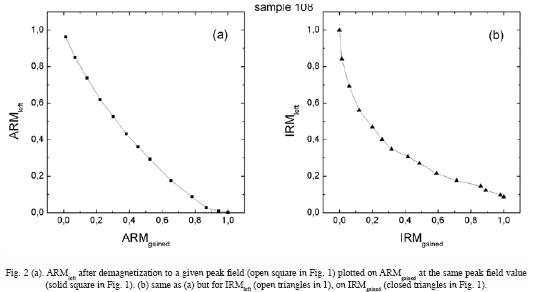
<body><![CDATA[<p align="justify">&nbsp;</p>     <p align="justify"><font face="verdana" size="2"><b>Experimental Methods</b></font></p>     <p align="justify"><font face="verdana" size="2"><i>Paleomagnetic Analysis</i></font></p>     <p align="justify"><font face="verdana" size="2">In order to test the stability of the NRM and to remove any viscous overprints, progressive alternating field (AF) demagnetization was carried out. In the orthogonal demagnetization (Zijderveld) diagrams, we generally observed straight lines that passed through the origin of the demagnetization diagram, indicating a single component and stable characteristic remanent magnetization. A limited number of samples show a small viscous remanent magnetization (VRM) that is progressively destroyed at 10 or 15mT. Further steps revealed a high stability of the magnetization directions (Irurzun <i>et al., </i>2006).</font></p>     <p align="justify"><font face="verdana" size="2">Paleointensity determinations were carried out according to Tauxe <i>et al. </i>(1995) with the pseudo&#150;Thellier method on a group of 40 selected pilot samples from core lt98&#150;2. The NRM is demagnetized using an alternating field (AF) in 13 steps up to 95mT using steps of 5&#150;10mT. Then the ARM is imparted at the same field steps as the NRM demagnetization. The ARM acquired at 95mT AF was demagnetized in the same way as the NRM. Finally, the sample is subjected to an increasing field to analyze acquisition of IRM using the same field steps as the initial demagnetization of the NRM, continuing to saturation. This SIRM was also demagnetized (Tauxe <i>et al., </i>1995). The results obtained after this procedure for sample 280 are plotted in <a href="#f1">Fig. 1</a>. The average median destructive field (MDF) is 23+2mT for the NRM, 25.7+0.5mT for ARM and 26&plusmn;1mT for SIRM. ARM acquisition and demagnetization curves show a crossing at about 37% and a comparable crossing for IRM data at about 27%. The ARM data are, thus, more stable against demagnetization than the IRM (Tauxe <i>et al., </i>1995).</font></p>     <p align="center"><a name="f1"></a></p>     <p align="center"><img src="/img/revistas/geoint/v47n4/a2f1.jpg"></p>     <p align="justify"><font face="verdana" size="2"><i>Rock Magnetic Analysis</i></font></p>     <p align="justify"><font face="verdana" size="2">In order to study the nature of the magnetic minerals in the sediments, a set of experiments were carried out by Gogorza <i>et al. </i>(2006). The following measurements were performed for all samples: NRM; magnetic susceptibility at low frequency (specific, X and volumetric, k); isothermal remanent magnetization (IRM) in increasing steps up to 1.2T, reaching the SIRM; back field, in growing steps until cancelling the magnetic remanence; anhysteric remanent magnetization (ARM<sub>100mT</sub>), with a direct field of 0. 1mT and a peak alternating field of 100mT. Associated parameters calculated by Irurzun <i>et al. </i>(2006) were also used: S&#150;ratio (IRM<sub>&#150;300mT</sub>  JSIRM), remanent coercitive field (B<sub>CR</sub>), SIRM/</span> k, ARM<sub>100mT</sub>      /k and SIRM/ARM<sub>100mT</sub>. In addition to these studies, hysteresis curves and temperature dependence of SIRM were obtained for a set of discrete samples. These studies show that the dominant remanence carriers are magnetite and titano&#150;magnetite within the pseudo&#150;single domain (PSD) grain size and that the concentration of these minerals varies between 0.01 to 0.1%. A more detailed description of these items is given in Gogorza <i>et al. </i>(2006) and Irurzun <i>et al. </i>(2006).</span></font></p>     <p align="justify"><font face="verdana" size="2"><a href="#f2">Fig. 2</a> graphically displays the linear behavior of ARM left (ARM<sub>left</sub>) versus ARM gained (ARM <sub>gained</sub>) at the same peak field ("Arai Plot" of Nagata <i>et al., </i>1963) and the marked curve behavior of IRM left (IRM<sub>left</sub>) versus IRM gained (IRM <sub>gained</sub>) (sample 108). The slight deviation of the ARM . versus ARM     . plot from the linear behavior may be due to the existence of a magnetic interaction. IRM acquisition curves and corresponding DC and AF demagnetization curves were analyzed to test the magnetic interaction (Henkel, 1964; Cisowski, 1981; Kruiver <i>et al., </i>1999). Stepwise acquisition was carried out up to fields of 1.2T; then a progressive demagnetization was applied up to 1.2T for the DC experiment (<a href="#f3">Fig. 3a</a>) and up to 95mT for the alternating field (AF) (<a href="#f3">Fig. 3b</a>). <a href="#f3">Fig. 3a</a> shows that about 90% of the SIRM is obtained between 200 and 300mT. From <a href="#f3">Fig. 3b</a> we can see that the intersection of the acquisition and AF demagnetization curves is at about 30% of the SIRM. According to Cisowski (1981), if the point of intersection is at 50% of the SIRM, there is no magnetic interaction. It is necessary to take into account that the Cisowski (1981) investigation is focused on magnetic interaction for SD particles and his results might not be applicable to the PSD particles present in our samples (Kruiver <i>et al., </i>1999). From the Henkel plot (Henkel, 1964), IRM<sub>gained</sub> vs. IRM<sub>left</sub>,  the occurrence of magnetic interaction can be verified (Wohlfarth, 1958). Non&#150;linearity in this plot is typically motivated by interparticle dipolar interactions in fine&#150;particle systems (Cisowski, 1981). The behavior observed in the samples of Lake El Tr&eacute;bol (<a href="#f3">Fig. 3.c</a>) suggests that no magnetic interaction would be present in our samples. Finally, all samples show similar behavior in the stepwise acquisition experiments (<a href="#f3">Fig. 3d</a>), independent of the absolute IRM intensities. According to Kruiver <i>et al. </i>(1999), the degree of interaction between magnetic particles is dependent on concentration; for this reason, we would have to find different behaviors in samples which have different concentrations. However, all samples deviate to the same extent from the non&#150;interaction line (slope &#150;0.5) in the Henkel plot and the point of intersection in the Cisowski plot (app. 30%) is the same for all samples.</font></p>     ]]></body>
<body><![CDATA[<p align="center"><a name="f2"></a></p>     <p align="center"><img src="/img/revistas/geoint/v47n4/a2f2.jpg"></p>     <p align="center"><a name="f3" id="f3"></a></p>     <p align="center"><img src="/img/revistas/geoint/v47n4/a2f3.jpg"></p>     <p align="justify"><font face="verdana" size="2">In summary, it is unlikely that magnetic interaction has occurred in the studied sediments. This is supported by the fact that magnetic interaction takes place when the concentration is higher than &gt;0.1 &#150;1 % and the concentration in our sediments varies between 0.01&#150;0.1% (Gogorza <i>et al., </i>2006).</font></p>     <p align="justify"><font face="verdana" size="2"><i>Age Control</i></font></p>     <p align="justify"><font face="verdana" size="2">The sediments of lake El Tr&eacute;bol are dated by correlation between the Declination and Inclination curves obtained in Irurzun <i>et al. </i>(2006) and the PSV curves from lake Escondido (Gogorza <i>et al., </i>2002). The dating is based on visual inspection of the curves (Fig. 10 in Irurzun <i>et al., </i>2006). On the basis of this correlation, 44 tie points provide age estimates. Ages of the most distinct declination peaks are transferred to the lake El Tr&eacute;bol record and inclination features are matched. Minor changes in inclination and declination are then correlated.</font></p>     <p align="justify"><font face="verdana" size="2">The resultant age scale was tested by three accelerator mass spectrometer (AMS) radiocarbon dates obtained for that work by the AMS Laboratory of the University of Arizona, which were converted into calendar years using the calibration curves of Stuiver and Reimer (1993). The information about each sample, including radiocarbon years before present (RCYBP) and calibrated ages, is listed in Table 1 in Irurzun <i>et al. </i>2006.</font></p>     <p align="justify">&nbsp;</p>     <p align="justify"><font face="verdana" size="2"><b>The "pseudo&#150; Thellier" normalization</b></font></p>     ]]></body>
<body><![CDATA[<p align="justify"><font face="verdana" size="2">The pseudo&#150;Thellier approach turned out to be successful in estimating relative paleointensities from sedimentary cores (Tauxe, 1995; Kok, 1998; Kruiver <i>et al., </i>1999; Brachfeld and Banerjee, 2000; Pan <i>et al., </i>2001; Snowball and Sandgren, 2004). In this paper, paleointensity  determinations  on 40  samples  by  the pseudo&#150;Thellier method, following Tauxe <i>et al. </i>(1995), are achieved using ARM.</font></p>     <p align="justify"><font face="verdana" size="2"><a href="/img/revistas/geoint/v47n4/a2f4.jpg" target="_blank">Fig. 4</a> shows the pseudo&#150;Thellier results of the sample 176. <a href="/img/revistas/geoint/v47n4/a2f4.jpg" target="_blank">Fig. 4a</a> shows stepwise AF demagnetization of NRM and acquisition of ARM, with the intensities normalized to their peak values. The best fit slope (m<sub>a</sub>) is obtained from the Arai plot (<a href="/img/revistas/geoint/v47n4/a2f4.jpg" target="_blank">Fig. 4b</a>), the NRM intensity left after demagnetization versus the ARM acquisition intensity (at the same peak field), by using two versions of a jackknife resampling procedure (Efron, 1982). <a href="/img/revistas/geoint/v47n4/a2f4.jpg" target="_blank">Fig. 4c</a> represents a histogram of the calculated slopes (ma). The solid line represents the best&#150;fit slope; dashed lines point out the upper and lower limits of 90% of possible m<sub>a</sub> values.</font></p>     <p align="justify"><font face="verdana" size="2">In one of the estimation procedures (Method 1), we followed the methods of Kok (1998) and Kruiver <i>et al. </i>(1999). The proposed method produced in every sample several regression slope estimates based on combinations of Jackknife subsamples (all, all but one, all but two and all but three, if possible) of field values lying between 20mT and 60mT (a minimum of three points in each subsample was required by the slope formulae) in most of the cases (Kok, 1998). In the other estimation procedure (Method 2), a modified version of that method was used to produce the slope estimates. In method 2, the Jackknife resampling was combined with Theil's complete method of robust&#150;resistant regression slope estimation (Glaister, 2005).</font></p>     <p align="justify"><font face="verdana" size="2">In both methods, the best slope estimate for each sample was identified as the slope using a specific optimizing criterion: for the first one, the slope estimate with minimum relative error (Kok, 1998); for the latter, the slope estimate achieving the minimum sum of absolute deviations between experimental values and the slope estimates.</font></p>     <p align="justify"><font face="verdana" size="2">In addition, two measures of estimation goodness were calculated for each method, to compare the results: i) a 90% bandwidth is obtained, as in Kok (1998), and the percentage of points lying inside that band was given (37.2% applying the robust&#150;resistant estimation method and 8% if the other method is used); ii) the sum of absolute deviations between the line joining best slopes and the experimental values is calculated. Based on both measures, it was observed that Method 1 (robust&#150;resistant estimation method) performed better.</font></p>     <p align="justify"><font face="verdana" size="2">In order to compare the results, the conventional paleointensity records obtained by Gogorza <i>et al. </i>(2006) taking NRM<sub>20mT</sub>/ARM<sub>20mT</sub> and the pseudo&#150;Thellier paleointensity are shown in <a href="/img/revistas/geoint/v47n4/a2f5.jpg" target="_blank">Fig. 5a</a> using Method 1 and in <a href="/img/revistas/geoint/v47n4/a2f5.jpg" target="_blank">Fig 5b</a> using Method 2. With the aim of comparing them, both are normalized by their mean values. We have taken NRM<sub>20mT</sub>    /ARM<sub>20mT</sub> as a conventional paleointensity estimate because the pseudo&#150;Thellier method uses ARM as well (Kruiver <i>et al., </i>1999).</font></p>     <p align="justify"><font face="verdana" size="2">It is necessary to note that both methods applied to the pseudo&#150;Thellier data provide an estimate of errors in the paleointensity. This error constitutes the information enclosed in the sample about NRM and ARM acquisition (Kruiver <i>et al., </i>1999).</font></p>     <p align="justify"><font face="verdana" size="2">&nbsp;</font></p>     <p align="justify"><font face="verdana" size="2"><b>Results</b></font></p>     <p align="justify"><font face="verdana" size="2"><i>Relative Paleointensity Results</i></font></p>     ]]></body>
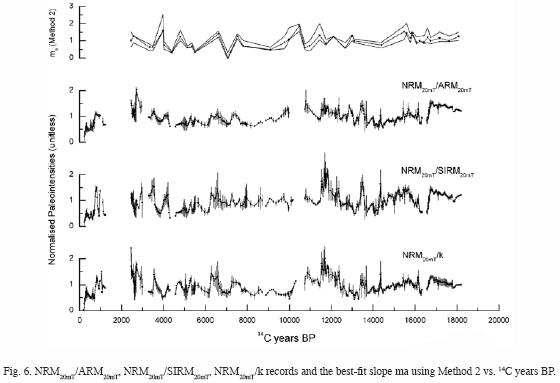
<body><![CDATA[<p align="justify"><font face="verdana" size="2">Relative paleointensity profiles are shown in <a href="#f6">Fig. 6</a>. Here, the results comparing 40 specimens, using Method 2, are compared with previous estimates of Gogorza <i>et al. </i>(2006). The three traditional normalization methods yield profiles with broad similarities but differ in the amplitude of peaks and troughs. The coherence analysis indicates that the parameter ARM<sub>20mT</sub> is the more appropriate normalization method in these sediments (not coherence frequency above the 95% confidence level) and that the NRM<sub>20mT</sub>/ARM<sub>20mT</sub> is not affected by climatic or lithologic factors, but represents a true geomagnetic signal (Gogorza <i>et al., </i>2006). In order for comparison, each of the four data sets (NRM<sub>20mT</sub>     /ARM<sub>20mT</sub>     , NRM<sub>20mT</sub>     /SIRM<sub>20mT</sub>     , NRM<sub>20mT</sub>     /k, m<sub>a</sub>) has been divided by its mean value. In the case of the pseudo&#150;Thellier record, this results in positive values of m<sub>a</sub>. It is necessary to take into account that the different resolution observed in the records is because fewer samples were studied by the pseudo&#150;Thellier method.</font></p>     <p align="justify"><font face="verdana" size="2">Here, we have found sufficient similarities between the pseudo&#150;Thellier data and the average NRM<sub>20mT</sub>    /ARM<sub>20mT </sub>profile (according to Brachfeld <i>et al. </i>(2000)) which is not surprising for young sediments unaffected by viscous overprint. The most conspicuous differences occur in features at 2600&#150;3000<sup>14</sup>C years BP, 10450&#150;11800<sup>14</sup>C years BP and 16800&#150;18350 <sup>14</sup>C years BP, which coincide with prominent dissimilarities in the grain size proxies (<a href="#f3">Figure 3</a>, Gogorza <i>et al., </i>2006). Changes in the ratios ARM<sub>100mT</sub>/k and ARM<sub>100mT</sub>/SIRM; higher ratios indicate smaller grain size and a higher proportion of single&#150;domain (SD) grains (Hunt <i>et al., </i>1995). If, for example, there is an increase in the proportion of finer grains, the NRM.<sub>20mT</sub>/ARM    <sub>20mT </sub>will decrease but the NRM<sub>20mT</sub>    /SIRM<sub>20mT</sub> will increase, which is noticed at about 11800&#150;12800 <sup>14</sup>C years BP; on the other hand, if there is an decrease in the proportion of finer grains, the NRM<sub>20mT</sub>/ARM<sub>20mT</sub> will increase but the NRM<sub>20mT</sub>    /SIRM<sub>20mT</sub> will decrease, as is observed at about 16800&#150;18100 <sup>14</sup>C years BP. There are other intervals where differences are observed, but further studies would be necessary in those cases (for ex. 2600&#150;3100, 4700&#150;5200, 6700&#150;7500, 13500&#150;14350 and 14400&#150;15400 <sup>14</sup>C years BP). Unfortunately we do not have data in this respect in the pseudo&#150;Thellier profile.</font></p>     <p align="center"><a name="f6"></a></p>     <p align="center"><img src="/img/revistas/geoint/v47n4/a2f6.jpg"></p>     <p align="justify">&nbsp;</p>     <p align="justify"><font face="verdana" size="2"><b>Conclusions</b></font></p>     <p align="justify"><font face="verdana" size="2">In this paper, we have applied the pseudo&#150;Thellier method to 40 samples from Lake El Tr&eacute;bol and present the results. This technique not only conveniently separates  VRM from DRM,  but offers  a means  of assessing the uncertainty of the relative paleointensity estimate (Tauxe <i>et al., </i>1995). The pseudo&#150;Thellier record and the conventional method of normalization (NRM<sub>20mT</sub>/ ARM<sub>20mT</sub>) show a reasonable agreement. This similarity would support the conclusion that any technique for relative paleointensity of sediment samples produces reliable results, providing that the sediments meet the criteria for magnetic uniformity necessary for estimates of the relative paleointensity of the geomagnetic field.</font></p>     <p align="justify"><font face="verdana" size="2">The advantage of using a robust&#150;resistant method of regression slope estimation in this type of research should not be surprising, as the influence of outliers, often present due to different kind of perturbations, is minimized.</font></p>     <p align="justify"><font face="verdana" size="2">&nbsp;</font></p>     <p align="justify"><font face="verdana" size="2"><b>Bibliography</b></font></p>     ]]></body>
<body><![CDATA[<!-- ref --><p align="justify"><font face="verdana" size="2">Bianchi, M. M., J. Masaferro, G. Roman Ross, A. J. Amos and A. Lami, 1999. Late Pleistocene and early Holocene ecological response of Lake El Tr&eacute;bol (Patagonia, Argentina)   to  environmental   changes, <i>Journal of Paleolimnology, </i>22, 137&#150;148.</font>&nbsp;&nbsp;&nbsp;&nbsp;&nbsp;&nbsp;&nbsp;&nbsp;[&#160;<a href="javascript:void(0);" onclick="javascript: window.open('/scielo.php?script=sci_nlinks&ref=3902123&pid=S0016-7169200800040000200001&lng=','','width=640,height=500,resizable=yes,scrollbars=1,menubar=yes,');">Links</a>&#160;]<!-- end-ref --><!-- ref --><p align="justify"><font face="verdana" size="2">Brachfeld, S. A. and S. A. Banerjee, 2000. A new high&#150;resolution geomagnetic relative paleointensity record for the North American Holocene: A comparison of sedimentary and absolute intensity data, <i>J. Geophys. Res., 105, B1, </i>821&#150;834.</font>&nbsp;&nbsp;&nbsp;&nbsp;&nbsp;&nbsp;&nbsp;&nbsp;[&#160;<a href="javascript:void(0);" onclick="javascript: window.open('/scielo.php?script=sci_nlinks&ref=3902124&pid=S0016-7169200800040000200002&lng=','','width=640,height=500,resizable=yes,scrollbars=1,menubar=yes,');">Links</a>&#160;]<!-- end-ref --><!-- ref --><p align="justify"><font face="verdana" size="2">Brachfeld, S. A., E. Domack, C. Kisel, C. Laj, A. Lev enter, S. Ishman, R. Gilbert, A. Camerlenghi and L. B. Eglinton, 2003. Holocene history of the Larsen&#150;A Ice Shelf constrained by geomagnetic paleointensity dating, <i>Geology, 31, 9, </i>749&#150;752.</font>&nbsp;&nbsp;&nbsp;&nbsp;&nbsp;&nbsp;&nbsp;&nbsp;[&#160;<a href="javascript:void(0);" onclick="javascript: window.open('/scielo.php?script=sci_nlinks&ref=3902125&pid=S0016-7169200800040000200003&lng=','','width=640,height=500,resizable=yes,scrollbars=1,menubar=yes,');">Links</a>&#160;]<!-- end-ref --><!-- ref --><p align="justify"><font face="verdana" size="2">Cisowski, S., 1981. Interacting vs. non&#150;interacting single domain behaviour in natural and synthetic samples, <i>Phys. Earth and Planet. Inter. 26, </i>56&#150;62.</font>&nbsp;&nbsp;&nbsp;&nbsp;&nbsp;&nbsp;&nbsp;&nbsp;[&#160;<a href="javascript:void(0);" onclick="javascript: window.open('/scielo.php?script=sci_nlinks&ref=3902126&pid=S0016-7169200800040000200004&lng=','','width=640,height=500,resizable=yes,scrollbars=1,menubar=yes,');">Links</a>&#160;]<!-- end-ref --><!-- ref --><p align="justify"><font face="verdana" size="2">Efron, B., 1982. The Jackknife, the Bootstrap and other resampling Plans., Society for Industrial and Applied Mathematics, Philadelphia, PA.</font>&nbsp;&nbsp;&nbsp;&nbsp;&nbsp;&nbsp;&nbsp;&nbsp;[&#160;<a href="javascript:void(0);" onclick="javascript: window.open('/scielo.php?script=sci_nlinks&ref=3902127&pid=S0016-7169200800040000200005&lng=','','width=640,height=500,resizable=yes,scrollbars=1,menubar=yes,');">Links</a>&#160;]<!-- end-ref --><!-- ref --><p align="justify"><font face="verdana" size="2">Glaister, P., 2005. Robust Linear Regression Using Theil's Method. <i>J. Chem. Educ., 82, </i>1472&#150;1474.</font>&nbsp;&nbsp;&nbsp;&nbsp;&nbsp;&nbsp;&nbsp;&nbsp;[&#160;<a href="javascript:void(0);" onclick="javascript: window.open('/scielo.php?script=sci_nlinks&ref=3902128&pid=S0016-7169200800040000200006&lng=','','width=640,height=500,resizable=yes,scrollbars=1,menubar=yes,');">Links</a>&#160;]<!-- end-ref --><!-- ref --><p align="justify"><font face="verdana" size="2">Gogorza, C. S. G., A. M. Sinito, I. Di Tomasso, J. F. Vilas, K. M. Creer and H. Nu&ntilde;ez, 1999. Holocene Secular variation recorded by sediments from Lake Escondido (South Argentina), <i>Earth Planets Space, 51, </i>93&#150;106.</font>&nbsp;&nbsp;&nbsp;&nbsp;&nbsp;&nbsp;&nbsp;&nbsp;[&#160;<a href="javascript:void(0);" onclick="javascript: window.open('/scielo.php?script=sci_nlinks&ref=3902129&pid=S0016-7169200800040000200007&lng=','','width=640,height=500,resizable=yes,scrollbars=1,menubar=yes,');">Links</a>&#160;]<!-- end-ref --><!-- ref --><p align="justify"><font face="verdana" size="2">Gogorza, C. S. G., A. M. Sinito, I. Di Tomasso, J. F. Vilas, K. M. Creer and H. Nu&ntilde;ez, 2001. Geomagnetic Secular Variations 0&#150;12000 yr. as recorded by sediments from Moreno Lake (South Argentina), <i>J. of South American </i><i>Earth Sci., 13, </i>7, 627&#150;645.</font>&nbsp;&nbsp;&nbsp;&nbsp;&nbsp;&nbsp;&nbsp;&nbsp;[&#160;<a href="javascript:void(0);" onclick="javascript: window.open('/scielo.php?script=sci_nlinks&ref=3902130&pid=S0016-7169200800040000200008&lng=','','width=640,height=500,resizable=yes,scrollbars=1,menubar=yes,');">Links</a>&#160;]<!-- end-ref --><!-- ref --><p align="justify"><font face="verdana" size="2">Gogorza, C. S. G., A. M. Sinito, J. M. Lirio, H. Nu&ntilde;ez, M. A. E. Chaparro and J. F. Vilas, 2002. Paleosecular Variations 0&#150;19,000 years recorded by sediments from Escondido Lake (Argentina), <i>Phys. Earth and Planet. Inter., 133, </i>35&#150;55.</font>&nbsp;&nbsp;&nbsp;&nbsp;&nbsp;&nbsp;&nbsp;&nbsp;[&#160;<a href="javascript:void(0);" onclick="javascript: window.open('/scielo.php?script=sci_nlinks&ref=3902131&pid=S0016-7169200800040000200009&lng=','','width=640,height=500,resizable=yes,scrollbars=1,menubar=yes,');">Links</a>&#160;]<!-- end-ref --><!-- ref --><p align="justify"><font face="verdana" size="2">Gogorza, C. S. G., J. M. Lirio, H. Nu&ntilde;ez, M. A. E. Chaparro, H. R. Bertorello and A. M. Sinito, 2004. Paleointensity studies on Holocene&#150;Pleistocene sediments from Lake Escondido, Argentina, Phys. <i>Earth and Planet. Inter., 145, </i>219&#150;238.</font>&nbsp;&nbsp;&nbsp;&nbsp;&nbsp;&nbsp;&nbsp;&nbsp;[&#160;<a href="javascript:void(0);" onclick="javascript: window.open('/scielo.php?script=sci_nlinks&ref=3902132&pid=S0016-7169200800040000200010&lng=','','width=640,height=500,resizable=yes,scrollbars=1,menubar=yes,');">Links</a>&#160;]<!-- end-ref --><!-- ref --><p align="justify"><font face="verdana" size="2">Gogorza, C. S. G., M. A. Irurzun, M. A. E. Chaparro, J. M. Lirio, H. Nu&ntilde;ez, P. G. Bercoff and A. M. Sinito, 2006. Relative paleointensity of the geomagnetic field over the last 21,000 years BP from sediment cores, Lake El Tr&eacute;bol (Patagonia, Argentina), <i>Earth Planet and Space, 58, </i>1323&#150;1332.</font>&nbsp;&nbsp;&nbsp;&nbsp;&nbsp;&nbsp;&nbsp;&nbsp;[&#160;<a href="javascript:void(0);" onclick="javascript: window.open('/scielo.php?script=sci_nlinks&ref=3902133&pid=S0016-7169200800040000200011&lng=','','width=640,height=500,resizable=yes,scrollbars=1,menubar=yes,');">Links</a>&#160;]<!-- end-ref --><!-- ref --><p align="justify"><font face="verdana" size="2">Henkel, O., 1964. Remanenzverhalten und Wechsel&#150;wirkungen in hartmagnetischen Teilchenkollektiven, <i>Phys. Stat. Sol., </i>7, 919&#150;929.</font>&nbsp;&nbsp;&nbsp;&nbsp;&nbsp;&nbsp;&nbsp;&nbsp;[&#160;<a href="javascript:void(0);" onclick="javascript: window.open('/scielo.php?script=sci_nlinks&ref=3902134&pid=S0016-7169200800040000200012&lng=','','width=640,height=500,resizable=yes,scrollbars=1,menubar=yes,');">Links</a>&#160;]<!-- end-ref --><!-- ref --><p align="justify"><font face="verdana" size="2">Hunt, C. P., S. K. Banerjee, J. Han, P. A. Solheid, E. Oches, W. Sun and T. Liu, 1995. Rock&#150;magnetic proxies of climate change in the loess&#150;paleosol sequences of the western Loess Plateau of China. <i>Geophys. J. Int. 123, </i>232&#150;244.</font>&nbsp;&nbsp;&nbsp;&nbsp;&nbsp;&nbsp;&nbsp;&nbsp;[&#160;<a href="javascript:void(0);" onclick="javascript: window.open('/scielo.php?script=sci_nlinks&ref=3902135&pid=S0016-7169200800040000200013&lng=','','width=640,height=500,resizable=yes,scrollbars=1,menubar=yes,');">Links</a>&#160;]<!-- end-ref --><!-- ref --><p align="justify"><font face="verdana" size="2">Irurzun, M. A., C. S. G. Gogorza, A. M. Sinito, J. M. Lirio, H. Nu&ntilde;ez and M. A. E. Chaparro, 2006. Paleosecular variations recorded by sediments from Lake El Tr&eacute;bol, Argentina, Phys. <i>Earth and Planet. Inter., 154, </i>1&#150;17.</font>&nbsp;&nbsp;&nbsp;&nbsp;&nbsp;&nbsp;&nbsp;&nbsp;[&#160;<a href="javascript:void(0);" onclick="javascript: window.open('/scielo.php?script=sci_nlinks&ref=3902136&pid=S0016-7169200800040000200014&lng=','','width=640,height=500,resizable=yes,scrollbars=1,menubar=yes,');">Links</a>&#160;]<!-- end-ref --><!-- ref --><p align="justify"><font face="verdana" size="2">Kok, Y. S., 1998. Relative paleointensities of the Earth's magnetic field derived from deep&#150;sea sediments. Reading the muddy compass (PhD Thesis Utrecht University), <i>Geologica Ultraiectina, 165, </i>pp. 131.</font>&nbsp;&nbsp;&nbsp;&nbsp;&nbsp;&nbsp;&nbsp;&nbsp;[&#160;<a href="javascript:void(0);" onclick="javascript: window.open('/scielo.php?script=sci_nlinks&ref=3902137&pid=S0016-7169200800040000200015&lng=','','width=640,height=500,resizable=yes,scrollbars=1,menubar=yes,');">Links</a>&#160;]<!-- end-ref --><!-- ref --><p align="justify"><font face="verdana" size="2">Kruiver, P. P., Y. S. Kok, M. J. Dekkers, C. G. Langereis and C. Laj, 1999. A pseudo&#150;Thellier relative paleointensity record, and rock magnetic and geochemical parameters in relation to climate during the last 276 kyr. in the Azores region,. <i>Geophys. J. Int., 136, </i>757&#150;770.</font>&nbsp;&nbsp;&nbsp;&nbsp;&nbsp;&nbsp;&nbsp;&nbsp;[&#160;<a href="javascript:void(0);" onclick="javascript: window.open('/scielo.php?script=sci_nlinks&ref=3902138&pid=S0016-7169200800040000200016&lng=','','width=640,height=500,resizable=yes,scrollbars=1,menubar=yes,');">Links</a>&#160;]<!-- end-ref --><!-- ref --><p align="justify"><font face="verdana" size="2">Nowaczyk, N. R., S. Harwart and M. Melles, 2001. Impact of early diagenesis and bulk particle grain size distribution on estimates of relative geomagnetic palaeointensity variations in sediments from Lama Lake, northern Central Siberia, <i>Geophys. J. Int., 145, </i>300&#150;306</font>.&nbsp;&nbsp;&nbsp;&nbsp;&nbsp;&nbsp;&nbsp;&nbsp;[&#160;<a href="javascript:void(0);" onclick="javascript: window.open('/scielo.php?script=sci_nlinks&ref=3902139&pid=S0016-7169200800040000200017&lng=','','width=640,height=500,resizable=yes,scrollbars=1,menubar=yes,');">Links</a>&#160;]<!-- end-ref --><!-- ref --><p align="justify"><font face="verdana" size="2">Pan, Y., R. Zhu, J. Shaw, Q. Liu and B. Guo, 2001. Can relative paleointensities be determined from the normalised magnetisation of the wind&#150;blown loess of China?, <i>J. Geophys. Res., 106, B9, </i>19, 221&#150;19, 232.</font>&nbsp;&nbsp;&nbsp;&nbsp;&nbsp;&nbsp;&nbsp;&nbsp;[&#160;<a href="javascript:void(0);" onclick="javascript: window.open('/scielo.php?script=sci_nlinks&ref=3902140&pid=S0016-7169200800040000200018&lng=','','width=640,height=500,resizable=yes,scrollbars=1,menubar=yes,');">Links</a>&#160;]<!-- end-ref --><!-- ref --><p align="justify"><font face="verdana" size="2">Sagnotti, L., P. Macri, A. Camerlenghi and M. Rebesco, 2001. Environmental      magnetism      of  Antarctic Late   Pleistocene   sediments   and   interhemispheric correlation of climatic events, <i>Earth Planet. Sci. Lett., 192, </i>65&#150;80.</font>&nbsp;&nbsp;&nbsp;&nbsp;&nbsp;&nbsp;&nbsp;&nbsp;[&#160;<a href="javascript:void(0);" onclick="javascript: window.open('/scielo.php?script=sci_nlinks&ref=3902141&pid=S0016-7169200800040000200019&lng=','','width=640,height=500,resizable=yes,scrollbars=1,menubar=yes,');">Links</a>&#160;]<!-- end-ref --><!-- ref --><p align="justify"><font face="verdana" size="2">Stoner, J. S., C. Laj, J. E. T. Channell and C. Kissel,</font> <font face="verdana" size="2">2002.&nbsp; South Atlantic and North Atlantic geomagnetic paleointensity stacks (0&#150;80ka): implications for interhemispheric correlation, <i>Quat. Sci. Rev., 21, </i>1141&#150;1151.</font>&nbsp;&nbsp;&nbsp;&nbsp;&nbsp;&nbsp;&nbsp;&nbsp;[&#160;<a href="javascript:void(0);" onclick="javascript: window.open('/scielo.php?script=sci_nlinks&ref=3902142&pid=S0016-7169200800040000200020&lng=','','width=640,height=500,resizable=yes,scrollbars=1,menubar=yes,');">Links</a>&#160;]<!-- end-ref --><!-- ref --><p align="justify"><font face="verdana" size="2">St&#150;Onge, G., J. S. Stoner and C. Hillaire&#150;Marcel, 2003. Holocene paleomagnetic records from St. Lawrence Estuary, eastern Canada: centennial&#150; to millennial&#150;scale geomagnetic modulation of cosmogenic isotopes, <i>Earth Planet. Sci. Lett., 209, </i>113&#150;130.</font>&nbsp;&nbsp;&nbsp;&nbsp;&nbsp;&nbsp;&nbsp;&nbsp;[&#160;<a href="javascript:void(0);" onclick="javascript: window.open('/scielo.php?script=sci_nlinks&ref=3902143&pid=S0016-7169200800040000200021&lng=','','width=640,height=500,resizable=yes,scrollbars=1,menubar=yes,');">Links</a>&#160;]<!-- end-ref --><!-- ref --><p align="justify"><font face="verdana" size="2">Tauxe, L., 1993. Sedimentary records of relative paleointensities of the geomagnetic field: theory and practice, <i>Rev. Geophys., 31, </i>319&#150;354.</font>&nbsp;&nbsp;&nbsp;&nbsp;&nbsp;&nbsp;&nbsp;&nbsp;[&#160;<a href="javascript:void(0);" onclick="javascript: window.open('/scielo.php?script=sci_nlinks&ref=3902144&pid=S0016-7169200800040000200022&lng=','','width=640,height=500,resizable=yes,scrollbars=1,menubar=yes,');">Links</a>&#160;]<!-- end-ref --><!-- ref --><p align="justify"><font face="verdana" size="2">Tauxe, L., T. Pick and Y. S. Kok, 1995. Relative paleointensity in sediments: a pseudo&#150;Thellier approach, <i>Geophys. Res. Lett., 22, </i>2285&#150;2888.</font>&nbsp;&nbsp;&nbsp;&nbsp;&nbsp;&nbsp;&nbsp;&nbsp;[&#160;<a href="javascript:void(0);" onclick="javascript: window.open('/scielo.php?script=sci_nlinks&ref=3902145&pid=S0016-7169200800040000200023&lng=','','width=640,height=500,resizable=yes,scrollbars=1,menubar=yes,');">Links</a>&#160;]<!-- end-ref --><!-- ref --><p align="justify"><font face="verdana" size="2">Wohlfarth, E. O., 1958. Relations between different modes of acquisition of the remanent magnetisation of ferromagnetic particles, <i>J. Appl. Phys., 29, </i>595&#150;596.</font>&nbsp;&nbsp;&nbsp;&nbsp;&nbsp;&nbsp;&nbsp;&nbsp;[&#160;<a href="javascript:void(0);" onclick="javascript: window.open('/scielo.php?script=sci_nlinks&ref=3902146&pid=S0016-7169200800040000200024&lng=','','width=640,height=500,resizable=yes,scrollbars=1,menubar=yes,');">Links</a>&#160;]<!-- end-ref --> ]]></body><back>
<ref-list>
<ref id="B1">
<nlm-citation citation-type="journal">
<person-group person-group-type="author">
<name>
<surname><![CDATA[Bianchi]]></surname>
<given-names><![CDATA[M. M.]]></given-names>
</name>
<name>
<surname><![CDATA[Masaferro]]></surname>
<given-names><![CDATA[J]]></given-names>
</name>
<name>
<surname><![CDATA[Roman Ross]]></surname>
<given-names><![CDATA[G]]></given-names>
</name>
<name>
<surname><![CDATA[Amos]]></surname>
<given-names><![CDATA[A. J.]]></given-names>
</name>
<name>
<surname><![CDATA[Lami]]></surname>
<given-names><![CDATA[A]]></given-names>
</name>
</person-group>
<article-title xml:lang="en"><![CDATA[Late Pleistocene and early Holocene ecological response of Lake El Trébol (Patagonia, Argentina) to environmental changes]]></article-title>
<source><![CDATA[Journal of Paleolimnology]]></source>
<year>1999</year>
<numero>22</numero>
<issue>22</issue>
<page-range>137-148</page-range></nlm-citation>
</ref>
<ref id="B2">
<nlm-citation citation-type="journal">
<person-group person-group-type="author">
<name>
<surname><![CDATA[Brachfeld]]></surname>
<given-names><![CDATA[S. A.]]></given-names>
</name>
<name>
<surname><![CDATA[Banerjee]]></surname>
<given-names><![CDATA[S. A.]]></given-names>
</name>
</person-group>
<article-title xml:lang="en"><![CDATA[A new high-resolution geomagnetic relative paleointensity record for the North American Holocene: A comparison of sedimentary and absolute intensity data]]></article-title>
<source><![CDATA[J. Geophys. Res.]]></source>
<year>2000</year>
<volume>105</volume>
<numero>B1</numero>
<issue>B1</issue>
<page-range>821-834</page-range></nlm-citation>
</ref>
<ref id="B3">
<nlm-citation citation-type="journal">
<person-group person-group-type="author">
<name>
<surname><![CDATA[Brachfeld]]></surname>
<given-names><![CDATA[S. A.]]></given-names>
</name>
<name>
<surname><![CDATA[Domack]]></surname>
<given-names><![CDATA[E]]></given-names>
</name>
<name>
<surname><![CDATA[Kisel]]></surname>
<given-names><![CDATA[C]]></given-names>
</name>
<name>
<surname><![CDATA[Laj]]></surname>
<given-names><![CDATA[C]]></given-names>
</name>
<name>
<surname><![CDATA[Leventer]]></surname>
<given-names><![CDATA[A]]></given-names>
</name>
<name>
<surname><![CDATA[Ishman]]></surname>
<given-names><![CDATA[S]]></given-names>
</name>
<name>
<surname><![CDATA[Gilbert]]></surname>
<given-names><![CDATA[R]]></given-names>
</name>
<name>
<surname><![CDATA[Camerlenghi]]></surname>
<given-names><![CDATA[A]]></given-names>
</name>
<name>
<surname><![CDATA[Eglinton]]></surname>
<given-names><![CDATA[L. B.]]></given-names>
</name>
</person-group>
<article-title xml:lang="en"><![CDATA[Holocene history of the Larsen-A Ice Shelf constrained by geomagnetic paleointensity dating]]></article-title>
<source><![CDATA[Geology]]></source>
<year>2003</year>
<volume>31</volume>
<numero>9</numero>
<issue>9</issue>
<page-range>749-752</page-range></nlm-citation>
</ref>
<ref id="B4">
<nlm-citation citation-type="journal">
<person-group person-group-type="author">
<name>
<surname><![CDATA[Cisowski]]></surname>
<given-names><![CDATA[S]]></given-names>
</name>
</person-group>
<article-title xml:lang="en"><![CDATA[Interacting vs. non-interacting single domain behaviour in natural and synthetic samples]]></article-title>
<source><![CDATA[Phys. Earth and Planet. Inter.]]></source>
<year>1981</year>
<numero>26</numero>
<issue>26</issue>
<page-range>56-62</page-range></nlm-citation>
</ref>
<ref id="B5">
<nlm-citation citation-type="book">
<person-group person-group-type="author">
<name>
<surname><![CDATA[Efron]]></surname>
<given-names><![CDATA[B]]></given-names>
</name>
</person-group>
<source><![CDATA[The Jackknife, the Bootstrap and other resampling Plans.]]></source>
<year>1982</year>
<publisher-loc><![CDATA[Philadelphia^ePA PA]]></publisher-loc>
<publisher-name><![CDATA[Society for Industrial and Applied Mathematics]]></publisher-name>
</nlm-citation>
</ref>
<ref id="B6">
<nlm-citation citation-type="journal">
<person-group person-group-type="author">
<name>
<surname><![CDATA[Glaister]]></surname>
<given-names><![CDATA[P]]></given-names>
</name>
</person-group>
<article-title xml:lang="en"><![CDATA[Robust Linear Regression Using Theil's Method]]></article-title>
<source><![CDATA[J. Chem. Educ.]]></source>
<year>2005</year>
<numero>82</numero>
<issue>82</issue>
<page-range>1472-1474</page-range></nlm-citation>
</ref>
<ref id="B7">
<nlm-citation citation-type="journal">
<person-group person-group-type="author">
<name>
<surname><![CDATA[Gogorza]]></surname>
<given-names><![CDATA[C. S. G.]]></given-names>
</name>
<name>
<surname><![CDATA[Sinito]]></surname>
<given-names><![CDATA[A. M.]]></given-names>
</name>
<name>
<surname><![CDATA[Di Tomasso]]></surname>
<given-names><![CDATA[I]]></given-names>
</name>
<name>
<surname><![CDATA[Vilas]]></surname>
<given-names><![CDATA[J. F.]]></given-names>
</name>
<name>
<surname><![CDATA[Creer]]></surname>
<given-names><![CDATA[K. M.]]></given-names>
</name>
<name>
<surname><![CDATA[Nuñez]]></surname>
<given-names><![CDATA[H]]></given-names>
</name>
</person-group>
<article-title xml:lang="en"><![CDATA[Holocene Secular variation recorded by sediments from Lake Escondido (South Argentina)]]></article-title>
<source><![CDATA[Earth Planets Space]]></source>
<year>1999</year>
<numero>51</numero>
<issue>51</issue>
<page-range>93-106</page-range></nlm-citation>
</ref>
<ref id="B8">
<nlm-citation citation-type="journal">
<person-group person-group-type="author">
<name>
<surname><![CDATA[Gogorza]]></surname>
<given-names><![CDATA[C. S. G.]]></given-names>
</name>
<name>
<surname><![CDATA[Sinito]]></surname>
<given-names><![CDATA[A. M.]]></given-names>
</name>
<name>
<surname><![CDATA[Di Tomasso]]></surname>
<given-names><![CDATA[I.]]></given-names>
</name>
<name>
<surname><![CDATA[Vilas]]></surname>
<given-names><![CDATA[J. F.]]></given-names>
</name>
<name>
<surname><![CDATA[Creer]]></surname>
<given-names><![CDATA[K. M.]]></given-names>
</name>
<name>
<surname><![CDATA[Nuñez]]></surname>
<given-names><![CDATA[H]]></given-names>
</name>
</person-group>
<article-title xml:lang="en"><![CDATA[Geomagnetic Secular Variations 0-12000 yr. as recorded by sediments from Moreno Lake (South Argentina)]]></article-title>
<source><![CDATA[J. of South American Earth Sci.]]></source>
<year>2001</year>
<volume>13</volume>
<numero>7</numero>
<issue>7</issue>
<page-range>627-645</page-range></nlm-citation>
</ref>
<ref id="B9">
<nlm-citation citation-type="journal">
<person-group person-group-type="author">
<name>
<surname><![CDATA[Gogorza]]></surname>
<given-names><![CDATA[C. S. G.]]></given-names>
</name>
<name>
<surname><![CDATA[Sinito]]></surname>
<given-names><![CDATA[A. M.]]></given-names>
</name>
<name>
<surname><![CDATA[Lirio]]></surname>
<given-names><![CDATA[J. M.]]></given-names>
</name>
<name>
<surname><![CDATA[Nuñez]]></surname>
<given-names><![CDATA[H]]></given-names>
</name>
<name>
<surname><![CDATA[Chaparro]]></surname>
<given-names><![CDATA[M. A. E.]]></given-names>
</name>
<name>
<surname><![CDATA[Vilas]]></surname>
<given-names><![CDATA[J. F.]]></given-names>
</name>
</person-group>
<article-title xml:lang="en"><![CDATA[Paleosecular Variations 0-19,000 years recorded by sediments from Escondido Lake (Argentina)]]></article-title>
<source><![CDATA[Phys. Earth and Planet. Inter.]]></source>
<year>2002</year>
<numero>133</numero>
<issue>133</issue>
<page-range>35-55</page-range></nlm-citation>
</ref>
<ref id="B10">
<nlm-citation citation-type="journal">
<person-group person-group-type="author">
<name>
<surname><![CDATA[Gogorza]]></surname>
<given-names><![CDATA[C. S. G.]]></given-names>
</name>
<name>
<surname><![CDATA[Lirio]]></surname>
<given-names><![CDATA[J. M.]]></given-names>
</name>
<name>
<surname><![CDATA[Nuñez]]></surname>
<given-names><![CDATA[H]]></given-names>
</name>
<name>
<surname><![CDATA[Chaparro]]></surname>
<given-names><![CDATA[M. A. E.]]></given-names>
</name>
<name>
<surname><![CDATA[Bertorello]]></surname>
<given-names><![CDATA[H. R.]]></given-names>
</name>
<name>
<surname><![CDATA[Sinito]]></surname>
<given-names><![CDATA[A. M.]]></given-names>
</name>
</person-group>
<article-title xml:lang="en"><![CDATA[Paleointensity studies on Holocene-Pleistocene sediments from Lake Escondido, Argentina]]></article-title>
<source><![CDATA[Phys. Earth and Planet. Inter.]]></source>
<year>2004</year>
<numero>145</numero>
<issue>145</issue>
<page-range>219-238</page-range></nlm-citation>
</ref>
<ref id="B11">
<nlm-citation citation-type="journal">
<person-group person-group-type="author">
<name>
<surname><![CDATA[Gogorza]]></surname>
<given-names><![CDATA[C. S. G.]]></given-names>
</name>
<name>
<surname><![CDATA[Irurzun]]></surname>
<given-names><![CDATA[M. A.]]></given-names>
</name>
<name>
<surname><![CDATA[Chaparro]]></surname>
<given-names><![CDATA[M. A. E.]]></given-names>
</name>
<name>
<surname><![CDATA[Lirio]]></surname>
<given-names><![CDATA[J. M.]]></given-names>
</name>
<name>
<surname><![CDATA[Nuñez]]></surname>
<given-names><![CDATA[H]]></given-names>
</name>
<name>
<surname><![CDATA[Bercoff]]></surname>
<given-names><![CDATA[P. G.]]></given-names>
</name>
<name>
<surname><![CDATA[Sinito]]></surname>
<given-names><![CDATA[A. M.]]></given-names>
</name>
</person-group>
<article-title xml:lang="en"><![CDATA[Relative paleointensity of the geomagnetic field over the last 21,000 years BP from sediment cores, Lake El Trébol (Patagonia, Argentina)]]></article-title>
<source><![CDATA[Earth Planet and Space]]></source>
<year>2006</year>
<numero>58</numero>
<issue>58</issue>
<page-range>1323-1332</page-range></nlm-citation>
</ref>
<ref id="B12">
<nlm-citation citation-type="journal">
<person-group person-group-type="author">
<name>
<surname><![CDATA[Henkel]]></surname>
<given-names><![CDATA[O]]></given-names>
</name>
</person-group>
<article-title xml:lang="de"><![CDATA[Remanenzverhalten und Wechsel-wirkungen in hartmagnetischen Teilchenkollektiven]]></article-title>
<source><![CDATA[Phys. Stat. Sol.]]></source>
<year>1964</year>
<numero>7</numero>
<issue>7</issue>
<page-range>919-929</page-range></nlm-citation>
</ref>
<ref id="B13">
<nlm-citation citation-type="journal">
<person-group person-group-type="author">
<name>
<surname><![CDATA[Hunt]]></surname>
<given-names><![CDATA[C. P.]]></given-names>
</name>
<name>
<surname><![CDATA[Banerjee]]></surname>
<given-names><![CDATA[S. K.]]></given-names>
</name>
<name>
<surname><![CDATA[Han]]></surname>
<given-names><![CDATA[J]]></given-names>
</name>
<name>
<surname><![CDATA[Solheid]]></surname>
<given-names><![CDATA[P. A.]]></given-names>
</name>
<name>
<surname><![CDATA[Oches]]></surname>
<given-names><![CDATA[E]]></given-names>
</name>
<name>
<surname><![CDATA[Sun]]></surname>
<given-names><![CDATA[W]]></given-names>
</name>
<name>
<surname><![CDATA[Liu]]></surname>
<given-names><![CDATA[T]]></given-names>
</name>
</person-group>
<article-title xml:lang="en"><![CDATA[Rock-magnetic proxies of climate change in the loess-paleosol sequences of the western Loess Plateau of China]]></article-title>
<source><![CDATA[Geophys. J. Int.]]></source>
<year>1995</year>
<numero>123</numero>
<issue>123</issue>
<page-range>232-244</page-range></nlm-citation>
</ref>
<ref id="B14">
<nlm-citation citation-type="journal">
<person-group person-group-type="author">
<name>
<surname><![CDATA[Irurzun]]></surname>
<given-names><![CDATA[M. A.]]></given-names>
</name>
<name>
<surname><![CDATA[Gogorza]]></surname>
<given-names><![CDATA[C. S. G.]]></given-names>
</name>
<name>
<surname><![CDATA[Sinito]]></surname>
<given-names><![CDATA[A. M.]]></given-names>
</name>
<name>
<surname><![CDATA[Lirio]]></surname>
<given-names><![CDATA[J. M.]]></given-names>
</name>
<name>
<surname><![CDATA[Nuñez]]></surname>
<given-names><![CDATA[H]]></given-names>
</name>
<name>
<surname><![CDATA[Chaparro]]></surname>
<given-names><![CDATA[M. A. E.]]></given-names>
</name>
</person-group>
<article-title xml:lang="en"><![CDATA[Paleosecular variations recorded by sediments from Lake El Trébol, Argentina]]></article-title>
<source><![CDATA[Phys. Earth and Planet. Inter.]]></source>
<year>2006</year>
<numero>154</numero>
<issue>154</issue>
<page-range>1-17</page-range></nlm-citation>
</ref>
<ref id="B15">
<nlm-citation citation-type="journal">
<person-group person-group-type="author">
<name>
<surname><![CDATA[Kok]]></surname>
<given-names><![CDATA[Y. S.]]></given-names>
</name>
</person-group>
<article-title xml:lang="en"><![CDATA[Relative paleointensities of the Earth's magnetic field derived from deep-sea sediments: Reading the muddy compass (PhD Thesis Utrecht University)]]></article-title>
<source><![CDATA[Geologica Ultraiectina]]></source>
<year>1998</year>
<numero>165</numero>
<issue>165</issue>
<page-range>131</page-range></nlm-citation>
</ref>
<ref id="B16">
<nlm-citation citation-type="journal">
<person-group person-group-type="author">
<name>
<surname><![CDATA[Kruiver]]></surname>
<given-names><![CDATA[P. P.]]></given-names>
</name>
<name>
<surname><![CDATA[Kok]]></surname>
<given-names><![CDATA[Y. S.]]></given-names>
</name>
<name>
<surname><![CDATA[Dekkers]]></surname>
<given-names><![CDATA[M. J.]]></given-names>
</name>
<name>
<surname><![CDATA[Langereis]]></surname>
<given-names><![CDATA[C. G.]]></given-names>
</name>
<name>
<surname><![CDATA[Laj]]></surname>
<given-names><![CDATA[C]]></given-names>
</name>
</person-group>
<article-title xml:lang="en"><![CDATA[A pseudo-Thellier relative paleointensity record, and rock magnetic and geochemical parameters in relation to climate during the last 276 kyr. in the Azores region]]></article-title>
<source><![CDATA[Geophys. J. Int.]]></source>
<year>1999</year>
<numero>136</numero>
<issue>136</issue>
<page-range>757-770</page-range></nlm-citation>
</ref>
<ref id="B17">
<nlm-citation citation-type="journal">
<person-group person-group-type="author">
<name>
<surname><![CDATA[Nowaczyk]]></surname>
<given-names><![CDATA[N. R.]]></given-names>
</name>
<name>
<surname><![CDATA[Harwart]]></surname>
<given-names><![CDATA[S]]></given-names>
</name>
<name>
<surname><![CDATA[Melles]]></surname>
<given-names><![CDATA[M]]></given-names>
</name>
</person-group>
<article-title xml:lang="en"><![CDATA[Impact of early diagenesis and bulk particle grain size distribution on estimates of relative geomagnetic palaeointensity variations in sediments from Lama Lake, northern Central Siberia]]></article-title>
<source><![CDATA[Geophys. J. Int.]]></source>
<year>2001</year>
<numero>145</numero>
<issue>145</issue>
<page-range>300-306</page-range></nlm-citation>
</ref>
<ref id="B18">
<nlm-citation citation-type="journal">
<person-group person-group-type="author">
<name>
<surname><![CDATA[Pan]]></surname>
<given-names><![CDATA[Y]]></given-names>
</name>
<name>
<surname><![CDATA[Zhu]]></surname>
<given-names><![CDATA[R]]></given-names>
</name>
<name>
<surname><![CDATA[Shaw]]></surname>
<given-names><![CDATA[J]]></given-names>
</name>
<name>
<surname><![CDATA[Liu]]></surname>
<given-names><![CDATA[Q]]></given-names>
</name>
<name>
<surname><![CDATA[Guo]]></surname>
<given-names><![CDATA[B]]></given-names>
</name>
</person-group>
<article-title xml:lang="en"><![CDATA[Can relative paleointensities be determined from the normalised magnetisation of the wind-blown loess of China?]]></article-title>
<source><![CDATA[J. Geophys. Res.]]></source>
<year>2001</year>
<volume>106</volume>
<numero>B9</numero>
<issue>B9</issue>
<page-range>232</page-range></nlm-citation>
</ref>
<ref id="B19">
<nlm-citation citation-type="journal">
<person-group person-group-type="author">
<name>
<surname><![CDATA[Sagnotti]]></surname>
<given-names><![CDATA[L]]></given-names>
</name>
<name>
<surname><![CDATA[Macri]]></surname>
<given-names><![CDATA[P]]></given-names>
</name>
<name>
<surname><![CDATA[Camerlenghi]]></surname>
<given-names><![CDATA[A]]></given-names>
</name>
<name>
<surname><![CDATA[Rebesco]]></surname>
<given-names><![CDATA[M]]></given-names>
</name>
</person-group>
<article-title xml:lang="en"><![CDATA[Environmental magnetism of Antarctic Late Pleistocene sediments and interhemispheric correlation of climatic events]]></article-title>
<source><![CDATA[Earth Planet. Sci. Lett.]]></source>
<year>2001</year>
<numero>192</numero>
<issue>192</issue>
<page-range>65-80</page-range></nlm-citation>
</ref>
<ref id="B20">
<nlm-citation citation-type="journal">
<person-group person-group-type="author">
<name>
<surname><![CDATA[Stoner]]></surname>
<given-names><![CDATA[J. S.]]></given-names>
</name>
<name>
<surname><![CDATA[Laj]]></surname>
<given-names><![CDATA[C]]></given-names>
</name>
<name>
<surname><![CDATA[Channell]]></surname>
<given-names><![CDATA[J. E. T.]]></given-names>
</name>
<name>
<surname><![CDATA[Kissel]]></surname>
<given-names><![CDATA[C]]></given-names>
</name>
</person-group>
<article-title xml:lang="en"><![CDATA[South Atlantic and North Atlantic geomagnetic paleointensity stacks (0-80ka): implications for interhemispheric correlation]]></article-title>
<source><![CDATA[Quat. Sci. Rev.]]></source>
<year>2002</year>
<numero>21</numero>
<issue>21</issue>
<page-range>1141-1151</page-range></nlm-citation>
</ref>
<ref id="B21">
<nlm-citation citation-type="journal">
<person-group person-group-type="author">
<name>
<surname><![CDATA[St-Onge]]></surname>
<given-names><![CDATA[G]]></given-names>
</name>
<name>
<surname><![CDATA[Stoner]]></surname>
<given-names><![CDATA[J. S.]]></given-names>
</name>
<name>
<surname><![CDATA[Hillaire-Marcel]]></surname>
<given-names><![CDATA[C]]></given-names>
</name>
</person-group>
<article-title xml:lang="en"><![CDATA[Holocene paleomagnetic records from St. Lawrence Estuary, eastern Canada: centennial- to millennial-scale geomagnetic modulation of cosmogenic isotopes]]></article-title>
<source><![CDATA[Earth Planet. Sci. Lett.]]></source>
<year>2003</year>
<numero>209</numero>
<issue>209</issue>
<page-range>113-130</page-range></nlm-citation>
</ref>
<ref id="B22">
<nlm-citation citation-type="journal">
<person-group person-group-type="author">
<name>
<surname><![CDATA[Tauxe]]></surname>
<given-names><![CDATA[L]]></given-names>
</name>
</person-group>
<article-title xml:lang="en"><![CDATA[Sedimentary records of relative paleointensities of the geomagnetic field: theory and practice]]></article-title>
<source><![CDATA[Rev. Geophys.]]></source>
<year>1993</year>
<numero>31</numero>
<issue>31</issue>
<page-range>319-354</page-range></nlm-citation>
</ref>
<ref id="B23">
<nlm-citation citation-type="journal">
<person-group person-group-type="author">
<name>
<surname><![CDATA[Tauxe]]></surname>
<given-names><![CDATA[L]]></given-names>
</name>
<name>
<surname><![CDATA[Pick]]></surname>
<given-names><![CDATA[T]]></given-names>
</name>
<name>
<surname><![CDATA[Kok]]></surname>
<given-names><![CDATA[Y. S.]]></given-names>
</name>
</person-group>
<article-title xml:lang="en"><![CDATA[Relative paleointensity in sediments: a pseudo-Thellier approach]]></article-title>
<source><![CDATA[Geophys. Res. Lett.]]></source>
<year>1995</year>
<numero>22</numero>
<issue>22</issue>
<page-range>2285-2888</page-range></nlm-citation>
</ref>
<ref id="B24">
<nlm-citation citation-type="journal">
<person-group person-group-type="author">
<name>
<surname><![CDATA[Wohlfarth]]></surname>
<given-names><![CDATA[E. O.]]></given-names>
</name>
</person-group>
<article-title xml:lang="en"><![CDATA[Relations between different modes of acquisition of the remanent magnetisation of ferromagnetic particles]]></article-title>
<source><![CDATA[J. Appl. Phys.]]></source>
<year>1958</year>
<numero>29</numero>
<issue>29</issue>
<page-range>595-596</page-range></nlm-citation>
</ref>
</ref-list>
</back>
</article>