<?xml version="1.0" encoding="ISO-8859-1"?><article xmlns:mml="http://www.w3.org/1998/Math/MathML" xmlns:xlink="http://www.w3.org/1999/xlink" xmlns:xsi="http://www.w3.org/2001/XMLSchema-instance">
<front>
<journal-meta>
<journal-id>0016-7169</journal-id>
<journal-title><![CDATA[Geofísica internacional]]></journal-title>
<abbrev-journal-title><![CDATA[Geofís. Intl]]></abbrev-journal-title>
<issn>0016-7169</issn>
<publisher>
<publisher-name><![CDATA[Universidad Nacional Autónoma de México, Instituto de Geofísica]]></publisher-name>
</publisher>
</journal-meta>
<article-meta>
<article-id>S0016-71692008000300017</article-id>
<title-group>
<article-title xml:lang="en"><![CDATA[Geomagnetic disturbances analysis using discrete wavelets]]></article-title>
</title-group>
<contrib-group>
<contrib contrib-type="author">
<name>
<surname><![CDATA[Zossi de Artigas]]></surname>
<given-names><![CDATA[M]]></given-names>
</name>
<xref ref-type="aff" rid="A01"/>
</contrib>
<contrib contrib-type="author">
<name>
<surname><![CDATA[Fernandez de Campra]]></surname>
<given-names><![CDATA[P]]></given-names>
</name>
<xref ref-type="aff" rid="A03"/>
</contrib>
<contrib contrib-type="author">
<name>
<surname><![CDATA[Zotto]]></surname>
<given-names><![CDATA[E. M.]]></given-names>
</name>
<xref ref-type="aff" rid="A04"/>
</contrib>
</contrib-group>
<aff id="A01">
<institution><![CDATA[,Universidad Nacional de Tucumán Facultad de Ciencias Exactas y Tecnología Departamento de Física]]></institution>
<addr-line><![CDATA[Tucuman ]]></addr-line>
<country>Argentina</country>
</aff>
<aff id="A03">
<institution><![CDATA[,Universidad Nacional de Tucumán Facultad de Ciencias Exactas y Tecnología Departamento de Ciencias de la Computación]]></institution>
<addr-line><![CDATA[Tucuman ]]></addr-line>
<country>Argentina</country>
</aff>
<aff id="A04">
<institution><![CDATA[,Universidad Nacional de Catamarca Facultad de Tecnología y Ciencias Aplicadas ]]></institution>
<addr-line><![CDATA[Catamarca ]]></addr-line>
<country>Argentina</country>
</aff>
<pub-date pub-type="pub">
<day>00</day>
<month>09</month>
<year>2008</year>
</pub-date>
<pub-date pub-type="epub">
<day>00</day>
<month>09</month>
<year>2008</year>
</pub-date>
<volume>47</volume>
<numero>3</numero>
<fpage>257</fpage>
<lpage>263</lpage>
<copyright-statement/>
<copyright-year/>
<self-uri xlink:href="http://www.scielo.org.mx/scielo.php?script=sci_arttext&amp;pid=S0016-71692008000300017&amp;lng=en&amp;nrm=iso"></self-uri><self-uri xlink:href="http://www.scielo.org.mx/scielo.php?script=sci_abstract&amp;pid=S0016-71692008000300017&amp;lng=en&amp;nrm=iso"></self-uri><self-uri xlink:href="http://www.scielo.org.mx/scielo.php?script=sci_pdf&amp;pid=S0016-71692008000300017&amp;lng=en&amp;nrm=iso"></self-uri><abstract abstract-type="short" xml:lang="es"><p><![CDATA[Para estudiar periodicidades y tendencia en tormentas geomagnéticas se aplicó la transformada wavelet discreta, usando la función Daubechies. De entre una variedad de técnicas disponibles para analizar variabilidad, el análisis wavelets ha surgido en la última década como una herramienta estadística útil para este propósito. En el presente análisis se usó el número de tormentas geomagnéticas desde 1957 al 2004. El análisis wavelets se aplicó a tormentas con diferentes intensidades. Para identificar tormentas geomagnéticas se usó el índice ecuatorial Dst. La tendencia durante el período analizado no es uniforme, con mínimos alrededor de los años 1965 y 2000, y un máximo alrededor de 1990. Se han detectado diferentes periodicidades. Su comportamiento no es regular a lo largo del período analizado. Se discuten posibles causas para la variabilidad observada.]]></p></abstract>
<abstract abstract-type="short" xml:lang="en"><p><![CDATA[To assess long-term trends and periodicities in geomagnetic storms, the discrete wavelet transform, using the Daubechies function, was applied. Among a variety of techniques, which are available for analyzing variability, wavelet analysis has emerged in the last decade as a useful statistical tool for this purpose. The number of geomagnetic storms from 1957 to 2004 was used for the present analysis. The wavelet analysis has been applied to storms with different intensities. For identify geomagnetic storms, the equatorial index, Dst, has been used. The long-term trend during the analyzed period is not a uniform, with minimum around the years 1965 and 2000, and a maximum around 1990. Different periodicities have been detected. Their behavior is not regular along the analyzed period, they have different intensity values. Possible causes for the observed variability are discussed.]]></p></abstract>
<kwd-group>
<kwd lng="es"><![CDATA[Tormentas geomagnéticas]]></kwd>
<kwd lng="es"><![CDATA[actividad geomagnética]]></kwd>
<kwd lng="es"><![CDATA[periodicidades]]></kwd>
<kwd lng="es"><![CDATA[índices geomagnéticos]]></kwd>
<kwd lng="en"><![CDATA[Geomagnetic storms]]></kwd>
<kwd lng="en"><![CDATA[geomagnetic activity]]></kwd>
<kwd lng="en"><![CDATA[periodicities]]></kwd>
<kwd lng="en"><![CDATA[geomagnetic indices]]></kwd>
</kwd-group>
</article-meta>
</front><body><![CDATA[ <p align="justify"><font face="verdana" size="4">Article</font></p>     <p align="justify"><font face="verdana" size="2">&nbsp;</font></p>     <p align="center"><font face="verdana" size="4"><b>Geomagnetic disturbances analysis using discrete wavelets</b></font></p>     <p align="justify"><font face="verdana" size="2">&nbsp;</font></p>     <p align="center"><font face="verdana" size="2"><b>M. Zossi de Artigas<sup>1,2,</sup>*, P. Fernandez de Campra<sup>3</sup> and E. M. Zotto<sup>4</sup></b></font></p>     <p align="justify"><font face="verdana" size="2">&nbsp;</font></p>     <p align="justify"><font face="verdana" size="2"><sup>1</sup> <i>Departamento de F&iacute;sica, Facultad de Ciencias Exactas y Tecnolog&iacute;a, Universidad Nacional de Tucum&aacute;n, Av. Independencia 1800, 4000. Tucuman, Argentina</i>. * Corresponding author: <a href="mailto:mzossi@herrera.unt.edu.ar">mzossi@herrera.unt.edu.ar</a></font></p>     <p align="justify"><font face="verdana" size="2"><sup>2</sup> <i>Consejo Nacional de Investigaciones Cient&iacute;ficas y T&eacute;cnicas, Argentina.</i> </font></p>     <p align="justify"><font face="verdana" size="2"><sup>3</sup><i> Departamento de Ciencias de la Computaci&oacute;n, Facultad de Ciencias Exactas y Tecnolog&iacute;a, Universidad Nacional de Tucum&aacute;n, Av. Independencia 1800, 4000. Tucuman, Argentina.</i></font></p>     <p align="justify"><font face="verdana" size="2"><sup>4</sup> <i>Facultad de Tecnolog&iacute;a y Ciencias Aplicadas, Universidad Nacional de Catamarca, Maximio Victoria 55, 4700. Catamarca, Argentina.</i></font></p>     ]]></body>
<body><![CDATA[<p align="justify"><font face="verdana" size="2">&nbsp;</font></p>     <p align="justify"><font face="verdana" size="2">Received: October 29, 2007    <br> Accepted: April 23, 2008</font></p>     <p align="justify"><font face="verdana" size="2">&nbsp;</font></p>     <p align="justify"><font face="verdana" size="2"><b>Resumen</b></font></p>     <p align="justify"><font face="verdana" size="2">Para estudiar periodicidades y tendencia en tormentas geomagn&eacute;ticas se aplic&oacute; la transformada wavelet discreta, usando la funci&oacute;n Daubechies. De entre una variedad de t&eacute;cnicas disponibles para analizar variabilidad, el an&aacute;lisis wavelets ha surgido en la &uacute;ltima d&eacute;cada como una herramienta estad&iacute;stica &uacute;til para este prop&oacute;sito. En el presente an&aacute;lisis se us&oacute; el n&uacute;mero de tormentas geomagn&eacute;ticas desde 1957 al 2004. El an&aacute;lisis wavelets se aplic&oacute; a tormentas con diferentes intensidades. Para identificar tormentas geomagn&eacute;ticas se us&oacute; el &iacute;ndice ecuatorial Dst. La tendencia durante el per&iacute;odo analizado no es uniforme, con m&iacute;nimos alrededor de los a&ntilde;os 1965 y 2000, y un m&aacute;ximo alrededor de 1990. Se han detectado diferentes periodicidades. Su comportamiento no es regular a lo largo del per&iacute;odo analizado. Se discuten posibles causas para la variabilidad observada.</font></p>     <p align="justify"><font face="verdana" size="2"><b>Palabras clave: </b>Tormentas geomagn&eacute;ticas, actividad geomagn&eacute;tica, periodicidades, &iacute;ndices geomagn&eacute;ticos.</font></p>     <p align="justify"><font face="verdana" size="2">&nbsp;</font></p>     <p align="justify"><font face="verdana" size="2"><b>Abstract</b></font></p>     <p align="justify"><font face="verdana" size="2">To assess long&#150;term trends and periodicities in geomagnetic storms, the discrete wavelet transform, using the Daubechies function, was applied. Among a variety of techniques, which are available for analyzing variability, wavelet analysis has emerged in the last decade as a useful statistical tool for this purpose. The number of geomagnetic storms from 1957 to 2004 was used for the present analysis. The wavelet analysis has been applied to storms with different intensities. For identify geomagnetic storms, the equatorial index, Dst, has been used. The long&#150;term trend during the analyzed period is not a uniform, with minimum around the years 1965 and 2000, and a maximum around 1990. Different periodicities have been detected. Their behavior is not regular along the analyzed period, they have different intensity values. Possible causes for the observed variability are discussed.</font></p>     ]]></body>
<body><![CDATA[<p align="justify"><font face="verdana" size="2"><b>Key words:</b> Geomagnetic storms, geomagnetic activity, periodicities, geomagnetic indices.</font></p>     <p align="justify"><font face="verdana" size="2">&nbsp;</font></p>     <p align="justify"><font face="verdana" size="2"><b>Introduction</b></font></p>     <p align="justify"><font face="verdana" size="2">Many of the studies of the variability of geomagnetic activity are based on the analysis of geomagnetic indices (Clua de Gonzalez <i>et al.</i>, 1993; Vennerstrom and Friis&#150;Christensen, 1996; Rangarajan and Iyemori, 1997; Kane, 1997; Rangarajan and Barreto, 2000), indicating their periodicities and relating them with the solar activity and others periodic parameters. Some of which have indicated the fact that the recurrent behavior in the geomagnetic activity is not constant along time.</font></p>     <p align="justify"><font face="verdana" size="2">The geomagnetic activity has a seasonal variability with maxima in the equinoxes (Russell and McPherron, 1973; Clua de Gonzalez <i>et al.</i>, 1993). Gonzalez and Tsurutani (1992) found, during the period 1975&#150;1986, a great seasonal modulation in the distribution of intense geomagnetic storms with Dst &lt;&#150;100 nT.</font></p>     <p align="justify"><font face="verdana" size="2">Cliverd <i>et al.</i> (1998, 2002) analyzed the occurrence of magnetic storms, with geomagnetic index, aa *&gt; 40 nT, among the years 1868 and 2000. They found an increase in the storm activity in all the phases of the solar cycle. In this work, the discrete wavelet transform, using the Daubechies function, was applied to assess periodicities and long&#150;term trends, from 1957 to 2004. to: i) monthly number of geomagnetic storms and ii) yearly number of geomagnetic storms of different intensity.</font></p>     <p align="justify">&nbsp;</p>     <p align="justify"><font size="2" face="verdana"><b>Data Analysis</b></font></p>     <p align="justify"><font face="verdana" size="2">The magnetic storm as defined by values of the equatorial geomagnetic index, Dst<u>&lt;</u>&#150;50 nT.</font></p>     <p align="justify"><font face="verdana" size="2">The Dst index monitors the disturbance of the horizontal component of the geomagnetic field (H) at the dipole equator on the Earth's surface (Mayaud, 1980) monitoring the ring current state. The hourly values of Dst index from January 1957 to December 2004, available at the World Data Center&#150; C2, Kyoto University (Japan), were used.</font></p>     ]]></body>
<body><![CDATA[<p align="justify"><font face="verdana" size="2">A decomposition of the series was performed using Daubechies wavelets by estimating first the coefficients of all the components (details and approximation) up to a level 6.</font></p>     <p align="justify"><font face="verdana" size="2">We used Daubechies wavelet because it is a commonly used family of wavelets (Daubechies, 1988, 1992) for discrete analysis. They are the only wavelets having a finite support (they are non&#150;zero only over a finite range) with full scaling and translational orthogonality (Horgan, 1999). While details contain the high frequency information of the series, the approximation reflects its slowest variations. In fact, details correspond to the reconstruction of the series after going through a high&#150;pass filter, while the approximation corresponds to the low&#150;pass filtered series. The discrete wavelet analysis (DWT) using the Wavelet Toolbox for Matlab was applied.</font></p>     <p align="justify"><font face="verdana" size="2">The reconstruction of the components (details and approximation) has shown in <a href="/img/revistas/geoint/v47n3/a17f1.jpg" target="_blank">Figs. 1a&#150;f</a>. Besides, for each reconstruction, we have also calculated the well known Fourier spectrum.</font></p>     <p align="justify">&nbsp;</p>     <p align="justify"><font size="2" face="verdana"><b>Following, each periodicity is analyzed separately</b></font></p>     <p align="justify"><font face="verdana" size="2"><i>~ 0.5 &#150;year cycle</i></font></p>     <p align="justify"><font face="verdana" size="2">The semi annual cycle (<a href="/img/revistas/geoint/v47n3/a17f1.jpg" target="_blank">Fig. 1a</a>) appears as the strongest periodicity. It has long been recognized that geomagnetic activity exhibits this periodicity (Chapman and Bartels, 1940; Fraser&#150;Smith, 1972; Russell and McPherron, 1973) with the greatest activity near equinoxes. Its possible cause has been a point of debate and has been reviewed by many authors (Murayama, 1974; Schreiber, 1998; Cliver <i>et al.</i>, 2000) who coincide in three causes: 1) the axial effect, that is the variation of the position of the Earth in heliographic latitude and the concurrent increase in solar wind (SW) speed at higher heliographic latitudes, 2) the equinoctial effect, that is the varying angle of the Earth's dipole with respect to the Earth&#150;Sun line or rather the SW velocity and thus presumably a varying efficiency of coupling with the SW and 3) the Russell&#150;McPherron effect, an effect due to the larger z&#150;component of the interplanetary magnetic field (IMF) near the equinoxes in geocentric solar magnetospheric (GSM) coordinates which in turn is due to the tilt of dipole axis with respect to the heliographic equatorial plane. Crooker <i>et al.</i> (1992) indicate that high value of the BS component of the interplanetary magnetic field would be responsible of this seasonal distribution in the occurrence of strong storms. Bell <i>et al.</i> (1997) found that strong geomagnetic storms happen more frequently near the equinoxes and in the descent of the solar cycle.</font></p>     <p align="justify"><font face="verdana" size="2">~ Mid&#150;term quasi&#150;periodicities</font></p>     <p align="justify"><font face="verdana" size="2">Level 3 (<a href="/img/revistas/geoint/v47n3/a17f1.jpg" target="_blank">Fig 1b</a>), presents a band periodicity around 1 year. Several authors have shown the presence of the 1.3&#150;year periodicity in geomagnetic and auroral activity (Shapiro, 1967; Fraser&#150;Smith, 1972; Delouis and Mayaud, 1975, Szabo <i>et al.</i>, 1995; Silverman and Shapiro, 1983) with varying significant levels at different times. Richardson <i>et al.</i> (1994), who noted this periodicity in SW speed, speculated that it might be related to the topology of coronal holes and to the formation of open magnetic structures. Gazis <i>et al.</i> (1995) and Gazis (1996) suggest that these variations must originate quite close to the Sun, probably in the SW source region. Valdez Galicia <i>et al.</i> (1996) showed that a 1.7 year periodicity is present in cosmic rays in solar cycle 21. Mursula and Zieger (2001) have shown that a mid term variation in cosmic rays present a very close connection with the similar periodicities in SW and geomagnetic activity, who present alternating periods for even and odd cycles; during the last 70 years. The main quasi periodicities are 1.3 &#150; 1.4 years during cycles 20 and 22 and 1.6&#150;1.7 for cycles 19 and 21. Periodicity values between 1 and 2 years are shown in <a href="/img/revistas/geoint/v47n3/a17f1.jpg" target="_blank">fig 1c</a>, too.</font></p>     <p align="justify"><font face="verdana" size="2">~ Quasi&#150;biennial cycle</font></p>     ]]></body>
<body><![CDATA[<p align="justify"><font face="verdana" size="2">Level 4 presents peaks at around 2&#150;2.5 years (Fig. 1c). Several authors have identified a quasi&#150;biennial oscillation (QBO) in geomagnetic activity. Among them, Stacey and Westcott (1962) attributed this oscillation to the extension of the equatorial stratospheric QBO to ionospheric heights; Yacob and Bhargava (1968) argued that its source was a biennial periodicity in solar UV radiation; Raja Rao and Joseph (1971) suggested an association between its mechanism and the equatorial electrojet; and Olsen (1994) and Olsen and Kiefer (1995) postulated that the observed QBO in geomagnetic variations could be caused by a dynamo action of a QBO in lower thermospheric winds. Jarvis (1996) arrived at conclusions similar to Olsen's analyzing data of a high latitude station. Kane (2005) have analyzed the QBO present in solar, interplanetary and terrestrial parameters. The solar indices presents a QBO that is strong near solar maximum, the cosmic rays observed on Earth presents similar distribution of peaks.</font></p>     <p align="justify"><font face="verdana" size="2">~ 3.5 &#150;year cycle</font></p>     <p align="justify"><font face="verdana" size="2">A cycle of around 3.5 years, a quasi&#150;triennial oscillation (QTO), is detected during the whole period in level 5 (<a href="/img/revistas/geoint/v47n3/a17f1.jpg" target="_blank">Fig. 1d</a>). From a study of geomagnetic storms, Gonzalez <i>et al.</i> (1990) and Gonzalez <i>et al.</i> (1993) showed that the yearly distribution of storms present two peaks around the solar maximum: one at the solar maximum or slightly earlier and the other in the early part of the descending phase. The average separation of these peaks is between 3 and 4 years. It may be related to a similar dual&#150;peak structure presented by the intensity of certain coronal processes, as shown by Gnevyshev (1967) and Gonzalez <i>et al.</i> (1996). Therefore, there exist mechanisms in different phases of the solar cycle that explain this periodicity. A similar oscillation was also detected by Rangarajan and Iyemori (1997) in Ap index. They attribute this quasi&#150;periodic fluctuation to the change in high speed SW streams associated with sector boundary passages rather than due to the dual peak distribution of intense geomagnetic storms as suggested by Gonzalez <i>et al.</i> (1993). Kane (2005) also studied this oscillation and their differences with the QBO in solar, interplanetary and terrestrial parameters.</font></p>     <p align="justify"><font face="verdana" size="2">We detected this periodicity very important for severe storms.</font></p>     <p align="justify"><font face="verdana" size="2">~ 5.5 &#150;year cycle</font></p>     <p align="justify"><font face="verdana" size="2">This band around 5 years (detail 5 and detail 6, <a href="/img/revistas/geoint/v47n3/a17f1.jpg" target="_blank">Figs. 1d and 1e</a>) is observed also in aa index (Echer <i>et al.</i>, 2004a). It is detected in SW speed and in the intensity of the interplanetary magnetic field, B, (Rangarajan and Barreto, 2000). Some authors consider that the periodicity of 5.5 years in the solar activity, indicated by Rz, is the second harmonic of the 11 year&#150; cycle (Sugiura, 1980, Djurovic and Paquet, 1996). Our results have shown this periodicity for all cases studied.</font></p>     <p align="justify"><font face="verdana" size="2">~ 11&#150;year cycle</font></p>     <p align="justify"><font face="verdana" size="2">This periodicity is present with significance in detail 6, <a href="/img/revistas/geoint/v47n3/a17f1.jpg" target="_blank">Fig. 1e</a>. This oscillation is observed almost in phase with the solar activity cycle and it has been examined in several studies.</font></p>     <p align="justify"><font face="verdana" size="2">In fact, Vennerstrom and Friis&#150;Christensen (1996) had already noticed a high correlation between the solar activity and a ring current measure, even higher than the correlation with aa index. Moderate storms present this periodicity as important as 5.5 years one.</font></p>     <p align="justify">&nbsp;</p>     ]]></body>
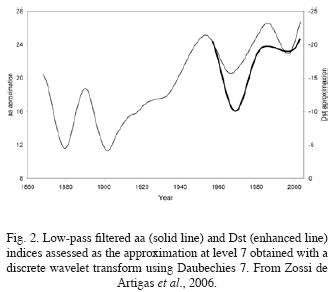
<body><![CDATA[<p align="justify"><font size="2" face="verdana"><b>Long&#150;term trend</b></font></p>     <p align="justify"><font face="verdana" size="2">The long&#150;term trend in the monthly number of storms (<a href="/img/revistas/geoint/v47n3/a17f1.jpg" target="_blank">Fig. 1f</a>) during the analyzed period is not a uniform or linear trend. It is similar that of Dst and aa geomagnetic indices (<a href="#f2">Fig. 2</a>, Zossi de Artigas <i>et al.</i>, 2006): minimum around the years 1965. Our results present another minimum around the 2000's. Many works exist on the long term variation of geomagnetic indices. Russell and Mulligan (1995) analyzed the average behavior of the index aa and they also suggest long term variations in the field of the polar region of the Sun. Cliverd <i>et al.</i> (1998) detected an increase in the number of storms in all the phases of the solar cycle, but in the minimum the increment is 40% superior to the other phases, concluding that the cause is a higher solar activity. Vennerstrom (2000) proposes that the growing tendency in geomagnetic activity is due to an increment in the parameters of the SW. Besides, Echer <i>et al.</i> (2004b) results have shown that, the correlation and lag variation between sunspot number (Rz) and aa geomagnetic index long&#150;term (annual) averages would probably caused by a stronger role of co&#150;rotating interaction regions. This seems to indicate an increase in open solar magnetic field structure strengths to drive geomagnetic activity in comparison to the closed ones.</font></p>     <p align="center"><font face="verdana" size="2"><a name="f2"></a></font></p>     <p align="center"><font face="verdana" size="2"><img src="/img/revistas/geoint/v47n3/a17f2.jpg"></font></p>     <p align="justify">&nbsp;</p>     <p align="justify"><font face="verdana" size="2"><b>Discussion and conclusions</b></font></p>     <p align="justify"><font face="verdana" size="2">Fourier analysis is a method for the analysis of stationary time series. Since it extracts global information, non&#150;stationarities in a small time interval may not be captured by the Fourier spectrum. (Chiann and Morettin, 1998). Wavelets provide a time&#150;frequency window, which shrinks for high frequencies and widens for low frequencies, capturing the local behavior of the signal.</font></p>     <p align="justify"><font face="verdana" size="2">The discrete wavelet transform, using the Daubechies function, was applied to obtain periodicities and long&#150;term trends in the number of geomagnetic storms, from 1957 to 2004. The behavior of the periodicities is not regular along the analyzed period, they have different intensity values, like peaks around 1990 (details 3 and 4).</font></p>     <p align="justify"><font face="verdana" size="2">The long&#150;term trend is similar, to that of Rz, what suggests that these variations may be due to changes in the Sun. Gonzalez <i>et al.</i> (1990) studied the frequency distribution of intense geomagnetic storms with the solar cycle and found that did not agree with the evolution of the number of sunspots. Cliver and Ling (2002), based on the similarity of the secular variations of aa and Rz, attribute a solar origin to the geomagnetic activity.</font></p>     <p align="justify"><font face="verdana" size="2">The wavelet transform is without doubt a powerful tool. Although the results do not differ much from those of other authors, the contribution of this work is the assessment of the oscillations in the amount of storms of different intensity, using local wavelet spectrum and the significance between the different periodicities like, the 5.5 years periodicity is as important as the 11 years one. The time variation of the pattern of each cycle is due to the fact that the formation of the storm&#150;time is linked to solar sources which, in turn, do not present cycles of constant periodicities and amplitude over time.</font></p>     ]]></body>
<body><![CDATA[<p align="justify">&nbsp;</p>     <p align="justify"><font size="2" face="verdana"><b>Bibliography</b></font></p>     <!-- ref --><p align="justify"><font face="verdana" size="2">Bell, J. T., S. Gussenhoven and E. G. Mullen, 1997. Super storms, <i>J. Geophys. Res., 102</i>, 14189&#150;14198.</font>&nbsp;&nbsp;&nbsp;&nbsp;&nbsp;&nbsp;&nbsp;&nbsp;[&#160;<a href="javascript:void(0);" onclick="javascript: window.open('/scielo.php?script=sci_nlinks&ref=3900330&pid=S0016-7169200800030001700001&lng=','','width=640,height=500,resizable=yes,scrollbars=1,menubar=yes,');">Links</a>&#160;]<!-- end-ref --><!-- ref --><p align="justify"><font face="verdana" size="2">Chapman, S. and J. Bartels, 1940. Geomagnetism, Chapter II, Oxford Univ. Press, New York.</font>&nbsp;&nbsp;&nbsp;&nbsp;&nbsp;&nbsp;&nbsp;&nbsp;[&#160;<a href="javascript:void(0);" onclick="javascript: window.open('/scielo.php?script=sci_nlinks&ref=3900331&pid=S0016-7169200800030001700002&lng=','','width=640,height=500,resizable=yes,scrollbars=1,menubar=yes,');">Links</a>&#160;]<!-- end-ref --><!-- ref --><p align="justify"><font face="verdana" size="2">Chiann, C. and P.A. Morettin, 1998, A wavelet analysis for time series, Nonparametric Statistics ,10, 1&#150;46.</font>&nbsp;&nbsp;&nbsp;&nbsp;&nbsp;&nbsp;&nbsp;&nbsp;[&#160;<a href="javascript:void(0);" onclick="javascript: window.open('/scielo.php?script=sci_nlinks&ref=3900332&pid=S0016-7169200800030001700003&lng=','','width=640,height=500,resizable=yes,scrollbars=1,menubar=yes,');">Links</a>&#160;]<!-- end-ref --><!-- ref --><p align="justify"><font face="verdana" size="2">Clilverd, M. A., Clark, T.D.G., Clarke E., and Rishberth, H., 1998, Increased magnetic storms activity from 1868 to 1995,<i> Journal of Atmospheric and Solar&#150;Terrestrial Physics, 60</i>, 1047&#150;1056.</font>&nbsp;&nbsp;&nbsp;&nbsp;&nbsp;&nbsp;&nbsp;&nbsp;[&#160;<a href="javascript:void(0);" onclick="javascript: window.open('/scielo.php?script=sci_nlinks&ref=3900333&pid=S0016-7169200800030001700004&lng=','','width=640,height=500,resizable=yes,scrollbars=1,menubar=yes,');">Links</a>&#160;]<!-- end-ref --><!-- ref --><p align="justify"><font face="verdana" size="2">Clilverd, M. A., T. D. G. Clark, E. Clarke, H. Rishberth and T. Ulich, 2002. The causes of long&#150; term change in the aa index, <i>Journal of Geophysical Research, 107</i>, NO.0, XXXX, doi:10.1029/2001JA000501.</font>&nbsp;&nbsp;&nbsp;&nbsp;&nbsp;&nbsp;&nbsp;&nbsp;[&#160;<a href="javascript:void(0);" onclick="javascript: window.open('/scielo.php?script=sci_nlinks&ref=3900334&pid=S0016-7169200800030001700005&lng=','','width=640,height=500,resizable=yes,scrollbars=1,menubar=yes,');">Links</a>&#160;]<!-- end-ref --><!-- ref --><p align="justify"><font face="verdana" size="2">Cliver, E., Y. Kamide and A. Ling, 2000. Mountains versus valleys: Semiannual variation of geomagnetic activity, <i>J. Geophys. Res., 106</i>, 2413.</font>&nbsp;&nbsp;&nbsp;&nbsp;&nbsp;&nbsp;&nbsp;&nbsp;[&#160;<a href="javascript:void(0);" onclick="javascript: window.open('/scielo.php?script=sci_nlinks&ref=3900335&pid=S0016-7169200800030001700006&lng=','','width=640,height=500,resizable=yes,scrollbars=1,menubar=yes,');">Links</a>&#160;]<!-- end-ref --><!-- ref --><p align="justify"><font face="verdana" size="2">Cliver, E. W. and A. G. Ling, 2002. Secular change in geomagnetic indices and the solar open magnetic flux during the first half of the twentieth century. <i>J. Geophys. Res. 107</i>, 1303. doi:10.1029/2001JA000505.</font>&nbsp;&nbsp;&nbsp;&nbsp;&nbsp;&nbsp;&nbsp;&nbsp;[&#160;<a href="javascript:void(0);" onclick="javascript: window.open('/scielo.php?script=sci_nlinks&ref=3900336&pid=S0016-7169200800030001700007&lng=','','width=640,height=500,resizable=yes,scrollbars=1,menubar=yes,');">Links</a>&#160;]<!-- end-ref --><!-- ref --><p align="justify"><font face="verdana" size="2">Clua de Gonzalez, A. L., W. D. Gonzalez and S. L. G. Dutra, 1993. Periodic variation in the geomagnetic activity: A study based on the Ap index, <i>J. Geophys. Res., 98</i>, 9215&#150;9231.</font>&nbsp;&nbsp;&nbsp;&nbsp;&nbsp;&nbsp;&nbsp;&nbsp;[&#160;<a href="javascript:void(0);" onclick="javascript: window.open('/scielo.php?script=sci_nlinks&ref=3900337&pid=S0016-7169200800030001700008&lng=','','width=640,height=500,resizable=yes,scrollbars=1,menubar=yes,');">Links</a>&#160;]<!-- end-ref --><!-- ref --><p align="justify"><font face="verdana" size="2">Crooker, N. U., E. W. Cliver and B. T. Tsurutani, 1992. The semiannual variation of great geomagnetic storms and the postshock Rusell&#150;Mc Pherron effect preceding coronal mass ejecta, <i>Geophys. Res. Lett., 19</i>, 429&#150;432.</font>&nbsp;&nbsp;&nbsp;&nbsp;&nbsp;&nbsp;&nbsp;&nbsp;[&#160;<a href="javascript:void(0);" onclick="javascript: window.open('/scielo.php?script=sci_nlinks&ref=3900338&pid=S0016-7169200800030001700009&lng=','','width=640,height=500,resizable=yes,scrollbars=1,menubar=yes,');">Links</a>&#160;]<!-- end-ref --><!-- ref --><p align="justify"><font face="verdana" size="2">Daubechies, I., 1988. Orthonormal bases of compactly supported wavelets. <i>Comm. Pure Appl., Math. 41</i>, 906&#150;966.</font>&nbsp;&nbsp;&nbsp;&nbsp;&nbsp;&nbsp;&nbsp;&nbsp;[&#160;<a href="javascript:void(0);" onclick="javascript: window.open('/scielo.php?script=sci_nlinks&ref=3900339&pid=S0016-7169200800030001700010&lng=','','width=640,height=500,resizable=yes,scrollbars=1,menubar=yes,');">Links</a>&#160;]<!-- end-ref --><!-- ref --><p align="justify"><font face="verdana" size="2">Daubechies, I., 1992. Ten lectures on wavelets, second ed. SIAM, Philadelphia.</font>&nbsp;&nbsp;&nbsp;&nbsp;&nbsp;&nbsp;&nbsp;&nbsp;[&#160;<a href="javascript:void(0);" onclick="javascript: window.open('/scielo.php?script=sci_nlinks&ref=3900340&pid=S0016-7169200800030001700011&lng=','','width=640,height=500,resizable=yes,scrollbars=1,menubar=yes,');">Links</a>&#160;]<!-- end-ref --><!-- ref --><p align="justify"><font face="verdana" size="2">Delouis, H. and P. Mayaud, 1975. Spectral analysis of the geomagnetic activity index aa over a103&#150;year interval, <i>J. Geophys. Res., 80</i>, 4681&#150;4688.</font>&nbsp;&nbsp;&nbsp;&nbsp;&nbsp;&nbsp;&nbsp;&nbsp;[&#160;<a href="javascript:void(0);" onclick="javascript: window.open('/scielo.php?script=sci_nlinks&ref=3900341&pid=S0016-7169200800030001700012&lng=','','width=640,height=500,resizable=yes,scrollbars=1,menubar=yes,');">Links</a>&#160;]<!-- end-ref --><!-- ref --><p align="justify"><font face="verdana" size="2">Djurovic and P. Paquet, 1996. <i>Solar Phys. 167,</i> 427.</font>&nbsp;&nbsp;&nbsp;&nbsp;&nbsp;&nbsp;&nbsp;&nbsp;[&#160;<a href="javascript:void(0);" onclick="javascript: window.open('/scielo.php?script=sci_nlinks&ref=3900342&pid=S0016-7169200800030001700013&lng=','','width=640,height=500,resizable=yes,scrollbars=1,menubar=yes,');">Links</a>&#160;]<!-- end-ref --><!-- ref --><p align="justify"><font face="verdana" size="2">Echer, E., N. R. Rigozo, M. P. Souza Echer, L. E. A. Vieira, D. J. R. Nordemann, 2004a. Reconstruction of the aa index on the basis of spectral characteristics. <i>Geof&iacute;sica Internacional, 43</i>, 1, p. 103&#150;111.</font>&nbsp;&nbsp;&nbsp;&nbsp;&nbsp;&nbsp;&nbsp;&nbsp;[&#160;<a href="javascript:void(0);" onclick="javascript: window.open('/scielo.php?script=sci_nlinks&ref=3900343&pid=S0016-7169200800030001700014&lng=','','width=640,height=500,resizable=yes,scrollbars=1,menubar=yes,');">Links</a>&#160;]<!-- end-ref --><!-- ref --><p align="justify"><font face="verdana" size="2">Echer, E., W. D. Gonzalez, A. L. C. Gonzalez, A. Prestes, L. E. A. Vieira, A. Dal Lago, F. L. Guarnieri and N. J. Schuch, 2004b. Long Term Correlation between solar and Geomagnetic Activity, <i>J. Atmos. Terr. Phys., 66</i>, 1019&#150;1025.</font>&nbsp;&nbsp;&nbsp;&nbsp;&nbsp;&nbsp;&nbsp;&nbsp;[&#160;<a href="javascript:void(0);" onclick="javascript: window.open('/scielo.php?script=sci_nlinks&ref=3900344&pid=S0016-7169200800030001700015&lng=','','width=640,height=500,resizable=yes,scrollbars=1,menubar=yes,');">Links</a>&#160;]<!-- end-ref --><!-- ref --><p align="justify"><font face="verdana" size="2">Fraser&#150;Smith, A., 1972. The spectrum of geomagnetic activity index Ap, <i>J. Geophys. Res., 77</i>, 4209&#150;4220.</font>&nbsp;&nbsp;&nbsp;&nbsp;&nbsp;&nbsp;&nbsp;&nbsp;[&#160;<a href="javascript:void(0);" onclick="javascript: window.open('/scielo.php?script=sci_nlinks&ref=3900345&pid=S0016-7169200800030001700016&lng=','','width=640,height=500,resizable=yes,scrollbars=1,menubar=yes,');">Links</a>&#160;]<!-- end-ref --><!-- ref --><p align="justify"><font face="verdana" size="2">Gazis, P. R., J. D. Richardson and K. I. Paularena, 1995. Long term periodicity in solar wind velocity during the last three solar cycles, <i>Geophys. Res. Lett., 22</i>, 1165&#150;1168.</font>&nbsp;&nbsp;&nbsp;&nbsp;&nbsp;&nbsp;&nbsp;&nbsp;[&#160;<a href="javascript:void(0);" onclick="javascript: window.open('/scielo.php?script=sci_nlinks&ref=3900346&pid=S0016-7169200800030001700017&lng=','','width=640,height=500,resizable=yes,scrollbars=1,menubar=yes,');">Links</a>&#160;]<!-- end-ref --><!-- ref --><p align="justify"><font face="verdana" size="2">Gazis, P. R., 1996. Long term enhancements in the solar wind speeds, <i>J. Geophys. Res., 101</i>, 415&#150;424.</font>&nbsp;&nbsp;&nbsp;&nbsp;&nbsp;&nbsp;&nbsp;&nbsp;[&#160;<a href="javascript:void(0);" onclick="javascript: window.open('/scielo.php?script=sci_nlinks&ref=3900347&pid=S0016-7169200800030001700018&lng=','','width=640,height=500,resizable=yes,scrollbars=1,menubar=yes,');">Links</a>&#160;]<!-- end-ref --><!-- ref --><p align="justify"><font face="verdana" size="2">Gnevyshev, M., 1967. On the 11&#150;years cycle of solar activity, <i>Solar Phys., 1</i>, 109&#150;120.</font>&nbsp;&nbsp;&nbsp;&nbsp;&nbsp;&nbsp;&nbsp;&nbsp;[&#160;<a href="javascript:void(0);" onclick="javascript: window.open('/scielo.php?script=sci_nlinks&ref=3900348&pid=S0016-7169200800030001700019&lng=','','width=640,height=500,resizable=yes,scrollbars=1,menubar=yes,');">Links</a>&#160;]<!-- end-ref --><!-- ref --><p align="justify"><font face="verdana" size="2">Gonzalez, W., A. Gonzalez and B. Tsurutani, 1990. Dual peak distribution of intense geomagnetic storms, <i>Planet. Space. Sci., 38</i>, 181&#150;187.</font>&nbsp;&nbsp;&nbsp;&nbsp;&nbsp;&nbsp;&nbsp;&nbsp;[&#160;<a href="javascript:void(0);" onclick="javascript: window.open('/scielo.php?script=sci_nlinks&ref=3900349&pid=S0016-7169200800030001700020&lng=','','width=640,height=500,resizable=yes,scrollbars=1,menubar=yes,');">Links</a>&#160;]<!-- end-ref --><!-- ref --><p align="justify"><font face="verdana" size="2">Gonzalez, W. D. and B. T. Tsurutani, 1992. Terrestrial response to eruptive solar flares: Geomagnetic storms, in Eruptive Solar flares, edited by Z. Svestka, B.V. Jackson, and M. E. Machado, 277&#150;286, Springer&#150;Verlag, New York.</font>&nbsp;&nbsp;&nbsp;&nbsp;&nbsp;&nbsp;&nbsp;&nbsp;[&#160;<a href="javascript:void(0);" onclick="javascript: window.open('/scielo.php?script=sci_nlinks&ref=3900350&pid=S0016-7169200800030001700021&lng=','','width=640,height=500,resizable=yes,scrollbars=1,menubar=yes,');">Links</a>&#160;]<!-- end-ref --><!-- ref --><p align="justify"><font face="verdana" size="2">Gonzalez, A., W. Gonzalez and S. Dutra, 1993. Periodic variations in the geomagnetic activity: A study based on the Ap index, <i>J. Geophys. Res., 98</i>, 9215&#150;9231.</font>&nbsp;&nbsp;&nbsp;&nbsp;&nbsp;&nbsp;&nbsp;&nbsp;[&#160;<a href="javascript:void(0);" onclick="javascript: window.open('/scielo.php?script=sci_nlinks&ref=3900351&pid=S0016-7169200800030001700022&lng=','','width=640,height=500,resizable=yes,scrollbars=1,menubar=yes,');">Links</a>&#160;]<!-- end-ref --><!-- ref --><p align="justify"><font face="verdana" size="2">Gonzalez, W., B. Tsurutani, P. McIntosh and A. Gonzalez, 1996. Coronal hole&#150; Active region&#150;Current sheet (CHARCS) association with intense interplanetary and geomagnetic activity, <i>Geophys. Res. Lett., 23</i>, 2577&#150;2580.</font>&nbsp;&nbsp;&nbsp;&nbsp;&nbsp;&nbsp;&nbsp;&nbsp;[&#160;<a href="javascript:void(0);" onclick="javascript: window.open('/scielo.php?script=sci_nlinks&ref=3900352&pid=S0016-7169200800030001700023&lng=','','width=640,height=500,resizable=yes,scrollbars=1,menubar=yes,');">Links</a>&#160;]<!-- end-ref --><!-- ref --><p align="justify"><font face="verdana" size="2">Horgan, G. W., 1999. Using wavelets for data smoothing: a simulation study. <i>J. Appl. Stat. 26 (8),</i> 923&#150;932.</font>&nbsp;&nbsp;&nbsp;&nbsp;&nbsp;&nbsp;&nbsp;&nbsp;[&#160;<a href="javascript:void(0);" onclick="javascript: window.open('/scielo.php?script=sci_nlinks&ref=3900353&pid=S0016-7169200800030001700024&lng=','','width=640,height=500,resizable=yes,scrollbars=1,menubar=yes,');">Links</a>&#160;]<!-- end-ref --><!-- ref --><p align="justify"><font face="verdana" size="2">Jarvis, M. J., 1996. Quasi&#150;biennial oscillation effects in the semidiurnal tide of the Antarctic lower thermosphere, <i>Geophys. Res. Let., 23</i>, 2661&#150;2664.</font>&nbsp;&nbsp;&nbsp;&nbsp;&nbsp;&nbsp;&nbsp;&nbsp;[&#160;<a href="javascript:void(0);" onclick="javascript: window.open('/scielo.php?script=sci_nlinks&ref=3900354&pid=S0016-7169200800030001700025&lng=','','width=640,height=500,resizable=yes,scrollbars=1,menubar=yes,');">Links</a>&#160;]<!-- end-ref --><!-- ref --><p align="justify"><font face="verdana" size="2">Kane, R. P., 1997. Quasi&#150;biennial and quasi&#150;triennial oscillations in geomagnetic activity indices, <i>Ann. Geophysicae, 15</i>, 1581&#150;1594.</font>&nbsp;&nbsp;&nbsp;&nbsp;&nbsp;&nbsp;&nbsp;&nbsp;[&#160;<a href="javascript:void(0);" onclick="javascript: window.open('/scielo.php?script=sci_nlinks&ref=3900355&pid=S0016-7169200800030001700026&lng=','','width=640,height=500,resizable=yes,scrollbars=1,menubar=yes,');">Links</a>&#160;]<!-- end-ref --><!-- ref --><p align="justify"><font face="verdana" size="2">Kane, R. P., 2005. Differences in the quasi&#150;biennial oscillation and quasi&#150;triennial oscillation characteristics of the solar, interplanetary, and terrestrial parameters, <i>J. Geophys. Res., 110</i>, A01108, doi: 10.1029/2004JA010606.</font>&nbsp;&nbsp;&nbsp;&nbsp;&nbsp;&nbsp;&nbsp;&nbsp;[&#160;<a href="javascript:void(0);" onclick="javascript: window.open('/scielo.php?script=sci_nlinks&ref=3900356&pid=S0016-7169200800030001700027&lng=','','width=640,height=500,resizable=yes,scrollbars=1,menubar=yes,');">Links</a>&#160;]<!-- end-ref --><!-- ref --><p align="justify"><font face="verdana" size="2">Mayaud, P. N., 1980. Derivation, Meaning, and Use of Geomagnetic Indices, Geophysical Monograph 22, American Geophysical Union, Washington D.C.</font>&nbsp;&nbsp;&nbsp;&nbsp;&nbsp;&nbsp;&nbsp;&nbsp;[&#160;<a href="javascript:void(0);" onclick="javascript: window.open('/scielo.php?script=sci_nlinks&ref=3900357&pid=S0016-7169200800030001700028&lng=','','width=640,height=500,resizable=yes,scrollbars=1,menubar=yes,');">Links</a>&#160;]<!-- end-ref --><!-- ref --><p align="justify"><font face="verdana" size="2">Murayama, T., 1974. Origin of the semiannual variation of geomagnetic Kp indices, <i>J. Geophys. Res., 79</i>, 297&#150;300.</font>&nbsp;&nbsp;&nbsp;&nbsp;&nbsp;&nbsp;&nbsp;&nbsp;[&#160;<a href="javascript:void(0);" onclick="javascript: window.open('/scielo.php?script=sci_nlinks&ref=3900358&pid=S0016-7169200800030001700029&lng=','','width=640,height=500,resizable=yes,scrollbars=1,menubar=yes,');">Links</a>&#160;]<!-- end-ref --><!-- ref --><p align="justify"><font face="verdana" size="2">Mursula, K. and B. Zieger, 2001. Simultaneous Occurrence of Mid&#150;Term Periodicities in Solar Wind Speed, Geomagnetic Activity and Cosmic Rays, Proceedings of the 26th International Cosmic Ray Conference, 7, 123&#150;126.</font>&nbsp;&nbsp;&nbsp;&nbsp;&nbsp;&nbsp;&nbsp;&nbsp;[&#160;<a href="javascript:void(0);" onclick="javascript: window.open('/scielo.php?script=sci_nlinks&ref=3900359&pid=S0016-7169200800030001700030&lng=','','width=640,height=500,resizable=yes,scrollbars=1,menubar=yes,');">Links</a>&#160;]<!-- end-ref --><!-- ref --><p align="justify"><font face="verdana" size="2">Olsen, N., 1994. A 27&#150;month periodicity in the low latitude geomagnetic field and its connection to the stratospheric QBO, <i>Geophys. Res. Lett., 21</i>, 1125&#150;1128.</font>&nbsp;&nbsp;&nbsp;&nbsp;&nbsp;&nbsp;&nbsp;&nbsp;[&#160;<a href="javascript:void(0);" onclick="javascript: window.open('/scielo.php?script=sci_nlinks&ref=3900360&pid=S0016-7169200800030001700031&lng=','','width=640,height=500,resizable=yes,scrollbars=1,menubar=yes,');">Links</a>&#160;]<!-- end-ref --><!-- ref --><p align="justify"><font face="verdana" size="2">Olsen, N. and M. Kiefer, 1995. Geomagnetic daily variations produced by a QBO in thermospheric prevailing winds, J. Atmos. Terr. Phys., 57, 1583&#150;1589.</font>&nbsp;&nbsp;&nbsp;&nbsp;&nbsp;&nbsp;&nbsp;&nbsp;[&#160;<a href="javascript:void(0);" onclick="javascript: window.open('/scielo.php?script=sci_nlinks&ref=3900361&pid=S0016-7169200800030001700032&lng=','','width=640,height=500,resizable=yes,scrollbars=1,menubar=yes,');">Links</a>&#160;]<!-- end-ref --><!-- ref --><p align="justify"><font face="verdana" size="2">Raja Rao, K. S. and K. T. Joseph, 1971. Quasi&#150;biennial oscillation in the geomagnetic Sq field in the low latitude region, J. Atmos. Terr. Phys., 33, 797&#150;805.</font>&nbsp;&nbsp;&nbsp;&nbsp;&nbsp;&nbsp;&nbsp;&nbsp;[&#160;<a href="javascript:void(0);" onclick="javascript: window.open('/scielo.php?script=sci_nlinks&ref=3900362&pid=S0016-7169200800030001700033&lng=','','width=640,height=500,resizable=yes,scrollbars=1,menubar=yes,');">Links</a>&#160;]<!-- end-ref --><!-- ref --><p align="justify"><font face="verdana" size="2">Rangarajan, G. K. and T. Iyemori, 1997. Time variations of geomagnetic activity indices Kp and Ap: an update, <i>Ann. Geophysicae, 15</i>, 1271&#150;1290.</font>&nbsp;&nbsp;&nbsp;&nbsp;&nbsp;&nbsp;&nbsp;&nbsp;[&#160;<a href="javascript:void(0);" onclick="javascript: window.open('/scielo.php?script=sci_nlinks&ref=3900363&pid=S0016-7169200800030001700034&lng=','','width=640,height=500,resizable=yes,scrollbars=1,menubar=yes,');">Links</a>&#160;]<!-- end-ref --><!-- ref --><p align="justify"><font face="verdana" size="2">Rangarajan, G. K. and L. M. Barreto, 2000. Long term variability in solar wind velocity and IMF intensity and the relationship between solar wind parameters &amp; geomagnetic activity, <i>Earth Planets Space, 52</i>, 121&#150;132.</font>&nbsp;&nbsp;&nbsp;&nbsp;&nbsp;&nbsp;&nbsp;&nbsp;[&#160;<a href="javascript:void(0);" onclick="javascript: window.open('/scielo.php?script=sci_nlinks&ref=3900364&pid=S0016-7169200800030001700035&lng=','','width=640,height=500,resizable=yes,scrollbars=1,menubar=yes,');">Links</a>&#160;]<!-- end-ref --><!-- ref --><p align="justify"><font face="verdana" size="2">Richardson, J. D, K. I. Paularena, J. W. Belcher and A. J. Lazarus, 1994. Solar wind oscillations with a 1.3&#150;year period, <i>Geophys. Res. Lett., 21</i>, 1559&#150;1560.</font>&nbsp;&nbsp;&nbsp;&nbsp;&nbsp;&nbsp;&nbsp;&nbsp;[&#160;<a href="javascript:void(0);" onclick="javascript: window.open('/scielo.php?script=sci_nlinks&ref=3900365&pid=S0016-7169200800030001700036&lng=','','width=640,height=500,resizable=yes,scrollbars=1,menubar=yes,');">Links</a>&#160;]<!-- end-ref --><!-- ref --><p align="justify"><font face="verdana" size="2">Russell, C. T. and R. L. McPherron, 1973. Semiannual variation of geomagnetic activity, <i>J. Geophys. Res., 78</i>, 92&#150;108.</font>&nbsp;&nbsp;&nbsp;&nbsp;&nbsp;&nbsp;&nbsp;&nbsp;[&#160;<a href="javascript:void(0);" onclick="javascript: window.open('/scielo.php?script=sci_nlinks&ref=3900366&pid=S0016-7169200800030001700037&lng=','','width=640,height=500,resizable=yes,scrollbars=1,menubar=yes,');">Links</a>&#160;]<!-- end-ref --><!-- ref --><p align="justify"><font face="verdana" size="2">Russell, C. T. and T. Mulligan, 1995. The 22&#150;year variation of geomagnetic activity: Implications for the polar magnetic field of the Sun, <i>Geophys. Res. Lett., 22</i>, 3287&#150;3288.</font>&nbsp;&nbsp;&nbsp;&nbsp;&nbsp;&nbsp;&nbsp;&nbsp;[&#160;<a href="javascript:void(0);" onclick="javascript: window.open('/scielo.php?script=sci_nlinks&ref=3900367&pid=S0016-7169200800030001700038&lng=','','width=640,height=500,resizable=yes,scrollbars=1,menubar=yes,');">Links</a>&#160;]<!-- end-ref --><!-- ref --><p align="justify"><font face="verdana" size="2">Schreiber, H., 1998. On the periodic variations of geomagnetic activity indices Ap and ap, <i>Ann. Geophysicae, 16</i>, 510&#150;517.</font>&nbsp;&nbsp;&nbsp;&nbsp;&nbsp;&nbsp;&nbsp;&nbsp;[&#160;<a href="javascript:void(0);" onclick="javascript: window.open('/scielo.php?script=sci_nlinks&ref=3900368&pid=S0016-7169200800030001700039&lng=','','width=640,height=500,resizable=yes,scrollbars=1,menubar=yes,');">Links</a>&#160;]<!-- end-ref --><!-- ref --><p align="justify"><font face="verdana" size="2">Shapiro, R., 1967, Interpretation of the subsidiary peaks at periods near 27 days in power spectra of geomagnetic disturbance indices. <i>J. Geophys. Res., 72</i>, 4945.</font>&nbsp;&nbsp;&nbsp;&nbsp;&nbsp;&nbsp;&nbsp;&nbsp;[&#160;<a href="javascript:void(0);" onclick="javascript: window.open('/scielo.php?script=sci_nlinks&ref=3900369&pid=S0016-7169200800030001700040&lng=','','width=640,height=500,resizable=yes,scrollbars=1,menubar=yes,');">Links</a>&#160;]<!-- end-ref --><!-- ref --><p align="justify"><font face="verdana" size="2">Silverman, S. M. and R. Shapiro, 1983. Power spectral analysis of auroral occurrence frequency, <i>J. Geophys. Res., 88</i>, 6310&#150;6316.</font>&nbsp;&nbsp;&nbsp;&nbsp;&nbsp;&nbsp;&nbsp;&nbsp;[&#160;<a href="javascript:void(0);" onclick="javascript: window.open('/scielo.php?script=sci_nlinks&ref=3900370&pid=S0016-7169200800030001700041&lng=','','width=640,height=500,resizable=yes,scrollbars=1,menubar=yes,');">Links</a>&#160;]<!-- end-ref --><!-- ref --><p align="justify"><font face="verdana" size="2">Stacey, F.D and P. Westcott, 1962. Possibility of a 26&#150;month periodicity in the equatorial geomagnetic field and its correlation with stratospheric winds, <i>Nature, 196</i>, 730&#150;732.</font>&nbsp;&nbsp;&nbsp;&nbsp;&nbsp;&nbsp;&nbsp;&nbsp;[&#160;<a href="javascript:void(0);" onclick="javascript: window.open('/scielo.php?script=sci_nlinks&ref=3900371&pid=S0016-7169200800030001700042&lng=','','width=640,height=500,resizable=yes,scrollbars=1,menubar=yes,');">Links</a>&#160;]<!-- end-ref --><!-- ref --><p align="justify"><font face="verdana" size="2">Sugiura, M., 1980, What Do We Expect in Magnetic Activity in the Current Solar Cycle?, EOS Trans. AGU, 61(43), 673&#150;675.</font>&nbsp;&nbsp;&nbsp;&nbsp;&nbsp;&nbsp;&nbsp;&nbsp;[&#160;<a href="javascript:void(0);" onclick="javascript: window.open('/scielo.php?script=sci_nlinks&ref=3900372&pid=S0016-7169200800030001700043&lng=','','width=640,height=500,resizable=yes,scrollbars=1,menubar=yes,');">Links</a>&#160;]<!-- end-ref --><!-- ref --><p align="justify"><font face="verdana" size="2">Szabo, A., R. Lepping and J. King, 1995. Magnetic field observations of the 1.3&#150;year solar wind oscillation, <i>Geophys. Res. Lett., 22</i>, 1845&#150;1848.</font>&nbsp;&nbsp;&nbsp;&nbsp;&nbsp;&nbsp;&nbsp;&nbsp;[&#160;<a href="javascript:void(0);" onclick="javascript: window.open('/scielo.php?script=sci_nlinks&ref=3900373&pid=S0016-7169200800030001700044&lng=','','width=640,height=500,resizable=yes,scrollbars=1,menubar=yes,');">Links</a>&#160;]<!-- end-ref --><!-- ref --><p align="justify"><font face="verdana" size="2">Valdes&#150;Galicia, J. F. and R. Perez&#150;Enriquez, 1996. The Cosmic&#150;ray 1.68 year variation: A clue to understand the nature of the solar cycle?, <i>Solar Physics. 167</i>, 1&#150;2. 409&#150;417.</font>&nbsp;&nbsp;&nbsp;&nbsp;&nbsp;&nbsp;&nbsp;&nbsp;[&#160;<a href="javascript:void(0);" onclick="javascript: window.open('/scielo.php?script=sci_nlinks&ref=3900374&pid=S0016-7169200800030001700045&lng=','','width=640,height=500,resizable=yes,scrollbars=1,menubar=yes,');">Links</a>&#160;]<!-- end-ref --><!-- ref --><p align="justify"><font face="verdana" size="2">Vennerstrom, S. and E. Friis&#150;Christensen, 1996. Long&#150;term and solar cycle variation of the ring current, <i>J. Geophys. Res., 101</i>, 24727&#150;24732.</font>&nbsp;&nbsp;&nbsp;&nbsp;&nbsp;&nbsp;&nbsp;&nbsp;[&#160;<a href="javascript:void(0);" onclick="javascript: window.open('/scielo.php?script=sci_nlinks&ref=3900375&pid=S0016-7169200800030001700046&lng=','','width=640,height=500,resizable=yes,scrollbars=1,menubar=yes,');">Links</a>&#160;]<!-- end-ref --><!-- ref --><p align="justify"><font face="verdana" size="2">Vennerstrom, S., 2000. Long&#150;term rise in geomagnetic activity &#150; A close connection between quiet days and storms. <i>Geophys. Res. Lett. 27</i>, 69&#150;72.</font>&nbsp;&nbsp;&nbsp;&nbsp;&nbsp;&nbsp;&nbsp;&nbsp;[&#160;<a href="javascript:void(0);" onclick="javascript: window.open('/scielo.php?script=sci_nlinks&ref=3900376&pid=S0016-7169200800030001700047&lng=','','width=640,height=500,resizable=yes,scrollbars=1,menubar=yes,');">Links</a>&#160;]<!-- end-ref --><!-- ref --><p align="justify"><font face="verdana" size="2">Yacob, A. and B. N. Bhargava, 1968. On 26&#150;month periodicity in quiet&#150;day range of geomagnetic horizontal force and in sunspot number, <i>J. Atmos. Terr. Phys., 30</i>, 1907&#150;1911.</font>&nbsp;&nbsp;&nbsp;&nbsp;&nbsp;&nbsp;&nbsp;&nbsp;[&#160;<a href="javascript:void(0);" onclick="javascript: window.open('/scielo.php?script=sci_nlinks&ref=3900377&pid=S0016-7169200800030001700048&lng=','','width=640,height=500,resizable=yes,scrollbars=1,menubar=yes,');">Links</a>&#160;]<!-- end-ref --><!-- ref --><p align="justify"><font face="verdana" size="2">Zossi de Artigas, M., A. G. Elias and P. Fernandez de Campra, 2006. Discrete wavelet analysis to assess long&#150;term trends in geomagnetic activity, <i>Physics and Chemistry of the Earth, 31</i>, 77&#150;80.</font>&nbsp;&nbsp;&nbsp;&nbsp;&nbsp;&nbsp;&nbsp;&nbsp;[&#160;<a href="javascript:void(0);" onclick="javascript: window.open('/scielo.php?script=sci_nlinks&ref=3900378&pid=S0016-7169200800030001700049&lng=','','width=640,height=500,resizable=yes,scrollbars=1,menubar=yes,');">Links</a>&#160;]<!-- end-ref --> ]]></body><back>
<ref-list>
<ref id="B1">
<nlm-citation citation-type="journal">
<person-group person-group-type="author">
<name>
<surname><![CDATA[Bell]]></surname>
<given-names><![CDATA[J. T.]]></given-names>
</name>
<name>
<surname><![CDATA[Gussenhoven]]></surname>
<given-names><![CDATA[S]]></given-names>
</name>
<name>
<surname><![CDATA[Mullen]]></surname>
<given-names><![CDATA[E. G.]]></given-names>
</name>
</person-group>
<article-title xml:lang="en"><![CDATA[Super storms]]></article-title>
<source><![CDATA[J. Geophys. Res.]]></source>
<year>1997</year>
<numero>102</numero>
<issue>102</issue>
<page-range>14189-14198</page-range></nlm-citation>
</ref>
<ref id="B2">
<nlm-citation citation-type="book">
<person-group person-group-type="author">
<name>
<surname><![CDATA[Chapman]]></surname>
<given-names><![CDATA[S]]></given-names>
</name>
<name>
<surname><![CDATA[Bartels]]></surname>
<given-names><![CDATA[J]]></given-names>
</name>
</person-group>
<source><![CDATA[Geomagnetism]]></source>
<year>1940</year>
<publisher-loc><![CDATA[New York ]]></publisher-loc>
<publisher-name><![CDATA[Oxford Univ. Press]]></publisher-name>
</nlm-citation>
</ref>
<ref id="B3">
<nlm-citation citation-type="book">
<person-group person-group-type="author">
<name>
<surname><![CDATA[Chiann]]></surname>
<given-names><![CDATA[C]]></given-names>
</name>
<name>
<surname><![CDATA[Morettin]]></surname>
<given-names><![CDATA[P.A.]]></given-names>
</name>
</person-group>
<source><![CDATA[A wavelet analysis for time series]]></source>
<year>1998</year>
<volume>10</volume>
<page-range>1-46</page-range><publisher-name><![CDATA[Nonparametric Statistics]]></publisher-name>
</nlm-citation>
</ref>
<ref id="B4">
<nlm-citation citation-type="journal">
<person-group person-group-type="author">
<name>
<surname><![CDATA[Clilverd]]></surname>
<given-names><![CDATA[M. A.]]></given-names>
</name>
<name>
<surname><![CDATA[Clark]]></surname>
<given-names><![CDATA[T.D.G.]]></given-names>
</name>
<name>
<surname><![CDATA[Clarke]]></surname>
<given-names><![CDATA[E]]></given-names>
</name>
<name>
<surname><![CDATA[Rishberth]]></surname>
<given-names><![CDATA[H]]></given-names>
</name>
</person-group>
<article-title xml:lang="en"><![CDATA[Increased magnetic storms activity from 1868 to 1995]]></article-title>
<source><![CDATA[Journal of Atmospheric and Solar-Terrestrial Physics]]></source>
<year>1998</year>
<numero>60</numero>
<issue>60</issue>
<page-range>1047-1056</page-range></nlm-citation>
</ref>
<ref id="B5">
<nlm-citation citation-type="journal">
<person-group person-group-type="author">
<name>
<surname><![CDATA[Clilverd]]></surname>
<given-names><![CDATA[M. A.]]></given-names>
</name>
<name>
<surname><![CDATA[Clark]]></surname>
<given-names><![CDATA[T. D. G.]]></given-names>
</name>
<name>
<surname><![CDATA[Clarke]]></surname>
<given-names><![CDATA[E]]></given-names>
</name>
<name>
<surname><![CDATA[Rishberth]]></surname>
<given-names><![CDATA[H]]></given-names>
</name>
<name>
<surname><![CDATA[Ulich]]></surname>
<given-names><![CDATA[T]]></given-names>
</name>
</person-group>
<article-title xml:lang="en"><![CDATA[The causes of long- term change in the aa index]]></article-title>
<source><![CDATA[Journal of Geophysical Research]]></source>
<year>2002</year>
<numero>107</numero>
<issue>107</issue>
</nlm-citation>
</ref>
<ref id="B6">
<nlm-citation citation-type="journal">
<person-group person-group-type="author">
<name>
<surname><![CDATA[Cliver]]></surname>
<given-names><![CDATA[E]]></given-names>
</name>
<name>
<surname><![CDATA[Kamide]]></surname>
<given-names><![CDATA[Y]]></given-names>
</name>
<name>
<surname><![CDATA[Ling]]></surname>
<given-names><![CDATA[A]]></given-names>
</name>
</person-group>
<article-title xml:lang="en"><![CDATA[Mountains versus valleys: Semiannual variation of geomagnetic activity]]></article-title>
<source><![CDATA[J. Geophys. Res.]]></source>
<year>2000</year>
<numero>106</numero>
<issue>106</issue>
<page-range>2413</page-range></nlm-citation>
</ref>
<ref id="B7">
<nlm-citation citation-type="journal">
<person-group person-group-type="author">
<name>
<surname><![CDATA[Cliver]]></surname>
<given-names><![CDATA[E. W.]]></given-names>
</name>
<name>
<surname><![CDATA[Ling]]></surname>
<given-names><![CDATA[A. G.]]></given-names>
</name>
</person-group>
<article-title xml:lang="en"><![CDATA[Secular change in geomagnetic indices and the solar open magnetic flux during the first half of the twentieth century]]></article-title>
<source><![CDATA[J. Geophys. Res.]]></source>
<year>2002</year>
<numero>107</numero>
<issue>107</issue>
<page-range>1303</page-range></nlm-citation>
</ref>
<ref id="B8">
<nlm-citation citation-type="journal">
<person-group person-group-type="author">
<name>
<surname><![CDATA[Clua de Gonzalez]]></surname>
<given-names><![CDATA[A. L.]]></given-names>
</name>
<name>
<surname><![CDATA[Gonzalez]]></surname>
<given-names><![CDATA[W. D.]]></given-names>
</name>
<name>
<surname><![CDATA[Dutra]]></surname>
<given-names><![CDATA[S. L. G.]]></given-names>
</name>
</person-group>
<article-title xml:lang="en"><![CDATA[Periodic variation in the geomagnetic activity: A study based on the Ap index]]></article-title>
<source><![CDATA[J. Geophys. Res.]]></source>
<year>1993</year>
<numero>98</numero>
<issue>98</issue>
<page-range>9215-9231</page-range></nlm-citation>
</ref>
<ref id="B9">
<nlm-citation citation-type="journal">
<person-group person-group-type="author">
<name>
<surname><![CDATA[Crooker]]></surname>
<given-names><![CDATA[N. U.]]></given-names>
</name>
<name>
<surname><![CDATA[Cliver]]></surname>
<given-names><![CDATA[E. W.]]></given-names>
</name>
<name>
<surname><![CDATA[Tsurutani]]></surname>
<given-names><![CDATA[B. T.]]></given-names>
</name>
</person-group>
<article-title xml:lang="en"><![CDATA[The semiannual variation of great geomagnetic storms and the postshock Rusell-Mc Pherron effect preceding coronal mass ejecta]]></article-title>
<source><![CDATA[Geophys. Res. Lett.]]></source>
<year>1992</year>
<numero>19</numero>
<issue>19</issue>
<page-range>429-432</page-range></nlm-citation>
</ref>
<ref id="B10">
<nlm-citation citation-type="journal">
<person-group person-group-type="author">
<name>
<surname><![CDATA[Daubechies]]></surname>
<given-names><![CDATA[I]]></given-names>
</name>
</person-group>
<article-title xml:lang="en"><![CDATA[Orthonormal bases of compactly supported wavelets]]></article-title>
<source><![CDATA[Comm. Pure Appl., Math.]]></source>
<year>1988</year>
<numero>41</numero>
<issue>41</issue>
<page-range>906-966</page-range></nlm-citation>
</ref>
<ref id="B11">
<nlm-citation citation-type="book">
<person-group person-group-type="author">
<name>
<surname><![CDATA[Daubechies]]></surname>
<given-names><![CDATA[I]]></given-names>
</name>
</person-group>
<source><![CDATA[Ten lectures on wavelets]]></source>
<year>1992</year>
<edition>second</edition>
<publisher-loc><![CDATA[Philadelphia ]]></publisher-loc>
<publisher-name><![CDATA[SIAM]]></publisher-name>
</nlm-citation>
</ref>
<ref id="B12">
<nlm-citation citation-type="journal">
<person-group person-group-type="author">
<name>
<surname><![CDATA[Delouis]]></surname>
<given-names><![CDATA[H]]></given-names>
</name>
<name>
<surname><![CDATA[Mayaud]]></surname>
<given-names><![CDATA[P]]></given-names>
</name>
</person-group>
<article-title xml:lang="en"><![CDATA[Spectral analysis of the geomagnetic activity index aa over a103-year interval]]></article-title>
<source><![CDATA[J. Geophys. Res.]]></source>
<year>1975</year>
<numero>80</numero>
<issue>80</issue>
<page-range>4681-4688</page-range></nlm-citation>
</ref>
<ref id="B13">
<nlm-citation citation-type="journal">
<person-group person-group-type="author">
<name>
<surname><![CDATA[Djurovic]]></surname>
</name>
<name>
<surname><![CDATA[Paquet]]></surname>
<given-names><![CDATA[P]]></given-names>
</name>
</person-group>
<source><![CDATA[Solar Phys.]]></source>
<year>1996</year>
<numero>167</numero>
<issue>167</issue>
<page-range>427</page-range></nlm-citation>
</ref>
<ref id="B14">
<nlm-citation citation-type="journal">
<person-group person-group-type="author">
<name>
<surname><![CDATA[Echer]]></surname>
<given-names><![CDATA[E]]></given-names>
</name>
<name>
<surname><![CDATA[Rigozo]]></surname>
<given-names><![CDATA[N. R.]]></given-names>
</name>
<name>
<surname><![CDATA[Souza Echer]]></surname>
<given-names><![CDATA[M. P.]]></given-names>
</name>
<name>
<surname><![CDATA[Vieira]]></surname>
<given-names><![CDATA[L. E. A.]]></given-names>
</name>
<name>
<surname><![CDATA[Nordemann]]></surname>
<given-names><![CDATA[D. J. R.]]></given-names>
</name>
</person-group>
<article-title xml:lang="en"><![CDATA[Reconstruction of the aa index on the basis of spectral characteristics]]></article-title>
<source><![CDATA[Geofísica Internacional]]></source>
<year>2004</year>
<month>a</month>
<volume>43</volume>
<numero>1</numero>
<issue>1</issue>
<page-range>103-111</page-range></nlm-citation>
</ref>
<ref id="B15">
<nlm-citation citation-type="journal">
<person-group person-group-type="author">
<name>
<surname><![CDATA[Echer]]></surname>
<given-names><![CDATA[E]]></given-names>
</name>
<name>
<surname><![CDATA[Gonzalez]]></surname>
<given-names><![CDATA[W. D.]]></given-names>
</name>
<name>
<surname><![CDATA[Gonzalez]]></surname>
<given-names><![CDATA[A. L. C.]]></given-names>
</name>
<name>
<surname><![CDATA[Prestes]]></surname>
<given-names><![CDATA[A]]></given-names>
</name>
<name>
<surname><![CDATA[Vieira]]></surname>
<given-names><![CDATA[L. E. A.]]></given-names>
</name>
<name>
<surname><![CDATA[Dal Lago]]></surname>
<given-names><![CDATA[A]]></given-names>
</name>
<name>
<surname><![CDATA[Guarnieri]]></surname>
<given-names><![CDATA[F. L.]]></given-names>
</name>
<name>
<surname><![CDATA[Schuch]]></surname>
<given-names><![CDATA[N. J.]]></given-names>
</name>
</person-group>
<article-title xml:lang="en"><![CDATA[Long Term Correlation between solar and Geomagnetic Activity]]></article-title>
<source><![CDATA[J. Atmos. Terr. Phys.]]></source>
<year>2004</year>
<month>b</month>
<numero>66</numero>
<issue>66</issue>
<page-range>1019-1025</page-range></nlm-citation>
</ref>
<ref id="B16">
<nlm-citation citation-type="journal">
<person-group person-group-type="author">
<name>
<surname><![CDATA[Fraser-Smith]]></surname>
<given-names><![CDATA[A]]></given-names>
</name>
</person-group>
<article-title xml:lang="en"><![CDATA[The spectrum of geomagnetic activity index Ap]]></article-title>
<source><![CDATA[J. Geophys. Res.]]></source>
<year>1972</year>
<numero>77</numero>
<issue>77</issue>
<page-range>4209-4220</page-range></nlm-citation>
</ref>
<ref id="B17">
<nlm-citation citation-type="journal">
<person-group person-group-type="author">
<name>
<surname><![CDATA[Gazis]]></surname>
<given-names><![CDATA[P. R.]]></given-names>
</name>
<name>
<surname><![CDATA[Richardson]]></surname>
<given-names><![CDATA[J. D.]]></given-names>
</name>
<name>
<surname><![CDATA[Paularena]]></surname>
<given-names><![CDATA[K. I.]]></given-names>
</name>
</person-group>
<article-title xml:lang="en"><![CDATA[Long term periodicity in solar wind velocity during the last three solar cycles]]></article-title>
<source><![CDATA[Geophys. Res. Lett.]]></source>
<year>1995</year>
<numero>22</numero>
<issue>22</issue>
<page-range>1165-1168</page-range></nlm-citation>
</ref>
<ref id="B18">
<nlm-citation citation-type="journal">
<person-group person-group-type="author">
<name>
<surname><![CDATA[Gazis]]></surname>
<given-names><![CDATA[P. R.]]></given-names>
</name>
</person-group>
<article-title xml:lang="en"><![CDATA[Long term enhancements in the solar wind speeds]]></article-title>
<source><![CDATA[J. Geophys. Res.]]></source>
<year>1996</year>
<numero>101</numero>
<issue>101</issue>
<page-range>415-424</page-range></nlm-citation>
</ref>
<ref id="B19">
<nlm-citation citation-type="journal">
<person-group person-group-type="author">
<name>
<surname><![CDATA[Gnevyshev]]></surname>
<given-names><![CDATA[M]]></given-names>
</name>
</person-group>
<article-title xml:lang="en"><![CDATA[On the 11-years cycle of solar activity]]></article-title>
<source><![CDATA[Solar Phys.]]></source>
<year>1967</year>
<numero>1</numero>
<issue>1</issue>
<page-range>109-120</page-range></nlm-citation>
</ref>
<ref id="B20">
<nlm-citation citation-type="journal">
<person-group person-group-type="author">
<name>
<surname><![CDATA[Gonzalez]]></surname>
<given-names><![CDATA[W]]></given-names>
</name>
<name>
<surname><![CDATA[Gonzalez]]></surname>
<given-names><![CDATA[A]]></given-names>
</name>
<name>
<surname><![CDATA[Tsurutani]]></surname>
<given-names><![CDATA[B]]></given-names>
</name>
</person-group>
<article-title xml:lang="en"><![CDATA[Dual peak distribution of intense geomagnetic storms]]></article-title>
<source><![CDATA[Planet. Space. Sci.]]></source>
<year>1990</year>
<numero>38</numero>
<issue>38</issue>
<page-range>181-187</page-range></nlm-citation>
</ref>
<ref id="B21">
<nlm-citation citation-type="book">
<person-group person-group-type="author">
<name>
<surname><![CDATA[Gonzalez]]></surname>
<given-names><![CDATA[W. D.]]></given-names>
</name>
<name>
<surname><![CDATA[Tsurutani]]></surname>
<given-names><![CDATA[B. T.]]></given-names>
</name>
</person-group>
<article-title xml:lang="en"><![CDATA[Terrestrial response to eruptive solar flares: Geomagnetic storms]]></article-title>
<person-group person-group-type="editor">
<name>
<surname><![CDATA[Svestka]]></surname>
<given-names><![CDATA[Z]]></given-names>
</name>
<name>
<surname><![CDATA[Jackson]]></surname>
<given-names><![CDATA[B.V.]]></given-names>
</name>
<name>
<surname><![CDATA[Machado]]></surname>
<given-names><![CDATA[M. E.]]></given-names>
</name>
</person-group>
<source><![CDATA[Eruptive Solar flares]]></source>
<year>1992</year>
<page-range>277-286</page-range><publisher-loc><![CDATA[New York ]]></publisher-loc>
<publisher-name><![CDATA[Springer-Verlag]]></publisher-name>
</nlm-citation>
</ref>
<ref id="B22">
<nlm-citation citation-type="journal">
<person-group person-group-type="author">
<name>
<surname><![CDATA[Gonzalez]]></surname>
<given-names><![CDATA[A]]></given-names>
</name>
<name>
<surname><![CDATA[Gonzalez]]></surname>
<given-names><![CDATA[W]]></given-names>
</name>
<name>
<surname><![CDATA[Dutra]]></surname>
<given-names><![CDATA[S]]></given-names>
</name>
</person-group>
<article-title xml:lang="en"><![CDATA[Periodic variations in the geomagnetic activity: A study based on the Ap index]]></article-title>
<source><![CDATA[J. Geophys. Res.]]></source>
<year>1993</year>
<numero>98</numero>
<issue>98</issue>
<page-range>9215-9231</page-range></nlm-citation>
</ref>
<ref id="B23">
<nlm-citation citation-type="journal">
<person-group person-group-type="author">
<name>
<surname><![CDATA[Gonzalez]]></surname>
<given-names><![CDATA[W]]></given-names>
</name>
<name>
<surname><![CDATA[Tsurutani]]></surname>
<given-names><![CDATA[B]]></given-names>
</name>
<name>
<surname><![CDATA[McIntosh]]></surname>
<given-names><![CDATA[P]]></given-names>
</name>
<name>
<surname><![CDATA[Gonzalez]]></surname>
<given-names><![CDATA[A]]></given-names>
</name>
</person-group>
<article-title xml:lang="en"><![CDATA[Coronal hole- Active region-Current sheet (CHARCS) association with intense interplanetary and geomagnetic activity]]></article-title>
<source><![CDATA[Geophys. Res. Lett.]]></source>
<year>1996</year>
<numero>23</numero>
<issue>23</issue>
<page-range>2577-2580</page-range></nlm-citation>
</ref>
<ref id="B24">
<nlm-citation citation-type="journal">
<person-group person-group-type="author">
<name>
<surname><![CDATA[Horgan]]></surname>
<given-names><![CDATA[G. W.]]></given-names>
</name>
</person-group>
<article-title xml:lang="en"><![CDATA[Using wavelets for data smoothing: a simulation study]]></article-title>
<source><![CDATA[J. Appl. Stat.]]></source>
<year>1999</year>
<volume>26</volume>
<numero>8</numero>
<issue>8</issue>
<page-range>923-932</page-range></nlm-citation>
</ref>
<ref id="B25">
<nlm-citation citation-type="journal">
<person-group person-group-type="author">
<name>
<surname><![CDATA[Jarvis]]></surname>
<given-names><![CDATA[M. J.]]></given-names>
</name>
</person-group>
<article-title xml:lang="en"><![CDATA[Quasi-biennial oscillation effects in the semidiurnal tide of the Antarctic lower thermosphere]]></article-title>
<source><![CDATA[Geophys. Res. Let.]]></source>
<year>1996</year>
<numero>23</numero>
<issue>23</issue>
<page-range>2661-2664</page-range></nlm-citation>
</ref>
<ref id="B26">
<nlm-citation citation-type="journal">
<person-group person-group-type="author">
<name>
<surname><![CDATA[Kane]]></surname>
<given-names><![CDATA[R. P.]]></given-names>
</name>
</person-group>
<article-title xml:lang="en"><![CDATA[Quasi-biennial and quasi-triennial oscillations in geomagnetic activity indices]]></article-title>
<source><![CDATA[Ann. Geophysicae]]></source>
<year>1997</year>
<numero>15</numero>
<issue>15</issue>
<page-range>1581-1594</page-range></nlm-citation>
</ref>
<ref id="B27">
<nlm-citation citation-type="journal">
<person-group person-group-type="author">
<name>
<surname><![CDATA[Kane]]></surname>
<given-names><![CDATA[R. P.]]></given-names>
</name>
</person-group>
<article-title xml:lang="en"><![CDATA[Differences in the quasi-biennial oscillation and quasi-triennial oscillation characteristics of the solar, interplanetary, and terrestrial parameters]]></article-title>
<source><![CDATA[J. Geophys. Res.]]></source>
<year>2005</year>
<numero>110</numero>
<issue>110</issue>
</nlm-citation>
</ref>
<ref id="B28">
<nlm-citation citation-type="book">
<person-group person-group-type="author">
<name>
<surname><![CDATA[Mayaud]]></surname>
<given-names><![CDATA[P. N.]]></given-names>
</name>
</person-group>
<source><![CDATA[Derivation, Meaning, and Use of Geomagnetic Indices]]></source>
<year>1980</year>
<publisher-loc><![CDATA[Washington^eD.C. D.C.]]></publisher-loc>
<publisher-name><![CDATA[American Geophysical Union]]></publisher-name>
</nlm-citation>
</ref>
<ref id="B29">
<nlm-citation citation-type="journal">
<person-group person-group-type="author">
<name>
<surname><![CDATA[Murayama]]></surname>
<given-names><![CDATA[T]]></given-names>
</name>
</person-group>
<article-title xml:lang="en"><![CDATA[Origin of the semiannual variation of geomagnetic Kp indices]]></article-title>
<source><![CDATA[J. Geophys. Res.]]></source>
<year>1974</year>
<numero>79</numero>
<issue>79</issue>
<page-range>297-300</page-range></nlm-citation>
</ref>
<ref id="B30">
<nlm-citation citation-type="confpro">
<person-group person-group-type="author">
<name>
<surname><![CDATA[Mursula]]></surname>
<given-names><![CDATA[K]]></given-names>
</name>
<name>
<surname><![CDATA[Zieger]]></surname>
<given-names><![CDATA[B]]></given-names>
</name>
</person-group>
<source><![CDATA[Simultaneous Occurrence of Mid-Term Periodicities in Solar Wind Speed, Geomagnetic Activity and Cosmic Rays]]></source>
<year>2001</year>
<volume>7</volume>
<conf-name><![CDATA[ Proceedings of the 26th International Cosmic Ray Conference]]></conf-name>
<conf-loc> </conf-loc>
<page-range>123-126</page-range></nlm-citation>
</ref>
<ref id="B31">
<nlm-citation citation-type="journal">
<person-group person-group-type="author">
<name>
<surname><![CDATA[Olsen]]></surname>
<given-names><![CDATA[N]]></given-names>
</name>
</person-group>
<article-title xml:lang="en"><![CDATA[A 27-month periodicity in the low latitude geomagnetic field and its connection to the stratospheric QBO]]></article-title>
<source><![CDATA[Geophys. Res. Lett.]]></source>
<year>1994</year>
<numero>21</numero>
<issue>21</issue>
<page-range>1125-1128</page-range></nlm-citation>
</ref>
<ref id="B32">
<nlm-citation citation-type="journal">
<person-group person-group-type="author">
<name>
<surname><![CDATA[Olsen]]></surname>
<given-names><![CDATA[N]]></given-names>
</name>
<name>
<surname><![CDATA[Kiefer]]></surname>
<given-names><![CDATA[M]]></given-names>
</name>
</person-group>
<article-title xml:lang="en"><![CDATA[Geomagnetic daily variations produced by a QBO in thermospheric prevailing winds]]></article-title>
<source><![CDATA[J. Atmos. Terr. Phys.]]></source>
<year>1995</year>
<numero>57</numero>
<issue>57</issue>
<page-range>1583-1589</page-range></nlm-citation>
</ref>
<ref id="B33">
<nlm-citation citation-type="journal">
<person-group person-group-type="author">
<name>
<surname><![CDATA[Raja Rao]]></surname>
<given-names><![CDATA[K. S.]]></given-names>
</name>
<name>
<surname><![CDATA[Joseph]]></surname>
<given-names><![CDATA[K. T.]]></given-names>
</name>
</person-group>
<article-title xml:lang="en"><![CDATA[Quasi-biennial oscillation in the geomagnetic Sq field in the low latitude region]]></article-title>
<source><![CDATA[J. Atmos. Terr. Phys.]]></source>
<year>1971</year>
<numero>33</numero>
<issue>33</issue>
<page-range>797-805</page-range></nlm-citation>
</ref>
<ref id="B34">
<nlm-citation citation-type="journal">
<person-group person-group-type="author">
<name>
<surname><![CDATA[Rangarajan]]></surname>
<given-names><![CDATA[G. K.]]></given-names>
</name>
<name>
<surname><![CDATA[Iyemori]]></surname>
<given-names><![CDATA[T]]></given-names>
</name>
</person-group>
<article-title xml:lang="en"><![CDATA[Time variations of geomagnetic activity indices Kp and Ap: an update]]></article-title>
<source><![CDATA[Ann. Geophysicae]]></source>
<year>1997</year>
<numero>15</numero>
<issue>15</issue>
<page-range>1271-1290</page-range></nlm-citation>
</ref>
<ref id="B35">
<nlm-citation citation-type="journal">
<person-group person-group-type="author">
<name>
<surname><![CDATA[Rangarajan]]></surname>
<given-names><![CDATA[G. K.]]></given-names>
</name>
<name>
<surname><![CDATA[Barreto]]></surname>
<given-names><![CDATA[L. M.]]></given-names>
</name>
</person-group>
<article-title xml:lang="en"><![CDATA[Long term variability in solar wind velocity and IMF intensity and the relationship between solar wind parameters & geomagnetic activity]]></article-title>
<source><![CDATA[Earth Planets Space]]></source>
<year>2000</year>
<numero>52</numero>
<issue>52</issue>
<page-range>121-132</page-range></nlm-citation>
</ref>
<ref id="B36">
<nlm-citation citation-type="journal">
<person-group person-group-type="author">
<name>
<surname><![CDATA[Richardson]]></surname>
<given-names><![CDATA[J. D]]></given-names>
</name>
<name>
<surname><![CDATA[Paularena]]></surname>
<given-names><![CDATA[K. I.]]></given-names>
</name>
<name>
<surname><![CDATA[Belcher]]></surname>
<given-names><![CDATA[J. W.]]></given-names>
</name>
<name>
<surname><![CDATA[Lazarus]]></surname>
<given-names><![CDATA[A. J.]]></given-names>
</name>
</person-group>
<article-title xml:lang="en"><![CDATA[Solar wind oscillations with a 1.3-year period]]></article-title>
<source><![CDATA[Geophys. Res. Lett.]]></source>
<year>1994</year>
<numero>21</numero>
<issue>21</issue>
<page-range>1559-1560</page-range></nlm-citation>
</ref>
<ref id="B37">
<nlm-citation citation-type="journal">
<person-group person-group-type="author">
<name>
<surname><![CDATA[Russell]]></surname>
<given-names><![CDATA[C. T.]]></given-names>
</name>
<name>
<surname><![CDATA[McPherron]]></surname>
<given-names><![CDATA[R. L.]]></given-names>
</name>
</person-group>
<article-title xml:lang="en"><![CDATA[Semiannual variation of geomagnetic activity]]></article-title>
<source><![CDATA[J. Geophys. Res.]]></source>
<year>1973</year>
<numero>78</numero>
<issue>78</issue>
<page-range>92-108</page-range></nlm-citation>
</ref>
<ref id="B38">
<nlm-citation citation-type="journal">
<person-group person-group-type="author">
<name>
<surname><![CDATA[Russell]]></surname>
<given-names><![CDATA[C. T.]]></given-names>
</name>
<name>
<surname><![CDATA[Mulligan]]></surname>
<given-names><![CDATA[T]]></given-names>
</name>
</person-group>
<article-title xml:lang="en"><![CDATA[The 22-year variation of geomagnetic activity: Implications for the polar magnetic field of the Sun]]></article-title>
<source><![CDATA[Geophys. Res. Lett.]]></source>
<year>1995</year>
<numero>22</numero>
<issue>22</issue>
<page-range>3287-3288</page-range></nlm-citation>
</ref>
<ref id="B39">
<nlm-citation citation-type="journal">
<person-group person-group-type="author">
<name>
<surname><![CDATA[Schreiber]]></surname>
<given-names><![CDATA[H]]></given-names>
</name>
</person-group>
<article-title xml:lang="en"><![CDATA[On the periodic variations of geomagnetic activity indices Ap and ap]]></article-title>
<source><![CDATA[Ann. Geophysicae]]></source>
<year>1998</year>
<numero>16</numero>
<issue>16</issue>
<page-range>510-517</page-range></nlm-citation>
</ref>
<ref id="B40">
<nlm-citation citation-type="journal">
<person-group person-group-type="author">
<name>
<surname><![CDATA[Shapiro]]></surname>
<given-names><![CDATA[R]]></given-names>
</name>
</person-group>
<article-title xml:lang="en"><![CDATA[Interpretation of the subsidiary peaks at periods near 27 days in power spectra of geomagnetic disturbance indices]]></article-title>
<source><![CDATA[J. Geophys. Res.]]></source>
<year>1967</year>
<numero>72</numero>
<issue>72</issue>
<page-range>4945</page-range></nlm-citation>
</ref>
<ref id="B41">
<nlm-citation citation-type="journal">
<person-group person-group-type="author">
<name>
<surname><![CDATA[Silverman]]></surname>
<given-names><![CDATA[S. M.]]></given-names>
</name>
<name>
<surname><![CDATA[Shapiro]]></surname>
<given-names><![CDATA[R]]></given-names>
</name>
</person-group>
<article-title xml:lang="en"><![CDATA[Power spectral analysis of auroral occurrence frequency]]></article-title>
<source><![CDATA[J. Geophys. Res.]]></source>
<year>1983</year>
<numero>88</numero>
<issue>88</issue>
<page-range>6310-6316</page-range></nlm-citation>
</ref>
<ref id="B42">
<nlm-citation citation-type="journal">
<person-group person-group-type="author">
<name>
<surname><![CDATA[Stacey]]></surname>
<given-names><![CDATA[F.D]]></given-names>
</name>
<name>
<surname><![CDATA[Westcott]]></surname>
<given-names><![CDATA[P]]></given-names>
</name>
</person-group>
<article-title xml:lang="en"><![CDATA[Possibility of a 26-month periodicity in the equatorial geomagnetic field and its correlation with stratospheric winds]]></article-title>
<source><![CDATA[Nature]]></source>
<year>1962</year>
<numero>196</numero>
<issue>196</issue>
<page-range>730-732</page-range></nlm-citation>
</ref>
<ref id="B43">
<nlm-citation citation-type="journal">
<person-group person-group-type="author">
<name>
<surname><![CDATA[Sugiura]]></surname>
<given-names><![CDATA[M]]></given-names>
</name>
</person-group>
<article-title xml:lang="en"><![CDATA[What Do We Expect in Magnetic Activity in the Current Solar Cycle?]]></article-title>
<source><![CDATA[EOS Trans. AGU]]></source>
<year>1980</year>
<volume>61</volume>
<numero>43</numero>
<issue>43</issue>
<page-range>673-675</page-range></nlm-citation>
</ref>
<ref id="B44">
<nlm-citation citation-type="journal">
<person-group person-group-type="author">
<name>
<surname><![CDATA[Szabo]]></surname>
<given-names><![CDATA[A]]></given-names>
</name>
<name>
<surname><![CDATA[Lepping]]></surname>
<given-names><![CDATA[R]]></given-names>
</name>
<name>
<surname><![CDATA[King]]></surname>
<given-names><![CDATA[J]]></given-names>
</name>
</person-group>
<article-title xml:lang="en"><![CDATA[Magnetic field observations of the 1.3-year solar wind oscillation]]></article-title>
<source><![CDATA[Geophys. Res. Lett.]]></source>
<year>1995</year>
<numero>22</numero>
<issue>22</issue>
<page-range>1845-1848</page-range></nlm-citation>
</ref>
<ref id="B45">
<nlm-citation citation-type="journal">
<person-group person-group-type="author">
<name>
<surname><![CDATA[Valdes-Galicia]]></surname>
<given-names><![CDATA[J. F.]]></given-names>
</name>
<name>
<surname><![CDATA[Perez-Enriquez]]></surname>
<given-names><![CDATA[R]]></given-names>
</name>
</person-group>
<article-title xml:lang="en"><![CDATA[The Cosmic-ray 1.68 year variation: A clue to understand the nature of the solar cycle?]]></article-title>
<source><![CDATA[Solar Physics]]></source>
<year>1996</year>
<volume>167</volume>
<numero>1-2</numero>
<issue>1-2</issue>
<page-range>409-417</page-range></nlm-citation>
</ref>
<ref id="B46">
<nlm-citation citation-type="journal">
<person-group person-group-type="author">
<name>
<surname><![CDATA[Vennerstrom]]></surname>
<given-names><![CDATA[S]]></given-names>
</name>
<name>
<surname><![CDATA[Friis-Christensen]]></surname>
<given-names><![CDATA[E]]></given-names>
</name>
</person-group>
<article-title xml:lang="en"><![CDATA[Long-term and solar cycle variation of the ring current]]></article-title>
<source><![CDATA[J. Geophys. Res.]]></source>
<year>1996</year>
<numero>101</numero>
<issue>101</issue>
<page-range>24727-24732</page-range></nlm-citation>
</ref>
<ref id="B47">
<nlm-citation citation-type="journal">
<person-group person-group-type="author">
<name>
<surname><![CDATA[Vennerstrom]]></surname>
<given-names><![CDATA[S]]></given-names>
</name>
</person-group>
<article-title xml:lang="en"><![CDATA[Long-term rise in geomagnetic activity - A close connection between quiet days and storms]]></article-title>
<source><![CDATA[Geophys. Res. Lett.]]></source>
<year>2000</year>
<numero>27</numero>
<issue>27</issue>
<page-range>69-72</page-range></nlm-citation>
</ref>
<ref id="B48">
<nlm-citation citation-type="journal">
<person-group person-group-type="author">
<name>
<surname><![CDATA[Yacob]]></surname>
<given-names><![CDATA[A]]></given-names>
</name>
<name>
<surname><![CDATA[Bhargava]]></surname>
<given-names><![CDATA[B. N.]]></given-names>
</name>
</person-group>
<article-title xml:lang="en"><![CDATA[On 26-month periodicity in quiet-day range of geomagnetic horizontal force and in sunspot number]]></article-title>
<source><![CDATA[J. Atmos. Terr. Phys.]]></source>
<year>1968</year>
<numero>30</numero>
<issue>30</issue>
<page-range>1907-1911</page-range></nlm-citation>
</ref>
<ref id="B49">
<nlm-citation citation-type="journal">
<person-group person-group-type="author">
<name>
<surname><![CDATA[Zossi de Artigas]]></surname>
<given-names><![CDATA[M]]></given-names>
</name>
<name>
<surname><![CDATA[Elias]]></surname>
<given-names><![CDATA[A. G.]]></given-names>
</name>
<name>
<surname><![CDATA[Fernandez de Campra]]></surname>
<given-names><![CDATA[P]]></given-names>
</name>
</person-group>
<article-title xml:lang="en"><![CDATA[Discrete wavelet analysis to assess long-term trends in geomagnetic activity]]></article-title>
<source><![CDATA[Physics and Chemistry of the Earth]]></source>
<year>2006</year>
<numero>31</numero>
<issue>31</issue>
<page-range>77-80</page-range></nlm-citation>
</ref>
</ref-list>
</back>
</article>
