<?xml version="1.0" encoding="ISO-8859-1"?><article xmlns:mml="http://www.w3.org/1998/Math/MathML" xmlns:xlink="http://www.w3.org/1999/xlink" xmlns:xsi="http://www.w3.org/2001/XMLSchema-instance">
<front>
<journal-meta>
<journal-id>0016-7169</journal-id>
<journal-title><![CDATA[Geofísica internacional]]></journal-title>
<abbrev-journal-title><![CDATA[Geofís. Intl]]></abbrev-journal-title>
<issn>0016-7169</issn>
<publisher>
<publisher-name><![CDATA[Universidad Nacional Autónoma de México, Instituto de Geofísica]]></publisher-name>
</publisher>
</journal-meta>
<article-meta>
<article-id>S0016-71692008000300006</article-id>
<title-group>
<article-title xml:lang="en"><![CDATA[Inter-decadal variability of Sporadic-E layer at Argentine Islands, Antarctica?]]></article-title>
</title-group>
<contrib-group>
<contrib contrib-type="author">
<name>
<surname><![CDATA[Flores]]></surname>
<given-names><![CDATA[P. A.]]></given-names>
</name>
<xref ref-type="aff" rid="A01"/>
</contrib>
<contrib contrib-type="author">
<name>
<surname><![CDATA[Foppiano]]></surname>
<given-names><![CDATA[A. J.]]></given-names>
</name>
<xref ref-type="aff" rid="A02"/>
</contrib>
</contrib-group>
<aff id="A01">
<institution><![CDATA[,Universidad del Bío-Bío  ]]></institution>
<addr-line><![CDATA[ ]]></addr-line>
<country>Chile</country>
</aff>
<aff id="A02">
<institution><![CDATA[,Universidad de Concepción  ]]></institution>
<addr-line><![CDATA[ ]]></addr-line>
<country>Chile</country>
</aff>
<pub-date pub-type="pub">
<day>00</day>
<month>09</month>
<year>2008</year>
</pub-date>
<pub-date pub-type="epub">
<day>00</day>
<month>09</month>
<year>2008</year>
</pub-date>
<volume>47</volume>
<numero>3</numero>
<fpage>173</fpage>
<lpage>177</lpage>
<copyright-statement/>
<copyright-year/>
<self-uri xlink:href="http://www.scielo.org.mx/scielo.php?script=sci_arttext&amp;pid=S0016-71692008000300006&amp;lng=en&amp;nrm=iso"></self-uri><self-uri xlink:href="http://www.scielo.org.mx/scielo.php?script=sci_abstract&amp;pid=S0016-71692008000300006&amp;lng=en&amp;nrm=iso"></self-uri><self-uri xlink:href="http://www.scielo.org.mx/scielo.php?script=sci_pdf&amp;pid=S0016-71692008000300006&amp;lng=en&amp;nrm=iso"></self-uri><abstract abstract-type="short" xml:lang="es"><p><![CDATA[Se ha determinado las variaciones diurnas de la ocurrencia y de varias características de las capas esporádicas de la región E sobre Islas Argentinas (65.3°S; 64.3°W) para otoño, invierno, primavera y verano, tanto durante niveles de actividad solar baja como alta de los ciclos solares 21, 22 y 23. Se intenta identificar posibles variaciones interdecadales, aunque se usó equipos idénticos solo durante los ciclos 22 y 23. Parece haber diferencias reales entre ciclos, al menos para algunos tipos de Es en invierno.]]></p></abstract>
<abstract abstract-type="short" xml:lang="en"><p><![CDATA[The diurnal variations of Sporadic-E layer (Es) occurrence and of various Es characteristics over Argentine Islands (65.3°S; 64.3°W) have been determined for autumn, winter, spring and summer during both low and high solar activity level for solar cycles 21, 22 and 23. Although identical equipments were used only for cycles 22 and 23, an attempt is made to identify possible inter-decadal variations, which seem to have been documented for other locations. There seems to be true inter-cycle differences at least for some Es types during winter.]]></p></abstract>
<kwd-group>
<kwd lng="es"><![CDATA[Esporádicas E]]></kwd>
<kwd lng="es"><![CDATA[ionosfera]]></kwd>
<kwd lng="es"><![CDATA[variaciones interdecadales]]></kwd>
<kwd lng="es"><![CDATA[península antártica]]></kwd>
<kwd lng="en"><![CDATA[Sporadic-E]]></kwd>
<kwd lng="en"><![CDATA[ionosphere]]></kwd>
<kwd lng="en"><![CDATA[inter-decadal variability]]></kwd>
<kwd lng="en"><![CDATA[Antarctic Peninsula]]></kwd>
</kwd-group>
</article-meta>
</front><body><![CDATA[ <p align="justify"><font face="verdana" size="4">Article</font></p>     <p align="center"><font face="verdana" size="2">&nbsp;</font></p>     <p align="center"><font face="verdana" size="4"><b>Inter&#150;decadal variability of Sporadic&#150;E layer at Argentine Islands, Antarctica?</b></font></p>     <p align="justify"><font face="verdana" size="2">&nbsp;</font></p>     <p align="center"><font face="verdana" size="2"><b>P. A. Flores<sup>1</sup> and A. J. Foppiano<sup>2,</sup>*</b></font></p>     <p align="justify"><font face="verdana" size="2">&nbsp;</font></p>     <p align="justify"><font face="verdana" size="2"><sup>1</sup> <i>Universidad del B&iacute;o&#150;B&iacute;o, Casilla 5&#150;C, Concepci&oacute;n, Chile.</i> E&#150;mail: <a href="mailto:pflores@ubiobio.cl">pflores@ubiobio.cl</a></font></p>     <p align="justify"><font face="verdana" size="2"><sup>2</sup> <i>Universidad de Concepci&oacute;n, Casilla 160&#150;C, Concepci&oacute;n, Chile.</i> * Corresponding author: <a href="mailto:foppiano@udec.cl">foppiano@udec.cl</a></font></p>     <p align="justify"><font face="verdana" size="2">&nbsp;</font></p>     <p align="justify"><font face="verdana" size="2">Received: October 10, 2007    ]]></body>
<body><![CDATA[<br>   Accepted: January 21, 2008</font></p>     <p align="justify"><font face="verdana" size="2">&nbsp;</font></p>     <p align="justify"><font face="verdana" size="2"><b>Resumen</b></font></p>     <p align="justify"><font face="verdana" size="2">Se ha determinado las variaciones diurnas de la ocurrencia y de varias caracter&iacute;sticas de las capas espor&aacute;dicas de la regi&oacute;n E sobre Islas Argentinas (65.3&deg;S; 64.3&deg;W) para oto&ntilde;o, invierno, primavera y verano, tanto durante niveles de actividad solar baja como alta de los ciclos solares 21, 22 y 23. Se intenta identificar posibles variaciones interdecadales, aunque se us&oacute; equipos id&eacute;nticos solo durante los ciclos 22 y 23. Parece haber diferencias reales entre ciclos, al menos para algunos tipos de Es en invierno.</font></p>     <p align="justify"><font face="verdana" size="2"><b>Palabras clave: </b>Espor&aacute;dicas E, ionosfera, variaciones interdecadales, pen&iacute;nsula ant&aacute;rtica.</font></p>     <p align="justify"><font face="verdana" size="2">&nbsp;</font></p>     <p align="justify"><font face="verdana" size="2"><b>Abstract</b></font></p>     <p align="justify"><font face="verdana" size="2">The diurnal variations of Sporadic&#150;E layer (Es) occurrence and of various Es characteristics over Argentine Islands (65.3&deg;S; 64.3&deg;W) have been determined for autumn, winter, spring and summer during both low and high solar activity level for solar cycles 21, 22 and 23. Although identical equipments were used only for cycles 22 and 23, an attempt is made to identify possible inter&#150;decadal variations, which seem to have been documented for other locations. There seems to be true inter&#150;cycle differences at least for some Es types during winter.</font></p>     <p align="justify"><font face="verdana" size="2"><b>Key words: </b>Sporadic&#150;E, ionosphere, inter&#150;decadal variability, Antarctic Peninsula.</font></p>     <p align="justify"><font face="verdana" size="2">&nbsp;</font></p>     ]]></body>
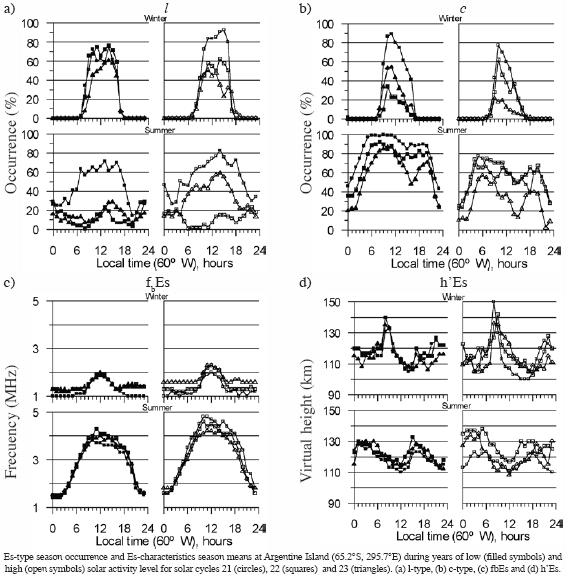
<body><![CDATA[<p align="justify"><font face="verdana" size="2"><b>Introduction</b></font></p>     <p align="justify"><font face="verdana" size="2">At mid&#150;latitudes, Sporadic&#150;E layer (Es) is the name given to charged metal ions that are swept into narrow layers (~1 to 5 km thick in vertical scale) by neutral wind shears usually in the height range 100&#150;150 km (Whitehead, 1960, 1970, 1989; Mathews, 1998). Wind shears come from three wave sources, atmospheric gravity waves, tides and planetary waves. Es has strong diurnal and semi&#150;diurnal variation of occurrence at mid&#150;latitudes demonstrating the importance of atmospheric tides in the lower thermosphere (MacDougall, 1974, 1978). There is a growing body of evidence that there is a peak in the occurrence of gravity waves in the vicinity of the Antarctic Peninsula and to a lesser extent associated with the Andes (e.g. Espy et al., 2006; Preusse et al., 2006; Alexander and Teitelbaum, 2007; Baumgaertner and McDonald, 2007). The reason for this 'hot spot' is primarily due to orography, and the proximity of the Antarctic polar vortex. Es statistics can be a sensitive indicator of tides, planetary waves, gravity waves and their interactions. In this paper Es occurrence and Es characteristics are determined for given location in the Antarctic Peninsula sector (Argentine Islands) using ionosonde observations, manually scaled, and covering a three solar cycle interval. The main goal is to try to identify possible inter&#150;decadal Es variability, as been suggested it exists for locations in the Australian sector (Baggaley, 1985), and which may lead to inter&#150;decadal variability of the processes governing Es formation or destruction.</font></p>     <p align="justify">&nbsp;</p>     <p align="justify"><font size="2" face="verdana"><b>Data analysis</b></font></p>     <p align="justify"><font face="verdana" size="2">There are internationally&#150;agreed standards for the analysis of vertical incidence ionosonde data. These are codified in Piggott and Rawer (1972 with further revisions in 1978). Here, the parameters determined at each hour are <i>foEs, fbEs,</i> <i>h'Es</i> and <i>Es Type.</i> foEs is the maximum frequency of an ordinary wave that can be reflected from an Es layer. The maximum frequency is related to the maximum ion concentration. <i>fbEs</i> is the lowest frequency at which the Es layer becomes semi&#150;transparent. The difference between <i>foEs</i> and <i>fbEs</i> represents a measure of the spatial variation in the concentration of ionisation in the Es layer. h'Es is the virtual height of the Es layer. Es layer height determination is taken from the flat part of the trace. Because there is little underlying ionization the real height and the virtual height are normally very similar (probably within 5 km). For Es layers that show retardation effects, there will be greater uncertainty that is indicated by the qualifying letters. The minimum reflected frequency, fmin, was also determined. Es type is codified into four main classes at mid latitudes: <i>f </i>(flat) is the name given to all Es layers where there is no E layer present (i.e. at night), <i>l</i> (low) occurs below the height of the E layer, <i>h</i> (high) occurs above the height of the E layer, and <i>c</i> (cusp) lies between high and low types, i.e. within the E layer.</font></p>     <p align="justify"><font face="verdana" size="2">If <i>foEs</i> of a layer in the valley between the E and the F layer are less that <i>foE</i>, then the Es layer will not be detected by the ionosonde. Furthermore, as <i>foE</i> exhibits a diurnal variation, the 'visibility' of layers changes through the day. Both factors introduce an unknown bias into the analysis for the absolute occurrence of sporadic E layer. In spite of this limitation, the analysis proposed here is considered of some interest.</font></p>     <p align="justify"><font face="verdana" size="2">The international rules for ionogram interpretation allow up to three entries in the Es&#150;type columns. The first entry is always the one from which the numerical Es parameters are determined. In the statistics presented in the paper, all three entries are used. However, it should be noted that having all three entries is not frequent.</font></p>     <p align="justify"><font face="verdana" size="2">Diurnal variations of Es occurrence and Es characteristics have been determined for solar cycles 21, 22 and 23 over Argentine Islands (65.2&deg;S; 296&deg;E geographic, &#150;49.6; 8.84 corrected geomagnetic). <a href="/img/revistas/geoint/v47n3/a6t1.jpg" target="_blank">Table 1</a> gives years used. The occurrences of the main four Es&#150;types were determined simply counting the number of occasions a given type was present at a given hour. Diurnal variation are representative of autumn (February, March, April), winter (May, June, July), spring (August, September, October) and summer (November, December and January). The diurnal variations of <i>foEs, fbEs,</i> <i>h'Es,</i> and <i>fmin</i> for a given season are determined using monthly median values for all months grouped for that season. Simple average is computed using the three median values for a given hour.</font></p>     <p align="justify"><font face="verdana" size="2">Using identical equipment for all three solar cycles would have made the identification of possible inter&#150;decadal variability much simpler. Unfortunately, during solar cycle 21 a different ionosonde was used (Union Radio Mark II &#150; UR Mk II) than for cycles 22 and 23 (IPS 42). The UR Mk II ionosonde (Clarke and Shearman, 1953) was much more sensitive and it transmitted more power. Furthermore, the format of the ionograms was larger and thus it made it easier to scale. A comparison between data from co&#150;sited earlier version of IPS 42 (designated 4A) and UR Mk II ionosondes has been reported by Rodger and Williams (1981). This means that gain sensitive para&#150;meters (<i>foEs</i> and <i>fbEs</i>) would give slightly higher values during solar cycle 21 but other parameters (h'Es and Es type) will be unaffected, again provided no other effects exist. Also <i>fmin</i> would be lower during solar cycle 21.</font></p>     <p align="justify"><font face="verdana" size="2">As the solar activity differs from one solar cycle to another and possible Es inter&#150;decadal variability may be associated to these solar activity differences, reference to solar activity indices are needed. <a href="/img/revistas/geoint/v47n3/a6t2.jpg" target="_blank">Table 2</a> gives season mean values of daily flare index and of monthly mean sunspot numbers used. Season mean values of monthly mean geomagnetic Ap index are also given. Both flare indices and sunspot numbers indicate that solar activity for all three cycles is similar for winter and summer during low solar activity. For equinox at low solar activity and for high solar activity during all seasons solar activity is similar for cycles 21 and 22 but is significantly lower for solar cycle 23.</font></p>     ]]></body>
<body><![CDATA[<p align="justify">&nbsp;</p>     <p align="justify"><font size="2" face="verdana"><b>Results</b></font></p>     <p align="justify"><font face="verdana" size="2">Results for only the main four Es types, <i>l, f, c</i> and <i>h</i>, are determined since the percentage of occurrence for other types is very small when compared with those for the former. The fig. shows the diurnal variations of <i>l</i> and <i>c</i> Es&#150;type percentage of occurrence for winter and summer at both low and high solar activity level. It should be noted that the scaling conventions determine the diurnal variation of some Es types, e.g. <i>l</i> has mainly a daytime occurrence while f has a night time occurrence. A summary of the main points determined from these figs. (and from figs. for <i>f</i> and <i>h</i>, and during equinox, not shown) is given in <a href="/img/revistas/geoint/v47n3/a6t3.jpg" target="_blank">Table 3</a>. Diurnal variations of <i>fbEs</i> and <i>h'Es</i> are also shown in the fig. Again, main features are summarized in <a href="/img/revistas/geoint/v47n3/a6t3.jpg" target="_blank">Table 3</a> (including those from figs. for <i>fmin</i> and <i>foEs</i>, and during equinox, not shown).</font></p>     <p align="justify"><font face="verdana" size="2">The shapes of the diurnal variations of occurrence of <i>l, f, c</i> and <i>h</i> Es&#150;types are almost the same during all three cycles for all seasons except for <i>l</i> type in summer at low and high solar activity. Otherwise, the inter&#150;decadal variability is noticeably mostly on the amplitude of the diurnal variations. This is particularly so for <i>l </i>and <i>c</i> types although no consistent patterns arise. Some of the solar cycle 21 differences in the <i>l</i> type occurrence (larger) may be explained by the use of different equipment.</font></p>     <p align="center"><font face="verdana" size="2"><img src="/img/revistas/geoint/v47n3/a6f1.jpg"></font></p>     <p align="justify"><font face="verdana" size="2">In the case of <i>fmin, foEs, fbEs</i>, and <i>h'Es</i> the shapes are similar in all cases. Again, it is the amplitude of the diurnal variations which shows some inter&#150;decadal variability. For <i>fmin</i> some of the differences (lower at night of solar cycle 21) may also be associated to equipment and radio propagation differences. This allows lower values of <i>foEs</i> and <i>fbEs</i> to be read from ionograms. Very similar shape and diurnal amplitude for <i>h'Es</i> means that processes associated to Es formation or destruction do not change significantly from one solar cycle to another.</font></p>     <p align="justify"><font face="verdana" size="2">Although, as already mentioned, there is evidence of inter&#150;decadal variations of Es parameters for locations in the Australian sector, the results of Baggaley (1985) cannot be directly compared with the results presented here.</font></p>     <p align="justify">&nbsp;</p>     <p align="justify"><font size="2" face="verdana"><b>Conclusions</b></font></p>     <p align="justify"><font face="verdana" size="2">There seems to be true inter&#150;cycle differences for c Es&#150;type occurrence although there is no consistent pattern for winter across solar activity level. The same may be true for <i>l</i> Es&#150;type. Part of the differences in the amplitude of the diurnal variation may be associated to equipment differences.</font></p>     ]]></body>
<body><![CDATA[<p align="justify"><font face="verdana" size="2">It seems there is neither significant equipment nor inter&#150;cycle differences for all Es parameter during low solar activity. The observed rather small inter&#150;cycle differences during high solar activity do not seem to show a consistent pattern.</font></p>     <p align="justify">&nbsp;</p>     <p align="justify"><font size="2" face="verdana"><b>Acknowledgements</b></font></p>     <p align="justify"><font face="verdana" size="2">Data and preliminary data processing for Argentine Island were kindly offered by R. Stamper of WDC&#150;C1, Appleton Rutherford Laboratory, Oxford, UK. Support for this study was provided by Fondo Nacional de Desarrollo Cient&iacute;fico y Tecnol&oacute;gico under Proyecto No. 1010218.</font></p>     <p align="justify">&nbsp;</p>     <p align="justify"><font size="2" face="verdana"><b>Bibliography</b></font></p>     <!-- ref --><p align="justify"><font face="verdana" size="2">Alexander, M. J. and H. Teitelbaum, 2007. Observation and analysis of a large amplitude mountain wave event over the Antarctic Peninsula, <i>Journal of Geophysical Research,</i> submitted.</font>&nbsp;&nbsp;&nbsp;&nbsp;&nbsp;&nbsp;&nbsp;&nbsp;[&#160;<a href="javascript:void(0);" onclick="javascript: window.open('/scielo.php?script=sci_nlinks&ref=3901656&pid=S0016-7169200800030000600001&lng=','','width=640,height=500,resizable=yes,scrollbars=1,menubar=yes,');">Links</a>&#160;]<!-- end-ref --><!-- ref --><p align="justify"><font face="verdana" size="2">Baggaley, W. J., 1985. Changes in the frequency distribution of foEs and fbEs over two solar cycles, Planetary and Space <i>Science, 33</i>, 457&#150;459.</font>&nbsp;&nbsp;&nbsp;&nbsp;&nbsp;&nbsp;&nbsp;&nbsp;[&#160;<a href="javascript:void(0);" onclick="javascript: window.open('/scielo.php?script=sci_nlinks&ref=3901657&pid=S0016-7169200800030000600002&lng=','','width=640,height=500,resizable=yes,scrollbars=1,menubar=yes,');">Links</a>&#160;]<!-- end-ref --><!-- ref --><p align="justify"><font face="verdana" size="2">Baumgaertner, A. J. G. and A. J. MacDonald, 2007. A gravity wave climatology for Antarctica compiled from Challenging Minisatellite Payload/Global Positioning System (CHAMP/GPS) radio occultations, <i>Journal of Geophysical Research, 112</i>, D05103, doi:10.1029/2006JD007504.</font>&nbsp;&nbsp;&nbsp;&nbsp;&nbsp;&nbsp;&nbsp;&nbsp;[&#160;<a href="javascript:void(0);" onclick="javascript: window.open('/scielo.php?script=sci_nlinks&ref=3901658&pid=S0016-7169200800030000600003&lng=','','width=640,height=500,resizable=yes,scrollbars=1,menubar=yes,');">Links</a>&#160;]<!-- end-ref --><!-- ref --><p align="justify"><font face="verdana" size="2">Clarke, C. and E. D. R. Shearman, 1953. Automatic ionospheric height recorder, <i>Wireless Engineer, 30</i>, 211&#150;212.</font>&nbsp;&nbsp;&nbsp;&nbsp;&nbsp;&nbsp;&nbsp;&nbsp;[&#160;<a href="javascript:void(0);" onclick="javascript: window.open('/scielo.php?script=sci_nlinks&ref=3901659&pid=S0016-7169200800030000600004&lng=','','width=640,height=500,resizable=yes,scrollbars=1,menubar=yes,');">Links</a>&#160;]<!-- end-ref --><!-- ref --><p align="justify"><font face="verdana" size="2">Espy, P. J., R. E. Hibbins, G. R. Swenson, J. Tang, M. J. Taylor, D. M. Riggin and D. C. Fritts, 2006. Regional variations of mesospheric gravity&#150;wave momentum flux over Antarctica, <i>Annales Geophysicae, 24</i>, 81&#150;88.</font>&nbsp;&nbsp;&nbsp;&nbsp;&nbsp;&nbsp;&nbsp;&nbsp;[&#160;<a href="javascript:void(0);" onclick="javascript: window.open('/scielo.php?script=sci_nlinks&ref=3901660&pid=S0016-7169200800030000600005&lng=','','width=640,height=500,resizable=yes,scrollbars=1,menubar=yes,');">Links</a>&#160;]<!-- end-ref --><!-- ref --><p align="justify"><font face="verdana" size="2">MacDougall, J. W., 1974. 110 km Neutral zonal wind patterns, <i>Planetary and Space Science, 22</i>, 545&#150;558.</font>&nbsp;&nbsp;&nbsp;&nbsp;&nbsp;&nbsp;&nbsp;&nbsp;[&#160;<a href="javascript:void(0);" onclick="javascript: window.open('/scielo.php?script=sci_nlinks&ref=3901661&pid=S0016-7169200800030000600006&lng=','','width=640,height=500,resizable=yes,scrollbars=1,menubar=yes,');">Links</a>&#160;]<!-- end-ref --><!-- ref --><p align="justify"><font face="verdana" size="2">MacDougall, J. W., 1978. Seasonal variation of semidiur&#150;nal winds in the dynamo region, <i>Planetary and Space Science, 26</i>, 705&#150;714.</font>&nbsp;&nbsp;&nbsp;&nbsp;&nbsp;&nbsp;&nbsp;&nbsp;[&#160;<a href="javascript:void(0);" onclick="javascript: window.open('/scielo.php?script=sci_nlinks&ref=3901662&pid=S0016-7169200800030000600007&lng=','','width=640,height=500,resizable=yes,scrollbars=1,menubar=yes,');">Links</a>&#160;]<!-- end-ref --><!-- ref --><p align="justify"><font face="verdana" size="2">Mathews, J. D., 1998. Sporadic E: current views and recent progress, <i>Journal of Atmospheric and Solar&#150;Terrestrial Physics, 60</i>, 413&#150;435.</font>&nbsp;&nbsp;&nbsp;&nbsp;&nbsp;&nbsp;&nbsp;&nbsp;[&#160;<a href="javascript:void(0);" onclick="javascript: window.open('/scielo.php?script=sci_nlinks&ref=3901663&pid=S0016-7169200800030000600008&lng=','','width=640,height=500,resizable=yes,scrollbars=1,menubar=yes,');">Links</a>&#160;]<!-- end-ref --><!-- ref --><p align="justify"><font face="verdana" size="2">Piggott, W. R. and K. Rawer, 1972. U.R.S.I. Handbook of ionogram interpretation and reduccion, Second Edition, Report UAG&#150;23, World Data Center A for Solar&#150;Terrestrial Physics, NOAA, Boulder, Colorado.</font>&nbsp;&nbsp;&nbsp;&nbsp;&nbsp;&nbsp;&nbsp;&nbsp;[&#160;<a href="javascript:void(0);" onclick="javascript: window.open('/scielo.php?script=sci_nlinks&ref=3901664&pid=S0016-7169200800030000600009&lng=','','width=640,height=500,resizable=yes,scrollbars=1,menubar=yes,');">Links</a>&#160;]<!-- end-ref --><!-- ref --><p align="justify"><font face="verdana" size="2">Piggott, W. R. and K. Rawer, 1978. Revision of chapters 1&#150;4 of the U. R. S. I. Handbook of ionogram interpretation and reduccion, Report UAG&#150;23A, World Data Center A for Solar&#150;Terrestrial Physics, NOAA, Boulder, Colorado.</font>&nbsp;&nbsp;&nbsp;&nbsp;&nbsp;&nbsp;&nbsp;&nbsp;[&#160;<a href="javascript:void(0);" onclick="javascript: window.open('/scielo.php?script=sci_nlinks&ref=3901665&pid=S0016-7169200800030000600010&lng=','','width=640,height=500,resizable=yes,scrollbars=1,menubar=yes,');">Links</a>&#160;]<!-- end-ref --><!-- ref --><p align="justify"><font face="verdana" size="2">Preusse, P., M. Ern, S. D. Eckermann, C. D. Warner, R. H. Picard, P. Knieling, M. Krebsbach, J. M. Russell III, M. G. Mlynczak, C. J. Mertens and M. Riese, 2006. Tropopause to mesopause gravity waves in August: Measurements and modeling, <i>Journal of Atmospheric and Solar&#150;Terrestrial Physics, 68</i>, 1730&#150;1751.</font>&nbsp;&nbsp;&nbsp;&nbsp;&nbsp;&nbsp;&nbsp;&nbsp;[&#160;<a href="javascript:void(0);" onclick="javascript: window.open('/scielo.php?script=sci_nlinks&ref=3901666&pid=S0016-7169200800030000600011&lng=','','width=640,height=500,resizable=yes,scrollbars=1,menubar=yes,');">Links</a>&#160;]<!-- end-ref --><!-- ref --><p align="justify"><font face="verdana" size="2">Rodger, A. S. and D. H. Williams, 1981. A comparative study of data from co&#150;sited 4A and UR Mk II ionosondes, British Antarctic Survey, Internal Report number BAS/AS/ION/81/1(unpublished).</font>&nbsp;&nbsp;&nbsp;&nbsp;&nbsp;&nbsp;&nbsp;&nbsp;[&#160;<a href="javascript:void(0);" onclick="javascript: window.open('/scielo.php?script=sci_nlinks&ref=3901667&pid=S0016-7169200800030000600012&lng=','','width=640,height=500,resizable=yes,scrollbars=1,menubar=yes,');">Links</a>&#160;]<!-- end-ref --><!-- ref --><p align="justify"><font face="verdana" size="2">Whitehead, J. D., 1960. Formation of the sporadic E layer in the temperate zone, <i>Nature, 188</i>, 567.</font>&nbsp;&nbsp;&nbsp;&nbsp;&nbsp;&nbsp;&nbsp;&nbsp;[&#160;<a href="javascript:void(0);" onclick="javascript: window.open('/scielo.php?script=sci_nlinks&ref=3901668&pid=S0016-7169200800030000600013&lng=','','width=640,height=500,resizable=yes,scrollbars=1,menubar=yes,');">Links</a>&#160;]<!-- end-ref --><!-- ref --><p align="justify"><font face="verdana" size="2">Whitehead, J. D., 1970. Report on the production and prediction of sporadic E, <i>Reviews of Geophysics and Space Physics, 8</i>, 65&#150;144.</font>&nbsp;&nbsp;&nbsp;&nbsp;&nbsp;&nbsp;&nbsp;&nbsp;[&#160;<a href="javascript:void(0);" onclick="javascript: window.open('/scielo.php?script=sci_nlinks&ref=3901669&pid=S0016-7169200800030000600014&lng=','','width=640,height=500,resizable=yes,scrollbars=1,menubar=yes,');">Links</a>&#160;]<!-- end-ref --><!-- ref --><p align="justify"><font face="verdana" size="2">Whitehead, J. D., 1989. Recent work on mid&#150;latitude and equatorial sporadic &#150; E, <i>Journal of Atmospheric and Terrestrial Physics, 51</i>, 401&#150;424.</font>&nbsp;&nbsp;&nbsp;&nbsp;&nbsp;&nbsp;&nbsp;&nbsp;[&#160;<a href="javascript:void(0);" onclick="javascript: window.open('/scielo.php?script=sci_nlinks&ref=3901670&pid=S0016-7169200800030000600015&lng=','','width=640,height=500,resizable=yes,scrollbars=1,menubar=yes,');">Links</a>&#160;]<!-- end-ref --> ]]></body><back>
<ref-list>
<ref id="B1">
<nlm-citation citation-type="journal">
<person-group person-group-type="author">
<name>
<surname><![CDATA[Alexander]]></surname>
<given-names><![CDATA[M. J.]]></given-names>
</name>
<name>
<surname><![CDATA[Teitelbaum]]></surname>
<given-names><![CDATA[H]]></given-names>
</name>
</person-group>
<article-title xml:lang="en"><![CDATA[Observation and analysis of a large amplitude mountain wave event over the Antarctic Peninsula]]></article-title>
<source><![CDATA[Journal of Geophysical Research]]></source>
<year>2007</year>
</nlm-citation>
</ref>
<ref id="B2">
<nlm-citation citation-type="journal">
<person-group person-group-type="author">
<name>
<surname><![CDATA[Baggaley]]></surname>
<given-names><![CDATA[W. J.]]></given-names>
</name>
</person-group>
<article-title xml:lang="en"><![CDATA[Changes in the frequency distribution of foEs and fbEs over two solar cycles]]></article-title>
<source><![CDATA[Planetary and Space Science]]></source>
<year>1985</year>
<numero>33</numero>
<issue>33</issue>
<page-range>457-459</page-range></nlm-citation>
</ref>
<ref id="B3">
<nlm-citation citation-type="journal">
<person-group person-group-type="author">
<name>
<surname><![CDATA[Baumgaertner]]></surname>
<given-names><![CDATA[A. J. G.]]></given-names>
</name>
<name>
<surname><![CDATA[MacDonald]]></surname>
<given-names><![CDATA[A. J.]]></given-names>
</name>
</person-group>
<article-title xml:lang="en"><![CDATA[A gravity wave climatology for Antarctica compiled from Challenging Minisatellite Payload/Global Positioning System (CHAMP/GPS) radio occultations]]></article-title>
<source><![CDATA[Journal of Geophysical Research]]></source>
<year>2007</year>
<numero>112</numero>
<issue>112</issue>
</nlm-citation>
</ref>
<ref id="B4">
<nlm-citation citation-type="journal">
<person-group person-group-type="author">
<name>
<surname><![CDATA[Clarke]]></surname>
<given-names><![CDATA[C]]></given-names>
</name>
<name>
<surname><![CDATA[Shearman]]></surname>
<given-names><![CDATA[E. D. R.]]></given-names>
</name>
</person-group>
<article-title xml:lang="en"><![CDATA[Automatic ionospheric height recorder]]></article-title>
<source><![CDATA[Wireless Engineer]]></source>
<year>1953</year>
<numero>30</numero>
<issue>30</issue>
<page-range>211-212</page-range></nlm-citation>
</ref>
<ref id="B5">
<nlm-citation citation-type="journal">
<person-group person-group-type="author">
<name>
<surname><![CDATA[Espy]]></surname>
<given-names><![CDATA[P. J.]]></given-names>
</name>
<name>
<surname><![CDATA[Hibbins]]></surname>
<given-names><![CDATA[R. E.]]></given-names>
</name>
<name>
<surname><![CDATA[Swenson]]></surname>
<given-names><![CDATA[G. R.]]></given-names>
</name>
<name>
<surname><![CDATA[Tang]]></surname>
<given-names><![CDATA[J]]></given-names>
</name>
<name>
<surname><![CDATA[Taylor]]></surname>
<given-names><![CDATA[M. J.]]></given-names>
</name>
<name>
<surname><![CDATA[Riggin]]></surname>
<given-names><![CDATA[D. M.]]></given-names>
</name>
<name>
<surname><![CDATA[Fritts]]></surname>
<given-names><![CDATA[D. C.]]></given-names>
</name>
</person-group>
<article-title xml:lang="en"><![CDATA[Regional variations of mesospheric gravity-wave momentum flux over Antarctica]]></article-title>
<source><![CDATA[Annales Geophysicae]]></source>
<year>2006</year>
<numero>24</numero>
<issue>24</issue>
<page-range>81-88</page-range></nlm-citation>
</ref>
<ref id="B6">
<nlm-citation citation-type="journal">
<person-group person-group-type="author">
<name>
<surname><![CDATA[MacDougall]]></surname>
<given-names><![CDATA[J. W.]]></given-names>
</name>
</person-group>
<article-title xml:lang="en"><![CDATA[110 km Neutral zonal wind patterns]]></article-title>
<source><![CDATA[Planetary and Space Science]]></source>
<year>1974</year>
<numero>22</numero>
<issue>22</issue>
<page-range>545-558</page-range></nlm-citation>
</ref>
<ref id="B7">
<nlm-citation citation-type="journal">
<person-group person-group-type="author">
<name>
<surname><![CDATA[MacDougall]]></surname>
<given-names><![CDATA[J. W.]]></given-names>
</name>
</person-group>
<article-title xml:lang="en"><![CDATA[Seasonal variation of semidiur-nal winds in the dynamo region]]></article-title>
<source><![CDATA[Planetary and Space Science]]></source>
<year>1978</year>
<numero>26</numero>
<issue>26</issue>
<page-range>705-714</page-range></nlm-citation>
</ref>
<ref id="B8">
<nlm-citation citation-type="journal">
<person-group person-group-type="author">
<name>
<surname><![CDATA[Mathews]]></surname>
<given-names><![CDATA[J. D.]]></given-names>
</name>
</person-group>
<article-title xml:lang="en"><![CDATA[Sporadic E: current views and recent progress]]></article-title>
<source><![CDATA[Journal of Atmospheric and Solar-Terrestrial Physics]]></source>
<year>1998</year>
<numero>60</numero>
<issue>60</issue>
<page-range>413-435</page-range></nlm-citation>
</ref>
<ref id="B9">
<nlm-citation citation-type="book">
<person-group person-group-type="author">
<name>
<surname><![CDATA[Piggott]]></surname>
<given-names><![CDATA[W. R.]]></given-names>
</name>
<name>
<surname><![CDATA[Rawer]]></surname>
<given-names><![CDATA[K]]></given-names>
</name>
</person-group>
<source><![CDATA[U.R.S.I. Handbook of ionogram interpretation and reduccion]]></source>
<year>1972</year>
<edition>Second</edition>
<publisher-loc><![CDATA[Colorado ]]></publisher-loc>
<publisher-name><![CDATA[World Data Center A for Solar-Terrestrial Physics, NOAA, Boulder,]]></publisher-name>
</nlm-citation>
</ref>
<ref id="B10">
<nlm-citation citation-type="book">
<person-group person-group-type="author">
<name>
<surname><![CDATA[Piggott]]></surname>
<given-names><![CDATA[W. R.]]></given-names>
</name>
<name>
<surname><![CDATA[Rawer]]></surname>
<given-names><![CDATA[K]]></given-names>
</name>
</person-group>
<source><![CDATA[Revision of chapters 1-4 of the U. R. S. I. Handbook of ionogram interpretation and reduccion]]></source>
<year>1978</year>
<publisher-loc><![CDATA[Colorado ]]></publisher-loc>
<publisher-name><![CDATA[World Data Center A for Solar-Terrestrial Physics, NOAA, Boulder,]]></publisher-name>
</nlm-citation>
</ref>
<ref id="B11">
<nlm-citation citation-type="journal">
<person-group person-group-type="author">
<name>
<surname><![CDATA[Preusse]]></surname>
<given-names><![CDATA[P]]></given-names>
</name>
<name>
<surname><![CDATA[Ern]]></surname>
<given-names><![CDATA[M]]></given-names>
</name>
<name>
<surname><![CDATA[Eckermann]]></surname>
<given-names><![CDATA[S. D.]]></given-names>
</name>
<name>
<surname><![CDATA[Warner]]></surname>
<given-names><![CDATA[C. D.]]></given-names>
</name>
<name>
<surname><![CDATA[Picard]]></surname>
<given-names><![CDATA[R. H.]]></given-names>
</name>
<name>
<surname><![CDATA[Knieling]]></surname>
<given-names><![CDATA[P]]></given-names>
</name>
<name>
<surname><![CDATA[Krebsbach]]></surname>
<given-names><![CDATA[M]]></given-names>
</name>
<name>
<surname><![CDATA[Russell III]]></surname>
<given-names><![CDATA[J. M.]]></given-names>
</name>
<name>
<surname><![CDATA[Mlynczak]]></surname>
<given-names><![CDATA[M. G.]]></given-names>
</name>
<name>
<surname><![CDATA[Mertens]]></surname>
<given-names><![CDATA[C. J.]]></given-names>
</name>
<name>
<surname><![CDATA[Riese]]></surname>
<given-names><![CDATA[M]]></given-names>
</name>
</person-group>
<article-title xml:lang="en"><![CDATA[Tropopause to mesopause gravity waves in August: Measurements and modeling]]></article-title>
<source><![CDATA[Journal of Atmospheric and Solar-Terrestrial Physics]]></source>
<year>2006</year>
<numero>68</numero>
<issue>68</issue>
<page-range>1730-1751</page-range></nlm-citation>
</ref>
<ref id="B12">
<nlm-citation citation-type="book">
<person-group person-group-type="author">
<name>
<surname><![CDATA[Rodger]]></surname>
<given-names><![CDATA[A. S.]]></given-names>
</name>
<name>
<surname><![CDATA[Williams]]></surname>
<given-names><![CDATA[D. H.]]></given-names>
</name>
</person-group>
<source><![CDATA[A comparative study of data from co-sited 4A and UR Mk II ionosondes]]></source>
<year>1981</year>
<publisher-name><![CDATA[British Antarctic Survey]]></publisher-name>
</nlm-citation>
</ref>
<ref id="B13">
<nlm-citation citation-type="journal">
<person-group person-group-type="author">
<name>
<surname><![CDATA[Whitehead]]></surname>
<given-names><![CDATA[J. D.]]></given-names>
</name>
</person-group>
<article-title xml:lang="en"><![CDATA[Formation of the sporadic E layer in the temperate zone]]></article-title>
<source><![CDATA[Nature]]></source>
<year>1960</year>
<numero>188</numero>
<issue>188</issue>
<page-range>567</page-range></nlm-citation>
</ref>
<ref id="B14">
<nlm-citation citation-type="journal">
<person-group person-group-type="author">
<name>
<surname><![CDATA[Whitehead]]></surname>
<given-names><![CDATA[J. D.]]></given-names>
</name>
</person-group>
<article-title xml:lang="en"><![CDATA[Report on the production and prediction of sporadic E]]></article-title>
<source><![CDATA[Reviews of Geophysics and Space Physics]]></source>
<year>1970</year>
<numero>8</numero>
<issue>8</issue>
<page-range>65-144</page-range></nlm-citation>
</ref>
<ref id="B15">
<nlm-citation citation-type="journal">
<person-group person-group-type="author">
<name>
<surname><![CDATA[Whitehead]]></surname>
<given-names><![CDATA[J. D.]]></given-names>
</name>
</person-group>
<article-title xml:lang="en"><![CDATA[Recent work on mid-latitude and equatorial sporadic - E]]></article-title>
<source><![CDATA[Journal of Atmospheric and Terrestrial Physics]]></source>
<year>1989</year>
<numero>51</numero>
<issue>51</issue>
<page-range>401-424</page-range></nlm-citation>
</ref>
</ref-list>
</back>
</article>
