<?xml version="1.0" encoding="ISO-8859-1"?><article xmlns:mml="http://www.w3.org/1998/Math/MathML" xmlns:xlink="http://www.w3.org/1999/xlink" xmlns:xsi="http://www.w3.org/2001/XMLSchema-instance">
<front>
<journal-meta>
<journal-id>0016-7169</journal-id>
<journal-title><![CDATA[Geofísica internacional]]></journal-title>
<abbrev-journal-title><![CDATA[Geofís. Intl]]></abbrev-journal-title>
<issn>0016-7169</issn>
<publisher>
<publisher-name><![CDATA[Universidad Nacional Autónoma de México, Instituto de Geofísica]]></publisher-name>
</publisher>
</journal-meta>
<article-meta>
<article-id>S0016-71692006000400005</article-id>
<title-group>
<article-title xml:lang="en"><![CDATA[Spectral signature of ultraviolet solar irradiance in Zacatecas]]></article-title>
</title-group>
<contrib-group>
<contrib contrib-type="author">
<name>
<surname><![CDATA[Pinedo V]]></surname>
<given-names><![CDATA[J. L]]></given-names>
</name>
<xref ref-type="aff" rid="A01"/>
</contrib>
<contrib contrib-type="author">
<name>
<surname><![CDATA[Mireles]]></surname>
<given-names><![CDATA[F]]></given-names>
</name>
<xref ref-type="aff" rid="A02"/>
</contrib>
<contrib contrib-type="author">
<name>
<surname><![CDATA[Ríos M]]></surname>
<given-names><![CDATA[C]]></given-names>
</name>
<xref ref-type="aff" rid="A02"/>
</contrib>
<contrib contrib-type="author">
<name>
<surname><![CDATA[Quirino T]]></surname>
<given-names><![CDATA[L. L]]></given-names>
</name>
<xref ref-type="aff" rid="A02"/>
</contrib>
<contrib contrib-type="author">
<name>
<surname><![CDATA[Dávila R]]></surname>
<given-names><![CDATA[J. I]]></given-names>
</name>
<xref ref-type="aff" rid="A02"/>
</contrib>
</contrib-group>
<aff id="A01">
<institution><![CDATA[,Universidad Autónoma de Zacatecas  ]]></institution>
<addr-line><![CDATA[Zacatecas Zac]]></addr-line>
<country>México</country>
</aff>
<aff id="A02">
<institution><![CDATA[,Universidad Autónoma de Zacatecas  ]]></institution>
<addr-line><![CDATA[Zacatecas Zac]]></addr-line>
<country>México</country>
</aff>
<pub-date pub-type="pub">
<day>00</day>
<month>12</month>
<year>2006</year>
</pub-date>
<pub-date pub-type="epub">
<day>00</day>
<month>12</month>
<year>2006</year>
</pub-date>
<volume>45</volume>
<numero>4</numero>
<fpage>263</fpage>
<lpage>269</lpage>
<copyright-statement/>
<copyright-year/>
<self-uri xlink:href="http://www.scielo.org.mx/scielo.php?script=sci_arttext&amp;pid=S0016-71692006000400005&amp;lng=en&amp;nrm=iso"></self-uri><self-uri xlink:href="http://www.scielo.org.mx/scielo.php?script=sci_abstract&amp;pid=S0016-71692006000400005&amp;lng=en&amp;nrm=iso"></self-uri><self-uri xlink:href="http://www.scielo.org.mx/scielo.php?script=sci_pdf&amp;pid=S0016-71692006000400005&amp;lng=en&amp;nrm=iso"></self-uri><abstract abstract-type="short" xml:lang="es"><p><![CDATA[En este trabajo se presenta un análisis de la radiación espectral global ultravioleta (290-400 nm) registrada en Zacatecas, una ciudad vecina al trópico de cáncer, situada a 2500 m sobre el nivel del mar, latitud de 22°N y longitud de 102°O. Los espectros correspondientes han sido medidos mediante un espectroradiómetro Bentham con un paso de 0.5 nm de longitud de onda. Las mediciones muestran niveles de radiación ultravioleta (UV) relativamente elevados, que pueden ser característicos de las zonas vecinas al trópico de cáncer. Frente al aumento de incidencia de cáncer en la piel en la población del estado de Zacatecas, estas mediciones ponen en relieve la necesidad de formular un plan preventivo de daños.]]></p></abstract>
<abstract abstract-type="short" xml:lang="en"><p><![CDATA[This study presents an analysis of the global ultraviolet spectral irradiance (290-400 nm) registered in Zacatecas, a city near the Tropic of Cancer, located at 2500 m above sea level, latitude of 22° N and longitude of 102°W. The spectra have been measured using a Bentham radiometer with a 0.5 nm step in wavelength. The measurements show relatively high levels of ultraviolet irradiance (UV), which may be characteristic of areas close to the Tropic of Cancer. Faced with an increase of the incidence of skin cancer among the population of Zacatecas, these measurements highlight that a damage prevention plan is required.]]></p></abstract>
<kwd-group>
<kwd lng="es"><![CDATA[Solar]]></kwd>
<kwd lng="es"><![CDATA[espectral]]></kwd>
<kwd lng="es"><![CDATA[ultravioleta]]></kwd>
<kwd lng="es"><![CDATA[radiación]]></kwd>
<kwd lng="es"><![CDATA[climatología]]></kwd>
<kwd lng="en"><![CDATA[Solar]]></kwd>
<kwd lng="en"><![CDATA[spectral]]></kwd>
<kwd lng="en"><![CDATA[ultraviolet]]></kwd>
<kwd lng="en"><![CDATA[irradiance]]></kwd>
<kwd lng="en"><![CDATA[climatology]]></kwd>
</kwd-group>
</article-meta>
</front><body><![CDATA[ <p align="justify"><font face="verdana" size="4">Geof&iacute;sica internacional</font></p>     <p align="justify"><font face="verdana" size="2">&nbsp;</font></p>     <p align="center"><font face="verdana" size="4"><b>Spectral signature of ultraviolet solar irradiance in Zacatecas</b></font></p>     <p align="center"><font face="verdana" size="2">&nbsp;</font></p>     <p align="center"><font face="verdana" size="2"><b>J. L. Pinedo V.<sup>1</sup>, F. Mireles G.<sup>2</sup>, C. R&iacute;os M.<sup>2</sup>, L. L. Quirino T.<sup>2</sup> and J. I. D&aacute;vila R.<sup>2</sup></b></font></p>     <p align="justify"><font face="verdana" size="2">&nbsp;</font></p>     <p align="justify"><font face="verdana" size="2"><i>1 Universidad Aut&oacute;noma de Zacatecas, Cipr&eacute;s No. 10, Frac. La Pe&ntilde;uela, 98068 Zacatecas, Zac., M&eacute;xico, Tel. and Fax: (492) 9 22 70 43 ext 107. Email: <a href="mailto:jlpinedo@cantera.reduaz.mx">jlpinedo@cantera.reduaz.mx</a></i></font></p>     <p align="justify"><font face="verdana" size="2"><i>2 Universidad Aut&oacute;noma de Zacatecas, Zacatecas, Zac., M&eacute;xico</i></font></p>     <p align="justify"><font face="verdana" size="2">&nbsp;</font></p>     <p align="justify"><font face="verdana" size="2">Received: February 1, 2006    ]]></body>
<body><![CDATA[<br>   Accepted: September 5, 2006.</font></p>     <p align="justify"><font face="verdana" size="2">&nbsp;</font></p>     <p align="justify"><font face="verdana" size="2"><b>RESUMEN</b></font></p>     <p align="justify"><font face="verdana" size="2">En este trabajo se presenta un an&aacute;lisis de la radiaci&oacute;n espectral global ultravioleta (290&#150;400 nm) registrada en Zacatecas, una ciudad vecina al tr&oacute;pico de c&aacute;ncer, situada a 2500 m sobre el nivel del mar, latitud de 22&deg;N y longitud de 102&deg;O. Los espectros correspondientes han sido medidos mediante un espectroradi&oacute;metro Bentham con un paso de 0.5 nm de longitud de onda. Las mediciones muestran niveles de radiaci&oacute;n ultravioleta (UV) relativamente elevados, que pueden ser caracter&iacute;sticos de las zonas vecinas al tr&oacute;pico de c&aacute;ncer. Frente al aumento de incidencia de c&aacute;ncer en la piel en la poblaci&oacute;n del estado de Zacatecas, estas mediciones ponen en relieve la necesidad de formular un plan preventivo de da&ntilde;os.</font></p>     <p align="justify"><font face="verdana" size="2"><b>PALABRAS CLAVE: </b>Solar, espectral, ultravioleta, radiaci&oacute;n, climatolog&iacute;a.</font></p>     <p align="justify"><font face="verdana" size="2">&nbsp;</font></p>     <p align="justify"><font face="verdana" size="2"><b>ABSTRACT</b></font></p>     <p align="justify"><font face="verdana" size="2">This study presents an analysis of the global ultraviolet spectral irradiance (290&#150;400 nm) registered in Zacatecas, a city near the Tropic of Cancer, located at 2500 m above sea level, latitude of 22&deg; N and longitude of 102&deg;W. The spectra have been measured using a Bentham radiometer with a 0.5 nm step in wavelength. The measurements show relatively high levels of ultraviolet irradiance (UV), which may be characteristic of areas close to the Tropic of Cancer. Faced with an increase of the incidence of skin cancer among the population of Zacatecas, these measurements highlight that a damage prevention plan is required.</font></p>     <p align="justify"><font face="verdana" size="2"><b>KEY WORDS: </b>Solar, spectral, ultraviolet, irradiance, climatology.</font></p>     <p align="justify"><font face="verdana" size="2">&nbsp;</font></p>     ]]></body>
<body><![CDATA[<p align="justify"><font face="verdana" size="2"><b>INTRODUCTION</b></font></p>     <p align="justify"><font face="verdana" size="2">Ultraviolet radiation is defined as the portion of the electromagnetic spectrum between X&#150;rays and visible light, that is between wavelengths of 40 and 400 nm (energy comprised between 30 and 3 eV). The UV spectrum can be divided into broad bands: vacuum UV (40&#150;190 nm), far or extreme UV (190&#150;220 nm), UVC (220&#150;290 nm), UVB (290&#150;320 nm), and UVA (320&#150;400 nm) (Zeman, 2006). Only the last three bands of solar radiation (UVC, UVB and UVA) reach the Earth's atmosphere, and only the last two (UVB and UVA) reach the Earth's surface.</font></p>     <p align="justify"><font face="verdana" size="2">Solar radiation measurement studies, and in particular those of ultraviolet irradiance, have acquired greater relevance in recent years. Indeed, electromagnetic UV radiation has important chemical and biological effects; therefore implications for human health, as well as for fauna and flora (Caldwell etal., 1986; Worrest etal., 1989; Bigelow <i>et al., </i>1998; Sutherland <i>et al., </i>1997; Chaney <i>et al., </i>2005).</font></p>     <p align="justify"><font face="verdana" size="2">It is well known that the spectral composition of radiation reaching the Earth's surface depends on the reactions of solar radiation with the atmospheric constituents and the solar ray path in the atmosphere. Selective absorption results from variable amounts of ozone and water vapour as well as from uniformly mixed gases (CO<sub>2</sub> and O<sub>2</sub> ). Scattering is produced by the air molecules and the highly anisotropic absorption process arises from aerosol effects. The solar path on the atmosphere depends on latitude, altitude and solar entrance angle, which changes day to day over the year and second to second in the day.</font></p>     <p align="justify"><font face="verdana" size="2">Climatic variations modify the turbidity of the atmosphere and the radiation composition, amplifying or reducing its spectral intensity. Additionally the atmospheric concentration of several constituents (ozone, CO<sub>2</sub>, NO<sub>2</sub>) has been increasing in the past decades, inducing consequently a non natural modification of the spectral composition of solar radiation.</font></p>     <p align="justify"><font face="verdana" size="2">The depletion observed in the ozone layer in the stratosphere (Molina and Rowland, 1973; Farman <i>et al., </i>1985; Abbatt and Molina, 1993; WMO, 1994; Bojkov <i>et al., 1</i>995) is susceptible to induce an increase in UV radiation at the shorter wavelengths (280&#150;330 nm) in the troposphere and on the Earth's surface. This has incited the international scientific community to become aware of the need for establishing a UV climatology and monitoring its long term variations.</font></p>     <p align="justify"><font face="verdana" size="2">A UV&#150;B climatology has been created from broadband measurements, using broad band UV&#150;B instruments. These are mounted in ground stations or on satellites. However, as it becomes clear that a whole band is not responsible for such an effect, rather a mere fraction of it, broadband climatology is coming to be viewed as insufficient for studying the phenomena in depth (de la Casini&egrave;re <i>et al., </i>2002).</font></p>     <p align="justify"><font face="verdana" size="2">Spectroradiometers measure UV spectral irradiance with a 0.5 nm step in wavelength or less. A band can be reconstructed with precision from a spectrum, but the opposite can only be achieved by using complex radiative transfer computer codes or rigorous transmittance models. Both codes and models demand meteorological data, the amount of aerosols, and the total amount of ozone over the site among others. Indeed radiative transfer codes and transmittance models provide agreement between models and measurements within 6% (Wang and Lenoble, 1994, Idrissa, 1996, Casini&egrave;re <i>et al., </i>2003). However, while the UV radiation increase, accurate spectral measurements are necessary to follow the eventual modifications and to test or validate the models.</font></p>     <p align="justify"><font face="verdana" size="2">In this paper, we present the analysis of two series of spectral measurements, which give a first impression of the nature of UV radiation in Zacatecas, a city located in the area of the Tropic of Cancer, situated at a considerable altitude (2550 m above sea level) and under a dry atmosphere.</font></p>     <p align="justify"><font face="verdana" size="2">Spectral irradiance measurements are interesting from the physical viewpoint, but the accumulation of data will eventually allow the elucidation of the effects of ultraviolet radiation, which is not less important.</font></p>     ]]></body>
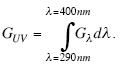
<body><![CDATA[<p align="justify"><font face="verdana" size="2">Frequent exposition to UV solar radiation is the major risk factor of skin cancer (Armstrong <i>et al., </i>2001, Wang <i>et al., </i>2005). There are three type of skin cancer: basal cell carcinoma (BCC), the more common but highly curable no melanoma skin cancer; squamous cell carcinoma (SCC), a curable no melanoma skin cancer; and the less common but potentially lethal cutaneous malignant melanoma (CMM).</font></p>     <p align="justify"><font face="verdana" size="2">More than one million of no melanoma skin cancers are diagnosed annually in United States; in contrast, the incidence of CMM has been steadily rising, and 59 580 new CMM cases and 7770 CMM deaths were expected in 2005 (Jemal, 2005). In 2006, The American Cancer Society has estimated 62 190 new cases and 7910 deaths of CMM.</font></p>     <p align="justify"><font face="verdana" size="2">In Mexico, skin cancer is not among the ten more frequent diseases. However statistics must be incomplete: patients with dermatological disease are not attended by public hospitals or health services, the largest part of them does not have formal medical assistance, others have recourse to private medical. So the information rarely transits to official statistics departments. The subject began to draw the attention of specialists several decades ago but studies are so few and limited. Two of the most copious epidemiological studies have been undertaken at the General Hospital in Mexico City: the first one accounts 389 cases of SCC and CMM registered between 1975 and 1992 (Peniche and Peniche, 1993); the second, following the same direction accounts 508 cases of SCC and CMM registered between 1991 and 2002 (Barron <i>et al., </i>2004).</font></p>     <p align="justify"><font face="verdana" size="2">The state of Zacatecas, Mexico, has a population of approximately 1.3 million, and skin cancer is reaching important levels. In the last ten years, the University Clinic has only received approximately 1.5 thousand patients worried about skin cancer. Officially, according to the Zacatecas Health Department, skin cancer morbidity reached 118 cases in 2000 and 127 in 2001 and skin cancer deaths were 27 in 2004 and 16 in 2005.</font></p>     <p align="justify"><font face="verdana" size="2">Effects in the skin did not appear, or rather, were not recorded until recently. Thirty years ago, wide&#150;rimmed hats and long&#150;sleeved clothing were commonly worn in the countryside, sports in broad daylight and tanning were much less frequent than recently, and life expectancy in the state has risen since then from 55 to 70 years. Consequently, solar radiation exposure has increased as the result of a changing lifestyle. This change in people's habits is perhaps a probable cause of the effects of solar radiation on the skin, but it is also possible that there has been a modification in the intensity of the irradiance reaching the Earth's surface.</font></p>     <p align="justify"><font face="verdana" size="2">The purpose of this work is not properly to elucidate the relationship between UV solar irradiance and its biological effects. Our aim is to present the experimental basis for the evaluation, analysis and monitoring of UV radiation, with special emphasis on the relevance of spectral measurements.</font></p>     <p align="justify"><font face="verdana" size="2">&nbsp;</font></p>     <p align="justify"><font face="verdana" size="2"><b>GLOBAL SOLAR IRRADIANCE ON THE EARTH'S SURFACE</b></font></p>     <p align="justify"><font face="verdana" size="2">The electromagnetic radiation coming from the Sun and reaching the Earth's surface can be measured as <i>total, spectral, </i>or <i>monochromatic. Total </i>measurements include the whole range of wavelengths or the whole of corresponding energies, while <i>spectral </i>or <i>monochromatic </i>measurements are associated with a specific unit of wavelength.</font></p>     <p align="justify"><font face="verdana" size="2">In general the studies of solar radiation on the Earth's surface can be reported implicitly or explicitly in terms of general energetic quantities, such as <i>global irradiance, diffuse irradiance </i>and <i>direct irradiance, </i>whether they are total or monochromatic dimensions. <i>Global irradiance </i>is made up by <i>direct irradiance </i>ensuing from the solid angle delimited by the solar disc and by <i>diffuse irradiance, </i>which includes all of the radiation scattered by atmospheric molecules and which allow visibility or daylight.</font></p>     ]]></body>
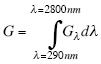
<body><![CDATA[<p align="justify"><font face="verdana" size="2"><i>Total global irradiance </i>&#150;which can be denoted by <i>G </i>and whose units are <i>W/m<sup>2</sup>&#150; </i>is the solar hemispheric irradiance arriving at any point on the Earth's surface. <i>Monochromatic global irradiance </i>is denoted by <i>G<sub><sub>&lambda; </sub></sub>, </i>its units are <i>W/m<sup>2</sup> &micro;m </i>or <i>mW/m<sup>2</sup>nm, </i>and it is the hemispheric irradiance corresponding to a narrow band of wavelength, as narrow as possibly measurable (for example: 1 nm, 0.5 nm, 0.1 nm,...).</font></p>     <p align="justify"><font face="verdana" size="2">Global irradiance in the UV band comprises the set of photons whose wavelength is between 290 and 400 nm, that is, the sum of all the monochromatic irradiances between both wavelengths, therefore it can be represented by</font></p>     <p align="justify"><font face="verdana" size="2"><img src="/img/revistas/geoint/v45n4/a5e1.jpg"></font></p>     <p align="justify"><font face="verdana" size="2">Total global irradiance includes all the photons arriving on Earth's surface, that is, all photons of all wavelengths or of all energies arriving from the Sun. Total global irradiance includes UV, visible and infrared irradiance. Given that the wavelengths of global irradiance range from approximately 290 to 2800 nm, the total global irradiance is represented by</font></p>     <p align="justify"><font face="verdana" size="2"><img src="/img/revistas/geoint/v45n4/a5e2.jpg"></font></p>     <p align="justify"><font face="verdana" size="2">Evidently, it is not the same all around the world, nor is it the same all year long; however the same systematic behavior should occur over time.</font></p>     <p align="justify"><font face="verdana" size="2">&nbsp;</font></p>     <p align="justify"><font face="verdana" size="2"><b>MEASURING GLOBAL SOLAR IRRADIANCE</b></font></p>     <p align="justify"><font face="verdana" size="2">Two types of solar irradiance measuring systems should be distinguished: <i>broadband </i>and <i>spectral </i>measuring systems. Examples of broadband measuring systems are UV, UVA, UVB radiometers, and pyranometers, which are instruments for measuring total irradiance. <i>Spectral </i>measuring systems are commonly called radiometers, or more specifically, spectroradiometers (Casini&egrave;re, 2003).</font></p>     <p align="justify"><font face="verdana" size="2">Broadband measuring systems are more common and economical, while spectroradiometers, or spectral irradiance measuring systems, are more sophisticated, more costly, less utilized, and although the tendency is towards ever greater use, they are still considered special instruments and are not exactly conventional. Evidently spectral measuring systems' potential is greater: a spectrum implies a measurement from which detailed information regarding a band can be obtained. On the other hand, a spectrum cannot be obtained from a broadband measurement since the instrument averages all the events during the measurement process.</font></p>     ]]></body>
<body><![CDATA[<p align="justify"><font face="verdana" size="2">In general, both solar and spectral systems consist of a receiver, a detector, a signal or detector response processor and a counting system. The receiver makes it possible to receive radiation and to transfer it to the detector. The detector makes it possible to convert the solar energy, directly or indirectly, into an electrical signal.</font></p>     <p align="justify"><font face="verdana" size="2">The receiver in classical pyranometers roughly consists of two superposed glass domes and of a highly absorbent layer coating the detector, the latter being a thermoelectric or a photoelectric sensor. The receiver in a spectroradiometer is a diffusing device that can be used to mix the radiation from the whole sky dome and to light the entrance slit of a monochromator used as a detector (Kondratyev, 1969).</font></p>     <p align="justify"><font face="verdana" size="2">&nbsp;</font></p>     <p align="justify"><font face="verdana" size="2"><b>MEASURING SPECTRAL GLOBAL SOLAR IRRADIANCE</b></font></p>     <p align="justify"><font face="verdana" size="2">The spectral or monochromatic measurements corresponding to this study were carried out under clear sky conditions, on May 3<sup>th</sup> and November 6<sup>th</sup>, 2005 with a Bentham spectroradiometer, with a 0.5 nm step in wavelength. The system was calibrated previously using a 1000 W lamp Standard Irradiance, supplied by Optronic Laboratory. The step for calibration was 0.5 nm.</font></p>     <p align="justify"><font face="verdana" size="2"><a href="/img/revistas/geoint/v45n4/a5f1.jpg" target="_blank">Figure 1</a> presents six UV spectra measured on May 3<sup>th </sup>2005 between 10:00 and 14:00 hours, with corresponding solar zenith angles between 7&deg; and 50&deg;.</font></p>     <p align="justify"><font face="verdana" size="2">The energy corresponding to the UV B (290 &#150; 320 nm), UV A (320 &#150;400 nm) and total UV bands &#150;the sum of both&#150;can be obtained by integrating the area under the curve for each spectrum zone. The results for spectra are presented in <a href="/img/revistas/geoint/v45n4/a5t1.jpg" target="_blank">Table 1</a>.</font></p>     <p align="justify"><font face="verdana" size="2">This data shows that, under clear sky conditions, the intensity of the UVB irradiance vary between 2 and 4 <i>W/m<sup>2</sup>, </i>UVA irradiance vary between 27 and 49 <i>W/m<sup>2</sup>, </i>and the irradiance corresponding to the total UV band vary between 29 and 53 <i>W/m<sup>2</sup>.</i></font></p>     <p align="justify"><font face="verdana" size="2"><a href="/img/revistas/geoint/v45n4/a5f2.jpg" target="_blank">Figure 2</a> presents eight spectra measured on November 6<sup>th</sup> between 12:00 and 14:00 hours, local time, corresponding to the peak hours in solar intensity. In contrast with measures made six months before, these spectra show no appreciable variation in intensity.</font></p>     <p align="justify"><font face="verdana" size="2">By integrating the area under the curve for the UV B (290 &#150; 320 nm), UV A (320 &#150;400 nm) and total UV bands, the corresponding energy was obtained, <a href="/img/revistas/geoint/v45n4/a5t2.jpg" target="_blank">Table 2</a>.</font></p>     ]]></body>
<body><![CDATA[<p align="justify"><font face="verdana" size="2">This data shows that, for the sun's peak hours, under clear sky conditions, the intensity of the UVB irradiance is of the order of 4 <i>W/m<sup>2</sup>, </i>UVA irradiance is of the order of 46 <i>W/m<sup>2</sup>, </i>and the irradiance corresponding to the total UV band is of the order of 50 <i>W/m<sup>2</sup>.</i></font></p>     <p align="justify"><font face="verdana" size="2">In fact, although the measures have been taken between 12:00 and 14:00 hours, solar zenith angles are very similar, as it is shown in <a href="/img/revistas/geoint/v45n4/a5t2.jpg" target="_blank">Table 2</a>.</font></p>     <p align="justify"><font face="verdana" size="2">A significant remark is that wavelengths under to 300 nm are observed in the spectrum of UV irradiance in Zacatecas, which correspond to a more energetic spectral zone. This may be a relevant characteristic in the case of solar irradiance in the tropics, that is, with a higher proportion of UVB irradiance in relation to that found at higher altitudes.</font></p>     <p align="justify"><font face="verdana" size="2">&nbsp;</font></p>     <p align="justify"><font face="verdana" size="2"><b>DISCUSSION</b></font></p>     <p align="justify"><font face="verdana" size="2">Few spectral solar irradiance measurements are available in the literature. The current ground measurement sites are not numerous nor close together enough to provide a global climatology of UV&#150;B. Consequently, any additional measurement sites will be important on the task to establish a global UV monitoring network.</font></p>     <p align="justify"><font face="verdana" size="2">The results of these measurements show the high levels of UVB irradiance during peak daylight hours. This research is an important addition in the study of ultraviolet irradiance (UV) in the City of Zacatecas. The measurements may be characteristic of areas close to the Tropic of Cancer under clear sky condition.</font></p>     <p align="justify"><font face="verdana" size="2">We could not determine the cosine error of radiometer receiver, which rigorously needs an angular response measurement. Cosine error can vary between 3% and 18 % depending on the wavelength (Seckmeyer and Bernhard,1993). This means that the total global irradiance can carry an error of &plusmn; 10%. Meanwhile the spectra can be considered as a first spectral signature of global irradiance in Zacatecas. Of course the measures could be improved after correcting the angular response.</font></p>     <p align="justify"><font face="verdana" size="2">These results suggest that the formulation of a risk prevention plan against skin cancer is required. This, of course, should include educational aspects and recommendations regarding limit exposure during peak daylight hours, such as the use of appropriate clothing, sun block, and hats.</font></p>     <p align="justify"><font face="verdana" size="2">&nbsp;</font></p>     ]]></body>
<body><![CDATA[<p align="justify"><font face="verdana" size="2"><b>BIBLIOGRAPHY</b></font></p>     <!-- ref --><p align="justify"><font face="verdana" size="2">ABBATT, J. P. D. and M. J. MOLINA, 1993, Status of Stratospheric Ozone Depletion. <i>Ann. Rev. Energy Environ., 18, </i>1&#150;29.</font>&nbsp;&nbsp;&nbsp;&nbsp;&nbsp;&nbsp;&nbsp;&nbsp;[&#160;<a href="javascript:void(0);" onclick="javascript: window.open('/scielo.php?script=sci_nlinks&ref=3894507&pid=S0016-7169200600040000500001&lng=','','width=640,height=500,resizable=yes,scrollbars=1,menubar=yes,');">Links</a>&#160;]<!-- end-ref --><!-- ref --><p align="justify"><font face="verdana" size="2">AMERICAN CANCER SOCIETY, 2006. Surveillance Research, Cancer Facts &amp; Figures, 4.</font>&nbsp;&nbsp;&nbsp;&nbsp;&nbsp;&nbsp;&nbsp;&nbsp;[&#160;<a href="javascript:void(0);" onclick="javascript: window.open('/scielo.php?script=sci_nlinks&ref=3894508&pid=S0016-7169200600040000500002&lng=','','width=640,height=500,resizable=yes,scrollbars=1,menubar=yes,');">Links</a>&#160;]<!-- end-ref --><!-- ref --><p align="justify"><font face="verdana" size="2">ARMSTRONG, B. K. and A. KRICKER, 2001. The epidemilogy of UV induced skin cancer. <i>J. Photochem. Photobiol. B, 63, </i>8&#150;18.</font>&nbsp;&nbsp;&nbsp;&nbsp;&nbsp;&nbsp;&nbsp;&nbsp;[&#160;<a href="javascript:void(0);" onclick="javascript: window.open('/scielo.php?script=sci_nlinks&ref=3894509&pid=S0016-7169200600040000500003&lng=','','width=640,height=500,resizable=yes,scrollbars=1,menubar=yes,');">Links</a>&#160;]<!-- end-ref --><!-- ref --><p align="justify"><font face="verdana" size="2">BARR&Oacute;N, T., J. PENICHE, A. PENICHE, I. ARELLANO, G. LE&Oacute;N and P. MERCADILLO, 2004, Carcinoma Epidermoide de la piel en la poblaci&oacute;n Mexicana: Estudio Epidemiol&oacute;gico y Cl&iacute;nico en 508 tumores, <i>Revista M&eacute;dica del Hospital General de M&eacute;xico, 67(25), </i>71&#150;77.</font>&nbsp;&nbsp;&nbsp;&nbsp;&nbsp;&nbsp;&nbsp;&nbsp;[&#160;<a href="javascript:void(0);" onclick="javascript: window.open('/scielo.php?script=sci_nlinks&ref=3894510&pid=S0016-7169200600040000500004&lng=','','width=640,height=500,resizable=yes,scrollbars=1,menubar=yes,');">Links</a>&#160;]<!-- end-ref --><!-- ref --><p align="justify"><font face="verdana" size="2">BIGELOW, D. S., J. R. SLUSSER, A. F. BEAUBIEN and J. H. GIBSON, 1998. The USDA Ultraviolet Radiation Monitoring Program, Bulletin of the American Meteorological Society.</font>&nbsp;&nbsp;&nbsp;&nbsp;&nbsp;&nbsp;&nbsp;&nbsp;[&#160;<a href="javascript:void(0);" onclick="javascript: window.open('/scielo.php?script=sci_nlinks&ref=3894511&pid=S0016-7169200600040000500005&lng=','','width=640,height=500,resizable=yes,scrollbars=1,menubar=yes,');">Links</a>&#160;]<!-- end-ref --><!-- ref --><p align="justify"><font face="verdana" size="2">BOJKOV, R. D., L. BISHOP and V. E. FIOLETOV, 1995. Total ozone trends from quality controlled ground based data (1964&#150;1994). <i>J. Geoph. Res., 100, </i>25867&#150;25876.</font>&nbsp;&nbsp;&nbsp;&nbsp;&nbsp;&nbsp;&nbsp;&nbsp;[&#160;<a href="javascript:void(0);" onclick="javascript: window.open('/scielo.php?script=sci_nlinks&ref=3894512&pid=S0016-7169200600040000500006&lng=','','width=640,height=500,resizable=yes,scrollbars=1,menubar=yes,');">Links</a>&#160;]<!-- end-ref --><!-- ref --><p align="justify"><font face="verdana" size="2">CALDWELL, M. M., C. W. CAMP, C. W. WARNER and S. D. FLINT, 1986. Action Spectra and their key role in assessing biological consequences of solar UV&#150;B radiation change. Stratospheric Ozone Reduction, Solar Ultraviolet Radiation and Plant Life, Ed Springer&#150;Verlag, 87&#150;111.</font>&nbsp;&nbsp;&nbsp;&nbsp;&nbsp;&nbsp;&nbsp;&nbsp;[&#160;<a href="javascript:void(0);" onclick="javascript: window.open('/scielo.php?script=sci_nlinks&ref=3894513&pid=S0016-7169200600040000500007&lng=','','width=640,height=500,resizable=yes,scrollbars=1,menubar=yes,');">Links</a>&#160;]<!-- end-ref --><!-- ref --><p align="justify"><font face="verdana" size="2">CASINI&Egrave;RE, A., 2003, Le rayonnement solaire dans l'environnement terrestre, Publibook, 185&#150;200.</font>&nbsp;&nbsp;&nbsp;&nbsp;&nbsp;&nbsp;&nbsp;&nbsp;[&#160;<a href="javascript:void(0);" onclick="javascript: window.open('/scielo.php?script=sci_nlinks&ref=3894514&pid=S0016-7169200600040000500008&lng=','','width=640,height=500,resizable=yes,scrollbars=1,menubar=yes,');">Links</a>&#160;]<!-- end-ref --><!-- ref --><p align="justify"><font face="verdana" size="2">CASINI&Egrave;RE, A., M. L. TOUR&Eacute;, D. MASSEROT, T. CABOT and J. L. PINEDO, 2002. Daily Dose of Biologically Active UV Radiation Retrieved from Commonly Available Parameters, Photochemistry and Photobiology, 76(2).</font>&nbsp;&nbsp;&nbsp;&nbsp;&nbsp;&nbsp;&nbsp;&nbsp;[&#160;<a href="javascript:void(0);" onclick="javascript: window.open('/scielo.php?script=sci_nlinks&ref=3894515&pid=S0016-7169200600040000500009&lng=','','width=640,height=500,resizable=yes,scrollbars=1,menubar=yes,');">Links</a>&#160;]<!-- end-ref --><!-- ref --><p align="justify"><font face="verdana" size="2">CHANEY, E. K. and D. H. SLINEY, 2005. Re&#150;evaluation on the ultraviolet hazard action spectrum. The impact of spectral bandwidth. <i>Health Physics Society, </i>322&#150;332.</font>&nbsp;&nbsp;&nbsp;&nbsp;&nbsp;&nbsp;&nbsp;&nbsp;[&#160;<a href="javascript:void(0);" onclick="javascript: window.open('/scielo.php?script=sci_nlinks&ref=3894516&pid=S0016-7169200600040000500010&lng=','','width=640,height=500,resizable=yes,scrollbars=1,menubar=yes,');">Links</a>&#160;]<!-- end-ref --><!-- ref --><p align="justify"><font face="verdana" size="2">CLAYMAN, G. L., J. J. LEE, F. C. HOLSINGER, X. ZHOU, M. DUVIC, A. K. EL&#150;NAGGAR, V. G. PRIETO, E. ALTAMIRANO, S. L. TUCKER, S. S. STROM, M. L. KRIPKE and S. M. LIPPMAN, 2005, Mortality risk from squamous cell skin cancer. <i>J. Clin. Oncol. 1, 23(4), </i>759&#150;65.</font>&nbsp;&nbsp;&nbsp;&nbsp;&nbsp;&nbsp;&nbsp;&nbsp;[&#160;<a href="javascript:void(0);" onclick="javascript: window.open('/scielo.php?script=sci_nlinks&ref=3894517&pid=S0016-7169200600040000500011&lng=','','width=640,height=500,resizable=yes,scrollbars=1,menubar=yes,');">Links</a>&#160;]<!-- end-ref --><!-- ref --><p align="justify"><font face="verdana" size="2">FARMAN, J. C., B. G. GARDINER and J. D. SHANKLIN, 1985. Large losses of total ozone in Antarctica reveal seasonal C10x/NOx interaction. <i>Nature 315, </i>207.</font>&nbsp;&nbsp;&nbsp;&nbsp;&nbsp;&nbsp;&nbsp;&nbsp;[&#160;<a href="javascript:void(0);" onclick="javascript: window.open('/scielo.php?script=sci_nlinks&ref=3894518&pid=S0016-7169200600040000500012&lng=','','width=640,height=500,resizable=yes,scrollbars=1,menubar=yes,');">Links</a>&#160;]<!-- end-ref --><!-- ref --><p align="justify"><font face="verdana" size="2">IDRISSA&#150;BOKOYE, A., 1996. &Eacute;tude spectrale de l' &eacute;clairement solaire direct et de l' &eacute;paisseur optique des a&eacute;rosols en site urbain, Th&egrave;se doctorale Universit&eacute; Joseph Fourier, Grenoble.</font>&nbsp;&nbsp;&nbsp;&nbsp;&nbsp;&nbsp;&nbsp;&nbsp;[&#160;<a href="javascript:void(0);" onclick="javascript: window.open('/scielo.php?script=sci_nlinks&ref=3894519&pid=S0016-7169200600040000500013&lng=','','width=640,height=500,resizable=yes,scrollbars=1,menubar=yes,');">Links</a>&#160;]<!-- end-ref --><!-- ref --><p align="justify"><font face="verdana" size="2">JEMAL, A., T. MURRAY, E. WARD, A. SAMUELS, R. C. TIWARI, A. GHAFOOR <i>et al., </i>2005. Cancer statistics, CA Cancer. J. Clin., 10&#150;30.</font>&nbsp;&nbsp;&nbsp;&nbsp;&nbsp;&nbsp;&nbsp;&nbsp;[&#160;<a href="javascript:void(0);" onclick="javascript: window.open('/scielo.php?script=sci_nlinks&ref=3894520&pid=S0016-7169200600040000500014&lng=','','width=640,height=500,resizable=yes,scrollbars=1,menubar=yes,');">Links</a>&#160;]<!-- end-ref --><!-- ref --><p align="justify"><font face="verdana" size="2">KONDRATYEV, K. Y. , 1969. Radiation in the Atmosphere, Academic, New York, 1969, p. 82.</font>&nbsp;&nbsp;&nbsp;&nbsp;&nbsp;&nbsp;&nbsp;&nbsp;[&#160;<a href="javascript:void(0);" onclick="javascript: window.open('/scielo.php?script=sci_nlinks&ref=3894521&pid=S0016-7169200600040000500015&lng=','','width=640,height=500,resizable=yes,scrollbars=1,menubar=yes,');">Links</a>&#160;]<!-- end-ref --><!-- ref --><p align="justify"><font face="verdana" size="2">LENSEELE, U. and D. SCHMITT, 2002. La peau. <i>La Recherche, </i>351, 54.</font>&nbsp;&nbsp;&nbsp;&nbsp;&nbsp;&nbsp;&nbsp;&nbsp;[&#160;<a href="javascript:void(0);" onclick="javascript: window.open('/scielo.php?script=sci_nlinks&ref=3894522&pid=S0016-7169200600040000500016&lng=','','width=640,height=500,resizable=yes,scrollbars=1,menubar=yes,');">Links</a>&#160;]<!-- end-ref --><!-- ref --><p align="justify"><font face="verdana" size="2">MOLINA, M. J. and F. S. ROWLAND, 1973. Stratospheric Sink for Clorofluoromethanes: Chlorine Catalyzed Destruction or Ozone. <i>Nature, 249, </i>810&#150;814.</font>&nbsp;&nbsp;&nbsp;&nbsp;&nbsp;&nbsp;&nbsp;&nbsp;[&#160;<a href="javascript:void(0);" onclick="javascript: window.open('/scielo.php?script=sci_nlinks&ref=3894523&pid=S0016-7169200600040000500017&lng=','','width=640,height=500,resizable=yes,scrollbars=1,menubar=yes,');">Links</a>&#160;]<!-- end-ref --><!-- ref --><p align="justify"><font face="verdana" size="2">PENICHE, A. and J. PENICHE, Carcinoma Epidermoide, 1993, Estudio Epidemiol&oacute;gico de 389 casos estudiados en el Hospital General de M&eacute;xico S. S. 1975&#150;1992, Tesis de Posgrado, UNAM.</font>&nbsp;&nbsp;&nbsp;&nbsp;&nbsp;&nbsp;&nbsp;&nbsp;[&#160;<a href="javascript:void(0);" onclick="javascript: window.open('/scielo.php?script=sci_nlinks&ref=3894524&pid=S0016-7169200600040000500018&lng=','','width=640,height=500,resizable=yes,scrollbars=1,menubar=yes,');">Links</a>&#160;]<!-- end-ref --><!-- ref --><p align="justify"><font face="verdana" size="2">SECKMEYER, G. and G. BERNHARD, 1993. Cosine error correction of spectral UV&#150;irradiance. <i>Atmospheric Radiation, 2049, </i>140&#150;151.</font>&nbsp;&nbsp;&nbsp;&nbsp;&nbsp;&nbsp;&nbsp;&nbsp;[&#160;<a href="javascript:void(0);" onclick="javascript: window.open('/scielo.php?script=sci_nlinks&ref=3894525&pid=S0016-7169200600040000500019&lng=','','width=640,height=500,resizable=yes,scrollbars=1,menubar=yes,');">Links</a>&#160;]<!-- end-ref --><!-- ref --><p align="justify"><font face="verdana" size="2">SUTHERLAND, B. M., K. HARDY, M. MELTZ and R. GLICKMAN, 1997. Ultraviolet Radiation Hazards to Humans. Nonionizing Radiation: An Overview of the Physics and Biology, Medical Physics Publishing, Madison.</font>&nbsp;&nbsp;&nbsp;&nbsp;&nbsp;&nbsp;&nbsp;&nbsp;[&#160;<a href="javascript:void(0);" onclick="javascript: window.open('/scielo.php?script=sci_nlinks&ref=3894526&pid=S0016-7169200600040000500020&lng=','','width=640,height=500,resizable=yes,scrollbars=1,menubar=yes,');">Links</a>&#160;]<!-- end-ref --><!-- ref --><p align="justify"><font face="verdana" size="2">WANG, L. E., P. XIONG, S. S. STROM, L. H. GOLDBERG, J. E. LEE, M. I. ROSS, P. F. MANSFIELD, J. E. GERSHENWALD, V. G. PRIETO J. N. CORMIER, M. DUVIC, G. L. CLAYMAN, R. S. WEBER, S. M. LIPPMAN, C. I. AMOS, M. R. SPITZ and Q. WEI, 2005. In vitro sensitivity to ultraviolet B light and skin cancer risk: a case&#150;control analysis. <i>J. Natl. Cancer Inst. 21, 97(24), </i>1822&#150;31.</font>&nbsp;&nbsp;&nbsp;&nbsp;&nbsp;&nbsp;&nbsp;&nbsp;[&#160;<a href="javascript:void(0);" onclick="javascript: window.open('/scielo.php?script=sci_nlinks&ref=3894527&pid=S0016-7169200600040000500021&lng=','','width=640,height=500,resizable=yes,scrollbars=1,menubar=yes,');">Links</a>&#160;]<!-- end-ref --><!-- ref --><p align="justify"><font face="verdana" size="2">WANG, P. and J. LENOBLE, 1994. Comparison between measurements and modeling of UV&#150;B irradiance for clear sky: a case study. <i>Applied Optics 33(18), </i>3964&#150;71.</font>&nbsp;&nbsp;&nbsp;&nbsp;&nbsp;&nbsp;&nbsp;&nbsp;[&#160;<a href="javascript:void(0);" onclick="javascript: window.open('/scielo.php?script=sci_nlinks&ref=3894528&pid=S0016-7169200600040000500022&lng=','','width=640,height=500,resizable=yes,scrollbars=1,menubar=yes,');">Links</a>&#160;]<!-- end-ref --><!-- ref --><p align="justify"><font face="verdana" size="2">WMO, 1994. Scientific assessment of ozone depletion. Global Ozone Research and Monitoring Project, Rep. 37.</font>&nbsp;&nbsp;&nbsp;&nbsp;&nbsp;&nbsp;&nbsp;&nbsp;[&#160;<a href="javascript:void(0);" onclick="javascript: window.open('/scielo.php?script=sci_nlinks&ref=3894529&pid=S0016-7169200600040000500023&lng=','','width=640,height=500,resizable=yes,scrollbars=1,menubar=yes,');">Links</a>&#160;]<!-- end-ref --><!-- ref --><p align="justify"><font face="verdana" size="2">WORREST, R. C., K. D. SMYTHE and A. M. TAIT, 1989. Linkages between climate changes and stratospheric ozone depletion. Global Climate Changes Linkages, acid Rain, Air Quality and Stratospheric Ozone. J. C. White, Ed. Elsevier Science, 67&#150;78.</font>&nbsp;&nbsp;&nbsp;&nbsp;&nbsp;&nbsp;&nbsp;&nbsp;[&#160;<a href="javascript:void(0);" onclick="javascript: window.open('/scielo.php?script=sci_nlinks&ref=3894530&pid=S0016-7169200600040000500024&lng=','','width=640,height=500,resizable=yes,scrollbars=1,menubar=yes,');">Links</a>&#160;]<!-- end-ref --><!-- ref --><p align="justify"><font face="verdana" size="2">ZEMAN, G., 2006. Ultraviolet Radiation, Health Physics Society, &#91;On line: <a href="http://hps.org/hpspublications/articles/uv.html" target="_blank">http://hps.org/hpspublications/articles/uv.html</a>&#93;.</font>&nbsp;&nbsp;&nbsp;&nbsp;&nbsp;&nbsp;&nbsp;&nbsp;[&#160;<a href="javascript:void(0);" onclick="javascript: window.open('/scielo.php?script=sci_nlinks&ref=3894531&pid=S0016-7169200600040000500025&lng=','','width=640,height=500,resizable=yes,scrollbars=1,menubar=yes,');">Links</a>&#160;]<!-- end-ref --> ]]></body><back>
<ref-list>
<ref id="B1">
<nlm-citation citation-type="journal">
<person-group person-group-type="author">
<name>
<surname><![CDATA[ABBATT]]></surname>
<given-names><![CDATA[J. P. D]]></given-names>
</name>
<name>
<surname><![CDATA[MOLINA]]></surname>
<given-names><![CDATA[M. J.]]></given-names>
</name>
</person-group>
<article-title xml:lang="en"><![CDATA[Status of Stratospheric Ozone Depletion]]></article-title>
<source><![CDATA[Ann. Rev. Energy Environ]]></source>
<year>1993</year>
<numero>18</numero>
<issue>18</issue>
<page-range>1-29</page-range></nlm-citation>
</ref>
<ref id="B2">
<nlm-citation citation-type="">
<collab>AMERICAN CANCER SOCIETY</collab>
<source><![CDATA[Surveillance Research, Cancer Facts & Figures, 4]]></source>
<year>2006</year>
</nlm-citation>
</ref>
<ref id="B3">
<nlm-citation citation-type="journal">
<person-group person-group-type="author">
<name>
<surname><![CDATA[ARMSTRONG]]></surname>
<given-names><![CDATA[B. K]]></given-names>
</name>
<name>
<surname><![CDATA[KRICKER]]></surname>
<given-names><![CDATA[A]]></given-names>
</name>
</person-group>
<article-title xml:lang="en"><![CDATA[The epidemilogy of UV induced skin cancer]]></article-title>
<source><![CDATA[J. Photochem. Photobiol]]></source>
<year>2001</year>
<numero>63</numero>
<issue>63</issue>
<page-range>8-18</page-range></nlm-citation>
</ref>
<ref id="B4">
<nlm-citation citation-type="journal">
<person-group person-group-type="author">
<name>
<surname><![CDATA[BARRÓN]]></surname>
<given-names><![CDATA[T]]></given-names>
</name>
<name>
<surname><![CDATA[PENICHE]]></surname>
<given-names><![CDATA[J]]></given-names>
</name>
<name>
<surname><![CDATA[PENICHE]]></surname>
<given-names><![CDATA[A]]></given-names>
</name>
<name>
<surname><![CDATA[ARELLANO]]></surname>
<given-names><![CDATA[I]]></given-names>
</name>
<name>
<surname><![CDATA[LEÓN]]></surname>
<given-names><![CDATA[G]]></given-names>
</name>
<name>
<surname><![CDATA[MERCADILLO]]></surname>
<given-names><![CDATA[P]]></given-names>
</name>
</person-group>
<article-title xml:lang="es"><![CDATA[Carcinoma Epidermoide de la piel en la población Mexicana: Estudio Epidemiológico y Clínico en 508 tumores]]></article-title>
<source><![CDATA[Revista Médica del Hospital General de México]]></source>
<year>2004</year>
<volume>67</volume>
<numero>25</numero>
<issue>25</issue>
<page-range>71-77</page-range></nlm-citation>
</ref>
<ref id="B5">
<nlm-citation citation-type="">
<person-group person-group-type="author">
<name>
<surname><![CDATA[BIGELOW]]></surname>
<given-names><![CDATA[D. S]]></given-names>
</name>
<name>
<surname><![CDATA[SLUSSER]]></surname>
<given-names><![CDATA[J. R.]]></given-names>
</name>
<name>
<surname><![CDATA[BEAUBIEN]]></surname>
<given-names><![CDATA[A. F]]></given-names>
</name>
<name>
<surname><![CDATA[GIBSON]]></surname>
<given-names><![CDATA[J. H]]></given-names>
</name>
</person-group>
<source><![CDATA[The USDA Ultraviolet Radiation Monitoring Program, Bulletin of the American Meteorological Society]]></source>
<year>1998</year>
</nlm-citation>
</ref>
<ref id="B6">
<nlm-citation citation-type="journal">
<person-group person-group-type="author">
<name>
<surname><![CDATA[BOJKOV]]></surname>
<given-names><![CDATA[R. D]]></given-names>
</name>
<name>
<surname><![CDATA[BISHOP]]></surname>
<given-names><![CDATA[L]]></given-names>
</name>
<name>
<surname><![CDATA[FIOLETOV]]></surname>
<given-names><![CDATA[V. E]]></given-names>
</name>
</person-group>
<article-title xml:lang="en"><![CDATA[Total ozone trends from quality controlled ground based data (1964-1994)]]></article-title>
<source><![CDATA[J. Geoph. Res]]></source>
<year>1995</year>
<numero>100</numero>
<issue>100</issue>
<page-range>25867-25876</page-range></nlm-citation>
</ref>
<ref id="B7">
<nlm-citation citation-type="book">
<person-group person-group-type="author">
<name>
<surname><![CDATA[CALDWELL]]></surname>
<given-names><![CDATA[M. M]]></given-names>
</name>
<name>
<surname><![CDATA[CAMP]]></surname>
<given-names><![CDATA[C. W]]></given-names>
</name>
<name>
<surname><![CDATA[WARNER]]></surname>
<given-names><![CDATA[C. W]]></given-names>
</name>
<name>
<surname><![CDATA[FLINT]]></surname>
<given-names><![CDATA[S. D]]></given-names>
</name>
</person-group>
<source><![CDATA[Action Spectra and their key role in assessing biological consequences of solar UV-B radiation change: Stratospheric Ozone Reduction, Solar Ultraviolet Radiation and Plant Life]]></source>
<year>1986</year>
<page-range>87-111</page-range><publisher-name><![CDATA[Springer-Verlag]]></publisher-name>
</nlm-citation>
</ref>
<ref id="B8">
<nlm-citation citation-type="">
<person-group person-group-type="author">
<name>
<surname><![CDATA[CASINIÈRE]]></surname>
<given-names><![CDATA[A]]></given-names>
</name>
</person-group>
<source><![CDATA[Le rayonnement solaire dans l'environnement terrestre]]></source>
<year>2003</year>
<page-range>185-200</page-range></nlm-citation>
</ref>
<ref id="B9">
<nlm-citation citation-type="journal">
<person-group person-group-type="author">
<name>
<surname><![CDATA[CASINIÈRE]]></surname>
<given-names><![CDATA[A]]></given-names>
</name>
<name>
<surname><![CDATA[TOURÉ]]></surname>
<given-names><![CDATA[M. L]]></given-names>
</name>
<name>
<surname><![CDATA[MASSEROT]]></surname>
<given-names><![CDATA[D]]></given-names>
</name>
<name>
<surname><![CDATA[CABOT]]></surname>
<given-names><![CDATA[T]]></given-names>
</name>
<name>
<surname><![CDATA[PINEDO]]></surname>
<given-names><![CDATA[J. L]]></given-names>
</name>
</person-group>
<article-title xml:lang="en"><![CDATA[Daily Dose of Biologically Active UV Radiation Retrieved from Commonly Available Parameters]]></article-title>
<source><![CDATA[Photochemistry and Photobiology]]></source>
<year>2002</year>
<volume>76</volume>
<numero>2</numero>
<issue>2</issue>
</nlm-citation>
</ref>
<ref id="B10">
<nlm-citation citation-type="journal">
<person-group person-group-type="author">
<name>
<surname><![CDATA[CHANEY]]></surname>
<given-names><![CDATA[E. K]]></given-names>
</name>
<name>
<surname><![CDATA[SLINEY]]></surname>
<given-names><![CDATA[D. H]]></given-names>
</name>
</person-group>
<article-title xml:lang="en"><![CDATA[Re-evaluation on the ultraviolet hazard action spectrum: The impact of spectral bandwidth]]></article-title>
<source><![CDATA[Health Physics Society]]></source>
<year>2005</year>
<page-range>322-332</page-range></nlm-citation>
</ref>
<ref id="B11">
<nlm-citation citation-type="journal">
<person-group person-group-type="author">
<name>
<surname><![CDATA[CLAYMAN]]></surname>
<given-names><![CDATA[G. L]]></given-names>
</name>
<name>
<surname><![CDATA[LEE]]></surname>
<given-names><![CDATA[J. J]]></given-names>
</name>
<name>
<surname><![CDATA[HOLSINGER]]></surname>
<given-names><![CDATA[F. C]]></given-names>
</name>
<name>
<surname><![CDATA[ZHOU]]></surname>
<given-names><![CDATA[X]]></given-names>
</name>
<name>
<surname><![CDATA[DUVIC]]></surname>
<given-names><![CDATA[M]]></given-names>
</name>
<name>
<surname><![CDATA[EL-NAGGAR]]></surname>
<given-names><![CDATA[A. K]]></given-names>
</name>
<name>
<surname><![CDATA[PRIETO]]></surname>
<given-names><![CDATA[V. G]]></given-names>
</name>
<name>
<surname><![CDATA[ALTAMIRANO]]></surname>
<given-names><![CDATA[E]]></given-names>
</name>
<name>
<surname><![CDATA[TUCKER]]></surname>
<given-names><![CDATA[S. L]]></given-names>
</name>
<name>
<surname><![CDATA[STROM]]></surname>
<given-names><![CDATA[S. S]]></given-names>
</name>
<name>
<surname><![CDATA[KRIPKE]]></surname>
<given-names><![CDATA[M. L]]></given-names>
</name>
<name>
<surname><![CDATA[LIPPMAN]]></surname>
<given-names><![CDATA[S. M]]></given-names>
</name>
</person-group>
<article-title xml:lang="en"><![CDATA[Mortality risk from squamous cell skin cancer]]></article-title>
<source><![CDATA[J. Clin. Oncol]]></source>
<year>2005</year>
<volume>23</volume>
<numero>4</numero>
<issue>4</issue>
<page-range>759-65</page-range></nlm-citation>
</ref>
<ref id="B12">
<nlm-citation citation-type="journal">
<person-group person-group-type="author">
<name>
<surname><![CDATA[FARMAN]]></surname>
<given-names><![CDATA[J. C]]></given-names>
</name>
<name>
<surname><![CDATA[GARDINER]]></surname>
<given-names><![CDATA[B. G]]></given-names>
</name>
<name>
<surname><![CDATA[SHANKLIN]]></surname>
<given-names><![CDATA[J. D]]></given-names>
</name>
</person-group>
<article-title xml:lang="en"><![CDATA[Large losses of total ozone in Antarctica reveal seasonal C10x/NOx interaction]]></article-title>
<source><![CDATA[Nature]]></source>
<year>1985</year>
<numero>315</numero>
<issue>315</issue>
<page-range>207</page-range></nlm-citation>
</ref>
<ref id="B13">
<nlm-citation citation-type="">
<person-group person-group-type="author">
<name>
<surname><![CDATA[IDRISSA-BOKOYE]]></surname>
<given-names><![CDATA[A]]></given-names>
</name>
</person-group>
<source><![CDATA[Étude spectrale de l' éclairement solaire direct et de l' épaisseur optique des aérosols en site urbain]]></source>
<year>1996</year>
</nlm-citation>
</ref>
<ref id="B14">
<nlm-citation citation-type="journal">
<person-group person-group-type="author">
<name>
<surname><![CDATA[JEMAL]]></surname>
<given-names><![CDATA[A]]></given-names>
</name>
<name>
<surname><![CDATA[MURRAY]]></surname>
<given-names><![CDATA[T]]></given-names>
</name>
<name>
<surname><![CDATA[WARD]]></surname>
<given-names><![CDATA[E]]></given-names>
</name>
<name>
<surname><![CDATA[SAMUELS]]></surname>
<given-names><![CDATA[A]]></given-names>
</name>
<name>
<surname><![CDATA[TIWARI]]></surname>
<given-names><![CDATA[R. C]]></given-names>
</name>
<name>
<surname><![CDATA[GHAFOOR]]></surname>
<given-names><![CDATA[A]]></given-names>
</name>
</person-group>
<article-title xml:lang="en"><![CDATA[Cancer statistics, CA Cancer]]></article-title>
<source><![CDATA[J. Clin]]></source>
<year>2005</year>
<page-range>10-30</page-range></nlm-citation>
</ref>
<ref id="B15">
<nlm-citation citation-type="book">
<person-group person-group-type="author">
<name>
<surname><![CDATA[KONDRATYEV]]></surname>
<given-names><![CDATA[K. Y]]></given-names>
</name>
</person-group>
<source><![CDATA[Radiation in the Atmosphere]]></source>
<year>1969</year>
<page-range>82</page-range><publisher-loc><![CDATA[New York ]]></publisher-loc>
<publisher-name><![CDATA[Academic]]></publisher-name>
</nlm-citation>
</ref>
<ref id="B16">
<nlm-citation citation-type="">
<person-group person-group-type="author">
<name>
<surname><![CDATA[LENSEELE]]></surname>
<given-names><![CDATA[U]]></given-names>
</name>
<name>
<surname><![CDATA[SCHMITT]]></surname>
<given-names><![CDATA[D]]></given-names>
</name>
</person-group>
<source><![CDATA[La peau: La Recherche]]></source>
<year>2002</year>
<volume>351</volume>
<page-range>54</page-range></nlm-citation>
</ref>
<ref id="B17">
<nlm-citation citation-type="journal">
<person-group person-group-type="author">
<name>
<surname><![CDATA[MOLINA]]></surname>
<given-names><![CDATA[M. J]]></given-names>
</name>
<name>
<surname><![CDATA[ROWLAND]]></surname>
<given-names><![CDATA[F. S]]></given-names>
</name>
</person-group>
<article-title xml:lang="en"><![CDATA[Stratospheric Sink for Clorofluoromethanes: Chlorine Catalyzed Destruction or Ozone]]></article-title>
<source><![CDATA[Nature]]></source>
<year>1973</year>
<numero>249</numero>
<issue>249</issue>
<page-range>810-814</page-range></nlm-citation>
</ref>
<ref id="B18">
<nlm-citation citation-type="">
<person-group person-group-type="author">
<name>
<surname><![CDATA[PENICHE]]></surname>
<given-names><![CDATA[A]]></given-names>
</name>
<name>
<surname><![CDATA[PENICHE]]></surname>
<given-names><![CDATA[J]]></given-names>
</name>
</person-group>
<source><![CDATA[Carcinoma Epidermoide]]></source>
<year>1993</year>
</nlm-citation>
</ref>
<ref id="B19">
<nlm-citation citation-type="journal">
<person-group person-group-type="author">
<name>
<surname><![CDATA[SECKMEYER]]></surname>
<given-names><![CDATA[G]]></given-names>
</name>
<name>
<surname><![CDATA[BERNHARD]]></surname>
<given-names><![CDATA[G]]></given-names>
</name>
</person-group>
<article-title xml:lang="en"><![CDATA[Cosine error correction of spectral UV-irradiance]]></article-title>
<source><![CDATA[Atmospheric Radiation]]></source>
<year>1993</year>
<numero>2049</numero>
<issue>2049</issue>
<page-range>140-151</page-range></nlm-citation>
</ref>
<ref id="B20">
<nlm-citation citation-type="">
<person-group person-group-type="author">
<name>
<surname><![CDATA[SUTHERLAND]]></surname>
<given-names><![CDATA[B. M]]></given-names>
</name>
<name>
<surname><![CDATA[HARDY]]></surname>
<given-names><![CDATA[K]]></given-names>
</name>
<name>
<surname><![CDATA[MELTZ]]></surname>
<given-names><![CDATA[M]]></given-names>
</name>
<name>
<surname><![CDATA[GLICKMAN]]></surname>
<given-names><![CDATA[R]]></given-names>
</name>
</person-group>
<source><![CDATA[Ultraviolet Radiation Hazards to Humans. Nonionizing Radiation: An Overview of the Physics and Biology, Medical Physics Publishing, Madison]]></source>
<year>1997</year>
</nlm-citation>
</ref>
<ref id="B21">
<nlm-citation citation-type="journal">
<person-group person-group-type="author">
<name>
<surname><![CDATA[WANG]]></surname>
<given-names><![CDATA[L. E]]></given-names>
</name>
<name>
<surname><![CDATA[XIONG]]></surname>
<given-names><![CDATA[P]]></given-names>
</name>
<name>
<surname><![CDATA[STROM]]></surname>
<given-names><![CDATA[S. S]]></given-names>
</name>
<name>
<surname><![CDATA[GOLDBERG]]></surname>
<given-names><![CDATA[L. H]]></given-names>
</name>
<name>
<surname><![CDATA[LEE]]></surname>
<given-names><![CDATA[J. E]]></given-names>
</name>
<name>
<surname><![CDATA[ROSS]]></surname>
<given-names><![CDATA[M. I]]></given-names>
</name>
<name>
<surname><![CDATA[MANSFIELD]]></surname>
<given-names><![CDATA[P. F]]></given-names>
</name>
<name>
<surname><![CDATA[GERSHENWALD]]></surname>
<given-names><![CDATA[J. E]]></given-names>
</name>
<name>
<surname><![CDATA[PRIETO]]></surname>
<given-names><![CDATA[V. G]]></given-names>
</name>
<name>
<surname><![CDATA[CORMIER]]></surname>
<given-names><![CDATA[J. N]]></given-names>
</name>
<name>
<surname><![CDATA[DUVIC]]></surname>
<given-names><![CDATA[M]]></given-names>
</name>
<name>
<surname><![CDATA[CLAYMAN]]></surname>
<given-names><![CDATA[G. L]]></given-names>
</name>
<name>
<surname><![CDATA[WEBER]]></surname>
<given-names><![CDATA[R. S]]></given-names>
</name>
<name>
<surname><![CDATA[LIPPMAN]]></surname>
<given-names><![CDATA[S. M]]></given-names>
</name>
<name>
<surname><![CDATA[AMOS]]></surname>
<given-names><![CDATA[C. I]]></given-names>
</name>
<name>
<surname><![CDATA[SPITZ]]></surname>
<given-names><![CDATA[M. R]]></given-names>
</name>
<name>
<surname><![CDATA[WEI]]></surname>
<given-names><![CDATA[Q]]></given-names>
</name>
</person-group>
<article-title xml:lang="en"><![CDATA[In vitro sensitivity to ultraviolet B light and skin cancer risk: a case-control analysis]]></article-title>
<source><![CDATA[J. Natl. Cancer Inst]]></source>
<year>2005</year>
<volume>97</volume>
<numero>24</numero>
<issue>24</issue>
<page-range>1822-31</page-range></nlm-citation>
</ref>
<ref id="B22">
<nlm-citation citation-type="journal">
<person-group person-group-type="author">
<name>
<surname><![CDATA[WANG]]></surname>
<given-names><![CDATA[P]]></given-names>
</name>
<name>
<surname><![CDATA[LENOBLE]]></surname>
<given-names><![CDATA[J]]></given-names>
</name>
</person-group>
<article-title xml:lang="en"><![CDATA[Comparison between measurements and modeling of UV-B irradiance for clear sky: a case study]]></article-title>
<source><![CDATA[Applied Optics]]></source>
<year>1994</year>
<volume>33</volume>
<numero>18</numero>
<issue>18</issue>
<page-range>3964-71</page-range></nlm-citation>
</ref>
<ref id="B23">
<nlm-citation citation-type="">
<collab>WMO</collab>
<source><![CDATA[Scientific assessment of ozone depletion: Global Ozone Research and Monitoring Project, Rep. 37]]></source>
<year>1994</year>
</nlm-citation>
</ref>
<ref id="B24">
<nlm-citation citation-type="book">
<person-group person-group-type="author">
<name>
<surname><![CDATA[WORREST]]></surname>
<given-names><![CDATA[R. C]]></given-names>
</name>
<name>
<surname><![CDATA[SMYTHE]]></surname>
<given-names><![CDATA[K. D]]></given-names>
</name>
<name>
<surname><![CDATA[TAIT]]></surname>
<given-names><![CDATA[A. M]]></given-names>
</name>
<name>
<surname><![CDATA[White]]></surname>
<given-names><![CDATA[J. C.]]></given-names>
</name>
</person-group>
<source><![CDATA[Linkages between climate changes and stratospheric ozone depletion: Global Climate Changes Linkages, acid Rain, Air Quality and Stratospheric Ozone]]></source>
<year>1989</year>
<page-range>67-78</page-range><publisher-name><![CDATA[Elsevier Science]]></publisher-name>
</nlm-citation>
</ref>
<ref id="B25">
<nlm-citation citation-type="book">
<person-group person-group-type="author">
<name>
<surname><![CDATA[ZEMAN]]></surname>
<given-names><![CDATA[G]]></given-names>
</name>
</person-group>
<source><![CDATA[Ultraviolet Radiation]]></source>
<year>2006</year>
<publisher-name><![CDATA[Health Physics Society]]></publisher-name>
</nlm-citation>
</ref>
</ref-list>
</back>
</article>