<?xml version="1.0" encoding="ISO-8859-1"?><article xmlns:mml="http://www.w3.org/1998/Math/MathML" xmlns:xlink="http://www.w3.org/1999/xlink" xmlns:xsi="http://www.w3.org/2001/XMLSchema-instance">
<front>
<journal-meta>
<journal-id>0016-7169</journal-id>
<journal-title><![CDATA[Geofísica internacional]]></journal-title>
<abbrev-journal-title><![CDATA[Geofís. Intl]]></abbrev-journal-title>
<issn>0016-7169</issn>
<publisher>
<publisher-name><![CDATA[Universidad Nacional Autónoma de México, Instituto de Geofísica]]></publisher-name>
</publisher>
</journal-meta>
<article-meta>
<article-id>S0016-71692006000400004</article-id>
<title-group>
<article-title xml:lang="en"><![CDATA[Atmospheric electric field effects of cosmic rays detected in Mexico City]]></article-title>
</title-group>
<contrib-group>
<contrib contrib-type="author">
<name>
<surname><![CDATA[González]]></surname>
<given-names><![CDATA[L. X]]></given-names>
</name>
<xref ref-type="aff" rid="A01"/>
</contrib>
<contrib contrib-type="author">
<name>
<surname><![CDATA[Valdés-Galicia]]></surname>
<given-names><![CDATA[J. F]]></given-names>
</name>
<xref ref-type="aff" rid="A02"/>
</contrib>
</contrib-group>
<aff id="A01">
<institution><![CDATA[,UNAM Instituto de Geofísica ]]></institution>
<addr-line><![CDATA[México D. F.]]></addr-line>
<country>México</country>
</aff>
<aff id="A02">
<institution><![CDATA[,UNAM Instituto de Geofísica ]]></institution>
<addr-line><![CDATA[México D. F]]></addr-line>
<country>México</country>
</aff>
<pub-date pub-type="pub">
<day>00</day>
<month>12</month>
<year>2006</year>
</pub-date>
<pub-date pub-type="epub">
<day>00</day>
<month>12</month>
<year>2006</year>
</pub-date>
<volume>45</volume>
<numero>4</numero>
<fpage>255</fpage>
<lpage>262</lpage>
<copyright-statement/>
<copyright-year/>
<self-uri xlink:href="http://www.scielo.org.mx/scielo.php?script=sci_arttext&amp;pid=S0016-71692006000400004&amp;lng=en&amp;nrm=iso"></self-uri><self-uri xlink:href="http://www.scielo.org.mx/scielo.php?script=sci_abstract&amp;pid=S0016-71692006000400004&amp;lng=en&amp;nrm=iso"></self-uri><self-uri xlink:href="http://www.scielo.org.mx/scielo.php?script=sci_pdf&amp;pid=S0016-71692006000400004&amp;lng=en&amp;nrm=iso"></self-uri><abstract abstract-type="short" xml:lang="es"><p><![CDATA[Estudiamos los posibles efectos de los campos eléctricos atmosféricos, generados en las tormentas eléctricas, sobre la intensidad de los rayos cósmicos detectados en la superficie terrestre, analizando las variaciones de las razones de conteo de la componente nucleónica de los rayos cósmicos, obtenidas por el monitor de neutrones instalado en la ciudad de México, durante tormentas eléctricas ocurridas entre 1996 y 1997, años del mínimo solar. Comparamos nuestros resultados experimentales con la teoría general de los efectos meteorológicos en los rayos cósmicos, desarrollada por Dorman (1995). Se observó una variación en la intensidad de alrededor de 0.2%. De acuerdo con Dorman (1995), el efecto puede estar entre 0.27 % y 0.81% en las razones de conteo del monitor de neutrones cuando las intensidades del campo eléctrico atmosférico se encuentran al rededor de 100 a 300 Vcm-¹. Nuestros resultados muestran que los campos eléctricos en la ciudad de México tuvieron menos intensidad que los campos eléctricos asumidos por Dorman (1995) o que los campos eléctricos no son uniformes en el tiempo y altura durante el desarrollo de la tormenta eléctrica.]]></p></abstract>
<abstract abstract-type="short" xml:lang="en"><p><![CDATA[We studied the possible effects of atmospheric electric fields, generated in thunderstorms, on the cosmic ray intensity detected at the Earth's surface by investigating the variations of the counting rates of the cosmic-ray nucleonic component, obtained from the neutron monitor installed in Mexico City, for thunderstorms during 1996 and 1997. These were years of minimum solar activity. We compare our experimental results with the general theory of cosmic ray meteorological effects by Dorman (1995). The observed intensity variation is about 0.2%. According to Dorman (1995), the effect should be between 0.27% and 0.81% on the counting rate of the neutron monitor when the atmospheric electric field intensities are around 100 to 300 Vcm-1. Our results show that either the electric field in Mexico City had less intensity than assumed by Dorman (1995), or the electric field is not uniform in time and height during the development of the thunderstorm.]]></p></abstract>
<kwd-group>
<kwd lng="es"><![CDATA[Campo eléctrico atmosférico]]></kwd>
<kwd lng="es"><![CDATA[rayos cósmicos]]></kwd>
<kwd lng="en"><![CDATA[Atmospheric electric field]]></kwd>
<kwd lng="en"><![CDATA[cosmic rays]]></kwd>
</kwd-group>
</article-meta>
</front><body><![CDATA[ <p align="justify"><font face="verdana" size="4">Geof&iacute;sica internacional</font></p>     <p align="justify"><font face="verdana" size="2">&nbsp;</font></p>     <p align="center"><font face="verdana" size="4"><b>Atmospheric electric field effects of cosmic rays detected in Mexico City</b></font></p>     <p align="center"><font face="verdana" size="2">&nbsp;</font></p>     <p align="center"><font face="verdana" size="2"><b>L. X. Gonz&aacute;lez<sup>1</sup> and J. F. Vald&eacute;s&#150;Galicia<sup>2</sup></b></font></p>     <p align="justify"><font face="verdana" size="2">&nbsp;</font></p>     <p align="justify"><font face="verdana" size="2"><i>1 Instituto de Geof&iacute;sica, Universidad Nacional Aut&oacute;noma de M&eacute;xico, (UNAM), 04510 M&eacute;xico, D. F., M&eacute;xico    <br>   Email: <a href="mailto:xavier@geofisica.unam.mx">xavier@geofisica.unam.mx</a></i></font></p>     <p align="justify"><font face="verdana" size="2"><i>2 Instituto de Geof&iacute;sica, Universidad Nacional Aut&oacute;noma de M&eacute;xico, (UNAM), 04510 M&eacute;xico, D. F., M&eacute;xico</i></font></p>     <p align="justify"><font face="verdana" size="2">&nbsp;</font></p>     ]]></body>
<body><![CDATA[<p align="justify"><font face="verdana" size="2">Received: April 28, 2006    <br>   Accepted: September 12, 2006</font></p>     <p align="justify"><font face="verdana" size="2">&nbsp;</font></p>     <p align="justify"><font face="verdana" size="2"><b>RESUMEN</b></font></p>     <p align="justify"><font face="verdana" size="2">Estudiamos los posibles efectos de los campos el&eacute;ctricos atmosf&eacute;ricos, generados en las tormentas el&eacute;ctricas, sobre la intensidad de los rayos c&oacute;smicos detectados en la superficie terrestre, analizando las variaciones de las razones de conteo de la componente nucle&oacute;nica de los rayos c&oacute;smicos, obtenidas por el monitor de neutrones instalado en la ciudad de M&eacute;xico, durante tormentas el&eacute;ctricas ocurridas entre 1996 y 1997, a&ntilde;os del m&iacute;nimo solar. Comparamos nuestros resultados experimentales con la teor&iacute;a general de los efectos meteorol&oacute;gicos en los rayos c&oacute;smicos, desarrollada por Dorman (1995).</font></p>     <p align="justify"><font face="verdana" size="2">Se observ&oacute; una variaci&oacute;n en la intensidad de alrededor de 0.2%. De acuerdo con Dorman (1995), el efecto puede estar entre 0.27 % y 0.81% en las razones de conteo del monitor de neutrones cuando las intensidades del campo el&eacute;ctrico atmosf&eacute;rico se encuentran al rededor de 100 a 300 Vcm&#150;<sup>1</sup>. Nuestros resultados muestran que los campos el&eacute;ctricos en la ciudad de M&eacute;xico tuvieron menos intensidad que los campos el&eacute;ctricos asumidos por Dorman (1995) o que los campos el&eacute;ctricos no son uniformes en el tiempo y altura durante el desarrollo de la tormenta el&eacute;ctrica.</font></p>     <p align="justify"><font face="verdana" size="2"><b>PALABRAS CLAVE: </b>Campo el&eacute;ctrico atmosf&eacute;rico, rayos c&oacute;smicos.</font></p>     <p align="justify"><font face="verdana" size="2">&nbsp;</font></p>     <p align="justify"><font face="verdana" size="2"><b>ABSTRACT</b></font></p>     <p align="justify"><font face="verdana" size="2">We studied the possible effects of atmospheric electric fields, generated in thunderstorms, on the cosmic ray intensity detected at the Earth's surface by investigating the variations of the counting rates of the cosmic&#150;ray nucleonic component, obtained from the neutron monitor installed in Mexico City, for thunderstorms during 1996 and 1997. These were years of minimum solar activity. We compare our experimental results with the general theory of cosmic ray meteorological effects by Dorman (1995).</font></p>     ]]></body>
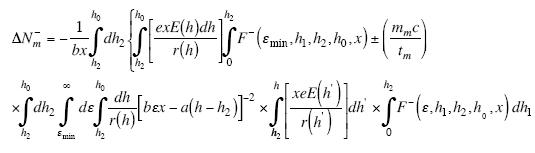
<body><![CDATA[<p align="justify"><font face="verdana" size="2">The observed intensity variation is about 0.2%. According to Dorman (1995), the effect should be between 0.27% and 0.81% on the counting rate of the neutron monitor when the atmospheric electric field intensities are around 100 to 300 Vcm<sup>&#150;1</sup>. Our results show that either the electric field in Mexico City had less intensity than assumed by Dorman (1995), or the electric field is not uniform in time and height during the development of the thunderstorm.</font></p>     <p align="justify"><font face="verdana" size="2"><b>KEY WORDS: </b>Atmospheric electric field, cosmic rays.</font></p>     <p align="justify"><font face="verdana" size="2">&nbsp;</font></p>     <p align="justify"><font face="verdana" size="2"><b>1. INTRODUCTION</b></font></p>     <p align="justify"><font face="verdana" size="2">Short variations of cosmic ray intensity during rain and thunderstorm events (meteorological cosmic ray effects) were observed at Baksan by Alexeenko <i>et al. </i>(1985).</font></p>     <p align="justify"><font face="verdana" size="2">Data on short&#150;term variations of the intensity of secondary cosmic rays during thunderstorms were presented by Alexeenko <i>et al. </i>(2001). The effect was studied separately for soft and hard components, with data provided on 11 and 14 thunderstorms, respectively.</font></p>     <p align="justify"><font face="verdana" size="2">Dorman (1995) developed a general theory of cosmic ray meteorological effects. On the basis of this theory, we investigated atmospheric electric field effects in the cosmic ray neutron component in Mexico City. According to the theory of Dorman (1995), it is possible to detect thunderstorm effects in neutron monitor counting rates.</font></p>     <p align="justify"><font face="verdana" size="2">Variations of the flux of secondary cosmic rays associated with electric field variations were reported by the Baksan Group in 1985 (Alexeenko <i>et al., </i>2002). They noted that the flux of the soft component (&gt; 10 MeV) and the hard component (&gt; 70 MeV) increased in the presence of a negative electric field.</font></p>     <p align="justify"><font face="verdana" size="2">The Japanese Group at Nagoya found that there is evidence for proton acceleration in the presence of positive electric field, and evidence was also obtained for increases of secondary cosmic rays in a positive electric field (Muraki <i>et al., </i>2003).</font></p>     <p align="justify"><font face="verdana" size="2">The Russian Group at Baksan presented the results of a correlation between the hard and soft components of cosmic ray showers and the atmospheric electric field during thunderstorm periods. They demonstrated that the quadratic effect (changing intensity of muons in an electric field of any sign) is most pronounced for soft muons. They studied also the effect of lightning on the intensity of cosmic rays by statistics (Khaerdinov, N.S. <i>et al., </i>2003 a,b,c).</font></p>     ]]></body>
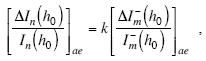
<body><![CDATA[<p align="justify"><font face="verdana" size="2">&nbsp;</font></p>     <p align="justify"><font face="verdana" size="2"><b>2. THE DORMAN THEORY</b></font></p>     <p align="justify"><font face="verdana" size="2">About 7% of the neutron monitor counting rate is caused by negative soft muons captured by lead nucleons</font></p>     <p align="justify"><font face="verdana" size="2"><img src="/img/revistas/geoint/v45n4/a4e1.jpg">.......(1)</font></p>     <p align="justify"><font face="verdana" size="2">The first integral on the right&#150;hand side of (1) describes the atmospheric electric field muon absorption effect, part of which is caused by a change of pressure at the observing level and contributes to the barometric effect, while another part is due to a possible change of thickness of the shield.</font></p>     <p align="justify"><font face="verdana" size="2">The second integral describes the atmospheric electric field muon decay that arises from the instability of muons, (Dorman, 1974).</font></p>     <p align="justify"><font face="verdana" size="2">Furthermore, the expected variation in the neutron monitor counting rate caused by the atmospheric electric field effect on the negative soft muon flux is</font></p>     <p align="justify"><font face="verdana" size="2"><img src="/img/revistas/geoint/v45n4/a4e2.jpg">........................................................................(2)</font></p>     <p align="justify"><font face="verdana" size="2">where I<sub>m</sub> is the negative soft muon intensity at atmospheric pressure h<sub>0</sub>, and <i>k </i>is a constant <i>(k = </i>0.07).</font></p>     <p align="justify"><font face="verdana" size="2">On the basis of (1) and (2), Dorman estimated the expected atmospheric effect on the neutron monitor counting rate. For the case considered with E (h) = 100 and 300 Vcm<sup>&#150;1</sup> between h<sub>c</sub> = 700 g cm<sup>&#150;2</sup> and h<sub>0</sub> = 1000 g cm<sup>&#150;2</sup> at <i>k = </i>0.07, the effect was 0.27% and 0.81%, using 5 min of data.</font></p>     ]]></body>
<body><![CDATA[<p align="justify"><font face="verdana" size="2">&nbsp;</font></p>     <p align="justify"><font face="verdana" size="2"><b>3. DATA SELECTION</b></font></p>     <p align="justify"><font face="verdana" size="2">Two different selection criteria of data were used as being best suited to the two different methods of study explained in section 3.</font></p>     <p align="justify"><font face="verdana" size="2"><b><i>3.1. Strong and long duration storms</i></b></font></p>     <p align="justify"><font face="verdana" size="2">Neutron counting rates were obtained from the neutron monitor installed in Mexico City. We use 5 min of data as that together form mesoatoms with the generation of several MeV neutrons from the lead of the neutron monitor (Dorman, 1974).</font></p>     <p align="justify"><font face="verdana" size="2">According to Dorman, the atmospheric electric field effect on negative muon intensity changes can be obtained from the equation:</font></p>     <p align="justify"><font face="verdana" size="2">suggested by Dorman' s Theory. Two periods of data, during the Solar minimum (1996, 1997), were selected to reduce the possible influence of the active Sun.</font></p>     <p align="justify"><font face="verdana" size="2">Furthermore, to eliminate the possible influence of geomagnetic disturbances, we choose days with thunderstorms during which the daily sum of geomagnetic index K<sub>p</sub> &lt; 20.</font></p>     <p align="justify"><font face="verdana" size="2">The thunderstorm data were obtained from the National Meteorological Service in Mexico City. The meteorological station is less than 10 km from the neutron monitor location. We search periods with thunderstorms of long duration (&gt; 4hrs.).</font></p>     <p align="justify"><font face="verdana" size="2">On the basis of these considerations, we find two intervals: the first from 14 to 19 of June and the second from 13 to 18 of July, both in 1996. During 1997 there were no thunderstorms satisfying our selection criteria.</font></p>     ]]></body>
<body><![CDATA[<p align="justify"><font face="verdana" size="2"><a href="/img/revistas/geoint/v45n4/a4f1.jpg" target="_blank">Figure 1</a> and <a href="/img/revistas/geoint/v45n4/a4f2.jpg" target="_blank">Figure 2</a> show the neutron data as a function of time for interval 1(June 14 to June 19, 1996) and interval 2 (July 13 to July 18, 1996), respectively.</font></p>     <p align="justify"><font face="verdana" size="2"><b><i>3.2. Strong and isolated storms</i></b></font></p>     <p align="justify"><font face="verdana" size="2">We alternatively selected intense thunderstorm isolated in time. We define as "isolated" thunderstorms all those without atmospheric electric activity 72 hrs before and after the selected thunderstorm. Intense thunderstorms include lightning, thunder and heavy rain. We found 9 thunderstorms in 1996 and 5 thunderstorms in 1997 fulfilling these criteria. In order to eliminate the influence of high frequency signals we used 5 min neutron counting rates filtered with moving averages of 7 data points.</font></p>     <p align="justify"><font face="verdana" size="2">&nbsp;</font></p>     <p align="justify"><font face="verdana" size="2"><b>4. STUDY DESIGN AND METHODS</b></font></p>     <p align="justify"><font face="verdana" size="2"><b><i>4.1. Dynamic spectrum</i></b></font></p>     <p align="justify"><font face="verdana" size="2">To find high frequency signals produced in the neutron monitor due to variable electric fields we use a Fast Fourier Transform (FFT) analysis to calculate power spectra. Our analysis uses series of 256 neutron monitor data points (a little more than 21 hours).</font></p>     <p align="justify"><font face="verdana" size="2">The data were partially overlapped. The start for the second series was 128 data points after the first series, etc. This technique was developed by Priestley (1981). It is known as <i>dynamic spectrum. </i>By using short intervals we guarantee that the temporary series represents a stationary process, a necessary condition for using an FFT spectral technique.</font></p>     <p align="justify"><font face="verdana" size="2">For the first interval we obtained 13 spectra. For the second data interval we obtained 11 spectra, because there were gaps in the neutron data.</font></p>     <p align="justify"><font face="verdana" size="2">The data periods for the spectral estimates are much longer than the actual thunderstorm interval. This technique allowed us to search for a signal of the electric field that can be seen as significant difference in the power spectra, for data recorded during thunderstorm time interval and data taken during quiet times.</font></p>     ]]></body>
<body><![CDATA[<p align="justify"><font face="verdana" size="2"><a href="/img/revistas/geoint/v45n4/a4f3.jpg" target="_blank">Figure 3</a> and <a href="/img/revistas/geoint/v45n4/a4f4.jpg" target="_blank">Figure 4</a> show examples of the results of dynamic spectra calculations.</font></p>     <p align="justify"><font face="verdana" size="2">In <a href="/img/revistas/geoint/v45n4/a4f3.jpg" target="_blank">Figure 3</a> we appreciate that the spectra 10 and 11 of interval 1 have a power spectral density much greater than spectra 12 and 13, and furthermore have a strong decreasing tendency with the frequency. Spectra 10 and 11 are below the noise level.</font></p>     <p align="justify"><font face="verdana" size="2">In <a href="/img/revistas/geoint/v45n4/a4f4.jpg" target="_blank">Figure 4</a> we can see the results of spectra 1, 2 and 3 of interval 2. None of these spectra have a dependence on the power spectral density or the frequency; in fact, they are typical white noise spectra. The noise level is too high; we cannot obtain any significant information from these spectra.</font></p>     <p align="justify"><font face="verdana" size="2"><b><i>4.2. Superposed epoch analysis</i></b></font></p>     <p align="justify"><font face="verdana" size="2">In the search for identifiable signals of thunderstorms in secondary neutron cosmic ray intensity, we alternatively selected intense thunderstorm isolated in time (section 2.2).</font></p>     <p align="justify"><font face="verdana" size="2">This lowered the time resolution of our data but, as we saw in the results of the last section, it is very difficult to find identifiable high frequency signals of thunderstorms in cosmic ray data. Therefore we searched among low frequency signals.</font></p>     <p align="justify"><font face="verdana" size="2">We define a TTU (Time Thunderstorm Unit) as the time elapsed during a thunderstorm. Each thunderstorm has a TTU from two to five hours in our case. This procedure allowed us to separate the time intervals before and after the thunderstorm in a normalized manner.</font></p>     <p align="justify"><font face="verdana" size="2">We define T<sub>0</sub> as the TTU when the thunderstorm takes place. T<sub>1</sub> is the time from the end of T<sub>0</sub> to the following TTU. T&#150;<sub>1</sub> is the TTU prior to the storm, and so on. We take 5 intervals before and after T<sub>0</sub>; the total period for each thunderstorm is around 2 days. The average intensities I<sub>&#150;5</sub>,...,I<sub>0</sub>,...,I<sub>5</sub>, were weighted per TTU for each thunderstorm, and then we calculated an average weighted global intensity (&lt;I<sub>&#150;5</sub>&gt;,...,&lt;I<sub>0</sub>&gt;,...,&lt;I<sub>5</sub>&gt;) for each thunderstorm. The results are shown in <a href="/img/revistas/geoint/v45n4/a4f5.jpg" target="_blank">Figures 5,</a> <a href="/img/revistas/geoint/v45n4/a4f6.jpg" target="_blank">6,</a> <a href="/img/revistas/geoint/v45n4/a4f7.jpg" target="_blank">and 7</a>.</font></p>     <p align="justify"><font face="verdana" size="2"><a href="/img/revistas/geoint/v45n4/a4f5.jpg" target="_blank">Figures 5</a> <a href="/img/revistas/geoint/v45n4/a4f6.jpg" target="_blank">and 6</a> show the percentage variation of the average global intensity per TTU for 1996 and 1997, respectively. In <a href="/img/revistas/geoint/v45n4/a4f5.jpg" target="_blank">Figure 5</a> we can see decay in intensity just before the start of the thunderstorm. In <a href="/img/revistas/geoint/v45n4/a4f6.jpg" target="_blank">Figure 6</a>, the decay starts at the same time as the thunderstorm. In these figures, from TTU = 0 to the end (TTU = 5), the tendency is very similar.</font></p>     <p align="justify"><font face="verdana" size="2">This change in intensity may indicate a tendency in global intensity due to intense thunderstorms.</font></p>     ]]></body>
<body><![CDATA[<p align="justify"><font face="verdana" size="2">The percentages are very similar for thunderstorms of 1996 and 1997. Every data group was weighted for its TTU, thus we may eliminate the possible influence of longer thunderstorms than others.</font></p>     <p align="justify"><font face="verdana" size="2"><a href="/img/revistas/geoint/v45n4/a4f7.jpg" target="_blank">Figure 7</a> shows the variation of global intensity for all thunderstorms, a comparison between thunderstorms of 1996 and 1997, and we see that the tendency of the intensity to decay is present. Furthermore, these three figures are similar. Point T<sub>&#150;1</sub> makes the difference, but the tendency in the global intensity is the same. This tendency may be due to a possible influence of the electric fields of thunderstorms on the average global intensity.</font></p>     <p align="justify"><font face="verdana" size="2">&nbsp;</font></p>     <p align="justify"><font face="verdana" size="2"><b>5. DISCUSSION AND CONCLUSIONS</b></font></p>     <p align="justify"><font face="verdana" size="2">The dynamic spectrum showed a weak signal of the influence of thunderstorms on cosmic ray intensity fluctuations; only two spectra have a higher power than others, and show frequency dependence <a href="/img/revistas/geoint/v45n4/a4f3.jpg" target="_blank">(Figure 3)</a>, while the rest are similar to <a href="/img/revistas/geoint/v45n4/a4f4.jpg" target="_blank">Figure 4</a>. Spectra 10 and 11 in <a href="/img/revistas/geoint/v45n4/a4f3.jpg" target="_blank">Figure 3</a> correspond to an intense thunderstorm registered in Mexico City in 1996 (thunderstorm 5 in <a href="/img/revistas/geoint/v45n4/a4f1.jpg" target="_blank">Figure 1</a>). According to these results, high frequency signals of electric field influence on cosmic ray intensity are rare and ambiguous. If we could use a better time resolution (&lt; 5 min), we might be able to observe some electric storm effects in the cosmic rays intensity.</font></p>     <p align="justify"><font face="verdana" size="2">With a superposed epoch analysis, we find a systematic tendency of cosmic ray intensity during thunderstorms. <a href="/img/revistas/geoint/v45n4/a4f5.jpg" target="_blank">Figures 5</a> <a href="/img/revistas/geoint/v45n4/a4f6.jpg" target="_blank">and 6</a> show the tendency of cosmic ray intensity to decrease from TTU=T<sub>0</sub> to TTU=T<sub>2</sub>, for the solar minimum year (1996) and the year of the start of Solar activity (1997). This tendency was persistent in all thunderstorms (1996 and 1997), with the exception of point T<sub>&#150;1</sub> <a href="/img/revistas/geoint/v45n4/a4f5.jpg" target="_blank">Figures 5,</a> <a href="/img/revistas/geoint/v45n4/a4f6.jpg" target="_blank">6</a> <a href="/img/revistas/geoint/v45n4/a4f7.jpg" target="_blank">and 7</a> show the same trends. This may be a sign of the influence of atmospheric electric fields on neutron monitor counting rates in Mexico City. There is no clear tendency of cosmic ray intensity before the storm, but a definite decrease follows and is of similar magnitude always. The measured decrease is about 0.2%; according to Dorman's Theory we would expect an effect of around 0.27% to 0.81 % in neutron monitor counting rates for electric fields of 100 to 300 Vcm<sup>&#150;1</sup>.</font></p>     <p align="justify"><font face="verdana" size="2">Our results may mean that the atmospheric electric fields in Mexico City are smaller than those assumed by Dorman in his calculations, or that these fields are not uniform and vary in time and space during the thunderstorm, thus reducing the net effect on cosmic rays.</font></p>     <p align="justify"><font face="verdana" size="2">Use of an electric field meter may enable us to obtain better results for study of atmospheric electric field effects on cosmic rays: this would greatly improve the quality of experimental data.</font></p>     <p align="justify"><font face="verdana" size="2">The most important result obtained here is that there is a systematic observable decay in cosmic ray intensity during and after thunderstorms. This decay may be due to the presence of strong electric fields in the atmosphere.</font></p>     <p align="justify"><font face="verdana" size="2">&nbsp;</font></p>     ]]></body>
<body><![CDATA[<p align="justify"><font face="verdana" size="2"><b>BIBLIOGRAPHY</b></font></p>     <!-- ref --><p align="justify"><font face="verdana" size="2">ALEXEENKO, V. V., A. E. CHUDAKOV, V. G. SBORSHIKOV and V. A. TIZENGAUZEN, 1985. Short perturbations of cosmic ray intensity and electric field in atmosphere. Proc. 19<sup>th</sup> Int. Cosmic Ray Conf. (La Jolla), 5, 352&#150;355.</font>&nbsp;&nbsp;&nbsp;&nbsp;&nbsp;&nbsp;&nbsp;&nbsp;[&#160;<a href="javascript:void(0);" onclick="javascript: window.open('/scielo.php?script=sci_nlinks&ref=3894402&pid=S0016-7169200600040000400001&lng=','','width=640,height=500,resizable=yes,scrollbars=1,menubar=yes,');">Links</a>&#160;]<!-- end-ref --><!-- ref --><p align="justify"><font face="verdana" size="2">ALEXEENKO, V. V., N. S. KHAERDINOV, A. S. LIDVANSKY and V. B. PETKOV, 2001. Electric field disturbances in the summer&#150;time atmosphere and associated variations of CR intensity. Proc. 27<sup>th</sup> Int. Cosmic Ray Conf. (Hamburg), 4161&#150;4164.</font>&nbsp;&nbsp;&nbsp;&nbsp;&nbsp;&nbsp;&nbsp;&nbsp;[&#160;<a href="javascript:void(0);" onclick="javascript: window.open('/scielo.php?script=sci_nlinks&ref=3894403&pid=S0016-7169200600040000400002&lng=','','width=640,height=500,resizable=yes,scrollbars=1,menubar=yes,');">Links</a>&#160;]<!-- end-ref --><!-- ref --><p align="justify"><font face="verdana" size="2">ALEXEENKO, V. V., N. S. KHAERDINOV, A. S. LIDVANSKY and V. B. PETKOV, 2002. Transient variations of secondary cosmic rays due to atmospheric electric fields and evidence for pre&#150;lightning particle acceleration. <i>Phys. Lett. A 301, </i>299&#150;306.</font>&nbsp;&nbsp;&nbsp;&nbsp;&nbsp;&nbsp;&nbsp;&nbsp;[&#160;<a href="javascript:void(0);" onclick="javascript: window.open('/scielo.php?script=sci_nlinks&ref=3894404&pid=S0016-7169200600040000400003&lng=','','width=640,height=500,resizable=yes,scrollbars=1,menubar=yes,');">Links</a>&#160;]<!-- end-ref --><!-- ref --><p align="justify"><font face="verdana" size="2">BENDAT, J. S. and A. G. PIERSOL, 1971. Random data: analysis and measurement procedures, Wiley&#150;Interscience, New York.</font>&nbsp;&nbsp;&nbsp;&nbsp;&nbsp;&nbsp;&nbsp;&nbsp;[&#160;<a href="javascript:void(0);" onclick="javascript: window.open('/scielo.php?script=sci_nlinks&ref=3894405&pid=S0016-7169200600040000400004&lng=','','width=640,height=500,resizable=yes,scrollbars=1,menubar=yes,');">Links</a>&#160;]<!-- end-ref --><!-- ref --><p align="justify"><font face="verdana" size="2">DORMAN, L. I. and I. V. DORMAN, 1995. Cosmic&#150;ray atmospheric electric field effects. <i>Can. J. Phys., 73,</i>440&#150;443.</font>&nbsp;&nbsp;&nbsp;&nbsp;&nbsp;&nbsp;&nbsp;&nbsp;[&#160;<a href="javascript:void(0);" onclick="javascript: window.open('/scielo.php?script=sci_nlinks&ref=3894406&pid=S0016-7169200600040000400005&lng=','','width=640,height=500,resizable=yes,scrollbars=1,menubar=yes,');">Links</a>&#160;]<!-- end-ref --><!-- ref --><p align="justify"><font face="verdana" size="2">DORMAN, L. I., 1974. Cosmic rays: Variations and space exploration. North&#150;Holland Publishing Co., Amsterdam.</font>&nbsp;&nbsp;&nbsp;&nbsp;&nbsp;&nbsp;&nbsp;&nbsp;[&#160;<a href="javascript:void(0);" onclick="javascript: window.open('/scielo.php?script=sci_nlinks&ref=3894407&pid=S0016-7169200600040000400006&lng=','','width=640,height=500,resizable=yes,scrollbars=1,menubar=yes,');">Links</a>&#160;]<!-- end-ref --><!-- ref --><p align="justify"><font face="verdana" size="2">KHAERDINOV, N. S., A. S. LIDVANSKY, V. B. PETKOV and Y. P. SUROVETSKY, 2003. Effect of the disturbed electric field of the atmosphere on cosmic rays: 1. Soft component. Proc. 28<sup>th</sup> Int. Cosmic Ray Conf. (Tsukuba), 4169&#150;4172, a.</font>&nbsp;&nbsp;&nbsp;&nbsp;&nbsp;&nbsp;&nbsp;&nbsp;[&#160;<a href="javascript:void(0);" onclick="javascript: window.open('/scielo.php?script=sci_nlinks&ref=3894408&pid=S0016-7169200600040000400007&lng=','','width=640,height=500,resizable=yes,scrollbars=1,menubar=yes,');">Links</a>&#160;]<!-- end-ref --><!-- ref --><p align="justify"><font face="verdana" size="2">KHAERDINOV, N. S., A. S. LIDVANSKY, V. B. PETKOV and Y. P. SUROVETSKY, 2003. Effect of the disturbed electric field of the atmosphere on cosmic rays: 2. Hard component. Proc. 28<sup>th</sup> Int. Cosmic Ray Conf. (Tsukuba), 4173&#150;4176, b.</font>&nbsp;&nbsp;&nbsp;&nbsp;&nbsp;&nbsp;&nbsp;&nbsp;[&#160;<a href="javascript:void(0);" onclick="javascript: window.open('/scielo.php?script=sci_nlinks&ref=3894409&pid=S0016-7169200600040000400008&lng=','','width=640,height=500,resizable=yes,scrollbars=1,menubar=yes,');">Links</a>&#160;]<!-- end-ref --><!-- ref --><p align="justify"><font face="verdana" size="2">KHAERDINOV, N. S., A. S. LIDVANSKY, V. B. PETKOV and Y. P. SUROVETSKY, 2003. The effect of lightning on the intensity of the soft component of cosmic rays. Proc. 28<sup>th</sup> Int. Cosmic Ray Conf. (Tsukuba), 4185&#150;4188, c.</font>&nbsp;&nbsp;&nbsp;&nbsp;&nbsp;&nbsp;&nbsp;&nbsp;[&#160;<a href="javascript:void(0);" onclick="javascript: window.open('/scielo.php?script=sci_nlinks&ref=3894410&pid=S0016-7169200600040000400009&lng=','','width=640,height=500,resizable=yes,scrollbars=1,menubar=yes,');">Links</a>&#160;]<!-- end-ref --><!-- ref --><p align="justify"><font face="verdana" size="2">MURAKI, Y., Y. MIYAMOTO, T. TAKAMI, W. I. AXFORD, Y. MATSUBARA, K. MASUDA, T. SAKO, K. WATANABE, S. SAKAKIBARA, S. SHIBATA, Y. MUNAKATA, S. YASUE, T. SAKAI, K. MITSUI and E. O. FLUECKIGER, 2003. Acceleration below thunder clouds at mount Norikura. Proc. 28<sup>th</sup> Int. Cosmic Ray Conf. (Tsukuba), 4177&#150;4180.</font>&nbsp;&nbsp;&nbsp;&nbsp;&nbsp;&nbsp;&nbsp;&nbsp;[&#160;<a href="javascript:void(0);" onclick="javascript: window.open('/scielo.php?script=sci_nlinks&ref=3894411&pid=S0016-7169200600040000400010&lng=','','width=640,height=500,resizable=yes,scrollbars=1,menubar=yes,');">Links</a>&#160;]<!-- end-ref --> ]]></body><back>
<ref-list>
<ref id="B1">
<nlm-citation citation-type="confpro">
<person-group person-group-type="author">
<name>
<surname><![CDATA[ALEXEENKO]]></surname>
<given-names><![CDATA[V. V]]></given-names>
</name>
<name>
<surname><![CDATA[CHUDAKOV]]></surname>
<given-names><![CDATA[A. E]]></given-names>
</name>
<name>
<surname><![CDATA[SBORSHIKOV]]></surname>
<given-names><![CDATA[V. G]]></given-names>
</name>
<name>
<surname><![CDATA[TIZENGAUZEN]]></surname>
<given-names><![CDATA[V. A]]></given-names>
</name>
</person-group>
<source><![CDATA[Short perturbations of cosmic ray intensity and electric field in atmosphere]]></source>
<year>1985</year>
<volume>5</volume>
<conf-name><![CDATA[ Proc. 19th Int. Cosmic Ray Conf]]></conf-name>
<conf-loc>La Jolla </conf-loc>
<page-range>352-355</page-range></nlm-citation>
</ref>
<ref id="B2">
<nlm-citation citation-type="confpro">
<person-group person-group-type="author">
<name>
<surname><![CDATA[ALEXEENKO]]></surname>
<given-names><![CDATA[V. V]]></given-names>
</name>
<name>
<surname><![CDATA[KHAERDINOV]]></surname>
<given-names><![CDATA[N. S]]></given-names>
</name>
<name>
<surname><![CDATA[LIDVANSKY]]></surname>
<given-names><![CDATA[A. S]]></given-names>
</name>
<name>
<surname><![CDATA[PETKOV]]></surname>
<given-names><![CDATA[V. B]]></given-names>
</name>
</person-group>
<source><![CDATA[Electric field disturbances in the summer-time atmosphere and associated variations of CR intensity]]></source>
<year>2001</year>
<conf-name><![CDATA[ Proc. 27th Int. Cosmic Ray Conf]]></conf-name>
<conf-loc>Hamburg </conf-loc>
<page-range>4161-4164</page-range></nlm-citation>
</ref>
<ref id="B3">
<nlm-citation citation-type="journal">
<person-group person-group-type="author">
<name>
<surname><![CDATA[ALEXEENKO]]></surname>
<given-names><![CDATA[V. V]]></given-names>
</name>
<name>
<surname><![CDATA[KHAERDINOV]]></surname>
<given-names><![CDATA[N. S]]></given-names>
</name>
<name>
<surname><![CDATA[LIDVANSKY]]></surname>
<given-names><![CDATA[A. S]]></given-names>
</name>
<name>
<surname><![CDATA[PETKOV]]></surname>
<given-names><![CDATA[V. B]]></given-names>
</name>
</person-group>
<article-title xml:lang="en"><![CDATA[Transient variations of secondary cosmic rays due to atmospheric electric fields and evidence for pre-lightning particle acceleration]]></article-title>
<source><![CDATA[Phys. Lett]]></source>
<year>2002</year>
<numero>A 301</numero>
<issue>A 301</issue>
<page-range>299-306</page-range></nlm-citation>
</ref>
<ref id="B4">
<nlm-citation citation-type="book">
<person-group person-group-type="author">
<name>
<surname><![CDATA[BENDAT]]></surname>
<given-names><![CDATA[J. S]]></given-names>
</name>
<name>
<surname><![CDATA[PIERSOL]]></surname>
<given-names><![CDATA[A. G]]></given-names>
</name>
</person-group>
<source><![CDATA[Random data: analysis and measurement procedures]]></source>
<year>1971</year>
<publisher-loc><![CDATA[New York ]]></publisher-loc>
<publisher-name><![CDATA[Wiley-Interscience]]></publisher-name>
</nlm-citation>
</ref>
<ref id="B5">
<nlm-citation citation-type="journal">
<person-group person-group-type="author">
<name>
<surname><![CDATA[DORMAN]]></surname>
<given-names><![CDATA[L. I]]></given-names>
</name>
<name>
<surname><![CDATA[DORMAN]]></surname>
<given-names><![CDATA[I. V]]></given-names>
</name>
</person-group>
<article-title xml:lang="en"><![CDATA[Cosmic-ray atmospheric electric field effects]]></article-title>
<source><![CDATA[Can. J. Phys]]></source>
<year>1995</year>
<numero>73</numero>
<issue>73</issue>
<page-range>440-443</page-range></nlm-citation>
</ref>
<ref id="B6">
<nlm-citation citation-type="book">
<person-group person-group-type="author">
<name>
<surname><![CDATA[DORMAN]]></surname>
<given-names><![CDATA[L. I]]></given-names>
</name>
</person-group>
<source><![CDATA[Cosmic rays: Variations and space exploration]]></source>
<year>1974</year>
<publisher-loc><![CDATA[Amsterdam ]]></publisher-loc>
<publisher-name><![CDATA[North-Holland Publishing Co]]></publisher-name>
</nlm-citation>
</ref>
<ref id="B7">
<nlm-citation citation-type="confpro">
<person-group person-group-type="author">
<name>
<surname><![CDATA[KHAERDINOV]]></surname>
<given-names><![CDATA[N. S]]></given-names>
</name>
<name>
<surname><![CDATA[LIDVANSKY]]></surname>
<given-names><![CDATA[A. S]]></given-names>
</name>
<name>
<surname><![CDATA[PETKOV]]></surname>
<given-names><![CDATA[V. B]]></given-names>
</name>
<name>
<surname><![CDATA[SUROVETSKY]]></surname>
<given-names><![CDATA[Y. P]]></given-names>
</name>
</person-group>
<source><![CDATA[Effect of the disturbed electric field of the atmosphere on cosmic rays: 1. Soft component]]></source>
<year>2003</year>
<conf-name><![CDATA[ Proc. 28th Int. Cosmic Ray Conf]]></conf-name>
<conf-loc>Tsukuba </conf-loc>
<page-range>4169-4172</page-range></nlm-citation>
</ref>
<ref id="B8">
<nlm-citation citation-type="confpro">
<person-group person-group-type="author">
<name>
<surname><![CDATA[KHAERDINOV]]></surname>
<given-names><![CDATA[N. S]]></given-names>
</name>
<name>
<surname><![CDATA[LIDVANSKY]]></surname>
<given-names><![CDATA[A. S]]></given-names>
</name>
<name>
<surname><![CDATA[PETKOV]]></surname>
<given-names><![CDATA[V. B]]></given-names>
</name>
<name>
<surname><![CDATA[SUROVETSKY]]></surname>
<given-names><![CDATA[Y. P]]></given-names>
</name>
</person-group>
<source><![CDATA[Effect of the disturbed electric field of the atmosphere on cosmic rays: 2. Hard component]]></source>
<year>2003</year>
<conf-name><![CDATA[ Proc. 28th Int. Cosmic Ray Conf]]></conf-name>
<conf-loc>Tsukuba </conf-loc>
<page-range>4173-4176</page-range></nlm-citation>
</ref>
<ref id="B9">
<nlm-citation citation-type="confpro">
<person-group person-group-type="author">
<name>
<surname><![CDATA[KHAERDINOV]]></surname>
<given-names><![CDATA[N. S]]></given-names>
</name>
<name>
<surname><![CDATA[LIDVANSKY]]></surname>
<given-names><![CDATA[A. S]]></given-names>
</name>
<name>
<surname><![CDATA[PETKOV]]></surname>
<given-names><![CDATA[V. B]]></given-names>
</name>
<name>
<surname><![CDATA[SUROVETSKY]]></surname>
<given-names><![CDATA[Y. P]]></given-names>
</name>
</person-group>
<source><![CDATA[The effect of lightning on the intensity of the soft component of cosmic rays]]></source>
<year>2003</year>
<conf-name><![CDATA[ Proc. 28th Int. Cosmic Ray Conf]]></conf-name>
<conf-loc>Tsukuba </conf-loc>
<page-range>4185-4188</page-range></nlm-citation>
</ref>
<ref id="B10">
<nlm-citation citation-type="confpro">
<person-group person-group-type="author">
<name>
<surname><![CDATA[MURAKI]]></surname>
<given-names><![CDATA[Y]]></given-names>
</name>
<name>
<surname><![CDATA[MIYAMOTO]]></surname>
<given-names><![CDATA[Y]]></given-names>
</name>
<name>
<surname><![CDATA[TAKAMI]]></surname>
<given-names><![CDATA[T]]></given-names>
</name>
<name>
<surname><![CDATA[AXFORD]]></surname>
<given-names><![CDATA[W. I]]></given-names>
</name>
<name>
<surname><![CDATA[MATSUBARA]]></surname>
<given-names><![CDATA[Y]]></given-names>
</name>
<name>
<surname><![CDATA[MASUDA]]></surname>
<given-names><![CDATA[K]]></given-names>
</name>
<name>
<surname><![CDATA[SAKO]]></surname>
<given-names><![CDATA[T]]></given-names>
</name>
<name>
<surname><![CDATA[WATANABE]]></surname>
<given-names><![CDATA[K]]></given-names>
</name>
<name>
<surname><![CDATA[SAKAKIBARA]]></surname>
<given-names><![CDATA[S]]></given-names>
</name>
<name>
<surname><![CDATA[SHIBATA]]></surname>
<given-names><![CDATA[S]]></given-names>
</name>
<name>
<surname><![CDATA[MUNAKATA]]></surname>
<given-names><![CDATA[Y]]></given-names>
</name>
<name>
<surname><![CDATA[YASUE]]></surname>
<given-names><![CDATA[S]]></given-names>
</name>
<name>
<surname><![CDATA[SAKAI]]></surname>
<given-names><![CDATA[T]]></given-names>
</name>
<name>
<surname><![CDATA[MITSUI]]></surname>
<given-names><![CDATA[K]]></given-names>
</name>
<name>
<surname><![CDATA[FLUECKIGER]]></surname>
<given-names><![CDATA[E. O]]></given-names>
</name>
</person-group>
<source><![CDATA[Acceleration below thunder clouds at mount Norikura]]></source>
<year>2003</year>
<conf-name><![CDATA[ Proc. 28th Int. Cosmic Ray Conf]]></conf-name>
<conf-loc>Tsukuba </conf-loc>
<page-range>4177-4180</page-range></nlm-citation>
</ref>
</ref-list>
</back>
</article>