<?xml version="1.0" encoding="ISO-8859-1"?><article xmlns:mml="http://www.w3.org/1998/Math/MathML" xmlns:xlink="http://www.w3.org/1999/xlink" xmlns:xsi="http://www.w3.org/2001/XMLSchema-instance">
<front>
<journal-meta>
<journal-id>0016-7169</journal-id>
<journal-title><![CDATA[Geofísica internacional]]></journal-title>
<abbrev-journal-title><![CDATA[Geofís. Intl]]></abbrev-journal-title>
<issn>0016-7169</issn>
<publisher>
<publisher-name><![CDATA[Universidad Nacional Autónoma de México, Instituto de Geofísica]]></publisher-name>
</publisher>
</journal-meta>
<article-meta>
<article-id>S0016-71692006000200003</article-id>
<title-group>
<article-title xml:lang="en"><![CDATA[Crustal thickness beneath Rio de Janeiro, Brazil, from spectra of SH waves at station RDJ]]></article-title>
</title-group>
<contrib-group>
<contrib contrib-type="author">
<name>
<surname><![CDATA[Cario]]></surname>
<given-names><![CDATA[Felipe Dias]]></given-names>
</name>
<xref ref-type="aff" rid="A01"/>
</contrib>
<contrib contrib-type="author">
<name>
<surname><![CDATA[Souza]]></surname>
<given-names><![CDATA[Jorge Luis de]]></given-names>
</name>
<xref ref-type="aff" rid="A01"/>
</contrib>
</contrib-group>
<aff id="A01">
<institution><![CDATA[,MCT Observatório Nacional ]]></institution>
<addr-line><![CDATA[Rio de Janeiro ]]></addr-line>
<country>Brazil</country>
</aff>
<pub-date pub-type="pub">
<day>00</day>
<month>06</month>
<year>2006</year>
</pub-date>
<pub-date pub-type="epub">
<day>00</day>
<month>06</month>
<year>2006</year>
</pub-date>
<volume>45</volume>
<numero>2</numero>
<fpage>115</fpage>
<lpage>128</lpage>
<copyright-statement/>
<copyright-year/>
<self-uri xlink:href="http://www.scielo.org.mx/scielo.php?script=sci_arttext&amp;pid=S0016-71692006000200003&amp;lng=en&amp;nrm=iso"></self-uri><self-uri xlink:href="http://www.scielo.org.mx/scielo.php?script=sci_abstract&amp;pid=S0016-71692006000200003&amp;lng=en&amp;nrm=iso"></self-uri><self-uri xlink:href="http://www.scielo.org.mx/scielo.php?script=sci_pdf&amp;pid=S0016-71692006000200003&amp;lng=en&amp;nrm=iso"></self-uri><abstract abstract-type="short" xml:lang="es"><p><![CDATA[Se analizaron espectros de amplitud y de fase para ondas S para estimar el espesor de la corteza bajo la estación sísmica de Río de Janeiro. El resultado estimado es de 32.9 ± 2.6 km, que es consistente con una zona de transición intraplaca de océano a continente. Las fuentes sísmicas someras a distancias de 83 a 88 grados proporcionan óptimos resultados.]]></p></abstract>
<abstract abstract-type="short" xml:lang="en"><p><![CDATA[Amplitude and phase spectra of long period analog S wave records were used to estimate crustal thickness under Rio de Janeiro seismic station. Earthquakes with shallow focal depths (10-33 km) and epicentral distances varying from 83 to 88 degrees provided the best estimates of crustal thickness. Epicentral distance seems to be the most important parameter in getting adequate amplitude and phase spectra. The estimated crustal thickness under RDJ station is 32.9 ± 2.6 km. This value is compatible with an intraplate continent-ocean transition zone and with recent surface wave studies and crustal thickness determinations from receiver functions.]]></p></abstract>
<kwd-group>
<kwd lng="es"><![CDATA[Ondas SH]]></kwd>
<kwd lng="es"><![CDATA[espectros de amplitud y de fase]]></kwd>
<kwd lng="es"><![CDATA[espesor de la corteza]]></kwd>
<kwd lng="es"><![CDATA[Río de Janeiro]]></kwd>
<kwd lng="es"><![CDATA[velocidad de S]]></kwd>
<kwd lng="es"><![CDATA[Brasil]]></kwd>
<kwd lng="en"><![CDATA[SH waves]]></kwd>
<kwd lng="en"><![CDATA[amplitude and phase spectra]]></kwd>
<kwd lng="en"><![CDATA[crustal thickness]]></kwd>
<kwd lng="en"><![CDATA[Rio de Janeiro]]></kwd>
<kwd lng="en"><![CDATA[S wave velocity]]></kwd>
<kwd lng="en"><![CDATA[southeastern Brazil]]></kwd>
</kwd-group>
</article-meta>
</front><body><![CDATA[ <p align="center"><font face="verdana" size="4"><b>Crustal thickness beneath Rio de Janeiro, Brazil, from spectra of </b><b>SH waves at station RDJ</b></font></p>     <p align="justify"><font face="verdana" size="2">&nbsp;</font></p>     <p align="center"><font face="verdana" size="2"><b>Felipe Dias Cario and Jorge Luis de Souza*</b></font></p>     <p align="center"><font face="verdana" size="2">&nbsp;</font></p>     <p align="justify"><font face="verdana" size="2"><i>MCT &#150; Observat&oacute;rio Nacional, R: Gal. Jos&eacute; Cristino, 77 &#150; S&atilde;o Crist&oacute;v&atilde;o, 20921&#150;400 Rio de Janeiro, Brazil *Author for correspondence: <a href="mailto:jorge@on.br">jorge@on.br</a></i></font></p>     <p align="justify"><font face="verdana" size="2">&nbsp;</font></p>     <p align="justify"><font face="verdana" size="2">Received: November 13, 2005    <br> Accepted: April 4, 2006</font></p>     <p align="justify"><font face="verdana" size="2">&nbsp;</font></p>     <p align="justify"><font face="verdana" size="2"><b>Resumen</b></font></p>     ]]></body>
<body><![CDATA[<p align="justify"><font face="verdana" size="2">Se analizaron espectros de amplitud y de fase para ondas S para estimar el espesor de la corteza bajo la estaci&oacute;n s&iacute;smica de R&iacute;o de Janeiro. El resultado estimado es de 32.9 &plusmn; 2.6 km, que es consistente con una zona de transici&oacute;n intraplaca de oc&eacute;ano a continente. Las fuentes s&iacute;smicas someras a distancias de 83 a 88 grados proporcionan &oacute;ptimos resultados.</font></p>     <p align="justify"><font face="verdana" size="2"><b>Palabras clave: </b> Ondas SH, espectros de amplitud y de fase, espesor de la corteza, R&iacute;o de Janeiro, velocidad de S, Brasil.</font></p>     <p align="justify"><font face="verdana" size="2">&nbsp;</font></p>     <p align="justify"><font face="verdana" size="2"><b>Abstract</b></font></p>     <p align="justify"><font face="verdana" size="2">Amplitude and phase spectra of long period analog S wave records were used to estimate crustal thickness under Rio de Janeiro seismic station. Earthquakes with shallow focal depths (10&#150;33 km) and epicentral distances varying from 83 to 88 degrees provided the best estimates of crustal thickness. Epicentral distance seems to be the most important parameter in getting adequate amplitude and phase spectra. The estimated crustal thickness under RDJ station is 32.9 &plusmn; 2.6 km. This value is compatible with an intraplate continent&#150;ocean transition zone and with recent surface wave studies and crustal thickness determinations from receiver functions.</font></p>     <p align="justify"><font face="verdana" size="2"><b>Key words: </b>SH waves, amplitude and phase spectra, crustal thickness, Rio de Janeiro, S wave velocity, southeastern Brazil.</font></p>     <p align="justify"><font face="verdana" size="2">&nbsp;</font></p>     <p align="justify"><font face="verdana" size="2"><b>1. Introduction</b></font></p>     <p align="justify"><font face="verdana" size="2">Seismological research in South America began at the end of the XIX century, with the installation of the Observat&oacute;rio Nacional station at Rio de Janeiro, Brazil. Since then, the instrumentation of seismic station RDJ has been updated regularly. Until 1977, all analog records generated at RDJ were sent to North American institutions, which were responsible for providing all necessary material to support of the station. From 1977 to 1992, Observat&oacute;rio Nacional accumulated a valuable data set of long period analog records, which have been used to investigate crustal and upper mantle structure of Brazil by surface wave dispersion (Souza, 1988; 1991; 1995; 1996a; 1996b; 1996c).</font></p>     <p align="justify"><font face="verdana" size="2">The spectral content of seismic body waves has been used in the seismological literature to estimate crustal thickness in many places around the world (Bakun, 1971; Leong, 1975; Al&#150;Amri, 1998). In Brazil, information about crustal thickness is limited and concentrated in some regions of the country. Surface wave studies along profiles crossing several geological provinces (Souza, 1988; 1991; 1996b) have shown that the average crustal thickness in Eastern Brazil is around 40 &plusmn; 5 km, which is a typical value for shield regions. However, recent determinations of crustal thickness in Southeastern Brazil (Assump&ccedil;&atilde;o <i>et al., </i>1997; Assump&ccedil;&atilde;o <i>et al., </i>2002), by using receiver function methodology, show significant variations of crustal thickness in that region. According to Assump&ccedil;&atilde;o <i>et al. </i>(1997), crustal thickness in southeastern Brazil varies from 37 to 47km. In the Paran&aacute; basin, they found an average crustal thickness of 43 &plusmn; 3km, whereas in Mantiqueira it is 41 &plusmn; 3km and in the Ribeira belt it is 39 &plusmn; 3km.</font></p>     ]]></body>
<body><![CDATA[<p align="justify"><font face="verdana" size="2">A recent three&#150;dimensional S wave velocity structure study in southeastern Brazil, using a large data set of Rayleigh wave dispersion curves, has also generated a 3D Moho image for the region (Pacheco, 2003). It shows that Moho depth under RDJ seismic station is around 32 km. The objective of this paper is to use long period analog records of S waves recorded at station RDJ, to estimate crustal thickness under it. Information from amplitude and phase spectra of SH waves is applied to compute crustal thickness.</font></p>     <p align="justify"><font face="verdana" size="2">&nbsp;</font></p>     <p align="justify"><font face="verdana" size="2"><b>2. GEOTECTONIC SETTING</b></font></p>     <p align="justify"><font face="verdana" size="2">The continental part of the South American plate features strong geological and tectonic contrasts. Geologic history from the Precambrian to the present covers three major tectonic provinces: Andean Cordillera, Patagonian platform and South American platform. The platforms are tectonically stable and the Cordillera is tectonically active. According to Almeida <i>et al. </i>(1981), the South American platform is divided into four large cratonic areas (<a href="/img/revistas/geoint/v45n2/a3f1.jpg" target="_blank">Figure 1</a>). The first craton is the Guyana shield, which is geologically constituted of a thin post&#150;Paleozoic cover over metamorphosed and igneous rocks of Precambrian age (<a href="/img/revistas/geoint/v45n2/a3f1.jpg" target="_blank">Figure 1</a>). The central and eastern parts of the Guyana block are composed of granulites and gneisses with ages varying from 3700 to 3400 ma. The second cratonic area is the central Brazilian shield, covered by Phanerozoic sedimentary rocks and associated basalts with thicknesses of a few hundred meters (<a href="/img/revistas/geoint/v45n2/a3f1.jpg" target="_blank">Figure 1</a>). The Tocantins sector of this province, located between the Amazonian and S&atilde;o Francisco cratons, shows three different structural regions. Rocks older than 2600 ma are normally found in the central part of the province. The Tapaj&oacute;s province, or Guapor&eacute; craton, is composed of Precambrian rocks covered by remnants of Phanerozoic deposits (Almeida <i>et al., </i>1981). A few isolated radiometric determinations have suggested that a large part of the Xingu complex is older than 2500 ma.</font></p>     <p align="justify"><font face="verdana" size="2">The third cratonic area is the Atlantic shield, characterized by a cover of various ages with granitic&#150;gneissic complexes exposed in some places (<a href="/img/revistas/geoint/v45n2/a3f1.jpg" target="_blank">Figure 1</a>). The northern part of this province is the Borborema province, which coincides with the Nordeste fold belt. The Mantiqueira province, where Rio de Janeiro is located, is almost entirely formed by coastal mountains. Finally, the Rio de La Plata craton represents the southern part of the Brazilian territory, plus Uruguay and northern Argentina (<a href="/img/revistas/geoint/v45n2/a3f1.jpg" target="_blank">Figure 1</a>). This craton is mostly covered by Phanerozoic sediments and features an extensive association of granites, granodiarites and migmatites with metasedimentary troughs. Radiometric determinations in the basement of this province indicate that the cratonic area was consolidated at the end of the Transamazonian cycle (Almeida <i>et al., </i>1981).</font></p>     <p align="justify"><font face="verdana" size="2">Surrounding the cratonic cores are four great intracratonic basins: Amazonian, Parna&iacute;ba, Paran&aacute; and Chaco (<a href="/img/revistas/geoint/v45n2/a3f1.jpg" target="_blank">Figure 1</a>). The Amazonian basin is located between the Guyana and central Brazilian shields and it contains Paleozoic marine deposits from Early Silurian to Permian age (<a href="/img/revistas/geoint/v45n2/a3f2.jpg" target="_blank">Figure 2</a>). The Parna&iacute;ba basin is located entirely in the northern part of the Brazilian territory. It has an almost circular shape with elevations commonly less than 600 m (<a href="/img/revistas/geoint/v45n2/a3f2.jpg" target="_blank">Figure 2</a>). The subsidence of this province began in Early Silurian or probably in Late Ordovician, after erosion of the Precambrian basement rocks. According to Almeida <i>et al. </i>(1981), the region was affected by several episodes of marine and continental sedimentation with ages ranging from Early Devonian to Early Permian. The Paran&aacute; basin is situated mainly in the southern part of the Brazilian territory, but it also extends into Paraguay, Uruguay and Argentina (<a href="/img/revistas/geoint/v45n2/a3f2.jpg" target="_blank">Figure 2</a>). According to Almeida <i>et al. </i>(1981), the oldest sediments of the province are of Silurian age and are found in Paraguay. The evolution of the basin is marked by episodes of marine (Devonian and Carboniferous) and continental (Permian) sedimentation. A sedimentary cover of about 4.2 km thickness was deposited during the more recent periods of sedimentation (Almeida <i>et al., </i>1981). During the separation of South America from Africa, in the Late Jurassic, the province was extensively covered by continental sediments of 0.4 km thickness with basaltic flows of up to 1.5 km thickness in north&#150;central Paran&aacute; province (Almeida <i>et al., </i>1981). The Chaco basin occupies the southern and southwestern parts of the South American platform (<a href="/img/revistas/geoint/v45n2/a3f1.jpg" target="_blank">Figure 1</a>). According to Almeida (1969), this province is almost entirely covered by a few hundred meters of Cenozoic sediments. In its deeper parts, the sedimentary cover reaches up to 3.2 km thickness. The older sediments in the Chaco basin are probably from Early Silurian or Early Devonian and the youngest sediments are of Quaternary age.</font></p>     <p align="justify"><font face="verdana" size="2">RDJ station is located in Mantiqueira province (<a href="/img/revistas/geoint/v45n2/a3f3.jpg" target="_blank">Figure 3</a>). It is dominated by a large mountain range, which spreads along the entire coastal area of southeastern Brazil. In northern Mantiqueira province there are three fold systems which originated in the Brasiliano Cycle, separated by two massifs following a NE&#150;SW direction. In the massifs, the pre&#150;Brasiliano basement is exposed as Middle and Early Precambrian covers. Several small basins are found within the fold systems and its margins are filled with molasses and acidic to intermediate lavas with a thickness of around 5 km (Almeida <i>et al., </i>1981).</font></p>     <p align="justify"><font face="verdana" size="2">&nbsp;</font></p>     <p align="justify"><font face="verdana" size="2"><b>3. METHODOLOGY</b></font></p>     <p align="justify"><font face="verdana" size="2">When a wave arrives at an interface between two media of different elastic properties, it gives rise to reflected and refracted waves. The number of reflected and refracted waves depends on the incident wave or the media (B&aring;th, 1973). If the incident wave is an SH wave and if the media are solid, a reflected SH wave and refracted SH wave are generated. The energy associated with SH is not converted to another kind of wave and may be used to estimate the crustal thickness H beneath RDJ seismic station (<a href="/img/revistas/geoint/v45n2/a3f4.jpg" target="_blank">Figure 4</a>). We use SH waves of earthquakes at large distances from the seismic station. According to Ibrahim (1969), the propagation of SH waves in a stratified medium can be used to investigate the amplitude relationship between an incident plane wave at the Mohorovicic discontinuity and its corresponding reflected and refracted waves. He showed that the amplitude spectrum, either for a single&#150;layer or double&#150;layer model, contains a series of maxima and minima, which are related to constructive and destructive interference in the crust. A minimum of the theoretical amplitude spectrum coincides with a zero of the theoretical phase spectrum, and a straight line is obtained when the frequencies related to those particular points in the spectra are plotted against an integer corresponding to the number of the minimum.</font></p>     ]]></body>
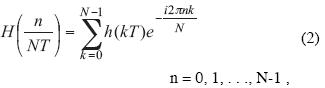
<body><![CDATA[<p align="justify"><font face="verdana" size="2">For a single layer overlying an infinite half&#150;space, the maxima and minima in the amplitude spectrum are due to resonance effects in the crust (Ibrahim, 1969) and their loci are given by</font></p>     <p align="center"><font face="verdana" size="2"><img src="/img/revistas/geoint/v45n2/a3s1.jpg"></font></p>     <p align="justify"><font face="verdana" size="2">where <i>f</i> is the spectral frequency, <u>m</u> is the order number of the minimum in the amplitude spectrum, <i>&beta; is </i>the shear wave velocity of the layer of thickness <i>H, </i>and<i> &theta; </i>is the angle of incidence at the base of the crust beneath RDJ station (<a href="/img/revistas/geoint/v45n2/a3f4.jpg" target="_blank">Figure 4</a>).</font></p>     <p align="justify"><font face="verdana" size="2">&nbsp;</font></p>     <p align="justify"><font face="verdana" size="2"><b>3.1. Computation of amplitude and phase spectra</b></font></p>     <p align="justify"><font face="verdana" size="2">Let h(kT) and <img src="/img/revistas/geoint/v45n2/a3s2.jpg"> be a discrete S wave record observed at RDJ seismic station and its Discrete Fourier Transform, respectively. We may write (Brigham, 1988)</font></p>     <p align="center"><font face="verdana" size="2"><img src="/img/revistas/geoint/v45n2/a3s3.jpg"></font></p>     <p align="justify"><font face="verdana" size="2">where n and k are integers, T is the sampling interval, N is the total number of points of the discrete S wave record and i is the imaginary number.</font></p>     <p align="justify"><font face="verdana" size="2">As<i> <img src="/img/revistas/geoint/v45n2/a3s2.jpg"></i> is a complex quantity, the amplitude spectrum is given by </font></p>     <p align="center"><font face="verdana" size="2"><img src="/img/revistas/geoint/v45n2/a3s4.jpg"></font></p>     ]]></body>

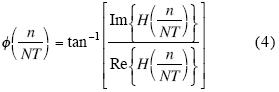
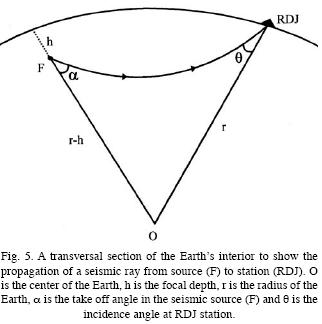
<body><![CDATA[<p align="justify"><font face="verdana" size="2">and the phase spectrum is</font></p>     <p align="center"><font face="verdana" size="2"><img src="/img/revistas/geoint/v45n2/a3s5.jpg"></font></p>     <p align="justify"><font face="verdana" size="2">where Im{ } and Re{ } stand for the imaginary and real parts. The computation of the amplitude and phase spectra, through equations (3) and (4), provides the terms <i>f</i> and <i>m </i>of equation (1).</font></p>     <p align="justify"><font face="verdana" size="2">&nbsp;</font></p>     <p align="justify"><font face="verdana" size="2"><b>3.2. Determination of the incidence angle</b></font></p>     <p align="justify"><font face="verdana" size="2">Consider the propagation of an S wave from source F to station RDJ (<a href="#f5">Figure 5</a>). If an initial angle  &alpha; is considered at the source, we may use Snell's law to compute the incidence angle &theta; at RDJ seismic station through the following expression</font></p>     <p align="center"><font face="verdana" size="2"><img src="/img/revistas/geoint/v45n2/a3s6.jpg"></font></p>     <p align="center"><font face="verdana" size="2"><a name="f5"></a></font></p>     <p align="center"><font face="verdana" size="2"><img src="/img/revistas/geoint/v45n2/a3f5.jpg"></font></p>     <p align="justify"><font face="verdana" size="2">where r is the Earth's radius, h is the focal depth, and &beta;<sub>F</sub> and &beta;<sub>RDJ</sub> are the shear wave velocities at the source and beneath RDJ station, as defined by the Earth model used in the computations.</font></p>     ]]></body>
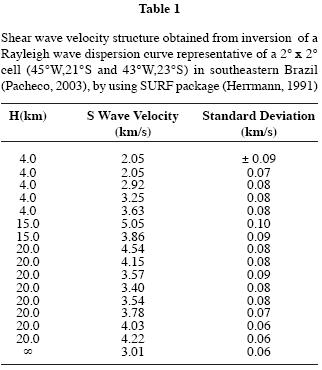
<body><![CDATA[<p align="justify"><font face="verdana" size="2">&nbsp;</font></p>     <p align="justify"><font face="verdana" size="2"><b>3.3. Shear wave velocity beneath RDJ station</b></font></p>     <p align="justify"><font face="verdana" size="2">In order to compute the crustal thickness under RDJ station from equation (1) we need an average shear wave velocity value for the crust beneath the seismic station. In practice, this value is obtained from global Earth models, which represent average values on a large scale. However, we may use data from the three&#150;dimensional S wave velocity structure of the southeastern Brazilian lithosphere (Pacheco, 2003). We are using the estimated shear wave velocity structure of the cell that contains RDJ station (<a href="#t1">Table 1</a>). The Rayleigh wave dispersion inversion results for this cell is shown in <a href="/img/revistas/geoint/v45n2/a3f6.jpg" target="_blank">Figure 6</a>. Observed and theoretical Rayleigh wave dispersion curves match quite well over the period range analysed (<a href="/img/revistas/geoint/v45n2/a3f6.jpg" target="_blank">Figure 6a</a>). However, the estimated shear wave velocity structure is well resolved only in the upper 50 km. The resolving kernels for the layers below 50 km are broad and undefined. For depths below 180 km, both final and starting models are similar (<a href="/img/revistas/geoint/v45n2/a3f6.jpg" target="_blank">Figure 6b</a>). A high S wave velocity layer in the intermediate and/or lower parts of the crust is observed and well resolved by the dispersion data (<a href="/img/revistas/geoint/v45n2/a3f6.jpg" target="_blank">Figure 6b</a>). If we remove this anomalous layer the estimated model is still a consistent model for the region. Because of this layer, we make the computation of crustal thickness for two different situations, i. e., by considering the high velocity zone as a lower crustal layer and by considering the high velocity zone as an intermediate crustal layer. In practice, it means to calculate an average S wave velocity value by using the upper six or seven layers of the estimated shear wave velocity model (<a href="#t1">Table 1</a>). The details and results of this procedure will be discussed in section 5.</font></p>     <p align="center"><font face="verdana" size="2"><a name="t1"></a></font></p>     <p align="center"><font face="verdana" size="2"><img src="/img/revistas/geoint/v45n2/a3t1.jpg"></font></p>     <p align="justify"><font face="verdana" size="2">&nbsp;</font></p>     <p align="justify"><font face="verdana" size="2"><b>4. DATA PROCESSING </b></font></p>     <p align="justify"><font face="verdana" size="2">The principal data for this study are the analog seismograms obtained at RDJ seismic station from 1978 to 1984 (Perez <i>et al., </i>1984; Bueno <i>et al., </i>1987). Thus, the first step was the selection of seismic events where the S phase was clearly recorded in the horizontal components of the motion. We looked for phases IS (sharply recorded) in the RDJ station bulletins (Perez <i>et al., </i>1984; Bueno <i>et al., </i>1987).</font></p>     <p align="justify"><font face="verdana" size="2">A total of sixty five earthquakes were initially selected to be used in the present study. The next step was an analysis of the seismograms' conditions, i. e., to verify time marks, signal's amplitude, absence of components, etc. Thirty&#150;two earthquakes were eliminated from the initial sample due to amplitudes or absence of horizontal components. The remaining thirty three earthquakes were selected for the present study (<a href="/img/revistas/geoint/v45n2/a3t2.jpg" target="_blank">Table 2</a>). The analog seismograms, corres ponding to the horizontal components of the motion (N&#150;S and E&#150;W), were converted from analog to digital. An example of long period analog records is displayed in <a href="/img/revistas/geoint/v45n2/a3f7.jpg" target="_blank">Figure 7</a>.</font></p>     <p align="justify"><font face="verdana" size="2">A time window of three minutes in the horizontal analog seismograms, corresponding to S wave arrival, was digitized at irregular intervals and a linear interpolation was used to produce a regular discrete signal with a sampling interval of 1s. The digital signal was corrected for linear trend and the horizontal components was rotated to obtain both radial and transversal components of the motion. The Discrete Fourier Transform was applied to the transverse components of the motion (SH waves), so that both amplitude and phase spectra were obtained from equations (3) and (4).</font></p>     ]]></body>
<body><![CDATA[<p align="justify"><font face="verdana" size="2">Equation (5) was computationally implemented to calculate an incidence angle at RDJ seismic station. The Earth model used in the incidence's angle computation was IASP91 (Kennett and Engdahl, 1991). The estimated angles of incidence at the base of the crust under RDJ station are displayed in <a href="/img/revistas/geoint/v45n2/a3t2.jpg" target="_blank">Table 2</a>.</font></p>     <p align="justify"><font face="verdana" size="2">&nbsp;</font></p>     <p align="justify"><font face="verdana" size="2"><b>5. DISCUSSION AND INTERPRETATION</b></font></p>     <p align="justify"><font face="verdana" size="2">Amplitude and phase spectra of the earthquakes listed in <a href="/img/revistas/geoint/v45n2/a3t2.jpg" target="_blank">Table 2</a> were computed, through equations (3) and (4), and carefully analyzed to identify where the minimum of the amplitude spectrum coincides with the zero of the phase spectrum. Three seismic events presented the expected behaviour in both amplitude and phase spectra. The spectral information about these seismic events is displayed in <a href="/img/revistas/geoint/v45n2/a3f12.jpg" target="_blank">Figures 8&#150;10</a>. All amplitude spectra show clearly a high signal/noise ratio and, in all cases, the seismic signal is concentrated in the frequency range below 0.1 Hz. Furthermore, signal energy is approximately six times larger than noise energy.</font></p>     <p align="justify"><font face="verdana" size="2">Theoretically, we are looking for SH waves arising vertically at the base of the crust and, therefore, their incidence angles should be small. <a href="/img/revistas/geoint/v45n2/a3t2.jpg" target="_blank">Table 2</a> indicates that the angles of the three seismic events (<a href="/img/revistas/geoint/v45n2/a3f12.jpg" target="_blank">Figures 8&#150;10</a>) are in the group of the lowest incidence angles. Most other earthquakes did not present systematically coincidence of amplitude and phase spectra. <a href="/img/revistas/geoint/v45n2/a3t2.jpg" target="_blank">Table 2</a> shows that, in general, the incidence angles are higher than 20 degrees. There are only eight earthquakes (<a href="/img/revistas/geoint/v45n2/a3t2.jpg" target="_blank">Table 2</a>) with incidence angle smaller than 20 degrees. <a href="/img/revistas/geoint/v45n2/a3t2.jpg" target="_blank">Table 2</a> shows that these seismic events have epicentral distances ranging from 75 to 92 degrees. In general, they have shallow focal depth (from 10 to 33 km), but the lowest incidence angle was for an earthquake with focal depth of 98 km and epicentral distance around 90&deg; (seismic event # 12). Apparently, focal depth is not relevant.</font></p>     <p align="justify"><font face="verdana" size="2">Seismic events 11 and 22 (<a href="/img/revistas/geoint/v45n2/a3t2.jpg" target="_blank">Table 2</a>) displayed a coincidence between amplitude minimum and zero of the phase spectrum (<a href="/img/revistas/geoint/v45n2/a3f8.jpg" target="_blank">Figures 8 </a>and <a href="/img/revistas/geoint/v45n2/a3f9.jpg" target="_blank">9</a>). Earthquake number 23 (<a href="/img/revistas/geoint/v45n2/a3t2.jpg" target="_blank">Table 2</a>) presented an approximate coincidence of both amplitude and phase spectra (<a href="/img/revistas/geoint/v45n2/a3f10.jpg" target="_blank">Figure 10</a>). In <a href="/img/revistas/geoint/v45n2/a3f12.jpg" target="_blank">Figures 8&#150;10</a>, the arrows are in the frequency band from DC to 0.1 Hz, which is the band related to the long period seismic signal.</font></p>     <p align="justify"><font face="verdana" size="2">The four parameters f, m, &beta; and &theta; (equation 1), and the corresponding crustal thickness for the best amplitude and phase spectra are shown in <a href="/img/revistas/geoint/v45n2/a3t3.jpg" target="_blank">Table 3</a>. We are using two different average shear wave velocities beneath RDJ station, but the difference between both average values is not relevant (<img src="/img/revistas/geoint/v45n2/a3s7.jpg">3% &#150; <a href="#t1">Table 1</a>) and will not affect significantly the crustal thickness estimates. The difference is from 0.9 to 1.1 km, less than 3% in crustal thickness under RDJ station (<a href="/img/revistas/geoint/v45n2/a3t3.jpg" target="_blank">Table 3</a>).</font></p>     <p align="justify"><font face="verdana" size="2">Results for events 22 and 23 are consistent and agree with a typical continent&#150;ocean transition zone (Laske <i>et al. </i>2000). Estimated crustal thickness from seismic event # 11 (<a href="/img/revistas/geoint/v45n2/a3t3.jpg" target="_blank">Table 3</a>) is slightly different from those found for seismic events # 22 and 23, but is still reasonable for the region under investigation.</font></p>     <p align="justify"><font face="verdana" size="2">Our assumption that crustal structure beneath RDJ seismic station can be represented by one layer over an infinite half&#150;space (<a href="/img/revistas/geoint/v45n2/a3f4.jpg" target="_blank">Figure 4</a>), implies that the incidence angle of SH waves does not change inside the crust. However, a recent surface wave tomographic study in southeastern Brazil (Pacheco, 2003) has pointed out the presence of a high S wave velocity layer in the intermediate and/or lower parts of the crust around RDJ station (<a href="/img/revistas/geoint/v45n2/a3f6.jpg" target="_blank">Figure 6</a>). If this layer exists, it may affect the incidence angle of a SH wave and its corresponding spectral content. This might account for the variations in amplitude and phase spectra of the four earthquakes displayed in <a href="/img/revistas/geoint/v45n2/a3t2.jpg" target="_blank">Table 2</a> (seismic events 12, 24, 29 and 32). These earthquakes have general characteristics similar to those used in the crustal thickness determination (seismic events 11, 22 and 23), but their spectra did not show the expected coincidence.</font></p>     <p align="justify"><font face="verdana" size="2">A map with the geographical location of all earthquakes displayed in <a href="/img/revistas/geoint/v45n2/a3t2.jpg" target="_blank">Table 2</a> is shown in <a href="/img/revistas/geoint/v45n2/a3f11.jpg" target="_blank">Figure 11</a>. The data are reasonably well distributed azimuthally, but seismic events 11, 22 and 23 (<a href="/img/revistas/geoint/v45n2/a3t2.jpg" target="_blank">Table 2</a>) used in the crustal thickness estimate are concentrated in a very narrow azimuthal range. The seismic events with coincidence in amplitude and phase spectra (seismic events 11 and 22 &#150; <a href="/img/revistas/geoint/v45n2/a3t2.jpg" target="_blank">Table 2</a>) have almost the same back&#150;azimuth in relation to RDJ station. The seismic event with approximate coincidence in both amplitude and phase spectra (seismic event 23&#151; <a href="/img/revistas/geoint/v45n2/a3t2.jpg" target="_blank">Table 2</a>) has a back&#150;azimuth slightly different from seismic events 11 and 22. Furthermore, it coincides (or it is very close) with those earthquakes whose general characteristics are similar to the seismic events 11 and 22 (seismic events 24, 29 and 32 &#150; <a href="/img/revistas/geoint/v45n2/a3t2.jpg" target="_blank">Table 2</a>), but their amplitude and phase spectra did not present any coincidence. These observations suggest that the likely high S wave velocity layer is not uniformly distributed azimuthally. In conclusion, the existence of a high S wave velocity layer inside the Earth's crust beneath RDJ station, such as observed by surface wave tomography in southeastern Brazil (Pacheco, 2003) and presented in <a href="/img/revistas/geoint/v45n2/a3f6.jpg" target="_blank">Figure 6</a>, could explain the lack of coincidence in both amplitude and phase spectra of seismic events 12, 24, 29 and 32 (<a href="/img/revistas/geoint/v45n2/a3t2.jpg" target="_blank">Table 2</a>). The same idea can be applied to explain the approximate coincidence of seismic event 23 (<a href="/img/revistas/geoint/v45n2/a3t2.jpg" target="_blank">Table 2</a>) and also for explaining the differences in the crustal thicknesses obtained with seismic events 11, 22 and 23 (<a href="/img/revistas/geoint/v45n2/a3t3.jpg" target="_blank">Table 3</a>). From all estimates of <a href="/img/revistas/geoint/v45n2/a3t3.jpg" target="_blank">Table 3</a>, an average value of 32.9 km, with a standard deviation of 2.6 km, is obtained for the crustal thickness under RDJ seismic station.</font></p>     ]]></body>
<body><![CDATA[<p align="justify"><font face="verdana" size="2">&nbsp;</font></p>     <p align="justify"><font face="verdana" size="2"><b>6. CONCLUSIONS</b></font></p>     <p align="justify"><font face="verdana" size="2">Amplitude and phase spectra of long period S waves were used to estimate crustal thickness under RDJ seismic station. Three earthquakes with shallow focal depths (10&#150;33 km) and epicentral distances ranging from 83 to 88 degrees provided the best estimates of crustal thickness. The hypocentral parameters of those seismic events are in agreement with the theoretical assumption that incidence's angle at base of the crust (beneath the station) must be small, i. e., vertical incidence. The estimated crustal thickness under RDJ station is 32.9 &plusmn; 2.6 km. This value is compatible with a continent&#150;ocean transition zone, where RDJ station is located. Our estimate is also compatible with recent surface wave studies (Pacheco, 2003) and crustal thickness determinations (Assump&ccedil;&atilde;o <i>et al.</i>, 2002) in the area, and it supports the idea that crustal thickness is thinning towards sea.</font></p>     <p align="justify"><font face="verdana" size="2">&nbsp;</font></p>     <p align="justify"><font face="verdana" size="2"><b>ACKNOWLEDGEMENTS</b></font></p>     <p align="justify"><font face="verdana" size="2">One of the authors (FDC) would like to thank Conselho Nacional de Desenvolvimento Cient&iacute;fico e Tecnol&oacute;gico (CNPq) for providing financial support for the development of this research (process # : 105473/98&#150;7), while he took part in the Programa Institucional de Bolsas de Inicia&ccedil;&atilde;o Cient&iacute;fica (PIBIC) of the MCT/Observat&oacute;rio Nacional. The author JLS also thanks MCT/Observat&oacute;rio Nacional for all support. The authors also thank both anonymous reviewers for the construtive comments and Constantino de Mello Motta for helping with several figures. The Generic Mapping Tools package (Wessel and Smith, 1998) was also used to generate one figure.</font></p>     <p align="justify"><font face="verdana" size="2">&nbsp;</font></p>     <p align="justify"><font face="verdana" size="2"><b>Bibliography</b></font></p>     <!-- ref --><p align="justify"><font face="verdana" size="2">ALMEIDA, F. F. M., 1969. Diferencia&ccedil;&atilde;o tect&ocirc;nica da plataforma brasileira. <i>In: </i>Anais do 23&deg; Congresso Brasileiro de Geologia, Salvador, Socieda de Brasileira de Geologia, 29&#150;46.</font>&nbsp;&nbsp;&nbsp;&nbsp;&nbsp;&nbsp;&nbsp;&nbsp;[&#160;<a href="javascript:void(0);" onclick="javascript: window.open('/scielo.php?script=sci_nlinks&ref=3892776&pid=S0016-7169200600020000300001&lng=','','width=640,height=500,resizable=yes,scrollbars=1,menubar=yes,');">Links</a>&#160;]<!-- end-ref --><!-- ref --><p align="justify"><font face="verdana" size="2">ALMEIDA, F. F. M., B. B. DE BRITO NEVES and R. A. FUCK, 1981. Brazilian structural provinces: na Introduction. <i>Earth&#150;Sci. Rev., 17, </i>1&#150;29.</font>&nbsp;&nbsp;&nbsp;&nbsp;&nbsp;&nbsp;&nbsp;&nbsp;[&#160;<a href="javascript:void(0);" onclick="javascript: window.open('/scielo.php?script=sci_nlinks&ref=3892777&pid=S0016-7169200600020000300002&lng=','','width=640,height=500,resizable=yes,scrollbars=1,menubar=yes,');">Links</a>&#160;]<!-- end-ref --><!-- ref --><p align="justify"><font face="verdana" size="2">AL&#150;AMRI, A. M. S., 1998. The crustal structure of the western Arabian platform from the spectral analysis of long&#150;period P&#150;wave amplitude ratios. <i>Tectonophysics 290, </i>271&#150;283.</font>&nbsp;&nbsp;&nbsp;&nbsp;&nbsp;&nbsp;&nbsp;&nbsp;[&#160;<a href="javascript:void(0);" onclick="javascript: window.open('/scielo.php?script=sci_nlinks&ref=3892778&pid=S0016-7169200600020000300003&lng=','','width=640,height=500,resizable=yes,scrollbars=1,menubar=yes,');">Links</a>&#160;]<!-- end-ref --><!-- ref --><p align="justify"><font face="verdana" size="2">ASSUMP&Ccedil;&Atilde;O, M., D. JAMES and A. SNOKE, 1997. Crustal thicknesses in SE Brazilian shield with receiver function : isostatic compensation by density variations in the lithospheric mantle. 5<sup>th</sup> International Congress of the Brazilian Geophysical Society, Expanded Abstracts, 895&#150;897.</font>&nbsp;&nbsp;&nbsp;&nbsp;&nbsp;&nbsp;&nbsp;&nbsp;[&#160;<a href="javascript:void(0);" onclick="javascript: window.open('/scielo.php?script=sci_nlinks&ref=3892779&pid=S0016-7169200600020000300004&lng=','','width=640,height=500,resizable=yes,scrollbars=1,menubar=yes,');">Links</a>&#160;]<!-- end-ref --><!-- ref --><p align="justify"><font face="verdana" size="2">ASSUMP&Ccedil;&Atilde;O, M., D. JAMES and A. SNOKE, 2002. Crustal thicknesses in SE Brazilian shield by receiver function analysis: Implications for isostatic compensation. <i>J. Geophys. Res. 107, </i>NO. B1, 10.1029/ 2001JB000422.</font>&nbsp;&nbsp;&nbsp;&nbsp;&nbsp;&nbsp;&nbsp;&nbsp;[&#160;<a href="javascript:void(0);" onclick="javascript: window.open('/scielo.php?script=sci_nlinks&ref=3892780&pid=S0016-7169200600020000300005&lng=','','width=640,height=500,resizable=yes,scrollbars=1,menubar=yes,');">Links</a>&#160;]<!-- end-ref --><!-- ref --><p align="justify"><font face="verdana" size="2">BAKUN, W. H., 1971. Crustal model parameter from P&#150;wave spectra. <i>Bull. Seism. Soc. Am. 61, </i>913&#150;935.</font>&nbsp;&nbsp;&nbsp;&nbsp;&nbsp;&nbsp;&nbsp;&nbsp;[&#160;<a href="javascript:void(0);" onclick="javascript: window.open('/scielo.php?script=sci_nlinks&ref=3892781&pid=S0016-7169200600020000300006&lng=','','width=640,height=500,resizable=yes,scrollbars=1,menubar=yes,');">Links</a>&#160;]<!-- end-ref --><!-- ref --><p align="justify"><font face="verdana" size="2">B&Aring;TH, M., 1973. Introduction to Seismology, Birkh&auml;user Verlag, Basel and Stuttgart, 395pp.</font>&nbsp;&nbsp;&nbsp;&nbsp;&nbsp;&nbsp;&nbsp;&nbsp;[&#160;<a href="javascript:void(0);" onclick="javascript: window.open('/scielo.php?script=sci_nlinks&ref=3892782&pid=S0016-7169200600020000300007&lng=','','width=640,height=500,resizable=yes,scrollbars=1,menubar=yes,');">Links</a>&#160;]<!-- end-ref --><!-- ref --><p align="justify"><font face="verdana" size="2">BRIGHAM, E. O., 1988. The Fast Fourier Transform and its applications, Prentice&#150;Hall Inc., New Jersey, 448pp.</font>&nbsp;&nbsp;&nbsp;&nbsp;&nbsp;&nbsp;&nbsp;&nbsp;[&#160;<a href="javascript:void(0);" onclick="javascript: window.open('/scielo.php?script=sci_nlinks&ref=3892783&pid=S0016-7169200600020000300008&lng=','','width=640,height=500,resizable=yes,scrollbars=1,menubar=yes,');">Links</a>&#160;]<!-- end-ref --><!-- ref --><p align="justify"><font face="verdana" size="2">BUENO, A., R. AKEHO and H. TEIXEIRA, 1987. Boletim sismol&oacute;gico: per&iacute;odo 1982 &#150; 1984. Publica&ccedil;&atilde;o Especial do Observat&oacute;rio Nacional, 118pp.</font>&nbsp;&nbsp;&nbsp;&nbsp;&nbsp;&nbsp;&nbsp;&nbsp;[&#160;<a href="javascript:void(0);" onclick="javascript: window.open('/scielo.php?script=sci_nlinks&ref=3892784&pid=S0016-7169200600020000300009&lng=','','width=640,height=500,resizable=yes,scrollbars=1,menubar=yes,');">Links</a>&#160;]<!-- end-ref --><!-- ref --><p align="justify"><font face="verdana" size="2">HERRMANN, R. B., 1991. Computer programs in Seismology. Saint Louis University, MO.</font>&nbsp;&nbsp;&nbsp;&nbsp;&nbsp;&nbsp;&nbsp;&nbsp;[&#160;<a href="javascript:void(0);" onclick="javascript: window.open('/scielo.php?script=sci_nlinks&ref=3892785&pid=S0016-7169200600020000300010&lng=','','width=640,height=500,resizable=yes,scrollbars=1,menubar=yes,');">Links</a>&#160;]<!-- end-ref --><!-- ref --><p align="justify"><font face="verdana" size="2">IBRAHIM, A.&#150;B. K., 1969. Determination of crustal thickness from spectral behavior of SH waves. <i>Bul. Seism. Soc. Am. 59, </i>1247&#150;1258.</font>&nbsp;&nbsp;&nbsp;&nbsp;&nbsp;&nbsp;&nbsp;&nbsp;[&#160;<a href="javascript:void(0);" onclick="javascript: window.open('/scielo.php?script=sci_nlinks&ref=3892786&pid=S0016-7169200600020000300011&lng=','','width=640,height=500,resizable=yes,scrollbars=1,menubar=yes,');">Links</a>&#160;]<!-- end-ref --><!-- ref --><p align="justify"><font face="verdana" size="2">KENNETT, B. L. N. and E. R. ENGDAHL, 1991. Traveltimes for global earthquake location and phase identification. <i>Geophys. J. Int. </i>105, 429&#150;465.</font>&nbsp;&nbsp;&nbsp;&nbsp;&nbsp;&nbsp;&nbsp;&nbsp;[&#160;<a href="javascript:void(0);" onclick="javascript: window.open('/scielo.php?script=sci_nlinks&ref=3892787&pid=S0016-7169200600020000300012&lng=','','width=640,height=500,resizable=yes,scrollbars=1,menubar=yes,');">Links</a>&#160;]<!-- end-ref --><!-- ref --><p align="justify"><font face="verdana" size="2">LASKE, G. G., G. MASTERS and C. REIF, 2000. CRUST2.0: A new global crustal model at 2&deg; x 2&deg;. <a href="http://mahi.ucsd.edu/Gabi/rem.dir/crust/crust2.html" target="_blank">http://mahi.ucsd.edu/Gabi/rem.dir/crust/crust2.html</a></font>&nbsp;&nbsp;&nbsp;&nbsp;&nbsp;&nbsp;&nbsp;&nbsp;[&#160;<a href="javascript:void(0);" onclick="javascript: window.open('/scielo.php?script=sci_nlinks&ref=3892788&pid=S0016-7169200600020000300013&lng=','','width=640,height=500,resizable=yes,scrollbars=1,menubar=yes,');">Links</a>&#160;]<!-- end-ref --><!-- ref --><p align="justify"><font face="verdana" size="2">LEONG, L. S., 1975. Crustal structure of the Baltic shield beneath Umea, Sweden, from the spectral behavior of long&#150;period P waves. <i>Bull. Seism. Soc. Am. 65, </i>113&#150;126.</font>&nbsp;&nbsp;&nbsp;&nbsp;&nbsp;&nbsp;&nbsp;&nbsp;[&#160;<a href="javascript:void(0);" onclick="javascript: window.open('/scielo.php?script=sci_nlinks&ref=3892789&pid=S0016-7169200600020000300014&lng=','','width=640,height=500,resizable=yes,scrollbars=1,menubar=yes,');">Links</a>&#160;]<!-- end-ref --><!-- ref --><p align="justify"><font face="verdana" size="2">PACHECO, R. P., 2003. Imageamento tridimensional da onda S na litosfera do sudeste brasileiro e adjac&ecirc;ncias. <i>Ph.D. thesis, </i>MCT/Observat&oacute;rio Nacional, Rio de Janeiro, 495 pp (In Portuguese).</font>&nbsp;&nbsp;&nbsp;&nbsp;&nbsp;&nbsp;&nbsp;&nbsp;[&#160;<a href="javascript:void(0);" onclick="javascript: window.open('/scielo.php?script=sci_nlinks&ref=3892790&pid=S0016-7169200600020000300015&lng=','','width=640,height=500,resizable=yes,scrollbars=1,menubar=yes,');">Links</a>&#160;]<!-- end-ref --><!-- ref --><p align="justify"><font face="verdana" size="2">PEREZ, A. B., R. AKEHO, C. A. MANSO and J. L. SOUZA, 1984. Boletim sismol&oacute;gico: per&iacute;odo 1978 &#150; 1981. Publica&ccedil;&atilde;o Especial do Observat&oacute;rio Nacional, 206pp.</font>&nbsp;&nbsp;&nbsp;&nbsp;&nbsp;&nbsp;&nbsp;&nbsp;[&#160;<a href="javascript:void(0);" onclick="javascript: window.open('/scielo.php?script=sci_nlinks&ref=3892791&pid=S0016-7169200600020000300016&lng=','','width=640,height=500,resizable=yes,scrollbars=1,menubar=yes,');">Links</a>&#160;]<!-- end-ref --><!-- ref --><p align="justify"><font face="verdana" size="2">SOUZA, J. L. DE, 1988. Estrutura da crosta terrestre na regi&atilde;o do escudo Atl&acirc;ntico Brasileiro. <i>M.Sc. dissertation. </i>CNPq/Observat&oacute;rio Nacional, Rio de Janeiro, 195pp (In Portuguese).</font>&nbsp;&nbsp;&nbsp;&nbsp;&nbsp;&nbsp;&nbsp;&nbsp;[&#160;<a href="javascript:void(0);" onclick="javascript: window.open('/scielo.php?script=sci_nlinks&ref=3892792&pid=S0016-7169200600020000300017&lng=','','width=640,height=500,resizable=yes,scrollbars=1,menubar=yes,');">Links</a>&#160;]<!-- end-ref --><!-- ref --><p align="justify"><font face="verdana" size="2">SOUZA, J. L. DE, 1991. Crustal and upper mantle structures of the Brazilian coast. <i>Pure and Appl. Geophys. </i>136, 604&#150;624.</font>&nbsp;&nbsp;&nbsp;&nbsp;&nbsp;&nbsp;&nbsp;&nbsp;[&#160;<a href="javascript:void(0);" onclick="javascript: window.open('/scielo.php?script=sci_nlinks&ref=3892793&pid=S0016-7169200600020000300018&lng=','','width=640,height=500,resizable=yes,scrollbars=1,menubar=yes,');">Links</a>&#160;]<!-- end-ref --><!-- ref --><p align="justify"><font face="verdana" size="2">SOUZA, J. L. DE, 1995. Shear wave velocity in the southeastern Brazilian continental shelf. <i>Geophys. J. Int. 122, </i>691&#150;702.</font>&nbsp;&nbsp;&nbsp;&nbsp;&nbsp;&nbsp;&nbsp;&nbsp;[&#160;<a href="javascript:void(0);" onclick="javascript: window.open('/scielo.php?script=sci_nlinks&ref=3892794&pid=S0016-7169200600020000300019&lng=','','width=640,height=500,resizable=yes,scrollbars=1,menubar=yes,');">Links</a>&#160;]<!-- end-ref --><!-- ref --><p align="justify"><font face="verdana" size="2">SOUZA, J. L. DE, 1996a. S wave velocity in the south Atlantic oceanic lithosphere. <i>An. Acad. Bras. Ci. 68, </i>41&#150;63.</font>&nbsp;&nbsp;&nbsp;&nbsp;&nbsp;&nbsp;&nbsp;&nbsp;[&#160;<a href="javascript:void(0);" onclick="javascript: window.open('/scielo.php?script=sci_nlinks&ref=3892795&pid=S0016-7169200600020000300020&lng=','','width=640,height=500,resizable=yes,scrollbars=1,menubar=yes,');">Links</a>&#160;]<!-- end-ref --><!-- ref --><p align="justify"><font face="verdana" size="2">SOUZA, J. L. DE, 1996b. Shear wave velocities beneath the eastern part of Brazil. <i>Geof&iacute;s. Int., 35, </i>301&#150;314.</font>&nbsp;&nbsp;&nbsp;&nbsp;&nbsp;&nbsp;&nbsp;&nbsp;[&#160;<a href="javascript:void(0);" onclick="javascript: window.open('/scielo.php?script=sci_nlinks&ref=3892796&pid=S0016-7169200600020000300021&lng=','','width=640,height=500,resizable=yes,scrollbars=1,menubar=yes,');">Links</a>&#160;]<!-- end-ref --><!-- ref --><p align="justify"><font face="verdana" size="2">SOUZA, J. L. DE, 1996c. Crustal structure of the southeastern Brazilian continental margin from surface wave dispersion. <i>Geof&iacute;s. Int., 35, </i>285&#150;300.</font>&nbsp;&nbsp;&nbsp;&nbsp;&nbsp;&nbsp;&nbsp;&nbsp;[&#160;<a href="javascript:void(0);" onclick="javascript: window.open('/scielo.php?script=sci_nlinks&ref=3892797&pid=S0016-7169200600020000300022&lng=','','width=640,height=500,resizable=yes,scrollbars=1,menubar=yes,');">Links</a>&#160;]<!-- end-ref --><!-- ref --><p align="justify"><font face="verdana" size="2">WESSEL, P. and W. H. F. SMITH, 1998. New, improved version of the Generic Mapping Tools released, <i>EOS </i><i>Trans. Am. Geophys. U. 79, </i>579.</font>&nbsp;&nbsp;&nbsp;&nbsp;&nbsp;&nbsp;&nbsp;&nbsp;[&#160;<a href="javascript:void(0);" onclick="javascript: window.open('/scielo.php?script=sci_nlinks&ref=3892798&pid=S0016-7169200600020000300023&lng=','','width=640,height=500,resizable=yes,scrollbars=1,menubar=yes,');">Links</a>&#160;]<!-- end-ref --> ]]></body><back>
<ref-list>
<ref id="B1">
<nlm-citation citation-type="confpro">
<person-group person-group-type="author">
<name>
<surname><![CDATA[ALMEIDA]]></surname>
<given-names><![CDATA[F. F. M]]></given-names>
</name>
</person-group>
<article-title xml:lang="pt"><![CDATA[Diferenciação tectônica da plataforma brasileira]]></article-title>
<source><![CDATA[]]></source>
<year>1969</year>
<conf-name><![CDATA[ Anais do 23° Congresso Brasileiro de Geologia]]></conf-name>
<conf-loc> </conf-loc>
<page-range>29-46</page-range><publisher-name><![CDATA[Socieda de Brasileira de Geologia]]></publisher-name>
</nlm-citation>
</ref>
<ref id="B2">
<nlm-citation citation-type="journal">
<person-group person-group-type="author">
<name>
<surname><![CDATA[ALMEIDA]]></surname>
<given-names><![CDATA[F. F. M]]></given-names>
</name>
<name>
<surname><![CDATA[DE BRITO NEVES]]></surname>
<given-names><![CDATA[B. B]]></given-names>
</name>
<name>
<surname><![CDATA[FUCK]]></surname>
<given-names><![CDATA[R. A]]></given-names>
</name>
</person-group>
<article-title xml:lang="pt"><![CDATA[Brazilian structural provinces: na Introduction]]></article-title>
<source><![CDATA[Earth-Sci. Rev]]></source>
<year>1981</year>
<numero>17</numero>
<issue>17</issue>
<page-range>1-29</page-range></nlm-citation>
</ref>
<ref id="B3">
<nlm-citation citation-type="journal">
<person-group person-group-type="author">
<name>
<surname><![CDATA[AL-AMRI]]></surname>
<given-names><![CDATA[A. M. S]]></given-names>
</name>
</person-group>
<article-title xml:lang="en"><![CDATA[The crustal structure of the western Arabian platform from the spectral analysis of long-period P-wave amplitude ratios]]></article-title>
<source><![CDATA[Tectonophysics]]></source>
<year>1998</year>
<numero>290</numero>
<issue>290</issue>
<page-range>271-283</page-range></nlm-citation>
</ref>
<ref id="B4">
<nlm-citation citation-type="confpro">
<person-group person-group-type="author">
<name>
<surname><![CDATA[ASSUMPÇÃO]]></surname>
<given-names><![CDATA[M]]></given-names>
</name>
<name>
<surname><![CDATA[JAMES]]></surname>
<given-names><![CDATA[D]]></given-names>
</name>
<name>
<surname><![CDATA[SNOKE]]></surname>
<given-names><![CDATA[A]]></given-names>
</name>
</person-group>
<source><![CDATA[Crustal thicknesses in SE Brazilian shield with receiver function: isostatic compensation by density variations in the lithospheric mantle]]></source>
<year>1997</year>
<conf-name><![CDATA[ 5th International Congress of the Brazilian Geophysical Society]]></conf-name>
<conf-loc> </conf-loc>
<page-range>895-897</page-range></nlm-citation>
</ref>
<ref id="B5">
<nlm-citation citation-type="journal">
<person-group person-group-type="author">
<name>
<surname><![CDATA[ASSUMPÇÃO]]></surname>
<given-names><![CDATA[M]]></given-names>
</name>
<name>
<surname><![CDATA[JAMES]]></surname>
<given-names><![CDATA[D]]></given-names>
</name>
<name>
<surname><![CDATA[SNOKE]]></surname>
<given-names><![CDATA[A]]></given-names>
</name>
</person-group>
<article-title xml:lang="en"><![CDATA[Crustal thicknesses in SE Brazilian shield by receiver function analysis: Implications for isostatic compensation]]></article-title>
<source><![CDATA[J. Geophys. Res]]></source>
<year>2002</year>
<volume>107</volume>
<numero>B1</numero>
<issue>B1</issue>
</nlm-citation>
</ref>
<ref id="B6">
<nlm-citation citation-type="journal">
<person-group person-group-type="author">
<name>
<surname><![CDATA[BAKUN]]></surname>
<given-names><![CDATA[W. H]]></given-names>
</name>
</person-group>
<article-title xml:lang="en"><![CDATA[Crustal model parameter from P-wave spectra]]></article-title>
<source><![CDATA[Bull. Seism. Soc. Am]]></source>
<year>1971</year>
<numero>61</numero>
<issue>61</issue>
<page-range>913-935</page-range></nlm-citation>
</ref>
<ref id="B7">
<nlm-citation citation-type="book">
<person-group person-group-type="author">
<name>
<surname><![CDATA[BÅTH]]></surname>
<given-names><![CDATA[M]]></given-names>
</name>
</person-group>
<source><![CDATA[Introduction to Seismology]]></source>
<year>1973</year>
<page-range>395</page-range><publisher-loc><![CDATA[BaselStuttgart ]]></publisher-loc>
<publisher-name><![CDATA[Birkhäuser Verlag]]></publisher-name>
</nlm-citation>
</ref>
<ref id="B8">
<nlm-citation citation-type="book">
<person-group person-group-type="author">
<name>
<surname><![CDATA[BRIGHAM]]></surname>
<given-names><![CDATA[E. O]]></given-names>
</name>
</person-group>
<source><![CDATA[The Fast Fourier Transform and its applications]]></source>
<year>1988</year>
<page-range>448</page-range><publisher-loc><![CDATA[New Jersey ]]></publisher-loc>
<publisher-name><![CDATA[Prentice-Hall Inc]]></publisher-name>
</nlm-citation>
</ref>
<ref id="B9">
<nlm-citation citation-type="book">
<person-group person-group-type="author">
<name>
<surname><![CDATA[BUENO]]></surname>
<given-names><![CDATA[A]]></given-names>
</name>
<name>
<surname><![CDATA[AKEHO]]></surname>
<given-names><![CDATA[R]]></given-names>
</name>
<name>
<surname><![CDATA[TEIXEIRA]]></surname>
<given-names><![CDATA[H]]></given-names>
</name>
</person-group>
<source><![CDATA[Boletim sismológico: período 1982 - 1984]]></source>
<year>1987</year>
<page-range>118</page-range><publisher-name><![CDATA[Publicação Especial do Observatório Nacional]]></publisher-name>
</nlm-citation>
</ref>
<ref id="B10">
<nlm-citation citation-type="book">
<person-group person-group-type="author">
<name>
<surname><![CDATA[HERRMANN]]></surname>
<given-names><![CDATA[R. B]]></given-names>
</name>
</person-group>
<source><![CDATA[Computer programs in Seismology]]></source>
<year>1991</year>
<publisher-loc><![CDATA[^eMO MO]]></publisher-loc>
<publisher-name><![CDATA[Saint Louis University]]></publisher-name>
</nlm-citation>
</ref>
<ref id="B11">
<nlm-citation citation-type="journal">
<person-group person-group-type="author">
<name>
<surname><![CDATA[IBRAHIM]]></surname>
<given-names><![CDATA[A.-B. K]]></given-names>
</name>
</person-group>
<article-title xml:lang="en"><![CDATA[Determination of crustal thickness from spectral behavior of SH waves]]></article-title>
<source><![CDATA[Bul. Seism. Soc. Am]]></source>
<year>1969</year>
<numero>59</numero>
<issue>59</issue>
<page-range>1247-1258</page-range></nlm-citation>
</ref>
<ref id="B12">
<nlm-citation citation-type="journal">
<person-group person-group-type="author">
<name>
<surname><![CDATA[KENNETT]]></surname>
<given-names><![CDATA[B. L. N]]></given-names>
</name>
<name>
<surname><![CDATA[ENGDAHL]]></surname>
<given-names><![CDATA[E. R]]></given-names>
</name>
</person-group>
<article-title xml:lang="en"><![CDATA[Traveltimes for global earthquake location and phase identification]]></article-title>
<source><![CDATA[Geophys. J. Int]]></source>
<year>1991</year>
<numero>105</numero>
<issue>105</issue>
<page-range>429-465</page-range></nlm-citation>
</ref>
<ref id="B13">
<nlm-citation citation-type="">
<person-group person-group-type="author">
<name>
<surname><![CDATA[LASKE]]></surname>
<given-names><![CDATA[G. G]]></given-names>
</name>
<name>
<surname><![CDATA[MASTERS]]></surname>
<given-names><![CDATA[G]]></given-names>
</name>
<name>
<surname><![CDATA[REIF]]></surname>
<given-names><![CDATA[C]]></given-names>
</name>
</person-group>
<source><![CDATA[CRUST2.0: A new global crustal model at 2° x 2°]]></source>
<year>2000</year>
</nlm-citation>
</ref>
<ref id="B14">
<nlm-citation citation-type="journal">
<person-group person-group-type="author">
<name>
<surname><![CDATA[LEONG]]></surname>
<given-names><![CDATA[L. S]]></given-names>
</name>
</person-group>
<article-title xml:lang="en"><![CDATA[Crustal structure of the Baltic shield beneath Umea, Sweden, from the spectral behavior of long-period P waves]]></article-title>
<source><![CDATA[Bull. Seism. Soc. Am]]></source>
<year>1975</year>
<month>.</month>
<numero>65</numero>
<issue>65</issue>
<page-range>113-126</page-range></nlm-citation>
</ref>
<ref id="B15">
<nlm-citation citation-type="">
<person-group person-group-type="author">
<name>
<surname><![CDATA[PACHECO]]></surname>
<given-names><![CDATA[R. P]]></given-names>
</name>
</person-group>
<source><![CDATA[Imageamento tridimensional da onda S na litosfera do sudeste brasileiro e adjacências]]></source>
<year>2003</year>
<page-range>495</page-range></nlm-citation>
</ref>
<ref id="B16">
<nlm-citation citation-type="">
<person-group person-group-type="author">
<name>
<surname><![CDATA[PEREZ]]></surname>
<given-names><![CDATA[A. B]]></given-names>
</name>
<name>
<surname><![CDATA[AKEHO]]></surname>
<given-names><![CDATA[R]]></given-names>
</name>
<name>
<surname><![CDATA[MANSO]]></surname>
<given-names><![CDATA[C. A]]></given-names>
</name>
<name>
<surname><![CDATA[SOUZA]]></surname>
<given-names><![CDATA[J. L]]></given-names>
</name>
</person-group>
<source><![CDATA[Boletim sismológico: período 1978 - 1981]]></source>
<year>1984</year>
<page-range>206</page-range></nlm-citation>
</ref>
<ref id="B17">
<nlm-citation citation-type="book">
<person-group person-group-type="author">
<name>
<surname><![CDATA[SOUZA]]></surname>
<given-names><![CDATA[J. L]]></given-names>
</name>
</person-group>
<source><![CDATA[Estrutura da crosta terrestre na região do escudo Atlântico Brasileiro]]></source>
<year>1988</year>
<page-range>195</page-range><publisher-loc><![CDATA[Rio de Janeiro ]]></publisher-loc>
<publisher-name><![CDATA[CNPq/Observatório Nacional]]></publisher-name>
</nlm-citation>
</ref>
<ref id="B18">
<nlm-citation citation-type="journal">
<person-group person-group-type="author">
<name>
<surname><![CDATA[SOUZA]]></surname>
<given-names><![CDATA[J. L]]></given-names>
</name>
</person-group>
<article-title xml:lang="en"><![CDATA[Crustal and upper mantle structures of the Brazilian coast]]></article-title>
<source><![CDATA[Pure and Appl. Geophys]]></source>
<year>1991</year>
<numero>136</numero>
<issue>136</issue>
<page-range>604-624</page-range></nlm-citation>
</ref>
<ref id="B19">
<nlm-citation citation-type="journal">
<person-group person-group-type="author">
<name>
<surname><![CDATA[SOUZA]]></surname>
<given-names><![CDATA[J. L]]></given-names>
</name>
</person-group>
<article-title xml:lang="en"><![CDATA[Shear wave velocity in the southeastern Brazilian continental shelf]]></article-title>
<source><![CDATA[Geophys. J. Int]]></source>
<year>1995</year>
<numero>122</numero>
<issue>122</issue>
<page-range>691-702</page-range></nlm-citation>
</ref>
<ref id="B20">
<nlm-citation citation-type="journal">
<person-group person-group-type="author">
<name>
<surname><![CDATA[SOUZA]]></surname>
<given-names><![CDATA[J. L]]></given-names>
</name>
</person-group>
<article-title xml:lang="en"><![CDATA[S wave velocity in the south Atlantic oceanic lithosphere]]></article-title>
<source><![CDATA[An. Acad. Bras. Ci]]></source>
<year>1996</year>
<month>a</month>
<numero>68</numero>
<issue>68</issue>
<page-range>41-63</page-range></nlm-citation>
</ref>
<ref id="B21">
<nlm-citation citation-type="journal">
<person-group person-group-type="author">
<name>
<surname><![CDATA[SOUZA]]></surname>
<given-names><![CDATA[J. L]]></given-names>
</name>
</person-group>
<article-title xml:lang="en"><![CDATA[Shear wave velocities beneath the eastern part of Brazil]]></article-title>
<source><![CDATA[Geofís. Int]]></source>
<year>1996</year>
<month>b</month>
<numero>35</numero>
<issue>35</issue>
<page-range>301-314</page-range></nlm-citation>
</ref>
<ref id="B22">
<nlm-citation citation-type="journal">
<person-group person-group-type="author">
<name>
<surname><![CDATA[SOUZA]]></surname>
<given-names><![CDATA[J. L]]></given-names>
</name>
</person-group>
<article-title xml:lang="en"><![CDATA[Crustal structure of the southeastern Brazilian continental margin from surface wave dispersion]]></article-title>
<source><![CDATA[Geofís. Int]]></source>
<year>1996</year>
<month>c</month>
<numero>35</numero>
<issue>35</issue>
<page-range>285-300</page-range></nlm-citation>
</ref>
<ref id="B23">
<nlm-citation citation-type="journal">
<person-group person-group-type="author">
<name>
<surname><![CDATA[WESSEL]]></surname>
<given-names><![CDATA[P]]></given-names>
</name>
<name>
<surname><![CDATA[SMITH]]></surname>
<given-names><![CDATA[W. H. F]]></given-names>
</name>
</person-group>
<article-title xml:lang="en"><![CDATA[New, improved version of the Generic Mapping Tools released]]></article-title>
<source><![CDATA[EOS Trans. Am. Geophys. U]]></source>
<year>1998</year>
<numero>79</numero>
<issue>79</issue>
<page-range>579</page-range></nlm-citation>
</ref>
</ref-list>
</back>
</article>