<?xml version="1.0" encoding="ISO-8859-1"?><article xmlns:mml="http://www.w3.org/1998/Math/MathML" xmlns:xlink="http://www.w3.org/1999/xlink" xmlns:xsi="http://www.w3.org/2001/XMLSchema-instance">
<front>
<journal-meta>
<journal-id>0016-7169</journal-id>
<journal-title><![CDATA[Geofísica internacional]]></journal-title>
<abbrev-journal-title><![CDATA[Geofís. Intl]]></abbrev-journal-title>
<issn>0016-7169</issn>
<publisher>
<publisher-name><![CDATA[Universidad Nacional Autónoma de México, Instituto de Geofísica]]></publisher-name>
</publisher>
</journal-meta>
<article-meta>
<article-id>S0016-71692006000200001</article-id>
<title-group>
<article-title xml:lang="en"><![CDATA[Late Pleistocene to Holocene environmental changes from &#948;13C determinations in soils at Teotihuacan, Mexico]]></article-title>
</title-group>
<contrib-group>
<contrib contrib-type="author">
<name>
<surname><![CDATA[Lounejeva Baturina]]></surname>
<given-names><![CDATA[E]]></given-names>
</name>
<xref ref-type="aff" rid="A01"/>
</contrib>
<contrib contrib-type="author">
<name>
<surname><![CDATA[Morales Puente]]></surname>
<given-names><![CDATA[P]]></given-names>
</name>
<xref ref-type="aff" rid="A01"/>
</contrib>
<contrib contrib-type="author">
<name>
<surname><![CDATA[Cabadas Báez]]></surname>
<given-names><![CDATA[H. V]]></given-names>
</name>
<xref ref-type="aff" rid="A02"/>
</contrib>
<contrib contrib-type="author">
<name>
<surname><![CDATA[Cienfuegos Alvarado]]></surname>
<given-names><![CDATA[E]]></given-names>
</name>
<xref ref-type="aff" rid="A01"/>
</contrib>
<contrib contrib-type="author">
<name>
<surname><![CDATA[Sedov]]></surname>
<given-names><![CDATA[S]]></given-names>
</name>
<xref ref-type="aff" rid="A01"/>
</contrib>
<contrib contrib-type="author">
<name>
<surname><![CDATA[Vallejo Gómez]]></surname>
<given-names><![CDATA[E]]></given-names>
</name>
<xref ref-type="aff" rid="A01"/>
</contrib>
<contrib contrib-type="author">
<name>
<surname><![CDATA[Solleiro Rebolledo]]></surname>
<given-names><![CDATA[E]]></given-names>
</name>
<xref ref-type="aff" rid="A01"/>
</contrib>
</contrib-group>
<aff id="A01">
<institution><![CDATA[,UNAM Instituto de Geología ]]></institution>
<addr-line><![CDATA[México D.F.]]></addr-line>
<country>México</country>
</aff>
<aff id="A02">
<institution><![CDATA[,UNAM Posgrado en Ciencias de la Tierra ]]></institution>
<addr-line><![CDATA[México D.F]]></addr-line>
<country>México</country>
</aff>
<pub-date pub-type="pub">
<day>00</day>
<month>06</month>
<year>2006</year>
</pub-date>
<pub-date pub-type="epub">
<day>00</day>
<month>06</month>
<year>2006</year>
</pub-date>
<volume>45</volume>
<numero>2</numero>
<fpage>85</fpage>
<lpage>98</lpage>
<copyright-statement/>
<copyright-year/>
<self-uri xlink:href="http://www.scielo.org.mx/scielo.php?script=sci_arttext&amp;pid=S0016-71692006000200001&amp;lng=en&amp;nrm=iso"></self-uri><self-uri xlink:href="http://www.scielo.org.mx/scielo.php?script=sci_abstract&amp;pid=S0016-71692006000200001&amp;lng=en&amp;nrm=iso"></self-uri><self-uri xlink:href="http://www.scielo.org.mx/scielo.php?script=sci_pdf&amp;pid=S0016-71692006000200001&amp;lng=en&amp;nrm=iso"></self-uri><abstract abstract-type="short" xml:lang="es"><p><![CDATA[Utilizamos la firma de isótopos estables de carbono, medida como &#948;13C, en la materia orgánica de suelo (SOM) como un método de alta resolución espacial para inferir algunos cambios ambientales durante el Pleistoceno tardío y el Holoceno en el valle de Teotihuacan. La interpretación se basa en la diferencia de &#948;13Cy preferencias climáticas correspondientes de las plantas referidas como C3, C4 y CAM. Los valores de &#948;13Cobtenidos de plantas que crecen en el valle hoy en día difieren claramente entre dos grupos: los de las plantas C3 con un promedio de -27%o, y los de C4 y CAM con un promedio cerca de -13%o. Los datos obtenidos para los suelos se encuentran en el intervalo de -25.72 a -15.54 %o. Las secuencias de suelos Pleistoceno tardío- Reciente del valle alto (posición geomorfológica alta), localizadas en el perfil de Cerro Gordo, se caracterizan por una &#948;13Ccon poca variabilidad alrededor de -20%o, indicando una coexistencia duradera entre las plantas C3 y C4 (y CAM). Las firmas más empobrecidas (-23 ± 2) %o, dominadas por carbono derivado de la vegetación tipo C3, corresponden a los suelos de pantano del Pleistoceno tardío en el perfil retrógrado de transición Tepexpan del antiguo lago de Texcoco-Xaltocan. Los paleosuelos en el valle bajo (Pleistoceno tardío - Holoceno medio), incluyendo los de la Pirámide de la Luna, están menos empobrecidos (-17 ± 1) %o, o bien, dominados por carbono de plantas C4 y CAM. Los suelos del Holoceno tardío y modernos presentan una disminución (1-2 %o) respecto a las &#948;13Cde los suelos subyacentes. A partir de las &#948;13Cde suelos se estimó la porción relativa de la contribución de las plantas C4 a la materia orgánica del mismo. Nuestros resultados implican un incremento, dependiendo del lugar, de entre 10 y 70%, durante el período de transición entre el Pleistoceno tardío y Holoceno temprano, y un dominio de la vegetación tipo C4 en el ambiente del valle, hasta en un 84%, durante Holoceno medio. Nuestros datos apoyan la idea de un cambio natural de un clima más frío y húmedo durante el último Máximo Glacial y el Pleistoceno tardío a uno más seco y caluroso en el Holoceno medio. Un ligero incremento de humedad y establecimiento de un clima semejante al actual, aún cálido y seco, se infiere del incremento en todo el valle, dependiendo del lugar, de 4 a 10%, de la población de plantas C3. Sugerimos que este último cambio climático pudo favorecer el desarrollo de la antigua agricultura. Nuestra interpretación general de los primeros datos de isótopos estables del carbono concuerda con interpretaciones paleoambientales para el área basadas en registros palinológicos y paleolimnológicos en sedimentos lacustres.]]></p></abstract>
<abstract abstract-type="short" xml:lang="en"><p><![CDATA[Stable carbon isotopic signature (&#948;13C) of soil organic matter (SOM) is used as a high-spatial resolution tool to infer environmental changes during late Pleistocene to Present in the Teotihuacan valley, Mexico. Interpretation was based on climatic preferences of C3, CAM and C4 plant groups. &#948;13Cvalues of modern plant types are clearly distinguished. C3 plants display values around -27%o, while C4 and CAM plants have values around-13%o. Data from soil profiles range from -25.7 to -15.5 %o. Cerro Gordo site &#948;13Cvaryies around -20%o, indicating long-term, time-stable co-existence between C3 and C4 or CAM plants. The more depleted signatures (-23 ± 2 %o) are, dominated by carbon from C3 vegetation of late Pleistocene swamp paleosols in the Tepexpan profile of the Lake Texcoco. Younger paleosols from lower valley sites, have less depleted values (-17 ± 1) %o, dominated by C4 and CAM carbon. Late Holocene and modern soils present slightly more negative values (1-2 %o) with respect to &#948;13Cof underlying soils. Our results show 1) an increase of 10-70 % depending on the site, during the transition from the late Pleistocene to early Holocene, and 2) a dominance of C4 vegetation, up to 84%, in valley environment during the middle Holocene. These data support a climatic change from cold and wet conditions in the Last Glacial Maximum and late Pleistocene, to warm and dry conditions in middle Holocene. A slight rise in moisture availability during late Holocene is inferred based on the 4-10% increase in C3 plant carbon in soils from the valley. Conditions remained generally warm and dry, much as they are at present, favouring the development of agriculture in the valley. Our interpretation agrees with results of paleoenvironmental studies at Texcoco Lake based on diatom and pollen analyses in lake.]]></p></abstract>
<kwd-group>
<kwd lng="es"><![CDATA[Teotihuacan]]></kwd>
<kwd lng="es"><![CDATA[isótopos estables del carbono]]></kwd>
<kwd lng="es"><![CDATA[paleosuelos]]></kwd>
<kwd lng="es"><![CDATA[cambios climáticos de Cuaternario]]></kwd>
<kwd lng="es"><![CDATA[México Central]]></kwd>
<kwd lng="es"><![CDATA[registros arqueológicos]]></kwd>
<kwd lng="en"><![CDATA[Teotihuacan]]></kwd>
<kwd lng="en"><![CDATA[carbon stable isotope]]></kwd>
<kwd lng="en"><![CDATA[paleosols]]></kwd>
<kwd lng="en"><![CDATA[Quaternary climatic changes]]></kwd>
<kwd lng="en"><![CDATA[Central Mexico]]></kwd>
<kwd lng="en"><![CDATA[archeological records]]></kwd>
</kwd-group>
</article-meta>
</front><body><![CDATA[ <p align="center"><font face="verdana" size="4"><b>Late Pleistocene to Holocene environmental changes from &delta;<sup>13</sup>C determinations in soils at Teotihuacan, Mexico</b></font></p>     <p align="center"><font face="verdana" size="2">&nbsp;</font></p>     <p align="center"><font face="verdana" size="2"><b>E. Lounejeva Baturina<sup>1</sup>, P. Morales Puente<sup>1</sup>, H. V. Cabadas B&aacute;ez<sup>2</sup>, E. Cienfuegos Alvarado<sup>1</sup>, S. Sedov<sup>1</sup>, E. Vallejo G&oacute;mez<sup>1</sup> and E. Solleiro Rebolledo<sup>1</sup></b></font></p>     <p align="justify"><font face="verdana" size="2">&nbsp;</font></p>     <p align="justify"><font face="verdana" size="2"><i><sup>1</sup> Instituto de Geolog&iacute;a, UNAM, Ciudad Universitaria, </i><i>Apartado Postal 70&#150;296, 04510 M&eacute;xico, D.F., M&eacute;xico</i></font></p>     <p align="justify"><font face="verdana" size="2"><i><sup>2</sup> Posgrado en Ciencias de la Tierra, UNAM, Ciudad Universitaria, 04510 M&eacute;xico, D.F., M&eacute;xico     <br> </i><i>Email: Elena Lounejeva</i><i> <a href="mailto:elenal@servidor.unam.mx">elenal@servidor.unam.mx</a></i></font></p>     <p align="justify"><font face="verdana" size="2">&nbsp;</font></p>     <p align="justify"><font face="verdana" size="2">Received: February 18, 2005    <br> Accepted: May 2, 2006</font></p>     ]]></body>
<body><![CDATA[<p align="justify"><font face="verdana" size="2">&nbsp;</font></p>     <p align="justify"><font face="verdana" size="2"><b>Resumen</b></font></p>     <p align="justify"><font face="verdana" size="2">Utilizamos la firma de is&oacute;topos estables de carbono, medida como &delta;<sup>13</sup>C, en la materia org&aacute;nica de suelo (SOM) como un m&eacute;todo de alta resoluci&oacute;n espacial para inferir algunos cambios ambientales durante el Pleistoceno tard&iacute;o y el Holoceno en el valle de Teotihuacan. La interpretaci&oacute;n se basa en la diferencia de &delta;<sup>13</sup>Cy preferencias clim&aacute;ticas correspondientes de las plantas referidas como C3, C4 y CAM.</font></p>     <p align="justify"><font face="verdana" size="2">Los valores de &delta;<sup>13</sup>Cobtenidos de plantas que crecen en el valle hoy en d&iacute;a difieren claramente entre dos grupos: los de las plantas C3 con un promedio de &#150;27%o, y los de C4 y CAM con un promedio cerca de &#150;13%o. Los datos obtenidos para los suelos se encuentran en el intervalo de &#150;25.72 a &#150;15.54 <i>%o. </i>Las secuencias de suelos Pleistoceno tard&iacute;o&#150; Reciente del valle alto (posici&oacute;n geomorfol&oacute;gica alta), localizadas en el perfil de Cerro Gordo, se caracterizan por una &delta;<sup>13</sup>Ccon poca variabilidad alrededor de &#150;20%o, indicando una coexistencia duradera entre las plantas C3 y C4 (y CAM). Las firmas m&aacute;s empobrecidas (&#150;23 &plusmn; 2) %o, dominadas por carbono derivado de la vegetaci&oacute;n tipo C3, corresponden a los suelos de pantano del Pleistoceno tard&iacute;o en el perfil retr&oacute;grado de transici&oacute;n Tepexpan del antiguo lago de Texcoco&#150;Xaltocan. Los paleosuelos en el valle bajo (Pleistoceno tard&iacute;o &#150; Holoceno medio), incluyendo los de la Pir&aacute;mide de la Luna, est&aacute;n menos empobrecidos (&#150;17 &plusmn; 1) %o<i>, </i>o bien, dominados por carbono de plantas C4 y CAM. Los suelos del Holoceno tard&iacute;o y modernos presentan una disminuci&oacute;n (1&#150;2 <i>%o) </i>respecto a las &delta;<sup>13</sup>Cde los suelos subyacentes.</font></p>     <p align="justify"><font face="verdana" size="2">A partir de las &delta;<sup>13</sup>Cde suelos se estim&oacute; la porci&oacute;n relativa de la contribuci&oacute;n de las plantas C4 a la materia org&aacute;nica del mismo. Nuestros resultados implican un incremento, dependiendo del lugar, de entre 10 y 70%, durante el per&iacute;odo de transici&oacute;n entre el Pleistoceno tard&iacute;o y Holoceno temprano, y un dominio de la vegetaci&oacute;n tipo C4 en el ambiente del valle, hasta en un 84%, durante Holoceno medio. Nuestros datos apoyan la idea de un cambio natural de un clima m&aacute;s fr&iacute;o y h&uacute;medo durante el &uacute;ltimo M&aacute;ximo Glacial y el Pleistoceno tard&iacute;o a uno m&aacute;s seco y caluroso en el Holoceno medio. Un ligero incremento de humedad y establecimiento de un clima semejante al actual, a&uacute;n c&aacute;lido y seco, se infiere del incremento en todo el valle, dependiendo del lugar, de 4 a 10%, de la poblaci&oacute;n de plantas C3. Sugerimos que este &uacute;ltimo cambio clim&aacute;tico pudo favorecer el desarrollo de la antigua agricultura. Nuestra interpretaci&oacute;n general de los primeros datos de is&oacute;topos estables del carbono concuerda con interpretaciones paleoambientales para el &aacute;rea basadas en registros palinol&oacute;gicos y paleolimnol&oacute;gicos en sedimentos lacustres.</font></p>     <p align="justify"><font face="verdana" size="2"><b>Palabras clave: </b>Teotihuacan, is&oacute;topos estables del carbono, paleosuelos, cambios clim&aacute;ticos de Cuaternario, M&eacute;xico Central, registros arqueol&oacute;gicos.</font></p>     <p align="justify"><font face="verdana" size="2">&nbsp;</font></p>     <p align="justify"><font face="verdana" size="2"><b>Abstract</b></font></p>     <p align="justify"><font face="verdana" size="2">Stable carbon isotopic signature (&delta;<sup>13</sup>C) of soil organic matter (SOM) is used as a high&#150;spatial resolution tool to infer environmental changes during late Pleistocene to Present in the Teotihuacan valley, Mexico. Interpretation was based on climatic preferences of C3, CAM and C4 plant groups. &delta;<sup>13</sup>Cvalues of modern plant types are clearly distinguished. C3 plants display values around &#150;27%o, while C4 and CAM plants have values around&#151;13%o. Data from soil profiles range from &#150;25.7 to &#150;15.5 <i>%o. </i>Cerro Gordo site &delta;<sup>13</sup>Cvaryies around &#150;20%o, indicating long&#150;term, time&#150;stable co&#150;existence between C3 and C4 or CAM plants. The more depleted signatures (&#150;23 &plusmn; 2 %o) are, dominated by carbon from C3 vegetation of late Pleistocene swamp paleosols in the Tepexpan profile of the Lake Texcoco. Younger paleosols from lower valley sites, have less depleted values (&#150;17 &plusmn; 1) %o, dominated by C4 and CAM carbon. Late Holocene and modern soils present slightly more negative values (1&#150;2 <i>%o) </i>with respect to &delta;<sup>13</sup>Cof underlying soils. Our results show 1) an increase of 10&#150;70 % depending on the site, during the transition from the late Pleistocene to early Holocene, and 2) a dominance of C4 vegetation, up to 84%, in valley environment during the middle Holocene. These data support a climatic change from cold and wet conditions in the Last Glacial Maximum and late Pleistocene, to warm and dry conditions in middle Holocene. A slight rise in moisture availability during late Holocene is inferred based on the 4&#150;10% increase in C3 plant carbon in soils from the valley. Conditions remained generally warm and dry, much as they are at present, favouring the development of agriculture in the valley. Our interpretation agrees with results of paleoenvironmental studies at Texcoco Lake based on diatom and pollen analyses in lake.</font></p>     <p align="justify"><font face="verdana" size="2"><b>Key words: </b>Teotihuacan, carbon stable isotope, paleosols, Quaternary climatic changes, Central Mexico, archeological records.</font></p>     ]]></body>
<body><![CDATA[<p align="justify"><font face="verdana" size="2">&nbsp;</font></p>     <p align="justify"><font face="verdana" size="2"><b>Introduction</b></font></p>     <p align="justify"><font face="verdana" size="2">Paleoenvironmental research, in conjunction with archeological investigation, can be used to explore how landscape dynamics influenced the evolution of early human societies. Pre&#150;Hispanic cultures in America were strongly affected by climate change. The Teotihuacan culture, one of the great civilizations of the Classic period in Mesoamerica, established a theocratic empire over an extensive territory in the Mexico and Puebla basins. They built a city that covered up to 20 km<sup>2</sup> and supported <img src="/img/revistas/geoint/v45n2/a4s2.jpg">200 000 inhabitants. They developed stable agriculture and an efficient market for obsidian and ceramics (Mill&oacute;n, 1967). The causes of the decline and abandonment of the urban area around 650 AC, are still debated. Political and religious disturbances (Sanders <i>et al., </i>1979) and ecological causes have been invoked. Increased aridity may have affected all of Mexico during the Classic period, along with human &#150;induced deforestation and enhanced soil erosion; such climate changes may have contributed to agricultural degradation for Classic Mesoamerican cultures (Heine, 1987; P&eacute;rez, 2003).</font></p>     <p align="justify"><font face="verdana" size="2">Metcalfe <i>et al. </i>(2000) reviewed the paleoenvironmental records for the late Pleistocene &#150; Holocene, including lacustrine palynological, diatom and sediment chemistry data, as well as glacial and stable isotope records from lacustrine ostracodes. They used mass spectrometry (AMS) <sup>14</sup>C and glacial dating, and proposed some general tendencies as follows: 1) During the late Pleistocene (24&#150;11 kyr BP), a generally cool climate was associated with a varying moisture availability, 2) It turned colder and drier at the end of the glacial period, a time characterized by numerous volcanic eruptions in the area, 3) In early Holocene, climate became warmer and drier marked by regional enhancement of aridity between 6000 and 5000 BP, and around 1000 yr BP. Reasons for the paleoenvironmental fluctuations have been considered by Bradbury (1989), Lozano&#150;Garc&iacute;a <i>et al. </i>(1993), Urrutia&#150;Fucugauchi <i>et al. </i>(1994, 1995), Caballero&#150;Miranda <i>et al. </i>(1999, 2002). They suggest several causal factors, including global solar insolation shifts, regional glacial melting, tectonic and volcanic activity, as well as anthropogenic activity since middle Holocene.</font></p>     <p align="justify"><font face="verdana" size="2">Lacustrine sediments do not represent records with high spatial resolution. Paleosols provide good paleoecological&#150;records, allowing good resolution paleoenvironment reconstruction because soil pedogenesis is controlled by a set of local soil forming factors, such as climate, humidity and biota (Targulian and Goriachnikov, 2004). Tephra and paleosol sequences from the Trans&#150;Mexican Volcanic Belt have been used successfully for Quaternary paleoenvironmental reconstructions (Sedov <i>et al., </i>2001; Sedov <i>et al., </i>2003a; Solleiro <i>et al., </i>2003 a, b). A frequently used "soil memory" variable is carbon isotope composition (&delta;<sup>13</sup>C) of soil organic matter (SOM), because carbon is an important </font><font face="verdana" size="2">element to understand the earth&#150;atmosphere&#150;biosphere system and provides insight into vegetation&#150;environment interactions. The stable carbon isotope ratio (<sup>13</sup>C/<sup>12</sup>C) in paleosols contains information regarding the relative abundance of plant species with different photosynthetic pathways. The stable carbon isotope ratio is expressed as &delta;<sup>13</sup>C, the deviation of the sample isotopic signature from a standard in parts per thousand (permil).</font></p>     <p align="justify"><font face="verdana" size="2">Around 85 % of plant species generate molecules containing three atoms of carbon during Calvin&#150;type photosynthesis (Boutton, 1991; O'Leary, 1988). These C3 plants are dominant and ubiquitous, and include tall trees, shrubs, a few grasses and some cultivated taxa such as wheat, barley, potato, bean, or cotton. They are associated with humid climate. During photosynthesis, C3 plants display a preference for the light carbon isotope (<sup>12</sup>C) in atmospheric CO<sub>2</sub> over the heavy one (<sup>13</sup>C), and the resultant plant material is characterized by relatively low &delta;<sup>13</sup>Cvalues in the range from &#150;35 to &#150;22 %o<i>, </i>with a mean of &#150;27%o (Smith and Epstein, 1971).</font></p>     <p align="justify"><font face="verdana" size="2">Another group of plants, refereed to as C4 plants, appeared at the end of the Mesozoic era (20 Ma). They are highly efficient at assembling four&#150;carbon chains from atmospheric CO<sub>2</sub> using the Hatch&#150;Slack photosynthetic process. These plants represent about 5% of known modern species. They belong to eighteen families and are confined to certain geographic areas. About half of the C4 plants are tropical or sub&#150;tropical, and around 17% of the global landscape is covered by C4 plants. They are responsible for 20&#150;30% of terrestrial photosynthesis (Boutton, 1996). The geographic distribution and productivity of C4 plants can be correlated with high temperatures and, to a lesser extent, low humidity. These plants discriminate less against the heavy carbon isotope, and are thus characterized by higher &delta;<sup>13</sup>Cvalues, varying from &#150;19 to &#150;9%o, with a mean of &#150;13%o (O'Leary, 1988; Boutton, 1991). They are generally associated with warm, dry climate. Many grasses, sedges and herbs, as well as maize, millet, pearl and sugar cane are examples of C4 plants. A species of shrub, found in Hawaii, is also a C4 plant (Boutton <i>et al., </i>1996).</font></p>     <p align="justify"><font face="verdana" size="2">Finally, the CAM plants, use both photosynthetic mechanisms to incorporate CO<sub>2</sub>. They are known as succulents (cactus, agave, pineapple, etc.) and they represent around 10 % of plant species. At least 30 families of plants belong to this group (Koch, 1998). The CAM plants can have &delta;<sup>13</sup>Cvalues ranging from &#150;28 to &#150;10 <i>%o </i>depending on the particular species, but they are minor components of most ecosystems.</font></p>     <p align="justify"><font face="verdana" size="2">The main influence on &delta;<sup>13</sup>Cvalues in the SOM is the relative contribution from C3 versus C4 plants. Changes in the C3 versus C4 ratio in time may be attributed to changes in climate or other environmental disturbances.</font></p>     <p align="justify"><font face="verdana" size="2">Studies in C3 (Faquhar <i>et al., </i>1989; Ehleringer <i>et al., </i>1993) and C4 plant species (Peisker and Henderson, 1992) show that &delta;<sup>13</sup>Cvalues, even for sensitive C3 plants, change only about l%o in response to major variations in environmental and biological factors such as light, water supply and salinity, osmosis stress, nutrient levels, temperature and atmospheric carbon dioxide pressure, and less than 2 <i>%o </i>due to decomposition. On the average, &delta;<sup>13</sup>C of C4 plants is about 14 <i>%o </i>higher than &delta;<sup>13</sup>Cof C3 plants. This natural isotopic difference allows one to estimate the relative amount of carbon derived from each photosynthetic pathway that makes its way into the SOM pool, and to infer vegetation changes at a specific site through evaluation of the relative C3&#150;C4 abundance. SOM can be preserved in paleosols for thousands of years enabling the use of carbon stable isotopes as a paleoecological proxy (Heine, 1987).</font></p>     ]]></body>
<body><![CDATA[<p align="justify"><font face="verdana" size="2">Earlier attempts to reconstruct paleoenvironment in the Teotihuacan valley were based on paleopedological records (McClung <i>et al., </i>2003; Gama&#150;Castro <i>et al., </i>2004). The objective of the present work is to document paleoenviron&#150;mental changes in the Teotihuacan valley using carbon stable isotope composition of organic matter in paleosols.</font></p>     <p align="justify"><font face="verdana" size="2">&nbsp;</font></p>     <p align="justify"><font face="verdana" size="2"><b>Site location</b></font></p>     <p align="justify"><font face="verdana" size="2">The Teotihuacan valley is located in the central plateau of the Trans Mexican Volcanic Belt, N19&deg;35'&#150;19&deg;48', W98&deg;45&#150;98&deg;58' (<a href="/img/revistas/geoint/v45n2/a1f1.jpg" target="_blank">Figure 1</a>). The Miocene&#150;Plio&#150;Pleistocene volcanoes of Cerro Gordo to the north, and Patlachique to the south, limit the valley. To the east there are small cinder cones and the Apan plains. The Valley is connected to the Mexico Basin to the southwest. Alluvial deposits cover the moust of the valley (V&aacute;squez and Jaimes, 1989).</font></p>     <p align="justify"><font face="verdana" size="2">A stratigraphic study registered 80 m of lacustrine clays and sands alternating with tephra deposits corresponding to the last 170 kyr BP (Mooser <i>et al., </i>1996).</font></p>     <p align="justify"><font face="verdana" size="2">The altitude of the valley floor is around 2200 m a.s.l. Mean annual temperature lies between 12&deg; and 18 &deg;C, and annual precipitation ranges between 500 and 600 mm, with highest rainfall typically in July. Higher elevation sites can receive up to 1200 mm per year (Garc&iacute;a, 1968).</font></p>     <p align="justify"><font face="verdana" size="2">Natural modern vegetation includes xerophytic scrub and evergreen oak forest <i>(Quercus, Juniperus, Pinus), </i><i>Buddleia </i>and <i>Schinus </i>tree species, land grasses, aquatic and anthropogenic vegetation, i.e., barley, corn <i>(Zea mays), </i>tuna <i>(Opuntia), </i>agave and alfalfa (Rzedowski, 1957; Castilla y Tejero, 1983).</font></p>     <p align="justify"><font face="verdana" size="2">&nbsp;</font></p>     <p align="justify"><font face="verdana" size="2"><b>Site description</b></font></p>     <p align="justify"><font face="verdana" size="2">Sampling at Teotihuacan Valley (<a href="/img/revistas/geoint/v45n2/a1f1.jpg" target="_blank">Figure 1</a>) included sites at different altitudes: the tops of volcanic cones (Cerro Gordo), Patlachique volcano foot hills (Maseca), the border of the ancient Texcoco &#150; Xaltocan Lake (Tepexpan); floodplain valley (Otumba) whit clear evidence of human activity; and finally the archeological site Pyramid of the Moon, belonging to Teotihuacan culture.</font></p>     ]]></body>
<body><![CDATA[<p align="justify"><font face="verdana" size="2">Cabadas&#150;B&aacute;ez (2004) and Solleiro <i>et al. (in press) </i>described paleopedological features, such as micromorphology, clay mineralogy and phytolits for the paleosols from Cerro Gordo, Otumba and Maseca profiles (<a href="/img/revistas/geoint/v45n2/a1f2.jpg" target="_blank">Figure 2</a>). Here we only summarize the main units and their relative ages. Only humus rich A and AB horizons were sampled for the isotopic study.</font></p>     <p align="justify"><font face="verdana" size="2">The <b>Cerro Gordo </b>soil profile is located at 2948 m a.s.l. It is composed of Luvisols at the base and a superficial Cambisol. The conventional radiocarbon date from humus of the buried 2Ah horizon is 13 340 &plusmn; 300 kyr BP which we interpreted as a minimal age of the Luvisol (Solleiro <i>et al., </i>in press). McClung <i>et al. </i>(2005) obtained <sup>14</sup>C ages of 18 and 22 kyr BP for 2Bt and 3 Bt horizons, respectively, from a correlative profile. We conclude that the buried Luvisol pedocomplex was formed during late Pleistocene and the surface Cambisol during Holocene.</font></p>     <p align="justify"><font face="verdana" size="2">The <b>Maseca</b> profile presents a well&#150;developed Stagnic Luvisol, correlative to the buried Pleistocene Luvisol of Cerro Gordo. This paleosol is overlain by a modern soil with a superficial A horizon sampled for the study because of its relative humus richness.</font></p>     <p align="justify"><font face="verdana" size="2">At the <b>Otumba </b>site we found a young profile of a Mollic Fluvisol of alluvial origin. The sequence contains artefacts of human activity, such as ceramic fragments and obsidian tools. The formation age <img src="/img/revistas/geoint/v45n2/a4s2.jpg">3 kyr BP (late Holocene) was attributed to the second humus rich (2A) horizon (Cabadas&#150;B&aacute;ez, 2004) as an age of the early settlements in the valley (Sanders <i>et al., </i>1979).</font></p>     <p align="justify"><font face="verdana" size="2">The <b>Tepexpan </b>site at the southwestern exit of the Teotihuacan valley is related to the ancient Texcoco&#150;Xaltocan lake, which was drained beginning in 1608 AD. We consider the Tepexpan profile shown in <a href="/img/revistas/geoint/v45n2/a1f3.jpg" target="_blank">Figure 3 </a>as a lake &#150; dry land transitional sequence. The lowest part was deposited in the lakebed and consists of volcanic material, poor in organic matter. This lacustrine deposit is overlain by a sequence of swamp syn&#150;sedimentary soils, and seems to be a wetland soil formed at the periphery of the retreating lake. Over this intermediate unit there are three well&#150;developed dry&#150;land paleosols separated by tephras. The organic matter from the depth interval of 115&#150;130 cm dated by <sup>14</sup>C AMS gives a minimal age for the first dry&#150;land soil formation 4Ah of about 5.5 kyr BP (Solleiro <i>et al., </i>in press). The last dry&#150;land paleosol as well as the upper part of the sequence, i.e. the modern soil, were studied at a distance about 20 m from the main profile.</font></p>     <p align="justify"><font face="verdana" size="2">The final site is just inside the gallery, dug recently for archeological research, in the Pyramid of the Moon, one of two main Teotihuacan pyramids in the central part of the valley. The wall cuts, in different parts of the pyramid, display interfaces between at least seven constructions built one on the top of the other at different times between 1800 and 1500 years ago (100&#150;450 A.C.) (Sugiyama and Cabrera, 2003). The interface fill has a stratified structure, and is similar to the fill material between stones of the construction. It seems to be a redeposited soil rich in organic matter (<a href="/img/revistas/geoint/v45n2/a1f4.jpg" target="_blank">Figure 4 a, b</a>). We assume that each fill represents a surface A&#150;horizon from the surrounding ground and consequently its carbon isotopic composition should reflect the vegetation in Teotihuacan at the time of its construction. We sampled humus&#150;rich material from the fills of the superimposed buildings, i.e., the 2<sup>nd</sup> and 4<sup>th</sup> ones as classified by archeologists.</font></p>     <p align="justify"><font face="verdana" size="2">To establish a correlation between the isotopic signature of SOM in paleosols and modern vegetation, we sampled living plants including trees, cactus, herbs, grasses, and cultivated maize at the Otumba site. This set of samples represents the modern and more typical species of the valley that flower during the rainy season (August). Additionally, some shallow aquatic species were sampled in the area to measure the isotopic signature of swamp plants.</font></p>     <p align="justify"><font face="verdana" size="2">&nbsp;</font></p>     <p align="justify"><font face="verdana" size="2"><b>Methods</b></font></p>     <p align="justify"><font face="verdana" size="2">Soil samples were ground and sieved through a 2 mm mesh. Large bits of detritus (roots, leaves) were picked from the matrix by hand. We used 3N HCl to remove carbonates. Fine detritus was isolated after rinsing in distilled water by double centrifugation (6000 rpm, 5 min). Modern plant samples, namely leaves of trees, cactus, and maize, unsorted green and dried herbs, grasses, and aquatic species, were cleaned and washed with distilled water, dried at 75 &deg;C for 48 h, and ground and sieved through 0.5 mm mesh before analysis. The analyses of the carbonate&#150;free fraction for Total Soil Organic Matter (SOM, %) (Walkley and Black, 1935) allowed us calculate the total organic carbon (TOC,%) using coefficient (ref).</font></p>     ]]></body>
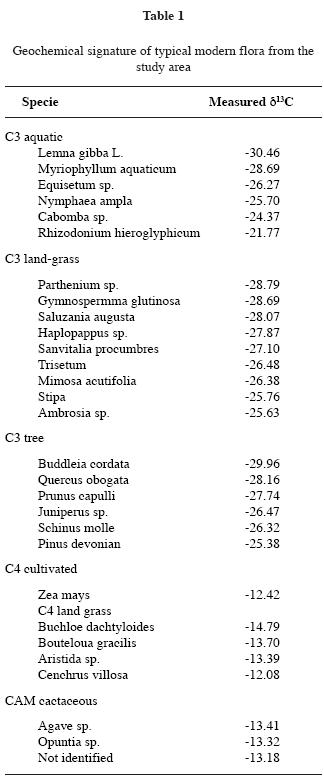
<body><![CDATA[<p align="justify"><font face="verdana" size="2">We used a routine combustion method (Sofer, 1980; Mook and Longsma, 1987) to prepare the samples, and a triple collector mass spectrometer (Finnigan MAT250) to analyze the &delta;<sup>13</sup>Cratios of the SOM (see Sedov <i>et al., </i>2003b). Each batch of samples was accompanied by reference materials 8540 PEF&#150;1 (polyethylene foil), 8539 NBS&#150;22 (oil) and 8242 Sucrose ANU (sucrose) from NIST.</font></p>     <p align="justify"><font face="verdana" size="2">The &delta;<sup>13</sup>Cis expressed as &delta;<sup>13</sup>C= 1000 * (<sup>13</sup>C/<sup>12</sup>C <sub>sample</sub>/ <sup>13</sup>C/<sup>12</sup>C <sub>VPDB</sub>)&#150;1 in permil, where <sup>13</sup>C/<sup>12</sup>C <sub>VPDB</sub> corresponds to the Cretaceous mollusk carbonate shell, <i>Beleminitella americana, </i>from the Pee Dee Formation in South Carolina (Craig, 1957) as accepted by the IAEA in Vienna (Coplen, 1995). The uncertainty for the analytical method is about 0.1 <i>%o.</i></font></p>     <p align="justify"><font face="verdana" size="2">The proportion of carbon from C4 plants in soil samples was estimated using the mass balance equation (Boutton, 1996):</font></p>     <p align="center"><font face="verdana" size="2"><img src="/img/revistas/geoint/v45n2/a1s2.jpg"></font></p>     <p align="justify"><font face="verdana" size="2">where</font></p>     <p align="center"><font face="verdana" size="2"><img src="/img/revistas/geoint/v45n2/a1s3.jpg"></font></p>     <p align="justify"><font face="verdana" size="2"><i>(x) </i>and <i>(1&#150;x) </i>represent the proportion in SOM of carbon derived from C4 (and/or CAM) species and from C3 species, respectively, &delta;<sup>13</sup>Cis the isotopic ratio of the sample, &delta;<sup>13</sup>C<sub>C4 </sub>and &delta;<sup>13</sup>C<sub>C3</sub> are the respective means of the present day C4+CAM and C3 plant species in the area. Equation (2) shows a positive correlation between &delta;<sup>13</sup>Cof SOM and the proportion of organic carbon derived from C4 plants.</font></p>     <p align="justify"><font face="verdana" size="2">&nbsp;</font></p>     <p align="justify"><font face="verdana" size="2"><b>Results</b></font></p>     <p align="justify"><font face="verdana" size="2">The &delta;<sup>13</sup>Cvalues of modern vegetation and SOM, as well as the calculated fraction of C4&#150;derived SOM, are presented in <a href="#t1">Tables 1</a> and <a href="/img/revistas/geoint/v45n2/a1t2.jpg" target="_blank">2</a>, respectively. Data from <a href="/img/revistas/geoint/v45n2/a1t2.jpg" target="_blank">Table 2</a> are plotted in <a href="/img/revistas/geoint/v45n2/a1f5.jpg" target="_blank">Figure 5</a> using relative ages on the vertical axis.</font></p>     ]]></body>
<body><![CDATA[<p align="center"><font face="verdana" size="2"><a name="t1"></a></font></p>     <p align="center"><font face="verdana" size="2"><img src="/img/revistas/geoint/v45n2/a1t1.jpg"></font></p>     <p align="justify"><font face="verdana" size="2"><i>Modern vegetation. </i>Common modern plants from the area display two ranges of &delta;<sup>13</sup>Cvalues: below &#150;21 %o for C3 plants (including tall trees, aquatic, most terrestrial grasses), and above &#150;14 %o for a small set of C4 plants (some land grass spp and maize) and CAM (cactus) plants. The calculated means for the C3 plants (&#150;26.96 &plusmn; 1.97 %o, n=21) such as tall trees, aquatic spp. and composed (compuestas) grasses, and C4 + CAM plants (&#150;13.29 &plusmn; 0.82 %o, n=8), are close to characteristic values reported by others (Boutton, 1991; O'Leary, 1988). Field observations show that C3, C4 and CAM species coexist in the valley.</font></p>     <p align="justify"><font face="verdana" size="2"><i>Soils. </i>The &delta;<sup>13</sup>Cresults obtained for modern soil samples from the Teotihuacan valley vary among sites by up to 4 %o, confirming the high spatial resolution that can be achieved with isotopic measurements in soils. The difference observed between time&#150;separated samples is &gt;2 <i>%o </i>and cannot be explained by post &#150;formation factors, but instead reflects the primary vegetation buried in the soil. For each soil sample, we estimated the relative proportion (%) of carbon derived from C4+CAM plants.</font></p>     <p align="justify"><font face="verdana" size="2">The late Pleistocene&#150;Recent soil sequence from the high&#150;elevation Cerro Gordo profile displays intermediate &delta;<sup>13</sup>C values (&delta;<sup>13</sup>C= &#150;20.30 &plusmn; 0.63 %o, n=4). A small maximum at &#150;19.5%o is observed for the AB soil horizon, with estimated middle Holocene age. Along the profile, the C4 carbon contribution fluctuates from 44 to 55 % (<a href="/img/revistas/geoint/v45n2/a1t2.jpg" target="_blank">Table 2</a>).</font></p>     <p align="justify"><font face="verdana" size="2">The Maseca modern and cultivated soil samples have a nearly identical intermediate &delta;<sup>13</sup>Cvalue of &#150;20.5 %o, comprising a mixture close to 1:1 of C3 and C4 + CAM plants. This calculated date is in good agreement with qualitative field observations of the growing plants, such as maiz and C3 species of herbs.</font></p>     <p align="justify"><font face="verdana" size="2">The main changes through time are observed in the Tepexpan profile from ancient lake Texcoco. More depleted signatures (&delta;<sup>13</sup>C=&#150;23.28 &plusmn; 2.12%o, n=3), dominated by carbon derived from C3 vegetation, were measured on the late Pleistocene swamp paleosols. The minimum at &#150;25.72 <i>%o </i>&#91;9% C4&#93; sometime in the late Pleistocene&#150;early Holocene paleosols is followed by abrupt increases reaching &#150;15.54 <i>%o </i>&#91;84% C4&#93; in the 2<sup>nd</sup> dry&#150;land paleosol, tentatively assigned to the late Holocene. The late Holocene and modern soils in Tepexpan yield values of about &#150;16.3 %o, &#91;78% C4&#93;.</font></p>     <p align="justify"><font face="verdana" size="2">The late Holocene soil sequence from Otumba is also slightly less depleted (&delta;<sup>13</sup>C =&#150;17.71 &plusmn; 0.77 %o, n=4) than modern deposits. There is a small decrease in &delta;<sup>13</sup>Cfrom the paleo unit (&#150;17.1 %o, &#91;73% C4&#93;) to the modern one (&#150;18.3 %o, &#91;61% C4&#93;).</font></p>     <p align="justify"><font face="verdana" size="2">The isotopic signature of fills from the Pir&aacute;mide de la Luna is slightly higher (&delta;<sup>13</sup>C = &#150; 16.60 &plusmn; 0.65 %o, n=4) than the value from modern soils from Otumba, but the youngest humus&#150;rich horizon displays a decline (down to &#150;17.57 %o)<i>. </i>The corresponding C4 contribution to the soil changes from 79 to 69 % (<a href="/img/revistas/geoint/v45n2/a1t2.jpg" target="_blank">Table 2</a>).</font></p>     <p align="justify"><font face="verdana" size="2">Using the relative chronology, based on a mixture of carbon dating, pedological and archeological correlations, one can note a general increase in the carbon isotopic signature of paleosols between the late Pleistocene and middle Holocene, followed by a decrease in recent SOM.</font></p>     ]]></body>
<body><![CDATA[<p align="justify"><font face="verdana" size="2">&nbsp;</font></p>     <p align="justify"><font face="verdana" size="2"><b>Discussion</b></font></p>     <p align="justify"><font face="verdana" size="2">Changes in paleovegetation at the Teotihuacan valley (late Pleistocene &#150; Present) were inferred from stable carbon isotope signatures in SOM. Environmental fluctuations in the Teotihuacan valley were reconstructed based on inferred shifts in C3/C4 plant ratios from several soil sequences. We compare our data with other paleoenvironmental proxies on local and regional scales.</font></p>     <p align="justify"><font face="verdana" size="2">&nbsp;</font></p>     <p align="justify"><font face="verdana" size="2"><i>Vegetation changes in Teotihuacan valley</i></font></p>     <p align="justify"><font face="verdana" size="2">The Cerro Gordo profile represents the vegetation at high elevations. Pollen records from the late Pleistocene &#150;Holocene Texcoco lake sediments (Lozano&#150;Garc&iacute;a and Ortega&#150;Guerrero, 1998) indicate persistent and dominant (up to 90 %) arboreal pollen. Historical records from the volcano flanks suggest that C3 forest vegetation &#150; pine, oak, cedar &#150;that covered the volcano slopes was exploited, though some remains of oak forest still persist. Because &delta;<sup>13</sup>Cvalues for C3 tree species are below <i>&#150;</i>25%o, differing only 1 to 2 %o from species of mesic low&#150;lying, and drier upland landscapes (Garten and Taylor, 1992), more depleted &delta;<sup>13</sup>C values might be expected, at least for the modern Cerro Gordo soils. The measured signature, around &#150;20 %o, suggests a combination of C3 and C4 plants, with almost the same proportion of each, rather than a pure tall tree (i.e., C3) community. The data gap between paleosols with estimated ages of 13 and 5 ky, limits our ability to identify precisely the time frame for the balanced coexistence of the two vegetation types. It seems that environmental changes are more perceptible in the low flood plain, and did not seriously affect the slightly cooler and moister highlands of the valley. The low variation of &delta;<sup>13</sup>Cthrough time at the high&#150;elevation Cerro Gordo site contrasts with the marked temporal changes observed in the isotope record from the lowland valley profile of Tepexpan.</font></p>     <p align="justify"><font face="verdana" size="2">&nbsp;</font></p>     <p align="justify"><font face="verdana" size="2"><i>Vegetation changes in Teotihuacan in time: general tendencies</i></font></p>     <p align="justify"><font face="verdana" size="2"><i>Late Pleistocene. </i>Depleted &delta;<sup>13</sup>Cvalues from the Pleistocene paleosols, present in the Cerro Gordo and Tepexpan profiles, suggest that plants with the C3 photosynthetic pathway dominated the vegetation in the Teotihuacan valley through the late Pleistocene. We suppose that the main contributors to these paleosols were probably some tall trees on the top of Cerro Gordo, and aquatic together with near shore vegetation in the Tepexpan swamp soils, because of their low &delta;<sup>13</sup>Cdata at present. In general, the dominance of C3 plants through late Pleistocene, the presence of swamps reveals relatively high moisture, enough to preserve the swamps, and favors the idea of a wet and cool environment. In the particular case of intermediate swamps, where the calculated percentage of C3 plants is so high as 91%, is in agreement with an episode of moderate increase in effective moisture around 18 kyr BP interpreted from diatom records in the lower and central Lake Texcoco basin (Bradbury, 1989).</font></p>     <p align="justify"><font face="verdana" size="2">The paleopedological record from the Tepexpan profile shows evidence of gradual drying of the swamps through the Pleistocene&#150;Holocene transition. The latest swamp soil, assigned to terminal Pleistocene, is poorer, but still rich, in C3 plants &#91;63%&#93;, marking a transition period from a cooler to warmer but still wet climate. Brown (1985) proposed a similar climatic fluctuation around 12.5 kyr, based on the palynological records from the lake Texcoco sediments (Gonz&aacute;lez&#150;Quintero and Fuentes&#150;Mata, 1980).</font></p>     ]]></body>
<body><![CDATA[<p align="justify"><font face="verdana" size="2">Other late Pleistocene palynological records from Texcoco lake sediments (Lozano&#150;Garc&iacute;a and Ortega&#150;Guerrero, 1998) indicate abundant arboreal pollen that correlates with the depleted signatures of the coeval SOM dominated by C3 plant vegetation. But a drastic reduction in pine and an increase in herbaceous pollen were registered in sediments around 23 kyr old. This was interpreted as an increase in aridity that persisted to the middle Holocene.</font></p>     <p align="justify"><font face="verdana" size="2">This comparison between pollen and isotope records illustrates that inferences may differ between proxies measured in a paleosol (formed <i>in situ) </i>and the pollen record from a lake sediment core (a product of air and water transportation and redeposition). As pointed out by Lozano&#150;Garc&iacute;a and Ortega&#150;Guerrero (1998), the pollen record does not necessarily respond to climate change alone, but may be influenced, in our particular case, by volcanic activity of Popocat&eacute;petl just about 23 kyr ago (Siebe <i>et al., </i>1996) and consequent changes in the hydrological system in the area.</font></p>     <p align="justify"><font face="verdana" size="2">&nbsp;</font></p>     <p align="justify"><font face="verdana" size="2"><i>Holocene. </i>C4 plants dominate Holocene SOM.</font></p>     <p align="justify"><font face="verdana" size="2">The data obtained for the soils from Cerro Gordo as well as from the Tepexpan profiles indicate that in the middle Holocene the valley environment was dominated by C4 and/ or CAM species representing <img src="/img/revistas/geoint/v45n2/a4s2.jpg">55 % of the source SOM even at high elevations, and up to 84 % at sites in the lowlands. The increases of about 10 % (Cerro Gordo) and 71 % (Tepexpan) in the proportion of C4 plants in the SOM signatures may reflect increased aridity throughout the late Pleistocene and first part of the Holocene. Aridity was probably the major factor contributing to the decline in C3 plants, because of their sensitivity to water supply.</font></p>     <p align="justify"><font face="verdana" size="2">Isotopic data from all late Holocene soil samples show a modest shift in the proportion of C3 and C4 plants between the middle Holocene and the Recent. Isotope values differ from site to site, but all sites display a decrease of about 11 % in C4 and CAM representation in the Recent (<a href="/img/revistas/geoint/v45n2/a1f5.jpg" target="_blank">Figure 5</a>). We infer a slight increase in available moisture during late Holocene &#150; Recent transition.</font></p>     <p align="justify"><font face="verdana" size="2">Our data suggest a general pattern of moisture availability in the Teotihuacan valley since the late Pleistocene that includes the following: 1) generally humid late Pleistocene, 2) increment of aridity through the Pleistocene &#150;Holocene boundary culminating in middle Holocene, and 3) a return to slightly moister conditions in the recent. Climate has not changed drastically through the last 2000 years, as reflected by the carbon isotope signature in younger soils from the low valley. Furthermore, we suggest that the modest humidity increase in late Holocene may had been favorable for agricultural activity and supported irrigation, documented by archeological excavations at Teotihuacan.</font></p>     <p align="justify"><font face="verdana" size="2">Given the available isotopic data it is not yet possible to determine the time when agricultural activity became an important factor in forcing environmental change, nor can we say much about the relation between human impact and the decline of the Teotihuacan civilization.</font></p>     <p align="justify"><font face="verdana" size="2">&nbsp;</font></p>     <p align="justify"><font face="verdana" size="2"><i>Comparison of the environmental fluctuations in the Teotihuacan valley with surrounding areas in Central Mexico</i></font></p>     ]]></body>
<body><![CDATA[<p align="justify"><font face="verdana" size="2">Our interpretation of the isotopic data from paleosols and modern soils from the Teotihuacan Valley is in general agreement with paleoenvironmental studies of lacustrine sediments, and supported by some AMS radiocarbon dating, from the neighboring areas of the Central Mexico Basin.</font></p>     <p align="justify"><font face="verdana" size="2">Late Pleistocene paleosols of Nevado de Toluca, located 120 km SW of the Teotihuacan valley, present pedological evidence of cold and humid forest environments (Sedov <i>et al., </i>2001), although a more detailed interpretation of the paleosol also suggests an oscillation between wet and dry periods (Sedov <i>et al., </i>2003b). This last interpretation can be correlated with the episode of increased humidity reflected in the SOM of late Pleistocene swamps from the Tepexpan profile.</font></p>     <p align="justify"><font face="verdana" size="2">Relative dryness throughout the late Glacial Maximum, and very dry conditions between 14 and 4.8 kyr BP were inferred from low organic production, supported by low magnetic susceptibility and an increase in paramagnetic, weathering&#150;derived clays in sediments from Zacap&uacute; lake, and the Lerma Basin, west of Teotihuacan (Ortega&#150;Guerrero <i>et al., </i>2002).</font></p>     <p align="justify"><font face="verdana" size="2">We propose a preliminary interpretation of &delta;<sup>13</sup>C data from radiocarbon&#150;dated lacustrine sediments from Zacap&uacute; lake, western Mexico (Ortega&#150;Guerrero <i>et al., </i>2002). &delta;<sup>13</sup>C reported for early Holocene sediments (<img src="/img/revistas/geoint/v45n2/a4s2.jpg">9.8 kyr BP) has a value of &#150;25.7 %o, while that for the middle Holocene sediments (<img src="/img/revistas/geoint/v45n2/a4s2.jpg"> 4.7 kyr BP) is &#150;16.6 %o. These isotopic values lie in the same ranges as those obtained for the late Pleistocene swamps and Holocene soils from the Tepexpan site and suggest the same change of vegetation from C3 to C4 dominance. Although there is a discrepancy in absolute age for the two records (lacustrine versus soils) from the Zacap&uacute; and Teotihuacan sites, the same climatic trends, from wetter (and colder) to drier (and warmer), may be inferred from the two isotopic data sets.</font></p>     <p align="justify"><font face="verdana" size="2">Increasing aridity in the very late Pleistocene and early Holocene, inferred from the SOM isotopic signature at Tepexpan profile has also been inferred using the diatom and pollen records (14&#150;8.5&#150;6 kyr BP) from lacustrine sediments in the Central part of Texcoco lake (Bradbury, 1989) and in the upper Lerma river and Chalco lake basins (Caballero&#150;Miranda <i>et al., </i>1997, 1998, 2001, 2002; Lozano&#150;Garc&iacute;a <i>et al.,1</i>993), located west and south&#150;east, respectively, of the Teotihuacan valley.</font></p>     <p align="justify"><font face="verdana" size="2">Tecocomulco lake is located in a sub&#150;basin NE of the Teotihuacan valley. Archaeological artifacts belonging to the Teotihuacan civilization have been found in this area (Acu&ntilde;a, 1984). The palynological, diatom, and magnetic records from the sediments at the southeastern part of Tecocomulco lake (Caballero&#150;Miranda <i>et al., </i>1999) indicate an extremely dry environment after ca. 16 kyr BP, until the mid&#150;late Holocene (<img src="/img/revistas/geoint/v45n2/a4s2.jpg">3 kyr BP).</font></p>     <p align="justify"><font face="verdana" size="2">Extreme aridity in Central Mexico during the middle Holocene (6 kyr BP; Metcalfe <i>et al., </i>2000) can be correlated temporally with the maximum isotope values recorded in the Tepexpan (&#150;15.54%o) and Cerro Gordo profile (&#150;19.48%o).</font></p>     <p align="justify"><font face="verdana" size="2">The small moisture increase registered in late Holocene paleosols in Teotihuacan is consistent with an increase in water levels of the Lerma, Chalco and Texcoco lake basins, based on a diatom study of sediments younger than 5 kyr BP (Caballero&#150;Miranda <i>et al., </i>2001). Aridity around 1000 yr BP, that was inferred from the lacustrine sediment records (Metcalfe <i>et al., </i>2000; Caballero&#150;Miranda <i>et al., </i>2002) cannot be inferred from the &delta;<sup>13</sup>Cresults from the Teotihuacan valley soils.</font></p>     <p align="justify"><font face="verdana" size="2">Numerous paleoenvironmental records suggest a change toward increased aridity in Central Mexico during the late Pleistocene. The onset of drying, however, appears to vary from site to site. The timing may be dependent on the type of record used to infer moisture availability, with some proxies displaying a lag in response to climatic drying. Climatic interpretation of any single record can be complicated by factors unrelated to climate that may potentially affect measured proxies. Correlation of different proxy records from several natural archives should be helpful for climatic interpretation.</font></p>     <p align="justify"><font face="verdana" size="2">&nbsp;</font></p>     ]]></body>
<body><![CDATA[<p align="justify"><font face="verdana" size="2"><b>Conclusions</b></font></p>     <p align="justify"><font face="verdana" size="2">Preliminary results of carbon isotopic values in paleosols and modern soils from the Teotihuacan valley suggest a 10&#150;70% increase in C4 vegetation during the transition from late Pleistocene to early Holocene. C4 plants dominated the environment in middle Holocene. Our data suggest a natural climatic change from relatively wet and cold conditions through the late Pleistocene to warmer and very dry conditions in the middle Holocene. A slight increase in moisture availability and establishment of a relatively dry and warm climate in the late Holocene is suggested by a modest 4&#150;10 % increase in the C3 plant community in the valley. The small increase in moisture availability may have been favourable for agriculture. This preliminary interpretation of the first isotopic data obtained from paleosols and modern soils in general agrees with paleoenvironmental studies in lake Texcoco area based on diatom and pollen records from lake sediment cores. Low temporal resolution of the isotope data from soil samples precludes inferences about climatic influence on the evolution of the Teotihuacan civilization.</font></p>     <p align="justify"><font face="verdana" size="2">&nbsp;</font></p>     <p align="justify"><font face="verdana" size="2"><b>Acknowledgments</b></font></p>     <p align="justify"><font face="verdana" size="2">UNAM PAPIIT (IN400403&#150;2) and CONACYT (No.43746) projects financed part of this work. We acknowledge S. Palacios Mayorga and F. Ramos Marchena for appreciated help in plant sampling and identification; K. Shimada, E. Ibarra and M. Hern&aacute;ndez Quiroga for technical assistance. Dr. E. McClung is acknowledged for advising on archeological questions, Dr. M. Caballero&#150;Miranda for fruitful discussion, and Dr. M. Brenner for a critical review essential to the improvement of the manuscript.</font></p>     <p align="justify"><font face="verdana" size="2">&nbsp;</font></p>     <p align="justify"><font face="verdana" size="2"><b>Bibliography</b></font></p>     <!-- ref --><p align="justify"><font face="verdana" size="2">ACU&Ntilde;A, R. (Ed.), 1984. Relaciones geogr&aacute;ficas del Siglo XVI: M&eacute;xico, Tomo II. Instituto de Investigaciones Antropol&oacute;gicas, UNAM, M&eacute;xico.</font>&nbsp;&nbsp;&nbsp;&nbsp;&nbsp;&nbsp;&nbsp;&nbsp;[&#160;<a href="javascript:void(0);" onclick="javascript: window.open('/scielo.php?script=sci_nlinks&ref=3892308&pid=S0016-7169200600020000100001&lng=','','width=640,height=500,resizable=yes,scrollbars=1,menubar=yes,');">Links</a>&#160;]<!-- end-ref --><!-- ref --><p align="justify"><font face="verdana" size="2">BRADBURY, J., 1989. Late Quaternary lacustrine paleoenvironments in the Mexico basin. <i>Quat. Sci. Rev., 8, </i>75&#150;100.</font>&nbsp;&nbsp;&nbsp;&nbsp;&nbsp;&nbsp;&nbsp;&nbsp;[&#160;<a href="javascript:void(0);" onclick="javascript: window.open('/scielo.php?script=sci_nlinks&ref=3892309&pid=S0016-7169200600020000100002&lng=','','width=640,height=500,resizable=yes,scrollbars=1,menubar=yes,');">Links</a>&#160;]<!-- end-ref --><!-- ref --><p align="justify"><font face="verdana" size="2">BROWN, R. B., 1985. A summary of late&#150;Quaternary pollen records from Mexico west of the Isthmus of Tehuantepec. <i>In: </i>Bryant, V.M., jr. and Holloway, R.G. (eds.), pollen records of late&#150;Quaternary North American Sediments, p. 71&#150;94. American Association of Stratigraphic Palynological Foundation.</font>&nbsp;&nbsp;&nbsp;&nbsp;&nbsp;&nbsp;&nbsp;&nbsp;[&#160;<a href="javascript:void(0);" onclick="javascript: window.open('/scielo.php?script=sci_nlinks&ref=3892310&pid=S0016-7169200600020000100003&lng=','','width=640,height=500,resizable=yes,scrollbars=1,menubar=yes,');">Links</a>&#160;]<!-- end-ref --><!-- ref --><p align="justify"><font face="verdana" size="2">BOUTTON, T. W., 1991. Carbon isotope techniques. <i>In: </i>Coleman, D.C. and Fry, B. (Eds). Academic Press, New York. 173&#150;185.</font>&nbsp;&nbsp;&nbsp;&nbsp;&nbsp;&nbsp;&nbsp;&nbsp;[&#160;<a href="javascript:void(0);" onclick="javascript: window.open('/scielo.php?script=sci_nlinks&ref=3892311&pid=S0016-7169200600020000100004&lng=','','width=640,height=500,resizable=yes,scrollbars=1,menubar=yes,');">Links</a>&#160;]<!-- end-ref --><!-- ref --><p align="justify"><font face="verdana" size="2">BOUTTON, T. W., 1996. Stable carbon isotope ratios of soil organic matter and their use as indicators of vegetation and climatic change. <i>In: </i>Boutton, T.W., Yamasaki, S. (Eds.) Mass spectrometry of soils. Marcel Dekker, Inc. , 517p.</font>&nbsp;&nbsp;&nbsp;&nbsp;&nbsp;&nbsp;&nbsp;&nbsp;[&#160;<a href="javascript:void(0);" onclick="javascript: window.open('/scielo.php?script=sci_nlinks&ref=3892312&pid=S0016-7169200600020000100005&lng=','','width=640,height=500,resizable=yes,scrollbars=1,menubar=yes,');">Links</a>&#160;]<!-- end-ref --><!-- ref --><p align="justify"><font face="verdana" size="2">CABADAS&#150;B&Aacute;EZ, H. V., 2004. Paleosuelos como indicadores de cambio ambiental en el Cuaternario superior: el caso del valle Teotihuacan. Tesis de licenciatura, Facultad de Ingenier&iacute;a, Universidad Aut&oacute;noma de M&eacute;xico, M&eacute;xico, D.F. 167 p.</font>&nbsp;&nbsp;&nbsp;&nbsp;&nbsp;&nbsp;&nbsp;&nbsp;[&#160;<a href="javascript:void(0);" onclick="javascript: window.open('/scielo.php?script=sci_nlinks&ref=3892313&pid=S0016-7169200600020000100006&lng=','','width=640,height=500,resizable=yes,scrollbars=1,menubar=yes,');">Links</a>&#160;]<!-- end-ref --><!-- ref --><p align="justify"><font face="verdana" size="2">CABALLERO&#150;MIRANDA, M., 1997. The Last Glacial Maximum in the basin of Mexico: The diatom record between 34,000 and 15,000 years BP from lake Chalco. <i>Quater. Inter., 43/44, </i>125&#150;136.</font>&nbsp;&nbsp;&nbsp;&nbsp;&nbsp;&nbsp;&nbsp;&nbsp;[&#160;<a href="javascript:void(0);" onclick="javascript: window.open('/scielo.php?script=sci_nlinks&ref=3892314&pid=S0016-7169200600020000100007&lng=','','width=640,height=500,resizable=yes,scrollbars=1,menubar=yes,');">Links</a>&#160;]<!-- end-ref --><!-- ref --><p align="justify"><font face="verdana" size="2">CABALLERO&#150;MIRANDA M. and B. ORTEGA&#150;GUERRERO, 1998. Lake levels since about 40,000 years ago at lake Chalco, near Mexico City. <i>Quater. Res., 50, </i>69&#150;79.</font>&nbsp;&nbsp;&nbsp;&nbsp;&nbsp;&nbsp;&nbsp;&nbsp;[&#160;<a href="javascript:void(0);" onclick="javascript: window.open('/scielo.php?script=sci_nlinks&ref=3892315&pid=S0016-7169200600020000100008&lng=','','width=640,height=500,resizable=yes,scrollbars=1,menubar=yes,');">Links</a>&#160;]<!-- end-ref --><!-- ref --><p align="justify"><font face="verdana" size="2">CABALLERO&#150;MIRANDA, M., B. ORTEGA&#150;GUERRERO, J. URRUTIA &#150;FUCUGAUCHI and J. L. MAC&Iacute;AS, 1999. Environmental characteristics of lake Tecocomulco, northern basin of Mexico, for the last ca. 50,000 years. <i>J. Paleolimnol., 22, </i>399&#150;411.</font>&nbsp;&nbsp;&nbsp;&nbsp;&nbsp;&nbsp;&nbsp;&nbsp;[&#160;<a href="javascript:void(0);" onclick="javascript: window.open('/scielo.php?script=sci_nlinks&ref=3892316&pid=S0016-7169200600020000100009&lng=','','width=640,height=500,resizable=yes,scrollbars=1,menubar=yes,');">Links</a>&#160;]<!-- end-ref --><!-- ref --><p align="justify"><font face="verdana" size="2">CABALLERO&#150;MIRANDA, M., J. L. MAC&Iacute;AS, S. LOZANO&#150;GARC&Iacute;A, J. URRUTIA&#150;FUCUGAUCHI and R. CASTA&Ntilde;EDA&#150;BERNAL, 2001. Late Pleistocene&#150;Holocene volcanic stratigraphy and paleoenvironments of the upper Lerma basin, Mexico. <i>Spec. Pubs int. Ass. Sediment, 30, </i>247&#150;261.</font>&nbsp;&nbsp;&nbsp;&nbsp;&nbsp;&nbsp;&nbsp;&nbsp;[&#160;<a href="javascript:void(0);" onclick="javascript: window.open('/scielo.php?script=sci_nlinks&ref=3892317&pid=S0016-7169200600020000100010&lng=','','width=640,height=500,resizable=yes,scrollbars=1,menubar=yes,');">Links</a>&#160;]<!-- end-ref --><!-- ref --><p align="justify"><font face="verdana" size="2">CABALLERO&#150;MIRANDA, M., B. ORTEGA&#150;GUERRERO, F. VALADEZ, S. METCALFE, J. L. MAC&Iacute;AS and Y. SUGIURA, 2002. Sta.Cruz Atizap&aacute;n: a 22&#150;ka lake level record and climatic implications for the Holocene human occupation in the Upper Lerma basin, Central Mexico. <i>Palaeogeogr., Palaeoclimatol., Palaeoecol., 186, </i>217&#150;235.</font>&nbsp;&nbsp;&nbsp;&nbsp;&nbsp;&nbsp;&nbsp;&nbsp;[&#160;<a href="javascript:void(0);" onclick="javascript: window.open('/scielo.php?script=sci_nlinks&ref=3892318&pid=S0016-7169200600020000100011&lng=','','width=640,height=500,resizable=yes,scrollbars=1,menubar=yes,');">Links</a>&#160;]<!-- end-ref --><!-- ref --><p align="justify"><font face="verdana" size="2">CASTILLA, M. E. and J. D. TEJERO, 1983. Estudio flor&iacute;stico del Cerro Gordo (Pr&oacute;ximo a San Teotihuacan) y regiones aleda&ntilde;as. Tesis de licenciatura en Biolog&iacute;a, Escuela Nacional de Estudios Profesionales Iztacala, UNAM, M&eacute;xico.</font>&nbsp;&nbsp;&nbsp;&nbsp;&nbsp;&nbsp;&nbsp;&nbsp;[&#160;<a href="javascript:void(0);" onclick="javascript: window.open('/scielo.php?script=sci_nlinks&ref=3892319&pid=S0016-7169200600020000100012&lng=','','width=640,height=500,resizable=yes,scrollbars=1,menubar=yes,');">Links</a>&#160;]<!-- end-ref --><!-- ref --><p align="justify"><font face="verdana" size="2">COPLEN, T. B., 1995. Reporting of stable carbon, hydrogen, and oxygen isotopic abundances. <i>In: </i>Reference and intercomparison materials for stable isotopes of light elements: Vienna, International Atomic Energy Agency, IAEA&#150;TECDOC&#150;825, 31&#150;34.</font>&nbsp;&nbsp;&nbsp;&nbsp;&nbsp;&nbsp;&nbsp;&nbsp;[&#160;<a href="javascript:void(0);" onclick="javascript: window.open('/scielo.php?script=sci_nlinks&ref=3892320&pid=S0016-7169200600020000100013&lng=','','width=640,height=500,resizable=yes,scrollbars=1,menubar=yes,');">Links</a>&#160;]<!-- end-ref --><!-- ref --><p align="justify"><font face="verdana" size="2">CRAIG, H., 1957. Isotopic standards for carbon and oxygen and corrected factors for mass&#150;spectrometric analysis of carbon dioxide. <i>Geochimica et Cosmochimica Acta, 12, </i>133&#150;149.</font>&nbsp;&nbsp;&nbsp;&nbsp;&nbsp;&nbsp;&nbsp;&nbsp;[&#160;<a href="javascript:void(0);" onclick="javascript: window.open('/scielo.php?script=sci_nlinks&ref=3892321&pid=S0016-7169200600020000100014&lng=','','width=640,height=500,resizable=yes,scrollbars=1,menubar=yes,');">Links</a>&#160;]<!-- end-ref --><!-- ref --><p align="justify"><font face="verdana" size="2">EHLERINGER, J. R., A. E. HALL and G. D. FARQUHAR, 1993. Stable isotopes and plant carbon&#150; water&#150; relation. Academic Press, New York.</font>&nbsp;&nbsp;&nbsp;&nbsp;&nbsp;&nbsp;&nbsp;&nbsp;[&#160;<a href="javascript:void(0);" onclick="javascript: window.open('/scielo.php?script=sci_nlinks&ref=3892322&pid=S0016-7169200600020000100015&lng=','','width=640,height=500,resizable=yes,scrollbars=1,menubar=yes,');">Links</a>&#160;]<!-- end-ref --><!-- ref --><p align="justify"><font face="verdana" size="2">FARQUHAR, G. D., J. R. EHLERINGER and K. T. HUBIC, 1989. Carbon isotope discrimination and photosynthesis. <i>Annu. Rev. Plant Physiology and Plant Mol. Biol., 40, </i>503&#150;537.</font>&nbsp;&nbsp;&nbsp;&nbsp;&nbsp;&nbsp;&nbsp;&nbsp;[&#160;<a href="javascript:void(0);" onclick="javascript: window.open('/scielo.php?script=sci_nlinks&ref=3892323&pid=S0016-7169200600020000100016&lng=','','width=640,height=500,resizable=yes,scrollbars=1,menubar=yes,');">Links</a>&#160;]<!-- end-ref --><!-- ref --><p align="justify"><font face="verdana" size="2">GAMA&#150;CASTRO, J., E. SOLLEIRO&#150;REBOLLEDO, E. MCCLUNG, J. L. VILLALPANDO, S. SEDOV, C. JASSO&#150;CASTA&Ntilde;EDA, S. PALACIOS and D. HERN&Aacute;NDEZ, 2004. Contribuciones de la Ciencia del Suelo a la investigaci&oacute;n arqueol&oacute;gica&#150; el caso de Teotihuacan. (Terra, in press).</font>&nbsp;&nbsp;&nbsp;&nbsp;&nbsp;&nbsp;&nbsp;&nbsp;[&#160;<a href="javascript:void(0);" onclick="javascript: window.open('/scielo.php?script=sci_nlinks&ref=3892324&pid=S0016-7169200600020000100017&lng=','','width=640,height=500,resizable=yes,scrollbars=1,menubar=yes,');">Links</a>&#160;]<!-- end-ref --><!-- ref --><p align="justify"><font face="verdana" size="2">GARC&Iacute;A, E., 1968. Clima actual de Teotihuacan. <i>In: </i>Lorenzo, J. L. (Ed.) Materiales para la Arqueolog&iacute;a de Teotihuacan XVII. INAH, M&eacute;xico, 10&#150;27.</font>&nbsp;&nbsp;&nbsp;&nbsp;&nbsp;&nbsp;&nbsp;&nbsp;[&#160;<a href="javascript:void(0);" onclick="javascript: window.open('/scielo.php?script=sci_nlinks&ref=3892325&pid=S0016-7169200600020000100018&lng=','','width=640,height=500,resizable=yes,scrollbars=1,menubar=yes,');">Links</a>&#160;]<!-- end-ref --><!-- ref --><p align="justify"><font face="verdana" size="2">GARTEN, C. T. and G. E. TAYLOR, 1992. Foliar &#948;<sup>13</sup>C within a temperate deciduous forest: spatial, temporal and species sources of variation. <i>Oecologia, 90, </i>1&#150;7.</font>&nbsp;&nbsp;&nbsp;&nbsp;&nbsp;&nbsp;&nbsp;&nbsp;[&#160;<a href="javascript:void(0);" onclick="javascript: window.open('/scielo.php?script=sci_nlinks&ref=3892326&pid=S0016-7169200600020000100019&lng=','','width=640,height=500,resizable=yes,scrollbars=1,menubar=yes,');">Links</a>&#160;]<!-- end-ref --><!-- ref --><p align="justify"><font face="verdana" size="2">GENOV&Eacute;S TARAZAGA, S., 1960. Revaluation of age, stature and sex of the Tepexpan remains, Mexico. <i>Amer. J. Phys. Anthropol., 18, </i>205&#150;218.</font>&nbsp;&nbsp;&nbsp;&nbsp;&nbsp;&nbsp;&nbsp;&nbsp;[&#160;<a href="javascript:void(0);" onclick="javascript: window.open('/scielo.php?script=sci_nlinks&ref=3892327&pid=S0016-7169200600020000100020&lng=','','width=640,height=500,resizable=yes,scrollbars=1,menubar=yes,');">Links</a>&#160;]<!-- end-ref --><!-- ref --><p align="justify"><font face="verdana" size="2">GONZ&Aacute;LEZ&#150;QUINTERO, L. and L. FUENTES&#150;MATA, 1980. El Holoceno de la porci&oacute;n central de la Cuenca de M&eacute;xico. <i>In: </i>S&aacute;nchez, F. (Ed.), Memorias III Coloquio sobre paleobot&aacute;nica y Palinolog&iacute;a. Colecci&oacute;n Cient&iacute;fica Instituto Nacional de Antropolog&iacute;a e Historia, 86, 113&#150;132.</font>&nbsp;&nbsp;&nbsp;&nbsp;&nbsp;&nbsp;&nbsp;&nbsp;[&#160;<a href="javascript:void(0);" onclick="javascript: window.open('/scielo.php?script=sci_nlinks&ref=3892328&pid=S0016-7169200600020000100021&lng=','','width=640,height=500,resizable=yes,scrollbars=1,menubar=yes,');">Links</a>&#160;]<!-- end-ref --><!-- ref --><p align="justify"><font face="verdana" size="2">HEINE, K., 1987. Anthropogenic sedimentological changes during the Holocene in Central America: <i>Striae, 26, </i>51&#150;63.</font>&nbsp;&nbsp;&nbsp;&nbsp;&nbsp;&nbsp;&nbsp;&nbsp;[&#160;<a href="javascript:void(0);" onclick="javascript: window.open('/scielo.php?script=sci_nlinks&ref=3892329&pid=S0016-7169200600020000100022&lng=','','width=640,height=500,resizable=yes,scrollbars=1,menubar=yes,');">Links</a>&#160;]<!-- end-ref --><!-- ref --><p align="justify"><font face="verdana" size="2">KOCH, L., 1998. Isotopic reconstruction of past continental environments. <i>Annual Review of Earth and Planetary Science, 26, </i>573&#150;613.</font>&nbsp;&nbsp;&nbsp;&nbsp;&nbsp;&nbsp;&nbsp;&nbsp;[&#160;<a href="javascript:void(0);" onclick="javascript: window.open('/scielo.php?script=sci_nlinks&ref=3892330&pid=S0016-7169200600020000100023&lng=','','width=640,height=500,resizable=yes,scrollbars=1,menubar=yes,');">Links</a>&#160;]<!-- end-ref --><!-- ref --><p align="justify"><font face="verdana" size="2">LOZANO&#150;GARC&Iacute;A, S. and B. ORTEGA&#150;GUERRERO, 1998. Late Quaternary environmental changes of the central part of the Basin of Mexico; correlation between Texcoco and Chalco basins. <i>Review of Palaeobotany and Palynology, 99, </i>77&#150;93.</font>&nbsp;&nbsp;&nbsp;&nbsp;&nbsp;&nbsp;&nbsp;&nbsp;[&#160;<a href="javascript:void(0);" onclick="javascript: window.open('/scielo.php?script=sci_nlinks&ref=3892331&pid=S0016-7169200600020000100024&lng=','','width=640,height=500,resizable=yes,scrollbars=1,menubar=yes,');">Links</a>&#160;]<!-- end-ref --><!-- ref --><p align="justify"><font face="verdana" size="2">LOZANO&#150;GARC&Iacute;A, M. S., B. ORTEGA&#150;GUERRERO, M. CABALLERO&#150;MIRANDA and J. URRUTIA&#150;FUCUGAUCHI, 1993. Late Pleistocene and Holocene paleoenvironments of Chalco Lake, central Mexico. <i>Quatern. Res., 40, </i>332&#150;342.</font>&nbsp;&nbsp;&nbsp;&nbsp;&nbsp;&nbsp;&nbsp;&nbsp;[&#160;<a href="javascript:void(0);" onclick="javascript: window.open('/scielo.php?script=sci_nlinks&ref=3892332&pid=S0016-7169200600020000100025&lng=','','width=640,height=500,resizable=yes,scrollbars=1,menubar=yes,');">Links</a>&#160;]<!-- end-ref --><!-- ref --><p align="justify"><font face="verdana" size="2">MAC&Iacute;AS, J. L., S. LOZANO&#150;GARC&Iacute;A, J. URRUTIA&#150;FUCUGAUCHI and R. CASTA&Ntilde;EDA&#150;BERNAL, 2001. Late &#150;Pleistocene&#150;Holocene volcanic stratigraphy and palaeoenvironments of the Upper Lerma basin, M&eacute;xico. <i>Spec. Publs int. Ass Sediment. 30, </i>247&#150;261.</font>&nbsp;&nbsp;&nbsp;&nbsp;&nbsp;&nbsp;&nbsp;&nbsp;[&#160;<a href="javascript:void(0);" onclick="javascript: window.open('/scielo.php?script=sci_nlinks&ref=3892333&pid=S0016-7169200600020000100026&lng=','','width=640,height=500,resizable=yes,scrollbars=1,menubar=yes,');">Links</a>&#160;]<!-- end-ref --><!-- ref --><p align="justify"><font face="verdana" size="2">McCLUNG, E., E. SOLLEIRO&#150;REBOLLEDO, J. GAMA&#150;CASTRO, J. L. VILLALPANDO and S. SEDOV, 2003. Paleosols in the Teotihuacan valley, Mexico: evidence for paleoenvironment and human impact. <i>Revista Mexicana de Ciencias Geol&oacute;gicas, 20, 3, </i>270&#150;282</font>&nbsp;&nbsp;&nbsp;&nbsp;&nbsp;&nbsp;&nbsp;&nbsp;[&#160;<a href="javascript:void(0);" onclick="javascript: window.open('/scielo.php?script=sci_nlinks&ref=3892334&pid=S0016-7169200600020000100027&lng=','','width=640,height=500,resizable=yes,scrollbars=1,menubar=yes,');">Links</a>&#160;]<!-- end-ref --><!-- ref --><p align="justify"><font face="verdana" size="2">METCALFE, S. E., S. L. O'HARA M. and S. J. DAVIES, 2000. Records of late Pleistocene&#150;Holocene climatic change in Mexico &#150; a review. <i>Quatern. Sci. Rev., 19, </i>699&#150;721.</font>&nbsp;&nbsp;&nbsp;&nbsp;&nbsp;&nbsp;&nbsp;&nbsp;[&#160;<a href="javascript:void(0);" onclick="javascript: window.open('/scielo.php?script=sci_nlinks&ref=3892335&pid=S0016-7169200600020000100028&lng=','','width=640,height=500,resizable=yes,scrollbars=1,menubar=yes,');">Links</a>&#160;]<!-- end-ref --><!-- ref --><p align="justify"><font face="verdana" size="2">MILL&Oacute;N, R., 1967. Extensi&oacute;n y poblaci&oacute;n de la ciudad de Teotihuacan en sus diferentes periodos: un c&aacute;lculo provisional. Onceava Mesa Redonda de la Sociedad Mexicana de la Antropolog&iacute;a, 57&#150;78, M&eacute;xico.</font>&nbsp;&nbsp;&nbsp;&nbsp;&nbsp;&nbsp;&nbsp;&nbsp;[&#160;<a href="javascript:void(0);" onclick="javascript: window.open('/scielo.php?script=sci_nlinks&ref=3892336&pid=S0016-7169200600020000100029&lng=','','width=640,height=500,resizable=yes,scrollbars=1,menubar=yes,');">Links</a>&#160;]<!-- end-ref --><!-- ref --><p align="justify"><font face="verdana" size="2">MOOK, W. G. and J. LONGSMA, 1987. Measurement of the N<sub>2</sub>O corrections for <sup>13</sup>C/<sup>12</sup>C ratios of atmospheric CO<sub>2</sub> by removal of N<sub>2</sub>O. <i>Tellus, 39B, </i>96&#150;99.</font>&nbsp;&nbsp;&nbsp;&nbsp;&nbsp;&nbsp;&nbsp;&nbsp;[&#160;<a href="javascript:void(0);" onclick="javascript: window.open('/scielo.php?script=sci_nlinks&ref=3892337&pid=S0016-7169200600020000100030&lng=','','width=640,height=500,resizable=yes,scrollbars=1,menubar=yes,');">Links</a>&#160;]<!-- end-ref --><!-- ref --><p align="justify"><font face="verdana" size="2">MOOSER, F., A. MONTIEL and A. Z&Uacute;&Ntilde;IGA, 1996. Nuevo mapa geol&oacute;gico de las cuencas de M&eacute;xico, Toluca y Puebla. Estratigraf&iacute;a, tect&oacute;nica regional y aspectos geot&eacute;rmicos. CFE, 1937&#150;1996, M&eacute;xico.</font>&nbsp;&nbsp;&nbsp;&nbsp;&nbsp;&nbsp;&nbsp;&nbsp;[&#160;<a href="javascript:void(0);" onclick="javascript: window.open('/scielo.php?script=sci_nlinks&ref=3892338&pid=S0016-7169200600020000100031&lng=','','width=640,height=500,resizable=yes,scrollbars=1,menubar=yes,');">Links</a>&#160;]<!-- end-ref --><!-- ref --><p align="justify"><font face="verdana" size="2">O'LEARY, M. H., 1988. Carbon isotopes in photosynthesis. <i>Bioscience 38, </i>328&#150;336.</font>&nbsp;&nbsp;&nbsp;&nbsp;&nbsp;&nbsp;&nbsp;&nbsp;[&#160;<a href="javascript:void(0);" onclick="javascript: window.open('/scielo.php?script=sci_nlinks&ref=3892339&pid=S0016-7169200600020000100032&lng=','','width=640,height=500,resizable=yes,scrollbars=1,menubar=yes,');">Links</a>&#160;]<!-- end-ref --><!-- ref --><p align="justify"><font face="verdana" size="2">ORTEGA, B., M. CABALLERO, S. LOZANO, I. ISRADE and G. VILACLARA, 2002. 52 000 years of environmental history in Zacap&uacute; basin, Michoac&aacute;n, Mexico: the magnetic record. <i>Earth. Planet. Sci. Lett., 202, </i>663&#150;675.</font>&nbsp;&nbsp;&nbsp;&nbsp;&nbsp;&nbsp;&nbsp;&nbsp;[&#160;<a href="javascript:void(0);" onclick="javascript: window.open('/scielo.php?script=sci_nlinks&ref=3892340&pid=S0016-7169200600020000100033&lng=','','width=640,height=500,resizable=yes,scrollbars=1,menubar=yes,');">Links</a>&#160;]<!-- end-ref --><!-- ref --><p align="justify"><font face="verdana" size="2">PEISKER, M. and S. A. HENDERSON, 1992. CARBON TERRESTRIAL C4 PLANTS. <i>Plant, Cell and Environm., 15, </i>987&#150;1004.</font>&nbsp;&nbsp;&nbsp;&nbsp;&nbsp;&nbsp;&nbsp;&nbsp;[&#160;<a href="javascript:void(0);" onclick="javascript: window.open('/scielo.php?script=sci_nlinks&ref=3892341&pid=S0016-7169200600020000100034&lng=','','width=640,height=500,resizable=yes,scrollbars=1,menubar=yes,');">Links</a>&#160;]<!-- end-ref --><!-- ref --><p align="justify"><font face="verdana" size="2">P&Eacute;REZ, J., 2003. La agricultura en Teotihuacan. Una forma de modificaci&oacute;n al paisaje. Tesis de Maestra. Facultad de Filosof&iacute;a y Letras, UNAM, 284 .</font>&nbsp;&nbsp;&nbsp;&nbsp;&nbsp;&nbsp;&nbsp;&nbsp;[&#160;<a href="javascript:void(0);" onclick="javascript: window.open('/scielo.php?script=sci_nlinks&ref=3892342&pid=S0016-7169200600020000100035&lng=','','width=640,height=500,resizable=yes,scrollbars=1,menubar=yes,');">Links</a>&#160;]<!-- end-ref --><!-- ref --><p align="justify"><font face="verdana" size="2">POMPA Y PADILLA, J. A. and E. SERRANO CARRETO, 2001. Los m&aacute;s antiguos americanos. <i>Arqueolog&iacute;a Mexicana IX (52), </i>36&#150;41.</font>&nbsp;&nbsp;&nbsp;&nbsp;&nbsp;&nbsp;&nbsp;&nbsp;[&#160;<a href="javascript:void(0);" onclick="javascript: window.open('/scielo.php?script=sci_nlinks&ref=3892343&pid=S0016-7169200600020000100036&lng=','','width=640,height=500,resizable=yes,scrollbars=1,menubar=yes,');">Links</a>&#160;]<!-- end-ref --><!-- ref --><p align="justify"><font face="verdana" size="2">RZEDOWSKI, J., 1957. Algunas asociaciones vegetales de los terrenos del lago de Texcoco. Bolet&iacute;n de la Sociedad Bot&aacute;nica de M&eacute;xico, 21, 1&#150;15.</font>&nbsp;&nbsp;&nbsp;&nbsp;&nbsp;&nbsp;&nbsp;&nbsp;[&#160;<a href="javascript:void(0);" onclick="javascript: window.open('/scielo.php?script=sci_nlinks&ref=3892344&pid=S0016-7169200600020000100037&lng=','','width=640,height=500,resizable=yes,scrollbars=1,menubar=yes,');">Links</a>&#160;]<!-- end-ref --><!-- ref --><p align="justify"><font face="verdana" size="2">SANDERS, W., J. PARSONS and R. SANTLEY, 1979. The Basin of Mexico: Ecological Processes in the Evolution of a Civilization. New York, Academic Press.</font>&nbsp;&nbsp;&nbsp;&nbsp;&nbsp;&nbsp;&nbsp;&nbsp;[&#160;<a href="javascript:void(0);" onclick="javascript: window.open('/scielo.php?script=sci_nlinks&ref=3892345&pid=S0016-7169200600020000100038&lng=','','width=640,height=500,resizable=yes,scrollbars=1,menubar=yes,');">Links</a>&#160;]<!-- end-ref --><!-- ref --><p align="justify"><font face="verdana" size="2">SEDOV, S., E. SOLLEIRO&#150;REBOLLEDO, J. E. GAMA&#150;CASTRO, E. VALLEJO&#150;G&Oacute;MEZ and A. GONZ&Aacute;LEZ&#150;VEL&Aacute;ZQUEZ, 2001. Buried paleosols of the Nevado de Toluca: an alternative record of late Quaternary environmental change in central Mexico. <i>J. Quater. Sci., 16, </i>375&#150;389.</font>&nbsp;&nbsp;&nbsp;&nbsp;&nbsp;&nbsp;&nbsp;&nbsp;[&#160;<a href="javascript:void(0);" onclick="javascript: window.open('/scielo.php?script=sci_nlinks&ref=3892346&pid=S0016-7169200600020000100039&lng=','','width=640,height=500,resizable=yes,scrollbars=1,menubar=yes,');">Links</a>&#160;]<!-- end-ref --><!-- ref --><p align="justify"><font face="verdana" size="2">SEDOV, S., E. SOLLEIRO&#150;REBOLLEDO and J. GAMA&#150;CASTRO, 2003a. Andosol to Luvisol evolution in central Mexico: timing, mechanisms and environmental setting. <i>Catena, 54 (3), </i>495&#150;513.</font>&nbsp;&nbsp;&nbsp;&nbsp;&nbsp;&nbsp;&nbsp;&nbsp;[&#160;<a href="javascript:void(0);" onclick="javascript: window.open('/scielo.php?script=sci_nlinks&ref=3892347&pid=S0016-7169200600020000100040&lng=','','width=640,height=500,resizable=yes,scrollbars=1,menubar=yes,');">Links</a>&#160;]<!-- end-ref --><!-- ref --><p align="justify"><font face="verdana" size="2">SEDOV, S., E. SOLLEIRO&#150;REBOLLEDO, MORALES&#150;PUENTE, A. ARIAS&#150;HERRER&Iacute;A, E. VALLEJO&#150;G&Oacute;MEZ and C. JASSO&#150;CASTA&Ntilde;EDA, 2003b. Mineral and organic components of the buried paleosols of the Nevado de Toluca/central Mexico as indicators of paleoenvironments and soil evolution. <i>Quatern. Int., 106&#150;107, </i>169&#150;184.</font>&nbsp;&nbsp;&nbsp;&nbsp;&nbsp;&nbsp;&nbsp;&nbsp;[&#160;<a href="javascript:void(0);" onclick="javascript: window.open('/scielo.php?script=sci_nlinks&ref=3892348&pid=S0016-7169200600020000100041&lng=','','width=640,height=500,resizable=yes,scrollbars=1,menubar=yes,');">Links</a>&#160;]<!-- end-ref --><!-- ref --><p align="justify"><font face="verdana" size="2">SIEBE, C. G., M. ABRAMS, J. L. MAC&Iacute;AS and J. OBENHOLZNER, 1996. Repeated volcanic disasters in Prehispanic time at Popocat&eacute;petl, Central Mexico: Past key to the future? <i>Geology, 24, </i>399&#150;402.</font>&nbsp;&nbsp;&nbsp;&nbsp;&nbsp;&nbsp;&nbsp;&nbsp;[&#160;<a href="javascript:void(0);" onclick="javascript: window.open('/scielo.php?script=sci_nlinks&ref=3892349&pid=S0016-7169200600020000100042&lng=','','width=640,height=500,resizable=yes,scrollbars=1,menubar=yes,');">Links</a>&#160;]<!-- end-ref --><!-- ref --><p align="justify"><font face="verdana" size="2">SMITH, B. N. and S. EPSTEIN, 1971. Two categories of <sup>13</sup>C/<sup>12</sup>C ratios of higher plants. <i>Plant physiology, 47, </i>380&#150;384.</font>&nbsp;&nbsp;&nbsp;&nbsp;&nbsp;&nbsp;&nbsp;&nbsp;[&#160;<a href="javascript:void(0);" onclick="javascript: window.open('/scielo.php?script=sci_nlinks&ref=3892350&pid=S0016-7169200600020000100043&lng=','','width=640,height=500,resizable=yes,scrollbars=1,menubar=yes,');">Links</a>&#160;]<!-- end-ref --><!-- ref --><p align="justify"><font face="verdana" size="2">SOFER, Z., 1980. Preparation of carbon dioxide for stable carbon isotope analysis of petroleum fractions. <i>Analyt. Geochem., 52, </i>1389&#150;1391.</font>&nbsp;&nbsp;&nbsp;&nbsp;&nbsp;&nbsp;&nbsp;&nbsp;[&#160;<a href="javascript:void(0);" onclick="javascript: window.open('/scielo.php?script=sci_nlinks&ref=3892351&pid=S0016-7169200600020000100044&lng=','','width=640,height=500,resizable=yes,scrollbars=1,menubar=yes,');">Links</a>&#160;]<!-- end-ref --><!-- ref --><p align="justify"><font face="verdana" size="2">SUGIYAMA, S. and R. CABRERA, 2003. Hallazgos recientes en la Pir&aacute;mide de la Luna. <i>Arqueolog&iacute;a Mexicana, XI, 64, </i>42&#150;49.</font>&nbsp;&nbsp;&nbsp;&nbsp;&nbsp;&nbsp;&nbsp;&nbsp;[&#160;<a href="javascript:void(0);" onclick="javascript: window.open('/scielo.php?script=sci_nlinks&ref=3892352&pid=S0016-7169200600020000100045&lng=','','width=640,height=500,resizable=yes,scrollbars=1,menubar=yes,');">Links</a>&#160;]<!-- end-ref --><!-- ref --><p align="justify"><font face="verdana" size="2">SOLLEIRO&#150;REBOLLEDO, E., J. L. MAC&Iacute;AS, S. GAMA&#150;CASTRO and S. SEDOV, 2003a. Quaternary pedostratigraphy of the Nevado de Toluca volcano. <i>Rev. Mex. Ciencias Geol&oacute;gicas, 21 (1), </i>101&#150;109.</font>&nbsp;&nbsp;&nbsp;&nbsp;&nbsp;&nbsp;&nbsp;&nbsp;[&#160;<a href="javascript:void(0);" onclick="javascript: window.open('/scielo.php?script=sci_nlinks&ref=3892353&pid=S0016-7169200600020000100046&lng=','','width=640,height=500,resizable=yes,scrollbars=1,menubar=yes,');">Links</a>&#160;]<!-- end-ref --><!-- ref --><p align="justify"><font face="verdana" size="2">SOLLEIRO&#150;REBOLLEDO, E., S. SEDOV, J. E. GAMA&#150;CASTRO, D. FLORES&#150;ROM&Aacute;N and G. ESCAMILLA&#150;SARABIA, 2003b. Paleosol&#150;sedimentary sequences of the Glacis de Buenavista, central Mexico: interaction of late Quaternary pedogenesis and volcanic sedimentation. <i>Quatern. Int., 106&#150;107, </i>185&#150;201.</font>&nbsp;&nbsp;&nbsp;&nbsp;&nbsp;&nbsp;&nbsp;&nbsp;[&#160;<a href="javascript:void(0);" onclick="javascript: window.open('/scielo.php?script=sci_nlinks&ref=3892354&pid=S0016-7169200600020000100047&lng=','','width=640,height=500,resizable=yes,scrollbars=1,menubar=yes,');">Links</a>&#160;]<!-- end-ref --><!-- ref --><p align="justify"><font face="verdana" size="2">TARGULIAN, V. O. and S. V. GORIACHKIN, 2004. Soil memory: Types of record, carriers, hierarchy and diversity. <i>Rev. Mex. Ciencias Geol&oacute;gicas, 21( 1), </i>1&#150;8.</font>&nbsp;&nbsp;&nbsp;&nbsp;&nbsp;&nbsp;&nbsp;&nbsp;[&#160;<a href="javascript:void(0);" onclick="javascript: window.open('/scielo.php?script=sci_nlinks&ref=3892355&pid=S0016-7169200600020000100048&lng=','','width=640,height=500,resizable=yes,scrollbars=1,menubar=yes,');">Links</a>&#160;]<!-- end-ref --><!-- ref --><p align="justify"><font face="verdana" size="2">URRUTIA&#150;FUCUGAUCHI, J., M. S. LOZANO&#150;GARC&Iacute;A, B. ORTEGA&#150;GUERRERO and CABALLERO&#150;MIRANDA, M., 1995. Paleomagnetic and paleoenvironmental studies in the southern basin of Mexico&#150;II. Late Pleistocene&#150;Holocene Chalco Lake record. <i>Geof&iacute;s. Int., 34, </i>33&#150;53.</font>&nbsp;&nbsp;&nbsp;&nbsp;&nbsp;&nbsp;&nbsp;&nbsp;[&#160;<a href="javascript:void(0);" onclick="javascript: window.open('/scielo.php?script=sci_nlinks&ref=3892356&pid=S0016-7169200600020000100049&lng=','','width=640,height=500,resizable=yes,scrollbars=1,menubar=yes,');">Links</a>&#160;]<!-- end-ref --><!-- ref --><p align="justify"><font face="verdana" size="2">URRUTIA&#150;FUCUGAUCHI, J., M. S. LOZANO&#150;GARC&Iacute;A, B. ORTEGA&#150;GUERRERO, M. CABALLERO&#150;MIRANDA, R. HANSEN, H. BOEHNEL and J. F. W. NEGENDANK, 1994. Paleomagnetic and paleoenvironmental studies in the southern basin of Mexico&#150;I. Volcanosedimentary sequence and basin structure of Chalco Lake. <i>Geof&iacute;s. Int., </i>33, 421&#150;430.</font>&nbsp;&nbsp;&nbsp;&nbsp;&nbsp;&nbsp;&nbsp;&nbsp;[&#160;<a href="javascript:void(0);" onclick="javascript: window.open('/scielo.php?script=sci_nlinks&ref=3892357&pid=S0016-7169200600020000100050&lng=','','width=640,height=500,resizable=yes,scrollbars=1,menubar=yes,');">Links</a>&#160;]<!-- end-ref --><!-- ref --><p align="justify"><font face="verdana" size="2">V&Aacute;ZQUEZ&#150;S&Aacute;NCHEZ, E. R. and L. JAIMES&#150;PALOMERA, 1989. Geolog&iacute;a de la Cuenca de M&Eacute;XICO. <i>Geof&iacute;s. Int., </i>28(2), 133&#150;190.</font>&nbsp;&nbsp;&nbsp;&nbsp;&nbsp;&nbsp;&nbsp;&nbsp;[&#160;<a href="javascript:void(0);" onclick="javascript: window.open('/scielo.php?script=sci_nlinks&ref=3892358&pid=S0016-7169200600020000100051&lng=','','width=640,height=500,resizable=yes,scrollbars=1,menubar=yes,');">Links</a>&#160;]<!-- end-ref --> ]]></body><back>
<ref-list>
<ref id="B1">
<nlm-citation citation-type="book">
<person-group person-group-type="author">
<name>
<surname><![CDATA[ACUÑA]]></surname>
<given-names><![CDATA[R]]></given-names>
</name>
</person-group>
<source><![CDATA[Relaciones geográficas del Siglo XVI]]></source>
<year>1984</year>
<volume>II</volume>
<publisher-name><![CDATA[Instituto de Investigaciones Antropológicas, UNAM]]></publisher-name>
</nlm-citation>
</ref>
<ref id="B2">
<nlm-citation citation-type="journal">
<person-group person-group-type="author">
<name>
<surname><![CDATA[BRADBURY]]></surname>
<given-names><![CDATA[J]]></given-names>
</name>
</person-group>
<article-title xml:lang="en"><![CDATA[Late Quaternary lacustrine paleoenvironments in the Mexico basin]]></article-title>
<source><![CDATA[Quat. Sci. Rev]]></source>
<year>1989</year>
<numero>8</numero>
<issue>8</issue>
<page-range>75-100</page-range></nlm-citation>
</ref>
<ref id="B3">
<nlm-citation citation-type="book">
<person-group person-group-type="author">
<name>
<surname><![CDATA[BROWN]]></surname>
<given-names><![CDATA[R. B]]></given-names>
</name>
</person-group>
<article-title xml:lang="en"><![CDATA[A summary of late-Quaternary pollen records from Mexico west of the Isthmus of Tehuantepec]]></article-title>
<person-group person-group-type="editor">
<name>
<surname><![CDATA[Bryant]]></surname>
<given-names><![CDATA[V.M]]></given-names>
</name>
<name>
<surname><![CDATA[Holloway]]></surname>
<given-names><![CDATA[R.G]]></given-names>
</name>
</person-group>
<source><![CDATA[pollen records of late-Quaternary North American Sediments]]></source>
<year>1985</year>
<page-range>71-94</page-range><publisher-name><![CDATA[American Association of Stratigraphic Palynological Foundation]]></publisher-name>
</nlm-citation>
</ref>
<ref id="B4">
<nlm-citation citation-type="book">
<person-group person-group-type="author">
<name>
<surname><![CDATA[BOUTTON]]></surname>
<given-names><![CDATA[T. W]]></given-names>
</name>
</person-group>
<article-title xml:lang="en"><![CDATA[Carbon isotope techniques]]></article-title>
<person-group person-group-type="editor">
<name>
<surname><![CDATA[Coleman]]></surname>
<given-names><![CDATA[D.C]]></given-names>
</name>
<name>
<surname><![CDATA[Fry]]></surname>
<given-names><![CDATA[B]]></given-names>
</name>
</person-group>
<source><![CDATA[]]></source>
<year>1991</year>
<page-range>173-185</page-range><publisher-loc><![CDATA[New York ]]></publisher-loc>
<publisher-name><![CDATA[Academic Press]]></publisher-name>
</nlm-citation>
</ref>
<ref id="B5">
<nlm-citation citation-type="book">
<person-group person-group-type="author">
<name>
<surname><![CDATA[BOUTTON]]></surname>
<given-names><![CDATA[T. W]]></given-names>
</name>
</person-group>
<article-title xml:lang="en"><![CDATA[Stable carbon isotope ratios of soil organic matter and their use as indicators of vegetation and climatic change]]></article-title>
<person-group person-group-type="editor">
<name>
<surname><![CDATA[Boutton]]></surname>
<given-names><![CDATA[T.W]]></given-names>
</name>
<name>
<surname><![CDATA[Yamasaki]]></surname>
<given-names><![CDATA[S]]></given-names>
</name>
</person-group>
<source><![CDATA[Mass spectrometry of soils]]></source>
<year>1996</year>
<page-range>517</page-range><publisher-name><![CDATA[Marcel Dekker, Inc]]></publisher-name>
</nlm-citation>
</ref>
<ref id="B6">
<nlm-citation citation-type="">
<person-group person-group-type="author">
<name>
<surname><![CDATA[CABADAS-BÁEZ]]></surname>
<given-names><![CDATA[H. V]]></given-names>
</name>
</person-group>
<source><![CDATA[Paleosuelos como indicadores de cambio ambiental en el Cuaternario superior: el caso del valle Teotihuacan]]></source>
<year>2004</year>
<page-range>167</page-range></nlm-citation>
</ref>
<ref id="B7">
<nlm-citation citation-type="journal">
<person-group person-group-type="author">
<name>
<surname><![CDATA[CABALLERO-MIRANDA]]></surname>
<given-names><![CDATA[M]]></given-names>
</name>
</person-group>
<article-title xml:lang="en"><![CDATA[The Last Glacial Maximum in the basin of Mexico: The diatom record between 34,000 and 15,000 years BP from lake Chalco]]></article-title>
<source><![CDATA[Quater. Inter]]></source>
<year>1997</year>
<numero>43/44</numero>
<issue>43/44</issue>
<page-range>125-136</page-range></nlm-citation>
</ref>
<ref id="B8">
<nlm-citation citation-type="journal">
<person-group person-group-type="author">
<name>
<surname><![CDATA[CABALLERO-MIRANDA]]></surname>
<given-names><![CDATA[M]]></given-names>
</name>
<name>
<surname><![CDATA[ORTEGA-GUERRERO]]></surname>
<given-names><![CDATA[B]]></given-names>
</name>
</person-group>
<article-title xml:lang="en"><![CDATA[Lake levels since about 40,000 years ago at lake Chalco, near Mexico City]]></article-title>
<source><![CDATA[Quater. Res]]></source>
<year>1998</year>
<numero>50</numero>
<issue>50</issue>
<page-range>69-79</page-range></nlm-citation>
</ref>
<ref id="B9">
<nlm-citation citation-type="journal">
<person-group person-group-type="author">
<name>
<surname><![CDATA[CABALLERO-MIRANDA]]></surname>
<given-names><![CDATA[M]]></given-names>
</name>
<name>
<surname><![CDATA[ORTEGA-GUERRERO]]></surname>
<given-names><![CDATA[B]]></given-names>
</name>
<name>
<surname><![CDATA[URRUTIA -FUCUGAUCHI]]></surname>
<given-names><![CDATA[J]]></given-names>
</name>
<name>
<surname><![CDATA[MACÍAS]]></surname>
<given-names><![CDATA[J. L]]></given-names>
</name>
</person-group>
<article-title xml:lang="en"><![CDATA[Environmental characteristics of lake Tecocomulco, northern basin of Mexico, for the last ca. 50,000 years]]></article-title>
<source><![CDATA[J. Paleolimnol]]></source>
<year>1999</year>
<numero>22</numero>
<issue>22</issue>
<page-range>399-411</page-range></nlm-citation>
</ref>
<ref id="B10">
<nlm-citation citation-type="journal">
<person-group person-group-type="author">
<name>
<surname><![CDATA[CABALLERO-MIRANDA]]></surname>
<given-names><![CDATA[M]]></given-names>
</name>
<name>
<surname><![CDATA[MACÍAS]]></surname>
<given-names><![CDATA[J. L.]]></given-names>
</name>
<name>
<surname><![CDATA[LOZANO-GARCÍA]]></surname>
<given-names><![CDATA[S]]></given-names>
</name>
<name>
<surname><![CDATA[URRUTIA-FUCUGAUCHI]]></surname>
<given-names><![CDATA[J]]></given-names>
</name>
<name>
<surname><![CDATA[CASTAÑEDA-BERNAL]]></surname>
<given-names><![CDATA[R]]></given-names>
</name>
</person-group>
<article-title xml:lang="en"><![CDATA[Late Pleistocene-Holocene volcanic stratigraphy and paleoenvironments of the upper Lerma basin, Mexico]]></article-title>
<source><![CDATA[Spec. Pubs int. Ass. Sediment]]></source>
<year>2001</year>
<numero>30</numero>
<issue>30</issue>
<page-range>247-261</page-range></nlm-citation>
</ref>
<ref id="B11">
<nlm-citation citation-type="journal">
<person-group person-group-type="author">
<name>
<surname><![CDATA[CABALLERO-MIRANDA]]></surname>
<given-names><![CDATA[M]]></given-names>
</name>
<name>
<surname><![CDATA[ORTEGA-GUERRERO]]></surname>
<given-names><![CDATA[B]]></given-names>
</name>
<name>
<surname><![CDATA[VALADEZ]]></surname>
<given-names><![CDATA[F]]></given-names>
</name>
<name>
<surname><![CDATA[METCALFE]]></surname>
<given-names><![CDATA[S]]></given-names>
</name>
<name>
<surname><![CDATA[MACÍAS]]></surname>
<given-names><![CDATA[J. L]]></given-names>
</name>
<name>
<surname><![CDATA[SUGIURA]]></surname>
<given-names><![CDATA[Y]]></given-names>
</name>
</person-group>
<article-title xml:lang="en"><![CDATA[Sta.Cruz Atizapán: a 22-ka lake level record and climatic implications for the Holocene human occupation in the Upper Lerma basin, Central Mexico]]></article-title>
<source><![CDATA[Palaeogeogr., Palaeoclimatol., Palaeoecol]]></source>
<year>2002</year>
<numero>186</numero>
<issue>186</issue>
<page-range>217-235</page-range></nlm-citation>
</ref>
<ref id="B12">
<nlm-citation citation-type="">
<person-group person-group-type="author">
<name>
<surname><![CDATA[CASTILLA]]></surname>
<given-names><![CDATA[M. E]]></given-names>
</name>
<name>
<surname><![CDATA[TEJERO]]></surname>
<given-names><![CDATA[J. D]]></given-names>
</name>
</person-group>
<source><![CDATA[Estudio florístico del Cerro Gordo (Próximo a San Teotihuacan) y regiones aledañas]]></source>
<year>1983</year>
</nlm-citation>
</ref>
<ref id="B13">
<nlm-citation citation-type="book">
<person-group person-group-type="author">
<name>
<surname><![CDATA[COPLEN]]></surname>
<given-names><![CDATA[T. B]]></given-names>
</name>
</person-group>
<article-title xml:lang="en"><![CDATA[Reporting of stable carbon, hydrogen, and oxygen isotopic abundances]]></article-title>
<source><![CDATA[Reference and intercomparison materials for stable isotopes of light elements]]></source>
<year>1995</year>
<page-range>31-34</page-range><publisher-loc><![CDATA[Vienna ]]></publisher-loc>
<publisher-name><![CDATA[International Atomic Energy Agency]]></publisher-name>
</nlm-citation>
</ref>
<ref id="B14">
<nlm-citation citation-type="journal">
<person-group person-group-type="author">
<name>
<surname><![CDATA[CRAIG]]></surname>
<given-names><![CDATA[H]]></given-names>
</name>
</person-group>
<article-title xml:lang="en"><![CDATA[Isotopic standards for carbon and oxygen and corrected factors for mass-spectrometric analysis of carbon dioxide]]></article-title>
<source><![CDATA[Geochimica et Cosmochimica Acta]]></source>
<year>1957</year>
<numero>12</numero>
<issue>12</issue>
<page-range>133-149</page-range></nlm-citation>
</ref>
<ref id="B15">
<nlm-citation citation-type="book">
<person-group person-group-type="author">
<name>
<surname><![CDATA[EHLERINGER]]></surname>
<given-names><![CDATA[J. R]]></given-names>
</name>
<name>
<surname><![CDATA[HALL]]></surname>
<given-names><![CDATA[A. E]]></given-names>
</name>
<name>
<surname><![CDATA[FARQUHAR]]></surname>
<given-names><![CDATA[G. D]]></given-names>
</name>
</person-group>
<source><![CDATA[Stable isotopes and plant carbon- water- relation]]></source>
<year>1993</year>
<publisher-loc><![CDATA[New York ]]></publisher-loc>
<publisher-name><![CDATA[Academic Press]]></publisher-name>
</nlm-citation>
</ref>
<ref id="B16">
<nlm-citation citation-type="journal">
<person-group person-group-type="author">
<name>
<surname><![CDATA[FARQUHAR]]></surname>
<given-names><![CDATA[G. D]]></given-names>
</name>
<name>
<surname><![CDATA[EHLERINGER]]></surname>
<given-names><![CDATA[J. R]]></given-names>
</name>
<name>
<surname><![CDATA[HUBIC]]></surname>
<given-names><![CDATA[K. T]]></given-names>
</name>
</person-group>
<article-title xml:lang="en"><![CDATA[Carbon isotope discrimination and photosynthesis]]></article-title>
<source><![CDATA[Annu. Rev. Plant Physiology and Plant Mol. Biol]]></source>
<year>1989</year>
<numero>40</numero>
<issue>40</issue>
<page-range>503-537</page-range></nlm-citation>
</ref>
<ref id="B17">
<nlm-citation citation-type="">
<person-group person-group-type="author">
<name>
<surname><![CDATA[GAMA-CASTRO]]></surname>
<given-names><![CDATA[J]]></given-names>
</name>
<name>
<surname><![CDATA[SOLLEIRO-REBOLLEDO]]></surname>
<given-names><![CDATA[E]]></given-names>
</name>
<name>
<surname><![CDATA[MCCLUNG]]></surname>
<given-names><![CDATA[E]]></given-names>
</name>
<name>
<surname><![CDATA[VILLALPANDO]]></surname>
<given-names><![CDATA[J. L]]></given-names>
</name>
<name>
<surname><![CDATA[SEDOV]]></surname>
<given-names><![CDATA[S]]></given-names>
</name>
<name>
<surname><![CDATA[JASSO-CASTAÑEDA]]></surname>
<given-names><![CDATA[C]]></given-names>
</name>
<name>
<surname><![CDATA[PALACIOS]]></surname>
<given-names><![CDATA[S]]></given-names>
</name>
<name>
<surname><![CDATA[HERNÁNDEZ]]></surname>
<given-names><![CDATA[D]]></given-names>
</name>
</person-group>
<source><![CDATA[Contribuciones de la Ciencia del Suelo a la investigación arqueológica- el caso de Teotihuacan]]></source>
<year>2004</year>
</nlm-citation>
</ref>
<ref id="B18">
<nlm-citation citation-type="book">
<person-group person-group-type="author">
<name>
<surname><![CDATA[GARCÍA]]></surname>
<given-names><![CDATA[E]]></given-names>
</name>
</person-group>
<article-title xml:lang="es"><![CDATA[Clima actual de Teotihuacan]]></article-title>
<person-group person-group-type="editor">
<name>
<surname><![CDATA[Lorenzo]]></surname>
<given-names><![CDATA[J. L]]></given-names>
</name>
</person-group>
<source><![CDATA[Materiales para la Arqueología de Teotihuacan XVII]]></source>
<year>1968</year>
<page-range>10-27</page-range><publisher-name><![CDATA[INAH]]></publisher-name>
</nlm-citation>
</ref>
<ref id="B19">
<nlm-citation citation-type="journal">
<person-group person-group-type="author">
<name>
<surname><![CDATA[GARTEN]]></surname>
<given-names><![CDATA[C. T]]></given-names>
</name>
<name>
<surname><![CDATA[TAYLOR]]></surname>
<given-names><![CDATA[G. E]]></given-names>
</name>
</person-group>
<article-title xml:lang="en"><![CDATA[Foliar &#948;13C within a temperate deciduous forest: spatial, temporal and species sources of variation]]></article-title>
<source><![CDATA[Oecologia]]></source>
<year>1992</year>
<numero>90</numero>
<issue>90</issue>
<page-range>1-7</page-range></nlm-citation>
</ref>
<ref id="B20">
<nlm-citation citation-type="journal">
<person-group person-group-type="author">
<name>
<surname><![CDATA[GENOVÉS TARAZAGA]]></surname>
<given-names><![CDATA[S]]></given-names>
</name>
</person-group>
<article-title xml:lang="en"><![CDATA[Revaluation of age, stature and sex of the Tepexpan remains, Mexico]]></article-title>
<source><![CDATA[Amer. J. Phys. Anthropol]]></source>
<year>1960</year>
<numero>18</numero>
<issue>18</issue>
<page-range>205-218</page-range></nlm-citation>
</ref>
<ref id="B21">
<nlm-citation citation-type="book">
<person-group person-group-type="author">
<name>
<surname><![CDATA[GONZÁLEZ-QUINTERO]]></surname>
<given-names><![CDATA[L]]></given-names>
</name>
<name>
<surname><![CDATA[FUENTES-MATA]]></surname>
<given-names><![CDATA[L]]></given-names>
</name>
</person-group>
<article-title xml:lang="es"><![CDATA[El Holoceno de la porción central de la Cuenca de México]]></article-title>
<person-group person-group-type="editor">
<name>
<surname><![CDATA[Sánchez]]></surname>
<given-names><![CDATA[F]]></given-names>
</name>
</person-group>
<source><![CDATA[Memorias III Coloquio sobre paleobotánica y Palinología]]></source>
<year>1980</year>
<volume>86</volume>
<page-range>113-132</page-range><publisher-name><![CDATA[Instituto Nacional de Antropología e Historia]]></publisher-name>
</nlm-citation>
</ref>
<ref id="B22">
<nlm-citation citation-type="journal">
<person-group person-group-type="author">
<name>
<surname><![CDATA[HEINE]]></surname>
<given-names><![CDATA[K]]></given-names>
</name>
</person-group>
<article-title xml:lang="en"><![CDATA[Anthropogenic sedimentological changes during the Holocene in Central America]]></article-title>
<source><![CDATA[Striae]]></source>
<year>1987</year>
<numero>26</numero>
<issue>26</issue>
<page-range>51-63</page-range></nlm-citation>
</ref>
<ref id="B23">
<nlm-citation citation-type="journal">
<person-group person-group-type="author">
<name>
<surname><![CDATA[KOCH]]></surname>
<given-names><![CDATA[L]]></given-names>
</name>
</person-group>
<article-title xml:lang="en"><![CDATA[Isotopic reconstruction of past continental environments]]></article-title>
<source><![CDATA[Annual Review of Earth and Planetary Science]]></source>
<year>1998</year>
<numero>26</numero>
<issue>26</issue>
<page-range>573-613</page-range></nlm-citation>
</ref>
<ref id="B24">
<nlm-citation citation-type="journal">
<person-group person-group-type="author">
<name>
<surname><![CDATA[LOZANO-GARCÍA]]></surname>
<given-names><![CDATA[S]]></given-names>
</name>
<name>
<surname><![CDATA[ORTEGA-GUERRERO]]></surname>
<given-names><![CDATA[B]]></given-names>
</name>
</person-group>
<article-title xml:lang="en"><![CDATA[Late Quaternary environmental changes of the central part of the Basin of Mexico; correlation between Texcoco and Chalco basins]]></article-title>
<source><![CDATA[Review of Palaeobotany and Palynology]]></source>
<year>1998</year>
<numero>99</numero>
<issue>99</issue>
<page-range>77-93</page-range></nlm-citation>
</ref>
<ref id="B25">
<nlm-citation citation-type="journal">
<person-group person-group-type="author">
<name>
<surname><![CDATA[LOZANO-GARCÍA]]></surname>
<given-names><![CDATA[M. S]]></given-names>
</name>
<name>
<surname><![CDATA[ORTEGA-GUERRERO]]></surname>
<given-names><![CDATA[B]]></given-names>
</name>
<name>
<surname><![CDATA[CABALLERO-MIRANDA]]></surname>
<given-names><![CDATA[M]]></given-names>
</name>
<name>
<surname><![CDATA[URRUTIA-FUCUGAUCHI]]></surname>
<given-names><![CDATA[J]]></given-names>
</name>
</person-group>
<article-title xml:lang="en"><![CDATA[Late Pleistocene and Holocene paleoenvironments of Chalco Lake, central Mexico]]></article-title>
<source><![CDATA[Quatern. Res]]></source>
<year>1993</year>
<numero>40</numero>
<issue>40</issue>
<page-range>332-342</page-range></nlm-citation>
</ref>
<ref id="B26">
<nlm-citation citation-type="journal">
<person-group person-group-type="author">
<name>
<surname><![CDATA[MACÍAS]]></surname>
<given-names><![CDATA[J. L]]></given-names>
</name>
<name>
<surname><![CDATA[LOZANO-GARCÍA]]></surname>
<given-names><![CDATA[S]]></given-names>
</name>
<name>
<surname><![CDATA[URRUTIA-FUCUGAUCHI]]></surname>
<given-names><![CDATA[J]]></given-names>
</name>
<name>
<surname><![CDATA[CASTAÑEDA-BERNAL]]></surname>
<given-names><![CDATA[R]]></given-names>
</name>
</person-group>
<source><![CDATA[Spec. Publs int. Ass Sediment]]></source>
<year>2001</year>
<numero>30</numero>
<issue>30</issue>
<page-range>247-261</page-range></nlm-citation>
</ref>
<ref id="B27">
<nlm-citation citation-type="journal">
<person-group person-group-type="author">
<name>
<surname><![CDATA[McCLUNG]]></surname>
<given-names><![CDATA[E]]></given-names>
</name>
<name>
<surname><![CDATA[SOLLEIRO-REBOLLEDO]]></surname>
<given-names><![CDATA[E]]></given-names>
</name>
<name>
<surname><![CDATA[GAMA-CASTRO]]></surname>
<given-names><![CDATA[J]]></given-names>
</name>
<name>
<surname><![CDATA[VILLALPANDO]]></surname>
<given-names><![CDATA[J. L]]></given-names>
</name>
<name>
<surname><![CDATA[SEDOV]]></surname>
<given-names><![CDATA[S]]></given-names>
</name>
</person-group>
<article-title xml:lang="en"><![CDATA[Paleosols in the Teotihuacan valley, Mexico: evidence for paleoenvironment and human impact]]></article-title>
<source><![CDATA[Revista Mexicana de Ciencias Geológicas]]></source>
<year>2003</year>
<volume>20</volume>
<numero>3</numero>
<issue>3</issue>
<page-range>270-282</page-range></nlm-citation>
</ref>
<ref id="B28">
<nlm-citation citation-type="journal">
<person-group person-group-type="author">
<name>
<surname><![CDATA[METCALFE]]></surname>
<given-names><![CDATA[S. E]]></given-names>
</name>
<name>
<surname><![CDATA[O'HARA M]]></surname>
<given-names><![CDATA[S. L]]></given-names>
</name>
<name>
<surname><![CDATA[DAVIES]]></surname>
<given-names><![CDATA[S. J]]></given-names>
</name>
</person-group>
<article-title xml:lang="en"><![CDATA[Records of late Pleistocene-Holocene climatic change in Mexico - a review]]></article-title>
<source><![CDATA[Quatern. Sci. Rev]]></source>
<year>2000</year>
<numero>19</numero>
<issue>19</issue>
<page-range>699-721</page-range></nlm-citation>
</ref>
<ref id="B29">
<nlm-citation citation-type="">
<person-group person-group-type="author">
<name>
<surname><![CDATA[MILLÓN]]></surname>
<given-names><![CDATA[R]]></given-names>
</name>
</person-group>
<source><![CDATA[Extensión y población de la ciudad de Teotihuacan en sus diferentes periodos: un cálculo provisional]]></source>
<year>1967</year>
<page-range>57-78</page-range></nlm-citation>
</ref>
<ref id="B30">
<nlm-citation citation-type="journal">
<person-group person-group-type="author">
<name>
<surname><![CDATA[MOOK]]></surname>
<given-names><![CDATA[W. G]]></given-names>
</name>
<name>
<surname><![CDATA[LONGSMA]]></surname>
<given-names><![CDATA[J]]></given-names>
</name>
</person-group>
<article-title xml:lang="en"><![CDATA[Measurement of the N2O corrections for 13C/12C ratios of atmospheric CO2 by removal of N2O]]></article-title>
<source><![CDATA[Tellus]]></source>
<year>1987</year>
<numero>39B</numero>
<issue>39B</issue>
<page-range>96-99</page-range></nlm-citation>
</ref>
<ref id="B31">
<nlm-citation citation-type="book">
<person-group person-group-type="author">
<name>
<surname><![CDATA[MOOSER]]></surname>
<given-names><![CDATA[F]]></given-names>
</name>
<name>
<surname><![CDATA[MONTIEL]]></surname>
<given-names><![CDATA[A]]></given-names>
</name>
<name>
<surname><![CDATA[ZÚÑIGA]]></surname>
<given-names><![CDATA[A]]></given-names>
</name>
</person-group>
<source><![CDATA[Nuevo mapa geológico de las cuencas de México, Toluca y Puebla: Estratigrafía, tectónica regional y aspectos geotérmicos]]></source>
<year>1996</year>
<page-range>1937-1996</page-range><publisher-name><![CDATA[CFE]]></publisher-name>
</nlm-citation>
</ref>
<ref id="B32">
<nlm-citation citation-type="journal">
<person-group person-group-type="author">
<name>
<surname><![CDATA[O'LEARY]]></surname>
<given-names><![CDATA[M. H]]></given-names>
</name>
</person-group>
<article-title xml:lang="en"><![CDATA[Carbon isotopes in photosynthesis]]></article-title>
<source><![CDATA[Bioscience]]></source>
<year>1988</year>
<numero>38</numero>
<issue>38</issue>
<page-range>328-336</page-range></nlm-citation>
</ref>
<ref id="B33">
<nlm-citation citation-type="journal">
<person-group person-group-type="author">
<name>
<surname><![CDATA[ORTEGA]]></surname>
<given-names><![CDATA[B]]></given-names>
</name>
<name>
<surname><![CDATA[CABALLERO]]></surname>
<given-names><![CDATA[M]]></given-names>
</name>
<name>
<surname><![CDATA[LOZANO]]></surname>
<given-names><![CDATA[S]]></given-names>
</name>
<name>
<surname><![CDATA[ISRADE]]></surname>
<given-names><![CDATA[I]]></given-names>
</name>
<name>
<surname><![CDATA[VILACLARA]]></surname>
<given-names><![CDATA[G]]></given-names>
</name>
</person-group>
<article-title xml:lang="en"><![CDATA[52 000 years of environmental history in Zacapú basin, Michoacán, Mexico: the magnetic record]]></article-title>
<source><![CDATA[Earth. Planet. Sci. Lett]]></source>
<year>2002</year>
<numero>202</numero>
<issue>202</issue>
<page-range>663-675</page-range></nlm-citation>
</ref>
<ref id="B34">
<nlm-citation citation-type="journal">
<person-group person-group-type="author">
<name>
<surname><![CDATA[PEISKER]]></surname>
<given-names><![CDATA[M]]></given-names>
</name>
<name>
<surname><![CDATA[HENDERSON]]></surname>
<given-names><![CDATA[S. A]]></given-names>
</name>
</person-group>
<article-title xml:lang="en"><![CDATA[CARBON TERRESTRIAL C4 PLANTS]]></article-title>
<source><![CDATA[Plant, Cell and Environm]]></source>
<year>1992</year>
<numero>15</numero>
<issue>15</issue>
<page-range>987-1004</page-range></nlm-citation>
</ref>
<ref id="B35">
<nlm-citation citation-type="">
<person-group person-group-type="author">
<name>
<surname><![CDATA[PÉREZ]]></surname>
<given-names><![CDATA[J]]></given-names>
</name>
</person-group>
<source><![CDATA[La agricultura en Teotihuacan: Una forma de modificación al paisaje]]></source>
<year>2003</year>
<page-range>284</page-range></nlm-citation>
</ref>
<ref id="B36">
<nlm-citation citation-type="journal">
<person-group person-group-type="author">
<name>
<surname><![CDATA[POMPA Y PADILLA]]></surname>
<given-names><![CDATA[J. A]]></given-names>
</name>
<name>
<surname><![CDATA[SERRANO CARRETO]]></surname>
<given-names><![CDATA[E]]></given-names>
</name>
</person-group>
<article-title xml:lang="es"><![CDATA[Los más antiguos americanos]]></article-title>
<source><![CDATA[Arqueología Mexicana]]></source>
<year>2001</year>
<volume>IX</volume>
<numero>52</numero>
<issue>52</issue>
<page-range>36-41</page-range></nlm-citation>
</ref>
<ref id="B37">
<nlm-citation citation-type="">
<person-group person-group-type="author">
<name>
<surname><![CDATA[RZEDOWSKI]]></surname>
<given-names><![CDATA[J]]></given-names>
</name>
</person-group>
<source><![CDATA[Algunas asociaciones vegetales de los terrenos del lago de Texcoco]]></source>
<year>1957</year>
<volume>21</volume>
<page-range>1-15</page-range></nlm-citation>
</ref>
<ref id="B38">
<nlm-citation citation-type="book">
<person-group person-group-type="author">
<name>
<surname><![CDATA[SANDERS]]></surname>
<given-names><![CDATA[W]]></given-names>
</name>
<name>
<surname><![CDATA[PARSONS]]></surname>
<given-names><![CDATA[J]]></given-names>
</name>
<name>
<surname><![CDATA[SANTLEY]]></surname>
<given-names><![CDATA[R]]></given-names>
</name>
</person-group>
<source><![CDATA[The Basin of Mexico: Ecological Processes in the Evolution of a Civilization]]></source>
<year>1979</year>
<publisher-loc><![CDATA[New York ]]></publisher-loc>
<publisher-name><![CDATA[Academic Press]]></publisher-name>
</nlm-citation>
</ref>
<ref id="B39">
<nlm-citation citation-type="journal">
<person-group person-group-type="author">
<name>
<surname><![CDATA[SEDOV]]></surname>
<given-names><![CDATA[S]]></given-names>
</name>
<name>
<surname><![CDATA[SOLLEIRO-REBOLLEDO]]></surname>
<given-names><![CDATA[E]]></given-names>
</name>
<name>
<surname><![CDATA[GAMA-CASTRO]]></surname>
<given-names><![CDATA[J. E]]></given-names>
</name>
<name>
<surname><![CDATA[VALLEJO-GÓMEZ]]></surname>
<given-names><![CDATA[E]]></given-names>
</name>
<name>
<surname><![CDATA[GONZÁLEZ-VELÁZQUEZ]]></surname>
<given-names><![CDATA[A]]></given-names>
</name>
</person-group>
<article-title xml:lang="en"><![CDATA[Buried paleosols of the Nevado de Toluca: an alternative record of late Quaternary environmental change in central Mexico]]></article-title>
<source><![CDATA[J. Quater. Sci]]></source>
<year>2001</year>
<numero>16</numero>
<issue>16</issue>
<page-range>375-389</page-range></nlm-citation>
</ref>
<ref id="B40">
<nlm-citation citation-type="journal">
<person-group person-group-type="author">
<name>
<surname><![CDATA[SEDOV]]></surname>
<given-names><![CDATA[S]]></given-names>
</name>
<name>
<surname><![CDATA[SOLLEIRO-REBOLLEDO]]></surname>
<given-names><![CDATA[E]]></given-names>
</name>
<name>
<surname><![CDATA[GAMA-CASTRO]]></surname>
<given-names><![CDATA[J]]></given-names>
</name>
</person-group>
<article-title xml:lang="en"><![CDATA[Andosol to Luvisol evolution in central Mexico: timing, mechanisms and environmental setting]]></article-title>
<source><![CDATA[Catena]]></source>
<year>2003</year>
<month>a</month>
<volume>54</volume>
<numero>3</numero>
<issue>3</issue>
<page-range>495-513</page-range></nlm-citation>
</ref>
<ref id="B41">
<nlm-citation citation-type="journal">
<person-group person-group-type="author">
<name>
<surname><![CDATA[SEDOV]]></surname>
<given-names><![CDATA[S]]></given-names>
</name>
<name>
<surname><![CDATA[SOLLEIRO-REBOLLEDO]]></surname>
<given-names><![CDATA[E]]></given-names>
</name>
<name>
<surname><![CDATA[MORALES-PUENTE]]></surname>
</name>
<name>
<surname><![CDATA[ARIAS-HERRERÍA]]></surname>
<given-names><![CDATA[A]]></given-names>
</name>
<name>
<surname><![CDATA[VALLEJO-GÓMEZ]]></surname>
<given-names><![CDATA[E]]></given-names>
</name>
<name>
<surname><![CDATA[JASSO-CASTAÑEDA]]></surname>
<given-names><![CDATA[C]]></given-names>
</name>
</person-group>
<article-title xml:lang="en"><![CDATA[Mineral and organic components of the buried paleosols of the Nevado de Toluca/central Mexico as indicators of paleoenvironments and soil evolution]]></article-title>
<source><![CDATA[Quatern. Int]]></source>
<year>2003</year>
<month>b</month>
<numero>106-107</numero>
<issue>106-107</issue>
<page-range>169-184</page-range></nlm-citation>
</ref>
<ref id="B42">
<nlm-citation citation-type="journal">
<person-group person-group-type="author">
<name>
<surname><![CDATA[SIEBE]]></surname>
<given-names><![CDATA[C. G]]></given-names>
</name>
<name>
<surname><![CDATA[ABRAMS]]></surname>
<given-names><![CDATA[M]]></given-names>
</name>
<name>
<surname><![CDATA[MACÍAS]]></surname>
<given-names><![CDATA[J. L]]></given-names>
</name>
<name>
<surname><![CDATA[OBENHOLZNER]]></surname>
<given-names><![CDATA[J]]></given-names>
</name>
</person-group>
<article-title xml:lang="en"><![CDATA[Repeated volcanic disasters in Prehispanic time at Popocatépetl, Central Mexico: Past key to the future?]]></article-title>
<source><![CDATA[Geology]]></source>
<year>1996</year>
<numero>24</numero>
<issue>24</issue>
<page-range>399-402</page-range></nlm-citation>
</ref>
<ref id="B43">
<nlm-citation citation-type="journal">
<person-group person-group-type="author">
<name>
<surname><![CDATA[SMITH]]></surname>
<given-names><![CDATA[B. N]]></given-names>
</name>
<name>
<surname><![CDATA[EPSTEIN]]></surname>
<given-names><![CDATA[S]]></given-names>
</name>
</person-group>
<article-title xml:lang="en"><![CDATA[Two categories of 13C/12C ratios of higher plants]]></article-title>
<source><![CDATA[Plant physiology]]></source>
<year>1971</year>
<numero>47</numero>
<issue>47</issue>
<page-range>380-384</page-range></nlm-citation>
</ref>
<ref id="B44">
<nlm-citation citation-type="journal">
<person-group person-group-type="author">
<name>
<surname><![CDATA[SOFER]]></surname>
<given-names><![CDATA[Z]]></given-names>
</name>
</person-group>
<article-title xml:lang="en"><![CDATA[Preparation of carbon dioxide for stable carbon isotope analysis of petroleum fractions]]></article-title>
<source><![CDATA[Analyt. Geochem]]></source>
<year>1980</year>
<numero>52</numero>
<issue>52</issue>
<page-range>1389-1391</page-range></nlm-citation>
</ref>
<ref id="B45">
<nlm-citation citation-type="journal">
<person-group person-group-type="author">
<name>
<surname><![CDATA[SUGIYAMA]]></surname>
<given-names><![CDATA[S]]></given-names>
</name>
<name>
<surname><![CDATA[CABRERA]]></surname>
<given-names><![CDATA[R]]></given-names>
</name>
</person-group>
<article-title xml:lang="es"><![CDATA[Hallazgos recientes en la Pirámide de la Luna]]></article-title>
<source><![CDATA[Arqueología Mexicana]]></source>
<year>2003</year>
<volume>XI</volume>
<numero>64</numero>
<issue>64</issue>
<page-range>42-49</page-range></nlm-citation>
</ref>
<ref id="B46">
<nlm-citation citation-type="journal">
<person-group person-group-type="author">
<name>
<surname><![CDATA[SOLLEIRO-REBOLLEDO]]></surname>
<given-names><![CDATA[E]]></given-names>
</name>
<name>
<surname><![CDATA[MACÍAS]]></surname>
<given-names><![CDATA[J. L]]></given-names>
</name>
<name>
<surname><![CDATA[GAMA-CASTRO]]></surname>
<given-names><![CDATA[S]]></given-names>
</name>
<name>
<surname><![CDATA[SEDOV]]></surname>
<given-names><![CDATA[S]]></given-names>
</name>
</person-group>
<article-title xml:lang="en"><![CDATA[Quaternary pedostratigraphy of the Nevado de Toluca volcano]]></article-title>
<source><![CDATA[Rev. Mex. Ciencias Geológicas]]></source>
<year>2003</year>
<month>a</month>
<volume>21</volume>
<numero>1</numero>
<issue>1</issue>
<page-range>101-109</page-range></nlm-citation>
</ref>
<ref id="B47">
<nlm-citation citation-type="journal">
<person-group person-group-type="author">
<name>
<surname><![CDATA[SOLLEIRO-REBOLLEDO]]></surname>
<given-names><![CDATA[E]]></given-names>
</name>
<name>
<surname><![CDATA[SEDOV]]></surname>
<given-names><![CDATA[S]]></given-names>
</name>
<name>
<surname><![CDATA[GAMA-CASTRO]]></surname>
<given-names><![CDATA[J. E]]></given-names>
</name>
<name>
<surname><![CDATA[FLORES-ROMÁN]]></surname>
<given-names><![CDATA[D]]></given-names>
</name>
<name>
<surname><![CDATA[ESCAMILLA-SARABIA]]></surname>
<given-names><![CDATA[G]]></given-names>
</name>
</person-group>
<article-title xml:lang="en"><![CDATA[Paleosol-sedimentary sequences of the Glacis de Buenavista, central Mexico: interaction of late Quaternary pedogenesis and volcanic sedimentation]]></article-title>
<source><![CDATA[Quatern. Int]]></source>
<year>2003</year>
<month>b</month>
<numero>106-107</numero>
<issue>106-107</issue>
<page-range>185-201</page-range></nlm-citation>
</ref>
<ref id="B48">
<nlm-citation citation-type="journal">
<person-group person-group-type="author">
<name>
<surname><![CDATA[TARGULIAN]]></surname>
<given-names><![CDATA[V. O]]></given-names>
</name>
<name>
<surname><![CDATA[GORIACHKIN]]></surname>
<given-names><![CDATA[S. V]]></given-names>
</name>
</person-group>
<article-title xml:lang="en"><![CDATA[Soil memory: Types of record, carriers, hierarchy and diversity]]></article-title>
<source><![CDATA[Rev. Mex. Ciencias Geológicas]]></source>
<year>2004</year>
<volume>21</volume>
<numero>1</numero>
<issue>1</issue>
<page-range>1-8</page-range></nlm-citation>
</ref>
<ref id="B49">
<nlm-citation citation-type="journal">
<person-group person-group-type="author">
<name>
<surname><![CDATA[URRUTIA-FUCUGAUCHI]]></surname>
<given-names><![CDATA[J]]></given-names>
</name>
<name>
<surname><![CDATA[LOZANO-GARCÍA]]></surname>
<given-names><![CDATA[M. S]]></given-names>
</name>
<name>
<surname><![CDATA[ORTEGA-GUERRERO]]></surname>
<given-names><![CDATA[B]]></given-names>
</name>
<name>
<surname><![CDATA[CABALLERO-MIRANDA]]></surname>
<given-names><![CDATA[M]]></given-names>
</name>
</person-group>
<article-title xml:lang="en"><![CDATA[Paleomagnetic and paleoenvironmental studies in the southern basin of Mexico-II: Late Pleistocene-Holocene Chalco Lake record]]></article-title>
<source><![CDATA[Geofís. Int]]></source>
<year>1995</year>
<numero>34</numero>
<issue>34</issue>
<page-range>33-53</page-range></nlm-citation>
</ref>
<ref id="B50">
<nlm-citation citation-type="journal">
<person-group person-group-type="author">
<name>
<surname><![CDATA[URRUTIA-FUCUGAUCHI]]></surname>
<given-names><![CDATA[J]]></given-names>
</name>
<name>
<surname><![CDATA[LOZANO-GARCÍA]]></surname>
<given-names><![CDATA[M. S]]></given-names>
</name>
<name>
<surname><![CDATA[ORTEGA-GUERRERO]]></surname>
<given-names><![CDATA[B]]></given-names>
</name>
<name>
<surname><![CDATA[CABALLERO-MIRANDA]]></surname>
<given-names><![CDATA[M]]></given-names>
</name>
<name>
<surname><![CDATA[HANSEN]]></surname>
<given-names><![CDATA[R]]></given-names>
</name>
<name>
<surname><![CDATA[BOEHNEL]]></surname>
<given-names><![CDATA[H]]></given-names>
</name>
<name>
<surname><![CDATA[NEGENDANK]]></surname>
<given-names><![CDATA[J. F. W]]></given-names>
</name>
</person-group>
<article-title xml:lang="en"><![CDATA[Paleomagnetic and paleoenvironmental studies in the southern basin of Mexico-I: Volcanosedimentary sequence and basin structure of Chalco Lake]]></article-title>
<source><![CDATA[Geofís. Int]]></source>
<year>1994</year>
<numero>33</numero>
<issue>33</issue>
<page-range>421-430</page-range></nlm-citation>
</ref>
<ref id="B51">
<nlm-citation citation-type="journal">
<person-group person-group-type="author">
<name>
<surname><![CDATA[VÁZQUEZ-SÁNCHEZ]]></surname>
<given-names><![CDATA[E. R]]></given-names>
</name>
<name>
<surname><![CDATA[JAIMES-PALOMERA]]></surname>
<given-names><![CDATA[L]]></given-names>
</name>
</person-group>
<article-title xml:lang="es"><![CDATA[Geología de la Cuenca de MÉXIC]]></article-title>
<source><![CDATA[Geofís. Int]]></source>
<year>1989</year>
<volume>28</volume>
<numero>2</numero>
<issue>2</issue>
<page-range>133-190</page-range></nlm-citation>
</ref>
</ref-list>
</back>
</article>