<?xml version="1.0" encoding="ISO-8859-1"?><article xmlns:mml="http://www.w3.org/1998/Math/MathML" xmlns:xlink="http://www.w3.org/1999/xlink" xmlns:xsi="http://www.w3.org/2001/XMLSchema-instance">
<front>
<journal-meta>
<journal-id>2007-4298</journal-id>
<journal-title><![CDATA[Botanical Sciences]]></journal-title>
<abbrev-journal-title><![CDATA[Bot. sci]]></abbrev-journal-title>
<issn>2007-4298</issn>
<publisher>
<publisher-name><![CDATA[Sociedad Botánica de México A.C.]]></publisher-name>
</publisher>
</journal-meta>
<article-meta>
<article-id>S2007-42982014000300009</article-id>
<title-group>
<article-title xml:lang="en"><![CDATA[Antibacterial activity of the phlorotanninsdieckol and phlorofucofuroeckol-A from Ecklonia cava against Propionibacteriumacnes]]></article-title>
<article-title xml:lang="es"><![CDATA[Actividadantibacterial contra Propionibacterium acnes por florotaninos diecol yflorofucofuroecol-A producidos por Ecklonia cava]]></article-title>
</title-group>
<contrib-group>
<contrib contrib-type="author">
<name>
<surname><![CDATA[Choi]]></surname>
<given-names><![CDATA[Jae-Suk]]></given-names>
</name>
<xref ref-type="aff" rid="A01"/>
<xref ref-type="aff" rid="A02"/>
</contrib>
<contrib contrib-type="author">
<name>
<surname><![CDATA[Lee]]></surname>
<given-names><![CDATA[Kyungyong]]></given-names>
</name>
<xref ref-type="aff" rid="A03"/>
</contrib>
<contrib contrib-type="author">
<name>
<surname><![CDATA[Lee]]></surname>
<given-names><![CDATA[Bo-Bae]]></given-names>
</name>
<xref ref-type="aff" rid="A01"/>
</contrib>
<contrib contrib-type="author">
<name>
<surname><![CDATA[Kim]]></surname>
<given-names><![CDATA[Yang-Chun]]></given-names>
</name>
<xref ref-type="aff" rid="A03"/>
</contrib>
<contrib contrib-type="author">
<name>
<surname><![CDATA[Kim]]></surname>
<given-names><![CDATA[Young Dae]]></given-names>
</name>
<xref ref-type="aff" rid="A04"/>
</contrib>
<contrib contrib-type="author">
<name>
<surname><![CDATA[Hong]]></surname>
<given-names><![CDATA[Yong-Ki]]></given-names>
</name>
<xref ref-type="aff" rid="A05"/>
</contrib>
<contrib contrib-type="author">
<name>
<surname><![CDATA[Cho]]></surname>
<given-names><![CDATA[Kwang Keun]]></given-names>
</name>
<xref ref-type="aff" rid="A06"/>
</contrib>
<contrib contrib-type="author">
<name>
<surname><![CDATA[Choi]]></surname>
<given-names><![CDATA[In Soon]]></given-names>
</name>
<xref ref-type="aff" rid="A01"/>
<xref ref-type="aff" rid="A07"/>
</contrib>
</contrib-group>
<aff id="A01">
<institution><![CDATA[,Silla University RIS Center Industry-Academic CooperationFoundation]]></institution>
<addr-line><![CDATA[Busan ]]></addr-line>
<country>Corea delSur</country>
</aff>
<aff id="A02">
<institution><![CDATA[,Silla University Department of Bio-Food Materials ]]></institution>
<addr-line><![CDATA[Busan ]]></addr-line>
<country>Corea delSur</country>
</aff>
<aff id="A03">
<institution><![CDATA[,Gijang Local Products Co. Ltd.  ]]></institution>
<addr-line><![CDATA[Busan ]]></addr-line>
<country>Republicof Korea</country>
</aff>
<aff id="A04">
<institution><![CDATA[,National Fisheries Research & DevelopmentInstitute East Sea Fisheries Research Institute ]]></institution>
<addr-line><![CDATA[Gangneung ]]></addr-line>
<country>Republicof Korea</country>
</aff>
<aff id="A05">
<institution><![CDATA[,Pukyong NationalUniversity Department of Biotechnology ]]></institution>
<addr-line><![CDATA[Busan ]]></addr-line>
<country>Corea delSur</country>
</aff>
<aff id="A06">
<institution><![CDATA[,Gyeongnam National University of Science andTechnology Department of Animal Resources Technology ]]></institution>
<addr-line><![CDATA[Jinju Gyeongnam]]></addr-line>
<country>Republicof Korea</country>
</aff>
<aff id="A07">
<institution><![CDATA[,Silla University Department of Biological Science ]]></institution>
<addr-line><![CDATA[Busan ]]></addr-line>
<country>Corea delSur</country>
</aff>
<pub-date pub-type="pub">
<day>00</day>
<month>00</month>
<year>2014</year>
</pub-date>
<pub-date pub-type="epub">
<day>00</day>
<month>00</month>
<year>2014</year>
</pub-date>
<volume>92</volume>
<numero>3</numero>
<fpage>425</fpage>
<lpage>431</lpage>
<copyright-statement/>
<copyright-year/>
<self-uri xlink:href="http://www.scielo.org.mx/scielo.php?script=sci_arttext&amp;pid=S2007-42982014000300009&amp;lng=en&amp;nrm=iso"></self-uri><self-uri xlink:href="http://www.scielo.org.mx/scielo.php?script=sci_abstract&amp;pid=S2007-42982014000300009&amp;lng=en&amp;nrm=iso"></self-uri><self-uri xlink:href="http://www.scielo.org.mx/scielo.php?script=sci_pdf&amp;pid=S2007-42982014000300009&amp;lng=en&amp;nrm=iso"></self-uri><abstract abstract-type="short" xml:lang="en"><p><![CDATA[Methanol extract ofthe marine brown alga Ecklonia cava has been shown to exhibitantimicrobial activity against Propionibacterium acnes. To identify thecompounds conferring this antimicrobial activity, methanol extract wasfractionated using silica-gel column chromatography by increasing solventpolarity, and the antimicrobial activities of each fraction were determined interms of the minimum inhibitory concentration. Hexane, diethyl ether, acetone,ethyl acetate, acetonitrile, methanol, and water fractions were generated, withthe acetone fraction exhibiting the greatest antibacterial activity (minimuminhibitory concentration = 156 &#956;g/mL). The acetone fraction was further purifiedby Sephadex LH-20 column chromatography and reverse-phase HPLC using an AlltimaC18 column with an H2O-MeOH linear gradient from 30 to 100%. Twopeaks were eluted at 18.1 (P1) and 23.8 (P2) min, both of which exhibitedmarked antibacterial activity (minimum inhibitory concentration = 39 &#956;g/mL forboth). The structures of these compounds were determined on the basis of ¹Hand 13C nuclear magnetic resonance data and, through comparison withpublished data, can be phloroglucinol derivatives dieckol (P1) andphlorofucofuroeckol-A (P2). These results suggest that phlorotannins derivedfrom E. cava have antimicrobial activity against P. acnes, and somay be useful as natural additives in anti-acne cosmetics and pharmaceuticalproducts.]]></p></abstract>
<abstract abstract-type="short" xml:lang="es"><p><![CDATA[Se conoce que elextracto de metanol del alga parda marina Ecklonia cava presentaactividad antimicrobiana contra Propionibacterium acnes. Para identificarlos compuestos que confieren esta actividad antimicrobiana se fraccionóel extracto de metanol, usando cromatografía en columna de sílicagel, mediante el aumento de la polaridad del disolvente. La actividad antimicrobianade cada fracción se determinó en términos de laconcentración mínima inhibitoria. Las fracciones de hexano,éter dietílico, acetona, acetato de etilo, acetonitrilo, metanoly agua fueron producidas. La fracción de acetona presentó lamayor actividad antibacteriana (concentración mínima inhibitoria= 156 &#956;g/mL). Con base en este resultado, la fracción de acetona sepurificó por cromatografía en columna en LH-20 Sephadex y HPLC defase inversa usando una columna Alltima C18 con un gradiente lineal de H2O-MeOHde 30 a 100%. Dos picos se eluyeron a 18.1 (P1) y 23.8 (P2) min, ambos tuvieronactividad antibacteriana marcada (concentración mínimainhibitoria = 39 &#956;g/mL para ambos). La estructura de estos compuestos sedeterminó sobre la base de ¹H y 13C de resonanciamagnética nuclear y, mediante la comparación con valorespublicados, éstos pueden ser derivados de floroglucinol diecol (P1) yflorofucofuroecol-A (P2). Los resultados sugieren que florotaninos derivados deE. cava tienen actividad antimicrobiana frente a P. acnes, y porlo tanto, pueden ser útiles como aditivos naturales en loscosméticos anti-acné y los productos farmacéuticos.]]></p></abstract>
<kwd-group>
<kwd lng="en"><![CDATA[dieckol]]></kwd>
<kwd lng="en"><![CDATA[minimum inhibitoryconcentration]]></kwd>
<kwd lng="en"><![CDATA[natural additives]]></kwd>
<kwd lng="en"><![CDATA[phlorofucofuroeckol-A]]></kwd>
<kwd lng="en"><![CDATA[phlorotannins]]></kwd>
<kwd lng="es"><![CDATA[aditivosnaturales]]></kwd>
<kwd lng="es"><![CDATA[concentraciónmínima inhibitoria]]></kwd>
<kwd lng="es"><![CDATA[diecol]]></kwd>
<kwd lng="es"><![CDATA[florofucofuroecol-A]]></kwd>
<kwd lng="es"><![CDATA[florotaninos]]></kwd>
</kwd-group>
</article-meta>
</front><body><![CDATA[ 
        <p align="justify"><font face="verdana" size="4">Fitoqu&iacute;mica</font></p>
    
        <p align="justify"><font face="verdana" size="2">&nbsp;</font></p>
        <p align="center"><font face="verdana" size="4"><b>Antibacterial activity of the phlorotannins dieckol and phlorofucofuroeckol&#45;A from <i>Ecklonia cava</i> against <i>Propionibacterium acnes</i></b><i></i></font></p>
        <p align="justify"><font face="verdana" size="2">&nbsp;</font></p>
        <p align="center"><font face="verdana" size="3"><b>Actividad antibacterial contra <i>Propionibacterium acnes</i> por florotaninos diecol y florofucofuroecol-A producidos por <i>Ecklonia cava</i></b></font></p>
        <p align="justify"><font face="verdana" size="2">&nbsp;</font></p>
        <p align="center"><font face="verdana" size="2"><b>Jae&#45;Suk Choi<sup>1,</sup><sup>2</sup>, Kyungyong Lee<sup>3</sup>, Bo&#45;Bae Lee<sup>1</sup>, Yang&#45;Chun Kim<sup>3</sup>, Young Dae Kim<sup>4</sup>, Yong&#45;Ki Hong<sup>5</sup>, Kwang Keun Cho<sup>6</sup> and In Soon Choi<sup>1,7,8</sup></b></font></p>
        <p align="justify"><font face="verdana" size="2">&nbsp;</font></p>
        <p align="justify"><font face="verdana" size="2"><sup><i>1</i></sup><i> RIS Center, Industry&#45;Academic Cooperation Foundation, Silla University, Busan, Republic of Korea. </i></font></p>
        ]]></body>
<body><![CDATA[<p align="justify"><font face="verdana" size="2"><sup><i>2</i></sup><i> Department of Bio&#45;Food Materials, Silla University, Sasang&#45;gu, Busan, Republic of Korea. </i></font></p>
        <p align="justify"><font face="verdana" size="2"><sup><i>3</i></sup><i> Gijang Local Products Co. Ltd., Gijang&#45;eup, Gijang&#45;gun, Busan, Republic of Korea. </i></font></p>
        <p align="justify"><font face="verdana" size="2"><sup><i>4</i></sup><i> East Sea Fisheries Research Institute, National Fisheries Research &amp; Development Institute, Gangneung, Republic of Korea. </i></font></p>
        <p align="justify"><font face="verdana" size="2"><sup><i>5</i></sup><i> Department of Biotechnology, Pukyong National University, Namgu, Busan, Republic of Korea. </i></font></p>
        <p align="justify"><font face="verdana" size="2"><sup><i>6</i></sup><i> Department of Animal Resources Technology, Gyeongnam National University of Science and Technology, Jinju, Gyeongnam, Republic of Korea. </i></font></p>
        <p align="justify"><font face="verdana" size="2"><sup><i>7</i></sup><i> Depertment of Biological Science, Silla University, Sasang&#45;gu, Busan, Republic of Korea. </i></font></p>
        <p align="justify"><font face="verdana" size="2"><sup><i>8</i></sup><i> Corresponding author:</i> <a href="mailto:ischoi@silla.ac.kr">ischoi@silla.ac.kr</a>.</font></p>
        <p align="justify"><font face="verdana" size="2">&nbsp;</font></p>
        <p align="justify"><font face="verdana" size="2">Received: June 17th, 2013     <br>
Accepted: October 12th, 2013</font></p>
        ]]></body>
<body><![CDATA[<p align="justify"><font face="verdana" size="2">&nbsp;</font></p>
        <p align="justify"><font face="verdana" size="2"><b>Abstract</b></font></p>
        <p align="justify"><font face="verdana" size="2">Methanol extract of the marine brown alga <i>Ecklonia cava</i> has been shown to exhibit antimicrobial activity against <i>Propionibacterium acnes.</i> To identify the compounds conferring this antimicrobial activity, methanol extract was fractionated using silica&#45;gel column chromatography by increasing solvent polarity, and the antimicrobial activities of each fraction were determined in terms of the minimum inhibitory concentration. Hexane, diethyl ether, acetone, ethyl acetate, acetonitrile, methanol, and water fractions were generated, with the acetone fraction exhibiting the greatest antibacterial activity (minimum inhibitory concentration = 156 &#956;g/mL). The acetone fraction was further purified by Sephadex LH&#45;20 column chromatography and reverse&#45;phase HPLC using an Alltima C18 column with an H<sub>2</sub>O&#45;MeOH linear gradient from 30 to 100%. Two peaks were eluted at 18.1 (P1) and 23.8 (P2) min, both of which exhibited marked antibacterial activity (minimum inhibitory concentration = 39 &#956;g/mL for both). The structures of these compounds were determined on the basis of <sup>1</sup>H and <sup>13</sup>C nuclear magnetic resonance data and, through comparison with published data, can be phloroglucinol derivatives dieckol (P1) and phlorofucofuroeckol&#45;A (P2). These results suggest that phlorotannins derived from <i>E. cava</i> have antimicrobial activity against <i>P. acnes,</i> and so may be useful as natural additives in anti&#45;acne cosmetics and pharmaceutical products.</font></p>
        <p align="justify"><font face="verdana" size="2"><b>Keywords:</b> dieckol, minimum inhibitory concentration, natural additives, phlorofucofuroeckol&#45;A, phlorotannins.</font></p>
    
        <p align="justify"><font face="verdana" size="2">&nbsp;</font></p>
        <p align="justify"><font face="verdana" size="2"><b>Resumen</b></font></p>
        <p align="justify"><font face="verdana" size="2">Se conoce que el extracto de metanol del alga parda marina <i>Ecklonia cava</i> presenta actividad antimicrobiana contra <i>Propionibacterium acnes.</i> Para identificar los compuestos que confieren esta actividad antimicrobiana se fraccion&oacute; el extracto de metanol, usando cromatograf&iacute;a en columna de s&iacute;lica gel, mediante el aumento de la polaridad del disolvente. La actividad antimicrobiana de cada fracci&oacute;n se determin&oacute; en t&eacute;rminos de la concentraci&oacute;n m&iacute;nima inhibitoria. Las fracciones de hexano, &eacute;ter diet&iacute;lico, acetona, acetato de etilo, acetonitrilo, metanol y agua fueron producidas. La fracci&oacute;n de acetona present&oacute; la mayor actividad antibacteriana (concentraci&oacute;n m&iacute;nima inhibitoria = 156 &#956;g/mL). Con base en este resultado, la fracci&oacute;n de acetona se purific&oacute; por cromatograf&iacute;a en columna en LH&#45;20 Sephadex y HPLC de fase inversa usando una columna Alltima C18 con un gradiente lineal de H<sub>2</sub>O&#45;MeOH de 30 a 100%. Dos picos se eluyeron a 18.1 (P1) y 23.8 (P2) min, ambos tuvieron actividad antibacteriana marcada (concentraci&oacute;n m&iacute;nima inhibitoria = 39 &#956;g/mL para ambos). La estructura de estos compuestos se determin&oacute; sobre la base de <sup>1</sup>H y <sup>13</sup>C de resonancia magn&eacute;tica nuclear y, mediante la comparaci&oacute;n con valores publicados, &eacute;stos pueden ser derivados de floroglucinol diecol (P1) y florofucofuroecol&#45;A (P2). Los resultados sugieren que florotaninos derivados de <i>E. cava</i> tienen actividad antimicrobiana frente a <i>P. acnes,</i> y por lo tanto, pueden ser &uacute;tiles como aditivos naturales en los cosm&eacute;ticos anti&#45;acn&eacute; y los productos farmac&eacute;uticos.</font></p>
        <p align="justify"><font face="verdana" size="2"><b>Palabras clave:</b> aditivos naturales, concentraci&oacute;n m&iacute;nima inhibitoria, diecol, florofucofuroecol&#45;A, florotaninos.</font></p>
    
        <p align="justify"><font face="verdana" size="2">&nbsp;</font></p>
        <p align="justify"><font face="verdana" size="2">Acne is a chronic inflammatory condition whose clinical presentation can range from a mild comedonal form to severe cystic acne of the face, chest, and back. Factors that contribute to the development of acne include hormonal imbalance, bacterial infection, stress, food, or spoiled cosmetic application (Zu <i>et al.,</i> 2010; Park <i>et al.,</i> 2004). <i>Propionibacterium acnes</i> is a gram&#45;positive, anaerobic microorganism, which has been recognized as a key factor in the development of inflammatory acne, due to its ability to metabolize sebaceous triglycerides into fatty acids, which attract neutrophils (Jappe, 2003).</font></p>
        ]]></body>
<body><![CDATA[<p align="justify"><font face="verdana" size="2">Antibiotics are regularly prescribed for the treatment of acne vulgaris; however, antibiotic resistance is increasingly common in many dermatologic infections. The development of antibiotic resistance is multifactorial, involving host characteristics, the mechanism of antibiotic activity, how the antibacterial is used, and environmental factors (Eady, 1998; Swanson, 2003). To address the growing problem of antibiotic resistance, medicinal plants have been investigated as alternative treatments (Chomnawang <i>et al.,</i> 2005; Choi <i>et al.,</i> 2011).</font></p>
    
        <p align="justify"><font face="verdana" size="2">A previous study of methanol extracts of <i>Ecklonia cava</i> showed considerable antibacterial activity against microorganisms frequently involved in acne inflammation, such as <i>Propionibacterium acnes,</i> with minimal side effects (Choi <i>et al.,</i> 2011). Of the 57 species of seaweed screened for their potential antimicrobial, the methanol extracts of <i>E. cava</i> exhibited the highest activity against <i>P. acnes,</i> showing 0.31 mg/mL of the minimum inhibitory concentration (MIC) value. However, the active compounds were not identified. In this study, we examined crude extracts of <i>E. cava</i> by solvent polarity, gel chromatography, and HPLC with the aim of isolating and identifying the active compounds.</font></p>
    
        <p align="justify"><font face="verdana" size="2">&nbsp;</font></p>
        <p align="justify"><font face="verdana" size="2"><b>Materials and methods</b></font></p>
        <p align="justify"><font face="verdana" size="2"><i>Algae.</i> The edible marine brown alga <i>Ecklonia cava</i> Kjellman was collected from the coast of Jeju Island, South Korea, in 2009 and washed three times with tap water to remove salt. Algae were air&#45;dried for five days at room temperature using an electric fan and ground in a mill and passed through a 500 mesh sieve. The sieved material was stored at &#45;20 &deg;C until use.</font></p>
    
        <p align="justify"><font face="verdana" size="2"><i>Extraction.</i> The sieved powder (1 kg) was suspended in 80% methanol (3 L) for two days to extract soluble compounds. The extract was then filtered through Toyo No. 2 filter paper under reduced pressure. This extraction procedure was repeated three times and the extracts were combined. The combined 80% methanol extract was concentrated and dried to a dark&#45;green residue (54.9 g) under reduced pressure in a vacuum evaporator.</font></p>
    
        <p align="justify"><font face="verdana" size="2"><i>Purification of antimicrobial compounds.</i> To fractionate according to polarity, the dried extract was then suspended in a 5 mL aliquot of hexane, subjected to silica gel chromatography (3.6 cm i.d. &times; 40 cm, Silica Gel 60, 15&#45;40 um, Merck, Germany), and eluted successively with 300 mL of different solvents: hexane, diethyl ether, acetone, ethyl acetate, acetonitrile, methanol, and water. The acetone fraction (2.87 g), which exhibited the greatest antibacterial activity, was further purified by Sephadex LH&#45;20 chromatography (1.5 cm i.d. &times; 50 cm, Sigma, St. Louis, MO) with 1 L of methanol to yield four sub&#45;fractions containing the desired active compounds. Each 10 mL fraction was collected at a flow rate of 1 mL/min. Of these, sub&#45;fraction 66&#45;75 (583.2 mg), which exhibited the most potent antibacterial activity, was subjected to reverse&#45;phase HPLC purification using a Waters 600 HPLC system (Waters, Milford, MA, USA) and an Alltima C18 column (10 mm i.d. &times; 250 mm, Alltech Inc., IL, USA) with 5 um particles. Elution was performed at a low rate of 4.0 mL/min using a H<sub>2</sub>O&#45;MeOH linear gradient, from 30 to 100% for 20 min, and maintained for 20 min. The UV detector was set at 290 nm. The two peaks (P1 and P2), which exhibited the most potent antibacterial activity, were isolated. Each eluted compound was dried under a stream of nitrogen gas obtained from a N<sub>2</sub> generator (G4010E, Domnick Hunter, England; less than 100 ppm oxygen content).</font></p>
    
        <p align="justify"><font face="verdana" size="2"><i>Nuclear Magnetic Resonance (NMR).</i> Two compounds of P1 and P2 were analyzed using NMR. <sup>1</sup>H NMR (400 MHz) and <sup>13</sup>C NMR (100 MHz) spectra were recorded on a JNM&#45;ECP 400 NMR spectrometer (JEOL, Tokyo, Japan), using a DMSO&#45;d6 solvent peak (2.50 ppm in <sup>1</sup>H and 39.5 ppm in <sup>13</sup>C NMR) as an internal reference standard. MS spectra were obtained on a JMS&#45;700 spectrometer (JEOL, Japan). The structures of the purified compounds were identified and confirmed to be identical to the spectral data in Nakamura <i>et al.</i> (1996), Fukuyama <i>et al.</i> (1990), and Kang <i>et al.</i> (2003).</font></p>
    
        <p align="justify"><font face="verdana" size="2"><i>Culture of microorganism. Propionibacterium acnes</i> (KCTC 3314) was obtained from the Korean Collection for Type Cultures (KCTC; Daejeon, South Korea) and was incubated in CM 1135 brain heart infusion (BHI) agar (Oxoid Ltd., Hampshire, England) containing 1% glucose at 37 &deg;C for 72 h under anaerobic conditions using the Bactron Anaerobic Chamber&trade; system (SHEL LAB, USA). Gas conditions were H<sub>2</sub> 5%, CO<sub>2</sub> 5%, and N<sub>2</sub> 90%.</font></p>
    
        <p align="justify"><font face="verdana" size="2"><i>Determination of MIC value.</i> Antimicrobial activity was determined by broth microdilution assay, following the guideline of the National Committee for Clinical and Laboratory Standards (NCCLS) for anaerobic bacteria M11&#45;A6 (NCCLS, 2004) in a 96 U&#45;shaped well microplate. <i>Propionibacterium acnes</i> inocula were prepared from 24 h broth cultures, and suspensions adjusted to 0.5 McFarland solution turbidity. Samples were first diluted to the highest concentration (10 mg/mL) to be tested, followed by serial twofold dilutions to generate a concentration range of 19.5 to 10 mg/mL. All MIC tests were performed using three independent replicates.</font></p>
    
        ]]></body>
<body><![CDATA[<p align="justify"><font face="verdana" size="2">&nbsp;</font></p>
        <p align="justify"><font face="verdana" size="2"><b>Results</b></font></p>
        <p align="justify"><font face="verdana" size="2"><i>Isolation of antibacterial fractions.</i> Methanol extract of <i>Ecklonia cava</i> showed considerable antibacterial activity. To identify compounds conferring antimicrobial activity, the methanol extract of <i>E. cava</i> (54.9 g) were further fractionated by silica&#45;gel column chromatography using increasing solvent polarity. The yield of each solvent fraction was hexa&#45;ne (0.16 g), diethyl ether (2.95 g), acetone (3.34 g), ethyl acetate (0.49 g), acetonitrile (1.58 g), methanol (38.56 g) and water (4.32 g). The acetone fraction exhibited the greatest activity against <i>Propionibacterium acnes</i> as indicated by the MIC (<a href="/img/revistas/bs/v92n3/a9t1.jpg" target="_blank">Table 1</a>). To isolate the compounds conferring antibacterial activity, the acetone fraction was further purified by Sephadex LH&#45;20 gel column chromatography using methanol as the eluent, with each fraction separated into 10 mL aliquots. Fraction 66&#45;75 showed the greatest antibacterial activity and was therefore, collected (583.2 mg) for further isolation.</font></p>
    
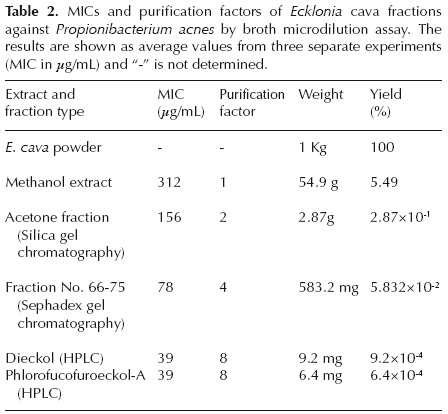
        <p align="justify"><font face="verdana" size="2">The active fraction was subjected to HPLC using an Alltima C18 reverse&#45;phase column (Alltech Inc., IL, USA). Elution was performed using a linear gradient from 30 to 100% methanol for 20 min and maintained for 20 min, yielding two peaks at t<sub>R</sub> (retention time) = 18 min (P1; 9.2 mg) and <i>t</i><sub>R</sub> = 24 min (P2; 6.4 mg). Both fractions showed marked activity against <i>Propionibacterium acnes</i> (<a href="#t2">Table 2</a>).</font></p>
    
        <p align="center"><font face="verdana" size="2"><a name="t2"></a></font></p>
        <p align="center"><font face="verdana" size="2"><img src="/img/revistas/bs/v92n3/a9t2.jpg"></font></p>
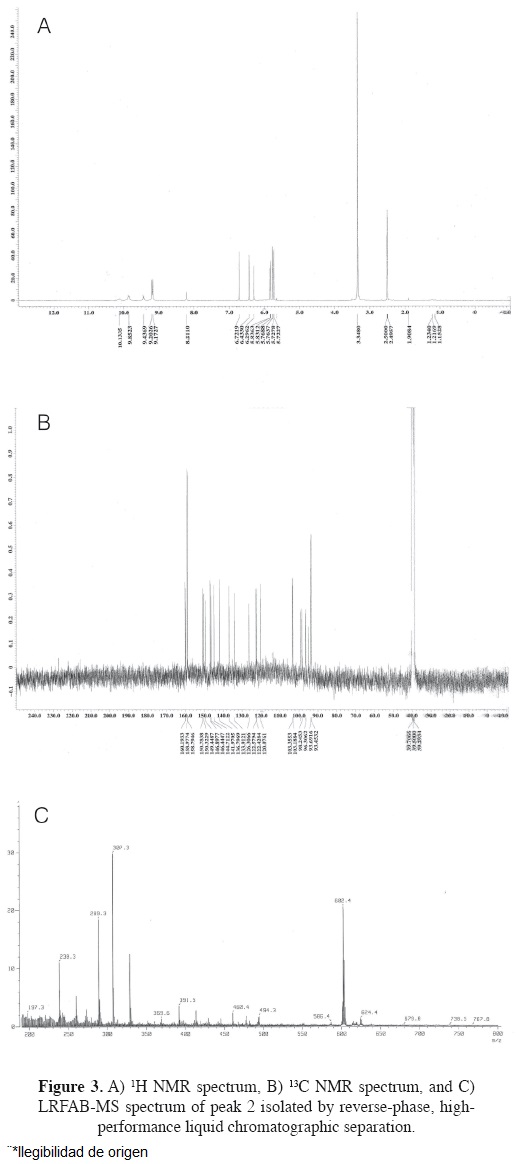
        <p align="justify"><font face="verdana" size="2"><i>Identification of antibacterial compounds.</i> The purified compounds were analyzed in a Low Resolution Mass Spectrometer JMS&#45;700 spectrometer (JEOL, Japan). The two peaks were identified as dieckol (P1) and phlorofucofuroeckol&#45;A (P2) on the basis of NMR and mass spectrophotometer data, as well as through comparison with previously reported values (<a href="/img/revistas/bs/v92n3/a9f1.jpg" target="_blank">Figures 1</a>&#45;<a href="#f3">3</a>). NMR readouts for compounds P1 and P2 were as follows:</font></p>
        <p align="justify"><font face="verdana" size="2">P1 (dieckol).&#45; light brown powder; <sup>1</sup>H NMR (DMSO&#45;d<sub>6</sub>, 400 MHz) &#948; 9.68 (1H, s, OH&#45;9), 9.58 (1H, s, OH&#45;9"), 9.48 (1H, s, OH&#45;4"), 9.43 (1H, s, OH&#45;4), 9.33 (2H, s, OH&#45;3",5") , 9.26 (1H, s, OH&#45;2"), 9.21 (1H, s, OH&#45;2), 9.19 (1H, s, OH&#45;7"), 9.14 (2H, s, OH&#45;3', 5'), 6.16 (1H, s, H&#45;3"), 6.14 (1H, s, H&#45;3), 6.02(1H, d, <i>J</i> = 3.0 Hz, H&#45;8), 5.98 (1H, d, <i>J</i> = 2.7 Hz, H&#45;8"), 5.94 (1H, s, H&#45;2'",6'"), 5.82 (1H, d, <i>J</i> = 2.7 Hz, H&#45;6), 5.81 (1H, d, <i>J</i> = 2.7 Hz, H&#45;600), 5.79 (1H, t, <i>J</i> = 2.0 Hz, H&#45;4'), 5.72 (2H, d, <i>J</i> = 2.0 Hz, H&#45;2', 6'); <sup>13</sup>C NMR (DMSO&#45;d<sub>6</sub>, 100 MHz) &#948; 122.1 (s, C&#45;1), 146.0 (s, C&#45;2), 98.2 (d, C&#45;3), 141.8 (s, C&#45;4), 123.1 (s, C&#45;4a), 142.3 (s, C&#45;5a), 93.5 (d, C&#45;6), 154.2 (s, C&#45;7), 98.0 (d, C&#45;8), 145.9 (s, C&#45;9), 123.2 (s, C&#45;9a), 137.2 (s, C&#45;10a), 160.2 (s, C&#45;1'), 93.6 (d, C&#45;2'), 158.7 (s, C&#45;3'), 96.2 (d, C&#45;4'), 158.7 (s, C&#45;5'), 93.6 (d, C&#45;6'), 122.2 (s, C&#45;1"), 145.9 (s, C&#45;2"), 98.2 (d, C&#45;3"), 141.9 (s, C&#45;4"), 123.1 (s, C&#45;4a"), 142.5 (s, C&#45;5a"), 93.8 (d, C&#45;6"), 153.0&nbsp;(s, C&#45;7"), 98.4 (d, C&#45;8"), 146.0 (s, C&#45;9"), 122.5 (s, C&#45;9a"), 137.0 (s, C&#45;10a"), 155.8 (s, C&#45;1'"), 94.4 (d, C&#45;2'"), 151.1&nbsp;(s, C&#45;3'"), 124.0 (s, C&#45;4'"), 151.1 (s, C&#45;5'"), 94.4 (d, C&#45;6'") ; LRFAB&#45;MS m/z 742.36 &#91;M&#93;+ (<a href="#f2">Figure 2</a>).</font></p>
    
        <p align="center"><font face="verdana" size="2"><a name="f2"></a></font></p>
        <p align="center"><font face="verdana" size="2"><img src="/img/revistas/bs/v92n3/a9f2.jpg"></font></p>
        ]]></body>
<body><![CDATA[<p align="center"><font face="verdana" size="2"><a name="f3"></a></font></p>
        <p align="center"><font face="verdana" size="2"><img src="/img/revistas/bs/v92n3/a9f3.jpg"></font></p>
        <p align="justify"><font face="verdana" size="2">P2 (phlorofucofuroeckol&#45;A).&#45; light brown powder; <sup>1</sup>H NMR (DMSO&#45;d<sub>6</sub>, 400 MHz) 6 10.13 (1H, s, OH&#45;14), 9.85 (1H, s, OH&#45;4), 9.85 (1H, s, OH&#45;10), 9.43 (1H, s, OH&#45;2), 9.20 (2H, s, OH&#45;3",5"), 9.17 (2H, s, OH&#45;3',5'), 8.21 (1H, s, OH&#45;8), 6.72 (1H, s, H&#45;13), 6.43 (1H, s, H&#45;9), 6.29 (1H, s, H&#45;3), 5.84 (2H, t, <i>J</i> = 2.0 Hz, H&#45;4', 4"), 5.76 (2H, d, <i>J</i> = 2.0 Hz, H&#45;2', 6'), 5.72 (2H, d, <i>J</i> = 2.0 Hz, H&#45;2", 6"); <sup>13</sup>C NMR (DMSO&#45;d<sub>6</sub>, 100 MHz) &#948; 122.5 (s, C&#45;1), 146.9 (s, C&#45;2), 98.2 (d, C&#45;3), 141.9 (s, C&#45;4), 122.5 (s, C&#45;4a), 133.9 (s, C&#45;5a), 103.1 (s, C&#45;6), 103.3 (s, C&#45;7), 146.4 (s, D&#45;8), 99.0 (d, C&#45;9), 150.3 (s, C&#45;10), 120.0 (s, C&#45;11), 149.4 (s, C&#45;11a), 150.7&nbsp;(s, C&#45;12a), 94.8 (d, C&#45;13), 144.7 (s, C&#45;14), 126.3 (s, C&#45;14a), 136.8 (s, C&#45;15a), 160.2 (s, C&#45;1'), 93.7 (s, C&#45;2'), 158.8&nbsp;(s, C&#45;3'), 96.3 (d, C&#45;4'), 158.9 (s, C&#45;5'), 93.7 (s,C&#45;6'), 159.9 (s, C&#45;1"), 93.4 (d, C&#45;2"), 158.8 (s, C&#45;3"), 96.4 (d, C&#45;4"), 158.8 (s, C&#45;5"), 93.4 (d, C&#45;6"); LRFAB&#45;MS m/z 602.38 &#91;M+H&#93;+ (<a href="#f3">Figure 3</a>).</font> </p>
        <p align="justify"><font face="verdana" size="2"><i>Antibacterial activity.</i> The MIC of the <i>Ecklonia cava</i> methanol extract against <i>Propionibacterium acnes</i> was 312 &#956;g/mL; the MIC of the acetone fraction isolated by silica gel chromatography was 156 &#956;g/mL. The MIC of fraction No. 66&#45;75 purified by Sephadex gel column chromatography was 78 &#956;g/mL. The MICs for purified dieckol and phlorofucofuroeckol&#45;A against <i>P. acnes</i> were both 39 &#956;g/mL (<a href="/img/revistas/bs/v92n3/a9t1.jpg" target="_blank">Tables 1</a>, <a href="#t2">2</a>). The yields of dieckol and phlorofucofuroeckol&#45;A from <i>Ecklonia cava</i> were 9.2&times;10<sup>4</sup>% and 6.4&times;10<sup>4</sup>%, respectively (<a href="#t2">Table 2</a>).</font></p>
        <p align="justify"><font face="verdana" size="2">&nbsp;</font></p>
        <p align="justify"><font face="verdana" size="2"><b>Discussion</b></font></p>
        <p align="justify"><font face="verdana" size="2"><i>Ecklonia cava</i> is a large, perennial brown alga (Laminariaceae) that is widely distributed throughout the subtidal regions of South Korea. Because of the economic and ecological importance of this species, it has been studied extensively (Bolton and Anderson, 1994; Wijesinghe and Jeon, 2012). <i>Ecklonia cava</i> has been used as a source of fucoidan, fucan sulfate, and phlorotannins, which have known antitumor, anticoagulant, antioxidant, and antithrombin properties (Heo <i>et al.,</i> 2005; Ahn <i>et al.,</i> 2007; Eom <i>et al.,</i> 2012; Wijesinghe and Jeon, 2012). Furthermore, <i>E. cava</i> has long been used throughout China and Korea in traditional herbal medicines for the treatment of cancer and inflammation (Xu <i>et al.,</i> 2002).</font></p>
    
        <p align="justify"><font face="verdana" size="2">Among the active compounds isolated from <i>Ecklonia cava,</i> phlorotannins are the most important. Chemical analysis of <i>E. cava</i> revealed that phlorotannins, oligomeric polyphenols of the phloroglucinol class compounds, are the main constituents responsible for the biological activity of <i>E. cava;</i> they include eckol, dieckol, bieckol and phlorofucofuroeckol&#45;A (Eom <i>et al.,</i> 2012). Structurally, phlorotannins are oligomers and polymers of 1,3,5&#45;trihydroxybenzene (phloroglucinol), which are formed via the polyketide pathway (Ragan and Glombitza, 1986; Waterman and Mole, 1994). They have shown broad therapeutic potential, including anti&#45;diabetes, antioxidation, radiation protection, anti&#45;cancer, anti&#45;HIV, and anti&#45;allergenic activities (Li <i>et al.,</i> 2011).</font></p>
    
        <p align="justify"><font face="verdana" size="2">In our previous study, <i>Ecklonia cava</i> was used as the starting material to identify compounds exhibiting unique antibacterial activities against microorganisms frequently involved in acne inflammation, such as <i>Propionibacterium acnes</i> (Choi <i>et al.,</i> 2011). In this study, we further fractioned the <i>E. cava</i> methanol extract using silica gel chromatography, Sephadex gel column chromatography, and HPLC. Fractions were then analyzed by NMR and the active components identified. Based on the Low Resolution Fast Atom Bombardment&#45;Mass Spectrometry (LRFAB&#45;MS) data, and through comparison of <sup>1</sup>H and <sup>13</sup>C NMR results in Nakamura <i>et al.</i> (1996), Fukuyama <i>et al.</i> (1990), and Kang <i>et al.</i> (2003), the active compounds were identified as dieckol and phlorofucofuroeckol&#45;A.</font></p>
        <p align="center"><font face="verdana" size="2"><img src="/img/revistas/bs/v92n3/a9f4.jpg"></font></p>
    
        ]]></body>
<body><![CDATA[<p align="justify"><font face="verdana" size="2">Dieckol and phlorofucofuroeckol&#45;A are phlorotannin derivatives of brown algae. The antibacterial activities of phlorotannins against a range of pathogenic bacteria have been demonstrated (Eom <i>et al.,</i> 2012). They showed antimicrobial effect against food&#45;borne pathogenic bacteria, antibiotic resistance bacteria, and human tinea pedis fungus. Although many studies have examined the antimicrobial activities of phlorotannins isolated from marine algae, we focused specifically on the isolation and identification of antimicrobial compounds active against acne&#45;causing bacteria. The grampositive bacterium <i>Propionibacterium acnes</i> ATCC 6919 was selected based upon its ability to cause acne. The MICs of dieckol and phlorofucofuroeckol&#45;A against <i>P. acnes</i> were both 39 &#956;g/mL.</font></p>
    
        <p align="justify"><font face="verdana" size="2">In addition to its antibacterial properties, dieckol purified from <i>Ecklonia cava</i> has been shown to exhibit fungicidal activity (MIC = 148 mg/mL) against <i>Trichophyton rubrum,</i> a causative agent of dermatophytic nail infections in humans (Lee <i>et al.,</i> 2010). Dieckol isolated from <i>E. stolonifera</i> exhibits strong anti&#45;methicillin&#45;resistant <i>Staphylococcus aureus</i> (MRSA) activity, with MICs of 32&#45;64 &#956;g/mL (Lee <i>et al.,</i> 2008).</font></p>
    
        <p align="justify"><font face="verdana" size="2">Phlorofucofuroeckol&#45;A purified from <i>Eisenia bicyclis</i> inhibits MRSA at concentrations &gt; 32&#45;64 &#956;g/mL (Eom, 2012). Phlorofucofuroeckol&#45;A purified from <i>E. kurome</i> exhibits bactericidal activity against <i>Campylobacter jejuni, Escherichia coli, Salmonella enteritidis, Salmonella typhimurium,</i> and <i>Vibrio parahaemolyticus</i> at concentrations &gt; 800.0 &#956;g/mL (Nagayama <i>et al.,</i> 2002).</font></p>
    
        <p align="justify"><font face="verdana" size="2">Structurally, phlorotannins are oligomers and polymers of 1,3,5&#45;trihydroxybenzene (phloroglucinol), which are formed via the polyketide pathway (Ragan and Glombitza, 1986; Waterman and Mole, 1994). Although the relationship between the structure and antimicrobial activity of phlorotannins is poorly understood, the physiological activity may depend on the degree of polymerization of phlorotannin derivatives (Ragan and Glombitza, 1986; Eom <i>et al.,</i> 2012). It has been reported that eckol, dieckol, bieckol, and phlorofucofuroeckol&#45;A are the most abundant phlorotannin compounds in <i>Ecklonia cava</i> (Li <i>et al.,</i> 2011). In this study, two phlorotannins, dieckol and phlorofucofuroeckol&#45;A, representing 9.2&times;10<sup>&#45;4</sup>% and 6.4&times;10<sup>&#45;4</sup>% of the methanol extract, respectively, were shown to exhibit antibacterial activity.</font></p>
    
        <p align="justify"><font face="verdana" size="2">&nbsp;</font></p>
        <p align="justify"><font face="verdana" size="2"><b>Conclusions</b></font></p>
        <p align="justify"><font face="verdana" size="2">The data suggest that phlorotannins have pronounced antimicrobial activity against acne&#45;causing bacteria. Moreover, no cytotoxic effects were observed following oral administration of phlorotannins at a dosage of 170&#45;1,500 mg/kg/day for 14 days in mice (Nagayama <i>et al.,</i> 2002). Together, these results suggest that the phlorotannins dieckol and phlorofucofuroeckol&#45;A isolated from <i>Ecklonia cava</i> could be useful antibiotic agents for both cosmetic and pharmaceutical applications.</font></p>
    
        <p align="justify"><font face="verdana" size="2">&nbsp;</font></p>
        <p align="justify"><font face="verdana" size="2"><b>Acknowledgments</b></font></p>
        <p align="justify"><font face="verdana" size="2">This research was supported by the Korea Small and Medium Business Administration (Grants No.00036130), Republic of Korea, and was also supported by the Global Healthcare Industry RIS Center, Ministry of Knowledge Economy, Republic of Korea. KKC was also supported by Gyeongnam National University of Science and Technology Grant 2012, Republic of Korea, and Priority Research Centers Program through the National Research Foundation of Korea (NRF) funded by the Ministry of Education, Science and Technology (2012&#45;006683). We are grateful to reviewers for helpful comments.</font></p>
    
        ]]></body>
<body><![CDATA[<p align="justify"><font face="verdana" size="2">&nbsp;</font></p>
        <p align="justify"><font face="verdana" size="2"><b>Literature cited</b></font></p>
        <!-- ref --><p align="justify"><font face="verdana" size="2">Ahn G.N., Kim K.N., Cha S.H., Song C.B., Lee J., Heo M.S., Yeo I.K., Lee N.H., Jee Y.H., Kim J.S., Heu M.S. and Jeon Y.J. 2007. Antioxodant activities of phlorotannins purified from <i>Ecklonia cava</i> on free radical scavenging using ESR and H<sub>2</sub>O<sub>2</sub>&#45;mediated DNA damage. <i>European Food Research and Technology</i> <b>226</b>:71&#45;79.    &nbsp;&nbsp;&nbsp;&nbsp;&nbsp;&nbsp;&nbsp;&nbsp;[&#160;<a href="javascript:void(0);" onclick="javascript: window.open('/scielo.php?script=sci_nlinks&ref=1777842&pid=S2007-4298201400030000900001&lng=','','width=640,height=500,resizable=yes,scrollbars=1,menubar=yes,');">Links</a>&#160;]<!-- end-ref --></font></p>
    
        <!-- ref --><p align="justify"><font face="verdana" size="2">Bolton J.J. and Anderson R.J. 1994. <i>Ecklonia.</i> In: Akatsuka I. Ed. <i>Biology of Economic Algae,</i> pp. 385&#45;406, SPB Academic Publishing, The Hague.    &nbsp;&nbsp;&nbsp;&nbsp;&nbsp;&nbsp;&nbsp;&nbsp;[&#160;<a href="javascript:void(0);" onclick="javascript: window.open('/scielo.php?script=sci_nlinks&ref=1777844&pid=S2007-4298201400030000900002&lng=','','width=640,height=500,resizable=yes,scrollbars=1,menubar=yes,');">Links</a>&#160;]<!-- end-ref --></font></p>
    
        <!-- ref --><p align="justify"><font face="verdana" size="2">Choi J.S., Bae H.J., Kim S.J. and Choi I.S. 2011. <i>In vitro</i> antibacterial and anti&#45;inflammatory properties of seaweed extracts against acne inducing bacteria, <i>Propionibacterium acnes. Journal of Environmental Biology</i> <b>32</b>:313&#45;318.    &nbsp;&nbsp;&nbsp;&nbsp;&nbsp;&nbsp;&nbsp;&nbsp;[&#160;<a href="javascript:void(0);" onclick="javascript: window.open('/scielo.php?script=sci_nlinks&ref=1777846&pid=S2007-4298201400030000900003&lng=','','width=640,height=500,resizable=yes,scrollbars=1,menubar=yes,');">Links</a>&#160;]<!-- end-ref --></font></p>
    
        <!-- ref --><p align="justify"><font face="verdana" size="2">Chomnawang M.T., Surassmo S., Nukoolkarn V.S. and Gritsanapan W. 2005. Antimicrobial effects of Thai medicinal plants against acne&#45;inducing bacteria. <i>Journal of Ethnopharmacology</i> <b>101</b>:330&#45;333.    &nbsp;&nbsp;&nbsp;&nbsp;&nbsp;&nbsp;&nbsp;&nbsp;[&#160;<a href="javascript:void(0);" onclick="javascript: window.open('/scielo.php?script=sci_nlinks&ref=1777848&pid=S2007-4298201400030000900004&lng=','','width=640,height=500,resizable=yes,scrollbars=1,menubar=yes,');">Links</a>&#160;]<!-- end-ref --></font></p>
    
        ]]></body>
<body><![CDATA[<!-- ref --><p align="justify"><font face="verdana" size="2">Eady E.A. 1998. Bacterial resistance in acne. <i>Dermatology</i> <b>196</b>:59&#45;66.    &nbsp;&nbsp;&nbsp;&nbsp;&nbsp;&nbsp;&nbsp;&nbsp;[&#160;<a href="javascript:void(0);" onclick="javascript: window.open('/scielo.php?script=sci_nlinks&ref=1777850&pid=S2007-4298201400030000900005&lng=','','width=640,height=500,resizable=yes,scrollbars=1,menubar=yes,');">Links</a>&#160;]<!-- end-ref --></font></p>
    
        <!-- ref --><p align="justify"><font face="verdana" size="2">Eom S.H. 2012. Anti&#45;MRSA (methicillin&#45;resistant <i>Staphylococcus aureus)</i> substance isolated from <i>Eisenia bicyclis</i> and its action mechanism. Ph.D. Dissertation, Pukyong National University, Busan. 45 pp.    &nbsp;&nbsp;&nbsp;&nbsp;&nbsp;&nbsp;&nbsp;&nbsp;[&#160;<a href="javascript:void(0);" onclick="javascript: window.open('/scielo.php?script=sci_nlinks&ref=1777852&pid=S2007-4298201400030000900006&lng=','','width=640,height=500,resizable=yes,scrollbars=1,menubar=yes,');">Links</a>&#160;]<!-- end-ref --></font></p>
    
        <!-- ref --><p align="justify"><font face="verdana" size="2">Eom S.H., Kim Y.M. and Kim S.K. 2012. Antimicrobial effect of phlorotannins from marine brown algae. <i>Food and Chemical Toxicology</i> <b>50</b>:3251&#45;3255.    &nbsp;&nbsp;&nbsp;&nbsp;&nbsp;&nbsp;&nbsp;&nbsp;[&#160;<a href="javascript:void(0);" onclick="javascript: window.open('/scielo.php?script=sci_nlinks&ref=1777854&pid=S2007-4298201400030000900007&lng=','','width=640,height=500,resizable=yes,scrollbars=1,menubar=yes,');">Links</a>&#160;]<!-- end-ref --></font></p>
    
        <!-- ref --><p align="justify"><font face="verdana" size="2">Fukuyama Y., Kodama M., Miura I., KinZyo Z., Mori H., Nakayama Y. and Takahashi M.1990. Anti&#45;plasmin inhibitor. VI. Structure of phlorofucofuroeckol A, a novel phlorotannin with both dibenzo&#45;1,4&#45;dioxin and dibenzofuran elements, from <i>Ecklonia kurome</i> OKAMURA. <i>Chemical and Pharmaceutical Bulletin</i> <b>38</b>:133&#45;135.    &nbsp;&nbsp;&nbsp;&nbsp;&nbsp;&nbsp;&nbsp;&nbsp;[&#160;<a href="javascript:void(0);" onclick="javascript: window.open('/scielo.php?script=sci_nlinks&ref=1777856&pid=S2007-4298201400030000900008&lng=','','width=640,height=500,resizable=yes,scrollbars=1,menubar=yes,');">Links</a>&#160;]<!-- end-ref --></font></p>
    
        <!-- ref --><p align="justify"><font face="verdana" size="2">Heo S.J., Park P.J., Park E.J., Kim S.K. and Jeon Y.J. 2005. Antioxidant activity of enzymatic extracts from a brown seaweed <i>Ecklonia cava</i> by electron spin resonance spectrometry and comet assay. <i>European Food Research and Technology</i> <b>221</b>:41&#45;47.    &nbsp;&nbsp;&nbsp;&nbsp;&nbsp;&nbsp;&nbsp;&nbsp;[&#160;<a href="javascript:void(0);" onclick="javascript: window.open('/scielo.php?script=sci_nlinks&ref=1777858&pid=S2007-4298201400030000900009&lng=','','width=640,height=500,resizable=yes,scrollbars=1,menubar=yes,');">Links</a>&#160;]<!-- end-ref --></font></p>
    
        ]]></body>
<body><![CDATA[<!-- ref --><p align="justify"><font face="verdana" size="2">Kang H.S., Chung H.Y., Jung J.H., Son B.W. and Choi J.S. 2003. A new phlorotannin from the brown alga <i>Ecklonia stolonifera. Chemical and Pharmaceutical Bulletin</i> <b>51</b>:1012&#45;1014.    &nbsp;&nbsp;&nbsp;&nbsp;&nbsp;&nbsp;&nbsp;&nbsp;[&#160;<a href="javascript:void(0);" onclick="javascript: window.open('/scielo.php?script=sci_nlinks&ref=1777860&pid=S2007-4298201400030000900010&lng=','','width=640,height=500,resizable=yes,scrollbars=1,menubar=yes,');">Links</a>&#160;]<!-- end-ref --></font></p>
    
        <!-- ref --><p align="justify"><font face="verdana" size="2">Jappe U. 2003. Pathological mechanisms of acne with special emphasis on <i>Propionibacterium acnes</i> and related therapy. <i>Acta Dermato&#45;Venereologica</i> <b>83</b>:241&#45;248.    &nbsp;&nbsp;&nbsp;&nbsp;&nbsp;&nbsp;&nbsp;&nbsp;[&#160;<a href="javascript:void(0);" onclick="javascript: window.open('/scielo.php?script=sci_nlinks&ref=1777862&pid=S2007-4298201400030000900011&lng=','','width=640,height=500,resizable=yes,scrollbars=1,menubar=yes,');">Links</a>&#160;]<!-- end-ref --></font></p>
    
        <!-- ref --><p align="justify"><font face="verdana" size="2">Lee M.H., Lee K.B., Oh S.M., Lee B.H. and Chee H.Y. 2010. Anti&#45;fungal activities of dieckol isolated from the marine brown alga <i>Ecklonia cava</i> against <i>Trichophyton rubrum. Journal of the Korean Society for Applied Biological Chemistry</i> <b>53</b>:504&#45;507.    &nbsp;&nbsp;&nbsp;&nbsp;&nbsp;&nbsp;&nbsp;&nbsp;[&#160;<a href="javascript:void(0);" onclick="javascript: window.open('/scielo.php?script=sci_nlinks&ref=1777864&pid=S2007-4298201400030000900012&lng=','','width=640,height=500,resizable=yes,scrollbars=1,menubar=yes,');">Links</a>&#160;]<!-- end-ref --></font></p>
    
        <!-- ref --><p align="justify"><font face="verdana" size="2">Lee D.S., Kang M.S., Hwang H.J., Eom S.H., Yang J.Y., Lee M.S., Lee W.J., Jeon Y.J., Choi J.S. and Kim Y.M. 2008. Synergistic effect between dieckol from <i>Ecklonia stolonifera</i> and &szlig;&#45;lactams against methicillin&#45;resistant <i>Staphylococcus aureus. Biotechnology and Bioprocess Engineering</i> <b>13</b>:758&#45;764.    &nbsp;&nbsp;&nbsp;&nbsp;&nbsp;&nbsp;&nbsp;&nbsp;[&#160;<a href="javascript:void(0);" onclick="javascript: window.open('/scielo.php?script=sci_nlinks&ref=1777866&pid=S2007-4298201400030000900013&lng=','','width=640,height=500,resizable=yes,scrollbars=1,menubar=yes,');">Links</a>&#160;]<!-- end-ref --></font></p>
    
        <!-- ref --><p align="justify"><font face="verdana" size="2">Li Y.X., Wijesekara I., Li Y. and Kim S.K. 2011. Phlorotannins as bioactive agents from brown algae. <i>Process Biochemistry</i> <b>46</b>:2219&#45;2224.    &nbsp;&nbsp;&nbsp;&nbsp;&nbsp;&nbsp;&nbsp;&nbsp;[&#160;<a href="javascript:void(0);" onclick="javascript: window.open('/scielo.php?script=sci_nlinks&ref=1777868&pid=S2007-4298201400030000900014&lng=','','width=640,height=500,resizable=yes,scrollbars=1,menubar=yes,');">Links</a>&#160;]<!-- end-ref --></font></p>
    
        ]]></body>
<body><![CDATA[<!-- ref --><p align="justify"><font face="verdana" size="2">Nagayama K., Iwamura Y., Shibata T., Hirayama I. and Nakamura T. 2002. Bactericidal activity of phlorotannins from the brown alga <i>Ecklonia kurome. Antimicrobial Agents and Chemotherapy </i><b>50</b>:889&#45;893.    &nbsp;&nbsp;&nbsp;&nbsp;&nbsp;&nbsp;&nbsp;&nbsp;[&#160;<a href="javascript:void(0);" onclick="javascript: window.open('/scielo.php?script=sci_nlinks&ref=1777870&pid=S2007-4298201400030000900015&lng=','','width=640,height=500,resizable=yes,scrollbars=1,menubar=yes,');">Links</a>&#160;]<!-- end-ref --></font></p>
    
        <!-- ref --><p align="justify"><font face="verdana" size="2">Nakamura T., Nagayama K., Uchida K. and Tanaka R. 1996. Antioxidant activity of phlorotannins isolated from brown alga <i>Ei&#45;senia bicyclis. Fisheries Science</i> <b>62</b>:923&#45;926.    &nbsp;&nbsp;&nbsp;&nbsp;&nbsp;&nbsp;&nbsp;&nbsp;[&#160;<a href="javascript:void(0);" onclick="javascript: window.open('/scielo.php?script=sci_nlinks&ref=1777872&pid=S2007-4298201400030000900016&lng=','','width=640,height=500,resizable=yes,scrollbars=1,menubar=yes,');">Links</a>&#160;]<!-- end-ref --></font></p>
    
        <!-- ref --><p align="justify"><font face="verdana" size="2">NCCLS. National Committee for Clinical Laboratory Standards. 2004. <i>Methods for antimicrobial susceptibility testing of anaerobic bacteria.</i> NCCLS Document M11&#45;A6, NCCLS, Wayne.    &nbsp;&nbsp;&nbsp;&nbsp;&nbsp;&nbsp;&nbsp;&nbsp;[&#160;<a href="javascript:void(0);" onclick="javascript: window.open('/scielo.php?script=sci_nlinks&ref=1777874&pid=S2007-4298201400030000900017&lng=','','width=640,height=500,resizable=yes,scrollbars=1,menubar=yes,');">Links</a>&#160;]<!-- end-ref --></font></p>
    
        <!-- ref --><p align="justify"><font face="verdana" size="2">Park J., Lee J., Jung E., Park Y., Kim K., Park B., Jung K., Park E., Kim J. and Park D. 2004. <i>In vitro</i> antibacterial and anti&#45;inlammatory effects of honokiol and magnolol against <i>Propionibacterium</i> sp. <i>European Journal of Pharmacology</i> <b>496</b>:189&#45;195.    &nbsp;&nbsp;&nbsp;&nbsp;&nbsp;&nbsp;&nbsp;&nbsp;[&#160;<a href="javascript:void(0);" onclick="javascript: window.open('/scielo.php?script=sci_nlinks&ref=1777876&pid=S2007-4298201400030000900018&lng=','','width=640,height=500,resizable=yes,scrollbars=1,menubar=yes,');">Links</a>&#160;]<!-- end-ref --></font></p>
    
        <!-- ref --><p align="justify"><font face="verdana" size="2">Ragan M.A. and Glombitza K.W. 1986. Phlorotannins, brown algal polyphenols. In: Round F.E. and Chapman D.J. Eds. <i>Progress in Psychological Research Vol. 4,</i> pp. 129&#45;241, Biopress Ltd., Bristol.    &nbsp;&nbsp;&nbsp;&nbsp;&nbsp;&nbsp;&nbsp;&nbsp;[&#160;<a href="javascript:void(0);" onclick="javascript: window.open('/scielo.php?script=sci_nlinks&ref=1777878&pid=S2007-4298201400030000900019&lng=','','width=640,height=500,resizable=yes,scrollbars=1,menubar=yes,');">Links</a>&#160;]<!-- end-ref --></font></p>
    
        ]]></body>
<body><![CDATA[<!-- ref --><p align="justify"><font face="verdana" size="2">Swanson J.K. 2003. Antibiotic resistance of <i>Propionibacterium acnes</i> in acne vulgaris. <i>Dermatology Nursing</i> <b>15</b>:359&#45;362.    &nbsp;&nbsp;&nbsp;&nbsp;&nbsp;&nbsp;&nbsp;&nbsp;[&#160;<a href="javascript:void(0);" onclick="javascript: window.open('/scielo.php?script=sci_nlinks&ref=1777880&pid=S2007-4298201400030000900020&lng=','','width=640,height=500,resizable=yes,scrollbars=1,menubar=yes,');">Links</a>&#160;]<!-- end-ref --></font></p>
    
        <!-- ref --><p align="justify"><font face="verdana" size="2">Waterman P.G. and Mole S. 1994. <i>Analysis of Phenolic Plant Metabolites.</i> Blackwell Scientific Publications, Oxford.    &nbsp;&nbsp;&nbsp;&nbsp;&nbsp;&nbsp;&nbsp;&nbsp;[&#160;<a href="javascript:void(0);" onclick="javascript: window.open('/scielo.php?script=sci_nlinks&ref=1777882&pid=S2007-4298201400030000900021&lng=','','width=640,height=500,resizable=yes,scrollbars=1,menubar=yes,');">Links</a>&#160;]<!-- end-ref --></font></p>
    
        <!-- ref --><p align="justify"><font face="verdana" size="2">Wijesinghe W.A.J.P. and Jeon Y.J. 2012. Exploiting biological activities of brown seaweed <i>Ecklonia cava</i> for potential industrial applications: a review. <i>International Journal of Food Sciences and Nutrition</i> <b>63</b>:225&#45;235.    &nbsp;&nbsp;&nbsp;&nbsp;&nbsp;&nbsp;&nbsp;&nbsp;[&#160;<a href="javascript:void(0);" onclick="javascript: window.open('/scielo.php?script=sci_nlinks&ref=1777884&pid=S2007-4298201400030000900022&lng=','','width=640,height=500,resizable=yes,scrollbars=1,menubar=yes,');">Links</a>&#160;]<!-- end-ref --></font></p>
    
        <!-- ref --><p align="justify"><font face="verdana" size="2">Xu N., Fan X., Han L., Lin W. and Zeng C. 2002. Study on the antibacterial activities of the ethanol extracts of seaweed. <i>Oceanologia et Limnologia Sinica</i> <b>33</b>:265&#45;270.    &nbsp;&nbsp;&nbsp;&nbsp;&nbsp;&nbsp;&nbsp;&nbsp;[&#160;<a href="javascript:void(0);" onclick="javascript: window.open('/scielo.php?script=sci_nlinks&ref=1777886&pid=S2007-4298201400030000900023&lng=','','width=640,height=500,resizable=yes,scrollbars=1,menubar=yes,');">Links</a>&#160;]<!-- end-ref --></font></p>
    
        <!-- ref --><p align="justify"><font face="verdana" size="2">Zu Y., Yu H., Liang L., Fu Y., Efferth T., Liu X. and Wu N. 2010. Activities of ten essential oils towards <i>Propionibacterium acnes</i> and PC&#45;3, A&#45;549 and MCF&#45;7 cancer cells. <i>Molecules</i> <b>15</b>:3200&#45;3210.    &nbsp;&nbsp;&nbsp;&nbsp;&nbsp;&nbsp;&nbsp;&nbsp;[&#160;<a href="javascript:void(0);" onclick="javascript: window.open('/scielo.php?script=sci_nlinks&ref=1777888&pid=S2007-4298201400030000900024&lng=','','width=640,height=500,resizable=yes,scrollbars=1,menubar=yes,');">Links</a>&#160;]<!-- end-ref --></font></p>

    ]]></body>
<body><![CDATA[ ]]></body><back>
<ref-list>
<ref id="B1">
<nlm-citation citation-type="journal">
<person-group person-group-type="author">
<name>
<surname><![CDATA[Ahn]]></surname>
<given-names><![CDATA[G.N.]]></given-names>
</name>
<name>
<surname><![CDATA[Kim]]></surname>
<given-names><![CDATA[K.N.]]></given-names>
</name>
<name>
<surname><![CDATA[Cha]]></surname>
<given-names><![CDATA[S.H.]]></given-names>
</name>
<name>
<surname><![CDATA[Song]]></surname>
<given-names><![CDATA[C.B.]]></given-names>
</name>
<name>
<surname><![CDATA[Lee]]></surname>
<given-names><![CDATA[J.]]></given-names>
</name>
<name>
<surname><![CDATA[Heo]]></surname>
<given-names><![CDATA[M.S.]]></given-names>
</name>
<name>
<surname><![CDATA[Yeo]]></surname>
<given-names><![CDATA[I.K.]]></given-names>
</name>
<name>
<surname><![CDATA[Lee]]></surname>
<given-names><![CDATA[N.H.]]></given-names>
</name>
<name>
<surname><![CDATA[Jee]]></surname>
<given-names><![CDATA[Y.H.]]></given-names>
</name>
<name>
<surname><![CDATA[Kim]]></surname>
<given-names><![CDATA[J.S.]]></given-names>
</name>
<name>
<surname><![CDATA[Heu]]></surname>
<given-names><![CDATA[M.S.]]></given-names>
</name>
<name>
<surname><![CDATA[Jeon]]></surname>
<given-names><![CDATA[Y.J.]]></given-names>
</name>
</person-group>
<article-title xml:lang="en"><![CDATA[Antioxodant activities of phlorotanninspurified from Ecklonia cava on free radical scavenging using ESR and H2O2-mediatedDNA damage]]></article-title>
<source><![CDATA[EuropeanFood Research and Technology]]></source>
<year>2007</year>
<volume>226</volume>
<page-range>71-79</page-range></nlm-citation>
</ref>
<ref id="B2">
<nlm-citation citation-type="book">
<person-group person-group-type="author">
<name>
<surname><![CDATA[Bolton]]></surname>
<given-names><![CDATA[J.J.]]></given-names>
</name>
<name>
<surname><![CDATA[Anderson]]></surname>
<given-names><![CDATA[R.J.]]></given-names>
</name>
</person-group>
<person-group person-group-type="editor">
<name>
<surname><![CDATA[Akatsuka]]></surname>
<given-names><![CDATA[I.]]></given-names>
</name>
</person-group>
<source><![CDATA[Biology of Economic Algae]]></source>
<year>1994</year>
<page-range>385-406</page-range><publisher-loc><![CDATA[TheHague ]]></publisher-loc>
<publisher-name><![CDATA[SPBAcademic Publishing]]></publisher-name>
</nlm-citation>
</ref>
<ref id="B3">
<nlm-citation citation-type="journal">
<person-group person-group-type="author">
<name>
<surname><![CDATA[Choi]]></surname>
<given-names><![CDATA[J.S.]]></given-names>
</name>
<name>
<surname><![CDATA[Bae]]></surname>
<given-names><![CDATA[H.J.]]></given-names>
</name>
<name>
<surname><![CDATA[Kim]]></surname>
<given-names><![CDATA[S.J.]]></given-names>
</name>
<name>
<surname><![CDATA[Choi]]></surname>
<given-names><![CDATA[I.S.]]></given-names>
</name>
</person-group>
<article-title xml:lang="en"><![CDATA[In vitro antibacterial andanti-inflammatory properties of seaweed extracts against acne inducingbacteria, Propionibacterium acnes]]></article-title>
<source><![CDATA[Journalof Environmental Biology]]></source>
<year>2011</year>
<volume>32</volume>
<page-range>313-318</page-range></nlm-citation>
</ref>
<ref id="B4">
<nlm-citation citation-type="journal">
<person-group person-group-type="author">
<name>
<surname><![CDATA[Chomnawang]]></surname>
<given-names><![CDATA[M.T.]]></given-names>
</name>
<name>
<surname><![CDATA[Surassmo]]></surname>
<given-names><![CDATA[S.]]></given-names>
</name>
<name>
<surname><![CDATA[Nukoolkarn]]></surname>
<given-names><![CDATA[V.S.]]></given-names>
</name>
<name>
<surname><![CDATA[Gritsanapan]]></surname>
<given-names><![CDATA[W.]]></given-names>
</name>
</person-group>
<article-title xml:lang="en"><![CDATA[Antimicrobial effects of Thai medicinalplants against acne-inducing bacteria]]></article-title>
<source><![CDATA[Journalof Ethnopharmacology]]></source>
<year>2005</year>
<volume>101</volume>
<page-range>330-333</page-range></nlm-citation>
</ref>
<ref id="B5">
<nlm-citation citation-type="journal">
<person-group person-group-type="author">
<name>
<surname><![CDATA[Eady]]></surname>
<given-names><![CDATA[E.A.]]></given-names>
</name>
</person-group>
<article-title xml:lang="en"><![CDATA[Bacterial resistance in acne]]></article-title>
<source><![CDATA[Dermatology]]></source>
<year>1998</year>
<volume>196</volume>
<page-range>59-66</page-range></nlm-citation>
</ref>
<ref id="B6">
<nlm-citation citation-type="">
<person-group person-group-type="author">
<name>
<surname><![CDATA[Eom]]></surname>
<given-names><![CDATA[S.H.]]></given-names>
</name>
</person-group>
<source><![CDATA[Anti-MRSA (methicillin-resistant Staphylococcusaureus) substance isolated from Eisenia bicyclis and its actionmechanism]]></source>
<year>2012</year>
<page-range>45</page-range></nlm-citation>
</ref>
<ref id="B7">
<nlm-citation citation-type="journal">
<person-group person-group-type="author">
<name>
<surname><![CDATA[Eom]]></surname>
<given-names><![CDATA[S.H.]]></given-names>
</name>
<name>
<surname><![CDATA[Kim]]></surname>
<given-names><![CDATA[Y.M.]]></given-names>
</name>
<name>
<surname><![CDATA[Kim]]></surname>
<given-names><![CDATA[S.K.]]></given-names>
</name>
</person-group>
<article-title xml:lang="en"><![CDATA[Antimicrobial effect of phlorotannins frommarine brown algae]]></article-title>
<source><![CDATA[Food andChemical Toxicology]]></source>
<year>2012</year>
<volume>50</volume>
<page-range>3251-3255</page-range></nlm-citation>
</ref>
<ref id="B8">
<nlm-citation citation-type="journal">
<person-group person-group-type="author">
<name>
<surname><![CDATA[Fukuyama]]></surname>
<given-names><![CDATA[Y.]]></given-names>
</name>
<name>
<surname><![CDATA[Kodama]]></surname>
<given-names><![CDATA[M.]]></given-names>
</name>
<name>
<surname><![CDATA[Miura]]></surname>
<given-names><![CDATA[I.]]></given-names>
</name>
<name>
<surname><![CDATA[KinZyo]]></surname>
<given-names><![CDATA[Z.]]></given-names>
</name>
<name>
<surname><![CDATA[Mori]]></surname>
<given-names><![CDATA[H.]]></given-names>
</name>
<name>
<surname><![CDATA[Nakayama]]></surname>
<given-names><![CDATA[Y.]]></given-names>
</name>
<name>
<surname><![CDATA[Takahashi]]></surname>
<given-names><![CDATA[M.]]></given-names>
</name>
</person-group>
<article-title xml:lang="en"><![CDATA[Anti-plasmin inhibitor. VI. Structure ofphlorofucofuroeckol A, a novel phlorotannin with both dibenzo-1,4-dioxin anddibenzofuran elements, from Ecklonia kurome OKAMURA]]></article-title>
<source><![CDATA[Chemicaland Pharmaceutical Bulletin]]></source>
<year>1990</year>
<volume>38</volume>
<page-range>133-135</page-range></nlm-citation>
</ref>
<ref id="B9">
<nlm-citation citation-type="journal">
<person-group person-group-type="author">
<name>
<surname><![CDATA[Heo]]></surname>
<given-names><![CDATA[S.J.]]></given-names>
</name>
<name>
<surname><![CDATA[Park]]></surname>
<given-names><![CDATA[P.J.]]></given-names>
</name>
<name>
<surname><![CDATA[Park]]></surname>
<given-names><![CDATA[E.J.]]></given-names>
</name>
<name>
<surname><![CDATA[Kim]]></surname>
<given-names><![CDATA[S.K.]]></given-names>
</name>
<name>
<surname><![CDATA[Jeon]]></surname>
<given-names><![CDATA[Y.J.]]></given-names>
</name>
</person-group>
<article-title xml:lang="en"><![CDATA[Antioxidant activity of enzymatic extractsfrom a brown seaweed Ecklonia cava by electron spin resonancespectrometry and comet assay]]></article-title>
<source><![CDATA[EuropeanFood Research and Technology]]></source>
<year>2005</year>
<volume>221</volume>
<page-range>41-47</page-range></nlm-citation>
</ref>
<ref id="B10">
<nlm-citation citation-type="journal">
<person-group person-group-type="author">
<name>
<surname><![CDATA[Kang]]></surname>
<given-names><![CDATA[H.S.]]></given-names>
</name>
<name>
<surname><![CDATA[Chung]]></surname>
<given-names><![CDATA[H.Y.]]></given-names>
</name>
<name>
<surname><![CDATA[Jung]]></surname>
<given-names><![CDATA[J.H.]]></given-names>
</name>
<name>
<surname><![CDATA[Son]]></surname>
<given-names><![CDATA[B.W.]]></given-names>
</name>
<name>
<surname><![CDATA[Choi]]></surname>
<given-names><![CDATA[J.S.]]></given-names>
</name>
</person-group>
<source><![CDATA[Chemicaland Pharmaceutical Bulletin]]></source>
<year>2003</year>
<volume>51</volume>
<page-range>1012-1014</page-range></nlm-citation>
</ref>
<ref id="B11">
<nlm-citation citation-type="journal">
<person-group person-group-type="author">
<name>
<surname><![CDATA[Jappe]]></surname>
<given-names><![CDATA[U.]]></given-names>
</name>
</person-group>
<article-title xml:lang="en"><![CDATA[Pathological mechanisms of acne withspecial emphasis on Propionibacterium acnes and related therapy]]></article-title>
<source><![CDATA[ActaDermato-Venereologica]]></source>
<year>2003</year>
<volume>83</volume>
<page-range>241-248</page-range></nlm-citation>
</ref>
<ref id="B12">
<nlm-citation citation-type="journal">
<person-group person-group-type="author">
<name>
<surname><![CDATA[Lee]]></surname>
<given-names><![CDATA[M.H.]]></given-names>
</name>
<name>
<surname><![CDATA[Lee]]></surname>
<given-names><![CDATA[K.B.]]></given-names>
</name>
<name>
<surname><![CDATA[Oh]]></surname>
<given-names><![CDATA[S.M.]]></given-names>
</name>
<name>
<surname><![CDATA[Lee]]></surname>
<given-names><![CDATA[B.H.]]></given-names>
</name>
<name>
<surname><![CDATA[Chee]]></surname>
<given-names><![CDATA[H.Y.]]></given-names>
</name>
</person-group>
<article-title xml:lang="en"><![CDATA[Anti-fungal activities of dieckol isolatedfrom the marine brown alga Ecklonia cava against Trichophyton rubrum]]></article-title>
<source><![CDATA[Journalof the Korean Society for Applied Biological Chemistry]]></source>
<year>2010</year>
<volume>53</volume>
<page-range>504-507</page-range></nlm-citation>
</ref>
<ref id="B13">
<nlm-citation citation-type="journal">
<person-group person-group-type="author">
<name>
<surname><![CDATA[Lee]]></surname>
<given-names><![CDATA[D.S.]]></given-names>
</name>
<name>
<surname><![CDATA[Kang]]></surname>
<given-names><![CDATA[M.S.]]></given-names>
</name>
<name>
<surname><![CDATA[Hwang]]></surname>
<given-names><![CDATA[H.J.]]></given-names>
</name>
<name>
<surname><![CDATA[Eom]]></surname>
<given-names><![CDATA[S.H.]]></given-names>
</name>
<name>
<surname><![CDATA[Yang]]></surname>
<given-names><![CDATA[J.Y.]]></given-names>
</name>
<name>
<surname><![CDATA[Lee]]></surname>
<given-names><![CDATA[M.S.]]></given-names>
</name>
<name>
<surname><![CDATA[Lee]]></surname>
<given-names><![CDATA[W.J.]]></given-names>
</name>
<name>
<surname><![CDATA[Jeon]]></surname>
<given-names><![CDATA[Y.J.]]></given-names>
</name>
<name>
<surname><![CDATA[Choi]]></surname>
<given-names><![CDATA[J.S.]]></given-names>
</name>
<name>
<surname><![CDATA[Kim]]></surname>
<given-names><![CDATA[Y.M.]]></given-names>
</name>
</person-group>
<article-title xml:lang="en"><![CDATA[Synergistic effect between dieckol from Eckloniastolonifera and ß-lactams against methicillin-resistant Staphylococcusaureus]]></article-title>
<source><![CDATA[Biotechnologyand Bioprocess Engineering]]></source>
<year>2008</year>
<volume>13</volume>
<page-range>758-764</page-range></nlm-citation>
</ref>
<ref id="B14">
<nlm-citation citation-type="journal">
<person-group person-group-type="author">
<name>
<surname><![CDATA[Li]]></surname>
<given-names><![CDATA[Y.X.]]></given-names>
</name>
<name>
<surname><![CDATA[Wijesekara]]></surname>
<given-names><![CDATA[I.]]></given-names>
</name>
<name>
<surname><![CDATA[Li]]></surname>
<given-names><![CDATA[Y.]]></given-names>
</name>
<name>
<surname><![CDATA[Kim]]></surname>
<given-names><![CDATA[S.K.]]></given-names>
</name>
</person-group>
<article-title xml:lang="en"><![CDATA[Phlorotannins as bioactive agents frombrown algae]]></article-title>
<source><![CDATA[ProcessBiochemistry]]></source>
<year>2011</year>
<volume>46</volume>
<page-range>2219-2224</page-range></nlm-citation>
</ref>
<ref id="B15">
<nlm-citation citation-type="journal">
<person-group person-group-type="author">
<name>
<surname><![CDATA[Nagayama]]></surname>
<given-names><![CDATA[K.]]></given-names>
</name>
<name>
<surname><![CDATA[Iwamura]]></surname>
<given-names><![CDATA[Y.]]></given-names>
</name>
<name>
<surname><![CDATA[Shibata]]></surname>
<given-names><![CDATA[T.]]></given-names>
</name>
<name>
<surname><![CDATA[Hirayama]]></surname>
<given-names><![CDATA[I.]]></given-names>
</name>
<name>
<surname><![CDATA[Nakamura]]></surname>
<given-names><![CDATA[T.]]></given-names>
</name>
</person-group>
<article-title xml:lang="en"><![CDATA[Bactericidal activity of phlorotannins fromthe brown alga Ecklonia kurome]]></article-title>
<source><![CDATA[AntimicrobialAgents and Chemotherapy]]></source>
<year>2002</year>
<volume>50</volume>
<page-range>889-893</page-range></nlm-citation>
</ref>
<ref id="B16">
<nlm-citation citation-type="journal">
<person-group person-group-type="author">
<name>
<surname><![CDATA[Nakamura]]></surname>
<given-names><![CDATA[T.]]></given-names>
</name>
<name>
<surname><![CDATA[Nagayama]]></surname>
<given-names><![CDATA[K.]]></given-names>
</name>
<name>
<surname><![CDATA[Uchida]]></surname>
<given-names><![CDATA[K.]]></given-names>
</name>
<name>
<surname><![CDATA[Tanaka]]></surname>
<given-names><![CDATA[R.]]></given-names>
</name>
</person-group>
<article-title xml:lang="en"><![CDATA[Antioxidant activity of phlorotanninsisolated from brown alga Ei-senia bicyclis]]></article-title>
<source><![CDATA[FisheriesScience]]></source>
<year>1996</year>
<volume>62</volume>
<page-range>923-926</page-range></nlm-citation>
</ref>
<ref id="B17">
<nlm-citation citation-type="book">
<collab>NationalCommittee for Clinical Laboratory Standards</collab>
<source><![CDATA[Methods for antimicrobial susceptibilitytesting of anaerobic bacteria]]></source>
<year>2004</year>
<publisher-loc><![CDATA[Wayne ]]></publisher-loc>
<publisher-name><![CDATA[NCCLS]]></publisher-name>
</nlm-citation>
</ref>
<ref id="B18">
<nlm-citation citation-type="journal">
<person-group person-group-type="author">
<name>
<surname><![CDATA[Park]]></surname>
<given-names><![CDATA[J.]]></given-names>
</name>
<name>
<surname><![CDATA[Lee]]></surname>
<given-names><![CDATA[J.]]></given-names>
</name>
<name>
<surname><![CDATA[Jung]]></surname>
<given-names><![CDATA[E.]]></given-names>
</name>
<name>
<surname><![CDATA[Park]]></surname>
<given-names><![CDATA[Y.]]></given-names>
</name>
<name>
<surname><![CDATA[Kim]]></surname>
<given-names><![CDATA[K.]]></given-names>
</name>
<name>
<surname><![CDATA[Park]]></surname>
<given-names><![CDATA[B.]]></given-names>
</name>
<name>
<surname><![CDATA[Jung]]></surname>
<given-names><![CDATA[K.]]></given-names>
</name>
<name>
<surname><![CDATA[Park]]></surname>
<given-names><![CDATA[E.]]></given-names>
</name>
<name>
<surname><![CDATA[Kim]]></surname>
<given-names><![CDATA[J.]]></given-names>
</name>
<name>
<surname><![CDATA[Park]]></surname>
<given-names><![CDATA[D.]]></given-names>
</name>
</person-group>
<article-title xml:lang="en"><![CDATA[In vitro antibacterial andanti-inlammatory effects of honokiol and magnolol against Propionibacteriumsp]]></article-title>
<source><![CDATA[EuropeanJournal of Pharmacology]]></source>
<year>2004</year>
<volume>496</volume>
<page-range>189-195</page-range></nlm-citation>
</ref>
<ref id="B19">
<nlm-citation citation-type="book">
<person-group person-group-type="author">
<name>
<surname><![CDATA[Ragan]]></surname>
<given-names><![CDATA[M.A.]]></given-names>
</name>
<name>
<surname><![CDATA[Glombitza]]></surname>
<given-names><![CDATA[K.W.]]></given-names>
</name>
</person-group>
<article-title xml:lang="en"><![CDATA[Phlorotannins, brown algal polyphenols]]></article-title>
<person-group person-group-type="editor">
<name>
<surname><![CDATA[Round]]></surname>
<given-names><![CDATA[F.E.]]></given-names>
</name>
<name>
<surname><![CDATA[Chapman]]></surname>
<given-names><![CDATA[D.J.]]></given-names>
</name>
</person-group>
<source><![CDATA[Progress in Psychological Research]]></source>
<year>1986</year>
<volume>4</volume>
<page-range>129-241</page-range><publisher-loc><![CDATA[Bristol ]]></publisher-loc>
<publisher-name><![CDATA[BiopressLtd.]]></publisher-name>
</nlm-citation>
</ref>
<ref id="B20">
<nlm-citation citation-type="journal">
<person-group person-group-type="author">
<name>
<surname><![CDATA[Swanson]]></surname>
<given-names><![CDATA[J.K.]]></given-names>
</name>
</person-group>
<article-title xml:lang="en"><![CDATA[Antibiotic resistance of Propionibacteriumacnes in acne vulgaris]]></article-title>
<source><![CDATA[DermatologyNursing]]></source>
<year>2003</year>
<volume>15</volume>
<page-range>359-362</page-range></nlm-citation>
</ref>
<ref id="B21">
<nlm-citation citation-type="book">
<person-group person-group-type="author">
<name>
<surname><![CDATA[Waterman]]></surname>
<given-names><![CDATA[P.G.]]></given-names>
</name>
<name>
<surname><![CDATA[Mole]]></surname>
<given-names><![CDATA[S.]]></given-names>
</name>
</person-group>
<source><![CDATA[Analysis of Phenolic Plant Metabolites]]></source>
<year>1994</year>
<publisher-loc><![CDATA[Oxford ]]></publisher-loc>
<publisher-name><![CDATA[BlackwellScientific Publications]]></publisher-name>
</nlm-citation>
</ref>
<ref id="B22">
<nlm-citation citation-type="journal">
<person-group person-group-type="author">
<name>
<surname><![CDATA[Wijesinghe]]></surname>
<given-names><![CDATA[W.A.J.P.]]></given-names>
</name>
<name>
<surname><![CDATA[Jeon]]></surname>
<given-names><![CDATA[Y.J.]]></given-names>
</name>
</person-group>
<article-title xml:lang="en"><![CDATA[Exploiting biological activities of brownseaweed Ecklonia cava for potential industrial applications: a review]]></article-title>
<source><![CDATA[InternationalJournal of Food Sciences and Nutrition]]></source>
<year>2012</year>
<volume>63</volume>
<page-range>225-235</page-range></nlm-citation>
</ref>
<ref id="B23">
<nlm-citation citation-type="journal">
<person-group person-group-type="author">
<name>
<surname><![CDATA[Xu]]></surname>
<given-names><![CDATA[N.]]></given-names>
</name>
<name>
<surname><![CDATA[Fan]]></surname>
<given-names><![CDATA[X.]]></given-names>
</name>
<name>
<surname><![CDATA[Han]]></surname>
<given-names><![CDATA[L.]]></given-names>
</name>
<name>
<surname><![CDATA[Lin]]></surname>
<given-names><![CDATA[W.]]></given-names>
</name>
<name>
<surname><![CDATA[Zeng]]></surname>
<given-names><![CDATA[C.]]></given-names>
</name>
</person-group>
<article-title xml:lang="en"><![CDATA[Study on the antibacterial activities ofthe ethanol extracts of seaweed]]></article-title>
<source><![CDATA[Oceanologiaet Limnologia Sinica]]></source>
<year>2002</year>
<volume>33</volume>
<page-range>265-270</page-range></nlm-citation>
</ref>
<ref id="B24">
<nlm-citation citation-type="journal">
<person-group person-group-type="author">
<name>
<surname><![CDATA[Zu]]></surname>
<given-names><![CDATA[Y.]]></given-names>
</name>
<name>
<surname><![CDATA[Yu]]></surname>
<given-names><![CDATA[H.]]></given-names>
</name>
<name>
<surname><![CDATA[Liang]]></surname>
<given-names><![CDATA[L.]]></given-names>
</name>
<name>
<surname><![CDATA[Fu]]></surname>
<given-names><![CDATA[Y.]]></given-names>
</name>
<name>
<surname><![CDATA[Efferth]]></surname>
<given-names><![CDATA[T.]]></given-names>
</name>
<name>
<surname><![CDATA[Liu]]></surname>
<given-names><![CDATA[X.]]></given-names>
</name>
<name>
<surname><![CDATA[Wu]]></surname>
<given-names><![CDATA[N.]]></given-names>
</name>
</person-group>
<article-title xml:lang="en"><![CDATA[Activities of ten essential oils towards Propionibacteriumacnes and PC-3, A-549 and MCF-7 cancer cells]]></article-title>
<source><![CDATA[Molecules]]></source>
<year>2010</year>
<volume>15</volume>
<page-range>3200-3210</page-range></nlm-citation>
</ref>
</ref-list>
</back>
</article>